
TH-AC 190 Kit - Compressor EINHELL - Free user manual and instructions
Find the device manual for free TH-AC 190 Kit EINHELL in PDF.


| Product Type | Compressor |
| Brand | Einhell |
| Model | TH-AC 190 Kit |
| Power Supply | 230 V ~ 50 Hz |
| Motor Power | 1500 W (estimated) |
| Max. Pressure | 8 bar (116 psi) |
| Free Air Delivery | 190 L/min (estimated) |
| Tank Capacity | 6 L (estimated) |
| Operating Mode | S3 15% (10 min cycle) |
| Noise Level | 97 dB(A) (typical) |
| Weight | 12 kg (estimated) |
| Dimensions (L x W x H) | 40 x 30 x 35 cm (estimated) |
| Protection Class | IP20 |
| Safety Features | Thermal overload protection, safety valve, pressure switch |
| Proper Use | Generating compressed air for pneumatic tools and tire inflation |
| Maintenance | Clean with moist cloth and soft soap; store in dry place |
| Spare Parts Availability | Order via manufacturer service center (www.isc-gmbh.info) |
| Included Accessories | Tire inflation gauge, adapter set (a-c), blow-out nozzle (d), compressed air hose with quick-lock coupling |
Frequently Asked Questions - TH-AC 190 Kit EINHELL
User questions about TH-AC 190 Kit EINHELL
0 question about this device. Answer the ones you know or ask your own.
Ask a new question about this device
Download the instructions for your Compressor in PDF format for free! Find your manual TH-AC 190 Kit - EINHELL and take your electronic device back in hand. On this page are published all the documents necessary for the use of your device. TH-AC 190 Kit by EINHELL.
USER MANUAL TH-AC 190 Kit EINHELL
GB Original operating instructions Compressor
8


South America
-2-
E

6.2 Interruptor ON/OFF (4)
Caution - Read the operating instructions to reduce the risk of inquiry

Wear ear-muffs. The impact of noise can cause damage to hearing.

Beware of electrical voltage!

Beware of hot parts!

Warning! The equipment is remote-controlled and may start-up without warning
GB
⚠️ Important!
When using the equipment, a few safety precautions must be observed to avoid injuries and damage. Please read the complete operating instructions and safety regulations with due care. Keep this manual in a safe place, so that the information is available at all times. If you give the equipment to any other person, hand over these operating instructions and safety regulations as well. We cannot accept any liability for damage or accidents which arise due to a failure to follow these instructions and the safety instructions.
1. Safety regulations
Caution!
Read all safety regulations and instructions. Any errors made in following the safety regulations and instructions may result in an electric shock, fi re and/or serious injury.
Keep all safety regulations and instructions in a safe place for future use.
This appliance is not intended for use by persons (including children) with reduced physical, sensory or mental capabilities, or lack of experience and knowledge, unless they have been given supervision or instruction concerning use of the appliance by a person responsible for their safety. Children should be supervised to ensure that they do not play with the appliance.
⚠️ Important! The following basic safety actions must be taken when using this compressor in order to protect the user from electric shocks and the risk of injury and fire. Read and follow these instructions before using the equipment.
- Keep your work area tidy
Untidy work areas can result in accidents.
• Check the ambient conditions
Do not expose the compressor to rain. Never use the compressor in damp or wet locations. There is a risk of electric shock! Provide good lighting. Do not use the compressor near flammable liquids or gases. There is a risk of explosion! - Protect yourself against electric shocks Avoid bodily contact with earthed parts, e.g. pipes, radiators, cookers and refrigerators.
- Keep children away!
Do not allow other persons to touch the com-
pressor or cable, keep them away from your work area.
- Keep your compressor in a safe place When unused, the compressor must be stored in a dry, locked room out of children's reach.
- Do not overload your compressor It will run better and safer within its quoted capacity range.
• Wear suitable work clothes
Never wear loose fitting clothes or jewellery. They may get caught in moving parts. Rubber gloves and non-slip shoes are recommended when working outdoors. Wear a hair net if you have long hair. Risk of injury!
- Do not use the cable for purposes other than that for which it is designed
Do not carry the compressor by its cable and do not use the cable to pull the plug out of the socket. Protect the cable from heat, oil and sharp edges. The cable/plug could become damaged.
• Take care of your compressor
Keep your compressor clean in order to work well and safely. Follow the maintenance instructions. Check the power plug and cable on a regular basis and have them replaced by an authorized specialist if they are damaged. Check the extension cable regularly and replace it if damaged.
• Pull out the power plug
When not in use and before carrying out any maintenance work.
- Avoid unintentional starting
Make sure that the switch is turned off when connecting to the power supply.
- When using an extension cable outdoors Check that it is approved for outdoor duty and is marked accordingly.
- Be alert at all times
Watch what you are doing. Use common sense when working. Never use the compressor when you are distracted.
- Check your compressor for damage Before using the compressor again, carefully check the safety devices and any slightly damaged parts to ensure that they are in good working order. Check that the moving parts are working correctly, that they do not jam, and that no parts are damaged. Make sure that all parts are fitted correctly to ensure that the equipment remains safe to use. Unless otherwise stated in the operating instructions, damaged guards and parts have to be
GB
repaired or replaced by a customer service workshop. Damaged switches have to be replaced by a customer service workshop. Never use an electric power tool with a switch that cannot be turned on and off.
- Important!
For your own safety you must only use the accessories and additional units listed in the operating instructions or recommended or specified by the manufacturer. The use of mounted tools or accessories other than those recommended in the operating instructions or catalog may place your personal safety at risk.
- Leave all repairs to a qualified electrician Repairs must be left strictly to qualified electricians or the user might suffer an accident.
Noise
Wear ear muffs when you use the compressor.
• Replacing the power cable
To prevent hazards, leave the replacement of damaged power cables strictly to the manufacturer or a qualified electrician. There is a risk of electric shock!
• Inflating tires
Directly after inflating tires, check the pressure with a suitable pressure gauge, for example at your filling station.
- Roadworthy compressors for building site operations
Make sure that all lines and fittings are suitable for the maximum permissible operating pressure of the compressor.
• Place of installation
Set up the compressor on an even surface.
Safety instructions for working with compressed air and blasting guns
- The compressor pump and lines can become very hot during operation. Touching these parts will burn you.
- The air which is sucked in by the compressor must be kept free of impurities that could cause fires or explosions in the compressor pump.
- When releasing the hose coupling, hold the hose coupling piece with your hand. This way, you can protect yourself against injury from the rebounding hose.
- Wear safety goggles when working with the blow-out pistol. Foreign bodies or blown off parts can easily cause injuries.
- Do not blow at people with the blow-out pistol and do not clean clothes while being worn.
Risk of injury!
Safety information for paint spraying
- Do not process any paints or solvents with a flash point below 55°C. There is a risk of explosion!
- Do not heat up paints or solvents. There is a risk of explosion!
- If hazardous liquids are processed, wear protective filter units (face guards). Also, adhere to the safety information provided by the manufacturers of such liquids.
- The details and designations of the Ordinance on Hazardous Substances, which are displayed on the outer packaging of the processed material, must be observed. Additional protective measures are to be undertaken if necessary, particularly the wearing of suitable clothing and masks.
- Do not smoke during the spraying process and/or in the work area. There is a risk of explosion! Paint vapors are easily combustible.
- Never set up or operate the equipment in the vicinity of a fire place, open lights or sparking machines.
- Do not store or eat food and drink in the work area. Paint vapors are harmful to your health.
- The work area must exceed 30 m ^2 and sufficient ventilation must be ensured during spraying and drying. Do not spray against the wind. Always adhere to the regulations of the local police authority when spraying combustible or hazardous materials.
- Do not process media such as white spirit, butyl alcohol and methylene chloride with the PVC pressure hose. These media will destroy the pressure hose.
2. Layout and items supplied
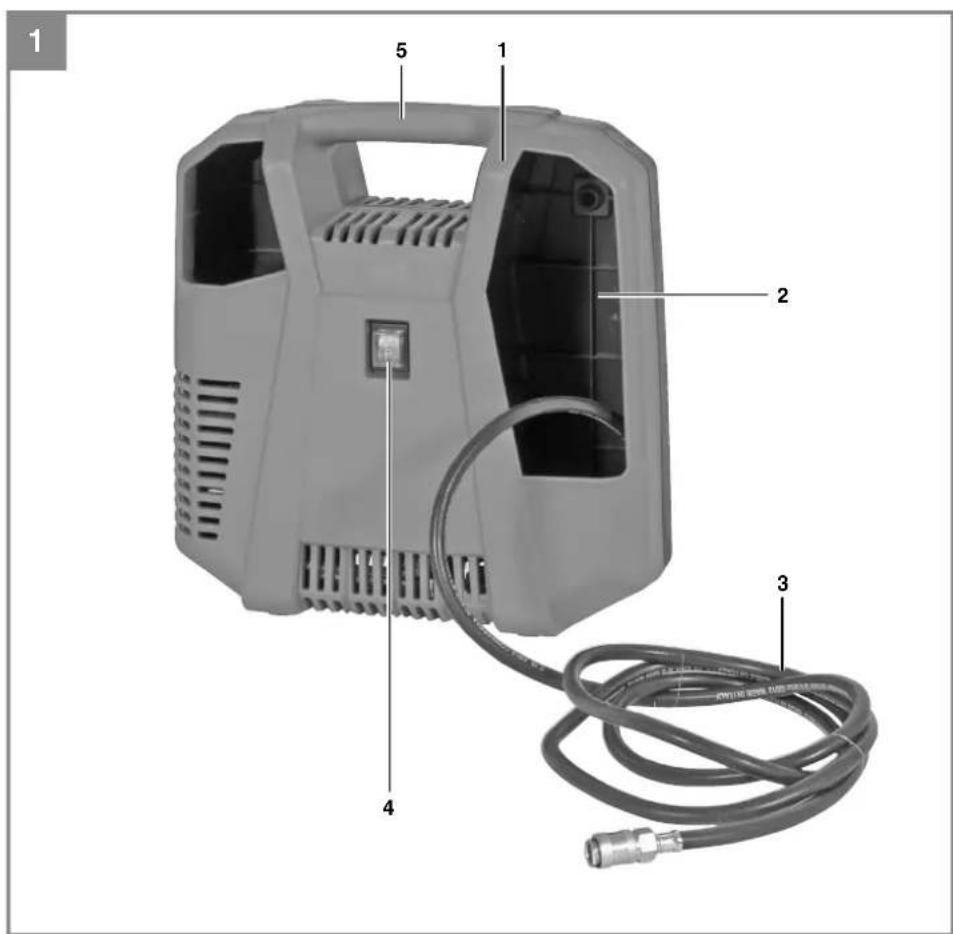
2.1 Layout (Fig. 1-3)
- Housing
- Accessory compartment
- Compressed air hose with quick-lock coupling
- On/Off switch
- Transport handle
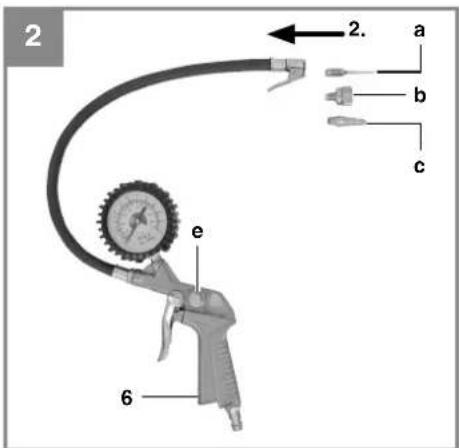
- Tire inflation meter
a-c Adapter set.
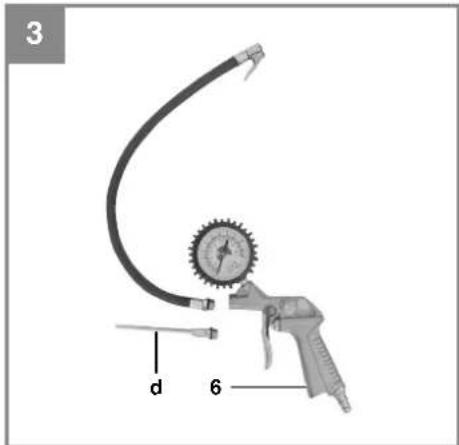
d Blow-out adapter
GB
2.2 Items supplied
Please check that the article is complete as specified in the scope of delivery. If parts are missing, please contact our service center or the sales outlet where you made your purchase at the latest within 5 working days after purchasing the product and upon presentation of a valid bill of purchase. Also, refer to the warranty table in the service information at the end of the operating instructions.
- Open the packaging and take out the equipment with care.
- Remove the packaging material and any packaging and/or transportation braces (if available).
- Check to see if all items are supplied.
- Inspect the equipment and accessories for transport damage.
- If possible, please keep the packaging until the end of the guarantee period.
Important!
The equipment and packaging material are not toys. Do not let children play with plastic bags, foils or small parts. There is a danger of swallowing or suff ocating!
- Compressor
• Tire inflation meter - Adapter set (a,b,c)
• Adapter/ blow-out nozzle (d)
• Original operating instructions
3. Proper use
The compressor is designed to generate compressed air for compressed air driven tools.
The equipment is to be used only for its prescribed purpose. Any other use is deemed to be a case of misuse. The user / operator and not the manufacturer will be liable for any damage or injuries of any kind caused as a result of this.
Please note that our equipment has not been designed for use in commercial, trade or industrial applications. Our warranty will be voided if the machine is used in commercial, trade or industrial businesses or for equivalent purposes.
4. Technical data
See warranty card of your country.
Noise
The noise emission values were measured in accordance with EN ISO 3744.
Operating mode S3 - 15% - 10min: S3 = Intermittent mode without influencing the starting process. This means that during a period of 10 min the max. operating time is 15% (1.5 min).
5. Before starting the equipment
Before you connect the equipment to the power supply make sure that the data on the rating plate are identical to the supply voltage.
- Check the equipment for damage which may have occurred in transit. Report any damage immediately to the transport company which was used to deliver the compressor.
• Install the compressor in the vicinity of the point of consumption. - Avoid long air lines and supply lines (extension cables).
• Make sure that the intake air is dry and dust-free. - Do not install the compressor in a damp or wet room.
- The compressor may only be used in suitable rooms (with good ventilation and an ambient temperature from +5 °C to 40 °C). There must be no dust, acids, vapors, explosive gases or inflammable gases in the room.
- The compressor is designed to be used in dry rooms. It is prohibited to use the compressor in areas where work is conducted with sprayed water.
- Operate the equipment only on a firm, level surface.
- During operation place the compressor on the rubber feet on the compressor rear wheel.
- Important! When you switch off the compressor, excess air will escape at the safety valve. This is not a fault, but arises in connection with the equipment's construction.
GB
6. Assembly and starting
⚠️ Important!
You must fully assemble the appliance before using it for the first time.
6.1. Power supply
Before you use the machine, make sure that the mains voltage complies with the specifications on the rating plate. Long supply cables, extensions, cable reels etc. cause a drop in voltage and can impede motor start-up. At low temperatures below +5°C, sluggishness may make starting difficult or impossible.
6.2 On/Off switch (4)
To switch on the equipment set the On/Off switch (4) to position 1. Move the On/Off switch (4) to position 0 to switch off the equipment.
6.3 Compressed air hose with quick-lock coupling (3)
Connecting:
Insert the nipple of the air tool into the quick-lock coupling, the sleeve will spring forward automatically.
Disconnecting:
Pull back the sleeve and remove the tool. Important! When releasing the quick-lock coupling, be sure to hold the coupling piece to protect yourself against injury from the rebounding hose.
6.4 Tire pressure gauge with adapters (Fig. 2/Item 6)
Working pressure in bar: 0-8/0-0,8 MPa
Range of applications:
The tire pressure gauge allows you to inflate tires easily and exactly. Use the pressure gauge to check the tire pressure. If the tire pressure is too high, you can reduce the pressure with the integrated relief valve (e).
After fi lling with air, please check the set tire pressure with a calibrated gauge, for example at a petrol station. The tire pressure gauge comes with a valve adapter for car tire valves. Other valve types can be fi lled using the supplied adapters (a - c).
Using the equipment as a blow-out pistol (Fig. 3)
To use the tire pressure gauge as a blow-out pistol you must first unscrew and remove the hose with the valve adapter for care tires. Now the blow-out adapter (d) can be screwed to the tire pressure gauge.
Range of applications:
For cleaning and blowing out hollow spaces or hard-to-reach areas, as well as for cleaning soiled equipment. The infinitely variable trigger lever allows an exact dosing of compressed air.
GB
7. Cleaning, maintenance and ordering of spare parts
⚠️ Important!
Pull the power plug before doing any cleaning and maintenance work on the appliance.
⚠️ Important!
Wait until the compressor has completely cooled down. Risk of burns!
⚠️ Important!
After use, always switch off the equipment immediately and pull out the power plug.
7.1 Cleaning
- Keep all safety devices, air vents and the motor housing free of dirt and dust as far as possible. Wipe the equipment with a clean cloth or blow it with compressed air at low pressure.
• We recommend that you clean the device immediately each time you have finished using it. - Clean the equipment regularly with a moist cloth and some soft soap. Do not use cleaning agents or solvents; these could attack the plastic parts of the equipment. Ensure that no water can seep into the device. The ingress of water into an electric tool increases the risk of an electric shock.
- You must disconnect the hose and any spraying tools from the compressor before cleaning. Do not clean the compressor with water, solvents or the like.
7.2 Storage
⚠️ Important!
Pull the mains plug out of the socket and ventilate the appliance and all connected pneumatic tools. Switch off the compressor and make sure that it is secured in such a way that it cannot be started up again by any unauthorized person.
⚠️ Important!
Store the compressor only in a dry location which is not accessible to unauthorized persons. Always store upright, never tilted!
7.3 Ordering replacement parts:
Please quote the following data when ordering replacement parts:
• Type of machine
• Article number of the machine
• Identification number of the machine
- Replacement part number of the part required For our latest prices and information please go to www.isc-gmbh.info
8. Disposal and recycling
The equipment is supplied in packaging to prevent it from being damaged in transit. The raw materials in this packaging can be reused or recycled. The equipment and its accessories are made of various types of material, such as metal and plastic. Never place defective equipment in your household refuse. The equipment should be taken to a suitable collection center for proper disposal. If you do not know the whereabouts of such a collection point, you should ask in your local council offices.
9. Possible causes of failure
| Problem Cause Solution | ||
| Thecompressor does not start. | 1. No supply voltage.2. Insufficient supply voltage.3. Outside temperature is too low.4. Motor is overheated. | 1. Check the supply voltage, the power plug and the socket-outlet.2. Make sure that the extension cable is not too long. Use an extension cable with large enough wires.3. Never operate with an outside temperature of below +5°C.4. Allow the motor to cool down. If necessary, remedy the cause of the overheating. |
| Thecompressor starts but there is no pressure. | 1. The non-return valve leaks.2. The seals are damaged. | 1. Have a service center replace the non-return valve.2. Check the seals and have any damaged seals replaced by a service center. |
| Thecompressor starts, pressure is shown on the pressure gauge, but the tools do not start. | 1. The hose connections have a leak.2. A quick-lock coupling has a leak. | 1. Check the compressed air hose and tools and replace if necessary.2. Check the quick-lock coupling and replace if necessary. |
AR


- E
- Interruptor ON/OFF (4)
- GB
- ⚠️ Important!
- Safety regulations
- Caution!
- - Important!
- Noise
- • Replacing the power cable
- • Inflating tires
- - Roadworthy compressors for building site operations
- • Place of installation
- Safety instructions for working with compressed air and blasting guns
- Risk of injury!
- Safety information for paint spraying
- Layout and items supplied
- Layout (Fig. 1-3)
- Items supplied
- Important!
- Proper use
- Technical data
- Before starting the equipment
- Assembly and starting
- Power supply
- On/Off switch (4)
- Compressed air hose with quick-lock coupling (3)
- Connecting:
- Disconnecting:
- Tire pressure gauge with adapters (Fig. 2/Item 6)
- Working pressure in bar: 0-8/0-0,8 MPa
- Range of applications:
- Using the equipment as a blow-out pistol (Fig. 3)
- Cleaning, maintenance and ordering of spare parts
- Cleaning
- Storage
- Ordering replacement parts:
- Disposal and recycling
- Possible causes of failure
- AR
Brand : EINHELL
Model : TH-AC 190 Kit
Category : Compressor