
INE-Z928HD - DVD player ALPINE - Free user manual and instructions
Find the device manual for free INE-Z928HD ALPINE in PDF.


| Product Type | DVD Player with GPS Navigation System |
| Brand | Alpine |
| Model | INE-Z928HD |
| Display | Touchscreen with split-screen capability |
| Navigation Features | On-road and off-road navigation, address input, POI search, route planning with multiple waypoints, lane guidance, junction view, traffic information (TMC), speed limit warnings, green routing |
| Map Coverage | United States, Canada, Mexico (preloaded maps) |
| GPS Receiver | Built-in with 2D/3D positioning, Lock-on-Road technology |
| Audio Integration | Compatible with Alpine audio system, split-screen for map and audio |
| Voice Guidance | Natural voice and TTS options, multiple languages |
| Safety Features | Warnings: speed limit exceed, driver alerts, caution for use while driving |
| Storage | microSD card slot for pictures and data |
| Power Supply | Vehicle battery (12V DC) |
| Weight | Approximately 1.5 kg (estimated) |
| Dimensions | Standard DIN size: 178 x 100 x 150 mm (estimated) |
| Maintenance | Keep screen clean with soft cloth; avoid liquids; update maps via SD card |
| Warranty | See manufacturer documentation |
| Compatible Media | DVD, CD, USB (via Alpine media), microSD |
Frequently Asked Questions - INE-Z928HD ALPINE
User questions about INE-Z928HD ALPINE
0 question about this device. Answer the ones you know or ask your own.
Ask a new question about this device
Download the instructions for your DVD player in PDF format for free! Find your manual INE-Z928HD - ALPINE and take your electronic device back in hand. On this page are published all the documents necessary for the use of your device. INE-Z928HD by ALPINE.
USER MANUAL INE-Z928HD ALPINE
Navigation software for the Alpine
INE-S920HD/INE-Z928HD/INE-NAV-30/INE-NAV-38
US English (EN)
Thank you for choosing the Alpine unit as your navigator. Start using your device right away. This document is the detailed description of the navigation software. You can easily discover the software while you are using it; however, we still recommend that you read this manual to fully understand the screens and features.
Table of contents
1 Warnings and Safety information 6
2 Getting started....7
2.1 Buttons and other controls on the screen 8
2.1.1 Using keyboards....9
2.1.2 Beyond single screen tap....10
2.2 Map screen.... 11
2.2.1 Navigating on the map....11
2.2.2 Position markers....14
2.2.2.1 Vehimarker and Lock-on-Road.... 14
2.2.2.2 Selected map location (Cursor) and selected map object.... 14
2.2.3 Objects on the map....14
2.2.3.1 Streets and roads.... 14
2.2.3.2 Turn preview and Next street....15
2.2.3.3 Lane information and Signposts....16
2.2.3.4 Junction view....16
2.2.3.5 Freeway exit services....17
2.2.3.6 3D object types....17
2.2.3.7 Elements of the active route....18
2.2.3.8 Traffic events....18
2.2.4 Manipulating the map 19
2.2.5 Checking the details of the current position (Where Am I?)....21
2.3 Navigation menu 22
3 On-road navigation 23
3.1 Selecting the destination of a route 23
3.1.1 Entering an address or a part of the address....23
3.1.1.1 Entering an address (United States)....24
3.1.1.2 Entering an address (Canada)....26
3.1.1.3 Entering an address (Mexico)....28
3.1.1.4 Entering an address starting with the street name (in the United States only).... 30
3.1.1.5 Entering the midpoint of a street as the destination.... 32
3.1.1.6 Selecting an intersection as the destination 33
3.1.1.7 Selecting a city/town center as the destination.... 35
3.1.1.8 Entering an address with a ZIP code 36
3.1.1.9 Tips on entering addresses quickly.... 38
3.1.2 Selecting the destination from the Places of Interest 39
3.1.2.1 Quick search for a Place of Interest.... 39
3.1.2.2 Searching for a Place of Interest using preset categories 40
3.1.2.3 Searching for a Place of Interest by category....42
3.1.2.4 Searching for a Place of Interest by name 45
3.1.3 Using the free form search....48
3.1.4 Selecting a map location as the destination....49
3.1.5 Selecting the destination from your Address Book....50
3.1.6 Selecting a recent destination from the History ....51
3.1.7 Entering the coordinate of the destination .....52
3.1.8 Navigate to a location stored in a picture....53
3.1.9 Building a route from the list of destinations (Create Route) 54
3.2 Viewing the entire route on the map....55
3.3 Modifying the route 55
3.3.1 Selecting a new destination when already having a route: New Route, Waypoint or Final Destination .. 55
3.3.2 Setting a new starting position for the route ....56
3.3.3 Editing the list of destinations (Edit Route)....57
3.3.4 Canceling the active route....58
3.3.5 Checking route alternatives....58
3.4 Saving a location as an Address Book entry.... 59
3.5 Saving a location as an alert point....60
3.6 Editing an alert point....60
3.7 Watching the simulation of the route....61
4 Off-road navigation....63
4.1 Selecting the destination of the route 63
4.2 Navigating in off-road mode....63
5 Reference Guide 64
5.1 Concepts 64
5.1.1 Smart Zoom 64
5.1.2 Route calculation and recalculation ....64
5.1.3 Green routing....66
5.1.4 Speed limit warning....67
5.1.5 Traffic information in route planning 67
5.1.5.1 Historical traffic....67
5.1.5.2 Real-time traffic information (TMC) (INE-Z928HD/INE-NAV-38 only)....67
5.2 Information menu....69
5.3 Settings menu 70
5.3.1 Sound and Warnings....72
5.3.2 Traffic settings 74
5.3.3 Route settings....74
5.3.4 Map settings....78
5.3.5 Visual guidance settings....79
5.3.6 Regional settings....81
5.3.7 Trip monitor settings....81
5.4 Trip monitor....82
6 Glossary 83
7 Copyright note....85
1 Warnings and Safety information
The navigation system helps you find your way to your destination with a connected GPS receiver. The software does not transmit your GPS position; others cannot track you.
It is important that you look at the display only when it is safe to do so. If you are the driver of the vehicle, we recommend that you operate your software before you start your journey. Plan the route before your departure and stop if you need to change the route.
You must obey the traffic signs and follow the road geometry. If you deviate from the recommended route, your software changes the instructions accordingly.
2 Getting started
When using the navigation software for the first time, an initial setup process starts automatically. Do as follows:
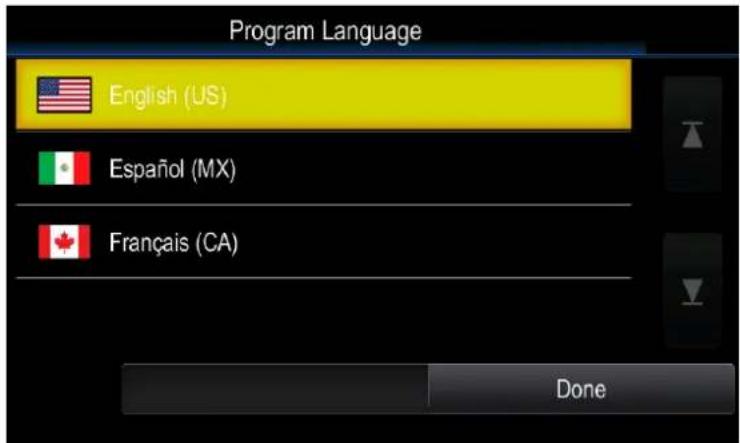
- Select the written language of the application interface. Later you can change it in Regional settings (page 81).
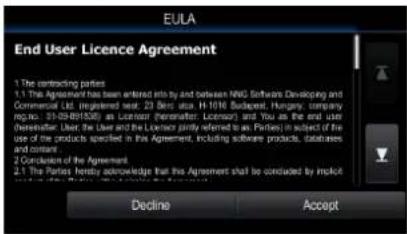
- Read the End User License Agreement. Tap


-
The Configuration wizard starts. Tap
-
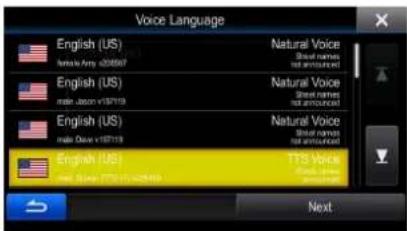
Select the language and speaker used for voice guidance messages. Later you can change it in Sound and Warnings settings (page 81).
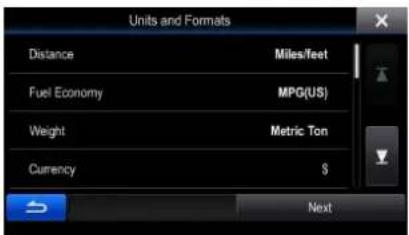
- If needed, modify the time format and unit settings. Later you can change them in Regional settings (page 81).
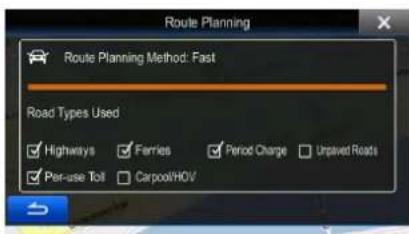
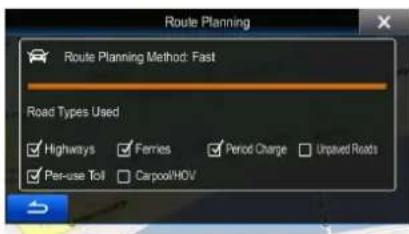
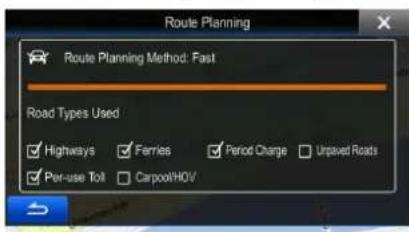
- If needed, modify the default route planning options. Later you can change them in Route settings (page 74).
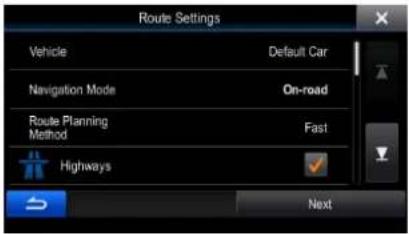
- The initial setup is now complete. The Configuration wizard can be restarted later from the Settings menu (page 70).
After the initial setup, the Map screen appears and you can start using the software.
2.1 Buttons and other controls on the screen
When you are using the software, you usually tap buttons on the touch screen.
You only need to confirm selections or changes if the application needs to restart, it needs to perform a major reconfiguration, or you are about to lose some of your data or settings. Otherwise, the software saves your selections and applies the new settings without confirmation as soon as you use the controls.
| Type | Example | Description | How to use it |
| Button |  | Tap it to initiate a function, to open a new screen, or to set a parameter. | Tap it once. |
| Button with value |  | Some buttons display the current value of a field or setting. Tap the button to change the value. After the change, the new value is shown on the button. | Tap it once. |
| Icon |  | Shows status information. | Some icons also function as a button. Tap them once. |
| List | 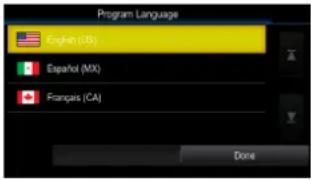 | When you need to select from several options, they appear in a list. | Grab the list anywhere and slide your finger up or down. Depending on the speed of the sliding, the list will scroll fast or slow, only a bit or till the end. Alternatively, move between pages with the   buttons and tap the value that you want. buttons and tap the value that you want. |
| Radio button |  | When there are only a few choices, radio buttons may be used instead of lists. Only one value can be selected. | Tap one of the buttons to select a new value. |
| Switch |  | When there are only two choices, a checkmark shows whether the feature is enabled. | Tap it to turn the switch on or off. |
| Slider | 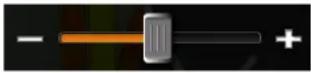 | When a feature can be set to different values in a range, the software shows an indicator on a gauge that displays and sets the value. | Drag the handle to move the slider to its new position.Tap the slider where you want the handle to appear; the thumb jumps there. |
| Virtual keyboard | 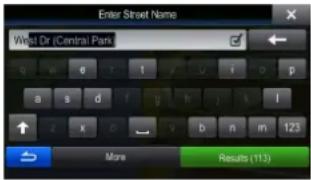 | Alphabetic and alphanumeric keyboards to enter text and numbers. | Each key is a touch screen button. |
2.1.1 Using keyboards
You only need to enter letters or numbers when you cannot avoid it. You can type with your fingertips on the full-screen keyboards and you can switch between various keyboard layouts, for example English, Greek or numerical.
| Task | Instruction | |
| Switching to another keyboard layout, for example from an English keyboard to a Greek keyboard | Tap the  from the list. from the list. | button and select the new keyboard layout |
| Correcting your entry on the keyboard |  Tap move the unneeded character(s).Tap and hold the button to delete several characters or the entire input string. Tap move the unneeded character(s).Tap and hold the button to delete several characters or the entire input string. |
| Entering a space, for example between a first name and a family name or in multi-word street names | Tap the  n at the bottom center of the screen. n at the bottom center of the screen. |
| Entering upper and lower case letters | When entering a text, the first character appears in upper case while the rest of the text is in lower case. Tap letter an upper case letter or tap twice to turn on Caps Lock. Tap again and lower case letters return. |
| Entering symbols |  Tap to switch to a keyboard offering numeric and symbol characters. Tap to switch to a keyboard offering numeric and symbol characters. |
| Finalizing the keyboard entry (accepting the suggested search result) | Tap  |
| Finalizing the keyboard entry (opening the list of search results) | Tap  |
| Finalizing the keyboard entry (saving your input) | Tap  |
| Canceling the keyboard entry (returning to the previous screen) | Tap  |
2.1.2 Beyond single screen tap
You usually need to tap the screen only once. However, some useful features can be accessed with combined touch screen tapping. Those are the following:
| Action | Details |
| Tapping and holding the screen | Tap and keep pressing the following buttons to reach extra functions:      Tap and hold any of the ,buttons on the Map screen: you can rotate, tilt or scale the map continuously.Tap and hold o board screens: you can delete several characters quickly.Tap and hold o long - you can scroll pages continuously. Tap and hold any of the ,buttons on the Map screen: you can rotate, tilt or scale the map continuously.Tap and hold o board screens: you can delete several characters quickly.Tap and hold o long - you can scroll pages continuously. |
| Gestures (drag&drop) | You need to drag and drop the screen only in cases like:Moving the handle on a slider.Scrolling the list: grab the list anywhere and slide your finger up or down. Depending on the speed of the sliding, the list will scroll fast or slow, only a bit or till the end.Moving the map in map browsing mode: grab the map, and move it in the desired direction. |
2.2 Map screen
2.2.1 Navigating on the map
The Map screen is the most frequently used screen of the software.
It shows the current position (the Vehimarker, a blue arrow by default), the recommended route (an orange line), and the surrounding map area.

The application starts with a full screen map. Tap to reduce the map size to half and allow information from your Alpine unit audio system to appear on the other half. You can decide which side of the map is the navigation. Simply tap the audio part and drag it to the other side of the screen.
When there is no GPS position, the Vehimarker is transparent. It shows your last known position.
You see colored dots circling around a satellite symbol in the top left corner. The more green dots you see, the closer you are to get the valid GPS position.
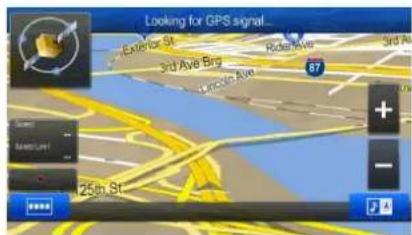
When GPS position is available, the Vehimarker is displayed in full color, now showing your current position.
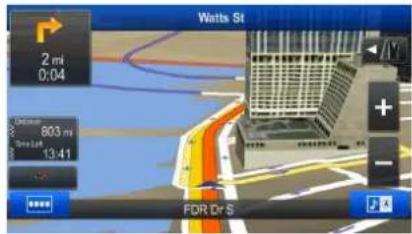
There are screen buttons and data fields on the screen to help you navigate. During navigation, the screen shows route information.
Two data fields are displayed on the left.
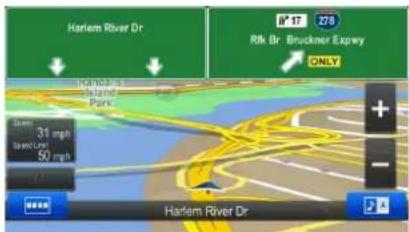
The data fields are different when you are navigating an active route and when you have no specified destination (the orange line is not displayed).
There are no data fields without a given destination.
Default data fields when navigating a route (tap any of the fields to change its value):
| Field | Description |
| Distance16.9 mi | Shows the distance you need to travel on the route before reaching your final destination. |
| Time Left0:16 | Shows the time needed to reach the final destination of the route based on information available for the remaining segments of the route.If your device is capable of receiving live traffic information, the calculation takes into account traffic delays affecting your route if they are received.However, this calculation is rarely accurate.Historical traffic data can also be taken into account if data is available. |
There are three map view modes. Tap the button below the data fields to change the view:

• : 3 perspective view rotated in your direction of travel.

• : 200 m down view facing North.

• : 2: Top-down view rotated in your direction of travel.
2.2.2 Position markers
2.2.2.1 Vehimarker and Lock-on-Road
When your GPS position is available, the software marks your current position with the Vehimarker. By default, this marker is a blue arrow, but you can change this icon in Settings.
When on-road navigation is selected, the Vehimarker may not show your exact GPS position and heading. If roads are near, it is aligned to the nearest road to suppress GPS position errors, and the direction of the icon is aligned to the direction of the road.
If you select off-road navigation: The Vehimarker is at your exact GPS position. The direction of the icon shows your current heading.
2.2.2.2 Selected map location (Cursor) and selected map object
You can mark a map location in the following ways:
- Tap the map when navigating,
- Tap the map when you are asked to confirm the destination at the end of a search, or
- Tap the map in Find on Map (page 49)
When a map location is selected, the Cursor appears at the selected point on the map. The Cursor is

displayed with a radiating red dot ( ) to make it visible at all zoom levels.
The location of the Cursor can be used as the destination of the route, a new alert point, you can search for Places around it, or you can save this location as one of your Favorite destinations.
You can also select some of the objects on the map. If you tap the map at the icon of a Place of Interest or an alert point, the object will be selected (you see a red circling border around the object), and you can get information about this object or use it as a route point.
2.2.3 Objects on the map
2.2.3.1 Streets and roads
The software shows the streets in a way that is similar to how the paper road maps show them. Their width and colors correspond to their importance: you can easily tell a freeway from a small street.
2.2.3.2 Turn preview and Next street
When navigating a route, the top section of the Map screen shows information about the next route event (maneuver) and the next street or the next city/town.
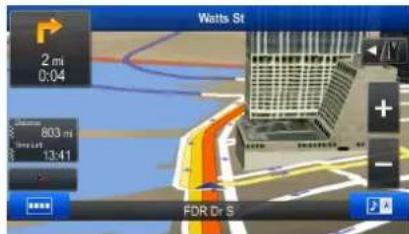
There is a field in the top left corner that displays the next maneuver. Both the type of the event (turn, traffic circle, exiting freeway, etc.) and its distance from the current position are displayed.
Most of these icons are very intuitive. The following table lists some of the frequently shown route events.
| Icon | Description |
 | Turn left. |
 | Turn right. |
 | Turn back. |
 | Bear right. |
 | Turn sharp left. |
 | Keep left. |
 | Continue straight in the intersection. |
 | Go left on the traffic circle, 3rd exit. |
 | Enter freeway. |
 | Exit freeway. |
 | Board ferry. |
 | Leave ferry. |
| Approaching a waypoint. | |
| Approaching the destination. |
These fields also act as buttons:
- Tap the Turn preview field and the voice guidance will repeat the latest instruction with updated distance information.
- Tap the Next street field to open the Itinerary.
2.2.3.3 Lane information and Signposts
When navigating on multilane roads, it is important to take the appropriate lane in order to follow the recommended route. If lane information is available in the map data, the software displays the lanes and their directions using small arrows at the top of the map. Highlighted arrows represent the lanes you need to take.
Where additional information is available, signposts substitute arrows. Signposts are displayed at the top of the map. The color and style of the signposts are similar to the real ones you can see above road or by the roadside. They show the available destinations and the number of the road the lane leads to.
All signposts look similar when cruising (when there is no recommended route). When navigating a route, only the signpost that points to the lane(s) to be taken is displayed in vivid colors; all others are darker.
If you want to hide the currently displayed signposts, tap any of them and the normal Map screen returns until new signpost information is received.
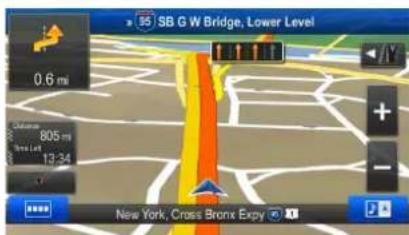
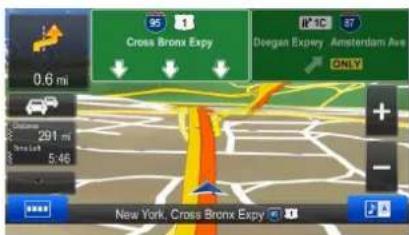
This feature can be turned off in Visual Guidance settings.
2.2.3.4 Junction view
If you are approaching a freeway exit or a complex intersection and the needed information exists, the map is replaced with a 3D view of the junction. The lanes you need to take are displayed with arrows. Signposts can also be present if information is available.
If you want to hide the currently displayed junction, tap the picture and the Map screen returns.
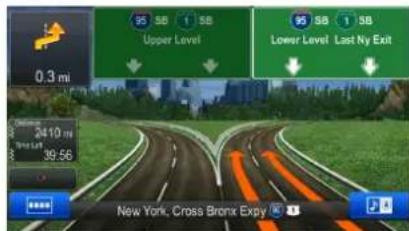
This feature can be turned off in Visual Guidance settings.
2.2.3.5 Freeway exit services
You may need a gas station or a restaurant during your journey. This feature displays a new button on the map when you are driving on freeways.
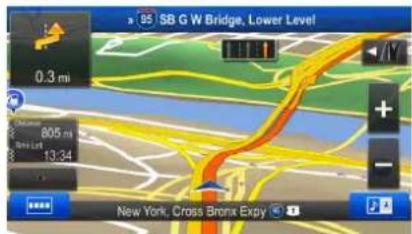
Tap this button to open a panel with the details of the next few exits or service stations.
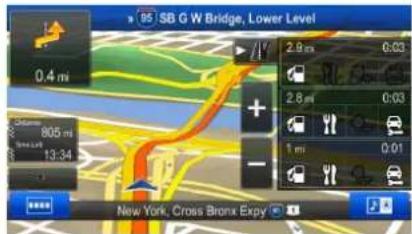
Tap any of them to display it on the map and add it as a waypoint to your route if needed.
If you want to display other types of Places for the exits, you can change the icons in Visual Guidance settings (page 79).
2.2.3.6 3D object types
Your software supports the following 3D object types:
| Type | Description |
| 3D terrain 3D terrain | in map data shows changes in terrain, elevations or depressions in the land when you view the map in 2D, and use it to plot the route map in 3D when you navigate. Hills and mountains are shown in the background of the 3D map, and illustrated by color and shading on the 2D map. |
| Elevated roads | Complex intersections and vertically isolated roads (such as overpasses or bridges) are displayed in 3D. |
| 3D landmarks Landmarks | and marks are 3D artistic or block representations of prominent or well-known objects. |
| 3D buildings | 3D block representation of full city building data containing actual building size and position on the map. |
2.2.3.7 Elements of the active route
Your software shows the route in the following way:
| Symbol | Name | Description |
 | Current GPS position and Start point | Your current position displayed on the map. If roads are near, it is aligned to the nearest road.Normally if GPS position is available, the route starts from the current position. If there is no valid GPS position, your software uses the last known position as the start point. |
 | Waypoint (intermediate destination) | An intermediate destination of the route before reaching the final destination. |
 | Destination (end point) The final destination of the route. | |
| Route color | The route always stands out with its color on the map, both in daytime and in night color mode. | |
| Streets and roads that are excluded from the navigation | You can choose whether you want to use or avoid certain road types (page 74). However, when your software cannot avoid such roads, the route will include them and it will show them in a color that is different from the route color. | |
| Streets and roads that are affected by traffic events | Road segments may be affected by traffic events received. These streets and roads are displayed in an alternate color, and small symbols displayed along the route show the type of the traffic event. | |
2.2.3.8 Traffic events
Road segments affected by traffic events are displayed with an alternate color on the map, and small symbols above the road show the nature of the event:
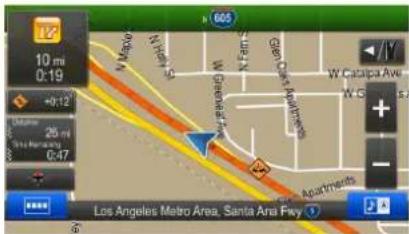

Tap to open the list of traffic event categories:
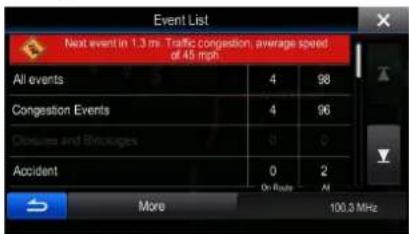
In the first column you can see the number of traffic events on your route. The second column contains the full count of traffic events in the categories.
Tap any of the even types to list the event in that category or select the top row to open the list of all traffic events:
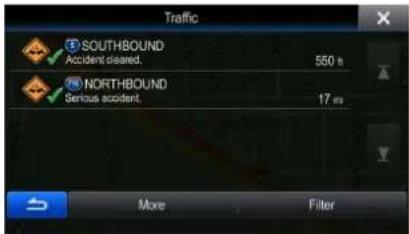
Now tap any of the list items to see its details, and to display the affected road segment in its full length on the map:
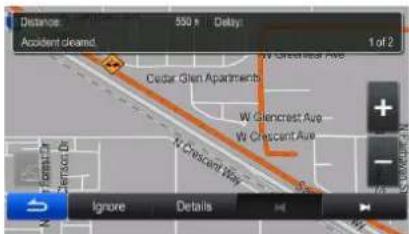
2.2.4 Manipulating the map
Tap the map anywhere to browse it during navigation. The map stops following the current position (the Vehimarker, a blue arrow by default, is not locked in a fix position on the screen any more) and control buttons appear to help you modify the map view.
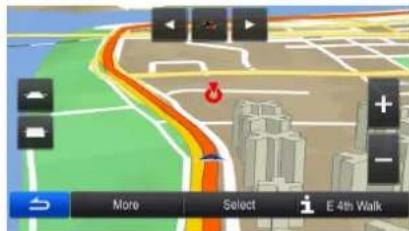
| Action | Button(s) | Description |
| Moving the map with drag&drop | No buttons | You can move the map in any direction: tap and hold the map, and move your finger towards the direction you want to move the map. |
| Zooming in and out |  | Changes how much of the map is displayed on the screen.Your software uses high- quality vector maps that let you examine the map at various zoom levels, always with optimized content. It always displays street names and other text with the same font size, never upside-down, and you only see the streets and objects that you need.Map scaling has a limit in 3D map view mode. If you zoom out further, the map switches to 2D view mode.Tap the button once to modify the view in large steps, or tap and hold the button to modify it continuously and smoothly. |
| Tilting up and down |  | Changes the vertical view angle of the map in 3D mode.Tap the button once to modify the view in large steps, or tap and hold the button to modify it continuously and smoothly. |
| Rotating left and right |  | Changes the horizontal view angle of the map.Tap the button once to modify the view in large steps, or tap and hold the button to modify it continuously and smoothly. |
| Compass |  | Tap this button to cycle between a 3D perspective and two 2D top-down map view modes. |
| Location information | i Quai Des Célestins | Tap this button to open a new screen with information about the selected map point, the Cursor. |
| Return to normal navigation |  | Tap this button to move the map back to follow the current GPS position. Automatic map rotation is also re-enabled.The map manipulation buttons disappear and navigation continues. |
| Additional options |  | Tap this button to open a list of additional features like saving the Cursor as an Address Book entry, or searching for Places around the Cursor. |
| Select destination |  | Tap this button to select the Cursor as a new destination. |
2.2.5 Checking the details of the current position (Where Am I?)
This screen contains information about the current position (or about the last known position if GPS reception is not available) and a button to search for useful Places nearby.
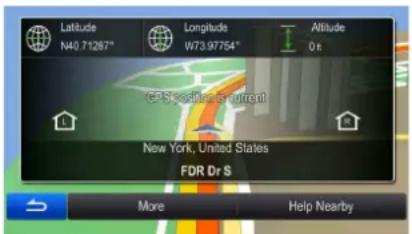
You can access this screen from the map in one of the following ways:
- If the current street is displayed below the Vehimarker (the current position on the map), tap it to open the Where Am I? screen.
• In the Navigation menu, tap

Information on this screen:


• , : Longitude (coordinate of the current position in WGS84 format).

- : Available (elevation information coming from the GPS receiver - often inaccurate).
- Address details (when available) of the current position are also displayed at the bottom.
You can also perform some actions on this screen:

Tap position as an Address Book entry or to read the Country Information.

You can also search for assistance near your current position. Tap screen for the Quick search:
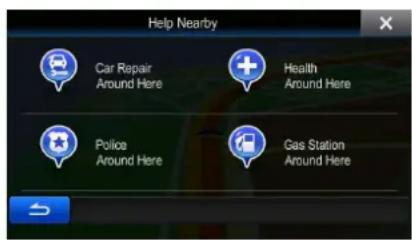
The following services can be searched around the current position or the last known position:
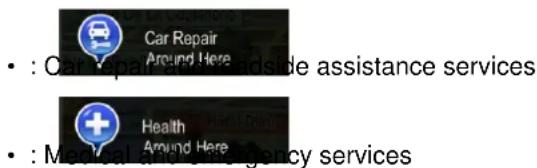
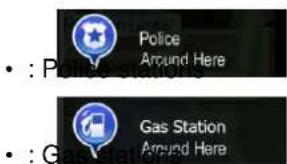
Tap any of the buttons, select a Place from the list, and navigate to it.
2.3 Navigation menu
You can reach all parts of the software from the Navigation menu. When you open the menu, the destination search buttons appear on the screen. Tap any other menu button at the top and their feature buttons appear below.
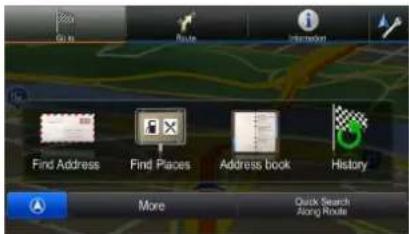
You have the following menus:
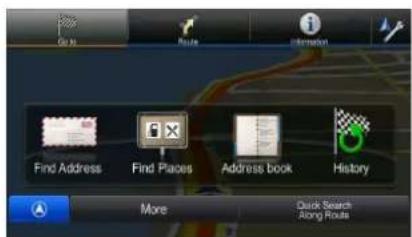
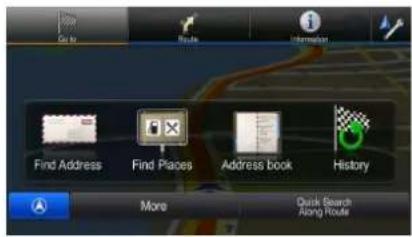
- Tap to go your destination by entering an address or selecting a place of interest, a location on the map or one of your Address Book entries. You can also look up your recent destinations from the History, enter a coordinate or use the location saved in a photo. You can also use the free form search.

- Tap to the route parameters and the route in its full length on the map. You can also perform route-related actions such as editing or canceling your route, setting a start point for the route, picking route alternatives, avoiding parts of the route or simulating navigation.

- Tap to information about your current position, the GPS reception or the trips you have taken or to run some additional applications..
- Tap to minimize the way the navigation software works.
- Press the MAP hardware button to start navigating on the map.
3 On-road navigation
When first started, Alpine unit calculates routes using the road network of the high quality vector maps provided with the product.
You can set up your route in different ways:
- If you need a route for immediate navigation, you can select the destination and start navigating to it right away (normal navigation).
- You can also plan a route independently of your current GPS position or even without GPS reception (to achieve this, you need to turn off the GPS receiver and set a new starting point in Route / Edit Route by tapping the flag icon at the current position).
You can plan routes with multiple destinations. Select the first destination. Then select a second destination and add it to your route to create a multi-point route. You can add as many destinations to your route as you like.
You can also use Alpine unit for off-road navigation. For details, see page 63.
3.1 Selecting the destination of a route
The software offers you several ways of choosing your destination:
- Enter a full address or a part of an address, for example a street name without a house number or the names of two intersecting streets (page 23).
- Enter an address with ZIP code (page 36). This way you do not need to select the name of the city/town and the search for street names might be faster as well.
- Use a built-in Place of Interest as your destination (page 39).
- Use the free form search to find an address or Place (page 48).
- Select a location on the map with the Find on Map feature (page 49).
- Use a previously saved Address Book entry (page 50).
- Select a location from the History of previously used destinations (page 51).
- Enter the coordinate of the destination (page 52).
- Use the location where a photo was taken (page 53).
3.1.1 Entering an address or a part of the address
If you know at least a part of the address, it is the quickest way to select the destination of the route.
Using the same screen, you can find an address by entering:
- the exact address, including house number
• the center of a city/town - an intersection
• the midpoint of a street
- any of the above, starting the search with the ZIP code (page 36)
You can also search for an address with the free form search (page 48).
3.1.1.1 Entering an address (United States)
To enter an address as the destination, do as follows:
-
In the Navigation menu, tap the following buttons: , Go to Find Address
-
By default, the software proposes the country and state where you are. If needed, tap

enter the first few letters of the destination country or state on the keyboard,
and select one from the list. If you select a country without a state, you can search for a city/town in all its states.
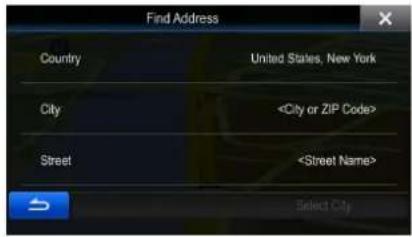
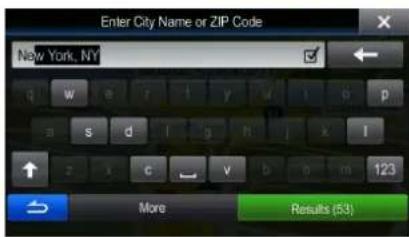
- Select a new city/town:
a. Tap . City local search, tap to accept it, otherwise continue with entering the destination city/town name.
b. Start entering the name of the city/town on the keyboard.
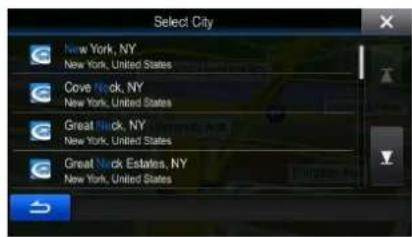
c. Find the city/town you need:
- The most likely city/town name is always shown in the input field. To accept it, tap

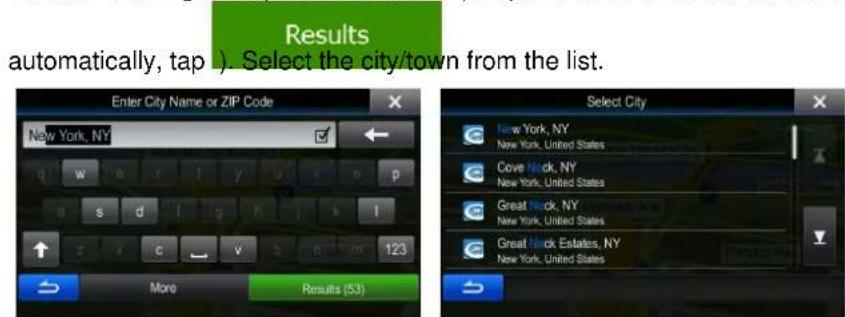
- If the desired name does not show up, the names that match the string appear in a list after entering a couple of characters (to open the list of results before it appears
Results automatically, tap ). Select the city/town from the list.
- Enter the street name:
a. Start entering the street name on the keyboard.
b. Find the street you need:
- The most likely street name is always shown in the input field. To accept it, tap

- If the desired name does not show up, the names that match the string appear in a list after entering a couple of characters (to open the list of results before it appears
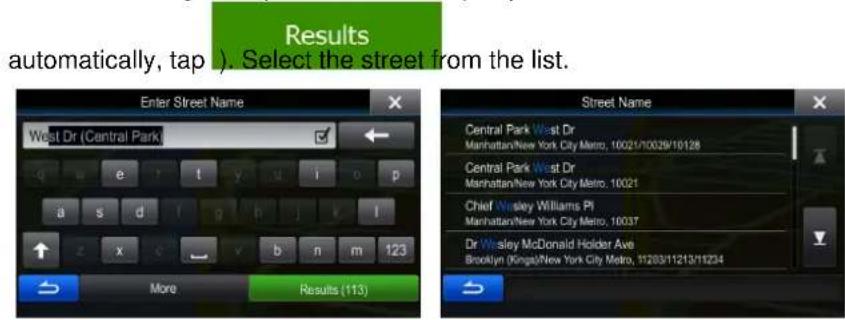
- Enter the house number:
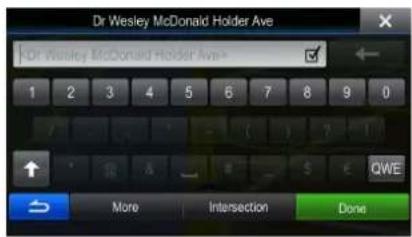
a. Enter the house number on the keyboard. (To enter symbols, tap ).

b. Tap to finish entering the address. (If the entered house number cannot be found, the midpoint of the street is selected as the destination.)

- A full screen map appears with the selected point in the middle. If necessary, tap the map

destination.
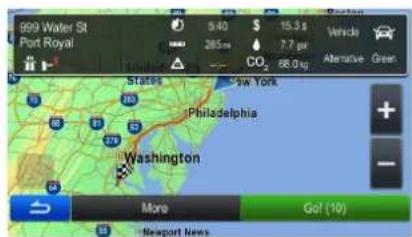
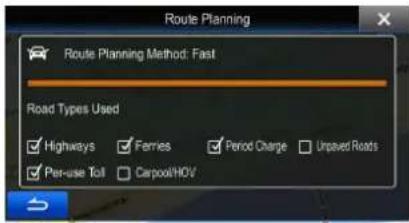
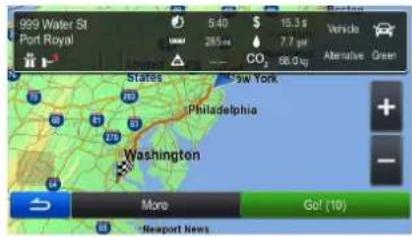
- After a short summary of the route parameters, the map appears showing the entire route. The

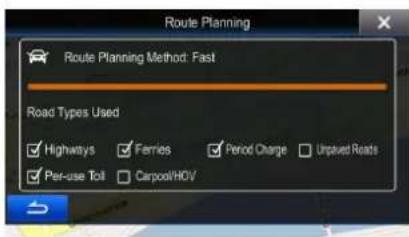
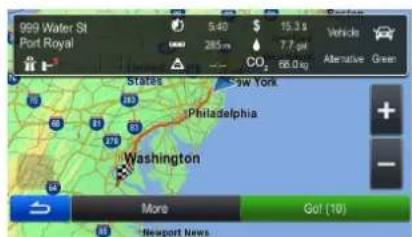
Tip!
If you know that you will use this destination
frequently, before tapping
Next
More
to confirm the destination, put it in the Address Book first: tap

Add to Favorites
then
give a name for the new entry, and tap
to save the location. The map with the destination returns automatically. Now you can start your journey.
3.1.1.2 Entering an address (Canada)
To enter an address as the destination, do as follows:

- In the Navigation menu, tap the following buttons: ,
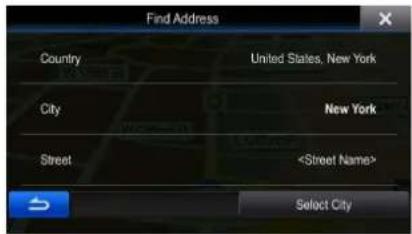
- By default, the software proposes the country, state and city/town where you are. If needed, tap
Country
, enter the first few letters of the destination country or state on the keyboard, and select one from the list. If you select a country without a state, you can search for a city/town in all its states.
- If needed, select a new city/town:
a. Tap

b. Start entering the name of the city/town on the keyboard.
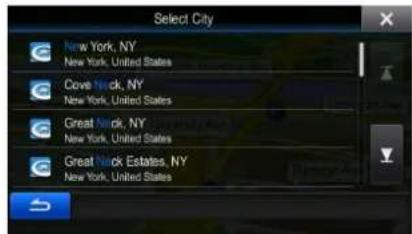
c. Find the city/town you need:
b. Start entering the name of the city/town on the keyboard. c. Find the city/town you need:
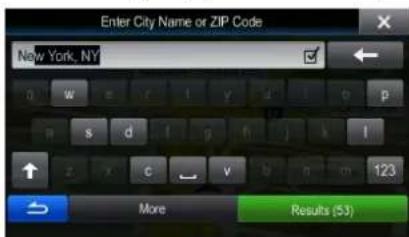
- The most likely city/town name is always shown in the input field. To accept it, tap

- If the desired name does not show up, the names that match the string appear in a list after entering a couple of characters (to open the list of results before it appears
automatically, tap). Select the city/town from the list.
- Enter the street name:

a city/town above, this step is not needed).
a. Tap
b. Start entering the street name on the keyboard.
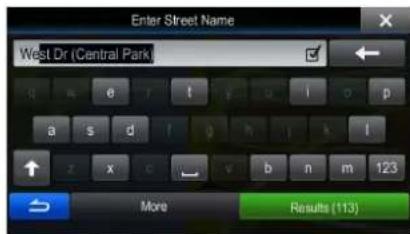
c. Find the street you need:
- The most likely street name is always shown in the input field. To accept it, tap

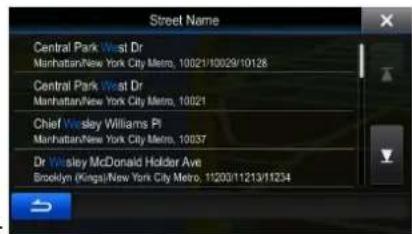
- If the desired name does not show up, the names that match the string appear in a list after entering a couple of characters (to open the list of results before it appears
automatically, tap ). Select the street from the list.
- Enter the house number:
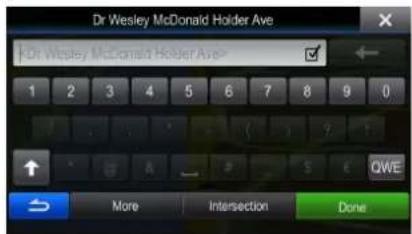
a. Enter the house number on the keyboard. (To enter symbols, tap)

b. Tap to finish entering the address. (If the entered house number cannot be found, the midpoint of the street is selected as the destination.)

to finish entering the address. (If the entered house number point of the street is selected as the destination.)
- A full screen map appears with the selected point in the middle. If necessary, tap the map

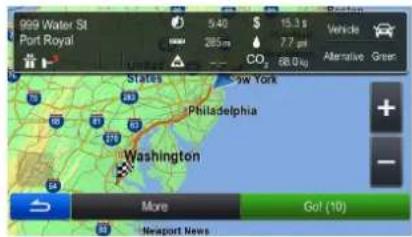
- After a short summary of the route parameters, the map appears showing the entire route. The

3.1.1.3 Entering an address (Mexico)
To enter an address as the destination, do as follows:

- In the Navigation menu, tap the following buttons: ,
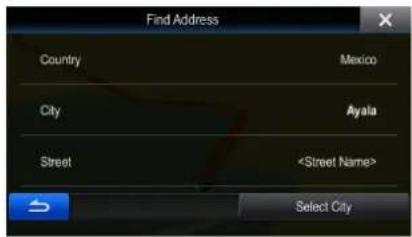
- By default, the software proposes the country and city/town where you are. If needed, tap
enter the first few letters of the country name on the keyboard, and select list of results.

- If needed, select a new city/town:

a. Tap
b. Start entering the name of the city/town on the keyboard.
c. Find the city/town you need:
• The most likely city/town name is always shown in the input field. To accept it, tap

- If the desired name does not show up, the names that match the string appear in a list after entering a couple of characters (to open the list of results before it appears
1. Enter the street name:
a. Tap

ed a city/town above, this step is not
b. Start entering the street name on the keyboard.
c. Find the street you need:
- The most likely street name is always shown in the input field. To accept it, tap

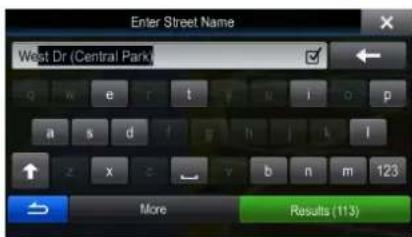
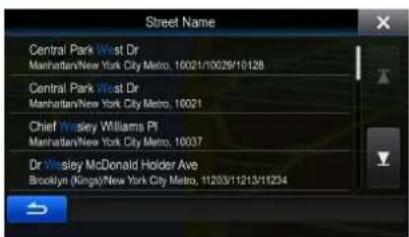
- If the desired name does not show up, the names that match the string appear in a list after entering a couple of characters (to open the list of results before it
Results appears automatically, tap ). Select the street from the list.
4. Enter the house number:
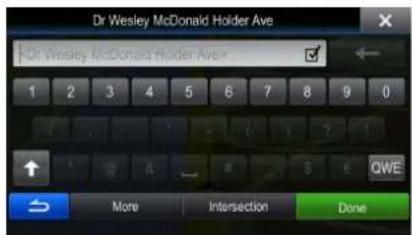
a. Enter the house number on the keyboard. (To enter symbols, tap).

b. Tap to finish entering the address. (If the entered house number cannot be found, the midpoint of the street is selected as the destination.)
- A full screen map appears with the selected point in the middle. If necessary, tap the map

- After a short summary of the route parameters, the map appears showing the entire route. The

3.1.1.4 Entering an address starting with the street name (in the United States only)
You can leave the city/town name empty and start the search with the street name. This way you can search in all streets of a state. Do as follows:

- In the Navigation menu, tap the following buttons:
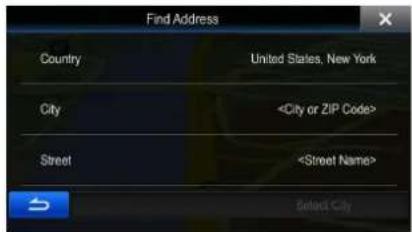
- By default, the software proposes the country and state where you are. If needed, tap the button with the name of the country, enter the first few letters of the destination country or state on the keyboard, and select a country and state from the list. If you select the country without a state, this function cannot work.
- Enter the street name:
a. Tap

b. Start entering the street name on the keyboard.
c. Find the street you need:
- The most likely street name is always shown in the input field. To accept it, tap

- If the desired name does not show up, the names that match the string appear in a list after entering a couple of characters (to open the list of results before it appears
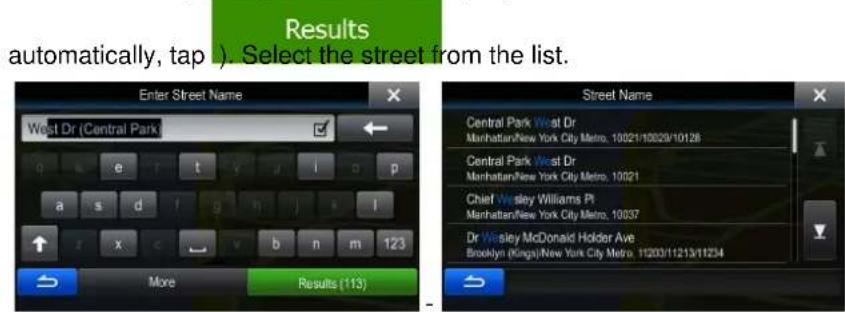
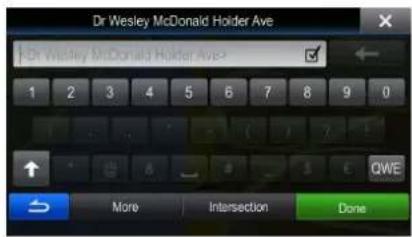
- Enter the house number:
a. Enter the house number on the keyboard. (To enter symbols, tap)

b. Tap to finish entering the address. (If the entered house number cannot be found, the midpoint of the street is selected as the destination.)

- A full screen map appears with the selected point in the middle. If necessary, tap the map
somewhere else to modify the destination. The Cursor ( ) appears at the new location. Tap

to confirm the destination, or tap

destination.
- After a short summary of the route parameters, the map appears showing the entire route. The

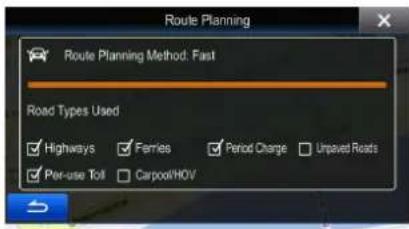
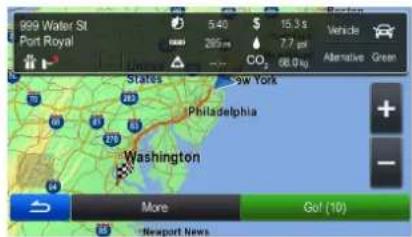
3.1.1.5 Entering the midpoint of a street as the destination
You can navigate to the midpoint of a street if the house number is not available:

- In the Navigation menu, tap the following buttons: ,
- Select the country, state and city/town as described earlier (page 24).
- Enter the street name:
a. Tap

a city/town above, this step is not needed).
b. Start entering the street name on the keyboard.
c. Find the street you need:
- The most likely street name is always shown in the input field. To accept it, tap

- If the desired name does not show up, the names that match the string appear in a list after entering a couple of characters (to open the list of results before it appears
automatically, tap ). Select the street from the list.
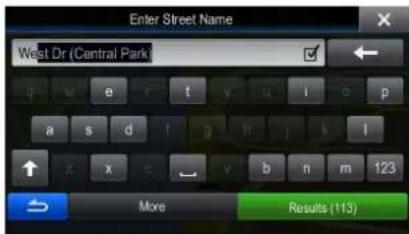
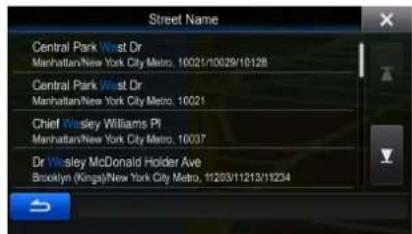
- Instead of entering the house number, tap the input field above. The midpoint of the street is selected as the destination.
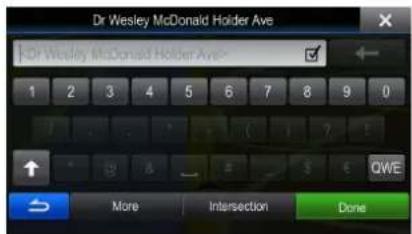
- A full screen map appears with the selected point in the middle. If necessary, tap the map

destination.
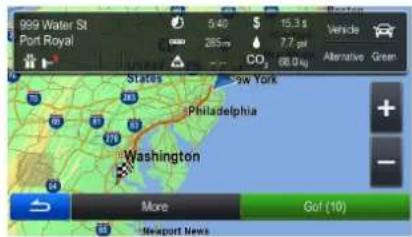
- After a short summary of the route parameters, the map appears showing the entire route. The

3.1.1.6 Selecting an intersection as the destination
To enter an address as the destination, do as follows:

- In the Navigation menu, tap the following buttons: , Go to Find Address
- Select the country, state and city/town as described earlier (page 24).
- Enter the street name:
a. Tap

a city/town above, this step is not needed).
b. Start entering the street name on the keyboard.
c. Find the street you need:
b. Start entering the street name on the keyboard. c. Find the street you need:
- The most likely street name is always shown in the input field. To accept it, tap
- If the desired name does not show up, the names that match the string appear in a list after entering a couple of characters (to open the list of results before it appears
- The most likely street name is always shown in the input field. To accept it, tap - If the desired name does not show up, the names that match the string appear in a list after entering a couple of characters (to open the list of results before it appears
Results automatically, tap ). Select the street from the list.

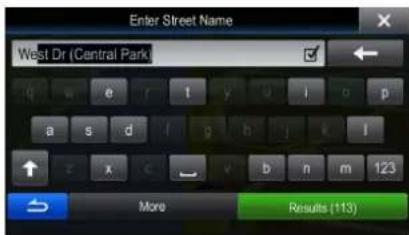
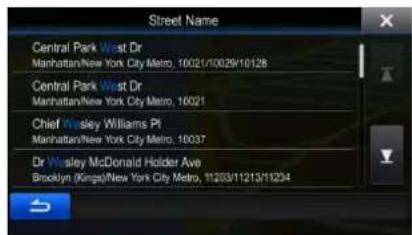

- Instead of entering the house number, tap . ____ street is selected as the destination.
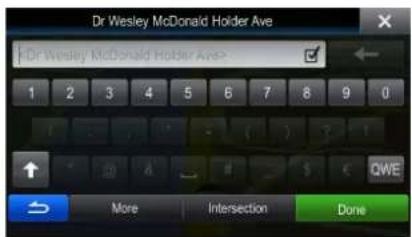
- A full screen map appears with the selected point in the middle. If necessary, tap the map
somewhere else to modify the destination. The Cursor ( ) appears at the new location. Tap Next to confirm the destination, or tap to select a different destination.
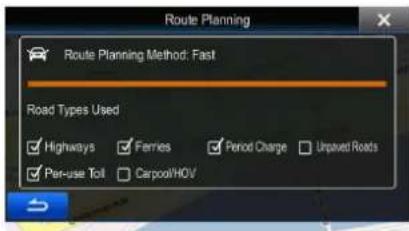
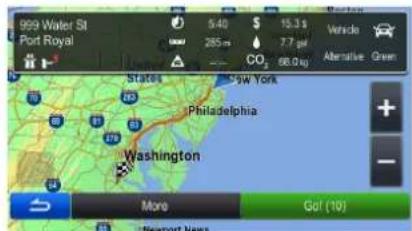
- After a short summary of the route parameters, the map appears showing the entire route. The
route is automatically calculated. Tap Go! More and start your journey.
3.1.1.7 Selecting a city/town center as the destination
The city/town center is not the geometric center of the city/town but an arbitrary point the map creators have chosen. In towns and villages, it is usually the most important intersection; in larger cities, it is one of the important intersections.

- In the Navigation menu, tap the following buttons: ,
- Select the country and state as described earlier (page 24).
- Select the destination city/town:
a. Tap

b. Start entering the name of the city/town on the keyboard.
c. Find the city/town you need:
• The most likely city/town name is always shown in the input field. To accept it, tap

- If the desired name does not show up, the names that match the string appear in a list after entering a couple of characters (to open the list of results before it appears
Results automatically, tap ). Select the city/town from the list.
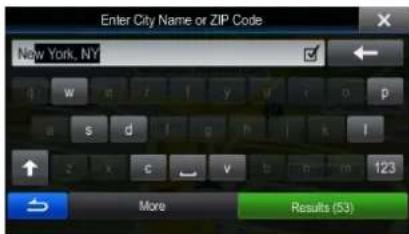
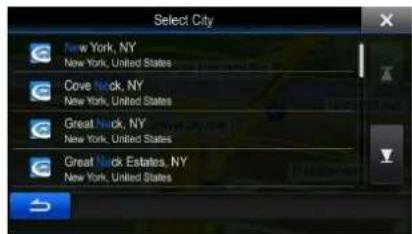
- Instead of entering the street name, tap . . . . . . . . . . . . . . . . . . . . . . . . . . . . . . . . . . . . . . of the displayed city/town becomes the destination of the route.
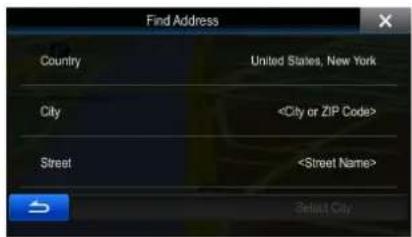
- A full screen map appears with the selected point in the middle. If necessary, tap the map
somewhere else to modify the destination. The Cursor ( ) appears at the new location. Tap

destination.
- After a short summary of the route parameters, the map appears showing the entire route. The

3.1.1.8 Entering an address with a ZIP code
All of the above address searching possibilities can be performed with entering the ZIP code instead of the city/town name. Find below an example with a full address:
- In the Navigation menu, tap the following buttons:
- Select the country and state as described earlier (page 24).
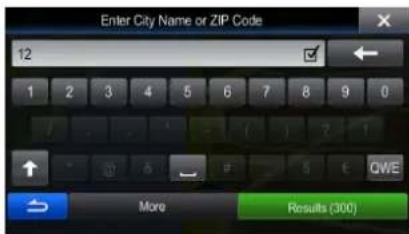
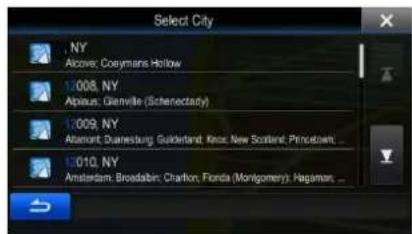
- Enter a new city/town using its ZIP code:
a. Tap

b. Start entering the ZIP code.
c. Find the city/town you need:
- The most likely ZIP code is always shown in the input field. To accept it, tap .
- If the desired number does not show up, open the list of results by tapping

Select the ZIP code from the list.

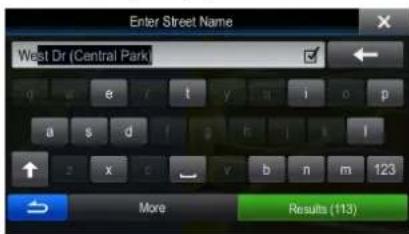
- Enter the street name:
a. Tap

b. Start entering the street name on the keyboard.
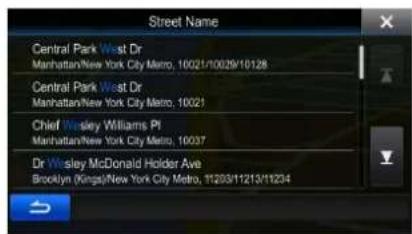
c. Find the street you need:
- The most likely street name is always shown in the input field. To accept it, tap

- If the desired name does not show up, the names that match the string appear in a list after entering a couple of characters (to open the list of results before it appears
automatically, tap ). Select the street from the list.
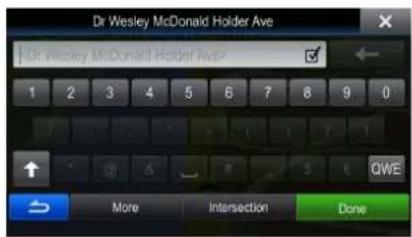
- Enter the house number:
a. Enter the house number on the keyboard. (To enter symbols, tap)

b. Tap to finish entering the address. (If the entered house number cannot be found, the midpoint of the street is selected as the destination.)
- A full screen map appears with the selected point in the middle. If necessary, tap the map
somewhere else to modify the destination. The Cursor () appears at the new location. Tap

to confirm the destination, or tap

destination.
- After a short summary of the route parameters, the map appears showing the entire route. The

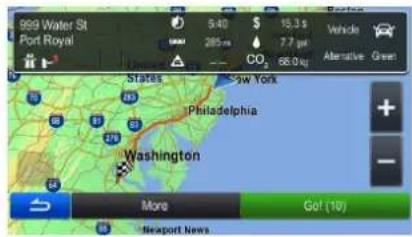
3.1.1.9 Tips on entering addresses quickly
- When you are entering the name of a city/town or a street:
- Only those letters are offered on the keyboard that appear in possible search results. All other characters are grayed out.
• As you are typing, the most likely result is always displayed in the input field. If the guess is
correct, tap to select it.

• After entering a couple of letters, tap to list the items that contain the specified letters.
- You can speed up finding an intersection:
- Search first for the street with a less common or less usual name; fewer letters are enough to find it.
-
If one of the streets is shorter, search for that one first. You can then find the second one faster.
-
You can search for both the type and the name of a road. If the same word appears in several names, for example in the name of streets, roads and avenues, you can obtain the result faster if you enter the first letter of the street type: For example, enter 'PI A' to obtain Pine Avenue and skip all Pine Streets and Pickwick Roads.
- You can also search in ZIP codes. As ZIP codes consist of only a few characters, this is usually faster than entering the name of the city/town.
3.1.2 Selecting the destination from the Places of Interest
You can select your destination from the Places of Interest included with your software.
Using the same screen, you can find a Place in different ways:
• with the Quick search feature, you can quickly find a nearby Place by its name
• with the Preset search feature, you can find frequently searched types of Places with only a few screen taps
- you can search for a Place by its category
- you can search for a Place by its name
In addition, you can search for special services from the 'Where Am I?' screen.
You can also search for a Place with the free form search (page 48).
3.1.2.1 Quick search for a Place of Interest
The Quick search feature lets you quickly find a Place by its name. The search is always carried out
• along the recommended route if it exists or
• around your current location if there is no destination given.

- To start the Quick search function, in the Navigation menu, tap
- Using the keyboard, start entering the name of the Place.
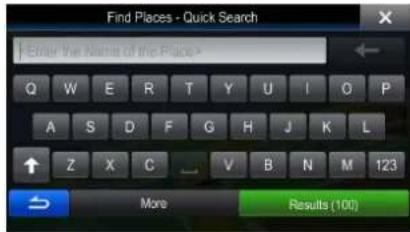
- After entering a few letters, tap to open the list of Places with names containing the entered character sequence.
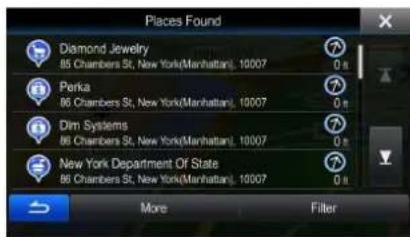
- (optional) The Places in the list are ordered by the length of the necessary detour (when navigating a route) or by their distance from the current position (when no destination is given). If you need to
reorder the list, tap

-
Browse the list if necessary and tap one of the list items. A full screen map appears with the selected point in the middle. The name and address of the Place is displayed at the top of the screen.
-
(optional) Tap the selected Place. Tap


Quai Des Célestins
to return to the map.
- If necessary, tap the map somewhere else to modify the destination. The Cursor () appears
at the new location. Tap to select a different dest

nation, or tap

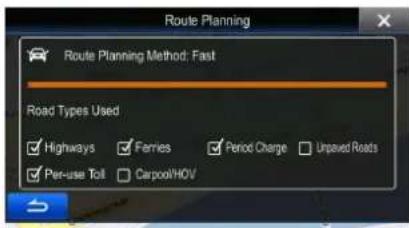
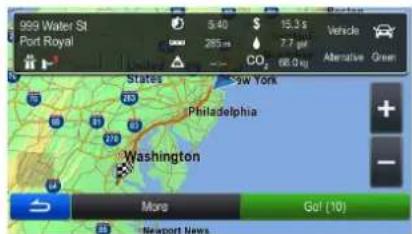
- After a short summary of the route parameters, the map appears showing the entire route. The

3.1.2.2 Searching for a Place of Interest using preset categories
The Preset search feature lets you quickly find the most frequently selected types of Places.

- In the Navigation menu, tap the following buttons:
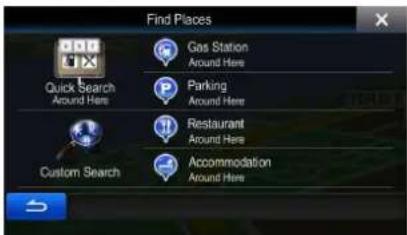
2. The preset search categories appear:

Gas Station Along Route
- If an active route exists, gas stations are searched along the route.
- If there is no active route (destination is not selected), they are searched around the current position.
- If the current position is not available either (no GPS signal), they are searched around the last known position.

Parking At My Destination
- If an active route exists, parking lots are searched around the destination of the route.
- If there is no active route (destination is not selected), they are searched around the current position.
- If the current position is not available either (no GPS signal), they are searched around the last known position.

Restaurant Along Route
- If an active route exists, restaurants are searched along the route.
- If there is no active route (destination is not selected), they are searched around the current position.
- If the current position is not available either (no GPS signal), they are searched around the last known position.

Accommodation At My Destination
- If an active route exists, accommodation is searched around the destination of the route.
- If there is no active route (destination is not selected), they are searched around the current position.
- If the current position is not available either (no GPS signal), they are searched around the last known position.
3. Tap any of the quick search buttons to get an instant list of Places.
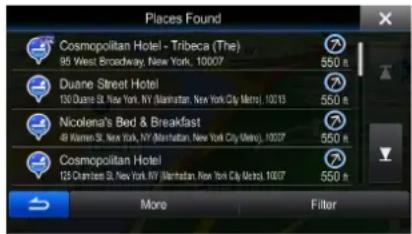
- (optional) The Places in the list are ordered by their distance from the current or last known position, from the destination or by the length of the necessary detour. If you need to reorder the
list, tap

-
Browse the list if necessary and tap one of the list items. A full screen map appears with the selected point in the middle. The name and address of the Place is displayed at the top of the screen.
-
(optional) Tap the selected Place. Tap


Quai Des Célestins
to return to the map.
- If necessary, tap the map somewhere else to modify the destination. The Cursor () appears
at the new location. Tap to select a different dest

nation, or tap

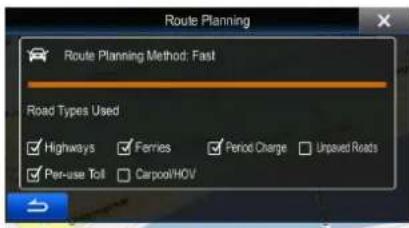
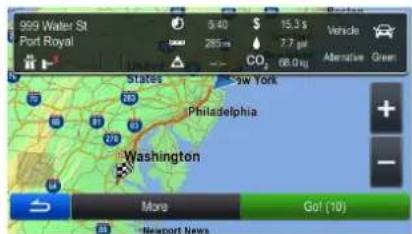
- After a short summary of the route parameters, the map appears showing the entire route. The

3.1.2.3 Searching for a Place of Interest by category
You can search for Places of Interest by their categories and subcategories.

- In the Navigation menu, tap the following buttons: , Go to Find Places
-
Tap . Custom Search
-
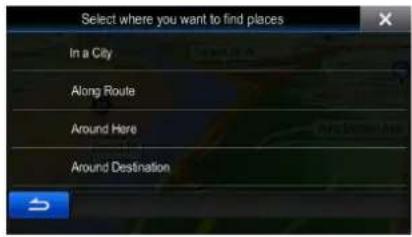
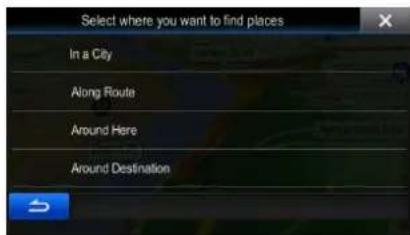
Select the area around which the Place should be searched for:

- Tap to ____ current position or if it is not available, around the last know position. (The result list will be ordered by the distance from this position.)
In a City
- Tap to within a selected city/town. (The result list will be ordered by the distance from the center of the selected city/town.)
Around Destination
- Tap to round a destination around the destination of the active route. (The result list will be ordered by the distance from the destination.)
Along Route
- Tap to the active route, and not around a given point.
This is useful when you search for a later stopover that results in a minimal detour only, such as searching for upcoming gas stations or restaurants. (The result list will be ordered by the length of the necessary detour.)
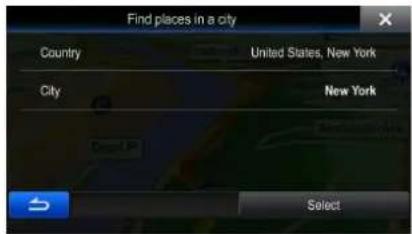
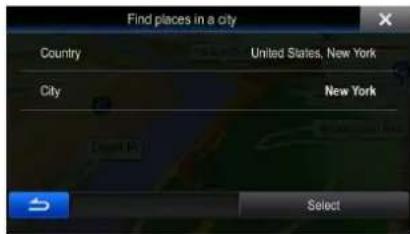
In a City
- (optional) If you have selected, so search in.
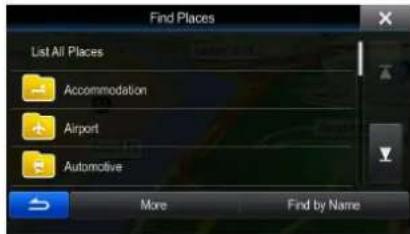
List All Places
- Select one of the main Place categories (e.g. Accommodation) or tap Places around the selected location or along the route.
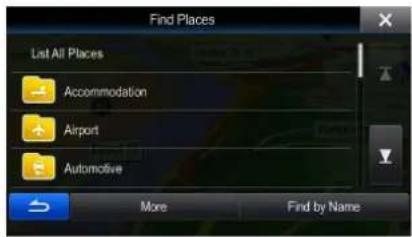
List All Places
- Select one of the Place subcategories (e.g. Hotel or Motel) or tap places in the selected main category around the selected location or along the route.
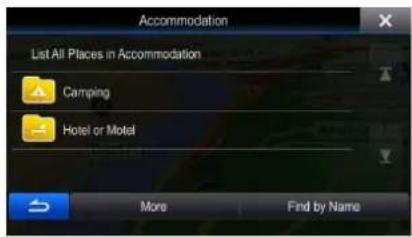
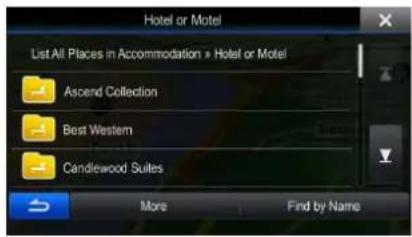
- Sometimes the list of brands in the selected Place subcategory appears. Select one brand or tap
List All Places
to list all Places in the selected subcategory around the selected location or
along the route.
- Finally, the results appear in a list.
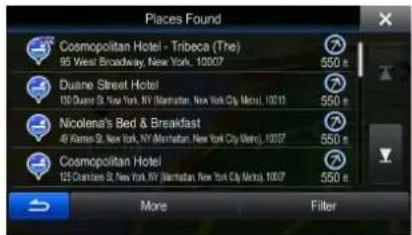
- (optional) The Places in the list are ordered by their distance from the current or last known position, from the selected city/town, from the destination or by the length of the necessary detour.
If you need to reorder the list, tap
More
-
Browse the list if necessary and tap one of the list items. A full screen map appears with the selected point in the middle. The name and address of the Place is displayed at the top of the screen.
-
(optional) Tap

Quai Des Célestins
the selected Place. Tap

to return to the map.
- If necessary, tap the map somewhere else to modify the destination. The Cursor () appears
at the new location. Tap
Next
to select a different destination.


- After a short summary of the route parameters, the map appears showing the entire route. The

3.1.2.4 Searching for a Place of Interest by name
You can search for Places of Interest by their names. You can search around different locations or along your route in the whole Place database or in one Place category or subcategory only.
- In the Navigation menu, tap the following buttons: ,
-
Tap
-
Select the area around which the Place should be searched for:
Around Here
- Tap to ____ current position or if it is not available, around the last know position. (The result list will be ordered by the distance from this position.)
In a City
- Tap to ____ within a selected city/town. (The result list will be ordered by the distance from the center of the selected city/town.)
Around Destination
- Tap to Around Destination around the destination of the active route. (The result list will be ordered by the distance from the destination.)
Along Route
- Tap to using a collective route, and not around a given point. This is useful when you search for a later stopover that results in a minimal detour only, such as searching for upcoming gas stations or restaurants. (The result list will be ordered by the length of the necessary detour.)
- (optional) If you have selected, no search in.

- Select one of the main Place categories (e.g. Accommodation) to search in or tap
Find by Name
to search among all Places.
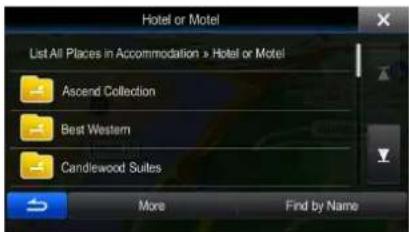
- Select one of the Place subcategories (e.g. Hotel or Motel) to search in or tap to search in the selected Place category.
Find by Name
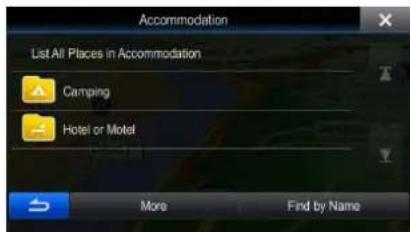
- Tap it before.
Find by Name
- Using the keyboard, start entering the name of the Place.
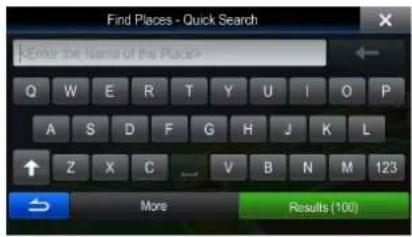

- After entering a few letters, tap to open the list of Places with names containing the entered character sequence.
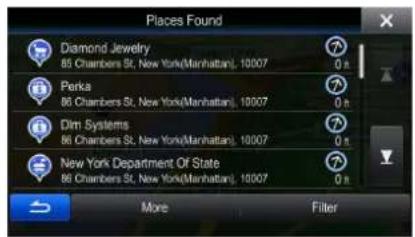
- (optional) The Places in the list are ordered by their distance from the current or last known position, from the selected city/town, from the destination or by the length of the necessary detour.
If you need to reorder the list, tap

-
Browse the list if necessary and tap one of the list items. A full screen map appears with the selected point in the middle. The name and address of the Place is displayed at the top of the screen.
-
(optional) Tap the selected Place. Tap

- If necessary, tap the map somewhere else to modify the destination. The Cursor () appears
at the new location. Tap ination , or tap to select a different destination.

- After a short summary of the route parameters, the map appears showing the entire route. The

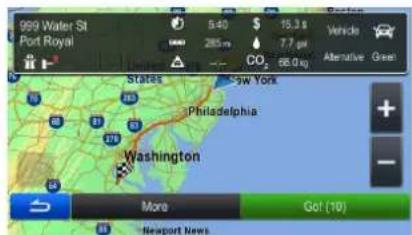
3.1.3 Using the free form search
A quick way to search for an address, a Place, an Address Book entry or a History item is to use the free form search. Do as follows:
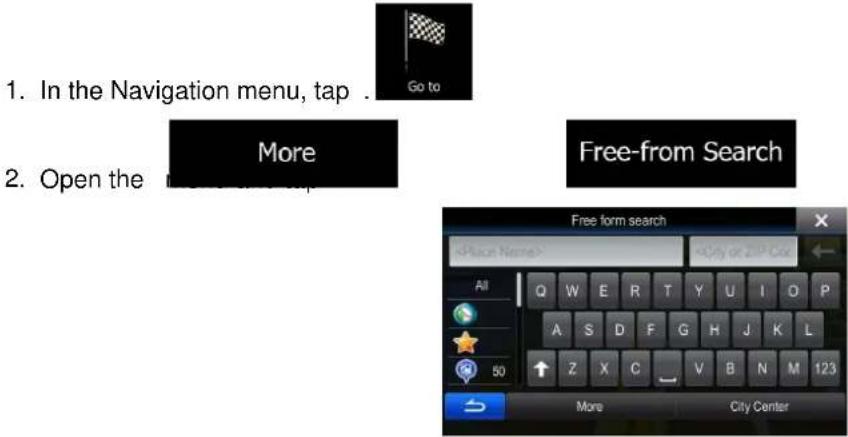
- In the left field enter the name you are looking for. It can be a street address (just the street name or both the street and the house number), the name of a Place, a previous destination or an Address Book entry.
- If you are searching in an area that is far from your current location, tap on the right field and enter a city name or a post code from the target area.
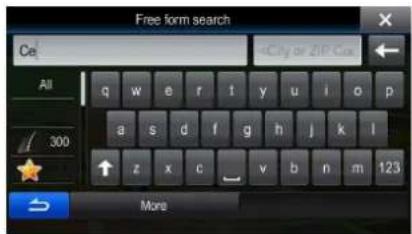
- While you type, the number of matching items is displayed on the left broken down by category.
Tap one of the categories or the keyboard is now replaced with th

atching items. The
- Select one of the items from the list.
- A full screen map appears with the selected point in the middle. If necessary, tap the map
somewhere else to modify the destination. The Cursor () appears at the new location. Tap

destination.
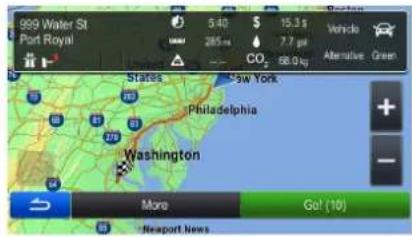
- After a short summary of the route parameters, the map appears showing the entire route. The

3.1.4 Selecting a map location as the destination

- In the Navigation menu, tap the following buttons: , Go to
- Locate your destination on the map: move and scale the map as needed.
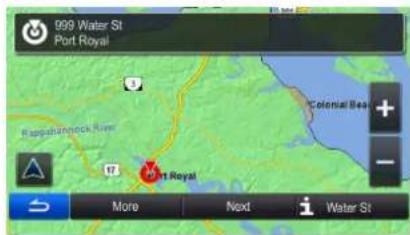

- Tap the location that you want to select as your destination. The Cursor () appears.
- Tap as the destination.
- After a short summary of the route parameters, the map appears showing the entire route. The

3.1.5 Selecting the destination from your Address Book
You can select a location that you have already saved as an Address Book entry to be your destination. Adding a location to the Address Book is described on page 59.
- Access the Address Book: in the Navigation menu, tap

- The Address Book is displayed.
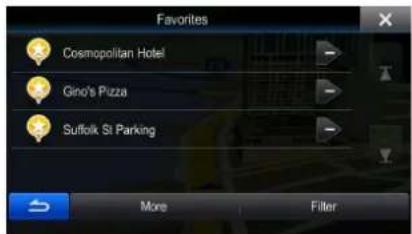
- Tap the entry that you want to set as your destination. If necessary, browse down to see more of
the list or tap
ers from the name of the entry.
- A full screen map appears with the selected point in the middle. If necessary, tap the map
somewhere else to modify the destination. The Cursor () appears at the new location. Tap


destination.
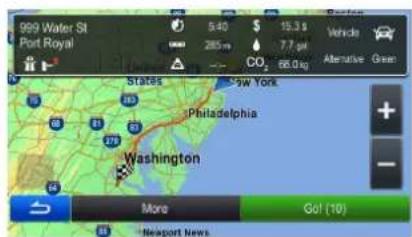
- After a short summary of the route parameters, the map appears showing the entire route. The
route is automatically calculated. Tap Go! More and start your journey.
3.1.6 Selecting a recent destination from the History
The destinations that you have set earlier appear in the History.
- Access the History:
- If you are in the Navigation menu, tap and tap.

- The list of recent destinations appears. Smart History promotes three destinations to the first page based on your previous routes (most likely destinations). The rest of the destinations are ordered by time they were last selected. If necessary, scroll the list to see earlier destinations.
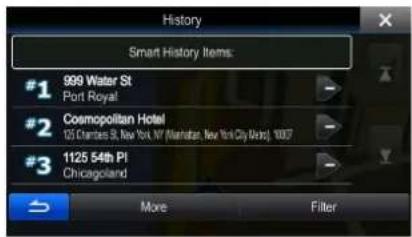
- Select a destination from the list.
- A full screen map appears with the selected point in the middle. If necessary, tap the map

destination.
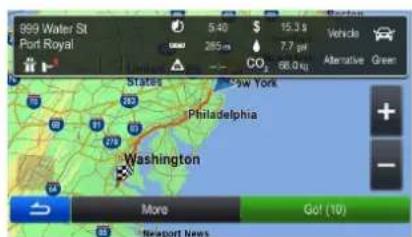
- After a short summary of the route parameters, the map appears showing the entire route. The

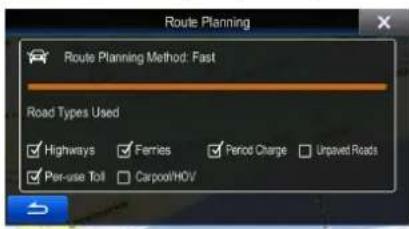
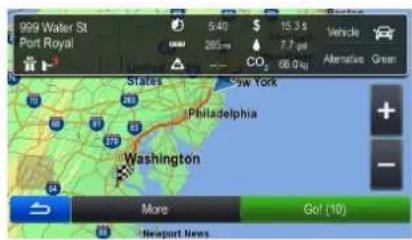
3.1.7 Entering the coordinate of the destination
You can also select a destination by entering its coordinate. Do as follows:

-
In the Navigation menu, tap
-
Open the


- You can enter the latitude and longitude values in any of the following formats: decimal degrees; degrees and decimal minutes; or degrees, minutes and decimal seconds.
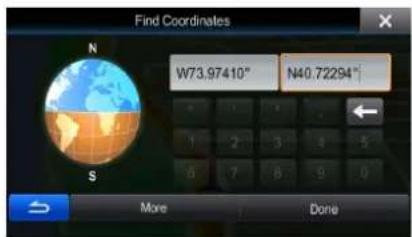
- (optional) If necessary, tap in UTM format.

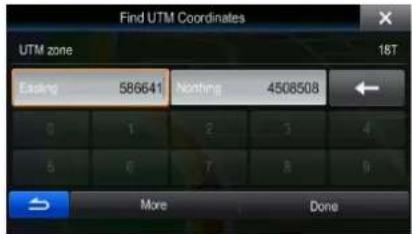
Done
-
When finished, tap .
-
A full screen map appears with the selected point in the middle. If necessary, tap the map
somewhere else to modify the destination. The Cursor () appears at the new location. Tap


destination.
- After a short summary of the route parameters, the map appears showing the entire route. The

3.1.8 Navigate to a location stored in a picture
You can also set the location stored in a picture as your destination. Do as follows:

-
In the Navigation menu, tap .
-
Open the

-
The list of picutres stored on the microSD card appears. Select one picture from the list.
-
A full screen map appears with the selected point in the middle. If necessary, tap the map

destination.
- After a short summary of the route parameters, the map appears showing the entire route. The

Note!
Only geotagged JPG files contain location information. That is why these kind of files can only be used in navigation. Other picture files do not appear in the list.
Files must be located on an inserted microSD card, in a "pictures" folder.
3.1.9 Building a route from the list of destinations (Create Route)
You can also build your route destination by destination from the Route menu.
-
In the Navigation menu, tap .
-
Tap
-
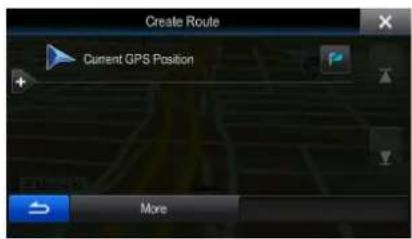
There is only one line in the list of route points, the start point of the route, normally the current GPS position.
-
Tap

- The Destination menu appears and you can select the destination of the route the same way as described in the previous sections.
- When the new destination is selected, the list returns.
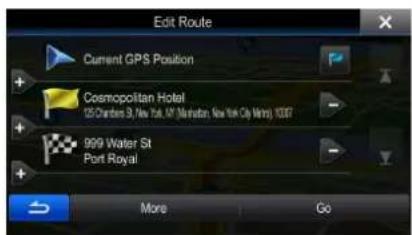
- To add more destinations, tap repeat the above procedure.

you want to insert the new route point in the list, and
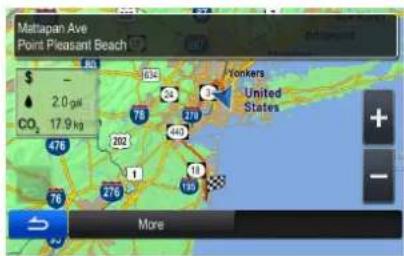
3.2 Viewing the entire route on the map
It is easy to get a map overview of the active route. Do as follows:
- In the Navigation menu, tap .
- Tap . Overviewe route is displayed in its full length on the map together with additional information and controls.
3.3 Modifying the route
When navigation is already started, there are several ways to modify the active route. The following sections show some of those options.
3.3.1 Selecting a new destination when already having a route: New Route, Waypoint or Final Destination
If you already have a recommended route and you select a new destination as described in the above sections, the application will ask you whether to start a new route, add a new waypoint (intermediate destination) to the route or append the newly selected destination at the end of the current route.
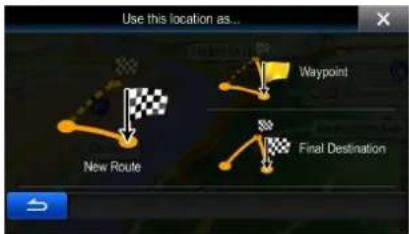

- Tap to new route to the newly selected location. The previous destination and waypoint(s) are deleted.
- Tap to newly selected location as an intermediate destination to your route. The other destinations of the route remain intact. Note: the new waypoint is placed among destinations to keep the route optimal. To decide where a waypoint to appear, use the Edit Route feature.

- Tap to Facilitation the newly selected destination at the end of the route. The other destinations of the route remain intact. The previous final destination is now the last waypoint.
3.3.2 Setting a new starting position for the route
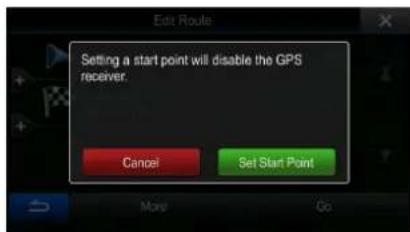
For normal navigation, all routes are planned from the current position. In order to check future routes, simulate them or see their length in time and distance, you can turn off the GPS receiver. Then you can set the starting point of the route to a different location than the current GPS position.
-
In the Navigation menu, tap
-
If you already have a route, tap . Edit Route e starting a new route, tap .
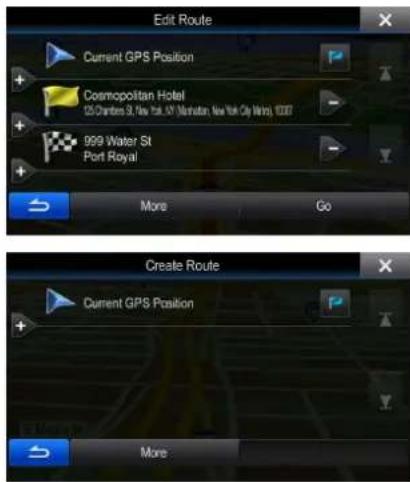
- The first line is the start of the route, normally the current GPS position. Tap a confirm your action at the warning message.

- The Destination menu appears and you can select the start point of the route the same way you select a destination.

-
When the new start point is set, tap .
-
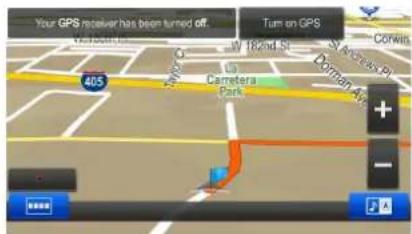
The map returns with a transparent Vehimarker (showing that there is no GPS reception). If an active route already existed, it is now recalculated starting from the selected location.
- To return to normal navigation, tap
3.3.3 Editing the list of destinations (Edit Route)
You can edit the route by modifying the list of destinations. You can add or remove destinations, modify the start position or reorder the list.
- In the Navigation menu, tap .
- Tap
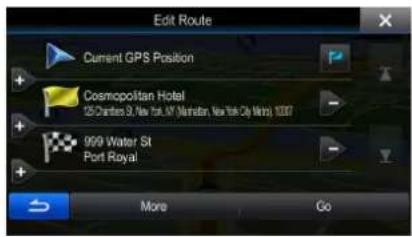
- You have the following options:

- Tap to a new destination.
- Tap to leave a destination.
- Tap to modify the start point of the route.
• Tap to you can do it manually or you can let the application optimize the route for you.
3.3.4 Canceling the active route

To cancel the navigated route, tap route is deleted with all its waypoints.
3.3.5 Checking route alternatives
To recalculate the active route with a different route planning method, you can modify the Route settings. There is another way to do this and to compare different route alternatives with the same route planning method. Do as follows:
- In the Navigation menu, tap
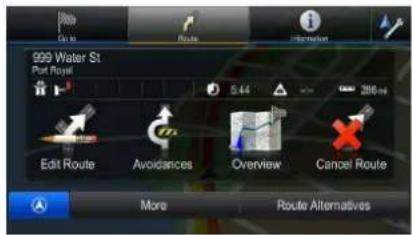
Route Alternatives
-
Tap
-
You see the basic details of three route alternatives with the selected route planning method. Tap any of them to see it on the map.
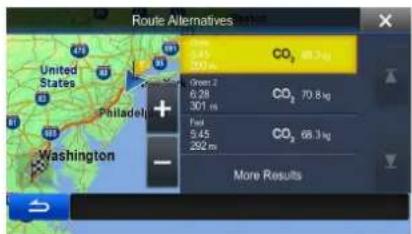
- Or if you cannot find a good alternative, tap different routing methods.

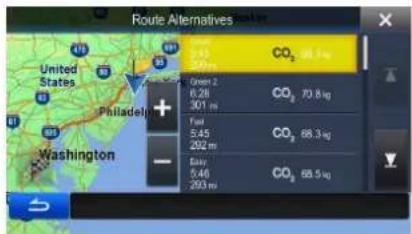

- Select one of the route alternatives then tap to return to the Map screen. The software recalculates the route. The orange line now shows the new recommended route.
3.4 Saving a location as an Address Book entry
You can add any location to the Address Book, the list of frequently used destinations. Planning a route to one of these destinations was described earlier.
- Select a destination as described before. It can be an address, a Place, any location on the map, a previously used destination from History, a coordinate or a location where a photo was taken.
- When the full screen map appears with the selected location in the middle, tap

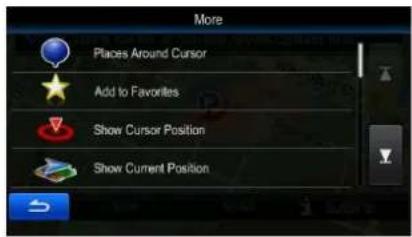
- Tap

Add to Favorites
- (optional) Using the keyboard, you can change the name offered for the Address Book entry.
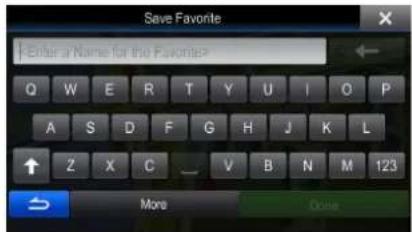
- Tap

3.5 Saving a location as an alert point
You can save any map location as an alert point (for example a speed camera or a railroad crossing).
-
Browse the map and select a location. The red Cursor appears there.
-
Tap

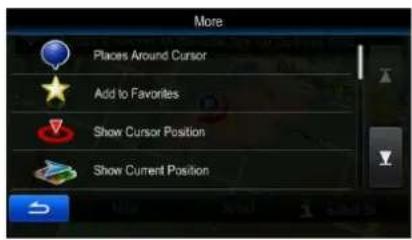
- Scroll down the list and tap
- On the newly opened screen, select the type of the alert point, the direction from which you expect the alert, and (if applicable) the speed limit for this alert point.
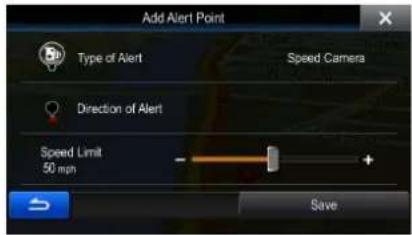
- Tap as a new alert point.
3.6 Editing an alert point
You can edit a previously saved or uploaded alert point (for example a speed camera or a railroad crossing).
-
Browse the map and select the alert point to edit. The red circle appears around the alert point.
-
Tap

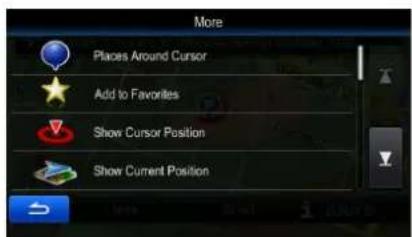
-
Scroll down the list and tap
-
On the newly opened screen, modify the type of the alert point, the direction from which you expect the alert, or (if applicable) the speed limit for this alert point.
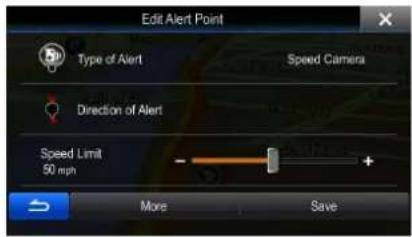
- Tap to the alert point.
3.7 Watching the simulation of the route
You can run a simulated navigation that demonstrates the active route. Do as follows:
- In the Navigation menu, tap
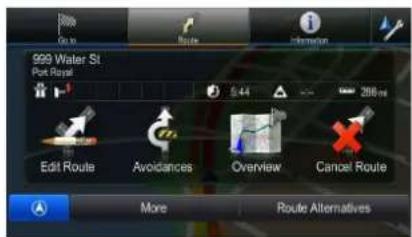
- Tap

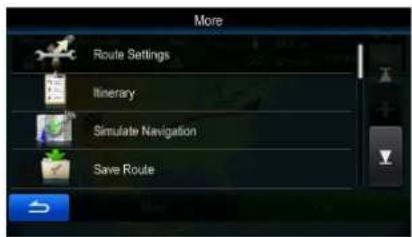
- Tap . The route from the starting point of the route, and using a realistic speed, it leads you through the whole recommended route.
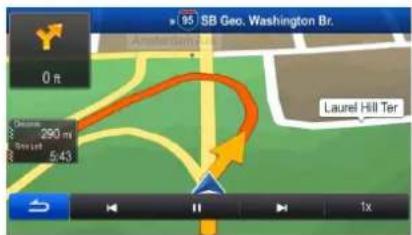
- (optional) You have the following controls during the simulation:
• : Jump to the next route event (maneuver).
- : Please the simulation.
• : Jump to the previous route event (maneuver).
• : T _1x increase the speed of the simulation to 4, 8 or 16 times faster. Now tap again to return to the normal speed.
- Tap to stop the simulation.

4 Off-road navigation
When first started, Alpine unit calculates routes using the road network of the high quality vector maps provided with the product.
More
You can switch the application to off-road mode from the Navigation menu. Tap,

Most of the procedures described for on-road navigation also apply to off-road navigation. However, there are some that are not available in this navigation mode (for example you cannot open the itinerary as you have no maneuvers just route points and straight lines between them).
4.1 Selecting the destination of the route
Selecting the start point or a destination (waypoint or final destination) is the same as described at on-road navigation. The only difference is that route points are linked to form a route with straight lines regardless of the road network and traffic regulations.
4.2 Navigating in off-road mode
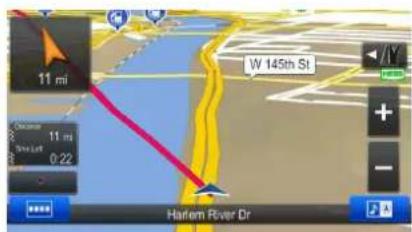
The real difference between the on-road and off-road modes is the navigation itself. When you are on the Map screen with an off-road route:
- your position and heading is not aligned with the nearest road and
- there is no turn by turn navigation just a recommended direction.
You see a straight line drawn between your current position and the next destination to reach. The Turn Preview field in the top left corner shows an arrow with your bearing and the distance of the next destination.
When you reach a waypoint, the straight line will show the direction to the next destination. When you reach the final destination, navigation ends.
5 Reference Guide
On the following pages you will find the description of the different concepts and menu screens of the software.
5.1 Concepts
5.1.1 Smart Zoom
Smart Zoom provides much more than just a usual automatic zoom feature:
- While following a route: when approaching a turn, it will zoom in and raise the view angle to let you easily recognize your maneuver at the next junction. If the next turn is at a distance, it will zoom out and lower the view angle to be flat so you can see the road in front of you.
- While driving without an active route: Smart Zoom will zoom in if you drive slowly and zoom out when you drive at high speed.
5.1.2 Route calculation and recalculation
Your software calculates the route based on your preferences:
- Route planning methods:

• : You can travel at or near the speed limit on all roads. Usually the best selection for fast and normal cars.

- : G is the smallest total distance of all possible routes. It can be practical for slow vehicles.

- : G efficient route based on the fuel consumption data given in Route settings. Travel cost and CO_2 emission calculations are estimations only. They cannot take elevations, curves and traffic conditions into account.

- : Fewer turns and no difficult maneuvers. With this option, you can make your software to take, for example, the freeway instead of a series of smaller roads or streets.
- Vehicle types:
When creating a new vehicle profile, select one of the below vehicle types.

- Maneuver restrictions and directional constraints are taken into account when planning a route.
- Roads are used only if access for cars is allowed.
- Private roads and resident-only roads are used only if they are inevitable to reach the destination.
- Walkways are excluded from routes.
Default Emergency
- All maneuvers are available in intersections.
- Directional constraints are taken into account the way that opposite direction is allowed with a low speed.
- A private road is used only if the destination is there.
- Walkways are excluded from routes.
Default Bus
- Maneuver restrictions and directional constraints are taken into account when planning a route.
- Roads are used only if access for buses is allowed.
- Private roads, resident-only roads and walkways are excluded from routes.
Taxi
- Maneuver restrictions and directional constraints are taken into account when planning a route.
- Roads are used only if access for taxis is allowed.
- Private roads, resident-only roads and walkways are excluded from routes.
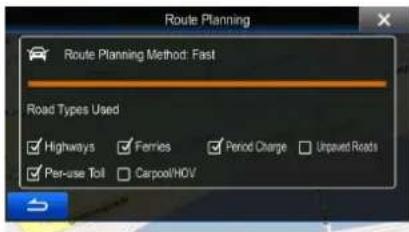
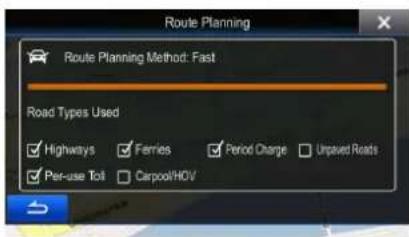
- Road types used or avoided in route calculation:
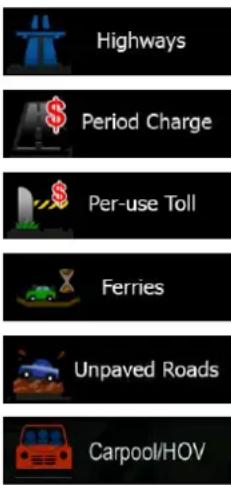
Whenever data exist, route calculation takes into account statistical traffic data for the given day of week and time of day.
Real-time Traffic events are also taken into account and sometimes greatly modify the route.
Your software automatically recalculates the route if you deviate from the proposed itinerary or if a newly received Traffic event concerns a part of the recommended route.
5.1.3 Green routing
Route calculation is not only about finding the quickest or shortest route. For some of the vehicle types, you can also check the fuel consumption and CO _2 emission when planning a route, and you can create cost effective routes with less effect on the environment.
In Route settings, you can edit the parameters of the selected vehicle. Enter the fuel consumption values and the price of the fuel. You can also select whether you want to see the difference between your route and the green route even if the selected routing method is not Green.

After the above parameters are set, select ____ method to get a fast but
also fuel efficient route. Note that travel cost and CO_2 emission calculations are estimations only. They cannot take elevations, turns, curves and traffic conditions into account. Also, this routing is not meant to give you the "greenest" route of all. It is still important to travel quickly so the result is a fast route with low fuel consumption and CO_2 emission.
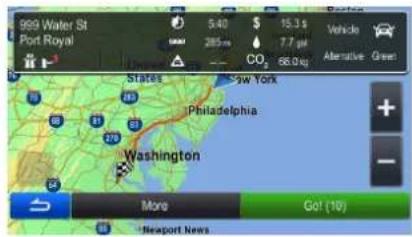
With a vehicle type where green routing is selectable, whichever route planning method is selected, the Green details are also shown when you confirm the route:
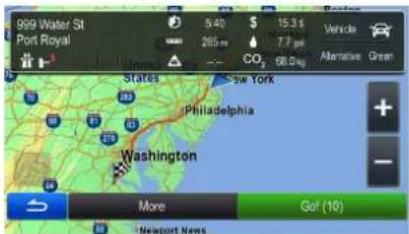
If the selected route planning method is not Green, and you have allowed the application to show the green alternative, the price, fuel consumption and CO _2 emission differences between your selected route and the Green route are also shown on this screen:
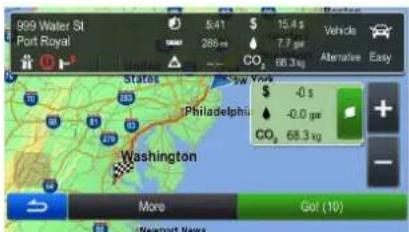
Tap the field with these details to switch the route to Green immediately.
5.1.4 Speed limit warning
Maps may contain information about the speed limits of the road segments. The software is able to warn you if you exceed the current limit. This information may not be available for your region (ask your local dealer), or may not be fully correct for all roads in the map. Speed warning can be fine-tuned in Sound and Warning settings.
You can set the relative speed above which the application initiates the warning.
The following warning types are available:
- Audio warning: you receive a verbal warning when you exceed the speed limit with the given percentage.
- Visual warning: the current speed limit is shown on the map when you exceed it (for example: SPEED LIMIT 50).
You can also choose to see the speed limit sign on the map all the time.
5.1.5 Traffic information in route planning
The recommended route is not always the same between two points. Offline statistical traffic information (historical speed information or traffic patterns) can be taken into account in the route calculation based on the time of day and the day of week whenever suitable data exists. In addition, real-time traffic information (INE-Z928HD/INE-NAV-38 only) can help you avoid current traffic events like temporary road closures or a traffic jam caused by an accident. Both functions are subject to data availability
5.1.5.1 Historical traffic
If statistical traffic information is stored with the map data, the software can take them into account when planning a route. In normal cases, these statistics help you avoid usual traffic jams on the given day of week in the given hour but in some cases like on public vacations that fall on normal weekdays, they can be misleading. You can enable this feature in Traffic settings.
5.1.5.2 Real-time traffic information (TMC) (INE-Z928HD/INE-NAV-38 only)
TMC (Traffic Message Channel) can provide you with the real-time status of the traffic. Route calculation can avoid road blocks or unexpected traffic jams caused by an accident.
TMC is a specific application of the FM Radio Data System (RDS) used for broadcasting real-time traffic and weather information.
Using traffic information is enabled by default in the software.
Note!
TMC is not a global service. It may not be available in your country or region. Ask your local dealer for coverage details.
Your device contains the TMC receiver that is needed to receive Traffic events.
If public Traffic data is broadcast at your location, the software automatically takes into account the traffic events received. You do not need to set anything in the program. The receiver will automatically search
the FM radio stations for TMC data, and the decoded information will immediately be used in route planning. When your software receives traffic information that may affect your route, the program will warn you that it is recalculating the route, and navigation will continue with a new route that is optimal considering the most up-to-date traffic conditions.
To fine-tune this recalculation, you can set the minimum delay that can trigger a route recalculation, or you can instruct the software to have you confirm the new recommended route before it takes effect. You can do these in Traffic settings.

A special icon () is displayed on the Map screen to show you whether traffic events
are received. The icon shows the status of the traffic receiver when there are no traffic events on your route, otherwise it shows the type of the next traffic event on your route.
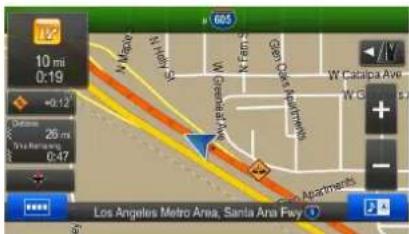
Road segments affected by traffic events are displayed with an alternate color on the map, and small symbols above the road show the nature of the event:
Tap

affic even categories :
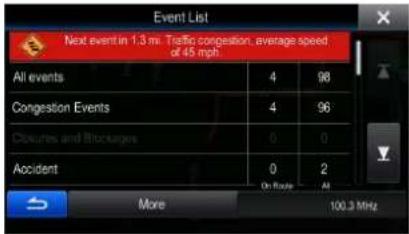
In the first column you can see the number of traffic events on your route. The second column contains the full count of traffic events in the categories.
Tap any of the even types to open the list of traffic events or tap the first line to show all events:
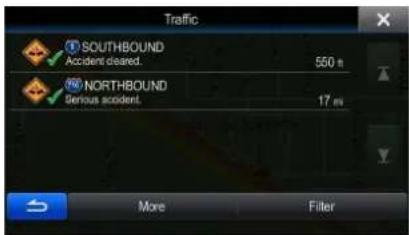
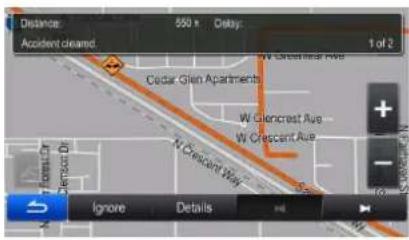
Now tap any of the list items to see its details, and to display the affected road segment in its full length on the map:
5.2 Information menu
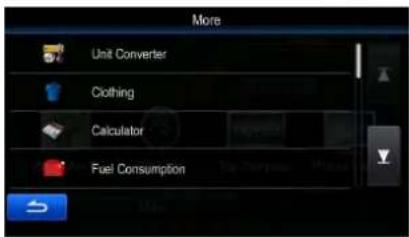
The Information menu provides you with various options and additional applications.
In the Navigation menu, tap

| Button | Description | |
 | Tap this button to get information about the current location and to find nearby help. | |
 | Tap this button to open the GPS Information screen with satellite position and signal strength information. | |
 | If you save your trip logs when you arrive at some of your destinations or let the application automatically save the trip logs for you, those logs are all listed here.Tap one of the trips to see the trip statistics, speed and altitude profile. If track log has also been saved, you can display it on the map with the selected color . Track logs can be exported to GPX files for later use.As a shortcut, the Trip monitor can be accessed from the Navigation menu. | |
 | Access the Picture Viewer app lication. View the pictures stored on your microSD.If coordinates are stored in your photos, you can start navigating to the plac where the selected photo was taken. | |
 | Tap this button to access additional functions. See the list below. | |
 Unit Converter Unit Converter | Access travel applications: the unit converter helps you convert between various different international units for temperature, speed, area or pressure, etc. | |
| [34TK] Clothing | Access travel applications: the clothing size converter helps you convert between various different international size units for men's or women's cloth types and shoes. | |
| [62W6] Calculator | The scientific calculator helps you in all your calculation needs. Tap the Mode button for additional functions and use the memory to save your results. | |
 Fuel Consumption Fuel Consumption | The Fuel consumption monitor helps you keep track of the consumption of your car even if you do not use navigation for all your journeys. Set the initial odometer value and then record the distance taken and fuel filled in whenever you fill your car. You can also set reminders for regular car maintenance. | |
| [TXCO] Sunrise & Sunset | Tap this button to see the sunlit and dark areas of the world. Your current location and route points are marked on the map. Tap the Details button to see the exact sunrise and sunset times for all your route points (your current location, all waypoints and the final destination). | |
| [KOW7] Country Information | Select a country from the list and see useful driving information about the selected country. Information may include speed limits on different road types, the maximum blood alcohol level and any compulsory equipment you need to show when stopped by the police. | |
5.3 Settings menu
You can configure the program settings, and modify the behavior of the software.
In the Navigation menu, tap

The Settings menu has several options. Tap 📋 roll with your finger to see the full list.
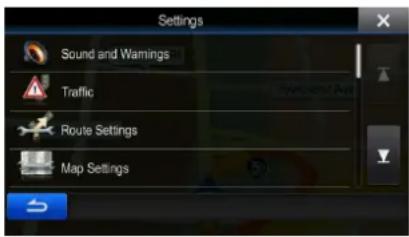
| Button | Description | |
 | Sound and Warnings | Adjust the sound volume, mute your device or change the voice guidance language. In addition, you can enable and set up different warnings and alerts. Enable different sounds and alerts in the application. |
 | Traffic | The recommended route is not always the same between two points. Whenever suitable data exists, traffic information can be taken into account in the route calculation (INE-Z928HD/INE-NAV-38 Only). |
 | Route Settings | These settings determine how routes will be calculated. Select the type of vehicle you are driving, the road types used in route planning, and the route planning method. |
 | Map Settings | You can fine-tune the appearance of the Map screen. Adjust the map view to your needs, choose suitable color themes from the list for both daytime and night use, change the blue arrow to a 3D car model, show or suppress 3D buildings, turn track logging on or off, and manage you Place visibility sets (which Places to show on the map). |
 | Visual Guidance | Adjust how the software helps you navigate with different kinds of route related information on the Map screen. |
 | Regional | These settings allow you to customize the application for your local language, measurement units, time and date settings and formats, as well as to choose the time zone. |
 | Trip Monitor | Trip logs and track logs contain useful information about your trips. Trip logs can be saved manually when you reach your destination or you can turn on the automatic saving here. |
 | Start Configuration Wizard | Modify the basic software parameters set during the initial setup process. For details, see page 7. |
 | Reset to Defaults | Delete all saved data and reset all settings to their factory defaults. |
 | Update | Visit alpine.naviextras.com to get additional content, such as new maps or 3D landmarks and useful applications. |
 | About | The About section provides you with product information. Read the Software and Database End User License Agreement, or check the map and other contents of the application. You can also access program usage statistics. |
5.3.1 Sound and Warnings
Adjust the sound volume, mute your device or change the voice guidance language. In addition, you can enable and set up different warnings and alerts.
| Button | Description |
| Volume | Tap this button to adjust the volume of the different sounds in the application. A new screen shows the different sound types and their controls. See below for details. |
| Voice Language | This button shows the current voice guidance profile. By tapping the button, you can select a new profile from the list of available languages and speakers. Tap any of these to hear a sample voice prompt. Just tap  when you have selected the new spoken language. when you have selected the new spoken language. |
| TTS Pro | Tap this button to adjust the enhanced TTS features. The following settings are available:You can set the feature to read out traffic messages.Whenever a route is calculated, the software can read out the quick summary of the route.When you cross country borders, the application can read out the information about the country you have just entered.All system messages can also be announced. |
| Advanced Settings | Street names sound correctly only if you use a native voice profile for the country. You can decide whether the applicationtries to read the street names in a foreign country,use road numbers in your language orannounces the maneuver only.You can also decide whether you want an announcement for distance maneuvers or it is enough to receive the information when the turn is near. |
| Verbosity Level | Tap this button to set the verbosity of the voice instructions: how much they tell and how often they speak. |
| Speed Warning Settings | Maps may contain information about the speed limits of the road segments. The software is able to warn you if you exceed the current limit. This information may not be available for your region (ask your local dealer), or may not be fully correct for all roads in the map. This setting lets you decide whether you wish to receive visible and/or audible warnings.Adjust the slider to set the relative speed above which the application initiates the warning.The following warning types are available:Audio warning: you receive a verbal warning when you exceed the speed limit with the given percentage.Visual warning: the current speed limit is shown on the map when you exceed it.If you prefer to see the speed limit sign on the map all the time (normally it shown only if your speed exceeds it), you can set it here. |
| Warning Sign Alerts | Maps may contain driver alert information. Tap this button to turn on or off these warnings and to set the distance from the hazard to receive the warning at. These can be set individually for the different warning types. |
You can control the volume of the following sound types:
| Button | Description |
| Guidance | These controls affect the volume of the guidance sounds (verbal instructions). |
| Ding | Turn off the attention tone preceding verbal instructions or adjust its volume. |
| Alert Beeps | These controls affect the volume of the alert sounds (beeps). |
| Key | Key sounds provide audible confirmation of tapping the touch screen. These controls affect key sounds. |
Controls for each sound type:
| Button | Description |
| Use the switch to mute the related sound. The slider becomes inactive. Tap again to re-enable. | |
| Volume slider | Adjusts the volume of the related sound. |
5.3.2 Traffic settings
The recommended route is not always the same between two points. Whenever suitable data exists, traffic information can be taken into account in the route calculation.
| Button | Description | |
| Smart Routes | Use this switch to enable or disable historical traffic data and traffic patterns. This locally stored information can be very useful in normal circumstances but for example on public vacation s it may be better to turn off in order not to take into account normal weekday traffic jams. | |
| [67xz] Traffic Receiver | Use this switch to enable or disable the TMC receiver that can receive real- time traffic information. The rest of the buttons below are all related to the TMC function and are available only if the receiver is enabled (INE-Z928HD/INE-NAV-38 Only). | |
 Detour Detour | This setting determines how your software uses the received real-time traffic information in route calculation. When calculating a new route , or when recalculation becomes necessary based on the received Traffic events, yo ur software avoids traffic events if it makes sense.You can also set the minimum delay that triggers route recalculation, and you can instruct the application if you want to confirm every recalculation (INE-Z928HD/INE-NAV-38 Only). | |
 Event Types Event Types | Tap this button to open the list of traffic event types, and select which events to take into account in route calculation (INE-Z928HD/INE-NAV-38 Only). | |
5.3.3 Route settings
These settings determine how routes will be calculated.
| Button | Description |
| Vehicle | You can set the type of vehicle you will use to navigate the route . Based upon this setting, some of the road types can be excluded from the route , or some of the restrictions may not be taken into account in route calculation.You can edit the parameters of the selected vehicle profile, or you can even create new vehicle profiles if you tap More. |
| Navigation Mode | On-road navigation creates a turn by turn itinerary using the road network on the map. Switch to off- road navigation to navigate between destinations in a straight line. |
| Route Planning Method | The route calculation can be optimized for different situations and vehicle types by changing the planning method. See below for details. |
To let the route fit your needs, you can also set which road types are to be considered for or to be excluded from the route if possible.
Excluding a road type is a preference. It does not necessarily mean total prohibition. If your destination can only be accessed using some of the excluded road types, they will be used but only as much as necessary. In this case a warning icon will be shown on the Route screen, and the part of the route not matching your preference will be displayed in a different color on the map.
In the list of road types you can see in how many segments and what total length of the road type is used in the current route.
| Button | Description |
 | You might need to avoid freeways when you are driving a slow car or you are towing another vehicle. |
 | Charge roads are pay roads where you can purchase a pass or vignette to use the road for a longer period of time. They can be enabled or disabled separately from toll roads. |
 | The software includes toll roads (pay roads where there is a per-use charge) in the routes by default. If you disable toll roads, your software plans the best toll-free route. |
 | The software includes ferries in a planned route by default. However, a map does not necessarily contain information about the accessibility of temporary ferries. You might also need to pay a fare on ferries. |
 | The software excludes unpaved roads by default: unpaved roads can be in a bad condition and usually you cannot reach the speed limit on them. |
 | Carpool or HOV lanes can be used if a given number of passengers are traveling in the vehicle. You should check whether you are allowed to use carpool lanes before enabling this road type. |
Vehicle profiles:
When you first tap options:

default vehicle profiles. You have the following
| Button | Description |
 | You can edit the parameters of the vehicle profile. |
 | Tap this button to reveal the below options. |
 | Tap this button to create your own vehicle profile. |
 | Tap this button to reset all vehicle profiles to their default settings. |
When creating a new vehicle profile, first you need to select the vehicle type. Then you need to set the following parameters. You can modify the same parameters when you edit an existing profile:
| Button | Description |
| Name | Tap this button to rename the profile for something meaningful. |
| Fuel Consumption Urban | Enter the average consumption of your vehicle when used in built-up areas. The unit for consumption can be set in Regional Settings. |
| Fuel Consumption Rural | Enter the average consumption of your vehicle when used on highways. The unit for consumption can be set in Regional Settings. |
| Engine Type | Select the engine and fuel type of your vehicle. This helps in estimating the CO2 emission. |
| Fuel Price | Enter the average fuel price for travel cost calculation. The currency can be set in Regional Settings. |
| Max. Speed | Set the maximum speed you travel with the vehicle. |
Vehicle types:
When creating a new vehicle profile, select one of the below vehicle types.
Default Car
- Maneuver restrictions and directional constraints are taken into account when planning a route.
- Roads are used only if access for cars is allowed.
- Private roads and resident-only roads are used only they are inevitable to reach the destination.
- Walkways are excluded from routes.
Default Emergency
- All maneuvers are available in intersections.
- Directional constraints are taken into account the way that opposite direction is allowed with a low speed.
- A private road is used only if the destination is there.
- Walkways are excluded from routes.
Default Bus
- Maneuver restrictions and directional constraints are taken into account when planning a route.
- Roads are used only if access for buses is allowed.
- Private roads, resident-only roads and walkways are excluded from routes.
Taxi
- Maneuver restrictions and directional constraints are taken into account when planning a route.
- Roads are used only if access for taxis is allowed.
- Private roads, resident-only roads and walkways are excluded from routes.
Route Planning Method types:
| Button | Description |
| Fast | Gives a quick route if you can travel at or near the speed limit on all roads. Usually the best selection for fast and normal cars. |
| Short | Gives a short route to minimize the distance to travel. It can be practical for slow vehicles. Searching for a short route regardless of the speed, this route type rarely practical for normal vehicles. |
| Green | Gives a quick but fuel efficient route based on the fuel consumption data given in Route settings (page 74). Travel cost and CO2 emission calculations are estimations only. They cannot take elevations, curves and traffic conditions into account. |
| Easy | Results in a route with fewer turns and no difficult maneuver s. With this option, you can make your software to take, for example, the freeway instead of a series of smaller roads or streets. |
5.3.4 Map settings
You can fine-tune the appearance of the Map screen. Adjust the map view to your needs, choose suitable color themes from the list for both daytime and night use, change the blue arrow to a 3D car model, show or hide 3D buildings, turn track logging on or off, and manage you Place visibility sets (which Places to show on the map).
The map is always shown on the screen so that you can see the effect when you change a setting.
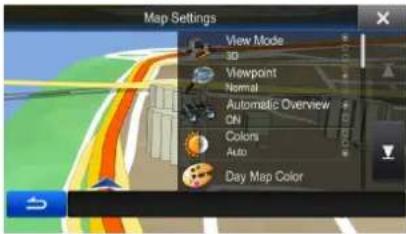
| Button | Description |
 | Switch the map view between a 3D perspective view and two 2D top- down view modes. |
 | Adjust the basic zoom and tilt levels to your needs. Three preset levels are available. There is also a manual mode when you can set the zoom and tilt levels with the buttons on the left. |
 | When selected, the map zooms out to show an overview of the surrounding area if the next route event (maneuver) is far. When you get close to the event, the normal map view returns. |
 | Switch between daytime and night color modes or let the software switch between the two modes automatically a few minutes before sunrise and a few minutes after sunset. |
 | Select the color scheme used in daytime mode. |
 | Select the color scheme used in night mode. |
 | Replace the default position marker to one of the 3D vehicle models. You can select separate icons for different vehicle types selected for route planning. Separate icons can be used for car and the other vehicles. |
 | Show or suppress 3D landmarks, 3D artistic or block representations of prominent or well-known objects. |
 | Buildings ON | Show or suppress 3D city models, 3D artistic or block representation of full city building data containing actual building size and position on the map. |
 | Track Logs ON | Turn on or off track log saving, that is, saving the sequence of th e locations your journeys go through. |
 | Place Markers | Select which Places to show on the map while navigating. Too many Places make the map crowded so it is a good idea too keep as few of them on the map as possible. For this, you have the possibility to save different Place visibility sets. You have the following possibilities:Tap the checkbox to show or hide the Place category.Tap the name of the Place category to open the list of its subcategories.MoreTap to place visibility set or to load a previously saved one. Here you can also revert to the default visibility settings. |

 Tunnel View Tunnel View | When entering tunnels, the surface roads and buildings can be disturbing. The feature shows a generic picture of a tunnel instead of the map. A top-down overview of the tunnel and remaining distance are also displayed. |
 Route Progress Bar Route Progress Bar | Turn on the route progress bar to see your route as a straight line on the right side of the map. The blue arrow represents your current position and moves up as you travel. Waypoints and Traffic events are also displayed on the line. |
 Offer Congestion Detour on Highways Offer Congestion Detour on Highways | When you slow down while driving on a freeway , there is a chance that you are in a traffic jam so the software offers you a detour using the next exit. The message shows you distance of the exit and the difference in distance and estimated time compared to the original route. You can choose from one of the following options: Tap Dismiss or just ignore the message if you want to keep the original route.Tap Preview to see the overview of the original route and the detour to make the decision. You can accept the detour as offered or increase the bypassed freeway segment before accepting.Turn to the suggested new direction and the route will be automatically recalculated. |
| [THBT] Offer Real-time Route Alternatives | Similar to the above possibility, alternative routes can be suggested when driving on normal roads. The software will select a different turn in the upcoming intersection and offers you a different route for the next section of the route.Your options are the similar as above but you cannot modify the offered detour. |
 Offer Parking Around Destination Offer Parking Around Destination | Parking at the destination may not be easy in city areas. As you approach the destination, the software can offer parking category Places near your destination. Tap the "P" button to open a top- down map with the destination and the offered parking Places. Select one and modify the route accordingly. |
 Offer Hints Upon Detour Offer Hints Upon Detour | If you leave the recommended route and suddenly exit the freeway , the application offers different alternatives near the exit like gas stations or restaurants. Also, if there are avoidable parts of the original route ahead (like a tunnel, a toll road or a ferry), you will find them in the list in case you want to bypass them with the help of the software. |
| Video Interrupt | When enabled, the device will switch back from split screen or from Audio screen to full screen map mode during voice guidance announcements. After the voice instruction the previous screen returns. |
5.3.6 Regional settings
These settings allow you to customize the application for your local language, measurement units, time and date settings and formats, as well as to choose the time zone.
| Button | Description |
| Program Language | This button displays the current written language of the user interface. By tapping the button, you can select a new language from the list of available languages. The application will restart if you change this setting; you are asked to confirm this. |
| Units and Formats | You can set the distance units to be used by the program. Your software may not support all the listed units in some voice guidance languages.Select between 12 and 24 hours time display and the various international date display formats.You can also set other country specific units used to display different values in the application. |
| Time Settings | By default, time zone is taken from the map information and adjusted by your current location. Here you can set time zone and daylight saving manually. |
5.3.7 Trip monitor settings
Trip logs contain useful information about your trips. Trip logs can be saved manually when you reach your destination or you can turn on the automatic saving here. You can access these logs in the Trip monitor. Trip monitor is available from the More menu.
| Trip database size | This is not a button. This line shows the current size of the trip database, the sum of all trip and track logs saved. |
| Enable Auto-Saving | Trip monitor can record statistical data of your trips. If you need these logs later, you can let the application save them automatically for you. |
| Save Track Log | Track logs, the sequence of the positions given by the GPS receiver, can be saved together with trip logs. They can later be displayed on the map. You can let the application save the track log whenever it saves a trip. |
5.4 Trip monitor
If you save your trip logs when you arrive at some of your destinations or let the application automatically save the trip logs for you, those logs are all listed here. Tap one of the trips to see the trip statistics, speed and elevation profile.
If track log has also been saved, you can display it on the map with the selected color. Track logs can be exported to GPX files for later use.
The Trip monitor can also be accessed from the Information menu.
6 Glossary
2D/3D GPS reception
The GPS receiver uses satellite signals to calculate its (your) position and needs at least four signals to give a three-dimensional position, including elevation. Because the satellites are moving and because objects can block the signals, your GPS device might not receive four signals. If three satellites are available, the receiver can calculate the horizontal GPS position but the accuracy is lower and the GPS device does not give you elevation data: only 2D reception is possible.
Active route
The currently navigated route. Whenever the destination is set, the route is active until you delete it or you reach your destination. See also: Route.
City Center
The city/town center is not the geometric center of the city/town but an arbitrary point the map creators have chosen. In towns and villages, it is usually the most important intersection; in larger cities, it is one of the important intersections.
GPS accuracy
Several factors have impact on the deviation between your real position and the one given by the GPS device. For example, signal delay in the ionosphere or reflecting objects near the GPS device have a different and varying impact on how accurately the GPS device can calculate your position.
Map
The software works with digital maps which are not simply the computerized versions of traditional paper maps. Similarly to the paper road maps, the 2D mode of digital maps show you streets, roads, and elevation is also shown by colors.
In 3D mode, you can see the altitude differences, for example valleys and mountains, elevated roads, and in selected cities 3D landmarks and 3D buildings are also displayed.
You can use digital maps interactively: you can zoom in and out (increase or decrease the scale), you can tilt them up and down, and rotate them left and right. In GPS-supported navigation, digital maps facilitate route planning.
North-up map orientation
In North-up mode the map is rotated so its top always faces North. This is the orientation for example in Find on Map.
Route
A sequence of route events, i.e. maneuvers (for example, turns and traffic circles) to reach the destination. The route contains one start point and one or more destinations. The start point is the current (or last known) position by default. If you need to see a future route, the start point can be replaced with any other given point.
Heading-up map orientation
In this mode the map is rotated so its top always points in the current driving direction. This is the default orientation in 3D map view mode.
Vehimarker
The current position is shown with a blue arrow on the map by default. The direction of the blue arrow shows the current heading. This position marker can be replaced with different 3D vehicle symbols. You can even specify different Vehimarkers for different route types (depending on which vehicle type is selected for route calculation).
7 Copyright note
The product and the information contained herein are subject to change without prior notification.
This manual may not, in whole or in part, be reproduced or transmitted in any form either electronically or mechanically, including photocopying and recording, without the express written consent of Alpine Electronics, Inc.
© 2011 - Alpine Electronics, Inc
© 2011 NAVTEQ. All rights reserved.
All rights reserved.
- Table of contents
- Warnings and Safety information 6
- Getting started....7
- Buttons and other controls on the screen 8
- Map screen.... 11
- Objects on the map....14
- Manipulating the map 19
- Navigation menu 22
- On-road navigation 23
- Selecting the destination of a route 23
- Selecting the destination from the Places of Interest 39
- Off-road navigation....63
- Reference Guide 64
- Warnings and Safety information
- Getting started
- Buttons and other controls on the screen
- Using keyboards
- Beyond single screen tap
- Map screen
- Navigating on the map
- Position markers
- Vehimarker and Lock-on-Road
- Selected map location (Cursor) and selected map object
- Objects on the map
- Streets and roads
- Turn preview and Next street
- Lane information and Signposts
- Junction view
- Freeway exit services
- 3D object types
- Elements of the active route
- Traffic events
- Manipulating the map
- Checking the details of the current position (Where Am I?)
- Navigation menu
- On-road navigation
- Selecting the destination of a route
- Entering an address or a part of the address
- Entering an address (United States)
- Tip!
- Entering an address (Canada)
- Entering an address (Mexico)
- Enter the street name:
- Enter the house number:
- Entering an address starting with the street name (in the United States only)
- Entering the midpoint of a street as the destination
- Selecting an intersection as the destination
- Selecting a city/town center as the destination
- Entering an address with a ZIP code
- Tips on entering addresses quickly
- Selecting the destination from the Places of Interest
- Quick search for a Place of Interest
- Searching for a Place of Interest using preset categories
- The preset search categories appear:
- Gas Station Along Route
- Parking At My Destination
- Restaurant Along Route
- Accommodation At My Destination
- Tap any of the quick search buttons to get an instant list of Places.
- Searching for a Place of Interest by category
- In a City
- Around Destination
- Along Route
- List All Places
- More
- Quai Des Célestins
- Next
- Searching for a Place of Interest by name
- Around Here
- Find by Name
- Using the free form search
- Selecting a map location as the destination
- Selecting the destination from your Address Book
- Selecting a recent destination from the History
- Entering the coordinate of the destination
- Done
- Navigate to a location stored in a picture
- Note!
- Building a route from the list of destinations (Create Route)
- Viewing the entire route on the map
- Modifying the route
- Selecting a new destination when already having a route: New Route, Waypoint or Final Destination
- Setting a new starting position for the route
- Editing the list of destinations (Edit Route)
- Canceling the active route
- Checking route alternatives
- Route Alternatives
- Saving a location as an Address Book entry
- Saving a location as an alert point
- Editing an alert point
- Watching the simulation of the route
- Off-road navigation
- Selecting the destination of the route
- Navigating in off-road mode
- Reference Guide
- Concepts
- Smart Zoom
- Route calculation and recalculation
- Default Emergency
- Default Bus
- Taxi
- Green routing
- Speed limit warning
- Traffic information in route planning
- Historical traffic
- Real-time traffic information (TMC) (INE-Z928HD/INE-NAV-38 only)
- Information menu
- Settings menu
- Sound and Warnings
- Traffic settings
- Route settings
- Vehicle profiles:
- Vehicle types:
- Default Car
- Map settings
- Regional settings
- Trip monitor settings
- Trip monitor
- Glossary
- 2D/3D GPS reception
- Active route
- City Center
- GPS accuracy
- Map
- North-up map orientation
- Route
- Heading-up map orientation
- Vehimarker
- Copyright note
Brand : ALPINE
Model : INE-Z928HD
Category : DVD player