
D-325 - Hi-Fi ONKYO - Free user manual and instructions
Find the device manual for free D-325 ONKYO in PDF.


| Product Type | Hi-Fi Speaker System |
| Brand | Onkyo |
| Model | D-325 |
| Design | 2-way bass reflex |
| Impedance | 4 Ω |
| Maximum Input Power | 70 W |
| Output Sound Pressure Level | 83 dB/W/m |
| Frequency Response | 50 Hz – 100 kHz |
| Crossover Frequency | 6 kHz |
| Woofer | 13 cm A-OMF MONOCOQUE type |
| Tweeter | 3 cm ring drive |
| Dimensions (W × H × D) | 160 × 275.5 × 271.5 mm (incl. grille and projection) |
| Weight | 3.8 kg (8.6 lbs) |
| Speaker Terminals | Push-type |
| Grille | Detachable |
| Magnetic Shielding | Yes |
| Cabinet Material | Wood |
| Accessories Included | 2 × 1.8 m speaker cables, 8 cork spacers |
| Color Variants | Letter suffix indicates color (e.g., black, white) |
| Care Instructions | Wipe with soft dry cloth; for stains, use mild detergent and water |
| Safety Precautions | Avoid liquids, extreme temperatures, and magnetic objects; handle with dry hands |
| General Information | Read manual thoroughly before use; retain for future reference |
Frequently Asked Questions - D-325 ONKYO
User questions about D-325 ONKYO
0 question about this device. Answer the ones you know or ask your own.
Ask a new question about this device
Download the instructions for your Hi-Fi in PDF format for free! Find your manual D-325 - ONKYO and take your electronic device back in hand. On this page are published all the documents necessary for the use of your device. D-325 by ONKYO.
USER MANUAL D-325 ONKYO
Thank you for purchasing an Onkyo Speaker System.
Please read this manual thoroughly before using it. Following the instructions in this manual will enable you to obtain optimum performance and listening enjoyment from your new Speaker System.
Please retain this manual for future reference.
Before Using Your New Speakers
- The speaker cabinets are made out of wood and are therefore sensitive to extreme temperatures and humidity. Do not use them in locations subject to direct sunlight or in humid places, such as near an air conditioner, humidifier, bathroom, or kitchen.
- Place the speakers on sturdy, flat surfaces. Putting them on uneven or unstable surfaces where they may fall and cause damage will affect the sound quality.
- Do not keep water or other liquids close to the speakers. If a liquid is spilled over them, the woofer and tweeter inside may be damaged.
- Do not handle the speakers with wet or damp hands.
Precautions
In catalogs and on packaging, the letter at the end of the product name indicates the color. Specifications and operation are the same regardless of the color.
The speakers can handle the specified input power when used for normal music reproduction. If they're fed any of the following signals, even if the input power is within the specified rating, excessive current may flow in the speaker coils, causing burning or wire breakage:
- Interstation noise from an untuned FM radio.
- Audio from a cassette that's being fast-forwarded.
- High-pitched sounds generated by an oscillator, electronic musical instrument, and so on.
- Amplifier oscillation.
- Special test tones from audio test CDs and so on.
- Thumps and clicks caused by connecting or disconnecting audio cables (always turn off your amplifier before connecting or disconnecting cables).
- Microphone feedback.
The speakers contain powerful magnets. Do not put metal items, such as screwdrivers, close to the speakers, as they may be attracted toward the magnet, causing injury, or damage to the tweeter diaphragm.
Getting to Know the Speakers
• D-525/D-425/D-325
Grille attach-
ment catcher
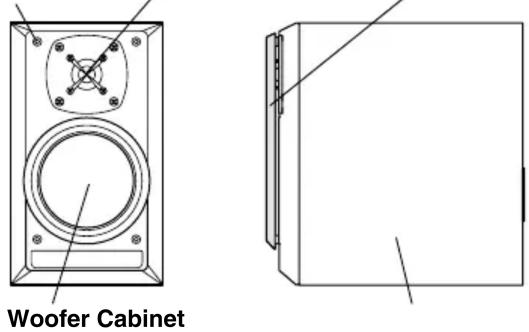
The two speakers are identical, so it doesn't matter which one you use on the left or right.
Using Close to a TV or Computer
TVs and computer monitors are magnetically sensitive devices and as such are likely to suffer from discoloration or picture distortion when conventional speakers are placed nearby. To prevent this, the speakers feature internal magnetic shielding. In some situations, however, discoloration may still be an issue. In this case, turn off your TV or monitor, wait 15 to 30 minutes, and then turn it back on again. This normally activates the degaussing function, which neutralizes the magnetic field, thereby removing any discoloration effects. If discoloration problems persist, try moving the speakers away from your TV or monitor. Note that discoloration can also be caused by a magnet or demagnetizing tool that's too close to your TV or monitor.
Note:
If the speakers are placed close to a TV or monitor, due to the electromagnetic waves radiated by the TV or monitor, you may hear noise from the speakers even after your amplifier has been turned off. To prevent this, position the speakers away from your TV or monitor.
Removing the Speaker Grilles
You can use the speakers either with or without their grilles, which can be removed as follows.
- Use both hands to gently pull the bottom of the grille away from the speaker.
- Use both hands to gently pull the top of the grille away from the speaker.
- To replace the grille, align the four fasteners and gently push the grille toward the speaker.
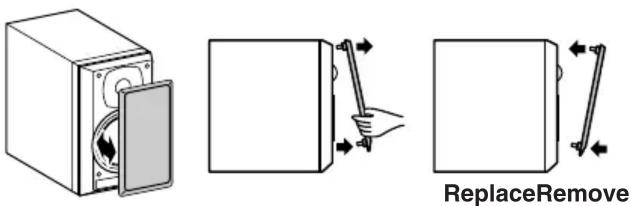
Using the Included Cork Spacers
You can improve the sound quality by attaching the included cork spacers to raise the speakers off the surface and reduce the contact area. The cork spacers also make the speakers stable and prevent them from slipping.
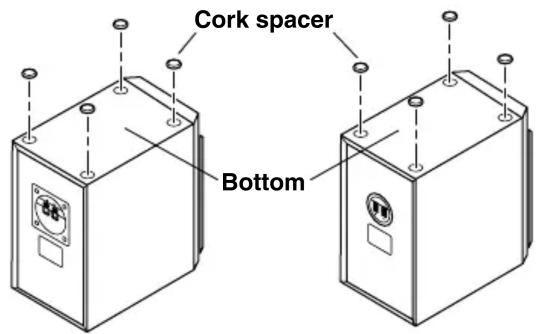
D-525/D-425 D-325
Connecting the Speakers
- Before connecting the speakers, disconnect your amplifier's power cord from the wall outlet and set its volume control to minimum.
- The speaker's rated impedance is . Make sure you connect an amplifier that is compatible with a 4 impedance.
- Use the supplied speaker cables to connect the speakers to your amplifier as shown.
D-525/D-425
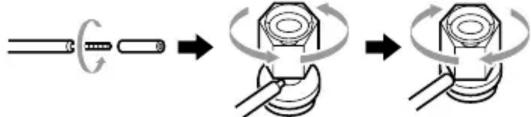
flowchart
graph LR
    A["Initial cylindrical component"] --> B["Rotated arm with rotating arms"]
    B --> C["Receiving circular components with rotating arms"]
    C --> D["Receiving final mechanical part with rotating arms"]
-
Peel the insulation off the ends of the speaker cable and twist the core wires.
-
Loosen the terminal screw and insert the speaker cable into the hole (until the core wires are inserted fully).
-
Fasten the terminal screw.
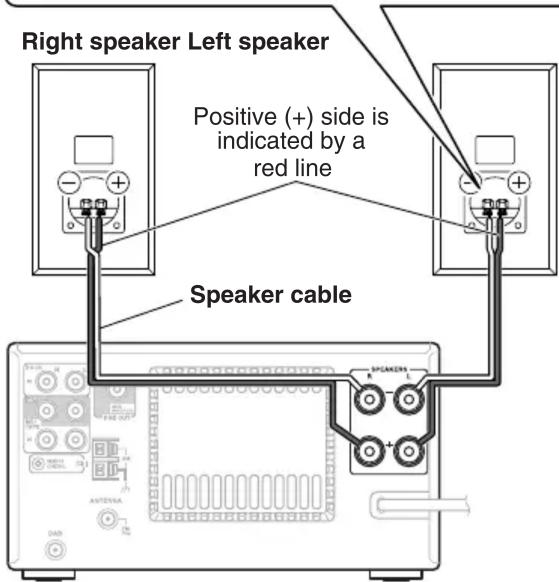
D-325
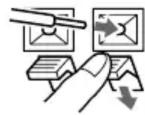
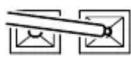
- Peel the insulation off the ends of the speaker cable and twist the core wires.
- While pressing the lever, insert the wire into the hole, and then release the lever.
- Make sure that the terminals are gripping the bare wires, not the insulation.

Right speaker Left speaker
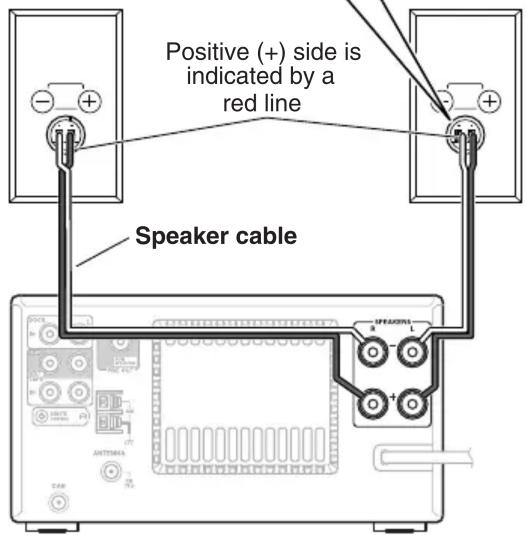
The type of speaker terminals used on the receiver and their position depends on the model. Refer to the receiver's instruction manual for details on connecting speakers to the receiver.
Before Turning on Your Receiver:
- Make sure the speaker's positive (+) terminals are connected to the amplifier's positive (+) terminals, and the speaker's negative (−) terminals are connected to the amplifier's negative (−) terminals. If you get the polarity reversed, the sound will be unnatural, with a limited bass range and poor stereo image.
- Make sure that the positive (+) and negative (−) wires are not touching each other. If they are, a short circuit may occur, damaging your amplifier.

natural_image
Symbol of crossed mechanical components with no text or labels
Speaker Placement
The sound quality of the speakers is directly affected by the size and shape of the room they're used in and its furnishings. When considering where to place your speakers, read the following:
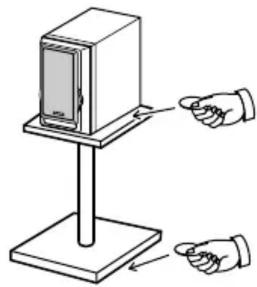
- Where possible, mount the speakers on speaker stands, concrete blocks, bricks, or a sturdy bookshelf. Putting them directly on the floor will emphasize bass sounds, creating a boomy sound.
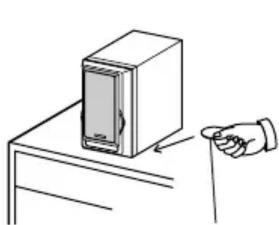
- If a speaker is placed on an uneven surface where it can wobble or vibrate, bass performance will be adversely affected. You can eliminate speaker wobble by putting a shim made out of cork or metal, such as a coin, underneath the speaker or stand, as shown.
natural_image
Line drawing of a hand holding a computer tower with a monitor, no text or symbols presentShim
natural_image
Line drawing of a hand pressing a button on a stand with a monitor (no text or symbols)- If you mount the speakers on a flat surface, such as a bookshelf, you can improve the sound quality by inserting cork spacers or coins in between the speaker and the shelf. Raising them off the surface like this will reduce the contact area and improve the sound.
- If you like lots of bass, mount the speakers on low speaker stands and place them in front of a solid wall.
- Walls and furnishings affect sound quality. To achieve a good stereo sound, put the left and right speakers in similar locations at the same distance away from your listening position and at the same height. If you put them in totally different locations, for example, one on the floor and the other on a bookshelf, the stereo imaging will be adversely affected.
- To determine the best positions for your speakers, imagine an equilateral triangle and put the left and right speakers at the ends of the base. The ideal listening position is at or slightly behind the triangle's apex. Angle the speakers toward your listening position.
- Glass doors and smooth walls behind the listening position can reflect the sound from the speakers and can make sounds at certain frequencies louder. You can prevent this by hanging sound-absorbing material, such as thick curtain, on the door or wall.
Care
To maintain the appearance of the speakers, you should periodically wipe them with a soft, dry cloth. Stubborn stains can be removed by using a soft cloth dampened with water and a mild detergent. Dry the speakers immediately afterward with a clean, dry cloth. Do not use abrasive cloths, thinners, alcohol, or other chemical solvents that may damage the finish.
Specifications
D-525/425
Type: 2-way bass reflex
Impedance: 4 Ω
Maximum input power: 70 W
Output sound pressure level: 83 dB/W/m
Frequency response: 50 Hz–100 kHz
Crossover frequency: 6 kHz
Cabinet capacity: 7.9
Dimensions (W × H × D): 160 × 275.5 × 272.5 mm
(incl. grille and projection)
Weight: 3.9 kg
Speakers Woofer: 13 cm A-OMF MONOCOQUE type
Tweeter: 3 cm ring drive
Terminal: Nut-type binding posts,
compatible with banana plugs
Grille: Detachable
Accessories: 1.8 meter speaker cable ×2
Cork spacer × 8
Others: Magnetic shielding
D-325
Type: 2-way bass reflex
Impedance: 4
Maximum input power: 70 W
Output sound pressure level: 83 dB/W/m
Frequency response: 50 Hz–100 kHz
Crossover frequency: 6 kHz
Cabinet capacity: 7.9
Dimensions (W×H×D): 160 ×275.5×271.5 mm
(incl. grille and projection)
Weight: 3.8 kg (8.6 lbs)
Speakers Woofer: 13 cm A-OMF MONOCOQUE type
Tweeter: 3 cm ring drive
Terminal: Push-type
Grille: Detachable
Accessories: 1.8 meter speaker cable ×2
Cork spacer × 8
Others: Magnetic shielding
Specifications and appearance are subject to change for improvement without prior notice.
ONKYO CORPORATION
Sales & Product Planning Div. : 2-1, Nisshin-cho, Neyagawa-shi, OSAKA 572-8540, JAPAN
Tel: 072-831-8023 Fax: 072-831-8163
18 Park Way, Upper Saddle River, N.J. 07458, U.S.A.
Tel: 201-785-2600 Fax: 201-785-2650 http://www.us.onkyo.com/
ONKYO EUROPE ELECTRONICS GmbH
Liegnitzerstrasse 6, 82194 Groebenzell, GERMANY
Tel: +49-8142-4401-0 Fax: +49-8142-4401-555 http://www.eu.onkyo.com/
ONKYO EUROPE UK Office
Suite 1, Gregories Court, Gregories Road, Beaconsfield, Buckinghamshire, HP9 1HQ
UNITED KINGDOM Tel: +44-(0)1494-681515 Fax: +44(0)-1494-680452
ONKYO CHINA LIMITED
Unit 1&12, 9/F, Ever Gain PlazaTower 1, 88, Container Port Road, Kwai Chung,
N.T., HONG KONG Tel: 852-2429-3118 Fax: 852-2428-9039
http://www.ch.onkyo.com/

http://www.onkyo.com/
I0802-1
- Before Using Your New Speakers
- Precautions
- Getting to Know the Speakers
- Using Close to a TV or Computer
- Note:
- Removing the Speaker Grilles
- Using the Included Cork Spacers
- Connecting the Speakers
- D-525/D-425
- D-325
- Before Turning on Your Receiver:
- Speaker Placement
- Care
- Specifications
- D-525/425
- ONKYO CORPORATION
- ONKYO EUROPE ELECTRONICS GmbH
- ONKYO EUROPE UK Office
- ONKYO CHINA LIMITED
Brand : ONKYO
Model : D-325
Category : Hi-Fi