GT-R (2021) - Automobile NISSAN - Free user manual and instructions
Find the device manual for free GT-R (2021) NISSAN in PDF.


| Product Type | Automotive, Supercar |
| Brand | Nissan |
| Model | GT-R (2021) |
| Fuel Requirement | Unleaded premium gasoline, 93 AKI (98 RON) minimum |
| Engine Oil Specification | Mobil 1 (0W-40) 100% synthetic or equivalent; factory fill |
| Transmission Type | Dual clutch transmission (DCT) with electronic oil pressure control |
| Transmission Oil | Genuine Nissan Transmission Oil R35 Special or equivalent |
| Differential Oil | Differential Oil R35 COMPETITION type 2189E or equivalent |
| Brake System | Cross-drilled floating rotors, radial-mounted six-piston monoblock calipers; optional NCCB (Nissan Carbon Ceramic Brake) |
| Brake Fluid | Genuine Nissan Brake Fluid R35 Special II or equivalent |
| Tire Type | Specially designed run-flat tires; summer or all-season |
| Coolant Mixture (Performance) | 30% antifreeze, 70% demineralized/distilled water |
| Wheel Alignment Toe-In (Front) | ≤ 0.059 in (1.5 mm) |
| Wheel Alignment Toe-In (Rear) | ≤ 0.079 in (2.0 mm) |
| Performance Optimization Services Interval | At 1,000 miles, then every 12 months/12,000 miles |
| Break-In Period | 1,200 miles (2,000 km) with specific driving restrictions |
| VDC Off Mode Usage | Only briefly for freeing vehicle from snow/mud; otherwise drive with VDC on |
| Special Precautions for Performance Driving | Frequent fluid changes, cool-down procedures, transmission setting |
Frequently Asked Questions - GT-R (2021) NISSAN
User questions about GT-R (2021) NISSAN
0 question about this device. Answer the ones you know or ask your own.
Ask a new question about this device
Download the instructions for your Automobile in PDF format for free! Find your manual GT-R (2021) - NISSAN and take your electronic device back in hand. On this page are published all the documents necessary for the use of your device. GT-R (2021) by NISSAN.
USER MANUAL GT-R (2021) NISSAN
Operating, servicing and maintaining a passenger vehicle or off-highway motor vehicle can expose you to chemicals including engine exhaust, carbon monoxide, phthalates, and lead, which are known to the State of California to cause cancer and birth defects or other reproductive harm. To minimize exposure, avoid breathing exhaust, do not idle the engine except as necessary, service your vehicle in a well-ventilated area and wear gloves or wash your hands frequently when servicing your vehicle. For more information go to www.P65Warnings.ca.gov/passenger-vehicle.
FOREWORD
This manual was prepared to help you understand the operation and maintenance of your vehicle so that you may enjoy many miles (kilometers) of driving pleasure. Please read through this manual before operating your vehicle.
A separate Warranty Information Booklet contains the warranties covering your vehicle (whose terms have control over this Owner's Manual or any other document or representation regarding warranty coverage).
Additionally, a separate Customer Care/Lemon Law Booklet (U.S. only) will explain how to resolve any concerns you may have with your vehicle, as well as clarify your rights under your state's lemon law.
In addition to factory installed options, your vehicle may also be equipped with additional accessories installed by NISSAN or your GT-R certified NISSAN dealer prior to delivery. It is important that you familiarize yourself with all disclosures, warnings, cautions and instructions concerning proper use of such accessories prior to operating the vehicle and/or accessory. It is recommended you see a GT-R certified NISSAN dealer for details concerning the particular accessories with which your vehicle is equipped.
Your GT-R certified NISSAN dealer knows your vehicle best. When you require any service or have any questions, they will be glad to assist you with the extensive resources available to them.
READ FIRST — THEN DRIVE SAFELY
Before driving your vehicle, please read this Owner's Manual carefully. This will ensure familiarity with controls and maintenance requirements, assisting you in the safe operation of your vehicle.

WARNING
IMPORTANT SAFETY INFORMATION REMINDERS!
Follow these important driving rules to help ensure a safe and comfortable trip for you and your passengers!
• NEVER drive under the influence of alcohol or drugs.
- ALWAYS observe posted speed limits and never drive too fast for conditions.
- ALWAYS give your full attention to driving and avoid using vehicle features or taking other actions that could distract you.
•ALWAYSuseyourseatbeltsand appropriatechildrestraintsystems.Pre-teenchildrenshould beseatedintherearseat.
•ALWAYSprovideinformation abouttheproperuseofvehicle safetyfeaturestoallooccupants ofthevehicle.
- ALWAYSreviewthisOwner'sManualforimportantsafetyinformation.
MODIFICATIONOFYOURVEHICLE
This vehicles should not be modified. Modification could affect its performance, safety, durability, and may even violate governmental regulations. Seethe 2021 NISSANGT-RWarranty Information Booklet for details including applicable exclusions.

WARNING
InstallinganaftermarketOn-Board Diagnostic(OBD)plug-indevicethat usestheportduringnormaldriving, forexampleremoteinsurancecompanymonitoring,remotevehiclediagnostics,telematicsorengine reprogramming,maycauseinterfer-
enceordamagetovehiclesystems. Wedonotrecommendorendorse theuseofanyaftermarketOBD plug-indevices,unlessspecifically approvedbyNISSAN.Thevehicle warrantymaynotcoverdamage causedbyanyaftermarketplug-in device.
WHENREADINGTHEMANUAL
Thismanualincludesinformationforall featuresandequipmentavailableon thismodel.Featuresandequipmentin yourvehiclemayvarydependingon model,trimlevel,optionsselected,order,dateofproduction,regionoravailability.Therefore,youmayfind informationaboutfeaturesorequipmentthatarenotincludedorinstalled onyourvehicle.
All information, specifications and illustrations in this manual are those in effect at the time of printing. NISSAN reserves the right to change specifications, performance, design or component suppliers without notice and without obligation. From time to time, NISSAN may update or revise this manual to provide owners with the most accurate information currently available. Please carefully read and retain with this manual all revision updates sent to you by NISSAN to ensure you have access to accurate and up-to-date information regarding your vehicle. Current versions of vehicle Owner's Manuals and any updates can also be found in the Owner section of the NISSAN website at https://owners.nissanusa.com/owners/navigation/manualsGuide. If you have questions concerning any information in your Owner's Manual, contact NISSAN Consumer Affairs. See the NISSAN CUSTOMER CARE PROGRAM page in this Owner's Manual for contact information.
IMPORTANT INFORMATION ABOUT THISMANUAL
You will see various symbols in this manual. They are used in the following ways:

WARNING
Thisisusedtoindicateahazardthat couldcausedeathorseriouspersonalinjury.Toavoidorreducetherisk, followtheinformationandinstructionsexactly.

CAUTION
Thisisusedtoindicateahazardthat couldcauseminorormoderatepersonalinjury.Toavoidorreducethe risk,followtheinformationandinstructionscarefully.
NOTICE
Thisisusedtoindicateahazardthat couldcausedamagetopropertyor yourvehicle.Toavoidorreducethe risk,followtheinformationandinstructions.

Arrows in an illustration that are similar to those above call attention to an item in the illustration.
[Figure]
This indicates the title and reference page.
CALIFORNIAPERCHLORATEADVI- SORY
Somevehicleparts,suchaslithium batteries,maycontainperchloratematerial.Thefollowingadvisoryisprovided:"PerchlorateMaterial-special handlingmayapply,Seewww.dtsc.ca. gov/hazardouswaste/perchlorate."
If you see the symbol above, it means "Do notdothis" or "Donotletthishappen".

If you see a symbol similar to those above in an illustration, it means the arrow points to the front of the vehicle.
© 2021 NISSAN MOTOR CO., LTD.
All rights reserved. No part of this Owner's Manual may be reproduced or stored in a retrieval system, or transmitted in any reform, or by any means, electronic, mechanical, photocopying, recording or otherwise, without the prior written permission of NISSAN Motor Co., Ltd.

Arrows in an illustration that are similar to those above indicate movement or action.

NISSANCUSTOMERCAREPROGRAM
NISSANCARES...
Both NISSAN and your GT-R certified NISSAN dealer are dedicated to serving all your automotive needs. Your satisfaction with your vehicle and your GT-R certified NISSAN dealer are our primary concerns. Your GT-R certified NISSAN dealer is always available to assist you with all your automobile sales and service needs.
However, if there is something that your GT-R certified NISSAN dealer cannot assist you with or you would like to provide NISSAN directly with comments or questions, please contact the NISSAN Consumer Affairs Department using our toll-free number:
For U.S. customers 1-866-668-1GTR (1-866-668-1487)
ForCanadiancustomers 1-800-387-0122
The Consumer Affairs Department will ask for the following information:
-Your name, address, and telephone number
●Vehicle identification number (attached to the top of the instrument panel on the driver's side)
- Date of purchase
●Current odometer reading
-Your NISSAN dealer's name
-Your comments or questions OR
You can write to NISSAN with the information on the left at:
ForU.S.customers
NISSANNorthAmerica,Inc.
ConsumerAffairsDepartment
P.O.Box685003
Franklin,TN37068-5003
orviae-mailat:
nnaconsumeraffairs@nissan-usa.
com
ForCanadiancustomers
NISSANCanadaInc.
5290OrbitorDrive
Mississauga,OntarioL4W4Z5
orviae-mailat:
information.centre@nissancana-
da.com
If you prefer, visit us at:
www.nissanusa.com(for U.S. customers)
or www.nissan.ca(for Canadian customers)
We appreciate your interest in NISSAN and thank you for buying a quality NISSAN vehicle.
Table of Contents
| GT-ROverview | GTR |
| Illustratedtableofcontents | 0 |
| Safety—Seats,seatbeltsandsupplementalrestraint system | 1 |
| Instrumentsandcontrols | 2 |
| Pre-drivingchecksandadjustments | 3 |
| Displayscreen,heater,airconditionerandaudiosystems | 4 |
| Startinganddriving | 5 |
| Incaseofemergency | 6 |
| Appearanceandcare | 7 |
| Do-it-yourself | 8 |
| Maintenanceandschedules | 9 |
| Technicalandconsumerinformation | 10 |
| Index | 11 |
GT-ROverview
GT-Rspecificinformation....GTR-3 Warrantyinformation....GTR-3 Maintenanceinformation....GTR-3
GT-Rspecialspecificationparts....GTR-4 Engineoil....GTR-4 Transmissionoil....GTR-4 Differentialoil(frontandrear)....GTR-5 Brakefluid....GTR-5
GT-Rspecialprecautions....GTR-5 Tiresandroadwheels....GTR-5 Brakepadanddiscrotor....GTR-6 NCCB(NISSANCarbonCeramicBrake)(if soequipped)....GTR-6 Exhaustmufflerandtrunkcarpet....GTR-7 Titaniummufflerandtrunkcarpet(if soequipped)....GTR-7 Drycarbonfiberparts(ifsoequipped)....GTR-8 Enginestartandstop....GTR-8
GT-Rperformanceoptimizationservices.....GTR-8 Wheelalignmentinspectionand adjustment(ifnecessary)(includingtire pressureadjustment).....GTR-9 Transmissionsettings.....GTR-9 Break-inschedule.....GTR-10 Wheelalignment.....GTR-10
Precautionsbeforedriving....GTR-11 VehicleDynamicControl(VDC) OFFmode....GTR-11 Summertires....GTR-11 All-seasontires....GTR-11 Avoidingbodydamage....GTR-12 Fuel....GTR-12 Bodyrepair....GTR-12 Drivingafterreplacingtires....GTR-12
Additionalmaintenanceitems....GTR-13 Precautionsonperformedriving.....GTR-13 Inspectionandadjustments beforedriving....GTR-14 Inspectionandadjustments afterdriving....GTR-19
GT-Rspecificvehiclecharacteristics....GTR-24 Refuelingprecautions....GTR-24 Gasolinesmell....GTR-24 Outsidetemperaturedisplayindicates highertemperature....GTR-24 Idlespeedisnotsteady....GTR-24 Enginespeedisrestricted....GTR-25 Engineoutput....GTR-25 Unevenwearoftires....GTR-25 Noisesareheardwhiledriving....GTR-25

Brakesysteminformation......GTR-27
Changeofsurfacecoloroftitanium muffler(ifsoequipped)....GTR-29
Thecolortoneofthetitaniummuffler finishermightbedifferentfromothers (ifsoequipped)....GTR-29
Soundheardaroundtitaniummuffler (ifsoequipped)....GTR-29
Exhaustgasisnotemittedfromleft
exhaustpipeduringidling/whenengine
speedislow(ifsoequipped)......GTR-29
Drycarbonfiberparts(ifsoequipped)....GTR-29
Dualclutchtransmission....GTR-29
Transmission
operationcharacteristics......GTR-31
GT-RSPECIFICINFORMATION
The GT-R is NISSAN's first supercar category vehicle. The GT-R is equipped with special systems. These systems are different than those used on conventional vehicles to allow for the high performance driving characteristics of this vehicle. It is recommended that your vehicle be maintained by a GT-R certified NISSAN dealer. Special skills, knowledge and equipment are necessary to properly maintain your GT-R.
WARRANTYINFORMATION
Please read this Owner's Manual carefully, together with your Warranty Information Booklet which describes a number of express limitations, exclusions and ways to void your warranty for failing to follow the instructions contained in this Owner's Manual, including, but not limited to:
- Failure to use proper parts, fuel and fluids,
●Driving with the VDC off,
●Racing,
●Any competitive driving of any sort whatsoever, - Use on a track or driving on any airstrip,
- Modifications, including adding/replacing, reprogramming, attempting to
reprogram, altering, disconnecting any computer, control unit or electronic modules,
- Deleting any or all stored information in any computer, control unit or electronic module including VSDR,
●Failure to have required GT-R Performance Optimization Services performed.
In addition, see your tire warranty for specific limitations or exclusions for operating summer tires below -4°F ( -20°C ).
MAINTENANCEINFORMATION
●Special skills, knowledge and equipment are necessary to properly inspect and adjust the GT-R engine, transmission, suspension and brakes to maintain performance. A GT-R certified NISSAN dealer has the GT-R certified technical staff and the special equipment to properly maintain your GT-R.
- NISSAN recommends maintenance items that require the replacement of parts, engine oil, oil filters and air filters be performed by a GT-R certified NISSAN dealer. Make sure the recommended fluids and parts are used when the maintenance is performed. NISSAN also recommends the replace-
ment of parts such as brakes should be performed by a GT-R certified NISSAN dealer.
GT-RSPECIALSPECIFICATIONPARTS
NOTICE
It is recommended that you only use the followingspecified fluids and parts in the GT-Rto avoid possible vehicle damage.
ENGINEOIL
Mobil1(0W-40)(100%syntheticoil)or equivalent
Mobil 1 (0W-40) (100% synthetic) is the factory fill oil. The VR38 engine with its plasma-sprayed bores was developed using this oil. NISSAN cannot ensure proper engine operation and durability if other non-equivalent synthetic oil is used. If Mobil 1 (0W-40) or equivalent is not available, Mobil 1 (10W-40) (100% synthetic) or equivalent may be used; however, some performance loss may be noticed.
Furthermore, replacement of the engine oil with MOTUL NISMO COMPETITION OIL type 2193E(5W40) is recommended for the frequent high performance driving opportunities.
NISSAN cannot ensure proper engine operation and durability if other non-equivalent synthetic oil is used.
Theuseofadditives,chemicalmaterials orabrasivecompoundsisprohibited.
The use of additives, chemical materials, abrasive compounds or other high performance engine oils may cause internal engine damage.
Engineoilmaintenance
- When the vehicle is delivered, the engine oil level is 0.39 in (10 mm) below the H mark on the engine oil dipstick for optimum high performance driving. The engine oil can be filled up to the H mark if not engaging in performance driving.
- Because of the high performance characteristics of the GT-R engine, more frequent oil level inspections are necessary. Check the oil level every 1,800 miles (3,000 km) and adjust as necessary. Also, change the engine oil based on the driving conditions. For the information regarding oil replacement intervals, refer to the "9. Maintenance and schedules" section of this manual.
- Some amount of oil is consumed by your engine under normal operating conditions, and oil consumption by itself does not necessarily indicate any malfunction. If your rate of oil
consumption increases suddenly or without explanation, NISSAN recommends that you have your vehicle inspected by a GT-R certified NISSAN dealer.
- For information about the oil replacement intervals for performance driving, refer to the interval for replacing oil after high performance driving. ( "Additional maintenance items" page GTR-13)
Make sure to replace the oil filter when the engine oil is changed.
TRANSMISSIONOIL
GenuineNISSANTransmissionOilR35 Special(100%syntheticoil)orequivalent
The GT-R uses a multiple-disc dual wet clutch transmission. The specially developed transmission oil maximizes the friction characteristics of the clutch and the lubrication of the gear bearings.
Theuseofadditivesisnotrecommended.
The use of additives or other transmission oil may cause internal transmission or clutch damage.
GT-RSPECIALPRECAUTIONS
DIFFERENTIALOIL(frontandrear) DifferentialOilR35COMPETITIONtype 2189Eorequivalent
Use Differential Oil R35 COMPETITION type 2189E or equivalent that can keep the oil temperature low in order to protect all parts of the differential and maximize the performance of the Limited Slip Differential (LSD).
Theuseofadditivesisnotrecommended.
Using additives or any other than the specified differential oil may cause the oil temperature to increase and the final drive to be damaged. Also it may cause vibration and adversely the vehicle handling characteristics.
BRAKEFLUID
GenuineNISSANBrakeFluidR35Special Ilorequivalent
Genuine NISSAN Brake Fluid R35 Special II is the factory fill brake fluid. The Vehicle Dynamic Control (VDC) unit and other related parts were specially designed for this brake fluid. NISSAN cannot ensure proper operation of the vehicle if other non-equivalent brake fluid is used.
TIRESANDROADWHEELS
Tires
The GT-R uses specially designed run-flat tires and matching road wheels. Use of these specially developed tires and wheels provides the greatest potential for maximum performance.
- Using non-genuine GT-R tires may cause powertrain system damage if the vehicle is driven in a flat tire situation, even if run-flat tires are used. This may also prevent the vehicle from being stopped safely.
- Using non-genuine GT-R tires may also cause tire failure due to excessive heat buildup caused by tire distortion while driving.
- Using non-genuine GT-R tires may affect the operation of the VDC system.
Tirereplacement:
- When tire replacement is required, replacing tires as a set of four with new tires is recommended. However, if a tire is punctured or damaged, it may be possible to replace only the damaged tire. Determining whether one tire or a complete set of tires should
be replaced is based on a number of factors including tire wear and condition. Your GT-R certified NISSAN dealer can recommend if an individual tire or a complete set should be replaced.
- The GT-R uses specially designed run-flat tires which have a rigid side wall. Special equipment and procedures are required when replacing these tires. NISSAN recommends that tire replacement be performed at a GT-R certified NISSAN dealer.
- Specific tire changing equipment must be used to remove the GT-R tires from the wheel and to install the GT-R tires onto the wheel. It is only possible to reuse the tires when they have no cracks and/or deformations on the bead portion of the tire. If the incorrect equipment is used to remove the GT-R tires from the wheel and to install the GT-R tires onto the wheel, cracks and deformation may occur on the bead portion of the tires meaning that the tires cannot be reused. We recommend contacting a GT-R certified NISSAN dealer if the tires need to be removed from the wheels.
- When reusing tires, it is recommended you contact a GT-R certified NISSAN
GT-ROverviewGTR-5
dealer.
Roadwheels
Using non-genuine GT-R wheels may cause the following:
- vehicle vibration
●the tire coming loose from the wheel during a flat tire
●reduced wheel lug nut tightness
BRAKEPADANDDISCROTOR
This vehicle is equipped with cross-drilled floating rotors and radial-mounted six-piston monoblock calipers. This helps to achieve excellent stopping performance and fade-resistance.
Using non-genuine GT-R brake pads or rotors can affect vehicle braking performance and the operation of the ABS and VDC system.
Replacementofbrakepadsand discrotors
FormodelswithoutNCCB(NISSANCarbonCeramicBrake)package:
NISSAN generally recommends to replace all four sets of brake pads and disc rotors at the same time to maintain maximum brake performance.
However, replacing only the brake pads may be allowed in some cases (four wheels or only front wheels depending on the conditions). A GT-R certified technician must inspect the vehicle and determine that only the brake pads need to be replaced. In this case, replacing all brake pads and disc rotors as a set is no necessary.
Note that the replacement of brake pads and the disc rotors as a set on all four wheels should be performed when a GT-R certified technician determines that this is the correct repair.
If the inside of the disc rotors are cold during the winter and the surface becomes hot due to a heavy force being applied repeatedly to the brakes, cracks may occur near the coolant hole on the surface of the disc rotor. Cracks may also occur due to a heavy force being repeatedly applied to the brakes during high performance driving. In these cases it may be necessary to replace the disc rotors or brake pads depending on the condition of the crack. We recommend contacting a GT-R certified NISSAN dealer for replacement.
NCCB(NISSANCarbonCeramic Brake)(ifsoequipped)
In order to enjoy the high performance braking sensation as well as the sporty driving and flexibility offered by the GT-R, NCCB (NISSAN Carbon Ceramic Brake) is available. NCCB (NISSAN Carbon Ceramic Brake) is specially designed brake system. Conventional carbon ceramic brakes have weaknesses in braking performance when driving in the rain, at a low temperature or at low speeds. However, NCCB (NISSAN Carbon Ceramic Brake) achieves both a stable brake force at high temperatures during high performance driving and braking performance under such driving conditions. NISSAN recommends that you have the NCCB (NISSAN Carbon Ceramic Brake) and the related parts maintained by a GT-R certified NISSAN dealer. Otherwise, the braking performance may not be delivered across all situations and the brake system may be damaged, which could result in a serious accident.
Replacementofbrakepadsand discrotors
When replacing brake pads and brake disc rotors, NISSAN recommends replacing two sets of them at the same time.
However, the brake pads can be separately replaced only when a GT-R certified technician judges that the brake disc rotors are reusable, based on a measured weight and a check for scratches and cracks.
EXHAUSTMUFFLERANDTRUNK CARPET
The GT-R exhaust system is designed to provide the maximum vehicle performance and to protect the vehicle from high exhaust gas temperatures.
If non-genuine GT-R exhaust system parts are used it is possible that the muffler or other exhaust system parts will deform and cause damage to the under-body. Non-genuine GT-R exhaust system parts can also affect vehicle performance and possibly lead to turbocharger, engine or power train related parts including transmission, damage.
Also, do not remove the trunk carpet from the vehicle for any reason. The carpet insulates the vehicle interior from the heat of the muffler and from the noise of the transmission.
TITANIUMMUFFLERANDTRUNK CARPET(ifsoequipped)
If a non-genuine titanium muffler is used, the muffler may become deformed and damage the underbody due to the high performance engine reaching high exhaust gas temperatures (1,832°F (1,000°C) or more). The highest-class titanium alloy is used for genuine parts to ensure the resistance strength and creeping characteristics against high exhaust gas temperature. In addition, further cooling effects are secured by taking in air through the duct on the undercover, to cool the area around the muffler, and by applying partial plate thickness reduction. Since genuine titanium mufflers are made of titanium alloy, the surface color will change depending on the driving conditions, which is not unusual. Prior to shipping from factory, all vehicles receive balance aligning for engine, transmission, and clutch, as well as quench driving of brake pads and rotors. As a result, the muffler surface color may differ depending on the vehicle.
Never remove the trunk carpet from the vehicle for any reason. The carpet insulates the vehicle interior from the heat of the muffler and from the noise of the transmission.
NeverAllowOilorGreasetoAdhereto theTitaniumMuffler.
If the muffler is heated when oil or grease adhere to the muffler surface, the color of this area will be different from that of the surrounding area. To remove the oil or grease, check that the surface temperature of the muffler has cooled, wash the area with a neutral detergent, wipe it with a brake cleaner-sprayed clean shop cloth and gently tap it with a dry shop cloth to dry. Be careful not to allow the brake cleaner to splatter on rubber parts, bumper, etc.
NOTICE
Neverallowpolisheswithcompounds,becausethereisapossibilitythatthetitaniummufflerfinisher coloringwillbechanged.
DRYCARBONFIBERPARTS(ifso equipped)
Because of the characteristics of the material, the dry carbon fiber parts may turn yellow due to exposure to ultraviolet rays. The surfaces of dry carbon fiber parts are coated with a special ultraviolet protection paint. To maintain the appearance of these parts, it is important to take proper care of them.
NOTICE
- Donotusecompoundagentson clear-coateddrycarbonfiber parts(suchastheNISMOmodel's bumper, sidesillprotector, rear spoiler, roof, hood, hoodduct, frontfenderduct, etc.).
- Donotuseanychemicalagents (wax, coating agent, compound agent, etc.) on matte-painted dry carbon fiber parts (such as the reardiffuser, arearspoiler that is of specifications other than NISMO, etc.).
- Whendrycarbonfiberpartsbe-comedirty, prepareadilute cleaningsolutionbymixingone capfulofmilddetergentina
bucketofwater, andusethat mixturetocleantheparts.
NOTE:
Thesurfacesofthedrycarbonfiber partsarelightlycoatedlikearacecarso thatyoucanfeelthepropertextureof realcarbon,whichmayfeelrough.This isnormal.
ENGINESTARTANDSTOP
This vehicle includes spark plugs that are designed for high performance. For this reason, if the engine is repeatedly started and stopped over a short time, the spark plugs may become fouled, making the engine difficult to start. To prevent diminished starting performance, avoid starting and stopping the engine repeatedly during a short period of time.
GT-RPERFORMANCE OPTIMIZATION SERVICES
In addition to the regular maintenance recommended by NISSAN, the GT-R requires the following special inspections:
- Wheel alignment inspection and adjustment (if necessary) (including tire pressure adjustment)
●Transmission settings These inspections are required at the following intervals:
•1,000 miles
•12 months
•24 months
•36 months
NOTE:
•Theseinspectionswillbeperformed freeofchargeforlaborataGT-R certifiedNISSANdealeronly.Inspec-tionsthereafterarerecommended every12monthsor12,000miles (whichevercomesfirst)atthecus-tomer'sexpense.Seethe2021 NISSANGT-RWarrantyInformation Bookletfordetails.
- Repairs and adjustments involving parts replacement, etc. determined to be necessary as a result of these inspections are performed at the customer's expense.
- Seethe2021NISSANGT-RWarranty InformationBookletforsignificant limitations,exclusionsandpossible voidingofyourwarrantyresulting fromfailuretohavethesenecessary inspections,repairsand/oradjustmentsperformed.
- Seethe"9.Maintenanceandschedules"sectionofthismanualfora detailedexplanationoftheGT-R PerformanceOptimizationServices.
WHEELALIGNMENTINSPECTION ANDADJUSTMENT(ifnecessary) (including tire pressure adjustment)
This vehicle is equipped with a high performance suspension. The vehicle's wheel alignment should be measured and adjusted (if necessary) as necessary as the vehicle is driven and the suspension parts break-in. It is recommended that you see a GT-R certified NISSAN dealer to perform these services.
The wheel alignment can be adjusted by a GT-R certified NISSAN dealer in accordance with specifications for city driving to high performance driving.
The tires on the GT-R may have different wear rates and wear patterns in comparison to conventional passenger vehicles. It is recommended you contact a GT-R certified NISSAN dealer to confirm that the alignment is within specifications.
Preventingtoe-out:
Toe-outcancauseuneventirewearor damagetoareasinsidethetiresdueto highheat.Besuretohavethewheel alignmenttoe-insettingcheckedand adjusted.ItisrecommendedyoucontactaGT-RcertifiedNISSANdealer beforeanyperformancedrivingon closedcircuittracks.Obeyalltraffic lawswhenonpublicroads.
| Toe-in specification | |
| Front | ≤ 0.059 in (1.5 mm) |
| Rear | ≤ 0.079 in (2.0 mm) |
TRANSMISSIONSETTINGS
The design of the clutch and transmission requires inspection and adjustment of the clutch and shift forks. It is recommended you contact a GT-R certified NISSAN dealer at the recommended intervals. If the transmission setting is not complete, excessive loads may be applied to the transmission and power train system parts during starting and shifting, which may result in a malfunction or damage. Depending on the driving conditions,
more frequent adjustments may be necessary to help maximize vehicle performance.
BREAK-INSCHEDULE
NOTICE
Followtheserecommendationsto obtainmaximumengineperformanceandensurethefuturereliabilityandeconomyofyournew vehicle.Failureretofollowtheserecommendationsmayresultinshortenedenginelifeandreduced vehicleperformance.
Please observe the following types of driving until the mileage shown below has been reached.
Until 300 miles (500 km):
- Do not depress the accelerator pedal more than halfway and avoid rapid acceleration.
- Drive with the engine speed kept at less than 3,500 RPM.
- Avoid unnecessary quick steering, abrupt braking and driving on poor roads.
300 to 600 miles (500 to 1,000 km): -
Avoid rapid acceleration in a low gear (1st to 3rd gears) with the accelerator pedal fully depressed. Depress the pedal slowly.
-
Avoid unnecessary quick steering and abrupt braking.
- Drive with the suspension setup switch in the COMF mode to allow more suspension stroke.
600 to 1,200 miles (1,000 to 2,000 km): - Drive with the engine speed kept relatively high with the shift lever in the M position. Shifting is recommended between 1st and 4th gears.
- Avoid unnecessary quick steering and abrupt braking.
- Drive with the suspension setup switch in the COMF mode to allow more suspension stroke.
Even though the mileage reaches over 1,200 miles (2,000 km), the clutch may take longer to properly engage if the vehicle is mainly driven in town at a low speed. NISSAN recommends breaking in the clutch at a GT-R certified NISSAN dealer. Always perform the transmission setting after breaking in the clutch. If the transmission setting is not complete, excessive loads may be applied to the transmission and power train system parts during starting and shifting, which may result in a malfunction or damage.
WHEELALIGNMENT
Do not adjust the wheel alignment until the mileage reaches 1,000 miles (1,600 km). Until then, the suspension may not engage enough and the height may be higher.
However, make sure to adjust the alignment after 1,000 miles (1,600 km).
The wheel alignment can be adjusted by a GT-R certified NISSAN dealer in accordance with specifications for city driving to high performance driving.
The tires on the GT-R may have different wear rates and wear patterns in comparison to conventional passenger vehicles. It is recommended you contact a GT-R certified NISSAN dealer to confirm that the alignment is within specifications.
PRECAUTIONSBEFOREDRIVING
VEHICLEDYNAMICCONTROL(VDC) OFFMODE
Always make sure the VDC is ON before driving the vehicle by checking that the VDC OFF indicator lights on the meter and the VDC set-up switch are not illuminated. The GT-R is a high performance vehicle and the VDC must be on/activated to provide proper powertrain operation and intended drivability.

WARNING
•TheVDCOFFmodeshouldONLY beusedbrieflytohelpfreethe vehicleifstuckinsnowormudby temporarilystoppingoperation oftheVDCtomaintainwheel torque.
- DrivingtheGT-RwiththeVDCoff mayleadtohandlingissuesrelatedtosteeringmaneuvers,acceleration,ordeceleration. Moreover,drivingwiththeVDC offcanresultinaninoperative vehiclebycausingseriousdamagetothepowertrain,including damagetotheTransaxleAssemblyincludingTransfer,Clutch, Gears,Transaxlecaseandallof
itscomponentsandotherdrive-traincomponent(s)byoverheat-ingorexcessiveforce.
- Damagethepowertrainorany drivetraincomponent(s)thatoccurswhenthereisarecordinthe VehicleStatusDataRecorder (VSDR)thatthevehiclewasdriven withVDCoffduringtheperiod whenthedamagewasincurredis excludedfromwarrantycoverage.
See your 2021 Warranty Information Booklet for important related information and warranty coverage exclusions. See also section 2 ( "Transmission warning light" page 2-33) and section 5 ( "Vehicle Dynamic Control (VDC) system" page 5-54) of this Owner's Manual, "Transmission Clutch Temperature High" and "Vehicle Dynamic Control (VDC) System" for important additional related information.
SUMMERTIRES
The GT-R summer tires are made from a specially formulated rubber to maximize the vehicle's performance capabilities. Performance of summer tires is substantially reduced when temperatures are less than 32°F (0°C) so you must drive carefully. NISSAN recommends the use of winter or all-season tires on all four wheels if you plan to operate your vehicle in snowy or icy conditions when temperatures are less than 32°F (0°C).

WARNING
Neverusesummertireswhenthe temperatureisbelow-4°F(-20°C)to preventpermanenttreaddeformationwhichmaycausetiredamageor tirefailure. This may causealossof vehicle control which can result in serious personal injury or death.
ALL-SEASONTIRES
Do not exceed the speed rating of the tire that is installed on the vehicle.
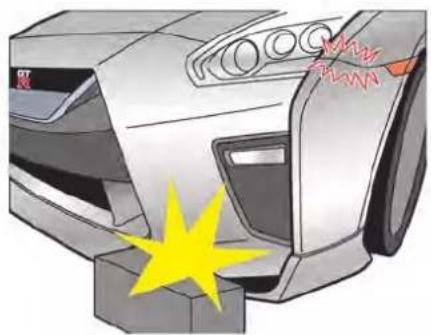
AVOIDINGBODYDAMAGE
The GT-R bumper, fascia, side sills and undercarriage are close to the ground. Drive slowly on rough or uneven roads to avoid damaging these parts. Pay careful attention to wheel blocks and curbs. If the front bumper contacts a wheel block, curb, etc., the bumper and underlying parts may be damaged or cracked. Be careful not to damage the front spoiler that is installed below the engine room.
FUEL
NISSAN recommends using fuels that contain no alcohol. However, fuels containing up to 10% alcohol may be used, if necessary. Do not use E-15 or E-85 in your vehicle. ( "Fuel information" page 10-4)
NOTICE
To avoid serious engined damaged to increased cylindertemperatures, donotuse fuel that contain more alcohol than indicated in "Gasoline containing oxygenates" page 10-5. Also, donotuse fuel additives, fuel stabilizers or fuel deicer that contain alcohol.
Only certified body shops using CELETTE® advanced collision repair equipment are approved by NISSAN for repairing structural body damage. It is recommended you contact a GT-R certified NISSAN dealer or NISSAN Consumer Affairs for a referral or list of certified body shops.
DRIVINGAFTERREPLACINGTIRES
Avoid the driving conditions listed under "Additional maintenance items" in this section for 48 hours after tires are installed on the wheels ( "Additional maintenance items" page GTR-13). The tire may slip on the wheel if the vehicle is driven in these conditions before 48 hours have passed. If the tire slips on the wheel, the wheel/tire assembly will be out of balance and will require rebalancing.
BODYREPAIR
The body of the GT-R has been manufactured on special fixtures utilizing a hybrid structure with aluminum die cast parts for the frame work. Special skills, information and equipment are required to correctly repair the body. It is recommended you contact a GT-R certified NISSAN dealer if the vehicle is damaged, such as in a collision, and they will recommend an appropriate body shop.
ADDITIONALMAINTENANCEITEMS
The information and specifications in this section apply only when engaging in performance driving.
The following information applies only if you engage in performance driving such as driving your GT-R for extended periods under the following conditions.
●Higher-RPM (approaching redline) operation
●Frequent high pedal force braking from moderate and higher speeds
●Frequent throttle activation
●Fast revving throughout the RPM range
In such cases, the following additional maintenance guidelines apply.
However, you should also carefully read your 2021 NISSANGT-R Warranty Information Booklet for important information concerning warranty coverage, limitations and exclusions.
We recommend that all GT-R maintenance be performed at a GT-R certified NISSAN dealer. NISSAN will only pay for GT-R Performance Optimization Services performed at a GT-R certified NISSAN dealer.
PRECAUTIONSON PERFORMANCE DRIVING
The information and specifications in this section apply only when engaging in performance driving.
Checkingthetemperatureofthe coolantandoilsonthetouch screendisplay
When the temperatures of the engine coolant and oil, and the oil pressure exceed the normal range, the color of the multi function meter on the touch screen display changes to red to warn the driver. When engaging in high performance driving, switch the display to the multi function meter to display the temperature of the engine coolant and oil, and the oil pressure. When the color of the meter display changes to red, perform cool down driving. When the values of the temperature and pressure return to the normal range, the color of the multi function meter will turn back to white. Warning temperature:
- Engine coolant temperature is 230° F ( 110° C) or higher: If the engine coolant temperature increases above 230° F ( 110° C), the
color of the multi function meter on the touch screen display changes to red to warn of a possible overheat condition and engine output is reduced.
- Engine oil temperature is 275°F (135°C) or higher: If the engine oil temperature is higher than 275°F (135°C), the meter display changes to red, maximum engine speed is automatically limited to 4,000 rpm, and the transmission automatically changes from the position to the position.
●Transmission oil temperature is 284°F (140°C) or higher:
If the transmission oil temperature increases to over 284° F ( 140° C), the color of the meter display changes to red. However, the vehicle can continue to be driven until the temperature reaches 295° F ( 146° C). If the oil temperature exceeds 284° F ( 140° C) while driving (the color of the meter displayed in red), change both the transmission oil and the differential oil after driving because these fluids have deteriorated because of the heat.
Cooldown
The information and specifications in this section apply only when engaging in performance driving.
Cool down the vehicle to help extend the life of the vehicle if coolant temperatures are extremely high. Drive the vehicle at 37 to 50 MPH (60 to 80 km/h), in 5th or 6th gear for 2 to 3 miles (3 to 5 km) and then stop the engine.
Refueling precautions

WARNING
Donotattempttotopoffthefuel tankafterthefuelpumpnozzle shutsoffautomatically.Continued refuelingmaycausefueloverflow, resultinginfuelsprayandpossiblya fire.Thefueltankisfullatthefirst automaticshutoff.
To maximize vehicle performance, the fuel tank is located as low as possible to lower the vehicle center of gravity. The tank is also divided into two parts. This fuel tank design causes higher pressures inside the tank than other vehicles so fuel spillage is possible by trying to top off the
fuel tank after automatic shutoff.
The fuel tank pressure is higher when the vehicle is hot, especially if the tank is more than half full. If the cap is opened when the vehicle is hot, it may cause fuel spray and there may be a hissing noise. Open the cap slowly, releasing the pressure from the tank gradually. Also, if the vehicle is refueled when the vehicle is hot, the fuel pump may automatically shut off before the tank is full. This does not indicate that there is a malfunction. Refuel slowly or refuel after the vehicle has cooled.
INSPECTIONANDADJUSTMENTS BEFOREDRIVING
The information and specifications in this section apply only when engaging in performance driving.
Fluids
- Check the engine, transmission, differential and under vehicle surfaces for oil and coolant leaks.
- Check the fluid levels and adjust as necessary using the specified fluid as described under the conditions listed in this section. ( "Recommended fluids and maintenance interval" page GTR-20) If you do not drive under the
conditions listed, refer to the "9. Maintenance and schedules" section of this manual.

- NISSAN recommends to adjust the engine oil level ① to be 0.39 in (10 mm) (1/8 gal (0.5 liters)) below the H mark on the engine oil dipstick. ( ③ range is 1.18 in (30 mm).) Before checking the oil level, run the engine until it reaches operating temperature and wait at least 5 minutes after turning off the engine. Make sure the oil level always remains above the L mark.
When the vehicle is delivered, the engine oil is set to "H- 0.39 in (10 mm)" for optimal high performance driving.
• Some amount of oil is consumed by
your engine under normal operating conditions, and oil consumption by itself does not necessarily indicate any malfunction. If your rate of oil consumption increases suddenly or without explanation, NISSAN recommends that you have your vehicle inspected by a GT-R certified NISSAN dealer.
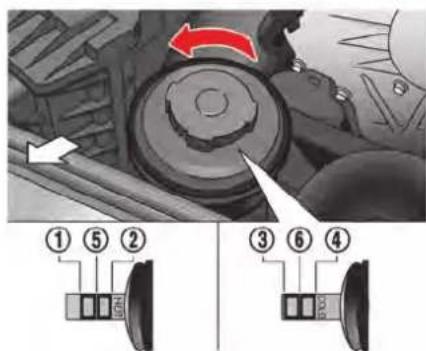
- Adjust the power steering fluid level to the R mark ⑤ on the power steering dipstick when the fluid temperature is hot or ⑥ when the fluid temperature is cold.
Fluid temperature:
Hot: 122 to 176°F (50 to 80°C ): between ① and ⑤
Cold: 32 to 86°F (0 to 30°C): between and ⑥
Coolantlevelandmixtureratio
Theinformationandspecificationsin thissectionapplyonlywhenengaging inperformedriving.
GT-ROverviewGTR-15
Check the coolant level in the pressurized imperformedriving.
coolant reservoir. Adjust the level so that the fluid is between the MAX and MIN markings. For the coolant, use genuine NISSAN Long Life coolant or equivalent. (On delivery of new vehicle, the reservoir is filled to the MIN level. Be sure to replenish approximately 3/8 US quart (0.3 to 0.4 liter) of coolant.)
NOTICE
Donotoverfillthecoolant. This may increasethepressureinthecooling systemandcausecoolantleaks.
To maximize vehicle performance, the coolant mixture ratio should be a combination of 30% coolant antifreeze and 70% demineralized or distilled water for maximum cooling system performance regardless of ambient temperatures.
If ambient temperatures are anticipated below 5° F ( -15° C), make sure a proper mixture ratio of 50% antifreeze and 50% demineralized or distilled water mix is used.
Engineandpowertrain
Theinformationandspecificationsin thissectionapplyonlywhenengaging
- Check the engine, transmission, differential and under the vehicle for oil and coolant leaks.
- Inspect the areas surrounding of the catalytic converter for heat deterioration.
●Always perform the transmission setting. After that, adjust the clutch clearance so that the clearance is less than the clearance used for daily driving. Your GT-R certified NISSAN dealer has the necessary information and equipment to set the clutch clearance to the correct specification. The clearance used for daily driving increases clutch heat generated during Performance Driving. This leads to an increase in temperature of the transmission oil. In addition, a more direct shifting feel can be obtained by reducing the clutch clearance for Performance Driving. The clutch clearance should be reset to the daily driving specification after Performance Driving. It is recommended you see a GT-R certified NISSAN dealer for information.
NOTICE
Failuretohavetheclutchproperly adjustedbeforeperformedriving maycausethetransmissionoiltemperaturetoincreasewhichmay causetransmissiondamage.
- Inspect and confirm the clearance between the exhaust finisher and rear bumper is more than 0.24 in (6 mm) (up/down) and more than 0.20 in (5 mm) (left/right).
- Inspect the dust boot of the drive shaft universal joint for cracks or damage.
Suspensionandwheelalignment
The information and specifications in this section apply only when engaging in performance driving.
- Check the steering and suspension system and other links for loose and/or damaged parts.
- Measure and adjust the wheel alignment. ( "Wheel alignment" page GTR-10) It is recommended you contact a GT-R certified NISSAN dealer to adjust the wheel alignment to the recommended setting for high perfor-
mance driving.
Preventingtoe-out:
Toe-outcancauseuneventirewearor damagetoareasinsidethetiresdueto highheat.Besuretohavethewheel alignmenttoe-insettingcheckedand adjusted.ItisrecommendedyoucontactaGT-RcertifiedNISSANdealer beforeanyperformedrivingon closedcircuittracks.Obeyalltraffic lawswhenonpublicroads.
| Toe-in specification | |
| Front | ≤ 0.059 in (1.5 mm) |
| Rear | ≤ 0.079 in (2.0 mm) |
Wheelsandtires
Theinformationandspecificationsin thissectionapplyonlywhenengaging inperformedriving.
- Check tire wear and cracking.
- Inspect the tire side wall for damage.
- Check the tire pressure and adjust the pressure as necessary when the tires are cold. ( "Wheels and tires" page 8-29)
The tire pressure changes depending on the outside temperature or altitude. Check the tire pressure regularly and when the climate conditions change.
* The following chart indicates how the tire pressure will decrease as outside air temperature decreases.


WARNING
Keepyourtiresinflatedtothecorrecttirepressure.Drivingwithlow tirepressurecandamagesome powertrainsystemsandaffectthe operationoftheABSandVDCsystems.LowTirepressuremayalso causetirefailureandresultinseriouspersonalinjuryordeath.
- Make sure the tire valve stem cap is installed and that the valve stem is tight. When installing the cap, make sure to tighten the cap by hand. If a
GT-ROverviewGTR-17
tool is used to tighten the cap, the cap stripped. may be damaged.
- Make sure the wheel nuts are tight. ( "Wheels and tires" page 8-29)
●Make sure the drive shaft nuts are tight. - Make sure to replace the grommet seal, the valve core and the valve cap of the Tire Pressure Monitoring System (TPMS) sensor attached to the wheel every 3 years for performance driving use. Replace them every 5 years even when not engaging in performance driving. A dirty grommet seal will cause the air leak from the tire.
- Make sure that the nuts and valves that are attached to the TPMS sensor are tight and there is no nitrogen leak.
- Use only a NISSAN genuine valve cap or equivalent.
- Check wheel hub run out and that the wheel rotates smoothly without any friction. Check these with the tires removed whenever an inspection is performed with the vehicle jacked up.
- Secure road wheel balance weights with aluminum tape.
- Check that the wheel nuts are not
GTR-18 GT-ROverview

●Make sure the tire has not slipped on the wheel causing the assembly to be out of balance. The reference marks on the tire and wheel should be aligned. If the reference marks are not aligned, the tire has slipped on the wheel. Have the wheels/tires rebalanced. Make sure the old reference marks are erased and new reference marks are applied to the wheel and tire. When installing new tires on the wheels, make sure new reference marks are applied to the wheels and tires.
- Avoid the driving conditions listed under "Additional maintenance items"
in this section for 48 hours after tires are installed on the wheels. The tire may slip on the wheel if the vehicle is driven in these conditions before 48 hours have passed. If the tire slips on the wheel, the wheel/tire assembly will be out of balance and will require rebalancing.
Brakes
The information and specifications in this section apply only when engaging in performance driving.
- Check for the heat deterioration of the brakes and parts around the brakes.
-
It is recommended that you remove air from the brake system after any of the following:
-
When engaging in high performance driving for the first time after purchasing a new vehicle.
— After replacing the brake fluid. - When engaging in high performance driving for a sustained period of time. It is recommended that bleeding the brake be performed when the brake calipers are hot (about 212°F (100°C) ).
Brakepadbreak-inprocedure:
NISSAN recommends that a special brake pad break-in procedure be performed before engaging in performance driving. It is recommended you contact a GT-R certified NISSAN dealer for details.
INSPECTIONANDADJUSTMENTS AFTERDRIVING
The information and specifications in this section apply only when engaging in performance driving.
NOTICE
Atthecompletionofperformance driving,allfluidandotheradjustmentsshouldbereturnedtothe normalfluidspecificationsasshown inthe"8.Do-it-yourself"sectionof thismanual.
Fluids
The information and specifications in this section apply only when engaging in performance driving.
- Check the engine, transmission, differential and under the vehicle for oil and coolant leaks.
- Check the fluid levels and adjust as necessary using the specified fluid as described under the conditions listed in this section. ( "Recommended fluids and maintenance interval" page GTR-20) If you do not drive under the conditions listed, refer to the "9. Maintenance and schedules" section of this manual.
- When changing fluids, be sure to use the specified fluids as described in this Owner's manual. (12) "Capacities and recommended fluids/lubricants" page 10-2)
Recommendedfluidsandmaintenanceinterval
The information and specifications in this section apply only when engaging in performance driving.
| ITEMS Engine Oil | ||
| GT-R SPECIFIED FLUIDS | Mobil 1 (0W-40)*1 or equivalent | |
| MAINTENANCE INTERVAL | ●When the oil temperature stays below 230°F (110°C) while driving | Change engine oil and engine oil filter at the same interval as Schedule 1 and 2 in the "9. Maintenance and schedules" section of this manual. |
| ●When the oil temperature reaches between 230°F (110°C) and 266°F (130°C) while driving | Change engine oil and engine oil filter every 3,000 miles (5,000 km). | |
| ●When the oil temperature exceeds 266°F (130°C) while driving | Change engine oil and engine oil filter immediately after stopping. | |
*1: Mobil 1 (0W-40) (100% synthetic) is the factory fill oil. The VR38 engine with its plasma-sprayed bores was developed using this oil. NISSAN cannot ensure proper engine operation and durability if other 0W-40 non-equivalent synthetic oil is used. If Mobil 1 (0W-40) or equivalent is not available, Mobil 1 (10W-40) (100% synthetic) or equivalent may be used; however, some performance loss may be noticed.
| ITEMS | Transmission Oil | |
| GT-R SPECIFIED FLUIDS | Genuine NISSAN Transmission Oil R35 Special or equivalent | |
| MAINTENANCE INTERVAL | ●When the oil temperature stays below 248°F (120°C) while driving | Change transmission oil at the same interval as Schedule 1 and the "9. Maintenance and schedules" section of this manual. |
| ●When the oil temperature reaches between 248°F (120°C) and 284°F (140°C) while driving | Change transmission oil every 3,000 miles (5,000 km). | |
| ●When the oil temperature exceeds 284°F (140°C) while driving | Change both transmission oil and differential oil immediately aft stopping. Differential oil temperature usually increases concurrently. | |
| ITEMS | Differential Oil (front and rear) | |
| GT-R SPECIFIED FLUIDS | Differential Oil R35 COMPETITION type 2189E*2 or equivalent | |
| MAINTENANCE INTERVAL | ●When the oil temperature stays below 248°F (120°C) while driving | Change differential oil at the same interval as Schedule 1 and 2 the "9. Maintenance and schedules" section of this manual. |
| ●When the oil temperature reaches between 248°F (120°C) and 284°F (140°C) while driving | Change differential oil every 3,000 miles (5,000 km). | |
| ●When the oil temperature exceeds 284°F (140°C) while driving | Change both transmission oil and differential oil immediately aft stopping. Differential oil temperature usually increases concurrently as the transmission oil temperature. | |
*2: The differential oil temperature cannot be displayed on the multi function meter on the touch screen display. The differential oil temperature can be checked with the transmission oil temperature since both usually increases or decrease concurrently.
| ITEMS Brake Fluid | |
| GT-R SPECIFIED FLUIDS Genuine NISSAN Brake Fluid | R35 Special II*3 or equivalent |
| MAINTENANCE INTERVAL Change brake fluid every 3,000 miles (5,000 km). | |
*3: Genuine NISSAN Brake Fluid R35 Special II is the factory fill brake fluid. The Vehicle Dynamic Control (VDC) unit and other related parts were specially designed for this brake fluid and NISSAN cannot ensure the best performance and proper operation of the vehicle if other non-equivalent brake fluid is used.
Suspensionandwheelalignment
- Check the steering and suspension system and other links for loose and/or damaged parts.
●Measure and adjust the wheel alignment. It is recommended you contact a GT-R certified NISSAN dealer to adjust the wheel alignment to the recommended setting for normal driving.
Wheelsandtires
- Check tire wear and cracking.
- Inspect the tire side wall for damage.
- Check the tire pressure and adjust the pressure as necessary when the tires are cold. (IF "Wheels and tires" page GTR-17) If you do not drive under the conditions listed in this section, see IF "Wheels and tires" page 8-29.
- Check that the wheel nuts are not stripped. Check if there is no deforma-
tion on the contact surface of the wheel nuts.
- Make sure the wheel nuts are tight. ( "Wheels and tires" page 8-29)
- Make sure the drive shaft nuts are tight.
- Check wheel hub run out and that the wheel rotates smoothly without any friction. Check these with the tires removed whenever an inspection is performed with the vehicle jacked up.
- Make sure the tire has not slipped on the wheel causing the assembly to be out of balance. The reference marks on the tire and wheel should be aligned. If the reference marks are not aligned, the tire has slipped on the wheel. Have the wheels/tires re-balanced. Make sure the old reference marks are erased and new reference marks are applied to the wheel and tire. When installing new tires on the wheels, make sure new reference
marks are applied to the wheels and tires. ( "Wheels and tires" page GTR-17)
●Make sure that the TPMS sensor installation nuts and the sensor valve are tight and there is no nitrogen leak.
Brakes
- Check for the heat deterioration of the brakes and parts around the brakes.
- Check the condition of the brake pads and disc rotors and replace them as necessary.
- Apply MOLYKOTE® 7439 or equivalent to the top and bottom of the front brake pads. (See next page for illustration).
Frontdiscbrakepad:
BRAKE PAD: Exploded View (GT-R certified NISSAN dealer)
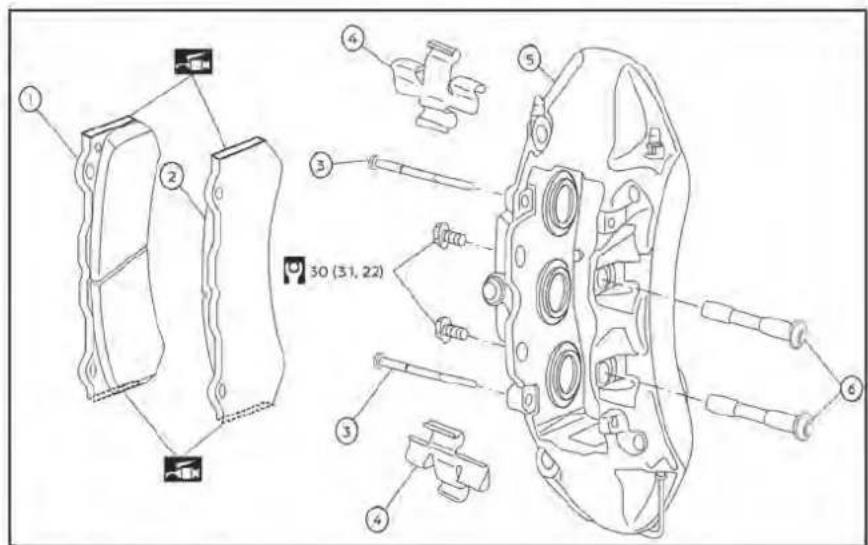
- Inner pad (with pad wear sensor)
- Cross spring
- Outer pad
- Caliper
- Pad pin
- Tie-rod

Apply MOLYKOTE® 7439 or equivalent to the match face (A) of the brake pad (I)
Molykete is a registered trademark of Dow Corning Corporation.

Apply MOLYKOTE 7459 or equivalent
GT-RSPECIFICVEHICLECHARACTERISTICS
Engineandpowertrain
- Check the engine, transmission, differential and under the vehicle for oil and coolant leaks.
- Inspect the area surrounding the catalytic converter for heat deterioration.
- Inspect and confirm the clearance between the exhaust finisher and rear bumper is more than 0.24 in (6 mm) (up/down) and more than 0.20 in (5 mm) (left/right).
●The clutch clearance and shift fork position may need to be adjusted. - Inspect the dust boot of the drive shaft universal joint for cracks or damage.
- Check that there is no abnormal noise, vibrations or warning lights illuminated when making tight turns at slow speed (for tight corner braking phenomenon).
REFUELINGPRECAUTIONS

WARNING
Donotattempttotopoffthefuel tankafterthefuelpumpnozzle shutsoffautomatically.Continued refuelingmaycausefueloverflow, resultinginfuelsprayandpossiblya fire.Thefueltanksifullatthefirst automaticshutoff.
To maximize vehicle performance, the fuel tank is located as low as possible to lower the vehicle center of gravity. The tank is also divided into two parts. This fuel tank design causes higher pressures inside the tank than other vehicles so fue spillage is possible by trying to top off the fuel tank after automatic shutoff.
The fuel tank pressure is higher when the vehicle is hot, especially if the tank is more than half full. If the cap is opened when the vehicle is hot, it may cause fuel spray and there may be a hissing noise. Open the cap slowly, releasing the pressure from the tank gradually. Also, if the vehicle is refueled when the vehicle is hot, the fuel pump may automatically shut off before the tank is full. This does not indicate that there is a malfunction. Refuel slowly or refuel after the vehicle has cooled.
GASOLINESMELL
The fuel temperature is higher when the vehicle is hot. This may cause a gasoline smell from the vehicle. This does not indicate that there is a malfunction. The smell will go away when the fuel temperature has cooled.
OUTSIDE TEMPERATURE DISPLAY INDICATES HIGHER TEMPERATURE
Heat from the engine compartment, radiator and intercoolers can affect the outside temperature display. The outside temperature display may indicate a higher than actual temperature while driving or stopped. This is normal.
IDLESPEEDISNOTSTEADY
The idle speed may not be steady when the engine compartment is extremely hot. This is normal. The engine speed will be steady when the engine cools down.
In this case, the Malfunction Indicator Light (MIL) may come on. After a few driving trips, the MIL should turn off. If the light remains on after a few driving trips, it is recommended you have the vehicle inspected by a GT-R certified NISSAN dealer.
ENGINESPEEDISRESTRICTED
To help protect the engine, the maximum engine speed is automatically controlled in the following conditions:
●Reving the engine with the shift lever in the P or Position: The maximum engine speed is 4,300 RPM
- Revving the engine when the engine oil is at a low (below 32°F (0°C) ) or extremely high (over 275°F (135°C) ) temperature: The maximum engine speed is 4,000 RPM (The M position will automatically change to the A position.)
ENGINEOUTPUT
Highaltitude
To protect the engine, engine output is controlled so that it does not increase at altitude of approximately 3,281 ft (1,000 m) or higher.
Engineoutputaccordingtothe coolanttemperature
The engine output is controlled at a low level when the engine coolant temperature is lower than approximately 158° F ( 70° C) or higher than 230° F ( 110° C). This is not a malfunction.
If the temperature is lower than approximately 158° F ( 70° C), drive the vehicle until it reaches normal operating temperature. If the temperature is higher than 230° F ( 110° C), perform cool-down driving procedure. (“Cool down” page GTR-14) When the temperature of the engine coolant is between 158° F ( 70° C) and 230° F ( 110° C), the engine output returns to normal.
UNEVENWEAROFTIRES
The GT-R is equipped with high performance, low profile, run-flat tires that are optimized for performance and handling. The life of these tires will be less than those of tires installed on a typical vehicle, and you are likely to experience uneven tire wear and tire noise regardless of the type of tire used.
NOISESAREHEARDWHILEDRIVING
- The GT-R brake pads use material that provides a high amount of braking power even in high temperatures. This material can cause an intermittent screeching noise just before the vehicle comes to a stop when the brakes are gently applied. The noise decreases as the brake pads wear. However, the additional brake pad break-
in or replacing the cross spring may decrease the noise. It is recommended you contact a GT-R certified NISSAN dealer.
●A screeching noise may be heard when the brake pedal is depressed:
— When driving the vehicle for the first time in the morning,
— After leaving the vehicle parked for extended periods of time, or
— When the vehicle is damp following rain showers or washing the vehicle.
These sounds are normal. The noise is caused when the brake pads absorb moisture, and the noise stops after the brake is applied several times.
●A screeching noise may also be heard when the brake pedal is depressed:
— When repeatedly applying gentle braking, especially on a curve at a low speed, or
- When the brake rotors have circular scores with the brake temperature high.
FormodelswithoutNCCB(NISSAN CarbonCeramicBrake)package:

WARNING
Followtheinstructionsbelowwhen parkingthevehicletohelpprevent thebrakerotorandbrakepadsfrom rustingogether.Failureretofollow theinstructionscouldcausethe rotorandpadstorusttogether.If therotorandpadsrusttogether, theremaybeapoppingnoise and somevibrationwhenthevehicleis driven,awheelmaynotrollcorrectly, orthebrakepadscouldbedamaged. Ifthepadsaredamaged,thismay reducetheeffectivenesssofthebrake systemwhichcouldcauseacollision, seriouspersonalinjuryordeath.
- The GT-R uses brake pad materials that have high metallic content. The brake pad material helps maintain braking performance in a wide range of weather and driving conditions. For the first 3,000-6,000 miles (5,000-10,000 km) of the vehicle's service life, and for the first 3,000-6,000 miles (5,000-10,000 km) after a brake replacement, the brake pad to brake rotor
clearance is very small. When parking, apply the parking brake and move the shift lever to the P position. Idle the engine for more than 20 seconds without depressing the brake pedal. This allows the brake pads to move away from the rotor so the pad does not contact the rotor.
Additionally, the brakes must be dry before parking the vehicle after driving on wet roads or after washing the vehicle. If the roads are wet, lightly apply the brakes for a short distance before parking the vehicle to dry the brakes. After washing the vehicle, dry the brakes by driving on a dry road for a few miles and apply the brakes normally based on traffic and road conditions.
The metallic brake pads and brake disc rotor may rust together when the brakes are not applied:
- If the vehicle is not idled for 20 seconds without the brakes applied, or if the brakes are applied when the vehicle is shut off, the rotor and pads can rust together, even when the brake pads are dry.
— If the brakes are wet when the vehicle is parked and the parking brake is applied for a long time.
- The hill start assist system can apply the brakes even if the brake pedal is not depressed. The brake pads and rotors can rust together if the parking procedure previously described is not followed. It is recommended you contact a GT-R certified NISSAN dealer if the brake pads and brake rotor have rusted together.
NOTICE
Tohelpreducethepossibilityofthe rotorsandbrakepadsrusting:
Havethebrakepadsand/orrotors quenchedwhenthebrakepadsare replaced. Fordetailedinformation aboutquenching,contactaGT-R certifiedNISSANdealer.
Afterquenchingthebrakepadsand/orrotors,applyabrakeof0.5Gto stopthevehicle6-7timesatleast onceaweekinasafelocation.G-forcecanbecheckedonthemulti functionmeteronthetouchscreen display.RefertotheseparateMulti FunctionDisplayOwner'sManual.
•To maintain steady braking perfor-
mance in both extremely high and low temperatures, the gap between the brake pad and caliper is larger than normal and large-size brake pads are used. When driving over a bump, a light rattling sound may be heard from the brake pad. This does not indicate that there is a malfunction.
- When the brake disc rotor undergoes thermal expansion, a ticking noise may be heard from the engaging portion of the wheel and the brake disc rotor. This does not indicate that there is a malfunction. The noise will reduce when the temperature decreases.
- In addition to noise resulting from uneven tire wear discussed in the previous section, the GT-R tires are more rigid than a typical passenger car tire and are made from a specially formulated rubber to maximize the vehicle's performance capabilities. These characteristics cause the GT-R tires to have more road noise than a typical passenger car tire. This road noise is normal.
- Due to the performance capabilities and requirements of the GT-R, the sequential 6-speed dual clutch transmission is unlike a typical automatic
transmission. You will likely hear mechanical sounds from the transmission, particularly at slow speeds and at idle. This condition is normal.
The friction material of the GT-R disc brake pad is bonded to the pad backing plate more strongly than conventional brake pads to withstand the high brake temperatures. The friction material and backing plate expand due to heat at different rates. Some cracks may be on the surface of the friction material due to the differences in expansion rates and the strong bond between the friction material and backing plate. The cracks do not indicate the brake pads need to be replaced. However, depending on the condition of the cracks, the pads may need to be replaced. It is recommended you contact a GT-R certified NISSAN dealer.
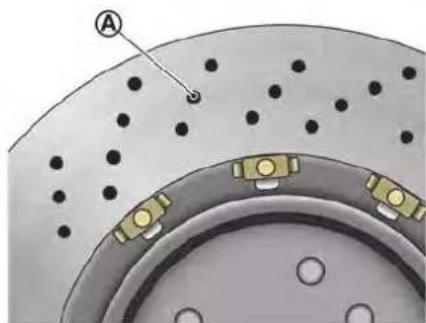
Cracksonthedisrotors(models withoutNCCB(NISSANCarbon CeramicBrake)package)
When the brake is repeatedly applied at high loads during the cold season, small cracks of approximately 0.12 in (3 mm) long may appear around the cross drilled holes Ⓐ This is due to the temperature differential that occurs because the surfaces of the disc rotors become hot while the inside of the rotor is still cold. However, this poses no problem in terms of brake performance, and does not indicate a malfunction. The brakes do not need to
GT-ROverviewGTR-27
be replaced.
However, if the cracks extend to 0.16 in (mm) or longer after repeated application of the brakes at high loads during high performance driving, or through the continued use of the brakes, the disc rotors must be replaced.
Brakedust
This vehicle is equipped with high performance brakes, and the characteristics of the brake pad material may cause more brake dust than other vehicles. NISSAN recommends a wheel coating that helps prevent the brake dust from sticking to the wheels. It is recommended you contact a GT-R certified NISSAN dealer for more details.
Soundheardfrombrakesystem (modelswithNCCB(NISSANCarbonCeramicBrake)package)
Rattlesfrombrakepadsandcreaks duringbraking
The high performance brake system of vehicles equipped with the NCCB (NISSAN Carbon Ceramic Brake) has more clearance between its brake pad and brake caliper than regular vehicles, and it uses a large brake pad to ensure stable braking performance under a wide range of driving conditions such as extremely high temperature areas or low temperature areas like snow-covered roads. Accordingly, you may hear light rattles from the brake pad area when driving over a step, which is not a malfunction. In addition, you will hear creaks because of the characteristics of the material for the disc rotor. These creaks reduce with time and wear.
Neverparkyourvehicleforalongtime withthebrakesystemwet.
The materials used for the brake disc rotor and brake pads for specified NCCB (NISSAN Carbon Ceramic Brake) are different from those used for the standard brake system in GT-R. The rotor and pads will be protected from adhesion caused by rusting. However, never park your vehicle for a long time with the brake system wet. This helps maintain the brake disc rotor and brake pads for a long time and prevents an influence on the material composition of the carbon ceramic rotor and deterioration in the joint of brake disc rotor's full floating structure. Especially during winter, be sure to park your vehicle with the brake disc rotor and pads dry to prevent them from being frozen and damaged in below freezing temperature conditions. The carbon ceramic brake for GT-R includes air bubbles in the rotor and pads. Note that leaving them in the wet condition tends to cause adhesion due to freezing.
●A screeching noise may be heard when the brake pedal is depressed:
— When driving the vehicle for the first time in the morning,
— After leaving the vehicle parked for extended periods of time, or
— When the vehicle is damp following rain showers or washing the vehicle.
These sounds are normal. The noise is caused when the brake pads absorb moisture, and the noise stops after the brake is applied several times.
●A screeching noise may also be heard when the brake pedal is depressed:
— When repeatedly applying gentle braking, especially on a curve at a low speed, or
- When the brake rotors have circular scores with the brake temperature high.
The NCCB (NISSAN Carbon Ceramic Brake) causes more screeching noise in cold weather conditions than in normal weather conditions.
CHANGEOFSURFACECOLOROF TITANIUMMUFFLER(ifso equipped)
Genuine titanium mufflers are made of titanium alloy. The surface color will change depending on the driving conditions, which is not unusual. Prior to shipping from factory, all vehicles receive balance aligning for engine, transmission, and clutch, as well as quench driving of brake pads and rotors. As a result, the muffler surface color may differ depending on the vehicle.
THECOLORTONEOFTHETITA-NIUMMUFFLERFINISHERMIGHT BEDIFFERENTFROMOTHERS(if soequipped)
The titanium muffler finisher color tone is hand-made, so it may differ depending on the finisher.
SOUNDHEARDAROUNDTITANIUM MUFFLER(ifsoequipped)
When stopping the engine (rapid cooling), you may hear a metal-rubbing sound or unusual ticking sound because of the differential thermal expansion between the inner and outer pipes of the muffler. This is not a malfunction. The sound will
decrease when the temperature lowers.
EXHAUSTGASISNOTEMITTED FROMLEFTEXHAUSTPIPEDURING IDLING/WHENENGINESPEEDIS LOW(ifsoequipped)
The titanium muffler for vehicles with the exhaust sound control system is equipped with a control valve installed on the left-side exhaust pipe. When the exhaust sound control switch is ON or the engine speed is low, exhaust sound silencing is enhanced by closing the valve. Exhaust gas is not emitted from the left-side exhaust pipe when the control valve is closed. This is not a malfunction. ( "Exhaust sound control system" page 5-59)
DRYCARBONFIBERPARTS(ifso equipped)
Roughnessorunevensurfacesofdry carbonfiberpartsandfibertwists
The surfaces of the dry carbon fiber parts are lightly coated like a race car so that you can feel the proper texture of real carbon, which may feel rough. This is normal.
DUALCLUTCHTRANSMISSION
The GT-R dual clutch transmission is a newly-developed system that uses an electronically controlled multiple-disc wet clutch attached to the highly efficient manual transmission. This transmission has two driving modes.
- A position (Automatic gearshift): allows automatic shifting of the manual transmission.
- M position (Manual gearshift): allows quick shifting of the manual transmission.
NOTE:
When starting or driving on a steep uphill grade, shift to the M position and operatethe paddleshiftertoshift downto1stgearsimilartoamanual transmission vehicle.
The GT-R dual clutch transmission was developed specifically to maximize vehicle performance and driving enjoyment. The GT-R transmission components were designed using different engineering standards than typical passenger car transmissions. Because of this, the GT-R has different operating characteristics, and various rattle noises may be heard during some driving conditions because of the following items:
●Gear clearances
- Ultralight flywheel
•Dry sump lubrication
These noises do not indicate that there is a malfunction.
GTR-30 GT-ROverview
TRANSMISSIONOPERATIONCHARACTERISTICS
| Mechanism | Operationcharacteristics |
| Base Manual transmission | The GT-R transmission design is different from transmissions used in conventional passenger cars. The GT-R uses a transmission gear design, light flywheel and a dry sump lubrication system to provide maximum vehicle performance. Because the GT-R Transmission design is different, noises may be louder. When the transmission temperature is high, rattling, shaking and jarring noises may be heard.Clattering noises may be heard while shifting.Appropriate gaps are provided between gears to achieve smooth gear rotation and steady tooth surface lubrication under the high-load driving condition. However, this causes a rattling noise.If the shift lever is moved fromRtoA→Mposition, orA→MtoRposition before the vehicle stops, you may not be able to shift gear or it may take longer to shift gear. Make sure to depress the brake pedal and check that the vehicle has stopped before shifting. |
| Multiple-disc wet clutch | When stopping the vehicle with the shift lever in theRorA→Mposition, be sure to firmly depress the brake pedal. The vehicle may slowly move if the brake pedal is not depressed.Avoid depressing the brake and accelerator pedals at the same time. Depressing the brake and accelerator pedals at the same time could cause the clutch to overheat and accelerate deterioration.When the vehicle is stopped on a hill, do not hold the vehicle in place by depressing the accelerator pedal. Doing so may cause the clutch to overheat and result in transmission damage. Use the brakes to prevent the vehicle from moving. |
| Electronic oil pressure control | The following conditions are caused due to changes in fluid viscosity as a result of temperature changes.When the transmission oil is extremely cold or extremely hot, the transmission may feel like it is slipping during shifts or there may be hard shifts. This is normal. Transmission shifting should return to normal when the transmission oil returns to normal operating temperatures.When the transmission oil temperature is extremely cold, the time required to run a system check may increase. During the system check, the shift lever must stay in tRposition. Move the shift lever after turning off the system check display. Also, it is normal to hear clicking noises during the transmission systems check. |
| Changing modes | The higher shift speeds in theMposition may result in shift shock and jerkiness when starting or shifting.The quickest shifting in the R mode with the transmission in theMposition is available when the engine speed is high. However, the transmission may shift more slowly when the engine speed is low. |
| Mechanical Limited Slip Differential (LSD) | If the vehicle accelerates from a stop with the steering wheel turned half a turn in cold temperatures, the inner wheel tire may slip and some noise or vibration may be heard. This phenomenon occurs because the viscosity of the differential oil becomes thicker and the Limited Slip Differential (LSD) operates with increasing load. When the steering wheel is returned to the straight ahead position or the differential oil warms up, the noise and vibration decrease. |
GT-ROverviewGTR-31
| Mechanism | Operationcharacteristics |
| Electronically-controlled All-Wheel Drive (AWD) | If the vehicle accelerates from a stop with the steering wheel turned half a turn in cold temperatures, it may be hard to move the vehicle when the accelerator pedal is depressed. This phenomenon is unique to AWD vehicles and is caused by the speed difference between the front and rear wheel. This is not a malfunction. Resolve the phenomenon by returning the steering wheel to the straight ahead position. This phenomenon can be reduced if certain conditions are most. (tight corner braking phenomenon" page 5-44) |
| Ultralight flywheel | ● An ultralight flywheel is provided to achieve rapid engine response to the accelerator pedal operation. The engine rotation fluctuations become larger than conventional vehicles. Rattling, shaking or jarring noises may be heard when idling or driving at a low speed. ●Rattling noises may be heard when the engine is started or stopped. |
GTR-32 GT-ROverview
0Illustratedtableofcontents
Seats,seatbeltsandSupplementalRestraint
System(SRS)0-2
Front 0-2
Rear 0-3
Exteriorfront 0-4
Exteriorrear....0-6
Passengercompartment....0-7
Cockpit....0-8
Instrumentpanel....0-9
Metersandgauges....0-10
Enginecompartment....0-1 1
Warningandindicatorlights....0-12
SEATS, SEATBELTSANDSUPPLEMENTAL RESTRAINTSYSTEM(SRS)
- Front seats (P.1-3)

FRONT
- Seat belt (Page 1-6)
- Rear seat walk-in lever (P.1-5)
-
Roof-mounted curtain side-impact and rollover supplemental air bag system (P.1-34)
-
Supplemental front-impact air bags (P.1-34)
- Seat belt pretensioner (P.1-46)
- Front seat-mounted side-impact supplemental air bag system (P.1-34)
- Occupant classification sensor (pattern sensor) (P.1-40)
0-2 Illustratedtableofcontents
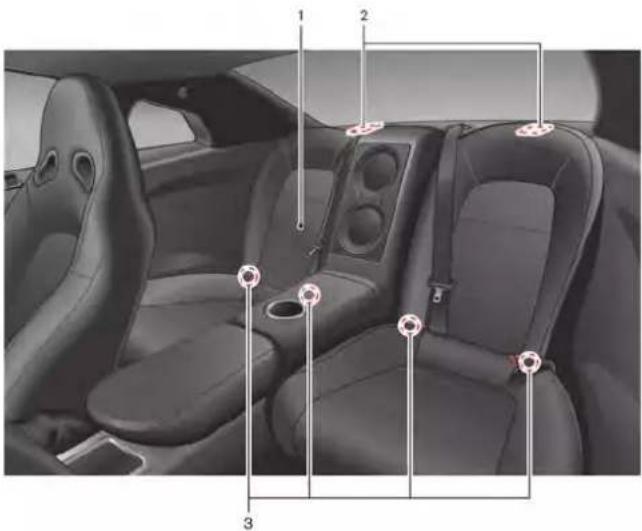
REAR
- Rear seats
— Child restraint installation (P.1-15)
-
Child restraint anchor points (for top tether strap child restraint) (P.1-19)
-
LATCH (Lower Anchors and Tethers for CHildren) system (P.1-17, P.1-26, P.1-30)
Illustratedtableofcontents0-3
EXTERIORFRONT

- Hood (P.3-18)
- Windshield wiper and washer (P.2-51, P.8-18)
- Doors (P.3-2, P.3-4, P.3-8)
- Outside mirrors (P.3-28)
-
Power windows (P.2-67)
-
Corner sensors (P.5-48)
- Center sensors (P.5-48)
- Daytime running light (P.2-53)
- Headlight and turn signal (P.2-53, P.8-27)
- Tires and wheels (P.5-4, P.6-3, P.8-29, P.10-10)
| ITEMS | GENUINE PARTS |
| Road wheel | Genuine road wheel speci-fic to GT-R |
| Tire*1 | Genuine tire specific to GT-R |
| Brake pad*2 | Genuine brake pad specifi-c to GT-R |
| Brake disc ro-tor*2 | Genuine brake disc rotor specific to GT-R |
*1: When tire replacement is required, replacing tires as a set of four with new tires is recommended. However, if a tire is punctured or damaged, it may be possible to replace only the damaged tire. Determining whether one tire or a complete set of tires should be replaced is based on a number of factors including tire wear and condition. It is recommended you contact your GT-R certified NISSAN dealer. They can recommend if an individual tire or a complete set should be replaced.
*2: For models without NCCB (NISSAN Carbon Ceramic Brake) package: "Brake pad and disc rotor" page GTR-6
For models with NCCB (NISSAN Carbon Ceramic Brake) package: "NCCB (NISSAN Carbon Ceramic Brake)" page GTR-6
Genuine NISSAN Brake Fluid R35 Special II is the factory fill brake fluid. The Vehicle Dynamic Control (VDC) unit and other related parts were specially designed for this brake fluid. NISSAN cannot ensure
0-4 Illustratedtableofcontents
proper operation of the vehicle if other non-equivalent brake fluid is used.
Illustratedtableofcontents0-5
EXTERIORREAR

- High-mounted stop light (P.8-27)
- Trunk (P.3-8, P.3-20)
- Rear window defroster (P.2-52)
- Satellite antenna (P.4-14)
- Corner sensors (P.5-48)
-
Center sensors (P.5-48)
-
Rear view camera (P.4-2)
- Rear combination light (P.8-27)
- Fuel-filler door (P.3-24, P.10-4)
Ⓐ Except for NISMO models
© NISMO models
| ITEMS GT-R SPECIFIED FUEL | |
| Fuel | Unleaded premium gasoline with an octane rating of at least 93 A( Anti-Knock Index) number (Research octane number 98)*1 |
*1: Use unleaded premium gasoline with an octane rating of at least 93 AKI (Anti-Knock Index) number (Research octane number 98) to maximize vehicle performance. If 93 AKI number (Research octane number 98) premium gasoline is not available, you may use unleaded premium gasoline with an octane rating of at least 91 AKI number (Research octane number 96), but you may notice a decrease in performance.
0-6 Illustratedtableofcontents
PASSENGERCOMPARTMENT
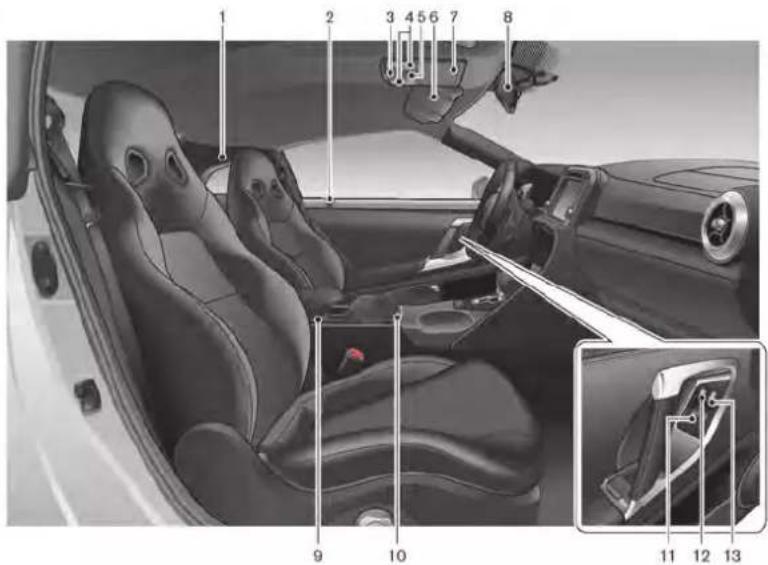
- Coat hooks (P.2-66)
- Inside lock knob (P.3-5)
- Interior light control switch (P.2-69)
- Map lights (P.2-69)
- E-Call (SOS) button (P.2-61)
-
Sun visors (P.3-27)
-
Sunglasses holder (P.2-64)
- Inside mirror (P.2-71, P.3-27)
- Center console box (P.2-66)
— Power outlet (P.2-60)
- USB memory operation*
- iPod® player operation*
- Auxiliary input jack*
- Cup holders (P.2-63)
- Power window switches (P.2-67)
- Window lock button (P.2-68)
- Power door lock switch (P.3-5)
*: Refer to the separate Multi Function Display Owner's Manual.
Illustratedtableofcontents0-7
COCKPIT

- Headlight and turn signal switch (P.2-53)
- Paddle shifters (P.5-15)
- Steering-wheel-mounted controls (left side)*
- Meters and gauges (P.2-6)
-
Steering-wheel-mounted controls (right side)
-
MRK (Mark) switch*
— Cruise control (P.5-35) -
Wiper and washer switch (P.2-51)
- VDC, transmission and suspension set up switches (P.5-25)
-
Trunk lid release switch (P.3-20)
-
Hood release handle (P.3-18)
- Intelligent Key port (P.5-12)
- Sonar system OFF switch (P.5-50)
- Tilting/telescopic steering wheel lever (P.3-26)
- Horn (P.2-58)
- Exhaust sound control switch (if so equipped) (P.5-59)
- Push-button ignition switch (P.5-10)
- Shift lever (P.5-15)
- Parking brake (P.5-34, P.5-46)
*: Refer to the separate Multi Function Display Owner's Manual.
0-8 Illustratedtableofcontents
INSTRUMENTPANEL
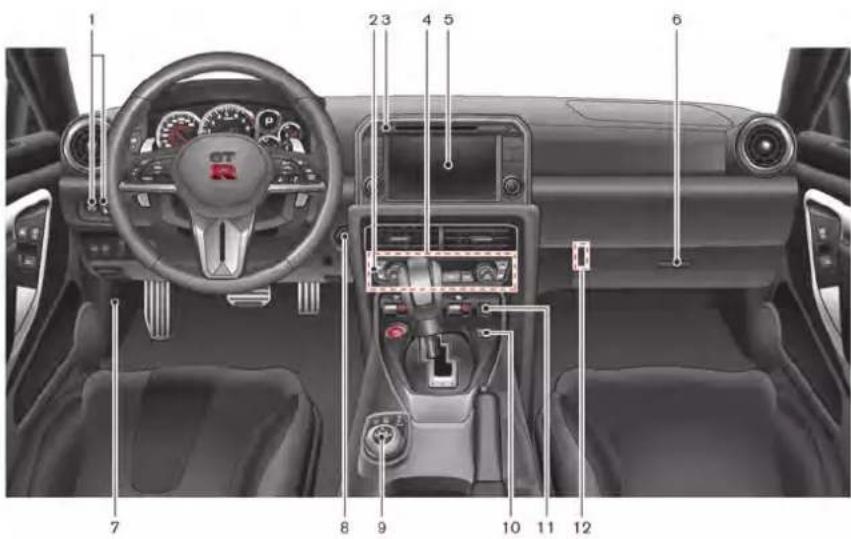
- Outside mirror control switch (P.3-28)
- Rear window defroster switch (P.2-52)
- CD slot*
- Heater and air conditioner (P.4-10)
- Touch screen display*
-
Glove box (P.2-65)
-
Fuse box cover (P.8-22)
- Power outlet (P.2-60)
- Display Commander*
- Front passenger air bag status light (P.1-42)
-
Hazard warning flasher switch (P.6-2)
-
Trunk release power cancel switch (P.3-21)
*: Refer to the separate Multi Function Display Owner's Manual.
METERSANDGAUGES

- Trip A/B reset switch (P.2-7)
- Speedometer (P.2-7)
- Tachometer (P.2-8)/Upshift Indicator (P.2-10)
- Transmission position indicator (P.2-10)
-
Engine coolant temperature gauge (P.2-8)
-
ENTER switch (P.2-16)
- Instrument brightness control switch (P.2-12)
- Vehicle information display (P.2-13)
- Odometer/twin trip odometer (P.2-7)
- Fuel gauge (P.2-9)
- NEXT switch (P.2-16)
0-10 Illustratedtableofcontents
NOTE:
●Metersandgaugeswillilluminate whentheignitionswitchispushed totheONposition.
- Theneedleindicatorsmaymove slightlyaftertheignitionswitchis pushedtotheOFFposition.This doesnotindicatethatthereisa malfunction.
ENGINECOMPARTMENT
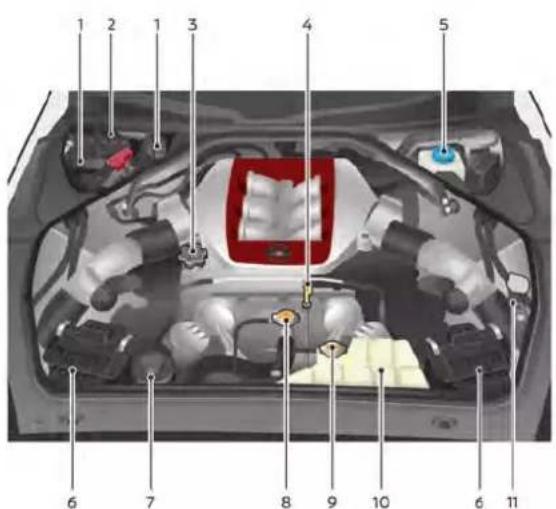
- Fuse/fusible link holder (P.8-22)
- Battery (P.8-13)
- Engine oil filler cap (P.8-9)
- Engine oil dipstick (P.8-9)
- Brake fluid reservoir (P.8-11)
-
Air cleaner (P.8-17)
-
Power steering fluid reservoir (P.8-11)
- Radiator filler cap (P.8-6)
- Coolant reservoir cap (pressure type) (P.8-6)
- Coolant reservoir (P.8-6)
- window washer fluid reservoir (P.8-12)
| ITEMS | GT-R SPECIFIED FLUIDS |
| Engine oil | Mobil 1 (0W-40)*1 or equivalent |
| Transmission oil | Genuine NISSAN Transmission Oil R35 Special or equivalent |
| Differential oil (front and rear) | Differential Oil R35 COMPETITION type 2189E or equivalent |
| Brake fluid | Genuine NISSAN Brake Fluid R35 Special II*2 or equivalent |
*1: Mobil 1 (0W-40) (100% synthetic) is the factory fill oil. The VR38 engine with its plasma-sprayed bores was developed using this oil. NISSAN cannot ensure proper engine operation and durability if other 0W-40 non-equivalent synthetic oil is used. If Mobil 1 (0W-40) or equivalent is not available, Mobil 1 (10W-40) (100% synthetic) or equivalent may be used; however, some performance loss may be noticed.
*2: Genuine NISSAN Brake Fluid R35 Special II is the factory fill brake fluid. The Vehicle Dynamic Control (VDC) unit and other related parts were specially designed for this brake fluid and NISSAN cannot ensure proper operation of the vehicle if other non-equivalent brake fluid is used.
WARNINGANDINDICATORLIGHTS
| Red light | Name | Page |
 | Brake warning light | 2-26 |
 | Charge warning light | 2-27 |
 | Engine oil pressure warning light | 2-28 |
 | Seat belt warning light | 2-28 |
 | Supplemental air bag warning light | 2-28 |
| Yellow light | Name | Page |
| [W2BA] | All-Wheel Drive (AWD) warning light | 2-29 |
 | Anti-lock Braking System (ABS) warning light | 2-29 |
| [Y2XS] | Intelligent Key warning light | 2-30 |
| [H5HS] | Low tire pressure warning light | 2-30 |
 | Malfunction Indicator Light (MIL) | 2-32 |
 | Master warning light | 2-32 |
| [WSDD] | Transmission warning light | 2-33 |
| [BOAT] | Vehicle Dynamic Control (VDC) off indicator light | 2-33 |
 | Vehicle Dynamic Control (VDC) warning light | 2-34 |
| Other light | Name | Page |
 | Cruise main switch indicator light | 2-34 |
| [TKSY] | Cruise set switch indicator light | 2-34 |
 | Exterior light indicator | 2-34 |
 | Front passenger air bag status light | 2-34 |
 | High beam indicator light | 2-34 |
 | Turn signal/hazard indicator lights | 2-34 |
1 Safety—Seats,seatbeltsandsupplementalrestraintsystem
Seats 1-2
Frontseats....1-3
Headrestraints/headrests....1-5
Seatbelts....1-6
Precautionsonseatbeltusage....1-6
Pregnantwomen....1-9
Injuredpersons....1-9
Three-pointtypeseatbeltwithretractor.....1-9
Seatbeltextenders....1-12
Seatbeltmaintenance....1-12
Childsafety 1-13
Infants....1-13
Smallchildren....1-14
Largerchildren....1-14
Childrestraints....1-15
Precautionsonchildrestraints....1-16
LowerAnchorsandTethersforChildren
System(LATCH)....1-17
Rear-facingchildrestraintinstallation
usingLATCH....1-20
Rear-facingchildrestraintinstallationusing
theseatbelts....1-21
Forward-facingchildrestraintinstallation
usingLATCH....1-24
Forward-facingchildrestraintinstallation
usingtheseatbelts....1-27
Boosterseats....1-30
Supplementalrestraintsystem....1-34
Precautionsonsupplemental
restraintsystem....1-34
NISSANAdvancedAirBagSystem
(frontseats)....1-40
Frontseat-mountedside-impact
supplementalairbagandroof-mounted
curtainside-impactandrollover
supplementalairbagsystems....1-45
Seatbeltswithpretensioners
(frontseats)....1-46
Supplementalairbagwarninglabels....1-48
Supplementalairbagwarninglight....1-48
Repairandreplacementprocedure....1-49
SEATS
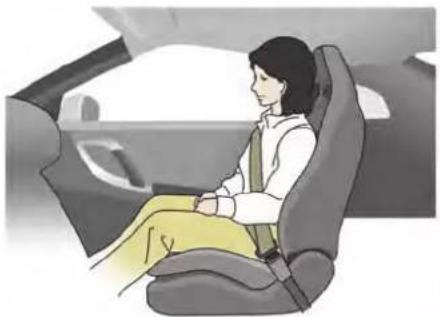
Sit upright and well back.


WARNING
- Donotrideinamovingvehicle whentheseatbackisreclined. This can be dangerous. The shoulder belt will not be against your body. In an accident, you could be thrown into it and receive no other serious injuries. You could also slide under the lap belt and receive serious internal injuries.
- Forthemosteeffectiveprotection whenthevehicleisinmotion,the seatshouldbeupright.Alwayssit
wellbackanduprightintheseat withbothfeetonthefloor and adjusttheseatproperly. ( "Precautionsonseatbelt usage"page1-6)
•Afteradjustment, gentlyrockin theseattomakesureitisse-curelylocked.
- Donotleavechildrenunattended insidethevehicle.Theycould unknowinglyactivateswitches orcontrols.Unattendedchildren couldbecomeinvolvedinserious accidents.
•Tohelpavoidriskofinjuryor deaththroughunintendedoperationofthevehicleand/orits systems,donotleavechildren, peoplewhorequiretheassistanceofothersorpetsunattendedinyourvehicle. Additionally,thetemperatureinsideaclosedvehicleonawarm daycanquicklybecomehigh enoughtocauseasignificantrisk ofinjuryordeathtopeopleand pets.
•Theseatbackshouldnotbereclinedany morethan neededfor comfort.Seatbeltsaremosteffectivewhenthepassengersits withtheirbackstraightupand contactingtheseat.Iftheseat-backisreclined,theriskof sliding underthelapbeltandbeing injuredisincreased.

CAUTION
When adjusting these at positions, besuren to contact anymoving part to avoid possible injuries or damage.
1-2 Safety—Seats, seat belts and supplemental restraintsystem
NOTICE
Makesurethefrontseatbackdoes notcontacttherearseatwhenre-cliningtheseat.Whenthefrontseat isreclinedtotherearmostposition,it maycontacttherearseat.Thismay causeanindentationintheseat-back.

FRONTSEATS
Frontpowerseatadjustment
Operating tips
- The power seat motor has an auto-reset overload protection circuit. If the motor stops during operation, wait 30 seconds, then reactivate the switch.
- Do not operate the power seat switch for a long period of time when the engine is off. This will discharge the battery.
| Seat Adjustment Switch Operation Location | |||
| Forward and backward | A | Move the switch forward or backward until the desired seat position is obtained. | Driver's and front passenger's seats |
| Reclining | A | Turn the switch forward and backward until the desired seatback angle is obtained.The reclining feature allows adjustment of the seatback for occupants of different sizes for added comfort and to help obtain proper seat belt fit.(1-5 "Precautions on seat belt usage" page 1-6)Also, the seatback can be reclined to allow occupants to rest when the vehicle is stopped and the transmission is in the position with the parking brake fully applied. | |
| Seat lifter (front) | B | Push the switch up or down to raise or lower the front portion of the seat. | Driver's seat |
| Seat lifter (rear) | A | Move the switch Ap or down to raise or lower the rear portion of the seat. | |
1-4 Safety—Seats, seatbeltsandsupplementalrestraintsystem

Rearseatwalk-in
This feature makes it easier to get in and out of the rear seat. Use the following procedure when getting in and out of the rear seat.
- Pull up the lever ①, hold the knob ② and tilt the seatback forward.
- Use the seat adjustment switch Ⓐ to slide the seat forward to a position where it will be easier to enter or exit the rear seats. Fold the shoulder belt guide for easier access to the rear seat.
To return the seatback to its original position, hold the knob②, raise the seat-
back, and use the seat adjustment switch Ⓐ to adjust the seat position.

CAUTION
- When returning these attoits original position, confirm that these at and seat back are locked properly.
- Becarefulnottopinchyourhand orfootorbumpyourheadwhen operatingthewalk-inseat.
NOTICE
Donotplaceanyobjectsnearthe seatbackofthefrontseats.They maybepinchedanddamaged.
HEADRESTRAINTS/HEADRESTS

WARNING
Headrestraints/headrestssupplementtheothervehiclesafetysystems.Theymayprovideadditional protectionagainstinjuryincertain rearendcollisions.
Headrestraints/headrestsmustbe adjustedproperly,asspecifiedinthis section.Check theadjustment after someoneelseusestheseat.Failure to followthese instructions canreducetheeffectivenessofthehead restraints/headrests.Thismayincreasetheriskofseriousinjuryor deathinacollision.

The illustration shows the seating positions equipped with head restraint/head-rest.
▲ Indicates the seating position is equipped with a head restraint.
+ Indicates the seating position is not equipped with a head restraint or head-rest.
Your vehicle is equipped with integrated head restraints/headrests.
Proper adjustment:
Properly position the head restraint by adjusting the front seat so that the top of the seat is as upright as possible.
SEATBELTS
PRECAUTIONSONSEATBELT USAGE
If you are wearing your seat belt properly adjusted, and you are sitting upright and well back in your seat with both feet on the floor, your chances of being injured or killed in an accident and/or the severity of injury may be greatly reduced. NISSAN strongly encourages you and all of your passengers to buckle up every time you drive, even if your seating position includes a supplemental air bag.
MostU.S.statesandCanadianprovincesorterritoriespecifythatseat beltsbewornataltimeswhena vehicleisbeingdriven.
1-6 Safety—Seats, seat belts and supplemental restraintsystem
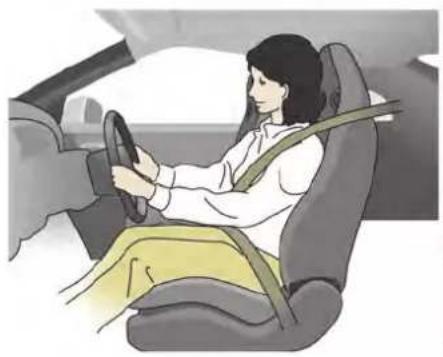
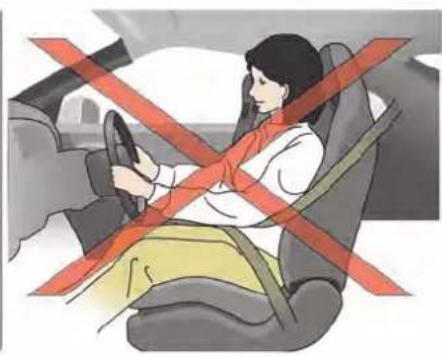


WARNING
- Everypersonwhodrivesorrides inthisvehicleshoulduseaseat beltataltimes. Childrenshould beproperlyrestrainedintherear seatand,ifappropriate,inachild restraint.
- Theseatbeltshouldbeproperly adjustedtoasnugfit.Failureto dosomayreducetheeffectivenessoftheentirerestraintsystemandinincreasethechanceor severityofinjuryinanaccident. Seriousinjuryordeathcanoccur iftheseatbeltisnotwornproperly.
•Alwaysroutetheshoulderbelt overyourshoulderandacross yourchest.Neverputthebelt behindyourback,underyour armoracrossyourneck.Thebelt shouldbeawayfromyourface andneck,butnotfallingoffyour shoulder. - Positionthelapbeltaslowand snugaspossibleAROUNDTHE HIPS,NOTTHEWAIST.Alapbelt worntoohighcouldincreasethe riskofinternalinjuriesinan
Safety—Seats, seatbeltsandsupplementalrestraintsystem1-7
accident.
- Besuretheseatbelttongueis securelyfastenedtotheproper buckle.
- Donotweartheseatbeltinside outortwisted.Doingsomay reduceitseffectiveness.
- Donotallowmorethanone persontousethesameseatbelt.
●Nevercarrymorepeopleinthe vehiclethanthereareseatbelts.
- Iftheseatbeltwarninglight glowscontinuouslywhilethe ignitionisturnedONwithall doorsclosedandallseatbelts fastened,itmayindicateamal-functioninthesystem.Itisrecommendedyouhavethesystem checkedbyaGT-Rcertified NISSANdealer.
- Nochangesshouldbemadeto theseatbeltsystem.Forexample,donotmodifytheseatbelt, addmaterial,orinstalldevices thatmaychangetheseatbelt routingortension.Doingsomay affecttheoperationoftheseat beltsystem.Modifyingortamperingwiththeseatbeltsystem mayresultinseriouspersonal
injury.
- Onceaseatbeltpretensionerhas activated, it cannot be used and must be replaced together with theretractor. It is recommended you see a GT-R certified NISSAN dealer.
-Removalandinstallationofthe pretensionersystemcomponents shouldbedonebyaGT-RcertifiedNISSANdealer.
- Allseatbeltassemblies, including retractors and attaching hardware, should be inspected after any collision by a GT-Rcertified NISSAN dealer. NISSAN recommend that all seat belt assemblies in used during acollision be replaced unless the collision was minor and the belt show no damage and continueto operate properly. Seat belt assemblies not in used during ac collision should also be inspected and replaced if either damage or improper operation is noted.
- Allchildrestraintsandattaching hardwareshouldbeinspected afteranycollision.Alwaysfollow therestraintmanufacturer'sin-
spectioninstructionsandreplacementrecommendations.The childrestraintsshouldbere-placediftheyaredamaged.


PREGNANTWOMEN
NISSAN recommends that pregnant women use seat belts. The seat belt should be worn snug, and always position the lap belt as low as possible around the hips, not the waist. Place the shoulder belt over your shoulder and across your chest. Never run the lap/shoulder belt over your abdominal area. Contact your doctor for specific recommendations.
INJUREDPERSONS
NISSAN recommends that injured persons use seat belts. Check with your doctor for specific recommendations.
THREE-POINTTYPESEATBELT WITHRETRACTOR

WARNING
- Everypersonwhodrivesorrides inthisvehicleshoulduseaseat beltataltimes.
- Donotrideinamovingvehicle whentheseatbackisreclined. Thiscanbedangerous.The shoulderbeltwillnotbeagainst yourbody.Inanaccident,you couldbethrownintoitandreceiveneckorotherseriousinju-
ries.Youcouldalsoslideunder thelapbeltandreceiveserious internalinjuries.
- Forthemosteeffectiveprotection whenthevehicleisinmotion,the seatshouldbeupright.Alwayssit wellbackanduprightintheseat withbothfeetonthefloor and adjusttheseatbeltproperly.
- Donotallowchildrentoplaywith theseatbelts. MostseatingpositionsareequippedwithAutomaticLockingRetractor(ALR) modeseatbelts. Iftheseatbelt becomeswrappedarounda child'sneckwiththeALRmode activated, thechildcanbeseriouslyinjuredorkillediftheseat beltretractsandbecomestight. Thiscanoccurvenifthevehicle isparked. Unbuckletheseatbelt toreleasethechild. Iftheseat beltcannotbeunbuckledoris alreadyunbuckled, releasethe childbycuttingtheseatbeltwith asuitabletool(suchasaknifeor scissors)toreleasetheseatbelt.

Thensmoothlypullthebeltoutof theretractor.
Fasteningtheseatbelts
-
Adjust the seat. ("Seats" page 1-2)
-
Slowly pull the seat belt out of the retractor and insert the tongue into the buckle until you hear and feel the latch engage.
- Theretractorisdesignedtolock duringasuddenstoporonimpact.Aslowpullingmotionpermitsthebeltomove,andallows yousomefreedomofmovement intheseat.
- If theseatbelt cannot be pulled from its fully retracted position, firmly pull the belt and release it.
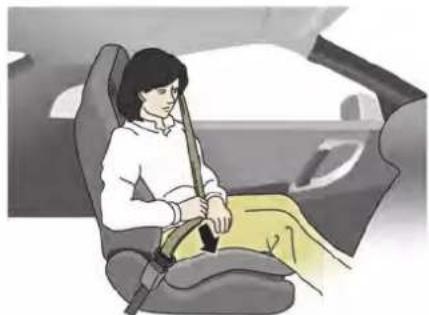
- Position the lap belt portion lowand snugonthehipsas shown.
- Pull the shoulder belt portion toward the retractor to take up extra slack. Be sure the shoulder belt is routed over your shoulder and across your chest.
The three-point type seat belts for the front passenger and rear seats have two modes of operation:
●Emergency Locking Retractor (ELR)
●Automatic Locking Retractor (ALR) The Emergency Locking Retractor (ELR) mode allows the seat belt to extend and retract to allow the driver and passengers some freedom of movement in the seat.
1-10 Safety—Seats, seatbeltsandsupplementalrestraintsystem
The ELR locks the seat belt when the vehicle slows down rapidly or during impacts.
The Automatic Locking Retractor (ALR) mode or child restraint mode locks the seat belt for child restraint installation. When the ALR mode is activated the seat belt cannot be extended again until the seat belt tongue is detached from the buckle and fully retracted. The seat belt returns to the ELR mode after the seat belt is fully retracted.
( "Child restraints" page 1-15)
The ALRmodeshouldbeusedonly for childrestraintinstallation.Duringnormalseatbeltusebyanoccupant,the ALRmodeshouldnotbeactivated.ifit isactivateditmaycauseuncomfortable seatbeltension.itcanalsochangethe operationofthefrontpassengerair bag.( "Frontpassengerairbagand statuslight"page1-42)

WARNING
When fastening these seat belts, be certain that seat backs are completely secured in the latched position. If they are not completely secured, passengers maybe injured in an accident or sudden stop.

Unfasteningtheseatbelts
To unfasten the seat belt, push the button on the buckle. The seat belt automatically retracts.
Checkingseatbeltoperation
Seat belt retractors are designed to lock seat belt movement by two separate methods:
- When the belt is pulled quickly from the retractor.
- When the vehicle slows down rapidly. To increase your confidence in the seat belts, check the operation as follows:
●Grasp the shoulder belt and pull forward quickly. The retractor should lock and restrict further belt movement.
If the retractor does not lock during this check or if you have any question about seat belt operation, see a GT-R certified NISSAN dealer.

Shoulderbeltarm(forfrontseats)
Before fastening the seat belt, adjust the shoulder belt arm to the lock position where the belt fits snugly on the shoulder. The arm can also be folded down to allow rear seat passengers easier access.
Pulling the arm forward will allow an easy access to the belt.
SEATBELTEXTENDERS
If, because of body size or driving position, it is not possible to properly fit the lap-shoulder belt and fasten it, an extender that is compatible with the installed seat belts is available that can be purchased. The extender adds approximately 8 in (200 mm) of length and may be used for either the driver or front passenger seating position. It is recommended you see a GT-R certified NISSAN dealer for assistance with purchasing an extender if an extender is required.

WARNING
-Itisrecommendedthatonly NISSANseatbeltextenders,made bythesamecompanywhich madetheoriginalequipmentseat belts,beusedwiththeNISSAN seatbelts.
- Adultsandchildrenwhocanuse thestandardseatbeltshouldnot useanextender.Suchunnecessaryusecouldresultinserious personalinjuryintheeventofan accident.
- Neveruseseatbeltextendersto installchildrestraints.Ifthechild restraintisnotsecuredproperly,
thechildcouldbeseriouslyin- juredorkilledinacollisionora suddenstop.
SEATBELTMAINTENANCE
- Tocleantheseatbeltwebbing,apply a mild soap solution or any solution recommended for cleaning upholstery or carpets. Then, wipe with a cloth and allow the seat belts to dry in the shade. Do not allow the seat belts to retract until they are completely dry.
- Ifdirtbuildsupintheshoulderbelt guideof the seat belt anchors, the seat belts may retract slowly. Wipe the shoulder belt guide with a clean, dry cloth.
•Periodicallychecktoseethatthe seatbeltandthemetalcomponents such as buckles, tongues, retractors, flexible wires and anchors work properly. If loose parts, deterioration, cuts or other damage on the webbing is found, the entire seat belt assembly should be replaced.
1-12 Safety—Seats, seatbeltsandsupplementalrestraintsystem
CHILDSAFETY

WARNING
Donotallowchildrentoplaywiththe seatbelts.Mostseatingpositionsare equippedwithAutomaticLocking Retractor(ALR)modeseatbelts.If theseatbeltbecomeswrapped aroundachild'sneckwiththeALR modeactivated,thechildcanbe seriouslyinjuredorkillediftheseat beltretractsandbecomestight.This canocurevenifthevehicleis parked.Unbuckletheseatbeltto releasethechild.Iftheseatbelt cannotbeunbuckledorisalready unbuckled,releasethechildbycuttingtheseatbeltwithasuitabletool (suchasaknifeorscissors)to releasetheseatbelt.
Childrenneedadultstohelpprotect them. Theyneedtobeproperlyrestrained.
In addition to the general information in this manual, child safety information is available from many other sources, including doctors, teachers, government traffic safety offices, and community organizations. Every child is different, so be sure to learn the best way to transport
your child.
There are three basic types of child restraint systems:
●Rear-facing child restraint
●Forward-facing child restraint
- Booster seat
The proper restraint depends on the child's size. Generally, infants (up to about 1 year and less than 20lb (9 kg)) should be placed in rear-facing child restraints. Forward-facing child restraints are available for children who outgrow rear-facing child restraints and are at least 1 year old. Booster seats are used to help position a vehicle lap/shoulder belt on a child who can no longer use a forward-facing child restraint.

WARNING
Infantsandchildrenneedspecial protection. The vehicle's seat belts may not fit them properly. The shoulder belt may cometo close to the face or neck. Thelap belt may not fit over their small hip bones. In an accident, anim properly fitting seat belt could cause serious or fatal injury. Always use appropriate child restraints.
All U.S. states and Canadian provinces or territories require the use of approved child restraints for infants and small children. (15) "Child restraints" page 1-15) A child restraint may be secured in the vehicle by using either the LATCH (Lower Anchor and Tethers for CHildren) system or with the vehicle seat belt. (15) "Child restraints" page 1-15)
bNISSANrecommendsthatallpre-teens andchildrenberestrainedintherear seat.Accordingtoaccidentstatistics, childrenaresaferwhenproperlyre-strainedintherearseatthaninthe frontseat.
Thisisespeciallyimportantbecause yourvehiclehassupplementalre-straintsystem(airbagsystem)forthe frontpassenger.( "Supplemental restraintsystem"page1-34)
INFANTS
Infants up to at least one year old should be placed in a rear-facing child restraint. NISSAN recommends that infants be placed in child restraints that comply with Federal Motor Vehicle Safety Standards or Canadian Motor Vehicle Safety Standards. You should choose a child restraint which fits your vehicle and always follow the manufacturer's instructions for instal-
lation and use.
SMALLCHILDREN
Children that are over 1 year old and weigh at least 20 lb (9 kg) should remain in a rear-facing child restraint as long as possible up to the height or weight limit of the child restraint. Children who out-grow the height or weight limit of the rear-facing child restraint and are at least 1 year old should be secured in a forward facing child restraint with a harness. Refer to the manufacturer's instructions for minimum and maximum weight and height recommendations. NISSAN recommends that small children be placed in child restraints that comply with Federal Motor Vehicle Safety Standards or Canadian Motor Vehicle Safety Standards. You should choose a child restraint that fits your vehicle and always follow the manufacturer's instructions for installation and use.
LARGERCHILDREN
Children should remain in a forward-facing child restraint with a harness until they reach the maximum height or weight limit allowed by the child restraint manufacturer.
Once a child outgrows the height or weight limit of the harness-equipped forward-facing child restraint, NISSAN recommends that the child be placed in a commercially available booster seat to obtain proper seat belt fit. For a seat belt to fit properly, the booster seat should raise the child so that the shoulder belt is properly positioned across the chest and the top, middle portion of the shoulder. The shoulder belt should not cross the neck or face and should not fall off the shoulder. The lap belt should lie snugly across the lower hips or upper thighs, not the abdomen.
A booster seat can only be used in seating positions that have a three-point type seat belt. The booster seat should fit the vehicle seat and have a label certifying that it complies with Federal Motor Vehicle Safety Standards or Canadian Motor Vehicle Safety Standards.
A booster seat should be used until the child can pass the seat belt fit test below:
- Are the child's back and hips against the vehicle seatback?
- Is the child able to sit without slouching?
- Do the child's knees bend easily over the front edge of the seat with feet flat on the floor?
- Can the child safely wear the seat belt (lap belt low and snug across the hips and shoulder belt across mid-chest and shoulder)?
- Is the child able to use the properly adjusted head restraint/headrest?
- Will the child be able to stay in position for the entire ride?

If you answered no to any of these questions, the child should remain in a booster seat using a three-point type seat belt.
NOTE:
Lawsinsomecommunitiesmayfollow differentguidelines.Checklocaland stateregulationstoconfirmyourchild isusingthecorrectrestraintsystem beforetraveling.

WARNING
Neverletachildstandorkneelon anyseatandonotallowachildin thecargoareaswhilethevehicleis moving. Thechildcouldbeseriously injuredorkilledinanaccidentor suddenstop.
CHILDRESTRAINTS

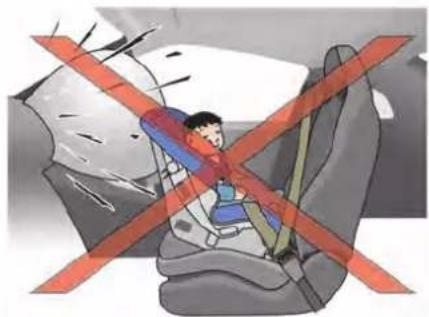
Safety—Seats, seatbeltsandsupplementalrestraintsystem1-15
PRECAUTIONSONCHILDRESTRAINTS

WARNING
- Failuretofollowthewarnings andinstructionsforproperuse andinstallationofchildrestraints couldresultinserious injuryor deathofachildorotherpassengersinasuddenstoporcollision:
—The child restraint must be used and installed properly. Always follow a llof the child restraint manufacturer's instructions for installation and use.
—Infantsandchildrenshould neverbeheldonanyone's lap. Eventhestrongestadult cannotresisttheforcesofa collision.
—Donotputaseatbeltaround bothachildandanotherpassenger.
—NISSANrecommendsthatall childrestraintsbeinstalledin therearseat.Studieshow thatchildrenaresaferwhen properlyrestrainedintherear
seatthaninthefrontseat. If you must install a forward-facing child restraint in the frontseat. ( "Forward-facing child restraint installation using these seat belts" page 1-27)
—EvenwiththeNISSANAdvancedAirBagSystem,never installarear-facingchildrestraintinthefrontseat.An inflatingairbagcouldseriouslyinjureorkillachild.A rear-facingchildrestraint mustonlybeusedintherear seat.
—Besuretopurchaseachild restraintthatwillfitthechild andvehicle.Somechildren-straintsmaynotfitproperly inyourvehicle.
—Childrestraintanchorpoints aredesignedtowithstand loadsfromchildrestraints thatareproperlyfitted.
—Neverusetheanchorpoints for adultseatbeltsorhar-nesses.
—Achildrestraintwithatop tetherstrapshouldnotbe
usedinthefrontpassenger seat.
—Keepseatbacksasuprightas possibleafterfittingthechild restraint.
—Infantsandchildrenshould alwaysbeplacedinanappropriatechildrestraintwhilein thevehicle.
- Whenthechildrestraintisnotin use, keepitsecured with the LATCHsystemoraseatbelt. In a suddenstopor collision, loose objectscaninjureoccupants or damagethe vehicle.

CAUTION
Achildrestraintinaclosedvehicle canbecomeveryhot.Checkthe seatingsurfaceandbucklesbefore placingachildinthechildrestraint.
This vehicle is equipped with a universal child restraint anchor system, referred to as the LATCH (Lower Anchors and Tethers for CHildren) system. Some child restraints include rigid or webbing-mounted attachments that can be con-
nected to these anchors. (See "lower Anchors and Tethers for CHildren System (LATCH)" page 1-17.) If you do not have a LATCH compatible child restraint, the vehicle seat belts can be used. Several manufacturers offer child restraints for infants and small children of various sizes. When selecting any child restraint, keep the following points in mind:
- Choose only a restraint with a label certifying that it complies with Federal Motor Vehicle Safety Standard 213 or Canadian Motor Vehicle Safety Standard 213.
- Check the child restraint in your vehicle to be sure it is compatible with the vehicle's seat and seat belt system.
- If the child restraint is compatible with your vehicle, place your child in the child restraint and check the various adjustments to be sure the child restraint is compatible with your child. Choose a child restraint that is designed for your child's height and weight. Always follow all recommended procedures.
• If the combined weight of the child
and child restraint is less than 65 lbs (29.5 kg), you may use either the LATCH anchors or the seat belt to install the child restraint (not both at the same time).
- If the combined weight of the child and child restraint is greater than 65 lbs (29.5 kg), use the vehicle's seat belt (not the lower anchors) to install the child restraint.
- Be sure to follow the child restraint manufacturer's instructions for installation.
AllU.S.statesandCanadianprovinces orterritoriesrequirethatinfantsand smallchildrenberestrainedinanapprovedchildrestraintatalltimeswhile thevehicleisbeingoperated.Canadian lawrequiresthetoptetherstrapon forward-facingchildrestraintsbese-curedtothedesignatedanchorpoint onthevehicle.

LATCHlabellocation
LowerAnchorsandTethersfor CHildrenSystem(LATCH)
Your vehicle is equipped with special anchor points that are used with the LATCH (Lower Anchors and Tethers for CHildren) system compatible child restraints. This system may also be referred to as the ISOFIX or ISOFIX compatible system. With this system, you do not have to use a vehicle seat belt to secure the child restraint unless the combined weight of the child and child restraint exceeds 65 lbs (29.5 kg). If the combined weight of the child and child restraint is greater than 65 lbs (29.5 kg), use the
Safety—Seats, seatbeltsandsupplementalrestraintsystem1-17
vehicle's seat belt (not the lower anchors) to install the child restraint. Be sure to follow the child restraint manufacturer's instructions for installation.
LATCHloweranchor

WARNING
Failuretofollowthewarningsand instructionsforproperuseandin-stallationofchildrestraintscould resultinseriousinjuryordeathofa childorotherpassengersinasuddenstoporcollision:
- AttachLATCHsystemcompatible childrestraintsonlyatthelocationsshownintheillustration.
•Inspecttheloweranchorsbyin- sertingyourfingersintothelow- eranchorarea.Feeltomakesure therearenoobstructionsover theanchorssuchasseatbelt webbingorseatkushionmaterial. Thechildrestraintwillnotbe securedproperlyifthelower anchorsareobstructed.
Childrestraintanchoragesaredesignedtowithstandonlythoseloads imposedbycorrectlyfittedchild restraints.Undernocircumstances
aretheytobeusedtoattachadult seatbelts,orotheritemsorequipmenttothevehicle.Doingsocould damagethechildrestraintanchorages.Thechildrestraintwillnot beproperlyinstalledusingthedamagedanchorage,andachildcould beseriouslyinjuredorkilledina collision.
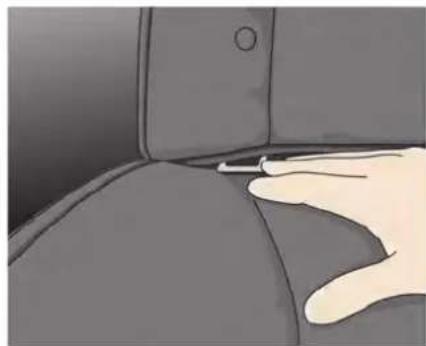
LATCHloweranchorlocation
LATCHloweranchorlocation
The LATCH lower anchors are located at the rear of the seat cushion near the seatback. A label is attached to the seatback to help you locate the LATCH anchors.

WARNING
TheGT-Rhasseatsandseatbeltsfor fouroccupants,twointhefront seatsandtwointherearseats. Neverusetherearconsoleasa seatingpositionorforachildrestraint.

LATCHwebbing-mountedattachment

LATCHrigid-mountedattachment

InstallingchildrestraintLATCH loweranchorattachments
LATCH compatible child restraints include two rigid or webbing-mounted attachments that can be connected to two anchors located at certain seating positions in your vehicle. With this system, you do not have to use a vehicle seat belt to secure the child restraint. Check your child restraint for a label stating that it is compatible with LATCH. This information may also be in the instructions provided by the child restraint manufacturer.
When installing a child restraint, carefully read and follow the instructions in this manual and those supplied with the child restraint.
Toptetheranchorpointlocations
Anchor points are located on the rear parcel shelf.
If you have any questions when installing atoptetherstrapchildrestraint on therearseat, it is recommended you see a GT-R certified NISSAN dealer for this service.

WARNING
Childrestraintanchoragesaredesignedtowithstandonlythoseloads imposedbycorrectlyfittedchild restraints.Undernocircumstances
Safety—Seats, seatbeltsandsupplementalrestraintsystem1-19
aretheytobeusedtoattachadult seatbelts,orotheritemsorequipmenttothevehicle.Doingsocould damagethechildrestraintanchorages.Thechildrestraintwillnot beproperlyinstalledusingthedamagedanchorage,andachildcould beseriouslyinjuredorkilledina collision.
REAR-FACINGCHILDRESTRAINT INSTALLATIONUSINGLATCH
Refer to all Warnings and Cautions in the "Child safety" and "Child restraints" sections before installing a child restraint. Do not use the lower anchors if the combined weight of the child and the child restraint exceeds 65 lbs (29.5 kg). If the combined weight of the child and the child restraint is greater than 65 lbs (29.5 kg), use the vehicle's seat belt (not the lower anchors) to install the child restraint. Be sure to follow the child restraint manufacturer's instructions for installation.
Follow these steps to install a rear-facing child restraint using the LATCH system:
- Position the child restraint on the seat. Always follow the child restraint manufacturer's instructions.
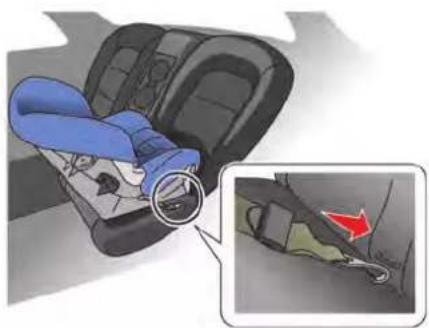
Rear-facingweb-mounted-step2
- Secure the child restraint anchor attachments to the LATCH lower anchors. Check to make sure the LATCH attachment is properly attached to the lower anchors.
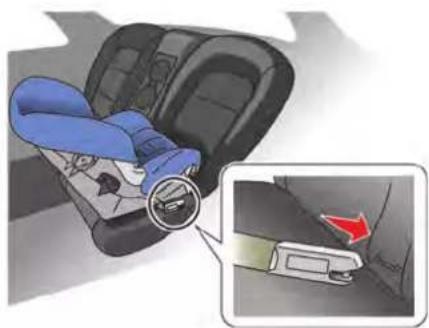
Rear-facingrigid-mounted-step2

Rear-facing-step3
1-20 Safety—Seats, seatbeltsandsupplementalrestraintsystem
- For child restraints that are equipped with webbing-mounted attachments, remove any additional slack from the anchor attachments. Press downward and rearward firmly in the center of the child restraint with your hand to compress the vehicle seat cushion and seatback while tightening the webbing of the anchor attachments.
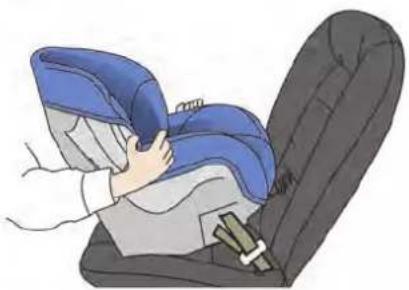
Rear-facing-step4
- After attaching the child restraint, test it before you place the child in it. Push it from side to side while holding the child restraint near the LATCH attachment path. The child restraint should not move more than 1 inch (25 mm), from side to side. Try to tug it forward and check to see if the LATCH attachment holds the restraint in place. If the restraint is not secure, tighten the LATCH attachment as necessary, or put the restraint in another seat and test it again. You may need to try a different child restraint or try installing by using the vehicle seat belt (if applicable). Not all child restraints fit
in all types of vehicles.
- Check to make sure the child restraint is properly secured prior to each use. If the child restraint is loose, repeat steps 1 through 4.
REAR-FACINGCHILDRESTRAINT INSTALLATIONUSINGTHESEAT BELTS

WARNING
Thethree-pointseatbeltwithAutomaticLockingRetractor(ALR)must beusedwheninstallingachildrestraint.FailuretousetheALRmode willresultinthechildrestraintnot beingproperlysecured.Therestraint couldtipoverorbelooseandcause injurytoachildinasuddenstopor collision.Also,itcanchange the operationofthefrontpassengerair bag.See"Frontpassengerairbag andstatuslight"laterinthissection.
Safety—Seats, seatbeltsandsupplementalrestraintsystem1-21

Rear-facing-step1
Refer to all Warnings and Cautions in "Child safety" and "Child restraints" before installing a child restraint.
Do not use the lower anchors if the combined weight of the child and the child restraint exceeds 65 lbs (29.5 kg). If the combined weight of the child and the child restraint is greater than 65 lbs (29.5 kg), use the vehicle's seat belt (not the lower anchors) to install the child restraint. Be sure to follow the child restraint manufacturer's instructions for installation.
Follow these steps to install a rear-facing child restraint using the vehicle seat belts in the rear seats:
- Childrestraintsforinfantsmustbe usedintherear-facingdirectionand thereforemustnotbeusedinthe frontseat.Position the child restraint on the seat. Always follow the restraint manufacturer's instructions.

Rear-facing-step2
- Route the seat belt tongue through the child restraint and insert it into the buckle until you hear and feel the latch engage. Be sure to follow the child restraint manufacturer's instructions for belt routing.
1-22 Safety—Seats, seat belts and supplemental restraintsystem

Rear-facing-step3
3. Pull the shoulder belt until the belt is fully extended. At this time, the seat belt retractor is in the Automatic Locking Retractor (ALR) mode (child restraint mode). It reverts to the Emergency Locking Retractor (ELR) mode when the seat belt is fully retracted.

Rear-facing-step4
4. Allow the seat belt to retract. Pull up on the shoulder belt to remove any slack in the belt.
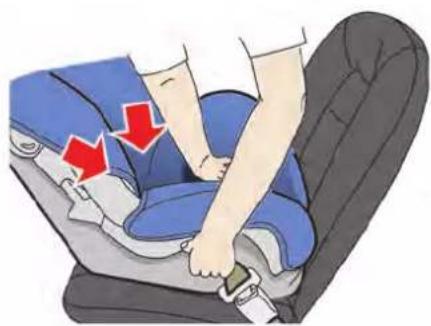
Rear-facing-step5
5. Remove any additional slack from the seat belt; press downward and rearward firmly in the center of the child restraint to compress the vehicle seat cushion and seatback while pulling up on the seat belt.
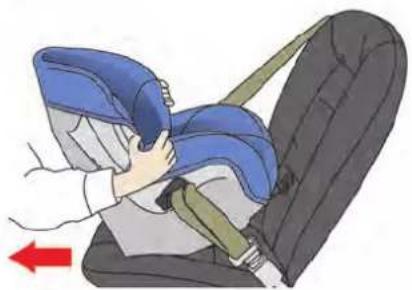
Rear-facing-step6
-
After attaching the child restraint, test it before you place the child in it. Push it from side to side while holding the child restraint near the seat belt path. The child restraint should not move more than 1 inch (25 mm), from side to side. Try to tug it forward and check to see if the belt holds the restraint in place. If the restraint is not secure, tighten the seat belt as necessary, or put the restraint in another seat and test it again. You may need to try a different child restraint. Not all child restraints fit in all types of vehicles.
-
Check to make sure that the child restraint is properly secured prior to
1-24 Safety—Seats,seatbeltsandsupplementalrestraintsystem
each use. If the seat belt is not locked, repeat steps 1 through 6. After the child restraint is removed and the seat belt fully retracted, the ALR mode (child restraint mode) is canceled.
FORWARD-FACINGCHILDRESTRAINTINSTALLATIONUSING LATCH
Refer to all Warnings and Cautions in the "Child safety" and "Child restraints" sections before installing a child restraint. Do not use the lower anchors if the combined weight of the child and the child restraint exceeds 65 lbs (29.5 kg). If the combined weight of the child and the child restraint is greater than 65 lbs (29.5 kg), use the vehicle's seat belt (not the lower anchors) to install the child restraint. Be sure to follow the child restraint manufacturer's instructions for installation.
Follow these steps to install a forward-facing child restraint using the LATCH system:
- Position the child restraint on the seat. Always follow the child restraint manufacturer's instructions.
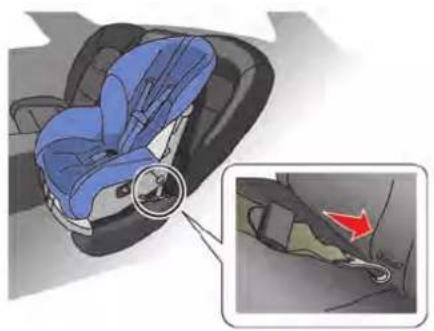
Forward-facingweb-mounted-step2
- Secure the child restraint anchor attachments to the LATCH lower anchors. Check to make sure the LATCH attachment is properly attached to the lower anchors. If the child restraint is equipped with a top tether strap, route the top tether strap and secure the tether strap to the tether anchor point. See
1-7 "Installing top tether strap" page 1-26. Do not install child restraints that require the use of a top tether strap in seating positions that do not have a top tether anchor.
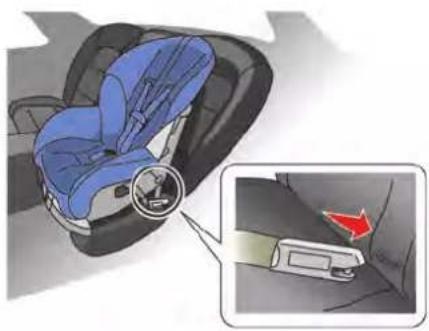
Forward-facingrigid-mounted-step2
- The back of the child restraint should be secured against the vehicle seat-back. If the seating position is interfering with the proper child restraint fit, try another seating position or a different child restraint.
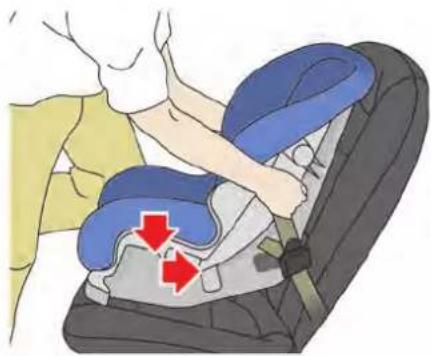
Forward-facing-step4
-
For child restraints that are equipped with webbing-mounted attachments, remove any additional slack from the anchor attachments. Press downward and rearward firmly in the center of the child restraint with your knee to compress the vehicle seat cushion and seatback while tightening the webbing of the anchor attachments.
-
Tighten the tether strap according to the manufacturer's instructions to remove any slack.

Forward-facing-step6
-
After attaching the child restraint, test it before you place the child in it. Push it from side to side while holding the child restraint near the LATCH attachment path. The child restraint should not move more than 1 inch (25 mm), from side to side. Try to tug it forward and check to see if the LATCH attachment holds the restraint in place. If the restraint is not secure, tighten the LATCH attachment as necessary, or put the restraint in another seat and test it again. You may need to try a different child restraint. Not all child restraints fit in all types of vehicles.
-
Check to make sure the child restraint is properly secured prior to each use. If the child restraint is loose, repeat steps 1 through 6.

Installingtoptetherstrap
The child restraint top tether strap must be used when installing the child restraint with the LATCH lower anchor attachments.
First, secure the child restraint with the LATCH lower anchors (rear outboard seat positions only).
-
Flip up the anchor cover from the anchor point which is located directly behind the child restraint.
-
Position the top tether strap over the top of the seatback.
-
Secure the tether strap to the tether anchor point on the rear parcel shelf.
1-26 Safety—Seats,seatbeltsandsupplementalrestraintsystem
- Refer to the appropriate child restraint installation procedure steps earlier in this section before tightening the tether strap.
If you have any questions when installing atoptetherstrap, consulta GT-R certified NISSAN dealerford details.
FORWARD-FACINGCHILDRE-STRAINTINSTALLATIONUSINGTHE SEATBELTS

WARNING
Thethree-pointseatbeltwithAutomaticLockingRetractor(ALR)must beusedwheninstallingachildrestraint.FailuretousetheALRmode willresultinthechildrestraintnot beingproperlysecured.Therestraint couldtipoverorbelooseandcause injurytoachildinasuddenstopor collision.Also,itcanchangethe operationofthefrontpassengerair bag.See"Frontpassengerairbag andstatuslight"laterinthissection.

Forward-facing(frontpassengerseat)—step1 Refer to all Warnings and Cautions in the "Child safety" and "Child restraints" sections before installing a child restraint. Do not use the lower anchors if the combined weight of the child and the child restraint exceeds 65 lbs (29.5 kg). If the combined weight of the child and the child restraint is greater than 65 lbs (29.5 kg), use the vehicle's seat belt (not the lower anchors) to install the child restraint. Be sure to follow the child restraint manufacturer's instructions for installation.
Follow these steps to install a forward-facing child restraint using the vehicle seat belt in the rear seats or in the front
passenger seat:
-
If you must install child restraint in the front seat, it should be placed in a forward-facing direction only. Movethese at to there are most position. Child restraints for infants must be used in therear-facing direction and, therefore, must not be used in the front seat.
-
Position the child restraint on the seat. Always follow the child restraint manufacturer's instructions. The back of the child restraint should be secured against the vehicle seat-back.
If the seating position is interfering with the proper child restraint fit, try another seating position or a different child restraint.

Forward-facing-step3
- Route the seat belt tongue through the child restraint and insert it into the buckle until you hear and feel the latch engage. Be sure to follow the child restraint manufacturer's instructions for belt routing. If the child restraint is equipped with a top tether strap, route the top tether strap and secure the tether strap to the tether anchor point. (15) "Installing top tether strap" page 1-30) Do not install child restraints that require the use of a top tether strap in seating positions that do not have a top tether anchor.

Forward-facing-step4
- Pull the shoulder belt until the belt is fully extended. At this time, the seat belt retractor is in the Automatic Locking Retractor (ALR) mode (child restraint mode). It reverts to Emergency Locking Retractor (ELR) mode when the seat belt is fully retracted.
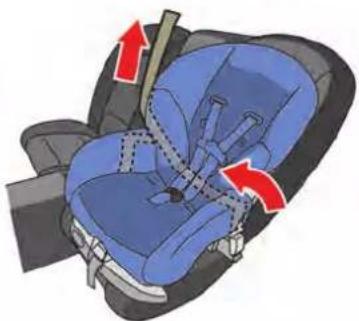
Forward-facing-step5
- Allow the seat belt to retract. Pull up on the shoulder belt to remove any slack in the belt.
1-28 Safety—Seats,seatbeltsandsupplementalrestraintsystem

Forward-facing-step6
- Remove any additional slack from the seat belt; press downward and rearward firmly in the center of the child restraint with your knee to compress the vehicle seat cushion and seatback while pulling up on the seat belt.
- Tighten the tether strap according to the manufacturer's instructions to remove any slack.

Forward-facing-step8
-
After attaching the child restraint, test it before you place the child in it. Push it from side to side while holding the child restraint near the seat belt path. The child restraint should not move more than 1 inch (25 mm), from side to side. Try to tug it forward and check to see if the belt holds the restraint in place. If the restraint is not secure, tighten the seat belt as necessary, or put the restraint in another seat and test it again. You may need to try a different child restraint. Not all child restraints fit in all types of vehicles.
-
Check to make sure the child restraint is properly secured prior to each use. If the seat belt is not locked, repeat steps 2 through 8.
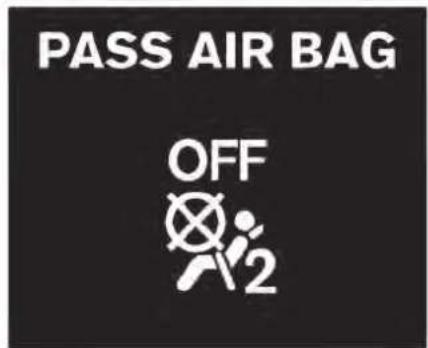
Forward-facing-step10
- If the child restraint is installed in the front passenger seat, place the ignition switch in the ON position. The front passenger air bag status light
should illuminate. If this light is not illuminated, see "Front passenger air bag and status light" in this section
Movethechildrestrainttoanother seatingposition.It is recommended you have the system checked by a GT-R certified NISSAN dealer.
After the child restraint is removed and the seat belt is fully retracted, the ALR mode (child restraint mode) is canceled.

Installingtoptetherstrap
The child restraint top tether strap must be used when installing the child restraint with the seat belts.
First, secure the child restraint with the seat belt.
- Flip up the anchor cover from the anchor point which is located directly behind the child restraint.
- Position the top tether strap over the top of the seatback.
- Secure the tether strap to the tether anchor point on the rear parcel shelf.
- Refer to the appropriate child restraint installation procedure steps earlier in
this section before tightening the tether strap.
If you have any questions when installing atoptetherstrap, it is recommended you consult a GT-R certified NISSAN dealer for details.
BOOSTERSEATS
Precautionsonboosterseats

WARNING
Ifaboosterseatandseatbeltarenot usedproperly,theriskofachild beinginjuredinasuddenstopor collisiongreatlyincreases:
- Makesuretheshoulderportionof thebeltisawayfromthechild's faceandneckandthelapportion ofthebeltdoesnotcrossthe stomach.
- Makesuretheshoulderbeltisnot behindthechildorunderthe child'sarm.
- Aboosterseatmustonlybe installedinaseatingpositionthat hasalap/shoulderbelt.


Always follow all recommended procedures.
Booster seats of various sizes are offered by several manufacturers. When selecting any booster seat, keep the following points in mind:
- Choose only a booster seat with a label certifying that it complies with Federal Motor Vehicle Safety Standard 213 or Canadian Motor Vehicle Safety Standard 213.
- Check the booster seat in your vehicle to be sure it is compatible with the vehicle's seat and seat belt system.
- Make sure the child's head will be properly supported by the booster seat or vehicle seat. The seatback must be at or above the center of the child's ears. For example, if a low back booster seat ① is chosen, the vehicle seatback must be at or above the center of the child's ears. If the seatback is lower than the center of the child's ears, a high back booster seat ② should be used.
- If the booster seat is compatible with your vehicle, place your child in the booster seat and check the various adjustments to be sure the booster seat is compatible with your child.
Safety—Seats, seatbeltsandsupplementalrestraintsystem1-31

AllU.S.statesandCanadianprovinces orterritoriesrequirethatinfantsand smallchildrenberestrainedinanapprovedchildrestraintatalltimeswhile thevehicleisbeingoperated.
The instructions in this section apply to booster seat installation in the rear seats or the front passenger seat.
Boosterseatinstallation

WARNING
Toavoidinjurytochild, donotuse thelap/shoulderbeltAutomatic LockingRetractor(ALR)modewhen usingaboosterseatwiththeseat belts.
Refer to all Warnings and Cautions in the "Child safety", "Child restraints" and "Booster seats" sections earlier in this section before installing a child restraint. Follow these steps to install a booster seat in the rear seat or in the front passenger seat:

-
Ifyoumustinstallaboosterseatin thefrontseat, movetheseattothe rearmostposition.
-
Position the booster seat on the seat. Only place it in a forward-facing direction. Always follow the booster seat manufacturer's instructions.
1-32 Safety—Seats, seat belts and supplemental restraintsystem

Outboardposition
- The booster seat should be positioned on the vehicle seat so that it is stable. If the seating position is interfering with the proper booster seat fit, try another seating position or a different booster seat.
- Position the lap portion of the seat belt low and snug on the child's hips. Be sure to follow the booster seat manufacturer's instructions for adjusting the belt routing.
- Pull the shoulder belt portion of the seat belt toward the retractor to take up extra slack. Be sure the shoulder belt is positioned across the top, middle portion of the child's shoulder.
Be sure to follow the booster seat manufacturer's instructions for adjusting the belt routing.

Frontseat
- Follow the warnings, cautions and instructions for properly fastening a seat belt. ( "Three-point type seat belt with retractor" page 1-9)
- If the booster seat is installed in the front passenger seat, push the ignition switch to the ON position. The front passenger air bag status light may or may not illuminate depending on the size of the child and the type of booster seat used. ( "Front passenger air bag and status light" page 1-42)
SUPPLEMENTALRESTRAINTSYSTEM
PRECAUTIONSONSUPPLEMENTAL RESTRAINTSYSTEM
This Supplemental Restraint System (SRS) section contains important information concerning the following systems:
- Driver and passenger supplemental front-impact air bag (NISSAN Advanced Air Bag System)
●Front seat-mounted side-impact supplemental air bag
●Roof-mounted curtain side-impact and rollover supplemental air bag - Seat belt pretensioner
Supplementalfront-impactairbagsystem:The NISSAN Advanced Air Bag System can help cushion the impact force to the head and chest of the driver and front passenger in certain frontal collisions.
Frontseat-mountedside-impactsup- plemental air bag system: This system can help cushion the impact force to the chest area of the driver and front pas- senger in certain side impact collisions. The side air bags are designed to inflate on the side where the vehicle is impacted
Roof-mountedcurtainside-impact and rolloversupplementalairbagsystem: This system can help cushion the impact force to the head of occupants in the
front seating positions in certain side impact or rollover collisions. In a side impact, the curtain air bags are designed to inflate on the side where the vehicle is impacted. In a rollover, curtain air bags on both sides are designed to inflate and remain inflated for a short time.
Curtain air bags are also designed to inflate in certain types of rollover collisions or near rollovers. As a result, certain vehicle movements may cause the curtain air bags to inflate.
These supplemental restraint systems are designed to supplement the crash protection provided by the driver and passenger seat belts and are not a substitute for them. Seat belts should always be correctly worn and the occupant seated a suitable distance away from the steering wheel, instrument panel and door finishers. ( "Seat belts" page 1-6)
Thesupplementalairbagsoperateonly when theignitionswitch isinthe ON position.
Afterpushingtheignitionswitchtothe ONposition, the supplementalair bag warninglightilluminates. Thesupplemental air bag warning light will turn off afterabout7secondsifthesystems areoperational.
1-34 Safety—Seats, seat belts and supplemental restraintsystem

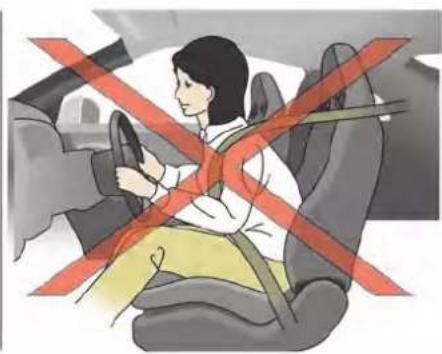
Situprightandwellback.
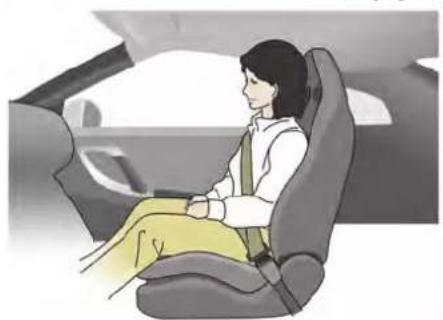

Situprightandwellback.

WARNING
•Thefrontairbagsordinarilywill notinflateintheeventofaside impact,rearimpact,rollover,or lowerseverityfrontalcollision. Alwayswearyourseatbeltsto helpreducetheriskorseverity of injuryinvariouskindsofaccidents.
- Thefrontpassengerairbagwill notinflateifthepassengerair bagstatuslightislitorifthefront passengerseatisunoccupied. ( "Frontpassengerairbag andstatuslight"page1-42)
•Theseatbeltsandthefrontair bagsaremosteffectivewhenyou aresittingwellbackandupright intheseat.Thefrontairbags inflatewithgreatforce.Evenwith theNISSANAdvancedAirBag System,ifyouareunrestrained, leaningforward,sittingsideways oroutofpositioninanyway,you areatgreaterriskofinjuryor deathinacrash.Youmayalso receiveseriosurfatalinjuries fromthefrontairbagifyouare upagainstitwhenitinflates. Alwayssitbackagainsttheseat-
Safety—Seats, seatbeltsandsupplementalrestraintsystem1-35
backandasfar-awayaspractical fromthesteeringwheelorinstrumentpanel.Alwaysusetheseat belts.
- Thedriverandfrontpassenger seatbeltbucklesareequipped withsensorsthatdetectifthe seatbeltsarefastened.TheAdvancedAirBagSystemmonitors theseverityofacollisionandseat beltusagetheninflatestheair bagsasneeded.Failuretoproperlywearseatbeltscanincrease theriskorseverityofinjuryinan accident.
- Thefrontpassengerseatis equipped with an occupant classifications sensor (pattern sensor) that turn the frontpassenger air bag OFF fundersome conditions. This sensor is only used in this seat. Failure to be properly seated and wearing these at belt can increase the risk severity of injury in an accident. ( "Frontpassengerairbag and statuslight" page 1-42)
- Keephandsontheoutsideofthe steeringwheel.Placingthemin-sidethesteeringwheelrimcould increasetheriskofhandinjuryif
thesupplementalfrontairbag inflates.
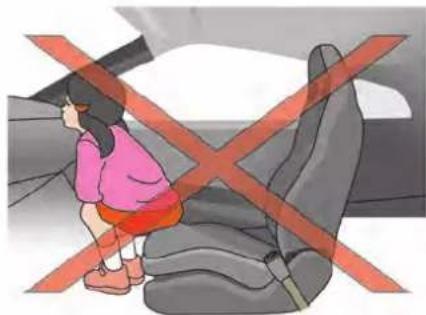
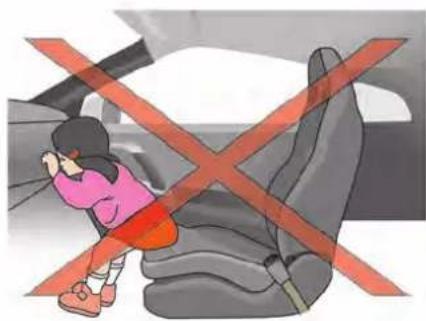


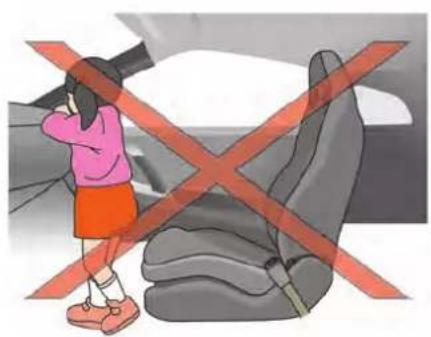


WARNING
●Neverletchildrenrideunrestrainedorextendtheirhandsor faceoutofthewindow.Donot attempttoholdtheminyourlap orarms.Someexamplesofdangerousridingpositionsare shownintheillustrations.
- Childrenmaybeseverelyinjured orkilledwhenthefrontairbags, sideairbagsorcurtainairbags inflateiftheyarenotproperly restrained.Pre-teensandchildrenshouldbeproperlyrestrainedintherearseat,if possible.
- EvenwiththeNISSANAdvanced AirBagSystem,neverinstalla rear-facingchildrestraintinthe frontseat.Aninflatingsupplementalfrontairbagcouldseriouslyinjureorkillyourchild. ( "Childrestraints"page1-15)

Donotleanagainstdoorsorwindows.Donotleanagainstdoorsorwindows.


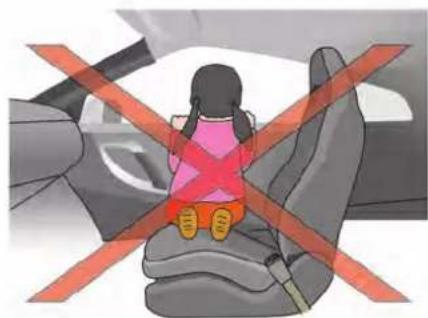

WARNING
Frontseat-mountedside-impact supplementalairbagsandroof-mountedcurtainside-impact and rolloversupplementalairbags:
- Thesideairbagsordinarilywill notinflateintheeventofafront impact,rearimpact,rollover,or lowerseveritysidecollision.Alwayswearyourseatbeltstohelp reducetheriskorseverity of injuryinvariouskindsofaccidents.
- Thecurtainairbagsordinarilywill notinflateintheeventofafront impact,rearimpact,orlower severitysidecollision.Always wearyourseatbeltstohelp reducetheriskorseverity of injuryinvariouskindsofaccidents.
•Theseatbelts,sideairbagsand curtainairbagsaremosteffectivewhenyouaresittingwell backanduprightintheseat.The sideairbagsandcurtainairbags inflatewithgreatforce.Donot allowanyonetoplacetheirhand, legorfacenearthesideairbag
1-38 Safety—Seats, seatbeltsandsupplementalrestraintsystem
onthesideoftheseatbackofthe frontseatornearthesideroof rails.Donotallowanyonesitting inthefrontseattoextendtheir handoutofthewindoworlean againstthedoor.Someexamples ofdangerousridingpositionsare showninthepreviousillustrations.
- Whensittingintherearseat,do notholdontotheseatbackofthe frontseat.Ifthesupplemental sideairbaginflates,youmaybe seriouslyinjured.Beespecially carefulwithchildren,whoshould alwaysbeproperlyrestrained. Someexamplesofdangerous ridingpositionsareshowninthe illustrations.
- Donotuseseatcoversonthe frontseatbacks.Theymayinterferewithsideairbaginflation.

- Crash zone sensor
- Supplemental front-impact air bag modules (NISSAN Advanced Air Bag System)
- Front seat-mounted side-impact supplemental air bags
-
Roof-mounted curtain side-impact and rollover supplemental air bags
-
Roof-mounted curtain side-impact and rollover supplemental air bag inflators
- Pressure sensors in door
- Occupant classification sensor (pattern sensor)
-
Occupant classification system control unit
-
Satellite sensors
- Seat belt pretensioners
- Air bag Control Unit (ACU)
NISSANADVANCEDAIRBAGSYS- TEM(frontseats)
This vehicle is equipped with the NISSAN Advanced Air Bag System for the driver and front passenger seats. This system is designed to meet certification requirements under U.S. regulations. It is also permitted in Canada. Alloftheinformation,cautionsandwarningsinthis manualapplyandmustbefollowed.
The driver supplemental front-impact air bag is located in the center of the steering wheel. The front passenger supplemental front-impact air bag is mounted in the instrument panel above the glove box. The front air bags are designed to inflate in higher severity frontal collisions, although they may inflate if the forces in another type of collision are similar to those of a higher severity frontal impact. They may not inflate in certain frontal collisions. Vehicle damage (or lack of it) is not always an indication of proper front air bag operation.
The NISSAN Advanced Air Bag System has dual stage air bag inflators. The system monitors information from the Air bag
1-40 Safety—Seats,seatbeltsandsupplementalrestraintsystem
Control Unit (ACU), seat belt buckle sensors and the occupant classification sensor (pattern sensor). Inflator operation is based on the severity of a collision and seat belt usage for the driver. For the front passenger, the occupant classification sensor is also monitored. Based on information from the sensors, only one front air bag may inflate in a crash, depending on the crash severity and whether the front occupants are belted or unbelted. Additionally, the front passenger air bag may be automatically turned OFF under some conditions, depending on the information provided by the occupant classification sensor. If the front passenger air bag is OFF, the passenger air bag status light will be illuminated (if the seat is unoccupied, the light will not be illuminated, but the air bag will be off). One front air bag inflating does not indicate improper performance of the system. (17 "Front passenger air bag and status light" page 1-42)
If you have any questions about your air bag system, it is recommended you contact NISSAN or a GT-R certified NISSAN dealer. If you are considering modification of your vehicle due to a disability, you may also contact NISSAN. Contact information is contained in the front of this Owner's Manual. When a front air bag inflates, a fairly loud noise may be heard, followed by release of smoke. This smoke is not harmful and does not indicate a fire. Care should be taken not to inhale it, as it may cause irritation and choking. Those with a history of a breathing condition should get fresh air promptly.
Front air bags, along with the use of seat belts, help to cushion the impact force on the head and chest of the front occupants. They can help save lives and reduce serious injuries. However, an inflating front air bag may cause facial abrasions or other injuries. Front air bags do not provide restraint to the lower body.
Even with NISSAN advanced air bags, seat belts should be correctly worn and the driver and passenger seated upright as far as practical away from the steering wheel or instrument panel. The front air bags inflate quickly in order to help protect the front occupants. Because of this, the force of the front air bag inflating can increase the risk of injury if the occupant is too close to, or is against, the air bag module during inflation. The front air bags deflate quickly after a collision.
Thefrontairbagsoperateonlywhen theignitionswitchisintheONposition.
Afterpushingtheignitionswitchtothe ONposition,thesupplementalairbag warninglightilluminates.Thesupplementalairbagwarninglightwillturn offafterabout7secondsifthesystem isoperational.

Frontpassengerairbagstatuslight
Frontpassengerairbagandstatuslight

WARNING
ThefrontpassengerairbagisdesignedtoautomaticallyturnOFF undersomeconditions.Readthis sectioncarefullytolearnhowit operates.Properuseoftheseat, seatbeltandchildrestraintsnecessaryformosteeffectiveprotection.Failureretofollowall instructionsinthismanualconcern-
ingtheuseofseats,seatbeltsand childrestraintscanincreasetherisk orseverityofinjuryinanaccident.
Statuslight:
The front passenger air bag status light is located on the center instrument panel. After the ignition switch is placed in the ON position, the front passenger air bag status light on the instrument panel illuminates for about 7 seconds and then turns off or illuminates depending on the front passenger seat occupied status. The light operates as follows:
●Unoccupied passenger seat: The light is OFF and the front passenger air bag is OFF and will not inflate in a crash.
●Passenger seat occupied by a small adult, child or child restraint as outlined in this section: The light illuminates to indicate that the front passenger air bag is OFF and will not inflate in a crash.
Occupied passenger seat and the passenger meets the conditions outlined in this section: The light is OFF to indicate that the front passenger air bag is operational.
Frontpassengerairbag:
The front passenger air bag is designed to automatically turn OFF when the vehicle is operated under some conditions as described below as permitted by U.S. regulations. If the front passenger air bag is OFF, it will not inflate in a crash. The driver air bag and other air bags in your vehicle are not part of this system.
The purpose of the regulation is to help reduce the risk of injury or death from an inflating air bag to certain front passenger seat occupants, such as children, by requiring the air bag to be automatically turned OFF.
The occupant classification sensor (pattern sensor) is in the front passenger seat cushion and is designed to detect an occupant and objects on the seat. For example, if a child is in the front passenger seat, the Advanced Air Bag System is designed to turn the passenger air bag OFF in accordance with the regulations. Also, if a child restraint of the type specified in the regulations is on the seat, the occupant classification sensor can detect it and cause the air bag to turn OFF.
Front passenger seat adult occupants who are properly seated and using the seat belt as outlined in this manual should not cause the passenger air bag
to be automatically turned OFF. For small adults it may be turned OFF, however, if the occupant does not sit in the seat properly (for example, by not sitting upright, by sitting on an edge of the seat, or by otherwise being out of position), this could cause the sensor to turn the air bag OFF. Always be sure to be seated and wearing the seat belt properly for the most effective protection by the seat belt and supplemental air bag.
NISSAN recommends that pre-teens and children be properly restrained in a rear seat. NISSAN also recommends that appropriate child restraints and booster seats be properly installed in a rear seat. If this is not possible, the occupant classification sensor is designed to operate as described above to turn the front passenger air bag OFF for specified child restraints. Failing to properly secure child restraints and to use the Automatic Locking Retractor (ALR) mode (child restraint mode) may allow the restraint to tip or move in an accident or sudden stop. This can also result in the passenger air bag inflating in a crash instead of being OFF. ( "Child restraints" page 1-15) If the front passenger seat is not occupied, the passenger air bag is designed not to inflate in a crash. However, heavy objects placed on the seat could result in air bag inflation, because of the object being detected by the occupant classification sensor. Other conditions could also result in air bag inflation, such as if a child is standing on the seat, or if two children are on the seat, contrary to the instructions in this manual. Always be sure that you and all vehicle occupants are seated and restrained properly.
Using the passenger air bag status light, you can monitor when the front passenger air bag is automatically turned OFF with the seat occupied. The light will not illuminate when the front passenger seat is unoccupied.
If an adult occupant is in the seat but the passenger air bag status light is illuminated (indicating that the air bag is OFF), it could be that the person is a small adult, or is not sitting on the seat properly.
If a child restraint must be used in the front seat, the passenger air bag status light may or may not be illuminated, depending on the size of the child and the type of child restraint being used. If the passenger air bag status light is not illuminated (indicating that the air bag might inflate in a crash), it could be that the child restraint or seat belt is not being used properly. Make sure that the child restraint is installed properly, the seat bel
is used properly and the occupant is positioned properly. If the passenger air bag status light is still not illuminated, reposition the occupant or child restraint in a rear seat.
If the passenger air bag status light will not illuminate even though you believe that the child restraint, the seat belts and the occupant are properly positioned, the system may be sensing an unoccupied seat (in which case the air bag is OFF). Your GT-R certified NISSAN dealer can check that the system is OFF by using a special tool. However, until you have confirmed with your dealer that your air bag is working properly, reposition the occupant or child restraint in a rear seat. The NISSAN Advanced Air Bag System and passenger air bag status light will take a few seconds to register a change in the passenger seat status. However, if the seat becomes unoccupied, the air bag status light will remain off.
If a malfunction occurs in the front passenger air bag system, the supplemental air bag warning light, located in the meter and gauges area will blink. It is recommended you have the system checked by a GT-R certified NISSAN deal-
Othersupplementalfrontairbag precautions

WARNING
- Donotplaceanyobjectsonthe steeringwheelpadoronthe instrumentpanel. Also, donot placeanyobjectsbetweenany occupantandthesteeringwheel orinstrumentpanel. Such objects maybecomedangerousprojectilesandcauseinjuryifthefront airbaginflates.
- Donotplaceobjectswithsharp edgesontheseat. Also, donot placeheavyobjectsontheseat that will leave permanent impressions in theseat. Such objects candamagethesatoroccupant classification sensor (pattern sensor). This can affect the operation of the airbagsystem and result in serious personal injury.
- Donotusewateroracidicclea- ners(hotsteamcleaners)onthe seat. This candamagetheseator occupantclassificationsensor. This can also affect the operation of the air bagsystem and result in
seriouspersonalinjury.
- Immediatelyafterinflation,severalfrontairbagsystemcomponentswillbehot.Donottouch them;youmayseverelyburn yourself.
• Nounauthorizedchangesshould bemadetoanycomponentsor wiringofthesupplementalair bagsystem. Thisistoprevent accidentalinflationofthesupplementalairbagordamagetothe supplementalairbagsystem. - Donotmakeunauthorized changestoyourvehicle'selectricalsystem,suspensionsystemor frontendstructure.Thiscould affectproperoperationofthe frontairbagsystem.
- Tamperingwiththesupplementalairbagsystemmayresultin seriouspersonalinjury.Tamperingincludeschangestothesteeringwheelandtheinstrument panelassemblybyplacingmaterialoverthesteeringwheelpad andabovetheinstrumentpanel orbyinstallingadditionaltrim material around the air bag system.
- Modifying or tampering with the frontpassengerseatmayresult inseriouspersonalinjury. For example, donotchangethefront seats by placing material onthe seat cushionor byinstalling additionaltrimmaterial, such as seatcovers, ontheseatthatis not specifically designed to assureproperairbagoperation. Additionally, donotstowany objectsunderthefrontpassengerseatortheseatcushion and seatback. Suchobjectsmayinterferewiththeproperoperation of theoccupant classification sensor.
- Nounauthorizedchangesshould bemadetoanycomponentsor wiring oftheseatbeltsystem. Thismayaffectthefrontairbag system.Tamperingwiththeseat beltsystemmayresultinserious personalinjury.
•Workonandaroundthefrontair bagsystemshouldbedonebya GT-RcertifiedNISSANdealer.Installationofelectricalequipment shouldalsobedoneby aGT-R certifiedNISSANdealer.TheSupplementalRestraintSystem(SRS)
wiringharnesses*shouldnotbe modifiedordisconnected.Unauthorizedelectricaltestequipmentandprobingdevicesshould notbeusedontheairbagsystem.
- Acracked windshield should be replaced immediately by a qualified repair facility. A cracked windshield could affect the function of the supplemental airbag system.
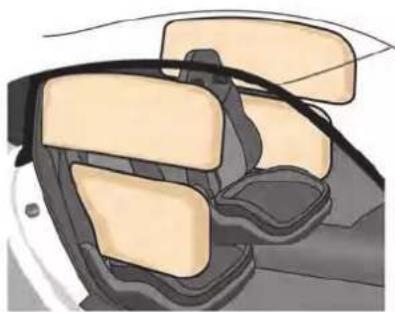
*The SRSwiringharness connectors are yellow and orange foreasy identification.
When selling your vehicle, we request that you inform the buyer about the front air bag system and guide the buyer to the appropriate sections in this Owner's Manual.
FRONTSEAT-MOUNTEDSIDE-IMPACTSUPPLEMENTALAIRBAG ANDROOF-MOUNTEDCURTAIN SIDE-IMPACTANDROLLOVER SUPPLEMENTALAIRBAGSYSTEMS
The front side air bags are located in the outside of the seatback of the front seats. The curtain air bags are located in the side roof rails. Alloftheinformation, cautionsandwarningsinthismanual applyandmustbefollowed. The side air bags and curtain air bags are designed to inflate in higher severity side collisions, although they may inflate if the forces in another type of collision are similar to
those of a higher severity side impact. They are designed to inflate on the side where the vehicle is impacted. They may not inflate in certain side collisions.
Curtain air bags are also designed to inflate in certain types of rollover collisions or near rollovers. As a result, certain vehicle movements may cause the curtain air bags to inflate.
Vehicle damage (or lack of it) is not always an indication of proper side air bag and curtain air bag operation.
When the side air bags and curtain air bags inflate, a fairly loud noise may be heard, followed by release of smoke. This smoke is not harmful and does not indicate a fire. Care should be taken not to inhale it, as it may cause irritation and choking. Those with a history of a breathing condition should get fresh air promptly.
Front side air bags, along with the use of seat belts, help to cushion the impact force on the chest of the front occupants. Curtain air bags help to cushion the impact force to the head of occupants in the front seating positions. They can help save lives and reduce serious injuries. However, an inflating side air bag and curtain air bag may cause abrasions or other injuries. Side air bags and curtain air bags do not provide restraint to the lower
body.
The seat belts should be correctly worn and the driver and passenger seated upright as far as practical away from the side air bags. The side air bags and curtain air bags inflate quickly in order to help protect occupants. Because of this, the force of the side air bags and curtain air bags inflating can increase the risk of injury if the occupant is too close to, or is against, these air bag modules during inflation. In a rollover, the curtain air bags on both sides are designed to inflate. Under both side-impact situations, the curtain air bags will remain inflated for a short period of time.
The side air bags and curtain air bags operate only when the ignition switch is in the ON position.
Afterplacingtheignitionswitchinthe ONposition,thesupplementalairbag warninglightilluminates.Theairbag warninglightwillturnoffafterabout7 secondsifthesystemsareoperational.

WARNING
- Donotplaceanyobjectsnearthe seatbackofthefrontseats. Also, donotplaceanyobjects(an umbrella,bag,etc.)between the doorfinisherandthefrontseat.
Suchobjectsmaybecomedangerousprojectilesandcauseinjuryifasideairbaginflates.
•Rightafterinflation,seversalside airbagandcurtainairbagsystemcomponentswillbehot.Do nottouchthem;youmayseverely burnyourself.
- Nounauthorizedchangesshould bemadetoanycomponentsor wiringofthesideairbagsand curtainairbags. This is to prevent damagetooraccidentalinflation of the sideairbag and curtainair bags systems.
- Donotmakeunauthorized changestoyourvehicle'selectricalsystem,suspensionsystemor sidepanel.Thiscouldaffectproperoperationofthesideairbag andcurtainairbagsystems.
•Tamperingwiththesideairbag systemmayresultinseriouspersonalinjury. Forexample, donot changethefrontseatbyplacing materialneartheseatbackorby installingadditionaltrimmaterial, suchasseatcovers, around thesideairbags.
•Workaroundandonthesideair
bagandcurtainairbagsystems shouldbedonebyaGT-RcertifiedNISSANdealer.Installationof electricalequipmentshouldalso bedonebyaGT-Rcertified NISSANdealer.TheSRSwiring harnesses*shouldnotbemodifiedordisconnected.Unauthorizedelectricaltestequipment andprobingdevicesshouldnot beusedonthesideairbagand curtainairbagsystems.
*The SRSwiringharnessconnectors are yellow and orange foreasy identification.
When selling your vehicle, we request that you inform the buyer about the side air bag and curtain air bag systems and guide the buyer to the appropriate sections in this Owner's Manual.
SEATBELTSWITHPRETEN- SIONERS(frontseats)

WARNING
•Thepretensionerscannotbereusedafteractivation. They must bereplaced together with the retractor and buckle as a unit.
- If the vehicle becomes involved in a collision but the pretensioner is not activated, it is recommended to have the pretensionersystem checked and, if necessary, replaced by a GT-R certified NISSAN dealer.
- Nounauthorizedchangesshould bemadeoanycomponentsor wiringofthepretensioners. This istopreventdamagetooraccidentalactivationofthepretensioners.Tamperingwiththe pretensionersystemmayresult inseriouspersonalinjury.
- WorkaroundandonthepretensionersshouldbedonebyaGT-R certifiedNISSANdealer.Installationofelectricalequipment shouldalsobedonebyaGT-R certifiedNISSANdealer.Unauthorizedelectricaltestequipmentandprobingdevicesshould notbeusedonthepretensioners.
- If you need to dispose of a pre-tensioner or scrap the vehicle, it is recommended you contact a GT-R certified NISSAN dealer. In-correct disposals procedures could cause personal injury.
The pretensioner system may activate with the supplemental air bag system in certain types of collisions. Working with the seat belt retractor, it helps tighten the seat belt when the vehicle becomes involved in certain types of collisions, helping to restrain front seat occupants.
The pretensioner is encased with the seat belt retractor. These seat belts are used the same way as conventional seat belts. When a pretensioner activates, smoke is released and a loud noise may be heard. The smoke is not harmful, and it does not indicate a fire. Care should be taken not to inhale it as it may cause irritation and choking. Those with a history of a breathing condition should get fresh air promptly.
After pretensioner activation, load limiters allow the seat belt to release webbing (if necessary) to reduce forces against the chest.
The supplemental air bag warning light is used to indicate malfunctions in the pretensioner system. (See "Supplemental air bag warning light" page 1-48 for more details.) If the operation of the supplemental air bag warning light indicates there is a malfunction, it is recommended you have the system checked by a GT-R certified NISSAN dealer.
When selling your vehicle, we request that you inform the buyer about the pretensioner system and guide the buyer to the appropriate sections in this Owner's Manual.
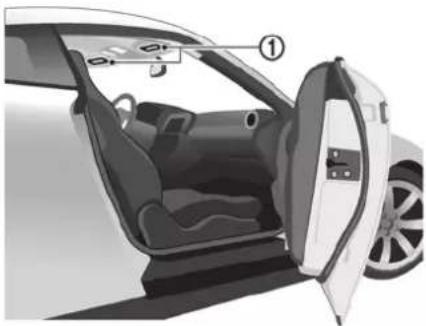
SUPPLEMENTAL AIRBAG WARNING LABELS
Warning labels about the supplemental front-impact air bag are placed in the vehicle as shown in the illustration.
① SRSairbag
The warning labels are located on the surface of the sun visors.
WARNING
Donotusearear-facingchildre-straintonaseatprotectedbyanair baginfrontofit.Iftheairbag deploys,itmaycauseseriousinjury ordeath.

SUPPLEMENTAL AIRBAG WARNING LIGHT
The supplemental air bag warning light, displaying ⚙ in the meter, monitors the circuits for the air bag systems, pretensioners and all related wirings. When the ignition switch is in the ON position, the supplemental air bag warning light illuminates for about 7 seconds and then turns off. This means the SRS air bag systems are operational. If any of the following conditions occur, the air bag and/or pretensioner systems need servicing:
1-48 Safety—Seats, seat belts and supplemental restraintsystem
●The supplemental air bag warning light remains on after approximately 7 seconds.
●The supplemental air bag warning light flashes intermittently.
●The supplemental air bag warning light does not come on at all. Under these conditions, the air bag and/or pretensioner systems may not operate properly. They must be checked and repaired. It is recommended you take your vehicle to the nearest GT-R certified NISSAN dealer.

WARNING
If the supplemental air bag warning lightison, it could mean that the frontairbag, sideairbag, curtainair bag and or pretensioners will not operate in an accident. To help avoid injury to yourself for others, have your vehicle checked by a dealer as soon as possible.
REPAIRANDREPLACEMENTPROCEDURE
The front air bags, side air bags, curtain air bags and pretensioners are designed to activate on a one-time-only basis. As a reminder, unless it is damaged, the supplemental air bag warning light will remain illuminated after inflation has occurred. Repair and replacement of these systems should be done only by a GT-R certified NISSAN dealer.
When maintenance work is required on the vehicle, the front air bags, side air bags, curtain air bags, pretensioners and related parts should be pointed out to the person conducting the maintenance. The ignition switch should always be in the LOCK position when working under the hood or inside the vehicle.

WARNING
- Onceafrontairbag,sideairbag, orcurtainairbaghasinflated,the airbagmodulewillnotfunction againandmustbereplaced.Additionally,theactivatedpretensionersmustalsobereplaced. Theairbagmoduleandpretensionersshouldbereplacedbya GT-RcertifiedNISSANdealer.The
airbagmoduleandpretensioners cannotberepaired.
- Thefrontairbag, sideairbag, curtainairbag and the pretensioners should be inspected by a GT-R certified NISSAN dealer if there is any damage to the front endorside portion of the vehicle.
- If you need to dispose of as supplemental air bagorapretensioner or scrap the vehicle, contact a GT-R certified NISSAN dealer. Incorrect disposal procedures could cause personal injury.
MEMO
1-50 Safety—Seats,seatbeltsandsupplementalrestraintsystem
2Instrumentsandcontrols
Cockpit....2-4
Instrumentpanel....2-5
Metersandgauges....2-6
Speedometer 2-7
Odometer/twintripodometer....2-7
Tachometer 2-8
Enginecoolanttemperaturegauge....2-8
Fuelgauge....2-9
Transmissionpositionindicator....2-10
Upshiftindicator....2-10
Instrumentbrightnesscontrol....2-12
Vehicleinformationdisplay....2-13
Engineoilleveldisplay....2-13
Transmissionsystemcheckdisplay....2-15
Drivecomputer....2-16
Currentfuelconsumption....2-16
Vehiclespeed....2-17
Cruisecontrol....2-17
Averagefuelconsumptionandspeed....2-17
Elapsed time and tripodometer....2-18
Distancetoempty 2-18
Outsideairtemperature....2-19
Setting(drivecomputer)....2-20
Warning(drivecomputer)....2-24
Warninglights, indicatorlights and
audiblereminders....2-26
Checkinglights....2-26
Warning/indicatorlights(red)....2-26
Warning/indicatorlights(yellow)......2-29
Warning/indicatorlights(other)......2-34
Audiblereminders....2-34
Warningdisplay....2-36
Engineoillowpressurewarning....2-37
Enginesystemwarning....2-37
Shiftleverpositionwarning....2-37
Reversewarning....2-38
Transmissionsystemwarning....2-38
Transmissionoilhigh
temperaturewarning....2-38
Transmissionclutchhigh
temperaturewarning....2-39
Parkingbrakereleasewarning....2-39
Lowbrakefluidwarning....2-39
Anti-lockBrakingSystem(ABS)warning.....2-40
VehicleDynamicControl(VDC)
systemwarning....2-40
AWDclutchhightemperaturewarning.....2-40
Front/reartiresizediscrepancywarning....2-41
AWDsystemwarning....2-41
Lowtirepressurewarning....2-42
Run-flattirewarning....2-42
TirePressureMonitoringSystem
(TPMS)warning....2-42
Cruisecontrolsystemwarning....2-43
Lowfuelwarning....2-43
Door/trunkopenwarning....2-44
Headlightsystemwarning....2-44
Lowwasherfluidwarning....2-44
Nokeywarning....2-45
Operationdisplays....2-45
Enginestartoperationindicator....2-46
Shift"P"warning....2-46
"PUSH"warning....2-46
Steeringlockrelease
malfunctionindicator....2-47
IntelligentKeyinsertionindicator....2-47
IntelligentKeyremovalindicator....2-47
IntelligentKeybattery
dischargeindicator....2-48
Securitysystems....2-48
Vehiclesecuritysystem....2-48
NISSANVehicleImmobilizerSystem....2-50
Wiperandwasherswitch....2-51
Usingthewipers....2-51
Usingthewasher....2-52
Rearwindowdefrosterswitch....2-52
Headlightandturnsignalswitch....2-53
Headlightswitch....2-53
Turnsignalswitch....2-57
Horn 2-58
Heatedseats....2-58
Turningontheheaters....2-58
Turningofftheheaters....2-58
Sonarsystemoffswitch....2-59
Exhaustsoundcontrolswitch(if
soequipped)....2-59
Poweroutlets....2-60
E-Call(SOS)Button....2-61
Emergencysupport....2-61
Storage....2-63
Cupholders....2-63
Sunglassesholder....2-64
Doorpocket 2-65
Glovebox....2-65
Consolebox....2-66
Coathooks....2-66
Windows....2-67
Powerwindows....2-67
Interiorlights....2-69
Maplights....2-69
Interiorlightcontrolswitch....2-70
Vanitymirrorlights....2-71
HomeLink®UniversalTransceiver....2-71
ProgrammingHomeLink ® 2-72
ProgrammingHomeLink®forCanadian
customersandgateopeners....2-73
OperatingtheHomeLink®Universal
Transceiver....2-74
Programmingtroubleshooting....2-74
Clearingtheprogrammedinformation....2-74
ReprogrammingasingleHomeLink®
button....2-74
Ifyourvehicleisstolen....2-75
COCKPIT

- Headlight and turn signal switch (P.2-53)
- Paddle shifters (P.5-15)
- Steering-wheel-mounted controls (left side)*
- Meters and gauges (P.2-6)
-
Steering-wheel-mounted controls (right side)
-
MRK (Mark) switch*
— Cruise control (P.5-35) -
Wiper and washer switch (P.2-51)
- VDC, transmission and suspension set up switches (P.5-25)
-
Trunk lid release switch (P.3-20)
-
Hood release handle (P.3-18)
- Intelligent Key port (P.5-12)
- Sonar system OFF switch (P.5-50)
- Tilting/telescopic steering wheel lever (P.3-26)
- Horn (P.2-58)
- Exhaust sound control switch (if so equipped) (P.5-59)
- Push-button ignition switch (P.5-10)
- Shift lever (P.5-15)
- Parking brake (P.5-34, P.5-46)
*: Refer to the separate Multi Function Display Owner's Manual.
2-4 Instrumentsandcontrols
INSTRUMENTPANEL

-
Outside mirror control switch (P.3-28)
-
Rear window defroster switch (P.2-52)
-
CD slot*
-
Heater and air conditioner (P.4-10)
-
Touch screen display*
-
Glove box (P.2-65)
-
Fuse box cover (P.8-22)
-
Power outlet (P.2-60)
-
Display Commander*
-
Front passenger air bag status light (P.1-42)
-
Hazard warning flasher switch (P.6-2)
-
Trunk release power cancel switch (P.3-21)
*: Refer to the separate Multi Function Display Owner's Manual.
Instrumentsandcontrols2-5
METERSANDGAUGES

- Trip A/B reset switch (P.2-7)
- Speedometer (P.2-7)
- Tachometer (P.2-8)/Upshift indicator (P.2-10)
- Transmission position indicator (P.2-10)
-
Engine coolant temperature gauge (P.2-8)
-
ENTER switch (P.2-16)
- Instrument brightness control switch (P.2-12)
- Vehicle information display (P.2-13)
- Odometer/twin trip odometer (P.2-7)
- Fuel gauge (P.2-9)
- NEXT switch (P.2-16)
2-6 Instrumentsandcontrols
NOTE:
●Metersandgaugeswillilluminate whentheignitionswitchispushed totheONposition.
- Theneedleindicatorsmaymove slightlyaftertheignitionswitchis pushedtotheOFFposition.This doesnotindicatethatthereisa malfunction.
SPEEDOMETER
The speedometer indicates the vehicle speed.

CAUTION
- Forcleaning, use as soft cloth, dampened with water. Never use a rough cloth, alcohol, benzine, thinner or any kind of solventor papertowel with a chemical cleaning agent. They will scratch or caused discoloration to the helens.
- Donotsprayanyliquidsuchas wateronthemeterlens.Spraying
liquidmaycausethesystemto malfunction.

ODOMETER/TWINTRIPOD-OMETER
The odometer ① indicates the total distance that the vehicle has been driven. The twin trip odometer ② indicates the distance of individual trips.
Changingthedisplay
Push the TRIP A/B RESET switch to change between tripsA and B
Instrumentsandcontrols2-7
Resettingthetripodometer
To reset a trip, display the trip that you want to reset to zero, then push and hold the TRIP A/B RESET switch for more than 1 second.
NOTE:
When the battery is disconnected, the memory for trips A and is erased, and both return to zero.

TACHOMETER
The tachometer indicates the engine speed in revolutions per minute (rpm). Do not rev the engine into the red zone
NOTICE
Whenenginespeedapproachesthe redzone, shifttoahighergearor reduceenginespeed. Operating the engineintheredzonemaycause seriousenginedamage.

The gauge indicates the engine coolant temperature.
The engine coolant temperature is within the normal range when the gauge needle points within the zone ① shown in the illustration.
The engine coolant temperature varies with the outside air temperature and driving conditions.
NOTICE
Ifthegaugeindicatesenginecoolant temperaturenearthehot(H)endof thenormalrange,reducevehicle speedtodecreasetemperature.If gaugeisoverthenormalrange,stop thevehicleassoonassafelypossible.Iftheengineisoverheated, continuedoperationofthevehicle mayseriouslydamagetheengine. ( If"Ifyourvehicleoverheats"page 6-8)
FUELGAUGE
The gauge indicates the approximate fuel level in the tank.
The gauge may move slightly during braking, turning, acceleration, or going up or down hills.
The gauge needle returns to E (Empty) after the ignition switch is pushed to the LOCK position.
Refillthefueltankbeforethegauge registers"E"(Empty).
The low fuel warning will be indicated on the vehicle information display when the fuel tank is getting low. Refuel as soon as it is convenient, preferably before the
gauge reaches "E". There will be a small reserve of fuel in the tank when the fuel gauge needle reaches "E". (1) "Low fuel warning" page 2-43)
The ▶ indicates that the fuel-filler door is located on the passenger's side of the vehicle. ( "Fuel-filler door" page 3-24)
NOTE:
Ifthevehiclerunsoutoffuel,the MalfunctionIndicatorLight(MIL)may comeon.Refuelassoonaspossible.

Afterafewdrivingtrips,the SERVICE COMPANY light shouldturnoff.Ifthelightremainson afterafewdrivingtrips,itisrecommendedyouhavethevehicleinspected byaGT-RcertifiedNISSANdealer.
( "MalfunctionIndicatorLight(MIL)" page2-32)


TRANSMISSIONPOSITIONINDICATOR
The transmission position indicator indicates the gear positions.
The indicator blinks if it is not possible to shift the gear when in the position.
- Upshift indicator (green)
- Upshift indicator (yellow)
- Upshift Indicator (red)
UPSHIFTINDICATOR
When the upshift indicator is set to on, the indicators on the tachometer will illuminate to help upshift at a constant engine speed from any gear or to warn the driver of over-revving.
The upshift indicator operates only when the shift lever is in the M position. This function consists of two modes that can be selected on the vehicle information display: AUTO setting and MANUAL setting.
2-10 Instrumentsandcontrols
| MODE | INDICATOR | COLOR | CONDITIONS |
| AUTO setting |  | No color | Light is off at all times. |
 | Yellow | Light comes on about 700 RPM before the red zone. | |
 | Red | Light comes on immediately before the red zone. | |
| MANUAL setting |  | Green | Light blinks about 500 RPM before the set RPM and comes on at the set RPM. |
 | Yellow | Light comes on about 700 RPM before the red zone. | |
 | Red | Light comes on immediately before the red zone. |
![graph TD A["SETTING"] --> B["SHIFT > ALERT > MAINTENANCE > OPTIONS"] B --> C["NEXT"] D["ALERT"] --> E["SHORT > UP SHIFT > TIMER > ICY"] E --> F["NEXT"] G["UP SHIFT"] --> H["SHORT > SETTING AUTO RPM"] H --> I["NEXT"] J["UP SHIFT 3000 RPM"] --> K["NEXT"]](/content/2026/05/810568/images/9a5e09a28837988b8854490b53dc14b6b679b5ea4792c38e03b5ceba7963e254.jpg)
Setting
Push the ignition switch to the ON position. Use the ENTER switch □ and toggle the vehicle information display to show the SETTING screen.
Use the NEXT switch ● and ENTER
Instrumentsandcontrols2-11
switch 10 go to ALERT > UPSHIFT. The current status of the upshift indicator will be shown on the UPSHIFT screen. Note that the function is set to AUTO as the factory default setting.
To change the upshift indicator mode, choose SETTING on the UPSHIFT screen. Set one of the following modes by pushing the NEXT switch ●, and then push ENTER □ to complete.
. AUTO
.3,000 to 6,300 RPM (MANUAL)
.OFF
The number will increase by 100 RPM. To increase the number by 500 RPM, push and hold the NEXT switch.
Example
Whenthemaximumenginespeedis desired:
Set the upshift indicator to AUTO. The yellow indicator illuminates approximately 700 RPM before the red zone, and the red indicator illuminates just before the red zone.
Whenthemaximumenginetorqueis desired:
Set the figure at 6,000 RPM. The green indicator starts flashing from approxi-
2-12 Instrumentsandcontrols
mately 5,500 RPM and illuminates at 6,000 RPM.
Whenbreaking-inthevehicle:
To help avoid high engine speeds during break-in, set the upshift indicator to less than 3,500 RPM. The green indicator starts flashing approximately 500 RPM before the set figure and illuminates from the set figure. ( "Break-in schedule" page 5-40)
NOTE:
. Theremaybeaslightdifference betweenthetimingoftheupshift indicatorilluminationandthetachometerindication.
. Whenthebatteryterminalisdisconnected,thesetmemorywillbe erasedandthemodereturnstothe default.

INSTRUMENTBRIGHTNESSCONTROL
The instrument brightness can be adjusted when the ignition switch is in the ON position. Push the switch to adjust the brightness up ① or down ② The brightness level is shown on the vehicle information display.
When the headlights are on, the brightness of the interior switches is also adjusted at the same time.
NOTE:
- Theinstrumentbrightnesscanbe adjustedseparatelyfordaytimeand nighttimeconditions.Theadjusted settingsareautomaticallystored.
- When the battery terminal is disconnected, the set memory will be erased and the setting return to the default.
VEHICLEINFORMATIONDISPLAY
The vehicle information display can display the following information.
●Engine oil level display
●Transmission system check display
- Instrument brightness control level display
( "Instrument brightness control" page 2-12)
-Drive computer
( "Drive computer" page 2-16)
●Warning display
("Warning display" page 2-36)
-Operation display
( "Operation displays" page 2-45)
•Cruise control display
( "Cruise control" page 5-35)

ENGINEOILLEVELDISPLAY
When the ignition switch is pushed to the ON position, the engine oil status before starting the engine is indicated as illustrated.
Whentheoillevelisnormal
"OIL LEVEL OK" is displayed. Push the displayed LEVEL switch ● to check the oil level.


NOTICE
Ifthevehicleisinalocationthatis notlevel,accuratemeasurementof theoillevelmaynotbepossible.If "OILLEVELLOW"isdisplayed,butthe levelshownbytheoildipstickis normal,movethevehicletoalevel locationandstoptheengine.Afterat least5minuteshavepassed,open thedriver'sdoorandpushtheignitionswitchbacktoON.Ifthe"OIL LEVELLOW"messageappearsagain, haveengineoiladdedortheoil changed.
NOTE:
Theengineoilevelcanbedisplayed afterthe"OILLEVELOK"displayturns offorwhiletheengineisstartedand running.( "Maintenance"page2-21)
Whentheoillevelislow
If the message shown above is displayed, the engine oil level is low.
Warm up the engine in a level location. After at least 5 minutes have passed since engine stop, use the engine oil dipstick to check the oil level. (Engine oil" page 8-9)
If the oil level is low, it is recommended you have additional engine oil added, or the oil changed, at a GT-R certified NISSAN dealer.
2-14 Instrumentsandcontrols
ENGINE OIL
performed, even after the system check is finished. Releasethe button and push it againto operat the shiftlever.
- Duringwinteroratothertimeswhen thetemperatureisextremelylow, changesinthehydraulicresponse characteristicsmayincrease the amountoftimethatisrequired for thesystemcheck.Duringthesystem check,athuddingoperatingnoise mayoccurortheenginespeedmay decrease,howeverthisdoesnot indicate thatthereisamalfunction.
Whentheoillevelsensormal-
functionoccurs
If the message shown above is displayed, the engine oil level sensor may be malfunctioning.
It is recommended you contact a GT-R certified NISSAN dealer immediately.
TRANSMISSIONSYSTEMCHECK DISPLAY
This is displayed after the engine is started while the transmission system is being checked. It turns off after a few seconds.
NOTE:
- Duringthesystemcheck, theshift lever cannot be removed out of the position. Operatetheshiftleverafter thesystemcheckindicatorturnsoff.
- Theshiftlevercannotbemovedif theshiftleverbuttonispushed whilethesystemcheckisbeing
DRIVECOMPUTER
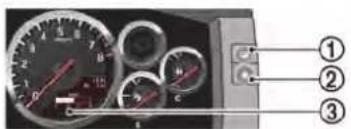
- ENTER switch

- NEXT switch

- Vehicle information display
The drive computer displays the following information:
●Current fuel consumption
●Vehicle speed
•Cruise control
●Average fuel consumption and speed
- Elapsed time and trip computer
•Distance to empty
●Outside air temperature
- Setting
2-16 Instrumentsandcontrols
●Warning
The vehicle information display ③ can be changed when the ignition switch is in the ON position. Push the ENTER switch ☐ ① to change the display.
NOTE:
- Thecruisecontroldisplayisshownif cruisecontrolisset.( control"page5-35)
- Thewarningdisplayisnotshownif therearenoconditionstowarnthe driver.
- Dependingonthdrivingconditions andotherfactors,thedisplayed valuesmaydifferfromtheactual values.
•Thepositionofthespeedometer needleandthespeedshowninthe vehicleinformationdisplaymay slightlydiffer.

CURRENTFUELCONSUMPTION
The current fuel economy is displayed when driving.
55 MPH
CRUISE 60 MPH
MPG 19.0 MPH 55.0
VEHICLESPEED
This displays the vehicle speed while driving.
CRUISECONTROL
This displays the set cruise control status.
NOTE:
Thecruisecontroldisplayisshownif cruisecontrolisset.( "Cruisecontrol"page5-35)
AVERAGEFUELCONSUMPTION ANDSPEED
This displays the average fuel economy and average vehicle speed beginning from the time when the display was last reset.
To reset the display, push and hold the NEXT switch ● for more than 1 second. (The average fuel economy and average vehicle speed are reset at the same time.)
NOTE:
- “isdisplayedduringthefirst1/3 mile(500m)orthefirst30seconds afterareset.
•Thevaluesareupdatedapproximatelyevery30seconds.
TIME 1:00 MILES 34.5
RANGE 123 MILES
ELAPSEDTIMEANDTRIPOD-OMETER
This displays the elapsed time and trip odometer beginning from the time when the display was last reset.
To reset the display, push and hold the NEXT switch ● for more than 1 second. (The elapsed time and trip odometer are reset at the same time.)
DISTANCETOEMPTY
This displays the approximate distance that the vehicle can be driven based on the amount of fuel remaining in the fuel tank and the actual fuel consumption.
NOTE:
- If the fuel level is slow, the low fuel warning will be displayed. (fuel warning"page2-43)
"Low
- If the vehicle is not refueled after the low fuel warning appears, the display will change to "....". This changetiming may become earlier depending on the driving conditions. This does not indicate that there is a
malfunction.
•Thevaluesareupdatedapproximatelyevery30seconds.
OUTSIDE TEMP
77°F
- When the outside air temperature is lower than 37°F (3°C), thelow outside temperature warning will be displayed and "ICY" is indicated on the outside air temperature display. ( Alert page2-20)
This displays the outside air temperature.
NOTE:
- The outside air temperature may not be displayed correctly in the following cases.
— Theoutsideairtemperatureis lowerthan-22°F(-30°C)oris higherthan131°F(55°C).
— Thevehicleisstoppedorisdriving atalowspeed(lessthanapproximately12MPH(20km/h)).
— Thetemperatureintheengine compartmentishigh.

NOTE:
- When the battery terminal is disconnected, the set memory will be erased and the settings return to the default.
- Settingisnotpossibleinthefollowingcases.
— Thevehicleisbeingdriven.
— A warningdisplayisactive.
— Theinstrumentbrightnesscontrolleveldisplayisactive.
— Thecruisecontrolstatusisdis-
played.
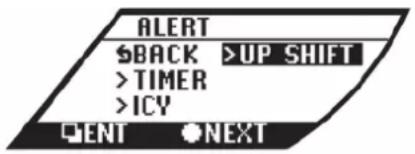
SETTING(drivecomputer)
This is used to set the alert, maintenance and optional settings.
Use the NEXT switch ● to select an item, then confirm with the ENTER switch
☐ to change to the corresponding setting screen.
To return to the initial setting screen, push and hold the ENTER switch ☐ for more than 1 second.
Alert
This function can be used to make settings for the upshift indicator, "time to rest" Indicator and low outside temperature warning.
Upshiftindicator:
For details concerning the upshift indicator, refer to the following section.
( "Upshift indicator" page 2-10)
2-20 Instrumentsandcontrols


"TIMER"indicator:
This alert informs the driver that the set driving time has elapsed.
On the TIMER screen, push the NEXT switch ● to change the time. Push and hold the switch to increase the number every 1 hour. A maximum of 6 hours can be set.
NOTE:
ThedefaultsettingisOFF.
Lowoutsidetemperaturewarning:
This alert informs the driver when the outside air temperature is lower than 37° F ( 3° C).
On the ICY screen, push the NEXT switch to turn this warning ON/OFF.
NOTE:
ThedefaultsettingisON.
Maintenance
This function can be used to set the various maintenance intervals and to check the engine oil level. The reminders shown below are used to notify the driver of the maintenance intervals.
NOTE:
Because these are displayed based on them, they don't indicate the actual condition so the vehicle. Use these functions only as a reference.
Input the maintenance distance using the following items:
- On each setting screen, push the
Instrumentsandcontrols2-21
NEXT switch to change the mileage. Push and hold the switch to increase the number every 600 miles (1,000 km).
- Set to “—” to set no reminders.
- To reset the accumulated mileage to zero, go to the RESET screen, then push the NEXT switch and confirm with the ENTER switch.
NOTE:
- Torestorethemileagetothеoriginalfigureafterresetting, pushthe NEXTswitch ● again.
- When the battery terminal is disconnected, the set mileagewill be erased and these settings will return to their default settings.
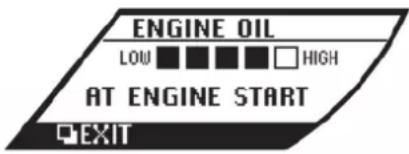
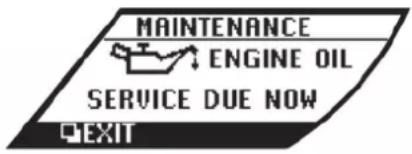
Engineoillevel:
This can be used to check the pre-start level while the engine is running. Select SETTING > MAINTENANCE > OIL > ENGINE OIL > LEVEL.
If the low level reminder appears, check the level using the engine oil dipstick. ( "Checking engine oil level" page 8-9)
Engineoil:
When the customer set mileage approaches, the reminder will appear on the display and the remaining distance is displayed at regular intervals. Select SETTING > MAINTENANCE > OIL > ENGINE OIL to set or reset the mileage for the engine oil change.
NOTE:
Thedefaultsettingis9,500miles (15,000km). Themaximummileage thatcanbesetis9,500miles(15,000 km).
2-22 Instrumentsandcontrols


Engineoilfilter:
The reminder is displayed when the customer set mileage is exceeded. Select SETTING > MAINTENANCE > FILTER to set or reset the mileage for the engine oil filter change.
NOTE:
Thedefaultsettingis9,500miles (15,000km). Themaximummileage thatcanbesetis9,500miles(15,000 km).
Transmissionoil:
The reminder is displayed when the customer set mileage is exceeded. Select SETTING > MAINTENANCE > OIL > T/M OIL to set or reset the mileage for the transmission oil change.
NOTE:
Thedefaultsettingis37,000miles (60,000km). Themaximummileage thatcanbesetis55,500miles(90,000 km).
Tires:
This reminder appears when the customer set distance comes for maintaining tires. You can set or reset the distance for maintaining tires. ( "Setting (drive computer)" page 2-20)

WARNING
Thetiremaintenanceindicatorisnot asubstituteforregulartirechecks, includingtirepressurechecks.See "Changingwheelsandtires"inthe"8. Do-it-yourself"section.Manyfactors includingtireinflation,alignment, drivinghabitsandroadconditions
Instrumentsandcontrols2-23
affecttirewearandwhentires shouldbereplaced.Settingthetire maintenancereminderforacertain drivingdistancedoesnotmeanyour tireswilllastthatlong.Usethetire maintenancereminderasaguide onlyandalwaysperformregulartire checks.Failureretoperformregular tirechecks,includingtirepressure checkscouldresultintirefailure. Seriousvehicledamagecouldoccur andmayleadtoacollision,which couldresultinseriouspersonalinjuryordeath.


NOTE:
ThedefaultsettingisOFF.
Options
This function can be used to make settings for language and unit.
Language:
Select ENGLISH or FRANCAIS for use in the vehicle information display.
Unit:
Select METRIC or US for use in the vehicle information display.
WARNING(drivecomputer)
Warning information is displayed on the vehicle information display.
Push the ENTER switch ☐ while a warning display is active to return to the original display.
It is also possible to check any warnings that have not been corrected. ( "Warning display" page 2-36)
Checkingthewarnings
Use the NEXT switch ● to select "DETAIL", then confirm with the ENTER switch

When there are multiple warnings, push
2-24 Instrumentsandcontrols
the ENTER switch to change the display among them.
To return to the initial warning, push and hold the ENTER switch ☐ for more than 1 second.
NOTE:
If therearenowarningstodisplay, only "SKIP" can be selected.
WARNINGLIGHTS,INDICATOR LIGHTSANDAUDIBLEREMINDERS

CHECKINGLIGHTS
With all doors closed, apply the parking brake, fasten the seat belts and place the ignition switch in the ON position without starting the engine. The following lights (if so equipped) will come on:

come on briefly and then go off:
If any light does not come on or operates in a way other than described, it may indicate a burned-out bulb and/or a system malfunction. It is recommended you have the system checked by a GT-R certified NISSAN dealer.
WARNING/INDICATORLIGHTS(red)
See "Warning display" page 2-36 and "Vehicle information display" page 2-13.

This light functions for both the parking brake and the foot brake systems.
2-26 Instrumentsandcontrols
Parkingbrakeindicator:
When the ignition switch is in the ON position, the light comes on when the parking brake is applied.
Lowbrakefluidwarninglight:
When the ignition switch is in the ON position, the light warns of a low brake fluid level. If the light comes on while the engine is running with the parking brake not applied, stop the vehicle and perform the following:
- Check the brake fluid level. Add brake fluid as necessary. ( "Brake fluid" page 8-11)
- If the brake fluid level is correct, it is recommended you have the warning system checked by a GT-R certified NISSAN dealer.
Anti-lockBrakingSystem(ABS)warning indicator:
When the parking brake is released and the brake fluid level is sufficient, if both the brake warning light and the Anti-lock Braking System (ABS) warning light illuminate, it may indicate the ABS is not functioning properly. It is recommended you have the brake system checked, and if necessary repaired, by a GT-R certified NISSAN dealer promptly. ( "Anti-lock Braking System (ABS) warning light" page 2-29)
Brakepadwearwarningindicator (modelswithNCCB(NISSANCarbon CeramicBrake)package):
When the brake warning light illuminates, it may indicate that there is brake pad wear. Have the brake system checked and brake pads replaced as soon as possible. It is recommended you contact a GT-R certified NISSAN dealer for this service.

CAUTION
Neverdriveforalongperiodoftime whenthebrakewarninglightilluminatesforbrakepadwearwarning indicatesilluminated. Otherwise, thebrakemaynotfunctionproperly duetobrakepadwear.

WARNING
-Yourbrakesystemmaynotbe workingproperlyifthewarning lightison.Drivingcouldbedangerous.Ifyoujudgeittobesafe, drivecarefullytothenearest servicestationforrepairs. Otherwise,haveyourvehicletowed
becausedrivingitcouldbedangerous.
- Pressingthebrakepedalwiththe enginestoppedand/orlowbrake fluidlevelmayincreaseyour stoppingdistanceandbraking willrequiregreaterpedaleffort aswellaspedaltravel.
- If the brakefluid level is below the minimum or MIN mark on the brake fluid reservoir, donot drive until the brakesystem has been checked. It is recommended you contact a GT-R certified NISSAN dealer.

Chargewarninglight
If the light comes on while the engine is running, it may indicate the charging system is not functioning properly. Turn the engine off and check the alternator belt. If the belt is loose, broken, missing or if the light remains on, it is recommended you see a GT-R certified NISSAN dealer immediately.
NOTICE
Donotcontinuedrivingifthealternatorbeltisloose,brokenormissing.

Engineoilpressurewarning
light
This light warns of low engine oil pressure. If the light flickers or comes on during normal driving, pull off the road in a safe area and stop the engine immediately. It is recommended you call a GT-R certified NISSAN dealer.
Theengineoilpressurewarninglightis notdesignedtoindicatealowoillevel. Checkthevehicleinformationdisplayor usethedipsticktochecktheoillevel.
( "Engine oil level display" page 2-13) ( "Checking engine oil level" page 8-9)
NOTICE
Runningtheenginewiththeengine oilpressurewarninglightoncould causeseriousdamagetotheengine almostimmediately.Turnoffthe engineassoonasitissafetodoso.

Seatbeltwarninglightand
chime
The light and chime remind you to fasten seat belts. The light illuminates whenever the ignition switch is placed in the ON position, and will remain illuminated until the driver's seat belt is fastened. At the same time, the chime will sound for about 6 seconds unless the driver's seat belt is securely fastened.
The seat belt warning light for the front passenger will illuminate if the seat belt is not fastened when the front passenger's seat is occupied. For approximately 5 seconds after the ignition switch is placed in the ON position, the system does not activate the warning light for the front passenger. ( "Seat belts" page 1-6)

Supplementalairbagwarn-
inglight
After pushing the ignition switch to the ON position, the supplemental air bag warning light will illuminate for about 7 seconds and then turn off. This means the system is operational. If any of the following conditions occur, the front air bag, side air bag, curtain air bag and pretensioner systems need servicing and it is recommended your vehicle
be taken to a GT-R certified NISSAN dealer.
●The supplemental air bag warning light remains on after approximately 7 seconds.
●The supplemental air bag warning light flashes intermittently.
- The supplemental air bag warning light does not come on at all. Unless checked and repaired, the supplemental restraint system (air bag system) and/or the pretensioners may not function properly. ( "Supplemental restraint system" page 1-34)

WARNING
If the supplemental air bag warning lightison, it could mean that the front air bag, side air bag, curtain air bag and or pretension systems will not operate in an accident. To help avoid injury to yourself for others, have your vehicle checked. It is recommended you visit a GT-R certified NISSAN dealer forth his service.
WARNING/INDICATORLIGHTS(yel-low)
See "Warning display" page 2-36 and "Vehicle information display" page 2-13.

All-WheelDrive(AWD)warn- ght
The AWD warning light comes on when the ignition switch is pushed to ON. It turns off soon after the engine is started. If the AWD system malfunctions, the warning light will either remain illuminated or blink. ( "All-Wheel Drive (AWD)" page 5-43)

CAUTION
- If the warning light comes on while driving therem maybe a malfunction in the AWD system. Reducethe vehicles speed and have your vehicle checked as soon as possible. It is recommended you have the vehicle checked by a GT-R certified NISSAN dealer.
- IftheAWDwarninglightblinkson whenyouaredriving:
—blinksrapidly(abouttwicea second):
Pullofftheroadinasafearea, andidletheengine. ThedrivingmodewillchangetoRWD topreventtheAWDsystem frommalfunctioning. If the warninglightturnsoff, you candriveagain. This does not indicate that there is a malfunction.
-blinksslowly(aboutonce every2seconds): Pullofftheroadinasafearea, andidletheengine.Check thatalltiresizesarethesame asthatspecifiedontheTire andLoadingInformationlabel locatedinthedriver'sdoor opening,tirepressureiscorrecttiresarenotworn. ( "Tireandloadinginformationlabel"page10-14) Ifthetirepressureisinsufficient,fillwithnitrogengas.It isrecommendedyoucontact aGT-RcertifiedNISSANdealer aboutfillingwithnitrogen gas.Ifnitrogengasisnot available,compressedair maybesafelyusedunder normaldrivingconditions.
However, NISSAN recommends refilling with nitrogen gas form maximum tire performance.
- If the warning light is still on after the above operations, have your vehicle checked as soon as possible. It is recommended you have the vehicle checked by a GT-R certified NISSAN dealer.

or Anti-lockBraking
System(ABS)warninglight
When the ignition switch is in the ON position, the Anti-lock Braking System (ABS) warning light illuminates and then turns off. This indicates the ABS is operational.
If the ABS warning light illuminates while the engine is running, or while driving, it may indicate the ABS is not functioning properly. It is recommended you have the system checked by a GT-R certified NISSAN dealer.
If an ABS malfunction occurs, the anti-lock function is turned off. The brake system then operates normally, but without anti-lock assistance. (IF "Brake system" page 5-52)

IntelligentKeywarninglight
After the ignition switch is pushed to the ON position, this light comes on for about 2 seconds and then turns off.
This light warns of a malfunction with the electrical steering lock system or the Intelligent Key system.
If the light comes on while the engine is stopped, it may be impossible to free the steering lock or to start the engine. If the light comes on while the engine is running, you can drive the vehicle. However in these cases, it is recommended you contact a GT-R certified NISSAN dealer for repair as soon as possible.

Lowtirepressurewarning
light
Your vehicle is equipped with a Tire Pressure Monitoring System (TPMS) that monitors the tire pressure of all tires.
The low tire pressure warning light warns of low tire pressure and flat tire, or indicates that the TPMS is not functioning properly.
After the ignition switch is pushed to the ON position, the warning light illuminates for about 1 second and turns off.
Lowtirepressurewarning:
If the vehicle is being driven with low tire pressure, the warning light will illuminate.
Whenthelowtirepressurewarning lightilluminates,youshouldstopand adjustthetirepressureofall4wheels totherecommendedCOLDtirepressure shownontheTireandLoadingInformationlabelallocatedinthedriver'sdoor opening.
Thelowtirepressurewarninglightdoes notautomaticallyturnoffwhenthetire pressureisadjusted.Afterthetireis inflatedtotherecommendedpressure, thevehiclemustbedrivenatspeeds above16MPH(25km/h)toactivatethe TPMSandturnoffthelowtirepressure warninglight.Useatirepressuregauge tocheckthetirepressure.( "Tire PressureMonitoringSystem(TPMS)" page5-4)( "TirePressureMonitoringSystem(TPMS)"page6-3)
Run-flattirewarning:
The run-flat tire warning warns of a flat tire.
If the vehicle is being driven with one or more flat tires, the warning light will illuminate continuously and a chime will sound for 10 seconds.
The chime will only sound at the first indication of a flat tire and the warning
light will illuminate continuously. When the flat tire warning is activated, it is recommended you have the system reset and the tire checked and replaced if necessary by a GT-R certified NISSAN dealer. Even if the tire is inflated to the specified COLD tire pressure, the warning light will continue to illuminate until the system is reset.
If you select the tire pressure information in the touch screen display, the warning screen will be displayed. The tire pressure for each tire will also be displayed. Refer to the separate Multi Function Display Owner's Manual.
Your vehicle can be driven for a limited time on a flat tire. ( "Run-flat tires" page 6-4) ( "Run-flat tires" page 8-37)
TPMSmalfunction:
If the TPMS is not functioning properly, the low tire pressure warning light will flash for approximately 1 minute when the ignition switch is pushed to the ON position. The light will remain on after the 1 minute. It is recommended you have the system checked by a GT-R certified NISSAN dealer. ( "Tire Pressure Monitoring System (TPMS)" page 5-4) ( "Tire pressure" page 8-30)

WARNING
- Ifthelightdoesnotilluminate withtheignitionswitchpushed to theONposition,itisrecommendedyouhavethevehicle checkedbyaGT-Rcertified NISSANdealerassoonaspossible.
- Ifthelightilluminateswhiledriving,avoidsuddensteeringmaneuversorabruptbraking,reduce vehiclespeed,pullofftheroadto asafelocationandstopthe vehicleassoonaspossible.Drivingwithunder-inflatedtiresmay permanentlydamagethetires andincreasethelikelihoodoftire failure.Seriousvehicledamage couldoccurandmayleadtoan accidentandcouldresultinseriouspersonalinjury.Checkthe tirepressureforallfourtires. Adjustthetirepressuretothe recommendedCOLDtirepressure shownontheTireandLoading Informationlabellocatedinthe driver'sdooropeningtoturnthe lowtirepressurewarninglight off.Ifthelightstillilluminates whiledrivingafteradjustingthe
tirepressure, atiremaybeflat ("Run-flattires"page6-4) or the TPMS may be malfunctioning. If notireis flat and all tires are properly inflated, it is recommended you have the vehicle checked by a GT-R certified NISSAN dealer.
- Although you can continued driving with apunctured run-flattire, remember that vehicle handling stability is reduced, which could lead to an accident and personal injury. Also, driving along distance at high speedsmay damage yet.
- Donotdriveatspeedsabove50 MPH(80km/h)anddonotdrive morethan50miles(80km)witha puncturedrun-flattire.Theactual distancethevehiclecanbedriven onaflattiredependsonoutside temperature,vehicleload,road conditionsandotherfactors.
- If you detect any unusual sounds or vibrations while driving with a punctured run-flattire, pulloff theroad to asafelocation and stop the vehicle as soon as possible. The tire may be seriously damaged and need to be
placed.
- Whenawheelisreplaced, the TPMSwillnotfunctionandthe lowtirepressurewarninglight willflashforapproximately1 minute. Thelightwillremainon afterthe1minute. ItisrecommendedyoucontactaGT-RcertifiedNISSANdealerassoonas possiblefortirereplacement and/orsystemresetting.
- Replacingtireswiththosenot originallyspecifiedbyNISSAN couldaffecttheproperoperation oftheTPMS.

CAUTION
•TheTPMSisnotasubstitutefor theregulartirepressurecheck. Besuretocheckthetirepressure regularly.
- Besuretoinstallthespecified sizeoftiresonthefourwheels.
NOTE:
- If the vehicle is being driven at speed of less than 16 MPH (25 km/h), the TPMS may not operate correctly.
- Thetiresofthisvehiclearefilled withnitrogengas.Whenthetire pressureislow,fillthetireswith nitrogengas.Itisrecommendedyou contactaGT-RcertifiedNISSAN dealerforinformationonfillingthe tireswithnitrogengas.

MalfunctionIndicatorLight
(MIL)
If the malfunction indicator light comes on steady or blinks while the engine is running, it may indicate a potential emission control or the muffler with electronic control valve (if so equipped) malfunction. The malfunction indicator light may also come on steady if the fuel-filler cap is loose or missing, or if the vehicle runs out of fuel. Check to make sure the fuel-filler cap is installed and closed tightly, and that the vehicle has at least 3 US gallons (12 liters) of fuel in the fuel tank.
After a few driving trips, the SERVICE ENGINE light should turn off if no other potential emission control system malfunction exists.
If this indicator light remains on for 20 seconds and then blinks for 10 seconds when the engine is not running, it indicates that the vehicle is not ready for an emission control system inspection/maintenance test. ( "Readiness for Inspection/Maintenance (I/M) test (US only)" page 10-22)
Operation:
The malfunction indicator light will come on in one of two ways:
- Malfunction indicator light on steady — An emission control system malfunction has been detected. Check the fuel-filler cap. If the fuel-filler cap is loose or missing, tighten or install the cap and continue to drive the vehicle. The SERVICE ENGINE SOON light should turn off after a few driving trips. If the ICEE LIGHT does not turn off after a few driving trips, it is recommended you have the vehicle inspected by a GT-R certified NISSAN dealer. You do not need to have your vehicle towed to the dealer.
- Malfunction indicator light blinking — An engine misfire has been detected which may damage the emission control system.
To reduce or avoid emission control system damage:
1) Do not drive at speeds above 45 MPH (72 km/h).
2) Avoid hard acceleration or deceleration.
3) Avoid steep uphill grades.
4) If possible, reduce the amount of cargo being hauled or towed. The malfunction indicator light may stop blinking and remain on. It is recommended you have the vehicle inspected by a GT-R certified NISSAN dealer. You do not need to have your vehicle towed to the dealer.
NOTICE
Continuedvehicleoperationwithout havingtheemissioncontrolsystem checkedandrepairedasnecessary couldleadtopoordriveability,reducedfueleconomy,andpossible damagetotheemissioncontrolsystem.

Masterwarninglight
When the ignition switch is in the ON position, the master warning light illuminates if any of the warning displays appear on the vehicle information display. ( "Warning display" page 2-36)
2-32 Instrumentsandcontrols

Transmissionwarninglight
This light warns of the following malfunctions.
The light blinks if a malfunction in the transmission system occurs. If the light blinks, certain gear positions may become unusable, so that the vehicle may become undrivable. It is recommended you have the system inspected promptly by a GT-R certified NISSAN dealer.
Transmissionoiltemperaturehigh:
The light illuminates if the transmission oil temperature becomes unusually high. If the light illuminates, avoid driving at high speed or at high engine speed until the light turns off. The light will turn off after short period of time and the vehicle can then be driven normally. If the light illuminates frequently, it is recommended you contact a GT-R certified NISSAN dealer.
NOTICE
If the light continues to illuminate, the engine output may be reduced to prevent transmission damage.
Transmissionclutchtemperaturehigh:
The light illuminates if clutch temperature becomes unusually high. If the light illuminates, pull off the road in a safe area and idle the engine. When the light turns off, driving can be resumed. If the light illuminates frequently, it is recommended you contact a GT-R certified NISSAN dealer.
NOTICE
- Continuing to drivewith the light on could cause serious damage to the transmission.
- Ifthelightcontinuestoilluminate, the vehicle cannot be driven because the engine output may be reduced and the clutch maybe reduced to keep the clutch disengaged.
Rmodestartfunction:
If the R mode start function is used 4 times continuously, the function may be disabled and cannot be turned on for protection. While the function is disabled, the warning light illuminates. When the warning light goes off, the function can be used again. ( "R mode start function" page 5-33)
When the warning light illuminates, perform cool down driving (driving 1.3 mile (2 km) in 5th or 6th gear at a speed of approximately 37 - 50 MPH (60 - 80 km/h) while checking the temperature of the transmission oil until the warning light goes off.
NOTICE
While the warning light is illuminated, the engine output is controlled so that it does not increase.

VehicleDynamicControl
(VDC)offindicatorlight
When the ignition switch is in the ON position, the Vehicle Dynamic Control (VDC) off indicator light illuminates and then turns off.
The light comes on when the VDC set up switch is pushed to OFF for more than 1 second. (VDC, transmission and suspension setup switches" page 5-25) This indicates that the vehicle dynamic control system and traction control system are not operating. (Vehicle Dynamic Control (VDC) system" page 5-54)
Instrumentsandcontrols2-33

VehicleDynamicControl
(VDC)warninglight
The light will blink when the VDC system or the traction control system is operating, thus alerting the driver that the vehicle is nearing its traction limits. The road surface may be slippery. If the VDC warning light illuminates when the VDC system is turned on, this light alerts the driver to the fact that the VDC system's fail-safe mode is operating, for example the VDC or hill start assist system may not be functioning properly. It is recommended you have the system checked by a GT-R certified NISSAN dealer. If a malfunction occurs in the system, the VDC system function will be canceled but the vehicle is still driveable. (1) "Vehicle Dynamic Control (VDC) system" page 5-54)
WARNING/INDICATORLIGHTS (other)

Cruisemainswitchindicator
light
The light comes on when the cruise control is pushed. The light turns off when the main switch is pushed again. While the cruise control system main
switch indicator light is on, the cruise control system is operational.

Cruisesetswitchindicator
light
The light comes on while the vehicle speed is controlled by the cruise control system. If the light blinks while the engine is running, it may indicate the cruise control system is not functioning properly. It is recommended you have the system checked by a GT-R certified NISSAN dealer.

Exteriorlightindicator
This indicator illuminates when the headlight switch is turned to the AUTQpa: or position and the front parking lights, instrument panel lights, rear combination lights, license plate lights or headlights are on. The indicator turns off when these lights are turned off.

Frontpassengerairbag
statuslight
The front passenger air bag status light ( ) will be lit and the passenger front bag will be OFF depending on how the front passenger seat is being used. ( ) "NISSAN Advanced Air Bag System
(front seats)" page 1-40)

Highbeamindicatorlight
This light comes on when the headlight high beam is on and goes out when the low beam is selected.

Turnsignal/hazardindicator
lights
The light flashes when the turn signal switch lever or hazard switch is turned on.
AUDIBLEREMINDERS
When the buzzer sounds, be sure to check both the vehicle and the Intelligent Key. See "Troubleshooting guide" (P.3-17).
Lightreminderchime
A chime will sound when the driver side door is opened with the headlight switch in the 3DGE or 10 position and the ignition switch in the ACC, OFF or LOCK position. Turn the headlight switch to the OFF (if so equipped) or AUTO position when you leave the vehicle.
Parkingbrakereminderchime
A chime will sound if the vehicle speed is above 4 MPH (7 km/h) with the parking brake applied. Stop the vehicle and release the parking brake.
all the time even if the brake pedal is not depressed. Have the brakes checked as soon as possible if the warning sound is heard.
Reversewarningchime
The chime will sound inside the vehicle if any of the following conditions occurs.
- The driver's door is opened while the shift lever is in the R position and the ignition switch is in the ON position.
- The shift lever is in the R position and 5 minutes have passed while the ignition switch is in the ON position. Be sure to move the shift lever out of the R position after driving in reverse.
Brakepadwearwarning(models withoutNCCB(NISSANCarbon
CeramicBrake)package)
The disc brake pads have audible wear warnings. When a brake pad requires replacement, it will make a high pitched scraping sound when the vehicle is in motion. This scraping sound will first occur only when the brake pedal is depressed. After the wear of the brake pad is increased, the sound will be heard
WARNINGDISPLAY

chime also sounds.
If there are multiple warnings, the warning lights remain lit or continue to blink and the warnings displayed in the vehicle information display are switched at regular intervals. The warnings displayed in the vehicle information display can be switched voluntarily by pushing the ENTER switch ☐.

WARNING
Whenthewarninglightilluminates orblinksandawarningisdisplayed, promptlytaketheappropriateaction. Ignoringthewarningmayresult
inmalfunctionsandaccidents.
When the items mentioned below are detected the master warning light ① illuminates and the warning is displayed on the vehicle information display ② A
2-36 Instrumentsandcontrols






ENGINEOILLOWPRESSURE WARNING
This will appear if the engine oil pressure is low. ( "Engine oil pressure warning light" page 2-28)
ENGINESYSTEMWARNING
This will appear if a potential emission control or the muffler with electronic control valve (if so equipped) malfunction is detected, the fuel-filler cap is loose or missing, or the vehicle runs out of fuel. ( "Malfunction Indicator Light (MIL)" page 2-32)
SHIFTLEVERPOSITIONWARNING
This will appear if the system cannot detect the shift lever position. Stop the vehicle in a safe location. Depress the brake pedal and move this shift lever to another position then move the lever back to the desired position. If the warning is still displayed after the above operation is performed, it is recommended you have the system checked by a GT-R certified NISSAN dealer. ( "Driving the vehicle" page 5-15)




REVERSEWARNING
This will appear (and a chime will sound) if this will appear if a transmission system the shift lever is in the position for more malfunction occurs. ( "Transmission than 5 minutes, or when the driver's door warning light" page 2-33) is opened while the shift lever is in the position.
TRANSMISSIONSYSTEMWARNING
TRANSMISSIONOILHIGHTEM- PERATUREWARNING
This will appear if the transmission oil temperature becomes unusually high. ( "Transmission warning light" page 2-33)
2-38 Instrumentsandcontrols



This will appear if the transmission clutch temperature becomes unusually high.
( "Transmission warning light" page 2-33)
This will appear if the vehicle speed is above 4 MPH (7 km/h) with the parking brake applied. ( "Brake warning light" page 2-26) ( "Parking brake reminder chime" page 2-35)
This will appear if the brake fluid level becomes low. ( "Brake warning light" page 2-26)





ANTI-LOCKBRAKINGSYSTEM (ABS)WARNING
This will appear if the Anti-lock Braking System (ABS) is not functioning properly. ( "Anti-lock Braking System (ABS) warning light" page 2-29) ( "Brake warning light" page 2-26)
VEHICLEDYNAMICCONTROL(VDC) SYSTEMWARNING
This will appear if the Vehicle Dynamic Control (VDC) system or the hill start assist system is not functioning properly. ( "Vehicle Dynamic Control (VDC) warning light" page 2-34) ( "Vehicle Dynamic Control (VDC) off indicator light" page 2-33)
AWDCLUTCHHIGHTEMPERATURE WARNING
This will appear if the temperature of the AWD clutch becomes unusually high. ( "All-Wheel Drive (AWD) warning light" page 2-29)
NOTE:
Ifthevehicleisdriveninawaywhich causestherearwheelstoslip,theAWD clutchtemperaturewillincreaseand thewarningindicatormayflash.Continuingtodriveinwaythatcausesthe warninglighttoflashmaycausethe clutchtoreachexcessivetemperatures
thatcouldresultindamagetothe vehicle.




FRONT/REARTIRESIZEDISCRE- PANCYWARNING
This will appear if the diameter of the front and the rear wheels are different. ( "All-Wheel Drive (AWD) warning light" page 2-29)
AWDSYSTEMWARNING
This will appear if the AWD system is not functioning properly while the engine is running. ( "All-Wheel Drive (AWD) warning light" page 2-29)





LOWTIREPRESSUREWARNING
This will appear if the vehicle is being driven with low tire pressure. ( "Low tire pressure warning light" page 2-30)
RUN-FLATTIREWARNING
This will appear and a chime will sound the vehicle is being driven with one or more flat tires. ( "Low tire pressure warning light" page 2-30)
TIREPRESSUREMONITORING SYSTEM(TPMS)WARNING
This will appear if the Tire Pressure Monitoring System (TPMS) is not functioning properly. ( "Low tire pressure warning light" page 2-30)
2-42 Instrumentsandcontrols



- Thetimingofthelowfuelwarning displaymaychangeddependingon braking,turning,acceleration,or goingupordownhills.
- If the vehicle is not refueled after the low fuel warning appears, the display will change to "....". This changetiming may become earlier depending on the driving conditions. This does not indicate that there is a malfunction.
CRUISECONTROLSYSTEMWARNING
This will appear if the cruise control system is not functioning properly. ( "Cruise set switch indicator light" page 2-34)
LOWFUELWARNING
This will appear when the fuel level in the tank is getting low. Refuel as soon as it is convenient, preferably before the fuel gauge reaches the empty (E) position.
This displays the approximate distance that the vehicle can be driven based on the amount of fuel remaining in the fuel tank and the actual fuel consumption.
NOTE:
•Thelowfuelwarningwillappear whentheamountoffuelremaining inthetankdecreasestoapproximately3USgallons(12liters).
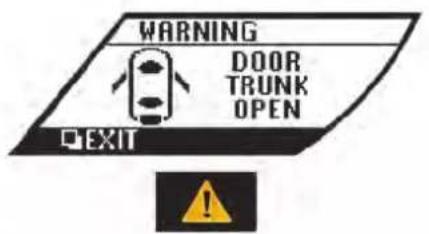


DOOR/TRUNKOPENWARNING
This will appear if any of the doors and/or This will appear if the LED headlight trunk lid are open or not closed securely. system is not functioning properly. It is The vehicle icon indicates which door or the trunk lid is open. checked by a GT-R certified NISSAN dealer
HEADLIGHTSYSTEMWARNING
LOWWASHERFLUIDWARNING
This will appear when the washer tank fluid is at a low level. Add washer fluid as necessary. ( "Window washer fluid" page 8-12)
2-44 Instrumentsandcontrols

UnregisteredIntelligentKey
The warning appears when the ignition switch is pushed from the LOCK position and the Intelligent Key cannot be recognized by the system. You cannot start the engine with an unregistered Intelligent Key.
( "Intelligent Key system" page 3-8)
OPERATIONDISPLAYS
These displays appear when an appropriate operation is required in starting or stopping the engine.
NOKEYWARNING
This will appear in either of the following conditions.
Nokeyinsidethevehicle
The warning appears when the door is closed with the Intelligent Key left outside the vehicle and the ignition switch in the ACC or ON position. Make sure that the Intelligent Key is inside the vehicle.



ENGINESTARTOPERATIONINDICATOR
This indicator appears when the shift lever is in the p position.
This indicator means that the engine will start by pushing the ignition switch with the brake pedal depressed.
SHIFT"P"WARNING
This warning appears and an inside warning chime sounds when the ignition switch is pushed to stop the engine with the shift lever in any position except the position.
If this warning appears, move the shift lever to the P position. This warning will also turn off when pushing the ignition switch to the ON position.
"PUSH"WARNING
This warning appears when the shift lever is moved to the p position with the ignition switch in the ACC position after the SHIFT p warning appears.
If this warning appears, push the ignition switch to the OFF position.



STEERINGLOCKRELEASEMAL-FUNCTIONINDICATOR
This indicator appears when the steering wheel lock cannot be released from the LOCK position. If this indicator appears, push the ignition switch while lightly turning the steering wheel right and left.
INTELLIGENTKEYINSERTIONINDICATOR
This indicator appears when the Intelligent Key needs to be inserted into the Intelligent Key port (for example, the Intelligent Key battery is discharged). If this indicator appears, insert the Intelligent Key into the Intelligent Key port in the correct direction. ("Intelligent Key battery discharge" page 5-12)
INTELLIGENTKEYREMOVALINDI-CATOR
This indicator appears when the driver's door is opened with the ignition switch in the OFF or LOCK position and the Intelligent Key placed in the Intelligent Key port. A key reminder chime also sounds. If this indicator appears, remove the Intelligent Key from the Intelligent Key port and take it with you when leaving the vehicle.

INTELLIGENTKEYBATTERYDIS- CHARGEINDICATOR
This indicator appears when the Intelligent Key battery is running out of power. If this indicator appears, replace the battery with a new one. (“Intelligent Key battery replacement” page 8-25)
SECURITYSYSTEMS
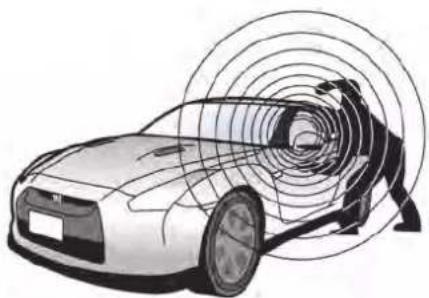
Your vehicle has two types of security systems, as follows:
●Vehicle security system
- NISSAN Vehicle Immobilizer System The security condition will be shown by the security indicator light.
VEHICLESECURITYSYSTEM
The vehicle security system provides visual and audio alarm signals if someone opens the doors, hood, or trunk lid when the system is armed. It is not, however, a motion detection type system that activates when a vehicle is moved or when a vibration occurs.
The system helps deter vehicle theft but cannot prevent it, nor can it prevent the theft of interior or exterior vehicle components in all situations. Always secure your vehicle even if parking for a brief period. Never leave your Intelligent Key(s) in the vehicle, and always lock it when unattended. Be aware of your surroundings, and park in secure, well-lit areas whenever possible.
Many devices offering additional protection, such as component locks, identification markers, and tracking systems, are available at auto supply stores and specialty shops. Your GT-R certified NISSAN dealer may also offer such equipment. Check with your insurance company to see if you may be eligible for discounts for various theft protection features.

Howtoarmthevehiclesecurity system
- Close all windows. Thesystemcanbearmedevenifthe windowsareopen.
- Push the ignition switch to the OFF or LOCK position.
- Remove the Intelligent Key from the vehicle.
- Close all doors, hood and trunk. Lock all doors. The doors can be locked with the Intelligent Key, door handle request switch or power door lock switch. The power door lock switch
should be operated while the door is open, and then closed.
- Confirm that the security indicator light comes on. The security indicator light stays on for about 30 seconds. The vehicle security system is now pre-armed. After about 30 seconds the vehicle security system automatically shifts into the armed phase. The security light begins to flash once every approximately 3 seconds. If, during this 30-second pre-arm time period, the door is unlocked, or the ignition switch is pushed to ACC or ON, the system will not arm.
Evenwhenthedriverand/orpassengersareinthevehicle,thesystemwill activatewithalldoors,hood,andtrunk lidlockedwiththeignitionswitchinthe LOCKposition.WhenpushingtheignitionswitchtotheACCorONposition, thesystemwillbereleased.
Vehiclesecuritysystemactivation
The vehicle security system will give the following alarm:
●The headlights blink and the horn sounds intermittently.
●The alarm automatically turns off after approximately 1 minute. However, the alarm reactivates if the
vehicle is tampered with again.
The alarm is activated by:
- Opening the door or the trunk lid without using the button on the Intelligent Key, the door handle request switch or the mechanical key. (Even if the door is opened by releasing the door inside lock knob, the alarm will activate.)
- Opening the hood.
Howtostopanactivatedalarm
The alarm will stop by:
- Unlocking a door by pushing the UNLOCK button on the Intelligent Key.
- Unlocking a door by pushing the door handle request switch.
- Pushing the ignition switch to the ACC or ON position.
If the system does not operate as described above, it is recommended you have it checked by a GT-R certified NISSAN dealer.
The NISSAN Vehicle Immobilizer System will not allow the engine to start without the use of the registered Intelligent Key. Neverleavethesekeysinthevehicle.
FCCNotice:
ForUSA:
ThisdevicecomplieswithPart15ofthe FCCRules.Operationissubjecttothe followingtwoconditions:(1)Thisdevice maynotcauseharmfulinterference, and(2)thisdevicemustacceptany interferencereceived,includinginterferencethatmaycauseundesiredoperation.
Note: Changesormodificationsnot expresslyapprovedbythepartyresponsibleforcompliancecouldvoid theuser'sauthoritytooperatethe equipment.
ForCanada:
ThisdevicecomplieswithIndustryCanadalicence-exemptRSSstandard(s). Operationissubjecttothefollowing twoconditions:(1)thisdevicemaynot causeinterference,and(2)thisdevice mustacceptanyinterference,including interferencethatmaycauseundesired operationofthedevice.

enginewillnotstart,itisrecommended youseeaGT-RcertifiedNISSANdealer forNISSANVehicleImmobilizerSystem serviceassoonaspossible.Please bringallIntelligentKeysthatyouhave whenvisitingaGT-RcertifiedNISSAN dealerforservice.
Securityindicatorlight
The security indicator light is located on the instrument panel. It indicates the status of the NISSAN Vehicle Immobilizer System.
The light blinks whenever the ignition switch is in the ACC, OFF or LOCK position. This function indicates the security systems equipped on the vehicle are operational.
If the NISSAN Vehicle Immobilizer System is malfunctioning, this light will remain on while the ignition switch is in the ON position.
Ifthelightstillremainsonand/orthe
WIPERANDWASHERSWITCH

WARNING
Infreezingtemperaturesthewasher solutionmayfreezeonthewindshieldandobscureyourvisionwhich mayleadtoanaccident.Warmwindshieldwiththedefrosterbeforeyou washthewindshield.
NOTICE
- Donotoperatethewashercontinuouslyformorethan30seconds.
- Donotoperatethewasherifthe reservoirtankisempty.
- Donotfillthewindowwasher reservoirtankwithwasherfluid concentratesatfullstrength. Somemethylalcoholbased washerfluidconcentratesmay permanentlystainthegrilleif spilledwhilefillingthewindow washerreservortank.
•Pre-mixwasherfluidconcentrateswithwatertothemanufacturer'srecommendedlevels beforepouringthefluidintothe windowwasherreservoirtank.Do
notusethewindowwasherreservoirtanktomixthewasher fluidconcentrateandwater.
The windshield wiper and washer operates when the ignition switch is in the ON position.
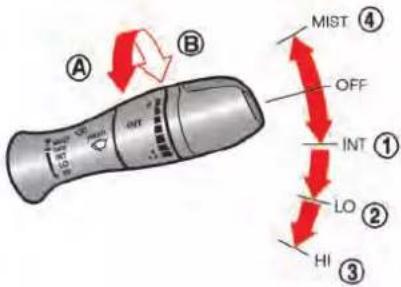
USINGTHEWIPERS
Push the lever down to operate the wiper at the following speed:
① INT (Intermittent) — intermittent operation can be adjusted by turning the knob toward Ⓐ(Slower) or ⒽFaster).
② Low — continuous low speed operation
③ High — continuous high speed operation
Push the lever up ④ to have one sweep operation of the wiper.
NOTE:
- IntheMISTposition, thewipers operate while the lever is lifted up. Whenthe lever is released, it automatically return to the OFF position and the wipers stop.
- Whenthespeedsensingwiperintervalfunctionisturnedon,theintermittentoperationspeedvariesinaccordancewiththevehiclespeed.(Forexample,whenthevehiclespeedishigh,theintermittentoperationspeedwillbefaster.)Toturnthisfunctiononandoff,seetheseparateMultiFunctionDisplayOwner'sManual.
- Ifthewiperoperationisinterrupted bysnoworice,thewipermaystop movingtoprotectitsmotor.Ifthis occurs,turnthewiperswitchtothe OFFpositionandremovethesnow oriceonandaroundthewiperarms. Inapproximately1minute,turnthe switchonagaintooperatethe wiper.

USINGTHEWASHER
Pull the lever toward you to operate the washer. Then the wiper will also operate several times.
NOTE:
Whenthelevelofwasherfluidislow,a warningdisplayappearsonthevehicle informationdisplay.( "Lowwasher fluidwarning"page2-44)
REARWINDOWDEFROSTERSWITCH

To defog/defrost the rear window, start the engine and push the switch on. The indicator light on the switch will come on. Push the switch again to turn the defroster off.
It will automatically turn off in approximately 15 minutes.
NOTE:
Whentherearwindowdefrosterswitch ispressed, the heated outsidersmirrors also operate at the mesame time.
( "Outsidemirrors"page3-28)
NOTICE
Whencleaningtheinnersideofthe rearwindow,becarefulnotto scratchordamagetherearwindow defroster.
HEADLIGHTANDTURNSIGNALSWITCH
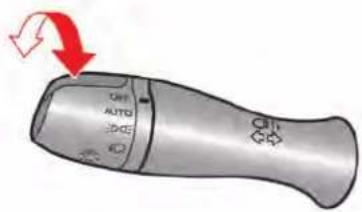
the daytime running light will remain on. Turningtheswitchtothe position: Headlights will come on and all the other lights remain on. The daytime running light will turn off.
HEADLIGHTSWITCH
Lighting
ForUSA:
The parking, tail and license plate lights will turn on after the engine is started regardless of the position of the headlight switch. The lights will turn off when the engine is turned off.
The daytime running lights will also turn on when the engine is started.
Turningtheswitchtothe EDGE position:
The parking, side marker, tail, license plate and instrument lights will come on and

The autolight system will also be set in this position.
Turningtheswitchtothe position:
Headlights will come on and all the other lights remain on. The daytime running light will turn off.
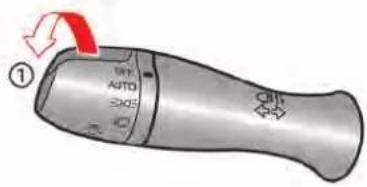
ForCanada:
The parking, tail and license plate lights will turn on after the engine is started regardless of the position of the headlight switch. The lights will turn off when the engine is turned off while the headlight switch is in the AUTO position.
The daytime running lights will also turn on when the engine is started while the headlights are off.
Turningtheswitchtothe position:
The parking, side marker, tail, license plate and instrument lights will come on and the daytime running light will remain on if the headlights are off.
2-54 Instrumentsandcontrols
Autolightsystem
ForUSA:
The autolight system allows the head-lights to be set so they turn on and off automatically.
To set the autolight system:
-
Make sure the headlight switch is in the AUTO position①
-
Push the ignition switch to the ON position.
-
The autolight system automatically turns the headlights on and off.
To turn the autolight system off, turn the switch to the OFF, or position.
The autolight system can turn on the headlights automatically when it is dark and turn off the headlights when it is light.
If the ignition switch is pushed to the OFF position and one of the doors is opened, the headlights remain on for 45 seconds.

ForCanada:
The autolight system allows the head-lights to be set so they turn on and off automatically.
To set the autolight system:
- Make sure the headlight switch is in the AUTO or position ①
- Push the ignition switch to the ON position.
- The autolight system automatically turns the headlights on and off.
To turn the autolight system off, turn the switch to the ☐ position.
The autolight system can turn on the headlights automatically when it is dark
and turn off the headlights when it is light.
If the ignition switch is pushed to the ON position when the parking brake is applied, the headlights remain off.
With the 3D position selected, the headlights turn off when the ignition switch is pushed to the OFF position, the shift lever is placed in the P position or the parking brake is applied. (The parking, side marker, tail, license plate, and instrument lights are on.)
With the AUTO position selected (headlights are on), the headlights will remain on for 45 seconds when the ignition switch is placed in the OFF position and one of the doors is opened.

Headlightbeamselect
When the headlights are on, push the lever to the front of the vehicle ① to switch to the high beams. The high-beam indicator light illuminates. ( "High beam indicator light" page 2-34) Pull the lever to the neutral position② to switch to the low beams.
Pulling the lever toward you ③ will flash the headlight high beam regardless of the position of the headlight switch.
CAUTION
Uselowbeamshwhentherearecars approachingfromtheoppositedirection,duringcitydrivingandat similartimes.
Batterysaversystem
A chime will sound when the driver side door is opened with the headlight switch in the pad or position and the ignition switch in the ACC, OFF or LOCK position.
( "Light reminder chime" page 2-34) When the headlight switch is in the or position while the ignition switch is in the ON position, the lights will automatically turn off after a period of time when the ignition switch has been pushed to the OFF position.
When the headlight switch remains in the 3p02 or position after the lights automatically turn off, the lights will turn on when the ignition switch is pushed to the ON position.
NOTICE
- Besuretoturntheheadlight switchtotheOFF(ifsoequipped) or AUTOpositionwhenyouleave thevehicleforextendedperiods oftime,otherwisethebatterywill bedischarged.
- Neverleavetheheadlightswitch onwhentheengineisnotrun- ningforextendedperiodsoftime eveniftheheadlightsturnoff automatically.
Daytimerunninglightsystem
ForUSA:
The daytime running lights automatically illuminate when the engine is started with the parking brake released. The daytime running lights operate with the headlight switch in the AUTO position. Turn the headlight switch to the 🔐 position for full illumination when driving at night. If the parking brake is applied before the engine is started, the daytime running lights do not illuminate. The daytime running lights illuminate once the parking brake is released. The daytime running lights will remain on until the ignition
switch is pushed to the OFF position.

WARNING
Whenthedaytimerunninglightsystemisactive,taillightsonyourvehiclearenoton.itisnecessaryatdusktoturnonyourheadlights.Failureretodosocouldcauseanaccidentinjuringyourselfandothers.

turn signal begins to flash, but the lever does not latch, and release the lever. The turn signal will automatically flash three times.
Choose the appropriate method to signal a lane change based on road and traffic conditions.
ForCanada:
The daytime running lights automatically illuminate when the engine is started with the parking brake released. The daytime running lights operate with the headlight switch in the AUTO position or in the position, the headlight must be off. Turn the headlight switch to the position for full illumination when driving at night. If the parking brake is applied before the engine is started, the daytime running lights do not illuminate. The daytime running lights illuminate once the parking brake is released. The daytime running lights will remain on until the ignition switch is pushed to the OFF position or the headlights turn on.
TURNSIGNALSWITCH
① Turnsignal
Move the lever up or down to signal the turning direction. When the turn is completed, the turn signals cancel automatically.
② Lanechangesignal
- Move the lever up or down until the turn signal begins to flash, but the lever does not latch, to signal a lane change. Hold the lever until the lane change is completed.
- Move the lever up or down until the
HORNHEATEDSEATS

To sound the horn, push the center pad area of the steering wheel.

WARNING
Donotdisassemblethehorn.Doing socouldaffectproperoperationof thesupplementalfrontairbagsystem.Tamperingwiththesupplementalfrontairbagsystemmay resultinseriouspersonalinjury.

The seat heaters can be used when the ignition switch is in the ON position. The front seats are warmed by the built-in heaters.
TURNINGONTHEHEATERS
Push the "HI" or "LO" side of the switch to activate the heaters. The switch indicator illuminates.
| Switch position | Function |
| HI To heat the seat quickly | |
| LO To keep the seat warm | |
TURNINGOFFTHEHEATERS
Move the switch to the level position. The switch indicator turns off.

WARNING
Donotuseorallowoccupantstouse theseatheaterifyouortheoccupantscannotmonitorelevatedseat temperaturesorhaveaninabilityto feelpaininthosebodypartsin contactwiththeseat.Useoftheseat heaterbysuchpeoplecouldresultin seriousinjury.

CAUTION
- Donotputanythingontheseat whichinsulatesheat,suchasa blanket,cushion,seatcover,etc. Otherwise,theseatmaybecome overheated.
- Donotplaceanythinghardor heavyontheseatorpierceitwith apinorsimilarobject.Thismay resultindamagetotheheater.
• Anyliquidspilledontheheated seatshouldberemovedimmediatelywithadrycloth.
2-58 Instrumentsandcontrols
•Ifanymalfunctionsarefoundor theheatedseatdoesnotoperate, turntheswitchoffanditis recommendedyouhavethesystemcheckedbyaGT-Rcertified NISSANdealer.
NOTICE
- The battery could rundown if the seatheater is operated while the engine is not running.
- Donotusetheseatheaterfor extendedperiodsorwhennoone isusingtheseat.
- Whencleaningtheseat,neveruse gasoline,thinner,oranysimilar materials.
SONARSYSTEMOFFSWITCH

The sonar system OFF switch on the lower side of the instrument panel allows the driver to turn the sonar system on and off. To turn the sonar system on and off, the ignition switch must be in the ON position. The indicator light ① on the switch will turn off when the system is turned off. If the indicator light flashes it may indicate a malfunction in the sonar system.
( "Sonar system" page 5-48 )
EXHAUSTSOUNDCONTROL SWITCH(ifsoequipped)
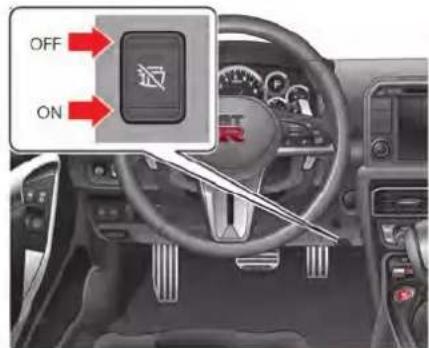
The exhaust sound control switch on the lower side of the instrument panel allows the driver to turn the exhaust sound control system on and off.
To close the electronic control valve, push the exhaust sound control switch to the ON side.
To open the electronic control valve, push the exhaust sound control switch to the OFF side.
( "Exhaust sound control system" page 5-59)
POWEROUTLETS

CAUTION
•Theoutletandplugmaybehot duringorimmediatelyafteruse.
- Donotusewithaccessoriesthat exceeda12volt,120W(10A) powerdraw.Donotusedouble adaptersormorethanoneelectricalaccessory.
- Thispoweroutletisnotdesigned forusewithacigarettelighter unit.
- Beforeinsertingordisconnecting aplug,besuretheelectrical accessorybeingusedisturned OFF.
- Whennotinuse, besuretoclose thecap. Donotallowwaterto contacttheoutlet.
NOTICE
- Usepoweroutletwiththeengine runningtoavoiddischargingthe vehiclebattery.
- Avoidusingpoweroutletwhen theairconditioner,headlightsor rearwindowdefrosterison.
2-60 Instrumentsandcontrols
- Pushthepluginasfarasitwill go. Ifgoodcontactisnotmade, theplugmayoverheatorthe internaltemperaturefusemay open.
Nexttothesteeringwheel
Pull out the cap to use the outlet. Replace the cap after use.

Insidetheconsolebox
Open the cap to use the outlet. Close the cap after use.
E-CALL(SOS)BUTTON
EMERGENCYSUPPORT
NissanConnect® Services provides various services to support dealing with emergencies of the subscribed vehicle and the driver.
For example, in case of an illness or serious injury, you can seek support by pushing the in-vehicle E-Call* (SOS) button and connecting to NissanConnect® Services. NissanConnect® Services can specify the location of the vehicle via GPS, and the information will be sent to the police or other agencies as needed. *: "E-Call" is an abbreviation for the "Emergency Call".
For information about other NissanConnect® Services emergency support related services, refer to the NissanConnect® Services website or contact the NissanConnect® Services support line.
NissanConnect®Serviceswebsite:
For U.S.
www.nissanusa.com/connect
For Canada
www.nissan.ca/nissanconnect (English)
www.nissan.ca/nissanconnect/fr (French)
NissanConnect®Servicessupportline:
1-855-426-6628

WARNING
- PleasenotethattheAutomatic CollisionNotificationservice(For detailsoftheAutomaticCollision Notificationservice, refertothe separateMultiFunctionDisplay Owner'sManual.) and Emergency Callfunctioncannotbeused in the following conditions:
—Emergencyfunctionsandserviceswillnotbeavailable withoutapaidsubscription toNissanConnect®Services.
—TheNissanConnect®Services networksystemisdisabled.
—The vehicle moves outside the service are a where the TCU (Telematics Control Unit) is connected to the system.
—The vehicle is outside the area where the cellular network service is receivable.
—The vehicle isinalocation with poorsignalreception suchastunnels, underground parking garages, behind buildings or in mountainous areas.
Instrumentsandcontrols2-61
—Thelineisbusy.
—TheTCU(TelematicsControl Unit)orothersystemsofyour vehiclearenotworkingproperly.
—It may not be possible to make an emergency call depending on these severity of a collision and/or emergency.
•Parkthevehicleinasafelocation andsettheparkingbrakebefore operatingtheE-Call(SOS)button.
- Onlyusethisserviceincaseofan emergency.Theremaybepenaltyforinappropriateuseofthe service.
- Radiowavescouldadverselyaffectelectricmedicalequipment. Individualswhouseapacemaker shouldcontactthedevicemanu-facturerregardinganypossible effectsbeforeusingthesystem.
•TheTCU(TelematicsControlUnit) antennaisinstalledinsidethe uppercentralpartoftheinstrumentpanel.Anoccupantshould notgetanyclosertotheantenna thanspecifiedbythepacemaker manufacturer.Theradiowaves
fromtheTCUantennamayadverselyaffecttheoperationofthe pacemakerwhileusingtheNissanConnect®Services.
Makinganemergencycall
The E-Call (SOS) button is located near the map light.
- Push the E-Call (SOS) button.
- When the line is connected, speak to the Response Specialist.

INFO:
●After the E-Call (SOS) button is pushed, it may take some time until the system initiates connection, depending on the technical environment and whether the TCU (Telematics Control Unit) is being used by other
STORAGE
services.
- An indicator light on the E-Call (SOS) button shows the readiness of the emergency support system. If the indicator light is not illuminated, pushing the E-Call (SOS) button does not connect your vehicle to the Response Specialist.
The indicator light blinks while connected to the NissanConnect® Services Response Center.
- Even when the indicator light is illuminated, connection to the Nissan-Connect® Services Response Center may not be possible. If this occurs in an emergency situation, contact the authorities by other means.
- To avoid disconnecting the line, keep the engine running during an emergency call, if it is safe to do so.
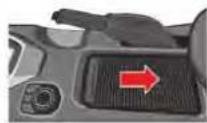
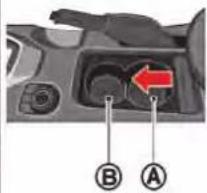
CUPHOLDERS

CAUTION
- Avoid abrupt starting and braking when the cupholder is being used to prevent spilling the drink. If the liquid is hot, it can scale you or your passenger.
•Useonlysoftcupsinthecup holder.Hardobjectscaninjure youinanaccident.
Front
Slide the cover toward the rear of the vehicle to open.
To close, slide the cover back toward the front of the vehicle.

Rear
NOTE:
Cupholder A iswiderandshallower thancupholders B and. Small-size cupsarelikelytotipoverincupholder A. Usecupholders and C
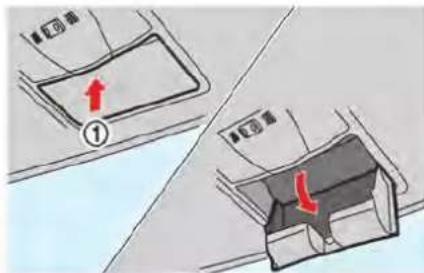
SUNGLASSESHOLDER
To open the sunglasses holder, push.

WARNING
Keepthesunglassesholderclosed whiledrivingtoavoidobstructing thedriver'sviewandtohelpprevent anaccident.

CAUTION
- Donotuseforanythingother thanglasses.
- Donotleaveglassesinthesun-glassesholderwhileparkingin directs sunlight. The heat may damagetheglasses.
2-64 Instrumentsandcontrols
DOORPOCKET
Door pockets are located inside the driver's side and passenger's side doors.
NOTICE
Donotgraspthedoorpocketsto openandclosethedoors.Doingso maydamagethepockets.
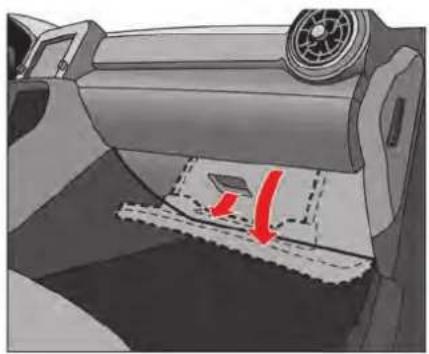
GLOVEBOX
WARNING
Keepgloveboxlidclosedwhiledrivingtohelppreventinjuryinan accidentorasuddenstop.
Pull the knob toward you to open the glove box.
To close the glove box, press the lid forward until it locks in place.

Use the mechanical key to lock and unlock ② the glove box. (1) Mechanical key page 3-3)
The mechanical key stops when it is inserted approximately halfway in.


NOTICE
Donotplaceitemsthataremore than2lb(1kg)onthehook.
CONSOLEBOX
Lift up the lock knob to open the lid.
To close the center console box, press on the lid until it locks in place.
NOTE:
Theconsoleboxcontainsapowerout-let.

CAUTION
Donotleavetheconsoleboxopen. Theopenlidmaysuddenly close when the vehicle stops.
COATHOOKS
To use the coat hook, push the upper side of the hook to release it.

CAUTION
Donothanganyobjectswithsharp edgesonthecoathangers. These itemsmaybeknockedoffiftheSRS airbagdeploys,possiblycausing injury.
2-66 Instrumentsandcontrols
WINDOWS
POWERWINDOWS

WARNING
●Makesurethatallpassengers havetheirhands,etc.insidethe vehiclewhileitisinmotionand beforeclosingthewindows.Use thewindowlockswitchtopre-ventunexpecteduseofthe powerwindows.
- Tohelpavoidriskofinjuryor deaththroughunintendedoperationofthevehicleandorits systems,includingentrapment inwindowsorinadvertentdoor lockactivation,donotleavechildren,peoplewhorequirethe assistanceofothersorpetsunattendedinyourvehicle.Additionally,thetemperatureinsidea closedvehicleonawarmdaycan quicklybecomehighenoughto causeasignificantriskofinjury ordeathtopeopleandpets.
The power windows operate when the ignition switch is in the ON position or for about 45 seconds after the ignition switch is pushed to the LOCK position. If the driver's or front passenger's door is
opened during this period of about 45 seconds, power to the windows is canceled.

- Window lock button
- Driver's window switch
- Front passenger's window switch
Instrumentsandcontrols2-67

Frontpassenger'sside
4. Front passenger's window switch
Mainpowerwindowswitch(driver'sside)
To open or close the window, push down or pull up the switch and hold it. The mai switch (driver's side switches) will open or close all the windows.
Lockingpassengers'windows
When the window lock button is pushed in, only the driver's side window can be opened or closed. Push it in again to cancel.
Passenger'ssidepowerwindow switch
The passenger side switch will open or close only the corresponding window. To open close the window, push down or pull up the switch and hold it.
Automaticoperation
To fully open or close the window, completely push down or pull up the switch and release it; it does not need to be held. The window will automatically open or close all the way. To stop the window, just push or lift the switch in the opposite direction.
A light push or pull on the switch will cause the window to open or close until the switch is released.
Autoreversefunction
If the control unit detects something caught in the window as it is closing, the window will be immediately lowered.
The auto reverse function can be activated when the window is closed by automatic operation when the ignition switch is in the ON position or for 45 seconds after the ignition switch is pushed to the OFF position.
Depending on the environment or driving conditions, the auto reverse function may be activated if an impact or load similar to something being caught in the window occurs.

WARNING
Therearesomesmalldistancesimmediatelybeforetheclosedposition whichcannotbedetected.Makesure thatallpassengershavetheirhands, etc.,insidethevehiclebeforeclosing thewindow.
Automaticadjustingfunction

CAUTION
When the battery cable is removed from the battery terminal, donot close either of the front doors. The automatic window adjusting function will not work and the sideroof panel may be damaged.
The power window has an automatic adjusting function. When the door is being opened, the window is automatically lowered slightly to avoid contact between the window and the side roof
panel. When the door is closed, the window is automatically raised slightly. While the automatic adjusting function does not work, the window will be controlled as follows:
- When the door is opened, the window lowers for approximately 2 seconds.
●While the door is open, the window cannot be raised.
Ifthewindowsdonotclose automatically
If the power window automatic function (closing only) does not operate properly, perform the following procedure to initialize the power window system.
- Push the ignition switch to start the engine.
- Close the door.
- After starting the engine, open the window completely by operating the power window switch.
- Pull the power window switch and hold it to close the driver side window, and then hold the switch more than 3 seconds after the window is closed completely.
- Release the power window switch. Operate the window by the automatic function to confirm the initialization is
complete.
- Perform steps 2 through 5 above for the passenger side window by operating either driver's or passenger's side switch.
If the power window automatic function does not operate properly after performing the procedure above, it is recommended you have your vehicle checked by a GT-R certified NISSAN dealer.
INTERIORLIGHTS
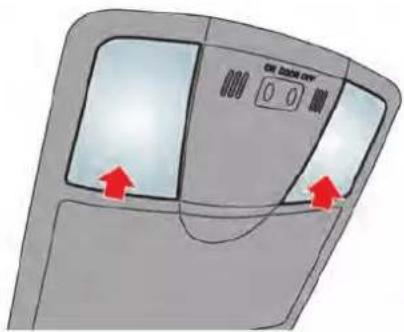
MAPLIGHTS
Push the button as illustrated to turn the light on or off.

INTERIORLIGHTCONTROL SWITCH
The interior light control switch has three positions: ON①, DOOR② and OFF. ③
ONposition
When the switch is in the ON position, the map lights will illuminate.
NOTICE
Donotusethelightforextended periodsoftimewiththeengine stopped. This could result in adis-charged battery.
NOTE:
Thelightswillalsoturnoffaftera periodoftimewhenthelightsremain illuminatedaftertheignitionswitchhas beenpushedtotheOFForLOCKpositiontopreventthebatteryfrombecomingdischarged.
DOORposition
When the switch is in the DOOR position ② the map lights will turn on when the door is opened and turn off when the door is closed. The map lights will turn approximately 15 seconds after the door is closed with the ignition switch in the OFF or LOCK position.
NOTE:
Whentheinteriorlightcontrolswitchis intheDOORpositionandthedooris open,thelightwillremainoneven whenthemaplightswitchispressed toturnoff.
Key-linkedinteriorlightcontrolsystem:
The map lights will turn on and off linked with the locking and unlocking of the door.
This function operates when the interior light control switch is in the DOOR position.
- Whenenteringthevehicle
When the driver's seat door is unlocked, the map light illuminates for approximately 15 seconds, then it turns off. While the map light is on, if the ignition switch is pushed to the ACC or ON position, or if the driver's side door is locked, the light turns off.
- Whenexitingthevehicle
When the ignition switch is pushed to the OFF or LOCK position, the map lights turn on for approximately 15 seconds, then it turns off.
If the driver's side door is locked while the map lights are on, the light turns off.
NOTE:
Itispossibletocancelthekey-linked interiorlightcontrolsystemsetting.See theseparateMultiFunctionDisplay Owner'sManual.
OFFposition
When the switch is in the OFF position, the map lights will not illuminate, regardless of any condition.
VANITYMIRRORLIGHTS
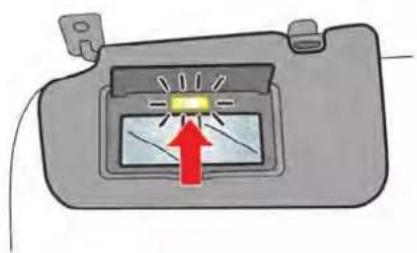
There is an illuminated vanity mirror on the reverse side of the sun visor.
HomeLink®UNIVERSALTRANSCEIVER
The HomeLink® Universal Transceiver provides a convenient way to consolidate the functions of up to three individual hand-held transmitters into one built-in device.
HomeLink® Universal Transceiver:
- Will operate most Radio Frequency (RF) devices such as garage doors, gates, home and office lighting, entry door locks and security systems.
- Is powered by your vehicle's battery. No separate batteries are required. If the vehicle's battery is discharged or is disconnected, HomeLink® will retain all programming.
WhentheHomeLink®UniversalTransceiverisprogrammed,retaintheoriginaltransmitterforfutureprogramming procedures(Example:newvehiclepurchases).Uponsaleofthevehicle,the programmedHomeLink®Universal Transceiverbuttonsshouldbeerased forsecuritypurposes.Foradditional information,referto "ProgrammingHomeLink®"page 2-72.

WARNING
- DonotusetheHomeLink® UniversalTransceiverwithanygaragedooropenerthatlackssafety stopandreversefeaturesasrequiredbyfederalsafetystandards.(Thesestandardsbecame effectiveforopenermodelsmanufacturedafterApril1,1982.)A garagedooropenerwhichcannot detectanobjectinthepathofa closinggaragedoorandthen automaticallystopandreverse, doesnotmeetcurrentfederal safetystandards.Usingagarage dooropenerwithoutthesefeaturesincreasestheriskofserious injuryordeath.
- During the programming procedure your garagedoor security gate will open and close (if the transmitter is within range). Make sure that people or objects are clear of the garagedoor, gate, etc. that you are programming.
-Yourvehicle'sengineshouldbe turnedoffwhileprogramming theHomeLink®UniversalTransceiver.Donotbreatheexhaust gases;theycontaincolorless
Instrumentsandcontrols2-71
andodorlesscarbonmonoxide. Carbonmonoxide is dangerous. It can cause unconsciousness or death.
PROGRAMMINGHomeLink®
If you have any questions or are having difficulty programming your HomeLink® buttons, refer to the HomeLink® web site at: www.homelink.com or call 1-800-355-3515.
NOTE:
Itisalsorecommendedthatanew batterybeplacedinthehand-held transmitterofthedevicebeingprogrammedtoHomeLink®forquicker programmingandaccuratetransmissionoftheradio-frequency.
- Position the end of your hand-held transmitter 1-3 in (26-76 mm) away from the HomeLink® surface, keeping the HomeLink® indicator light ① in view.
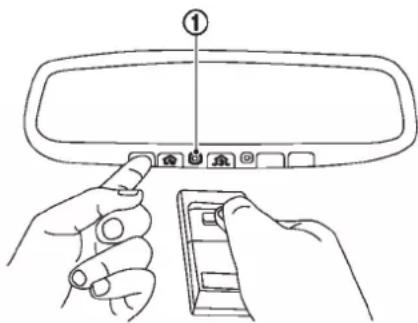
- Using both hands, simultaneously press and hold the desired HomeLink® button and handheld transmitter button. DO NOT release until the HomeLink® indicator light ① flashes slowly and then rapidly. When the indicator light flashes rapidly, both buttons may be released. (The rapid flashing indicates successful programming.)
NOTE: Somedevicestobeprogrammed mayrequireyoutoreplaceStep2 withthecyclingprocedurenotedin the "ProgrammingHomeLink® forCanadiancustomersandgate
openers"page2-73.
2-72 Instrumentsandcontrols

-
Press and hold the programmed HomeLink® button and observe the indicator light.
-
If the indicator light is solid/continuous, programming is complete and your device should activate when the HomeLink® button is pressed and released.
-
If the indicator light blinks rapidly for two seconds and then turns to a solid/continuous light, continue with Steps 4-6 for a rolling code device. A second person may make the following steps easier. Use a ladder or other device. Do not stand on your vehicle to perform the next steps.
-
At the receiver located on the garage door opener motor in the garage, locate the "learn" or "smart" button (the name and color of the button may vary by manufacturer but it is usually located near where the hanging antenna wire is attached to the unit). If there is difficulty locating the button, reference the garage door opener's manual.
-
Press and release the "learn" or "smart" button.
NOTE: Oncethebuttonispressed, you have approximately 30 secondstoinitiate then next step.
-
Return to the vehicle and firmly press and hold the programmed HomeLink® button for two seconds and release. Repeat the "press/hold/release" sequence up to 3 times to complete the programming process. HomeLink® should now activate your rolling code equipped device.
-
If you have any questions or are having difficulty programming your HomeLink® buttons, refer to the HomeLink® web site at: www.homelink.com or call 1-800-355-3515.
PROGRAMMINGHomeLink® FOR CANADIANCUSTOMERSANDGATE OPENERS
Canadian radio-frequency laws require transmitter signals to "time-out" (or quit) after several seconds of transmission - which may not be long enough for HomeLink® to pick up the signal during programming. Similar to this Canadian law, some U.S. gate operators are designed to "time-out" in the same manner.
If you live in Canada or you are having difficulties programming a gate operator or garage door opener by using the "Programming HomeLink®" procedures, replace "Programming HomeLink®" Step 2 with the following:
NOTE:
When programmingagaragedoor opener,etc., unplugthe deviceduring the"cycling"process to preventpossible damagetothegaragedooropener components.
Step 2: Using both hands, simultaneously press and hold the desired HomeLink® button and the hand-held transmitter button. During programming, your hand-held transmitter may automatically stop transmitting. Continue to press and hold the desired HomeLink® button while you
press and re-press ("cycle") your hand-held transmitter every two seconds until the frequency signal has been learned. The HomeLink® indicator light will flash slowly and then rapidly after several seconds upon successful programming. DONOTrelease until the HomeLink® indicator light flashes slowly and then rapidly. When the indicator light flashes rapidly, both buttons may be released. The rapid flashing indicates successful programming.
Proceed with "Programming HomeLink®" step 3 to complete.
Remember to plug the device back in when programming is completed.
The HomeLink® Universal Transceiver, after it is programmed, can be used to activate the programmed device. To operate, simply press and release the appropriate programmed HomeLink® Universal Transceiver button. The amber indicator light will illuminate while the signal is being transmitted.
For convenience, the hand-held transmitter of the device may also be used at any time.
PROGRAMMINGTROUBLESHOOTING
If the HomeLink® does not quickly learn the hand-held transmitter information:
- replace the hand-held transmitter batteries with new batteries.
- position the hand-held transmitter with its battery area facing away from the HomeLink® surface.
- press and hold both the HomeLink® and hand-held transmitter buttons without interruption.
- position the hand-held transmitter 1-3 in (26-76 mm) away from the HomeLink® surface. Hold the transmitter in that position for up to 15 seconds. If HomeLink® is not programmed within that time, try holding the transmitter in another position - keeping the indicator light in view at all times.
If you have any questions or are having difficulty programming your HomeLink® buttons, refer to the HomeLink® web site at: www.homelink.com or 1-800-355-3515.
CLEARINGTHEPROGRAMMEDINFORMATION
The following procedure clears the programmed information from both buttons. Individual buttons cannot be cleared. However, individual buttons can be reprogrammed, see "Reprogramming a single HomeLink® button" page 2-74.
Toclearallprogramming
- Press and hold the two outer HomeLink® buttons until the indicator light begins to flash in approximately 10 seconds. Do not hold for longer than 20 seconds.
- Release both buttons.
HomeLink® is now in the programming mode and can be programmed at any time beginning with "Programming HomeLink®" - Step 1.
REPROGRAMMINGASINGLE HomeLink®BUTTON
To reprogram a HomeLink® Universal Transceiver button, complete the following.
- Press and hold the desired HomeLink® button. Donotrelease the button.
- The indicator light will begin to flash after 20 seconds. Without releasing
the HomeLink® button, proceed with "Programming HomeLink®" - Step 1. For questions or comments, contact HomeLink® at: www.homelink.com or 1-800-355-3515.
The HomeLink® Universal Transceiver button has now been reprogrammed. The new device can be activated by pushing the HomeLink® button that was just programmed. This procedure will not affect any other programmed HomeLink® buttons.
IFYOURVEHICLEISSTOLEN
If your vehicle is stolen, you should change the codes of any non-rolling code device that has been programmed into HomeLink®. Consult the Owner's Manual of each device or call the manufacturer or dealer of those devices for additional information.
When your vehicle is recovered, you will need to reprogram the HomeLink® Universal Transceiver with your new transmitter information.
FCCNotice:
ForUSA:
ThisdevicecomplieswithPart15ofthe FCCRules.Operationissubjecttothe followingtwoconditions:(1)Thisdevice
maynotcauseharmfulinterference, and(2)thisdevicemustacceptany interferencereceived,includinginterferencethatmaycauseundesiredoperation.
NOTE:
Changesormodificationsnotexpressly approvedbythepartyresponsiblefor compliancecouldvoidtheuser's authoritytooperatetheequipment. ForCanada:
This device complies with Industry Canada licence-exempt RSS standard(s). Operation is subject to the following two conditions: (1) this device may not cause interference, and (2) this device must accept any interference, including interference that may cause undesired operation of the device.
MEMO
2-76 Instrumentsandcontrols
3Pre-drivingchecksandadjustments
Keys....3-2
IntelligentKey....3-2
Doors....3-4
Lockingwithinsidelockknob....3-5
Lockingwithpowerdoorlockswitch....3-5
Automaticdoorlocksystem....3-5
Lockingwithmechanicalkey....3-6
Openingthedoors....3-7
IntelligentKeysystem....3-8
IntelligentKeyfunctions....3-9
Remotekeylessentrysystem....3-12
Settinghazardindicatorandhornmode.....3-14
Warningsignals....3-16
Troubleshootingguide....3-17
Hood....3-18
Openingthehood....3-18
Closingthehood....3-19
Trunk....3-20
Trunkopenrequestswitch....3-20
Trunklidreleaseswitch....3-20
Trunkreleasepowercancelswitch....3-21
Openingandclosingthetrunk....3-22
Emergencytrunklidrelease....3-22
Fuel-fillerdoor....3-24
Openingthefuel-fillerdoor....3-25
Closingthefuel-fillerdoor 3-25
Steeringwheel....3-26
Tilt/telescopicsteeringcolumn....3-26
Sunvisors....3-27
Mirrors....3-27
Insidemirror 3-27
Outsidemirrors....3-28
Vanitymirror....3-29
KEYS
A key number plate is supplied with your keys. Record the key number and keep it in a safe place (such as your wallet), not in the vehicle. If you lose your keys, it is recommended you see a GT-R certified NISSAN dealer for duplicates by using the key number. NISSAN does not record any key numbers so it is very important to keep track of your key number plate.
A key number is only necessary when you have lost all keys and do not have one to duplicate from. If you still have a key, this key can be duplicated by a GT-R certified NISSAN dealer.

- Intelligent Key (2 sets)
- Mechanical key (inside Intelligent Keys) (2 sets)
- Key number plate (1 set)
INTELLIGENTKEY
Your vehicle can only be driven with the Intelligent Keys which are registered to your vehicle's Intelligent Key system components and NISSAN Vehicle Immobilizer System components. As many as 4 Intelligent Keys can be registered and used with one vehicle. The new keys must be registered by a GT-R certified NISSAN dealer prior to use with the Intelligent Key system and NISSAN Vehicle Immobi-
lizer System of your vehicle. Since the registration process requires erasing all memory in the Intelligent Key components when registering new keys, be sure to take all Intelligent Keys that you have to a GT-R certified NISSAN dealer.
NOTICE
- BesuretocarrytheIntelligent Keywithyouwhendriving.The IntelligentKeyisaprecisiondevicewithabuilt-intransmitter.To avoiddamagingit,pleasenote thefollowing.
—The Intelligent Key is water resistant; however, wetting may damage the Intelligent Key. If the Intelligent Key gets wet, immediately wipe until it is completely dry.
—Donotbend, droporstrikeit againstanotherobject.
—Donotplacethe Intelligent Keyforanextendedperiodin aplacewheretemperatures exceed140°F(60°C).
-Iftheoutsidetemperatureis below 14°F(-10°C) , the battery of the Intelligent Keymaynot
3-2 Pre-drivingchecksandadjustments
functionproperly.
—Donotchangeormodifythe IntelligentKey.
—Donotuseamagnetkey holder.
—Donotplacethe Intelligent Keynearanelectric appliance suchasatelevisionset, personalcomputerorcellular phone.
—DonotallowtheIntelligent Keytocomeintocontactwith waterorsaltwater,anddo notwashitinawashing machine.Thiscouldaffect thesystemfunction.
- IfanIntelligentKeyislostor stolen,NISSANrecommends erasingtheIDcodeofthatIntelligentKey.Thiswillpreventthe IntelligentKeyfromunauthorized usetounlockthevehicle.For informationregardingtheerasingprocedure,pleasecontacta GT-RcertifiedNISSANdealer.
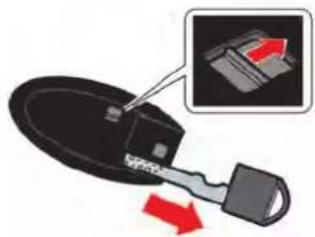
Mechanicalkey
To remove the mechanical key, release the lock knob at the back of the intelligent Key.
To install the mechanical key, firmly insert it into the Intelligent Key until the lock knob returns to the lock position.
Use the mechanical key to lock or unlock the doors and the glove box. ( Locking with mechanical key" page 3-6) ( "Glove box" page 2-65)

CAUTION
Alwayscarrythemechanicalkey installedintheIntelligentKey.
Valethand-off
When you have to leave a key with a valet, give them the Intelligent Key itself and keep the mechanical key with you to protect your belongings.
To prevent the glove box and the trunk from being opened during valet hand-off, follow the procedures below.
- Push the trunk release power cancel switch to the OFF side. ( "Trunk release power cancel switch" page 3-21)
- Remove the mechanical key from the Intelligent Key.
- Lock the glove box with the mechanical key. ( "Glove box" page 2-65)
- Hand the Intelligent Key to the valet, keeping the mechanical key in your pocket or bag for insertion into the Intelligent Key when you retrieve your vehicle.
DOORS

WARNING
●Alwayshavethedoorslocked whiledriving. Alongwiththeuse ofseatbelts, thisprovidesgreat- ersafetyintheeventofan accidentbyhelpingtoprevent personsfrombeingthrownfrom thevehicle. Thisalsohelpskeep childrenandothersfromunintentionallyopeningthedoors, andwillhelpkeepoutintruders.
- Beforeopeninganydoor,always lookforandavoidoncoming traffic.
●Tohelpavoidriskofinjuryor deaththroughunintendedoperationofthevehicleandorits systems,includingentrapment inwindowsorinadvertentdoor lockactivation,donotleavechildren,peoplewhorequirethe assistanceofothersorpetsun-attendedinyourvehicle.Additionally,thetemperatureinsidea closedvehicleonawarmdaycan quicklybecomehighenoughto causeasignificantriskofinjury ordeathtopeopleandpets.

CAUTION
Topreventtheftoraccidents,besure tostoptheengineandlockthedoors beforesteppingawayfromtheve- hicle.
NOTICE
When the battery cable is removed from the battery terminal, donot close either of the front doors. The automatic window adjusting function will not work, and the sideroof panel may be damaged. ( "Automatic adjusting function" page2-68)
NOTE:
- Thedoorsofthisvehiclearesome-whathardertoclosethanthoseof anordinaryvehicle(especiallywhen thevehicleisnew).Thisisbecause thestiffnessoftherubberhasbeen increasedto improve theairtightnessofthe vehicleinteriorduring situationssuchashigherspeed driving.Thisdoesnotindicatethat thereisamalfunction.
- Whenthdriver'sdoorislockedor unlocked, the fuel-filler door is automatically locked or unlocked at the sametime.
When the door is being opened, the window is automatically lowered slightly to avoid contact between the window and the side roof panel. When the door is closed, the window is automatically raised slightly. ( "Automatic adjusting function" page 2-68)
3-4 Pre-drivingchecksandadjustments
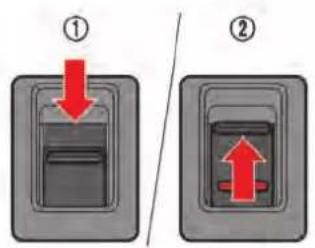

LOCKINGWITHINSIDELOCKKNOB
To lock a door individually, push down the inside lock knob to the lock position ① then close the door.
To unlock, lift up the inside lock knob to the unlock position②.
NOTE:
Whenlockingthedoorwithoutan IntelligentKey,besurenottoleavethe IntelligentKeyinsidethevehicle.
LOCKINGWITHPOWERDOORLOCK
eSWITCH
Operating the power door lock switch will lock or unlock all the doors. The switches are located on the driver's and front passenger's door armrests.
To lock the doors, push the power door lock switch to the lock position with the driver's or front passenger's door open, then close the door.
NOTE:
Whenlockingthedoorthisway,besure nottoleavethelIntelligentKeyinside thevehicle.
To unlock the doors, push the power door lock switch to the unlock position ②
Lockoutprotection
When the power door lock switch (driver or front passenger) is moved to the lock position with the Intelligent Key left in the key port and any door open, all doors will lock and unlock automatically.
When the power door lock switch (driver or front passenger) is moved to the lock position with the Intelligent Key left in the vehicle (not in the Intelligent Key port) and any door open, all doors will unlock automatically and a chime will sound after the door is closed.
These functions help to prevent the Intelligent Key from being accidentally locked inside the vehicle.
AUTOMATICDOORLOCKSYSTEM
- All doors lock automatically when the vehicle speed reaches 15 MPH (24 km/h).
- All doors unlock automatically when the ignition switch is placed in the OFF position.
Pre-drivingchecksandadjustments3-5
The automatic unlock function can be deactivated or activated. To deactivate or activate the automatic door unlock system, perform the following procedure:
- Close all doors.
- Place the ignition switch in the ON position.
- Within 20 seconds of performing Step 2, push and hold the power door lock switch to the 🔒 position (UNLOCK) for more than 5 seconds.
- When activated, the hazard indicator will flash twice. When deactivated, the hazard indicator will flash once.
- The ignition switch must be placed in the OFF and ON position again between each setting change.
When the automatic door unlock system is deactivated, the doors do not unlock when the ignition switch is placed in the OFF position. To unlock the door manually, use the inside lock knob or the power door lock switch (driver's or front passenger's side).

LOCKINGWITHMECHANICALKEY
The driver's door will be locked or unlocked using the mechanical key.
- Press the rear end of the driver's outside door handle ① to lift up the front end ②.

- With the outside door handle lifted up, use the mechanical key and turn the key cylinder cap Ⓐ counterclockwise to remove.
3-6 Pre-drivingchecksandadjustments

- Turning the door key cylinder to the front of the vehicle ① will lock the driver's door, and turning to the rear of the vehicle② will unlock the driver's door.
- Replace the key cylinder cap in the reverse order.
NOTICE
Donotdrivewiththecapremoved. Waterthatentersthroughthekey-holemaycauseamalfunction.
NOTE:
- Donotpulltoohardonthedoor handlewhenlockingorunlocking thedoors. Pullingtoohardwillpreventthemechanicalkeyfromturning,makingitimpossibletolocker unlockthedoors.
- Unlockingthedriver'sdoorusingthe mechanicalkeywillnotunlockthe fuel-fillerdoor.

OPENINGTHEDOORS
Openingfromoutsidethevehicle
- Press the rear end of the outside door handle ① to lift up the front end of the handle.
- Pull the front end of the outside door handle ②toward you.
Openingfrominsidethevehicle
Lift up the inside door handle to open a door from inside the vehicle.
Pre-drivingchecksandadjustments3-7
NOTICE
Donotgraspthedoorpocketsto openandclosethedoors.Doingso maydamagethepockets.
INTELLIGENTKEYSYSTEM

WARNING
●Radiowavescouldadverselyaffectelectricmedicalequipment. Thosewhouseapacemaker shouldcontacttheelectricmedicalequipmentmanufacturerfor thepossibleinfluencesbefore use.
●TheIntelligentKeytransmits radiowaveswhenthebuttons arepushed. The Federal Aviation Agency (FAA)advisestheradio wavesmayaffectaircraftnavigationandcommunicationsystems. Donotoperatethe IntelligentKeywhileonanairplane. Makesurethebuttonsare notoperatedunintentionally whentheunitisstoredfora flight.
The Intelligent Key system can operate all the door locks using the remote controller function or pushing the request switch on the vehicle without taking the key out from a pocket or purse. The operating environment and/or conditions may affect the Intelligent Key system operation. Be sure to read the following before using
the Intelligent Key system.

CAUTION
- BesuretocarrytheIntelligent Keywithyouwhenoperatingthe vehicle.
- NeverleavetheIntelligentKeyin thevehiclewhenyouleavethe vehicle.
●The Intelligent Key is always communicating with the vehicle as it receives radio waves. The Intelligent Key system transmits weak radio waves. Environmental conditions may interfere with the operation of the Intelligent Key system under the following operating conditions. In such cases, correct the operating conditions before using the Intelligent Key function or use the mechanical key.
- When operating near a location where strong radio waves are transmitted, such as a TV tower, power station and broadcasting station.
— When in possession of wireless equipment, such as a cellular telephone, transceiver, and CB radio.
- When the Intelligent Key is in contact with or covered by metallic materials.
— When any type of radio wave remote control is used nearby.
— When the Intelligent Key is placed near an electric appliance such as a personal computer.
— When the vehicle is parked near a parking meter.
- Although the life of the battery varies depending on the operating conditions, the battery's life is approximately 2 years. If the battery is discharged, replace it with a new one. ( "Intelligent Key battery replacement" page 8-25)
- Since the Intelligent Key is continuously receiving radio waves, if the key is left near equipment which transmits strong radio waves, such as signals from a TV and personal computer, the battery life may become shorter.
- Because the steering wheel is locked electrically, unlocking the steering wheel with the ignition switch in the LOCK position is impossible when the vehicle battery is completely discharged. Pay special attention that the vehicle battery is not completely discharged.
- Do not push the door handle request switch with the Intelligent Key held in your hand. The close distance to the door handle will cause the Intelligent Key system to have difficulty recognizing that the Intelligent Key is outside the vehicle.
●After locking the doors, check that the doors are securely locked by testing them.
- To prevent the Intelligent Key from being left inside the vehicle, make sure you carry the key with you and then lock the doors.
- To prevent the Intelligent Key from being left inside the trunk, make sure you carry the key with you and then close the trunk.
- Do not pull the door handle before pushing the door handle request switch. The door will be unlocked but will not open. Release the door handle once and pull it again to open the door.
INTELLIGENTKEYFUNCTIONS
It is possible to lock/unlock all doors, fuel-filler door and trunk lid by pushing the request switch on the outside door handles and the trunk lid.
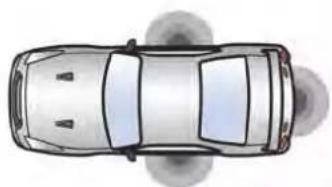
- If the Intelligent Keyistoocloseto the doorglass, handleor rear bumper, therequest switches may not function.
-WhentheIntelligentKeyiswithin theoperatingrange,itispossiblefor anyonewhodoesnotcarrythe IntelligentKeytopushtherequest switchtolock/unlockthedoors.
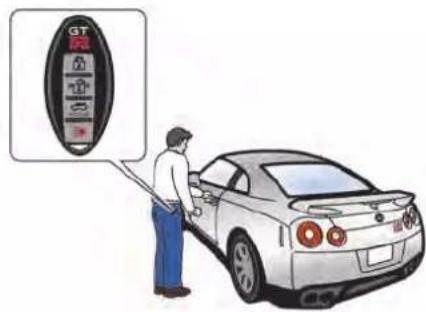
IntelligentKeyoperatingrange
The Intelligent Key functions can only be used when the Intelligent Key is within the specified operating range from the request switch. The operating range is within 31.50 in (80 cm) from each request switch.
NOTE:
-WhentheIntelligentKeybatteryis dischargedorstrongradiowaves arepresentneartheoperatinglocation,theIntelligentKeysystem's operatingrangebecomesnarrower, andtheIntelligentKeymaynot functionproperly.
3-10 Pre-drivingchecksandadjustments
IntelligentKeyoperation
You can lock or unlock the doors without taking the key out from your pocket or bag.

When you carry the Intelligent Key with you, you can lock or unlock all doors by pushing the door handle request switch Ⓐ within the range of operation.
NOTE:
- Whenthedriver'sdoorislockedor unlocked, thefuel-fillerdoorisautomaticallylockedor unlocked at the sametime.
- Whenyoulockorunlockthedoors orthetrunklid,thehazardindicator willflashandthehorn(ortheoutsidechime)willsoundasaconfirmation.( "Settinghazard indicatorandhornmode"page3-14)
Lockingdoors:
- Move the shift lever to the P position, push the ignition switch to the OFF position and make sure you carry the Intelligent Key with you.
- Close all the doors.
- Push the driver's or front passenger's door handle request switch while carrying the Intelligent Key with you.
- All the doors will lock.
- The hazard indicator flashes twice and the outside chime sounds twice.
NOTE:
- DoorswilllockwiththeIntelligent Keywhiletheignitionswitchisinthe ACCorONposition.
- DoorswillnotlockwiththeIntelligentKeywhileanydoorisopen.
- Doorswillnotlockbypushingthe doorhandlerequestswitchwiththe IntelligentKeyinsidethevehicle. However,whenanIntelligentKeyis insidethevehicle,doorscanbe locked withanother registeredIntelligentKey.
Unlockingdoors:
- Push the driver's or front passenger's door handle request switch once while carrying the Intelligent Key with
you
- The hazard indicator flashes once and outside chime sounds once. The corresponding door will unlock.
- Push the door handle request switch again within 1 minute.
- The hazard indicator flashes once and outside chime sounds once again. All the doors will unlock.
NOTE:
Alldoorswillbelockedautomatically unlessoneofthefollowingoperations isperformedwithin1minuteafter pushingthe requestswitch whilethe doorsarelocked.lfduringthis1-minute timeperiod,therequestswitchis pushed,alldoorswillbelockedautomaticallyafteranother1minute.
- Openinganydoor
- Pushingtheignitionswitch
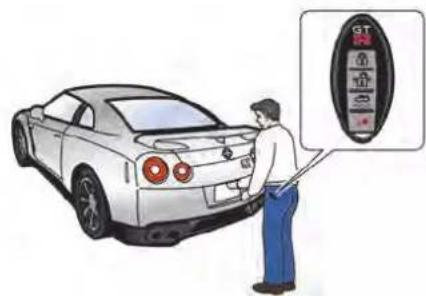

Openingtrunklid:
- Push the trunk open request switchⒶ for more than 1 second.
- The trunk will unlatch. An outside chime will sound four times.
- Raise the trunk lid to open the trunk.
NOTE:
- TopreventtheIntelligentKeyfrom beingaccidentallylockedinthe trunk,lockoutprotectionis equippedwiththeIntelligentKey system.
- Whenthetrunklidisclosedwiththe IntelligentKeyinsidethetrunk,the outsidebuzzerwillsoundandthe trunkwillopen.
Batterysaversystem
When all the following conditions are met for a period of time, the battery saver system will cut off the power supply to prevent battery discharge.
●The ignition switch is in the ACC position, and
●All doors are closed, and
•The shift lever is in the P position.
REMOTEKEYLESSENTRYSYSTEM
It is possible to lock/unlock all doors, fuel-filler door, and activate the panic alarm by pushing the buttons on the Intelligent Key.
NOTE:
Beforelockingthedoors, makesurethe IntelligentKeyisnotleftinthevehicle.
Remotekeylessentryoperating range
The LOCK/UNLOCK button on the Intelligent Key can operate at a distance of approximately 33 ft (10 m) from the vehicle. (The effective distance depends upon the conditions around the vehicle.) The lock and unlock buttons on the Intelligent Key will not operate when:
●the distance between the Intelligent Key and the vehicle is over 33 ft (10 m).
- the Intelligent Key battery runs down. The LOCK/UNLOCK operating range varies depending on the environment. To securely operate the lock and unlock buttons, approach the vehicle to about 3 ft (1 m) from the door.
3-12 Pre-drivingchecksandadjustments

Remotekeylessentryoperation
NOTE:
- Whenthdriver'sdoorislockedor unlocked, thefuel-fillerdoorisautomaticallylockedor unlocked at the sametime.
- Whenyoulockorunlockthedoors orthetrunklid,thehazardindicator willflashandthehorn(orthout-sidechime)willsoundasaconfirmation.( "Settinghazard indicatorandhornmode"page3-14)
Lockingdoors:
- Move the shift lever to the P position, push the ignition switch to the OFF position, and make sure you carry the Intelligent Key with you.
- Close all the doors.
- Push the LOCK 🔒 button on the Intelligent Key.
- All the doors will lock.
- The hazard indicator flashes twice and the horn chirps once.
NOTE:
- DoorswilllockwiththeIntelligent Keywhiletheignitionswitchisinthe ACCorONposition.
- DoorswillnotlockwiththeIntelligentKeywhileanydoorisopen.
Unlockingdoors:
- Push the UNLOCK 🔒 button on the Intelligent Key once.
- The hazard indicator flashes once. The driver's door will unlock.
- Push the UNLOCK 🔒 button on the Intelligent Key again within 60 seconds.
- The hazard indicator flashes once again. All the doors will unlock. All doors will be locked automatically unless one of the following operations is
performed within 1 minute after pushing the UNLOCK button on the Intelligent Key while the doors are locked. If during this 1-minute time period, the UNLOCK button on the Intelligent Key is pushed, all doors will be locked automatically after another 1 minute.
- Opening any door
- Pushing the ignition switch
Openingtrunklid:
- Push the TRUNK 🎨 button ③ on the Intelligent Key for more than 1 second.
- The trunk will unlatch.
- Raise the trunk lid to open the trunk.
Usingpanicalarm:
If you are near your vehicle and feel threatened, you may activate the alarm to call attention as follows:
- Push the PANIC ➕ button ④ on the Intelligent Key for more than 1 second.
- The theft warning alarm and headlights will stay on for 25 seconds.
- The panic alarm stops when:
• It has run for 25 seconds, or - Any of the buttons on the Intelligent Key are pushed. (Note: the panic button should be pushed for more than 1 second to turn the
Pre-drivingchecksandadjustments
panic alarm off.)
SETTINGHAZARDINDICATORAND HORNMODE
This vehicle is set in hazard indicator and horn mode when you first receive the vehicle.
When you lock/unlock the doors, the hazard indicator will flash and the horn (or the outside chime) will sound as a confirmation.
The following descriptions show how the hazard indicator and horn will activate when locking/unlocking the doors and how the horn feature can be deactivated.
Hazardindicatorandhornmode
| DOORLOCKDOOR | UNLOCK | TRUNKUNLOCK | |
| IntelligentKeysystem(Using door handle request switch or trunk open request switch) | HAZARD - twiceOUTSIDE CHIME - twice | HAZARD - onceOUTSIDE CHIME - once | HAZARD - noneOUTSIDE CHIME - 4 times |
| Remotekeylessentrysystem(Using 📄, 📄 or button) | HAZARD - twiceHORN - once | HAZARD - onceHORN - none | HAZARD - noneHORN - none |
3-14 Pre-drivingchecksandadjustments
Hazardindicatormode
| DOORLOCKDOORUNLOCK | TRUNKUNLOCK | ||
| IntelligentKeysystem(Using door handle request switch or trunk open request switch) | HAZARD - twiceHAZARD - none | HAZARD - none | |
| Remotekeylessentrysystem(Using 🔊, 🔊 or 🔊 button) | HAZARD - twiceHAZARD - none | HAZARD - none | |
Switchingprocedure
The horn beep feature can be deactivated with the following procedures.
- Push the LOCK 🔒 and UNLOCK 🔒 buttons simultaneously for more than 2 seconds.
- The hazard indicator flashes 3 times.
- The horn beep feature will be deactivated (Hazard indicator mode).
- To reactivate the horn beep feature (Hazard indicator and horn mode), push the buttons once more. The hazard indicator flashes once and the horn beeps once.
![graph TD A["HAZARD INDICATOR AND HORN MODE"] --> B["Push ( ) for more than 2 sec."] A --> C["HAZARD flashes 3 times"] A --> D["HAZARD INDICATOR MODE"] D --> E["Push ( ) for more than 2 sec."] D --> F["HAZARD flashes once HORN chirps once"] F --> A](/content/2026/05/810568/images/abe317e2a2b5f7a12f2a970a784ebf6192e1feb3add96202f527de93c7fea4ec.jpg)
Pre-drivingchecksandadjustments3-15
WARNINGSIGNALS
To help prevent the vehicle from moving unexpectedly due to an erroneous operation of the Intelligent Key listed on the following chart or to help prevent the vehicle from being stolen, a chime or beep sounds inside and outside the vehicle and a warning displays in the vehicle information display. ( "Warning display" page 2-36) ( "Operation displays" page 2-45)
When a chime or beep sounds or a warning displays, be sure to check the vehicle and the Intelligent Key.
3-16 Pre-drivingchecksandadjustments
TROUBLESHOOTINGGUIDE
| Symptom Possible cause | Action to take | ||
| When pushing the ignition switch to stop the engine | The SHIFT P warning appears on the display and the inside warning chime sounds continuously. | The shift lever is not in the position. | Shift the shift lever to the position. |
| When opening the driver's door to get out of the vehicle | The inside warning chime sounds continuously. | The ignition switch is in the ACC position. | Push the ignition switch to the OFF position. |
| The Intelligent Key is in the Intelligent Key port. | Remove the Intelligent Key from the Intelligent Key port. | ||
| When closing the door after getting out of the vehicle | The NO KEY warning appears on the display, the outside chime sounds 3 times and the inside warning chime sounds for approximately 3 seconds. | The ignition switch is in the ACC or ON position. | Push the ignition switch to the OFF position. |
| The SHIFT P warning appears on the display and the outside chime sounds continuously. | The ignition switch is in the ACC or OFF position and the shift level is not in the position. | Move the shift lever to the position and push the ignition switch to the OFF position. | |
| When closing the door with the inside lock knob turned to LOCK | The outside chime sounds for approximately 3 seconds and all the doors unlock. | The Intelligent Key is inside the vehicle or trunk. | Carry the Intelligent Key with you. |
| When pushing the door handle request switch to lock the door | The outside chime sounds for approximately 2 seconds. | The Intelligent Key is inside the vehicle or trunk. | Carry the Intelligent Key with you. |
| A door is not closed securely. | Close the door securely. | ||
| The door handle request switch is pushed before the door is closed. | Push the door handle request switch after the door is closed. | ||
| When closing the trunk lid | The outside chime sounds for approximately 10 seconds and the trunk lid opens. | The Intelligent Key is inside the trunk. | Carry the Intelligent Key with you. |
HOOD

OPENINGTHEHOOD
- Pull the hood lock release handle ① located below the instrument panel. The hood will then spring up slightly.

- Pull the lever at the front of the hood with your fingertips and raise the hood.

- Grasp the insulated part of the stay and release it from the hook, then securely insert it into the hood hole.

WARNING
If youseesteamorsmokecoming from the engine compartment, do not openthehood. Doings could cause injury.
3-18 Pre-drivingchecksandadjustments

CAUTION
- Donotinserthands, clothing, toolsorotheritemsintothe enginecompartmentwhilethe engineisrunning.
- Donottouchtheexhaustsystem parts, radiatororotherhotparts until the engine and the parts have cooled.
NOTICE
Donotopenthehoodwhilethe wiperarmsareliftedawayfromthe windshield.Thehoodandwiperswill bedamaged.

CLOSINGTHEHOOD
- While supporting the hood, store the stay to the original position.
- Slowly lower the hood. When it is at a height of 1 ft (30 cm) or higher, drop the hood and make sure that both sides of the hood securely lock in place.

WARNING
●Makesurethehoodiscompletely closedandlatchedbeforedriving. Failuretodosocouldcausethe hoodtoopenandresultinan
accident.
- Besuretocheckthatthehoodis securelyclosedbeforedriving.If bothsidesofthehoodarenot lockedinplace,thehoodmay openduringdriving,possibly causinganaccident.

CAUTION
Whenclosingthehood, lowerit slowlysothathandsorotheritems donotgetcaught.
NOTE:
Because the hood of this vehiclere-quires more for cet olocethan that for other vehicles, the hood will be difficult to close if you lower it all the way and then attempt top press it closed. Besure to dorop the hood from a height of approximately 1ft (30cm) and besure that both sides secure by lock in place.
Pre-drivingchecksandadjustments3-19
TRUNK

WARNING
- Donotdrivewiththetrunklid open. This could allow dangerous exhaust gas estobedrawn into the vehicle. ( "Exhaustgas (carbonmonoxide)" page5-3)
- Closelysupervisechildrenwhen theyarearoundcarstoprevent themfromplayingandbecoming lockedinthetrunkwherethey couldbeseriouslyinjured.Keep thecarlocked,withthetrunk closed,whennotinuse,and preventchildren'saccesstoin-telligentKeys.
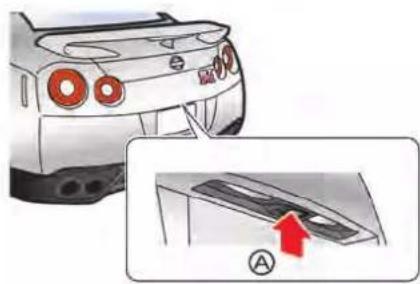

TRUNKOPENREQUESTSWITCH
The trunk lid can be opened by pushing the trunk open request switch Ⓐ when the Intelligent Key is within the operating range of the trunk lock/unlock function regardless of the inside lock knob position. (1) "Intelligent Key system" page 3-8)
TRUNKLIDRELEASESWITCH
Press the trunk lid release switch to unlock the trunk.

valet and keep the mechanical key with you. (15 "Valet hand-off" page 3-3) To connect the power to the trunk lid, push the switch to the ON position.
TRUNKRELEASEPOWERCANCEL SWITCH
When the switch located inside the glove box is in the OFF position, the power to the trunk lid will be canceled and the trunk lid cannot be opened by the trunk lid release switch, the trunk open request switch or the TRUNK button on the Intelligent Key.
When you have to leave the vehicle with a valet and want to keep your belongings safe in the glove box and the trunk, push this switch to OFF and lock the glove box with the mechanical key. Then leave the vehicle and the Intelligent Key with the

Exceptforcarbontrunklidmodels

Pre-drivingchecksandadjustments3-21
OPENINGANDCLOSINGTHE TRUNK
When opening the trunk, first unlock it then lift up the trunk lid so that it is fully open.
When closing the trunk, lower the trunk lid and press it until it is securely locked in place. The strap Ⓐ (except for carbon trunk lid models) or the handle Ⓑ (for carbon trunk lid models) can be used when the trunk lid is dirty.
NOTICE
- Openandclosethetrunkwithout graspingtherearspoiler.Graspingtherearspoilertoopenor closethetrunkmaydamagethe spoiler.
- Donotleavethekeyinsidethe trunk.
NOTE:
- TopreventtheIntelligentKeyfrom beingaccidentallylockedinthe trunk,lockoutprotectionis equippedwiththeIntelligentKey system.Whenthetrunklidisclosed withtheIntelligentKeyinsidethe trunk,theoutsidebuzzerwillsound
3-22 Pre-drivingchecksandadjustments
andthetrunkwillopen.
- Thetrunkofthisvehicleislightly moredifficulttoclosethanonordinaryvehicle(particularlywhenthe vehicleisnew).Thisisbecausethe trunkrigidityhasbeenincreasedto handlethehighloadontherear spoilerduringvehicleoperation. Thisdoesnotindicatethatthereis amalfunction.Checkthatthetrunk issecurelylocked.

EMERGENCYTRUNKLIDRELEASE

WARNING
Closelysupervisechildrenwhenthey arearoundcarstopreventthem fromplayingandbecominglocked inthetrunkwheretheycouldbe seriouslyinjured.Keepthecar locked,withthetrunklidsecurely latched,whennotinuse,andpreventchildren'saccesstoIntelligent Keys.
The emergency trunk lid release mechan-
ism allows opening of the trunk lid in the event that people become locked inside the trunk or in the event of the loss of electrical power such as a discharged battery.
Insidethetrunk
To open the trunk lid from the inside, pull the release handle ① until the lock releases and push up on the trunk lid. The release lever is made of a material that glows in the dark after a brief exposure to ambient light.
The handle is located on the back of the trunk lid as illustrated.

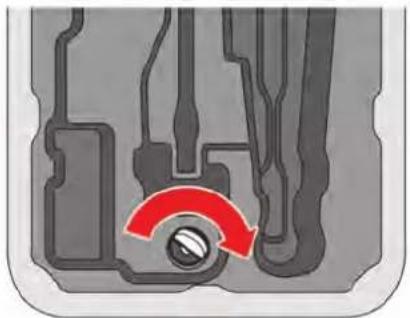
From the passenger compartment
The trunk can be opened with the emergency trunk lid opener located on the floor in front of the passenger's seat.
-
Remove the board located on the floor in front of the passenger's seat.
-
Insert the mechanical key into the emergency trunk lid opener and turn it clockwise until it stops.
NOTE:
Becausethetrunkrigidityhasbeen increasedtohandlethehighloadon therearspoilerduringvehicleoperation,moreforceisrequiredtooperate themechanicalkey(particularlywhen thevehicleisnew).Besuretoturnthe keyclockwiseuntilstops.
Pre-drivingchecksandadjustments3-23
FUEL-FILLERDOOR
The fuel-filler door is located on the right and rear side of the vehicle.

WARNING
Gasolineisextremelyflammable andhighlyexplosiveundercertainconditions.Youcouldbe burnedorseriouslyinjuredifitis misusedormishandled.Always stopengineandonotsmokeor allowopenflamesorsparksnear thevehiclewhenrefueling.
- Donotattempttotopoffthefuel tankafterthefuelpumpnozzle shutsoffautomatically.Continuedrefuelingmaycausefuel overflow,resultinginfuelspray andpossiblyafire.
- Useonlyanoriginalequipment typefuel-fillercapasareplacement. Ithasabuilt-insafetyvalve needed for proper operation of the fuelsystemandemission control system. An incorrect cap can result in a serious malfunction and possible injury. It could also cause themalfunction indicator lighttocomeon.
- Neverpourfuelintothethrottle bodytoattempttostartyour
3-24 Pre-drivingchecksandadjustments
vehicle.
- Donotfillaportablefuelcontainerinthevehicleortrailer.Staticelectricitycancauseanexplosionofflammableliquid,vapororgasinanyvehicleortrailer.Toreducetheriskofseriousinjuryordeathwhenfillingportablefuelcontainers:
—Alwaysplacethecontaineron thegroundwhenfilling.
—Donotuseelectronicdevices whenfilling.
—Keepthepumpnozzleincontactwiththecontainerwhile youarefillingit.
—Useonlyapprovedportable fuelcontainersforflammable liquid.
NOTICE
- Iffuelisspilledonthevehicle body, flushitawaywithwaterto avoidpaintdamage.
- Insertthecapstraightintothe fuel-fillertube, thentightenuntil thefuel-fillercapclicks. Failureto
tightenthefuel-fillercapproperly maycausethe SERVICE ENGINE MAINfunction IndicatorLight(MIL)toilluminate. Ifthe SERVICE ENGINE ENGINE ENGINE ENGINE ENGINE ENGINE ENGINE ENGINE ENGINE ENGINE ENGINE ENGINE ENGINE ENGINE ENGINE ENGINE ENGINE ENGINE ENGINE ENGINE ENGINE ENGINE ENGINE ENGINE ENGINE ENGINE ENGINE ENGINE ENGINE ENGINE ENGINE ENGINE ENGINE ENGINE ENGINE ENGINE ENGINE ENGINE ENGINE ENGINE ENGINE ENGINE ENGINE ENGINE ENGINE ENGINE ENGINE ENGINE ENGINE ENGINE ENGINE ENGINE ENGINE ENGINE ENGINE ENGINE ENGINE ENGINE ENGINE ENGINE ENGINE ENGINE ENGINE ENGINE ENGINE ENGINE ENGINE ENGINE ENGINE ENGINE ENGINE ENGINE ENGINE ENGINE ENGINE ENGINE ENGINE ENGINE ENGINE ENGINE ENGINE ENGINE ENGINE ENGINE ENGINE ENGINE Engine Engine Engine Engine Engine Engine Engine Engine Engine Engine Engine Engine Engine Engine Engine Engine Engine Engine Engine Engine Engine Engine Engine Engine Engine Engine Engine Engine Engine Engine Engine Engine Engine Engine Engine Engine Engine Engine Engine Engine Engine Engine Engine Engine Engine Engine Engine Engine Engine Engine Engine Engine Engine Engine Engine Engine Engine Engine Engine Engine Engine Engine Engine Engine Engine Engine Engine Engine Engine Engine Engine Engine Engine Engine Engine Engine Engine Engine Engine Engine Engine Engine Engine Engine Engine Engine Engine Engine Engine Engine Engine Engine Engine Engine Engine Engine Engine Engine Engine Engine Vehicle:The SERVICE ENGINE ENGINE ENGINE Engineer Service Lightdoesnotturnoffaftera lightdoesnotturnoffaftera lightdoesnotturnoffaftera lightdoesnotturnoffaftera lightdoesnotturnoffaftera lightdoesnotturnoffaftera lightdoesnotturnoffaftera lightdoesnotturnoffaftera lightdoesnotturnoffaftera lightdoesnotturnoffaftera lightdoesnotturnoffaftera lightdoesnotturnoffaftera lightdoesnotturnoffaftera lightdoesnotturnoffaftera lightdoesnotturnoffaftera lightdoes notturnoffaftera light does not turnoffaftera light does not turnoffaftera light does not turnoffaftera light does not turnoffaftera light does not turnoffaftera light does not turnoffaftera light does not turnoffaftera light does not turnoffaftera light does not turnoffaftera light does not turnoffaftera light does not turnoffaftera light does not turnoffaftera light does not turnoffaftera light does not turnoffaftera light does not turnoff aftera light does not turnoffaftera light does not turnoffaftera light does not turnoffaftera light does not turnoffaftera light does not turnoffaftera light does not turnoffaftera light does not turnoffaftera light does not turnoffaftera light does not turnoffaftera light does not turnoffaftera light does not turnoffaftera light does not turnoffaftera light does not turnoffaftera light does not turnoffaftera
( "MalfunctionIndicatorLight (MIL)"page2-32)
- This vehicle includes a system that cansupplyfuelevenduring high-G(gravity)turns. The fuel tank pressure is higher when the vehicle is shot. If the vehicle is refueled when the vehicle is shot, the fuel pump may automatically shutoff before the tank is full. This does not indicate that there is a malfunction.
OPENINGTHEFUEL-FILLERDOOR
-
Unlock the fuel-filler door by using one of the following operations.
-
Push the door handle request switch with the Intelligent Key carried with you.
- Push the UNLOCK button on the Intelligent Key.
- Push the power door lock switch to the UNLOCK position.
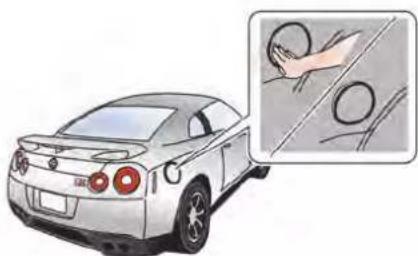
- Press the rear side of the fuel-filler door to release the door lock, and open the door.

- Turn the cap slowly counterclockwise to remove it. During refueling, place the cap on the inside of the door②.
CLOSINGTHEFUEL-FILLERDOOR
- Turn the cap clockwise until a single click sound is heard.
- Close the door. Lock the fuel-filler door by using one of the following operations.
- Push the door handle request switch with the Intelligent Key carried with you.
- Push the LOCK button on the Intelli-
Pre-drivingchecksandadjustments3-25
gent Key.
- Push the power door lock switch to the LOCK position.
NOTE:
Afterasingleclickisheardandthecap isreleaseditmaymoveslightly.This is notamalfunction.
STEERINGWHEEL

WARNING
- Donotadjustthesteeringwheel whiledriving.Youcouldlosecon- trolofyourvehicleandcausean accident.
- Donotadjustthesteeringwheel anyclosertoyouthanisnecessaryforpropersteeringoperationandcomfort. Thedriver'sair baginflateswithgreatforce. If youareunrestrained, leaningforward, sittingsidewaysorout of positioninanyway, you areat greaterriskofinjuryordeathina crash. You may also receive serious or fatal injuries from their bag if you are up again sit when it inflates. Always sit back against these at back and far away as practical from theesteeringwheel. Always usetheseatbelts.

TILT/TELESCOPICSTEERINGCOLUMN
Tiltadjustment
This adjusts up/down the position of the steering wheel.
- Press lever Ⓐdown ①
- Move the steering wheel up/down ② and stop it in an appropriate position.
- Lift up lever Ⓐ to lock the steering wheel in position ③

SUNVISORS
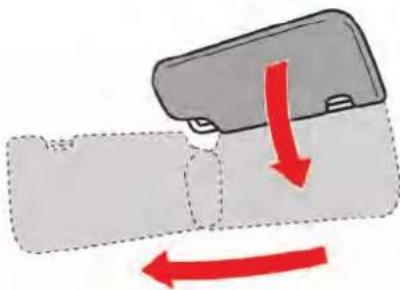
MIRRORS
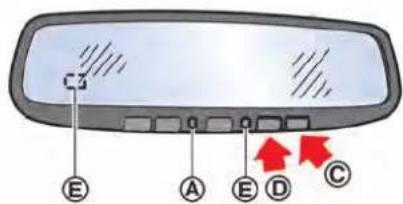
Telescopicadjustment
This adjusts the forward/backward position of the steering wheel.
- Press lever Ⓑ down Ⓙ
- Move the steering wheel forward/backward ② and stop it in an appropriate position.
- Lift up lever Ⓑ to lock the steering wheel in position③
Lower the sun visor to block sunlight coming from the forward direction.
To block sunlight coming from the side, lower the sun visor, then unclip it from hook and move it to the side.
INSIDEMIRROR
The inside mirror is designed so that it automatically changes reflection according to the intensity of the headlights of the following vehicle.
The anti-glare system will be automatically turned on when the ignition switch is pushed to the ON position.
When the anti-glare system is turned on, the indicator light Ⓐ will illuminate and excessive glare from the headlights of the vehicle behind you will be reduced.
Push the "○" switch to make the inside rearview mirror operate normally. The indicator light will turn off. Push the "I"
Pre-drivingchecksandadjustments3-27
switch to turn the system on.
NOTICE
Donotallowanyobjecttocoverthe sensors ® orapplyglasscleaneron them.Doingsowillreducethesensitivityofthesensor,resultinginimproperoperation.

OUTSIDEMIRRORS

WARNING
Objectsviewedintheoutsidemirror onthepassengersidearecloser thantheyappear.Becarefulwhen movingtotheright.Usingonlythis mirrorcouldcauseanaccident.Use theinsidemirrororglanceoveryour shouldertoproperlyjudgedistances tootherobjects.
The outside mirror will operate only when the ignition switch is in the ACC or ON
position.
Adjustingtheoutsidemirrors
- Turn the switch right or left to select the right or left side mirror ①
- Operate the control switch②to adjust the mirror angle.

WARNING
Adjustthemirrorsbeforestartingto drive.Adjustingthemirrorsduring drivingisdangerousasitreduces thedriver'sattentiontotheforward direction.

Foldingtheoutsidemirrors
Push the switch down to fold the outside mirrors.
Push the switch up ① to unfold the mirrors before driving.

CAUTION
- Donottouchthemirrorswhile theyaremoving.Yourhandmay bepinched,andthemirrormay malfunction.
- Donotdrivewiththemirrors stored.Youwillbeunabletosee
behindthevehicle.
- Ifthemirrorswerefoldedor unfoldedbyhand,thereisa chancethatthemirrorwillmove forwardorbackwardduringdriving.Ifthemirrorswerefoldedor unfoldedbyhand,besureto adjustthemagainelectricallybeforedriving.
NOTE:
- If the switch is operated continuously, them mirror may stop before movement is completed. This does not indicate that there is a malfunction. Wait a few moments, then operate the switch again.
- If them mirrors were folded by hand, them mirrors may start moving when the ignition switch is set to the ACCorON position.
- WhentheignitionswitchisintheON position,operatingtherearwindow defrosterwillalsoremovefrostand fogfromtheoutsidemirrors.
( "Rearwindowdefrosterswitch" page2-52)

VANITYMIRROR
To use the front vanity mirror, pull down the sun visor and pull up the cover.
MEMO
3-30 Pre-drivingchecksandadjustments
4Displayscreen, heater, airconditioner and audiosystems
MultiFunctionDisplayOwner'sManual....4-2
RearViewMonitor....4-2
RearViewMonitorsystemoperation....4-3
Howtoreadthedisplayedlines....4-3
Differencebetweenpredictive and actualdistances....4-3
Howtoparkwithpredictivecourselines......4-5
Adjustingthescreen....4-6
Howtoturnonandoffpredictive
courselines....4-7
Sonarindicator....4-7
RearViewMonitorsystemlimitations....4-7
SystemMaintenance....4-8
Ventilators....4-9
Centerventilators....4-9
Sideventilators....4-9
Heaterandairconditioner 4-10
Automaticairconditioner....4-11
Operatingtips 4-13
In-cabinmicrofilter....4-13
Servicingairconditioner....4-14
Antenna....4-14
Windowantenna....4-14
Satelliteantenna 4-15
CarphoneorCBradio....4-15
MULTIFUNCTIONDISPLAY OWNER'SMANUALREARVIEWMONITOR
Refer to the separate Multi Function Display Owner's Manual that includes the following information.
●Multi function display system
- Settings
●Audio system
- Bluetooth® Hands-Free Phone System
●NissanConnect® Services powered by SiriusXM®
-SiriusXM® Travel Link
●SiriusXM Traffic TM
- Apple CarPlay®
●Navigation
●Voice recognition
●Multi function meter

WARNING
Failuretofollowthewarningsand instructionsforproperuseofthe RearViewMonitorsystemcouldresultinseriousinjuryordeath.
•TheRearViewMonitorisaconveniencebutitisnotasubstitute forproperbacking.Alwaysturn andlookoutthewindows,and checkmirrorstobesurethatitis safetomovebeforeoperating thevehicle.Alwaysbackup slowly.
- Thesystemisdesignedasanaid tothedriverinshowinglarge stationaryobjectsdirectlybehind thevehicle,tohelpavoiddamagingthevehicle.
- Thedistanceguidelineandthe vehiclewidthlineshouldbeused asareferenceonlywhenthe vehicleisonalevelpavedsurface. Thedistanceviewedonth monitorisforreferenceonly and maybedifferentthantheactual distancebetweenthevehicleand displayedobjects.

CAUTION
Donotscratchthecameralenswhen cleaningDIRtorsnowfromthefront ofthecamera.
The RearView Monitor system automatically shows a rear view of the vehicle when the shift lever is placed in the R position.
The radio can still be heard while the RearView Monitor is active.
4-2 Displayscreen, heater, airconditioner and audiosystems

To display the rear view, the RearView Monitor system uses a camera located just above the vehicle's license plate.
with the ignition switch in the ON position, move the shift lever to the position to operate the RearView Monitor.
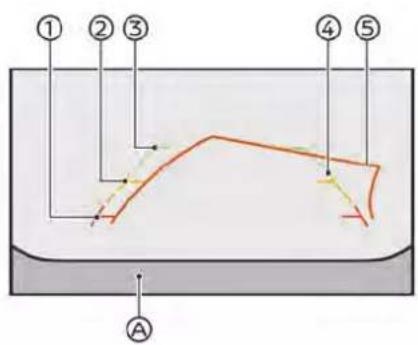
HOWTOREADTHEDISPLAYED LINES
Guiding lines which indicate the vehicle width and distances to objects with reference to the bumper line Ⓐ are displayed on the monitor.
Distanceguidelines:
Indicate distances from the bumper.
●Red line ①: approx. 1.5 ft (0.5 m)
●Yellow line ② approx. 3 ft (1 m)
●Green line ③ approx. 7 ft (2 m)
Vehiclewidthguidelines ④:
Indicates the approximate vehicle width.
Predictivecourselines ⑤:
Indicate the predictive course when backing up. The predictive course lines will be displayed on the monitor when the shift lever is in the position and the steering wheel is turned. The predictive course lines will move depending on how much the steering wheel is turned and will not be displayed while the steering wheel is in the neutral position.
The vehicle width guide lines and the width of the predictive course lines are wider than the actual width and course.
DIFFERENCEBETWEENPREDICTIVEANDACTUALDISTANCES
The displayed guide lines and their locations on the ground are for approximate reference only. Objects on uphill or downhill surfaces or projecting objects will be actually located at distances different from those displayed in the monitor relative to the guide lines (refer to illustrations). When in doubt, turn around and view the objects as you are backing up, or park and exit the vehicle to view the positioning of objects behind the vehicle.


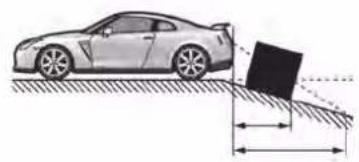

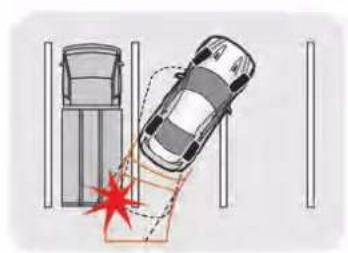
Backinguponasteepuphill
When backing up the vehicle up a hill, the when backing up the vehicle down a hill, distance guide lines and the vehicle width the distance guide lines and the vehicle guide lines are shown closer than the actual distance. Note that any object on the hill is further than it appears on the monitor. width guide lines are shown further than the actual distance. Note that any object on the hill is closer than it appears on the monitor.
Backinguponasteepdownhill
Backingupnearaprojectingob-
ject
The predictive course lines do not touch the object in the display. However, the vehicle may hit the object if it projects over the actual backing up course.
4-4 Displayscreen, heater, airconditioner and audiosystems

Backingupbehindaprojecting object
The position is shown further than the position B in the display. However, the position C is actually at the same distance as the position A. The vehicle may hit the object when backing up to the
position Ⓐ if the object projects over the actual backing up course.
HOWTOPARKWITHPREDICTIVE COURSELINES

WARNING
- If the tires are replaced with different-sized tires, the predictive courseelinemay not bed is displayed correctly.
•Onasnow-coveredorslippery road,theremaybeadifference between the predictive course line and the actual course line.
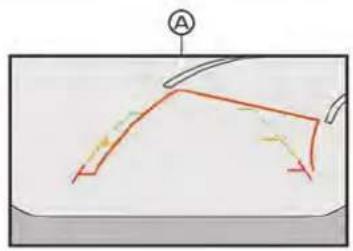

- Visually check that the parking space is safe before parking your vehicle.
- The rear view of the vehicle is displayed on the screen when the shift lever is moved to the position.

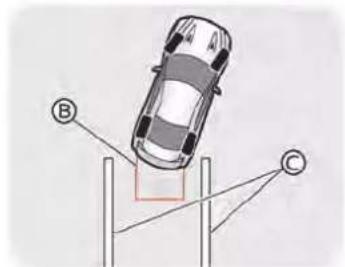
- Slowly back up the vehicle adjusting the steering wheel so that the predictive course lines® enter the parking space ©.
- Maneuver the steering wheel to make the vehicle width guide lines parallel to the parking space while referring
4-6 Displayscreen, heater, airconditioner and audiosystems
to the predictive course lines.
- When the vehicle is parked in the space completely, move the shift lever in an appropriate gear and apply the parking brake.
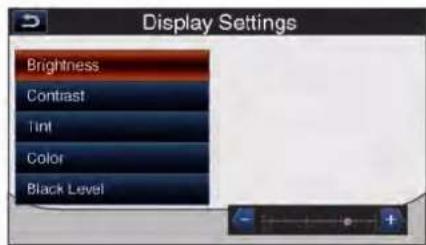
ADJUSTINGTHESCREEN
- While on a RearView Monitor screen, touch the touch screen display. The Camera Settings screen will come up.
- Touch the "Display Settings" key.
- Touch the "Brightness", "Contrast", "Tint", "Color" or "Black Level" key.
- Adjust the item by touching the "+" or "-" key on the touch screen display.
NOTE:
Donotadjustanyofthedisplaysettings oftheRearViewMonitorwhilethe vehicleismoving.Makesuretheparkingbrakeisfirmlyapplied.
HOWTOTURNONANDOFFPRE-DICTIVECOURSELINES
If the RearView Monitor is in operation and the rear view is displayed, turn on and off the predictive course line setting according to the following procedure.
- Touch the touch screen display.
- Touch the "Predictive Course Lines" key to turn the feature on or off.

If the RearView Monitor is not in operation, change the setting according to the following procedure.
- Touch the "Settings" key on the Launch Bar Ⓐ on the touch screen display.
- Touch the "Camera" key.
- Touch the "Predictive Course Lines" key. The indicator illuminates when the item is turned on.
SONARINDICATOR
The sonar indicator will appear in the RearView Monitor display. ( "Sonar system" page 5-48)
REARVIEWMONITORSYSTEMLIMITATIONS

WARNING
ListedbelowarethesystemlimitationsforRearViewMonitor.Failureto operatethevehicleinaccordance withthesesystemlimitationscould resultinseriousinjuryordeath.
- Thesystemcannotcompletely eliminateblindspotsandmay notshoweveryobject.
• Underneaththebumperandthe cornerareasofthebumpcan- notbeviewedontheRearView Monitorbecause of itsmonitoring rangelimitation. Thesystemwill notshowsmalobjectsbelowthe bumper, and may notshowobjectscloseto thebumperor on theground. - ObjectsviewedintheRearView Monitordifferfromactualdis- tancebecauseawide-anglelens
isused.
- ObjectsintheRearViewMonitor willappearvisuallyopposite comparedtowhenviewedinthe rearviewandoutsidemirrors.
•Usethedisplayedlinesasareference.Thelinesarehighlyaffectedbythenumberofoccupants,fuellevel,vehicleposition,roadconditionsandroadgrade. - Makesurethatthetrunklidis securelyclosedwhenbackingup.
- Donotputanythingontherear-viewcamera.Therearviewcameraisinstalledabovethelicense plate.
- When washing the vehicle with high-pressure water, besurenot to spray it around the camera. Otherwise, water may enter the camera unit causing water condensation on the helens, amalfunction, fire or an electric shock.
- Donotstrikethecamera.Itisa precisioninstrument. Otherwise, itmaymalfunctionorcausedamageresultinginafireoran electricshock.
The following are operating limitations and do not represent a system malfunction:
- When the temperature is extremely high or low, the screen may not clearly display objects.
- When strong light is directly coming on the camera, objects may not be displayed clearly.
- Vertical lines may be seen in objects on the screen. This is due to strong reflected light from the bumper.
●The screen may flicker under fluorescent light.
●The colors of objects on the RearView Monitor may differ somewhat from the actual color of objects. - Objects on the monitor may not be clear in a dark environment.
●There may be a delay when switching to the RearView Monitor screen. - If dirt, rain or snow accumulates on the camera, the RearView Monitor may not display objects clearly. Clean the camera.
- Do not use wax on the camera window. Wipe off any wax with a clean cloth dampened with mild detergent diluted with water.
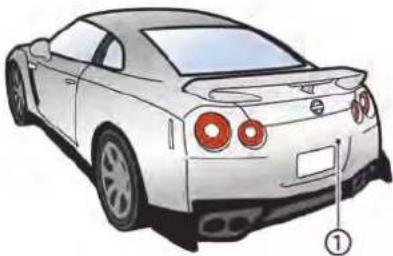
SYSTEMMAINTENANCE

CAUTION
- Donotusealcohol, benzineor thinnertocleanthecamera. This will caused discoloration. Toclean thecamera, wipewithacloth dampened with diluted mild cleaning agent and then wipe withadrycloth.
- Donotdamagethecameraasthe monitorscreenmaybeadversely affected.
VENTILATORS
If dirt, rain or snow accumulates on the camera ①, the RearView Monitor may not display objects clearly. Clean the camera by wiping it with a cloth dampened with a diluted mild cleaning agent and then wiping it with a dry cloth.


CENTERVENTILATORS
Adjust the air flow direction of the ventilators by moving the center knob (up/down, left/right) until the desired position is achieved.
SIDEVENTILATORS
Turning the center knob clockwise or counterclockwise will close or open the ventilators.
Adjust the air flow direction by moving the ventilators until the desired position is achieved.
Displayscreen, heater, airconditioner and audiosystems 4-9
HEATERANDAIRCONDITIONER

WARNING
•Theairconditionercoolingfunctionoperatesonlywhentheengineisrunning.
- Donotleavechildrenoradults whowouldnormallyrequirethe supportofothersaloneinyour vehicle.Petsshouldnotbeleft aloneeither.Onhot,sunnydays, temperaturesinaclosedvehicle couldquicklybecomehighenoughtocausesevereorpossibly fatalinjuriestopeopleoranimals.
- Donotusethere circulationmode forlongperiodsasitmaycause theinteriorairtobecomestale andthewindowstofogup.
Start the engine and operate the heater and air conditioner system.
NOTE:
- Odorsfrominsideandoutsidethe vehiclecanbuildupintheairconditionerunit.Odorcanenterthepassengercompartmentthroughthe vents.
- Whenparking, settheheaterandair conditionercontrolstoturnoffair
4-10 Displayscreen, heater, airconditioner and audiosystems
recirculationtoallowfreshairinto thepassengercompartment.This shouldhelpreduceodorsinsidethe vehicle.
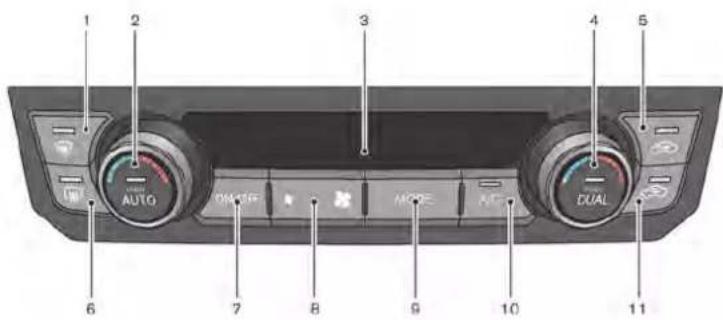
- front defroster button
- Temperature control dial (driver's side)/AUTO (automatic) button
- Display screen
- Temperature control dial (passenger's side)/DUAL zone control button
- outside air circulation button
- rear window defroster button ( "Rear window defroster switch" page 2-52)
- ON-OFF button
- fan speed control button
- MODE (manual air flow control) button
- A/C (air conditioner) button
- air recirculation button
AUTOMATICAIRCONDITIONER
Automaticoperation
Cooling and/or dehumidified heating (AUTO):
This mode may be used all year round as the system automatically works to keep a constant temperature. Air flow distribution and fan speed are also controlled automatically.
- Push the AUTO button on. (The indicator light on the button will illuminate.)
- Turn the temperature control dial on the driver's side to the left or right to
set the desired temperature.
- The temperature of the passenger compartment will be maintained automatically. Air flow distribution and fan speed are also controlled automatically.
- A visible mist may be seen coming from the vents in hot, humid conditions as the air is cooled rapidly. This does not indicate a malfunction.
- You can individually set driver's and front passenger's side temperature using each temperature control dial. When the DUAL zone control button is pushed or the passenger's side temperature control dial is turned, the indicator light on the DUAL zone control button will come on. To turn off the passenger's side temperature control, push the DUAL zone control button.
Heating(A/COFF):
The air conditioner does not activate in this mode. Only use this mode when you need to heat the vehicle.
- Push the AUTO button on. (The indicator light on the button will illuminate.)
- If the indicator light on the A/C button
is turned on, push the A/C button. (The indicator light will turn off.)
-
Turn the temperature control dial on the driver's side to set the desired temperature.
-
The temperature of the passenger compartment will be maintained automatically. Air flow distribution and fan speed are also controlled automatically.
- Do not set the temperature lower than the outside air temperature or the system may not work properly.
-
Not recommended if windows fog up.
-
You can individually set driver's and front passenger's side temperature using each temperature control dial. When the DUAL zone control button is pushed or passenger's side temperature control dial is turned, the DUAL indicator light will come on. To turn of the passenger's side temperature control, push the DUAL zone control button.
Dehumidifieddefrostingordefogging:
- Push the front defroster button on. (The indicator light on the button will come on.)
- Turn the temperature control dial on
the driver's side to set the desired temperature.
- To quickly remove ice from the outside of the windows, use the ✿ fan speed control button to set the fan speed to maximum.
- As soon as possible after the windshield is clean, push the AUTO button to return to the automatic mode.
When the front defroster button is pushed, the air conditioner will automatically be turned on at outside temperatures above 36° F ( 2° C) to defrost the windshield, and the air recirculation mode will automatically be turned off. Outside air is drawn into the passenger compartment to improve the defrosting performance.
Manualoperation
offFanspeedcontrol:
Push the ✿ fan speed control button to manually control the fan speed. Push the AUTO button to return to automatic control of the fan speed.
Airintakecontrol:
- Push the air recirculation button to recirculate interior air inside the vehicle. The indicator light on the
button will come on.
- Push the 📋 outside air circulation button to draw outside air into the passenger compartment. The 📋 indicator light on the button will come on.
- To switch to automatic control mode, push and hold the air recirculation button or the outside air circulation button (whichever one with an indicator light illuminated) for about 2 seconds. The indicator lights (both air recirculation and outside air circulation buttons) will flash twice, and then the air intake will be controlled automatically.
Airflowcontrol:
Push the MODE button repeatedly to change the air flow mode.

Air flows from the center and side ventilators.

Air flows from the center and side ventilators and the foot outlets.

Air flows mainly from the foot outlets.

Air flows from the defroster and foot outlets.
4-12 Displayscreen, heater, airconditioner and audiosystems
Turningthesystemon/off
Push the ON-OFF button.


air flow from the foot outlets may not operate. However, this is not a malfunction. After the coolant temperature warms up, the air flow from the foot outlets will operate normally.
The sensors Ⓐ and located on the instrument panel help maintain a constant temperature. Do not put anything on or around the sensors.
IN-CABINMICROFILTER
The air conditioning system is equipped with an in-cabin microfilter which collects dirt, dust, etc. To make sure the air conditioner heats, defogs, and ventilates efficiently, replace the filter in accordance with the maintenance schedule in the "9. Maintenance and schedules" section of this manual. It is recommended to see a NISSAN dealer or GT-R certified NISSAN dealer to replace the filter.
Thefiltershouldbereplacedifairflow isextremelydecreasedorwhenwindowsfogupeasilywhenoperating heaterorairconditioningsystem.
OPERATINGTIPS
When the engine coolant temperature and outside air temperature are low, the
Displayscreen, heater, airconditioner and audiosystems 4-13
ANTENNA
SERVICINGAIRCONDITIONER
The air conditioning system in your NISSAN is charged with a refrigerant designed with the environment in mind.
Thisrefrigerantwillnotharmthe earth'sozonelayer.However, special charging equipment and lubricant are required when servicing your NISSAN air conditioner. Using improper refrigerants or lubricants will cause severe damage to your air conditioning system. ( "Capacities and recommended fluids/lubricants" page 10-2)
Your NISSAN dealer or GT-R certified NISSAN dealer will be able to service your environmentally friendly air conditioning system.

WARNING
Thesystemcontainsrefrigerantunderhighpressure.Toavoidpersonal injury,anyairconditionerservice shouldbedoneonlybyanexperiencedtechnicianwiththeproper equipment.

WINDOWANTENNA
The antenna pattern is printed inside the rear window.

CAUTION
- Donotplacemetalizedfilmnear therearwindowglassorattach anymetalpartstoit. This may causepoorreceptionornoise.
- whencleaningtheinsideofthe rearwindow,becarefulnotto scratchordamagetherearwindowantenna.Lightlywipealong theantennawithadampened
softcloth.
4-14 Displayscreen, heater, airconditioner and audiosystems

SATELLITEANTENNA
The satellite antenna is located on the rear part of the vehicle roof.

CAUTION
•Abuildupoficeonthesatellite antennacanaffectradioperformance.Removetheicetorestore radioreception.
- Whenremovingsnowfromthe roof, donotapplystrongforceto thesatelliteantenna. That may cause breakensatelliteantenna androof paneldent.
- When using a high pressure car wash, keep the high pressure nozzle away from the satellite antenna. These may be deformed or damaged.
- Theradioperformancemaybe affectedifcargocarriedonthe roofblockstheradiosignal.If possible,donotputcargonear thesatelliteantenna.
CARPHONEORCBRADIO
When installing a car phone or a CB radio in your vehicle, be sure to observe the following cautions, otherwise the new equipment may adversely affect the electronic control modules and electronic control system harness.

WARNING
- Acellularphoneshouldnotbe usedforanypurposewhiledrivingsofullattentionmaybegiven tovehicleoperation.Somejurisdictionsprohibittheuseofcellularphoneswhiledriving.
- If you must make a call while your vehicle is in motion, the hands-free cellular phone operational mode (if so equipped) is highly recommended. Exercise extreme caution at all times of full attention may begin to vehicle operation.
- If you are unable to devote full attention to vehicle operation while talking on the phone, pull off the road to as a location and stop your vehicle.

CAUTION
- Keeptheantennaasfarawayas possiblefromtheelectroncontrolmodules.
- Keeptheantennawiremorethan 8in(20cm)awayfromthe electroniccontrolsystemharness.Donotroutetheantenna wirenexttoanyharness.
- Adjusttheantennastanding-waveratioasrecommendedby themanufacturer.
- Connectthegroundwirefromthe CBradiochassistothebody.
• Fordetails, it is recommended you visit a NISSAN dealer or GT-R certified NISSAN dealer.
5Startinganddriving
Precautionswhenstartinganddriving....5-3
Exhaustgas(carbonmonoxide)....5-3
Three-waycatalyst....5-3
TirePressureMonitoringSystem(TPMS)....5-4
Avoidingcollisionandrollover....5-7
Off-roadrecovery....5-8
Rapidairpressureloss....5-8
Drinkingalcohol/drugsanddriving....5-9
All-WheelDrive(AWD)driving safetyprecautions....5-9
Push-buttonignitionswitch....5-10
Operatingrangeforenginestart....5-10
Ignitionswitchoperation....5-11
Ignitionswitchpositions....5-11
Emergencyengineshutoff....5-12
IntelligentKeybatterydischarge....5-12
Beforestartingtheengine....5-13
Startingtheengine....5-14
Drivingthevehicle 5-15
VDC,transmissionandsuspension
setupswitches....5-25
Usageofeachmode....5-25
Howtoswitchthemodes....5-26
Featuresofeachmode....5-28
Turbochargersystem....5-32
Rmodestartfunction....5-33
HowtouseRmodestartfunction....5-34
Parkingbrake....5-34
Cruisecontrol 5-35
Precautionsoncruisecontrol....5-36
Steering-wheel-mountedcontrols....5-36
Indicatorsanddisplay 5-37
Cruisecontroloperations....5-37
HillStartAssistSystem....5-39
Break-inschedule....5-40
Wheelalignment....5-40
FuelEfficientDrivingTips....5-41
Increasingfueleconomy....5-42
All-WheelDrive(AWD) 5-43
AWDwarninglight....5-43
Tightcornerbrakingphenomenon....5-44
Tires....5-44
AWDsystemcharacteristics....5-45
LimitedSlipDifferential(LSD) 5-45
Parking/parkingonhills....5-46
Sonarsystem....5-48
Sonarindicator....5-49
SonarsystemOFFswitch....5-50

Sonarsystemsetting....5-50
Powersteering....5-51
Brakesystem....5-52
Brakingprecautions....5-52
Parkingbrakebreak-in....5-52
Brakeassist....5-53
Anti-lockBrakingSystem(ABS)....5-53
VehicleDynamicControl(VDC)system....5-54
Coldweatherdriving....5-57
Freeingafrozendoorlock....5-57
Anti-freeze....5-57
Battery 5-57
Drainingofcoolantwater....5-57
Tireequipment 5-57
Specialwinterequipment....5-57
Drivingonsnoworice....5-57
Engineblockheater(ifsoequipped)......5-58
Exhaustsoundcontrolsystem(if soequipped)....5-59
Activenoisecancellation(ifsoequipped)/
Activesoundenhancement(ifsoequipped)....5-59
Activenoisecancellation....5-60
Activesoundenhancement....5-60
PRECAUTIONSWHENSTARTING ANDDRIVING

WARNING
- Donotleavechildrenoradults whowouldnormallyrequirethe supportofothersaloneinyour vehicle.Petsshouldnotbeleft aloneeither.Theycouldaccidentallyinjurethemselvesorothersthroughinadvertentoperationof thevehicle.Also,onhot,sunny days,temperaturesinaclosed vehiclecouldquicklybecome highenoughtocausesevereor possiblyfatalinjuriestopeopleor animals.
- Closelysupervisechildrenwhen theyarearoundcarstoprevent themfromplayingandbecoming lockedinthetrunkwherethey couldbeseriouslyinjured.Keep thecarlocked,withtherearseat-backandtrunklidsecurely latchedwhennotinuse,and preventchildren'saccesstocar keys.
EXHAUSTGAS(carbonmonoxide)

WARNING
- Donotbreatheexhaustgases; theycontaincolorlessandodor-lesscarbonmonoxide. Carbon monoxide is dangerous. It can cause unconsciousness or death.
- Ifyoususpectthatexhaustfumes areenteringthevehicle,drive withallwindowsfullyopen,and havethevehicleinspectedimmediately.
- Donotruntheengineinclosed spacessuchasagarage.
- Donotparkthevehiclewiththe engineerunningforanyextended lengthoftime.
- Keepthetrunklidclosedwhile driving,otherwiseexhaustgases couldbedrawnintothepassengercompartment.Ifyoumust drivewiththetrunklidopen, followtheseprecautions: a.Openallthewindows.
b.Setthe airrecirculationto offandthefancontroltohigh tocirculatetheair.
•Theexhaustsystemandbody shouldbeinspectedbyaqualifiedmechanicwhenever:
—Thevehicleisraisedforservice.
—Yoususpectthatexhaust fumesareenteringintothe passengercompartment.
—Younoticeachangeinthe soundoftheexhaustsystem.
—Youhavehadanaccident involvingdamagetotheex-haustsystem,underbody,or rearofthevehicle.
THREE-WAYCATALYST
The three-way catalyst is an emission control device installed in the exhaust system. Exhaust gases in the three-way catalyst are burned at high temperatures to help reduce pollutants.

WARNING
•Theexhaustgasandtheexhaust systemareveryhot.Keeppeople, animalsorflammablematerials awayfromtheexhaustsystem components.
Startinganddriving5-3
- Donotstoporparkthevehicle overflammablematerialssuchas drygrass,wastepaperorrags. Theymayigniteandcauseafire.
NOTICE
- Donotuseleadedgasoline.Depositsfromleadedgasolineseriouslyreducethethree-way catalyst'sabilitytohelpreduce exhaustpollutants.
- Keepyourenginetunedup.Malfunctionsintheignition,fuelinjection,orelectricalsystemscan causeoverrichfuelflowintothe three-waycatalyst,causingitto overheat.Donotkeepdrivingif theenginemisfires,orifnoticeablelossofperformanceorother unusualoperatingconditionsare detected.Itisrecommendedyou havethevehicleinspected promptlybyaGT-Rcertified NISSANdealer.
-
Avoiddrivingwithanextremely lowfuellevel.Runningoutoffuel couldcausetheenginetomisfire, damagingthethree-waycatalyst.
-
Donotracetheenginewhile warmingitup.
- Donotpushortowyourvehicle tostarttheengine.
TIREPRESSUREMONITORING SYSTEM(TPMS)
Each tire should be checked monthly when cold and inflated to the inflation pressure recommended by the vehicle manufacturer on the vehicle placard or tire inflation pressure label. (If your vehicle has tires of a different size than the size indicated on the vehicle placard or tire inflation pressure label, you should determine the proper tire inflation pressure for those tires.)
As an added safety feature, your vehicle has been equipped with a Tire Pressure Monitoring System (TPMS) that illuminates a low tire pressure telltale when one or more of your tires is significantly under-inflated. Accordingly, when the low tire pressure telltale illuminates, you should stop and check your tires as soon as possible, and inflate them to the proper pressure. Driving on a significantly under-inflated tire causes the tire to overheat and can lead to tire failure. Under-inflation also reduces fuel efficiency and tire tread life, and may affect the vehicle's handling and stopping ability. If the vehicle is being driven with one or more flat tires, the low tire pressure warning light will illuminate continuously and a chime will sound for 10 seconds. The chime will only sound at the first indication of a flat tire, and the warning light will illuminate continuously. When the flat tire warning is activated, it is recommended you have the system reset and the tire checked and replaced if necessary by a GT-R certified NISSAN dealer. Even if the tire is inflated to the specified COLD tire pressure, the warning light will continue to illuminate until the system is reset. Your vehicle can be driven for a limited time on a flat tire ("Run-flat tires" page 8-37)
Please note that the TPMS is not a substitute for proper tire maintenance, and it is the driver's responsibility to maintain correct tire pressure, even if under-inflation has not reached the level to trigger illumination of the TPMS low tire pressure telltale.
Your vehicle has also been equipped with a TPMS malfunction indicator to indicate when the system is not operating properly. The TPMS malfunction indicator is combined with the low tire pressure tell-
tale. When the system detects a malfunction, the telltale will flash for approximately one minute and then remain continuously illuminated. This sequence will continue upon subsequent vehicle start-ups as long as the malfunction exists. When the malfunction indicator is illuminated, the system may not be able to detect or signal low tire pressure as intended. TPMS malfunctions may occur for a variety of reasons, including the installation of replacement or alternate tires or wheels on the vehicle that prevent the TPMS from functioning properly. Always check the TPMS malfunction telltale after replacing one or more tires or wheels on your vehicle to ensure that the replacement or alternate tires and wheels allow the TPMS to continue to function properly.
Additionalinformation
- The TPMS will activate only when the vehicle is driven at speeds above 16 MPH (25 km/h). Also, this system may not detect a sudden drop in tire pressure (for example a flat tire while driving).
- The low tire pressure warning light does not automatically turn off when the tire pressure is adjusted. After the tire is inflated to the recommended
pressure, the vehicle must be driven at speeds above 16 MPH (25 km/h) to activate the TPMS and turn off the low tire pressure warning light. Use a tire pressure gauge to check the tire pressure.
- The "TIRE LOW PRESSURE - VISIT DEALER" warning appears in the vehicle information display when the low tire pressure warning light is illuminated and low tire pressure is detected. The "TIRE LOW PRESSURE - VISIT DEALER" warning turns off when the low tire pressure warning light turns off.
The "TIRE LOW PRESSURE - VISIT DEALER" warning appears each time the ignition switch is placed in the "ON" position as long as the low tire pressure warning light remains illuminated.
The "TIRE LOW PRESSURE - VISIT DEALER" warning does not appear if the low tire pressure warning light illuminates to indicate a TPMS malfunction.
- The "FLAT TIRE - VISIT DEALER" warning appears in the vehicle information display when the low tire pressure warning light is illuminated and one or more flat tires are detected.
●Tire pressure rises and falls depending on the heat caused by the vehicle's operation and the outside temperature. Do not reduce the tire pressure after driving because the tire pressure rises after driving. Low outside temperature can lower the temperature of the air inside the tire which can cause a lower tire inflation pressure. Altitude can also affect tire pressure. These may cause the low tire pressure warning light to illuminate. If the warning light illuminates, check the tire pressure for all four tires.
- GT-R vehicles are delivered from the factory with nitrogen-filled tires. For best performance, NISSAN recommends that GT-R owners maintain their vehicles by using nitrogen for tire inflation. Because nitrogen is more stable than compressed air, it is less prone to pressure fluctuation resulting from temperature variations. If nitrogen is not available, compressed air may be safely used under normal driving conditions. However, NISSAN recommends refilling with Nitrogen for maximum tire performance.
●The Tire and Loading Information label (also referred to as the vehicle placard or tire inflation pressure label) is located in the driver's door opening.
Startinganddriving5-5
- You can also check the pressure of all tires on the touch screen display. Refer to the separate Multi Function Display Owner's Manual.
●The tire pressure sensor should be reset anytime the wheels or tires are removed or replaced. - If the tire is removed in order to replace the tire pressure sensor battery, it may not be possible to reuse the removed tire from the wheel. To replace the tire pressure sensor battery, it is recommended you contact a GT-R certified NISSAN dealer.

WARNING
- Ifthelowtirepressurewarning lightilluminateswhiledriving, avoidsuddensteeringmaneu-versorabruptbraking,reduce vehiclespeed,pullofftheroad toasafelocationandstopthe vehicleassoonaspossible.Drivingwithunder-inflatedtiresmay permanentlydamagethetires andincreasethelikelihoodoftire failure.Seriousvehicledamage couldoccurandmayleadtoan accidentandcouldresultinseriouspersonalinjury.Checkthe
tirepressureforallfourtires. Adjustthetirepressuretothe recommendedCOLDtirepressure shownontheTireandLoading Informationlabeltoturnthelow tirepressurewarninglightoff.If thelightstillilluminateswhile drivingafteradjustingthetire pressure,atiremaybeflat ( "Run-flattires"page6-4)or theTPMSmaybemalfunctioning. Ifnotireisflatandalltiresare properlyinflated,havethevehicle checked.Itisrecommendedyou havethevehiclecheckedbya GT-RcertifiedNISSANdealer.
- Although you can continued driving with a punctured run-flattire, remember that vehicle handling stability is reduced, which could lead to an accident and personal injury. Also, driving along distance at high speeds may damage the tires.
- Donotdriveatspeedsabove50 MPH(80km/h)anddonotdrive morethan50miles(80km)with a puncturedrun-flattire.Theactual distancethevehiclecanbedriven onaflattiredependsonoutside temperature,vehicleload,road
conditionsandotherfactors.
- Whenawheelisreplaced, the TPMSwillnotfunctionandthe lowtirepressurewarninglight willflashforapproximately1 minute. Thelightwillremainon after1minute. It is recommended you contact your GT-Rcertified NISSAN dealerassoonaspossible fortirereplacement and/or system resetting.
- Replacingtireswiththosenot originallyspecifiedbyNISSAN couldaffecttheproperoperation oftheTPMS.
- Donotinjectanytireliquidor aerosoltiresealantintothetires, asthismaycauseamalfunction ofthetirepressuresensors.
NOTICE
- The TPMS may not function properly when the wheels are equipped with tire chains or the wheels are buried in snow.
•TheTPMSmaynotfunctionproperlyiftheTPMSsensorisnot resetandwhenwheels/tiresfrom
anotherGT-Rareinstalledon yourvehicle.
- TheTPMSwillnotfunctionproperlyifnon-GT-Rwheelsareinstalledonthevehicle.
- Donotplacemetalizedfilmor anymetalparts(antenna,etc.)on thewindows.Thismaycause poorreceptionofthesignals fromthetirepressuresensors, andtheTPMSwillnotfunction properly.
Some devices and transmitters may temporarily interfere with the operation of the TPMS and cause the low tire pressure warning light to illuminate. Some examples are:
- Facilities or electric devices using similar radio frequencies are near the vehicle.
- If a transmitter set to similar frequencies is being used in or near the vehicle.
- If a computer (or similar equipment) or a DC/AC converter is being used in or near the vehicle.
Low tire pressure warning light may illuminate in the following cases.
- If the vehicle is equipped with a wheel and tire without TPMS.
- If the TPMS has been replaced and the ID has not been registered.
- If the wheel is not originally specified by NISSAN.
FCCNotice:
ForUSA:
This device complies with Part 15 of the FCC Rules. Operation is subject to the following two conditions: (1) This device may not cause harmful interference, and (2) this device must accept any interferencereceived, including interference that may cause undesired operation.
Note: Changesormodificationsnot expresslyapprovedbythepartyresponsibleforcompliancecouldvoid theuser'sauthoritytooperatethe equipment. ForCanada:
This device complies with Industry Canada licence-exempt RSS standard(s). Operation is subject to the following two conditions: (1) this device may not cause interference, and (2) this device must accept any interference, including interference that may cause undesired operation of the device.
AVOIDINGCOLLISIONANDROLL-OVER

WARNING
Failuretooperatethisvehicleina safeandprudentmannermayresult inlossofcontroloranaccident.
Be alert and drive defensively at all times. Obey all traffic regulations. Avoid excessive speed, high speed cornering, or sudden steering maneuvers, because these driving practices could cause you to lose control of your vehicle. Aswith anyvehicle, alossofcontrol could resultinacollisionwithothervehicles orobjects, orcausethevehicletorollover, particularlyifthelossofcontrol causesthevehicletoslidesideways. Be attentive at all times, and avoid driving when tired. Never drive when under the influence of alcohol or drugs (including prescription or over-the-counter drugs which may cause drowsiness). Always wear your seat belt as outlined in this manual, and also instruct your passengers to do so. ("Seat belts" page 1-6) Seat belts help reduce the risk of injury in collisions and rollovers. Inarollover crash, an unbeltedorimproperlybelted
Startinganddriving5-7
personissignificantlymorelikelytobe injuredorkilledthanapersonproperly wearingaseatbelt.
OFF-ROADRECOVERY
While driving, the right side or left side wheels may unintentionally leave the road surface. If this occurs, maintain control of the vehicle by following the procedure below. Please note that this procedure is only a general guide. The vehicle must be driven as appropriate based on the conditions of the vehicle, road and traffic.
- Remain calm and do not overreact.
- Do not apply the brakes.
- Maintain a firm grip on the steering wheel with both hands and try to hold a straight course.
- When appropriate, slowly release the accelerator pedal to gradually slow the vehicle.
- If there is nothing in the way, steer the vehicle to follow the road while the vehicle speed is reduced. Do not attempt to drive the vehicle back onto the road surface until vehicle speed is reduced.
- When it is safe to do so, gradually turn the steering wheel until both tires return to the road surface. When all
tires are on the road surface, steer the vehicle to stay in the appropriate driving lane.
- If you decide that it is not safe to return the vehicle to the road surface based on vehicle, road or traffic conditions, gradually slow the vehicle to a stop in a safe place off the road.
RAPIDAIRPRESSURELOSS
Rapid air pressure loss or a "blow-out" can occur if the tire is punctured or is damaged due to hitting a curb or pothole. Rapid air pressure loss can also be caused by driving on under-inflated tires.
Rapid air pressure loss can affect the handling and stability of the vehicle, especially at highway speeds.
Help prevent rapid air pressure loss by maintaining the correct air pressure and visually inspect the tires for wear and
e damage. ( "Wheels and tires" page 8-29)
If a tire rapidly loses air pressure or "blows-out" while driving maintain control of the vehicle by following the procedure below. Please note that this procedure is only a general guide. The vehicle must be driven as appropriate based on the conditions of the vehicle, road and traffic.

WARNING
The following actions can increase the chance of losing control of the vehicle if there is sudden loss of air pressure. Losing control of the vehicle may cause a collision and result in personal injury.
- Thevehiclegenerallymovesor pullsinthedirectionoftheflat tire.
• Donotrapidlyapplythebrakes. - Donotrapidlyreleasetheacceleratorpedal.
-
Donotrapidlyturnthesteering wheel.
-
Remain calm and do not overreact.
- Maintain a firm grip on the steering wheel with both hands and try to hold a straight course.
- When appropriate, slowly release the accelerator pedal to gradually slow the vehicle.
- Gradually steer the vehicle to a safe location off the road and away from traffic if possible.
- Lightly apply the brake pedal to gra-
5-8 Startinganddriving
dually stop the vehicle.
- Turn on the hazard warning flashers and contact a roadside emergency service to change the tire.
DRINKINGALCOHOL/DRUGSAND DRIVING

WARNING
Neverdriveundertheinfluence of alcoholordrugs. Alcohol in the bloodstream reduces coordination, delays reaction time and impairs judgement. Driving after drinking alcohol increasestehelikelihood of being involved in an accident injury yourself and others. Additionally, if you are injured in an accident, alcohol can increase the severity of the injury.
NISSAN is committed to safe driving. However, you must choose not to drive under the influence of alcohol. Every year thousands of people are injured or killed in alcohol-related accidents. Although the local laws vary on what is considered to be legally intoxicated, the fact is that alcohol affects all people differently and most people underestimate the effects of alcohol.
Remember, drinking and driving don't mix! And that is true for drugs, too (over-the-counter, prescription, and illegal drugs). Don't drive if your ability to operate your vehicle is impaired by alcohol, drugs, or some other physical condition.
ALL-WHEELDRIVE(AWD)DRIVING SAFETYPRECAUTIONS

WARNING
- Donotdrivebeyondtheperformancecapabilityofthetires, evenwithAWDengaged.Acceleratingquickly,sharpsteering maneuversorsuddenbraking maycauselossofcontrol.
●Alwaysusethespecifiedtireson allfourwheels.Installtirechains ontherearwheelswhendriving onslipperyroadsanddrivecarefully. - Thisvehicleisnotdesignedfor offroad(roughroad)use.Donot driveonsandyormuddyroads thattiresmaygetstuckin.
- Donotattempttoraisetwo wheelsoffthegroundandshift
thetransmissionoany A→Mor R positionwiththeengineerunning.Doingsomayresultin drivetraindamageorunexpected vehiclemovementwhichcould resultinseriousvehicledamage orpersonalinjury.
- DonotattempttotestanAWD equippedvehicleona2-wheel dynamometer,(suchasthedynamometersusedbysome statesforemissionstesting),or similarequipmentevenifthe othertwowheelsareraisedoff theground.Makesureyouinform testfacilitypersonnelthatyour vehicleisequippedwithAWD beforeitisplacedonadynamometer.Usingthewrongtest equipmentmayresultindrive-traindamageorunexpectedvehiclemovementwhichcould resultinseriousvehicledamage orpersonalinjury.
- Whenawheelisofftheground duetoanunlevelsurface, donot spinthewheelexcessively.
PUSH-BUTTONIGNITIONSWITCH

WARNING
Donotoperatethepush-button ignitionswitchwhiledrivingthevehicleexceptinanemergency.(The enginewillstopwhentheignition switchispushedthreeconsecutive timesortheignitionswitchis pushedandheldformorethan2 seconds.)Iftheenginestopwhile thevehicleisbeingdriven,thiscould leadtoacrashandseriousinjury.
Before operating the push-button ignition switch, be sure to move the shift lever to the p position.
be possible to start the engine.
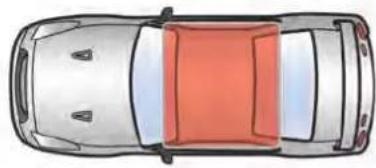
OPERATINGRANGEFORENGINE START
The operating range for starting the engine inside the vehicle is shown in the illustration.
- If the Intelligent Key is on the instrument panel, rear parcel shelf, inside the glove box, door pocket, cup holders or console box, or the corner of the passenger compartment, it may not be possible to start the engine. Carry the Intelligent-Key and try to start the engine again.
- If the Intelligent Key is near the door or door glass outside the vehicle, it may
5-10 Startinganddriving
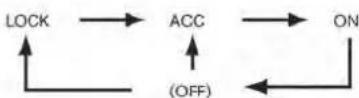

IGNITIONSWITCHOPERATION
When the Intelligent Key is carried with you and the ignition switch is pushed without depressing the brake pedal, the ignition switch position will change as follows:
- Push center once to change to ACC.
- Push center two times to change to ON.
- Push center three times to change to OFF. (No position illuminates.)
- Push center four times to return to ACC.
- Open or close any door to return to LOCK during the OFF position.
IGNITIONSWITCHPOSITIONS
LOCK(Normalparkingposition)
The ignition switch can only be locked in this position.
The ignition switch will be unlocked when it is pushed to the ACC position while carrying the Intelligent Key or with the Intelligent Key inserted in the port.
ACC(Accessories)
This position activates electrical accessories such as the radio, when the engine is not running.
ON(Normaloperatingposition)
This position turns on the ignition system and electrical accessories.
OFF
The engine can be turned off without locking the steering wheel.
The ignition lock is designed so that the ignition switch cannot be switched to the LOCK position until the shift lever is moved to the p position.
NOTE:
- If the steeringlock release malfunction indicator appears on the vehicle information display when the ignition switch is pressed, press the ignition switch again while slightly turning the steering wheel left and right. ( "Steeringlock release malfunction indicator" page 2-47)
- Iftheshift P warningappearsonthe vehicleinformationdisplaywhen theignitionswitchispushed,the shiftleverisinanypositionexcept the P position.Movetheshiftlever tothe P position.(“Shift”P" warning”page2-46)
- If the Intelligent Key battery discharge indicator appears on the vehicle information display, the Intelligent Key battery is discharged and the ignition switch will not operate. Insert the Intelligent Key into the key port to operate the ignition switch. ( "Intelligent Key battery discharge indicator" page 2-48)
- Whenallofthefollowingconditions aremetfor60minutes,thebattery saversystemwillcutoffthepower supplytopreventbatterydischarge.
- TheignitionswitchisintheACC
Startinganddriving5-11
position,and
— Alldoorsareclosed, and
— Theshiftleverisinthe p position.
- Donotleavethevehiclewiththe ignitionswitchintheACCorON positionwhentheengineisnot runningforanextendedperiodof time.Thisdischargethebattery.
EMERGENCYENGINESHUTOFF
To shut off the engine in an emergency situation while driving, perform the following procedure:
●Rapidly push the push-button ignition switch 3 consecutive times in less than 1.5 seconds, or
- Push and hold the push button ignition switch for more than 2 seconds.

INTELLIGENTKEYBATTERYDIS- CHARGE
If the battery of the Intelligent Key is almost discharged, the guide light ① of the Intelligent Key port blinks and the indicator appears on the vehicle information display. (1) "Intelligent Key Insertion indicator" page 2-47
In this case, inserting the Intelligent Key into the port allows you to start the engine. Make sure that the mechanical key side faces backward as illustrated. Insert the Intelligent Key in the port until it is latched and secured.
To remove the Intelligent Key from the
port, push the ignition switch to the OFF position and pull the Intelligent Key out of the port.
NOTICE
Neverplaceanythingexceptthe IntelligentKeyinthelIntelligentKey port.Doingsomaycausedamageto theequipment.
5-12 Startinganddriving

NOTE:
●MakesuretheIntelligentKeyisin thecorrectdirectionwheninserting itintotheIntelligentKeyport.The enginemaynotstartifitisinthe incorrectdirection.
- RemovetheIntelligentKeyfromthe IntelligentKeyportaftertheignition switchispushedtotheOFFposition.
- The Intelligent Keyport does not charge the Intelligent Key battery. If you seethelow battery indicator in the vehicle information display, replace the battery as soon as possible. ( "Intelligent Key battery
replacement"page8-25)
BEFORESTARTINGTHEENGINE
●Make sure the area around the vehicle is clear.
- Check fluid levels such as engine oil, coolant, brake fluid and window washer fluid as frequently as possible, or at least whenever you refuel.
- Check that all windows and lights are clean.
- Visually inspect tires for their appearance and condition. Also check tires for proper inflation.
- Lock all doors.
- Position seat.
-Adjust inside and outside mirrors.
- Fasten seat belts and ask all passengers to do likewise.
- Check the operation of warning lights when the ignition switch is pushed to the ON position. ( "Warning lights, indicator lights and audible reminders" page 2-26)
Startinganddriving5-13
STARTINGTHEENGINE
NOTE:
- Thisvehicleincludessparkplugs thataredesignedformaximum performance.Ifthestarttimebecomeslonger,theplugsmaybe fouled,makingtheengineedifficult tostart.Ifthisoccurs,startthe engineusingtheproceduredescribedinthissection.
- Aclicksoundmaybeheardwhen thebrakepedalisdepressedand released. Thisisnormal.
- Alowrattlingoperatingsoundmay occurwhentheengineisstartedor stopped. Thisisbecauseofthe transmissiongeardesign, lightfly-wheelanddrysumplubrication systemusedinthistransmersion. Thisdoesnotindicate thatthereis amalfunction. Thissoundislikelyto occurinparticulariftheengineis stoppedwhenthetemperatureof thetransmissionoilishigh.
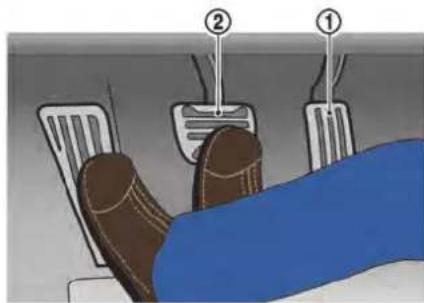
- Check the positions of the accelerator pedal ① and brake pedal ② Adjust the steering wheel and seat positions so that the correct driving posture is achieved. ( "Front seats" page 1-3)
- Check that the parking brake is engaged.
- Check that the shift lever is in the or N position. P's recommended.)
- Firmly depress the brake pedal. Without depressing the accelerator pedal, push the ignition switch once to start the engine.
- To stop the engine, move the shift lever to the p position, and push the ignition switch to the OFF position.
NOTE:
- Careshouldbetakentoavoidsituationsthatcanleadtopotential batterydischargeandpotentialno-startconditionssuchas:
a. Installationorextendeduseof electronicaccessoriesthatconsumebatterypowerwhenthe engineisnotrunning(Phone chargers,GPS,DVDplayers,etc.)
b.Vehicleisnotdrivenregularly and/oronlydrivenshortdistances. Inthesecases,thebatterymayneed tobechargedtomaintainbattery health.
- Iftheengineisdifficulttostart, depresstheacceleratorpedalall thewaytothefloorandholdit. Pushtheignitionswitchwiththe brakepedaldepressedtostart crankingtheengine.After5or6 seconds,stopcrankingbypushing theignitionswitchtotheOFFposition,andthenreleasetheacceleratorpedal.Thenperformsteps1to5 tostarttheengine.Iftheengine starts,butfailstorun,repeatthis procedure.
- Startingandstoppingtheengine overashortperiodoftimemay
makethevehiclemoredifficultto start.Ifthisoccurs,waitformore than3minutes,andthenpushthe ignitionswitchagaintostartthe engine.
- Tomaintainhighperformanceover alongperiodoftime,theengine speedislimitedto4,300rpmwhen theengineisrevvedwiththeshift leverinthe N or position,andto 4,000rpmwhentheengineoilor coolanttemperatureisloworhigher thannormal.
- If the ignition switch is pushed before the shift lever is moved to the position, the ignition switch will not change the OFF position. If this occurs, the SHIFT warning display appears on the vehicle information display. When stopping the engine, besuretomovetheshift levertothe position and then push the ignition switch. Failure to dosomay result in discharge of the battery. (Shift "P" warning page 2-46)
- Iftheshiftleverwasinthe A←M or R positionwhentheenginewas stopped,thenbesuretomovethe shiftlevertothe P positionbefore startingtheenginethenexttime.If
theengineisstartedwiththeshift leverinthe N position,thenitmay notbepossibletodrivethevehicle evenwhentheshiftleverismoved tothe A↔M or R position.Ifthis occurs,theSHIFT P warningappears on thevehicle information display. ( "Shift"P"warning"page2-46)
CAUTION
If the engine was stopped soon when the engine is shot, the cooling fan may operate for approximately 2 minutes after the engine was stopped to cool the components in the engine compartment. When the cooling fan is operating, besure that hands or other items donot get caught init.
DRIVINGTHEVEHICLE
DUALCLUTCHTRANSMISSION
The GT-R dual clutch transmission is a newly-developed system that uses an electronically controlled multiple-disc wet clutch attached to the highly efficient manual transmission. This transmission has two driving modes.
- A position (Automatic gearshift): allows automatic shifting of the manual transmission.
- M position (Manual gearshift): allows quick shifting of the manual transmission.
NOTE:
When starting or driving on a steeep uphill grade, shift to the M position and operate the paddleshift to shift down to 1st gear similar to a manual transmission vehicle.
The GT-R dual clutch transmission was developed specifically to maximize vehicle performance and driving enjoyment. The GT-R transmission components were designed using different engineering standards than typical passenger car transmissions. Because of this, the GT-R has different operating characteristics, and various rattle noises may be heard during some driving conditions because
of the following items:
●Gear clearances
•Ultralight flywheel
•Dry sump lubrication
These noises do not indicate that there is a malfunction.

WARNING
- Donotdepresstheaccelerator pedalwhileshiftingfromthe
P or
N positiontotheor←R A position.Alwaysdepressthe brakepedaluntilshiftingiscompleted.Failureretodosocould causelossofcontrolandan accident.
•Coldengineidlespeedishigh,so usecautionwhenshiftingintoa forwardorreversegearbefore theenginehaswarmedup.
- Nevershifttoeitherthe P or positionwhilethevehicleismovingforwardand P or+A positionwhilethevehicleisreversing. Thiscouldcauseanaccidentor damagethetransmission.
- Theshiftlevercontainsapowerfulmagnet.Donotplaceelectro-
nicmedicaldevicesorother electronicproductsthataresusceptibletomagneticforceclose totheshiftlever.
- Donotdownshiftabruptlyon slipperyroads. This may cause a loss of control.
- Iftheshiftleverismovedfrom to←A position, or←tA M R positionbeforethevehiclestops, youmaynotbeabletoshiftgear or it may take longer to shift gear. Makesuretodepressthebrake pedalandcheckthatthevehicle hasstoppedbeforeshifting.

CAUTION
- Because the vehicle includes a dual clutch transmission that automatically control the clutch and shifting operation of the manual transmission, whenever the shift lever is in position other than P or N the vehicle will begin to move slowly, in the same way as when the clutch china manual transmission vehicle is partially engaged. Keep the brake pedal firmly depressed when the
vehicle is stopped. In some circumstance the vehicle may not start moving on its own, however this does not indicate that there is an malfunction.
NOTICE
- To avoid possible damage to your vehicle;whenstoppingthevehicle on an uphill grade, do not hold the vehicleinplaceby depressing theaccelerator pedal.Doing so maycausetheclutchtooverheat andresultintransmissiondamage.Usethebrakestoprevent thevehiclefrommoving.
●TheGT-Rdual clutchtransmissionisprovidedwithadrysumplubricationsystemthatimproves efficiencyandensuresreliability underhighg-forceconditions. Whenoilviscosityishighatlow temperatures,ittakeslongerfor allcomponentstobesufficiently lubricated.Thus,whentethransmissiontemperatureislow(approximately104°F(40°C),donot acceleraterapidlyorruntheenginefasterthan4,000rpm.

![graph TD P["Region P"] --> R["Region R"] R --> N["Region N"] N --> A["Region A"] A --> M["Region M"] M --> N style P fill:#f9f,stroke:#333 style R fill:#bbf,stroke:#333 style N fill:#bfb,stroke:#333 style A fill:#ffb,stroke:#333 style M fill:#fbb,stroke:#333](/content/2026/05/810568/images/89ac6f1cf71d1e423f3d48171e75ada6a9d92342a731d8d52fd27af83de338b7.jpg)
Operatingtheshiftlever
After starting the engine, fully depress the brake pedal and move the shift lever from the P position to the , R or N → A M position. Push the button to shift into the P or R position. All other positions can be selected without pushing the button.
| Shift lever operation | |
| Push the button while depressing the brake pedal. | |
| Push the button. | |
| Just move the shift lever. | |
| Automatically returns. | |
P position:
Use this position for parking and starting the engine. The ignition switch will be changed to the OFF or LOCK position.
CAUTION
Usethepositiononlywhenthe vehicleiscompletelystopped.
R position:
Use this position for driving in reverse. A chime will sound inside the vehicle and a warning will appear in the vehicle information display if the shift lever is in the position for more than 5 minutes, or when the driver's door is opened while the shift lever is in the position.
N position:
Neither forward nor reverse gear is engaged.
A→Mposition:
Use this position for all normal forward driving. The shift lever can be moved between A and m alternately change each other. The position indicator indicates the gear position with the indication of "A" or "M".
- A position: Use this position for ordinary driving, with the gears shifted automatically from first gear to sixth gear according to the speed and driving conditions.
- M position: Operate the paddle shifter to drive in first gear to sixth gear as desired.
- The position indicator blinks if it is not possible to shift the gear. ( "Transmission position indicator" page 2-10)


CAUTION
●Griptheshiftlevercorrectlywhen operatingit.Failureretodosomay causeafingerorotheritemsto betrappedbetweentheleverand gate,possiblycausinganaccident.
- Because rolling resistance is reduced in the GT-R, the vehicle can move when on road with a slight gradient, even when in the N position. Besuretodepress the brake pedal.
NOTICE
- Besuretoobservethefollowing precautions. Failuretodosomay resultinshiftlevermalfunction.
—Donotspillwater, beverages or other liquidsontheshift lever.
—Donotallowsandorsimilar substanceocontactthe shiftlever. - Developthehabitofperforming theoperationsmarkedwith" withoutpressingthebutton.If thebuttonispressedatthese times,thereisthepossibilitythat thelevercouldaccidentallyenter the P orP'positions.
- When the vehicle is shot, the area around the shift lever may be hot or may produce an unusual sound, however this does not indicate that there is a malfunction.
- Avoiddepressingthebrakeand acceleratorpedalsatthesame time.Depressingbothpedalsat thesametimecouldcausethe clutchtooverheatandaccelerate

deterioration.
NOTE:
- Whenmovingtheshiftleverout of the ▶ position, it may not be possible to movetheshiftleverif the button is pressed before the brake pedal is depressed. Pressthebutton only after depressing the brake pedal.
- Donotplacecoinsorothersmall objectsintheareaaroundtheshift lever. Theseobjectsmaygetstuckin theshiftgateandpreventtheshift leverfrommovingintoaposition. Sometimes, you may not be able to retrieve these objects.
- Immediatelyafteracoldstart,while thetransmissionsystemcheckdisplay("T/MSYSTEMCHECKINPROCESS")appearsonthevehicle informationdisplay,theshiftlever cannotbemovedoutofthe position.Thisisbecauseacheckof thetransmissionsystemisinprogress.Thisdoesnotindicate that thereisamalfunction.Movethe shiftleverafterthemessageonthe vehicleinformationdisplayturnsoff.
•Theshiftleverknobandconsole-
mountedshiftindicatorhaveagenuineleatherfinishthatrequires propercareandmaintenance. ( "Cleaninginterior"page7-5)

Shiftlockrelease
If the battery charge is low or discharged, the shift lever may not be moved from the
P position even with the brake pedal depressed and the shift lever button pushed.
To move the shift lever, perform the following procedure.
- Push the ignition switch to the OFF or LOCK position.
- Apply the parking brake.
- Remove the shift lock cover using a suitable tool wrapped with a cloth.
-
Push down the shift lock as illustrated.
-
Push the shift lever button and move the shift lever to the N position while holding down the shift lock. Push the ignition switch to the ON position to unlock the steering wheel. Now the vehicle may be moved to the desired location. If the battery is discharged completely, the steering wheel cannot be unlocked. Do not move the vehicle with the steering wheel locked.
NOTICE
If the shift lever cannot be removed out of the position after performing the shift lock release procedure, it is recommended you immediately have the vehicle inspected by a GT-R certified NISSAN dealer.
Adaptiveshiftcontrol
The adaptive shift control system automatically operates when the transmission is in the A position and selects an appropriate gear depending on the road conditions such as uphill, downhill or curving roads.
Controlonuphillandcurvingroads:
A low gear is maintained that suits the degree of the slope or curve to allow smooth driving with a small number of shifts.
Controlondownhillroads:
The adaptive shift control system shifts to a low gear that suits the degree of the slope, and uses the engine brake to reduce the number of times that the foot brake must be used.
Controlonwindingroads:
A low gear is maintained on continuous curves that involve repeated acceleration and deceleration, so that smooth acceleration is available instantly when the accelerator pedal is depressed.
NOTE:
Adaptiveshiftcontrolmaynotoperate whenthetransmissionoiltemperature islowimmediatelyafterthestartof drivingorwhenitisveryhot.Ifthis occurs,switchtothe M positionand downshiftifnecessary.
M position
Changingtotheposition:
To change to the M position from the A position, either move the shift lever to the M side or operate the paddle shifter. The position indicator indicates the gear position with the indication of "M".
If the paddle shifter is used, in one operation the A position changes to the M position and the gear position shifts (except for downshifting from 2nd gear to 1st gear). For the downshift operation from the 2nd gear to the 1st gear, the first paddle shifter operation changes the A position to the position, and the second operation changes the gear position.
To return to the A position, either move the shift lever to the M side again or pull the right side (up sift side) paddle shifter for approximately 2 seconds. The position indicator indicates the gear position with the indication of "A".

Changinggearsusingpaddleshifters:
NOTE:
The vehicle cannot be accelerated from atop condition while the gear is in the 2nd to 6th position. When accelerating the vehicle from atop condition, use the 1st gear position.
To shift up, pull the paddle shifter on the right side ① toward you.
To shift down, pull the paddle shifter on the left side②toward you.


-First gear:
Use this position when accelerating from a stop, climbing a steep hill slowly or engine braking at low speeds.
- Second gear:
Use this position when accelerating or engine braking at mid-low speeds.
- Third gear:
Use this position when accelerating or gently engine braking at middle speeds.
- Fourth gear:
Use this position when accelerating or gently engine braking at mid-high
speeds.
•Fifth gear:
Use this position for all normal forward driving at highway speeds. Engine braking is weaker in this position.
- Sixth gear:
Use this position for all normal forward driving at highway speeds. Engine braking is weakest in this position.
Suggestedmaximumspeedineach gear:
Downshift to a lower gear if the engine is not running smoothly, or if you need to accelerate.
Do not exceed the maximum suggested speed (shown below) in any gear. For level road driving, use the highest gear suggested for that speed. Always observe posted speed limits, and drive according to the road conditions that will ensure safe operation. Do not over-rev the engine when shifting to a lower gear as it may cause engine damage or loss of vehicle control.
| Gear | MPH (km/h) |
| 1st | 36 (58) |
| 2nd | 63 (102) |
| 3rd | 91 (148) |
| 4th | — |
| 5th | — |
| 6th | — |
DRIVINGTIPS
After starting the engine, fully depress the foot brake pedal and push the shift lever button before shifting the shift lever from the P position to the , RofN→ A M position. Be sure the vehicle is fully stopped before attempting to shift the shift lever.
The transmission is designed so that the foot brake pedal must be depressed before shifting from P to any other position.
The shift lever cannot be moved out of the p position and into any other position with the ignition switch other in the LOCK, OFF or ACC position.
Whenacceleratingfromastop
Keep the foot brake pedal depressed and push the shift lever button to shift into a driving gear as following:
- To drive forward, move the shift lever to the A ↔ M position.
- To back up, move the shift lever to the R position.
Startingonlevelgroundoranuphill:
- Check the shift lever position indicator on the meter to confirm that the driving gear is selected.
- Release the parking brake.
- Release the foot brake pedal gradually, then slowly depress the accelerator pedal to start the vehicle in motion.
( "R mode start function" page 5-33)
NOTE:
- Topreventtheclutchfromoverheatingwhentheparkingbrakeis applied,engineoutputislimited whentheacceleratorpedalisdepressed.inparticular,thevehicle maynotstartsmoothlywhenthe acceleratorpedalisdepressedwith theparkingbrakeappliedonan uphillgrade.Toenablesmooth starting,releasetheparkingbrake
5-22 Startinganddriving
beforemovingthevehicle.
- Thehillstartassistsystemoperates whenthevehicleisaccelerating fromastoponanuphill.(StartAssistSystem"page5-39) "Hill
Whendrivingthevehicle
WARNING
Donotmovetheshiftlevertothe positionwhiledriving.Doingsomay resultinanaccidentduetolossof enginebraking.Itmayalsodamage thetransmission.
Normaldriving:
Drive with the shift lever in the position. The appropriate gear will be automatically shifted according to the position of the accelerator pedal, the driving speed and driving conditions.
Passing:
• A position:
Fully depress the accelerator pedal to the floor. This shifts the transmission down into a lower gear depending on the vehicle speed. Then depress the accelerator pedal as needed to adjust vehicle
speed.
• M position:
Use the paddle shifter to down shift, then fully depress the accelerator pedal to the floor. Then depress the accelerator pedal as needed to adjust vehicle speed.
Hillclimbing:
- When the vehicle speed decreases, depress the accelerator pedal to the floor with the shift lever in the position. This automatically shifts the transmission into a lower gear and maintains this position depending on the gradient of the hill.
●The system may down shift according to the accelerator pedal position and the vehicle speed.
- If the transmission is frequently changing gears while driving, switch to the M position and select the appropriate gear for the driving conditions.
Drivingonadownhill:
• A position:
The system shifts down according to the degree of downhills to increase the effectiveness of the engine brake.
• M position:
When driving on a long slope, selecting the M position and 4th or 3rd gear will
provide gentle engine braking. When driving on a steep downhill, selecting the position and 2nd or 1st gear will provide powerful engine braking.

WARNING
- Whentheshiftleverisinthe position, the adaptiveshift control system will stay in alow gear inordertomaintain the effective ness of the engine brake. However if the vehicle is traveling too fast depending on the degree of the slope, you should shift to the position and set the paddle shifteroshiftdown. If you continue to use only the foot brake, a high load will be applied to the brake, which may overheat, reducing it effectiveness. Besureto us the engine brake together with the foot brake. ( "Adaptiveshift control" page 5-19)
- Donotdownshiftabruptlyon slipperyroads. This may cause a loss of control.
NOTICE
Whendrivingintheposition, gear-shiftingwillbeperformedautomaticallywiththeadaptiveshiftcontrol system( "Adaptiveshiftcontrol" page5-19)evenonroadconditions withcontinuousandsuddenhillsor curves.However,whenthetransmissionoiltemperatureislowimmediatelyafterstartingthevehicolor highwhenengaginginhighperfor-mancedriving,theremaybesome caseswherethesystemcannotcontrolshifting.Whenthisoccurs,switch tothe positionandselectalower gear,dependingonthegradientof thehill.
Whenstoppingthevehicle
Leave the shift lever in the ←A QH R position and firmly depress the foot brake pedal.
If the vehicle will be stopped for a long period of time, apply the parking brake and move the shift lever to the P or N position as necessary.

WARNING
- Donotracetheenginewhilethe vehicleisstopped.Doingsomay acceleratethevehiclesuddenly and causeanaccidentwhen shiftingtoadrivinggear.
- Whiletheengineisrunning,the propellershaftthattransmits torquefromtheenginetothe transmissionisturningatall times.Crawlingorreachingunder thevehiclewhiletheengineis runningmayresultinserious injury.
NOTICE
Whenthevehicleisstoppedonahill, donotholdthevehicleinplaceby depressingtheacceleratorpedal. Doing so may cause the clutch to overheatandresultintransmission damage. Usethebrakestoprevent thevehiclefrommoving.
Whenparkingthevehicle

WARNING
Beforeexitingthevehicle,besureto movetheshiftlevertothe p position andstoptheengine.Iftheengineis runningandtheshiftleverisnotin the p position,thevehiclemaystart movingduetopartialengagement oftheclutchortotheeffectsof gravityonaslope,orthevehiclemay suddenlyaccelerateduetoaccidentaloperationoftheacceleratorpedal,possiblycausinganaccident.
FormodelswithoutNCCB(NISSANCarbonCeramicBrake)package:

WARNING
Followtheinstructionsbelowwhen parkingthevehicletohelpprevent thebrakerotorandbrakepadsfrom rustingogether.Failureuretofollow theinstructionscouldcausethe rotorandpadstorusttogether.If therotorandpadsrusttogether, theremaybeapoppingnoise and somevibrationwhenthevehicleis driven,awheelmaynotrollcorrectly,
orthebrakepadscouldbedamaged. Ifthepadsaredamaged, this may reduce the effectiveness of the brake system which could cause a collision, serious personal injury or death.
The GT-R uses brake pad materials that have high metallic content. The brake pad material helps maintain braking performance in a wide range of weather and driving conditions.
For the first 3,000 miles (5,000 km) of the vehicle's service life, and for the first 3,000 miles (5,000km) after a brake replacement, the brake pad to brake rotor clearance is very small. When parking, apply the parking brake and move the shift lever to the P position. Idle the engine for more than 20 seconds without depressing the brake pedal. This allows the brake pads to move away from the rotor so the pad does not contact the rotor.
Additionally, the brakes must be dry before parking the vehicle after driving on wet roads or after washing the vehicle. 5 If the roads are wet, lightly apply the brakes for a short distance before parking the vehicle to dry the brakes. After washing the vehicle, dry the brakes by driving (on a dry road for a few miles and apply the brakes normally based on traffic and road conditions.
The metallic brake pads and brake disc rotor may rust together when the brakes are not applied:
- If the vehicle is not idled for 20 seconds without the brakes applied, or if the brakes are applied when the vehicle is shut off, the rotor and pads can rust together, even when the brake pads are dry.
- If the brakes are wet when the vehicle is parked and the parking brake is applied for a long time.
It is recommended you contact a GT-R certified NISSAN dealer if the brake pads and brake rotor have rusted together.
1. Bring the vehicle to a complete stop.
2. With the foot brake pedal depressed, apply the parking brake.
3. Move the shift lever to the p position.
4. Check the shift lever position indicator on the meter to confirm that the P position is selected.
5. Push the ignition switch to stop the engine.
FormodelswithNCCB(NISSANCarbon CeramicBrake)package:
( "NCCB (NISSAN Carbon Ceramic Brake)" page 8-20)
5-24 Startinganddriving
VDC,TRANSMISSIONAND SUSPENSIONSETUPSWITCHES

The control of the dual clutch transmission, Bilstein DampTronic® electronically controlled shock absorbers and Vehicle Dynamic Control (VDC) can be changed the desired modes by operating the set switches. Select the desired mode best suited to the driving conditions.
NOTE:
BilsteinDampTronic®isaregistered trademarkofThyssenKruppBilstein SuspensionGmbH.
USAGEOFEACHMODE
Rmode
This mode enables optimum GT-R high performance during performance or high-speed driving.
If the gear is shifted or the accelerator pedal is quickly operated when the transmission setup switch is in R mode and the engine warmed up, a sound effect is output to enhance the sense of sportiness. ( "Active sound enhancement" page 5-60)
Normalmode
This mode is suitable for normal driving or performance driving. When the engine is started again, all modes will return to the normal mode.
Othermodesforeachswitch
Transmission:SAVEmode:
This mode improves the fuel economy for long distance driving and reduce fatigue by enabling easy acceleration pedal operation.
Suspension:COMFmode:
This mode is suitable for normal driving.
VDC:OFFmode:
This mode is an emergency mode that can be used to free the vehicle from slush and deep snow, etc.

- Transmission setup switch
- Suspension setup switch
- Vehicle Dynamic Control (VDC) setup switch
HOWTOSWITCHTHEMODES
Each time the engine is started, all switches are set to the normal mode. The normal mode is recommended for normal driving. Move the VDC, transmission and suspension setup switches up down to change the mode when the engine is running.
![graph LR A["Switch"] --> B["Transmission*"] B --> C["Suspension"] C --> D["VDC"] E["Indicator"] --> F["OFF"] F --> G["SAVE"] G --> H["COMP"] H --> I["OFF"] I --> J["OFF"]](/content/2026/05/810568/images/58de86b5b1a762c90e946be62b7748135d6384a1e3f715b6e70c261b45148b98.jpg)
→: Push and hold the switch for longer than approximately 1 second
→: Push the switch
* The selected mode is maintained even if the shift lever is moved between A and M position.
NOTICE
- "ESC(ElectronicStabilityControl) OFF"indicatedontheVDCsetup switchstandsfor"VDCOFF". - Whentheignitionswitchis
5-26 Startinganddriving
pushedtothe"ON"position,the indicatorsonthesetupswitches mayilluminatebriefly,however thisisnotamalfunction.
Startinganddriving5-27
FEATURESOFEACHMODE
Transmission
The transmission mode differs depending on the shift lever position, or
A position:
| Set up mode | Features |
 | ●In addition to the normal mode functions, this mode allows you to achieve higher engine speed, greater powertrain torque and engine braking.●With the VDC switch in R mode, the R mode start function can be used ( [R"R mode start function" page 5-33)●When the R mode is selected, the maximum speed is lower than the one in the normal mode. |
| Normal (light is off) | ●For everyday and performance driving, an appropriate gear position is automatically selected. |
 | ●For long distance driving, this mode helps improve fuel economy by reducing engine output compared to the normal mode.●The engine response to accelerator operation changes to be less sensitive to pedal movement than the normal mode. The engine speed does not change as quickly for small accelerator pedal position change●This mode controls powertrain torque on snowy roads and slippery surfaces making starting and driving easier.●When the SAVE mode is selected, the maximum speed is lower than the one in the normal mode. |
5-28 Startinganddriving
M position:
| Set up mode | Features |
 | ●This mode allows you to shift gears quickly and directly.●This mode will not allow the transmission to automatically upshift even when the engine speed reaches the red zone. Do not rev the engine the red zone.●With the VDC switch in R mode, the R mode start function can be used ( "R mode start function" page 5-33) |
| Normal (light is off) | ●For everyday and performance driving, any gear position can be selected.●This mode will allow the transmission to automatically upshift even when the engine speed is about to reach the red zone. |
 | ●For long distance highway driving, this mode improves fuel economy by reducing engine output compared to the normal mode.●The engine response to accelerator operation changes to be less sensitive to pedal movement than the normal mode. The engine speed does not change as quickly for small accelerator pedal position change.● This mode controls powertrain torque on snowy roads and slippery surfaces making starting and driving easier.●This mode allows the transmission to automatically upshift even when the engine speed is about to reach the red zone.●When the SAVE mode is selected, the maximum speed is lower than the one in the normal mode. |
NOTICE
- Whentheenginespeedapproachestheredzone,shifttoa highergearorreducetheengine speed.Operatingtheenginein theredzonemaycauseserious enginedamage.
- QuickestshiftingintheRmode withthetransmissioninthe positionisavailablewhenthe enginespeedishigh. However, thetransmissionmayshiftmore slowlywhentheenginespeedis low.

Suspension
| Set up mode | Features |
 | ●The damping force of the shock absorbers is set for maximum vehicle performance. ●Riding comfort becomes harder. |
| Normal (light is off) | ●The damping force of the shock absorbers is variably adjusted for everyday driving or maximum vehicle performance. |
 | ●The damping force of the shock absorbers is variably adjusted for more comfortable driving. Movement of the vehicle body is larger than the normal and R modes. |
NOTICE
Whilemaximizingvehicleperformance,shockabsorbercontrolmay automaticallybereturnedtothe normalmode.IftheRmodeorthe COMFmodeisselectedinthecase above,thesuspensionsetupswitch indicatormayturnoff.Operatethe suspensionsetupswitchtotheR modeortheCOMFmodeandcheck tomakesuretheindicatorilluminates.Iftheindicatordoesnotilluminate,itisrecommendedyouhave thesystemcheckedbyaGT-RcertifiedNISSANdealer.
5-30 Startinganddriving
VehicleDynamicControl(VDC)
| Set up mode | Features |
| [W5D6] | ●In addition to the normal mode function, this mode adjusts front and rear wheel power distribution to improve handling.●With the transmission switch in R mode, the R mode start function can be used. ( "R mode start function" page 5-33) |
| Normal (light is off) | ●This mode is for use in a broad range of driving conditions, for routine driving during fair to rainy weather, as well as for driving on road surfaces that are slippery due to snow or ice.Make sure to use this mode for everyday driving. |
 | ●Temporary mode that can be used to free if it is stuck in snow or mud Also place transmission setup switch In SAVE mode when freeing a s vehicle. |
NOTE:
AlwaysmakesuretheVDCisONbeforedrivingthevehiclebycheckingthattheVDC OFFindicatorlightsonthemeterandtheVDCset-upswitcharenotilluminated. TheGT-RisahighperformancevehicleandtheVDCmustbeon/activatedto provideproperpowertrainoperationandintendeddrivability.

WARNING
•TheVDCOFFmodeshouldONLY beusedbrieflytohelpfreethe vehicleifstuckinsnowormudby temporarilystoppingoperation oftheVDCtomaintainwheel torque.
- DrivingtheGT-RwiththeVDCoff mayleadtohandlingissuesrelatedtosteeringmaneuvers,acceleration,ordeceleration. Moreover,drivingwiththeVDC offcanresultinaninoperative vehiclebycausingseriousdamagetothepowertrain,including damagetotheTransaxleAssemblyincludingTransfer,Clutch, Gears,Transaxlecaseandallof itscomponentsandotherdrive-traincomponent(s)byoverheatingorexcessiveforce.
- Damagetothepowertrainorany drivetraincomponent(s)thatoccurswhenthereisarecordinthe VehicleStatusDataRecorder (VSDR)thatthevehiclewasdriven withVDCoffduringtheperiod whentedamagewasincurredis excludedfromwarrantycover-
age.
See your 2021 Warranty Information Booklet for important related information and warranty coverage exclusions. See also section 2 ( "Transmission warning light" page 2-33) and section 5 ( "Vehicle Dynamic Control (VDC) system" page 5-54) of this Owner's Manual, "Transmission Clutch Temperature High" and "Vehicle Dynamic Control (VDC) System" for Important additional related information.
TURBOCHARGERSYSTEM
The turbocharger system uses engine oil for lubrication and cooling of its rotating components. The turbocharger turbine turns at extremely high speeds and it can get very hot. It is essential to maintain a supply of oil flowing through the turbocharger system. Therefore, a sudden interruption of oil supply may cause a malfunction in the turbocharger.
To ensure prolonged life and performance of the turbocharger, it is essential to perform the following maintenance procedure:
- Change your engine oil according to the recommended intervals shown in the "9. Maintenance and schedules" section of this manual. Use only the recommended engine oil.
- If the engine had been operating at high engine speed for an extended period of time, let it idle for a few minutes prior to shutdown.
- Do not accelerate your engine to high engine speed immediately after start.
NOTICE
- Thisvehicleincludessparkplugs thataredesignedforhighperformance.Forthisreason,ifthe engineisrepeatedlystartedand stoppedoverashorttime,the sparkplugsmaybecomefouled, makingtheengineedifficultto start.Topreventdiminished startingperformance,avoid startingandstoppingtheengine repeatedlyduringashortperiod oftime.
NOTE:
- Whenthevehicleisdelivered, the engineoillevelis0.39in(10mm) belowtheHmarkontheengineoil dipstickforoptimumhighperformedriving. The engineoilcanbe filleduptotheHmarkifnotengaginginperformedriving.
- Becauseofthehighperformance characteristicsoftheGT-Rengine, morefrequentoilevelinspections arenecessary.Checktheoillevel every1,800miles(3,000km)and adjustasnecessary.Also,change theengineoilbasedonthedriving conditions.Fortheinformationre-
gardingoilreplacementintervals, refertothe"9.Maintenanceand schedules"sectionofthismanual.
- Someamountofoilsconsumedby yourengineundernormaloperating conditions,andoilconsumptionby itselfdoesnotnecessarilyindicate anymalfunction.Ifyourrateofoil consumptionincreasesuddenlyor withoutexplanation,NISSANrecommendsthatyouhaveyourvehicle inspectedbyaGT-RcertifiedNISSAN dealer.
RMODESTARTFUNCTION
This function enables the driver to start acceleration from a stop by selecting R mode with the VDC and transmission setup switch. The engine output will be maintained at approximately 4,100 rpm. When using the R mode or the R mode start function, always use proper seating position and follow the safety instructions in Section 1 of this manual.

WARNING
●Failuretofollowthewarnings andinstructionfortheuseofthis featuremaycausealossofvehiclecontroloracollisionwhich mayleadtoseriospersonalinjuryordeath:
- Makesuretodrivecarefullywith-inlegallimits.
- Onlyusethisfunctionwhenyou canguaranteethatitissafetodo so,basedonthesurrounding trafficconditions.
- Donotusethisfunctiononslip-peryorwetroads. This may cause lossofvehiclecontrol and could result in an accident.
•TheRmodestartfunctionhas beendevelopednotonlyforcon-
trollingtheengine,transmission and VDCsystem,butalso the settingsofthesuspensionand tires.Therefore,anymodification ofthevehiclemaydisruptthe vehicle'sbalance.Thiswillnot onlyreducetheoptimumper- manceofthevehiclebutmay alsocausedamagetopowertrain components,includingthetrans- mission.
NOTICE
- When the temperature of the engine coolant and transmission oil is high or low, the function cannot be used. The temperature range in which the R modest start function can be used:
—Enginecoolant:140°F-212°F (60°C-100°C)
—Transmissionoil:140°F-266°F (60°C-130°C) - If the Rmodestartfunction is used 4 times consecutively, the function may be disabled and cannot be turned on top to protect the vehiclesystem. While the
functionisdisabled, the warning lightilluminates. Whenteharninglightilluminates, performcool downdriving. ( "Cooldown" pageGTR-14) WhentehWarning lightturnsoff, the functioncanbe usedagain.
- Theperformanceofstartmay varydependingontheamount ofwheelspin,orincreaseand decreaseoftheengineoutputin responsetotheoutsidetemperature.(Thisvehiclewassetup accordingtotheroadsurface conditionsofthestraightsectionsoftheSendaiHighlandRacewaycourseinJapanat59°F (15°C).)
- Forsafetyreasons, VDCcontrol may activate automatically when driving on a slippery roads surface, such as a wet road, in order to apply the brakes or limit the engine output.
- FrequentuseoftheRmodestart functionincreasestheloadon thepowertrainrelatedpartssuch astheclutchandtransmission comparedtonormaldriving. In particular, theclutchwillwearout
morequickly.
HOWTOUSERMODESTART FUNCTION
- Move the shift lever to the or A position.
- Select the R mode with the transmission setup switch. ( "VDC, transmission and suspension setup switches" page 5-25)
- Select the R mode with the VDC setup switch.
- Depress the brake pedal firmly with your left foot and keep depressing the brake pedal.
- Depress the accelerator pedal quickly to the floor with your right foot while the brake pedal is depressed. The engine speed will increase to approximately 4,100 rpm and will be maintained.
- Within 3 seconds after depressing the accelerator pedal, release the brake pedal.
PARKINGBRAKE


WARNING
- Besuretheparkingbrakeisfully releasedbeforedriving.Failureto dosocancausebrakefailureand leadtoanaccident.
- Donotreleasetheparkingbrake fromoutsidethevehicle.
- Donotusetheshiftleverinplace of the parking brake. When parking, besuretheparking brake is fully engaged.
•Tohelpavoidriskofinjuryor deaththroughunintendedopera-
tionofthevehicleand/orits systems, donotleavechildren, peoplewhorequiretheassistanceofothersorpetsunattended in your vehicle. Additionally, the temperature inside aclosed vehicle on a warm day can quickly become high enough to cause significant risk of injury or death to people and pets.
Toapply: Pull the parking brake lever up. Torelease:
- Firmly apply the foot brake.
- While pulling up on the parking brake lever slightly, push the button Ⓐ and lower the lever completely.
- Before driving, be sure the brake warning light goes out.
CRUISECONTROL
The cruise control allows driving at speeds above 25 MPH (40 km/h) without keeping your foot on the accelerator pedal.

WARNING
Donotusethecruisecontrolwhen drivingunderthefollowingconditions.Doingsocouldcausealossof vehiclecontrolandresultinanaccident.
- Whenitisnotpossibletokeep thevehicleatasetspeed.
•Inheavytrafficorintrafficthat variesinspeed.
•Onwindingorhillyroads. - Onslipperyroads(rain,snow,ice, etc.).
•Inverywindyareas.
Whenthevehicleapproachesagentleuphill, there may beaslight delay asthevehiclereturnstothepreset speed. However, the vehicle will gradually accelerate and return to the presetspeed.
NOTE:
- When the SAVEmode is selected with the transmission setup switch, the acceleration and deceleration can be controlled smoothly. When the SAVEmode is selected, the maximum settings speed is lower than the one in then normal mode.

certified NISSAN dealer.
- The SET indicator may sometimes blink when the cruise control main switch is turned on while pushing the RESUME/ACCELERATE, SET/COAST or CANCEL switch. To properly set the cruise control system, perform the steps below in the order indicated.
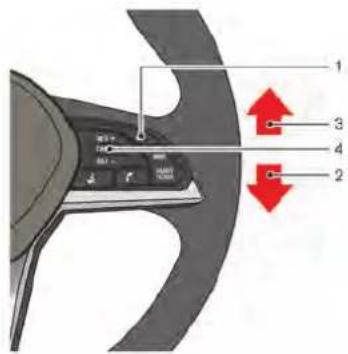
PRECAUTIONSONCRUISECON- TROL
- If the cruise control system malfunctions, it will cancel automatically. The SET indicator will blink and the cruise control system warning will appear to warn the driver. ( "Cruise control system warning" page 2-43)
- If the engine coolant temperature becomes excessively high, the cruise control system will be canceled automatically.
- If the SET indicator blinks, turn the cruise control main switch off and it is recommended you contact a GT-R
5-36 Startinganddriving
STEERING-WHEEL-MOUNTED CONTROLS
- MAIN switch
Turns cruise control ON/OFF. - SET/COAST switch (pressed down) Lowers the set vehicle speed.
- RESUME/ACCELERATE switch (pressed up)
Raises the set vehicle speed. - CANCEL switch Cancels cruise control.
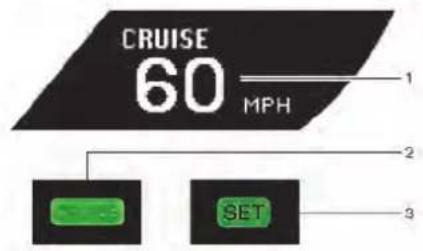
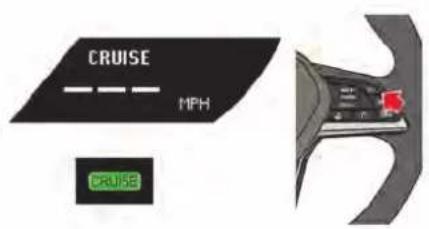

INDICATORSANDDISPLAY
- CRUISE display
Displays the set vehicle speed.
- CRUISE indicator
Informs the driver that the MAIN switch is ON.
- SET indicator
Informs the driver that the vehicle is driving at the set speed.
CRUISECONTROLOPERATIONS
Constant-speeddriving
To set the cruising speed, perform the following procedure.
-
Push the MAIN switch on. The CRUISE indicator will come on.
-
Accelerate your vehicle to the desired speed, push the SET/COAST switch and release it. (The SET indicator will illuminate in the meter.) Take your foot off the accelerator pedal. Your vehicle will maintain the set speed.
NOTE:
Ifthevehiclespeedreachesapproximately3MPH(5km/h)overthesetspeed,thesetspeedonthevehicle informationdisplayblinks.
Passinganothervehicle
To pass another vehicle, depress the accelerator pedal. When you release the pedal, the vehicle will return to the previously set speed.
Increasingthesetvehiclespeed
To reset at a faster cruising speed, use one of the following methods:
- Depress the accelerator pedal. When the vehicle attains the desired speed, push and release the SET/COAST switch.
- Push and hold the RESUME/ACCELERATE switch. When the vehicle attains the speed you desire, release the switch.
- Push and then quickly release the RESUME/ACCELERATE switch. Each time you do this, the set speed will increase by about 1 MPH or 1 km/h.
Decreasingthesetvehiclespeed
To reset at a slower cruising speed, use one of the following methods:
●Lightly tap the brake pedal. When the vehicle attains the desired speed, push and release the SET/COAST switch.
5-38 Startinganddriving
- Push and hold the SET/COAST switch. Release the switch when the vehicle slows down to the desired speed.
- Push and then quickly release the SET/COAST switch. Each time you do this, the set speed will decrease by about 1 MPH or 1 km/h.
Resumingthepresetspeed
To resume the preset speed, push and release the RESUME/ACCELERATE switch. The vehicle will resume the last set cruising speed when the vehicle speed is over 25 MPH (40 km/h).

Cancelingthepresetspeed
To cancel the preset speed, use one of the following methods:
- Push the CANCEL switch ① The SET indicator will turn off.
- Tap the brake pedal indicator will turn off. ③ The SET
- Turn the MAIN switch ② off. Both the CRUISE indicator and SET indicator will turn off.
- Ifcruisecontrolwascanceledby pressingthecancelswitchorby depressingthebrakepedal,the systemchangestostandbystatus.
- If you depressthebrakepedal while pushing the RESUME/ACCELERATE or SET/COAST switch and reset at the cruisingspeed, the cruise control will be deactivated. Turn the MAIN switchoffonce and thenturniton again.
Under the following conditions, cruise control will be automatically canceled.
●Vehicle speed drops to below approximately 19 MPH (30 km/h).
●Vehicle speed drops to more than approximately 8 MPH (13 km/h) below the set vehicle speed.
- The shift lever is moved to a position other than A ↔ M .
•VDC operates.
●A tire is spinning.
- There is a malfunction in the cruise control system.

WARNING
- Neverrelysolelyonthehillstart assistsystemtopreventthevehiclefrommovingbackwardona hill.Alwaysdrivecarefully and attentively.Depressthebrake pedalwhenthevehicleisstopped onasteephill.Beespeciallycarefulwhenstoppedonahillon frozenormuddyroads.Failure topreventthevehiclefromrolling backwardsmayresultinalossof controlofthevehicleandpossibleseriousinjuryordeath.
●Thehillstartassistsystemisnot designedtoholdthevehicleata standstillonahill.Depressthe brakepedalwhenthevehicleis stoppedonasteephill.Failureureto dosomaycausethevhicletro rollbackwardsandmayresultin acollisionorseriouspersonal injury.
●Thehillstartassistmaynotpreventthevehiclefromrolling backwardsonahillunderallload orroadconditions.Alwaysbe preparedtodepressthebrake pedaltopreventthevehiclefrom
rollingbackwards.Failuretodo somayresultinacollisionor seriouspersonalinjury.
NOTICE
Whenthevehicleisstoppedonahill, donotholdthevehicleinplaceby depressingtheacceleratorpedal. Doingsomaycausetheclutchto overheatandresultintransmission damage. Usethebrakestoprevent thevehiclefrommoving.
The hill start assist system automatically keeps the brakes applied to help prevent the vehicle from rolling backwards in the time it takes the driver to release the brake pedal and apply the accelerator when the vehicle is stopped on a hill. Hill start assist will operate automatically under the following conditions:
●The shift lever is moved to a forward or reverse position.
●The vehicle is stopped completely on a hill by applying the brake.
The maximum holding time is 2 seconds. After 2 seconds the vehicle will begin to roll back and hill start assist will stop
BREAK-INSCHEDULE
operating completely.
Hill start assist will not operate when the shift lever is moved to the or position or on a flat and level road.
NOTE:
This system does not function when the VehicleDynamicControlVDC) system warning appears on the vehicle information display located in the tachometer. ( "VehicleDynamicControl (VDC) system warning" page 2-40)
NOTICE
Followtheserecommendationsto obtainmaximumengineperformanceandensurethefuturereliabilityandeconomyofyournew vehicle.Failureretofollowtheserecommendationsmayresultinshortenedenginelifeandreduced vehicleperformance.
Please observe the following types of driving until the mileage shown below has been reached.
Until 300 miles (500 km):
- Do not depress the accelerator pedal more than halfway and avoid rapid acceleration.
- Drive with the engine speed kept at less than 3,500 RPM.
- Avoid unnecessary quick steering, abrupt braking and driving on poor roads.
300 to 600 miles (500 to 1,000 km):
- Avoid rapid acceleration in a low gear (1st to 3rd gears) with the accelerator pedal fully depressed. Depress the pedal slowly.
- Avoid unnecessary quick steering and abrupt braking.
- Drive with the suspension setup switch in the COMF mode to allow more suspension stroke.
600 to 1,200 miles (1,000 to 2,000 km):
- Drive with the engine speed kept relatively high with the shift lever in the M position. Shifting is recommended between 1st and 4th gears.
- Avoid unnecessary quick steering and abrupt braking.
- Drive with the suspension setup switch in the COMF mode to allow more suspension stroke.
Even though the mileage reaches over 1,200 miles (2,000 km), the clutch may take longer to properly engage if the vehicle is mainly driven in town at a low speed. NISSAN recommends breaking in the clutch at a GT-R certified NISSAN dealer.
WHEELALIGNMENT
Do not adjust the wheel alignment until the mileage reaches 1,000 miles (1,600 km). Until then, the suspension may not engage enough and the height may be higher.
However, make sure to adjust the align-
FUELEFFICIENTDRIVINGTIPS
ment after 1,000 miles (1,600 km).
The wheel alignment can be adjusted by a GT-R certified NISSAN dealer in accordance with specifications for city driving to high performance driving.
The tires on the GT-R may have different wear rates and wear patterns in comparison to conventional passenger vehicles. It is recommended you contact a GT-R certified NISSAN dealer to confirm that the alignment is within specifications.
Follow these easy-to-use Fuel Efficient Driving Tips to help you achieve the most fuel economy from your vehicle.
-
Use smooth accelerator and brake pedal application.
-
Avoid rapid starts and stops.
- Use smooth, gentle accelerator and brake application whenever possible.
-
Maintain constant speed while commuting and coast whenever possible.
-
Maintain constant speed.
-
Look ahead to try and anticipate and minimize stops.
- Synchronizing your speed with traffic lights allows you to reduce your number of stops.
-
Maintaining a steady speed can minimize red light stops and improve fuel efficiency.
-
Use air conditioning (A/C) at higher vehicle speeds.
-
Below 40 MPH (64 km/h), it is more efficient to open windows to cool the vehicle due to reduced engine load.
- Above 40 MPH (64 km/h), it is more efficient to use A/C to cool the vehicle due to increased aerodynamic drag.
- Recirculating the cool air in the cabin when the A/C is on reduces cooling load.
-
Drive at economical speeds and distances.
-
Observing the speed limit and not exceeding 60 MPH (97 km/h) (where legally allowed) can improve fuel efficiency due to reduced aerodynamic drag.
- Maintaining a safe following distance behind other vehicles reduces unnecessary braking.
- Safely monitoring traffic to anticipate changes in speed permits reduced braking and smooth acceleration changes.
-
Select a gear range suitable to road conditions.
-
Use cruise control.
-
Using cruise control during highway driving helps maintain a steady speed.
-
Cruise control is particularly effective in providing fuel savings when driving on flat terrains.
-
Plan for the shortest route.
- Utilize a map or navigation system to determine the best route to save time.
- Avoid idling.
- Shutting off your engine when safe for stops exceeding 30-60 seconds saves fuel and reduces emissions.
- Buy an automated pass for toll roads.
- Automated passes permit drivers to use special lanes to maintain cruising speed through the toll and avoid stopping and starting.
-
Winter warm up.
-
Limit idling time to minimize impact to fuel economy.
- Vehicles typically need no more than 30 seconds of idling at start-up to effectively circulate the engine oil before driving.
-
Your vehicle will reach its ideal operating temperature more quickly while driving versus idling.
-
Keeping your vehicle cool.
-
Park your vehicle in a covered parking area or in the shade whenever possible.
-
When entering a hot vehicle, opening the windows will help to reduce the inside temperature faster, resulting in reduced demand on your A/C system.
-
Use the SAVE mode.
• It is recommended that you select
5-42 Startinganddriving
the SAVE mode with the transmission setup switch while driving, except engaging in high performance driving. Doing so will enable improved fuel economy. (VDC, transmission and suspension setup switches" page 5-25)
INCREASINGFUELECONOMY
- Keep your engine tuned up.
- Follow the recommended scheduled maintenance.
- Keep the tires inflated to the correct pressure. Low tire pressure increases tire wear and lowers fuel economy.
- Keep the wheels in correct alignment. Improper alignment increases tire wear and lowers fuel economy.
- Use the recommended viscosity engine oil. ( "Oil viscosity" page 10-7)
ALL-WHEELDRIVE(AWD)
| Warning light | Comes on or blinks when |
 | There is a malfunction in the all wheel drive system. |
| Comes on | |
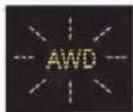 | The AWD clutch temperature rises abnormally. |
| Blinks rapidly | |
 | The difference in wheel rotation is large. |
| Blinks slowly |
AWDWARNINGLIGHT
The AWD warning light is located in the meter.
The AWD warning light comes on when the ignition switch is pushed to the ON position. It turns off soon after the engi is started.
If any malfunction occurs in the AWD system while the engine is running, the warning light will come on.
The warning light may blink rapidly (about twice per second) while trying to free a stuck vehicle due to high AWD clutch temperature. The driving mode may change to two-wheel drive. If the warning light blinks rapidly during operation, stop the vehicle with the engine idling in a safe place immediately. Then if the light goes off after a while, you can continue driving.
A large difference between the diameters of front and rear wheels will make the warning light blink slowly (about once per two seconds). Pull off the road in a safe area, and idle the engine. Check that all tire sizes are the same, tire pressure is correct and tires are not worn and winter tires are not installed on the front or rear wheels only.
If the warning light is blinking after the above operation, it is recommended you have your vehicle checked by a GT-R certified NISSAN dealer as soon as possible.
If non-genuine GT-R tires are used, the warning light may illuminate. ( "GT-R special precautions" page GTR-5)

WARNING
- Donotattempttoraisetwo wheelsoffthegroundandshift thetransmissiontoanydriveor reversepositionwiththeengine running.Doingsomayresultin drivetraindamageorunexpected vehiclemovementwhichcould resultinseriousvehicledamage orpersonalinjury.
- DonotattempttotestanAWD equippedvehicleona2-wheel dynamometer(suchasthodynametersusedbysome statesforemissionstesting)or similarequipmentevenifthe othertwowheelsareraisedoff theground.Makesurethatyou informthetestfacilitypersonnel thatyourvehicleisequippedwith AWDbeforeitisplacedona dynamometer.Usingthewrong testequipmentmayresultin drivetraindamageorunexpected vehiclemovementwhichcould resultinseriousvehicledamage orpersonalinjury.
NOTICE
- If the warning light comes on while driving therem maybe a malfunction in the AWD system. Reducethe vehicles speed and it is recommended you have your vehicle checked by a GT-R certified NISSAN dealer as soon as possible.
- If the warning light remains on after the above operation, it is recommended you have your vehicle checked by a GT-R certified NISSAN dealer as soon as possible.
- The powertrain may be damaged if you continued driving with the warning light blinking.
- Donotspintherearwheelswhile driving.Spinningtherearwheels mayincreasethetemperatures oftheAWDclutchsystemand damagethesystem.Adjustthe acceleratorpedalpositionstop wheelspin.
If the steering wheel is turned more than half a turn when the vehicle is started when it is cold, it may be harder to move the vehicle forward and backward. This phenomenon is known as the "tight corner braking phenomenon".
This phenomenon is unique to AWD vehicles, and occurs due to a difference in speeds between the front and rear wheels while the vehicle is turning. This does not indicate that there is a malfunction.
NOTE:
If the tight corner braking phenomenon occurs, as lippingsound may be heard from the tires, orasqueakingsound may be heard from the drivesystem.
Reducingtightcornerbraking phenomenon
The tight corner braking phenomenon can be reduced if the following three conditions are met:
●Transmission setup switch is set to Normal mode.
●Vehicle speed is low (less than approximately 6 MPH (10 km/h)).
●The steering wheel is turned more than 1/2 turn.
TIRES
This vehicle is equipped with special tires. When changing the tires, install the designated special tires. Replacing tires as a set of four with new ones is recommended. However, if a tire is punctured or damaged, it may be possible to replace only the damaged tire. Determining whether one tire or a complete set of tires should be replaced is based on a number of factors including tire wear and condition. Contact your GT-R certified NISSAN dealer. They can recommend if an individual tire or a complete set should be replaced.
NOTICE
Iftiresotherthanthedesignated tires, tireswithlargedifferencesin wearortiresofdifferentsizesare installed, the AWD performance will be degraded and the drivemechanism may bedamaged.
AWDSYSTEMCHARACTERISTICS
The AWD system automatically distributes the optimal torque to the front and rear wheels. This provides both the superior turning performance of a rear wheel drive vehicle and the traction of a AWD vehicle.
Electronic control continuously distributes torque to the front and rear wheels in the range from 0:100 (rear-wheel drive mode) to 50:50 (all-wheel drive mode) to match the driving conditions and road conditions. This allows the engine output (torque) to be effectively transmitted to the road surface.
LIMITEDSLIPDIFFERENTIAL(LSD)
The rear final drive of this vehicle is equipped with a 1.5-way mechanical Limited Slip Differential (LSD).

WARNING
Suddenoperationoftheaccelerator pedalcanresultinfishtailingor sideslip,possiblycausinganaccident.Useparticularcautionwhen drivinginrainyweatheroronslip-peryroads.
NOTICE
Usethedsignateddifferentialgear oil.Ifanyoilotherthanthedesignatedoilisused,theLSDmaynot operatecorrectly,andnoiseand vibrationmayoccur,possiblyresultinginamalfunction.
NOTE:
- If the vehicle accelerates from a stop with the steering wheel turned in cold temperatures, the inner wheel tire mayslip and somenoise or vibration maybe heard. This phenomenon is uniquet vehicles
equippedwiththeLSD. This does not indicate that there is a malfunction.
•TheLSDcontrolsthespeeddiffer-encebetweentheleftandright wheels,andoptimallyallocateor-quetothewheels.
•The1.5-waymechanicalLSDinthe rearfinaldriveofthisvehicleis characterizedbyitsasymmetrical LSDeffectstwhentheaccelerator pedalisONandwhenitisOFF.This allowstheappropriateamountof torqueforthedrivingenvironment tobetransmittedtotheroadsurface.
PARKING/PARKINGONHILLS
①
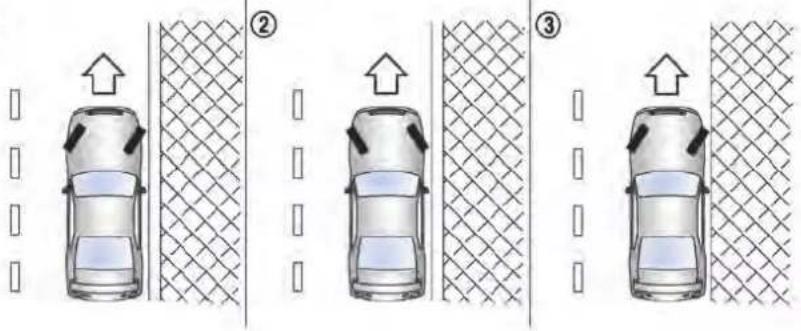

WARNING
- Donotstoporparkthevehicle overflammablematerialssuchas drygrass,wastepaperorrags. Theymayigniteandcauseafire.
●Neverleavetheengine running whilethevehicleisunattended. - Donotleavechildrenunattended insidethevehicle.Theycould unknowinglyactivateswitches orcontrols.Unattendedchildren couldbecomeinvolvedinserious accidents.
•Tohelpavoidriskofinjuryor deaththroughunintendedoperationofthevehicleand/orits systems,donotleavechildren, peoplewhorequiretheassistanceofothersorpetsunattendedinyourvehicle. Additionally,thetemperatureinsideaclosedvehicleonawarm daycanquicklybecomehigh enoughtocauseasignificantrisk ofinjuryordeathtopeopleand pets.
- Safeparkingproceduresrequire thatboththeparkingbrakebe
appliedandthetransmission placedintothe P position.Failure todosocouldcausethevehicle tomoveunexpectedlyorroll awayandresultinanaccident.
•Makesuretheshiftleverhas beenpushedasfarforwardasit cangoandcannotbemoved withoutdepressingthe foot brakepedal.
- Followtheinstructionsbelow whenparkingthevehicletohelp preventthebrakerotorand brakepadsfromrustingogether.Failureretofollowtheinstructionscouldcausetherotor andpadstorusttogether.Ifthe rotorandpadsrusttogether, theremaybeapoppingnoise andsomevibrationwhenthe vehicleisdriven,awheelmay notrollcorrectly,orthebrake padscouldbedamaged.Ifthe padsaredamaged,thismayreducetheeffectivenessofthe brakesystemwhichcouldcause acollision,seriouspersonalinjury ordeath.(formodelswithout NCCB(NISSANCarbonCeramic Brake)package)
- Firmly apply the parking brake.
- Move the shift lever to the P position.
-
To help prevent the vehicle from rolling into the street when parked on a sloping drive way, it is a good practice to turn the wheels as illustrated.
-
HEADED DOWNHILL WITH CURB① Turn the wheels into the curb and move the vehicle forward until the curb side wheel gently touches the curb.
- HEADED UPHILL WITH CURB② Turn the wheels away from the curb and move the vehicle back until the curb side wheel gently touches the curb.
- HEADED UPHILL OR DOWNHILL, NO CURB: ③
Turn the wheels toward the side of the road so the vehicle will move away from the center of the road if it moves.
- Push the ignition switch to the LOCK position.
FormodelswithoutNCCB(NISSANCarbonCeramicBrake)package:
The GT-R uses brake pad materials that have high metallic content. The brake pad material helps maintain braking performance in a wide range of weather and
driving conditions.
For the first 3,000 - 6,000 miles (5,000 - 10,000 km) of the vehicle's service life, and for the first 3,000 - 6,000 miles (5,000 - 10,000 km) after a brake replacement, the brake pad to brake rotor clearance is very small. When parking, apply the parking brake and move the shift lever to the position. Idle the engine for more than 20 seconds without depressing the brake pedal. This allows the brake pads to move away from the rotor so the pad does not contact the rotor.
Additionally, the brakes must be dry before parking the vehicle after driving on wet roads or after washing the vehicle. If the roads are wet, lightly apply the brakes for a short distance before parking the vehicle to dry the brakes. After washing the vehicle, dry the brakes by driving on a dry road for a few miles and apply the brakes normally based on traffic and road conditions.
The metallic brake pads and brake disc rotor may rust together when the brakes are not applied:
- If the vehicle is not idled for 20 seconds without the brakes applied, or if the brakes are applied when the vehicle is shut off, the rotor and pads can rust together, even when the
brake pads are dry.
- If the brakes are wet when the vehicle is parked and the parking brake is applied for a long time.
It is recommended you contact a GT-R certified NISSAN dealer if the brake pads and brake rotor have rusted together.
FormodelswithNCCB(NISSANCarbon CeramicBrake)package:
( "NCCB (NISSAN Carbon Ceramic Brake)" page 8-20)
SONARSYSTEM


WARNING
- Thesonarsystemisaconveniencebutitisnotasubstitutefor properparking.Alwayslook aroundandcheckthatitissafe todosobeforeparking.Always moveslowly.
-
Readandunderstandthelimitationsofthesonarsystemas containedinthissection.inclementweathermayaffectthe functionofthesonarsystem;this mayincludereducedperformanceorafalseactivation.
-
This system is not designed to prevent contact with small or moving objects.
- Thesystemisdesignedasanaid tothedriverindetectinglarge stationaryobjectstohelpavoid damagingthevehicle. Thesystemwillnotdetectsmalobjects belowthebumper, and may not detectobjectsthataretooclose tothebumperorontheground.
- If your vehicles sustains damage to the bumperfascia, leaving it misalignedorbent, the sensing zonemaybealtered causing in
accuratemeasurementofobstaclesorfalsealarms.

CAUTION
- Keeptheinteriorofthevehicleas quietaspossibletohearthetone clearly.Excessivenoise(suchas audiosystemvolumeoranopen vehiclewindow)willinterfere withthetoneanditmaynotbe heard.
- Keepthesonar(locatedonthe bumperfascia)freefromsnow, iceandlargeaccumulations of dirt(donotcleanthesonar with sharpobjects). Ifthesonaris covered, it will affect the accuracy of the sonarsystem.
- Thesonarsystemmaynotoperatecorrectlyifalicenseplate coverisinstalled.
The sonar system sounds a tone to warn the driver of obstacles near the bumper. The sonar indicator will also appear in the touch screen display. (17) "Sonar indicator" page 5-49.) The system detects front obstacles when the shift lever is in the position or position and both front and
rear obstacles when the shift lever is in the R position.
The system may not detect objects at speeds above 6 MPH (10 km/h) and may not detect certain angular or moving objects.
Refer to the illustration for approximate zone coverage areas. As you move closer to the obstacle, the rate of the tone increases. When you move even closer to the obstacle, the tone will sound continuously.
The sensitivity level of the sonar can be adjusted (higher or lower) in the sonar setting display. ( "Sonar system setting" page 5-50)
The intermittent tone will stop in 3 seconds when an obstacle is detected by only the corner sensor and the distance does not change.
①

②

① Sonar display
Ⓐ Corner sonar indicator
B Center sonar Indicator
② RearView Monitor display
SONARINDICATOR
With the "Automatic Display with Sonar" key ON in the touch screen display, when the front sonar detects obstacles near the bumper, a tone will sound and the sonar indicator will appear in the touch screen display ① When the RearView Monitor is displayed, the sonar indicator will appear in the upper corner of the display ②
The sonar indicators and indicate the position of the object and the distance to the object with its color and rate of blinking.
When an object is detected, the indicator (green) appears and blinks (the tone sounds intermittently). When the vehicle moves closer to the object, the color of the indicator turns yellow and the rate of blinking increases (the rate of the tone increases). When the vehicle moves even closer to the object, the indicator stops blinking and turns red (the tone sounds continuously).
WhentheRearViewMonitorisdis- played,thecolorsofthesonarindicator andthedistanceguidelinesintherear viewindicatedifferentdistancetothe object.

- When vehicle speed decreases below approximately 6 MPH (10 km/h).
- When the ignition switch is placed in the OFF position and turned back to the ON position again.

SONARSYSTEMOFFSWITCH
The sonar system OFF switch on the lower side of the instrument panel allows the driver to turn the sonar system on and off. To turn the sonar system on and off, the ignition switch must be in the ON position. The indicator light ① on the switch will turn off when the system is turned off. If the indicator light flashes it may indicate a malfunction in the sonar system.
The sonar system will turn on automatically under the following conditions.
- When the shift lever is placed in the R position.
5-50 Startinganddriving
SONARSYSTEMSETTING
Sonar settings can be adjusted.
- Touch the "Settings" key on the Launch Bar in the touch screen display.
- Select the "Sonar" key.
Select a menu item to change from the following options.
Sonar
●Only FR Sensor Use
●Automatic Display with Sonar - Sonar Sensitivity
•Volume

AutomaticDisplaywithSonar
Automatically shows the sonar view on the touch screen display when the sonar is activated.
ON (default) - OFF
SonarSensitivity
Adjust the sensitivity level of the sonar. higher (right) - lower (left)
Volume
Adjust the volume of the tone. higher (right) - lower (left)
POWERSTEERING

WARNING
If the engine is not running, is turned off while driving, the power assist for the steering will not work. Steering will be hard to operate.
The power assisted steering uses a hydraulic pump, driven by the engine, to assist steering.
If the engine stops or the drive belt breaks, you will still have control of the vehicle. However, much greater steering effort is needed, especially in sharp turns and at low speeds.
Sonar
When this item is turned ON, the front and rear sonar is activated. When this item is turned to OFF (indicator turns off), the front and rear sonar is deactivated.
ON (default) - OFF
OnlyFRSensorUse
When this item is turned on, only the rear sonar is turned off. The amber markers are displayed at the rear corners of the vehicle icon.
ON - OFF (default)
BRAKESYSTEM
BRAKINGPRECAUTIONS
The brake system has two separate hydraulic circuits. If one circuit malfunctions, you will still have braking at two wheels.
You may feel a small click and hear a sound when the brake pedal is fully depressed slowly. This is not a malfunction and indicates that the brake assist mechanism is operating properly.
Vacuumassistedbrakes
The brake booster aids braking by using engine vacuum. If the engine stops, you can stop the vehicle by depressing the brake pedal. However, greater foot pressure on the brake pedal will be required to stop the vehicle and the stopping distance will be longer.
Wetbrakes
When the vehicle is washed or driven through water, the brakes may get wet. As a result, your braking distance will be longer and the vehicle may pull to one side during braking.
To dry brakes, drive the vehicle at a safe speed while lightly tapping the brake pedal to heat-up the brakes. Do this until the brakes return to normal. Avoid driving
the vehicle at high speeds until the brakes function correctly.
Usingthebrakes
Avoid resting your foot on the brake pedal while driving. This will cause overheating of the brakes, wearing out the brake and pads faster and reduce gas mileage.
To help reduce brake wear and to prevent the brakes from overheating, reduce speed and downshift to a lower gear before going down a slope or long grade. Overheated brakes may reduce braking performance and could result in loss of vehicle control.
5 PARKINGBRAKEBREAK-IN
Break in the parking brake shoes whenever the stopping effect of the parking brake is weakened or whenever the parking brake shoes and/or drums/rotors are replaced, in order to assure the best braking performance.
This procedure is described in the vehicle service manual and can be performed by ta GT-R certified NISSAN dealer.

WARNING
- While driving on aslippery surface, be careful when braking, accelerating order down shifting. Abrupt braking or accelerating could cause the wheelmostoid and result in an accident.
- If the engine is not running or is turned off while driving, the power assist for the brakes will not work. Braking will be harder.
5-52 Startinganddriving
BRAKEASSIST
ANTI-LOCKBRAKINGSYSTEM (ABS)

WARNING
•The Anti-lock Braking System (ABS) is as sophisticated device, but it cannot prevent accidents resulting from careless dangerous driving techniques. It can help maintain vehicle control during braking on slippery surfaces. Remember that stopping distances on slippery surfaces will be longer than on normal surfaces even with ABS. Stopping distances may also be longer on rough, gravelors now covered roads, or if you are using tire chains. Always maintain a safe distance from the vehicle in front of you. Ultimately, the driver is responsible for safety.
- Tiretypeandconditionmayalso affectbrakingeffectiveness. Whenreplacingtires,installthe specifiedsizeoftiresonallfour wheels.
The Anti-lock Braking System (ABS) con-
trols the brakes so the wheels do not lock during hard braking or when braking on slippery surfaces. The system detects the rotation speed at each wheel and varies the brake fluid pressure to prevent each wheel from locking and sliding. By preventing each wheel from locking, the system helps the driver maintain steering control and helps to minimize swerving and spinning on slippery surfaces.
Usingthesystem
Depress the brake pedal and hold it down. Depress the brake pedal with firm steady pressure, but do not pump the brakes. The ABS will operate to prevent the wheels from locking up. Steer the vehicle to avoid obstacles.

WARNING
Donotpumpthebrakepedal.Doing somayresultinincreasedstopping distances.
Self-testfeature
The ABS includes electronic sensors, electric pumps, hydraulic solenoids and a computer. The computer has a built-in diagnostic feature that tests the system
keach time you start the engine and move the vehicle at a low speed in forward or reverse. When the self-test occurs, you may hear a "clunk" noise and/or feel a pulsation in the brake pedal. This does not indicate that there is a malfunction. If the computer senses a malfunction, it switches the ABS off and illuminates the ABS warning light on the meter. The brake system then operates normally, but without anti-lock assistance.
If the ABS warning light illuminates during the self-test or while driving, it is recommended you have the vehicle checked by a GT-R certified NISSAN dealer.
Normaloperation
The ABS operates at speeds above 3 to 6 MPH (5 to 10 km/h). The speed varies according to road conditions.
When the ABS senses that one or more wheels are close to locking up, the actuator rapidly applies and releases hydraulic pressure. This action is similar to pumping the brakes very quickly. You may feel a pulsation in the brake pedal and hear a noise from under the hood or feel a vibration from the actuator when it is operating. This is normal and indicates that the ABS is operating properly. However, the pulsation may indicate that road
Startinganddriving5-53
conditions are hazardous and extra care is required while driving.
VEHICLEDYNAMICCONTROL(VDC)SYSTEM
The Vehicle Dynamic Control (VDC) system uses various sensors to monitor driver inputs and vehicle motion. Under certain driving conditions, the VDC system helps to perform the following functions.
●Controls brake pressure to reduce wheel slip on one slipping drive wheel so power is transferred to a non slipping drive wheel on the same axle.
●Controls brake pressure and engine output to reduce drive wheel slip based on vehicle speed (traction control function).
●Controls brake pressure at individual wheels and engine output to help the driver maintain control of the vehicle in the following conditions:
— understeer (vehicle tends to not follow the steered path despite increased steering input)
— oversteer (vehicle tends to spin due to certain road or driving conditions).
The VDC system can help the driver to maintain control of the vehicle, but it cannot prevent loss of vehicle control in all driving situations.
When the VDC system operates, the VDC warning light 📁 in the meter flashes so note the following:
●The road may be slippery or the system may determine some action is required to help keep the vehicle on the steered path.
- You may feel a pulsation in the brake pedal and hear a noise or vibration from under the hood. This is normal and indicates that the VDC system is working properly.
- Adjust your speed and driving to the road conditions.
- The VDC mode can be changed using the VDC setup switch. ( "VDC, transmission and suspension setup switches" page 5-25)
( "Vehicle Dynamic Control (VDC) warning light" page 2-34, "Vehicle Dynamic Control (VDC) off indicator light" page 2-33)
If a malfunction occurs in the system, the VDC warning light 📋 illuminates in the meter. The VDC system automatically turns off.
The VDC setup switch is used to turn off the VDC system. The VDC off indicator illuminates to indicate the VDC system is off.
When the VDC setup switch is used to turn off the system, the VDC system still
operates to prevent one drive wheel from slipping by transferring power to a non slipping drive wheel. The VDC warning light flashes if this occurs. All other VDC functions are off and the VDC warning light will not flash. The VDC system is automatically reset to on when the ignition switch is placed in the off position then back to the on position. ( "Vehicle Dynamic Control (VDC) warning light" page 2-34, "Vehicle Dynamic Control (VDC) off indicator light" page 2-33)
The computer has a built-in diagnostic feature that tests the system each time you start the engine and move the vehicle forward or in reverse at a slow speed. When the self-test occurs, you may hear a "clunk" noise and/or feel a pulsation in the brake pedal. This is normal and is not an indication of a malfunction.

WARNING
•TheVDCsystemisdesignedto helpthedrivermaintainstability butdoesnotpreventaccidents duetoabruptsteeringoperation athighspeedsorbycarelessor dangerousdrivingtechniques. Reducevehiclespeedandbe especiallycarefulwhendriving
andcorneringonslipperysurfacesandalwaysdrivecarefully.
- Donotmodifythevehicle'ssuspension.Ifsuspensionpartssuchasshockabsorbers,struts,springs,stabilizerbars,bushingsandwheelsarenotNISSANapprovedorareextremelydeteriorated,theVDCsystemmaynotoperateproperly.Thiscouldadverselyaffectivehandlingperformance,andtheVDCwarninglight mayilluminate.
- Ifbrakerelatedpartssuchas brakepads,rotorsandcalipers arenotstandardequipmentor areextremelydeteriorated,the VDCsystemmaynotoperate properlyandtheVDCwarning light mayilluminate.
•Ifenginecontrolrelatedpartsare notstandardequipmentorare extremelydeteriorated,theVDC warninglight mayilluminate.
-Whendrivingonextremelyin-clinedsurfacesuchashigher bankedcorners,theVDCsystem maynotoperateproperlyandthe VDCwarninglight mayilluminate.Donotdriveonthesetypes
ofroads.
- Whendrivingonanunstablesurfacesuchasaturntable,ferry, elevatororramp,theVDCwarninglight mayilluminate.This isnotamalfunction.Restartthe engineafterdrivingontoastable surface.
- If wheels sortires other than the those recommended are used, the VDC system may not operate properly and the VDC warning light may illuminate.
•TheVDCsystemisnotasubstituteforwintertiresortirechains onasnowcoveredroad.
NOTE:
●AlwaysmakesuretheVDCisON beforedrivingthevehiclebycheckingthattheVDCOFFindicatorlights onthemeterandtheVDCset-up switcharenotilluminated. TheGT-Risahighperformance vehicleandtheVDCmustbeon/ activatedtoprovideproperpower- trainoperationandintendeddrivability.

WARNING
•TheVDCOFFmodeshouldONLY beusedbrieflytohelpfreethe vehicleifstuckinsnowormudby temporarilystoppingoperation oftheVDCtomaintainwheel torque.
- DrivingtheGT-RwiththeVDCoff mayleadtohandlingissuesrelatedtosteeringmaneuvers,acceleration,ordeceleration. Moreover,drivingwiththeVDC offcanresultinaninoperative vehiclebycausingseriousdamagetothepowertrain,including damagetotheTransaxleAssemblyincludingTransfer,Clutch, Gears,Transaxlecaseandallof itscomponentsandotherdrive-traincomponent(s)byoverheatingorexcessiveforce.
- Damagetothepowertrainorany drivetraincomponent(s)thatoccurswhenthereisarecordinthe VehicleStatusDataRecorder (VSDR)thatthevehiclewasdriven withVDCoffduringtheperiod whenthedamagewasincurredis excludedfromwarrantycover-
age.
See your 2021 Warranty Information Booklet for important related information and warranty coverage exclusions. See also section 2 ( "Transmission warning light" page 2-33) and section 5 ( "Vehicle Dynamic Control (VDC) system" page 5-54) of this Owner's Manual, "Transmission Clutch Temperature High" and "Vehicle Dynamic Control (VDC) System" for Important additional related information.
- Exceptfortheemergencycases above,anyissuesrelatedtodriving stability(e.g.,steeringmaneuvers andmaneuversduringacceleration anddeceleration)andanydamages todrivetraincomponents(e.g., transfer,clutch,asortofgear,transaxlecase)willnotbecoveredby warrantyifthereisarecordinthe VehicleStatusDataRecorder(VSDR) thatthevehiclewasdrivenwithVDC off.
- Whenattemptingtofreethevehicle frommudorfreshsnow,theVDCwill detectthetireslipping,andthe enginespeedmaynotincreaseeven whentheacceleratorpedalisdepressed.Toraisetheenginespeed,
usetheVDCsetupswitchtoturnthe VDCsystemOFFandselectSAVE modewiththetransmissionswitch. ("VDC,transmissionandsuspensionsetupswitches"page5-25)
- When the VDC system is misturned OFF, all VDC functions (including traction control), except for the ABS functions, are deactivated.
COLDWEATHERDRIVING
FREEINGAFROZENDOORLOCK
To prevent a door lock from freezing, apply deicer through the key hole. If the lock becomes frozen, heat the key before inserting it into the key hole or use the Intelligent Key system.
ANTI-FREEZE
In the winter when it is anticipated that the outside temperature will drop below 32° F ( 0° C), check antifreeze to assure proper winter protection. ( "Engine cooling system" page 8-6)
BATTERY
If the battery is not fully charged during extremely cold weather conditions, the battery fluid may freeze and damage the battery. To maintain maximum efficiency, the battery should be checked regularly. (15) "Battery" page 8-13)
DRAININGOFCOOLANTWATER
If the vehicle is to be left outside without antifreeze, drain the cooling system, including the engine block. Refill before operating the vehicle. For details, it is recommended you contact a GT-R certified NISSAN dealer.
TIREEQUIPMENT
The GT-R summer tires are made from a specially formulated rubber to maximize the vehicle's performance capabilities. Performance of summer tires is substantially reduced when temperatures are less than 32° F ( 0° C) so you must drive carefully. NISSAN recommends the use of winter or all-season tires on all four wheels if you plan to operate your vehicle in snowy or icy conditions when temperatures are less than 32° F ( 0° C).

WARNING
Neverusesummertireswhenthe temperatureisbelow-4°F(-20°C)to preventpermanenttreaddeformationwhichmaycausetiredamageor tirefailure. This may causealossof vehiclecontrol which can result in serious personal injury or death.
Tire chains may be used. ( "Tire chains" page 8-38)
If you install tires, they must also be the specified size, brand, construction and tread pattern on all four wheels.
SPECIALWINTEREQUIPMENT
It is recommended that the following items be carried in the vehicle during winter:
●A scraper and stiff-bristled brush to remove ice and snow from the windows and wiper blades.
●A sturdy, flat board to be placed under the jack to give it firm support.
●A shovel to dig the vehicle out of snowdrifts.
- Extra window washer fluid to refill the reservoir tank.
DRIVINGONSNOWORICE

WARNING
- Wetice(32°F,0°Candfreezing rain),very coldsnoworice can be slick and very hard to drive on. The vehicle will have much less traction or "grip" under these conditions. Try to avoid driving on wetice until theroadissalted or sanded.
- Whateverthecondition,drive withcaution.Accelerateandslow downwithcare.Ifacceleratingor downshiftingtoofast,thedrive
Startinganddriving5-57
wheelswillloseevenmoretraction.
- Allowmorestoppingdistance undertheseconditions.Braking shouldbestartedsoonerthanon drypavement.
- Allowgreaterfollowingdistances onslipperyroads.
- Watchforslipperyspots(glare ice). These may appear on a otherwise clear road in shaded areas. If a patch of ice is seen ahead, brake before reaching it. Try not to break while on the ice, and avoid any sudden steering maneuvers.
- Donotusethecruisecontrol on slipperyroads.
- Snowcantrapdangerouse exhaustgasesundryourvehicle. Keepsnowclearoftheexhaust pipeandfromaroundyourvehicle.
NOTE:
Whendrivingonsnow,selecttheSAVE modewiththesetupswitch.Byselect- ingtheSAVEmode,theengineoutputis controlledappropriatelyforsnowor
slipperyroadsurfaces. This enables the vehicle to start or accelerate smoothly.
ENGINEBLOCKHEATER(ifso equipped)
Engine block heaters are used to assist with cold temperature starting. The engine block heater should be used when the outside temperature is 20° F ( -7° C) or lower.
Tousetheengineblockheater
- Turn the engine off.
- Plug the engine block heater cord into a grounded 3-wire, 3-pronged extension cord.
- Plug the extension cord into a Ground Fault Interrupt (GFI) protected, grounded 110-volt AC (VAC) outlet.
- The engine block heater must be plugged in for at least 2 - 4 hours, depending on outside temperatures, to properly warm the engine coolant. Use an appropriate timer to turn the engine block heater on.
- Before starting the engine, unplug and properly store the cord to keep it away from moving parts.

WARNING
- Donotuseyouengineblock heaterwithanungroundedelectricalsystemora2-pronged adapter.Youcanbeseriously injuredbyanelectricalshockif youuseanungroundedconnection.
- Disconnectandproperlystorethe engineblockheatercord before startingtheengine.Damageto thecord couldresult inan electricalshockandcancauseseriousinjury.
- Useaheavy-duty3-wire,3-prongedextensioncordrated for at least 10A. Plug the extensioncordintoaGroundFault Interrupt(GFI)protected, grounded110-VACoutlet.
Failure to use the proper extensioncordoragroundedoutlet canresultina fireor electrical shockandcauseseriouspersonal injury.
EXHAUSTSOUNDCONTROL SYSTEM(ifsoequipped)
This system enhances exhaust sound silencing by closing the electronic control valve while starting the engine, and while idling after starting the engine.

To close the electronic control valve, push the exhaust sound control switch to the ON side.
To open the electronic control valve, push the exhaust sound control switch to the OFF side.
NOTE:
Donotdisconnecttheelectroniccontrol valveconnector.Iftheconnectorisnot pluggedin,thesystemwilldetectthis asamalfunctionandengineoutputwill belimited.
ACTIVENOISECANCELLATION(if soequipped)/ACTIVESOUND ENHANCEMENT(ifsoequipped)


Startinganddriving5-59
NOTE:
Tooperatetheactivenoisecancellation andactivesoundenhancementsystem properly:
- Do not cover the speakers or woofer.
- Do not cover the microphones.
- Do not change or modify speakers including the woofer and any audio related parts such as the amplifier.
- Do not make any modification including sound deadening or modifications around the microphones, speakers or woofer.
ACTIVENOISECANCELLATION
The active noise cancellation uses the front and rear microphones ① to detect engine booming noise. The system then automatically generates a noise cancelling sound through the speakers ② and woofer ③ to reduce engine booming noise.
The front and rear microphones ① are located inside of the roof.
The front speakers are located on the doors and the woofer is located in between the rear seats.
ACTIVESOUNDENHANCEMENT
The active sound enhancement generates sounds according to engine speed and driving modes selected by the Vehicle Dynamic Control (VDC) system, transmission and suspension setup switches through the speakers ② and woofer ③ to enhance the quality of the engine sound.
In addition, if the gear is shifted or the accelerator pedal is quickly operated when the transmission setup switch is in R mode and the engine warmed up, a sound effect is output to enhance the sense of sportiness. ( "R mode" page 5-25)
6Incaseofemergency
Hazardwarningflasherswitch....6-2
Roadsideassistanceprogram....6-2
Emergencyengineshutoff....6-3
Flattire....6-3
TirePressureMonitoringSystem(TPMS)......6-3
Run-flattires....6-4
Jumpstarting....6-5
Pushstarting....6-7
If your vehicle overheats....6-8
Towingyourvehicle....6-9
TowingrecommendedbyNISSAN......6-9
Vehiclerecovery(freeingastuckvehicle).....6-9
Push the switch on to warn other drivers when you must stop or park under emergency conditions. All turn signal lights will flash.
The flasher can be actuated with the ignition switch in any position. Somestatelawsmayprohibittheuseof thehazardwarningflasherswitchwhile driving.

WARNING
- Ifstoppingforanemergency,be suretomovethevehiclewelloff theroad.
- Donotusethehazardwarning flasherswhilemovingonthe highwayunlessunusualcircumstancesforceyoutodriveso slowlythatyourvehiclemight becomeahazardtoothertraffic.
•Turnsignalsdonotworkwhen thehazardwarningflasherlights areon.
ROADSIDEASSISTANCEPROGRAM
In the event of a roadside emergency, Roadside Assistance Service is available to you. Please refer to your Warranty Information Booklet (U.S.) or Warranty & Roadside Assistance Information Booklet (Canada) for details.
6-2 Incaseofemergency
EMERGENCYENGINESHUTOFFFLATTIRE
To shut off the engine in an emergency situation while driving, perform the following procedure:
- Rapidly push the push-button ignition switch 3 consecutive times in less than 1.5 seconds, or
- Push and hold the push-button ignition switch for more than 2 seconds.
TIREPRESSUREMONITORING SYSTEM(TPMS)
This vehicle is equipped with the Tire Pressure Monitoring System (TPMS). It monitors tire pressure of all tires. When the low tire pressure warning light is lit, one or more of your tires is significantly under-inflated. If the vehicle is being driven with low tire pressure, the TPMS will activate and warn you of it by the low tire pressure warning light (in the meter) or the warning message (on the display). This system will activate only when the vehicle is driven at speeds above 16 MPH (25 km/h). ( "Low tire pressure warning light" page 2-30) ( "Tire Pressure Monitoring System (TPMS)" page 5-4)

WARNING
- Ifthelowtirepressurewarning lightilluminateswhiledriving, avoidsuddensteeringmaneu-versorabruptbraking,reduce vehiclespeed,pullofftheroad toasafelocationandstopthe vehicleassoonaspossible.Drivingwithunder-inflatedtiresmay permanentlydamagethetires andincreasethelikelihoodoftire failure.Seriousvehicledamage
couldoccurandmayleadtoan accidentandcouldresultinseriouspersonalinjury.Checkthe tirepressureforallfourtires. Adjustthetirepressuretothe recommendedCOLDtirepressure shownontheTireandLoading Informationlabeltoturnthelow tirepressurewarninglightoff.If thelightstillilluminateswhile drivingafteradjustingthetire pressure,atiremaybeflat ( "Run-flattires"page6-4)or theTPMSmaybemalfunctioning. Ifnotireisflatandalltiresare properlyinflated,itisrecommendedyouhavethevehicle checkedbyaGT-Rcertified NISSANdealer.
- Whenawheelisreplaced, the TPMSwillnotfunctionandthe lowtirepressurewarninglight willflashforapproximately1 minute. Thelightwillremainon after1minute. It is recommended you contact a GT-Rcertified NISSAN dealerassoonaspossible forirereplacement and/or systemresetting.
•Replacing tires with those not originally specified by NISSAN
Incaseofemergency6-3
could affect the proper operation of the TPMS.
- Donotinjectanytireliquidor aerosoltiresealantintothetires, asthismaycauseamalfunction ofthetirepressuresensors.
NOTE:
- Youcancheckthepressureofall fourtiresonthetouchscreendisplay.SeetheseparateMultiFunctionDisplayOwner'sManual.
- Thetiresofthisvehiclearefilled withnitrogengas.Whenthetire pressureislow,fillthetireswith nitrogen.Itisrecommendedyou contactaGT-RcertifiedNISSAN dealerforinformationonfillingthe tireswithnitrogen.
- Ifnitrogenisnotavailable,compressedairmaybesafelyused undernormaldrivingconditions. However,NISSAN recommendsrefillingwithnitrogenformaximum tireperformance.
RUN-FLATTIRES
Run-flat tires are those tires that can be used temporarily if they are punctured. ( "Run-flat tires" page 8-37) Also, see the tire safety information in the Warranty Information Booklet.

WARNING
- Although you can continued driving with punctured run-flattire, remember that vehicle handling stability is reduced, which could lead to accident and personal injury. Also, driving along distance at high speeds may damage the tires.
- Donotdriveatspeedsabove50 MPH(80km/h)anddonotdrive morethan50miles(80km)witha puncturedrun-flattire.Theactual distancethevehiclecanbedriven onaflattiredependsonoutside temperature,vehicleload,road conditionsandotherfactors.
- Drivesafelyatreducedspeeds. Avoidhardcorneringorbraking, whichmaycauseyoutolose controlofthevehicle.
NOTICE
- Neverinstalltirechainsona puncturedrun-flattire,asthis coulddamageyourvehicle.
- Avoiddrivingoveranyprojection orpothole, astheclearancebetween the vehicle and the ground is smaller than normal.
- Donotenteranautomatedcar washwithapuncturedrun-flat tire.
- Itisrecommendedyouhavethe puncturedtirereplacedbyyour GT-RcertifiedNISSANdealeras soonaspossible,asthetire's performancecapabilityisreduced.
If you have a flat tire and have to stop the vehicle, follow the instructions below.
- Safely move the vehicle off the road and away from traffic.
- Turn on the hazard warning flashers.
- Park on a level surface and apply the parking brake. Move the shift lever to the P position.
- Turn off the engine.
- Raise the hood to warn other traffic,
JUMPSTARTING
and to signal professional road assistance personnel that you need assistance.
- Have all passengers get out of the vehicle and stand in a safe place, away from traffic and clear of the vehicle. For the tire removing procedure, see the following section. (Jacking vehicle and removing wheels" page 8-42)
The following circumstances indicate that the battery is discharged.
●The starter motor does not turn or it turns weakly and the engine does not start.
- The vehicle lights are much dimmer than usual.
- The sound of the horn is weak. The horn makes no sound.
NOTICE
Whenthebatteryisdischarged,do notcloseeitherofthefrontdoors. Theautomaticwindowadjusting functionwillnotwork,andtheside roofpanelmaybedamaged.
To start your engine with a booster battery, the instructions and precautions below must be followed.
For the battery maintenance information, see the following section. ( "Battery" page 8-13)

WARNING
- If done incorrectly, jump starting can lead to a battery explosion, resulting in severe injury or death. It could also damage your vehicle.
•Explosivehydrogengasisalways presentinthevicinityofthe battery.Keepallsparksand flamesawayfromthebattery. - Donotallowbatteryfluidtocome intocontactwitheyes,skin, clothingorpaintedsurfaces.Batteryfluidisacorrosivesulphuric acidsolutionwhichcancause severeburns.Ifthefluidshould comeintocontactwithanything, immediatelyflushthecontacted areawithwater.
- Keepthebatteryoutofthereach ofchildren.
•Theboosterbatterymustbe ratedat12volts.Useofanim-properlyratedbatterycandamageyourvehicle. - Wheneverworkingonornea battery,alwayswearsuitableeye protectors(forexample,goggles orindustrialsafetyspectacles)
Incaseofemergency6-5
andremoverings,metalbands, oranyotherjewelry.Donotlean overthebatterywhenjumpstarting.
- Donotattempttojumpstarta frozenbattery.Itcouldexplode andcauseseriousinjury.
-Yourvehiclehasanautomatic enginecoolingfan.Itcouldcome onatanytime.Keephandsand otherobjectsawayfromit.


WARNING
Alwaysfollowtheinstructionsbelow. Failuretodosocouldresultin damagetothechargingsystemand causepersonalinjury.
-
If the booster battery is in another vehicle A position the two vehicles (and ) to bring their batteries into close proximity to each other. Donot allowthetwovehiclestotouch.
-
Apply parking brake. Move the shift lever to the P position. Switch off all
unnecessary electrical systems (light, heater, air conditioner, etc.).
- Remove the battery cover. Cover the battery with a firmly wrung out moist cloth to reduce explosion hazard.
- Connect jumper cables in the sequence as illustrated ① → ② → ③ ④).
If the battery is disconnected or discharged, the steering wheel will lock and cannot be turned. Supply power using jumpercables before pushing the ignition switch and disengaging the steering lock.

CAUTION
-
Alwaysconnectpositive(+)to positive(+)andnegative(-)to bodyground(asillustrated),not tothebattery.
●Makesurethatthejumpercables donottouchmovingpartsinthe enginecompartmentandthat clampsdonotcontactanyother metal. -
Start the engine of the booster vehicle Ⓐ and let it run for a few minutes.
- Keep the engine speed of the booster
vehicle Ⓐ at about 2,000 rpm, and start the engine of the vehicle being jump started Ⓑ.
NOTE:
Donotkeepthestartermotoren-gagedformorethan10seconds.If theenginedoesnotstartrightaway, pushtheignitionswitchtotheOFF positionandwait10secondsbefore tryingagain.
- After starting your engine, carefully disconnect the negative cable and then the positive cable (4 → 3 → 2 →)①
- Be sure to dispose of the cloth used to cover the vent holes as it may be contaminated with corrosive acid.
- Put the battery cover on.
NOTE:
If the clampclipis difficult to connect to the battery terminal, removethecowl topcover to make it easier. ( "Removing the cowl topcover" page8-5)
PUSHSTARTING
Do not attempt to start the engine by pushing.
NOTICE
YourNISSANcannotbepush-started ortow-started.Attemptingtodoso maycausetransmissiondamage.
IFYOURVEHICLEOVERHEATS

WARNING
- Donotcontinuetodriveifyour vehicleoverheats.Doingsocould causeenginedamageoravehicle fire.
•Toavoidthedangerofbeing scalded,neverremovetheradiatorfillercapandthecoolant reservoircapwhiletheengineis stillhot.Whenthecapsremoved, pressurizedhotwaterwillspurt out,possiblycausingseriousinjury. - Donotopenthehoodifsteamis comingout.
If your vehicle is overheating (indicated by an extremely high temperature gauge reading), or if you feel a lack of engine power, detect unusual noise, etc., take the following steps:
- Move the vehicle safely off the road, apply the parking brake and move the shift lever to the position.
Donotstoptheengine.
- Turn off the air conditioner. Open all the windows, move the temperature control to maximum hot and fan
control to high speed.
- If engine overheating is caused by climbing a long hill on a hot day, run the engine at a fast idle (approximately 1,500 rpm) until the temperature gauge indication returns to normal.
- Get out of the vehicle. Look and listen for steam or coolant escaping from the radiator before opening the hood. (If steam or coolant is escaping, turn off the engine.) Do not open the hood further until no steam or coolant can be seen.
- Open the engine hood.

WARNING
Ifsteamorwateriscomingfromthe engine,standcleartopreventgettingburned.
- Visually check drive belts for damage or looseness. Also check if the cooling fan is running. The radiator hoses and radiator should not leak water. If coolant is leaking, the drive belts are missing or loose, or the cooling fan does not run, stop the engine.

WARNING
Becarefulnottoallowyourhands, hair, jewelryorclothing tocome into contactwith,orgetcaughtin,engine beltsortheenginecoolingfan.The enginecoolingfancanstartatany time.
- When the coolant temperature gauge goes down to the midpoint, stop the engine and wait until the gauge goes down further to "C" (cold).
- After the engine cools down, check the coolant level in the reservoir tank. Add coolant to the reservoir, if necessary, after opening the coolant reservoir cap with a heavy cloth covering it. ( "Engine cooling system" page 8-6)
- It is recommended you have your vehicle repaired at the nearest GT-R certified NISSAN dealer.
6-8 Incaseofemergency
TOWINGYOURVEHICLE
When towing your vehicle, all State (Provincial in Canada) and local regulations for towing must be followed. Incorrect towing equipment could damage your vehicle. Towing instructions are available from a GT-R certified NISSAN dealer. Local service operators are familiar with the applicable laws and procedures for towing. To assure proper towing and to prevent accidental damage to your vehicle, NISSAN recommends that you have a service operator tow your vehicle. It is advisable to have the service operator carefully read the following precautions.

WARNING
- Neverrideinavehiclethatis beingtowed.
- Nevergetunderyourvehicleafter ithasbeenliftedbyatowtruck.

CAUTION
Alwaysattachsafetychainsbefore towing.
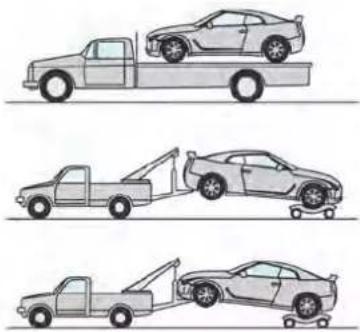

TOWINGRECOMMENDED BY NISSAN
NISSAN recommends that towing dollies be used when towing your vehicle or the vehicle be placed on a flat bed truck as illustrated.
NOTICE
Nevertowthevehiclewithanyofthe wheelsonthegroundasthismay causeseriousandexpensiveda-magetothepowertrain.
VEHICLERECOVERY(freeinga stuckvehicle)

WARNING
Toavoidvehicledamage,serious personalinjuryordeathwhenrecoveringastuckvehicle:
- Contactaprofessionaltowing servicetorecoverthevehicleif youhaveanyquestionsregardingtherecoveryprocedure.
- Towchainsorcablesmustbe attachedonlytomainstructural membersofthevehicle.
Incaseofemergency6-9
- Donotusethevehicletie-downs totoworfreeeastuckvehicle.
- Onlyusedevicessspecificallydesignedforvehiclerecoveryand followthemanufacturer's instructions.
- Alwayspulltherecoverydevice straightoutfromthefrontofthe vehicle.Neverpullatanangle.
- Routerecoverydevicessothey donottouchanypartofthe vehicleexcepttheattachment point.
If your vehicle is stuck in sand, snow, mud etc., use a tow strap or other device designed specifically for vehicle recovery. Always follow the manufacturer's instructions for the recovery device.
Rockingastuckvehicle
If your vehicle is stuck in sand, snow, mud, etc., use the following procedure:
- Turn off the Vehicle Dynamic Control (VDC) system and select SAVE mode with the transmission setup switch. ( "VDC, transmission and suspension setup switches" page 5-25)
- Make sure the area in front and behind the vehicle is clear of obstruc-
6-10 Incaseofemergency
tions.
- Turn the steering wheel right and left to clear an area around the front tires.
-
Slowly rock the vehicle forward and backward.
-
Shift back and forth between the and positions.
- Apply the accelerator as little as possible to maintain the rocking motion.
- Release the accelerator pedal before shifting between the R and A↔M positions.
-
Do not spin the tires above 35 MPH (55 km/h).
-
Turn on the Vehicle Dynamic Control (VDC) system.
-
If the vehicle cannot be freed after a few tries, contact a professional towing service to remove the vehicle.

WARNING
•Standclearofastuckvehicle.
- Donotspinyourtiresathigh speed. This could cause them to explode and result in serious injury. Part of your vehicle could also overheat and bedamaged.
7Appearanceandcare
Cleaningexterior....7-2
Washing....7-2
Waxing....7-3
Removingspots....7-3
Underbody....7-3
Glass....7-3
Wheels....7-4
Chromeparts....7-4
Frontgrille 7-4
Outsidedoorhandles....7-4
Tiredressing....7-4
Drycarbonfiberparts(ifsoequipped)....7-5
Cleaninginterior....7-5
Airfresheners....7-6
Floormats....7-6
Seatbelts 7-8
Corrosionprotection....7-9
Mostcommonfactorscontributingto vehiclecorrosion....7-9
Environmentalfactorsinfluencetherate of corrosion....7-9
Toprotectyourvehiclefromcorrosion....7-9
CLEANINGEXTERIOR
In order to maintain the appearance of your vehicle, it is important to take proper care of it.
To protect the paint surfaces, wash your vehicle as soon as you can:
●after a rainfall to prevent possible damage from acid rain
●after driving on coastal roads
- when contaminants such as soot, bird droppings, tree sap, metal particles or bugs get on the paint surface
- when dust or mud builds up on the surface
Whenever possible, store or park your vehicle inside a garage or in a covered area.
When it is necessary to park outside, park in a shady area or protect the vehicle with a body cover.
Becarefulnottoscratchthepaint surfacewhenputtingonorremoving thebodycover.
WASHING
wash dirt off the vehicle with a wet sponge and plenty of water. Clean the vehicle thoroughly using a mild soap, a special vehicle soap or general purpose dishwashing liquid mixed with clean, lukewarm (never hot) water.
NOTICE
- Donotuseanautomaticcar wash. Therearspoilermaybe damaged.
- Donotusecarwashesthatuse acidinthedetergent. Some car washes, especially brushless ones, usesomeacidforcleaning. The acidmayreactwithsome plasticvehiclecomponents, causing themtocrack. This could affect their appearance, and also could cause themnottofunction properly. Always check with your carwashtoconfirm that aacid is not used.
- Donotwashthevehiclewith stronghouseholdsoap,strong chemicaldetergents,gasolineor solvents.
- Donotwashthevehicleindirect
sunlightorwhilethevehiclebody ishot, asthesurfacemaybecome water-spotted.
- Avoidusingtight-nappedor roughcloths,suchaswashing mitts.Caremustbetakenwhen removingcaked-ondirtorother foreignsubstancesothepaint surfaceisnotscratchedordamaged.
- Formodelswithdecorativestick- erand/orprotectionfilmonfront fenderandrearbumper,observe thefollowing:
—Washdirtoffthevehiclewitha wetspongeandplentyof water.Thenwipethevehicle gentlyusingasoftcloth.
—Donotapplydirectwater pressure,suchashigh-pressuresprayer,onthevehicle bodyaroundthestickerand/orprotectionfilm.Thismay causethestickerand/orprotectionfilmedgestopeel awayorcomeofffromthe vehicle.
Rinse the vehicle thoroughly with plenty of clean water.
7-2 Appearanceandcare
Inside flanges, seams and folds on the doors, hatches and hood are particularly vulnerable to the effects of road salt. Therefore, these areas must be regularly cleaned. Take care that the drain holes in the lower edge of the door are open. Spray water under the body and in the wheel wells to loosen the dirt and wash away road salt. Avoid leaving water spots on the paint surface by using a damp chamois to dry the vehicle.
WAXING
Regular waxing protects the paint surface and helps retain new vehicle appearance. Polishing is recommended to remove built-up wax residue and to avoid a weathered appearance before reapplying wax.
A GT-R certified NISSAN dealer can assist you in choosing the proper product.
- Wax your vehicle only after a thorough washing. Follow the instructions supplied with the wax.
- Do not use a wax containing any abrasives, cutting compounds or cleaners that may damage the vehicle finish.
Machine compound or aggressive polishing on a base coat/clear coat paint finish
may dull the finish or leave swirl marks.

WARNING
Donotusewaxontheglass,rubber orplasticpartsaroundtheglassor door.Thismaypreventthewindow operationorcausepoorvisibilityand thewaxcannotbecoateduniformly.
NOTICE
- Donotusecompoundagents on clear-coated dry carbon fiber parts (such as the NISMO model's bumper, sidesill protector, rear spoiler, roof, hood, hoodduct, frontfenderduct, etc.).
- Donotuseanychemicalagents (wax, coating agent, compound agent, etc.) on matte-painted dry carbon fiber parts (such as the reardiffuser, arearspoiler thatis of specifications other than NISMO, etc.).
REMOVINGSPOTS
Remove tar and oil spots, industrial dust, insects, and tree sap as quickly as possible from the paint surface to avoid lasting damage or staining. Special cleaning products are available at a GT-R certified NISSAN dealer or any automotive accessory stores.
UNDERBODY
In areas where road salt is used in winter, the underbody must be cleaned regularly. This will prevent dirt and salt from building up and causing the acceleration of corrosion on the underbody and suspension. Before the winter period and again in the spring, the underseal must be checked and, if necessary, re-treated.
GLASS
Use glass cleaner to remove smoke and dust film from the glass surfaces. It is normal for glass to become coated with a film after the vehicle is parked in the hot sun. Glass cleaner and a soft cloth will easily remove this film.
NOTICE
Whencleaningtheinsideofthe windows, donotuses sharp-edged tools, abrasive cleaners or chlorine-based disinfectant cleaners. They could damage the electrical conductors, radioantennaelements or rear window defrosterelements.
WHEELS
Wash the wheels when washing the vehicle to maintain their appearance.
- Clean the inner side of the wheels when the wheel is changed or the underside of the vehicle is washed.
- Inspect wheel rims regularly for dents or corrosion. Such damage may cause loss of pressure or poor seal at the tire bead.
- NISSAN recommends that the road wheels be waxed to protect against road salt in areas where it is used during winter.

CAUTION
Donotuseabrasivecleanerswhen washingthewheels.
Aluminumalloywheels
Wash regularly with a sponge dampened in a mild soap solution, especially during winter months in areas where road salt is used. Salt could discolor the wheels if not removed.
It may discolor to black depending on storage conditions. If only one wheel is changed, it may be different color with other wheels. If the wheel is changed, it is recommended you consult with a GT-R certified NISSAN dealer.
NOTICE
Followthedirectionsbelowtoavoid stainingordiscoloringthewheels:
- Donotuseacleanerthatuses strongacidoralkalicentsto cleanthewheels.
- Donotapplywheelcleanersto thewheelswhentheyarehot. Thewheeltemperatureshouldbe thesameasambienttempera-
ture.
- Rinsethewheeltocompletely removethecleanerwithin15 minutesafterthecleanerisapplied.
CHROMEPARTS
Clean chrome parts regularly with a non-abrasive chrome polish to maintain the finish.
FRONTGRILLE
Use alcohol (IPA), such as ethanol, to remove dirt, tar and oil spots, etc. that adheres to the surface of plated parts.
OUTSIDEDOORHANDLES
After driving on a road where salt is used in winter, immediately wash and clean the outside door handles that are provided with a special coating. This will keep the beautiful finish longer.
TIREDRESSING
NISSAN does not recommend the use of tire dressings. Tire manufacturers apply a coating to the tires to help reduce discoloration of the rubber. If a tire dressing is applied to the tires, it may react with the coating and form a compound. This
7-4 Appearanceandcare
compound may come off the tire while driving and stain the vehicle paint. If you choose to use a tire dressing, take the following precautions:
- Use a water-based tire dressing. The coating on the tire dissolves more easily with an oil-based tire dressing.
- Apply a light coat of tire dressing to help prevent it from entering the tire tread/grooves (where it would be difficult to remove).
- Wipe off excess tire dressing using a dry towel. Make sure the tire dressing is completely removed from the tire tread/grooves.
- Allow the tire dressing to dry as recommended by tire dressing manufacturer.
DRYCARBONFIBERPARTS(ifso equipped)
Because of the characteristics of the material, the dry carbon fiber parts may turn yellow due to exposure to ultraviolet rays. The surfaces of dry carbon fiber parts are coated with a special ultraviolet protection paint. To maintain the appearance of these parts, it is important to take proper care of them.
NOTE:
Thesurfacesofthedrycarbonfiber partsarelightlycoatedlikeearacecarso thatyoucanfeelthepropertextureof realcarbon,whichmayfeelrough.This isnormal.
NOTICE
- Donotusecompoundagents on clear-coated dry carbon fiber parts (such as the NISMO model's bumper, sidesill protector, rear spoiler, roof, hood, hoodduct, frontfenderduct, etc.).
- Donotuseanychemicalagents (wax, coating agent, compound agent, etc.) on matte-painted dry carbon fiber parts (such as the reardiffuser, arearspoiler thatis of specifications other than NISMO, etc.).
- Whendrycarbonfiberpartsbe- comedirty, prepareadilute cleaningsolutionbymixingone capfulofmilddetergentina bucketofwater, andusethat mixturetocleantheparts.
CLEANINGINTERIOR
Occasionally remove loose dust from the interior trim, plastic parts and seats using a vacuum cleaner or soft bristled brush. Wipe the vinyl and leather surfaces with a clean, soft cloth dampened in mild soap solution, then wipe clean with a dry soft cloth.
Regular care and cleaning is required in order to maintain the appearance of the leather.
Before using any fabric protector, read the manufacturer's recommendations. Some fabric protectors contain chemicals that may stain or bleach the seat material.
Use a cloth dampened only with water, to clean the meter and gauge lens.

WARNING
Donotusewateroracidicleaners (hotsteamcleaners) on theseat. This candamagetheseatoroccupant classification sensor. This can also affect the operation of the airbag system and result in serious personal injury.
Appearanceandcare7-5

CAUTION
- Neverusebenzine, thinner, or any similar material.
- Forcleaning, use as soft cloth, dampened with water. Never use a rough cloth, alcohol, benzine, thinner or any kind of solventor papertowel with a chemical cleaning agent. They will scratch or caused discoloration to the lens.
- Donotsprayanyliquidsuchas wateronthemeterlens.Spraying liquidmaycausethesystemto malfunction.
NOTICE
- Smalldirtparticlescanbeabra- siveanddamagingtotheleather surfacesandshouldberemoved promptly.Donotusesaddlesoap, carwaxes,polishes,oils,cleaning fluids,solvents,detergentsor ammonia-basedcleanersasthey maydamagetheleather'snatural finish.
- Neverusefabricprotectorsunlessrecommendedbythemanu-
facturer.
- Donotuseglassorplasticcleaner onmeterorgaugelenscovers.It maydamagethelenscover.
- Donotspillonormakecontact withinteriorsurfaceswhilehandlingairfresheners, aromaagents, cosmetics,sunscreen,etc.They maycausepermanentdiscoloration,stain,crack,paintpeeling, etc. dependingontheingredients.Iftheycontacttheinterior surface,wipethemoffimmediatelyusingasoftcloth.
- Donotusethechlorine-based cleaningliquidsuchaschlorine dioxideandhypochlorousacid, whichmaycausethepaintpeeling, corrosion, etc. Ifitisunavoidabletocleanorsterilizeinterior surfaces, useless than 75% ethanol. Wipetheinteriorpartswitha dryclothdampenedwithethanol. Wipeoffethanol completely. If youleaveituncleaned, it may causepaintpeeling, discoloration, etc. Sinceethanolisflammable, be carefuloffire.
AIRFRESHENERS
Most air fresheners use a solvent that could affect the vehicle interior. If an air freshener is used, take the following precautions:
●Hanging-type air fresheners can cause permanent discoloration when they contact vehicle interior surfaces. Place the air freshener in a location that allows it to hang free and not contact an interior surface.
- Liquid-type air fresheners typically clip on the vents. These products can cause immediate damage and discoloration when spilled on interior surfaces.
Carefully read and follow the manufacturer's instructions before using air fresheners.
FLOORMATS

WARNING
To avoid potential pedal interference that may result in a collision, injury or death:
-NEVERplaceafloormatontopof anotherfloormatinthedriver frontpositionorinstallthemup-
sidedownorbackwards.
- UseonlygenuineNISSANfloor matsorequivalentfloormats thatarespecificallydesignedfor useinyourvehiclemodeland modelyear.
•Properlypositionthematsinthe floorwellusingthefloormatpositioninghooks.( "Floormat installation"page7-7)
●Makesurethefloormatdoesnot interferewithpedaloperation.
•Periodicallycheckthefloormats tomakesuretheyareproperly installed.
•Aftercleaningthevehicleinterior, checkthefloormatstomake suretheyareproperlyinstalled.
The use of genuine NISSAN floor mats can extend the life of your vehicle carpet and make it easier to clean the interior. Mats should be maintained with regular cleaning and replaced if they become excessively worn.

Floormatinstallation
Your vehicle is equipped with floor mat positioning hook(s). The number and shape of the floor mat positioning hooks for each seating position varies depending on the vehicle.
When installing genuine NISSAN floor mats, follow the installation instructions provided with the floor mat and the following:
- Position the floor mat in the floorwell so that the mat grommet holes are aligned with the hook(s).
- Secure the grommet holes into the hook(s) and ensure that the floor mat
is properly positioned.
- Make sure the floor mat does not interfere with pedal operation. With the ignition in the OFF position and the shift lever in the (Park) position, fully apply and release all pedals. The floor mat must not interfere with pedal operation or prevent the pedal from returning to its normal position. It is recommended you see a GT-R certified NISSAN dealer for details about installing the floor mats in your vehicle.

Positioninghooks
The illustration shows the location of the floor mat positioning hooks.
SEATBELTS
The seat belts can be cleaned by wiping them with a sponge dampened in a mild soap solution. Allow the belts to dry completely in the shade before using them. (1-2) "Seat belt maintenance" page 1-12

WARNING
Donotallowwetseatbeltstorollup intheretractor.NEVERusebleach, dye,orchemicalsolventstoclean theseatbelts,sincethesematerials mayseverelyweakenteseatbelt webbing.
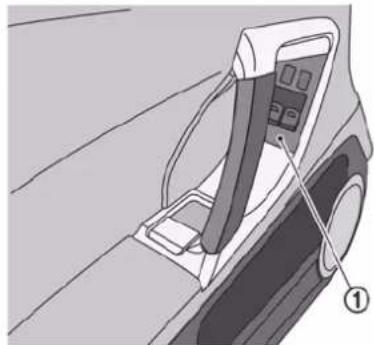
Cleaning the power window finisher
Moisten a soft cloth with neutral detergent and wipe off the dirt on the power window finisher ①
After wiping off the dirt, soak a cloth with water and wring it out thoroughly, then wipe off the neutral detergent.
7-8 Appearanceandcare
NOTICE
Somecleanersmaycausethepaint topeelorcausespotstooccur. If usingacleaner, it is recommended you consult with a GT-Rcertified NISSAN dealer.
CORROSIONPROTECTION
MOSTCOMMONFACTORSCON- TRIBUTINGTOVEHICLECORRO- SION
●The accumulation of moisture-retaining dirt and debris in body panel sections, cavities, and other areas.
●Damage to paint and other protective coatings caused by gravel and stone chips or minor traffic accidents.
ENVIRONMENTALFACTORSIN- FLUENCETHERATEOFCORRO- SION
Moisture
Accumulation of sand, dirt and water on the vehicle body underside can accelerate corrosion. Wet floor coverings will not dry completely inside the vehicle, and should be removed for drying to avoid floor panel corrosion.
Relativehumidity
Corrosion will be accelerated in areas of high relative humidity, especially those areas where the temperatures stay above freezing where atmospheric pollution exists, or where road salt is used.
Temperature
A temperature increase will accelerate the rate of corrosion to those parts which are not well ventilated.
Airpollution
Industrial pollution, the presence of salt in the air in coastal areas, or heavy road salt use will accelerate the corrosion process. Road salt will also accelerate the disintegration of paint surfaces.
TOPROTECT YOUR VEHICLE FROM CORROSION
- Wash and wax your vehicle often to keep the vehicle clean.
●Always check for minor damage to the paint and repair it as soon as possible. - Keep drain holes at the bottom of the doors open to avoid water accumulation.
- Check the underbody for accumulation of sand, dirt or salt. If present, wash with water as soon as possible.

CAUTION
- NEVERremovedirt, sandorother debris from the passenger compartment by washing it out with a hose. Removedirt with a vacuum cleaner.
●Neverallowwaterorotherliquids tocomeincontactwithelectronic componentsinsidethevehicleas thismaydamagethem.
Chemicals used for road surface deicing are extremely corrosive. They accelerate corrosion and deterioration of underbody components such as the exhaust system, fuel and brake lines, brake cables, floor pan and fenders.
Inwinter, theunderbody must be cleaned periodically.
For additional protection against rust and corrosion, which may be required in some areas, it is recommended you consult a GT-R certified NISSAN dealer.
7-10 Appearanceandcare
8Do-it-yourself
Maintenance precautions 8-3
Enginecompartmentchecklocations....8-4 Removingthecowltopcover....8-5
Enginecoolingsystem....8-6 Checkingenginecoolantlevel....8-8 Changingenginecoolant....8-8
Engineoil....8-9 Checkingengineoillevel....8-9 Changingengineoilandfilter....8-10
Transmissionoil....8-10
Powersteeringfluid....8-11
Brakefluid....8-11
Windowwasherfluid....8-12
Battery....8-13 Precautions....8-14
Fluidlevelcheck 8-14
Jumpstarting8-15
Drivebelts....8-16
Sparkplugs....8-16 Replacingsparkplugs....8-17
Aircleaner 8-17
Windshieldwiperblades....8-18 Cleaning....8-18
Replacingthewiperblades....8-18
Brakes....8-19
Self-adjustingbrakes....8-19
Brakepadwearwarning(modelswithout NCCB(NISSANCarbonCeramic Brake)package)....8-19
Highperformancebrakesystem (modelswithoutNCCB(NISSANCarbon CeramicBrake)package)....8-19 Replacingthebrakepads(modelswithout NCCB(NISSANCarbonCeramic Brake)package)....8-20
NCCB(NISSANCarbonCeramicBrake)(if soequipped)....8-20 Replacingbrakepadsandbrake discrotors....8-21
Fuses....8-22 Enginecompartment....8-22 Passengercompartment....8-23
IntelligentKeybatteryreplacement....8-25 Lights....8-27 Headlights....8-27 Exteriorandinteriorlights....8-28
Wheelsandtires....8-29 Tirepressure....8-30 Tireandloadinginformationlabel....8-32 Checkingthetirepressure....8-33

Tirelabeling....8-35
Changingwheelsandtires....8-39
Jackingvehicleandremovingwheels......8-42
Wheellocknuts(ifsoequipped)....8-47
MAINTENANCEPRECAUTIONS
When performing any inspection or maintenance work on your vehicle, always take care to prevent serious accidental injury to yourself or damage to the vehicle. The following are general precautions which should be closely observed.

WARNING
- Parkthevehicleonalevelsurface,applytheparkingbrake securelyandblockthewheelsto preventthevehiclefrommoving. Movetheshiftlevertothe position.
- Besuretheignitionswitchisin theOFFForLOCKpositionwhen performinganypartsreplacementorrepairs.
- If you must work with the engine running, keep your hands, clothing, hair and tools away from moving fans, belts and any other moving parts.
- Itisadvisabletosecureorremoveanylooseclothingand removeanyjewelry,suchas rings,watches,etc.beforework-ingonyourvehicle.
• Alwaysweareyeprotection
wheneveryouworkonyourvehicle.
•Ifyoumustruntheengineinan enclosedspacesuchasagarage, besurethereisproperventilation forexhaustgasestoescape.
- Nevergetunderthevehiclewhile itissupportedonlybyajack.Ifit isnecessarytoworkunderthe vehicle,supportitwithsafety stands.
- Keepsmokingmaterials, flame andsparksawayfromfueltank andthebattery.
-Yourvehicleisequippedwithan automaticenginecoolingfan.It maycomeonatanytimewithout warning,eveniftheignitionkeyis intheOFFpositionandtheengineisnotrunning.Toavoid injury,alwaysdisconnectthenegativebatterycablebeforeworkingnearthefan.
- Thefuelfilterorfuelliness should beservicedbyaGT-Rcertified NISSANdealerbecausethefuel linesareunderhighpressure evenwhentheengineisoff.

CAUTION
- Donotworkunderthehoodwhile theengineishot.Turntheengine offandwaituntilcoolsdown.
- Avoiddirectcontactwithused engineoilandcoolant.Improperlydisposedengineoil,coolant, and/orothervehiclefluidscan damagetheenvironment.Always conformtolocalregulationsfor disposalofvehiclefluid.
NOTICE
- Neverconnectordisconnectthe batteryoranytransistorized componentwhiletheignition switchisintheONposition.
- Neverleavetheengineortransmissionrelatedcomponentharnessesdisconnectedwhilethe ignitionswitchisintheONposition.
This "8. Do-it-yourself" section gives instructions regarding only those items which are relatively easy for an owner to perform.
Do-it-yourself8-3
ENGINECOMPARTMENTCHECKLOCATIONS
A genuine NISSAN Service Manual is also available. ( "Owner's Manual/Service Manual order information" page 10-24) You should be aware that incomplete or improper servicing may result in operating difficulties or excessive emissions. Ifin doubtaboutanyservicing, were recommendthatitbedonebyaGT-Rcertified NISSANdealer.
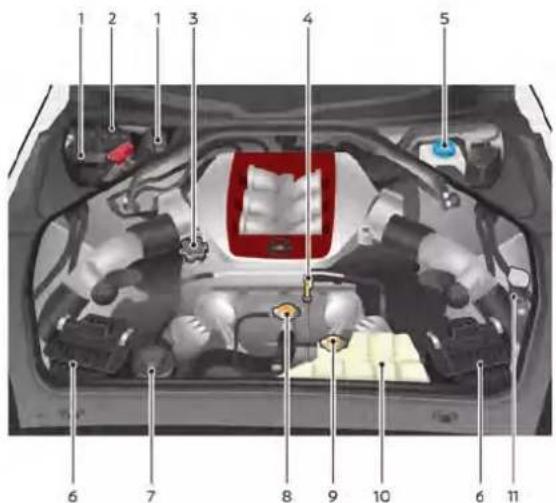
- Fuse/fusible link holder
- Battery
- Engine oil filler cap
- Engine oil dipstick
- Brake fluid reservoir
-
Air cleaner
-
Power steering fluid reservoir
- Radiator filler cap
- Coolant reservoir cap (pressure type)
- Coolant reservoir
- Window washer fluid reservoir
8-4 Do-it-yourself
NOTICE
Thecoolantreservoirisequipped withapressuretypecap,andthe radiatorisequippedwithanon-pressuretypecap.Donotswitch theradiatorfillercapandthecoolant reservoircap.Doingsowillcause substandardcoolingperformance andoverheating.


REMOVINGTHECOWLTOPCOVER
Remove the cowl top cover if necessary.
-
Remove the battery cover.
-
Unfasten the 5 clips and remove the cowl top cover® by pulling it up.

- Unfasten the 3 clips and remove the cowl top cover® by pulling it towards the front of the vehicle.
The engine cooling system is filled at the factory with a pre-diluted mixture of 50% Genuine NISSAN Long Life Antifreeze/ Coolant (blue) and 50% water to provide year-round anti-freeze and coolant protection. The anti-freeze solution contains rust and corrosion inhibitors. Additional engine cooling system additives are not necessary.

WARNING
- Neverremovetheradiatoror coolantreservoircapwhenthe engineishot.Waituntiltheengineandradiatorcooldown. Seriousburnscouldbecaused byhighpressurefluidescaping fromtheradiator.( "Ifyour vehicleoverheats"page6-8)
•Theradiatorisequippedwitha pressuretyperadiatorcap.To preventenginedamage,useonly agenuineNISSANradiatorcap.

CAUTION
- Neveruseanycoolingsystem additivessuchasradiatorsealer. Additivesmayclogthecooling systemandcausedamageto theengine,transmissionand/or coolingsystem.
- Whenaddingorreplacingcoolant,besuretouseonlyGenuine NISSANLongLifeAntifreeze/Coolant(blue)orequivalent.GenuineNISSANLongLifeAntifreeze/Coolant(blue)ispre-dilutedto provideantifreezeprotectionto -34°F(-37°C) .Ifadditionalfreeze protectionisneededdueto weatherwhereyouoperateyour vehicle,addGenuineNISSANLong LifeAntifreeze/Coolant(blue) concentratefollowingthedirectionsonthecontainer.Ifan equivalentcoolantotherthan GenuineNISSANLongLifeAntifreeze/Coolant(blue)isused, followthe coolantmanufacture's instructionstomaintainminimumantifreezeprotectionto -34°F(-37°C) .Theuseofother typesofcoolantsolutionsother thanGenuineNISSANLongLife
Antifreeze/Coolant(blue)or equivalentmaydamagetheenginecoolingsystem.
- Thelifeexpectancyofthefactory-fillcoolantis24,000miles (38,400km)or2years.Mixing anyothertypeofcoolantother thanGenuineNISSANLongLife Antifreeze/Coolant(blue)(or equivalentcoolant),including GenuineNISSANLongLifeAnti-freeze/Coolant(green),ortheuse ofnondistilledwatermayreduce thelifeexpectancyofthefactory-fillcoolant.Refertothe"9.Maintenanceandschedules"section ofthismanualformoredetails.

ExceptforNISMOmodels

NISMOmodels
① MAX line
②: MIN line
③: Between MAX and MIN lines (except for NISMO models)

CHECKINGENGINECOOLANTLEVEL
Check the coolant level inthereservoir whentheengineiscold. If the coolant level is below the MIN level ②, open the reservoir cap (pressure type) ⑧ and add coolant up to between the MAX ① and MIN ② level. If the reservoir is empty, open the radiator filler cap ⑨ and check the coolant level in the radiator whenthe engineiscold. If there is insufficient coolant in the radiator, fill the radiator with coolant up to the filler opening and also add it to the reservoir up to between the MAX ① and MIN ② level.
This vehicle contains Genuine NISSAN Long Life Antifreeze/Coolant (blue). The life expectancy of the factory-fill coolant is 24,000 miles (38,400 km) or 2 years. Mixing any other type of coolant or the use of non-distilled water will reduce the life expectancy of the factory-fill coolant. Refer to the "9. Maintenance and schedules" section of this manual for more details.
Ifthecoolingsystemfrequentlyrequirescoolant,itisrecommendedyou haveitcheckedbyaGT-Rcertified NISSANdealer.
Check that the level of coolant is between MAX and MIN on the pressurized radiator reservoir. If the level is below the midpoint, the amount of coolant circulating may be insufficient for maximum vehicle performance, possibly causing engine overheating or other trouble.
For the coolant level and mixture ratio when engaging in performance driving, see "Coolant level and mixture ratio" page GTR-15.
ExceptforNISMOmodels:
If it is difficult to determine the midpoint between MAX and MIN, remove the coolant reservoir cap and look inside through the opening to check that the coolant level is above the divider③ between the top half and bottom half of the pressur-
ized coolant reservoir.
NOTICE
- Thecoolantreservoirisequipped withapressuretypecap,and the radiatorisequippedwithanon-pressuretypecap.Donotswitch theradiatorfillercapandthe coolantreservoircap.Doingso willcausesubstandardcooling performanceandoverheating.
- If you have added only water as the coolant in an emergency, change it to a coolant mixture ratios specified as soon as possible.
CHANGINGENGINECOOLANT
If major cooling system repairs are required, it is recommended you contact a GT-R certified NISSAN dealer. The service procedures can be found in the appropriate NISSAN Service Manual.
Improperservicingcanresultinre- ducedheaterperformanceandengine overheating.

WARNING
•Toavoidthedangerofbeing scalded,neverchangethecoolantwhentheengineishot.
- Neverremovetheradiatorfiller capandthecoolantreservoircap whentheengineishot.Serious burnscouldbecasedbyhigh pressurefluidescapingfromthe radiatorandreservoir.
- Avoiddirectskincontactwith usedcoolant.ifskincontactis made,washthoroughlywithsoap orhandcleanerassoonaspossible.
- Keepcoolantoutofreachof childrenandpets.
Engine coolant must be disposed of properly. Check your local regulations.
ENGINEOIL
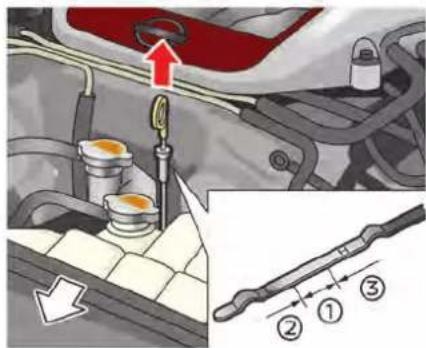
CHECKINGENGINEOILLEVEL
- Park the vehicle on a level surface and apply the parking brake.
- Run the engine until it reaches operating temperature.
- Turn off the engine. Wait at least 5 minutes for the oil to drain back into the oil pan before checking the oil.
- Remove the dipstick and wipe it clean. Reinsert it all the way.
- Remove the dipstick again and check the oil level. It should be within the range ①. If the oil level is below, ② remove the oil filler cap and pour recommended oil through the open-
ing. Donotoverfill ③
- Recheck oil level with the dipstick.
NOTE:
-Itisnormaltoaddsomeoilbetween oilmaintenanceintervalsorduring thebreak-inperiod,depending on theseverityofoperatingconditions. More engineoilisconsumedby frequent acceleration/deceleration especiallywhentheengineerpmis high.Ifyourrateofoilconsumption increasessuddenlyorwithoutexplanation,NISSANrecommendsthat youhaveyourvehicleinspectedbya GT-RcertifiedNISSANdealer.
- When the vehicle is delivered, the engine oilissetto 0.39 in (10 mm) below the Hmark for optimal high performed driving. The engine oil can be filled up to the Hmark if performed driving is not engaged.
NOTICE
•Mobil1(OW-40) (100%synthetic) isthe factoryfill oil.The VR38 enginewithits plasma-sprayed boreswasdevelopedusingthis oil.NISSANcannotensureproper engineoperationanddurabilityif otherOW-40non-equivalentsyn-
theticoilisused.IfMobil1(0W-40)orequivalentisnotavailable, Mobil1(10W-40)(100%synthetic) orequivalentmaybeused;however,someperformancelossmay benoticed.
- Oillevelshouldbecheckedregularly.Operatingtheenginewith aninsufficientamountofoilcan damagetheengine.Seethe2021NISSANGT-RWarrantyInformationBookletfordetailsincluding applicableexclusions.
CHANGINGENGINEOILANDFILTER
NOTE:
Whenreplacementisrequired,itis recommendedyoucontactaGT-RcertifiedNISSANdealerforservicing.

WARNING
•Prolongedandrepeatedcontact withusedengineoilmaycause skincancer.
- Trytoavoiddirectskincontact withusedoil.Ifskincontactis made,washthoroughlywithsoap orhandcleanerassoonaspos-
sible.
- Keepusedengineoiloutofreach ofchildren.
TRANSMISSIONOIL
NOTE:
Whencheckingorreplacementisrequired,itisrecommendedyoucontact aGT-RcertifiedNISSANdealerforservicing.
NOTICE
-Itisrecommendedthatyouuse onlyGenuineNISSANTransmissionOilR35Specialorequivalent. Donotmixwithotherfluids.
- Usingtransmissionoilotherthan GenuineNISSANTransmissionOil R35Specialorequivalentmay causedeteriorationindriveability andtransmissiondurability,and maydamagethetransmission. Seethe2021NISSANGT-RWarrantyInformationBookletfordetailsincludingapplicable exclusions.
POWERSTEERINGFLUID

Check the fluid level in the reservoir. Remove the cap that is attached with a gauge inside.
The fluid level should be checked using the front side of the gauge marked "HOT" (①: HOT MIN., : HOT MAX.) at fluid temperatures of 122 to 176°F (50 to 80°C) or using the reverse side of the gauge marked "COLD" (③: COLD MIN., ④: COLD MAX.) at fluid temperatures of 32 to 86°F (0 to 30°C).
If the fluid is below the MIN line, add Genuine NISSAN PSF II or equivalent. Remove the cap and fill through the opening.
NOTE:
Formaximumsteeringsystemperformance,adjustthefluidlevelattheline ⑤ atthehotfluidtemperatureorat ⑥ thecoldfluidtemperature.WerecommendcontactingaGT-Rcertified NISSANdealerwhenprecisefluidlevel adjustmentisrequired.
NOTICE
- Donotoverfill.
•UseGenuineNISSANPSFllor equivalent.
BRAKEFLUID
For further brake fluid information, see the following section. ( "Capacities and recommended fluids/lubricants" page 10-2)

WARNING
•Useonlynewfluidfromasealed container.Old,inferiororcontaminatedfluidmaydamagethe brakesystem.Theuseofimproperfluidscandamagethebrake systemandaffectthevehicle's stoppingability.
- Cleanthefillercapbeforeremoving.
- Brakefluidispoisonous and shouldbestoredcarefully in markedcontainersoutofthe reachofchildren.

CAUTION
GenuineNISSANBrakeFluidR35 Speciallisthefactoryfillbrakefluid. TheVehicleDynamicControl(VDC) unitandotherrelatedpartswere speciallydesignedforthisbrake fluidandNISSANcannotensure properoperationofthevehicleif
Do-it-yourself
othernon-equivalentbrakefluidis used.
NOTICE
Donotspillthefluidonanypainted surfaces. This will damage the paint. If fluidisspilled, wash the surface with water.
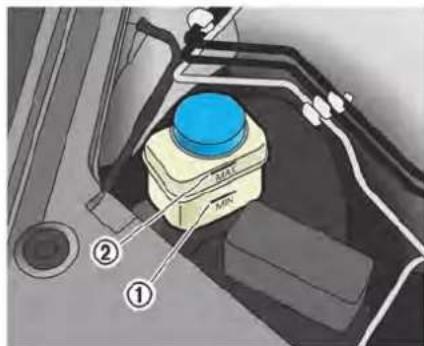
WINDOWWASHERFLUID

Check the fluid level in the reservoir. If the fluid is below the MIN line 1 or the brake warning light comes on, add Genuine NISSAN Brake Fluid R35 Special II fluid (or equivalent) up to the MAX line 2 . If fluid must be added frequently, the system should be checked. It is recommended you contact a GT-R certified NISSAN dealer.

WARNING
Antifreezeispoisonousandshould bestoredcarefullyinmarkedcontainersoutofthereachofchildren.
Fill the window washer fluid reservoir periodically. Add window washer fluid when the low washer fluid warning appears on the vehicle information display. ( "Low washer fluid warning" page 2-44)
To fill the window washer fluid reservoir, lift the cap off the reservoir tank and pour the window washer fluid into the tank
opening.
Add a washer solvent to the washer for better cleaning. In the winter season, add a windshield washer antifreeze. Follow the manufacturer's instructions for the mixture ratio.
Refill the reservoir more frequently when driving conditions require an increased amount of window washer fluid.
NOTICE
- Donotsubstituteengineanti-freezecoolantforwindow washersolution. This may result in damagetothepaint.
- Donotfillthewindowwasher reservoirtankwithwasherfluid concentratesatfullstrength. Somemethylalcoholbased washerfluidconcentratesmay permanentlystainthegrilleif spilledwhilefillingthewindow washerreservortank.
NOTE:
Pre-mixwasherfluidconcentrateswith watertothemanufacturer'srecommended levelsbeforepouringthefluid into the windowwasherreservoir.Do
notusethewindowwasherreservoirto mixthewasherfluidconcentrateand water.
BATTERY
- Keep the battery surface clean and dry. Clean the battery with a solution of baking soda and water.
- Make certain the terminal connections are clean and securely tightened.
- If the vehicle is not to be used for 30 days or longer, disconnect the negative (-) battery terminal cable to prevent discharging it.
NOTE:
Careshouldbetakentoavoidsituations thatcanleadtopotentialbatterydischargeandpotentialno-startconditionssuchas:
- Installationorextendeduseofelec- tronicaccessoriesthatconsume batterypowerwhentheengineis notrunning(Phonechargers,GPS, DVDplayers,etc.)
- Vehicleisnotdrivenregularlyand/oronlydrivenshortdistances.
Inthesecases, the battery may need to be charged to maintain battery health.
PRECAUTIONS
NOTICE
When the battery cable is removed from the battery terminal, donot close either of the front doors. The automatic window adjusting function will not work, and the sideroof panel may be damaged.
To disconnect the negative (-) battery terminal, perform the procedure in the following order. Otherwise, the window and the side roof panel may contact and be damaged.
- Close the windows.
- Open the hood.
- Close and lock all the doors.
- Disconnect the negative (-) battery terminal.
- Securely close the hood.
To connect the negative (-) battery terminal, perform the procedure in the following order. Otherwise, the window and the side roof panel may contact and be damaged. - Unlock and open the driver side door. Do not close the door.
- Open the hood.
8-14 Do-it-yourself
- Connect the negative (-) battery terminal. Then close the hood.
- Fully open the driver side door window.
- Close the driver side door and the window.
FLUIDLEVELCHECK

WARNING
- Donotexposethebatteryto flamesorelectricalsparks.Hydrogengasgeneratedbythe batteryisexplosive.Donotallow batteryfluidtocontactyourskin, eyes,fabrics,orpaintedsurfaces. Aftertouchingabatteryorbatterycap,donottouchorrubyour eyes.Thoroughlywashyour hands.Iftheacidcontactsyour eyes,skinorclothing,immediatelyflushwithwaterforatleast 15minutesandseekmedical attention.
-
Donotoperatethevehicleifthe fluidinthebatteryislow.Low batteryfluidcancauseahigher loadonthebatterywhichcan generateheat,reducebatterylife, andinsomecasesleadtoan explosion.
-
Whenworkingonornear a battery,alwayswearsuitableeye protectionandremovealljewelry.
- Batteryposts,terminalsandrelatedaccessoriescontainlead andleadcompounds.Wash handsafterhandling.
- Keepthebatteryoutofthereach ofchildren.


JUMPSTARTING
If jump starting is necessary, see the following section. ( "Jump starting" page 6-5) If the engine does not start by jump starting, the battery may have to be replaced. It is recommended you contact a GT-R certified NISSAN dealer.
Check the fluid level in each cell (Remove the battery cover if it is necessary). It should be between the UPPER LEVEL ① and LOWER LEVELlines.
If it is necessary to add fluid, add only distilled water to bring the level to the indicator in each filler opening. Donot overfill.
-
Remove the cell plugs Ⓐ
-
Add distilled water up to the UPPER LEVEL ① line. If the side of the battery is not clear, check the distilled water level by looking directly above the cell; the condition ① indicates OK and the conditions ② needs more to be added.
-
Tighten cell plugs Ⓐ
Vehicles operated in high temperatures or under severe conditions require frequent checks of the battery fluid level.
DRIVEBELTS

- Power steering fluid pump
- Alternator
- Crankshaft pulley
- Air conditioner compressor
- Drive belt auto-tensioner

WARNING
Besuretheignitionswitchisinthe OFForLOCKpositionbeforeservicingdrivebelts.Theenginecould rotateunexpectedly.
- Visually inspect each belt for signs of unusual wear, cuts, fraying or loosen-
8-16 Do-it-yourself
SPARKPLUGS
ess. If the belt is in poor condition or loose, have it replaced or adjusted. It is recommended you contact a GT-R certified NISSAN dealer.
- Have the belts checked regularly for condition and tension in accordance with the maintenance schedule shown in the "9. Maintenance and schedules" section.

WARNING
Besuretheengineandtheignition switchareoffandthattheparking brakeisengagedsecurely.
NOTICE
Besuretousethecorrectsocketto removethesparkplugs.Anincorrect socketcandamagethesparkplugs.

REPLACINGSPARKPLUGS
If replacement is required, it is recommended you see a GT-R certified NISSAN dealer for servicing.
Iridium-tippedsparkplugs
It is not necessary to replace the iridium-tipped spark plugs as frequently as the conventional type spark plugs since they will last much longer. Follow the maintenance schedule shown in the "9. Maintenance and schedules" section, but do not reuse them by cleaning or regapping. Alwaysreplacesparkplugswithrecommendedorequivalentones.
AIRCLEANER


Remove the retainers ① as illustrated and pull out the filter element ②
The filter element should not be cleaned and reused. Replace it according to the maintenance intervals. See the "9. Maintenance and schedules" section for maintenance intervals. When replacing the
filter, wipe the inside of the air cleaner housing and the cover with a damp cloth.

WARNING
- Operatingtheenginewiththeair cleanerremovedcancauseyou orotherstobeburned.Theair cleanernotonlycleanstheair,it stopsflameiftheenginebackfires.Ifitisn'tthere,andthe enginebackfires,youcouldbe burned.Donotdrivewiththeair cleanerremoved,andbecareful whenworkingontheenginewith theaircleanerremoved.
- Neverpourfuelintothethrottle bodyorattempttostartthe enginewiththeaircleanerremoved.Doingsocouldresultin seriousinjury.
WINDSHIELDWIPERBLADES
CLEANING
If your windshield is not clear after using the windshield washer or if a wiper blade chatters when running, wax or other material may be on the blade or windshield.
Clean the outside of the windshield with a washer solution or a mild detergent. Your windshield is clean if beads do not form when rinsing with clear water.
Clean each blade by wiping it with a cloth soaked in a washer solution or a mild detergent. Then rinse the blade with clear water. If your windshield is still not clear after cleaning the blades and using the wiper, replace the blades.

CAUTION
Wornwindshieldwiperbladescan damagethewindshieldandimpair drivervision.

REPLACINGTHEWIPERBLADES
Replace the wiper blades if they are worn.
- Pull the wiper arm.
- Push the release tab Ⓐ and then move the wiper blade down the wiper arm ⏱ while pushing the release tab to remove.
- Insert the new wiper blade onto the wiper arm until a click sounds.
- Rotate the wiper blade so the dimple is in the groove.
NOTICE
•Afterwiperbladereplacement, returnthewiperarmtoitsoriginalposition;otherwiseitmaybe damagedwhenthehoodis opened.
•Makesurethewiperbladescontacttheglass;otherwisethearm maybedamagedfromwind pressure.
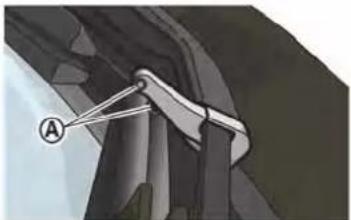

B

BRAKES
If the brakes do not operate properly, have the brakes checked. It is recommended you contact a GT-R certified NISSAN dealer.
SELF-ADJUSTINGBRAKES
Your vehicle is equipped with self-adjusting brakes.
The disc-type brakes self-adjust every time the brake pedal is applied.

WARNING
Westronglyrecommendseeinga GT-RcertifiedNISSANdealerfora brakesystemcheckifthebrake pedalheightdoesnotreturnto normal.
BRAKEPADWEARWARNING (modelswithoutNCCB(NISSAN CarbonCeramicBrake)package)
The disc brake pads have audible wear warnings. When a brake pad requires replacement, it will make a high pitched scraping sound when the vehicle is in motion. This scraping sound will first occur only when the brake pedal is depressed. After more wear of the brake pad, the sound will always be heard even if the brake pedal is not depressed. Have the brakes checked as soon as possible if the wear warning sound is heard.
Under some driving or climate conditions, occasional brake squeak, squeal or other noise may be heard. Occasional brake noise during light to moderate stops is normal and does not affect the function or performance of the brake system.
Properbrakeinspectionintervals shouldbefollowed. For additional information, see the maintenance schedule shown in the "9. Maintenance and schedules" section.
HIGHPERFORMANCEBRAKESYSTEM(modelswithoutNCCB (NISSANCarbonCeramicBrake) package)
This vehicle is equipped with high performance brake pads that provide appropriate braking force in a broad range of driving environments. Due to the material used for the brake pads, the road wheels may become more easily covered by brake dust, however this does not indicate that there is a malfunction.
The GT-R brake pads use material that contains a lot of iron to maintain steady braking performance even in high and low temperatures. However, if the brake
Do-it-yourself8-19
NCCB(NISSANCarbonCeramic Brake)(ifsoequipped)
system is wet and the parking brake is applied for a long time, the iron in this material may get rusty and the brake pa and disc rotor may be fixed together. The may cause noise and vibration while driving. Before parking the vehicle, dry the brake by driving on a dry road, especially after washing the vehicle or driving in rain. It is recommended you contact a GT-R certified NISSAN dealer if the noise and vibration continue.
Frequent hard braking may cause scorching of the brake pads. This will require the brake pads to be replaced, even if the wear limit has not been reached. Have the brake pads and disc rotors inspected at the regular vehicle inspections.
For more details, it is recommended you contact a GT-R certified NISSAN dealer.
REPLACINGTHEBRAKEPADS (modelswithoutNCCB(NISSAN CarbonCeramicBrake)package)
NISSAN generally recommends to replace all four sets of brake pads and disc rotors at the same time to maintain maximum brake performance.
However, replacing only the brake pads may be allowed in some cases (four wheels or only front wheels depending on the conditions). A GT-R certified tech-
nician must inspect the vehicle and determine that only the brake pads need to be replaced. In this case, replacing all brake pads and disc rotors as a set is not necessary.
Note that the replacement of brake pads and the disc rotors as a set on all four wheels should be performed when a GT-R certified technician determines that this is the correct repair.
If the inside of the disc rotors are cold during the winter and the surface becomes hot due to a heavy force being applied repeatedly to the brakes, cracks may occur near the coolant hole on the surface of the disc rotor. Cracks may also occur due to a heavy force being repeatedly applied to the brakes during high performance driving. In these cases it may be necessary to replace the disc rotors or brake pads depending on the condition of the crack. It is recommended you contact a GT-R certified NISSAN dealer for replacement.
NOTE:
•InordertoenjoythehighperformancebrakingsensationaswellasthesportydrivingandflexibilityofferedbytheGT-R,NCCB(NISSANCarbonCeramicBrake)isavailable. Inaddition,NCCB(NISSANCarbonCeramicBrake)hasexcellentdurabilityduringnormaldrivinganditslightweightallowthereductionoftheunsprungweighttoimprovetheroadholdinggripperformance.
- Afterhighperformancedrivingor extremeuseofthebrake, the compositionofthebrakediscrotorwill changeduetobrakepadwearor hightemperaturefrictionheat. Even ifthebrakediscrotorlooksnormal, itmayneedtobereplaced.
•NCCB(NISSANCarbonCeramic Brake)hasthesamefullfloating structureasthestandardbrake systeminGT-R.Therefore,thejoint ofthefullfloatingstructureofthe discrotormaynotrustdepending onthestatusofuse.Incaseofrust onthejoint,haveNCCB(NISSAN CarbonCeramicBrake)andtherelatedpartsinspected.Itisrecommendedyouhavethevehicle inspectedbyaGT-RcertifiedNISSAN
dealer.
- Thematerialsusedforthebrake discrotorandbrakepadsforNCCB (NISSANCarbonCeramicBrake)are differentfromthoseusedforthe standardbrakesysteminGT-R.The rotorandpadswillbeprotected fromadhesioncausedbyrusting. However,neverparkyourvehiclefor alongtimewiththebrakesystem wet.Thishelpsmaintainthebrake discrotorandbrakepadsforalong timeandpreventsaninfluenceon thematerialcompositionofthe carbonceramicrotoranddeteriorationinthejointofbrakediscrotor's fullfloatingstructure.Especially duringwinter,besuretoparkyour vehiclewiththebrakediscrotorand padsdrytopreventthemfrom beingfrozenanddamagedinbelow freezingtemperatureconditions. Thecarbonceramicbrakeincludes airbubblesintherotorandpads. Notethatleavingtheminthewet conditiontendstocauseadhesion duetofreezing.

WARNING
Afteranimpacttotheunderbodyor whenthebrakediscrotorhaschippingorcracks,haveyourvehicle inspected.Itisrecommendedyou havethevehicleinspectedbya GT-RcertifiedNISSANdealer.Otherwise,thebrakediscrotormaybe damaged,whichmayresultina seriousaccident.
NOTICE
●Neverusebrakecleanerorany chemicalagentonthebrakedisc rotor. Usingbrakecleanerorany chemicalagentonthebrakedisc rotormaycauseadecreasein durabilityofthebrakediscrotor.
●Afterdrivingonagravelroad, suchasanevacuationroute,have yourvehiclecheckedfordamage tothebrakediscrotor.Itis recommendedyoucontacta GT-RcertifiedNISSANdealerfor thisservice.
•Sincethecarbonceramicbrake discrotorisveryhard, donot
subjectittoastrongimpact. Whenremovingthetires,becarefulnottoallowthetiretointerferewiththebrakediscrotor.
REPLACINGBRAKEPADSAND BRAKEDISCROTORS
- When replacing brake pads and brake disc rotors, NISSAN recommends replacing two sets of them at the same time. However, the brake pads can be separately replaced only when a GT-R certified technician judges that the brake disc rotors are reusable, based on a measured weight and a check for scratches and cracks.
- It is recommended that maintenance and inspection on your vehicle should be performed at a GT-R certified NISSAN dealer after engaging in high performance driving. Otherwise, the peripheral parts of the brake may be damaged due to the generation of special radiant heat because of the characteristics of the material in addition to brake pad wear and the deterioration in durability of the brake disc rotor.
Brakepad
When the brake warning light illuminates to indicate brake pad wear, have the brake system checked and brake pads replaced as soon as possible. It is recommended you contact a GT-R certified NISSAN dealer for this service.

CAUTION
Neverdriveforalongperiodoftime whenthewarninglightisilluminated. Otherwise, thebrakemay notfunctionproperlyduetobrake padwear.
Brakediscrotor
Under the following conditions, the immediate replacement of the brake disc rotor may be necessary. Even if it looks normal, have your vehicle inspected immediately. It is recommended you contact a GT-R certified NISSAN dealer for this service.
●Extremely decreased braking force
●Chipping or cracks on the brake disc rotor
●After an impact to tires or the periph-
8-22 Do-it-yourself
ery of the wheels
- Parts around the brake may have contacted with the brake disc rotor or brake caliper due to wear.
- The metal plate of a brake pad has contacted with the surface of a brake disc rotor because the brake pad replacement period was exceeded.
- Interference between the wheel and brake disc rotor during tire installation or removal.

WARNING
WhenaGT-Rcertifiedtechnician judgesthatabrakediscrotorshould bereplaced,havethediscrotor replaced.
FUSES

ENGINECOMPARTMENT

WARNING
Neveruseafuseofahigherorlower amperageratingthanthatspecified onthefuseboxcover.Thiscould damagetheelectricalsystemor electroniccontrolunitsorcausea fire.
If any electrical equipment does not operate, check for an open fuse.
- Be sure the ignition switch is pushed to the OFF or LOCK position and the
headlights are turned off.
- Open the engine hood and remove the cover on the battery and the fuse/fusible link holder.
- Remove the fuse/fusible link holder cover.
- Remove the fuse with the fuse puller that is located in the engine compartment fuse box.


- If the fuse is open replace it with a new fuses . Spare fuses are stored in the passenger compartment fuse box.
- If a new fuse also opens, have the electrical system checked and repaired. It is recommended you contact a GT-R certified NISSAN dealer.
Fusiblelinks
If any electrical equipment does not operate and fuses are in good condition, check the fusible links. If any of these fusible links are melted, replace only with genuine NISSAN parts.
PASSENGERCOMPARTMENT

WARNING
Neveruseafuseofahigherorlower amperageratingthanthatspecified onthefuseboxcover.Thiscould damagetheelectricalsystemorelectroniccontrolunitsorcausea fire.
If any electrical equipment does not operate, check for an open fuse. 1. Be sure the ignition switch is pushed to the OFF or LOCK position and the
Do-it-yourself8-23
headlights are turned off. 2. Open the fuse box lid.
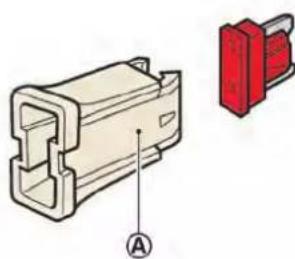
(switched on) and should always remain on. If any electrical equipment does not operate, remove the extended storage fuse switch and check for an open fuse.
NOTE:
Iftheextendedstoragefuseswitch malfunctions,orifthefuseisopen,it isnotnecessarytoreplacetheswitch. Inthiscase,removetheextendedstoragefuseswitchandreplaceitwitha newfuseofthesamerating.
- Remove the fuse with the fuse puller Ⓐ.
- If the fuse is open, replace it with a new fuse.
- If a new fuse also opens, have the electrical system checked and repaired. It is recommended you contact a GT-R certified NISSAN dealer.
Extendedstoragefuseswitch(if soequipped)
To reduce battery drain, the extended storage fuse switch comes from the factory switched off. Prior to delivery of your vehicle, the switch is pushed in
INTELLIGENTKEYBATTERYREPLACEMENT


Howtoremovetheextendedstorage fuseswitch:
- To remove the extended storage fuse switch, be sure the ignition switch is in the OFF or LOCK position.
- Be sure the headlights are turned off.
- Remove the fuse box cover.
- Pinch the locking tabs ① found on each side of the extended storage fuse switch.
- Pull the extended storage fuse switch straight out from the fuse box ② .

WARNING
Becarefulthatbatteriesandother removedcomponentsarenotswallowedbychildren.
NOTICE
Thereisthepossibilitythatthekey maybedamagedwhenthebatteryis replaced.Itisrecommendedthat youhavethebatteryreplacedbya GT-RcertifiedNISSANdealer.
Recommended battery: Lithium battery CR2032 or an equivalent.
- Disengage the lock on the reverse side of the Intelligent Key while pulling out the mechanical key.
- Insert a flat-bladed screwdriver ① wrapped with a cloth into the slit ② and twist it to separate the case into the upper and lower parts.
NOTICE
Becausethereistheriskofscratchingthekey,wrapaclothorsimilar itemaroundthescrewdriverwhen separatingtheparts.Ifthescrewdriverisinsertedtoofarintothekey,it maydamagetheinternalcircuit board.

- Remove the old battery and insert a new battery with the + side facing down.
NOTICE
- Besurethatthe+and-sidesof thebatteryarefacinginthe correctdirectionswhenthebatteryisinserted.
- Donottouchtheinternalcircuits orelectronicterminals.Doingso maydamagethem.

- Reconnect the upper and lower parts of the Intelligent Key.
See a GT-R certified NISSAN dealer if you need any assistance for replacement.
NOTE:
Afterreplacingthebattery,besureto checkandcheckthatallIntelligentKey systemfunctionsoperatecorrectly.
FCCNotice:
ForUSA:
ThisdevicecomplieswithPart15ofthe FCCRules.Operationissubjecttothe followingtwoconditions:(1)Thisdevice maynotcauseharmfulinterference,
and(2)thisdevicemustacceptany interferencereceived,includinginterferencethatmaycauseundesiredoperation.
Note: Changesormodificationsnot expresslyapprovedbythepartyresponsibleforcompliancecouldvoid theuser'sauthoritytooperatethe equipment.
ForCanada:
ThisdevicecomplieswithIndustryCanadalicense-exemptRSSstandard(s). Operationissubjecttothefollowing twoconditions:(1)thisdevicemaynot causeinterference,and(2)thisdevice mustacceptanyinterference,including interferencethatmaycauseundesired operationofthedevice.
LIGHTS
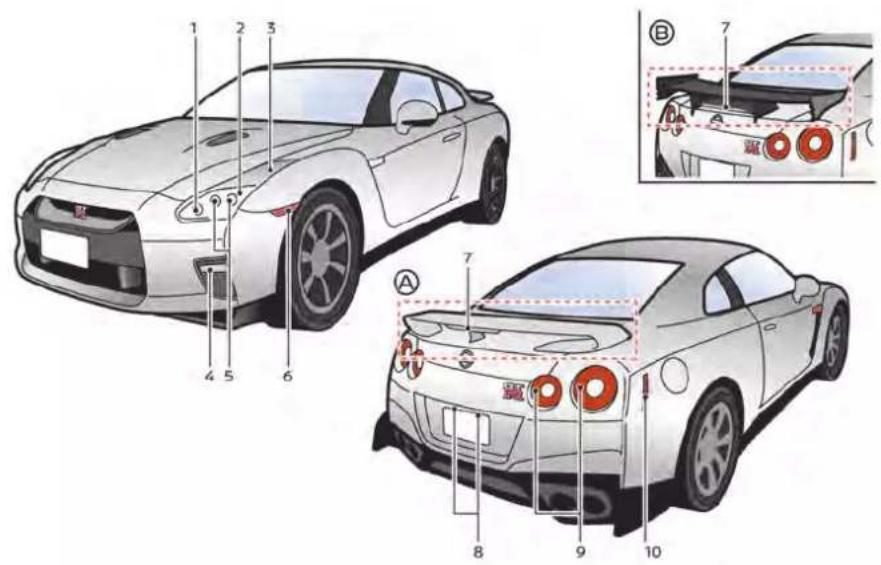
- Headlight (High beam)
- Front parking light
- Front turn signal light
- Daytime running light
- Headlight (Low beam)
-
Front side marker light
-
High-mounted stop light
- License plate light
-
Rear combination light (rear turn signal/tail/stop/back-up)
-
Rear side marker light
Ⓐ Except for NISMO models
© NISMO models
HEADLIGHTS
Fog may temporarily form inside the lens of the exterior lights in the rain or in a car wash. A temperature difference between the inside and the outside of the lens causes the fog. This does not indicate that there is a malfunction. If large drops of water collect inside the lens, it is recommended you contact a GT-R certified NISSAN dealer.
Replacing
LEDheadlight:
If replacement is necessary, it is recommended you see a GT-R certified NISSAN dealer.
Do-it-yourself8-27
EXTERIORANDINTERIORLIGHTS
| Item Wattage (W) | Bulb No. | |
| Headlight assembly | ||
| low-beam* LED — | ||
| high-beam* LED — | ||
| Front turn signal light* 28/8 | 7444NA | |
| Front parking light* LED — | ||
| Daytime running light* LED | — | |
| Front side marker light* 3.8 | T10 | |
| Rear combination light* | ||
| back-up 16 | W16W | |
| turn signal 21 | WY21W | |
| stop/tail LED | — | |
| Rear side marker light* LED — | ||
| License plate light* LED | — | |
| Map light | 8 | — |
| Vanity mirror light* 2 | — | |
| Step light* | 2.7 | — |
| Trunk light* | 3.4 | — |
| High-mounted stop light* | LED | — |
*: It is recommended you see a GT-R certified NISSAN dealer for replacement.
It is recommended you always check with the Parts Department at a GT-R certified NISSAN dealer for the latest parts information.
Replacementprocedures
All other lights are either type A, B, C, D, E or F. When replacing a bulb, first remove the lens and/or cover.
![graph TD A["Light Bulb"] --> B["Add Battery"] B --> C["Remove Battery"] C --> D["Install"] D --> E["Battery"] E --> F["Add Battery"] F --> G["Remove Battery"] G --> H["Install"]](/content/2026/05/810568/images/c3040e430dd7a73f9e5e2d6d541fe2b128d4ae4a964c3d8361a42d50c74e3416.jpg)

WHEELSANDTIRES
If you have a flattire, seethefollowing section. ( "Flattire" page6-3)

CAUTION
AGT-RcertifiedNISSANdealer shouldperformatirechange.itwill benecessarytoresetthetirepressuresensors.Tochangethetires,itis recommendedyoucontactaGT-R certifiedNISSANdealer.
Be sure to use the tires and wheels together as a set that are designated for use with this vehicle.
When tire replacement is required, replacing the tires as a set of four with new tires is recommended. However, if a tire is punctured or damaged, it may be possible to replace only the damaged tire. Determining whether one tire or a complete set of tires should be replaced is based on a number of factors including tire wear and condition. It is recommended you contact your GT-R certified NISSAN dealer. They can recommend if an individual tire or a complete set should be replaced.
Do-it-yourself8-29
NOTICE
Makesurethetirevalvestemcapis installedandthatthevalvestemis tight.Wheninstallingthecap,make suretotightenthecapbyhand.Ifa toolisusedtotightenthecap,the capmaybedamaged.
TIREPRESSURE
TirePressureMonitoringSystem (TPMS)
This vehicle is equipped with the Tire Pressure Monitoring System (TPMS). It monitors tire pressure of all tires. When the low tire pressure warning light is lit, one or more of your tires is significantly under-inflated. The system also displays pressure of all tires on the touch screen display by sending a signal from a sensor that is installed in each wheel.
The TPMS will activate only when the vehicle is driven at speeds above 16 MPH (25 km/h). Also, this system may not detect a sudden drop in tire pressure. ( "Low tire pressure warning light" page 2-30) ( "Tire Pressure Monitoring System (TPMS)" page 5-4) ( "Flat tire" page 6-3)
8-30 Do-it-yourself
Tireinflationpressure
Check the tire pressure often and always prior to long distance trips. The recommended tire pressure specifications are shown on the F.M.V.S.S./C.M.V.S.S. label or the Tire and Loading Information label (if so equipped) under the "Cold Tire Pressure" heading. The Tire and Loading Information label is affixed to the driver side door end. Tire pressures should be checked regularly because:
- Most tires naturally lose air over time.
- Tires can lose air suddenly when driven over potholes or other objects or if the vehicle strikes a curb while parking.
NOTE:
- Youcancheckthepressureofall fourtiresonthetouchscreendisplay. See the separate Multi FunctionDisplayOwner'sManual.
- Thetiresofthisvehiclearefilled withnitrogengas.Whenthetire pressureislow,fillthetireswith
nitrogen. It is recommended you contact a GT-R certified NISSAN dealer for information on filling the tires with nitrogen.
- Ifnitrogenisnotavailable,compressedairmaybesafelyused undernormaldrivingconditions. However,NISSANrecommendsrefillingwithnitrogenformaximum tireperformance.
The tire pressures should be checked when the tires are cold. The tires are considered COLD after the vehicle has been parked for 3 or more hours, or driven less than 1 mile (1.6 km) at moderate speeds.
Incorrect tire pressure, including underinflation, may adversely affect tire life and vehicle handling.

WARNING
- Improperlyinflatedtirescan failsuddenlyandcausean accident.
•TheGrossVehicleWeight rating(GVWR)is locatedon
theF.M.V.S.S./C.M.V.S.S.certificationlabel.Thevehicle weightcapacityisindicated ontheTireandLoadingInformationlabel(ifso equipped).Donotloadyour vehiclebeyondthiscapacity. Overloadingyourvehicle mayresultinreducedtire life,unsafeoperatingconditionsduetoprematuretire failure,orunfavorablehandlingcharacteristics and couldalsoleadtoaserious accident.Loadingbeyond thespecifiedcapacitymay alsoresultinfailureofother vehiclecomponents.
- Beforetakingalongtrip,or whenever you heavily load your vehicle,useatirepressuregaugetoensure that the tire pressures are at the specified level.
- Foradditionalinformation regardingtires,referto"ImportantTireSafetyInforma-
tion"(US)or"TireSafety Information"(Canada)inthe WarrantyInformationBooklet.
NOTE:
- UseonlygenuineGT-Rtiresand roadwheels.
TheGT-Rusesspeciallydesigned run-flattiresandmatchingroad wheels.Useofthese specially developedtiresandwheelsprovidesthe greatestpotentialformaximum performance.
— GenuineGT-Rtiresandroad wheelshelpachievemaximum corneringandbrakingperformance.
— GenuineGT-Rtiresandroid wheelshelpachievemaximum tire durability during acceleration.
- GenuineGT-Rtiresandroid wheelshelpachievemaximum handling capability duringperformedriving.
- GenuineGT-Rtiresandroad wheelshelpprovideroadholding intheeventofdecreasingtire pressureandpunctures.
- GenuineGT-Rtiresandroid wheelshelppreventthedecrease ofstraight-runningstability causedbyuneventireweardue tohighrigiditywheelsandwide tires.
- TheGT-Rusesspeciallydesigned run-flattireswhichfeatureanextremelyrigidsidewall.Specialtechniquesandequipmentaretherefore requiredwhenreplacingthesetires. NISSANrecommendsthattirereplacementbeperformedataGT-R certifiedNISSANdealer.
- Specifictirechangingequipment mustbeusedtoremovetheGT-R tiresfromthewheelandtoinstall theGT-Rtiresontothewheel.Itis only possible to reuse the tires when theyhavenocracksand/ordeformationsonthebeadportionofthe tire.Iftheincorrectequipmentis usedtoremovetheGT-Rtiresfrom the wheel and to install the GT-R tiresontothewheel,cracksand deformationmayoccuronthebead portion of the tires meaning that the tirescannotbereused.Itisrecommended you contact a GT-R certified NISSANdealeriftthetiresneedtobe removedfromthewheels.
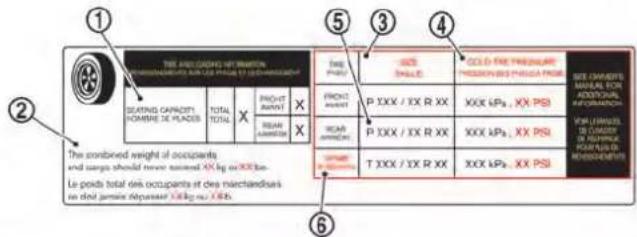
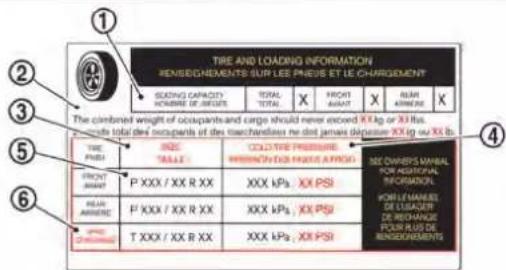
TIREANDLOADINGINFORMATION LABEL
① Seating capacity: The maximum number of occupants that can be seated in the vehicle.
② Vehicle load limit: See the following section. ( "Vehicle loading information" page 10-16)
③ Original size: The size of the tires originally installed on the vehicle at the factory.
④ Cold tire pressure: Inflate the tires to this pressure when the tires are cold. Tires are considered COLD after the vehicle has been parked for 3 or more hours, or driven less than 1 mile (1.6 km) at moderate speeds. The recommended cold tire inflation is set by the manufacturer to provide the best balance of tire wear, vehicle handling, driveability, tire noise, etc., up to the vehicle's GVWR.
⑤ Tire size — see the following section. ( "Tire labeling" page 8-35)
⑥ Spare tire size or compact spare tire size (if so equipped)
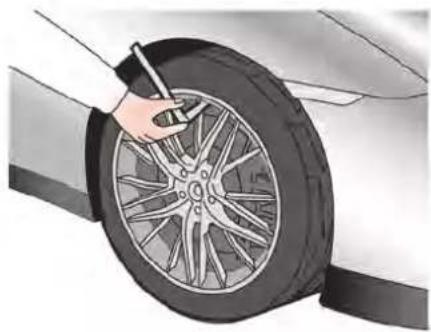
CHECKINGTHETIREPRESSURE
- Remove the valve stem cap from the tire.
- Press the pressure gauge squarely onto the valve stem. Do not press too hard or force the valve stem sideways, or air will escape. If the hissing sound of air escaping from the tire is heard while checking the pressure, reposition the gauge to eliminate this leakage.
-
Remove the gauge.
-
Read the tire pressure on the gauge stem and compare it to the specification shown on the Tire and Loading Information label.
- Add air to the tire as needed. If too much air is added, press the core of the valve stem briefly with the tip of the gauge stem to release pressure. Recheck the pressure and add or release air as needed.
- Install the valve stem cap.
- Check the pressure of all other tires.
- Check the pressure when driving the vehicle at speeds of 100 MPH (160 km/h) or higher where it is legal to do so.
NOTE:
- Youcancheckthepressureof allfourtiresonthetouch screendisplay.SeetheseparateMultiFunctionDisplay Owner'sManual.
•Thetiresofthisvehicleare filledwithnitrogengas.When
thetirepressureislow,fillthe tireswithnitrogen.ItisrecommendedyoucontactaGT-R certifiedNISSANdealerforinformationonfillingthetires withnitrogen.
•Ifnitrogenisnotavailable, compressedairmaybesafely usedundernormaldriving conditions. However, NISSAN recommendsrefillingwithnitrogenfor maximumtire performance.

WARNING
- Driving at high speeds, 100 MPH(160km/h)orhigher sustainedwhereitislegalto doso,cancausetiresto haveexcessiveheatbuild up,whichmayresultina tirefailure causing lossof control,crash,injuriesor evendeath.Somehigh-speedratedtiresrequireinflationpressure adjustment
Do-it-yourself8-33
forhigh-speedoperation. Whenspeedlimitsandroad conditionsallowvehicle drivingathighspeeds,make suretiresareratedtosupporthighspeedoperation, tiresareinoptimalconditionsandpressureisadjustedtocorrectcold inflationpressureforhigh speedoperation.
•Tiresrequireadjustmentto theinflationpressurewhen drivingthevehicleatspeeds of100MPH(160km/h)or higherwhereitislegaltodo so.Seerecommendedtire inflationchartforcorrect operatingpressure.
•Aftervehiclehighspeedoperationhasended,readjust thetirepressuretotherecommendedcoldinflation pressure.(See “Checking thetirepressure”page8-33.)
Summer tires:
| Size | ColdTire Inflation Pressure |
| FrontOriginalTire: 255/40ZRF20(97Y) | 30psi,210 kPa*132psi,220 kPa*2 |
| RearOriginalTire: 285/35ZRF20(100Y) | 29psi,200 kPa |
*1: Except for NISMO and Track edition engineered by nismo models
*2: NISMO and Track edition engineered by nismo models
All-season tires:
| Size | ColdTire Inflation Pressure |
| FrontOriginalTire: 255/40RF2097W | 32psi,220 kPa |
| RearOriginalTire: 285/35RF20100W | 30psi,210 kPa |
Recommended tire inflation pressures at speeds of 100 MPH (160 km/h) or higher where it is legal to do so.
Summer tires:
| Size | ColdTire Inflation Pressure |
| FrontOriginalTire: 255/40ZRF20(97Y) | 33psi,230 kPa |
| RearOriginalTire: 285/35ZRF20(100Y) | 33psi,230 kPa |
All-season tires:
| Size | ColdTire Inflation Pressure |
| FrontOriginalTire: 255/40RF2097W | 36psi,250 kPa |
| RearOriginalTire: 285/35RF20100W | 36psi,250 kPa |
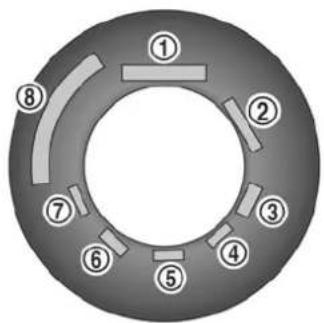
Example
TIRELABELING
Federal law requires tire manufacturers to place standardized information on the sidewall of all tires. This information identifies and describes the fundamental characteristics of the tire and also provides the tire identification number (TIN) for safety standard certification. The TIN can be used to identify the tire in case of a recall.

Example
① Tire size (example: P215/60R16 94H)
-
P: The "P" indicates the tire is designed for passenger vehicles. (Not all tires have this information.)
-
Three-digit number (215): This number gives the width in millimeters of the tire from sidewall edge to sidewall edge.
-
Two-digit number (65): This number, known as the aspect ratio, gives the tire's ratio of height to width.
-
R: The "R" stands for radial. F: The "F" after "R" indicates Self-Supporting type run-flat tire.
-
Two-digit number (15): This number is the wheel or rim diameter in inches.
-
Two- or three-digit number (95): This number is the tire's load index. It is a measurement of how much weight each tire can support. You may not find this information on all tires because it is not required by law.
-
H: Tire speed rating. You should not drive the vehicle faster than the tire speed rating.

- DOT: Abbreviation for the "Department of Transportation". The symbol can be placed above, below or to the left or right of the Tire Identification Number.
- Two-digit code: Manufacturer's identification mark
- Two-digit code: Tire size
- Three-digit code: Tire type code (Optional)
8-36 Do-it-yourself
- Four numbers represent the week and year the tire was built. For example, the numbers 3103 means the 31st week of 2003. If these numbers are missing, then look on the other sidewall of the tire.
③ Tire ply composition and material The number of layers or plies of rubber-coated fabric in the tire.
Tire manufacturers also must indicate the materials in the tire, which include steel, nylon, polyester, and others.
④ Maximum permissible inflation pressure
This number is the greatest amount of air pressure that should be put in the tire. Do not exceed the maximum permissible inflation pressure.
⑤ Maximum load rating
This number indicates the maximum load in kilograms and pounds that can be carried by the tire. When replacing the tires on the vehicle, always use a tire that has
the same load rating as the factory installed tire.
⑥ Term of "tubeless" or "tube type" indicates whether the tire requires an inner tube ("tube type") or not ("tubeless").
⑦ The word "radial"
The word "radial" is shown, if the tire has radial structure.
⑧ Manufacturer or brand name Manufacturer or brand name is shown.
Othertire-relatedterminology:
In addition to the many terms that are defined throughout this section, Intended Outboard Sidewall is (1) the sidewall that contains a whitewall, bears white lettering or bears manufacturer, brand and/or model name molding that is higher or deeper than the same molding on the other sidewall of the tire, or (2) the outward facing sidewall of an asymmetrical tire that has a particular side that must always face outward when mounted on a
vehicle.
TYPESOFTIRES

WARNING
- Whenchangingorreplacingtires, besureallfourtiresareofthe sametype(Examples:Summeror AllSeason)andconstruction.A GT-RcertifiedNISSANdealermay beabletohelpyouwithininformationabouttiretype,size,speed ratingandavailability.
- Replacingtireswiththosenot originallyspecifiedbyNISSAN couldaffecttheproperoperation oftheTPMS.
- For additional information regarding tires, refer to "Important Tire Safety Information" (US) or "Tire Safety Information" (Canada) in the Warranty Information Booklet.
All-seasontires
NISSAN specifies all-season tires on some models to provide good performance for use all year around, including snowy and icy road conditions. All-season tires are identified by ALL SEASON on the tire sidewall.
Summertires
The GT-R summer tires are made from a specially formulated rubber to maximize the vehicle's performance capabilities. Performance of summer tires is substantially reduced when temperatures are less than 32°F (0°C) so you must drive carefully. NISSAN recommends the use of winter or all-season tires on all four wheels if you plan to operate your vehicle in snowy or icy conditions when temperatures are less than 32°F (0°C).

WARNING
Neverusesummertireswhenthe temperatureisbelow-4°F(-20°C)to preventpermanenttreaddeformationwhichmaycausetiredamageor tirefailure. This may causealossof vehiclecontrol which can result in serious personal injury or death.
Run-flattires
Your vehicle is equipped with run-flat tires. You can continue driving to a safe location even if they are punctured. Al-
ways use run-flat tires of the specified size on all four wheels. Mixing tire sizes or construction may reduce vehicle handling stability. If necessary, contact a GT-R certified NISSAN dealer for assistance. Frequently check the tire pressure information on the touch screen display and adjust pressure of each tire properly. See the separate Multi Function Display Owner's Manual.
It can be difficult to tell if a run-flat tire is under-inflated or flat. Check the tire pressures as described earlier in this section. If the tire becomes under-inflated while driving, the low tire pressure warning light will come on. If the tire becomes flat while driving, the low tire pressure warning light and the run-flat tire warning display will come on.
Lowtirepressure:
If the vehicle is being driven with low tire pressure, the low tire pressure warning light will illuminate and the low tire pressure warning will appear in the vehicle information display.
Flattire:
If the vehicle is being driven with one or more flat tires, the low tire pressure warning light will illuminate continuously and a chime will sound for 10 seconds. The run-flat tire warning also appears in
Do-it-yourself8-37
the vehicle information display.
The chime will only sound at the first indication of a flat tire and the run-flat tire warning display will illuminate continuously. When the flat tire warning is activated, it is recommended you have the system reset and the tire checked and replaced if necessary by a GT-R certified NISSAN dealer. Even if the tire is inflated to the specified COLD tire pressure, the warning light will continue to illuminate until the system is reset. If the low tire pressure and the run-flat tire warning appears on the vehicle information display:
- Do not exceed 50 MPH (80 km/h).
- Increase your following distance to allow for increased stopping distances.
- Avoid sudden maneuvers, hard cornering and hard braking.

WARNING
- Although you can continued driving with apunctured run-flattire, remember that vehicle handling stability is reduced, which could lead to an accident and personal injury. Also, driving along distance at high speedsmayda
magethetire.
- Donotdriveatspeedsabove50 MPH(80km/h)anddonotdrive morethan50miles(80km)with a puncturedrun-flattire. The actual distancethevehiclecanbedriven onaflattiredependsonoutside temperature,vehicleload,road conditionsandotherfactors.
- Drivesafelyatreducedspeeds. Avoidhardcorneringorbraking, whichmaycauseyoutolose controlofthevehicle.
NOTICE
- Neverinstalltirechainsona puncturedrun-flattire,asthis coulddamageyourvehicle.
- Avoiddrivingoveranyprojection orpothole, astheclearancebetweenthevehicleandtheground issmallerthannormal.
- Donotenteranautomatedcar washwithapuncturedrun-flat tire.
- Itisrecommendedyouhavethe puncturedtirereplacedbyaGT-R certifiedNISSANdealerassoon
aspossible,asthetire'sperformancecapabilityisreduced.
TiresforAll-WheelDrive(AWD)
If excessive tire wear is found, it is recommended that all four tires be replaced with tires of the specified size, brand, construction and tread pattern. The tire pressure and wheel alignment should also be checked and corrected as necessary. It is recommended you contact a GT-R certified NISSAN dealer.
TIRECHAINS
Use of tire chains may be prohibited according to location. Check the local laws before installing tire chains. When installing tire chains, make sure they are of proper size for the tires on your vehicle and are installed according to the chain manufacturer instructions. UseonlySAE classSchains.Class "S" chains are used on vehicles with restricted tire to vehicle clearance. Vehicles that can use Class "S" chains are designed to meet the SAE standard minimum clearances between the tire and the closest vehicle suspension or body component required to accommodate the use of a winter traction device (tire chains or cables). The minimum clearances are determined
using the factory equipped tire size. Other types may damage your vehicle. Use chain tensioners when recommended by the tire chain manufacturer to ensure a tight fit. Loose end links of the tire chain must be secured or removed to prevent the possibility of whipping action damage to the fenders or undercarriage. If possible, avoid fully loading your vehicle when using tire chains. In addition, drive at a reduced speed. Otherwise, your vehicle may be damaged and/or vehicle handling and performance may be adversely affected.
NOTE:
Tirechainsmustbeinstalledonlyon therearwheelsandnotonthefront wheels.

CAUTION
Donotusetirechainsondryroads.
NOTICE
Neverinstalltirechainsonapuncturedrun-flattire,asthiscoulddamageyourvehicle.
Do not drive with tire chains on paved roads that are clear of snow. Driving with chains in such conditions can cause damage to the various mechanisms of the vehicle due to some overstress.
CHANGINGWHEELSANDTIRES
Tirerotation
Tires cannot be rotated because your vehicle is equipped with different sized tires in the front and rear.
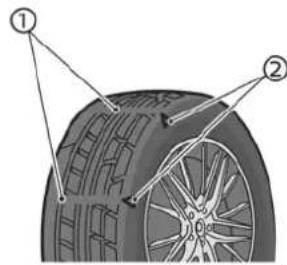
- Wear indicator
- Wear indicator location marks. The locations are shown by " Δ ", "TWI", etc. depending on tire types.
Tirewearanddamage

WARNING
•Tiresshouldbeperiodically inspectedforwear, cracking, bulgingorobjectscaughtin thetread.Ifexcessivewear, cracks,bulgingordeepcuts arefound,thetire(s)should
bereplaced.
•Theoriginaltireshavebuilt-intreadwearindicators. Whenthewearindicators arevisible, the tire(s) should bereplaced.
•Tiresdegradewithage and use. Havetires, over 6 years old checked by a qualified technician because some tiredamagemay not be obvious. Replacethetires as necessary to prevent tire failure and possible personal injury.
- For additional information regarding tires, refer to "Important Tire Safety Information" (US) or "Tire Safety Information" (Canada) in the Warranty Information Booklet.
Replacingwheelsandtires
When tire replacement is required, replacing tires as a set of four with new tires recommended. However, if a tire is punctured or damaged, it may be possible to replace only the damaged tire. Determining whether one tire or a complete set of tires should be replaced is based on a number of factors including tire wear and condition. It is recommended you contact your GT-R certified NISSAN dealer. They can recommend if an individual tire or a complete set should be replaced. When replacing a tire, use the specified size, speed rating and load carrying capacity as originally equipped. ( "Wheels and tires" page 10-10)
NOTICE
- WhenyoureplacetheGT-Rtires, itisrecommendedthatyoure-placeallthetiresatthesame time.
- TheGT-Rusesspeciallydesigned run-flattireswhichfeaturean extremelyrigidsidewall.Special techniquesandequipmentare thereforerequiredwhenreplacingthesetires.NISSANrecommendsthattirereplacementbe performedataGT-Rcertified NISSANdealer.
s •Whentiresarereinstalledafter
beinguninstalledfromthe wheels,useequipmentsuchasa leverlessautomatictirechanger. Itisonlypossibletoreusethetireswhentheyhavenocracks and/ordeformationsonthebead portion.However,ifyouusea lever-typetirechanger,cracks anddeformationmayoccuron thebeadportionofthetires meaningthatthetirescannotbe reused.
- Makesurethetirevalvestemcap isinstalledandthatthevalve stemistight.Wheninstallingthe cap,makesuretotightenthecap byhand.Ifatoolisusedto tightenthecap,thecapmaybe damaged.

WARNING
- Theuseoftiresotherthanthose specifiedorthemixeduseoftires ofdifferent brands,construction (bias,bias-belted,radialorrun-flat),ortreadpatternscanadverselyaffecttheride,braking, VDCsystem,handling,ground clearance,body-to-tireclearance,
tirechainclearance,speed- ometercalibration,headlight aimandbumperheight.Someof theseeffectsmayleadtoacci- dentsandcouldresultinserious personalinjury.
- ifthewheelsarechangedforany reason,alwaysreplacewith wheelswhichhavethesameoff-setdimension.Wheelsofadifferentoff-setcouldcauseprema-turetirewear,degradevehicle handlingcharacteristics,affect theVDCsystemand/orcause interferencewiththebrakediscs. Suchinterferencecanleadto decreasedbrakingefficiency and/orearlybrakepadwear. ( "Wheelsandtires"page10-10)
- Whenawheelisreplaced,tire pressurewillnotbeindicated, theTPMSwillnotfunction and thelowtirepressurewarning lightwillflashforapproximately 1minuteandremainonafterthe 1minute.Itisrecommendedyou contactaGT-RcertifiedNISSAN dealerassoonaspossiblefortire replacementand/orsystemresetting.
•Replacing tires with those not originally specified by NISSAN could affect the proper operation of the TPMS.
•TheTPMSsensormaybedamagedifitisnothandledcorrectly.Becarefulwhenhandling theTPMSsensor.
- WhenreplacingtheTPMSsensor, theIDregistrationmayberequired.ContactaGT-RcertifiedNISSANdealerforIDregistration.
- Donotuseavalvestemcapthat isnotspecifiedbyNISSAN.The valvestemcapmaybecome stuck.
- Besurethatthevalvestemcaps arecorrectlyfitted. Otherwisethe valvemaybecloggedupwithdirt andcauseamalfunctionorloss of pressure.
- Donotinstalladamagedor deformedwheelortireevenifit hasbeenrepaired.Suchwheels ortirescouldhavestructural damageandcouldfailwithout warning.
- Neveruseretreadtires.
-Foradditionalinformationre-
gardingtires, referto "Important TireSafetyInformation" (US) or "TireSafetyInformation" (Canada) in the Warranty Information Booklet.
●Alwaysusetiresofthespecified type,size,brand,construction (bias,bias-belted,radialorrun-flat),andtreadpatternonallfour wheels.Failurertodosomay resultinacircumferencedifferencebetweeniresonthefront andrearaxleswhichwillcause excessivetirewearandmaydamagethetransmission,transfer caseanddifferentialgears.
Wheelbalance
Unbalanced wheels may affect vehicle handling and tire life. Even with regular use, wheels can get out of balance. Therefore, they should be balanced as required.
Wheel balance service should be performed with the wheels off the vehicle. Spin balancing the rear wheels on the vehicle could lead to mechanical damage. For additional information regarding tires, refer to "Important Tire Safety Information" (US) or "Tire Safety Information"
Do-it-yourself8-41
(Canada) in the Warranty Information Booklet.
Careofwheels
( "cleaning exterior" page 7-2)
JACKINGVEHICLEANDREMOVING WHEELS

WARNING
- Makesuretheparkingbrakeis securelyappliedandthetransmissionisshiftedintothe position.
- Neverchangetireswhenthevehicleisonaslope,iceorslippery areas. This is hazardous.
●Neverchangetiresifoncoming trafficisclosetoyourvehicle. Waitforprofessionalroadassistance.

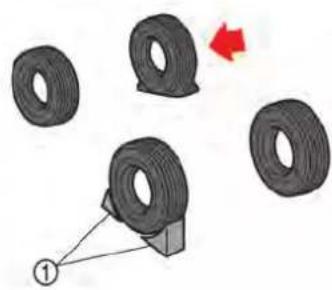

Blockingwheels
Place suitable blocks at both the front and back of the wheel diagonally opposite the flat tire to prevent the vehicle from moving when it is jacked up.

WARNING
Besuretoblockthewheelasthe vehiclemaymoveandresultin personalinjury.
Gettingthetools
NOTE:
Ajack,jackleverandrodarenot equippedasstandardwiththisvehicle. Thesepartsaredealeroptions.Itis recommendedyoucontactaGT-RcertifiedNISSANdealeraboutacquiringa jack,jackleverandrod.Youcanstorea jack,jackleverandrodinthefloorin frontofthepassenger'sseat.

CAUTION
Afterusingthetools,putthemback intheiroriginalplaces.Anaccident mayoccurifyouleavetheminthe carunsecured.
Jackingupthevehicleandre- movingthetire

WARNING
- Nevergetunderthevehiclewhile itissupportedonlybythejack.If itisnecessarytoworkunderthe vehicle,supportitwithsafety stands.
- Usethecorrectjack-uppoints. Neveruseanyotherpartofthe vehicleforjacksupport.
- Neverjackupthevehiclemore thannecessary.
- Neveruseblocksonorunderthe jack.
- Donotstartorruntheengine whilevehicleisonthejack,asit maycausethevehicletomove. Thisisespeciallytrueforvehicles
withlimitedslipdifferentials.
- Donotallowpassengerstostay inthevehiclewhileitisonthe jack.
Carefullyreadthecautionlabelattachedtothejackbodyandthefollowinginstructions.

Jack-uppoint
1. Place the jack directly under the jack-up point as illustrated so the top of the jack contacts the vehicle at the jack-up point. Thejackshouldbe usedonlevelfirmground.

-
Carefully raise the vehicle until the tire clears the ground. To lift the vehicle, securely hold the jack lever and rod with both hands as shown above.
-
Fit the jack head into the recess of the jack-up point by turning the jack-screw clockwise with your fingers.
- Loosen each wheel nut one or two turns by turning counterclockwise with the wheel nut wrench. Donot removethewheelnutsuntilthetire isofftheground.

8-44 Do-it-yourself
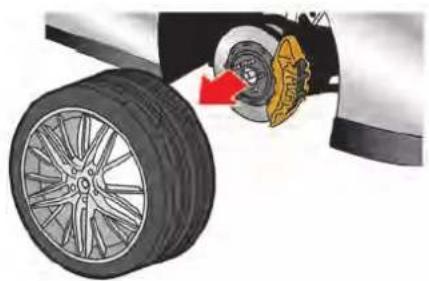
- Remove the wheel nuts and then remove the wheel.
NOTE: Whenputtingawheelonthe ground,putitdownwiththeouter sideofthewheelfacinguptopre-ventscratchingofthewheelsurface.

- Clean any mud or dirt from the surface between the brake disc rotor ① and wheel ②

- Tighten the wheel nuts by hand by turning them clockwise until the tapered part Ⓐ of each nut lightly contacts the seat part B of the wheel hole. When replacing a front wheel, make sure the hole in the wheel is aligned with the pin on the brake disc rotor.

- With the wheel nut wrench, tighten wheel nuts alternately and evenly in the sequence illustrated ①, ②, ③)④ ⑤ until they are tight.
- Lower the vehicle slowly until the tire touches the ground. Then, with the wheel nut wrench, tighten the wheel nuts securely in the sequence as illustrated. Lower the vehicle completely.

WARNING
•Incorrectwheelnutsorimproperlytightenedwheelnutscan causethewheeltobecomeloose orcomeoff. This could cause an accident.
- Donotuseoilorgreaseonthe wheelstudsornuts. This could cause thenutstobecomeloose.
- Retightenthewheelnutswhen thevehiclehasbeendrivenfor 600miles(1,000km).

WARNING
Iftheroadwheelsarehot,allow themtocoolsufficientlybeforetighteningthewheelnuts. Otherwise,the wheelnutscannotbetightenedto specification.
NOTE:
- As soon as possible, tighten the wheelnut stothespecified torque withatorquewrench. Wheel nutting torque:
ExceptforNISMOmodels,Track editionengineeredbynismo models,T-specversionand NISMOSpecialEdition 97ft-lb(132N·m)
NISMOmodels, Trackeditionengineered by nismomodels, T-specversion and NISMOSpecial Edition
114ft-lb(155N·m)
The wheelnuts must be kept tightened to specification at all times. It is recommended that wheel nuts be tightened to specifications at each lubrication interval.
- AdjusttirepressuretotheCOLD pressure.
COLDpressure:Afterthevehicle has been parked forth three hours or more or driven less than 1 mile (1.6km).
COLDtirepressuresareshownon theTireandLoadingInformation labelaffixedtothedriver'sdoor opening.
- Securely store the jacking equipment in the vehicle.
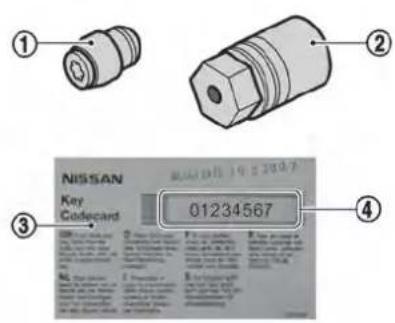
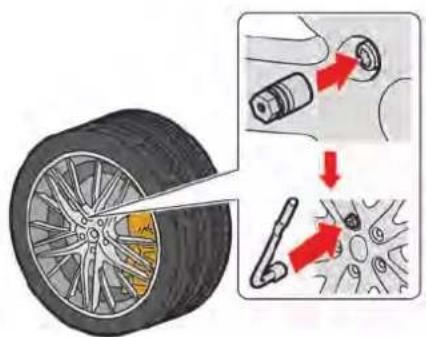
WHEELLOCKNUTS(ifso equipped)
In order to prevent theft, the specially designed wheel lock nut 1 is installed on each wheel. The wheel lock nut cannot be removed with commonly used tools.
When removing tires, use the lock key② provided with your vehicle.
Removingthewheellocknut
To remove the wheel lock nut, use the lock key stored under the passenger's side floor.
- Insert the lock key to the wheel lock nut.
- To remove the wheel lock nut, turn the lock key counterclockwise using the wheel nut wrench.

CAUTION
- Donotuseapowertooltore-movethewheellocknuts.
- Tightenthewheellocknutstothe sametighteningtorqueasthe normalwheelnuts. ("Jacking upthevehicleandremovingthe tire"page8-43)
NOTE:
- Thewheellocknuthasanindividual code.Alockkeywhichdoesnot matchtheindividualcodecannot removethewheellocknut.Ifyou losethewheellockkey,itisrecommendedyoucontactaGT-Rcertified NISSANdealerimmediately.
- Keepthekeycodecard ③ inasafe place.Topurchasealockkey,contactaGT-RcertifiedNISSANdealer withyouroriginalcode ④ onthekey codecard.
- WhenyouaskforaserviceataGT-R certifiedNISSANdealer,makesure tokeepthelockkeyinthevehicle. Otherwise,tirescannotberemoved andanyservicerequiringthere-movalofthewhelescannotbe performed.
MEMO
8-48 Do-it-yourself
9Maintenanceandschedules
Maintenancerequirement....9-2
Scheduledmaintenance....9-2
Generalmaintenance....9-2
Wheretogoforservice....9-2
Determining the proper maintenance interval....9-3
Generalmaintenance....9-3
Explanationofmaintenanceitems....9-3
Explanationofscheduledmaintenanceitems....9-6
Emissioncontrolsystemmaintenance....9-6
Chassisandbodymaintenance....9-7
Additionalmaintenanceitems....9-8
Settingguideofwheelalignmentdepending
onthecustomer'sdriving....9-21
Tirereplacementrecord....9-23
Transmissionassembly/parts
replacementrecord....9-26
Maintenancelogandrecords....9-28
MAINTENANCEREQUIREMENT
Some day-to-day and regular maintenance is essential to maintain your vehicle good mechanical condition, as well as its emission and engine performance.
It is the owner's responsibility to make sure that the scheduled maintenance, as well as general maintenance, is performed.
As the vehicle owner, you are the only one who can ensure that your vehicle receives the proper maintenance care. You are a vital link in the maintenance chain.
For your convenience, both required and optional scheduled maintenance items are described and listed in this section. You must refer to that guide to ensure that necessary maintenance is performed on your vehicle at regular intervals.
GENERALMAINTENANCE
General maintenance includes those items which should be checked during normal day-to-day operation. They are essential for proper vehicle operation. It is your responsibility to perform these procedures regularly as prescribed.
Performing general maintenance checks requires minimal mechanical skill and only a few general automotive tools.
These checks or inspections can be done forms the best job to meet the main-by yourself, a qualified technician or, if youtenance requirements on your vehicle.
To find a GT-R certified NISSAN dealer near you, call 1-866-668-1GTR in the US or 1-800-387-0122 in Canada, or go to www.gtrnissan.com/.
WHERETOGOFORSERVICE
GT-R certified NISSAN dealers are required to have additional training and equipment and are the only NISSAN dealers authorized to perform warranty work on key vehicle performance systems such as engine, transmission, suspension and brakes.
If maintenance service is required or your vehicle appears to malfunction, it is recommended that you have the systems checked and serviced by a GT-R certified NISSAN dealer.
NISSAN technicians are well-trained specialists and are kept up to date with the latest service information through technical bulletins, service tips, and in-dealer information systems. They are completely qualified to work on NISSAN vehicles beforework begins.
If your vehicle is involved in a collision, it is recommended that you ask your NISSAN dealer where the nearest NISSAN Certified Collision Center is located, or go to http://collision.nissanusa.com.
You can be confident that a GT-R certified NISSAN dealer's service department per-
9-2 Maintenanceandschedules
DETERMININGTHEPROPER MAINTENANCEINTERVAL
Depending on your driving habits and local conditions, you should follow one of the two maintenance schedules listed below for scheduled maintenance. In addition to Schedule 1 maintenance, additional maintenance must be performed for optimum performance. Use these guidelines to determine which maintenance schedule to use:
Schedule1(Every6,000miles(10,000 km)or6months,whichevercomesfirst)
Schedule 1 features 6,000-mile (10,000 km) service intervals. Use Schedule 1 if you primarily operate your vehicle under any of these conditions:
●Repeated short trips of less than 5 miles (8 km) in normal temperatures or less than 10 miles (16 km) in freezing temperatures
- Stop-and-go traffic in hot weather or lowspeed driving for long distances
- Driving in dusty conditions or on rough, muddy, or salt-spread roads Schedule2(Every6,000miles(10,000 km)or6months,whichevercomesfirst)
Schedule 2 features 6,000-mile (10,000 km) service intervals; with Schedule 2 fewer maintenance items are regularly checked or replaced than with Schedule 1. Generally, Schedule 2 applies only to
highway driving in temperate conditions. Use Schedule 2 only if you primarily operate your vehicle under conditions other than those listed in Schedule 1.
GENERALMAINTENANCE
During the normal day-to-day operation of the vehicle, general maintenance should be performed regularly as prescribed in this section. If you detect any unusual sounds, vibrations or smell, be sure to check for the cause and have it checked promptly. In addition, it is recommended you notify a GT-R certified NISSAN dealer if you think that repairs are required. ( "Maintenance precautions" page 8-3)
EXPLANATIONOFMAINTENANCE ITEMS
Additionalinformationonthefollowing itemswith""isfoundlaterinthe"8.Do-it-yourself"sectionofthismanual.
Outsidethevehicle
The maintenance items listed here should be performed from time to time, unless otherwise specified.
Doorsandenginehood:Check that all doors and the engine hood, operate properly. Also ensure that all latches lock securely. Lubricate hinges, latches, latch pins, rollers and links if necessary. Make sure that the secondary latch keeps the hood from opening when the primary latch is released.
When driving in areas using road salt or
Maintenanceandschedules9-3
other corrosive materials, check lubrication frequently.
Lights*: Clean the headlights on a regular basis. Make sure that the headlights, stop lights, tail lights, turn signal lights, and other lights are all operating properly and installed securely. Also check headlight aim.
Roadwheelnuts(lugnuts)*:When checking the tires, make sure no wheel nuts are missing, and check for any loose wheel nuts. Tighten if necessary.
Tirerotation*: Tires cannot be rotated because your vehicle is equipped with different sized tires in the front and rear.
Tires*:Check the pressure with a gauge often and always prior to long distance trips. If necessary, adjust the pressure in all tires to the pressure specified. Check carefully for damage, cuts or excessive wear.
NOTE:
- Youcancheckthepressureofall fourtiresonthetouchscreendisplay.SeetheseparateMultiFunctionDisplayOwner'sManual.
- Thetiresofthisvehiclearefilled withnitrogengas.Whenthetire pressureislow,fillthetireswith nitrogen.Itisrecommendedyou
contactaGT-RcertifiedNISSAN dealerforinformationonfillingthe tireswithnitrogen.
- Ifnitrogenisnotavailable,compressedairmaybesafelyused undernormaldrivingconditions. However,NISSANrecommendsrefillingwithnitrogenformaximum tireperformance.
TirePressureMonitoringSystem(TPMS) transmittercomponents:Replace grommet seal of transmitter in TPMS, when replacing each tire by reaching the wear limit.
Tire, wheelalignment and balance: If the vehicle should pull to either side while driving on a straight and level road, or if you detect uneven or abnormal tire wear, there may be a need for wheel alignment. If the steering wheel or seat vibrates at normal highway speeds, wheel balancing may be needed.
For additional information regarding tires, refer to "Important Tire Safety Information" (US) or "Tire Safety Information" (Canada) in the Warranty Information Booklet.
Windshield: Clean the windshield on a regular basis. Check the windshield at least every six months for cracks or other damage. Have a damaged windshield repaired by a qualified repair facility. It is recommended that you have a damaged windshield repaired by a GT-R certified NISSAN dealer, or a NISSAN Certified Collision Center. To locate a collision center in your area, refer to http://collision.nissanusa.com.
Windshieldwiperblades*:Check for cracks or wear if they do not wipe properly.
Insidethevehicle
The maintenance items listed here should be checked on a regular basis, such as when performing scheduled maintenance, cleaning the vehicle, etc.
Acceleratorpedal: Check the pedal for smooth operation and make sure the pedal does not catch or require uneven effort. Keep the floor mat away from the pedal.
Transmission p mechanism: On a fairly steep hill, check that your vehicle is held securely with the shift lever in the p position without applying any brakes.
Brakepedal: Check the pedal for smooth operation. If the brake pedal suddenly goes down further than normal, the pedal feels spongy or the vehicle seems to take longer to stop, it is recommended you see
9-4 Maintenanceandschedules
a GT-R certified NISSAN dealer immediately. Keep the floor mat away from the pedal.
Brakes: Check that the brakes do not pull the vehicle to one side when applied.
Parkingbrake: Check the parking brake operation regularly. The vehicle should be securely held on a fairly steep hill with only the parking brake applied. If the parking brake needs to be adjusted, it is recommended you see a GT-R certified NISSAN dealer.
Seatbelts: Check that all parts of the seat belt system (for example, buckles, anchors, adjuster and retractors) operate properly and smoothly, and are installed securely. Check the belt webbing for cuts, fraying, wear or damage.
Seats: Check seat position controls such as seat adjusters, seatback recliner, etc. to ensure they operate smoothly and that all latches lock securely in every position.
Steeringwheel: Check for changes in the steering conditions, such as excessive free play, hard steering or strange noises.
Warninglightsandchimes: Make sure that all warning lights and chimes are operating properly.
Windshielddefroster: Check that the air comes out of the defroster outlets properly and in sufficient quantity when operating the heater or air conditioner.
Windshieldwiperandwasher*:Check that the wipers and washer operate properly and that the wipers do not streak.
Underthehoodandvehicle
The maintenance items listed here should be checked periodically (for example, each time you check the engine oil or refuel).
Battery*:Check the fluid level in each cell. It should be between the MAX and MIN lines. Vehicles operated in high temperatures or under severe condition require frequent checks of the battery fluid level.
NOTE:
Careshouldbetakentoavoidsituations thatcanleadtopotentialbatterydischargeandpotentialno-startconditionssuchas:
-
Installationorextendeduseofelectronicaccessoriesthatconsume batterypowerwhentheengineis notrunning(Phonechargers,GPS, DVDplayers,etc.)
-
Vehicleisnotdrivenregularlyand/oronlydrivenshortdistances.
Inthesecases,thebatterymayneedto
bechargedtomaintainbatteryhealth.
Brakefluidlevel*: Make sure that the brake fluid level is between the MAX and MIN lines on the reservoir.
Enginecoolantlevel*:Check the coolant level when the engine is cold.
Enginedrivebelts*:Make sure that no belt is frayed, worn, cracked or oily. Engineoillevel*:Check the level after parking the vehicle on a level spot and turning off the engine. Wait at least 5 minutes for the oil to drain back into the oil pan before checking the oil.
Exhaustsystem: Make sure there are no loose supports, cracks or holes. If the sound of the exhaust seems unusual or there is a smell of exhaust fumes in the engine compartment, it is recommended you immediately have the exhaust system inspected. It is recommended you contact a GT-R certified NISSAN dealer. ( "Exhaust gas (carbon monoxide)" page 5-3)
Fluidleaks: Check under the vehicle for fuel, oil, water or other fluid leaks after the vehicle has been parked for a while. Water dripping from the air conditioner after use is normal. If you should notice any leaks or if gasoline fumes are evident, check for the cause and have it corrected immediately.
Maintenanceandschedules9-5
EXPLANATIONOFSCHEDULED MAINTENANCEITEMS
Powersteeringfluidlevel*andlines:
Check the level when the fluid is cold, with the engine off. Check the lines for proper attachment, leaks, cracks, etc.
Radiatorandhoses:Check the front of the radiator and clean off any dirt, insects leaves, etc., that may have accumulated. Make sure the hoses have no cracks, deformation, rot or loose connections.
Underbody: The underbody is frequently exposed to corrosive substances such as those used on icy roads or to control dust. It is very important to remove these substances, otherwise rust will form on the floor pan, frame, fuel lines and around the exhaust system. At the end of winter, the underbody should be thoroughly flushed with plain water, being careful to clean those areas where mud and dirt may accumulate. (1-7 "Underbody" page 7-3)
Windshieldwasherfluid*:Check that there is adequate fluid in the reservoir.
The following descriptions are provided to give you a better understanding of the scheduled maintenance items that should be regularly checked or replaced. The maintenance log indicates at which mileage/time intervals each item requires service.
In addition to scheduled maintenance, your vehicle requires that some items be checked during normal day-to-day operation. Refer to "General maintenance" page 9-3.
Maintenance items and intervals marked with "*" are recommended by NISSAN for reliable vehicle operation. You are not required to perform such maintenance in order to maintain the emission warranty or manufacturer recall liability.
When applicable, additional information can be found in the "8. Do-it-yourself" section of this manual.
NOTE:
NISSANdoesnotadvocatetheuseof non-OEMapprovedaftermarketflushingsystemsandstronglyadvises againstperformingtheseservicesona NISSANproduct.Manyoftheaftermarketflushingsystemsusenon-OEMapprovedchemicalsorsolvents,theuseof whichhasnotbeenvalidatedby
NISSAN.
Forrecommendedfuel, lubricants, fluids, grease, and refrigerant, referto
"Capacitiesandrecommended fluids/lubricants"page10-2ofthis manual.
Check engine drive belts for wear, fraying or cracking. Replace any damaged drive belts.
Engineairfilter:
Replace at specified intervals. When driving for prolonged periods in dusty conditions, check/replace the filter more frequently.
Enginecoolant*:
Replace coolant at the specified interval. When adding or replacing coolant, be sure to use only Genuine NISSAN Long Life Antifreeze/Coolant (blue) or equivalent with the proper mixture. (Refer to
"Engine cooling system" page 8-6 to determine the proper mixture for your area.)
NOTE:
Mixinganyothertypeofcoolantorthe useofnon-distilledwatermayreduce therecommendedserviceintervalof thecoolant.
Engineoilandoilfilter:
Replace engine oil and oil filter at the specified intervals. Check engine oil level every 1,800 miles (3,000 km) and add as needed. For recommended oil grade and viscosity refer to "Capacities and recommended fluids/lubricants" page 10-2.
Enginevalveclearance*:
Inspect only if valve noise increases.
Adjust valve clearance if necessary.
Evaporativeemissionscontrolvapor lines*:
Check vapor lines for leaks or looseness. Tighten connections or replace parts as necessary.
Fuelfilter
Maintenance-free item.
Fuellines*:
Check the fuel hoses, piping and connections for leaks, looseness, or deterioration. Tighten connections or replace parts as necessary.
Throttlechamberdeposits*:
Visually inspect the throttle chamber for deposits and clean as necessary.
Sparkplugs:
Replace at specified intervals. Install new plugs of the same type as originally equipped.
CHASSISANDBODYMAINTENANCE
Brakelinesandcables:
Visually inspect for proper installation. Check for chafing, cracks, deterioration, and signs of leaking. Replace any deteriorated or damaged parts immediately.
Brakepadsandrotors:
Check for wear, deterioration and fluid leaks. Replace any deteriorated or damaged parts immediately. Replace all four sets of brake pads and disc rotors at the same time to maintain maximum brake performance.
Exhaustsystem:
Visually inspect the exhaust pipes, muffler and hangers for leaks, cracks, deterioration, and damage. Tighten connections or replace parts as necessary.
In-cabinmicrofilter:
Replace at specified intervals. When driving for prolonged periods in dusty condi-
tions, replace the filter more frequently.
Measurement and adjustment of wheel alignment:
Manage the wheel alignment by measuring and adjusting at specified intervals.
Propellershaft(s):
Check for damage, looseness, and grease leakage.
Steeringgearandlinkage,axleand suspensionparts,driveshaftboots:
Check for damage, looseness, and leakage of oil or grease. Under severe driving conditions, inspect more frequently.
Tirerotation:
Tires cannot be rotated as front tires are different size from rear tires.
Transmissionoil,differentialoil:
Replace fluid at specified intervals. Visually inspect for signs of leakage at specified intervals.
Transmissionsettings:
To keep the best condition for transmission, this inspection allows learning of the clutch touch point and the engaged gear position and neutral position for each gear.
ADDITIONALMAINTENANCEITEMS
Additional maintenance items for performance driving - 2021 GT-R maintenance record list (Inspection before and after driving)
9-8 Maintenanceandschedules
Inspection Key:
| N/A | Normal | N | Replace | X | Tighten | T | Clean | C | |
| Adjust | A | Repair | Disassemble | D | Lubricate | L | Slip Snap | S |
Fluids and Lubricants

Inspect underbody for leakage and smears of oil, fluid and coolant. Adjust/inspect engine oil level (record temperature, document leakage and smears)

Adjust engine coolant level and mixture ratio in the pressurized radiator reservoir tank

inspect power steering fluid level and check for leakage inspect brake fluid level

inspect transmission and differential gear oil, record oil temperature and document leakage and smears
Engine

Inspect area around the catalytic converter for heat deterioration Inspect exhaust finishers and (only for vehicles with GT-R genuine exhaust) rear bumper clearance

inspect and adjust clearance between the exhaust and it's surrounding parts
Transmission

Adjust clutch clearance (clutch gear learning) inspect whether tight corner braking phenomenon does not become extremely strong
| Customer Name: |
| Address: |
| Missorg |
| CT-II Dealer Name: |
| Date: |
| Technician Name: |
Wheel and Tire

Apply aluminum tape over the wheel balance weight Inspect the wheel nuts for deformation Inspect the mounting point of the wheel nut for deformation Inspect the wheel nut and the wheel hub lock nut for looseness Tighten the wheel nut with the standard torque Inspect the wheel bearing (hub) for backlash and the wheel for rotation

Align the reference marks on the tire and the inner wheel inspect the tire and the wheel for direction of rotation deviation (rim deviation)

inspect and adjust the tire pressure inspect the air valve and nut of the tire for looseness inspect the tire for nitrogen leakage inspect the groove of the tire inspect the tire for uneven and abnormal wear inspect the tire for damage and cracks inspect the tire side wall for damage
Driveshaft

inspect driveshaft universal joint dust boots for cracks and damage
| Memo: |
Brake System
Inspect brake piping and hoses for leakages Inspect brake pads for wear, color/temperature indication, damage and cracks Inspect brake disc rotors for wear, damage and cracks Inspect brake master cylinder and the calipers for fluid leakage Bleed any air from brake fluid Inspect the parts and area surrounding the brake rotors for heat deterioration Remove the grease on the front, brake pads Apply the grease to the front brake pads
Steering

Inspect rods and arms of the steering system for looseness, backlash and damage inspect steering gear box for looseness at mounting points
Suspension

Inspect shock absorbers for damage and oil leakage inspect suspension for looseness at mounting points connection, backlash and damage Measure and adjust wheel adjustment
Other Maintenance Items and Replaced Parts
Inspection Key:
| N/A | Normal | N | Replace | X | Tighten | T | Clean | C | |
| Adjust | A | Repair | Disassemble | D | Lubricate | L | Slip Snap | S |
Fluids and Lubricants
B A (B: Before A: After)
Inspect underbody for leakage and smears of oil, fluid and coolant Adjust/inspect engine oil level (record temperature, document leakage and smears)
Adjust engine coolant level and mixture ratio in the pressurized radiator reservoir tank
inspect: power steering fluid level and check for leakage inspect: brake fluid level
Inspect transmission and differential gear oil, record oil temperature and document leakage and smears
Engine
inspect area around the catalytic converter for heat deterioration inspect exhaust finishers and (only for vehicles with GT-R genuine exhaust) rear bumper clearance
inspect and adjust clearance between the exhaust and it's surrounding parts
Transmission
BA
Adjust clutch clearance (clutch gear learning) Inspect whether tight corner braking phenomenon does not become extremely strong
| Customer Name: |
| Address: |
| Missorg |
| CT-II Dealer Name: |
| Date: |
| Technician Name: |
Wheel and Tire
Apply aluminum tape over the wheel balance weight
Inspect the wheel nuts for deformation
Inspect the mounting point of the wheel nut for deformation
inspect the wheel nut and the wheel hub lock nut for looseness
Tighten the wheel nut with the standard torque
inspect the wheel bearing (hub) for backlash and the wheel for rotation
Align the reference marks on the tire and the inner wheel
Inspect the tire and the wheel for direction of rotation
deviation (rim deviation)
inspect and adjust the tire pressure
inspect the air valve and nut of the tire for looseness
inspect the tire for nitrogen leakage
inspect the groove of the tire
inspect the tire for uneven and abnormal wear
inspect the tire for damage and cracks
inspect the tire side wall for damage
Driveshaft
B A Inspect driveshaft universal joint dust boots for cracks and damage
| Memo: |
Brake System
inspect brake piping and hoses for leakages
inspect brake pads for wear, color/temperature indication, damage and cracks
Inspect brake disc rotors for wear, damage and cracks
inspect brake master cylinder and the calipers for fluid leakage
bleed any air from brake fluid
inspect the parts and area surrounding the brake rotors for heat deterioration
Remove the grease on the front brake pads
Apply the grease to the front brake pads
Steering
☐ inspect rods and arms of the steering system for looseness,
backlash and damage
Inspect steering gear box for looseness at mounting points
Suspension
B A
inspect shock absorbers for damage and oil leakage
inspect suspension for looseness at mounting points
connection, backlash and damage
Measure and adjust wheel adjustment
Other Maintenance Items and Replaced Parts
Inspection Key:
| N/A | Normal | N | Replace | X | Tighten | T | Clean | C | |
| Adjust | A | Repair | Disassemble | D | Lubricate | L | Slip Step | S |
Fluids and Lubricants

Adjust engine coolant level and mixture ratio in the pressurized radiator reservoir tank

temperature and document leakage and smears
Engine
inspect area around the catalytic converter for heat deterioration inspect exhaust finishers and (only for vehicles with GT-R genuine exhaust) rear bumper clearance

Inspect and adjust clearance between the exhaust and it's surrounding parts
Transmission

Adjust clutch clearance (clutch gear learning) inspect whether tight corner braking phenomenon does not become extremely strong
| Customer Name: |
| Address: |
| Missorg |
| CT-II Dealer Name: |
| Date: |
| Technician Name: |
Wheel and Tire
Apply aluminum tape over the wheel balance weight
Inspect the wheel nuts for deformation
Inspect the mounting point of the wheel nut for deformation
inspect the wheel nut and the wheel hub lock nut for looseness
Tighten the wheel nut with the standard torque
inspect the wheel bearing (hub) for backlash and the wheel for rotation
Align the reference marks on the tire and the inner wheel
Inspect the tire and the wheel for direction of rotation
deviation (rim deviation)
Inspect and adjust the tire pressure
inspect the air valve and nut of the tire for looseness
inspect the tire for nitrogen leakage
inspect the groove of the tire
inspect the tire for uneven and abnormal wear
inspect the tire for damage and cracks
inspect the tire side wall for damage
Driveshaft
B A inspect driveshaft universal joint dust boots for cracks and damage
| Memo: |
Brake System
Inspect brake piping and hoses for leakages
inspect brake pads for wear, color/temperature indication, damage and cracks
inspect brake disc rotors for wear, damage and cracks
inspect brake master cylinder and the calipers for fluid leakage
bleed any air from brake fluid
inspect the parts and area surrounding the brake rotors for heat deterioration
Remove the grease on the front brake pads
Apply the grease to the front brake pads
Steering
B A
Inspect rods and arms of the steering system for looseness,
□ □ inspect steering gear box for looseness at mounting points
Suspension
inspect shock absorbers for damage and oil leakage
inspect suspension for looseness at mounting points
connection, backlash and damage
Measure and adjust wheel adjustment
Other Maintenance Items and Replaced Parts
Inspection Key:
| N/A | Normal | N | Replace | X | Tighten | T | Clean | C | |
| Adjust | A | Repair | Disassemble | D | Lubricate | L | Slip Snap | S |
Fluids and Lubricants

Inspect underbody for leakage and smears of oil, fluid and coolant. Adjust/inspect engine oil level (record temperature, document leakage and smears)

Adjust engine coolant level and mixture ratio in the pressurized radiator reservoir tank

inspect power steering fluid level and check for leakage inspect brake fluid level

inspect transmission and differential gear oil, record oil temperature and document leakage and smears
Engine

Inspect area around the catalytic converter for heat deterioration Inspect exhaust finishers and (only for vehicles with GT-R genuine exhaust) rear bumper clearance

inspect and adjust clearance between the exhaust and it's surrounding parts
Transmission

Adjust clutch clearance (clutch gear learning) inspect whether tight corner braking phenomenon does not become extremely strong
| Customer Name: |
| Address: |
| Missorg |
| CT-II Dealer Name: |
| Date: |
| Technician Name: |
Wheel and Tire
Apply aluminum tape over the wheel balance weight Inspect the wheel nuts for deformation Inspect the mounting point of the wheel nut for deformation Inspect the wheel nut and the wheel hub lock nut for looseness Tighten the wheel nut with the standard torque Inspect the wheel bearing (hub) for backlash and the wheel for rotation

Align the reference marks on the tire and the inner wheel inspect the tire and the wheel for direction of rotation deviation (rim deviation)

inspect and adjust the tire pressure inspect the air valve and nut of the tire for looseness inspect the tire for nitrogen leakage inspect the groove of the tire inspect the tire for uneven and abnormal wear inspect the tire for damage and cracks inspect the tire side wall for damage
Driveshaft

inspect driveshaft universal joint dust boots for cracks and damage
| Memo: |
Brake System
Inspect brake piping and hoses for leakages Inspect brake pads for wear, color/temperature indication, damage and cracks inspect brake disc rotors for wear, damage and cracks inspect brake master cylinder and the calipers for fluid leakage tiled any air from brake fluid Inspect the pants and area surrounding the brake rotors for heat deterioration Remove the grease on the front brake pads Apply the grease to the front brake pads
Steering
☐ inspect rods and arms of the steering system for looseness, backlash and damage ☐ inspect steering gear box for looseness at mounting points
Suspension
B A Inspect shock absorbers for damage and oil leakage inspect suspension for looseness at mounting points connection, backlash and damage Measure and adjust wheel adjustment
Other Maintenance Items and Replaced Parts
9-12 Maintenanceandschedules
Inspection Key:
| N/A | Normal | N | Replace | X | Tighten | T | Clean | C | |
| Adjust | A | Repair | Disassemble | D | Lubricate | L | Slip Snap | S |
Fluids and Lubricants

Inspect underbody for leakage and smears of oil, fluid and coolant. Adjust/inspect engine oil level (record temperature, document leakage and smears)

Adjust engine coolant level and mixture ratio in the pressurized radiator reservoir tank

inspect: power steering fluid level and check for leakage inspect: brake fluid level

inspect transmission and differential gear oil, record oil temperature and document leakage and smears
Engine

Inspect area around the catalytic converter for heat deterioration inspect exhaust finishers and (only for vehicles with GT-R genuine exhaust) rear bumper clearance

Inspect and adjust clearance between the exhaust and it's surrounding parts
Transmission

Adjust clutch clearance (clutch gear learning) Inspect whether tight corner braking phenomenon does not become extremely strong
| Customer Name: |
| Address: |
| Missorg |
| CT-II Dealer Name: |
| Date: |
| Technician Name: |
Wheel and Tire
Apply aluminum tape over the wheel balance weight
Inspect the wheel nuts for deformation
inspect the mounting point of the wheel nut for deformation
inspect the wheel nut and the wheel hub lock nut for looseness
Tighten the wheel nut with the standard torque
inspect the wheel bearing (hub) for backlash and the wheel for rotation
Align the reference marks on the tire and the inner wheel
Inspect the tire and the wheel for direction of rotation
deviation (rim deviation)
Inspect and adjust the tire pressure
inspect the air valve and nut of the tire for looseness
inspect the tire for nitrogen leakage
inspect the groove of the tire
inspect the tire for uneven and abnormal wear
inspect the tire for damage and cracks
inspect the tire side wall for damage
Driveshaft
B A inspect driveshaft universal joint dust boots for cracks and damage
| Memo: |
Brake System
Inspect brake piping and hoses for leakages
inspect brake pads for wear, color/temperature indication, damage and cracks
inspect brake disc rotors for wear, damage and cracks
inspect brake master cylinder and the calipers for fluid leakage
bleed any air from brake fluid
inspect the parts and area surrounding the brake rotors for heat deterioration
Remove the grease on the front brake pads Apply the grease to the front brake pads
Steering
☐ inspect rods and arms of the steering system for looseness, backlash and damage ☐ inspect steering gear box for looseness at mounting points
Suspension
B A Inspect shock absorbers for damage and oil leakage inspect suspension for looseness at mounting points connection, backlash and damage Measure and adjust wheel adjustment
Other Maintenance Items and Replaced Parts
Inspection Key:
| N/A | Normal | N | Replace | X | Tighten | T | Clean | C | |
| Adjust | A | Repair | Disassemble | D | Lubricate | L | Slip Snap | S |
Fluids and Lubricants

Inspect underbody for leakage and smears of oil, fluid and coolant Adjust/inspect engine oil level (record temperature, document leakage and smears)

Adjust engine coolant level and mixture ratio in the pressurized radiator reservoir tank

inspect: power steering fluid level and check for leakage inspect: brake fluid level

inspect transmission and differential gear oil, record oil temperature and document leakage and smears
Engine

Inspect area around the catalytic converter for heat deterioration Inspect exhaust finishers and (only for vehicles with GT-R genuine exhaust) rear bumper clearance

Inspect and adjust clearance between the exhaust and it's surrounding parts
Transmission

Adjust clutch clearance (clutch gear learning) Inspect whether tight corner braking phenomenon does not become extremely strong
| Customer Name: |
| Address: |
| Missorg |
| CT-II Dealer Name: |
| Date: |
| Technician Name: |
Wheel and Tire
Apply aluminum tape over the wheel balance weight Inspect the wheel nuts for deformation Inspect the mounting point of the wheel nut for deformation Inspect the wheel nut and the wheel hub lock nut for looseness Tighten the wheel nut with the standard torque Inspect the wheel bearing (hub) for backlash and the wheel for rotation

Align the reference marks on the tire and the inner wheel inspect the tire and the wheel for direction of rotation deviation (rim deviation)

Inspect and adjust the tire pressure inspect the air valve and nut of the tire for looseness inspect the tire for nitrogen leakage inspect the groove of the tire inspect the tire for uneven and abnormal wear inspect the tire for damage and cracks inspect the tire side wall for damage
Driveshaft

inspect driveshaft universal joint dust boots for cracks and damage
| Memo: |
Brake System

Inspect brake piping and hoses for leakages Inspect brake pads for wear, color/temperature indication, damage and cracks inspect brake disc rotors for wear, damage and cracks inspect brake master cylinder and the calipers for fluid leakage bleed any air from brake fluid Inspect the parts and area surrounding the brake rotors for heat deterioration Remove the grease on the front, brake pads Apply the grease to the front brake pads
Steering

inspect rods and arms of the steering system for looseness, backlash and damage inspect steering gear box for looseness at mounting points
Suspension

Inspect shock absorbers for damage and oil leakage inspect suspension for looseness at mounting points connection, backlash and damage Measure and adjust wheel adjustment
Other Maintenance Items and Replaced Parts
9-14 Maintenanceandschedules
Inspection Key:
| N/A | Normal | N | Replace | X | Tighten | T | Clean | C | |
| Adjust | A | Repair | Disassemble | D | Lubricate | L | Slip Step | S |
Fluids and Lubricants

Inspect underbody for leakage and smears of oil, fluid and coolant. Adjust/inspect engine oil level (record temperature, document leakage and smears)

Adjust engine coolant level and mixture ratio in the pressurized radiator reservoir tank

inspect: power steering fluid level and check for leakage inspect: brake fluid level

inspect transmission and differential gear oil, record oil temperature and document leakage and smears
Engine

Inspect area around the catalytic converter for heat deterioration inspect exhaust finishers and (only for vehicles with GT-R genuine exhaust) rear bumper clearance

Inspect and adjust clearance between the exhaust and it's surrounding parts
Transmission

Adjust clutch clearance (clutch gear learning) Inspect whether tight corner braking phenomenon does not become extremely strong
| Customer Name: |
| Address: |
| Missorg |
| CT-II Dealer Name: |
| Date: |
| Technician Name: |
Wheel and Tire

Apply aluminum tape over the wheel balance weight Inspect the wheel nuts for deformation Inspect the mounting point of the wheel nut for deformation Inspect the wheel nut and the wheel hub lock nut for looseness Tighten the wheel nut with the standard torque Inspect the wheel bearing (hub) for backlash and the wheel for rotation

Align the reference marks on the tire and the inner wheel inspect the tire and the wheel for direction of rotation deviation (rim deviation)
inspect and adjust the tire pressure inspect the air valve and nut of the tire for looseness inspect the tire for nitrogen leakage inspect the groove of the tire inspect the tire for uneven and abnormal wear inspect the tire for damage and cracks inspect the tire side wall for damage
Driveshaft

inspect driveshaft universal joint dust boots for cracks and damage
| Memo: |
Brake System
Inspect brake piping and hoses for leakages Inspect brake pads for wear, color/temperature indication, damage and cracks inspect brake disc rotors for wear, damage and cracks inspect brake master cylinder and the calipers for fluid leakage tiled any air from brake fluid Inspect the pants and area surrounding the brake rotors for heat deterioration Remove the grease on the front brake pads Apply the grease to the front brake pads
Steering
☐ inspect rods and arms of the steering system for looseness, backlash and damage ☐ inspect steering gear box for looseness at mounting points
Suspension
B A Inspect shock absorbers for damage and oil leakage inspect suspension for looseness at mounting points connection, backlash and damage Measure and adjust wheel adjustment
Other Maintenance Items and Replaced Parts
Inspection Key:
| N/A | Normal | N | Replace | X | Tighten | T | Clean | C | |
| Adjust | A | Repair | Disassemble | D | Lubricate | L | Slip Snap | S |
Fluids and Lubricants

Inspect underbody for leakage and smears of oil, fluid and coolant. Adjust/inspect engine oil level (record temperature, document leakage and smears)

Adjust engine coolant level and mixture ratio in the pressurized radiator reservoir tank

inspect: power steering fluid level and check for leakage inspect: brake fluid level

inspect transmission and differential gear oil, record oil temperature and document leakage and smears
Engine

Inspect area around the catalytic converter for heat deterioration Inspect exhaust finishers and (only for vehicles with GT-R genuine exhaust) rear bumper clearance

inspect and adjust clearance between the exhaust and it's surrounding parts
Transmission

Adjust clutch clearance (clutch gear learning) inspect whether tight corner braking phenomenon does not become extremely strong
| Customer Name: |
| Address: |
| Missorg |
| CT-II Dealer Name: |
| Date: |
| Technician Name: |
Wheel and Tire
Apply aluminum tape over the wheel balance weight Inspect the wheel nuts for deformation Inspect the mounting point of the wheel nut for deformation Inspect the wheel nut and the wheel hub lock nut for looseness Tighten the wheel nut with the standard torque Inspect the wheel bearing (hub) for backlash and the wheel for rotation

Align the reference marks on the tire and the inner wheel inspect the tire and the wheel for direction of rotation deviation (rim deviation)

inspect and adjust the tire pressure inspect the air valve and nut of the tire for looseness inspect the tire for nitrogen leakage inspect the groove of the tire inspect the tire for uneven and abnormal wear inspect the tire for damage and cracks inspect the tire side wall for damage
Driveshaft

inspect driveshaft universal joint dust boots for cracks and damage
| Memo: |
Brake System
Inspect brake piping and hoses for leakages Inspect brake pads for wear, color/temperature indication, damage and cracks inspect brake disc rotors for wear, damage and cracks inspect brake master cylinder and the calipers for fluid leakage tiled any air from brake fluid Inspect the pants and area surrounding the brake rotors for heat deterioration Remove the grease on the front brake pads Apply the grease to the front brake pads
Steering
☐ inspect rods and arms of the steering system for looseness, backlash and damage ☐ inspect steering gear box for looseness at mounting points
Suspension
B A Inspect shock absorbers for damage and oil leakage inspect suspension for looseness at mounting points connection, backlash and damage Measure and adjust wheel adjustment
Other Maintenance Items and Replaced Parts
Inspection Key:
| N/A | Normal | N | Replace | X | Tighten | T | Clean | C | |
| Adjust | A | Repair | Disassemble | D | Lubricate | L | Slip Step | S |
Fluids and Lubricants

Inspect underbody for leakage and smears of oil, fluid and coolant. Adjust/inspect engine oil level (record temperature, document leakage and smears)

Adjust engine coolant level and mixture ratio in the pressurized radiator reservoir tank

inspect power steering fluid level and check for leakage inspect brake fluid level

inspect transmission and differential gear oil, record oil temperature and document leakage and smears
Engine

Inspect area around the catalytic converter for heat deterioration Inspect exhaust finishers and (only for vehicles with GT-R genuine exhaust) rear bumper clearance

inspect and adjust clearance between the exhaust and it's surrounding parts
Transmission

Adjust clutch clearance (clutch gear learning) inspect whether tight corner braking phenomenon does not become extremely strong
| Customer Name: |
| Address: |
| Missorg |
| CT-II Dealer Name: |
| Date: |
| Technician Name: |
Wheel and Tire

Apply aluminum tape over the wheel balance weight Inspect the wheel nuts for deformation Inspect the mounting point of the wheel nut for deformation Inspect the wheel nut and the wheel hub lock nut for looseness Tighten the wheel nut with the standard torque Inspect the wheel bearing (hub) for backlash and the wheel for rotation

Align the reference marks on the tire and the inner wheel inspect the tire and the wheel for direction of rotation deviation (rim deviation)

inspect and adjust the tire pressure inspect the air valve and nut of the tire for looseness inspect the tire for nitrogen leakage inspect the groove of the tire inspect the tire for uneven and abnormal wear inspect the tire for damage and cracks inspect the tire side wall for damage
Driveshaft

inspect driveshaft universal joint dust boots for cracks and damage
| Memo: |
Brake System

Inspect brake piping and hoses for leakages Inspect brake pads for wear, color/temperature indication, damage and cracks inspect brake disc rotors for wear, damage and cracks inspect brake master cylinder and the calipers for fluid leakage bleed any air from brake fluid Inspect the parts and area surrounding the brake rotors for heat deterioration Remove the grease on the front, brake pads Apply the grease to the front brake pads
Steering

inspect rods and arms of the steering system for looseness, backlash and damage inspect steering gear box for looseness at mounting points
Suspension

Inspect shock absorbers for damage and oil leakage inspect suspension for looseness at mounting points connection, backlash and damage Measure and adjust wheel adjustment
Other Maintenance Items and Replaced Parts
Inspection Key:
| N/A | Normal | N | Replace | X | Tighten | T | Clean | C | |
| Adjust | A | Repair | Disassemble | D | Lubricate | L | Slip Snap | S |
Fluids and Lubricants
B A (B: Before A: After)
Inspect underbody for leakage and smears of oil, fluid and coolant Adjust/inspect engine oil level (record temperature, document leakage and smears)
Adjust engine coolant level and mixture ratio in the pressurized radiator reservoir tank
Inspect: power steering fluid level and check for leakage inspect: brake fluid level inspect: transmission and differential gear oil, record oil temperature and document leakage and smears
Engine
inspect area around the catalytic converter for heat deterioration inspect exhaust finishers and (only for vehicles with GT-R genuine exhaust) rear bumper clearance
inspect and adjust clearance between the exhaust and it's surrounding parts
Transmission
BA
Adjust clutch clearance (clutch gear learning) Inspect whether tight corner braking phenomenon does not become extremely strong
| Customer Name: |
| Address: |
| Mieorge |
| CT-3 Dealer Name: |
| Date: |
| Technician Name: |
Wheel and Tire
Apply aluminum tape over the wheel balance weight
Inspect the wheel nuts for deformation
Inspect the mounting point of the wheel nut for deformation
Inspect the wheel nut and the wheel hub lock nut for looseness
Tighten the wheel nut with the standard torque
Inspect the wheel bearing (hub) for backlash and the wheel for rotation
Align the reference marks on the tire and the inner wheel inspect the tire and the wheel for direction of rotation deviation (rim deviation)
Inspect and adjust the tire pressure
Inspect the air valve and nut of the tire for looseness
inspect the tire for nitrogen leakage
inspect the groove of the tire
inspect the tire for uneven and abnormal wear
inspect the tire for damage and cracks
inspect the tire side wall for damage
Driveshaft
B A inspect driveshaft universal joint dust boots for cracks and damage
| Memo: |
Brake System
inspect brake piping and hoses for leakages
inspect brake pads for wear, color/temperature indication, damage and cracks
Inspect brake disc rotors for wear, damage and cracks
inspect brake master cylinder and the calipers for fluid leakage
bleed any air from brake fluid
inspect the parts and area surrounding the brake rotors for heat deterioration
Remove the grease on the front brake pads Apply the grease to the front brake pads
Steering
B A
inspect rods and arms of the steering system for looseness, backairs and damage
Inspect steering gear box for looseness at mounting points
Suspension
inspect shock absorbers for damage and oil leakage
inspect suspension for looseness at mounting points
connection, backlash and damage
Measure and adjust wheel adjustment
Other Maintenance Items and Replaced Parts
Inspection Key:
| N/A | Normal | N | Replace | X | Tighten | T | Clean | C | |
| Adjust | A | Repair | Disassemble | D | Lubricate | L | Slip Snap | S |
Fluids and Lubricants

Inspect underbody for leakage and smears of oil, fluid and coolant. Adjust/inspect engine oil level (record temperature, document leakage and smears)

Adjust engine coolant level and mixture ratio in the pressurized radiator reservoir tank

inspect: power steering fluid level and check for leakage inspect: brake fluid level

inspect transmission and differential gear oil, record oil temperature and document leakage and smears
Engine

Inspect area around the catalytic converter for heat deterioration Inspect exhaust finishers and (only for vehicles with GT-R genuine exhaust) rear bumper clearance

inspect and adjust clearance between the exhaust and it's surrounding parts
Transmission

Adjust clutch clearance (clutch gear learning) inspect whether tight corner braking phenomenon does not become extremely strong
| Customer Name: |
| Address: |
| Missorg |
| CT-II Dealer Name: |
| Date: |
| Technician Name: |
Wheel and Tire
Apply aluminum tape over the wheel balance weight
Inspect the wheel nuts for deformation
Inspect the mounting point of the wheel nut for deformation
inspect the wheel nut and the wheel hub lock nut for looseness
Tighten the wheel nut with the standard torque
inspect the wheel bearing (hub) for backlash and the wheel for rotation
Align the reference marks on the tire and the inner wheel
Inspect the tire and the wheel for direction of rotation
deviation (rim deviation)
Inspect and adjust the tire pressure
inspect the air valve and nut of the tire for looseness
inspect the tire for nitrogen leakage
inspect the groove of the tire
inspect the tire for uneven and abnormal wear
inspect the tire for damage and cracks
inspect the tire side wall for damage
Driveshaft
B A inspect driveshaft universal joint dust boots for cracks and damage
| Memo: |
Brake System
Inspect brake piping and hoses for leakages
inspect brake pads for wear, color/temperature indication, damage and cracks
inspect brake disc rotors for wear, damage and cracks
inspect brake master cylinder and the calipers for fluid leakage
bleed any air from brake fluid
inspect the parts and area surrounding the brake rotors for heat deterioration
Remove the grease on the front brake pads
Apply the grease to the front brake pads
Steering
☐ Inspect rods and arms of the steering system for looseness, backlash and damage ☐ Inspect steering gear box for looseness at mounting points
Suspension
B A Inspect shock absorbers for damage and oil leakage inspect suspension for looseness at mounting points connection, backlash and damage Measure and adjust wheel adjustment
Other Maintenance Items and Replaced Parts
Inspection Key:
| N/A | Normal | N | Replace | X | Tighten | T | Clean | C | |
| Adjust | A | Repair | Disassemble | D | Lubricate | L | Slip Step | S |
Fluids and Lubricants
B A (B: Before A: After)
Inspect underbody for leakage and smears of oil, fluid and coolant Adjust/inspect engine oil level (record temperature, document leakage and smears)
Adjust engine coolant level and mixture ratio in the pressurized radiator reservoir tank
Inspect: power steering fluid level and check for leakage inspect: brake fluid level inspect: transmission and differential gear oil, record oil temperature and document leakage and smears
Engine
inspect area around the catalytic converter for heat deterioration inspect exhaust finishers and (only for vehicles with GT-R genuine exhaust) rear bumper clearance
inspect and adjust clearance between the exhaust and it's surrounding parts
Transmission
BA
Adjust clutch clearance (clutch gear learning) Inspect whether tight corner braking phenomenon does not become extremely strong
| Customer Name: |
| Address: |
| Mieorge |
| CT-3 Dealer Name: |
| Date: |
| Technician Name: |
Wheel and Tire
Apply aluminum tape over the wheel balance weight Inspect the wheel nuts for deformation Inspect the mounting point of the wheel nut for deformation Inspect the wheel nut and the wheel hub lock nut for looseness Tighten the wheel nut with the standard torque Inspect the wheel bearing (hub) for backlash and the wheel for rotation
Align the reference marks on the tire and the inner wheel inspect the tire and the wheel for direction of rotation deviation (rim deviation)
Inspect and adjust the tire pressure Inspect the air valve and nut of the tire for looseness inspect the tire for nitrogen leakage inspect the groove of the tire inspect the tire for uneven and abnormal wear inspect the tire for damage and cracks inspect the tire side wall for damage
Driveshaft
B A inspect driveshaft universal joint dust boots for cracks and damage
| Memo: |
Brake System
Inspect brake piping and hoses for leakages Inspect brake pads for wear, color/temperature indication, damage and cracks Inspect brake disc rotors for wear, damage and cracks Inspect brake master cylinder and the calipers for fluid leakage bleed any air from brake fluid Inspect the parts and area surrounding the brake rotors for heat deterioration Remove the grease on the front brake pads Apply the grease to the front brake pads
Steering
☐ inspect rods and arms of the steering system for looseness, backlash and damage ☐ inspect steering gear box for looseness at mounting points
Suspension
B A Inspect shock absorbers for damage and oil leakage inspect suspension for looseness at mounting points connection, backlash and damage Measure and adjust wheel adjustment
Other Maintenance Items and Replaced Parts
SETTINGGUIDEOFWHEELALIGNMENT DEPENDINGONTHECUSTOMER'SDRIVING
ExceptForNISMOandTrackeditionengineeredbynismomodels
The wheel alignment can be adjusted. We recommend that you contact a GT-R certified or damage to areas inside the tires due to high heat. Be sure to have the NISSAN dealer for further details.

- Toe-out can cause uneven tire wear or damage to areas inside the tires due to high heat. Be sure to have the wheel alignment toe-in setting checked and adjusted. We recommend that you contact your GT-R certified NISSAN dealer for this service.
●The toe changes, depending on vehicle attitude changes or the permanent set of bushings. Accordingly, the state of the front wheels change to toe-out and the rear wheels, toe in.
- For the above reasons, be sure to adjust to toe-in when engaging in high performance driving on a race-track. (Toe-out is not covered by the warranty.)
For NISMO and Track edition engineered by nismo models

- Toe-out can cause uneven tire wear or damage to areas inside the tires due to high heat. Be sure to have the wheel alignment toe-in setting checked and adjusted by your GT-R certified NISSAN dealer before any performance driving on closed circuit tracks. Obey all traffic laws when on public roads.
Toe-inspecification
Front: ≤ 0.059 in (1.5 mm)
Rear: ≤ 0.079 in (2.0 mm)
- The toe changes, depending on vehicle attitude changes or the permanent set of bushings. Accordingly, the state of the front wheels change to toe-out and the rear wheels, toe in.
- For the above reasons, be sure to adjust to toe-in when engaging in high performance driving on a race-track. (Toe-out is not covered by the warranty.)
9-22 Maintenanceandschedules
TIREREPLACEMENTRECORD
The GT-R uses specially designed run-flat tires and matching road wheels. Use of these specially developed tires and wheels provides the greatest potential for maximum performance.
NOTICE
- WhenyoureplacetheGT-Rtires, itisrecommendedthatyoure-placeallthetiresatthesame time.
•TheGT-Rusesspeciallydesigned run-flattireswhichfeaturean extremelyrigidsidewall.Special techniquesandequipmentare thereforerequiredwhenreplacingthesetires.NISSANrecommendsthattirereplacementbe performedataGT-Rcertified NISSANdealer.
| Date | Mileage at replacement miles (km) | Part number of replacement tires | Front: | |||||
| Rear: | ||||||||
| Tire pressure (nitrogen filling) | Installed balance weight (g) / Residual unbalance weight (g) | |||||||
| Left | Front | KPa | Right | Front | KPa | Left | Front g/ g | Right |
| Bear | kPa | Bear | kPa | Bear g/ g | ||||
| NHPC name or signature | ||||||||
| Date | Mileage at replacement miles (km) | Part number of replacement time | Front | |||||
| Rear | ||||||||
| Tire pressure (nitrogen filing) | Installed balance weight (g) / Residual unbalance weight (g) | |||||||
| Left | Front kPa | Right | Front kPa | Left | Front g/ g | Right | Front g/ g | |
| Rear kPa | Rear kPa | Rear g/ g | Rear g/ g | |||||
| NHPC name or signature | ||||||||
| Date | Mileage at replacement miles (km) | Part number of replacement tires | Front | |||||
| Rear | ||||||||
| Taw pressure (nitrogen filling) | Installed balance weight (g) / Residual unbalance weight (g) | |||||||
| Left | Front kPa | Right | Front kPa | Left | Front g/ g | Right | Front g/ g | |
| Rear kPa | Rear kPa | Rear g/ g | Rear g/ g | |||||
| NHPC name or signature | ||||||||
| Date | Mileage at replacement | Part number of replacement tire | Front | |||||
| Rear | ||||||||
| Tire pressure (nitrogen filling) | Installed balance weight (g) / Residual umbalance weight (g) | |||||||
| Left | Front kPa | Right | Front kPa | Left | Front g/ g | Right | Front g/ g | |
| Rear kPa | Rear kPa | Rear g/ g | Rear g/ g | |||||
| NRPC name or signature | ||||||||
| Date | Mileage at replacement | Part number of replacement tire | Front | ||||||
| miles(km) | Rear | ||||||||
| Tire pressure (nitrogen filling) | installed balance weight (g) / Residual unbalance weight (gi) | ||||||||
| Left | Front kPa | Right | Front kPa | Left | Front g/ g | Right | Front g/ g | ||
| Rear kPa | Rear kPa | Rear g/ g | Rear g/ g | ||||||
| NHPC name or signature | |||||||||
| Date | Mileage at replacement miles (km) | Part number of replacement tre | Front | |||||
| Rear | ||||||||
| Tire pressure (nitrogen filling) | Installed balance weight (g) / Residual unbalance weight (g) | |||||||
| Left | Front kPa | Right | Front kPa | Left | Front g/ g | Right | Front g/ g | |
| Rear kPa | Rear kPa | Rear g/ g | Rear g/ g | |||||
| MHRC name or signature | ||||||||
| Date | Mileage at replacement miles (km) | Part number of replacement tires | Front: | |||||
| Rear: | ||||||||
| Tire pressure (nitrogen filling) | Installed Balance weight (g) / Residual unbalance weight (g) | |||||||
| Left | Front kPa | Right | Front kPa | Left | Front g/ g | Right | Front g/ g | |
| Rear kPa | Rear kPa | Rear g/ g | Rear g/ g | |||||
| NHPC name or signature | ||||||||
| Date | Mileage at replacement miles (km) | Part number of replacement tire | Front | |||||
| Rear | ||||||||
| Tire pressure (nitrogen filling) | Installed balance weight (g) / Residual imbalance weight (g) | |||||||
| Left | Front kPa | Right | Front kPa | Left | Front g/ g | Right | Front g/ g | |
| Rear kPa | Rear kPa | Rear g/ g | Rear g/ g | |||||
| NHPC name or signature | ||||||||
| Date | Mileage at replacement miles (km) | Part number of replacement tires | Front | |||||
| Rear | ||||||||
| Taw pressure (nitrogen filling) | Installed balance weight (g) / Residual unbalance weight (g) | |||||||
| Left | Front kPa | Right | Front kPa | Left | Front g/ g | Right | Front g/ g | |
| Rear kPa | Rear kPa | Rear g/ g | Rear g/ g | |||||
| NHPC name or signature | ||||||||
| Date | Mileage at replacement | Part number of replacement tire | Front | |||||
| Rear | ||||||||
| Tire pressure (nitrogen filling) | Installed balance weight (g) / Residual umbalance weight (g) | |||||||
| Left | Front kPa | Right | Front kPa | Left | Front g/ g | Right | Front g/ g | |
| Rear kPa | Rear kPa | Rear g/ g | Rear g/ g | |||||
| NRPC name or signature | ||||||||
| Date | Mileage at replacement | Part number of replacement tire | Front | |||||
| miles (km) | Rear | |||||||
| Tire pressure (nitrogen filling) | installed balance weight (g) / Residual unbalance weight (g) | |||||||
| Left | Front kPa | Right | Front kPa | Left | Front g/ g | Right | Front g/ g | |
| Rear kPa | Rear kPa | Rear g/ g | Rear g/ g | |||||
| NHPC name or signature | ||||||||
| Date | Mileage at replacement miles (km) | Part number of replacement tre | Front | |||||
| Rear | ||||||||
| Tire pressure (nitrogen filling) | Installed balance weight (g) / Residual unbalance weight (g) | |||||||
| Left | Front kPa | Right | Front kPa | Left | Front g/ g | Right | Front g/ g | |
| Rear kPa | Rear kPa | Rear g/ g | Rear g/ g | |||||
| NHPC name or signature | ||||||||
TRANSMISSIONASSEMBLY/PARTS REPLACEMENTRECORD
When replacing the transmission assembly, be sure to record the new serial number in the space provided. - When replacing the transmission assembly


9-26 Maintenanceandschedules
- Whenreplacingthetransmissionparts


MAINTENANCELOGANDRECORDS
The following Maintenance Log has been compiled by NISSAN to assist you in performing the recommended maintenance services and keeping appropriate records of services performed. The maintenance log is composed of the log for GT-R special inspections and the log for scheduled maintenance. Along with the related repair invoices, receipts, and other such records, a properly documented maintenance history could enhance the value of your vehicle should you ever wish to sell it. The services listed represent the minimal NISSAN recommended requirements for each time/ mileage interval, up to 96,000 miles (160,000 km) / 96 months.
Abbreviations
[]: Performed based on the mileage only.
<>: Performed based on the number of months only.
9-28 Maintenanceandschedules
GT-R Complimentary Performance Optimization Services*
* Necessary repairs discovered during inspections may incur service charges.
1,000 MILES (1,600 KILOMETERS)
□ Inspect the following:
— Measurement and adjustment (if needed) of wheel alignment
— Transmission settings
* Refer to the appropriate Schedule 1 or Schedule 2, recommended maintenance schedule for additional maintenance items
GT-R Performance Optimization Service Log Record of Service Details
Measurement and Adjustment of wheel alignment
Measured Values
| FR | Total Toe-In | in/mm | ||
| Camber | LH | Deg/min (Dec/Deg) | ||
| RH | Deg/min (Dec/Deg) | |||
| Caster | LH | Deg/min (Dec/Deg) | ||
| RH | Deg/min (Dec/Deg) | |||
| RR | Total Toe-In | in/mm | ||
| Camber | LH | Deg/min (Dec/Deg) | ||
| RH | Deg/min (Dec/Deg) |
Transmission Settings
Measured Values
| Engine Speed | rpm |
| Trans. Oil Temp. | °F (°C) |
| Customer Name | |
| Address | |
Adjusted Values
| FR | Total Toe-in | in/mm | ||
| Camber | LH | Deg/min (Dec/Deg) | ||
| RH | Deg/min (Dec/Deg) | |||
| Caster | LH | Deg/min (Dec/Deg) | ||
| RH | Deg/min (Dec/Deg) | |||
| RR | Total Toe-in | in/mm | ||
| Camber | LH | Deg/min (Dec/Deg) | ||
| RH | Deg/min (Dec/Deg) |
Status of Transmission Setting
| Clutch Gear Learning | Previous Learned Value |
| Current Learned Value |
*Circle the settings as delivered to the Customer
| Clutch A touch point setting value | |
| Clutch B touch point setting value | |
| Adjust clutch A capacity setting value | |
| Adjust clutch B capacity setting value |
| Mileage | Miles/km |
| Dealer Name | |
| Date | |
| Technician Name | |
Notes:
GT-R Complimentary Performance Optimization Services*
* Necessary repairs discovered during inspections may incur service charges.
12 MONTHS
□ Inspect the following:
— Measurement and adjustment (if needed) of wheel alignment
— Transmission settings
* Refer to the appropriate Schedule 1 or Schedule 2 recommended maintenance schedule for additional maintenance items.
Maintenanceandschedules9-31
GT-R Performance Optimization Service Log Record of Service Details
Measurement and Adjustment of wheel alignment
Measured Values
| FR | Total Toe-In | in/mm | ||
| Camber | LH | Deg/min (Dec/Deg) | ||
| RH | Deg/min (Dec/Deg) | |||
| Caster | LH | Deg/min (Dec/Deg) | ||
| RH | Deg/min (Dec/Deg) | |||
| RR | Total Toe-In | in/mm | ||
| Camber | LH | Deg/min (Dec/Deg) | ||
| RH | Deg/min (Dec/Deg) |
Transmission Settings
Measured Values
| Engine Speed | rpm |
| Trans. Oil Temp. | °F (°C) |
| Customer Name | |
| Address | |
Adjusted Values
| FR | Total Toe-in | in/mm | ||
| Camber | LH | Deg/min (Dec/Deg) | ||
| RH | Deg/min (Dec/Deg) | |||
| Caster | LH | Deg/min (Dec/Deg) | ||
| RH | Deg/min (Dec/Deg) | |||
| RR | Total Toe-in | in/mm | ||
| Camber | LH | Deg/min (Dec/Deg) | ||
| RH | Deg/min (Dec/Deg) |
Status of Transmission Setting
| Clutch Gear Learning | Previous Learned Value |
| Current Learned Value |
*Circle the settings as delivered to the Customer
| Clutch A touch point setting value | |
| Clutch B touch point setting value | |
| Adjust clutch A capacity setting value | |
| Adjust clutch B capacity setting value |
| Mileage | Miles/km |
| Dealer Name | |
| Date | |
| Technician Name | |
Notes:
GT-R Complimentary Performance Optimization Services*
* Necessary repairs discovered during inspections may incur service charges.
24 MONTHS
□ Inspect the following:
— Measurement and adjustment (if needed) of wheel alignment
Transmission settings
* Refer to the appropriate Schedule 1 or Schedule 2 recommended maintenance schedule for additional maintenance items.
GT-R Performance Optimization Service Log Record of Service Details
Measurement and Adjustment of wheel alignment
Measured Values
| FR | Total Toe-In | in/mm | ||
| Camber | LH | Deg/min (Dec/Deg) | ||
| RH | Deg/min (Dec/Deg) | |||
| Caster | LH | Deg/min (Dec/Deg) | ||
| RH | Deg/min (Dec/Deg) | |||
| RR | Total Toe-In | in/mm | ||
| Camber | LH | Deg/min (Dec/Deg) | ||
| RH | Deg/min (Dec/Deg) |
Transmission Settings
Measured Values
| Engine Speed | rpm |
| Trans. Oil Temp. | °F (°C) |
| Customer Name | |
| Address | |
Adjusted Values
| FR | Total Toe-in | in/mm | ||
| Camber | LH | Deg/min (Dec/Deg) | ||
| RH | Deg/min (Dec/Deg) | |||
| Caster | LH | Deg/min (Dec/Deg) | ||
| RH | Deg/min (Dec/Deg) | |||
| RR | Total Toe-in | in/mm | ||
| Camber | LH | Deg/min (Dec/Deg) | ||
| RH | Deg/min (Dec/Deg) |
Status of Transmission Setting
| Clutch Gear Learning | Previous Learned Value |
| Current Learned Value |
*Circle the settings as delivered to the Customer
| Clutch A touch point setting value | |
| Clutch B touch point setting value | |
| Adjust clutch A capacity setting value | |
| Adjust clutch B capacity setting value |
| Mileage | Miles/km |
| Dealer Name | |
| Date | |
| Technician Name | |
Notes:
GT-R Complimentary Performance Optimization Services*
* Necessary repairs discovered during inspections may incur service charges.
36 MONTHS
□ Inspect the following:
— Measurement and adjustment (if needed) of wheel alignment
Transmission settings
* Refer to the appropriate Schedule 1 or Schedule 2 recommended maintenance schedule for additional maintenance items.
GT-R Performance Optimization Service Log Record of Service Details
Measurement and Adjustment of wheel alignment
Measured Values
| FR | Total Toe-In | in/mm | ||
| Camber | LH | Deg/min (Dec/Deg) | ||
| RH | Deg/min (Dec/Deg) | |||
| Caster | LH | Deg/min (Dec/Deg) | ||
| RH | Deg/min (Dec/Deg) | |||
| RR | Total Toe-In | in/mm | ||
| Camber | LH | Deg/min (Dec/Deg) | ||
| RH | Deg/min (Dec/Deg) |
Transmission Settings
Measured Values
| Engine Speed | rpm |
| Trans. Oil Temp. | °F (°C) |
| Customer Name | |
| Address | |
Adjusted Values
| FR | Total Toe-in | in/mm | ||
| Camber | LH | Deg/min (Dec/Deg) | ||
| RH | Deg/min (Dec/Deg) | |||
| Caster | LH | Deg/min (Dec/Deg) | ||
| RH | Deg/min (Dec/Deg) | |||
| RR | Total Toe-in | in/mm | ||
| Camber | LH | Deg/min (Dec/Deg) | ||
| RH | Deg/min (Dec/Deg) |
Status of Transmission Setting
| Clutch Gear Learning | Previous Learned Value |
| Current Learned Value |
*Circle the settings as delivered to the Customer
| Clutch A touch point setting value | |
| Clutch B touch point setting value | |
| Adjust clutch A capacity setting value | |
| Adjust clutch B capacity setting value |
| Mileage | Miles/km |
| Dealer Name | |
| Date | |
| Technician Name | |
Notes:
6,000 MILES (10,000 KILOMETERS) OR 6 MONTHS
SCHEDULE 1 MAINTENANCE
□ Replace engine oil and filter
□ Inspect the following:
_ Axle & suspension parts
Brake pads & rotors
Drive shaft boots
_ Exhaust system
_ Front suspension ball joints
__ Propeller shaft
_ Steering gear and linkage
_ Steering linkage ball joints
SCHEDULE 2 MAINTENANCE
□ Replace engine oil and filter
12,000 MILES (20,000 KILOMETERS) OR 12 MONTHS
SCHEDULE 1 MAINTENANCE
Replace engine oil and filter
□ Replace in-cabin microfilter
□ Inspect the following:
_
_ Axle & suspension parts
Brake lines & cables
Brake pads & rotors
_ Differential oil (front & rear)
_ Drive shaft boots
_ Exhaust system
_ Front suspension ball joints
Transmission oil
__ Propeller shaft
— Steering gear and linkage
_ Steering linkage ball joints
SCHEDULE 2 MAINTENANCE
Replace engine oil and filter
Replace in-cabin microfilter
Inspect the following
__
_
_ Brake lines & cables
Brake pads & rotors
_ Differential oil (front & rear)
_ Drive shaft boots
— Transmission oil
Propeller shaft
◇: Performed based on the number of service months only.
Refer to the appropriate GT-R Performance Optimization Services section for additional maintenance items.
18,000 MILES (30,000 KILOMETERS) OR 18 MONTHS
SCHEDULE 1 MAINTENANCE
□ Replace engine oil and filter
□ Inspect the following:
— Axle & suspension parts
Brake pads & rotors
— Drive shaft boots
— Exhaust system
Front suspension ball joints
— Propeller shaft
— Steering gear and linkage
— Steering linkage ball joints
SCHEDULE 2 MAINTENANCE
Replace engine oil and filter
<>: Performed based on the number of service months only.
24,000 MILES (40,000 KILOMETERS) OR 24 MONTHS
SCHEDULE 1 MAINTENANCE
Replace engine oil and filter
Replace engine coolant
☐ Replace in-cabin microfilter
□ Inspect the following:
__
—
_
_ Axle & suspension parts
_ Brake lines & cables
_ Brake pads & rotors
— Differential oil (front & rear)
— Engine drive belts
— Drive shaft boots
_ Exhaust system
— Front suspension ball joints.
_ Fuel lines/connections
_ Fuel tank vapor vent
system hoses
Transmission oil
__ Propeller shaft
— Steering gear and linkage
— Steering linkage ball joints
SCHEDULE 2 MAINTENANCE
Replace engine oil and filter
Replace engine coolant
Replace in-cabin microfilter
□ inspect the following
__
—
_
_ Brake lines & cables
Brake pads & rotors Differential oil (front & rear)
— Engine drive belts
— Drive shaft boots
_ Exhaust system
— Front suspension ball joints
_ Fuel lines/connections
— Fuel tank vapor vent system hoses
Transmission oil
__ Propeller shaft
— Steering gear and linkage
— Steering linkage ball joints
◇: Performed based on the number of service months only.
Refer to the appropriate GT-R Performance Optimization Services section for additional maintenance items,
30,000 MILES (50,000 KILOMETERS) OR 30 MONTHS
SCHEDULE 1 MAINTENANCE
□ Replace engine oil and filter
□ [Replace engine air filter]
☐ [Replace spark plugs for NISMO]
□ Inspect the following:
— Axle & suspension parts
— Brake pads & rotors
— Drive shaft boots
— Exhaust system
— Front suspension ball joints
__ Propeller shaft
— Steering gear and linkage
— Steering linkage ball joints
SCHEDULE 2 MAINTENANCE
Replace engine oil and filter
□ [Replace engine air filter]
☐ [Replace spark plugs for NISMO]
1 Replace spark plug when the spark plug gap reaches 0.9 mm (0.035 in) or more, even if within specified periodic replacement mileage
[1]: Performed based on the mileage only.
36,000 MILES (60,000 KILOMETERS) OR 36 MONTHS
SCHEDULE 1 MAINTENANCE
☐ [Replace engine oil and filter]
□ Replace in-cabin microfilter
□ [Replace transmission oil]
□ [Replace differential oil (front & rear)]
□ Inspect the following:
__
_
— Engine drive belts
— Axle & suspension parts
— Brake lines & cables
— Brake pads & rotors
— Drive shaft boots
— Exhaust system
— Front suspension ball joints
— Propeller shaft
— Steering gear and linkage
— Steering linkage ball joints
SCHEDULE 2 MAINTENANCE
□ [Replace engine oil and filter]
□ Replace in-cabin microfilter
□ [Replace transmission oil]
□ [Replace differential oil (front & rear)]
□ Inspect the following:
_
_
_ Engine drive belts
_ Brake lines & cables
_ Brake pads & rotors
_ Drive shaft boots
__ Propeller shaft
[]: Performed based on the mileage only.
◇: Performed based on the number of service months only.
Refer to the appropriate GT-R Performance Optimization Services section for additional maintenance items.
42,000 MILES (70,000 KILOMETERS) OR 42 MONTHS
SCHEDULE 1 MAINTENANCE
Replace engine oil and filter
□ Inspect the following:
— Axle & suspension parts
— Brake pads & rotors
— Drive shaft boots
— Exhaust system
— Front suspension ball joints
— Propeller shaft
— Steering gear and linkage
— Steering linkage ball joints
SCHEDULE 2 MAINTENANCE
1 Replace engine oil and filter
48,000 MILES (80,000 KILOMETERS) OR 48 MONTHS
SCHEDULE 1 MAINTENANCE
□ Replace engine oil and filter
Replace engine coolant
Replace in-cabin microfilter
□ Inspect the following:
—
—
_
_ Axle & suspension parts
_ Brake lines & cables
_ Brake pads & rotors
— Differential oil (front & rear)
_ Drive shaft boots
_ Engine drive belts
_ Exhaust system
Transmission settings
— Measurement and adjustment of wheel alignment 1
— Front suspension ball joints
— Fuel lines/connections
— Fuel tank vapor vent system hoses
— Transmission oil
Propeller shaft
— Steering gear and linkage
— Steering linkage ball joints
SCHEDULE 2 MAINTENANCE
□ Replace engine oil and filter
□ Replace engine coolant
□ Replace in-cabin microfilter
□ Inspect the following:
—
—
_
_ Axle & suspension parts
_ Brake lines & cables
Brake pads & rotors
— Differential oil (front & rear)
_ Drive shaft boots
_ Engine drive belts
— Exhaust system
— Transmission settings 1
— Measurement and adjustment of wheel alignment 1
— Front suspension ball joints
— Fuel lines/connections
— Fuel tank vapor vent system hoses
Transmission oil
Propeller shaft
— Steering gear and linkage
— Steering linkage ball joints
GT-R Performance Optimization Service Log Record of Service Details
Measurement and Adjustment of wheel alignment
Measured Values
| FR | Total Toe-In | in/mm | ||
| Camber | LH | Deg/min (Dec/Deg) | ||
| RH | Deg/min (Dec/Deg) | |||
| Caster | LH | Deg/min (Dec/Deg) | ||
| RH | Deg/min (Dec/Deg) | |||
| RR | Total Toe-In | in/mm | ||
| Camber | LH | Deg/min (Dec/Deg) | ||
| RH | Deg/min (Dec/Deg) |
Transmission Settings
Measured Values
| Engine Speed | rpm |
| Trans. Oil Temp. | °F (°C) |
| Customer Name | |
| Address | |
Adjusted Values
| FR | Total Toe-in | in/mm | ||
| Camber | LH | Deg/min (Dec/Deg) | ||
| RH | Deg/min (Dec/Deg) | |||
| Caster | LH | Deg/min (Dec/Deg) | ||
| RH | Deg/min (Dec/Deg) | |||
| RR | Total Toe-in | in/mm | ||
| Camber | LH | Deg/min (Dec/Deg) | ||
| RH | Deg/min (Dec/Deg) |
Status of Transmission Setting
| Clutch Gear Learning | Previous Learned Value |
| Current Learned Value |
*Circle the settings as delivered to the Customer
| Clutch A touch point setting value | |
| Clutch B touch point setting value | |
| Adjust clutch A capacity setting value | |
| Adjust clutch B capacity setting value |
| Mileage | Miles/km |
| Dealer Name | |
| Date | |
| Technician Name | |
| Notes: |
54,000 MILES (90,000 KILOMETERS) OR 54 MONTHS
SCHEDULE 1 MAINTENANCE
□ Replace engine oil and filter
□ Inspect the following:
— Axle & suspension parts
— Brake pads & rotors
— Drive shaft boots
— Exhaust system
_ Front suspension ball joints
— Propeller shaft
— Steering gear and linkage
— Steering linkage ball joints
SCHEDULE 2 MAINTENANCE
Replace engine oil and filter
[]: Performed based on the mileage only.
-, Performed based on the number of service months only.
60,000 MILES (100,000 KILOMETERS) OR 60 MONTHS
SCHEDULE 1 MAINTENANCE
Replace engine oil and filter
□ Replace in-cabin microfilter
☐ [Replace engine air filter]
□ [Replace spark plugs except NISMO] 2
☐ [Replace spark plugs for NISMO] 3
□
□ Inspect the following.
__
_
_ Transmission settings
— Measurement and
adjustment of wheel alignment 1
_ Axle & suspension parts
_ Brake lines & cables
_ Brake pads & rotors
— Differential oil (front & rear)
_ Drive shaft boots
Engine drive belts
— Exhaust system
— Front suspension ball joints
— Transmission oil
__ Propeller shaft
— Steering gear and
linkage
— Steering linkage ball joints
SCHEDULE 2 MAINTENANCE
Replace engine oil and filter
□ Replace in-cabin microfilter
☐ [Replace engine air filter]
□ [Replace spark plugs except NISMO]
☐ [Replace spark plugs for NISMO] 3
Replace brake hoses
□ Inspect the following:
_
_
Transmission settings
_ Measurement and adjustment of wheel alignment!
_ Brake lines & cables
Brake pads & rotors
_ Differential oil (front & rear)
_ Drive shaft boots
_ Engine drive belts
— Transmission oil
Propeller shaft
1 if the performance optimization services at 36 months (free of charge) including this inspection have not been finished yet, this inspection is not necessary.
2 Replace spark plug when the spark plug gap reaches 1.0 mm (0.039 in) or more, even if within specified periodic replacement mileage.
3 Replace spark plug when the spark plug gap reaches 0.9 mm (0.035 in) or more, even if within specified periodic replacement mileage
[ ]: Performed based on the mileage only.
: Performed based on the number of service months only.
GT-R Performance Optimization Service Log Record of Service Details
Measurement and Adjustment of wheel alignment
Measured Values
| FR | Total Toe-In | in/mm | ||
| Camber | LH | Deg/min (Dec/Deg) | ||
| RH | Deg/min (Dec/Deg) | |||
| Caster | LH | Deg/min (Dec/Deg) | ||
| RH | Deg/min (Dec/Deg) | |||
| RR | Total Toe-In | in/mm | ||
| Camber | LH | Deg/min (Dec/Deg) | ||
| RH | Deg/min (Dec/Deg) |
Transmission Settings
Measured Values
| Engine Speed | rpm |
| Trans. Oil Temp. | °F (°C) |
| Customer Name | |
| Address | |
Adjusted Values
| FR | Total Toe-in | in/mm | ||
| Camber | LH | Deg/min (Dec/Deg) | ||
| RH | Deg/min (Dec/Deg) | |||
| Caster | LH | Deg/min (Dec/Deg) | ||
| RH | Deg/min (Dec/Deg) | |||
| RR | Total Toe-in | in/mm | ||
| Camber | LH | Deg/min (Dec/Deg) | ||
| RH | Deg/min (Dec/Deg) |
Status of Transmission Setting
| Clutch Gear Learning | Previous Learned Value |
| Current Learned Value |
*Circle the settings as delivered to the Customer
| Clutch A touch point setting value | |
| Clutch B touch point setting value | |
| Adjust clutch A capacity setting value | |
| Adjust clutch B capacity setting value |
| Mileage | Miles/km |
| Dealer Name | |
| Date | |
| Technician Name | |
Notes:
66,000 MILES (110,000 KILOMETERS) OR 66 MONTHS
SCHEDULE 1 MAINTENANCE
Replace engine oil and filter
□ Inspect the following:
— Axle & suspension parts
— Brake pads & rotors
— Drive shaft boots
— Exhaust system
— Front suspension ball joints
__ Propeller shaft
— Steering gear and linkage
— Steering linkage ball joints
SCHEDULE 2 MAINTENANCE
Replace engine oil and filter
72,000 MILES (120,000 KILOMETERS) OR 72 MONTHS
SCHEDULE 1 MAINTENANCE
□ Replace engine oil and filter
□ Replace engine coolant
□ [Replace transmission oil]
□ [Replace differential oil (front & rear)]
□ Replace in-cabin microfilter
□ Inspect the following:
__
_
_ Axle & suspension parts
_ Brake lines & cables
_ Brake pads & rotors
Transmission settings
— Measurement and adjustment of wheel alignment 1
Drive shaft boots
Engine drive belts
_ Exhaust system
— Front suspension ball joints
_ Fuel lines/connections
— Fuel tank vapor vent system hoses
__ Propeller shaft
— Steering gear and linkage
— Steering linkage ball joints
SCHEDULE 2 MAINTENANCE
Replace engine oil and filter
Replace engine coolant
□ [Replace transmission oil]
☐ [Replace differential oil (front & rear)]
Replace in-cabin microfilter
□ Inspect the following:
—
—
__
Brake lines & cables
_ Brake pads & rotors
Transmission settings
— Measurement and adjustment of wheel alignment 1
_ Drive shaft boots
Engine drive belts
If the performance optimization services at 30 months (free of charge) including this inspection have not been finished yet, this inspection is not necessary.
[ ]: Performed based on the mileage only.
◇: Performed based on the number of service months only.
GT-R Performance Optimization Service Log Record of Service Details
Measurement and Adjustment of wheel alignment
Measured Values
| FR | Total Toe-In | in/mm | ||
| Camber | LH | Deg/min (Dec/Deg) | ||
| RH | Deg/min (Dec/Deg) | |||
| Caster | LH | Deg/min (Dec/Deg) | ||
| RH | Deg/min (Dec/Deg) | |||
| RR | Total Toe-In | in/mm | ||
| Camber | LH | Deg/min (Dec/Deg) | ||
| RH | Deg/min (Dec/Deg) |
Transmission Settings
Measured Values
| Engine Speed | rpm |
| Trans. Oil Temp. | °F (°C) |
| Customer Name | |
| Address | |
Adjusted Values
| FR | Total Toe-in | in/mm | ||
| Camber | LH | Deg/min (Dec/Deg) | ||
| RH | Deg/min (Dec/Deg) | |||
| Caster | LH | Deg/min (Dec/Deg) | ||
| RH | Deg/min (Dec/Deg) | |||
| RR | Total Toe-in | in/mm | ||
| Camber | LH | Deg/min (Dec/Deg) | ||
| RH | Deg/min (Dec/Deg) |
Status of Transmission Setting
| Clutch Gear Learning | Previous Learned Value |
| Current Learned Value |
*Circle the settings as delivered to the Customer
| Clutch A touch point setting value | |
| Clutch B touch point setting value | |
| Adjust clutch A capacity setting value | |
| Adjust clutch B capacity setting value |
| Mileage | Miles/km |
| Dealer Name | |
| Date | |
| Technician Name | |
| Notes: |
78,000 MILES (130,000 KILOMETERS) OR 78 MONTHS
SCHEDULE 1 MAINTENANCE
□ Replace engine oil and filter
□ Inspect the following:
— Axle & suspension parts
— Brake pads & rotors
— Drive shaft boots
— Exhaust system
— Front suspension ball joints
__ Propeller shaft
— Steering gear and linkage
— Steering linkage ball joints
SCHEDULE 2 MAINTENANCE
Replace engine oil and filter
84,000 MILES (140,000 KILOMETERS) OR 84 MONTHS
SCHEDULE 1 MAINTENANCE
Replace engine oil and filter
□ Replace in-cabin microfilter
□ Inspect the following:
__
—
—
— Transmission settings 1
— Measurement and adjustment of wheel alignment 1
_ Axle & suspension parts
_ Brake lines & cables
_ Brake pads & rotors
SCHEDULE 2 MAINTENANCE
Replace engine oil and filter
□ Replace in-cabin microfilter
□ Inspect the following:
__
_
Transmission settings
_ Measurement and adjustment of wheel alignment 1
_ Brake lines & cables
_ Brake pads & rotors
_ Differential oil (front & rear)
_ Drive shaft boots
Engine drive belts
Transmission oil
__ Propeller shaft
GT-R Performance Optimization Service Log Record of Service Details
Measurement and Adjustment of wheel alignment
Measured Values
| FR | Total Toe-In | in/mm | ||
| Camber | LH | Deg/min (Dec/Deg) | ||
| RH | Deg/min (Dec/Deg) | |||
| Caster | LH | Deg/min (Dec/Deg) | ||
| RH | Deg/min (Dec/Deg) | |||
| RR | Total Toe-In | in/mm | ||
| Camber | LH | Deg/min (Dec/Deg) | ||
| RH | Deg/min (Dec/Deg) |
Transmission Settings
Measured Values
| Engine Speed | rpm |
| Trans. Oil Temp. | °F (°C) |
| Customer Name | |
| Address | |
Adjusted Values
| FR | Total Toe-in | in/mm | ||
| Camber | LH | Deg/min (Dec/Deg) | ||
| RH | Deg/min (Dec/Deg) | |||
| Caster | LH | Deg/min (Dec/Deg) | ||
| RH | Deg/min (Dec/Deg) | |||
| RR | Total Toe-in | in/mm | ||
| Camber | LH | Deg/min (Dec/Deg) | ||
| RH | Deg/min (Dec/Deg) |
Status of Transmission Setting
| Clutch Gear Learning | Previous Learned Value |
| Current Learned Value |
*Circle the settings as delivered to the Customer
| Clutch A touch point setting value | |
| Clutch B touch point setting value | |
| Adjust clutch A capacity setting value | |
| Adjust clutch B capacity setting value |
| Mileage | Miles/km |
| Dealer Name | |
| Date | |
| Technician Name | |
Notes:
90,000 MILES (150,000 KILOMETERS) OR 90 MONTHS
SCHEDULE 1 MAINTENANCE
Replace engine oil and filter
□ [Replace engine air filter]
□ [Replace spark plugs for NiSMO]
□ inspect the following:
— Axle & suspension parts
— Brake pads & rotors
— Drive shaft boots
— Exhaust system
— Front suspension ball joints
— Propeller shaft
— Steering gear and linkage
— Steering linkage ball joints
SCHEDULE 2 MAINTENANCE
□ Replace engine oil and filter
□ [Replace engine air filter]
☐ [Replace spark plugs for NISMO]
1 Replace spark plug when the spark plug gap reaches 0.9 mm (0.035 in) or more, even if within specified periodic replacement mileage
[]: Performed based on the mileage only.
: Performed based on the number of service months only.
96,000 MILES (160,000 KILOMETERS) OR 96 MONTHS
SCHEDULE 1 MAINTENANCE
Replace engine oil and filter
Replace engine coolant
□ Replace in-cabin microfilter
Inspect the following:
__
—
_
_ Axle & suspension parts
_ Brake lines & cables
Brake pads & rotors
Transmission oil
_ Differential oil (front & rear)
Drive shaft boots
_ Engine drive belts
_ Transmission settings
— Measurement and adjustment of wheel alignment 1
— Exhaust system
— Front suspension ball joints
Fuel lines/connections
— Fuel tank vapor vent system hoses
__ Propeller shaft
— Steering gear and linkage
— Steering linkage ball joints
SCHEDULE 2 MAINTENANCE
Replace engine oil and filter
Replace engine coolant
□ Replace in-cabin microfilter
□ Inspect the following:
—
_
_Axle & suspension parts
Brake lines & cables
Brake pads & rotors
Transmission oil
__ Differential oil (front & rear)
_Drive shaft boots
__ Engine drive belts
Transmission settings
_ Measurement and adjustment of wheel alignment 1
_ Exhaust system
_ Front suspension ball joints
_ Fuel lines/connections
— Fuel tank vapor vent system hoses
__ Propeller shaft
Steering gear and linkage
_ Steering linkage ball joints
If the performance optimization services at 36 months (free of charge) including this inspection have not been finished yet, this inspection is not necessary.
<>: Performed based on the number of service months only.
GT-R Performance Optimization Service Log Record of Service Details
Measurement and Adjustment of wheel alignment
Measured Values
| FR | Total Toe-In | in/mm | ||
| Camber | LH | Deg/min (Dec/Deg) | ||
| RH | Deg/min (Dec/Deg) | |||
| Caster | LH | Deg/min (Dec/Deg) | ||
| RH | Deg/min (Dec/Deg) | |||
| RR | Total Toe-In | in/mm | ||
| Camber | LH | Deg/min (Dec/Deg) | ||
| RH | Deg/min (Dec/Deg) |
Transmission Settings
Measured Values
| Engine Speed | rpm |
| Trans. Oil Temp. | °F (°C) |
| Customer Name | |
| Address | |
Adjusted Values
| FR | Total Toe-in | in/mm | ||
| Camber | LH | Deg/min (Dec/Deg) | ||
| RH | Deg/min (Dec/Deg) | |||
| Caster | LH | Deg/min (Dec/Deg) | ||
| RH | Deg/min (Dec/Deg) | |||
| RR | Total Toe-in | in/mm | ||
| Camber | LH | Deg/min (Dec/Deg) | ||
| RH | Deg/min (Dec/Deg) |
Status of Transmission Setting
| Clutch Gear Learning | Previous Learned Value |
| Current Learned Value |
*Circle the settings as delivered to the Customer
| Clutch A touch point setting value | |
| Clutch B touch point setting value | |
| Adjust clutch A capacity setting value | |
| Adjust clutch B capacity setting value |
| Mileage | Miles/km |
| Dealer Name | |
| Date | |
| Technician Name | |
| Notes: |
MEMO
9-58 Maintenanceandschedules
10Technicalandconsumerinformation
Capacitiesand
recommendedfluids/lubricants....10-2
Fuelinformation....10-4
Engineoilandoilfilterrecommendation.....10-6
Airconditioningsystemrefrigerantand
oilrecommendations....10-7
Specifications....10-9
Engine....10-9
Wheelsandtires....10-10
Dimensions....10-11
Whentravelingorregisteringin
anothercountry....10-12
Vehicleidentification....10-12
VehicleIdentificationNumber(VIN)plate....10-12
Vehicleidentificationnumber
(chassisnumber)....10-12
Engineserialnumber....10-13
F.M.V.S.S./C.M.V.S.S.certificationlabel.....10-13
Emissioncontrolinformationlabel....10-13
Tireandloadinginformationlabel....10-14
Airconditionerspecificationlabel....10-14
Installingfrontlicenseplate....10-16
Vehicleloadinginformation....10-16
Terms....10-16
Vehicleloadcapacity....10-18
Loadingtips....10-18
Measurementofweights....10-19
Towingatrailer....10-19
Flattowing....10-20
Uniformtirequalitygrading....10-20 Treadwear....10-20
TractionAA,A,BandC....10-20
TemperatureA,BandC....10-20
Emissioncontrolsystemwarranty....10-21
Reportingsafetydefects....10-21
Readiness for Inspection/Maintenance(I/M)
test(USonly)....10-22
EventDataRecorders(EDR)....10-23
Vehiclestatusdatarecorder(VSDR)......10-24
Handlingofdata....10-24
Owner'sManual/ServiceManual
orderinformation....10-24
CAPACITIES AND RECOMMENDED FLUIDS/LUBRICANTS
The following are approximate capacities. The actual refill capacities may be a little different. When refilling, follow the procedure instructed in the "8.Do-it-yourself" section to determinethe proper refill capacity.
| Fluid type | Capacity (approximate) | Recommended Fluids/Lubricants | ||||
| Metric Measure | US Measure | Imperial Measure | ||||
| Fuel 73.8 L 19-1/2 gal 16-1/4 gal | ·( ) "Fuel information" page 10-4) | |||||
| Engine oil* With oil filter change 5.0 L 5-1/4 qt 4-Drain and refill*For additional information, seeChanging engine oil and filter"page 8-10. | 3/8 qt | ·Mobil 1 (0W-40) or equivalent·Mobil 1 (0W-40) (100% synthetic) is the factory fill oil. The VR38 engine with its plasma-sprayed bores was developed using this oil. NISSAN cannot ensure proper engine operation and durability if other 0W-40 non-equivalent synthetic oil is used. If Mobil 1 (0W-40) or equivalent is not available Mobil 1 (10W-40) (100% synthetic) or equivalent may be used; however, some performance loss may be noticed. Additional information, see the following section.( ) "Engine oil and oil filter recommendation" page 10-6).·The recommended oil capacity level is 0.39 in (10 mm) L below the H mark on the engine oil dipstick. For additional information, see the following section.( ) "Engine oil" page 8-9) | ||||
| Without oil filter change | 4.5 L | 4-3/4 qt 4 qt | ||||
| Engine coolant | For NISMO models | With reservoir | 11.7 L | 12-3/8 qt | 10-1/4 qt | ·Genuine NISSAN Long Life Antifreeze/Coolant (blue) or equivalent·For additional information, see the following section.( ) "Engine cooling system" page 8-6) |
| Reservoir | 1.8 L | 1-7/8 qt | 1-5/8 qt | |||
| Except for NISMO models | With reservoir | 11.3 L | 12 qt | 10 qt | ||
| Reservoir | 1.4 L | 1-1/2 qt 1-1/4 qt | ||||
| Transmission oil (Drain and refill) | 9.4 L | 10 qt | 8-1/4 qt | ·Genuine NISSAN Transmission Oil R35 Special or equivalent·The use of fluids and lubricants other than the specified may cause vehicle malfunctions and result in non-warrant vehicle repairs.·All of the fluid cannot be removed when servicing the transmission. The actual refill amount may be less than shown. | ||
| Differential oil(Drain and refill) | Front | 0.65 L | 1-3/8 pt | 1-1/8 pt | ·Genuine NISSAN Differential Oil R35 COMPETITION type 2189E or equivalent·The use of fluids and lubricants other than the specified may cause vehicle malfunctions and result in non-warrant vehicle repairs. | |
| Rear | 1.35 L | 2-7/8 pt | 2-3/8 pt | |||
| Power steering fluid (PSF) | Refill to the proper oil level according to the instructions in the "8. Do-it-yourself" section. | ·Genuine NISSAN PSF II or equivalent·DEXRON"VI type ATF or equivalent may also be used. | ||||
10-2 Technicalandconsumerinformation
| Fluid type | Capacity (approximate) | Recommended Fluids/Lubricants | ||
| Metric Measure | US Measure | Imperial Measure | ||
| Brake fluid Refill to the proper oil level according to the | instructions in the "8. Do-it-yourself" section. | Genuine NISSAN Brake Fluid R35 Special II or equivalentGenuine NISSAN Brake Fluid R35 Special II is the factory brake fluid. The Vehicle Dynamic Control (VDC) unit and other related parts were specially designed for this brake fluid and NISSAN cannot ensure the best performance and proper operation of the vehicle if other non-equivalent brake fluid is used. | ||
| Multi-purpose grease - - - | NLGI No. 2 (Lithium soap base) | |||
| Air conditioning system refrigerant - - - | HFO-1234yf (R-1234yf)For additional information, see the following section.( Air conditioner specification label" page 10-14) | |||
| Air conditioning system oil - - - | NISSAN A/C System Oil VC100YF (PAG) or equivalent | |||
| Window washer fluid - - - | Genuine NISSAN Windshield Washer Concentrate CleanerAntifreeze or equivalent | |||
Technical and consumer information 10-3
FUELINFORMATION
VR38engine
Use unleaded premium gasoline with an octane rating of at least 93 AKI (Anti-Knock Index) number (Research octane number 98) to maximize vehicle performance.
If the premium gasoline specified above is not available, you may use unleaded premium gasoline with an octane rating of at least 91 AKI number (Research octane number 96), but you may notice a decrease in performance.
Do not use gasoline with an octane rating lower than 91 AKI (Research octane number 96).
NOTICE
- Usingafuelotherthanthatspecifiedcouldadverselyaffectthe emissioncontrolsystem,and mayalsoaffectwarrantycoverage.
- Undernocircumstanceshoulda leadedgasolinebeused, because thiswilldamagethethree-way catalyst.
• DonotuseE-15orE-85fuelin
10-4 Technicalandconsumerinformation
yourvehicle.Yourvehicleisnot designedtorunonE-15orE-85 fuel.UsingE-15orE-85fuelina vehiclenotspecificallydesigned forE-15orE-85fuelcanadversely affecttheemissioncontroldevicesandsystemsofthevehicle. Damagecausedbysuchfuelis notcoveredbytheNISSANnew vehiclelimitedwarranty.
- Donotusefuelthatcontainsthe octaneboostermethylcyclopentadienylmanganesetricarbonyl (MMT).Usingfuelcontaining MMTmayadverselyaffectvehicle performanceandvehicleemissions.Notallfueldispensersare labeledtoindicateMMTcontent,soyoumayhavetoconsultyour gasolineretailerformoredetails. NotethatFederalandCalifornia lawsprohibittheuseofMMTin reformulatedgasoline.
•U.S. government regulations requireethanoldispensingpumps to beidentified byasmall, square, orangeandblacklabel with thecommonabbreviation or theappropriatepercentagefor thatregion.
•NISSANrecommendusingfuels
thatcontainnoalcohol. However, fuelscontainingupto10%alcoholmaybeused,ifnecessary. To avoidseriousenginedamagedue toincreasedcylindertemperatures,donotusefuelsthatcontainmorealcoholthanindicated inthissection.Also,donotuse fueladditives,fuelstabilizersor fueldeicersthatcontainalcohol.
Gasolinespecifications
NISSAN recommends using gasoline that meets the World-Wide Fuel Charter (WWFC) specifications where it is available. Many of the automobile manufacturers developed this specification to improve emission system and vehicle performance. Ask your service station manager if the gasoline meets the World-Wide Fuel Charter (WWFC) specifications.
Reformulatedgasoline
Some fuel suppliers are now producing reformulated gasolines. These gasolines are specially designed to reduce vehicle emissions. NISSAN supports efforts towards cleaner air and suggests that you use reformulated gasoline when avail-
able.
Gasolinecontainingoxygenates
Some fuel suppliers sell gasoline containing oxygenates such as ethanol, MTBE and methanol with or without advertising their presence. NISSAN does not recommend the use of fuels of which the oxygenate content and the fuel compatibility for your NISSAN cannot be readily determined. If in doubt, ask your service station manager.
If you use oxygenate-blend gasoline, please take the following precautions as the usage of such fuels may cause vehicle performance problems and/or fuel system damage.
- Thefuelshouldbeunleadedand haveanoctaneratingnolowerthan thatrecommendedforunleaded gasoline.
- Ifanoxygenate-blend, excepting a methanol blend, is used, it should contain nomorethan 10% oxygenate. (MTBEmay, however, beaded up to 15%).
- E-15fuelcontainsmorethan10% oxygenate.E-15fuelwilladversely affecttheemissioncontroldevices andsystemsofthevehicleand shouldnotbeused.Damagecaused
bysuchfuelisnotcoveredunderthe NISSANnewvehiclelimitedwarranty.
- Ifamethanolblendisused, it should contain nomorethan 5% methanol (methylalcohol and woodalcohol). It should also contain suitable amount of appropriate cosolvents and corrosion inhibitors. If not properly formulated with the appropriate cosolvents and corrosion inhibitors, such methanol blends may cause fuel system damage and/or vehicle performance malfunctions. At this time, sufficient data is not available to ensure that all methanol blends are suitable for use in NISSAN vehicles.
If any undesirable driveability problems such as engine stalling or hard hot starting are experienced after using oxygenate-blend fuels, immediately change to a non-oxygenate fuel or a fuel with a low blend of MTBE.
NOTICE
Takecarenottospillgasolineduring refueling.Gasolinecontainingoxy-genatescancausepaintdamage.
E-15fuel
E-15 fuel is a mixture of approximately 15% fuel ethanol and 85% unleaded gasoline. E-15 can only be used in vehicles designed to run on E-15 fuel. Do not use E-15 in your vehicle. U.S. government regulations require fuel ethanol dispensing pumps to be identified with small, square, orange and black label with the common abbreviation or the appropriate percentage for that region.
E-85fuel
E-85 fuel is a mixture of approximately 85% fuel ethanol and 15% unleaded gasoline. E-85 can only be used in a Flexible Fuel Vehicle (FFV). Do not use E-85 fuel in your vehicle. U.S. government regulations require fuel ethanol dispensing pumps to be identified by a small, square, orange and black label with the common abbreviation or the appropriate percentage for that region.
FuelcontainingMMT
MMT, or methylcyclopentadienyl manganese tricarbonyl, is an octane boosting additive. NISSAN does not recommend the use of fuel containing MMT. Such fuel may adversely affect vehicle performance, including the emissions control
Technical and consumer information 10-5
system. Note that while some fuel pumps label MMT content, not all do, so you may have to consult your gasoline retailer for more details.
Aftermarketfueladditives
NOTICE
NISSANdoesnotrecommendtheuse ofanyaftermarketfueladditives (Example: fuelinjectorcleaner, intakevalvedepositremovers, etc.) whicharesoldcommercially. Many of theseadditivesintendedforgum, varnishordepositremovalmaycontainactivesolventorsimilaringredients that can beharmfultothefuel systemandengine.
Octaneratingtips
Usingunleadedgasolinewithanoctane ratinglowerthanrecommendedabove cancausepersistent, heavyspark knock.(Sparkknockisametallicrappingnoise.)Ifsevere, thiscanleadto enginedamage. If you detect persistent heavysparkknock even when using gasoline of the stated octane rating, or if you hear steady sparkknock while holding a steady speed on level
10-6 Technicalandconsumerinformation
roads,itisrecommendedyouhavea /GT-RcertifiedNISSANdealercorrectthe condition.Failuretocorrectthecondi- tionismisuseofthevehicle,forwhich NISSANisnotresponsible.
Incorrect ignition timing will result in knocking, after-run or overheating. This in turn may cause excessive fuel consumption or damage to the engine. If any of the above symptoms are encountered, it is recommended you have your vehicle checked at a GT-R certified NISSAN dealer or other competent service facility.
However, now and then you may notice light spark knock for short time while accelerating or driving up hills. This is no cause for concern, because you get the greatest fuel benefit when there is light spark knock for short time under heavy engine load.
ENGINEOILANDOILFILTERRE- COMMENDATION
Selectingthecorrectoil
It is essential to choose the correct grade quality, and viscosity engine oil to ensure satisfactory engine life and performance. ( "Capacities and recommended fluids/lubricants" page 10-2)
Mobil 1 (OW-40) (100% synthetic) is the
factory fill oil. The VR38 engine with its plasma-sprayed bores was developed using this oil. NISSAN cannot ensure proper engine operation and durability if other OW-40 non-equivalent synthetic oil is used. If Mobil 1 (OW-40) or equivalent is not available, Mobil 1 (10W-40) (100% synthetic) or equivalent may be used; however, some performance loss may be noticed.
NOTICE
Using an engine oil other than that specified could adversely affect the engine. See the 2021 NISSANGT-R Warranty Information Booklet for details and exclusions.
Oiladditives
NISSAN does not recommend the use of oil additives. The use of an oil additive is not necessary when the proper oil type is used and maintenance intervals are followed.
Oil which may contain foreign matter or has been previously used should not be used.
Oilviscosity
The engine oil viscosity or thickness changes with temperature. Because of this, it is important that the engine oil viscosity be selected based on the temperatures at which the vehicle will be operated before the next oil change. Choosing an oil viscosity other than that recommended could cause serious engine damage.
Selectingthecorrectoilfilter
Your new vehicle is equipped with a high quality genuine NISSAN oil filter. NISSAN recommends to use the genuine NISSAN oil filter for the reason described in change intervals.
Changeintervals
The oil and oil filter change intervals for your engine are based on the use of the specified quality oils and filters. Oil and filter other than the specified quality, or oil and filter change intervals longer than recommended could reduce engine life. Damage to engines caused by improper maintenance or use of incorrect oil and filter quality and/or viscosity is not covered by the NISSAN new vehicle limited warranties.
Your engine was filled with a high quality engine oil when it was built. You do not have to change the oil before the first recommended change interval. Oil and filter change intervals depend upon how you use your vehicle. Operation under the following conditions may require more frequent oil and filter changes.
•repeated short distance driving at cold outside temperatures
●driving in dusty conditions
•extensive idling
- stop and go "rush hour" traffic Refer to the "9. Maintenance and schedules" section of this manual for the maintenance schedule.
AIRCONDITIONINGSYSTEMRE- FRIGERANTANDOILRECOMMEN- DATIONS
Theairconditionersysteminyour NISSANvehiclemustbechargedwith therefrigerantHFO-1234yf(R-1234yf) andNISSANA/CSystemOilVC100YF (PAG)ortheexactequivalents.

CAUTION
Theuseofanyotherrefrigerantoroil willcauseseveredamagetotheair conditioningsystemandwillrequire thereplacementofallairconditioner systemcomponents.
The refrigerant HFO-1234yf (R-1234yf) in your NISSAN vehicle does not harm the earth's ozone layer. Although this refrigerant does not affect the earth's atmosphere, certain government regulations require the recovery and recycling of any refrigerant during automotive air conditioner system service. Air conditioner system should only be serviced by trained and certified technicians to ensure proper and safe operation (SAE J2845). Your GT-R certified NISSAN dealer has the trained technicians and equipment needed to recover and recycle your air conditioner system refrigerant. Only new and SAEJ2842 certified evaporator(s) shall be used as replacement parts.
A damaged or leaking air conditioning evaporator shall never be repaired or replaced with one removed from a used or salvaged vehicle. To replace a damaged or leaking evaporator, use only new and SAE J2842 certified evaporator
Technical and consumer information 10-7
(s). It is recommended that you visit a GT-R certified NISSAN dealer when servicing your air conditioner system.
10-8 Technicalandconsumerinformation
SPECIFICATIONS
ENGINE
| Model | VR38 | |
| Type | Gasoline, 4-cycle | |
| Cylinder arrangement | 6-cylinder, V-slanted at 60° | |
| Bore × Stroke In (mm) | 3.760 × 3.480 ( 95.5 × 88.4 ) | |
| Displacement cu in (cm) | 3) | 231.83 (3,799) |
| Firing order | 1-2-3-4-5-6 | |
| Idle speed rpm | No adjustment is necessary. | |
| Ignition timing (B.T.D.C.) | degree/rpm | |
| Spark plug Standard | DILKAR8A8 | |
| Spark plug gap (Normal) in (mm) | 0.031 (0.8) | |
| Camshaft operation | Timing chain | |
ThissparkignitionsystemcomplieswiththeCanadianstandardICES-002.
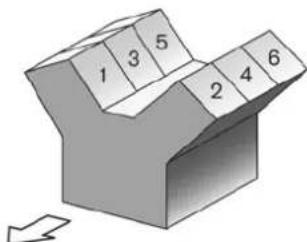
Technical and consumer information 10-9
WHEELSANDTIRES
Tire
| Type Size | Pressure PSI (kPa) [Cold] | |
| Summer | Front: 255/40ZRF20 (97Y) | 30 (210)*132 (220)*2 |
| Rear: 285/35ZRF20 (100Y) | 29 (200) | |
| All-season | Front: 255/40RF20 97W | 32 (220) |
| Rear: 285/35RF20 100W | 30 (210) | |
*1: Except for NISMO and Track edition engineered by nismo models
*2: NISMO and Track edition engineered by nismo models
Make sure to use the tires for GT-R. See the 2021 Warranty Information Booklet for the applicable exclusions.
Roadwheel
| Type Size | Offset in (mm) | ||
| Aluminum | Front: | 20 × 9-1/2J*1 | 1.77 (45)*1 |
| 20 × 10J*2 | 1.61 (41)*2 | ||
| Rear: | 20 × 10-1/2J | 0.98 (25) | |
*1: Except for NISMO models, Track edition engineered by nismo models, T-spec ver and NISMO Special Edition
*2: NISMO models, Track edition engineered by nismo models, T-spec version and NISMO Special Edition
Make sure to use the road wheels for GT-R. See the 2021 Warranty Information Booklet. Except for NISMO models
for the applicable exclusions.
DIMENSIONS
in (mm)
| Overall length | 185.4 (4,710)*1184.6 (4,690)*2 |
| Overall width | 74.6 (1,895) |
| Overall height | 53.9 (1,370) |
| oFront tread | 62.6 (1,590)*363.0 (1,600)*4 |
| Rear tread | 63.0 (1,600) |
| Wheelbase | 109.4 (2,780) |
*2: NISMO models
*3: Except for NISMO models, Track edition engineered by nismo models, T-spec version and NISMO Special Edition
*4: NISMO models, Track edition engineered by nismo models and, T-spec version and NISMO Special Edition
WHENTRAVELINGORREGISTERING INANOTHERCOUNTRY
If you plant to travel in another country, you should first find out if the fuel available is suitable for your vehicle's engine.
Using fuel with too low an octane rating may cause engine damage. All gasoline vehicles must be operated with unleaded gasoline. Therefore, avoid taking your vehicle to areas where appropriate fuel is not available.
Whentransferringtheregistrationof yourvehicletoanothercountry,state, provinceordistrict,it may be necessary to modify the vehicle to meet local laws and regulations.
The laws and regulations for motor vehicle emission control and safety standards vary according to the country, state, province or district; therefore, vehicle specifications may differ.
Whenanyvehicleistobetakeninto anothercountry,state,provinceordistrictandregistered,itsmodifications, transportation,andregistrationarethe responsibilityoftheuser.NISSANisnot responsibleforanyinconveniencethat mayresult.
VEHICLEIDENTIFICATION

VEHICLEIDENTIFICATIONNUMBER (VIN)PLATE
The vehicle identification number plate is attached as shown. This number is the identification for your vehicle and is used in the vehicle registration.
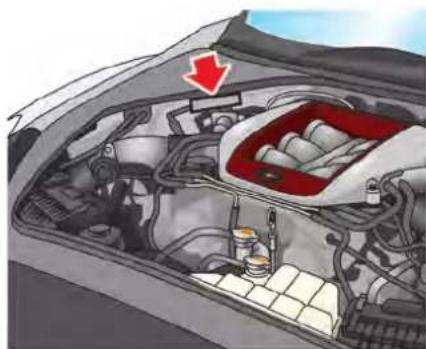
VEHICLEIDENTIFICATIONNUMBER (chassisnumber)
The number is stamped as shown in the engine compartment.

ENGINESERIALNUMBER
The number is stamped on the engine as shown.

F.M.V.S.S./C.M.V.S.S.CERTIFICATIONLABEL
The Federal/Canadian Motor Vehicle Safety Standards (F.M.V.S.S./C.M.V.S.S.) certification label is affixed as shown. This label contains valuable vehicle information, such as: Gross Vehicle Weight Ratings (GVWR), Gross Axle Weight Rating (GAWR), month and year of manufacture, Vehicle Identification Number (VIN), etc. Review it carefully.
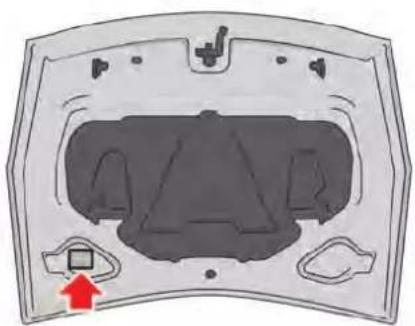
EMISSIONCONTROLINFORMATIONLABEL
The emission control information label is attached as shown.
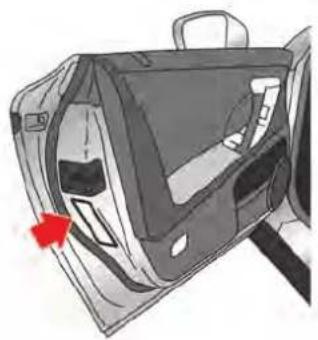

TIREANDLOADINGINFORMATION LABEL
The cold tire pressure is shown on the Tire and Loading Information label affixed to the door end as illustrated.
AIRCONDITIONERSPECIFICATION LABEL
The air conditioner specification label is attached as shown.
10-14 Technicalandconsumerinformation
| Airconditionerspecificationlabelsymbols: | ||
| Symbol Name Reference Graphic | ||
| Caution ISO 7000 0434 |  | |
| Air Conditioning System (MAC) | ISO 2575 D01 |  |
| MAC System Lubricant Type (PAG-POE) |  | |
| Requires Registered Technician to Service MAC System |  | |
| Flammable Refrigerant |  | |
INSTALLINGFRONTLICENSEPLATE
VEHICLELOADINGINFORMATION


Make sure that the two POP® nuts as illustrated are enclosed in the plastic bag. They are used for front license plate installation.
To install the front license plate to your vehicle, it is recommended you contact a GT-R certified NISSAN dealer.

WARNING
- Itisextremelydangerousto rideinacargoareainside thevehicle.Inacollision, peopleridingintheseareas aremorelikelytobeseriouslyinjuredorkilled.
- Donotallowpeopletoride inanyareaofvehiclethatis notequippedwithseatsand seatbelts.
- Besureeveryoneinyour vehicleisinaseatandusing aseatbeltproperly.
TERMS
It is important to familiarize yourself with the following terms before loading your vehicle:
- Curb Weight (actual weight of your vehicle) - vehicle weight including: standard and optional equipment, fluids or emergency tools. This weight does not in-
clude passengers and cargo.
•GVW (Gross Vehicle Weight) - curb weight plus the combined weight of passengers and cargo.
•GVWR (Gross Vehicle Weight Rating) - maximum total combined weight of the unloaded vehicle, passengers, luggage, hitch, trailer tongue load and any other optional equipment. This information is located on the F.M.V.S.S./C.M.V.S.S. label.
- GAWR (Gross Axle Weight Rating) - maximum weight (load) limit specified for the front or rear axle. This information is located on the F.M.V.S.S./C.M.V.S.S. label.
- GCWR (Gross Combined Weight Rating) - The maximum total weight rating of the vehicle, passengers, cargo, and trailer.
- Vehicle Capacity Weight, Load limit, Total load capacity - maximum total weight limit specified of the load (passengers and cargo) for the vehicle. This is
the maximum combined weight of occupants and cargo that can be loaded into the vehicle. If the vehicle is used to tow a trailer, the trailer tongue weight must be included as part of the cargo load. This information is located on the Tire and Loading Information label.
•Cargo capacity - permissible weight of cargo, the weight of total occupants weight subtracted from the load limit.
Example 1 Load limit - ( Occupants amp; Luggage amp; + 1 5 0 lb + 1 5 0 lb = 3 0 0 lb amp; 3 0 lb (7 0 kg ) (7 0 kg ) (1 4 0 kg ) (1 5 kg ) ) = Available cargo and luggage load capacity 1, 0 7 0 lb (4 8 5 kg )
Example 2 Load limit - ( Occupants amp; Luggage + amp; 1 5 0 lb × 4 = 6 0 0 lb amp; 3 0 lb × 4 = 1 2 0 lb (7 0 kg) amp; (2 8 0 kg) (1 5 kg) amp; (6 0 kg) ) = Available cargo and luggage load capacity 6 8 0 lb (3 0 0 kg)
VEHICLELOADCAPACITY
Do not exceed the load limit of your vehicle shown as "The combined weight of occupants and cargo" on the Tire and Loading Information label. Do not exceed the number of occupants shown as "Seating Capacity" on the Tire and Loading Information label.
To get "the combined weight of occupants and cargo", add the weight of all occupants, then add the total luggage weight. Examples are shown in the illustration.
Stepsfordeterminingcorrect loadlimit
- Locate the statement "The combined weight of occupants and cargo should never exceed XXX kg or XXX lbs" on your vehicle's placard.
- Determine the combined weight of the driver and passengers that will be riding in your vehicle.
- Subtract the combined weight
of the driver and passengers from XXX kg or XXX lbs.
-
The resulting figure equals the available amount of cargo and luggage load capacity. For example, if the XXX amount equals 1400 lbs. and there will be five 150 lb. passengers in your vehicle, the amount of available cargo and luggage load capacity is 650 lbs. (1400 - 750 (5 x 150) = 650 lbs) or 640 - 340 (5 x 70) = 300 kg.)
-
Determine the combined weight of luggage and cargo being loaded on the vehicle. That weight may not safely exceed the available cargo and luggage load capacity calculated in Step 4.
- If your vehicle will be towing a trailer, load from your trailer will be transferred to your vehicle. Consult this manual to determine how this reduces the available cargo and luggage load
capacity of your vehicle.
Before driving a loaded vehicle, confirm that you do not exceed the Gross Vehicle Weight Rating (GVWR) or the Gross Axle Weight Rating (GAWR) for your vehicle. ( "Measurement of weights" page 10-19)
Also check tires for proper inflation pressures. See the Tire and Loading Information label.
LOADINGTIPS
- The GVW must not exceed GVWR or GAWR as specified on the F.M. V.S.S./C.M.V.S.S. certification label.
- Do not load the front and rear axle to the GAWR. Doing so will exceed the GVWR.

WARNING
- Properlysecureallcargoto helppreventitfromsliding orshifting.Donotplace cargohigherthantheseat-
backs.Inasuddenstopor collision,unsecuredcargo couldcausepersonalinjury.
- Donotloadyourvehicleany heavierthantheGVWRor themaximumfrontandrear GAWRs.Ifyoudo,partsof yourvehiclecanbreak,tire damagecouldoccur,orit canchangethewayyour vehiclehandles.Thiscould resultinlossofcontroland causepersonalinjury.
Overloadingcouldnotonly shortenthelfeofyourvehicleandthetires,butalso couldleadtohazardousvehiclehandlingandlong brakingdistance.Thismay causeaprematuretiremal-function,whichcouldresult inaseriousaccidentand personalinjury.Repairsdue tooverloadingthevehicle arenotcoveredbythevehicle'swarranty.(Seethe2021 NISSANGT-RWarrantyInfor-
mationBooklet.)
MEASUREMENTOFWEIGHTS
Secure loose items to prevent weight shifts that could affect the balance of your vehicle. When the vehicle is loaded, drive to a scale and weigh the front and the rear wheels separately to determine axle loads. Individual axle loads should not exceed either of the gross axle weight ratings (GAWR). The total of the axle loads should not exceed the gross vehicle weight rating (GVWR). These ratings are given on the vehicle certification label. If weight ratings are exceeded, move or remove items to bring all weights below the ratings.
TOWINGATRAILER
Donottowatrailerwithyourvehicle.
FLATTOWINGUNIFORMTIREQUALITYGRADING
Towing your vehicle with all four wheels on the ground is sometimes called flat towing. This method is sometimes used when towing a vehicle behind a recreational vehicle, such as a motor home.
DO NOT tow the GT-R with all four wheels on the ground (flat towing). Doing so will DAMAGE internal transmission parts. Tow the GT-R with all four wheels off the ground. ( "Towing your vehicle" page 6-9)
DOT (Department Of Transportation) Quality Grades: All passenger car tires must conform to federal safety requirements in addition to these grades.
Quality grades can be found where applicable on the tire sidewall between tread shoulder and maximum section width. For example:
Treadwear200TractionAATemperatureA
TREADWEAR
The treadwear grade is a comparative rating based on the wear rate of the tire when tested under controlled conditions on a specified government test course. For example, a tire graded 150 would wear one and one-half (1 1/2) times as well on the government course as a tire graded 100. The relative performance of tires depends upon actual conditions of their use, however, and may depart significantly from the norm due to variations in driving habits, service practices and differences in road characteristics and climate.
TRACTIONAA,A,BANDC
The traction grades, from highest to lowest, are AA, A, B and C. Those grades represent the tire's ability to stop on wet pavement as measured under controlled conditions on specified government test surfaces of asphalt and concrete. A tire marked C may have poor traction performance.

WARNING
Thetractiongradeassignedtothis tireisbasedonstraight-aheadbrakingtractiontests,anddoesnot includeacceleration,cornering,hydroplaning,orpeaktractioncharacteristics.
TEMPERATUREA,BANDC
The temperature grades A (the highest), B, and C, representing the tire's resistance to the generation of heat and its ability to dissipate heat when tested under controlled conditions on a specified indoor laboratory test wheel. Sustained high temperature can cause the material of the tire to degenerate and reduce tire life, and excessive temperature can lead to sudden tire failure. The grade C corre-
sponds to a level of performance which all passenger car tires must meet under the Federal Motor Vehicle Safety Standard No. 109. Grades B and A represent higher levels of performance on the laboratory test wheel than the minimum required by law.

WARNING
Thetemperaturegradeforthistireis establishedforatirethatisproperly inflatedandnotoverloaded.Excessivespeed,under-inflation,orexcessiveloading,eitherseparatelyorin combination,cancauseheatbuild-upandpossibletirefailure.
EMISSIONCONTROLSYSTEMWARRANTY
Your NISSAN is covered by specific emission warranties:
For the United States, see the 2021 NISSAN GT-R Warranty Information Booklet.
For Canada, see the Warranty and Road-side Assistance Information Booklet.
If you did not receive a Warranty Information Booklet (Warranty and Roadside Assistance Information (Canada only)), or it has become lost, you may obtain a replacement by writing to:
•NISSAN Division
NISSAN North America, Inc. Consumer Affairs Department P.O. Box 685003 Franklin, TN 37068-5003
●NISSAN Canada Inc. 5290 Orbitor Drive Mississauga, Ontario, L4W 4Z5
REPORTINGSAFETYDEFECTS
For USA
If you believe that your vehicle has a defect which could cause a crash or could cause injury or death, you should immediately inform the National Highway Traffic Safety Administration (NHTSA) in addition to notifying NISSAN.
If NHTSA receives similar complaints, it may open an investigation, and if it finds that a safety defect exists in a group of vehicles, it may order a recall and remedy campaign. However, NHTSA cannot become involved in individual problems between you, your dealer, or NISSAN.
To contact NHTSA, you may call the Vehicle Safety Hotline toll-free at 1-888-327-4236 (TTY: 1-800-424-9153); go to http://www.safercar.gov; or write to: Administrator, NHTSA, 400 Seventh Street, SW., Washington, D.C. 20590. You can also obtain other information about motor vehicle safety from http://www.safercar.gov.
Technicalandconsumerinformation10-21
You may notify NISSAN by contacting our Consumer Affairs Department, toll-free, at 1-866-668-1GTR (1-866-668-1487).
For Canada
If you believe that your vehicle has a defect which could cause a crash or could cause injury or death, you should immediately inform Transport Canada in addition to notifying NISSAN.
If Transport Canada receives complaints, it may open an investigation, and if it finds that a safety defect exists in a group of vehicles, it may request that NISSAN conduct a recall campaign. However, Transport Canada cannot become involved in individual problems between you, your dealer, or NISSAN.
You may contact Transport Canada's Defect Investigations and Recalls Division toll free at 1-800-333-0510. You may also report safety defects online at:
https://wwwapps.tc.gc.ca/Saf-Sec-
Sur/7/PCDB-BDPP/fc-cp.aspx?lang=eng (English speakers) or https://wwwapps.tc.gc.ca/Saf-Sec-Sur/7/PCDB-BDPP/fc-cp.aspx?lang=fra (French speakers).
Additional information concerning motor vehicle safety may be obtained from Transport Canada's Road Safety Information Centre at 1-800-333-0371 or online at www.tc.gc.ca/roadsafety (English speakers) or www.tc.gc.ca/securiteroutiere (French speakers).
To notify NISSAN of any safety concerns please contact our Consumer Information Centre toll free at 1-800-387-0122.
10-22 Technicalandconsumerinformation
READINESSFORINSPECTION/MAINTENANCE(I/M)TEST(USonly)
A vehicle equipped with All-Wheel Drive (AWD) should never be tested using a two-wheel dynamometer (such as the dynamometers used by some states for emissions testing), or similar equipment. Make sure you inform test facility personnel that your vehicle is equipped with AWD before it is placed on a dynamometer. Using the wrong test equipment may result in transmission damage or unexpected vehicle movement which could result in serious vehicle damage or personal injury.
Due to legal requirements in some states/areas, your vehicle may be required to be in what is called the "ready condition" for an Inspection/Maintenance (I/M) test of the emission control system.
The vehicle is set to the "ready condition" when it is driven through certain driving patterns. Usually, the "ready condition" can be obtained by ordinary usage of the vehicle.
If a powertrain system component is repaired or the battery is disconnected, the vehicle may be reset to a "not ready condition". Before taking the I/M test, check the vehicle's inspection/maintenance test readiness condition. Push the ignition switch to the ON position without starting the engine. If the Malfunction
EVENTDATARECORDERS(EDR)
Indicator Light (MIL) comes on steady for 20 seconds and then blinks for 10 seconds, the I/M test condition is "not ready". If the MIL does not blink after 20 seconds, the I/M test condition is "ready".
It is recommended you contact a GT-R certified NISSAN dealer to set "ready condition" or to prepare the vehicle for testing.
This vehicle is equipped with an Event Data Recorder (EDR). The main purpose of an EDR is to record, in certain crash or near crash-like situations, such as an air bag deployment or hitting a road obstacle, data that will assist in understanding how a vehicle's systems performed. The EDR is designed to record data related to vehicle dynamics and safety systems for a short period of time, typically 30 seconds or less. The EDR in this vehicle is designed to record such data as:
- How various systems in your vehicle were operating;
- Whether or not the driver and passenger safety belts were buckled/fas-stened;
- How far (if at all) the driver was depressing the accelerator and/or brake pedal; and,
●How fast the vehicle was traveling.
●Sounds are not recorded. These data can help provide a better understanding of the circumstances in which crashes and injuries occur. NOTE: EDR data are recorded by your vehicle only if a nontrivial crash situation occurs; no data are recorded by the EDR under normal driving conditions and no personal data (e.g. name, gender, age and crash
location) are recorded. However, other parties, such as law enforcement, could combine the EDR data with the type of personally identifying data routinely acquired during a crash investigation. To read data recorded by an EDR, special equipment is required and access to the vehicle or the EDR is needed. In addition to the vehicle manufacturer and NISSAN dealer, other parties, such as law enforcement, that have the special equipment, can read the information if they have access to the vehicle or the EDR. EDR data will only be accessed with the consent of the vehicle owner or lessee or as otherwise required or permitted by law.
Technicalandconsumerinformation10-23
VEHICLESTATUSDATARECORDER(VSDR)
The Vehicle Status Data Recorder (VSDR) is different from the Event Data Recorder described in "Event Data Recorder" in this section. The VSDR is not a crash-activated device, but it records and accumulates vehicle data while driving.
Examples are:
●Vehicle operating information such as the wheel speeds of the front and rear wheels
- Engine control information such as the engine speed and boost pressure The VSDR always records and stores vehicle operating data between periodic inspections, which can assist and be used for servicing, diagnosing and performing warranty repairs.
The VSDR does not record sounds, conversations or images.
To read data recorded by the VSDR, special equipment is required and access to the vehicle or the VSDR is needed.
HANDLINGOFDATA
NISSAN and third parties affiliated with NISSAN can acquire and use the data recorded by the VSDR in order to confirm the part replacement history to improve the quality of NISSAN vehicles.
With the exception of the following cases,
10-24 Technicalandconsumerinformation
neither NISSAN nor third parties affiliated with NISSAN, shall disclose or offer the acquired data to other non-affiliated third parties.
●With the agreement of the vehicle owner
- When legally required to, such as when ordered by a court of law, etc.
- When offering processed data so that neither the vehicle owner nor the vehicle is identified, to research centers for statistical analysis, etc.
OWNER'SMANUAL/SERVICE MANUALORDERINFORMATION
Genuine NISSAN Service Manuals for this model year and prior can be purchased. A genuine NISSAN Service Manual is the best source of service and repair information for your vehicle. This manual is the same one used by the factory-trained technicians working at NISSAN dealer. Genuine NISSAN Owner's Manuals can also be purchased.
ForUSA:
For current pricing and availability of genuine NISSANServiceManuals,
www.nissan-techinfo.com
For current pricing and availability of genuine NISSANOwner'sManuals, contact:
1-800-247-5321
ForCanada:
To purchase a copy of a genuine NISSAN Service Manual or Owner's Manual for this model year and prior, please contact a GT-R certified NISSAN dealer. For the phone number and location of a GT-R certified NISSAN dealer in your area call the NISSAN Information Center at 1-800-387-0122 and a bilingual NISSAN representative will assist you.
MEMO
Technicalandconsumerinformation10-25
MEMO
10-26 Technicalandconsumerinformation
MEMO
Technicalandconsumerinformation10-27
MEMO
10-28 Technicalandconsumerinformation
11Index
A
Activenoisecancellation....5-60
Activesoundenhancement....5-60
Additionalmaintenanceitems......GTR-13
Maintenancerecordlist....9-8
Aircleaner 8-17
Airconditioner 4-11
Airconditioneroperation....4-10
Airconditionerspecificationlabel.....10-14
Airconditioningsystemrefrigerant andoilrecommendations....10-7
Airfresheners....7-6
All-seasontires....GTR-11
All-WheelDrive 5-43
All-Wheel Drivedriving safetyprecautions....5-9
Anti-freeze....5-57
Anti-lockBrakingSystem....5-53
Anti-lockBrakingSystemwarning....2-40
AppleCarPlay ® 4-2
Audiblereminders....2-34
Automatic Automaticdoorlocksystem....3-5
Averagefuelconsumptionandspeed.....2-17
Avoidingbodydamage....GTR-12
Avoidingcollisionandrollover....5-7
AWDclutchhightemperaturewarning....2-40
AWDsystemcharacteristics....5-45
AWDsystemwarning....2-41
AWDwarninglight 5-43
B
Battery....5-57,8-13
IntelligentKeybatterydischarge....5-12
IntelligentKeybattery
dischargeindicator....2-48
IntelligentKeybatteryreplacement.....8-25
Beforestartingtheengine....5-13
Bodyrepair....GTR-12
Boosterseats....1-30
Brake
Brakeassist....5-53
Brakefluid......GTR-5,8-11
Brakepadwearwarning....8-19
Brakesystem....5-52
Brakes....8-19
Highperformancebrakesystem....8-19
Lowbrakefluidwarning....2-39
Parkingbrake....5-34
Parkingbrakebreak-in....5-52
Parkingbrakereleasewarning....2-39
Replacingthebrakepads....8-20
Self-adjustingbrakes....8-19
Brakediscrotor....8-22
Brakedust....GTR-28
Brakepad....GTR-16
Brakepadanddiscrotor....GTR-6
Brakepadbreak-inprocedure.....GTR-16
Brakesysteminformation......GTR-27
Brakes....GTR-19,GTR-22
Brakingprecautions....5-52
Break-inschedule....GTR-10,5-40
C
Capacitiesand
recommendedfluids/lubricants....10-2
CarphoneorCBradio 4-15
Changing
Changingenginecoolant 8-8
Changingengineoilandfilter....8-10
Changingwheelsandtires....8-39
Checking
Checkingenginecoolantlevel....8-8
Checkingengineoillevel....8-9
Checkinglights....2-26
Checkingthetirepressure....8-33
Childrestraints....1-15
Childsafety....1-13
Chromeparts....7-4
Cleaning....8-18
Cleaningexterior....7-2
Cleaninginterior....7-5
Closingthefuel-fillerdoor....3-25
Closingthehood 3-19
Coathooks....2-66
Cockpit 2-4
Coldweatherdriving....5-57
Consolebox....2-66
Cooldown....GTR-14
Coolant
Changingenginecoolant 8-8

Checkingenginecoolantlevel....8-8
Drainingofcoolantwater....5-57
Enginecoolanttemperaturegauge.....2-8
Coolantlevelandmixtureratio......GTR-15
Corrosionprotection....7-9
Cracksonbrakepad....GTR-27
Cracksonthediscrotors....GTR-27
Cruisecontrol....2-17,5-35
Cruisecontroloperations....5-37
Cruisecontrolsystemwarning....2-43
Cupholders....2-63
Currentfuelconsumption....2-16
D
Determining the proper
maintenanceinterval 9-3
Differentialoil....GTR-5
Dimensions....10-11
Distancetoempty....2-18
Doorpocket 2-65
Door/trunkopenwarning....2-44
Doors....3-4
Drainingofcoolantwater....5-57
Drinkingalcohol/drugsanddriving....5-9
Drivebelts....8-16
Drivecomputer....2-16
Driving
All-Wheel Drivedriving
safetyprecautions....5-9
Brakesystem(NCCB(NISSANCarbon
CeramicBrake))......GTR-28,8-20
Coldweatherdriving....5-57
Drinkingalcohol/drugsanddriving.....5-9
Drivingonsnoworice....5-57
Drivingthevehicle....5-15
Drivingtips....5-21
Precautionswhenstarting
anddriving....5-3
Drivingafterreplacingtires......GTR-12
Drycarbonfiberparts.....GTR-8,GTR-29,7-5
Dualclutchtransmission.....GTR-29,5-15
E
E-Call(SOS)Button....2-61
Elapsed time and tripodometer.....2-18
Emergencyengineshutoff....5-12,6-3
Emergencytrunklidrelease....3-22
Emissioncontrolinformationlabel......10-13
Emissioncontrolsystemwarranty....10-21
Engine....10-9
Beforestartingtheengine....5-13
Changingenginecoolant....8-8
Changingengineoilandfilter....8-10
Checkingenginecoolantlevel....8-8
Checkingengineoillevel....8-9
Emergencyengineshutoff....5-12,6-3
Engineblockheater....5-58
Enginecompartment......8-22
Enginecompartment
checklocations....8-4
Enginecoolanttemperaturegauge.....2-8
Enginecoolingsystem....8-6
Engineoil....GTR-4,8-9
Engineoilandoil
filterrecommendation....10-6
Engineoilleveldisplay....2-13
Engineoillowpressurewarning.....2-37
Engineserialnumber....10-13
Enginestartoperationindicator.....2-46
Enginesystemwarning....2-37
Operatingrangeforenginestart......5-10
Startingtheengine....5-14
Engineandpowertrain.....GTR-16,GTR-24
Engineoilmaintenance....GTR-4
Engineoutput......GTR-25
Engineoutputaccordingtothe
coolanttemperature......GTR-25
Enginespeedisrestricted......GTR-25
Environmentalfactorsinfluencethe
rateofcorrosion....7-9
EventDataRecorders(EDR)....10-23
Exhaustgas....5-3
Exhaustmufflerandtrunkcarpet.....GTR-7
Exhaustsoundcontrolswitch....2-59
Exhaustsoundcontrolsystem....5-59
Explanationofmaintenanceitems....9-3
Explanationofscheduled
maintenanceitems....9-6
Extendedstoragefuseswitch....8-24
Exteriorandinteriorlights....8-28
F
F.M.V.S.S./C.M.V.S.S.certificationlabel.....10-13
Featuresofeachmode....5-28
Flattire....6-3
Flattowing....10-20
Floormats....7-6
Fluid
Brakefluid......GTR-5,8-11
Fluidlevelcheck 8-14
Lowbrakefluidwarning....2-39
Lowwasherfluidwarning....2-44
Powersteeringfluid....8-11
Windowwasherfluid....8-12
Fluids....GTR-14,GTR-19
Forward-facingchildrestraintinstallation
usingLATCH....1-24
Forward-facingchildrestraintinstallation
usingtheseatbelts....1-27
Freeingafrozendoorlock....5-57
Frontseat-mountedside-impact
supplementalairbagandroof-mounted
curtainside-impactandrollover
supplementalairbagsystems....1-45
Frontseats....1-3
Front/reartiresize
discrepancywarning....2-41
Fuel......GTR-12
Averagefuelconsumption andspeed....2-17
Capacitiesand recommendedfluids/lubricants....10-2
Closingthefuel-fillerdoor 3-25
Currentfuelconsumption....2-16
Fuelgauge....2-9
Fuelinformation....10-4
Fuel-fillerdoor 3-24
Increasingfueleconomy....5-42
Lowfuelwarning....2-43
Openingthefuel-fillerdoor 3-25
FuelEfficientDrivingTips....5-41
Fuses....8-22
G
Garagedooropener
HomeLink®UniversalTransceiver....2-71
Gasolinesmell....GTR-24
Gauge
Enginecoolanttemperaturegauge.....2-8
Fuelgauge....2-9
Metersandgauges....2-6
Generalmaintenance....9-2,9-3
Glass....7-3
Glovebox....2-65
GT-Rperformance
optimizationservices....GTR-8
GT-Rspecialprecautions....GTR-5
GT-Rspecialspecificationparts.....GTR-4
GT-Rspecificinformation....GTR-3
GT-Rspecificvehiclecharacteristics.....GTR-24
H
Handlingofdata....10-24
Hazardwarningflasherswitch....6-2
Headrestraints/headrests....1-5
Headlight
Headlightandturnsignalswitch.....2-53
Headlightswitch....2-53
Headlights....8-27
Heatedseats....2-58
Heater
Heaterandair conditioneroperation....4-10
Highaltitude......GTR-25
Highperformancebrakesystem....8-19
HillStartAssistSystem....5-39
HomeLink®UniversalTransceiver....2-71
Hood....3-18
Horn....2-58
Howtoswitchthemodes....5-26
HowtouseRmodestartfunction....5-34
I
Idlespeedisnotsteady....GTR-24
If your vehicle overheats....6-8
Ignitionswitchoperation....5-11
Ignitionswitchpositions....5-11
In-cabinmicrofilter 4-13
Increasingfueleconomy....5-42
Indicatorsanddisplay....5-37
Infants....1-13
Injuredpersons....1-9
Insidemirror 3-27
Inspection and adjustments
afterdriving....GTR-19
Inspection and adjustments
beforedriving......GTR-14
Installingfrontlicenseplate....10-16
Installingtoptetherstrap....1-26,1-30
Instrumentbrightnesscontrol....2-12
Instrumentpanel....2-5
IntelligentKey 3-2
IntelligentKeybatterydischarge....5-12
IntelligentKeybattery
dischargeindicator....2-48
IntelligentKeybatteryreplacement......8-25
IntelligentKeyfunctions....3-9
IntelligentKeyinsertionindicator....2-47
IntelligentKeyremovalindicator....2-47
IntelligentKeysystem 3-8
Interiorlightcontrolswitch....2-70
Interiorlights....2-69
J
Jackingvehicleandremovingwheels.....8-42
Jumpstarting....6-5,8-15
K
Key
IntelligentKey 3-2
IntelligentKeybatterydischarge....5-12
IntelligentKeybattery
dischargeindicator....2-48
IntelligentKeybatteryreplacement.....8-25
IntelligentKeyfunctions....3-9
IntelligentKeyinsertionIndicator.....2-47
IntelligentKeyremovalindicator....2-47
IntelligentKeysystem 3-8
Keys....3-2
Lockingwithmechanicalkey....3-6
Nokeywarning....2-45
Remotekeylessentrysystem....3-12
L
Largerchildren....1-14
Light
AWDwarninglight....5-43
Exteriorandinteriorlights....8-28
Headlightandturnsignalswitch.....2-53
Headlightswitch....2-53
Headlights....8-27
Interiorlightcontrolswitch....2-70
Interiorlights....2-69
Lights....8-27
Maplights....2-69
Supplementalairbagwarninglight.....1-48
Vanitymirrorlights....2-71
Warninglights, indicatorlights and
audiblereminders....2-26
Warning/indicatorlights(other)......2-34
Warning/indicatorlights(red).....2-26
Warning/indicatorlights(yellow).....2-29
LimitedSlipDifferential....5-45
Loadingtips....10-18
Lock
Anti-lockBrakingSystem....5-53
Anti-lockBrakingSystemwarning.....2-40
Automaticdoorlocksystem....3-5
Freeingafrozendoorlock....5-57
Lockingwithinsidelockknob....3-5
Lockingwithmechanicalkey....3-6
Lockingwithpowerdoorlockswitch.....3-5
Steeringlockrelease
malfunctionindicator....2-47
Wheellocknuts....8-47
Lowbrakefluidwarning....2-39
Lowfuelwarning....2-43
Lowtirepressurewarning....2-42
Lowwasherfluidwarning....2-44
Loweranchorsandtethersfor
childrensystem....1-17
M
Maintenance
Brakesystem(NCCB(NISSANCarbon
CeramicBrake))....8-20
Explanationofmaintenanceitems....9-3
Generalmaintenance....9-2,9-3
Maintenanceinformation......GTR-3
Maintenance precautions....8-3
Maintenancerequirement....9-2
Readinessfor
Inspection/Maintenancetest....10-22
Scheduledmaintenance....9-2
Seatbeltmaintenance....1-12
Maintenancelogandrecords....9-28
Maplights....2-69
Measurementofweights....10-19
Metersandgauges....2-6
Mirror
Insidemirror 3-27
Mirrors....3-27
Outsidemirrors....3-28
Vanitymirror 3-29
Vanitymirrorlights....2-71
Mostcommonfactorscontributingto
vehiclecorrosion....7-9
MultiFunctionDisplayOwner'sManual.....4-2
N
NCCB(NISSANCarbon
CeramicBrake)....GTR-6,8-20
Replacingbrakepadsandbrake
discrotors....8-21
NISSANAdvancedAirBagSystem....1-40
NISSANVehicleImmobilizerSystem....2-50
Nokeywarning....2-45
Noisesareheardwhiledriving.....GTR-25
Normalmode....5-25
O
Odometer/twintripodometer....2-7
Off-roadrecovery 5-8
Oil
Changingengineoilandfilter....8-10
Checkingengineoillevel....8-9
Differentialoil....GTR-5
Engineoil....GTR-4,8-9
Engineoilandoil
filterrecommendation....10-6
Engineoilleveldisplay....2-13
Engineoillowpressurewarning.....2-37
Transmissionoil....GTR-4,8-10
Transmissionoilhigh
temperaturewarning....2-38
Openingandclosingthetrunk....3-22
Openingthedoors....3-7
Openingthefuel-fillerdoor 3-25
Openingthehood....3-18
Operatingrangeforenginestart....5-10
Operationdisplays....2-45
Othermodesforeachswitch....5-25
Outsideairtemperature....2-19
Outsidedoorhandles....7-4
Outsidemirrors....3-28
OutsidetemperaturedisplayIndicates
highertemperature....GTR-24
Overheat
If your vehicle overheats....6-8
Owner's Manual/Service Manual
orderinformation....10-24
P
Parking
Parkingbrake....5-34
Parkingbrakebreak-in....5-52
Parkingbrakereleasewarning....2-39
Parking/parkingonhills 5-46
Passengercompartment....8-23
Power
Lockingwithpowerdoorlockswitch.....3-5
Poweroutlets....2-60
Powersteering....5-51
Powersteeringfluid....8-11
Powerwindows....2-67
Trunkreleasepowercancelswitch.....3-21
Precautions....8-14
All-wheel Drivedriving
safetyprecautions....5-9
Brakingprecautions....5-52
Maintenance precautions....8-3
Precautionsonchildrestraints....1-16
Precautionsoncruisecontrol....5-36
Precautionsonseatbeltusage....1-6
Precautionsonsupplemental
restraintsystem....1-34
Precautionswhenstarting
anddriving....5-3
Precautionsbeforedriving......GTR-11
Precautionsonperformedriving.....GTR-13
Pregnantwomen....1-9
Pushstarting 6-7
"PUSH"warning....2-46
Push-buttonignitionswitch....5-10
R
Rmode 5-25
Rmodestartfunction....5-33
Rapidairpressureloss....5-8
Readinessfor
Inspection/Maintenancetest....10-22
Rearwindowdefrosterswitch....2-52
Rear-facingchildrestraintinstallation
usingLATCH....1-20
Rear-facingchildrestraintinstallation
usingtheseatbelts....1-21
RearViewMonitor....4-2
Recommendedfluidsand
maintenanceinterval......GTR-20
Reducingtightcorner
brakingphenomenon....5-44
Refuelingprecautions......GTR-14
Remotekeylessentrysystem....3-12
Removingspots....7-3
Removingthecowltopcover....8-5
Repairandreplacementprocedure......1-49
Replacementofbrakepadsand
discrotors....GTR-6
Replacementofbrakepadsanddisc
rotors(NCCB(NISSANCarbon
CeramicBrake))......GTR-6
Replacingsparkplugs....8-17
Replacingthebrakepads....8-20
Replacingthewiperblades....8-18
Reportingsafetydefects....10-21
Reversewarning....2-38
Roadsideassistanceprogram....6-2
Run-flattirewarning....2-42
Run-flattires....6-4
S
Safety
All-Wheel Drivedriving
safetyprecautions....5-9
Childsafety....1-13
Reportingsafetydefects....10-21
Safety—Seats,seatbeltsand
supplementalrestraintsystem....1-1
Scheduledmaintenance....9-2
Seat
Boosterseats....1-30
Forward-facingchildrestraint
installationusingtheseatbelts....1-27
Frontseat-mountedside-impact
supplementalairbagand
roof-mountedcurtainside-impactand
rolloversupplementalair
bagsystems....1-45
Frontseats....1-3
Heatedseats....2-58
NISSANAdvancedAirBagSystem......1-40
Precautionsonseatbeltusage....1-6
Rear-facingchildrestraintinstallation
usingtheseatbelts....1-21
Seatbeltextenders....1-12
Seatbeltmaintenance....1-12
Seatbelts....1-6,7-8
Seatbeltswithpretensioners....1-46
Seats....1-2
Three-pointtypeseatbelt
withretractor....1-9
Seatbelt
Forward-facingchildrestraint
installationusingtheseatbelts.....1-27
Precautionsonseatbeltusage....1-6
Rear-facingchildrestraintinstallation
usingtheseatbelts....1-21
Seatbeltextenders....1-12
Seatbeltmaintenance....1-12
Seatbelts....1-6,7-8
Seatbeltswithpretensioners....1-46
Three-pointtypeseatbelt
withretractor....1-9
Securitysystems....2-48
Self-adjustingbrakes....8-19
Servicingairconditioner....4-14
Setting(drivecomputer)....2-20
Settingguideofwheelalignment
dependingonthecustomer'sdriving.....9-21
Settinghazardindicatorand
hornmode....3-14
Shiftleverpositionwarning....2-37
Shift"P"warning....2-46
Smallchildren....1-14
Sonarsystem....5-48
Sonarsystemoffswitch....2-59
Sonarsystemsetting....5-50
Sparkplugs....8-16
Specialwinterequipment....5-57
Specifications....10-9
Speedometer....2-7
Starting
Beforestartingtheengine....5-13
Jumpstarting....6-5,8-15
Precautionswhenstarting
anddriving....5-3
Pushstarting....6-7
Startingtheengine....5-14
Steering
Powersteering....5-51
Powersteeringfluid....8-11
Steeringlockrelease
malfunctionindicator....2-47
Steeringwheel....3-26
Steering-wheel-mountedcontrols.....5-36
Tilt/telescopicsteeringcolumn....3-26
Storage....2-63
Summertires....GTR-11
Sunvisors....3-27
Sunglassesholder 2-64
Supplementalairbagwarninglabels.....1-48
Supplementalairbagwarninglight.....1-48
Supplementalrestraintsystem....1-34
Suspensionand
wheelalignment....GTR-16,GTR-22
Switch
Hazardwarningflasherswitch....6-2
Headlightandturnsignalswitch.....2-53
Headlightswitch....2-53
Howtoswitchthemodes....5-26
Ignitionswitchoperation....5-11
Ignitionswitchpositions....5-11
Interiorlightcontrolswitch....2-70
Lockingwithpowerdoorlockswitch.....3-5
Push-buttonignitionswitch....5-10
Rearwindowdefrosterswitch....2-52
Trunklidreleaseswitch....3-20
Trunkopenrequestswitch....3-20
Trunkreleasepowercancelswitch.....3-21
VDC, transmission and suspension
setupswitches....5-25
wiperandwasherswitch....2-51
T
Tachometer 2-8
TemperatureA,BandC....10-20
Terms....10-16
Three-pointtypeseatbelt
withretractor....1-9
Three-waycatalyst....5-3
Tightcornerbrakingphenomenon....5-44
Tilt/telescopicsteeringcolumn....3-26
Tire
Changingwheelsandtires....8-39
Checkingthetirepressure....8-33
Flattire....6-3
Front/reartiresize
discrepancywarning....2-41
Lowtirepressurewarning....2-42
Run-flattirewarning....2-42
Run-flattires....6-4
Tireandloading
informationlabel....8-32,10-14
Tirechains....8-38
Tiredressing....7-4
Tireequipment....5-57
Tirelabeling....8-35
Tirepressure....8-30
TirePressureMonitoringSystem.....5-4,6-3
TirePressureMonitoring
Systemwarning....2-42
Tirereplacementrecord....9-23
Tires 5-44
Changeofsurfacecolorof
titaniummuffler......GTR-29
Soundheardaround
titaniummuffler....GTR-29
Toprotectyourvehiclefromcorrosion.....7-9
Towing
Flattowing....10-20
Towingatrailer....10-19
TowingrecommendedbyNISSAN......6-9
Towingyourvehicle....6-9
TractionAA,A,BandC....10-20
Transceiver
HomeLink®UniversalTransceiver......2-71
Transmission
Transmissionclutchhigh
temperaturewarning....2-39
Transmissionoil....GTR-4,8-10
Transmissionoilhigh
temperaturewarning....2-38
Transmissionpositionindicator....2-10
Transmissionsystemcheckdisplay.....2-15
Transmissionsystemwarning....2-38
VDC, transmission and suspension
setupswitches....5-25
Transmissionassembly/parts
replacementrecord....9-26
Transmission
operationcharacteristics......GTR-31
Transmissionsettings......GTR-9
Treadwear....10-20
Troubleshootingguide....3-17
Trunk 3-20
Trunklidreleaseswitch....3-20
Trunkopenrequestswitch....3-20
Trunkreleasepowercancelswitch....3-21
Turbochargersystem....5-32
Turningofftheheaters....2-58
Turningontheheaters....2-58
Usingthewipers....2-51
V
Vanitymirror 3-29
Vanitymirrorlights....2-71
VDC, transmission and suspension
setupswitches....5-25
VehicleDynamicControl(VDC)
OFFmode....GTR-11
VehicleDynamicControl(VDC)
warninglight 2-34
VehicleDynamicControlsystem....5-54
VehicleDynamicControl
systemwarning....2-40
Vehicleidentification....10-12
Vehicleidentificationnumber......10-12
Vehicleidentification
Numberplate....10-12
Vehicleinformationdisplay....2-13
Vehicleloadcapacity....10-18
Vehicleloadinginformation....10-16
Vehiclerecovery....6-9
Vehiclesecuritysystem....2-48
Vehiclespeed....2-17
Vehiclestatusdatarecorder....10-24
Ventilators....4-9
W
Warning
Anti-lockBrakingSystemwarning.....2-40
AWDclutchhigh
temperaturewarning....2-40
AWDsystemwarning....2-41
AWDwarninglight....5-43
Brakepadwearwarning....8-19
Cruisecontrolsystemwarning....2-43
Door/trunkopenwarning....2-44
Engineoillowpressurewarning.....2-37
Enginesystemwarning....2-37
Front/reartiresize
discrepancywarning....2-41
Hazardwarningflasherswitch....6-2
Lowbrakefluidwarning....2-39
Lowfuelwarning....2-43
Lowtirepressurewarning....2-42
Lowwasherfluidwarning....2-44
Nokeywarning....2-45
Parkingbrakereleasewarning....2-39
"PUSH"warning....2-46
Reversewarning....2-38
Run-flattirewarning....2-42
Shiftleverpositionwarning....2-37
Shift"P"warning....2-46
Supplementalairbag
warninglabels....1-48
Supplementalairbagwarninglight.....1-48
TirePressureMonitoring
Systemwarning....2-42
Transmissionclutchhigh
temperaturewarning....2-39
Transmissionoilhigh
temperaturewarning....2-38
Transmissionsystemwarning....2-38
VehicleDynamicControl
systemwarning....2-40
Warning(drivecomputer)......2-24
Warningdisplay 2-36
Warninglights, indicatorlights and
audiblereminders....2-26
Warningsignals....3-16
Warning/indicatorlights(red).....2-26
Warning/indicatorlights(other)......2-34
Warning/indicatorlights(yellow).....2-29
Warrantyinformation......GTR-3
Washing....7-2
Waxing....7-3
wheelalignment....GTR-10,5-40
Wheelalignmentinspectionand
adjustment(ifnecessary)(includingtire
pressureadjustment)......GTR-9
Wheellocknuts....8-47
Wheels....7-4
wheelsand
tires....GTR-17,GTR-22,8-29,10-10
Whentravelingorregisteringin
anothercountry....10-12
Wheretogoforservice....9-2
windowwasherfluid....8-12
Windows....2-67
Windshieldwiperblades....8-18
wiper
Replacingthewiperblades....8-18
Usingthewipers....2-51
windshieldwiperblades....8-18
Wiperandwasherswitch....2-51
Wiperandwasherswitch....2-51
MEMO
GASSTATIONINFORMATION
FUELINFORMATION
VR38engine
Use unleaded premium gasoline with an octane rating of at least 93 AKI (Anti-Knock Index) number (Research octane number 98) to maximize vehicle performance.
If the premium gasoline specified above is not available, you may use unleaded premium gasoline with an octane rating of at least 91 AKI number (Research octane number 96), but you may notice a decrease in performance.
Do not use gasoline with a lower octane rating than 91 AKI (Research octane number 96).
NOTICE
- Usingafuelotherthanthatspecifiedcouldadverselyaffectthe emissioncontrolsystems,and mayalsoaffectwarrantycoverage.
- Undernocircumstanceshoulda leadedgasolinebeused, since thiswilldamagethethreeway catalyst.
- DonotuseE-15orE-85fuelin yourvehicle.Yourvehicleisnot designedtorunonE-15orE-85 fuel.UsingE-15orE-85fuelina vehiclenotspecificallydesigned forE-15orE-85fuelcanadversely affecttheemissioncontroldevicesandsystemsofthevehicle. Damagecausedbysuchfuelis notcoveredbytheNISSANnew vehiclelimitedwarranty.
•U.S. government regulations require ethanold dispensing pumps to be identified by a small, square, orange and black label with the common abbreviation or the appropriate percentage for that region.
- NISSAN recommends using fuels that contain no alcohol. However, fuels containing up to 10% alcohol maybe used, if necessary. To avoid serious engined damaged due to increased cylindertemperature, donot use fuel that contain more alcohol than indicated in "Gasoline containing oxygenates" page 10-5. Also, donot use fuel additives, fuel stabilizers or fuel deicers that contain alcohol.
For additional information, see the following section. (1) "Capacities and recommended fluids/lubricants" page 10-2)
ENGINEOILRECOMMENDATION
Mobil 1 (0W-40) (100% synthetic) is the factory fill oil. The VR38 engine with its plasma-sprayed bores was developed using this oil. NISSAN cannot ensure proper engine operation and durability if other 0W-40 non-equivalent synthetic oil is used. If Mobil 1 (0W-40) or equivalent is not available, Mobil 1 (10W-40) (100% synthetic) or equivalent may be used; however, some performance loss may be noticed.
See the following section for engine oil and oil filter recommendation. ( "Capacities and recommended fluids/lubricants" page 10-2)
COLDTIREPRESSURES
The label is typically located on the driver side center pillar or on the driver's door. ( "Wheels and tires" page 8-29)
NEWVEHICLEBREAK-INPROCEDURE DURESRECOMMENDATION
Follow these recommendations for the future reliability and economy of your new vehicle.
During the first 1,200 miles (2,000 km) of vehicle use, follow the recommendations outlined in this Owner's Manual.
( "Break-in schedule" page 5-40)

hgedcedbaSRPcRO NRgaMEMD
hAN:e53ce2da1 20. OMMDEE:Eonm M
hgedcR. aedac-Ra (SIA)
onml i

- FOREWORD
- READ FIRST — THEN DRIVE SAFELY
- WARNING
- IMPORTANT SAFETY INFORMATION REMINDERS
- MODIFICATIONOFYOURVEHICLE
- WHENREADINGTHEMANUAL
- IMPORTANT INFORMATION ABOUT THISMANUAL
- CAUTION
- NOTICE
- CALIFORNIAPERCHLORATEADVI- SORY
- NISSANCUSTOMERCAREPROGRAM
- NISSANCARES
- FORCANADIANCUSTOMERS 1-800-387-0122
- FORU.S.CUSTOMERS
- FORCANADIANCUSTOMERS
- GT-ROVERVIEW
- GT-RSPECIFICINFORMATION
- WARRANTYINFORMATION
- MAINTENANCEINFORMATION
- GT-RSPECIALSPECIFICATIONPARTS
- ENGINEOIL
- MOBIL1(0W-40)(100%SYNTHETICOIL)OR EQUIVALENT
- THEUSEOFADDITIVES,CHEMICALMATERIALS ORABRASIVECOMPOUNDSISPROHIBITED
- ENGINEOILMAINTENANCE
- TRANSMISSIONOIL
- GENUINENISSANTRANSMISSIONOILR35 SPECIAL(100%SYNTHETICOIL)OREQUIVALENT
- THEUSEOFADDITIVESISNOTRECOMMENDED
- GT-RSPECIALPRECAUTIONS
- DIFFERENTIALOIL(FRONTANDREAR) DIFFERENTIALOILR35COMPETITIONTYPE 2189EOREQUIVALENT
- BRAKEFLUID
- GENUINENISSANBRAKEFLUIDR35SPECIAL ILOREQUIVALENT
- TIRESANDROADWHEELS
- TIRES
- TIREREPLACEMENT
- ROADWHEELS
- BRAKEPADANDDISCROTOR
- REPLACEMENTOFBRAKEPADSAND DISCROTORS
- FORMODELSWITHOUTNCCB(NISSANCARBONCERAMICBRAKE)PACKAGE
- NCCB(NISSANCARBONCERAMIC BRAKE)(IFSOEQUIPPED)
- EXHAUSTMUFFLERANDTRUNK CARPET
- TITANIUMMUFFLERANDTRUNK CARPET(IFSOEQUIPPED)
- NEVERALLOWOILORGREASETOADHERETO THETITANIUMMUFFLER
- DRYCARBONFIBERPARTS(IFSO EQUIPPED)
- BUCKETOFWATER, ANDUSETHAT MIXTURETOCLEANTHEPARTS
- NOTE
- ENGINESTARTANDSTOP
- GT-RPERFORMANCE OPTIMIZATION SERVICES
- WHEELALIGNMENTINSPECTION ANDADJUSTMENT(IFNECESSARY) (INCLUDING TIRE PRESSURE ADJUSTMENT)
- PREVENTINGTOE-OUT
- TRANSMISSIONSETTINGS
- BREAK-INSCHEDULE
- WHEELALIGNMENT
- PRECAUTIONSBEFOREDRIVING
- VEHICLEDYNAMICCONTROL(VDC) OFFMODE
- SUMMERTIRES
- ALL-SEASONTIRES
- AVOIDINGBODYDAMAGE
- FUEL
- DRIVINGAFTERREPLACINGTIRES
- BODYREPAIR
- ADDITIONALMAINTENANCEITEMS
- THE INFORMATION AND SPECIFICATIONS IN THIS SECTION APPLY ONLY WHEN ENGAGING IN PERFORMANCE DRIVING
- HOWEVER, YOU SHOULD ALSO CAREFULLY READ YOUR 2021 NISSANGT-R WARRANTY INFORMATION BOOKLET FOR IMPORTANT INFORMATION CONCERNING WARRANTY COVERAGE, LIMITATIONS AND EXCLUSIONS
- PRECAUTIONSON PERFORMANCE DRIVING
- CHECKINGTHETEMPERATUREOFTHE COOLANTANDOILSONTHETOUCH SCREENDISPLAY
- COOLDOWN
- REFUELING PRECAUTIONS
- INSPECTIONANDADJUSTMENTS BEFOREDRIVING
- FLUIDS
- COOLANTLEVELANDMIXTURERATIO
- DONOTOVERFILLTHECOOLANT. THIS MAY INCREASETHEPRESSUREINTHECOOLING SYSTEMANDCAUSECOOLANTLEAKS
- ENGINEANDPOWERTRAIN
- THEINFORMATIONANDSPECIFICATIONSIN THISSECTIONAPPLYONLYWHENENGAGING
- FAILURETOHAVETHECLUTCHPROPERLY ADJUSTEDBEFOREPERFORMEDRIVING MAYCAUSETHETRANSMISSIONOILTEMPERATURETOINCREASEWHICHMAY CAUSETRANSMISSIONDAMAGE
- SUSPENSIONANDWHEELALIGNMENT
- WHEELSANDTIRES
- BRAKES
- BRAKEPADBREAK-INPROCEDURE
- INSPECTIONANDADJUSTMENTS AFTERDRIVING
- RECOMMENDEDFLUIDSANDMAINTENANCEINTERVAL
- FRONTDISCBRAKEPAD
- GT-RSPECIFICVEHICLECHARACTERISTICS
- REFUELINGPRECAUTIONS
- GASOLINESMELL
- OUTSIDE TEMPERATURE DISPLAY INDICATES HIGHER TEMPERATURE
- IDLESPEEDISNOTSTEADY
- ENGINESPEEDISRESTRICTED
- ENGINEOUTPUT
- HIGHALTITUDE
- ENGINEOUTPUTACCORDINGTOTHE COOLANTTEMPERATURE
- UNEVENWEAROFTIRES
- NOISESAREHEARDWHILEDRIVING
- FORMODELSWITHOUTNCCB(NISSAN CARBONCERAMICBRAKE)PACKAGE
- CRACKSONTHEDISROTORS(MODELS WITHOUTNCCB(NISSANCARBON CERAMICBRAKE)PACKAGE)
- BRAKEDUST
- SOUNDHEARDFROMBRAKESYSTEM (MODELSWITHNCCB(NISSANCARBONCERAMICBRAKE)PACKAGE)
- RATTLESFROMBRAKEPADSANDCREAKS DURINGBRAKING
- NEVERPARKYOURVEHICLEFORALONGTIME WITHTHEBRAKESYSTEMWET
- CHANGEOFSURFACECOLOROF TITANIUMMUFFLER(IFSO EQUIPPED)
- THECOLORTONEOFTHETITA-NIUMMUFFLERFINISHERMIGHT BEDIFFERENTFROMOTHERS(IF SOEQUIPPED)
- SOUNDHEARDAROUNDTITANIUM MUFFLER(IFSOEQUIPPED)
- EXHAUSTGASISNOTEMITTED FROMLEFTEXHAUSTPIPEDURING IDLING/WHENENGINESPEEDIS LOW(IFSOEQUIPPED)
- ROUGHNESSORUNEVENSURFACESOFDRY CARBONFIBERPARTSANDFIBERTWISTS
- DUALCLUTCHTRANSMISSION
- WHEN STARTING OR DRIVING ON A STEEP UPHILL GRADE, SHIFT TO THE M POSITION AND OPERATETHE PADDLESHIFTERTOSHIFT DOWNTO1STGEARSIMILARTOAMANUAL TRANSMISSION VEHICLE
- 0ILLUSTRATEDTABLEOFCONTENTS
- SEATS, SEATBELTSANDSUPPLEMENTAL RESTRAINTSYSTEM(SRS)
- FRONT
- ILLUSTRATEDTABLEOFCONTENTS
- REAR
- EXTERIORFRONT
- EXTERIORREAR
- PASSENGERCOMPARTMENT
- COCKPIT
- INSTRUMENTPANEL
- METERSANDGAUGES
- ENGINECOMPARTMENT
- 1 SAFETY—SEATS,SEATBELTSANDSUPPLEMENTALRESTRAINTSYSTEM
- SEATS
- FRONTSEATS
- FRONTPOWERSEATADJUSTMENT
- REARSEATWALK-IN
- HEADRESTRAINTS/HEADRESTS
- SEATBELTS
- PRECAUTIONSONSEATBELT USAGE
- ACCIDENT
- INJURY
- PREGNANTWOMEN
- INJUREDPERSONS
- THREE-POINTTYPESEATBELT WITHRETRACTOR
- FASTENINGTHESEATBELTS
- UNFASTENINGTHESEATBELTS
- CHECKINGSEATBELTOPERATION
- SHOULDERBELTARM(FORFRONTSEATS)
- SEATBELTEXTENDERS
- SEATBELTMAINTENANCE
- CHILDSAFETY
- CHILDRENNEEDADULTSTOHELPPROTECT THEM. THEYNEEDTOBEPROPERLYRESTRAINED
- INFANTS
- SMALLCHILDREN
- LARGERCHILDREN
- PRECAUTIONSONCHILDRESTRAINTS
- LOWERANCHORSANDTETHERSFOR CHILDRENSYSTEM(LATCH)
- LATCHLOWERANCHOR
- LATCHLOWERANCHORLOCATION
- INSTALLINGCHILDRESTRAINTLATCH LOWERANCHORATTACHMENTS
- TOPTETHERANCHORPOINTLOCATIONS
- REAR-FACINGCHILDRESTRAINT INSTALLATIONUSINGLATCH
- REAR-FACINGCHILDRESTRAINT INSTALLATIONUSINGTHESEAT BELTS
- FORWARD-FACINGCHILDRESTRAINTINSTALLATIONUSING LATCH
- INSTALLINGTOPTETHERSTRAP
- FORWARD-FACINGCHILDRE-STRAINTINSTALLATIONUSINGTHE SEATBELTS
- BOOSTERSEATS
- PRECAUTIONSONBOOSTERSEATS
- BOOSTERSEATINSTALLATION
- OUTBOARDPOSITION
- SUPPLEMENTALRESTRAINTSYSTEM
- PRECAUTIONSONSUPPLEMENTAL RESTRAINTSYSTEM
- NISSANADVANCEDAIRBAGSYS- TEM(FRONTSEATS)
- FRONTPASSENGERAIRBAGANDSTATUSLIGHT
- INGTHEUSEOFSEATS,SEATBELTSAND CHILDRESTRAINTSCANINCREASETHERISK ORSEVERITYOFINJURYINANACCIDENT
- STATUSLIGHT
- FRONTPASSENGERAIRBAG
- OTHERSUPPLEMENTALFRONTAIRBAG PRECAUTIONS
- SERIOUSPERSONALINJURY
- THE SRSWIRINGHARNESS CONNECTORS ARE YELLOW AND ORANGE FOREASY IDENTIFICATION
- FRONTSEAT-MOUNTEDSIDE-IMPACTSUPPLEMENTALAIRBAG ANDROOF-MOUNTEDCURTAIN SIDE-IMPACTANDROLLOVER SUPPLEMENTALAIRBAGSYSTEMS
- BODY
- SEATBELTSWITHPRETEN- SIONERS(FRONTSEATS)
- SUPPLEMENTAL AIRBAG WARNING LABELS
- ① SRSAIRBAG
- SUPPLEMENTAL AIRBAG WARNING LIGHT
- REPAIRANDREPLACEMENTPROCEDURE
- 2INSTRUMENTSANDCONTROLS
- INSTRUMENTSANDCONTROLS
- SPEEDOMETER
- ODOMETER/TWINTRIPOD-OMETER
- CHANGINGTHEDISPLAY
- RESETTINGTHETRIPODOMETER
- TACHOMETER
- FUELGAUGE
- TRANSMISSIONPOSITIONINDICATOR
- UPSHIFTINDICATOR
- SETTING
- EXAMPLE
- WHENTHEMAXIMUMENGINESPEEDIS DESIRED
- WHENTHEMAXIMUMENGINETORQUEIS DESIRED
- WHENBREAKING-INTHEVEHICLE
- INSTRUMENTBRIGHTNESSCONTROL
- VEHICLEINFORMATIONDISPLAY
- ENGINEOILLEVELDISPLAY
- WHENTHEOILLEVELISNORMAL
- WHENTHEOILLEVELISLOW
- ENGINE OIL
- WHENTHEOILLEVELSENSORMAL
- FUNCTIONOCCURS
- TRANSMISSIONSYSTEMCHECK DISPLAY
- DRIVECOMPUTER
- CURRENTFUELCONSUMPTION
- VEHICLESPEED
- CRUISECONTROL
- AVERAGEFUELCONSUMPTION ANDSPEED
- ELAPSEDTIMEANDTRIPOD-OMETER
- DISTANCETOEMPTY
- SETTING(DRIVECOMPUTER)
- ALERT
- TIMER"INDICATOR
- LOWOUTSIDETEMPERATUREWARNING
- MAINTENANCE
- ENGINEOILLEVEL
- ENGINEOILFILTER
- OPTIONS
- LANGUAGE
- UNIT
- WARNING(DRIVECOMPUTER)
- CHECKINGTHEWARNINGS
- WARNINGLIGHTS,INDICATOR LIGHTSANDAUDIBLEREMINDERS
- CHECKINGLIGHTS
- WARNING/INDICATORLIGHTS(RED)
- PARKINGBRAKEINDICATOR
- LOWBRAKEFLUIDWARNINGLIGHT
- ANTI-LOCKBRAKINGSYSTEM(ABS)WARNING INDICATOR
- BRAKEPADWEARWARNINGINDICATOR (MODELSWITHNCCB(NISSANCARBON CERAMICBRAKE)PACKAGE)
- CHARGEWARNINGLIGHT
- ENGINEOILPRESSUREWARNING
- LIGHT
- SEATBELTWARNINGLIGHTAND
- CHIME
- SUPPLEMENTALAIRBAGWARN
- INGLIGHT
- WARNING/INDICATORLIGHTS(YEL-LOW)
- ALL-WHEELDRIVE(AWD)WARN- GHT
- OR ANTI-LOCKBRAKING
- SYSTEM(ABS)WARNINGLIGHT
- INTELLIGENTKEYWARNINGLIGHT
- LOWTIREPRESSUREWARNING
- RUN-FLATTIREWARNING
- TPMSMALFUNCTION
- PLACED
- MALFUNCTIONINDICATORLIGHT
- (MIL)
- OPERATION
- MASTERWARNINGLIGHT
- TRANSMISSIONWARNINGLIGHT
- TRANSMISSIONOILTEMPERATUREHIGH
- TRANSMISSIONCLUTCHTEMPERATUREHIGH
- RMODESTARTFUNCTION
- VEHICLEDYNAMICCONTROL
- (VDC)OFFINDICATORLIGHT
- (VDC)WARNINGLIGHT
- WARNING/INDICATORLIGHTS (OTHER)
- CRUISEMAINSWITCHINDICATOR
- CRUISESETSWITCHINDICATOR
- EXTERIORLIGHTINDICATOR
- HIGHBEAMINDICATORLIGHT
- TURNSIGNAL/HAZARDINDICATOR
- LIGHTS
- AUDIBLEREMINDERS
- LIGHTREMINDERCHIME
- PARKINGBRAKEREMINDERCHIME
- REVERSEWARNINGCHIME
- BRAKEPADWEARWARNING(MODELS WITHOUTNCCB(NISSANCARBON
- CERAMICBRAKE)PACKAGE)
- WARNINGDISPLAY
- INMALFUNCTIONSANDACCIDENTS
- ENGINEOILLOWPRESSURE WARNING
- ENGINESYSTEMWARNING
- SHIFTLEVERPOSITIONWARNING
- REVERSEWARNING
- TRANSMISSIONSYSTEMWARNING
- TRANSMISSIONOILHIGHTEM- PERATUREWARNING
- ANTI-LOCKBRAKINGSYSTEM (ABS)WARNING
- VEHICLEDYNAMICCONTROL(VDC) SYSTEMWARNING
- AWDCLUTCHHIGHTEMPERATURE WARNING
- FRONT/REARTIRESIZEDISCRE- PANCYWARNING
- AWDSYSTEMWARNING
- TIREPRESSUREMONITORING SYSTEM(TPMS)WARNING
- CRUISECONTROLSYSTEMWARNING
- LOWFUELWARNING
- DOOR/TRUNKOPENWARNING
- HEADLIGHTSYSTEMWARNING
- LOWWASHERFLUIDWARNING
- UNREGISTEREDINTELLIGENTKEY
- OPERATIONDISPLAYS
- NOKEYWARNING
- NOKEYINSIDETHEVEHICLE
- ENGINESTARTOPERATIONINDICATOR
- SHIFT"P"WARNING
- PUSH"WARNING
- STEERINGLOCKRELEASEMAL-FUNCTIONINDICATOR
- INTELLIGENTKEYINSERTIONINDICATOR
- INTELLIGENTKEYREMOVALINDI-CATOR
- INTELLIGENTKEYBATTERYDIS- CHARGEINDICATOR
- SECURITYSYSTEMS
- VEHICLESECURITYSYSTEM
- HOWTOARMTHEVEHICLESECURITY SYSTEM
- VEHICLESECURITYSYSTEMACTIVATION
- HOWTOSTOPANACTIVATEDALARM
- FCCNOTICE
- SECURITYINDICATORLIGHT
- WIPERANDWASHERSWITCH
- USINGTHEWIPERS
- USINGTHEWASHER
- REARWINDOWDEFROSTERSWITCH
- HEADLIGHTANDTURNSIGNALSWITCH
- HEADLIGHTSWITCH
- LIGHTING
- FORUSA
- FORCANADA
- AUTOLIGHTSYSTEM
- HEADLIGHTBEAMSELECT
- BATTERYSAVERSYSTEM
- DAYTIMERUNNINGLIGHTSYSTEM
- TURNSIGNALSWITCH
- ① TURNSIGNAL
- ② LANECHANGESIGNAL
- HORNHEATEDSEATS
- TURNINGONTHEHEATERS
- TURNINGOFFTHEHEATERS
- SONARSYSTEMOFFSWITCH
- EXHAUSTSOUNDCONTROL SWITCH(IFSOEQUIPPED)
- POWEROUTLETS
- E-CALL(SOS)BUTTON
- EMERGENCYSUPPORT
- NISSANCONNECT®SERVICESWEBSITE
- MAKINGANEMERGENCYCALL
- INFO
- STORAGE
- CUPHOLDERS
- SUNGLASSESHOLDER
- DOORPOCKET
- GLOVEBOX
- CONSOLEBOX
- COATHOOKS
- WINDOWS
- POWERWINDOWS
- MAINPOWERWINDOWSWITCH(DRIVER'SSIDE)
- LOCKINGPASSENGERS'WINDOWS
- PASSENGER'SSIDEPOWERWINDOW SWITCH
- AUTOMATICOPERATION
- AUTOREVERSEFUNCTION
- AUTOMATICADJUSTINGFUNCTION
- IFTHEWINDOWSDONOTCLOSE AUTOMATICALLY
- INTERIORLIGHTS
- MAPLIGHTS
- INTERIORLIGHTCONTROL SWITCH
- ONPOSITION
- DOORPOSITION
- WHENENTERINGTHEVEHICLE
- WHENEXITINGTHEVEHICLE
- OFFPOSITION
- VANITYMIRRORLIGHTS
- HOMELINK®UNIVERSALTRANSCEIVER
- PROGRAMMINGHOMELINK®
- NOTE: ONCETHEBUTTONISPRESSED, YOU HAVE APPROXIMATELY 30 SECONDSTOINITIATE THEN NEXT STEP
- PROGRAMMINGHOMELINK® FOR CANADIANCUSTOMERSANDGATE OPENERS
- WHEN PROGRAMMINGAGARAGEDOOR OPENER,ETC., UNPLUGTHE DEVICEDURING THE"CYCLING"PROCESS TO PREVENTPOSSIBLE DAMAGETOTHEGARAGEDOOROPENER COMPONENTS
- PROGRAMMINGTROUBLESHOOTING
- CLEARINGTHEPROGRAMMEDINFORMATION
- TOCLEARALLPROGRAMMING
- REPROGRAMMINGASINGLE HOMELINK®BUTTON
- IFYOURVEHICLEISSTOLEN
- 3PRE-DRIVINGCHECKSANDADJUSTMENTS
- KEYS
- INTELLIGENTKEY
- PRE-DRIVINGCHECKSANDADJUSTMENTS
- MECHANICALKEY
- VALETHAND-OFF
- DOORS
- LOCKINGWITHINSIDELOCKKNOB
- LOCKINGWITHPOWERDOORLOCK
- ESWITCH
- LOCKOUTPROTECTION
- AUTOMATICDOORLOCKSYSTEM
- LOCKINGWITHMECHANICALKEY
- OPENINGTHEDOORS
- OPENINGFROMOUTSIDETHEVEHICLE
- OPENINGFROMINSIDETHEVEHICLE
- INTELLIGENTKEYSYSTEM
- INTELLIGENTKEYFUNCTIONS
- INTELLIGENTKEYOPERATINGRANGE
- INTELLIGENTKEYOPERATION
- LOCKINGDOORS
- UNLOCKINGDOORS
- YOU
- OPENINGTRUNKLID
- REMOTEKEYLESSENTRYSYSTEM
- REMOTEKEYLESSENTRYOPERATING RANGE
- REMOTEKEYLESSENTRYOPERATION
- USINGPANICALARM
- SETTINGHAZARDINDICATORAND HORNMODE
- SWITCHINGPROCEDURE
- WARNINGSIGNALS
- HOOD
- OPENINGTHEHOOD
- CLOSINGTHEHOOD
- TRUNK
- TRUNKOPENREQUESTSWITCH
- TRUNKLIDRELEASESWITCH
- TRUNKRELEASEPOWERCANCEL SWITCH
- OPENINGANDCLOSINGTHE TRUNK
- INSIDETHETRUNK
- FROM THE PASSENGER COMPARTMENT
- FUEL-FILLERDOOR
- VEHICLE
- OPENINGTHEFUEL-FILLERDOOR
- CLOSINGTHEFUEL-FILLERDOOR
- STEERINGWHEEL
- TILT/TELESCOPICSTEERINGCOLUMN
- TILTADJUSTMENT
- TELESCOPICADJUSTMENT
- INSIDEMIRROR
- OUTSIDEMIRRORS
- ADJUSTINGTHEOUTSIDEMIRRORS
- FOLDINGTHEOUTSIDEMIRRORS
- BEHINDTHEVEHICLE
- VANITYMIRROR
- 4DISPLAYSCREEN, HEATER, AIRCONDITIONER AND AUDIOSYSTEMS
- MULTIFUNCTIONDISPLAY OWNER'SMANUALREARVIEWMONITOR
- HOWTOREADTHEDISPLAYED LINES
- DISTANCEGUIDELINES
- PREDICTIVECOURSELINES ⑤
- DIFFERENCEBETWEENPREDICTIVEANDACTUALDISTANCES
- BACKINGUPONASTEEPUPHILL
- BACKINGUPONASTEEPDOWNHILL
- BACKINGUPNEARAPROJECTINGOB
- JECT
- BACKINGUPBEHINDAPROJECTING OBJECT
- HOWTOPARKWITHPREDICTIVE COURSELINES
- ADJUSTINGTHESCREEN
- HOWTOTURNONANDOFFPRE-DICTIVECOURSELINES
- SONARINDICATOR
- REARVIEWMONITORSYSTEMLIMITATIONS
- ISUSED
- SYSTEMMAINTENANCE
- VENTILATORS
- CENTERVENTILATORS
- SIDEVENTILATORS
- HEATERANDAIRCONDITIONER
- AUTOMATICAIRCONDITIONER
- COOLING AND/OR DEHUMIDIFIED HEATING (AUTO)
- HEATING(A/COFF)
- DEHUMIDIFIEDDEFROSTINGORDEFOGGING
- MANUALOPERATION
- OFFFANSPEEDCONTROL
- AIRINTAKECONTROL
- AIRFLOWCONTROL
- TURNINGTHESYSTEMON/OFF
- IN-CABINMICROFILTER
- OPERATINGTIPS
- ANTENNA
- SERVICINGAIRCONDITIONER
- WINDOWANTENNA
- SATELLITEANTENNA
- CARPHONEORCBRADIO
- 5STARTINGANDDRIVING
- PRECAUTIONSWHENSTARTING ANDDRIVING
- EXHAUSTGAS(CARBONMONOXIDE)
- THREE-WAYCATALYST
- TIREPRESSUREMONITORING SYSTEM(TPMS)
- ADDITIONALINFORMATION
- CONDITIONSANDOTHERFACTORS
- AVOIDINGCOLLISIONANDROLL-OVER
- PERSONISSIGNIFICANTLYMORELIKELYTOBE INJUREDORKILLEDTHANAPERSONPROPERLY WEARINGASEATBELT
- OFF-ROADRECOVERY
- RAPIDAIRPRESSURELOSS
- STARTINGANDDRIVING
- DRINKINGALCOHOL/DRUGSAND DRIVING
- ALL-WHEELDRIVE(AWD)DRIVING SAFETYPRECAUTIONS
- PUSH-BUTTONIGNITIONSWITCH
- OPERATINGRANGEFORENGINE START
- IGNITIONSWITCHOPERATION
- IGNITIONSWITCHPOSITIONS
- LOCK(NORMALPARKINGPOSITION)
- ACC(ACCESSORIES)
- ON(NORMALOPERATINGPOSITION)
- OFF
- EMERGENCYENGINESHUTOFF
- INTELLIGENTKEYBATTERYDIS- CHARGE
- BEFORESTARTINGTHEENGINE
- STARTINGTHEENGINE
- DRIVINGTHEVEHICLE
- OPERATINGTHESHIFTLEVER
- P POSITION
- USETHEPOSITIONONLYWHENTHE VEHICLEISCOMPLETELYSTOPPED
- R POSITION
- N POSITION
- A→MPOSITION
- DETERIORATION
- SHIFTLOCKRELEASE
- ADAPTIVESHIFTCONTROL
- CONTROLONUPHILLANDCURVINGROADS
- CONTROLONDOWNHILLROADS
- CONTROLONWINDINGROADS
- M POSITION
- CHANGINGTOTHEPOSITION
- CHANGINGGEARSUSINGPADDLESHIFTERS
- SUGGESTEDMAXIMUMSPEEDINEACH GEAR
- DRIVINGTIPS
- WHENACCELERATINGFROMASTOP
- STARTINGONLEVELGROUNDORANUPHILL
- BEFOREMOVINGTHEVEHICLE
- WHENDRIVINGTHEVEHICLE
- NORMALDRIVING
- PASSING
- SPEED
- HILLCLIMBING
- DRIVINGONADOWNHILL
- WHENSTOPPINGTHEVEHICLE
- WHENPARKINGTHEVEHICLE
- FORMODELSWITHNCCB(NISSANCARBON CERAMICBRAKE)PACKAGE
- VDC,TRANSMISSIONAND SUSPENSIONSETUPSWITCHES
- USAGEOFEACHMODE
- RMODE
- NORMALMODE
- OTHERMODESFOREACHSWITCH
- TRANSMISSION:SAVEMODE
- SUSPENSION:COMFMODE
- VDC:OFFMODE
- HOWTOSWITCHTHEMODES
- FEATURESOFEACHMODE
- TRANSMISSION
- AGE
- TURBOCHARGERSYSTEM
- MOREQUICKLY
- HOWTOUSERMODESTART FUNCTION
- PARKINGBRAKE
- TOAPPLY: PULL THE PARKING BRAKE LEVER UP. TORELEASE
- PRECAUTIONSONCRUISECON- TROL
- STEERING-WHEEL-MOUNTED CONTROLS
- INDICATORSANDDISPLAY
- CRUISECONTROLOPERATIONS
- CONSTANT-SPEEDDRIVING
- PASSINGANOTHERVEHICLE
- INCREASINGTHESETVEHICLESPEED
- DECREASINGTHESETVEHICLESPEED
- RESUMINGTHEPRESETSPEED
- CANCELINGTHEPRESETSPEED
- FUELEFFICIENTDRIVINGTIPS
- INCREASINGFUELECONOMY
- AWDWARNINGLIGHT
- REDUCINGTIGHTCORNERBRAKING PHENOMENON
- AWDSYSTEMCHARACTERISTICS
- LIMITEDSLIPDIFFERENTIAL(LSD)
- PARKING/PARKINGONHILLS
- SONARSYSTEM
- SONARSYSTEMSETTING
- AUTOMATICDISPLAYWITHSONAR
- SONARSENSITIVITY
- VOLUME
- POWERSTEERING
- SONAR
- ONLYFRSENSORUSE
- BRAKESYSTEM
- BRAKINGPRECAUTIONS
- VACUUMASSISTEDBRAKES
- WETBRAKES
- USINGTHEBRAKES
- 5 PARKINGBRAKEBREAK-IN
- BRAKEASSIST
- ANTI-LOCKBRAKINGSYSTEM (ABS)
- USINGTHESYSTEM
- SELF-TESTFEATURE
- NORMALOPERATION
- VEHICLEDYNAMICCONTROL(VDC)SYSTEM
- OFROADS
- COLDWEATHERDRIVING
- FREEINGAFROZENDOORLOCK
- ANTI-FREEZE
- BATTERY
- DRAININGOFCOOLANTWATER
- TIREEQUIPMENT
- SPECIALWINTEREQUIPMENT
- DRIVINGONSNOWORICE
- SLIPPERYROADSURFACES. THIS ENABLES THE VEHICLE TO START OR ACCELERATE SMOOTHLY
- ENGINEBLOCKHEATER(IFSO EQUIPPED)
- TOUSETHEENGINEBLOCKHEATER
- EXHAUSTSOUNDCONTROL SYSTEM(IFSOEQUIPPED)
- TOOPERATETHEACTIVENOISECANCELLATION ANDACTIVESOUNDENHANCEMENTSYSTEM PROPERLY
- ACTIVENOISECANCELLATION
- ACTIVESOUNDENHANCEMENT
- 6INCASEOFEMERGENCY
- ROADSIDEASSISTANCEPROGRAM
- INCASEOFEMERGENCY
- EMERGENCYENGINESHUTOFFFLATTIRE
- RUN-FLATTIRES
- JUMPSTARTING
- PUSHSTARTING
- IFYOURVEHICLEOVERHEATS
- DONOTSTOPTHEENGINE
- IFSTEAMORWATERISCOMINGFROMTHE ENGINE,STANDCLEARTOPREVENTGETTINGBURNED
- TOWINGYOURVEHICLE
- TOWINGRECOMMENDED BY NISSAN
- VEHICLERECOVERY(FREEINGA STUCKVEHICLE)
- ROCKINGASTUCKVEHICLE
- 7APPEARANCEANDCARE
- CLEANINGEXTERIOR
- WASHING
- APPEARANCEANDCARE
- WAXING
- REMOVINGSPOTS
- UNDERBODY
- GLASS
- WHEELS
- ALUMINUMALLOYWHEELS
- CHROMEPARTS
- FRONTGRILLE
- OUTSIDEDOORHANDLES
- TIREDRESSING
- CLEANINGINTERIOR
- FACTURER
- AIRFRESHENERS
- FLOORMATS
- FLOORMATINSTALLATION
- POSITIONINGHOOKS
- CLEANING THE POWER WINDOW FINISHER
- CORROSIONPROTECTION
- MOSTCOMMONFACTORSCON- TRIBUTINGTOVEHICLECORRO- SION
- ENVIRONMENTALFACTORSIN- FLUENCETHERATEOFCORRO- SION
- MOISTURE
- RELATIVEHUMIDITY
- TEMPERATURE
- AIRPOLLUTION
- TOPROTECT YOUR VEHICLE FROM CORROSION
- 8DO-IT-YOURSELF
- MAINTENANCEPRECAUTIONS
- ENGINECOMPARTMENTCHECKLOCATIONS
- DO-IT-YOURSELF
- REMOVINGTHECOWLTOPCOVER
- CHECKINGENGINECOOLANTLEVEL
- IFTHECOOLINGSYSTEMFREQUENTLYREQUIRESCOOLANT,ITISRECOMMENDEDYOU HAVEITCHECKEDBYAGT-RCERTIFIED NISSANDEALER
- EXCEPTFORNISMOMODELS
- CHANGINGENGINECOOLANT
- CHECKINGENGINEOILLEVEL
- CHANGINGENGINEOILANDFILTER
- POWERSTEERINGFLUID
- PRECAUTIONS
- FLUIDLEVELCHECK
- DRIVEBELTS
- SPARKPLUGS
- REPLACINGSPARKPLUGS
- IRIDIUM-TIPPEDSPARKPLUGS
- WINDSHIELDWIPERBLADES
- CLEANING
- REPLACINGTHEWIPERBLADES
- SELF-ADJUSTINGBRAKES
- BRAKEPADWEARWARNING (MODELSWITHOUTNCCB(NISSAN CARBONCERAMICBRAKE)PACKAGE)
- HIGHPERFORMANCEBRAKESYSTEM(MODELSWITHOUTNCCB (NISSANCARBONCERAMICBRAKE) PACKAGE)
- REPLACINGTHEBRAKEPADS (MODELSWITHOUTNCCB(NISSAN CARBONCERAMICBRAKE)PACKAGE)
- DEALER
- REPLACINGBRAKEPADSAND BRAKEDISCROTORS
- BRAKEPAD
- BRAKEDISCROTOR
- FUSIBLELINKS
- EXTENDEDSTORAGEFUSESWITCH(IF SOEQUIPPED)
- INTELLIGENTKEYBATTERYREPLACEMENT
- HOWTOREMOVETHEEXTENDEDSTORAGE FUSESWITCH
- HEADLIGHTS
- REPLACING
- LEDHEADLIGHT
- REPLACEMENTPROCEDURES
- TIREPRESSURE
- TIREPRESSUREMONITORINGSYSTEM (TPMS)
- TIREINFLATIONPRESSURE
- TIREANDLOADINGINFORMATION LABEL
- CHECKINGTHETIREPRESSURE
- TIRELABELING
- OTHERTIRE-RELATEDTERMINOLOGY
- TYPESOFTIRES
- LOWTIREPRESSURE
- FLATTIRE
- MAGETHETIRE
- ASPOSSIBLE,ASTHETIRE'SPERFORMANCECAPABILITYISREDUCED
- TIRESFORALL-WHEELDRIVE(AWD)
- TIRECHAINS
- CHANGINGWHEELSANDTIRES
- TIREROTATION
- TIREWEARANDDAMAGE
- BEREPLACED
- REPLACINGWHEELSANDTIRES
- WHEELBALANCE
- CAREOFWHEELS
- JACKINGVEHICLEANDREMOVING WHEELS
- BLOCKINGWHEELS
- GETTINGTHETOOLS
- JACKINGUPTHEVEHICLEANDRE- MOVINGTHETIRE
- WHEELLOCKNUTS(IFSO EQUIPPED)
- REMOVINGTHEWHEELLOCKNUT
- 9MAINTENANCEANDSCHEDULES
- MAINTENANCEREQUIREMENT
- GENERALMAINTENANCE
- WHERETOGOFORSERVICE
- MAINTENANCEANDSCHEDULES
- DETERMININGTHEPROPER MAINTENANCEINTERVAL
- SCHEDULE1(EVERY6,000MILES(10,000 KM)OR6MONTHS,WHICHEVERCOMESFIRST)
- EXPLANATIONOFMAINTENANCE ITEMS
- OUTSIDETHEVEHICLE
- INSIDETHEVEHICLE
- UNDERTHEHOODANDVEHICLE
- EXPLANATIONOFSCHEDULED MAINTENANCEITEMS
- POWERSTEERINGFLUIDLEVEL*ANDLINES
- NISSAN
- ENGINEAIRFILTER
- ENGINECOOLANT
- MIXINGANYOTHERTYPEOFCOOLANTORTHE USEOFNON-DISTILLEDWATERMAYREDUCE THERECOMMENDEDSERVICEINTERVALOF THECOOLANT
- ENGINEOILANDOILFILTER
- ENGINEVALVECLEARANCE
- EVAPORATIVEEMISSIONSCONTROLVAPOR LINES
- FUELFILTER
- FUELLINES
- THROTTLECHAMBERDEPOSITS
- CHASSISANDBODYMAINTENANCE
- BRAKELINESANDCABLES
- BRAKEPADSANDROTORS
- EXHAUSTSYSTEM
- MEASUREMENT AND ADJUSTMENT OF WHEEL ALIGNMENT
- PROPELLERSHAFT(S)
- STEERINGGEARANDLINKAGE,AXLEAND SUSPENSIONPARTS,DRIVESHAFTBOOTS
- TRANSMISSIONOIL,DIFFERENTIALOIL
- FLUIDS AND LUBRICANTS
- ENGINE
- WHEEL AND TIRE
- DRIVESHAFT
- BRAKE SYSTEM
- STEERING
- SUSPENSION
- SETTINGGUIDEOFWHEELALIGNMENT DEPENDINGONTHECUSTOMER'SDRIVING
- EXCEPTFORNISMOANDTRACKEDITIONENGINEEREDBYNISMOMODELS
- TOE-INSPECIFICATION
- TIREREPLACEMENTRECORD
- TRANSMISSIONASSEMBLY/PARTS REPLACEMENTRECORD
- WHENREPLACINGTHETRANSMISSIONPARTS
- MAINTENANCELOGANDRECORDS
- GT-R COMPLIMENTARY PERFORMANCE OPTIMIZATION SERVICES
- 1,000 MILES (1,600 KILOMETERS)
- GT-R PERFORMANCE OPTIMIZATION SERVICE LOG RECORD OF SERVICE DETAILS
- 12 MONTHS
- 24 MONTHS
- 36 MONTHS
- 6,000 MILES (10,000 KILOMETERS) OR 6 MONTHS
- SCHEDULE 1 MAINTENANCE
- SCHEDULE 2 MAINTENANCE
- 12,000 MILES (20,000 KILOMETERS) OR 12 MONTHS
- 18,000 MILES (30,000 KILOMETERS) OR 18 MONTHS
- 24,000 MILES (40,000 KILOMETERS) OR 24 MONTHS
- 30,000 MILES (50,000 KILOMETERS) OR 30 MONTHS
- 36,000 MILES (60,000 KILOMETERS) OR 36 MONTHS
- 42,000 MILES (70,000 KILOMETERS) OR 42 MONTHS
- 48,000 MILES (80,000 KILOMETERS) OR 48 MONTHS
- 54,000 MILES (90,000 KILOMETERS) OR 54 MONTHS
- 60,000 MILES (100,000 KILOMETERS) OR 60 MONTHS
- 66,000 MILES (110,000 KILOMETERS) OR 66 MONTHS
- 72,000 MILES (120,000 KILOMETERS) OR 72 MONTHS
- 78,000 MILES (130,000 KILOMETERS) OR 78 MONTHS
- 84,000 MILES (140,000 KILOMETERS) OR 84 MONTHS
- 90,000 MILES (150,000 KILOMETERS) OR 90 MONTHS
- 96,000 MILES (160,000 KILOMETERS) OR 96 MONTHS
- 10TECHNICALANDCONSUMERINFORMATION
- CAPACITIESAND
- WHENTRAVELINGORREGISTERINGIN
- CAPACITIES AND RECOMMENDED FLUIDS/LUBRICANTS
- FUELINFORMATION
- VR38ENGINE
- GASOLINESPECIFICATIONS
- REFORMULATEDGASOLINE
- GASOLINECONTAININGOXYGENATES
- E-15FUEL
- E-85FUEL
- FUELCONTAININGMMT
- AFTERMARKETFUELADDITIVES
- OCTANERATINGTIPS
- ENGINEOILANDOILFILTERRE- COMMENDATION
- SELECTINGTHECORRECTOIL
- OILADDITIVES
- OILVISCOSITY
- SELECTINGTHECORRECTOILFILTER
- CHANGEINTERVALS
- AIRCONDITIONINGSYSTEMRE- FRIGERANTANDOILRECOMMEN- DATIONS
- SPECIFICATIONS
- WHENTRAVELINGORREGISTERING INANOTHERCOUNTRY
- VEHICLEIDENTIFICATION
- VEHICLEIDENTIFICATIONNUMBER (VIN)PLATE
- VEHICLEIDENTIFICATIONNUMBER (CHASSISNUMBER)
- AIRCONDITIONERSPECIFICATION LABEL
- INSTALLINGFRONTLICENSEPLATE
- VEHICLELOADINGINFORMATION
- TERMS
- VEHICLELOADCAPACITY
- STEPSFORDETERMININGCORRECT LOADLIMIT
- LOADINGTIPS
- MATIONBOOKLET.)
- MEASUREMENTOFWEIGHTS
- TOWINGATRAILER
- FLATTOWINGUNIFORMTIREQUALITYGRADING
- TREADWEAR200TRACTIONAATEMPERATUREA
- TREADWEAR
- TRACTIONAA,A,BANDC
- TEMPERATUREA,BANDC
- EMISSIONCONTROLSYSTEMWARRANTY
- REPORTINGSAFETYDEFECTS
- READINESSFORINSPECTION/MAINTENANCE(I/M)TEST(USONLY)
- EVENTDATARECORDERS(EDR)
- VEHICLESTATUSDATARECORDER(VSDR)
- HANDLINGOFDATA
- OWNER'SMANUAL/SERVICE MANUALORDERINFORMATION
- 11INDEX
- A
- B
- C
- D
- E
- F
- G
- H
- I
- J
- K
- KEY
- L
- LOCK
- M
- N
- O
- P
- R
- S
- T
- V
- W
- GASSTATIONINFORMATION
- ENGINEOILRECOMMENDATION
- COLDTIREPRESSURES
- NEWVEHICLEBREAK-INPROCEDURE DURESRECOMMENDATION
Brand : NISSAN
Model : GT-R (2021)
Category : Automobile