
WM Pure 8F16 - Washing machine BAUKNECHT - Free user manual and instructions
Find the device manual for free WM Pure 8F16 BAUKNECHT in PDF.


User questions about WM Pure 8F16 BAUKNECHT
0 question about this device. Answer the ones you know or ask your own.
Ask a new question about this device
Download the instructions for your Washing machine in PDF format for free! Find your manual WM Pure 8F16 - BAUKNECHT and take your electronic device back in hand. On this page are published all the documents necessary for the use of your device. WM Pure 8F16 by BAUKNECHT.
USER MANUAL WM Pure 8F16 BAUKNECHT
THANK YOU FOR PURCHASING A BAUKNECHT PRODUCT.

To receive more comprehensive assistance, register the
appliance on
Before using the appliance carefully read the Health and Safety guide.

Before using the machine, it is imperative that the transport bolts are removed. For more detailed instructions on how to remove them, see the Installation Guide.
CONTROL PANEL
- ON/OFF button
- CHILD LOCK button
- CLEANING ACTION button
- CLEANING ACTION indicator lights
- START/PAUSE button and indicator light
- OPTION button and indicator light
- DELAY START button
- SPIN button
- TEMPERATURE button
- WASH CYCLE SELECTOR KNOB
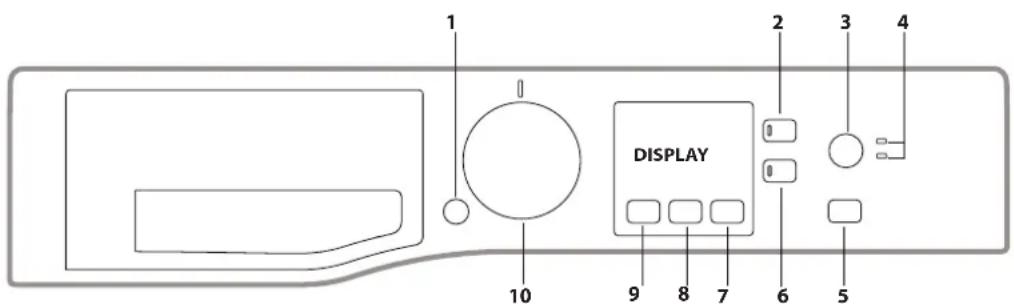
text_image
1 2 3 4 DISPLAY 10 9 8 7 6 5WASH CYCLE TABLE
| Maximum load 8 kgPower input in off mode 0.5 W / in left-on mode 8 W | Detergents and Additives | Recommended detergent | Residual dampness % | Energy consumption kWh | Total water I | |||||||||
| Wash cycle | Temperature | Maximum spin (r.p.m.) | Maximum load (kg) | Duration (minutes) | Prewash | Wash | Fabric softener | Powder | Liquid | |||||
| Default Range | 1 2 3 | |||||||||||||
| 1 | Anti-Stain 100 40 °C | -40°C | 600 8,0 | ** | ● | ● | ○ | √ | - | - | - | - | ||
| 2 | Anti-Stain 45' 40 °C | -40°C | 200 4,5 | ** | - | ● | ○ | - | √ | - | - | - | ||
| 3 | Whites | 60 °C | -90°C | 600 8,0 | ** | ● | ● | ○ | √ | - | - | - | - | |
| 4 | Bed&Bath | 60 °C | -60°C | 600 8,0 | ** | ● | ● | ○ | √ | - | - | - | - | |
| 5 | Eco cotton (1) | 60 °C | 60°C | 1600 8,0 | 225 | - | ● | ○ | √ | √ | 44 1 | 08 | 55 | |
| 40°C | 1600 8,0 | 220 | - | ● | ○ | √ | √ | 44 1 | 03 | 92 | ||||
| 6 | Mixed | 40 °C | -40°C | 000 4,5 | ** | - | ● | ○ | - | √ | - | - | - | |
| 7 | Cotton (2) | 40 °C | -60°C | 600 8,0 | 220 | - | ● | ○ | √ | -44 | 1,03 | 92 | ||
| 8 | Synthetics (3) 40 °C | -60°C | 200 4,5 | 200 | ● | ● | ○ | √ | -32 | 0,80 | 78 | |||
| 9 | Colours | 40 °C | -40°C | 600 8,0 | ** | ● | ● | ○ | √ | - | - | - | - | |
| 10 | Rapid 30' | 30 °C | -30°C | 800 | 4,5 | 30 | - | ● | ○ | - | √ | 71 0 | 19 | 45 |
| 11 | Wool | 40 °C | -40°C | 800 | 2 | ** | - | ● | ○ | - | √ | - | - | - |
| 12 | Darks | 30 °C | -30°C | 800 | 4,5 | ** | - | ● | ○ | - | √ | - | - | - |
| 13 | Ultra-delicate | 30 °C | -30°C | -- | 1,0 | ** | - | ● | ○ | - | √ | - | - | - |
| 14 | Duvets | 30 °C | -30°C | 000 3,5 | ** | - | ● | ○ | - | √ | - | - | - | |
| Rinse | - | - | 1600 | 8,0 | ** | - | - | ○ | - | - | - | - | - | |
| Spin & Drain * | - | - | 1600 | 8,0 | ** | - | - | - | - | - | - | - | - | |

Required dosage ○ Optional dosage
The cycle duration indicated on the display or instruction manual is an estimate based on standard conditions. The actual duration may vary in relation to several factors, such as the temperature and pressure of the incoming water, ambient temperature, amount of detergent, load quantity and type, load balancing and any additional options selected.
1) Test wash cycle in compliance with regulation 1061/2010:
This cycle is designed for normally soiled cotton loads and is the most efficient in terms of both electricity and water consumption; it should be used for garments washable at 60^ C or at 40^ C. The actual washing temperature may differ from the indicated value.
PRODUCT DESCRIPTION
- Top
- Detergent dispenser drawer
- Control panel
- Handle
- Porthole door
- Drain pump (behind the plinth)
- Plinth (removable)
- Adjustable feet (2)
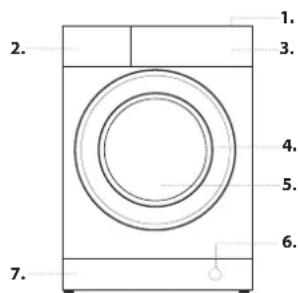
text_image
1. 2. 3. 4. 5. 6. 7.8.
For all testing institutes:
2) Long cotton cycle: set cycle 7 at a temperature of 40°C.
3) Long synthetics cycle: set cycle 8 at a temperature of 40^ C.
* By selecting the cycle and excluding the spin cycle, the washing machine will drain only.
** The duration of the wash cycles can be checked on the display.
DETERGENT DISPENSER DRAWER
Compartment 1: Prewash detergent (powder)
Compartment 2: Washing detergent (powder or liquid)
If liquid detergent is used, the removable plastic partition A (supplied) should be used for proper dosage.
If powder detergent is used, place the partition into slot B.
Compartment 3: Additives (fabric softeners, etc.)
The fabric softener must not exceed the "MAX" level.
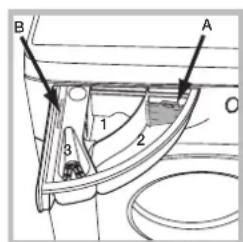
text_image
B A 1 2 3 OWASH CYCLES
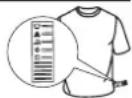
Follow the instructions on the symbols of the garment's wash care label. The value indicated in the symbol is the maximum recommended temperature for washing the garment.
Anti-Stain 100
This cycle is suitable to heavily-soiled garments with resistant colours. It ensures a washing class that is higher than the standard class (A class). When running the programme, do not mix garments of different colours. We recommend the use of powder detergent. Pre-treatment with special additives is recommended if there are obstinate stains
Anti-Stain 45'
This cycle is ideal for washing daily stains in 45'. It is ideal for mixed fabrics and coloured garments.
Whites
For heavily soiled whites and resistant colours.
Bed&Bath
For washing home linen in a single cycle. It optimises the use of fabric softener and allows for saving time and electricity. We recommend the use of powder detergent.
Eco cotton
Suitable for washing moderately soiled cotton garments. At 40^ C and 60^ C it is the standard cycle for washing cotton garments, and is the most efficient in terms of combined water and electricity consumption.
Mixed
To wash mixed and coloured items together.
Cotton
Suitable for washing towels, underwear, table cloths, etc. made of resistant linen and cotton that are moderately to heavily soiled.
Synthetics
Suitable for washing moderately soiled garments made of synthetic fibres (e.g. polyester, polyacrylic, viscose, etc.) or mixed synthetic-cotton fibres.
Colours
For washing coloured cotton garments. This programme is optimised to keep colours bright even after repeated washing.
Rapid 30'
For washing lightly soiled garments in a short time. Not suitable for wool, silk and garments to be washed by hand.
Wool - Woolmark Apparel Care - Green:
The Wool wash cycle of this machine has been approved by The Woolmark Company for the washing of wool garments labelled as "hand wash" provided that the products are washed according to the instructions on the garment label and those issued by the manufacturer of this washer-dryer (M1127). The Woolmark logo is a

Certification mark in many countries.
Darks
For washing dark-coloured garments. The wash cycle is designed to preserve dark colours over time.
We recommend using a liquid detergent for best results, preferably when washing dark-coloured garments.
Ultra-delicate
For washing very delicate garments. It is advisable to turn the garments inside out before washing them. For best results, use liquid detergent on delicate garments.
Duvets
To wash double or single duvets (weighing under 3,5 kg), cushions or down jackets. Duvets should be loaded into the drum with their edges folded inwards and no more than 34 of the total drum volume should be used up. For best results, it is advisable to use liquid detergent to be poured into the detergent drawer.
Rinse
Designed for rinsing and spinning.
Spin & Drain
Designed for spinning and draining the water.
DISPLAY
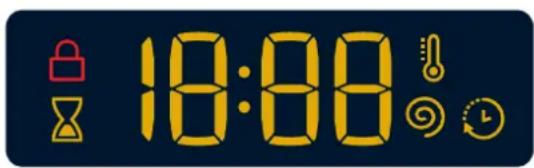
The display is useful when programming the washing machine and provides plenty of information.
text_image
18:00The duration of the available wash cycles and the remaining time of a running cycle appear (the display will show the maximum duration of the cycle chosen, which may decrease after several minutes, since the effective duration of the programme varies depending on the wash load and the settings chosen); if the DELAY START option has been set, the countdown to the start of the selected wash cycle will appear. Pressing the corresponding button allows you to view the maximum spin speed and temperature values attained by the machine during the set wash cycle, or the values selected most recently, if these are compatible with the set wash cycle.

Locked door indicator
When lit, the symbol indicates that the door is locked. To prevent any damage, wait until the symbol turns off before opening the door. To open the door while a cycle is in progress, press the START/PAUSE button ▷ the symbol is off, the door can be opened.
FIRST-TIME USE
Once the appliance has been installed, and before it is used for the first time, run a wash cycle with detergent and no laundry, by setting the "Auto-Clean" cycle.
DAILY USE
Prepare the laundry by following the suggestions appearing under the "TIPS AND SUGGESTIONS" section.
- Press the ON/OFF button; the indicator light relative to START/PAUSE will flash slowly.
- Open the door. Load the laundry while making sure not to exceed the maximum load quantity indicated in the wash cycle table.
- Pull out the detergent dispenser drawer and pour the detergent into the relevant compartments, as described in the "DETERGENT DISPENSER DRAWER" section.
- Close the door.
- The machine automatically displays the maximum temperature and spin speed values for the selected cycle, or the most recently used settings if they are compatible with the selected cycle. Pressing the button gradually reduces the temperature down to the cold wash "OFF" setting. Pressing the button gradually reduces the spin speed until it is completely excluded ("OFF" setting). Pressing the buttons further restores the maximum allowed values for the selected cycle.
- Select the desired option.
- Press the START/PAUSE button to start the wash cycle; the relative indicator light will light up steady and the door will lock (symbol on).
PAUSING A CYCLE
To pause the wash cycle, press the START/PAUSE button again; the indicator light will flash. To start the wash cycle from the point at which it was interrupted, press the START/PAUSE button again.
OPENING THE DOOR, IF NECESSARY
Once a cycle starts, the symbol turns on to signal that the door cannot be opened. While a wash cycle is running, the door remains locked. To open the door while a cycle is under way, for example, to add or remove garments, press the START/PAUSE button to pause the cycle; the indicator light will flash. If the symbol is not lit, the door may be opened. Press the START/PAUSE button again to continue the cycle.
CHANGING A RUNNING WASH CYCLE
To change a wash cycle while it is in progress, pause the washing machine using the START/PAUSE button (the relative indicator light will flash), then select the desired cycle and press the START/PAUSE button again.
! To cancel a cycle that has already begun, press and hold the ON/OFF button. The cycle will be stopped and the machine will switch off.
AT THE END OF THE WASH CYCLE
This will be indicated by the word "END" on the display; when the symbol switches off, the door may be opened. Open the door, unload the laundry and switch off the machine. If you do not press ON/OFF button, the washing machine will switch off automatically after about a half of an hour.
OPTIONS
- If the selected option is not compatible with the set wash cycle, the indicator light will flash and the option will not be activated.

Prewash
Allows you to perform a prewash.

Delay start
To set a delayed start for the selected cycle, press the corresponding button repeatedly until the desired delay period is reached. When this option has been activated, the symbol lights up on the display. To remove the delayed start setting, press the button until "OFF" appears on the display.

temperature
Each wash cycle has a pre-defined temperature. To modify the temperature, press the button. The value will appear on the display.
Spin
Each wash cycle has a pre-defined spin speed. To modify the spin speed, press the ⏻ button. The value will appear on the display.
Cleaning Action
Option makes it possible to optimise washing based on the level of soil in the fabrics and on desired wash cycle intensity. For heavily-soiled garments press a button until the "Intensiv" level is reached. This level ensures a high-performance wash due to a larger quantity of water used in the initial phase of the cycle and due to increased drum rotation. It is useful when removing the most stubborn stains.
For lightly-soiled garments or a more delicate treatment of the fabrics, press button until the "Sanft" level is reached. The cycle will reduce drum rotation to ensure washing results that are perfect for delicate garments.
CHILD LOCK
To activate the control panel lock, press and hold the button for approximately 2 seconds. When the symbol is lit, the control panel is locked (except for the ON/OFF button). This will prevent accidental modifications to wash cycles, especially when children are at home. To deactivate the control panel lock, press and hold the button for approximately 2 seconds.
TIPS AND SUGGESTIONS
Divide the laundry according to:
Type of fabric (cotton, mixed fibres, synthetics, wool, garments to be hand-washed). Colour (separate coloured garments from whites, wash new coloured garments separately). Delicates (small garments – such as nylon stockings – and items with hooks – such as bras: insert them in a fabric bag).
Empty the pockets:
Objects such as coins or lighters can damage the washing machine and the drum. Check all buttons.
CARE AND MAINTENANCE
Before performing cleaning and maintenance, switch the washing machine off and disconnect it from the mains power. Do not use flammable liquids to clean the washing machine.
Cutting off the water and electricity supplies
Close the water tap after every wash. This will limit wear on the hydraulic system inside the washing machine and help to prevent leaks. Unplug the washing machine when cleaning it and during all maintenance work.
Cleaning the washing machine
The outer parts and rubber components of the appliance can be cleaned using a soft cloth soaked in lukewarm soapy water. Do not use solvents or abrasives.
The washing machine has a "Self-Cleaning" cycle for its internal parts; it must be run without any load in the drum.
To optimise this cycle, it is possible to use either detergent (10% of the quantity specified for lightly soiled garments) or special additives to clean the washing machine. We recommend running a cleaning cycle every 40 wash cycles.
To start the programme press button for 5 seconds.
The cycle will start automatically and will run for about 70 minutes. To stop the cycle, press the START/PAUSE button.
Cleaning the detergent dispenser drawer
Remove the dispenser drawer by lifting and pulling it outwards. Wash it under running water; this procedure should be effected regularly.
Caring for the door and drum
Always leave the porthole door ajar in order to prevent unpleasant odours from forming.
Cleaning the pump
The washing machine is fitted with a self-cleaning pump that does not require any maintenance. Small items (such as coins or buttons) may sometimes fall into the protective pre-chamber situated at the base of the pump.
! Make sure that the wash cycle has ended and unplug the appliance.
To access the pre-chamber:
-
remove the covering panel on the front side of the machine by inserting a screwdriver in the centre and sides of the panel and using it as a lever;
-
loosen the drainage pump cover by turning it anti-clockwise: it is normal for some water to leak out;
-
clean the inside thoroughly;
-
screw the cover back on;
-
put the panel back in place, making sure the hooks slot in place before pushing the panel onto the appliance.
Checking the water inlet hose
Check the water inlet hose at least once a year. If it is cracked or broken, it must be replaced: during wash cycles, the high pressure of the water could suddenly split the hose open.
! Never use hoses that have already been used.
ACCESSORIES
Contact our Technical Assistance Service to check whether the following accessories are available for this washing machine model.
Stacking kit
With this accessory you can secure the tumble dryer to the upper part of your washing machine to save space and facilitate loading and unloading of the tumble dryer.
TRANSPORT AND HANDLING
Do not lift the washing machine by gripping it from the upper section. Unplug the appliance and close the water tap. Check that the door and detergent dispenser drawer are tightly closed. Detach the filling hose from the water tap then detach the drain hose. Empty all the water remaining in the hoses and secure the latter so that they do not get damaged during transport. Apply the transport bolts back on. Repeat, in reverse order, the transport bolt removal procedure described in the "Installation instructions".
TROUBLESHOOTING
Your washing machine could occasionally fail to work. Before contacting the Technical Assistance Service, make sure that the problem cannot be easily solved using the following list.
Anomalies Possible causes / Solution
| The washing machine does not start. | The appliance is not plugged into the socket fully, or not enough to make contact. |
| There is no power in the house. | |
| The wash cycle does not start. | The washing machine door is not closed properly. |
| The ON/OFF button has not been pressed. | |
| The START/PAUSE button has not been pressed. | |
| The water tap has not been opened. | |
| A delay has been set for the start time. | |
| The washing machine does not fill with water ("H2O" appears on the display). | The water inlet hose is not connected to the tap. |
| The hose is bent. | |
| The water tap has not been opened. | |
| There is no water supply in the house. | |
| The pressure is too low. | |
| The START/PAUSE button has not been pressed. | |
| The washing machine continuously loads and unloads water. | The drain hose is not fitted between 65 and 100 cm from the floor. |
| The free end of the hose is immersed in water. | |
| The wall drainage system is not fitted with a breather pipe. | |
| If the problem persists even after these checks, turn off the water tap, switch the appliance off and contact the Technical Assistance Service. If the home is on one of the upper floors of a building, there may be problems relating to back-siphonage, causing the washing machine to fill with water and drain continuously. Special anti-siphon valves are available in shops and help to prevent this inconvenience. | |
| The washing machine does not drain or spin. | The cycle does not include drainage: with certain cycles it must be started manually. |
| The drain hose is bent. | |
| The drainage duct is clogged. | |
| The washing machine vibrates a lot during the spin cycle. | The drum was not unlocked correctly during installation. |
| The washing machine is not level. | |
| The washing machine is tucked between furniture cabinets and the wall. | |
| The washing machine leaks. | The water inlet hose is not screwed on properly. |
| The detergent dispenser drawer is obstructed. | |
| The drain hose is not properly attached. | |
| The "Options" and START/ PAUSE indicator lights flash rapidly and the display visualises an error code (e.g.: F-01, F-...). | Switch off the machine and unplug it, wait for approximately 1 minute and then switch it back on again. If the problem persists, contact the Technical Assistance Service. |
| There is too much foam. | The detergent is not suitable for machine washing (it should display the text "for washing machines" or "hand and machine wash", or the like). |
| Too much detergent was used. |
DEMO MODE: to deactivate this function, switch the washing machine OFF. Than press and hold "Start/Pause" ▷ button, within 5 seconds press also "ON/OFF" ● button and hold both buttons for 2 seconds.