
BS274 - Vidéo-projecteur LG - Free user manual and instructions
Find the device manual for free BS274 LG in PDF.


| Product Type | DLP Video Projector |
| Display Technology | TI DMD 0.55-inch SVGA |
| Native Resolution | SVGA 800x600 |
| Projection Distance | 1.5 m – 12 m |
| Screen Size | 36" – 243" (up to 300") |
| Lens | Manual Focus / Manual Zoom, Zoom Ratio 1.1 |
| Keystone Correction | Vertical ±15 degrees |
| Projection Methods | Front, Rear, Desktop, Ceiling |
| Video Compatibility | NTSC, PAL, SECAM, SDTV, EDTV, HDTV |
| Data Compatibility | VGA, SVGA, XGA, SXGA, Mac |
| H-Sync Range | 15, 30 – 91.4 kHz, 97.6 kHz |
| V-Sync Range | 43 – 87 Hz, 120 Hz |
| Audio | 1.5W mono speaker |
| Inputs | RGB (D-Sub), Composite Video (RCA), Audio (mini-jack), RS-232C |
| Security | Kensington Lock slot |
| Power Supply | AC 100 – 240 V, 50/60 Hz |
| Power Consumption (Normal) | 260 W |
| Power Consumption (Eco) | 230 W |
| Standby Power | < 1 W |
| Operating Temperature | 5 °C – 35 °C |
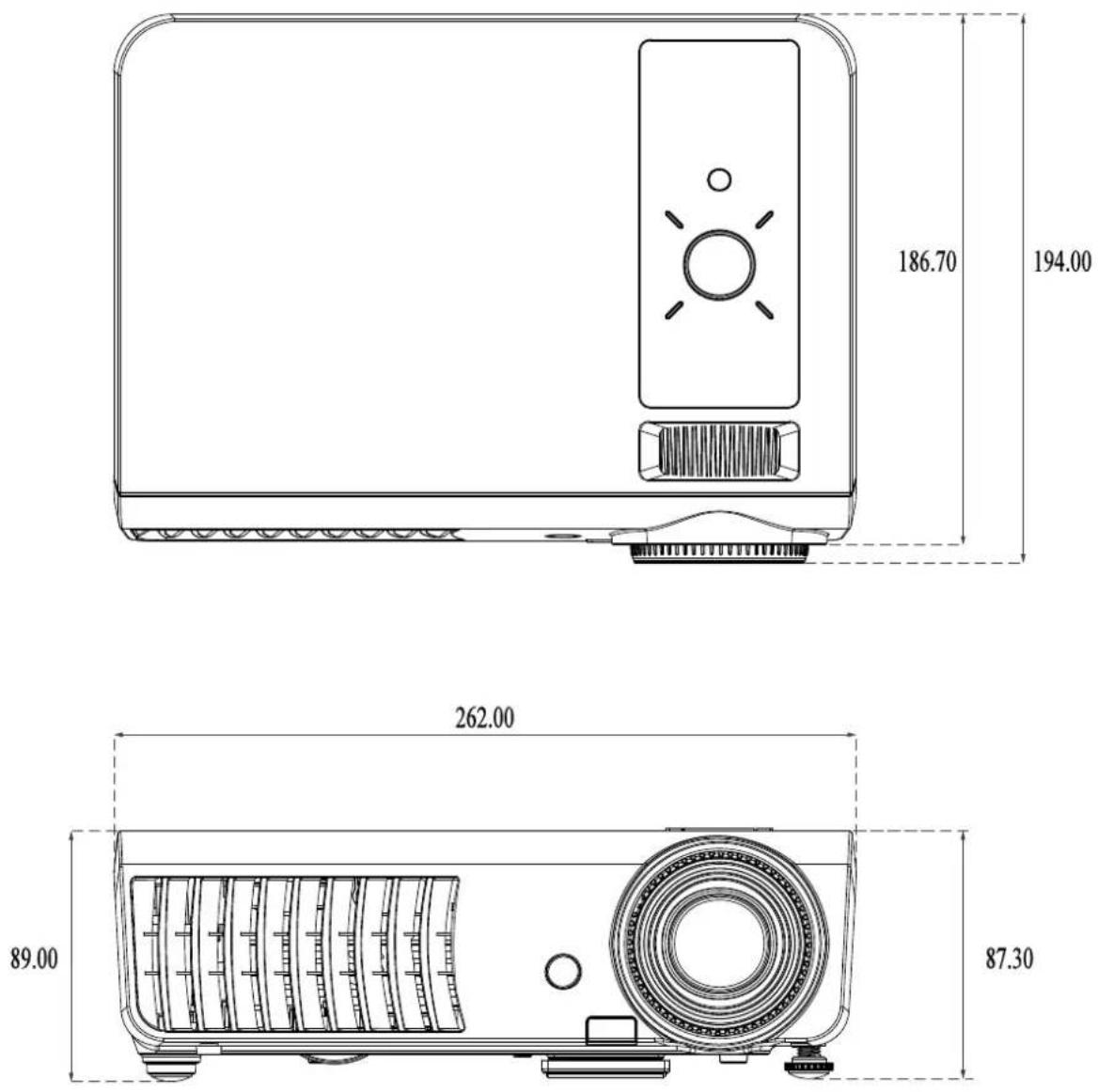
| Dimensions (W x H x D) | 262 mm x 89 mm x 194 mm |
| Lamp (Normal/Eco) | 200 W / 180 W |
| Remote Control Battery | CR2025 (3V lithium) |
| Safety Certifications | FCC-B, UL, cUL, TUV, CB, CE, PCT, SASO, NOM, KC, CCC |
Frequently Asked Questions - BS274 LG
User questions about BS274 LG
0 question about this device. Answer the ones you know or ask your own.
Ask a new question about this device
Download the instructions for your Vidéo-projecteur in PDF format for free! Find your manual BS274 - LG and take your electronic device back in hand. On this page are published all the documents necessary for the use of your device. BS274 by LG.
USER MANUAL BS274 LG
This publication, including all photographs, illustrations and software, is protected under international copyright laws, with all rights reserved. Neither this manual, nor any of the material contained herein, may be reproduced without written consent of the author.
© Copyright 2010
Disclaimer
The information in this document is subject to change without notice. The manufacturer makes no representations or warranties with respect to the contents hereof and specifically disclaims any implied warranties of merchantability or fitness for any particular purpose. The manufacturer reserves the right to revise this publication and to make changes from time to time in the content hereof without obligation of the manufacturer to notify any person of such revision or changes.
Trademark Recognition
Kensington is a U.S. registered trademark of ACCO Brand Corporation with issued registrations and pending applications in other countries throughout the world.
All other product names used in this manual are the properties of their respective owners and are acknowledged.
Important Safety Information
Important:
It is strongly recommended that you read this section carefully before using the projector. These safety and usage instructions will ensure that you enjoy many years of safe use of the projector. Keep this manual for future reference.
Symbols Used
Warning symbols are used on the unit and in this manual to alert you of hazardous situations.
The following styles are used in this manual to alert you to important information.
Note:
Provides additional information on the topic at hand.
Important:
Provides additional information that should not be overlooked.
Caution:
Alerts you to situations that may damage the unit.
Warning:
Alerts you to situations that may damage the unit, create a hazardous environment, or cause personal injury.
Throughout this manual, component parts and items in the OSD menus are denoted in bold font as in this example:
"Push the Menu button on the remote control to open the Main menu."
General Safety Information
Do not open the unit case. Aside from the projection lamp, there are no user-serviceable parts in the unit. For servicing, contact qualified service personnel.
➢ Follow all warnings and cautions in this manual and on the unit case.
The projection lamp is extremely bright by design. To avoid damage to eyes, do not look into the lens when the lamp is on.
Do not place the unit on an unstable surface, cart, or stand.
- Avoid using the system near water, in direct sunlight, or near a heating device.
Do not place heavy objects such as books or bags on the unit.
Power Safety
▶ Only use the supplied power cord.
Do not place anything on the power cord. Place the power cord where it will not be in the way of foot traffic.
Remove the batteries from the remote control when storing or not in use for a prolonged period.
Replacing the Lamp
Replacing the lamp can be hazardous if done incorrectly. See Replacing the Projection Lamp on page 35 for clear and safe instructions for this procedure. Before replacing the lamp:
▶ Unplug the power cord.
- Allow the lamp to cool for about one hour.
Cleaning the Projector
➢ Unplug the power cord before cleaning. See Cleaning the Projector on page 38.
- Allow the lamp to cool for about one hour.
Regulatory Warnings
Before installing and using the projector, read the regulatory notices in the Regulatory Compliance section on page 53.
Main Features
• Lightweight unit, easy to pack away and transport.
• Compatible with all major video standards including NTSC, PAL, and SECAM.
- A high brightness rating allows for presentations in daylight or in lit rooms.
• Supports resolutions up to SXGA at 16.7 million colors to deliver crisp, clear images.
- Flexible setup allows for front, rear projections.
- Line-of-vision projections remain square, with advanced keystone correction for angled projections.
• Input source automatically detected.
About this manual
This manual is intended for end users and describes how to install and operate the DLP projector. Wherever possible, relevant information—such as an illustration and its description—has been kept on one page. This printer-friendly format is both for your convenience and to help save paper, thereby protecting the environment. It is suggested that you only print sections that are relevant to your needs.
Table of Contents
GETTING STARTED....1
PACKING CHECKLIST....1
VIEWS OF PROJECTOR PARTS....2
Top view—On-screen Display (OSD) buttons and LEDs 3
Rear view 4
Bottom view....5
REMOTE CONTROL PARTS 6
SETUP AND OPERATION....9
INSERTING THE REMOTE CONTROL BATTERIES 9
CONNECTING INPUT DEVICES....10
STARTING AND SHUTTING DOWN THE PROJECTOR....11
SETTING AN ACCESS PASSWORD (SECURITY LOCK) 12
ADJUSTING THE PROJECTOR LEVEL 14
ADJUSTING THE ZOOM, FOCUS AND KEYSTONE 15
ADJUSTING THE VOLUME 16
ON-SCREEN DISPLAY (OSD) MENU SETTINGS.... 17
OSD MENU CONTROLS 17
Navigating the OSD....17
SETTING THE OSD LANGUAGE....18
OSD MENU OVERVIEW....19
OSD SUB-MENU OVERVIEW 20
IMAGE MENU....21
Advanced Feature 22
Color Manager....23
COMPUTER MENU....24
VIDEO/AUDIO MENU 25
Audio....26
INSTALLATION I MENU....27
Advanced....28
INSTALLATION II MENU 29
Advanced Feature 30
OSD Menu Setting.... 32
Peripheral Test....32
Lamp Hour Reset 33
Factory Reset 33
Status.... 34
MAINTENANCE AND SECURITY....35
REPLACING THE PROJECTION LAMP 35
Resetting the Lamp....37
CLEANING THE PROJECTOR....38
Cleaning the Lens 38
Cleaning the Case....38
USING THE KENSINGTON ^® LOCK 39
TROUBLESHOOTING 40
COMMON PROBLEMS AND SOLUTIONS 40
TIPS FOR TROUBLESHOOTING 40
LED ERROR MESSAGES 41
IMAGE PROBLEMS....41
LAMP PROBLEMS 42
REMOTE CONTROL PROBLEMS 42
AUDIO PROBLEMS 42
HAVING THE PROJECTOR SERVICED 42
SPECIFICATIONS....43
SPECIFICATIONS......43
Input Connectors.... 43
PROJECTION DISTANCE VS. PROJECTION SIZE 44
Projection Distance and Size Table 44
TIMING MODE TABLE 45
RS232C SETTING 47
Communication Parameter Setup 47
Control Command Structure 48
Operation Command....48
Remote Command 49
Set Value Command 49
Data Range 50
Query Command....50
Response message....51
PROJECTOR DIMENSIONS 52
REGULATORY COMPLIANCE 53
FCC WARNING....53
CANADA 53
SAFETY CERTIFICATIONS....53
GETTING STARTED
Packing Checklist
Carefully unpack the projector and check that the following items are included:
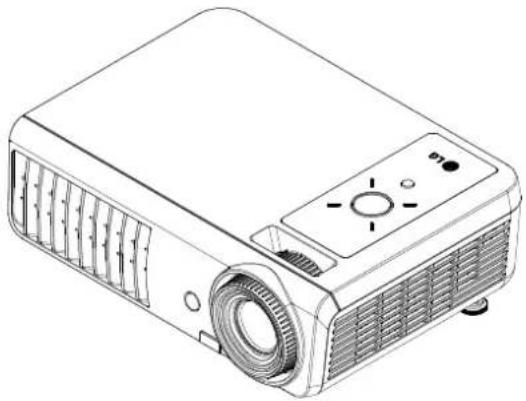
natural_image
Line drawing of a projector with ventilation slots and control panel (no text or symbols)DLP PROJECTOR
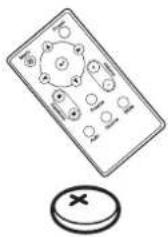
natural_image
Illustration of a remote control panel with circular buttons and a circular button (no text or symbols)REMOTE CONTROL (WITH ONE 3V CR2025 BATTERY)
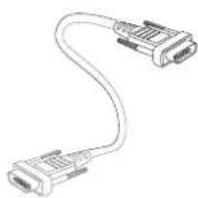
natural_image
Line drawing of a U88222222222222222222222222222222222222222222222222222222222222222222222222222222222222222222222RGB CABLE
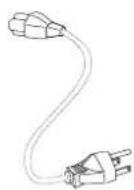
POWER CORD
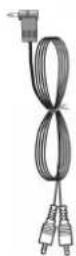
AUDIO CABLE
(OPTIONAL)
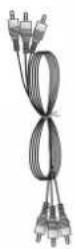
COMPONENT CABLE
(OPTIONAL)
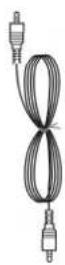
VIDEO CABLE
(OPTIONAL)
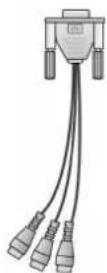
RGB TO COMPONENT
ADAPTER (OPTIONAL)
natural_image
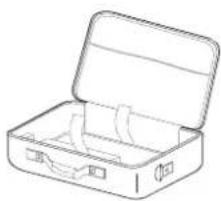
Line drawing of an open suitcase with lid open (no text or symbols)CARRYING CASE

CD-ROM
(THIS USER'S MANUAL)
Contact your dealer immediately if any items are missing, appear damaged, or if the unit does not work. It is recommend that you keep the original packing material should you ever need to return the equipment for warranty service.
Caution:
Avoid using the projector in dusty environments.
Views of Projector Parts
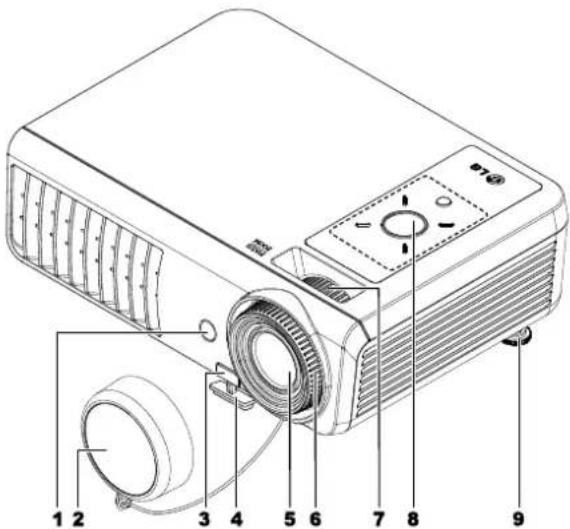
| ITEM | LABEL | DESCRIPTION | SEE PAGE: |
| 1. | IR receiver Receiver for IR signal from remote control | 6 | |
| 2. | Lens cap Covers lens to protect when not in use | ||
| 3. | Height-adjuster button Push to release height adjuster | 14 | |
| 4. | Height adjuster Adjusts level of projector | ||
| 5. | Lens Remove lens cap before use | ||
| 6. | Zoom ring Enlarges the projected image | 15 | |
| 7. | Focus ring Focuses the projected image | ||
| 8. | Function keys | See Top view—On-screen Display (OSD) buttons and LEDs. | 3 |
| 9. | Height adjuster Adjusts level of projector | 14 | |
Important:
Ventilation openings on the projector allow for good air circulation, which keeps the projector lamp cool. Do not obstruct any of the ventilation openings.
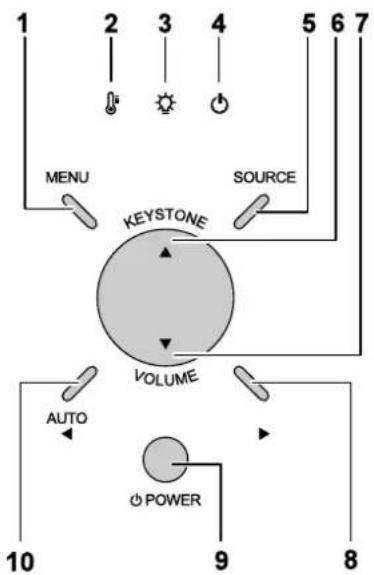
Top view—On-screen Display (OSD) buttons and LEDs
flowchart
graph TD
    A["1"] --> B["2"]
    B --> C["3"]
    C --> D["4"]
    D --> E["5"]
    E --> F["6"]
    F --> G["7"]
    H["MENU"] --> I["KEYSTONE VOLUME"]
    J["SOURCE"] --> I
    K["AUTO"] --> L["POWER"]
    M["10"] --> L
    N["9"] --> L
    O["8"] --> L
| ITEM LABEL DESCRIPTION | SEEPAGE: | |||
| 1. | MENU Open and exits the OSD buttons | 17 | ||
| 2. |  OVER TEMP LED OVER TEMP LED | On System over temperature | ||
| Off | Normal State | |||
| 3. | [4802] LAMP LED | Flashing Error | Code (see LED Error Messages on page 41) | |
| 4. | [4196] POWER LED | Green Power On | ||
| Off Power Off (AC Off) | ||||
| Flashing | Error code | |||
| 5. | SOURCE Detects the input device | 10 | ||
| 6. | [4796] (Up cursor) / KEYSTONE | Navigates and changes settings in the OSD Quick Menu – For Keystone | 17 | |
| 7. | [1Y36] (Down cursor) / VOLUME | Navigates and changes settings in the OSD Quick Menu – For Volume | ||
| 8. | [5081] (Right cursor) | Navigates and changes settings in the OSD | ||
| 9. | [0736] POWER | Turns the projector On or Off | 11 | |
| 10. | [4241] (Left cursor) / AUTO | Navigates and changes settings in the OSD Optimizes image size, position, and resolution | 17 | |
Rear view
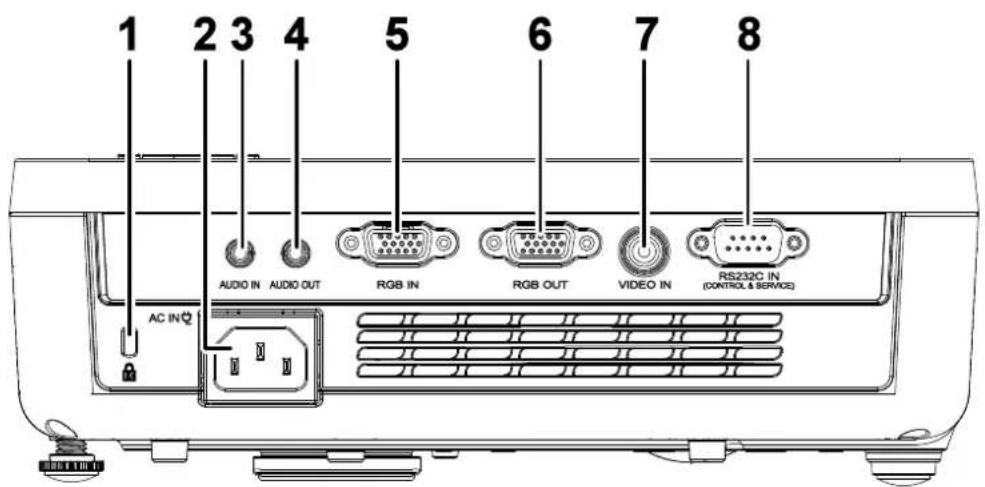
| ITEM | LABEL | DESCRIPTION | SEE PAGE: |
| 1. | Kensington Lock | Secure to permanent object with a Kensington® Lock system | 39 |
| 2. | AC IN Connect the POWER CABLE | 11 | |
| 3. | AUDIO IN Connect the AUDIO CABLE from the input device | 10 | |
| 4. | AUDIO OUT Connect an AUDIO cable for audio loop through | ||
| 5. | RGB IN | Connect the RGB CABLE from a computer or components | |
| 6. | RGB OUT Connect the RGB CABLE to a display | ||
| 7. | VIDEO IN Connect the VIDEO CABLE from a video device | ||
| 8. | RS-232C IN | Connect the RS-232C CABLE from a computer (CONTROL & SERVICE) | |
Bottom view
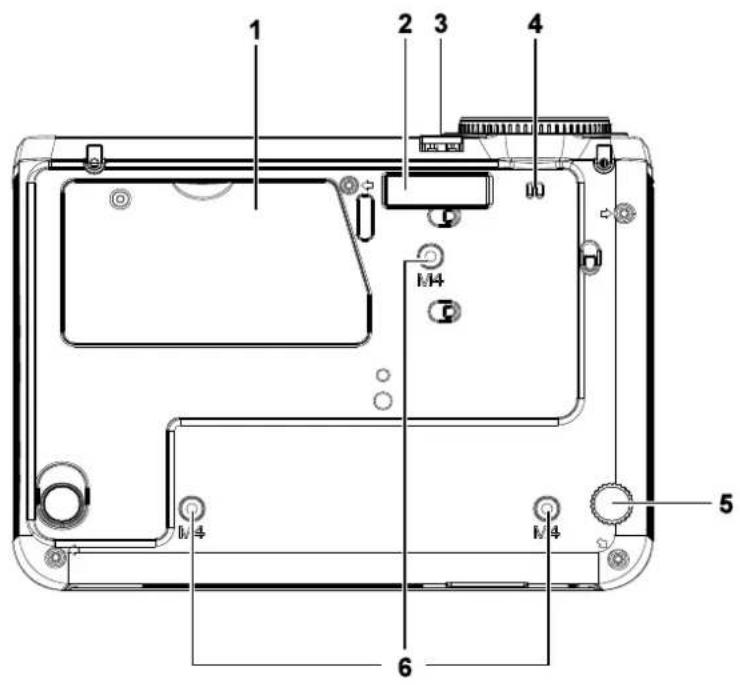
| ITEM | LABEL | DESCRIPTION | SEE PAGE: |
| 1. | Lamp cover Remove when changing the lamp | 35 | |
| 2. | Height adjustor Adjuster drops down when adjuster button is pushed | 14 | |
| 3. | Height adjustor button Push to release adjustor | ||
| 4. | Lens cap hook To fasten the lens cap cover | ||
| 5. | Tilt adjustor Rotate adjuster lever to adjust angle position | 14 | |
| 6. | Ceiling support holes | Contact your dealer for information on mounting the projector on a ceiling | |
Note:
When installing, ensure that you use only UL Listed ceiling mounts.
For ceiling installations, use approved mounting hardware and M4 screws with a maximum screw depth of 6 mm (0.23 inch).
The construction of the ceiling mount must be of a suitable shape and strength. The ceiling mount load capacity must exceed the weight of the installed equipment, and as an additional precaution be capable of withstanding three times the weight of the equipment (not less than 5.15 kg) over a period of 60 seconds.
Remote Control Parts
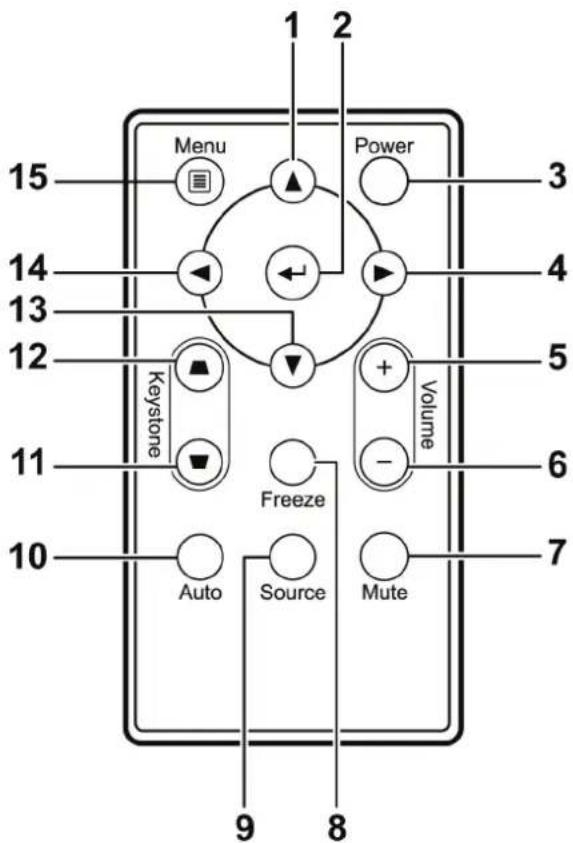
Important:
- Avoid using the projector with bright fluorescent lighting turned on. Certain high-frequency fluorescent lights can disrupt remote control operation.
- Be sure nothing obstructs the path between the remote control and the projector. If the path between the remote control and the projector is obstructed, you can bounce the signal off certain reflective surfaces such as projector screens.
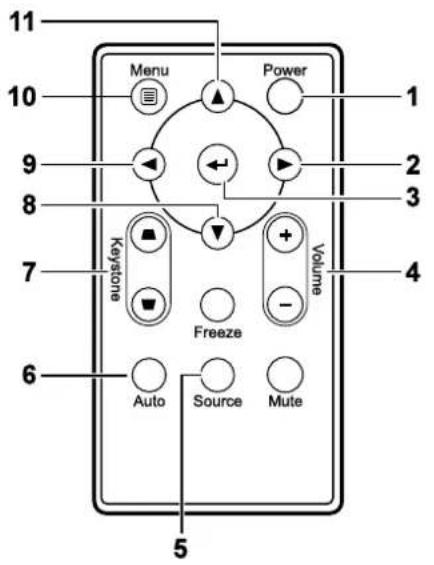
- The buttons and keys on the projector have the same functions as the corresponding buttons on the remote control. This user's manual describes the functions based on the remote control.
| ITEM | LABEL | DESCRIPTION | SEE PAGE: |
| 1. | Up cursor Navigates and changes settings in the OSD | 17 | |
| 2. | Enter Changes settings in the OSD | ||
| 3. | Power Turns the projector | On or Off | 11 |
| 4. | Right cursor Navigates and changes settings in the OSD | 17 | |
| 5. | Volume + Increase volume | 16 | |
| 6. | Volume - Decrease volume | ||
| 7. | Mute Mutes the built-in speaker | ||
| 8. | Freeze Freeze/unfreezes the on-screen picture | ||
| 9. | Source Detects the input device | 10 | |
| 10. | Auto Auto adjustment for frequency, tracking, size, position (RGB only) | ||
| 11. | Keystone top Corrects image-trapezoid (wider top) effect | 15 | |
| 12. | Keystone bottom | Corrects image trapezoid (wider bottom) effect | |
| 13. | Down cursor | Navigates and changes settings in the OSD | 17 |
| 14. | Left cursor | Navigates and changes settings in the OSD | |
| 15. | Menu | Opens the OSD | |
Remote Control Operating Range
The remote control uses infrared transmission to control the projector. It is not necessary to point the remote directly at the projector. Provided you are not holding the remote perpendicular to the sides or the rear of the projector, the remote will function well within a radius of about 7 meters (23 feet) and 15 degrees above or below the projector level. If the projector does not respond to the remote control, move a little closer.
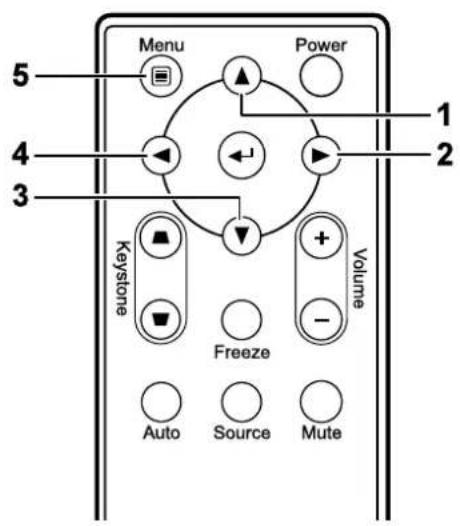
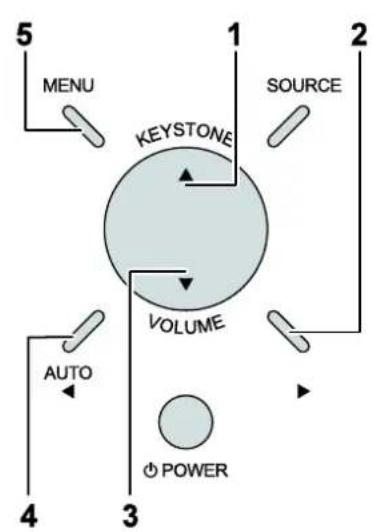
Projector and Remote Control Buttons
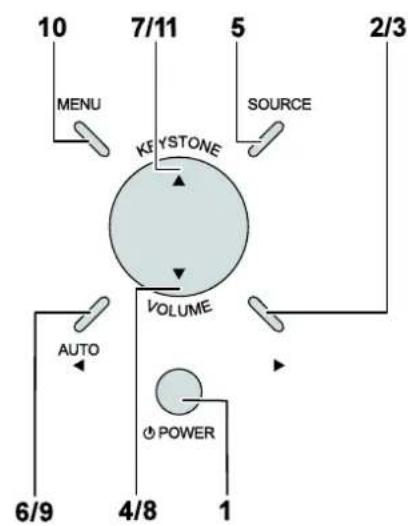
The projector can be operated using the remote control or the buttons on the top of the projector. All operations can be carried out with the remote control; however, the buttons on the projector are limited in use. The following illustration shows the corresponding buttons on the remote control and on the projector.
Remote Control
flowchart
graph TD
    A["1"] --> B["KEYSTONE"]
    B --> C["VOLUME"]
    C --> D["2"]
    D --> E["SOURCE"]
    E --> F["3"]
    F --> G["AUTO"]
    G --> H["4"]
    H --> I["5"]
    I --> J["MENU"]
Some buttons on the projector have multiple functions. For example, item 1 on the projector functions as the keystone button and as the up cursor key.
Inserting the Remote Control Batteries
- Remove the battery compartment cover by sliding the cover in the direction of the arrow (A). Pull out the cover (B).
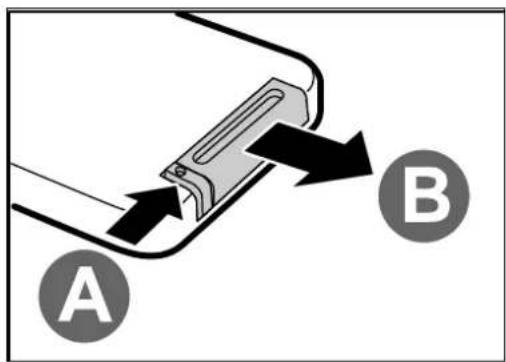
- Insert the battery with the positive side facing up.
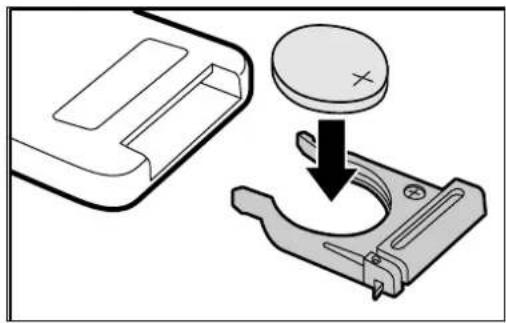
natural_image
Diagram showing a device with a circular component and a mechanical clamp, no text or symbols present- Replace the cover.
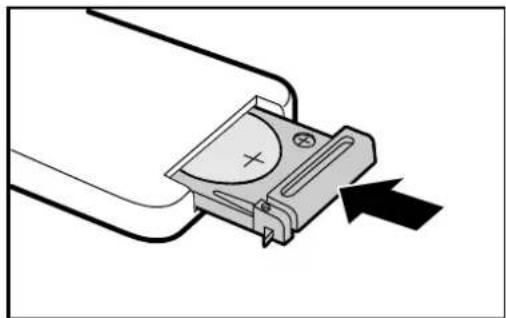
natural_image
Diagram of a cable connector with a magnified inset showing a pin (no text or symbols)Caution:
- Only use a 3V lithium battery (CR2025).
- Dispose of used batteries according to local ordinance regulations.
- Remove the battery when not using the projector for prolonged periods.
Connecting Input Devices
A PC or notebook computer and video devices can be connected to the projector at the same time. Video devices include DVD, VCD, and VHS players, as well as movie camcorders and digital still cameras. Check the user manual of the connecting device to confirm it has the appropriate output connector.
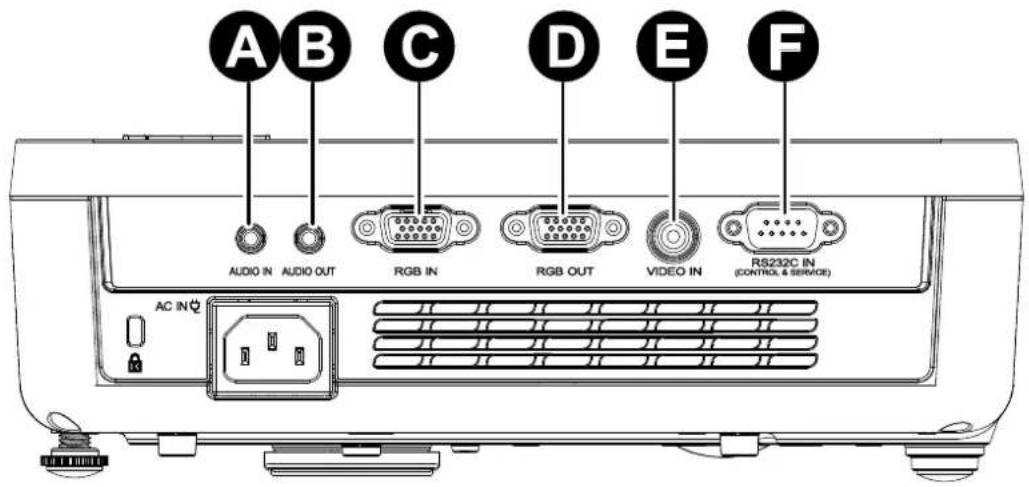
| ITEM LABEL DESCRIPTION | ||
 | AUDIO IN Connect the AUDIO CABLE from the input device | |
 | AUDIO OUT Connect an AUDIO cable for audio loop through | |
 | RGB IN Connect the RGB CABLE from a computer or components | |
 | RGB OUT Connect the RGB CABLE to a display | |
 | VIDEO IN Connect the VIDEO CABLE from a video device | |
 | RS-232C IN Connect the RS-232C CABLE from a computer (CONTROL & SERVICE) | |
Warning:
As a safety precaution, disconnect all power to the projector and connecting devices before making connections.
Starting and Shutting down the Projector
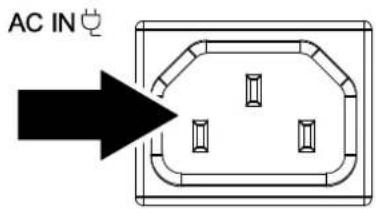
- Connect the power cord to the projector. Connect the other end to a wall outlet. The ⏻ POWER LED on the projector lights.
- Turn on the connected devices.
- Then press the POWER button to turn on the projector.
The projector splash screen displays and connected devices are detected.
See Setting an Access Password (Security Lock) on page 12 if security lock is enabled.
-
If more than one input device is connected, press the SOURCE button and use ▲▼ to scroll among devices. (Component is supported through the RGB to COMPONENT ADAPTER.)
-
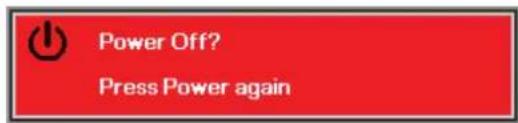
When the "Power Off? /Press Power again" message appears, press the POWER button. The projector turns off.
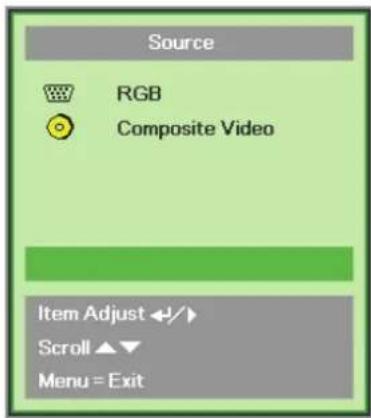
- RGB: Analog RGB Component: DVD input YCbCr / YPbPr, or HDTV input YPbPr via HD15 connector
- Composite Video: Traditional composite video
Caution:
- Be sure to remove the lens cap before starting projector.
- Do not unplug the power cord until the POWER LED stops flashing-indicating the projector has cooled down.
Setting an Access Password (Security Lock)
You can use the four (arrow) buttons to set a password and prevent unauthorized use of the projector. When enabled, the password must be entered after you power on the projector. (See Navigating the OSD on page 17 and Setting the OSD Language on page 18 for help on using OSD menus.)
Important:
Keep the password in a safe place. Without the password, you will not be able to use the projector. If you lose the password, contact your reseller for information on clearing the password.
- Press the MENU button to open the OSD menu.
- Press the cursor ◀▶ button to move to the Installation I menu.

Image

Computer

Video / Audio

Installation

Installation II
Display Mode
User
Brilliant Color
1
Brightness
50
Contrast
50
Sharpness
16
Gamma
PC
Advanced
e/
Reset
الله
Menu=Exit
Menu Select
Scroll ▲▼
The image is too blurry to recognize any text content.

Image

Computer

Video / Audio

Installation

Installation II
Language
English
Blank Screen


Projection
扫描
Aspect Ratio
0
Keystone
H/
Digital Zoom
[Illegible]
Advanced
H/
Reset
Menu=Exit
Menu Select
Scroll ▲▼
The image is too blurry to recognize any text content.
- Press the cursor ▲▼ button to select Advanced.
- Press (Enter) / ▶.

Image

Computer

Video / Audio

Installation I

Installation II
Language
English
Blank Screen


Aspect Ratio
F10
Keystone
0
Digital Zoom
H/
Advanced
H/
Reset
Menu=Exit
Menu Select
Scroll ▲▼
The image is too blurry to recognize any text content.
-
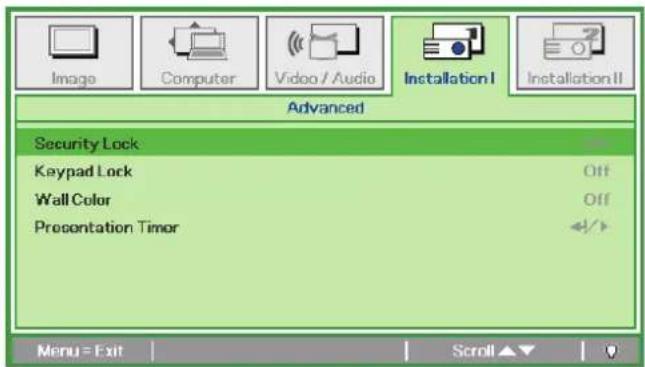
Press the cursor ▲▼ button to select Security Lock.
-
Press the cursor ◀▶ button to enable or disable security lock function.
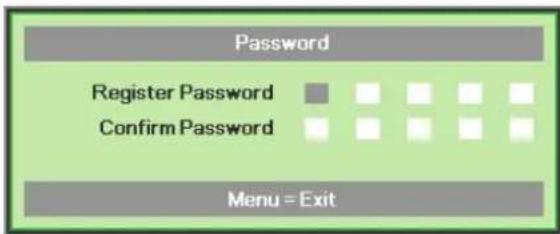
A password dialog box automatically appears.
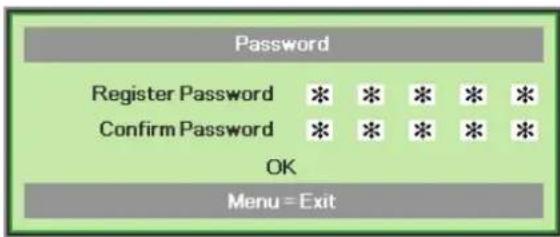
- You can use the cursor buttons ▲▼◀▶ either on keypad or IR remote control for password entry. You can use any combination including the same arrow five times, but not less than five.
Press the cursor buttons in any order to set the password. Push the MENU button to exit the dialog box.
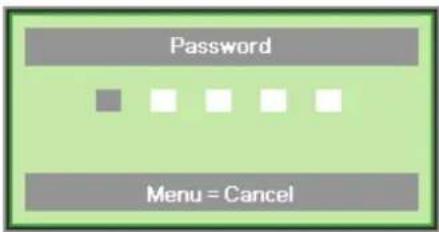
- The password confirm menu appears when user presses the power-on key in case the Security Lock is enabled.
Enter the password in the order you set it at step 5. In case you forget the password, please contact the service center.
Service center will validate the owner and help reset the password.
Adjusting the Projector Level
Take note of the following when setting up the projector:
• The projector table or stand should be level and sturdy.
• Position the projector so that it is perpendicular to the screen.
- Ensure the cables are in a safe location. You could trip over them.
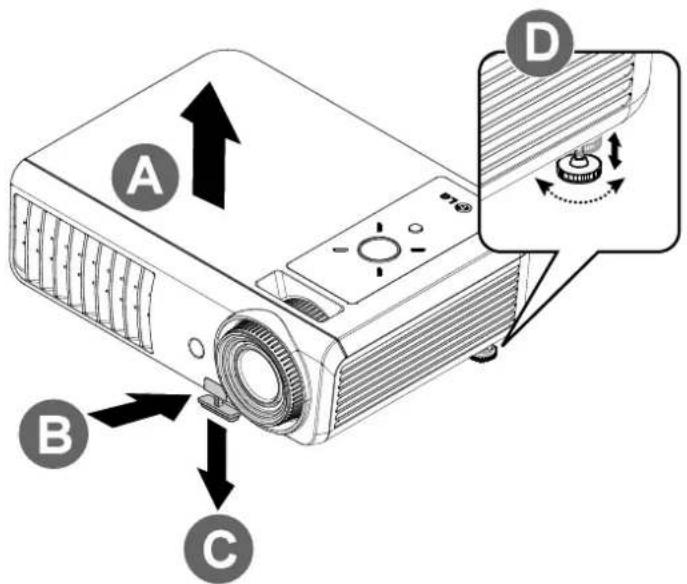
- To raise the level of the projector, lift the projector [A] and press the height-adjuster button [B].
The height adjuster drops down [C]. - To lower the level of the projector, press the height-adjuster button and push down on the top of the projector.
- To adjust the angle of the picture, turn the tilt-adjuster [D] right or left until the desired angle has been achieved.
Adjusting the Zoom, Focus and Keystone
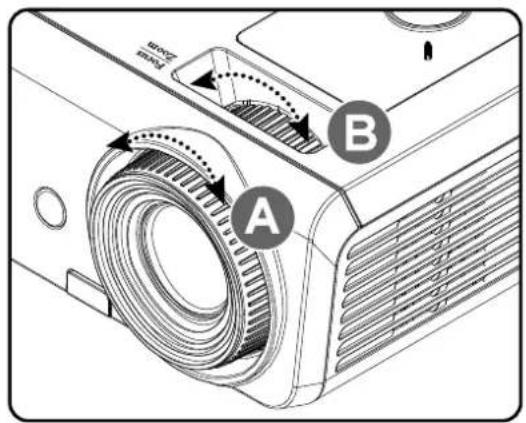
- Use the Image-zoom control (on the projector only) to resize the projected image and screen size B.
- Use the Image-focus control (on the projector only) to sharpen the projected image Ⓐ.
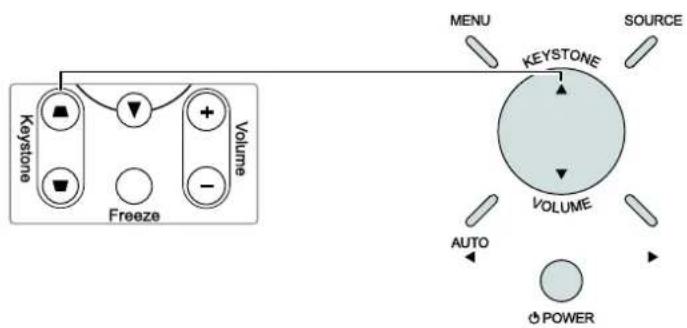
- Press the Keystone buttons on the remote control or press ▲ KEYSTONE and use ◀ or ▶ on the keypad to correct image-trapezoid (wider top or bottom) effect.
- The keystone control appears on the display.
flowchart
graph TD
    A["Keystone"] --> B["Volume"]
    B --> C["Freeze"]
    C --> D["Keystone"]
    E["AUTO"] --> F["VOLUME"]
    G["SOURCE"] --> H["KEystone"]
    I["POWER"] --> J["Volume"]
Remote control and OSD panel

Adjusting the Volume
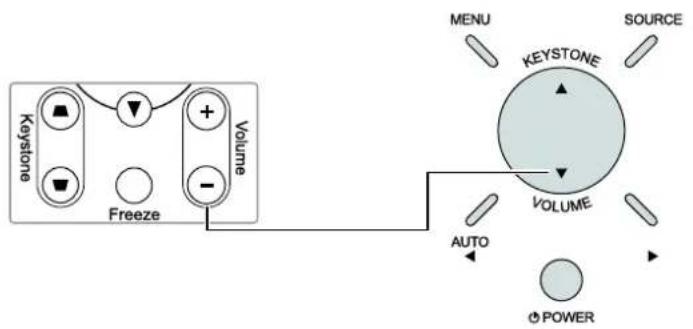
- Press the Volume +/- buttons on the remote control or press ▼ VOLUME and use ◀ or ▶ on the keypad to adjust volume.
flowchart
graph TD
    A["Keystone"] --> B["Volume"]
    B --> C["Freeze"]
    D["AUTO"] --> E["VOLUME"]
    F["SOURCE"] --> G["KEYSTONE"]
    G --> H["POWER"]
Remote control and OSD panel
- The volume control appears on the display. See page 26.

- Press the MUTE button to turn off the volume (This feature is available only on the remote).
ON-SCREEN DISPLAY (OSD) MENU SETTINGS
OSD Menu Controls
The projector has an OSD that lets you make image adjustments and change various settings.
Navigating the OSD
You can use the remote control cursor buttons or the buttons on the top of the projector to navigate and make changes to the OSD. The following illustration shows the corresponding buttons on the remote control and on the projector.
flowchart
graph TD
    A["10"] --> B["MENU"]
    B --> C["Kystone"]
    C --> D["VOLUME"]
    D --> E["6/9"]
    D --> F["4/8"]
    D --> G["1"]
    H["7/11"] --> I["SOURCE"]
    I --> J["2/3"]
    K["5"] --> L["POWER"]
    M["AUTO"] --> N["Power"]
- To enter the OSD, press the MENU button.
- There are five menus. Press the cursor ◀▶ button to move through the menus.
- Press the cursor ▲▼ button to move up and down in a menu.
- Press ◀▶ to change values for settings.
- Press MENU to close the OSD or leave a submenu.
Note:
Depending on the video source, not all items in the OSD are available. For example, the Horizontal/Vertical Position items in the Computer menu can only be modified when connected to a PC. Items that are not available cannot be accessed and are grayed out.
Setting the OSD Language
Set the OSD language to your preference before continuing.
- Press the MENU button. Press the cursor ◀▶ button to navigate to Installation I.
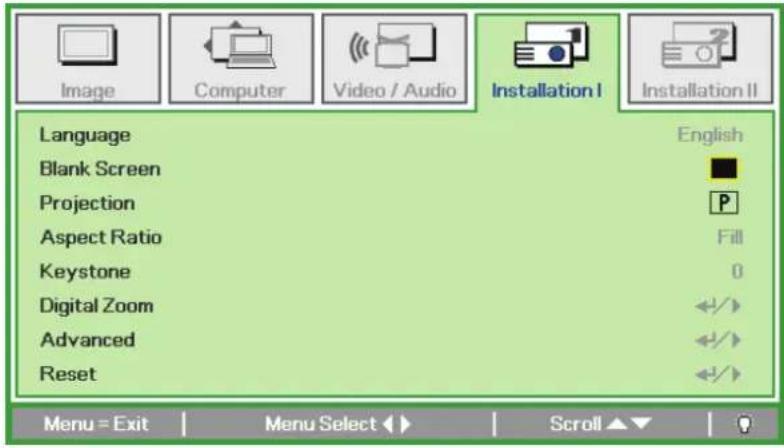
- Press the cursor ▲▼ button until Language is highlighted.
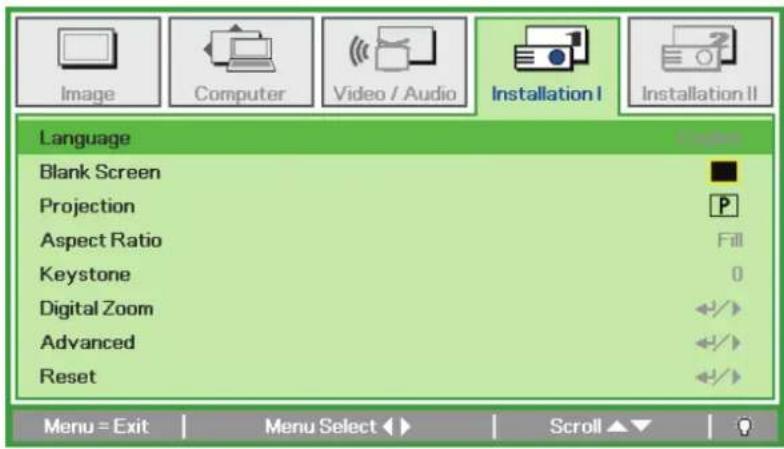
- Press the cursor ◀▶ button until the language you want is highlighted.
- Press the MENU button twice to close the OSD.
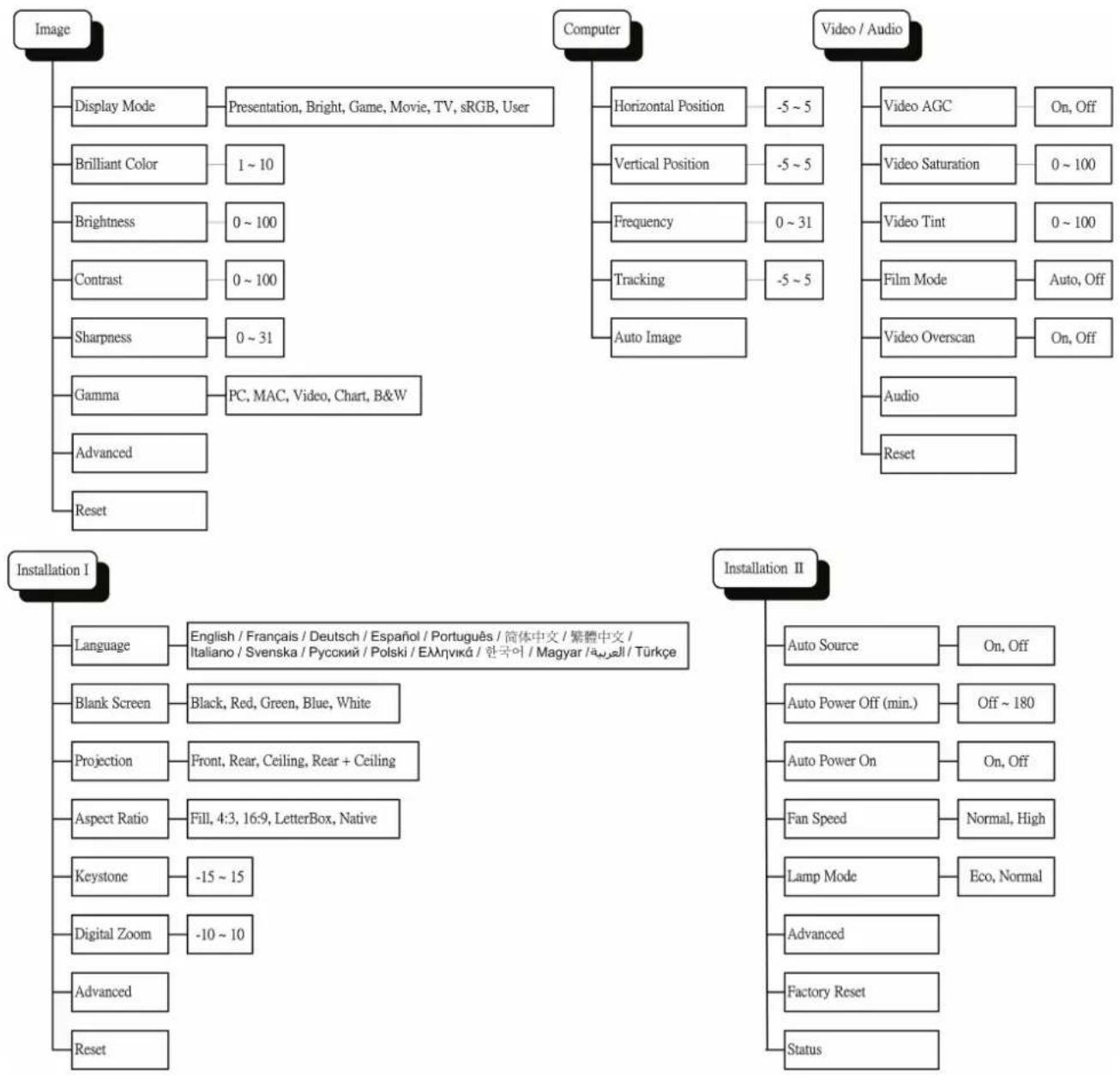
OSD Menu Overview
Use the following illustration to quickly find a setting or determine the range for a setting.
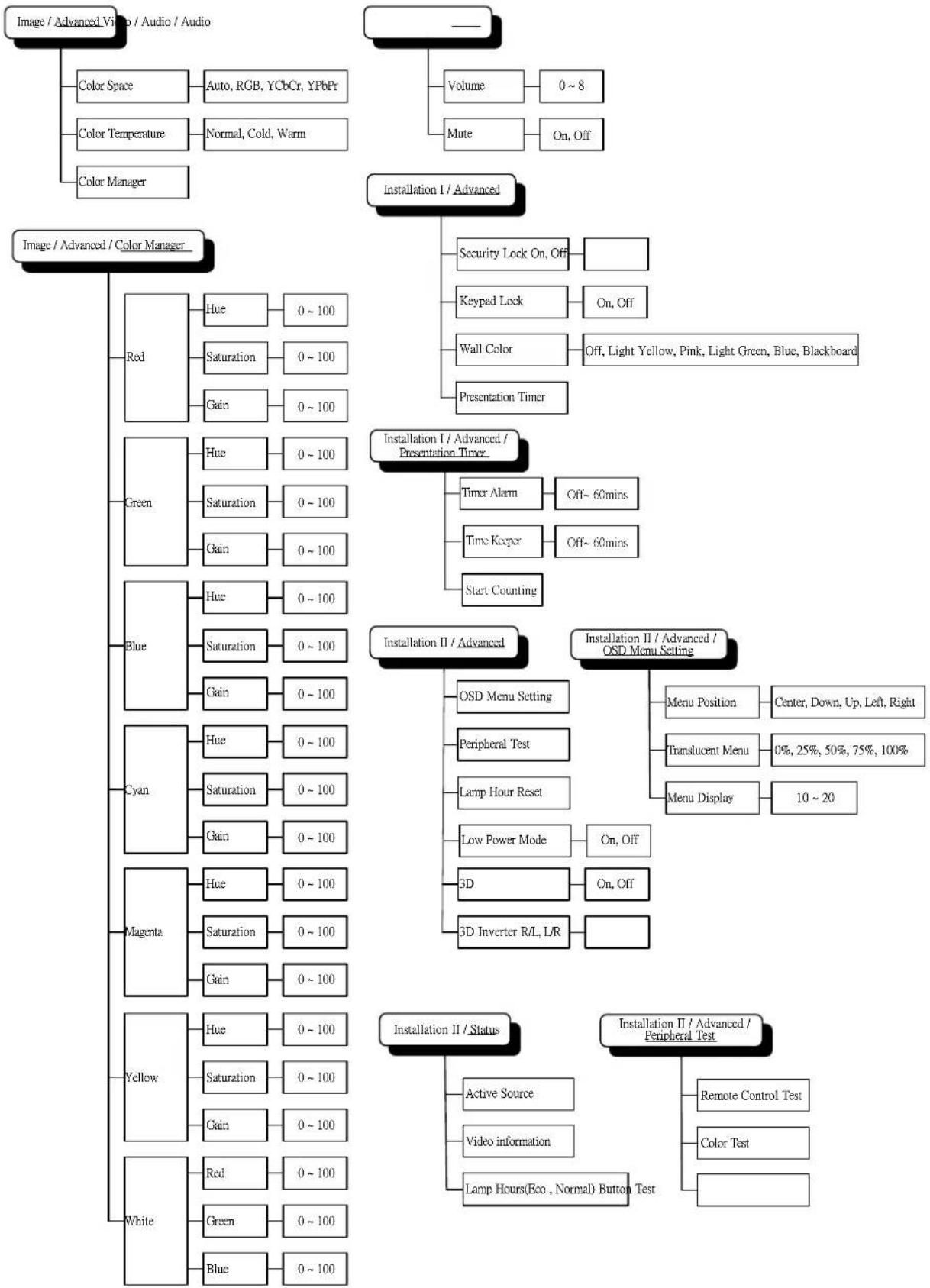
OSD Sub-Menu Overview
flowchart
graph TD
    A["Image / Advanced Video / Audio / Audio"] --> B["Color Space"]
    A --> C["Color Temperature"]
    A --> D["Color Manager"]
    B --> E["Auto, RGB, YCbCr, YPbPr"]
    C --> F["Normal, Cold, Warm"]
    D --> G["Volume 0 ~ 8"]
    D --> H["Mute On, Off"]

    I["Image / Advanced / Color Manager"] --> J["Red"]
    J --> K["Hue 0 ~ 100"]
    J --> L["Saturation 0 ~ 100"]
    J --> M["Gain 0 ~ 100"]

    I --> N["Green"]
    N --> O["Hue 0 ~ 100"]
    N --> P["Saturation 0 ~ 100"]
    N --> Q["Gain 0 ~ 100"]

    I --> R["Blue"]
    R --> S["Hue 0 ~ 100"]
    R --> T["Saturation 0 ~ 100"]
    R --> U["Gain 0 ~ 100"]

    I --> V["Cyan"]
    V --> W["Hue 0 ~ 100"]
    V --> X["Saturation 0 ~ 100"]
    V --> Y["Gain 0 ~ 100"]

    I --> Z["Magenta"]
    Z --> AA["Hue 0 ~ 100"]
    Z --> AB["Saturation 0 ~ 100"]
    Z --> AC["Gain 0 ~ 100"]

    I --> AD["Yellow"]
    AD --> AE["Hue 0 ~ 100"]
    AD --> AF["Saturation 0 ~ 100"]
    AD --> AG["Gain 0 ~ 100"]

    I --> AH["White"]
    AH --> AI["Red 0 ~ 100"]
    AH --> AJ["Green 0 ~ 100"]
    AH --> AK["Blue 0 ~ 100"]

    I --> AL["Installation I / Advanced"]
    AL --> AM["Security Lock On, Off"]

    AL --> AN["Keypad Lock On, Off"]
    AL --> AO["Wall Color Off, Light Yellow, Pink, Light Green, Blue, Blackboard Presentation Timer"]

    AL --> AP["Installation I / Advanced / Presentation Timer"]
    AP --> AQ["Timer Alarm Off~60mins"]
    AP --> AR["Time Keeper Off~60mins"]
    AP --> AS["Start Counting"]

    AL --> AT["Installation II / Advanced"]
    AT --> AU["OSD Menu Setting"]
    AT --> AV["Peripheral Test"]
    AT --> AW["Lamp Hour Reset"]
    AT --> AX["Low Power Mode On, Off"]
    AT --> AY["3D On, Off"]
    AT --> AZ["3D Inverter R/L, L/R"]

    AT --> BA["Installation II / Advanced / OSD Menu Setting"]
    BA --> BB["Menu Position Center, Down, Up, Left, Right"]
    BA --> BC["Translucent Menu 0%, 25%, 50%, 75%, 100%"]
    BA --> BD["Menu Display 10 ~ 20"]

    AT --> BE["Installation II / Status"]
    BE --> BF["Active Source"]
    BE --> BG["Video information"]
    BE --> BH["Lamp Hours(Eco, Normal) Button Test"]

    BE --> BI["Installation II / Advanced / Peripheral Test"]
    BI --> BJ["Remote Control Test"]
    BI --> BK["Color Test"]
Image Menu
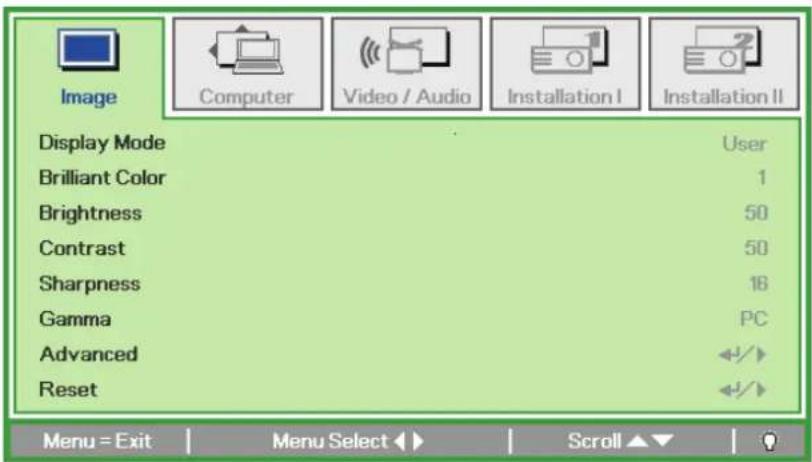
Press the MENU button to open the OSD menu. Press the cursor ◀▶ button to move to the Image Menu. Press the cursor ▲▼ button to move up and down in the Image menu. Press ◀▶ to change values for settings.
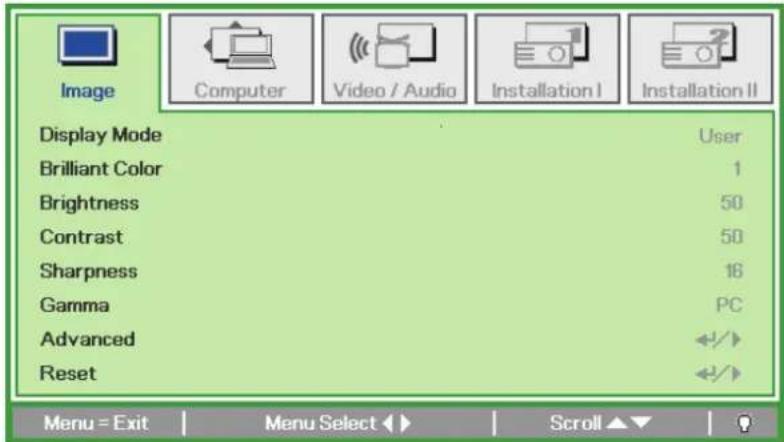
| ITEM DESCRIPTION | |
| Display Mode | Press the cursor ◀► button to set the Didplay Mode.Note: Regarding Display Mode, the parameter adjustments are disabled except for User mode. |
| Brilliant Color | Press the cursor ◀► button to adjust the Brilliant Color value. |
| Brightness | Press the cursor ◀► button to adjust the display brightness. |
| Contrast | Press the cursor ◀► button to adjust the display contrast. |
| Sharpness | Press the cursor ◀► button to adjust the display sharpness level. |
| Gamma | Press the cursor ◀► button to adjust the gamma correction of the display. |
| Advanced | Press ←(Enter) / ► to enter the Advanced menu. See Advanced Feature on page 22. |
| Reset | Press ←(Enter) / ► to reset all settings to default values. |
Advanced Feature
Press the Menu button to open the OSD menu. Press ◀▶ to move to the Image menu. Press ▼▲ to move to the Advanced menu and then press Enter or ▶. Press ▼▲ to move up and down in the Advanced1 menu.
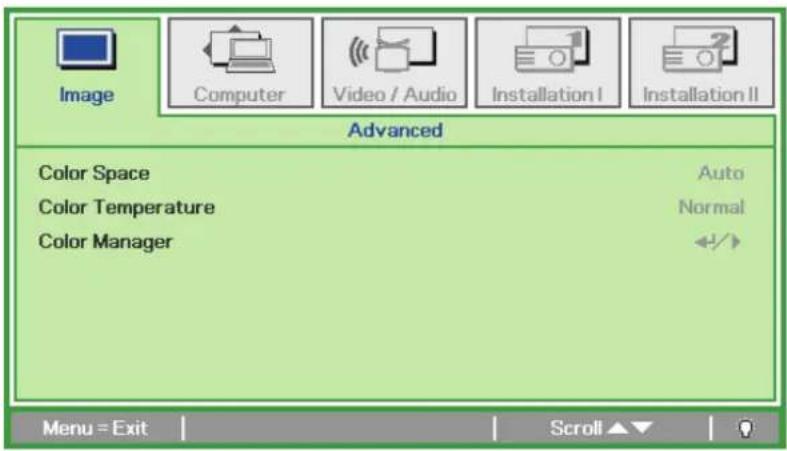
| ITEM DESCRIPTION | |
| Color Space | Press the cursor ◀► button to adjust the color space.(Range: Auto - RGB - YCbCr -YPbPr) |
| Color Temperature | Press the cursor ◀► button to adjust the color temperature.(Range: Normal ~ Cold) |
| Color Manager | Press ←(Enter) / ► to enter the color manager menu. (Range: Red-Green-Blue-Cyan-Magenta-Yellow-White). See page 23 for more information on Color Manager. |
Color Manager
Press ← (Enter) / ▶ to enter the Color Manager sub menu.
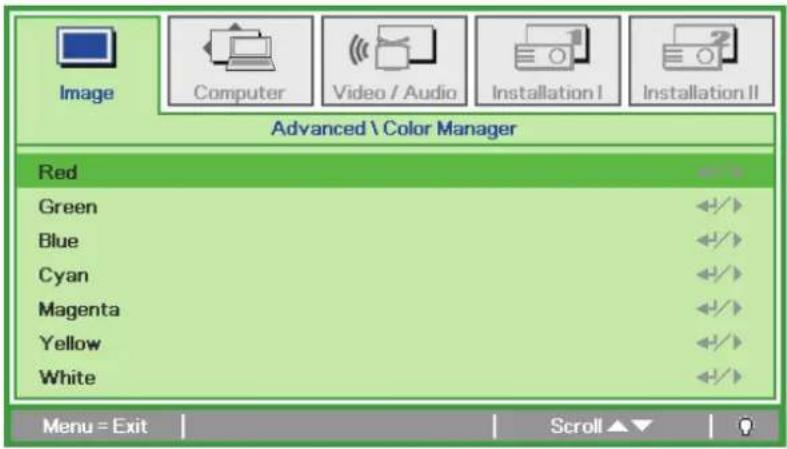
| ITEM DESCRIPTION | |
| Red | Select to enter the Red Color Manager.Press the ◀▶ buttons to adjust the Hue, Saturation, and Gain. |
| Green | Select to enter the Green Color Manager.Press the ◀▶ buttons to adjust the Hue, Saturation, and Gain. |
| Blue | Select to enter the Blue Color Manager.Press the ◀▶ buttons to adjust the Hue, Saturation, and Gain. |
| Cyan | Select to enter the Cyan Color Manager.Press the ◀▶ buttons to adjust the Hue, Saturation, and Gain. |
| Magenta | Select to enter the Magenta Color Manager.Press the ◀▶ buttons to adjust the Hue, Saturation, and Gain. |
| Yellow | Select to enter the Yellow Color Manager.Press the ◀▶ buttons to adjust the Hue, Saturation, and Gain. |
| White | Select to enter the White Color Manager.Press the ◀▶ buttons to adjust the Red, Green, and Blue. |
Computer Menu
Press the MENU button to open the OSD menu. Press the cursor ◀▶ button to move to the Computer menu. Press the cursor ▲▼ button to move up and down in the computer menu. Press ◀▶ to change values for settings.
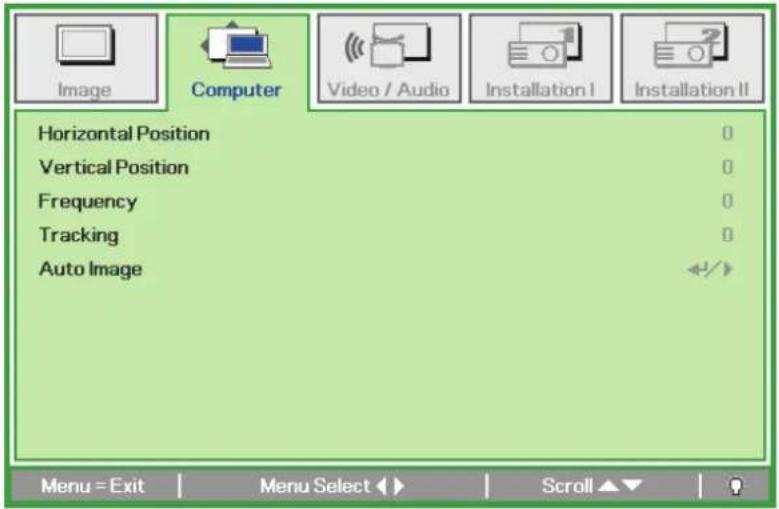
| ITEM DESCRIPTION | |
| Horizontal Position | Press the cursor ◀▶ button to adjust the display position to left or right. |
| Vertical Position | Press the cursor ◀▶ button to adjust the display position to up or down. |
| Frequency | Press the cursor ◀▶ button to adjust the A/D sampling clock. |
| Tracking | Press the cursor ◀▶ button to adjust the A/D sampling dot. |
| Auto Image | Press ←(Enter) / ▶ to automatically adjustment for phase, tracking, size and position. |
Video/Audio Menu
Press the MENU button to open the OSD menu. Press the cursor ◀▶ button to move to the Video/Audio menu. Press the cursor ▲▼ button to move up and down in the Video/Audio menu. Press ◀▶ to change values for settings.
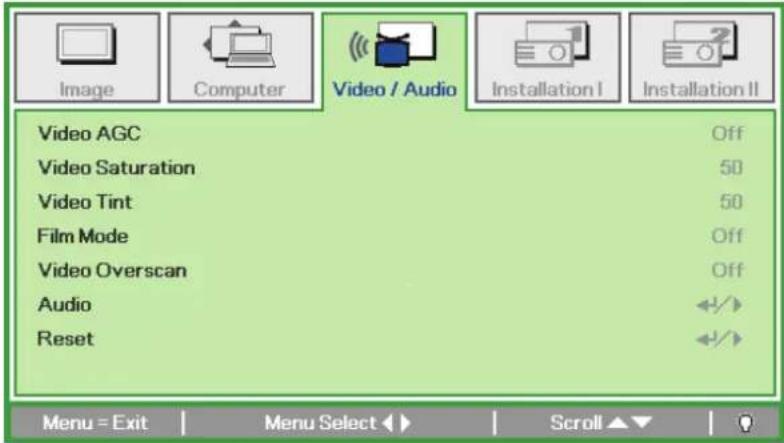
| ITEM DESCRIPTION | |
| Video AGC | Press the ◀▶ buttons to enable or disable the Automatic Gain Control for video source. |
| Video Saturation | Press the ◀▶ buttons to adjust the video saturation. |
| Video Tint | Press the ◀▶ buttons to adjust the video tint/hue. |
| Film Mode | Press the ◀▶ buttons to select a different film mode.Note:Set up the projector for the best picture appearance for viewing movies.When you operate Film Mode, the projector will adjust 24 fps video from movie to 30 fps video for display.It's not available to use this function in RGB-PC. |
| Video Overscan | Press the ◀▶ buttons to enable or disable video over scan. |
| Audio | Press ←(Enter) / ▶ to enter the Audio menu. See Audio on page 26. |
| Reset | Press ←(Enter) / ▶ to reset all settings to default values. |
Note:
Video jagging may occur when playing interlace video. To overcome this issue, open the Video / Audio menu and adjust the Film Mode feature.
Audio
Press ← (Enter) / ▶ to enter the Audio sub menu.
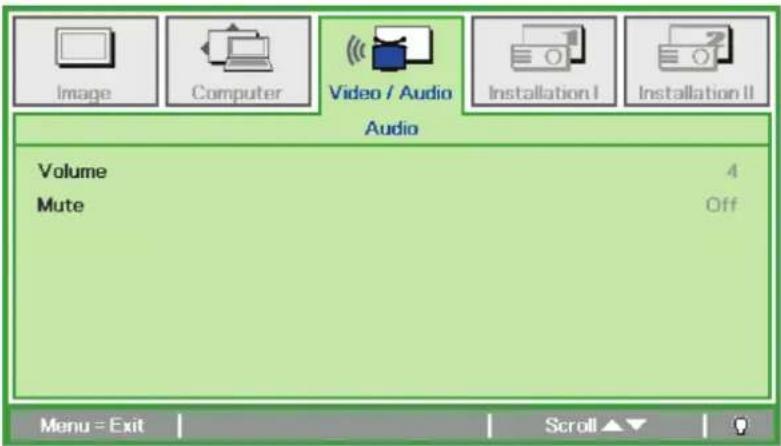
| ITEM DESCRIPTION | |
| Volume | Press the ◀▶ buttons to adjust the audio volume.(Range: 0~8) |
| Mute | Press the ◀▶ buttons to turn on or off the speaker. |
Installation I Menu
Press the MENU button to open the OSD menu. Press the cursor ◀▶ button to move to the Installation I menu. Press the cursor ▲▼ button to move up and down in the Installation I menu. Press ◀▶ to change values for settings.
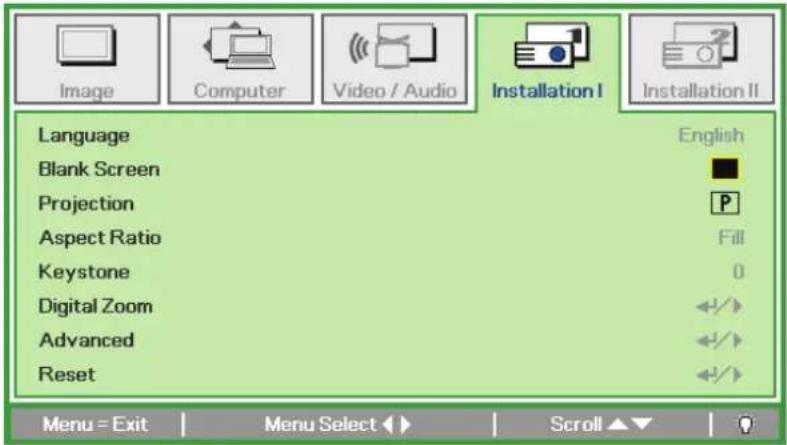
| ITEM DESCRIPTION | |
| Language | Press the cursor ◀▶ button to select a different localization Menu. |
| Blank Screen | Press the cursor ◀▶ button to select different color to blank the screen. |
| Projection | Press the cursor ◀▶ button to choose from four projection methods. |
| Aspect Ratio | Press the cursor ◀▶ button to adjust the video aspect ratio. |
| Keystone | Press the cursor ◀▶ button to adjust the display keystone. |
| Digital Zoom | Press the cursor ◀▶ button to adjust the Digital Zoom menu. (Range: -10 ~ +10) |
| Advanced | Press ←(Enter) / ▶ to enter the Advanced menu. |
| Reset | Press ←(Enter) / ▶ to reset all settings to default values. |
Advanced
Press ← (Enter) / ▶ to enter the Advanced sub menu.
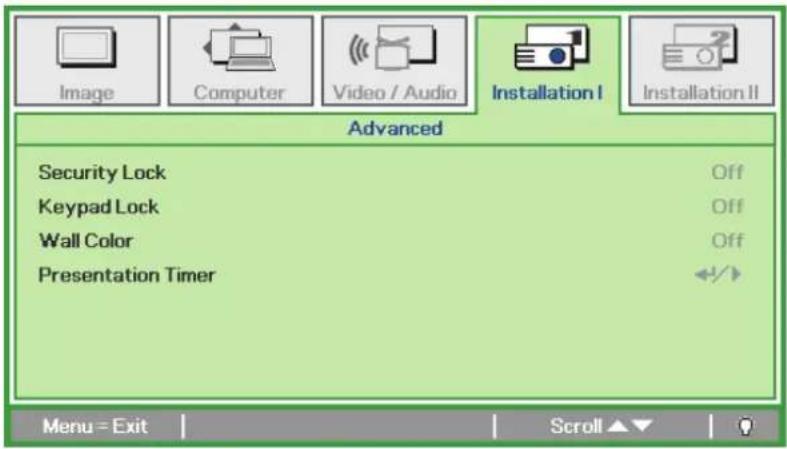
| ITEM DESCRIPTION | |
| Security Lock | Press the cursor ◀▶ button to enable or disable security lock function. |
| Keypad Lock | Press the cursor ◀▶ button to enable or disable keypad lock function. |
| Wall Color | Press the cursor ◀▶ button to choose from six wall colors:Off/ Light yellow/ Pink/ Light Green/ Blue/ Blackboard |
| Presentation Timer | Press ←(Enter) / ▶ to enter Presentation Timer function. |
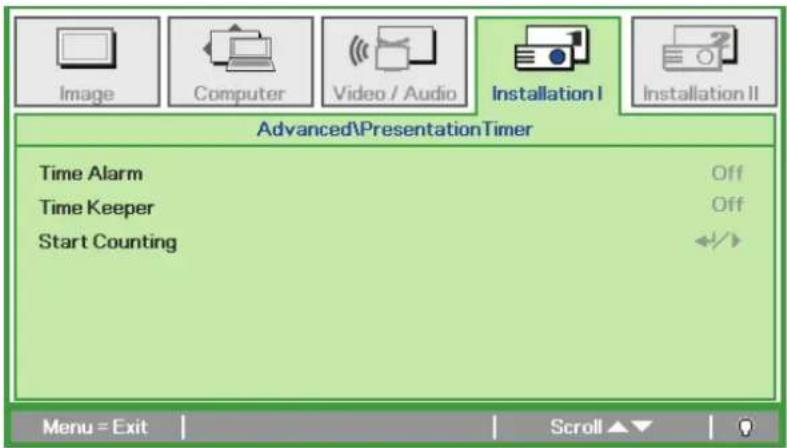
Presentation Timer
Press ← (Enter) / ▶ to enter the Presentation Timer sub menu.
| ITEM DESCRIPTION | |
| Time Alarm | Press the cursor ◀▶ button to adjust the Time Alarm (Range: off to 60). |
| Time Keeper | Press the cursor ◀▶ button to adjust the Time Keeper (Range: off to 60). |
| Start Counting | Press ←(Enter) / ▶ to begin the Time Alarm or Time Keeper functions. |
Installation II Menu
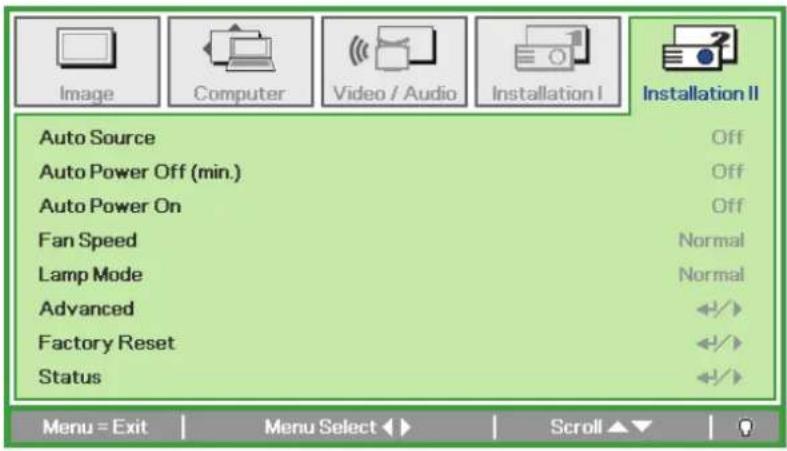
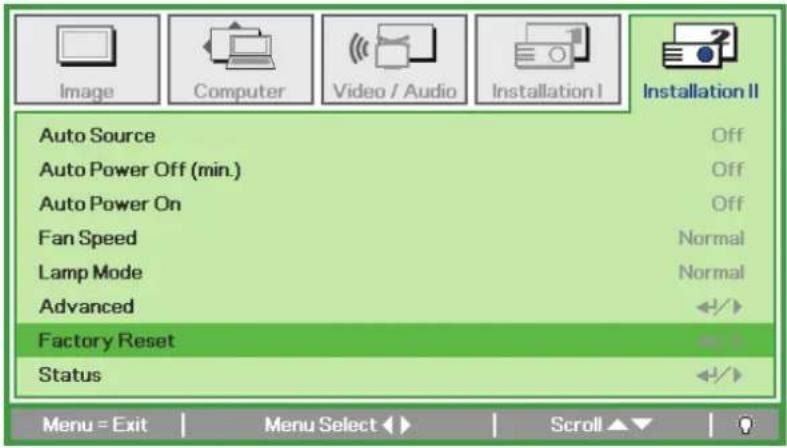
Press the MENU button to open the OSD menu. Press the cursor ◀▶ button to move to the Installation II menu. Press the cursor ▲▼ button to move up and down in the Installation II menu.
| ITEM DESCRIPTION | |
| Auto Source | Press the cursor ◀► button to enable or disable automatic source detection. (Range: On ~ Off) |
| Auto Power Off (min.) | Press the cursor ◀► button to enable or disable automatic shutdown of lamp when no signal. |
| Auto Power On | Press the cursor ◀► button to enable or disable automatic power On when AC power is supplied. |
| Fan Speed | Press the cursor ◀► button to toggle between Normal and High fan speeds.Note: We recommend selecting high speed in high temperatures, high humidity, or high altitude areas. |
| Lamp Mode | Press the cursor ◀► button to select the lamp mode for higher brightness or lower brightness to save lamp life. |
| Advanced | Press ←(Enter) / ► to enter the Advanced menu. See Advanced Feature on page 30. |
| Factory Reset Press (Enter) /→ to reset all items to factory preset values. | |
| Status | Press ← to (Enter) status menu. See page 34 for more information on Status. |
Advanced Feature
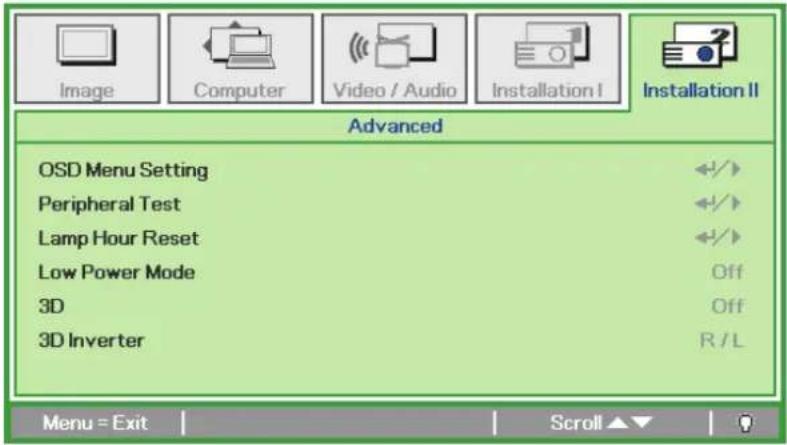
Press the Menu button to open the OSD menu. Press ◀▶ to move to the Installation II menu. Press ▲▼ to move to the Advanced menu and then press Enter or ▶. Press ▲▼ to move up and down in the Advanced menu. Press ◀▶ to change values for setting.
| ITEM DESCRIPTION | |
| OSD Menu Setting | Press ← (Enter) / ▶ to enter the OSD setting menu. See page 32 for more information on OSD Menu Setting. |
| Peripheral Test | Press ← (Enter) / ▶ to enter the Peripheral Test menu. See page 32 for more information on Peripheral Test. |
| Lamp Hour Reset | After replacing the lamp, this item should be reset. See page 33 for more information on Lamp Hour Reset. |
| Low Power Mode | Press the cursor ◀▶ button to enable or disable Low Power Mode. (Range: On ~ Off) |
| 3D | Press the cursor ◀▶ button to enable or disable 3D mode. |
| 3D Inverter | Press the cursor ◀▶ button to select R/L or L/R function. |
3D video Function
3D video is the technology of using a different video frame for each eye to add depth to the video.
How to watch 3D video
-
If you are watching 3D video through PC input. Please use the PC with graphic card(Quad buffer feature) with 3D player that can display vertical frequency of 120Hz.
-
The 3D video performance may differ among graphic cards. Following resolutions support 3D video.
| SIGNALS RESOLUTIONS | HORIZONTAL FREQUENCY [KHz] | VERTICAL FREQUENCY [Hz] | PLAYABLE FORM OF 3D VIDEO | ||
| RGB PC | SVGA | 800x600 | — | 120 | Frame Sequential |
| XGA | 1024x768 | — | 120 | ||
| Video | NTSC | — — | 60 | ||
- Press the 3D function on from the OSD menu.
- Press the L/R to the 3D video with better visibility.
Note:
- When you just turn on the goggle you may see a cross-talk image. Please give it a time until it gets optimized.
- If you watch 3D video under 3-wavelength Fluorescent light (50\~60Hz) or near windows the image may blink. Please cover the sunlight using curtain or dim lamps.
- Any object places between goggle and 3D video image may affect the image.
- 3D video only supports DLP link type goggle.
- Performance may differ among brands of goggles.
Caution:
when viewing 3D video:
- When viewing 3D video, watch the projector within the effective viewing angle and distance. If you exceed the viewing angle or distance, you may not be able to view 3D video (Recommended distance: 1.5m\~5m).
- If you watch the 3D video too closely for a long period of time, it may strain your eyes.
- Watching the screen with the 3D video glasses for a long period of time can cause drowsiness or fatigue to your eyes.
- Pregnant woman, senior, person with heart problem or frequent drowsiness may wish to refrain from watching 3D video. 3D video can cause an elevated heart rate.
- Some 3D video may cause you to duck or dodge the image in the video. Do not watch 3D video near fragile object or any objects that can be knocked over easily.
- Special care is required for children watching the 3D video.
- Please prevent children under the age of 5 from watching 3D video. It may affect their vision development.
- Risk of photosensitization seizure can be reduced with the following actions.
-Take 5-15 minutes of break for every 1-hour watched.
-For anyone that has a difference in the vision between the eyes, watch after taking vision correction measures.
-Watch at eye level with the 3D screen, directly in front of the screen.
-If you experience headache, tiredness or dizziness immediately stop watching the 3D video and take a rest.
-Do not watch 3D video for a long period of time when very sleepy, tired or sick.
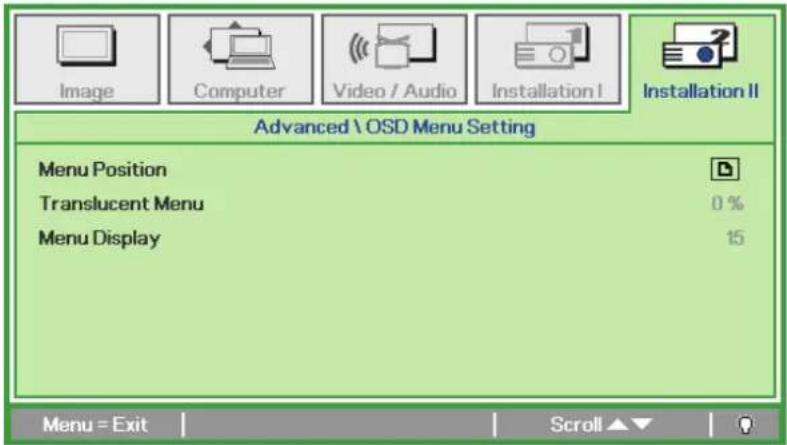
OSD Menu Setting
| ITEM DESCRIPTION | |
| Menu Position Press ◀► button to select different OSD location. | |
| Translucent Menu | Press ◀► button to select OSD background translucent level. |
| Menu Display | Press ◀► button to select OSD timeout delay. |
Peripheral Test
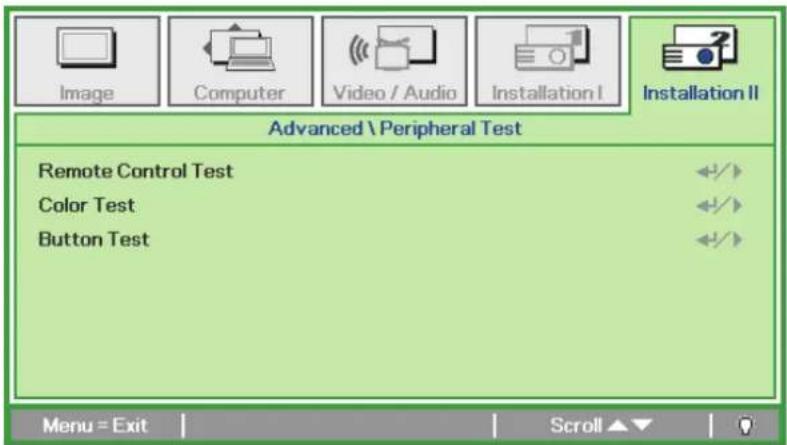
| ITEM DESCRIPTION | |
| Remote Control Test | Press ← (Enter) / ▶ to test the IR remote controller for diagnostic. |
| Color Test | Press ← (Enter) / ▶ to select different colors on screen. |
| Button Test | Press ← (Enter) / ▶ to test the button on keypad. |
Lamp Hour Reset
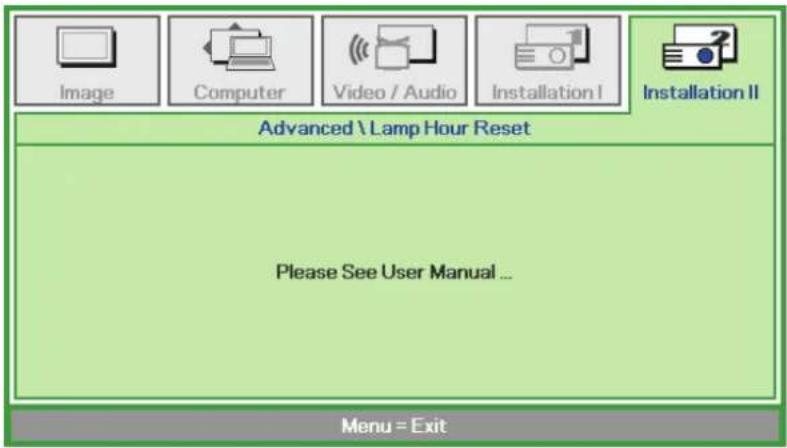
Please refer to Resetting the Lamp on page 37 to reset the lamp hour counter.
Factory Reset
Press the cursor ▲▼ button to move up and down in the Installation II menu. Select the Factory Reset sub menu and press ← (Enter) / ▶ to reset all the menu items to the factory default values.
Status
Press the cursor ▲▼ button to move up and down in the Installation II menu. Select the Installation II sub menu and press ← (Enter) / ▶ to enter the Status sub menu.
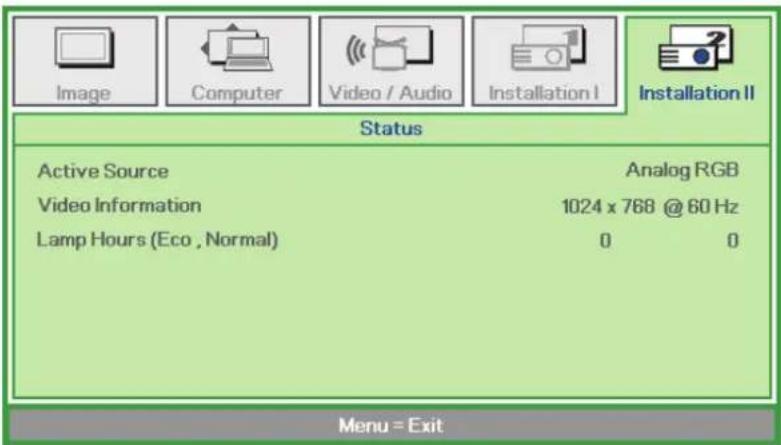
| ITEM DESCRIPTION | |
| Active Source Display | the activated source. |
| Video Information | Displays resolution/video information for RGB source and color standard for Video source. |
| Lamp Hours | Lamp hour used information is displayed. Eco and Normal counters are separated. |
MAINTENANCE AND SECURITY
Replacing the Projection Lamp
The projection lamp should be replaced when it burns out. It should only be replaced with a certified replacement part, which you can order from your local dealer.
Important:
a. The fluorescent lamp used in this product contains a small amount of mercury
b. Do not dispose this product with general household waste.
c. Disposal of this product must be carried out in accordance with the regulations of your local authority.
Warning:
Be sure to turn off and unplug the projector at least 30 minutes before replacing the lamp. Failure to do so could result in a severe burn.
-
Loosen the captive screw on the lamp compartment cover.
-
Remove the lamp compartment cover.
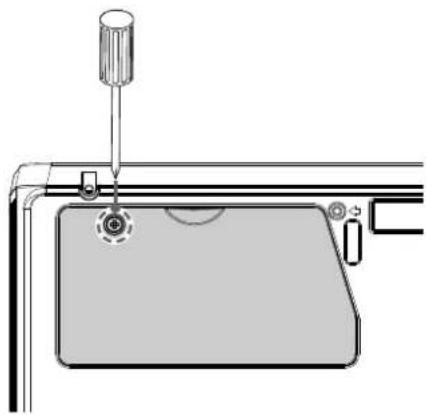
natural_image
Technical line drawing of a mechanical assembly with a tool and base component (no text or symbols)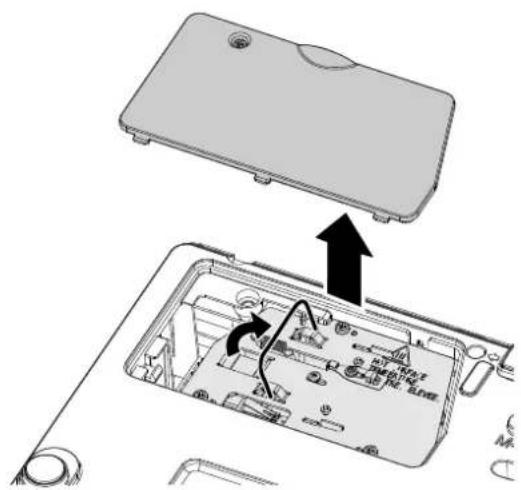
- Remove the three screws from the lamp module.
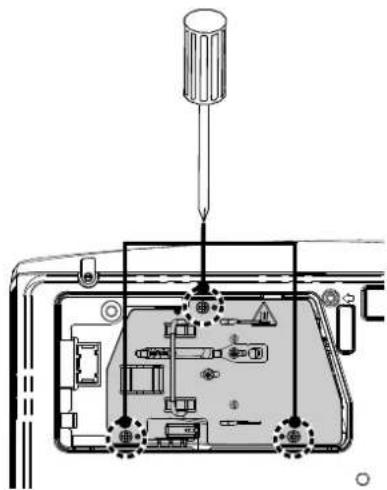
- Lift the module handle up.
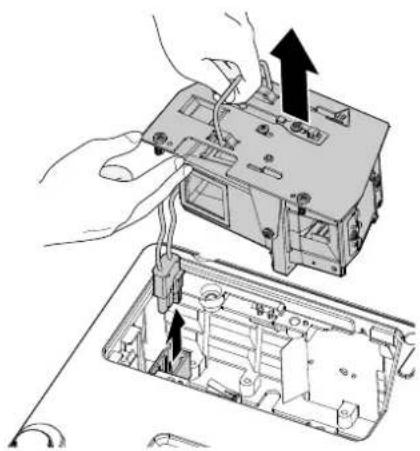
- Disconnect the lamp connector.
- Pull firmly on the module handle to remove the lamp module.
- Reverse steps 1 to 6 to install the new lamp module. While installing, align the lamp module with the connector and ensure it is level to avoid damage.
Note: The lamp module must sit securely in place and the lamp connector must be connected properly before tightening the screws.
natural_image
Diagram of hands installing or adjusting a device into an open circuit board (no text or symbols visible)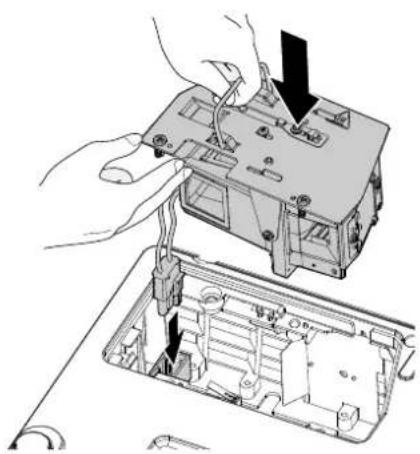
natural_image
Diagram of hands installing or adjusting a device into an open chassis (no text or symbols visible)Resetting the Lamp
After replacing the lamp, you should reset the lamp hour counter to zero. Refer to the following:
- Press the MENU button to open the OSD menu.
- Press the cursor ◀▶ button to move to the Installation II menu. Press the cursor button to move down to Advanced.
- Press the cursor ▼▲ button to move down to Lamp Hour Reset.
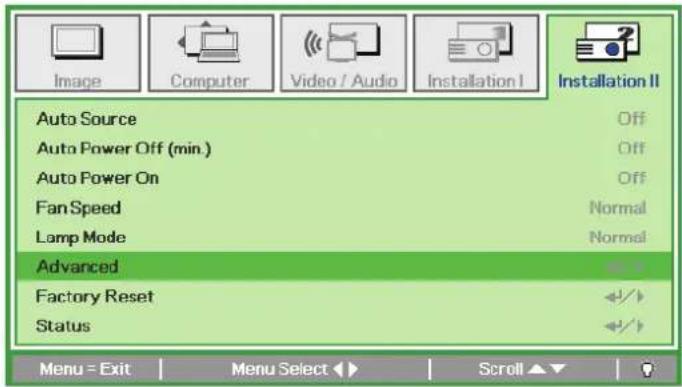
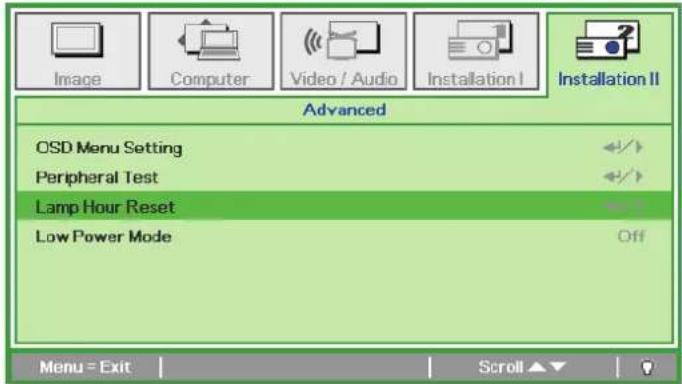
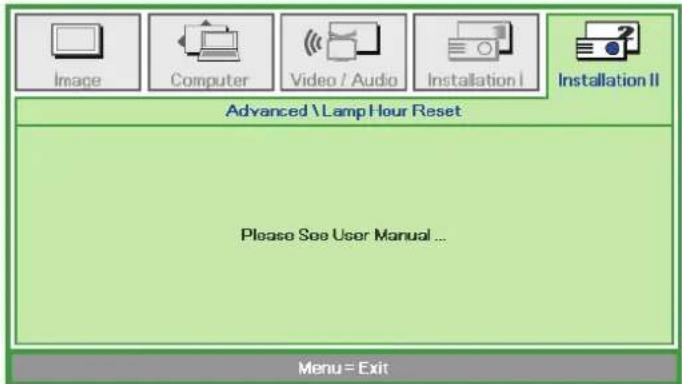
- Press the cursor ▶ or Enter button. A message screen appears.
- Press ▼▲◀▶ buttons to reset the lamp hour.
- Press the MENU button to get back to Installation II.
Cleaning the Projector
Cleaning the projector to remove dust and grime will help ensure trouble-free operation.
Warning:
- Be sure to turn off and unplug the projector at least 30 minutes before cleaning. Failure to do so could result in a severe burn.
- Use only a dampened cloth when cleaning. Do not allow water to enter the ventilation openings on the projector.
- If a little water gets into the projector interior while cleaning, leave unplugged in a well-ventilated room for several hours before using.
- If a lot of water gets into the projector interior when cleaning, have the projector serviced.
Cleaning the Lens
You can purchase optic lens cleaner from most camera stores. Refer to the following to clean the projector lens.
- Apply a little optic lens cleaner to a clean soft cloth. (Do not apply the cleaner directly to the lens.)
- Lightly wipe the lens in a circular motion.
Caution:
- Do not use abrasive cleaners or solvents.
- To prevent discoloration or fading, avoid getting cleaner on the projector case.
Cleaning the Case
Refer to the following to clean the projector case.
- Wipe off dust with a clean dampened cloth.
- Moisten the cloth with warm water and mild detergent (such as used to wash dishes), and then wipe the case.
- Rinse all detergent from the cloth and wipe the projector again.
Caution:
To prevent discoloration or fading of the case, do not use abrasive alcohol-based cleaners.
Using the Kensington® Lock
If you are concerned about security, attach the projector to a permanent object with the Kensington slot and a security cable.
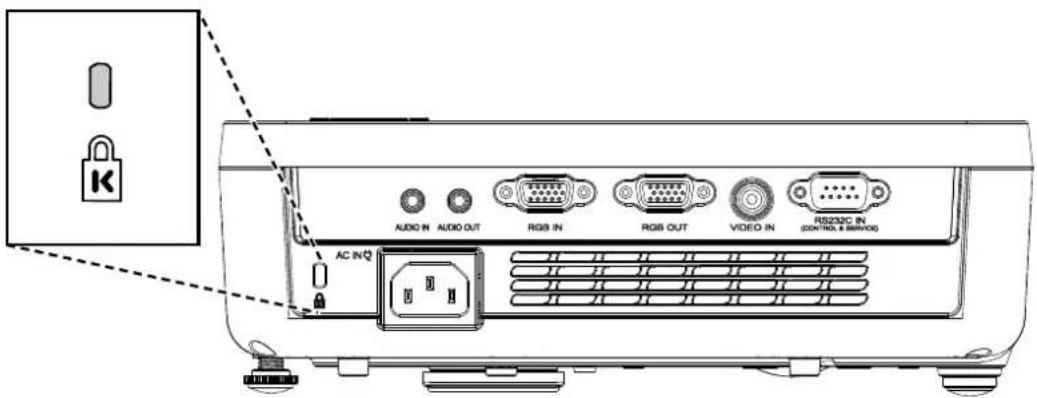
Note:
Contact your vendor for details on purchasing a suitable Kensington security cable.
The security lock corresponds to Kensington's MicroSaver Security System. If you have any comment, contact: Kensington, 2853 Campus Drive, San Mateo, CA 94403, U.S.A. Tel: 800-535-4242, http://www.Kensington.com.
TROUBLESHOOTING
Common problems and solutions
These guidelines provide tips to deal with problems you may encounter while using the projector. If the problem remains unsolved, contact your dealer for assistance.
Often after time spent troubleshooting, the problem is traced to something as simple as a loose connection. Check the following before proceeding to the problem-specific solutions.
- Use some other electrical device to confirm that the electrical outlet is working.
- Ensure the projector is turned on.
- Ensure all connections are securely attached.
- Ensure the attached device is turned on.
- Ensure a connected PC is not in suspending mode.
- Ensure a connected notebook computer is configured for an external display. (This is usually done by pressing an Fn-key combination on the notebook.)
Tips for Troubleshooting
In each problem-specific section, try the steps in the order suggested. This may help you to solve the problem more quickly.
Try to pin point the problem and thus avoid replacing non-defective parts.
For example, if you replace batteries and the problem remains, put the original batteries back and go to the next step.
Keep a record of the steps you take when troubleshooting: The information may be useful when calling for technical support or for passing on to service personnel.
LED Error Messages
| ERROR CODE MESSAGES | POWER LED BLINK | LAMP LED BLINK | OVER TEMPLED |
| Standby mode ON ON 0 | |||
| Over temperature 0 0 ON | |||
| Thermal break status error 4 0 0 | |||
| Lamp error | 5 | 0 | |
| Fan1 error | 6 | 1 | |
| Fan2 error | 6 | 2 | |
| Fan3 error | 6 | 3 | |
| Lamp door open 7 0 0 | |||
| DMD error | 8 | 0 | |
| Color wheel error 9 0 0 |
In the event of an error, please disconnect the AC power cord and wait for one (1) minute before re-starting the projector. If the Power or Lamp LEDs are still blinking or the Over Temp LED is lit, contact your service center.
Image Problems
Problem: No image appears on the screen
- Verify the settings on your notebook or desktop PC.
- Turn off all equipment and power up again in the correct order.
Problem: The image is blurred
- Adjust the Focus on the projector.
- Press the Auto button on the remote control or projector.
- Ensure the projector-to-screen distance is within the 10-meter (33-feet) specified range.
- Check that the projector lens is clean.
Problem: The image is wider at the top or bottom (trapezoid effect)
- Position the projector so it is as perpendicular to the screen as possible.
- Use the Keystone button on the remote control or projector to correct the problem.
Problem: The image is reversed
Check the Projection setting on the Installation I menu of the OSD.
Problem: The image is streaked
- Set the Frequency and Tracking settings on the Computer menu of the OSD to the default settings.
- To ensure the problem is not caused by a connected PC's video card, connect to another computer.
Problem: The image is flat with no contrast
Adjust the Contrast setting on the Image menu of the OSD.
Problem: The color of the projected image does not match the source image.
Adjust the Color Temperature and Gamma settings on the Image menu of the OSD.
Lamp Problems
Problem: There is no light from the projector
- Check that the power cable is securely connected.
- Ensure the power source is good by testing with another electrical device.
- Restart the projector in the correct order and check that the Power LED is green.
- If you have replaced the lamp recently, try resetting the lamp connections.
- Replace the lamp module.
- Put the old lamp back in the projector and have the projector serviced.
Problem: The lamp goes off
- Power surges can cause the lamp to turn off. Re-plug power cord. When the Ready LED is on, press the power button.
- Replace the lamp module.
- Put the old lamp back in the projector and have the projector serviced.
Remote Control Problems
Problem: The projector does not respond to the remote control
- Direct the remote control towards remote sensor on the projector.
- Ensure the path between remote and sensor is not obstructed.
- Turn off any fluorescent lights in the room.
- Check the battery polarity.
- Replace the batteries.
- Turn off other Infrared-enabled devices in the vicinity.
- Have the remote control serviced.
Audio Problems
Problem: There is no sound
- Adjust the volume on the remote control.
- Adjust the volume of the audio source.
- Check the audio cable connection.
- Test the source audio output with other speakers.
- Have the projector serviced.
Problem: The sound is distorted
- Check the audio cable connection.
- Test the source audio output with other speakers.
- Have the projector serviced.
Having the Projector Serviced
If you are unable to solve the problem, you should have the projector serviced. Pack the projector in the original carton. Include a description of the problem and a checklist of the steps you took when trying to fix the problem: The information may be useful to service personnel. For servicing, return the projector to the place you purchased it.
SPECIFICATIONS
Specifications
| Model | BS274 | BX274 | BX324 |
| Display type | TI DMD 0.55-inch SVGA TI | DMD 0.55-inch XGA | |
| Resolution | SVGA 800x600 Native XGA 1024x768 Native | ||
| Projection distance | 1.5 meters ~ 12 meters | ||
| Projection screen size | 36 to 243 inch (can overdrive to 300") | ||
| Projection lens | Manual Focus/Manual Zoom | ||
| Zoom ratio | 1.1 | ||
| Vertical keystone correction | +/- 15 degrees | ||
| Projection methods | Front, Rear, Desktop/Ceiling (Rear, Front) | ||
| Data compatibility | IBM PC or compatibles (VGA, SVGA, XGA, SXGA), Mac | ||
| SDTV/EDTV/ HDTV | 480i, 576i, 480p, 576p, 720p, 1080i | ||
| Video compatibility | NTSC/NTSC 4.43, PAL (B/G/H/I/M/N/60), SECAM | ||
| H-Sync | 15, 30 – 91.4 kHz, 97.6kHz | ||
| V-Sync | 43 – 87 Hz, 120 Hz | ||
| Safety certification | FCC-B, UL, cUL, TUV, CB, CE, PCT, SASO, NOM, KC and CCC | ||
| Operation temperature | 5° ~ 35°C | ||
| Dimensions | 262 mm (W) x 89 mm (H) x 194 mm (D) | ||
| AC Input | AC Universal 100 ~ 240, Typical @ 110VAC (100~240)/+-10% | ||
| Power consumption | Typical 260W (Normal mode);Typical 230W (Eco mode) | Typical 300W (Normal mode);Typical 230W (Eco mode) | |
| Stand By | <1 watts | ||
| Lamp | Normal Mode: 200W;Eco Mode: 180W | Normal Mode: 240W;Eco Mode: 180W | |
| Audio speaker | 1.5W mono speaker | ||
| PC | RGB | ||
| Video | Composite video (RCA X 1) | ||
| Audio | Mini-jack | ||
| Security | Kensington lock | ||
Input Connectors
| PC | RGB |
| RS-232C (CONTROL & SERVICE) | |
| Video Composite video (RCAx1) | |
| Audio | Mini-jack |
| Security | Kensington slot |
Projection Distance vs. Projection Size
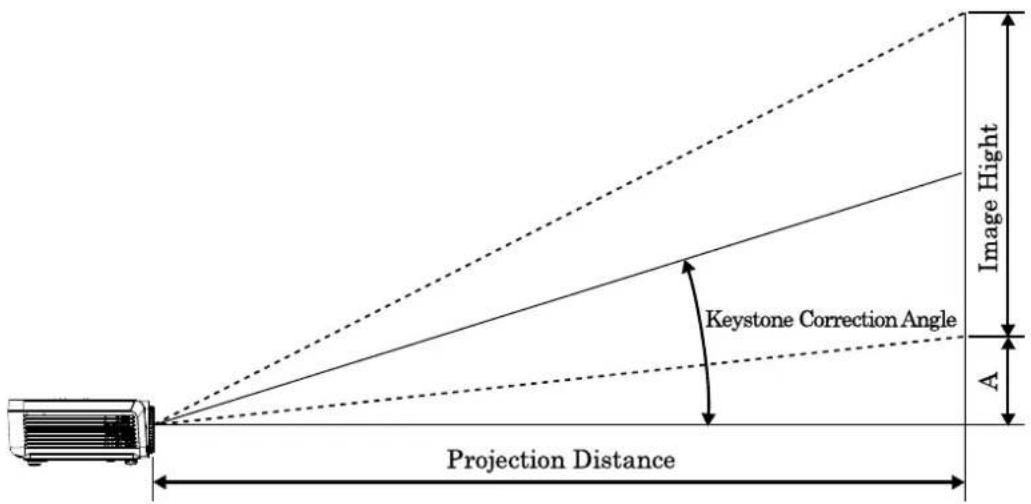
Projection Distance and Size Table
| ITEM TELE WIDE | |||||||||
| Distance (m) 1.32 3.58 4.39 | 8.78 | 1.57 | 3.14 | 3.93 | 11.77 | ||||
| Diagonal (inches) | 30 | 80 | 100 | 200 | 40 | 80 | 100 | ||
| Keystone (degree) 12.5 12.5 | 12.5 | 12.5 | 13.9 | 13.9 | 13.9 | 13.9 | |||
| Image Height (mm) | 457 | 1219 | 1524 | 3048 | 610 | 1219 | 1524 | ||
| Image Width (mm) | 610 | 1626 | 2032 | 4064 | 813 | 1626 | 2032 | ||
| A (mm) | 64 | 171 | 213 | 427 | 85 | 171 | 213 | 640 | |
300
4572
6096
Timing Mode Table
The projector can display several resolutions. The following table outlines the resolutions that can be displayed by the projector.
| SIGNAL RESOLUTION | H-SYNC (KHz) | V-SYNC (Hz) | COMPOSITE | COMPONENT | RGB | |
| NTSC | — | 15.734 | 60.0 | O | ||
| PAL/SECAM | — | 15.625 | 50.0 | O | ||
| VESA | 640 x350* 31.5 | 70.0 — | — | O | ||
| 640 x350* 37.9 | 85.0 — | — | O | |||
| 640 x400* 37.9 | 85.0 — | — | O | |||
| 640 x 480 | 31.5 60.0 | — | — | O | ||
| 640 x 480 | 37.9 72.0 | — | — | O | ||
| 640 x 480 | 37.5 75.0 | — | — | O | ||
| 640 x 480 | 43.3 85.0 | — | — | O | ||
| 800 x 600 | 35.2 56.0 | — | — | O | ||
| 800 x 600 | 37.9 60.0 | — | — | O | ||
| 800 x 600 | 48.1 72.2 | — | — | O | ||
| 800 x 600 | 46.9 75.0 | — | — | O | ||
| 800 x 600 | 53.7 85.0 | — | — | O | ||
| 1024 x 768 | 48.4 60.0 | — | — | O | ||
| 1024 x 768 | 56.5 70.0 | — | — | O | ||
| 1024 x 768 | 60.0 75.0 | — | — | O | ||
| 1024 x 768 | 68.7 85.0 | — | — | O | ||
| 1440 x 900 | 55.6 60.0 | — | — | O | ||
| 1280 x 1024 | 63.98 | 60.0 | — | — | O | |
| 1280 x 1024 | 79.98 | 75.0 | — | — | O | |
| 1400 x 1050# | 65.3 60.0 | — | — | O | ||
| 1400 x 1050# | 64.7 60.0 | — | — | O | ||
| Apple Macintosh | 640 x 480 | 34.98 | 66.66 | — | — | O |
| 640 x 480 | 35.0 | 66.68 | — | — | O | |
| 832 x 624 | 49.725 | 74.55 | — | — | O | |
| 1024 x 768 | 60.24 | 75.0 | — | — | O | |
| 1152 x 870 | 68.68 | 75.06 | — | — | O | |
| 3D | 800 x 600 | 76.3 | 120 | — | — | O |
| 1024 x 768 | 97.55 | 120 | — | — | O | |
| SDTV | 480i | 15.734 | 60 | — | O | — |
| 576i | 15.625 | 50 | — | O | — | |
| EDTV | 480p | 31.469 | 60 | — | O | |
| 576p | 31.25 | 50 | — | O | — | |
| SIGNAL RESOLUTION | H-SYNC (KHz) | V-SYNC (Hz) | COMPOSITE | COMPONENT RGB | ||
| HDTV | 720p | 37.5 | 50 | — | ||
| 720p | 45.0 | 60 | — | |||
| 1080i | 33.8 | 60 | — | |||
| 1080i | 28.1 | 50 | — | |||
0
0
0
0
*2 VGA modes: 640 x 350 @70Hz/ 640 x 350 @85Hz show up will mainly depends on DDP2431. It will display either 640 x 400 or 640 x 480. As for vertical Sync, it will follow each mode's frequency accordingly.
2 VGA modes: 1400 x 1050 @60Hz this DPI for system constrain.
O: Frequency supported
—: Frequency not supported
* : Displayable level
The resolution of the panel for the BS274 is 800 x 600, 1024 X 768 is for BX274 and BX324. Resolution other than native resolution may display with uneven size of text or lines.
HDTV timing: DVD player (main source), VG828 (secondary source).
RS232C Setting
Connect the RS232C input jack to an external control device (such as a computer) and control the Projector's functions externally.
Use the RS232C cable to control the projector externally.
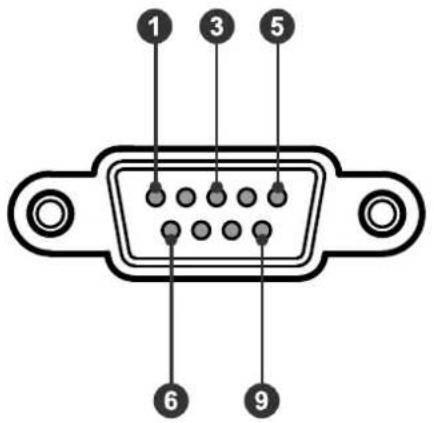
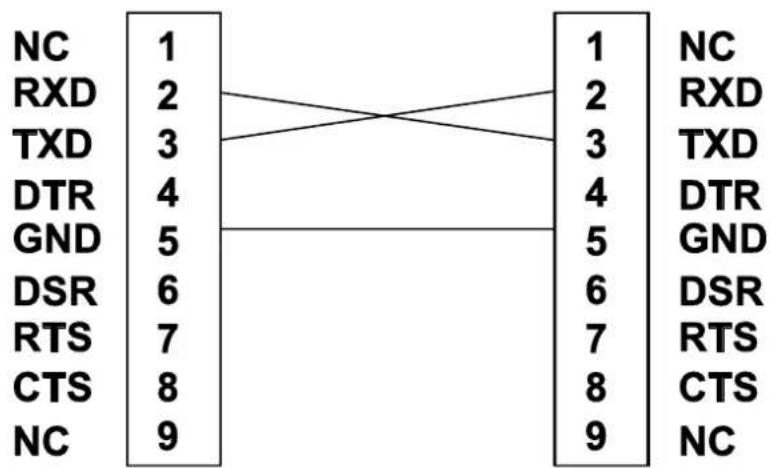
Communication Parameter Setup
| BAUD RATE: | 9600 |
| PARITY CHECK: | None |
| DATA BIT: | 8 |
| STOP BIT: | 1 |
| FLOW CONTROL | None |
Minimum delay for next command: 1ms
Control Command Structure
The command is structured by the Header code, command code, data code and end code. Most of the commands are structured except some for the compatibility issue with other projectors.
| HEADER CODE | COMMAND CODE | DATA CODE | END CODE | |
| ASCII | ‘~’ | Command | CRData | |
Control Sequence
The projector may send a return code after it received a command. If the command isn't received correctly, the projector will not send the return code
Operation Command
The operation commands execute the basic operation setting of this projector.
| OPERATION ASCII | |
| Power On ※ | ~ P N CR ※ |
| Power Off | ~ P F CR |
| Auto Image | ~ A I CR |
| Lamp Hour Reset | ~ R L CR |
| Input Select RGB | ~ S R CR |
| Input Select Video | ~ S V CR |
※ Power On command will only work at system standby.
CR: Carriage Return.
Remote Command
The remote commands simulate the code send from IR remote handset.
| BUTTON'S NAME ASCII | |
| UP arrow | |
| DOWN arrow | |
| LEFT arrow | |
| RIGHT arrow | |
| POWER | |
| INPUT | |
| AUTO | |
| KEYSTONE+ | |
| KEYSTONE- | |
| MENU | |
| STATUS | |
| MUTE | |
| ZOOM+ | |
| ZOOM- | |
| BLANK | |
| FREEZE | |
| VOLUME+ | |
| VOLUME- | |
| Enter | |
Set Value Command
| ITEM ASCII | |
| Brightness | ~s B ? CR ※ |
| Contrast | ~s C ? CR |
| Color | ~s R ? CR |
| Tint | ~s N ? CR |
| Scaling | ~s A ? CR |
| Color Temperature | ~s T ? CR |
| Projection Mode | ~s J ? CR |
※ ? : ASCII Data
Data Range
| ITEM | SET DATA RANGE | SOURCE |
| Brightness 0 ~ 100 | ALL | |
| Contrast 0 ~ 100 ALL | ||
| Color 0 ~ 100 Video /Component | ||
| Tint 0 ~ 100 Video /Component | ||
| Scaling | 0: Fill 1: 4:3 2: 16:9 3 :Letter Box 4 :Native | ALL |
| Color Temperature | 0: Cold 1: Normal 2: Warm | ALL |
| Projection Mode | 0: Front 1: Rear 2: Rear+Ceiling 3: Ceiling | ALL |
Attention: Data range may be different for different models
Example 1. Adjust Brightness value to 100
Example 2. Adjust Color Temperature to Warm
Send Command : \~sT2CR
Query Command
| ITEM ASCII | |
| Power State | ~ q P CR |
| Input Select | ~ q S CR |
| Lamp Hours | ~ q L CR |
| Brightness | ~ q B CR |
| Contrast | ~ q C CR |
| Color (Video) | ~ q R CR |
| Tint (Video) | ~ q N CR |
| Scaling | ~ q A CR |
| Color Temperature | ~ q T CR |
| Projection Mode | ~ q J CR |
Response message
| ITEM RESPONSE MESSAGE EXAMPLES | |
| Power State | On Off |
| Input Select | RGB Video Component |
| Lamp Hours 2000 | |
| Brightness | 100 |
| Contrast | 100 |
| Color (Video) 100 | |
| Tint (Video) 100 | |
| Scaling | Fill 4:3 16:9 LetterBox Native |
| Color Temperature | Cold Normal Warm |
| Projection Mode | Front Rear+Ceiling Rear Ceiling |
Example 1. Get Brightness value
Send Command : \~qBCR
Response : 100
Example 2. Get Color Temperature
Send Command : \~qTCR
Response : Warm
Projector Dimensions
REGULATORY COMPLIANCE
FCC Warning
This equipment has been tested and found to comply with the limits for a Class B digital device pursuant to Part 15 of the FCC Rules. These limits are designed to provide reasonable protection against harmful interference when the equipment is operated in a commercial environment.
This equipment generates, uses, and can radiate radio frequency energy and, if not installed and used in accordance with the instruction manual, may cause harmful interference to radio communications. Operation of this equipment in a residential area is likely to cause harmful interference in which case the user will be required to correct the interference at his/her own expense.
Changes or modifications not expressly approved by the parties responsible for compliance could void the user's authority to operate the equipment.
Canada
This class B digital apparatus complies with Canadian ICES-003.
Safety Certifications
FCC-B, UL, cUL, TUV, CB, CE, PCT, SASO, NOM, KC and CCC.