
R-230Z(W) - Microwaves SHARP - Free user manual and instructions
Find the device manual for free R-230Z(W) SHARP in PDF.


| Product Type | Microwave Oven |
| Brand | Sharp |
| Model | R-230Z(W) |
| Colour | White |
| Power Supply | 220V, 50 Hz, single phase |
| Power Consumption (Microwave) | 1270 W |
| Microwave Output Power | 800 W |
| Microwave Frequency | 2450 MHz |
| Oven Capacity | 20 litres |
| Turntable Diameter | 255 mm |
| External Dimensions (W x H x D) | 440 x 258 x 327 mm |
| Cavity Dimensions (W x H x D) | 306 x 205 x 307 mm |
| Net Weight | Approx. 10.90 kg |
| Number of Power Levels | 11 (100P to 10P) |
| Clock Function | 24-hour digital clock |
| Timer Function | Up to 99 minutes 50 seconds |
| Child Lock | Yes, press and hold STOP/CLEAR for 3 seconds |
| Auto Cook Menus | Popcorn, Baked Potato, Pizza, Frozen Vegetable, Beverage, Dinner Plate |
| Defrost Functions | Time Defrost (30P) and Weight Defrost (0.1 kg - 2 kg) |
| Control Panel | Touch keys with display |
| Door Opening | Push button |
| Safety Features | Door safety latches, child lock, automatic power reduction after 30 min at 100P |
| Cleaning Instructions | Use mild soap and water; turntable dishwasher safe; do not use abrasive cleaners |
| Accessories Included | Turntable, turntable support, coupling |
| Installation Type | Countertop only (not built-in) |
Frequently Asked Questions - R-230Z(W) SHARP
User questions about R-230Z(W) SHARP
0 question about this device. Answer the ones you know or ask your own.
Ask a new question about this device
Download the instructions for your Microwaves in PDF format for free! Find your manual R-230Z(W) - SHARP and take your electronic device back in hand. On this page are published all the documents necessary for the use of your device. R-230Z(W) by SHARP.
USER MANUAL R-230Z(W) SHARP
natural_image
Exterior view of a modern white SHARP microwave oven with control panel and display (no visible text or symbols)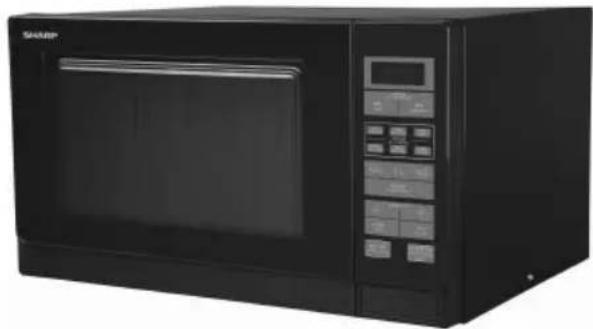
natural_image
Black Sharp microwave oven with control panel and door (no visible text or symbols)
R-230 Z(W)/ R-3B Z(K)
800 W / 900 W
微波爐
使用說明書
natural_image
Exterior view of a modern white SHARP microwave oven with control panel and display (no visible text or symbols)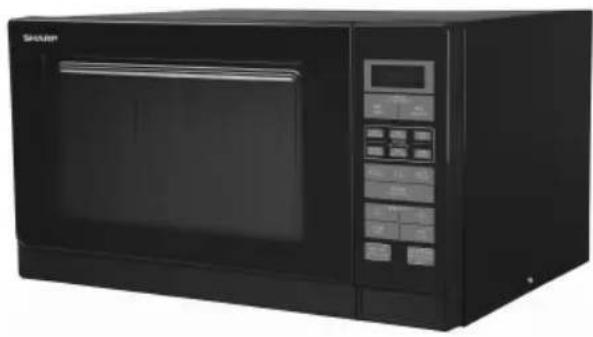
natural_image
Black Skimaker oven with control panel and display screen (no visible text or symbols)R-230 Z(W)/ R-303 Z(K) 800 W / 900 W
This operation manual contains important information which you should read carefully before using your microwave oven.
IMPORTANT: There may be a serious risk to health if this operation manual is not followed or if the oven is modified so that it operates with the door open.
Operation manual
CONTENTS 1
SPECIFICATIONS .... 1
OVEN AND ACCESSORIES 2
CONTROL PANEL....3
IMPORTANT SAFETY INSTRUCTIONS....4-6
INSTALLATION....6
BEFORE OPERATION 6
SETTING THE CLOCK....7
OTHER CONVENIENT FUNCTIONS....9
REHEATING ADVICE 10
DEFROSTING ADVICE 11
TIME DEFROST AND WEIGHT DEFROST OPERATION 12
AUTO MENU OPERATION....12
AUTO MENU CHART 13
SUITABLE OVENWARE 14
CARE AND CLEANING 15
TROUBLESHOOTING....16
SPECIFICATIONS

| Model name: | R-230Z (W) | R-330Z (K) |
| AC Line Voltage : 220V, 50 Hz single phase : 220V, 50 Hz AC Power required: Microwave : 1270 W : 1450 W Output power: Microwave : 800 W : 900 W Off Mode (Energy Save Mode): Microwave Frequency Outside Dimensions (W) x (H) x (D) mm Cavity Dimensions (W) x (H) x (D)** mm Oven Capacity Turntable Weight | Hz single phase less than 1.0 W : less than 1.0 W : 2450 MHz* : 440x 258 x 327 : 306 x 205 x 307 : 20 litres** : ø 255 mm : approx. 10.90 kg | : 2450 MHz* : 513 x 306 x 397 : 330 x 208 x 370 : 25 litres** : ø 315 mm : approx. 14.85 kg |
* This Product fulfils the requirement of the European standard EN55011.
In conformity with this standard, this product is classified as group 2 class B equipment.
Group 2 means that the equipment intentionally generates radio-frequency energy in the form of electromagnetic radiation for the heat treatment of food.
Class B equipment means that the equipment is suitable to be used in domestic establishments.
** Internal capacity is calculated by measuring maximum width, depth and height. Actual capacity for holding food is less.
AS PART OF A POLICY OF CONTINUOUS IMPROVEMENT, WE RESERVE THE RIGHT TO ALTER DESIGN AND SPECIFICATIONS WITHOUT NOTICE.
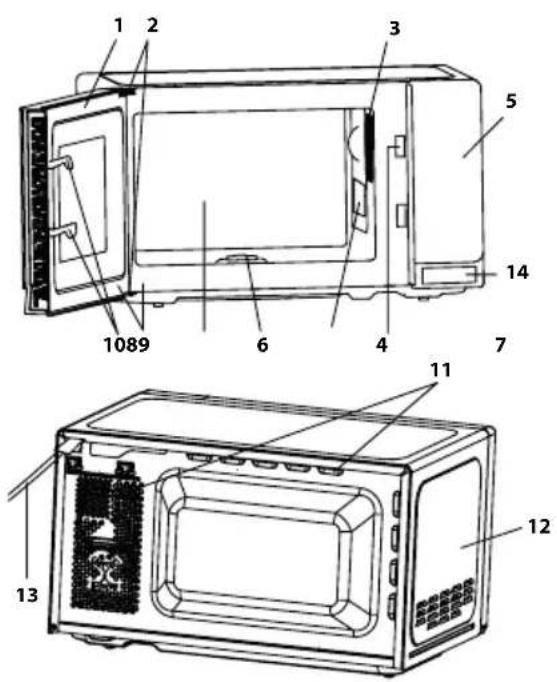
OVEN
- Door
- Door hinges
- Oven lamp
- Waveguide cover (DO NOT REMOVE)
- Control panel
- Coupling
- Door latches
- Oven cavity
- Door seals and sealing surfaces
- Door safety latches
- Ventilation openings
- Outer cabinet
- Power supply cord
- Door opening button
ACCESSORIES:
Check to make sure the following accessories are provided:
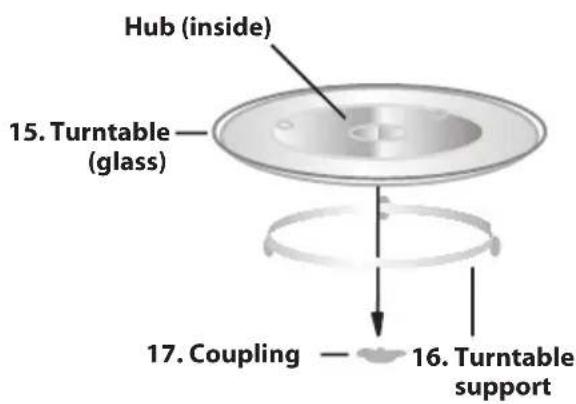
(15) Turntable (16) Turntable support (17) Coupling Place the turntable support in the centre of the oven floor so that it can freely rotate around the coupling. Then place the turntable on to the turntable support so that it locates firmly into the coupling.
To avoid turntable damage, ensure dishes and containers are lifted clear of the turntable rim when removing them from the oven.
NOTE: When you order accessories, please mention two items: part name and model name to your dealer or SHARP authorised service agent.
NOTES:
- The waveguide cover is fragile. Care should be taken when cleaning inside the oven to ensure that it is not damaged.
• Always operate the oven with the turntable and turntable support fitted correctly. This promotes thorough, even cooking. A badly fitted turntable may rattle, may not rotate properly and could cause damage to the oven. - All food and containers of food are always placed on the turntable for cooking.
- The turntable rotates clockwise or anti-clockwise. The rotary direction may change each time you start the oven. This does not affect cooking performance.
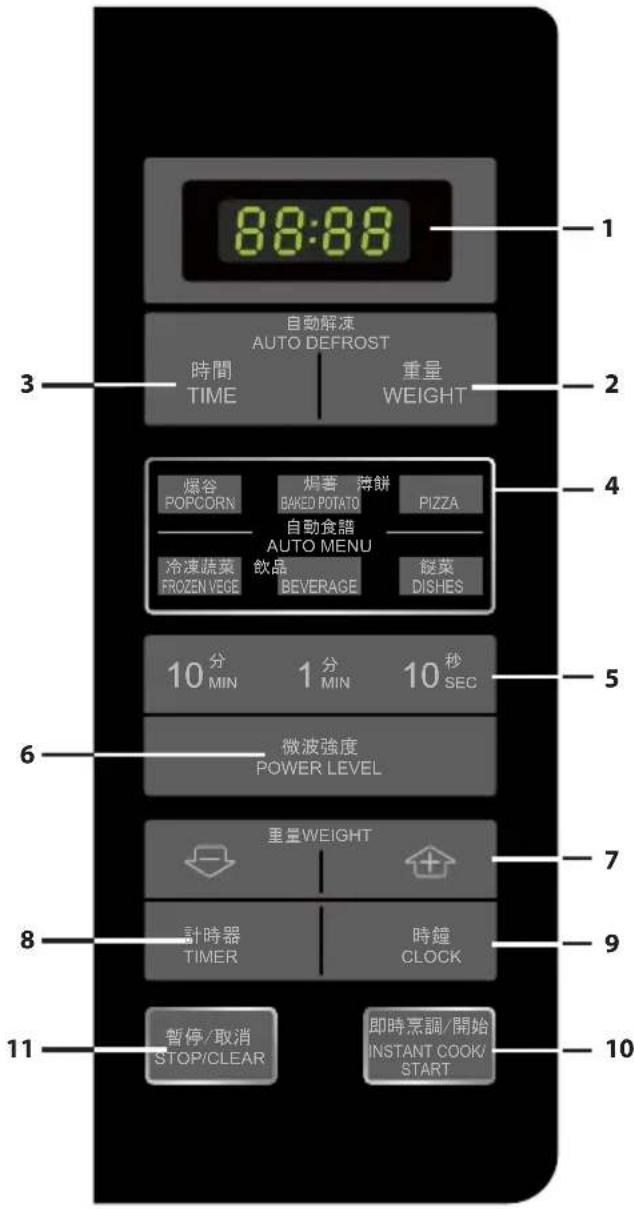
Press to enter time, and keep pressing to continuously increase time.
- POWER LEVEL key:
Press to select microwave power level.
- WEIGHT keys (up and down)
Press to increase/decrease weight, and keep pressing to continuously increase/decrease weight.
- TIMER key
Press to use as a minute timer, or to programme standing time.
- SET CLOCK key
- INSTANT COOK/START key
- STOP/CLEAR key
IMPORTANT SAFETY INSTRUCTIONS: READ CAREFULLY AND KEEP FOR FUTURE REFERENCE
To avoid the risk of fire.
The microwave oven should not be left unattended during operation. Power levels that are too high, or cooking times that are too long, may overheat foods resulting in a fire.
- This oven is designed to be used on a countertop only. It is not designed to be built into a kitchen unit.
- Do not place the oven in a cabinet.
• The electrical outlet must be readily accessible so that the unit can be unplugged easily in an emergency.
•The AC power supply must be 220V, 50Hz, with a minimum 10A distribution line fuse, or a minimum 10A distribution circuit breaker. - A separate circuit serving only this appliance should be provided.
- Do not place the oven in areas where heat is generated.
- For example, close to a conventional oven.
- Do not install the oven in an area of high humidity or where moisture may collect.
- Do not store or use the oven outdoors.
If smoke is observed, switch off or unplug the oven and keep the door closed in order to stifle any flames.
Use only microwave-safe containers and utensils. See Page E-14. Utensils should be checked to ensure that they are suitable for use in microwave ovens.
When heating food in plastic or paper containers, keep an eye on the oven for signs of smoke or burning.
Clean the waveguide cover, the oven cavity, the turntable and roller stay after use. These must be dry and free from grease. Built-up grease may overheat and begin to smoke or catch fire.
- Do not place flammable materials near the oven or ventilation openings.
- Do not block the ventilation openings.
- Remove all metallic seals, wire twists, etc., from food and food packages. Arcing on metallic surfaces may cause a fire.
- Do not use the microwave oven to heat oil for deep frying. The temperature cannot be controlled and the oil may catch fi re.
- To make popcorn, use only special microwave popcorn makers.
- Do not store food or any other items inside the oven.
- Check the settings after you start the oven to ensure the oven is operating as desired.
• To avoid overheating and fire, special care must be taken when cooking or reheating foods with a high sugar or fat content, for example, Sausage rolls, Pies or Christmas pudding.
To avoid the risk of injury
WARNING:
Do not operate the oven if it is damaged or malfunctioning. Check the following before use:
a) The door; make sure the door closes properly and ensure it is not misaligned or warped.
b) The hinges and safety door latches; check to make sure they are not broken or loosened.
c) The door seals and sealing surfaces; ensure that they have not been damaged.
d) Inside the oven cavity or on the door; make sure there are no dents.
e) The power supply cord and plug; ensure that they are not damaged.
If the door or door seals are damaged, the oven must not be operated until it has been repaired by a qualified service technician trained by SHARP.
Never adjust, repair or modify the oven yourself. It is hazardous for anyone other than a qualified service technician trained by SHARP to carry out any service or repair operation which involves the removal of a cover which gives protection against exposure to microwave energy.
- Do not operate the oven with the door open or alter the door safety latches in any way.
- Do not operate the oven if there is an object between the door seals and sealing surfaces.
Do not allow grease or dirt to build up on the door seals and adjacent parts. Clean the oven at regular intervals and remove any food deposits. Follow the instructions for "Care and Cleaning" on page E-15. Failure to maintain the oven in a clean condition could lead to a deterioration of the surface that could adversely affect the life of the appliance and possibly result in a hazardous situation.
- Individuals with PACEMAKERS should check with their doctor or the manufacturer of the pacemaker for precautions regarding microwave ovens.
To avoid the risk of electric shock
- Do not remove the outer cabinet.
• Never spill or insert any objects into the door lock openings or ventilation openings. In the event of a spill, turn off and unplug the oven immediately, and call an authorised SHARP service agent. - Do not immerse the power supply cord or plug in water or any other liquid.
-
Do not let the power supply cord hang over the edge of a table or work surface.
-
Keep the power supply cord away from heated surfaces, including the rear of the oven.
- Do not attempt to replace the oven lamp yourself or allow anyone who is not an electrician authorised by SHARP to do so. If the oven lamp fails, please consult your dealer or an authorised SHARP service agent.
- If the power supply cord of this appliance is damaged, it must be replaced with a special cord.
• The exchange must be made by an authorised SHARP service agent.
To avoid the risk of explosion and sudden boiling:
WARNING: Liquids and other foods must not be heated in sealed containers to avoid the risk of explosion.
Microwave heating of beverages can result in delayed eruptive boiling, therefore care must be taken when handling the container.
- Never use sealed containers. Remove seals and lids before use. Sealed containers can explode due to a build up of pressure even after the oven has been turned off.
- Pay attention when microwaving liquids. Use a wide mouthed container to allow bubbles to escape.
Never heat liquids in narrow necked containers such as baby bottles, as this may result in eruption of the contents from the container when heated and cause burns.
• To prevent sudden eruption of boiling liquid and possible scalding:
- Do not use excessive cooking time.
- Stir liquid prior to heating/reheating.
- Insert a glass rod or similar utensil (not metal) into the liquid whilst reheating.
- Let the liquid stand for at least 20 seconds in the oven at the end of cooking time to prevent delayed eruptive boiling.
Do not cook eggs in their shells and whole hard boiled eggs should not be heated in microwave ovens since they may explode even after microwave cooking has ended. To cook or reheat eggs which have not been scrambled or mixed, pierce the yolks and the whites, or the eggs may explode. Shell and slice hard boiled eggs before reheating them in the microwave oven.
- Pierce the skin of foods such as potatoes, sausages and fruit before cooking, or they may explode.
To avoid the risk of burns
WARNING: The contents of feeding bottles and baby food jars must be stirred or shaken and the temperature checked before consumption, in order to avoid burns.
- Use pot holders or oven gloves when removing food from the oven to prevent burns.
• Always open containers, popcorn makers, oven cooking bags, etc., away from the face and hands to avoid steam burns and eruption of boiling.
To avoid burns, always test food temperature and stir before serving and pay special attention to the temperature of food and drink given to babies, children or the elderly. Accessible parts may become hot during use. Young children should be kept away.
• The temperature of the container is not always a true indication of the temperature of the food or drink; always check the food or drink temperature.
• Always stand back from the oven door when opening it to avoid burns from escaping steam and heat.
- Slice stuffed baked foods after heating to release steam and avoid burns.
- Keep children away from the door to prevent them from burning themselves.
To avoid misuse by children
WARNING: Only allow children to use the oven without supervision when adequate instructions have been given so that the child is able to use the oven in a safe way and understands the hazards of improper use. This appliance is not intended for use by persons (including children) with reduced physical, sensory or mental capabilities, or lack of experience and knowledge, unless they have been given supervision or instruction concerning use of the appliance by a person responsible for their safety. Children should be supervised to ensure that they do not play with the appliance.
- Do not lean or swing on the oven door. Do not play with the oven or use it as a toy.
- Children should be taught all important safety instructions: use of pot holders, careful removal of food coverings; paying special attention to packaging (e.g. self-heating materials) designed to make food crisp, as they may be extra hot.
Other warnings
- Never modify the oven in any way.
- Do not move the oven while it is in operation.
• This oven is for home food preparation only and may only be used for cooking food. It is not suitable for commercial or laboratory use.
To ensure trouble-free use of your oven and avoid damage.
- Never operate the oven when it is empty. When using a browning dish or self-heating material, always place a heat-resistant insulator such as a porcelain plate under it to prevent damage to the turntable and turntable support due to heat stress. The preheating time specified in the dishes instructions must not be exceeded.
NSTRUCTIONS
- Do not use metal utensils, which reflect microwaves and may cause electrical arcing. Do not put cans in the oven.
- Use only the turntable and the turntable support designed for this oven. Do not operate the oven without the turntable.
•To prevent the turntable from breaking:
(a) Before cleaning the turntable with water, leave the turntable to cool.
(b) Do not put hot foods or hot utensils on a cold turntable.
(c) Do not put cold foods or cold utensils on a hot turntable.
- Do not place anything on the outer cabinet during operation.
NOTE:
• If you are unsure how to connect your oven, please consult an authorised, qualifi ed electrician.
- Neither the manufacturer nor the dealer can accept any liability for damage to the oven or personal injury resulting from failure to observe the correct electrical connection procedure.
• Water vapour or drops may occasionally form on the oven walls or around the door seals and sealing surfaces. This is a normal occurrence and is not an indication of microwave leakage or a malfunction.
INSTALLATION
- Remove all packing materials from the inside of the oven cavity.
- Check the oven carefully for any signs of damage.
- Place oven on a secure, level surface, strong enough to take the oven weight, plus the heaviest item likely to be cooked in the oven. Do not place the oven in a cabinet.
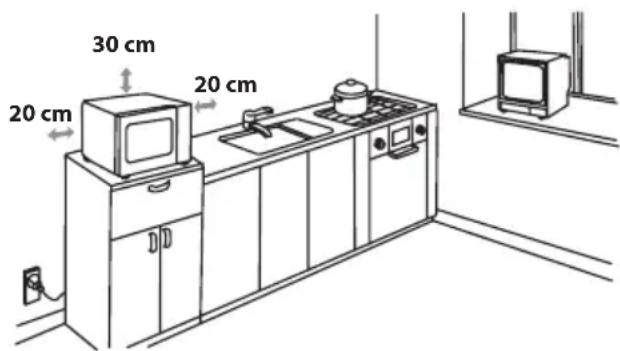
- Select a level surface that provides enough open space for the intake and/or outlet vents.
The rear surface of appliance shall be placed against a wall.
- A minimum space of 20m is required between the oven and any adjacent walls.
- Leave a minimum space of 30~cm above the oven.
- Do not remove the feet from the bottom of the oven.
- Blocking the intake and/or outlet openings can damage the oven.
- Place the oven as far away from radios and TV's as possible. Operation of the microwave oven may cause interference to your radio or TV reception.
- Securely connect the plug of the oven to a standard earthed (grounded) household electrical outlet.
WARNING: Do not place the oven where heat, moisture or high humidity are generated, (for example, near or above a conventional oven) or near combustible materials (for example, soft furnishings).
Do not block or obstruct air vent openings.
Do not place objects on top of the oven.
BEFORE OPERATION
Plug in the oven. The oven display will display: "0:00", an audible signal will sound once.
This model has a clock function and the oven uses less than 1.0 W in stand by mode.
To set the clock, see next page.
Your oven has a 24 hour clock mode.
- Press the CLOCK key 時鐘 CLOCK once and "00:00" will flash.
- Press the time keys and enter the current time. Enter the hours by pressing the 10 min. key and enter the minutes by pressing the 1 min. and 10 sec. keys.
- Press the CLOCK key 時鐘 to finish clock setting.
NOTES:
- If the clock is set, when cooking is complete, the display will show the correct time of day. If the clock has not been set, the display will only show "0:00" when cooking is complete.
- To check the time of day during a cooking process, press CLOCK key and the LED will display the time of day for 2-3 seconds. This does not affect the cooking process.
- In the process of clock setting, if the STOP/CLEAR key is pressed or if there is no operation within 1 minute, the oven will go back to the former setting.
- If the electrical power supply to your microwave oven is interrupted, the display will intermittently show "0:00" - after the power is reinstated. If this occurs during cooking, the programme will be erased. The time of day will also be erased.
Generally the following recommendations apply:
100P/90P - (HIGH) used for fast cooking or reheating e.g. for casseroles, hot beverages, vegetables etc.
80P/70P - (MEDIUM HIGH) used for longer cooking of dense foods such as roast joints, meat loaf and plated meals, also for sensitive dishes such as sponge cakes. At this reduced setting, the food will cook evenly without over cooking at the sides.
- Your oven has 11 power levels, as shown.
- To change the power level for cooking, press the POWER LEVEL key until the display indicates the desired level. Enter the cooking time and press the START key to start the oven.
- To check the power level during cooking, press the POWER LEVEL key. The oven continues to count down although the display will show the power level.
- If "OP" is selected, the oven will work with the fan but no power. You can use this level to remove the odour.
60P/ 50P - (MEDIUM) for dense foods which require a long cooking time when cooked conventionally, e.g. beef casserole, it is advisable to use this power setting to ensure the meat will be tender.
40P/30P - (MEDIUM LOW) to defrost, select this power setting, to ensure that the dish defrosts evenly. This setting is also ideal for simmering rice, pasta, dumplings and cooking egg custard.
20P/10P - (LOW) For gentle defrosting, e.g. cream gateaux or pastry.
Opening the door:
To open the oven door, push the door opening button.
Starting the oven:
Prepare and place food in a suitable container onto the turntable or place directly onto the turntable. Close the door and press the INSTANT COOK/STARTE desired cooking mode.
Once the cooking programme has been set and the INSTANT COOK/START in 1 minute, the setting will be cancelled.
The INSTANT COOK/START to continue cooking after the door is opened during cooking. The audible signal sounds once by efficient press, inefficient press will be no response.
Use the STOP/CLEAR key to:
- Erase a mistake during programming.
- Stop the oven temporarily during cooking.
- Cancel a programme during cooking, press the STOP/CLEAR key twice.
- To set and to cancel the child lock (refer to page E-9).
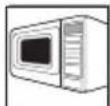
MICROWAVE
Your oven can be programmed for up 99 minutes 50 seconds (99.50).
MANUAL COOKING/ MANUAL DEFROSTING
- Enter the cooking time and use microwave power levels 100P to 10P to cook or defrost (refer to page E-7).
- Stir or turn the food, where possible, 2 - 3 times during cooking.
• After cooking, cover the food and leave to stand, where recommended.
• After defrosting, cover the food in foil and leave to stand until thoroughly defrosted.
Example:
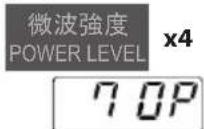
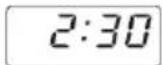
To cook 2 minutes and 30 seconds on 70% microwave power.
- Input the power level by pressing the POWER LEVEL key 4 times for 70 P.
- Enter the cooking time by pressing the 1 min. key twice and then the 10 sec. key 3 times.
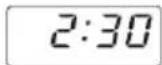
- Press the INSTANT COOK/START to start the timer.
(The display will count down through the set cooking/defrosting time.)
NOTE:
- When the oven starts, the oven lamp will light and the turntable will rotate clockwise or anticlockwise.
- If the door is opened during cooking/defrosting to stir or to turn over food, the cooking time on the display stops automatically. The cooking/ defrosting time starts to count down again when the door is closed and the INSTANT COOK/START key is pressed.
- When cooking/defrosting is complete, open the door or press STOP/CLEAR key and the time of day will reappear on the display, if the clock has been set.
• If you wish to know the power level during cooking, press the POWER LEVEL key.
IMPORTANT:
- Close the door after cooking / defrosting. Please note that the light will remain on when the door is open, this is for safety reasons to remind you to close the door.
- If you cook the food over the standard time with only 100P, the power of the oven will lower automatically to avoid overheating. (The microwave power level will be reduced).
| Cooking Mode | Standard time |
| Microwave 100P | 30 minutes |
OTHER CONVENIENT FUNCTIONS
1. SEQUENCE COOKING
This function allows you to cook using up to 2 different stages which can include manual cooking time and mode and /or time defrost as well as weight defrost function. Once programmed there is no need to interfere with the cooking operation as the oven will automatically move onto the next stage. The audible signal will sound once after the first stage. If one stage is defrosting, it should be in the first stage.
Note: Auto menu cannot be set as one of the multiple sequences.
Example: If you want to defrost the food for 5 minutes, then to cook with 80P microwave power for 7 minutes. The steps are as follows:
- Press the AUTODEFROST-TIMEsplay will appear dEF2.
- Enter the cooking time by pressing the 1 min. key 5 times.
- Input the power level (80P) by pressing the POWER LEVEL key 3 times.
- Enter the cooking time by pressing the 1 min. key 7 times.
- Press the INSTANT COOK/STARTING.
2. AUTO MINUTE FUNCTION
The INSTANT COOK/START
a. Direct start
You can directly start cooking on 100P microwave power level for 1 minute by pressing the AUTO MINUTE key.
b. Extend the cooking time
You can extend the cooking time during manual cooking, time defrost and auto menu operation in multiples of 1 minute if the INSTANT COOK START the oven is in operation. During the weight defrost,
the cooking time cannot be increased by pressing INSTANT COOK/START
NOTE: The cooking time may be extended to a maximum of 99 minutes 50 seconds.
3. TIMER FUNCTION :
You can use the timer for timing where microwave cooking is not involved for example to time boiled eggs cooked on conventional hob or to monitor the standing time for cooked/defrosted food.
Example:
To set the timer for 5 minutes.
- Press the TIMER key once.
-
Enter the desired time by pressing the 1 min. key 5 times.
-
Press the INSTANT COOK/START key to start the timer.
Check the display. (The display will count down through the set cooking/defrosting time.)
When the timer time arrives, the audible signal will sound 5 times and the LED will display the time of day. You can enter any time up to 99 minutes 50 seconds. To cancel the TIMER whilst counting down, simply press the STOP/CLEAR key.
NOTE: The TIMER function cannot be used whilst cooking.
4. CHILD LOCK:
Use to prevent unsupervised operation of the oven by children.
a. To set the CHILD LOCK:
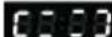
Press and hold the STOP/CLEAR key for 3 seconds until a long a beep sounds. The display will show:
b. To cancel the CHILD LOCK:
Press and hold the STOP/CLEAR key for 3 seconds until a long beep sound.
For the reheating of foods, follow the advice and guidelines below to ensure food is thoroughly reheated before serving.
| Plated meals Remove | ve any poultry or meat portions, reheat these separately, see below.Place smaller items of food to the centre of the plate, larger and thicker foods to the edge. Cover with vented microwave cling fi lm and reheat on 50%, stir/rearrange halfway through reheating.NOTE: Ensure the food is thoroughly reheated before serving. | 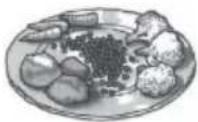 |
| Sliced meat | Cover with vented microwave cling film and reheat on 50%.Rearrange at least once to ensure even reheating.NOTE: Ensure the meat is thoroughly reheated before serving. | 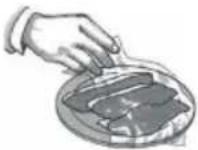 |
| Poultry portions | Place thickest parts of the portions to the outside of the dish, cover with vented microwave cling fi lm and reheat on 70%.Turn over halfway through reheating.NOTE: Ensure the poultry is thoroughly reheated before serving. | 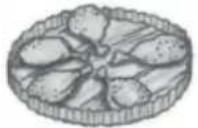 |
| Casseroles | Cover with vented microwave cling film or a suitable lid and reheat on 50%.Stir frequently to ensure even reheating.NOTE: Ensure the food is thoroughly reheated before serving. | 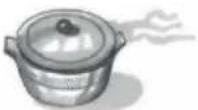 |
To achieve the best results when reheating, select a suitable microwave power level appropriate to the type of food. e.g. A bowl of vegetables can be reheated using 100%, while a lasagne which contains ingredients that cannot be stirred, should be reheated using 50%.
NOTES:
- Remove food from foil or metal containers before reheating.
- Reheating times will be affected by the shape, depth, quantity and temperature of food together with the size, shape and material of the container.
WARNING:
Never heat liquids in narrow-necked containers, as this could result in the contents erupting from the container and may cause burns.
- To avoid overheating and fire, special care must be taken when reheating foods with a high sugar or fat content, e.g. mince pies or Christmas pudding.
- Never heat oil or fat for deep frying as this may lead to overheating and fire.
- Canned potatoes should not be heated in the microwave oven, follow the manufacturer's instructions on the can.
WARNING:
The contents of feeding bottles and baby food jars are to be stirred or shaken and the temperature is to be checked before consumption to avoid burns.
Defrosting food using your microwave oven is the quickest method of all.
It is a simple process but the following instructions are essential to ensure the food is thoroughly defrosted.
| Rearrange | Foods that are placed towards the outside of the dish will defrost quicker than foods in the centre. It is therefore essential that the food is rearranged up to 4 times during defrosting.Move closely packed pieces from the outside to the centre and rearrange over-lapping areas.This will ensure that all parts of the food defrosts evenly. |
| Separate | Foods may be stuck together when removed from the freezer. It is important to separate foods as soon as possible during defrosting, e.g. bacon rashers, chicken fi llets. |
| Shield Some areas of | food being defrosted may become warm. To prevent them becoming warmer and starting to cook, these areas can be shielded with small pieces of foil, which reflect microwaves, e.g. legs and wings on a chicken. |
| Stand Standing time | is necessary to ensure food is thoroughly defrosted. Defrosting is not complete once the food is removed from the microwave oven. Food must stand, covered, for a length of time to ensure the centre has completely defrosted. |
| Turn over | It is essential that all foods are turned over at least 3 - 4 times during defrosting. This is important to ensure thorough defrosting. |
NOTES:
- Remove all packaging and wrapping before defrosting.
• To defrost food, use microwave power levels 30% or 10%.
DEFROST AND WEIGHT DEFROST OPERATION
1. TIME DEFROST
This function quickly defrosts food while enabling you to choose a suitable defrost period, depending on the food type. Follow the example below for details on how to operate this function. The time range is 0:10 - 99:50.
Example: To defrost the food for 10 minutes.
- Select the menu required by pressing the TIME DEFROST key once.

x1, the display will show:
dEF2
- Enter the cooking time by pressing the 10 min. key once.
10:00
- Press the INSTANT COOK/START key to start cooking.
Notes for Time Defrost:
- After cooking the audible signal will sound fi ve times and the LED will display the time of day, if the clock has been set. If the clock has not been set, the display will only show "0:00" when cooking is complete.
- The preset microwave power level is 30P and can not be changed.
2. WEIGHT DEFROST
The microwave oven is pre-programmed with a time and power level so that the following food is defrosted easily: Pork, beef and chicken. The weight range for this food is from 0.1kg – 2kg in 0.1kg steps.
Follow the example below for details on how to operate these functions.
Example : To defrost a meat joint weighing 1.2kg using WEIGHT DEFROST. Place the meat in a fl an dish or microwave oven defrost rack on the turntable.
- Select the menu required by pres the WEIGHT DEFROST key once.
x1,
the display will show:
dEF1
- Enter the weight by pressing the WEIGHT keys until the desired weight is displayed.
, display: 1.2
- Press the INSTANT COOK/START key to start cooking.
(The display will count down through defrosting time)
Frozen foods are defrosted from -18°C.
NOTES FOR WEIGHT DEFROST:
- Before freezing foods, ensure food is fresh and of good quality.
- Food weight should be rounded up to the nearest 0.1kg, for example, 0.65kg to 0.7kg.
- If necessary, shield small areas of meat or poultry with flat pieces of aluminium foil. This will prevent areas from becoming warm during defrosting. Ensure the foil does not touch the oven walls.
AUTO
The AUTO MENU keys automatically work out the correct cooking mode and cooking of the foods (details on page E-3 and E-13). Follow the example below for details on how to operate this function.
Example: To cook two jacket potatoes (460g) by using the AUTO MENU function.
- Select the required menu by pressing the Baked Potato
the display will show:
- Press WEIGHT UP/DOWN keys or continue to press the Baked Potato key to choose the required number of potatoes (up to 3).
x1, display: 2
- Press the INSTANT COOK/START key to start cooking.
(The display will count down through defrosting time)
NOTES:
- The weight or quantity of the food can be input by pressing the WEIGHT UP/DOWN keys until the desired weight/quantity is displayed. Enter the weight of the food only. Do not include the weight of the container.
- For food weighting more or less than the weights/quantities given in the AUTO MENU chart on page E-13, cook by manual operation.
| Auto Menu WEIGHT/ PORTION / UTENSILS Procedure | ||
| Popcorn Place the pop | 0.05kg, 0kg directly on the turntable | (Please see the note below: 'Important Information About Microwave Popcorn Feature') |
| Baked Potato 1, | 2, 3 potatoes (pieces)1 potato = approx. 0.23kg(initial temp. 20°C) | Please use potatoes with a similar size of approx. 023Kg.Pierce each potato in several places and place towards the edge of the turntable. Turn over and re-arrange halfway through cooking. Stand for 3 - 5 minutes before serving. |
| Pizza 0.1kg, 0.2kg, | 0.4kg Plate(initial temp 5°C) | Place the pizza on a plate in the centre of the turntable.Do not cover. |
| Frozen vegetable e.g. Brussel sprouts, green beans, peas, mixed vegetables, broccoli | 0.15kg, 0.35kg, 0.5kg Bowl(initial temp -18°C) | Place vegetables in a suitable container. Add 1tbsp of water per 0.1Kg of vegetables, cover the dish and place on the turntable. Stir halfway through cooking and after cooking. |
| Beverage(120ml/ cup) | 1, 2, 3 Cup(initial temp. 5°C) | Place the cup(s) on the turntable and stir after heating. |
| Dishes 0.25kg, 0.35kg | 0.5kg Plate(initial temp. 5°C) | Place your dinner plate of food (such as meat, vegetable and rice/potatoes) in the centre of the turntable and follow the instructions on page E-12. It is always good to stir at the end to get an even temperature. |
Notes:
- The final temperature will vary according to the initial food temperature. Check if the food is piping hot after cooking. If necessary, you can extend the cooking manually.
- The results when using auto cook depend on variances such as the shape and size of the food and your personal preference as regards cooking results. If you are not satisfied with the programmed result, please adjust the cooking time to match your requirement.
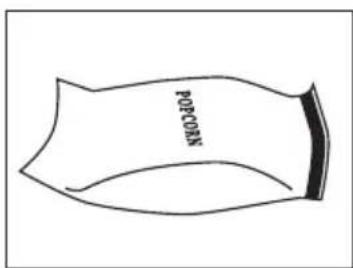
Important Information about Microwave Popcorn Feature:
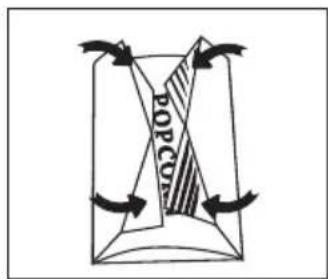
- When selecting 0.1kg of popcorn, it is suggested that you fold down a triangle on each corner of the bag before cooking.
Refer to the picture on the right.
- If/When the popcorn bag expands and no longer rotates properly, please press STOP/CLEAR key once and open the oven door and adjust the bag position to ensure even cooking.
To cook/defrost food in a microwave oven, the microwave energy must be able to pass through the container to penetrate the food. Therefore it is important to choose suitable cookware.
Round/oval dishes are preferable to square/oblong ones, as the food in the corners tends to overcook. A variety of cookware can be used as listed below.
| Cookware Microwave | Safe | Comments |
| Aluminium foilFoil Containers | ✓ / ✗ | Small pieces of aluminium foil can be used to shield food from overheating. Keep foil at least 2cm from the oven walls, as arcing may occur.Foil containers are not recommended unless specified by the manufacturer.Follow instructions carefully. |
| Browning dishes | ✓ | Always follow the manufacturers' instructions.Do not exceed heating time given. Be very careful as these dishes can be very hot. |
| China clay and ceramics | ✓ / ✗ | Porcelain, pottery, glazed earthenware and bone china are usually suitable, except for those with metallic decoration. |
| Glassware | ✓ | Care should be taken if using fi ne glassware as it can break or crack if heated suddenly. |
| Metal | ✕ | It is not recommended to use metal cookware as it will arc, which can lead to fi re. |
| Plastic/Polystyrene e.g fast food containers | ✓ | Care must be taken as some containers warp, melt or discolour at high temperatures. |
| Cling fi Im | ✓ | It should not touch the food and must be pierced to let the steam escape. |
| Freezer/Roasting bags | ✓ | Must be pierced to let steam escape. Ensure bags are suitable for microwave use. |
| Paper - Plates, cups and kitchen paper | ✓ | Do not use plastic or metal ties, as they may melt or catch fi re due to the metal 'arcing'. |
| Straw and wooden Containers | ✓ | Only use for warming or to absorb moisture.Care must be taken as overheating may cause fi re. |
| Recycled paper and newspaper | ✕ | Always attend the oven when using these materials as overheating may cause fi re.May contain extracts of metal which will cause 'arcing' and may lead to fi re. |

WARNING:
When heating food in plastic or paper containers, monitor the oven due to the risk of ignition.
CAUTION: DO NOT USE COMMERCIAL OVEN CLEANERS, STEAM CLEANERS, ABRASIVE, HARSH CLEANERS, ANY THAT CONTAIN SODIUM HYDROXIDE OR SCOURING PADS ON ANY PART OF YOUR MICROWAVE OVEN.
CLEAN THE OVEN AT REGULAR INTERVALS AND REMOVE ANY FOOD DEPOSITS - Keep the oven clean, or the oven could lead to a deterioration of the surface. This could adversely affect the life of the appliance and possibly result in a hazardous situation.
Oven exterior
The outside of your oven can be cleaned easily with mild soap and water. Make sure the soap is wiped off with a moist cloth, and dry the exterior with a soft towel.
Control panel
Open the door before cleaning to de-activate the control panel. Care should be taken in cleaning the control panel. Using a cloth dampened with water only, gently wipe the panel until it becomes clean.
Avoid using excessive amounts of water. Do not use any sort of chemical or abrasive cleaner.
Oven Interior
-
For cleaning, wipe any splatters or spills with a soft damp cloth or sponge after each use while the oven is still warm. For heavier spills, use a mild soap and wipe several times with a damp cloth until all residues are removed. Do not remove the waveguide cover.
-
Make sure that mild soap or water does not penetrate the small vents in the walls which may cause damage to the oven.
- Do not use spray type cleaners on the oven interior. Keep the waveguide cover clean at all times.
The waveguide cover is constructed from a fragile material and should be cleaned with care (follow the cleaning instructions above).
NOTE: Excessive soaking may cause disintegration of the waveguide cover.
The waveguide cover is a consumable part and without regular cleaning, will need to be replaced.
Turntable and Turntable support
Remove the turntable and turntable support from the oven.
Wash the turntable and turntable support in mild soapy water. Dry with a soft cloth. Both the turntable and the turntable support are dishwasher safe.
Door
To remove all trace of dirt, regularly clean both sides of the door, the door seals and adjacent parts with a soft, damp cloth. Do not use abrasive cleaner.
NOTE: A steam cleaner should not be used.
Cleaning tip - For easier cleaning of your oven:
Place half a lemon in a bowl, add 300ml (1/2 pint) water and heat on 100% for 10 - 12 minutes.
Wipe the oven clean using a soft, dry cloth.
Keep the power supply cord away from heated surface. If you think the oven is not working properly there are some simple checks you can carry out yourself before calling an engineer.
Follow this simple check below: Place half a cup of water on the turntable and close the door. Programme the oven to cook for 1 minute using 100% microwave power.
- Does the oven lamp come on when it is cooking?
- Does the turntable rotate?
- Does the cooling fan work? (Check by placing your hand above the air vent openings.)
- After I minute does the audible signal sound?
- Is the water in the cup hot?
- After 3 minutes, does the grill heating element become red?
If you answer "NO" to any question, first check that the oven is plugged in properly and the fuse has not blown. If there is no fault with either, check against the troubleshooting chart below.
WARNING: Never adjust, repair or modify the oven yourself. It is hazardous for anyone other than a SHARP trained engineer to carry out servicing or repairs. This is important as it may involve the removal of covers that provide protection against microwave energy.
- The door seal stops microwave leakage during oven operation, but does not form an airtight seal. It is normal to see drops of water, light or feel warm air around the oven door. Food with a high moisture content will release steam and cause condensation inside the door which may drip from the oven.
- Repairs and Modifications: Do not attempt to operate the oven if it is not working properly.
- Outer Cabinet & Lamp Access: Never remove the outer cabinet. This is very dangerous due to high voltage parts inside which must never be touched, as this could be fatal.
Your oven is not fitted with a lamp access cover. If the lamp fails, do not attempt to replace the lamp yourself, contact your nearest service centre approved by SHARP
TROUBLESHOOTING CHART
| QUERY ANSWER | |
| Draught circulates around the door. | When the oven is working, air circulates within the cavity.The door does not form an airtight seal so air may escape from the door. |
| Condensation forms in the oven, and may drip from the door. | The oven cavity will normally be colder than the food being cooked, and so steam produced when cooking will condense on the colder surface. The amount of steam produced depends on the water content of the food being cooked. Some foods, such as potatoes have a high moisture content. Condensation trapped in the door glass should clear after a few hours. |
| Flashing or arcing from within the cavity when cooking. | Arcing will occur when a metallic object comes into close proximity to the oven cavity during cooking. This may possibly roughen the surface of the cavity, but would not otherwise damage the oven. |
| Arcing potatoes. Ensure all "eyes" are removed from the potatoes and that they have been pierced, place directly onto the turntable or in a heat resistant fl an dish or similar. | |
| The display is lit but the control panel will not work when pressed. | Check the door is closed properly. |
| Oven cooks too slowly. | Ensure correct power level has been selected. |
| Oven makes a noise. | The microwave energy pulses ON and OFF during cooking/defrosting. |
| Outer cabinet is hot. | The cabinet may become hot to touch - keep children away. |
- R-230 Z(W)/ R-3B Z(K)
- W / 900 W
- R-230 Z(W)/ R-303 Z(K) 800 W / 900 W
- Operation manual
- SPECIFICATIONS
- OVEN
- ACCESSORIES:
- NOTES:
- IMPORTANT SAFETY INSTRUCTIONS: READ CAREFULLY AND KEEP FOR FUTURE REFERENCE
- To avoid the risk of fire.
- To avoid the risk of injury
- WARNING:
- To avoid the risk of electric shock
- To avoid the risk of explosion and sudden boiling:
- To avoid the risk of burns
- To avoid misuse by children
- Other warnings
- To ensure trouble-free use of your oven and avoid damage.
- NSTRUCTIONS
- NOTE:
- INSTALLATION
- BEFORE OPERATION
- Opening the door:
- Starting the oven:
- MICROWAVE
- MANUAL COOKING/ MANUAL DEFROSTING
- Example:
- IMPORTANT:
- OTHER CONVENIENT FUNCTIONS
- SEQUENCE COOKING
- AUTO MINUTE FUNCTION
- a. Direct start
- b. Extend the cooking time
- TIMER FUNCTION :
- CHILD LOCK:
- DEFROST AND WEIGHT DEFROST OPERATION
- TIME DEFROST
- Notes for Time Defrost:
- WEIGHT DEFROST
- NOTES FOR WEIGHT DEFROST:
- AUTO
- Important Information about Microwave Popcorn Feature:
- Oven exterior
- Control panel
- Oven Interior
- Turntable and Turntable support
- Door
Brand : SHARP
Model : R-230Z(W)
Category : Microwaves