twenty.22 - Pregnant PMC - Free user manual and instructions
Find the device manual for free twenty.22 PMC in PDF.


User questions about twenty.22 PMC
0 question about this device. Answer the ones you know or ask your own.
Ask a new question about this device
Download the instructions for your Pregnant in PDF format for free! Find your manual twenty.22 - PMC and take your electronic device back in hand. On this page are published all the documents necessary for the use of your device. twenty.22 by PMC.
USER MANUAL twenty.22 PMC
twenty® series user guide
No.
Hand built by
Date
twenty·21
twenty·22
twenty·23
twenty·24
twenty·26
twenty·C
twe
IMPORTANT - Complete your warranty certificate
Warranty Certificate
Please take a few moments to complete the warranty card at the back of this booklet or register at www.pmc-speakers.com (click on 'register a product'). This records the purchase of your loudspeakers and provides you, the customer an opportunity to make suggestions and provide feedback directly to PMC.
Product Support
For product support, accessories or servicing advice, please contact a PMC authorised dealer - See www.pmc-speakers.com.
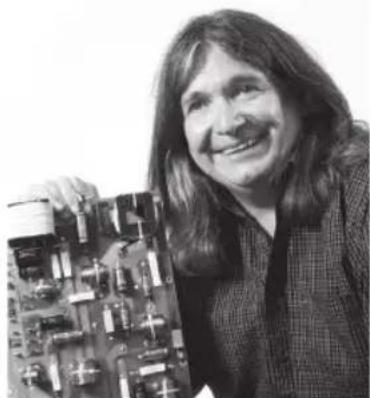
A message from Peter Thomas –
natural_image
Black-and-white photo of a smiling man holding a printed circuit board (no visible text or symbols)PeterThomas
Owner & Chief Designer
Our sole aim while designing loudspeakers is to recreate the true essence of an artist's intention, combining the ultimate level of sonic resolution with solid engineering principles.
We believe that the same loudspeaker can be used throughout the entire audio chain, from composer to studio or film stage, post-production or mastering and then, finally, the consumer. Our unswerving passion for getting it right has made this goal possible.
Thank you for choosing PMC products. It is now time for you to read the user guide, install your new twenty series speakers, and realise just how much you've been missing.

text_image
PPChammsCongratulations - You have joined the elite
PMC: the authority for quality sound.
Prince
Stevie Wonder
elton john
BBC
Tony Bennett
JVC Studios
elbow
SONY
Coldplay
Basement Jaxx
Over two decades PMC has earned an
unrivalled reputation for creating the
world's finest professional loudspeakers.
Simply put, our loudspeakers provide a
reference for the world's highest profile
productions and events. They are found
at every stage of the creative process,
from conception to recording and
broadcast and, of course, in the home.
Our client list reads like a who's who of the
sonically aware, with Prince,
Stevie Wonder, Robbie Williams, Coldplay,
Brian May, Universal, Sony, Dreamworks,
Deutsche Grammophon and the BBC
among the makers of movies and music.
Our loudspeakers were used in the
production of Titanic, Man of Steel, Skyfall,
WALL-E and during broadcasts of both the
Beijing and the London Olympics.
Royal College of Music
Brian May
Kraftwerk
Warner Music
Underworld
Emil Berliner/Deutsche Grammophon
Siemens
twenty® user guide
Contents
7 General usage guidelines
8 PMC's ATL™ - Basically speaking
9 ATL™ - Technically speaking
10 Our meticulous attention to detail
11 Unpacking
12 Resonance absorbing plinth installation guide
13 Compact loudspeaker set up
14 Connections
15 Connecting to an amplifier twenty.21, 23, 24 & C
16 Connecting to an amplifier twenty.26
17 Running in or breaking in
18 Positioning
20 Fine tuning for perfect bass
21 Stereo set up
22 Surround sound specific set up
23 Ideal 5.1 surround sound set up
24 Ideal 7.1 surround sound set up
25 Service
26 Specifications
29 Warranty on-line
30 Warranty certificate - Part 1 - Your copy
31 Warranty certificate - Part 2 - Our copy
32 Help us improve - Your Comments
33 Inspection certificate
General usage guidelines
1 Read these instructions and keep them in a safe place for future reference.
2 Heed all electrical safety warnings, including any on the loudspeakers themselves.
3 Do not use the loudspeakers near water.
4 We have provided a high quality Microfiber cloth for cleaning. This is ideal as the cabinet should only be cleaned with a dry, lint-free, cloth. Do not use solvents, abrasives, waxes or liquids as they may be detrimental to the finish.
5 Floor spikes are sharp and should be treated with great care during installation and use.
6 Do not install near any heat sources such as radiators, ovens or other equipment that produce excessive heat.
7 Unplug this product from both source and power during electrical storms or when unused for extended periods of time.
8 Packing material can pose danger to the young and vulnerable. Ensure these items are kept or disposed of safely.
9 High volume audio signals, however short their duration, have the potential to cause hearing damage. Use care when setting the system volume level to ensure playback sound pressure levels remain within safe comfortable limits.
10 Do not attempt to service the equipment. There are no user serviceable parts inside. Please refer all servicing to PMC authorised personnel.
11 Servicing is required when the apparatus is damaged, exposed to moisture, or exhibits a distinct or sudden change of operation or audio performance.
12 PMC has made efforts to provide accurate installation information and good quality fixings. PMC will not be held responsible or liable for injuries or property damage - direct, indirect or consequential - arising out of use or inability to use this product safely and properly.
13 twenty loudspeakers contain very powerful magnets and therefore may have a detrimental effect if left in close proximity to magnetically sensitive items such as; CRT (tube style) televisions or monitors and media such as floppy discs, cassettes and videotapes.
ATL ^TM
Advanced Transmission Line
Basically speaking
The world's leading professionals rely on the accuracy of PMC's designs everyday to create much of the music and sound you hear. You can rest assured that what you hear from a PMC speaker is identical to the version approved by the artist themselves.
What they offer above a standard HiFi speaker
Detail - They are extremely detailed and sound natural - As if the musicians are with you in the room
Room filling - The sound they produce covers a massive area, so wherever you sit you still hear everything
Full, rich sound at any volume - You can listen at low level and still hear bass - Ideal for low level or late night listening
Reliability - all the components are tried and tested in the professional world
Ease of drive - They are efficient and therefore can be driven by the vast majority of good quality amplifiers

text_image
twenty 24 cross section showing ATL*Ideal for surround - They all have an identical tonal balance and can be mixed and matched to create the ultimate surround sound system
Easy to position - They sound superb in a vast array of rooms, large and small
Feel good - They are made in Britain by hand, by nice people who care, and love audio
Boast - You have joined the long list of world famous music makers and recording studios using PMC's ATL™ technology - See www.pmc-speakers.com and click on key clients
Technically speaking
PMC's ATL™ (Advanced Transmission Line) enclosures have taken loudspeaker design to the highest level.
A PMC transmission line design utilises sophisticated cabinet construction, proprietary drive units and patented absorption materials and techniques.
The benefits are enormous compared to the relatively simple sealed and ported models currently available elsewhere.
The bass driver is placed at one end of a long tunnel (the transmission line), which is heavily damped with absorbent acoustic material. This material is specified to absorb the upper bass and higher frequencies that radiate from the rear of the bass driver. The lowest frequencies, which remain in phase, then emerge from the large vent at the end of the line, which essentially acts as an additional driver. One advantage to this approach is that the air pressure loading the main driver is maintained, thus controlling the driver over a wide frequency range, which in

natural_image
Pure diagram of a maze-like structure with no text, numbers, or symbolstwenty 22 cross section showing ATL™
turn significantly reduces distortion. A spin-off from the lack of distortion is that the upper bass and midrange detail is not masked by harmonic distortion residing in the very low frequencies. The result is PMC's characteristic transparent midrange and fast, attacking bass notes, all reproduced with outstanding clarity.
A further advantage of the transmission line approach is a cabinet that produces a higher volume and greater bass extension than a ported or sealed design of a similar size, even if identical drivers were used.
Moreover, as the loading on the main driver is maintained at all volumes, the frequency response also remains consistent regardless of listening level.
Casual late night listening or analytical studio sessions can be conducted without the need for high volumes to achieve maximum bass response. A characteristic that is especially suited to both the home enthusiast and recording professional alike.
'No other technology provides such a huge, rich room filling sound'
Our meticulous attention to detail
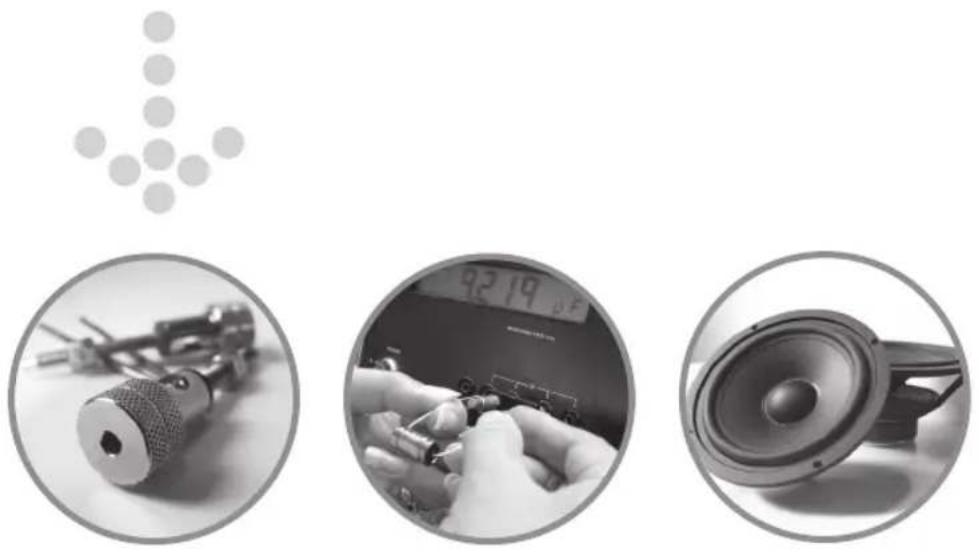
All PMC loudspeakers are hand-built in the U.K. using individual components that are matched to our reference model; this includes the structural integrity of every cabinet and the testing and recording of each component. This guarantees it will be within our strict tolerances and ensures your purchase sounds identical to the original design. Each completed loudspeaker then undergoes a set of objective and subjective measurements - frequency response sweeps ensure that the design meets our exacting performance criteria, and then listening tests are conducted against the reference model using a wide variety of material, from a benchmark BBC speech test to classical music, pop and rock.
natural_image
Three circular images showing mechanical components: a tool, a digital display with time and seconds, and a speaker emitting sound waves (no text or symbols)Unpacking

natural_image
Simple icon of an umbrella inside a gray circle (no text or symbols)
text_image
FRAGILE
natural_image
Gray circular icon with a white upward arrow (no text or symbols)
Please retain your packaging for future use as all PMC cartons are durable, reusable and can be employed to safely transport your loudspeakers should they be relocated or returned for servicing.
Much of the packing is constructed from recyclable materials, so if you are to dispose of it please do so in an environmentally friendly manner.

Packing materials can pose danger to animals, the young and vulnerable. Ensure these items are kept or disposed of safely.
Resonance absorbing plinth installation guide for floorstanding models
Resonance damping plinths and spikes enhance the performance and stability of the floorstanding models in the range. The plinths attach to the base of each speaker using M8 bolts. The twenty series spikes are reversible, with spike or ball tips for use on either carpeted or more sensitive hard flooring.
1 Carefully invert the loudspeaker so that its base is uppermost. Take care not to damage the top of the loudspeaker when it is upside-down, the use of a soft cloth or square of carpet is suggested.
2 Position the plinth on the bottom of the loudspeaker so that its large curved edge is to the rear (same face as 4mm terminals/sockets). Ensure that the corresponding inserts in the base of the cabinet are aligned with the rebated holes in the plinth.
3 Locate the large M8 bolts and tighten them gently using the allen key supplied until the heads of the bolts are flush with the plinth's surface. Once the bolts are flush carefully tighten each bolt by half a turn N.B. Do not over tighten. Over tightening will reduce the effect of the resonance absorbing material
4 Fully thread each spike with one of the supplied lock nuts. The spikes can then be attached to the plinth; they should point upwards whilst the cabinet is inverted.
Caution: the spikes are sharp and should be treated with great care and may damage hard flooring if in direct contact
N.B. You have the option of using the ball tips for use on more sensitive flooring
5 Re-invert the loudspeaker so that the spikes and plinth are at the bottom.
6 Once in position, level the loudspeaker by adjusting each spike in turn.
7 The final step is to tighten each spike's lock nut with the spanner provided; this will ensure that the spike and loudspeaker are as rigid as possible.


Compact loudspeaker set up
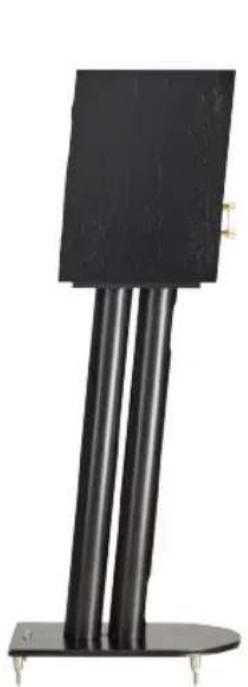
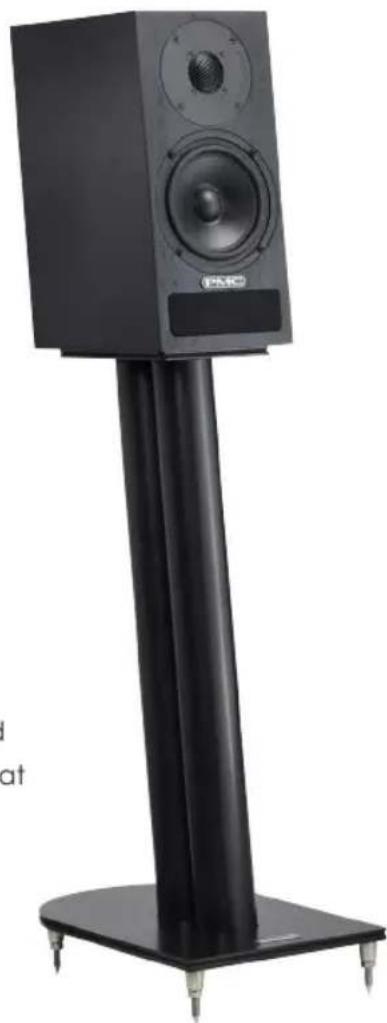
The compact twenty series models are designed to offer exceptional clarity while taking up minimal space, either on stands or within audio/video furniture.
natural_image
Black electronic device with three vertical leads and a flat top, no visible text or symbolsThey will realise their optimum performance when used in conjunction with their dedicated high-mass stand that positions them at the ideal height with stability.
- Unique, damped, 3 layer sandwich construction
• Mass fill-able – sand or shot - Cable management
• Essential to complete the dynamic twenty look
natural_image
Black electronic speaker tower with visible sound waves and a logo, mounted on a stand (no text or symbols on the device itself)H 599mm +25mm spikes W 229mm D 364mm
Connections

Caution
To avoid potential damage, please ensure that your power amplifier(s) or receiver is turned off before connecting or disconnecting your loudspeakers.
Cable & connectors
When selecting cables for use with your twenty series loudspeakers, ensure that their construction is of a high enough standard to withstand the rigors of everyday use and that they are suitably terminated. While bare wire can be accommodated by the twenty series binding posts, we recommend the use of either spade lugs or 4mm 'banana' plugs in order to maintain an electrical connection of the highest integrity and avoid the possibility of short circuits. Please consult your dealer for more information regarding cable lengths and termination options.
Polarity + & -
It is of vital importance to observe the polarity markings and maintain positive-to-positive and negative-to-negative connections from amplifier or receiver to the loudspeaker. The twenty series terminals are colour-coded to aid in their identification, positive terminals are red, negative terminals are black.
Plugging them in
Connecting to an amplifier
twenty:21 twenty:22 twenty:23 twenty:24 twenty:C
Standard / Single wiring connection
This is the most common, using a single cable with two conductors.
Connect using any of the two pairs of RED+/BLACK- terminals. Ensuring the twenty series terminals and gold linking bars are secure and the binding posts are finger tight.
Advanced connection / Bi-wiring & Bi-amping
twenty series models with four binding posts can be bi-wired or bi-amped.
By loosening all four rear binding posts, the gold linking bars can be removed thus enabling separate signals to be fed to the low (Woofer) and high frequency (Tweeter) drivers. Ensure the binding posts are re-tightened after the bridging bars are removed. Both bi-wiring and bi-amping require the use of two lengths of cable per speaker. Bi-amping requires two separate amplifiers; one for each driver.
Please consult your dealer regarding the benefits and the correct procedure.
Terminal identification
Top pair of terminals - HF / High Frequency / Tweeter
Bottom pair of terminals – LF / Bass Frequency / Woofer
Back panel
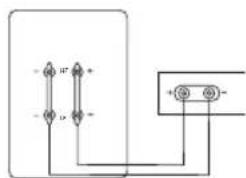
natural_image
Pure electrical circuit lines without any symbolsStandard/single wiring
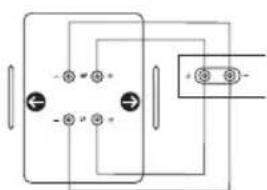
text_image
Electrical circuit diagram with labeled components and connectionsBi-wiring Bi-amp connection
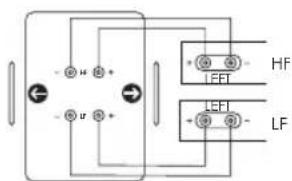
text_image
- u + - v + HF LEF LFConnecting to an amplifier
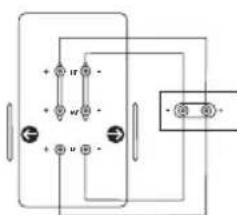
Standard / Single wiring connection
Connect using any of the three pairs of RED+/BLACK- terminals. Ensure the linking bars are secure and the binding posts are finger tight.
Advanced connection / Bi-wiring & Bi-amping
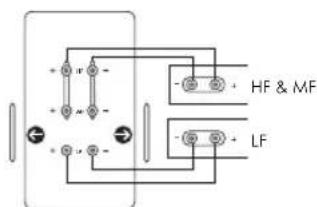
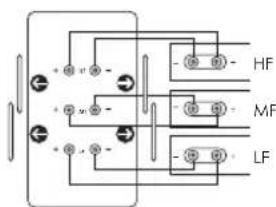
The twenty.26 can also be bi-wired, bi-amped, tri-wired or tri-amplified. By loosening all six rear binding posts, the linking bars can be removed so separate signals can be fed to the LF (Woofer), MF (50mm Dome) and HF (Tweeter) drivers. Ensure the binding posts are re-tightened after the linking bars are removed.
Both bi-wiring and bi-amping use two lengths of cable per speaker, tri-wiring and tri-amping use three lengths per speaker. Bi-amping also uses two separate amplifiers; tri-amping uses three, one for each driver. Please consult your dealer regarding the benefits and the correct procedure.
Terminal identification
Top pair of terminals - HF / High Frequency / Tweeter
Middle pair of terminals - MF / Mid Frequency / 50mm Dome
Bottom pair of terminals - LF / Bass Frequency / Woofer
Back panel
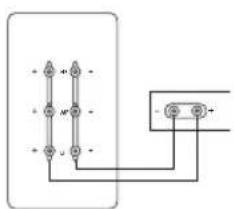
text_image
Electrical wiring diagram showing connections between three-phase power lines with labeled terminals and a terminal blockStandard/single wiring
text_image
Electrical circuit diagram with labeled components and connectionsBi-wiring

text_image
Electrical circuit diagram with labeled components and polarity indicatorsTri-wiring
text_image
+ - + - HF & MF - - LFBi-amp wiring
flowchart
graph TD
    A["Power Source"] --> B["Capacitor"]
    B --> C["Current Source 1"]
    B --> D["Current Source 2"]
    B --> E["Capacitor 3"]
    E --> F["Capacitor 4"]
    E --> G["Capacitor 5"]
    E --> H["Current Source 6"]
    H --> I["Capacitor 7"]
    H --> J["Capacitor 8"]
    H --> K["Current Source 9"]
    K --> L["Capacitor 10"]
    K --> M["Capacitor 11"]
    K --> N["Current Source 12"]
    N --> O["Capacitor 13"]
    N --> P["Capacitor 14"]
    N --> Q["Current Source 15"]
    Q --> R["Capacitor 16"]
    Q --> S["Capacitor 17"]
    Q --> T["Current Source 18"]
    T --> U["Capacitor 19"]
    T --> V["Capacitor 20"]
    U --> W["HF"]
    V --> X["MF"]
    W --> Y["Capacitor 3"]
    X --> Z["Capacitor 4"]
    Y --> AA["Capacitor 5"]
    Z --> AB["Capacitor 6"]
    AA --> AC["Capacitor 7"]
    AB --> AD["Capacitor 8"]
    AC --> AE["Capacitor 9"]
    AD --> AF["Capacitor 10"]
    AE --> AG["Capacitor 11"]
    AF --> AH["Capacitor 12"]
    AG --> AI["Capacitor 13"]
    AH --> AJ["Capacitor 14"]
    AI --> AK["Capacitor 15"]
    AJ --> AL["Capacitor 16"]
    AK --> AM["Capacitor 17"]
    AL --> AN["Capacitor 18"]
    AM --> AO["Capacitor 19"]
    AN --> AP["Capacitor 20"]
Tri-amp wiring
Running in or breaking in

natural_image
Analog clock face showing 10:30 (no text or symbols beyond hour and minute hands)When loudspeakers are new they will take time to reach their full potential. It is often debated whether any solid-state equipment, such as CD players or transistor-based power amplifiers change with use, but the characteristics of mechanical devices such as loudspeakers do alter and improve their performance significantly after a short 'running in' period.
The science is simple; as the soft material surrounding the dome or woofer cone is flexed it will eventually reach a point where it has optimum compliancy allowing the drive unit to move more freely. This translates to greater accuracy and speed of attack in the bass region and the mid and high frequency produces a far more vivid audio picture. This short 'running in' period takes approximately 50 hours of normal use.
50+ hours to run-in
Positioning
With their unique ATL™ Advanced Transmission Line design, wide dispersion, ultra low distortion and smooth bass roll-off, PMC loudspeakers are more forgiving of difficult room conditions and placement constraints than conventional designs - you will be able to achieve a superb sound throughout the room with little effort. We do encourage you to spend some time experimenting in your own room in order to achieve the very best results. Remembering that small changes in location can often influence system performance.
Room shape, size, construction and interior decoration vary immensely and therefore influence sound in different ways. The following guidelines are suggestions for the starting point to locate your new speakers. Fine-tuning of their positioning can start from here.
Positioning
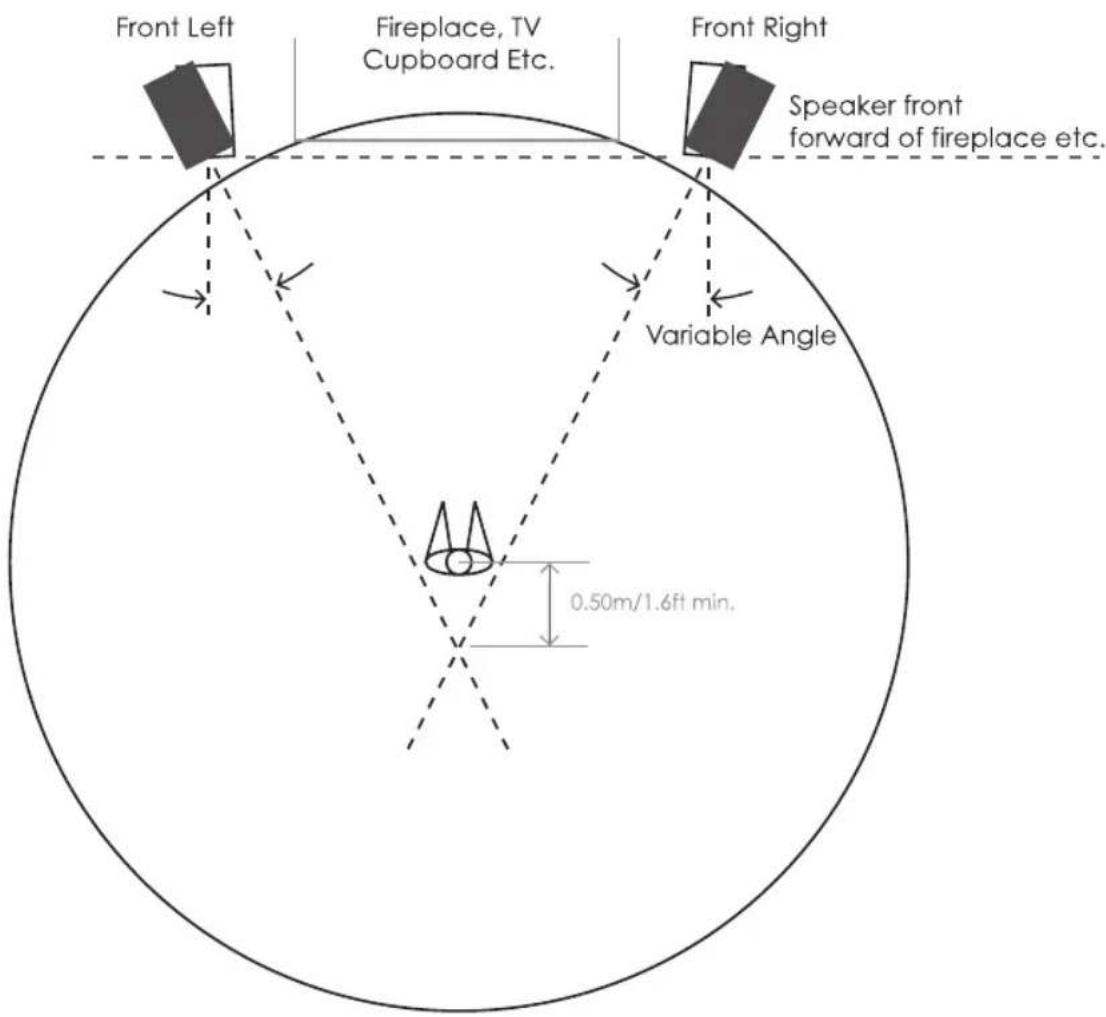
- Place the speaker so the front face is slightly forward of any large object that protrudes into the room - this could be a fireplace, bookcase or television for example.
Tip See stereo set up diagram
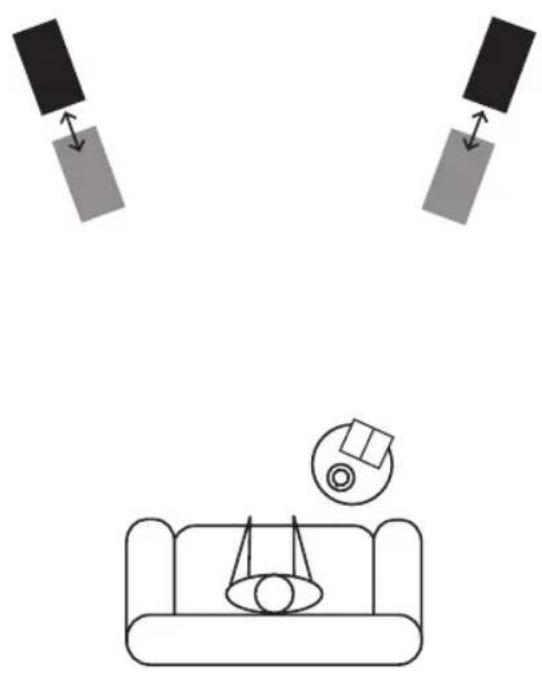
- Ensure that stereo pairs of loudspeakers are equidistant from the listening position.
- It is best to position the front left/right pair (and centre channel loudspeaker if you have a surround system) at the same height, usually at ear-level when seated at the listening position.
Tip If any of the speakers are mounted above or below ear level, then angle the speaker towards the listening position.
- The distance between your left/right speakers and the listening position should ideally create an equilateral triangle. As a general rule, the width of the audio picture will be narrow if the speakers are too close together. If they are too far apart the picture will be wide but there will be less central definition
Tip Use a well recorded vocal track to judge the ideal spot.
- To further enhance the audio picture or soundstage the speakers can be angled/toed-in'. Start with the speakers angled so they will cross approximately 50cm (2ft) behind the listening position. (See stereo set-up diagram) Varying this angle will also subtly affect the vividness of the audio picture, so again experiment.
Tip A simple well recorded band with vivid vocals will help to achieve the best position
Fine tuning for perfect bass
Bass / LF (Low Frequency adjustment)
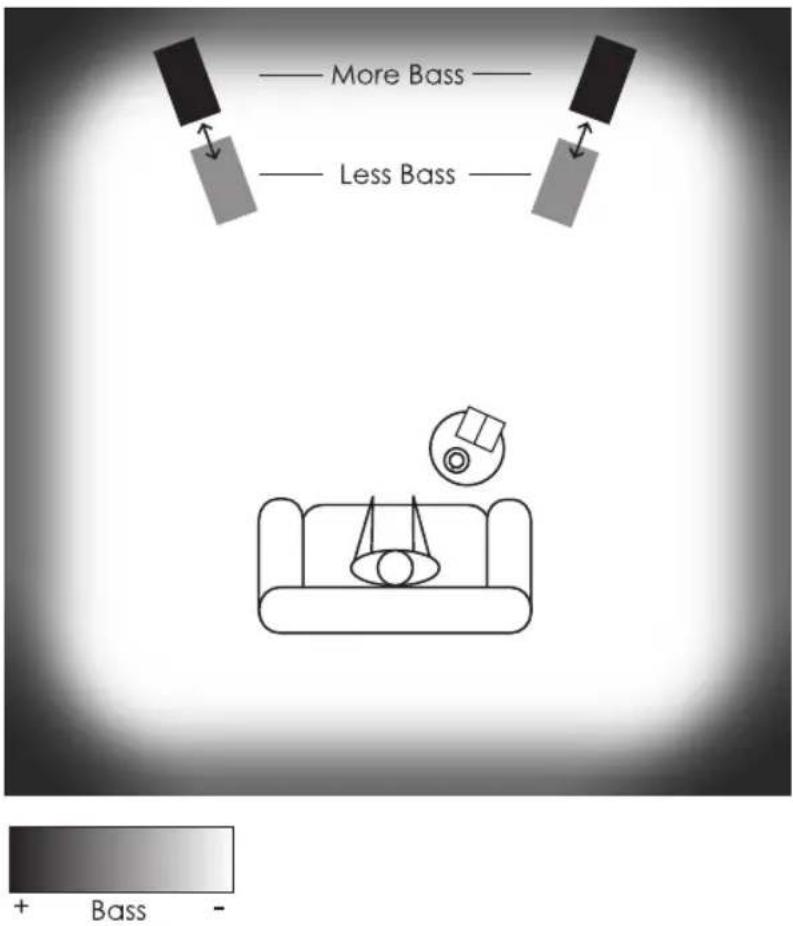
Solid boundaries (i.e. walls, ceilings and floors) reflect sound and help to contain it within a room. They make a speaker sound louder the closer they are to them, especially in the low frequency (bass) region.
This diagram shows the areas, that if a speaker is positioned, will either increase or decrease bass - The darker the shading the more bass will be heard. Placing the speakers in the corners will generate the most bass, and in the centre of the room, the least bass.
Fine tuning for perfect bass
text_image
More Bass Less BassStereo set up
text_image
Front Left Fireplace, TV Cupboard Etc. Front Right Speaker front forward of fireplace etc. Variable Angle 0.50m/1.6ft min.Surround sound specific set up
5.1 Systems
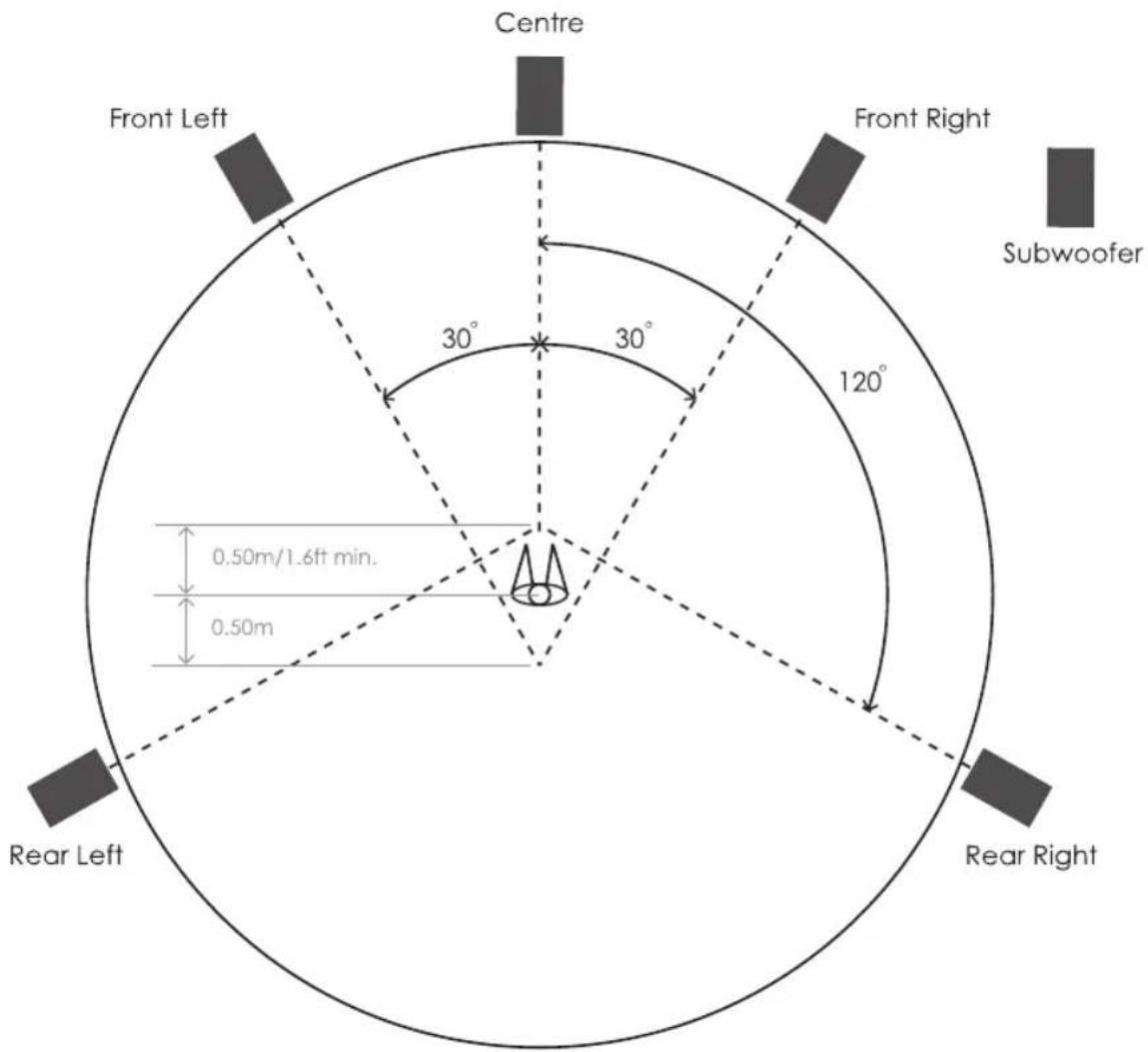
The twenty series has been designed for perfect multi channel music or movie playback and the following diagrams display the ideal layout for the speakers.
Tip
No doubt the constraints of room size and shape will vary the distances from the listener to the speakers. Therefore use of the time alignment function of your surround processor will be important.
Tip
The guidance given in the ‘Stereo set up and ‘Fine tuning for perfect bass’ also apply to the set up of a surround system.
Note
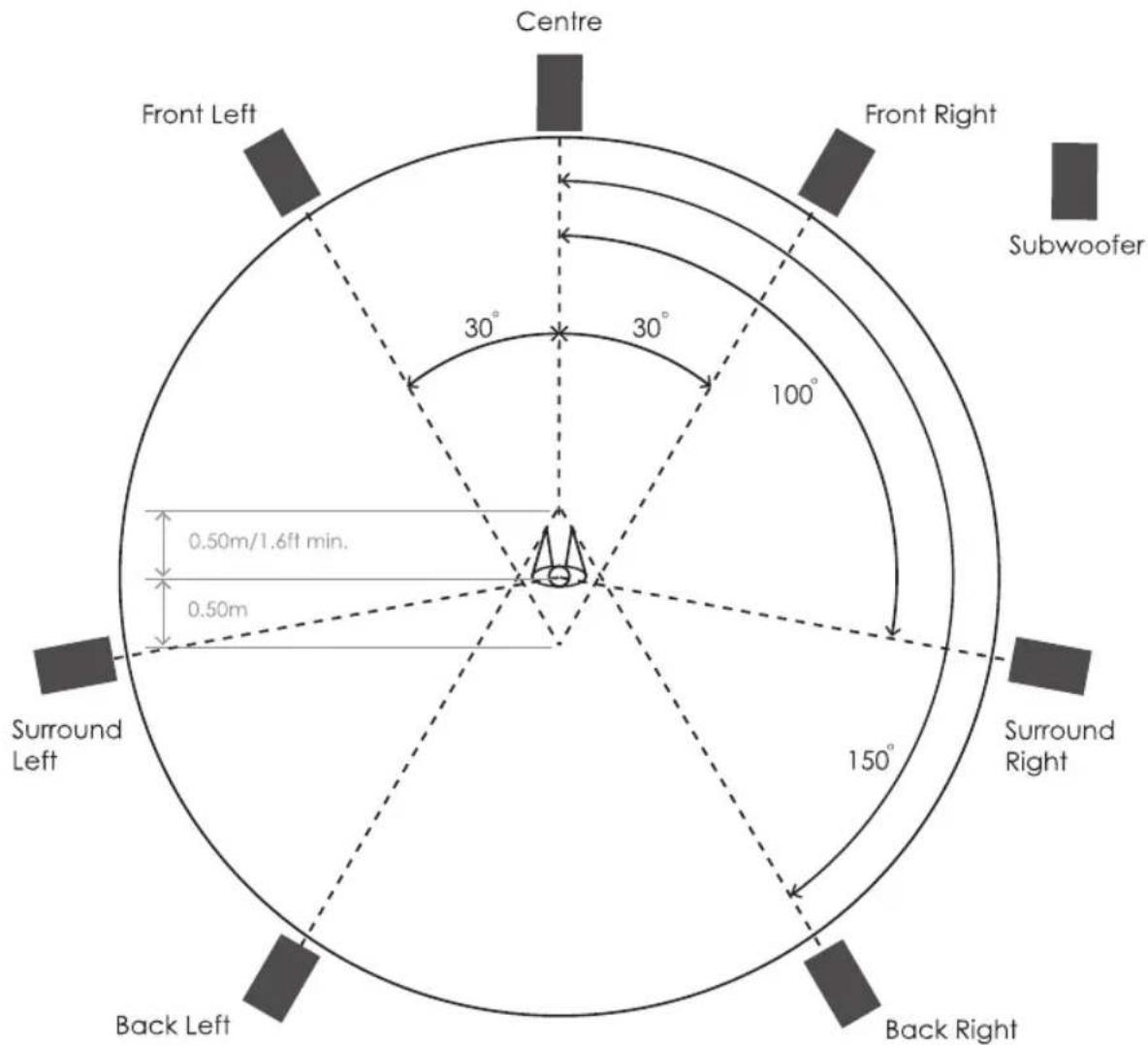
7.1 Systems
In a system capable of full 7.1 Dolby® Digital Surround EX™, DTS® ES™, Blu-ray™ or HD DVD™ playback there will be two sets of surround speakers. The first pair should be positioned at 100° and the second set at 150°. (The centre is considered 0° while directly to the rear of the room is 180°). See Ideal 7.1 surround set up diagram.
Ideal 5.1 surround set up
text_image
Centre Front Left 30° 30° 120° Subwoofer Rear Left 0.50m/1.6ft min. 0.50m Rear RightIdeal 7.1 surround sound set up
text_image
Centre Front Left 30° 30° 100° Subwoofer Surround Left 0.50m/1.6ft min. 0.50m 150° Back Left Back RightService
We are confident your twenty loudspeakers will afford many years of trouble-free listening of the highest order. But in the unlikely event that one or more requires repair, our unique manufacturing procedure, wherein the precise value of each component together with the response of the system as a whole is recorded, will ensure that any replaced parts will exactly match the performance of those originally included within each individual loudspeaker.
For any issues that might arise or for advice and service requirements, the primary point of contact should be your knowledgeable and authorised PMC dealer/distributor.
If you do not have a local representative please see www.pmc-speakers.com and click on 'where to buy'.
Alternatively you can view our FAQ's (Frequently Asked Questions) and servicing section on our website. (Click on the contacts section and select FAQ).
Specifications
twenty:21
Freq response 50Hz - 25kHz
Sensitivity 87dB 1w 1m
Recommended amp power 30 - 150W
Effective ATL ^TM 1.72m (5.6ft)
Impedance 8 Ohm
Drive units LF PMC twenty series, Lightweight doped
5.5"/140mm cone with cast alloy chassis
HF PMC/SEAS®, 27mm twenty series, SONOLEX™
Soft dome, Ferrofluid cooled
Crossover freq 1.8kHz
Input connectors 2 pairs 4mm sockets (Bi-amp or Bi-wire)
Dimensions H 325mm 12.8" x W 152mm 6" x D 277mm 11"
(+ 6mm grille)
Weight 5kg 11 lbs
twenty·22
Freq response 40Hz - 25kHz
Sensitivity 90dB 1w 1m
Recommended amp power 30 - 200W
Effective ATL ^TM 2m (6.5ft)
Impedance 8 Ohm
Drive units LF PMC twenty series, Lightweight doped
6.5"/170mm cone with cast alloy chassis
HF PMC/SEAS®, 27mm twenty series, SONOLEX™
Soft dome, Ferrofluid cooled
Crossover freq 1.8kHz
Input connectors 2 pairs 4mm sockets (Bi-amp or Bi-wire)
Dimensions H 410mm 16.14" x W 184mm 7.25" x D 367mm 14.45"
(+ 6mm grille)
Weight 8kg 17.6 lbs
Specifications
twenty®23
Freq response 29Hz - 25kHz
Sensitivity 87dB 1w 1m
Recommended amp power 30 - 150W
Effective ATL ^TM 2.4m (7.8ft)
Impedance 8 Ohm
Drive units LF PMC twenty series, Lightweight doped 5.5" / 140mm
cone with cast alloy chassis
HF PMC/SEAS®, 27mm twenty series, SONOLEX™ Soft
dome, Ferrofluid cooled
Crossover freq 1.8kHz
Input connectors 2 pairs 4mm sockets (Bi-amp or Bi-wire)
Dimensions H 918mm 36.14" x W 152mm 6.0" x D 330mm 13.0" (+25mm spikes) (+6mm grille)
Weight 13.2kg 29 lbs
twenty:24
Freq response 28Hz – 25kHz
Sensitivity 90dB 1w 1m
Recommended amp power 30 - 200W
Effective ATL ^TM 3.0m (9.8ft)
Impedance 8 Ohm
Drive units LF PMC twenty series, Lightweight doped 6.5" / 170mm
cone with cast alloy chassis
HF PMC/SEAS®, 27mm twenty series, SONOLEX™
Soft dome, Ferrofluid cooled
Crossover freq 1.8kHz
Input connectors 2 pairs 4mm sockets (Bi-amp or Bi-wire)
Dimensions H 1028mm 40.47" x W 184mm 7.24" x D 419mm 16.5" (+25mm spikes) (+6mm grille)
Weight 21kg 46.2 lbs
Specifications
twenty:26
Freq response 27Hz - 25kHz
Sensitivity 86dB 1w 1m
Recommended amp power 50 - 300W
Effective ATL ^TM 3.3m (11ft)
Impedance 8 Ohm
Drive units LF PMC twenty series, Lightweight doped 6.5" / 170mm
cone with cast alloy chassis
MF PMC 50mm twenty series soft dome mid-range
HF PMC/SEAS®, 27mm twenty series, SONOLEX™ Soft
dome, Ferrofluid cooled
Crossover freq 380Hz & 3.8kHz
Input connectors 3 pairs 4mm sockets (Tri-amp or Tri-wire)
Dimensions H 1062mm 41.8" x W 190mm 7.5" x D 439mm 17.3" (+25mm spikes) (+16mm grille)
Weight 22.5kg 49 lbs
twenty°C
Freq response 45Hz – 25kHz
Sensitivity 90dB 1w 1m
Recommended amp power 30 - 200W
Effective ATL ^TM 1.8m (5.9ft)
Impedance 6 Ohm
Drive units LF 2 x PMC twenty series, Lightweight doped 5.5" / 140mm
cone with cast alloy chassis
HF PMC/SEAS®, 27mm twenty series, SONOLEX™
Soft dome, Ferrofluid cooled
Crossover freq 1.8kHz
Input connectors 2 pairs 4mm sockets (Bi-amp or Bi-wire)
Dimensions H 172mm 6.75" x W 520mm 20.5" x D 305mm 12" (+ 6mm grille)
Weight 9.5kg 21 lbs
Warranty on-line
SIMPLY ACTIVATE YOUR 20 YEAR WARRANTY ON-LINE
GO TO WWW.PMC-SPEAKERS.COM AND CLICK ON REGISTER PRODUCT

text_image
PMC® WARRANTY ON-LINEIf you do not have access to the internet fill in the warranty form found on pages 31 & 32 and post it to us.
WARRANTY CERTIFICATE - PART 1
Your Copy to KEEP
Please complete and retain this page for your own records
Product
Serial Nos
Date of purchase
Dealers name
Dealers address
Town
County
Postcode
Dealers Telephone No
Servicing and warranty issues – Please read the following carefully.
Non UK clients
Contact your local dealer/distributor for the details of warranty repairs - see www.pmc-speakers.com and click on 'where to buy' for their details.
UK clients
In the unlikely event of a fault occurring with your The Professional Monitor Company Limited (PMC) product firstly contact your dealer where the product was purchased.
Do not return a product to PMC without firstly contacting our technical dept. If the product must be returned for service you will be issued with a Returns Authorisation number.
If a product is returned to PMC and subsequently is found to have no fault or a non-warranty fault it will be subject to a minimum of £50.00 plus the carriage for its return.
Proof of purchase is required for any claim covered by this warranty.
This product is warranted for a period of 20 years from the date of purchase or upon receipt of 'our copy' overleaf or on-line registration within ten days of purchase or receipt.
The warranty covers defects due to faulty materials or workmanship but does not cover defects arising from accidental damage, misuse or wear and tear. The warranty is void if any attempt has been made by persons not authorised by PMC to dismantle, repair or modify any part of the product.
Products must be returned using original packing material. This warranty does not cover damage in transit.
Note that the cost of the carriage to PMC is not covered by the warranty.
Returned products that are defective that are covered by warranty will be repaired or replaced at the discretion of PMC.
Allow minimum of 14 working days for return of warranty repairs.
This warranty does not effect your consumer rights under statutory law. This warranty is only valid in the United Kingdom.
WARRANTY CERTIFICATE - PART 2
Our Copy
Please complete and return this section - or simply complete the on-line registration at www.pmc-speakers.com and click on register product.
Product
Serial Nos
Date of purchase
Purchased from
Your Name
Your email address
Your address
Town
County
Postcode/Zip code
Help us improve our products see over
Help us Improve
Your Comments
If there is one thing we should change, what would it be?
We value all our client's comments. Please take a moment to help us improve:
Please tell us how your new PMC's perform. Your comments may appear on the customer quotes section for this product on our site. N.B. Don't worry the comments will be anonymous; your personal details will not appear.
What magazines do you read?
HiFi Pro Lifes style Online
HiFi Choice Future Music T3 mixonline.com
What HiFi Sound on Sound Stuff gearslutz.com
Stereophile Audio Media GQ avreview.co.uk
HiFi World Pro Sound News EVO techradar.com
HiFi Critic Resolution FHM HiFi WigWam.com
HiFi News Audiofanzine Shortlist What HiFi.com
HiFi+ IBE Maxim the-ear.net
Gramophone Tape Op Esquire Other
Other Other Other
We hope you enjoy your latest purchase as much as we enjoyed designing and building them - Thank you.
Inspection certificate
Every component that appears in a PMC product is measured, tested, matched and recorded by hand. This analysis also applies to the final product we build to ensure you receive an identical replica of the reference model.
| Crossover matching | |
| Enclosure finish | |
| Assembly & Wiring | |
| Driver Installation | |
| Enclosure seal | |
| Level - Frequency | |
| Impedance - frequency | |
| Pair matching | |
| Listening test 1 | |
| Listening test 2 | |
| Final inspection | |
| Accessory pack | |
| User Guide |

natural_image
Abstract arrangement of gray circles forming a right-pointing arrow shape (no text or symbols)All the above has been carefully checked by the builder of your twenty series loudspeakers detailed on the front of this user guide.
© 2016 PMC. All rights reserved.
This document should not be construed as a commitment on the part of The Professional Monitor Company Limited (PMC). The information it contains is subject to change without notice. PMC assumes no responsibility for errors that may appear within this document. Information subject to change.
'The trade marks TWENTY and twenty are trade marks, and in the United Kingdom, registered trade marks, of The Professional Monitor Company Limited'. This document should not be construed as a commitment on the part of The Professional Monitor Company Limited. The Professional Monitor Company Limited will not assume responsibility for errors that may appear in this document.
CE Conformity PMC passive loudspeakers conform to CE Directive LVD 73/23/EEC and EMC 89/336/EEC.
WEEE European directive - PMC Limited is a member of a National Compliance scheme and have gained the associated certification of compliance and the following registration number from the Environment Agency WEEE/GJ0101WU
WEEE EU Directive
This symbol on the product or in/on its packaging indicates that this product must not be disposed of with other household waste. It is the responsibility of the owner to dispose of waste equipment via a designated collection point for the recycling of waste electrical and electronic equipment. The recycling of your waste equipment is an attempt to conserve natural resources and ensures that it is recycled in a manner that protects human health and the environment. For more information about where you dispose of your waste equipment for recycling, please contact your local waste/recycling authority or the dealer from whom you purchased the product.

nty®
twenty®21 twenty®22 twenty®23 twenty®24 twenty®26 twenty®C