
Baby-G BGD-560-7ER - Watch CASIO - Free user manual and instructions
Find the device manual for free Baby-G BGD-560-7ER CASIO in PDF.


User questions about Baby-G BGD-560-7ER CASIO
0 question about this device. Answer the ones you know or ask your own.
Ask a new question about this device
Download the instructions for your Watch in PDF format for free! Find your manual Baby-G BGD-560-7ER - CASIO and take your electronic device back in hand. On this page are published all the documents necessary for the use of your device. Baby-G BGD-560-7ER by CASIO.
USER MANUAL Baby-G BGD-560-7ER CASIO
Operation Guide 3290
CASIO®
About This Manual
text_image
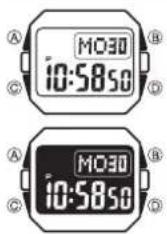
MO30 10:58s0 MO30 10:58s0- All of the displays in this manual show black-on-white. - Button operations are indicated using the letters shown in the illustration.
- Each section of this manual provides you with the information you need to perform operations in each mode. Further details and technical information can be found in the "Reference" section.
E
Contents
General Guide....E-4
Timekeeping....E-6
World Time....E-11
Stopwatch E-13
Countdown Timer....E-15
Alarms E-17
Illumination....E-22
Reference E-24
Specifications....E-27
Procedure Lookup
The following is a handy reference list of all the operational procedures contained in this manual.
To set the time and date ....E-7
To toggle the Timekeeping Mode time between DST and Standard Time .....E-10
To view the time in another city code....E-11
To toggle a city code time between Standard Time
and Daylight Saving Time....E-12
To measure times with the stopwatch....E-14
To use the countdown timer....E-15
To set the countdown start time....E-16
To set an alarm time....E-18
To test the alarm....E-19
To turn an alarm on and off....E-20
To turn the Hourly Time Signal on and off....E-21
E-2
To illuminate the display....E-23
To specify the illumination duration....E-23
To turn the button operation tone on and off....E-24
E-1
E-3
General Guide
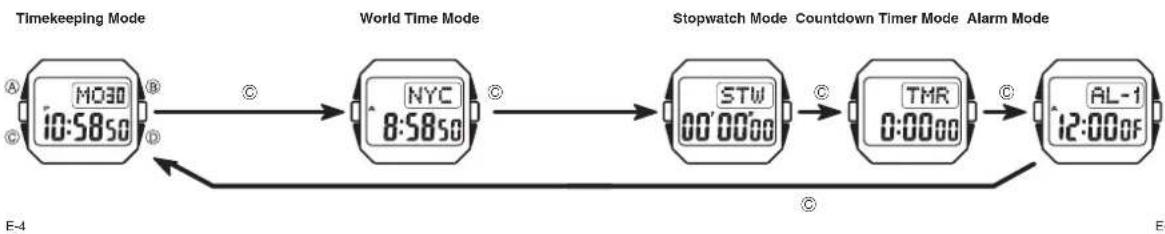
- Press © to change from mode to mode.
- In any mode (except when a setting screen is on the display), press Ⓑ to illuminate the display.
flowchart
graph LR
    A["Timekeeping Mode"] --> B["World Time Mode"]
    B --> C["Stopwatch Mode"]
    C --> D["Countdown Timer Mode"]
    D --> E["Alarm Mode"]
    E --> F["AL-1 12:000F"]
    style A fill:#f9f,stroke:#333
    style B fill:#ccf,stroke:#333
    style C fill:#cfc,stroke:#333
    style D fill:#fcc,stroke:#333
    style E fill:#cff,stroke:#333
    style F fill:#ffc,stroke:#333
Timekeeping
PM indicator
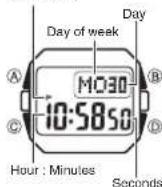
Use the Timekeeping Mode to set and view the current time and date.
Read this before you set the time and date!
The times displayed in the Timekeeping Mode and World Time Mode are linked. Because of this, make sure you select a city code for your Home City (the city where you normally use the watch) before you eat the time and date
• To view the current Home City code setting, press Ⓐ while in the Timekeeping Mode.
- For full information on city codes, see the "City Code Table" at the back of this manual.
To set the time and date
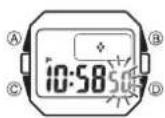
- In the Timekeeping Mode, hold down Ⓐ until the seconds start to flash, which indicates the setting screen.
- Press © to move the flashing in the sequence shown below to select other settings.

flowchart
graph LR
    A["Seconds"] --> B["City Code"]
    B --> C["DST Hour"]
    C --> D["Minutes"]
    D --> E["12/24-Hour Format"]
    F["Day"] --> G["Month Year"]
    G --> H["12/24-Hour Format"]
    I["Clock"] --> J["Day"]
    K["Clock"] --> L["Month Year"]
    M["Clock"] --> N["12/24-Hour Format"]
E-6
E-7
- When the setting you want to change is flashing, use Ⓓ and Ⓑ to change it as described below.
| Screen To do this: Do this: | ||
| 50 | Reset the seconds to 00 | Press 10. |
| TYO | Change the city code | Use 12 (east) and 8 (west). |
| OF | Toggle between Daylight Saving Time (0) and Standard Time (9) | Press 16. |
| 10:58 | Change the hour or minutes | Use 13 (+) and 8 (-). |
| 12 H | Toggle between 12-hour (12) and 24-hour (2) (thekeeping) | Press 16. |
| 20:30 | Change the year, month, or day | Use 13 (+) and 8 (-). |
- See "Daylight Saving Time (DST)" (page E-10) for details about the DST setting.
E-8
-
Press Ⓐ to exit the setting screen.
-
Resetting the seconds now while the current count is in the range of 30 to 59 causes the minutes to be increased by 1. In the range of 00 to 29, the seconds are reset to 00 without changing the minutes.
- With the 12-hour format, the P (PM) indicator appears on the display for times in the range of noon to 11:59 p.m. and the A (AM) indicator appears for times in the range of midnight to 11:59 a.m.
- With the 24-hour format, times are displayed in the range of 0:00 to 23:59, without any indicator.
- The 12-hour/24-hour timekeeping format you select in the Timekeeping Mode is applied in all modes.
• The year can be set in the range of 2000 to 2099. - The watch's built-in full automatic calendar makes allowances for different month lengths and leap years. Once you set the date, there should be no reason to change it except after you have the watch's battery replaced.
- The day of the week is automatically displayed in accordance with the date (year, month, and day) settings.
E-9
Daylight Saving Time (DST)
Daylight Saving Time (summer time) advances the time setting by one hour from Standard Time. Remember that not all countries or even local areas use Daylight Saving Time.
To toggle the Timekeeping Mode time between DST and Standard Time
DST indicator
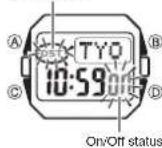
- In the Timekeeping Mode, hold down (A) until the seconds start to flash, which indicates the setting screen.
- Press © twice to display the DST setting screen.
- Press ☑ to toggle between Daylight Saving Time (ON) and Standard Time (OF).
- Press Ⓐ to exit the setting screen.
- The DST indicator is displayed on the Timekeeping Mode and Alarm Mode screen while Daylight Saving Time is turned on.
World Time
City code
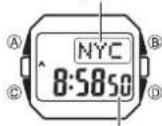
Current time in the zone of the selected city code
World Time shows the current time in 4B cities (29 time zones) around the world.
- All of the operations in this section are performed in the World Time Mode, which you enter by pressing © (page E-4).
To view the time in another city code
In the World Time Mode, press Ⓓ to scroll eastwardly through city codes.
- For full information about city codes, see the "City Code Table" at the back of this manual.
- If the current time shown for a city is wrong, check your Timekeeping Mode time and Home City code settings and make the necessary changes.
E-10
E·11
To toggle a city code time between Standard Time and Daylight Saving Time
DST Indicator
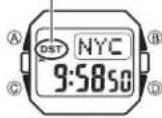
-
In the World Time Mode, use Ⓓ to display the city code (time zone) whose Standard Time/Daylight Saving Time setting you want to change.
-
Hold down Ⓐ for about one second to toggle between Daylight Saving Time (DST indicator displayed) and Standard Time (DST indicator not displayed).
- The DST indicator is on the display whenever you display a city code for which Daylight Saving Time is turned on. - Note that the DST/Standard Time setting affects only the currently displayed city code. Other city codes are not affected.
- In the World Time Mode, you can switch the city code you currently have selected as your Timekeeping Mode Home City between Standard Time and DST. The setting you select in the World Time Mode will also be applied in the Timekeeping Mode.
Stopwatch
Minutes
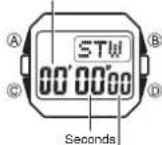
1/100 second
The stopwatch lets you measure elapsed time, split times, and two finishes.
• The display range of the stopwatch is 59 minutes, 59.99 seconds.
- The stopwatch continues to run, restarting from zero after it reaches its limit, until you stop it.
- The stopwatch measurement operation continues even if you exit the Stopwatch Mode.
- Exiting the Stopwatch Mode while a split time is frozen on the display clears the split time and returns to elapsed time measurement.
- All of the operations in this section are performed in the Stopwatch Mode, which you enter by pressing © (page E-5).
E-12
E-13
To measure times with the stopwatch
Elapsed Time

Split Time

Two Finishes

flowchart
graph LR
    A["Start Split"] --> B["A"]
    B --> C["Stop"]
    C --> D["A"]
    D --> E["Split release"]
    E --> F["A"]
    F --> G["Clear"]

    note1["First runner finishes. Display time of first runner."] --> B
    note2["Second runner finishes."] --> C
    note3["Display time of second runner."] --> D
Countdown Timer
Hours
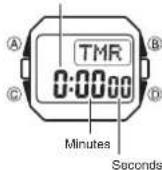
The countdown timer can be set within a range of one minute to 24 hours. An alarm sounds when the countdown reaches zero.
• The countdown operation continues even if you exit the Countdown Timer Mode.
- All of the operations in this section are performed in the Countdown Timer Mode, which you enter by pressing © (page E-5).
To use the countdown timer
Press Ⓓ while in the Countdown Timer Mode to start the countdown timer.
- When the end of the countdown is reached, the alarm sounds for 10 seconds or until you stop it by pressing any button. The countdown time is automatically reset to its starting value after the alarm stops.
E-14
E-15
- Press ① while a countdown operation is in progress to pause it. Press ② again to resume the countdown.
- To completely stop a countdown operation, first pause it (by pressing Ⓓ), and then press Ⓔ. This returns the countdown time to its starting value.
To set the countdown start time
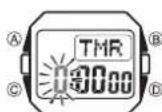
- In the Countdown Timer Mode, hold down Ⓐ until the hours of the countdown start time start to ll ash, which indicates the setting screen.
- Press Ⓐ to move the flashing between the hours and minutes.
- While a setting is flashing, use Ⓓ (+) or Ⓑ (−) to change it.
• To set the starting value of the countdown time to 24 hours, set 0:00. - Press Ⓐ to exit the setting screen.
Alarms
Alarm number
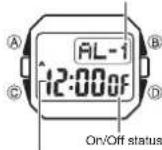
Alarm time (Hour: Minutes)
You can set fi ve independent Daily Alarms. When an alarm is turned on, the alarm tone sounds when the alarm time is reached. One of the alarms is a snooze alarm, while the other four are one-time alarms.
You can turn on an Hourly Time Signal that causes the watch to beep twice every hour on the hour.
- There are six screens in the Alarm Mode. Four are for one-time alarms (indicated by numbers from AL-1 through AL-4), one is for a snooze alarm (indicated by SNZ), and one is for the Hourly Time Signal (indicated by SIG).
- All of the operations in this section are performed in the Alarm Mode, which you enter by pressing © (page E-5).
E-16
E-17
To set an alarm time

- In the Alarm Mode, use Ⓓ to scroll through the alarm screens until the one whose time you want to set is displayed.
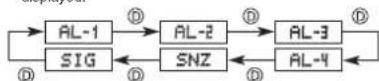
- To set a one-time alarm, display one of the screens indicated by an alarm number from AL-1 through AL-2 set the snooze alarm, display the screen indicated by SNZ.
• The snooze alarm repeats every five minutes.
- After you select an alarm, hold down Ⓐ until the hour setting of the alarm time starts to flash, which indicates the setting screen.
This operation turns on the alarm automatically.
- Press Ⓒ to move the ll ashing between the hour and minute settings.
E-18
- While a setting is flashing, use Ⓓ (+) and Ⓑ (−) to change it.
- When setting the alarm time using the 12-hour format, take care to set the time correctly as a.m. (A indicator) or p.m. (P indicator).
- Press (A) to exit the setting screen.
Alarm Operation
The alarm sounds at the preset time for about 10 seconds, regardless of the mode the watch is in. In the case of the snooze alarm, the alarm operation is performed a total of seven times, every five minutes, or until you turn the alarm off (page E-20).
• To stop the alarm tone after it starts to sound, press any button.
- Performing any one of the following operations during a 5-minute interval between snooze alarms cancels the current snooze alarm operation.
Displaying the Timekeeping Mode setting screen (page E-7)
Displaying the SNZ setting screen (page E-18)
To test the alarm
In the Alarm Mode, hold down Ⓓ to sound the alarm.
E-19
Operation Guide 3290
CASIO®
To turn an alarm on and off
Alarm on indicator
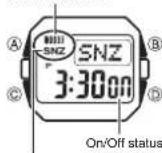
Snooze alarm indicator
-
In the Alarm Mode, use Ⓓ to select an alarm.
-
Press Ⓐ to toggle it on (on displayed) and off
(DF displayed).
- Turning on a one-time alarm through AIL-4
displays the alarm on indicator on its Alarm Mode screen.
• Turning on the snooze alarm() displays the alarm
on indicator and snooze alarm indicator on the Alarm
Mode snooze alarm screen.
• In all modes, the alarm on indicator is shown for any
alarm that is currently turned on.
• The alarm on indicator flashes while the alarm is
sounding.
• The snooze alarm indicator fl ashes during the 5-minute
intervals between alarms.
To turn the Hourly Time Signal on and off
Hourly time signal on
indicator
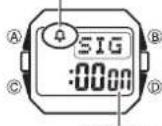
On/Off status
-
In the Alarm Mode, use Ⓓ to select the Hourly Time Signal (SIG).
-
Press (A) to toggle it on (on displayed) and off
(DF displayed).
- The Hourly Time Signal on indicator is shown on the display in all modes while the Hourly Time Signal is turned on.
E-20
E·21
Illumination
This watch has an EL (electro-luminescent) panel that causes the entire display to glow for easy reading in the dark.
Illumination Precautions
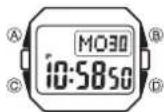
• The electro-luminescent panel that provides illumination loses power after very long use.
- Illumination may be hard to see when viewed under direct sunlight.
- The watch may emit an audible sound whenever the display is illuminated. This is due to vibration of the EL panel used for illumination, and does not indicate malfunction.
- Illumination automatically turns off whenever an alarm sounds.
• Frequent use of illumination runs down the battery.
To illuminate the display
In any mode (except when a setting screen is on the display), press Ⓑ to turn on illumination.
- You can use the procedure below to select either 1.5 seconds or 3 seconds as the illumination duration. When you press (B), the illumination will remain on for about 1.5 seconds or 3 seconds, depending on the current illumination duration setting.
To specify the illumination duration
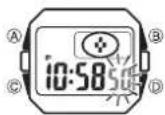
- In the Timekeeping Mode, hold down Ⓐ until the seconds start to flash, which indicates the setting screen.
- While the seconds are II ashing, press Ⓗ to toggle the illumination duration between 1.5 seconds (♦) and 3 seconds (✗).
- Press (A) to exit the setting screen.
E-22
E-23
Reference
This section contains more detailed and technical information about watch operation. It also contains important precautions and notes about the various features and functions of this watch.
Button Operation Tone
Mute Indicator
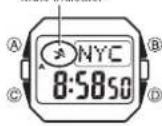
The button operation tone sounds any time you press one of the watch's buttons. You can turn the button operation tone on or off as desired.
- Even if you turn off the button operation tone, the alarm, Hourly Time Signal, and Countdown Timer Mode alarm all operate normally.
To turn the button operation tone on and off
In any mode (except when a setting screen is on the display), hold down Ⓐ to toggle the button operation tone on (A not displayed) and off (displayed).
E-24
- Holding down Ⓗ to turn the button operation tone on or off also causes the watch's current mode to change.
- The mute indicator is displayed in all modes when the button operation tone is turned off.
Auto Return Features
- If you leave the watch in the Alarm Mode for two or three minutes without performing any operation, it automatically changes to the Timekeeping Mode.
- If you leave a screen with flashing digits or a cursor on the display for two or three minutes without performing any operation, the watch automatically saves any settings you have made up to that point and exits the setting screen.
Scrolling
The Ⓑ and Ⓓ buttons are used in various modes and setting screens to scroll through data on the display. In most cases, holding down these buttons during a scroll operation scrolls at high speed.
E-25
Initial Screens
When you enter the World Time or Alarm Mode, the data you were viewing when you last exited the mode appears first.
World Time
- The seconds count of the World Time is synchronized with the seconds count of the Timekeeping Mode.
- All World Time Mode times are calculated from the current Home City time in the Timekeeping Mode using UTC time differential values.
- The UTC differential is a value that indicates the time difference between a reference point in Greenwich, England and the time zone where a city is located.
- The letters "UTC" is the abbreviation for "Coordinated Universal Time", which is the world-wide scientific standard of timekeeping. It is based upon carefully maintained atomic (cesium) clocks that keep time accurately to within microseconds. Leap seconds are added or subtracted as necessary to keep UTC in sync with the Earth's rotation.
E-26
Specifications
Accuracy at normal temperature: ±30 seconds a month
Timekeeping: Hour, minutes, seconds, a.m. (A)/p.m. (P), day, day of the week Time format: 12-hour and 24-hour Calendar system: Full Auto-calendar pre-programmed from the year 2000 to 2099 Other: Home City code (can be assigned one of 48 city codes); Daylight Saving Time (summer time)/Standard Time
World Time: 48 cities (29 time zones)
Other: Daylight Saving Time/Standard Time
Stopwatch
Measuring unit: 1/100 second
Measuring capacity: 59' 59.99'
Measuring modes: Elapsed time, split time, two finishes
Countdown Timer
Measuring unit: 1 second
Input range: 1 minute to 24 hours (1-minute increments and 1-hour increments)
E-27
Alarms: 5 daily alarms (4 one-time alarms: 1 snooze alarm); Hourly Time Signal Illumination: EL Backlight (electro-luminescent panel); Selectable illumination duration
Other: Button operation tone on/off
Battery: One lithium battery (Type: CR1616)
Approximately 3 years on type CR1616 (assuming alarm operation 10 seconds per day, and one illumination operation 1.5 seconds per day)
The above battery life is shortened by illumination as shown below.
- 5 illumination operations (10 seconds) per day: approximately 2.5 years
• 10 illumination operations (20 seconds) per day: approximately 1.7 years
E-28
City Code Table
L-1
Operation Guide 3290
CASIO®
City Code Table
| City Code | City | UTC Offset/GMT Differential | Other major cities In same time zone |
| PPG | Pago Pago | -11 | |
| HNL | Honolulu -10 Parpote | ||
| ANC | Anchorage | -9 | Nome |
| YVR | Vancouver | -8 | Las Vegas, Seattle/Tacoma, Dawson City |
| SFO | San Francisco | ||
| LAX | Los Angeles | ||
| DEN | Denver | -7 | Edmonton, El Paso |
| MEX | Mexico City | -6 | Houston, Dallas/Fort Worth, New Orleans, Winnipeg |
| CHI | Chicago | ||
| MIA | Miami | -5 | Montreal, Detroit, Boston, Panama City, Havana, Lima, Bogota |
| NYC | New York | ||
| CCS^ | Caracas | -4 | La Paz, Santiago, Port Of Spain |
| YYT | St. Johns | -3.5 | |
| RIO | Rio De Janeiro | -3 | Sao Paulo, Buenos Aires, Brasília, Montevideo |
L-2
| City Code | City | UTC Offset/GMT Differential | Other major cities in same time zone |
| RAI | Prala | -1 | |
| LIS | Lisbon | 0 | Dublin, Casablanca, Dakar, Abidjan |
| LON | London | ||
| BCN | Barcelona | +1 | Amsterdam, Algiers, Hamburg, Frankfurt, Vienna, Madrid, Stockholm |
| PAR | Paris | ||
| MIL | Milan | ||
| ROM | Rome | ||
| BER | Berlin | ||
| ATH | Athens | +2 | Helsinki, Beirut, Damascus, Cape Town |
| JNB | Johannesburg | ||
| IST | Isiambul | ||
| CAI | Cairo | ||
| JRS | Jerusalem | ||
| MOW* | Moscow | +3 | Kuwait, Riyadh, Aden, Addis Ababa, Nairobi |
| JED | Jeddan |
L·3
| City Code | City | UTC Offset/ GMT Differential | Other major cities in same time zone |
| THR Tehran +3.5 Shiraz | |||
| DXB | Dubai | +4 | Abu Dhabi, Muscat |
| KBL | Kabul | +4.5 | |
| KHI Karachi | +5 | ||
| MLE | Male | ||
| DEL | Delhi | +5.5 Mumbai, Kolkata, Colombo | |
| DAC Dhaka | +6 | ||
| RGN | Yangon +6.5 | ||
| BKK | Bangkok | +7 | Phnom Penh, Hanoi, Vientiane, Jakarta |
| SIN | Singapore | +8 | Kuala Lumpur, Taipei, Manila, Perth, Ulaanbaatar |
| HKG | Hong Kong | ||
| BJS | Beijing | ||
| SEL | Seoul | +9 | Pyongyang |
| TYO | Tokyo | ||
| ADL | Adelaide | +9.5 Darwin | |
L-4
| City Code | City | UTC Offset/ GMT Differential | Other major cities in same time zone |
| GUM Guam | +10 Melbourne, Rabaul | ||
| SYD Sydney | |||
| NOU Noumea +11 Port Vila | |||
| WLG Wellington +12 Christchurch, Nadi, Nauru Island | |||
This table shows the city codes of this watch
- The rules governing global times (UTC offset and GMT differential) and summer time are determined by each individual country.
* As of June 2013, the official UTC offset for Caracas, Venezuela (CCS) has been changed from -4 to -4.5, but this watch still uses an offset of -4 (the old offset) for CCS.
** As of June 2013, the official UTC offset for Moscow, Russia (MOW) has been changed from +3 to +4, but this watch still uses an offset of +3 (the old offset) for MOW. Because of this, you should leave the summer time setting turned on (which advances the time by one hour) for the MOW time.
L-5