
335i (2014) - Automotive BMW - Free user manual and instructions
Find the device manual for free 335i (2014) BMW in PDF.


| Product Type | Automobile |
| Brand | BMW |
| Model | 335i (2014) |
| Category | Compact Executive Car (Sedan) |
| Engine | 3.0L TwinPower Turbo Inline-6 |
| Horsepower | 300 hp @ 5800 rpm |
| Torque | 300 lb-ft @ 1200 rpm |
| Transmission | 8-speed automatic (Steptronic) or 6-speed manual |
| Drivetrain | Rear-wheel drive (standard) / xDrive all-wheel drive (optional) |
| Fuel Type | Premium unleaded (91 octane or higher) |
| Fuel Tank Capacity | 15.8 gallons (approx.) |
| Length | 182.5 in |
| Width | 71.3 in |
| Height | 56.0 in |
| Curb Weight | Approx. 3,500 lb (manual) – 3,600 lb (automatic) |
| Seating Capacity | 5 |
| Key Features | iDrive with touchpad, voice activation, Integrated Owner's Manual, Comfort Access, Dynamic Stability Control, Active Cruise Control, Park Distance Control, Rearview Camera, Head-Up Display |
| Maintenance | BMW Condition Based Service (CBS); oil change interval up to 10,000 miles or 1 year |
| Safety Systems | Airbags (front, side, knee, head), Dynamic Stability Control, Anti-lock Brakes, Tire Pressure Monitor, Active Blind Spot Detection, Lane Departure Warning, Collision Warning with Braking |
| Tire Pressure (front/rear) | 32 psi / 35 psi (recommended for standard load) |
| Engine Oil Capacity | 6.9 quarts (with filter) |
| Recommended Engine Oil | BMW LL-01 approved 5W-30 or 0W-30 |
| Battery | 12V lead-acid, Absorbent Glass Mat (AGM) type, 90 Ah |
Frequently Asked Questions - 335i (2014) BMW
User questions about 335i (2014) BMW
0 question about this device. Answer the ones you know or ask your own.
Ask a new question about this device
Download the instructions for your Automotive in PDF format for free! Find your manual 335i (2014) - BMW and take your electronic device back in hand. On this page are published all the documents necessary for the use of your device. 335i (2014) by BMW.
USER MANUAL 335i (2014) BMW
text_image
Contents A-Z Owner's Manual for Vehicle BMW The Ultimate Driving Machine M GC 4783THE BMW 3 SERIES SEDAN. OWNER'S MANUAL.
BMW EfficientDynamics
Less emissions. More driving pleasure.
3 Series Owner's Manual for Vehicle
Thank you for choosing a BMW.
The more familiar you are with your vehicle, the better control you will have on the road. We therefore strongly suggest:
Read this Owner's Manual before starting off in your new BMW. Also use the Integrated Owner's Manual in your vehicle. It contains important information on vehicle operation that will help you make full use of the technical features available in your BMW. The manual also contains information designed to enhance operating reliability and road safety, and to contribute to maintaining the value of your BMW.
Any updates made after the editorial deadline for the printed or Integrated Owner's Manual are located in the appendix of the printed quick reference for the vehicle.
Supplementary information can be found in the additional brochures in the onboard literature.
We wish you a safe and enjoyable drive.
BMW AG
Reprinting, including excerpts, only with the written
consent of BMW AG, Munich.
US English II/14, 03 14 490
Printed on environmentally friendly paper, bleached
without chlorine, suitable for recycling.
Contents
The fastest way to find information on a particular topic or item is by using the index, refer to page 232.
6 Notes
At a glance
12 Cockpit
16 iDrive
24 Voice activation system
27 Integrated Owner's Manual in the vehicle
Controls
32 Opening and closing
47 Adjusting
57 Transporting children safely
61 Driving
73 Displays
89 Lamps
94 Safety
114 Driving stability control systems
119 Driving comfort
141 Climate control
148 Interior equipment
156 Storage compartments
Driving tips
162 Things to remember when driving
165 Loading
168 Saving fuel
Mobility
178 Refueling
180 Fuel
185 Wheels and tires
196 Engine compartment
198 Engine oil
201 Coolant
202 Maintenance
204 Replacing components
215 Breakdown assistance
221 Care
Reference
228 Technical data
232 Everything from A to Z
Notes
Using this Owner's Manual
Orientation
The fastest way to find information on a particular topic is by using the index.
An initial overview of the vehicle is provided in the first chapter.
Updates made after the editorial deadline
Any updates made after the editorial deadline for the Owner's Manuals are located in the appendix of the printed quick reference for the vehicle.
User's manual for Navigation, Entertainment, Communication
The topics of Navigation, Entertainment, Communication and the short commands of the voice activation system are described in a separate user's manual, which is also included with the onboard literature.
Additional sources of information
The service center will be happy to answer any other questions you may have.
Information on BMW, e.g., on technology, is available on the Internet: www.bmwusa.com.
Symbols
A Indicates precautions that must be followed precisely in order to avoid the possibility of personal injury and serious damage to the vehicle.
Marks the end of a specific item of information.
"..." Identifies Control Display texts used to select individual functions.
»...« Verbal instructions to use with the voice activation system.
»...« Identifies the answers generated by the voice activation system.
Refers to measures that can be taken to help protect the environment.
Symbols on vehicle components
i Indicates that you should consult the relevant section of this Owner's Manual for information on a particular part or assembly.
Vehicle equipment
This Owner's Manual describes all models and all standard, country-specific and optional equipment that is offered in the model series. Therefore, in this Owner's Manual, equipment is also described and illustrated that is not available in your vehicle, e.g., because of the selected optional equipment or the country-specific variants.
This also applies for safety-related functions and systems.
For any options and equipment not described in this Owner's Handbook, refer to the Supplementary Owner's Handbooks.
On right-hand drive vehicles, some control elements are arranged differently than shown in the illustrations.
Status of the Owner's Manual
Basic information
The manufacturer of your vehicle pursues a policy of constant development that is conceived to ensure that our vehicles continue to embody the highest quality and safety stan-
dards. In rare cases, therefore, the features described in this Owner's Manual may differ from those in your vehicle.
Updates made after the editorial deadline
Any updates made after the editorial deadline for the Owner's Manuals are located in the appendix of the printed quick reference for the vehicle.
For your own safety
Warranty
Your vehicle is technically configured for the operating conditions and registration requirements applying in the country of first delivery - homologation. If your vehicle is to be operated in a different country it might be necessary to adapt your vehicle to potentially differing operating conditions and permit requirements. If your vehicle does not comply with the homologation requirements in a certain country you cannot lodge warranty claims for your vehicle there. Further information can be obtained from your Service Centre.
Maintenance and repairs
Advanced technology, e.g., the use of modern materials and high-performance electronics, requires suitable maintenance and repair methods.
Therefore, have this work performed only by a BMW center or a workshop that works according to BMW repair procedures with appropriately trained personnel.
If this work is not carried out properly, there is the danger of subsequent damage and related safety hazards.
Parts and accessories
BMW recommends using parts and accessories approved by BMW for this purpose.
Your BMW center is the right contact for genuine BMW parts and accessories, other products approved by BMW and related qualified advice.
BMW has tested these products for safety and suitability in relation to BMW vehicles.
BMW can assume responsibility for them.
However, we cannot assume any responsibility whatsoever for parts and accessories that have not been specifically approved by BMW.
BMW cannot evaluate whether each individual product from another manufacturer can be used with BMW vehicles without presenting a safety hazard. This guarantee is also not applicable when country-specific government approval has been granted. Testing of this kind may fail to embrace the entire range of potential operating conditions to which components might be exposed on BMW vehicles. Such products could conceivably fail to comply with BMW's own stringent quality standards.
California Proposition 65 Warning
California laws require us to state the following warning:
Engine exhaust and a wide variety of automobile components and parts, including components found in the interior furnishings in a vehicle, contain or emit chemicals known to the State of California to cause cancer and birth defects and reproductive harm. In addition, certain fluids contained in vehicles and certain products of component wear contain or emit chemicals known to the State of California to cause cancer and birth defects or other reproductive harm. Battery posts, terminals and related accessories contain lead and lead compounds. Wash your hands after handling. Used engine oil contains chemicals that have caused cancer in laboratory animals. Always protect your skin by washing thoroughly with soap and water.
Service and warranty
We recommend that you read this publication thoroughly. Your vehicle is covered by the following warranties:
▶ New Vehicle Limited Warranty.
▶ Rust Perforation Limited Warranty.
▶ Federal Emissions System Defect Warranty.
▶ Federal Emissions Performance Warranty.
▶ California Emission Control System Limited Warranty.
Detailed information about these warranties is listed in the Service and Warranty Information Booklet for US models or in the Warranty and Service Guide Booklet for Canadian models.
Your vehicle has been specifically adapted and designed to meet the particular operating conditions and homologation requirements in your country and continental region in order to deliver the full driving pleasure while the vehicle is operated under those conditions. If you wish to operate your vehicle in another country or region, you may be required to adapt your vehicle to meet different prevailing operating conditions and homologation requirements. You should also be aware of any applicable warranty limitations or exclusions for such country or region. In such case, please contact Customer Relations for further information.
Maintenance
Maintain the vehicle regularly to sustain the road safety, operational reliability and the New Vehicle Limited Warranty.
Specifications for required maintenance measures:
▶ BMW Maintenance system
▶ Service and Warranty Information Booklet for US models
Warranty and Service Guide Booklet for Canadian models
If the vehicle is not maintained according to these specifications, this could result in serious damage to the vehicle. Such damage is not covered by the BMW New Vehicle Limited Warranty.
Data memory
Many electronic components on your vehicle are equipped with data memories that temporarily or permanently store technical information about the condition of the vehicle, events and faults. This technical information generally documents the state of a component, a module, a system or the environment:
▶ Operating states of system components, fill levels for instance.
Status messages for the vehicle and from its individual components, e.g., wheel rotation speed/ vehicle speed, deceleration, transverse acceleration.
Malfunctions and faults in important system components, e.g., lights and brakes.
▶ Responses by the vehicle to special situations, e.g., deployment of an airbag, engagement of stability control systems.
▶ Ambient conditions, such as temperature.
This data is purely technical in nature and is used to detect and correct faults and to optimize vehicle functions. Motion profiles over routes traveled cannot be created from this data. When service offerings are used, e.g., repair services, service processes, warranty claims, quality assurance, this technical information can be read out from the event and fault memories by the service personnel, including the manufacturer, using special diagnostic tools. You can obtain further information there if it is needed. After a fault is corrected, the information in the fault memory is deleted or overwritten on a continuous basis.
When the vehicle is in use, situations are conceivable in which it might be possible to associate this technical data with individuals if it is combined with other information, e.g., an accident report, damage to the vehicle, eye wit-
ness accounts — possibly with the assistance of an expert.
Additional functions that are contractually agreed with the customer, such as vehicle locating in an emergency, enable certain vehicle data to be transmitted from the vehicle.
Event Data Recorder EDR
This vehicle is equipped with an event data recorder EDR. The main purpose of an EDR is to record, in certain crash or near crash-like situations, such as an air bag deployment or hitting a road obstacle, data that will assist in understanding how a vehicle's systems performed. The EDR is designed to record data related to vehicle dynamics and safety systems for a short period of time, typically 30 seconds or less.
The EDR in this vehicle is designed to record such data as:
▶ How various systems in your vehicle were operating.
▶ Whether or not the driver and passenger safety belts were fastened.
▶ How far, if at all, the driver was depressing the accelerator and/or brake pedal.
▶ How fast the vehicle was traveling.
These data can help provide a better understanding of the circumstances in which crashes and injuries occur.
EDR data are recorded by your vehicle only if a nontrivial crash situation occurs; no data are recorded by the EDR under normal driving conditions and no personal data, e.g., name, gender, age, and crash location, are recorded.
However, other parties, such as law enforcement, could combine the EDR data with the type of personally identifying data routinely acquired during a crash investigation.
To read data recorded by an EDR, special equipment is required, and access to the vehicle or the EDR is needed. In addition to the vehicle manufacturer, other parties, such as law enforcement, that have the special equipment, can read the information if they have access to the vehicle or the EDR.
Reporting safety defects
For US customers
The following only applies to vehicles owned and operated in the US.
If you believe that your vehicle has a defect which could cause a crash or could cause injury or death, you should immediately inform the National Highway Traffic Safety Administration NHTSA, in addition to notifying BMW of North America, LLC, P.O. Box 1227, Westwood, New Jersey 07675-1227, Telephone 1-800-831-1117.
If NHTSA receives similar complaints, it may open an investigation, and if it finds that a safety defect exists in a group of vehicles, it may order a recall and remedy campaign.
However, NHTSA cannot become involved in individual problems between you, your dealer, or BMW of North America, LLC.
To contact NHTSA, you may call the Vehicle Safety Hotline toll-free at 1-888-327-4236 (TTY: 1-800-424-9153); go to http://www.safercar.gov; or write to: Administrator, NHTSA, 400 Seventh Street, SW., Washington, DC 20590. You can also obtain other information about motor vehicle safety from http://www.safercar.gov.
For Canadian customers
Canadian customers who wish to report a safety-related defect to Transport Canada, Defect Investigations and Recalls, may telephone the toll-free hotline 1-800-333-0510. You can also obtain other information about motor vehicle safety from http://www.tc.gc.ca/roadsafety.
text_image
Online Edition for Part no. 01 40 2 925 743 - II/14At a glance
These overviews of buttons, switches and displays are intended to familiarize you with your vehicle. You will also become quickly acquainted with the available control concepts and options.
Cockpit
Vehicle equipment
All standard, country-specific and optional equipment that is offered in the model series is described in this chapter. Therefore, equip-
ment is also described that is not available in a vehicle, e. g., because of the selected optional equipment or country variant. This also applies for safety-related functions and systems.
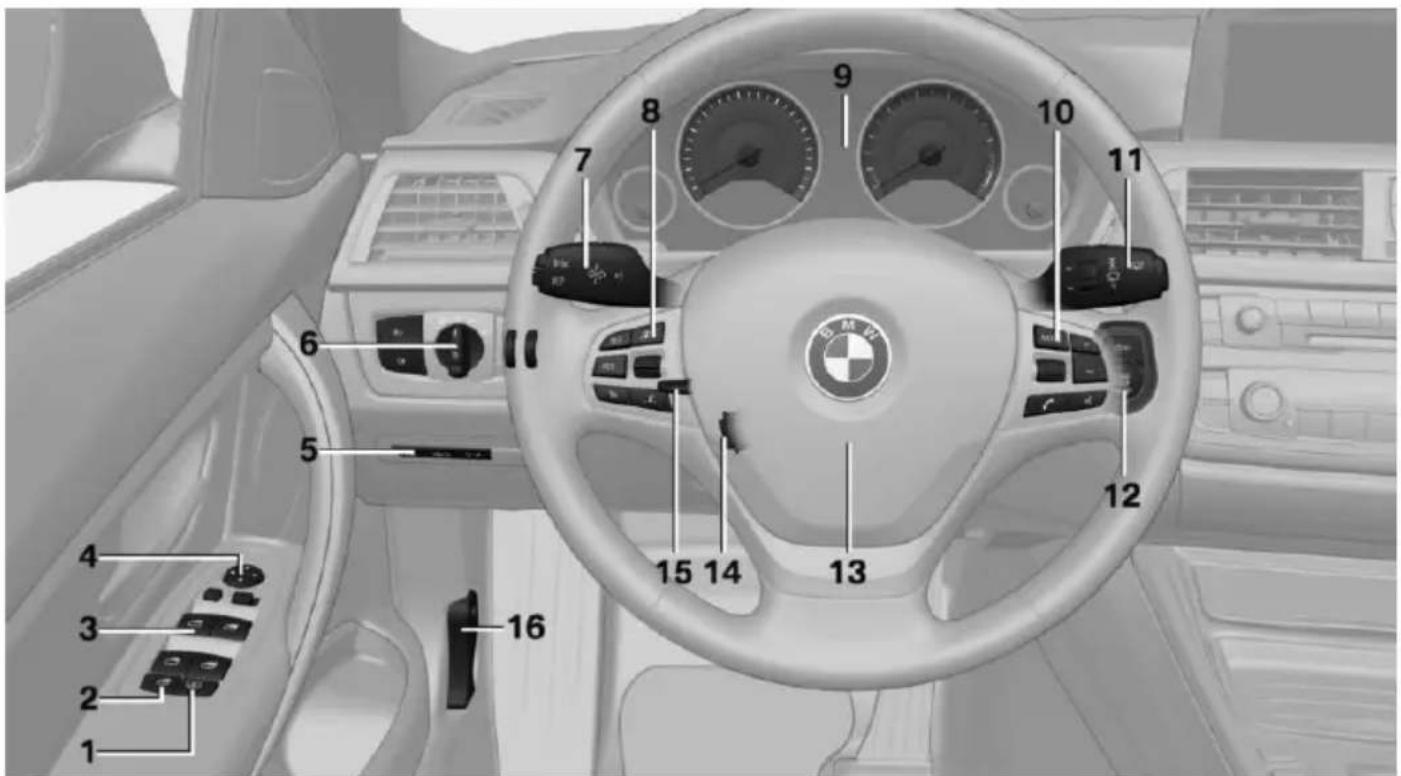
All around the steering wheel
text_image
1 2 3 4 5 6 7 8 9 10 11 12 13 14 15 161 Roller sunblinds 44
2 Rear window safety switch 44
3 Power windows 43
4 Exterior mirror operation 54
5 Glove compartment on the driver's side 156
Driver assistance systems

Active Blind Spot Detection 111

Intelligent Safety 102

Lane departure warning 110
6 Lamps

Front fog lamps 92

Parking lamps 89

Low beams 89

Automatic headlamp control 90
Daytime running lights 90
Adaptive Light Control 90
High-beam Assistant 91

Instrument lighting 92
7 Steering column stalk, left

Turn signal 65

High beams, head-lamp flasher 65

High-beam Assistant 91

Roadside parking lamps 90

Computer 83
8 Steering wheel buttons, left

Store speed 125, 119

Resume speed 127, 119

Cruise control on/off, interrupting 126

Active Cruise Control on/off, interrupting 119

Reduce distance 122

Increase distance 122
Cruise control rocker switch 127, 121
9 Instrument cluster 73
10 Steering wheel buttons, right

Entertainment source

Volume

Voice activation 24

Telephone, see user's manual for Navigation, Entertainment and Communication
Thumbwheel for selection lists 83
11 Steering column stalk, right

Windshield wipers 66

Rain sensor 67

Clean the windshields and head-lamps 68
12 START STOP the engine and switch the ignition on/off 62

Auto Start/Stop function 63
13 Horn
14 Steering wheel heating 56

15 Adjust steering wheel 56
16 Unlock hood 197
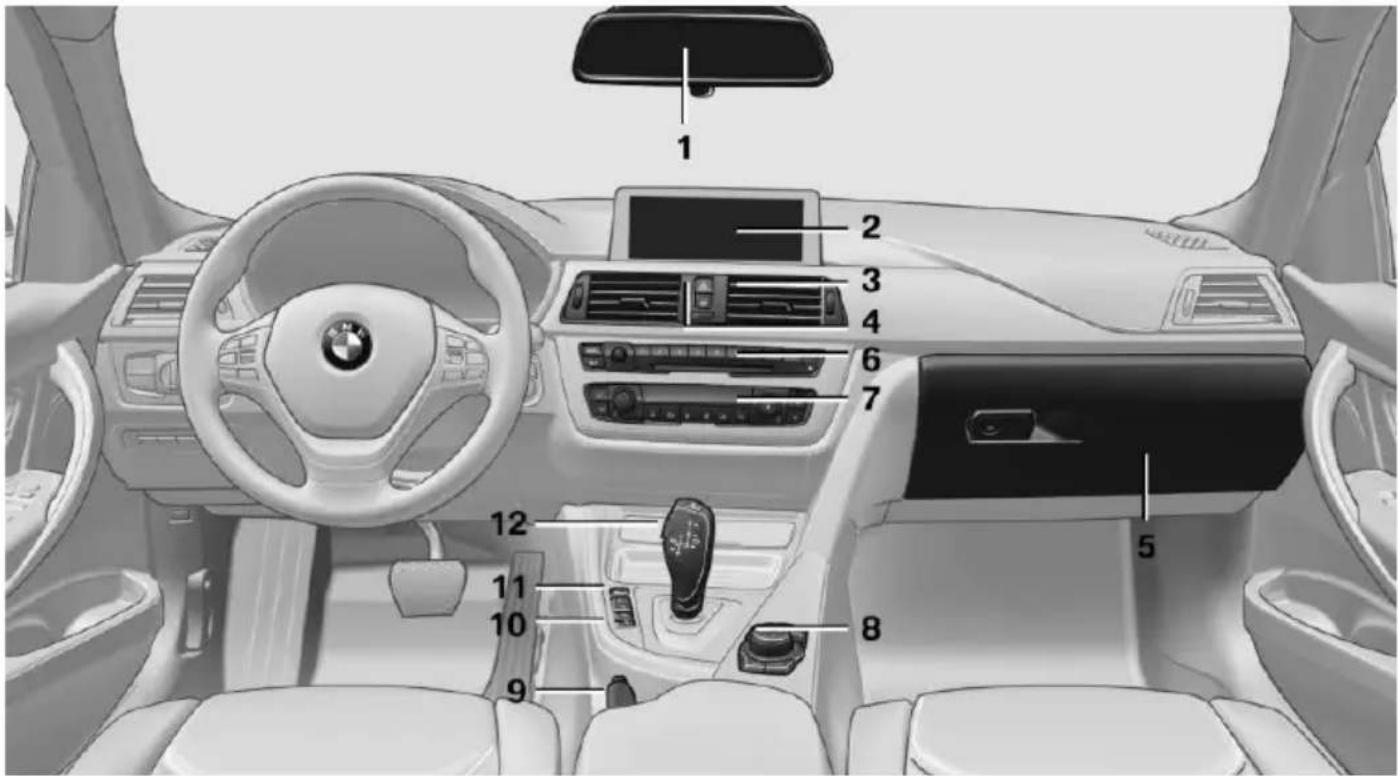
All around the center console
text_image
Interior view of a BMW car with numbered component labels pointing to key areas such as dashboard, air intake, and steering wheel.1 Headliner 15
2 Control Display 16
3 Ventilation 146
4 Hazard warning system 215


Central locking system 37
5 Glove compartment 156
6 Radio/CD/Multimedia, see user's manual for Navigation, Entertainment and Communication
7 Climate control 141
8 Controller with buttons 16
9 Parking brake 65
10 PDG Park Distance Control 128

Rearview camera 130
Parking assistant 136
Surround View 130
11 Driving Dynamics Control 116


DSC Dynamic Stability Control 114
12 Automatic transmission selector lever 69
Manual transmission selector lever 69
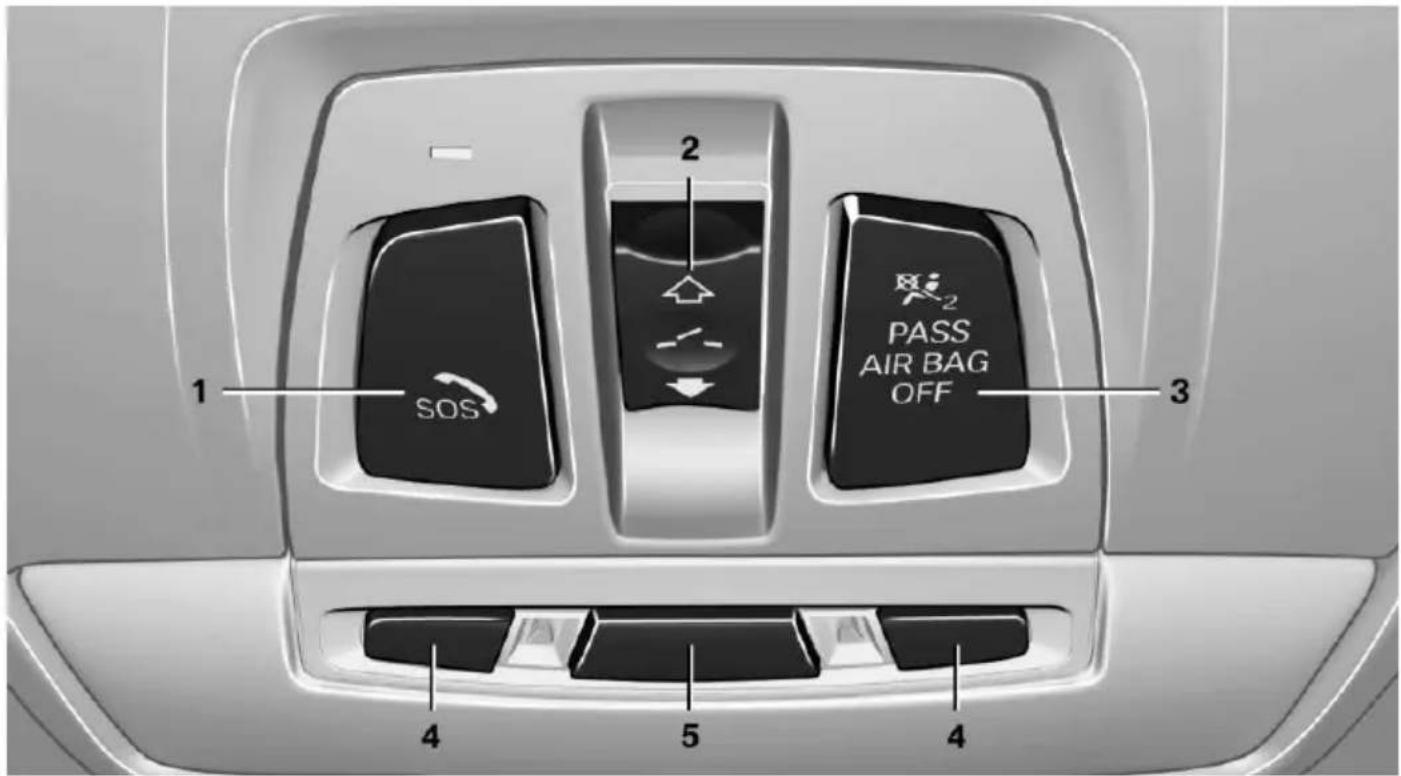
All around the headliner
text_image
1 SOS 2 PASS AIR BAG OFF 3 4 5 41 Intelligent Emergency Request 215
4 Reading lamps 92
2 Glass sunroof, powered 45
5 Interior lamps 92
3 Indicator lamp, front passenger RASS AIR BAG DIFF airbag 96
iDrive
Vehicle equipment
All standard, country-specific and optional equipment that is offered in the model series is described in this chapter. Therefore, equipment is also described that is not available in a vehicle, e.g., because of the selected optional equipment or country variant. This also applies for safety-related functions and systems.
The concept
The iDrive combines the functions of a multitude of switches. Thus, these functions can be operated from a central location.

Using the iDrive during a trip
To avoid becoming distracted and posing an unnecessary hazard to your vehicle's occupants and to other road users, never attempt to use the controls or enter information unless traffic and road conditions allow this.
Controls at a glance
Control elements
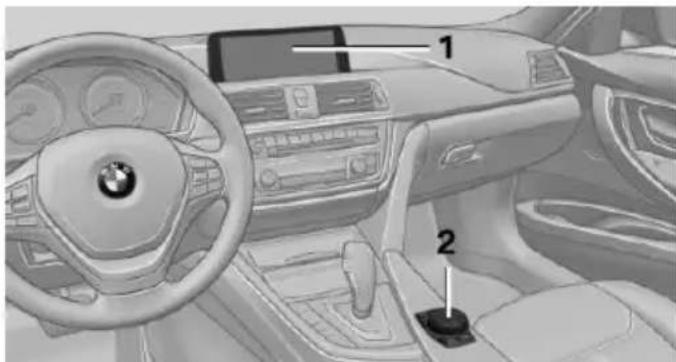
natural_image
Interior view of a BMW car dashboard and steering wheel (no visible text or symbols)1 Control Display
2 Controller with buttons and, depending on the equipment version, with touchpad
Control Display
Hints
To clean the Control Display, follow the care instructions.
Do not place objects close to the Control Display; otherwise, the Control Display can be damaged.
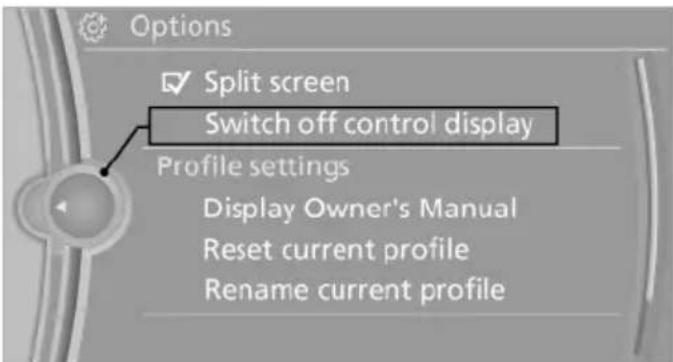
Switching off

Press the button.
- "Switch off control display"
text_image
Options Split screen Switch off control display Profile settings Display Owner's Manual Reset current profile Rename current profileSwitching on
Press the controller again to switch the screen back on.
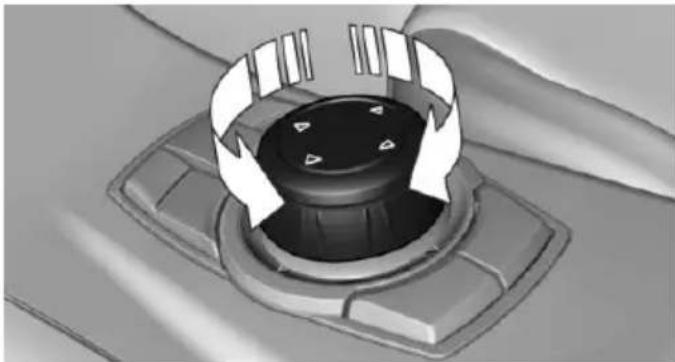
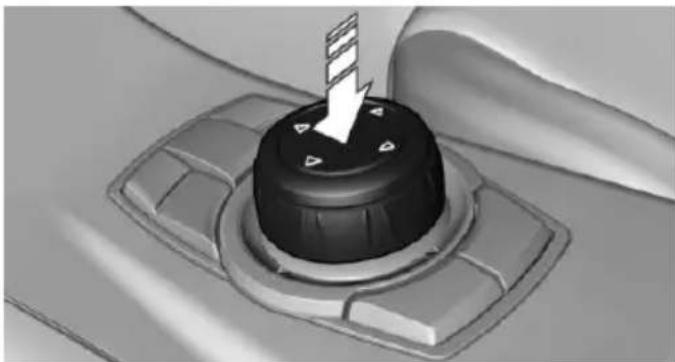
Controller with navigation system
The buttons can be used to open the menus directly. The controller can be used to select menu items and create the settings.
Some iDrive functions can be operated using the touchpad on the controller.
- Turn.
natural_image
Close-up of a car dashboard with directional arrows indicating rotation or movement (no text or symbols)- Press.
natural_image
Close-up of a black mechanical knob with a white arrow pointing to it, mounted on a control panel (no text or symbols visible)- Move in four directions.
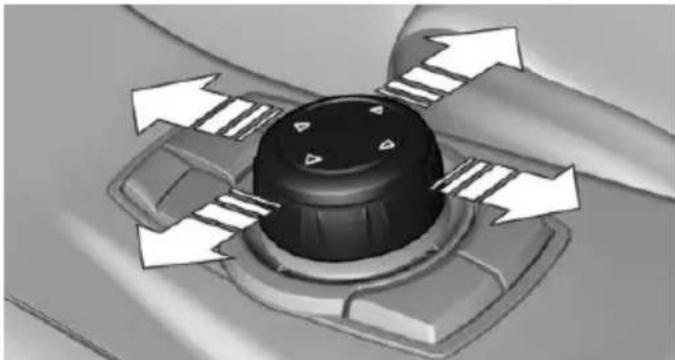
natural_image
Close-up of a black rotary knob with directional arrows indicating rotation or movement (no text or symbols)Buttons on controller
Press the button Function
MENU Open the main menu.
RADIO Opens the Radio menu.
MEDIA Opens the CD/Multimedia menu.
NAV Opens the Navigation menu.
Press the but- Function ton
TEL Opens the Telephone menu.
BACK Displays the previous panel.
OPTION Opens the Options menu.
Controller without navigation system
The buttons can be used to open the menus directly. The controller can be used to select menu items and create the settings.
- Turn.
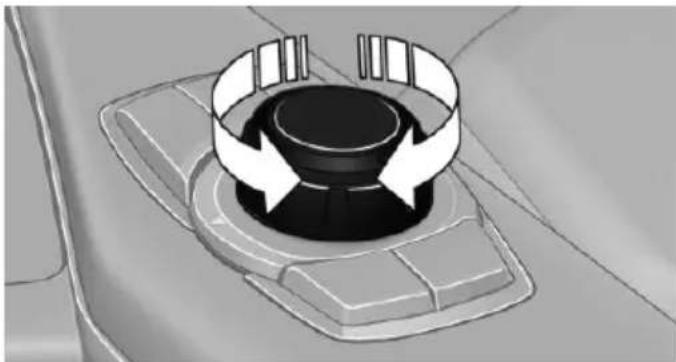
natural_image
Close-up of a car's head panel with a black knob and three white arrows indicating rotation or movement (no text or symbols)- Press.
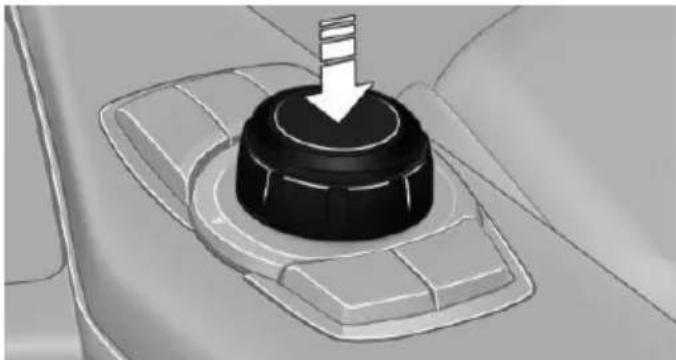
natural_image
Close-up of a car's internal gear shift knob with a white arrow pointing to the knob (no text or symbols visible)- Move in two directions.
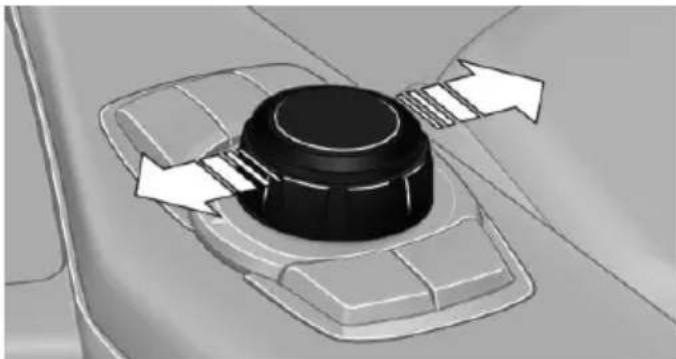
natural_image
Mechanical component diagram showing a black knob with directional arrows indicating motion or movement (no text or symbols)Buttons on controller
Press the but- Function ton
MENU Open the main menu.
Audio Open audio menu last listened to, switch between audio menus.
TEL Opens the Telephone menu.
BACK Open previous panel.
OPTION Opens the Options menu.
Operating concept
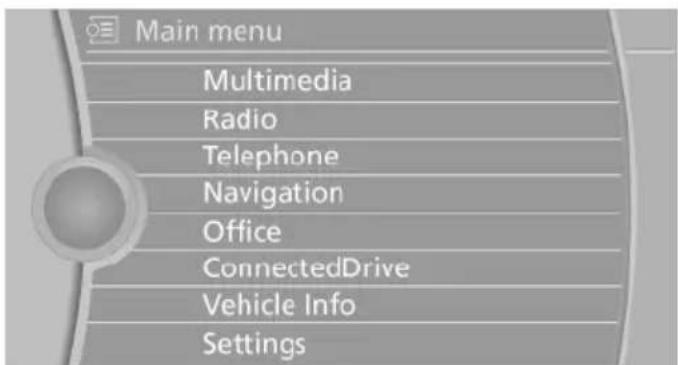
Opening the main menu

Press the button.
text_image
Main menu Multimedia Radio Telephone Navigation Office ConnectedDrive Vehicle Info SettingsThe main menu is displayed.
All iDrive functions can be called up via the main menu.
Selecting menu items
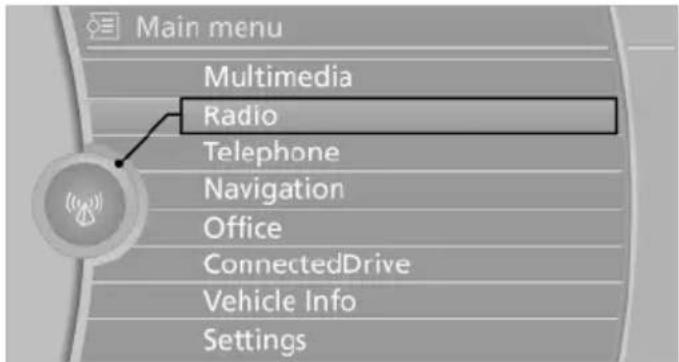
Highlighted menu items can be selected.
- Turn the controller until the desired menu item is highlighted.
text_image
Main menu Multimedia Radio Telephone Navigation Office ConnectedDrive Vehicle Info Settings- Press the controller.
Menu items in the Owner's Manual
In the Owner's Manual, menu items that can be selected are set in quotation marks, e.g., "Settings".
Changing between panels
After a menu item is selected, e.g., "Radio", a new panel is displayed. Panels can overlap.
▶ Move the controller to the left.
The current panel is closed and the previous panel is displayed.
The previous panel is opened again by pressing the BACK button. In this case, the current panel is not closed.
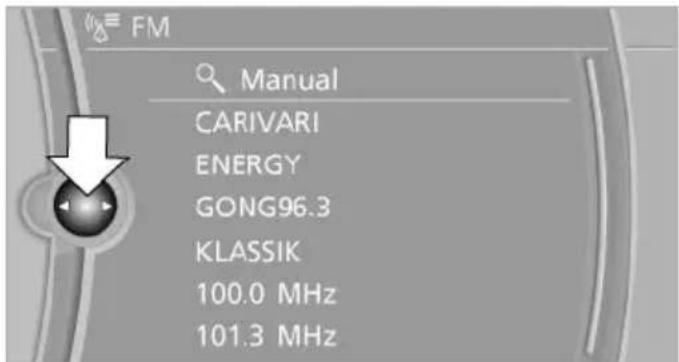
▶ Move the controller to the right.
A new panel is opened on top of the previous display.
text_image
FM Manual CARIVARI ENERGY GONG96.3 KLASSIK 100.0 MHz 101.3 MHzWhite arrows pointing to the left or right indicate that additional panels can be opened.
View of an opened menu
When a menu is opened, it generally opens with the panel that was last selected in that menu. To display the first panel of a menu:
▶ Move the controller to the left repeatedly until the first panel is displayed.
▶ Press the menu button on the controller twice.
Opening the Options menu

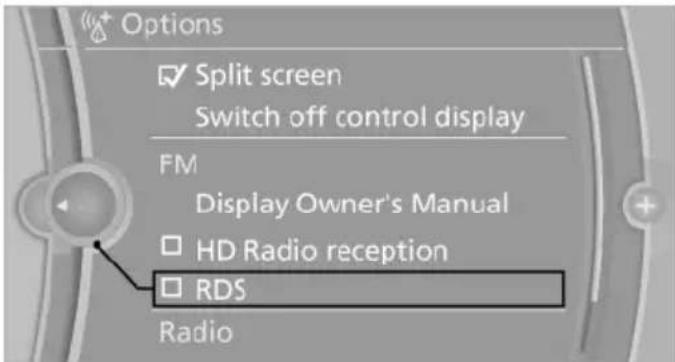
Press the button.
The "Options" menu is displayed.
text_image
Options Split screen Switch off control display FM Display Owner's Manual HD Radio reception RDS RadioAdditional options: move the controller to the right repeatedly until the "Options" menu is displayed.
Options menu
The "Options" menu consists of various areas:
▶ Screen settings, e.g., "Split screen".
This area remains unchanged.
▶ Control options for the selected main menu, e.g., for "Radio".
▶ If applicable, further operating options for the selected menu, e.g., "Store station".
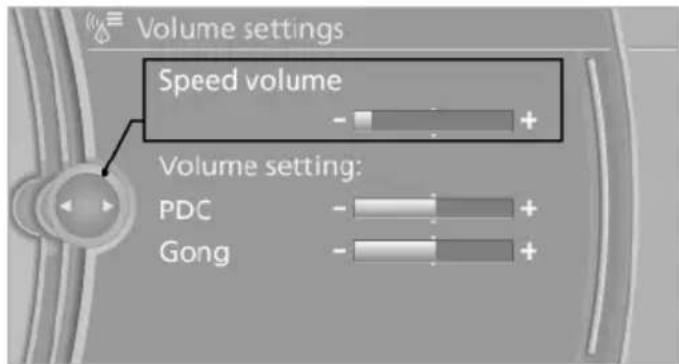
Changing settings
-
Select a field.
-
Turn the controller until the desired setting is displayed.
text_image
Volume settings Speed volume Volume setting: PDC Gong- Press the controller.
Activating/deactivating the functions
Several menu items are preceded by a checkbox. It indicates whether the function is activated or deactivated. Selecting the menu item activates or deactivates the function.
The function is activated.
☐ The function is deactivated.
Touchpad
Some iDrive functions can be operated using the touchpad on the controller:
Selecting functions
- "Settings"
- "Touchpad"
- Select the desired function.
▶ "Speller": enter letters and numbers.
▶ "Interactive map": operating the interactive map.
▶ "Browser": enter Internet addresses.
▶ "Audio feedback": the entered letters and numbers are announced.
Entering letters and numbers
The entry of the letters requires some practice at the beginning. In the entry, pay attention to the following:
For the input of upper/lower case letters and numbers, it may be necessary to switch via the controller to the corresponding Input mode, refer to page 23, e.g. when the spelling of upper and lower case letters is identical.
▶ Enter characters as they are displayed on the Control Display.
▶ Always enter accompanying signs, such as accents or periods so that the letter can be clearly recognized. The possibility of input depends on the set language. Where necessary, enter special characters via the controller.
To delete a character, slide to the left on the touchpad.
To enter a blank space, slide to the right in the center of the touchpad.
To enter a hyphen, slide to the right in the upper area of the touchpad.
To enter an underscore, slide to the right in the lower area of the touchpad.
Using interactive map and Internet
The interactive map in the navigation system and Internet sites can be moved via the touch-pad.
Function Controls
| Move interactive map or Internet sites. | Slide in the corresponding direction. |
| Enlarge/shrink interactive map or Internet sites. | Drag inwards or outwards on the touchpad with the fingers. |
| Display the menu or open a link in the Internet. | Tap once. |
Changing settings
Settings on the control display, such as the volume, can be made via the touchpad. To do this slide to the left or right accordingly.
Example: setting the clock
Setting the clock

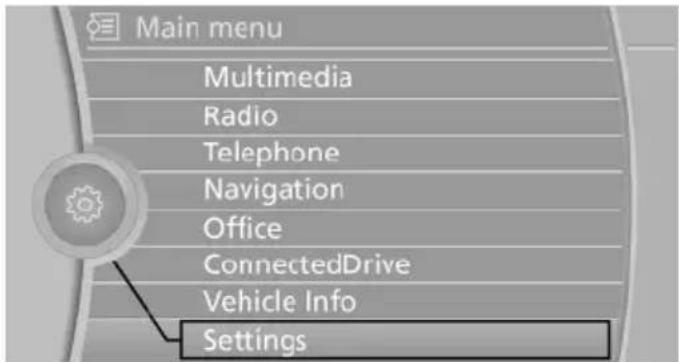
Press the button. The main menu is ayed.
- Turn the controller until "Settings" is highlighted, and then press the controller.
text_image
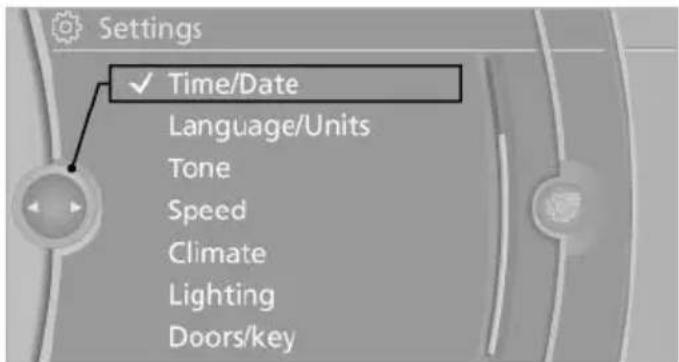
Main menu Multimedia Radio Telephone Navigation Office ConnectedDrive Vehicle Info Settings- If necessary, move the controller to the left to display "Time/Date".
- Turn the controller until "Time/Date" is highlighted, and then press the controller.
text_image
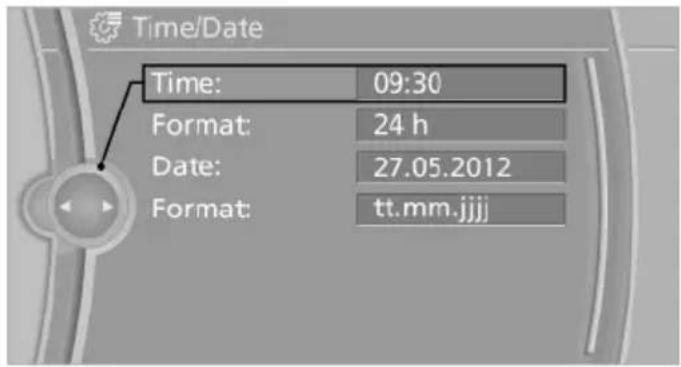
Settings ✓ Time/Date Language/Units Tone Speed Climate Lighting Doors/key- Turn the controller until "Time:" is highlighted, and then press the controller.
text_image
Time/Date Time: 09:30 Format: 24 h Date: 27.05.2012 Format: tt.mm.jjjj- Turn the controller to set the hours and press the controller.
- Turn the controller to set the minutes and press the controller.
Status information
Status field
The following information is displayed in the status field at the top right:
Time.
▶ Current entertainment source.
▶ Sound output, on/off.
▶ Wireless network reception strength.
▶ Telephone status.
▶ Traffic bulletin reception.
Status field symbols
The symbols are grouped as follows.
Radio symbols
Symbol Meaning
HD HD radio station is being received.
Satellite radio is switched on.
Telephone symbols
Symbol Meaning
Incoming or outgoing call.
Missed call.
Wireless network reception strength. Symbol flashes: network search.
Wireless network is not available.
Bluetooth is switched on.
▲ Roaming is active.
Text message was received.
Check the SIM card.
SIM card is blocked.
SIM card is missing.
Enter the PIN.
Entertainment symbols
Symbol Meaning
CD/DVD player.
Music collection.
gracenote Gracenote® database.
AUX-IN port.
USB audio interface.
Mobile phone audio interface.
Additional symbols
Symbol Meaning
Spoken instructions are switched off.
Split screen
General information
Additional information can be displayed on the right side of the split screen, e.g., information from the onboard computer.
In the divided screen view, the so-called split screen, this information remains visible even when you change to another menu.
Switching the split screen on and off

Press the button.
- "Split screen"
Selecting the display

s the button.
- "Split screen"
- Move the controller until the split screen is selected.
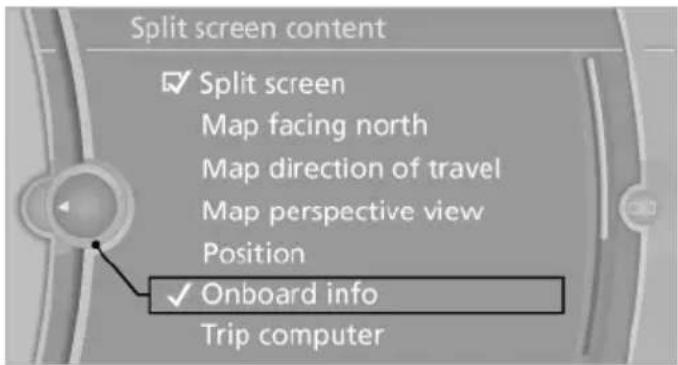
- Press the controller or select "Split screen content".
- Select the desired menu item.
text_image
Split screen content ✓ Split screen Map facing north Map direction of travel Map perspective view Position ✓ Onboard info Trip computerProgrammable memory buttons
General information
The iDrive functions can be stored on the programmable memory buttons and called up directly, e.g., radio stations, navigation destina-
tions, phone numbers and entry points into the menu.
The settings are stored for the remote control currently in use.
Without navigation system and telephone
Only radio stations can be stored on the buttons, refer to user's manual for Navigation, Entertainment, Communication.
Saving a function
- Highlight the function via the iDrive.
- 1...8 Press the desired button for more than 2 seconds.
Running a function
Press the button.
The function will run immediately. This means, for example, that the number is dialed when a phone number is selected.
Displaying the button assignment
Use a finger to touch the buttons. Do not wear gloves or use objects.
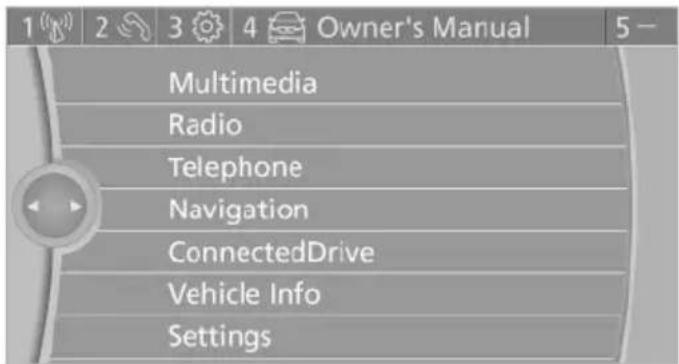
The key assignment is displayed at the top edge of the screen.
text_image
1 2 3 4 Owner's Manual 5 - Multimedia Radio Telephone Navigation ConnectedDrive Vehicle Info SettingsTo display short information: touch the button.
To display detailed information: touch the button for an extended period.
Deleting the button assignments
- Press buttons 1 and 8 simultaneously for approx. five seconds.
- "OK"
Entering letters and numbers
General information
- Turn the controller: select letters or numbers.
- Select additional letters or numbers if needed.
- "OK": confirm the entry.
Symbol Function
← Press the controller: delete the letter or number.
← Press the controller for an extended period: delete all letters or numbers.
Switching between cases, letters and numbers
Depending on the menu, you can switch between entering upper and lower case, letters and numbers:
Symbol Function
A^B_C Enter the letters.
1@+ Enter the numbers.
abc or ABC move the controller up.
Without navigation system
@A A ^a Select the symbol.
Entry comparison
Entry of names and addresses: the selection is narrowed down every time a letter is entered and letters may be added automatically.
The entries are continuously compared to the data stored in the vehicle.
▶ Only those letters are offered during the entry for which data is available.
Destination search: town/city names can be entered using the spelling of language available on the Control Display.
Voice activation system
Vehicle equipment
All standard, country-specific and optional equipment that is offered in the model series is described in this chapter. Therefore, equipment is also described that is not available in a vehicle, e.g., because of the selected optional equipment or country variant. This also applies for safety-related functions and systems.
The concept
▶ Most functions that are displayed on the Control Display can be operated by spoken commands via the voice activation system. The system prompts you to make your entries.
▶ Functions that can only be used when the vehicle is stationary cannot be operated using the voice activation system.
The system uses a special microphone on the driver's side.
▶ »...« Verbal instructions in the Owner's Manual to use with the voice activation system.
Requirements
Via the Control Display, set a language that is also supported by the voice activation system so that the spoken commands can be identified.
Set the language, refer to page 86.
Using voice activation
Activating the voice activation system
- wheel.
- Wait for the signal.
- Say the command.
The command is displayed in the instrument cluster.
This symbol in the instrument cluster indicates that the voice activation system is active. If no other commands are available, operate the function in this case via iDrive.
Terminating the voice activation system
Briefly press the button on the steering wheel or >End.
Possible commands
Most menu items on the Control Display can be voiced as commands.
The available commands depend on which menu is currently displayed on the Control Display.
Short commands exist for many functions.
Some list entries, e.g., Phone book entries, can also be selected via the voice activation system. Speak these list entries exactly as they are displayed in the respective list.
Having possible commands read aloud
You can have the available commands read out loud for you: >commands
For example, if the "Settings" menu is displayed, the commands for the settings are read out loud.
Executing functions using short commands
Functions on the main menu can be performed directly by means of short commands, nearly irrespective of which menu item is currently selected, e.g., >Vehicle status.
List of short commands of the voice activation system, see Navigation, Entertainment, Communication Owner's Manual.
Help dialog for the voice activation system
Calling up help dialog: >Help<
Additional commands for the help dialog:
Help with examples: information about the current operating options and the most important commands for them are announced.
▶ Help voice activation: information about the principle of operation for the voice activation system is announced.
One example: open the tone settings
Via the main menu
The commands of the menu items are spoken just as they are selected via the controller.
-
Switch on the Entertainment sound output if necessary.
-
Press the button on the steering wheel.
-
»Radio menu«
-
»Audio settings«
Via short command
The desired radio station can also be started via a short command.
-
Switch on the Entertainment sound output if necessary.
-
Press the button on the steering wheel.
-
»Audio settings«
Setting the voice dialog
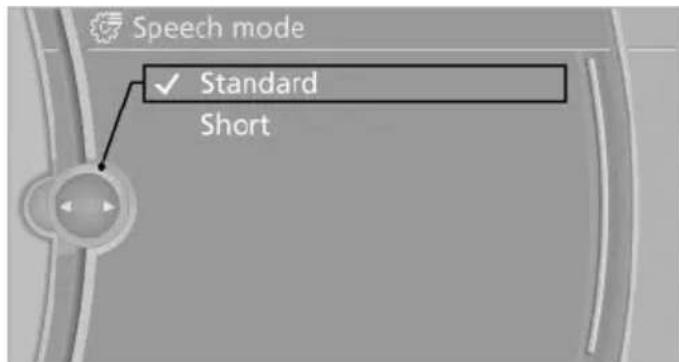
You can set whether the system should use the standard dialog or a shorter version.
In the shorter variant of the voice dialog, the announcements from the system are issued in an abbreviated form.
- "Settings"
- "Language/Units"
- "Speech type:"
- Select the setting.
text_image
Speech mode ✓ Standard ShortAdjusting the volume
Turn the volume button while giving an instruction until the desired volume is set.
The volume remains constant even if the volume of other audio sources is changed.
The volume is stored for the remote control currently in use.
Hints on Emergency Requests
Do not use the voice activation system to initiate an Emergency Request. In stressful situations, the voice and vocal pitch can change.
This can unnecessarily delay the establishment of a telephone connection.
Instead, use the SOS button, refer to page 215, in the vicinity of the interior mirror.
Environmental conditions
▷ Say the commands, numbers, and letters smoothly and with normal volume, emphasis, and speed.
▶ Always say commands in the language of the voice activation system.
Keep the doors, windows, and glass sun-roof closed to prevent noise interference.
▶ Avoid making other noise in the vehicle while speaking.
Integrated Owner's Manual in the vehicle
Vehicle equipment
All standard, country-specific and optional equipment that is offered in the model series is described in this chapter. Therefore, equipment is also described that is not available in a vehicle, e.g., because of the selected optional equipment or country variant. This also applies for safety-related functions and systems.
Integrated Owner's Manual in the vehicle
The Integrated Owner's Manual can be displayed on the Control Display. The equipment and functions that are in the vehicle are described therein.
Components of the Integrated Owner's Manual
The Integrated Owner's Manual consists of three parts, which offer various levels of information or access possibilities.
Quick Reference Guide
Located in the Quick Reference is important information for the operation of the vehicle, the operation of basic vehicle functions or for what to do in the event of a flat tire. This information can also be displayed during driving.
Search by pictures
Information and descriptions based on illustrations can be searched via search by pictures. This is helpful, for example, if the description of an outfitting package that cannot be named is needed.
Owner's Manual
Information and descriptions can be searched by direct entry of a search term via the index.
Select components
Press the button.
-
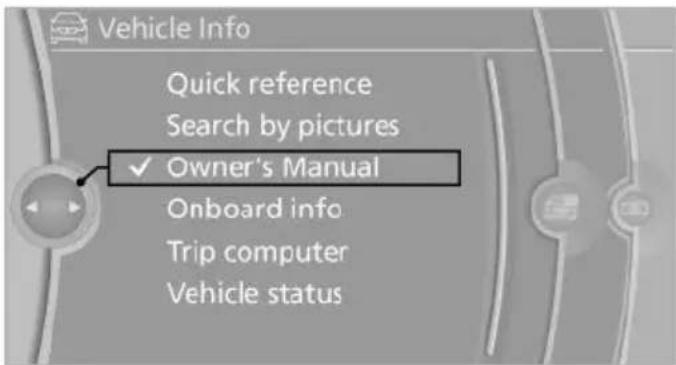
Turn the controller: open "Vehicle Info".
-
Press the controller.
-
Selecting desired range:
▶ "Quick reference"
▶ "Search by pictures"
▶ "Owner's Manual"
text_image
Vehicle Info Quick reference Search by pictures ✓ Owner's Manual Onboard info Trip computer Vehicle statusLeafing through the Owner's Manual
Page by page with link access
Turn the controller until the next or previous page is displayed.
Page by page without link access
Leaf through the pages directly while skipping the links.
Highlight the symbol once. Now simply press the controller to leaf from page to page.

Leaf back.

Leaf forward.
Context help - Owner's Manual to the temporarily selected function
The relevant information can be opened directly.
Opening via the iDrive
To move directly from the application on the Control Display to the options menu:

-
☐ Press the button or move the controller to the right repeatedly until the "Options" menu is displayed.
-
"Display Owner's Manual"
Opening when a Check Control message is displayed
Directly from the Check Control message on the Control Display:
"Display Owner's Manual"
Changing between a function and the Owner's Manual
To change from a function, e.g., radio, to the Owner's Manual on the Control Display and to switch between the two displays:

-
Press the button or move the controller to the right repeatedly until the "Options" menu is displayed.
-
"Display Owner's Manual"
-
Select the desired page in the Owner's Manual.

- ☐ Press the button again to return to the function displayed last.

- ☐ Press the button to return to the page of the Owner's Manual displayed last.
To switch back and forth repeatedly between the function displayed last and the page of the Owner's Manual displayed last, repeat steps 4 and 5. This opens a new panel every time.
Programmable memory buttons
General information
The Owner's Manual can be stored on the programmable memory buttons and called up directly.
Storing
- "Owner's Manual" Select via the iDrive.
- 1...8 Press the desired button for more than 2 seconds.
Executing
1...8 Press the button. The Owner's Manual is displayed immediately.
text_image
START STOP ENGINE Online Edition for Part no. 01 40 2 925 743 - II/14Controls
This chapter is intended to provide you with information that will give you complete control of your vehicle. All features and accessories that are useful for driving and your safety, comfort and convenience are described here.
Opening and closing
Vehicle equipment
All standard, country-specific and optional equipment that is offered in the model series is described in this chapter. Therefore, equipment is also described that is not available in a vehicle, e.g., because of the selected optional equipment or country variant. This also applies for safety-related functions and systems.
Remote control/key
General information
The vehicle is supplied with two remote controls with integrated keys.
Every remote control contains a replaceable battery.
Depending on the equipment package and country-specific variant, the functions of the keys can be set. Settings, refer to page 41.
For every remote control, personal settings are stored in the vehicle. Personal Profile, refer to page 33.
Information on the required maintenance is stored in the remote controls. Service data in the remote control, refer to page 202.
At a glance
text_image
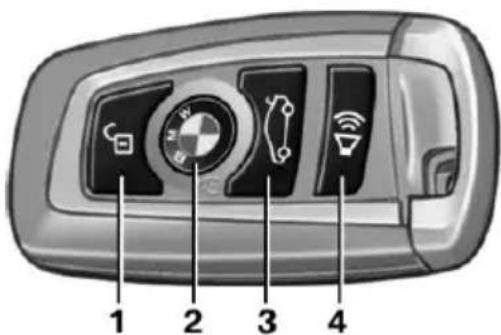
1 2 3 41 Unlocking
2 Locking
3 Opening the trunk lid
4 Panic mode in alarm system
Integrated key
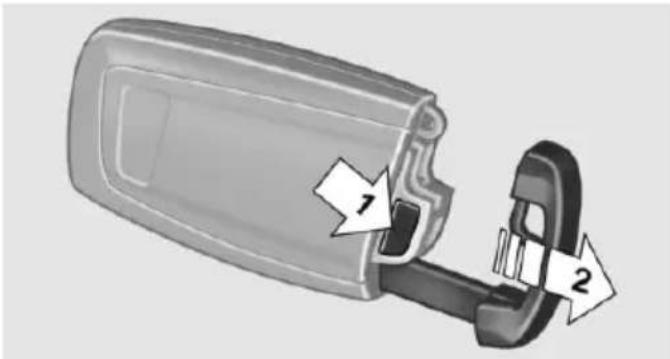
text_image
Diagram of a device component with numbered parts, showing a close-up and labeled parts 1 and 2.Press the button on the back of the remote control, arrow 1, and pull out the key, arrow 2.
The integrated key fits the following locks:
Driver's door.
▶ Glove compartment on the front passenger side.
The storage compartment contains a switch for separately securing the trunk lid, refer to page 38.
The front passenger glove compartment contains a switch for separately securing the trunk lid, refer to page 38.
Replacing the battery
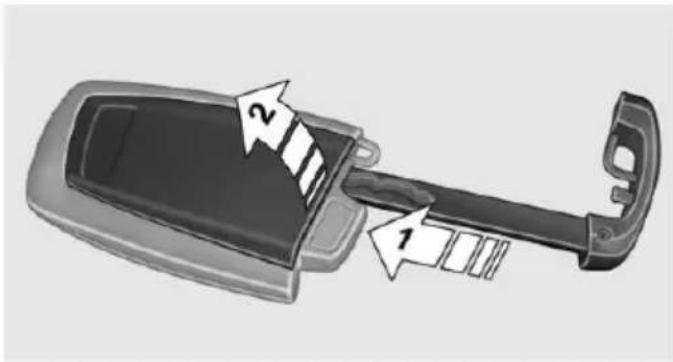
text_image
Diagram showing a car door handle with labeled parts, including numbered arrows indicating parts of the handle.- Take the integrated key out of the remote control.
- Push in the catch with the key, arrow 1.
- Remove the cover of the battery compartment, arrow 2.
- Insert a battery of the same type with the positive side facing upwards.
- Press the cover closed.

Take the used battery to a recycling center or to your service center.
New remote controls
New remote controls are available from the service center.
Loss of the remote controls
Lost remote controls can be blocked by your service center.
Emergency detection of remote control
It is possible to switch on the ignition or start the engine in situations such as the following:
▶ Interference of radio transmission to remote control by external sources, e.g. by radio masts.
▶ Discharged battery in the remote control.
▶ Interference of radio transmission by mobile devices in close proximity to the remote control.
▶ Interference of radio transmission by charger while charging items such as mobile devices in the vehicle.
A Check Control message is displayed if an attempt is made to switch on the ignition or start the engine.
Starting the engine with emergency detection of the remote control
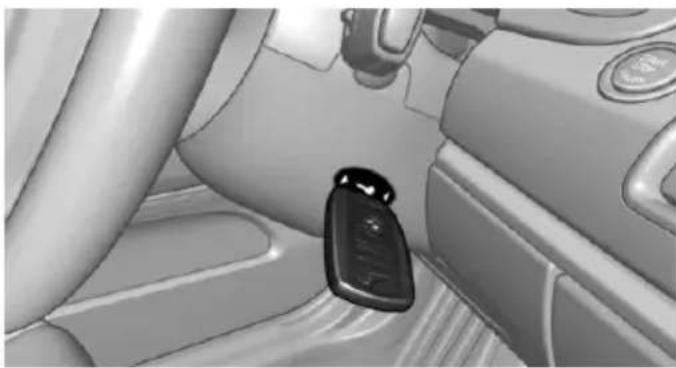
natural_image
Interior view of a car showing the rear seatbelt and dashboard (no text or symbols visible)Automatic transmission: if a corresponding Check Control message appears, hold the remote control, as shown, against the marked area on the steering column and press the Start/Stop button within 10 seconds while pressing the brake.
Manual transmission: if a corresponding Check Control message appears, hold the remote control, as shown, against the marked area on the steering column and press the Start/Stop button within 10 seconds while pressing the clutch pedal.
Personal Profile
The concept
Individual settings in the vehicle are saved in personal profiles. Every remote control is assigned a profile.
Three personal profiles and a guest profile can be created.
Changes to the settings are automatically saved in the profile currently activated.
During unlocking, the profile stored for the remote control is activated.
▶ Your personal settings will be recognized and called up again even if the vehicle has been operated in the meantime with another remote control.
Adjusting
The following settings are stored in a profile.
Radio: stored stations, station listened to last.
▶ Assignment of the programmable memory buttons.
▶ Tone settings.
▶ Audio source listened to last.
▶ Unlocking the vehicle: driver door or entire vehicle.
▶ Locking the vehicle: if no door is open or after starting off.
▶ Welcome lamps: on/off.
▶ Triple turn signal activation: on/off.
▶ Headlamp courtesy delay feature: time setting.
▷ Language on the Control Display.
Daytime running lights: on/off.
▶ Automatic climate control/Automatic climate control with enhanced features: settings.
▶ Navigation: map views, route criteria, voice output on/off.
▶ Park Distance Control PDC: adjusting the signal tone volume.
▶ Rearview camera: selection of functions and type of display.
▶ Side view: display type.
▶ Head-up Display: selection, brightness, position and rotation of the display.
▶ Driving Dynamics Control: sport program.
Exterior mirror position.
▶ Driver's seat position: automatically retrieved after unlocking.
▶ Collision warning: warning time.
▶ Lane departure warning: last setting, on/off.
Active Blind Spot Detection: last setting, on/off.
Profile management
Opening the profiles
A different profile can be called up than the one associated with the remote control currently in use.
- "Settings"
- "Profiles"
- Select a profile.
Called up profile is assigned to the remote control being used at the time.
Renaming profiles
- "Settings"
- "Profiles"
- Open "Options".
- "Rename current profile"
Resetting profiles
The settings of the active profile are reset to their default values.
- "Settings"
- "Profiles"
- Open "Options".
- "Reset current profile"
Exporting profiles
Most settings of the active profile and the saved contacts can be exported.
This can be helpful for securing and retrieving personal settings, before delivering the vehicle to a workshop for example. The saved profiles
can be taken with you to another vehicle equipped with the Personal Profile function.
The following export options are available:
▶ BMW Online.
▶ Via the USB port to a USB device.
Popular file systems for USB devices are supported. FAT32 and exFAT are the recommended formats for profile export. Other formats may not support the export.
- "Settings"
- "Profiles"
- "Export profile"
- BMW Online: "BMW Online"
USB interface: "USB device"
Importing profiles
Existing settings and contacts are overwritten with the imported profile.
- "Settings"
- "Profiles"
- "Import profile"
- BMW Online: "BMW Online"
USB interface: "USB device"
Using the guest profile
The guest profile can be used to make individual settings that are saved in none of the three personal profiles.
This can be useful for drivers who are using the vehicle temporarily and do not have their own profile.
- "Settings"
- "Profiles"
- Open "Guest".
The guest profile cannot be renamed. It is not assigned to the current remote control.
Display profile list during start
The profile list can be displayed during each start for selecting the desired profile.
- "Settings"
- "Profiles"
- Open "Options".
- "Display user list at startup"
Using the remote control
Note

Take the remote control with you
People or animals left unattended in a parked vehicle can lock the doors from the inside. Always take the remote control with you when leaving the vehicle so that the vehicle can then be opened from the outside.
Unlocking
Press the button on the remote control.
The vehicle is unlocked.
Welcome lamps, interior lamp and courtesy lamps are switched on.
You can set how the vehicle is to be unlocked. Performing settings, refer to page 41.
The alarm system, refer to page 41, is disarmed.
Convenient opening
The remote control can be used to open the windows and the glass sunroof after unlocking.

Press and hold the button on the remote control.
Releasing the button stops the motion.
Locking

Press the button on the remote control.

Locking from the outside
Do not lock the vehicle from the outside if there are people in it, as the vehicle cannot be unlocked from inside without special knowledge.
The alarm system, refer to page 41, is armed.
Switching on interior lamps and courtesy lamps

Press the button on the remote control with the vehicle locked.
If the button is pressed again within 10 seconds of the vehicle being locked, the interior motion sensor and tilt alarm sensor of the anti-theft warning system, refer to page 43, are switched off. After locking, wait 10 seconds before pressing the button again.
Panic mode
You can trigger the alarm system if you find yourself in a dangerous situation.
Press the button on the remote control for at least 3 seconds.
To switch off the alarm: press any button.
Opening the trunk lid
Press the button on the remote control for approx. 1 second.
The trunk lid opens, regardless of whether the vehicle was previously locked or unlocked.
During opening, the trunk lid pivots back and up. Ensure that adequate clearance is available before opening.
If the doors were not unlocked, the trunk lid is locked again as soon as it is pushed closed.

Do not place the remote control in the cargo area
Take the remote control with you and do not leave it in the cargo area; otherwise, the re-
mote control is locked inside the vehicle when the trunk lid is closed.
Malfunction
If the vehicle can no longer be locked or unlocked with the remote control, the battery may be discharged or there may be interference from external sources such as mobile phones, metal objects, overhead power lines, transmission towers, etc.
In this case, lock/unlock the vehicle without the remote control, refer to page 37.
For US owners only
The transmitter and receiver units comply with part 15 of the FCC/Federal Communication Commission regulations. Operation is governed by the following:
FCC ID:
▷ LX8766S.
▷ LX8766E.
▷ LX8CAS.
▷ LX8CAS2.
MYTCAS4.
Compliance statement:
This device complies with part 15 of the FCC Rules. Operation is subject to the following two conditions:
This device may not cause harmful interference, and
- this device must accept any interference received, including interference that may cause undesired operation.
Any unauthorized modifications or changes to these devices could void the user's authority to operate this equipment.
Without remote control
From the outside

Locking from the outside
Do not lock the vehicle from the outside if there are people in it, as the vehicle cannot be unlocked from inside without special knowledge.

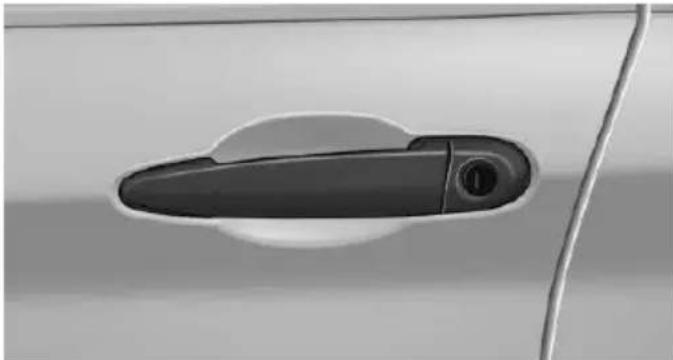
Remove the key before pulling the door handle
Before pulling the outside door handle, remove the key to avoid damaging the paintwork and the key.
natural_image
Close-up of a car door handle with a black plastic clip and circular button (no text or symbols visible)Unlock or lock the driver's door via the door lock using the integrated key. The other doors must be unlocked or locked from the inside.
Alarm system
The alarm system is not armed if the vehicle is locked with the integrated key.
The alarm system is triggered when the door is opened, if the vehicle was unlocked via the door lock. In order to terminate this alarm, unlock vehicle with the remote control or switch on the ignition, if necessary, by emergency detection of the remote control.
From the inside
Locking and unlocking

natural_image
Front view of a car air conditioner unit with a central logo (no visible text or symbols)Pressing the button for the central locking system locks and unlocks the doors and the trunk lid when the front doors are closed, but they are not secured against theft.
The fuel filler flap remains unlocked.
In the event of an accident of corresponding severity, the vehicle is automatically unlocked. The hazard warning system and interior lamps come on.
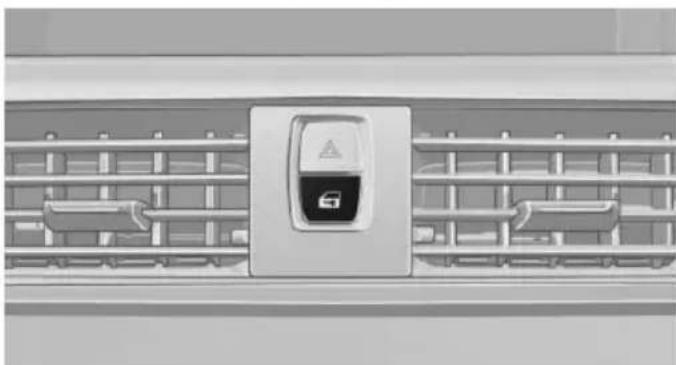
Unlocking and opening
natural_image
Front view of a car air conditioner unit with no visible text or symbols on the grille (black and white photo)Either unlock the doors together using the button for the central locking system and then pull the door handle above the arm-rest or
▶ Pull the door opener twice individually on each door: the first time unlocks the door, the second time opens it.
Trunk lid
Opening
During opening, the trunk lid pivots back and up.
Ensure that adequate clearance is available before opening.
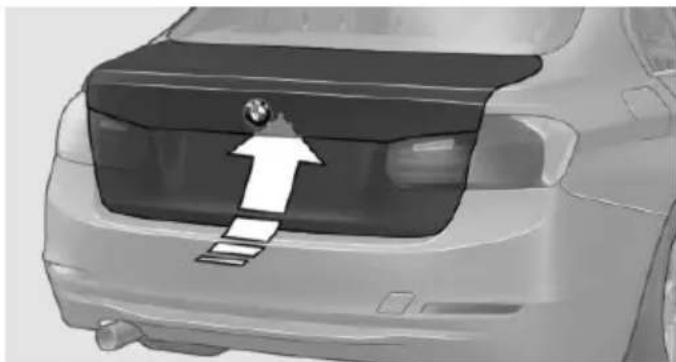
Opening from the outside
natural_image
Side view of a car's rear bumper with a white arrow pointing upward (no text or symbols)▶ Press the button on the trunk lid.
▶ Press the button on the remote control for approx. 1 second.
The trunk lid opens.
Opening from the inside
With the vehicle stationary, press the button in the driver's footwell.
The trunk lid opens.
Closing
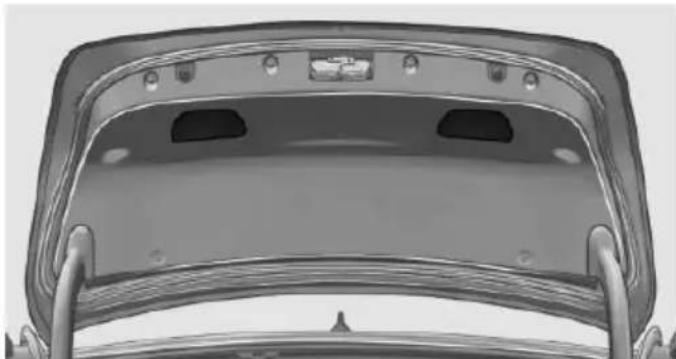
natural_image
Top-down view of a car backrest with open rear canopy and side-mounted doorways (no text or symbols visible)Recessed grips in the interior trim of the trunk lid make it easier to pull down the lid.
Keep the closing path clear Make sure that the closing path of the trunk lid is clear; otherwise, injuries may result.
Do not place the remote control in the cargo area
Take the remote control with you and do not leave it in the cargo area; otherwise, the remote control is locked inside the vehicle when the trunk lid is closed.
Locking separately
The trunk lid can be locked separately with the switch in the front passenger glove compartment.
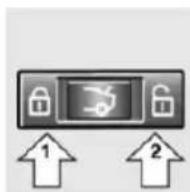
▶ Trunk lid secured, arrow 1.
- Trunk lid not secured, arrow 2.
Slide the switch into the arrow 1 position. This secures the trunk lid and disconnects it from the central locking system.
If the glove compartment on the front passenger side is locked, the trunk lid cannot be opened.
This is beneficial when the vehicle is parked using valet service. The infrared remote control can be handed out without the key.
Emergency unlocking
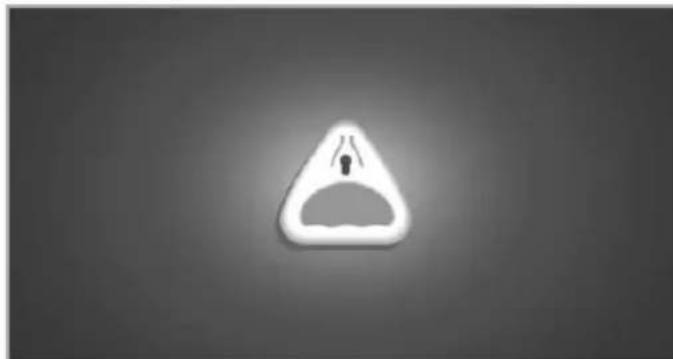
natural_image
Simple triangular warning symbol with a downward arrow inside, no text or numbers present.Pull the handle inside the cargo area.
The trunk lid unlocks.
Comfort Access
The concept
The vehicle can be accessed without activating the remote control.
All you need to do is to have the remote control with you, such as in your pants pocket.
The vehicle automatically detects the remote control when it is nearby or in the passenger compartment.
Comfort Access supports the following functions:
▶ Unlocking/locking of the vehicle.
▶ Convenient closing.
▶ Open the trunk lid individually.
▶ Open trunk lid with no-touch activation
▷ Start the engine.
Functional requirements
There are no external sources of interference nearby.
To lock the vehicle, the remote control must be located outside of the vehicle.
The next unlocking and locking cycle is not possible until after approx. 2 seconds.
The engine can only be started if the remote control is in the vehicle.
Comparison with ordinary remote control
The functions can be controlled by pressing the buttons of the remote control or Comfort Access.
Unlocking
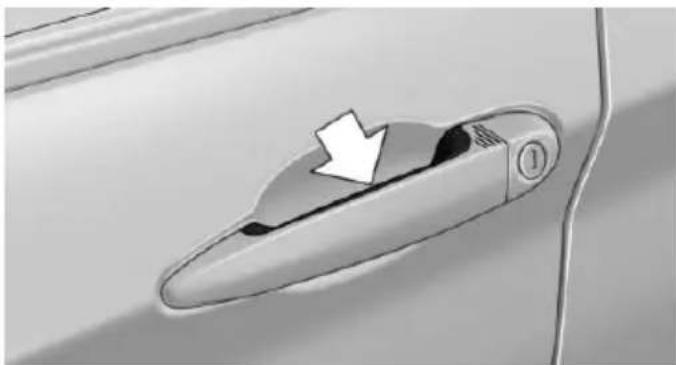
natural_image
Close-up of a car door handle with a white arrow pointing to the keyhole (no text or symbols visible)Grasp the door handle on the driver's or front passenger door completely, arrow.
This corresponds to pressing the button on the remote control.
Locking
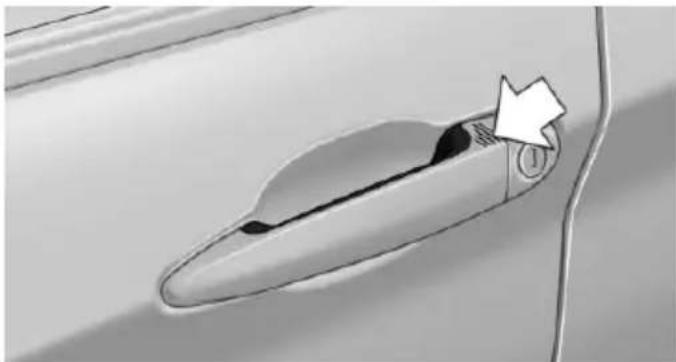
natural_image
Close-up of a car door handle with a white arrow pointing to the left side (no text or symbols visible)Press the area on the door handle, arrow, with your finger for approx. 1 second without grasping the door handle.
This corresponds to pressing the ⚙button on the remote control.
To save battery power, ensure that the ignition and all electronic systems and/or power consumers are switched off before locking the vehicle.
Convenient closing
Press the area on the door handle, arrow, with your finger and hold it down.
In addition to locking, the windows and the glass sunroof are closed.

Monitor the closing process
Monitor the closing process to ensure
that no one becomes trapped.
Unlocking the trunk lid separately
Press the button on the exterior of the trunk lid.
This corresponds to pressing the ton on the remote control.


Do not place the remote control in the cargo area
Take the remote control with you and do not leave it in the cargo area; otherwise, the remote control is locked inside the vehicle when the trunk lid is closed.
Open trunk lid with no-touch activation
With Comfort Access, the trunk lid can be opened with no-touch activation using the remote control you are carrying.
Two sensors detect a forward-directed foot motion in the center of the area at the rear of the car and the trunk lid opens.
Foot movement to be carried out

Do not touch vehicle
With the foot motion, make sure there is steady stance and do not touch the vehicle; otherwise, there is a danger of injury, e. g. from hot exhaust system parts.
- Place in the center behind the vehicle, about an arm's length from the vehicle rear.
- Move a foot in the direction of travel as far under the vehicle as possible and immediately pull it back. With this movement, the
leg must pass through the ranges of both sensors.
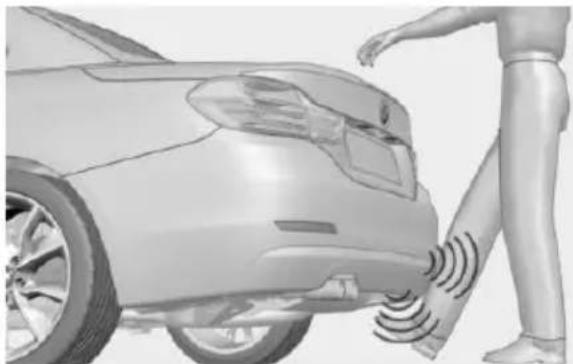
natural_image
3D rendering of a car with sensor waves attached to the side of a human figure (no text or symbols visible)Opening
The trunk lid opens, regardless of whether it was previously locked or unlocked.
During opening, the trunk lid pivots back and up. Ensure that adequate clearance is available before opening.
Before the opening, the hazard warning system flashes.

Preventing inadvertent opening
In situations where the trunk lid should is not to be opened with no-touch activation, ensure that the remote control is located beyond the range of the sensor, at least 5 ft/1.50 m from the rear of the car.
Otherwise, the trunk lid may be opened inadvertently, for example by an unintentional or misinterpreted movement of the foot.
Malfunction
Comfort Access may not function properly if it experiences interference from external sources such as mobile phones, metal objects, overhead power lines, transmission towers, etc.
In this case, open or close the vehicle using the buttons on the remote control or use the integrated key in the door lock.
If there is a malfunction, open the trunk lid with the remote control button or with the button on the trunk lid.
Adjusting
Unlocking
The setting is stored for the remote control currently in use.
- "Settings"
- "Doors/key"
- Select symbol or "Unlock button:"
- Select the desired function:
▶ "Driver's door only"
Only the driver's door and the fuel filler flap are unlocked. Pressing again un-locks the entire vehicle.
▶ "All doors"
The entire vehicle is unlocked.
Depending on how the vehicle is equipped or the country-specific variant, you can set whether the doors are also unlocked with the

button on the remote control.
Confirmation signals from the vehicle
The setting is stored for the remote control currently in use.
- "Settings"
- "Doors/key"
- Deactivate or activate the desired confirmation signals.
▶ "Acoustic sig. lock/unlock"
▶ "Flash when lock/unlock"
Automatic locking
The setting is stored for the remote control currently in use.
- "Settings"
- "Doors/key"
- Select the desired function:
▶ "Lock if no door is opened"
The vehicle locks automatically after a short period of time if a door is not opened.
▶ "Lock after start driving"
The vehicle locks automatically after you drive away.
Retrieving the seat and mirror settings
The driver's seat and exterior mirror positions used last are stored for the remote control currently in use.
When the vehicle is unlocked, these positions are automatically retrieved if this function was activated.

Pinch hazard when moving back the seat If this function is used, first make sure
that the footwell behind the driver's seat is empty. Otherwise, people can be injured or objects damaged when the seat is moved back.
The adjustment procedure is interrupted:
▶ When a seat position switch is pressed.
▷ When a button of the seat and mirror memory is pressed.
Activating the setting
- "Settings"
- "Doors/key"
- "Last seat position autom."
Alarm system
The concept
The vehicle alarm system responds to:
▶ Opening of a door, the hood or the trunk lid.
▶ Movements in the vehicle.
Changes in the vehicle tilt, e.g., during attempts to steal a wheel or when towing the car.
▶ Interruptions in battery voltage.
The alarm system briefly indicates tampering:
By sounding an acoustic alarm.
▷ By switching on the hazard warning system.
By flashing the daytime running lights.
Arming and disarming the alarm system
General information
When you lock or unlock the vehicle, either with the remote control or via the Comfort Access at the door lock, the alarm system is armed or disarmed at the same time.
Door lock and armed alarm system
The alarm system is triggered when the door is opened, if the vehicle is unlocked via the door lock.
In order to terminate this alarm, unlock vehicle with the remote control or switch on the ignition, if necessary, by emergency detection of the remote control.
Trunk lid and armed alarm system
The trunk lid can be opened even when the alarm system is armed.
After the trunk lid is closed, it is locked and monitored again if the doors are locked. The hazard warning system flashes once.
Panic mode
You can trigger the alarm system if you find yourself in a dangerous situation.
Press the button on the remote control for at least 3 seconds.
To switch off the alarm: press any button.
Switching off the alarm
To terminate the alarm:
▶ Unlock the vehicle using the remote control.
With Comfort Access: If you are carrying the remote control with you, grasp the driver side or front passenger side door handle completely.
Indicator lamp on the interior rearview mirror
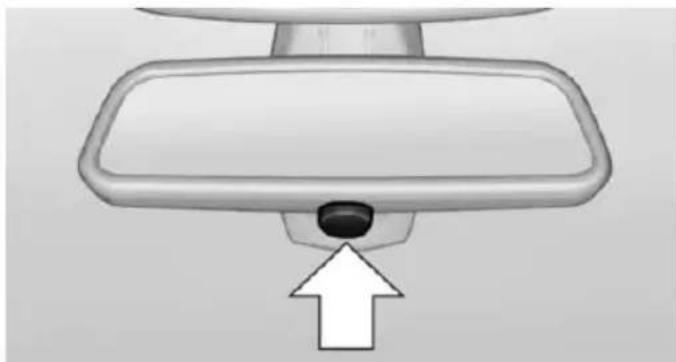
natural_image
Diagram of a car rearview mirror with an arrow pointing to the nose (no text or symbols present)The indicator lamp flashes briefly every 2 seconds:
The system is armed.
The indicator lamp flashes after locking:
The doors, hood or trunk lid is not closed properly, but the rest of the vehicle is secured.
After 10 seconds, the indicator lamp flashes continuously. Interior motion sensor and tilt alarm sensor are not active.
The indicator lamp goes out after unlocking:
The vehicle has not been tampered with.
The indicator lamp flashes after unlocking until the engine ignition is switched on, but no longer than approx. 5 minutes:
An alarm has been triggered.
Tilt alarm sensor
The tilt of the vehicle is monitored.
The alarm system responds in situations such as attempts to steal a wheel or when the car is towed.
Interior motion sensor
The windows and glass sunroof must be closed for the system to function properly.
Avoiding unintentional alarms
The tilt alarm sensor and interior motion sensor can be switched off together, such as in the following situations:
In automatic car washes.
In duplex garages.
During transport on car-carrying trains, at sea or on a trailer.
When animals are to remain in the vehicle.
Switching off the tilt alarm sensor and interior motion sensor

Press the remote control button again within 10 seconds as soon as the vehicle ked.
The indicator lamp lights up for approx. 2 seconds and then continues to flash.
The tilt alarm sensor and interior motion sensor are switched off until the vehicle is locked again.
Power windows
General information

Take the remote control with you
Take the remote control with you when leaving the vehicle so that children, for example, cannot operate the power windows and injure themselves.
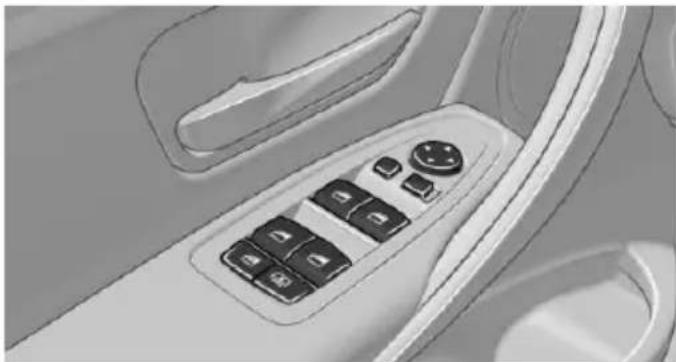
natural_image
Interior view of a car dashboard with control panel and side door (no visible text or symbols)Opening
Press the switch to the resistance
The window opens while the switch is held.
Press the switch beyond the resist- point.
The window opens automatically.
Pressing the switch again stops the motion.
Convenient opening, refer to page 35, via the remote control.
Closing

Keep the closing path clear
Monitor the closing process and make sure that the closing path of the window is clear; otherwise, injuries may result.
Pull the switch to the resistance
The window closes while the switch is held.
Pull the switch beyond the resistance.
The window closes automatically.
Pressing the switch stops the motion.
Closing via Comfort Access, refer to page 39.
Pinch protection system
If the closing force exceeds a specific value as a window closes, the closing action is interrupted.
The window reopens slightly.

Danger of pinching even with pinch protection
Even with the pinch protection system, check that the window's closing path is clear; otherwise, the closing action may not stop in certain situations, e.g., if thin objects are present.

No window accessories
Do not install any accessories in the
range of movement of the windows; otherwise, the pinch protection system will be impaired.
Closing without the pinch protection system

Keep the closing path clear
Monitor the closing process and make sure that the closing path of the window is clear; otherwise, injuries may result.
For example, if there is an external danger or if ice on the windows prevents a window from closing normally, proceed as follows:
- Pull the switch past the resistance point and hold it there.
The pinch protection is limited and the window reopens slightly if the closing force exceeds a certain value.
- Pull the switch past the resistance point again within approx. 4 seconds and hold it there.
The window closes without pinch protection.
Safety switch
The safety switch in the driver's door can be used to prevent children, for example, from opening and closing the rear windows using the switches in the rear.
Switching on and off
Press the button.
The LED lights up if the safety function is switched on.

Safety switch for rear operation
Press the safety switch when transporting children in the rear; otherwise, injury may result if the windows are closed without supervision.
Roller sunblinds
Roller sunblind for rear window
General information
If you are no longer able to move the roller sun-blind for the rear window after having activated it a number of times in a row, the system is blocked for a limited time to prevent overheating. Let the system cool.
The roller sunblind for the rear window cannot be moved at low interior temperatures.
Extending or retracting roller blind for rear window
Press the button.
Roller sunblinds for the rear side windows
Pull out the roller sunblind at the loop and hook it onto the bracket.

Do not open the window while the roller sunblind is raised.
Do not open the window while the roller sun-blind is raised; otherwise, there is a risk of damage at high speeds that may result in personal injury.
Glass sunroof, powered
General information
The glass sunroof is operational when the ignition is switched on.

Keep the closing path clear
Monitor the closing process and make sure that the closing path of the glass sunroof is clear; otherwise, injuries may result.

Take the remote control with you
Take the remote control with you when leaving the vehicle so that children, for example, cannot operate the roof and injure themselves.
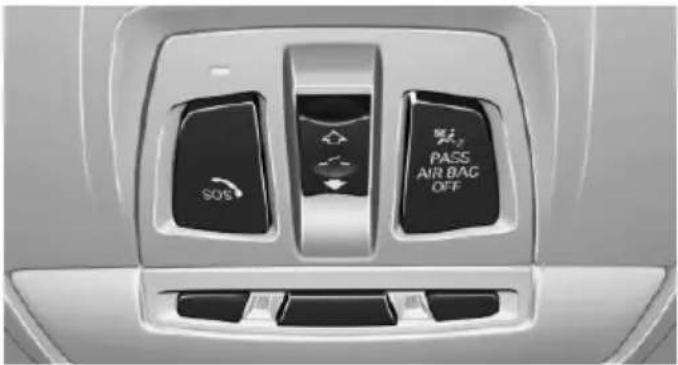
natural_image
Close-up of a car air bag control panel with 'SOS' and 'PASS AIR BAG OFF' buttons (no readable text beyond labels)Tilting the glass sunroof
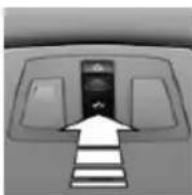
Push switch upward briefly.
▶ Closed roof is tilted open.
The opened roof closes until it is in its tilted position. The sliding visor stays completely open.
Opening/closing the glass sunroof and sliding visor together
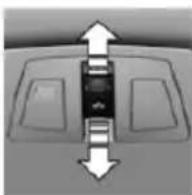
▶ Slide switch back to the resistance point and hold.
Glass sunroof and sliding vis- sor open together as long as the switch is held down.
▶ Press switch back past the resistance point.
The glass sunroof and sliding visor open automatically. Pressing the switch again stops the opening motion.
Analogously, the glass sunroof is closed by sliding the switch forward.
The sliding visor remains open and can be closed by hand.
Convenient operation, refer to page 35, via the remote control.
Convenient closing, refer to page 39, with Comfort Access.
Comfort position
Stops the roof in the comfort position if the roof is not fully open. This reduces wind noise in the passenger compartment.
If desired, continue the movement by pressing the switch.
Pinch protection system
If the closing force when closing the glass sun-roof exceeds a certain value, the closing movement is stopped, beginning at approximately the middle of the opening in the roof, or from the tilted position during closing.
The glass sunroof opens again slightly.

Danger of pinching even with pinch protection
Despite the pinch protection system, check that the roof's closing path is clear; otherwise, the closing action may not be interrupted in certain extreme situations, such as when thin objects are present.
Closing from the open position without pinch protection
For example, if there is an external danger, proceed as follows:
- Press the switch forward beyond the resistance point and hold.
Pinch protection is limited and the roof re-opens slightly if the closing force exceeds a certain value.
- Press the switch forward again beyond the resistance point and hold until the roof closes without pinch protection. Make sure that the closing area is clear.
Closing from the raised position without pinch protection
If there is an external danger, push the switch forward past the resistance point and hold it.
The roof closes without pinch protection.
Initializing after a power failure
After a power failure during the opening or closing process, the roof can only be operated to a limited extent.
Initializing the system
The system can be initialized when the vehicle is stationary and the engine is running.
During the initialization, the roof closes without pinch protection.

Keep the closing path clear
Monitor the closing process and make sure that the closing path of the glass sunroof is clear; otherwise, injuries may result.
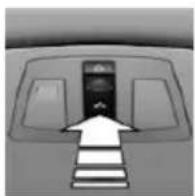
Press the switch up and hold it until the initialization is complete:
▶ Initialization begins within 15 seconds and is completed when the sunroof is completely closed.
The roof closes without pinch protection.
Adjusting
Vehicle equipment
All standard, country-specific and optional equipment that is offered in the model series is described in this chapter. Therefore, equipment is also described that is not available in a vehicle, e.g., because of the selected optional equipment or country variant. This also applies for safety-related functions and systems.
Sitting safely
The ideal seating position can make a vital contribution to relaxed, fatigue-free driving.
The seating position plays an important role in an accident in combination with:
▶ Safety belts, refer to page 50.
▶ Head restraints, refer to page 51.
Airbags, refer to page 94.
Seats
Hints

Do not adjust the seat while driving
Do not adjust the driver's seat while driving, or the seat could respond with unexpected movement and the ensuing loss of vehicle control could lead to an accident.

Do not incline the backrest too far to the rear
Also on the front passenger side, do not incline the backrest on the front passenger side too far to the rear during driving, or there is a risk of slipping under the safety belt in the event of an accident. This would eliminate the protection normally provided by the belt.
Manually adjustable seats
At a glance
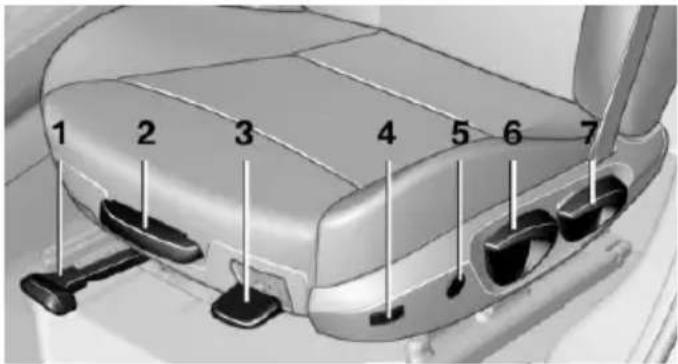
text_image
1 2 3 4 5 6 71 Forward/backward
2 Thigh support
3 Seat tilt
4 Backrest width
5 Lumbar support
6 Height
7 Backrest tilt
Forward/backward
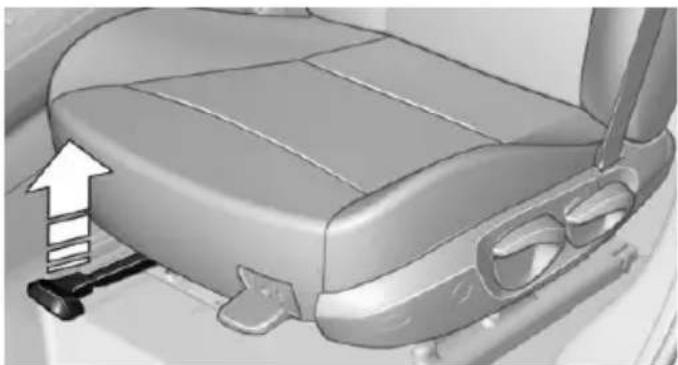
natural_image
Close-up of a car seat with visible gait and seatbelt components, no text or symbols presentPull the lever and slide the seat in the desired direction.
After releasing the lever, move the seat forward or back slightly to make sure it engages properly.
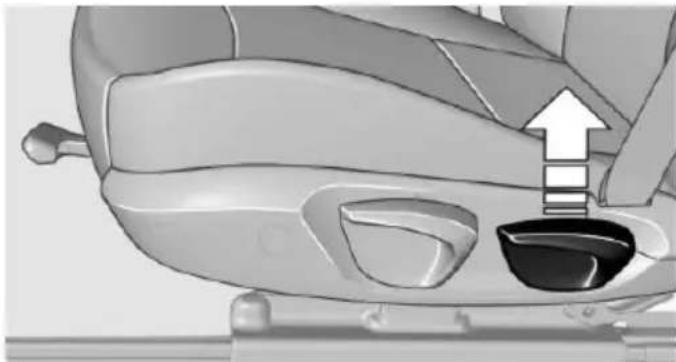
Height
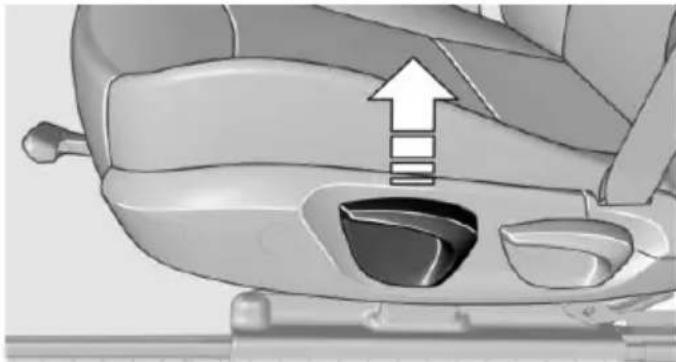
natural_image
Top-down view of a car interior showing the dashboard and seat area with an arrow indicating direction (no text or symbols present)Pull the lever and apply your weight to the seat or lift it off, as necessary.
Backrest tilt
natural_image
Interior view of a car seat with a cup and an upward arrow indicating direction (no text or symbols)Pull the lever and apply your weight to the backrest or lift it off, as necessary.
Seat tilt
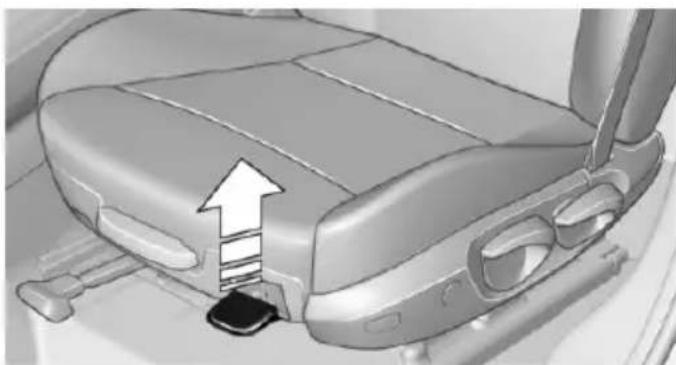
natural_image
3D rendering of a car seat with a highlighted seatbelt and upward arrow (no text or symbols)Pull the lever and move the seat to the desired tilt. After releasing the lever, apply your weight to the seat or lift it off to make sure the seat engages properly.
Electrically adjustable seats
At a glance
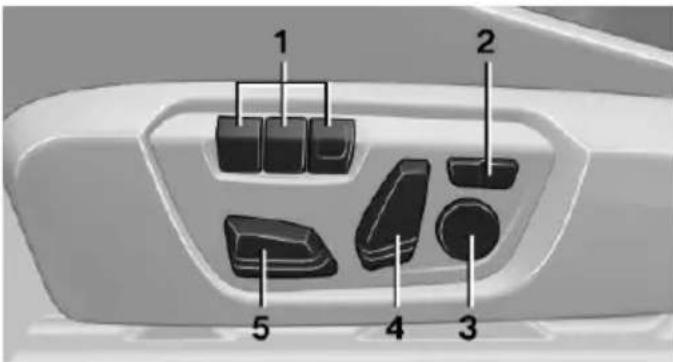
text_image
1 2 5 4 31 Seat and mirror memory
2 Backrest width
3 Lumbar support
4 Backrest tilt
5 Forward/backward, height, seat tilt
Note
The seat setting for the driver's seat is stored for the remote control currently in use. When the vehicle is unlocked via the remote control, the position is automatically retrieved if the function, refer to page 41, is activated for this purpose.
Adjustments in detail
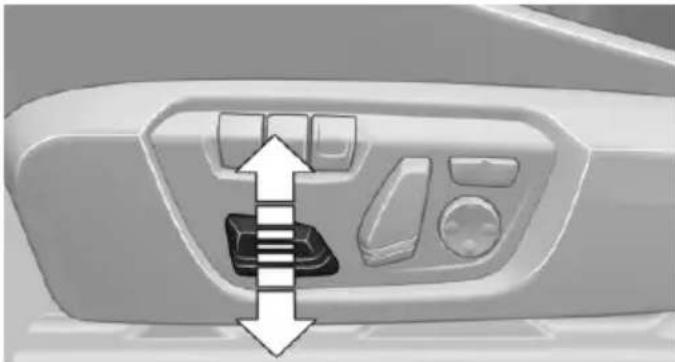
1. Forward/back.
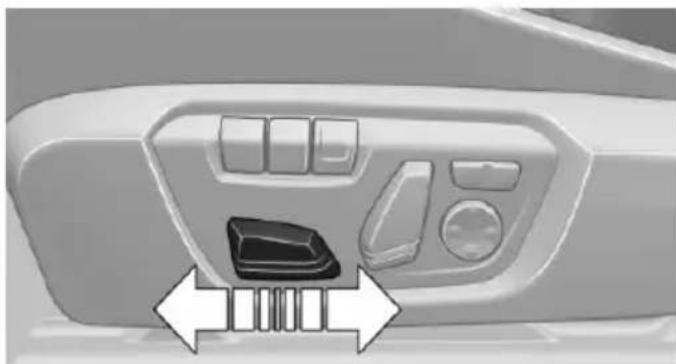
natural_image
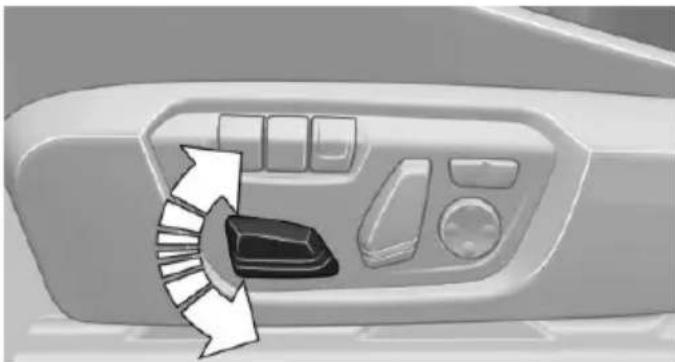
Close-up of a car dashboard control panel with buttons and a highlighted seat (no text or symbols visible)- Height.
natural_image
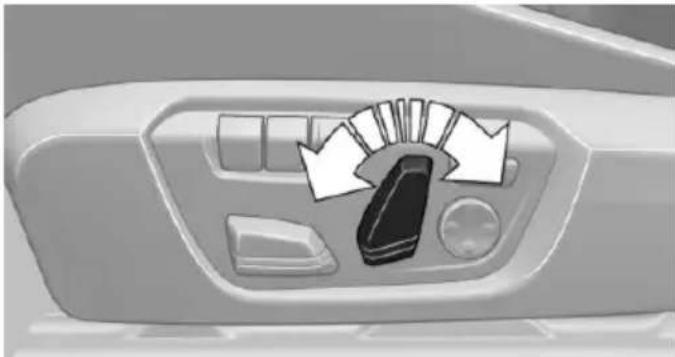
Close-up of a car air vent with directional arrows indicating left and right control buttons (no text or symbols)- Seat tilt.
natural_image
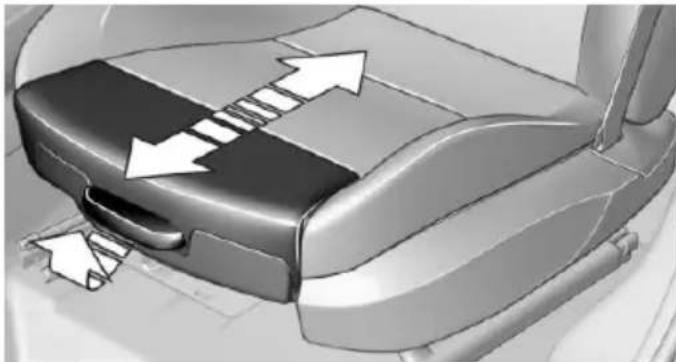
Interior view of a car dashboard with directional arrows indicating flow or movement (no text or symbols)- Backrest tilt.
natural_image
Interior view of a car dashboard with directional arrows indicating airflow or movement (no text or symbols)Thigh support
natural_image
Diagram of a car seatbelt with directional arrows indicating movement or force (no text or symbols present)Pull the lever at the front of the seat and adjust the thigh support.
Lumbar support
The curvature of the seat backrest can be adjusted in such a way that it supports the lumbar region of the spine. The lower back and the spine are supported for upright posture.
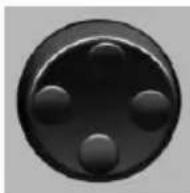
▶ Press the front/rear section of the switch.
The curvature is increased/decreased.
▶ Press the upper/lower section of the switch.
The curvature is shifted up/down.
Backrest width
Change the width of the back-rest using the side wings to adjust the lateral support.
Front seat heating
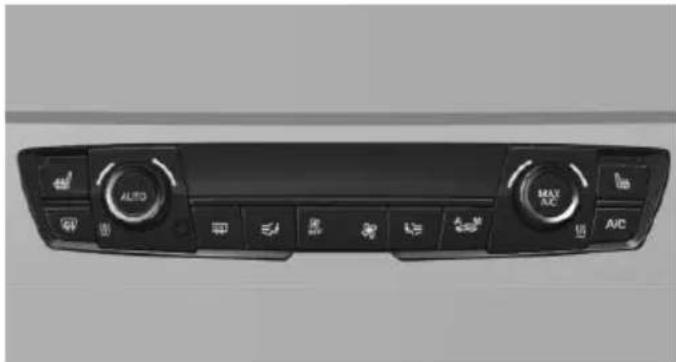
natural_image
Top-down view of a car air conditioning dashboard with rotary buttons and control buttons (no readable text or symbols)Switching on
Press the button once for each temperature level.
The maximum temperature is reached when three LEDs are lit.
If the drive is continued within approx. 15 minutes, the seat heating is activated automatically with the temperature selected last.
When ECO PRO, refer to page 169, is activated, the heater output is reduced.
Switching off
Press the button longer. The LEDs go out.
Rear seat heating
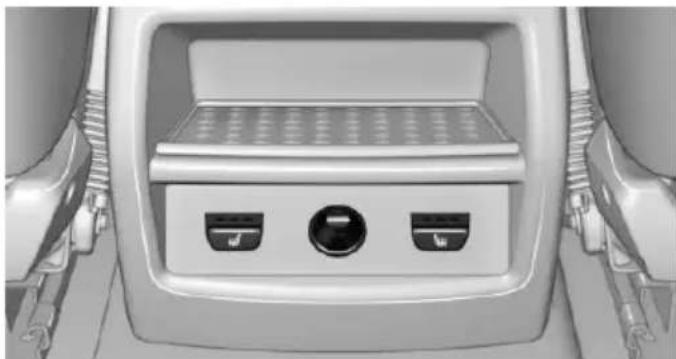
natural_image
Interior view of a car backseat showing two air outlets with ventilation slots (no text or symbols visible)Switching on
Press the button once for each temperature level.
The maximum temperature is reached when three LEDs are lit.
If the drive is continued within approx. 15 minutes, the seat heating is activated automatically with the temperature selected last.
When ECO PRO, refer to page 169, is activated, the heater output is reduced.
Switching off
Press the button longer. The LEDs go out.
Safety belts
Seats with safety belt
The vehicle has five seats, each of which is equipped with a safety belt.
Number of safety belts
Your vehicle has been fitted with five safety belts for the safety of you and your passengers. However, they can only offer protection when adjusted correctly.
Hints
Always make sure that safety belts are being worn by all occupants before driving away.
To protect the occupants, the belt locking triggers early. Slowly guide the belt out of the holder when applying it.
Although airbags enhance safety by providing added protection, they are not a substitute for safety belts.
The upper shoulder strap's anchorage point will be correct for adult seat occupants of every build if the seat is correctly adjusted.
The two outer safety belt buckles, integrated into the rear seat, are for passengers sitting on the left and right.
The center rear seat belt buckle is solely intended for the center passenger.

One person per safety belt
Never allow more than one person to wear a single safety belt. Never allow infants or small children to ride on a passenger's lap.

Putting on the belt
Lay the belt, without twisting, snugly across the lap and shoulders, as close to the body as possible. Make sure that the belt lies low around the hips in the lap area and does not press on the abdomen. Otherwise, the belt can slip over the hips in the lap area in a frontal impact and injure the abdomen.
The safety belt must not lie across the neck, rub on sharp edges, be routed over breakable objects, or be pinched.

Reduction of restraining effect
Avoid wearing bulky clothing, and pull the shoulder belt periodically to readjust the tension. Make sure that the belt is not jammed; otherwise, the belt can be damaged and the restraining effect reduced.
Buckling the belt
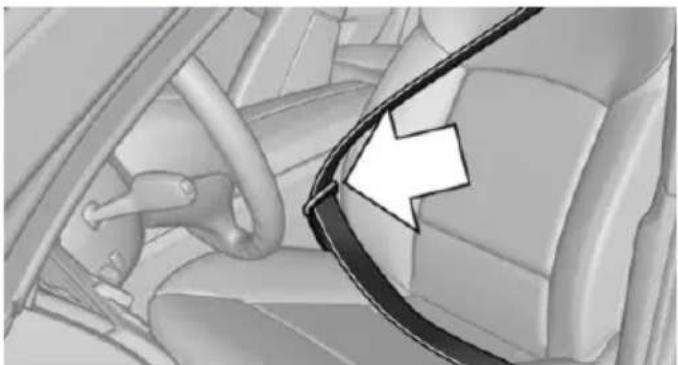
natural_image
Interior view of a car showing steering wheel and dashboard (no text or symbols visible)Make sure you hear the latch plate engage in the belt buckle.
Unbuckling the belt
- Hold the belt firmly.
- Press the red button in the belt buckle.
- Guide the belt back into its reel.
Safety belt reminder for driver's and passenger's seat

The indicator lamp lights up and a signal sounds. Make sure that the safety belts are positioned correctly. The safety belt reminder is active at speeds above approx. 6 mph/10 km/h. It can also be activated if objects are placed on the front passenger seat.
Damage to safety belts
In the case of strain caused by accidents or damage:
Have the safety belts, including the safety belt tensioners, replaced and have the belt anchors checked.

Checking and replacing safety belts
Have the work performed only by your service center; otherwise, it cannot be ensured that this safety feature will function properly.
Front headrests
Correctly adjusted head restraint
A correctly adjusted head restraint reduces the risk of injury to cervical vertebrae in the event of an accident.

Adjusting the head restraint
Correctly adjust the head restraints of all occupied seats; otherwise, there is an increased risk of injury in an accident.
Height
Adjust the head restraint so that its center is approximately at ear level.
Distance
Adjust the distance so that the head restraint is as close as possible to the back of the head. If necessary, adjust the distance by adjusting the tilt of the backrest.
Adjusting the height
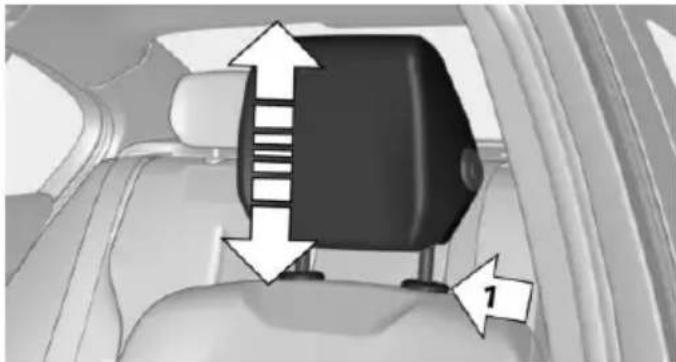
natural_image
Interior view of a vehicle seatbelt with directional arrows indicating movement or force (no text or symbols)To raise: pull.
To lower: press the button, arrow 1, and push the head restraint down.
Tilt
Three different tilt positions are available.
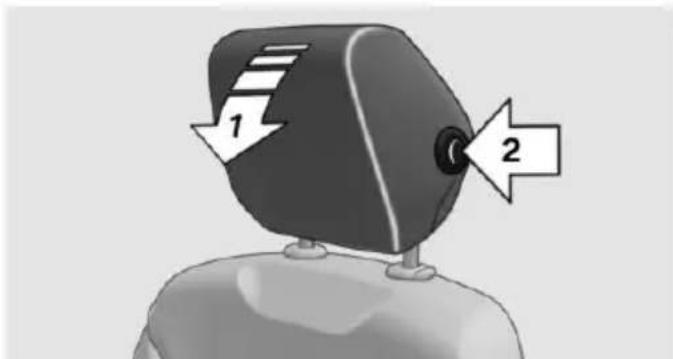
text_image
1 2▶ Forward: pull the top edge of the head restraint forward, arrow 1.
▶ Back: press the button, arrow 2. The head restraint folds as far back as possible.
Removing
Only remove the head restraint if no one will be sitting in the seat in question.
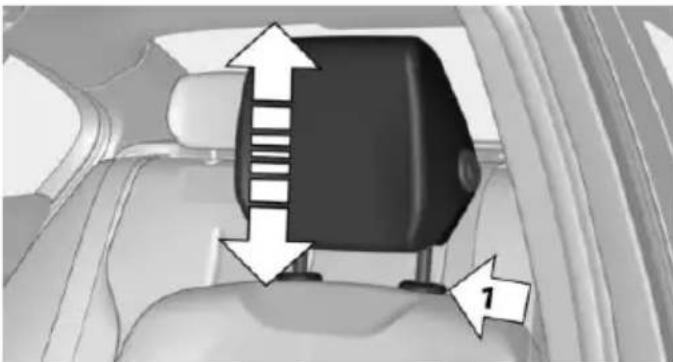
natural_image
Mechanical component diagram showing a belt buckle with directional arrows indicating movement or force (no text or symbols present)-
Pull the head restraint upward as far as possible.
-
Press the button, arrow 1, and pull the head restraint out completely.
Before transporting passengers
Reinstall the head restraint before transporting anyone in the seat; otherwise, the protective function of the head restraint is unavailable.
Rear head restraints
Correctly adjusted head restraint
A correctly adjusted head restraint reduces the risk of injury to cervical vertebrae in the event of an accident.
Adjusting the head restraint
Correctly adjust the head restraints of all occupied seats; otherwise, there is an increased risk of injury in an accident.
Height
Adjust the head restraint so that its center is approximately at ear level.
Adjusting the height
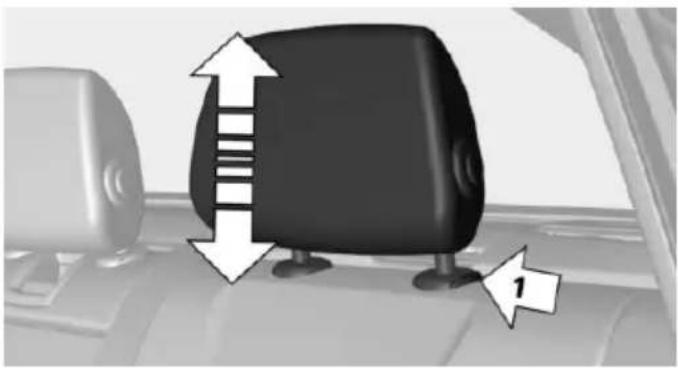
natural_image
Diagram of a black rectangular device with directional arrows indicating movement or force, mounted on a surface (no text or symbols present)To raise: pull.
To lower: press the button, arrow 1, and push the head restraint down.
The center head restraint cannot be adjusted in elevation.
Folding down head restraints

Extending/retracting head restraint
Only fold down head restraint if no passengers are in the rear. Fold out retracted headrests again if passengers are being carried in the rear; otherwise, there is increased risk of injury in the event of an accident.
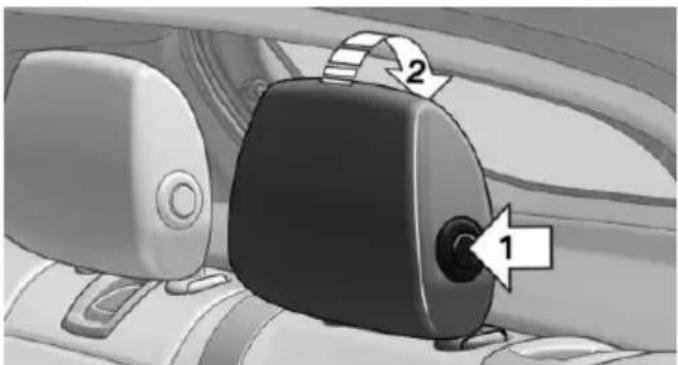
text_image
Diagram showing car seatbelt switch with labeled parts 1 and 2, indicating directional movement or adjustment.To lower flaps: press the button, arrow 1, and press down the head restraint, arrow 2.
▶ Fold back up: pull up head restraints.
Removing
Only remove the head restraint if no one will be sitting in the seat in question.
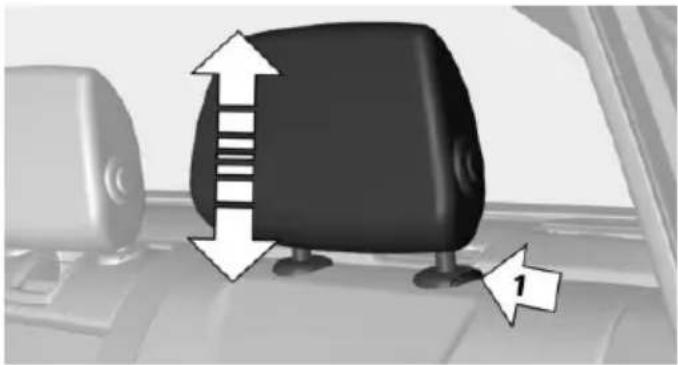
natural_image
Diagram of a device with directional arrows indicating movement or force, no readable text or symbols present- Pull the head restraint upward as far as possible.
- Press the button, arrow 1, and pull the head restraint out completely.

Before transporting passengers
Reinstall the head restraint before transporting anyone in the seat; otherwise, the protective function of the head restraint is unavailable.
Seat and mirror memory
Hints

Do not retrieve the memory while driving
Do not retrieve the memory setting while driving, as an unexpected movement of the seat could result in an accident.

Keep the movement area unobstructed
When changing the seat position, keep the seat's area of movement unobstructed; otherwise, people can be injured or objects damaged.
General information
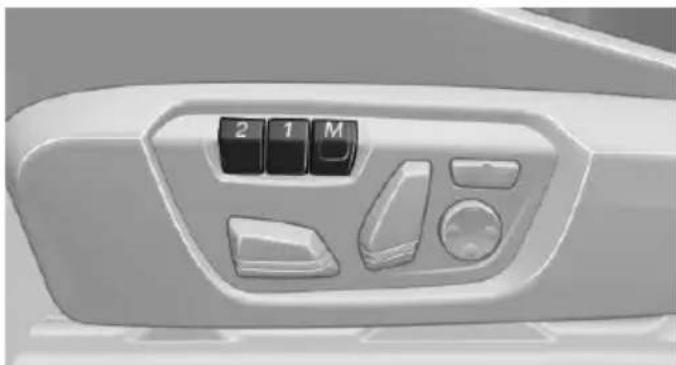
natural_image
Close-up of a car interior control panel with buttons and gauges (no readable text or symbols)Two different driver's seat and exterior mirror positions can be stored and retrieved for each remote control. Settings for the backrest width and lumbar support are not stored in memory.
Storing
- Switch on the ignition.
- Set the desired position.

-
Press the button. The LED in the button lights up.
-
Press the desired button 1 or 2. The LED goes out.
If the M button is pressed accidentally:

Press the button again.
The LED goes out.
Calling up settings
Comfort function
- Open the driver's door.
- Switch off the ignition.
- Briefly press the desired button 1 or 2.
The corresponding seat position is performed automatically.
The procedure stops when a switch for adjusting the seat or one of the buttons is pressed.
Safety mode
-
Close the driver's door or switch on the ignition.
-
Press and hold the desired button 1 or 2 until the adjustment procedure is completed.
Calling up of a seat position deactivated
After a brief period, the calling up of stored seat positions is deactivated to save battery power.
To reactivate calling up of a seat position:
▶ Open and close the door or trunk lid.
▶ Press a button on the remote control.
▶ Press the Start/Stop button.
Mirrors
Exterior mirrors
At a glance
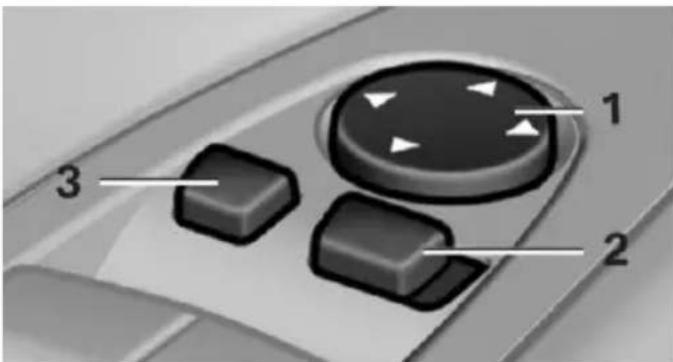
text_image
Diagram of a car control panel with labeled buttons and directional arrows indicating action points1 Adjusting
2 Left/right, Automatic Curb Monitor
3 Fold in and out
General information
The mirror on the passenger side is more curved than the driver's side mirror.
Estimating distances correctly
Objects reflected in the mirror are closer than they appear. Do not estimate the distance to the traffic behind you based on what you see in the mirror, as this will increase your risk of an accident.
Depending on how the vehicle is equipped, the mirror setting is stored for the remote control in use. When the vehicle is unlocked via the remote control, the position is automatically retrieved if the setting for this function is active.
Selecting a mirror
To change over to the other mirror: Slide the mirror changeover switch.
Adjusting electrically
The setting corresponds to the direction in which the button is pressed.
Saving positions
Seat and mirror memory, refer to page 53
Adjusting manually
If an electrical malfunction occurs, for example, press the edges of the mirror glass.
Automatic Curb Monitor
The concept
When the reverse gear is engaged, the mirror glass tilts downward slightly on the front passenger side. This improves your view of the curb and other low-lying obstacles when parking, for example.
Activating
-
Side the mirror changeover switch to the driver's side mirror position.
-
Engage selector lever position R.
Deactivating
Slide the mirror changeover switch to the passenger side mirror position.
Fold in and out

Press the button.
Possible up to approx. 15 mph/20 km/h.
For example, this is advantageous
In car washes.
In narrow streets.
For folding back mirrors that were folded away manually.
Mirrors that were folded in are folded out automatically at a speed of approx.
25 mph/40 km/h.

Fold in the mirror in a car wash
Before washing the car in an automatic car wash, fold in the exterior mirrors by hand or with the button; otherwise, the mirrors could be damaged, depending on the width of the vehicle.
Automatic heating
Both exterior mirrors are automatically heated whenever the engine is running.
Automatic dimming feature
Both exterior mirrors are automatically dimmed. Photocells are used for control in the Interior rear view mirror, refer to page 56.
Interior rearview mirror, manually dimmable
Turn knob
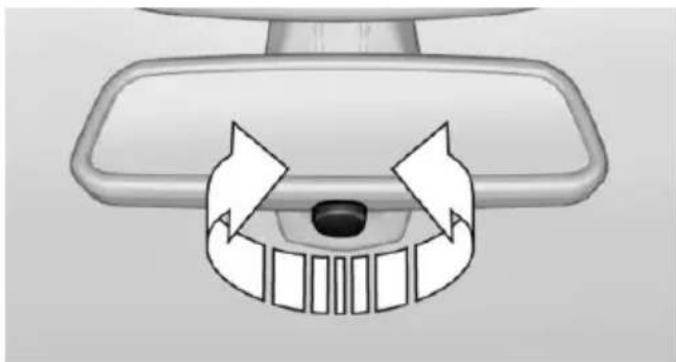
natural_image
Top-down view of a car dashboard with a black knob and white panel, no text or symbols visibleTurn the knob to reduce the blinding effect by the interior mirror.
Interior rearview mirror, automatic dimming feature
The concept
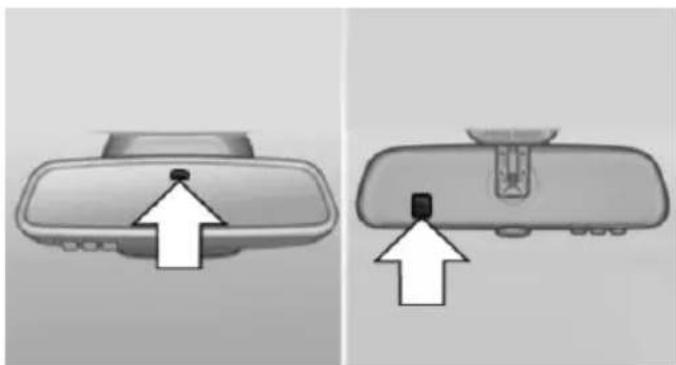
natural_image
Side-by-side comparison of a car rearview mirror showing top and front views with directional arrows (no text or symbols)Photocells are used for control:
In the mirror glass.
On the back of the mirror.
Functional requirement
For proper operation:
Keep the photocells clean.
Do not cover the area between the inside rearview mirror and the windshield.
Steering wheel
General information

Do not adjust while driving
Do not adjust the steering wheel while driving; otherwise, an unexpected movement could result in an accident.
Adjusting
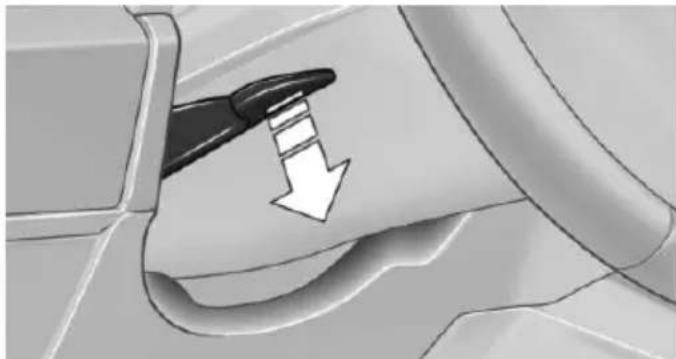
natural_image
Close-up of a car's side panel showing a downward arrow pointing to the interior (no text or symbols visible)- Fold the lever down.
- Move the steering wheel to the preferred height and angle to suit your seating position.
- Fold the lever back.
Steering wheel heating
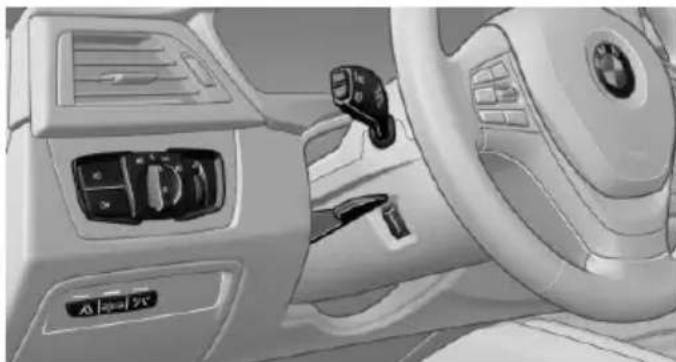
natural_image
Interior view of a car dashboard and steering wheel (no visible text or symbols)Switching on/off
Press the button.
On: the LED lights up.
▶ Off: the LED goes out.
Transporting children safely
Vehicle equipment
All standard, country-specific and optional equipment that is offered in the model series is described in this chapter. Therefore, equipment is also described that is not available in a vehicle, e.g., because of the selected optional equipment or country variant. This also applies for safety-related functions and systems.
The right place for children
Note

Children in the vehicle
Do not leave children unattended in the vehicle; otherwise, they could endanger themselves and other persons, e.g., by opening the doors.
Children should always be in the rear
Accident research shows that the safest place for children is in the back seat.

Transporting children in the rear
Only transport children younger than 13 years of age or shorter than 5 ft/150 cm in the rear in child restraint fixing systems provided in accordance with the age, weight and size of the child; otherwise, there is an increased risk of injury in an accident.
Children 13 years of age or older must wear a safety belt as soon as a suitable child restraint fixing system can no longer be used, due to their age, weight and size.
Children on the front passenger seat
Should it ever be necessary to use a child restraint fixing system in the front passenger seat, make sure that the front, knee and side airbags on the front passenger side are deacti-
vated. Automatic deactivation of front passenger airbags, refer to page 96.
Note

Deactivated front passenger airbags
If a child restraint fixing system is used in the front passenger seat, the front passenger airbags must be deactivated; otherwise, there is an increased risk of injury to the child when the airbags are triggered, even with a child restraint fixing system.
Installing child restraint fixing systems
Before mounting
Before mounting child restraint fixing systems, ensure that the rear seat backrests are locked.
Hints

Manufacturer's information for child re- straint fixing systems
To select, mount and use child restraint fixing systems, observe the information provided by the system manufacturer; otherwise, the protective effect can be impaired.

Ensuring the stability of the child seat
When installing child restraint fixing systems, make sure that the child seat is securely fastened to the backrest of the seat. The angle of the backrest may need to be adjusted and, where necessary, the headrest height may also need to be adjusted, or if possible removed. Make sure that all backrests are securely locked. Otherwise, the stability of the child seat is limited, and there is an increased risk of injury because of unexpected movement of the rear seat backrest.
On the front passenger seat
Deactivating airbags
After installing a child restraint fixing system in the front passenger seat, make sure that the front, knee and side airbags on the front passenger side are deactivated.
Deactivate the front passenger airbags automatically, refer to page 96.

Deactivating the front passenger airbags If a child restraint fixing system is used in the front passenger seat, the front passenger airbags must be deactivated; otherwise, there is an increased risk of injury to the child when the airbags are triggered, even with a child restraint fixing system.
Seat position and height
Before installing a child restraint fixing system, move the front passenger seat as far back as possible and adjust its height to the highest position to obtain the best possible position for the belt and to offer optimal protection in the event of an accident.
If the upper fixing point of the safety belt is located before the belt guide of the child seat, move the passenger seat carefully forward until the best possible belt guide position is reached.
Backrest width
Adjustable backrest width: before installing a child restraint fixing system in the front passenger seat, open the backrest width completely. Do not change the backrest width again and do not call up a memory position.

Backrest width for the child seat
Before installing a child restraint fixing system in the front passenger seat, the back-rest width must be opened completely. Do not change the adjustment after this; otherwise, the stability of the child seat will be reduced.
Child seat security
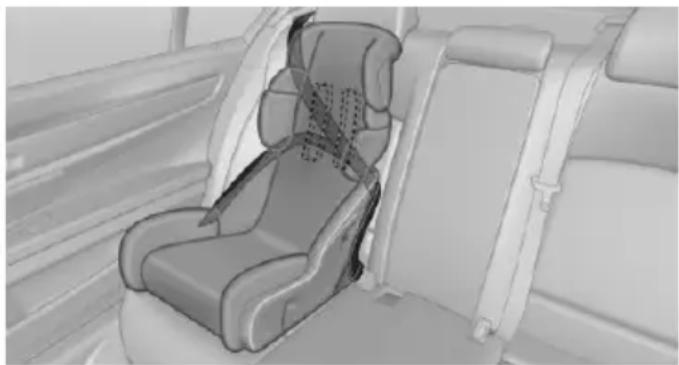
natural_image
Interior view of a car seat assembly showing seatbelt and seat cover (no text or symbols visible)The rear safety belts and the front passenger safety belt can be locked against pulling out for mounting the child restraint fixing systems.
Locking the safety belt
- Pull out the belt webbing completely.
- Secure the child restraint fixing system with the belt.
- Allow the belt webbing to be pulled in and pull it taut against the child restraint fixing system. The safety belt is locked.
Unlocking the safety belt
- Unbuckle the belt buckle.
- Remove the child restraint fixing system.
- Allow the belt webbing to be pulled in completely.
LATCH child restraint fixing system
LATCH: Lower Anchors and Tether for Children.
Note

Follow manufacturer's information for LATCH child restraint fixing systems
To mount and use the LATCH child restraint fixing systems, observe the operating and safety information from the system manufacturer; otherwise, the level of protection may be reduced.
Mounts for the lower LATCH anchors
The lower anchors may be used to attach the CRS to the vehicle seat up to a combined child and CRS weight of 65 lb/30 kg when the child is restrained by the internal harnesses.

Correctly engage the lower LATCH anchors
Make sure that the lower LATCH anchors have properly engaged and that the child restraint fixing system is resting snugly against the backrest; otherwise, the degree of protection offered may be reduced.
Before mounting the LATCH child restraint fixing system, pull the belt away from the child restraint fixing system.
Without a through-loading system: Position
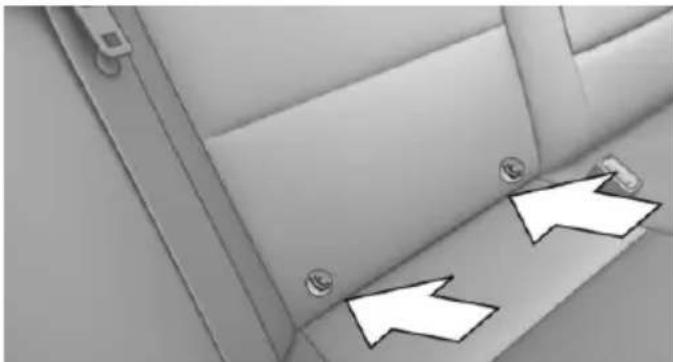
natural_image
Interior view of a vehicle cabin with visible door, seats, and directional arrows indicating movement (no text or symbols)Mounts for the lower LATCH anchors are located in the gap between the seat and back-rest.
With a through-loading system: Position
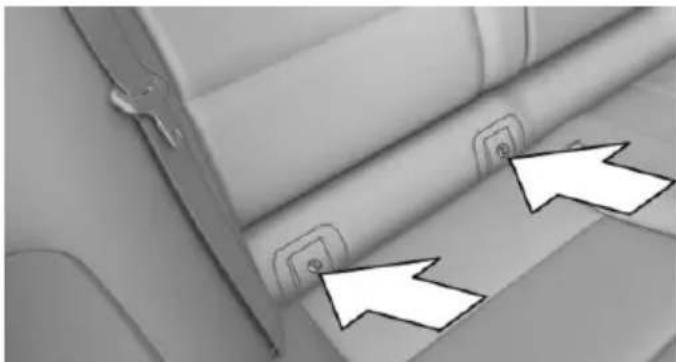
natural_image
Close-up of a car's seatbelt with two white arrows pointing to specific buttons (no text or symbols visible)Mounts for the lower LATCH anchors are located behind the indicated covers.
Mounting ISOFIX child restraint fixing systems
- Mount the child restraint fixing system; refer to the user's manual of the system.
- Ensure that both LATCH anchors are properly connected.
Child restraint fixing system with a tether strap
Mounting points
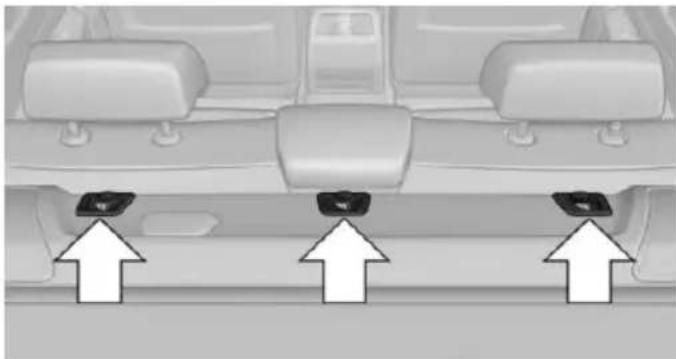
natural_image
Top-down view of a car rearview showing three black buttons placed on the side of the backrest, with white arrows pointing to each button (no text or symbols present)Depending on the vehicle equipment, there are two outer or three mounting points for child restraint fixing systems with a tether strap.
Note

Mounting eyes
Only use the mounting eyes for the upper retaining strap to secure child restraint fixing systems; otherwise, the mounting eyes could be damaged.
Retaining strap guide

Retaining strap
Make sure that the upper retaining strap is not routed over the head restraints or sharp edges and is free of twisting on its way to the upper mounting point; otherwise, the belt cannot properly secure the child restraint fixing system in an accident.
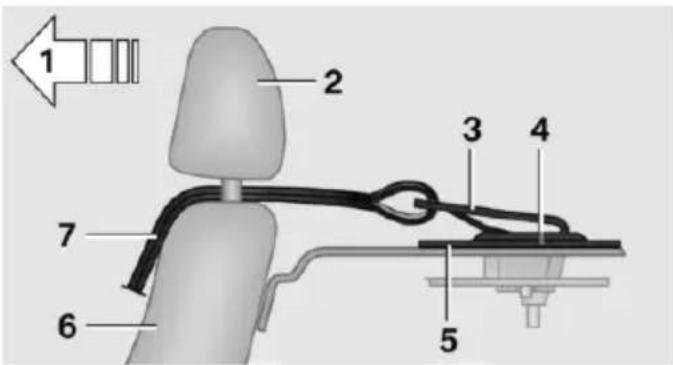
text_image
1 2 3 4 5 6 71 Direction of travel
2 Head restraint.
3 Hook for upper retaining strap
4 Mounting point/eye
5 Rear window shelf
6 Seat backrest
7 Upper retaining strap
Attaching the upper retaining strap to the mounting point
- Remove the mounting point cover.
- Raise the head restraint.
- Guide the upper retaining strap between the supports of the head restraint.
-
Attach the hook of the retaining strap to the mounting eye.
-
Tighten the retaining strap by pulling it down.
- Lower and lock head restraints as needed.
Locking the doors and windows
Rear doors
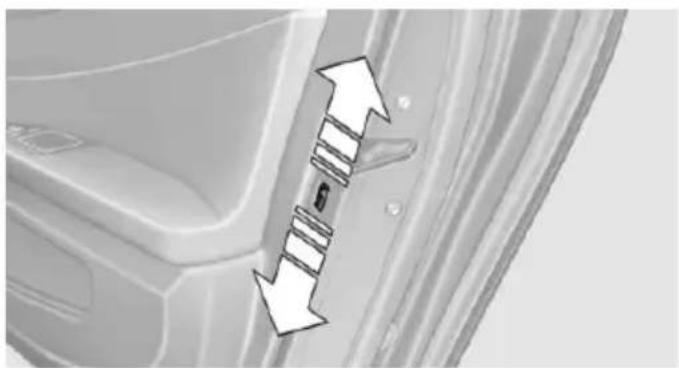
natural_image
Close-up of a car door panel with directional arrows indicating movement or force (no text or symbols)Push the locking lever on the rear doors down. The door can now be opened from the outside only.
Safety switch for the rear
Press the button on the driver's door if children are being transported in the
rear.
This locks various functions so that they cannot be operated from the rear: safety switch, refer to page 44.
Driving
Vehicle equipment
All standard, country-specific and optional equipment that is offered in the model series is described in this chapter. Therefore, equipment is also described that is not available in a vehicle, e.g., because of the selected optional equipment or country variant. This also applies for safety-related functions and systems.
Start/Stop button
The concept
Pressing the Start/Stop button switches the ignition on or off and starts the engine.
Automatic transmission: The engine starts if the brake is de-
pressed while pressing the Start/Stop button.
Manual transmission: the engine starts if the clutch pedal is depressed when the Start/Stop button is pressed.
Ignition on
Automatic transmission: Press the Start/Stop button but do not depress the brake.
Manual-shift transmission: press the Start/Stop button, and do not press on the clutch pedal at the same time.
All vehicle systems are ready for operation.
Most of the indicator and warning lamps in the instrument cluster light up for varying lengths of time.
To save battery power when the engine is off, switch off the ignition and any unnecessary electronic systems/power consumers.
Note
If the engine is switched off and the ignition is switched on, the system automatically switches to the radio ready state when the door is opened if the lights are switched off or the daytime running lights are switched on.
Ignition off
Automatic transmission: Press the Start/Stop button again, but do not depress the brake.
Manual-shift transmission: press the Start/Stop button again, and do not press on the clutch pedal at the same time.
All indicator lamps in the instrument cluster go out.
To save battery power when the engine is off, switch off the ignition and any unnecessary electronic systems/power consumers.

P when the ignition is switched off
P is engaged automatically when the ignition is switched off. When in an automatic car wash, for example, ensure that the ignition is not switched off accidentally.
The ignition automatically cuts off while the vehicle is stationary and the engine is stopped:
▶ When locking the vehicle, and when the low beams are activated.
▶ Shortly before the battery is discharged completely, so that the engine can still be started. This function is only available when the low beams are switched off.
When opening or closing the driver door, if the driver's seat belt is unbuckled and the low beams are switched off.
▶ While the driver's seat belt is unbuckled, if the driver's door is open and the low beams are switched off.
When the ignition is switched off, by opening or closing the driver's door or unbuckling the
driver's seat belt, the radio ready state remains active.
Radio ready state
Activate radio ready state:
When the engine is running: press the Start/Stop button.
Some electronic systems/power consumers remain ready for operation.
The radio ready state switches off automatically:
▶ After approx. 8 minutes.
▷ When the vehicle is locked using the central locking system.
▶ Shortly before the battery is discharged completely, so that the engine can still be started.
Starting the engine
Hints

Enclosed areas
Do not let the engine run in enclosed areas, since breathing in exhaust fumes may lead to loss of consciousness and death. The exhaust gases contain carbon monoxide, an odorless and colorless, but highly toxic gas.

Unattended vehicle
Do not leave the vehicle unattended with the engine running; doing so poses a risk of danger.
Before leaving the vehicle with the engine running, set the parking brake and place the transmission in selector lever position P or neutral to prevent the vehicle from moving.

Repeated starting in quick succession
Avoid repeated unsuccessful attempts to start the vehicle or starting the vehicle several times in quick succession. Otherwise, the fuel is not burned or is inadequately burned, posing
a risk of overheating and damage to the catalytic converter.
Do not wait for the engine to warm-up while the vehicle remains stationary. Start driving at moderate engine speeds.
Diesel engine
If the engine is cold and temperatures are below approx. 32 °F/0 °C, the start process may be delayed somewhat due to automatic preheating.
A Check Control message is displayed.
Automatic transmission
Starting the engine
-
Depress the brake pedal.
-
Press the Start/Stop button.
The ignition is activated automatically for a certain time and is stopped as soon as the engine starts.
Manual transmission
Starting the engine
-
Depress the brake pedal.
-
Press on the clutch pedal and shift to neutral.
-
Press the Start/Stop button.
The ignition is activated automatically for a certain time and is stopped as soon as the engine starts.
Engine stop
Hints

Take the remote control with you
Take the remote control with you when leaving the vehicle so that children, for example, cannot start the engine.

Set the parking brake and further secure the vehicle as required
Set the parking brake firmly when parking; otherwise, the vehicle could roll. On steep upward and downward inclines, further secure the vehicle, for example, by turning the steering wheel in the direction of the curb.
Before driving into a car wash
In order for the vehicle to be able to roll into a car wash, pay attention to the information regarding Washing in automatic car washes, refer to page 221.
Automatic transmission
Switching off the engine
- Engage selector lever position P with the vehicle stopped.
- Press the Start/Stop button.
The engine is switched off.
The radio ready state is switched on. - Set the parking brake.
Manual transmission
Switching off the engine
- With the vehicle at a standstill, press the Start/Stop button.
- Shift into first gear or reverse.
- Set the parking brake.
Auto Start/Stop function
The concept
The Auto Start/Stop function helps save fuel. The system switches off the engine during a stop, e.g., in traffic congestion or at traffic lights. The ignition remains switched on. The engine starts again automatically for driving off.
Automatic mode
After every start of the engine using the Start/Stop button, the Auto Start/Stop function is in the last selected state, refer to page 64.
When the Auto Start Stop function is active, it is available when the vehicle is traveling faster than about 3 mph, approx. 5 km/h.
Engine stop
The engine is switched off automatically during a stop under the following conditions:
Automatic transmission:
The selector lever is in selector lever position D.
▶ Brake pedal remains depressed while the vehicle is stopped.
The driver's safety belt is buckled or the driver's door is closed.
Manual transmission:
▶ Neutral is engaged and the clutch pedal is not pressed.
The driver's safety belt is buckled or the driver's door is closed.
The air flow of the air conditioner is reduced when the engine is switched off.
Displays in the instrument cluster
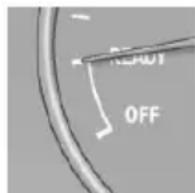
The READY display in the tachometer signals that the Auto Start/Stop function is ready to start the engine automatically.
The display indicates that the conditions for an automatic engine stop have not been satisfied.
Note
The engine is not switched off automatically in the following situations:
▶ External temperature too low.
The external temperature is high and automatic climate control is running.
The passenger compartment has not yet been heated or cooled to the required level.
The engine is not yet at operating temperature.
The wheels are at a sharp angle or the steering wheel is being turned.
▶ After driving in reverse.
Fogging of the windows when the automatic climate control is switched on.
▶ Vehicle battery is heavily discharged.
The engine compartment lid is unlocked.
The parking assistant is activated.
▶ Stop-and-go traffic.
The selector lever is in position N or M/S.
▶ Use of fuel with high ethanol content.
Starting the engine
The engine starts automatically under the following conditions:
▶ Automatic transmission:
By releasing the brake pedal.
▶ Manual transmission:
The clutch pedal is pressed.
After the engine starts, accelerate as usual.
Safety mode
After the engine switches off automatically, it will not start again automatically if any one of the following conditions are met.
The driver's safety belt is unbuckled and the driver's door is open.
The hood was unlocked.
Some indicator lamps light up for varying lengths of time.
The engine can only be started via the Start/Stop button.
Note
Even if driving away was not intended, the deactivated engine starts up automatically in the following situations:
Excessive warming of the passenger compartment when the cooling function is switched on.
The steering wheel is turned.
▶ Automatic transmission: change from selector lever position D to N, R or M/S.
▶ Automatic transmission: change from selector lever position P to N, D, R or M/S.
The vehicle begins rolling.
Fogging of the windows when the automatic climate control is switched on.
▶ Vehicle battery is heavily discharged.
Excessive cooling of the passenger compartment when the heating is switched on.
Low brake vacuum pressure; this can occur, for example, if the brake pedal is depressed a number of times in succession.
Activating/deactivating the system manually
Using the button
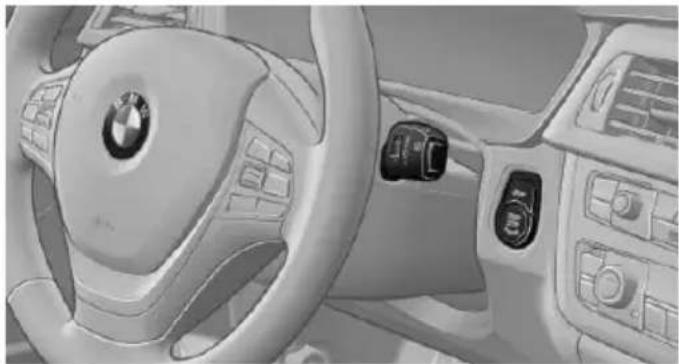
natural_image
Interior view of a car dashboard with BMW logo and control panel (no visible text or symbols)
Press the button.
▶ LED comes on: Auto Start Stop function is deactivated.
The engine is started during an automatic engine stop.
The engine can only be stopped or started via the Start/Stop button.
▶ LED goes out: Auto Start Stop function is activated.
Switching off the vehicle during an automatic engine stop
During an automatic engine stop, the vehicle can be switched off permanently, e.g., when leaving it.
- Press the Start/Stop button. The ignition is switched off. The Auto Start/Stop function is deactivated.
Selector lever position P is engaged automatically.
- Set the parking brake.
Engine start as usual via Start/Stop button.
Automatic deactivation
In certain situations, the Auto Start/Stop function is deactivated automatically for safety reasons, such as when the driver is detected to be absent.
Malfunction
The Auto Start/Stop function no longer switches of the engine automatically. A Check Control message is displayed. It is possible to continue driving. Have the system checked.
Parking brake
Applying
The lever automatically engages after being pulled up.

The indicator lamp lights up red. The parking brake is set.
Lower lamp: indicator lamp in Canadian models
Releasing
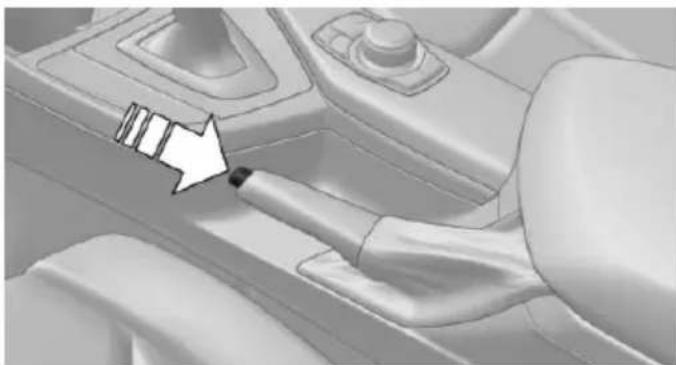
natural_image
Interior view of a car gear shift lever with a white arrow pointing to the shaft (no text or symbols visible)Raise lever slightly, press the button and guide the lever down.
Hints

Use while driving
If on a rare occasion it is necessary to use the parking brake while driving, do not use excessive force when applying it. When using it, keep the button on the lever depressed.
Otherwise, using excessive force when applying the parking brake may cause the rear wheels to lock, resulting in fishtailing.
To prevent corrosion and braking control on one side only, lightly apply the parking brake periodically while coasting, if traffic conditions permit.
The brake lamps will not light up if the parking brake is engaged.
Turn signal, high beams, headlamp flasher
Turn signal

Do not fold in the exterior mirrors
Do not fold in the exterior mirror while driving and when the turn signals/warning flashers are working, or else the additional flasher lights in the exterior mirror will no longer be in the prescribed position and will be difficult to see.
Using turn signals
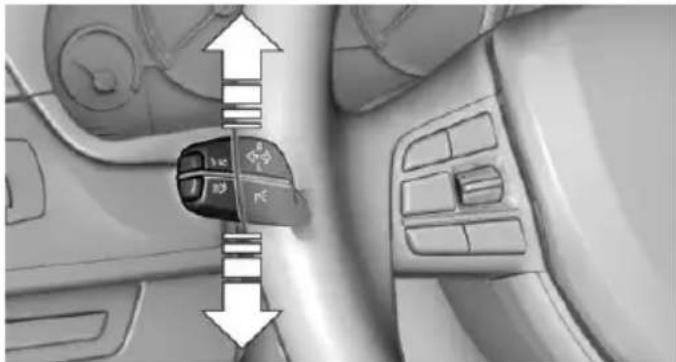
natural_image
Interior view of a car showing a car's key seat and dashboard with directional arrows (no text or symbols)Press the lever beyond the resistance point.
To switch off manually, press the lever to the resistance point.
Unusually rapid flashing of the indicator lamp indicates that a turn signal bulb has failed.
Triple turn signal activation
Press the lever to the resistance point.
The turn signal flashes three times.
The function can be activated or deactivated:
-
"Settings"
-
"Lighting"
-
"Triple turn signal"
The setting is stored for the remote control currently in use.
Signaling briefly
Press the lever to the resistance point and hold it there for as long as you want the turn signal to flash.
High beams, headlamp flasher
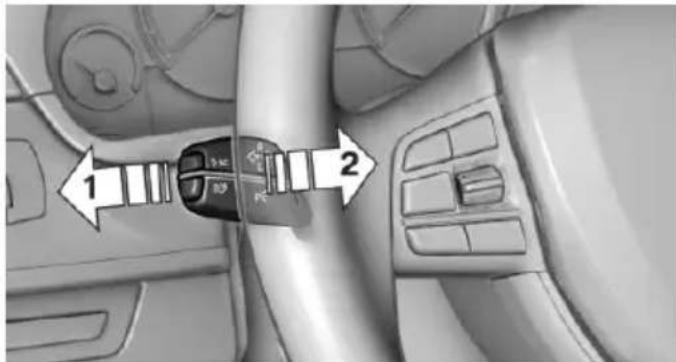
text_image
Diagram showing a car's seatbelt with numbered arrows indicating directional movement or positioning.▷ High beams, arrow 1.
▶ Headlamp flasher, arrow 2.
Washer/wiper system
Switching the wipers on/off and brief wipe
Do not switch on the wipers if frozen
Do not switch on the wipers if they are frozen onto the windshield; otherwise, the wiper blades and the windshield wiper motor may be damaged.
No wiper operation on dry windshield
Do not use the windshield wipers if the windshield is dry, as this may damage the wiper blades or cause them to become worn more quickly.
No wiper operation with wipers folded away
Do not switch on the wipers if they are folded away, otherwise the hood or the wipers may be damaged.
Switching on
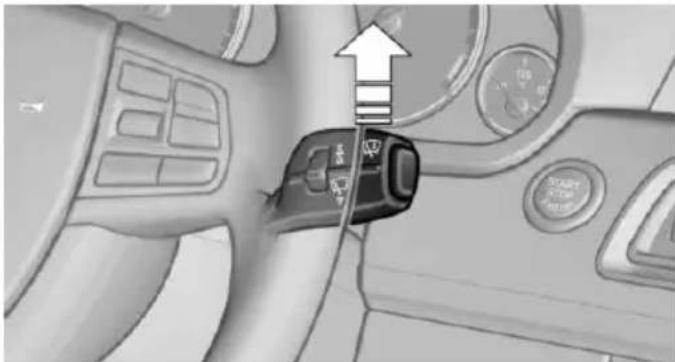
natural_image
Interior view of a car dashboard with steering wheel and directional arrow (no text or symbols)Press the wiper levers up.
The lever automatically returns to its initial position when released.
Normal wiping speed: press up once.
The wipers switch to intermittent operation when the vehicle is stationary.
▶ Fast wiping speed: press up twice or press once beyond the resistance point.
The wipers switch to normal speed when the vehicle is stationary.
Switching off and brief wipe
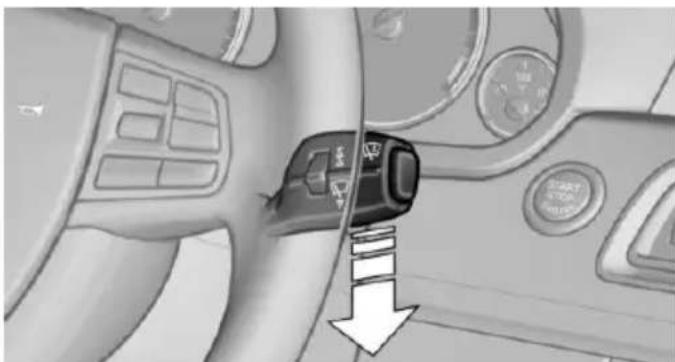
natural_image
Interior view of a car dashboard with a black control panel and directional arrow (no text or symbols visible)Press the wiper levers down.
The lever automatically returns to its initial position when released.
▶ Brief wipe: press down once.
To switch off normal wipe: press down once.
To switch off fast wipe: press down twice.
Intermittent operation or rain sensor
The concept
Without the rain sensor, the frequency of the wiper operation is preset.
The rain sensor automatically controls the time between wipes depending on the intensity of the rainfall. The sensor is located on the wind-shield, directly behind the interior rearview mirror.
Activating/deactivating
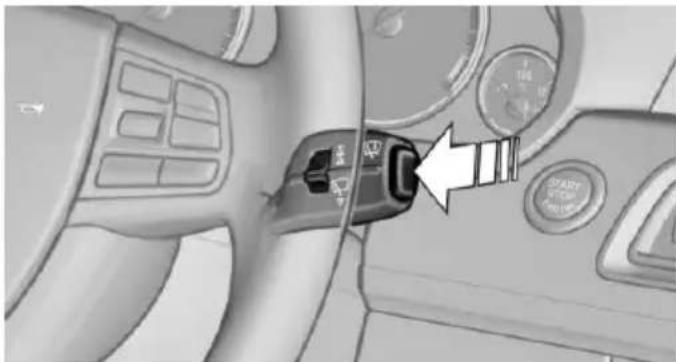
natural_image
Interior view of a car dashboard with a black connector and control buttons (no visible text or symbols)Press the button on the wiper lever.
The LED in the wiper lever lights up and a wiping operation is started. If there is frost, wiper operation is not started.

Deactivate the rain sensor in car washes
Deactivate the rain sensor when passing through an automatic car wash; otherwise, damage could be caused by undesired wiper activation.
Setting the frequency or sensitivity of the rain sensor
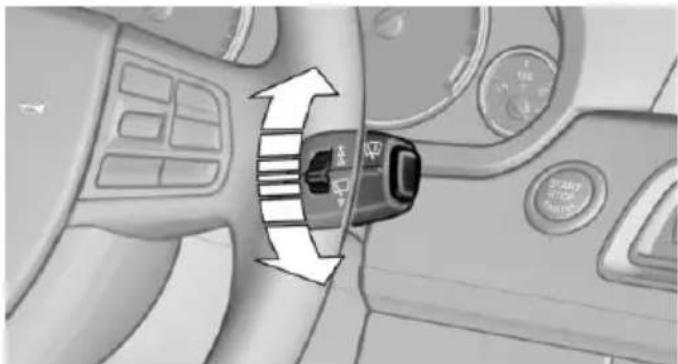
natural_image
Top-down view of a car dashboard with directional arrows indicating left and right motion (no text or symbols)Turn the thumbwheel.
Clean the windshield, headlamps
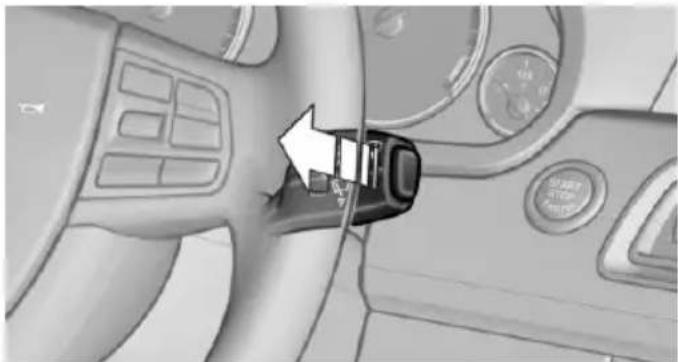
natural_image
Interior view of a car dashboard with control panel and directional arrow (no visible text or symbols)Pull the wiper lever.
The system sprays washer fluid on the wind-shield and activates the wipers briefly.
In addition, the headlamps are cleaned at regular intervals when the vehicle lights are switched on.

Do not use the washer system at freezing temperatures
Do not use the washers if there is any danger that the fluid will freeze on the windshield; otherwise, your vision could be obscured. For this reason, use antifreeze.
Avoid using the washer when the reservoir is empty; otherwise, you could damage the pump.
Windshield washer nozzles
The windshield washer nozzles are automatically heated while the ignition is switched on.
Fold-out position of the wipers
Required when changing the wiper blades or under frosty conditions, for example.
- Switch the ignition on and off again.
- Under frosty conditions, ensure that the wiper blades are not frozen onto the windshield.
- Press the wiper lever up beyond the point of resistance and hold it for approx. 3 seconds, until the wiper remains in a nearly vertical position.
After the wipers are folded back down, the wiper system must be reactivated.

Fold the wipers back down
Before switching the ignition on, fold the wipers back down to the windshield; otherwise, the wipers may become damaged when they are switched on.
- Switch on the ignition.
- Press the wiper levers down. The wipers move to their resting position and are ready for operation.
Washer fluid
General information

Antifreeze for washer fluid
Antifreeze is flammable and can cause injury if it is used incorrectly.
Therefore, keep it away from sources of ignition.
Only keep it in the closed original container and inaccessible to children.
Follow the notes and instructions on the container.
United States: The washer fluid mixture ratio is regulated by the U.S. EPA and many individual states; do not exceed the allowable washer fluid dilution ratios limits that apply. Follow the usage instructions on the washer fluid con-
tainer. Use BMW's Windshield Washer Concentrate or the equivalent.
Washer fluid reservoir

Adding washer fluid
Only add washer fluid when the engine is cool, and then close the cover completely to avoid contact between the washer fluid and hot engine parts.
Otherwise, there is the danger of fire and a risk to personal safety if the fluid is spilled.
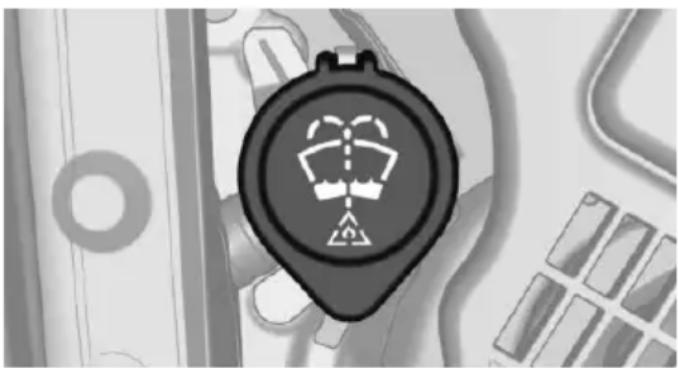
natural_image
Close-up of a black circular device with a white warning symbol on its face, surrounded by abstract geometric patterns (no text or symbols)All washer nozzles are supplied from one reservoir.
Fill with a mixture of windshield washer concentrate and tap water and – if required – with a washer antifreeze, according to the manufacturer's recommendations.
Mix the washer fluid before adding to maintain the correct mixing ratio.
Do not add windshield washer concentrate and antifreeze undiluted and do not fill with pure water; this could damage the wiper system.
Do not mix window washer concentrates of different manufacturers, because otherwise it can result in clogging of the windshield washer nozzles.
Recommended minimum fill quantity: 0.2 US gal/1 liter.
Manual transmission
Shifting

Shifting into 5th or 6th gear
When shifting into 5th or 6th gear, push the gearshift lever to the right; otherwise inadvertent shifting into the 3rd or 4th gear could lead to engine damage.
Reverse gear
Select only when the vehicle is stationary.
To overcome the resistance move the selector lever in a dynamic movement to the left and engage the reverse gear.
Automatic transmission with Steptronic
Selector lever positions
D Drive, automatic position
Gear position for normal vehicle operation. All forward gears are available.
R is Reverse
Select only when the vehicle is stationary.
N is Neutral
Use in automatic car washes, for example. The vehicle can roll.
When the ignition is switched off, refer to page 61, selector lever position P is engaged automatically.
P Park
Select only when the vehicle is stationary. The drive wheels are blocked.
P is engaged automatically:
▶ After the engine is switched off when the vehicle is in radio ready state, refer to page 62, or when the ignition is switched
off, refer to page 61, and when position R or D is engaged.
▶ With the ignition off, if selector lever position N is engaged.
If the safety belt is unbuckled, the driver's door is opened, and the brake pedal is not pressed while the vehicle is stationary and position D or R is engaged.
Before exiting the vehicle, make sure that selector lever position P of the automatic transmission is engaged. Otherwise, the vehicle may begin to roll.
Kickdown
Kickdown is used to achieve maximum driving performance. Press on the accelerator pedal beyond the resistance point at the full throttle position.
Engaging selector lever positions
It is not possible to shift out of selector lever position P until the engine is running and the brake is applied.
With the vehicle stationary, press on the brake pedal before shifting out of P or N; otherwise, the shift command will not be executed: shift lock.

Press on the brake pedal until you start driving
To prevent the vehicle from creeping after you select a gear, maintain pressure on the brake pedal until you are ready to start.
Engaging D, R and N
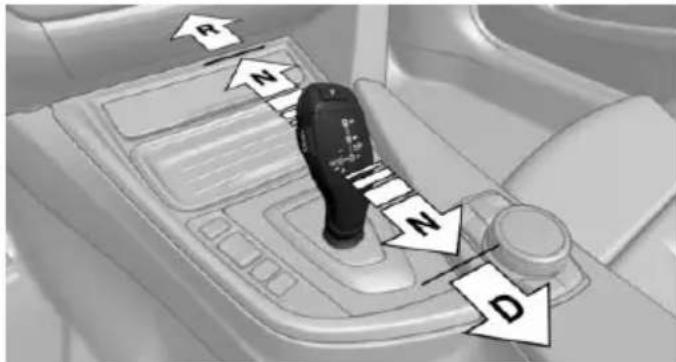
text_image
R N N DBriefly push the selector lever in the desired direction, beyond a resistance point if necessary.
After releasing the selector lever, it returns to its center position.
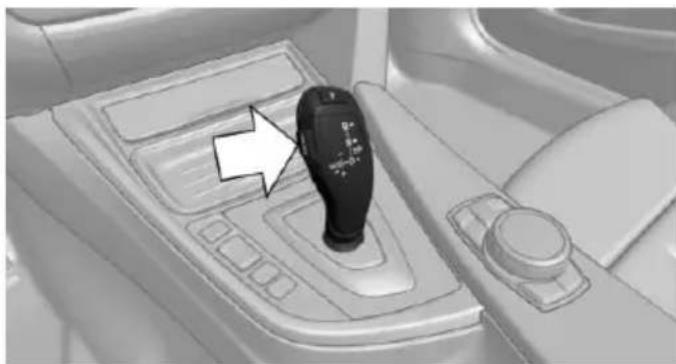
natural_image
Interior view of a car gear shift control panel with a black key inserted, showing no text or symbols on the main component.Press unlock button, in order to:
Engage R.
▶ Shift out of P.
Engaging P
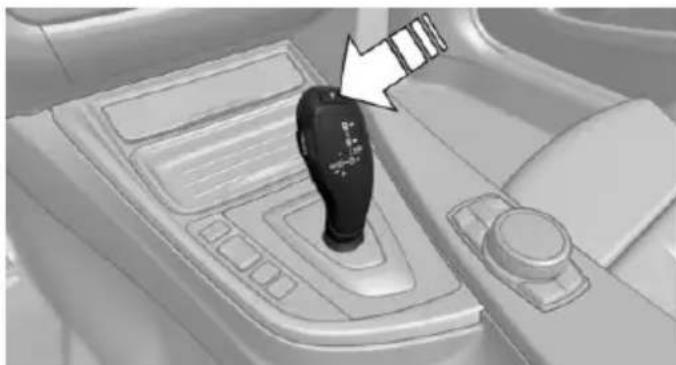
natural_image
Interior view of a car gear shift lever with a black key inserted, showing no text or symbols on the component itself.Press button P.
Sport program and manual mode
Activating the sport program
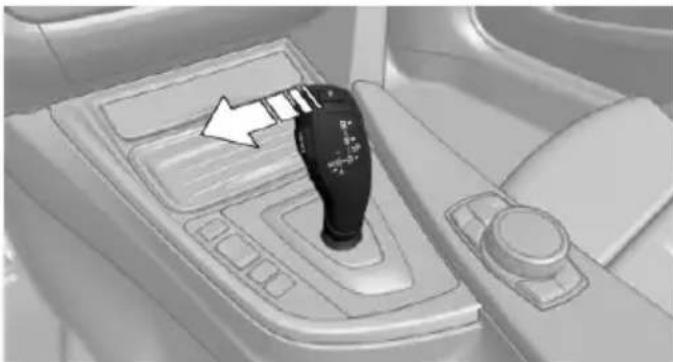
natural_image
Interior view of a car gear shift lever with control panel and mode dial (no text or symbols visible)Press the selector lever to the left out of selector lever position D.
The sport program of the transmission is activated.
Activating the M/S manual mode
- Press the selector lever to the left out of selector lever position D.
- Push the selector lever forward or pull it backward.
Manual mode becomes active and the gear is changed.
The engaged gear is displayed in the instrument cluster, e.g., M1.
Once maximum engine speed is attained, M/S manual mode is automatically upshifted as needed.
Switching to manual mode
To shift down: press the selector lever forward.
To shift up: pull the selector lever rearwards.
Gears will only be shifted at appropriate engine and road speeds, e.g., downshifting is not possible if the engine speed is too high.
The selected gear is briefly displayed in the instrument cluster, followed by the current gear.
Sport automatic transmission: prevent automatic upshifting in M/S manual mode
For vehicles with Sport automatic transmissions, automatic shift operations are not performed, at maximum engine speed for example, if one of the following conditions is met:
▷ DSC deactivated.
▶ TRACTION activated.
▶ SPORT+ activated.
In addition, the kickdown is deactivated.
Ending the sport program/manual mode
Push the selector lever to the right.
D is displayed in the instrument cluster.
Shift paddles
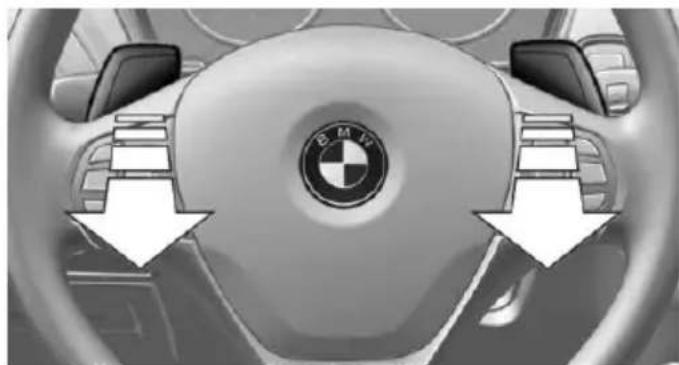
natural_image
Interior view of a BMW car dashboard showing the wheel, steering wheel, and logo (no text or symbols visible)The shift paddles on the steering wheel allow you to shift gears quickly while keeping both hands on the steering wheel.
If the shift paddles on the steering wheel are used to shift gears in automatic mode, the transmission temporarily switches to manual mode.
If the shift paddles are not used and the vehicle is not accelerated for a certain time, the system switches back into automatic mode if the selector lever is in selector lever position D.
▶ Shift up: pull right shift paddle.
▶ Shift down: pull left shift paddle.
Gears will only be shifted at appropriate engine and road speeds, for example downshifting is not possible if the engine speed is too high.
The selected gear is briefly displayed in the instrument cluster, followed by the current gear.
Displays in the instrument cluster
The selector lever position is displayed, e.g.: P.
Sport automatic transmission: Launch Control
The concept
Launch Control enables optimum acceleration on surfaces with good traction.
Hints

Component wear
Do not use Launch Control too often;
otherwise, this may result in premature wear of components due to the high stress placed on the vehicle.
Did not use Launch Control during the break-in, refer to page 162, period.
To increase vehicle stability, activate DSC again as soon as possible.
An experienced driver may be able to achieve better acceleration values in DSC OFF mode.
Requirements
Launch Control is available when the engine is warmed up, that is, after uninterrupted driving of at least 6 miles/10 km.
To start with Launch Control do not steer the steering wheel.
Start with launch control
While the engine is running:
Press button or select with the Dynamics Control Sport+.
TRACTION is displayed in the instrument cluster and the indicator lamp for DSC OFF lights up.
-
Engage gear S.
-
With the left foot, forcefully press down on the brake.
-
Press and hold down the accelerator pedal beyond the resistance point at the full throttle position.
A flag symbol appears in the instrument cluster.
- The starting engine speed adjusts. Within 3 seconds, release the brake.
Before using Launch Control, allow the transmission to cool down for approx. 5 minutes.
Launch Control adjusts to the surrounding conditions, e.g., wet pavement, when used again.
Displays
Vehicle equipment
All standard, country-specific and optional equipment that is offered in the model series is described in this chapter. Therefore, equip-
ment is also described that is not available in a vehicle, e. g., because of the selected optional equipment or country variant. This also applies for safety-related functions and systems.
Instrument cluster
Overview, instrument cluster
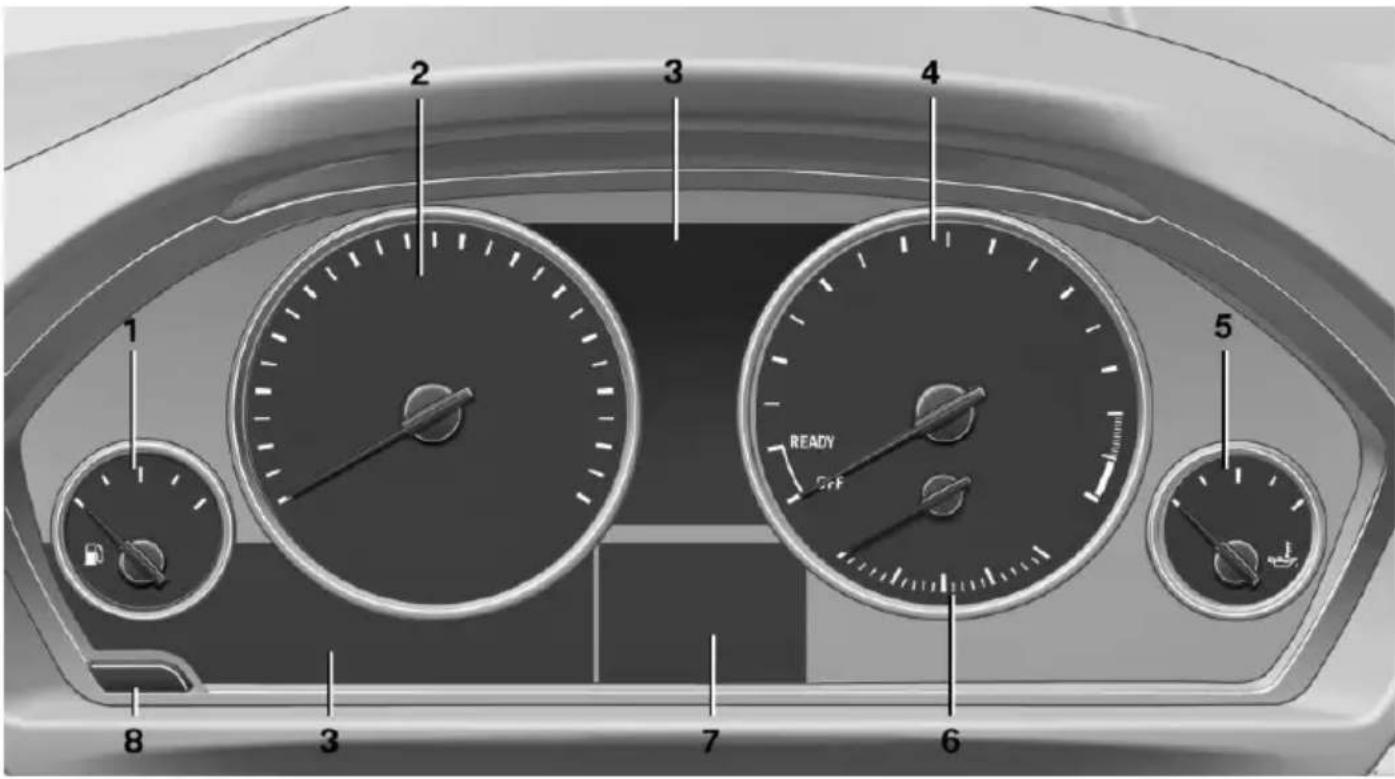
text_image
1 2 3 4 5 READY Left 6 7 8 31 Fuel gauge 78
2 Speedometer
3 Indicator/warning lamps 76
4 Tachometer 78
5 Engine oil temperature 78
6 Current fuel consumption 80
7 Electronic displays 75
8 Display/reset miles 79
Overview, instrument cluster with enhanced features
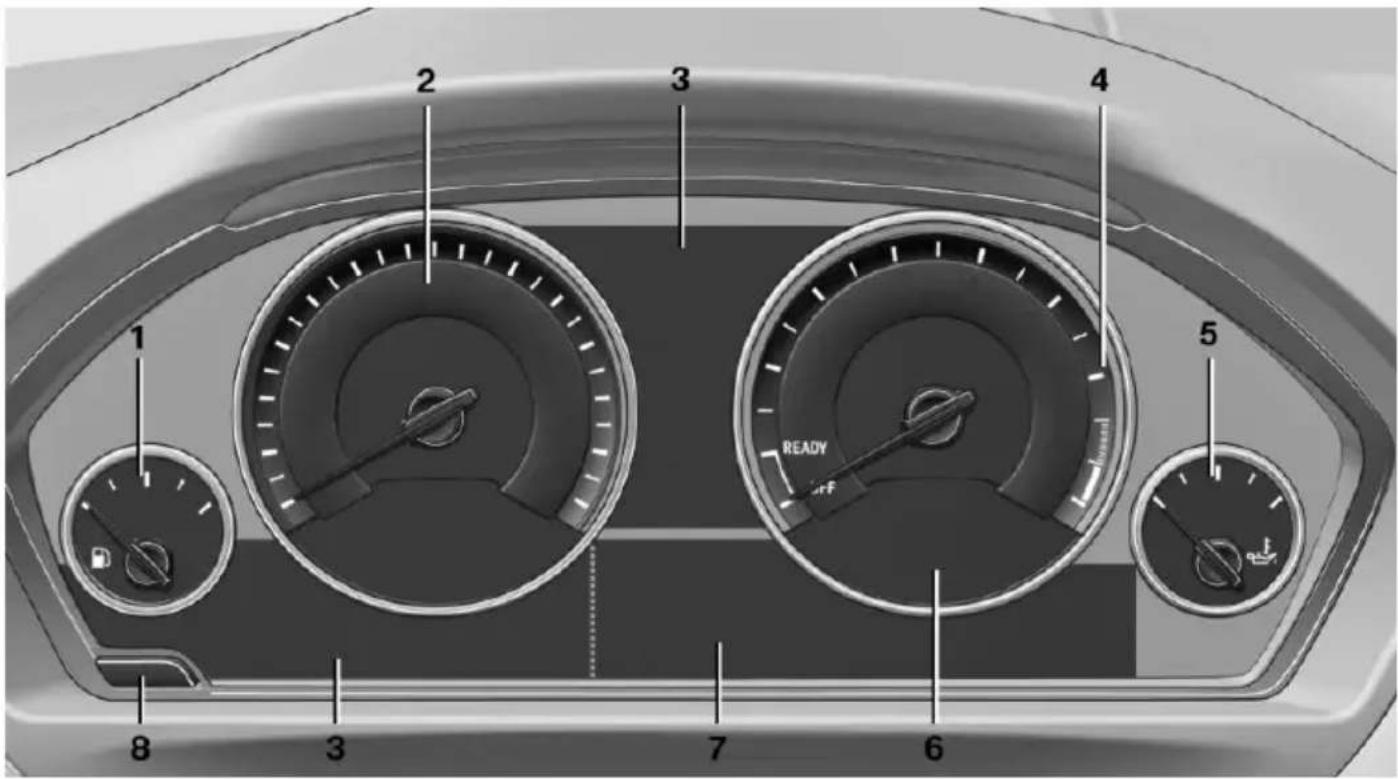
text_image
1 2 3 4 5 READY OFF 7 8 3 61 Fuel gauge 78
2 Speedometer
3 Indicator/warning lamps 76
4 Tachometer 78
5 Engine oil temperature 78
6 Current fuel consumption 80
7 Electronic displays 75
8 Display/reset miles 79
Electronic displays
Overview, instrument cluster
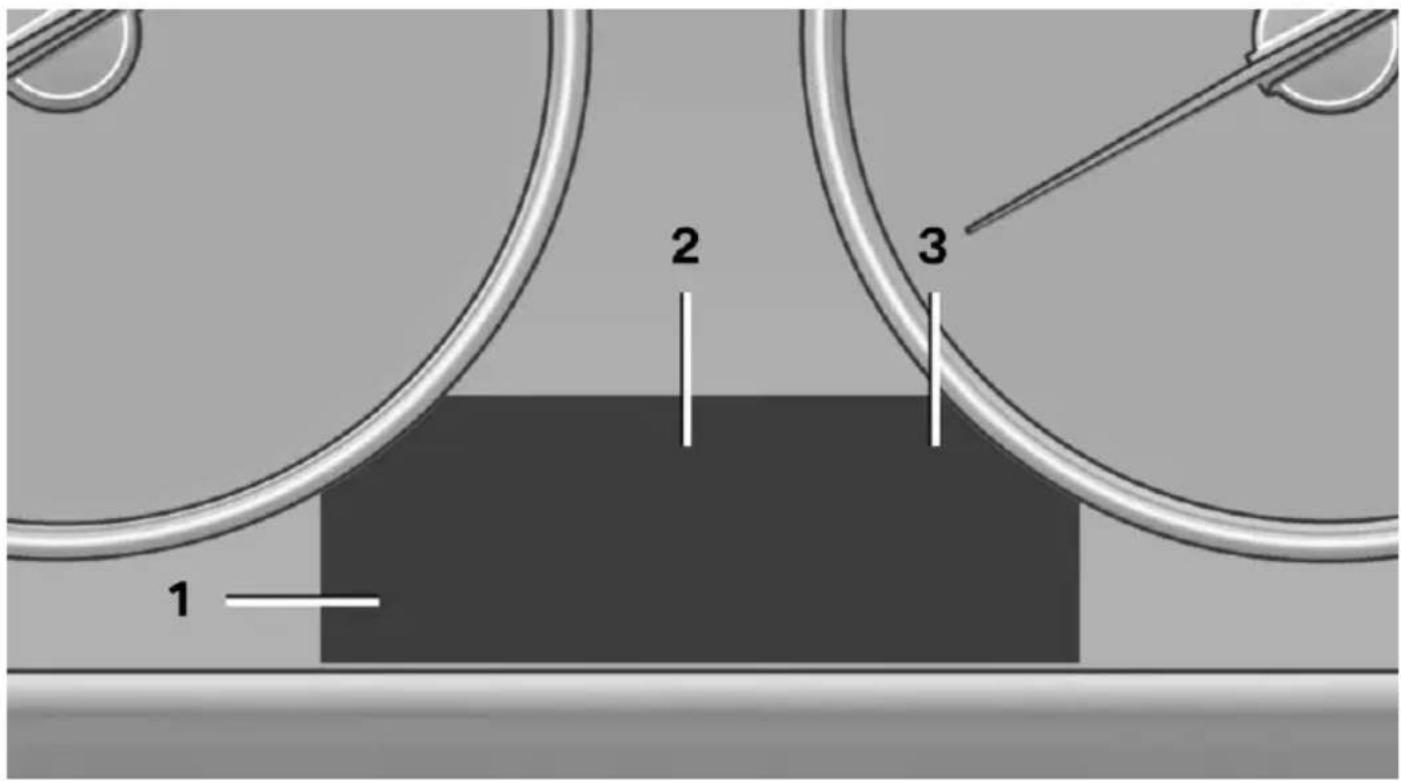
text_image
1 2 31 Messages, e.g., Check Control 76
Time 79
Date 79
External temperature 79
Selection lists 83
Service requirements 80
Miles/trip miles 79
Computer 83
2 Transmission display 72
Gear shift indicator 81
3 Status, Driving Dynamics Control 116
Overview, instrument cluster with enhanced features
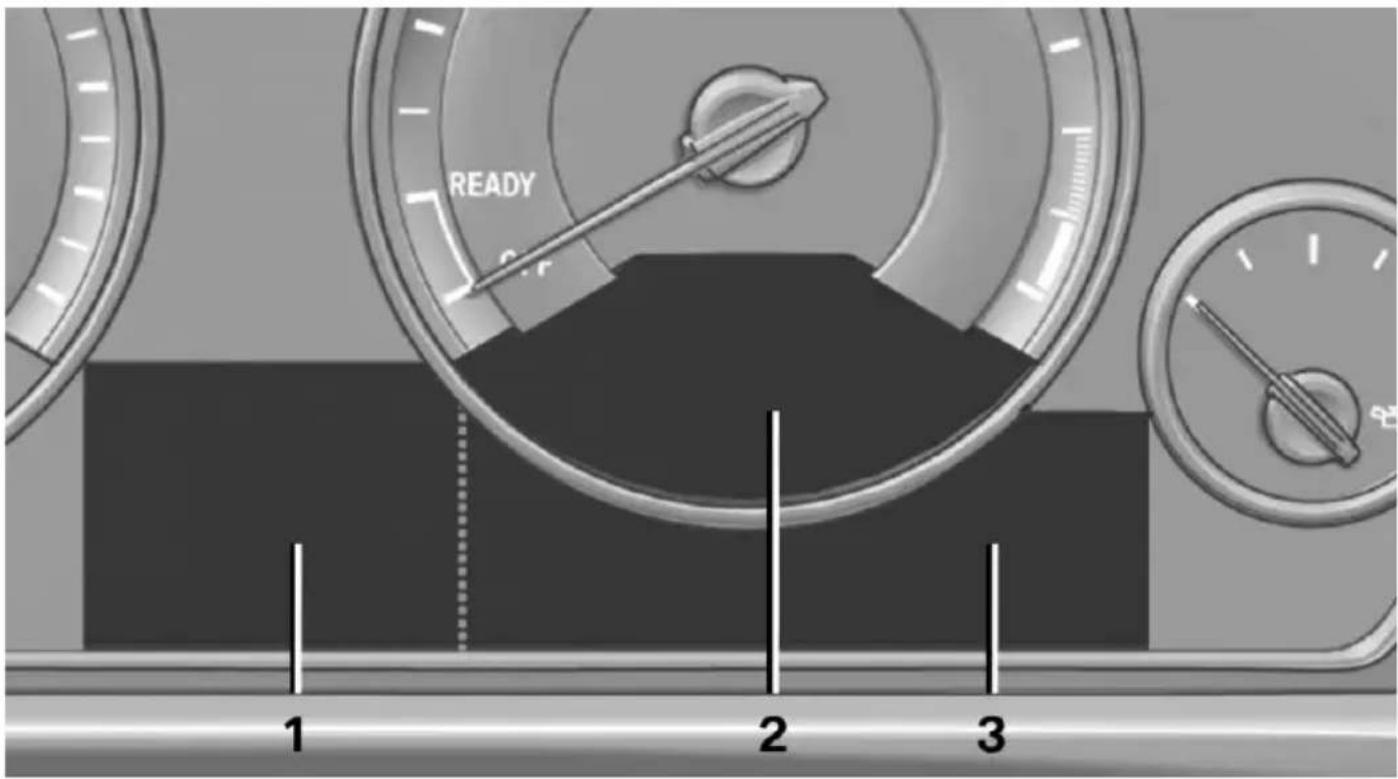
text_image
READY 1 2 31 Time 79
External temperature 79
Date 79
Selection list, such as for the radio 83
Speed limit detection 81
Computer 83
Miles/trip miles 79
Navigation display, see user's manual for Navigation, Entertainment and Communication.
Status, Driving Dynamics Control 116
2 Energy recovery 80
Transmission display 72
Current fuel consumption 80
ECO PRO 169
3 Messages, e.g., Check Control 76
Service requirements 80
Check Control
The concept
The Check Control system monitors functions in the vehicle and notifies you of malfunctions in the monitored systems.
A Check Control message is displayed as a combination of indicator or warning lamps and text messages in the instrument cluster and in the Head-up Display.
In addition, an acoustic signal may be output and a text message may appear on the Control Display.
Indicator/warning lamps
The indicator and warning lamps in the instrument cluster can light up in a variety of combinations and colors.
Several of the lamps are checked for proper functioning and light up temporarily when the engine is started or the ignition is switched on.
Overview: indicator/warning lamps
Symbol Function or system

Turn signal.

Front fog lamps.

High beams.

High-beam Assistant.

Parking lamps, headlamp control.

Active Cruise Control.

Vehicle detection, Active Cruise Control: collision warning.

Pedestrian warning.

Cruise control.

Lane departure warning.

DSC Dynamic Stability Control.

DSC Dynamic Stability Control is deactivated or DTC Dynamic Traction Control is activated.

Tire Pressure Monitor. Flat Tire Monitor.

Safety belts.
Symbol Function or system

Airbag system.

Steering system.

Engine functions.

Parking brake. Brake system.

In Canadian models Parking brake. Brake system.

ABS Antilock Brake System.

In Canadian models ABS Antilock Brake System.

At least one Check Control message is displayed or is stored (symbol in display).
Text messages
Text messages in combination with a symbol in the instrument cluster explain a Check Control message and the meaning of the indicator and warning lamps.
Supplementary text messages
Additional information, such as on the cause of a fault or the required action, can be called up via Check Control.
The supplementary text of urgent messages is automatically displayed on the Control Display.
Symbols
Depending on the Check Control message, the following functions can be selected.
"Owner's Manual"
Display additional information about the Check Control message in the Integrated Owner's Manual.
"Service request"
Contact your service center.
"Roadside Assistance"
Contact Roadside Assistance.
Hiding Check Control messages
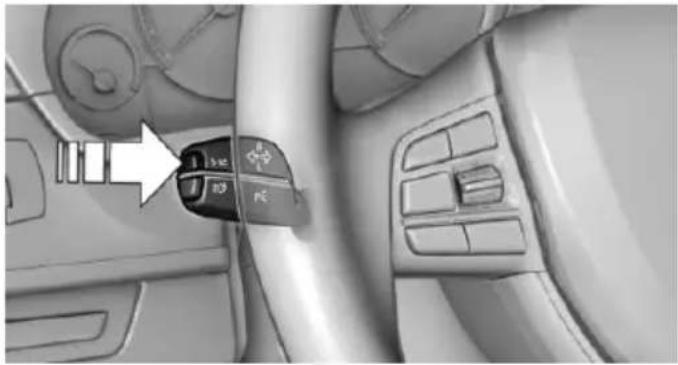
natural_image
Interior view of a car showing the rear wheel, dashboard, and seatbelt (no visible text or symbols)Press the onboard computer button on the turn signal lever.
Some Check Control messages are displayed continuously and are not cleared until the malfunction is eliminated. If several malfunctions occur at once, the messages are displayed consecutively.
These messages can be hidden for approx. 8 seconds. After this time, they are displayed again automatically.
▶ Other Check Control messages are hidden automatically after approx. 20 seconds. They are stored and can be displayed again later.
Displaying stored Check Control messages
-
"Vehicle Info"
-
"Vehicle status"
-
"Check Control"
-
Select the text message.
Messages after trip completion
Special messages that are displayed during driving are displayed again after the ignition is switched off.
Fuel gauge
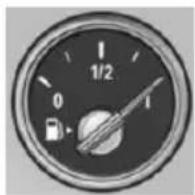
The vehicle inclination may cause the display to vary.
US models: the arrow beside the fuel pump symbol shows which side of the vehicle the fuel filler
flap is on.
Hints on refueling, refer to page 178.
Tachometer
Always avoid engine speeds in the red warning field. In this range, the fuel supply is interrupted to protect the engine.
Engine oil temperature
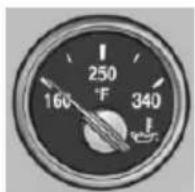
▶ Cold engine: the pointer is at the low temperature end. Drive at moderate engine and vehicle speeds.
Normal operating temperature: the pointer is in the middle or in the left half of the temperature display.
Hot engine: the pointer is at the high end of the temperature range. A Check Control message is also displayed.
Coolant temperature
If the coolant along with the engine becomes too hot, a Check Control message is displayed.
Check the coolant level, refer to page 201.
Odometer and trip odometer
Display
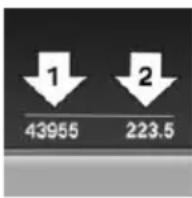
▶ Odometer, arrow 1.
▶ Trip odometer, arrow 2.
Show/reset kilometers
Press the knob.
When the ignition is switched off, the time, the external temperature and the odometer are displayed.
▷ When the ignition is switched on, the trip odometer is reset.
External temperature
If the indicator drops to +37 °F/+3 °C or lower, a signal sounds.
A Check Control message is displayed.
There is an increased risk of ice on roads.

Ice on roads
Even at temperatures above
+37 °F/+3 °C, there can be a risk of ice on roads.
Therefore, drive carefully on bridges and shaded roads, for example, to avoid the increased risk of an accident.
Time

The time is displayed at the bottom of the instrument cluster.
Setting the time and time format, refer to page 86.
Date
The date is displayed in the computer.
Setting the date and date format, refer to page 86.
Range
Display
After the reserve range is reached:
▶ A Check Control message is displayed briefly.
The remaining range is shown on the onboard computer.
When a dynamic driving style is used, such as when cornering quickly, operation of the engine is not always ensured.
The Check Control message appears continuously below a range of approx. 30 miles/50 km.

Refuel promptly
Refuel no later than at a range of
30 miles/50 km, or operation of the engine is not ensured and damage may occur.
Displaying the cruising range
Depending on the equipment version, the range is displayed in the instrument cluster.
- "Settings"
- "Instr. cluster display"
- "Additional indicators"
Current fuel consumption
Instrument cluster
Displays the current fuel consumption. You can check whether you are currently driving in an efficient and environmentally-friendly manner.
Instrum. cluster with enhanced features
Displays the current fuel consumption. You can check whether you are currently driving in an efficient and environmentally-friendly manner.
Displaying the current fuel consumption
- "Settings"
- "Instr. cluster display"
- "Additional indicators"
The bar display for the current fuel consumption is displayed in the instrument cluster.
Energy recovery
Display
The kinetic energy of the vehicle is converted to electrical energy while coasting. The vehicle battery is partially charged and fuel consumption can be reduced.
Service requirements
The concept
The driving distance or the time to the next scheduled maintenance is displayed briefly in the instrument cluster after the ignition is switched on.
The current service requirements can be read out from the remote control by the service specialist.
Display
Data regarding the service status or legally mandated inspections of the vehicle are automatically transmitted to your service center before a service due date.
Detailed information on service requirements
More information on the scope of service required can be displayed on the Control Display.
- "Vehicle Info"
- "Vehicle status"
- "Service required"
Required maintenance procedures and legally mandated inspections are displayed.
- Select an entry to call up detailed information.
Symbols
Symbols
Description

No service is currently required.

The deadline for scheduled maintenance or a legally mandated inspection is approaching.

The service deadline has already passed.
Entering appointment dates
Enter the dates for the required inspections.
Ensure that the vehicle date and time are set correctly.
- "Vehicle Info"
- "Vehicle status"
- "Service required"
- "§ Vehicle inspection"
- "Date:"
- Adjust the settings.
- Confirm.
The entered date is stored.
Automatic Service Request
Data regarding the service status or legally mandated inspections of the vehicle are automatically transmitted to your service center before a service due date.
You can check when your service center was notified.
- "Vehicle Info"
- "Vehicle status"
- Open "Options".
- "Last Service Request"
Gear shift indicator
The concept
The system recommends the most fuel efficient gear for the current driving situation.
Depending on how the vehicle is equipped and the country-specific version of the vehicle, the gear shift indicator is active in the manual mode of the automatic transmission and in the manual transmission.
Indicators to shift up or down are displayed in the instrument cluster.
On vehicles without a gear shift indicator, the engaged gear is displayed.
Manual transmission: displays
Symbol Description

Fuel efficient gear is engaged.

Shift up to fuel efficient gear.

Shift down to fuel efficient gear.

Shift into neutral.
Automatic transmission: displays
Example Description

Fuel efficient gear is engaged.

Shift into fuel efficient gear.
Speed limit detection with No Passing Information
The concept
Speed limit detection
Speed limit detection uses a symbol in the shape of a traffic sign to display the currently detected speed limit. The camera at the base of the interior rearview mirror detects traffic signs at the edge of the road as well as variable overhead sign posts. Traffic signs with extra symbols for wet road conditions, etc. are also detected and compared with vehicle interior data, such as for the rain sensor, and are displayed depending on the situation. The system takes into account the information stored in
the navigation system and also displays speed limits present on routes without signs.
No Passing Information
No Passing Information in the instrument cluster displays the beginnings and ends of no passing zones detected by the camera. The system accounts for only the beginnings and ends of No Passing zones marked by signs.
No display is shown:
In countries where No Passing zones are primarily identified with road markings.
On routes without signage.
▶ Where there are railroad crossings, highway markings or other situations where no signage is present, but passing would not be permitted.
Hints

Personal judgment
The system cannot serve as a substitute for the driver's personal judgment of the traffic situation.
The system assists the driver and does not replace the human eye.
At a glance
Camera
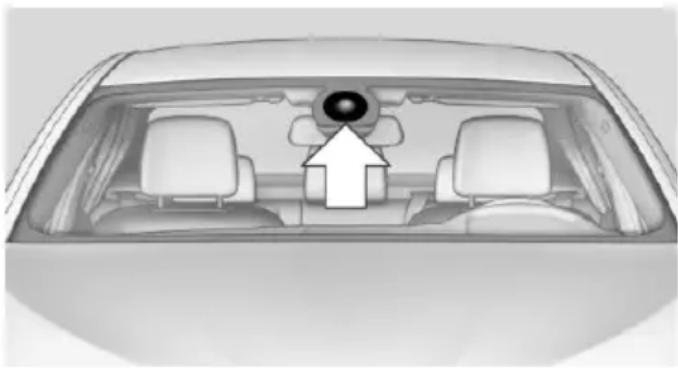
natural_image
Top-down view of a car interior showing the rearview and front seats with a circular head indicator (no text or symbols)The camera is located near the base of the mirror.
Keep the windshield in the area behind the interior rear view mirror clean and clear.
Switching on/off
- "Settings"
- "Instr. cluster display"
- "Speed limit information"
If speed limit detection is switched on, it can be displayed on the info display in the instrument cluster via the onboard computer.
No Passing Information is displayed together with the activated speed limit information.
Display
The following is displayed in the instrument cluster.
Speed limit detection
Current speed limit.

Speed limit detection is not available.
Speed limit detection can also be displayed in the Head-up Display.
No Passing Information
▶ Start of No Passing zone.
▶ End of No Passing zone.
▶ No Passing Information not available.
No Passing Information can also be displayed in the Head-up Display.
System limits
The system may not be fully functional and may provide incorrect information in the following situations:
▶ In heavy fog, rain or snowfall.
When signs are concealed by objects.
▶ When driving very close to the vehicle in front of you.
When driving toward bright lights.
When the windshield behind the interior rearview mirror is fogged over, dirty or covered by a sticker, etc.
In the event of incorrect detection by the camera.
▶ If the speed limits stored in the navigation system are incorrect.
In areas not covered by the navigation system.
When roads differ from the navigation, such as due to changes in the road network.
When passing buses or trucks with a speed sticker.
▶ If the traffic signs are non-conforming.
During calibration of the camera immediately after vehicle shipment.
Selection lists in the instrument cluster
The concept
Depending on the equipment version, the following can be displayed or operated using the buttons and the thumbwheel on the steering wheel and the displays in the instrument cluster and the Head-up Display:
▶ Current audio source.
▶ Redial on telephone.
▶ Activation of the voice activation system.
In addition, programs of the Driving Dynamics Control are displayed.
Display
text_image
No One But You ✓ Rock'n Roll Boy Shine A LightDepending on the equipment version, the list in the instrument cluster can differ from the illustration.
Activating a list and adjusting the setting
natural_image
Close-up of a car's front and side compartments with directional arrows indicating movement or flow (no text or symbols)On the right side of the steering wheel, turn the thumbwheel to activate the corresponding list.
Using the thumbwheel, select the desired setting and confirm it by pressing the thumbwheel.
Computer
Indication in the info display
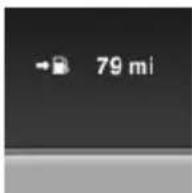
The information from the on-board computer is shown in the info display in the instrument cluster.
Calling up information on the info display
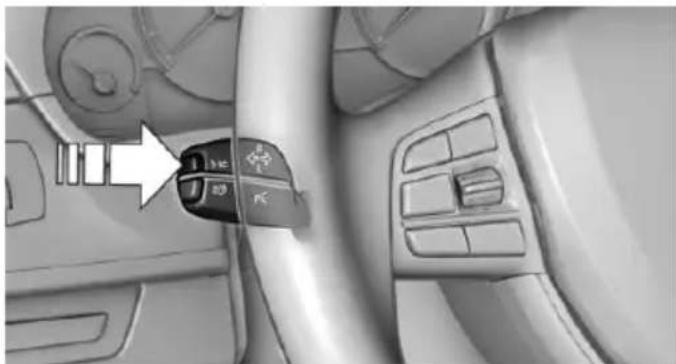
natural_image
Interior view of a car dashboard with a black key inserted into the seat, showing no visible text or symbols.Press the onboard computer button on the turn signal lever.
Information is displayed on the info display of the instrument cluster.
Information at a glance
Repeatedly pressing the button on the turn signal lever calls up the following information on the info display:
Range.
▶ Average fuel consumption.
▶ Current fuel consumption.
▶ Average speed.
Date.
▶ Speed limit detection.
Time of arrival.
When destination guidance is activated in the navigation system.
Distance to destination.
When destination guidance is activated in the navigation system.
▶ Arrow view of navigation system.
When destination guidance is activated in the navigation system.
When the arrow view in the Head-up Display is inactive.
▶ ECO PRO bonus range.
Adjusting the info display
You can select what information from the on-board computer is to be displayed on the info display of the instrument cluster.
- "Settings"
- "Instr. cluster display"
- Select the desired displays.
Information in detail
Range
Displays the estimated cruising range available with the remaining fuel.
It is calculated based on your driving style over the last 20 miles/30 km.
If there is only enough fuel left for less than 45 miles/80 km, the color of the display changes.
Average fuel consumption
The average fuel consumption is calculated for the period during which the engine is running.
The average fuel consumption is calculated for the distance traveled since the last reset by the onboard computer.
Average speed
Periods in which the vehicle is parked with the engine manually stopped do not enter into the calculation of the average speed.
Resetting average values
Press and hold the computer button on the turn signal lever.
Distance to destination
The distance remaining to the destination is displayed if a destination is entered in the navigation system before the trip is started.
The distance to the destination is adopted automatically.
Time of arrival
The estimated time of arrival is displayed if a destination is entered in the navigation system before the trip is started.
The time must be correctly set.
Speed limit detection
Description of the speed limit detection, refer to page 81, function.
Trip computer
The vehicle features two types of computer.
▶ "Onboard info": the values can be reset as often as necessary.
▶ "Trip computer": the values provide an overview of the current trip.
Resetting the trip computer
- "Vehicle Info"
- "Trip computer"
- "Reset": all values are reset.
"Automatically reset": all values are reset approx. 4 hours after the vehicle comes to a standstill.
Display on the Control Display
Display the onboard computer or trip computer on the Control Display.
- "Vehicle Info"
- "Onboard info" or "Trip computer"
Resetting the fuel consumption or speed
- "Vehicle Info"
- "Onboard info"
- "Consumpt." or "Speed"
- "Yes"
Sport displays
The concept
In the Control Display, the current values for power and torque can be displayed.
Displaying sport displays in the Control Display
- "Vehicle Info"
- "Sport displays"
Speed warning
The concept
Display of a speed limit which, when reached, should cause a warning to be issued.
The warning is repeated if the vehicle speed drops below the set speed limit once by at least 3 mph/5 km/h.
Displaying, setting or changing the limit
- "Settings"
- "Speed"
- "Warning at:"
- Turn the controller until the desired limit is displayed.
- Press the controller.
The speed limit is stored.
Activating/deactivating the limit
- "Settings"
- "Speed"
- "Warning"
- Press the controller.
Setting your current speed as the limit
- "Settings"
-
"Speed"
-
"Select current speed"
-
Press the controller.
The current vehicle speed is stored as the limit.
Settings on the Control Display
Time
Setting the time zone
-
"Settings"
-
"Time/Date"
-
"Time zone"
-
Select the desired time zone.
The time zone is stored.
Setting the time
-
"Settings"
-
"Time/Date"
-
"Time:"
-
Turn the controller until the desired hours are displayed.
-
Press the controller.
-
Turn the controller until the desired minutes are displayed.
-
Press the controller.
The time is stored.
Setting the time format
-
"Settings"
-
"Time/Date"
-
"Format:"
-
Select the desired format.
The time format is stored.
Automatic time setting
Depending on the equipment version, the time, date and, if necessary, the time zone are updated automatically.
-
"Settings"
-
"Time/Date"
-
"Auto time set"
Date
Setting the date
-
"Settings"
-
"Time/Date"
-
"Date:"
-
Turn the controller until the desired day is displayed.
-
Press the controller.
-
Make the necessary settings for the month and year.
The date is stored.
Setting the date format
-
"Settings"
-
"Time/Date"
-
"Format:"
-
Select the desired format.
The date format is stored.
Language
Setting the language
To set the language on the Control Display:
-
"Settings"
-
"Language/Units"
-
"Language:"
-
Select the desired language.
The setting is stored for the remote control currently in use.
Setting the voice dialog
Voice dialog for the voice activation system, refer to page 25.
Units of measure
Setting the units of measure
To set the units for fuel consumption, route/ distance and temperature:
- "Settings"
- "Language/Units"
- Select the desired menu item.
- Select the desired unit.
The setting is stored for the remote control currently in use.
Brightness
Setting the brightness
To set the brightness of the Control Display:
- "Settings"
- "Control display"
- "Brightness"
- Turn the controller until the desired brightness is set.
- Press the controller.
The setting is stored for the remote control currently in use.
Depending on the light conditions, the brightness control may not be clearly visible.
Assist system information
Display on the Control Display
Information on the Assist system can be displayed by activating Assist on the Control Display.
- "Settings"
- "Control display"
- "Driver assistance info"
Head-up Display
The concept
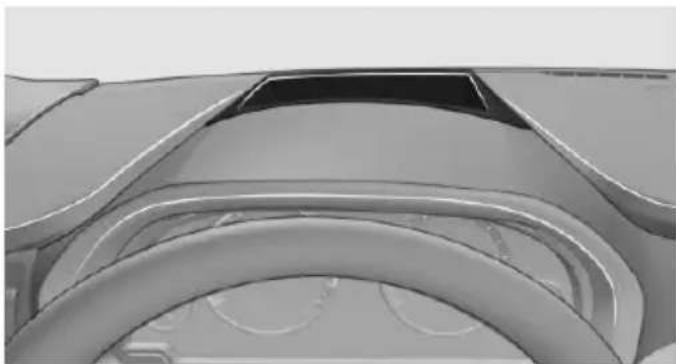
natural_image
Close-up of a car's front wheel and dashboard (no visible text or symbols)This system projects important information into the driver's field of vision, e.g., the speed.
The driver can get information without averting his or her eyes from the road.
Display visibility
The visibility of the displays in the Head-up Display is influenced by the following factors:
▶ Certain sitting positions.
▶ Objects on the cover of the Head-up Display.
▶ Sunglasses with certain polarization filters.
▷ Wet roads.
▶ Unfavorable light conditions.
If the image is distorted, check the basic settings.
Switching on/off
- "Settings"
- "Head-Up Display"
- "Head-Up Display"
Display
Overview
▷ Speed.
▶ Navigation system.
▶ Check Control messages.
Selection list from the instrument cluster.
▶ Driver assistance systems.
Some of this information is only displayed briefly as needed.
Selecting displays in the Head-up Display
- "Settings"
- "Head-Up Display"
- "Displayed information"
- Select the desired displays in the Head-up Display.
The settings are stored for the remote control currently in use.
Setting the brightness
The brightness is automatically adjusted to the ambient light.
The basic setting can be adjusted manually.
- "Settings"
- "Head-Up Display"
- "Brightness"
- Turn the controller.
When the low beams are switched on, the brightness of the Head-up Display can be additionally influenced using the instrument lighting.
The setting is stored for the remote control currently in use.
Adjusting the height
- "Settings"
- "Head-Up Display"
- "Height"
- Turn the controller.
The setting is stored for the remote control currently in use.
Setting the rotation
- "Settings"
-
"Head-Up Display"
-
"Rotation"
- Turn the controller.
The setting is stored for the remote control currently in use.
Special windshield
The windshield is part of the system.
The shape of the windshield makes it possible to display a precise image.
A film in the windshield prevents double images from being displayed.
Therefore, have the special windshield replaced by a service center only.
Lamps
Vehicle equipment
All standard, country-specific and optional equipment that is offered in the model series is described in this chapter. Therefore, equipment is also described that is not available in a vehicle, e.g., because of the selected optional equipment or country variant. This also applies for safety-related functions and systems.
At a glance
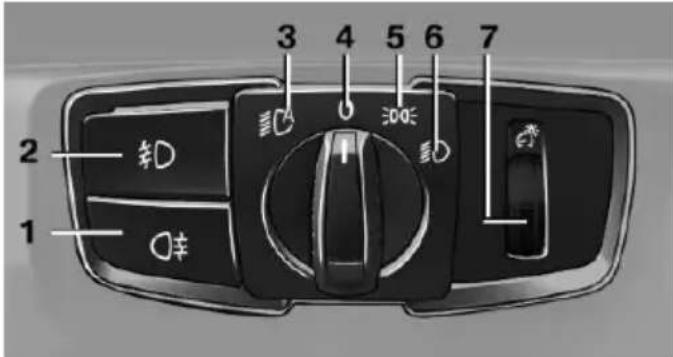
text_image
1 2 3 4 5 6 7 ¥00 ¥00 ¥00 ¥001 Rear fog lamps
2 Front fog lamps
3 Automatic headlamp control, Adaptive Light Control, High-beam Assistant, Welcome lamps, Daytime running lights
4 Lamps off, daytime running lights
5 Parking lamps, daytime running lights
6 Low beams, welcome lamps, High-beam Assistant
7 Instrument lighting
Parking lamps/low beams, headlamp control
General information
Switch position: 0,


If the driver door is opened with the ignition switched off, the exterior lighting is automatically switched off at these switch settings.
Parking lamps
Switch position 30 the vehicle lamps light up on all sides, e.g., for parking.
Do not use the parking lamps for extended periods; otherwise, the vehicle battery may become discharged and it would then be impossible to start the engine.
When parking, it is preferable to switch on the one-sided roadside parking lamps, refer to page 90.
Low beams
Switch position 📋 with the ignition switched on: the low beams light up.
Welcome lamps
When the vehicle is parked, leave the switch in position ☐ or :parking and interior lamps come on briefly when the vehicle is unlocked depending on the ambient light.
Activating/deactivating
- "Settings"
- "Lighting"
- "Welcome lights"
The setting is stored for the remote control currently in use.
Headlamp courtesy delay feature
The low beams stay lit for a short while if the headlamp flasher is switched on after the ignition is switched off.
Setting the duration
- "Settings"
-
"Lighting"
-
"Pathway lighting:"
- Set the duration.
The setting is stored for the remote control currently in use.
Automatic headlamp control
Switch position ☐ the low beams are switched on and off automatically, e.g., in tunnels, in twilight or if there is precipitation. The indicator lamp in the instrument cluster lights up.
A blue sky with the sun low on the horizon can cause the lights to be switched on.
The low beams always stay on when the fog lamps are switched on.

Personal responsibility
The automatic headlamp control cannot serve as a substitute for your personal judgment in determining when the lamps should be switched on in response to ambient lighting conditions.
For example, the sensors are unable to detect fog or hazy weather. To avoid safety risks, you should always switch on the lamps manually under these conditions.
Daytime running lights
With the ignition switched on, the daytime running lights light up in position 0, ☑️. After the ignition is switched off, the parking lamps light up in position ☑️.
Activating/deactivating
In some countries, daytime running lights are compulsory, so it may not be possible to deactivate the daytime running lights.
- "Settings"
- "Lighting"
- "Daytime running lamps"
The setting is stored for the remote control currently in use.
Roadside parking lamps
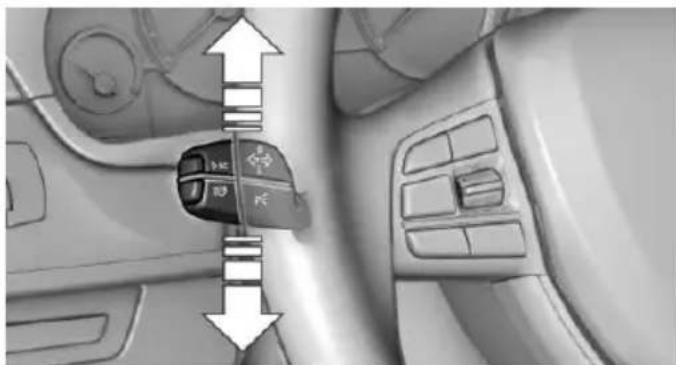
natural_image
Interior view of a car showing a key inserted into the dashboard with directional arrows indicating flow or movement (no text or symbols visible)The vehicle can be illuminated on one side.
Switching on
With the ignition switched off, press the lever either up or down past the resistance point for approx. 2 seconds.
Switching off
Briefly press the lever to the resistance point in the opposite direction.
Adaptive Light Control
The concept
Adaptive Light Control is a variable headlamp control system that enables dynamic illumination of the road surface.
Depending on the steering angle and other parameters, the light from the headlamp follows the course of the road.
In tight curves, e.g., on mountainous roads or when turning, one of the two front fog lamps is switched on as a cornering lamp. As a result the inside of the curve is better lighted.
Activating
Switch position with the ignition switched on.
The cornering lamps are automatically switched on depending on the steering angle or the use of turn signals.
To avoid blinding oncoming traffic, the Adaptive Light Control does not swivel to the driver's side when the vehicle is at a standstill.
When driving in reverse, only the cornering lamp is active.
Malfunction
A Check Control message is displayed.
Adaptive light control is malfunctioning or has failed. Have the system checked as soon as possible.
High-beam Assistant
The concept
When the low beams are switched on, this system automatically switches the high beams on and off or suppresses the light in the areas that blind oncoming traffic. The procedure is controlled by a sensor on the front of the interior rearview mirror. The assistant ensures that the high beams are switched on whenever the traffic situation allows. The driver can intervene at any time and switch the high beams on and off as usual.
Activating
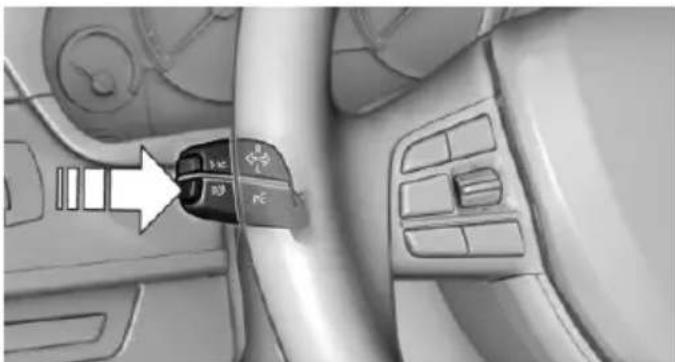
natural_image
Interior view of a car showing a car's seatbelt switch and dashboard (no text or symbols visible)The High-beam Assistant can be activated when the low beams are switched on.
- Turn the light switch to or D
- Press the button on the turn signal lever, arrow.

The indicator lamp in the instrument cluster lights up.
When the low beams are on, the lights are automatically brightened or dimmed.
The system responds to light from oncoming traffic and traffic driving ahead of you, and to adequate illumination, e.g., in towns and cities.

The blue indicator lamp in the instrument cluster lights up when the system switches on the high beams. Depend-
ing on the version of the system in the vehicle, the high beams may not switch off for oncoming vehicles, but may only be dimmed in the areas that blind oncoming traffic. In this case, the blue indicator light will stay on.
Switching the high beams on and off manually
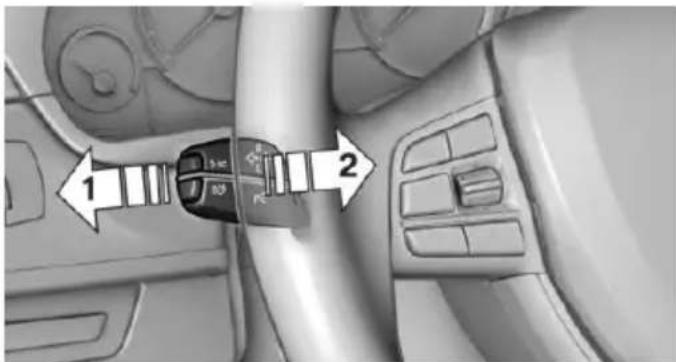
text_image
Diagram of car seatbelt mechanism showing two directional arrows labeled 1 and 2 pointing to a car interior panel.▶ High beams on, arrow 1.
▶ High beams off/headlamp flasher, arrow 2.
The High-beam Assistant can be switched off when manually adjusting the light. To reactivate the High-beam Assistant, press the button on the turn signal lever.
System limits

Personal responsibility
The high-beam assistant cannot serve as a substitute for the driver's personal judgment of when to use the high beams. Therefore, manually switch off the high beams in situations where this is required to avoid a safety risk.
The system is not fully functional in situations such as the following, and driver intervention may be necessary:
In very unfavorable weather conditions, such as fog or heavy precipitation.
In detecting poorly-lit road users, such as pedestrians, cyclists, horseback riders and wagons; when driving close to train or ship traffic; and at animal crossings.
In tight curves, on hilltops or in depressions, in cross traffic or half-obscured on-coming traffic on freeways.
In poorly-lit towns and cities and in the presence of highly reflective signs.
▶ At low speeds.
When the windshield behind the interior rearview mirror is fogged over, dirty or covered with stickers, etc.
Camera
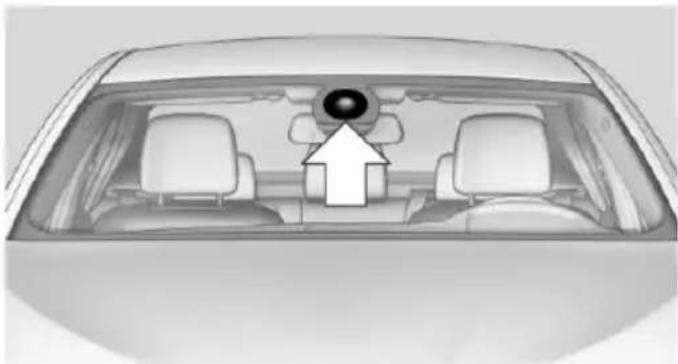
natural_image
Top-down view of a car's rearview mirror and dashboard (no text or symbols visible)The camera is located near the base of the mirror.
Keep the windshield in the area behind the interior rear view mirror clean and clear.
Fog lamps
Front fog lamps
The low beams must be switched on.
Press the button. The green indicator lamp lights up.
If the automatic headlamp control, refer to page 90, is activated, the low beams will come on automatically when you switch on the front fog lamps.
When the high beams or headlamp flasher are activated, the front fog lamps are not switched on.
Instrument lighting
Adjusting
The parking lamps or low beams must be switched on to adjust the brightness.
Adjust the brightness using the thumbwheel.
Interior lamps
General information
The interior lamps, footwell lamps, entry lamps and courtesy lamps are controlled automatically.
The brightness of some of these lamps is influenced by the thumbwheel for the instrument lighting.
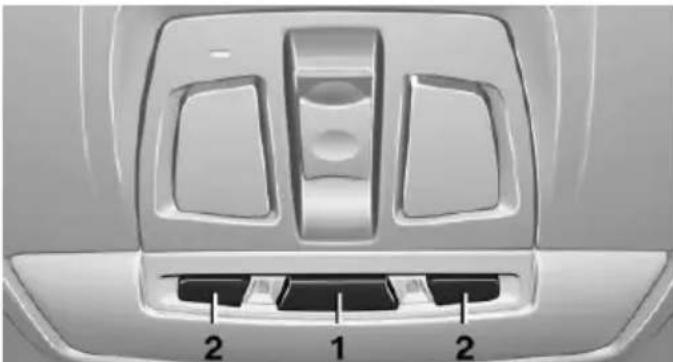
natural_image
Top-down view of a car air vent with labeled buttons (no text or symbols beyond numbers)1 Interior lamps
2 Reading lamp
Switching the interior lamps on and off
Press the button.
To switch off permanently: press the button for approx. 3 seconds.
Switch back on: press button.
Reading lamps
Press the button.
Reading lamps are located at the front and rear next to the interior lamps.
Ambient light
Depending on the equipment, the lighting can be adjusted in the interior for some lights.
Selecting color scheme
- "Settings"
- "Lighting"
- "Ambient:"
- Select the desired setting.
If the color scheme of the line is selected and the welcome lamps are activated, the welcome lamps are displayed in the color of the line when the vehicle is unlocked.
Setting the brightness
The brightness of the ambient light can be adjusted via the thumbwheel for the instrument lighting or on the Control Display.
- "Settings"
- "Lighting"
- "Brightness:"
- Adjust the brightness.
Safety
Vehicle equipment
All standard, country-specific and optional equipment that is offered in the model series is described in this chapter. Therefore, equip-
ment is also described that is not available in a vehicle, e. g., because of the selected optional equipment or country variant. This also applies for safety-related functions and systems.
Airbags
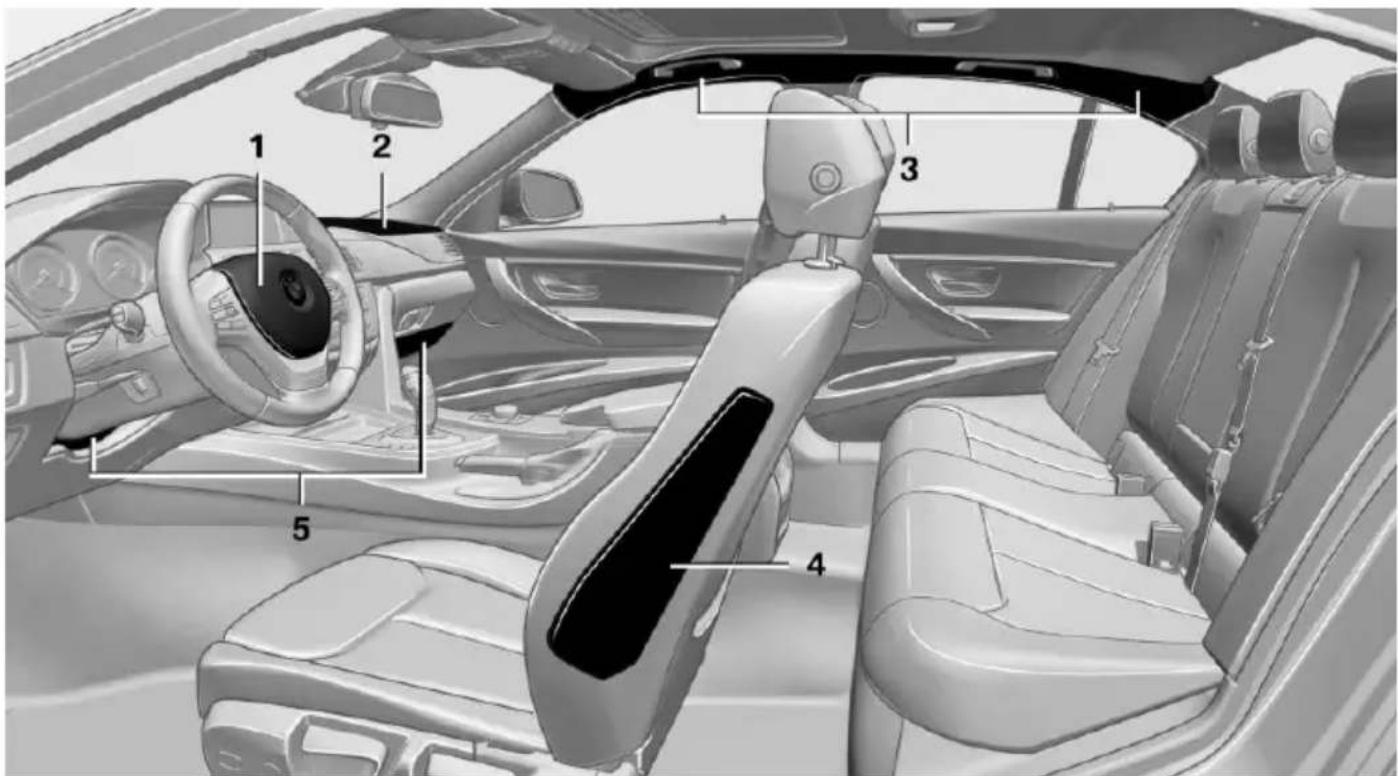
text_image
Technical diagram of a car interior with numbered components for identification1 Front airbag, driver
2 Front airbag, front passenger
3 Head airbag
4 Side airbag
5 Knee airbags
Front airbags
Front airbags help protect the driver and front passenger by responding to frontal impacts in which safety belts alone cannot provide adequate restraint.
Side airbags
In a lateral impact, the side airbag supports the side of the body in the chest and lap area.
Head airbags
In a lateral impact, the head airbag supports the head.
Knee airbag
The knee airbag supports the legs in a frontal impact.
Protective action
Airbags are not triggered in every impact situation, e.g., in less severe accidents or rear-end collisions.

Information on how to ensure the optimal protective effect of the airbags
Keep at a distance from the airbags.
▶ Always grasp the steering wheel on the steering wheel rim, holding your hands at the 3 o'clock and 9 o'clock positions, to keep the danger of injury to your hands or arms as low as possible if the airbag is triggered.
There should be no people, animals, or objects between an airbag and a person.
Do not use the cover of the front airbag on the front passenger side as a storage area.
Keep the dashboard and window on the front passenger side clear, i.e. do not cover with adhesive labels or coverings, and do not attach holders such as for navigation instruments and mobile phones.
▶ Make sure that the front passenger is sitting correctly, i.e., keeps his or her feet and legs in the footwell; otherwise, leg injuries can occur if the front airbag is triggered.
Do not place slip covers, seat cushions or other objects on the front passenger seat that are not approved specifically for seats with integrated side airbags.
Do not hang pieces of clothing, such as jackets, over the backrests.
▶ Make sure that occupants keep their heads away from the side airbag and do not rest against the head airbag; otherwise, injuries can occur if the airbags are triggered.
Do not remove the airbag restraint system.
Do not remove the steering wheel.
Do not apply adhesive materials to the air-bag cover panels, cover them or modify them in any way.
▶ Never modify either the individual components or the wiring in the airbag system. This also applies to steering wheel covers, the dashboard, the seats, the roof pillars and the sides of the headliner.
Even when all instructions are followed closely, injury from contact with the airbags cannot be ruled out in certain situations.
The ignition and inflation noise may lead to short-term and, in most cases, temporary hearing impairment in sensitive individuals.

In the case of a malfunction, deactivation and after triggering of the airbags
Do not touch the individual components immediately after the system has been triggered; otherwise, there is the danger of burns.
Only have the airbags checked, repaired or dismantled and the airbag generator scrapped by the service center or a workshop that has the necessary authorization for handling explosives.
Non-professional attempts to service the system could lead to failure in an emergency or undesired triggering of the airbag, either of which could result in injury.
Warnings and information on the airbags are also found on the sun visors.
Functional readiness of the airbag system

When the ignition is switched on, the warning lamp in the instrument cluster lights up briefly and thereby indicates
the operational readiness of the entire airbag system and the belt tensioner.
Airbag system malfunctioning
▶ Warning lamp does not come on when the ignition is turned on.
The warning lamp lights up continuously.

When there is a malfunction, have the airbag system checked immediately
When there is a malfunction, have the airbag system checked immediately; otherwise, there is a risk that the system does not function as expected in the event of an accident despite corresponding severity of the accident.
Automatic deactivation of the front passenger airbags
The system determines whether the front passenger seat is occupied by measuring the resistance of the human body.
The front, knee, and side airbag on the front passenger side are activated or deactivated accordingly.

Leave feet in the footwell
Make sure that the front passenger
keeps his or her feet in the footwell; otherwise, the front passenger airbags may not function properly.

Child restraint fixing system in the front passenger seat
Before transporting a child on the front passenger seat, refer to the safety notes and instructions under Children on the front passenger seat.
Malfunction of the automatic deactivation system
When transporting older children and adults, the front passenger airbags may be deactivated in certain sitting positions. In this case, the indicator lamp for the front passenger airbags lights up.
In this case, change the sitting position so that the front passenger airbags are activated and the indicator lamp goes out.
If it is not possible to activate the airbags, have the person sit in the rear.
To make sure that the occupied seat cushion can be evaluated correctly
Do not attach covers, cushions, ball mats or other items to the front passenger seat unless they are specifically recommended by the manufacturer of your vehicle.
Do not place any electronic devices on the passenger seat if a child restraint system is to be installed on it.
Do not place objects under the seat that could press against the seat from below.
No moisture in or on the seat.
Indicator lamp for the front passenger airbags
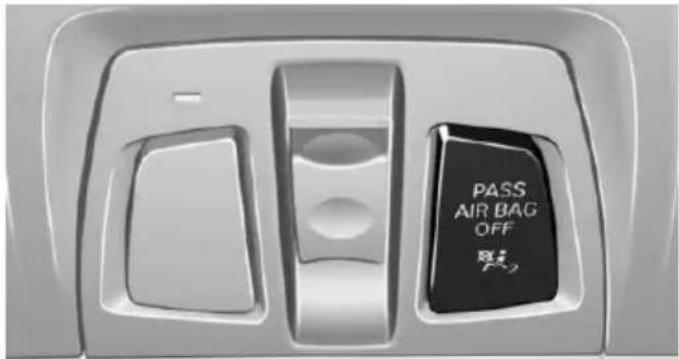
text_image
PASS AIR BAG OFFThe indicator lamp for the front passenger airbags indicates the operating state of the front passenger airbags.
The lamp indicates whether the airbags are activated or deactivated.
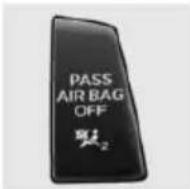
The indicator lamp lights up when a child who is properly seated in a child restraint fixing system intended for that purpose is detected on the seat or the seat is empty. The airbags on the front passenger side are not activated.
The indicator lamp does not light up when, for example, a correctly seated person of sufficient size is detected on the seat. The airbags on the front passenger side are activated.
Detected child seats
The system generally detects children seated in a child seat, especially in the child seats that were required by NHTSA when the vehicle was manufactured. After installing a child seat, make sure that the indicator lamp for the front passenger airbags lights up. This indicates that the child seat has been detected and the front passenger airbags are not activated.
Strength of the driver's and front passenger airbag
The strength with which the driver's and front passenger airbags are triggered depends on the position of the driver's and front passenger seats.
To maintain the accuracy of this function over the long-term, calibrate the front seats when a corresponding message appears on the Control Display.
Calibrating the front seats
A corresponding message appears on the Control Display.
- Move the respective seat forward all the way.
- Move the respective seat forward again. It moves forward briefly.
- Readjust the seat to the desired position.
The calibration procedure is completed when the message on the Control Display disappears.
If the message continues to be displayed, repeat the calibration.
If the message does not disappear after a repeat calibration, have the system checked as soon as possible.

Unobstructed area of movement
Ensure that the area of movement of the seats is unobstructed to avoid personal injury or damage to objects.
Tire Pressure Monitor TPM
The concept
The system monitors tire pressure in the four mounted tires. The system warns you if there is a significant loss of pressure in one or more tires. For this purpose, sensors in the tire valves measure the tire inflation pressure.
Hints

Tire damage due to external factors
Sudden tire damage caused by external influences cannot be indicated in advance.
Pay attention to the other information and indications under Tire inflation pressure, refer to page 185, as well when using the system.
Functional requirements
The system must have been reset with the correct tire inflation pressure; otherwise, reliable signaling of tire pressure loss is not ensured.
Reset the system after each adjustment of the tire inflation pressure and after every tire or wheel change.
Always use wheels with TPM electronics to ensure that the system will operate properly.
Status display
The current status of the Tire Pressure Monitor TPM can be displayed on the Control Display, e.g., whether or not the TPM is active.
- "Vehicle Info"
- "Vehicle status"
- "Tire Pressure Monitor (TPM)"
The status is displayed.
Status control display
The tire and system status is indicated by the color of the wheels and a text message on the Control Display.
All wheels green
System is active and will issue a warning relative to the tire inflation pressures stored during the last reset.
One wheel is yellow
A flat tire or major drop in inflation pressure in the indicated tire.
All wheels are yellow
A flat tire or major drop in inflation pressure in several tires.
Wheels, gray
The system cannot detect a flat tire. Reasons for this may be:
The system is being reset.
Malfunction.
Carry out reset
Reset the system after each adjustment of the tire inflation pressure and after every tire or wheel change.
- "Vehicle Info"
- "Vehicle status"
- "Perform reset"
- Start the engine - do not drive away.
- Carry out the reset with "Perform reset".
- Drive away.
The tires are shown in gray and the status is displayed.
After driving faster than 19 mph/30 km/h for a short period, the tire inflation pressures set are accepted as reference values. The reset is completed automatically during driving.
After a successfully completed Reset, the wheels on the Control Display are shown in green and "Tire Pressure Monitor (TPM) active" is displayed.
The trip can be interrupted at any time. If you drive away again, the reset resumes automatically.
Low tire pressure message

The yellow warning lamp lights up. A Check Control message is displayed.
There is a flat tire or a major loss in tire inflation pressure.
No reset was performed for the system. The system therefore issues a warning based on the tire inflation pressures before the last reset.
- Reduce your speed and stop cautiously. Avoid sudden braking and steering maneuvers.
- Check whether the vehicle is fitted with regular tires or run-flat tires.
Run-flat tires, refer to page 195, are la-beled with a circular symbol containing the letters RSC marked on the tire sidewall.

Do not continue driving without run-flat tires
Do not continue driving if the vehicle is not equipped with run-flat tires; continued driving may result in serious accidents.
When a low inflation pressure is indicated, DSC Dynamic Stability Control is switched on if necessary.
Actions in the event of a flat tire
Normal tires
- Identify the damaged tire.
Do this by checking the air pressure in all four tires.
If the tire inflation pressure in all four tires is correct, it is possible that a reset was not carried out for the Tire Pressure Monitor. Then perform the reset.
If an identification is not possible, please contact the service center.
- Fix the flat tire.
Run-flat tires
Maximum speed
You can continue driving with a damaged tire at speeds up to 50 mph/80 km/h.
Continued driving with a flat tire
If continuing to drive with a damaged tire:
- Avoid sudden braking and steering maneuvers.
- Do not exceed a speed of 50 mph/80 km/h.
- Check the air pressure in all four tires at the next opportunity.
If the tire inflation pressure in all four tires is correct, it is possible that a reset was not carried out for the Tire Pressure Monitor. In that case, carry out a reset.
Possible driving distance with complete loss of tire inflation pressure:
The possible driving distance after a loss of tire inflation pressure depends on the cargo load and the driving style and conditions.
For a vehicle containing an average load, the possible driving distance is approx. 50 miles/80 km.
When the vehicle is driven with a damaged tire, its handling characteristics change, e.g., reduced lane stability during braking, a longer braking distance, and altered self-steering properties. Adjust your driving style accordingly. Avoid abrupt steering maneuvers or driving over obstacles, e.g., curbs, potholes, etc.
Because the possible driving distance depends on how the vehicle is used during the trip, the actual distance may be smaller or greater depending on the driving speed, road conditions, external temperature, cargo load, etc.

Continued driving with a flat tire
Drive moderately and do not exceed a speed of 50 mph/80 km/h.
A loss of tire inflation pressure results in a change in the handling characteristics, e.g., reduced lane stability during braking, a longer braking distance and altered self-steering properties.

Final tire failure
Vibrations or loud noises while driving can indicate the final failure of the tire. Reduce speed and stop; otherwise, pieces of the tire could come loose and cause an accident. Do not continue driving, and contact your service center.
Required inflation pressure check message
A Check Control message is displayed in the following situations
The system has detected a wheel change, but no reset was carried out.
▶ Inflation was not carried out according to specifications.
The tire pressure has fallen below the level of the last confirmation.
In this case:
▶ Check the tire pressure and correct as needed.
- Carry out a reset of the system after a tire change.
System limits
The system does not function properly if a reset has not been carried out, e.g., a flat tire is reported even though the tire inflation pressures are correct.
The tire pressure depends on the temperature of the tire. If the tire temperature rises, e.g., due to driving or because of the heat of the Sun, the tire inflation pressure increases also. The tire pressure is reduced when the tire
temperature falls again. This behavior may cause a warning to be issued if temperatures fall very sharply.
Malfunction

The yellow warning lamp flashes and then lights up continuously. A Check Control message is displayed. No flat tire or loss of tire pressure can be detected.
Display in the following situations:
▶ A wheel without TPM electronics is fitted: have the service center check it if necessary.
▶ Malfunction: have the system checked by your service center.
▷ TPM was unable to complete the reset. Reset the system again.
Disturbance by systems or devices with the same radio frequency: after leaving the area of the disturbance, the system automatically becomes active again.
Declaration according to NHTSA/FMVSS 138 Tire Pressure Monitoring System
Each tire, including the spare (if provided) should be checked monthly when cold and inflated to the inflation pressure recommended by the vehicle manufacturer on the vehicle placard or tire inflation pressure label. (If your vehicle has tires of a different size than the size indicated on the vehicle placard or tire inflation pressure label, you should determine the proper tire inflation pressure for those tires.) As an added safety feature, your vehicle has been equipped with a tire pressure monitoring system (TPMS) that illuminates a low tire pressure telltale when one or more of your tires is significantly under-inflated. Accordingly, when the low tire pressure telltale illuminates, you should stop and check your tires as soon as possible, and inflate them to the proper pressure. Driving on a significantly under-inflated tire causes the tire to overheat and can lead to tire failure. Under-inflation also reduces fuel efficiency and tire tread life, and may affect the vehicle's handling and stopping ability. Please note that the TPMS is not a substitute for proper tire maintenance, and it is the driver's responsibility to maintain correct tire pressure, even if under-inflation has not reached the level to trigger illumination of the TPMS low tire pressure telltale. Your vehicle has also been equipped with a TPMS malfunction indicator to indicate when the system is not operating properly. The TPMS malfunction indicator is combined with the low tire pressure telltale. When the system detects a malfunction, the telltale will flash for approximately one minute and then remain continuously illuminated. This sequence will continue upon subsequent vehicle start-ups as long as the malfunction exists. When the malfunction indicator is illuminated, the system may not be able to detect or signal low tire pressure as intended. TPMS malfunctions may occur for a variety of reasons, including the installation of replacement or alternate tires or wheels on the vehicle that prevent the TPMS from functioning properly. Always check the TPMS malfunction telltale after replacing one or more tires or wheels on your vehicle to ensure that the replacement or alternate tires and wheels allow the TPMS to continue to function properly.
FTM Flat Tire Monitor
The concept
The system detects a pressure loss on the basis of speed differences between the individual wheels while driving.
In the event of a pressure loss, the diameter and therefore the rotational speed of the corresponding wheel change. This is detected and reported as a flat tire.
The system does not measure the actual inflation pressure in the tires.
Functional requirements
The system must have been initialized when the tire inflation pressure was correct; otherwise, reliable signaling of a flat tire is not ensured. Initialize the system after each correction of the tire inflation pressure and after every tire or wheel change.
Status display
The current status of the Flat Tire Monitor can be displayed on the Control Display, e.g., whether or not the FTM is active.
- "Vehicle Info"
- "Vehicle status"
- "E" at Tire Monitor (FTM)"
The status is displayed.
Initialization
The initialization process adopts the set inflation tire pressures as reference values for the detection of a flat tire. Initialization is started by confirming the inflation pressures.
Do not initialize the system when driving with snow chains.
- "Vehicle Info"
- "Vehicle status"
- "Perform reset"
- Start the engine - do not drive away.
- Start the initialization with "Perform reset".
- Drive away.
The initialization is completed while driving, which can be interrupted at any time.
The initialization automatically continues when driving resumes.
Indication of a flat tire

The yellow warning lamp lights up. A Check Control message is displayed.
There is a flat tire or a major loss in tire inflation pressure.
- Reduce your speed and stop cautiously. Avoid sudden braking and steering maneuvers.
- Check whether the vehicle is fitted with regular tires or run-flat tires.
Run-flat tires, refer to page 195, are labeled with a circular symbol containing the letters RSC marked on the tire sidewall.

Do not continue driving without run-flat tires
Do not continue driving if the vehicle is not equipped with run-flat tires; continued driving may result in serious accidents.
When a flat tire is indicated, DSC Dynamic Stability Control is switched on if necessary.
System limits

Sudden tire damage
Sudden serious tire damage caused by external influences cannot be indicated in advance.
A natural, even pressure loss in all four tires cannot be detected. Therefore, check the tire inflation pressure regularly.
The system could be delayed or malfunction in the following situations:
▶ When the system has not been initialized.
When driving on a snowy or slippery road surface.
▶ Sporty driving style: slip in the drive wheels, high lateral acceleration.
▶ When driving with snow chains.
Actions in the event of a flat tire
Normal tires
- Identify the damaged tire.
Do this by checking the air pressure in all four tires.
If the tire inflation pressure in all four tires is correct, the Flat Tire Monitor may not have been initialized. In this case, initialize the system.
If an identification is not possible, please contact the service center.
- Rectify the flat tire.
Run-flat tires
Maximum speed
You can continue driving with a damaged tire at speeds up to 50 mph/80 km/h.
Continued driving with a flat tire
If continuing to drive with a damaged tire:
- Avoid sudden braking and steering maneuvers.
- Do not exceed a speed of 50 mph/80 km/h.
- Check the air pressure in all four tires at the next opportunity.
If the tire inflation pressure in all four tires is correct, the Flat Tire Monitor may not have been initialized. In this case, initialize the system.
Possible driving distance with complete loss of tire inflation pressure:
The possible driving distance after a loss of tire inflation pressure depends on the cargo load and the driving style and conditions.
For a vehicle containing an average load, the possible driving distance is approx. 50 miles/80 km.
When the vehicle is driven with a damaged tire, its handling characteristics change, e.g., reduced lane stability during braking, a longer braking distance, and altered self-steering properties. Adjust your driving style accordingly. Avoid abrupt steering maneuvers or driving over obstacles, e.g., curbs, potholes, etc.
Because the possible driving distance depends on how the vehicle is used during the trip, the actual distance may be smaller or greater depending on the driving speed, road conditions, external temperature, cargo load, etc.
Continued driving with a flat tire Drive moderately and do not exceed a speed of 50 mph/80 km/h.
A loss of tire inflation pressure results in a change in the handling characteristics, e.g., reduced lane stability during braking, a longer braking distance and altered self-steering properties.
Final tire failure Vibrations or law
Vibrations or loud noises while driving can indicate the final failure of the tire. Reduce speed and stop; otherwise, pieces of the tire could come loose and cause an accident. Do not continue driving, and contact your service center.
Intelligent Safety
The concept
Depending on how the vehicle is equipped, Intelligent Safety consists of one or more of the following systems, which can help to avoid an imminent collision. These systems are active automatically every time the engine is started using the Start/Stop button:
▶ Collision warning, refer to page 103.
▶ Pedestrian warning, refer to page 108.
Note
Personal responsibility
The system does not serve as a substitute for the driver's personal judgment of the traffic situation.
Be aware of the traffic situation and the vehicle's surroundings at all times, otherwise an accident is still possible despite all warnings.
At a glance
Button in the vehicle
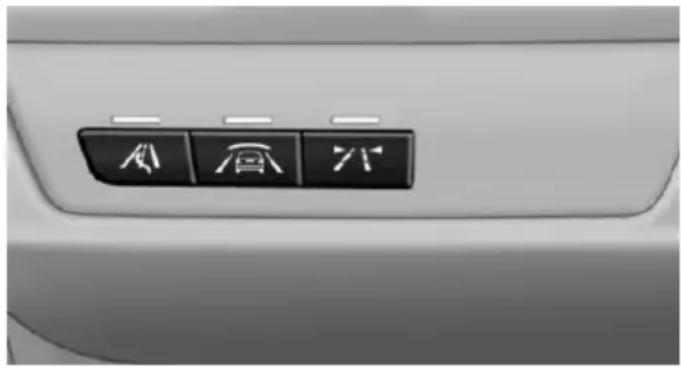
natural_image
Close-up of a car's front panel showing three directional icons: airplane, train, and bicycle (no text or labels visible)
Intelligent Safety button
Camera
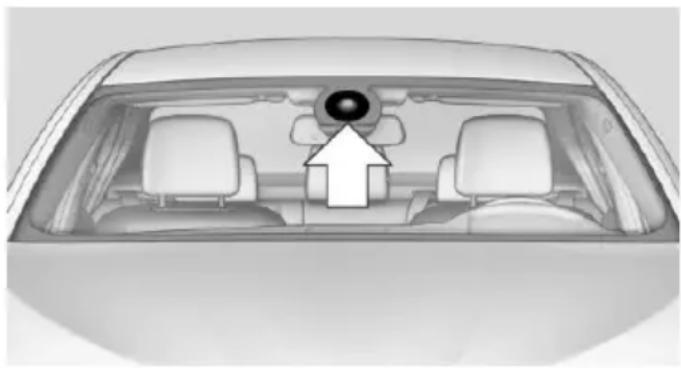
natural_image
Top-down view of a car showing the rearview mirror and dashboard (no text or symbols visible)The camera is located near the base of the mirror.
Keep the windshield in the area behind the interior rear view mirror clean and clear.
Switching on/off
The Intelligent Safety systems are automatically active after each engine start via the start/stop button.
Press the button: the systems are switched off. The LED goes out.
Press the button: the systems are switched off. The LED lights up.
Settings can be made on the Control Display.
Collision warning
Depending on how the equipment is equipped, the collision warning system consists of one of the two systems:
▶ Collision warning with City Braking function, refer to page 103.
▶ Collision warning with braking function, refer to page 106
Collision warning with City Braking function
The concept
The system can help to prevent accidents. If an accident cannot be prevented, the system helps to reduce the collision speed.
The system issues a warning if there is imminent danger of a collision and if so brakes independently.
The automatic braking intervention is done with limited force and duration.
The system is controlled via a camera in the base of the mirror.
The collision warning is available even if cruise control has been deactivated.
When the vehicle is intentionally brought close to a vehicle, the collision warning is delayed to avoid false warnings.
General information
The system issues a two-phase warning of a danger of collision with vehicles at speeds above approx. 3 mph/5 km/h. The time of these warnings may vary depending on the current driving situation.
Up to approx. 35 mph/60 km/h a braking intervention occurs when appropriate.
Detection range
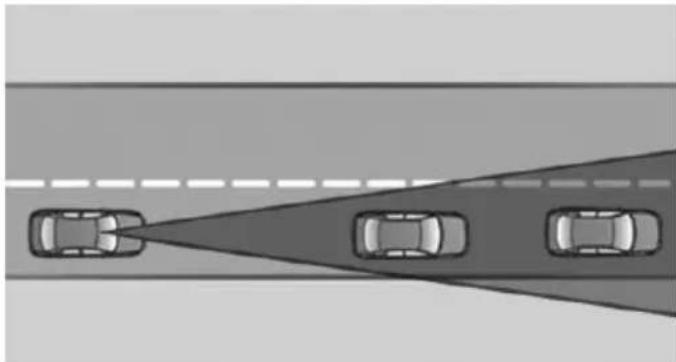
natural_image
Top-down view of a road with three cars ahead, showing a collision or perspective projection (no text or symbols)Vehicles are observed when they are traveling in the same direction of movement if they are located within the detection range of the system.
At a glance
Button in the vehicle
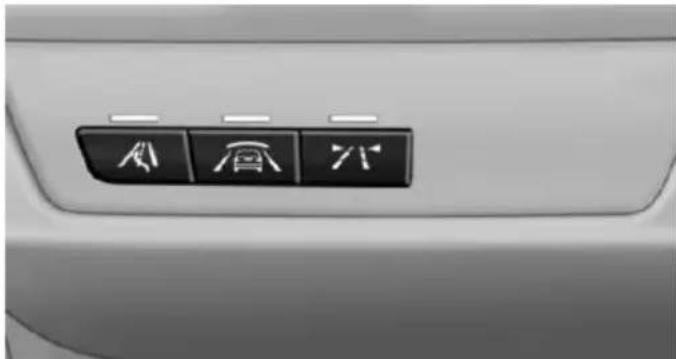
natural_image
Close-up of a car's front panel showing three directional icons: airplane, train, and bicycle (no text or symbols beyond icons)
Intelligent Safety button
Camera
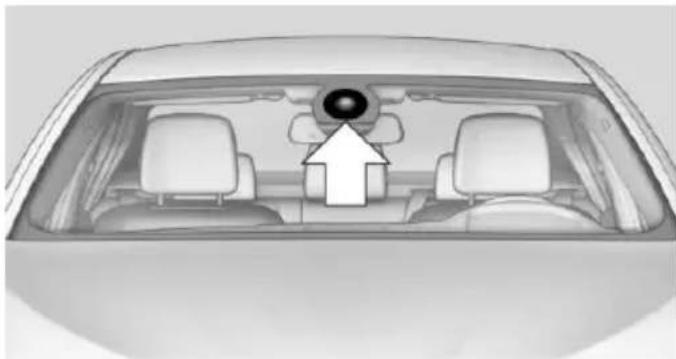
natural_image
Top-down view of a car's rearview mirror and dashboard (no text or symbols visible)The camera is located near the base of the mirror.
Keep the windshield in the area behind the interior rear view mirror clean and clear.
Switching on/off
Switching on automatically
The system is automatically active every time the engine is started using the Start/Stop button.
Switching off
Press button: the system is switched off. The LED goes out.
Re-press button: the system is switched on. The LED lights up.
Setting the prewarning time
The prewarning time can be set via iDrive.
- "Settings"
- "Frontal Coll. Warning"
- Activate the desired time on the Control Display.
The selected time is stored for the remote control currently in use.
Warning with braking function
Note

Adapting your speed and driving style
The warning does not relieve the driver of the responsibility to adapt his or her driving speed and style to the traffic conditions.
Display
If a collision with a vehicle detected in this way is imminent, a warning symbol appears on the instrument cluster and in the Head-up Display.
Symbol Measure

The vehicle lights up red: prewarning.
Increase braking and distance.

The vehicle flashes red and an acoustic signal sounds: acute warning.
You are requested to intervene by braking or making an evasive maneuver.
Braking intervention
The warning prompts the driver himself to intervene. During a warning, the maximum braking force is used. A prerequisite for the brake booster is a sufficiently fast and sufficiently strong actuation of the brake pedal. In addition, if there is a risk of collision, the system can assist with a slight braking intervention. The intervention can bring a vehicle traveling at slow speed to a complete stop.
Manual transmission: During a braking intervention up until reaching a complete stop, the engine may be shut down.
The braking intervention is executed only if DSC Dynamic Stability Control is switched on and Dynamic Traction Control DTC is activated.
The braking intervention can be interrupted by pressing on the accelerator pedal or by actively moving the steering wheel.

Tow-starting and towing
When tow-starting and towing the vehicle, switch off the Intelligent Safety systems; otherwise, improper behavior of the braking function of individual systems could result in an accident.
System limits

Be alert
Due to system limitations, warnings may be not be issued at all, or may be issued late or improperly. Therefore, always be alert and ready to intervene; otherwise, there is the danger of an accident occurring.
Detection range
The system's detection capabilities are limited.
This may result in the warning not being issued or being issued late.
For example, the following situations may not be detected:
▶ Slow moving vehicles when you approach them at high speed.
▶ Vehicles that suddenly swerve in front of you or sharply decelerating vehicles.
▶ Vehicles with an unusual rear appearance.
▶ Two-wheeled vehicles ahead of you.
▶ Pedestrians.
Functional limitations
The system may not be fully functional in the following situations:
In heavy fog, rain, sprayed water or snowfall.
In tight curves.
▶ If the driving stability control systems are limited or deactivated, for example, DSC OFF.
▶ If the camera in the mirror or the radar sensor is dirty or obscured.
During calibration of the camera immediately after vehicle shipment.
If there is constant dimming because of oncoming light, for example, from the sun low in the sky.
Prewarning sensitivity
Depending on the set prewarning time, this may result in increased false warnings.
Collision warning with braking function
The concept
The system issues a warning if there is imminent danger of a collision and also includes a braking function.
If the vehicle is equipped with Active Cruise Control with Stop & Go, the collision warning is controlled via the cruise control radar sensor.
The collision warning is available even if cruise control has been deactivated.
When the vehicle is intentionally brought close to a vehicle, the collision warning is delayed to avoid false warnings.
General information
The system issues a two-phase warning of a possible danger of collision with vehicles at speeds above approx. 3 mph/5 km/h. The time of these warnings may vary depending on the current driving situation.
Detection range
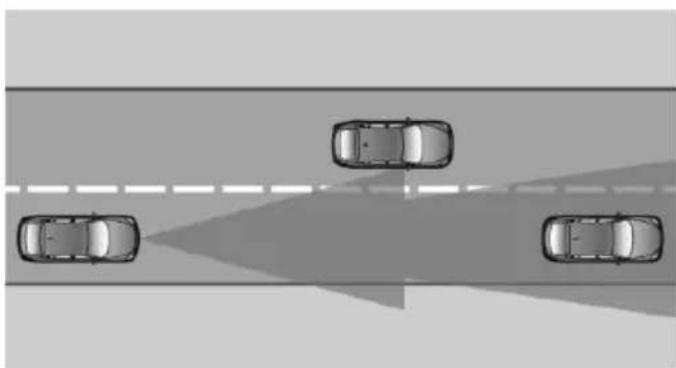
natural_image
Top-down view of four cars driving on a road with a shaded lane (no text or symbols visible)It responds to objects if they are detected by the radar.
At a glance
Button in the vehicle
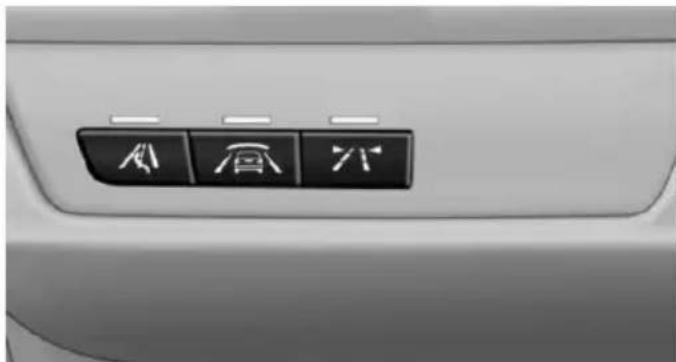
natural_image
Close-up of a car's front panel showing three directional icons (car, train, van) on the right side, no text or symbols present.
Intelligent Safety button
Switching on/off
Switching on automatically
The system is automatically active every time the engine is started using the Start/Stop button.
Switching off
Press button: the system is switched off. The LED goes out.
Re-press button: the system is switched on. The LED lights up.
Setting the prewarning time
The prewarning time can be set via iDrive.
- "Settings"
- "Frontal Coll. Warning"
- Activate the desired time on the Control Display.
The selected time is stored for the remote control currently in use.
Display
Warning stages
Prewarning
This warning is issued, for example, when there is the impending danger of a collision or the distance to the vehicle ahead is too small.
Acute warning with braking function
Warning of the imminent danger of a collision when the vehicle approaches another object at a relatively high differential speed.
The driver must intervene actively when there is an acute warning. If necessary, the driver is assisted by an automatic braking intervention in a possible risk of collision.
The detection of objects can be influenced by technical system limitations, e. g. pedestrians or stationary objects. Limitations of the detection range and functional restrictions are to be considered.
The braking intervention is executed with limited braking force and for a brief period only.
The intervention can bring the vehicle to a complete stop.
The braking intervention is executed only if DSC Dynamic Stability Control is switched on and Dynamic Traction Control DTC is activated.
Above approx. 130 mph/210 km/h, the braking intervention occurs as a brief braking pressure. No automatic delay occurs.

Adapting your speed and driving style
The warning does not relieve the driver of the responsibility to adapt his or her driving speed and style to the traffic conditions.
The braking intervention can be interrupted by pressing on the accelerator pedal or by actively moving the steering wheel.

Tow-starting and towing
When tow-starting and towing the vehicle, switch off the Intelligent Safety systems; otherwise, improper behavior of the braking function of individual systems could result in an accident.
Display in the instrument cluster
The collision warning can be issued in the instrument cluster, in the Head-up Display, and acoustically.
Warning stages
Symbol Measure

The vehicle lights up red: prewarning.
Increase distance.

The vehicle flashes red and an acoustic signal sounds: acute warning.
You are requested to intervene by braking or making an evasive maneuver.

Adapting your speed and driving style
The display does not relieve the driver of the responsibility to adapt his or her driving speed and style to the traffic conditions.
System limits

Be alert
Due to system limitations, warnings may be not be issued at all, or may be issued late or improperly. Therefore, always be alert and ready to intervene; otherwise, there is the danger of an accident occurring.
Detection range
The system's detection capabilities are limited.
This may result in the warning not being issued or being issued late.
For example, the following situations may not be detected:
▶ Slow moving vehicles when you approach them at high speed.
▶ Vehicles that suddenly swerve in front of you or sharply decelerating vehicles.
▶ Vehicles with an unusual rear appearance.
▶ Two-wheeled vehicles ahead of you.
▶ Pedestrians.
▶ Stationary objects.
Functional limitations
The system may not be fully functional in the following situations:
In heavy fog, rain, sprayed water or snowfall.
In tight curves.
▶ If the driving stability control systems are limited or deactivated, for example, DSC OFF.
▶ If the radar sensor is dirty or obscured.
Prewarning sensitivity
Depending on the set prewarning time, this may result in increased false warnings.
Pedestrian warning with city braking function
The concept
The system can help to prevent accidents with pedestrians.
The system issues a warning in the city driving speed area if there is imminent danger of a collision with pedestrians and includes a braking function.
The system is controlled via the camera in the base of the interior mirror.
General information
The system issues a warning with brightness staring at approx. 6 mph/10 km/h to approx. 35 mph/60 km/h regarding a possible risk of collision with pedestrians and assists with a brake intervention shortly before a collision. It responds to persons that are within the detection range of the system.
Detection range
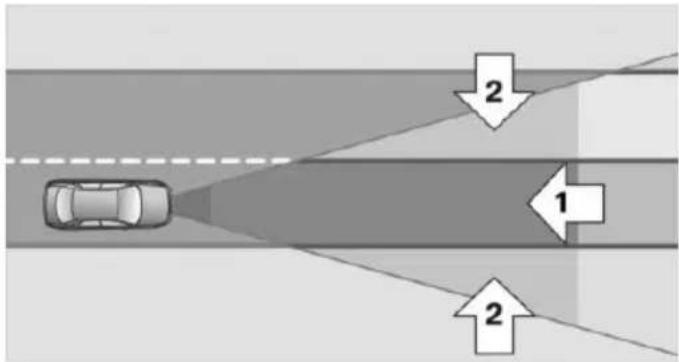
flowchart
graph TD
    A["Car"] --> B{Light Path}
    B --> C["Path 1"]
    B --> D["Path 2"]
    style A fill:#f9f,stroke:#333
    style B fill:#ccf,stroke:#333
    style C fill:#cfc,stroke:#333
    style D fill:#fcc,stroke:#333
The detection area in front of the vehicle is divided into two areas.
▶ Central area, arrow 1, directly in front of the vehicle.
▶ Expanded area, arrow 2, to the right and left.
A collision is imminent if pedestrians are located within the central area. A warning is issued about pedestrians who are located within the extended area only if they are moving in the direction of the central area.
At a glance
Button in the vehicle
natural_image
Close-up of a car's front panel showing three directional icons: airplane, train, and bicycle (no text or labels visible)
Intelligent Safety button
Camera
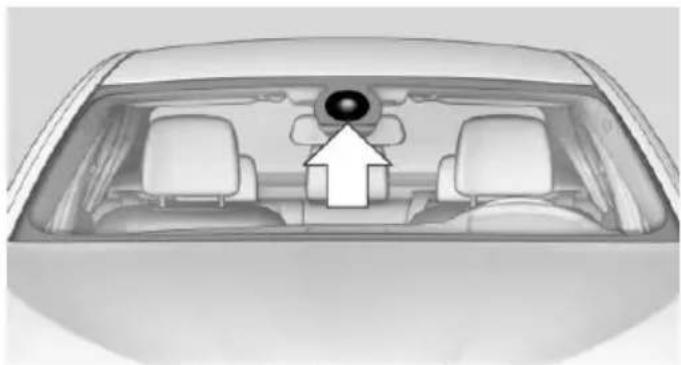
natural_image
Top-down view of a car's rearview showing the dashboard and steering wheel (no text or symbols visible)The camera is located near the base of the mirror.
Keep the windshield in the area behind the interior rear view mirror clean and clear.
Switching on/off
Switching on automatically
The system is automatically active every time the engine is started using the Start/Stop button.
Switching off
Press the button: the systems are switched off. The LED goes out.
Press the button: the systems are switched off. The LED lights up.
Warning with braking function
Note

Adapting your speed and driving style
The warning does not relieve the driver of the responsibility to adapt his or her driving speed and style to the traffic conditions.
Display
If a collision with a person detected in this way is imminent, a warning symbol appears on the instrument cluster and in the Head-up Display.

The red symbol is displayed and a signal sounds.
Intervene immediately by braking or an evasive maneuver.
Braking intervention
The warning prompts the driver himself to intervene. During a warning, the maximum braking force is used. A prerequisite for the brake booster is a sufficiently fast and sufficiently strong actuation of the brake pedal. In addition, if there is a risk of collision, the system can assist with a slight braking intervention. The intervention can bring a vehicle traveling at slow speed to a complete stop.
Manual transmission: During a braking intervention up until reaching a complete stop, the engine may be shut down.
The braking intervention is executed only if DSC Dynamic Stability Control is switched on and Dynamic Traction Control DTC is activated.
The braking intervention can be interrupted by pressing on the accelerator pedal or by actively moving the steering wheel.

Tow-starting and towing
When tow-starting and towing the vehicle, switch off the Intelligent Safety systems; otherwise, improper behavior of the braking function of individual systems could result in an accident.
System limits

Be alert
Due to system limitations, warnings may be not be issued at all, or may be issued late or improperly. Therefore, always be alert and
ready to intervene; otherwise, there is the danger of an accident occurring.
Detection range
The detection capability of the camera is limited.
This may result in the warning not being is- sued or being issued late.
For example, the following situations may not be detected:
▶ Partially covered pedestrians.
▶ Pedestrians that are not detected as such because of the viewing angle or contour.
▶ Pedestrians outside of the detection range.
▶ Pedestrians having a body size less than 32 in/80 cm.
Functional limitations
The system may not be fully functional or may not be available in the following situations:
In heavy fog, rain, sprayed water or snowfall.
In tight curves.
▶ If the camera view field or the front wind-shield are dirty or covered.
▶ When driving toward bright lights.
▶ Up to 10 seconds after the start of the engine, via the Start/Stop knob.
During calibration of the camera immediately after vehicle shipment.
When it is dark outside.
Lane departure warning
The concept
Starting at a specific speed, this system alerts you when the vehicle on streets with lane markings is about to leave the lane. This speed, depending on the country version, is between 35 mph/55 km/h and 45 mph/70 km/h.
When switching on the system below this speed, a message is displayed in the instrument cluster.
The steering wheel begins vibrating gently in the event of warnings. The time of the warning may vary depending on the current driving situation.
The system does not provide a warning if the turn signal is set before leaving the lane.
Hints

Personal responsibility
The system cannot serve as a substitute for the driver's personal judgment of the course of the road and the traffic situation.
In the event of a warning, do not jerk the steering wheel, as you may lose control of the vehicle.
At a glance
Button in the vehicle
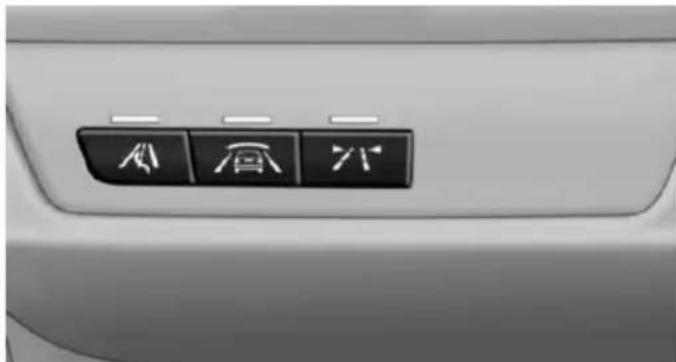
natural_image
Close-up of a car's front panel showing three directional icons: airplane, train, and bicycle (no text or symbols beyond icons)
Lane departure warning
Camera
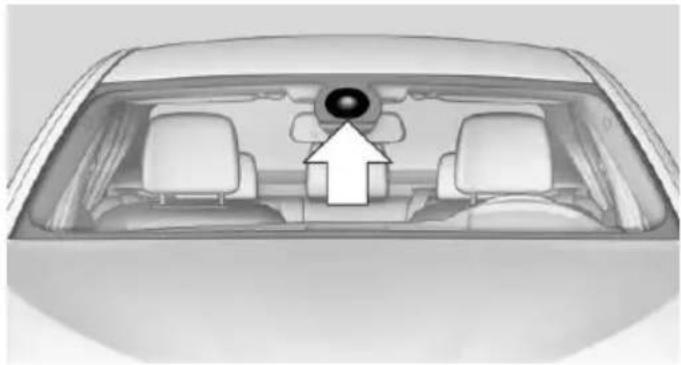
natural_image
Top-down view of a car's rearview mirror and dashboard (no text or symbols visible)The camera is located near the base of the mirror.
Keep the windshield in the area behind the interior rear view mirror clean and clear.
Switching on/off
Press the button.
On: the LED lights up.
▶ Off: the LED goes out.
The setting is stored for the remote control currently in use.
Display in the instrument cluster

▶ Lines: system is activated.
▶ Arrows: at least one lane marking was detected and warnings can be issued.
Issued warning
If you leave the lane and if a lane marking has been detected, the steering wheel begins vibrating.
If the turn signal is set before changing the lane, a warning is not issued.
End of warning
The warning ends:
▶ Automatically after approx. 3 seconds.
▷ When returning to your own lane.
When braking hard.
▷ When using the turn signal.
System limits
The system may not be fully functional in the following situations:
In heavy fog, rain or snowfall.
In the event of missing, worn, poorly visible, merging, diverging, or multiple lane markings such as in construction areas.
When lane markings are covered in snow, ice, dirt or water.
In tight curves or on narrow lanes.
When the lane markings are covered by objects.
When driving very close to the vehicle in front of you.
▶ When driving toward bright lights.
When the windshield in front of the interior rearview mirror is fogged over, dirty or covered with stickers, etc.
During calibration of the camera immediately after vehicle shipment.
Active Blind Spot Detection
The concept
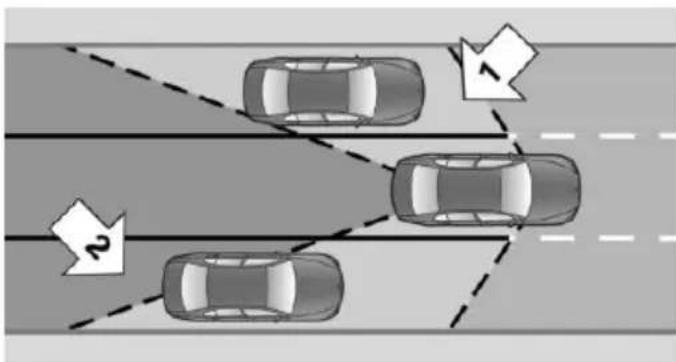
flowchart
graph TD
    A["Top Car"] --> B{Check}
    B -->|Yes| C["Car 1"]
    B -->|No| D["Car 2"]
    C --> E["Top Car"]
    D --> F["Car 3"]
    style A fill:#f9f,stroke:#333
    style C fill:#ccf,stroke:#333
    style D fill:#cfc,stroke:#333
Two radar sensors below the rear bumper monitor the area behind and next to the vehicle at speeds above approx. 30 mph/50 km/h.
The system indicates whether there are vehicles in the blind spot, arrow 1, or approaching from behind on the adjacent lane, arrow 2.
The lamp in the exterior mirror housing lights up dimly.
Before you change lanes after setting the turn signal, the system issues a warning in the situations described above.
The lamp in the housing of the exterior mirror flashes and the steering wheel vibrates.
Hints

Personal responsibility
The system does not serve as a substitute for the driver's personal judgment of the traffic situation.
Be aware of the traffic situation and the vehicle's surroundings at all times, otherwise an accident is still possible despite all warnings.
At a glance
Button in the vehicle
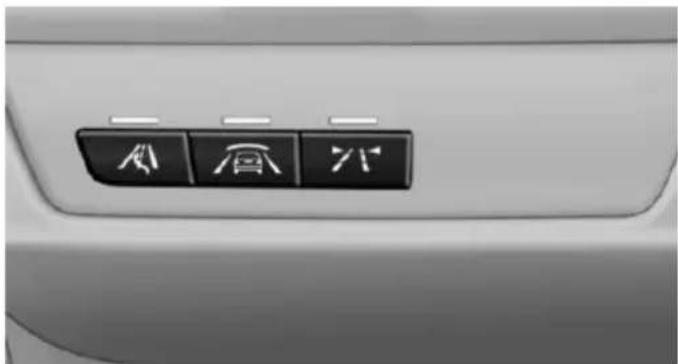
natural_image
Close-up of a car's front panel showing three directional icons: airplane, train, and bicycle (no text or labels visible)
Active Blind Spot Detection
Radar sensors
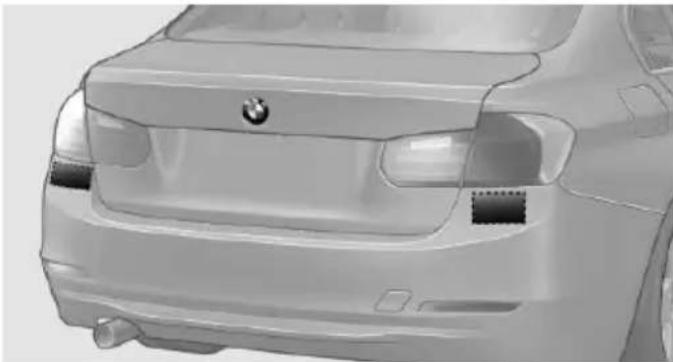
natural_image
Front view of a BMW sedan (no visible text or symbols)The radar sensors are located under the rear bumper.
Switching on/off
Press the button.
On: the LED lights up.
▶ Off: the LED goes out.
The system can issue warnings at speeds above approx. 30 mph/50 km/h.
The setting is stored for the remote control currently in use.
Display
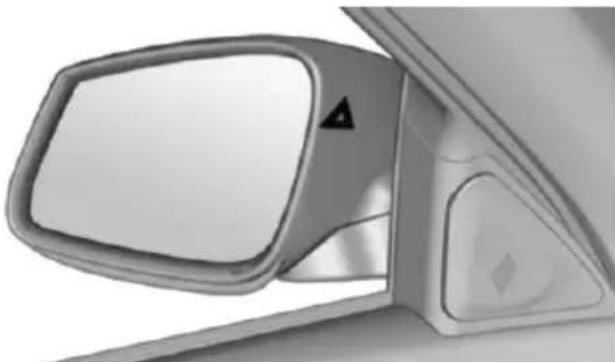
natural_image
Side view of a car front mirror and side panel (no text or symbols visible)Information stage
The dimmed lamp in the mirror housing indicates when there are vehicles in the blind spot or approaching from behind.
Warning
If the turn signal is set while a vehicle is in the critical zone, the steering wheel vibrates briefly
and the lamp in the mirror housing flashes brightly.
The warning stops when the turn signal is switched off, or the other vehicle leaves the critical zone.
System limits
The system may not be fully functional in the following situations:
When a vehicle is approaching at a speed much faster than your own.
In heavy fog, rain or snowfall.
In tight curves or on narrow lanes.
▶ If the bumper is dirty or iced up, or covered with stickers.
A Check Control message is displayed when the system is not fully functional.
For US owners only
The transmitter and receiver units comply with part 15 of the FCC/Federal Communication Commission regulations. Operation is governed by the following:
FCC ID:
NBG009014A.
Compliance statement:
This device complies with part 15 of the FCC Rules. Operation is subject to the following two conditions:
This device may not cause harmful interference, and
- this device must accept any interference received, including interference that may cause undesired operation.
Any unauthorized modifications or changes to these devices could void the user's authority to operate this equipment.
Brake force display
The concept
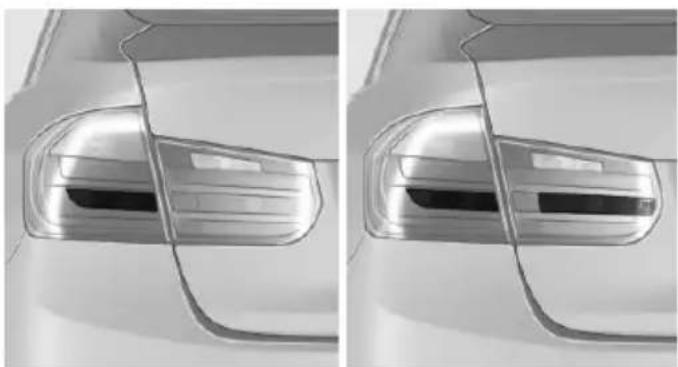
natural_image
Side-by-side comparison of a car's side profile showing front and rear angles (no text or symbols)During normal brake application, the outer brake lamps light up.
During heavy brake application, the inner brake lamps light up in addition.
Driving stability control systems
Vehicle equipment
All standard, country-specific and optional equipment that is offered in the model series is described in this chapter. Therefore, equipment is also described that is not available in a vehicle, e.g., because of the selected optional equipment or country variant. This also applies for safety-related functions and systems.
Antilock Brake System ABS
ABS prevents locking of the wheels during braking.
The vehicle remains steerable even during full brake applications, thus increasing active safety.
ABS is operational every time you start the engine.
Brake assistant
When you apply the brakes rapidly, this system automatically produces the maximum braking force boost. This then reduces braking distance to a minimum during full braking. This system utilizes all of the benefits provided by ABS.
Do not reduce the pressure on the brake pedal for the duration of the full braking.
DSC Dynamic Stability Control
The concept
DSC prevents traction loss in the driving wheels when driving away and accelerating.
DSC also recognizes unstable vehicle conditions, such as fishtailing or nose-diving. Subject to physical limits, DSC helps to keep the vehicle on a steady course by reducing engine speed and by applying brakes to the individual wheels.
Adjust your driving style to the situation An appropriate driving style is always the responsibility of the driver.
The laws of physics cannot be repealed, even with DSC.
Therefore, do not reduce the additional safety margin by driving in a risky manner.
Indicator/warning lamps
The indicator lamp flashes: DSC controls the drive forces and brake forces. The indicator lamp lights up: DSC has failed.
Deactivating DSC: DSC OFF
When DSC is deactivated, driving stability is reduced during acceleration and when driving in bends.
To increase vehicle stability, activate DSC again as soon as possible.
Deactivating DSC
Press and hold the button, but not longer than approx. 10 seconds, until the indicator lamp for DSC OFF lights up in the instrument cluster and DSC OFF is displayed.
The DSC system is switched off.
Steering and, depending on the equipment, the chassis are adjusted for sporty driving.
Activating DSC
OFF Press the button.
DSC OFF and the DSC OFF indicator lamp go out.
Indicator/warning lamps
When DSC is deactivated, DSC OFF is displayed in the instrument cluster.
The indicator lamp lights up: DSC is deactivated.
DTC Dynamic Traction Control
The concept
The DTC system is a version of the DSC in which forward momentum is optimized.
The system ensures maximum forward momentum on special road conditions, e.g., unplowed snowy roads, but driving stability is limited.
It is therefore necessary to drive with appropriate caution.
You may find it useful to briefly activate DTC under the following special circumstances:
▶ When driving in slush or on uncleared, snow-covered roads.
When rocking the vehicle or driving off in deep snow or on loose surfaces.
▶ When driving with snow chains.
Deactivating/activating DTC Dynamic Traction Control
Activating the Dynamic Traction Control DTC provides maximum traction on loose ground. Driving stability is limited during acceleration and when driving in bends.
Activating DTC
Press the button.
TRACTION is displayed in the instrument cluster and the indicator lamp for DSC OFF lights up.
Deactivating DTC
Press the button again.
TRACTION and the DSC OFF indica-
tor lamp go out.
xDrive
xDrive is the all-wheel-drive system of your vehicle. Concerted action by the xDrive and DSC further optimize traction and driving dynamics. The xDrive all-wheel-drive system variably distributes the drive forces to the front and rear axles as demanded by the driving situation and road surface.
Dynamic Damping Control
The concept
This system reduces undesirable vehicle motion when using a dynamic driving style or traveling on uneven road surfaces.
The system enhances driving dynamics and comfort as required for the road surface and driving style.
Programs
The system offers several different programs.
The programs can be selected via the Driving Dynamics Control, refer to page 116.
SPORT
Consistently sporty control of the shock absorbers for greater driving agility.
SPORT+
Consistently sporty control of the shock absorbers for greater driving agility when driving with limited driving stabilization.
COMFORT/ECO PRO
Balanced control of the vehicle.
Variable sport steering
The variable sport steering increases the steering angle of the front wheels at large steering wheel angles, e.g., in tight curves or when parking. Steering becomes more direct.
It also varies the force required to turn the wheels in accordance with the vehicle speed.
This results in a sporty steering response. In addition, it becomes easier to steer during parking and maneuvering.
Driving Dynamics Control
The concept
The Driving Dynamics Control can be used to adjust the certain characteristics of the vehicle. Various programs can be selected for this purpose. The Driving Dynamics Control and the DSC OFF buttons can each be used to activate a program.
Operating the programs
Press the button Program
| OFF | DSC OFF |
| TRACTION | |
| SPORT+ | |
| SPORT | |
| COMFORT | |
| ECO PRO |
Automatic program change
The system automatically switches to COM-FORT in the following situations:
▶ Failure of DSC Dynamic Stability Control.
The vehicle has a flat tire.
▶ When activating cruise control in TRACTION or DSC OFF mode.
DSC OFF
When DSC OFF, refer to page 114, is active, driving stability is limited during acceleration and when driving in bends.
TRACTION
When TRACTION is active, the vehicle has maximum traction on loose road surfaces. DTC Dynamic Traction Control, refer to page 115, is activated. Driving stability is limited during acceleration and when driving in bends.
SPORT+
Sporty driving with optimized chassis and adapted engine control with limited driving stabilization.
Dynamic Traction Control is switched on.
The driver handles several of the stabilization tasks.
Activating SPORT+
Press the button repeatedly until SPORT+ appears in the instrument cluster and the DSC OFF indicator lamp lights up.
Automatic program change
When activating cruise control, the program automatically switches to SPORT mode.
Indicator/warning lamps
SPORT+ is displayed in the instrument cluster.

The DSC OFF indicator lamp lights up: Dynamic Traction Control is activated.
SPORT
Consistently sporty tuning of the suspension and engine control for greater driving agility with maximum driving stabilization.
The program can be configured to individual specifications. The configuration is stored for the remote control currently in use.
Activating SPORT
Press button repeatedly until SPORT is displayed in the instrument cluster.
Configuring SPORT
When the display is activated on the Control Display, refer to page 118, the SPORT driving mode can be set to individual specifications.
▶ Activating SPORT.
▶ "Configure SPORT"
▶ Configuring the SPORT driving mode.
SPORT can also be configured before it is activated:
- "Settings"
- "Driving mode"
- "Configure SPORT"
- Configure driving mode.
This configuration is retrieved when the SPORT driving mode is activated.
COMFORT
For a balanced tuning with maximum driving stabilization.
Activating COMFORT
Press button repeatedly until COM-FORT is displayed in the instrument
cluster.
In certain situations, the system automatically changes to the NORMAL program, automatic program change, refer to page 116.
ECO PRO
ECO PRO, refer to page 169, provides consistent tuning to minimize fuel consumption for maximum range with maximum driving stabilization.
Comfort functions and the engine controller are adjusted.
The program can be configured to individual specifications.
Activating ECO PRO
Press button repeatedly until ECO PRO is displayed in the instrument
cluster.
Configuring ECO PRO
- Activate ECO PRO.
- "Configure ECO PRO"
Make the desired settings.
Configuring drive program
Settings can be made for the following driving programs in Driving mode:
▶ SPORT, refer to page 117.
▷ ECO PRO, refer to page 170.
Displays
Program selection

Pressing the button displays a list of the selectable programs.
Selected program

The selected program is dis- played in the instrument cluster.
Display on the Control Display
Program changes can be displayed on the Control Display.
- "Settings"
- "Driving mode"
- "Driving mode info"
Drive-off assistant
This system supports driving away on gradients. The parking brake is not required.
- Hold the vehicle in place with the foot brake.
- Release the foot brake and drive away without delay.
After the foot brake is released, the vehicle is held in place for approx. 2 seconds.
Depending on the vehicle load or when a trailer is being used, the vehicle may roll back slightly.

Driving off without delay
After releasing the foot brake, start driving without delay, since the drive-off assistant will not hold the vehicle in place for more than approx. 2 seconds and the vehicle will begin rolling back.
Driving comfort
Vehicle equipment
All standard, country-specific and optional equipment that is offered in the model series is described in this chapter. Therefore, equipment is also described that is not available in a vehicle, e.g., because of the selected optional equipment or country variant. This also applies for safety-related functions and systems.
Active Cruise Control with Stop & Go function, ACC
The concept
This system can be used to select a desired speed that the vehicle will maintain automatically on clear roads.
To the extent possible, the system automatically adjusts the speed to a slower vehicle ahead of you.
The distance that the vehicle maintains to the vehicle ahead of you can be varied.
For safety reasons, it depends on the speed.
To maintain a certain distance, the system automatically reduces the speed, applies the brakes lightly, or accelerates again if the vehicle ahead begins moving faster.
If the vehicle ahead of you brakes to a halt, the system is able to detect this within the given system limits. If the vehicle ahead of your drives away again from a halt, your vehicle is able to accelerate if operated accordingly.
Even if some time passes before the vehicle ahead of you drives away again, your own vehicle can still be accelerated automatically and simply.
As soon as the road is clear, it accelerates to the desired speed.
The speed is also maintained on downhill gradients, but may not be maintained on uphill slopes if engine power is insufficient.
General information
Depending on the set driving program, the characteristics of the cruise control can change in certain areas.
Hints

Personal responsibility
Even an active system does not release the driver from personal responsibility for the driving process, especially for lane tracking, adaptation of speed, distance and driving style to the traffic conditions.
Because of technical system limits, the system cannot independently react appropriately in all traffic situations.
Monitor the driving process, the surrounding area and what is occurring in traffic continuously and attentively and actively intervene as required, e.g., by braking, steering or making an evasive maneuver.

Unfavorable weather conditions
In the event of unfavorable weather and light conditions, e. g. if there is rain, snowfall, slush, fog or glare, this may result in poorer recognition of vehicles as well as short-term interruptions for vehicles that are already detected. Drive attentively, and react to the current traffic events. Intervene actively when necessary, e.g., by braking, steering or making an evasive maneuver, otherwise, there is danger of an accident.
At a glance
Buttons on the steering wheel
| Press the button | Function |
 | System on/off, interrupt, refer to page 120 |
 | Maintaining/storing the speed, refer to page 121 |
 | Resume speed, refer to page 122 |
 | Reduce distance, refer to page 122 |
 | Increase distance, refer to page 122 |
 | Rocker switch: Maintaining/storing the speed, refer to page 121Changing, maintaining, and storing the speed, refer to page 121 |
The arrangement of the buttons varies according to the how the vehicle is equipped or country-specific variants.
Radar sensor
A radar sensor is located in the front bumper for detecting vehicles on the road ahead of the vehicle.
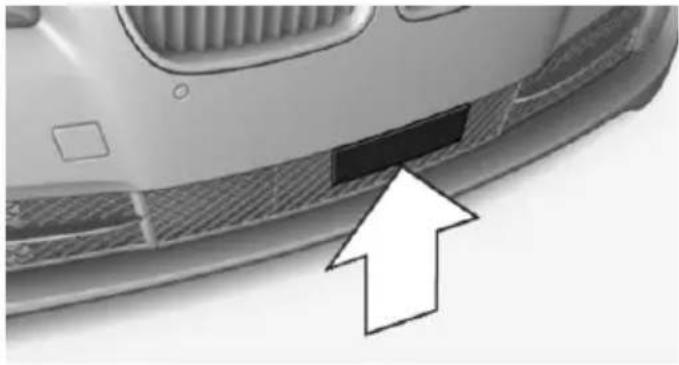
natural_image
Close-up of a car's front bumper with a black rectangular patch and an arrow pointing to it (no text or symbols visible)A dirty or covered sensor may hinder the detection of vehicles.
▶ If necessary, clean the radar sensor. Remove layers of snow and ice carefully.
Do not cover the view field of the radar sensor.
Switching on/off and interrupting cruise control
Switching on
Press the button on the steering wheel.
The indicator lamps in the instrument cluster light up and the mark in the speedometer is set to the current speed.
Cruise control can be used.
Switching off

Deactivated or interrupted system
If the system is deactivated or interrupted, actively intervene by braking, steering and, if necessary, with evasive maneuvers; otherwise, there is the danger of an accident occurring.
If switching off the system while stationary, press on the brake pedal at the same time.
Press the button.
▶ If active: press twice.
▶ If interrupted: press once.
The displays go out. The stored desired speed and distance are deleted.
Interrupting

When active, press the button.
If interrupting the system while stationary, press on the brake pedal at the same time.
The system is automatically interrupted in the following situations:
When the brakes are applied.
▶ When drive mode D is removed.
When DTC Dynamic Traction Control is activated or DSC is deactivated.
When DSC is actively controlling stability.
When SPORT+ is activated with Driving Dynamics Control.
If the safety belt and the driver's door are opened when the vehicle is standing still.
If the system has not detected objects for an extended period, e.g., on a road with very little traffic without road edge line markings.
▶ If the detection range of the radar is disrupted, for example, by dirt or heavy fog.
Maintaining/storing the speed
Press the button.
Or:
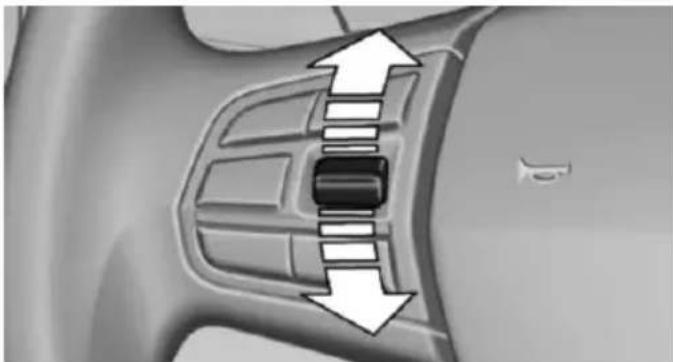
natural_image
Diagram of a vehicle's rearview and side profile with directional arrows indicating movement or force (no text or symbols)Press the rocker switch while the system is interrupted.
When the system is switched on, the current speed is maintained and stored as the desired speed.
This is displayed, refer to page 123, in the speedometer and briefly in the instrument cluster.
When cruise control is maintained or stored, DSC Dynamic Stability Control is switched on, if necessary.
Changing, maintaining, and storing the speed
The rocker switch can be pressed while the system is interrupted to maintain and store the current speed. DSC Dynamic Stability Control is switched on, if necessary.

Adapting the desired speed
Adapt the desired speed to the road conditions and be ready to brake at all times; otherwise, there is the danger of an accident occurring.

Speed differences
Large differences in speed relative to vehicles ahead of the vehicle cannot be compensated by the system for example in the following situations:
▶ When quickly approaching a slowly moving vehicle.
When another vehicle suddenly swerves into the wrong lane.
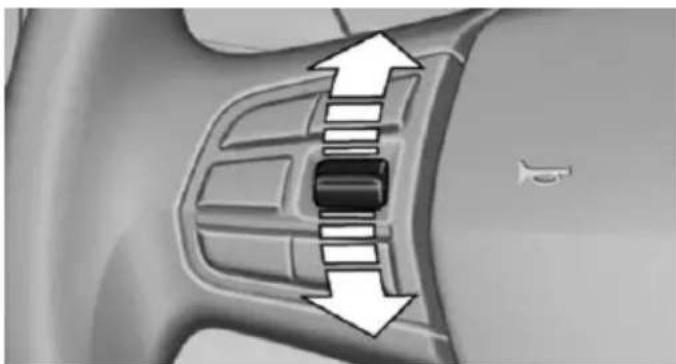
natural_image
Mechanical component diagram showing a piston and shaft assembly with directional arrows (no text or symbols)Press the rocker switch up or down repeatedly until the desired speed is set.
If active, the displayed speed is stored and the vehicle reaches the stored speed if the road is clear.
▶ Each time the rocker switch is pressed to the point of resistance, the desired speed increases or decreases by approx. 1 mph/1 km/h.
▶ Each time the rocker switch is pressed past the point of resistance, the desired speed increases or decreases by a maximum of 5 mph/10 km/h.
Hold the rocker switch in position to repeat the action.
Distance

Selecting a distance
Adjust the distance according to the traf-
fic and weather conditions; otherwise, there is the danger of an accident occurring. Maintain the prescribed safety distance.
Reduce distance
Press the button repeatedly until the desired distance is set.
The selected distance, refer to page 123, is displayed in the instrument cluster.
Increase distance
Press the button repeatedly until the desired distance is set.
The selected distance, refer to page 123, is displayed in the instrument cluster.
Calling up the desired speed and distance
While driving
Press the button with the system switched on.
In the following cases, the stored speed value is deleted and cannot be called up again:
▷ When the system is switched off.
▷ When the ignition is switched off.
While standing

Before leaving the vehicle, secure it against rolling
Before leaving the vehicle with the engine running, engage position P of the automatic transmission and apply the parking brake. Otherwise, the vehicle may begin to roll.
The system brought the vehicle to a complete standstill.
▶ Green marking in the speedometer:
Your vehicle accelerates automatically as soon as the vehicle in the range of the radar sensor moves off.
▶ Marking in the speedometer turns orange: no automatic driving away.
To accelerate to the desired speed automatically, press the accelerator or press the RES or SET button.
Rolling bars in the distance display indicate that the vehicle in the radar sensor detection range has moved off.
Your vehicle was braked to a halt by pressing on the brake pedal and it is standing behind another vehicle:
-
P=6 the button to call up a stored desired speed.
-
Release the brake pedal.
-
Press on the accelerator briefly, or press the RES rocker switch when the vehicle ahead of you drives away.
Displays in the instrument cluster
Desired speed
The marking lights up green: the system is active.
The marking lights up orange: the system has been interrupted.
The marking does not light up: the system is switched off.
Brief status display

Selected desired speed.
If --- appears briefly on the display for Check Control messages, it is possible that the system requirements for operation are currently not met.
Distance to vehicle ahead of you
The selected distance to the vehicle driving ahead of you is shown.
Distance display

Distance 1

Distance 2

Distance 3

Distance 4
This value is set after the system is switched on.

The system has been interrupted or distance control is deactivated because the accelerator pedal is being pressed; a vehicle was not detected.
Distance display

Distance control is deactivated because the accelerator pedal is being pressed; a vehicle was detected.
Rolling bars: the detected vehicle has driven away.
Indicator/warning lamps

Personal responsibility
The indicator and warning lamps do not relieve the driver of the responsibility to adapt his or her desired driving speed and style to the traffic conditions.

The vehicle symbol lights up orange: A vehicle has been detected ahead of you.

The vehicle symbol flashes orange: The conditions are not adequate for operating the system.
The system was deactivated but applies the brakes until you actively resume control by pressing on the brake pedal or accelerator pedal.

The vehicle symbol flashes red and an acoustic signal sounds:
You are requested to intervene by braking or making an evasive maneuver.
System limits
Speed range
Best results are achieved when using the system on well-developed roads and highways. The system is functional at speeds beginning at approx. 20 mph/30 km/h.
The maximum speed that can be set depends on the vehicle.
The system can also be activated when stationary.
Comply with the legal speed limit in every situation when using the system.
Detection range
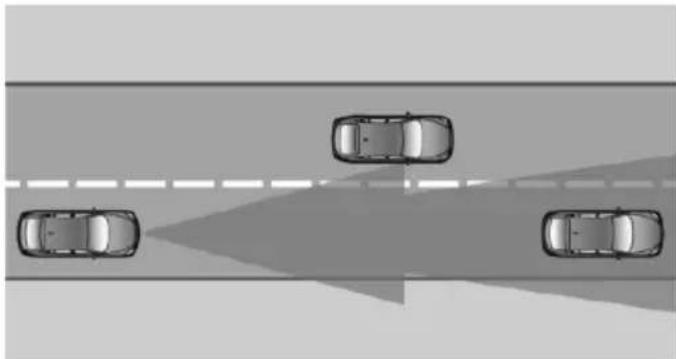
natural_image
Top-down view of four cars driving on a road with a shaded lane (no text or symbols visible)The detection capacity of the system and the automatic braking capacity are limited.
Two-wheeled vehicles driving ahead of you for instance might not be detected.

Limited detection capacity
Because of the limits to the detection capacity, you should be alert at all times so that you can intervene if necessary; otherwise, there is the danger of an accident occurring.
Deceleration
The system does not decelerate when a stationary obstacle is located in the same lane, e.g., a vehicle at a red traffic light or at the end of traffic congestion.
The system also does not respond to:
▶ Pedestrians or similar slow-moving road users.
▶ Red traffic lights.
▶ Stationary objects.
▷ Cross traffic.
Oncoming traffic.

No warnings
A warning may not be issued when approaching a stationary or very slow-moving obstacle. You must react yourself; otherwise, there is the danger of an accident occurring.
Swerving vehicles
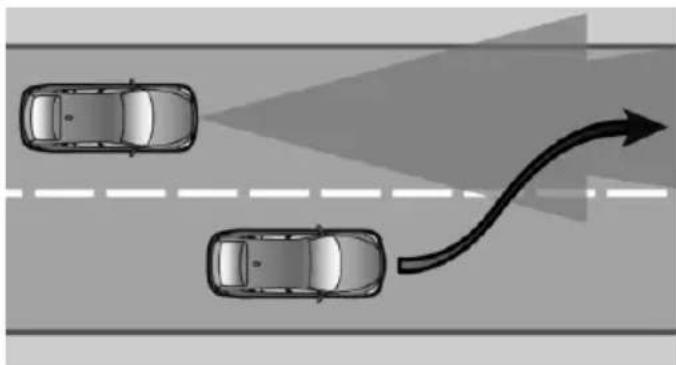
natural_image
Top-down diagram of a road with cars and a curved arrow indicating direction (no text or symbols)A vehicle driving in front of you is not detected until it is completely within the same lane as your vehicle.

Swerving vehicles
If a vehicle driving ahead of you suddenly swerves into your lane, the system may not be able to automatically restore the selected distance. This also applies to major speed differences to vehicles driving ahead of you, e.g., when rapidly approaching a truck. When a vehicle driving ahead of you is reliably detected, the system requests that the driver intervene by braking and carrying out evasive maneuvers, if necessary. You must react yourself; otherwise, there is the danger of an accident occurring.
Unexpected lane change
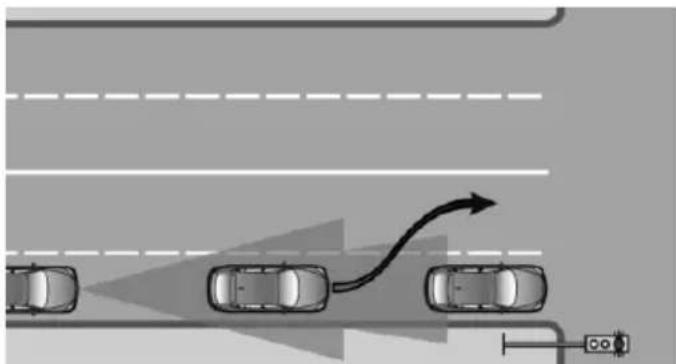
natural_image
Diagram showing a multi-lane road with cars and a traffic light, no text or symbols presentIf a vehicle ahead of you unexpectedly moves into another lane from behind a stopped vehicle, you yourself must react, as the system does not react to stopped vehicles.
Cornering
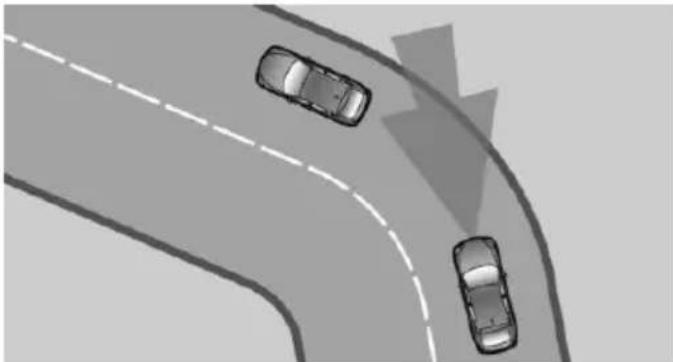
natural_image
Top-down view of three cars driving on a curved road with dashed lane markings (no text or symbols)If the desired speed is too high for a curve, the speed is reduced slightly in the curve, although curves cannot be anticipated in advance.
Therefore, drive into a curve at an appropriate speed.
In tight curves, situations may result due to the restricted detection range of the system in which a vehicle driving ahead of you may not be detected at all, or not until after a considerable delay.
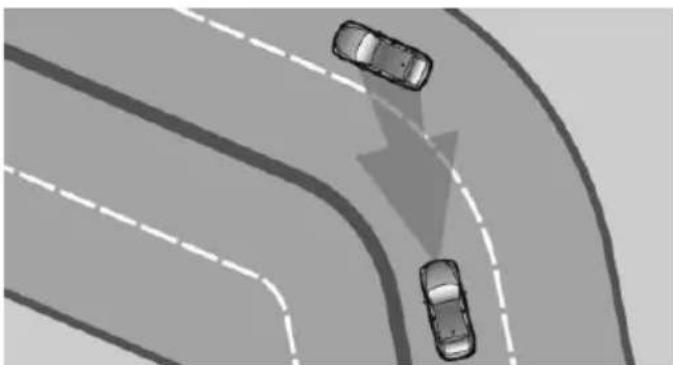
natural_image
Top-down view of three cars driving on curved road intersections with dashed lane markings (no text or symbols)When approaching a curve, the system may react briefly to the vehicles in the next lane due to the bend of the curve. Any deceleration of the vehicle by the system can be compensated for by briefly accelerating. After the accelerator pedal is released, the system becomes active again and independently controls the speed.
Driving away
In some situations, the vehicle cannot drive away automatically, e.g., on steep inclines or behind bumps in the road.
Radar sensor
For US owners only
The transmitter and receiver units comply with part 15 of the FCC/Federal Communication Commission regulations. Operation is governed by the following:
FCC ID:
OAYARS3-A
Compliance statement:
This device complies with part 15 of the FCC Rules. Operation is subject to the following two conditions:
This device may not cause harmful interference, and
- this device must accept any interference received, including interference that may cause undesired operation.
Any unauthorized modifications or changes to these devices could void the user's authority to operate this equipment.
Malfunction
The system cannot be activated if the radar sensor is not aligned correctly. This may be caused by damage incurred during parking, for example.
A Check Control message is displayed if the system fails.
Cruise control
The concept
The system is functional at speeds beginning at approx. 20 mph/30 km/h.
It maintains the speed that was set using the control elements on the steering wheel.
The system brakes on downhill gradients if engine braking action is insufficient.

Unfavorable conditions
Do not use the system if unfavorable
conditions make it impossible to drive at a constant speed, for instance:
On curvy roads.
In heavy traffic.
On slippery roads, in fog, snow or rain, or on a loose road surface.
Otherwise, you could lose control of the vehicle and cause an accident.
General information
Depending on the set driving program, the characteristics of the cruise control can change in certain areas.
At a glance
Buttons on the steering wheel
| Press the button Function | |
 | System on/off, interrupt |
 | Store speed |
 | Resume speed |
 | Rocker switch: change, hold, store speed |
Controls
Switching on
Press the button on the steering wheel.
The marking in the speedometer is set to the current speed.
Cruise control can be used.
Switching off

Deactivated or interrupted system
If the system is deactivated or interrupted, actively intervene by braking and, if necessary, with evasive maneuvers; otherwise, there is the danger of an accident occurring.
Press the button.
▶ If active: press twice.
▶ If interrupted: press once.
The displays go out. The stored desired speed is deleted.
Interrupting
When active, press the button.
The system is automatically interrupted if:
The brakes are applied.
The clutch pedal is depressed for a few seconds or released while a gear is not engaged.
The gear engaged is too high for the current speed.
▶ Selector lever position D is disengaged.
▷ DTC Dynamic Traction Control is activated or DSC is deactivated.
▶ DSC is actively controlling stability.
When SPORT+ is activated with Driving Dynamics Control.
Maintaining/storing the current speed
Press the button.
Or
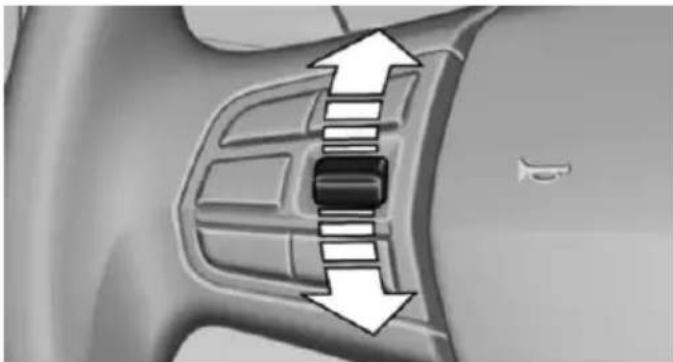
natural_image
Mechanical component diagram showing a piston-like structure with directional arrows indicating movement or force (no text or symbols present)Press the rocker switch while the system is interrupted.
When the system is switched on, the current speed is maintained and stored as the desired speed.
This is displayed, refer to page 127, in the speedometer and briefly in the instrument cluster.
When cruise control is maintained or stored, DSC Dynamic Stability Control is switched on, if necessary.
Changing/maintaining speed
The rocker switch can be pressed while the system is interrupted in order to maintain and store the current speed.

Adapting the desired speed
Adapt the desired speed to the road conditions and be ready to brake at all times; otherwise, there is the danger of an accident occurring.
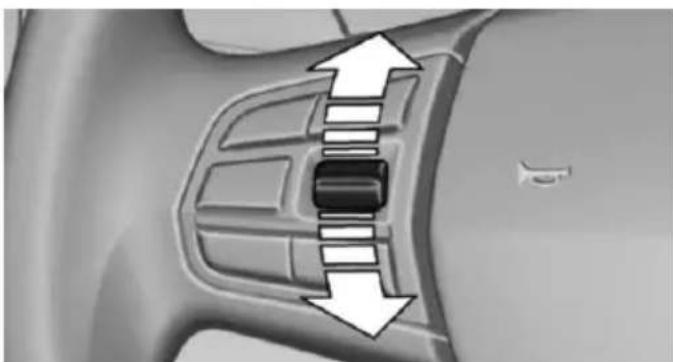
natural_image
Diagram of a vehicle's rearview and side view showing directional arrows and structural components (no text or symbols)Press the rocker switch up or down repeatedly until the desired speed is set.
If active, the displayed speed is stored and the vehicle reaches the stored speed if the road is clear.
▶ Each time the rocker switch is pressed to the point of resistance, the desired speed increases or decreases by approx. 1 mph/1 km/h.
▶ Each time the rocker switch is pressed past the point of resistance, the desired speed increases or decreases by a maximum of 5 mph/10 km/h.
The maximum speed that can be set depends on the vehicle.
▶ Pressing the rocker switch to the resistance point and holding it accelerates or decelerates the vehicle without requiring pressure on the accelerator pedal. After the rocker switch is released, the vehicle maintains its final speed. Pressing the switch beyond the resistance point causes the vehicle to accelerate more rapidly.
Resuming the desired speed
Press the button.
The stored speed is reached and maintained.
Displays in the instrument cluster
Indicator lamp

Depending on how the vehicle is equipped, the indicator lamp in the instrument cluster indicates whether the sys-
tem is switched on.
Desired speed
The marking lights up green: the system is active.
The marking lights up or- ange: the system has been interrupted.
The marking does not light up: the system is switched off.
Brief status display

Selected desired speed.
If --- appears briefly on the display for Check Control messages, it is possible that the system requirements for operation are currently not met.
PDC Park Distance Control
The concept
PDC support when parking. Slowly approaching an object behind or, with the appropriate PDC equipment, also in front of your vehicle is signaled by:
▶ Signal tones.
▶ Visual display.
General information
Measurements are made by ultrasound sensors in the bumpers.
The range, depending on the obstacle and environmental conditions, is approx. 6 ft/2 m.
An acoustic warning is first given:
By the front sensors and the two rear corner sensors at approx. 24 in/60 cm.
By the rear middle sensors at approx. 5 ft/1.50 m.
To ensure full operability:
Do not cover sensors, e.g., by stickers, bicycle racks and the like.
Keep the sensors clean and free of ice.
When using high-pressure washers, do not spray the sensors for long periods and maintain a distance of at least 12 in/30 cm.
Hints

Personal responsibility
Even an active system does not relieve the driver from personal responsibility for the driving process.
Because of technical system limits, the system cannot independently react appropriately in all traffic situations.
Continuously and attentively monitor the driving process, the area surrounding the vehicle and the traffic situation, and actively intervene when required, otherwise, there is a risk of an accident.

Avoid driving quickly with PDC
Avoid approaching an object quickly.
Avoid driving away quickly while PDC is not yet active.
For technical reasons, the system may otherwise be too late in issuing a warning.
At a glance
With front PDC: button in vehicle
natural_image
Interior view of a car dashboard with steering wheel, dashboard lock, and seatbelt (no text or symbols visible)
PDC Park Distance Control
Switching on/off
Switching on automatically
With the engine running, engage selector lever position R.
Automatic deactivation during forward travel
The system switches off when a certain driving distance or speed is exceeded.
Switch the system back on if necessary.
With front PDC: switching on/off manually

Press the button.
On: the LED lights up.
▶ Off: the LED goes out.
Display
Signal tones
When approaching an object, an intermittent tone is sounded that indicates the position of the object. For example, if an object is detected to the left rear of the vehicle, a signal tone sounds from the left rear speaker.
The shorter the distance to the object becomes, the shorter the intervals.
If the distance to a detected object is less than approx. 10 in/25 cm, a continuous tone is sounded.
With front PDC: if objects are located both in front of and behind the vehicle, an alternating continuous signal is sounded.
The signal tone is switched off:
When the vehicle moves away from an object by more than approx. 4 in/10 cm.
When selector lever position P is engaged on vehicles with automatic transmission.
Volume
The volume of the PDC signal tone can be adjusted similar to the tone and volume settings of the radio.
The setting is stored for the remote control currently in use.
Visual warning
The approach of the vehicle to an object can be shown on the Control Display. Objects that are farther away are displayed on the Control Display before a signal tone sounds.
A display appears as soon as Park Distance Control (PDC) is activated.
The range of the sensors is represented in the colors red, green and yellow.
When the image of the rearview camera is displayed, the switch can be made to PDC:
"Rear view camera"
System limits
Limits of ultrasonic measurement
The detection of objects can reach the physical limits of ultrasonic measurement, e.g., in the following circumstances:
▶ For small children and animals.
▶ For persons with certain clothing, e.g. coats.
▶ If there is an external disturbance of the ultrasound, e.g. from passing vehicles or loud machines.
▶ When sensors are dirty, iced over, damaged or out of position.
▶ Under certain weather conditions, such as high relative humidity, rain, snowfall extreme heat or strong wind.
- With tow bars and trailer hitches of other vehicles.
▶ With thin or wedge-shaped objects.
▶ With moving objects.
With elevated, protruding objects such as ledges or cargo.
▶ With objects with corners and sharp edges.
▶ With objects with a fine surface structure, such as fences.
▶ For objects with porous surfaces.
Low objects already displayed, e.g., curbs, can move into the blind area of the sensors before or after a continuous tone sounds.
False warnings
PDC may issue a warning under the following conditions even though there is no obstacle within the detection range:
In heavy rain.
When sensors are very dirty or covered in ice.
▶ When sensors are covered in snow.
On rough road surfaces.
On uneven surfaces, such as speed bumps.
In large buildings with right angles and smooth walls, e.g., in underground garages.
In heavy exhaust.
Due to other ultrasound sources, e.g., sweeping machines, high pressure steam cleaners or neon lights.
The malfunction is signaled by a continuous tone alternating between the front and rear speakers. As soon as the malfunction due to other ultrasound sources is no longer present, the system is again fully functional.
Malfunction
A Check Control message is displayed.
The range of the sensors is shown as a shaded area on the Control Display.
PDC has failed. Have the system checked.
To ensure full operability:
Keep the sensors clean and free of ice.
Do not adhere any stickers to the sensors.
When using high-pressure washers, do not spray the sensors for long periods and maintain a distance of at least 12 in/30 cm.
Surround View
The concept
Surround View comprises various camera assistance systems that help the driver when parking, maneuvering, and at complex exits and intersections.
▶ Rearview camera, refer to page 130
▶ Side View, refer to page 133.
▶ Top View, refer to page 134.
Rearview camera
The concept
The rearview camera provides assistance in parking and maneuvering backwards. The area behind the vehicle is shown on the Control Display.
Hints
Check the traffic situation as well Check the traffic situation around the vehicle with your own eyes. Otherwise, an accident could result from road users or objects located outside the picture area of the backup camera.
At a glance
Button in the vehicle
natural_image
Interior view of a car dashboard with steering wheel, dashboard lock, and side seats (no text or symbols visible)
Rearview camera
Camera
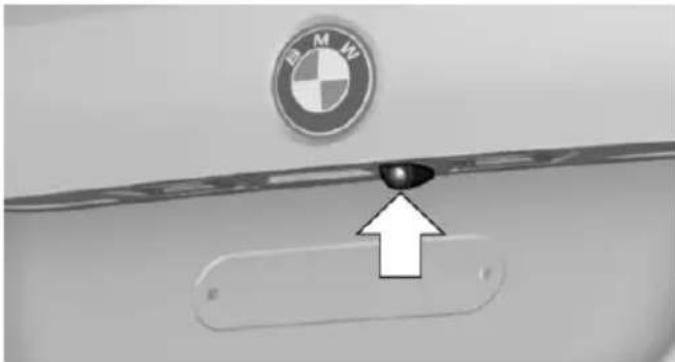
natural_image
Close-up of a BMW logo on a door panel, with an arrow pointing to a button (no text or symbols visible)The camera lens is located in the handle of the trunk lid. The image quality may be impaired by dirt.
Clean the lens, refer to page 224.
Switching on/off
Switching on automatically
With the engine running, engage selector lever position R.
The rearview camera image is displayed if the system was switched on via the iDrive.
Automatic deactivation during forward travel
The system switches off when a certain driving distance or speed is exceeded.
Switch the system back on if necessary.
Switching on/off manually

Press the button.
On: the LED lights up.
▶ Off: the LED goes out.
The PDC is shown on the Control Display.
Switching on the rearview camera via the iDrive
With PDC activated or Top View switched on:

"Rear view camera"
The rearview camera image is displayed.
Display on the Control Display
Functional requirement
The rearview camera is switched on.
The trunk lid is fully closed.
Activating the assistance functions
More than one assistance function can be active at the same time.
Parking aid lines
P "Parking aid lines"
Pathway and turning circle lines are displayed.
Obstacle marking
P_G "Obstacle marking"
Spatially-shaped markings are displayed.
Pathway lines
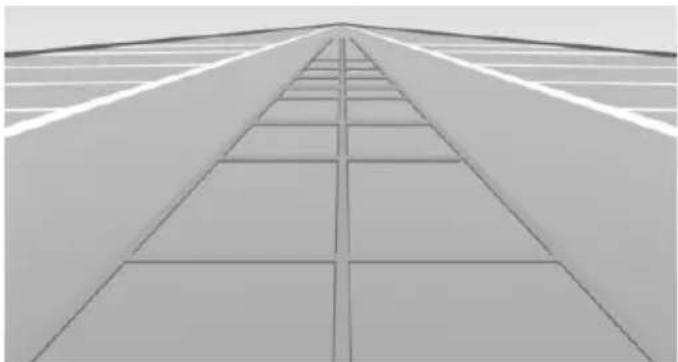
natural_image
Exterior view of a modern building facade with diagonal partitioning lines (no signage or text)- Can be shown in the rearview camera image when in selector lever position R.
▶ Help you to estimate the space required when parking and maneuvering on level roads.
Are dependent on the current steering angle and are continuously adjusted to the steering wheel movements.
Turning circle lines
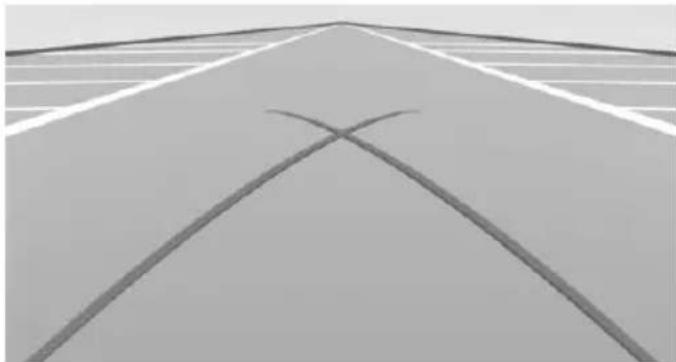
natural_image
Grayscale image of a road with two intersecting diagonal lines forming an X shape (no text or symbols)- Can be shown in the rearview camera image.
▶ Show the course of the smallest possible turning circle on a level road.
▶ Only one turning circle line is displayed after the steering wheel is turned past a certain angle.
Obstacle marking
General information
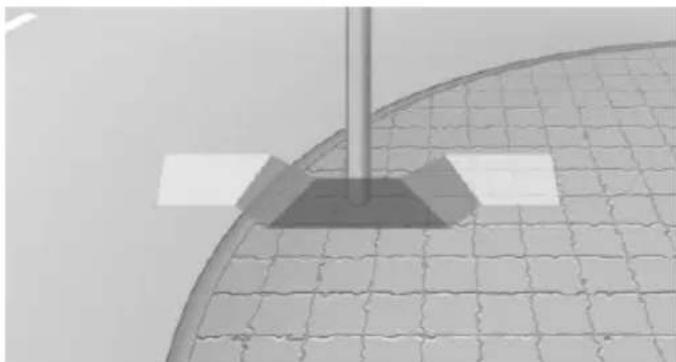
natural_image
3D rendering of a curved surface with a vertical rod and triangular base, no text or symbols visibleMarks for detected obstacles can be shown in the rearview camera image.
Their colored steps match the markings of the PDC. This simplifies estimation of the distance to the object shown.
Parking using pathway and turning circle lines
- Position the vehicle so that the turning circle lines lead to within the limits of the parking space.

natural_image
Exterior view of a modern building roof with diagonal metal framing (no signage or text)- Turn the steering wheel to the point where the pathway line covers the corresponding turning circle line.
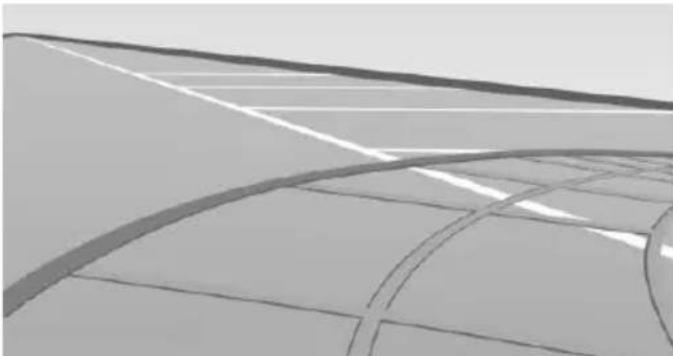
natural_image
Abstract geometric pattern with curved and straight lines forming a grid-like structure (no text or symbols)Display settings
Brightness
With the rearview camera switched on:
- ⚙️ Select the symbol.
- Turn the controller until the desired setting is reached, and press the controller.
Contrast
With the rearview camera switched on:
- Select the symbol.
- Turn the controller until the desired setting is reached, and press the controller.
System limits
Detection of objects
Very low obstacles as well as high, protruding objects such as ledges may not be detected by the system.
Assistance functions also take into account data of the PDC.
Follow instructions in the PDC chapter, refer to page 128.
The objects displayed in the Control Display under certain circumstances are closer than they appear. Therefore, do not estimate the distance from the objects on the display.
Side View
The concept
Side View provides an early look at cross traffic at blind driveways and intersections. Road users concealed by obstacles to the left and right of the vehicle can only be detected relatively late from the driver's seat. To improve visibility, two cameras in the front of the vehicle record the traffic situation on each side.
Notes
The images from both cameras are shown simultaneously on the Control Display.

Check the traffic situation as well
Check the traffic situation around the vehicle on blind driveways and intersections with your own eyes. Otherwise, an accident could result from road users or objects located outside the picture area of the Side View cameras.
At a glance
Button in the vehicle
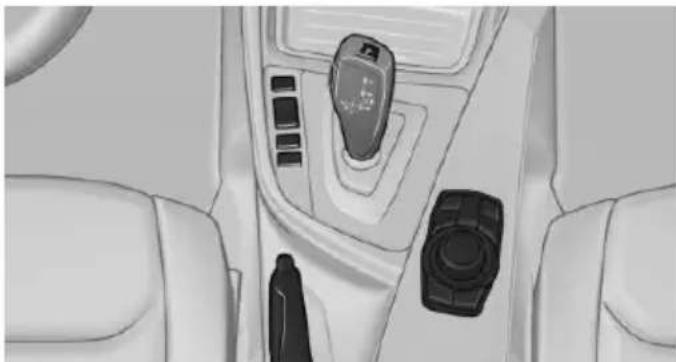
natural_image
Interior view of a vehicle dashboard with control panel and buttons (no visible text or symbols)
Side View
Cameras
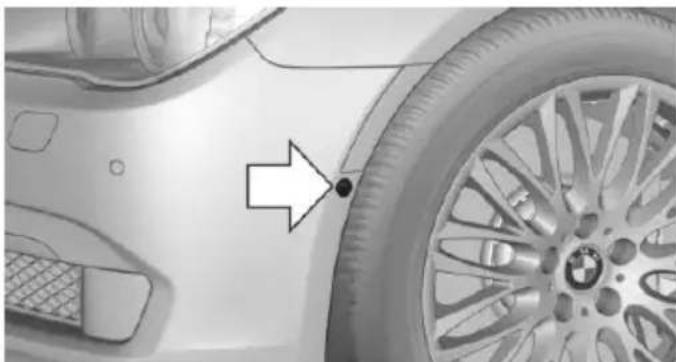
natural_image
Close-up of a car's front wheel and side panel, showing a white arrow pointing to a black dot on the wheel (no text or symbols visible)Two cameras integrated in the bumpers capture the image.
The two camera lenses are located on the sides of the bumper.
The image quality may be impaired by dirt.
Clean the lens, refer to page 224.
Switching on/off
Switching on/off manually

Press the button.
Automatic deactivation during forward travel
The system switches off when a certain driving distance or speed is exceeded.
Switch the system back on if necessary.
Display
The traffic area to the left and right is displayed on the Control Display.
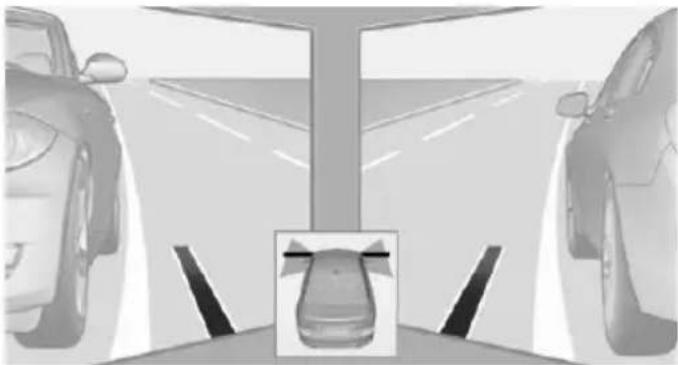
natural_image
Two cars standing on a road with a central display showing a vehicle (no text or symbols visible)Guidelines at the bottom of the image show the position of the front of the vehicle.
Brightness
With the Side View switched on:
-
"Brightness"
-
Turn the controller until the desired setting is reached, and press the controller.
Contrast
With the Side View switched on:
-
Ⓞ "Contrast"
-
Turn the controller until the desired setting is reached, and press the controller.
System limits
The cameras capture a maximum range of 330 ft/100 m.
Top View
The concept
Top View provides assistance in parking and maneuvering. The area around the doors and the road area around the vehicle are shown on the Control Display for this purpose.
General information
The image is captured by two cameras integrated in the exterior mirrors and by the backup camera.
The range is at least 7 ft/2 m to the side and rear.
In this way, obstacles up to the height of the exterior mirrors are detected early.
Notes
Check the traffic situation as well Check the traffic situation around the vehicle with your own eyes. Otherwise, an accident could result from road users or objects located outside the picture area of the cameras.
At a glance
Button in the vehicle
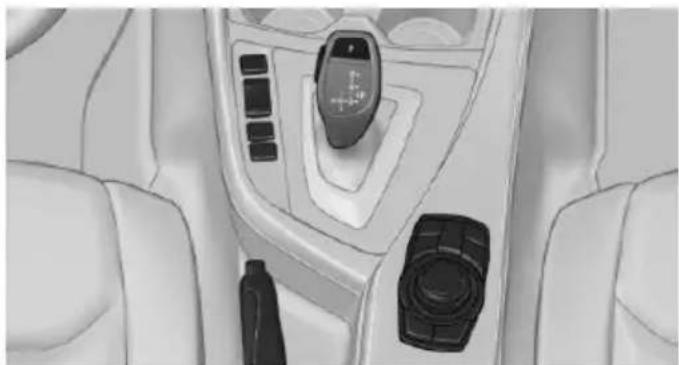
natural_image
Interior view of a car dashboard with steering wheel, dashboard controls, and seatbelt (no text or symbols visible)
Top View
Cameras
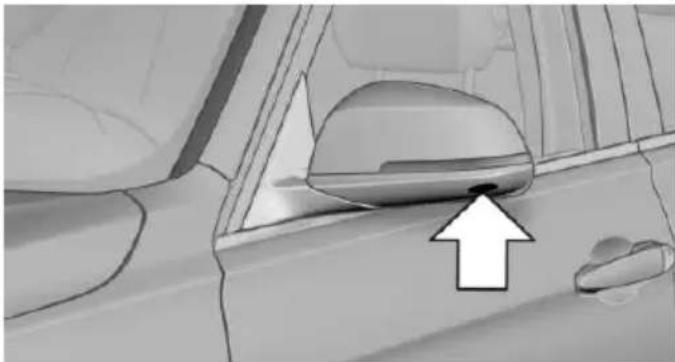
natural_image
Interior view of a car showing the dashboard and steering wheel (no text or symbols visible)The lenses of the Top View cameras are located at the bottom of the exterior mirror housings. The image quality may be impaired by dirt.
Clean the lens, refer to page 224.
Switching on/off
Switching on automatically
With the engine running, engage selector lever position R.
The Top View and PDC images are displayed if the system is switched on via iDrive.
Automatic deactivation during forward travel
The system switches off when a certain driving distance or speed is exceeded.
Switch the system back on if necessary.
Switching on/off manually

Press the button.
On: the LED lights up.
▶ Off: the LED goes out.
Top View is displayed.
Display
Visual warning
The approach of the vehicle to an object can be shown on the Control Display.
When the distance to an object is small, a red bar is shown in front of the vehicle, as it is in the PDC display.
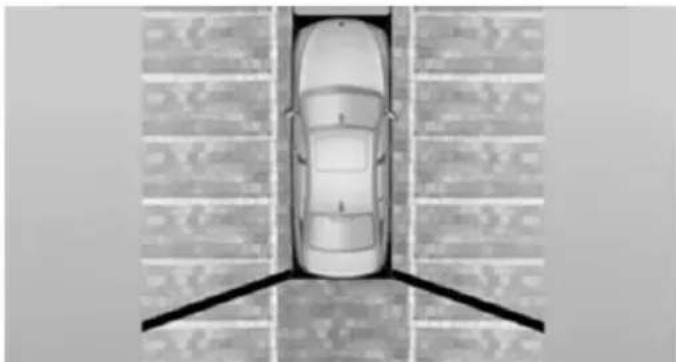
natural_image
Top-down view of a car parked in a parking lot with lane markings (no text or symbols visible)The display appears as soon as Top View is activated.
When the image of the rearview camera is displayed, it is possible to switch to top view:

"Rear view camera"
Brightness
With Top View switched on:
-
Select the symbol.
-
Turn the controller until the desired setting is reached, and press the controller.
Contrast
With Top View switched on:
-
Select the symbol.
-
Turn the controller until the desired setting is reached, and press the controller.
Displaying the turning circle and pathway lines
The static, red turning circle line shows the space needed to the side of the vehicle when the steering wheel is turned all the way.
The variable, green pathway line assists you in assessing the amount of space actually needed to the side of the vehicle.
The lane line depends on the engaged gear and the current steering angle. The
track line is continuously adjusted for the steering wheel movement.
"Parking aid lines"
Turning circle and pathway lines are displayed.
System limits
Top View cannot be used in the following situations:
▶ With a door open.
▶ With the trunk lid open.
▶ With an exterior mirror folded in.
In poor light.
A Check Control message is displayed in some of these situations.
Parking assistant
The concept
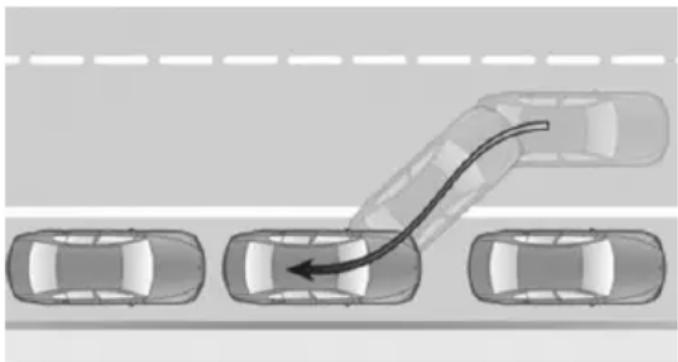
natural_image
Top-down diagram of a multi-lane road with cars and a curved arrow indicating direction (no text or symbols)This system assists the driver in parking parallel to the road.
Ultrasound sensors measure parking spaces on both sides of the vehicle.
The parking assistant calculates the best possible parking line and takes control of steering during the parking procedure.
When parking, also take note of the visual and acoustic information and instructions issued by the PDC, the parking assistant and the rear-view camera and react accordingly.
A component of the parking assistant is the PDC Park Distance Control, refer to page 128.
Hints
Personal responsibility
Even an active system does not relieve the driver from personal responsibility for the driving process.
Because of technical system limits, the system cannot independently react appropriately in all traffic situations.
Continuously and attentively monitor the driving process, the area surrounding the vehicle and the traffic situation, and actively intervene when required, otherwise, there is a risk of an accident.
Changes to the parking space
Changes to the parking space after it was measured are not taken into account by the system.
Therefore, always be alert and ready to intervene; otherwise, there is the danger of an accident occurring.
Transporting loads Loads that extend
Loads that extend beyond the perimeter of the vehicle are not taken into account by the system during the parking procedure.
Therefore, always be alert and ready to intervene; otherwise, there is the danger of an accident occurring.
Curbs The
The parking assistant may steer the vehicle over or onto curbs.
Therefore, always be alert and ready to intervene; otherwise, the wheels, tires, or the vehicle may become damaged.
An engine that has been switched off by the Auto Start Stop function is restarted automatically when the parking assistant is activated.
Requirements
For measuring parking spaces
▶ Maximum speed while driving forward approx. 22 mph/35 km/h.
▶ Maximum distance to row of parked vehicles: 5 ft/1.5 m.
Suitable parking space
▶ Gap between two objects with a minimum length of approx. 5 ft/1.5 m.
Min. length of gap between two objects: your vehicle's length plus approx. 4 ft/1.2 m.
▶ Minimum depth: approx. 5 ft/1.5 m.
For parking procedure
▶ Doors and trunk lid closed.
Parking brake released.
When parking in parking spaces on the driver's side, the corresponding turn signal must be set where applicable.
At a glance
Button in the vehicle
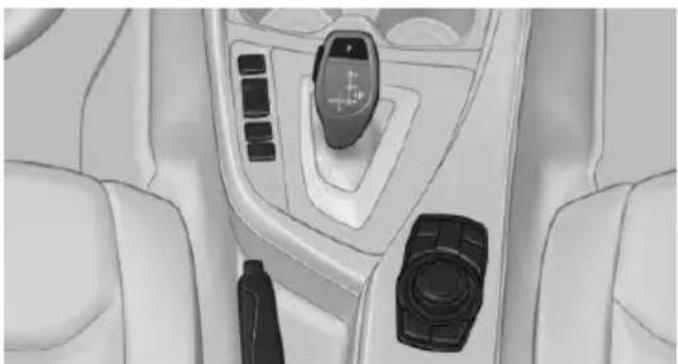
natural_image
Interior view of a vehicle dashboard and steering wheel (no text or symbols visible)
Parking assistant
Ultrasound sensors
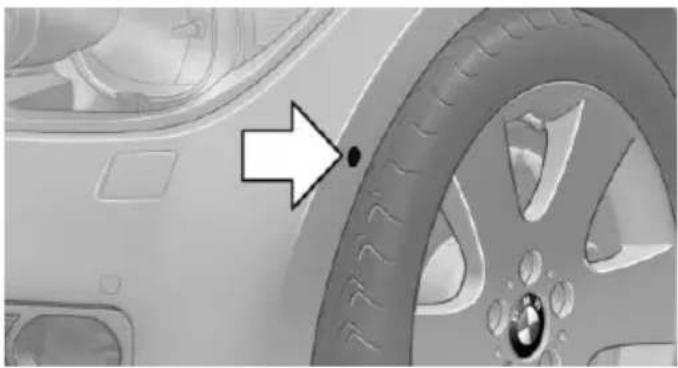
natural_image
Close-up of a car wheel rim with a white arrow pointing to a small dot on the wheel (no text or symbols visible)The ultrasound sensors for measuring parking spaces are located on the wheel arches.
To ensure full operability:
▷ Keep the sensors clean and free of ice.
When using high-pressure washers, do not spray the sensors for long periods and maintain a distance of at least 12 in/30 cm.
Do not paste over sensors.
Switching on/off
Switching on with the button

Press the button.
The LED lights up.
The current status of the parking space search is indicated on the Control Display.

Parking assistant is activated automatically.
Switching on with the reverse gear
Shift into reverse.
The current status of the parking space search is indicated on the Control Display.
To activate: "Parking Assistant"
Switching off
The system can be deactivated as follows:
▷ Switch off the ignition.
Display on the Control Display
System activated/deactivated
Symbol Meaning

Gray: the system is not available.
White: the system is available but not activated.

The system is activated.
Status display
Depending on the appointment version, different views of the status display are shown and are described below as View 1, refer to page 138, or View 2, refer to page 138.
Status of the system, Display 1
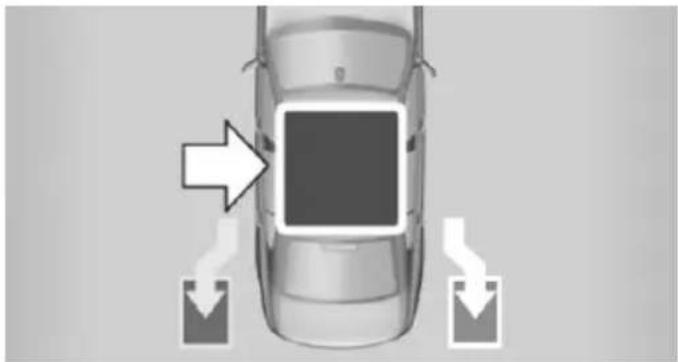
natural_image
Top-down view of a car with directional arrows indicating vehicle movement or navigation (no text or symbols)The status is displayed with symbols.

Gray: parking space search.
Blue: the system is activated. A suitable parking space was found.
The parking procedure is active.
Steering control has been seized.
Status of the parking space search

text_image
1 2Gray, arrow 1: parking space search.
▶ Blue, arrow 2: parking space is suitable.
The vehicle is parked in the parking space if the parking procedure is active.
▶ No display: no parking space search.
Status of the system, Display 2
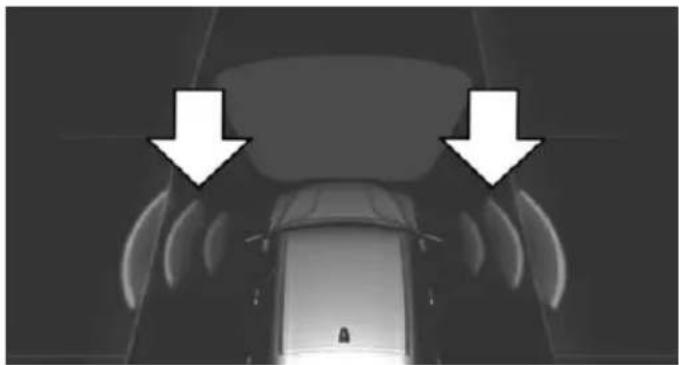
natural_image
Top-down view of a car's front wheel and roof, with two white arrows pointing to the seat area (no text or symbols)Colored symbols, see arrows, on the side of the vehicle representation. Parking assistant is activated and search for parking space active.
Suitable parking spaces are displayed next to the vehicle symbol at the edge of the road as on the Control Display. When the parking assistant is active, suitable parking spaces are highlighted.
The parking procedure is ac-
tive. Steering control has been seized.
Parking space search is always active whenever the vehicle is moving forwards slow and straight, even if the system is de-
activated. When the system is deactivated, the displays on the Control Display are shown in gray.
Parking using the parking assistant

Check the traffic situation as well
Loud sounds outside and within the vehicle can drown out the signal tones of the parking assistant and PDC.
Check the traffic situation around the vehicle with your own eyes; otherwise, there is the danger of an accident.
- Switch on the parking assistant and activate it if necessary.
The status of the parking space search is indicated on the Control Display.
- Follow the instructions on the Control Display.
To achieve the best possible parking position, wait for the automatic steering wheel movement after the gear change when the vehicle is stationary.
The end of the parking procedure is indicated on the Control Display.
- Adjust the parking position yourself if necessary.
Interrupting manually
The parking assistant can be interrupted at any time:
▶ "Parking Assistant"
▶ Press the button.
Interrupting automatically
The system is interrupted automatically in the following situations:
▶ If the driver grasps the steering wheel or if he takes over steering.
▶ If a gear is selected that does not match the instruction on the Control Display.
▶ If the vehicle speed exceeds approx. 6 mph/10 km/h.
On snow-covered or slippery road surfaces if necessary.
▶ If the Park Distance Control PDC displays clearances that are too small.
▶ If a maximum number of parking attempts or the time taken for parking is exceeded.
▶ When switching to another function on the Control Display.
A Check Control message is displayed.
Resume
An interrupted parking procedure can be continued if necessary.
Follow the instructions on the Control Display to do this.
System limits
No parking assistance
The parking assistant does not offer assistance in the following situations:
In tight curves.
Functional limitations
The system may not be fully functional in the following situations:
On bumpy road surfaces such as gravel roads.
On slippery ground.
When leaves or snow has collected in the parking space.
Limits of ultrasonic measurement
The detection of objects can reach the physical limits of ultrasonic measurement, e.g., in the following circumstances:
▶ For small children and animals.
For persons with certain clothing, e.g. coats.
If there is an external disturbance of the ultrasound, e.g. from passing vehicles or loud machines.
When sensors are dirty, iced over, damaged or out of position.
▶ Under certain weather conditions, such as high relative humidity, rain, snowfall extreme heat or strong wind.
With tow bars and trailer hitches of other vehicles.
▶ With thin or wedge-shaped objects.
With moving objects.
▶ With elevated, protruding objects such as ledges or cargo.
With objects with corners and sharp edges.
▶ With objects with a fine surface structure, such as fences.
▶ For objects with porous surfaces.
Low objects already displayed, e.g., curbs, can move into the blind area of the sensors before or after a continuous tone sounds.
The parking assistant may identify parking spaces that are not suitable for parking.
Malfunction
A Check Control message is displayed.
The parking assistant failed. Have the system checked.
Climate control
Vehicle equipment
All standard, country-specific and optional equipment that is offered in the model series is described in this chapter. Therefore, equip-
ment is also described that is not available in a vehicle, e. g., because of the selected optional equipment or country variant. This also applies for safety-related functions and systems.
Automatic climate control
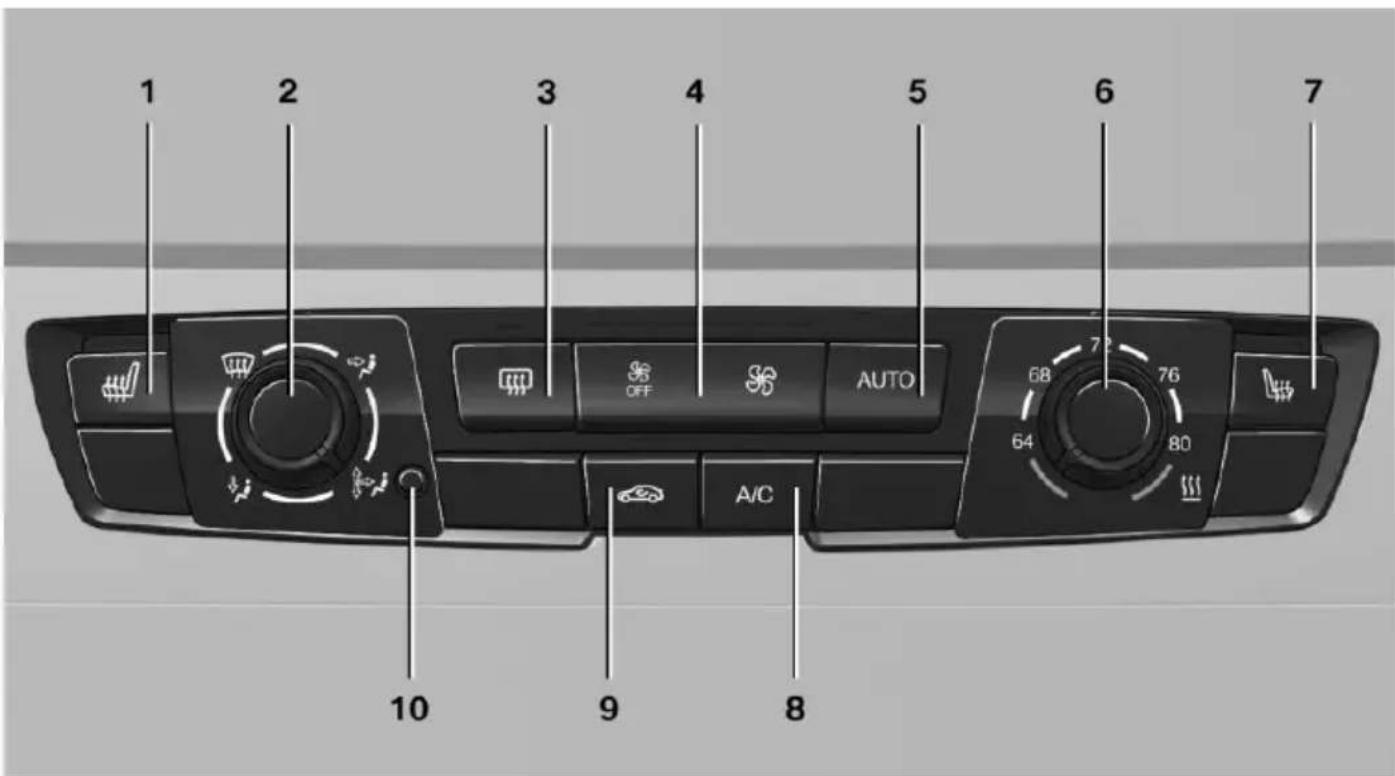
text_image
1 2 3 4 5 6 7 OFF AUTO A/C 68 72 76 64 80 10 9 81 Seat heating, left 50
2 Vent settings
3 Rear window defroster
4 Air flow
5 AUTO program
6 Temperature
7 Seat heating, right 50
8 Cooling function
9 Recirculated-air mode
10 Interior temperature sensor
Climate control functions in detail
Manual air distribution
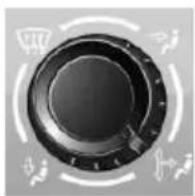
Turn the wheel to select the desired program or the desired intermediate setting.
▶ Windows.
▶ Upper body region.
Windows, upper body region, and foot-well.
▶ Footwell.
Defrosting windows and removing condensation
Direct the air distribution toward windows, increase the air flow and temperature, and, if necessary, use the cooling function.
Rear window defroster
Press the button.
The rear window defroster switches off automatically after a certain period of time.
Air flow, manual
Press the left or right side of the button: decrease or increase air flow.
The air flow of the air conditioner may be reduced automatically to save battery power.
AUTO program
Press the button.
Air flow, air distribution, and temperature are controlled automatically.
Depending on the selected temperature and outside influences, the air is directed to the windshield, side windows, upper body, and into the footwell.
The cooling function, refer to page 142, is switched on automatically with the AUTO program.
Temperature
Turn the wheel to set the desired temperature.
The automatic climate control reaches this temperature as quickly as possible, if necessary by increasing the cooling or heating output, and then keeps it constant.
Avoid rapidly switching between different temperature settings. Otherwise, the automatic climate control will not have sufficient time to adjust the set temperature.
Cooling function
The passenger compartment can only be cooled with the engine running.
Press the button.
The air is cooled and dehumidified and, depending on the temperature setting, warmed again.
Depending on the weather, the windshield may fog up briefly when the engine is started.
The cooling function is switched on automatically with the AUTO program.
When using the automatic climate control, condensation water, refer to page 164, develops that exits underneath the vehicle.
Recirculated-air mode
You can respond to unpleasant odors or pollutants in the immediate environment by temporarily suspending the supply of outside air. The system then recirculates the air currently within the vehicle.
Press the button repeatedly to select an operating mode:
▶ LED off: outside air flows in continuously.
▶ LED on, recirculated-air mode: the supply of outside air into the vehicle is permanently blocked.
Recirculated air mode switches off automatically at low external temperatures after a certain amount of time in order to window fogging.
If the windows fog over, switch off recirculated-air mode and increase the air flow, if necessary.

Continuous recirculated-air mode
The recirculated-air mode should not be used for an extended period of time, as the air quality inside the vehicle deteriorates steadily.
Switching the system on/off
Switching off
Press the left button for the minimum speed.
Switching on
Press any button except
▶ Rear window defroster.
▶ Seat heating.
Microfilter
In external and recirculated air mode the microfilter filters dust and pollen out of the air.
This filter should be replaced during scheduled maintenance, refer to page 202, of your vehicle.
Automatic climate control with enhanced features
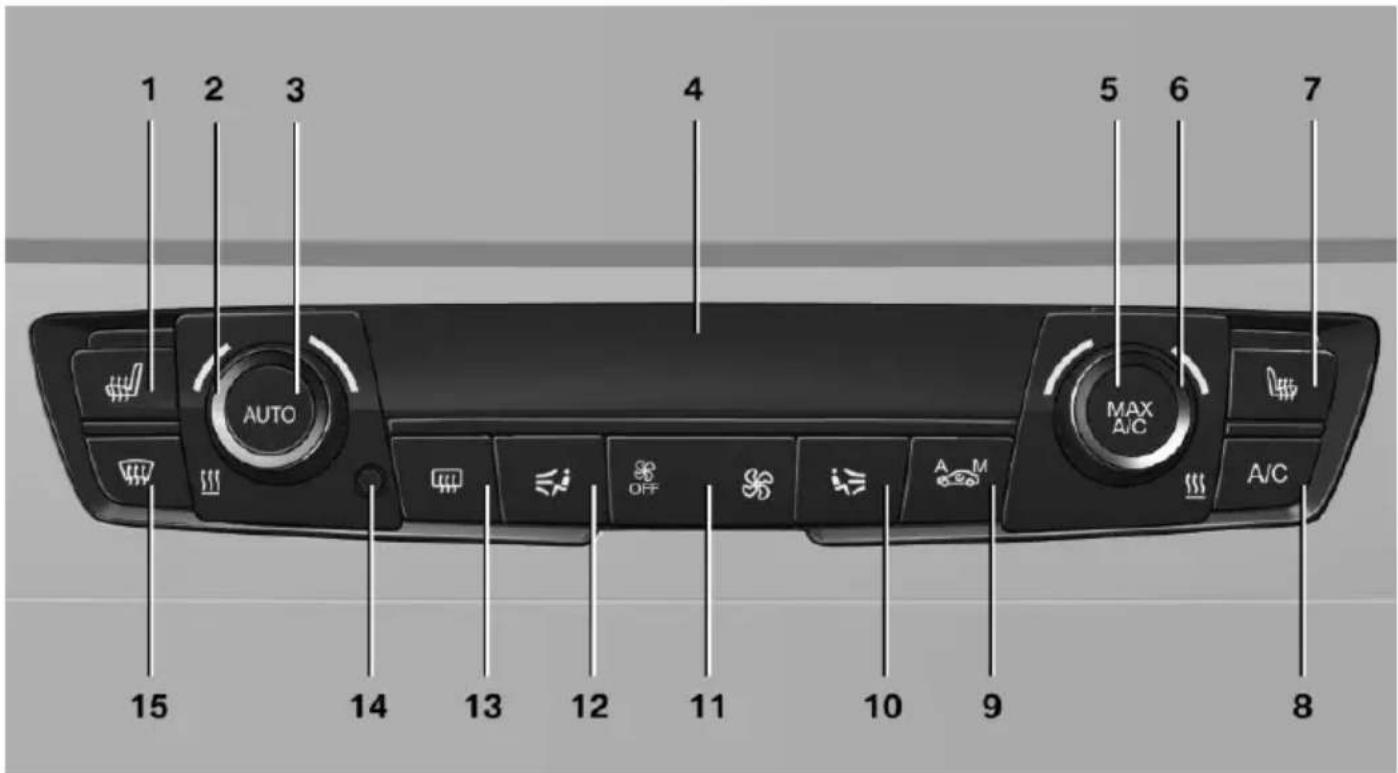
text_image
1 2 3 AUTO 4 5 6 7 MAX A/C A/C 15 14 13 12 11 10 9 81 Seat heating, left 50
2 Temperature, left
3 AUTO program
4 Display
5 Maximum cooling
6 Temperature, right
7 Seat heating, right 50
8 Cooling function
9 Automatic recirculated-air control/recirculated-air mode
Climate control functions in detail
Temperature
Turn the wheel to set the desired temperature.
The automatic climate control reaches this temperature as quickly as possible, if neces-
10 Air distribution, right
11 Air flow, AUTO intensity
12 Air distribution, left
13 Rear window defroster
14 Interior temperature sensor — always keep clear
15 Defrosting windows and removing condensation
sary by increasing the cooling or heating output, and then keeps it constant.
Avoid rapidly switching between different temperature settings. Otherwise, the automatic climate control will not have sufficient time to adjust the set temperature.
AUTO program
Press the button.
Air flow, air distribution, and temperature are controlled automatically.
Depending on the selected temperature, AUTO intensity program and outside influences, the air is directed to the windshield, side windows, upper body, and into the footwell.
The cooling function, refer to page 145, is switched on automatically with the AUTO program.
At the same time, a condensation sensor controls the program so as to prevent window condensation as much as possible.
Intensity of the AUTO program
With the AUTO program switched on, automatic control of the air flow and air distribution can be adjusted.
Press the left or right side of the button: decrease or increase the intensity.
The selected intensity is shown on the display of the automatic climate control.
Maximum cooling
Press the button.
The system is set to the lowest temperature, maximum air flow and air circulation mode.
Air flows out of the vents for the upper body region. The vents need to be open for this.
The function is available above an external temperature of approx. 32 ^/0 ^ and with the engine running.
The air flow can be adjusted when the program is active.
Cooling function
The passenger compartment can only be cooled with the engine running.
Press the button.
The air is cooled and dehumidified and, depending on the temperature setting, warmed again.
Depending on the weather, the windshield may fog up briefly when the engine is started.
The cooling function is switched on automatically with the AUTO program.
When using the automatic climate control, condensation water, refer to page 164, develops that exits underneath the vehicle.
Automatic recirculated-air control/recirculated-air mode
You can respond to unpleasant odors or pollutants in the immediate environment by temporarily suspending the supply of outside air. The system then recirculates the air currently within the vehicle.
Press the button repeatedly to select an operating mode:
▶ LEDs off: outside air flows in continuously.
▶ Left LED on, automatic recirculated-air control: a sensor detects pollutants in the outside air and controls the shutoff automatically.
▶ Right LED on, recirculated-air mode: the supply of outside air into the vehicle is permanently blocked.
Recirculated air mode switches off automatically at low external temperatures after a certain amount of time in order to window fogging.
If the windows are fogged over, switch off the recirculated-air mode and press the AUTO button to utilize the condensation sensor.
Make sure that air can flow onto the wind-shield.

Continuous recirculated-air mode
The recirculated-air mode should not be used for an extended period of time, as the air quality inside the vehicle deteriorates steadily.
Manual air distribution
Press the button repeatedly to select a program:
▶ Upper body region.
▶ Upper body region and footwell.
▶ Footwell.
▶ Windows and footwell: driver's side only.
▶ Windows, upper body region and footwell: driver's side only.
If the windows are fogged over, press the AUTO button to utilize the condensation sensor.
Air flow, manual
To be able to manually adjust the air flow, switch off the AUTO program first.
Press the left or right side of the button: decrease or increase air flow.
The selected air flow is shown on the display of the automatic climate control.
The air flow of the automatic climate control may be reduced automatically to save battery power.
Rear window defroster
Press the button.
The rear window defroster switches off automatically after a certain period of time.
Defrosting windows and removing condensation
Press the button.
Ice and condensation are quickly removed from the windshield and the front side windows.
The air volume can be adjusted when the program is active.
If the windows are fogged over, you can also switch on the cooling function or press the
AUTO button to utilize the condensation sensor.
Switching the system on/off
Switching off
Press the left button for the minimum speed.
Switching on
Press any button except
▶ Rear window defroster.
▶ Seat heating.
Microfilter/activated-charcoal filter
In external and recirculated air mode the microfilter/activated charcoal filter filters dust, pollen, and gaseous pollutants out of the air.
This filter should be replaced during scheduled maintenance, refer to page 202, of your vehicle.
Ventilation
Front ventilation
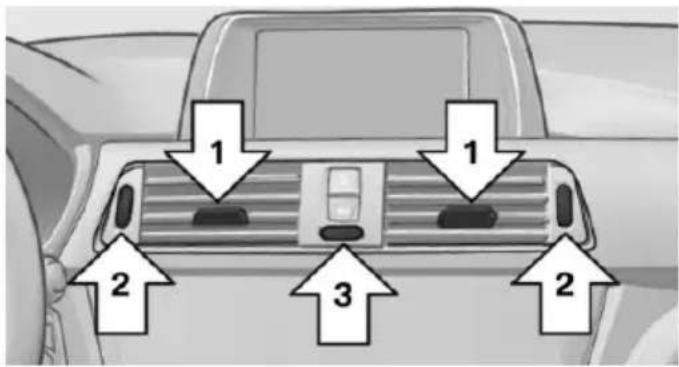
text_image
1 2 3 1 2▶ Lever for changing the air flow direction, arrow 1.
▶ Thumbwheels for opening and closing the vents continuously, arrows 2.
▶ Thumbwheel to vary the temperature, arrow 3.
Toward blue: colder.
Toward red: warmer.
Adjusting the ventilation
▶ Ventilation for cooling:
Adjust the vent to direct the air in your direction, such as if the vehicle interior is hot from the sun.
Draft-free ventilation:
Adjust the vent to let the air flow past you.
Ventilation in the rear
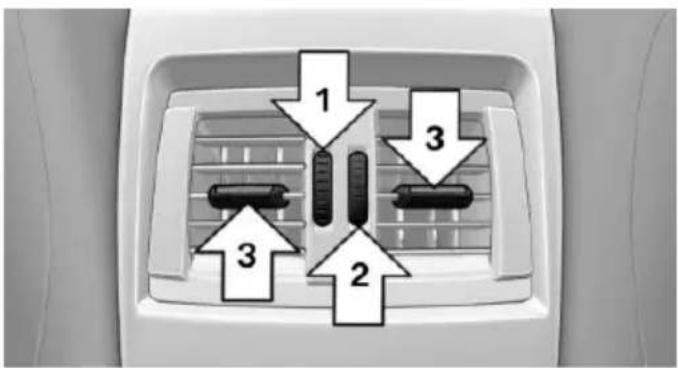
text_image
1 2 3 3▶ Thumbwheel for continuous opening and closing of the vents, arrow 1.
▶ Thumbwheel to vary the temperature, arrow 2.
Toward blue: colder.
Toward red: warmer.
▶ Lever for changing the air flow direction, arrow 3.
Parked-car ventilation
The concept
The parked-car ventilation ventilates the vehicle interior and lowers its temperature, if necessary.
The system can be switched on and off at any external temperature, either directly or by using two preset switch-on times. It remains switched on for 30 minutes.
Open the vents to allow air to flow out.
Switching on/off directly
-
"Settings"
-
"Climate"
-
"Activate comf. ventilation"
The symbol on the automatic climate control flashes if the system is switched on.
Preselecting the switch-on time
-
"Settings"
-
"Climate"
-
"Timer 1:" or "Timer 2:"
-
Set the desired time.
Activating the switch-on time
-
"Settings"
-
"Climate"
-
"Activate timer 1" or "Activate timer 2"
The symbol on the automatic climate control lights up when the switch-on time is activated.
The symbol on the automatic climate control flashes when the system has been switched on.
The system will only be switched on within the next 24 hours. After that, it needs to be reactivated.
Interior equipment
Vehicle equipment
All standard, country-specific and optional equipment that is offered in the model series is described in this chapter. Therefore, equipment is also described that is not available in a vehicle, e.g., because of the selected optional equipment or country variant. This also applies for safety-related functions and systems.
Universal garage door opener
The concept
The universal garage door opener can operate up to 3 functions of remote-controlled systems such as garage door drives or lighting systems. The universal garage door opener replaces up to 3 different hand-held transmitters. To operate the remote control, the buttons on the interior rearview mirror must be programmed with the desired functions. The hand-held transmitter for the particular system is required in order to program the remote control.

During programming
During programming and before activating a device using the integrated universal remote control, ensure that there are no people, animals, or objects in the range of movement of the remote-controlled device; otherwise, there is a risk of injury or damage.
Also follow the safety instructions of the hand-held transmitter.
Before selling the vehicle, delete the stored functions for the sake of security.
Compatibility

If this symbol is printed on the packaging or in the instructions of the system to be controlled, the system is gener-
ally compatible with the universal garage door opener.
If you have any questions, please contact:
▶ Your service center.
▷ www.homelink.com on the Internet.
HomeLink is a registered trademark of Johnson Controls, Inc.
Controls on the interior rearview mirror
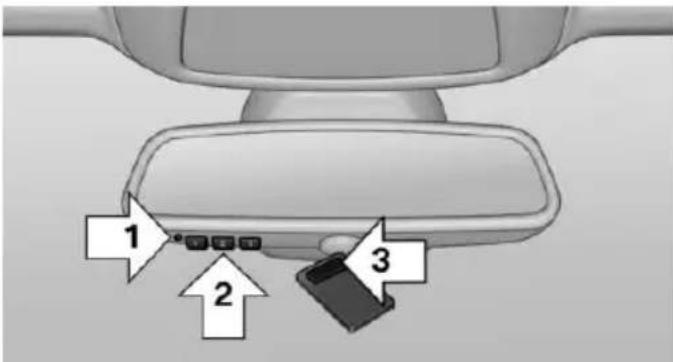
text_image
1 2 3▷ LED, arrow 1.
▶ Buttons, arrow 2.
The hand-held transmitter, arrow 3, is required for programming.
Programming
General information
-
Switch on the ignition.
-
Initial setup:
Press and hold the left and right button on the interior rearview mirror simultaneously for approximately 20 seconds until the LED on the interior rearview mirror flashes. This erases all programming of the buttons on the interior rearview mirror.
- Hold the hand-held transmitter for the system to be controlled approx. 1 to 3 in/2.5 to 8 cm away from the buttons on the interior
rearview mirror. The required distance depends on the manual transmitter.
- Simultaneously press and hold the button of the desired function on the hand-held transmitter and the button to be programmed on the interior rearview mirror. The LED on the interior rearview mirror will begin flashing slowly.
- Release both buttons as soon as the LED flashes more rapidly. When the LED is flashing faster, this indicates that the button on the interior rearview mirror has been programmed.
If the LED does not flash faster after at least 60 seconds, change the distance between the interior rearview mirror and the hand-held transmitter and repeat the step. Several more attempts at different distances may be necessary. Wait at least 15 seconds between attempts.
Canada: if programming with the hand-held transmitter was interrupted, hold down the interior rearview mirror button and repeatedly press and release the hand-held transmitter button for 2 seconds.
- To program other functions on other buttons, repeat steps 3 to 5.
The systems can be controlled using the interior rearview mirror buttons.
Special feature of the alternating-code wireless system
If you are unable to operate the system after repeated programming, please check if the system to be controlled features an alternating-code system.
Read the system's operating manual, or press the programmed button on the interior rear-view mirror longer. If the LED on the interior rearview mirror starts flashing rapidly and then stays lit constantly for 2 seconds, the system features an alternating-code system. Flashing and continuous illumination of the LED will repeat for approximately 20 seconds.
For systems with an alternating-code system, the universal garage door opener and the system also have to be synchronized.
Please read the operating manual of the system being set up for information on how to synchronize the system.
Synchronizing is easier with the aid of a second person.
To synchronize:
- Park the vehicle within range of the remote-controlled system.
- Program the relevant button on the interior rearview mirror as described.
- Locate and press the synchronizing button on the system being programmed. You have approx. 30 seconds for the next step.
- Hold down the programmed button on the interior rearview mirror for approximately 3 seconds and then release it. If necessary, repeat this work step up to three times in order to finish synchronization. Once synchronization is complete, the programmed function will be carried out.
Reprogramming individual buttons
- Switch on the ignition.
- Press and hold the interior rearview mirror button to be programmed.
- As soon as the interior rearview mirror LED starts flashing slowly, hold the hand-held transmitter for the system to be controlled approx. 1 to 3 in/2.5 to 8 cm away from the buttons on the interior rearview mirror. The required distance depends on the manual transmitter.
- Likewise, press and hold the button of the desired function on the hand-held transmitter.
- Release both buttons as soon as the interior rearview mirror LED flashes more rapidly. When the LED is flashing faster, this
indicates that the button on the interior rearview mirror has been programmed. The system can then be controlled by the button on the interior rearview mirror.
If the LED does not flash faster after at least 60 seconds, change the distance and repeat the step. Several more attempts at different distances may be necessary. Wait at least 15 seconds between attempts.
Canada: if programming with the hand-held transmitter was interrupted, hold down the interior rearview mirror button and repeatedly press and release the hand-held transmitter button for 2 seconds.
Controls

Before operation
Before operating a system using the integrated universal remote control, ensure that there are no people, animals, or objects within the range of movement of the remote-controlled system; otherwise, there is a risk of injury or damage.
Also follow the safety instructions of the hand-held transmitter.
The system, such as the garage door, can be operated using the button on the interior rearview mirror while the engine is running or when the ignition is started. To do this, hold down the button within receiving range of the system until the function is activated. The interior rearview mirror LED stays lit while the wireless signal is being transmitted.
Deleting stored functions
Press and hold the left and right button on the interior rearview mirror simultaneously for approximately 20 seconds until the LED flashes rapidly. All stored functions are deleted. The functions cannot be deleted individually.
Digital compass
At a glance
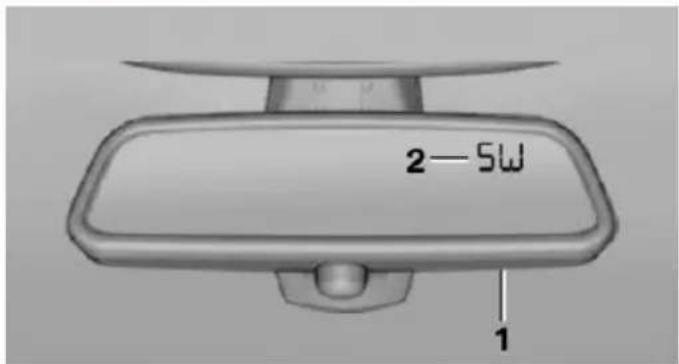
text_image
2—5W 11 Control button
2 Mirror display
Mirror display
The point of the compass is displayed in the mirror when driving straight.
Operating concept
Various functions can be called up by pressing the control button with a pointed object, such as the tip of a ballpoint pen or similar object. The following setting options are displayed in succession, depending on how long the control button is pressed:
▶ Pressed briefly: turns display on/off.
3 to 6 seconds: compass zone setting.
▶ 6 to 9 seconds: compass calibration.
▶ 9 to 12 seconds: left/right-hand steering setting.
12 to 15 seconds: language setting.
Setting the compass zones
Sets the particular compass zones on the vehicle so that the compass operates correctly; refer to World map with compass zones.
World map with magnetic zones
Procedure
- Press and hold the control button for approx. 3 to 4 seconds. The number of the set compass zone appears in the mirror.
- To change the zone setting, press the control button quickly and repeatedly until the number of the compass zone corresponding to your location appears in the mirror.
The set zone is stored automatically. The compass is ready for use again after approximately 10 seconds.
Calibrating the digital compass
The digital compass must be calibrated in the event of the following:
The wrong point of the compass is displayed.
The point of the compass displayed does not change despite changing the direction of travel.
▶ Not all points of the compass are displayed.
Procedure
- Make sure that there are no large metallic objects or overhead power lines near the vehicle and that there is sufficient room to drive around in a circle.
- Set the currently applicable compass zone.
- Press and hold the control button for approx. 6 to 7 seconds so that "C" appears on the display. Next, drive in a complete circle at least once at a speed of no more than 4 mph / 7 km / h . If calibration is successful, the "C" is replaced by the points of the compass.
Left/right-hand steering
The digital compass is already set for right or left-hand steering at the factory.
Setting the language
Press and hold the control button for approx. 12 to 13 seconds. Briefly press the control button again to switch between English "E" and German "O".
The setting is stored automatically after approximately 10 seconds.
Ashtray/cigarette lighter
Ashtray
Opening
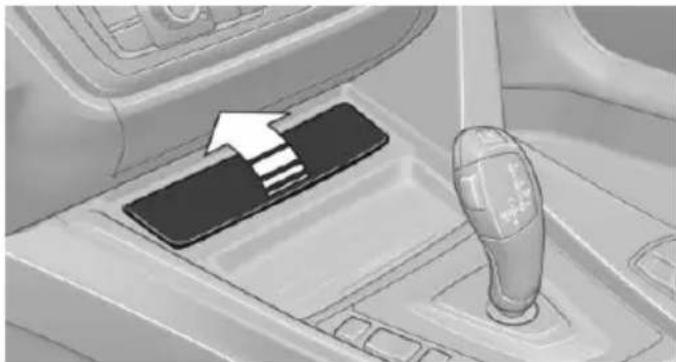
natural_image
Interior view of a car gear shift lever with a black pad and white arrow indicating direction (no text or symbols)Raise cover.
Emptying
Take out the insert.
Lighter

Danger of burns
Only hold the hot lighter by its knob; otherwise, there is the danger of getting burned.
Switch off the ignition and take the remote control with you when leaving the vehicle so that children cannot use the lighter and burn themselves.

Replace the cover after use
Reinsert the lighter or socket cover after use, otherwise objects may get into the lighter socket or fixture and cause a short circuit.
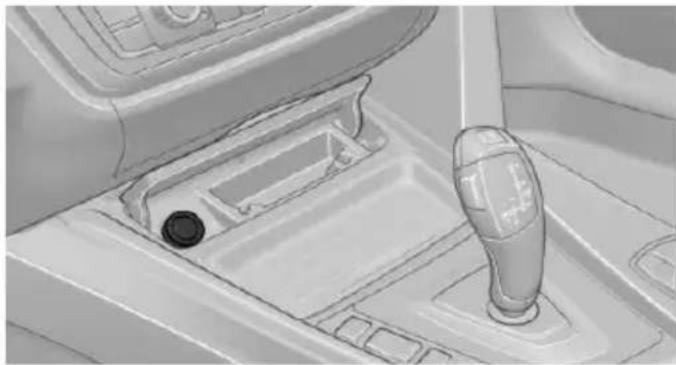
natural_image
Interior view of a car gear shift lever mechanism (no text or symbols visible)The lighter is located next to the ashtray.
Push in the lighter.
The lighter can be removed as soon as it pops back out.
Connecting electrical devices
Hints

Do not connect charging devices to the 12 volt socket in the vehicle
Do not connect battery chargers to the factory-installed 12 volt sockets in the vehicle as this may damage the vehicle battery due to an increased power consumption.

Replace the cover after use
Reinsert the lighter or socket cover after use, otherwise objects may get into the lighter socket or fixture and cause a short circuit.
Sockets
The lighter socket can be used as a socket for electrical equipment while the engine is running or when the ignition is switched on. The total load of all sockets must not exceed 140 watts at 12 volts.
Do not damage the socket by using unsuitable connectors.
Front center console
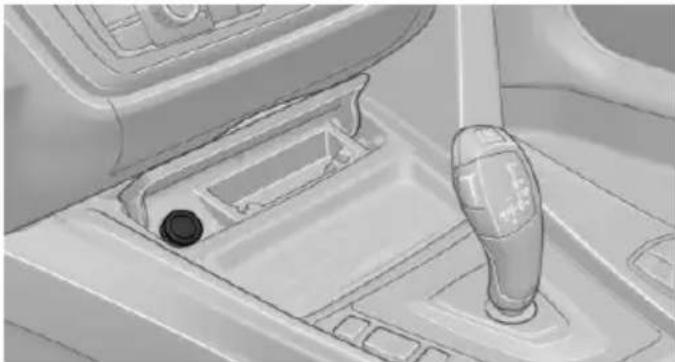
natural_image
Interior view of a car gear shift lever and dashboard (no text or symbols visible)Raise the cap and remove the cover or cigarette lighter.
In the front passenger footwell
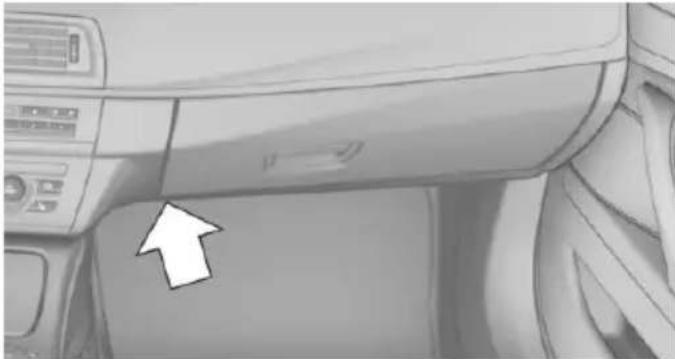
natural_image
Interior view of a car dashboard with a white arrow pointing to the backrest area (no text or symbols visible)The socket is located below the glove compartment.
Rear center console
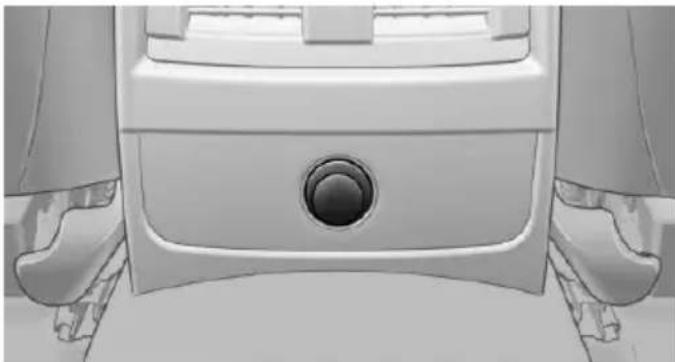
natural_image
Top-down view of a car's front bumper with a circular vent (no text or symbols visible)Remove the cover.
In the cargo area
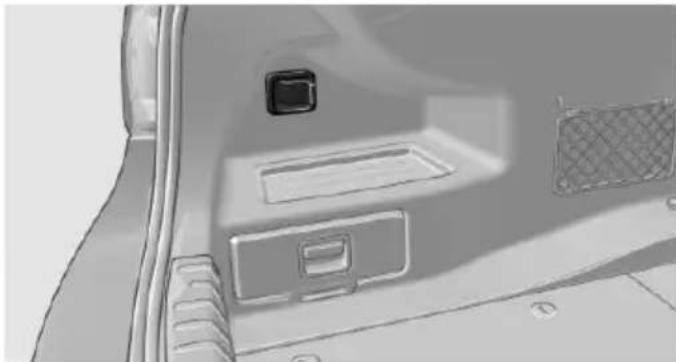
natural_image
Interior view of a vehicle's rear bumper showing door, seat, and grille (no text or symbols)The socket is located on the left side in the cargo area.
USB interface for data transfer
The concept
Connection for importing and exporting data on USB devices, e.g.:
▶ Personal Profile settings, refer to page 33.
▶ Music collection.
▶ Importing Trips.
Note
For technical reasons, the USB port for data transfer may be located in the glove compartment even in vehicles equipped with a navigation system or TV. If there is a USB port in the glove compartment, it is the USB port intended for transferring data.
Overview
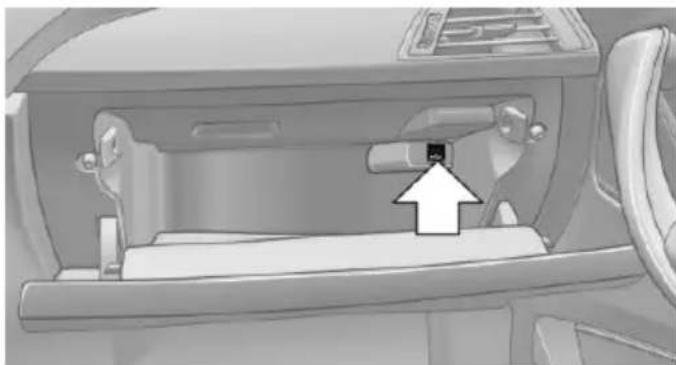
natural_image
Interior view of a car showing the dashboard and steering wheel (no text or symbols visible)The USB interface is located in the glove compartment.
Overview
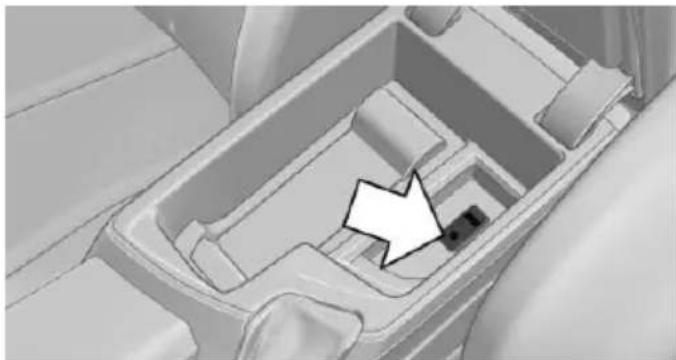
natural_image
3D mechanical component diagram showing internal structure with a white arrow pointing to a specific area (no text or symbols)The USB interface is located in the center arm-rest.
Notes
Observe the following when connecting:
Do not use force when plugging the connector into the USB interface.
Do not connect devices such as fans or lamps to the USB interface.
Do not connect USB hard drives.
Do not use the USB interface to recharge external devices.
Through-loading system
The concept
The cargo area can be enlarged by folding down the rear seat backrest.
The rear seat backrest is divided into two parts at a ratio of 60 to 40.
If equipped with through-loading system: the rear seat backrest is divided in the ratio 40–20–40.
The sides can be folded down separately or together.
Hints

Danger of pinching
Before folding down the rear seat backrests, ensure that the area of movement of the backrests is clear. In particular, ensure that no one is located in or reaches into the area of movement of the rear seat backrests when the middle section is folded down. Otherwise, injury or damage may result.

Ensuring the stability of the child seat
When installing child restraint fixing systems, make sure that the child seat is securely fastened to the backrest of the seat. The angle of the backrest may need to be adjusted and, where necessary, the headrest height may also need to be adjusted, or if possible removed. Make sure that all backrests are securely locked. Otherwise, the stability of the child seat is limited, and there is an increased risk of injury because of unexpected movement of the rear seat backrest.

Retract the head restraint if necessary before backrest is folded down
With folding head restraints, fold in the head restraints before folding down the backrests, or damage may result.
Opening
-
Unlock the belt lock of the center safety belt in the rear using the latch plate of another safety belt.
-
Insert the latch plate at the end of the belt into the specially designated fixture on the rear window shelf.

natural_image
Diagram of a black ribbon buckle being inserted into a car wheel, with an arrow indicating the direction (no text or symbols present)-
Push the corresponding head restraint down as far as it will go.
-
Pull the corresponding lever in the cargo area to release the rear seat backrest.
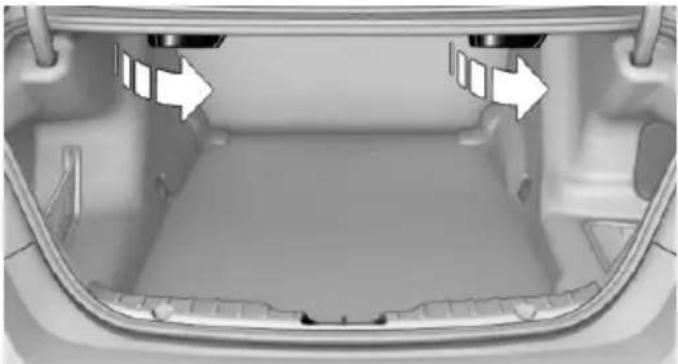
natural_image
Top-down view of a car trunk with two white arrows pointing to the rear side of the opening (no text or symbols visible)- The unlocked rear seat backrest moves forward slightly.
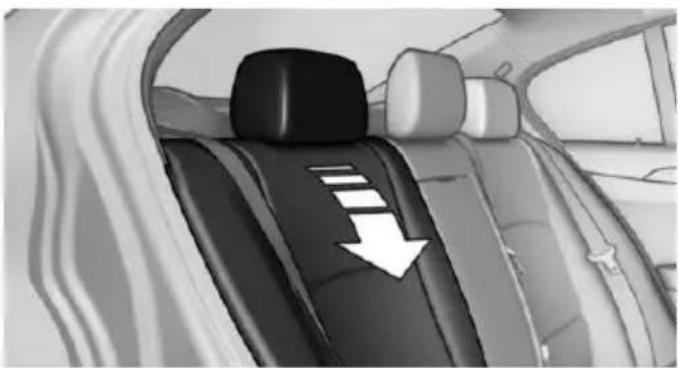
natural_image
Interior view of a car showing the rear seat with a white arrow pointing to a specific side panel (no text or symbols present)- Fold backrest forward.
Closing
- Return the rear seat backrest to the upright seating position and engage it.

Ensure that the lock is securely engaged
Make sure that the lock engages properly when folding back, otherwise transported cargo could enter the passenger compartment during braking or evasive maneuvers and endanger the vehicle occupants.
- Release the belt tongue from the fixture on the rear window shelf.
- Insert the belt tongue in the belt lock of the center safety belt. Make sure you hear the latch plate engage.
To secure cargo, refer to page 166, with nets or draw straps, the cargo area is fitted with lashing eyes.
Folding down the middle section
- Fold in the middle head restraint.
- Reach into the recess and pull the middle section forward.
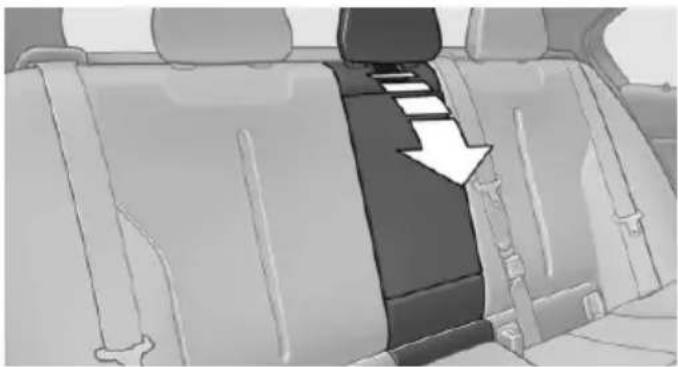
natural_image
Interior view of a car backseat showing seatbelt and rear seats with a white arrow pointing to the side panel (no text or symbols)Storage compartments
Vehicle equipment
All standard, country-specific and optional equipment that is offered in the model series is described in this chapter. Therefore, equipment is also described that is not available in a vehicle, e.g., because of the selected optional equipment or country variant. This also applies for safety-related functions and systems.
Notes

No loose objects in the passenger compartment
Do not stow any objects in the passenger compartment without securing them; otherwise, they may present a danger to occupants for instance during braking and avoidance maneuvers.

Do not place anti-slip mats on the dashboard
Do not place anti-slip mats on the dashboard. The mat materials could damage the dashboard.
Storage compartments
The following storage compartments are available in the vehicle interior:
▶ Glove compartment on the front passenger side, refer to page 156.
▶ Glove compartment on the driver's side, refer to page 157.
▶ Without Smoker's package: Front storage compartment, in front of the cupholders, refer to page 157.
Storage compartment in the front center armrest, refer to page 157.
▷ Compartments in the doors, refer to page 157.
▶ Nets on the backrests of the front seats.
Storage compartment in the rear center console, refer to page 158.
Glove compartment
Front passenger side
Note

Close the glove compartment again immediately
Close the glove compartment immediately after use while driving; otherwise, injury may occur during accidents.
Opening
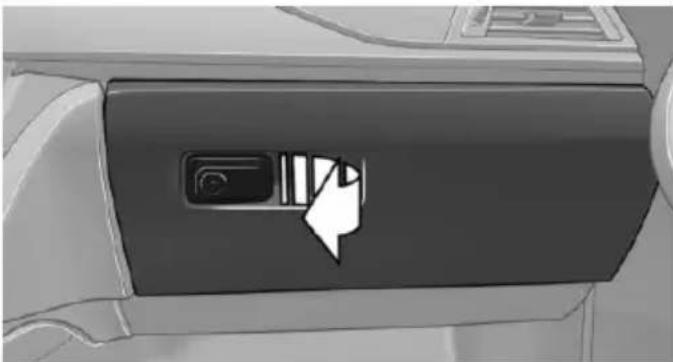
natural_image
Close-up of a car's front panel showing a hand cursor icon pointing to a button (no text or symbols visible)Pull the handle.
The light in the glove compartment switches on.
The net in the glove compartment is provided for stowing the storage tray for the cupholder, refer to page 158.
Closing
Fold cover closed.
Locking
The glove compartment can be locked with an integrated key to separately secure the trunk lid, refer to page 38, for example.
This prevents access to the glove compartment and to the cargo area.
After the glove compartment is locked, the remote control can be handed over, such as at a hotel, without the integrated key.
Driver's side
Note

Close the glove compartment again immediately
Close the glove compartment immediately after use while driving; otherwise, injury may occur during accidents.
Opening
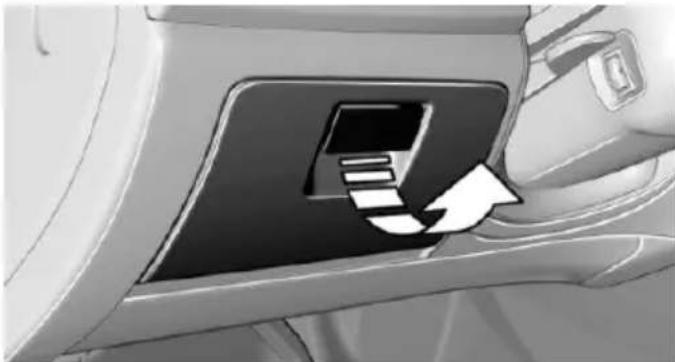
natural_image
Close-up of a hand pressing down on a car's side panel with a white arrow indicating left motion (no text or symbols)Pull the handle.
Closing
Fold cover closed.
Front storage compartment
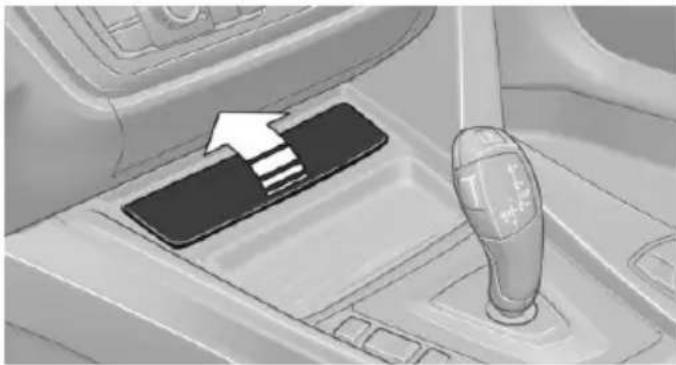
natural_image
Interior view of a car gear shift lever with a black tab and white arrow indicating the direction (no text or symbols)Raise the lid to open it.
Compartments in the doors

Do not stow any breakable objects
Do not store any breakable objects, e. g. glass bottles, in the compartments, or there is an increased risk of injury in the event of an accident.
Center armrest
Front
A storage compartment is located in the center armrest between the front seats.
Opening
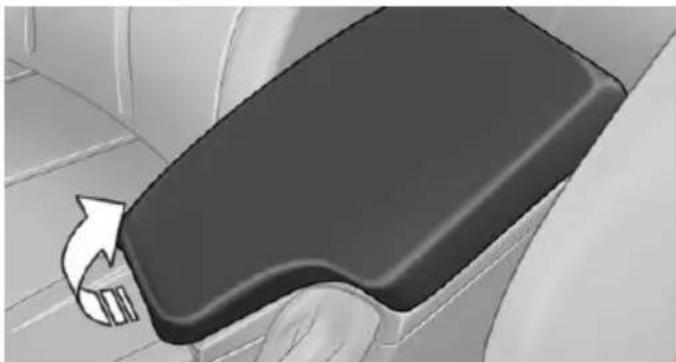
natural_image
Close-up of a car's seatbelt with a hand moving to the side (no text or symbols visible)Fold the center armrest up.
Repositioning
Center armrest can be pushed forwards or backwards. It engages in the end positions.
Connection for an external audio device
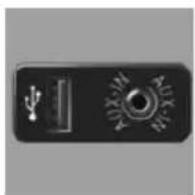
An external audio device, e.g., an MP3 player, can be connected via the AUX-IN port or the USB audio interface in the center armrest.
Storage compartment in the rear
A storage compartment is located in the center armrest.
Cupholders
Hints

Shatter-proof containers and no hot drinks
Use light and shatter-proof containers and do not transport hot drinks. Otherwise, there is the increased danger of injury in an accident.

Unsuitable containers
Do not forcefully push unsuitable containers into the cupholders. This may result in damage.
Front
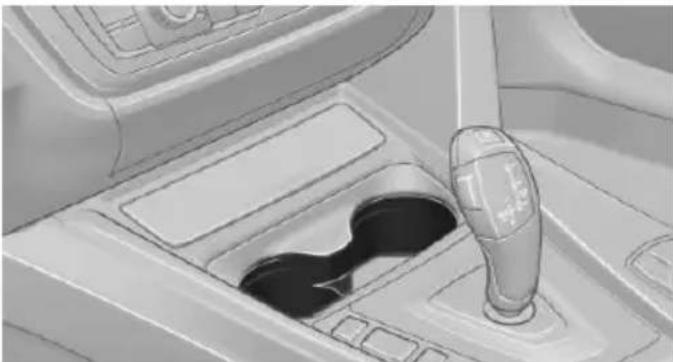
natural_image
Interior view of a car gear shift lever and intake manifold (no text or symbols visible)Storage tray for front cupholders
The cupholder with the storage tray can be used for additional storage. To do this, place the storage tray in the cupholder.
Only use the storage tray for small objects, such as keys or the remote control.
When not in use, stow the storage tray in the glove compartment net. Insert the storage tray into the net so that the top surface faces up. Note the trapezoidal shape of the net and tray.
Rear
In the center armrest.
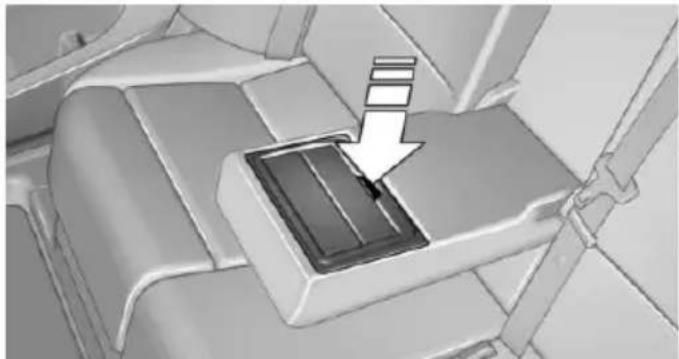
natural_image
Mechanical component diagram showing a lever mechanism with a downward arrow (no text or symbols)Pull the center armrest forward at the strap.
To open: press the button.
To close: push both covers back in, one after the other.

Pushing back the covers
Push back the covers before folding up the center armrest; otherwise, the cupholder could become damaged.
Clothes hooks
The clothes hooks are located in the grab handles in the rear.

Do not obstruct view
When suspending clothing from the hooks, ensure that it will not obstruct the driver's vision.

No heavy objects
Do not hang heavy objects from the hooks; otherwise, they may present a danger to passengers during braking and evasive maneuvers.
Storage compartments in the cargo area
Storage compartment
A storage compartment is located on the left side.
Located on the right side is a storage compartment for the onboard vehicle tool kit, refer to page 204, and first aid kit, refer to page 216.
Net
Small objects can be stowed in the net on the left side.
Hooks/multi-function hook
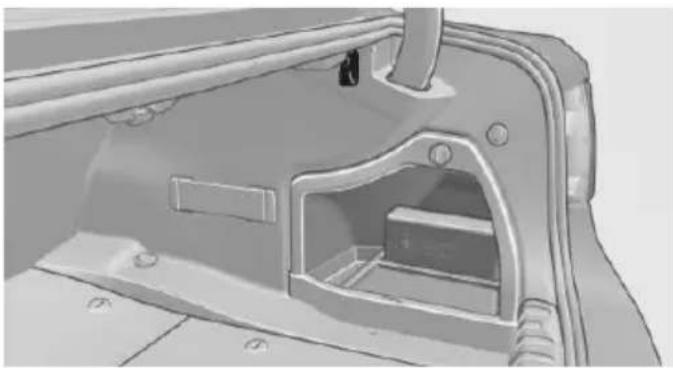
natural_image
3D CAD model of a mechanical bracket with internal cutaway view (no text or symbols)A multi-function hook is located on each side of the cargo area.
The multi-function hooks can be loaded up to a max. of 8.8 lbs/4 kg.

Light and suitable objects only
Only hang light bags or suitable objects from the holders. Otherwise, there is a danger of objects flying about during braking and evasive maneuvers.
Only transport heavy luggage in the trunk if it has been appropriately secured.
Retaining strap
A retaining strap is available on the right side trim for fastening small objects.
Lashing eyes in the cargo area
To secure the cargo, refer to page 166, there are four lashing eyes in the cargo area.
Floor net
The floor net can also be used to Secure the load, refer to page 166, and to store small parts.
Storage compartment under cargo floor panel

Maximum load
To avoid damage to the vehicle, do not exceed a maximum permitted load of 44 lbs/20 kg in the storage compartment under the cargo floor panel.
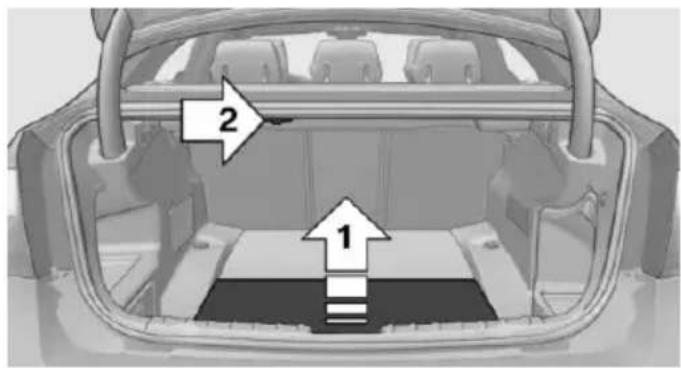
text_image
Diagram of a car rearview showing two labeled parts with arrows indicating direction or components.Raise the cargo floor panel, arrow 1, and latch at top, if necessary, arrow 2.
Partitioning the compartment
The compartment can be divided using an attachable partition.
text_image
Online Edition for Part no. 01 40 2 925 743 - II/14Driving tips
This chapter provides you with information useful in dealing with specific driving and operating modes.
Things to remember when driving
Vehicle equipment
All standard, country-specific and optional equipment that is offered in the model series is described in this chapter. Therefore, equipment is also described that is not available in a vehicle, e.g., because of the selected optional equipment or country variant. This also applies for safety-related functions and systems.
Breaking-in period
General information
Moving parts need to be broken in to adjust to each other.
The following instructions will help achieve a long vehicle life and good economy.
Engine and differential
Always obey the official speed limit.
Up to 1,200 miles/2,000 km
Do not exceed the maximum engine and road speed:
For gasoline engine 4,500 rpm and 100 mph/160 km/h.
For diesel engine 3,500 rpm and 93 mph/150 km/h.
Avoid full load or kickdown under all circumstances.
From 1,200 miles/2,000 km
The engine and vehicle speed can gradually be increased.
Tires
Due to technical factors associated with their manufacture, tires do not achieve their full traction potential until after an initial breaking-in period.
Drive conservatively for the first 200 miles/300 km.
Brake system
Brakes require an initial break-in period of approx. 300 miles/500 km to achieve optimized contact and wear patterns between brake discs and brake pads. Drive moderately during this break-in period.
Clutch
The function of the clutch reaches its optimal level only after a distance driven of approx. 300 miles/500 km. During this break-in period, engage the clutch gently.
Following part replacement
The same breaking in procedures should be observed if any of the components mentioned above have to be renewed in the course of the vehicle's operating life.
General driving notes
Closing the trunk lid
Drive with the trunk lid closed Only drive with the tailgate closed; otherwise, in the event of an accident or braking and evasive maneuvers, passengers and other road users may be injured, and the vehicle may be damaged. In addition, exhaust fumes may enter the passenger compartment.
If driving with the tailgate open cannot be avoided:
▶ Close all windows and the glass sunroof.
▶ Greatly increase the blower speed.
▶ Drive moderately.
Hot exhaust system

Hot exhaust system
High temperatures are generated in the exhaust system.
Do not remove the heat shields installed and never apply undercoating to them. Make sure that flammable materials, e. g. hay, leaves, grass, etc. do not come in contact with the hot exhaust system during driving, while in idle position mode, or when parked. Such contact could lead to a fire, and with it the risk of serious personal injury as well as property damage.
Do not touch hot exhaust pipes; otherwise, there is the danger of getting burned.
Diesel particulate filter
The diesel particulate filter collects soot particles and burns them periodically at high temperatures.
During the cleaning time of several minutes, the following may occur:
▶ Temporarily, the engine may run less smoothly.
▶ Noises and a slight amount of smoke coming from the exhaust until shortly after the engine is shut down.
▶ A somewhat higher engine speed is necessary to achieve the accustomed performance.
Mobile communication devices in the vehicle

Mobile communication devices in the vehicle
It is advised that you do not use mobile communication devices, e.g., mobile phones, inside the vehicle without connecting them directly to the external antenna. Otherwise, the vehicle electronics and mobile communication devices can interfere with each other. In addition, there is no assurance that the radiation
generated during transmission will be discharged from the vehicle interior.
Hydroplaning
On wet or slushy roads, a wedge of water can form between the tires and road surface.
This phenomenon is referred to as hydroplaning. It is characterized by a partial or complete loss of contact between the tires and the road surface, ultimately undermining your ability to steer and brake the vehicle.

Hydroplaning
When driving on wet or slushy roads, reduce your speed to prevent hydroplaning.
Driving through water

Adhere to water depth and speed limitations
Do not exceed this water depth and walking speed; otherwise, the vehicle's engine, the electrical systems and the transmission may be damaged.
Drive through calm water only and only if it is not deeper than. 9.8 inches/25 cm and at this height, no faster than walking speed, up to 6 mph/10 km/h.
Braking safely
Your vehicle is equipped with ABS as a standard feature.
Applying the brakes fully is the most effective way of braking in situations when this is necessary.
The vehicle maintains steering responsiveness. You can still avoid any obstacles with a minimum of steering effort.
Pulsation of the brake pedal and sounds from the hydraulic circuits indicate that ABS is in its active mode.
Objects within the range of movement of the pedals

No objects in the area around the pedals Keep floor mats, carpets, and any other objects out of the area of motion of the pedals; otherwise, the function of the pedals could be impeded while driving and create the risk of an accident.
Do not place additional floor mats over existing mats or other objects.
Only use floor mats that have been approved for the vehicle and can be properly fixed in place.
Ensure that the floor mats are securely fastened again after they were removed for cleaning, for example.
Driving in wet conditions
When roads are wet coated with road salt or there is heavy rain, briefly exert gentle pressure on the brake pedal every few miles.
Ensure that this action does not endanger other road users.
The heat generated in this process helps dry the brake discs and pads.
In this way braking efficiency will be available when you need it.
Hills
Drive long or steep downhill gradients in the gear in which the least braking is required.
Otherwise, the brake system may overheat, resulting in a reduction in the brake system efficiency.
You can increase the engine's braking effect by shifting down, going all the way to first gear, if necessary.

Avoid load on the brakes
Avoid placing excessive load on the
brake system. Light but consistent brake pressure can lead to high temperatures, brake wear and possibly even brake failure.

Do not drive in neutral
Do not drive in neutral or with the engine stopped, as doing so disables engine braking. In addition, steering and brake assist are unavailable with the engine stopped.
Brake disc corrosion
The corrosion on the brake discs and the contamination on the brake pads are furthered by:
Low mileage.
▶ Extended periods when the vehicle is not used at all.
▶ Infrequent use of the brakes.
Corrosion occurs when the minimum pressure that must be exerted by the pads during brake applications to clean the discs is not reached.
Should corrosion form on the brake discs, the brakes will tend to respond with a pulsating effect that generally cannot be corrected.
Condensation under the parked vehicle
When using the automatic climate control, condensation water develops that exits underneath the vehicle.
Traces of water under the vehicle like this are normal.
Loading
Vehicle equipment
All standard, country-specific and optional equipment that is offered in the model series is described in this chapter. Therefore, equipment is also described that is not available in a vehicle, e.g., because of the selected optional equipment or country variant. This also applies for safety-related functions and systems.
Hints

Overloading the vehicle
To avoid exceeding the approved carrying capacity of the tires, never overload the vehicle. Overloading can lead to overheating and increases the rate at which damage develops inside the tires. This could result in a sudden loss of tire inflation pressure.

No fluids in the trunk
Make sure that fluids do not leak into the trunk; otherwise, the vehicle may be damaged.

Heavy and hard objects
Do not stow any heavy and hard objects in the passenger compartment without securing them; otherwise, they may present a danger to occupants, e.g., during braking and evasive maneuvers.
Determining the load limit
- Locate the following statement on your vehicle's placard:
The combined weight of occupants and cargo should never exceed XXX kg or YYY lbs. Otherwise, damage to the
vehicle and unstable driving situations may result.
natural_image
Interior view of a car showing the side panel and seat area (no text or symbols visible)-
Determine the combined weight of the driver and passengers that will be riding in your vehicle.
-
Subtract the combined weight of the driver and passengers from XXX kilograms or YYY pounds.
-
The resulting figure equals the available amount of cargo and luggage load capacity.
For example, if the YYY amount equals 1,000 lbs and there will be four 150 lbs passengers in your vehicle, the amount of available cargo and luggage load capacity is 400 lbs: 1,000 lbs minus 600 lbs = 400 lbs.
- Determine the combined weight of luggage and cargo being loaded on the vehicle. That weight may not safely exceed the available cargo and luggage load capacity calculated in Step 4.
Load
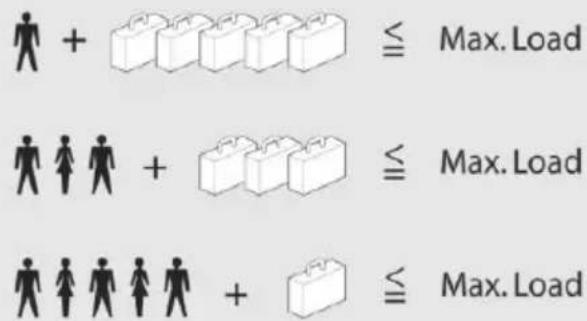
text_image
+ ≦ Max. Load + ≦ Max. Load + ≦ Max. LoadThe maximum load is the sum of the weight of the occupants and the cargo.
The greater the weight of the occupants, the less cargo that can be transported.
Stowing cargo
▶ Cover sharp edges and corners on the cargo.
▶ Heavy cargo: stow as far forward as possible, directly behind and at the bottom of the rear passenger seat backrests.
▶ Very heavy cargo: when the rear seat is not occupied, secure each of the outer safety belts in the opposite buckle.
▶ If necessary, fold down the rear backrests to stow cargo.
Do not stack cargo above the top edge of the backrests.
Securing cargo
Lashing eyes in the cargo area
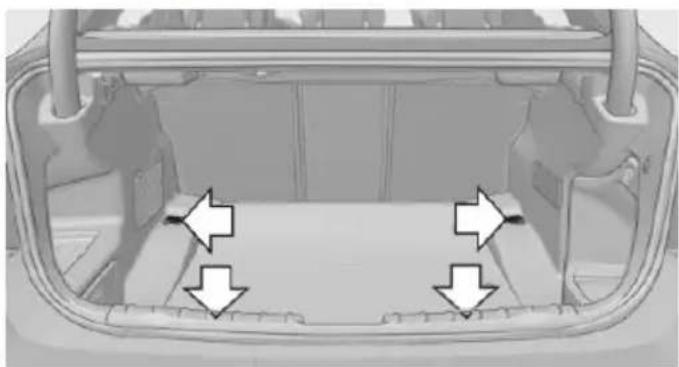
natural_image
Interior view of a car trunk with four directional arrows indicating movement or flow (no text or symbols present)To secure the cargo there are four lashing eyes in the cargo area.
Floor net
The floor net can also be used to Secure the load and to store small parts.
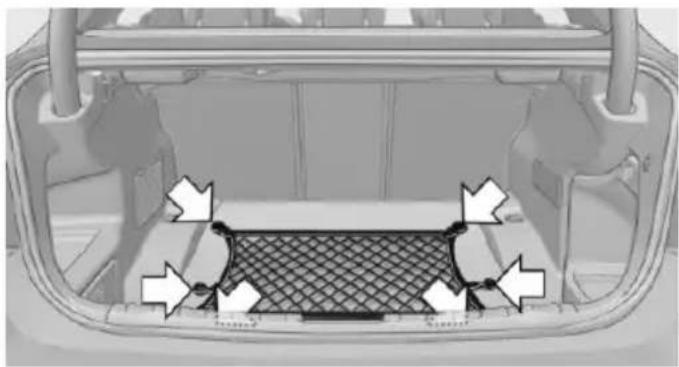
natural_image
Interior view of a car trunk with a mesh grille and directional arrows indicating movement or force (no text or symbols)Hook the floor net into the fittings in the cargo area floor.
Securing cargo
▶ Smaller and lighter items: secure with retaining straps or draw straps.
▶ Larger and heavy objects: secure with cargo straps.
Attach the cargo straps, retaining straps or draw straps to the lashing eyes in the cargo area.

Securing cargo
Stow and secure the cargo as described above; otherwise it may present a danger to the occupants, e.g., during braking and avoidance maneuvers.
Roof-mounted luggage rack
Note
Roof racks are available as special accessories.
Securing
Follow the installation instructions of the roof rack.
Roof drip rail with flaps

natural_image
Close-up of a car's side profile with a curved arrow indicating direction (no text or symbols)The anchorage points are located in the roof drip rail above the doors.
Fold the cover outward.
Loading
Be sure that adequate clearance is maintained for tilting and opening the glass sunroof.
Because roof racks raise the vehicle's center of gravity when loaded, they have a major effect on vehicle handling and steering response.
Therefore, note the following when loading and driving:
Do not exceed the approved roof/axle loads and the approved gross vehicle weight.
▷ Distribute the roof load uniformly.
The roof load should not be too large in area.
▶ Always place the heaviest pieces on the bottom.
- Secure the roof luggage firmly, e.g., tie with ratchet straps.
Do not let objects project into the opening path of the trunk lid.
▶ Drive cautiously and avoid sudden acceleration and braking maneuvers. Take corners gently.
Saving fuel
Vehicle equipment
All standard, country-specific and optional equipment that is offered in the model series is described in this chapter. Therefore, equipment is also described that is not available in a vehicle, e. g., because of the selected optional equipment or country variant. This also applies for safety-related functions and systems.
General information
Your vehicle contains advanced technology for the reduction of fuel consumption and emissions.
Fuel consumption depends on a number of different factors.
The implementation of certain measures, driving style and regular maintenance can have an influence on fuel consumption and on the environmental impact.
Remove unnecessary cargo
Additional weight increases fuel consumption.
Remove attached parts following use
Remove auxiliary mirrors, roof or rear luggage racks which are no longer required following use.
Attached parts on the vehicle impair the aerodynamics and increase the fuel consumption.
Close the windows and glass sunroof
Driving with the glass sunroof and windows open results in increased air resistance and thereby reduces the range.
Tires
General information
Tires can affect fuel consumption values in various ways, for instance fuel consumption can be influenced by the size of the tires.
Check the tire inflation pressure regularly
Check and, if necessary, correct the tire inflation pressure at least twice a month and before starting on a long trip.
Low tire inflation pressure increases rolling resistance and thus raises fuel consumption and tire wear.
Drive away immediately
Do not wait for the engine to warm-up while the vehicle remains stationary. Start driving right away, but at moderate engine speeds.
This is the fastest way for the cold engine to reach its operating temperature.
Look well ahead when driving
Avoid unnecessary acceleration and braking.
By maintaining a suitable distance to the vehicle driving ahead of you.
Driving smoothly and looking ahead reduces fuel consumption.
Avoid high engine speeds
Use 1st gear to get the vehicle in motion. Beginning with 2nd gear, accelerate rapidly. When accelerating, shift up before reaching high engine speeds.
When you reach the desired speed, shift into the highest applicable gear and drive with the engine speed as low as possible and at a constant speed.
As a rule: driving at low engine speeds lowers fuel consumption and reduces wear.
The gear shift indicator of your vehicle indicates the most fuel efficient gear.
Use coasting
When approaching a red light, take your foot off the accelerator and let the vehicle coast to a halt.
On a downhill gradient, take your foot off the accelerator and let the vehicle roll.
The flow of fuel is interrupted while coasting.
Switch off the engine during longer stops
Switch off the engine during longer stops, e.g., at traffic lights, railroad crossings or in traffic congestion.
Auto Start/Stop function
The Auto Start/Stop function of your vehicle automatically switches off the engine during a stop.
If the engine is switched off and then restarted rather than leaving the engine running constantly, fuel consumption and emissions are reduced. Savings can begin within a few seconds of switching off the engine.
In addition, fuel consumption is also determined by other factors, such as driving style,
road conditions, maintenance or environmental factors.
Switch off any functions that are not currently needed
Functions such as seat heating and the rear window defroster require a lot of energy and reduce the range, especially in city and stop-and-go traffic.
Therefore, switch off these functions if they are not actually needed.
The ECO PRO driving program supports the energy conserving use of comfort functions. These functions are automatically deactivated partially or completely.
Have maintenance carried out
Have vehicles maintained regularly to achieve optimal vehicle economy and operating life. The maintenance should be carried out by your service center.
Also note the BMW Maintenance System, refer to page 202.
ECO PRO
The concept
ECO PRO supports a driving style that saves on fuel consumption. For this purpose, the engine control and comfort functions, e.g. the climate control output, are adjusted.
Under certain conditions the engine is automatically decoupled from the transmission in the D selector lever position. The vehicle continues traveling with the engine idling to reduce fuel consumption. Selector lever position D remains engaged.
In addition, context-sensitive instructions can be displayed that assist in driving in a manner that optimizes fuel consumption.
In the instrument display, the extension of the range achieved by this can be displayed as a bonus range.
At a glance
The system includes the following EfficientDynamics functions and displays:
▶ ECO PRO bonus range, refer to page 170.
▷ ECO PRO tips driving instruction, refer to page 171
▶ ECO PRO climate control, refer to page 170.
▶ ECO PRO coasting driving status, refer to page 172.
▷ ECO PRO driving style analysis, refer to page 173.
Activate ECO PRO
Press button repeatedly until ECO PRO is displayed in the instrument
cluster.
Configuring ECO PRO
Via the Driving Dynamics Control
- Activate ECO PRO.
- "Configure ECO PRO"
- Configure the program.
Via the iDrive
- "Settings"
-
"ECO PRO mode"
Or -
"Settings"
- "Driving mode"
- "Configure ECO PRO"
Configure the program.
ECO PRO Tip
▷ "Tip at:",
Set ECO Pro speed at which an ECO PRO Tip is to be displayed.
▶ "ECO PRO speed warning":
A reminder is displayed if the set ECO PRO speed is exceeded.
Coasting
Fuel-efficiency can be optimized by disengaging the engine and Coasting, refer to page 172, with the engine idling.
This function is only available in ECO PRO mode.
ECO PRO climate control
"ECO PRO climate control"
The climate control is adjusted to be fuel-efficient.
By making a slight change to the set temperature, or slowly adjusting the rate of heating or cooling of the passenger compartment, fuel consumption can be economized.
The outputs of the seat heater and the exterior mirror heating are also reduced.
The exterior mirror heating is made available when outside temperatures are very cold.
ECO PRO potential
The percentage of potential savings that can be achieved with the current configuration is displayed.
Display in the instrument cluster
ECO PRO bonus range
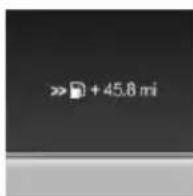
An extension of the range can be achieved by an adjusted driving style.
This may be displayed as the bonus range in the instrument
cluster.
The bonus range is shown in the range display. The bonus range is automatically reset every time the vehicle is refueled.
Driving style
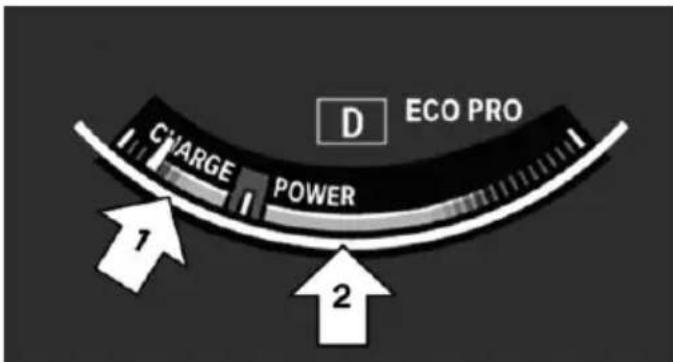
text_image
D ECO PRO CHARGE POWER 1 2In the tachometer, a mark in the bar display indicates the current efficiency of the driving style.
Mark in the CHARGE area, arrow 1: display for energy recovered by coasting or when braking. Mark in the POWER area, arrow 2: display when accelerating.
The efficiency of the driving style is shown by the color of the bar:
Blue display: efficient driving style as long as the mark moves within the blue range.
Gray display: adjust driving style, e. g. by backing off the accelerator pedal.
The display switches to blue as soon as all conditions for fuel-economy-optimized driving are met.
ECO PRO Tip - driving instruction
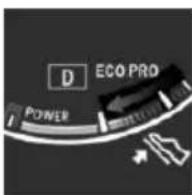
The arrow indicates that the driving style can be adjusted to be more fuel efficient by backing off the accelerator for instance.
Note
The driving style display and ECO PRO tips in the instrument cluster appear when the ECO PRO display is activated.
Activating driving style and ECO PRO tips:
- "Settings"
- "Instr. cluster display"
- "ECO PRO Info"
ECO PRO tip - Symbols
An additional symbol and a text instruction are displayed.
Symbol Measure

For efficient driving style, back off the accelerator or delay accelerating to allow time to assess road conditions.

Reduce speed to the selected ECO PRO speed.

Automatic transmission: switch from M/S to D and avoid manual shift interventions.

Manual shift transmission: follow shifting instructions.

Manual shift transmission: engage neutral for engine stop.
Indications on the Control Display
EfficientDynamics
Information on fuel consumption and technology can be displayed during driving.
- "Vehicle Info"
- "EfficientDynamics"
Displaying fuel consumption history
The average fuel consumption can be displayed within an adjustable time frame.
Vertical bars show consumption for the selected time frame.
Trip interruptions are represented below the bar on the time axis.
"Consumption history"
Adjusting fuel consumption history time frame
Select the symbol.
Resetting fuel consumption history
- Open "Options".
- "Reset consumption history"
Displaying EfficientDynamics info
The current efficiency can be displayed.
工 "EfficientDynamics info"
The following systems are displayed:
▶ Automatic engine Start/Stop function.
▶ Energy recovery.
▶ Climate control output.
▶ Coasting.
Display ECO PRO tips
i "ECO PRO Tips"
The setting is stored for the profile currently in use.
Coasting
The concept
The system helps to conserve fuel.
To do this, under certain conditions the engine is automatically decoupled from the transmission when selector lever position D is engaged. The vehicle continues traveling with the engine idling to reduce fuel consumption. Selector lever position D remains engaged.
This driving condition is referred to as coasting.
As soon as the brake or accelerator pedal is depressed, the engine is automatically coupled to the transmission again.
Hints
Coasting is a component of the ECO PRO, refer to page 169, driving mode.
Coasting is automatically activated when ECO PRO mode is called via the Driving Dynamics Control.
The function is available in a certain speed range.
A forward-looking driving style helps the driver to use the function as often as possible and supports the fuel-conserving effect of coasting.
Safety mode
The function is not available if one of the following conditions is satisfied.
▷ DSC OFF or TRACTION activated.
- Driving in the dynamic limit range and on steep uphill or downhill grades.
▶ Battery charge status temporarily too low or vehicle electrical system drawing excessive current.
▶ Cruise control activated.
Functional requirements
In ECO PRO mode, this function is available in a speed range from approximately 30 mph, approx. 50 km/h to 100 mph, approx. 160 km/h, if the following conditions are satisfied:
▶ Accelerator pedal and brake pedal are not operated.
The selector lever is in selector lever position D.
▶ Engine and transmission are at operating temperature.
Display
Display in the instrument cluster
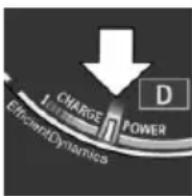
The mark in the bar display below the tachometer is backlit in blue and is located at the zero point. The tachometer approximately indicates idle speed.
The coasting point indicator is illuminated at the zero point during coasting.
Indications on the Control Display
The Coasting driving condition is displayed in EfficientDynamics Info while this driving mode is active.
The distance traveled in the Coasting driving condition is indicated by a counter.
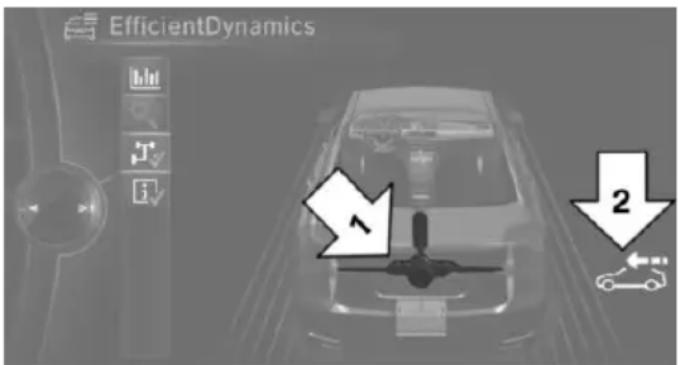
text_image
EfficientDynamics 2Color code blue, arrow 1, and symbol, arrow 2: driving condition Coasting.
Displaying EfficientDynamics info
- "Vehicle Info"
- "EfficientDynamics"
- "EfficientDynamics info"
Deactivating the system manually
The function can be deactivated in the Configure ECO PRO, refer to page 170, menu, e.g., to use the braking effect of the engine when traveling downhill.
The setting is stored for the profile currently in use.
ECO PRO driving style analysis
The concept
The system helps in this situation to develop an especially efficient driving style and to conserve fuel.
For this purpose, the driving style is analyzed. The assessment is done in various categories and is displayed on the Control Display.
Using this indication, the individual driving style can be oriented toward conserving fuel.
The last fifteen minutes of a trip are evaluated.
The range of the vehicle can be extended by an efficient driving style.
This gain in range is displayed as a bonus range in the instrument cluster and on the Control Display.
Functional requirement
The function is only available in ECO PRO mode.
Calling up ECO PRO driving style analysis
Via the Driving Dynamics Control
- Activate ECO PRO.
- "EfficientDynamics"
- Select the symbol.
Display
Display on the Control Display
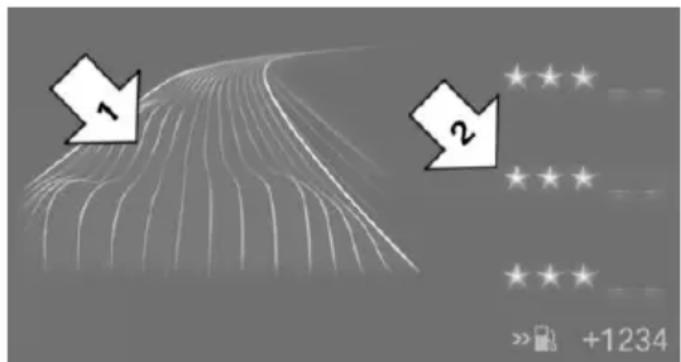
text_image
1 2 +1234The display of the ECO PRO driving style analysis consists of a symbolized road route and a lookup table.
The road symbolizes the efficiency of the driving style. The more efficient the driving style, the smoother the depicted road route becomes, arrow 1.
The table of values contains stars. The more efficient the driving style, the more stars are included in the table and the faster the bonus range increases, arrow 2.
If, on the other hand, the driving style is inefficient, a wavy road and a reduced number of stars is displayed.
To assist with an efficient driving style, ECO PRO tips are displayed during the drive.
Tips about the energy saving driving style, Conserving fuel, refer to page 168.
natural_image
Close-up of a metallic funnel pouring liquid into a circular pipe (no text or symbols visible)Mobility
In order to always ensure your mobility, you will find important information on operating fluids, wheels and tires, maintenance and Roadside Assistance in the following.
Refueling
Vehicle equipment
All standard, country-specific and optional equipment that is offered in the model series is described in this chapter. Therefore, equipment is also described that is not available in a vehicle, e.g., because of the selected optional equipment or country variant. This also applies for safety-related functions and systems.
Hints

Refuel promptly
Refuel no later than at a range of
30 miles/50 km, or operation of the engine is not ensured and damage may occur.
Diesel engines
The filler neck is designed for refueling at diesel fuel pumps.
Fuel cap
Opening
- Briefly press the rear edge of the fuel filler flap.
natural_image
Black square button with white left-pointing arrow symbol on a smooth gradient background (no text or symbols)- Turn the fuel cap counterclockwise.
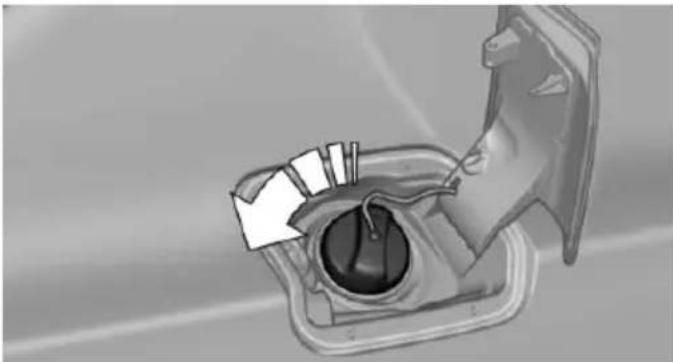
natural_image
Diagram of a mechanical component with internal parts and directional arrows, no visible text or symbols- Place the fuel cap in the bracket attached to the fuel filler flap.
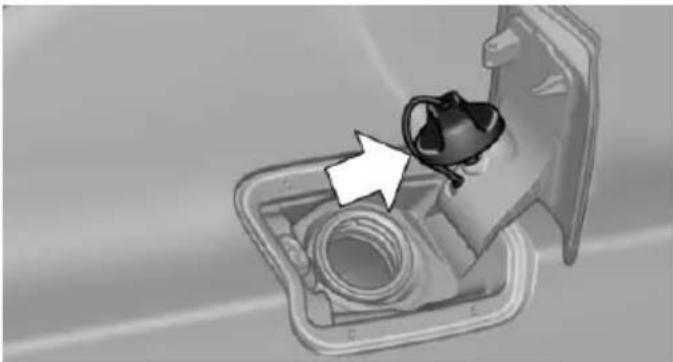
natural_image
Interior view of a vehicle hood with a gear and seat, showing no visible text or symbolsClosing
-
Fit the cap and turn it clockwise until you clearly hear a click.
-
Close the fuel filler flap.

Do not pinch the retaining strap
Do not pinch the retaining strap attached to the cap; otherwise, the cap cannot be closed properly and fuel vapors can escape.
Manually unlocking fuel filler flap
In the event of an electrical malfunction, for example.
- Open the cover on the right side trim. To do this, turn the cap.
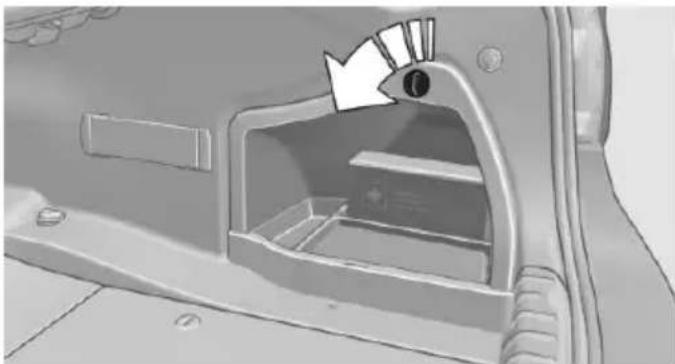
natural_image
Interior view of a car door with an open drawer and a directional arrow pointing to the interior (no text or symbols)- Pull the green knob with the fuel pump symbol. This releases the fuel filler flap.
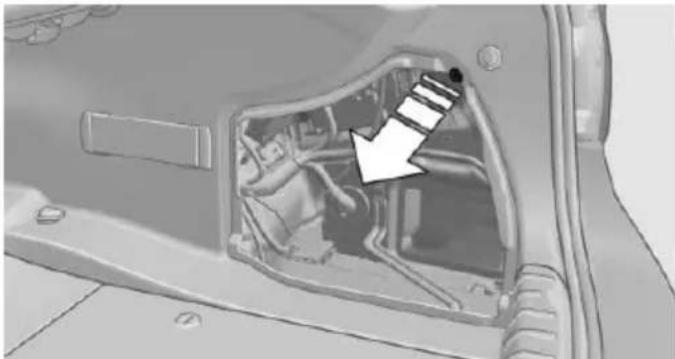
natural_image
Interior view of a car showing engine compartment with a white arrow pointing to a component (no text or symbols visible)Observe the following when refueling
The fuel tank is full when the filler nozzle clicks off the first time.

Do not overfill the fuel tank
Do not overfill the fuel tank; otherwise
fuel may escape, causing harm to the environment and damaging the vehicle.

Handling fuels
Obey safety regulations posted at the gas station.
Fuel
Vehicle equipment
All standard, country-specific and optional equipment that is offered in the model series is described in this chapter. Therefore, equipment is also described that is not available in a vehicle, e.g., because of the selected optional equipment or country variant. This also applies for safety-related functions and systems.
Fuel recommendation
Note

General fuel quality
Even fuels that conform to the specifications can be of low quality. This may cause engine problems, for instance poor engine starting behavior, poor handling and/or performance. Switch gas stations or use a brand name fuel with a higher octane rating.
Gasoline
For the best fuel economy, the gasoline should be sulfur-free or very low in sulfur content.
Fuels that are marked on the gas pump as containing metal must not be used.

Refuel only with unleaded gasoline without metallic additives.
Do not refuel with any leaded gasoline or gasoline with metallic additives, e. g. manganese or iron, or permanent damage to the catalytic converter and other components.
Fuels with a maximum ethanol content of 10 %, i. e., E10, may be used for refueling.
Ethanol should satisfy the following quality standards:
US: ASTM 4806-xx
CAN: CGSB-3.511-xx
xx: comply with the current standard in each case.

Do not use a fuel with a higher percentage of ethanol
Do not use a fuel with a higher ethanol percentage than recommended or one with other types of alcohol, i.e. no Flex Fuel, otherwise this could damage the engine and fuel supply system.
Recommended fuel grade
BMW recommends AKI 91.
Minimum fuel grade
BMW recommends AKI 89.

Minimum fuel grade
Do not use any gasoline below the minimum fuel grade as this may impair engine performance.
If you use gasoline with this minimum AKI Rating, the engine may produce knocking sounds when starting at high outside temperatures. This has no effect on the engine life.

Fuel quality
The use of poor-quality fuels may result in harmful engine deposits or damage. Additionally, problems relating to drivability, starting and stalling, especially under certain environmental conditions such as high ambient temperature and high altitude, may occur.
If drivability problems are encountered, we recommend switching to a high quality gasoline brand and a higher octane grade — AKI number — for a few tank fills. To avoid harmful engine deposits, it is highly recommended to purchase gasoline from BP or Top Tier retailers.
Failure to comply with these recommendations may result in the need for unscheduled maintenance.
BMW recommends BP fuels

Diesel
Low-Sulfur Diesel
The engine of your BMW is designed for diesel with low sulfur content:
Ultra-Low Sulfur Diesel ASTM D 975-xx.
xx: comply with the current standard in each case.

Use only Ultra-Low Sulfur Diesel.
The fraction of biodiesel in the fuel must not exceed 5 %, referred to as B5. Do not use gasoline. If you do fill the tank with the wrong fuel, e.g., gasoline, do not start the engine as this may damage the engine.
After adding the wrong fuel, contact your service center or roadside assistance.
If the fuel pump nozzle does not fit in the filler pipe of your BMW, please check to ensure that you are refueling at a diesel fuel pump that is equipped with a diesel fuel pump nozzle.
In the event the Ultra-Low Sulfur Diesel fuel cannot be fully inserted into the fuel filler neck, please contact BMW Roadside Assistance for instructions on how to add fuel. For more information on BMW Roadside Assistance, refer to page 216.
Winter diesel
To ensure that the diesel engine remains operational in the winter, use winter diesel. It is available at gas stations during winter months.
The fuel filter heating system, included as a standard feature, prevents disruption of the fuel supply while driving.

Do not add any diesel additives
Do not add additives, including gasoline; otherwise, engine damage may occur.
BMW Advanced Diesel
The concept
BMW Advanced Diesel reduces nitrogen oxides in the diesel emissions by injecting diesel exhaust fluid reducing agent into the exhaust system. A chemical reaction takes place inside the catalytic converter that minimizes nitrogen oxides.
The vehicle has a tank that can be refilled.
To be able to start the engine as usual, there must be an adequate reducing agent.
Reducing agent is added by the service center.
Warming up the system
In order to warm the engine up to its operating temperature after a cold start, the automatic transmission may subsequently shift up to the next higher gear.
Displays in the instrument cluster
Reserve display
This display in the instrument cluster provides information about the distance that can still be driven with the current reserve level.

The reserve display is shown starting at a remaining range of approx. 1,000 miles/1,600 km.

Refill in good time
The reducing agent must be replenished as soon as the Reserve display appears, otherwise the engine cannot be restarted.
Diesel exhaust fluid on minimum

The engine will continue to run even when the display shows --, as long as it is not switched off and all other operating conditions are satisfied, sufficient fuel
for example.

Engine does not start
Do not continue driving to the limit of the remaining travel distance. Otherwise, you will not be able to restart the engine after switching it off.
Misfueling
A Check Control message is displayed when an incorrect fluid is added.
After adding the wrong fluid, contact your service center.
System defect
A Check Control message is displayed when there is a system defect.
Have the diesel exhaust fluid replenished
The reducing agent is added by the service center within the context of regular maintenance.
It may be necessary to have the fluid replenished several times under particular circumstances, for example, if the vehicle is driven in a particularly sporty style or if it is driven at high altitudes.
The reducing agent must be replenished as soon as the reserve display appears in the instrument cluster to avoid not being able to re-start the engine.
Diesel exhaust fluid at low temperatures
Due to its physical properties, it is possible that the reducing agent may also need to be replenished between regular maintenance appointments if it is exposed to temperatures under +23 °F/- 5 °C. In this case, add reducing agent only immediately before starting to drive.
The need to replenish it is indicated by the Reserve display in the instrument cluster.
At temperatures below + 12 °F/- 11 °C the fill level in some cases cannot be measured.
After adding reducing agent, the reserve display is displayed only until the fill level can be measured again.
Replenishing Diesel exhaust fluid yourself in exceptional cases
You can replenish reducing agent yourself in exceptional cases, e.g., to get to the service center.

Avoid contact with Diesel exhaust fluid
Do not come into contact with the reducing agent. Otherwise, skin or eye irritations may result.

Handling Diesel exhaust fluid
When working with reducing agent in closed spaces, ensure good ventilation. When the bottle or container is opened, acrid smelling fumes may escape.

Keeping Diesel exhaust fluid out of reach of children
Keep reducing agent out of reach of children

Avoid contact with surfaces
Avoid contact of reducing agent with surfaces of the vehicle. Damage could result.
Suitable Diesel exhaust fluid
▶ Preferred: BMW Diesel Exhaust Fluid. With this bottle and its special adapter, Diesel
exhaust fluid can be replenished simply and safely.
Alternative: NOx reduction agent AUS 32
Diesel exhaust fluid can be purchased at your Service Center.
Refill quantity
When the Reserve display starts, add at least 2 bottles of reducing agent.
This corresponds to approx. 1 gallon.
Tank for reducing agent
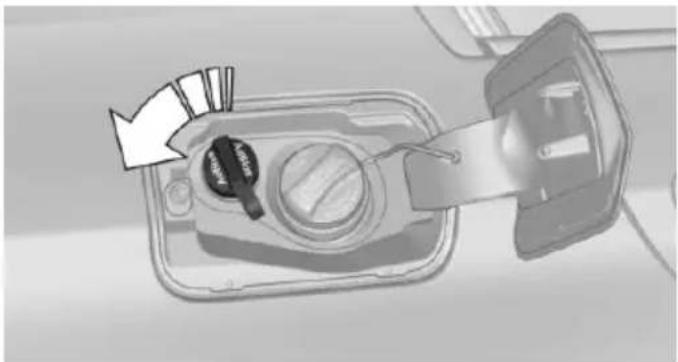
natural_image
Diagram of a device with a lock and cable inserted into a tray, showing internal components and a directional arrow (no text or symbols)The tank for the reducing agent is located next to the fuel tank.
Adding the reducing agent
Add the reducing agent when the ignition is switched on.
- Open the fuel filler flap, refer to page 178.
- Turn the fuel cap counterclockwise and remove.
- Place the bottle on it and turn it as far as it will go, see arrow.
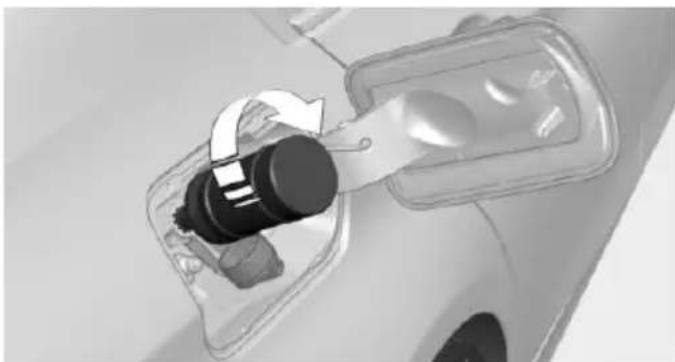
natural_image
Close-up of a car's fuel plug with a black valve and white plastic housing (no text or symbols visible)- Press the bottle down, see arrow.
The vehicle tank will be filled.
The tank is full when the fill level in the bottle no longer changes. It is not possible to overfill.
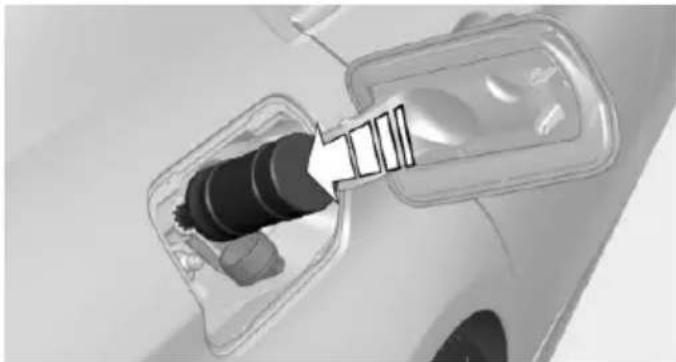
natural_image
Close-up of a car charging plug with a black plastic plug inserted into a transparent housing (no text or symbols visible)- Pull back the bottle, see arrow, and un-screw it.
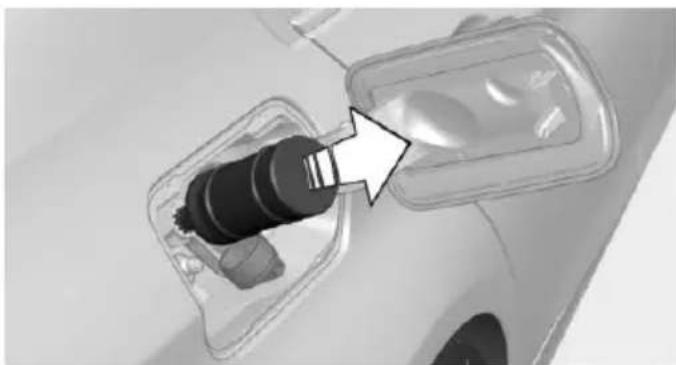
natural_image
Close-up of a car charging plug with a black connector and blue buttons, showing no text or symbols.- Replace the fuel cap and turn it clockwise.
- Close the fuel filler flap.
After adding Diesel exhaust fluid
Note

Incorrect fluids
After filling with incorrect fluids, such as antifreeze for washer water, do not start the engine, otherwise there is risk of fire.
Contact your service center.
Disposing of bottles

You take your empty Diesel exhaust fluid bottles to your Service Center for disposal.
Do not dispose of empty bottles with household waste unless this is permitted by local regulations.
Reserve display

The Reserve display will still appear along with the remaining range after refilling.
Engine can be started.
After several minutes of driving,
the Reserve indication goes out.
Diesel exhaust fluid on minimum

After filling, the indication -- is still displayed.
Only after the display goes out can the engine -- be started.
- Switch on the ignition.
Display -- goes out after approx. 1 minute.
- Engine can be started.
Wheels and tires
Vehicle equipment
All standard, country-specific and optional equipment that is offered in the model series is described in this chapter. Therefore, equipment is also described that is not available in a vehicle, e.g., because of the selected optional equipment or country variant. This also applies for safety-related functions and systems.
Tire inflation pressure
Safety information
The tire characteristics and tire inflation pressure influence the following:
The service life of the tires.
Road safety.
▶ Driving comfort.
Checking the pressure
Tires have a natural, consistent loss of pressure.

Check the tire inflation pressure regularly Regularly check the tire inflation pressure, and correct it as needed: at least twice a month and before a long trip. If you fail to observe this precaution, you may be driving on tires with incorrect tire pressures, a condition that may not only compromise your vehicle's driving stability, but also lead to tire damage and the risk of an accident.
Tires heat up during driving, and the tire inflation pressure increases along with the temperature of the tire. The tire inflation pressure specifications relate to cold tires or tires with the ambient temperature.
Only check the tire inflation pressure when the tires are cold. This means after driving no more
than 1.25 miles/2 km or when the vehicle has been parked for at least 2 hours.
The displays of inflation devices may under-read by up to 0.1bar, 2 psi.
For Flat Tire Monitor: after correcting the tire inflation pressure, reinitialize the Flat Tire Monitor.
For Tire Pressure Monitor: after correcting the tire inflation pressure, reset the Tire Pressure Monitor.
Pressure specifications
The tire inflation pressure table, refer to page 186, contains all pressure specifications for the specified tire sizes at the ambient temperature. Pressure specifications apply to approved tire sizes and recommended tire brands. This information can be obtained from your service center.
To identify the correct tire inflation pressure, please note the following:
▶ Tire sizes of your vehicle.
▶ Maximum permitted driving speed.
Tire inflation pressures up to 100 mph/160 km/h
For speeds of up to 100 mph/160 km/h and for optimum driving comfort, note the pressure values in the tire inflation pressure table, refer to page 186, and adjust as necessary.
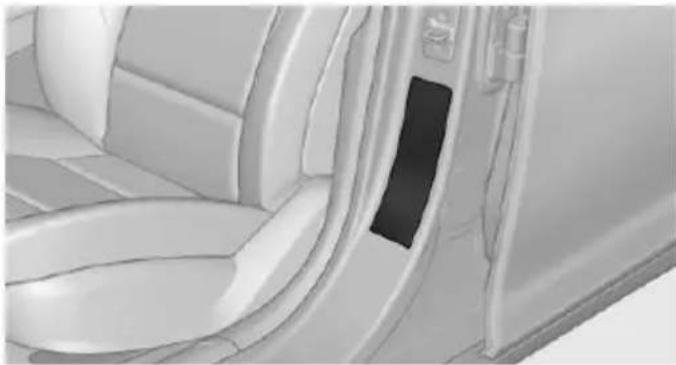
natural_image
Interior view of a car showing the side panel and seat area (no text or symbols visible)These pressure values can also be found on the tire inflation pressure label on the driver's door pillar.

Maximum permissible speed
Do not exceed 100 mph/160 km/h; otherwise, tire damage and accidents may result.
Tire inflation pressure values up to 100 mph/160 km/h
320i, 320i xDrive
Tire size Pressure specifications in bar/PSI
| Specifications in bar/PSI with cold tires |  |
| 225/50 R 17 94 V M+S A/S RSC | 2.2 / 32 2.2 / 32 |
| 225/50 R 17 94 H M+S RSC | |
| 225/45 R 18 91 V M+S A/S RSC | 2.2 / 32 2.4 / 35 |
| 225/45 R 18 91 Y RSC | |
| 225/45 R 18 95 V M+S XL RSC | |
| Front: 225/50 R 17 94 W RSC | 2.2 / 32 - |
| Rear: 255/45 R 17 98 W RSC | - 2.4 / 35 |
Tire size Pressure specifications in bar/PSI
| Front: 225/45 R 1891 Y RSCRear: 255/40 R 1895 Y RSC | 2.2 / 32- | -2.2 / 32 |
| Front: 225/40 R 1989 Y RSCRear: 255/35 R 1992 Y RSC | 2.2 / 32- | -2.4 / 35 |
| Front: 225/35 R 2090 Y XL RSCRear: 255/30 R 2092 Y XL RSC | 2.5 / 36- | -3.0 / 44 |
| Compact wheelT 135/80 R 17 102M | Speed up to a max. of50 mph / 80 km/h4.2 / 60 | |
328i, 328d
Tire size Pressure specifications in bar/PSI
| Specifications in bar/PSI with cold tires |  |
| 225/50 R 17 94 V M+S A/S RSC | 2.2 / 32 2.2 / 32 |
| 225/50 R 17 94 H M+S RSC | |
| 225/45 R 18 91 V M+S A/S RSC | 2.2 / 32 2.4 / 35 |
| 225/45 R 18 91 Y RSC | |
| 225/45 R 18 95 V M+S XL RSC |
| Tire size Pressure specifications in bar/PSI | ||
| Front: 225/50 R 1794 W RSCRear: 255/45 R 1798 W RSC | 2.2 / 32- | -2.2 / 32 |
| Front: 225/45 R 1891 Y RSCRear: 255/40 R 1895 Y RSC | 2.2 / 32- | -2.2 / 32 |
| Front: 225/40 R 1989 Y RSCRear: 255/35 R 1992 Y RSC | 2.2 / 32- | -2.4 / 35 |
| Front: 225/35 R 2090 Y XL RSCRear: 255/30 R 2092 Y XL RSC | 2.5 / 36- | -3.0 / 44 |
| Compact wheelT 135/80 R 17 102M | Speed up to a max. of 50 mph / 80 km/h4.2 / 60 | |
328i xDrive, 328d xDrive
| Tire size Pressure specifications in bar/PSI | |
| Specifications in bar/PSI with cold tires | |
| 225/50 R 17 94 V M+S A/S RSC | 2.2 / 32 2.2 / 32 |
| 225/50 R 17 94 H M+S RSC | |
| Tire size Pressure specifications in bar/PSI | ||
| 225/45 R 18 91 V M+S A/S RSC | 2.2 / 32 | 2.4 / 35 |
| 225/45 R 18 91 Y RSC | ||
| 225/45 R 18 95 V M+S XL RSC | ||
| Front: 225/50 R 17 94 W RSC | 2.2 / 32 | - |
| - | 2.4 / 35 | |
| Rear: 255/45 R 17 98 W RSC | ||
| Front: 225/45 R 18 91 Y RSC | 2.2 / 32 | - |
| - | 2.2 / 32 | |
| Rear: 255/40 R 18 95 Y RSC | ||
| Front: 225/40 R 19 89 Y RSC | 2.2 / 32 | - |
| - | 2.4 / 35 | |
| Rear: 255/35 R 19 92 Y RSC | ||
| Front: 225/35 R 20 90 Y XL RSC | 2.5 / 36 | - |
| - | 3.0 / 44 | |
| Rear: 255/30 R 20 92 Y XL RSC | ||
| Compact wheel T 135/80 R 17 102 M | Speed up to a max. of 50 mph / 80 km/h | |
| 4.2 / 60 | ||
335i, 335i xDrive
Tire size Pressure specifications in bar/PSI
| Specifications in bar/PSI with cold tires | ||
| 225/45 R 18 91 V M+S A/S RSC | 2.2 / 32 2.6 / 38 | |
| 225/45 R 18 91 Y RSC | ||
| 225/50 R 17 94 H M+S RSC | ||
| 225/45 R 18 95 V M+S XL RSC | ||
| Front: 225/45 R 18 91 Y RSC | 2.2 / 32 | - |
| - | 2.4 / 35 | |
| Rear: 255/40 R 18 95 Y RSC | ||
| Front: 225/40 R 19 89 Y RSC | 2.4 / 35 | - |
| - | 2.6 / 38 | |
| Rear: 255/35 R 19 92 Y RSC | ||
| Front: 225/35 R 20 90 Y XL RSC | 2.6 / 38 | - |
| - | 3.0 / 44 | |
| Rear: 255/30 R 20 92 Y XL RSC | ||
| Compact wheel T 135/80 R 17 102 M | Speed up to a max. of 50 mph / 80 km/h | |
| 4.2 / 60 | ||
Tire inflation pressures at max. speeds above 100 mph/160 km/h

Speeds above 100 mph/160 km/h
In order to drive at maximum speeds in excess of 100 mph/160 km/h, please observe, and, if necessary, adjust tire pressures for speeds exceeding 100 mph/160 km/h from the
relevant table on the following pages. Otherwise tire damage and accidents could occur.
Tire inflation pressure values over 100 mph/160 km/h
320i, 320i xDrive
Without high-speed tuning feature
Tire size Pressure specifications in bar/PSI
| Specifications in bar/PSI with cold tires |  | |
| 225/50 R 17 94 V M+S A/S RSC | 2.2 / 32 | 2.7 / 39 |
| 225/50 R 17 94 H M+S RSC | ||
| 225/45 R 18 91 V M+S A/S RSC | 2.4 / 35 | 2.9 /42 |
| 225/45 R 18 91 Y RSC | ||
| 225/45 R 18 95 V M+S XL RSC | ||
| Front: 225/50 R 17 94 W RSC | 2.2 / 32 | - |
| - | 2.4 / 35 | |
| Rear: 255/45 R 17 98 W RSC | ||
| Front: 225/45 R 18 91 Y RSC | 2.4 / 35 | - |
| - | 2.4 / 35 | |
| Rear: 255/40 R 18 95 Y RSC | ||
| Front: 225/40 R 19 89 Y RSC | 2.4 / 35 | - |
| - | 2.6 / 38 | |
| Rear: 255/35 R 19 92 Y RSC | ||
| Tire size Pressure specifications in bar/PSI | ||
| Front: 225/35 R 20 | 2.5 / 36 | - |
| 90 Y XL RSC | - | 3.0 / 44 |
| Rear: 255/30 R 20 | ||
| 92 Y XL RSC | ||
| Compact wheel | Speed up to a max. of | |
| T 135/80 R 17 102 | 50 mph / 80 km/h | |
| M | 4.2 / 60 | |
With high-speed tuning feature
| Tire size Pressure specifications in bar/PSI | |
| Specifications in bar/PSI with cold tires | |
| 225/50 R 17 94 V M+S A/S RSC | 2.2 / 32 2.7 / 39 |
| 225/50 R 17 94 H M+S RSC | |
| 225/45 R 18 91 Y RSC | 2.4 / 35 2.9 /42 |
| 225/45 R 18 95 V M+S XL RSC | |
| Front: 225/50 R 17 94 W RSC | 2.2 / 32 - 2.4 / 35 |
| Rear: 255/45 R 17 98 W RSC | |
| Front: 225/45 R 18 91 Y RSC | 2.4 / 35 - 2.4 / 35 |
| Rear: 255/40 R 18 95 Y RSC | |
| Front: 225/40 R 19 89 Y RSC | 2.4 / 35 - 2.6 / 38 |
| Rear: 255/35 R 19 92 Y RSC | |
| Tire size Pressure specifications in bar/PSI | ||
| Front: 225/35 R 20 | 2.5 / 36 | - |
| 90 Y XL RSC | - | 3.0 / 44 |
| Rear: 255/30 R 20 | ||
| 92 Y XL RSC | ||
| Compact wheel | Speed up to a max. of | |
| T 135/80 R 17 102 | 50 mph / 80 km/h | |
| M | 4.2 / 60 | |
328i, 328i xDrive, 328d, 328d xDrive
Without high-speed tuning feature
| Tire size Pressure specifications in bar/PSI | |
| Specifications in bar/PSI with cold tires | 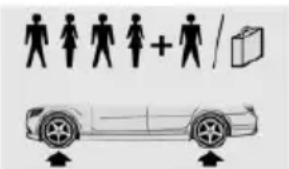 |
| 225/50 R 17 94 V M +S A/S RSC | 2.4 / 35 2.9 /42 |
| 225/50 R 17 94 H M +S RSC | |
| 225/45 R 18 91 V M +S A/S RSC | 2.6 / 38 3.1 / 45 |
| 225/45 R 18 91 Y RSC | |
| 225/45 R 18 95 V M +S XL RSC | |
| Front: 225/50 R 17 94 W RSC | 2.4 / 35 - 2.6 / 38 |
| Rear: 255/45 R 17 98 W RSC | |
| Front: 225/45 R 18 91 Y RSC | 2.6 / 38 - 2.6 / 38 |
| Rear: 255/40 R 18 95 Y RSC | |
| Tire size Pressure specifications in bar/PSI | ||
| Front: 225/40 R 19 | 2.6 / 38 | - |
| 89 Y RSC | - | 2.8 / 41 |
| Rear: | ||
| 255/35 R 19 92 Y | ||
| RSC | ||
| Front: 225/35 R 20 | 2.7 / 39 | - |
| 90 Y XL RSC | - | 3.2 / 46 |
| Rear: 255/30 R 20 | ||
| 92 Y XL RSC | ||
| Compact wheel | Speed up to a max. of 50 mph / 80 km/h | |
| T 135/80 R 17 102 | ||
| M | 4.2 / 60 | |
With high-speed tuning feature
| Tire size Pressure specifications in bar/PSI | |
| Specifications in bar/PSI with cold tires | 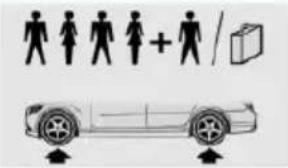 |
| 225/50 R 17 94 H M +S RSC | 2.4 / 35 2.9 /42 |
| 225/45 R 18 91 Y RSC | 2.6 / 38 3.1 / 45 |
| 225/45 R 18 95 V M +S XL RSC | |
| Front: 225/50 R 17 94 W RSC | 2.4 / 35 - 2.6 / 38 |
| Rear: 255/45 R 17 98 W RSC | |
| Front: 225/45 R 18 91 Y RSC | 2.6 / 38 - 2.6 / 38 |
| Rear: 255/40 R 18 95 Y RSC | |
| Tire size Pressure specifications in bar/PSI | ||
| Front: 225/40 R 19 | 2.6 / 38 | - |
| 89 Y RSC | - | 2.8 / 41 |
| Rear: | ||
| 255/35 R 19 92 Y | ||
| RSC | ||
| Front: 225/35 R 20 | 2.7 / 39 | - |
| 90 Y XL RSC | - | 3.2 / 46 |
| Rear: 255/30 R 20 | ||
| 92 Y XL RSC | ||
| Compact wheel | Speed up to a max. of | |
| T 135/80 R 17 102 | 50 mph / 80 km/h | |
| M | 4.2 / 60 | |
335i, 335i xDrive
Without high-speed tuning feature
| Tire size Pressure specifications in bar/PSI | |
| Specifications in bar/PSI with cold tires | 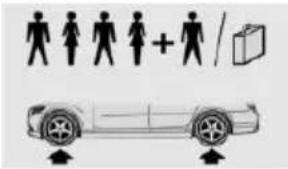 |
| 225/45 R 18 91 V M+S A/S RSC | 2.7 / 39 3.2 / 46 |
| 225/45 R 18 91 Y RSC | |
| 225/50 R 17 94 H M+S RSC | |
| 225/45 R 18 95 V M+S XL RSC | |
| Front: 225/45 R 18 91 Y RSC | 2.7 / 39 - 2.8 / 41 |
| Rear: 255/40 R 18 95 Y RSC | |
| Tire size Pressure specifications in bar/PSI | ||
| Front: 225/40 R 19 | 2.7 / 39 | - |
| 89 Y RSC | - | 3.0 / 44 |
| Rear: 255/35 R 19 | ||
| 92 Y RSC | ||
| Front: 225/35 R 20 | 2.9 /42 | - |
| 90 Y XL RSC | - | 3.4 / 49 |
| Rear: 255/30 R 20 | ||
| 92 Y XL RSC | ||
| Compact wheel | Speed up to a max. of | |
| T 135/80 R 17 102 | 50 mph / 80 km/h | |
| M | 4.2 / 60 | |
With high-speed tuning feature
| Tire size Pressure specifications in bar/PSI | |
| Specifications in bar/PSI with cold tires | |
| 225/45 R 18 91 Y RSC | 2.7 / 39 3.2 / 46 |
| 225/50 R 17 94 H M+S RSC | |
| 225/45 R 18 95 V M+S XL RSC | |
| Front: 225/45 R 18 91 Y RSC | 2.7 / 39 - |
| Rear: 255/40 R 18 95 Y RSC | 2.8 / 41 |
| Front: 225/40 R 19 89 Y RSC | 2.7 / 39 - |
| Rear: 255/35 R 19 92 Y RSC | 3.0 / 44 |
| Tire size Pressure specifications in bar/PSI | ||
| Front: 225/35 R 20 | 2.9 /42 | - |
| 90 Y XL RSC | - | 3.4 / 49 |
| Rear: 255/30 R 20 | ||
| 92 Y XL RSC | ||
| Compact wheel | Speed up to a max. of | |
| T 135/80 R 17 102 | 50 mph / 80 km/h | |
| M | 4.2 / 60 | |
Tire identification marks
Tire size
245/45 R 18 96 Y
245: nominal width in mm
45: aspect ratio in %
R: radial tire code
18: rim diameter in inches
96: load rating, not for ZR tires
Y: speed rating, before the R on ZR tires
Speed letter
Q = up to 100 mph, 160 km/h
R = up to 106 mph, 170 km/h
S = up to 112 mph, 180 km/h
T = up to 118 mph, 190 km/h
H = up to 131 mph, 210 km/h
V = up to 150 mph, 240 km/h
W = up to 167 mph, 270 km/h
Y = up to 186 mph, 300 km/h
Tire Identification Number
DOT code: DOT xxxx xxx 0814
xxxx: manufacturer code for the tire brand
xxx: tire size and tire design
0814: tire age
Tires with DOT codes meet the guidelines of the U.S. Department of Transportation.
Tire age
DOT ... 0814: the tire was manufactured in the 8th week of 2014.
Recommendation
Regardless of wear, replace tires at least every 6 years.
Uniform Tire Quality Grading
Quality grades can be found where applicable on the tire sidewall between tread shoulder and maximum section width.
For example: Treadwear 200; Traction AA; Temperature A
DOT Quality Grades
Treadwear
Traction AA A B C
Temperature A B C
All passenger car tires must conform to Federal Safety Requirements in addition to these grades.
Treadwear
The treadwear grade is a comparative rating based on the wear rate of the tire when tested under controlled conditions on a specified government test course. For example, a tire graded 150 would wear one and one-half, 1 g, times as well on the government course as a tire graded 100. The relative performance of tires depends upon the actual conditions of their use, however, and may depart significantly from the norm due to variations in driving habits, service practices and differences in road characteristics and climate.
Traction
The traction grades, from highest to lowest, are AA, A, B, and C.
Those grades represent the tire's ability to stop on wet pavement as measured under controlled conditions on specified government test surfaces of asphalt and concrete. A tire marked C may have poor traction performance.
The traction grade assigned to this tire is based on straight-ahead braking traction tests, and does not include acceleration, cornering, hydroplaning, or peak traction characteristics.
Temperature
The temperature grades are A, the highest, B, and C, representing the tire's resistance to the generation of heat and its ability to dissipate heat when tested under controlled conditions on a specified indoor laboratory test wheel. Sustained high temperature can cause the material of the tire to degenerate and reduce tire life, and excessive temperature can lead to sudden tire failure. The grade C corresponds to a level of performance which all passenger car tires must meet under the Federal Motor Vehicle Safety Standard No. 109. Grades Band A represent higher levels of performance on the laboratory test wheel than the minimum required by law.

Temperature grade for this tire
The temperature grade for this tire is established for a tire that is properly inflated and not overloaded. Excessive speed, underinflation, or excessive loading, either separately or in combination, can cause heat buildup and possible tire failure.
If necessary, have the vehicle towed.
RSC - Run-flat tires
Run-flat tires, refer to page 195, are labeled with a circular symbol containing the letters RSC marked on the sidewall.
M+S
Winter and all-season tires with better cold weather performance than summer tires.
Tire tread
Summer tires
Do not drive with a tire tread depth of less than 0.12 in/3 mm.
There is an increased danger of hydroplaning if the tread depth is less than 0.12 in/3 mm.
Winter tires
Do not drive with a tire tread depth of less than 0.16 in/4 mm.
Below a tread depth of 0.16 in/4 mm, tires are less suitable for winter operation.
Minimum tread depth
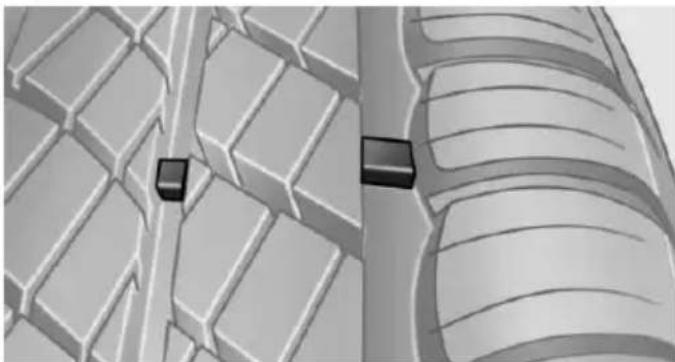
natural_image
3D rendered diagram of a mechanical component with grid-like surfaces and two black square markers (no text or symbols)Wear indicators are distributed around the tire's circumference and have the legally required minimum height of 0.063 in/1.6 mm.
They are marked on the side of the tire with TWI, Tread Wear Indicator.
Tire damage
General information
Inspect your tires often for damage, foreign objects lodged in the tread, and tread wear.
Notes
Driving over rough or damaged road surfaces, as well as debris, curbs and other obstacles can cause serious damage to wheels, tires and suspension parts. This is more likely to occur with low-profile tires, which provide less cush-
ioning between the wheel and the road. Be careful to avoid road hazards and reduce your speed, especially if your vehicle is equipped with low-profile tires.
Indications of tire damage or other vehicle defects:
▶ Unusual vibrations during driving.
▶ Unusual handling such as a strong tendency to pull to the left or right.
Damage can, e. g., be caused by driving over curbs, road damage, or similar things.

In case of tire damage
If there are indications of tire damage, reduce your speed immediately and have the wheels and tires checked right away; otherwise, there is the increased risk of an accident.
Drive carefully to the nearest service center. Have the vehicle towed or transported there. Otherwise, tire damage can become life threatening for vehicle occupants and also other road users.

Repair of tire damage
For safety reasons, the manufacturer of your vehicle recommends that you do not have damaged tires repaired; they should be replaced. Otherwise, damage can occur as a result.
Changing wheels and tires
Mounting

Information on mounting tires
Have mounting and balancing performed only by a service center.
If this work is not carried out properly, there is the danger of subsequent damage and related safety hazards.
Wheel and tire combination
You can ask the service center about the right wheel/tire combination and wheel rim versions for the vehicle.
Incorrect wheel and tire combinations impair the function of a variety of systems such as ABS or DSC.
To maintain good handling and vehicle response, use only tires with a single tread configuration from a single manufacturer.
Following tire damage, have the original wheel and tire combination remounted on the vehicle as soon as possible.

Approved wheels and tires
You should only use wheels and tires
that have been approved by the vehicle manufacturer for your vehicle type; otherwise, for example, despite having the same official size ratings, variations can lead to body contact and with it, the risk of severe accidents
The manufacturer of your vehicle cannot evaluate non-approved wheels and tires to determine if they are suited for use, and therefore cannot ensure the operating safety of the vehicle if they are mounted.
Recommended tire brands
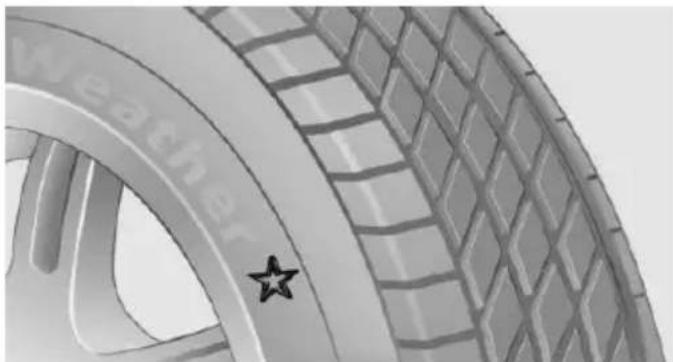
natural_image
Close-up of a car tire with a star marking on the side (no text or symbols visible)For each tire size, the manufacturer of your vehicle recommends certain tire brands. These can be identified by a star on the tire sidewall.
With proper use, these tires meet the highest standards for safety and handling.
New tires
Due to technical factors associated with their manufacture, tires do not achieve their full traction potential until after an initial breaking-in period.
Drive conservatively for the first 200 miles/300 km.
Retreaded tires
The manufacturer of your vehicle does not recommend the use of retreaded tires.

Retreaded tires
Possibly substantial variations in the design and age of the tire casing structures can limit service life and have a negative impact on road safety.
Winter tires
Winter tires are recommended for operating on winter roads.
Although so-called all-season M+S tires do provide better winter traction than summer tires, they do not provide the same level of performance as winter tires.
Maximum speed of winter tires
If the maximum speed of the vehicle is higher than the permissible speed for the winter tires, then display a corresponding sign in the field of vision. You can obtain this sign from the tire specialist or from your service center.

Maximum speed for winter tires
Do not exceed the maximum speed for the respective winter tires; otherwise, tire damage and accidents can occur.
Run-flat tires
If you are already using run-flat tires, for your own safety you should replace them only with the same kind. No spare tire is available in the case of a flat tire. Your service center will be glad to advise you.
Rotating wheels between axles
Different wear patterns can occur on the front and rear axles depending on individual driving conditions. The tires can be rotated between the axles to achieve even wear. Your service center will be glad to advise you. After rotating, check the tire pressure and correct if necessary.
Rotating the tires is not permissible on vehicles with different tire sizes on the front and rear axles, i.e. when using different types of tires.
Storage
Store wheels and tires in a cool, dry place with as little exposure to light as possible.
Always protect tires against all contact with oil, grease and fuels.
Do not exceed the maximum tire inflation pressure indicated on the side wall of the tire.
Run-flat tires
Label
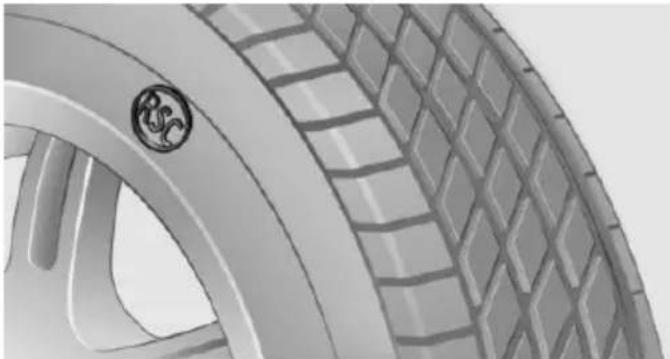
natural_image
Close-up of a car tire with a logo on the rim, showing tread pattern and side teeth (no text or symbols)RSC label on the tire sidewall.
The wheels are composed of special rims and tires that are self-supporting, to a limited degree.
The support of the sidewall allows the tire to remain drivable to a restricted degree in the event of a pressure loss.
FTM: continued driving with a damaged tire, refer to page 102.
TPM: continued driving with a damaged tire, refer to page 99.
Changing run-flat tires
For your own safety, only use run-flat tires. No spare tire is available in the case of a flat tire. Your service center will be glad to advise you.
Snow chains
Fine-link snow chains
Only certain types of fine-link snow chains have been tested by the manufacturer of the vehicle, classified as road-safe and approved.
Information about the approved snow chains are available from the service center.
Use
Use only in pairs on the rear wheels, equipped with the tires of the following size:
205/60 R 16.
225/55 R 16.
225/50 R 17.
225/45 R 18.
Follow the chain manufacturer's instructions.
Make sure that the snow chains are always sufficiently tight. Retighten as needed according to the chain manufacturer's instructions.
Do not initialize the Flat Tire Monitor after mounting snow chains, as doing so may result in incorrect readings.
Do not initialize the Tire Pressure Monitor after mounting snow chains, as doing so may result in incorrect readings.
When driving with snow chains, briefly activate Dynamic Traction Control if necessary.
Maximum speed with snow chains
Do not exceed a speed of 30 mph/50 km/h when using snow chains.
Engine compartment
Vehicle equipment
All standard, country-specific and optional equipment that is offered in the model series is described in this chapter. Therefore, equip-
ment is also described that is not available in a vehicle, e. g., because of the selected optional equipment or country variant. This also applies for safety-related functions and systems.
Important features in the engine compartment
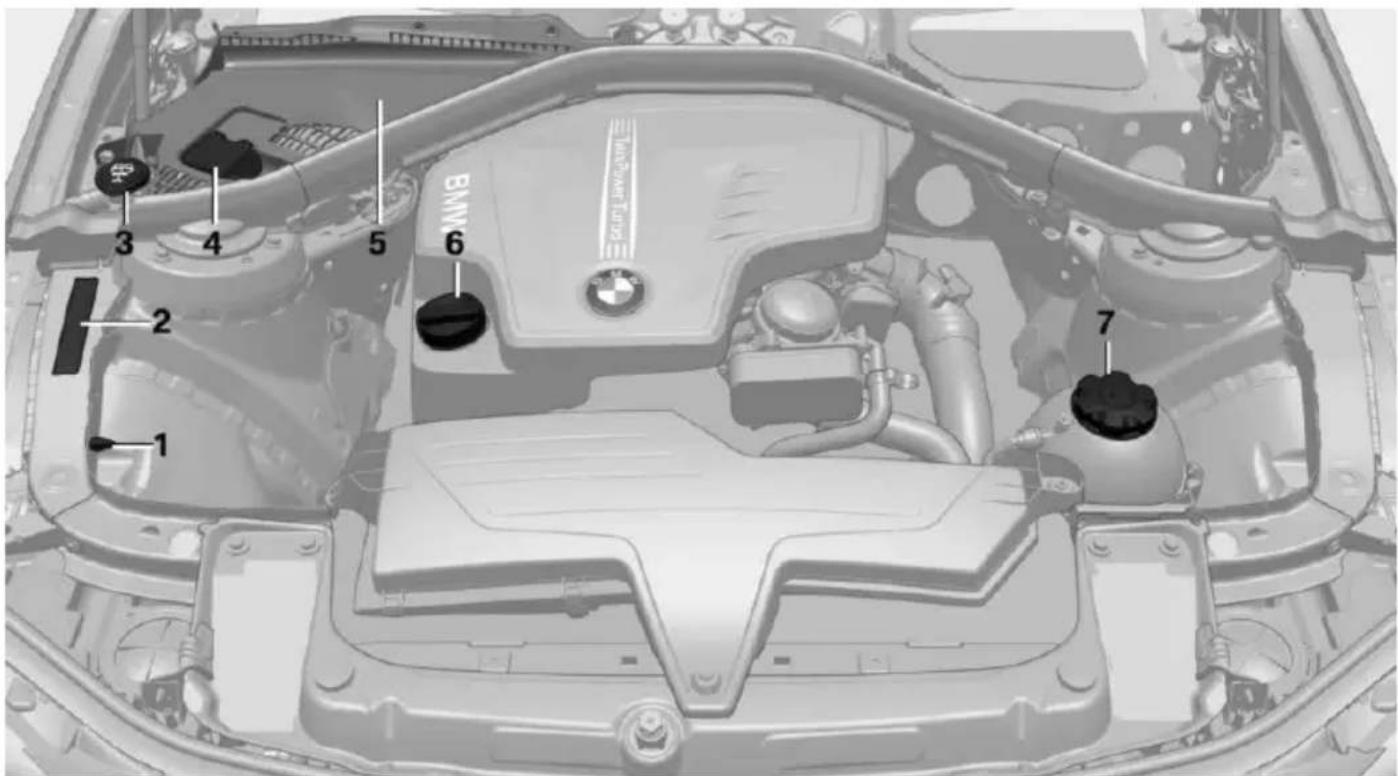
text_image
BMW Zurichan 1 2 3 4 5 6 71 Jump-starting, negative terminal
2 Vehicle identification number
3 Washer fluid reservoir
4 Jump-starting, positive terminal
5 Engine compartment fuse box
6 Oil filler neck
7 Coolant reservoir
The coolant reservoir for 6-cylinder and diesel engines is located on the opposite side of the engine compartment.
Hood
Hints

Working in the engine compartment
Never attempt to perform any service or repair operations on your vehicle without the necessary professional technical training.
If you are unfamiliar with the statutory guidelines, have any work on the vehicle performed only by a service center.
If this work is not carried out properly, there is the danger of subsequent damage and related safety hazards.

Never reach into the engine compartment
Never reach into the intermediate spaces or gaps in the engine compartment. Otherwise, there is risk of injury, e.g., from rotating or hot parts.

Fold down wiper arm
Before opening the hood, ensure that the wiper arms are against the windshield, or this may result in damage.
Opening the hood
- Pull lever in the interior:
Engine is released, arrow 1.
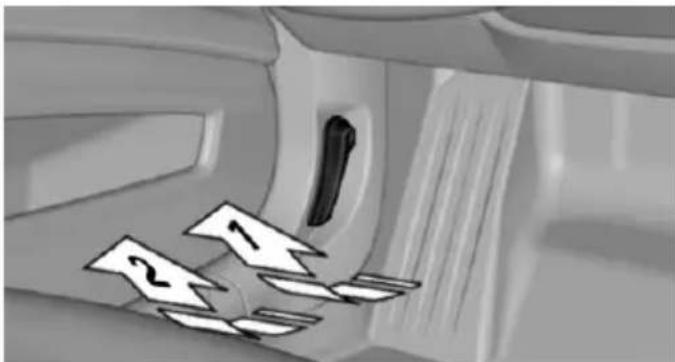
natural_image
Interior view of a car showing a door, seatbelt, and directional arrows (no text or symbols)- After the lever is released, pull the lever again:
Hood can be opened, arrow 2.
Indicator/warning lamps
When the hood is opened, a Check Control message is displayed.
Closing the hood
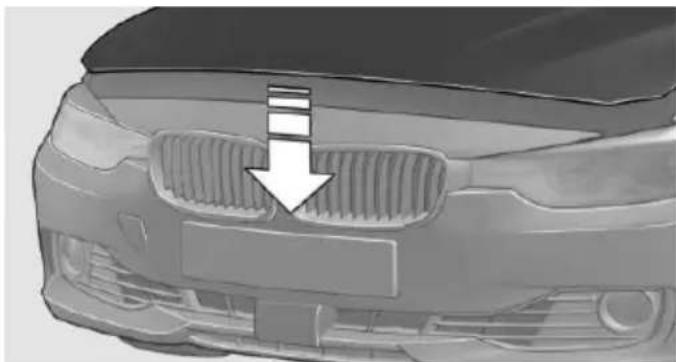
natural_image
Front view of a car's head with grille and side panel, showing a white arrow pointing to the grille (no text or symbols)Let the hood drop from a height of approx. 16 in/40 cm and push down on it to lock it fully.
The hood must audibly engage on both sides.

Hood open when driving
If you see any signs that the hood is not completely closed while driving, pull over immediately and close it securely.

Danger of pinching
Make sure that the closing path of the hood is clear; otherwise, injuries may result.
Engine oil
Vehicle equipment
All standard, country-specific and optional equipment that is offered in the model series is described in this chapter. Therefore, equipment is also described that is not available in a vehicle, e.g., because of the selected optional equipment or country variant. This also applies for safety-related functions and systems.
General information
The engine oil consumption is dependent on the driving style and driving conditions. When a sporty driving style is used, the engine oil consumption, for example, is clearly higher.
Therefore, regularly check the engine oil level after refueling.
Depending on its engine, the vehicle is equipped with electronic oil measurement or measuring is done with a dipstick.
The electronic oil measurement has two measuring principles.
▶ Status display
▶ Detailed measurement
Checking the oil level electronically
Status display
The concept
The oil level is monitored electronically during driving and shown on the Control Display.
If the oil level reaches the minimum level, a check control message is displayed.
Requirements
A current measured value is available after approx. 30 minutes of driving. During a shorter trip, the status of the last, sufficiently long trip is displayed.
With frequent short-distance trips, regularly perform a detailed measurement.
Displaying the oil level
-
"Vehicle Info"
-
"Vehicle status"
-
"Engine oil level"
Oil level display messages
Different messages appear on the display depending on the oil level. Pay attention to these messages.
If the engine oil level is too low, within the next 125 miles/200 km Add oil, refer to page 199.

Engine oil level too low
Add oil immediately; otherwise, an insufficient amount of engine oil could result in engine damage.
Take care not to add too much engine oil.

Too much engine oil
Have the vehicle checked immediately; otherwise, surplus oil can lead to engine damage.
Detailed measurement
The concept
In the detailed measurement the oil level is checked and displayed via a scale.
During the measurement, the idle speed is increased somewhat.
General information
A detailed measurement is only possible with certain engines.
Requirements
▶ Vehicle is on level road.
▶ Manual transmission: shift lever in neutral position, clutch and accelerator pedals not depressed.
▶ Automatic transmission: selector lever in selector lever position N or P and accelerator pedal not depressed.
▶ Engine is running and is at operating temperature.
Performing a detailed measurement
In order to perform a detailed measurement of the engine oil level:
- "Vehicle Info"
- "Vehicle status"
- "Measure engine oil level"
- "Start measurement"
The oil level is checked and displayed via a scale.
Duration: approx. 1 minute.
Adding engine oil
General information
Switch off the ignition and safely park the vehicle before engine oil is added.
Filler neck
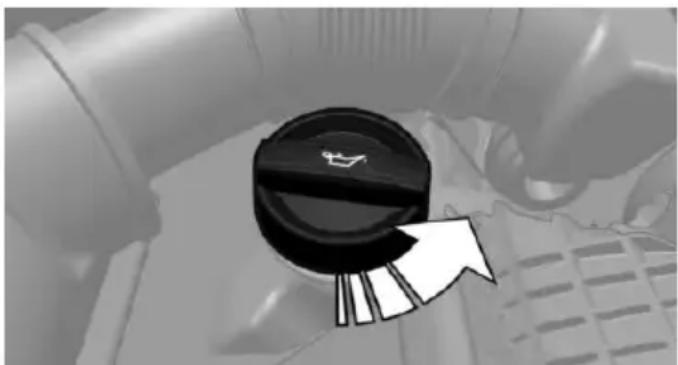
natural_image
Close-up of a black circular mechanical knob with a white star symbol, pointing to a grid pattern (no text or symbols visible)Only add 1 US quart/liter of oil when the message is displayed in the instrument cluster.
Adding oil Add oil within the next 125 miles/200 km. Otherwise, the engine may be damaged.
Do not add too much engine oil When too much engine oil is added, immediately have the vehicle checked, otherwise, this may cause engine damage.
Protect children Keep oil, grease, etc., out of reach of children and heed the warnings on the containers to prevent health risks.
Oil types for refilling
Hints
No oil additives Oil additives may lead to engine damage.
Viscosity grades for engine oils When selecting an engine oil, ensure that the engine oil belongs to one of the viscosity grades SAE 0W-40, SAE 0W-30, SAE 5W-40, and SAE 5W-30 or malfunctions or engine damage may occur.
The engine oil quality is critical for the life of the engine.
Approved oil types
You can add oils with the following specifications:
Gasoline engine
BMW Longlife-01.
BMW Longlife-01 FE.
Diesel engine
BMW Longlife-04.
Additional information about the approved types of oils can be requested from the service center.
Alternative oil types
If the approved engine oils are not available, up to 1 US quart/liter of an oil with the following specification can be added:
Gasoline engine
API SM or superior grade specification.
Diesel engine
API ILSAC GF-5.
Engine oil change:
The vehicle manufacturer recommends that you let the service center change the motor oil.
BMW recommends Castrol
Coolant
Vehicle equipment
All standard, country-specific and optional equipment that is offered in the model series is described in this chapter. Therefore, equipment is also described that is not available in a vehicle, e.g., because of the selected optional equipment or country variant. This also applies for safety-related functions and systems.
Hints

Danger of burns from hot engine
Do not open the cooling system while
the engine is hot; otherwise, escaping coolant may cause burns.

Suitable additives
Only use suitable additives; otherwise,
engine damage may occur. The additives are harmful to your health.
Coolant consists of water and additives.
Not all commercially available additives are suitable for the vehicle. Information about the suitable additives are available from the service center.
Coolant level
General information
Depending on the engine installation, the coolant reservoir may be located on the opposite side of the engine compartment.
Checking
- Let the engine cool.
- The coolant level is correct if it lies between the minimum and maximum marks.
The marks are on the side of the coolant reservoir.
Symbol Meaning
| ▽ | Maximum |
| △ | Minimum |
Adding
- Let the engine cool.
- Turn the cap of the coolant reservoir slightly counterclockwise to allow any excess pressure to dissipate, and then open it.
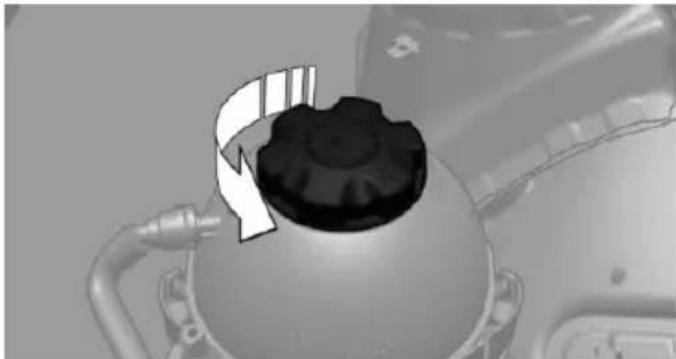
natural_image
Close-up of a mechanical component with a black gear-like top and directional arrow indicating rotation (no text or symbols)- If the coolant is low, slowly add coolant up to the specified level; do not overfill.
- Turn the cap until there is an audible click. The arrows on the coolant reservoir and the cap must point towards one another.
- Have the cause of the coolant loss eliminated as soon as possible.
Disposal

Comply with the relevant environmental protection regulations when disposing of coolant and coolant additives.
Maintenance
Vehicle equipment
All standard, country-specific and optional equipment that is offered in the model series is described in this chapter. Therefore, equipment is also described that is not available in a vehicle, e.g., because of the selected optional equipment or country variant. This also applies for safety-related functions and systems.
BMW maintenance system
The maintenance system indicates required maintenance measures, and thereby provides support in maintaining road safety and the operational reliability of the vehicle.
Condition Based Service CBS
Sensors and special algorithms take into account the driving conditions of your vehicle. Based on this, Condition Based Service determines the maintenance requirements.
The system makes it possible to adapt the amount of maintenance you need to your user profile.
Detailed information on service requirements, refer to page 80, can be displayed on the Control Display.
Service data in the remote control
Information on the required maintenance is continuously stored in the remote control. Your service center will read out this data and suggest the right array of service procedures for your vehicle.
Therefore, hand your service specialist the remote control with which the vehicle was driven most recently.
Storage periods
Storage periods during which the vehicle battery was disconnected are not taken into account.
If this occurs, have a service center update the time-dependent maintenance procedures, such as checking brake fluid and, if necessary, changing the engine oil and the microfilter/activated-charcoal filter.
Service and Warranty Information Booklet for US models and Warranty and Service Guide Booklet for Canadian models
Please consult your Service and Warranty Information Booklet for US models and Warranty and Service Guide Booklet for Canadian models for additional information on service requirements.
Maintenance and repair should be performed by your service center. Make sure to have regular maintenance procedures recorded in the vehicle's Service and Warranty Information Booklet for US models, and in the Warranty and Service Guide Booklet for Canadian models. These entries are proof of regular maintenance.
Socket for OBD Onboard Diagnosis
Note

Socket for Onboard Diagnosis
The socket for onboard diagnostics may only be used by the service center or a workshop that operates in accordance with the specifications of the vehicle manufacturer with
correspondingly trained personnel and other authorized persons. Otherwise, use may result in operating problems for the vehicle.
Position
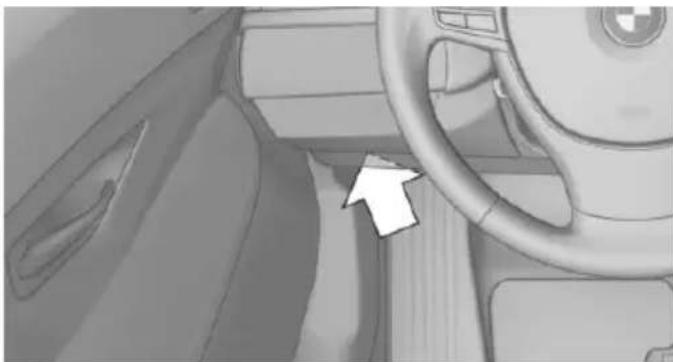
natural_image
Interior view of a car dashboard and steering wheel (no visible text or symbols)There is an OBD socket on the driver's side for checking the primary components in the vehicle emissions.
Emissions
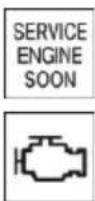
The warning lamp lights up:
Emissions are deteriorating. Have the vehicle checked as soon as possible.
Canadian model: warning light indicates the engine symbol.
The warning lamp flashes under certain circumstances:
This indicates that there is excessive mis-firing in the engine.
Reduce the vehicle speed and have the system checked immediately; otherwise, serious engine misfiring within a brief period can seriously damage emission control components, in particular the catalytic converter.
Replacing components
Vehicle equipment
All standard, country-specific and optional equipment that is offered in the model series is described in this chapter. Therefore, equipment is also described that is not available in a vehicle, e.g., because of the selected optional equipment or country variant. This also applies for safety-related functions and systems.
Onboard vehicle tool kit
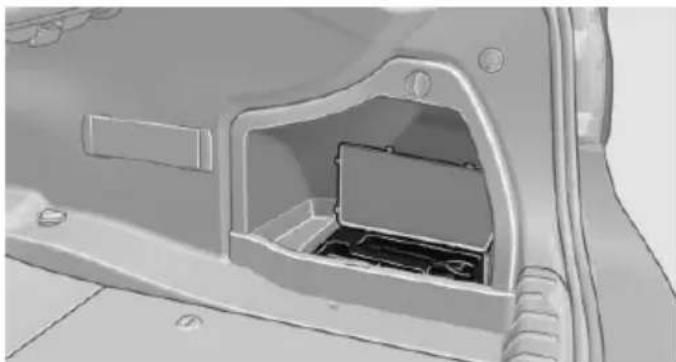
natural_image
Interior view of a vehicle showing the hood and engine compartment (no text or symbols visible)The onboard vehicle tool kit is located on the right side in the cargo area in a storage compartment. Open the cover.
Wiper blade replacement
Note

Do not fold down the wipers without wiper blades
Do not fold down the wipers if wiper blades have not been installed; this may damage the windshield.
Replacing the wiper blades
-
To change the wiper blades, fold up, refer to page 68, the wiper arms.
-
Fold up and hold the wiper arm firmly.
-
Squeeze the retainer spring, arrow 1, and fold up the wiper blade, arrow 2.
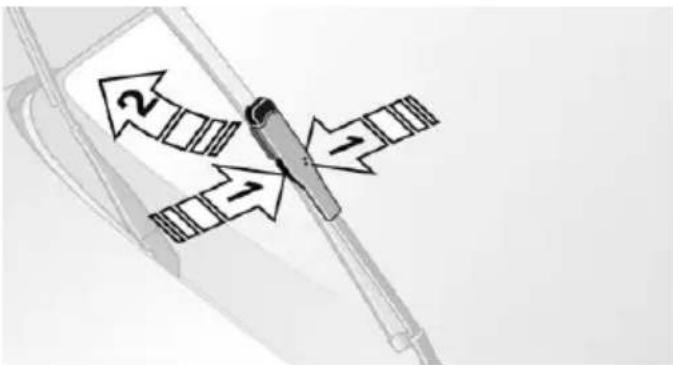
text_image
Diagram showing directional arrows with question mark and numbered boxes, possibly indicating movement or selection-
Remove the wiper blade forward from the catch.
-
Insert the new wiper blade in reverse order of removal until it locks in place.
-
Fold down the wipers.

Folding down wipers before opening the hood
Before opening the hood, ensure that the wiper arms with the wiper blades are against the windshield to prevent damage.
Lamp and bulb replacement
Hints
Lamps and bulbs
Lamps and bulbs make an essential contribution to vehicle safety.
The manufacturer of the vehicle recommends that you entrust corresponding procedures to the service center if you are unfamiliar with them or they are not described here.
You can obtain a selection of replacement bulbs at the service center.

Danger of burns
Only change bulbs when they are cool; otherwise, there is the danger of getting burned.

Working on the lighting system
When working on the lighting system, you should always switch off the lights affected to prevent short circuits.
To avoid possible injury or equipment damage when replacing bulbs, observe any instructions provided by the bulb manufacturer.

Do not perform work/bulb replacement on xenon headlamps
Have any work on the xenon lighting system, including bulb replacement, performed only by a service center. Due to the high voltage present in the system, there is the danger of fatal injuries if work is carried out improperly.

Do not touch the bulbs
Do not touch the glass of new bulbs with your bare hands, as even minute amounts of contamination will burn into the bulb's surface and reduce its service life.
Use a clean tissue, cloth or something similar, or hold the bulb by its base.
Light-emitting diodes (LEDs)
Some items of equipment use light-emitting diodes installed behind a cover as a light source.
These light-emitting diodes, which are related to conventional lasers, are officially designated as Class 1 light-emitting diodes.

Do not remove the covers
Do not remove the covers, and never stare into the unfiltered light for several hours; otherwise, irritation of the retina could result.
Headlamp glass
Condensation can form on the inside of the external lamps in cool or humid weather. When driving with the light switched on, the condensation evaporates after a short time. The headlamp glasses do not need to be changed.
If the headlamps do not dim despite driving with the light switched on, increasing humidity forms, e. g. water droplets in the light, have the service center check this.
Headlamp setting
The headlamp adjustments can be affected by changing lamps and bulbs. Therefore after a change, have the headlamp setting checked and corrected by Service.
Front lamps, bulb replacement
Halogen headlamps
Headlamps
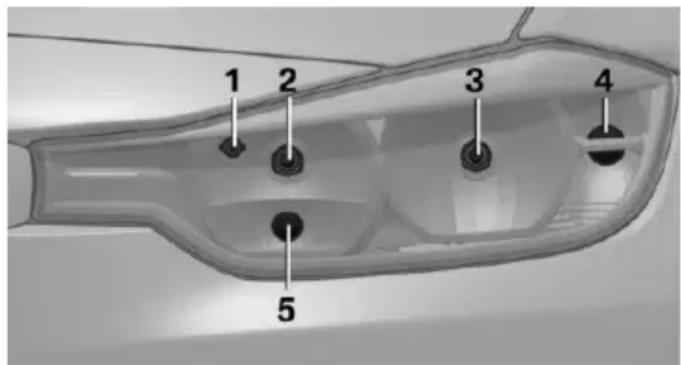
text_image
1 2 3 4 51 Parking lamps
2 High beams/headlamp flasher
3 Low beams
4 Turn signal
5 Daytime running lights
Accessing the turn signals and low beams
Follow general instructions, refer to page 204.
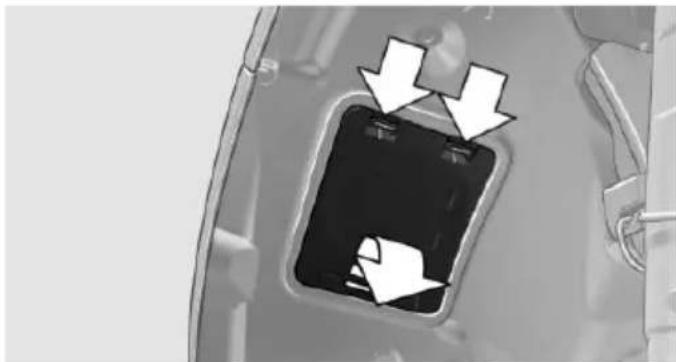
natural_image
Close-up of a car door panel with arrows pointing to internal components (no text or symbols visible)In the wheel house, loosen the two brackets and remove the cover.
Turn signal
21-watt bulb, PY21W
- If necessary, pull the inside trim of the wheel house slightly inward. Turn the bulb holder counterclockwise and remove.
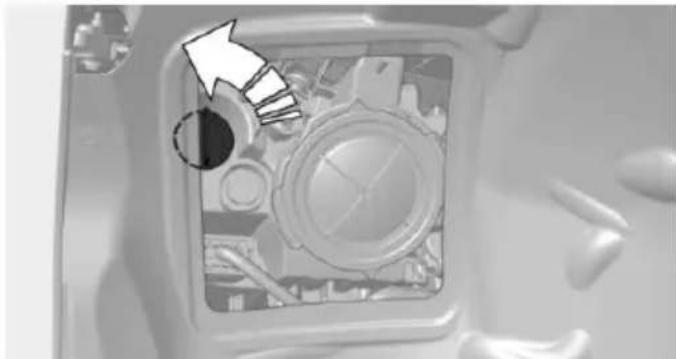
natural_image
Close-up of a mechanical component with a highlighted section showing internal gears and a directional arrow (no text or symbols)-
Press the bulb gently into the socket, turn counterclockwise and remove.
-
Install the new bulb and bulb holder in reverse order of removal.
-
Attach the cover to the wheel house.
Low beams
55-watt bulb, H7.
- Turn the cap counterclockwise and remove.
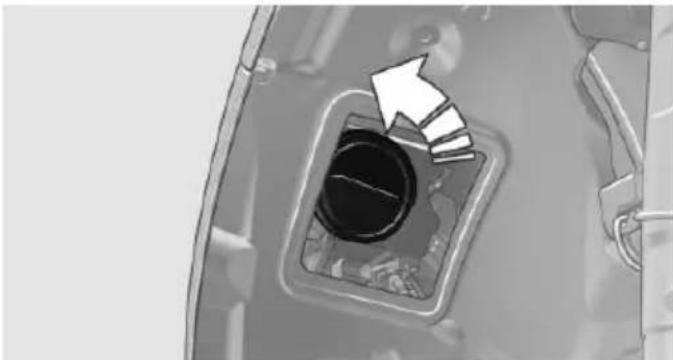
natural_image
Close-up of a mechanical component with a circular opening and directional arrow indicating motion (no text or symbols)- Tilt the bulb down and then up to loosen it from the holder and remove.
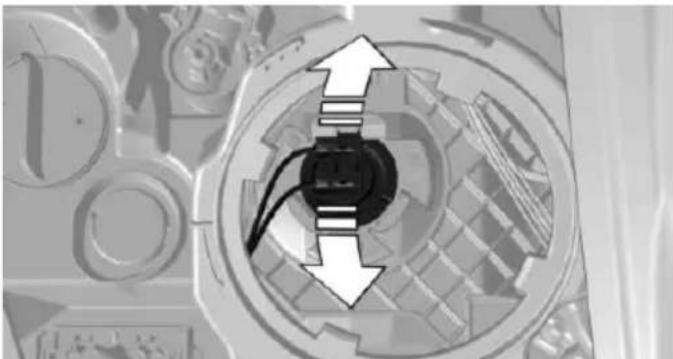
natural_image
Abstract mechanical diagram with gear and circuit components, no visible text or symbols-
Pull the connector off the bulb.
-
Attach the connector to the new bulb.
-
First insert the bulb at the top with the strap, arrow 1, and then press down firmly, arrow 2. Make sure that the bulb snaps into place.
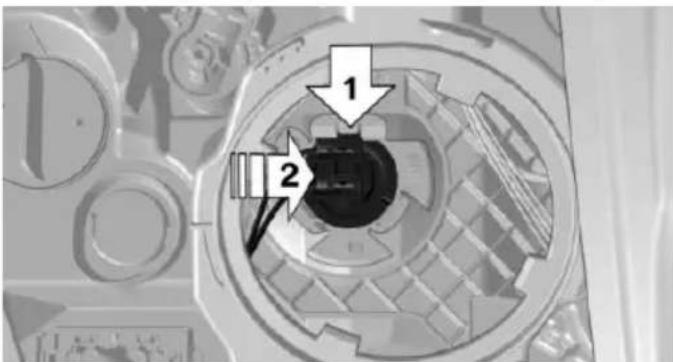
text_image
Technical diagram showing a mechanical component with numbered parts and directional arrows indicating assembly or alignment.-
Close the headlamp housing with the cap. Make sure that the cap engages.
-
Attach the cover to the wheel house.
Accessing the daytime running lights, high beams/headlamp flasher and parking lamps
Follow general instructions, refer to page 204.
- Open the hood, refer to page 197.
- Turn the cap counterclockwise and remove.
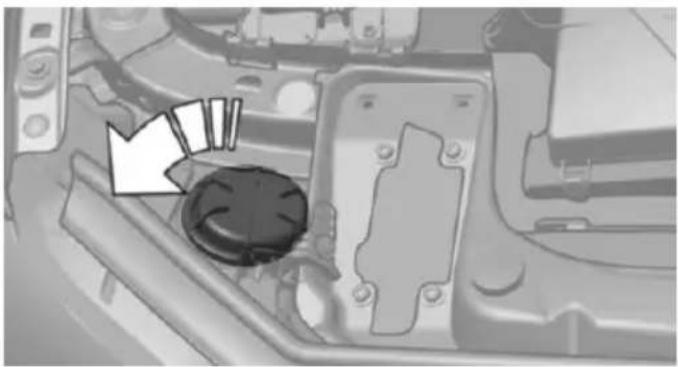
natural_image
Close-up of a car engine compartment with a circular component and directional arrow overlay (no text or symbols)Parking lamps
6-watt bulb, H6W.
- Turn the bulb holder counterclockwise and remove.
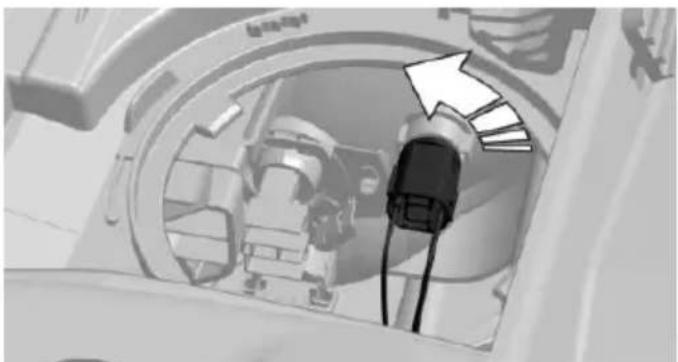
natural_image
Close-up of a mechanical component with a highlighted cable and arrow indicating direction (no text or symbols)- Press the bulb gently into the socket, turn counterclockwise and remove.
- To insert the bulb and bulb holder, proceed in reverse order of removal. Make sure that the bulb holder snaps into place.
- Close the headlamp housing with the cap. Make sure that the cap engages.
High beams/headlamp flasher
55-watt bulb, H7.
- Tilt the bulb down and then up to loosen it from the holder and remove.
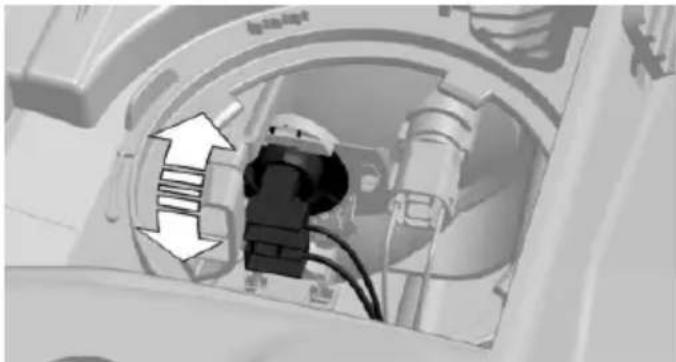
natural_image
Interior view of a mechanical device showing internal components and directional arrows (no text or symbols)- Pull the connector off the bulb.
- Attach the connector to the new bulb.
- First insert the bulb at the top with the strap, arrow 1, and then press down firmly, arrow 2. Make sure that the bulb snaps into place.
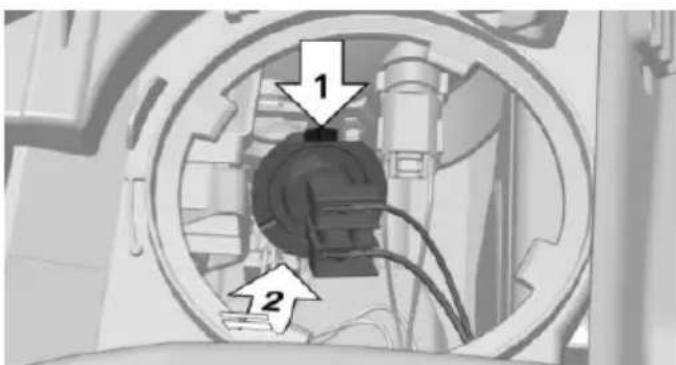
text_image
Technical diagram showing a mechanical component with numbered callouts indicating parts 1 and 2.- Close the headlamp housing with the cap. Make sure that the cap engages.
Daytime running lights
- If necessary, remove the high beam bulb connector.
- Remove the bulb holder.
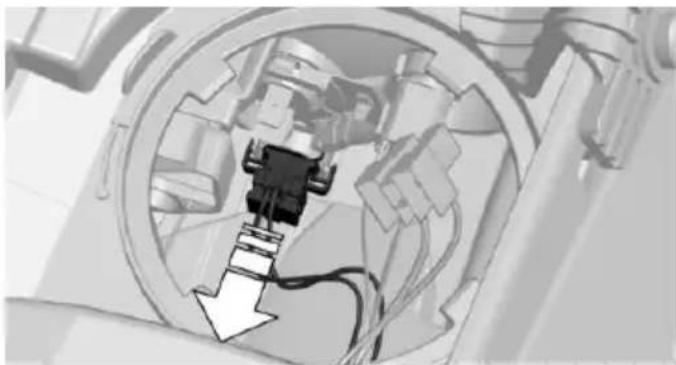
natural_image
Mechanical assembly diagram showing a central component with a downward arrow, enclosed within a circular housing (no text or symbols)- Remove the bulb from the bulb holder.
- To insert the new bulb, proceed in reverse order of removal. During insertion, the bottom of the bulb holder must be facing downward. Make sure that the bulb holder snaps into place.
- Attach the high beam bulb connector.
- Close the headlamp housing with the cap. Make sure that the cap engages.
Xenon headlamps
Xenon headlamps
Because of the long life of these bulbs, the likelihood of failure is very low. Switching the lamps on and off frequently shortens their life.
If a bulb fails, switch on the front fog lamps and continue the trip with great care. Comply with local regulations.

Do not perform work/bulb replacement on xenon headlamps
Have any work on the xenon lighting system, including bulb replacement, performed only by a service center. Due to the high voltage present in the system, there is the danger of fatal injuries if work is carried out improperly.
For checking and adjusting headlamp aim, please contact your BMW center.
Headlamps
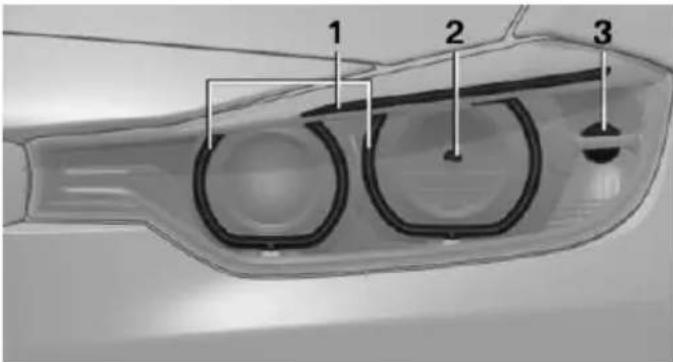
text_image
1 2 31 Parking lamps / daytime running lights
2 Low beams/high beams/headlamp flasher
3 Turn signal
Low beams and high beams are designed with xenon technology.
The parking lamps and daylight running lights are made using LED technology.
Contact your service center in the event of a malfunction.
Turn signal
Follow general instructions, refer to page 204.
21-watt bulb, PY21W
- In the wheel house, loosen the two brackets and remove the cover.
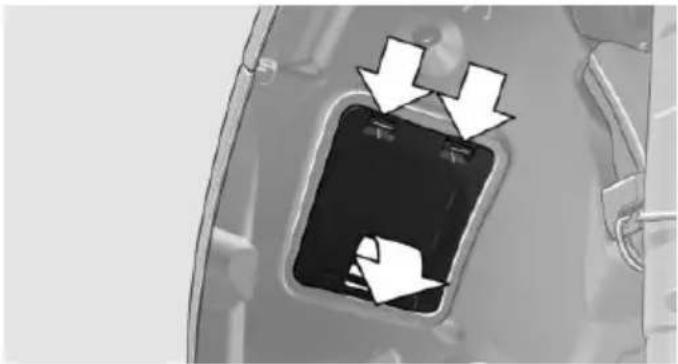
natural_image
Close-up of a car door panel with arrows pointing to internal components (no text or symbols visible)- If necessary, pull the inside trim of the wheel house slightly inward. Turn the bulb holder counterclockwise and remove.
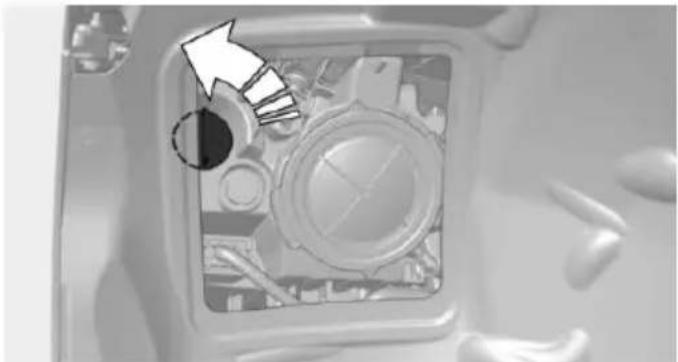
natural_image
Close-up of a mechanical component with a highlighted section showing internal gears and a white arrow pointing to a feature (no text or symbols visible)- Press the bulb gently into the socket, turn counterclockwise and remove.
- Install the new bulb and bulb holder in reverse order of removal.
- Attach the cover to the wheel house.
Front fog lamps
Follow general instructions, refer to page 204. 35-watt bulb, H8.
- Use the handle of the screwdriver from the onboard vehicle tool kit to remove the three wheel house panel screws, arrow 1.
Carefully pull back the wheel house panel, arrow 2.
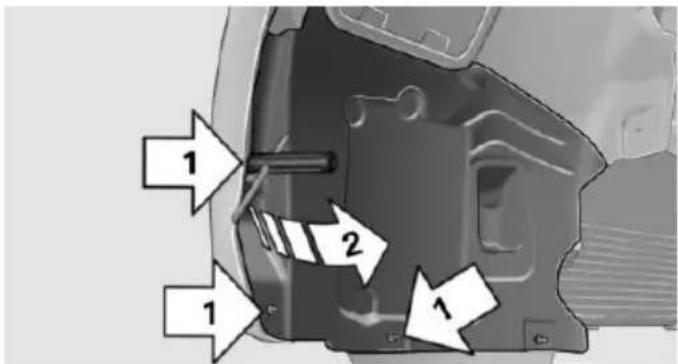
text_image
Technical diagram of a vehicle's internal components with numbered annotations pointing to specific parts.- Pull off the bulb connector, arrow 1.
Turn the bulb, arrow 2.
Left side of vehicle: turn clockwise.
Right side of vehicle: turn counterclockwise.
Remove the bulb.
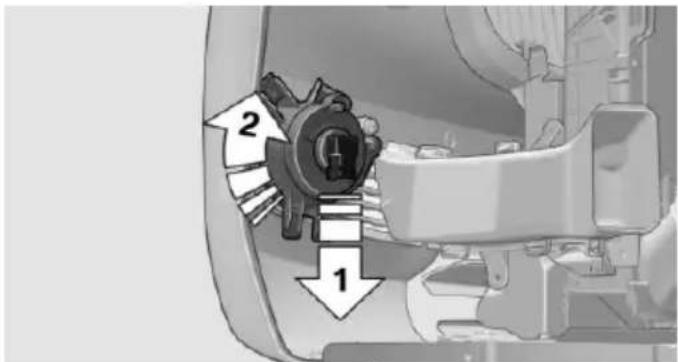
text_image
Diagram of a mechanical component with numbered parts and directional arrows indicating flow or movement.- Insert the new bulb, connect the connector and screw on the wheel house panel.
Turn signal in exterior mirror
Follow general instructions, refer to page 204. The turn signals in the exterior mirrors feature LED technology. Contact your service center in the event of a malfunction.
Tail lamps, bulb replacement
At a glance
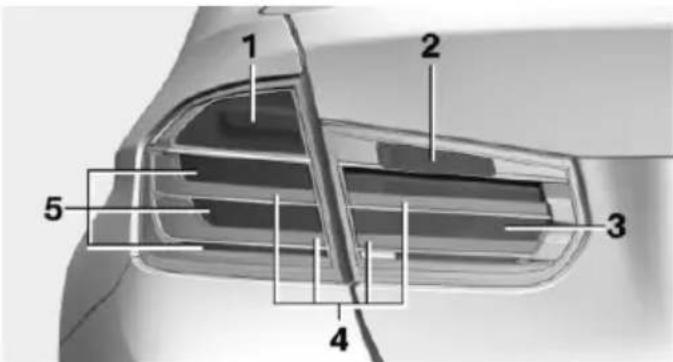
text_image
1 2 3 4 51 Turn signal
2 Reversing lamp
3 Inside brake lamp
4 Tail lamps
5 Outside brake lamp
Bulb replacement, exterior tail lamps
General information
Follow general instructions, refer to page 204.
Turn signal: 21-watt bulb, P21WLL.
Outer brake lamp: 21-watt bulb, H21W.
The tail lamps feature LED technology. Contact your service center in the event of a malfunction.

Use caution when replacing the bulb
Use caution and proceed one step at a
time when replacing the bulbs to prevent damage to the tail lamps or vehicle.
Removing the exterior tail lamp
- Open trunk lid.
- Use the screwdriver from the onboard vehicle tool kit to loosen the screw, arrow 1, and remove the cover, arrow 2.
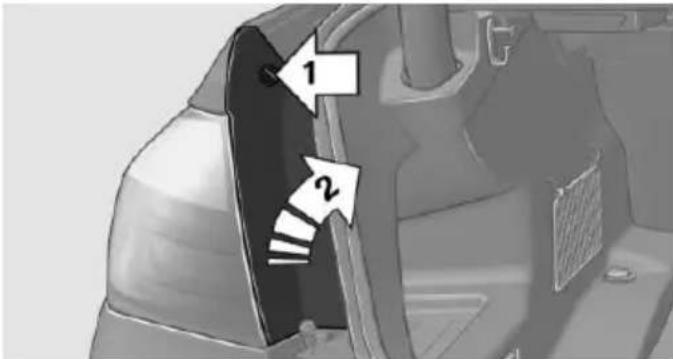
text_image
Diagram of a vehicle's rearview and side profile with numbered arrows indicating components- Use the screwdriver handle to loosen the two nuts, arrows 1 and 2, and remove. The tail lamp is still attached to a rubber mount on the outside.
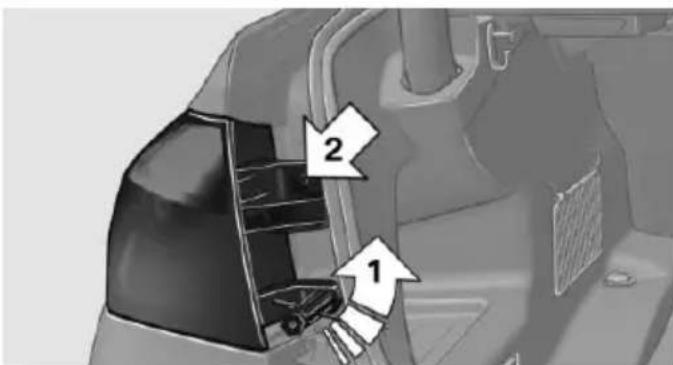
text_image
Diagram of a vehicle's rearview compartment with labeled parts 1 and 2, showing structural components.- Grasp the inner edge of the tail lamp and carefully swing it back and out of the rubber mount, arrow 1. Use your free hand to hold it in place in order to prevent the tail lamp from coming loose suddenly. Make sure that the foam rubber sealing ring is on the centering pin, arrow 2.
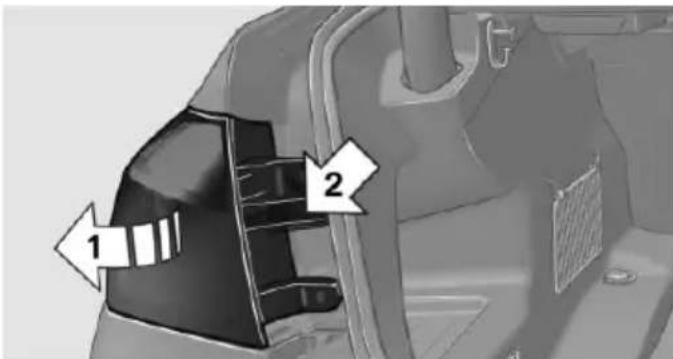
text_image
Diagram of a vehicle's rear window compartment with labeled parts 1 and 2, showing structural components.- Remove the connecting line from the clip on the bulb holder.
- Release the catch at the top on the connector of the connecting line and remove the connector from the bulb holder.
Replacing the bulbs
- Loosen the four fasteners, arrow 1, on the bulb holder and remove the bulb holder from the tail lamp, arrow 2.
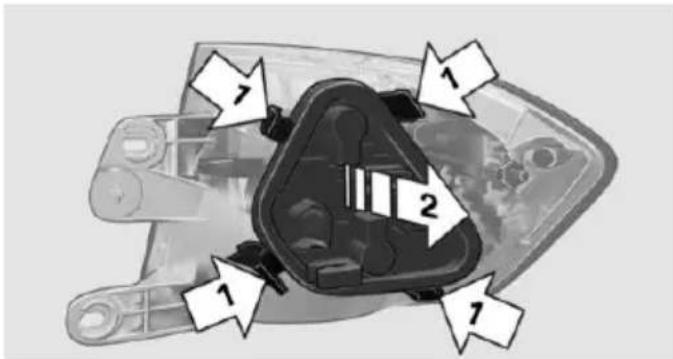
text_image
Diagram of a mechanical component with numbered parts labeled 1 and 2, showing internal structure and assembly.- Press the defective bulb gently into the socket, turn counterclockwise and remove.
- Proceed in the reverse order to insert the new bulb and attach the bulb holder. Make sure that the bulb holder engages in all fasteners.
Installing the tail lamp
- Connect the connecting line to the tail lamp and secure the bulb holder in the clip.
- Make sure that the foam rubber sealing ring is on the centering pin, arrow 2, and is not damaged.
- Position and firmly press the outer part of the tail lamp onto the rubber mount, arrow 1 and the inner part onto the centering
component, arrow 2. Make sure that the tail lamp engages in the rubber mount.
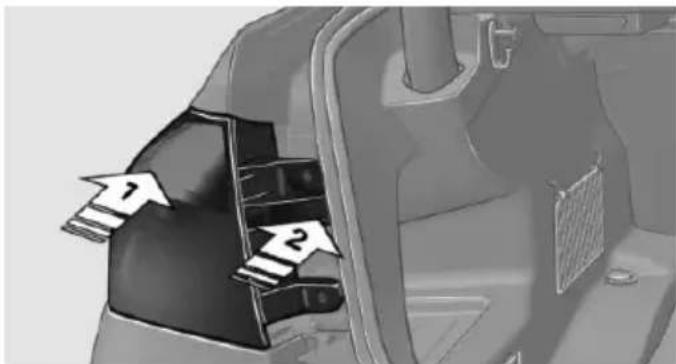
natural_image
Interior view of a vehicle showing a door panel with two numbered arrows pointing to the interior (no text or symbols present)- Screw the tail lamp on with the two nuts.
- Insert and secure the cover. Make sure that the tubular seal is not pinched.
Lamps in the trunk lid
General information
Follow general instructions, refer to page 204.
Reversing lamps: 16-watt bulb, PW16W.
Inner brake lamps: 21-watt bulb, H21W
Accessing the lamps
- Use the screwdriver from the onboard vehicle tool kit to loosen and completely remove the six screws on the trim.
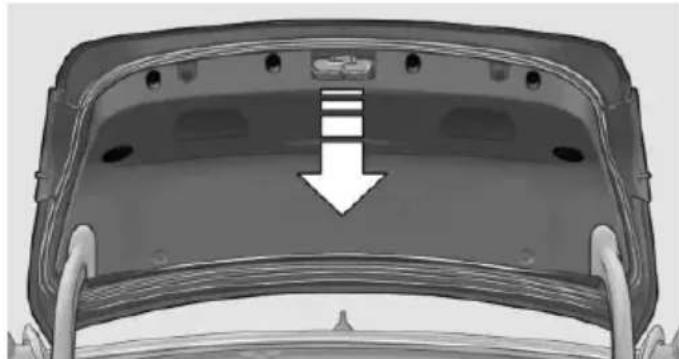
natural_image
Top-down view of a car's rear bumper with a white arrow pointing downward (no text or symbols)- Carefully loosen the trim from the trunk lid, starting at the edge and working toward the area around the recessed grips. Make sure that the trim does not become stuck.
- Carefully swing out the trim.
Replacing the reversing lamp and inner brake lamp
- Loosen the two holders, arrow 1 and pull down on the lamp holder to remove, arrow 2.
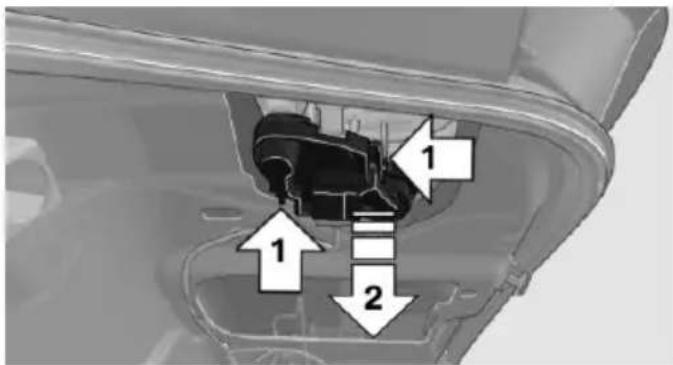
text_image
Technical diagram of a mechanical component with numbered parts and directional arrows indicating assembly or assembly steps.- Unscrew the defective bulb of the reversing or brake lamp from its socket counterclockwise.
- Insert the new bulb.
Installing the bulb holder
- Slide the bulb holder onto the two guide pins, arrow 1. Insert the two contacts, arrow 2, into the connections, arrow 3.
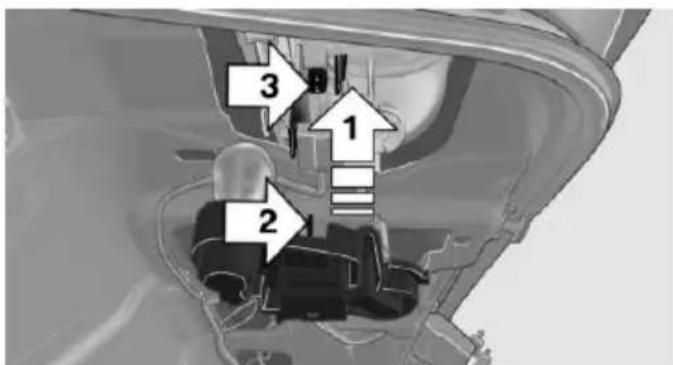
text_image
1 2 3- Press on the bulb holder. Make sure that the two exterior holders latch into place.
- Swing the trim back onto the trunk lid and secure.
Tail lamp, license plate lamp and central brake lamp
Follow general instructions, refer to page 204.
These lamps are made using LED technology. Contact your service center in the event of a malfunction.
Changing wheels
Hints
The vehicle equipment does not include a spare tire.
When using run-flat tires or tire sealants, a tire does not need to be changed immediately in the event of pressure loss due to a flat tire.
The tools for changing wheels are available as accessories from your service center.
Jacking points for the vehicle jack
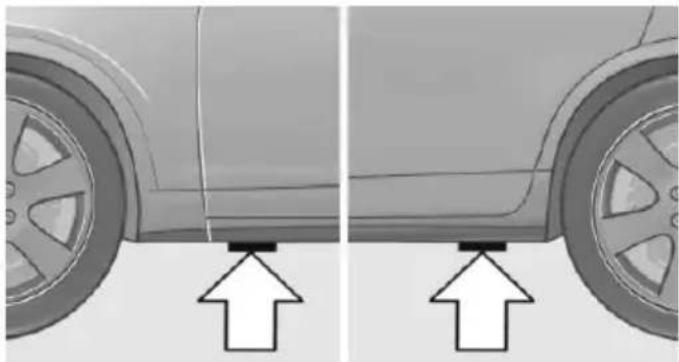
natural_image
Side view of a car showing front and side views with arrows pointing to the wheel (no text or symbols)The jacking points for the vehicle jack are located at the positions shown.
Vehicle battery
Maintenance
The battery is maintenance-free.
The added amount of acid is sufficient for the service life of the battery.
Your service center will be glad to advise you on questions regarding the battery.
Battery replacement
Use approved vehicle batteries only Only use vehicle batteries that have been approved for your vehicle by the manufacturer; otherwise, the vehicle could be damaged and systems or functions may not be fully available.
After a battery replacement, have the battery registered on the vehicle by your service center to ensure that all comfort functions are fully available and that any Check Control messages of these comfort functions are no longer displayed.
Charging the battery
Note

Do not connect charging devices to the 12 volt socket in the vehicle
Do not connect battery chargers to the factory-installed 12 volt sockets in the vehicle as this may damage the vehicle battery due to an increased power consumption.
General information
Make sure that the battery is always sufficiently charged to guarantee that the battery remains usable for its full service life.
The battery may need to be charged in the following cases:
▷ When making frequent short-distance drives.
▶ If the vehicle is not used for prolonged periods, longer than a month.
Starting aid terminals
In the vehicle, only charge the battery via the starting aid terminals, refer to page 217, in the engine compartment with the engine off.
Power failure
After a temporary power loss, some equipment needs to be reinitialized.
Individual settings need to be reprogrammed:
▶ Seat and mirror memory: store the positions again.
Time: update.
Date: update.
▶ Navigation system: wait for the operability of the navigation.
Disposing of old batteries

Have old batteries disposed of by your service center or bring them to a recycling center.
Maintain the battery in an upright position for transport and storage. Secure the battery so that it does not tip over during transport.
Fuses
Hints

Replacing fuses
Never attempt to repair a blown fuse and do not replace a defective fuse with a substitute of another color or amperage rating; this could lead to a circuit overload, ultimately resulting in a fire in the vehicle.
Plastic tweezers and information on the fuse types and locations are stored in the fuse box in the cargo area.
In the engine compartment
- Use the onboard vehicle tool kit to loosen the three cover screws, arrow 1.
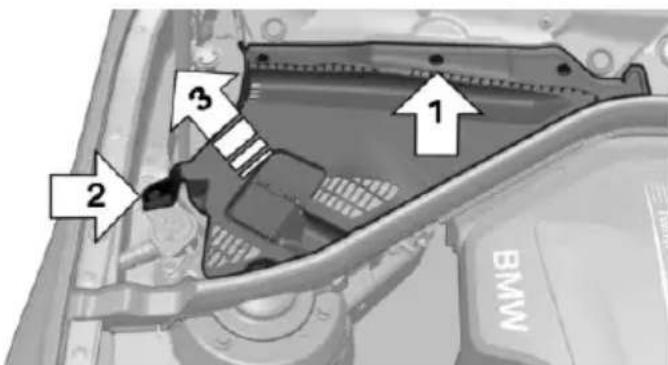
text_image
1 2 3 BMW-
Pull up the holder, arrow 2.
-
Remove the cover from one side, arrow 3.
- Press the four fasteners and remove the cover.
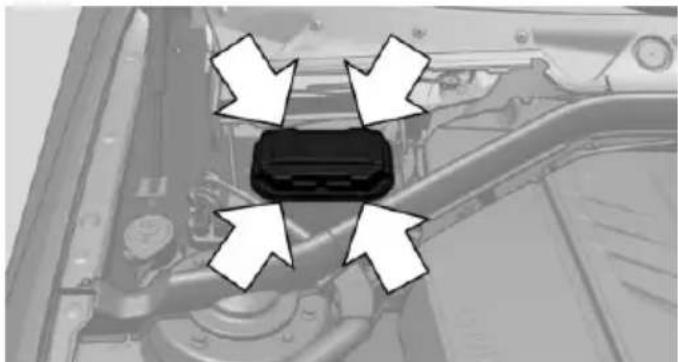
natural_image
Mechanical component with four white arrows pointing outward from a central black housing (no text or symbols)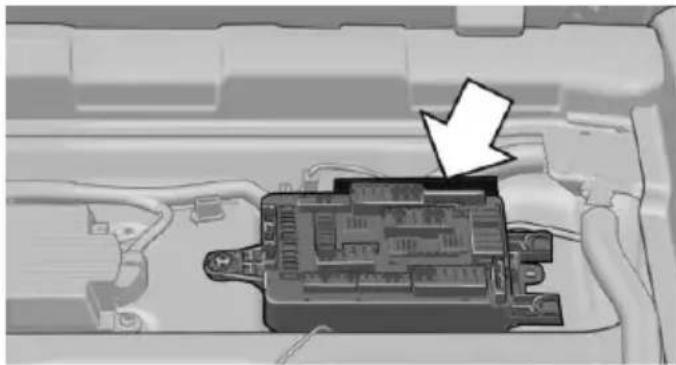
natural_image
Interior view of a vehicle battery pack with an arrow pointing to the internal components (no text or symbols visible)Information on the fuse types and locations is found on a separate sheet.
Attaching the covers
- When attaching the cover, make sure that all four fasteners are engaged.
- Attach the cover under the rubber lip and then thread it between the bars.
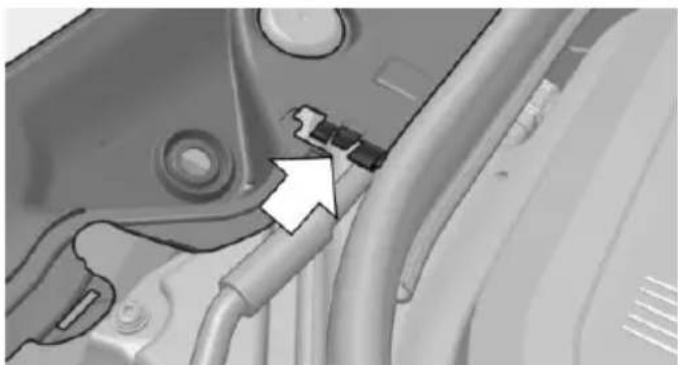
natural_image
Close-up of a mechanical component with a white arrow pointing to a connector detail (no visible text or symbols)- Press down on the holder and tighten the three screws.
In the cargo area
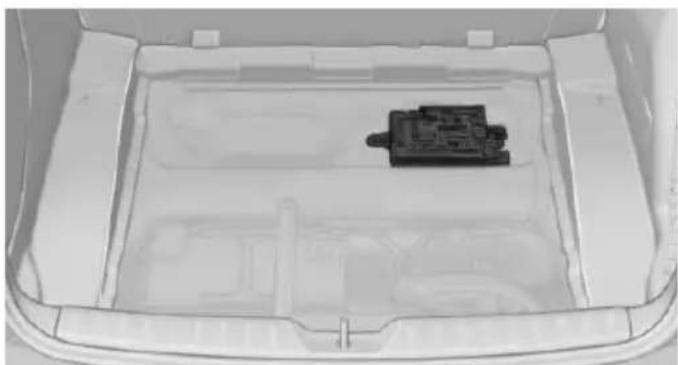
natural_image
Top-down view of a car trunk with internal compartments and a small black plastic component (no text or symbols visible)Raise the cargo floor panel.
Breakdown assistance
Vehicle equipment
All standard, country-specific and optional equipment that is offered in the model series is described in this chapter. Therefore, equipment is also described that is not available in a vehicle, e. g., because of the selected optional equipment or country variant. This also applies for safety-related functions and systems.
Hazard warning flashers
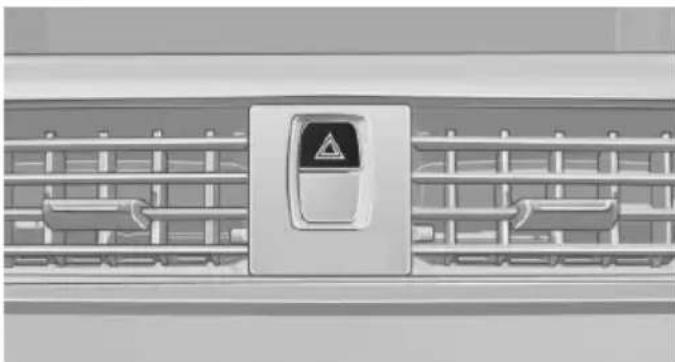
natural_image
Front view of a car air conditioner panel with warning symbol (no text or labels)The button is located in the center console.
Intelligent Emergency Request
Requirements
The radio ready state is switched on.
The Assist system is functional.
The SIM card integrated in the vehicle has been activated.
General information
Only press the SOS button in an emergency.
Hints

Emergency Request not guaranteed
For technical reasons, the Emergency
Request cannot be guaranteed under unfavorable conditions.
Initiating an Emergency Request
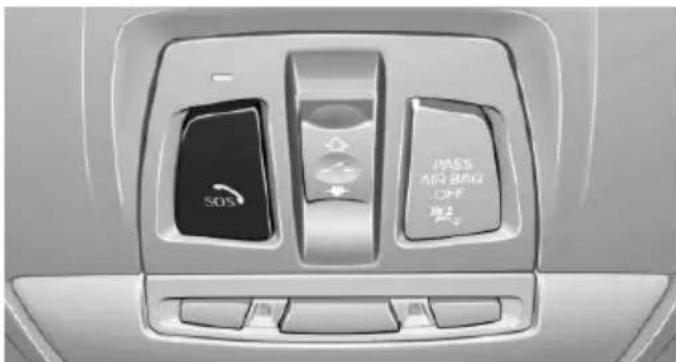
natural_image
Interior view of a car air conditioner control panel with 'SOS' and 'PASS AIR BAG OFF' buttons (no text or symbols on the panels)- Press the cover briefly to open it.
- Press the SOS button until the LED in the button lights up.
The LED lights up: an Emergency Request was initiated.
If the situation allows, wait in your vehicle until the voice connection has been established.
The LED flashes when a connection to the BMW Response Center has been established.
When the emergency request is received at the BMW Response Center, the BMW Response Center contacts you and takes further steps to help you.
Even if you are unable to respond, the BMW Response Center can take further steps to help you under certain circumstances.
For this purpose, data that are used to determine the necessary rescue measures, such as the current position of the vehicle
if it can be established, are transmitted to the BMW Response Center.
If the LED is flashing, but the BMW Response Center can no longer be heard via the speaker, you can nevertheless still be heard for the BMW Response Center.
Initiating an Emergency Request automatically
Under certain conditions, an Emergency Request is automatically initiated immediately after a severe accident. Automatic Collision Notification is not affected by pressing the SOS button.
Warning triangle
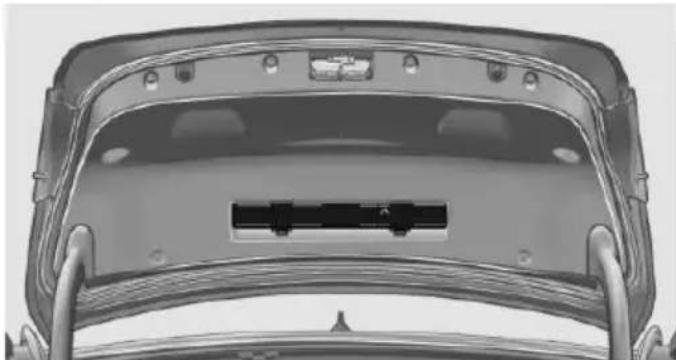
natural_image
Top-down view of a car rear bumper showing front, rear, and side panels (no text or symbols visible)The warning triangle is located on the inside of the trunk lid.
To remove, loosen the bracket.
First aid kit
Note
Some of the articles have a limited service life.
Check the expiration dates of the contents regularly and replace any expired items promptly.
Storage
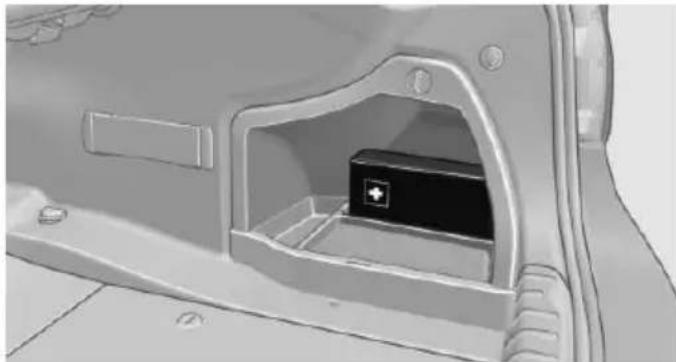
natural_image
Interior view of a car door with an open compartment showing a battery and a plus symbol (no text or labels)The first aid kit is located in the cargo area in a storage compartment.
Roadside Assistance
Service availability
Roadside Assistance can be reached around the clock in many countries. You can obtain assistance there in the event of a vehicle breakdown.
Roadside Assistance
The Roadside Assistance phone number can be viewed on the iDrive or a connection to Roadside Assistance can be established directly.
For additional information, see user's manual for Navigation, Entertainment and Communication.
Jump-starting
Notes
If the battery is discharged, an engine can be started using the battery of another vehicle and two jumper cables. Only use jumper cables with fully insulated clamp handles.
To prevent personal injury or damage to both vehicles, adhere strictly to the following procedure.

Do not touch live parts
To avoid the risk of potentially fatal injury, always avoid all contact with electrical components while the engine is running.
Preparation
- Check whether the battery of the other vehicle has a voltage of 12 volts. This information can be found on the battery.
- Switch off the engine of the assisting vehicle.
- Switch off any electronic systems/power consumers in both vehicles.

Bodywork contact between vehicles
Make sure that there is no contact between the bodywork of the two vehicles; otherwise, there is the danger of short circuits.
Starting aid terminals

Connecting order
Connect the jumper cables in the correct order; otherwise, there is the danger of injury from sparking.
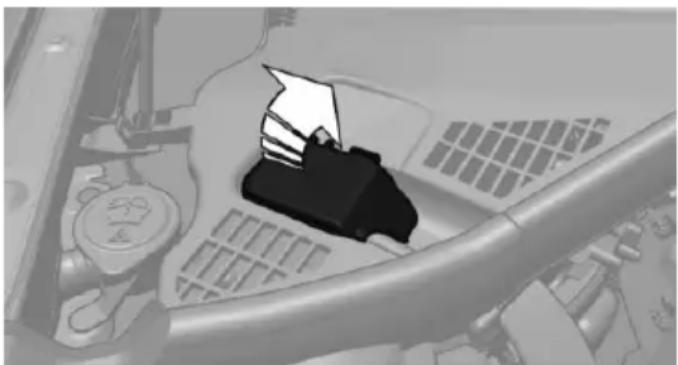
natural_image
Interior view of a car dashboard with steering wheel and gear (no visible text or symbols)The so-called starting aid terminal in the engine compartment acts as the battery's positive terminal.
Open the cover of the starting aid terminal.
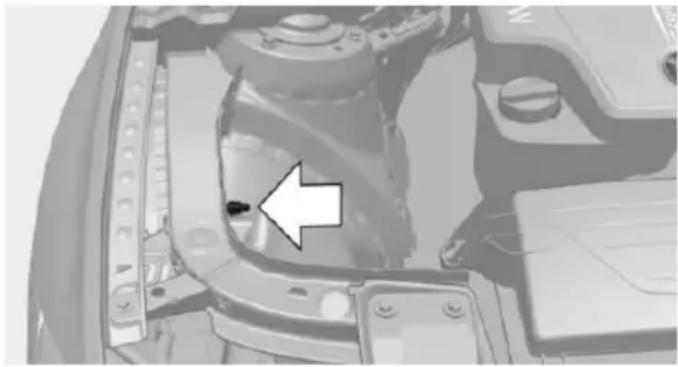
natural_image
Interior view of a mechanical device showing internal components and a highlighted arrow pointing to a specific area (no text or symbols visible)The body ground or a special nut acts as the battery negative terminal.
Connecting the cables
- Open the cover of the BMW starting aid terminal.
- Attach one terminal clamp of the positive jumper cable to the positive terminal of the battery, or to the corresponding starting aid terminal of the vehicle providing assistance.
- Attach the terminal clamp on the other end of the cable to the positive terminal of the battery, or to the corresponding starting aid terminal of the vehicle to be started.
- Attach one terminal clamp of the negative jumper cable to the negative terminal of the battery, or to the corresponding engine or body ground of assisting vehicle.
- Attach the second terminal clamp to the negative terminal of the battery, or to the corresponding engine or body ground of the vehicle to be started.
Starting the engine
Never use spray fluids to start the engine.
- Start the engine of the assisting vehicle and let it run for several minutes at an increased idle speed.
If the vehicle being started has a diesel engine: let the engine of the assisting vehicle run for approx. 10 minutes. - Start the engine of the vehicle being started in the usual way.
If the first starting attempt is not successful, wait a few minutes before making another attempt in order to allow the discharged battery to recharge.
- Let both engines run for several minutes.
- Disconnect the jumper cables in the reverse order.
Check the battery and recharge if necessary.
Tow-starting and towing
Note

Tow-starting and towing
When tow-starting and towing the vehicle, switch off the Intelligent Safety systems; otherwise, improper behavior of the braking function of individual systems could result in an accident.
Switching off Intelligent Safety systems, refer to page 102.
Manual transmission
Gearshift lever in neutral position.
Towing

Follow the towing instructions
Follow all towing instructions; otherwise, vehicle damage or accidents may occur.
▶ Make sure that the ignition is switched on; otherwise, the low beams, tail lamps, turn signals, and windshield wipers may be unavailable.
Do not tow the vehicle with the rear axle tilted, as the front wheels could turn.
When the engine is stopped, there is no power assist. Consequently, more force needs to be applied when braking and steering.
▶ Larger steering wheel movements are required.
The towing vehicle must not be lighter than the vehicle being towed; otherwise, it will not be possible to control the vehicle response.
Tow truck
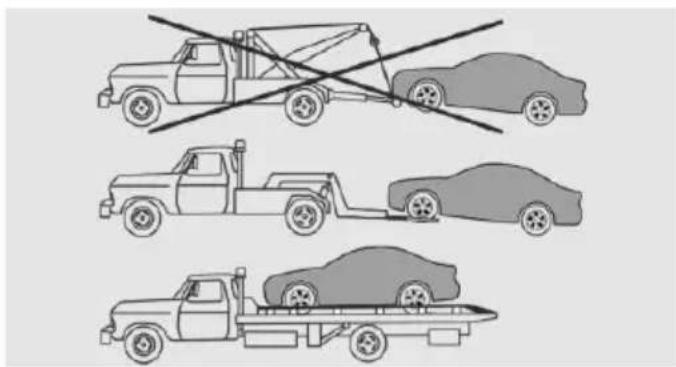
natural_image
Illustration of three truck scenarios: a flatbed truck, a car with a roof ramp, and a flatbed truck with a roof ramp (no text or symbols)Your vehicle should be transported with a tow truck with a so-called lift bar or on a flat bed.

Do not lift the vehicle
Do not lift the vehicle by the tow fitting or body and chassis parts; otherwise, damage may result.
Automatic transmission: transporting your vehicle
Note
Your vehicle is not permitted to be towed. Therefore, contact a service center in the event of a breakdown.

Do not have the vehicle towed
Have your vehicle transported on a loading platform only; otherwise, damage may occur.
Tow truck
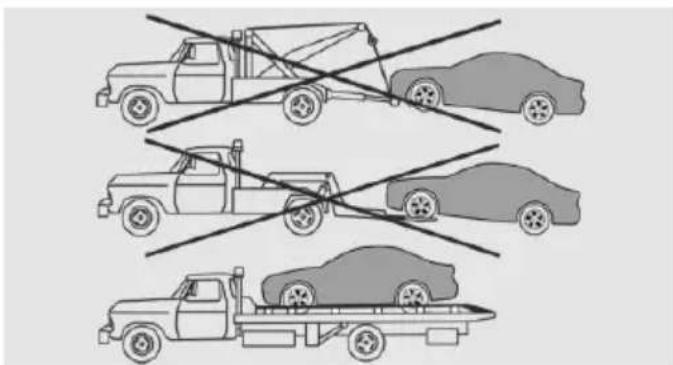
natural_image
Three types of cars: a flatbed truck, a moving car, and a car with a roof ramp, all crossed by diagonal lines (no text or symbols)The vehicle should only be transported on a loading platform.

Do not lift the vehicle
Do not lift the vehicle by the tow fitting or body and chassis parts; otherwise, damage may result.
Use the tow fitting screwed in at the front for maneuvering the vehicle only.
Towing other vehicles
General information

Light towing vehicle
The towing vehicle must not be lighter than the vehicle being towed; otherwise, it will not be possible to control the vehicle response.

Attaching the tow bar/tow rope correctly
Attach the tow bar or tow rope to the tow fitting; connecting it to other vehicle parts may cause damage.
▷ Switch on the hazard warning system, depending on local regulations.
If the electrical system has failed, clearly identify the vehicle being towed by placing a sign or a warning triangle in the rear window.
Tow bar
The tow fittings used should be on the same side on both vehicles.
Should it prove impossible to avoid mounting the tow bar at an offset angle, please observe the following:
▶ Maneuvering capability is limited during cornering.
The tow bar will generate lateral forces if it is secured with an offset.
Tow rope
When starting to tow the vehicle, make sure that the tow rope is taut.
To avoid jerking and the associated stresses on the vehicle components when towing, always use nylon ropes or nylon straps.

Attaching the tow rope correctly
Only secure the tow rope on the tow fitting; otherwise, damage can occur when it is secured on other parts of the vehicle.
Tow fitting
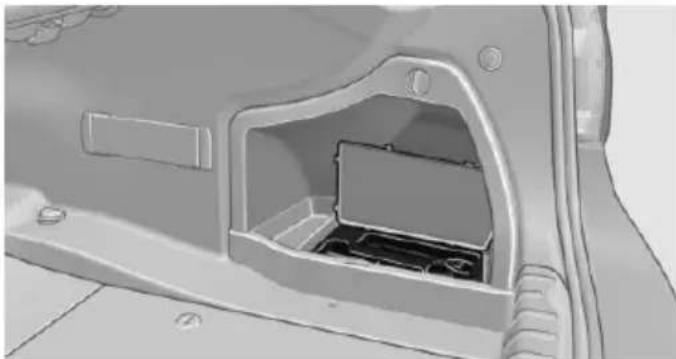
natural_image
Interior view of a car door frame showing an open battery compartment (no text or symbols visible)The screw-in tow fitting should always be carried in the vehicle. It can be screwed in at the front or rear of the BMW. It is in the onboard vehicle tool kit located in a storage compartment on the right side in the cargo area. Open the cover.

Tow fitting, information on use
▶ Use only the tow fitting provided with the vehicle and screw it all the way in.
▶ Use the tow fitting for towing on paved roads only.
▶ Avoid lateral loading of the tow fitting, e.g., do not lift the vehicle by the tow fitting.
Otherwise, damage to the tow fitting and the vehicle can occur.
Screw thread
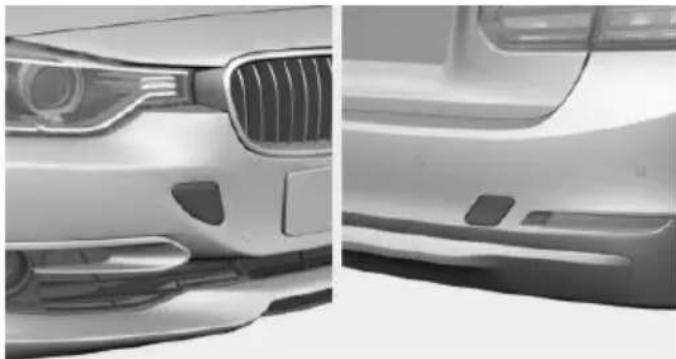
natural_image
Side-by-side comparison of a white car's front and side profiles, showing grille and dashboard details (no text or symbols visible)Press on the mark on the edge of the cover to push it out.
Tow-starting
Automatic transmission
Do not tow-start the vehicle.
Due to the automatic transmission, the engine cannot be started by tow-starting.
Have the cause of the starting difficulties remedied.
Manual transmission
If possible, do not tow-start the vehicle but start the engine by jump-starting, refer to page 216. If the vehicle is equipped with a catalytic converter, only tow-start while the engine is cold.
- Switch on the hazard warning system and comply with local regulations.
- Ignition, refer to page 61, on.
- Engage third gear.
-
Have the vehicle tow-started with the clutch pedal pressed and slowly release the pedal. After the engine starts, immediately press on the clutch pedal again.
-
Stop at a suitable location, remove the tow bar or rope, and switch off the hazard warning system.
- Have the vehicle checked.
Care
Vehicle equipment
All standard, country-specific and optional equipment that is offered in the model series is described in this chapter. Therefore, equipment is also described that is not available in a vehicle, e.g., because of the selected optional equipment or country variant. This also applies for safety-related functions and systems.
Car washes
Hints

Steam jets or high-pressure washers
When using steam jets or high-pressure washers, hold them a sufficient distance away and use a maximum temperature of 140^ F/60 ^ C.
If the vehicle has a glass sunroof, ensure that a distance of at least 31.5 inches/80 cm is maintained. Holding them too close or using excessively high pressures or temperatures can cause damage or preliminary damage that may then lead to long-term damage.
Follow the user's manual for the high-pressure washer.

Cleaning sensors/cameras with high-pressure washers
When using high-pressure washers, do not spray the exterior sensors and cameras, e.g., Park Distance Control, for extended periods of time and only from a distance of at least 12 in/30 cm.
▶ Regularly remove foreign items such as leaves in the area below the windshield when the hood is raised.
▶ Wash your vehicle frequently, particularly in winter.
Intense soiling and road salt can damage the vehicle.
Automatic car washes
Hints
▶ Give preference to cloth car washes or those that use soft brushes in order to avoid paint damage.
▶ Make sure that the wheels and tires are not damaged by the transport mechanisms.
▶ Fold in the exterior mirrors; otherwise, they may be damaged, depending on the width of the vehicle.
▶ Deactivate the rain sensor, refer to page 67, to avoid unintentional wiper activation.
In some cases, an unintentional alarm can be triggered by the interior motion sensor of the alarm system. Follow the instructions on avoiding an unintentional alarm, refer to page 43.

Guide rails in car washes
Avoid car washes with guide rails higher than 4 in/10 cm; otherwise, the vehicle body could be damaged.
Before driving into a car wash
In order to ensure that the vehicle can roll in a car wash, take the following steps:
Manual transmission:
- Drive into the car wash.
- Shift to neutral.
- Switch the engine off.
- Switch on the ignition.
Automatic transmission: -
Drive into the car wash.
-
Engage selector lever position N.
-
Switch the engine off.
In this way, the ignition remains switched on, and a Check-Control message is displayed.

Do not turn off the ignition in the car wash
Do not turn off the ignition in the car wash; otherwise, selector lever position P is engaged and damages can result.
To start the engine:
-
Depress the brake pedal.
-
Press the Start/Stop button.
Pressing the Start/Stop button without stepping on the brake turns the ignition off.
The vehicle cannot be locked from the outside when in selector lever position N. A signal is sounded when an attempt is made to lock the vehicle.
Selector lever position
Selector lever position P is engaged automatically:
▶ When the ignition is switched off.
▶ After approx. 15 minutes.
Headlamps
Do not rub dry and do not use abrasive or caustic cleansers.
Soak areas that have been soiled e.g. due to insects, with shampoo and wash off with water.
Thaw ice with deicing spray; do not use an ice scraper.
After washing the vehicle
After washing the vehicle, apply the brakes briefly to dry them; otherwise, braking action can be reduced and corrosion of the brake discs can occur.
Completely remove all residues on the windows, to minimize loss of visibility due to smearing and to reduce wiper noises and wiper blade wear.
Vehicle care
Car care products
BMW recommends using cleaning and care products from BMW, since these have been tested and approved.

Car care and cleaning products Follow the instructions on the container.
When cleaning the interior, open the doors or windows.
Only use products intended for cleaning vehicles.
Cleansers can contain substances that are dangerous and harmful to your health.
Vehicle paint
Regular care contributes to driving safety and value retention. Environmental influences in areas with elevated air pollution or natural contaminants, such as tree resin or pollen can affect the vehicle's paintwork. Tailor the frequency and extent of your car care to these influences.
Aggressive substances, such as spilled fuel, oil, grease or bird droppings, must be removed immediately to prevent the finish from being altered or discolored.
Leather care
Remove dust from the leather often, using a cloth or vacuum cleaner.
Otherwise, particles of dust and road grime chafe in pores and folds, and lead to increased wear and premature degradation of the leather surface.
To guard against discoloration, such as from clothing, provide leather care roughly every two months.
Clean light-colored leather more frequently because soiling on such surfaces is substantially more visible.
Use leather care products; otherwise, dirt and grease will gradually break down the protective layer of the leather surface.
Suitable care products are available from the service center.
Upholstery material care
Vacuum regularly with a vacuum cleaner.
If they are very dirty, e.g., beverage stains, use a soft sponge or microfiber cloth with a suitable interior cleaner.
Clean the upholstery down to the seams using large sweeping motions. Avoid rubbing the material vigorously.

Damage from Velcro® fasteners
Open Velcro® fasteners on pants or
other articles of clothing can damage the seat covers. Ensure that any Velcro® fasteners are closed.
Caring for special components
Light-alloy wheels
When cleaning the vehicle, use only neutral wheel cleaners having a pH value from 5 to 9. Do not use abrasive cleaning agents or steam jets above 140 °F/60 °C. Follow the manufacturer's instructions.
Aggressive, acidic or alkaline cleaning agents can destroy the protective layer of adjacent components, such as the brake disk.
Chrome surfaces
Carefully clean components such as the radiator grille or door handles with an ample supply of water, possibly with shampoo added, particularly when they have been exposed to road salt.
Rubber components
Aside from water, treat only with rubber cleansers.
When cleaning rubber seals, do not use any silicon-containing car care products in order to avoid damage or reduced noise damping.
Fine wood parts
Clean fine wood facing and fine wood components only with a moist rag. Then dry with a soft cloth.
Plastic components
These include:
▶ Imitation leather surfaces.
▷ Headliner.
▷ Lamp lenses.
▶ Instrument cluster cover.
▶ Matte black spray-coated components.
▶ Painted parts in the interior.
Clean with a microfiber cloth.
Lightly dampen the cloth with water.
Do not soak the headliner.

Do not use cleansers that contain alcohol or solvents
Do not use cleansers that contain alcohol or solvents, such as lacquer thinners, heavy-duty grease removers, fuel, or such; this could lead to surface damage.
Safety belts
Dirty belt straps impede the reeling action and thus have a negative impact on safety.

Chemical cleaning
Do not clean chemically; this can destroy
the webbing.
Use only a mild soapy solution, with the safety belts clipped into their buckles.
Do not allow the reels to retract the safety belts until they are dry.
Carpets and floor mats

No objects in the area around the pedals Keep floor mats, carpets, and any other objects out of the area of motion of the pedals; otherwise, the function of the pedals could be impeded while driving and create the risk of an accident.
Do not place additional floor mats over existing mats or other objects.
Only use floor mats that have been approved for the vehicle and can be properly fixed in place.
Ensure that the floor mats are securely fastened again after they were removed for cleaning, for example.
Floor mats can be removed from the passenger compartment for cleaning.
If the floor carpets are very dirty, clean with a microfiber cloth and water or a textile cleaner. To prevent matting of the carpet, rub back and forth in the direction of travel only.
Sensors/cameras
To clean sensors and cameras, use a cloth moistened with a small amount of glass cleaner.
Displays/screens
Clean the displays with an antistatic microfiber cloth.

Cleaning displays
Do not use chemical or household
cleansers.
Keep all fluids and moisture away from the unit.
Otherwise, they could affect or damage surfaces or electrical components.
Avoid pressing too hard when cleaning and do not use abrasive materials; otherwise, damage can result.
Long-term vehicle storage
When the vehicle is shut down for longer than three months, special measures must be taken. Additional information is available from the service center.
text_image
TUESKY PDUK HEDER Online Edition for Part no. 01 40 2 925 743 - II/14Reference
This chapter contains the technical data and an index that will quickly take you to the information you need.
Technical data
Vehicle equipment
All standard, country-specific and optional equipment that is offered in the model series is described in this chapter. Therefore, equip-
ment is also described that is not available in a vehicle, e. g., because of the selected optional equipment or country variant. This also applies for safety-related functions and systems.
Dimensions
| BMW 3 Series Limousine |
| Width with mirrors inches/mm 79.9/2,031 |
| Width without mirrors inches/mm 71.3/1,811 |
| Height inches/mm 56.4/1,434 |
| Length inches/mm 182.2/4,627 |
| Wheel base inches/mm 110.6/2,810 |
| Smallest turning circle diam. ft/m 37.1/11.3 |
| Smallest turning circle diameter with xDrive ft/m 38.4/11.7 |
Weights
The values preceding the slash apply to vehicles with manual transmission; the values fol- lowing the slash apply to vehicles with automatic transmission.
| 320i | ||
| Approved gross vehicle weight lbs | 4,300/4,340 | |
| kg | 1,950/1,969 | |
| Load lbs/kg 900/408 | ||
| Approved front axle load lbs/kg 1,985/900 | ||
| Approved rear axle load lbs/kg 2,480/1,125 | ||
| Approved roof load capacity lbs/kg 165/75 | ||
| Cargo area capacity | cu ft/l | 16.9/480 |
| 328i | ||
| Approved gross vehicle weight lbs | 4,365/4,420 | |
| kg | 1,980/2,005 | |
| Load lbs/kg 900/408 | ||
| Approved front axle load lbs/kg 2,015/914 | ||
| Approved rear axle load lbs/kg 2,510/1,139 | ||
| Approved roof load capacity lbs/kg 165/75 | ||
| Cargo area capacity cu ft/l 16.9/480 | ||
| 335i | ||
| Approved gross vehicle weight lbs | 4,540/4,565 | |
| kg | 2,059/2,071 | |
| Load lbs/kg 900/408 | ||
| Approved front axle load lbs/kg 2,140/971 | ||
| Approved rear axle load lbs/kg 2,535/1,150 | ||
| Approved roof load capacity lbs/kg 165/75 | ||
| Cargo area capacity cu ft/l 16.9/480 | ||
| 320i xDrive | ||
| Approved gross vehicle weight lbs | 4,465/4,505 | |
| kg | 2,025/2,043 | |
| Load lbs/kg 900/408 | ||
| Approved front axle load lbs/kg 2,125/964 | ||
| Approved rear axle load lbs/kg 2,510/1,139 | ||
| Approved roof load capacity lbs/kg 165/75 | ||
| Cargo area capacity cu ft/l 16.9/480 | ||
328i xDrive
| Approved gross vehicle weight lbs/kg 4,585/2,080 |
| Load lbs/kg 900/408 |
| Approved front axle load lbs/kg 2,160/980 |
| Approved rear axle load lbs/kg 2,555/1,159 |
| Approved roof load capacity lbs/kg 165/75 |
| Cargo area capacity cu ft/l 16.9/480 |
335i xDrive
| Approved gross vehicle weight lbs | kg | 4,675/4,695 |
| 2,121/2,130 | ||
| Load lbs/kg 900/408 | ||
| Approved front axle load lbs/kg 2,280/1,034 | ||
| Approved rear axle load lbs/kg 2,560/1,161 | ||
| Approved roof load capacity lbs/kg 165/75 | ||
| Cargo area capacity cu ft/l 16.9/480 |
328d
| Approved gross vehicle weight lbs/kg 4,365/1,980 |
| Load lbs/kg 900/408 |
| Approved front axle load lbs/kg 1,995/905 |
| Approved rear axle load lbs/kg 2,490/1,129 |
| Approved roof load capacity lbs/kg 165/75 |
| Cargo area capacity cu ft/l 16.9/480 |
328d xDrive
| Approved gross vehicle weight lbs/kg 4,540/2,059 |
| Load lbs/kg 900/408 |
| Approved front axle load lbs/kg 2,160/980 |
328d xDrive
Approved rear axle load lbs/kg 2,525/1,145
Approved roof load capacity lbs/kg 165/75
Cargo area capacity cu ft/l 16.9/480
Capacities
| US gal/liters Notes | ||
| Fuel tank Gasoline: 15.8/60 | Fuel quality, refer to page 180 | |
| Diesel: 15/57 |
Everything from A to Z
Index
A
ABS, Antilock Brake System 114
ACC, Active Cruise Control with Stop & Go 119
Acceleration Assistant, refer to Launch Control 72
Accessories and parts 7
Activated-charcoal filter 146
Active Blind Spot Detection 111
Active Cruise Control with Stop & Go, ACC 119
Adaptive brake lights, refer to Brake force display 113
Adaptive Light Control 90
Additives, oil 199
Adjustments, seats/head re- straints 47
After washing vehicle 222
Airbags 94
Airbags, indicator/warning light 95
Air circulation, refer to Recirculated-air mode 142, 145
Air, dehumidifying, refer to Cooling function 142, 145
Air distribution, manual 142, 146
Air flow, air conditioner 142
Air flow, automatic climate control 146
Air pressure, tires 185
Air vents, refer to Ventilation 146
Alarm system 41
Alarm, unintentional 43
All around the center console 14
All around the headliner 15
All around the steering wheel 12
All-season tires, refer to Winter tires 194
All-wheel-drive 115
Alternating-code hand-held transmitter 149
Alternative oil types 200
Antifreeze, washer fluid 68
Antilock Brake System, ABS 114
Anti-slip control, refer to DSC 114
Approved axle load 228
Approved engine oils 200
Arrival time 85
Ash tray 152
Assistance, Roadside Assistance 216
Assistance when driving off 118
Assist system information, on Control Display 87
AUTO intensity 145
Automatic car wash 221
Automatic climate control 141
Automatic climate control with enhanced features 144
Automatic Cruise Control with Stop & Go 119
Automatic Curb Monitor 55
Automatic deactivation, front passenger airbags 96
Automatic headlamp control 90
Automatic locking 41
Automatic recirculated-air control 145
Automatic transmission with Steptronic 69
AUTO program, automatic climate control 144
AUTO program, climate control 142
AUTO program, intensity 145
Auto Start/Stop function 63
Average fuel consumption 84
Average speed 84
Axle loads, weights 228
B
Backrest curvature, refer to Lumbar support 49
Backrest, width 49
Band-aids, refer to First aid kit 216
Bar for tow-starting/towing 219
Battery replacement, vehicle battery 212
Battery replacement, vehicle remote control 33
Battery, vehicle 212
Belts, safety belts 50
Beverage holder, cu- pholder 158
Blinds, sun protection 44
BMW Advanced Diesel 181
BMW Assist, see user's manual for Navigation, Entertainment and Communication
BMW Homepage 6
BMW Internet page 6
BMW maintenance sys- tem 202
Bottle holder, refer to Cupholder 158
Brake assistant 114
Brake discs, breaking in 162
Brake force display 113
Brake lamps, brake force display 113
Brake lights, adaptive 113
Brake pads, breaking in 162
Braking, hints 163
Breakdown assistance 215, 216
Breaking in 162
Brightness of Control Dis- play 87
Bulb replacement 204
Bulb replacement, front 205
Bulb replacement, halogen headlamps 205
Bulb replacement, rear 210
Bulb replacement, xenon headlamps 208
Bulbs and lamps 204
Button, RES 122
Button, Start/Stop 61
Bypassing, refer to Jump-starting 216
C
California Proposition 65 Warning 7
Camera, care 224
Camera, rearview cam- era 131
Camera, Side View 133
Camera, Top View 135
Can holder, refer to Cu- pholder 158
Car battery 212
Car care products 222
Care, displays 224
Care, vehicle 222
Cargo 165
Cargo area, enlarging 154
Cargo area, storage compartments 159
Cargo, securing 166
Cargo straps, securing cargo 166
Car key, refer to Remote control 32
Carpet, care 224
Car wash 221
Catalytic converter, refer to Hot exhaust system 163
CBS Condition Based Service 202
CD/Multimedia, see user's manual for Navigation, Entertainment and Communication
Center armrest 157
Center console 14
Central locking system 37
Central screen, refer to Control Display 16
Changes, technical, refer to Safety 7
Changing parts 204
Changing wheels 212
Changing wheels/tires 193
Check Control 76
Checking the oil level electronically 198
Children, seating position 57
Children, transporting safely 57
Child restraint fixing sys- tem 57
Child restraint fixing system LATCH 58
Child restraint fixing systems, mounting 57
Child safety locks 60
Child seat, mounting 57
Child seats 57
Chrome parts, care 223
Cigarette lighter 152
Cleaning, displays 224
Climate control 141, 144
Clock 79
Closing/opening via door lock 37
Closing/opening with remote control 35
Clothes hooks 158
Coasting 172
Coasting with engine decoupled, coasting 172
Coasting with idling engine 172
Cockpit 12
Cold starting, refer to Starting the engine 62
Collision warning with braking function 106
Collision warning with City Braking function 103
Combination switch, refer to Turn signals 65
Combination switch, refer to Wiper system 66
Comfort Access 39
COMFORT program, Dynamic Driving Control 117
Compartments in the doors 157
Compass 150
Computer 83
Condensation on windows 146
Condensation under the vehicle 164
Condition Based Service CBS 202
Configuring drive pro- gram 117
Confirmation signal 41
ConnectedDrive, see user's manual for Navigation, Entertainment and Communication
ConnectedDrive Services
Connecting electrical devices 152
Control Display 16
Control Display, settings 86
Controller 16, 17
Control systems, driving stability 114
Convenient opening 35
Coolant 201
Coolant temperature 78
Cooling function 142, 145
Cooling, maximum 145
Cooling system 201
Corrosion on brake discs 164
Cruise control 125
Cruise control, active with Stop & Go 119
Cruising range 79
Cupholder 158
Current fuel consumption 80
D
Damage, tires 193
Damping control, dynamic 115
Data, technical 228
Date 79
Daytime running lights 90
Defrosting, refer to defrosting the windows 142
Defrosting, refer to Windows, defrosting 146
Defrosting the windows 142
Dehumidifying, air 142, 145
Destination distance 84
Diesel exhaust fluid, at low temperatures 182
Diesel exhaust fluid, having refilled 182
Diesel exhaust fluid, on minimum 182
Diesel exhaust fluid, replenishing yourself 182
Diesel particulate filter 163
Digital clock 79
Digital compass 150
Dimensions 228
Dimmable exterior mirrors 55
Dimmable interior rearview mirror 56
Direction indicator, refer to Turn signals 65
Display, electronic, instrument cluster 75
Display in windshield 87
Display lighting, refer to In-strument lighting 92
Displays 73
Displays, cleaning 224
Disposal, coolant 201
Disposal, vehicle battery 213
Distance control, refer to PDC 128
Distance to destination 84
Divided screen view, split screen 22
Door lock 37
Door lock, refer to Remote control 32
Drive-off assistant 118
Drive-off assistant, refer to DSC 114
Driver assistance, refer to Intelligent Safety 102
Driving Assistant, refer to Intelligent Safety 102
Driving Dynamics Control 116
Driving instructions, breaking in 162
Driving mode 116
Driving notes, general 162
Driving stability control systems 114
Driving style analysis 173
Driving tips 162
DSC Dynamic Stability Control 114
DTC Dynamic Traction Control 115
Dynamic Damping Control 115
Dynamic Stability Control DSC 114
Dynamic Traction Control DTC 115
E
ECO PRO 169
ECO PRO, bonus range 170
ECO PRO display 169
ECO PRO driving mode 169
ECO PRO driving style analysis 173
ECO PRO mode 169
ECO PRO Tip - driving in- struction 171
EfficientDynamics 171
Electronic displays, instrument cluster 75
Electronic Stability Program ESP, refer to DSC 114
Emergency detection, remote control 33
Emergency release, fuel filler flap 178
Emergency Request 215
Emergency service, refer to Roadside Assistance 216
Emergency start function, engine start 33
Emergency unlocking, trunk lid 38
Energy Control 80
Energy recovery 80
Engine, automatic Start/Stop function 63
Engine, automatic switch-off 63
Engine compartment 196
Engine compartment, working in 197
Engine coolant 201
Engine idling when driving, coasting 172
Engine oil 198
Engine oil, adding 199
Engine oil additives 199
Engine oil change 200
Engine oil filler neck 199
Engine oil temperature 78
Engine oil types, alternative 200
Engine oil types, approved 200
Engine start during malfunction 33
Engine start, jump-starting 216
Engine start, refer to Starting the engine 62
Engine stop 62
Engine temperature 78
Entering a car wash 221
Equipment, interior 148
ESP Electronic Stability Program, refer to DSC 114
Exchanging wheels/tires 193
Exhaust system 163
Exterior mirror, automatic dimming feature 55
Exterior mirrors 54
External start 216
External temperature dis- play 79
External temperature warning 79
Eyes for securing cargo 166
F
Failure message, refer to Check Control 76
False alarm, refer to Unintentional alarm 43
Fan, refer to Air flow 142, 146
Fault displays, refer to Check Control 76
Filler neck for engine oil 199
Fine wood, care 223
First aid kit 216
Fitting for towing, refer to Tow fitting 219
Flat tire, changing wheels 212
Flat Tire Monitor FTM 100
Flat tire, Tire Pressure Monitor TPM 97
Flat tire, warning lamp 98, 101
Flooding 163
Floor carpet, care 224
Floor mats, care 224
Fogged up windows 142
Fold down the rear seat back-rest, see Though-loading system 154
Fold-out position, windshield wipers 68
Foot brake 163
Front airbags 94
Front fog lamps 92
Front fog lamps, bulb replacement 209
Front lamps 205
Front passenger airbags, automatic deactivation 96
Front passenger airbags, indicator lamp 96
FTM Flat Tire Monitor 100
Fuel 180
Fuel cap 178
Fuel consumption, current 80
Fuel consumption, refer to Average fuel consumption 84
Fuel filler flap 178
Fuel gauge 78
Fuel quality 180
Fuel recommendation 180
Fuel, tank capacity 231
Fuse 213
G
Garage door opener, refer to Universal garage door opener 148
Gasoline 180
Gear change, automatic transmission 70
Gear shift indicator 81
General driving notes 162
Glass sunroof, powered 45
Glove compartment 156
Gross vehicle weight, approved 228
H
Handbrake, refer to parking brake 65
Hand-held transmitter, alternating code 149
Hazard warning flashers 215
Head airbags 94
Headlamp control, automatic 90
Headlamp courtesy delay fea- ture 89
Headlamp flasher 66
Headlamp glass 205
Headlamps 205
Headlamps, care 222
Headlamp washer system 66
Headliner 15
Head restraints 47
Head restraints, front 51
Head restraints, rear 52
Head-up Display 87
Head-up Display, care 224
Heavy cargo, stowing 166
Height, vehicle 228
High-beam Assistant 91
High beams 66
High beams/low beams, refer to High-beam Assistant 91
Hills 164
Hill start assistant, refer to Drive-off assistant 118
Hints 6
Holder for beverages 158
Homepage 6
Hood 197
Horn 12
Hotel function, trunk lid 38
Hot exhaust system 163
HUD Head-up Display 87
Hydroplaning 163
|
Ice warning, see External temperature warning 79
Icy roads, see External temperature warning 79
Identification marks, tires 191
Identification number, refer to Important features in the engine compartment 196
iDrive 16
Ignition key, refer to Remote control 32
Ignition off 61
Ignition on 61
Indication of a flat tire 98, 101
Indicator and warning lamps 76
Individual air distribution 142, 146
Individual settings, refer to Personal Profile 33
Inflation pressure, tires 185
Inflation pressure warning FTM, tires 100
Info display, refer to Computer 83
Initialize, Tire Pressure Monitor TPM 98
Initializing, Flat Tire Monitor FTM 101
Instrument cluster 73
Instrument cluster, electronic displays 75
Instrument lighting 92
Integrated key 32
Integrated Owner's Manual in the vehicle 27
Intelligent Emergency Request 215
Intelligent Safety 102
Intensity, AUTO program 145
Interior equipment 148
Interior lamps 92
Interior lamps via remote control 36
Interior motion sensor 43
Interior rearview mirror, automatic dimming feature 56
Interior rearview mirror, compass 150
Interior rearview mirror, manually dimmable 56
Internet page 6
Interval display, service requirements 80
J
Jacking points for the vehicle jack 212
Joystick, automatic transmission 70
Jump-starting 216
K
Key/remote control 32
Keyless Go, refer to Comfort Access 39
Key Memory, refer to Personal Profile 33
Kickdown, automatic trans- mission 70
Knee airbag 94
L
Lamp replacement 204
Lamp replacement, front 205
Lamp replacement, rear 210
Lamps 89
Lamps and bulbs 204
Lane departure warning 110
Lane margin, warning 110
Language on Control Dis- play 86
Lashing eyes, securing cargo 166
LATCH child restraint fixing system 58
Launch Control 72
Leather, care 222
LEDs, light-emitting diodes 205
Length, vehicle 228
Letters and numbers, entering 23
Light alloy wheels, care 223
Light control 90
Light-emitting diodes, LEDs 205
Lighter 152
Lighting 89
Lighting via remote control 36
Light switch 89
Load 166
Loading 165
Lock, door 37
Locking/unlocking via door lock 37
Locking/unlocking with remote control 35
Locking, automatic 41
Locking, settings 41
Lock, power window 44
Locks, doors, and windows 60
Low beams 89
Low beams, automatic, refer to High-beam Assistant 91
Lower back support 49
Low-Sulfur Diesel 181
Luggage rack, refer to Roof-mounted luggage rack 167
Lumbar support 49
M
Maintenance 202
Maintenance requirements 202
Maintenance, service requirements 80
Maintenance system, BMW 202
Malfunction displays, refer to Check Control 76
Manual air distribution 142, 146
Manual air flow 142, 146
Manual mode, transmission 71
Manual operation, door lock 37
Manual operation, exterior mirrors 55
Manual operation, fuel filler flap 178
Manual operation, Park Distance Control PDC 129
Manual operation, rearview camera 131
Manual operation, Side View 133
Manual operation, Top View 135
Manual transmission 69
Marking on approved
tires 194
Marking, run-flat tires 195
Master key, refer to Remote control 32
Maximum cooling 145
Maximum speed, display 81
Maximum speed, winter tires 194
Measure, units of 87
Medical kit 216
Memory, seat, mirror 53
Menu, EfficientDynamics 171
Menu in instrument cluster 83
Menus, operating, iDrive 16
Menus, refer to iDrive operating concept 18
Messages, refer to Check Control 76
Microfilter 143, 146
Minimum tread, tires 193
Mirror 54
Mirror memory 53
Mobile communication devices in the vehicle 163
Modifications, technical, refer to Safety 7
Moisture in headlamp 205
Monitor, refer to Control Display 16
Mounting of child restraint fixing systems 57
Multifunction steering wheel, buttons 12
N
Navigation, see user's manual for Navigation, Entertainment and Communication
Neck restraints, front, refer to Head restraints 51
Neck restraints, rear, refer to Head restraints 52
Neutral cleaner, see wheel cleaner 223
New wheels and tires 193
No Passing Information 81
Nylon rope for tow-starting/towing 219
0
OBD Onboard Diagnosis 202
OBD, see OBD Onboard Diagnosis 202
Obstacle marking, rearview camera 132
Octane rating, refer to Recommended fuel grade 180
Odometer 79
Office, see user's manual for Navigation, Entertainment and Communication
Oil 198
Oil, adding 199
Oil additives 199
Oil change 200
Oil change interval, service requirements 80
Oil filler neck 199
Oil types, alternative 200
Oil types, approved 200
Old batteries, disposal 213
Onboard monitor, refer to Control Display 16
Onboard vehicle tool kit 204
Opening/closing via door lock 37
Opening and closing 32
Opening and closing, without remote control 37
Opening and closing, with remote control 35
Operating concept, iDrive 16
Optional equipment, standard equipment 6
Outside air, refer to Automatic recirculated-air control 145
Overheating of engine, refer to Coolant temperature 78
P
Paint, vehicle 222
Parallel parking assistant 136
Park Distance Control PDC 128
Parked-car ventilation 147
Parked vehicle, condensation 164
Parking aid, refer to PDC 128
Parking assistant 136
Parking brake 65
Parking lamps 89
Particulate filter 163
Parts and accessories 7
Passenger side mirror, tilting downward 55
Pathway lines, rearview camera 131
PDC Park Distance Control 128
Pedestrian warning with city braking function 108
Personal Profile 33
Personal Profile, exporting profiles 34
Personal Profile, importing profiles 35
Pinch protection system, glass sunroof 45
Pinch protection system, windows 44
Plastic, care 223
Power failure 213
Power sunroof, glass 45
Power windows 43
Pressure, tire air pressure 185
Pressure warning FTM, tires 100
Profile, refer to Personal Profile 33
Programmable memory buttons, iDrive 22
Protective function, glass sunroof 45
Protective function, windows 44
Push-and-turn switch, refer to Controller 16, 17
R
Radiator fluid 201
Radio-operated key, refer to Remote control 32
Radio ready state 62
Radio, see user's manual for Navigation, Entertainment and Communication
Rain sensor 67
Rear socket 153
Rear turn signal, bulb replacement 210
Rearview camera 130
Rearview mirror 54
Rear window defroster 142, 146
Recirculated-air filter 146
Recirculated-air mode 142, 145
Recommended fuel grade 180
Recommended tire brands 194
Refueling 178
Remaining range 79
Remote control/key 32
Remote control, malfunction 36
Remote control, universal 148
Replacement fuse 213
Replacing parts 204
Replacing wheels/tires 193
Reporting safety defects 9
RES button 122
Reserve warning, refer to Range 79
Reset, Tire Pressure Monitor
TPM 98
Retaining straps, securing cargo 166
Retreaded tires 194
Roadside parking lamps 90
Roller sunblinds 44
RON recommended fuel grade 180
Roof load capacity 228
Roof-mounted luggage rack 167
Rope for tow-starting/towing 219
RSC Run Flat System Component, refer to Run-flat tires 195
Rubber components, care 223
Run-flat tires 195
S
Safe braking 163
Safety 7
Safety belt reminder for driver's seat and front passenger seat 51
Safety belts 50
Safety belts, care 223
Safety switch, windows 44
Safety systems, airbags 94
Saving fuel 168
Screen, refer to Control Display 16
Screwdriver, see Onboard vehicle tool kit 204
Screw thread for tow fitting 220
Seat and mirror memory 53
Seat belts, refer to Safety belts 50
Seat heating, front 50
Seat heating, rear 50
Seating position for children 57
Seats 47
Selection list in instrument cluster 83
Selector lever, automatic transmission 70
Sensors, care 224
Service and warranty 8
Service requirements, Condition Based Service CBS 202
Service requirements, display 80
Service, Roadside Assistance 216
Services, ConnectedDrive
Settings, locking/unlocking 41
Settings on Control Display 86
Settings, storing for seat, mirror 53
Shifting, automatic transmission 69
Shifting, manual transmission 69
Shift paddles on steering wheel 71
Side airbags 94
Side View 133
Signaling, horn 12
Signals when unlocking 41
Sitting safely 47
Size 228
Slide/tilt glass roof 45
Smallest turning circle 228
Snow chains 195
Socket 152
Socket, OBD Onboard Diagnostics 202
Soot particulate filter 163
SOS button 215
Spare fuse 213
Specified engine oil types 200
Speed, average 84
Speed limit detection, on-board computer 85
Speed limiter, display 81
Speed Limit Information 81
Speed warning 85
Split screen 22
SPORT+ - program, Dynamic Driving Control 116
Sport automatic transmission 71
Sport displays, torque display, performance display 85
SPORT program, Dynamic Driving Control 117
Sport program, transmission 71
Sport steering, variable 116
Stability control systems 114
Start/stop, automatic function 63
Start/Stop button 61
Start function during malfunction 33
Starting the engine 62
Status control display, tires 97
Status information, iDrive 21
Status of Owner's Manual 6
Steering wheel, adjusting 56
Steering wheel heating 56
Steptronic, automatic transmission 69
Stopping the engine 62
Storage compartment in the rear 158
Storage compartments 156
Storage compartments, locations 156
Storage, tires 195
Storing the vehicle 224
Summer tires, tread 193
Supplementary text mes- sage 77
Surround View 130
Switch for Dynamic Driving 116
Switch-on times, parked-car ventilation 147
Switch, refer to Cockpit 12
Symbols 6
Symbols in the status field 21
T
Tachometer 78
Tail lamp 210
Tail lamps 210, 212
Technical changes, refer to Safety 7
Technical data 228
Telephone, see user's manual for Navigation, Entertainment and Communication
Temperature, automatic climate control 142, 144
Temperature display for external temperature 79
Temperature, engine oil 78
Tempomat, refer to Active Cruise Control 119
Terminal, starting aid 217
Text message, supplementary 77
Theft alarm system, refer to Alarm system 41
Thigh support 49
Through-loading system 154
Tilt alarm sensor 42
Time of arrival 85
Tire damage 193
Tire identification marks 191
Tire inflation pressure 185
Tire inflation pressure monitor, refer to FTM 100
Tire Pressure Monitor TPM 97
Tires, changing 193
Tires, everything on wheels and tires 185
Tires, run-flat tires 195
Tire tread 193
Tone, see user's manual for Navigation, Entertainment and Communication
Tool 204
Top View 134
Total vehicle weight 228
Touchpad 19
Tow fitting 219
Towing 218
Tow-starting 218
Tow truck 218
TPM Tire Pressure Monitor 97
Traction control 115
TRACTION program, Dynamic Driving Control 115
Transmission, automatic 69
Transmission, manual 69
Transporting children safely 57
Tread, tires 193
Trip computer 85
Triple turn signal activation 66
Trip odometer 79
Truck for tow-starting/towing 218
Trunk lid closing 38
Trunk lid, emergency unlocking 38
Trunk lid, hotel function 38
Trunk lid opening 38
Trunk lid via remote control 36
Turning circle 228
Turning circle lines, rearview camera 132
Turn signals, operation 65
U
Unintentional alarm 43
Units of measure 87
Universal remote control 148
Unlock button, automatic transmission 70
Unlocking/locking via door lock 37
Unlocking/locking with remote control 35
Unlocking, settings 41
Updates made after the editorial deadline 6
Upholstery care 223
USB interface 153
V
Variable sport steering 116
Vehicle battery 212
Vehicle battery, replacing 212
Vehicle, breaking in 162
Vehicle care 222
Vehicle equipment 6
Vehicle identification number, refer to Identification num-
ber in the engine compartment 196
Vehicle jack 212
Vehicle paint 222
Vehicle storage 224
Vehicle wash 221
Ventilation 146
Ventilation, refer to Parked-car ventilation 147
Voice activation system 24
W
Warning indicators 76
Warning lamps 76
Warning messages, refer to Check Control 76
Warning triangle 216
Washer fluid 68
Washer nozzles, wind-shield 68
Washer system 66
Washing, vehicle 221
Water on roads 163
Weights 228
Welcome lamps 89
Wheel base, vehicle 228
Wheel cleaner 223
Wheels, changing 193
Wheels, everything on wheels and tires 185
Wheels, Flat Tire Monitor FTM 100
Wheels, Tire Pressure Monitor TPM 97
Width, vehicle 228
Window defroster, rear 142, 146
Windows, powered 43
Windshield washer fluid 68
Windshield washer nozzles 68
Windshield washer sys- tem 66
Windshield wiper 66
Windshield wipers, fold-out position 68
Winter diesel 181
Winter storage, care 224
Winter tires, suitable tires 194
Winter tires, tread 193
Wiper blades, replacing 204
Wiper fluid 68
Wiper system 66
Wood, care 223
Word match concept, navigation 23
Wrench, see Onboard vehicle tool kit 204
X
xDrive 115
Xenon headlamps, bulb replacement 208
More about BMW
bmwusa.com

The Ultimate Driving Machine