
AS-2300 - Hi-Fi System OLYMPUS - Free user manual and instructions
Find the device manual for free AS-2300 OLYMPUS in PDF.


| Product Type | Digital Dictation Software (DSS Player) with optional hardware (Foot Switch, Headset) |
| Software Name | Olympus DSS Player (upgradable to DSS Player Plus) |
| Compatible Operating Systems | Microsoft Windows Me/2000 Professional/XP Professional/Home Edition; Mac OS 10.1/10.2/10.3 |
| Minimum PC Requirements (Windows) | Intel Pentium II 333 MHz, 128 MB RAM, 50 MB hard disk space, Sound Blaster 16 compatible sound card, USB port |
| Minimum PC Requirements (Mac) | Power Mac G3 233 MHz, 128 MB RAM, 50 MB hard disk space, USB port |
| Supported Audio Formats | DSS, WMA, WAVE (Windows), AIFF (Mac) |
| Software Features | Transfer voice files from Olympus recorders, classification and organization in folders, create reports, convert DSS to WAVE |
| Upgrade Features (DSS Player Plus) | Split/join sound files, voice recognition integration, file sharing, recorder menu settings |
| Foot Switch Compatibility | RS25/RS26 via USB or RS-232C (Windows); USB only (Mac) |
| Headset Compatibility | Olympus E102 stereo headset (3.5mm jack) |
| Installation Method | CD-ROM installation with automatic start for Windows; double-click for Mac |
| Uninstallation | Via Control Panel (Windows) or delete files (Mac); voice files stored in Message folder |
| Online Help | Available via Start menu or F1 (Windows); Help menu (Mac) |
| Technical Support | US/Canada: 1-888-553-4448; Europe: 00800 67 10 83 00 (toll-free) or +49 180 567 1083 |
| Regulatory Compliance | FCC Part 15 Class B, Canadian RFI Class B, CE marked |
Frequently Asked Questions - AS-2300 OLYMPUS
User questions about AS-2300 OLYMPUS
0 question about this device. Answer the ones you know or ask your own.
Ask a new question about this device
Download the instructions for your Hi-Fi System in PDF format for free! Find your manual AS-2300 - OLYMPUS and take your electronic device back in hand. On this page are published all the documents necessary for the use of your device. AS-2300 by OLYMPUS.
USER MANUAL AS-2300 OLYMPUS
PC TRANSCRIPTION KIT
AS-2300
INSTRUCTIONS
EN INSTRUCTIONS
EN
DSS Player Features
Things that you can do with DSS Player
The following list shows examples of the things you can do with DSS Player:
- Voice files recorded using Olympus recorders (DS/DM Series) can be transferred to your PC.
- Voice files can be classified and organized in folders.
- Create reports and summaries of meetings.
- Converts DSS files to WAVE files.
Things that you can do with DSS Player Plus
Upgrading to DSS Player Plus enables you to:
- Split sound files recorded using the recorder at any position.
- Join sound files recorded using the recorder.
-
Convert sound files into text in combination with voice recognition software.
-
OLYMPUS IMAGING CORP. holds the copyrights for DSS Player and the instructions (this manual).
- IBM, PC/AT, and ViaVoice are the trademarks or registered trademarks of International Business Machines Corporation.
- Microsoft, Windows and Windows Media are registered trademarks of Microsoft Corporation.
- Apple, Macintosh, iMac, Mac, and PowerMac are trademarks or registered trademarks of Apple Computer, Inc.
Intel and Pentium are registered trademarks of Intel Corporation.
●CORTOLOGIC is a registered trademark of Ruwisch & Kollegen GmbH.
- ScanSoft and Dragon NaturallySpeaking are the trademarks or registered trademarks of ScanSoft, Inc.
- Other product and brand names mentioned herein may be the trademarks or registered trademarks of their respective owners.

Table of Contents
Introduction
Operating Environment 4
Getting Ready
Installing Software 5
Uninstalling Software 8
Using Online Help.... 10
Let's Get Started
Running DSS Player.... 11
Connecting the RS25/RS26 Foot Switch .... 13
Connecting the E102 Headset ...... 14
Window Names...... 15
Play a Voice File 16
Upgrade Function 17
User Support
Technical Assistance and Support ..... 19
Operating Environment
Basic Operating Environment of DSS Player
| Windows | Macintosh | ||
| PC: | IBM PC/AT compatible PC | PC: | Power Mac G3 233 MHz class processor or faster iMac/ iBook/ eMac/ Power Mac/ PowerBook (The computer must support a standard USB port) (If recording to a hard disk directly with the WMA format, please use in the range of 500MHz or more) |
| Operating System: | Microsoft Windows Me/ 2000 Professional/XPProfessional,Home Edition | ||
| CPU: | Intel Pentium II class 333 MHz processor or more (If recording to a hard disk directly with the WMA format, please use in the range of 500MHz or more) | ||
| RAM: | 128MB or more (256MB or more is recommended) | Operating System: | Mac OS 10.1/10.2/10.3 |
| Hard drive space: | 50MB or more | RAM: | 128MB or more (256MB or more is recommended) |
| Drive: | 2x or faster CD-ROM, CD-R, CD-RW, DVD-ROM drive | Hard drive space: | 50MB or more |
| Sound card: | Creative Labs Sound Blaster 16 or 100% compatible sound card | Drive: | 2x or faster CD-ROM, CD-R, CD-RW, DVD-ROM drive |
| Browser: | Microsoft Internet Explorer 4.01 SP2 or later | Display: | 800 x 600 pixels or more, 256 colors or more |
| Display: | 800 x 600 pixels or more, 256 colors or more | USB port: | One free port |
| USB port: | One free port | Audio I/O terminals: | Earphone output or speakers |
| Audio I/O terminals: | Earphone output or speakers | ||
| Others: | The mouse or similar to a pointing device. | ||
| Environment where the Internet can be utilized. | |||
Installing Software
Before you connect the recorder to your PC and use it, you must first install the DSS player software from the included Software CD.
Applications included with "DSS Player"
- DSS Player: Recorded voice files can be downloaded to the PC for complete file management and playback solution.
- Acrobat Reader is installed on your PC. It is required to view the accompanying manual in PDF format.
Be sure to confirm the following before installation:
- Exit all running applications.
- Eject the floppy disk if you are using one.
- If you are running Windows2000/XP or Mac OS X on the network, you need to log on as an Administrator.
Windows
1 Insert DSS Player into the CD-ROM drive.
The installation program will start automatically. Once the program starts, jump to step 4. If it does not, follow the procedures in steps 2 and 3.
2 Click the [start] button and select [Run].
3 Enter "D:\setup.exe" in the [Open] field and click [OK].
This is assuming the CD-ROM drive is D.
4 The installation Language Selection dialog box opens.
Click the desired language to select it.
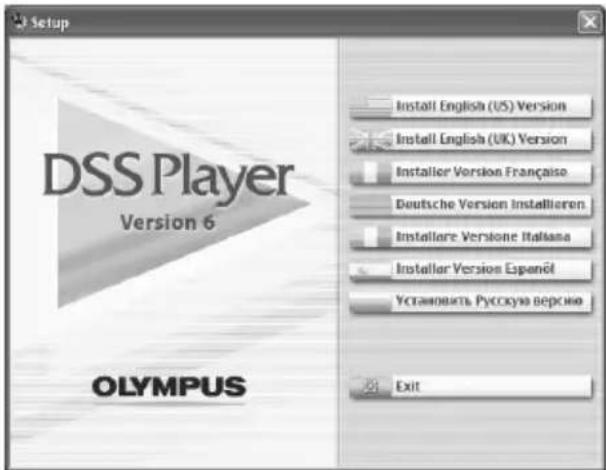
Installing DSS Player
5 Register user information.
Enter your name, company name and serial number. For the serial number, see the label attached to the CD-ROM package provided with DSS Player. When entered, click [Next]. When the confirmation dialog appears, click [Yes].
6 Confirm your acceptance of the terms of the Licensing
Agreement.
You must accept the terms of the Licensing Agreement to install DSS Player. If you accept them, click [Yes].
7 Select where to install DSS Player.
This lets you specify the folder in which to install DSS Player. Click [Browse] to find the desired installation folder. To accept the default folder, click [Next].
Note
If the installation folder does not exist, a confirmation dialog box opens to get your permission to create a folder for this purpose. Click [Yes].
Select a program menu folder.
You may change the program menu folder to another one, such as [Start Up]. To accept the default folder, click [Next].
9 Authorizing the start of file copying.
Confirm all "Current Settings". To accept them, click [Next].
Note
To change the program menu folder or installation folder, click [Back].
10 Copy files.
Wait until DSS Player is installed on your PC, then click [Finish].
The screen returns to the opening screen automatically.
Installing the Device Driver
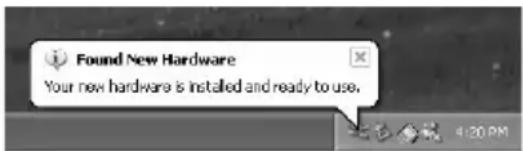
11 Connect the recorder to your PC.
When you connect the recorder to your PC for the first time after installing DSS Player, the recorder's driver will be installed automatically. If the driver is installed properly, DSS Player will start automatically.
(For details about operation for DSS Player see pages from P.11)
Macintosh
1 Insert DSS Player into the CD-ROM drive.
Double-click CD icon.
Double-click the desired language to select it.
Double-click the following icon.
4 Click [Continue] when the DSS Player opening screen appears.
5 Confirm your acceptance of the terms of the Licensing Agreement.
You must accept the terms of the Licensing Agreement to install DSS Player. If you accept them, click [Agree].
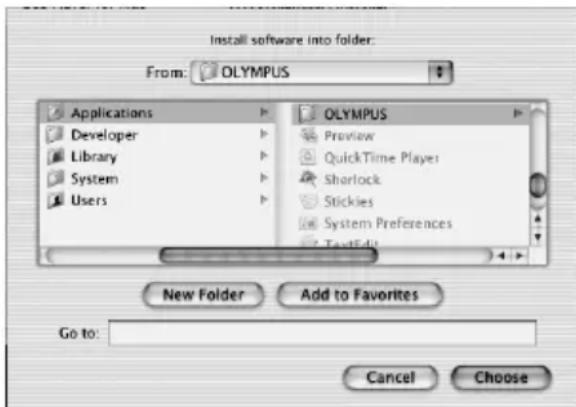
Select where to install DSS Player.
This lets you specify the folder in which to install DSS Player. To accept the default folder, click [Choose]. Installing DSS Player.
7 Completing setup. Installation has finished. Click [Quit].
Register user information.
To use the DSS Player, it is necessary to register the user information at the time of initial startup.
Open the [DSS Player] folder created at installation, and the user's registration screen will be displayed, if the ● is double clicked. Please input your name, company name, and serial number.
Please see the seal attached to the CD-ROM package included with the DSS Player, for the serial number. After the input has ended, click [OK] to complete the registration.
Uninstalling Software
To uninstall any of the software component of the DSS player software installed on your PC, follow the steps below.
Windows
Exit DSS Player.
Select [Control Panel] from [start] menu.
Click [Add/Remove programs] in the control panel window.
A list of applications that have been installed is displayed.
4 Select the software you would like to uninstall/remove.
5 Click [Change/Remove].
6 Confirmation of Deleting the File.
Click the [OK] button to start uninstalling.
An additional message may appear, if so, read it carefully and follow the instructions given.
7 When the [Maintenance Complete] screen is displayed, click [Finish] to complete uninstalling.
Note
The voice files you made are stored in the [MESSAGE] folder. If you don't need them, delete them. You can confirm the location of the [MESSAGE] folder by clicking [Options] in the [Tools] menu before uninstalling.
Macintosh
1 Exit DSS Player.
Delete the Preferences File.
Delete the [DSS Preference] file in the following location.
Macintosh HD : Users : Library : Preferences
Delete the Executable File.
Delete the [DSS Player] file in the location where you installed the file.
A Delete the Help File.
Delete the [DSS Player Help] file in the following location.
System Folder : Help
Note
The voice files you made are stored in the [MESSAGE] folder. If you don't need them, delete them. You can confirm the location of the [MESSAGE] folder by clicking on [Options] in the [Tools] menu before uninstalling.
Using Online Help
To open Online Help, you have the following options.
Windows
- Click the [start] button, select [All Programs], then [Olympus DSS Player], then click [Help].
- While DSS Player is running, choose [Contents] from the [Help] menu.
- While DSS Player is running, press [F1] on the keyboard.
Macintosh
- While DSS Player is running, choose [DSS Player Help] from the [Help] menu.
Search by Contents
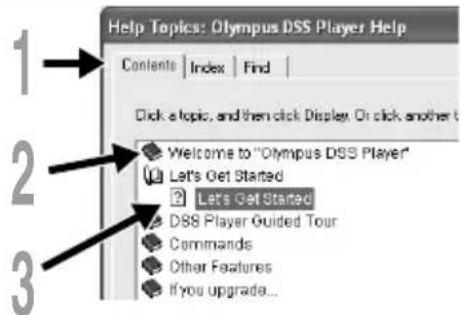
Once the Online Help screen appears, click the Contents tab.
2 Double-click the icon of the desired topic heading.
The title of the topic is displayed.
3 Double-click the icon of the desired topic. An explanation of the topic is displayed.
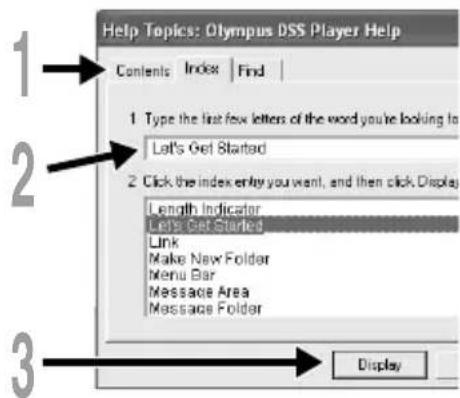
Search by Key word
1 Once the Online Help screen appears, click the Index tab.
Enter text.
Matching keywords are located automatically.
Choose a topic, then click [Display].
An explanation of the topic is displayed.
Note
10 For more information on menus and operations, refer to Online Help. You will be able to use Online Help after DSS Player is installed.
Running DSS Player
Windows
By connecting the recorder to your PC, you can automatically start the application.
Disabling automatic start
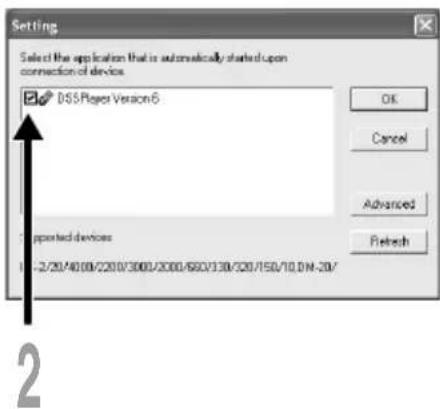
1 Right click on the ☐ of the taskbar on the lower right of the screen, and select [Setting].
The application which enables setting will be displayed by dialog.
2 Click the ☑ of the [DSS Player Version 6]. The check mark on [DSS Player Version 6] disappears. For automatic start, select and click DSS Player to reinstate again.
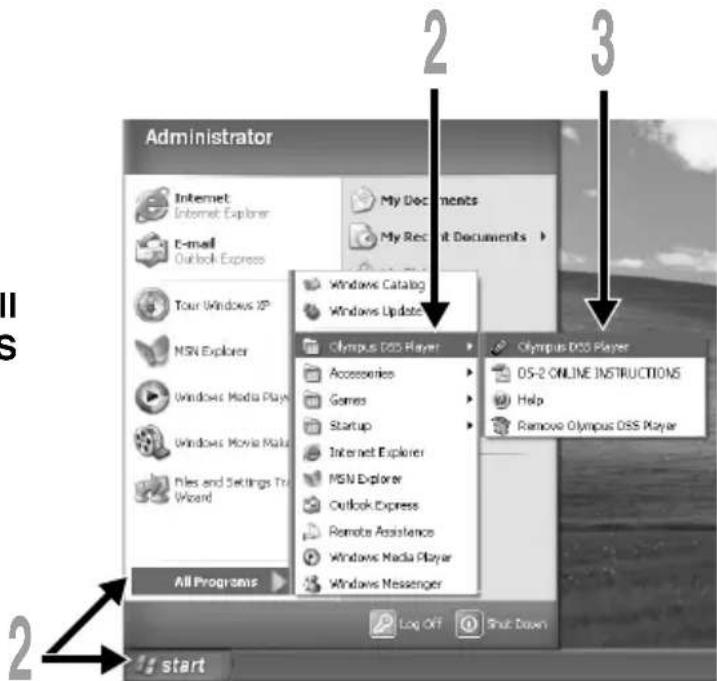
Manual start
1 Start Windows.
2 Click the [start] button, select [All Programs], then [Olympus DSS Player].
3 Click [Olympus DSS Player].
Note
You cannot run more than one DSS Player program or multiple copies of the same program simultaneously.
Macintosh
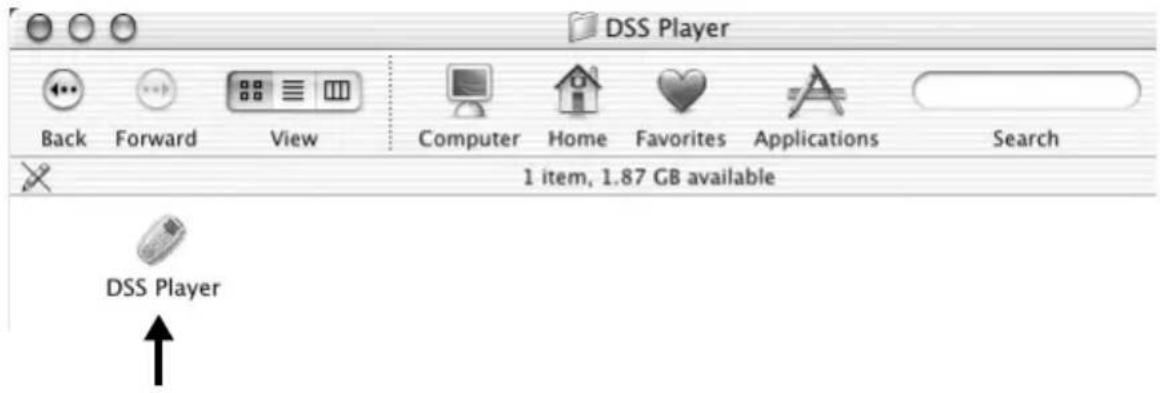
To start, open the "DSS Player" folder created upon installation and double-click the icon. When it starts for the first time after installation, user information needs to be registered. Please see P.7 for details.
Note
The Mac version DSS Player has no automatic start function.
Connecting the RS25/RS26 Foot Switch
Windows Macintosh
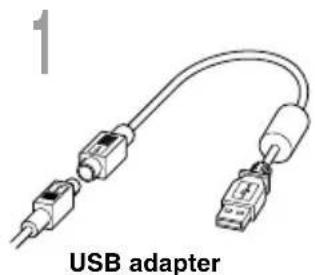
Connecting to a USB Port
1 Connect the foot switch cable to the USB adapter cable.
2 Connect the USB adapter cable to the PC's USB port.
natural_image
USB adapter cable with connector port (no text or symbols on diagram)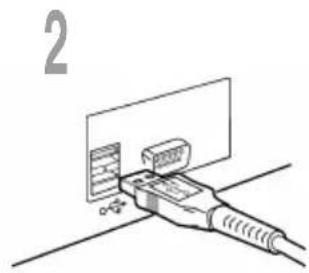
natural_image
Diagram of a plug inserted into a socket, showing internal wiring and a connector (no text or symbols)Windows
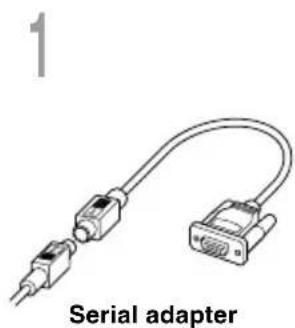
Connecting to a Serial Port
1 Connect the foot switch cable to the serial adapter cable.
2 Connect the serial adapter cable to the PC's serial port.
natural_image
Diagram of a serial adapter with two connected cables (no text or symbols on the diagram itself)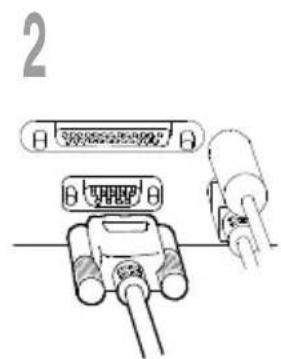
Foot switch setting
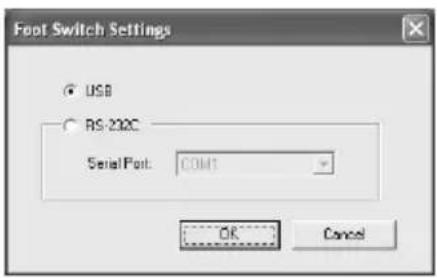
3 Start the DSS Player and select "Foot Switch Settings..." from the "Tools" menu.
4 Select the foot switch connection method.
Note
The RS25/RS26 foot switch works only with the DSS Player.
Connecting the E102 Headset
The E102 is a stereo headset. When playing stereo sound, wear the set properly, observing the L and R markings.
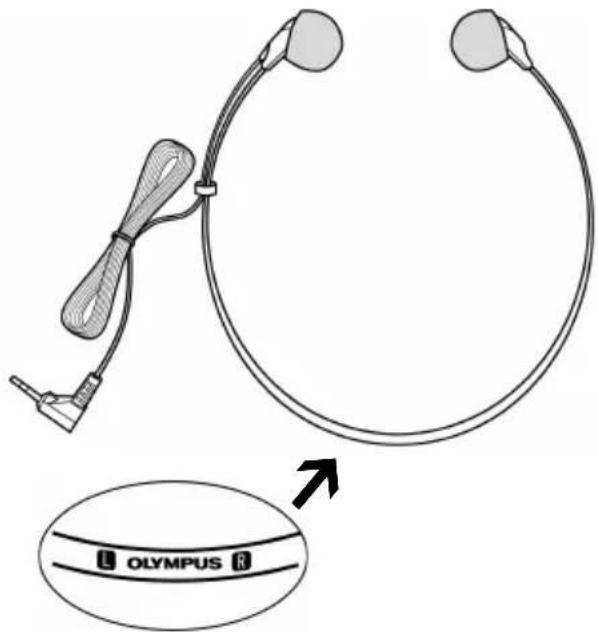
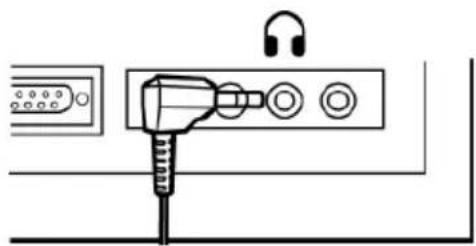
Plug the headset into the PC's earphone terminal 📷.
natural_image
Pure electrical circuit lines without any symbolsNote
If your PC does not have a terminal marked 📤, plug the headset into a terminal marked or ↔.
Window Names
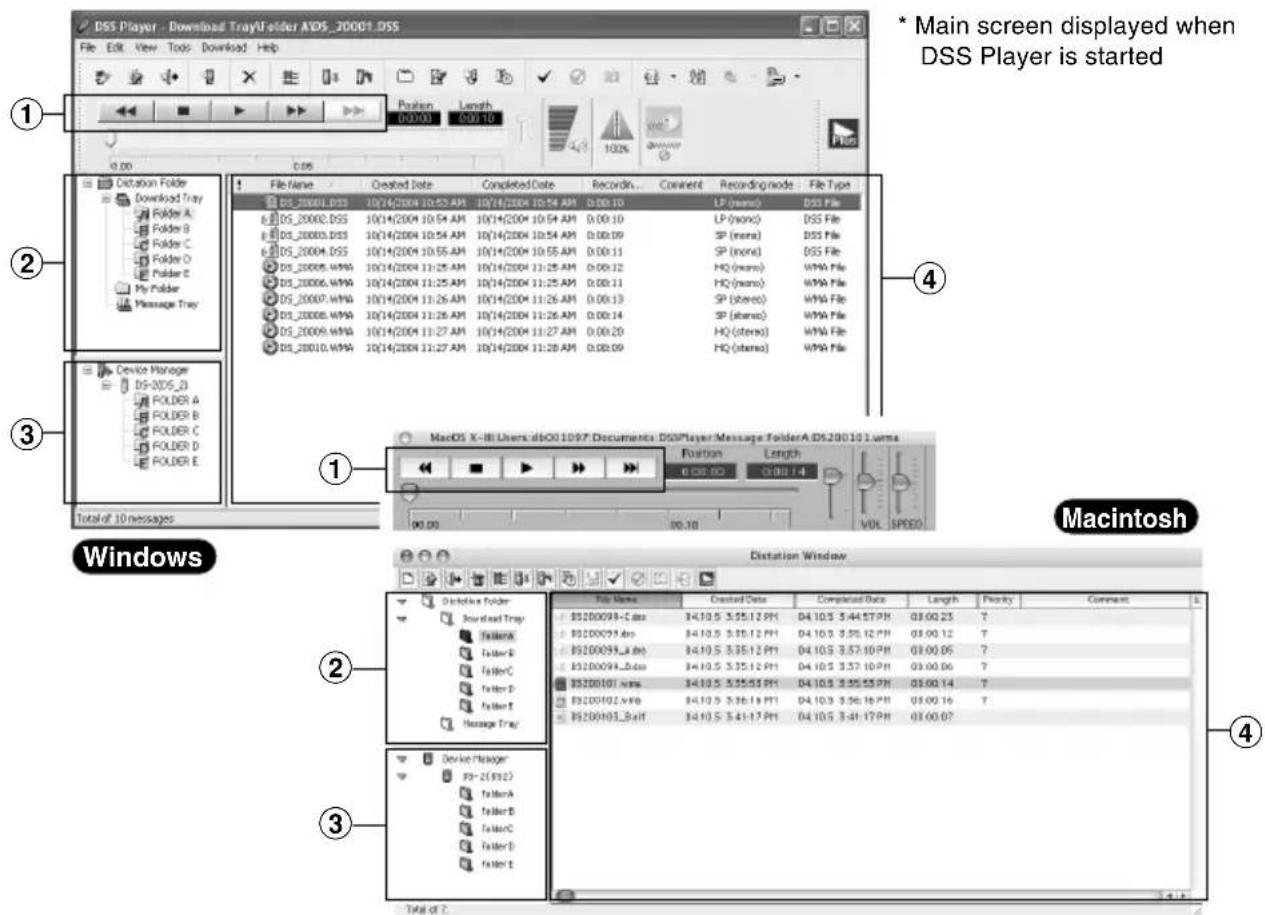
①Play Control Bar
Control buttons to play and stop voice files.
②Dictation Folder Window
Will display the directory structure of the DSS, WMA, WAVE (Windows only) and AIFF (Macintosh only)-format files stored on your PC's hard disk.
③Device Manager Window
Will display the directory structure of the folders in the recorder.
④Voice File List Box
Will display the voice files in the folder selected in ② and ③.
Play a Voice File
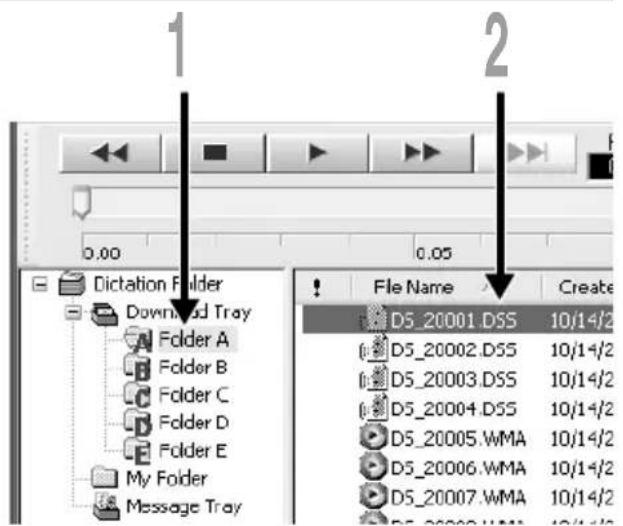
1 Select the folder.
Select the folder that contains the voice file you would like to play.
2 Select the voice file.
Select the voice file to play from the Voice File List Box.
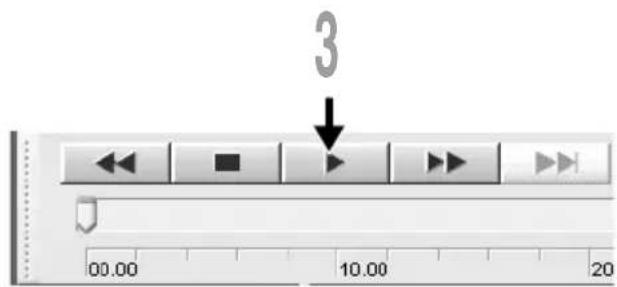
3 Play the voice file. Click the (play) button of the Play Control Bar.
Other playback control such as Rewind, Fast Forward, Stop, Speed Control, Volume Control, Time Axis and Index Skip are available from the Play Control Bar.
Upgrade Function
The “DSS Player” enables upgrades (Options) to the “DSS Player Plus” which is equipped with more functions. In addition to the DSS Player functions, voice recognition using voice recognition software, joining of files, sharing of files and the menu setting of this recorder can be utilized.
Purchase and Upgrade
To purchase "DSS Player Plus" and upgrading from "DSS Player" is operated in the following procedures.
Windows Macintosh
Start the DSS Player.
Please see ☐ P.11 for the starting method.
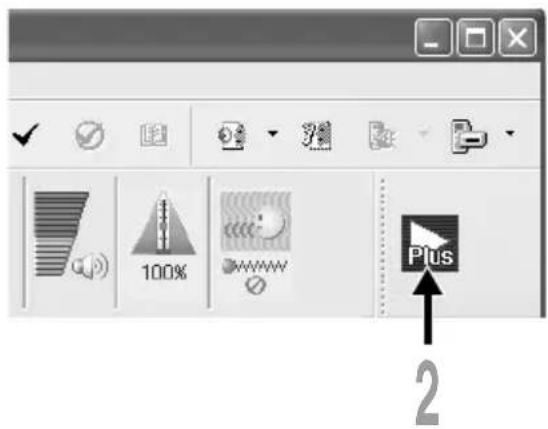
2 Click the button or select [Purchase a new license for DSS Player Plus] in the [Help] menu.
The web browser will start and the purchase site of the DSS Player Plus will be displayed. Please operate according to guidance on the screen.
When the purchase procedure is completed, the license number will be issued by mail.
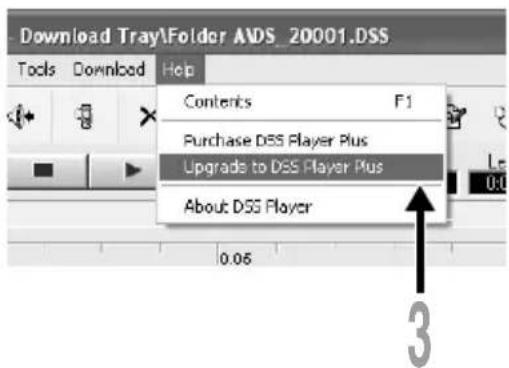
3 Select [Upgrade to DSS Player Plus] from the [Help] menu.
The "Upgrade to DSS Player Plus" dialog will be displayed.
4 In the [Upgrade to DSS Player Plus] dialog, enter the license number of your purchase, and click the [OK] button.
When starting the application next time, DSS Player will be upgraded to DSS Player Plus.
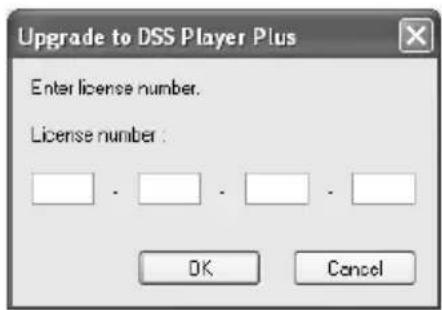
Upgrading to DSS Player Plus
When upgraded, the title of the main menu changes to [DSS Player Plus]. Also, you can confirm the upgrade by selecting [About DSS Player] from the [Help] menu on the tool bar. In the [About DSS Player] window, the [DSS Player Plus] should be displayed.
Notes
• To purchase the license number, it requires an environment where the Internet can be utilized.
- Please see the details in the website regarding the purchase of the license number.
Technical Assistance and Support
The following are contact information for technical support for Olympus recorders and software only.
◆Technical Hotline Number in the U.S. and Canada 1-888-553-4448
◆User Support E-mail address in the U.S. and Canada distec@olympus.com
◆Technical Hotline Number in Europe
Toll free number
00800 67 10 83 00
available for Austria, Belgium, Denmark, Finland, France, Germany, Italy, Luxembourg, Netherlands, Norway, Portugal, Spain, Sweden, Switzerland, United Kingdom
Charged numbers for the Rest of Europe
+49 180 567 1083
+49 40 23773 899
◆User Support E-mail address in Europe
dss.support@olympus-europa.com
For customers in Europe

“CE” mark indicates that this product complies with the European requirements for safety, health, environment and customer protection.

This symbol [crossed-out wheeled bin WEEE Annex IV] indicates separate collection of waste electrical and electronic equipment in the EU countries.
Please do not throw the equipment into the domestic refuse.
Please use the return and collection systems available in your country for the disposal of this product.
Applicable Product : Foot Switch
OLYMPUS®
OLYMPUS IMAGING CORP.
Shinjuku Monolith, 3-1 Nishi-Shinjuku 2-chome, Shinjuku-ku, Tokyo 163-0914, Japan. Tel. 03-3340-2111
OLYMPUS IMAGING AMERICA INC.
Two Corporate Center Drive, PO BOX 9058 Melville, NY 11747-9058, U.S.A. Tel. 1-800-622-6372
OLYMPUS IMAGING EUROPA GMBH
(Premises/Goods delivery) Wendenstrasse 14-18, 20097 Hamburg, Germany. Tel. 040-237730
(Letters) Postfach 10 49 08. 20034 Hamburg. Germany.
OLYMPUS UK LTD.
2-8 Honduras Street, London EC1Y OTX, United Kingdom, Tel. 020-7253-2772
http://www.olympus.com/
For customers in North and South America
Declaration of Conformity
Model Number: RS25
Trade Name: DIGITAL VOICE RECORDER
Responsible Party: OLYMPUS IMAGING AMERICA INC.
Address: 2 Corporate Center Drive, PO BOX 9058 Melville, NY 11747-9058, U.S.A.
Telephone Number: 800-622-6372
This device Complies with Part 15 of the FCC Rules. Operation is subject to the following two conditions: (1) This device may not cause harmful interference, and (2) this device must accept any interference received, including interference that may cause undesired operation.

Tested To Comply
With FCC Standards
FOR HOME OR OFFICE USE
Canadian RFI
This digital apparatus does not exceed the Class B limits for radio noise emissions from digital apparatus as set out in the Radio Interference Regulations of the Canadian Department of Communications.