
TS H552U - DVD Recorder SAMSUNG - Free user manual and instructions
Find the device manual for free TS H552U SAMSUNG in PDF.


| Type | DVD±R/RW Internal Optical Drive |
| Model | Samsung TS-H552U |
| Dimensions (W x H x D) | 148.2 x 42 x 184 mm (5.34 x 1.65 x 7.24 in) |
| Weight | 760 g (1.68 lbs) |
| Interface | ATA/ATAPI (E-IDE), PIO Mode 4, Ultra DMA Mode 2 |
| Buffer Memory | 2 MB |
| Power Supply | +5V DC and +12V DC from PC power supply |
| Read Speed (Max) | DVD-ROM (SL): 16x, DVD-ROM (DL): 8x, CD-ROM: 48x, DVD-R: 8x, DVD+R: 8x |
| Write Speed (Max) | DVD-R: 16x, DVD+R: 16x, DVD-RW: 4x, DVD+RW: 4x, DVD+R Dual: 4x, CD-R: 40x, CD-RW: 32x |
| Supported Disc Types | DVD-R, DVD-RW, DVD+R, DVD+RW, DVD-ROM, DVD-Video, DVD+R Dual; CD-ROM, CD-R, CD-RW, CD-DA, CD+E(G), CD-MIDI, CD-TEXT, CD-ROM XA, Mixed Mode CD, CD-I, CD-I Bridge, Multisession CD |
| Operating Temperature | 5°C to 45°C (41°F to 122°F) |
| Operating Humidity | 10% to 80% (non-condensing) |
| Installation Orientation | Horizontal or vertical (vertical only supports 12 cm discs) |
| Special Features | Buffer underrun prevention technology, Magic Speed (low noise mode), RPC-2 region code |
| Care & Cleaning | Clean exterior with soft dry cloth; do not use solvents. Keep away from liquids and foreign objects. |
| Safety Precautions | Do not disassemble or modify. Avoid shocks and drops. Use only recommended discs. |
| Spare Parts & Repairability | No user-serviceable parts. Firmware updates available via Samsung ODD website. Contact Samsung support for repairs. |
| Mounting Screws | M3 x 6 mm (provided with drive) |
Frequently Asked Questions - TS H552U SAMSUNG
User questions about TS H552U SAMSUNG
0 question about this device. Answer the ones you know or ask your own.
Ask a new question about this device
Download the instructions for your DVD Recorder in PDF format for free! Find your manual TS H552U - SAMSUNG and take your electronic device back in hand. On this page are published all the documents necessary for the use of your device. TS H552U by SAMSUNG.
USER MANUAL TS H552U SAMSUNG
Index | Safety Precautions Features Installing Device Driver How to Use Utilities Storing/Cleaning Troubleshooting Specifications
Samsung's OMS (Optical Media Solution) Customer Support Website (http://samsungelectronics.com) offers the latest versions of firmware for ODD products, user instructions and product information.


The Statement of Warranty
http://samsungelectronics.com
http://samsung-ODD.com
Index
Main Page
Safety Precautions
Safety Precautions During Installation During Operating Others
Features
Exterior System Requirements Features
Installing DVD±R/RW Drive and Connecting Cables
Installing Drive Connecting Cables
Installing Device Driver and Confirming The Installation
- Firmware Update Confirming the Installation of Device Driver Installing the MS-DOS device driver
How To Use The DVD±R/RW Drive
How to Use the Drive How to Use DVD±R/RW and Other Discs MAGIC SPEED
Storing/Cleaning Drive and Disc
Cleaning the Drive Storing the Disc Cleaning the Disc When the on/off Light Blinks
Deleting Utilities
Troubleshooting
Troubleshooting Caution: Possible Errors
Product Specifications
Important to read and understand at all times


This symbol indicates explanations about extremely dangerous matters. If users ignore this symbol and handle the device the wrong way, serious injury or death could result.

This symbol indicates explanations about dangerous matters. If users ignore this symbol and handle the device the wrong way, damage to home or property could result.

Important to read and understand at all times

Do not disassemble
B
Always make sure that the disc does not have a crack before use. If the disc has a crack (especially around the center hole), it is recommended to make a copy immediately and use the copy instead. When a cracked disc is used continuously, the size of the crack is likely to grow and this will eventually result in irreparable damage to the disc.
Do not drop the drive, and protect it from severe shocks. - It can damage the drive or cause it to malfunction.

Do not place the drive in direct sunlight.
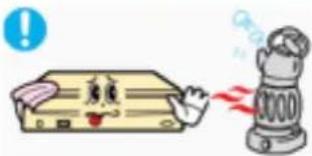
- Avoid low or high temperature environments.
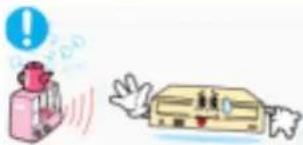
- Avoid high-humidity environments.
Handle with caution to prevent damage from external shock.
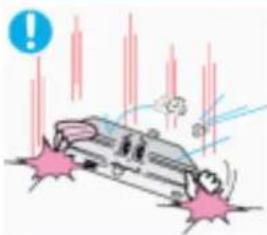
Do not drop the drive, and protect it from severe shocks. - It can damage the drive or cause it to malfunction.
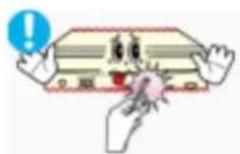
Do not move the drive while in operation and do not attempt to open the disc tray by force. Make sure to close all working programs before attempting to open the tray and always use the open/close button.

Do not insert a pin into the emergency opening while in operation.

Do not insert hands in the tray while in operation. This may cause damage to the product or human body
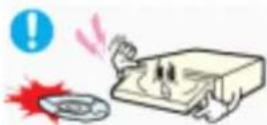
Do not use cracked, distorted or damaged discs. In particular, a disc with a crack on the inner tracks may break while in use.
Always check to be sure the disc is not cracked before use. If you find a crack on the disc (especially around the center hole), make a copy of the disc immediately and use the copy instead. Continued use of a cracked disc will cause the crack to become bigger, resulting in irreparable damage to the disc. Do not use low-quality discs (illegal, scratched, damaged, etc.). Samsung is not responsible for any loss resulting from the use of such discs.
Never allow food particles or foreign substances to enter the drive casing.
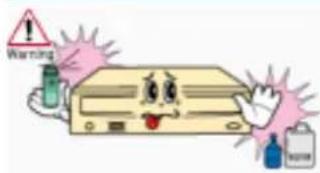
To protect against the risk of fire, do not spill such liquids as alcohol and benzene on the drive.
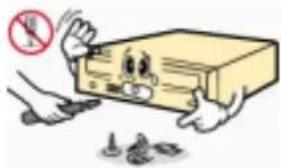
Do not disassemble, attempt to repair or modify the device without express approval as directed in the manual. - To reduce the risk of damage, electric shock, and fire.
Features
Front
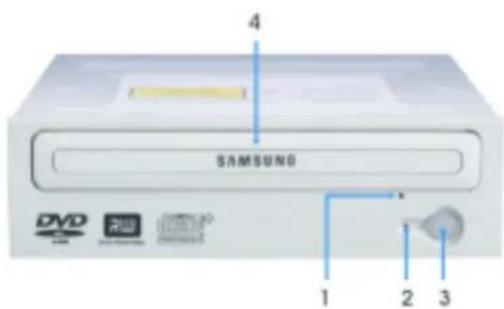
- Emergency Hole 2. On/Off Lamp
- Open/Close Button 4. Disc Tray
- Design and specifications are subject to change without prior notice.
Back
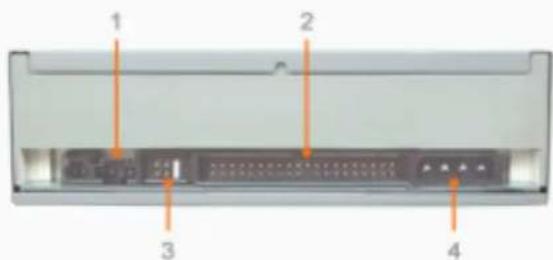
- Sound Output Port 2. Interface Port
- Master/Slave Selection Port 4. Power Port
Components
DVD±R/RW Drive
40-pin interface cable
audio cable
four screws to install the drive
• drive installation instruction sheets
software programs
(software: Nero Express 6.3, InCD 4, WinDVD Creator, WinDVD Recorder, Intervideo DVD Copy, Acrobat Reader 5.0, DirectX 9.0)
- In case you need to return the purchased product, be sure to include all the accessories provided with the product to receive a refund.
- The type of accessories varies depending on product model.
Features
System Requirements
You need to have an IBM-compatible PC with the following specifications.
| Item Description | |
| OS Microsoft Windows 98 SE/2000/Me/XP(SP 1.0 or higher) | |
| CPU | Pentium3 or greater IBM-compatible PC(Recommendation: Pentium4 2.0GHz or higher) |
| RAM 256Mbytes or greater | |
Features
Features
Versatile Multimedia Features
DVD-R : Read / Write DVD-RW : Read / Write / Rewrite allowed DVD+R : Read / Write DVD+RW : Read / Write / Rewrite allowed DVD-ROM : Read DVD+R Dual : Read / Write CD-R : Read / Write CD-RW : Read / Write / Rewrite allowed Supports Read (playback) for various types of discs
See table below for details
| Disc Type Writable Rewritable Read | ||||
| CD | CD-STAMP × × O | |||
| CD-R O × O | ||||
| CD-RW (O) O O | ||||
| DVD | DVD-STAMP × × O | |||
| DVD-R For General Ver 2.1 | O × O | |||
| DVD-RW Ver 1.1 | (O) O O | |||
| DVD+R Basic Ver 1.11 | O × O | |||
| DVD+RW Basic Ver 1.2 | (O) O O |
Writable : write once, read many times.
Rewritable: write data one or more times.
DVD Recommended Disc Types
DVD-R Media: Taiyo-Yuden, TDK, Mitsubishi Chemical, Hitachi Maxell, Fuji Film, PVC, Panasonic, RiTEK, CMC, UNIFINO. DVD-RW Media: TDK, Mitsubishi Chemical, JVC, PVC, RiTEK, CMC. DVD+R Media: RICOH, Taiyo-Yuden, Mitsubishi Chemical, RiTEK, CMC, Prodisc, Optdisc. DVD+RW Media: RICOH, Mitsubishi Chemical, RiTEK, CMC. DVD+R Dual: MKM
CD Recommended Disc Types
CD-R Media: Taiyo-Yuden, RICOH, Mitsubishi Chemical, Hitachi Maxell, Fuji Film, RiTEK (Phtharo), CMC, Pioneer, Princo, TDK. CD-RW Media: RICOH, Mitsubishi Chemical, RiTEK, CMC. HS CD-RW Media: RICOH, Mitsubishi Chemical, CMC. US CD-RW Media: Mitsubishi Chemical
Features
Buffer underrun prevention technology included
What is "buffer underrun prevention technology"?
A technology to prevent "buffer underrun" errors in which the data transmission speed is not as fast as the data writing speed when data is being recorded on a CD.
Reading / Recording Speed
Reading Speed (MAX): DVD-ROM (S) (16x), DVD-ROM (D) (8x), CD-ROM (40x), DVD-R (8x), DVD-RW (8x), DVD+R (8x), DVD+RW (8x), CD-ROM (48x), CD-R (48x), CD-RW (32x). Recording Speed (MAX):
DVD+R DUAL (4x), DVD+RW (4x), DVD-R (16x), DVD+R (16x), DVD-RW (4x), CD-R (40x), CD-RW (32x)
Installing DVD±R/RW Drive and Connecting Cables
Installing Drive
- Turn the PC off.
- Open the cover as shown in the picture.
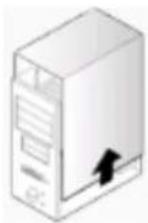
- If necessary, attach the support devices on both sides of the drive.
- The support devices are PC accessories. Purchase a pair if necessary. (SCREW: M3 X 6 X 4)
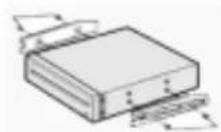
- Insert the DVD±R/RW Drive after removing the plate as below.
- If it is difficult to install the DVD±R/RW drive into the plate, try installing it where you put in the floppy discs.
- Be sure to use the screws (M3x6) provided with the product.
- Using screws other than M3x6 may cause malfunction.

Be sure that the screws are tightened securely in place. Loosely tightened screws may result in an increased level of noise.
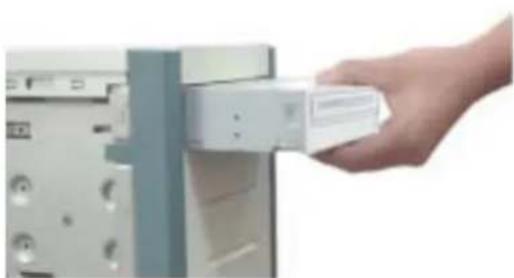
Installing DVD±R/RW Drive and Connecting Cables
Connecting Cables
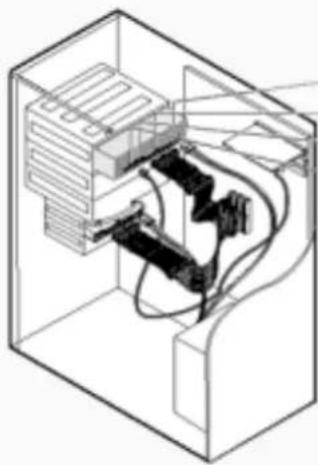
- Connecting the power cable
- Connecting the E-IDE cable
- Master/Slave Selection Port
- Connecting the audio cable
Connecting the power cable
Hold the power cable (with four pins) in the power box within the computer with the cutoff edges (○) facing up and connect it to the power port in the back of the DVD±R/RW drive.
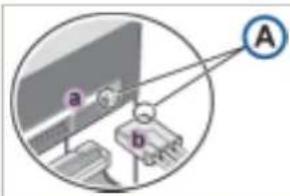
A - Cutoff edges
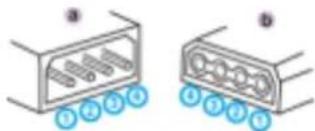
1 +5V DC 2 Ground 3 Ground 4 +12V DC

Improperly connected power cable may cause malfunction. Check the direction of the power cable and the cutoff edges before connecting the cable.
Connecting the E-IDE cable
When you use one E-IDE cable
Set the jumper to SL (slave) in the Master/Slave port in the back of the DVD±R/RW drive.
Installing the DVD±R/RW drive and connecting cables
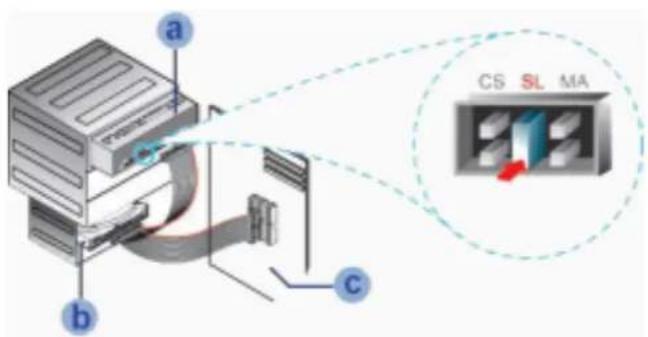
a: Slave drive (select the SL jumper) b: HDD c: Motherboard
When you use two E-IDE cables
Set the jumper to MA (master) in the Master/Slave port in the back of the DVD±R/RW drive.
When you have one DVD±R/RW drive: Set it to MA (master)
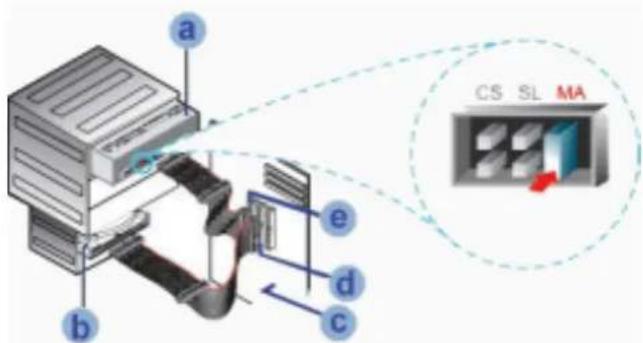
a: Master drive (select the MA jumper) b: HDD c: Motherboard d: Primary 1 e: Secondary 1
When you have one DVD±R/RW Drive and the other ODD products: Set it to MA (Master) / SL (Slave),
![a b c d e f [Select the Master jumper] CS SL MA [Select the Slave jumper]](/content/2026/05/788664/images/8f6d06d305d6fb99e57c3603888fa66725955199aaa87a7093391a72d8bd7f6b.jpg)
Installing DVD±R/RW Drive and Connecting Cables
| a : Master Drive (Select the MA jumper) | b : Slave Drive (Select the SL jumper) |
| c : HDD d : Motherboard | |
| e : Primary 1 f : Secondary 1 |
Connecting the Jumper to the Master/Slave Port
Connect the jumper to the slot in the back of the DVD±R/RW Drive. When you connect the jumper to MA (Master), the drive runs as the master, and when you connect it to SL (Slave), the drive runs as the slave. When you connect it to CS (CSEL), you can control the device using the host interface signal CSEL. (Connection to MA is recommended.)
![graph TD A["Server"] --> B["Chip 1"] A --> C["Chip 2"] A --> D["Chip 3"]](/content/2026/05/788664/images/4986f5154b5e8ed401397eaf68683dbd9ddcb3ec253f716246cefcb1a4205f63.jpg)
MA : Master
SL : Slave
CS : Cable Select(CSEL)
Connecting the Audio Cable (When Connected to the Sound Card)
To listen to the sound from the drive in Analog mode, connect the audio output on the DVD±R/RW Drive to the audio input of the sound card using an audio cable (4-pin).
Connecting the Digital output terminal.
For clearer sound, use a digital output terminal. Digital output terminal is only available with the Sound card which support Digital output. For using Digital output terminal, recommend to buy & use the sound card.
Installing Device Driver and Confirming the Installation
Firmware Update
- Go to http://samsung-ODD.com
- Click Firmware on the menu bar (in the upper right-hand corner).
- Click Firmware Downloads. Check for your drive model and start downloading.
Installing Device Driver and Confirming the Installation
Confirming the Installation of Device Driver
Confirming Using [Device Manager]
Windows 98/Me
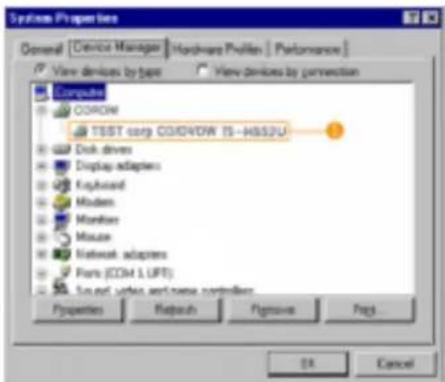
- Click [Start] - [Settings] - [Control Panel] - [System]
- Click on the [Device Manager] tab in the System Properties window.
- Click CDROM drive in the Device Manager window.
1 in the picture in the left appear if the driver is installed properly.
Windows 2000
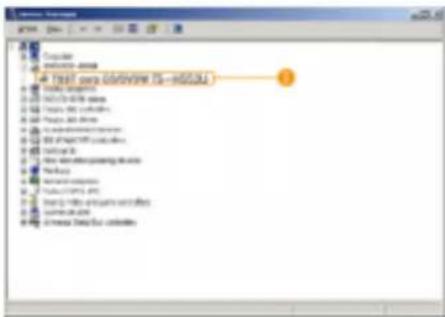
- Click [Start] - [Settings] - [Control Panel] - [System]
- Click on the [Hardware] tab in the System Properties window and then click on the [Device Manager] tab.
- Click DVD/CD-ROM drive in the Device Manager window.
1 in the picture in the left appear if the driver is installed properly.
Windows XP
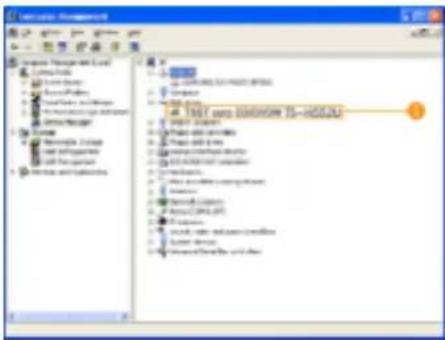
- Go to [Start] - [Settings] - [Control Panel] - [Performance and Maintenance]
- Click [Administrative Tools] icon in the Performance and Maintenance window.
- Click [Computer Management] icon in the Administrative Tools window.
- Click [Device Manager] icon in the Administrative Tools window and then click DVD/CD-ROM drive.
1 in the picture on the left appears if the driver is installed properly.
Installing Device Driver and Confirming the Installation
Installing the MS-DOS device driver
Automatic Setup
The device driver is located in the 'Dos_driver' folder of the CD which is provided with the DVD±R/RW Drive
- Insert the CD provided with the DVD±R/RW Drive and open the 'Dos_driver' folder.
- Run the CDSETUP.EXE file in the 'Dos_driver' folder.
- When Setup is successfully completed, click 'OK' button or press the 'Enter' key.
- Reboot the computer.

The MS-DOS device driver is used to detect a DVD-MULTI drive in MS-DOS and supports only the read function as in the case of a CD-ROM drive. We recommend that you not install the MS-DOS device driver when you use the record function.
Manual Setup
- Make the C:\SAMSUNG directory.
- Copy the files from the CD provided with the DVD±R/RW Drive to the C:\SAMSUNG directory. To do so, type "COPY D:\Dos_driver *.* C:\SAMSUNG" after the C:\ prompt and press [Enter].
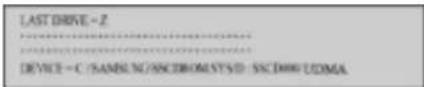
- Edit the 'CONFIG.SYS' file. Add the DEVICE=C:\SAMSUNG\SSCDROM.SYS\D:SSCD000 /UDMA entry.
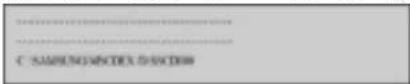
- Edit the 'AUTOEXEC.BAT' file. Add the C:\SAMSUNG\MSCDEX/D:SSCD000 entry.
- Reboot the computer.
How To Use The DVD±R/ RW Drive
How to Use the Drive
When the On/Off light is orange, do not turn the PC off or remove the DVD±R/RW Drive as it may cause damage in the drive.
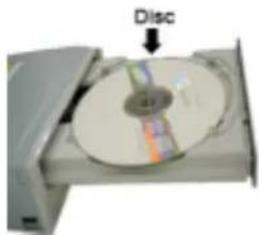
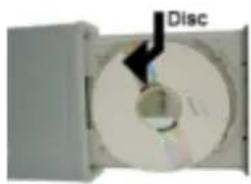
How to Use a Horizontally Installed Drive
You can use 3.15 Inch or 4.72 Inch (8cm or 12cm) discs. The drive cannot read the disc properly if any part of the disc is place outside the tray guiding line.
How to Use a Vertically Installed Drive
This drive can be installed vertically.
You can use only the 4.72 Inch (12cm) discs. (You cannot use the 3.15 Inch (8cm) discs) The drive cannot read the disc properly if any part of the disc is place outside the tray guiding line.
How To Use The DVD±R/RW Drive
How to Use DVD±R/RW and Other Discs

The DVD±R/RW Drive allows writing DVD-RW discs using Nero Express and enables "packet writing" (high-speed recording) using InCD. The drive also allows writing DVD-R discs using Nero Express.

Unauthorized copying of DVD or software titles is illegal and the individuals that make illegal copies will be held responsible for any copyright infringement. Using low-quality discs may lengthen the recording time or not support double-speed recording.
You can use the DVD±R/RW Drive to playback music CDs, CD-ROM, CD-R/RW, or DVD-ROM discs, like a CD-ROM drive or a DVD-ROM drive. If your computer recognizes the [CD-ROM] icon designated to the DVD±R/RW Drive as the 'E:' drive, insert a CD-ROM or a DVD-ROM disc and access the 'E:' drive. (The actual drive letter of the DVD±R/RW Drive may vary depending on the user's system environment.)
To Playback a DVD Video Disc:
You need a DVD decoder board or the DVD decoder software program. (Provided with WinDVD Recorder) Use WinDVD Recorder to change the region code of the DVD±R/RW Drive.
DVD Region Protection Coding (RPC):
The RPC feature is supported on DVD players and is used with DVD-video discs (such as movies). Currently, the motion picture industry has divided the world into different regions or zones that correspond to the regional markets into which the motion picture industry releases movies. Simply put, RPC codes are placed on movies marketed throughout the world, based on the region of the world in which they are being sold. These RPC codes help control and prevent pirating of new movies into other motion picture regions prior to their true release dates within those markets. The TS-H552U DVD±R/RW drive supports RPC phase II. In the RPC-2 mode, the local code can be changed by users. RPC-2 is selected by default for the TS-H552U DVD±R/RW drive. You can change the region code up to five times via an MPEG application.
Please contact your dealer or local SAMSUNG representative if you wish to change the local code more than five times.
MAGIC SPEED
What is MAGIC SPEED?
The MAGIC SPEED provides a function that user optionally chooses the disc reading speeds, high speed (Max speed) mode and low noise (X32) mode. The low noise mode offers the best PC environment by minimizing driving noise.
The Magic Speed not only functions to decrease noise by reducing reading speed but also gets a preventive effect of disc breakage, which could be occurred by high speed. Its purpose is to supply the stable PC environment to user.
Explanation of MAGIC SPEED Mode and Ways to Use
1. Explanation of MAGIC SPEED Mode
The Maximum Speed Mode: Set up this mode when you want to read a disc at the maximum speed provided by the drive. The Low Noise Mode: Set up this mode when you want to read a disc at a stable, low speed (X32). The mode selected and set using the Magic Speed feature does not change when you connect the drive to a different PC. Make sure you check the settings before use.
Caution: In case of a cracked disc, the disc could break if operating at maximum speed. Therefore, it is recommended to operate in Low Noise Mode or to immediately make a copy and use it.
2. Ways to Use the MAGIC SPEED
First, please install the Magic Speed program from Samsung's homepage. Operate the program by clicking the right mouse button on the MAGIC SPEED Tray Icon.
Select a desired mode from the program window, and click "Setup". The reading speed of the drive operates in the selected mode. Close the program window by selecting "Close". At this time, the reading speed will continue to operate at the changed speed unless you change the mode or end the program. It is recommended to use "Maximum Speed Mode" when performing Data Copy and Disc Copy, and to use "Low Noise Mode" for general operations. Other Function: Method to release automatic operation: This program automatically operates when the PC boots. If you wish to release the automatic operation, uncheck the "Automatic Operation" item in the Tray Icon menu.
Place to download MAGIC SPEED
Samsung's Customer Service Homepage (URL: www.samsungODD.com) - Select Firmware > MAGIC SPEED.
Deleting Utilities

Click [Start] - [Settings] - [Control Panel] - [Add/Remove Programs] and a window as shown below appears.

[Windows 98 / Me]
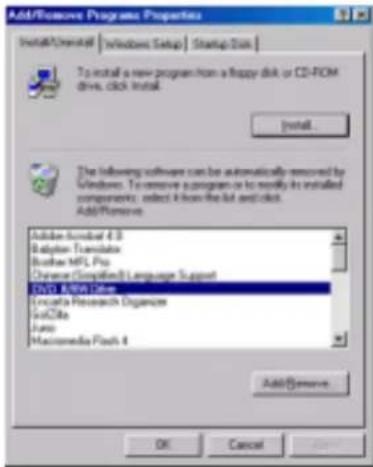
Click the [Add/Remove] button to remove the program.

[Windows 2000]
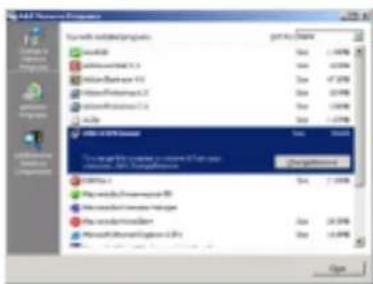
Click the [Add/Remove] button to remove the program.

[Windows XP]
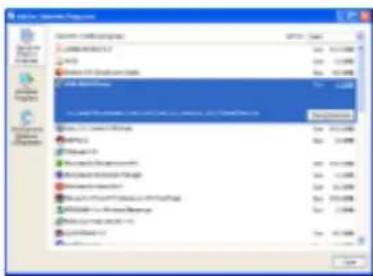
Click the [Add/Remove] button to remove the program.
Storing/Cleaning Drive and Disc
Cleaning the Drive
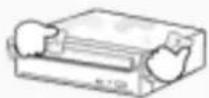
Turn the PC off and pull out the drive. Remove any foreign objects from the surface of the drive using soft cloth.
- Do not use benzene, paint thinner, or any other solvents.
- Cleaning the interior of the unit with such things as a cotton swab may cause failure or loss of functionality.

Storing/Cleaning Drive and Disc

This part of the manual is to prevent damages or data loss. Read carefully and use the device properly.
Storing the Disc
Do not place it under the direct sunlight. Place it so that it sits on its side on a flat surface. Do not scratch or place a label on the disc. * Handle the disc with caution to prevent damage from external shock. Do not expose it to severe temperature fluctuations. (Exposure to such environment may cause congealing.)

Storing/Cleaning Drive and Disc

This part of the manual is to prevent damages or data loss. Read carefully and use the device properly.
Cleaning the Disc
Do not touch the surface of the disc. Place your fingers on the edge of the disc to hold. - Clean the disc lightly with soft cotton cloth, starting from the center and move to the edge of the disc. Use only disc cleaning liquids. Do not use benzene, paint thinner, or any other solvents.
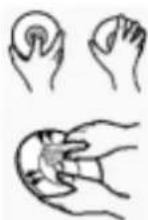

If the disc surface becomes dirty with fingerprints, foreign substances or dust, the disc may not function properly.
Storing/Cleaning Drive and Disc
When the On/Off Light Blinks
On/Off Lamp Meaning
Disc Lead-In: Green, blinks every 0.3 seconds.
Writing: Green, blinks every 0.3 seconds.
Reading: Green, blinks every 0.3 seconds.
Audio Playback [Analog Mode]: Green, blinks every 0.3 seconds.
Audio Playback [Digital Mode]: Green, blinks every 0.3 seconds.
Standby: Off
No Disc: Off

The indicator light turns off when the drive is not in use (standby) after disc lead-in.
Troubleshooting
General Problems
| Problem Meaning / Solution | |
| The tray won't open. See if the PC on. | |
| Make sure the power cable within the PC is connected properly. | |
| If the tray still won't open with the power on, turn the power off and insert a pin(paper clip) into the emergency hole to open. | |
| The tray won't close. Make sure the disc has been inserted properly. | |
| The PC is not working properly. | See if the jumper(s) is properly connected to the Master/Slave Selection port. |
| See if the drive is properly connected to the PC.See if the floppy disc remains in the PC. | |
| The drive is not working properly. See if the drive is connected properly to the PC. | |
| See if the device drive program has been installed properly. | |
| No sound is heard from an audio CD. | Check whether the audio cable is correctly connected to the sound output terminal on the drive and the sound card CD-IN terminal. |
| Check that the sound card is operational. | |
| If the Digital CD Audio Output box is checked, no sound comes out of the analog audio outputterminal of the driver. | |
| Check the condition of the CD and wipe the surface of the CD clean before use. | |
| The Window OS can't detect the drive. | See if the device drive program has been installed properly. |
| Can be an OS problem. Try reinstalling the Windows OS program. | |
| The system won't read the disc. See if the system detects the drive. | |
| Make sure you use the types of discs that are supported by the drive. | |
| See if the on/off light turns into green. | |
| Make sure you inserted the disc with the label facing up. | |
| Make sure you are using the right program for disc playback. | |
| See if the disc is clean. | |
| See if any congealing has occurred. | |
| Make sure the region code of the drive matches the disc number. | |
| The drive is connected to the sound card but cannot seem to detect it. | Your sound card is using AT BUS interface.Connect the card to the E-IDE port or replace the card with a new card with the built-in E-IDE interface capacity. |
Caution: Possible Errors
Caution: Possible Errors
DVD±R/RW drives record data on the disc by applying laser light onto the surface of the CD/DVD, and therefore writing errors may occur if you use a damaged CD/DVD, for example. Be sure to eliminate the following error-causing elements before you start writing:
* The following settings are recommended for all DVD±R/RW drives:
- Avoid a situation that requires multitasking, and turn off the screen saver.
A buffer underrun may occur if the system multitasks while the DVD±R/RW or CD-RW drive is writing/erasing.
- Block any outside attempt to access the host PC during a writing session.
An error may occur if another user accesses the printer connected to the system via the network during a writing session.
- Disable the CD auto-run feature.
- Inserting an auto-run-enabled CD into another drive connected to the same system during a writing/erasing session may cause an error.
How to disable the auto-run feature: Windows 98/ME
Go to Start > Settings > Control Panel > System > Hardware > Device Manager > CD-ROM > Settings. Disable Insert AutoRun.
- It is recommended that you use the image file format when you write a large number of small-sized files.
When there are a large number of small-sized files to write, the system's transmission rate drops and the Superlink feature works at a more frequent rate, resulting in lower writing quality.
If you are doing a CD-to-CD write, it is not necessary to check to see if you have available space on your hard disc beforehand.
However, in the case of image files, it is recommended that you be sure you have at least twice the amount of space needed for the data on your hard disc, as image files are copied to the hard disc before they are copied to the CD.
- Use a regulation-length (46cm) or shorter E-IDE cable.
Using an E-IDE cable longer than 46cm may cause a transmission error.
- Do not use more than one type of writing software.
Before you install a writing program, be sure to first uninstall existing versions of the program or other writing program(s) and reboot the system first.
(The Windows operating system may be damaged if you install the Korean version while the English version remains on the system.)
Use only the Nero Burning Rom writing software provided by Samsung. You may experience writing errors if you use Nero Burning Rom with other writing programs.
The write speed for a disc can be restricted if:
- The disc has bad properties data, and/or there are other discs with different properties available under the same ID.
The drive's write strategy is set in a way that the drive examines the disc properties and determines the optimal write conditions for those properties.
For example, many disc makers do not bother to insert property information distinguishing 48X discs from 32X discs. Since the two types of discs have the same properties data, although they actually have different properties, it is often impossible to respond to the situation with a single write strategy. In order to ensure stable writing, it is necessary to downgrade the write speed.
If discs from two different disc makers have the same write speed according to the labels, but actually have different write speeds, it is necessary to downgrade the write speed to ensure stable writing.
- Samsung's Standards for Write Speed Restriction
Standards 1: Write speed is downgraded for the sake of write stability, if high-speed discs available in the market have particularly bad properties data, or there are low-speed discs available under the same ID.
Speed-restricted discs go through further examination and adjustments later. If high-speed discs are available under the same ID as low-speed discs (speed restricted at present), the speed restriction is removed when the low-speed counterparts become no longer available in the market under the same ID.
You may experience lower write quality if you use disc products by some disc makers that are not registered with the product's firmware.
Therefore, it is recommended that you use only discs by recommended companies. Even if the write session is completed successfully, check the write quality before you put the disc in storage, especially in case of an important data backup.
Samsung is not responsible for any loss resulting from data backup failure.
We update the list of supported media on a regular basis through our firmware upgrades.
Specifications
| Category | TS-H552U | |
| DVD±R/RW Drive | ||
| DISC | Usable Discs | DVD: DVD-R, DVD-RW, DVD+R, DVD+RW, DVD-ROM, DVD-Video, DVD+R (Dual)CD: CD-ROM, CD-R, CD-RW, CD-DA, CD+E(G)CD-MIDI, CD-TEXT, CD-ROM XA, Mixed Mode CD CD-I, CD-I Bridge (Photo-CD, Video-CD), Multisession CD (Photo-CD, CD-EXTRA, Portfolio) |
| Disc Diameter 4.72 Inch or 3.15 Inch (120mm or 80mm) | ||
| Interface Support | Interface Port ATA/ATAPI (E-IDE) | |
| PIO mode PIO Mode 4: 16.7MB/sec | ||
| DMA mode Ultra DMA Mode 2: 33.3MB/sec | ||
| ACCESS TIME (Random) | CD-ROM 110ms (Random) | |
| DVD-ROM 130ms (Random) | ||
| Data Transfer Speed (Max) | Media Type Write Read | |
| DVD+R PCAV 16X (21.6MB/sec) CAV 8X (10.8MB/sec) | ||
| DVD+RW CLV 4X (5.4MB/sec) CAV 8X (10.8MB/sec) | ||
| DVD+R DUAL CLV 4X (5.4MB/sec) CAV 8X (10.8MB/sec) | ||
| DVD-R PCAV 16X (21.6MB/sec) CAV 8X (10.8MB/sec) | ||
| DVD-RW CLV 4X (5.4MB/sec) CAV 8X (10.8MB/sec) | ||
| DVD-ROM(Single) - | CAV 16X (21.6MB/sec) | |
| DVD-ROM(Dual) | - CAV 8X (10.8MB/sec) | |
| CD-ROM | - CAV 48X (7.0MB/sec) | |
| CD-R | PCAV 40X (6.0MB/sec) CAV 48X (7.0MB/sec) | |
| US-RW | PCAV 32X (4.8MB/sec) CAV 32X (4.8MB/sec) | |
| HS-RW | CLV 10X (1.5MB/sec) CAV 32X (4.8MB/sec) | |
| CD-RW | CLV 4X (0.6MB/sec) CAV 32X (4.8MB/sec) | |
| Buffer Memory | 2MB | |
| Drive Installation | Horizontal / Vertical(cannot use 3.15 Inch(80mm) discs) | |
| Operating Environment | Temperature | 41°F ~ 122°F (5°C ~ 45°C) |
| Humidity 10% ~ 80% (RH) | ||
| Size(Width x Height x Length) | 5.34 X 1.65 X 7.24 Inch (148.2 X 42 X 184mm) | |
| Weight | 760g | |
| MTBF | 125,000 POH(Duty 20%) | |

Note
Does not support DVD-R for Authoring, DVD-R DUAL, DVD-RAM. Cannot playback or record on both sides of a two-sided disc simultaneously. The read/write capacity of the supported discs depends on the condition of the disc and the recording format of the drive. Therefore, the read/write quality may not be perfect.

FCC Information to the User
This equipment has been tested and found to comply with the limits for a Class B digital device, pursuant to Part 15 of the FCC Rules. These limits are designed to provide reasonable protection against harmful interference in a residential installation. This equipment generates, uses, and can radiate radio frequency energy and, if not installed and used in accordance with the instructions, may cause harmful interference to radio communications. However, there is no guarantee that interference will not occur in a particular installation. If this equipment does cause harmful interference to radio or television reception, which can be determined by turning the equipment off and on, the user is encouraged to try to correct the interference by one or more of the following measures.
Reorient or relocate the receiving antenna. Increase the separation between the equipment and receiver. Connect the equipment into an outlet on a circuit different from that to which the receiver is connected. Consult the dealer or an experienced radio/TV technician for help.
CAUTION
Changes or modifications not expressly approved by the manufacturer responsible for compliance could void the user's authority to operate the equipment.

Laser Standard
IEC 60825-1:1993+A1:1997+A2:2001

The product specifications above may be changed to improve device performance without prior notice.


- INDEX
- MAIN PAGE
- SAFETY PRECAUTIONS
- FEATURES
- INSTALLING DVD±R/RW DRIVE AND CONNECTING CABLES
- INSTALLING DEVICE DRIVER AND CONFIRMING THE INSTALLATION
- HOW TO USE THE DVD±R/RW DRIVE
- STORING/CLEANING DRIVE AND DISC
- DELETING UTILITIES
- TROUBLESHOOTING
- PRODUCT SPECIFICATIONS
- FRONT
- BACK
- COMPONENTS
- SYSTEM REQUIREMENTS
- VERSATILE MULTIMEDIA FEATURES
- DVD RECOMMENDED DISC TYPES
- CD RECOMMENDED DISC TYPES
- BUFFER UNDERRUN PREVENTION TECHNOLOGY INCLUDED
- READING / RECORDING SPEED
- INSTALLING DRIVE
- CONNECTING CABLES
- CONNECTING THE POWER CABLE
- CONNECTING THE E-IDE CABLE
- INSTALLING THE DVD±R/RW DRIVE AND CONNECTING CABLES
- CONNECTING THE JUMPER TO THE MASTER/SLAVE PORT
- CONNECTING THE AUDIO CABLE (WHEN CONNECTED TO THE SOUND CARD)
- CONNECTING THE DIGITAL OUTPUT TERMINAL
- FIRMWARE UPDATE
- CONFIRMING THE INSTALLATION OF DEVICE DRIVER
- CONFIRMING USING [DEVICE MANAGER]
- INSTALLING THE MS-DOS DEVICE DRIVER
- AUTOMATIC SETUP
- MANUAL SETUP
- HOW TO USE THE DVD±R/ RW DRIVE
- HOW TO USE THE DRIVE
- HOW TO USE A HORIZONTALLY INSTALLED DRIVE
- HOW TO USE A VERTICALLY INSTALLED DRIVE
- HOW TO USE DVD±R/RW AND OTHER DISCS
- DVD REGION PROTECTION CODING (RPC)
- MAGIC SPEED
- WHAT IS MAGIC SPEED
- EXPLANATION OF MAGIC SPEED MODE AND WAYS TO USE
- EXPLANATION OF MAGIC SPEED MODE
- WAYS TO USE THE MAGIC SPEED
- PLACE TO DOWNLOAD MAGIC SPEED
- CLEANING THE DRIVE
- STORING THE DISC
- CLEANING THE DISC
- WHEN THE ON/OFF LIGHT BLINKS
- ON/OFF LAMP MEANING
- CAUTION: POSSIBLE ERRORS
- THE WRITE SPEED FOR A DISC CAN BE RESTRICTED IF
- SPECIFICATIONS
- NOTE
- FCC INFORMATION TO THE USER
- CAUTION
- LASER STANDARD
Brand : SAMSUNG
Model : TS H552U
Category : DVD Recorder