WT6-15C - Tumble dryer PKM - Free user manual and instructions
Find the device manual for free WT6-15C PKM in PDF.


| Product Type | Tumble Dryer |
| Brand | PKM |
| Model | WT6-15C |
| Control Type | Electronic |
| Capacity (Dry Laundry) | 6 kg |
| Drum Volume | 101.5 L |
| Drum Dimensions (D x H) | 572 x 420 mm |
| Energy Rating | Class C |
| Energy Consumption per Cycle (1000 RPM) | 2.27 kWh |
| Annual Energy Consumption | 437 kWh |
| Heating Power | 2100 W |
| Drum Material | Galvanised steel |
| Reversing Drum | Yes |
| Number of Programmes | 15 |
| Start Delay | 3 / 6 / 9 hours |
| Noise Emission | 68 dB(A) |
| Control Lights | 9 |
| Adjustable Feet | 2 (front) |
| Exhaust Hose Included | Yes |
| Exhaust Duct Location | Back left side |
| Dimensions (H x W x D) | 85.0 x 59.5 x 55.5 cm |
| Packaging Dimensions (H x W x D) | 88.5 x 65.5 x 57.5 cm |
| Net Weight | 36.0 kg |
| Gross Weight | 40.0 kg |
| Power Supply | 220-230 V AC |
| Included Accessories | Exhaust hose, ring nut |
Frequently Asked Questions - WT6-15C PKM
User questions about WT6-15C PKM
0 question about this device. Answer the ones you know or ask your own.
Ask a new question about this device
Download the instructions for your Tumble dryer in PDF format for free! Find your manual WT6-15C - PKM and take your electronic device back in hand. On this page are published all the documents necessary for the use of your device. WT6-15C by PKM.
USER MANUAL WT6-15C PKM
natural_image
Exterior view of a white washing machine with control panel and door (no visible text or symbols)English language on p. 23 ff.
natural_image
Diagram of a portable air conditioner unit with coiled tubing and labeled component B (no text or symbols beyond label)natural_image
Diagram of a computer case with labeled component A, showing internal compartments and mounting holes (no text or symbols beyond label)3
BEDIENUNG
3
Gerät
natural_image
White portable kitchen appliance with labeled buttons and door (no text or symbols beyond labels)natural_image
Simple graphic of two right-pointing triangles inside a rectangular box with an arrow pointing right (no text or symbols)natural_image
Gray arrow icon pointing right, with two black triangular arrows inside a rectangular box (no text or symbols)natural_image
Simple graphic of two black triangular shapes pointing right, with a gray arrow pointing right (no text or symbols)natural_image
Diagram of a door with internal components and an arrow pointing to a square opening (no text or symbols)
Filter
natural_image
Diagram of a washing machine interior showing internal components and a hand cleaning the casing (no text or labels)natural_image
Diagram of a refrigerator interior showing the door, vent, and internal components (no text or symbols)
Problembehandlung
Dear customer! We would like to thank you for purchasing a product from our wide range of domestic appliances. Read the complete instruction manual before you operate the appliance for the first time. Retain this instruction manual in a safe place for future reference. If you transfer the appliance to a third party, also hand over this instruction manual.
INDEX
- Safety instructions 23
- Operation 29
- Technical data 37
-
Guarantee conditions 39
-
Installation 27
- Cleaning and maintenance 36
- Waste management 38
EU - Declaration of Conformity
★ The products, which are described in this instruction manual, comply with the harmonized regulations.
★ The relevant documents can be requested from the final retailer by the competent authorities.
The figures in this instruction manual may differ in some details from the current design of your appliance. Nevertheless follow the instructions in such a case. Delivery without content.
i Any modifications, which do not influence the functions of the appliance. shall remain reserved by the manufacturer. Please dispose of the packing with respect to your current local and municipal regulations.
The appliance you have purchased may be an enhanced version of the unit this manual was printed for. Nevertheless, the functions and operating conditions are identical. This manual is therefore still valid.
i Technical modifications as well as misprints shall remain reserved.
1
SAFETY INSTRUCTIONS
1
Read the safety instructions carefully before you operate the appliance for the first time. All information included in those pages serve for the protection of the operator. If you ignore the safety instructions, you will endanger your health and life.
DANGER!
indicates a hazardous situation which, if ignored, will result in death or serious injury.
WARNING!
indicates a hazardous situation which, if ignored, could result in death or serious injury.
CAUTION! indicates a hazardous NOTICE! indicates possible damage to situation which, if not avoided, may the appliance. result in minor or moderate injury.
RISK OF FIRE!
Oil-affected items can ignite spontaneously when exposed to heat sources such as in a tumble dryer. The items become warm, causing an oxidation reaction in the oil. Oxidation creates heat. If the heat cannot escape, the items can become hot enough to catch fire. Piling, stacking or storing oil-affected items can prevent heat from escaping and so create a fire hazard.
If it is unavoidable that fabrics which contain vegetable or cooking oil or have been contaminated by hair care products are placed in a tumble dryer, they should be washed in hot water with extra detergent first - this will reduce, but not eliminate, the fire hazard.
Store this manual in a safe place so you can use it whenever it is needed. Strictly observe the instructions to avoid damage to persons and property.
Check the technical periphery of the appliance! Do all wires and connections to the appliance work properly? Or are they time-worn and do not match the technical requirements of the appliance? A check-up of existing and newly made connections must be done by an authorized professional. All connections and energy-leading components (incl. wires inside a wall) must be checked by a qualified professional. All modifications to the electrical mains to enable the installation of the appliance must be performed by a qualified professional.
i The appliance is intended for private use only.
The appliance is intended for washing laundry in a private household only.
i The appliance is intended for indoor-use only.
The appliance is not intended to be operated for commercial purposes, during camping and in public transport.
i Operate the appliance in accordance with its intended use only.
Do not allow anybody who is not familiar with this instruction manual to operate the appliance.
This appliance may be operated by children aged from 8 years and above as well as by persons with reduced physical, sensory and mental capabilities or lack of experience and knowledge if they are supervised or have been instructed concerning the safe use of the appliance and do comprehend the hazards involved. Children must not play with the appliance. Cleaning and user-maintenance must not be carried out by children unless they are supervised.
DANGER!
- All electrical work must be carried out by a qualified professional. Do not modify the energy supply. The connection must be carried out in accordance with the current local and legal regulations
- Do not connect the appliance to the mains if the appliance itself or the power cord or the plug are visibly damaged.
- Never try to repair the appliance yourself. Repairs carried out by unauthorized persons can cause serious damage. If the appliance does not operate properly, please contact the shop you purchased the appliance at. Original spare parts should be used only.
- When the power cord is damaged, it must be replaced by the manufacturer or an authorized aftersales service or a qualified professional only.
WARNING!
- Disconnect the appliance from the mains before you clean or maintain it.
- Operate the appliance with 220\~230V AC only. Use a suitable safety-socket near of the appliance.
- The appliance must always be grounded and protected corresponding to the requirements of your local energy supplier. The main current circuit must be equipped with a safety shut-down device.
- All modifications to the electrical mains to enable the installation of the appliance must be performed by a qualified professional.
- In case of an event caused by a technical malfunction, disconnect the appliance from the mains. Report the malfunction to your service centre so it can be repaired.
- Do not use adapters, multiple sockets and extension cords for connecting the appliance to the mains.
- Do not pull on the power cable. Pull on the plug.
- The plug must be secured on the power cable properly.
- Do not bend the power cord.
- Do not place any electrically-powered appliances on the dryer.
- Do not connect the exhaust hose to an extractor hood or a chimney/exhaust pipe which is intended to discharge exhaust fumes of fuel-burning appliances.
- The steam discharge must never be blocked. The exhaust hose must never be bent or squeezed.
- Do not carry out any modifications to your appliance.
- The room the appliance is installed in must be dry and well-ventilated. When the appliance is installed, an easy access to all control elements is required.
-
Do not install the appliance in rooms or at areas which contain flammable substances as petrol, gas or paint. Do not put any laundry which is contaminated by such materials in or near of the appliance.
-
When any fuels or gases are set free near of the appliance:
➢ open all windows for proper ventilation.
➢ do not unplug the appliance and do not use the controls of the appliance.
➢ do not touch the appliance unless the gas has been discharged completely.
▶ otherwise sparks can occur. RISK OF FIRE!
-
Never use a steam cleaner to clean the appliance. The steam will cause serious damage to the electric components of the appliance. Risk of electrical shock!
-
Do not install the appliance near of sources of heat.
-
Do not put candles or cigarettes on the appliance.
-
Do not install the appliance in a place where it can come in contact with rain or high levels of moisture. Otherwise the electric components can be damaged.
-
Do not spray the appliance with water.
-
If you have used a stain removal agent before or when washing, operate the rinse-programme of your washer before you put the relevant laundry in the dryer.
-
Check before drying that there are no lighters or matches in your laundry.
-
Do not dry the following items in the appliance as they store heat. RISK OF FIRE!
pillows, quilts, bedspreads
clothes and items which are soaked or splattered with fat, oil or any other flammable liquid.
clothes and items which have come into contact with volatile petroleum compounds.
items made of foam material or containing parts of foam material.
▶ swimming caps and waterproof textiles.
▶ rubberised items or clothes.
-
Children must not play with the appliance.
-
Always supervise children if they are near the appliance.
-
Check that children or pets have not get into the appliance before drying. Check the drum carefully before closing.
CAUTION!
-
Do not use any aggressive, abrasive and acrid detergents or sharp-edged items to clean the appliance.
-
Never operate the appliance without the filter installed.
NOTICE
-
When you move the appliance, hold it at its base and lift it carefully. Keep the appliance in an upright position.
-
Never use the door for moving the appliance as you will damage the hinges.
-
The appliance must be transported and installed by at least two persons.
-
When you unpack the appliance, you should take note of the position of every part of the interior accessories in case you have to repack and transport it at a later point of time.
- Do not operate the appliance unless all components are installed properly.
- Do not stand or lean on the base, the drawers, the doors etc of the appliance.
- The air vents of the appliance or its built-in structure (if the appliance is suitable for being built-in) must be completely open, unblocked and free of any kind of dirt.
- Remove all fluffs before operating the appliance.
- Never dry unwashed laundry.
- When you use fabric conditioner or a similar product, observe the information given on their packaging.
- Dry dryer-proof fabrics only. Observe the information on the labels.
- If you install the appliance on a carpet or carpeted floor, ensure proper air circulation by adjusting the adjustable feet.
- Do not place any items liquid can escape from on the appliance as the liquid can damage the control panel.
- Metal-made items, e.g. keys, screws, coins etc., can damage the appliance. Check that your laundry is free of such items.
- Do not overload the appliance.
- Do not put dripping-wet laundry in the appliance.
- The room temperature should not be less than +5 °C and not more than +35°C when operating the appliance.
- Clean the filter after operating the appliance.
2
INSTALLATION
2
Unpacking and positioning
- Unpack the appliance carefully. Dispose of the packaging as described in chapter waste management.
- Completely remove the transport-protection. Be very careful and do not use any aggressive or abrasive detergents to remove residuals of the transport-protection.
- Check that the appliance and the power cord are not visible damaged.
- Do not install the appliance in a place where it may come in contact with water or rain; otherwise the insulation of the electrical system will be damaged.
- Install the appliance on a level, dry and solid floor. Check the correct installation with a bubble level.
- Remove the complete packaging material (inside and outside the appliance) before initial operation.
- The nameplate is situated inside the appliance or at the back.
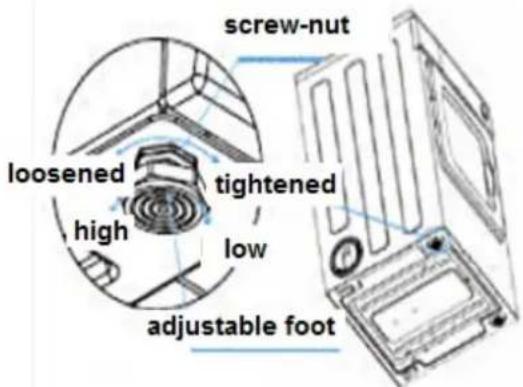
Levelling
- Allow adequate distance to the floor to avoid vibrations and noise.
- If the appliance does not stand horizontally, adjust the front feet by turning them clockwise/anticlockwise until the appliance is level.
Do not put any blankets or ropes or piles of items on the floor. They could generate heat so that the appliance will not properly work.
Installation of the exhaust hose
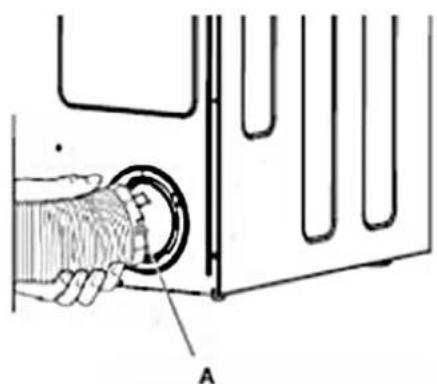
The air vent is on the back of the appliance.
➢ Fix the exhaust hose by pulling the ring nut (A) from the air vent. Then screw is on the hose and push it to its proper position.
natural_image
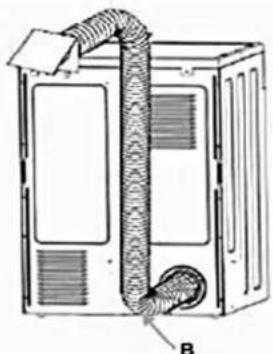
Diagram of a hand inserting a circular component into a device (no text or symbols present)If the hose is long and the room temperature low, some condensate may occur inside the hose. This is a normal. To avoid that water remains inside the hose or flows back into the appliance drill a small hole (diameter 3 mm) into the hose (at its lowest point) and place a small container there (B).
natural_image
Diagram of a microwave oven with a coiled hose and labeled component B (no text or symbols beyond label)When you have installed the appliance lead the hose to the air outlet you desire. Do not bend the hose more than twice. You will find all of the equipment and information you need to build the air outlet at your hardware store if you want to lead the hose to a solid grid in a wall or a window.
Thermostat reset button
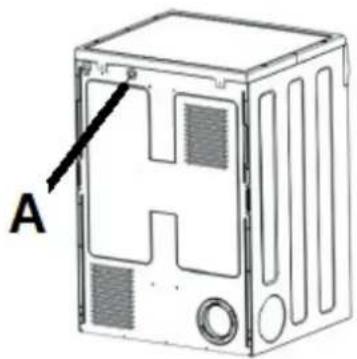
If the heating element does not work during operation, the manual thermostat may be disconnected. Turn the programme knob to position Air Dry and, then press the start button. Wait approx. 20 minutes. Press the thermostat reset button.
natural_image
Diagram of a computer case with labeled component A, showing internal compartments and mounting holes (no text or symbols beyond label)3
OPERATION
3
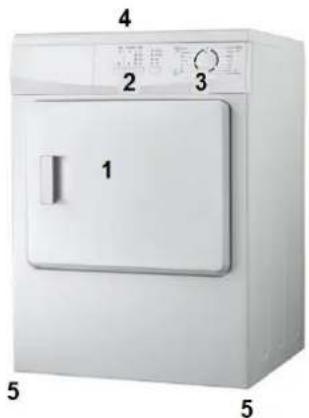
Appliance
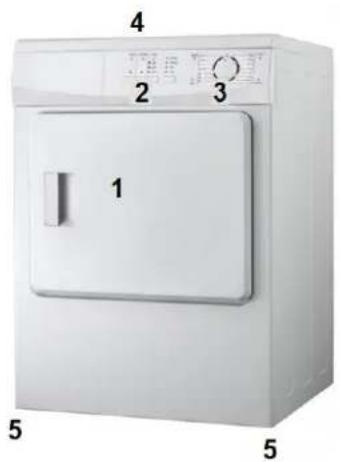
- Door
- Button function / control lights
- Rotary knob - programmes
- worktop
- Adjustable feet / front side
Control panel
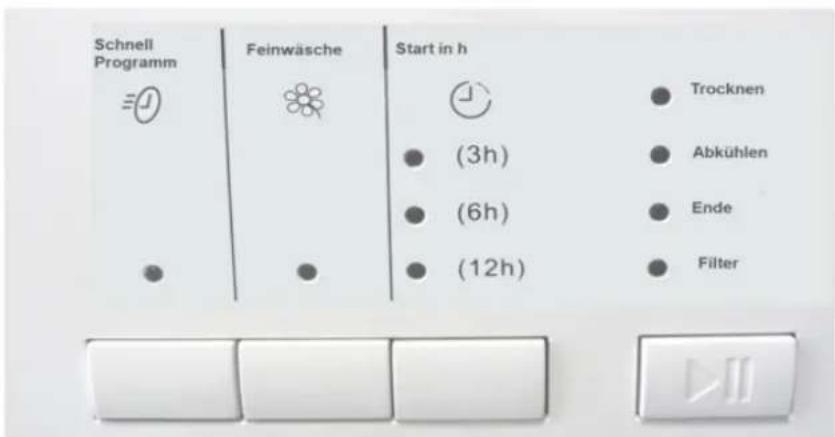
| Button Schnellprogramm | Switches on the quick-function. |
| Button Feinwäsche | Switches on the delicate-function. |
| Button Start in h | Delayed start setting. |
| Button ▶II Start / Pause | Starts or pauses a preset programme. |
Use of the programmes
The connection to the mains must be performed as described in this manual.
Remove any pieces of polystyrene and other materials out of the drum.
We recommend that you put some wet cloths into the appliance and dry them for approx. 30 minutes before you use the appliance for the first time.
➢ Open the door. Put the clothes one by one into the drum.
➢ Shake them out as well as possible before.
➢ Close the door. Check that the clothes are not stuck between the door and the seal.
Turn the function-control knob to the programme you desire to use. The START / PAUSE control light starts to flash. The programme selection will be deleted unless you press a button within the next 10 minutes.
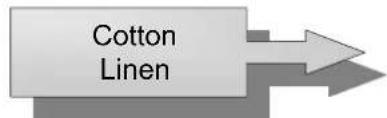
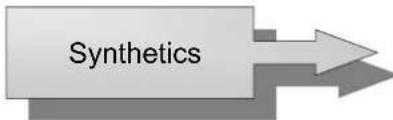
The function-control knob has 4 sections:
Cotton
Synthetics
Time
▶ Special
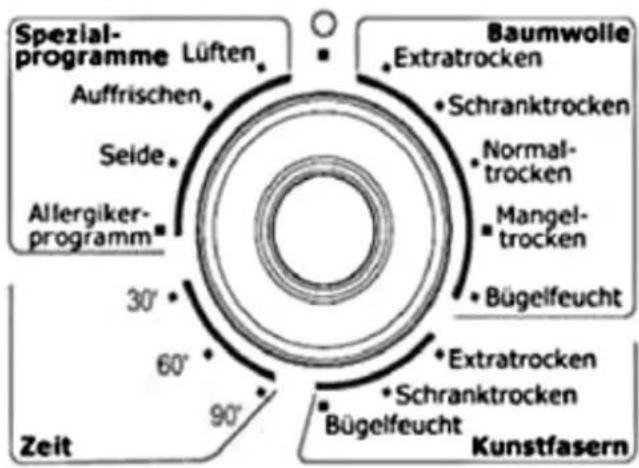
You can select different drying-programmes corresponding to the material your clothes are made of. The appliance is equipped with programmes for cotton, silk synthetics and an anti-bacterial programme.
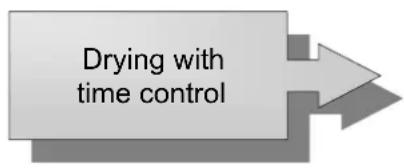
Use this setting to stop a drying period when it is needed. Select the 30, 60 or 90 minutes programme for cotton, the 30 minutes programme for synthetics. To stop a runnin programme turn the function-control knob to position O. When the drying period has ended also turn the knob to O before you take out the clothes.
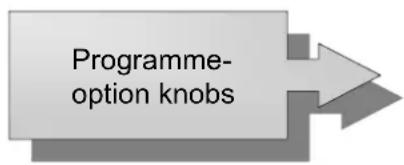
Depending on the programme you can combine several functions. Choose them after you have selected a programme and before you press the START / PAUSE button. When you press these buttons, the corresponding control light goes on. Press again and it goes off.
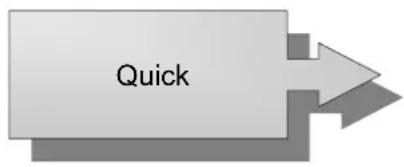
You can select this function for cotton and synthetics. When selecting this function the drying time is shortened by about 3-5 minutes. The corresponding control light goes on. You cannot select this function and the DELICATE-function at the same time.
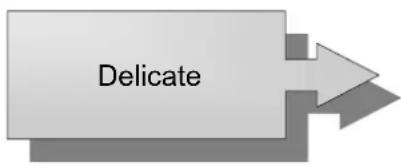
You can select this function for Cotton, Synthetics and Time. You can dry at a lower temperature when this function is selected. The corresponding control light goes on. You can select this function and Drying with time control at the same time.
You cannot use DELICATE and QUICK at the same time.
You can select this function only after you have selected the drying programme, but before you press the START / PAUSE button which will start the programme.
This function can be selected both before and after the selection of an optional programme (QUICK, DELICATE). The time control starts after you have pressed the START / PAUSE button. The corresponding control light goes on. You cannot select this function when you have selected a SPECIAL programme before.
| Drying | Drying period active. |
| Cooling | Cooling period active. |
| End | Cooling period over. Anti-creasing-period active. |
| Filter | Goes on after each use of the appliance to remember you to clean the filter. If you do not clean the filter you can run the appliance but its power will be heavily reduced. So clean the filter regularly. |
Select the programme and function you desire and press the button to start the appliance. If you open the do while the appliance is running, the START / PAUSE button has to be pressed again after you have closed the door. Now the programme starts at the point from where it was interrupted before. In such an event the control light of the START / PAUSE button flashes to remind you to press the button again.
Each drying period ends with a 10-minute cooling down period. If you do not take your clothes out of the appliance after the drying period has ended, the appliance starts the ANTI-CREASE period (Max. 30 minutes). If you do not take your clothes out of the appliance then it stops operation automatically.
To change a running programme stop it by turning the function-control knob to position 0. Now you can select another programme. Press START / PAUSE.
If it is necessary to stop the drying period before the programme has ended, we recommend you turn the function-control knob to position AIR DRY. Then wait until the cooling period has ended before you take your clothes out of the appliance. This avoids heat accumulation. Turn the knob to position 0, then to AIR DRY and press the START / PAUSE button.
Before loading the drum
Do not dry the following items in your appliance:
net curtains, wool, materials with metal-made or metal parts
▶ nylon tights
➢ large pieces of laundry, e.g. anoraks
blankets, puffs, bedrolls, eiderdowns
- items made of foam material or containing parts of foam material
natural_image
Simple gray arrow icon pointing right, with two black triangular arrows inside a rectangular box (no text or symbols)Always observe the instructions given on the label of your clothes

can be dried in a dryer.
Normal drying (high temperatures).
DELICATES (low temperatures).
Do not dry with a dryer.
Do not put open pillow cases into the appliance. Otherwise small pieces of laundry can become entangled in them. Close all zips, press-studs and hooks and tie all belts and apron strings together. Sort your laundry according to the type of clothing/material and select the appropriate drying procedure.
Do not dry your clothes too long. This avoids creases and saves energy.
Do not dry dark-coloured clothes and light-coloured and fluffy items as towels at the same time.
The clothes must be spin-dried before you can put them into the appliance.
➢ Spin-dry easy-care items (e.g. shirts), too.
➢ Knitwear can shrink a bit while drying. Do not dry such clothes too long. We recommend you keep this shrinkage in mind when you buy knitwear so you may buy a suitable size then.
➢ You can also put starched clothes into the dryer. Select the programme IRON. To remove residuals of starch from the drum, wipe the drum with a moist cloth and dry it afterwards.
To avoid static charge after drying use a fabric softener when washing the laundry or a special softener suitable for dryers.
➢ Take your clothes out of the appliance when the drying procedure has ended.
If some items are still a little bit wet after drying, dry them again for at least 30 minutes. This may be required for some complex items, e.g. collars or bags.
Maximum load
natural_image
Simple graphic of a rectangular block with two black right-pointing triangles and an arrow pointing right (no text or symbols)Recommended load ratios are described in the programme schedules.
Drum can be full, but not too compactly- loaded.
Drum not more than half-full.
Drum not more than quarter-full.
natural_image
Gray arrow icon pointing right, with two black triangular arrows inside a rectangular box (no text or symbols)Try to load the appliance up to its particular maximum capacity. Little loads are uneconomical. If you dry easy-to-crease materials, we recommend you not to run the appliance with maximum load.
Weight of clothes
| Bathrobe | 1200 g |
| Table napkin | 100 g |
| Quilt | 700 g |
| Sheet | 500 g |
| Pillow case | 200 g |
| Table cloth | 250 g |
| Bath towel | 200 g |
| Small table cloth | 100 g |
| Nightdress | 200 g |
| Lingerie | 100 g |
| Work shirt | 600 g |
| Shirt | 200 g |
| Pyjamas | 500 g |
| Blouse | 100 g |
| Pants | 100 g |
| Section | Path | Max. Load | Programme details |
| Cotton | Heavy | 6 kg | Bathrobes, bath towels, jeans, work wear |
| Strong | 6 kg | Bathrobes, bath towels, jeans, work wear | |
| Normal | 6 kg | Shirts, T-shirts, cotton trousers | |
| Damp | 6 kg | Knitwear, cotton shirts | |
| Iron | 6 kg | Sheets, bedclothes (linen), table cloths (linen), starched cloths | |
| Synthetics | Extra | 3 kg | Sheets, table cloths, synthetics |
| Cupboard | 3 kg | Synthetics | |
| Iron | 3 kg | Knitwear, shirts | |
| Time (Minutes) | 30, 60, 90 | 6 kg | multilayered textiles, e.g. terry towelling. For drying individual pieces of laundry or for small volumes. |
| Special | Antiallergenic | 3 kg | Men's underwear, lingerie, winter clothes |
| Silk | 1.5 kg | silk | |
| Freshen-up | 3 kg | Men's underwear, shirts | |
| Air Dry | 2 kg | Men's' underwear, shirts, T-shirts, cotton trousers |
If the weight of laundry is less than 1 kg, it is more efficient to select a time controlled drying programme.
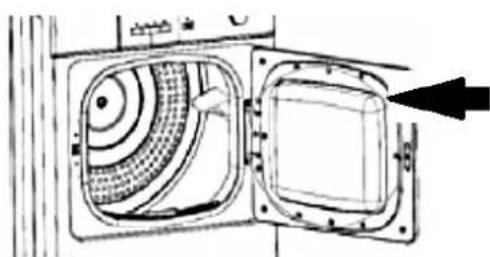
Door
➢ Clean the inside part of the door regularly to remove any residuals of textiles.
➢ Proper cleaning is required so that your appliance operates properly.
natural_image
Diagram of a door with internal components and an arrow pointing to a square opening (no text or symbols)
Filter
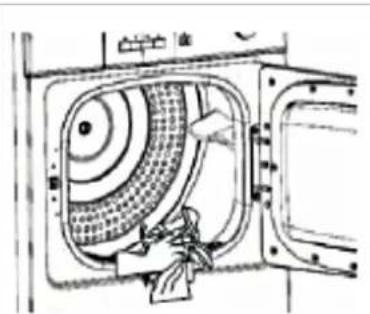
The appliance only works properly when the filter is clean.
The filter catches lint and other residuals which are generated during the drying procedure so that your appliance can work at its best performance.
natural_image
Diagram of a washing machine interior showing internal components and a cloth cover (no text or labels)The filter control light goes on to remember you to clean the filter.
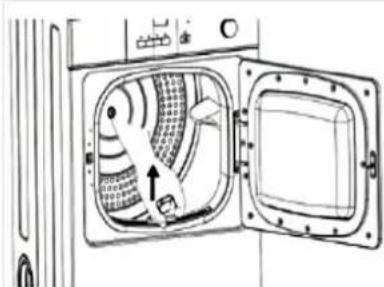
▶ You must remove the filter before cleaning.
If there is a lot of lint in the filter, use a brush and warm water to clean it. Open the door and remove the filter.
natural_image
Diagram of a refrigerator interior showing the door, vent, and internal components (no text or symbols)
Trouble shooting
Some problems may occur because you did not maintain the appliance correctly or you overlooked something. These problems can be easily solved sometimes so you do not need to call in a professional. If the appliance shows a malfunction not noted on the schedule above or if you have checked all items on the above schedule but the problem still exists, please contact a service department.
Sometimes the START / SOP control light may go on while the appliance is running to indicate that the appliance is not working. As soon as this problem is
solved press the START / PAUSE button and restart the programme. If the problem still exists, please call the aftersales service.
| Malfunction | Possible cause(s) |
| The appliance does not work at all. | ➢ The plug of the appliance is not connected to the socket.➢ The plug has become loose.➢ The socket is not supplied with energy.➢ Check the corresponding socket by connecting it with another appliance.➢ The voltage is too low. Compare the data on the model plate with the data of your energy supplier.➢ The door is not closed.➢ Did you Press the START button? |
| Uncommon sound during operating. | ➢ The appliance is not installed on a level, dry and solid floor. Realign the appliance.➢ The appliance is in contact with a wall or another item. Realign the appliance.➢ Incorrect programme selection.➢ Incorrect load volume. |
| The drying period ends shortly after the start of the programme | ➢ Not enough clothes in the appliance. Clothes are too dry for the selected programme. Select a suitable programme. |
| The drying procedure takes an uncommon long period of time | ➢ Load volume to big. Reduce the load. |
5 TECHNICAL DATA 5
| Type | Tumble drier |
| Control | Electronic |
| Capacity dry laundry in Kg | 6 Kg |
| Capacity in litre | 101.50 litre |
| Dimensions drum (D x H) in mm | 572 x 420 |
| Energy rating | C |
| Energy consumption per drying period / 1000 RPM | 2.27 kW/h |
| Energy consumption year | 437 kW/h |
| Heating power | 2100 Watt |
| Drum | Galvanised drum |
| Reversing drum | yes |
| Worktop | yes |
| Start delay | 3 / 6 / 9 h |
| Noise emission | 68 dB/A |
| Number of programmes | 15 programmes |
| half / full heating power | yes yes |
| Control lights | 9 |
| Adjustable feet | 2 / front |
| Exhaust hose | yes |
| Exhaust duct | Back left side |
| Dimensions appliance H / W / D in cm | 85.00 / 59.50 / 55.50 |
| Dimensions packaging H / W / D in cm | 88.50 / 65.50 / 57.50 |
| Net weight / gross weight | 36.00 40.00 |
6
WASTE MANAGEMENT
6
-
While unpacking, the packaging materials (polythene bags, polystyrene pieces, etc.) should be kept away from children. CHOKING HAZARD!
-
Do not depose of the appliance together with normal domestic waste. Waste separation is obligatory so the single components of the appliance can be recycled. Use your municipal waste collection points.
-
Used appliances do not represent unusable waste but contain valuable raw materials when recycled properly.
-
If electric appliances are disposed of at landfills, substances which are dangerous to one's health may get into the ground water. Such substances will become part of the food chain and cause damage to your health.
-
Before you dispose of an old appliance, render it inoperative. Unplug the appliance and cut off the entire power cord. Dispose of the power cord and the plug immediately.
-
Remove the door completely so children are not able to get into the appliance as this endangers their lives!
-
The materials of the appliance are recyclable and labelled with relevant information. When recycling materials or other parts from used appliances you make a significant contribution to the protection of our environment.
-
Dispose of any paper and cardboard into the corresponding containers.
-
Dispose of any plastics into the corresponding containers.
-
If suitable containers are not available at your residential area, dispose of these materials at a suitable municipal collection point for waste-recycling.
-
Receive more detailed information from your retailer or your municipal facilities.
7
GUARANTEE CONDITIONS
7
Guarantee conditions for large electric appliances PKM GmbH & Co. KG, Neuer Wall 2, 47441 Moers
This appliance was made and checked according to the most modern production methods. This appliance includes a 24-month guarantee for the consumer given by the manufacturer, dated from the day of purchase, referring to its flawless material-components and its faultless fabrication.
The consumer is accredited with both the dues of the guarantee given by the manufacturer and the vendor's guarantees. These are not restricted to the manufacturer's guarantee.
The guarantee is valid without prejudice to stringent legal liability regulations, e.g. the product liability law, in the case of malice and of wanton negligence in view of harm of life, body or health by PKM or its agents.
The right on the guarantee is not granted, when the purchase is made in the course of a commercial activity.
The guarantee claim has to be verified by the vendee by submitting a proof of purchase including the date of purchase and/or the date of delivery. This has to be reported to us or in the Federal Republic of Germany to the shop you purchased the appliance at. This report has to be made immediately after the detection and within 24 months after the delivery to the first ultimate vendee.
The guarantee for our appliances is valid under the following conditions:
Defects of the appliance which are verifiably caused by material or fabrication deficiency will be rectified free of charge by the shop you purchased the appliance at. When the defect appears within 6 months we suppose that there is a material or fabrication deficiency.
Within the guarantee we will repair deficient components free of charge using components of our own choice or they will be replaced by flawless components.
Appliances, which can, due to their dimensions, be reasonably transported by an automobile, should be given over or submitted to the shop you purchased the appliance at.
If the repair work is refused by us or if the repair work finally fails, the old appliance, if requested, will be replaced by an appliance of the same kind, quality and type within the period of guarantee. If the old appliance is no longer produced at the time the defect occurred, PKM will be entitled to deliver a similar appliance.
The exchange of the appliance principally takes place in the shop the first vendee bought the appliance in unless the appliance is too large to be transported by the vendee.
The guarantee does not establish any entitlement to withdraw from the purchase contract or for a price reduction.
Replaced components or exchanged appliances demise to us as our property.
The guarantee claim does not cover:
- fragile components as plastic, glass or bulbs;
- minor modifications of the PKM-products concerning their authorized condition if they do not influence the utility value of the product;
- damage caused by handling errors or false operation;
- damage caused by aggressive environmental conditions, chemicals, detergents;
- damage caused by non-professional installation and haulage;
- damage caused by non common household use;
- damages which have been caused outside the appliance by a PKM-product unless a liability is forced by legal regulations.
The validity of the guarantee will be terminated if:
- the prescriptions of the installation and operation of the appliance are not observed.
- the appliance is repaired by a non-professional.
- the appliance is damaged by the vendor, the installer or a third party.
- the installation or the start-up is performed inappropriately.
- the maintenance is inadequately or incorrectly performed.
- the appliance is not used for its intended purpose.
- the appliance is damaged by force majeur or natural disasters, including, but with not being limited to fires or explosions.
The guarantee claims neither extend the guarantee period nor initiate a new guarantee period. The guarantee period for installed replacement parts ends with the guarantee.
Provided that a product-related malfunction is not covered by this guarantee the vendee has to bear the cost, when the appliance is checked, including any labour costs that may arise.
If the holder of the guarantee has requested repair work, then the holder of the guarantee must be informed about the non-intervention of the guarantee and possible costs, that may arise, and thereafter he must bear all costs for spare parts and wages.
The geographical scope of the guarantee is limited with respect to appliances, which are purchased and used in Germany, Austria, Belgium, Luxembourg and the Netherlands.

August 2012
Aftersales service information on the leaflet inside this instruction manual.
Subject to alterations / Updated July 2014
- English language on p. 23 ff.
- BEDIENUNG
- Gerät
- Filter
- Problembehandlung
- INDEX
- EU - Declaration of Conformity
- 1
- SAFETY INSTRUCTIONS
- DANGER!
- WARNING!
- RISK OF FIRE!
- CAUTION!
- NOTICE
- INSTALLATION
- Unpacking and positioning
- Levelling
- Installation of the exhaust hose
- Thermostat reset button
- OPERATION
- Appliance
- Control panel
- Use of the programmes
- Before loading the drum
- Maximum load
- Weight of clothes
- Door
- Trouble shooting
- 6
- WASTE MANAGEMENT
- GUARANTEE CONDITIONS
- Guarantee conditions for large electric appliances PKM GmbH & Co. KG, Neuer Wall 2, 47441 Moers
- The guarantee for our appliances is valid under the following conditions:
- The guarantee claim does not cover:
- The validity of the guarantee will be terminated if:
Brand : PKM
Model : WT6-15C
Category : Tumble dryer