
Promax 40 II - Saw MCCULLOCH - Free user manual and instructions
Find the device manual for free Promax 40 II MCCULLOCH in PDF.


| Type | Gasoline-powered chainsaw |
| Displacement | 40 cc |
| Engine Power Output | 1.75 kW (2.3 HP) |
| Maximum Engine Speed | 11,000 min⁻¹ |
| Idle Speed | 2,800 min⁻¹ |
| Weight (without bar and chain) | 5.0 kg |
| Bar Length Options | 35 cm, 40 cm, 45 cm (14", 16", 18") |
| Chain Pitch | 3/8" or .325" (varies by bar length) |
| Chain Gauge | 1.3 mm |
| Fuel Tank Capacity | 390 cm³ |
| Oil Tank Capacity | 290 cm³ |
| Sound Pressure Level (LpA) | 97 dBA |
| Guaranteed Sound Power Level (LwA) | 112 dBA |
| Vibration Level (front/rear handle) | 7.5 / 8.7 m/s² |
| Chain Brake | Manual and inertia-activated (anti-kickback) |
| Chain Catcher | Yes, integrated |
| Decompression Valve | Yes (on some models) |
| Carburetor Adjustment | Three screws: L (low), H (high), I (idle) |
| Air Filter Type | Washable foam |
| Spark Plug Gap | 0.5–0.6 mm (0.025") |
| Chain Sharpening File | 5/32" or 3/16" round file (depending on chain) |
Frequently Asked Questions - Promax 40 II MCCULLOCH
User questions about Promax 40 II MCCULLOCH
0 question about this device. Answer the ones you know or ask your own.
Ask a new question about this device
Download the instructions for your Saw in PDF format for free! Find your manual Promax 40 II - MCCULLOCH and take your electronic device back in hand. On this page are published all the documents necessary for the use of your device. Promax 40 II by MCCULLOCH.
USER MANUAL Promax 40 II MCCULLOCH
natural_image
Line drawing of a chain-linking device with mesh cable (no text or symbols)CE
Mac 538E -38 cc
Mac 540E / California / Promac 40 II - 40 cc
Mac 545E / Promac 46 II - 46 cc
A.
B.
C.
D.
| Partner oil | McCulloch oil | 2 T oil | |
| 50 : 12% | 40 : 12,5% | 25 : 14% | |
| 1 ltr. 20 cm3 | 25 cm3 | 40 cm3 | |
| 4 80 100 160 | |||
| 5 100 125 200 | |||
| 10 200 250 400 | |||
| 20 400 500 800 | |||
E.
F.
G.
H.
I.
L.
 | MAC 538E | MAC 540E - 545E California | Promac 40 II Promac 46 II |
14” 350mm | 214235B202631B214215B (5/32”) | ||
16” 400mm | 214236B202729B214215B (5/32”) | 241997B202729B214215B (5/32”) | |
18” 450mm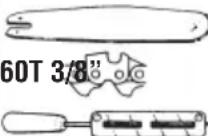 | 229157B228546B214215B (5/32”) | 241996B228546B214215B (5/32”) | |
16” 400mm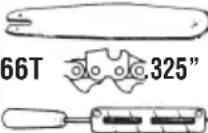 | 323219B247003B214216B (3/16”) | ||
18” 450mm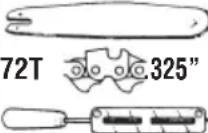 | 323215B228548B214216B (3/16”) |
GB Due to a constant product improvement programme, the factory reserves the right to modify technical details mentioned in this manual without prior notice.
La casa produttrice si riserva la possibilità di variare caratteristiche e dati del presente manuale in qualunque momento e senza preavviso.
F La Maison se réserve la possibilité de changer des caractéristiques et des données de ce manuel à n'importe quel moment et sans préavis.
D Im Sinne des Fortschritts behält sich der Hersteller das Recht vor, technische Änderungen ohne vorherigen Hinweis durchzuführen.
E La firma productora se reserva la posibilidad de cambiar las características y datos del presente manual en cualquier momento y sin previo aviso.
NL Door konstante produkt ontwikkeling behoud de fabrikant zich het recht voor om rechnische specificaties zoals vermeld in deze handleiding te veranderen zonder biervan vooraf bericht te geven.
S Tilverkaren reserverar sig rätten att ändra fakta och uppgifter ur handboken utan förvarning.
DK Producenten forbeholder sig ret til ændringer, hvad angår karakteristika og data i nærværende instruktion, når som helst og uden varsel.
FIN Jatkuvan tuotteen parannusohjelman tähden valmistaja pidättää oikeuden vaihtaa ilman ennakkovaroitusta tässä ohjekirjasessa mainittuja teknisiä yksityiskohtia.
N Produsenten forbeholder seg all rett og mulighet til å forandre tekniske detaljer i denne manualen uten forhåndsvarsel.
A casa productora se reserva a possibilidade de variar características e dados do presente manual em qualquer momento e sen aviso prévio.
GR Λόγω προγράμματος συνεχούς βελτίωσης προϊόντων, το εργοστάσιο επιφυλάσσεται του δικαιώματος να τροποποιεί τις τεχνικές λεπτομέρειες που αναφέρονται στο εγχειρίδιο αυτό χωρίς προηγούμενη ειδοποίηση.
H Folyamatos gyártmány felüjítási müsorunk következtében, a gyártó cég fenntartja a jogát ebben a Használati leirt müszaki adatok előzetes értesítés nélküli változtatására.
THIS PRODUCT MEETS THE SAFETY STANDARD REQUIREMENT OF THE EUROPEAN MACHINERY DIRECTIVE
UK
DISPLACEMENT (cm ^3 ) 38 40 46
BORE AND STROKE (mm) 40x30 41x30 43x32
ENGINE OUTPUT (kW) 1,5 1,75 2,4
ENGINE SPEED AT MAX POWER (min ^-1 ) 8.500 8.500 9.000
MAXIMUM SPEED (min-1) 11.000 11.000 11.000
MINIMUM SPEED (min ^-1 ) 2.800 2.800 2.800
DRY WEIGHT (Kg) (NO BAR AND CHAIN) 555,5
CHAIN PITCH (9,525 - 8,255 mm) 3/8" 3/8"-325" 3/8"-325"
PASSO CATENA (9,525 - 8,255 mm) 3/8" 3/8"-.325" 3/8"-.325"
SPESSORE CATENA (mm) 1,3 1,3 1,3
LUNGHEZZA BARRA (cm)....35/40/45 40/45 40/45
No. DENTI DEL PIGNONE 6 6/7 6/7
CAPACITÀ SERBATOIO OLIO (cm ^3 ) 290 290 290
CAPACITÀ SERBATOIO MISCELA (cm) 390 390 390
PRESSIONE SONORA ALL'ORECCHIO DELL'OPERATORE LpAav (dBA) (EN 27182 - EN 608). 97 97 98
LIVELLO POTENZA SONORA GARANTITA LwAav (dBA) (ISO 9207 - EN 608).... 112 112 113
LIVELLO POTENZA SONORA MISURATA LwAav (dBA) (ISO 9207 - EN 608).... 111 111 112
VIBRAZIONI (ISO 7505 - EN 608) (m/s²) 7,58,76,9
CE PRODUIT EST CONFORME À LA NORME EUROPÉENNE POUR LA SÉCURITÉ DES MACHINES
F
CYLINDRÉE (cm³) 38 40 46
ALÈSAGE / COURSE (mm).... 40x30 41x30 43x32
PUISSANCE MOTEUR (kW) 1,5 1,75 2,4
REGIME MOTEUR PUISSANCE MAX (min ^-1 ) 8.500 8.500 9.000
REGIME MAXIMUM (min ^1 ).... 11.000 11.000 11.000
REGIME DE RALENTI (min ^1 ) 2.800 2.800 2.800
POIDS A VIDE (Kg) (SANS BARRE NI CHAÎNE) 5 5 5,5
PAS DE LA CHAINE (9,525 - 8,255 mm) 3/8" 3/8"-.325" 3/8"-.325"
Read operator's manual carefully
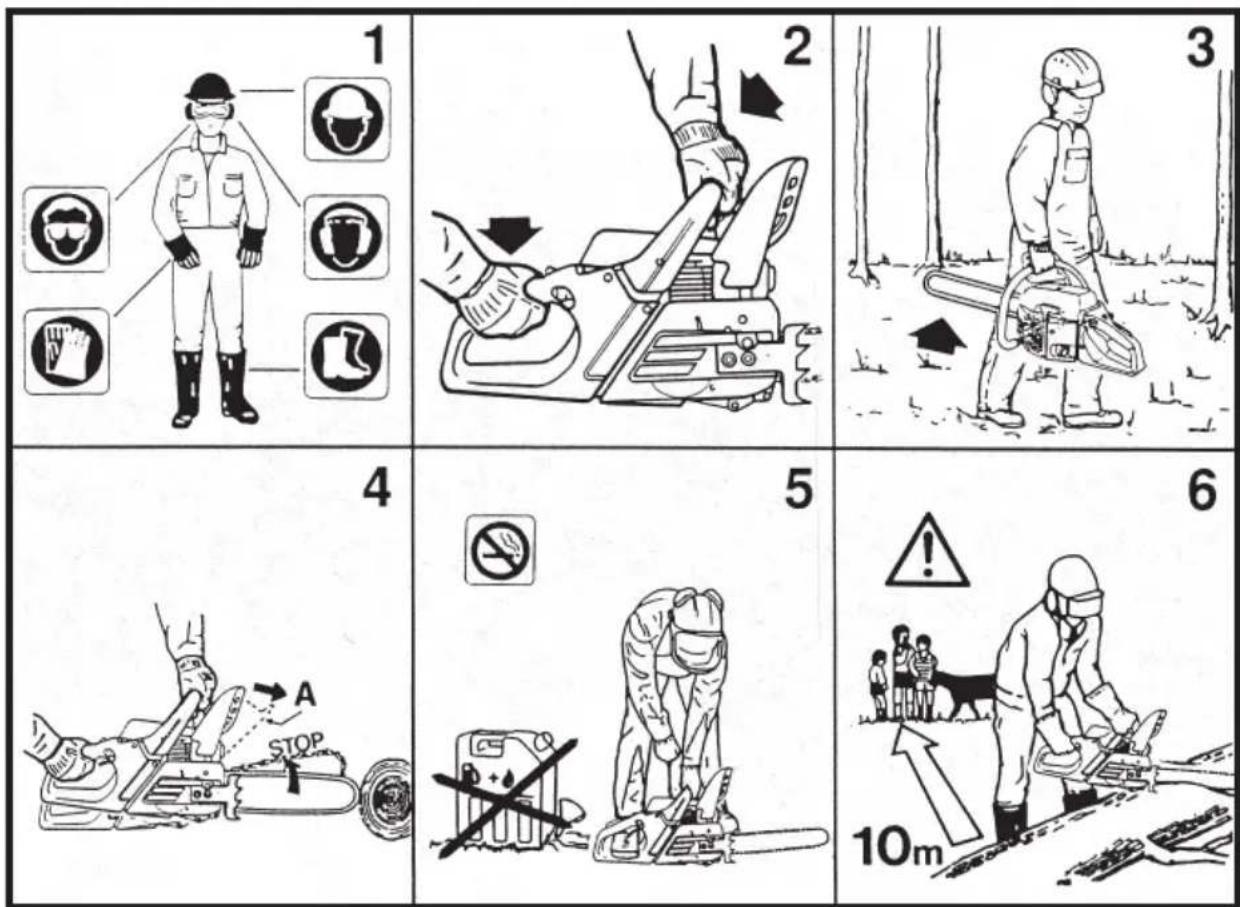
Wear safety clothing:

1 Approved safety glasses or face shield

2 Approved safety helmet

3 Approved ear defender

4 Approved gloves

5 Approved safety footwear

Do not smoke while refuelling or while operating the machine

Warning - Caution

Choke fully opened (hot start /run)

Choke partially opened

Choke closed (cold start)

Brake engaged / disengaged

Beware of kickback

Do not cut with the end on the bar, this may cause kickback

Never use the machine with only one hand

Always use the machine with both hands
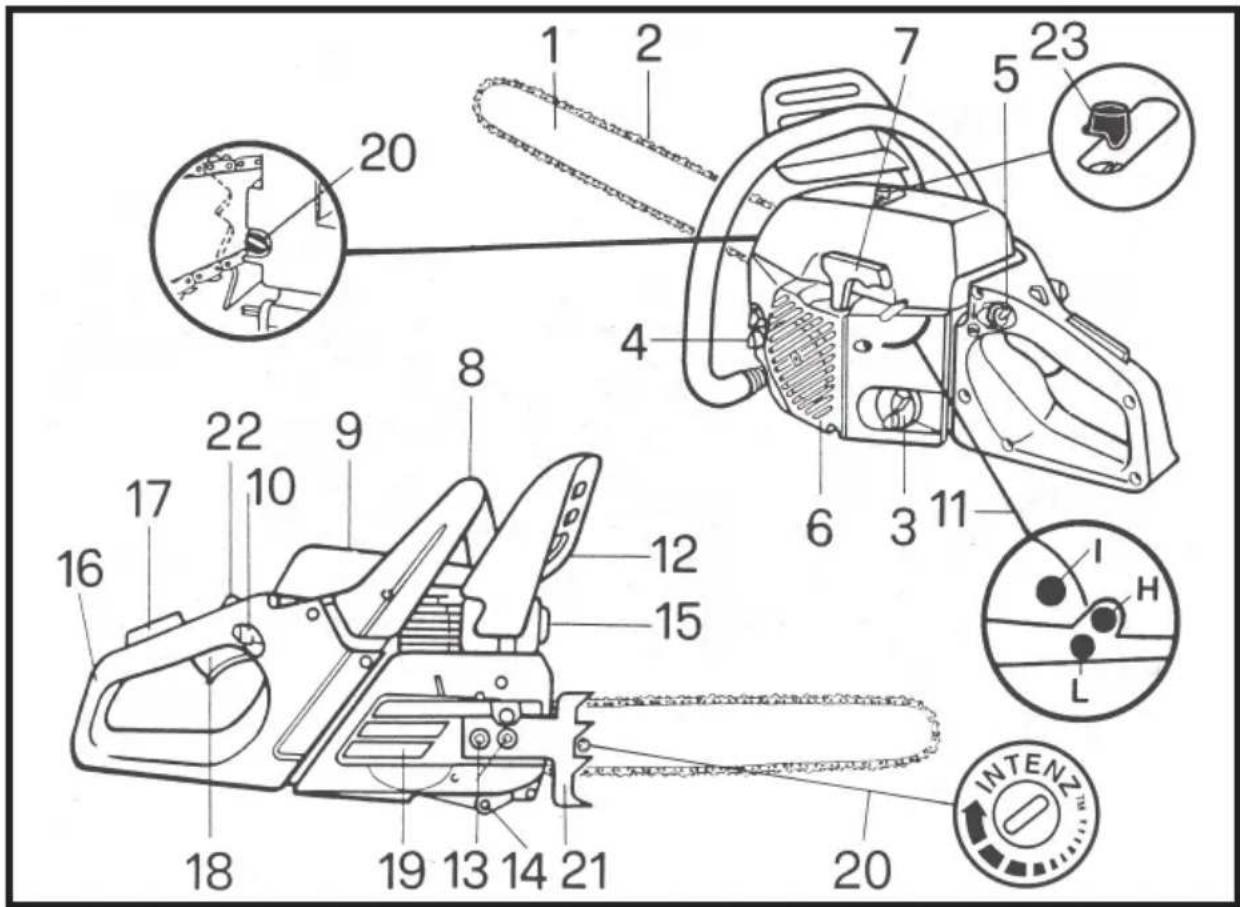
GENERAL DESCRIPTION
A
1 - BAR
2 - CHAIN
3 - FUEL TANK CAP
4 - OIL TANK CAP
5 - STOP SWITCH
6 - STARTER HOUSING
7 - STARTER HANDLE
8 - FRONT HANDLE
9 - AIR FILTER COVER
10 - CHOKE KNOB
11 - CARBURETOR ADJUSTMENT SCREWS
12 - SAFETY CHAIN BRAKE
13 - BAR RETAINING NUTS
14 - CHAIN CATCHER
15 - MUFFLER SHIELD
16 - REAR HANDLE
17 - THROTTLE TRIGGER LOCKOUT
18 - THROTTLE TRIGGER
19 - CHAIN BRAKE COVER
20 - CHAIN ADJUSTER SCREW / INTENZ
21 - SPIKE/SPACER
22 - THROTTLE ADVANCE
23 - DECOMPRESSION VALVE
SAFETY PRECAUTIONS
B
1 All operators should read this manual carefully before using this chainsaw; only use this machine for usage specifically mentioned in this manual.
Wear suitable clothing. This should include snugly-fitting (safety) clothing, sturdy boots, heavy duty gloves, goggles or a face screen and ear plugs or ear mufflers. Wear a helmet if there is risk of falling objects or projections from trees.
2 Always hold the chainsaw firmly with both hands when the engine is running. Always maintain a firm foothold. Ensure you are able to stop the engine quickly if necessary. Do not work up a tree unless you have received suitable training and have the appropriate equipment (belts, ropes, safety hooks etc.) for this type of work.
We strongly recommend that all first-time chainsaw users obtain practical instruction on safe chainsaw usage before operating the chainsaw.
Do not operate this machine when tired or under the influence of any substances, drugs or alcohol which can impair vision, dexterity or judgement.
Prolonged use of chainsaws or other machines exposing the operator to vibration may produce Whitefinger's Disease (Raynaud's Phenomenon). This may reduce the hands' ability to feel and regulate temperature and may
produce general numbness. Continual or regular users should therefore monitor closely the condition of their hands or fingers. If any of the symptoms appear, seek immediate medical advice.
3 Never carry the chainsaw with the engine running. Whenever carrying a chainsaw, even for short distances, the chain should be covered by the chain guard (scabbard) and the bar should point backwards.
When transporting the chainsaw in a vehicle, secure the saw to prevent fuel spillage.
4 To avoid kick-back, do not attempt to cut with the nose of the bar. Ensure the engine is running at full throttle before commencing to cut. To avoid kick-back, do not let the nose of the bar come into contact with logs, branches, the ground or any other obstruction. Do not allow any part of the chain to come into contact with rock, nails or wire fence
Ensure the chain is kept sharp and correctly tensioned. Keep the spike or the saw body against the wood when cutting. Use only genuine accessories and spare parts. We recommend you have your unit periodically checked and serviced by an authorised dealer.
Do not use chainsaw above shoulder height.
5 Do not operate the chainsaw near a naked flame or spilled fuel. Only operate the chainsaw outside and in well ventilated areas.
After re-fuelling, always wipe off any spilled fuel. Move the chainsaw away from the fuelling point before starting the engine.
6 Keep by-standers and animals out of the work area; at a minimum distance of 10 m or twice the timber length. If necessary, use warning signs to keep on-lookers at a distance.
Carefully survey the working site to note any hazards, eg. roads, paths, electricity cables, dangerous trees etc. Do not use the chainsaw if the device for stopping the chain (safety chainbrake) does not work correctly. Never place hands on the chain whilst the engine is running. Ensure someone is within hearing distance in case of an accident. If this is not possible, it is recommended that users operating chainsaws in remote areas carry an adequate first-aid kit with them and ensure someone knows their location. Never leave the engine running while the tool is unattended.
ONLY USE ORIGINAL SPARE PARTS AND ACCESSORIES.
BAR AND CHAIN INSTALLATION - INTENZ
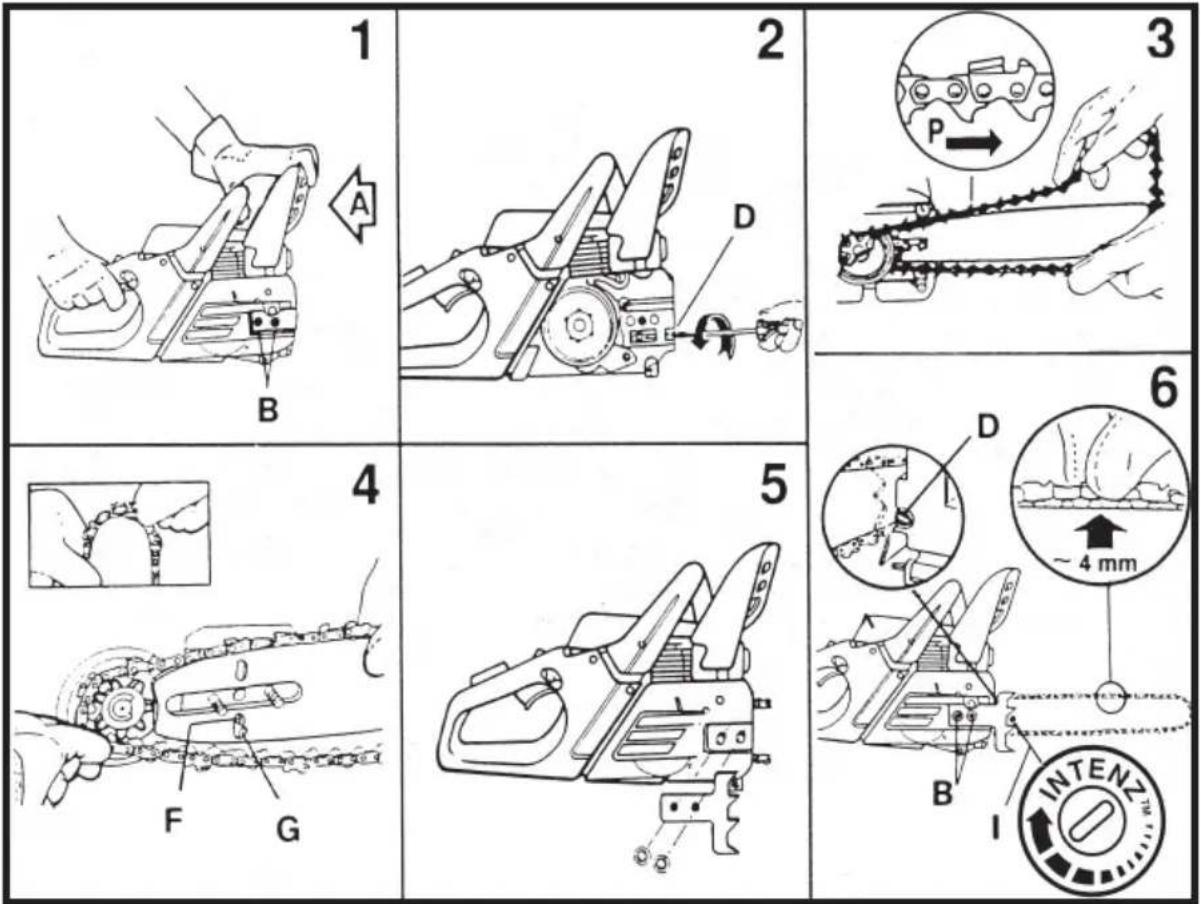
Ensure engine is always switched off before fitting or adjusting chain. Wear a pair of protective gloves when fitting or adjusting chain.
1 Ensure chain brake lever is in disengaged position (A). Remove retaining nuts (B) and cover.
2 Turn the adjusting screw (D) counterclockwise taking it fully back.
3 Feed chain into bar groove ensuring correct direction of chain (P).
4 Work the chain around sprocket and set the bar as illustrated, make the lower hole (F) coincide with the pin (G) of the adjusting screw.
5 Reposition side cover. Fit spike as illustrated.
6 Lock nuts (B) finger tight.
Adjust chain tension pin by turning screw (D) so that when lifting the chain an entire drive link is just visible.
The chain is correctly tensioned when there is no slack on the underside of the bar, and it runs freely in bar groove. Tighten the bar retaining nuts with the wrench, pushing bar tip upwards.
INTENZ
Turn the adjusting screw (I) counterclockwise taking it fully back.
Feed chain into bar groove ensuring correct direction of chain (P).
Lock nuts (B) finger tight.
Adjust chain tension pin by turning screw (l) so that when lifting the chain an entire drive link is just visible.
The chain is correctly tensioned when there is no slack on the underside of the bar, and it runs freely in bar groove. Tighten the bar retaining nuts with the wrench, pushing bar tip upwards.
FUEL MIX
D
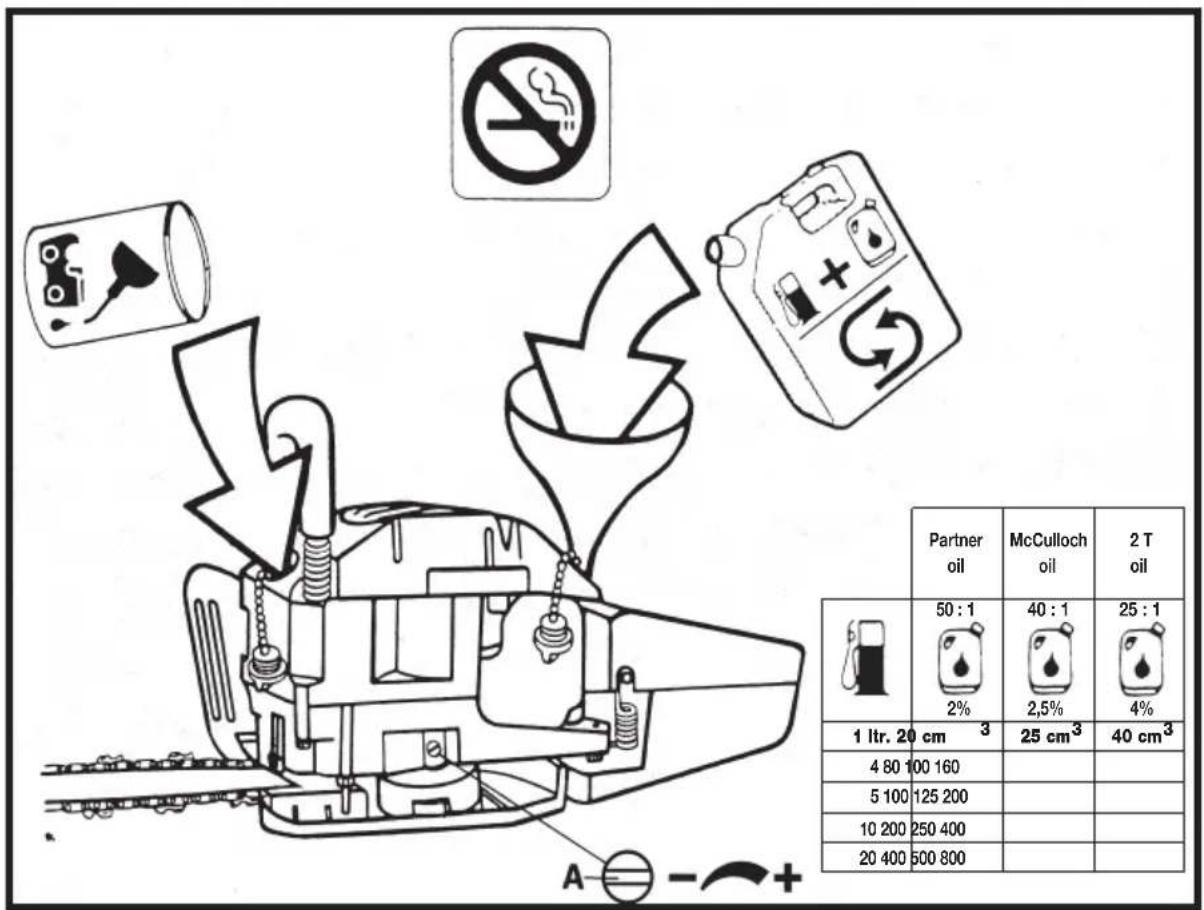
Use only fuel recommended by this manual. This product is fitted with a 2-stroke engine and therefore requires a 2-stroke petrol and oil mix. Use leaded (4 Star) or unleaded petrol with a minimum octane rating of 90.
UNLEADED PETROL: if using unleaded petrol, you must use a totally synthetic 2-stroke engine oil or branded 2-stroke engine oil (see table).
Only use oil from sealed containers. In order to obtain a good fuel mix, put the oil into the container before the petrol.
IMPORTANT
Always shake this fuel mix vigorously each time you use it. We recommend to carry out this operation each time you use the fuel.
Fuel mix properties deteriorate with time, we therefore recommend that you only make the quantity of fuel mix you will need for each usage. Do not use fuel mix more than a week old as this could damage the engine.
WARNING
Do not smoke when re-fuelling.
Always open the fuel cap slowly.
Re-fuel in open spaces only, keeping away from naked flames or sparks.
Always store fuel in an approved container.
SAFE STORAGE OF FUEL
Petrol is highly inflammable. Put out all cigarettes, pipes and cigars before working with petrol. Avoid spilling petrol. Store fuel in a cool, well ventilated place, in an approved container specifically designed for the purpose.
Never store engine with fuel in the tank in enclosed, poorly ventilated areas, where fuel fumes may reach an open flame, spark or pilot light such as in a furnace, water heater, clothes dryer etc. Petrol fumes can cause an explosion or a fire. Do not store large amounts of fuel.
CHAIN LUBRICATION
IMPORTANT
The service life of the bar and chain depends on good lubrication.
Always use chain lubricating oil of medium viscosity. We recommend special McCulloch chain lubricating oil.
Never use waste oil for this purpose. This results in damage to the bar, the chain and the oil pump.
Refill the chain oil tank each time the saw is refuelled.
To prevent possible restarting problems avoid running the fuel tank dry. This also helps to extend engine life.
NOTE: Saw chain stretches during use particularly when it is new, and it will occasionally be necessary to adjust and tighten it. A new chain will require adjustment after about 5 minutes of operation.
The mechanical oil pump for chain lubrication can be adjusted.
The feed rate of the chain oil pump can be adjusted by means of the regulating screw (A) (see details in the illustration).
STARTING AND STOPPING
E
IMPORTANT
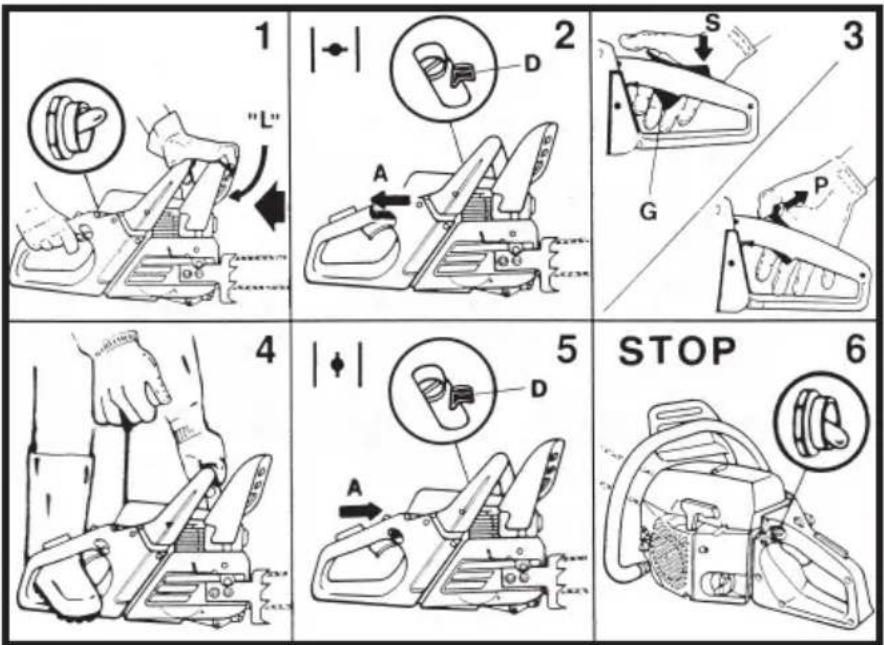
Never start or operate unless bar and chain are properly installed. Before starting always move the saw away from the fuelling area and place it on a firm, flat surface, the guide bar to the front.
STARTING A COLD ENGINE
1 Check that the chain brake is in the disengaged position moving the lever (L) towards the front handle.
Move the stop switch upwards.
2 Slide the choke lever (A) to the CLOSED position (OUT). Push the decompression valve (D) down if your models is fitted with one.
3 Depress throttle trigger lock out (S). Depress throttle trigger (G) and then operate throttle advance (P) moving it backwards.
4 Hold the saw firmly as shown in illustration and pull the starter rope until the engine fires once.
Beware of moving chain!
5 Move choke lever (A) to the OPEN position (IN). Push the decompression valve (D) down if your models is fitted with one.
Pull the starter rope until the engine starts.
Allow engine to warm up for ten seconds for better cutting performance.
Squeeze the throttle trigger (G) to release the throttle advance. If engine fails to start, repeat these instructions.
6 The engine is stopped by depressing the STOP switch to STOP position.
After lengthy use of the chain at full speed, we recommend to run the engine for a few seconds at idle speed before stopping it.
STARTING A WARM ENGINE
Check that the ignition switch is not in the "stop" position and do not use the throttle lock.
Hold the saw firmly, press valve (D) for decompression and pull the starter rope.
STARTING A WARM ENGINE AFTER RE-FUELLING
In the fuel tank as run completely dry, proceed to start as with a cold engine.
USAGE
F
IMPORTANT
Before using a chain saw read the Operator's Manual and all safety precautions carefully.
FELLING TREES
- Make sure that there are no bystanders or animals in the work area.
- Study the direction of the fall of the tree and then plan your exit path away from the planned direction of fall.
- Don't fell trees when there is a strong wind.
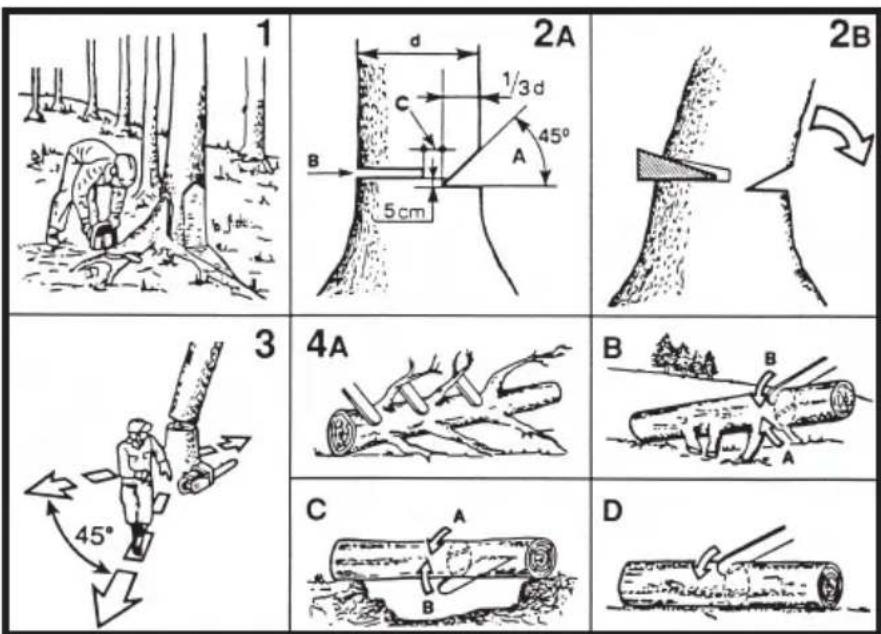
1 Clear the tree base of interfering limbs and brush. Clean the work area from stones or other objects which could damage the chain. If the tree has large protruding roots, remove them before felling (see illustrations).
2 A) Cut a felling notch (A) of 45° on the side you want the tree to fall to a depth of about one third of the trunk diameter (d). Then make a felling cut (B) about 5 cm higher than the felling notch on the opposite side of the tree. Make sure that the felling cut does not go right through the trunk. A hinge (C) must always be left to provide control over the direction of the fall.
B) Use wedges to control the moment and direction of the fall.
3 When the tree starts to fall, walk away along your preplanned escape path.
CUTTING FALLEN TRUNKS
4 A) Limbing thick branches. For limbing and bucking leave the lower limbs to support the log off the ground.
B) Supported at one end only. Begin with a bottom cut made by the upper side of the bar (A); the depth of the cut should be about one third of the log diameter. Finnish with a top cut (B) meeting the first one. With this technique splitting, cracking can be avoided
C) Supported at both ends. Begin with a top cut about one third of the log diameter. Then finish with a bottom cut (B) meeting the first one. This technique avoids the risk of pinching the bar in the log.
D) If the log is supported along its whole length it may be cut normally from above. Take care not to touch the ground with the chain.
- When working on a slope always stand on the uphill.
- When cutting prepared timber, use clamps or chocks to secure work.
- Use extreme caution when cutting small size brush and saplings which may catch the chain and pull you off balance.
CARBURETTOR ADJUSTMENT

We suggest carburetor adjustments are made by an authorized servicing dealer.
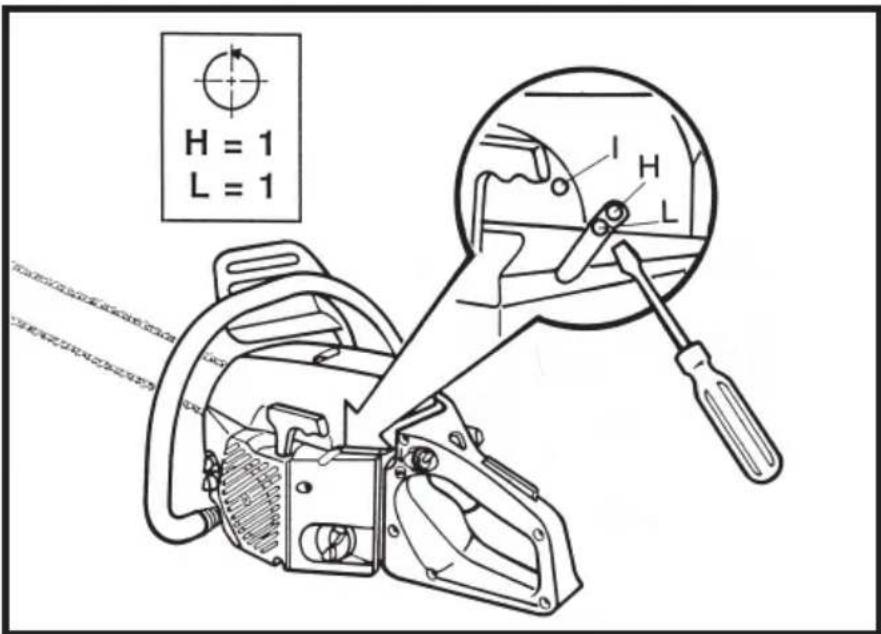
The carburetor has three adjustment screws:
- L: The needle screw L governs the fuel flow at low speed and also the acceleration from low to full speed.
To set screw L: close screw L turning it clockwise without forcing.
Then open screw 1 full turn (counterclockwise).
If acceleration is not smooth, open another 1/8 turn to increase fuel flow.
• H: The needle screw H governs fuel flow at high speed (throttle valve fully open).
To set hi speed screw H: close screw H turning it clockwise without forcing.
Then open screw 1 full turn (counterclockwise).
If the engine speed is too high, open the screw about 1/8 turn (counterclockwise). Optimal adjustment is found between 1 and 1 1/4 turns.
- I: The I (IDLE) screw controls the throttle opening to govern idle speed (2800 min ^-1 ) adjust as necessary.
CAUTION: increased idle speed may cause chain movement. The carburetor is adjusted for normal operation during production. When considerable changes of altitude require a supplementary adjustment, contact an authorised service station which offers the latest in tools, parts and technical assistance.
ROUTINE MAINTENANCE

Ensure engine is always switched off before any kind of maintenance operation.
CHAIN: Check tension regularly. A new chain will require more frequent adjustment. Loosen retention nuts. Tighten chain (see assembly instructions). Tighten retention nuts and adjust.
1 BAR
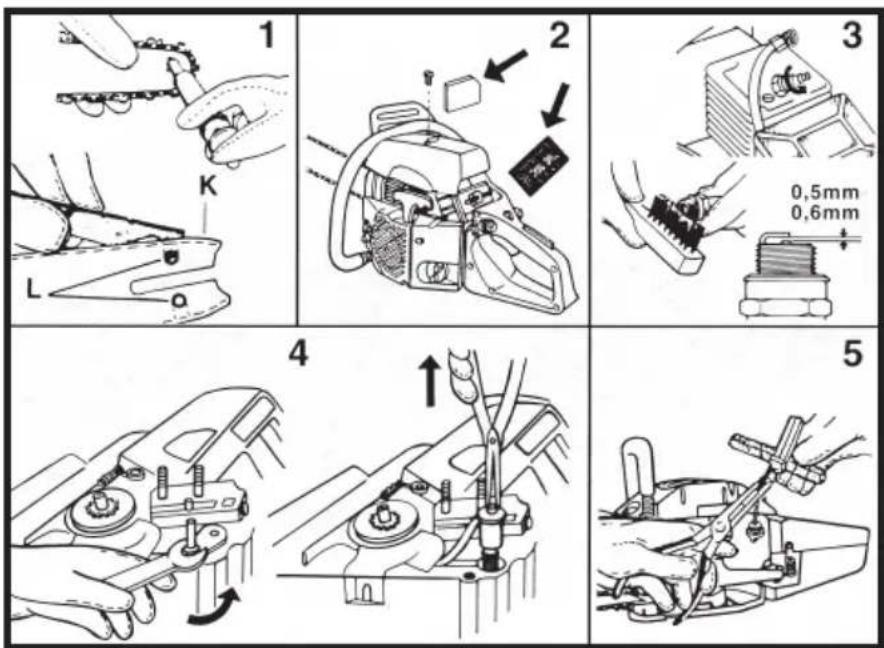
- Clean the bar groove (K) and check the lubrication holes (L) in the bar to ensure that they are not clogged.
- Grease sprocket periodically. Rotate sprocket and repeat.
- Rotate bar periodically to maximise bar life.
2 AIR FILTER
- A dust clogged air filter may cause carburetor problems. This may prevent the engine from reaching its maximum r.p.m. and cause high fuel consumption.
- Remove cover.
- Wash filter in petrol (do not use fuel which is mixed with oil).
- The filter can also be cleaned with compressed air.
- Replace filter if damaged or if it does not seal tightly in the air box.
3 SPARK PLUG
Remove and clean the spark plug every 30 hours. Check the electrode gap (0,5/0,6 mm. - 0.025 inches).
- Replace spark plug about every 100 working hours or whenever it is extremely encrusted.
- Heavily encrusted electrodes can result from an incorrect carburetor setting or from wrong fuel mixture (too much oil in the fuel mix) or a poor quality of oil in the fuel mix. Check and correct.
4 OIL FILTER
The oil filter is on the end of the oil suction hose inside the oil tank.
To clean and replace the filter pull it out through the oil tank filter opening. Use a piece of bent wire or long forceps.
To remove deposits from the oil tank half-fill it with kerosene or petrol and shake thoroughly. Drain off and fill the tank with fresh saw chain oil.
Never use waste oil.
5 FUEL FILTER
To change fuel filter remove the tank cap and pull out the filter with a piece of bent wire or long forceps. Replace the filter as shown in the illustration and reposition it.
It is recommended to replace the fuel filter at least once a year.
CHAIN BRAKE
- WARNING: Contact your service dealer if anything appears wrong with your chain brake. Do not disassemble or manipulate the mechanism of the chain brake.
- Clean the brake mechanism periodically (without disassembling it) and control the wear of the band visually.
- PERIODICALLY: It is important to clean the saw thoroughly particularly around cylinder fins to avoid overheating of the engine.
- LONG STORAGE: Empty fuel and run engine until dry.
SAFETY CHAIN BRAKE

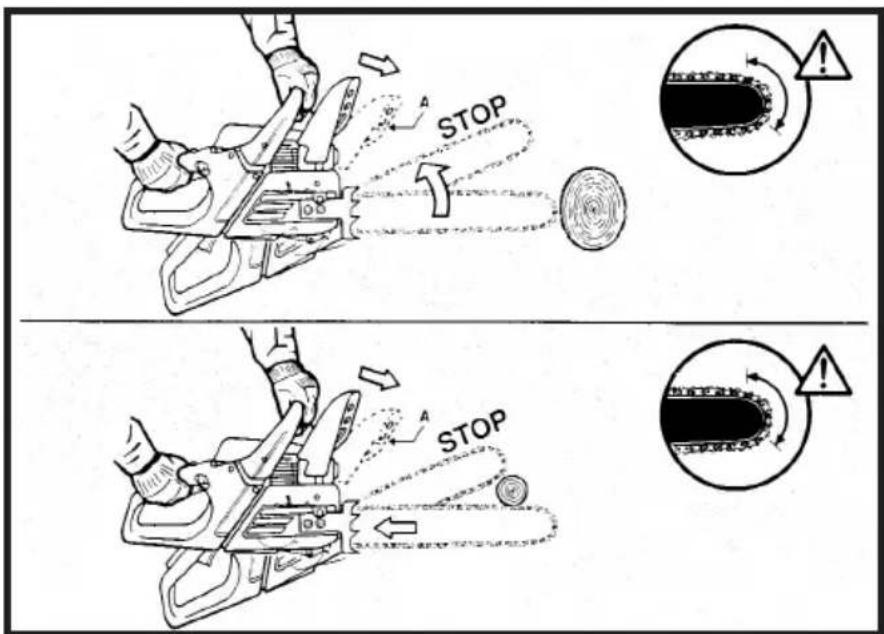
Your chain saw is fitted with a safety chainbrake designed to stop the chain in milliseconds in case of kickback. Always hold the saw firmly in both hands.
The chain brake does not provide a total protection if the machine is used without taking the necessary precautions and maintenances.
The chain brake is intended to engage automatically in case of kickback.
The chain brake can also be engaged manually by pushing the chain brake lever forwards. The manual use of the chain brake is recommended only at idle.
Always test the chain brake before using your saw. Do this by engaging the brake at idle (see below).
Always release the brake before starting.
Kickback may occur if the end of the bar (see illustrated angle) touches any solid object.
Never attempt to start a cut with the end of the bar.
Kickback is a violent upward and rearward movement of the bar and may cause you to lose control of the machine.
Therefore you should avoid starting a cut with this part of the bar. Always keep a firm grip on the saw with both hands because, in case of kickback, it is the contact of the left hand with the brake lever which will help to engage the brake.
CHAIN BRAKE TESTING:
1 The chain brake (A) is disengaged when brake lever is pulled back and locked(chain can move).
2 The chain brake (A) is engaged when brake lever is in the position (chain cannot rotate). The chain brake should snap into both positions. If strong resistance is felt or lever does not move into either position, DO NOT USE YOUR SAW. Take it immediately to an authorized servicing dealer.
3 CHAIN CATCHER
This unit is fitted with a chain catcher below the drive spocket. This is intended to stop the rearward movement of the chain in case of breakage or if it should come out of the bar. It should never be removed.
CHAIN SHARPENING

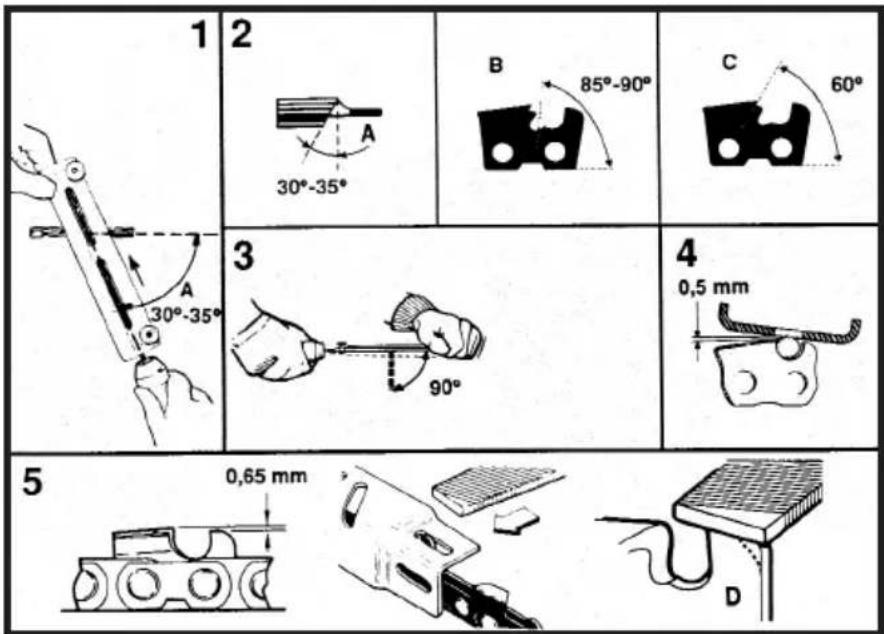
1 Chain cutter teeth can be sharpened with a round file, as follows:
CHAIN FILE
MP 370 GLX 5/32"
PM 320 GX 3/16"
The exact chain type is marked on the bottom half of the drive link which runs inside the bar groove.
Filing can be made easier by also using a file holder.
The chain can remain fitted on the bar during sharpening.
Before commencing, the chain should be tensioned correctly and the chain brake should be activated to prevent the chain from moving.
2 To obtain a correct sharpening the file must be carefully held to maintain 3 basic angles:
- "A" Top angle 30° - 35°
- “B” External, side angle 85° - 90°
- "C" Internal, side angle 60°
File in one direction only, from the “inside” of the cutter tooth towards the “outside”.
Do not allow the file to touch the chain as you bring it back to re-position it. Each cutter tooth should be filed with the same number of strokes.
3 The file should be held horizontally to the cutter tooth being sharpened.
4 Best results to obtain a precise sideways angle can be obtained by holding the file so that it rises 0,5 mm above the top face of the cutter tooth.
5 DEPTH GAUGE
Correct depth gauge height is vital to ensure maximum chain life and cutting efficiency.
The height of the depth gauge should be lowered as the cutter tooth is filed back; this height should be checked every 4 or 5 sharpenings.
The best way to do this is to use a flat file and a depth gauge tool.
The correct setting is 0.65 mm below the top edge of the cutter tooth.
The cutter tooth depth gauge should then be rounded (D).
FAULT FINDING TABLE
| Engine will not start Engine runs badly The chainsaw runs Engine runs badly or but does not cut well looses power when cutting | ||
| Check STOP switch is in the position I. | ● | |
| Control fuel level min. 25% tank capacity. | ● | ● |
| Check air filter is clean. | ● | |
| Remove spark plug, dry it, clean it and adjust it, and replace it, if necessary. | ● | ● |
| Control and adjust the carburetor screws if necessary. | ● | |
| Change fuel filter. Contact your dealer. | ● | |
| Carefully follow the chain assembly instructions. | ● | |
| Check chain is sharp. Otherwise, contact your dealer. | ● | |
| Engine still gives trouble: contact your dealer. | ||
GB EC Declaration of conformity
In accordance with the EC Machine Directive (98/37/CEE), 93/68/EEC (CE Marking
Directive) & 89/336/EEC (Directive on electromagnetic compatibility) Directive 2000/14/CEE (Annex V).
The undersigned, Fausto Parazzini, authorised by E.O.P.I., declares that the petrol-driven chainsaw: MS38E, MS40E, MS46E serial number as above, with chain bar of cutting length 35/40/45 cm, manufactured by E.O.P.I., Via Como 72, 23868 Valmadrera (LC), Italia, conform to the machine that was the object of the EC type testing in accordance with Annex VI of the Machine Directive.
The EC type examination was conducted by Marchio di Qualità (IMQ), Via Quintiliano 43, 20138 Milano (Italia), EC type examination certificate no. IMQ AQ 024DM, IMQ AQ 025DM, IMQ AQ 026DM.
This type testing established that the machine conforms to the essential health and safety requirements of the EC Machinery Directive.
ELECTROLUX OUTDOOR PRODUCTS
- C.
- D.
- E.
- F.
- G.
- H.
- I.
- L.
- THIS PRODUCT MEETS THE SAFETY STANDARD REQUIREMENT OF THE EUROPEAN MACHINERY DIRECTIVE
- UK
- CE PRODUIT EST CONFORME À LA NORME EUROPÉENNE POUR LA SÉCURITÉ DES MACHINES
- GENERAL DESCRIPTION
- A
- SAFETY PRECAUTIONS
- B
- BAR AND CHAIN INSTALLATION - INTENZ
- INTENZ
- FUEL MIX
- D
- IMPORTANT
- WARNING
- SAFE STORAGE OF FUEL
- CHAIN LUBRICATION
- STARTING AND STOPPING
- STARTING A COLD ENGINE
- STARTING A WARM ENGINE
- STARTING A WARM ENGINE AFTER RE-FUELLING
- USAGE
- FELLING TREES
- CUTTING FALLEN TRUNKS
- CARBURETTOR ADJUSTMENT
- ROUTINE MAINTENANCE
- BAR
- AIR FILTER
- SPARK PLUG
- OIL FILTER
- FUEL FILTER
- CHAIN BRAKE
- SAFETY CHAIN BRAKE
- CHAIN BRAKE TESTING:
- CHAIN CATCHER
- CHAIN SHARPENING
- DEPTH GAUGE
- GB EC Declaration of conformity
Brand : MCCULLOCH
Model : Promax 40 II
Category : Saw