
EFT 11423 WA++ - Freezer ECG - Free user manual and instructions
Find the device manual for free EFT 11423 WA++ ECG in PDF.


| Product Type | Freezer |
| Model | EFT 11423 WA++ |
| Brand | ECG |
| Dimensions (W x D x H) | 550 x 550 x 1430 mm |
| Weight | 46 kg |
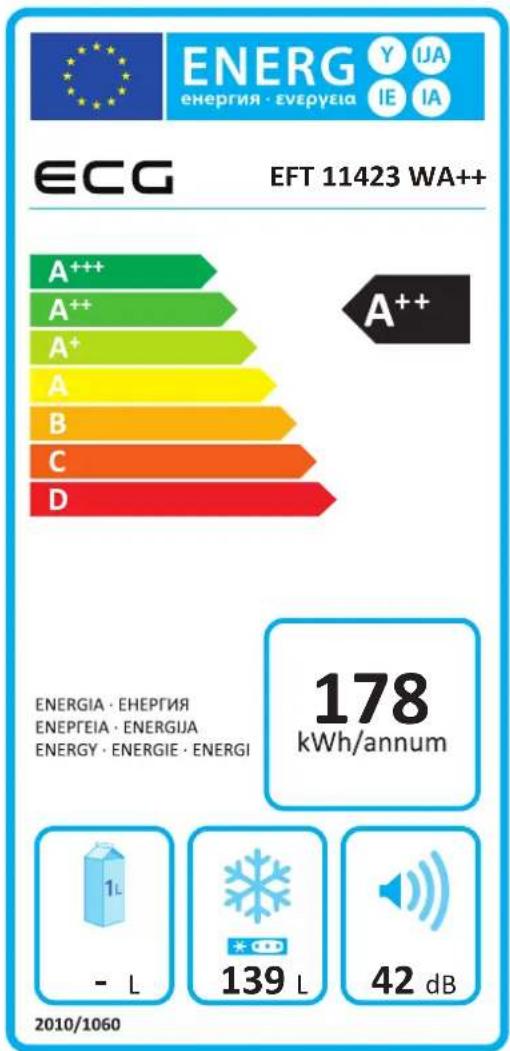
| Energy Class | A++ |
| Annual Energy Consumption | 178 kWh |
| Daily Energy Consumption | 0.4876 kWh/24h |
| Total Volume | 180 L |
| Net Freezer Volume | 165 L |
| Freezing Capacity (24h) | 10 kg |
| Climate Class | SN/N/ST/T |
| Noise Level | 42 dB(A) |
| Coolant | R600a (flammable) |
| Power Input | 70 W |
| Voltage/Frequency | 220-240 V~ / 50 Hz |
| Number of Doors | 1 |
| Defrosting | Manual |
| Temperature Control | Manual thermostat (Min/Mid/Max) |
| Freezer Star Rating | **** |
| Reversible Door | Yes |
| Adjustable Feet | Yes |
| Colour | White |
| Minimum Clearance - Sides/Rear | 10 cm |
| Minimum Clearance - Top | 30 cm |
Frequently Asked Questions - EFT 11423 WA++ ECG
User questions about EFT 11423 WA++ ECG
0 question about this device. Answer the ones you know or ask your own.
Ask a new question about this device
Download the instructions for your Freezer in PDF format for free! Find your manual EFT 11423 WA++ - ECG and take your electronic device back in hand. On this page are published all the documents necessary for the use of your device. EFT 11423 WA++ by ECG.
USER MANUAL EFT 11423 WA++ ECG
natural_image
Front view of a white refrigerator with five open doors, each containing a food item (no visible text or symbols)EFT 11423 WA++
CZ
MRAZNIČKA
NÁVOD K OBSLUZE
SK
MRAZNIČKA
NÁVOD NA OBSLUHU
DE
GEFRIERSCHRANK
BEDIENUNGSANLEITUNG
GB
FREEZER
INSTRUCTION MANUAL
HR/BIH
ZAMRZIVAČ
UPUTE ZA UPORABU
BEZPEČNOSTNÍ POKYNY
natural_image
Cartoon illustration of a person peeking out of a door, with arms and legs bent (no text or symbols)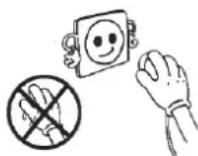

natural_image
Isometric line drawing of a structural frame with vertical supports and horizontal beams (no text or symbols)
natural_image
Technical line drawing of a rectangular panel with mounting holes and a magnified inset showing a curved arrow indicating rotation (no text or symbols)natural_image
Technical line drawing of a refrigerator with mounting bracket and internal components, shown in two orthographic views (no text or symbols)POKYNY K POUŽÍVÁNÍ

Ovládání teploty
natural_image
Cartoon illustration of a character opening a door with arms and legs, no text or symbols present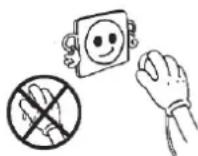
natural_image
Isometric line drawing of a structural frame with vertical supports and horizontal beams (no text or symbols)natural_image
Technical line drawing of a rectangular panel with mounting holes and a magnified inset showing a curved arrow indicating rotation (no text or symbols)natural_image
Technical line drawing of a refrigerator with an inset close-up showing internal components (no text or symbols)POKYNY NA POUŽÍVANIE
Ovládanie teploty
natural_image
Cartoon illustration of a character opening a door with arms and legs (no text or symbols)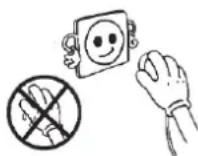
natural_image
Isometric line drawing of a structural frame with vertical supports and horizontal beams (no text or symbols)natural_image
Technical line drawing of a rectangular panel with mounting holes and a magnified inset showing a curved component with arrows indicating rotation (no text or symbols)natural_image
Isometric line drawing of a rectangular box with two small protrusions on top (no text or symbols)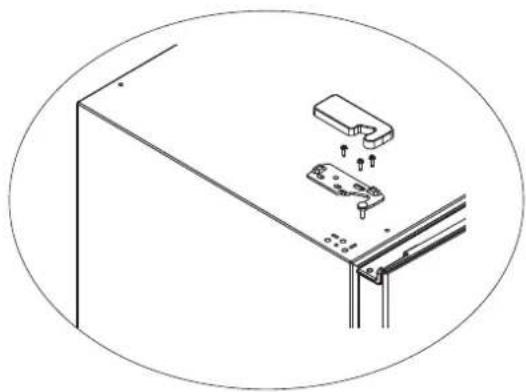
natural_image
Line drawing of a refrigerator with attached electronic components (no text or symbols)
ANWENDUNGSHINWEISE
Temperaturregelung
Read carefully and keep for future use!
Warning: The safety measures and instructions contained in this manual do not include all conditions and potential situations. The user must be aware that common sense, caution, and care are factors that cannot be integrated into a product. These factors must be therefore secured by the user/users using and operating this device. We are not liable for any damages caused during shipping, by incorrect use, voltage fluctuation or the modification or adjustment of any part of the appliance.
To protect against the risk of fire or electric shock, basic precautions must be taken while using electrical appliances, including the following:
-
Make sure the voltage in your outlet corresponds to the voltage provided on the appliance label and that the socket is correctly grounded. The outlet must be installed in accordance with applicable electrical codes according to EN.
-
Do not operate the device if the cord is damaged. All repairs or adjustments including cord replacements must be carried out by a professional service centre! Do not remove the protective covers from the appliance; there is a risk of electric shock!
-
The appliance must not come into direct contact with water or other liquids in order to prevent a potential electric shock. Do not immerse the cord or the plug in water!
-
Do not use the appliance in places, where a gas leak or a contact with an explosive atmosphere could occur. Do not touch the cord or the device with wet hands. There is a risk of electric shock.
-
The power cord must remain accessible once the device is installed. Do not shorten the cable or use adapters in electrical outlets. Do not allow the cord to touch hot surfaces or place the cord over sharp edges.
-
Do not turn the appliance on or off by plugging or unplugging the power cord. Do not remove the power cord from the outlet by
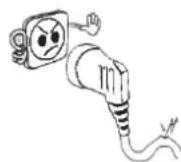
yanking the cord. Unplug the cable from the outlet by grasping the plug.
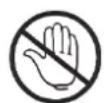
- Do not insert any objects into the device or place any objects on the device (e.g. vases, cups, etc.). Never cover the ventilation openings!
- Do not use in the appliance other electrical devices and refrigeration equipment.
- If this appliance is replacing an old product equipped with a lock, destroy the lock of the old appliance, so that children would not lock themselves in (e.g. during a play).
- Do not use mechanical devices or other artificial means to speed up defrosting. Do not use electrical appliances in the space designed to store foods. Protect the cooling circuit of the appliance against damage.
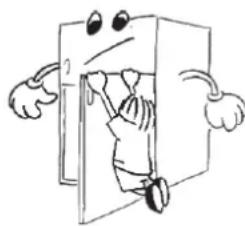
- Do not allow children to play with the appliance. Also, they may not sit on the shelves and hang on the door of the appliance.
- Do not use sharp metal objects to remove the ice from the refrigerator, because they may damage the refrigerating circuits and cause irreparable damage to the appliance. If necessary, use a plastic scraper.
- Do not store explosive substances in the appliance, e.g. sprays with propellant gas.
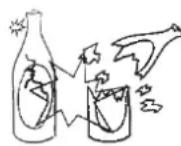
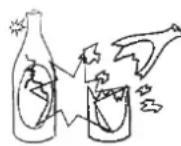
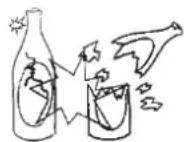
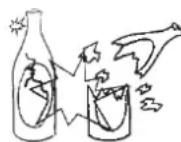
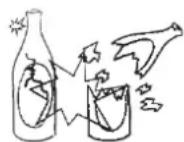
- Do not place containers with liquids (glass jars or tin cans) in the freezer. The container could burst.
- When you store bottles containing liquids with high content of alcohol, they must be properly closed and in vertical position.
- Do not expose the appliance to direct sunlight, do not use it outside and do not expose it to rain.
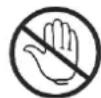
- Do not touch the cooling surfaces with wet hands. Risk of injury.
- Do not eat the ice removed from the freezer.
- This appliance is intended for household use and similar areas, such as:
natural_image
Cartoon illustration of a person peeking out of a door, with arms and legs raised (no text or symbols)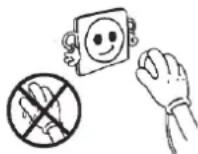
- kitchenettes in shops, offices, and other workplaces
-
appliances used in the agricultural industry
– by guests in hotels, motels, and other residential areas
– in bed and breakfast establishments -
This appliance may be used by children under 8 years of age and older and persons with reduced physical, sensory or mental capabilities or lack of experience and knowledge if supervised or instructed to use the appliance in a safe manner and understand the potential hazards. Children may not play with the appliance. Cleaning and maintenance operations performed by the user shall not be carried out by children without supervision.
-
Children aged 3 to 8 years can insert and remove food from refrigerating appliances.
- Child supervision is essential to prevent them from playing with the appliance.
- The manufacturer is not liable for any damage caused by improper grounding/use.
To prevent food contamination, please follow these recommendations:
- Opening the door for a long time can cause a significant increase in the temperature inside the appliance.
- Regularly clean surfaces and accessible drainage systems that may come into contact with food.
- Clean water containers if not used for 48 h; flush the water system connected to the water supply if the water has not flowed for 5 days.
- Store raw meat and fish in the refrigerator in suitable containers so that they do not come into contact with or drip into other foodstuff s.
- Two-star freezing compartments are suitable for storing pre-frozen food, storing or making ice cream and making ice cubes.
- One-, two- and three-star compartments are not suitable for freezing fresh food.
- If the refrigerating appliance is left empty for a long time, turn it off, defrost, clean, dry and leave the door open to prevent mold formation inside the appliance.
RISK OF FIRE!
GB
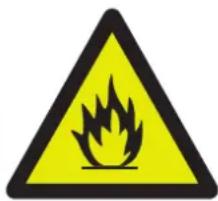
Warning: Risk of fi re/Flammable materials
This appliance contains R600a (the coolant isobutane), natural gas which is very environmentally friendly but flammable. When transporting and installing the equipment it is necessary to make sure that no part of the cooling circuit is damaged. In the case of damage, reduce the flame and ventilate the premises where the appliance is located for a few minutes.
When replacing the refrigerator interior lighting, always unplug the refrigerator. – otherwise there is a risk of electric shock. • If the replacement of the interior lighting is too complicated for you, contact your service representative. • If the products are equipped with LEDs, do not remove the lighting cover and LED yourself. – contact your service representatives.
REPLACING THE LED BULB
Do not remove the indicator cover or indicator yourself when the internal or external LEDs no longer operate. Contact the service representatives.
INTRODUCTION
Dear customers!
Thank you for purchasing this freezer. Please read carefully the instructions in this manual to obtain the best and longest performance from this product.
DESCRIPTION
This description is only for information about the components of the appliance. Individual parts may differ according to the particular appliance model.
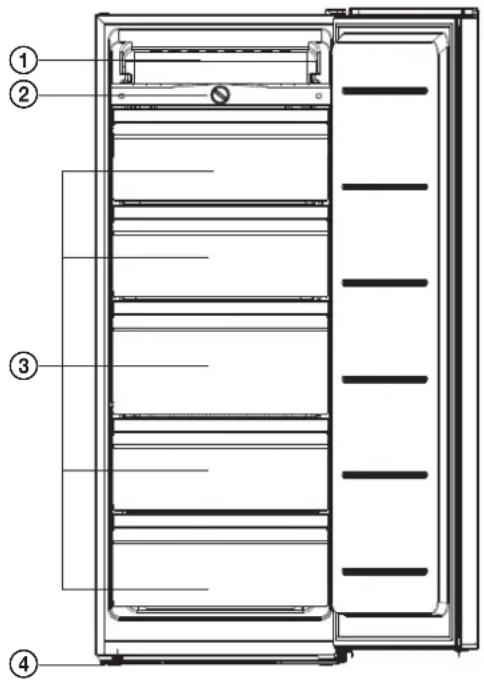
- Compartment (for pizza)
- Temperature control
- Drawers for storing frozen foods
- Adjustable feet
FREEZER INSTALLATION
GB
Unpacking the freezer
- Remove all tapes and labels (except the rating plate) from the freezer before use. You can easily remove the remnants of tapes and glue using a sponge and a small amount of detergent. Clean it after with warm water and dry it.
- Do not use any sharp objects, alcohol, flammable or abrasive cleaners, which could damage the surface finish of the appliance.
- When transporting the appliance, do not tilt it more than 45^ from the vertical position.
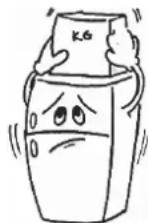
Warning: A minimum of two people are required to transport the freezer. Do not attempt to move the freezer yourself, as it may cause you a back or other injury.
Levelling the appliance
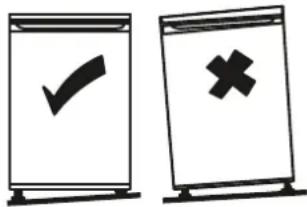
- If the freezer is not seated straight, the door may not be properly closed or sealed, which may cause problems with cooling performance, moisture penetration and icing. For trouble-free operation, it is very important to level the freezer properly.
- Use the adjusting feet to level the freezer. Rotate the adjusting foot clockwise to raise the respective side, rotate couterclockwise to lower it.
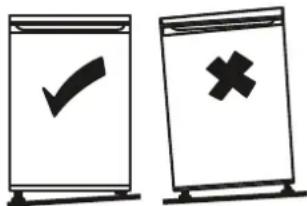
Note: Ask a second person to tilt the freezer backwards to ease the setting of the foot. Perform this operation before placing the food in the freezer.
Location and space requirements
- Place the freezer so that it is not exposed to direct sunlight.
- The freezer should be installed at least 50 cm away from a stove, gas oven or heating furnace and at least 5 cm away from an electric oven. If the freezer is located near a cabinet freezer, a gap of at least 2 cm should be between the appliances to avoid condensation of moisture on the outside.
- Do not place any objects on the freezer and install it at a convenient location so that there is at least 10 cm of free space on the sides and behind the appliance and at least 30 cm of free space above the appliance.
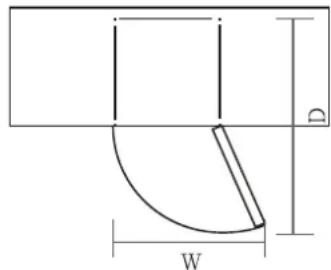
- If you install the freezer close to a solid wall, leave enough space on the hinge side to allow the door to open easily (width (W) × depth (D) > 902 × 1052 mm), see illustration.
- The ambient temperature influences the energy consumption and proper functioning. When placing the appliance, do not forget that it is advisable that the appliance operates in the temperature range specified for a given climate class, see the following table. You can find this information also on the rating plate of the appliance.
| Climate class Ambient temperature | |
| T 16 up to 43 °C | |
| ST 16 up to 38 °C | |
| N 16 up to 32 °C | |
| SN 10 up to 32 °C |
Warning: Prevent contact of the freezer with flammable materials and vapours, e.g. gasoline. Otherwise there is a risk of explosion, fi re, burns or other serious injury.
GB
Before first use
- Remove all packaging material and thoroughly clean the interior of the freezer with a solution water and soda before first use, then rinse with clean water and dry.
- Prior to first use or after relocation, let the freezer stand for 3 hours in vertical position before plugging it into the power supply. Otherwise, you could damage the compressor.
- You may detect a slight odour when you first switch it on. This odour will disappear once the appliance starts to cool.
Connection
- Before plugging it in the outlet make sure that the voltage on the nameplate corresponds with the voltage in your outlet.
- The outlet must be accessible after installing the appliance.
- We recommend that freezer connects to a separate circuit, which does not power any other appliances. Use an electrical outlet, which cannot be accidentally disconnected by an e.g. switch.
- Do not use extension cables to connect the freezer.
Note: Disconnect the freezer from the power supply before any manipulation. After finishing the installation plug the freezer in the outlet and set the thermostat to the required value.
Switching on the appliance
- When you first turn the appliance on, it should run continuously for 24 hours before it reaches a sufficiently low temperature.
- Avoid frequent opening of door during that time and putting in large amount of foods.
- If the appliance is turned off or disconnected from the power supply you need to wait at least 5 minutes before restarting or plugging it in to prevent damage to the compressor.
Reversing the door opening
Reversing the door opening direction can be done by a qualified service center.
When changing the direction of opening the door, we recommend to ask another person for assistance.
You will need an adhesive tape, cross and fl at screwdriver for assembly.
The freezer must be disconnected from power and empty before handling!
Warning:
- When removing the door, the appliance should be tilted backwards. You should support the appliance under the top panel with a solid object.
-
Do not tilt the freezer by more than 45^ from the vertical. Avoid laying the freezer flat completely, since this could damage the cooling system!
-
Secure the door with adhesive tape.
natural_image
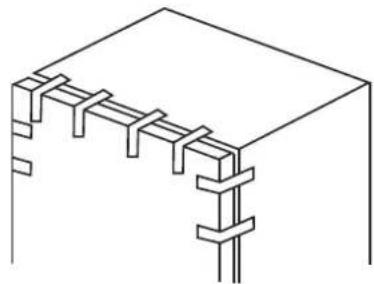
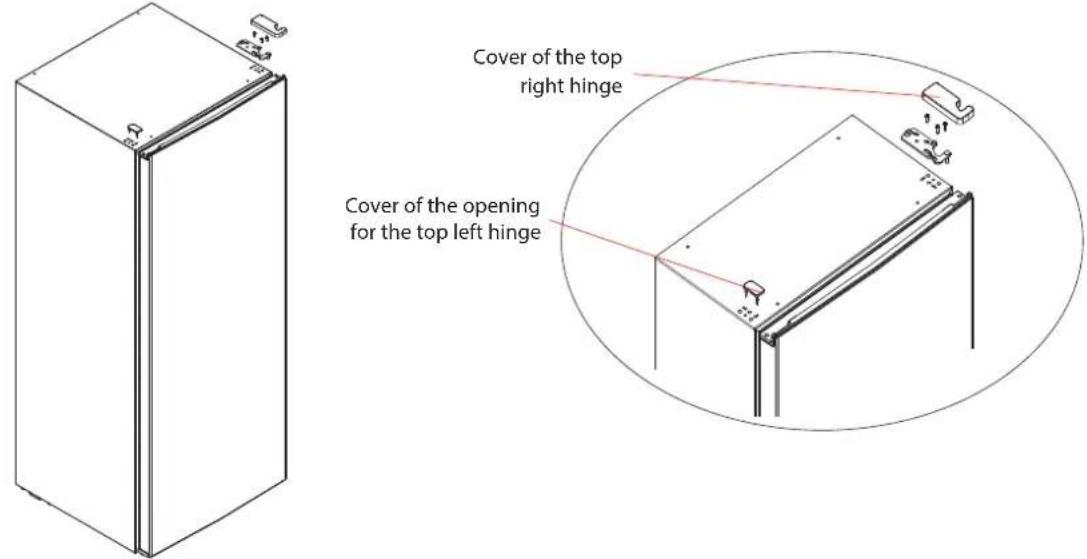
Isometric line drawing of a structural frame with vertical supports and horizontal beams (no text or symbols)- Remove the left opening cover of the upper hinge, the upper hinge cover (on the right) and unscrew the upper hinge bolts, then remove the upper hinge. Hold the door in vertical position all the time and make sure it does not fall.
GB
-
Remove the door.
-
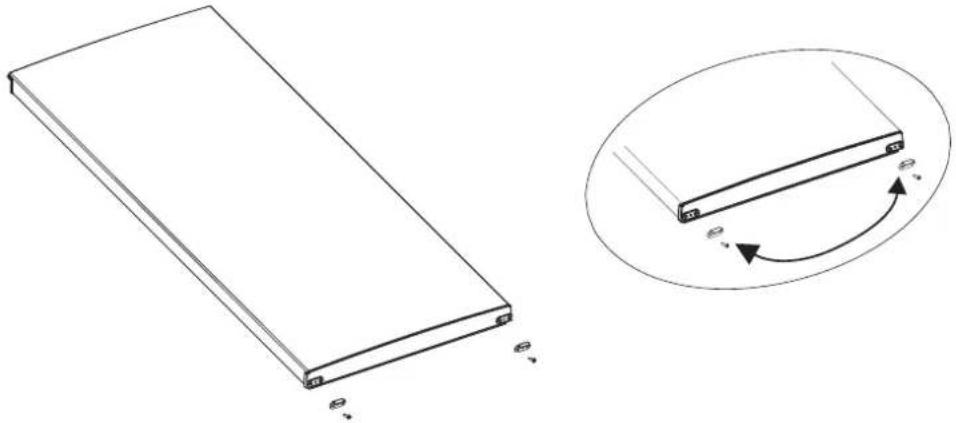
Remove the plug on the underside of the door and place it on the other side.
natural_image
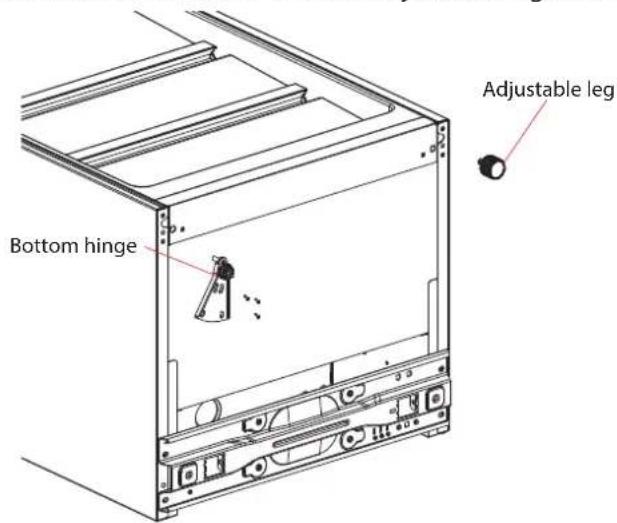
Technical line drawing of a rectangular panel with mounting holes and a magnified inset showing a rotating component (no text or symbols)- Remove the lower hinge and an adjustable foot.
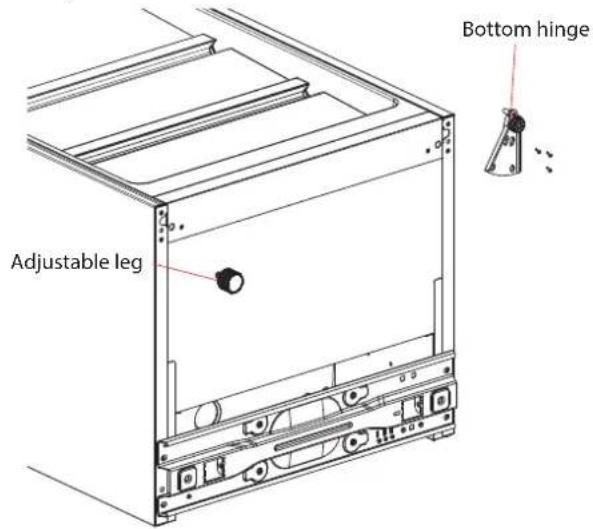
- Install the lower hinge on the left side of the freezer and the adjustable leg on the right.
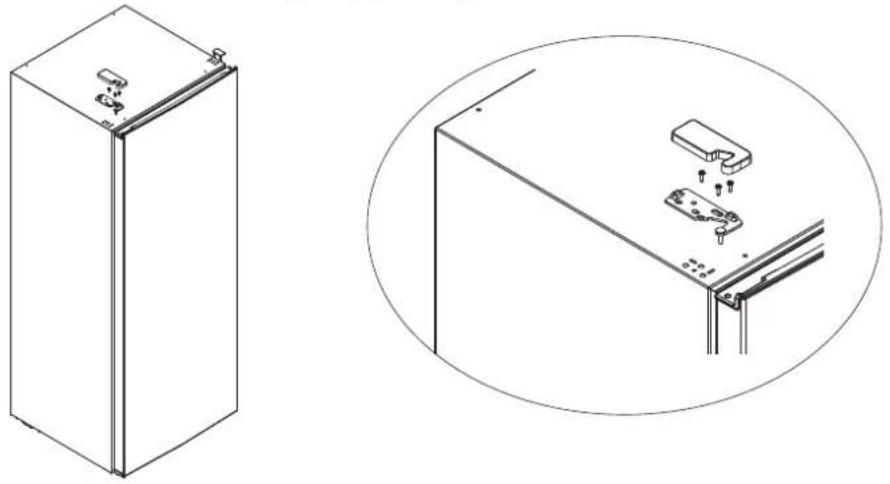
- Install the door on the lower hinge and check that the seal is sealing properly and that the door position is correct. Install the left upper hinge and attach the cover to the hinge (supplied as an accessory). Finally, attach the cover to the holes for the right upper hinge.
natural_image
Technical line drawing of a refrigerator with an inset close-up showing internal components (no text or symbols)OPERATING INSTRUCTIONS
Temperature control
The thermostat controller is located inside the freezer behind the front door. The thermostat regulates the temperature of the interior automatically. Thermostat settings:
- Setting „Min“: Lower cooling power, higher temperature.
- Setting „Mid“: Regular operation, suitable in most cases.
- Setting „Max“: Maximum cooling power, lowest temperature.
Notes:
- At high ambient temperatures, for example during a hot summer day, it may be necessary to set the thermostat to "Max". In this case, the compressor can run continuously to provide the required low temperature inside the freezer.
- When switching on the first time after installing the freezer, set the thermostat to a medium value and allow the freezer interior space to cool well before inserting the food. We recommend to wait 24 hours before inserting the food.
Tips for storing food in a freezer
- When storing frozen food, follow the instructions on food packaging. If there are no instructions given, the food should not be stored for more than 3 months from date of purchase.
- When buying frozen food, make sure that it was frozen at sufficient temperature and that the packaging is not damaged.
- Frozen foods should be transported in a suitable packaging and placed in the freezer as soon as possible.
- If the frozen food packaging shows signs of moisture or swelling, the food was probably stored at improper temperatures and its quality is low.
- The storage life of frozen foods depends on the room temperature, thermostat setting, the frequency of door opening, type of food and the time needed to transport food from the store in the freezer. Never exceed the indicated maximum storage life.
- Make sure that the foods do not damage the freezer pipes when closing the drawers.
Freezing fresh foods
- Make sure that the freezing procedure is carried out in the strictest hygienic conditions, since the freezing alone does not sterilize the food.
- Do not place hot or warm foods in the freezer.
- It is advisable to store cooked meat and fish in places above raw meat and fish to prevent any transfer of bacteria.
- Leave space between the frozen food to allow the air to circulate inside the appliance.
- Wrap the individual foods separately in plastic bags, foil or freezer bowls to avoid transfer of taste and the drying of food.
- Do not place fresh food side by side with frozen food, it could lead to partial thawing of already frozen food.
- When freezing fresh food (meat, fish, minced meat), it is recommended to divide the foods into individual portions and freeze them separately.
- The maximum freezing capacity in kg in 24 hours at room temperature 25 °C is specified in the section „Technical specifications“ at the end of this manual. Never freeze more than the maximum allowable quantity of food.
Note: Never place beverages or foods in preserving jars in the freezer. For ensuring optimum performance, keep in the freezer enough space to allow air flow around individual packages.
CARE AND MAINTENANCE
Cleaning the freezer
- Before cleaning the freezer, unplug the power cord from the outlet.
- Do not clean the freezer with running water. Use a sponge or cloth dipped in a mild solution of warm water and detergent. Do not use aggressive or abrasive cleaners.
- Wipe all surfaces carefully and dry them thoroughly.
- Do not use on plastic and rubber parts cleaning waxes, concentrated detergents, bleach or cleaners containing kerosene.
- Do not use for cleaning plastic parts paper cleaning wipes, window cleaners, scouring powders or flammable liquids that could scratch or otherwise damage the surface finish.
- Wash the accessories of the freezer separately in mild detergent solution. Do not wash in the dishwasher.
- Regularly once a year, clean the condenser on the back of the freezer with a brush. You increase the efficiency of the appliance and save energy.
Defrosting
- After a while, a layer of ice forms inside the freezer, depending on the frequency and length of the door opening and room humidity. It is important to ensure that frost is does not form in places where it would prevent the proper sealing of the door. The leaky door could cause the outside air to penetrate into the freezer space and a decrease in cooling efficiency accompanied by continuous compressor operation.
- A thin layer of frost can be removed with a plastic scraper. Do not use metal or sharp objects or mechanical devices or other means.
- Remove all frost from the appliance door.
- There is no need to shut down the appliance when removing the thin layer of frost.
- When removing a thick layer of ice, disconnect the appliance from the power supply and move all food to a cool place. The best time for defrosting is when the freezer is almost empty. The defrosting should be quick so that the temperature of the foods would not rise.
- Do not use metal or sharp objects or mechanical and other devices to speed up the defrosting process.
- The increase in temperature of frozen foods during defrosting of the freezer shortens their storage life.
- One or more hot water containers can be placed in the freezer compartment to reduce the defrosting time.
• After defrosting wash and wipe dry the freezer with a sponge or dry tea towel. - Plug the appliance into the power supply and allow it to run at level 5 for 2–3 hours before inserting the food.
- Before placing the foods back in the freezer check them carefully. You have to consume the partially defrosted foods within 24 hours or you have to cook them and freeze them again.
Long-term shutdown
If you do not intend to use the freezer for a longer period of time, proceed as follows:
- Pull the plug out of the outlet to disconnect the freezer from the power supply.
- Clean and dry the interior of the freezer as described in the section „Cleaning of the freezer“.
- Leave the freezer door open to prevent unpleasant odours forming in the unused freezer.
Power saving tips
- Place the appliance in a cool, well-ventilated location, away from direct sunlight and heat sources (radiators, cookers).
- Allow the warm food cool before putting it in the freezer.
- The food you want to thaw can be moved from the freezer to the refrigerator where it helps to keep the refrigerator temperature low.
- Beverages and liquids must be in closed containers in order not to increase the moisture inside the freezer.
- When putting in foods, limit the time you open the freezer door to a minimum.
- Do not leave open covers of individual freezer compartments.
- Keep the door seal clean. Replace a damaged door seal.
TROUBLESHOOTING
You can solve a number of common problems on your own. If the freezer is not working properly, check the following points before calling a service technician:
| The freezer does not work The power cord is disconnected.The main house breaker is off .The electrical outlet is not under voltage. Test the functionality of the outlet by plugging in another appliance. | |
| The freezing in the freezer is insufficient | The freezer is overloaded.Set the thermostat to higher value.The door does not close properly.There is dust on the condenser.If the door has been opened for too long or too often, it will take some time for the freezer to reach the set temperature.Check that the airflow is not restricted behind the freezer due to insufficient distance from the wall. |
| Odour Aromatic foods should be well wrapped.Check for spoiled food.Clean the inside of the appliance regularly. | |
| Long continuous compressor operation. | During summer at high ambient temperatures, the compressor's continuous operation is normal.Do not put too much fresh food in the freezer at once.Allow the food to cool before placing it inside.Reduce the door opening frequency. |
| The light inside the freezer is off . | Make sure that the freezer is plugged in and the bulb is not broken. |
| The freezer door can not be properly closed. | The door is blocked by improperly stored food.The freezer is overloaded.Check that the freezer does not touch other appliances or kitchen furniture and stands level. |
| Noisy operation. Check that the food is evenly spaced and the freezer is level.Check the correct placement of the freezer inside equipment. | |
TECHNICAL DATA
Specifications for the home freezer according to EU regulations no. 1060/2010
| Manufacturer ECG | |
| Model EFT 11423 WA++ | |
| EAN | 8592131238930 |
| Type Single door - freestanding | |
| Product dimensions (w × d × h) 550 × 550 × 1430 mm | |
| Dimensions including packaging (w × d × h) 580 × | 580 × 1475 mm |
| Product weight 46 kg | |
| Product weight including packaging 51 kg | |
| Climate class SN/N/ST/T | |
| Energy class A++ | |
| Energy consumption/daily 0.4876 kWh/24 h | |
| Energy consumption/annual 178 kWh/annual | |
| Total volume | 180 l |
| Net volume of the freezer compartment | 165 l |
| Noise level | 42 dB (A) |
| Coolant | R600a |
| Cooling medium weight | 58 g |
| Compressor | 1 piece |
| Thermostat | 1 piece |
| Temperature control | manual |
| Defrosting | manual |
| Freezer class | * * * * |
| Colour | white |
| Building-in option | no |
| Smooth back wall design | no |
| Number of doors | 1 |
| Reverse door opening | yes |
| Adjustable feet | yes |
| Freezing capacity (25 °C) | 10 kg / 24 h |
| Power input | 70 W |
| Power | 0.5 A |
| Voltage/Frequency | 220–240 V~ / 50 Hz |
USE AND DISPOSAL OF WASTE
Wrapping paper and corrugated paperboard – deliver to scrapyard. Packing foil, PE bags, plastic elements – throw into plastic recycling containers.
DISPOSAL OF PRODUCTS AT THE END OF LIFETIME
Disposal of electric and electronic equipment (valid in EU member countries and other European countries with an implemented recycling system)
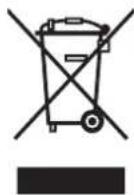
The represented symbol on the product or package means the product shall not be treated as domestic waste. Hand over the product to the specified location for recycling electric and electronic equipment. Prevent negative impacts on human health and the environment by properly recycling your product.
Recycling contributes to preserving natural resources. For more information on the recycling of this product, refer to your local authority, domestic waste processing organization or store, where you purchased the product.
This product complies with EU directive requirements on electromagnetic compatibility and electrical safety.
08/05
GB

The instruction manual is available at website www.ecg-electro.eu.
Changes in text and technical parameters reserved.
Old refrigerators and freezers contain insulation gases and freezing media, which must be disposed off. Entrust the disposal to a competent local waste disposal service. In doubt contact your local authority or your vendor. Make sure that the pipes of the cooling unit, which will be removed by the appropriate waste disposal, service are not damaged.
bar
ECG | Category | ECF (EFT 11423 WA++) | |---|---| | A+++ | 178 kWh/annum | | A++ | 178 kWh/annum | | A+ | 178 kWh/annum | | A | 178 kWh/annum | | B | 178 kWh/annum | | C | 178 kWh/annum | | D | 178 kWh/annum | | Label | Value (kWh/annum) | |---|---| | - L | 139 L | | 2010/1060 | 42 dB | ENERGIA · EHERGIA ENEPEIA · ENERGIJA ENERGY · ENERGIE · ENERGISIGURNOSNE UPUTE
natural_image
Cartoon illustration of a person climbing from a door with arms outstretched (no text or symbols)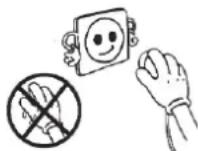
POZOR: Opasnost od požara – zapaljive tvari!
- Prije nego ga koristite, skinite sa zamrzivača sve naljepnice i oznake (osim natpisne pločice). Ostatke ljepila od naljepnica lako ćete odstraniti spužvicom s nešto deterđenta. Nakon toga očistite toplom vodom i osušite.
- Nemojte koristiti oštre predmete, alkohol, zapaljive tvari ili abrazivna sredstva za čišćenje jer biste time mogli oštetiti vanjski završni sloj uređaja.
- Kad premještate uređaj, nemojte ga nagnuti više od 45° u odnosu na vertikalu.
Napomena: Zamolite pomoć druge osobe koja će za vrijeme podešavanja visine nagnuti zamrzivač unazad i tako osloboditi nogu koju podešavate od pritiska. Podesite visinu prije nego počnete stavljati namirnice u zamrzivač.
natural_image
Isometric line drawing of a structural frame with vertical supports and horizontal beams (no text or symbols)natural_image
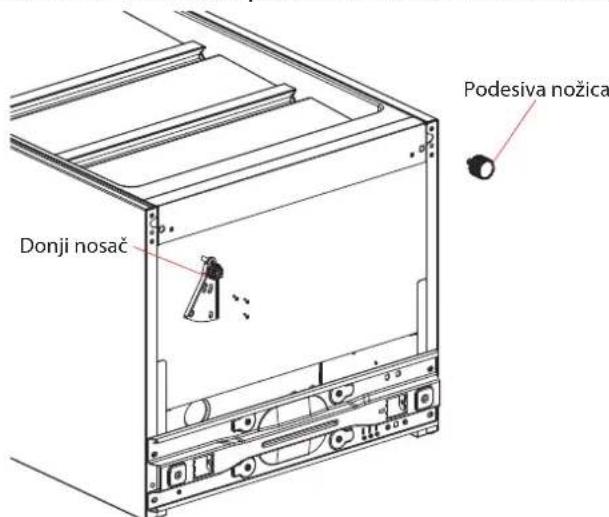
Technical line drawing of a rectangular panel with mounting holes and a magnified inset showing a curved component with arrows indicating rotation (no text or symbols)- Rastavite donji nosač i skinite podesivu nožicu.
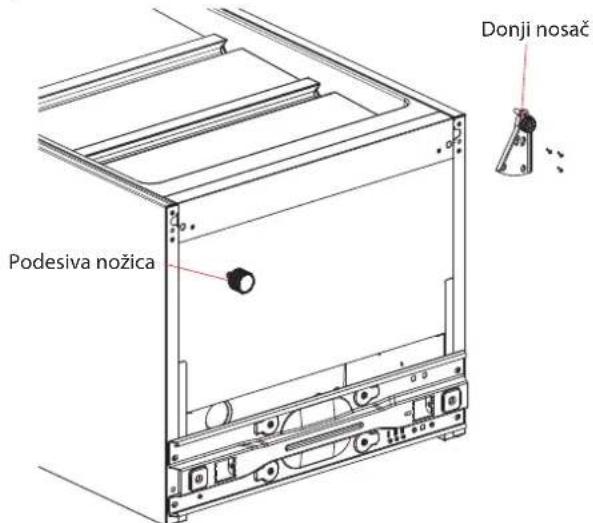
- Donji nosač postavite na lijevu stanu zamrzivača, a podesivu nožicu na desnu stranu.
natural_image
Technical line drawing of a refrigerator with an inset close-up showing internal components (no text or symbols)UPUTE ZA UPORABU
Upravljanje temperaturom
Regulator termostata nalazi se unutar zamrzivača, iza vrata. Termostat automatski regulira temperaturom unutrašnjosti uređaja. Podešavanje termostata:
- Položaj „Min“: Slabiji učinak hlađenja, viša temperatura.
- Položaj „Mid“: Uobičajen način rada, prikladan za većinu situacija.
- Položaj „Max“: Najjači učinak hlađenja, najniža temperatura.
Napomene:
- U slučaju da je temperatura okoline visoka, kao što je to za vrućih ljetnih dana, moguće je da će biti potrebno podesiti termostat na položaj „Max“. U tom slučaju se može dogoditi da uređaj radi neprestano kako bi osigurao potrebno nisku temperaturu unutar zamrzivača.
- Kad zamrzivač uključite prvi puta, postavite termostat na srednji položaj, a prije nego stavljate namirnice u njega ostavite da se dobro ohladi. Preporučamo da pričekate 24 sata prije nego stavite prve namirnice.
bar
ECG | Category | ECF (EFT 11423 WA++) | |---|---| | A+++ | 178 kWh/annum | | A++ | 178 kWh/annum | | A+ | 178 kWh/annum | | A | 178 kWh/annum | | B | 178 kWh/annum | | C | 178 kWh/annum | | D | 178 kWh/annum | | Label | Description | |---|---| | - L | 139 L | | 2010/1060 | - L | | Energy, Energy, Energy, Energy, Energy, Energy, Energy, Energy, Energy, Energy, Energy, Energy, Energy, Energy, Energy, Energy, Energy, Energy, Energy, Energy, Energy, Energy, Energy, Energy, Energy, Energy, Energy, Energy, Energy, Energy, Energy, Energy, Energy, Energy, Energy, Energy, Energy, Energy, Energy, Energy, Energy, Energy, Energy, Energy, Energy, Energy, Energy, Energy, Energy, Energy, Energy | | Color | Color | | Green | A++ | | Light Green | A++ | | Yellow | A | | Orange | B | | Red | D | | Blue | 178 kWh/annum | | Legend: ENERGIA · EHEPΓΙΑE NΕΡΓΕΙΑ · EΝΕΡΓΙΑE NΕΡΓΕΙΑ · EΝΕΡΓΕΙΑ · EΝΕΡΓΕΙΑ · EΝΕΡΓΕΙΑ · EΝΕΡΓΕΙΑ · EΝΕΡΓΕΙΑ · EΝΕΡΓΕΙΑ · EΝΕΡΓΕΙΑ · EΝΕΡΓΕΙΑ · EΝΕΡΓΕΙΑ · EΝΕΡΓΕΙΑ · EΝΕΡΓΕΙΑ · EΝΟΥ / Λ |www.ecg-electro.eu
CZ
K+B Progres, a.s.
U Expertu 91 tel.: +420 272 122 111
250 69 Klíčany e-mail: ECG@kbexpert.cz
SK
Distribútor pre SR: K+B Progres, a. s., organizacná zložka Mlynské Nivy 71
821 05 Bratislava e-mail: ECG@kbexpert.cz
DE


- EFT 11423 WA++
- BEZPEČNOSTNÍ POKYNY
- POKYNY K POUŽÍVÁNÍ
- Ovládání teploty
- POKYNY NA POUŽÍVANIE
- Ovládanie teploty
- ANWENDUNGSHINWEISE
- Temperaturregelung
- Read carefully and keep for future use!
- RISK OF FIRE!
- Warning: Risk of fi re/Flammable materials
- REPLACING THE LED BULB
- INTRODUCTION
- Dear customers!
- DESCRIPTION
- FREEZER INSTALLATION
- Unpacking the freezer
- Levelling the appliance
- Location and space requirements
- GB
- Before first use
- Connection
- Switching on the appliance
- Reversing the door opening
- The freezer must be disconnected from power and empty before handling!
- Warning:
- OPERATING INSTRUCTIONS
- Temperature control
- Notes:
- Tips for storing food in a freezer
- Freezing fresh foods
- CARE AND MAINTENANCE
- Cleaning the freezer
- Defrosting
- Long-term shutdown
- Power saving tips
- TROUBLESHOOTING
- TECHNICAL DATA
- USE AND DISPOSAL OF WASTE
- DISPOSAL OF PRODUCTS AT THE END OF LIFETIME
- SIGURNOSNE UPUTE
- POZOR: Opasnost od požara – zapaljive tvari!
- UPUTE ZA UPORABU
- Upravljanje temperaturom
- Napomene:
- www.ecg-electro.eu
Brand : ECG
Model : EFT 11423 WA++
Category : Freezer