
Express (2005) - Automotive CHEVROLET - Free user manual and instructions
Find the device manual for free Express (2005) CHEVROLET in PDF.


User questions about Express (2005) CHEVROLET
0 question about this device. Answer the ones you know or ask your own.
Ask a new question about this device
Download the instructions for your Automotive in PDF format for free! Find your manual Express (2005) - CHEVROLET and take your electronic device back in hand. On this page are published all the documents necessary for the use of your device. Express (2005) by CHEVROLET.
USER MANUAL Express (2005) CHEVROLET
2012ChevroletExpressOwnerManual
InBrief....1-1
InstrumentPanel......1-2
InitialDriveInformation......1-4
VehicleFeatures......1-16
Performanceand
Maintenance....1-20
Keys, Doors, and
Windows....2-1
KeysandLocks......2-2
Doors....2-9
VehicleSecurity......2-12
ExteriorMirrors....2-14
InteriorMirrors......2-15
Windows....2-16
SeatsandRestraints......3-1
HeadRestraints......3-2
FrontSeats......3-2
RearSeats......3-5
SafetyBelts....3-8
AirbagSystem......3-18
ChildRestraints......3-38
Storage....4-1
StorageCompartments......4-1
InstrumentsandControls....5-1
Controls....5-2
WarningLights,Gauges,and
Indicators......5-11
InformationDisplays......5-28
VehicleMessages......5-34
VehiclePersonalization......5-42
Lighting....6-1
ExteriorLighting......6-1
InteriorLighting......6-6
LightingFeatures......6-7
InfotainmentSystem......7-1
Introduction......7-1
Radio....7-8
AudioPlayers......7-13
Phone....7-24
ClimateControls....8-1
ClimateControlSystems......8-1
AirVents......8-8
2012ChevroletExpressOwnerManual
DrivingandOperating......9-1
DrivingInformation......9-2
StartingandOperating......9-16
EngineExhaust......9-24
AutomaticTransmission.....9-25
DriveSystems....9-33
Brakes....9-33
RideControlSystems......9-35
CruiseControl....9-37
Fuel....9-40
Towing....9-46
ConversionsandAdd-Ons...9-58
VehicleCare....10-1
GeneralInformation......10-2
VehicleChecks......10-4
BulbReplacement......10-35
ElectricalSystem......10-41
WheelsandTires......10-49
JumpStarting......10-86
Towing....10-90
AppearanceCare......10-93
ServiceandMaintenance...11-1
GeneralInformation......11-1
MaintenanceSchedule.....11-3
SpecialApplication Services....11-8
AdditionalMaintenance andCare....11-8
RecommendedFluids, Lubricants,andParts.....11-12
MaintenanceRecords.....11-15
TechnicalData....12-1
VehicleIdentification......12-1
VehicleData....12-2
CustomerInformation.....13-1
CustomerInformation......13-1
ReportingSafetyDefects....13-19
VehicleDataRecordingand
Privacy....13-20
OnStar....14-1
OnStarOverview......14-1
OnStarServices......14-2
OnStarAdditional Information....14-5
Index...... i-1



Thenames, logos, emblems, slogans, vehiclemodelnames, and vehiclebodydesignsappearingin thismanualincluding, but not limited to, GM, the GM logo, CHEVROLET, the CHEVROLETEmblem, and EXPRESSaretrademarks and/or servicemarksof General Motors LLC, itssubsidiaries, affiliates, or licensors.
Thismanualdescribesfeaturesthat mayormaynotbeonyourspecific vehicleeitherbecausetheyare optionsthatyoudidnotpurchaseor duetochangessubsequenttothe printingofthisownermanual.
Pleaserefertothepurchase documentationrelatingtoyour specificvehicletoc confirmeeachof thefeaturesfoundonyourvehicle. ForvehiclesfirstsoldinCanada, substitutethename"General MotorsofCanadaLimited"for ChevroletMotorDivisionwhereverit appearsinthismanual.
IfthevehiclehastheDuramax® Dieselengine,seetheDuramax dieselsupplementforadditionaland specificinformationonthisengine.
Keepthismanualinthevehiclefor quickreference.
CanadianVehicleOwners
AFrenchlanguagecopyofthis manualcanbeobtainedfromyour dealerorfrom:
PartNo.20875606AFirstPrinting
©2011GeneralMotorsLLC.AllRightsReserved.
UsingthisManual
Toquicklylocateinformationabout thevehicle,usethelndexinthe backofthemanual.Itisan alphabeticalallistofwhatisinthe manualandthepagenumberwhere itcanbefound.
Danger,Warnings, and Cautions
Warning messages found on vehicle labels and this manual describe hazards and what to avoid or reduce them.
Dangerindicatesahazardwitha highlevelofriskwhichwillresultin seriousinjuryordeath.
WarningorCautionindicatesa hazardthatcouldresultin injuryordeath.
WARNING
These mean there is something that could hurt you or other people.
Notice: This mean there is something that could result in property or vehicle damage. This would not be covered by the vehicle's warranty.

Acirclewithaslashthroughit isasafetysymbolwhichmeans "DoNot," "Donotdothis," or "Donotletthishappen."
Symbols
The vehicle has components and label that uses symbols instead of text. Symbols are shown along with the text describing the operation or information relating to a specific component, control, message, gauge, or indicator.
(i): This symbol is shown when you need to see the owner manual for additional instructions or information.
☐: This symbol is shown when you need to see a service manual for additional instructions or information.
VehicleSymbolChart
Herearesomeadditionalsymbols that may be found on the vehicle and what they mean. Form more information on the symbol, refer to the Index.
AirbagReadinessLight
AirConditioning
(ABS):AntilockBrakeSystem(ABS)
^* :AudioSteeringWheelControls orOnStar ^®
(1) (P): BrakeSystem WarningLight
- + : ChargingSystem
:CruiseControl
EngineCoolantTemperature
-ExteriorLamps
:FuelGauge
Fuses
ED:HeadlampHigh/Low-Beam Changer
TopTetherAnchorsfor ChildRestraints
:MalfunctionIndicatorLamp
:OilPressure
Power
Ω:RemoteVehicleStart
SafetyBeltReminders
():TirePressureMonitor
-∞:Tow/HaulMode
:TractionControl/StabiliTrak®
:WindshieldWasherFluid
vilntroduction
NOTES
InBrief
InstrumentPanel
InstrumentPanel......1-2
InitialDriveInformation
InitialDriveInformation......1-4
RemoteKeylessEntry(RKE)
System......1-4
RemoteVehicleStart......1-5
DoorLocks......1-5
Windows....1-6
SeatAdjustment....1-6
SafetyBelts....1-8
AirbagOn-OffSwitch.....1-8
PassengerSensingSystem...1-9
MirrorAdjustment......1-9
SteeringWheel
Adjustment....1-10
InteriorLighting......1-11
ExteriorLighting......1-12
WindshieldWiper/Washer....1-13
ClimateControls......1-13
Transmission....1-15
VehicleFeatures
Radio(s)....1-16
SatelliteRadio....1-17
PortableAudioDevices.....1-18
Bluetooth ^® ......1-18
SteeringWheelControls.....1-18
CruiseControl....1-19
PowerOutlets......1-19
PerformanceandMaintenance
StabiliTrak® System......1-20
TirePressureMonitor......1-21
EngineOilLifeSystem.....1-21
FuelE85(85%Ethanol).....1-21
DrivingforBetterFuel
Economy....1-21
Roadside Assistance
Program....1-22
OnStar ^® 1-22
InstrumentPanel
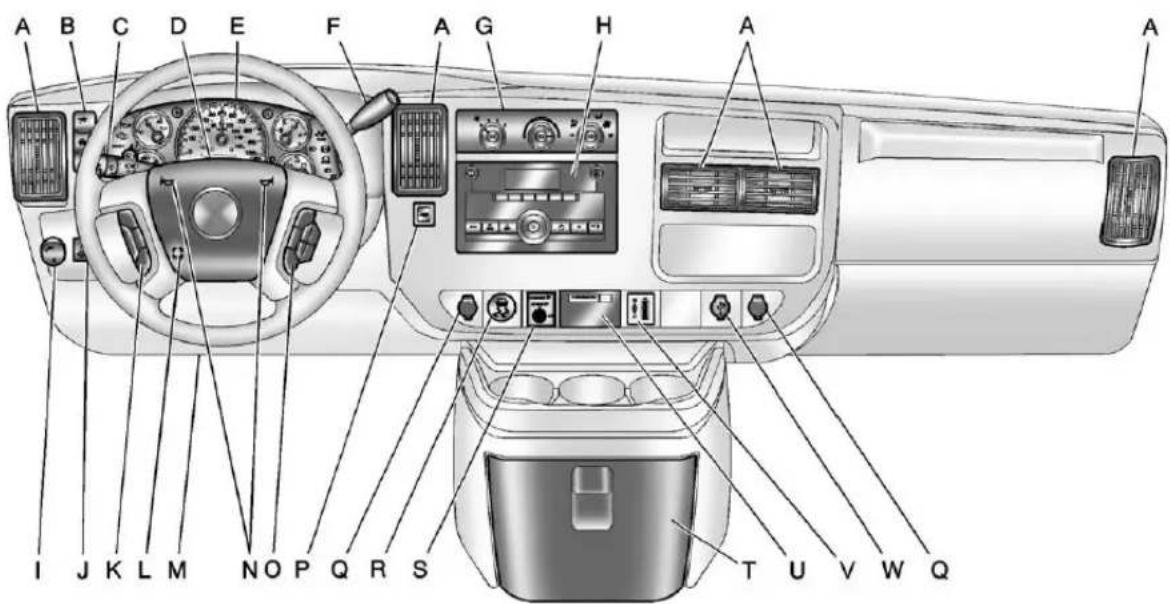
text_image
A B C D E F A G H A I J K L M N O P Q R S T U V W QA. AirVentsonpage8-8.
B.DriverInformationCenter(DIC) Buttons.SeeDriverInformation Center(DIC)onpage5-28.
C. TurnandLane-ChangeLever. See TurnandLane-Change Signalsonpage6-5. WindshieldWiper/Washeron page5-5.
D. HazardWarningFlasherson page6-5(OutofView).
E. InstrumentClusteron page5-12.
F.ShiftLever.See Startingthe Engineonpage9-18. ManualModeonpage9-31 (IfEquipped).
G. ClimateControlSystemson page8-1.
H. Infotainmentpage 7-1.
I. Exterior Lamp Controlson page6-1.
J. InstrumentPanelIllumination Controlonpage6-6.
DomeLampOverride.See DomeLampsonpage6-6.
K. CruiseControlonpage9-37 (IfEquipped).
FastIdleSystem(IfEquipped). SeetheDuramaxdiesel supplementformore information.
L. Steering Wheel Adjustment page5-2(IfEquipped).
M. DataLinkConnector(DLC) (OutofView). See Malfunction IndicatorLamponpage5-21.
N.Hornonpage5-4.
O. Steering Wheel Controlson page5-2(IfEquipped).
P. Tow/HaulModeButton.See "Tow/HaulMode" under Towing Equipmentonpage9-55.
Q.PowerOutletsonpage5-10.
R.StabiliTrak ^® Systemon page9-35(IfEquipped).
S.PassengerAirbagOn-Off Switch(IfEquipped).See AirbagOn-OffSwitchon page3-26.
T.FrontStorageonpage4-1 (IfEquipped).
U.PassengerAirbagStatus Indicatoronpage5-20 (IfEquipped). OnStar® SystemButton (IfEquipped).See OnStar Overviewpage 14-1.
V. RearHeatingSystemon page8-5(IfEquipped).
W.USBPort(IfEquipped).See Auxiliary Devices on page 7-19.
InitialDrive Information
Thissectionprovidesabrief overviewaboutsomeofthe importantfeaturesthatmayormay notbeonyourspecificvehicle.
Formoredetailedinformation, refer toeachofthefeatureswhichcanbe foundlaterinthisownermanual.
RemoteKeylessEntry (RKE)System
Ifequipped, theRKEtransmitteris usedtoremotelylockandunlock thedoorsfromupto60m(195ft) awayfromthevehicle.
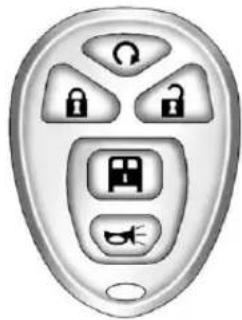
natural_image
Close-up of a stylized remote control device with key buttons and a grid of icons (no text or symbols)RKETransmitterwithRemote StartShown
:Presstolockalldoors.
Lockandunlockfeedbackcan bepersonalized.See Vehicle Personalizationonpage5-42.
:Presstounlockthedriverdoor. Press againwithinfiveseconds tounlockallremainingdoors.
:Presstounlockonlythe cargodoors.
:Pressandreleasetolocate thevehicle.Press andholdfor morethantwosecondstosoundthe panicalarm.Press against cancelthepanicalarm.
SeeKeysonpage2-2andRemote KeylessEntry(RKE)System Operationonpage2-3.
RemoteVehicleStart
With this feature the engine can be started from outside of the vehicle.
StartingtheVehicle
1.AimtheRKEtransmitterat thevehicle.
- Pressandrelease

- Immediately after completing Step2, press and hold until the turnsignallampsflash.
Whenthevehiclestarts, the parking lampswillturnonandremainonas longastheengineisrunning. The doorswillbelockedandtheclimate controlsystemmaycomeon.
Theenginewillcontinuetorunfor 10minutes.Repeatthestepsfora 10-minutetimeextension.Remote startcanbeextendedonlyonce.
CancelingaRemoteStart
Tocancelaremotestart:
- AimtheRKEtransmitteratthe vehicleandpressandhold untiltheparkinglampsturnoff.
• Turnonthehazardwarning flashers.
• Turntheignitiononandthen backoff.
See Remote Vehicle Starton page2-5.
DoorLocks
ManualDoorLocks
natural_image
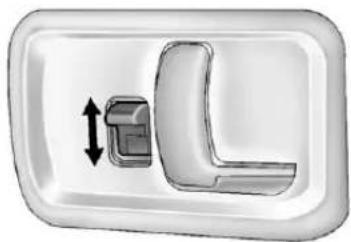
3D diagram of a car door handle with double-headed arrow indicating left side (no text or symbols)Lockandunlockthedoorfromthe outsideusingthekeyortheRemote KeylessEntry(RKE)transmitter, ifavailable.Fromtheinside,slide themanualleveronthedoorup ordown.
SeeDoorLocksonpage2-7.
PowerDoorLocks
Onvehicleswithpowerdoorlocks, theswitchesarelocatedonthe doors.
:Presstolockandunlock thedoors.
SeePowerDoorLocksonpage2-7.
1-6InBrief
Windows
ManualWindows
Operatethemanualwindowsby turningthehandcrankoneachdoor toraiseorlowerthesidedoor windows.
SeeManualWindowsonpage2-16.
PowerWindows
text_image
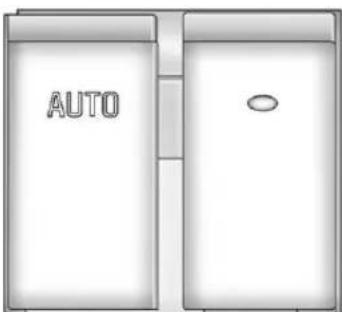
AUTOIf the vehicle has power windows, the controls are located one each of the sidedoors.
Thedriverdooralsohasacontrolto operatethefrontpassengerwindow.
Pressorpullupontheswitchto lowerorraisethewindow.
Express-Down
Thedriverwindowswitchalsohas anexpress-downfeaturethatallows thewindowtobeloweredwithout holdingtheswitch.Pressfullyand releasethewindowswitchmarked AUTOtoactivatetheexpress-down mode.Thismodecanbecancelled atanytimebypullinguponthe switch.Toopenthewindowpart way,lightlytaptheswitchuntilthe windowisatthedesiredposition.
SeePowerWindowsonpage2-16.
SeatAdjustment ManualSeats
natural_image
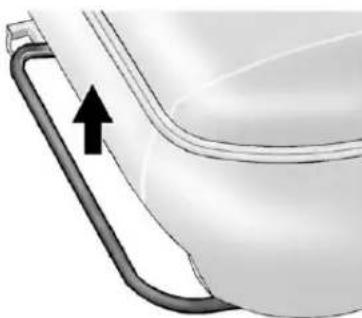
Diagram of a toilet handle with an arrow indicating direction (no text or symbols present)Toadjustamanualseat:
- Liftthebartounlocktheseat.
2.Slidetheseattothedesired positionandreleasethebar.
- Trytomovetheseatback and forthobesuretheseatis lockedinplace.
SeeSeatAdjustmentonpage3-2.
PowerSeats
natural_image
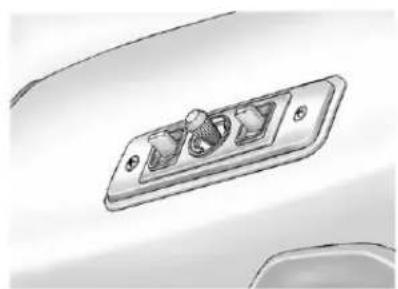
Illustration of a car electrical outlet with two switches and a bulb (no text or symbols)Toadjustapowerseat,ifavailable, usethecontrolsonthefrontof theseat:
- Adjusttheseatbymovingthe centerknobup,down,right, orleft.
- Raiseandlowerthefrontorrear oftheseatcushionbymoving therightorleftleverupordown.
SeePowerSeatAdjustmenton page3-3.
RecliningSeatbacks
natural_image
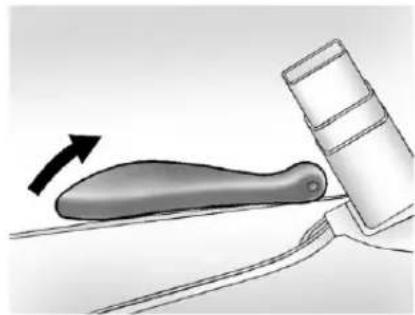
Illustration of a medical or laboratory procedure showing a tool interacting with a device (no text or symbols visible)Toreclinetheseatback:
- Lifttheleverontheinboardside oftheseat.
- Movetheseatbacktothe desiredposition, and then releasethelevertolockthe seatbackinplace.
- Pushandpullontheseatbackto makesureitislocked.
Toreturntheseatbacktothe uprightposition:
- Lifttheleverfullywithout applyingpressuretothe seatback,andtheseatbackwill returntotheprightposition.
- Pushandpullontheseatbackto makesureitislocked.
SeeRecliningSeatbackson page3-3.
SafetyBelts
natural_image
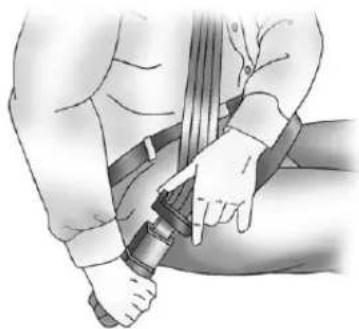
Illustration of a person adjusting a belt buckle (no text or symbols present)Refertothefollowingsectionsfor importantinformationonhowtouse safetybeltsproperly.
• SafetyBeltsonpage3-8.
• HowtoWearSafetyBelts Properlyonpage3-10.
• Lap-ShoulderBeltonpage3-11.
- LowerAnchorsandTethersfor Children(LATCHSystem)on page3-46.
AirbagOn-OffSwitch
Iftheinstrumentpanelhasoneof theswitchespicturedinthe followingillustrations,thevehicle hasanairbagon-offswitchthatyou canusetomanuallyturnonoroff therightfrontpassengerairbag.
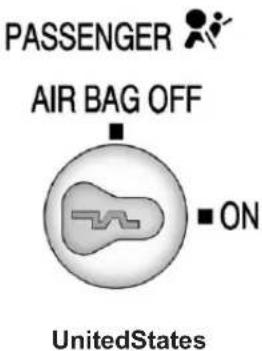
text_image
PASSENGER AIR BAG OFF ■ ON UnitedStates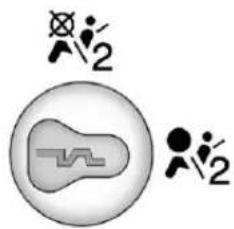
natural_image
Abstract diagram with three symbolic figures and a central waveform-like symbol, no text or labels present.CanadaandMexico
Tooperatetheairbagon-offswitch, usethevehiclekey.
SeeAirbagOn-OffSwitchon page3-26forimportantinformation.
PassengerSensing System
Thepassengersensingsystem, ifequipped, willturnofftheright frontpassengerfrontalairbagunder certainconditions. Thedriverairbag androof-railairbags, ifequipped, arenotaffectedbythis.
If the vehicle has a passenger sensing system, the passenger airbag status indicator will be visible on the instrument panel when the vehicle is started.
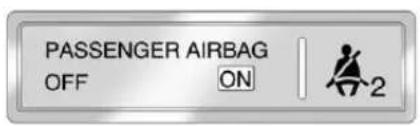
text_image
PASSENGER AIRBAG OFF ON 2UnitedStates
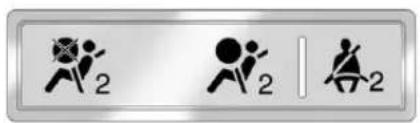
text_image
Three identical icons with the number '2' and a vertical line, likely representing action buttons or indicators.CanadaandMexico
See Passenger Sensing System on page 3-30 for important information.
MirrorAdjustment
ExteriorMirrors
Vehicleswithoutsidemanual mirrorscanbeadjustedbymoving themirrorupanddownorleftto rightsoyoucanseealittleofthe sideofthevehicle,andhavea clearviewofobjectsbehindyou.
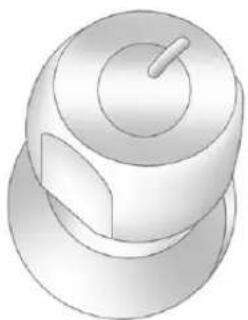
natural_image
3D rendered mechanical component with a cylindrical top and flange base (no text or symbols)Vehicleswithoutsidepowermirrors havecontrolslocatedonthedriver sidedoor.
1-10InBrief
Selecteachmirrorbyturningthe knobclockwiseforthepassenger sidemirrororcounterclockwisefor thedriversidemirror.Adjustthe mirroranglebymovingtheknobin thedesiredddirection.
Keeptheselectorswitchinthe centerpositionwhennotadjusting eitheroutsidemirror.

natural_image
Technical line drawing of a mechanical component with two views (no text or symbols)Vehicleswithtowingmirrorscanbe adjustedmanuallyforaclearview oftheobjectsbehindyou.
Manuallyfoldthemirrorsinwardto preventdamagewhengoing throughanautomaticcarwash. Tofold, pullthemirrortowardthe vehicle. Pushthemirroroutward, to returnittotheoriginalposition.
InteriorMirror
Holdtheinsiderearviewmirrorin thecentertomoveitforaclearer viewbehindthevehicle.Adjustthe mirrortoavoidglarefromthe headlampsbehind.Pushthetab, locatedatthebaseofthemirror, forwardfordaytimeuseandpullit fornighttimeuse.
SeeManualRearviewMirroron page2-15.
SteeringWheel Adjustment
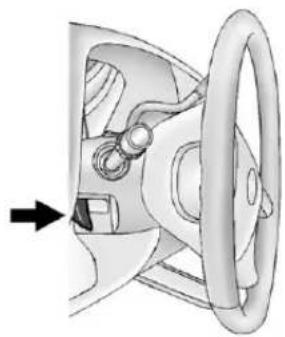
natural_image
Mechanical diagram showing a steering wheel and dashboard with an arrow indicating direction (no text or symbols)Forvehicleswithatiltsteering wheel,theleverislocatedonthe leftsideofthesteeringcolumn.
Toadjustthesteeringwheel:
-
Pullthelevertomovethe steeringwheelupordownintoa comfortableposition.
-
Releasethelevertolockthe steeringwheelinplace.
See Steering Wheel Adjustment page5-2.
InteriorLighting
DomeLamp
Thedomelampscomeonwhenany doorisopened. Theyturnoffafter allthedoorsareclosed.
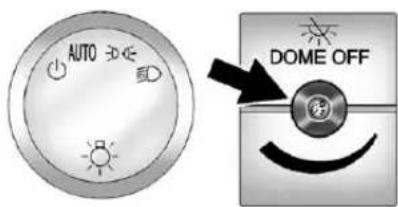
text_image
AUTO DOME OFFTheinstrumentpanelbrightness knobextendswhen ispressed.
Tomanuallyturnonthedome lamps,press ♂ thenturntheknob clockwisetothefarthestposition. Inthisposition,thedomelamps remainonwhetheradoorisopened orclosed.
DOMEOFF: This button is located abovethe instrument panel brightness knob.
Pressthebuttoninandthedome lampsremainoffwhenadooris opened.Pressthebuttonagainso thatthedomelampscomeonwhen adoorisopened.
ReadingLamps
Forvehicleswithreadinglamps, pressthebuttonlocatednextto eachlamptoturnitonoroff.
The vehicle may also have an reading lamps in other locations. The lamps cannot be adjusted.
Formoreinformationoninterior lighting,see:
- InstrumentPanelIllumination Controlonpage6-6.
• Entry/ExitLightingonpage6-7.
ExteriorLighting
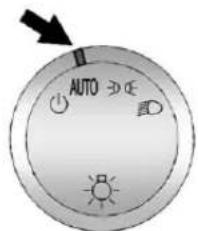
text_image
AUTO DE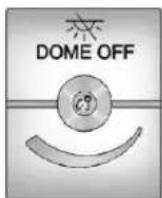
The exterior lamps control is located on the instrument panel to the left of the steering wheel.
:Brieflyturnthecontroltothis positiontoturntheautomatic headlampsandDaytimeRunning Lamps(DRL)offorbackon.
ForvehiclesfirstsoldinCanada, theoffpositiononlyworksfor vehiclesthatareshiftedintothe P(Park)position.
AUTO: Automatically turnson the headlamps, parking lamps, taillamps, instrument panellights, and license plate lamps.
300:Turnsontheparkinglamps, taillamps, instrumentpanellights, and licenseplatelamps.
:Turnsontheheadlamps, parkinglamps, taillamps, instrumentpanellights, and licenseplatelamps.
Formoreinformation,see:
- ExteriorLampControlson page6-1.
- ExteriorLampsOffReminderon page6-2.
• DaytimeRunningLamps(DRL) onpage6-3.
• AutomaticHeadlampSystemon page6-4.
WindshieldWiper/Washer
text_image
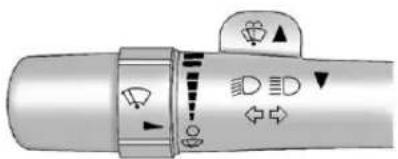
Diagram of a mechanical or electrical component with directional symbols and control iconsTheleverislocatedontheleftside ofthesteeringcolumn.

:Useforasinglewipingcycle.
i:Usetoadjustthedelaytime betweenwipes.Turnthebandupor downformorefrequentwipesor lessfrequentwipes.

:Slowwipes.

:Fastwipes.

Usetoturnthewipersoff.

:Pushthepaddleontopofthe ltifunctionlevertospraywasher donthewindshield.
See Windshield Wiper/Washeron page 5-5.
ClimateControls
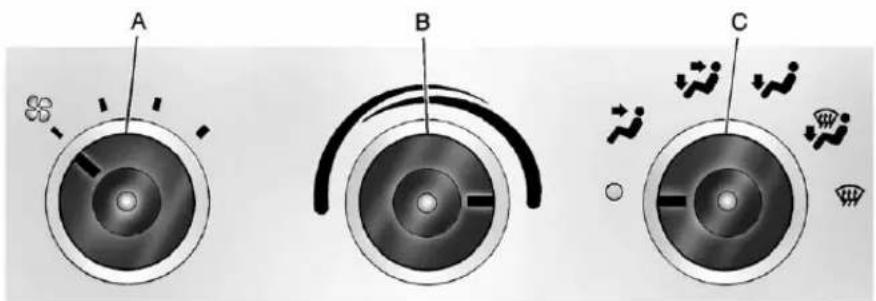
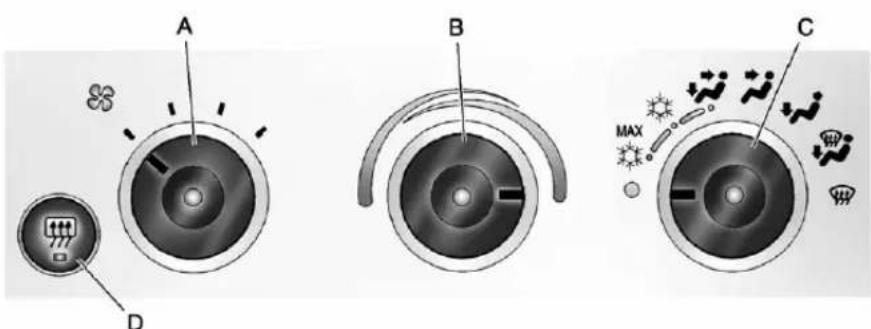
The vehicle'sheating, cooling, and ventilation can be controlled with thesesystems.
text_image
A B CVehicleswithoutAirConditioning
A. FanControl
B. TemperatureControl
C.AirDeliveryModeControl
1-14InBrief
text_image
A B C D MAXVehicleswithAirConditioning
A.FanControl
B. TemperatureControl
C.AirDeliveryModeControl
D.RearWindowDefogger
See ClimateControlSystemson page8-1. See Rear Heating System on page 8-5 (If Equipped) or Rear Climate Control System on page 8-6 (If Equipped).
Transmission RangeSelectionMode
natural_image
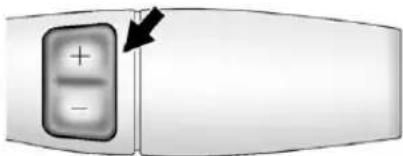
Simple diagram of a device with a plus and minus button, no text or symbols presentThe vehicle may have a Range Selection Mode. The Range Selection Mode helps control the vehicle's transmission and vehicle speed while driving downhill or towing at trailer by letting you select adesired range of gears.
Tousethisfeature,dothefollowing:
-
Movetheshiftleverto M(ManualMode).
-
Presstheplus/minusbuttons, locatedonthesteeringcolumn shiftlever, toselectthedesired rangeofgearsforcurrentdriving conditions.
WhenM(ManualMode)isselected, anumberdisplaysintheDICnextto theMindicatingthecurrentgear.
GradeBrakingisnotavailablewhen RangeSelectionModeisactive. See Tow/HaulModeonpage9-32.
WhileusingRangeSelectionMode, CruiseControlandtheTow/Haul Modecanbeused.SeeManual Modeonpage9-31.
VehicleFeatures Radio(s)
text_image
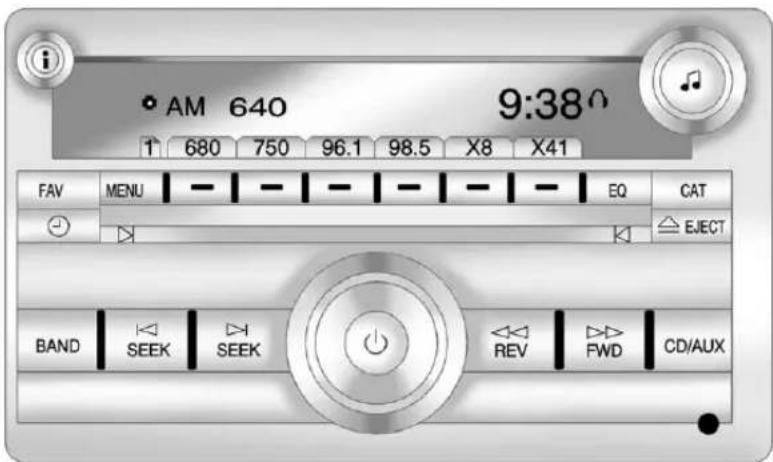
AM 640 9:38 1 680 750 96.1 98.5 X8 X41 FAV MENU - - - - - - - - EQ CAT EJECT BAND SEEK SEEK REV FWD CD/AUXRadiowithCD(MP3)
☐: Presstoturnthesystemon andoff. Turntoincreaseor decreasethevolume.
BAND: Presstochoosebetween FM1, FM2, AM, and XM™. ♩: Selectradiostations.
SEEK or SEEK: Seek or scan stations.
i:Presstoswitchthedisplay betweentheradiostationfrequency andthe time. While the ignition is off, pressthisbuttontodisplay the time. Presstodisplayadditionaltext information related to the current FM-RDSstationorMP3song. A choice of additional information such as Channel, Song, Artist, and CAT(category)candisplay. Continue pressing to highlight the desired tab, or pressthesoftkey located under anyone of the tabs and the information about that tab displays.
Formoreinformationaboutthese andotherradiofeatures,see Infotainmentpage7-1.
StoringaFavoriteStation
Dependingonwhichradiothe vehiclehas, radiostationsare storedaseitherfavoritesorpresets.
ForvehicleswithaFAVbutton,a maximumof36stationscanbe storedasfavoritesusingthesix softkeyslocatedbelowtheradio stationfrequencytabsandbyusing theradioFAVbutton.PressFAVto gothroughuptosixpagesof favorites,eachhavingsixfavorite stationsavailableperpage.Each pageoffavoritescancontainany combinationofAMandFMstations.
Iftheradiodoesnothavea FAVbutton, upto18stations (sixFM1, sixFM2, and sixAM), can be programmed on the sixnumbered buttons.
Formoreinformationonstoringa favoritestation,seeOperationon page7-3.
SettingtheClock
Tosetthetimeanddateforthe RadiowithCD(MP3):
- Press ⏻andtheHR,MIN,MM, DD,andYYYY(hour,minute, month,day,andyear)display.
- Pressthesoftkeylocatedbelow anyoneofthetabsthatyou wanttochange.
- Increase or decrease the time or date, depending on the radio, by pressing the SEEKorSEEK buttons, <REVorFWD buttons, or by turning clockwise or counterclockwise.
Fordetailedinstructionsonsetting theclockforyourspecificaudio system,seeClockonpage5-8.
SatelliteRadio
XMisasatelliteradioservicebased inthe48contiguousUnitedStates and10Canadianprovinces.
XMsatelliteradiohasawide varietyofprogrammingand commercial-freemusic,coastto coast,andindigital-qualitysound.
Afeeisrequiredtoreceivethe XMservice.
Formoreinformation, referto:
• www.xmradio.comorcall 1-800-929-2100(U.S.)
• www.xmradio.caorcall 1-877-438-9677(Canada)
See Satellite Radioonpage 7-10.
1-18InBrief
PortableAudioDevices
This vehicle may have an auxiliary input located on the radioface plate and a USB port located on the instrument panel. External devices such as an iPod ^ , laptop computer, MP3 player, CDchanger, or USB storage device can be connected to the auxiliary port using a 3.5mm (1/8in) input cable or the USB port depending on the audiosystem.
See"UsingtheAuxiliaryInputJack" and "UsingtheUSBPort"in AuxiliaryDevicesonpage7-19.
Bluetooth®
ForvehicleswithaBluetooth system, itallowsuserswitha Bluetooth-enabledcellphoneto makeandreceivehands-freecalls usingthevehicle'saudiosystem andcontrols.
TheBluetooth-enabledcellphone mustbepairedwiththeBluetooth systembeforeitcanbeusedinthe vehicle. Notallphoneswillsupport allfunctions. Formoreinformation, visitwww.gm.com/bluetooth.
Formoreinformation,seeBluetooth onpage7-24.
SteeringWheelControls
natural_image
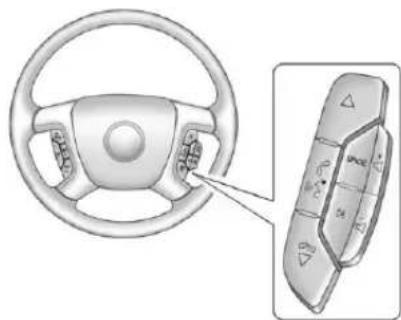
Diagram of a car steering wheel and its internal dashboard (no text or symbols)Forvehicleswithaudiosteering wheelcontrols, someaudiocontrols canbeadjustedatthesteering wheel.
△:Presstogotothenext favoriteradiostation,trackona CD,orfolderonaniPod ^ or USBdevice.
/ ▽ : Press to go to the previousfavoriteradiostation,track onaCD,orfolderonaniPod ^® or USBdevice.Alsopresstorejectan incomingcall,orendacurrentcall.
I_W^E : Press to silence the vehicle speakersonly. Pressagaintoturn thesoundon. Pressandholdlonger thantwosecondstointeractwith OnStar ^ orBluetoothsystems, ifequipped.
- :Presstoincreasevolume.
- Presstodecreasevolume.
SRCE: Presstoswitch between theradio and CD, and forequipped vehicles, the frontauxiliary.
D: Presstoseekthenextradio station, thenextrackwhilesourced totheCD, ortoselecttracksand foldersonaniPod ^ orUSBdevice.
Formoreinformation,seeSteering WheelControlsonpage5-2.
CruiseControl
text_image
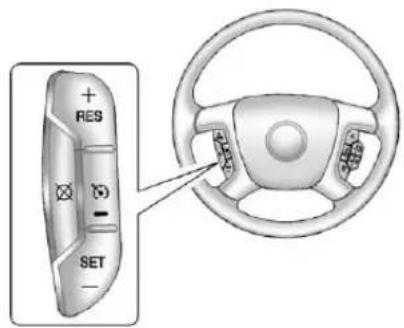
RES SETForvehicleswithcruisecontrol,the buttonsarelocatedontheleftside ofthesteeringwheel.
:Turnsthesystemonoroff.
+RES:Pressbrieflytomakethe vehicleresumetoapreviouslyset speed,orpressandholdto accelerate.
SET-:Presstosetthespeed and activate cruise control or press and holdtodecelerate.
☒: Presstodisengagecruise controlwithoutouterasingtheset speedfrommemory.
Formoreinformation,see Cruise Controlonpage9-37.
PowerOutlets
Theaccessorypoweroutletscanbe usedtopluginelectricalequipment, suchasacellphoneoranMP3 player.
The vehicle may have two accessory power outlets located on the instrument panel.
Removethecovertoaccessand replacewhennotinuse.
SeePowerOutletsonpage5-10.
Performance and Maintenance
StabiliTrak® System
The vehicle may have an extraction control system that limits wheel spin and the Stabili Trak system that assists with directional control of the vehicle in difficult driving conditions. Both system turn on automatically every time the vehicle is started.
text_image
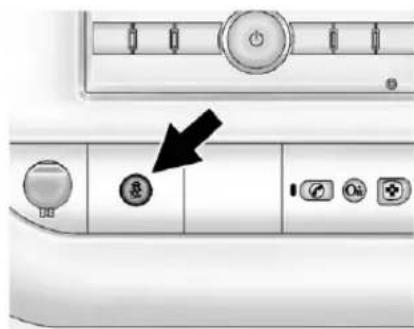
Control panel interface with buttons and a black arrow pointing to a button labeled '是' (Yes)- Toturnofftractioncontrol, press andreleasetheStabiliTrak button. TheappropriateDIC messagewilldisplay.SeeRide ControlSystemMessageson page5-38.
- Toturnoffbothtractioncontrol andStabiliTrak,pressandhold theStabiliTrakbutton √until theStabiliTrakOfflight illuminatesandtheappropriate DICmessagesdisplay.SeeRide ControlSystemMessageson page5-38. - Pressandreleasethe StabiliTrakbuttonagaintoturn onbothsystems.
Formoreinformation,see StabiliTrak® Systemonpage9-35.
TirePressureMonitor
This vehicle may have a Tire Pressure Monitor System (TPMS).

The TPMS warninglightalertsyou toasignificantlossinpressureof oneofthevehicle'stires.Ifthe warninglightcomeson,stopas soonaspossibleandinflatethe tirestotherecommendedpressure shownontheTireandLoading Informationlabel.SeeVehicleLoad Limitsonpage9-11.Thewarning lightwillremainonuntilthetire pressureiscorrected.
During cooler conditions, the low tire pressure warning light may appear when the vehicle is first started and then turn off. This maybe nearly
indicatorthatthetirepressuresare gettinglowandthetiresneedtobe inflatedtotheproperpressure.
The TPMS does not replacen normal monthly tire maintenance. It is the driver's responsibility to maintain correct tire pressures.
See TirePressureMonitorSystem onpage 10-58.
EngineOilLifeSystem
Theengineoillifesystemcalculates engineoillifebasedonvehicleuse anddisplaysaDICmessagewhen itisnecessarytochangetheengine oilandfilter. Theoillifesystem shouldberesetto100%only followinganoilchange.
ResettingtheOilLifeSystem
-
TurntheignitiontoON/RUN, withtheengineoff.
-
Fullypressandreleasethe acceleratorpedalthreetimes withinfiveseconds.
-
TurnthekeytoLOCK/OFF. SeeEngineOilLifeSystemon page10-10.
FuelE85(85%Ethanol)
VehiclesthathaveaFlexFuelbadge andayellowfuelcapcanuseeither unleadedgasolineorethanolfuel containingupto85%ethanol(E85). SeeFuelE85(85%Ethanol)on page9-42. Forallothervehicles, useonlytheunleadedgasoline describedunderRecommended Fuelonpage9-40.
DrivingforBetterFuel Economy
Drivinghabitscanaffectfuel mileage. Herearesomedrivingtips togetthebestfueleconomy possible.
- Avoidfaststartsandaccelerate smoothly.
- Brakegraduallyandavoid abruptstops.
1-22InBrief
- Avoididlingtheengineforlong periodsoftime.
- When road and weather conditions are appropriate, use cruise control.
• Alwaysfollowpostedspeed limitsordrivemoreslowlywhen conditionsrequire. - Keepvehicletiresproperly inflated.
• Combineseveraltripsintoa singletrip. - Replacethevehicle'stireswith thesameTPCSpecnumber moldedintothetire'ssidewall nearthesize.
- Followrecommended scheduled maintenance.
Roadside Assistance Program
U.S.:1-800-243-8872
TTYUsers(U.S.):1-888-889-2438
Canada:1-800-268-6800
Mexico:01-800-466-0800
AstheownerofanewChevrolet, you are automatically enrolled in the Roadside Assistance program.
SeeRoadsideAssistanceProgram (U.S.andCanada)onpage13-8or RoadsideAssistanceProgram (Mexico)onpage13-10for moreinformation.
Roadside Assistance and On Star (U.S. and Canada)
If you have an active On Star subscription, press the button and the current GPS location will be sent to an Star advisor who will assess your problem, contact Roadside Assistance, and relay you exact location to get the help you need.
OnlineOwnerCenter (U.S.andCanada)
TheOnlineOwnerCenterisa complimentaryservicethatincludes onlineservicereminders,vehicle maintenancetips,onlineowner manual,specialprivileges, andmore.
Signuptodayat: www.chevyownercenter.com (U.S.)orwww.gm.ca(Canada).
OnStar®
Ifequipped, this vehicle has a comprehensive, in-vehiclesystem that can connect to alive Advisor for Emergency, Security, Navigation, Connection, and Diagnostic Services. See On Star Overview page 14-1 form more information.
Keys, Doors, and Windows
KeysandLocks
Keys......2-2
RemoteKeylessEntry(RKE)
System......2-3
RemoteKeylessEntry(RKE)
SystemOperation......2-3
RemoteVehicleStart......2-5
DoorLocks......2-7
PowerDoorLocks......2-7
CargoDoorRelocking......2-7
DelayedLocking......2-8
AutomaticDoorLocks......2-8
LockoutProtection......2-8
SafetyLocks......2-8
Doors
SideDoor(60/40
Swing-Out)....2-9
SlidingDoor......2-10
RearDoors....2-11
VehicleSecurity
VehicleSecurity......2-12
Immobilizer......2-12
ImmobilizerOperation......2-12
ExteriorMirrors
ConvexMirrors......2-14
ManualMirrors......2-14
Trailer-TowMirrors......2-14
PowerMirrors......2-15
HeatedMirrors......2-15
InteriorMirrors
ManualRearviewMirror.....2-15
Windows
Windows....2-16
ManualWindows......2-16
PowerWindows......2-16
Swing-OutWindows......2-18
EnhancedTechnology
Glass....2-19
SunVisors......2-19
KeysandLocks
Keys

WARNING
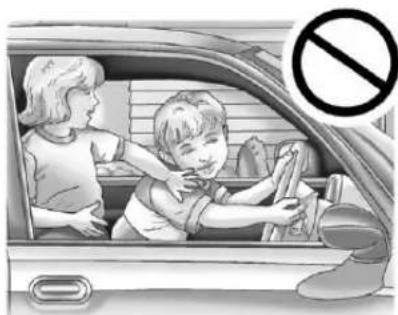
Leavingchildreninavehiclewith theignitionkeyisdangerousfor manyreasons. Childrenorothers couldbebadlyinjuredoreven killed. Theycouldoperatethe powerwindowsorothercontrols orevenmakethevehiclemove. Thewindowswillfunctionwiththe keysintheignitionandchildren couldbeseriouslyinjuredorkilled ifcaughtinthepathofaclosing window. Donotleavethekeysin avehiclewithchildren.
natural_image
Illustration of a child and an adult inside a car, with a no-smoking symbol overlay (no text or symbols on the figures)Thekeyisusedfortheignitionand alldoorlocks.
Thekeyhasabar-codedkeytag thatthedealerorqualifiedlocksmith canusetomakenewkeys.Store thisinformationinasafeplace,not inthevehicle.
Seeyourdealerifareplacement keyoradditionalkeyisneeded.
Notice: If the keys get locked in the vehicle, it may have to be damaged to get them out. Always carry as spare key.
If you are locked out of the vehicle, call the Roadside Assistance Center. See Roadside Assistance Program (U.S. and Canada) on page 13-8 or Roadside Assistance Program (Mexico) on page 13-10.
With an active On Stars subscription, an On Star Advisormay remotely unlock the vehicle. See On Star Overview on page 14-1.
RemoteKeylessEntry (RKE)System
SeeRadioFrequencyStatementon page13-22forinformation regardingPart15oftheFederal CommunicationsCommission(FCC) rulesandIndustryCanada StandardsRSS-GEN/210/220/310.
If thereisadecreaseintheRKE operatingrange:
- Checkthedistance. The transmitter may be too far from the vehicle.
- Checkthelocation. Other vehiclesorobjectsmaybe blockingthesignal.
- Checkthetransmitter's battery. See "BatteryReplacement" later in this section.
- Ifthetransmitterisstillnot workingcorrectly,seeyour dealeroraqualifiedtechnician forservice.
RemoteKeylessEntry (RKE)SystemOperation
Ifequipped, the Remote Keyless Entry (RKE) transmitter functions workup to 60m (195ft) away from the vehicle.
There are other conditions which can affect the performance of the transmitter. See Remote Keyless Entry(RKE) System on page 2-3.
natural_image
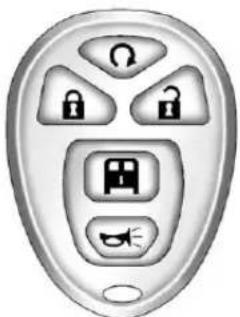
Close-up of a remote control interface with key buttons and navigation icons (no text or symbols)RKETransmitterwithRemote StartShown
(Lock):Pressoncetolockall doors. If enabled through the Driver Information Center(DIC), the parking lamps flash on ceto indicate locking has occurred.
Thehornmaychirpwhen is pressedagainwithinfiveseconds. See VehiclePersonalizationon page5-42foradditionalinformation.
(Unlock): Presstounlockthe driverdoor. If ispressedagain withinfiveseconds, allremaining doorsunlock.
Theinteriorlampscomeonand stayonfor20secondsoruntilthe ignitionisturnedon.Ifenabled throughtheDIC,theparkinglamps flashtwicetoindicateunlocking hasoccurred.See Vehicle Personalizationonpage5-42for additionalinformation.
(CargoDoor): Presstounlock onlythecargodoors.
Ω(RemoteVehicleStart):
Forvehicleswiththisfeature, press 📂andthenpressandholdΩ withinfivesecondstostartthe enginefromoutsidethevehicle usingtheRKEtransmitter.See Remote Vehicle Startonpage2-5 foradditionalinformation.
(VehicleLocator/Panic
Alarm): Pressandreleaseto locatethevehicle. Theturnsignal lampsflashandthehornsounds threetimes.
Pressandhold ☑ formorethan twosecondstoactivatethepanic alarm. Theturnsignallampsflash andthehornsoundsrepeatedly for 30 seconds. Thealarmturnsoff whentheignitionismovedtoON/RUNor ☑ ispressedagain. The ignitionmustbeinLOCK/OFF for thepanicalarmtowork.
ProgrammingTransmittersto theVehicle
OnlyRKEtransmittersprogrammed tothevehiclewillwork.lfa transmitterislostorstolen,a replacementcanbepurchased and programmedthroughyourdealer. Whenthereplacementtransmitteris programmedtothevehicle,all remainingtransmittersmustalsobe programmed.Anylostorstolen transmittersnolongerworkoncethe newtransmitterisprogrammed. Eachvehiclecanhaveupto fourtransmittersprogrammedtoit.
BatteryReplacement
Replace the battery if the REPLACE BATTERY IN REMOTE KEY messaged displays in the DIC. See "REPLACE BATTERY IN REMOTE KEY" under Key and Lock Messages on page 5-38 for additional information.
Notice: When replacing the battery, donottouchany of the circuitry on the transmitter. Static from your body could damage the transmitter.
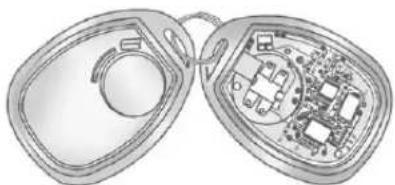
natural_image
Diagram of a device with open and closed views showing internal components (no text or symbols)Toreplacethebattery:
-
Separatethetransmitterwitha flat,thinobject,suchasaflat headscrewdriver.
-
Carefullyinsertthetoolinto thenotchlocatedalongthe partinglineofthe transmitter.Donotinsert thetooltoofar.Stopas soonasresistanceisfelt.
• Twistthetooluntilthe transmitterisseparated. -
Removetheoldbattery.Donot useametalobject.
- Insertthenewbattery, positive sidefacingdown. Replace with a CR2032orequivalent battery.
- Snapthetransmitterback together.
RemoteVehicleStart
Thisvehiclemayhavearemote startfeature. Thisfeatureallowsyou tostarttheenginefromoutsidethe vehicle. It may also start the vehicle'sheatingorairconditioning systems. See Climate Control Systemsonpage8-1foradditional information.
Lawsinsomelocalcommunities mayrestricttheuseofremote starters. Forexample, somelaws mayrequireapersonusingremote starttohavethevehicleinview whendoingso. Checklocal regulationsforanyrequirementson remotestartingofvehicles.
Donotusetheremotestart featureifthevehicleislowonfuel. Thevehiclemayrunoutoffuel.
If the vehicle has theremotestart feature, the RKE transmitter functions will have an increased range of operation. However, the rangemaybeless while the vehicle is running.
There are other conditions which can affect the performance of the transmitter, see Remote Keyless Entry(RKE) System on page 2-3 for additional information.
Ω(RemoteVehicleStart): ThisbuttonwillbeontheRKE transmitterifyouhaveremotestart.
Tostarttheengineusingtheremote startfeature:
1.AimtheRKEtransmitteratthe vehicle.
- Pressandrelease transmitter.
onthe
- Immediately press and hold until the return sign all lamps flash. If you cannot see the vehicle's lamps, press and hold for four seconds.
Whentheenginestarts, the parkinglampswillturnonand remainonwhiletheengineis running. Thedoorswillbe locked. Theairbagreadiness lightwillbeonduringaremote start. Itshouldturnoffwhenthe ignitionisturnedtoON/RUN. SeeAirbagReadinessLighton page5-18formoreinformation.
Theenginewillcontinuetorun for10minutes.Repeatthesteps fora10-minutetimeextension. Remotestartcanbeextended onlyonce.
Afterenteringthevehicleduringa remotestart,insertandturnthekey toON/RUNtodrivethevehicle.
Themaximumnumberofremote startsbetweenignitioncycleswith thekeyistwo.
If theremotestartprocedure is used again before the first 10 minutetime frame has ended, the first 10 minutes will immediately expire and these second 10 minutetime framewill start.
Aftertheenginehasbeenremote startedtwotimes,theignitionswitch mustbeturnedtoON/RUNandthen backtoLOCK/OFFusingthekey beforetheremotestartprocedure canbeusedagain.
Tocancelaremotestart:
- AimtheRKEtransmitteratthe vehicleandpress 🔒untilthe parkinglampsturnoff.
• Turnonthehazardwarning flashers.
• Turntheignitiononandthen backoff.
Theremotevehiclestartfeaturewill notoperateif:
• Thekeyisintheignition.
- Thehoodisopen.
- Thehazardwarningflashers areon.
- Thereisanemissioncontrol systemmalfunction.See MalfunctionIndicatorLampon page5-21.
• Theenginecoolanttemperature istoohigh.
• Theoilpressureislow.
- Tworemotevehiclestartshave alreadybeenprovided.
DoorLocks

WARNING
Unlockeddoorscan be dangerous.
- Passengers,especially children,caneasilyopenthe doorsandfalloutofamoving vehicle.Whenadooris locked,thehandlewillnot openit.Thechanceofbeing thrownoutofthevehicleina crashisincreasedifthe doorsarenotlocked.So,all passengersshouldwear safetybeltsproperlyandthe doorsshouldbelocked wheneverthevehicleis driven.
- Youngchildrenwhogetinto unlockedvehiclesmaybe unabletogetout.Achildcan beovercomebyextremeheat andcansufferpermanent
(Continued)
WARNING(Continued)
injuriesorevendeathfrom heatstroke.Alwayslockthe vehiclewheneverleavingit.
- Outsiderscaneasilyenter throughanunlockeddoor whenyouslowdownorstop thevehicle.Lockingthedoors canhelppreventthisfrom happening.
natural_image
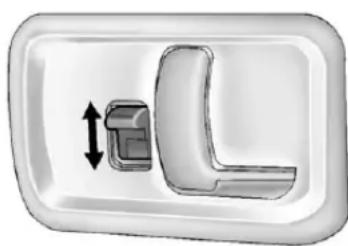
3D rendered diagram of a car seatbelt with L-shaped handle and double-headed arrow indicating left side (no text or symbols)Tolockthedoorfromtheinside, slidethemanualleveronthe doordown. Tounlockthedoor, slidethemanualleverup.
Fromtheoutside,usethekey.
If the vehicle is equipped with key less entry, see Remote Key less Entry (RKE) System Operation on page 2-3.
PowerDoorLocks
Onvehicleswithpowerdoor locks,theswitchesarelocated onthedoors.
:Presstolockandunlock thedoors.
Whenadoorislocked, the inside doorhandle will not work.
CargoDoorRelocking
If the cargodoorisopenwhen the lockbutton ispressed on the door or the RKE transmitter, all doors will lock except the cargodoor. The cargodoor will lock when it is closed or when the delayed locking feature functions.
DelayedLocking
When locking the doors with the power lock switch and a door open, the doors will lock five seconds after the last door is closed. You will hear three chimestosign that the delayed locking feature is in use.
Pressing ☑ twice or ☐ on the RKE transmittertwicewilloverride the delayed locking feature and immediately lock all the doors.
Thisfeaturewillnotoperateifthe keyisintheignition.
Thisfeaturecanbeprogrammed usingtheDriverInformation Center(DIC).See“DelayDoor Lock”inVehiclePersonalizationon page5-42.
AutomaticDoorLocks
The vehicle may have an automatic lock/unlock feature. This feature can be programmed using the Driver Information Center (DIC). See Vehicle Personalization on page 5-42 form more information on DIC programming.
LockoutProtection
Thisfeatureprotectsyoufrom lockingthekeyinthevehiclewhen thekeyisintheignitionandadoor isopen.
If the power lock switch is pressed when either the driver, passenger, or reardoor is open, all the doors will lock and then the driver door will unlock. This feature does not includetheside cargodoor.
If the vehicle has an ambulance package, this feature is disabled.
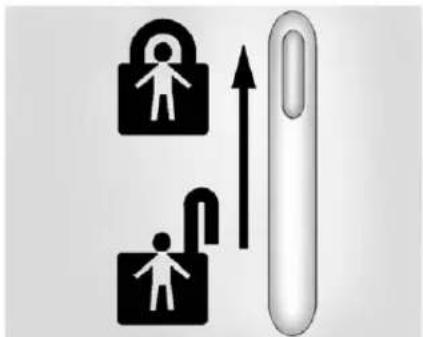
SafetyLocks
Securitylocksarelocatedonthe frontportionofthe60/40side swing-outdoorortheside slidingdoor.

natural_image
Two black padlock icons, one open and one closed, with no text or symbols60/40 Swing-OutSide Door—DriverSide Shown, Passenger Side Similar
Forthe60/40sideswing-outdoor, movethebuttontotherightforthe driversidedoorortotheleftforthe passengersidedoortoengagethe securityfeature.
Movethebuttontotheleftforthe driversidedoorortotherightfor thepassengersidedoortoreturn thedoorlockstonormaloperation.
text_image
Diagram showing two padlock icons with a person silhouette and an upward arrow next to a thermometer-like objectSideSlidingDoor
Forthesideslidingdoor, movethe buttonuptoengagethesecurity feature. Movethebuttondownto returnthedoorlockstonormal operation.
Doors
SideDoor (60/40 Swing-Out)
natural_image
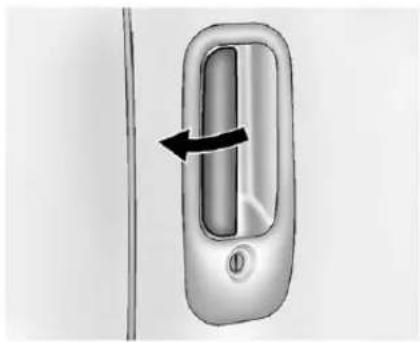
Close-up of a metallic door handle with a black arrow indicating left motion (no text or symbols)Toopenthefrontportionofa 60/40doorfromtheoutside,pullout onthehandleandopenthedoor.
natural_image
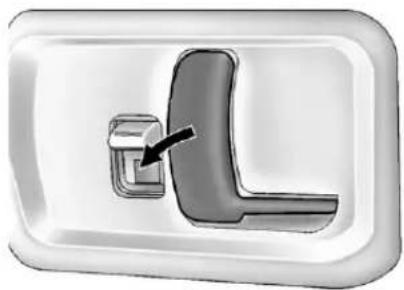
3D rendered diagram of a door handle with a black arrow pointing to the handle (no text or symbols)Toopenthefrontportionofa 60/40doorfromtheinside, pullthe handletowardyouandpushthe dooropen.
2-10Keys, Doors, and Windows
natural_image
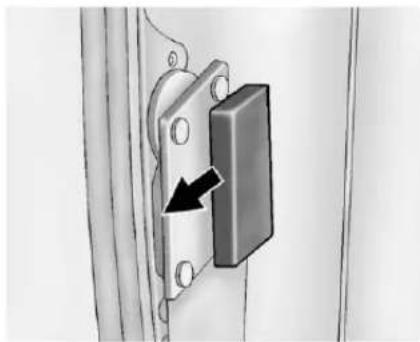
Diagram of a mechanical lock or latch mechanism with a black arrow indicating the locking point (no text or symbols present)Toopentherearportionofa60/40doorfromtheoutside,pullthe handleonthesideofthereardoor andpullthedoortowardyou.
Toclosethe60/40sidedoors,close thereardoorfirst. Thenclosethe frontdoor.Checktomakesurethat bothdoorsarecompletelyclosed.
Theswing-outdoorshaveacheck strapassemblyinthedoorframeto keepthedoorfromopeningbeyond 90degrees.
Toopenthedoorbeyond 90degrees, closethedoorpartially, pullthecheckstraptowardyouand
thenopenthedoor. Whenthedoor isclosed, thecheckstrapwill automaticallyre-engage.
SlidingDoor
natural_image
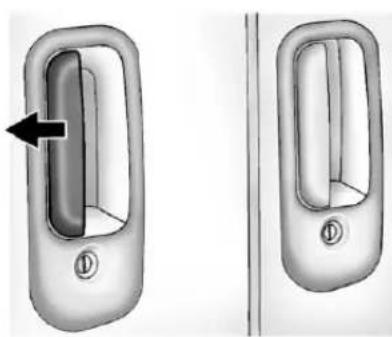
Two grayscale illustrations of a car door handle with a black arrow pointing to the left side (no text or symbols)Toopentheslidingsidedoorfrom theoutside,pullthehandletoward therearofthevehicleandslidethe dooropen.
Toclosetheslidingsidedoorfrom theoutside,usethehandletoslide thedoortowardthefrontofthe vehicle.
Whenthedoorisclosed, it will be flush with the side of the body.
natural_image
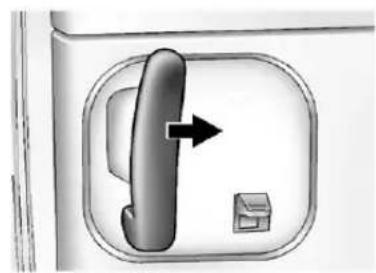
Close-up of a door handle with a hand pointing right, showing no text or symbolsToopentheslidingssidedoorfrom theinside,pullthehandletoward therearofthevehicle.Then,slide thedoortowardtherearofthe vehicle.
Toclosetheslidingsidedoorfrom theinside,graspthehandleand slidethedoortowardthefrontof thevehicle.
Makesurethedooriscompletely closedbeforedrivingaway.
RearDoors
WARNING
Unlockeddoorscanbe dangerous.
- Passengers,especially children,caneasilyopenthe doorsandfalloutofamoving vehicle.Whenadooris locked,thehandlewillnot openit.Thechanceofbeing thrownoutofthevehicleina crashisincreasedifthe doorsarenotlocked.So,all passengersshouldwear safetybeltsproperlyandthe doorsshouldbelocked wheneverthevehicleis driven.
(Continued)
WARNING(Continued)
- Youngchildrenwhogetinto unlockedvehiclesmaybe unabletogetout.Achildcan beovercomebyextremeheat andcansufferpermanent injuriesorevendeathfrom heatstroke.Alwayslockthe vehiclewheneverleavingit.
- Outsiderscaneasilyenter throughanunlockeddoor whenyouslowdownorstop thevehicle.Lockingthedoors canhelppreventthisfrom happening.
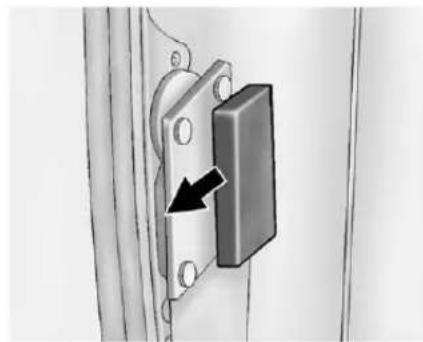
Toopenthereardoorsfromthe outside,pullthehandletowardyou toopenthepassengersiderear doorfirst.
natural_image
Diagram of a mechanical lock or latch mechanism with a black arrow indicating the locking point (no text or symbols present)Toopenthedriversidereardoor, pullthelatchreleaseattheinside edgeofthedoor.
Toclosethereardoors,closethe driversidereardoorfirst.Then closethepassengersidereardoor. Checktomakesurebothdoorsare completelyclosed.
VehicleSecurity
This vehicle has the theft-deterrent features; however, they donot make it impossible to steal.
Immobilizer
SeeRadioFrequencyStatementon page13-22forinformation regardingPart15oftheFederal CommunicationsCommission(FCC) rulesandIndustryCanada StandardsRSS-GEN/210/220/310.
ImmobilizerOperation
This vehicle is equipped with the PASS-Key ^® III+ (Personalized Automotive Security System) theft-deterrent system. PASS-KeyIII+isapassive theftdeterrent system.
Thesystemisautomaticallyarmed whenthekeyisremovedfromthe ignition.
Youdonothavetomanuallyarmor disarmthesystem.
Thesecuritylightwillcomeonif thereisaproblemwitharmingor disarmingthetheft-deterrent system.
WhenthePASS-KeyIII+system sensesthatsomeoneisusingthe wrongkey,itshutsdownthe vehicle'sstarterandfuelsystems. Thestarterwillnotworkandfuelwill stopbeingdeliveredtotheengine. Anyoneusingatrial-and-error methodtostartthevehiclewillbe discouragedbecauseofthehigh numberofelectricalkeycodes.
If theenginedoesnotstartandthe securitymessagecomeson,the keymayhaveadamaged transponder.Turntheignitionoff andtryagain.
Iftheenginestilldoesnotstart, and thekeyappearstobeundamaged, tryanotherignitionkey.Atthistime, youmayalsowanttocheckthe instrumentpanelPASSKEYfuse. Iftheenginestilldoesnotstartwith theotherkey,thevehicleneeds service.Ifthevehicledoesstart,the firstkeymaybefaulty.Seeyour dealeroralocksmithwhocan servicethePASS-KeyIII+tohavea newkeymade.SeeFusesand CircuitBreakersonpage10-41.
ItispossibleforthePASS-KeyIII+decodertolearnthetranspondervalueofaneworreplacementkey.Upto10keysmaybeprogrammedforthevehicle.Thisprocedureisforlearningadditionalkeysonly.Ifallthecurrentlyprogrammedkeysarelostordonotoperate,youmustseeyourdealeroralocksmithwhocanservicePASS-KeyIII+tohavekeysmadeandprogrammedtothesystem.
Seeyourdealeroralocksmithwho canservicePASS-KeyIII+togeta newkeyblankthatiscutexactlyas theignitionkeythatoperatesthe system.
Toprogramthenewkey:
-
Verifythenewkeyhas stampedonit.
-
Inserttheoriginal, already programmedkeyintotheignition lockcylinderandstartthe engine. If theenginewillnot start, seeyourdealerforservice.
-
After the engine has started, turn the key to LOCK/OFF and removethe key.
-
Insertthekeytobeprogrammed andturnittoON/RUNwithin 10secondsofremovingthe previouskey.
Thesecuritymessagewillturn offoncethekeyhasbeen programmed.Itmaynotbe apparentthatthesecurity messagewentonduetohow quicklythekeyisprogrammed.
- RepeatSteps1 through4 if additionalkeysaretobe programmed.
Ifyouloseordamagea PASS-Keyll+key,seeyourdealer oralocksmithwhocanservice PASS-Keyll+tohaveanew keymade.
Donotleavethekeyordevice thatdisarmsordeactivatethe theft-deterrentsystemin thevehicle.
ExteriorMirrors
ConvexMirrors

WARNING
Aconvexmirrorcanmakethings, likeothervehicles, lookfarther awaythantheyreallyare.Ifyou cuttoosharplyintotherightlane, youcouldhitavehicleonthe right.Checktheinsidemirroror glanceoveryourshoulderbefore changinglanes.
Thepassengersidemirrorisconvex shaped. Aconvexmirror's surface is curvesomorecanbeseen from thedriverseat.
ManualMirrors
Adjust them mirrors by pressing the mirror up and down a nle f t and right.
Themirrorscanbemanuallyfolded inorout.
Onthelowerportionofeachmirror isanauxiliaryconvexmirror.
Aconvexmirror's surface is curved so you can seem more from the driver seat. The auxiliary convex mirrors can be adjusted manually by pressing them mirror.
Trailer-TowMirrors
natural_image
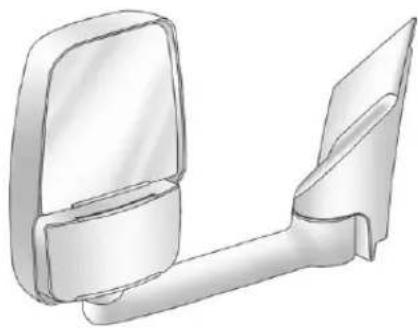
Technical line drawing of a mechanical component with two views (no text or symbols)Vehicleswithtowingmirrorscanbe adjustedmanuallyforaclearview oftheobjectsbehindyou.
Onthelowerportionofeachmirror thereisanauxiliaryconvexmirror thatcanbeadjustedmanually to provideanextendedfieldofview.
Themirrorscanbemanuallyfolded inorout.
PowerMirrors
natural_image
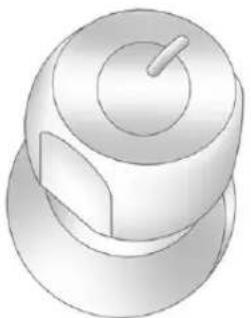
3D rendering of a mechanical knob or dial with a central knob (no text or symbols)Vehicleswithoutsidepowermirrors havecontrolslocatedonthedriver sidedoor.
Selecteachmirrorbyturningthe knobclockwiseforthepassenger sidemirrororcounterclockwisefor thedriversidemirror. Thecenter positionisneutral.
Then, adjust them mirror angle by moving the knob in the desired direction. The auxiliary convex mirrors can only be adjusted manually.
HeatedMirrors
Forvehicleswithheatedmirrors:
(RearDefogger):Presstoheat themirrors.
Anindicatorlightinthebuttonlights whentheoutsideheatedmirrorsare activated.
See "RearWindowDefogger" under ClimateControlSystemson page8-1 formoreinformation.
InteriorMirrors
ManualRearviewMirror
Holdtheinsiderearviewmirrorin thecentertomoveitforaclearer viewbehindthevehicle.Adjustthe mirrortoavoidglarefromthe headlampsbehind.Pushthetab forwardfordaytimeuseandpullit fornighttimeuse.
If you have acargovan without the reardoorglass, the vehicle may not have an insiderear view mirror.
Windows

WARNING
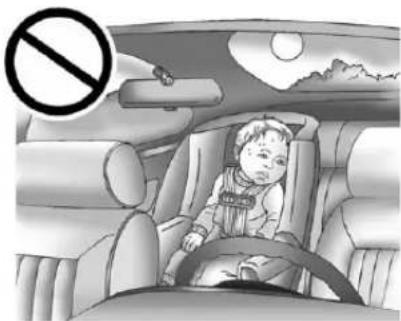
Leavingchildren, helplessadults, orpetsinavehiclewiththe windowsclosedisdangerous. Theycanbeovercomebythe extremeheatandsuffer permanentinjuriesoreven deathfromheatstroke.Never leaveachild,ahelplessadult, orapetaloneinavehicle, especiallywiththewindows closedinwarmorhotweather.
natural_image
Interior view of a car with a child seated in the seat, no visible text or symbolsManualWindows
Operatethemanualwindowsby turningthehandcrankoneachdoor toraiseorlowerthesidedoor windows.
PowerWindows

WARNING
Leavingchildreninavehiclewith thekeysisdangerousformany reasons. Childrenorotherscould bebadlyinjuredorevenkilled. Theycouldoperatethepower windowsorothercontrolsoreven makethevehiclemove. The windowswillfunctionandthey couldbeseriouslyinjuredorkilled ifcaughtinthepathofaclosing window.Donotleavekeysina vehiclewithchildren.
When there are children in the rearseatusethewindowlockout button to prevent unintentional operation of the windows.
text_image
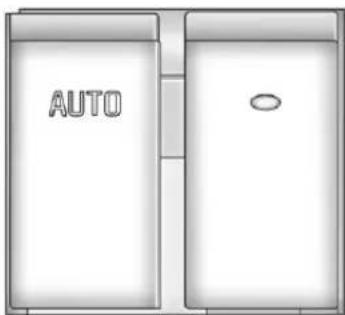
AUTOIf the vehicle has power windows, the controls are located one each of the sidedoors.
The driver door has as switch for the passenger window also. The power window will work when the ignition has been turned to ON/RUN or ACC/ACCESSORY, or when Retained Accessory Power (RAP) is active. See Retained Accessory Power (RAP) on page 9-21.
Presstheswitchtolowerthe window.
Pulluponthefrontedgeofthe switchtoraisethewindow.
Express-Down
Thedriverwindowswitchalsohas anexpress-downfeaturethatallows thewindowtobeloweredwithout holdingtheswitch.Pressfullyand releasethewindowswitchmarked AUTOtoactivatetheexpress-down mode.Thismodecanbecancelled atanytimebypullinguponthe switch.Toopenthewindowpart way, Lightlytaptheswitchuntilthe windowisatthedesiredposition.
2-18Keys, Doors, and Windows
Swing-OutWindows
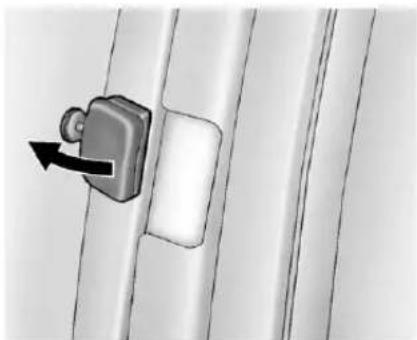
natural_image
Close-up of a metallic bracket with a black arrow pointing to its side panel (no text or symbols visible)SideSwing-OutWindow
Toopenthesidedoorswing-out window, pulluponthelatchatthe edgeofthewindow.Swingthe windowoutandpushdownonthe latchtolockthewindowintoplace.
Toclosethewindow, pullthelatch towardyouandpushdownonthe latchtolockit.
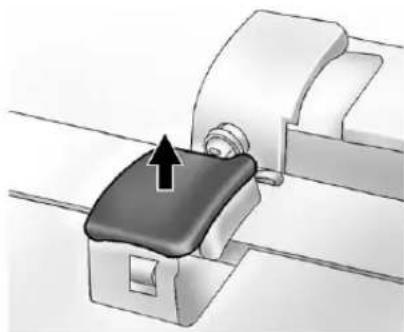
natural_image
Mechanical component diagram showing a belt buckle assembly with an arrow indicating direction (no text or symbols present)RearSwing-OutWindows
Thevehiclealsohasrearswing-out windows.Therearswing-out windowsworkthesamewayas thesideswing-outwindow,butthe latchislocatedatthebottomedge ofthewindow.
EnhancedTechnology Glass
The vehicle may be equipped with Enhanced Technology Glass (ETG). ETG is part of the overall occupant protection system on passenger vans. ETG may help to keep passengers sitting next to these fixed windows from being ejected through the glass insome, but not in all crashes. Even with this glass, safety belts must still beworn at all times. For passengers, use only ETG glass approved for the vehicle for replacement when damaged.
The following tables shows laminated glass location, based on vehicle model and options.
| VehicleConfigurationETGLocations | |
| Eight-SeatPassengerVansSlidingdoorforwardwindow | |
| 12-and15-SeatPassengerVans | Slidingdoorforwardwindowandrear-mostsidewindows |
| LongWheelbaseCargoVansRear-mostsidewindows | |
SunVisors
Toblockoutglare, swingdownthe sunvisors. Youcanalsoswingthem totheside.
VisorVanityMirror
The vehicle may have visor vanity mirrors, with or without lamps. Lift them mirror over to turn the lamps on, if equipped.
2-20Keys, Doors, and Windows
NOTES
Seatsand Restraints
HeadRestraints
HeadRestraints....3-2
FrontSeats
SeatAdjustment......3-2
PowerSeatAdjustment......3-3
RecliningSeatbacks......3-3
RearSeats
RearSeats......3-5
SafetyBelts
SafetyBelts....3-8
HowtoWearSafetyBelts Properly....3-10
Lap-ShoulderBelt......3-11
SafetyBeltUseDuring Pregnancy....3-16
SafetyBeltExtender......3-16
SafetySystemCheck......3-16
SafetyBeltCare....3-17
ReplacingSafetyBeltSystem PartsafteraCrash......3-17
AirbagSystem
AirbagSystem......3-18
WhereAretheAirbags?.....3-20
WhenShouldanAirbag Inflate?......3-22
WhatMakesanAirbag Inflate?......3-23
HowDoesanAirbag Restrain?......3-24
WhatWillYouSeeafteran AirbagInflates?......3-24
AirbagOn-OffSwitch......3-26
PassengerSensing System....3-30
ServicingtheAirbag-Equipped Vehicle....3-35
AddingEquipmenttothe Airbag-EquippedVehicle...3-35
AirbagSystemCheck......3-37
ReplacingAirbagSystem PartsafteraCrash......3-37
ChildRestraints
OlderChildren....3-38
InfantsandYoung Children......3-40
ChildRestraintSystems.....3-42
WheretoPuttheRestraint...3-45
LowerAnchorsandTethers forChildren(LATCH System)....3-46
ReplacingLATCHSystem PartsAfteraCrash......3-52
SecuringChildRestraints (RearSeatPosition)......3-53
SecuringChildRestraints (FrontSeat-Passenger SensingSystem)....3-55
SecuringChildRestraints (FrontSeat-AirbagOn/Off Switch)....3-58
HeadRestraints
Onvehicleswithfactoryinstalled seats, thefrontseatshavebuilt-in headrestraintsthatarenot adjustableintheoutboard seatingpositions.
FrontSeats
SeatAdjustment

WARNING
Youcanlosecontrolofthe vehicleifyoutrytoadjusta manualdriverseatwhilethe vehicleismoving. Thesudden movementcouldstartleand confuseyou,ormakeyoupusha pedalwhenyoudonotwantto. Adjustthedriverseatonlywhen thevehicleisnotmoving.
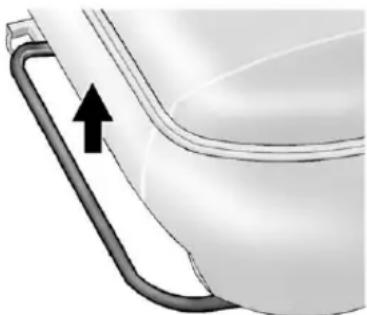
natural_image
Close-up of a toilet handle with a black arrow pointing to the outlet (no text or symbols visible)Toadjusttheseat:
- Liftthebarunderthefrontedge oftheseatcushiontounlock theseat.
- Slidetheseattothedesired positionandreleasethebar.
- Trytomovetheseatback and forthobesuretheseatis lockedinplace.
PowerSeatAdjustment
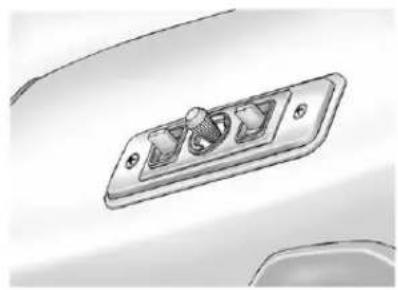
natural_image
Illustration of a car electrical outlet with two switches (no text or symbols)Toadjustapowerseat,ifavailable, usethecontrolsonthefrontof theseat:
- Movethecenterknobtothe rightorlefttomovetheseat forwardorrearward.
• Movethecenterknobupor downtoraiseorlowertheseat. - Movetherightorleftleverupor downtoraiseorlowerthefront orrearoftheseatcushion.
RecliningSeatbacks

WARNING
Youcanlosecontrolofthe vehicleifyoutrytoadjusta manualdriverseatwhilethe vehicleismoving. Thesudden movementcouldstartleand confuseyou,ormakeyoupusha pedalwhenyoudonotwantto. Adjustthedriverseatonlywhen thevehicleisnotmoving.

WARNING
Ifeitherseatbackisnotlocked, it couldmoveforwardinasudden stoporcrash. Thatcouldcause injurytothepersonsittingthere. Alwayspushandpullonthe seatbackstobesuretheyare locked.
natural_image
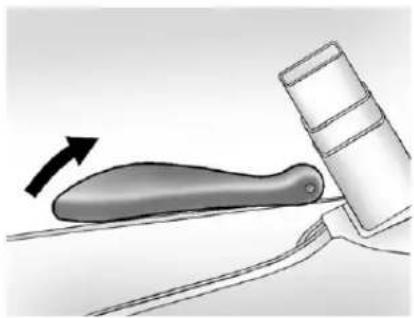
Illustration of a tool interacting with a curved object, showing motion direction (no text or symbols)Toreclinetheseatback:
- Lifttheleverontheinboardside oftheseat.
- Movetheseatbacktothe desiredposition, and then releasethelevertolockthe seatbackinplace.
- Pushandpullontheseatbackto makesureitislocked.
3-4 Seats and Restraints
Toreturntheseatbacktotheupright position:
- Lifttheleverfullywithout applyingpressuretothe seatback,andtheseatbackwill returntotheprightposition.
- Pushandpullontheseatback to make sureitislocked.

WARNING
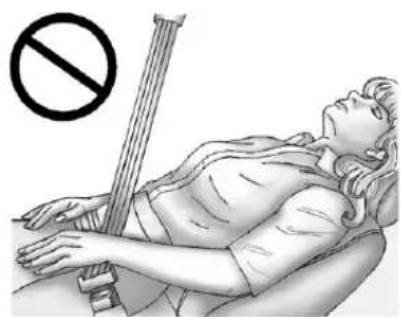
Sittinginareclinedpositionwhen thevehicleisinmotioncanbe dangerous.Evenwhenbuckled up,thesafetybeltscannotdo theirjobwhenreclinedlikethis.
Theshoulderbeltcannotdoits jobbecauseitwillnotbeagainst yourbody.Instead,itwillbein frontofyou.Inacrash,youcould gointoit,receivingneckorother injuries.
(Continued)
WARNING(Continued)
Thelapbeltcannotdoitsjob either.Inacrash,thebeltcould goupoveryourabdomen.The beltforceswouldbethere,notat yourpelvicbones.Thiscould causeseriousinternalinjuries.
Forproperprotectionwhenthe vehicleisinmotion,havethe seatbackupright.Thensitwell backintheseatandwearthe safetybeltproperly.
natural_image
Illustration of a person lying down with a string and a no-smoking symbol above (no text or labels)Donothaveaseatbackreclinedif thevehicleismoving.
RearSeats
RemovingtheRearSeat
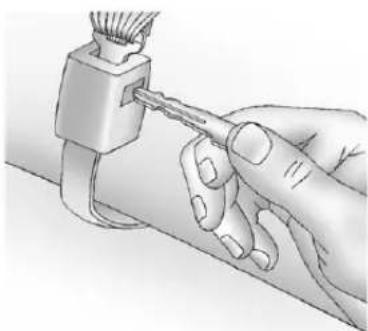
Disconnectthemini-latchplatesfor thelap-shoulderbeltsonthebench seattoberemoved.
natural_image
Illustration of a hand holding a wristband with a tool inserted (no text or symbols visible)-
Todothis, pressthetipofakey intotherleaseholeofthe safetybeltbucklewhilepulling uponthesafetybelt.
-
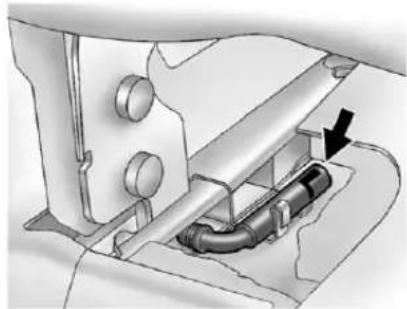
Locatethepins.
Onathree-passengerseatthere aretwopinsontheinboardsides oftherearseats.
natural_image
Mechanical assembly diagram showing pipe connection and valve mechanism (no text or labels)Three-PassengerSeatShown
Theleftsidepinhasagraycap withablack"L"markedonit.
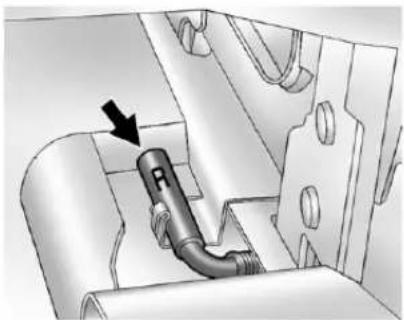
natural_image
Mechanical component diagram showing a pipe fitting with an arrow indicating direction (no text or symbols present)Three-PassengerSeatShown
Therightsidepinhasa blackcapwithawhite"R" markedonit.
Onafour-passengerseat, each halfoftheseathasasetofpins. Theleftsidehasaset marked"L,"andtherightside hasasetmarked"R".
If the vehicle has floormats, the pins are under a lapathas beencut into themat.
3-6 Seats and Restraints
- Pullthepinhandleupto disengagethepinfromthe retainingclip, and then pull the pinout.
- Repeat this procedure for the other pins.
- Pulltheseatrearwardabout 5cm(2in), and then lift theseat from the floor rails.
- Removetheseatfromthe vehicle.
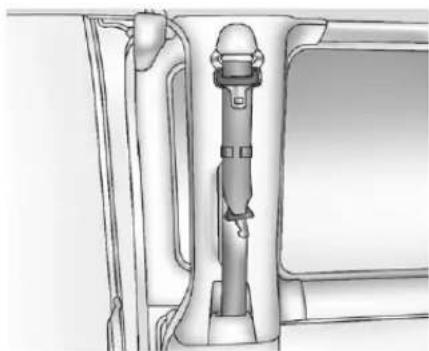
natural_image
Technical line drawing of a mechanical component with no visible text or symbols- For these second-and third-row seats, stowthesafetybeltlatch by attaching the clip on the safetybeltlatch to the trim just insidethesidedoor.
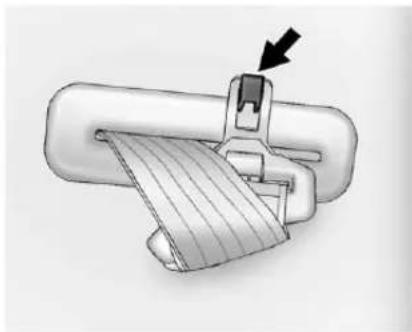
natural_image
Diagram of a mechanical device with a scroll and handle, showing a black arrow pointing to the handle (no text or symbols present)Forthelastrowofseats,stow thesafetybeltlatchplateonthe clipatthewindowtrim.Rollthe mini-latchintothesafetybelt webbingandthenhookthe safetybeltlatchplateontheclip.
ReinstallingtheRearSeats

WARNING
Aseatthatisnotlockedinto placeproperlycanmovearound inacollisionorsuddenstop. Peopleinthevehiclecouldbe injured.Besuretolocktheseat intoplaceproperlywhen installingit.

WARNING
Asafetybeltthatisimproperly routed, not properly attached, ortwisted will not provide the protection needed in acrash. The person wearing the belt could be seriously injured. After raising the rearseatback, always checktobe sure that the safety belts are properly routed and attached, and arenottwisted.
- Positiontheseatintotheopen slotsinbothrails. Pushtheseat forwardintherail, hookingboth seatbasesontothepinsinside oftherails.
- Locatetheholeintherailto installthelockingpinsattherear oftheseatbase.Ifthevehicle hasfloormats,pulltheflapthat hasbeencutintothemat.
- Insert the locking pins into the seatbase and push these seats to line up the pins with the base.
Onathree-passengerseat, thepinwiththeblackcap marked“R”mustbeinstalledon therightsideandthepinwith thegraycapmarked“L”onthe leftside.
Onafour-passengerseat, thepinsmarked "R" must be installed on the half of these seat on the right side. The pins marked "L" must be installed on the half of these seat on the left side.
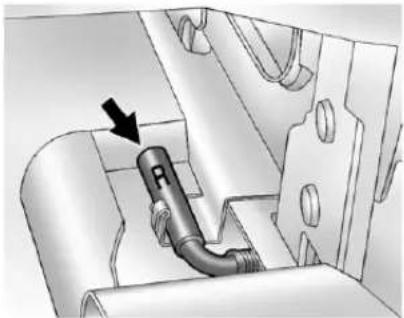
natural_image
Technical illustration of a mechanical component with an arrow indicating direction (no text or symbols present)Three-PassengerSeatShown
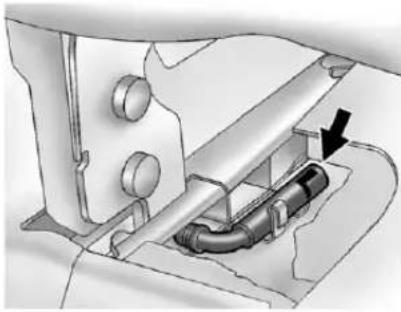
4. Pushthepin(s) marked "R" down until they are in the retainingclip.
3-8 Seats and Restraints
natural_image
Mechanical assembly diagram showing a pipe fitting with a black arrow indicating a component (no text or symbols present)Three-PassengerSeatShown
- Pushthepin(s)marked "L" down until they are in the retainingclip.
-
If the vehicle has a floor format, put the flap back to its original position.
-
Repeat this procedure for the other seat base.
- Connect themini-latchplates for the lap-shoulder belts by inserting the latch plates into the mini-buckles attached at the outboard position of the bench seat. Donottwist the belts.
- Check that all locking pins are locked into place before operating the vehicle.
SafetyBelts
Thissectionofthemanual describeshowtousesafetybelts properly.Italsodescribessome thingsnottodowithsafetybelts.

WARNING
Donotletanyoneridewherea safetybeltcannotbeworn properly.Inacrash,ifyouoryour passenger(s)arenotwearing safetybelts,injuriescanbemuch worsethanifyouarewearing safetybelts.Youcanbeseriously injuredorkilledbyhittingthings insidethevehicleharderorby beingejectedfromthevehicle. Inaddition,anyonewhoisnot buckledupcanstrikeother passengersinthevehicle.
(Continued)
WARNING(Continued)
Itisextremelydangeroustoride inacargoarea,insideoroutside ofavehicle.Inacollision, passengersridingintheseareas aremorelikelytobeseriously injuredorkilled.Donotallow passengerstorideinanyareaof thevehiclethatisnotequipped withseatsandsafetybelts.
Alwayswearasafetybelt, and checkthatallpassenger(s) are restrainedproperlytoo.
Thisvehiclehasindicatorsasa remindertobucklethesafetybelts. See SafetyBeltReminderson page5-17foradditionalinformation.
WhySafetyBeltsWork
natural_image
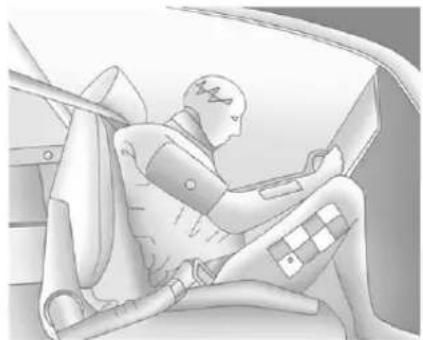
Illustration of a person seated in a car, wearing a seatbelt and using a device (no text or symbols visible)Whenridinginavehicle,youtravel asfastasthevehicledoes.Ifthe vehiclestopssuddenly,youkeep goinguntilsomethingstopsyou. Itcouldbethewindshield,the instrumentpanel,orthesafetybelts!
Whenyouwearasafetybelt,you andthevehicleslowdowntogether. Thereismoretimetostopbecause youstopoveralongerdistanceand, whenwornproperly,yourstrongest bonestaketheforcesfromthe safetybelts.Thatiswhywearing safetybeltsmakessuchgood sense.
QuestionsandAnswersAbout SafetyBelts
Q: Willlbetrappedinthevehicle afteracrashiflamwearinga safetybelt?
A: You could be—whether you are wearing as safety belt or not. Your chance of being conscious during and after a crash, so you can unbuckle and get out, is much greater if you are belted.
3-10 Seats and Restraints
Q: If my vehicle has air bags, why should have to wear safety belts?
A: Airbagsaresupplemental systemsonly; sotheyworkwith safetybelts—notinsteadof them. Whetherornotanairbag isprovided, allooccupantsstill havetobuckleuptogetthe mostprotection.
Also, innearly all states and in all Canadian provinces, the law requires wearingsafety belts.
HowtoWearSafetyBelts Properly
Thissectionisonlyforpeopleof adultsize.
Therearespecialthingstoknow aboutsafetybeltsandchildren.And therearedifferentrulesforsmaller childrenandinfants.Ifachildwillbe ridinginthevehicle,seeOlder Childrenonpage3-38orInfants andYoungChildrenonpage3-40. Followthoserulesforeveryone's protection.
Itisveryimportantforallooccupants tobuckleup.Statisticsshowthat unbeltedpeoplearehurtmoreoften incrashesthanthosewhoare wearingsafetybelts.
Thereareimportantthingstoknow aboutwearingasafetybeltproperly.
natural_image
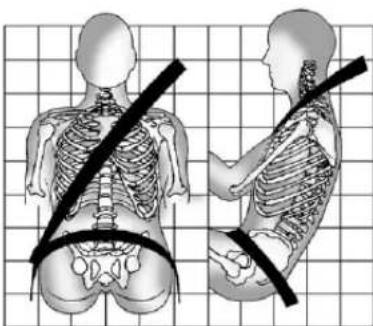
Illustration of human skeletal positions on a grid background, showing torso and spine alignment with no text or symbols- Situpstraightandalwayskeep yourfeetonthefloorinfront ofyou.
• Alwaysusethecorrectbuckle foryourseatingposition. - Wearthelappartofthebeltlow andsnugonthehips,just touchingthethighs.Inacrash, thisappliesforcetothestrong pelvicbonesandyouwouldbe lesslikelytoslideunderthelap belt.Ifyouslidunderit,thebelt wouldapplyforceonyour abdomen.Thiscouldcause seriousorevenfatalinjuries.
- Weartheshoulderbeltoverthe shoulderandacrossthechest. Thesepartsofthebodyarebest abletotakebeltrestraining forces. Theshoulderbeltlocksif thereisasuddenstoporcrash.
WARNING
Youcanbeseriouslyinjured, orevenkilled, bynotwearing yoursafetybeltproperly.
- Neverallowthelapor shoulderbelttobecome looseortwisted.
- Neverweartheshoulderbelt underbotharmsorbehind yourback.
- Neverroutethelapor shoulderbeltoveran armrest.
Lap-ShoulderBelt
Allseatingpositionsinthevehicle havealap-shoulderbelt. If you are using arearseating position with a detachables safety belt and the safety belt is not attached, see "Reinstalling the Rear Seats" under Rear Seat on page 3-5 for instructions on reconnecting the safety belt to themini-buckle.
The following instructionsexplain howtowearalap-shoulderbelt properly.
-
Adjusttheseat, if theseatis adjustable, so you cansitup straight. Toseehow, see "Seats" in the Index.
-
Pickupthelatchplateandpull thebeltacrossyou.Donotletit gettwisted.
Thelap-shoulderbeltmaylockif youpullthebeltacrossyouvery quickly. If this happens, let the beltgobackslightlytounlockit. Then pullthebeltacrossyou moreslowly.
Iftheshoulderportionofa passengerbeltispulledoutall theway,thechildrestraint lockingfeaturemaybeengaged. Ifthishappens,letthebeltgo backallthewayandstartagain.
3-12SeatsandRestraints
natural_image
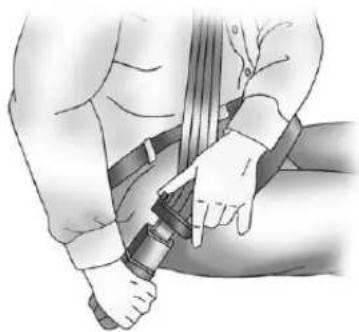
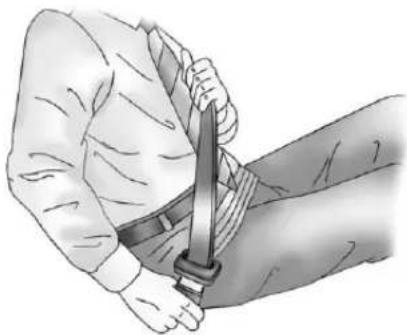
Illustration of a person adjusting a belt buckle, no text or symbols present- Pushthelatchplate into the buckle until it clicks.
Pulluponthelatchplateto makesureitissecure.Ifthebelt isnotlongenough,see Safety BeltExtenderonpage3-16.
Positionthereleasebuttonon thebucklesothatthesafetybelt couldbequicklyunbuckledif necessary.
- If equipped with a shoulder belt height adjuster, move it to the height that is right for you. See "Safety Belt Height Adjuster" later in this section for instructions on use and important safety information.
natural_image
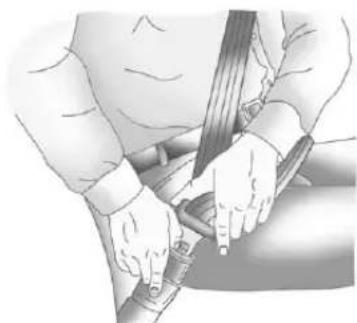
Illustration of a person using a bandage to lift a wrist (no text or symbols present)- Tomakethelapparttight, pull upontheshoulderbelt.
It may be necessary to pull stitching on the safety belt through the latch plate to fully tight enthelap beltons smaller occupants.
natural_image
Illustration of hands using a bandpass to lift a car (no text or symbols visible)Tounlatchthebelt, pushthebutton onthebuckle. Thebelt should return to its stowed position. Slide thelatchplateupthesafetybelt webbing when the safety belt is not in use. Thelatch plates should rest on the stitching on the safety belt, near the guideloop on the sidewall.
Beforeadoorisclosed,besurethe safetybeltisoutoftheway.lfa doorisslammedagainstasafety belt,damagecanoccurtoboththe safetybeltandthevehicle.
SafetyBeltHeightAdjuster
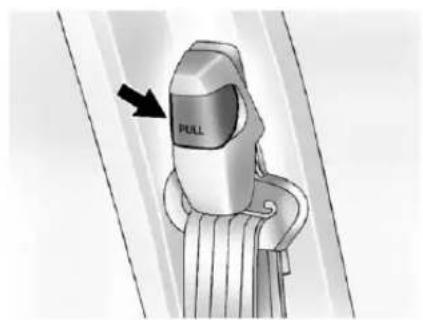
The vehicle has as safety bel the height adjuster forth driver and right front passenger positions.
Adjusttheheightsotheshoulder portionofthebeltisontheshoulder andnotfallingoffofit.Thebelt shouldbecloseto,butnot contacting,theneck.Improper shoulderbeltheightadjustment couldreducetheeffectiveness of thesafetybeltinacrash.SeeHow toWearSafetyBeltsProperlyon page3-10.
text_image
PULLTomoveitdown, pullonthecenter adjustercontrolllabeledPULL. You canmovetheheightadjusterupjust bypushingupontheshoulderbelt guide.
Aftertheadjusterissettothe desiredposition,trytomoveitdown withoutpushingintomakesureit haslockedintoposition.
SafetyBeltPretensioners
If the GVWR (Gross Vehicle Weight Rating) of the vehicle is below 3855 kg (8,500 lb) then the vehicle hassafety belt pretensioners for the
frontoutboardoccupants.See VehicleLoadLimitsonpage9-11to locatethecertificationlabelwhich containstheGVWR.
Although the safety belt pretensioners cannot be seen, they are part of the safety belt assembly. They can help to tighten the safety belts during the early stages of a moderate to severe frontal, near frontal, or rear crash if the threshold conditions for pretensioner activation are met. And, if the vehicle has side impact air bags, safety belt pretensioners can help tighten the safety belts in aside crash or rollover event.
Pretensionersworkonlyonce. Ifthepretensionersareactivated in acrash, thepretensionersand possiblyotherpartsofthesafety beltsystemwillneedtobereplaced. SeeReplacingSafetyBeltSystem PartsafteraCrashonpage3-17.
3-14 Seats and Restraints
RearSafetyBeltComfort Guides
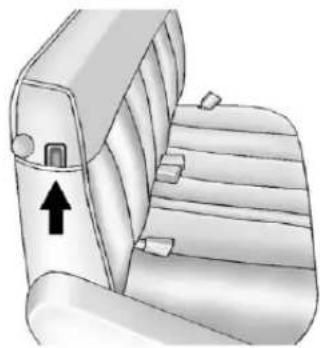
This vehicle may have rear shoulder belt comfort guides. If not, they are available through your dealer. The guides may provide added safety belt comfort for older children who have outgrown booster seats and for some adults. When installed and properly adjusted, the comfort guide position sthes shoulder belt away from theneck and head.
natural_image
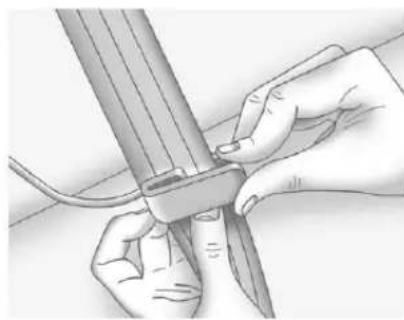
Diagram of a vehicle rearview seat with an arrow indicating direction (no text or symbols present)Hereishowtoinstallacomfort guidetothesafetybelt:
- Locatetheguideinapocketon thesideoftheseatback.
natural_image
Illustration of hands using a tool to cut or apply a cable or wire component (no text or symbols visible)- Placetheguideoverthebelt, andinsertthetwoedgesofthe beltintotheslotsoftheguide.
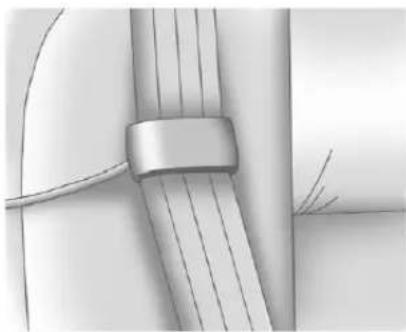
natural_image
Close-up of a metallic clamp securing a rope or cable (no text or symbols visible)- Besurethatthebeltisnot twistedanditiesflat. The elasticcordmustbeunderthe beltandtheguideontop.
WARNING
Asafetybeltthatisnotproperly wornmaynotprovidethe protectionneededinacrash.
(Continued)
WARNING(Continued)
The person wearing the belt could be seriously injured. The shoulder belt should go over the shoulder and across the chest. These parts of the body are best able to take beltrestraining forces.

natural_image
Illustration of a person seated in a chair holding a stringed instrument (no text or symbols visible)- Buckle, position, and release the safety belt as described previously in this section.
Makesuretheshoulderportion ofthebeltisontheshoulderand notfallingoffofit. Thebelt shouldbecloseto, but not contacting, theneck.
Toremoveandstorethecomfort guide, squeezethebeltedges togethersothatthesafetybeltcan beremovedfromtheguide.Slide theguideintoitsstoragepocketon thesideoftheseatback.
SafetyBeltUseDuring Pregnancy
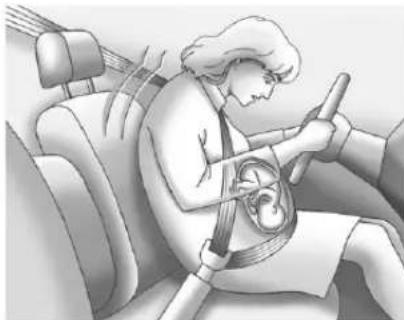
Safetybeltsworkforeveryone, includingpregnantwomen.Likeall occupants,theyaremorelikelyto beseriouslyinjurediftheydonot wearsafetybelts.
natural_image
Illustration of a person wearing a seatbelt inside a car, with hands adjusting the seatbelt (no text or symbols present)Apregnantwomanshouldweara lap-shoulderbelt, and the lap portions should bewornaslowas possible, belowtherounding, throughout the pregnancy.
The best way to protect the fetus is to protect them other. When as safety belt is worn properly, it is more likely that the fetus will not be hurt in a crash. For pregnant women, as for anyone, the key to makings safety belt is effective is wearing them properly.
SafetyBeltExtender
Ifthevehicle'ssafetybeltwillfasten aroundyou,youshoulduseit.
Butifasafetybeltisnotlong enough,yourdealerwillorderyou anextender.Whenyougointo orderit,taketheheaviestcoatyou willwear,sotheextenderwillbe longenoughforyou.Tohelpavoid personalinjury,donotletsomeone elseuseit,anduseitonlyforthe seatismadetofit.Theextender hasbeendesignedforadults.Never useitforsecuringchildseats.To wearit,attachittotheregularsafety belt.Formoreinformation,seethe instructionsheetthatcomeswith theextender.
SafetySystemCheck
Nowandthen, check that the safety belt reminder light, safety belts, buckles, latch plates, retractors, and anchorages are all working properly. Look for any other loose or damaged safety belts system parts that might keep safety belts system from doing its job. See your dealer to have it repaired. Tornor frayed safety belts may not protect you in acrash. They can ripapart under impact forces. Ifabeltistornor frayed, get anewoneright away.
Makesurethesafetybeltreminder lightisworking.SeeSafetyBelt Remindersonpage5-17for moreinformation.
Keepsafetybeltscleananddry. See SafetyBeltCareonpage3-17.
SafetyBeltCare
Keepbeltscleananddry.

WARNING
Donotbleachordyesafetybelts. Itmayseverelyweakenthem. Inacrash, they might not be able to provide adequate protection. Cleansafetybeltsonly with mild soap and lukewarmwater.
ReplacingSafetyBelt SystemPartsaftera Crash

WARNING
Acrashcandamagethesafety beltsysteminthevehicle. Adamagedsafetybeltsystem maynotproperlyprotectthe personusingit,resultingin seriousinjuryorevendeathina crash.Tohelpmakesurethe safetybeltsystemsareworking properlyafteracrash,havethem inspectedandanynecessary replacementsmadeassoon aspossible.
Afteraminorcrash, replacement of safetybeltsmaynotbenecessary. Butthesafetybeltasembliesthat were used during any crash may have been stressed or damaged. Seeyourdealertohavethesafety beltassemblies inspected or replaced.
Newpartsandrepairsmaybe necessaryevenifthesafetybelt systemwasnotbeingusedatthe timeofthecrash.
Havethesafetybeltpretensioners checkedifthevehiclehasbeenina crash,oriftheairbagreadinesslight staysonafteryoustartthevehicle orwhileyouaredriving.SeeAirbag ReadinessLightonpage5-18.
AirbagSystem
The vehicle has the following airbag:
• Afrontalairbagforthedriver.
The vehicle may have the following airbags:
- Afrontalairbagfortherightfront passenger.
• Aroof-railairbagforthedriver (cargovan).
- Aroof-railairbagfortheright frontpassengerposition (cargoorpassengervan equippedwithaslidingdoor).
If you have apassengervan witharightfrontpassenger roof-railairbagandasliding door, you will also have a separateroof-railairbagforthe passengerseateddirectly behindtherightfrontpassenger and the thirdrowoutboard passengerposition.
- Aroof-railairbagforthedriver, thepassengerseateddirectly behindthedriver,andthethird rowoutboardpassengerposition (passengervanequippedwitha slidingorhingeddoor).
- Aroof-railairbagfortheright frontpassenger, the passenger seateddirectlybehindtheright frontpassenger, and the thirdrowoutboardpassenger position (passengervan equipped with ahingeddoor).
Alloftheairbagsinthevehiclewill havethewordAIRBAGembossed inthetrimoronanattachedlabel nearthedeploymentopening.
Forfrontalairbags, theword AIRBAGwillappearonthemiddle partofthesteeringwheelforthe driverandontheinstrumentpanel fortherightfrontpassenger.
Withroof-railairbags, theword AIRBAG will appear along the headlinerortrim.
Herearethemostimportantthings toknowabouttheairbagsystem:

WARNING
Youcanbeseverelyinjuredor killedinacrashifyouarenot wearingyoursafetybelt—evenif youhaveairbags.Airbagsare designedtoworkwithsafety belts,butdonotreplacethem. Also,airbagsarenotdesignedto deployineverycrash.Insome crashessafetybeltsareyouronly restraint.SeeWhenShouldan AirbagInflate?onpage3-22.
Wearingyoursafetybeltduringa crashhelpsreduceyourchance ofhittingthingsinsidethevehicle orbeingejectedfromit.Airbags are“supplementalrestraints”to thesafetybelts.Everyoneinyour vehicleshouldwearasafetybelt properly—whetherornotthereis anairbagforthatperson.
WARNING
Airbagsinflatewithgreatforce, fasterthantheblinkofaney. Anyonewhoisupagainst, or verycloseto, anyairbagwhenit inflatescanbeseriouslyinjured orkilled. Donotsitunnecessarily closetotheairbag, asyouwould beifyouweresittingontheedge ofyourseatorleaningforward. Safetybeltshelpkeepyouin positionbeforeandduringa crash. Alwayswearyoursafety belt, evenwithairbags. Thedriver shouldsitasfarbackaspossible whilestillmaintainingcontrol of thevehicle.
Occupantsshouldnotleanonor sleepagainstthedoororside windowsinseatingpositionswith roof-railairbags.
WARNING
Childrenwhoareupagainst, orverycloseto,anyairbagwhen itinflatescanbeseriouslyinjured orkilled.Airbagsplus lap-shoulderbeltsofferprotection foradultsandolderchildren,but notforyoungchildrenandinfants. Neitherthevehiclesafetybelt systemnoritsairbagsystemis designedforthem.Young childrenandinfantsneedthe protectionthatachildrestraint systemcanprovide.Always securechildrenproperlyinthe vehicle.Toreadhow,seeOlder Childrenonpage3-38orInfants andYoungChildrenon page3-40.

Thereisanairbagreadinesslight ontheinstrumentpanel,which showstheairbagsymbol.
Thesystemcheckstheairbag electricalsystemformalfunctions. Thelighttellsyouifthereisan electricalproblem.SeeAirbag ReadinessLightonpage5-18for moreinformation.
3-20SeatsandRestraints
WhereAretheAirbags?
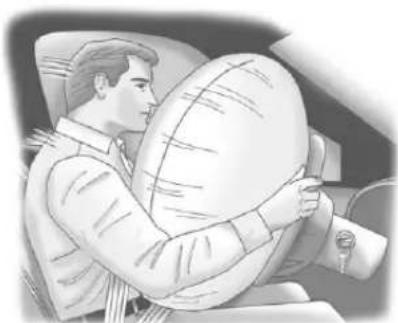
natural_image
Illustration of a person inside a car holding a large circular object, no visible text or symbolsThedriverfrontalairbagisinthe middleofthesteeringwheel.
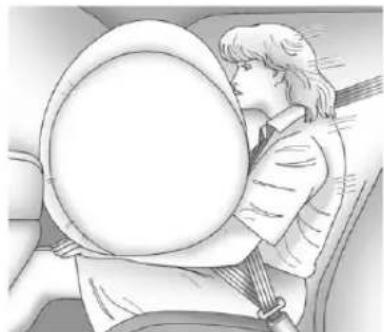
natural_image
Illustration of a person sitting in a chair, viewed from behind a large circular object (no text or symbols visible)If the vehicle has one, theright front passenger air bag is in the instrument panel on the passengers side.
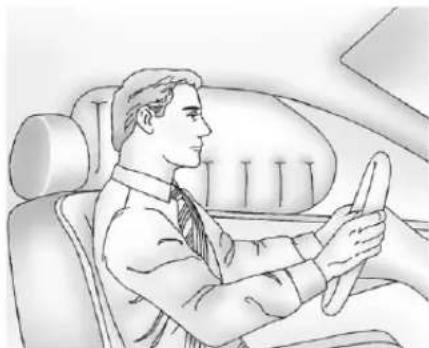
natural_image
Line drawing of a man sitting in a car, holding a steering wheel (no text or symbols)DriverSideShown, Passenger SideSimilar
Ifthevehicleisacargoor
passengervanwithaslidingdoor
andithasaroof-railairbagforthe
driverandrightfrontpassenger
position,theroof-railairbagsarein
theceilingabovethesidewindow.
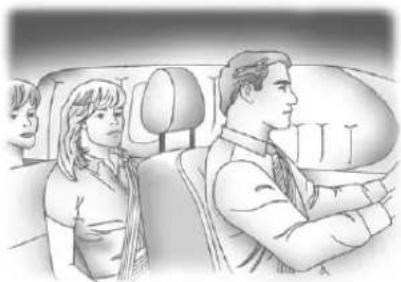
natural_image
Illustration of three people seated in a car, facing each other with arms crossed (no text or symbols visible)DriverSideShown, Passenger SideSimilar
If the vehicle has roof-rail air bags forth driver, right front passenger, passengers behind the driver and right front passenger, and the third row out board passengers, the roof-rail air bags are in the ceiling abovethesidewindows.
Onthedriversideofthevehicle, thereisonesingleroof-railairbag foreithervehicleswithahinged doororaslidingdoor.
Forpassengervanswithasliding door,onthepassengersideofthe vehicle,youwillhaveaseparate roof-railairbagforthepassenger seateddirectlybehindtherightfront passengerandthethirdrow outboardpassengerposition.
WARNING
If something is between an occupant and an airbag, the airbag might not inflate properly or might force the object into that person causing severe injury overvendath.
(Continued)
WARNING(Continued)
Thepathofaninflatingairbag mustbekeptclear.Donotput anythingbetweenanoccupant andanairbag,andonotattach orputanythingonthesteering wheelhuboronornearanyother airbagcovering.
Neversecureanythingtotheroof ofvehiclewithroof-railairbags byroutingaropeortiedown throughanydoororwindow opening. If youdo, the pathofan inflatingroof-railairbagwillbe blocked.
WhenShouldanAirbag Inflate?
Frontalairbagsaredesignedto inflateinmoderatetoseverefrontal ornear-frontalcrashestohelp reducethepotentialforsevere injuriesmainlytothedriverorright frontpassengerheadandchest. However,theyareonlydesignedto inflateiftheimpactexceedsa predetermineddeployment threshold.Deploymentthresholds areusedtopredicthowseverea crashislikelytobeintimeforthe airbagstoinflateandhelprestrain theoccupants.
Whether the frontal air bags will or should deploy is not based on how fast the vehicle is traveling. It depends largely on what you hit, the direction of the impact, and how quickly the vehicles slows down.
Frontalairbagsmayinflateat differentcrashspeeds. Forexample:
- If the vehicle hits stationary object, the air bags could inflate at different crash speed than if the vehicle hits moving object.
- Ifthevehiclehitsanobjectthat deforms,theairbagscould inflateatadifferentcrashspeed thanifthevehiclehitsanobject thatdoesnotdeform.
- Ifthevehiclehitsanarrowobject (likeapole), theairbags could inflate at different crash speed than if the vehicle hits a wide object (likeawall).
- Ifthevehiclegoesintoanobject atanangle, theairbags could inflate at different crash speed than if the vehiclegoes straight into the object.
Thresholdscanalsovarywith specificvehicledesign.
Frontalairbagsarenotintendedto inflateduringvehiclerollovers, rear impacts, orinmanysideimpacts.
SingleStagevs.DualStage Airbags
Dependingontheweightofthe vehicle,youwillhaveeither"Single StageAirbags"or"DualStage Airbags."Vehiclesthathavea passengersensingsystemalso havedualstageairbags.See PassengerAirbagStatusIndicator onpage5-20orPassengerSensing Systemonpage3-30.
IftheGVWR(GrossVehicleWeight Rating)ofthevehicleis3855kg (8,500lb)orabove,thevehiclemay havesinglestageairbags.Ifthe GVWRisbelow3855kg(8,500lb) thenthevehiclemayhavedual stageairbags.Youcanfindthe GVWRonthecertificationlabelon therearedgeofthedriverdoor.See VehicleLoadLimitsonpage9-11 formoreinformation.
Dual-stageairbagsadjustthe restraintaccordingtocrashseverity. Thevehiclehaselectronicfrontal sensors,whichhelpthesensing systemdistinguishbetweena moderatefrontalimpactandamore severefrontalimpact.Formoderate frontalimpacts,dual-stageairbags inflateatalevellessthanfull deployment.Formoreseverefrontal impacts,fulldeploymentoccurs.
The vehicle may inform any to have roof-rail airbags. See Airbag System on page 3-18. Roof-rail air bags are intended to inflate in moderate to severeside crashes. In addition, the seroof-rail air bags are intended to inflate during a rollover. Roof-rail air bag will inflate if the crash severity is above the system's designed threshold level. The threshold level can vary with specific vehicle design.
Roof-railairbagsarenotintendedto inflateinfrontalimpacts, near-frontal impacts, orrearimpacts. Allroof-rail airbagswilldeploywheneitherside ofthevehicleisstruck.
Inanyparticularcrash, noonecan say whether an airbag should have inflated simply because of the damage to a vehicle or because of what therepair cost were. For frontal airbags, inflation is determined by what the vehicle hits, the angle of the impact, and how quickly the vehicles slows down. For roof-rail airbags, deployment is determined by the location and severity of these side impact.
Inarolloverevent, roof-railairbag deployment is determined by the direction of the roll.
WhatMakesanAirbag Inflate?
Inadeploymentevent,thesensing systemsendsanelectricalsignal triggeringareleaseofgasfromthe inflator.Gasfromtheinflatorfills the airbagcausingthebagtobreakout ofthecoveranddeploy.Theinflator, theairbag,andrelatedhardwareare allpartoftheairbagmodule.
Frontalairbagmodulesarelocated insidethesteeringwheel and instrumentpanel. For vehicles with roof-railairbags, there are airbag modules in the ceiling of the vehicle, near the sidewindows for the first, second, and third drows (ifequipped). See Where Are the Airbags? on page 3-20 form more information.
HowDoesanAirbag Restrain?
Inmoderatetoseverefrontalor nearfrontalcollisions, evenbelted occupantscancontactthesteering wheelortheinstrumentpanel. In moderatetoseveresidecollisions, evenbeltedoccupantscancontact theinsideofthevehicle.
Airbagssupplementtheprotection providedbysafetybelts.Frontal airbagsdistributetheforceofthe impactmoreevenlyoverthe occupant'supperbody,stoppingthe occupantmoregradually.Roof-rail airbagsdistributetheforceofthe impactmoreevenlyoverthe occupant'supperbody.
Rollovercapableroof-railairbags aredesignedtohelpcontainthe headandchestofoccupantsinthe outboardseatingpositionsinthe first,second,andthirdrows, ifequipped. Therollovercapable roof-railairbagsaredesignedto helpreducetheriskoffullor
partialejectioninrolloverevents, althoughnosystemcanpreventall suchejections.
Butairbagswouldnothelpin manytypesofcollisions,primarily because the occupant'smotionis nottoward thoseairbags.See WhenShouldanAirbagInflate?on page3-22formoreinformation.
Airbagsshouldneverberegarded asanythingmorethanasupplement tosafetybelts.
WhatWillYouSeeafter anAirbagInflates?
Afterthefrontalairbagsinflate,they quicklydeflate,soquicklythatsome peoplemaynotevenrealizean airbaginflated.Roof-railairbags maystillbeatleastpartiallyinflated for sometimeaftertheydeploy. Somecomponentsoftheairbag modulemaybehotforseveral minutes.Forlocationoftheairbag modules,seeWhatMakesan AirbagInflate?onpage3-23.
Thepartsoftheairbagthatcome intocontactwithyoumaybewarm, butnottoohottotouch. Theremay besomesmokeanddustcoming fromtheventsinthedeflated airbags. Airbaginflationdoesnot preventthedriverfromseeingoutof thewindshieldorbeingabletosteer thevehicle, nordoesitprevent peoplefromleavingthevehicle.

WARNING
Whenanairbaginflates, there maybedustintheair. This dust could cause breathing problems for people with a history of asthma or other breathing trouble. To avoid this, everyone in the vehicles should get out as soon as it is safetodoso. If you have breathing problems but cannot get out of the vehicle after an air baginflates, then get fresh hair by opening a window or a door.
(Continued)
WARNING(Continued)
If you experience breathing problems following an airbag deployment, you should seek medical attention.
The vehicle has a safe feature that may automatically unlock the doors (ifequipped with power door locks), turn on the interior lamps and hazard warning flashers, and shut off the fuel system after the air bags inflate. You can lock the doors, and turn off the interior lamps and the hazard warning flashers by using the controls forth those features.

WARNING
Acrashsevereenoughtoinflate theairbagsmayhavealso damagedimportantfunctionsin thevehicle,suchasthefuel
(Continued)
WARNING(Continued)
system,brakeandsteering systems,etc.Evenifthevehicle appearstobedrivableaftera moderatecrash,theremaybe concealeddamagethatcould makeitdifficulttosafelyoperate thevehicle.
Usecautionifyoushouldattempt torestarttheengineafteracrash hasoccurred.
Inmanycrashessevereenoughto inflatetheairbag, windshieldsare brokenbyvehicledeformation. Additionalwindshieldbreakagemay alsooccurfromtherightfront passengerairbag.
- Airbagsaredesignedtoinflate onlyonce. Afteranairbag inflates, youwillneedsomenew partsfortheairbagsystem. Ifyoudonotgetthem, theairbag systemwillnotbetheretohelp protectyouinanothercrash.
Anewsystemwillincludeairbag modulesandpossiblyother parts. Theservicemanualfor thevehiclecoverstheneedto replaceotherparts.
- Thevehiclehasacrashsensing anddiagnosticmodulewhich recordsinformationaftera crash.SeeVehicleData RecordingandPrivacyon page 13-20andEventData Recordersonpage 13-20.
- Letonlyqualifiedtechnicians workontheairbagsystems. Improperservicecanmeanthat anairbagsystemwillnotwork properly.Seeyourdealerfor service.
AirbagOn-OffSwitch
Iftheinstrumentpanelhasoneof theswitchespicturedinthe followingillustrations,thevehicle hasanairbagon-offswitchthatyou canusetomanuallyturnonoroff therightfrontpassengerairbag.
PASSENGER
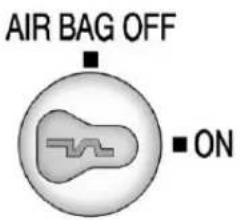
text_image
AIR BAG OFF ■ ONUnitedStates
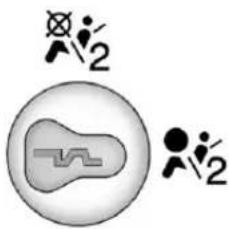
natural_image
Abstract diagram with three symbolic figures and a central waveform-like symbol (no text or labels)CanadaandMexico
Ifthevehicledoesnothavean airbagon-offswitch,itmayhavea passengersensingsystem.See PassengerSensingSystemon page3-30.
This switch should only be turned to the off position if the person in the right front passenger position is a member of a passenger risk group identified by thenational government as follows:
Infant.Aninfant(lessthan 1yearold)mustrideinthe frontseatbecause:
• Myvehiclehasnorearseat;
• Myvehiclehasarearseattoo smalltoaccommodatea rear-facinginfantseat;or
- Theinfanthasamedical conditionwhich,accordingtothe infant'sphysician,makesit necessaryfortheinfanttoridein thefrontseatsothatthedriver canconstantlymonitorthe child'scondition.
Childage1to12.Achild age1to12mustrideinthe frontseatbecause:
• Myvehiclehasnorearseat;
- Althoughchildrenages1to12 rideintherearseat(s)whenever possible,childrenages1to12 sometimesmustrideinthefront becausenospaceisavailablein therearseat(s)ofmyvehicle;or
- Thechildhasamedical conditionwhich,accordingtothe child'sphysician,makesit necessaryforthechildtoridein thefrontseatsothatthedriver canconstantlymonitorthe child'scondition.
MedicalCondition.Apassenger hasamedicalconditionwhich, accordingtohisorherphysician:
- Causesthepassengerairbagto poseaspecialriskforthe passenger; and
- Makesthepotentialharmfrom thepassengerairbaginacrash greaterthanthepotentialharm fromturningofftheairbagand allowingthepassenger,evenif belted,tohittheinstrument panelorwindshieldinacrash.

WARNING
Iftherightfrontpassengerairbag isturnedoffforapersonwhois notinariskgroupidentifiedby thenationalgovernment,that personwillnothavetheextra protectionofanairbag.Ina crash,theairbagwillnotbeable toinflateandhelpprotectthe personsittingthere. Donotturnoffthepassenger airbagunlessthepersonsitting thereisinariskgroup.
3-28SeatsandRestraints
PASSENGER

AIR BAG OFF
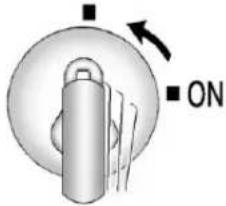
natural_image
Diagram of a mechanical switch or lever with directional arrows and 'ON' label (no text or symbols beyond basic diagram)UnitedStatesCanadaandMexico
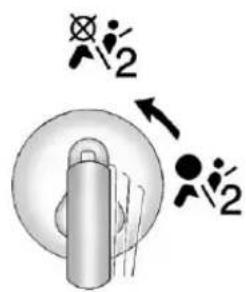
text_image
Diagram showing mechanical components with symbols and arrows, including a cylindrical component and directional arrows.Toturnofftherightfrontpassenger frontalairbag, inserttheignitionkey intotheswitch, pushin, andmove theswitchtotheoffposition.
Theairbagofflightwillcomeon toletyouknowtherightfront passengerairbagisoff.Theairbag offlightwillstayontoremindyou thattheairbagisoff.SeeAirbag On-OffLightonpage5-18.Theright frontpassengerairbagwillremain offuntilyouturnitbackonagain.

WARNING
If the airbagreadinesslight ever comes on and stay on, it mean that something may be wrong with the air bagsystem. Fore example, theright front passenger air bag could inflate even though the air bagon-off switchisturned off.
(Continued)
WARNING(Continued)
Tohelpavoidinjurytoyourselfor others,havethevehicleserviced rightaway.SeeAirbagReadiness Lightonpage5-18formore information,includingimportant safetyinformation.
PASSENGER

AIR BAG OFF
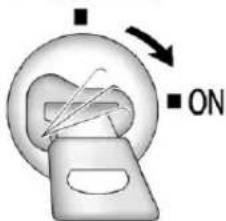
text_image
Diagram showing a device with ON/OFF indicators and directional arrows, likely illustrating a process or control mechanism.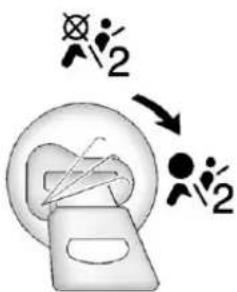
text_image
Diagram showing two figures with exclamation marks and a magnified view of a device, possibly illustrating a safety or safety concept.UnitedStatesCanadaandMexico
Toturntherightfrontpassenger airbagonagain,inserttheignition keyintotheswitch,pushin,and movetheswitchtotheonposition.
Therightfrontpassengerfrontal airbagisnowenabled, and mayinflate. See Airbag On-Off Light on page 5-18 form more information.
PassengerSensing System
Iftheinstrumentpanelhasoneof theindicatorspicturedinthe followingillustrations,thevehicle hasapassengersensingsystem unlessthereisanairbagoffswitch locatedontheinstrumentpanel. Ifthereisanairbagoffswitch,the vehicledoesnothaveapassenger sensingsystem.SeeAirbagOn-Off Switchonpage3-26formore information.
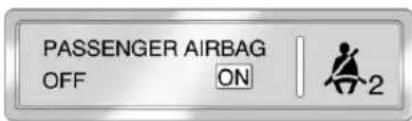
text_image
PASSENGER AIRBAG OFF ON 2UnitedStates
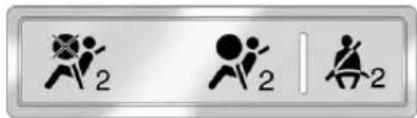
text_image
Three symbolic icons representing martial arts or combat poses, each labeled with the number 2.CanadaandMexico
The passenger air bag status indicator will be visible on the instrument panel when the vehicle is started.
ThewordsONandOFF,orthe symbolforonandoff,willbevisible duringthesystemcheck.Ifyouare usingremotestart,ifequipped,to startthevehiclefromadistance, youmaynotseethesystemcheck. Whenthesystemcheckis complete,eitherthewordONorthe wordOFF,orthesymbolforonor thesymbolforoff,willbevisible. SeePassengerAirbagStatus Indicatoronpage5-20.
Thepassengersensingsystemwill turnofftherightfrontpassenger frontalairbagundercertain conditions.
Thedriverairbagandroof-rail airbags, ifequipped, arenotpartof thepassengersensingsystem.
Thepassengersensingsystem workswithsensorsthatarepartof therightfrontpassengerseat. The sensorsaredesignedtodetectthe presenceofaproperlyseated occupantanddetermineifthe rightfrontpassengerfrontalairbag shouldbeenabled(mayinflate) ornot.
According to accident statistics, Childrenaresaferwhenproperly securedinarearseatinthecorrect childrestraintfortheirweight andsize.
Werecommendthatchildrenbe securedinarearseat,including: aninfantorachildridingina rear-facingchildrestraint;achild ridinginaforward-facingchildseat; anolderchildridinginabooster seat;andchildren,whoarelarge enough,usingsafetybelts.
Alabelonthesunvisorsays, "Neverputarear-facingchildseatin thefront." Thisisbecausetheriskto therear-facingchildissogreat, iftheairbagdeploys.
WARNING
Achildinarear-facingchild restraintcanbeseriouslyinjured orkillediftherightfront passengerairbaginflates. Thisisbecausethebackofthe rear-facingchildrestraintwould beveryclosetotheinflating airbag.Achildinaforward-facing childrestraintcanbeseriously injuredorkillediftherightfront passengerairbaginflatesandthe passengerseatisinaforward position.
Evenifthepassengersensing systemhasturnedofftheright frontpassengerfrontalairbag, no systemisfail-safe. Noonecan guaranteeethatanairbagwillnot deployundersomeunusual circumstance, even though the airbagisturnedoff.
(Continued)
WARNING(Continued)
Securerear-facingchildrestraints inarearseat, evenifthe airbagisoff. Ifyousecurea forward-facingchildrestraintin therightfrontseat, alwaysmove thefrontpassengerseatasfar backasitwillgo. Itisbetterto securethechildrestraintina rearseat.
Ifthevehicledoesnothavea rearseatthatwillaccommodatea rear-facingchildrestraint,a rear-facingchildrestraintshouldnot beinstalledinthevehicle,evenif theairbagisoff.
3-32SeatsandRestraints
Thepassengersensingsystemis designedtoturnofftherightfront passengerfrontalairbagif:
• Therightfrontpassengerseatis unoccupied.
- Thesystemdeterminesthatan infantispresentinarear-facing infantseat.
- Thesystemdeterminesthata smallchilddispresentinachild restraint.
- Thesystemdeterminesthata smallchildispresentina boosterseat.
- Arightfrontpassengertakes his/herweightoffoftheseatfor aperiodoftime.
- Therightfrontpassengerseatis occupied byasmallerperson, suchasachildwhohas outgrownchildrestraints.
- Or, if there is a critical problem with the air bagsystem or the passengersensingsystem.
Whenthepassengersensing systemhasturnedofftherightfront passengerfrontalairbag,theoff indicatorwilllightandstaylitto remindyouthattheairbagisoff. SeePassengerAirbagStatus Indicatoronpage5-20.
Thepassengersensingsystemis designedtoturnon(mayinflate)the rightfrontpassengerfrontalairbag anytimethesystemsensesthata personofadultsizeissitting properlyintherightfront passengerseat.
Whenthepassengersensing systemhasallowedtheairbagtobe enabled, theonindicatorwilllight andstaylittoremindyouthatthe airbagisactive.
Forsomechildrenwhohave outgrownchildrestraintsandfor verysmalladults,thepassenger sensingsystemmayormaynotturn offtherightfrontpassengerfrontal airbag,dependinguponthe person'sseatingpostureand bodybuild.
Everyoneinthevehiclewho hasoutgrownchildrestraints shouldwearasafetybelt properly—whetherornotthere isanairbagforthatperson.

WARNING
If the airbagreadiness light ever comes on and stay son, it means that something may bewrong with the air bagsystem. To help avoid injury to your self for others, have the vehicles serviced right away. See Airbag Readiness Lighton page 5-18 form more information, including important safety information.
IftheOnIndicatorisLitfora ChildRestraint
Ifachildrestrainhasbeeninstalled andtheonindicatorislit:
- Turnthevehicleoff.
- Removethechildrestraint from the vehicle.
-
Remove any additional items from these seats such as blankets, cushions, seat covers, seat heaters, or seat massagers.
-
Reinstall the child restraint following the directions provided by the child restraint manufacturer and referto Securing Child Restraints (Rear Seat Position) on page 3-53 or Securing Child Restraints (Front Seat-Passenger Sensing System) on page 3-55 or Securing Child Restraints (Front Seat-Airbag On/Off Switch) on page 3-58.
-
If, afterreinstalling the child restraint and restarting the vehicle, the on indicator is still lit, turn the vehicle off. Then slightly reclin the vehicle seat back and adjust these at cushion, if adjustable, to make sure that the vehicle seat back is not pushing the child restraint into these at cushion.
6.Restartthevehicle.
Iftheonindicatorisstilllit, securethechildinthechild restraintinarearseatposition inthevehicle,andcheckwith yourdealer.
Ifnorearseatisavailable, donotinstallachildrestraint inthisvehicle.
IftheOffIndicatorisLitforan Adult-SizeOccupant
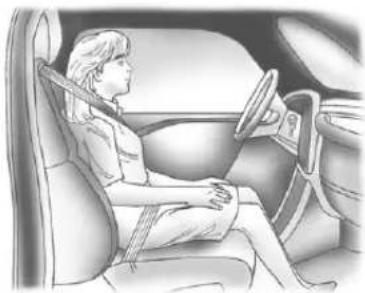
natural_image
Interior view of a car showing a person seated in the driver's seat, wearing a seatbelt and steering wheel (no text or symbols visible)Ifapersonofadult-sizeissittingin therightfrontpassengerseat, but theoffindicatorislit, it could be because that person is not sitting properly in theseat. If this happens, usethefollowingstepstoallowthe
systemtodetectthatpersonand enabletherightfrontpassenger frontalairbag:
- Turnthevehicleoff.
- Remove any additional material from these seat, such as blankets, cushions, seat covers, seat heaters, or seat massagers.
- Placetheseatbackinthefully uprightposition.
- Havethepersonsituprightin theseat, centeredontheseat cushion, with legscomfortably extended.
- Restart the vehicle and have the person remain in this position for two to three minutes after the conductor is lit.
Thisallowsthesystemtodetectthat personandthenenabletheright frontpassengerfrontalairbag.
AdditionalFactorsAffecting SystemOperation
Safetybeltshelpkeepthe passengerinpositionontheseat duringvehiclemaneuversand braking,whichhelpsthepassenger sensingsystemmaintainthe passengerairbagstatus.See "SafetyBelts"and"ChildRestraints" intheIndexforadditional informationabouttheimportanceof properrestraintuse.
Athicklayerofadditionalmaterial, suchasablanketorcushion, oraftermarketequipmentsuchas seatcovers,seatheaters,andseat massagerscanaffecthowwellthe passengersensingsystem operates.Werecommendthatyou notuseseatcoversorother aftermarketequipmentexceptwhen approvedbyGMforyourspecific vehicle.SeeAddingEquipmentto theAirbag-EquippedVehicleon page3-35formoreinformation aboutmodificationsthatcanaffect howthesystemoperates.
Theonindicatormaybelitifan object,suchasabriefcase, handbag,grocerybag,laptopor otherelectronicdevice,isputonan unoccupiedseat.Ifthisisnot desiredremovetheobjectfrom theseat.

WARNING
Stowingofarticlesunderthe passengerseatorbetweenthe passengerseatcushionand seatbackmayinterferewiththe properoperationofthepassenger sensingsystem.
Servicingthe Airbag-EquippedVehicle
Airbags affect how the vehicle should be serviced. There are parts of the air bagsystem in several places around the vehicle. Your dealer and the servicemanual have information about servicing the vehicle and the air bags system.
Topurchaseaservicemanual, see ServicePublicationsOrdering Informationonpage13-18.

WARNING
Forupto10secondsafterthe vehicleisturnedoffandthe batteryisdisconnected,anairbag canstillinflateduringimproper service.Youcanbeinjuredifyou areclosetoanairbagwhenit inflates.Avoidyellowconnectors. Theyareprobablypartofthe airbagsystem.Besuretofollow properserviceprocedures,and makesurethepersonperforming workforyouisqualifiedtodoso.
AddingEquipmenttothe Airbag-EquippedVehicle
Q: Isthereanythinglmightadd toorchangeaboutthevehicle thatcouldkeeptheairbags fromworkingproperly?
A: Yes. If you add things that changethe vehicle's frame, bumpersystem, height, frontend or sidesheet metal, they may keep the air bags system from working properly. Changing or moving any part of the front seats, safety belts, the airbag sensing and diagnostic module, steering wheel, instrument panel, roof-rail air bag modules, ceiling headliner or pillargarnish trim, frontsensors, rollover sensor module, or airbag wiring can affect the operation of the air bags system.
Inaddition, the vehicle may have passengers sensing system for the right front passenger position, which includes sensor that are part of the passenger seat. The passengers sensing system may not operate properly if the original seat trim is replaced with non-GM covers, upholstery or trim, or with GM covers, upholstery or trim designed for different vehicle. Any object, such as an aftermarket seat heater or comfortenancing pad device, installed under or on top of these at fabric, could also interfere with the operation of the passengers sensing system. This could either prevent proper deployment of the passenger air bag(s) or prevent the passengers sensing system from properly turning off the passenger air bag(s). See Passenger Sensing System page 3-30.
If you have any questions about this, you should contact Customer Assistance before you modify the vehicle. The phone numbers and addresses for Customer Assistance are in Step Two of the Customer Satisfaction Procedure in this manual. See Customer Satisfaction Procedure (U.S. and Canada) on page 13-1 or Customer Satisfaction Procedure (Mexico) on page 13-3.
If the vehicle has rollover roof-rail airbags, see Different Size Tires and Wheelson page 10-67 for additional important information.
Q: Because I have adisability, Ihavetogetmy vehicle modified. How can find out whether this will affect my air bagsystem?
A: If you have questions, call Customer Assistance. The phonenumbers and addresses for Customer Assistance are in Step Two of the Customer Satisfaction Procedure in this manual. See Customer Satisfaction Procedure (U.S. and Canada) on page 13-1 or Customer Satisfaction Procedure (Mexico) on page 13-3.
Inaddition, your dealer and the servicemanual have information about the location of the airbag sensors, sensing and diagnostic module and airbag wiring.
AirbagSystemCheck
The airbagsystemdoesnotneed regularly scheduled maintenance or replacement. Makesure the airbagreadinesslightisworking. See AirbagReadinessLighton page 5-18 form more information.
Notice:Ifanairbagcoveringis damaged,opened,orbroken,the airbagmaynotworkproperly. Donotopenorbreaktheairbag coverings.Ifthereareany openedorbrokenairbagcovers, havetheairbagcoveringand/or airbagmodulereplaced.Forthe locationoftheairbags,see WhereAretheAirbags?on page3-20.Seeyourdealerfor service.
ReplacingAirbagSystem PartsafteraCrash

WARNING
Acrashcandamagethe airbagsystemsinthevehicle. Adamagedairbagsystemmay notworkproperlyandmay notprotectyouandyour passenger(s)inacrash,resulting inseriousinjuryorevendeath. Tohelpmakesuretheairbag systemsareworkingproperly afteracrash,havethem inspectedandanynecessary replacementsmadeassoon aspossible.
Ifanairbaginflates, you will need to replace airbagsystemparts. Seeyourdealerforservice.
If the airbag readiness light stay on after the vehicle is started or comes on when you are driving, the airbag system may not work properly. Havethe vehicles serviced right away. See Airbag Readiness Light on page 5-18 form more information.
ChildRestraints OlderChildren
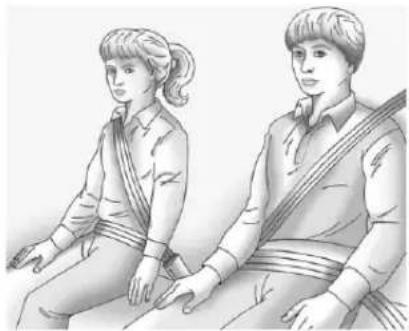
natural_image
Illustration of two individuals seated, one wearing a patterned garment and the other in a collared shirt (no text or symbols)Olderchildrenwhohaveoutgrown boosterseatsshouldwearthe vehiclesafetybelts.
Themanufacturer'sinstructionsthat comewiththeboosterseatstate theweightandheightlimitationsfor thatbooster.
Useaboosterseatwitha lap-shoulderbeltuntilthechild passesthefittestbelow:
- Sitallthewaybackontheseat. Dothekneesbendattheseat edge?Ifyes,continue.Ifno, returntotheboosterseat.
- Bucklethelap-shoulderbelt. Doestheshoulderbeltreston theshoulder?Ifyes,continue. Ifno,tryusingtherearsafety beltcomfortguide.See"Rear SafetyBeltComfortGuides" underLap-ShoulderBelton page3-11formoreinformation. Iftheshoulderbeltstilldoesnot restontheshoulder,thenreturn totheboosterseat.
- Doesthelapbeltfitlowand snugonthehips,touchingthe thighs?Ifyes,continue.Ifno, returntotheboosterseat.
- Canpropersafetybeltfitbe maintainedforthelengthofthe trip?Ifyes,continue.Ifno, returntotheboosterseat.
Q:Whatistheproperwayto wearsafetybelts?
A: Anolderchildshouldwearalap-shoulderbeltandgettheadditionalrestraintashoulderbeltcanprovide. Theshoulderbeltshouldnotcrossthefaceorneck. Thelapbeltshouldfit snuglybelowthehips, justtouchingthetopofthethighs.Thisappliesbeltforcetothe child'spelvicbonesinacrash.Itshouldneverbewornovertheabdomen,whichcouldcausesevereorevenfatalinternalinjuriesinacrash.
Alsosee"RearSafetyBeltComfort Guides"underLap-ShoulderBelton page3-11.
According to accident statistics, children and infants are safer when properly restrained in a child restraint system or infant restraint system secured in an arrearseating position.
Inacrash, children who are not buckled up can strike other people who are buckled up, or can be thrown out of the vehicle. Older children need to use safety belts properly.

WARNING
Neverdothis.
Neverallowtwochildrentowear thesamesafetybelt. Thesafety belt cannot properly spread the impact forces. Inacrash, the two children can be crushed together and seriously injured. As safety belt must be used by only one person at time.
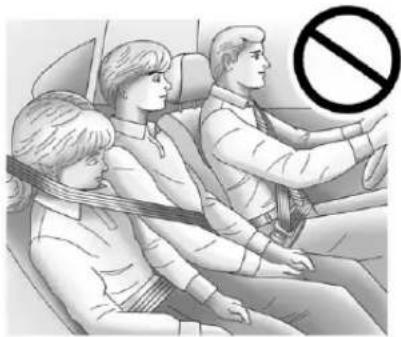
natural_image
Illustration of three people seated in a car, facing each other with a 'no' symbol overlay (no text or symbols present)
WARNING
Neverdothis.
Neverallowachildtowearthe safetybeltwiththeshoulderbelt behindtheirback.Achildcanbe seriouslyinjuredbynotwearing thelap-shoulderbeltproperly. Inacrash,thechildwouldnotbe restrainedbytheshoulderbelt. Thechildcouldmovetoofar forwardincreasingthechanceof headandneckinjury.
(Continued)
WARNING(Continued)
Thechildmightalsoslideunder thelapbelt. Thebeltforcewould thenbeappliedrightonthe abdomen. Thatcouldcause seriousorfatalinjuries. The shoulderbeltshouldgooverthe shoulderandacrossthechest.
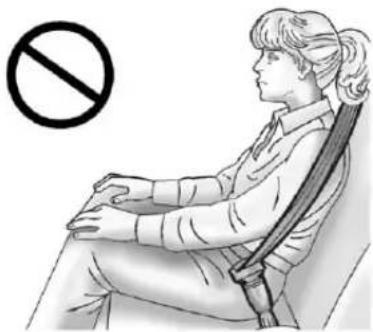
natural_image
Illustration of a person sitting in a chair with a diagonal band, facing away; no text or symbols present.3-40SeatsandRestraints
InfantsandYoung Children
Everyoneinavehicleneeds protection! Thisincludesinfantsand allotherchildren. Neither the distancetravelednortheage and sizeofthetravelerchangesthe need,foreveryone,tousesafety restraints. Infact,thelawinevery stateintheUnitedStatesandin everyCanadianprovincesays childrenuptosomeagemustbe restrainedwhileinavehicle.

WARNING
Childrencanbeseriouslyinjured orstrangledifashoulderbeltis wrappedaroundtheirneckand thesafetybeltcontinuesto tighten.Neverleavechildren unattendedinvehicleandnever allowchildrentoplaywiththe safetybelts.
Airbagspluslap-shoulderbeltsoffer protectionforadultsandolder children,butnotforyoungchildren andinfants.Neitherthevehicle's safetybeltsystemnoritsairbag systemisdesignedforthem.Every timeinfantsandyoungchildrenride invehicles,theyshouldhavethe protectionprovidedbyappropriate childrestraints.
Childrenwhoarenotrestrained properlycanstrikeotherpeople, orcanbethrownoutofthevehicle.

WARNING
Neverdothis.
Neverholdaninfantorachild whileridinginavehicle.Dueto crashforces,aninfantorachild willbecomesoheavyitisnot possibletoholditduringacrash.
(Continued)
WARNING(Continued)
Forexample, inacrashatonly 40km/h (25mph), a 5.5kg (12lb) infantwillsuddenly become a 110kg (240lb) forceona person's arms. An infant should be secured in an appropriate restraint.
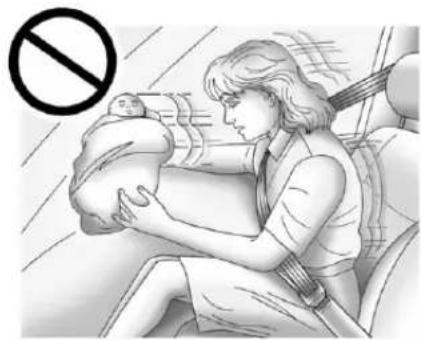
natural_image
Illustration of a woman breastfeeding a baby in a car seat, with a no-smoking symbol overlay (no text or symbols on the diagram itself)WARNING
Neverdothis.
Childrenwhoareupagainst, orverycloseto,anyairbagwhen itinflatescanbeseriouslyinjured orkilled.Neverputarear-facing childrestraintintherightfront seat.Securearear-facingchild restraintinarearseat.Itisalso bettertosecureaforward-facing childrestraintinarearseat.Ifyou mustsecureaforward-facing childrestraintintherightfront seat,alwaysmovethefront passengerseatasfarbackasit willgo.
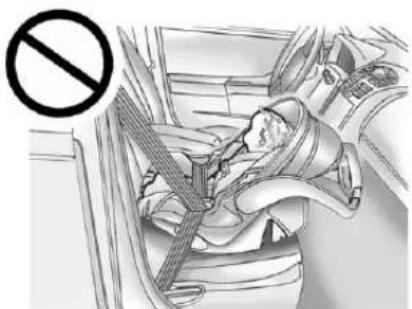
natural_image
Interior view of a car showing a person seated in a seatbelt, with a no-smoking symbol overlaid (no text or labels present)Q: Whatarethedifferenttypes of add-onchildrestraints?
A: Add-onchildrestraints, which are purchased by the vehicle owner, are available in four basic types. Selection of a particular restraint should take into consideration not only the child's weight, height, and age but also whether or not the restraint will be compatible with the motor vehicle in which it will be used.
Formostbasictypesofchild restraints,therearemany differentmodelsavailable.When purchasingachildrestraint,be sureitisdesignedtobeusedin amotorvehicle.Ifitis,the restraintwillhavealabelsaying thatitmeetsfederalmotor vehiclesafetystandards.
Therestraintmanufacturer's instructionsthatcomewiththe restraintstatetheweightand heightlimitationsforaparticular childrestraint.Inaddition,there aremanykindsofrestraints availableforchildrenwith specialneeds.

WARNING
Toreducetheriskofneck and headinjuryduringacrash,infants needcompletesupport. This is becauseaninfant'sneckisnot fullydevelopedanditshead weighssomuchcomparedwith therestofitsbody.Inacrash,an infantinarear-facingchild restraintsettlesintotherestraint, sothecrashforcescanbe distributedacrossthestrongest partofaninfant'sbody,theback andshoulders.Infantsshould alwaysbesecuredinrear-facing childrestraints.

WARNING
Ayoungchild'shipbonesarestill sosmallthatthevehicle'sregular safetybeltmaynotremainlowon thehipbones,asitshould. Instead,itmaysettleuparound thechild'sabdomen.Inacrash, thebeltwouldapplyforceona bodyareathatisunprotectedby anybonystructure.Thisalone couldcauseseriousorfatal injuries.Toreducetheriskof seriousorfatalinjuriesduringa crash,youngchildrenshould alwaysbesecuredinappropriate childrestraints.
ChildRestraintSystems
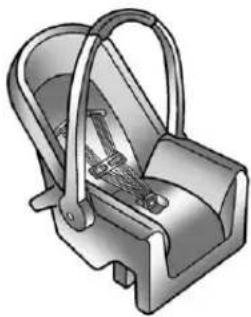
natural_image
3D illustration of a mechanical component with handle and internal structure (no text or symbols)(A)Rear-FacingInfantSeat
Arear-facinginfantseat(A) providesrestraintwiththeseating surfaceagainstthebackofthe infant.
The harnesssystemholdstheinfant inplaceand,inacrash,actsto keeptheinfantpositionedinthe restraint.
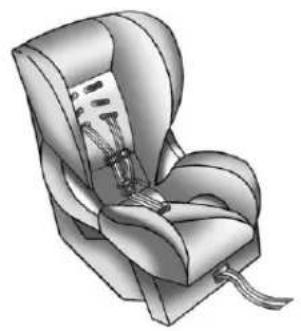
natural_image
Illustration of a car seat with straps and seats (no text or symbols)(B)Forward-FacingChildSeat
Aforward-facingchildseat(B) provides restraint for the child's body with the harness.
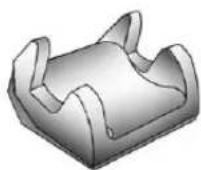
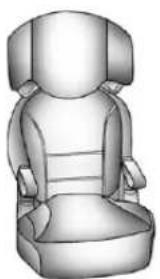
natural_image
3D rendered illustration of a car seat with no text or symbols(C)BoosterSeats
Aboosterseat(C)isachildrestraint designedtoimprovethefitofthe vehicle'ssafetybeltsystem. Aboosterseatcanalsohelpa childtoseeoutthewindow.
SecuringanAdd-OnChild RestraintintheVehicle

WARNING
Achildcanbeseriouslyinjuredor killedinacrashifthechild restraintisnotproperlysecuredin thevehicle.Securethechild restraintproperlyinthevehicle usingthevehiclesafetybeltor LATCHsystem,followingthe instructionsthatcamewiththat childrestraintandtheinstructions inthismanual.
Tohelpreducethechanceofinjury, thechildrestraintmustbesecured inthevehicle.Childrestraint systemsmustbesecuredinvehicle seatsbylapbeltsorthelapbelt portionofalap-shoulderbelt,orby theLATCHsystem.SeeLower AnchorsandTethersforChildren (LATCHSystem)onpage3-46for moreinformation.
3-44SeatsandRestraints
Childrencanbeendangeredina crashifthechildrestraintisnot properlysecuredinthevehicle.
Whensecuringanadd-onchild restraint, refertotheinstructions that comewiththerestraint which maybeontherestraintitselforina booklet, or both, and to this manual. The child restraint instructions are important, so if they are not available, obtain are replacement copy from the manufacturer.
Keepinmindthatanunsecured childrestraintcanmovearoundina collisionorsuddenstopandinjure peopleinthevehicle.Besureto properlysecureanychildrestraintin thevehicle—evenwhennochild isinit.
InsomeareasoftheUnitedStates andCanada,CertifiedChild PassengerSafetyTechnicians (CPSTs)areavailabletoinspect anddemonstratehowtocorrectly useandinstallchildrestraints. IntheU.S.,refertothe NationalHighwayTrafficSafety Administration(NHTSA)websiteto locatethenearestchildsafetyseat inspectionstation.ForCPST availabilityinCanada,checkwith TransportCanadaortheProvincial MinistryofTransportationoffice.
SecuringtheChildWithinthe ChildRestraint

WARNING
Achildcanbeseriouslyinjuredor killedinacrashifthechildisnot properlysecuredinthechild restraint.Securethechild properlyfollowingtheinstructions thatcamewiththatchildrestraint.
WheretoPutthe Restraint
According to accident statistics, children and infants are safer when properly restrained in child restraintsystem or infant restraintsystem secured in a rearseating position.
Werecommendthatchildrenand childrestraintsbesecuredinarear seat,including:aninfantorachild ridinginarear-facingchildrestraint; achildridinginaforward-facing childseat;anolderchildridingina boosterseat;andchildren,whoare largeenough,usingsafetybelts.
Ifachildrestraintissecuredinthe rightfrontpassengerseat, andthere isaswitchontheinstrumentpanel tomanuallyturnofftherightfront passengerairbag.SeeAirbag On-OffSwitchonpage3-26and SecuringChildRestraints(Rear SeatPosition)onpage3-53or SecuringChildRestraints(Front Seat-PassengerSensingSystem) onpage3-55orSecuringChild
Restraints(FrontSeat-AirbagOn/Off Switch)onpage3-58formore information, including important safetyinformation.
Alabelonthesunvisorsays, "Neverputarear-facingchildseatin thefront." Thisisbecausetheriskto therear-facingchildissogreat, iftheairbagdeploys.

WARNING
Achildinarear-facingchild restraintcanbeseriously injuredorkillediftherightfront passengerairbaginflates. Thisisbecausethebackofthe rear-facingchildrestraintwould beveryclosetotheinflating airbag.Achildinaforward-facing childrestraintcanbeseriously injuredorkillediftherightfront passengerairbaginflatesandthe passengerseatisinaforward position.
(Continued)
WARNING(Continued)
Evenifthepassengersensing systemorairbagswitchhas turnedofftherightfront passengerfrontalairbag,no systemisfail-safe.Noonecan guaranteeethatanairbagwillnot deployundersomeunusual circumstance,eventhoughtit isturnedoff.
Securerear-facingchild restraintsinarearseat,evenif theairbagisoff.Ifyousecurea forward-facingchildrestraintin therightfrontseat,alwaysmove thefrontpassengerseatasfar backasitwillgo.Itisbetterto securethechildrestraintina rearseat.
Whensecuringachildrestraintin arearseatingposition,studythe instructionsthatcamewiththe childrestrainttomakesureitis compatiblewiththisvehicle.
Childrestraintsandboosterseats varyconsiderablyinsize, and some mayfitincertainseatingpositions betterthanothers. Alwaysmake surethechildrestraintisproperly secured.
Dependingonwhereyouplacethe childrestraintandthesizeofthe childrestraint,youmaynotbeable toaccessadjacentsafetybelt assembliesorLATCHanchorsfor additionalpassengersorchild restraints.Adjacentseating positionsshouldnotbeusedifthe childrestraintpreventsaccesstoor interfereswiththeroutingofthe safetybelt.
Ifthevehicledoesnothavea rearseatthatwillaccommodate arear-facingchildrestraint,a rear-facingchildrestraintshouldnot beinstalledinthevehicle,evenif theairbagisoff.
Whereverachildrestraintis installed, besuretosecurethe childrestraintproperly.
Keepinmindthatanunsecured childrestraintcanmovearoundina collisionorsuddenstopandinjure peopleinthevehicle.Besureto properlysecureanychildrestraintin thevehicle—evenwhennochild isinit.
LowerAnchorsand TethersforChildren (LATCHSystem)
TheLATCHsystemholdsachild restraintduringdrivingorinacrash. Thissystemisdesignedtomake installationofachildrestrainteasier. TheLATCHsystemusesanchorsin thevehicleandattachmentsonthe childrestraintthataremadeforuse withtheLATCHsystem.
MakesurethataLATCH-compatible childrestraintisproperlyinstalled usingtheanchors,orusethe vehicle'ssafetybeltstosecurethe restraint,followingtheinstructions thatcamewiththatrestraint,and alsotheinstructionsinthismanual.
Wheninstallingachildrestraintwith atoptether,youmustalsouse eithertheloweranchorsorthe safetybeltstoproperlysecurethe childrestraint.Achildrestraintmust neverbeinstalledusingonlythetop tetherstrapandanchor.
InordertousetheLATCHsystem inyourvehicle,youneedachild restraintthathasLATCH attachments.Thechildrestraint manufacturerwillprovideyouwith instructionsonhowtousethechild restraintanditsattachments. Thefollowingexplainshowtoattach achildrestraintwiththese attachmentsinyourvehicle.
Notallvehicleseatingpositionson childrestraintshaveloweranchors andattachmentsortoptether anchorsandattachments.
LowerAnchors
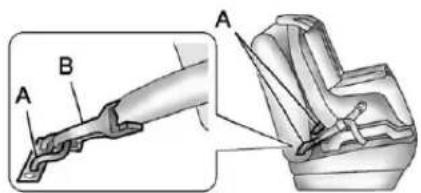
text_image
Technical diagram showing mechanical assembly with labeled parts A and B, including a close-up view of the component.Loweranchors(A)aremetalbars builtintothevehicle.Therearetwo loweranchorsforeachLATCH seatingpositionthatwill accommodateachildrestraintwith lowerattachments(B).
TopTetherAnchor
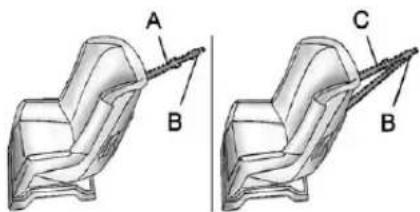
text_image
A B C BAtoptether(A,C)anchorsthetop ofthechildrestrainttothevehicle. Atoptetheranchorisbuiltintothe vehicle. Thetoptether attachment(B)onthechildrestraint connectstothetoptetheranchorin thevehicleinordertoreducethe forwardmovementandrotationof thechildrestraintduringdrivingor inacrash.
Yourchildrestraintmayhavea singletether(A)oradualtether(C). Eitherwillhaveasingle attachment(B)tosecurethetop tethertotheanchor.
Somechildrestraintsthathavea toptetheraredesignedforusewith orwithoutthetoptetherbeing attached.Othersrequirethetop tetheralwaystobeattached. InCanada,thelawrequiresthat forward-facingchildrestraintshave atoptether,andthatthetetherbe attached.Besuretoreadandfollow theinstructionsforyourchild restraint.
LowerAnchorandTopTether AnchorLocations
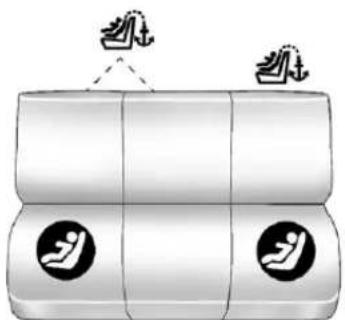
natural_image
Illustration of a car seat with two seats and two standing seats, no text or symbols presentSecond, Third, and Fourth Row with Three-Passenger Seat
(TopTetherAnchor): Seating positions with toptetheranchors.
(LowerAnchor): Seating positions with twolower anchors.
Seetheinformationfollowingfor installingachildrestraintwitha toptetherinthesecond,third,and fourthrowcenterpositions.
Donotinstallthreechildrestraintsin thesamerowatthesametimeand neverinstalltwotoptethersusing thesametoptetheranchor.
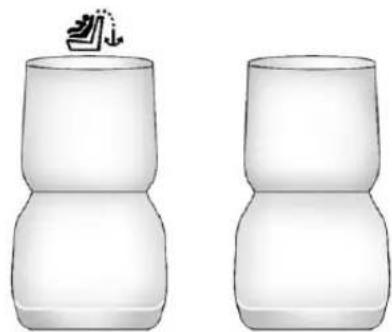
natural_image
Two identical white cylindrical objects with rounded tops, one with a small icon above it (no text or symbols)FrontPassengerPosition
(TopTetherAnchor): Seating positions with toptetheranchors.
Thesecond, third, and fourth throw with three-passenger seat have exposed metallower anchors located in the decrease between the seatback and these seat cushion.
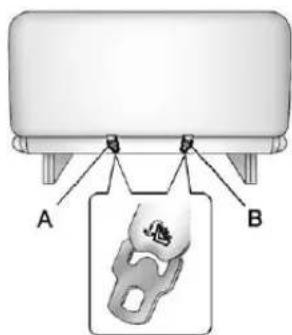
text_image
A BSecond, Third, and Fourth Row with Three-Passenger Seat—Passenger Van
Therearetwotoptetheranchorsin thesecond-,third-,andfourth-row three-passengerseats.Toinstalla childrestraintinthereardriver-side seatingpositions,useanchor point(A).Toinstallachildrestraint intherearpassenger-sideseating positions,useanchorpoint(B).Toinstallachildrestraintintherear centerseatingpositions,useanchor point(B).Neverinstalltwotop tethersusingthesametoptether anchor.
If the vehicle is equipped with a four-passenger fourth-or fifth-row seat, it does not have upper or lower anchors. If a child restraint is placed in the four-passenger fourth or fifth-row seat, it must be secured using the vehicles safety belts. See "Rear Seat Position" under Securing Child Restraints (Rear Seat Position) on page 3-53 or Securing Child Restraints (Front Seat-Passenger Sensing System) on page 3-55 or Securing Child Restraints (Front Seat-Airbag On/Off Switch) on page 3-58 form more information.
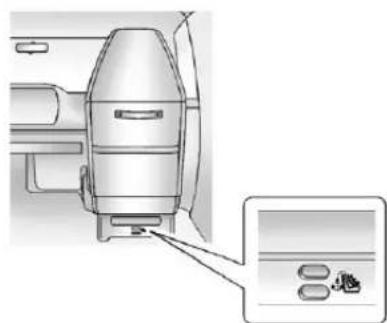
natural_image
Technical diagram of a vehicle air intake system with control panel and battery (no text or symbols)FrontPassengerPosition
Thereisatoptetheranchorforthe frontpassengerpositionwithafront passengerseat.Theanchoris locatedattherearoftheseat cushionontherightfront passengerseat.
Donotsecureachildrestraintina positionwithoutatoptetheranchor ifanationalorlocallawrequires thatthetoptetherbeattached,orif theinstructionsthatcomewiththe childrestraintsaythatthetoptether mustbeattached.
According to accident statistics, children and infants are safer when properly restrained in a child restraintsystemor infant restraint system secured in a rearseating position. See Where to Put the Restrainton page 3-45 for additional information.
SecuringaChildRestraint DesignedfortheLATCH System

WARNING
IfaLATCH-typechildrestraintis notattachedtoanchors, thechild restraintwillnotbeabletoprotect thechildcorrectly. Inacrash, the childcouldbeseriouslyinjuredor killed. InstallaLATCH-typechild restraintproperlyusingthe anchors, orusethevehiclesafety beltstosecuretherestraint, followingtheinstructionsthat camewiththechildrestraintand theinstructionsinthismanual.

WARNING
Donotattachmorethanonechild restrainttoasingleanchor. Attachingmorethanonechild
(Continued)
WARNING(Continued)
restrainttoasingleanchorcould causetheanchororattachment tocomelooseorevenbreak duringacrash.Achildorothers couldbeinjured.Toreducethe riskofseriousorfatalinjuries duringacrash,attachonly onechildrestraintperanchor.

WARNING
Childrencanbeseriouslyinjured orstrangledifashoulderbeltis wrappedaroundtheirneckand thesafetybeltcontinuesto tighten.Buckleanyunusedsafety beltsbehindthechildrestraintso childrencannotreachthem.Pull theshoulderbeltallthewayout oftheretractortosetthelock, ifthevehiclehasone,afterthe childrestrainthasbeeninstalled.
Notice: DonotlettheLATCH attachmentsrubagainstthe vehicle'ssafetybelts. This may damage these parts. If necessary, move buckledsafetybeltsto avoid rubbing the LATCH attachments.
Donotfoldtheemptyrearseat withasafetybeltbuckled. This coulddamagethesafetybeltor theseat. Unbuckleandreturnthe safetybelttoitsstowedposition, beforefoldingtheseat.
- Attachandtightenthelower attachmentstothelower anchors. If the child restraint does nothavelower attachmentsorthedesired seating positiondoes nothave lower anchors, secure the child restraint with the toptether and the safety belts. Refertoyour child restraint manufacturer instructions and the instructions in this manual.
1.1. Find the lower anchors for the desired seating position.
1.2. Put the child restraint on theseat.
1.3. Attachandtightenthelower attachmentsonthechild restrainttothelower anchors.
- If the child restraint manufacturer recommends that the toptether be attached, attach and tighten the toptethertothetoptether anchor, if equipped. Referto the child restraint instructions and the following steps:
2.1. Findthetoptetheranchor.
2.2.Forthesecond,third,and
fourthrowwith
three-passengerseatsonly,
inthereardriver-side
seatingpositions,use
anchorpoint(A).Forthe
rearpassenger-sideseating
positions,useanchor
point(B).
Forthecenterseating positions, useanchor point(B). Neverinstalltwo toptethersusingthesame toptetheranchor.
2.3. Route and tightenthetop tether according to your childrestraint instructions and the following instructions:
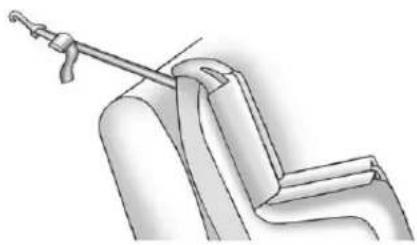
natural_image
Technical line drawing of a mechanical assembly with a tool inserted into a component (no text or symbols)If the position you are using does not have ahead rest or head restraint and you are using a single tether, routethetether over the seat back.
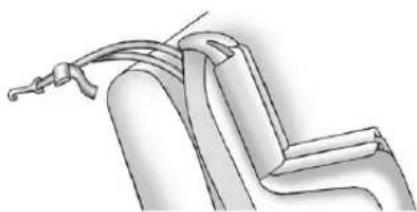
natural_image
Technical line drawing of a mechanical component or assembly (no text or symbols)If the position you are using does not have ahead rest or head restraint and you are using adualtether, routethetether over theseatback.

natural_image
Technical line drawing of a mechanical component with straps and mounting feet (no text or symbols)If the position you are using has an integrated headrest or headrestraint and you are using adualtether, routethetether around the headrestorheadrestraint.

natural_image
Technical line drawing of a mechanical component with no visible text or symbolsIf the position you are using has an integrated headrest or head restraint and you are using a single tether, routethetether over the headrestor head restraint.
- Beforeplacingachildinthe childrestraint, makesureitis securelyheldinplace. To check, graspthechildrestraintatthe LATCHpathandattemptto moveitsidetosideandback andforth. Thereshouldbeno morethan2.5cm(1in)of movementforproperinstallation.
ReplacingLATCHSystem PartsAfteraCrash

WARNING
AcrashcandamagetheLATCH systeminthevehicle. Adamaged LATCHsystemmaynotproperly securethechildrestraint, resultinginseriousinjuryoreven deathinacrash. To helpmake suretheLATCHsystemis workingproperlyafteracrash, seeyourdealertohavethe systeminspectedandany necessary replacementsmadeas soonaspossible.
IfthevehiclehastheLATCHsystem anditwasbeingusedduringa crash,newLATCHsystemparts maybeneeded.
Newpartsandrepairsmaybe necessaryeveniftheLATCH systemwasnotbeingusedatthe timeofthecrash.
SecuringChildRestraints (RearSeatPosition)
Whensecuringachildrestraintina rearseatingposition,studythe instructionsthatcamewiththechild restrainttomakesureitis compatiblewiththisvehicle.
If the child restraint that the LATCH system, see Lower Anchors and Tethers for Children (LATCH System) on page 3-46 for how and where to install the child restraint using LATCH. If a child restraint is secured in the vehicle using a safety belt and it uses to optether, see Lower Anchors and Tethers for Children (LATCH System) on page 3-46 for optether anchor locations.
Donotsecureachildseatina positionwithoutatoptetheranchor ifanationalorlocallawrequires thatthetoptetherbeanchored,orif theinstructionsthatcomewiththe childrestraintsaythatthetopstrap mustbeanchored.
InCanada, the law requires that forward-facing child restraint have adopted, and that the tether be attached.
If the child restraint does not have the LATCH system, you will be using the safety belt to secure the child restraint in this position. Besure to follow the instructions that camewith the child restraint. Secure the child in the child restraint when and asthe instruction say.
If more than one child restraint need to be installed in therear seat, besuretoread Where to Put the Restrainton page 3-45.
-
Putthechildrestraint on theseat.
-
Pickup the latch plate, and run the lap and shoulder portions of the vehicles safety belt through or around therestraint. The child restraint instructions will show you how.
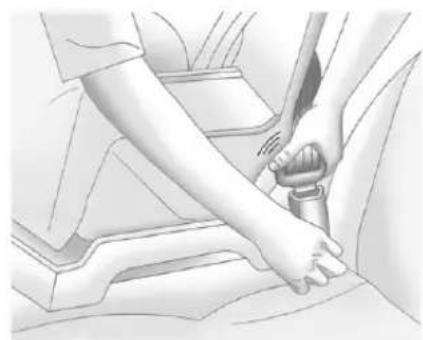
natural_image
Illustration of a hand using a belt switch to adjust the seat area (no text or symbols visible)- Pushthelatchplate into the buckle until it clicks.
Positionthereleasebuttonon thebucklesothatthesafetybelt couldbequicklyunbuckledif necessary.
3-54SeatsandRestraints
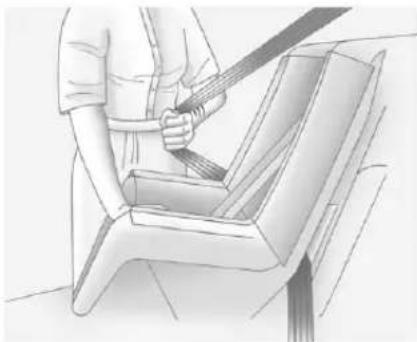
natural_image
Illustration of a person using a belt to lift a seatbelt (no text or symbols present)- Pulltheshoulderbeltalltheway outoftheretractortosetthe lock. Whentheretractorlockis set, thebeltcanbetightenedbut notpulledoutoftheretractor.
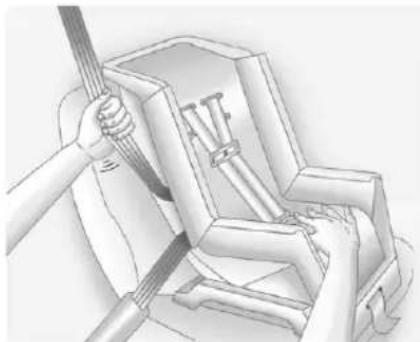
natural_image
Illustration of a hand using a tool to lift or install a mechanical component (no text or symbols visible)-
Totightenthebelt, pushdown onthechildrestraint, pullthe shoulderportionofthebelt to tightenthalapportionofthebelt, andfeedtheshoulderbeltback intotheretractor. Wheninstalling aforward-facingchildrestraint, it maybehelpfultouseyourknee topushdownonthechild restraintasyoutightenthebelt.
Trytopullthebeltoutofthe retractortomakesurethe retractorislocked.Ifthe retractorisnotlocked,repeat Steps4and5. -
If the child restraint has a top tether, follow the child restraint manufacturer's instructions regarding the use of the top tether. See Lower Anchors and Tethers for Children (LATCH System) on page 3-46 form more information.
- Beforeplacingachildinthe childrestraint, makesureitis securelyheldinplace. To check, graspthechildrestraintatthe safetybeltpathandattemptto moveitsidetosideandback andforth. Whenthechild restraintisproperlyinstalled, thereshouldbenomorethan 2.5cm(1in)ofmovement.
Toremovethechildrestraint, unbucklethevehiclesafetybeltand letitreturntothestowedposition. Ifthetoptetherisattachedtoatop tetheranchor, disconnectit.
SecuringChildRestraints (FrontSeat-Passenger SensingSystem)
This vehicle has airbags. Arear seatisasafer placetosecurea forward-facing child restraint. See Where to Put the Restrainton page 3-45.
Onvehicleswithapassenger sensingsystem,thesystemis designedtoturnofftherightfront passengerfrontalairbagunder certainconditions.SeePassenger SensingSystemonpage3-30and PassengerAirbagStatusIndicator onpage5-20formoreinformation, includingimportantsafety information.
Alabelonthesunvisorsays, "Neverputarear-facingchildseatin thefront." Thisisbecausetheriskto therear-facingchildissogreat, iftheairbagdeploys.
WARNING
Achildinarear-facingchild restraintcanbeseriouslyinjured orkillediftherightfront passengerairbaginflates. Thisisbecausethebackofthe rear-facingchildrestraintwould beveryclosetotheinflating airbag.Achildinaforward-facing childrestraintcanbeseriously injuredorkillediftherightfront passengerairbaginflatesandthe passengerseatisinaforward position.
Evenifthepassengersensing systemhasturnedofftheright frontpassengerfrontalairbag,no systemisfail-safe.Noonecan guaranteeethatanairbagwillnot deployundersomeunusual circumstance,eventhoughitis turnedoff.
(Continued)
WARNING(Continued)
Securerear-facingchildrestraints inarearseat, even if the airbagisoff. If you secure a forward-facing child restraint in therightfrontseat, always move thefrontpassenger seat as far backasitwill go. It is better to secure the child restraint in earseat.
See Passenger Sensing System on page 3-30 for additional information.
Ifthevehicledoesnothavea rearseatthatwillaccommodate arear-facingchildrestraint,a rear-facingchildrestraintshouldnot beinstalledinthevehicle,evenif theairbagisoff.
3-56SeatsandRestraints
IfthechildrestrainthastheLATCH system,seeLowerAnchorsand TethersforChildren(LATCH System)onpage3-46forhowand wheretoinstallthechildrestraint usingLATCH.Ifachildrestraintis securedusingasafetybeltandit usesatoptether,seeLower AnchorsandTethersforChildren (LATCHSystem)onpage3-46for toptetheranchorlocations.
Donotsecureachildseatina positionwithoutatoptetheranchor ifanationalorlocallawrequires thatthetoptetherbeanchored, orif theinstructionsthatcomewiththe childrestraintsaythatthetopstrap mustbeanchored.
InCanada, the law requires that forward-facing child restraints have adopted, and that the tether be attached.
Youwillbeusingthelap-shoulder belttosecurethechildrestraintin thisposition.Followtheinstructions thatcamewiththechildrestraint.
-
Movetheseatasfarbackasit willgobeforesecuringthe forward-facingchildrestraint. Whenthepassengersensing systemhasturnedofftheright frontpassengerfrontalairbag, theoffindicatoronthe passengerairbagstatus indicatorshouldlightandstay litwhenthevehicleisstarted. SeePassengerAirbagStatus Indicatoronpage5-20.
-
Putthechildrestraint on theseat.
-
Pickup the latch plate, and run the lap and shoulder portions of the vehicle's safety belt through or around therestraint. The child restraint instructions will show you how.
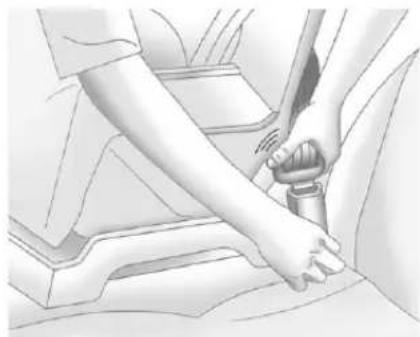
natural_image
Illustration of a person using a belt buckle to lift a car (no text or symbols visible)- Pushthelatchplate into the buckle until it clicks.
Positionthereleasebuttonon thebucklesothatthesafetybelt couldbequicklyunbuckledif necessary.
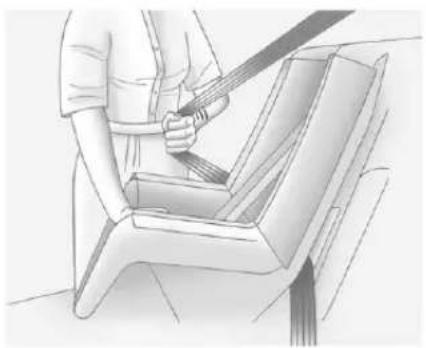
natural_image
Line drawing of a person using a broom to clean or wash a seatbelt (no text or symbols present)- Pulltheshoulderbeltalltheway outoftheretractortosetthe lock. Whentheretractorlockis set, thebeltcanbetightenedbut notpulledoutoftheretractor.
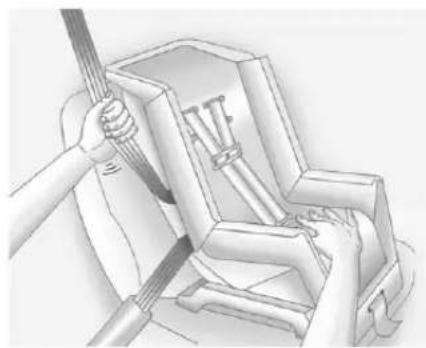
natural_image
Illustration of hands using a tool to lift a mechanical component (no text or symbols visible)-
Totightenthebelt, pushdown onthechildrestraint, pullthe shoulderportionofthebelt to tightenthelapportionofthebelt, andfeedtheshoulderbeltback intotheretractor. Wheninstalling aforward-facingchildrestraint, it maybehelpfultouseyourknee topushdownonthechild restraintasyoutightenthebelt.
Trytopullthebeltoutofthe retractortomakesurethe retractorislocked.Ifthe retractorisnotlocked,repeat Steps5and6. -
If the vehicle does not have a rearse at and the child restraint has to optether, follow the child restraint manufacturer's instructions regarding the use of the optether. See Lower Anchors and Tethers for Children (LATCH System) on page 3-46 form more information.
-
Beforeplacingachildinthe childrestraint, makesureitis securelyheldinplace. To check, graspthechildrestraintatthe safetybeltpathandattemptto moveitsidetosideandback andforth. Whenthechild restraintisproperlyinstalled, thereshouldbenomorethan 2.5cm(1in)ofmovement.
If the air bag is off, the off indicator in the passenger air bag status indicator will come on and stay on when the vehicle is started.
3-58SeatsandRestraints
If the child restraint has been installed and the on indicator is lit, see "If the On Indicator is Lit fora Child Restraint" under Passenger Sensing System on page 3-30 for more information.
Toremovethechildrestraint, unbucklethevehiclesafetybeltand letitreturntothestowedposition.
Ifthetoptetherisattachedtoatop tetheranchor, disconnectit.
SecuringChildRestraints (FrontSeat-AirbagOn/Off Switch)
Thisvehiclehasairbags.Arear seatisasaferplacetosecurea forward-facingchildrestraint. SeeWheretoPuttheRestrainton page3-45.
Onvehicleswithanairbagon/off switch,youcanusethisfeatureto turnofftherightfrontpassenger frontalairbag.Theswitchislocated ontheinstrumentpanel.
See Airbag On-Off Switch on page 3-26 form more information, including important safety information.
Alabelonthesunvisorsays, "Neverputarear-facingchildseatin thefront." Thisisbecausetheriskto therear-facingchildissogreat, iftheairbagdeploys.

WARNING
Achildinarear-facingchild restraintcanbeseriouslyinjured orkillediftherightfront passengerairbaginflates. Thisisbecausethebackofthe rear-facingchildrestraintwould beveryclosetotheinflating airbag.Achildinaforward-facing childrestraintcanbeseriously injuredorkillediftherightfront passengerairbaginflatesandthe passengerseatisinaforward position.
(Continued)
WARNING(Continued)
Eveniftheairbagswitchhas turnedofftherightfront passengerfrontalairbag,no systemisfail-safe.Noonecan guaranteeethatanairbagwillnot deployundersomeunusual circumstance,eventhoughitis turnedoff.
Securerear-facingchild restraintsinarearseat,evenif theairbagisoff.Ifyousecurea forward-facingchildrestraintin therightfrontseat,alwaysmove thefrontpassengerseatasfar backasitwillgo.Itisbetterto securethechildrestraintina rearseat.
WARNING
If the airbagreadinesslight ever comes on and stay on, it mean that something may be wrong with the air bags system. Forexample, therightfront passenger air bag could inflate even though the air bagon-off switchisturned off.
Tohelpavoidinjurytoyourselfor others,havethevehicleserviced rightaway.SeeAirbagReadiness Lightonpage5-18formore information,includingimportant safetyinformation.
Ifthevehicledoesnothavearear seatthatwillaccommodatea rear-facingchildrestraint,a rear-facingchildrestraintshouldnot beinstalledinthevehicle,evenif theairbagisoff.
If the child restraint has the LATCH system, see Lower Anchors and Tethers for Children (LATCH System) on page 3-46 for how and where to install the child restraint using LATCH. If a child restraint is secured using safety belt and it uses at option, see Lower Anchors and Tethers for Children (LATCH System) on page 3-46 for toptether anchor locations.
Donotsecureachildseatina positionwithoutatoptetheranchor ifanationalorlocallawrequires thatthetoptetherbeanchored,orif theinstructionsthatcomewiththe childrestraintsaythatthetopstrap mustbeanchored.
InCanada, the law requires that forward-facing child restraint have to optether, and that the tether be attached.
3-60SeatsandRestraints
Youwillbeusingthelap-shoulder belttosecurethechildrestraint in thisposition.Followtheinstructions thatcamewiththechildrestraint.
- Movetheseatasfarbackasit willgobeforesecuringthe forward-facingchildrestraint.
If you haven no other choice but to install arear-facing child restraint in this seat, makes sure the air bag is off on the child restraint has been installed.
Whentheairbagoffswitch hasturnedofftherightfront passengerfrontalairbag,theoff indicatorintheairbagofflight shouldlightandstaylitwhenthe vehicleisstarted.SeeAirbag On-OffLightonpage5-18. -
Putthechildrestraint on theseat.
-
Pickup the latch plate, and run the lap and shoulder portions of the vehicles safety belt through or around therestraint. The child restraint instructions will show you how.
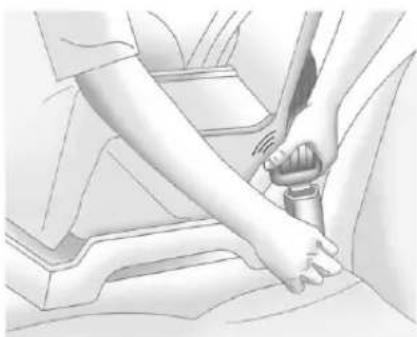
natural_image
Illustration of a hand using a belt switch to adjust the seat area (no text or symbols visible)- Pushthelatchplate into the buckle until it clicks.
Positionthereleasebuttonon thebucklesothatthesafetybelt couldbequicklyunbuckled ifnecessary.
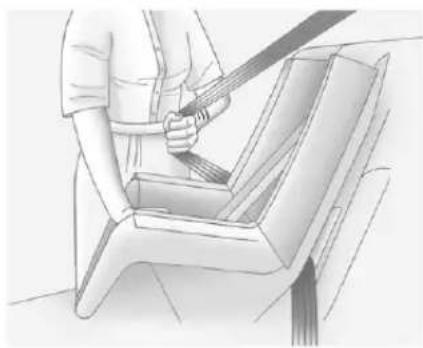
natural_image
Illustration of a person using a belt to lift a seatbelt (no text or symbols present)- Pulltheshoulderbeltalltheway outoftheretractortosetthe lock. Whentheretractorlockis set, thebeltcanbetightenedbut notpulledoutoftheretractor.
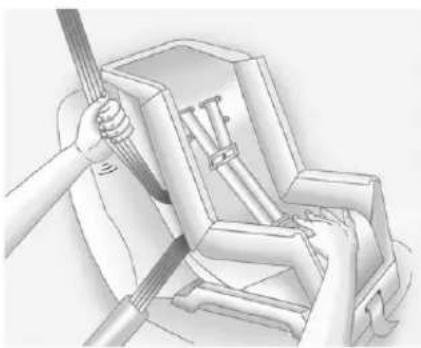
natural_image
Illustration of a hand using a tool to lift or install a mechanical component (no text or symbols visible)- Totightenthebelt, pushdown onthechildrestraint, pullthe shoulderportionofthebelt to tightenthelapportionofthebelt, andfeedtheshoulderbeltback intotheretractor. Wheninstalling aforward-facingchildrestraint, it maybehelpfultouseyourknee topushdownonthechild restraintasyoutightenthebelt.
Trytopullthebeltoutofthe retractortomakesurethe retractorislocked.Ifthe retractorisnotlocked,repeat Steps5and6.
-
If the vehicle does not have a reseat and the child restraint has to optether, follow the child restraint manufacturer's instructions regarding the use of the toptether. See Lower Anchors and Tethers for Children (LATCHSystem) on page 3-46 form more information.
-
Before placing a child in the child restraint, makes sure it is securely held in place. To check, grasp the child restraint at the safety belpath and attempt to move its diet side and back and forth. When the child restraint is properly installed, there should be more than 2.5cm (1in) of movement.
Toremovethechildrestraint, unbucklethevehiclesafetybeltand letitreturntothestowedposition.
Ifthetoptetherisattachedtoa toptetheranchor, disconnectit.
If you turned the air bag off with the switch, turn on the right front passenger air bag when you remove the child restraint from the vehicle unless the person who will be sitting there is a member of a passenger air bag risk group. See Airbag On-Off Switch on page 3-26 for more information, including important safety information.
3-62SeatsandRestraints
NOTES
Storage
StorageCompartments
FrontStorage......4-1
Storage Compartments
FrontStorage
This vehicle may have a front storage compartment. It is located at the center of the instrument panel extension, by the floor. To open the compartment, pull up on the latch. The compartment will open automatically.
Storage compartments may also be included on the inside of each frontdoor.
4-2Storage
NOTES
Instruments and Controls
Controls
SteeringWheelAdjustment...5-2
SteeringWheelControls.....5-2
Horn....5-4
WindshieldWiper/Washer.....5-5
Compass....5-6
Clock....5-8
PowerOutlets......5-10
CigaretteLighter....5-10
Ashtrays....5-11
WarningLights, Gauges, and Indicators
WarningLights, Gauges, and
Indicators......5-11
InstrumentCluster......5-12
Speedometer....5-13
Odometer....5-13
TripOdometer......5-13
FuelGauge....5-14
EngineOilPressure
Gauge....5-15
EngineCoolantTemperature
Gauge....5-16
VoltmeterGauge......5-16
SafetyBeltReminders.....5-17
AirbagReadinessLight.....5-18
AirbagOn-OffLight......5-18
PassengerAirbagStatus Indicator....5-20
ChargingSystemLight.....5-20
Malfunction IndicatorLamp......5-21
BrakeSystemWarning Light....5-23
AntilockBrakeSystem(ABS)
WarningLight......5-24
Tow/HaulModeLight......5-25
StabiliTrak® OFFLight......5-25
TractionControlSystem
(TCS)/StabiliTrak® Light....5-26
TirePressureLight......5-26
EngineOilPressureLight....5-27
SecurityLight......5-27
High-BeamOnLight.....5-28
CruiseControlLight......5-28
InformationDisplays
DriverInformation
Center(DIC)......5-28
VehicleMessages
VehicleMessages......5-34
BatteryVoltageandCharging
Messages......5-34
BrakeSystemMessages....5-34
CompassMessages......5-34
DoorAjarMessages......5-35
EngineCoolingSystem Messages....5-36
EngineOilMessages......5-37
EnginePowerMessages....5-37
FuelSystemMessages.....5-38
KeyandLockMessages.....5-38
LampMessages......5-38
RideControlSystem Messages....5-38
AirbagSystemMessages....5-40
Anti-theftAlarmSystem Messages......5-40
ServiceVehicleMessages...5-40
TireMessages......5-41
TransmissionMessages.....5-42
VehicleReminder Messages......5-42
VehiclePersonalization
VehiclePersonalization.....5-42
5-2 InstrumentsandControls
Controls
SteeringWheel Adjustment
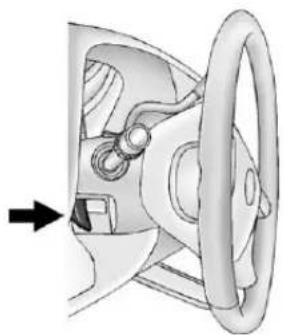
natural_image
Diagram of a car interior showing steering wheel and dashboard (no text or symbols)Forvehicleswithatiltsteering wheel,theleverislocatedonthe leftsideofthesteeringcolumn.
Toadjustthesteeringwheel:
-
Pullthelevertomovethe steeringwheelupordownintoa comfortableposition.
-
Releasethevertolockthe steeringwheelinplace.
Donotadjustthesteeringwheel whiledriving.
SteeringWheelControls
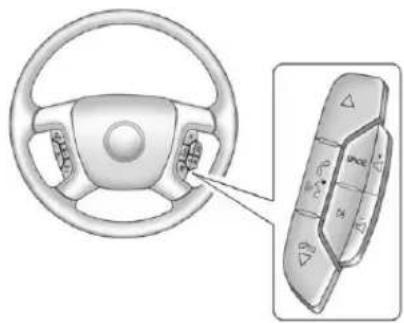
natural_image
Diagram of a car steering wheel and dashboard with control panel (no text or symbols)Ifavailable, someaudiocontrols can be adjusted at the steering wheel.
See Cruise Control on page 9-37 for more information on other steering wheel control.
△(Next):Presstogotothe nextfavoriteradiostation,track onaCD,orfolderonaniPod or USBdevice.
/ ▽ (Previous/End): Press to gotothepreviousfavoriteradio station,trackonaCD,orfolderon aniPod® orUSBdevice.Alsopress torejectanincomingcall,orenda currentcall.
Radio
Toselectpresetorfavoriteradio stations:
Pressandrelease △ or 📞 / ▽ to gotothenextorpreviousradio stationstoredasapresetor favorite.
CD
ToselecttracksonaCD:
Pressandrelease △ or 📞 / ▽ to gotothenextorprevioustrack.
SelectingTracksonaniPodor USBDevice
-
Pressandhold △or▽/▽ whilelisteningtoasonguntilthe contentsofthecurrentfolder displayontheradiodisplay.
-
Pressandrelease △or▽/▽ toscrollupordownthelist, then pressandhold △, orpress ▷ to playthehighlightedtrack.
NavigatingFoldersonaniPodor USBDevice
- Pressandhold

whilelisteningtoasonguntilthe contentsofthecurrentfolder displayontheradiodisplay.
- Pressandhold

backtothepreviousfolderlist.
- Pressandrelease

toscrollupordownthelist.
- Toselectafolder, press andhold △, orpress▶ whenthefolder is highlighted.
- Togobackfurtherin thefolderlist,pressand hold 📄/▽.
/ _^2 (Push to Talk): Press to silencethevehiclespeakersonly. Pressagaintoturnthesoundon.
ForvehicleswithBluetoothor OnStar® systems,pressandhold forlongerthantwosecondsto interactwiththosesystems.See Bluetoothonpage7-24andOnStar Overviewonpage14-1formore information.
SRCE(Source/Voice
Recognition): Presstoswitch betweentheradio and CD, and forequipped vehicles, the front auxiliary.
(Seek): Presstogotothe nextradiostationwhileinAM, FM, orXM^TM .
ForvehicleswithaCDPlayeror USBport:
Press ⚡togotothenexttrackor chapterwhilesourcedtotheCD.
Press ⚠toselectatrackorafolder when navigatingfoldersonaniPod orUSBdevice.
While listening to a CD, press and hold To quickly move forward through the tracks. Reaseto stop on the desired track.
+ :Presstoincreasevolume.
- :Presstodecreasevolume.
Horn
Pressthehornsymbolinthemiddle ofthesteeringwheeltosound thehorn.
WindshieldWiper/Washer
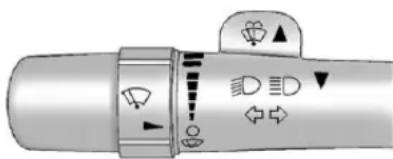
text_image
Diagram of a device control panel with directional icons and labels for settings or functionsThewindshieldwipercontrolis locatedonthemultifunctionleveron theleftsideofthesteeringwheel.
Turnthebandwith 📋onittoselect thewiperspeed.
(Mist): Useforasinglewipe. Holdthebandon 📋, thenrelease. Forseveralwipes, holdtheband on 📋 longer.
!(AdjustableIntervalWipes):
Usetoadjustthedelaytime betweenwipes.Turnthebandup formorefrequentwipesordownfor lessfrequentwipes.
(LowSpeed):Slowwipes.
(HighSpeed):Fastwipes.
○(Off):Usetoturnthe wipersoff.
Whendrivingduringthedayand thewipersareactivated,thehead lampsautomaticallyturnonafter completingeightwipecycles.
Cleariceandsnowfromthewiper bladesbeforeusingthem.Iffrozen tothewindshield,carefullyloosenor thawthem.Damagedbladesshould bereplaced.
WindshieldWasher
Thewindshieldwiperpaddleis locatedontopofthemultifunction lever.
(WasherFluid): Push the paddletospraywasherfluid on the windshield. Thewipers will clear the window and then either stop or return to the presets speed.
WARNING
Infreezingweather, donotuse the washer until the windshield is warmed. Otherwisethewasher fluid can form mice on the windshield, blocking your vision.
Compass
This vehicle may have a compass in the Driver Information Center(DIC).
CompassZone
Yourdealerwillsetthecorrectzone foryourlocation.
Undercertaincircumstances, suchasduringalongdistance cross-countrytripormovingtoa newstateorprovince,itwillbe necessarytocompensatefor compassvariancebyresettingthe zonethroughtheDICifthezoneis notsetcorrectly.
Compassvarianceisthedifference betweentheearth'smagneticnorth andtruegeographicnorth.Ifthe compassisnotsettothezone whereyoulive,thecompassmay givefalsereadings.Thecompass mustbesettothevariancezonein whichthevehicleistraveling.
Toadjustforcompassvariance,use thefollowingprocedure:
CompassVariance(Zone) Procedure
- Donotsetthecompasszone whenthevehicleismoving. Onlysetitwhenthevehicle isinP(Park).
Press 📋 until PRESS √ TO CHANGECOMPASSZONE displays.
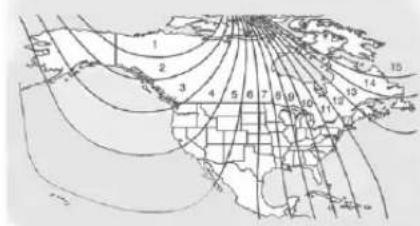
text_image
Map showing numbered regions and latitude/longitude lines across the United States, with labeled points 1 through 15.-
Findthevehicle'scurrent locationandvariancezone numberonthemap. Zones1through15are available.
-
Press √toscrollthrough andselecttheappropriate variancezone.
-
Press until the vehicle heading, forexample, N for North, is displayed in the DIC.
- If calibration is necessary, calibratethecompass. See "Compass Calibration Procedure" following.
CompassCalibration
The compasscanbemanually calibrated. Only calibratethe compassinamagnetically clean and safelocation, such as an open parking lot, wheredriving the vehicle in circles is not danger. It is suggested to calibrate away from all buildings, utility wires, manhole covers, or other industrial structures, if possible.
IfCALshouldeverappearinthe DICdisplay, thecompass should becalibrated.
IftheDICdisplaydoesnotshowa heading,forexample,NforNorth, ortheheadingdoesnotchange aftermakingturns,theremaybea strongmagneticfieldinterferingwith thecompass.Suchinterference maybecausedbyamagneticCBor cellphoneantennamount,a magneticemergencylight,magnetic notepadholder,oranyother magneticitem.Turnoffthevehicle, movethemagneticitem,thenturn onthevehicleandcalibratethe compass.
Tocalibratethecompass, usethe following procedure:
CompassCalibrationProcedure
- Before calibrating the compass, makes sure the compass zone is set to the variance zone in which the vehicle is located. See "Compass Variance (Zone) Procedure" earlier in this section.
Donotoperateanyswitches suchaswindow,climate controls,seats,etc.duringthe calibrationprocedure.
- Press 📋 until PRESS √TO CALIBRATECOMPASS displays.
- Press √ tostart the compass calibration.
- The DIC will display CALIBRATING: DRIVEIN CIRCLES. Drivethevehicle intightcirclesatlessthan 8km/h(5mph)tocompletethe calibration. The DIC will display CALIBRATION COMPLETE forafewsecondswhenthe calibrationiscomplete. The DIC displaywillthenreturnto PRESS √TOCALIBRATE COMPASS.
Clock
AM/FMRadiowithOptionalCD Player
IfthevehiclehasanAM/FMradio withanoptionalCDplayer,ithasa buttonforsettingthetime.With thesetypesofradios,theclockcan besetwitheithertheradioturned onoroff.
Setthetimebyfollowingthese steps:
- Press
untilthehourbegins ngondisplay.Pressthis nasecondtimeandthe esbeginflashingon y.
Press ⏻athirdtimeandthe 12HRor24HRtimeformat beginsflashing.
-
While either the hour or the minutes are flashing, turn the knob, located on the upperright side of the radio, clockwise or counterclockwisetoincrease or decrease the time. While the 12 HR or 24 HR time format is flashing, turn the knob clockwise or counterclockwiseto select the default times settings.
-
Press ①againuntiltheclock displaystopsflashingtoset thecurrentlydisplayedtime; otherwise, theflashingstops afterfivesecondsandthe currenttimedisplayedis automaticallyset.
MP3RadiowithaSingleCD Player
If the vehicle has a radiowitha single CD(MP3) player, the radiohasa ⏻ button for setting the time and date.
Tosetthetimeanddate, followthe instructions:
-
Press ⊕ and the HR, MIN, MM, DD, YYYY(hour, minute, month, day, and year) displays.
-
Pressthesoftkeylocatedunder anyoneofthetabsthatyou wanttochange.Everytimethe softkeyispressedagain,the timeorthedateifselected, increasesbyone.
Another way to increase the time or date, is to press SEEKor FWD (forward).
- Todecrease, press SEEKor ◀◀REV.Youcanalsoturnthe♪ knob, locatedontheupperright sideoftheradio,toadjustthe selectedsetting.
ChangingtheTimeandDate DefaultSettings
Youcanchangethetimedefault settingfrom12hoursto24hoursor changethedatedefaultsettingfrom month/day/yeartoday/month/year.
Tochangethetimeordatedefault settings, followtheseinstructions:
-
Press ⏻andthenthesoftkey locatedundertheforwardarrow thatiscurrentlydisplayed on theradioscreenuntilthetime 12H(hour)and24H(hour),and thedateMM/DD(monthand day)andDD/MM(dayand month)aredisplayed.
-
Pressthesoftkeylocatedunder thedesiredoption.
-
Press ⏻againtoapplythe selecteddefault,orletthe screentimeout.
MP3RadiowithaSix-DiscCD Player
If the vehicle has a radiowitha six-disc CD player, theradio has a MENU button instead of to set the time and date.
Tosetthetimeanddate, follow theseinstructions:
-
PresstheMENUbutton.Once the ⏻optiondisplays, pressthe softkeylocatedunderthattab. TheHR, MIN, MM, DD, YYYY (hour, minute, month, day, and year) displays.
-
Pressthesoftkeylocatedunder anyoneofthetabstochange. Everytimethesoftkeyis pressedagain, the timeorthe dateifselected, increases byone.
Another way to increase the time or date, is to press SEEKor FWD (forward).
- Todecrease, press KSEEKor ◀◀REV, orturnthe♪ knob, located on the upperrightside of theradio, to adjust these selected setting.
ChangingtheTimeandDate DefaultSettings
Tochangethetimedefaultsetting from12hoursto24hoursor changethedatedefaultsettingfrom month/day/yeartoday/month/year.
Tochangethetimeordateddefault settings, followtheseinstructions:
-
PresstheMENUbutton.Once the ⏻optiondisplays, press thesoftkeylocatedunderthe forwardarrowthatiscurrently displayedontheradioscreen untilthe12H(hour)and 24H(hour), andthedate MM/DD(monthandday)and DD/MM(dayandmonth) displays.
-
Pressthesoftkeylocatedunder thedesiredoption.
-
PresstheMENUbuttonagain to apply these selected default, or let the screentimeout.
PowerOutlets
Theaccessorypoweroutletscanbe usedtopluginelectricalequipment, suchasacellphoneoranMP3 player.
The vehicle may have two accessory power outlets located on the instrument panel.
Removethecovertoaccessand replacewhennotinuse.
Certainpoweraccessoryplugsmay notbecompatibletotheaccessory poweroutletandcouldoverload vehicleoradapterfuses. Ifa problemisexperienced,seeyour dealer.
WARNING
Powerisalwayssuppliedtothe outlets.Donotleaveelectrical equipmentpluggedinwhenthe vehicleisnotinusebecausethe vehiclecouldcatchfireandcause injuryordeath.
Notice:Leavingelectrical equipmentpluggedinforan extendedperiodoftimewhile thevehicleisoffwilldrainthe battery.Alwaysunplugelectrical equipmentwhennotinuseand donotpluginequipmentthat exceedsthemaximum 20ampererating.
Whenaddingelectricalequipment, besuretofollowtheproper installationinstructionsincluded withtheequipment.SeeAdd-On ElectricalEquipmentonpage9-58.
Notice: Hangingheavy equipment from the power outlet can caused damage not covered
bythevehiclewarranty. The poweroutletsaredesignedfor accessorypowerplugsonly,such ascellphonechargecords.
CigaretteLighter
Tousethecigarettelighter,ifthe vehiclehasone,pushitinallthe way,andletgo.Whenitisreadyfor use,itwillpopbackoutbyitself.
Donotusethelightertoplugin accessorydevices. Usethepower outletsprovided.
Notice: Holding acigarettelighter inwhileitisheating does not let the lighter back away from the heating element when it is hot. Damage from overheating can occur to the lighter or heating element, or a fuse could be blown. Donotholdacigarette lighter in whileitisheating.
Ashtrays
The vehicle may have are removable ashtray. The ashtray can be placed into the front floor console cupholder. Opencovertouse.
Notice: If papers, pins, or other flammable items are put in the ashtray, hot cigarettes or other smoking materials could ignite them and possibly damage the vehicle. Never put flammable items in the ashtray.
WarningLights, Gauges,and Indicators
Warninglightsandgaugescan signalthatsomethingiswrong beforeitbecomesseriouslyenough tocauseanexpensiverepairor replacement.Payingattentiontothe warninglightsandgaugescould preventinjury.
Warninglightscomeonwhenthere couldbeaproblemwithvehicle function. Somewarninglightscome onbrieflywhentheengineisstarted toindicatetheyareworking.
Gaugescanindicatewhenthere couldbeaproblemwithvehicle function.Oftengaugesandwarning lightsworktogethertoindicatea problemwiththevehicle.
Whenoneofthewarninglights comesonandstaysonwhile driving,orwhenoneofthegauges showstheremaybeaproblem, checkthesectionthatexplainswhat todo.Followthismanual'sadvice. Waitingtodorepairscanbecostly andevendangerous.
InstrumentCluster
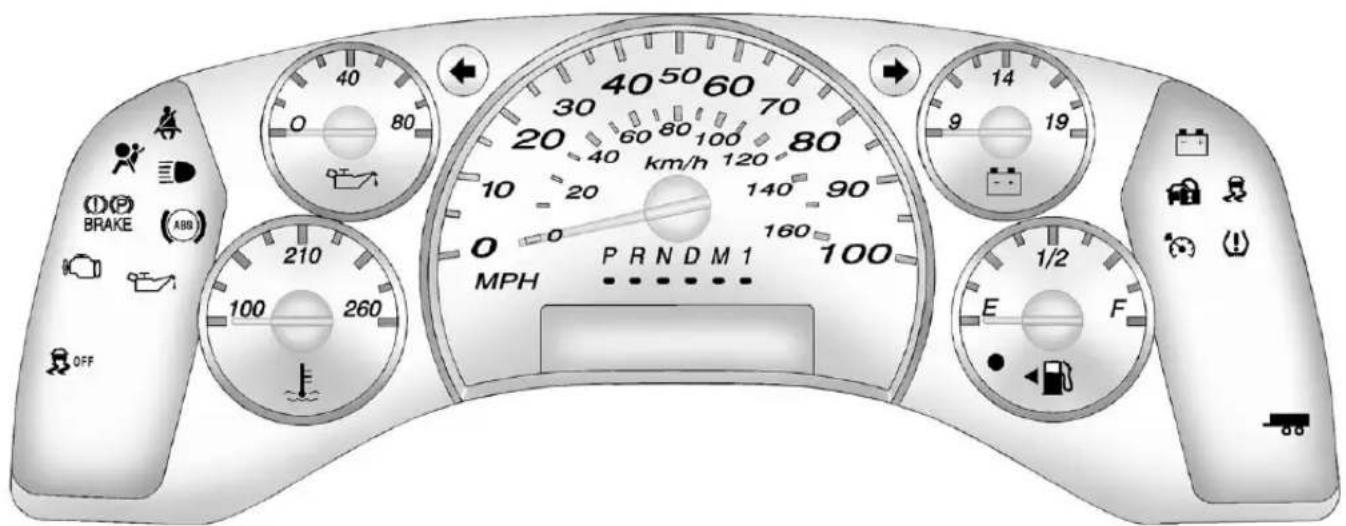
text_image
40 50 60 30 70 20 80 100 80 40 km/h 120 10 20 140 90 0 160 MPH PRNDM1 100 OFF BRAKE ABS 1/2 E F 1/2 100 260English4-SpeedVersionShown,6-SpeedandMetricSimilar
If the vehicle has a diesel engine, seethe Duramax diesels supplement form more information.
Speedometer
Thespeedometershowsthe vehicle'sspeedineitherkilometers perhour(km/h)ormilesper hour(mph).
Odometer
Theodometershowshowfarthe vehiclehasbeendriven,ineither kilometersormiles.
This vehicle has atamper-resistant odometer. Thedigital odometer will read 999,999 if it is turned back.
Ifthevehicleneedsanewodometer installed, itmustbesettothe mileagetotaloftheoldodometer. Ifthatisnotpossible, thenitmust besetatzeroandalabelmustbe putonthedriverdoortoshowthe oldmileagereadingwhenthenew odometerwasinstalled.
TripOdometer
Thetripodometercanshowhowfar thevehiclehasbeendrivensince thetripodometerwaslastset tozero.
Pressthe 📄 ontheDriver InformationCenter(DIC)switchto displaythetripodometerandthe regularodometerinformation.
SeeDriverInformationCenter(DIC) onpage5-28formoreinformation onresettingthetripodometer.
Todisplaytheodometerreading withtheignitionoff,press the ontheDriverInformation Center(DIC)switch.

FuelGauge
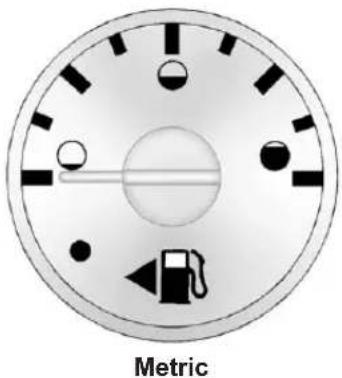
text_image
Metric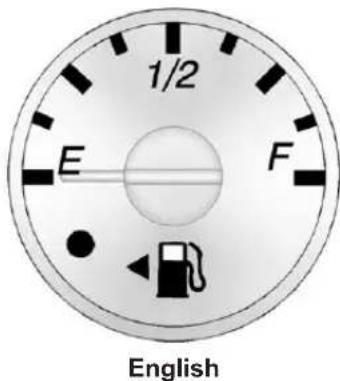
text_image
1/2 E F EnglishThefuelgauge,whentheignitionis on,indicateshowmuchfuelisleftin thevehiclefueltank.
Anarrowonthefuelgauge indicatesthesideofthevehiclethe fueldoorison.
Thegaugefirstindicatesempty beforethevehicleisoutoffuel,and thefueltankshouldbe refueledsoon.
Listedarefoursituationscustomers mightexperiencewiththefuel gauge.Noneoftheseindicatea problemwiththefuelgauge:
- Atthegasstation, thefuelpump shutsoffbeforethegauge readsfull.
- Ittakesalittlemoreorlessfuel tofillupthanthefuelgauge indicated. Forexample, the gaugemayhaveindicatedthe tankwashalffull,butitactually tookalittlemoreorlessthan halfthetank'scapacitytofill thetank.
- Thegaugemovesalittlewhile turningacornerorspeedingup.
- Thegaugedoesnotgobackto emptywhentheignitionis turnedoff.
If the vehicle has a diesel engine, seethe Duramax diesels supplement form more information.
EngineOilPressure Gauge
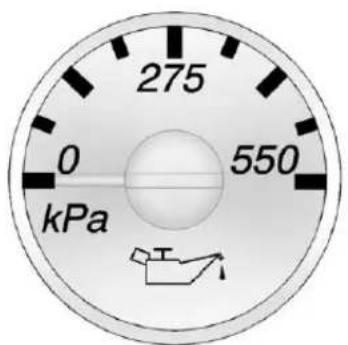
text_image
275 0 kPa 550Metric

text_image
40 O 80English
The oil pressure gaugeshowsthe engine oil pressure in psi (pounds persquare inch) or kPa (kilopascals) when the engine is running.
Oilpressuremayvarywithengine speed,outsidetemperatureandoil viscosity,butreadingsabovethe lowpressurezoneindicatethe normaloperatingrange.
Areadinginthelowpressurezone maybecausedbyadangerously lowoillevelorotherproblem causinglowoilpressure.Checkthe oilassoonaspossible.
WARNING
Donotkeepdrivingiftheoil pressureislow.Theenginecan becomesohotthatitcatchesfire. Someonecouldbeburned.Check theoilassoonaspossibleand havethevehicleserviced.
Notice:Lackofproperengineoil maintenancecandamagethe engine.Therepairswouldnotbe coveredbythevehiclewarranty. Alwaysfollowthemaintenance scheduleforchangingengineoil.
EngineCoolant
TemperatureGauge
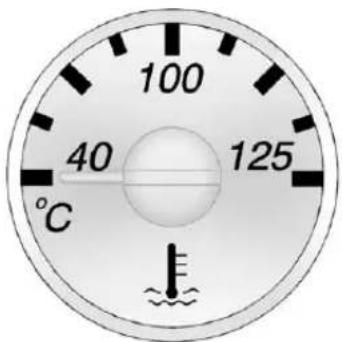
text_image
100 40 125 °CMetric
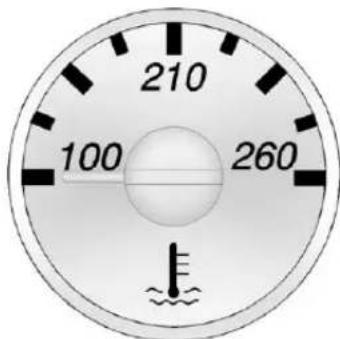
text_image
210 100 260English
Thisgaugeshowstheengine coolanttemperature.
Italsoprovidesanindicatorofhow hardthevehicleisworking.Duringa majorityoftheoperation,thegauge wilread100°C(210°F)orless.Ifthe vehicleispullingaloadorgoingup hills,itisnormalforthetemperature tofluctuateandapproachthe122°C (250°F)mark.Ifthegaugereaches the125°C(260°F)mark,itindicates thatthecoolingsystemisworking beyonditscapacity.
SeeEngineOverheatingon page10-22.
VoltmeterGauge
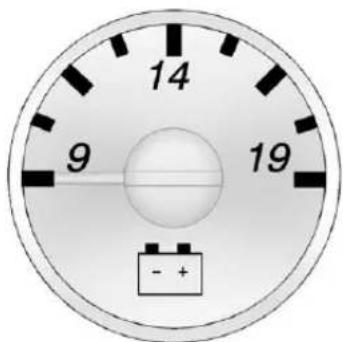
text_image
14 9 19 - +Whentheengineisnotrunning,but theignitionison,thisgaugeshows thebattery'sstateofchargein DCvolts.
Whentheengineisrunning,the gaugeshowstheconditionofthe chargingsystem.Readingsbetween thelowandhighwarningzones indicatethenormaloperatingrange.
Readingsinthelowwarningzone mayoccurwhenalargenumberof electricalaccessoriesareoperating inthevehicleandtheengineisleft atanidleforanextendedperiod. Thisconditionisnormalsincethe chargingsystemisnotableto providefullpoweratengineidle. Asenginespeedsareincreased, thisconditionshouldcorrectitselfas higherenginespeedsallowthe chargingsystemtocreatemaximum power.
The vehicle can be only driven for a short time with the reading ineither warning zone. If it must be driven, turnoff all unnecessary accessories.
Readingsineitherwarningzone indicateapossibleprobleminthe electricalsystem.Havethevehicle servicedassoonaspossible.
SafetyBeltReminders DriverSafetyBeltReminder Light
Thereisadriversafetybelt reminderlightontheinstrument panelcluster.

Whenthevehicleisstarted,this lightflashesandachimemaycome ontoremindthedrivertofasten theirsafetybelt. Thenthelightstays onsoliduntilthebeltisbuckled. Thiscyclemaycontinueseveral timesifthedriverremainsor becomesunbuckledwhilethe vehicleismoving.
Ifthedriversafetybeltisbuckled, neitherthelightnorthechime comeson.
PassengerSafetyBelt ReminderLight
Forvehiclesequippedwiththe passengersafetybeltreminderlight, severalsecondsaftertheengineis started,achimesoundsforseveral secondstoremindthefront passengertobuckletheirsafety belt.Thepassengersafetybeltlight flashesandthenstaysonsoliduntil thebeltisbuckled.Thiscycle continuesseveraltimesifthe passengerremainsorbecomes unbuckledwhilethevehicleis moving.
If the passengers safety belt is buckled, neither the chimen or the light comes on.
Thepassengersafetybeltreminder lightandchimemayturnonifan objectisputontheseatsuchasa briefcase,handbag,grocerybag, laptop,orotherelectronicdevice. Toturnoffthereminderlightand/or chime,removetheobjectfromthe seatorbucklethesafetybelt.
AirbagReadinessLight
Thesystemcheckstheairbag's electricalsystemforpossible malfunctions. If the light stay on it indicates there is an electrical problem. Thesystemcheck include the airbagsensor(s), the pretensioners, the airbag modules, the wiring and the crash sensing and diagnostic module. For more information on the airbag system, see Airbag System on page 3-18.

Theairbagreadinesslightflashes forafewsecondswhentheengine isstarted. Ifthelightdoesnotcome onthen, haveitfixedimmediately.
WARNING
If the airbagreadinesslightstays on after the vehicle is started or comes on while driving, it means the air bagsystem might not be working properly. The airbags in the vehicle might not inflate a crash, or they could even inflate without a crash. To help avoid injury, have the vehicles serviced right away.
Forvehicleswitharemotestart,the airbagreadinesslightwillstayon untilthedriverplacetheignition switchtotheON/RUNposition.
Ifthereisaproblemwiththeairbag system,anairbagDriverInformation Center(DIC)messagecanalso comeon.SeeAirbagSystem Messagesonpage5-40formore information.
AirbagOn-OffLight
Whentherightfrontpassenger airbagismanuallyturnedoffusing theairbagon-offswitchonthe instrumentpanel,ifequipped,the indicatorlightOFFortheoffsymbol willcomeonandstayonasa reminderthattheairbaghasbeen turnedoff.Thislightwillgooffwhen theairbaghasbeenturnedon.See AirbagOn-OffSwitchonpage3-26 formoreinformation,including importantsafetyinformation.
PASSENGER

AIR BAG OFF
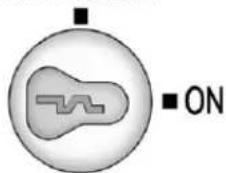
text_image
■ ONUnitedStates
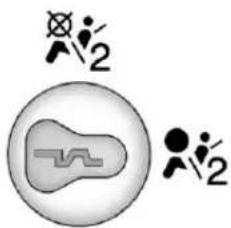
natural_image
Abstract diagram with two circular elements and symbolic figures (no text or labels)CanadaandMexico

WARNING
Iftherightfrontpassengerairbag isturnedoffforapersonwhois notinariskgroupidentifiedby thenationalgovernment,that personwillnothavetheextra protectionofanairbag.Ina crash,theairbagwillnotbeable toinflateandhelpprotectthe personsittingthere.
Donotturnoffthepassenger airbagunlessthepersonsitting thereisinariskgroupidentified bythenationalgovernment. SeeAirbagOn-OffSwitchon page3-26formoreonthis, includingimportantsafety information.

WARNING
If the airbagreadinesslight ever comes on and stay on, it mean that something may be wrong with the air bags system. Forexample, therightfront passenger air bag could inflate even though the air bagon-off switchisturned off.
Tohelpavoidinjurytoyourselfor others,havethevehicleserviced rightaway.SeeAirbagReadiness Lightonpage5-18formore information,includingimportant safetyinformation.
IfthewordONortheonsymbol islit, itmeansthattherightfront passengerfrontalairbagisenabled, andmayinflate.SeeAirbagOn-Off Switchonpage3-26formore information, includingimportant safetyinformation.
PassengerAirbagStatus Indicator
If the vehicle has a passenger sensing system, the instrument panel will have a passenger airbag status indicator. See Passenger Sensing System page 3-30 for important safety information.
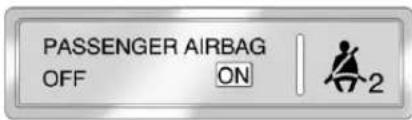
text_image
PASSENGER AIRBAG OFF ON 2UnitedStates
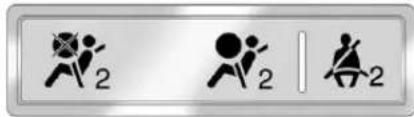
text_image
Three black-and-white icons representing different physical poses or movements, each labeled with the number '2' and a vertical line.CanadaandMexico
Whenthevehicleisstarted,the passengerairbagstatusindicator willlightONandOFF,orthesymbol foronandoff,forseveralseconds
asasystemcheck.Ifyouareusing remotestart,ifequipped,tostartthe vehiclefromadistance,youmay notseethesystemcheck.Then,afterseveralmoreseconds,the statusindicatorwilllighteitherON orOFF,oreithertheonoroff symboltoletyouknowthestatusof therightfrontpassengerfrontal airbag.
IfthewordONortheonsymbolis litonthepassengerairbagstatus indicator, itmeansthattheright frontpassengerfrontalairbagis enabled, and may inflate.
IfthewordOFFortheoffsymbolis litontheairbagstatusindicator, it meansthatthepassengersensing systemhasturnedofftherightfront passengerfrontalairbag.
If,afterseveralseconds,bothstatus indicatorlightsremainon,orifthere arenolightsatall,theremaybea problemwiththelightsorthe passengersensingsystem. Seeyourdealerforservice.

WARNING
If the airbagreadinesslightever comeson and stayson, it means that something may be wrong with the airbagsystem. To help avoid injury to your self for others, have the vehicles serviced right away. See AirbagReadiness Lightonpage 5-18 form more information, including important safety information.
ChargingSystemLight
Thislightcomesonbrieflywhenthe ignitionkeyisturnedtoSTART,but theengineisnotrunning,asa checktoshowitisworking.
Ifitdoesnot,havethevehicle servicedbyyourdealer.
Thelightshouldgooutoncethe enginestarts.lfitstayson, orcomesonwhiledriving,there couldbeaproblemwiththe chargingsystem.Achargingsystem messageintheDriverInformation Center(DIC)canalsoappear.See BatteryVoltageandCharging Messagesonpage5-34formore information.Thislightcouldindicate thatthereareproblemswitha generatordrivebelt,orthatthereis anelectricalproblem.Haveit checkedrightaway.Ifthevehicle mustbedrivenashortdistancewith thelighton,turnoffaccessories, suchastheradioandair conditioner.
Malfunction IndicatorLamp
AcomputersystemcalledOBDII (On-BoardDiagnostics-Second Generation)monitortheoperation ofthevehicletoensureemissions
areatacceptablelevels, toproduce acleanerenvironment. Thislight comesonwhenthevehicleis placedinON/RUN, asacheckto showitisworking. Ifitdoesnot, havethevehicleservicedbyyour dealer. SeeIgnitionPositionson page9-16formoreinformation.
Ifthemalfunctionindicatorlamp comesonandstaysonwhilethe engineisrunning,thisindicatesthat thereisanOBDIIproblemand serviceisrequired.
Malfunctionsoftenareindicated by thesystembeforeanyproblemis apparent. Beingawareofthelight canpreventmoreseriousdamage tothevehicle. Thissystemassists theservicetechnicianincorrectly diagnosinganymalfunction.
Notice: If the vehicle is continually driven with this light on, the emission control might not work as well, the vehicle fuel economy might not be as good, and the engine might not run as smoothly. This could lead to costly repair that might not be covered by the vehicle warranty.
Notice: Modificationsmadetothe engine, transmission, exhaust, intake, orfuelsystemofthe vehicleorthereplacementofthe originaltireswithotherthan thoseofthesameTire PerformanceCriteria(TPC)can affectthevehicle'semission controlsandcancausethislight tocomeon.Modificationsto thesesystemscouldleadto costlyrepairsnotcoveredbythe vehiclewarranty.Thiscouldalso resultinafailuretopassa requiredEmissionInspection/ Maintenancetest.See AccessoriesandModificationson page10-3.
Thislightcomesonduringa malfunctioninoneoftwoways:
LightFlashing: Amisfirecondition has been detected. Amisfire increases vehicle emissions and could damage the emission control system on the vehicle. Diagnosis and servicemight berequired.
Topreventmoreseriousdamageto thevehicle:
- Reducevehiclespeed.
- Avoidhardaccelerations.
- Avoidsteepuphillgrades.
- Iftowingatrailer, reduce the amount of cargobeing hauled as soon as it is possible.
Ifthelightcontinuestoflash,stop andparkthevehicle.Turnthe vehicleoff,waitatleast10seconds, andrestarttheengine.Ifthelightis stillflashing,followtheprevious stepsandseeyourdealerfor serviceassoonaspossible.
LightOnSteady: Anemission controlsystemmalfunctionhas beendetectedonthevehicle. Diagnosisandservicemight berequired.
The following maycorrectan emissionsystemmalfunction:
- Check that the fuel cap is fully installed. See Filling the Tank on page 9-44. The diagnostic system can determine if the fuel cap has been left for improperly installed. A loose or missing fuel cap allows fuel to evaporate into the atmosphere. Afew driving trip with the cap properly installed should turn the light off.
- Checkthatgoodqualityfuelis used.Poorfuelqualitycauses theenginenottorunas efficientlyasdesignedand maycausestallingafterstart-up,
stallingwhenthevehicleis changedintogear,misfiring, hesitationonacceleration, orstumblingonacceleration. Theseconditionsmightgoaway oncetheengineiswarmedup.
Ifoneormoreoftheseconditions occurs, changethefuelbrandused. Itwillrequireatleastonefulltankof theproperfueltoturnthelightoff.
SeeRecommendedFuelon page9-40.
Ifnoneoftheabovehavemadethe lightturnoff,yourdealercancheck thevehicle.Thedealerhashe propertestequipmentand diagnostictoolstofixany mechanicalorelectricalproblems thatmighthavedeveloped.
EmissionsInspection and Maintenance Programs
Somelocalgovernmentsmayhave programstoinspecttheon-vehicle emissioncontrolequipment. For the inspection, the emissionsystemtest equipment is connected to the vehicle's DataLink Connector(DLC).
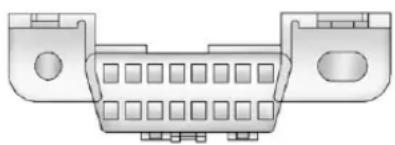
natural_image
Diagram of a 24-pin connector with slots and connectors (no text or labels)The DLC is under the instrument panel to the left of the steering wheel. See your dealer if assistance is needed.
The vehicle may not pass inspection if:
- Themalfunctionindicatorlampis onwiththeengine running, orif the light does not come on when the ignition is turned to ON/RUN
whiletheengineisoff.Seeyour dealerforassistanceinverifying properoperationofthe malfunctionindicatorlamp.
- TheOBDII(On-Board Diagnostics)systemdetermines that critical emission control systemshavenotbeen completely diagnosed. The vehicle would be considered not ready for inspection. This can happen if the 12-volt battery has recently been replaced or run down. The diagnostics system is designed to evaluate critical emission control systems during normal driving. This can take several days of routine driving. If this has been done and the vehicle still does not pass the inspection for lack of OBDII system readiness, your dealer can prepare the vehicle for inspection.
BrakeSystemWarning Light
The vehicle brakesystem consists of two hydraulics circuits. If one circuit is not working, there are remaining circuit can still work to stop the vehicle. Fornormal braking performance, both circuits need to be working.
If the warning light comes on, there could be a brake problem. Have the brakesystem inspection right away.


MetricEnglish
Thislightshouldcomeonbriefly whenignitionkeyisturnedtoON/RUN.Ifitdoesnotcomeon,haveit fixedsoitwillbereadytowarnif thereisaproblem.
Whentheignitionison,thebrake systemwarninglightalsocomeson whentheparkingbrakeisset.See ParkingBrakeonpage9-34for moreinformation.Thelightstayson iftheparkingbrakedoesnotfully release.Ifitstaysonafterthe parkingbrakeisfullyreleased,it meansthevehiclehasabrake problem.
Ifthelightcomesonwhiledriving, pullofftheroadandstopcarefully. Thepedalmightbehardertopush, orthepedalmightgoclosertothe floor. Itcouldtakelongertostop. Ifthelightisstillon,havethe vehicletowedforservice.See Towingthe Vehicleonpage 10-90.

WARNING
Thebrakesystemmightnotbe workingproperlyifthebrake systemwarninglightison.
(Continued)
WARNING(Continued)
Drivingwiththebrakesystem warninglightoncanleadtoa crash. If the light is still on after the vehicle has been pulled off theroad and carefully stopped, havethe vehicle towed for service.
AntilockBrakeSystem (ABS)WarningLight

ForvehicleswiththeAntilockBrake System(ABS), thislightcomeson brieflywhentheengineisstarted.
If it does not, hav the vehicle serviced by your dealer. If the system is working normally the indicator light thengoes off.
IftheABSlightstayson,turnthe ignitionoff.Ifthelightcomeson whiledriving,stopassoonasitis safelypossibleandturntheignition off.Thenstarttheengineagainto resetthesystem.IftheABSlight stayson,orcomesonagainwhile driving,thevehicleneedsservice. Iftheregularbrakesystemwarning lightisnoton,thevehiclestillhas brakes,butnotantilockbrakes. Iftheregularbrakesystemwarning lightisalsoon,thevehicledoesnot haveantilockbrakesandthereisa problemwiththeregularbrakes. SeeBrakeSystemWarningLighton page5-23.
Tow/HaulModeLight

ForvehicleswiththeTow/Haul Modefeature,thislightcomeson whentheTow/HaulModehasbeen activated.
Formoreinformation, see Tow/Haul Modeonpage9-32.
StabiliTrak® OFFLight
Thislightcomesonbrieflywhile startingtheengine.
If it does not, have the vehicle serviced by your dealer. If the system is working normally, the indicator light thengoes off.
PressandreleasetheTraction ControlSystem(TCS)/StabiliTrak buttontoturnoffTCS,anda messagedisplaysintheDIC.
PressandbrieflyholdtheTCS/StabiliTrakbuttontoturnofftheStabiliTraksystem;theStabiliTrakOfflightcomesonandamessageappearsintheDriverInformationCenter(DIC).
If the Stabili Trak/TCS system is off, the system does not assist in controlling the vehicle. Turn on the Stabili Trak/TCS system and the indicator light turn off.
SeeStabiliTrak ^® Systemon page9-35,andRideControlSystem Messagesonpage5-38formore information.
TractionControlSystem (TCS)/StabiliTrak® Light
The TractionControlSystem(TCS)/StabiliTraklightcomesonbriefly whentheengineisstarted.
Ifthelightdoesnotcomeonor stayson,havethevehicleserviced bythedealer.Ifthesystemis workingnormally,theindicatorlight turnsoff.
Ifthelightcomesonandstayson whiledriving, andamessage displaysintheDriverInformation Center(DIC), havethevehicle servicedbythedealer. SeeRide ControlSystemMessageson page5-38formoreinformation.
Ifthelightflasheswhiledriving, this meansthattheStabiliTrakorthe TCSisassistingincontrollingthe vehicle.SeeStabiliTrak® Systemon page9-35formoreinformation.
Fourchimessoundifthelight turnson.
TirePressureLight

ForvehicleswiththeTirePressure MonitorSystem(TPMS), thislight comesonbrieflywhentheengineis started. Itprovidesinformation about tirepressuresandtheTPMS.
WhentheLightIsOnSteady
This indicates that one or more of the tires are significantly underinflated.
ADriverInformationCenter(DIC) tirepressuremessagemayalso display.See VehicleMessageson page5-34formoreinformation. Stopassoonaspossible,and inflatethetirestothepressurevalue shownontheTireandLoading Informationlabel.See TirePressure onpage10-56formoreinformation.
WhentheLightFlashesFirstand ThenIsOnSteady
If the light flashes for about a minute and then stay on, ther may be a problem with the TPMS. If the problem is not corrected, the light will come on at every ignition cycle. See Tire Pressure Monitor Operation on page 10-59 for more information.
EngineOilPressureLight
WARNING
Donotkeepdrivingiftheoil pressureislow.Theenginecan becomesohotthatitcatchesfire. Someonecouldbeburned.Check theoilassoonaspossibleand havethevehicleserviced.
Notice:Lackofproperengineoil maintenancecandamagethe engine.Therepairswouldnotbe coveredbythevehiclewarranty. Alwaysfollowthemaintenance scheduleforchangingengineoil.
Thislightcomesonbrieflywhile startingtheengine.Ifitdoesnot, havethevehicleservicedbyyour dealer.Ifthesystemisworking normally,theindicatorlightthen goesoff.
Ifthelightcomesonandstayson, it meansthatoilisnotflowingthrough theengineproperly. Thevehicle couldbelowonoilanditmight havesomeothersystemproblem.
SecurityLight

Theimmobilizerlightshouldcome onbrieflyastheengineisstarted. Ifitdoesnotcomeon,havethe vehicleservicedbyyourdealer. Ifthesystemisworkingnormally, theindicatorlightturnsoff.
If the light stay on and the engine does not start, there could be a problem with the theft-deterrent system. See Immobilizer Operation on page 2-12 form more information.
High-BeamOnLight

Thislightcomesonwhenthe high-beamheadlampsareinuse.
SeeHeadlampHigh/Low-Beam Changeronpage6-2formore information.
CruiseControlLight
Thecruisecontrollightcomeson whenever the cruise control lisset.
Thelightgoesoutwhenthecruise controlisturnedoff.SeeCruise Controlonpage9-37formore information.
InformationDisplays
DriverInformation Center(DIC)
ThisvehiclehasaDriver InformationCenter(DIC).
AllmessageswillappearintheDIC displaylocatedatthebottomofthe instrumentpanelcluster.TheDIC buttonsarelocatedonthe instrumentpanel,nexttothe instrumentpanelcluster.
The DIC comes on when the ignition is on. After a short delay, the DIC will display the information that was last displayed before the engine wasturned off.
The DIC display strip, fuel, and vehicle system information, and warning messages if a system problem is detected.
If the vehicle hast these features, the DICalsodisplay the compass direction and the outside air temperature when viewing the trip
andfuelinformation.Thecompass directionappearsonthetopright corneroftheDICdisplay.The outsideairtemperature automaticallyappearsinthebottom rightcorneroftheDICdisplay. Ifthereisaproblemwiththesystem thatcontrolsthetemperature display,thenumberswillbe replacedwithdashes.Ifthisoccurs, havethevehicleservicedbyyour dealer.
Ifthevehiclehasadieselengine, seetheDuramax ^® diesel supplementformoreinformation.
DICOperationandDisplays
The DIChasdifferentdisplays which can be accessed by pressing the DICbuttonslocated on the instrumentpanel, next to the instrumentpanel cluster.
DICButtons
Thebuttonsarethetrip/fuel,vehicle information,customization,andset/resetbuttons.Thebuttonfunctions aredetailedinthefollowingpages.
(Trip/Fuel): Pressthisbutton todisplay theodometer, trip odometers, fuelrange, average economy, fuelused, timer, average speed, and digitaltachometer.
i(VehicleInformation):Press thisbuttontodisplaytheoillife, units,tirepressurereadingsfor vehicleswiththeTirePressure MonitorSystem(TPMS),engine hours,TirePressureMonitor System(TPMS)programmingfor vehicleswiththeTPMSandwithout aRemoteKeylessEntry(RKE) transmitter,andcompasszoneand compasscalibrationonvehicles withthisfeature.
E=(Customization):Pressthis buttontocustomizethefeature settingsonthevehicle.See Vehicle Personalizationonpage5-42for moreinformation.
√(Set/Reset):Pressthisbutton to setorreset certain functions and to turnofforacknowledgemessages on the DIC.
Trip/FuelMenultems
( Trip/Fuel ): Pressthisbutton toscrollthroughthefollowingmenu items:
Odometer
Press untilXXkm(mi) displays. This display shows the distance vehicle has been driven neither kilometers (km) or miles (mi).
TripOdometers
Press untilAorBdisplays. Thisdisplayshowsthecurrent distancetraveledineither kilometers(km)ormiles(mi)since thelastresetforeachtripodometer. Bothtripodometerscanbeusedat thesametime.
Eachtripodometercanberesetto zeroseparatelybypassing √while thedesiredtripodometeris displayed.
Thetripodometerhasafeature calledtheretro-activereset. This canbeusedtosethetripodometer tothenumberofkilometers(miles) drivensincetheignitionwaslast turnedon. Thiscanbeusedifthe tripodometerisnotresetatthe beginningofthetrip.
Tousetheretro-activeresetfeature, pressandhold √foratleast fourseconds. Thetripodometerwill displaythenumber of kilometers(km)ormiles(mi)driven sincetheignitionwaslastturned on andthevehiclewasmoving.Once thevehiclebeginsmoving,thetrip odometerwillaccumulatemileage. Forexample,ifthevehiclewas driven8km(5miles)beforeitis startedagain,andthenthe retro-activeresetfeatureis activated,thedisplaywillshow8km (5miles).Asthevehiclebegins moving,thedisplaywillthen increaseto8.1km(5.1miles), 8.2km(5.2miles),etc.
Iftheretro-activeresetfeatureis activatedafterthevehicleisstarted, butbeforeitbeginsmoving,the displaywillshowthenumberof kilometers(km)ormiles(mi)that weredrivenduringthelastignition cycle.
FuelRange
Press untilFUELRANGE displays. Thisdisplayshowsthe approximatenumberofremaining kilometers(km)ormiles(mi)the vehiclecanbedrivenwithout refueling. Thedisplaywillshow LOWifthefuellevelislow.
The fuel range estimate is based on an average of the fuele economy over recent driving history and the amount off fuel remaining in the fuel tank. This estimate will change if driving conditions change. For example, if driving in traffic and making frequent stops, this display may read on number, but if the vehicle is driven on a freeway, the number may change even though the same amount off fuel is in the
fueltank. This is because different driving conditions produced different fuel economies. Generally, freeway driving produces better fuel economy than city driving.
If the vehicle is slow on fuel, the FUEL LEVELLOW message will be displayed. See "FUEL LEVELLOW" under Fuel System Messages on page 5-38 form more information.
AverageEconomy
Press √ untilAVGECONOMY displays. This display shows the approximate average liters per 100 kilometers (L/100km) or miles per gallon (mpg). This number is calculated based on the number of L/100km (mpg) recorded since the last time this menu was reset. Toreset AVGECONOMY, press and hold √. The display will return to zero.
FuelUsed
Press untilFUELUSED displays. This display shows the number of fliters (L)orgallons (gal) offuel used sincethelast reset of this menu item. Toreset the fuel used information, press and hold while FUELUSED is displayed.
Timer
Press A until TIMERdisplays. Thisdisplaycanbeusedasatimer.
Tostartthetimer, press √while TIMERisdisplayed. Thedisplaywill show the amount of timethathas passed sincethetimer was last reset, not including timetheignition is off. Timewill continuetobe counted as long astheignition is on, even if an other display is being shown on the DIC. The timer will record up to 99 hours, 59 minutes and 59 seconds (99:59:59) after which the display will return to zero.
Tostopthetimer, press √ briefly while TIMERisdisplayed.
Toresetthetimertozero, pressand hold √ while TIMERisdisplayed.
AverageSpeed
Press until AVERAGESPEED displays. This display shows the averagespeed of the vehicle in kilometers per hour (km/h) or miles per hour (mph). This average is calculated based on the various vehicle speeds recorded since the last reset of this value. Toreset the value, press and hold √. The display will return to zero.
DigitalTachometer
Press 7: until
Tachometer##00RPMdisplays. Thisdisplayshowstheengine speedinrevolutionsper minute(RPM).
BlankDisplay
Thisdisplayshowsnoinformation.
Vehicle Information Menu Items
i(VehicleInformation):Press thisbuttontoscrollthroughthe followingmenuitems:
OilLife
Press 📋iuntilOILLIFE REMAININGdisplays.Thisdisplay showsanestimateoftheoil's remainingusefullife.Ifyousee 99%OILLIFEREMAININGonthe display,thatmeans99%ofthe currentoilliferemains.Theengine oillifesystemwillalertyouto changetheoilonaschedule consistentwithyourdriving conditions.
Whentheremainingoillifeislow, theCHANGEENGINEOILSOON messagewillappearonthedisplay. See "CHANGEENGINEOILSOON" underEngineOilMessageson page 5-37. You should change the oilassoon as possible. See Engine Oilonpage 10-7. In addition to the engine oil ifesystem monitoring the oil life, additional maintenance is recommended in the Maintenance Schedule in this manual. See Maintenance Schedule on page 11-3 form more information.
Remember, you must reset the OIL LIFE yourself after each oil change. It will not reset itself. Also, be careful not to reset the OILLIFE accidentally at any time other than when the oil has just been changed. It cannot reset accurately until then ex toil change. To reset the engine oil if esystem, see Engine Oil Life System on page 10-10.
Units
Press 📄iuntilUNITSdisplays. Thisdisplayallowsyoutoselect betweenmetricorEnglishunitsof measurement.Onceinthisdisplay, press √toselectbetweenMETRIC orENGLISHunits.
TirePressure
If the vehicle has the Tire Pressure Monitor System (TPMS), the pressure foreachtire can be viewed in the DIC. The tire pressure will be shown nine other kilopascals (kPa) or pound sparsquare inch (psi).
Press 📋iuntiltheDICdisplays FRONTTIRESPSI(kPa)LEFT##
RIGHT##.Press 📋iagainuntil theDICdisplaysREARTIRES PSI(kPa)LEFT##RIGHT##.
Ifalowtirepressureconditionis detectedbythesystemwhile driving, amessageadvisingyouto checkthepressureinaspecifictire willappearinthedisplay. See Tire Pressureonpage 10-56 and Tire Messagesonpage 5-41 formore information.
If the tire pressured display shows dashes instead of a value, there may be a problem with the vehicle. If this consistently occurs, see your dealer for service.
EngineHours
Press 📄 until ENGINEHOURS displays. This display shows the total number of hours the engine has run.
RelearnTirePositions
The vehicle may have this display. To access this display, the vehicle must be in P (Park). If the vehicle has the Tire Pressure Monitor System (TPMS), after rotating the tires or after replacing atire or sensor, the system must be learned the tire positions. Tore-learn the tire positions, see Tire Pressure Monitor System on page 10-58. See Tire Inspection on page 10-62, Tire Rotation on page 10-62 and Tire Messages on page 5-41 form more information.
ChangeCompassZone
The vehicle may have this feature. To changethe compass zone through the DIC, see Compassion page 5-6.
CalibrateCompass
The vehicle may have this feature. The compass can be manually calibrated. Tocalibrat the compass through the DIC, see Compassion page 5-6.
BlankDisplay
Thisdisplayshowsnoinformation.
VehicleMessages
MessagesdisplayedontheDIC indicatethestatusofthevehicleor someactionmaybeneededto correctacondition.Multiple messagesmayappearoneafter another.
Themessagesthatdonotrequire immediateactioncanbe acknowledgedandclearedby pressing √(Set/Reset).
Themessagesthatrequire immediateactioncannotbecleared untilthatactionisperformed.
Allmessagesshouldbetaken seriouslyandclearingthemessage doesnotcorrecttheproblem.
The following are the possible messages and some information about them.
If the vehicle has a diesel engine, seethe Duramax ^® diesel supplement from more information.
BatteryVoltage and ChargingMessages
SERVICEBATTERY CHARGINGSYSTEM
Onsomevehicles, this message displays if there is a problem with the battery charging system. Under certain conditions, the charging system light may also turn on the instrument panel cluster. See Charging System Lighton page 5-20. Driving with this problem could drain the battery. Turnoff all unnecessary accessories. Have the electrical system checked as soon as possible. See your dealer.
BrakeSystemMessages
SERVICEBRAKESYSTEM
Thismessagedisplaysalongwith thebrakesystemwarninglightif thereisaproblemwiththebrake system.SeeBrakeSystemWarning Lightonpage5-23.Ifthismessage appears,stopassoonaspossible
andturnoffthevehicle.Restartthe vehicleandcheckforthemessage ontheDICdisplay.Ifthemessage isstilldisplayedorappearsagain whenyoubegindriving,thebrake systemneedsserviceassoonas possible.Seeyourdealer.
CompassMessages
CALIBRATING:DRIVEIN CIRCLES
Thismessagedisplayswhen calibratingthecompass.Drivethe vehicleincirclesatlessthan8km/h (5mph)tocompletethcalibration. See Compassonpage5-6formore information.
CALIBRATIONCOMPLETE
Thismessagedisplayswhenthe compasscalibrationiscomplete. SeeCompassonpage5-6for moreinformation.
DoorAjarMessages
CARGODOOROPEN
Thismessagedisplaysandachime soundsifthecargodoorisopen whiletheignitionisinON/RUN. Turnoffthevehicleandcheckthe cargodoor.Restartthevehicle andcheckforthemessageon theDICdisplay.
DRIVERDOOROPEN
Thismessagedisplaysandachime soundsifthedriverdoorisnotfully closedandthevehicleisinadrive gear.Stopandturnoffthevehicle, checkthedorforobstructions,and closetedooragain.Checktosee ifthemessagestillappearson theDIC.
LEFTREARDOOROPEN
Onsomevehicles, thismessage displays and achimesounds if the driversidereardoor is not fully closed and the vehicle is in a drive gear. Stop and turn off the vehicle, check the door for obstructions, and closeted door again. Check to see if themessage still appear on the DIC.
PASSENGERDOOROPEN
Thismessagedisplaysandachime soundsifthepassengerdoorisnot fullyclosedandthevehicleisina drivegear.Stopandturnoffthe vehicle,checkthedorfor obstructions,andclosethedoor again.Checktoseeifthemessage stillappearsontheDIC.
RIGHTREARDOOROPEN
Onsomevehicles, this message displays and achimes sounds if the passengers sidereardoor is not fully closed and the vehicle is in a drive gear. Stop and turn off the vehicle, check the door for obstructions, and closeted door again. Check to see if them message still appear on the DIC.
EngineCoolingSystem Messages
ENGINEHOTA/C (AirConditioning)OFF
Thismessagedisplayswhenthe enginecoolantbecomeshotterthan thenormaloperatingtemperature. SeeEngineCoolantTemperature Gaugeonpage5-16.Toavoid addedstrainonahotengine, theairconditioningcompressor automaticallyturnsoff.Whenthe coolanttemperaturereturnsto normal,theairconditioning compressorturnsbackon.Youcan continuetodrivethevehicle.
If this message continues to appear, havethesystem repaired by your dealer as soon as possible to avoid damage to the engine.
ENGINEOVERHEATED IDLEENGINE
Notice: If you drivethe vehicle while the engine is overheating, severe engined damagemay occur. If an overheat warning appears on the instrument panel cluster and/or DIC, stop the vehicle as soon as possible. See Engine Overheating on page 10-22 form more information.
Thismessagedisplayswhenthe enginecoolanttemperatureistoo hot.Stopandallowthevehicleto idleuntilcoolsdown.SeeEngine Coolant Temperature Gaugeon page5-16.
ENGINEOVERHEATED STOPENGINE
Notice: If you drivethe vehicle while the engine is overheating, severe engined damagemay occur. If an overheat warning appears on the instrument panel cluster and/or DIC, stop the vehicle as soon as possible. See Engine Overheating on page 10-22 form more information.
Thismessagedisplaysandachime soundsiftheenginecoolingsystem reachesunsafetemperaturesfor operation. Stopandturnoffthe vehicleassoonasitissafetodo sotoavoidseveredamage. This messageclearswhentheengine hascooledtoasafeoperating temperature.
EngineOilMessages CHANGEENGINEOILSOON
Thismessagedisplayswhenthe engineoilneedstobechanged. Whenyouchangetheengineoil,be suretoresettheCHANGEENGINE OILSOONmessage.SeeEngine OilLifeSystemonpage10-10for informationonhowtoresetthe message.SeeEngineOilon page 10-7andMaintenance Scheduleonpage 11-3formore information.
ENGINEOILLOWADDOIL
Ifthevehiclehasanoillevelsensor, thismessagedisplaysiftheoillevel inthevehicleislow.Checktheoil levelandcorrectitasnecessary. Youmayneedtoletthevehiclecool orwarmupandcycletheignition to besurethismessageclears.See EngineOilonpage10-7for additionalinformation.
OILPRESSURELOW STOPENGINE
Notice: If you drivethe vehicle while the engine oil pressure is low, severe engaged damagem may occur. If a low oil pressure warning appears on the Driver Information Center (DIC), stop the vehicle as soon as possible. Donot drivethe vehicle until the cause of the low oil pressure is corrected. See Engine Oilon page 10-7 form more information.
Thismessagedisplaysiflowoil pressurelevelsoccur.Stopthe vehicleassoonassafelypossible anddonotoperateituntilthecause ofthelowoilpressurehasbeen corrected.Checktheoilassoonas possibleandhavethevehicle servicedbyyourdealer.SeeEngine Oilonpage10-7.
EnginePowerMessages ENGINEPOWERISREDUCED
Thismessagedisplaysandachime soundswhenthecoolingsystem temperaturegetstoohotandthe enginefurtherenterstheengine coolantprotectionmode.See EngineOverheatingonpage10-22 forfurtherinformation.
Thismessagealsodisplayswhen theenginepowerisreduced. Reducedenginepowercanaffect thevehicle'sabilitytoaccelerate. Ifthismessageison,butthereisno reductioninperformance,proceed toyourdestination.The performancemaybereducedthe nexttimethevehicleisdriven.The vehiclemaybedrivenatareduced speedwhilethismessageison,but accelerationandspeedmaybe reduced.Anytimethismessage stayson,thevehicleshouldbe takentoyourdealerforserviceas soonaspossible.
FuelSystemMessages
FUELLEVELLOW
Thismessagedisplaysandachime soundsifthefuellevelislow.Refuel as soonaspossible.SeeFuel Gaugeonpage5-14andFuelon page9-40formoreinformation.
TIGHTENGASCAP
Thismessagemaydisplayalong withthecheckenginelightonthe instrumentpanelclusterifthefuel capisnottightenedproperly.See MalfunctionIndicatorLampon page5-21.Reinstallthefuelcap fully.SeeFillingtheTankon page9-44.Thediagnosticsystem candetermineifthefuelcaphas beenleftofforimproperlyinstalled. Alooseormissingfuelcap allowsfueltoevaporateinto the atmosphere.Afewdrivingtripswith thecapproperlyinstalledshould turnthislightandmessageoff.
KeyandLockMessages REPLACEBATTERYIN REMOTEKEY
ThismessagedisplaysifaRemote KeylessEntry(RKE)transmitter batteryislow.Thebatteryneedsto bereplacedinthetransmitter. See "BatteryReplacement" under RemoteKeylessEntry(RKE) SystemOperationonpage2-3.
LampMessages
AUTOMATICLIGHT CONTROLOFF
Thismessagedisplayswhenthe automaticheadlampsareturnedoff. See Exterior Lamp Controlson page6-1 formoreinformation.
AUTOMATICLIGHT CONTROLON
Thismessagedisplayswhenthe automaticheadlampsareturnedon. See Exterior Lamp Controlson page6-1 formoreinformation.
TURNSIGNALON
Thismessagedisplaysandachime soundsifaturnsignalisleftonfor 1.2km(3/4ofamile).Movetheturn signal/multifunctionlevertothe offposition.
RideControlSystem Messages
SERVICESTABILITRAK
IfthevehiclehasStabiliTrak® and thismessagedisplays,itmeans theremaybeaproblemwiththe StabiliTraksystem.Ifyouseethis message,trytoresetthesystem. Stop;turnofftheengineforatleast 15seconds;thenstarttheengine again.Ifthismessagestillcomes on,itmeansthereisaproblem.You shouldseeyourdealerforservice. Thevehicleissafetodrive, however,youdonothavethe benefitofStabiliTrak,soreduce yourspeedanddriveaccordingly.
SERVICETRACTION CONTROL
IfthevehiclehasStabiliTrak, this messagedisplayswhenthereisa problemwiththeTractionControl System(TCS). Whenthismessage displays, thesystemwillnotlimit wheelspin. Adjustyourdriving accordingly. Seeyourdealerfor service. SeeStabiliTrak ^® Systemon page9-35formoreinformation.
STABILITRAKINITIALIZING
IfthevehiclehasStabiliTrak, this messagemaydisplayandthe TractionControlSystem(TCS)/StabiliTraklightontheinstrument panelclustermaybeonafterfirst drivingthevehicleandexceeding 32km/h(20mph)for30seconds. TheStabiliTraksystemisnot functionaluntilthelighthasturned off.SeeStabiliTrak® Systemon page9-35formoreinformation.
TRACTIONXX STABILITRAKXX
IfthevehiclehasStabiliTrak, this messagedisplayswhenthetraction controland/orStabiliTraksystems havebeenturnedonoroff.Adjust yourdrivingaccordingly.Tolimit wheelspinandrealizethefull benefitsofthestability enhancementsystem,youshould normallyleaveStabiliTrakon. However,youshouldturn StabiliTrakoffifthevehiclegets stuckinsand,mud,ice,orsnow andyouwanttorockthevehicleto attempttofreeit,orifyouare drivinginextremeoff-road conditionsandrequiremorewheel spin.SeelftheVehicleIsStuckon page9-10.ToturntheStabiliTrak systemonoroff,seeStabiliTrak Systemonpage9-35.
STABILITRAKOFFmayalso displaywhenthestabilitycontrol hasbeenautomaticallydisabled.
Thereareseveralconditionsthat cancausethismessagetoappear.
- Oneconditionisoverheating, whichcouldoccurifStabiliTrak activatescontinuouslyforan extendedperiodoftime.
- Themessagealsodisplaysifthe brakesystemwarninglightison. SeeBrakeSystemWarning Lightonpage5-23.
- Themessagecoulddisplayifthe stabilitysystemtakeslonger thanusualtocompleteits diagnosticchecksduetodriving conditions.
- Themessagedisplaysifan engineorvehiclerelated problemhasbeendetectedand thevehicleneedsservice. Seeyourdealer.
Themessageturnsoffassoonas theconditionsthatcausedthe messagetobedisplayedareno longerpresent.
AirbagSystemMessages SERVICEAIRBAG
Thismessagedisplaysifthereisa problemwiththeairbagsystem. Haveyourdealerinspectthe systemforproblems.SeeAirbag ReadinessLightonpage5-18and AirbagSystemonpage3-18for moreinformation.
Anti-theftAlarmSystem Messages
SERVICETHEFTDETERRENT SYSTEM
Thismessagedisplayswhenthere isaproblemwiththetheft-deterrent system. The vehicle mayormay not restart so you may want totak the vehicle to your dealer before returning off the engine. See Immobilizer Operation on page 2-12 form more information.
WAITTOSTART
Thismessagedisplaysbrieflywhen thetheft-deterrentsystemhas initiallyfoundincorrectconditions withinthevehicleandismakinga doublecheck.Ifyourvehicledoes notstartsoonafter,trytostartit again.Ifitstilldoesnotstart,have yourvehicleservicedbyyour dealer.
ServiceVehicleMessages SERVICEA/CSYSTEM
Thismessagedisplayswhenthe electronicsensorsthatcontrolthe airconditioningandheating systemsarenolongerworking. Havetheclimatecontrolsystem servicedbyyourdealerifyounotice adropinheatingandair conditioningefficiency.
SERVICEVEHICLES OON
Thismessagedisplayswhena non-emissionsrelatedmalfunction occurs.Havethevehicleserviced byyourdealerassoonaspossible.
STARTINGDISABLED SERVICETHROTTLE
This message displays if the starting of the engine is disabled, but the electronic throttle control system. Have the vehicles serviced by your dealer immediately.
Thismessageonlyappearswhile theignitionisinON/RUN, and will not disappear until the problem is resolved.
Thismessagecannot be acknowledged.
TireMessages
CHECKTIREPRESSUREor TIRELOWADDAIRTOTIRE
IfthevehiclehastheTirePressure MonitorSystem(TPMS), this messagedisplayswhenthe pressureinoneormoreofthetires islow. Thelowtirepressurewarning lightwillalsocomeon.See Tire PressureLightonpage5-26.This messagewillalsoindicatewhichtire needstobechecked.Youcan receivemorethanonetirepressure messageatatime.Toreadthe othermessagesthatmayhavebeen sentatthesametime,pressthe set/resetbutton.Ifatirepressure messageappearsontheDIC,stop assoonasyoucan.Havethetire pressurescheckedandsettothose shownontheTireLoading Informationlabel.See Tireson page 10-49,VehicleLoadLimitson page9-11,and TirePressureon page 10-56.
The DICalsoshowsthetire pressurevalues.SeeDriver InformationCenter(DIC)on page5-28.
SERVICETIREMONITOR SYSTEM
IfthevehiclehastheTirePressure MonitorSystem(TPMS), this messagedisplaysifapartonthe systemisnotworkingproperly. The tirepressurelightalsoflashesand thenremainsonduringthesame ignitioncycle.SeeTirePressure Lightonpage5-26.Several conditionsmaycausethismessage toappear.SeeTirePressure MonitorOperationonpage10-59for moreinformation.Ifthewarning comesonandstayson,theremay beaproblemwiththeTPMS. Seeyourdealer.
TIRELEARNINGACTIVE
If the vehicle has the Tire Pressure Monitor System (TPMS), this messaged displays when the system is re-learning the tire positions on the vehicle. See Driver Information Center (DIC) on page 5-28 form more information. The tire positions must bere learned after rotating the tires or after replacing atire or sensor. See Tire Inspection on page 10-62, Tire Rotation on page 10-62, Tire Pressure Monitor Operation on page 10-59, and Tire Pressure on page 10-56 form more information.
TransmissionMessages SERVICETRANSMISSION
Thismessagedisplayswhenthere isaproblemwiththetransmission. Seeyourdealerforservice.
TRANSMISSIONHOTIDLE ENGINE
Notice: If you drivethe vehicle while the transmission fluid is overheating and the transmission temperature warning is displayed on the instrument panel cluster and/or DIC, you can damage the transmission. This could lead to costly repair that would not be covered by the warranty. Donot drivethe vehicle with overheated transmission fluid or while the transmission temperature warning is displayed.
Thismessagedisplaysalongwitha chimeifthetransmissionfluidinthe vehiclegetshot.Drivingwiththe transmissionfluidtemperaturehigh cancausedamagetothevehicle. Stopthevehicleandletitidleto allowthetransmissiontocool.This messageclearsandthechime stopswhenthefluidtemperature reachesasafelevel.
VehicleReminder Messages
ICEPOSSIBLEDRIVE WITHCARE
Thismessagedisplayswhenthe outsideairtemperatureiscold enoughtocreateicyroad conditions.Adjustyourdriving accordingly.
Vehicle Personalization
This vehicle may have customization capabilities that allow you to provide certain features to one preferred setting. Customization features can only be programmed to onesetting on the vehicle and cannot be programmed to a preferred setting for how different drivers.
Allofthecustomizationoptionsmay notbeavailableonyourvehicle. Onlytheoptionsavailablewillbe displayedontheDIC.
The default settings for the customization features were reset when the vehicle left the factory, but may have been changed from their default states in cethen.
Thecustomizationpreferencesare automaticallyrecalled.
Tochangecustomization preferences, usethefollowing procedure.
EnteringtheFeature SettingsMenu
- Turntheignitiononandplace thevehicleinP(Park).
To avoid excessive drain on the battery, it is recommended that the headlamps are turned off.
- Press ☑:toenterthefeature settingsmenu.
Ifthemenuisnotavailable, FEATURESETTINGS AVAILABLEINPARKwill display.Beforeenteringthe menu,makesurethevehicleis inP(Park).
FeatureSettingsMenultems
The following are customization feature that allow you to up a program setting to the vehicle:
DISPLAYINENGLISH
Thisfeaturewillonlydisplayifa languageotherthanEnglishhas beenset. Thisfeatureallowsyouto changethelanguageinwhichthe DICmessagesappeartoEnglish.
Press √untilthePRESS√TO DISPLAYINENGLISHscreen appearontheDICdisplay.Press theset/resetbuttononcetodisplay allDICmessagesinEnglish.
LANGUAGE
Thisfeatureallowsyoutoselectthe languageinwhichtheDIC messageswillappear.
Press 📄untiltheLANGUAGE screenappearsontheDICdisplay. Press √oncetoaccessthesettings forthisfeature.Thenpress 📄to scrollthroughthefollowingsettings:
ENGLISH(default):Allmessages willappearinEnglish.
FRANCAIS: All messages will appear in French.
ESPANOL: Allmessages will appear in Spanish.
ARABIC: All messages will appear in Arabic.
5-44 InstrumentsandControls
NOCHANGE: Nochangewillbe madetothisfeature. Thecurrent settingwillremain.
Toselectasetting, press √ while thedesiredsettingisdisplayed on theDIC.Abeepwillsoundoncea languagehasbeenselected.
AUTODOORLOCK
Thisfeatureallowsyouto selectwhentedoorswill automaticallylock.
Press 📄:untilAUTODOOR LOCKappearsontheDICdisplay. Press √oncetoaccessthesettings forthisfeature.Thenpress 📄:to scrollthroughthefollowingsettings:
SHIFTOUTOFPARK(default): Thedoorswillautomaticallylock whenthevehicleisshiftedoutof P(Park).
ATVEHICLESPEED: Thedoors will automatically lock when the vehiclespeed is above 13 km/h (8 mph) forth reese seconds.
NOCHANGE: Nochangewillbe madetothisfeature. Thecurrent settingwillremain.
Toselectasetting, press √ while thedesiredsetting is displayed on the DIC.
AUTODOORUNLOCK
Thisfeatureallowsyoutoselect whetherornottoturnoffthe automaticdoorunlockingfeature. Italsoallowsyoutoselectwhich doorsandwhentedoorswill automaticallyunlock.
Press UntilAUTODOOR UNLOCKappearsontheDIC display. Press √ oncetoaccess thesettingsforthisfeature.
Thenpress E:toscrollthrough thefollowingsettings:
OFF: Noneofthedoorswill automaticallyunlock.
DRIVERATKEYOUT: Only the driverdoorwillunlockwhenthekey istakenoutoftheignition.
DRIVERINPARK: Only the driver door will unlock when the vehicle is shifted into P(Park).
ALLATKEYOUT: Allofthedoors will unlock whenthekeyistaken outoftheignition.
ALLINPARK(default):Allofthe doorswillunlockwhenthevehicleis shiftedintoP(Park).
NOCHANGE: Nochangewillbe madetothisfeature. The current setting will remain.
Toselectasetting, press √ while thedesiredsetting is displayed on the DIC.
REMOTEDOORLOCK
Thisfeatureallowsyoutoselectthe typeoffeedbackyouwillreceive whenlockingthevehiclewiththe RemoteKeylessEntry(RKE) transmitter.Youwillnotreceive feedbackwhenlockingthevehicle withtheRKEtransmitterifthedoors areopen.SeeRemoteKeyless Entry(RKE)SystemOperationon page2-3formoreinformation.
Press 📄:untilREMOTEDOOR LOCKappearsontheDICdisplay. Press √oncetoaccessthesettings forthisfeature.Thenpress 📄:to scrollthroughthefollowingsettings:
OFF: Therewillbenofeedback whenyoupress 🔒 ontheRKE transmitter.
LIGHTSONLY:Theexteriorlamps willflashwhenyoupress 📋onthe RKEtransmitter.
HORNONLY: The horn will sound on these second press of on the RKE transmitter.
HORN&LIGHTS(default): The exteriorlampswillflashwhenyou press 📞ontheRKEtransmitter, and thehornwillsoundwhen 🔒is pressedagainwithinfivesecondsof thepreviouscommand.
NOCHANGE: Nochangewillbe madetothisfeature. The current setting will remain.
Toselectasetting, press √ while thedesiredsetting is displayed on the DIC.
REMOTEDOORUNLOCK
Thisfeatureallowsyoutoselectthe typeoffeedbackyouwillreceive whenunlockingthevehiclewith theRemoteKeylessEntry(RKE) transmitter.Youwillnotreceive feedbackwhenunlockingthe vehiclewiththeRKEtransmitterif thedoorsareopen.
See Remote Keyless Entry (RKE) System Operation on page 2-3 for more information.
Press 📄untilREMOTEDOOR UNLOCKappearsontheDIC display.Press √oncetoaccessthe settingsforthisfeature.Thenpress ©toscrollthroughthefollowing settings:
LIGHTSOFF: The exterior lamps will not flash when you press on the RKE transmitter.
LIGHTSON(default): The exterior lampswillflashwhenyoupress ontheRKEtransmitter.
NOCHANGE: Nochangewillbe madetothisfeature. Thecurrent settingwillremain.
Toselectasetting, press √ while thedesiredsetting is displayed on the DIC.
DELAYDOORLOCK
Thisfeatureallowsyoutoselect whetherornothelockingofthe doorswillbedelayed.Whenlocking thedoorswiththepowerdoorlock switchandadoorisopen,this featurewilldelaylockingthedoors untilfivesecondsafterthelastdoor isclosed.Youwillhearthreechimes tosignalthatthedelayedlocking featureisinuse.Thekeymustbe outoftheignitionforthisfeatureto work.Youcantemporarilyoverride delayedlockingbypassingthe powerdoorlockswitchtwiceor ontheRKEtransmittertwice.See DelayedLockingonpage2-8for moreinformation.
Press 📄:untilDELAYDOORLOCK appearsontheDICdisplay.Press √oncetoaccessthesettingsfor thisfeature.Thenpress 📄:toscroll throughthefollowingsettings:
OFF: Therewillbenodelayed lockingofthevehicle'sdoors.
ON(default): Thedoorswillnot lockuntilfivesecondsafterthelast doorisclosed.
NOCHANGE: Nochangewillbe madetothisfeature. Thecurrent settingwillremain.
Toselectasetting, press √ while thedesiredsetting is displayed on the DIC.
EXITLIGHTING
Thisfeatureallowsyoutoselect theamountoftimeyouwantthe exteriorlampstoremainonwhen itisdarkenoughoutside. This happensafterthekeyisturned fromON/RUNtoLOCK/OFF.
Press 📄:untilEXITLIGHTING appearsontheDICdisplay.Press √oncetoaccessthesettingsfor thisfeature.Thenpress 📄:toscroll throughthefollowingsettings:
OFF: The exterior lampswill not turnon.
10SECONDS(default): The exteriorlampswillstayonfor 10seconds.
1MINUTE: The exterior lampswill stay on for one minute.
2MINUTES: The exterior lampswill stay on fortwominutes.
NOCHANGE: Nochangewillbe madetothisfeature. The current setting will remain.
Toselectasetting, press √ while thedesiredsetting is displayed on the DIC.
APPROACHLIGHTING
Thisfeatureallowsyoutoselect whetherornottohavetheexterior lampsturnonbrieflyduringglowlight periodsafterunlockingthevehicle usingtheRemoteKeyless Entry(RKE)transmitter.
Press 📁:untilAPPROACH LIGHTINGappearsontheDIC display. Press √oncetoaccessthe settingsforthisfeature.Thenpress 🔊:toscrollthroughthefollowing settings:
OFF:Theexteriorlampswillnot turnonwhenyouunlockthevehicle withtheRKEtransmitter.
ON(default):Ifitisdarkenough outside,theexteriorlampswillturn onbrieflywhenyouunlockthe vehiclewiththeRKEtransmitter.
Thelampswillremainonfor 20secondsoruntil 📞 ontheRKE transmitterispressed, orthevehicle isnolongeroff. See Remote KeylessEntry(RKE) System Operationonpage2-3formore information.
NOCHANGE: Nochangewillbe madetothisfeature. Thecurrent settingwillremain.
Toselectasetting, press √ while thedesiredsetting is displayed on the DIC.
CHIMEVOLUME
Thisfeatureallowsyoutoselectthe volumelevelofthechime.
Press 📄 until CHIMEVOLUME appear on the DIC display. Press √ oncetoaccessthesettings for this feature.
Thenpress E-toscrollthroughthe followingsettings:
NORMAL: Thechimevolumewill besettoanormallevel.
LOUD: Thechimevolumewillbe settoaloudlevel.
NOCHANGE: Nochangewillbe madetothisfeature. Thecurrent settingwillremain.
Thereisnodefaultforchime volume. The volumewillstayatthe lastknownsetting.
Toselectasetting, press √ while thedesiredsetting is displayed on the DIC.
5-48 InstrumentsandControls
FACTORYSETTINGS
Thisfeatureallowsyoutosetallof thecustomizationfeaturesbackto theirfactorydefaultsettings.
Press UntilFACTORYSETTINGS appear on the DIC display. Press √ oncetoaccessthesettings for this feature. Then press to scroll through the following settings:
RESTOREALL(default): The customizationfeatureswillbesetto theirfactorydefaultsettings.
DONOTRESTORE:The customizationfeatureswillnotbe settotheirfactorydefaultsettings.
Toselectasetting, press √ while thedesiredsetting is displayed on the DIC.
EXITFEATURESETTINGS
Thisfeatureallowsyoutoexitthe featuresettingsmenu.
Press 📄untilFEATURESETTINGS PRESS √TOEXITappearsinthe DICdisplay.Press √oncetoexit themenu.
If you donotexit, pressing will return out the beginning of the feature settings menu.
ExitingtheFeature SettingsMenu
Thefeaturesettingsmenuwillbe exitedwhenanyofthefollowing occurs:
• Thevehicleisnolongerin ON/RUN.
• The 📄 or 📄iDlCbuttons arepressed.
• Theendofthefeaturesettings menuisreachedandexited.
• A40secondtimeperiodhas elapsedwithnoselectionmade.
Lighting
ExteriorLighting
ExteriorLampControls......6-1
ExteriorLampsOff
Reminder......6-2
HeadlampHigh/Low-Beam
Changer......6-2
Flash-to-Pass......6-3
DaytimeRunning
Lamps(DRL)......6-3
AutomaticHeadlamp
System......6-4
HazardWarningFlashers.....6-5
TurnandLane-Change
Signals......6-5
InteriorLighting
InstrumentPanelIllumination
Control......6-6
DomeLamps....6-6
ReadingLamps......6-7
LightingFeatures
Entry/ExitLighting......6-7
BatteryLoadManagement....6-7
BatteryPowerProtection.....6-8
ExteriorLighting
ExteriorLampControls
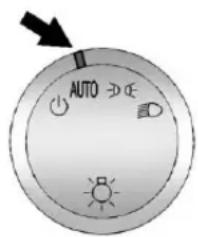
text_image
AUTO DE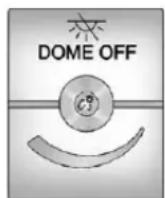
The exterior lamp controlled on the instrument panel to the left of the steering wheel.
Itcontrolsthefollowingsystems:
- Headlamps
- Taillamps
- ParkingLamps
- LicensePlateLamps
- InstrumentPanelLights
The exterior lamp control has four positions:
(Off): Brieflyturnthecontrol to this position to turn the automatic headlamps and daytime Running Lamps (DRL) offorback on.
For vehiclesfirstsoldin Canada, the off position only works for vehicle sthatareshifted into the P(Park) position.
AUTO(Automatic): Turnsonthe headlampsautomaticallyatnormal brightness,togetherwiththe following:
- ParkingLamps
- InstrumentPanelLights
- Taillamps
- LicensePlateLamps
300=(ParkingLamps):Turnsonthe parkinglampstogetherwiththe following:
- InstrumentPanelLights
- Taillamps
- LicensePlateLamps
(DHeadlamps): Turnsonthe headlampstogetherwiththe following:
- ParkingLamps
- InstrumentPanelLights
- Taillamps
- LicensePlateLamps
Iftheheadlampsareturnedon whilethevehicleison,the headlampsturnoffautomatically 10minutesaftertheignitionis turnedoff.Iftheheadlampsare turnedonwhilethevehicleisoff, theheadlampswillcontinuetostay on.Topreventthebatteryfrom beingdrained,turnthecontrolto the ⏻position.
Awarningchimesoundsifthedriver doorisopenedwhiletheignition switchisoffandtheheadlamps areon.
Tochangetheheadlampsfromlow beamtohighbeam,pulltheturn signal/multifunctionleveralltheway towardyou.Thenreleaseit.
ExteriorLampsOff Reminder
Ifadoorisopen,areminderchime soundswhentheheadlampsor parkinglampsaremanuallyturned onandthekeyisoutoftheignition. Toturnoffthechime,turnthe headlampswitchto 🚪orAUTOand thenbackon,orcloseandre-open thedoor.Intheautomode,the headlampsturnoffoncetheignition isinLOCK/OFFormayremainon untiltheheadlampdelayends, ifenabledintheDriverInformation Center(DIC).See“ExitLighting” underVehiclePersonalizationon page5-42.
HeadlampHigh/ Low-BeamChanger
ID ID (HeadlampHigh/Low-Beam Changer): Pulltheturnsignallever allthewaytowardyoutochange theheadlampsfromlowtohigh beam. Thenreleaseit.

Thisinstrumentpanelclusterlight comesonwhenthehigh-beam headlampsareon.
Flash-to-Pass
Thisfeatureisusedtosignaltothe vehicleaheadthatyouwant topass.
Iftheheadlampsareofforinthe low-beamposition,pulltheturn signallevertowardyouto momentarilyswitchtohighbeams.
Releasethevertoturnthe high-beamheadlampsoff.
DaytimeRunning Lamps(DRL)
DRLcanmakeiteasierforothersto seethefrontofthevehicleduring theday.Fullyfunctionaldaytime runninglampsarerequiredonall vehiclesfirstsoldinCanada.
The DRL system comes on daylight when the following conditions are met:
- Theignitionison.
• The exterior lamp control is in the AUTO position.
• TheshiftleverisnotinP(Park). - Thelightsensordeterminesit isdaytime.
WhentheDRLareon,thetaillamps, sidemarker,instrumentpanellights, andotherlampswillnotbeon.
The automatic headlampsystem automatically switches from DRL to the headlamps depending on the darkness of the surroundings.
ToturnofftheDRL,turntheexterior lampcontrolto ☐andthenrelease it.ForvehiclesfirstsoldinCanada, thetransmissionmustbeinthe P(Park)position,beforetheDRL canbeturnedoff.
AutomaticHeadlamp System
Whenitisdarkenoughoutsideand theheadlampswitchisinAUTO, theautomaticheadlampsystem turnsontheheadlamps, alongwith thetaillamps, sidemarkerlamps, parkinglamps, andtheinstrument panellights. Theradiolightswill alsobedim.
Toturnofftheautomaticheadlamp system,turntheexteriorlamp controltotheoffpositionandthen release.Forvehiclesfirstsoldin Canada,thetransmissionmustbe intheP(Park)position,beforethe automaticheadlampsystemcanbe turnedoff.
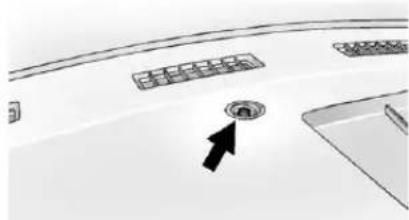
natural_image
Diagram showing a circular component with an arrow pointing to it, surrounded by rectangular blocks (no text or symbols)The vehicle has alightsensor located on the top of the instrument panel. Donot cover the sensor; otherwise the system will come on whenever the ignition is on.
Thesystemmayalsoturnonthe headlampswhendrivingthrougha parkinggarageortunnel.
Thereisdelayinthetransition between the daytime and nighttime operation of the Daytime Running Lamps (DRL) and the automatic headlampsystem so that driving under bridges or bright overhead streetlights does not affect the system.
TheDRLandautomaticheadlamp systemareonlyaffectedwhenthe lightsensorseesachangein lightinglastinglongerthanthe delay.
Ifthevehicleisstartedinadark garage,theautomaticheadlamp systemcomesonimmediately. Oncethevehicleleavesthegarage, ittakesapproximately30seconds fortheautomaticheadlampsystem tochangetoDRLifitislight outside.Duringthatdelay,the instrumentpanelclustermaynotbe asbrightasusual.Makesurethe instrumentpanelbrightnesscontrol isinthefullbrightposition.See InstrumentPanelIllumination Controlonpage6-6.
HazardWarningFlashers
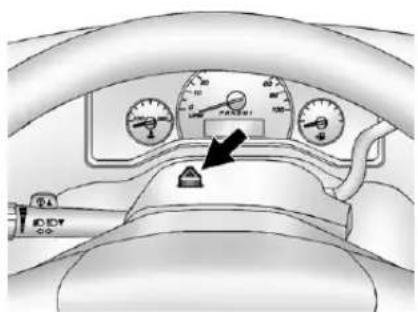
text_image
Diagram of a car dashboard with gauges, speedometer, and directional indicator showing vehicle status△(HazardWarningFlashers): Pressthisbuttonlocatedontopof thesteeringcolumn,tomakethe frontandreturnsignallamps flashonandoff.Thiswarnsothers thatyouarehavingtrouble.Press againstoturntheflashersoff.
Whenthehazardwarningflashers areon,thevehicle'sturnsignalswill notwork.
TurnandLane-Change Signals
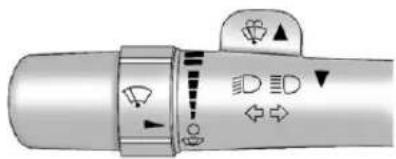
natural_image
Diagram of a mechanical or electrical component with directional arrows and symbols (no readable text or labels)Anarrowontheinstrument panelclusterflashesinthedirection oftheturnorlanechange.
Tosignalaturn, movetheleverall thewayupordown.
Tosignalalanechange, raiseor lowertheleveruntilthearrow startstoflash. Theturnsignal automaticallyflashestreetimes andiftheTow/HaulModeisactive itflashessixtimes. Holding the turnsignalleverformorethan onesecondcausestethurnsignals toflashcontinuallyuntilthelever isreleased.
Theleverreturnstoitsstarting positionwhenreleased.
Ifaftersignalingaturnorlane changethearrowflashesrapidlyor doesnotcomeon,asignalbulb maybeburnedout.
Haveanyburnedoutbulbs replaced.Ifthebulbisnotburned out,checkthefuse.SeeFusesand CircuitBreakersonpage10-41.
TurnSignalOnChime
If the turn signal is left on form more than 1.2 km (0.75 mi), achime sounds at each flash of the turn signal and the message TURN SIGNAL ON also appears in the Driver Information Center (DIC). See Lamp Messages on page 5-38. Toturn off the chime and message, mov the turn signal is a vertical error to the off position.
InteriorLighting
InstrumentPanel IlluminationControl
Theknobforthisfeatureislocated totheleftofthesteeringcolumn.
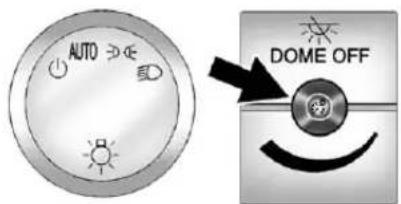
text_image
AUTO > DE ED DOME OFF(InstrumentPanelLights): Pushtheknobtoextendandthen turnclockwiseorcounterclockwise tobrightenordimtheinstrument panellightsandtheradiodisplay. Thisonlyworksiftheheadlampsor parkinglampsareon.
DomeLamps
Thedomelampscomeonwhenany doorisopened. Theyturnoffafter allthedoorsareclosed.
Theinstrumentpanelbrightness knobextendswhen ispressed. Tomanuallyturnonthedome lamps, press thenturntheknob clockwisetothefarthestposition. In this position, the domelamps remainonwhetheradoorisopened orclosed.
DomeLampOverride
The 来DOMEOFFbuttonis locatedabovetheinstrumentpanel brightnessknob.
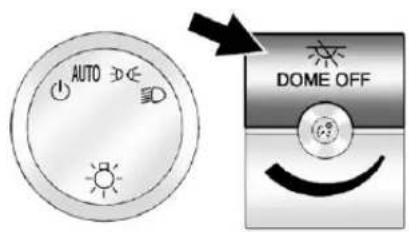
text_image
AUTO DOME OFFThedomelampoverridesetsthe domelampstoremainoffor comeonautomaticallywhena doorisopened.
※DOMEOFF:Pressthisbutton inandthedomelampsremainoff whenadoorisopened.Pressthe buttonagaintoreturnittothe extendedpositionsothatthedome lampscomeonwhenadooris opened.
ReadingLamps
Forvehicleswithreadinglamps, pressthebuttonlocatednextto eachlamptoturnitonoroff.
The vehicle may also have an reading lamps in other locations. The lamps cannot be adjusted.
LightingFeatures
Entry/ExitLighting
The vehicle has an illuminated entry/exit feature.
Thedomelampscomeonif the ☑DOMEOFFbuttonisinthe extendedposition,whenadooris openedorthekeyisremovedfrom theignition.
BatteryLoad Management
The vehicle may have Electric Power Management (EPM) that estimates the battery's temperature and state of charge. It then adjusts the voltage for best performance and extended life of the battery.
When the battery's state of charge is low, the voltage is raised slightly to quickly bring the charge backup. When the state of charge is high, the voltage is lowered slightly to prevent over charging. If the vehicle has a voltmeter gauge or a voltaged display on the Driver Information Center (DIC), you may se the voltagemove upordown. This is normal. If there is a problem, an alert will be displayed.
The battery can be discharged at idle if the electrical loads are very high. This is true for all vehicles. This because the generator (alternator) may not be spinning fast enough that lidetoproduce all the power that is needed for very high electrical loads.
6-8Lighting
Ahighelectricloadoccurswhen severalofthefollowingareon, suchas:headlamps,highbeams, foglamps,rearwindowdefogger, climatecontrolfanathighspeed, heatedseats,enginecoolingfans, trailerloads,andloadspluggedinto accessorypoweroutlets.
EPMworkstoppreventexcessive dischargeofthebattery.ltdoesthis bybalancingthegenerator'soutput andthevehicle'selectricalneeds. Itcanincreaseengineidlespeedto generatemorepower,whenever needed.Itcantemporarilyreduce thepowerdemandsofsome accessories.
Normally, these actions occur in steps or levels, without being noticeable. In rare cases at the highest level of corrective action, this action may be notice able to the driver. If so, a Driver Information Center (DIC) message might be displayed, such as SERVICE BATTERY CHARGINGSYSTEM. If this messages displays, it is recommended that the driver reduce the electrical loads and muchas possible. See Battery Voltage and Charging Messages on page 5-34.
BatteryPowerProtection
Thisfeatureshutsoffthedome lampsiftheyareleftonformore than10minuteswhentheignitionis inLOCK/OFF. Thishelpstoprevent thebatteryfromrunningdown.
Infotainment System
Introduction
Infotainment......7-1
Theft-DeterrentFeature.....7-2
Operation....7-3
Radio
AM-FMRadio....7-8
SatelliteRadio....7-10
RadioReception......7-12
FixedMastAntenna
(Multi-Band)....7-12
FixedMast
Antenna(Care)......7-12
AudioPlayers
CDPlayer....7-13
AuxiliaryDevices......7-19
Phone
Bluetooth....7-24
Introduction
Infotainment
If the vehicle camewithoutaradio, the wiring provisions for radio and an antennawere installed at the assembly plant, so that if you want, aradiocan be installed at the dealer.
Determinewhichradiothevehicle hasandreadthefollowingpagesto becomefamiliarwithitsfeatures.

WARNING
Takingyoureyesofftheroadfor extendedperiodscouldcausea crashresultingininjuryordeath toyouorothers.Donotgive extendedattentionto entertainmenttaskSWhiledriving.
This system provides access to many audio and non-audiolistings.
7-2InfotainmentSystem
Tominimizetakingyoureyesoffthe roadwhiledriving,dothefollowing whilethevehicleisparked:
- Becomefamiliarwiththe operationandcontrolsofthe audiosystem.
- Setupthetone, speaker adjustments, and presetradio stations.
Formoreinformation,seeDefensive Drivingonpage9-3.
Notice: Contact your dealer before adding any equipment.
Addingaudioorcommunication equipmentcouldinterferewith theoperationoftheengine,radio, orothersystems,andcould damagethem.Followfederal rulescoveringmobileradioand telephoneequipment.
Notice:Thechimesignalsrelated tosafetybelts,parkingbrake,and otherfunctionsofthevehicle operatethroughtheradio/entertainmentsystem.Ifthat equipmentisreplacedor additionalequipmentisaddedto thevehicle,thechimesmaynot work.Makesurethatreplacement oradditionalequipmentis compatiblewiththevehicle beforeinstallingit.See AccessoriesandModificationson page10-3.
ThevehiclehasRetained AccessoryPower(RAP).WithRAP, theaudiosystemcanbeplayed evenaftertheignitionisturnedoff. SeeRetainedAccessoryPower (RAP)onpage9-21formore information.
Theft-DeterrentFeature
Thetheft-deterrentfeatureworksby learningaportionoftheVehicle IdentificationNumber(VIN)tothe infotainmentsystem.The infotainmentsystemdoesnot operateifitisstolenormovedtoa differentvehicle.
Operation
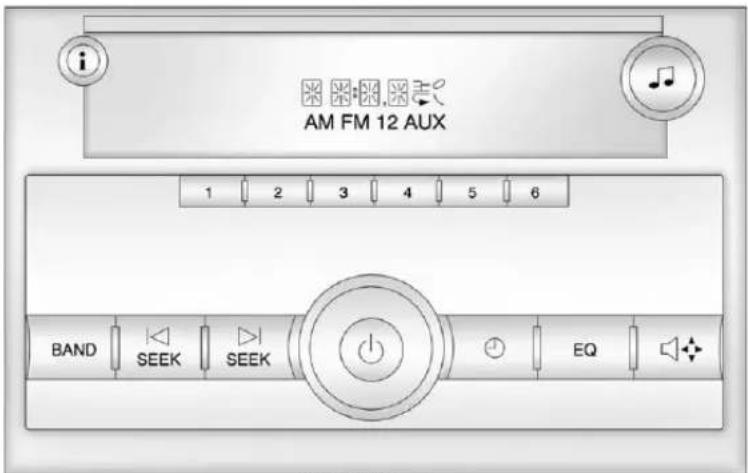
text_image
AM FM 12 AUX 1 2 3 4 5 6 BAND SEEK SEEK EQAM-FMRadio
7-4InfotainmentSystem
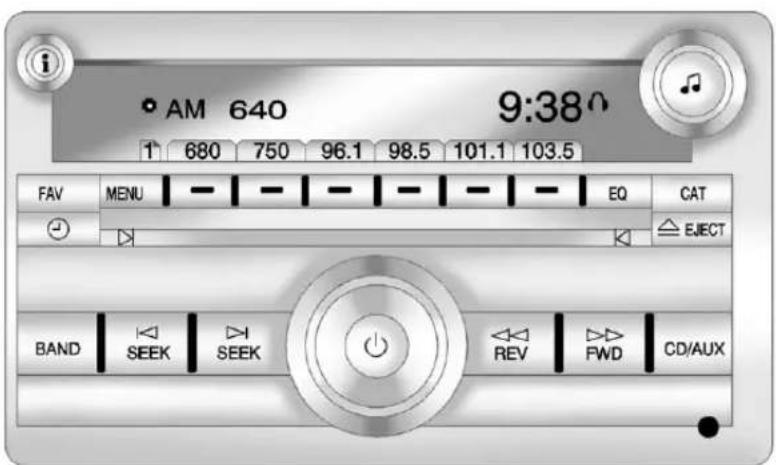
text_image
AM 640 9:38 1 680 750 96.1 98.5 101.1 103.5 FAV MENU - - - - - - - - EQ CAT EJECT BAND SEEK SEEK REV FWD CD/AUXRadiowithCD(MP3)Shown; RadiowithUSBandCD(MP3)andRadio withCDSimilar
The vehicle has one of the seradios as its audiosystem.
UsingtheRadio
(Power/Volume):Presstoturn thesystemonandoff.
Turnclockwiseorcounterclockwise toincreaseordecreasethevolume.
i(Information):Presstoswitch thedisplaybetweentheradio stationfrequencyandthetime. Whiletheignitionisoff,pressthis buttontodisplaythetime.Pressto displayadditionaltextinformation relatedtothecurrentFM-RDS stationorMP3song.Achoiceof additionalinformationsuchas Channel,Song,Artist,andCAT (category)candisplay.Continue pressingtohighlighthedesiredtab, orpressthesoftkeylocatedunder anyoneofthetabsandthe informationaboutthattabdisplays.
SpeedCompensated Volume(SCV):Radioswith SCVautomaticallyadjusttheradio volumetocompensateforroadand windnoiseasthevehiclespeed changeswhiledriving,sothatthe volumelevelstaysconsistent.
ToactivateSCV:
- Settheradiovolumetothe desiredlevel.
- PresstheMENUbutton to displaytheradiosetupmenu.
-
Pressthesoftkeyunderthe AUTOVOLUM(automatic volume)tabontheradiodisplay.
-
Pressthesoftkeyunderthe desiredSpeedCompensated Volumesetting(OFF, Low, Med, or High)toselectthelevelof radiovolumecompensation. Thedisplaytimesoutafter approximately 10 seconds. Each highersettingallowsformore radiovolumecompensation at fastervehiclespeeds.
SettingtheTone(Bass/Treble) (AM-FMRadioandAM-FM RadiowithCD)
Toadjustthebassortreble:
- Pressthe ♪knobuntilBassor Trebledisplays.
-
To adjust the setting, do one of the following:
-
Turnthe♪knob.
- Presseither✉SEEK, or ◀SEEK.
EQ(Equalization):Pressthis buttontochoosebassandtreble equalizationsettingsdesignedfor differenttypesofmusic.Selecting MANUAL,orchangingbassor treble,returnstheEQtothemanual bassandtreblesettings.
UniqueEQsettingscanbesaved foreachsource.
SettingtheTone (Bass/Midrange/Treble) (AllExceptAM-FMRadioand AM-FMRadiowithCD)
BASS/MID/TREB(Bass, Midrange, orTreble): Toadjustthebass, midrange, ortreble:
-
Pressthe ♪knobuntilthetone controltabsdisplay.
-
Highlightthedesiredtone controltabbydoingoneof thefollowing:
-
Pressthe♪knob.
• Pressthesoftkeyunderthe desiredtab. -
Adjust the setting by doing one of the following:
• Turnthe♪knobclockwise orcounterclockwise.
- PressSEEKonSEEK.
- Press▶▶FWDor◀◀REV.
Ifastation'sfrequencyisweakorif thereisstatic,decreasethetreble.
Toquicklyadjustbass, midrange, ortrebletothemiddleposition, pressthesoftkeypositionedunder theBASS,MID,orTREBtabfor morethantwoseconds.Abeep soundsandtheleveladjuststothe middleposition.
Toquicklyadjustalltoneand speakercontrolstothemiddle position, press the ♪knobformore thantwosecondsuntilabeep sounds.
EQ(Equalization):Pressthis buttontochoosebassandtreble equalizationsettingsdesignedfor differenttypesofmusic.Selecting MANUAL,orchangingbassor treble,returnstheEQtothemanual bassandtreblesettings.
UniqueEQsettingscanbesaved foreachsource.
IftheradiohasaBose ^® audio system,theEQsettingsareeither MANUALorTALK.
AdjustingtheSpeakers (Balance/Fade)(AM-FMRadio and AM-FMRadiowithCD)
Toadjustthebalanceorfade:
-
Press 📋orpressthe knob untilthespeakercontroltab displays.
-
To adjust the setting, do one of the following:
- Turnthe♪knob.
- Presseither✉SEEK, or ⌘SEEK.
AdjustingtheSpeakers (Balance/Fade)(AllExcept AM-FMRadioandAM-FM RadiowithCD)
BAL/FADE(Balance/Fade): Toadjustthebalanceorfade:
-
Pressthe ♪knobuntilthe speakercontroltabsdisplay.
-
Highlight the desired speaker control tabby doing one of the following:
- Pressthe♪knob.
• Pressthesoftkeyunderthe desiredtab.
- Adjustthesettingbydoingone ofthefollowing:
• Turnthe♪knobclockwise orcounterclockwise.
- PressSEEKorSEEK.
- Press▶▶FWDor◀◀REV.
Toquicklyadjustallspeakerand tonecontrolstothemiddleposition, pressthe ♪knobformorethan twoseconds.
If the Rear Seat Audio (RSA) is turned on, theradiodisables FADE and mutestherearspeakers.
RadioMessages
CalibrationError: Theaudio systemhasbeencalibratedforthe vehiclefromthefactory.
If Calibration Error displays, it mean that the radio has not been configured properly for the vehicle and must be returned to your dealer for service.
VINorNOVIN: Oneofthese messageswilldisplaywhenthe TheftLocksystemhaslockedupthe radio. Takethevehicletoyour dealerforservice.
Ifanyerroroccursrepeatedlyorif anerrorcannotbecorrected, contactyourdealer.
Radio
AM-FMRadio
RadioDataSystem(RDS)
TheRadiomayhaveaRadioData System(RDS).TheRDSfeatureis availableforuseonlyonFM stationsthatbroadcastRDS information. Thissystemreliesupon receivingspecificinformationfrom thesestationsandonlyworkwhen theinformationisavailable. While theradioistunedtoanFM-RDS station,thestationnameorcall lettersdisplay.Inrarecases,aradio stationcouldbroadcastincorrect informationthatcausestheradio featurestoworkimproperly.Ifthis happens,contacttheradiostation.
FindingaStation
BAND: Presstoswitch between FM1, FM2, AM, and XM. Theselectiondisplays.
♪(Tune):Turnclockwiseor counterclockwisetoincreaseor decreasestestationfrequency.
SEEKorSEEK:
Press KSEEKtogotothe previousor SEEKtogotothe nextstationandstaythere.
Toscanstations, press and hold either button for two seconds until beeps sounds. Theradiogoestoa station, plays for a few seconds, thengoestoth next station. For AM-FMRadio and Radiowith CD, the station frequency flashes while theradio is in the scan mode. Press either button again to stopscanning.
Theradioseeksandscansstations onlywithastrongsignalthatarein theselectedband.
ForAM-FMRadioandRadiowith CD, scanpresetswithinthecurrent selectedbandbypassingand holdingeitherSEEKbuttonfor foursecondsuntiladoublebeep sounds. Theradiogoestoastored preset, playsforafewsecondsifa strongsignalispresent, thengoes tothenextstoredpreset. The stationfrequencyflasheswhilethe radioisinthescanmode.
SettingPresetStations
Iftheradiodoesnothavea FAVbutton,upto18stations (sixFM1,sixFM2,andsixAM), canbeprogrammedonthesix numberedsoftkeys,byperforming thefollowingsteps:
- Turntheradioon.
- PressBANDtoselectFM1, FM2, or AM.
-
Tuneinthedesiredstation.
-
Pressandholdoneofthe sixnumberedsoftkeysfor threesecondsuntilabeep sounds. Whenthatsoftkeyis pressedandreleased, the stationthatwasset, returns.
- RepeatSteps2through4for eachsoftkey.
StoringaRadioStationasa Favorite
Driversareencouragedtosetup theirradiostationfavoriteswhilethe vehicleisparked.Tunetofavorite stationsusingthepresets,favorites button,andsteeringwheelcontrols, ifthevehiclehasthisfeature.See DefensiveDrivingonpage9-3.
FAV(Favorites):Ifthevehicle hasaFAVbutton,amaximumof 36stationscanbeprogrammedas favoritesusingthesixsoftkeys positionedbelowtheradiostation frequencytabsandbyusing theradiofavoritespagebutton (FAVbutton).
PresstheFAVbuttontogthrough uptosixpagesoffavorites,each havingsixfavoritestationsavailable perpage.Eachpageoffavorites cancontainanycombinationofAM andFMstations.
The balance/fade and tones settings that were previously adjusted, are stored with the favoritestations.
Tostoreastationasafavorite:
- Tunetothedesiredradiostation.
- Press the FAV button to display the pagewherethestation list to be stored.
- Pressandholdoneofthe sixsoftkeysuntilabeepsounds. Whenthatsoftkeyispressed andreleased,thestationthat wasset, returns.
- Repeat the steps foreach soft key radiostation you want stored as a favorite.
Thenumberoffavoritespagescan besetupusingtheMENUbutton. Tosetupthenumberoffavorites pages:
- PresstheMENUbutton to displaytheradiosetupmenu.
- Pressthesoftkeylocatedbelow theFAV1-6tab.
- Select the desired number of favorites pages by pressing the soft key located below the displayed pagenumbers.
- PresstheFAVbutton, orletthe menutimeout, toreturntothe originalmainradioscreen showingtheradiostation frequencytabsandtobeginthe processofprogrammingyour favoritesforthechosennumber ofnumberedpages.
SatelliteRadio
FindingaCategory(CAT) Station
CAT(Category): The CAT button is used to find XM ^™ stations while the radio is in the XM mode.
XMisasatelliteradioservicebased intheUnitedStatesand Canadaonly.
FindingaStation
BAND: Presstoswitch between FM1, FM2, AM, and XM. Theselectiondisplays.
Tune): Turnclockwiseor counterclockwisetoincreaseor decreasestestationfrequency.
SEEKorSEEK:
Press KSEEKtogotothe previousor SEEKtogotothe nextstationandstaythere.
Toscanstations, press and hold either button for two seconds until beepsounds. Theradiogoestoa station, plays for a few seconds, thengoestothen next station. For AM-FMRadio and Radiowith CD, the station frequency flashes while theradio is in the scan mode. Press either button again to stopscanning.
Theradioseeksandscansstations onlywithastrongsignalthatarein theselectedband.
ForAM-FMRadioandRadiowith CD, scanpresetswithinthecurrent selectedbandbypressingand holdingeitherSEEKbuttonfor foursecondsuntiladoublebeep sounds. Theradiogoestoastored preset, playsforafewsecondsifa strongsignalispresent, thengoes tothenextstoredpreset. The stationfrequencyflasheswhilethe radioisinthescanmode.
SettingPresetStations
Iftheradiodoesnothavea FAVbutton, upto18stations (sixFM1, sixFM2, and sixAM), can be programmed on the six numbered soft keys, by performing the following steps:
- Turntheradioon.
- PressBANDtoselectFM1, FM2, or AM.
-
Tuneinthedesiredstation.
-
Pressandholdoneofthesix numberedsoftkeysfor threesecondsuntilabeep sounds. Whenthatsoftkeyis pressedandreleased, the stationthatwasset, returns.
-
RepeatSteps2through4for eachsoftkey.
StoringaRadioStationasa Favorite
Driversareencouragedtosetup theirradiostationfavoriteswhilethe vehicleisparked.Tunetofavorite stationsusingthepresets,favorites button,andsteeringwheelcontrols, ifthevehiclehasthisfeature.See DefensiveDrivingonpage9-3.
FAV(Favorites):Ifthevehicle hasaFAVbutton,amaximumof 36stationscanbeprogrammedas favoritesusingthesixsoftkeys positionedbelowtheradiostation frequencytabsandbyusingthe radiofavoritespagebutton(FAV button).PresstheFAVbuttontogo throughuptosixpagesoffavorites, eachhavingsixfavoritestations availableperpage.Eachpage offavoritescancontainany combinationofAMandFMstations.
The balance/fade and tones settings that were previously adjusted, are stored with the favoritestations.
Tostoreastationasafavorite:
-
Tunetothedesiredradiostation.
-
PresstheFAVbuttontodisplay thepagewherethestationisto bestored.
-
Pressandholdoneofthe sixsoftkeysuntilabeepsounds. Whenthatsoftkeyispressed andreleased,thestationthat wasset, returns.
-
Repeat the steps foreach soft key radiostation you want stored as a favorite.
Thenumberoffavoritespagescan besetupusingtheMENUbutton. Tosetupthenumberoffavorites pages:
-
PresstheMENUbutton to displaytheradiosetupmenu.
-
Pressthesoftkeylocatedbelow theFAV1-6tab.
-
Select the desired number of favorites pages by pressing the soft key located below the displayed pagenumbers.
-
PresstheFAVbutton, orletthe menutimeout, toreturntothe originalmainradioscreen showingtheradiostation frequencytabsandtobeginthe processofprogrammingyour favoritesforthechosenamount ofnumberedpages.
RadioReception
Frequencyinterferenceandstatic canoccurduringnormalradio receptionifitemssuchascellphone chargers,vehicleconvenience accessories,andexternalelectronic devicesarepluggedintothe accessorypoweroutlet.Ifthereis interferenceorstatic,unplugthe itemfromtheaccessorypower outlet.
AM
TherangeformostAMstationsis greaterthanforFM,especiallyat night. Thelongerrangecancause stationfrequenciestointerferewith eachother.Forbetterradio reception,mostAMradiostations boostthepowerlevelsduringthe day,andthenreducetheselevels duringthenight.Staticcanalso occurwhentthingslikestormsand powerlinesinterferewithradio reception.Whenthishappens,try reducingthetrebleontheradio.
FMStereo
FMstereogivesthebestsound, but FMsignalsreachonlyabout16to 65km(10to40mi). Tallbuildingsor hillscaninterferewithFMsignals, causingthesoundtofadein andout.
CellularPhoneUsage
Cellularphoneusagemaycause interferencewiththeradio. This interferencemayoccurwhen makingorreceivingphonecalls, chargingthephone'sbattery, orsimplyhavingthephoneon. Thisinterferencecausesan increasedlevelofstaticwhile listeningtotheradio.Ifstaticis receivedwhilelisteningtotheradio, unplugthecellularphoneandturn itoff.
FixedMastAntenna (Multi-Band)
Themulti-bandantennaislocated ontheroofofthevehicle. The antennaisusedforOnStarandthe
XMSatelliteRadioServiceSystem ifthevehiclehasthesefeatures. Keeptheantennaclearof obstructionsforclearreception. Makesurethereissufficient clearancewhenenteringgarages orparkingstructures.
FixedMast Antenna(Care)
Thefixedmastantennacan withstandmostcarwasheswithout beingdamagedaslongasitis securelyattachedtothebase.Ifthe mastbecomesslightlybent, straightenitoutbyhand.Ifthemast isbadlybent,replaceit.
Makesurethereissufficient clearancewhenenteringgaragesor parkingstructures.
Occasionallychecktomakesure theantennaistightenedtoitsbase. Iftighteningisrequired,tighten byhand.
AudioPlayers
CDPlayer
CareoftheCDPlayer
DonotaddanylabeltoaCD. ItcouldgetcaughtintheCD.Ifa CDisrecordedonapersonal computerandadescriptionlabelis needed,trylabelingthetopofthe recordedCDwithamarkingpen.
TheuseofCDlenscleanersis notadvised, duetotheriskof contaminatingthelensoftheCD opticswithlubricantsinternaltothe CDplayermechanism.
Notice:Ifalabelisaddedtoa CD,morethanoneCDisinserted intotheslotatatime,oran attemptismadetoplayscratched ordamagedCDs,theCDplayer couldbedamaged.Whileusing theCDplayer,useonlyCDsin goodconditionwithoutanylabel, loadoneCDatatime,andkeep
theCDplayerandtheloadingslot freeofforeignmaterials, liquids, anddebris.
Ifanerrorddisplays,see"CDPlayer Messages"laterinthissection.
CareofCDs
IfplayingaCD-R,thesoundquality canbereducedduetoCD-Ror CD-RWquality,themethodof recording,thequalityofthemusic thathasbeenrecorded,andthe waytheCD-RorCD-RWhasbeen handled.Handlethemcarefully. StoreCD-RsorCD-RWsintheir originalcasesorotherprotective casesandawayfromdirectsunlight anddust.TheCDplayerscansthe bottomsurfaceofthedisc.Ifthe surfaceofaCDisdamaged,such ascracked,broken,orscratched, theCDdoesnotplayproperlyornot atall.Donottouchthebottomside ofaCDwhilehandlingit;thiscould damagethesurface.PickupCDs bygraspingtheouteredgesorthe edgeoftheholeandtheouteredge.
If the surface of a CD is soiled, clean with as soft, lint-free cloth or dampen a clean, soft cloth in amild, neutral detergent solution mixed with water. Makes sure the wiping process starts from the center to the edge.
InsertingaCD(SingleCD Player)
InsertaCDpartwayintotheslot, labelsideup. Theplayerpullsitin andtheCDshouldbeginplaying.
EjectingaCD(SingleCD Player)
△EJECT:Pressandreleaseto ejectthedisc.RemovetheCD whenRemoveDiscdisplays.Ifthe discisnotremoved,afterseveral secondsthediscisautomatically pulledbackintotheplayer.
7-14InfotainmentSystem
PlayingaCD
If the ignition or radioisturned off with a CD in the player, it stays in the player. When the ignition or radioisturned on, the CD starts playing where it stopped, if it was the last selected audiosource.
WhenaCDisinserted,theCD symboldisplaysontheleftsideof theradiodisplay.Aseachnewtrack startstoplay,thetracknumber displays.
TheCDplayercanplaythesmaller 8cm(3in)singleCDswithan adapterring.Full-sizeCDsandthe smallerCDsareloadedinthesame manner.
CD/AUX(CD/Auxiliary):Pressto cyclebetweenCDorAuxiliarywhen listeningtotheradio.TheCDicon andamessageshowingthedisc and/ortracknumberwilldisplay whenaCDisintheplayer.Press againandthesystemautomatically searchesforanauxiliaryinput device;seeAuxiliaryDeviceson page7-19formoreinformation. Ifaportableaudioplayerisnot connected,“NoInputDeviceFound” displays.
i(Information): Presstodisplay additionaltextinformationrelated to thecurrentsong.lfinformationis available,thesongtitleinformation displaysonthetoplineofthe displayandartistinformation displaysonthebottomline. Wheninformationisnotavailable, NOINFOdisplays.
♪(Tune):Turntoselecttrackson theCDthatiscurrentlyplaying.
KSEEK: Presstogotothestart of the current track if more than 10 seconds on the CD have played.
Presstogototheprevioustrackif lessthan10secondsontheCD haveplayed.
Pressandhold, or press multiple times, to continue moving backward through the trackson the CD.
SEEK: Presstogotothe nexttrack.
Pressandhold, or press multiple times, to continue moving forward through the trackson the CD.
◀REV(FastReverse):Press andholdtoreverseplaybackquickly withinatrack.
FWD(FastForward):Press andholdtoadvance playback quickly within at track.
RDM(Random): Presstolistento tracksinrandom, rather than sequential order. Touserandom, do one of the following:
FortheAM-FMRadiowithCD:
- PresstheRDMbuttonuntilthe randomicondisplays.
- PresstheRDMbuttonagain untiltherandomicondisappears fromthedisplay.
FortheRadiowithCD(MP3)and RadiowithUSBandCD(MP3):
-
Pressthesoftkeypositioned undertheRDMtabuntilRandom CurrentDiscdisplays.
-
Pressthesoftkeyagaintoturn offrandomplay.
MP3-SupportedFiles
The RadiowithCD(MP3) and RadiowithUSBandCD(MP3) have the capability of playing an MP3 CD-RorCD-RWdisc.
Format
Radiosthathavethecapability of playingMP3scanplay.mp3or.wma filesthatwererecordedontoa CD-RorCD-RWdisc. Thefilescan berecordedwiththefollowingfixed bitrates:32kbps,40kbps,56kbps, 64kbps,80kbps,96kbps,112kbps, 128kbps,160kbps,192kbps, 224kbps,256kbps,and320kbpsor avariablebitrate.
CompressedAudioorMixedMode Discs
Theradiocanplaydiscsthat containbothuncompressedCD audioandMP3files.Ifbothformats areonthedisc,theradioreadsall MP3filesfirst,thenthe uncompressedCDaudiofiles.
CD-R- or CD-RW-Supported File and Folder Structure
Theradiosupports:
- Upto50folders.
• Uptoeightfoldersindepth. - Upto50playlists.
- Upto255files.
- Playlistswithan.m3uor.wpl extension.
- Fileswithan.mp3,.wma,or.cda fileextension.
RootDirectory
Therootdirectoryistreatedasa folder.Filesarestoredintheroot directorywhenthediscorstorage devicedoesnotcontainfolders. Filesaccessedfromtheroot directoryofaCDdisplayas F1ROOT.
EmptyFolder
Foldersthatdonotcontainfilesare skipped, and the player advance to then next folder that contains files.
OrderofPlay
Compressedaudiofilesare accessedinthefollowingorder:
- Playlists(Px).
- Filesstoredintherootdirectory.
- Filesstoredinfoldersinthe rootdirectory.
Tracksareplayedinthefollowing order:
- Playbeginsfromthefirsttrackin thefirstplaylistandcontinues sequentiallythroughalltracksin eachplaylist.Whenthelast trackofthelastplaylisthas played,playcontinuesfromthe firsttrackofthefirstplaylist.
- Playbeginsfromthefirsttrackin thefirstfolderandcontinues sequentiallythroughalltracksin eachfolder.Whenthelasttrack ofthelastfolderhasplayed, playcontinuesfromthefirst trackofthefirstfolder.
FileSystemandNaming
Thesongnamethatdisplaysisthe songnamecontainedintheID3tag. Ifthesongnameisnotpresentin theID3tag,thentheradiodisplays thefilenamewithouttheextension (suchas.mp3)asthetrackname.
Tracknameslongerthan 32charactersofourpagesare shortened. Thedisplaydoesnot showpartsofwordsonthelast pageoftext, andtheextensionof thefilenameisnotdisplayed.
PreprogrammedPlaylists
CDsthathavepreprogrammed playlistscreatedusingWinAmp™, MusicMatch™, orRealJukebox™ softwarecanbeaccessed; however, thereisnoplaylist-editingcapability usingtheradio. Theseplaylistsare treatedasspecialfolderscontaining compressedaudiosongfiles.
Playliststhathavean.m3uor.pls fileextensionandarestoredona USBdevicemaybesupportedby theradiowithaUSBport.
Playlistscanbechangedbyusing thesoftkeysbelowthe
PlayinganMP3
i(Information): Presstodisplay additionaltextinformationrelated to thecurrentsong. Ifinformationis available, thesongtitleinformation displaysonthetoplineofthe displayandartistinformation displaysonthebottomline. Wheninformationisnotavailable, NOINFOdisplays.
♪(Tune):TurntoselectMP3son theCDcurrentlyplaying.
KSEEK: Presstogotothestartof thetrack, if more than 10 seconds have played. Pressandholdor pressmultipletimestocontinue moving backward through tracks.
SEEK: Presstogotothenext track. Pressandholdorpress multipletimestocontinuemoving forwardthroughtracks.
◀REV(Reverse):Pressandhold toreverse playback quickly. Sound is heardatareduced volume and the elapsed time of the file displays. Release ◀REVtoresumeplaying.
FWD(FastForward):Press andholdtoadvance playback quickly. Soundisheardatareduced volume and the elapsed time of the file displays. Release FWD to resume playing. The elapsed time of the file displays.
(NextFolder):Pressthe softkeybelowthe tabtogoto thefirsttrackinthenextfolder.
RDM(Random):Presstolistento tracksinrandom, rather than sequential order. Touserandom, do one of the following:
FortheRadiowithCD(MP3)and RadiowithUSBandCD(MP3):
- Pressthesoftkeypositioned undertheRDMtabuntilRandom CurrentDiscdisplays.
- Pressthesoftkeyagaintoturn offrandomplay.
(MusicNavigator):Pressthe softkeybelowthe tabtoplay thefilesinorderbyartistoralbum.
Theplayerscansthedisctosortthe filesbyartistandalbumID3tag information.Itcantakeseveral minutestoscanthediscdepending onthenumberofffilesonthedisc. Theradiomaybeginplayingwhileit isscanninginthebackground.
Whenthescanisfinished,thedisc beginsplayingfilesinorderby artist.Thecurrentartistplayingis shownonthesecondlineofthe display.Onceallsongsbythatartist areplayed,theplayermovestothe nextartistinalphabeticalorderand beginsplayingfilesbythatartist.
Tolistentofilesbyanotherartist, pressthesoftkeylocatedbelow eitherarrowtab.Thediscgoesto thenextorpreviousartistin alphabeticalorder.Continue pressingeithersoftkeybelowthe arrowtabuntilthedesiredartist displays.
7-18InfotainmentSystem
Tochangefrom playbackbyartistto playbackbyalbum:
- Pressthesoftkeylocatedbelow theSortBytab.
- Pressoneofthesoftkeysbelow theAlbumtabfromthesort screen.
- Pressthesoftkeybelowthe Backtabtoreturntothemain musicnavigatorscreen.
Thealbumnamedisplaysonthe secondlinebetweenhearrows, and songsfromthecurrentalbum begintoplay.Onceallsongsfrom thatalbumhaveplayed,theplayer movestothenextalbumin alphabeticalorderontheCDand beginsplayingMP3sfromthat album.
Toexitmusicnavigatormode, press thesoftkeybelowtheBacktabto returntonormalMP3 playback.
CDPlayerMessages
CHECKDISC: If this message displays and/or the CDejects, it could be before one of the following reasons:
- Itisveryhot. Whenthe temperaturereturnstonormal, theCDshouldplay.
- Theroadisveryrough.When theroadbecomessmoother,the CDshouldplay.
• TheCDisdirty, scratched, wet, or upsidedown.
• Theairisveryhumid.Ifso,wait aboutanhourandtryagain.
• Therewasaproblemwhile burningtheCD.
• Thelabeliscaughtinthe CDplayer.
If the CD is not playing correctly, for any other reason, try a known good CD.
Ifanyerroroccursrepeatedlyorif anerrorcannotbecorrected, contactyourdealer.Iftheradio displaysanerrormessage,writeit downandprovideittoyourdealer whenreportingtheproblem.
Auxiliary Devices
UsingtheAuxiliaryInputJack
Radioswithanauxiliaryinputjack locatedonthelowerrightsideofthe faceplatecanconnecttoanexternal audiodevicesuchasaniPod ^® , MP3player,orCDplayer,foruseas anothersourceforaudiolistening. Thisinputjackisnotanaudio output;donotplugheadphonesinto thefrontauxiliaryinputjack.
Driversareencouragedtosetup anyauxiliarydevicewhilethe vehicleisinP(Park).See DefensiveDrivingonpage9-3for moreinformationondriver distraction.
Touseaportableaudioplayer, connecta3.5mm(1/8in)cableto theradio'sfrontauxiliaryinputjack. Whenadeviceisconnected,press theradioCD/AUXbuttontobegin playingaudiofromthedeviceover thevehiclespeakers.
Foroptimalsoundquality, increase theportableaudiodevice'svolume totheloudestlevel.
Itisalwaysbesttopowerthe portableaudiodevicethroughits ownbatterywhileplaying.
(Power/Volume):Turnclockwise orcounterclockwisetoincreaseor decreasethevolumeofthe portableplayer.Additionalvolume adjustmentsmighthavetobemade fromtheportabledeviceifthe volumeisnotloudorsoftenough.
BAND: Presstolistentotheradio whenaportableaudiodeviceis playing. Theportableaudiodevice continuesplaying.
CD/AUX(CD/Auxiliary): Pressto playaCDwhenaportableaudio deviceisplaying.Pressagainand thesystembeginsplayingaudio fromtheconnectedportableaudio player.Ifaportableaudioplayeris notconnected,"NolInputDevice Found"displays.
7-20InfotainmentSystem
UsingtheUSBPort
RadioswithaUSBportcancontrol aUSBstoragedeviceoraniPod usingtheradiobuttonsandknobs. See "PlayinganMP3" in CDPlayer onpage7-13 for information about howtoconnectandcontrola USBstoragedeviceoraniPod.
USBSupport
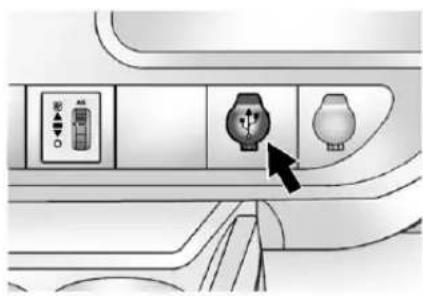
text_image
Diagram showing a device control panel with icons and a cursor pointing to a smartwatch icon, likely indicating a system or application.TheUSBconnectorislocatedon theinstrumentpanelandusesthe USB2.0standard.
USB-SupportedDevices
- USBflashdrive
- PortableUSBharddrive
• FifthgenerationorlateriPod - iPodnano
- iPodtouch
- iPodclassic
NotalliPodsandUSBdrivesare compatiblewiththeUSBport.
MakesuretheiPodhasthe latestfirmwarefromApple ^® for properoperation.iPodfirmware canbeupdatedusingthe latestiTunes ^® application. Seewww.apple.com/itunes.
ForhelpwithidentifyingtheiPod, go towww.apple.com/support.
RadiosthathaveaUSBportcan play.mp3and.wmafilesthatare storedonaUSBstoragedeviceas wellasAACfilesthatarestoredon aniPod.
USB-SupportedFileandFolder Structure
Theradiosupports:
- Upto700folders.
• Uptoeightfoldersindepth. - Upto65,535files.
- Folderandfilenamesupto 64bytes.
- Fileswithan.mp3or.wmafile extension.
• AACfilesstoredonaniPod.
FAT16. - FAT32.
ConnectingaUSBStorage DeviceoriPod
TheUSBportcanbeusedto controlaniPodoraUSBstorage device.
ToconnectaUSBstoragedevice, connectthedevicetotheUSBport locatedontheinstrumentpanel.
ToconnectaniPod, connectone endoftheUSBcablethatcame withtheiPodtotheiPod'sdock connectorandconnecttheother endtotheUSBportlocatedonthe instrumentpanel. Ifthevehicleis onandtheUSBconnectionworks, "OKtodisconnect"andaGMlogo mayappearontheiPod, andiPod appearsontheradiodisplay. The iPodmusicappearsontheradio displayandbeginsplaying.
TheiPodchargeswhileitis connectedtothevehicleifthe vehicleisintheACC/ACCESSORY orON/RUNposition.Whenthe vehicleisturnedoff,theiPod
automaticallypowersoffandwill notchargeordrawpowerfromthe vehicle'sbattery.
If you have an older Pod model that is not supported, it can still be used by connecting it to the auxiliary input jack using a standard 3.5mm (1/8in) stereocable. See "Using the Auxiliary Input Jack" earlier form more information.
UsingtheRadiotoControla USBStorageDeviceoriPod
TheradiocancontrolaUSB storagedeviceoraniPodusing theradiobuttonsandknobs,and displaysonginformationonthe radiodisplay.
♪(Tune):Turntoselectfiles.
KSEEK: Presstogotothestartof thetrack, if more than 10 seconds have played. Pressandholdor pressmultipletimesto continue moving backward through tracks.
SEEK: Presstogotothenext track. Pressandholdorpress multipletimestocontinuemoving forwardthroughtracks.
◀REV(Reverse):Pressandhold toreverse playback quickly. Sound isheard at areduced volume.
Release ◀REVtoresumeplaying. Theelapsedtimeofthefile displays.
FWD(FastForward):Press andholdtoadvance playback quickly. Soundisheardatareduced volume. Release FWDto resume playing. Theelapsed time of thefiledisplays.
i(Information): Presstodisplay additionalinformationaboutthe selectedtrack.
UsingSoftkeystoControla USBStorageDeviceoriPod
Thefivesoftkeysbelowtheradio displayareusedtocontrolthe functionslistedbelow.
Tousethesoftkeys:
-
Pressthefirstorfifthsoftkey belowtheradiodisplayto displaythefunctionslisted below, orpressthesoftkey belowthefunctionifitis currentlydisplayed.
-
Pressthesoftkeybelowthetab with the function on it to set that function.
II(Pause):Pressthesoftkey below IItopausethetrack. Thetab appearsraisedwhenpauseisbeing used. Pressthesoftkeybelow II againtoresume playback.
Back: Pressthesoftkeybelowthe Backtabtogobacktothemain displayscreenonaniPod, orthe rootdirectoryonaUSBstorage device.
(FolderView):Pressthe softkeybelow toviewthe contentsofthecurrentfolder on theUSBdrive.Tobrowseand selectfiles:
- Pressthesoftkeybelow

-
Turn 🔍 to scroll through the list of folders.
-
Press ⬆toselectthedesired folder. If there is more then one folder, repeat Steps 1 and 2 until the desired folder is reached.
-
Turn 🔍 to scroll through the files in these selected folder.
-
Press ♪toselectthedesiredfile tobeplayed.
Toskipthroughlargelists, thefive softkeyscanbeusedtonavigate in the following order:
- Firstsoftkey,firstiteminthelist.
• Secondsoftkey, 1% through the listeachtimethesoftkey is pressed.
• Thirdsoftkey,5%throughthelist eachtimethesoftkeyispressed.
- Fourthsoftkey, 10% through the listeachtimethesoftkey is pressed.
• Fifthsoftkey, endofthelist.
(MusicNavigator):Pressthe softkeybelow toviewand selectafileonaniPod,usingthe iPod'smenusystem.Filesare sortedby:
- Playlists
- Artists
- Albums
- Genres
- Songs
- Composers
Toselectfiles:
- Pressthesoftkeybelow

-
Turn ♪toscrollthroughthelist ofmenus.
-
Press♪ to select the desired menu.
- Turn ♪toscrollthroughthe foldersorfilesinthe selectedmenu.
- Press Ⓜtoselectthedesiredfile tobeplayed.
Toskipthroughlargelists, thefive softkeyscanbeusedtonavigate in thefollowingorder:
- Firstsoftkey,firstiteminthelist.
• Secondsoftkey, 1% through the listeachtimethesoftkey is pressed.
• Thirdsoftkey,5%throughthelist eachtimethesoftkeyispressed. - Fourthsoftkey, 10% through the listeachtimethesoftkey is pressed.
• Fifthsoftkey, endofthelist.
RepeatFunctionality
TouseRepeat:
Pressthesoftkeybelow ↩or↔1 toselectbetweenRepeatAlland RepeatTrack.
(RepeatAll):Pressthesoftkey below torepeatalltracks. The tabappearsloweredwhenRepeat Allisbeingused. Thisisthedefault modewhenaUSBstoragedevice oriPodisfirstconnected.
^1 (RepeatTrack):Pressthe softkeybelow ^1 torepeatone track. Thetabappearsraisedwhen RepeatTrackisbeingused.
ShuffleFunctionality
TouseShuffle:
Pressthesoftkeybelow →, ✗S, ✗A,or ✗Ftoselectbetween ShuffleOff,ShuffleAllSongs/ ShuffleSongs,ShuffleAlbum, orShuffleFolder.
→(ShuffleOff):Pressthe softkeybelow ✗Stoturnshuffle off. Thisisthedefaultmodewhena USBstoragedeviceoriPodisfirst connected.
S(ShuffleAllSongs/Shuffle Songs):Pressthesoftkeybelow
F or A to shuffle all songs on theUSBstoragedeviceoriPod.
A(ShuffleAlbum):Pressthe softkeybelow → toshuffleall songsinthecurrentalbumon aniPod.
F(ShuffleFolder): Press the soft key below → toshuffle all songs in the current folder on a USB storage device.
Phone
Bluetooth
Forvehiclesequipped with Bluetoothcapability, the system can interact with many cell phones, allowing:
- Placementandreceiptofcallsin ahands-freemode.
- Sharingofthecellphone's addressbookorcontactlistwith thevehicle.
Tominimizedriverdistraction, beforedriving, and with the vehicle parked:
- Becomefamiliarwiththe featuresofthecellphone. Organizethephonebook and contactlistsclearlyanddelete duplicateorrarelyusedentries. Ifpossible,programspeeddial orothershortcuts.
-
Reviewthecontrolsand operationoftheinfotainment system.
-
Paircellphone(s)tothevehicle. Thesystemmaynotworkwith allcellphones.See"Pairing"in thissectionformoreinformation.
- If the cell phone has voice dialing capability, learntouse that feature to access the address book or contact list. See "Voice Pass-Thru" in this section form more information.
- See "StoringandDeletingPhone Numbers" in this section for more information.

WARNING
When using acellphone, it can be distracting to look to long or too often at the screen of the phone or the infotainment (navigation) system. Taking your eyes off the road to long or too oft could cause a crash resulting in injury or death. Focus your attention on driving.
ABluetoothsystemcanusea Bluetooth-capablecellphonewitha Hands-FreeProfiletomake and receivephonecalls. Thesystem canbeusedwhilethekeyisinthe ON/RUNorACC/ACCESSORY position. TherangeoftheBluetooth systemcanbeupto9.1m(30ft). Notallphonessupportallfunctions, andnotallphonesworkwiththe in-vehicleBluetoothsystem.See www.gm.com/bluetoothformore informationoncompatiblephones.
VoiceRecognition
The Bluetooth system uses voice recognition to interpret voice command stodial phonenumbers and nametags.
For additional information, say "Help" while you are in a voice recognition menu.
Noise: Keepinteriornoiselevelsto a minimum. Thesystemmaynot recognizevoicecommandsifthere istoomuchbackgroundnoise.
WhentoSpeak: Ashorttone soundsafterthesystemresponds indicatingwhenitiswaitingfora voicecommand.Waituntilthetone andthenspeak.
HowtoSpeak: Speak clearly in a calmandnatural voice.
AudioSystem
When using the in-vehicle Bluetooth system, sound comesthrough the vehicle's front audiosystem speakers and overridest the audio system. Usethea audiosystem volumeknob, during acall, to changethe volume level. The adjusted volume level remains in memory for later calls. Toprevent missed calls, a minimum volume level is used if the volume is turned downtoolow.
BluetoothControls
Usethebuttonslocatedonthe steeringwheeltooperatethein-vehicleBluetoothsystem.See SteeringWheelControlson page5-2formoreinformation.
I w_^k (Mute/Push To Talk): Press toanswerincomingcalls, confirm systeminformation, and start speechrecognition.
/ ▽ (End): Press to end a call, rejectacall, orcancelanoperation.
Pairing
ABluetooth-enabled cellphone must be repaired to the Bluetooth system and then connected to the vehicle before it can be used. See the cell phonemanufacturer's user guide for Bluetooth functions before pairing the cellphone. If a Bluetooth phone is not connected, call will be made using OnStar Hands-Free Calling, if equipped. See OnStar Overview on page 14-1 form more information.
PairingInformation
- ABluetoothphonewithMP3 capabilitycannotbepairedto thevehicleasaphoneandan MP3playeratthesametime.
- Uptofivecellphonescanbe pairedtotheBluetoothsystem.
• Thepairingprocessisdisabled whenthevehicleismoving. - Pairingonlyneedstobe completedonce, unless the pairinginformationonthecell phonechangesorthecellphone isdeletedfromthesystem.
- Onlyonepairedcellphonecan beconnectedtotheBluetooth systematatime.
- If multiplepairedcellphones are within range of the system, the system connects to the first available paired cell phone in the order that they were first paired to the system. To connect to a different paired phone, see "Connecting to a Different Phone" later in this section.
PairingaPhone
- Pressandhold twoseconds.
/for - Say "Bluetooth." This command can beskipped.
- Say "Pair." Thesystemresponds withinstructionsandafour-digit PersonalIdentificationNumber (PIN). The PINisusedinStep5.
- Start the pairing process on the cellphonethatyouwanttopair. For help with this process, see the cellphonemanufacturer's userguide.
- Locatethedevicenamed "Your Vehicle" inthelistonthecell phone. Followtheinstructions onthecellphonetoenterthe PINprovidedinStep3. Afterthe PINissuccessfullyentered, the systempromptsyoutoprovidea nameforthepairedcellphone. Thisnamewillbeusedto indicatewhichphonesare pairedandconnectedtothe vehicle. Thesystemresponds
with "
- RepeatSteps1 through 5 topair additional phones.
ListingAllPairedandConnected Phones
Thesystemcanlistallcellphones pairedtoit. Ifapairedcellphone is alsoconnectedtothevehicle, the systemrespondswith "isconnected" afterthatphonename.
- Pressandhold twoseconds.
/for - Say "Bluetooth."
- Say "List."
DeletingaPairedPhone
If the phonename you want to delete is unknown, see "Listing All Paired and Connected Phones."
- Pressandhold twoseconds.
/for
-
Say "Bluetooth."
-
Say "Delete." Thesystemasks whichphonetodelete.
- Saythenameofthephoneyou wanttodelete.
ConnectingtoaDifferentPhone
Toconnecttoadifferentcellphone, theBluetoothsystemlooksforthe nextavailablecellphoneinthe orderinwhichalltheavailablecell phoneswerepaired.Dependingon whichcellphoneyouwantto connectto,youmayhavetouse thiscommandseveraltimes.
- Pressandhold twoseconds.
/lefor
2.Say"Bluetooth."
3.Say"Changephone."
- Ifanothercellphoneis found,theresponsewillbe "
isnow connected."
• Ifanothercellphoneisnot found, theoriginalphone remainsconnected.
StoringandDeletingPhone Numbers
Thesystemcanstoreupto 30phonenumbersasnametagsin theHands-FreeDirectorythatis sharedbetweentheBluetoothand OnStarsystems,ifequipped.
The following commands are used to delete and store phonenumbers.
Store: This command will store a phonenumber, oragroup of numbers as anametag.
DigitStore: This command allows a phonenumbertobestoredasa nametagbyenteringthedigitsone atatime.
Delete: This command is used to delete individual nametags.
DeleteAllNameTags:This commanddeletesallstoredname tagsintheHands-FreeCalling DirectoryandtheOnStar Turn-by-TurnDestinations Directory,ifequipped.
Usingthe"Store"Command
- Pressandhold for twoseconds.
2.Say"Store."
- Say the phonenumber group of numbers you want to store all at once with no pauses, then follow the directions given by the system to save an ametag for this number.
Usingthe“DigitStore”Command
Ifanunwantednumberis recognizedbythesystem, say "Clear"atanytimetoclearthe lastnumber.
Tohearallofthenumbers recognizedbythesystem, say "Verify" atanytime.
-
Pressandhold for twoseconds.
-
Say "DigitStore."
-
Sayeachdigit, oneatatime, thatyouwanttostore. After eachdigitisentered, thesystem
repeatsbackthedigititheard followedbyatone. Afterthelast digithasbeenentered, say "Store," and then follow the directions given by the system to save an ametag forth this number.
Usingthe"Delete"Command
- Pressandhold for twoseconds.
2.Say"Delete."
- Saythenametagyouwantto delete.
Usingthe"DeleteAllNameTags" Command
Thiscommanddeletesallstored nametagsintheHands-Free CallingDirectoryandtheOnStar Turn-by-TurnDestinationsDirectory, ifequipped.
Todeleteallnametags:
-
Pressandhold for twoseconds.
-
Say "Deleteallnametags."
7-28InfotainmentSystem
ListingStoredNumbers
Thelistcommandwilllistallstored numbersandnametags.
Usingthe"List"Command
- Pressandhold twoseconds.
/for
-
Say "Directory."
-
Say "Hands-FreeCalling."
-
Say "List."
MakingaCall
Callscanbemadeusingthe followingcommands.
DialorCall: Thedialor callcommandcanbeused interchangeablytodialaphone numberorastorednametag.
DigitDial: This command allows a phonenumbertobedialed by entering the digits one at time.
Re-dial: This command is used to dial the last number used on the cellphone.
Using the "Dial" or "Call" Command
- Pressandhold twoseconds.
/for
-
Say "Dial" or "Call."
-
Saytheentirenumberwithout pausing, or say thenametag.
Onceconnected, thepersoncalled willbeheardthroughtheaudio speakers.
Usingthe“DigitDial”Command
Thedigitdialcommandallowsa phonenumbertobedialedby enteringthedigitsoneatatime. Aftereachdigitisentered, the systemrepeatsbackthedigitit heardfollowedbyatone.
Ifanunwantednumberis recognizedbythesystem, say "Clear" atanytimetoclearthe lastnumber.
Tohearallofthenumbers recognizedbythesystem, say "Verify"atanytime.
- Pressandhold twoseconds.
/for
-
Say "DigitDial."
-
Sayeachdigit, oneatatime, thatyouwanttodial. After each digitisentered, the system repeats back the digitit heard followed by atone. After the last digit has been entered, say "Dial."
Onceconnected, thepersoncalled willbeheardthroughtheaudio speakers.
Usingthe"Re-dial"Command
- Pressandhold twoseconds.
/for
- Afterthetone, say "Re-dial."
Onceconnected, thepersoncalled willbeheardthroughtheaudio speakers.
ReceivingaCall
When an incoming call is received, the audiosystemmutes and aring tone is heardin the vehicle.
- Press/loanswerthecall.
- Press/▽toignoreacall.
CallWaiting
Callwaitingmustbesupported on thecellphoneandenabledbythe wirelessservicecarrier.
- Press/###toansweran incomingcallwhenanothercall isactive.Theoriginalcallis placedonhold.
- Press/ againtoreturnto theoriginalcall.
• Toignoretheincomingcall, no actionisrequired. - Press/√todisconnectthe currentcallandswitchtothecall onhold.
Three-WayCalling
Three-way calling must be supported on the cell phone and enabled by the wireless service carrier.
- Whileonacall, press
2.Say"Three-waycall." - Usethedialorcallcommandto dialthenumberofthethirdparty tobecalled.
- Oncethecallisconnected, press Ⓜ/¶tolinkallcallers together.
EndingaCall
Press/▽toendacall.
MutingaCall
During acall, all sounds from inside the vehicle can be muted so that the person on the other end of the call can not hear them.
- Tomuteacall, press, and then say "Mutecall."
- Tocancelmute, press 📂/1/2, andthensay "Un-mutecall."
TransferringaCall
Audiocanbetransferredbetween theBluetoothsystemandthecell phone.
Thecellphonemustbepaired and connected with the Bluetooth system before acall can be transferred. The connection process cantakeuptotwominutes after the ignitionisturned to ON/RUN.
TransferringAudiofromthe BluetoothSystemtoaCellPhone
During acallwiththeaudiointhe vehicle:
- Press
2.Say"TransferCall."
TransferringAudiotothe BluetoothSystemfroma CellPhone
During acall with the audio on the cellphone, press /_^ . The audio transfer to the vehicle. If the audio does not transferto the vehicle, use the audiotransfer feature on the cellphone. See your cellphone manufacturer's user guide for more information.
VoicePass-Thru
Voicepass-thruallowsaccesstothe voicerecognitioncommandsonthe cellphone.Seeyourcellphone manufacturer'suserguidetoseeif thecellphonesupportsthisfeature.
Toaccesscontactsstoredinthe cellphone:
- Pressandhold twoseconds.
/for
-
Say "Bluetooth." This command can be skipped.
-
Say "Voice." Thesystem responds "OK, accessing
"
Thecellphone'snormalprompt messageswillgothroughtheircycle accordingtothephone'soperating instructions.
DualToneMulti-Frequency (DTMF)Tones
TheBluetoothsystemcansend numbersandthenumbersstoredas nametagsduringacall. Youcan usethisfeaturewhencallinga menu-drivenphonesystem. Accountnumberscanalsobe storedforuse.
SendingaNumberorNameTag DuringaCall
- Press / . Thesystem responds "Ready," followed by atone.
2.Say"Dial."
- Saythenumberornametag tosend.
ClearingtheSystem
Unlessinformationisdeletedoutof their-vehicleBluetoothsystem,it willberetainedindefinitely.This includesallsavednametagsinthe phonebookandphonepairing information.Forinformationonhow todeletethisinformation,seethe previoussection"DeletingaPaired Phone"andtheprevioussections ondeletingnametags.
OtherInformation
TheBluetooth ^® wordmark and logos are owned by the Bluetooth SIG, Inc. and any use of such marks by General Motors is under license. Other trademarks and tradenames are those of their respective owners.
See Radio Frequency Statement on page 13-22 for information regarding Part 15 of the Federal Communications Commission (FCC) rules and Industry Canada Standards RSS-GEN/210/220/310.
ClimateControls
ClimateControlSystems
ClimateControlSystems.....8-1
RearHeatingSystem......8-5
RearClimateControl
System......8-6
AirVents
AirVents....8-8
ClimateControlSystems
Theheating, cooling, and ventilation for the vehicle can be controlled with this system.
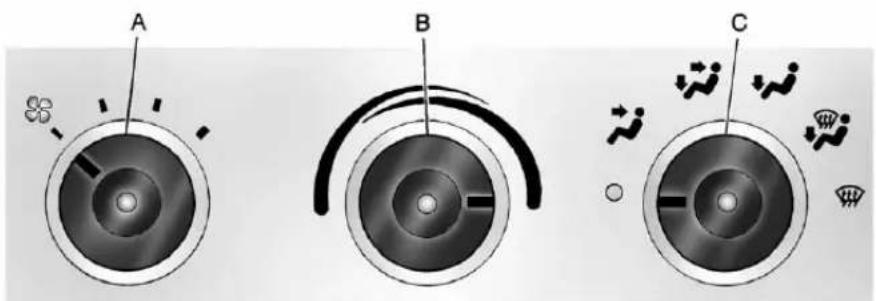
text_image
A B CVehicleswithoutAirConditioning
A. FanControl
B. TemperatureControl
C.AirDeliveryModeControl
(FanControl): Turntheknob clockwiseorcounterclockwiseto increaseordecreasethefanspeed.
○(Off):Turnsthesystemoff.
8-2ClimateControls
TemperatureControl: Turn the knobclockwise or counterclockwise to increase or decrease the temperature inside the vehicle.
AirDeliveryModeControl:
Turntheknobclockwiseor counterclockwisetochangethe currentairflowmode.
(Vent):Airisdirectedtothe instrumentpaneloutlets.
(Bi-Level):Airisdivided betweentheinstrumentpanel and flooroutlets, with some air directed toward the windshield.
(Floor):Airisdirectedtothe flooroutletswithsomeairdirected tothewindshieldandsidewindows.
(Defog): This mode clear the window soffogorm moisture. Outside air is directed to the floor and defroster outlets. Adjust the temperature knob for warmer or cooler air. The air conditioning compressorm might turn on this setting to dehumidify the air.
(Defrost): This mode clears the windshield off fogor frost more quickly. Air is directed to the windshield, with someto the floor outlets and front side windows. The air conditioning compressor might turn on this setting to dehumidify the air.
Donotdrivethevehicleuntilall thewindowsareclear.
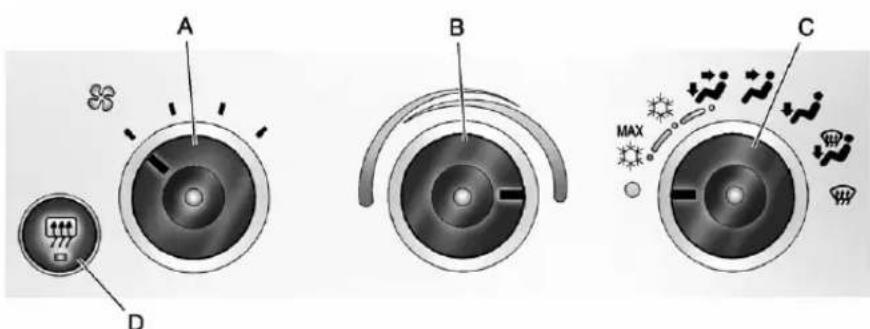
text_image
A B C D MAXVehicleswithAirConditioning
A.FanControl
B. TemperatureControl
C.AirDeliveryModeControl
D. RearWindowDefogger
Onhotdays, openthewindowsto lethotinsideairescape; then close them. This help storeducethetime needed for the vehicle to cooldown and the system operates more efficiently.
(AirConditioning): Coolsand dehumidifiestheairinsideofthe vehicle.
(MaximumAirConditioning): Cooltheairinsidethevehicle faster,byrecirculatingtheinsideair.
8-4ClimateControls
RearWindowDefogger
Forvehicleswitharearwindow defogger,awarminggridisused toremovefogorfrostfromthe rearwindow.
Itonlyworkswhentheignition isinON/RUN.
(RearWindowDefogger): Presstoturntherearwindow defoggeronoroff.
Therearwindowdefoggerturnsoff severalminutesafterthebuttonis pressed.lfturnedonagain,the defoggerwillrunforseveralmore minutesbeforeturningoff.The defoggercanalsobeturnedoffby turningofftheengine.
Donotdrivethevehicleuntilallthe windowsareclear.
Notice: Donotusearazorblade orsharpobjecttocleartheinside rearwindow. Donotadhere anythingtothedefoggergrid linesintherearglass. These actionsmaydamagetherear defogger. Repairswouldnotbe coveredbyyourwarranty.
RearHeatingSystem
Forvehicleswitharearheating system,itletsyouadjustthe amountofairflowingintotherearof thevehicle,fromthefront-seating area. Thisfeatureworkswiththe mainclimate-controlsystemin thevehicle.
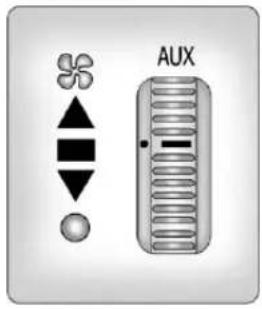
text_image
AUXAUX: Thethumbwheelforthis systemislocatedintheinstrument panelswitchbankbelowtheaudio system.
(Fan): Turnthethumbwheelup ordowntoincreaseordecreasethe amountofheatedairsenttothe rear-seatingarea.
▲(High): This positions supplies themostamountofheattotherear-seatingarea.
(Medium): This position supplies half the amount of heat to therear-seating area.
▼(Low): This positions supplies the least amount of heat to the rear-seating area.
○(Off):Turnstherearheating systemoff.
RearClimateControlSystem
For vehicles with rear heating and air-conditioning system, it controls the temperature, fanspeed and air delivery for therear seat passengers only. The front climate control panel is located in the overhead console between the driver and front passenger.
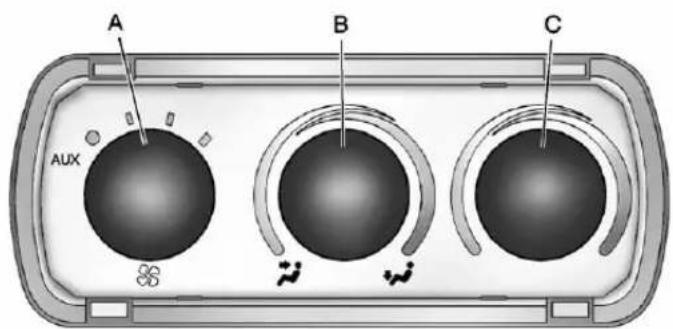
text_image
A B C AUXFrontClimateControlPanel
A.FanControl
B.AirDeliveryModeControl
C.TemperatureControl
Use this control panel to maintain a separate temperature setting. Adjust the direction of the airflow or adjust the fans speed for there are seat passenger(s).
WhenthefanknobisintheAUXposition,therearclimatecontrolpanelcan beusedtoadjusttheclimatesettingsintherearseatingarea.
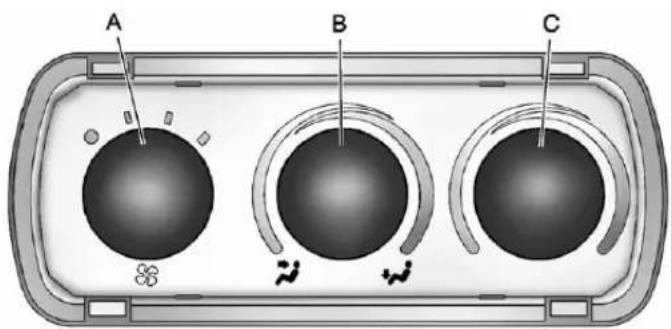
text_image
A B CRearClimateControlPanel
A. FanControl
B.AirDeliveryModeControl
C. TemperatureControl
Forvehicleswitharearclimate controlpanel,itislocatedoverhead behindthedriverandfront passenger,centeredinfrontofthe secondrow.Toadjusttherear climatecontrolpanelsettingsbya rearseatpassenger,thefront climatecontrolpanelfanknobmust beintheAUXposition.Thefan speed,airdeliverymode,and temperaturecanthenbeadjusted.
AUX(Auxiliary):Turnthefanknob onthefrontclimatecontrolpanelto AUXtoletrearseatpassengersuse thecontrolpanelintherearseating area. This disablesthefrontcontrol panel. Toreturncontroltothefront panel, movthefanknobout of AUX.
○:Turnsthesystemoff.
(FanControl): Turnclockwise or counterclockwisetoincreaseor decrease the fanspeed in the rear-seating area.
TemperatureControl:
Turnclockwiseor counterclockwisetoincrease ordecreasethetemperature intherear-seatingarea.
Theair-conditioningsystemonthe mainclimatecontrolpanelmustbe turnedontodirectcooledairtothe rearofthevehicle.Ifitisnoton, thenthetemperatureintherearof thevehicleremainsatcabin temperature.
AirDeliveryModeControl:
Turnclockwiseorcounterclockwise tochangethedirectionoftheairflow intherearseatingarea.
Tochangethecurrentmode, select oneofthefollowing:
→(Vent):Airisdirectedtothe upperoutlets,withsomedirectedto theflooroutlets.
→√(Floor):Airisdirectedtothe flooroutlets.
Besuretokeeptheareaunderthe frontseatsclearofanyobjectsso thattheairinsideofthevehiclecan circulateeffectively.
Forinformationonhowtousethe mainclimatecontrolsystem,see ClimateControlSystemson page8-1.Forinformationon ventilation,seeAirVentson page8-8.
AirVents
Usetheoutletslocatednearthe centerandonthesidesofthe instrumentpaneltochangethe directionofairflow.
OperationTips
- Clearawayanyice, snowor leaves from the airinlets at the base of the windshield that may block the flow of air into the vehicle.
- Useofnon-GMapprovedhood deflectorsmayadverselyaffect theperformanceofthesystem.
- Keepthepathunderthefront seatsclearofobjectstohelp circulatetheairinsideofthe vehiclemoreeffectively.
Driving and Operating
DrivingInformation
DistractedDriving......9-2
DefensiveDriving......9-3
DrunkDriving....9-3
ControlofaVehicle......9-3
Braking....9-3
Steering....9-4
Off-RoadRecovery......9-5
LossofControl......9-5
DrivingonWetRoads......9-6
HighwayHypnosis......9-7
HillandMountainRoads.....9-7
WinterDriving......9-8
IftheVehicleIsStuck......9-10
VehicleLoadLimits......9-11
StartingandOperating
NewVehicleBreak-In......9-16
IgnitionPositions......9-16
StartingtheEngine......9-18
FastIdleSystem......9-19
EngineHeater....9-20
RetainedAccessory
Power(RAP)......9-21
ShiftingIntoPark......9-21
ShiftingoutofPark......9-23
ParkingoverThings
ThatBurn....9-23
EngineExhaust
EngineExhaust......9-24
RunningtheVehicleWhile
Parked....9-24
AutomaticTransmission
AutomaticTransmission
(SixSpeed)....9-25
AutomaticTransmission
(FourSpeed)....9-28
ManualMode....9-31
Tow/HaulMode......9-32
DriveSystems
All-WheelDrive......9-33
Brakes
AntilockBrake
System(ABS)....9-33
ParkingBrake......9-34
RideControlSystems
StabiliTrak® System......9-35
LockingRearAxle......9-37
CruiseControl
CruiseControl......9-37
Fuel
Fuel....9-40
RecommendedFuel......9-40
GasolineSpecifications(U.S
andCanadaOnly)......9-41
CaliforniaFuel
Requirements......9-41
FuelsinForeignCountries...9-41
FuelAdditives......9-41
FuelE85(85%Ethanol).....9-42
FillingtheTank......9-44
FillingaPortableFuel
Container....9-45
Towing
GeneralTowing
Information......9-46
DrivingCharacteristicsand
TowingTips....9-46
TrailerTowing....9-50
TowingEquipment......9-55
ConversionsandAdd-Ons
Add-OnElectrical
Equipment......9-58
DrivingInformation
DistractedDriving
Distractioncomesinmanyforms andcantakeyourfocusfromthe taskofdriving.Exercisegood judgmentandonotletother activitiesdivertyourattention awayfromtheroad.Manylocal governmentshaveenactedlaws regardingdriverdistraction.Become familiarwiththelocallawsin yourarea.
Toavoiddistracteddriving,always keepyoureyesontheroad,hands onthewheel,andmindonthedrive.
- Donotuseaphonein demandingdrivingsituations. Useahands-freemethodto placeorreceivenecessary phonecalls.
-
Watchtheroad.Donotread, takenotes,orlookup informationonphonesorother electronicdevices.
-
Designateafrontseat passengertohandlepotential distractions.
- Becomefamiliarwithvehicle featuresbeforedriving,suchas programmingfavoriteradio stationsandadjustingclimate controlandseatsettings. Programalltripinformationinto anynavigationdevicepriorto driving.
- Waituntilthevehicleisparked toretrieveitemsthathavefallen tothefloor.
- Stoporparkthevehicletotend tochildren.
- Keeppetsinanappropriate carrierorrestraint.
- Avoidstressfulconversations whiledriving,whetherwitha passengeroronacellphone.

WARNING
Takingyoureyesofftheroadtoo longortoooftencouldcausea crashresultinginjuryordeath. Focusyourattentionondriving.
Refertotheinfotainmentsectionfor moreinformationonusingthat system,includingpairingandusing acellphone.
Ifequipped, refertothenavigation manualforinformationonthat system, includingpairingandusing acellphone.
DefensiveDriving
Defensivedrivingmeans"always expecttheunexpected."Thefirst stepindrivingdefensivelyistowear thesafetybelt.See SafetyBeltson page3-8.
- Assumethatotherroadusers (pedestrians, bicyclists, and otherdrivers) are going to be careless and make mistakes. Anticipate what they might do and beready.
- Allowenoughfollowingdistance betweenyouandthedriverin frontofyou.
• Focusonthetaskofdriving.
DrunkDriving
Deathandinjuryassociatedwith drinkinganddrivingisaglobal tragedy.

WARNING
Drinkingandthendrivingis verydangerous.Yourreflexes, perceptions, attentiveness, and judgmentcanbeaffectedbyevenasmallamountofalcohol.You canhaveaserious—oreven fatal—collisionifyoudriveafter drinking.
Donotdrinkanddriveorridewith adriverwhohasbeendrinking. Ridehomeinacab;orifyouare withagroup,designateadriver whowillnotdrink.
ControlofaVehicle
Braking, steering, and accelerating are important factors in helping to control vehicle while driving.
Braking
Brakingactioninvolvesperception timeandreactiontime.Decidingto pushthebrakepedalisperception time.Actuallydoingitis reactiontime.
Averagedriverreactiontimeis about three-fourthsofasecond. In that time, a vehicle moving at 100km/h (60mph) travels 20m (66ft), which could be alot of distance in an emergency.
9-4DrivingandOperating
Helpfulbrakingtipstokeepinmind include:
- Keepenoughdistancebetween youandthevehicleinfront ofyou.
- Avoidneedlessheavybraking.
- Keeppacewithtraffic.
Iftheengineeverstopswhilethe vehicleisbeingdriven,brake normallybutdonotpumpthe brakes.Doingsocouldmakethe pedalhardertopushdown.Ifthe enginestops,therewillbesome powerbrakeassistbutilwillbe usedwhenthebrakeisapplied. Oncethepowerassistisusedup,it cantakelongertostopandthe brakepedalwillbehardertopush.
Steering
HydraulicPowerSteering
Yourvehiclehashydraulic powersteering.Itmayrequire maintenance.SeePowerSteering Fluid Power Steering Fluid on page 10-24.
Ifpowersteeringassistislost because the engine stops the powersteeringsystem is not functioning, the vehicle can be steered but may require increased effort. See your dealer if there is a problem.
If the vehicle is a hybrid, seethe hybrids supplement form more information.
CurveTips
• Takecurvesatareasonable speed.
- Reducespeedbeforeentering acurve.
- Maintainareasonablesteady speedthroughthecurve
- Waituntilthevehicleisoutof thecurvebeforeaccelerating gentlyintothestraightaway.
SteeringinEmergencies
- Therearesomesituationswhen steeringaroundaproblemmay bemoreeffectivethanbraking.
- Holdingbothsidesofthe steeringwheelallowsyoutoturn 180degreeswithoutremoving ahand.
• AntilockBrakeSystem(ABS) allowssteeringwhilebraking.
Off-RoadRecovery
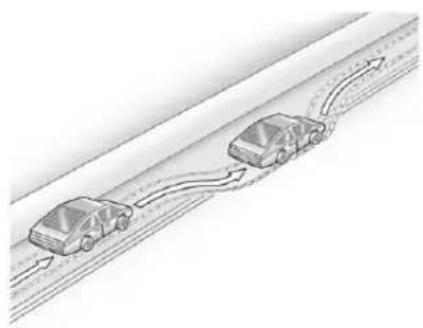
natural_image
Diagram of two cars driving on a road with directional arrows indicating flow (no text or symbols)Thevehicle'srightwheelscandrop offtheedgeofaroadontothe shoulderwhiledriving.Follow thesetips:
-
Easeofftheacceleratorand then, if there is nothing in the way, steer the vehicles that it straddle the edge of the pavement.
-
Turnthesteeringwheelabout one-eighthofaturn, until the rightfronttirecontactsthe pavementedge.
- Thenturnthesteeringwheelto gostraightdowntheroadway.
LossofControl
Skidding
Therearethreetypesofskidsthat correspondtothevehicle'sthree controlsystems:
- BrakingSkid—wheelsare notrolling.
• SteeringorCornering Skid—toomuchspeedor steeringinacurvecausestires toslipandlosecorneringforce. - AccelerationSkid—toomuch throttlecausesthedriving wheelstospin.
9-6DrivingandOperating
Defensivedriversavoidmostskids bytakingreasonablecaresuitedto existingconditions,andbynot overdrivingthoseconditions. Butskidsarealwayspossible.
If the vehicle start to slide, follow these suggestions:
- Easeyourfootoffthe acceleratorpedalandquickly steerthewayyouwantthe vehicletogo. The vehiclemay straightenout. Bereadyfora secondskidifitoccurs.
- Slowdownandadjustyour drivingaccordingtoweather conditions. Stoppingdistance canbelongerandvehicle controlcanbeaffectedwhen tractionisreducedbywater, snow,ice,gravel,orother materialontheroad. Learnto recognizewarningclues—such asenoughwater,ice,orpacked snowontheroadtomakea mirroredsurface—andslow downwhenyouhaveanydoubt.
- Trytoavoidsuddensteering, acceleration, or braking, including reducing vehiclespeed by shifting to lower gear. Any sudden changes could cause the rest of the vehicle.
Remember: Antilockbrakeshelp avoidonlythebrakingskid.
DrivingonWetRoads
Rainandwetroadscanreduce vehicletraction and affect your ability to stop and accelerate. Always drives slower in the set types of driving conditions and avoid driving through large puddles and deep-standing or flowing water.

WARNING
Wetbrakescancausecrashes. Theymightnotworkaswellina quickstopandcouldcause pullingtooneside.Youcould losecontrolofthevehicle.
(Continued)
WARNING(Continued)
Afterdrivingthroughalarge puddleofwateroracar/vehicle wash, lightlyapplythebrake pedaluntilthebrakeswork normally.
Flowingorrushingwatercreates strongforces.Drivingthrough flowingwatercouldcausethe vehicletobecarriedaway.Ifthis happens,youandothervehicle occupantscouldrown.Donot ignorepolicewarningsandbe verycautiousabouttryingtodrive throughflowingwater.
Hydroplaning
Hydroplaningisdangerous.Water canbuildupunderthevehicle's tiressotheyactuallyrideonthe water.Thiscanhappeniftheroadis wetenoughandyouaregoingfast enough.Whenthevehicleis hydroplaning,ithaslittleorno contactwiththeroad.
Thereisnohardandfastruleabout hydroplaning. Thebestadviceisto slowdownwhentheroadiswet.
OtherRainyWeatherTips
Besidesslowingdown,otherwet weatherdrivingtipsinclude:
- Allowextrafollowingdistance.
• Passwithcaution. - Keepwindshieldwiping equipmentingoodshape.
- Keepthewindshieldwasherfluid reservoirfilled.
- Havegoodtireswithproper treaddepth.See Tireson page10-49.
• Turnoffcruisecontrol.
HighwayHypnosis
Alwaysbealertandpayattentionto yoursurroundingswhiledriving. Ifyoubecometiredorsleepy,finda safeplacetoparkthevehicle andrest.
Otherdrivingtipsinclude:
- Keepthevehiclewellventilated.
- Keeptheinterior temperaturecool.
- Keepyoureyesmoving—scan theroadaheadandtothesides.
- Checktherearviewmirrorand vehicleinstrumentsoften.
HillandMountainRoads
Drivingonsteephillsorthrough mountainsisdifferentthandriving onflatorrollingterrain. Tipsfor drivingintheseconditionsinclude:
- Keepthevehicleservicedandin goodshape.
- Checkallfluidlevelsandbrakes, tires,coolingsystem,and transmission.
- Shifttoalowergearwhengoing downsteeporlonghills.

WARNING
If you donot shiftdown, the brakes could get so hot that they would not work well. You would then have poor braking over no going down a hill. You could crash. Shift downtolet the engine assist the brakes on a steep downhill slope.

WARNING
CoastingdownhillinN(Neutral) orwiththeignitionoffis dangerous. Thebrakeswillhave todoalltheworkofslowingdown andtheycouldgetsohotthat theywouldnotworkwell. You wouldthenhavepoorbrakingor evennonegoingdownahill. You couldcrash.Alwayshavethe engineerunningandthevehiclein gearwhengoingdownhill.
- Stayinyourownlane.Donot swingwideorcutacrossthe centeroftheroad.Driveat speedsthatletyoustayinyour ownlane.
- Bealertontopofhills, somethingcouldbeinyourlane (stalledcar, accident).
- Payattentiontospecialroad signs(fallingrocksarea,winding roads,longgrades,passingor no-passingzones)andtake appropriateaction.
WinterDriving
DrivingonSnoworIce
Drivecarefullywhenthereissnow oricebetweenthetiresandthe road,creatinglesstractionorgrip. Weticecanoccuratabout0°C (32°F)whenfreezingrainbeginsto fall,resultinginevenlesstraction. Avoiddrivingonweticeorin freezingrainuntilroadscanbe treatedwithsaltorsand.
Drivewithcaution,whatever the condition.Accelerategently so tractionisnotlost.Acceleratingtoo quicklycausesthewheelstospin andmakesthesurfaceunderthe tiresslick,sothereisevenless traction.
Trynottobreakthefragiletraction. If you accelerate at to of fast, the drive wheels will spin and polish the surface under the tire seven more.
TheAntilockBrake System(ABS) onpage9-33improvesvehicle stabilityduringhardstopsona slipperyroads,butapplythebrakes soonerthanwhenondrypavement.
Allowgreaterfollowingdistanceon anyslipperyroadandwatchfor slipperyspots.lcypatchescan occuronotherwiseclearroadsin shadedareas.Thesurfaceofa curveoranoverpasscanremainicy whenthesurroundingroadsare clear.Avoidsuddensteering maneuversandbrakingwhile once.
Turnoffcruisecontrol, ifequipped, onslippery surfaces.
BlizzardConditions
Beingstuckinsnowcanbea seriousssituation.Staywiththe vehicleunlesssthereishelpnearby. Ifpossible,usetheRoadside AssistanceProgram(U.S.and Canada)onpage13-8orRoadside AssistanceProgram(Mexico)on page13-10.Togethelpandkeep everyoneinthevehiclesafe:
• Turnonthehazardwarning flashers.
- Tiearedclothtoanoutside mirror.

WARNING
Snowcantrapengineexhaust underthevehicle. This may causeexhaustgasestoget inside. Engineexhaustcontains carbonmonoxide(CO)which cannotbeseenorsmelled. Itcancauseunconsciousness andevendeath.
(Continued)
WARNING(Continued)
Ifthevehicleisstuckinthesnow:
- Clearawaysnowfromaround thebaseofyourvehicle, especiallyanythatisblocking theexhaustpipeand/orthe fueloperatedheaterexhaust system,ifequipped.Ifthe vehiclehasadieselengine andafueloperatedheater, see“FuelOperatedHeater (FOH)”inthedieselengine supplement.
- Checkagainfromtimeto timetobesuresnowdoes notcollectthere.
- Openawindowabout5cm (2in)onthesideofthe vehiclethatisawayfromthe windtobringinfreshair.
- Fullyopentheairoutletson orundertheinstrument panel.
(Continued)
WARNING(Continued)
- Adjust the Climate Control system to setting that circulate the air inside the vehicle and set the fanspeed to the highest setting. See Climate Control Systems in the Index.
Formoreinformationabout carbonmonoxide,seeEngine Exhaustonpage9-24.
Snowcantrapexhaustgases underthevehicle. This can cause deadly CO (carbon monoxide) gastogetinside.CO could overcome you and kill you. You cannot see itorsmellit, so you might not know it in the vehicle. Clearaways now from around the base of the vehicle, especially any that is blocking the exhaust.
Runtheengineforshortperiods onlyasneededtokeepwarm,but becareful.
9-10DrivingandOperating
Tosavefuel, runtheengineforonly shortperiodsasneededtowarm thevehicleandthenshuttheengine offandclosethewindowmostof thewaytosaveheat.Repeatthis untilhelparrivesbutonlywhenyou feelreallyuncomfortablefromthe cold.Movingabouttokeepwarm alsohelps.
Ifittakessometimeforhelpto arrive,nowandthenwhenyourun theengine,pushtheaccelerator pedalslightlysotheengineurus fasterthantheidlespeed.This keepsthebatterychargedtorestart thevehicleandtosignalforhelp withtheheadlamps.Dothisaslittle aspossibletosavefuel.
IftheVehiclesStuck
Slowlyandcautiouslyspinthe wheelstofreethevehiclewhen stuckinsand,mud,ice,orsnow.
Ifthevehiclehasatractionsystem, itcanoftenhelptofreeastuck vehicle. Refertothevehicle's tractionsysteminthelndex. Ifstuck tooseverelyforthetractionsystem tofreethevehicle, turnthetraction systemoffandusetherocking method.

WARNING
If the vehicle's tiresspinathigh speed, they can explode, and you or others could be injured. The vehicle can overheat, causing an engine compartment fire or other damage. Spin the wheels as little as possible and avoid going above 55 km/h (35 mph).
Forinformationaboutusingtire chainsonthevehicle,see Tire Chainsonpage10-71.
RockingtheVehicletoGet itOut
Turnthesteeringwheelleftand righttocleartheareaaroundthe frontwheels.Turnoffanytractionor stabilitysystem.Shiftbackandforth betweenR(Reverse)andaforward gear,spinningthewheelsaslittleas possible.Topreventtransmission wear,waituntilthewheelsstop spinningbeforeshiftinggears. Releasetheacceleratorpedalwhile shifting,andpresslightlyonthe acceleratorpedalwhenthe transmissionisingear.Slowly spinningthewheelsintheforward andreversedirectionscausesa rockingmotionthatcouldfreethe vehicle.Ifthatdoesnotgetthe vehicleoutafterafewtries,itmight needtobetowedout.Ifthevehicle doesneedtobetowedout,see TowingtheVehicleonpage 10-90.
VehicleLoadLimits
It is very important to know how much weight the vehicle can carry. This weight is called the vehicle capacity weight and include the weight of all occupants, cargo, and all nonfactory-installed options. Twolabelson the vehicles show how much weight it was designed to carry, the Tire and Loading Information label and the Certification/Tire label.
WARNING
Donotloadthevehicleany heavierthantheGross VehicleWeightRating (GVWR), oreitherthe maximumfrontorrearGross AxleWeightRating(GAWR). Thiscancausesystemsto breakandchangethewaythe vehiclehandles. Thiscould causelossofcontrolanda crash. Overloadingcanalso shortenthelifeofthevehicle.
TireandLoadingInformation Label
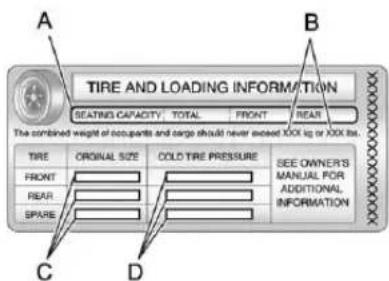
text_image
A TIRE AND LOADING INFORMATION SEATING CAPACITY TOTAL FRONT REAR The combined weight of occupants and cargo should never exceed XXX kg or XXX lbs. B TIRE ORIGINAL SIZE COLD TIRE PRESSURE SEE OWNER'S MANUAL FOR ADDITIONAL INFORMATION FRONT REAR SPARE C DLabelExample
AvehiclespecificTireand LoadingInformationlabelis attachedtothecenterpillar (B-pillar).Withthedriverdoor open,youwillfindthelabel attachedbelowthedoorlock post(striker).Thetireand loadinginformationlabelshows thenumberofoccupantseating
positions(A), and the maximum vehicle capacity weight(B) in kilograms and pounds.
The Tire and Loading Information label also shows the sizeofthe originalequipment tires (C) and there recommended coldtireinflation pressures (D). Formoreinformationontires and inflation see Tireson page 10-49 and TirePressure onpage 10-56.
Thereisalsoimportantloading informationonthevehicle Certification/Tirelabel.Ittells youtheGrossVehicleWeight Rating(GVWR)andtheGross AxleWeightRating(GAWR)for thefrontandrearaxle.See "Certification/TireLabel"laterin thissection.
StepsforDeterminingCorrect LoadLimit
-
Locatethestatement "Thecombinedweightof occupantsandcargoshould neverexceedXXXgor XXXlbs" onyourvehicle's placard.
-
Determinethecombined weightofthedriverand passengersthatwillbe ridinginyourvehicle.
-
Subtract the combined weight of the driver and passengers from XXXkgor XXXlbs.
-
Theresultingfigureequals theavailableamountofcargo andluggageloadcapacity. Forexample,ifthe"XXX" amountequals1400lbsand therewillbefive150lb passengersinyourvehicle,
theamountofavailablecargo andluggageloadcapacity is650lbs(1400-750 (5x150)=650lbs).
- Determinethecombined weightofluggageandcargo beingloadedonthevehicle. Thatweightmaynotsafely exceedtheavailablecargo andluggageloadcapacity calculatedinStep4.
- If your vehicle will betowing a trailer, the load from your trailer will be transferred to your vehicle. Consult this manual to determine how this reduces the available cargo and luggage load capacity of your vehicle. See Trailer Towing on page 9-50 for important information on towing a trailer, towingsafety rules and trailering tips.
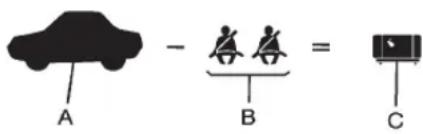
text_image
A - B = CExample1
A. Vehicle Capacity Weight for Example 1=453kg(1,000lbs)
B. SubtractOccupantWeight@
68kg(150lbs)×2=
136kg(300lbs)
C. Available Occupant and Cargo Weight = 317kg(700lbs)
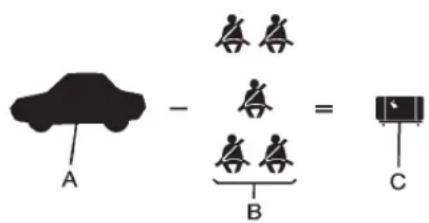
text_image
A - B = CExample2
A. Vehicle Capacity Weight for Example2=453kg(1,000lbs)
B. SubtractOccupantWeight@
68kg(150lbs)×5=
136kg(750lbs)
C. Available Cargo Weight = 113kg(250lbs)
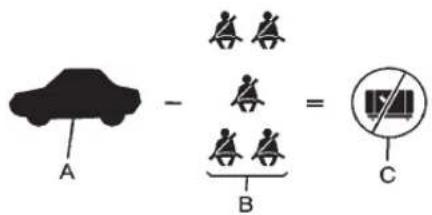
text_image
A - B = CExample3
A. Maximum Vehicle Capacity WeightforExample3=453kg(1,000lbs)
B.SubtractOccupantWeight@
91kg(200lbs)×5=
453kg(1,000lbs)
C. Available Cargo Weight=0kg(0lbs)
Refertothevehicletire and loadinginformationlabel for specificinformationaboutthe vehicle'scapacityweightand seatingpositions.
The combined weight of the driver, passengers, and cargo should never exceed the vehicle capacity weight.
Certification/TireLabel
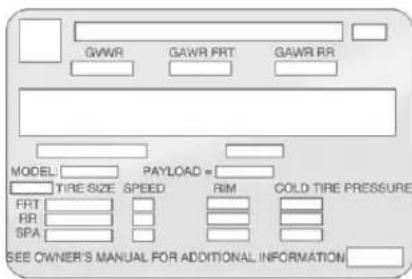
text_image
GWWR GAWR FRT GAWR RR MODEL: PAYLOAD = TIRE SIZE SPEED RIM COLD TIRE PRESSURE FRT RR SPA SEE OWNER'S MANUAL FOR ADDITIONAL INFORMATIONAvehiclespecificCertification/Tirelabelisfoundontherear edgeofthedriverdoor.The labelshowsthesizeofthe vehicle'soriginaltiresandthe inflationpressuresneededto obtainthegrossweightcapacity ofthevehicle.
This is called Gross Vehicle Weight Rating (GVWR). The GVWR include the weight of the vehicle, allooccupants, fuel, and cargo.
The Certification/Tirelabel also tells you the maximum weights for the front and rear axles, called Gross Axle Weight Rating (GAWR). To find the actual load on the front and rear axles, you need to go to a weigh station and weigh the vehicle. Your dealer can help you with this. Besuret spread out the loadequally on both sides of the centerline.
NeverexceedtheGVWRforthe vehicle,ortheGAWRforeither thefrontorrrearaxle.
If there is a heavy load, it should bespread out.
WARNING
Donotloadthevehicleany heavierthantheGross VehicleWeightRating (GVWR), oreitherthe maximumfrontorrearGross AxleWeightRating(GAWR). Thiscancausesystemsto breakandchangethewaythe vehiclehandles. Thiscould causelossofcontrolanda crash. Overloadingcanalso shortenthelifeofthevehicle.
WARNING
Thingsyouputinsidethe vehiclecanstrikeandinjure peopleinasuddenstopor turn, orinacrash.
- Putthingsinthecargo areaofthevehicle.Tryto spreadtheweightevenly.
- Neverstackheavier things,likesuitcases, insidethevehiclesothat someofthemareabove thetopsoftheseats.
(Continued)
WARNING(Continued)
- Donotleavean unsecuredchildrestraint inthevehicle.
- Whenyoucarrysomething insidethevehicle, secure itwheneveryoucan.
- Donotleaveaseatfolded downunlessyouneedto.
Add-OnEquipment
Whenyoucarryremovable items,youmayneedtoputa limitonhowmanypeopleyou carryinsidethevehicle.Besure toweighthevehiclebeforeyou buyandinstallthenew equipment.
Starting and Operating
NewVehicleBreak-In
Notice: The vehicle does not need an elaborate break-in. But it will perform better in the long run if you follow these guidelines:
- Keepthevehiclespeedat 88km/h(55mph)orlessfor thefirst805km(500miles).
-
Donotdriveatanyone constantspeed, fastorslow, forthefirst805km (500miles).Donotmake full-throttlestarts.Avoid downshiftingtobrakeor slowthevehicle.
-
Avoidmakinghardstopsfor thefirst322km(200miles)or so.Duringthistimethenew brakeliningsarenotyet brokenin.Hardstopswith newliningscanmean prematurewearandearlier replacement.Followthis breaking-inguidelineevery timeyougetnewbrake linings.
- Donottowatrailerduring break-in. See Trailer Towing on page 9-50 forthetrailer towing capabilities of the vehicle and more information.
Followingbreak-in, enginespeed and load can be gradually increased.
IgnitionPositions
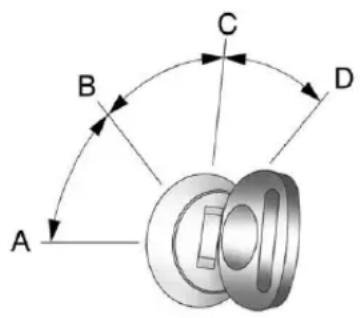
text_image
A B C DTheignitionswitchhasfourdifferent positions.
ToshiftoutofP(Park), theignition mustbeinON/RUNorACC/ACCESSORYandtheregularbrake pedalapplied.
A(STOPPINGTHEENGINE/LOCK/OFF): Whenthevehicleis stopped, turntheignitionswitchto LOCK/OFFtoturntheengineoff. RetainedAccessoryPower(RAP) willremainactive. SeeRetainedAccessoryPower(RAP) on page9-21.
Thispositionlockstheignitionand transmission.
Donotturntheengineoffwhenthe vehicleismoving. This will cause a loss of power assist in the brake and steerings systems and disable the airbags.
If the vehicle must be shutoff in an emergency:
-
Brakeusingafirmandsteady pressure.Donotpumpthe brakesrepeatedly.Thismay depletepowerassist,requiring increasedbrakepedalforce.
-
ShiftthevehicletoN(Neutral). Thiscanbedonewhilethe vehicleismoving. Aftershifting toN(Neutral), firmly apply the brakes and steerthevehicletoa safelocation.
-
Cometoacompletestop, shift toP(Park), and turntheignition toLOCK/OFF. On vehicles with an automatic transmission, the shiftlevermustbeinP(Park) to turntheignitionswitchtothe LOCK/OFF position.
-
Settheparkingbrake. See ParkingBrakeonpage9-34.

WARNING
Turningoffthevehiclewhile movingmaycauselossofpower assistinthebrakeandsteering systemsanddisabletheairbags. Whiledriving,onlyshutthe vehicleoffinanemergency.
If the vehicle cannot be pulled over, and must be shutoff while driving, turn the ignition to ACC/ACCESSORY.
Notice: Using atooltoforcethe keytoturnintheignitioncould causedamagetotheswitchor breakthekey. Usethecorrect key, makesureitisallthewayin, and turnitonlywithyourhand. If thekey cannot be turned by hand, seeyourdealer.
B(ACC/ACCESSORY): This is the position in which you can operate things like a radio and the windshield wipers when the engine is off.
C(ON/RUN): This position can be used to operate the electrical accessories and to display some instrument panel cluster warning and indicator lights. This position can also be used for service and diagnostics, and to verify the proper operation of them malfunction indicator lampasm may be required for remission inspection purposes. The switch stays in this position when the engine is running.
IfyouleavethekeyintheACC/ ACCESSORYorON/RUNposition withtheengineoff,thebatterycould bedrained.Youmaynotbeableto startthevehicleifthebatteryis allowedtodrainforanextended periodoftime.
D(START): This is the position that starts the engine. When the engine starts, releases the key. The ignition switch return to ON/RUN for driving.
Awaringtonewillsoundwhenthe driverdoorisopened,theignitionis inACC/ACCESSORYorLOCK/OFF andthekeyisintheignition.
StartingtheEngine
Ifthevehiclehasadieselengine, seetheDuramaxdieselsupplement formoreinformation.
Toplacethetransmissioninthe propergear:
MovetheshiftlevertoP(Park)or N(Neutral). Theenginewillnotstart inanyotherposition. Torestartthe enginewhenthevehicleisalready moving, useN(Neutral)only.
StartingProcedure
- With your footoff the accelerator pedal, turn the ignition key to START. When the engine starts, let go of the key. The edgespeed will godown a s you re engine gets warm. Donot racethe engine immediately after starting it. Operatethe engine and transmissionently to allow the oil to warm up and lubricate all moving parts.
Thevehiclehasa Computer-ControlledCranking System. Thisfeatureassistsin startingtheengineandprotects components. Iftheignitionkeyis turnedtotheSTARTposition, and thenreleasedwhenthe enginebeginscranking,the enginewillcontinuecrankingfor afewsecondsoruntilthe vehiclestarts. Iftheenginedoes notstartandthekeyisheldin STARTformanyseconds, crankingwillbestoppedafter 15secondstoppreventcranking motordamage.
Topreventgeardamage, this systemalsopreventscrankingif theengineisalreadyrunning. Enginecrankingcanbestopped byturningtheignitionswitchto theACC/ACCESSORYor LOCK/OFFposition.
When the Low Fuel warning lampison and the FUEL LEVEL LOW message is displayed in the Driver Information Center (DIC), the Computer-Controlled Cranking System is disabled to prevent possible vehicle component damage. When this happens, hold the ignitions switch in the START position to continue engine cranking.
Notice:Crankingtheenginefor longperiodsoftime,byreturning thekeytotheSTARTposition immediatelyaftercrankinghas ended,canoverheatanddamage thecrankingmotor,anddrainthe battery.Waitatleast15seconds betweeneachtry,toletthe crankingmotorcooldown.
- If theenginedoesnotstartafter 5-10 seconds, especially in very cold weather (below - 18°C or 0°F), it could be flooded with to much gasoline. Try pushing the accelerator pedal all the way to the floor and holding it there as you hold the key in START for up to 15 seconds. Wait at least 15 seconds between each try, to allow the cranking motor to cooldown. When the engine starts, let go of the key and accelerator. If the vehicle starts briefly but then stops again, do the something. This clear the extragasoline from the engine. Donotracethe engine immediately after starting it. Operat the engine and transmission gently until the oil warmsup and lubricates all moving parts.
Notice: The engine is designed to work with the electronics in the vehicle. If you add electrical parts or accessories, you could change the way the engine operates.
Beforeaddingelectrical equipment, checkwithyour dealer. If you donot, the engine might not perform properly. Any resulting damage would not be covered by the vehicle warranty.
FastIdleSystem
If the vehicle has this feature it is available only with cruise control. The manual fastidles switch is operated using the cruise control buttons located on the elefth and side of the steering wheel.
This system can be used to increase engine idlespeed whenever the following conditions are met:
• Theparkbrakeisset.
• Thebrakepedalisnotpressed.
• The vehicle must not be moving and the accelerator must not be pressed.
Tocontrolthefastidle:
- ToenabletheFastIdleSystem, pressandreleasetheCruise ControlOn/Offbuttonand ensurethattheswitchLEDislit.
- PressandreleasetheCruise ControlSetswitch.Engine speedwillbeheldat approximately1200RPM.
Whenthefastidleisactivethe DriverInformationCenter(DIC)will display"FASTIDLEON."
Oneofthefollowingactionswillturn offthefastidle:
- Pressingthebrake.
- SelectingtheCruiseControl Cancelbutton.
• ReleasingtheParkingBrake. - Thetransmissionshiftleveris movedoutofP(Park)or N(Neutral).
-
SelectingtheCruiseControl On/Offbuttonwhenitwas previouslyon.
-
PressingtheCruiseControlSet switchasecondtime.
- Pressingtheacceleratorgreater thanaquarterofthedown.
- Turningtheignitionswitchtothe LOCK/OFFposition.
EngineHeater
If the vehicle has a diesel engine, seethe Duramax diesels supplement form more information.
Theenginecoolantheatercan provideeasierstartingandbetter fueleconomyduringenginewarm-upincoldweatherconditionsator below-18°C(0°F).Vehicleswith an enginecoolantheatershouldbe pluggedinatleastfourhoursbefore starting.Aninternalthermostatin theplug-endofthecordmayexist whichwillpreventenginecoolant heateroperationattemperatures above-18°C(0°F).
ToUsetheEngineCoolant Heater
- Turnofftheengine.
- Openthehood and unwrap the electrical cord.
Thecordfortheenginecoolant heaterislocatedonthedriver sideoftheenginecompartment andisattachedtothehosefor thepowersteeringreservoir.
- Plugitintoanormal, grounded 110-voltACoutlet.

WARNING
Pluggingthecordintoan ungroundedoutletcouldcausean electricalshock.Also,thewrong kindofextensioncordcould overheatandcauseafire.You couldbeseriouslyinjured.Plug thecordintoaproperlygrounded three-prong110-voltACoutlet.
(Continued)
WARNING(Continued)
If thecordwillnotreach, use a heavy-duty three-prong extension cordrated for at least 15 amps.
- Before starting the engine, be suretounplugandstorethe cordasitwasbeforetokeepit awayfrommovingengineparts andpreventdamage.
Thelengthoftimetheheatershould remainpluggedindependson severalfactors.Askadealerinthe areawhereyouwillbeparkingthe vehicleforthebestadviceonthis.
RetainedAccessory Power(RAP)
These vehicle accessories can be used for up to 10 minutes after the engine is turned off:
- AudioSystem
• PowerWindows(ifequipped)
Thesefeatureswillworkwhenthe ignitionkeyisinON/RUNorACC/ACCESSORY.Oncethekeyis turnedfromON/RUNtoLOCK/OFF, powertotheradioandpower windowswillcontinuetowork 10minutesoruntilthedriverdooris opened.
ShiftingIntoPark

WARNING
Itcanbedangeroustogetoutof thevehicleiftheshiftleverisnot fullyinP(Park)withtheparking brakefirmlyset. Thevehiclecan
(Continued)
WARNING(Continued)
roll.Ifyouhavelefttheengine running,thevehiclecanmove suddenly.Youorotherscouldbe injured.Tobesurethevehiclewill notmove,evenwhenyouareon fairlylevelground,usethesteps thatfollow.Ifyouarepullinga trailer,seeDrivingCharacteristics andTowingTipsonpage9-46.
- Hold the brake pedaldown and set the parking brake. See Parking Brake on page 9-34.
- MovetheshiftleverintoP(Park) bypullingtheshiftlevertoward youandmovingitupasfarasit willgo.
- Turntheignitionkeyto LOCK/OFF.
- Removethekeyandtakeitwith you. If you can leavethe vehicle with the ignition key in your hand, the vehicle is in P (Park).
LeavingtheVehicleWiththe EngineRunning

WARNING
Itcanbedangeroustoleavethe vehiclewiththeengine running. Thevehiclecouldmovesuddenly iftheshiftleverisnotfully in P(Park)withtheparkingbrake firmlyset.And,ifyouleavethe vehiclewiththeengine running,it couldoverheatandevencatch fire.Youorotherscouldbe injured.Donotleavethevehicle withtheengine running.
If you havetoleavethe vehicle with the engineer running, besure the vehicle is in P (Park) and the parking brake is firmly set before you leave it. After you movetheshift lever into P (Park), hold theregular brake pedaldown. Then, see if you can movetheshift lever away from P (Park) without first pulling it toward you. If you can, it mean that the shift lever was not fully locked into P (Park).
TorqueLock
If you are parking on a hill and you donot shift the vehicle into P (Park) properly, the weight of the vehicle may put to much force on the parking paw lin the transmission. You may find difficult top pull the shiftlever out of P (Park). This is called torque lock. Top prevent torque lock, set the parking brake and then shift into P (Park) properly before you leavethed river seat. To find out how, see "Shifting Into Park" previously in this section.
Whenyouarereadytodrive,move theshiftleveroutofP(Park)before youreleasetheparkingbrake.
Iftorquelockdoesoccur,youmay needtohaveanothervehiclepush yoursalittleuphilltotakesomeof thepressurefromtheparkingpawl inthetransmission,soyoucanpull theshiftleveroutofP(Park).
ShiftingoutofPark
The vehicle has an automatic transmission shift lock control system. You have to fully apply the brakes before you can shift from P(Park) when the ignition is on RUN or ACC/ACCESSORY. See Automatic Transmission (Six Speed) on page 9-25 or Automatic Transmission (Four Speed) on page 9-28.
Theshiftlockcontrolsystemis designedtodothefollowing:
• Preventtheignitionkeyfrom beingremovedunlessstheshift leverisinP(Park).
- Preventmovementoftheshift leveroutofP(Park), unless the ignitionisinON/RUNorACC/ACCESSORYandtheregular brakepedalisapplied.
Theshiftlockcontrolsystemis alwaysfunctionalexceptinthecase ofadeadbatteryorlowvoltage (lessthan9V)battery.
If the vehicle has an uncharged battery or a battery with low voltage, trycharging or jump starting the battery. See Jump Starting on page 10-86 for more information.
ToshiftoutofP(Park)usethe following:
- Applythebrakepedal.
- TurntheignitiontoACC/ ACCESSORYorON/RUN.
- Movetheshiftlevertothe desiredposition.
If you still are unable to shift out of P(Park):
- Easethepressureonthe shiftlever.
- While holding down the brake pedal, push the shift lever all the way into P (Park).
- Movetheshiftlevertothe desiredposition.
If you are still having a problem shifting, havethe vehicles serviced.
ParkingoverThings ThatBurn

WARNING
Thingsthatcanburncouldtouch hotexhaustpartsunderthe vehicleandignite.Donotpark overpapers,leaves,drygrass, orotherthingsthatcanburn.
EngineExhaust

WARNING
Engineexhaustcontainscarbon monoxide(CO)whichcannot be seenorsmelled.ExposuretoCO cancauseunconsciousnessand evendeath.
Exhaustmayenterthevehicleif:
- The vehicleidlesinareas with poor ventilation (parking garages, tunnels, deep snow that may block under body airflowortail pipes).
• Theexhaustsmellsor soundsstrangeordifferent.
• Theexhaustsystemleaks duetocorrosionordamage. - Thevehicleexhaustsystem has been modified, damaged or improperly repaired.
(Continued)
WARNING(Continued)
- Thereareholesoropenings inthevehiclebodyfrom damageoraftermarket modificationsthatarenot completelysealed.
Ifunusualfumesaredetectedor ifitissuspectedthatexhaustis comingintothevehicle:
- Driveitonlywiththewindows completelydown.
- Havethevehiclerepaired immediately.
Neverparkthevehiclewiththe engineerunninginanenclosed areasuchasagarageora buildingthathasnofreshair ventilation.
RunningtheVehicle WhileParked
Itisbetternottoparkwiththe enginerunning.Butifyoueverhave to,herearesomethingstoknow.

WARNING
Idlingvehicleinanenclosed areawithpoorventilationis dangerous.Engineexhaustmay enterthevehicle.Engineexhaust containscarbonmonoxide(CO) whichcannotbeseenorsmelled. Itcancauseunconsciousness andevendeath.Neverrunthe engineinanenclosedareathat hasnofreshairventilation.For moreinformation,seeEngine Exhaustonpage9-24.
WARNING
Itcanbedangeroustogetoutof thevehicleiftheautomatic transmissionshiftleverisnotfully inP(Park)withtheparkingbrake firmlyset.Thevehiclecanroll. Donotleavethevehiclewhenthe engineisrunningunlessyou haveto.Ifyouhaveleftthe enginerunning,thevehiclecan movesuddenly.Youorothers couldbeinjured.Tobesurethe vehiclewillnotmove,evenwhen youareonfairlylevelground, alwayssettheparkingbrakeand movetheshiftlevertoP(Park).
Followtheproperstepstobesure thevehiclewillnotmove.See ShiftingIntoParkonpage9-21.
Ifparkingonahillandpullinga trailer, see DrivingCharacteristics and TowingTipsonpage9-46.
Automatic Transmission
AutomaticTransmission (SixSpeed)
Vehicleswithasixspeedautomatic transmissionhaveashiftposition indicatorwithintheinstrumentpanel cluster.
Thereareseveraldifferentpositions fortheshiftlever.
PRNDM1
See "RangeSelectionMode" under ManualModeonpage9-31.
P(Park): This position lock the rearwheels. It is the best position to use when starting the engine because the vehicle cannot move easily. When parked on a hill,
especiallywhenthevehiclehasa heavyload,youmightnoticean increaseintheefforttoshiftoutof P(Park).See"TorqueLock" under ShiftingIntoParkonpage9-21for moreinformation.
WARNING
It is dangerous to get out of the vehicle if the shift lever is not fully in P (Park) with the parking brake firmly set. The vehicle can roll.
Donotleavethevehiclewhenthe engineisrunningunlessyou haveto.Ifyouhaveleftthe engineerunning,thevehiclecan movesuddenly.Youorothers couldbeinjured.Tobesurethe vehiclewillnotmove,evenwhen youareonfairlylevelground, alwayssettheparkingbrakeand movetheshiftlevertoP(Park). SeeShiftingIntoParkon page9-21.Ifyouarepullinga trailer,seeDrivingCharacteristics and TowingTipsonpage9-46.
R(Reverse):Usethisgearto backup.
Notice: ShiftingtoR(Reverse) while the vehicle is moving forward could damage the transmission. There pairs would not be covered by the vehicle warranty. Shift to R(Reverse) only after the vehicle is stopped.
Torockthevehiclebackandfortho getoutofsnow,ice,orsandwithout damagingthetransmission,seelf the VehicleIsStuckonpage9-10.
N(Neutral):Inthisposition,the enginedoesnotconnectwiththe wheels.Torestartwhenyouare alreadymoving,useN(Neutral) only.Also,useN(Neutral)whenthe vehicleisbeingtowed.

WARNING
Shiftingintoadrivegearwhilethe engineisrunningathighspeedis dangerous.Unlessyourfootis
(Continued)
WARNING(Continued)
firmlyonthebrakepedal,the vehiclecouldmoveveryrapidly. Youcouldlosecontrolandhit peopleorobjects.Donotshift intoadrivegearwhiletheengine isrunningathighspeed.
Notice: ShiftingoutofP(Park) or N(Neutral) with the engine running at high speed may damage the transmission. The repairs would not be recovered by the vehicle warranty. Besure the engine is not running at high speed when shifting the vehicle.
D(Drive): This position is for normal driving. It provides the best fueleconomy. If you need more power for passing, and you are:
- Goinglessthanabout55km/h (35mph), pushtheaccelerator pedalabouthalfwaydown.
- Goingabout55km/h(35mph)or more,pushtheacceleratorall thewaydown.
Bydoingthis,thevehicleshifts downtothenextgearandhas morepower.
D(Drive)canbeusedwhentowing atrailer,carryingaheavyloader drivingonsteephills.Youmight wanttoshiftthetransmissiontoa lowergearselectionifthe transmissionshiftstoooften.
Downshiftingthetransmissionin slipperyroadconditionscouldresult inskidding.See"Skidding" under LossofControlonpage9-5.
The vehicle has a shift stabilization feature that adjusts the transmission shifting to the current driving conditions in order to reduce a rapid upshifts and downshifts. This shift stabilization feature is designed to determine, before making an upshift, if the engine is able to maintain vehicles speed by analyzing things such as vehicles speed, throttle position, and vehicle load.
If the shift stabilization feature determines that current vehicle speed cannot be maintained, the transmission does not up shift and instead hold the current gear. In some cases, this could appear to be delayed shift, however the transmission is operating normally.
Thetransmissionusesadaptive shiftcontrols.Adaptiveshiftcontrols continuallycompareskeyshift parameterstopre-programmed idealshiftsstoredinthe transmissionscomputer.The transmissionconstantlymakes adjustmentstoimprovevehicle performanceaccordingtohowthe vehicleisbeingused,suchaswith aheavyloadorwhentemperature changes.Duringthisadaptiveshift controlprocess,shiftingmightfeel differentasthetransmission determinesthebestsettings.
Theshiftqualityofanewvehicle maynotbeidealbecausethe AdaptiveShiftControlprocessmay nothavedeterminedthebest settingsforaparticularshiftor condition.Shiftqualitywillimprove withcontinueddriving.
Whentemperaturesareverycold, thetransmission'sgearshifting could bedelayed providing more stable shifts until the engine warms up. Shifts could be more noticeable with a cold transmission. This difference in shifting is normal.
M(ManualMode): This position lets drivers select the range of gears appropriate for current driving conditions. If the vehicle has this feature, see "Range Selection Mode" under Manual Mode on page 9-31.
3(Third): This position is alsoused for normal driving. It reduces vehicle speed more than D(Drive) without using the brakes. You might choose 3(Third) instead of D(Drive) when driving on hilly, winding roads, when towing a trailer, so there is less shifting between gears and when going downasteephill. See "Range Selection Mode" under Manual Mode on page 9-31.
2(Second): Thispositionreduces vehiclespeedevenmorethan 3(Third)withoutusingthebrakes. Youcanuse2(Second)onhills. Itcanhelpcontrolvehiclespeedas yougodownsteepmountainroads, butthenyouwouldalsowanttouse thebrakesoffandon.See"Range SelectionMode"underManual Modeonpage9-31.
If you manually select 2 (Second) in an automatic transmission, the transmission will start in second gear. You can us this feature for reducing the speed of the rear wheels when you are trying to start the vehicle from mastop on slippery roads surfaces.
1(First): Thispositionreduces vehiclespeedwithoutusingthe brakes. Youcanuseitformajor/severedowngradeswherethe vehiclewouldotherwiseaccelerate duetosteepnessofgrade.When youshiftto1(First)itprovidesthe lowestgearappropriatetocurrent roadspeedandcontinuesto downshiftasthevehicleslows, eventuallydownshiftingto1(First) gear. Thetransmissioncanbeheld in1(First) gearusingRange SelectionModeortheshiftlever. See“RangeSelectionMode” under ManualModeonpage9-31.
Notice: Spinningthetiresor holdingthevehicleinoneplace onahillusingonlythe acceleratorpedalmaydamage thetransmission. Therepairwill notbecoveredbythevehicle warranty. If you arestuck, donot spinthetires. When stopping on ahill, usethebrakestohold the vehicleinplace.
AutomaticTransmission (FourSpeed)
PRND321
Thereareseveraldifferentpositions foryourshiftlever.
P(Park): This position lock the rearwheels. It is the best position to use when you start the engine because the vehicle cannot move easily.

WARNING
It is dangerous to get out of the vehicle if the shift lever is not fully in P (Park) with the parking brake firmly set. The vehicle can roll.
Donotleavethevehiclewhenthe engineisrunningunlessyou haveto.Ifyouhaveleftthe engineerunning,thevehiclecan movesuddenly.Youorothers couldbeinjured.Tobesurethe vehiclewillnotmove,evenwhen youareonfairlylevelground, alwayssettheparkingbrakeand movetheshiftlevertoP(Park). SeeShiftingIntoParkon page9-21.Ifyouarepullinga trailer,seeDrivingCharacteristics and TowingTipsonpage9-46.
Makesuretheshiftleverisfullyin P(Park)beforestartingtheengine. Thevehiclehasanautomatic transmissionshiftlockcontrol system.Youmustfirstpressthe
brakepedalbeforeyoucanshift fromP(Park)withtheignitionin ON/RUN.
If you cannot shift out of P (Park), ease pressure on the shift lever and push the shift lever all the way into P (Park) as you maintain brake application. Then moveth shift lever into another gear. See Shifting out of Park on page 9-23.
R(Reverse):Usethisgearto backup.
Notice: ShiftingtoR(Reverse) while the vehicle is moving forward could damage the transmission. There pairs would not be recovered by the vehicle warranty. Shift to R(Reverse) only after the vehicle is stopped.
Torockthevehiclebackandfortho getoutofsnow,iceorsandwithout damagingthetransmission,seelf the VehicleIsStuckonpage9-10.
N(Neutral): In this position, the engined does not connect with the wheels. Torestart the engine when the vehicle is already moving, use N(Neutral) only. Also, use N(Neutral) when the vehicle is being towed.

WARNING
Shifting into a drive gear while the engine is running at high speed is dangerous. Unless your foot is firmly on the brake pedal, the vehicle could move very rapidly. You could lose control and hit people or objects. Donot shift into a drive gear while the engine is running at high speed.
Notice: ShiftingoutofP(Park) or N(Neutral) with the engine running at high speed may damage the transmission. The repairs would not be recovered by the vehicle warranty. Besure the engine is not running at high speed when shifting the vehicle.
D(Drive): This position is for normal driving. It provides the best fueleconomy. If you need more power for passing, and you are:
- Goinglessthanabout55km/h (35mph), pushtheaccelerator pedalabouthalfwaydown.
- Goingabout55km/h(35mph)or more,pushtheacceleratorall thewaydown.
Youwillshiftdowntothenext gearandhavemorepower.
Downshiftingthetransmissionin slipperyroadconditionscouldresult inskidding.See"Skidding" under LossofControlonpage9-5.
9-30DrivingandOperating
3(Third): Thispositionisalsoused fornormaldriving. However it reduces vehiclespeedmorethan D(Drive)withoutusingthebrakes. You might choose 3(Third) instead of D(Drive)whendrivingonhilly, windingroads, whentowingatrailer, sothere is less shifting between gears and when going downa steephill.
Youshoulduse3(Third)(oralower gearasneeded)whentowinga trailertominimizeheatbuild-upand extendthelifeofthetransmission.
2(Second): Thispositionreduces vehiclespeedevenmorethan 3(Third)withoutusingthebrakes. Youcanuse2(Second)onhills. Itcanhelpcontrolvehiclespeedas yougodownsteepmountainroads, butthenyouwouldalsowanttouse thebrakesoffandon.
Youmayusethisfeaturefor reducingtorquetotherearwheels whenyouaretryingtostartthe vehiclefromastoponslippery roadsurfaces.
1(First): Thispositionreduces vehiclespeedevenmorethan 2(Second)withoutusingthebrakes. Youcanuseitonverysteephills, orindeepsnowormud.Iftheshift leverisputin1(First)whilethe vehicleismovingforward,the transmissionwillnotshiftintofirst gearuntilthevehicleisgoingslowly enough.
Notice: Spinningthetiresor holdingthevehicleinoneplace onahillusingonlythe acceleratorpedalmaydamage thetransmission. Therepairwill notbecoveredbythevehicle warranty. If you are stuck, donot spinthetires. When stopping on ahill, usethebrakestohold the vehicleinplace.
ManualMode
RangeSelectionMode
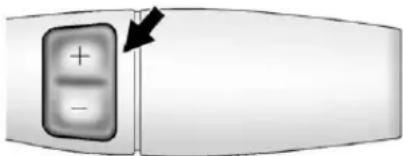
natural_image
Simple diagram of a device with a plus and minus button, no text or symbols presentThe vehicle may have a Range Selection Mode. The Range Selection Mode helps control the vehicle's transmission and vehicle speed while driving downhill or towing at trailer by letting you select adesired range of gears.
Tousethisfeature,dothefollowing:
- Movetheshiftleverto M(ManualMode).
- Press the +/- buttons, located on the steering column shift lever, to select the desired range of gears for current driving conditions.
WhenM(ManualMode)isselected anumberdisplaysintheDICnextto theMindicatingthecurrentgear.
Thisnumberisthehighestgearthat canbeused. However, the vehicle can automatically shift to lower gears as it adjust to driving conditions. This mean that all gears below that number are available. When 5 (Fifth) is selected, 1 (First) through 5 (Fifth) gears are automatically shifted by the vehicle, but 6 (Sixth) cannot be used until the +/- button located on the steering column lever is used to changeto the gear.
GradeBrakingisnotavailablewhen RangeSelectionModeisactive. See Tow/HaulModeonpage9-32.
WhileusingRangeSelectionMode, CruiseControlandtheTow/Haul Modecanbeused.
Notice: Spinningthetiresor holdingthevehicleinoneplace onahillusingonlythe acceleratorpedalmaydamage thetransmission. Therepairwill notbecoveredbythevehicle warranty. If you are stuck, donot spinthetires. When stopping on ahill, usethebrakestohold the vehicleinplace.
LowTractionMode
LowTractionModecanassistin vehicleaccelerationwhenroad conditionsareslippery. While the vehicleisatastop, select the secondgearrangeusingRange SelectionMode. Thiswilllimit torquetothewheelsafteritdetects wheelslip, preventingthetires fromspinning.
Tow/HaulMode
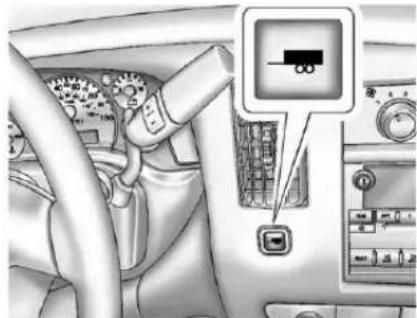
text_image
Diagram of car interior with dashboard, steering wheel, and control panel, showing a warning sign pointing to a vehicle.Vehicleswithanautomatic transmissionhaveaTow/Haul Mode.The Tow/HaulModeadjusts thetransmissionshiftpatternto reduceshiftcycling,providing increasedperformance,vehicle control,andtransmissioncooling whentowingorhaulingheavyloads.
TurntheTow/HaulModeonandoff bypassingthebutton, located to therightofthesteeringwheel on theinstrumentpanel.WhenTow/Haulison, alightontheinstrument panelclusterwillcomeon.
See Tow/HaulModeLighton page5-25formoreinformation.
Alsosee "Tow/HaulMode" under TowingEquipmentonpage9-55 for more information.
GradeBraking(SixSpeed AutomaticTransmission)
TheGradeBrakingshiftmodescan beactivatedbypassingtheTow/Haulbuttonontheinstrumentpanel. WhileinRangeSelectionMode, GradeBrakingisdeactivated allowingthedrivertoselecta desiredrangeofgears.
GradeBrakingisonlyactivwhile theTow/HaulModeisselectedand youarenotintheRangeSelection Mode.See“Tow/HaulMode”listed previously and Manual Mode on page9-31 formoreinformation on theRangeSelectionMode.Grade Brakingassistsinmaintaining desired vehiclespeedswhendriving ondownhillgradesbyautomatically shifting to lower gears when the driverdesirestoslowthevehicle by applying thebrake. This reduces wearonthebrakingsystem and increases control of the vehicle.
Alsosee Trailer Towingon page9-50 formoreinformation.
DriveSystems
All-WheelDrive
Ifthevehiclehasthisfeature, enginepowerissenttoallfour wheelswhenextratractionis needed. Thisislikefour-wheel drive, butthereisnoseparatelever orswitchtoengageordisengage thefrontaxle. Itisfullyautomatic, andadjustsitselfasneededfor roadconditions.
Brakes
AntilockBrake System(ABS)
This vehicle has the Antilock Brake System (ABS), an advanced electronic braking system that helps prevent abrakingskid.
Whentheengineisstartedandthe vehiclebeginstodriveaway,ABS checksitself.Amomentarymotoror clickingnoisemightbeheardwhile thistestisgoingon,anditmight evenbenoticedthatthebrake pedalmovesalittle.Thisisnormal.

If there is a problem with ABS, this warning light stays on. See Antilock Brake System (ABS) Warning Light on page 5-24.
Ifdrivingsafelyonawetroadandit becomesnecessarytoslamonthe brakesandcontinuebrakingto avoidasuddenobstacle,a computersensesthatthewheels areslowingdown.Ifoneofthe wheelsisabouttostoprolling,the computerwillseparatelyworkthe brakesateachwheel.
ABScanchangethebrakepressure toeachwheel, asrequired, faster thananydrivercould. Thiscanhelp thedriversteeraroundtheobstacle whilebrakinghard.
Asthebrakesareapplied, the computerkeepsreceivingupdates onwheelspeedandcontrols brakingpressureaccordingly.
Remember:ABSdoesnotchange thetimeneededtogetafootupto thebrakepedaloralwaysdecrease stoppingdistance.Ifyougettoo closetothevehicleinfrontofyou, therewillnotbeenoughtimeto applythebrakesifthatvehicle suddenlyslowsorstops.Always leaveenoughroomupaheadto stop,evenwithABS.
UsingABS
Donotpumpthebrakes.Justhold thebrakepedaldownfirmlyandlet ABSwork.YoumightheartheABS pumpormotoroperatingandfeel thebrakepedalpulsate,butthisis normal.
BrakinginEmergencies
ABSallowsthedrivertosteerand brakeatthesametime.Inmany emergencies,steeringcanhelp morethaneventheverybest braking.
ParkingBrake
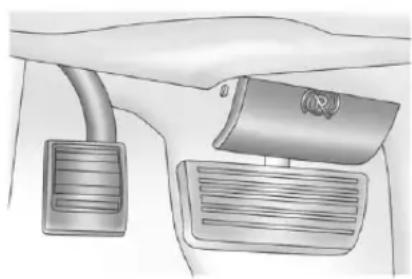
natural_image
Diagram of a car interior showing dashboard, vent, and exhaust system (no text or symbols)Tosettheparkingbrake, hold the regularbrakepedal, then push down the parkingbrakepedal.
If the ignition is on, the brake system warning light will come on.
Toreleasetheparkingbrake, hold theregularbrakepedaldown. Pull thehandle, locatedjustabovethe parkingbrakepedal, withthe parkingbrakesymbol, toreleasethe parkingbrake.
If the ignition is on when the parking brake is released, the brakes system warning light will go off.
Notice: Driving with the parking brake on can over heat the brake system and cause premature wear ordamagetobrakesystem parts. Verify that the parking brake is fully released and the brakewarning light is off before driving.
If you are towing a trailer and are parking on a hill, see Driving Characteristics and Towing Tips on page 9-46.
RideControlSystems
StabiliTrak® System
The vehicle may have an vehicle stability enhancement system called StabiliTrak. It is an advanced computer-controlled system that assists the driver with directional control of the vehicle difficult driving conditions.
StabiliTrakactivateswhenthe computersensesadiscrepancy betweentheintendedpathandthe directionthevehicleisactually traveling.StabiliTrakselectively appliesbrakingpressureatanyone ofthevehicle'sbrakestoassistthe driverwithkeepingthevehicleon theintendedpath.
Whenthevehicleisstartedand beginstomove,thesystem performsseveraldiagnosticchecks toinsuretherearenoproblems. Thesystemmaybeheardorfelt whileitisworking.Thisisnormal anddoesnotmeanthereisa problemwiththevehicle.
Thesystemshouldinitializebefore thevehiclereaches32km/h (20mph).Insomecases,itmay takeapproximately3.2km(2mi)of drivingbeforethesysteminitializes.
The TractionControlSystem(TCS)/StabiliTrakindicatorlightcomeson the instrumentpanelclusterwhen the systemrequiresservice.
WhenStabiliTrakactivates, the TCS/StabiliTrakindicatorlight flashesontheinstrumentpanel. ThisalsooccurswhenTCSis activated.
Formoreinformation,see Traction ControlSystem(TCS)/StabiliTrak ^® Lightonpage5-26.
Foryoursafety, thesystemcanonly bedisabledwhenthevehiclespeed islessthan32km/h(20mph).
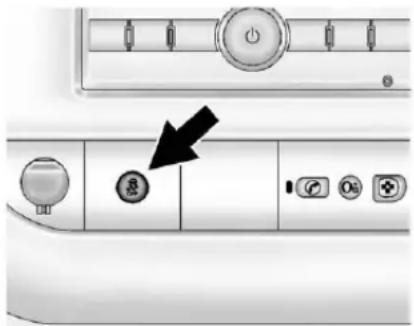
natural_image
Close-up of a computer control panel with buttons and a black arrow pointing to a button (no text or symbols visible)PresstheStabiliTrakbuttonlocated ontheinstrumentpaneloncetoturn offtheTractionControlSystem (TCS).Theappropriatemessageis displayedintheDIC.
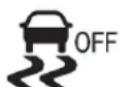
PressandholdtheStabiliTrak buttonformorethanfivesecondsto turnoffStabiliTrakandTCS.
TheStabiliTrakOfflightilluminates andtheappropriatemessageswill bedisplayedintheDIC.
ToturnontheStabiliTraksystem backon, presstheStabiliTrak buttonagain. StabiliTrakwill automatically turnbackon when the vehiclespeed exceeds 32km/h (20mph).
WhentheStabiliTraksystemhas been turned off, system noises may still be heard as a result of the brake-traction control coming on.
Itisrecommendedtoleavethe systemonfornormaldriving conditions, butitmaybenecessary toturnthesystemoffifthevehicle isstuckinsand,mud,iceorsnow, andyouwantto"rock"thevehicleto attempttofreeit.Seelfthe Vehicle IsStuckonpage9-10.
StabiliTrakSystemOperation
TheStabiliTraksystemisnormally on, exceptwhenthesystemis initializingorhasbeendisabled withtheStabiliTrakbutton. The StabiliTraksystemwillautomatically activatetoassistthedriverin maintainingvehicledirectional controlinmostdrivingconditions. Whenactivated,theStabiliTrak systemmayreduceenginepowerto thewheelsandapplybrakingto individualwheelsasnecessaryto assistthedriverwithvehicle directionalcontrol. Ifcruisecontrol isbeingusedwhenStabiliTrak activates, thecruisecontrol automaticallydisengages. The cruisecontrolcanbere-engaged whenroadconditionsallow.See CruiseControlonpage9-37.
TheStabiliTraksystemmayalso turnoffautomaticallyifitdetermines thataproblemexistswiththe system.Iftheproblemdoesnot clearitselfafterrestartingthe vehicle,seeyourdealerforservice.
TractionControlOperation
TCSispartoftheStabiliTrak system.TCSlimitswheelspinby reducingenginepowertothe wheelsandbyapplyingbrakesto eachindividualwheelasnecessary.
If the brake-traction control system activates constantly or if the brakes have heated up duetohigh speed braking, the brake-traction control will be automatically disabled. The system will come back on after the brakes have cooled. This can take uptotwominutes or longer depending on brake usage.
TCSmayactivateondryorrough roadsorunderconditionssuchas heavyaccelerationwhileturningor abruptupshifts/downshiftsofthe transmission. Whenthisareduction inaccelerationmaybenoticed,ora noiseorvibrationmaybeheard. Thisisnormal.
Adding non-dealer accessories can affect the vehicle's performance. See Accessories and Modifications on page 10-3 form more information.
LockingRearAxle
Vehicleswithalockingrearaxlecan givemoretractiononsnow,mud, ice,sand,orgravel.Itworkslikea standardaxlemostofthetime,but whentractionislow,thisfeaturewill allowtherearwheelwiththemost tractiontomovethevehicle.
CruiseControl
WARNING
Cruisecontrolcanbedangerous whereyoucannotdrivesafelyat asteadyspeed.So,donotuse thecruisecontrolonwinding roadsorinheavytraffic.
Cruisecontrolcanbedangerous onslipperyroads. Onsuchroads, fastchangesintiretraction can cause excessive wheelslip, and you could lose control. Donotuse cruise control on slippery roads.
Forvehicleswithcruisecontrol,a speedofabout40km/h(25mph)or morecanbemaintainedwithout keepingyourfootonthe accelerator.Cruisecontroldoes notworkatspeedsbelowabout 40km/h(25mph).
Whenthebrakesareapplied, cruisecontrolisturnedoff.
IfthevehiclehasStabiliTrakandthe systembeginstolimitwheelspin, cruisecontrolwillautomatically disengage.SeeStabiliTrak® System onpage9-35.Whenroadconditions allowthecruisecontroltobesafely usedagain,itcanbeturned backon.
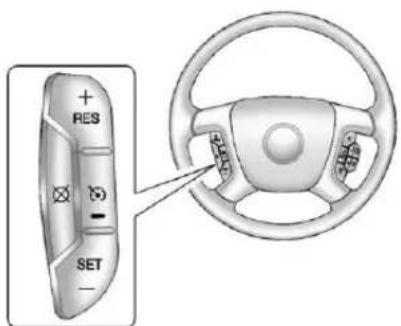
text_image
+ RES SET -(On/Off): Presstoturnthe systemonoroff. The indicator light is onwhencruisecontrolison and turnsoffwhencruisecontrolisoff.
+RES(Resume/Accelerate): Pressbrieflytomakethevehicle resumetoapreviouslysetspeed, orpressandholdtoaccelerate.
SET-(Set/Coast):Presstosetthe speedandactivatecruisecontrolor pressandholdtodecelerate.
(X) (Cancel): Presstodisengage cruisecontrolwithouterasingthe setspeedfrommemory.
SettingCruiseControl
If the cruise button is on when not in use, it could get bumped and go into cruise when not desired. Keep the cruise control switch off when cruise is not being used.
Thecruisecontrollightonthe instrumentpanelclustercomeson afterthecruisecontrolhasbeenset tothedesiredspeed.
1.Pressthe

2.Getuptothedesiredspeed.
-
PresstheSET-buttonlocated onthesteeringwheeland releaseit.
-
Takeyourfootoffthe accelerator.
ResumingaSetSpeed
If the cruise control lissetata desired speed and then the brakes are applied, the cruise control is disengaged without erasing the set speed from memory.
Oncethevehiclespeedreaches about40km/h(25mph)ormore, pressthe+RESbuttononthe steeringwheel. Thevehiclereturns totheprevioussetspeedand staysthere.
IncreasingSpeedWhileUsing CruiseControl
If the cruise control system is already activated,
- Pressandholdthe+RESbutton onthesteeringwheeluntilthe desiredspeedisreached,then releaseit.
- Toincreasevehiclespeedin smallamounts, pressthe+RES button. Each timethisis done, the vehiclegoes about 1.6 km/h (1 mph) faster.
ReducingSpeedWhileUsing CruiseControl
If the cruise control system is already activated,
- PressandholdtheSET-button onthesteeringwheeluntilthe desiredlowerspeedisreached, thenreleaseit.
- Toslowdowninsmallamounts, presstheSET-buttononthe steeringwheelbriefly.Eachtime thisisdone,thevehiclegoes about1.6km/h(1mph)slower.
PassingAnotherVehicleWhile UsingCruiseControl
Use the accelerator pedal to increase the vehicles speed. When you take your foot off the pedal, the vehicle will slow down to the previous set cruises speed.
UsingCruiseControlonHills
Howwellthecruise control works on hills depend on the vehicle speed, the load, and the steepness of the hills.
Whengoingupsteephills, pressing the acceleratorpedal maybe necessary to maintain vehicle speed.
Whilegoingdownhill:
- Vehicleswithafourspeed automatictransmissionmay needtohavethebrakesapplied orthetransmissionshiftedtoa lowergeartokeepthe speeddown.
- Vehicleswithasixspeed automatictransmissionhavea CruiseGradeBrakingfeature thatmayautomaticallyshifttoa lowergeartokeepthespeed down.Itmaybenecessaryto applythebrakeormanuallyshift thetransmissiontoalowergear. Thevehiclemayshifttoahigher gearwhengradebraking assistanceisnolongerrequired. CruiseGradeBrakingisnot availablewhileinRange SelectionMode.
Thisfeatureisactivewhen theexhaustbrakeisenabled (ifequipped).See"Range SelectionMode"underManual Modeonpage9-31.
Whenthebrakesaremanually appliedthecruisecontrolis disengaged.
EndingCruiseControl
Therearethreewaystoendcruise control:
• Todisengagecruisecontrol, steplightlyonthebrakepedal.
- Pressthe⊗onthesteering wheel.
- Toturnoffthecruise control, press 📋 onthesteeringwheel.
ErasingSpeedMemory
Thecruisecontrolsetspeedis erasedfrommemoryif is pressedorifthevehicleis turnedoff.
Fuel
Fordieselenginevehicles, see "FuelforDieselEngines" in the DuramaxDiesel Supplement.
For Vehicles with gasoline engines, pleasereadthis.
Gasoline
Useoftherecommendedfuelis animportantpartoftheproper maintenanceofthisvehicle.Tohelp keeptheenginecleanandmaintain optimumvehicleperformance,we recommendtheuseofgasoline advertisedasTOPTIERDetergent Gasoline.
LookfortheTOPTIERlabelonthe fuelpumptoensuregasolinemeets enhanceddetergencystandards developedbyautocompanies.Alist ofmarketersprovidingTOPTIER DetergentGasolinecanbefoundat www.toptiergas.com.

text_image
TOP TIER™ Detergent GasolineVehiclesthathaveaFlexFuelbadge andayellowfuelcapcanuseeither unleadedgasolineorethanolfuel containingupto85%ethanol(E85). SeeFuelE85(85%Ethanol)on page9-42. Forallothervehicles, useonlytheunleadedgasoline describedunderRecommended Fuelonpage9-40.
RecommendedFuel
Useregularunleadedgasolinewith apostedoctaneratingof87or higher.Iftheoctaneratingisless than87,anaudibleknockingnoise, commonlyreferredtoasspark knock,mightbeheardwhendriving. Ifthisoccurs,useagasolinerated at87octaneorhigherassoonas possible.Ifheavyknockingisheard whenusinggasolineratedat 87octaneorhigher,theengine needsservice.
GasolineSpecifications (U.S.andCanadaOnly)
Ataminimum, gasolines should meet ASTM specification D4814 in the United States or CAN/CGSB-3.5 or 3.511 in Canada. Some gasolines contain an octane-enhancing additive called methylcyclopentadienylmanganese tricarbonyl (MMT). Were recommend against the use of gasolines containing MMT. See Fuel Additives on page 9-41 for additional information.
CaliforniaFuel Requirements
If the vehicle is certified to meet California Emissions Standards, it is designed to operate on fuel that meet Californias specifications. See the underhood emission control label. If this fuel is not available in states adopting California Emissions Standards, the vehicle will operate satisfactorily on fuels meeting
federalspecifications, butemission controlsystemperformancemight beaffected. Themalfunction indicatorlampcouldturnonandthe vehiclemightfailasmog-checktest. SeeMalfunctionIndicatorLampon page5-21. Ifthisoccurs, returnto yourauthorizeddealerfordiagnosis. Ifitisdeterminedthatthecondition iscausedbythetypeoffuelused, repairsmightnotbecoveredbythe vehiclewarranty.
FuelsinForeign Countries
Neveruseleadedgasolineorany otherfuelnotrecommendedinthe previousstextonfuel.Costlyrepairs causedbyuseofimproperfuel wouldnotbecoveredbythevehicle warranty.
Tocheckthefuelavailability, askan autoclub, or contact a major oil company that does business in the country where you will be driving.
FuelAdditives
Toprovidecleanerair,allgasolines intheUnitedStatesarenow requiredtocontainadditivesthat helppreventengineandfuelsystem depositsfromforming,allowingthe emissioncontrolsystemtowork properly.Inmostcases,nothing shouldhavetobeaddtothefuel. However,somegasolinescontain onlytheminimumamountof additiverequiredtomeetU.S.EnvironmentalProtectionAgency regulations.Tohelpkeepfuel injectorsandintakevalvesclean andavoidproblemsduetodirty injectorsorvalves,lookforgasoline thatisadvertisedasTOPTIER DetergentGasoline.Lookforthe TOPTIERlabelonthefuelpumpto ensuregasolinemeetsenhanced detergencystandardsdevelopedby theautocompanies.Alistof marketersprovidingTOPTIER DetergentGasolinecanbefoundat www.toptiergas.com.
ForcustomerswhodonotuseTOP TIERDetergentGasolineregularly, onebottleofGMFuelSystem TreatmentPLUS,addedtothefuel tankateveryengineoilchange,can helpcleandepositsfromfuel injectorsandintakevalves.GMFuel SystemTreatmentPLUSistheonly gasolineadditiverecommendedby GeneralMotors.Itisavailableat yourdealer.
Gasolinescontainingoxygenates, suchasethersandethanol, and reformulatedgasolinesmightbe availableinyourarea. We recommendthatyouusethese gasolines,iftheycomplywiththe specificationsdescribedearlier. However,E85(85%ethanol)and otherfuelscontainingmorethan 15%ethanolmustnotbeusedin vehiclesthatwerenotdesignedfor thosefuels.
Notice: This vehicle was not designed for fuel that contains methanol. Donot use fuel containing methanol. It can corrode metal parts in the fuel system and also damage plastic and rubber parts. That damage would not be recovered under the vehicle warranty.
Somegasolinesthatarenot reformulatedforlowemissionscan containanoctane-enhancing additivecalled methylcyclopentadienylmanganese tricarbonyl(MMT);asktheattendant whereyoubuygasolinewhetherthe fuelcontainsMMT.Werecommend againsttheuseofsuchgasolines. FuelscontainingMMTcanreduce sparkpluglifeandaffectemission controlsystemperformance.The malfunctionindicatorlampmight turnon.Ifthisoccurs,returntoyour dealerforservice.
FuelE85(85%Ethanol)
VehiclesthathaveaFlexFuelbadge andayellowfuelcapcanuseeither unleadedgasolineorethanolfuel containingupto85%ethanol(E85). Forallothervehicles, useonlythe unleadedgasolinedescribedunder RecommendedFuelonpage9-40.
WeencouragetheuseofE85in vehiclesthataredesignedtouseit. TheethanolinE85isa“renewable” fuel, meaningitismadefrom renewablesourcessuchascorn andothercrops.
Manyservicestationswillnothave an85%ethanolfuel(E85)pump available.TheU.S.Departmentof Energyhasanalternativefuels website(www.afdc.energy.gov/afdc/locator/stations/)thatcanhelpyou findE85fuel.Thosestationsthatdo haveE85shouldhavealabel indicatingethanolcontent.Donot usethefueliftheethanolcontentis greaterthan85%.
Ataminimum, E85 should meet ASTMSpecificationD5798 or CGSBSpecification3.512. Filling the tank with fuel mixtures that do not meet ASTM or CGSB specifications can affect driveability and could cause them malfunction indicator lamptocomeon. Asthe outside temperature approaches freezing, ethanol fuel distributors should supply winter grade ethanol, the same as with unleaded gasoline.
Itisbestnottoalternaterepeatedly betweenengasolineandE85.If you doswitchfuels,itisrecommended thatyouaddasmuchfuelas possible—donotaddlessthan 11L(3gal)whenrefueling.You shoulddrivethevehicleimmediately afterrefuelingforatleast11km (7mi)toallowthevehicletoadapt tothechangeinethanol concentration.
E85haslessenergyperliter (gallon)thangasoline,soyouwill needtorefillthefueltankmore oftenwhenusingE85thanwhen youareusinggasoline.SeeFilling theTankonpage9-44.
Notice: Someadditives are not compatible with E85 fuel and can harm the vehicle's fuel system. Donot add anything to E85. Damage caused by additives would not be recovered by the vehicle warranty.
Notice: This vehicle was not designed for fuel that contains methanol. Donotuse fuel containing methanol. It can corrode metal parts in the fuel system and also damage plastic and rubber parts. That damage would not be covered under the vehicle warranty.
FillingtheTank

WARNING
Fuelvaporburnsviolentlyanda fuelfirecancausebadinjuries. Tohelpavoidinjuriestoyouand others,readandfollowallthe instructionsonthefuelpump island.Turnofftheenginewhen refueling.Donotsmokenearfuel orwhenrefuelingthevehicle. Donotusecellularphones. Keepsparks,flames,and smokingmaterialsawayfromfuel. (Continued)
WARNING(Continued)
Donotleavethefuelpump unattendedwhenrefuelingthe vehicle. Thisisagainstthelawin someplaces.Donotre-enterthe vehiclewhilepumpingfuel.Keep childrenawayfromthefuelpump; neverletchildrenpumpfuel.
Thetetheredfuelcapislocated behindahingedfueldooronthe driversideofthevehicle. IfthevehiclehasE85fuelcapability, thefuelcapwillbeyellowandstate thatE85orgasolinecanbeused. SeeFuelE85(85%Ethanol)on page9-42.
Toremovethefuelcap, turnit slowlycounterclockwise.
Whilerefueling,hangthetethered fuelcapfromthehookonthe fueldoor.

WARNING
Fuelcansprayoutonyouifyou openthefuelcaptooquickly. Ifyouspillfuelandthen somethingignitesit,youcouldbe badlyburned.Thisspraycan happenifthetankisnearlyfull, andismorelikelyinhotweather. Openthefuelcapslowlyandwait foranyhissnoisetostop.Then unscrewthecapalltheway.
Becarefulnottospillfuel.Donot topofforoverfillthetankandwaita fewsecondsafteryouhavefinished pumpingbeforeremovingthe nozzle.Cleanfuelfrompainted surfacesassoonaspossible. See ExteriorCareonpage 10-93.
When replacing the fuel cap, turn it clockwise until it clicks. Makes sure the cap is fully installed. The diagnostics system can determine if the fuel cap has been left for improperly installed. This would allow fuel to evaporate into the atmosphere. See Malfunction Indicator Lampon page 5-21.

WARNING
Ifafirestartswhileyouare refueling, donotremovethe nozzle. Shutofftheflowoffuelby shuttingoffthepumporby notifyingthestationattendant. Leavetheareaimmediately.
Notice: If you need an new fuel cap, besure to get their right type. Your dealer can get one of you. If you get the wrong type, it may not fit properly. This may cause them malfunction indicator lampto light and may damage the fuel
tankandemissionssystem.See MalfunctionIndicatorLampon page5-21.
FillingaPortableFuel Container

WARNING
Neverfillaportablefuelcontainer whileitisinthevehicle.Static electricitydischargefromthe containercanignitethefuel vapor.Youcanbebadlyburned andthevehicledamagedif thisoccurs.Tohelpavoidinjuryto youandothers:
- Dispensefuelonlyinto approvedcontainers.
- Donotfillacontainerwhileit isinsideavehicle,ina vehicle'strunk,pickupbed, oronanysurfaceotherthan theground.
(Continued)
WARNING(Continued)
- Bringthefillnozzleincontact withtheinsideofthefill openingbeforeoperatingthe nozzle.Contactshouldbe maintaineduntilthefillingis complete.
- Donotsmokewhile pumpingfuel.
- Donotuseacellularphone whilepumpingfuel.
Towing
GeneralTowing Information
Onlyusetowingequipmentthathas beendesignedforthevehicle. Contactyourdealerortrailering dealerforassistancewithpreparing thevehiclefortowingatraler.
Seethefollowingtrailertowing informationinthissection:
- Forinformationondrivingwhile towingatrailer,see"Driving Characteristicsand TowingTips."
- Formaximumvehicleandtrailer weights,see"TrailerTowing."
- Forinformationonequipmentto towatrailer,see“Towing Equipment.”
Forinformationontowingadisabled vehicle,see TowingtheVehicleon page 10-90.Forinformationon towingthevehiclebehindanother
vehiclesuchasamotorhome, see Recreational Vehicle Towingon page 10-90.
DrivingCharacteristics and TowingTips
PullingaTrailer
Herearesomeimportantpoints:
- Therearemanydifferentlaws, includingspeedlimitrestrictions, havingtodowithtrailering. Makesuretherigwillbelegal, notonlywhereyoulivebutalso whereyouwillbedriving. Agoodsourceforthis informationcanbestateor provincialpolice.
- Considerusingaswaycontrol. See "Hitches" in Towing Equipmentonpage9-55.
-
Donottowatraileratallduring thefirst800km(500mi)thenew vehicleisdriven. Theengine, axleorotherpartscouldbe damaged.
-
Then, during the first 800 km (500 mi) that a traileristowed, donot drive over 80 km/h (50 mph) and donot make starts at full throttle. This helpsthe engine and other part so the vehicle wear in at the heavier loads.
- Vehicleswithanautomatic transmissionscantowin D(Drive).Shiftthetransmission toalowergearifthe transmissionshiftstoooften underheavyloadsand/orhilly conditions.
Threeimportantconsiderations havetodowithweight:
• Theweightofthetrailer.
• Theweightofthetrailertongue.
• Theweightonthevehicle'stires.
Alsosee "Tow/HaulMode" later in this section for information about the Tow/Haulbutton and the Tow/Haul indicator light.
DrivingwithaTrailer

WARNING
Whentowingatrailer, exhaust gasesmaycollectattherearof thevehicleandenterifthe liftgate,trunk/hatch,orrear-most windowisopen.
Engineexhaustcontainscarbon monoxide(CO)whichcannot be seenorsmelled.Itcancause unconsciousnessandevendeath.
Tomaximizesafetywhentowing atrailer:
- Havetheexhaustsystem inspectedforleaksandmake necessaryrepairsbefore startingatrip.
- Neverdrivewiththeliftgate, trunk/hatch,orrear-most windowopen.
(Continued)
WARNING(Continued)
- Fullyopentheairoutletson orundertheinstrument panel.
- AdjusttheClimateControl systemtoasettingthat bringsinonlyoutsideairand setthefanspeedtothe highestsetting.SeeClimate ControlSysteminthelndex.
Formoreinformationabout carbonmonoxide,seeEngine Exhaustonpage9-24.
Towingatralerrequiresacertain amountofexperience.Gettoknow therigbeforesettingoutforthe openroad.Getacquaintedwiththe feelofhandlingandbrakingwiththe addedweightofthetrailer.And alwayskeepinmindthatthevehicle youaredrivingisnowlongerand notasresponsiveasthevehicleis byitself.
Beforestarting, checkalltrailerhitch partsandattachments, safety chains, electricalconnectors, lamps, tiresandmirroradjustments. If the trailerhaselectricbrakes, start the vehicle and trailermoving and then apply the trailerbrake controller by handtobesurethebrakes are working. This checksthe electrical connection at the same time.
Duringthetrip, checkoccasionally tobesurethattheloadissecure, and thatthelampsandanytrailer brakesarestillworking.
FollowingDistance
Stayatleasttwiceasfarbehindthe vehicleaheadasyouwouldwhen drivingthevehiclewithoutatrailer. Thiscanhelptoavoidsituations thatrequireheavybrakingand suddenturns.
Passing
Morepassingdistanceisneeded whentowingatrailer.Because the rigislonger,itisnecessarytogo muchfartherbeyondthepassed vehiclebeforereturningtothelane.
BackingUp
Holdthebottomofthesteering wheelwithonehand. Then, tomove thetrailertotheleft, movethathand totheleft. Tomovethetrailertothe right, moveyourhandtotheright. Alwaysbackupslowly and, if possible, havesomeone guideyou.
MakingTurns
Notice: Making very sharp turns while trailering could cause the trailertocome in contact with the vehicle. The vehicle could be damaged. Avoid making very sharp turns while trailering.
Whenturningwithatrailer,make widerturnsthannormal.Dothisso thetrailerwillnotstrikesoft
shoulders, curbs, road signs, trees or other objects. Avoid jerkyor suddenmaneuvers. Signalwellin advance.
TurnSignalsWhenTowinga Trailer
Thearrowsontheinstrumentpanel flashwheneversignalingaturnor lanechange.Properlyhookedup, thetrailerlampsalsoflash,telling otherdriversthevehicleisturning, changinglanesorstopping.
Whentowingatraler, thearrowson theinstrumentpanelflashforturns evenifthebulbsonthetrailerare burnedout. Forthisreasonyoumay thinkotherdriversareseeingthe signalwhentheyarenot. Itis importanttocheckoccasionally to besurethetrailerbulbsarestill working.
DrivingonGrades
Reducespeedandshifttoa lowergearbeforestartingdowna longorsteepdowngrade.Ifthe transmissionisnotshifteddown,the
brakesmighthavetobeusedso muchthattheywouldgethotandno longerworkwell.
The vehicle cantowin D(Drive). Shift the transmission to a lower gear if the transmission shift too often under heavy loads and/or hilly conditions.
Whentowingathighaltitudeon steepuphillgrades,considerthe following:Enginecoolantwillboilat alowertemperaturethanatnormal altitudes.Iftheengineisturnedoff immediatelyaftertowingathigh altitudeonsteepuphillgrades,the vehiclemayshowsignssimilarto engineoverheating.Toavoidthis, lettheengineerunwhileparked, preferablyonlevelground,withthe automatictransmissioninP(Park) forafewminutesbeforeturningthe engineoff.Iftheoverheatwarning comeson,seeEngineOverheating onpage 10-22.
ParkingonHills

WARNING
Parkingthevehicleonahillwith thetrailerattachedcanbe dangerous. If something goes wrong, therigcouldstarttomove. People can be injured, and both the vehicle and the trailer can be damaged. When possible, always parktherigonaflatsurface.
Ifparkingtherigonahill:
-
Pressthebrakepedal, butdo notshiftthetransmission into P(Park)yet.Turnthewheels into the curbif facing downhill or intotrafficif facing uphill.
-
Havesomeoneplacechocks underthetrailerwheels.
-
Whenthewheelchocksarein place, releasethebrakepedal untilthechocksabsorbtheload.
- Reapplythebrakepedal. Then apply the parking brake and shift into P(Park).
- Releasethebrakepedal.
LeavingAfterParkingonaHill
- Apply and hold the brake pedal while you:
1.1.Starttheengine.
1.2.Shiftintoagear.
1.3. Releasetheparkingbrake. - Letuponthebrakepedal.
- Driveslowlyuntilthetraileris clearofthechocks.
- Stopandhavesomeonepickup andstorethechocks.
MaintenanceWhenTrailer Towing
Thevehicleneedsservicemore oftenwhenpullingatrailer.Seethis manual'sMaintenanceScheduleor Indexformoreinformation.Things thatareespeciallyimportantin traileroperationareautomatic transmissionfluid,engineoil,axle lubricant,belts,coolingsystemand brakesystem.Itisagoodideato inspectthesebeforeandduring thetrip.
Checkperiodicallytoseethatall hitchnutsandboltsaretight.
TrailerTowing
Ifthevehiclehasadieselengine, seetheDuramax ^® diesel supplementformoreinformation.

WARNING
Thedrivercanlosecontrolwhen pullingatrailerifthecorrect equipmentisnotusedorthe vehicleisnotdrivenproperly. Forexample,ifthetraileristoo heavy,thebrakesmaynotwork well—orevenatall.Thedriver andpassengerscouldbe seriouslyinjured.Thevehiclemay alsobedamaged;theresulting repairswouldnotbecoveredby thevehiclewarranty.Pullatrailer onlyifallthestepsinthissection havebeenfollowed.Askyour dealerforadviceandinformation abouttowingatrailerwiththe vehicle.
Notice: Pullingatailer improperlycandamagethe vehicleandresultincostly repairsnotcoveredbythe vehiclewarranty.Topullatrailer correctly,followtheadviceinthis sectionandseeyourdealerfor importantinformationabout towingatralerwiththevehicle.
To identify the trailering capacity of the vehicle, read the information in "Weight of the Trailer" that appears later in this section.
Traileringisdifferentthanjust drivingthevehiclebyitself. Traileringmeanschangesin handling,acceleration,braking, durability,andfueleconomy. Successful,safetraileringtakes correctequipment,andithastobe usedproperly.
The following information has many time-tested, important trailering tips and safety rules. Many of these are important for yoursafety and that of
yourpassengers.Sopleaseread thissectioncarefullybeforepullinga trailer.
WeightoftheTrailer
Howheavycanatrailersafelybe?
Itdependsonhowtherigisused. Forexample, speed, altitude, road grades, outsidetemperature, and howmuchthevehicleisusedtopull atrailerareallimportant.Itcan dependonanyspecialequipment onthevehicle, and theamountof tongueweightthevehiclecancarry. See "WeightoftheTrailerTongue" laterinthissectionformore information.
Maximum trailerweightiscalculated assuming only the driver is in the tow vehicle and it has all the required trailering equipment. The weight of additional optional equipment, passengers, and cargoin the tow vehicle must be subtracted from the maximum trailer weight.
Usethefollowingcharttodeterminehowmuchthevehiclecanweigh,baseduponthevehiclemodelandoptions.
| VehicleAxleRatioMaximumTrailerWeightGCWR* | |||
| G1500CargoVan2WD | |||
| 4.3LV63.421950kg(4,300lbs)4309kg(9,500lbs) | |||
| 5.3LV8 | 3.423.73 | 3039kg(6,700lbs)5443kg(12,000lbs) | |
| H1500CargoVanAWD | |||
| 5.3LV83.422948kg(6,500lbs)5443kg(12,000lbs) | |||
| G1500PassengerVan2WD | |||
| 5.3LV8 | 3.423.73 | 2812kg(6,200lbs)5443kg(12,000lbs) | |
| H1500PassengerVanAWD | |||
| 5.3LV8 | 3.423.73 | 2722kg(6,000lbs)5443kg(12,000lbs) | |
| G2500CargoVan2WDShortWheelbase | |||
| 4.8LV83.423357kg(7,400lbs)5897kg(13,000lbs) | |||
| 6.0LV83.424536kg(10,000lbs)7257kg(16,000lbs) | |||
9-52DrivingandOperating
| VehicleAxleRatioMaximumTrailerWeightGCWR* | |||
| G2500CargoVan2WDLongWheelbase | |||
| 4.8LV83.423266kg(7,200lbs)5897kg(13,000lbs) | |||
| 6.0LV83.424536kg(10,000lbs)7257kg(16,000lbs) | |||
| G2500PassengerVan2WDShortWheelbase | |||
| 4.8LV83.423039kg(6,700lbs)5897kg(13,000lbs) | |||
| 6.0LV83.424445kg(9,800lbs)7257kg(16,000lbs) | |||
| G3500CargoVan2WDShortWheelbase | |||
| 4.8LV83.423357kg(7,400lbs)5897kg(13,000lbs) | |||
| 6.0LV83.424536kg(10,000lbs)7257kg(16,000lbs) | |||
| G3500CargoVan2WDLongWheelbase | |||
| 4.8LV83.423221kg(7,100lbs)5897kg(13,000lbs) | |||
| 6.0LV83.424536kg(10,000lbs)7257kg(16,000lbs) | |||
| VehicleAxleRatioMaximumTrailerWeightGCWR* | |||
| G3500PassengerVan2WDShortWheelbase | |||
| 6.0LV83.424400kg(9,700lbs)7257kg(16,000lbs) | |||
| G3500PassengerVan2WDLongWheelbase | |||
| 6.0LV83.424218kg(9,300lbs)7257kg(16,000lbs) | |||
| *TheGrossCombinedWeightRating(GCWR)isthetotalallowableweightofthecompletelyloadedvehicleand trailerincludinganypassengers,cargoequipmentandconversion.TheGCWRforthevehicleshouldnotbe exceeded. | |||
Askyourdealerforourtrailering informationoradvice,orwriteusat ourCustomerAssistanceOffices. See CustomerAssistance Offices (U.S.andCanada)onpage 13-5or CustomerAssistance Offices (Mexico)onpage 13-6formore information.
9-54 Driving and Operating
Weight of the Trailer Tongue
The tongue load (A) of any trailer is an important weight to measure because it affects the total gross weight of the vehicle. The Gross Vehicle Weight (GVW) includes the curb weight of the vehicle, any cargo carried in it, and the people who will be riding in the vehicle. If there are a lot of options, equipment, passengers, or cargo in the vehicle, it will reduce the tongue weight the vehicle can carry, which will also reduce the trailer weight the vehicle can tow. If towing a trailer, the tongue load must be added to the GVW because the vehicle will be carrying that weight, too. See Vehicle Load Limits on page 9-11 for more information about the vehicle's maximum load capacity.
The trailer tongue weight (A) should be 10 percent to 15 percent of the total loaded trailer weight (B), up to a maximum of 181 kg (400 lbs) with a weight carrying hitch. The trailer tongue weight (A) should be 10 percent to 15 percent of the total loaded trailer weight (B), up to a maximum of 454 kg (1,000 lbs) with a weight distributing hitch.
Do not exceed the maximum allowable tongue weight for the vehicle. Choose the shortest hitch extension that will position the hitch ball closest to the vehicle. This will help reduce the effect of trailer tongue weight on the rear axle.
After loading the trailer, weigh the trailer and then the tongue, separately, to see if the weights are proper. If they are not, adjustments might be made by moving some items around in the trailer.
Trailering may be limited by the vehicle's ability to carry tongue weight. Tongue weight cannot cause the vehicle to exceed the GVWR (Gross Vehicle Weight Rating) or the RGAWR (Rear Gross Axle Weight Rating). The effect of additional weight may reduce the trailering capacity more than the total of the additional weight.
It is important that the vehicle does not exceed any of its ratings—GCWR, GVWR, RGWR, Maximum Trailer Rating or Tongue Weight. The only way to be sure it is not exceeding any of these ratings is to weigh the vehicle and trailer.
TotalWeightontheVehicle's Tires
Besurethevehicletiresareinflated totheupperlimitforcoldtires. Thesenumberscanbefoundonthe Certificationlabelattherearedgeof thedriverdoor,orseeVehicleLoad Limitsonpage9-11.Makesurenot togoovertheGVWlimitforthe vehicle,ortheGAWR,includingthe weightofthetrailertongue.Ifusing aweightdistributinghitch,make surenottogoovertherearaxle limitbeforeapplyingtheweight distributionspringbars.
TowingEquipment
Hitches
It is important to have the correct hit equipment. Crosswinds, large truckgoing by and roughroads are afew reasons why therighthitch is needed.
Weight-DistributingHitches and WeightCarryingHitches
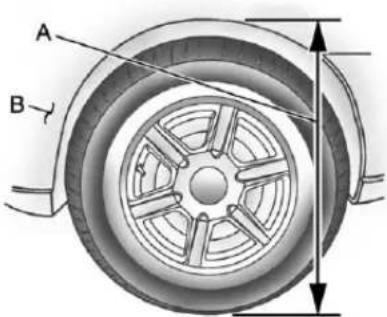
text_image
A BA. BodytoGroundDistance B. FrontofVehicle
When using a weight-distributing hitch, the hitch must be adjusted so the distance (A) remains the same both before and after coupling the trail to the tow vehicle.
Ifastep-bumperhitchwillbeused, thebumpercouldbedamagedin sharpturns. Makesurethere isampleroomwhenturningto avoidcontactbetweenthetrailer andthebumper.
Iftheloadedtrailerbeingpulled willweighmorethan2270kg (5,000lbs),besuretousea properlymountedweight-distributing hitchandswaycontroloftheproper size. This equipment is very important for proper vehicle loading and good handling when driving. Always use as way control if the trailer will weigh more than these limits. Askahitch dealer about sway controls.
Willanyholesneedtobemade in thebodyofthevehiclewhena trailerhitchisinstalled?
Ifusingthewiringprovidedwiththe factory-installedtraileringpackage, noholesneedtobemadeinthe bodyofthevehicle.However,ifan aftermarketethitchisinstalled,holes mayneedtobemadeinthebody.
Ifholesaremadeinthebody, then besuretosealtheholeslaterwhen thehitchisremoved. Iftheholesare notsealed, deadlycarbonmonoxide (CO) from the engine's exhaust can get into the vehicle as well as dirt and water. See "CarbonMonoxide" under Engine Exhauston page 9-24.
SafetyChains
Alwaysattachchainsbetweenthe vehicleandthetrailer.Crossthe safetychainsunderthetongueof thetrailertohelppreventthetongue fromcontactingtheroadifit becomesseparatedfromthehitch. Alwaysleavejustenoughslackso therigcanturn.Neverallowsafety chainstodragontheground.
TrailerBrakes
Aloaded trailer that weighs more than 680 kg (1,500 lbs) need to have its own brakes system that is adequate forth the weight of the trailer. Besuretoread and follow the instructions forth the trailer brakes so they are installed, adjusted and maintained properly.
TrailerWiringHarness
Theoptionalheavy-duty trailer wiringpackageincludesawiring harness,withaseven-pinconnector attherearofthevehicleanda four-wireharnessassemblyunder thedriversideoftheinstrument panel. Thefour-wireharness assemblycomeswithouta connector.
Ifthevehicledoesnothaveatrailer hitch,theseven-wireharness assemblywithconnectoristaped togetherandlocatedinaframe pocketatthedriversiderearleft corneroftheframe.
If the vehicle has a trailer hitch, the seven-wire harness assembly with connector is attached to a bracket on the hitch platform. In both cases, these two-wire harness has a connector and includes a 30-amp feedwire.
Theseven-wireharnessconnector contains the following trailercircuits:
• LightGreen:Back-upLamps (10Afuse)**
- White:Ground
• DarkBlue:TrailerBrakeSignal
- DarkGreen:RightRearStop andTurnSignal*
• Red/BlackStripe:BatteryFeed (30AFuse)
• Brown:TrailerParkLamp SupplyVoltage(15Afuse)**
- Yellow:LeftRearStopandTurn Signal*
The four-wireharness (without connector) contains the following circuits:
- Black:Ground
• Red/White:BatteryFeed
• DarkBlue:TrailerBrakeSignal
• LightBlue:CHMSL/Stoplamp SupplyVoltage
*Ifthevehicleisacutawaywith trailerprovisions,a15ampfusewill besharedforbothleft/stoptrailer turnandright/stoptrailerturn signals.However,thecutaway lightingconnectorwillhavea 10ampfuseforeachsignal.
**Ifthevehicleisacutawaywith trailerprovisions,a15ampfusewill besharedfortrailerparklampsand cutawayrearlightingconnectorpark lamps.Also,a10ampfusewillbe sharedfortrailerback-uplampsand cutawayrearlightingconnector back-uplamps.
Tow/HaulMode
Thisbuttonisontheinstrument panel,totherightofthesteering wheel.
Pressingthisbuttonturnsonandoff the Tow/HaulMode.

This indicator light on the instrument panel cluster comes on when the Tow/Haul Modeison.
Tow/Haulisafeaturethatassists whenpullingaheavytrailerora largeorheavyload.See Tow/Haul Modeonpage9-32formore information.
Tow/Haulisdesignedtobemost effectivewhenthevehicleand trailercombinedweightisatleast 75percentofthevehicleGross CombinedWeightRating(GCWR). See"WeightoftheTrailer"in Trailer Towingonpage9-50.Tow/Haulis mostusefulunderthefollowing drivingconditions:
- Whenpullingaheavytraileroralargeorheavyloadthroughrollingterrain.
- Whenpullingaheavytraileroralargeorheavyloadinstopandgottraffic.
- Whenpullingaheavytrailerorla largeorheavyloadinbusy parkinglotswhereimprovedlow speedcontrolofthevehicleis desired.
OperatingthevehicleinTow/Haul whenlightlyloadedorwithnotrailer atallwillnotcausedamage. However, thereisnobenefitto the selectionofTow/Haulwhenthe vehicleisunloaded.Sucha selectionwhenunloadedmay resultinunpleasantengine and transmissiondrivingcharacteristics andreducedfueleconomy.Tow/Haulisrecommendedonlywhen pullingaheavytraileroralargeor heavyload.
Conversionsand Add-Ons
Add-On Electrical Equipment
Notice: Donotaddanything electrical to the vehicle unless you check with your dealer first. Some electricalequipment can damage the vehicle and the damage would not be recovered by the vehicle's warranty. Some add-onelectricalequipment can keep other components from working asthey should.
Add-onequipmentcandrainthe vehicle's12-voltbattery,evenif thevehicleisnotoperating.
Thevehiclehasanairbagsystem. Beforeattemptingtoaddanything electricaltothevehicle,see ServicingtheAirbag-Equipped Vehicleonpage3-35andAdding EquipmenttotheAirbag-Equipped Vehicleonpage3-35.
VehicleCare
GeneralInformation
GeneralInformation......10-2
CaliforniaProposition 65Warning......10-2
CaliforniaPerchlorate MaterialsRequirements....10-2
Accessories and Modifications....10-3
VehicleChecks
DoingYourOwn ServiceWork......10-4
Hood....10-4
EngineCompartment Overview......10-6
EngineOil....10-7
EngineOilLifeSystem.....10-10
AutomaticTransmissionFluid (4-SpeedTransmission)...10-11
AutomaticTransmission Fluid(6-Speed Transmission)....10-13
EngineAirCleaner/Filter....10-16
CoolingSystem......10-18
EngineCoolant......10-18
EngineOverheating......10-22
EngineFan......10-24
PowerSteeringFluid......10-24
WasherFluid......10-25
Brakes....10-26
BrakeFluid......10-27
Battery....10-28
All-WheelDrive......10-29
FrontAxle......10-30
RearAxle....10-31
NoiseControlSystem.....10-31
StarterSwitchCheck......10-33
AutomaticTransmissionShift
LockControlFunction
Check....10-33
IgnitionTransmissionLock
Check......10-33
ParkBrakeandP(Park)
MechanismCheck......10-34
WiperBlade
Replacement.....10-34
BulbReplacement
BulbReplacement......10-35
HalogenBulbs......10-35
Headlamps....10-35
FrontTurnSignal, Sidemarker,andParking
Lamps....10-37
Taillamps....10-38
CenterHigh-Mounted Stoplamp(CHMSL).....10-39
LicensePlateLamp......10-40
ReplacementBulbs.....10-40
ElectricalSystem
ElectricalSystem Overload.....10-41
FusesandCircuit Breakers....10-41
EngineCompartmentFuse Block....10-42
FloorConsoleFuse Block......10-46
WheelsandTires
Tires....10-49
TireSidewallLabeling.....10-50
TireDesignations......10-52
TireTerminology and Definitions....10-54
TirePressure......10-56
TirePressureMonitor System....10-58
TirePressureMonitor Operation....10-59
TireInspection......10-62
TireRotation......10-62
DualTireRotation......10-64
WhenItIsTimeforNew
Tires....10-64
BuyingNewTires......10-65
DifferentSizeTiresand
Wheels......10-67
UniformTireQuality
Grading....10-68
WheelAlignmentandTire
Balance....10-69
WheelReplacement......10-70
TireChains....10-71
IfaTireGoesFlat......10-72
TireChanging......10-74
SecondaryLatchSystem...10-83
Full-SizeSpareTire.....10-85
JumpStarting
JumpStarting......10-86
Towing
TowingtheVehicle......10-90
Recreational Vehicle
Towing....10-90
AppearanceCare
ExteriorCare......10-93
InteriorCare....10-97
FloorMats......10-99
GeneralInformation
Forserviceandpartsneeds,visit yourdealer.Youwillreceive genuineGMpartsandGM-trained andsupportedservicepeople.
GenuineGMpartshaveoneof thesemarks:

Genuine

Parts

Accessories
CaliforniaProposition 65Warning
Mostmotorvehicles, including this one, contain and oremit chemicals known to the State of California cause cancer and birth defect or other reproductive harm. Engine exhaust, many parts and systems, many fluids, and some component wear by-products contain and/or emitthes Chemicals.
CaliforniaPerchlorate MaterialsRequirements
Certaintypesofautomotive applications, such as airbag initiators, seat belt pretensioners, and lithium batteries contained in Remote Keyless Entry transmitters, may contain perchloratematerials. Special handling may be necessary. For additional information, see www.dtsc.ca.gov/hazardous waste/perchlorate.
Accessories and Modifications
Adding non-dealer accessories or making modification to the vehicle can affect vehicle performance and safety, including such things as airbags, braking, stability, ride and handling, emission systems, aerodynamics, durability, and electronics systems like antilock brakes, traction control, and stability control. These accessories or modifications could deven cause malfunctionordamagenotcovered by the vehicle warranty.
Damageetovehiclecomponents resultingfrommodificationsorthe installationoruseofnon-GM certifiedparts,includingcontrol moduleorsoftwaremodifications,is notcoveredunderthetermsofthe vehiclewarrantyandmayaffect remainingwarrantycoveragefor affectedparts.
GMAccessoriesaredesignedto complementandfunctionwithother systemsonthevehicle. Seeyour dealertoaccessorizethevehicle usinggenuineGMAccessories installedbyadealertechnician.
Also, see Adding Equipment to the Airbag-Equipped Vehicle on page 3-35.
VehicleChecks
DoingYourOwn ServiceWork

WARNING
Youcanbeinjuredandthe vehiclecouldbedamagedifyou trytodoserviceworkonavehicle withoutknowingenoughaboutit.
- Besureyouhavesufficient knowledge,experience, theproperreplacement parts,andtoolsbefore attemptinganyvehicle maintenancetask.
- Besuretousetheproper nuts, bolts, and other fasteners. Metric and English fasteners can be easily confused. If the wrong fasteners are used, parts can later break or falloff. You could be hurt.
If doingsome of your own service work, us the properservice manual. It tells you much more about how to servicethe vehicle than this manual can. To order the properservicemanual, see Service Publications Ordering Information on page 13-18.
Thisvehiclehasanairbagsystem. Beforeattemptingtodayyourown servicework,seeServicingthe Airbag-EquippedVehicleon page3-35.
Keeparecordwithallpartsreceipts andlistthemileageandthedate ofanyserviceworkperformed. SeeMaintenanceRecordson page11-15.
Hood
Toopenthehood:

- Pull the handle with this symbol on it is located in front of the riversided door frame near the floor.
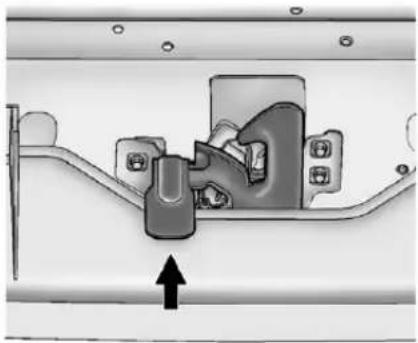
natural_image
Mechanical assembly diagram showing a bracket with mounting holes and a directional arrow (no text or symbols)- Gotothefrontofthevehicle and liftupthesecondaryhood release, whichislocated underneaththemiddleof thehood.
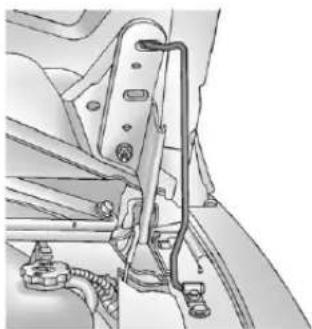
natural_image
Technical line drawing of a mechanical assembly with no visible text or symbols- Liftthehood, releasethehood propfromitsretainerandputthe hoodpropintotheslotin thehood.
If the vehicle has an underhood lamp, it will automatically come on and stay on until the hood disclosed.
Beforeclosingthehood,besureall ofthefillercapsareonproperly. Thenliftthehoodtorelieve pressureonthehoodprop.Remove thehoodpropfromtheslotinthe hoodandreturntheproptoits retainer.Letthehooddownand closeitfirmly.
EngineCompartmentOverview
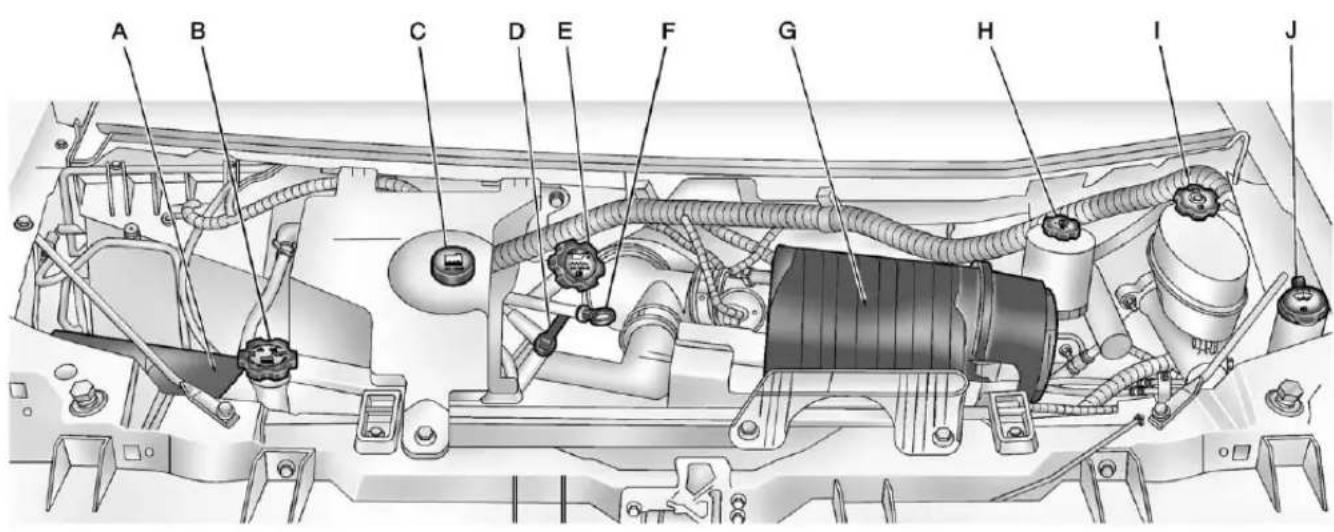
text_image
A B C D E F G H I J4.3LV6EngineShown(4.8LV8Engine,5.3LV8Engineand6.0LV8EngineSimilar)
A. Batteryonpage 10-28.
B. RadiatorPressureCap.See CoolingSystemonpage10-18.
C.CoolantRecoveryTank.See CoolingSystemonpage10-18.
D. Automatic Transmission Fluid Dipstick. See "Checking the Fluid Level" under Automatic Transmission Fluid (4-Speed Transmission) on page 10-11 or Automatic Transmission Fluid (6-Speed Transmission) on page 10-13.
E. EngineOilFillCap. See "When toAddEngineOil" under EngineOilonpage 10-7.
F. EngineOilDipstick.See "CheckingEngineOil" under EngineOilonpage10-7.
G. EngineAirCleaner/Filteron page10-16.
H. PowerSteeringFluidReservoir. See PowerSteeringFluidon page 10-24.
I. BrakeMasterCylinder
Reservoir. See BrakeFluidon
page 10-27.
J. Windshield Washer Fluid Reservoir. See "Adding Washer Fluid" under Washer Fluid on page 10-25.
EngineOil
Fordieselenginevehicles, see "EngineOil" in the Duramax Diesel Supplement.
Toensureproperengine performanceandlonglife,careful attentionmustbepaidtoengineoil. Followingthesesimple,but importantstepswillhelpprotect yourinvestment:
- Alwaysuseengineoilapproved totheproperspecificationandof theproperviscositygrade.See "SelectingtheRightEngineOil" inthissection.
- Checktheengineoillevel regularlyandmaintainthe properoillevel.See"Checking EngineOil"and"WhentoAdd EngineOil"inthissection.
- Changetheengineoilatthe appropriatetime.SeeEngineOil LifeSystemonpage 10-10.
- Always dispose of engine oil properly. See "What to Dow with Used Oil" in this section.
CheckingEngineOil
Itisagoodideatochecktheengine oillevelateachfuelfill. Inorderto getanaccuratereading, the vehicle must be on level ground. The engine oildipstick handle is yellow loop. See Engine Compartment Overview page 10-6 for the location of the engine oildipstick.
Obtaininganaccurateoillevel readingisessential:
- If the engine has been running recently, turn off the engine and allow several minutes for the oil to drain back into the oil pan. Checking the oil level too soon after engines hutoff will not provide an accurate oil level reading.
- Pulloutthedipstickandcleanit withapapertowelorcloth,then pushitbackinalltheway. Removeitagain,keepingthe tipdown,andcheckthelevel.
WhentoAddEngineOil

If the oil is below the cross-hatched area at the tip of the dipstick, add 1L(1qt) of there recommended oil and then recheck the level. See "Selecting the Right Engine Oil" in this section for an explanation of what kind of oil to use Forengine oil crank case capacity, see Capacities and Specifications on page 12-2.
Notice: Donotaddtoomuchoil. Oillevelsaboveorbelowthe acceptableoperatingrange shownonthedipstickareharmful totheengine. If you find that you have an oil level abovethe operating range, i.e., the engine hassomuchoil that the oil level gets abovethe cross-hatched
areathatshowstheproper operatingrange,theenginecould bedamaged.Youshoulddrain outtheexcessoilorimitdriving ofthevehicleandseekaservice professionaltoremovethe excessamountofoil.
SeeEngineCompartmentOverview onpage 10-6forthelocationofthe engineoilfillcap.
Addenoughoiltoputthelevel somewhereintheproperoperating range.Pushthedipstickalltheway backinwhenthrough.
SelectingtheRightEngineOil
Selectingtherightengineoil dependsonboththeproperoil specificationandviscositygrade. SeeRecommendedFluidsand Lubricantsonpage11-12.
Specification
Use and ask for licensed engine oils with the dexos ^1 approved certification mark. Engine oils meeting therequirements for the vehicles should have the dexos ^1 approved certification mark. This certification mark indicates that the oil has been approved to the dexos ^1 specification.

dexos™
Notice: Failuretousethe recommendedengineoilor equivalentcanresultinengine damagenotcoveredbythe vehiclewarranty.Checkwithyour dealerorserviceprovideron whethertheoilisapprovedtothe dexos1specification.
ViscosityGrade
SAE5W-30 isthebestviscosity grade for the vehicle. Donot use otherviscosity grade oil such as SAE10W-30, 10W-40, or 20W-50.
Ifinanareaofextremecold,where thetemperaturefallsbelow-20°F (-29°C),anSAE0W-30oilshould beused.Anoilofthisviscosity gradewillprovideeasiercold startingfortheengineatextremely lowtemperatures.Whenselecting anoiloftheappropriateviscosity grade,alwaysselectanoilthat meetsthedexos1specificationor equivalent.See“Specification”for moreinformation.
EngineOilAdditives/Engine OilFlushes
Donotaddanythingtotheoil. The recommended oil with the dexos specification and displaying the dexos certification mark are all that is needed for good performance and engine protection.
Engineoilsystemflushesarenot recommendedandcouldcause enginedamagenotcoveredbythe vehiclewarranty.
WhattoDowithUsedOil
Usedengineoilcontainscertain elementsthatcanbeunhealthyfor yourskinandcouldevencause cancer.Donotletusedoilstayon yourskinforverylong.Cleanyour skinandnailswithsoapandwater, oragoodhandcleaner.Washor properlydisposeofclothingorrags containingusedengineoil.Seethe manufacturer'swarningsaboutthe useanddisposalofoilproducts.
Usedoilcanbeathreattothe environment. If you change your own oil, besuretodrainallthe oil from the filter before disposal. Never dispose of oil by putting it in the trash or pouring it on the ground, intosewers, or intostreams or bodies of water. Recycle it by taking it to a placethat collects used oil.
EngineOilLifeSystem
WhentoChangeEngineOil
This vehicle has a computer system that indicates when to change the engine oil and filter. This is based on a combination of factors which include engine revolutions, engine temperature, and miles driven. Based on driving conditions, the mileage at which an oil change is indicated can vary considerably. For the oil if system to work properly, the system must be reset every time the oil is changed.
Whenthesystemhascalculated thatoillifehasbeendiminished, itindicatesthatanoilchangeis necessary.ACHANGEENGINE OILSOONmessagecomeson.See EngineOilMessagesonpage5-37. Changetheolassoonaspossible withinthenext1000km(600mi).
Itispossiblethat,ifdrivingunder thebestconditions,theoillife systemmightindicatethatanoil changeisnotnecessaryforuptoa year.Theengineoilandfiltermust bechangedatleastonceayear and,atthistime,thesystemmust bereset.Yourdealerhastrained servicepeoplewhowillperformthis workandresetthesystem.Itisalso importanttochecktheoilregularly overthecourseofanoildrain intervalandkeepitattheproper level.
If the system is ever reset accidentally, the oil must be changed at 5000 km (3,000 mi) sincethelast oil change. Remembertoreset the oil life system whenever the oil is changed.
HowtoResettheEngineOil LifeSystem
Resetthesystemwheneverthe engineoilischangedsothatthe systemcancalculatethenext engineoilchange.Toresetthe system:
- TurntheignitionkeytoON/RUN withtheengineoff.
- Fullypressandreleasethe acceleratorpedalslowlythree timeswithinfiveseconds.
- TurnthekeytoLOCK/OFF. If the CHANGEENGINEOILSOON message comes back on when the vehicle is started, the engine oil life system has not reset. Repeat the procedure.
AutomaticTransmission Fluid(4-Speed Transmission)
If the vehicle has a diesel engine, seethe Duramax diesels supplement form more information.
WhentoCheckandChange AutomaticTransmissionFluid
Agoodtimetochecktheautomatic transmissionfluidleveliswhenthe engineoilischanged.
Changethefluidandfilteratthe intervalslistedinMaintenance Scheduleonpage11-3andbesure tousethetransmissionfluidlistedin RecommendedFluidsand Lubricantsonpage11-12.
HowtoCheckAutomatic TransmissionFluid
Because this operation can be a little difficult, it may be decided to have this done at the dealer.
Ifnottakentothedealer, besureto followalltheinstructionshereora falsereadingonthedipstickcould result.
Notice: Toomuchortoolittle fluidcandamagethe transmission. Toomuchcan meanthatsomeofthefluidcould comeoutandfallonhotengine partsorexhaustsystemparts, startingafire. Toolittlefluid couldcausethetransmissionto overheat. Besuretogetan accuratereadingifchecking the transmissionfluid.
Waitatleast30minutesbefore checkingthetransmissionfluidlevel ifyouhavebeendriving:
- Whenoutsidetemperaturesare above 32^ C(90^ F) .
- Athighspeedforquiteawhile.
• Inheavytraffic—especially in hotweather. - Whilepullingatrailer.
Together rightreading, the fluid should beat normal operating temperature, which is 82^ C to 93^ C ( 180^ F to 200^ F).
Getthevehiclewarmedupby drivingabout24km(15mi)when outsidetemperaturesareabove 10^ C( 50^ F).Ifitiscolderthan 10^ C ( 50^ F),drivethevehiclein3(Third) untiltheenginetemperaturegauge movesandthenremainssteadyfor 10minutes.
Acoldfluidcheckcanbemade afterthevehiclehasbeensittingfor eighthoursormorewiththeengine off,butthisisusedonlyasa reference.Lettheengine run atidleforfiveminutesifoutside temperaturesare 10^(50^) or more.Ifitiscolderthan 10^ (50^) ,theenginemayhavetoidle longer.Shouldthefluidlevelbelow duringthiscoldcheck,thefluidmust becheckedhotbeforeaddingfluid. Checkingthefluidhotwillgivea moreaccuratereadingofthe fluidlevel.
CheckingtheFluidLevel
Preparethevehicleasfollows:
- Parkthevehicleonalevel place. Keep the engineer running.
-
With the parking brake applied, placetheshift leverin P(Park).
-
With your foot on the brake pedal, movetheshift lever through each gear range, pausing for about three seconds in each range. Then, position the shift lever in P (Park).
- Lettheengine runatidle for three minutes or more.
Then, without shutting off the engine, follow these steps:

Thetransmissiondipstickislocated nearthecenteroftheengine compartmentandwillbelabeled withthegraphicshown.
SeeEngineCompartmentOverview onpage 10-6 formoreinformation.
-
Flip the handleup and then pull out the dipstick and wipe it with aclean ragor papertowel.
-
Pushitbackinalltheway, wait threesecsecondsandthenpullit backoutagain.

- Check both sides of the dipstick, and read the lower level. The fluid level must be in the cold area for a cold check or in the Hot cross-hatched area for hot check. Besure to keep the dipstick pointed down to get an accuratereading.
- If the fluid level is in the acceptablerange, push the dipstick back in all the way; then flip the handled downtolock the dipstick in place.
HowtoAddAutomatic TransmissionFluid
RefertoRecommendedFluidsand Lubricantsonpage11-12to determinewhatkindoftransmission fluidtouse.
Usingafunnel,addfluiddownthe transmissiondipsticktubeonlyafter checkingthetransmissionfluid whileitishot.Acoldcheckisused onlyasareference.Ifthefluidlevel islow,addonlyenoughofthe properfluidtobringthelevelupto theHOTareaforahotcheck. Itdoesnottakemuchfluid, generallylessthan0.5L(1pt). Donotoverfill.
Notice: Use of the incorrect automatic transmission fluid may damage the vehicle, and the damages may not be recovered by the vehicle warranty. Always use the automatic transmission fluid listed in Recommended Fluids and Lubricantson page 11-12.
- Afteraddingfluid,recheckthe fluidlevelasdescribedunder "HowtoCheckAutomatic TransmissionFluid,"earlierin thissection.
- Whenthecorrectfluidlevelis obtained, pushthedipstickback inalltheway; then flip the handledowntolockthedipstick inplace.
AutomaticTransmission Fluid(6-Speed Transmission)
WhentoCheckandChange AutomaticTransmissionFluid
Itisusuallynotnecessary to check the transmission fluid level. The only reason for fluid loss is a transmission leak or overheating the transmission. Ifasmal leak is suspected, use the following procedure to check the fluid level.
However, if there is alargeleak, then it may be necessary to have the vehicle towed to a dealer and have it repaired before driving the vehicle further.
Changethefluidandfilteratthe intervalslistedinMaintenance Scheduleonpage 11-3, andbesure tousethetransmissionfluidlistedin RecommendedFluidsand Lubricantsonpage 11-12.
HowtoCheckAutomatic TransmissionFluid
Because this operation can be difficult, it is recommended to have this check done at the dealer, which can monitor the transmission temperature. The transmission fluid level increases with temperature. To obtain a highly accurate fluid level check, the transmission temperature must be measured.
Ifitisdecidedtocheckthefluid level,besuretofollowallthe instructionshere,orafalsereading onthedipstickmayoccur.
Notice: Toomuchortoo littlefluidcandamagethe transmission. Toomuchcan meanthatsomeofthefluidcould comeoutandfallonhotengine partsorexhaustsystemparts, startingafire. Toolittlefluid couldcausethetransmissionto overheat. Besuretogetan accuratereadingifchecking thetransmissionfluid.
Waitatleast30minuteswiththe engineOff,beforechecking the transmissionfluidlevelifthevehicle hasbeendriven:
- Inhotweather, when outside temperatures are above 32^(90^) .
• Thevehicleisheavilyloaded.
- Athighspeedforquiteawhile inhotweather.
• Inheavytrafficandhotweather.
• Whilepullingatrailer.
Afterdrivingundertheseconditions, ahotcheckcanbeperformed. The fluidshouldbeHot, which is 71^ C to 93^ C ( 160^ F to 200^ F).
Acoldfluidlevelcheckcanbe performedafterthevehiclehas been sittingforeighthoursormore withtheengineoff,butthisisused onlyasareference.Lettheengine runatidleforfiveminutesifoutside temperaturesisbetween15°C to 32°C(60°Fto90°F).Shouldthe fluidlevelbelowduringthiscold check,thefluidmustbechecked WarmorHotbeforeaddingfluid. Iftheoutsidetemperatureiscolder than15°C(60°F)orhotterthan 32°C(90°F),acoldcheckcannot beperformed.
Awarmfluidlevelcheckcanbe performedbydrivingthevehicle underlightlyloadedconditionsand outsidetemperaturesbetween10°C to27°C(50°Fto80°F).Thevehicle shouldbedrivenforatleast24km (15mi)beforeperformingawarm check.CheckingthefluidWarmor Hotwillgiveamoreaccurate readingofthefluidlevelthana coldcheck.
Because the vehicle is equipped with a high-efficiency air-to-oil cooler, the transmission fluid temperature may not reach the required Hotfluid level checking temperature under normal lightly loaded driving vehicle conditions.
CheckingtheFluidLevel
Preparethevehicleasfollows:
- Parkthevehicleonalevel place. Keep the engineer running.
- With the parking brake applied, placetheshift leverin P(Park).
- Withfootonthebrakepedal, movetheshiftleverthrough eachgearrange, pausingfor aboutthreesecondsineach range. When Misreached, movetheselectorfromM1 throughM3. Then, positionthe shiftleverinP(Park).
- Let the engineer unatidle for two minutes more.
Then, without shutting off the engine:

Thetransmissiondipstickislocated nearthecenteroftheengine compartmentandwillbelabeled withthegraphicshown.
SeeEngineCompartmentOverview onpage 10-6 form more information on location.
- Flip the handle up and then pull out the dip stick and wipe it with aclean ragor papertowel.
- Pushitbackinalltheway, wait threesecondsandthenpullit backoutagain.

A.COLDRange
B.WARMRange
C.HOTRange
- Check both sides of the dipstick, and read the lower level. The fluid level must be in the COLD(A) range for a cold check, transmission temperature 27°C to 32°C (80°F to 90°F), between the COLD(A) and HOT(C) range for a WARM(B) check, 50°C to 60°C (122°F to 140°F) or in the HOT(C) cross-hatched range for a hot check, 71°C to 93°C (160°F to 200°F). Besure to keep the dipstick pointed down to get an accuratereading.
- If the fluid level is in the acceptablerange, push the dipstick back in all the way; then flip the handled downtolock the dipstick in place.
HowtoAddAutomatic TransmissionFluid
RefertoRecommendedFluidsand Lubricantsonpage11-12to determinewhatkindoftransmission fluidtouse.

A.WARMRange
B.HOTRange
Usingafunnel,addfluiddownthe transmissiondipsticktubeonlyafter checkingthetransmissionfluid whileitiswarmorhot.Acoldcheck isusedonlyasareference.Ifthe fluidlevelislow,addonlyenoughof theproperfluidtobringthelevelup tothemiddleoftheWARM(A)or HOT(B)rangedependingonthe ambienttemperatureandprior drivingconditions.
Referto"HowtoCheckAutomatic TransmissionFluid", earlierinthis sectionforinstructionsondrivingto achievewarmorhottransmission fluid. Itdoesnottakemuchfluid, generallylessthan0.5L(1pt). Donotoverfill.
Notice:Useoftheincorrect automatictransmissionfluidmay damagethevehicle,andthe damagesmaynotbecoveredby thevehiclewarranty.Alwaysuse theautomatictransmissionfluid listedinRecommendedFluids andLubricantsonpage11-12.
- Afteraddingfluid, recheck the fluidlevelasdescribed under "HowtoCheckAutomatic TransmissionFluid," earlier in thissection.
- Whenthecorrectfluidlevelis obtained, pushthedipstickback inalltheway; thenflipthe handledowntolock the dipstickinplace.
EngineAirCleaner/Filter
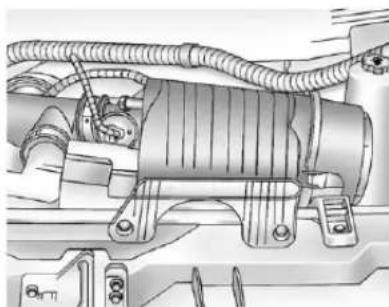
natural_image
Technical illustration of a mechanical assembly with hoses and components (no visible text or symbols)Theengineaircleaner/filteris locatednearthecenterofthe enginecompartment.SeeEngine CompartmentOverviewon page10-6formoreinformation onlocation.
WhentoInspecttheEngineAir Cleaner/Filter
Inspecttheaircleaner/filteratthe scheduledmaintenanceintervals andreplaceitatthefirstoilchange aftereach80000km(50,000mi) interval.SeeMaintenanceSchedule onpage11-3formoreinformation. Ifdrivingindusty/dirtyconditions, inspectthefilterateachengineoil change.
HowtoInspecttheEngineAir Cleaner/Filter
Toinspecttheaircleaner/filter, removethefilterfromthevehicle andlightlyshakethefiltertorelease loosedustanddirt. If thefilter remainscoveredwithdirt, anew filterisrequired. Neveruse compressedairtocleanthefilter.
Toinspectorreplacetheengineair cleaner/filter,dothefollowing:
- Unhooktheretainerclips and removethecover.
- Lift the filter out of the engine air cleaner/filterhousing. Care should be takentodislodge as littledirtas possible.
- Cleantheengineaircleaner/filterhousing.
- Inspectorreplacetheengineair cleaner/filter.Makesurethatthe filterfitsproperlyintothe housing.
- Reinstall the cover and fasten theretaining clips.
WARNING
Operatingtheenginewiththeair cleaner/filteroffcancauseyouor otherstobeburned. Theair cleanernotonlycleanstheair; it helpstostopflamesiftheengine backfires. Usecautionwhen workingontheengineanddonot drivewiththeaircleaner/filteroff.
Notice: If the aircleaner/filter is off, dirtcaneasilyget into the engine, which could damage it. Always havethe aircleaner/filter in place when you are driving.
CoolingSystem
Thecoolingsystemallowsthe enginetomaintainthecorrect workingtemperature.
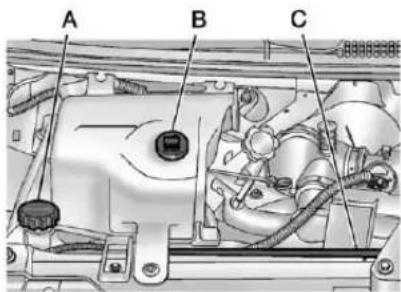
text_image
A B CA. RadiatorPressureCap
B.CoolantRecoveryTank
C.EngineCoolingFan (OutofView)
WARNING
Anelectricenginecoolingfancan startevenwhentheengineisnot running.Toavoidinjury,always keephands,clothing,andtools awayfromanyengine coolingfan.
WARNING
Heaterandradiatorhoses, andotherengineparts, can be veryhot. Donottouchthem. If youdo, you can be burned.
Donotruntheengineifthereisa leak.Ifyouruntheengine,it couldloseallcoolant.Thatcould causeanenginefire,andyou couldbeburned.Getanyleak fixedbeforeyoudrivethevehicle.
Notice: Using coolantother than DEX-COOL® can cause premature engine, heater core, or radiator corrosion. In addition, the engine coolant could require changing sooner, at 50000 km (30,000 mi) or 24 months, whichever occurs first. Any repairs would not be covered by the vehicle warranty. Always use DEX-COOL (silicate-free) coolant in the vehicle.
EngineCoolant
Thecoolingsysteminthevehicle isfilledwithDEX-COOL ^® engine coolant. Thiscoolantisdesigned to remaininthevehiclefor5yearsor 240000km(150,000mi),whichever occursfirst.
The following explainsthecooling systemandhowtocheckandadd coolantwhenitislow.Ifthereisa problemwithengineoverheating, seeEngineOverheatingon page 10-22.
WhattoUse

WARNING
Addingonlyplainwaterorsome otherliquidtothecoolingsystem canbedangerous. Plainwater andotherliquids, canboilbefore thepropercoolantmixturewill. Thecoolantwarningsystemisset forthepropercoolantmixture. Withplainwaterorthewrong mixture, theenginecouldgettoo hotbutyouwouldnotgetthe overheatwarning. Theengine couldcatchfireandyouor otherscouldbeburned. Usea 50/50mixtureofclean,drinkable waterandDEX-COOLcoolant.
Usea50/50mixtureofclean, drinkablewaterandDEX-COOL coolant. If using this mixture, nothingelseneedstobeaded. This mixture:
• Givesfreezingprotectiondown to -37^(-34^) , outside temperature.
• Givesboilingprotectionupto 129°C(265°F), engine temperature.
- Protectsagainstrustand corrosion.
• Willnotdamagealuminumparts.
• Helpskeep the proper engine temperature.
Notice: If an improper coolant mixture is used, the engine could overheat and be badly damaged. Therepair cost would not be covered by the vehicle warranty. To much water in them mixture can freeze and crack the engine, radiator, heater core, and other parts.
Notice: If extrainhibitors and/or additives are used in the vehicle cooling system, the vehicle could be damaged. Use only the proper mixture of the engine coolant listed in this manual for the cooling system. See Recommended Fluids and Lubricantson page 11-12 for more information.
Neverdisposeofenginecoolantby puttingitinthetrash,pourington theground,orintosewers,streams, orbodiesofwater.Havethecoolant changedbyanauthorizedservice center,familiarwithlegal requirementsregardingused coolantdisposal.Thiswillhelp protecttheenvironmentand yourhealth.
CheckingCoolant
The vehicle must be on a level surface when checking the coolant level.
Checktoseeifcoolantisvisiblein thecoolantrecoverytank.Ifthe coolantinsidethecoolantrecovery tankisboiling,donotdoanything elseuntilcoolsdown.Ifcoolantis visiblebutthecoolantlevelisnotat orabovetheCOLDFILLmark,add a50/50mixtureofclean,drinkable waterandDEX-COOLcoolantatthe coolantrecoverytank,butbesure thecoolingsystemmiscoolbefore thisisdone.

Thecoolantrecoverytankcaphas thissymbolonit.
Whentheengineiscold, thecoolant levelshouldbeatorabovethe COLDFILLmark. Ifitisnot, there couldbealeakinthecooling system.
If the coolant is slow, add the coolant ortak the vehicle to a dealer for service.
HowtoAddCoolanttothe RecoveryTankforGasoline Engines
WARNING
Youcanbeburnedifyouspill coolantonhotengineparts. Coolantcontainsethyleneglycol anditwillburniftheengineparts arehotenough.Donotspill coolantonahotengine.
Notice: This vehicle has a specific coolantfill procedure. Failure to follow this procedure
couldcausetheengineto overheatandbeseverely damaged.
Ifcoolantisneeded,addtheproper DEX-COOLcoolantmixtureatthe coolantrecoverytank.
HowtoAddCoolanttothe Radiator
WARNING
Anelectricenginecoolingfan underthehoodcanstartupeven whentheengineisnotrunning andcancauseinjury.Keep hands,clothing,andtoolsaway fromanyunderhoodelectricfan.
WARNING
Steamandscaldingliquidsfroma hotcoolingsystemcanblowout andburnyoubadly. They are underpressure, andify outurn (Continu
WARNING(Continued)
thesurgetankpressure cap—evenalittle—theycan comeoutathighspeed.Never turnthecapwhenthecooling system,includingthesurgetank pressurecap,ishot.Waitforthe coolingsystemandsurgetank pressurecaptocoolifyouever havetoturnthepressurecap.
Ifcoolantisneeded,addtheproper mixturedirectlytotheradiator,but besurethecoolingsystemiscool beforethisisdone.

- Removetheradiatorpressure capwhenthecoolingsystem, includingtheradiatorpressure capandupperradiatorhose,is
nolongerhot.Turnthepressure capslowlycounterclockwise untilfirststops.Donotpress downwhileturningthe pressurecap.
Ifahissisheard, waitforthatto stop. Ahissmeansthereisstill somepressureleft.
- Keep turning the pressure cap, but now pushdown as y out turn it. Removethe pressure cap.
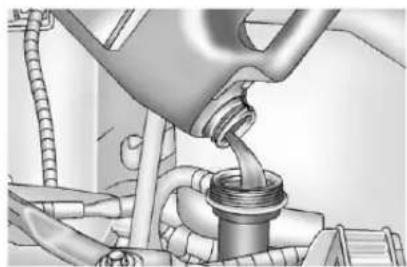
natural_image
Mechanical assembly showing a pouring container into a pipe fitting (no text or symbols visible)- Filltheradiatorwiththeproper DEX-COOLcoolantmixture, up tothebaseofthefillerneck.
SeeRecommendedFluidsand Lubricantsonpage11-12for moreinformationaboutthe propercoolantmixture.
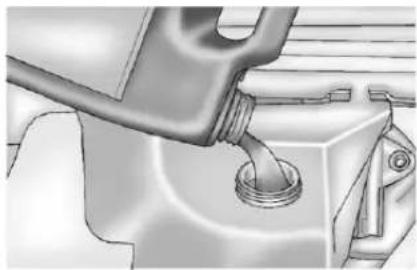
natural_image
Illustration of a fuel nozzle dispensing liquid into a car engine compartment (no text or symbols visible)-
Fill the coolant recovery tank to the COLDFILL mark.
-
Reinstallthecapbackonthe coolantrecoverytank, butleave theradiatorpressurecapoff.
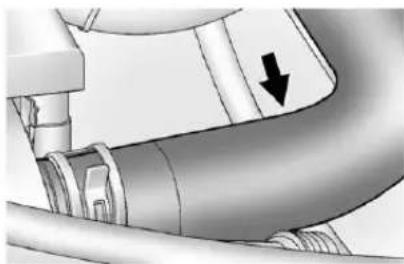
natural_image
Mechanical assembly diagram showing a pipe joint with a black arrow indicating direction (no text or symbols present)-
Starttheengineandletitrun untiltheupperradiatorhosecan befeltgettinghot.Watchoutfor theenginecoolingfan.
-
Bythistime, the coolant level inside theradiator fillerneck may belower. If the level is lower, add more of the proper DEX-COOL coolant mixture through the fillerneck until the level reaches the base of the fillerneck.
-
Replacethepressurecap. At anytimeduringthisprocedureif coolantbeginstoflowoutofthe fillerneck,reinstallthe pressurecap.
Notice: If the pressure cap is not tightly installed, coolant loss and possible engine damage may occur. Besure the cap is properly and tightly secured.
EngineOverheating
Ifthevehiclehasadieselengine, seetheDuramaxdieselsupplement formoreinformation.
The vehicle has an indicator to warn of engine overheating.
Thereisanenginecoolant temperaturegaugeonthevehicle's instrumentpanel.SeeEngine CoolantTemperatureGaugeon page5-16formoreinformation.
If the decision is madenotto lift the hood when this warning appears, but instead gets service help right away. See Roadside Assistance Program (U.S. and Canada) on page 13-8 or Roadside Assistance Program (Mexico) on page 13-10.
If the decisionismadetoliftthe hood, makesurethevehicleis parkedonalevelsurface.
Thenchecktoseeiftheengine coolingfansarerunning.Ifthe engineisoverheating,bothfans shouldberunning.Iftheyarenot, donotcontinuetoruntheengine andhavethevehicleserviced.
Seeiftheenginecoolingfanspeed increaseswhenidlespeedis doubledbypushingtheaccelerator pedaldown.Ifitdoesnot,the vehicleneedsservice.Turnoff theengine.
Notice: Enginedamage from running the engine without coolant is not covered by the warranty.
Notice: If the engine catches fire because of being driven with no coolant, the vehicle can be badly damaged. The costly repairs would not be covered by the vehicle warranty.
IfSteamisComingfromthe EngineCompartment

WARNING
Steamfromanoverheatedengine canburnyoubadly,evenify you justopenthehood.Stayaway fromtheengineifyouseeorhear steamcomingfromit.Justturnit offandgeteveryoneawayfrom thevehicleuntilcoolsdown. Waituntilthereisnosignof steamorcoolantbeforeyou openthehood.
(Continued)
WARNING(Continued)
If you keep driving when the engine is overheated, the liquids initcancatchfire. You or others could be badly burned. Stop the engine if to overheats, and get out of the vehicle until the engine is cool.
IfNoSteamisComingfrom theEngineCompartment
Ifanengineoverheatwarningis displayedbutnosteamcanbeseen orheard,theproblemmaynotbe tooserious.Sometimesheengine cangetalittletoohotwhenthe vehicle:
• Climbsalonghillonahotday.
- Stopsafterhigh-speeddriving.
• Idlesforlongperiodsintraffic.
- Towsatrailer.See "Drivingon Grades" under Trailer Towingon page9-50.
If the overheat warning is displayed with nosignofsteam:
- Turntheairoff.
- Turntheheaterontothehighest temperature and tothehighest fanspeed. Openthewindowsas necessary.
- In heavy traffic, let the engine idle in N(Neutral) while stopped. If it is a fast to do so, pulloff theroad, shift to P(Park) or N(Neutral) and let the engine idle.
If the temperature overheat gauge is nolonger in the overheat zone or an overheat warning nolonger displays, the vehicle can be driven. Continuetodrivethe vehicles slowly for about 10 minutes. Keep as safe vehicled distance from the vehicle in front. If the warning does not come back on, continued driven normally.
If the warning continues, pullover, stop, and park the vehicle right away.
Ifthereisstillnosignofsteam, pushdowntheacceleratoruntilthe enginespeedisabouttwiceasfast asnormalidlespeedforatleast threeminuteswhileyouareparked. Ifthewarningisstillon,turnoffthe engineuntilcoolsdown.
If the decision is madenottolift the hood, getservice help right away.
EngineFan
The vehicle has a clutched engine cooling fan. Whenthe clutch is engaged, the fanspins fast to provide more air to cool the engine. In most everyday driving conditions, the fan is spinnings slower and the clutch is not fully engaged. This improves fuele economy and reduces fannoise. Under heavy vehicle loading, trailertowing, and/or high outside temperatures, the fanspeed increases asthe clutch more fully engages, so an increase infan noisem maybe heard. This is normal and should not be mistaken as the
transmissionslippingormaking extrashifts.Itismerelythecooling systemfunctioningproperly.Thefan willslowdownwhenadditional coolingisnotrequiredandthe clutchpartiallydisengages.
Thisfannoisemaybeheardwhen startingtheengine.Itwillgoaway asthefanclutchpartially disengages.
PowerSteeringFluid
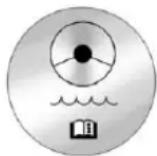
The power steering fluid reservoir is located in the engine compartment on the Riverside of the vehicle. See Engine Compartment Overview on page 10-6 for reservoir location.
WhentoCheckPowerSteering Fluid
Itisnotnecessarytoregularly checkpowersteeringfluidunless thereisaleaksuspectedinthe systemoranunusualnoiseis heard.Afluidlossinthissystem couldindicateaproblem.Havethe systeminspectedandrepaired.
HowtoCheckPowerSteering Fluid
Notice:Extremely small amounts of contamination can cause steering system damage and cause it tonotwork properly. Donotallow contaminant to contact the fluid side of the reservoir cap/dipstick or from entering the reservoir.
Tocheckthepowersteeringfluid, dothefollowing:
-
Turnthekeyoffandletthe enginecompartmentcooldown.
-
Wipethecapandthetopofthe reservoirclean.
-
Unscrewthecapandwipethe dipstickwithacleanrag.
- Replacethecapandcompletely tightenit.
- Thenremovethecapagain and lookatthefluidlevelonthe dipstick.
The level should beat the cold Fill mark. If necessary, add only enough fluid to bring the level up to themark.
Topreventcontaminationofbrake fluid,nevercheckorfillthepower steeringreservoirwiththebrake mastercylindercoveroff.
WhattoUse
Todeterminewhatkindoffluidto use,seeRecommendedFluidsand Lubricantsonpage11-12.Always usetheproperfluid.Failureretouse theproperfluidcancauseleaksand damagehosesandseals.
WasherFluid
WhattoUse
Whenthevehicleneedswindshield washerfluid,besuretoreadthe manufacturer'sinstructionsbefore use.Ifoperatingthevehicleinan areawherethetemperaturemayfall belowfreezing,useafluidthathas sufficientprotectionagainst freezing.
AddingWasherFluid

Openthecapwiththewasher symbolonit.Addwasherfluiduntil thetankisfull.SeeEngine CompartmentOverviewon page 10-6forreservoirlocation.
Notice
- When using concentrated washer fluid, follow the manufacturer's instructions for adding water.
- Donotmixwaterwith ready-to-usewasherfluid. Watercancausethesolution tofreezeanddamagethe washerfluidtankandother partsofthewashersystem. Also,waterdoesnotcleanas wellaswasherfluid.
- Fillthewasherfluidtankonly three-quartersfullwhenitis verycold. This allows for fluidexpansioniffreezing occurs, which could damage the tankifitis completely full.
- Donotuseenginecoolant (antifreeze)inthewindshield washer.Itcandamagethe windshieldwashersystem andpaint.
Brakes
This vehicle has disc brakes. Discbrakepadshave built-in wear indicator that make a high-pitched warnings sound when the brake pads are worn and new pads are needed. Thesound can come and goor be heard all the time the vehicle is moving, except when applying the brake pedal firmly.

WARNING
Thebrakewearwarningsound meansthatsoonthebrakeswill notworkwell.Thatcouldleadto acrash.Whenthebrakewear warningsoundisheard,havethe vehicleserviced.
Notice:Continuingtodrivewith worn-outbrakepadscouldresult incostlybrakerepair.
Somedrivingconditionsorclimates cancauseabrakesquealwhenthe brakesarefirstappliedorlightly applied. Thisdoesnotmean somethingiswrongwiththebrakes.
Properlytorquedwheelnutsare necessarytohelpppreventbrake pulsation.Whentiresarerotated, inspectbrakepadsforwear and evenlytightenwheelnutsinthe propersequencetotorque specificationsinCapacitiesand Specificationsonpage12-2.
Brakeliningsshouldalwaysbe replacedascompleteaxlesets.
BrakePedalTravel
Seeyourdealerifthebrakepedal doesnotreturntonormalheight, orifthereisarapidincreasein pedaltravel. Thiscouldbeasign thatbrakeservicemightbe required.
BrakeAdjustment
Everytimethebrakesareapplied, withorwithoutthevehiclemoving, thebrakesadjustforwear.
ReplacingBrakeSystemParts
Thebrakingsystemonavehicleis complex. Itsmanypartshavetobe oftopqualityandworkwelltogether ifthevehicleistohavereallygood braking. Thevehiclewasdesigned andtestedwithtop-qualitybrake parts. Whenpartsofthebraking systemarereplaced, besuretoget new, approvedreplacementparts. Ifthisisnotdone, thebrakesmight notworkproperly. Forexample, installingdiscbrakepadsthatare wrongforthevehicle, canchange thebalancebetweenthefrontand rearbrakes—fortheworse. The brakingperformanceexpectedcan changeinmanyotherwaysifthe wrongreplacementbrakeparts areinstalled.
BrakeFluid
Thebrakemastercylinderreservoir isfilledwithDOT3brakefluid.See EngineCompartmentOverviewon page 10-6forthelocationofthe reservoir.
Thereareonlytworeasonswhythe brakefluidlevelinthereservoir mightgodown:
- Thebrakefluidlevelgoesdown becauseofnormalbrakelining wear.Whennewliningsare installed,thefluidlevelgoes backup.
- Afluidleakinthebrake hydraulicsystemcanalsocause alowfluidlevel.Havethebrake hydraulicsystemfixed,sincea leakmeansthatsoonerolater thebrakeswillnotworkwell.
Donottopoffthebrakefluid. Addingfluiddoesnotcorrectaleak. Iffluidisaddedwhentheliningsare worn,therewillbetoomuchfluid whennewbrakeliningsare installed.Addorremovebrakefluid, asnecessary,onlywhenworkis doneonthebrakehydraulicsystem.
WARNING
Iftoomuchbrakefluidisadded, itcanspillontheengineand/or fueloperatedheaterparts, ifequipped. Ifthevehiclehasa dieselengineandafueloperated heater, see "FuelOperated Heater(FOH)" inthediesel enginesupplement. Thefluidwill burniftheengineishotenough. Youorotherscouldbeburned, andthevehiclecouldbe damaged. Addbrakefluidonly whenworkisdoneonthebrake hydraulicsystem. See "Checking BrakeFluid" inthissection.
RefertotheMaintenanceSchedule todeterminewhentocheckthe brakefluid.SeeMaintenance Scheduleonpage11-3.
CheckingBrakeFluid
Checkbrakefluidbylookingatthe brakefluidreservoir.SeeEngine CompartmentOverviewon page 10-6.
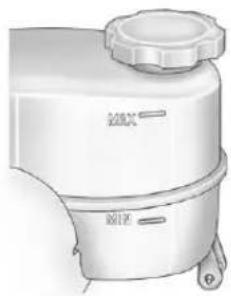
natural_image
Illustration of a white robotic mixer with a handle and control knob (no text or symbols)Thefluidlevelshouldbeabove MIN.Ifitisnot,havethebrake hydraulicsystemcheckedtoseeif thereisaleak.
Afterworkisdoneonthebrake hydraulicsystem,makesurethe levelisabovetheMINbutnotover theMAXmark.
WhattoAdd
UseonlynewDOT3brakefluid fromasealedcontainer.See RecommendedFluidsand Lubricantsonpage11-12.
Alwayscleanthebrakefluid reservoircapandtheareaaround thecapbeforeremovingit. This helpskeepdirtfromenteringthe reservoir.

WARNING
Withthewrongkindoffluidinthe brakehydraulicsystem,the brakesmightnotworkwell.This couldcauseacrash.Alwaysuse theproperbrakefluid.
Notice
- Usingthewrongfluid canbadlydamagebrake hydraulicsystemparts. For example, justafewdropsof mineral-basedoil,suchas engineoil,inthebrake hydraulicsystemcan damagebrakehydraulic systempartssobadlythat theywillhavetobereplaced. Donotletsomeoneputin thewrongkindoffluid.
- Ifbrakefluidisspilledonthe vehicle'spaintedsurfaces, thepaintfinishcanbe damaged.Becarefulnotto spillbrakefluidonthe vehicle.Ifyoudo,washit offimmediately.
Battery
Refertothereplacementnumber shownontheoriginalbatterylabel whenanewbatteryisneeded.See EngineCompartmentOverview page 10-6forbatterylocation.

WARNING
Batteryposts, terminals, and related accessories contain lead and lead compounds, chemicals known to the State of California to cause cancer and reproductive harm. Washhands after handling.
VehicleStorage

WARNING
Batterieshaveacidthatcanburn youandgasthatcanexplode. Youcanbebadlyhurtifyouare notcareful.See Jump Startingon page 10-86fortipsonworking aroundabatterywithout gettinghurt.
InfrequentUsage:Removethe black,negative(-)cablefromthe batterytokeepthebatteryfrom runningdown.
ExtendedStorage:Removethe black,negative(−)cablefromthe batteryoruseabatterytrickle charger.
All-WheelDrive
TransferCase
WhentoCheckLubricant
RefertotheMaintenanceSchedule todeterminehowoftentocheckthe lubricant.SeeMaintenance Scheduleonpage11-3.
HowtoCheckLubricant
Togetanaccuratereading, the vehicleshouldbeonalevel surface.
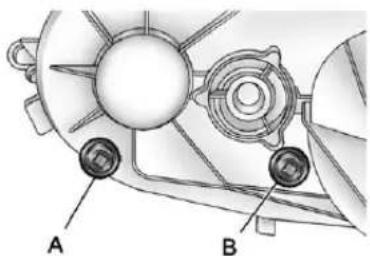
natural_image
Technical diagram of a mechanical component with labeled parts A and B (no text or symbols beyond labels)A.DrainPlug
B.FillPlug
Ifthelevelisbelowthebottomof thefillplughole,locatedonthe transfercase,somelubricantwill needtobeadded.Addenough lubricanttoraisetheleveltothe bottomofthefillplughole.Usecare nottoovertightentheplug.
WhattoUse
RefertoRecommendedFluidsand Lubricantsonpage11-12to determinewhatkindoflubricant touse.
FrontAxle
WhentoCheckandChange Lubricant
RefertotheMaintenanceSchedule todeterminehowoftentocheckthe lubricantandwhentochangeit. SeeMaintenanceScheduleon page11-3.
HowtoCheckLubricant
Togetanaccuratereading, the vehicleshouldbeonalevel surface.
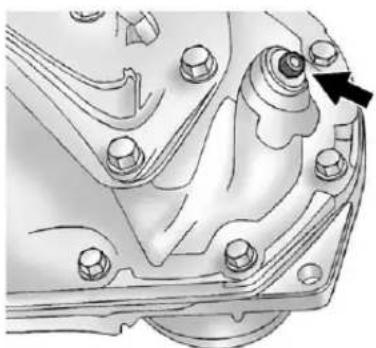
natural_image
Mechanical component diagram showing bolted assembly with a black arrow pointing to a specific part (no text or symbols present)If the level is below the bottom of the fill plug hole, some lubricant may need to be added.
Whenthedifferentialiscold, add enoughlubricanttoraisethelevel to 10mm(3/8in) below the fill plughole.
Whenthedifferentialisatoperating temperature(warm),addenough lubricanttoraisetheleveltothe bottomofthefillplughole.
WhattoUse
RefertoRecommendedFluidsand Lubricantsonpage11-12to determinewhatkindoflubricant touse.
RearAxle
WhentoCheckLubricant
RefertotheMaintenanceSchedule onpage11-3todeterminehow oftentocheckthelubricant.
HowtoCheckLubricant
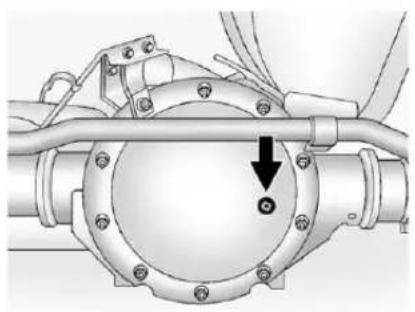
natural_image
Mechanical assembly diagram showing a valve or coupling with a central hub and bolted joints (no text or symbols visible)Togetanaccuratereading, the vehicleshouldbeonalevel surface.
If you have the 1500 Series, the proper level is from 15mm (5/8in) to 40mm (15/8in) below the bottom of the fill plughole. The proper level for the 2500 and 3500 Series is from 0 to 6mm (1/4in) below the bottom of the fill plughole. Additionally enough fluid to reach the proper level.
WhattoUse
RefertoRecommendedFluidsand Lubricantsonpage11-12to determinewhatkindoflubricant touse.
NoiseControlSystem
The following information relates to compliance with federal noise emission standards for vehicles with a Gross Vehicle Weight Rating (GVWR) of more than 4536 kg (10,000 lbs). The Maintenance Schedule provides information on maintaining the noise control system to minimize degradation of the noise emission control system during the life of the vehicle. Thenoise control system warranty is given in the vehicle warranty booklet.
Thesestandardsapplyonlyto vehiclessoldintheUnitedStates.
Federallawprohibits the following actsorthecaisingthereof:
-
Theremovalorrendering inoperativebyanyperson, otherthanforpurposesof maintenance,repairor replacement,ofanydeviceor elementofdesignincorporated intoanynewvehicleforthe purposeofnoisecontrol,priorto itssaleordeliverytotheultimate purchaserorwhileitisinuse;or
-
The use of the vehicle aftersuch deviceorelement of design has been removed or rendered in operative by any person.
Amongthoseactspresumedto constitutetamperingaretheacts listedbelow.
Insulation:
- Removalofthenoiseshieldsor anyunderhoodinsulation.
Engine:
- Removalorrenderingengine speedgovernor,ifthevehicle hasone,inoperativesoasto allowenginespeedtoexceed manufacturerspecifications.
FanandDrive:
- Removaloffanclutch, if the vehiclehasone, orrendering clutchinoperative.
- Removalofthefanshroud,if thevehiclehasone.
AirlIntake:
- Removaloftheaircleaner silencer.
• Modificationoftheaircleaner.
Exhaust:
- Removalofthemufflerand/or resonator.
- Removaloftheexhaustpipes andexhaustpipeclamps.
FuelOperatedHeater(FOH)—DieselEngine:
- Removalofthemuffler.
StarterSwitchCheck

WARNING
Whenyouaredoingthis inspection,thevehiclecould movesuddenly.Ifthevehicle moves,youorotherscouldbe injured.
- Before starting this check, be sure there is enoughroom around the vehicle.
- Firmlyapplyboththeparking brakeandtheregularbrake. SeeParkingBrakeon page9-34.
Donotusetheaccelerator pedal, and bereadytoturnoff theengineimmediatelyifit starts. - Trytostarttheengineineach gear. The vehicles should start only in P(Park) or N(Neutral).
If the vehicle starts in any other position, contact your dealer for service.
AutomaticTransmission ShiftLockControl FunctionCheck

WARNING
When you are doing this inspection, the vehicle could moves suddenly. If the vehicle moves, you or others could be injured.
- Before starting this check, be sure there is a tenough room around the vehicle. It should be parked on levels surface.
-
Firmly apply the parking brake. See Parking Brake on page 9-34.
Bereadytoapplytheregular brakeimmediatelyifthevehicle beginstomove. -
With the engine off, turn the ignition on, but donot start the engine. Without applying the regular brake, try to mov the shift lever out of Park (Park) with normaleffort. If the shift lever moves out of Park (Park), contact your dealer for service.
IgnitionTransmission LockCheck
Whileparked, and with the parking brakeset, try to turn the ignition to LOCK/OFFineachshift lever position.
- Theignitionshouldturnto LOCK/OFFonlywhentheshift leverisinP(Park).
• Theignitionkeyshouldcome outonlyinLOCK/OFF.
Contactyourdealerifserviceis required.
ParkBrakeandP(Park) MechanismCheck

WARNING
Whenyouaredoingthischeck, thevehiclecouldbegintomove. Youorotherscouldbeinjured andpropertycouldbedamaged. Makesurethereisroominfront ofthevehicleincaseitbeginsto roll. Bereadytoapplytheregular brakeatonceshouldthevehicle begintomove.
Parkonafairlysteephill, with the vehiclefacingdownhill. Keeping yourfootontheregularbrake, set theparkingbrake.
- Tochecktheparkingbrake's holdingability:Withtheengine runningandthetransmissionin N(Neutral),slowlyremovefoot pressurefromtheregularbrake pedal.Dothisuntilthevehicle is heldbytheparkingbrakeonly.
- TochecktheP(Park) mechanism'sholdingability: Withtheengine running, shiftto P(Park). Then releasethe parkingbrake followed by the regularbrake.
Contactyourdealerifserviceis required.
WiperBladeReplacement
Windshieldwiperbladesshouldbe inspectedforwearandcracking. SeeMaintenanceScheduleon page11-3formoreinformation.
Replacementbladescomein differenttypesandareremoved indifferentways.Forproperty andlength,seeMaintenance ReplacementPartsonpage11-14.
Notice: Allowingthewiperblade armtotouchthewindshieldwhen nowiperbladeisinstalledcould damagethewindshield.Any damagethatoccurswouldnotbe coveredbyyourwarranty.Donot allowthewiperbladearmto touchthewindshield.
- Liftthewiperarmaway from the windshield.

text_image
Technical diagram of a mechanical tool with labeled parts A, B, and C, showing directional arrows indicating movement or assembly.A.WiperArm
B.ReleaseLever
C.BladeAssembly
-
Pushthereleaselever(B) to disengage the hook and push the wiperarm(A) out of the blade assembly(C).
-
Pushthenewbladeassembly securelyonthewiperarmuntil thereleaseleverclicksinto place.
BulbReplacement
Forthepropertyofreplacement bulbs,seeReplacementBulbson page 10-40.
Foranybulb-changingprocedure notlistedinthissection,contact yourdealer.
HalogenBulbs
WARNING
Halogenbulbshavepressurized gasinsideandcanburstifyou droporscratchthebulb. Youor otherscouldbeinjured. Besure toreadandfollowtheinstructions onthebulbpackage.
Headlamps
CompositeHeadlamp
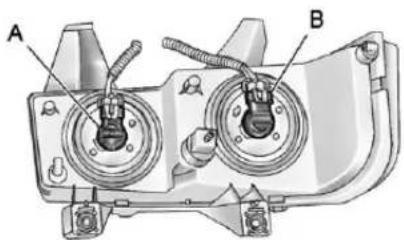
natural_image
Mechanical assembly diagram showing two components labeled A and B, with no visible text or symbols beyond labels.A. High-BeamHeadlamp
B.Low-BeamHeadlamp
Toremovetheheadlampassembly fromthevehicleandaccessthe bulbs:
- Openthehood. See Hoodon page 10-4 form more information.
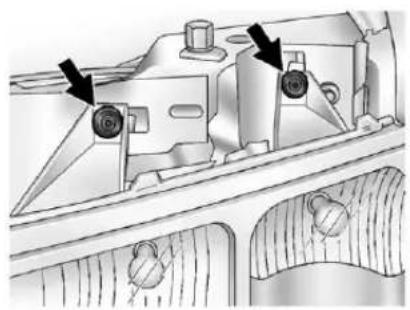
natural_image
Technical illustration of a mechanical assembly with two circular components and internal channels (no text or symbols)- Removethetwoboltsfromthe headlampassembly.
- Lifttheheadlampassembly to releasethelowertabsfromthe radiatorsupport.
- Turntheheadlampforwardand upwardtoremoveitfromthe grille.
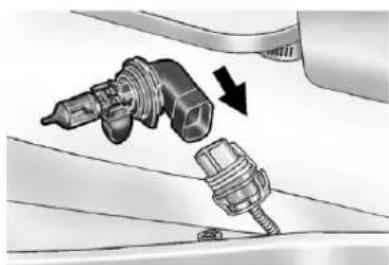
natural_image
Diagram showing a mechanical assembly with a tool inserted into a component, no text or symbols present- Disconnect the electrical connector.
- Turnthebulbcounterclockwise onequarterturntoremoveit fromtheheadlampassembly.
- Installthenewbulbintothe headlampassemblyandconnect theelectricalconnector.
- Reversethestepstoreinstall theheadlampassembly.
Topreventheadlampvibration andshortenedbulblife,besure toinserttheheadlampassembly tabsintheslotsatthelower portionofthehousing.
Sealed-BeamHeadlamp
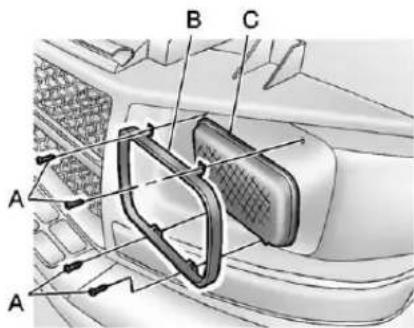
text_image
A B C AA. Headlampretainerscrews
B.Headlampretainer
C.Sealed-beamheadlampbulb
- Removethefourscrews(A) fromtheheadlampretainer(B).
Pulltheretainer(B)outandset itaside.
- Pullthebulb(C)forwardtogain accesstotheelectrical connector.
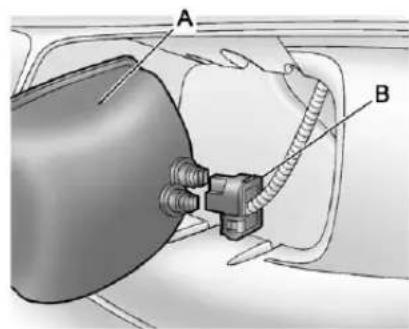
text_image
A B- Disconnect the electrical connector(B) and remove the headlamp bulb(A).
- ReverseSteps1 through 3 to reinstall the headlamp.
FrontTurnSignal, Sidemarker,and ParkingLamps
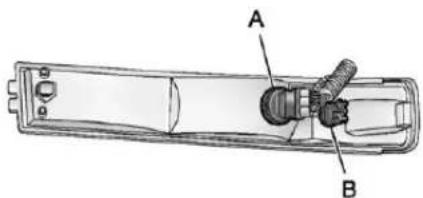
text_image
A BA. FrontParkingandTurn SignalLamp
B.FrontSidemarkerLamp
Toreplacethefrontturnsignal, sidemarker, and/orparkinglamp bulb(s):
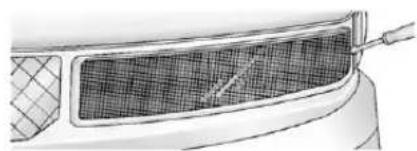
natural_image
Close-up illustration of a car's front grille and side arm (no text or symbols)-
Useasmalltooltounlatchthe outboardcliponthelampby pushinginboardandpryingthe lampassemblyforward.
-
Removethelampfromthegrille.
-
Turnthebulbsocket counterclockwiseonequarter turnandremoveitfromthe lampassembly.
-
Removethebulbfromthe socketbypullingitstraightout.
-
Replacethebulb.
-
Turnthebulbsocketclockwise toreinstallitinthelamp assembly.
-
Reinstall the lamp assembly into the grille until the outboard clip snaps in to place.
Taillamps
Toreplaceataillamp/turnsignal lamporback-uplampbulb:
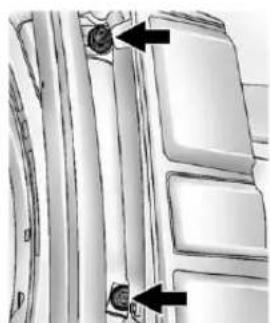
natural_image
Close-up of a mechanical component with two black arrows pointing to features (no visible text or symbols)- Removethetwoinboardnuts fromtheinsideofthetaillamp assembly.
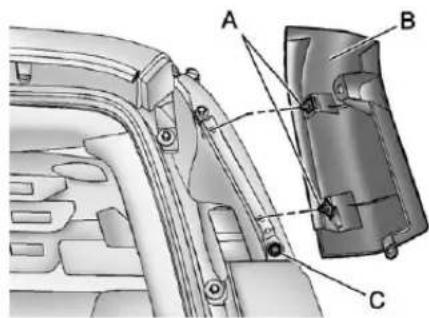
text_image
Technical diagram of a mechanical assembly with labeled parts A, B, and C-
Thethirdnut(C) is under the applique piece(B) above the lamp. Removethetwoinboard appliquenuts. Pull the applique(B) straight rearward slightly to clear the studs. Then rotatethe applique(B) just far enoughtogainaccesstothe outer pushpins(A).
-
Carefully disconnect the push pins (A) from the applique bracket
-
Removethethirdnut(C) from the upper outboard side of the lamp.
-
Removethetaillampassembly fromthevehicle.
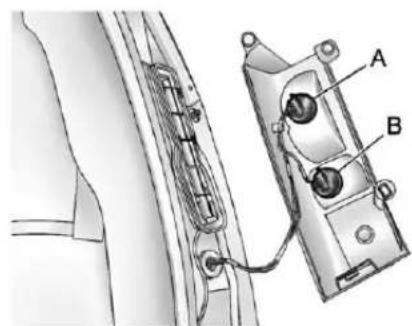
text_image
Technical diagram showing mechanical components with labeled parts A and B, likely illustrating a linkage or mounting mechanism.-
Removethetaillamp/turnsignal lamp(A)orback-uplamp(B) bulbsocketbyturningit counterclockwiseonequarter turnandpullingitoutofthelamp assembly.
-
Removethebulbbypullingit straightout.
-
Pushthenewbulbintothe socket.
- Reinstall the bulb socket by turning it clockwise into the lamp assembly.
- ReverseSteps1 through 5 to reinstall the taillampassembly and applique.
CenterHigh-Mounted Stoplamp(CHMSL)
The Center High-Mounted Stoplamp (CHMSL) is located abovetherear doors at the center of the vehicle.
Toreplaceabulb:
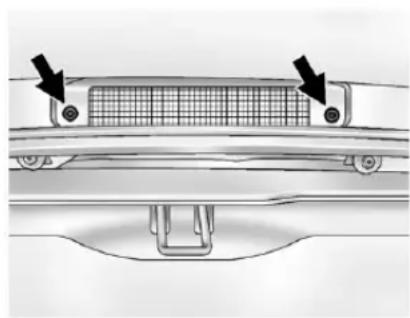
natural_image
Diagram of a vehicle front panel with arrows pointing to the grille and side-mounted sensors (no text or symbols)- Removethetwoscrewsfromthe CHMSLassembly.
-
RemovetheCHMSLassembly.
-
Turnthebulbsocket counterclockwiseonequarter turntoremoveitfromthelamp assembly.
- Pulltheoldbulbstraightout of the socket and push thenew bulb into the socket.
- Turnthebulbsocketclockwise onequarterturntoinstallitinthe lampassembly.
- Reinstall the CHMSL assembly and twoscrews.
DonotblockordamagetheCHMSL whenitemsareloadedontheroof ofthevehicle.
LicensePlateLamp
Toreplaceoneofthesebulbs:
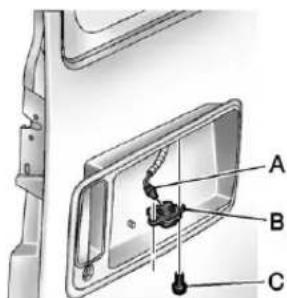
text_image
Technical diagram of a mechanical component with labeled parts A, B, and CA.BulbSocket
B. LicensePlateBulbAssembly
C.Screws
-
Removethescrews(C) that securethelicenseplatebulb assembly(B).
-
Turnthebulbsocket(A) counterclockwiseandpullthe bulbstraightoutofthesocket.
-
Installthenewbulb.
-
Reversesteps1 and 2 to reinstall the license plate bulb assembly.
ReplacementBulbs
| ExteriorLamp | Bulb Number |
| Back-up, RearParking, Stoplamp,and TurnSignalLamp | 3157KX |
| Center High-MountedStop Lamp(CHMSL) | 912LL |
| FrontParkingand TurnSignalLamp | 3157KX |
| Front SidemarkerLamp | 194LL |
| License PlateLamp | 194LL |
| ExteriorLamp | Bulb Number |
| Headlamps | |
| Composite High-Beam Headlamp | 9005LL |
| Composite Low-Beam Headlamp | 9006LL |
| SealedBeam Headlamp | H6054 |
Forreplacementbulbsnotlisted here,contactyourdealer.
ElectricalSystem
ElectricalSystem Overload
The vehicle has fuses and circuit breaker stop protect against electrical system overload.
Whenthecurrentelectricalloadis tooheavy, the circuitbreakeropens and closes, protecting the circuit until the current load return to normal or the problem is fixed.
This greatly reduces the chance of circuit overload and fire caused by electrical problems.
Fusesandcircuitbreakersprotect powerdevicesinthevehicle.
Replaceabadfusewithanewone oftheidenticalsizeandrating.
If thereisaproblemontheroad and afuseneedstobereplaced, the sameamperagefusecan be borrowed. Choosesomefeature of the vehicle that is not needed to use and replace it as soon as possible.
HeadlampWiring
Anelectricaloverloadmaycause thelampstogoonandoff, orin somecasestoremainoff. Havethe headlampwiringcheckedrightaway ifthelampsgoonandoffor remainoff.
WindshieldWipers
Ifthewipermotoroverheatsdueto heavysnoworice, the windshield wiperswillstopuntilthemotorcools and will then restart.
Although the circuit is protected from electrical overload, overload duetoheavysnoworicemay causewiperlinkaged damage.
Alwayscleariceandheavysnow fromthewindshieldbeforeusing thewindshieldwipers.
If the overload is caused by an electrical problem and not snow or ice, besure to get it fixed.
FusesandCircuit Breakers
Thewiringcircuitsinthevehicleare protectedfromshortcircuitsbya combinationoffusesandcircuit breakers. Thisgreatlyreducesthe chanceoffirescausedbyelectrical problems.
Lookatthesilver-coloredband insidethefuse. If the band is broken ormelted, replacethefuse. Besure youreplaceabad fuse with anew one of the identical size and rating.
EngineCompartment FuseBlock
The fuse block is located in the engine compartment on the driver side of the vehicle.
Notice: Spilling liquidon any electrical component on the vehicle may damage it. Always keep the cover on any electrical component.
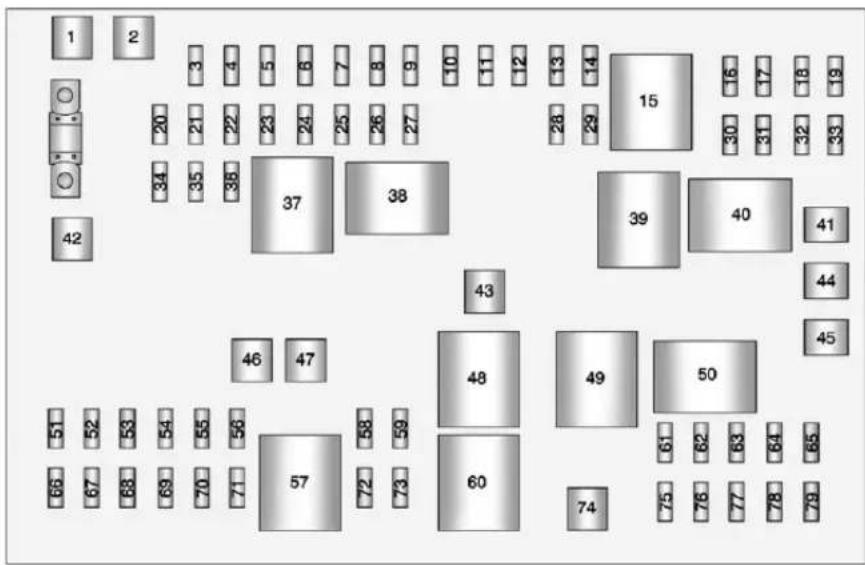
text_image
1 2 3 4 5 6 7 8 9 10 11 12 13 14 15 20 21 22 23 24 25 26 27 28 29 30 31 32 33 34 35 36 37 38 39 40 41 42 43 44 45 46 47 48 49 50 51 52 53 54 55 56 57 58 59 60 61 62 63 64 65 66 67 68 69 70 71 72 73 74The vehicle may not be equipped with allothefuses, relays, and feature shown.
| MiniFuseUsage | |
| 3 | RightStop/Turn Trailer |
| 4Spare | |
| 5Spare | |
| 6 | FuelSystem ControlModule Ignition |
| 7 | BodyControl Module5 |
| 8 | BodyControl Module7 |
| 9 | BodyControl Module4 |
| 10 | InstrumentPanel Cluster |
| MiniFuseUsage | |
| 11Trailer | Wiring |
| 12Spare | |
| 13Spare | |
| 14WindshieldWasher | |
| 16Horn | |
| 17Transmission | |
| 18 | AirConditioning Compressor |
| 19 | EngineControl ModuleBattery |
| 20Spare | |
| 21 | LeftStop/Turn Trailer |
| MiniFuseUsage | |
| 22Spare | |
| 23Spare | |
| 24FuelPump | |
| 25 | AuxiliaryPowerOutlet |
| 26 | BodyControlModule3 |
| 27 | SpecialEquipmentOption |
| 28Airbag | |
| 29 | SteeringWheelSensor |
| 30 | EngineControlModuleIgnition/GlowPlugModule |
10-44VehicleCare
| MiniFuseUsage | |
| 31 | Transmission ControlModule Ignition |
| 32 | Transmission ControlModule Battery |
| 33Spare | |
| 34Spare | |
| 35 | FuelOperated HeaterModule |
| 36 | FuelSystem ControlModule Battery |
| 51 | LeftHigh-Beam Headlamp |
| 52 | RightHigh-Beam Headlamp |
| MiniFuseUsage | |
| 53 | LeftLow-Beam Headlamp |
| 54 | RightLow-Beam Headlamp |
| 55Wiper | |
| 56 | CanisterVent Solenoid |
| 58 | BodyControl Module2 |
| 59 | BodyControl Module1 |
| 61Spare | |
| 62 | OxygenSensor2 (Post),EVFan (Diesel) |
| 63Spare | |
| MiniFuseUsage | |
| 64 | MassAirFlow/CanisterVent |
| 65 | OddIgnition/Injectors |
| 66 | DaytimeRunningLamps2(LOVL-V22)(IfEquipped) |
| 67 | DaytimeRunningLamps1(UPLVL+V22)(IfEquipped) |
| 68 | AuxiliaryStopLamps |
| 69Trailer | StopLamps |
| 70Spare | |
| 71 | FuelHeater/Flex FuelSensor |
| 72 | BodyControl Module6 |
| 73 | Lighter/DataLink Connection |
| 75V6Fuel | Injectors |
| 76Spare | |
| 77 | OxygenSensor 2(Pre) |
| 78 | EngineControl ModulePowertrain |
| 79 | EvenIgnition/Injectors |
| J-CaseFuseUsage | |
| 1ABSMotor | |
| 2ABSModule | |
| 41Spare | |
| 42TrailerWiring | |
| 43FanHigh | |
| 44StarteSolenoid | |
| 45 | EngineControlModule/Powertrain |
| 46Spare | |
| 47FanLo | |
| 74FrontBlower | |
| RelayUsage | |
| 15Run/Crank | |
| 37Spare | |
| 38FuelPump | |
| 39Crank | |
| 40 | AirConditioning Compressor |
| 48FanHigh | |
| 49Powertrain | |
| 50Spare | |
| 57FanLow | |
| 60FanControl | |
FloorConsoleFuseBlock
Thefloorconsolefuseblockis locatedunderthedriverseat.
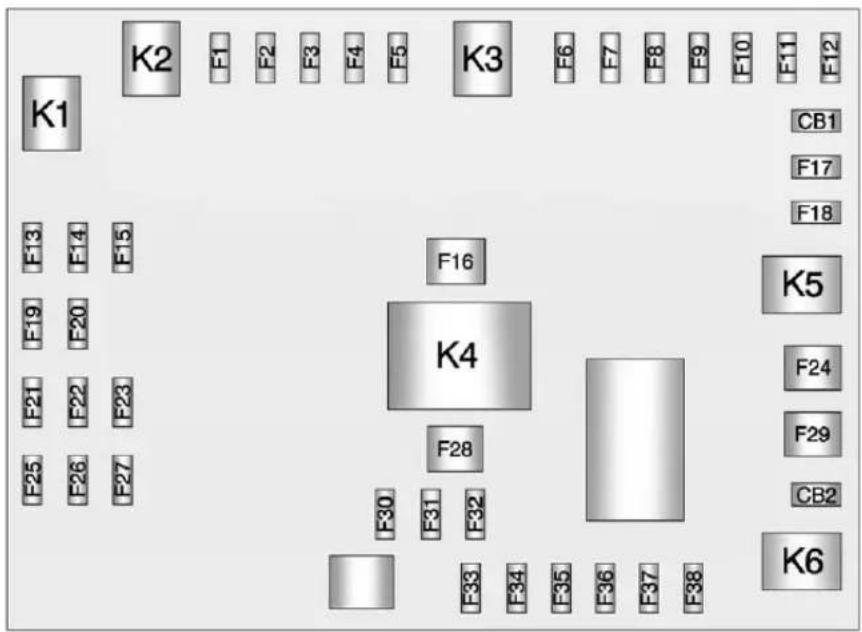
text_image
K1 K2 F1 F2 F3 F4 F5 K3 F6 F7 F8 F9 F10 F11 F12 CB1 F17 F18 F13 F14 F15 F16 F19 F20 F21 F22 F23 F25 F26 F27 K4 F28 F30 F31 F32 F33 F34 F35 F36 F37 F38 K5 F24 F29 CB2 K6The vehicle may not be equipped with allothefuses, relays, and feature shown.
| Mini-FuseUsage | |
| F1Empty | |
| F2 | SteeringWheel Sensor |
| F3 | AuxiliaryParking Lamps(Cut-Away) |
| F4FrontParkLamps | |
| F5TrailerParkLamps | |
| F6 | UpfitterPark Lamps |
| F7 | RightRear ParkLamp |
| F8 | LeftRear ParkLamp |
| F9 | OutsideRearview MirrorSwitch |
| Mini-FuseUsage | |
| F10 | Airbag/Automatic OccupantSensing |
| F11 | OnStar®(IfEquipped) |
| F12Empty | |
| F13 | Heating,Ventilation andAir Conditioning2 |
| F14 | Heating,Ventilation andAir Conditioning1 |
| F15Empty | |
| F17 | OutsideRearview MirrorHeater |
| F18 | RearWindow Defogger |
| Mini-FuseUsage | |
| F19Compass | |
| F20 | Radio/Chime/XM ^TM SatelliteRadio(IfEquipped) |
| F21 | RemoteFunctionActuator/TirePressureMonitor |
| F22 | IgnitionSwitch/DiscreteLogicIgnitionSensor(PK3) |
| F23 | InstrumentPanelCluster |
| F25 | Heating,VentilationandAirConditioningControl |
| F26 | Auxiliary/Trailer Backup |
| F27TaillampsBackup | |
| F30 | UpfitterCourtesy Lamps |
| F31FrontDoorLock | |
| F32RearDoorLock | |
| F33CargoDoorUnlock | |
| F34 | PassengerDoor Unlock |
| F35 | RearPassenger DoorUnlock |
| F36DriverDoorUnlock | |
| F37Empty | |
| F38Empty | |
| J-CaseFuseUsage | |
| F16UpfitterAuxiliary1 | |
| F24Empty | |
| F28 | UpfitterAuxiliary2ReadingLamps |
| F29RearBlower | |
| RelaysUsage | |
| K1 | Run(HighCurrent Micro) |
| K2 | Empty(High CurrentMicro) |
| K3 | ParkLamps(High CurrentMicro) |
| K4 | UpfitterAuxiliary2 (HighCurrentMini) |
| RelaysUsage | |
| K5 | RearDefogger(HighCurrentMicro) |
| K6 | RetainedAccessoryPower(RAP)(HighCurrentMicro) |
| Circuit Breaker | Usage |
| CB1Power | Seats |
| CB2Power | Windows |
WheelsandTires
Tires
EverynewGMvehiclehas high-qualitytiresmadebya leadingtiremanufacturer. Seethewarrantymanualfor informationregardingthetire warrantyandwheretoget service.Foradditional informationrefertothetire manufacturer.

WARNING
- Poorlymaintained and improperly used tires are dangerous.
• Overloadingthetirescan causeoverheatingasaresult oftoomuchflexing.There couldbeablowoutanda seriouscrash.See Vehicle LoadLimitsonpage9-11.
(Continued)
WARNING(Continued)
- Underinflatedtiresposethe samedangerasoverloaded tires. Theresultingcrash couldcauseseriousinjury. Checkalltiresfrequently to maintaintherecommended pressure. Tirepressure shouldbecheckedwhenthe tiresarecold.
• Overinflatedtiresaremore likelytobecut, punctured, orbrokenbyasudden impact—suchaswhen hittingapothole. Keeptiresat therecommended pressure. - Wornoroldtirescancausea crash. If the treadis badly worn, replacethem.
- Replaceanytiresthathave beendamagedbyimpacts withpotholes,curbs,etc.
(Continued)
WARNING(Continued)
- Improperlyrepairedtirescan causeacrash. Only the dealeroranauthorized tire servicecentersshouldrepair, replace, dismount, and mountthetires.
- Donotspinthetiresin excessof55km/h(35mph) onslipperysurfacesuchas snow,mud,ice,etc. Excessivespinningmay causethetirestoexplode.
TireSidewallLabeling
Usefulinformationabouta tireismoldedintothesidewall. Theexampleshowatypical passengervehicleandlight trucktiresidewall.
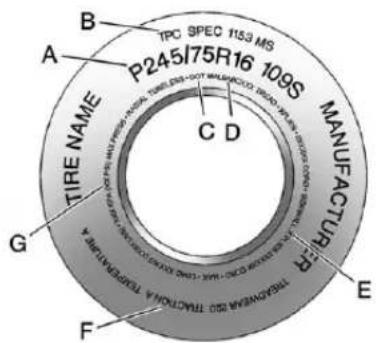
text_image
TPC SPEC 1153 MS P245175R16 109S MANUFACTURER A B C D TIRE NAME G F TRANSMAR ISO TRACOLYTA TRANSMAR TIP EPassenger(P-Metric)Tire
(A)TireSize: Thetiresize codeisacombinationofletters andnumbersusedtodefinea particulartire'swidth,height,aspectratio,constructiontype,andservicedescription.Seethe "TireSize"illustrationalterinthis sectionformoredetail.
(B)TPCSpec (TirePerformance CriteriaSpecification) : Originalequipmenttires designedtoGM'sspecifictire performancecriteriahavea TPCspecificationcodemolded ontothesidewall.GM'sTPC specificationsmeetorexceedall federalsafetyguidelines.
(C)DOT(Departmentof Transportation):The DepartmentofTransportation (DOT)codeindicates that thetireisincompliance with theU.S.Departmentof TransportationMotorVehicle SafetyStandards.
(D) TireIdentification Number(TIN) : The letters and numbers following the DOT code are the TireIdentification Number(TIN). The TIN shows the manufacturer and plant code, tiresize, and datethetire was manufactured. The TIN is molded on both sides of the tire, although only onesidemay have the date of manufacture.
(E)TirePlyMaterial :Thetype ofcordandnumberofpliesin thesidewallandunderthetread.
(F)UniformTireQuality Grading(UTQG): Tire manufacturersarerequired to gradetiresbasedonthree performancefactors:treadwear, traction,andtemperature resistance.Formore information,seeUniformTire QualityGradingonpage 10-68.
(G)MaximumColdInflation LoadLimit :Maximumload thatcanbecarriedandthe maximumpressureneeded tosupportthatload.For informationonrecommended tirepressureseeTirePressure onpage 10-56and VehicleLoad Limitsonpage9-11.
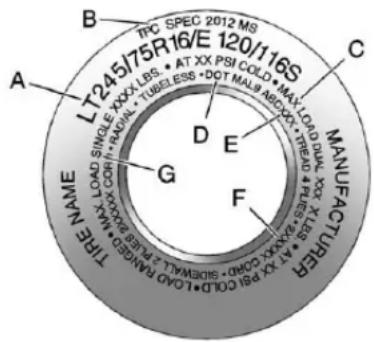
text_image
A B C D E F G TIME NAME TYPE NAME SINGLE SINGLE XXX-LSBS • AT XX PSI COLD • MAX • MAX CORP • RED BLESS • DOT MAL# 460XX • 120/116S TPC SPEC 2012 MS T245/75R16/E 120/116S MANUFACTURE 43 XXXXX CORP • SISWMTL 2.5 MLC • 43 XXXXX CORP • SIDWAL 2.5 MLCLightTruck(LT-Metric)Tire
(A)TireSize: Thetiresize codeisacombinationofletters andnumbersusedtodefinea particulartire'swidth,height,aspectratio,constructiontype,andservicedescription.Seethe "TireSize"illustrationalterinthis sectionformoredetail.
(B)TPCSpec (TirePerformance CriteriaSpecification):
Originalequipmenttires designedtoGM'sspecificire performancecriteriahavea TPCspecificationcodemolded ontothesidewall.GM'sTPC specificationsmeetorexceedall federalsafetyguidelines.This doesnotapplytoGoodyear LT225/75R16G949RSAand GoodyearLT225/75R16G933 RSDcommercialtrucktires.
(C)DualTireMaximumLoad : Maximumloadthatcanbe carriedandthemaximum pressureneededtosupport thatloadwhenusedinadual configuration.Forinformationon recommendedtirepressuresee TirePressureonpage 10-56 andVehicleLoadLimitson page9-11.
(D)DOT(Departmentof Transportation): The DepartmentofTransportation (DOT)codeindicatesthat thetireisincompliancewith theU.S.Departmentof TransportationMotorVehicle SafetyStandards.
(E) Tireldentification Number(TIN) : The letters and numbers following the DOT code are the Tireldentification Number(TIN). The TIN shows the manufacturer and plant code, tiresize, and datethetire was manufactured. The TIN is molded on both sides of the tire, although only onesidemay havethedate of manufacture.
(F)TirePlyMaterial :Thetype ofcordandnumberofpliesin thesidewallandunderthetread.
(G) Single Tire Maximum Load: Maximum load that can be carried and the maximum pressure needed to support that load when used as single. For information on recommended tire pressure see Tire Pressure on page 10-56 and Vehicle Load Limit on page 9-11.
TireDesignations
TireSize
The following example shows how the different part of a tiresize.
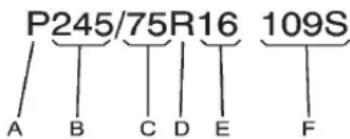
text_image
P245/75R16 109S A B C D E FPassenger(P-Metric)Tire
(A) Passenger(P-Metric) Tire: The United States version of a metric timesizing system. The letter Pasthe first character in
thetiresizemeansapassenger vehicletireengineeredto standardssetbytheU.S.Tire andRimAssociation.
(B)TireWidth : Thethree-digit numberindicatesthetiresection widthinmillimetersfrom sidewalltosidewall.
(C)AspectRatio :Atwo-digit numberthatindicatesthetire height-to-widthmeasurements. Forexample,ifthetiresize aspectratiois75,asshownin itemCoftheillustration,itwould meanthatthetire'ssidewallis 75percentashhighasitiswide.
(D)ConstructionCode : Alettercodeisusedtoindicate thetypeofplyconstructionin thetire.TheletterRmeans radialplyconstruction;the letterDmeansdiagonalorbias plyconstruction;andtheletterB meansbelted-biasply construction.
(E)RimDiameter:Diameter of the wheelin inches.
(F)ServiceDescription :These charactersrepresenttheload indexandspeedratingofthe tire. Theloadindexrepresents theloadcarryingcapacityatire iscertifiedtocarry. Thespeed ratingisthemaximumspeeda tireiscertifiedtocarryaload.
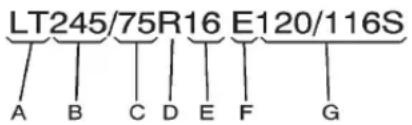
text_image
LT245/75R16 E120/116S A B C D E F GLightTruck(LT-Metric)Tire
(A)LightTruck(LT-Metric) Tire:TheUnitedStatesversion ofametrictiresizingsystem. ThelettersLTasthefirsttwo charactersinthetiresizemean alighttrucktireengineeredto standardssetbytheU.S.Tire andRimAssociation.
(B)TireWidth : Thethree-digit numberindicatesthetiresection widthinmillimetersfrom sidewalltosidewall.
(C)AspectRatio :Atwo-digit numberthatindicatesthetire height-to-widthmeasurements. Forexample,ifthetiresize aspectratiois75,asshown initemCofthelighttruck (LT-Metric)tireillustration,it wouldmeanthatthetire's sidewallis75percentashigh asitiswide.
(D)ConstructionCode : Alettercodeisusedtoindicate thetypeofplyconstructionin thetire.TheletterRmeans radialplyconstruction;the letterDmeansdiagonalor biasplyconstruction;andthe letterBmeansbelted-bias plyconstruction.
(E)RimDiameter :Diameterof thewheelininches.
(F)LoadRange :LoadRange.
(G)ServiceDescription :The servicedescriptionindicate the loadindexandspeedratingofa tire.Iftwonumbersaregivenas intheexample,120/116,then thisrepresentstheloadindexfor singleversusdualwheelusage (single/dual).Thespeedratingis themaximumspeedatireis certifiedocarryaload.This doesnotapplytoGoodyear LT225/75R16G949RSAand GoodyearLT225/75R16G933 RSDcommercialtrucktires;see the dualtireandsingletire maximumloadandloadrange letterdesignationsonthetire sidewall.
TireTerminology and Definitions
AirPressure:Theamountof airinsidethetirepressing outwardoneachsquareinch ofthetire.Airpressureis expressedinkPa(kilopascal) orpsi(poundspersquareinch).
AccessoryWeight : The combinedweightofoptional accessories. Some examples of optional accessories are automatic transmission, power steering, power brakes, power windows, power seats, and air conditioning.
AspectRatio :Therelationship ofatire'sheighttoitswidth.
Belt: Arubbercoatedlayerof cordsthatislocatedbetween thepliesandthetread. Cords maybemadefromsteelorother reinforcingmaterials.
Bead: Thetirebead contains steelwireswrapped by steel cordsthathold the tire onto therim.
BiasPlyTire :Apneumatictire inwhichthepliesarelaidat alternateangleslessthan 90degreestothecenterlineof thetread.
ColdTirePressure : Theamountofairpressure inatire, measuredin kPa(kilopascal)orpsi(pounds persquareinch)beforeatire hasbuiltupheatfromdriving. See TirePressureon page10-56.
CurbWeight : The weight of a motor vehicle with standard and optionalequipment including the maximum capacity off fuel, oil, and coolant, but without passengers and cargo.
DOTMarkings :Acodemolded intothesidewallofatire signifyingthatthetireisin compliancewiththeU.S. DepartmentofTransportation (DOT)MotorVehicleSafety Standards.TheDOTcode includestheTireIdentification Number(TIN),analphanumeric designatorwhichcanalso identifythetiremanufacturer, productionplant,brand,and dateofproduction.
GVWR: Gross Vehicle Weight Rating. See Vehicle Load Limits on page 9-11.
GAWRFRT : GrossAxleWeight Ratingforthefrontaxle. See VehicleLoadLimitson page9-11.
GAWRRR : Gross Axle Weight Rating for therear axle. See Vehicle Load Limit on page 9-11.
IntendedOutboardSidewall: Thesideofanasymmetricaltire, thatmustalwaysfaceoutward whenmountedonavehicle.
Kilopascal(kPa) : Thematic unitforairpressure.
LightTruck(LT-Metric)Tire : Atireusedonlightdutytrucks andsomemultipurpose passengervehicles.
LoadIndex : Anassigned numberranging from 1 to 279 that correspond to the load carrying capacity of fatire.
Maximum Inflation Pressure : Themaximum air pressure to which acoldt tire can be inflated. Themaximum air pressure is molded onto the sidewall.
MaximumLoadRating : Theloadratingforatireatthe maximumpermissibleinflation pressureforthattire.
MaximumLoadedVehicle Weight: Thesumofcurb weight, accessoryweight, vehiclecapacityweight, and productionoptionsweight.
NormalOccupantWeight : Thenumberofoccupantsa vehicleisdesignedtoseat multipliedby68kg(150lbs). SeeVehicleLoadLimitson page9-11.
OccupantDistribution : Designatedseatingpositions.
OutwardFacingSidewall : Thesideofanasymmetricaltire thathasaparticularsidethat facesoutwardwhenmountedon avehicle. Thesideofthetire thatcontainsawhitewall, bearswhitelettering,orbears manufacturer,brand,and/or modelnamemoldingthatis higherordeeperthanthesame moldingsontheothersidewall ofthetire.
Passenger(P-Metric)Tire : Atireusedonpassengercars andsomelightdutytrucksand multipurposevehicles.
Recommended Inflation Pressure: Vehicle manufacturer's recommended tireinflation pressure as shown on the tire placard. See Tire Pressure on page 10-56 and Vehicle Load Limit on page 9-11.
RadialPlyTire :Apneumatic tireinwhichtheplycordsthat extendtothebeadsarelaidat 90degreestothecenterlineof thetread.
Rim: Ametalsupportforatire anduponwhichthetirebeads areseated.
Sidewall: The portion of atire between the read and the bead.
SpeedRating:
Analphanumericcodeassigned toatireindicatingthemaximum speedatwhichatirecan operate.
Traction: Thefrictionbetween thetireandtheroadsurface. Theamountofgripprovided.
Tread: The portion of atire that comes into contact with theroad.
TreadwearIndicators :
Narrowbands, sometimes calledwearbars, that show acrossthetreadofatirewhen only 1.6mm(1/16in) oftread remains. See When It Is Time for New Tiresonpage 10-64.
UTQGS(UniformTireQuality GradingStandards) :Atire
informationsystemthatprovides consumerswithratingsfora tire'straction,temperature,and treadwear.
Ratingsaredetermined by tiremanufacturers using government testing procedures. Theratings are molded into the sidewallofthetire. See Uniform Tire Quality Grading on page 10-68.
VehicleCapacityWeight : Thenumberofdesignated seatingpositionsmultipliedby 68kg(150lbs)plustherated cargoload.See VehicleLoad Limitsonpage9-11.
VehicleMaximumLoadonthe Tire:Loadonanindividualtire duetocurbweight,accessory weight,occupantweight,and cargoweight.
VehiclePlacard :Alabel permanentlyattachedtoa vehicleshowingthevehicle capacityweightandtheoriginal equipmenttiresizeand recommendedinflationpressure.
See "TireandLoading InformationLabel" under Vehicle LoadLimitsonpage9-11.
TirePressure
Tiresneedthecorrectamountof airpressuretooperate effectively.
Notice: Neithertire underinflation nor overinflation is good.
Underinflatedtires, ortires that donothaveenoughair, canresultin:
- Tireoverloading and overheating which could lead to ablowout.
• Prematureor irregularwear. - Poorhandling.
- Reducedfueleconomy.
Overinflatedtires, ortiresthat havetoomuchair, can resultin:
- Unusualwear.
- Poorhandling.
- Roughride.
- Needlessdamagefrom roadhazards.
The Tire and Loading Information label on the vehicle indicates the originalequipment tires and the correct cold tire inflation pressures. The recommended pressure is the minimum air pressure needed to support the vehicle's maximum loadcarrying capacity.
For additional information regarding how much weight the vehicle can carry, and an example of the Tire and Loading Information label, see Vehicle Load Limit on page 9-11.
Howthevehicleisloaded affectsvehiclehandlingandride comfort.Neverloadthevehicle withmoreweightthanitwas designedtocarry.
WhentoCheck
Checkthetiresonceamonth ormore.
Donotforgetthesparetire, ifthevehiclehasone. SeeFull-SizeSpareTireon page10-85foradditional information.
HowtoCheck
Useagoodqualitypocket-type gaugetochecktirepressure. Propertireinflationcannotbe determinedbylookingatthetire. Checkthetireinflationpressure whenthetiresarecold,meaning thevehiclehasnotbeendriven foratleastthreehoursorno morethan1.6km(1mi).
Removethevalvecapfromthe tirevalvestem.Pressthetire gaugefirmlyontothevalveto getapressuremeasurement. Ifthecoldtireinflationpressure matchestherecommended pressureontheTireand LoadingInformationlabel,no furtheradjustmentisnecessary. Iftheinflationpressureislow, addairuntiltherecommended pressureisreached.Ifthe inflationpressureishigh,press onthemetalsteminthecenter ofthetirevalvetoreleaseair.
Re-checkthetirepressurewith thetiregauge.
Return the valve capson the valvestem stop prevent leaks and keep out dirt and moisture.
TirePressureMonitor System
The Tire Pressure Monitor System (TPMS) uses radio and sensor technology to check tire pressure levels. The TPMS sensors monitor the air pressure in your tires and transmit tire pressurereadings to are receiver located in the vehicle.
Eachtire, including the spare (if provided), should be checked monthly when cold and inflated to the inflation pressurerecommended by the vehicle manufacturer on the vehicle placardortire inflation pressure label. (If your vehicle has tires of different sizing thanthesize indicated on the vehicle placardortire inflation pressure label, you should determinethe propertire inflation pressure forthosetires.)
Asanadded safety feature, your vehicle has been equipped with a tire pressure monitoringsystem (TPMS) that illuminates alowtire pressure telltale when none or more of your tires is significantly under-inflated.
Accordingly, whenthelowtire pressuretelltaleilluminates, you shouldstopandcheckyourtiresas soonaspossible, andinflatethem totheproperpressure. Drivingona significantlyunder-inflatedtire causesthetiretooverheatandcan leadtotirefailure. Under-inflation alsoreducesfuelefficiencyandtire treadlife, andmayaffectthe vehicle'shandlingandstopping ability.
PleasenotethattheTPMSis notasubstituteforpropertire maintenance, anditisthedriver's responsibility to maintain incorrect tire pressure, even if under-inflation has not reached the level to trigger illumination of the TPMSlow tire pressure telltale.
Yourvehiclehasalsobeen equippedwithaTPMSmalfunction indicatortoindicatewhenthe systemisnotoperatingproperly. TheTPMSmalfunctionindicatoris combinedwiththelowtirepressure telltale.Whenthesystemdetectsa malfunction,thetelltalewillflashfor approximatelyoneminuteandthen remaincontinuouslyilluminated. Thissequencewillcontinueupon subsequentvehiclestart-upsas longasthemalfunctionexists.
Whenthemalfunctionindicatoris illuminated, thesystemmaynotbe abletodetectorsignallowtire pressureasintended. TPMS malfunctionsmayoccurforvariety ofreasons, includingtheinstallation ofreplacementoralternatetiresor wheelsonthevehiclethatprevent theTPMSfromfunctioningproperly.
AlwayschecktheTPMSmalfunction telltaleafterreplacingoneormore tiresorwheelsonyourvehicleto ensurethatthereplacementor alternatetiresandwheelsallowthe TPMStocontinuetofunction properly.
See TirePressureMonitor Operationonpage10-59for additionalinformation.
FederalCommunications Commission(FCC)Rulesand withIndustryCanada Standards
See Radio Frequency Statement on page 13-22 for information regarding Part 15 of the Federal Communications Commission (FCC) Rules and with Industry Canada Standards RSS-GEN/210/220/310.
TirePressureMonitor Operation
This vehicle may have a Tire Pressure Monitor System (TPMS). The TPMS is designed to warn the driver when alow tire pressure condition exists. TPMS sensors are mounted on to each tire and wheel assembly, excluding the spare tire and wheel assembly. The TPMS sensors monitor the air pressure in the tires and transmit the tire pressurereading to are receiver located in the vehicle.
Whenalowtirepressurecondition is detected, the TPMSilluminates the lowtirepressurewarninglight located on the instrument cluster. If the warninglight comes on, stop as soon as possible and in flat the
tirestotherecommendedpressure shownontheTireandLoading Informationlabel.SeeVehicleLoad Limitsonpage9-11.
Amessagetocheckthepressurein aspecifictiredisplaysintheDriver InformationCenter(DIC).Thelow tirepressurewarninglightandthe DICwarningmessagecomeonat eachignitioncycleuntilthetiresare inflatedtothecorrectinflation pressure.IfthevehiclehasDIC buttons,tirepressurelevelscanbe viewed.Foradditionalinformation anddetailsabouttheDICoperation anddisplays,seeDriverInformation Center(DIC)onpage5-28andTire Messagesonpage5-41.
Thelowtirepressurewarninglight maycomeonincoolweatherwhen thevehicleisfirststarted,andthen turnoffasthevehicleisdriven.This couldbeanearlyindicatorthatthe airpressureisgettinglowand needstobeinflatedtotheproper pressure.
ATireandLoadingInformationlabel showsthesizeoftheoriginal equipmenttiresandthecorrect inflationpressureforthetireswhen theyarecold.SeeVehicleLoad Limitsonpage9-11,foranexample oftheTireandLoadingInformation labelanditslocation.Alsosee Tire Pressureonpage10-56.
The TPMScanwarnabouta lowtirepressureconditionbutil doesnotreplacenormaltire maintenance. See TireInspection onpage 10-62, TireRotationon page 10-62 and Tireson page 10-49.
Notice: Tiresealantmaterials are notallthesame. Anon-approved tiresealantcoulddamagethe TPMSsensors. TPMSsensor damagecausedbyusingan incorrecttiresealantisnot coveredbythevehiclewarranty. Alwaysuseonlythe GM-approvedtiresealant availablethroughyourdealeror includedinthevehicle.
TPMSMalfunctionLightand Message
The TPMS will not function properly if one or more of the TPMS sensors are missing or in operable. When the system detects a malfunction, the low tire pressure warning light flashes for about one minute and then stay on for their remainder of the ignition cycle. ADIC warning message also displays. The malfunction light and DIC warning message come on at each ignition cycle until the problem is corrected. Some of the condition that can cause the set to come on are:
- Oneoftheroadtireshasbeen replacedwiththesparetire. Thesparetiredoesnothavea TPMSsensor. Themalfunction lightandtheDICmessage shouldgooffaftertheroadtire isreplacedandthesensor matchingprocessisperformed successfully. See"TPMSSensor MatchingProcess"laterinthis section.
- TheTPMSsensormatching processwasnotdoneornot completedsuccessfullyafter rotatingthetires.The malfunctionlightandthe DICmessage should gooffafter successfullycompleting the sensormatchingprocess. See"TPMSSensorMatching Process"laterinthissection.
- OneormoreTPMSsensors are missingordamaged. Themalfunctionlightandthe DICmessage should go off when the TPMSsensors are installed and the sensor matching process is performed successfully. Se your dealer for service.
- Replacementtiresorwheelsdo notmatchtheoriginalequipment tiresorwheels.Tiresandwheels otherthanthoserecommended couldpreventtheTPMSfrom functioningproperly.SeeBuying NewTiresonpage 10-65.
- Operatingelectronicdevicesor beingnearfacilitiesusingradio wavefrequenciessimilartothe TPMScouldcausetheTPMS sensorstomalfunction.
If the TPMS is not functioning properly, it cannot detectorsignala lowtirecondition. Seeyourdealer for service if the TPMS malfunction light and DIC message come on and stay on.
TPMSSensorMatching Process
EachTPMSsensorhasaunique identificationcode. Theidentification codeneedstobematchedtoa newtire/wheelpositionafterrotating thevehicle'stiresorreplacingone ormoreoftheTPMSsensors.Also, theTPMSsensormatchingprocess shouldbeperformedafterreplacing asparetirewitharoadtire containingtheTPMSsensor. ThemalfunctionlightandtheDIC messageshouldgooffatthenext ignitioncycle. Thesensorsare matchedtothetire/wheelpositions, usingaTPMSrelearntool, in the following order: driversidefronttire, passengersidefronttire, passenger sidereartire, and driversiderear. Seeyourdealerforserviceorto purchasearelearntool.
There are two minutestomatch the first tire/wheel position, and five minutes overall to match all four tire/wheel positions. If it takes longer, them matching process stops and must be started.
TheTPMSsensormatching processis:
- Settheparkingbrake.
- TurntheignitiontoON/RUNwith theengineoff.
- Press the Remote Keyless Entry (RKE) transmitter's LOCK and UNLOCK buttons at the sametime for approximately five seconds. The hornsounds twicetosignalthereceiver is inrelearn mode and TIRE LEARNING ACTIVE message displays on the DIC screen.
If the vehicle does not have RKE, press the Driver Information Center (DIC) vehicle information button until the PRESS √ TO RELEAR NTIRE POSITIONS messaged displays. The hornsoundstwicetosignal thereceiver is in relearn mode and TIRELEARNING ACTIVE messaged display on the DIC screen.
IfthevehicledoesnothaveRKE orDICbuttons,pressthetrip odometerresetstemlocatedon theinstrumentpanelclusteruntil thePRESS √TORELEARN TIREPOSITIONSmessage displays.Thehornsoundstwice tosignalthereceiverisin relearnmodeandTIRE LEARNINGACTIVEmessage displaysontheDICscreen.
-
Startwiththedriverside fronttire.
-
Placetherelearntoolagainst thetiresidewall, nearthevalve stem. Thenpressthebuttonto activate the TPMS sensor. Ahornchirpconfirmsthatthe sensor identificationcode has been matched to thistire and wheelposition.
- Proceed to the passengers side front tire, and repeat the procedure in Step 5.
- Proceed to the passengers side reartire, and repeat the procedure in Step 5.
-
Proceedtothedriversiderear tire, and repeat the procedure in Step5. The hornsoundstwo timesto indicate the sensor identification code has been matched to the driversiderear tire, and the TPMS sensor matching process is no longer active. The TIRELEARNING ACTIVE message on the DIC displayscreen goes off.
-
Turntheignitionswitch toLOCK/OFF.
- Setallfourtirestothe recommendedairpressure levelasindicatedontheTire andLoadingInformationlabel.
TireInspection
Werecommendthatthetires, includingthesparetire,ifthe vehiclehasone,beinspected forsignsofwearordamageat leastonceamonth.
Replacethetireif:
• Theindicatorsatthreeor moreplacesaroundthetire canbeseen.
- Thereiscordorfabric showingthroughthetire's rubber.
- Thetreadorsidewallis cracked, cut, or snagged deepenoughtoshowcord or fabric.
- Thetirehasabump, bulge, orsplit.
- Thetirehasapuncture, cut, orotherdamagethatcannot berepairedwellbecauseof thesizeorlocationofthe damage.
TireRotation
Tiresshouldberotatedevery 12000km(7,500mi).See MaintenanceScheduleon page11-3.
Tiresarerotatedtoachieve auniformwearforalltires. Thefirstrotationisthemost important.
Anytimeunusualwearis noticed,rotatethetiresassoon aspossibleandcheckthewheel alignment.Alsocheckfor damagedtiresorwheels.See WhenItIs TimeforNewTires onpage 10-64and Wheel Replacementonpage 10-70.
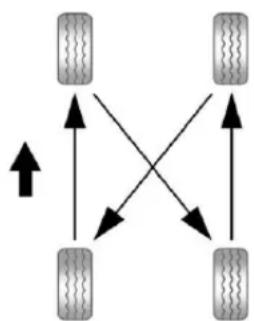
flowchart
graph TD
    A["Terr 1"] --> B["Terr 2"]
    B --> C["Terr 3"]
    C --> D["Terr 4"]
    D --> A
    A --> B
    B --> C
    C --> D
    D --> A
Usethisrotationpatternwhen rotatingthetires.
If the vehicle has a compact spare tire, donot include it in the tirerotation.
Adjustthefrontandreartiresto therecommendedinflation pressureontheTireand LoadingInformationlabelafter thetireshavebeenrotated.See TirePressureonpage10-56 and VehicleLoadLimitson page9-11.
ResettheTirePressureMonitor System.See TirePressure MonitorOperation on page10-59.
Check that all wheel nuts are properly tightened. See "Wheel Nut Torque" under Capacities and Specifications on page 12-2.

WARNING
Rustordirtonawheel, oronthe partstowhichitisfastened, can makewheelnutsbecomeloose aftertime.
(Continued)
WARNING(Continued)
The wheel could come off and cause an accident. When changing a wheel, remove any rustordirt from places where the wheel attach the vehicle. In an emergency, a cloth or paper towel can be used; however, use ascraper or wire brush laterto remove all rustordirt.
Lightlycoatthecenterofthe wheelhubwithwheelbearing greaseafterawheelchangeor tirerotationtopreventcorrosion orrustbuild-up.Donotget greaseontheflatwheel mountingsurfaceoronthe wheelnutsorbolts.
DualTireRotation
Whenthevehicleisnew, orwheneverawheel, wheelbolt, orwheelnutisreplaced, check thewheelnuttorqueafter 160, 1600, and 10000km (100, 1,000, and 6,000mi) of driving. For proper wheel nutting information, see "Removingthe Flat Tire and Installingthe Spare Tire" later in this section, under Ifa Tire Goes Flatonpage 10-72. Also see "Wheel Nut Torque" under Capacities and Specifications on page 12-2.
The outertireonadualwheelsetup generally wears faster than the inertire. Tireslastlongerandwear more evenly if they are rotated. See Tire Inspection on page 10-62 and Tire Rotation on page 10-62. Also see Maintenance Schedule on page 11-3.
WARNING
If the vehicle is operated with a tire that is under inflated, the tire can overheat. An overheated tire can lose air suddenly or catch fire. You or others could be injured. Properly inflate all tires, including the spare.
See Tiresonpage10-49and Tire Pressureonpage10-56formore informationonpropertireinflation.
WhenItIsTimefor NewTires
Factors such as maintenance, temperatures, drivingspeeds, vehicleloading, and road conditions affect the wear rate of the tires.
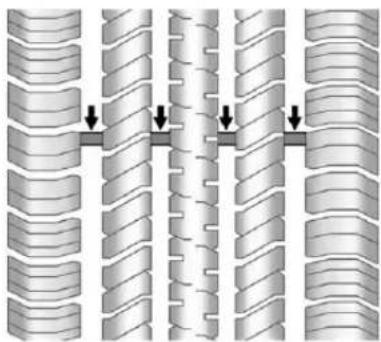
natural_image
Diagram of interlocking cylindrical structures with directional arrows indicating movement or force (no text or symbols)Treadwearindicatorsareonewayto tellwhenitistimefornewtires. Treadwearindicatorsappearwhen thetireshaveonly1.6mm(1/16in) orlessoftreadremaining.
Some commercial truck tires, including Goodyear LT225/75R16 G949RSA and Goodyear LT225/75R16G933RSD, may no have treadwear indicators. If the tires do no havetread wear indicators, replacethetires when the tread depth is downto 3.2mm (1/8in) for the front tires, or 1.6mm (1/16in) for thereartires.
See TireInspectiononpage10-62 and TireRotationonpage10-62 for additional information.
Therubberintiresagesovertime. Thisalsoappliestothesparetire, ifthevehiclehasone, evenifitis neverused. Multipleconditions includingtemperatures, loading conditions, andinflationpressure maintenanceaffecthowfastaging takesplace. Tireswilltypicallyneed tobereplacedduetowearbefore theymayneedtobereplaced duetoage. Consultthetire manufacturerformoreinformation onwhentiresshouldbereplaced.
VehicleStorage
Tiresagewhenstorednormally mountedonaparkedvehicle. Park avehiclethatwillbestoredforat leastamonthinacool,dry,clean areaawayfromdirectsunlightto slowaging. Thisareashouldbe freeofgrease,gasolineorother substanceesthatcandeteriorate rubber.
Parkingforanextendedperiodcan causeflatspotsonthetiresthat mayresultinvibrationswhile driving. Whenstoringavehiclefor atleastamonth,removethetiresor raisethevehicletoreducethe weightfromthetires.
BuyingNewTires
GMhasdevelopedandmatched specifictiresforthevehicle. Theoriginalequipmenttires installedweredesignedtomeet GeneralMotorsTirePerformance CriteriaSpecification(TPCSpec) systemrating.Whenreplacement tiresareneeded,GMstrongly recommendsbuyingtireswiththe sameTPCSpecrating.
GM's exclusive TPCSpecsystem considers overadozencritical specification that impact the overall performance of the vehicle, including brakesystem performance, ride and handling, traction control, and tire pressure monitoring performance. GM's TPCSpecnumber is molded onto the tire's sidewall near the tire size. If the tires have an all-season treadesign, the TPCSpecnumber will be followed by MS form and snow. See Tire Sidewall Labeling on page 10-50 for additional information.
GMrecommendsreplacingallthe tiresatthesametime.Uniformtread depthonalltireswillhelpto maintaintheperformanceofthe vehicle.Brakingandhandling performancemaybeadversely affectedifallthetiresarenot replacedatthesametime.See Tire Inspectiononpage 10-62and Tire Rotationonpage 10-62for informationonpropertirerotation.

WARNING
Tirescouldexplodeduring improperservice.Attempting tomountordismountatire couldcauseinjuryordeath. Onlyyourdealerorauthorized tireservicecentershould mountordismountthetires.

WARNING
Mixingtiresofdifferentsizes, brands,ortypesmaycauseloss ofcontrolofthevehicle,resulting inacrashorothervehicle damage. Usethecorrectsize, brand,andtypeoftiresonall wheels.
This vehicle may have different sizesparethantheroadtires originally installed on the vehicle. When new, the vehicle included a spare tire and wheel assembly with similar overall diameter as theroadtires and wheels, so it is all right to drive on it. The spare tire was developed for use on this vehicle and will not affect vehicle handling.

WARNING
Usingbias-plytiresonthe vehiclemaycausethewheel rimflangestodevelopcracks aftermanymilesofdriving. Atireand/orwheelcouldfail suddenlyandcauseacrash. Useonlyradial-plytireswith thewheelsonthevehicle.
If the vehicle tires must bere placed with atire that does not have a TPC Spec number, makes sure they are the namesize, load range, speed rating, and construction (radial) as the original tires.
Vehiclesthathaveatirepressure monitoringsystemcouldgivean inaccuratelow-pressurewarningif non-TPCSpecratedtiresare installed.SeeTirePressureMonitor Systemonpage10-58.
The Tire and Loading Information label indicates the original equipment tires on the vehicle. See Vehicle Load Limit on page 9-11 forthelabellocation and more information about the Tire and Loading Information label.
DifferentSizeTiresand Wheels
Ifwheelsortiresareinstalledthat areadifferentsizethantheoriginal equipmentwheelsandtires,vehicle performance,includingitsbraking, rideandhandlingcharacteristics, stability,andresistancetorollover maybeaffected.Ifthevehiclehas electronicsystemssuchasantilock brakes,rolloverairbags,traction control,andelectronicstability control,theperformanceofthese systemscanalsobearaffected.
WARNING
If differentsized wheels are used, theremay not bean acceptable level of performance and safety if tires not recommended forth those wheels are selected. This increases the chance of a crash and serious injury. Only use GM specific wheel and tires systems developed for the vehicle, and havethem properly installed by a GM certified technician.
SeeBuyingNewTireson page 10-65 and Accessories and Modifications on page 10-3 for additional information.
UniformTireQuality Grading
Qualitygradescanbefound whereapplicableonthetire sidewallbetweentreadshoulder andmaximumsectionwidth. Forexample:
Treadwear200TractionAA TemperatureA
The following information relates to the system developed by the United States National Highway Traffic Safety Administration (NHTSA), which gradestires by treadwear, traction, and temperature performance. This applies only to vehicles sold in the United States. The grades are molded on the sidewall of most passenger cartires.
TheUniformTireQuality Grading(UTQG)system doesnotapplytodeeptread, winter-typesnowtires, space-saver,ortemporaryuse sparetires,tireswithnominal rimdiametersof10to12inches (25to30cm),ortosome limited-productiontires.
While the tires available on General Motors passengers cars and light trucks may vary with respect to these grades, they must also conform to federal safety requirements and additional General Motors Tire Performance Criteria (TPC) standards.
All Passenger Car Tires Must Conform to Federal Safety Requirements In Addition To These Grades.
Treadwear
Thetreadweargradeisa comparativeratingbasedonthe wearrateofthetirewhentested undercontrolledconditionsona specifiedgovernmenttest course. Forexample, atire graded150wouldwearoneand ahalf(1½)timesaswellonthe governmentcourseasatire graded100. Therelative performanceoftiresdepends upontheactualconditionsof theiruse, however, and may departsignificantlyfromthe normduetovariationsindriving habits, servicepracticesand differencesinroad characteristicsandclimate.
Traction-AA,A,B,C
Thetractiongrades, from highest to lowest, are AA, A, B, and C. Those grades represent the tire's ability to stop on wet pavement as measured under controlled condition on specified government test surfaces of asphalt and concrete. At remarked C may have poor traction performance. Warning: The traction grade assigned to histire is based on straight-ahead braking traction tests, and does not include acceleration, cornering, hydroplaning, or peak traction characteristics.
Temperature-A,B,C
Thetemperaturegrades areA(thehighest),B,andC, representingthetire'sresistance tothegenerationofheatandits abilitytodissipateheatwhen testedundercontrolled conditionsonaspecifiedindoor laboratorytestwheel.Sustained hightemperaturecancausethe materialofthetiretodegenerate andreducetirelife,and excessive temperaturecanlead tosuddentirefailure.Thegrade Ccorrespondstoalevelof performancewhichall passengercartiresmustmeet undertheFederalMotorSafety StandardNo.109.GradesBand Arepresenthigherlevelsof performanceonthelaboratory testwheelthanthemminimum requiredbylaw.Warning:The temperaturegradeforthistireis establishedforatirethatis
properlyinflatedandnot overloaded.Excessivespeed, underinflation,orexcessive loading,eitherseparatelyorin combination,cancauseheat buildupandpossibletirefailure.
WheelAlignmentandTire Balance
Thetiresandwheelswerealigned andbalancedatthefactoryto providethelongesttirelifeandbest overallperformance.Adjustmentsto wheelalignmentandtirebalancing willnotbenecessaryonaregular basis.However,checkthe alignmentifthereisunusualtire wearorifthevehicleispullingto onesideortheother.Ifthevehicle vibrateswhendrivingonasmooth road,thetiresandwheelsmight needtoberebalanced.Seeyour dealerforproperdiagnosis.
WheelReplacement
Replaceanywheelthatisbent, cracked,orbadlyrustedor corroded.Ifwheelnutskeepcoming loose,thewheel,wheelbolts,and wheelnutsshouldbereplaced. Ifthewheelleaksair,replaceit. Somealuminumwheelscanbe repaired.Seeyourdealerifanyof theseconditionsexist.
Yourdealerwillknowthekindof wheelthatisneeded.
Eachnewwheelshouldhavethe sameload-carryingcapacity, diameter,width, offset, and be mountedthesamewayasthe oneitreplaces.
Replacewheels, wheelbolts, wheel nuts, or Tire Pressure Monitor System (TPMS) sensors with new GM originale equipment parts.
WARNING
Using the wrong replacement wheels, wheel bolts, or wheel nutscan be dangerous. It could affect the braking and handling of the vehicle. Tirescan lose air, and cause loss of control, causing a crash. Always use the correct wheel, wheel bolts, and wheel nuts for replacement.
Notice: The wrong wheel can also cause problems with bearing life, brake cooling, speedometer orodometeralibration, headlampaim, bumper height, vehicleground clearance, and tire ortirechain clear anctothe body and chassis.
SeelfaTireGoesFlaton page10-72formoreinformation.
UsedReplacementWheels
WARNING
Replacingawheelwithaused oneisdangerous.Howithas beenusedorhowfarithasbeen drivenmaybeunknown.Itcould failsuddenlyandcauseacrash. Whenreplacingwheels,usea newGMoriginalequipment wheel.
TireChains
WARNING
Tirechainsusedonavehicle withouttheproperamountof clearancecancausedamageto thebrakes,suspension,orother vehicleparts.Theareadamaged bythetirechainscouldcauseyou tolosecontrolofthevehicleand youorothersmaybeinjuredina crash.Tohelpavoiddamageto thevehicle,driveslowly,readjust, orremovethedeviceifitis contactingthevehicle.Donot spinthevehicle'stires.Followthe manufacturer'sinstructions.
Notice: Usetirechainsonly wherelegalandonlywhenyou must. Usechainsthatarethe propersizeforthetires.Install themonthetiresoftherearaxle. Donotusechainsonthetiresof thefrontaxle.Tightenthemas tightlyaspossiblewiththe endssecurelyfastened.Drive slowlyandfollowthechain manufacturer'sinstructions. If youcanhearthechains contactingthevehicle,stopand retightenthem.Ifthecontact continues,slowdownuntil stops.Drivingtoofastor spinningthewheelswithchains onwilldamagethevehicle.
ForCutawaymodelswithLT245/75R16, LT225/75R16orLT215/85R16sizesingleordualreartires, useLowProfileZ-ChainorSAE ClassScables.
ForCargoorPassengermodels withP245/70R17, LT225/75R16 or LT245/75R16sizetires, useLow ProfileZ-Chaincables.SAEClassS chainsarenotrecommended.
If the vehicle has dual reartires, donot use individual tire chains. Usetire chain that fit across both dual tires.
IfaTireGoesFlat
Itisunusualforatiretoblowout whiledriving,especiallyifthetires aremaintainedproperly.Ifairgoes outofatire,itismuchmorelikelyto leakoutslowly.Butifthereeverisa blowout,hereareafewtipsabout whattoexpectandwhattodo:
Ifafronttirefails,theflattire createsadragthatpullsthevehicle towardthatside.Takeyourfootoff theacceleratorpedalandgripthe steeringwheelfirmly.Steerto maintainlaneposition,andthen gentlybraketoastop,welloffthe road,ifpossible.
Arearblowout,particularlyyona curve,actsmuchlikeaskidand mayrequirethesamecorrectionas usedinaskid. Stoppressingthe acceleratorpedalandsteerto straightenthevehicle. Itmaybe verybumpyandnoisy. Gentlybrake toastop, wellofftheroad, ifpossible.
WARNING
Drivingonaflattirewillcause permanentdamagetothetire. Re-inflatingatireafterithas beendrivenonwhileseverely underinflatedorflatmaycausea blowoutandaseriouscrash. Neverattempttore-inflateatire thathasbeendrivenonwhile severelyunderinflatedorflat. Haveyourdealeroranaauthorized tireservicecenterrepairor replacetheflattireassoonas possible.
WARNING
Liftingvehicleandgetting underittodomainaintenanceor repairsidangerouswithoutthe appropriatesafetyequipmentand training.Ifajackisprovidedwith thevehicle,itisdesignedonlyfor changingaflattire.Ifitisusedfor anythingelse,youorotherscould bebadlyinjuredorkilledifthe vehicleslipsoffthejack.Ifajack isprovidedwiththevehicle,only useitforchangingaflattire.
Ifatiregoesflat, avoidfurthertire andwheeldamagebydrivingslowly toalevelplace, wellofftheroad, ifpossible. Turnonthehazard warningflashers.SeeHazard WarningFlashersonpage6-5.

WARNING
Changingatirecanbe dangerous. The vehicle canslip off the jack and rollover or fall causing injury or death. Find a level placeto changethe tire. To help prevent the vehicle from moving:
- Settheparkingbrakefirmly.
- Putanautomatic transmission in P(Park)ora manual transmission in 1(First)orR(Reverse).
(Continued)
WARNING(Continued)
- Turnofftheengineanddo notrestartwhilethevehicle israised.
- Donotallowpassengersto remaininthevehicle.
- Placewheelblocksonboth sidesofthetireatthe oppositecornerofthetire beingchanged.
Whenthevehiclehasaflattire(B), usethefollowingexampleasa guidetoassistintheplacementof thewheelblocks(A).
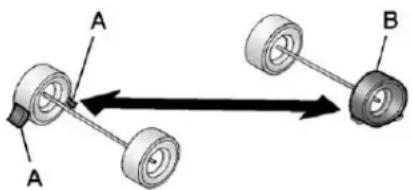
text_image
A A BA.WheelBlock
B.FlatTire
The following information explains how to repair or change atire.
TireChanging
RemovingtheSpareTireand Tools
Equipmentneededforacargovan orapassengervanislocatedinthe passengersiderearcornerofthe vehicle.
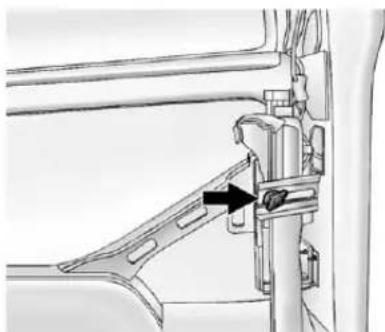
natural_image
Mechanical assembly diagram showing a bracket with a black arrow pointing to a component (no text or symbols present)Removetheretainingwingboltand liftitoffofthemountingbracket.
Equipmentneededfora 15-passengerseatingarrangement issecuredontherearflooronthe passengersideofthevehicle.
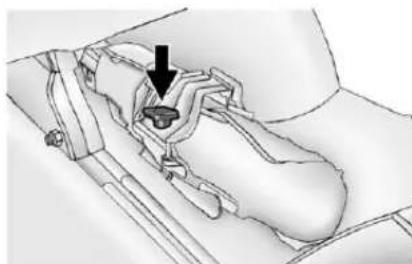
natural_image
Mechanical component diagram showing a valve assembly with a black arrow indicating a specific part (no text or symbols present)Removetheretainingwingboltand liftitoutofthemountingbracketto accesstheequipment.
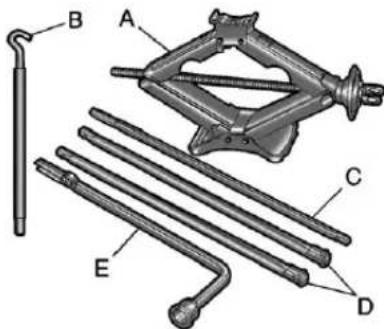
text_image
Technical diagram of a mechanical clamp or fixture with labeled parts A, B, C, D, and EThetoolsyouwillbeusinginclude:
A.Jack
B.JackHandle
C.HoistExtension
D. JackHandleExtension
E.WheelWrench
Thesparetireismountedintherear underbodyofthevehicle.
Usethehoistextension,jackhandle extensions,andthewheelwrench toremovetheunderbody-mounted spare tire.
Tolowerthesparetirefromthe vehicle:
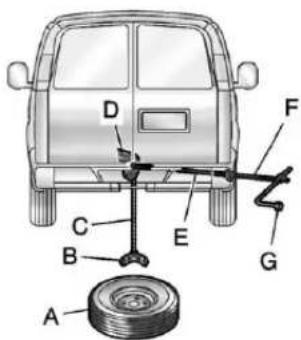
text_image
Diagram of a car suspension system with labeled parts including wheel, tire, and suspension componentsA. Spare Tire
B. Tire/WheelRetainer
C.HoistCable
D. HoistAssembly
E.HoistShaft
F.JackHandleandHoist Extensions
G.WheelWrench
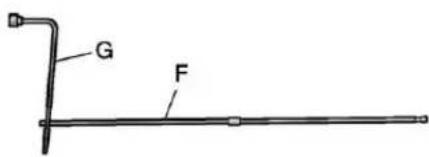
text_image
G F-
Assemble the wheel wrench (G) to one or two of the jack handles and the hoist extensions (F). Insert the hoist extension end through the hole in therear bumper.
-
Besurethehoistextensionend connectstothehoistshaft. The chiseledendoftheextensionis usedtolowerthesparetire.
-
Turnthewheelwrench counterclockwisetolowerthe sparetiretotheground. Continuetoturnthewheel wrenchuntilthesparetirecan bepulledoutfromunderthe vehicle.
If the spare tired does not lower to the ground, these secondary latch is engaged causing the tire not to lower. See Secondary Latch System on page 10-83.
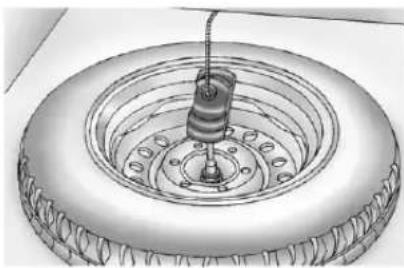
natural_image
Technical illustration of a tire assembly with a central shaft and mounting base (no text or symbols)- Whenthetirehasbeenlowered, pullitclosertoreachthetire retainerandpullitupthrough thewheelopening.
Foravehiclethatwas completedfromacaband chassis, refertotheinformation fromthebodysupplier/installer.
Thesparetireisafull-sizetire, liketheothertiresonthe vehicle.
- Putthesparetirenearthe flattire.
RemovingtheFlatTireand InstallingtheSpareTire
Ifthevehiclehasplasticwheelnut caps,loosenthembyturningthe wheelwrenchcounterclockwise. Thewheelnutcapsaredesigned toremainwiththecentercap. Removethecentercap.
Ifthewheelhasasmoothcenter piece, placethechiselendofthe wheelwrenchintheslotonthe wheelandgentlypryitout.
-
Doasafetycheckbefore proceeding. SeeIfa Tire Goes Flatonpage 10-72 formore information.
-
Loosenallthewheelnutswith thewheelwrench.Donot removethemyet.
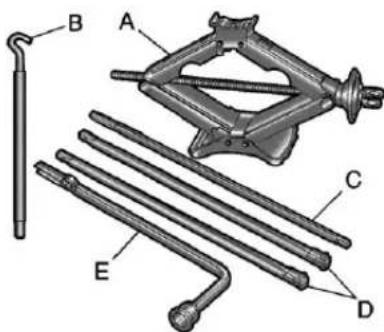
text_image
Technical diagram of a mechanical clamp device with labeled parts A, B, C, D, and EA.Jack
B.JackHandle
C.HoistExtension
D.JackHandleExtension
E.WheelWrench
- Assemble the jack and tools:
FrontFlat: Assemble the jack(A) together with the jack handle(B), one to two jack handle extensions(D), and the wheel wrench(E).
RearFlat: Assemblethejack(A) togetherwiththejackhandle(B), twojackhandleextensions(D), andthewheelwrench(E).

text_image
Diagram showing car wheel assembly with directional arrow and lever mechanism, likely illustrating vehicle motion or steering system.FrontPosition
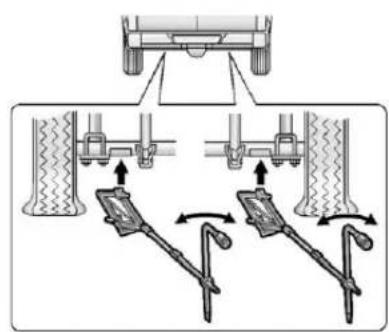
text_image
Diagram illustrating vehicle suspension system with labeled components and directional arrows indicating movementRearPosition
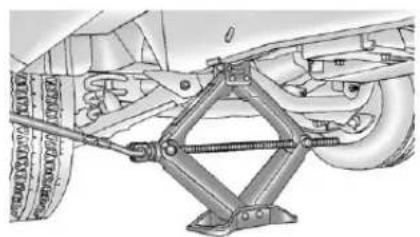
natural_image
Technical line drawing of a mechanical suspension system with no visible text or symbolsFrontPosition
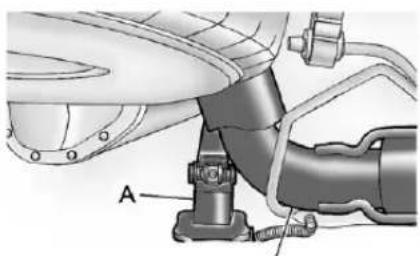
natural_image
Technical diagram of a mechanical assembly with labeled component A (no text or symbols present)B
RearAlternativePosition(Diesel Vehicles)
- Position the jack under the vehicle, asshown.
Thefrontpositionjackingpointis ontheframe. Therearposition jackingpointisontherearaxle.
Iftheexhaustsysteminterferes inthejacklocationintherear axle,suchasinDieselvehicles, placethejack(A)ontherear axlebetweentheaxlehousing andtheshockabsorber bracketinordertoavoidany interferencewiththeexhaust pipe(B).

WARNING
Gettingunderavehiclewhenitis jackedupisdangerous.Ifthe vehicleslipsoffthejackyoucould bebadlyinjuredorkilled.Never getunderavehiclewhenitis supportedonlybyajack.

WARNING
Raisingthevehiclewiththejack improperlypositionedcan damagethevehicleandeven makethevehiclefall. To help avoidpersonalinjuryandvehicle damage, besuretofitthejacklift headintotheproperlocation beforeraisingthevehicle.
- Turnthewheelwrench clockwisetoraisethevehicle. Raisethevehiclefarenoughoff thegroundsothereisenough roomforthesparetiretofit.
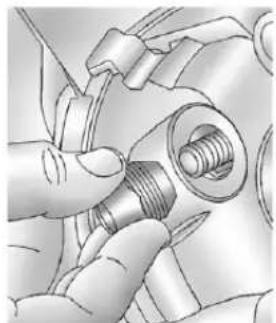
natural_image
Close-up of hands adjusting a mechanical component with a threaded bolt and nut (no visible text or symbols)-
Remove all the wheel nuts.
-
Takeflattireoffofthemounting surface.

WARNING
Rustordirtonawheel, oronthe partstowhichitisfastened, can makewheelnutsbecomeloose aftertime. Thewheelcouldcome offandcauseanaccident. When changingawheel, removeany rustordirtfromplaceswherethe
(Continued)
WARNING(Continued)
wheelattachestothevehicle. In an emergency, aclothorapaper towelcanbeused; however, use ascaperorwirebrushlaterto remove allrustordirt.
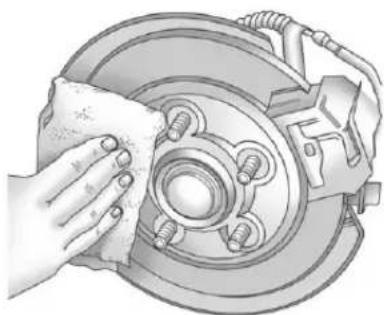
natural_image
Illustration of a hand cleaning a car brake disc with a cloth (no text or symbols)- Remove any rustordirt from the wheel bolts, mountingsurfaces and spare wheel.
WARNING
Neveruseoilorgreaseonbolts ornutsbecausethenutsmight comeloose. Thevehicle'swheel couldfalloff,causingacrash.
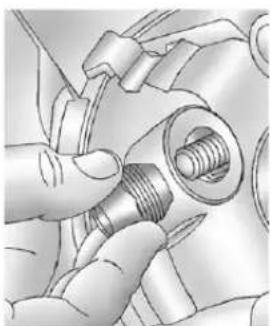
natural_image
Close-up of hands adjusting a mechanical component with threaded bolt (no visible text or symbols)-
Putthewheelnutsbackonwith theroundedendofthenuts towardthewheel. Tighteneach wheelnutbyhanduntilthe wheelisheldagainstthehub.
-
Turnthejackhandle counterclockwisetolowerthe vehicle. Lowerthejack completely.
WARNING
Wheelnutsthatarenottightcan workloose. Ifallthenutsona wheelcomeoff, thewheelcan comeoffthevehicle, causinga crash. Allwheelnutsmustbe properlytightened. Followthe rulesinthissectiontobesure theyare.

WARNING
Ifwheelstudsaredamaged, they can break. If all the tudsona wheel broke, the wheel could come off and cause a crash. If anystud is damaged because of a loose running wheel, it could be that allof the studs are damaged. Tobesure, replace all studs on the wheel. If the stud holes in a wheel have become larger, the wheel could collapse in operation. Replace any wheel if its stud holes have become larger or distorted in any way.
(Continued)
WARNING(Continued)
Inspecthubsandhub-piloted wheelsfordamage. Because of looserunningwheels, pilotingpad damagemayoccurandrequire replacementoftheentirehub, for propercenteringofthewheels. Whenreplacingstuds, hubs, wheelnutsorwheels, besureto useGMoriginalequipmentparts.

WARNING
Wheelnutsthatareimproperlyor incorrectlytightenedcancause thewheelstobecomelooseor comeoff. Thewheelnutsshould beightenedwithatorquewrench tothepropertorquespecification afterreplacing. Followthetorque specificationsuppliedbythe aftermarketmanufacturerwhen usingaccessorylockingwheel nuts.SeeCapacitiesand Specificationsonpage12-2for originalequipmentwheelnut torquespecifications.
Notice:Improperlytightened wheelnutscanleadtobrake pulsationandrotordamage.To avoidexpensivebrakerepairs, evenlytightenthewheelnutsin thepropersequenceandtothe propertorquespecification.See CapacitiesandSpecificationson page12-2forthewheelnut torquespecification.
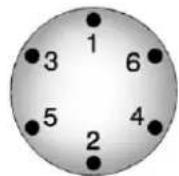
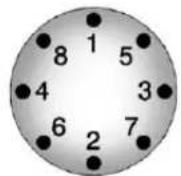
-
Usethewheelwrenchto tightenthenutsfirmly. Turnthe wheelwrenchclockwise and in acrisscrosssequence, as shown.
-
Putthewheelcoverorthe centercapandplasticwheel nutcapsbackon. Remove any wheelblocks.
Haveatechniciancheckthe wheelnuttightnessofall wheelswithatorquewrench afterthefirst160km(100mi) and then1600km(1,000mi) afterthat.Repeatthisservice wheneveratireisremovedor serviced.SeeCapacitiesand Specificationsonpage 12-2for moreinformation.
StoringaFlatorSpareTire andTools

WARNING
Storingajack, atire, or other equipment in the passenger compartment of the vehicle could cause injury. In sudden stop or collision, loose equipment could strike someone. Store all these in the proper place.
- Putthetireonthegroundatthe rearofthevehiclewiththevalve stemp pointeddown.
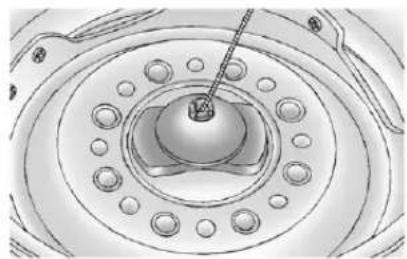
natural_image
Cross-sectional diagram of a mechanical or fluidic component with concentric rings and central hub (no text or symbols)- Pulltheretainingbarthroughthe centerofthewheel,makingsure itisproperlyattached.
- Pullthewheeltowardtherearof thevehicle,keepingthecable tight.
- Putthechiselendofthehoist extensiononananglethrough theholeinthereardoorframe, abovethebumper.
- Raisethetirefullyagainstthe undersideofthevehicle. Continueturningthewheel wrenchuntilthetireissecure
andthecableistight. Thesparetirehoistcannot beovertightened.
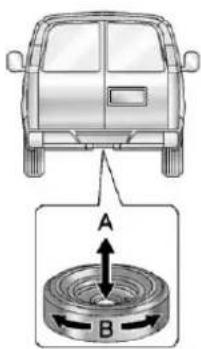
text_image
Diagram showing a car above and its magnetic field with labeled points A and B, illustrating the direction of magnetic motion.- Makesurethetireisstored securely.Push,pull(A),andthen trytoturn(B)thetire.Ifthetire moves,usethewheelwrenchto tightenthecable.
Twoclicksmeanthethetireis upalltheway.
- Return the jacking equipment to the proper location. Secure the items and replace the jack cover.
SecondaryLatchSystem
Thisvehiclehasan underbody-mountedtirehoist assemblyequippedwitha secondarylatchsystem.Itis designedtostopthesparetirefrom suddenlyfallingoffthevehicleifthe cableholdingthesparetireis damaged.Forthesecondarylatch towork,thetiremustbestowed withthevalvestempointingdown.
See "StoringaFlatorSpareTire andTools" under TireChangingon page 10-74 for instruction on storing the spare tire correctly.

WARNING
Beforebeginningthisprocedure readalltheinstructions.Failureto readandfollowtheinstructions coulddamagethehoistassembly andyouandotherscouldget hurt.Readandfollowthe instructionslistednext.
Toreleasethesparetirefromthe secondarylatch:

WARNING
Someonestandingtooclose duringtheprocedurecouldbe injuredbythejack.Ifthespare tiredoesnotslideoffthejack completely,makesurenooneis behindyouoroneithersideof youasyoupullthejackoutfrom underthespare.
- Checkunderthevehicletoseeif thecableendisvisible.
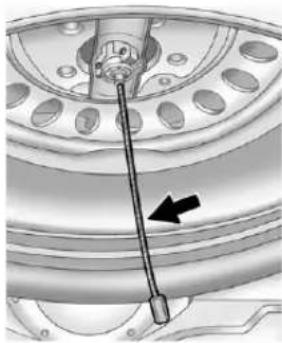
natural_image
Mechanical component diagram showing a shaft and wheel assembly with an arrow indicating direction (no text or symbols present)If the cable is not visible, start this procedure at Step 6.
- Turnthehoistextension counterclockwise until approximately 15cm(6in) of cable is exposed.
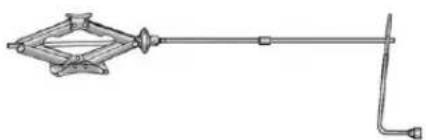
natural_image
Technical line drawing of a mechanical clamp or clamp device with no visible text or symbols- Attachthejackhandle/jack handleextensionandwheel wrenchtothejack.
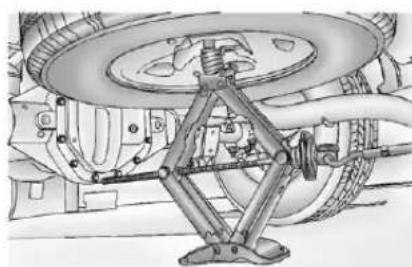
natural_image
Technical illustration of a vehicle suspension system with brake and wheel components (no text or labels)-
Placethejackunderthevehicle, aheadoftherearbumper. Positionthecenterliftpoint of thejackunderthecenterofthe sparetireandturnthehandle clockwisetoraisethejackuntil liftsthesecondarylatchspring.
-
Keepraisingthejackuntilthe sparetirestopsmovingupward andisheldfirmlyinplace. This letsyouknowthatthesecondary latchhasreleased. Thespare tireisnowbalancingonthejack.
-
Lowerthejackbyturningthe wheelwrenchcounterclockwise. Keeploweringthejackuntilthe sparetireslidesoffthejackoris hangingbythecable.
-
Disconnect the jack handle from the jack and carefully remove the jack. Use one hand top push against the spare while firmly pulling the jack out from under the spare tire with the other hand.
Ifthesparetireishangingfrom thecable,assemblythewheel wrenchontothehoistextension andinsertthechiselendofthe hoistextensionintothehoist shaftholeabovethebumper. Turnthewheelwrench counterclockwisetolowerthe sparetherestoftheway.
- Tilttheretainerattheendofthe cableandpullitthroughthe wheelopening.Pullthetireout fromunderthevehicle.
Notice: If you drive away before the spare tire or secondary latch system cable has been reinstalled, you could damage the vehicle. Always reinstall this cable before driving the vehicle.
- If the cable is hanging under the vehicle, turn the wheel wrench in the hoist shaft hole in the bumper clockwiset or a set the cable backup.
Havethehoistassemblyinspected assoonasyoucan. You will not be able to store aspare or flattire using the hoist assembly until it has been repaired or replaced.
To continue changing the flattire, return to Step 4 of "Storinga Flator Spare Tire and Tools" under Tire Changing on page 10-74.
Full-SizeSpareTire
This vehicle, when new, may have had a fully-inflated spare tire. Aspare tire may lose airovertime, so check its inflation pressure regularly. See Tire Pressure on page 10-56 and Vehicle Load Limits on page 9-11 for information regarding propertire inflation and loading the vehicle. For instruction on how to remove, install or store a spare tire, see "Removing the Flat Tire and Installing the Spare Tire" and "Storing a Flator Spare Tire and Tools" under Tire Changing on page 10-74.
Afterinstallingthesparetireonthe vehicle,youshouldstopassoonas possibleandmakesurethespareis correctlyinflated.Thesparetireis madetoperformwellatspeedsup to112km/h(70mph)atthe recommendedinflationpressure,so youcanfinishyourtrip.
Havethedamagedorflatroadtire repairedorreplacedassoonasyou canandinstalledbackontothe vehicle. Thisway, asparetirewill beavailableincaseyouneedit again. Donotmixtiresandwheels ofdifferentsizes, becausetheywill notfit. Keepthesparetireandits wheeltogether.
JumpStarting
Formoreinformationaboutthe vehiclebattery,seeBatteryon page10-28.
Ifthevehiclebatteryhasrundown, youmaywanttouseanother vehicleandsomejumpercablesto startyourvehicle.Besuretouse thefollowingstepstodoitsafely.

WARNING
Batteriescanhurtyou. They can be dangerous because:
• They contain acid that can burn you.
• Theycontainingasthatcan explodeorignite.
• They contain enough electricity to burn you.
If you donot follow these steps exactly, some or all of these things can hurt you.
Notice: Ignoring the seven steps could result in costly damage to the vehicle that would not be covered by the warranty.
Trying to start the vehicle by pushing or pulling it will not work, and it could damage the vehicle.
- Check the other vehicle. It must have a 12-volt battery with a negative ground system.
Notice: Only use vehicle that has a 12 - voltsystem with a negative ground for jump starting. If the other vehicle does not have a 12 - voltsystem with a negative ground, both vehicles can be damaged.
- Getthevehiclescloseenough sothejumpercablescanreach, butbesurethevehiclesarenot touchingeachother.Iftheyare, itcouldcauseaground connectionyoudonotwant.You wouldnotbeabletostartyour
vehicle, and the badgrounding could damage the electrical systems.
To avoid the possibility of the vehicles rolling, set the parking brake firmly on both vehicles involved in the jump start procedure. Put an automatic transmission in P (Park) or a manual transmission in N (Neutral) before setting the parking brake.
Notice:Ifanyaccessoriesareleft onorpluggedinduringthejump startingprocedure,theycouldbe damaged.Therepairswouldnot recoveredbythevehicle warranty.Wheneverpossible, turnofforunplugallaccessories oneithervehiclewhenjump startingthevehicle.
- Turnofftheignitiononboth vehicles. Unplugunnecessary accessoriespluggedintothe cigarettelighterortheaccessory poweroutlet. Turnofftheradio andalllampsthatarenot
needed. This will avoid sparks and helps save both batteries. And it could save a radio!
- Openthehoodsandlocatethe positive(+)andnegative(-) terminallocationsoftheother vehicle.
Onyourvan, usetheunpainted radioantennabracketasa remotenegative(-)terminal.

WARNING
Usinganopenflameneara batterycancausebatterygasto explode.Peoplehavebeenhurt doingthis,andsomehavebeen blinded.Useaflashlightifyou needmorelight.
Besurethebatteryhasenough water. Youdonotneedtoadd watertothebatteryinstalledin yournewvehicle. Butifabattery hasfillercaps, besuretheright amountoffluidisthere.
(Continued)
WARNING(Continued)
Ifitislow, addwatertotake careofthatfirst. If you donot, explosive gascould be present.
Batteryfluidcontainsacidthat canburnyou.Donotgetiton you.Ifyouaccidentallygetitin youreyesoronyourskin,flush theplacewithwaterandget medicalhelpimmediately.

WARNING
Fansorothermovingengine partscaninjureyoubadly.Keep yourhandsawayfrommoving partsoncetheengineisrunning.
- Check that the jumpercables do nothavelooseormissing insulation. If they do, you could get ashock. The vehicles could be damaged too.
Beforeyouconnectthecables, herearesomebasicthingsyou shouldknow.Positive(+)willgo topositive(+)ortoaremote positive(+)terminalifthevehicle hasone.Negative(-)willgoto anunpaintedmetalpartortoa remotenegative(-)terminalif thevehiclehasone.Onyour van,usetheunpaintedradio antennabracketasaremote negative(-)terminal.
Donotconnectpositive(+)to negative(-)oryouwillgeta shortthatwoulddamagethe batteryandmaybeotherparts too.Anddonotconnectthe negative(-)cabletothe negative(-)terminalonthe deadbatterybecausethiscan causesparks.
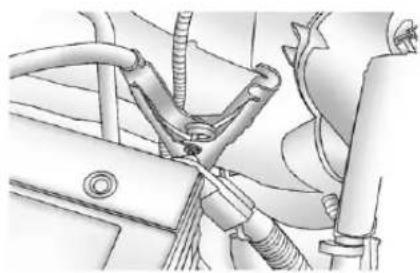
natural_image
Mechanical assembly diagram showing clamping mechanism with hoses and components (no text or labels)- Connecttheredpositive(+) cabletothepositive(+)terminal ofthedeadbattery.Usea remotepositive(+)terminalifthe vehiclehasone.Donotletthe otherendtouchmetal.Connect ittothepositive(+)terminalof thegoodbattery.Usearemote positive(+)terminalifthevehicle hasone.
7.Nowconnecttheblack negative(-)cabletothe negative(-)terminalofthe goodbattery.Usearemote negative(-)terminalifthe vehiclehasone.
Donotlettheotherendtouch anythinguntilthenextstep.The otherendofthenegative(-) cabledoesnotgotothedead battery.Itgoestoaheavy, unpaintedmetalenginepartor toaremotenegative(-)terminal onthevehiclewiththedead battery.Onyourvan,usethe unpaintedradioantennabracket asaremotenegative(-) terminal.
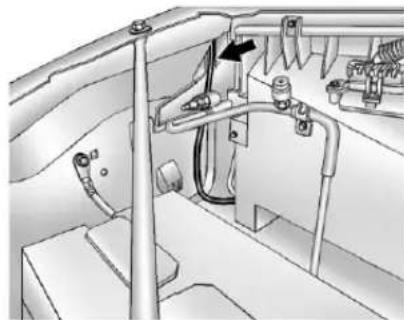
natural_image
Technical diagram of a vehicle interior showing mechanical components and wiring (no text or labels)- Connecttheotherendofthe negative(-)cabletothe negative(-)terminallocationon thevehiclewiththedeadbattery. Onyourvan,usetheunpainted radioantennabracketasa remotenegative(-)terminal.
Notice: Your vehicle uses the unpainted radioantennabracket as arem to negative (-) terminal. Movethe antennacoaxcable out of the way before clamping the negative jumper cable to the fixed antennabracket. Avoid touching thenegative cable clampt the air conditioning line. Failure todo either of these could damage your vehicle. There pairs would not be recovered by the warranty.
-
Nowstartthevehiclewiththe goodbatteryandruntheengine forawhile.
-
Trytostartthevehiclethathad thedeadbattery.lfitwillnot startafterafewtries, it probablyneedsservice.
Notice: If the jumpercables are connected or removed in the wrong order, electrical shorting may occur and damage the vehicle. Therepair would not be covered by the vehicle warranty.
Alwaysconnectandremovethe jumpercablesinthecorrect order,makingsurethatthe cablesdonottoucheachother orothermetal.
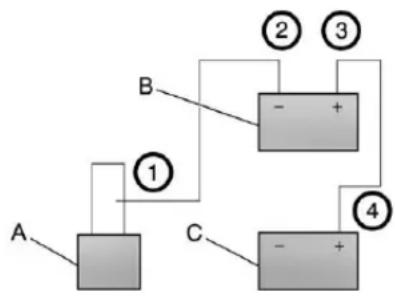
flowchart
graph TD
    A["A"] --> B["B"]
    B --> C["C"]
    C --> D["①"]
    D --> E["②"]
    E --> F["③"]
    F --> G["④"]
    G --> H["- +"]
JumperCableRemoval
A. UnpaintedMetalPartor RemoteNegative(-)Terminal
B. GoodBatteryorRemote Positive(+)andRemote Negative(-)Terminals
C. DeadBatteryorRemote Positive(+)Terminal
Todisconnectthejumpercables frombothvehicles,dothefollowing:
- Disconnecttheblack negative(-)cablefromthe vehiclethathadthedead battery.
- Disconnect the black negative (-) cable from the vehicle with the good battery.
- Disconnectthered positive(+) cable from the vehicle with the good battery.
- Disconnecttheredpositive(+) cablefromtheothervehicle.
- Returntheremotepositive(+) terminalcovertoitsoriginal position.
Towing
TowingtheVehicle
Notice: To avoid damage, the disabled vehicles should be towed with all four wheel soff the ground. Care must be taken with vehicle sthathavelow ground clearance and or special equipment. Always flat bedona car carrier.
Consultyourdealerora professionaltowingserviceifthe disabledvehiclemustbetowed. SeeRoadsideAssistanceProgram (U.S.andCanada)onpage13-8or RoadsideAssistanceProgram (Mexico)onpage13-10.
Totowthevehiclebehindanother vehicleforrecreationalpurposes, suchasbehindamotorhome,see "RecreationalVehicleTowing" in thissection.
Recreational Vehicle Towing
Recreationalvehicletowingmeans towingthevehiclebehindanother vehicle—suchasbehindamotor home. Thetwomostcommontypes ofrecreationalvehicletowingare knownasdinghytowinganddolly towing. Dinghytowingistowingthe vehiclewithallfourwheelsonthe ground. Dollytowingistowingthe vehiclewithtwowwheelsonthe groundandtwowheelsupona deviceknownasadolly.
Herearesomeimportantthings toconsiderbeforerecreational vehicletowing:
- Whatisthetowingcapacity of thetowingvehicle? Besureto readthetowvehicle manufacturer's recommendations.
- Whatisthedistancethatwillbe travelled?Somevehicleshave restrictionsonhowfarandhow longtheycantow.
- Isthepropertowingequipment goingtobeused? Seeyour dealerortraileringprofessional foradditionaladviceand equipmentrecommendations.
- Isthevehiclereadytobe towed?Justaspreparingthe vehicleforalongtrip,makesure thevehicleispreparedtobe towed.
DinghyTowing
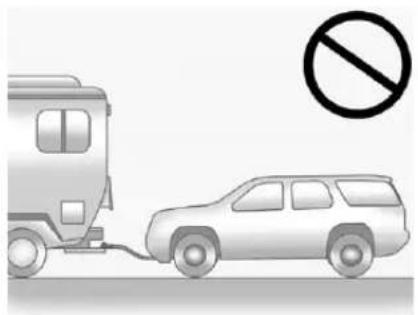
natural_image
Illustration of a van connected to a car with a no-smoking symbol (no text or labels)Two-Wheel-DriveVehicles
Notice: If the vehicle is bestowed with all four wheels on the ground, the drivetrain components could be damaged. There pairs would not be covered by the vehicle warranty. Donottow the vehicle with all four wheels on the ground.
Two-wheel-drive vehicle should not be towed with all four wheels on the ground. Two-wheel-drivetransmissions have no provisions for internal lubrication while being towed.
All-Wheel-DriveVehicles
The vehicle was not designed to be towed with all four wheels on the ground. Top properly to these vehicles, they should be placed on a platform trailer with all four wheels off the ground.
Notice: Towinganall-wheel-drive vehiclewithallfourwheelsonthe ground, orevenwithonlytwoof itswheelsontheground, will damagedrivetraincomponents. Donottowanall-wheel-drive vehiclewithanyofitswheelson theground.
DollyTowing
RearTowing(RearWheelsOff theGround)-Two-Wheel-Drive Vehicles
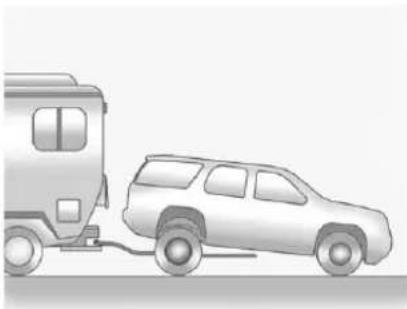
natural_image
Illustration of a car being pulled by a vehicle (no text or symbols)Usethefollowingprocedure to towthevehiclefromtherear:
-
Attachthedollytothetow vehiclefollowingthedolly manufacturer'sinstructions.
-
Drivetherearwheelsonto thedolly.
-
Firmlysettheparkingbrake. See ParkingBrakeonpage9-34 formoreinformation.
-
PutthetransmissioninP(Park).
-
Secure the vehicle to the Holly following the manufacturer's instructions.
-
Use an adequate clamping device designed for towing to ensure that the front wheels are locked into the straight position.
-
TurntheignitiontoLOCK/OFF. Ifthetowvehiclewillnotbe startedordrivenforsixweeksor more,removethebatterycable fromthenegativeterminal(post) ofthebatterytopreventthe batteryfromdrainingwhile towing.
RearTowing(RearWheelsOff theGround)—All-Wheel-Drive Vehicles
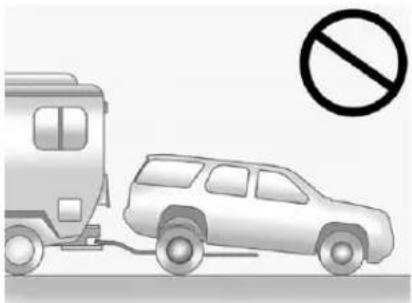
natural_image
Illustration of a van connected to a car with a no-smoking symbol (no text or labels)The vehicle was not designed to be towed with twowheels on the ground. Toproperlytow these vehicles, they should be placed on a platform trailer with all four wheels off the ground.
Notice: Towinganall-wheel-drive vehiclewithallfourwheelsonthe ground, orevenwithonlytwoof itswheelsontheground, will damagedrivetraincomponents. Donottowanall-wheel-drive vehiclewithanyofitswheelson theground.
AppearanceCare
ExteriorCare
WashingtheVehicle
Topreservethevehicle'sfinish, washitoftenandoutofdirect sunlight.
Notice: Donotusepetroleum based, acidic, or abrasive cleaning agents asthey can damage the vehicle's paint, metal, or plastic parts. If damage occurs, it would not be recovered by the vehicle's warranty. Approved cleaning product scan be obtained from your dealer. Follow all manufacturer directions regarding correct product usage, necessary safety precautions, and appropriate disposal of any vehicle care product.
Notice: Avoid using high pressure washes closer than 30cm(12in) to the surface of the vehicle. Use of power washers exceeding 8,274kPa (1,200 psi) can result in damage or removal of paint and decals.
Rinsethevehiclewell, before washing and after, to remove all cleaning agents completely. If they are allowed today on the surface, they could stain.
Drythefinishwithasoft, clean chamoisoranall-cottontowelto avoidsurfacescratchesand waterspotting.
FinishCare
Applicationofaftermarketclearcoat sealant/waxmaterialsisnot recommended.Ifpaintedsurfaces aredamaged,seeyourdealerto havethedamageassessed and repaired.Foreignmaterialssuchas calciumchlorideandothersalts,ice meltingagents,roadoilandtar,tree sap,birddroppings,chemicalsfrom industrialchimneys,etc.,can damagethevehicle'sfinishifthey remainonpaintedsurfaces.Wash thevehicleassoonaspossible. Ifnecessary,usenon-abrasive cleanersthataremarkedsafefor paintedsurfacestoremoveforeign matter.
Occasionalhandwaxingormild polishingsshouldbedonetoremove residuefromthepaintfinish.See yourdealerforapprovedcleaning products.
Notice: Machine compoundingor aggressive polishingona basecoat/clearcoat paint finish may damage it.
Useonlynon-abrasivewaxesand polishesthataremadefora basecoat/clearcoatpaintfinishon thevehicle.
Tokeep the paint finish looking new, keep the vehiclegaragedor covered whenever possible.
ProtectingExteriorBrightMetal Parts
Regularlycleanbrightmetalparts withwaterorchromepolishon chromeorstainlesssteeltrim, ifnecessary.
Foraluminum, never use autoor chromepolish, steam, or caustic soaptoclean. A coating of wax, rubbed to high polish, is recommended for all bright metal parts.
CleaningExteriorLamps/LensesandEmblems
Useonlylukewarmorcoldwater,a softcloth,andacarwashingsoap tocleanexteriorlampsandlenses. Followinstructionsunder"Washing theVehicle"laterinthissection.
WindshieldandWiperBlades
Cleantheoutsideofthewindshield withglasscleaner.
Cleanrubberbladesusinglint-free clothorpapertowelsoakedwith windshieldwasherfluidoramild detergent.Washthewindshield thoroughlywhencleaningthe blades.Bugs,roadgrime,sap,and abuildupofvehiclewash/wax treatmentsmaycausewiper streaking.
Replacethewiperbladesifthey arewornordamaged. Damagecan becausedbyextremedusty conditions,sand,salt,heat,sun, snowandice.
Weatherstrips
Applysiliconegreaseon weatherstripstomakethemlast longer,sealbetter,andnotstickor squeak.SeeRecommendedFluids andLubricantsonpage11-12.
Tires
Useastiffbrushwithtirecleanerto cleanthetires.
Notice: Using petroleum-based tiredressing product on the vehicle may damage the paint finish and/or tires. When applying atiredressing, always swipe off any overspray from all painted surfaces on the vehicle.
WheelsandTrim—Aluminum orChrome
Useasoft, cleancloth with mild soap and watertocleanthewheels. After rinsing thoroughly with clean water, dry with asoft, cleantowel. Awax may then be applied.
Keepthewheelscleanusinga soft,cleanclothwithmildsoapand water.Rinsewithcleanwater.After rinsingthoroughly,drywithasoft, cleantowel.Awaxmaythenbe applied.
Notice: Chromewheels and other chrometrimmay bedamaged if the vehicle is not washed after driving on roadsthath have been sprayed with magnesium, calcium, or sodium chloride. These chlorides are used on roads for condition such as ice and dust. Always wash the chromewith soap and water after exposure.
Notice: To avoid surface damage, do not use strong soaps, chemicals, abrasive polishes, cleaners, brushes, or cleaners that contain acidional aluminum chrome-plated wheels. Use only approved cleaners. Also, never drive vehicle with aluminum chrome-plated wheel through an automatic car wash that uses silicone car bidetire cleaning brushes. Damage could occur and there pairs would not be covered by the vehicle warranty.
Steering, Suspension, and ChassisComponents
Visuallyinspectfrontandrear suspensionandsteeringsystemfor damaged,loose,ormissingpartsor signsofwear.Inspectpower steeringlinesandhosesforproper hook-up,binding,leaks,cracks, chafing,etc. Visuallycheckconstant velocityjoints,rubberboots,and axlesealsforleaks.
BodyComponentLubrication
Lubricateallkeylockcylinders, hoodhinges,liftgatehinges,and steelfueldoorhingeunlessthe componentsareplastic.Applying siliconegreaseonweatherstrips withacleanclothwillmakethem lastlonger,sealbetter,andnotstick orsqueak.
UnderbodyMaintenance
Useplainwatertoflushdirtand debrisfromthevehicle'sunderbody. Yourdealeroranunderbodycar washingsystemcandothis.Ifnot removed,rustandcorrosioncan develop.
SheetMetalDamage
If the vehicle is damaged and requires sheet metal repair or replacement, makes sure the body repair shop applies anti-corrosion material to parts repaired or replaced to restore corrosion protection.
Originalmanufacturer replacement partswillprovidethe corrosion protectionwhilemaintainingthe vehiclewarranty.
FinishDamage
Quicklyrepairminorchipsand scratcheswithtouch-upmaterials availablefromyourdealertoavoid corrosion.Largerareasoffinish damagecanbecorrectedinyour dealer'sbodyandpaintshop.
ChemicalPaintSpotting
Airbornepollutantscanfallupon andattackpaintedvehiclesurfaces causingblotchy, ring-shaped discolorations, and small, irregular darkspotsetched into the paint surface.
InteriorCare
Topreventdirtparticleabrasions, regularlycleanthevehicle'sinterior. Immediatelyremoveanysoils. Note thatnewspapersordarkgarments thatcantransfercolortohome furnishingscanalsopermanently transfercolortothevehicle's interior.
Useasoftbristlebrushtoremove dustfromknobsandcrevicesonthe instrumentcluster. Usingamild soapsolution,immediatelyremove handlotions,sunscreen,andinsect repellantfromallinteriorsurfacesor permanentdamagemayresult.
Yourdealermayhaveproductsfor cleaningtheinterior. Usecleaners specificallydesignedforthe surfacesbeingcleanedtoprevent permanentdamage. Toprevent overspray,applyallcleanersdirectly tothecleaningcloth.Cleaners shouldberemovedquickly.Never allowcleanerstoremainonthe surfacebeingcleanedforextended periodsoftime.
Cleanersmaycontainsolventsthat canbecomeconcentratedinthe interior.Beforeusingcleaners,read andadheretoallsafetyinstructions onthelabel.Whilecleaningthe interior,maintainadequate ventilationbyopeningthedoors andwindows.
Topreventdamage, donotclean theinteriorusingthefollowing cleanersortechniques:
- Neverusearazororanyother sharpobjecttoremoveasoil fromanyinteriorsurface.
- Neveruseabrushwithstiff bristles.
- Neverrubanysurface aggressivelyorwithexcessive pressure.
- Donotuselaundrydetergentsor dishwashingsoapswith degreasers.Forliquidcleaners, useapproximately20drops per3.78L(1gal)ofwater.
Aconcentratedsoapsolutionwill leavearesiduethatcreates streaksandattractsdirt.Donot usesolutionsthatcontainstrong orcausticsoap.
- Donotheavilysaturatethe upholsterywhencleaning.
- Donotusesolventsorcleaners containingsolvents.
InteriorGlass
Toclean, useaterryclothfabric dampenedwithwater. Wipedroplets leftbehindwithacleandrycloth. Commercialglasscleanersmaybe used, ifnecessary, aftercleaning theinteriorglasswithplainwater.
Notice: Topreventscratching, neveruseabrasivecleanerson automotiveglass. Abrasive cleanersoraggressivecleaning maydamagetherearwindow defogger.
Fabric/Carpet
Startbyvacuumingthesurface usingasoftbrushattachment.lfa rotatingbrushattachmentisbeing usedduringvacuuming,onlyuseit onthefloorcarpet.Beforecleaning, gentlyremoveasmuchofthesoil aspossibleusingoneofthe followingtechniques:
• Gentlyblotliquidswithapaper towel. Continue blotting until no moresoil can be removed.
- Forsolidsoils, removeasmuch aspossibleprioritovacuuming.
Toclean:
- Saturateacleanlint-free colorfastclothwithwateror clubsoda. Microfiberclothis recommendedtopreventlint transfertothefabricorcarpet.
-
Remove excess moisture by gently wringing until water does not drip from the cleaning cloth.
-
Startontheoutsideedgeofthe soilandgentlyrubtowardthe center. Rotatethecleaningcloth toacleanareafrequentlyto preventforcingthesoilinto thefabric.
- Continue gently rubbing the soiled area until there is no longer any color transfer from the soil to the cleaning cloth.
- If the soil is not completely removed, use a mild soap solution followed only by clubs or plain water.
Ifthesoilisnotcompletely removed, it may be necessary to use a commercial upholstery cleaner or spot lifter. Testasmall hidden area for color fastness before using a commercial upholstery cleaner or spot lifter. If ring formation occurs, clean the entire fabric or carpet.
Following the cleaning process, a papertowel can be used to blot excess moisture.
InstrumentPanel, Leather, Vinyl, & Other Plastic Surfaces
Useasoftmicrofibercloth dampenedwithwatertoremove dustandloosedirt.Foramore thoroughcleaning,useasoft microfiberclothdampenedwitha mildsoapsolution.
Notice: Soakingorsaturating leather, especially perforated leather, as well as other interior surfaces, may cause permanent damage. Wipe excess moisture from thesesurfaces after cleaning and allow them today naturally. Never use heat, steam, spotlifters or spotremovers. Donot use cleaner that contain silicone or wax-based products. Cleaners containing these solvent scan permanently change the appearance and feel of leather or soft trim and are not recommended.
Donotusecleanersthatincrease gloss,especiallyontheinstrument panel. Reflectedglarecandecrease visibilitythroughthewindshield undercertainconditions.
Notice: Useofairfreshenersmay causepermanentdamageto plasticsandpaintedsurfaces. Ifanairfreshenercomesin contactwithanyplasticor paintedsurfaceinthevehicle, blotimmediatelyandcleanwitha softclothdampenedwithamild soapsolution.Damagecausedby airfreshenerswouldnotbe coveredbythevehiclewarranty.
CareofSafetyBelts
Keepbeltscleananddry.

WARNING
Donotbleachordyesafetybelts. Itmayseverelyweakenthem. In acrash, they might not be able to provide adequate protection. Cleansafety belt only with mild soap and lukewarm water.
FloorMats

WARNING
Ifafloormatisthewrongsizeor isnotproperlyinstalled,itcan interferewiththepedals. Interferencewiththepedalscan causeunintendedacceleration and/orincreasedstopping distancewhichcancauseacrash andinjury.Makesurethefloor matdoesnotinterferewith thepedals.
Usethefollowingguidelinesfor properfloormatusage.
- Theoriginalequipmentfloor matsweredesignedforthe vehicle. Ifthefloormatsneed replacing, itisrecommended that GMcertifiedfloormatsbe purchased. Non-GMfloormats maynotfitproperlyandmay interferewiththepedals. Always checkthatthefloormatsdo notinterferewiththepedals.
- Usethefloormatwiththe correctsideup.Donotturn itover.
- Donotplaceanythingontopof theriversidefloormat.
• Useonlyasinglefloormaton theriverside. - Donotplaceonefloormaton topofanother.
10-100VehicleCare
NOTES
Service and Maintenance
GeneralInformation
GeneralInformation......11-1
MaintenanceSchedule
MaintenanceSchedule......11-3
SpecialApplicationServices
SpecialApplication
Services....11-8
Additional Maintenance and Care
AdditionalMaintenance
andCare....11-8
RecommendedFluids, Lubricants,andParts
RecommendedFluidsand Lubricants....11-12
MaintenanceReplacement
Parts......11-14
MaintenanceRecords
MaintenanceRecords.....11-15
GeneralInformation
This maintenance section applies to vehicles with a gasoline engine. Fordiesel engine vehicles, seethe maintenances schedule section in the Duramax Diesel Supplement.
Yourvehicleisanimportant investment. Thissectiondescribes therequiredmaintenanceforthe vehicle.Followthisscheduletohelp protectagainstmajorrepair expensesresultingfromneglector inadequatemaintenance.Itmay alsohelptomaintainthevalueof thevehicleifitissold.Itisthe responsibilityoftheownertohave allrequiredmaintenanceperformed.
11-2ServiceandMaintenance
Yourdealerhastrainedtechnicians whocanperformrequired maintenanceusinggenuine replacementparts. They have up-to-datetoolsandequipmentfor fastandaccuratediagnostics. Manydealershaveextended eveningandSaturdayhours, courtesytransportation, andonline schedulingtoassistwithservice needs.
Yourdealerrecognizesthe importanceofproviding competitivelypricedmaintenance andrepairservices.Withtrained technicians,thedealeristheplace forroutinemaintenancesuchasoil changesandtirerotationsand additionalmaintenanceitemslike tires,brakes,batteries,and wiperblades.
Notice: Damagecaused by improper maintenance can lead to costly repairs and may not be covered by the vehicle warranty.
Maintenance intervals, checks, inspections, recommended fluids, and lubricants are important to keep the vehicle in good working condition.
The Tire Rotation and Required Services are theresponsibility of the vehicle owner. It is recommended to have your dealer perform these services every 12000 km/7,500 mi. Proper vehicle maintenance help to keep the vehicle in good working condition, improves fueleconomy, and reduces vehicle emissions.
Becauseofthewaypeopleuse vehicles,maintenanceneeds vary.Theremayneedtobemore frequentchecksandservices. TheAdditionalRequired Services-Normalarefor vehiclesthat:
- Carrypassengersandcargo withinrecommendedlimitson the TireandLoadingInformation label.SeeVehicleLoadLimits onpage9-11.
- Aredrivenonreasonableroad surfaceswithinlegaldriving limits.
• Usetherecommendedfuel. SeeRecommendedFuelon page9-40.
Refertotheinformationinthe MaintenanceScheduleAdditional RequiredServices-Normalchart.
The Additional Required Services-Severearefor vehiclesthatare:
• Mainlydriveninhillyor mountainousterrain.
• Frequentlytowingatrailer.
• Usedforhighspeedor competitivedriving.
• Usedfortaxi, police, ordelivery service.
Refertotheinformationinthe MaintenanceScheduleAdditional RequiredServices-Severechart.

WARNING
Performingmaintenanceworkcan bedangerousandcancause seriousinjury.Perform maintenanceworkonlyifthe requiredinformation,propertools, andequipmentareavailable. Iftheyarenot,seeyourdealerto haveatrainedtechniciandothe work.SeeDoingYourOwn ServiceWorkonpage 10-4.
Maintenance Schedule
OwnerChecksandServices
AtEachFuelStop
- Checktheengineoillevel. SeeEngineOilonpage10-7.
OnceaMonth
- Checkthetireinflation pressures. See TirePressureon page 10-56.
• Inspectthetiresforwear. See TireInspectiononpage10-62. - Checkthewindshieldwasher fluidlevel.See WasherFluidon page10-25.
EngineOilChange
WhentheCHANGEENGINEOIL SOONmessagedisplays,havethe engineoilandfilterchangedwithin thenext1000km/600mi.Ifdriven underthebestconditions,the engineoillifesystemmightnot indicateetheneedforvehicleservice formorethanayear.Theengineoil andfiltermustbechangedatleast onceayearandtheoillifesystem mustbereset.Yourtraineddealer techniciancanperformthiswork. Iftheengineoillifesystemisreset accidentally,servicethevehicle within5000km/3,000misincethe lastservice.Resettheoillife systemwhentheoilischanged. SeeEngineOilLifeSystemon page 10-10.
TireRotationandRequired ServicesEvery12000km/7,500mi
Rotatethetires, if recommended for the vehicle, and perform the followingservices. See Tire Rotationonpage 10-62.
- Checkengineoillevelandoil lifepercentage.Ifneeded, changeengineoilandfilter,and resetoillifesystem.SeeEngine Oilonpage10-7andEngineOil LifeSystemonpage10-10.
- Checkenginecoolantlevel.See EngineCoolantonpage10-18.
- Checkwindshieldwasherfluid level. See WasherFluidon page 10-25.
-
Visuallyinspectwindshieldwiper bladesforwear, cracking, orcontamination. See Exterior Careonpage 10-93. Replace wornordamagedwiperblades. See WiperBladeReplacement onpage 10-34.
-
Checktireinflationpressures. See TirePressureon page10-56.
• Inspecttirewear. See Tire Inspectiononpage10-62.
• Visuallycheckforfluidleaks. - Inspectengineaircleanerfilter. SeeEngineAirCleaner/Filteron page10-16.
- Inspectbrakesystem.
- Visuallyinspectsteering, suspension, and chassis components for damaged, loose, or missing parts or sign of wear. See Exterior Care on page 10-93.
- Checkrestraintsystem components.SeeSafetySystem Checkonpage3-16.
- Visuallyinspectfuelsystemfor damageorleaks.
- Visuallyinspectexhaustsystem andnearbyheatshieldsfor looseordamagedparts.
• Lubricatebodycomponents. SeeExteriorCareon page10-93.
- Checkstarterswitch.SeeStarter SwitchCheckonpage10-33.
- Checkautomatictransmission shiftlockcontrolfunction.See AutomaticTransmissionShift LockControlFunctionCheckon page10-33.
- Checkignitiontransmissionlock.
SeelgnitionTransmissionLock
Checkonpage10-33.
- Checkparkingbrakeand automatictransmissionpark mechanism.SeeParkBrakeand P(Park)MechanismCheckon page10-34.
- Checkacceleratorpedalfor damage, higheffort, orbinding. Replace if needed.
- Visually inspect gas strut for signsofwear, cracks, or other damage. Check the hold open ability of the strut. See your dealer if service is required.
| Maintenance ScheduleAdditional RequiredServices - Normal | 12 000 km/7,500 mi | 24 000 km/15,000 mi | 36 000 km/22,500 mi | 48 000 km/30,000 mi | 60 000 km/37,500 mi | 72 000 km/45,000 mi | 84 000 km/52,500 mi | 96 000 km/60,000 mi | 108 000 km/67,500 mi | 120 000 km/75,000 mi | 132 000 km/82,500 mi | 144 000 km/90,000 mi | 156 000 km/97,500 mi | 168 000 km/105,000 mi | 180 000 km/112,500 mi | 192 000 km/120,000 mi | 204 000 km/127,500 mi | 216 000 km/136,000 mi | 228 000 km/142,500 mi | 240 000 km/150,000 mi |
| Rotate tires and perform RequiredServices. Check engine oil level andoil life percentage. Change engine oiland filter, if needed. | √ | √ | √ | √ | √ | √ | √ | √ | √ | √ | √ | √ | √ | √ | √ | √ | √ | √ | √ | √ |
| Inspect evaporative control system. (a) | √ | √ | √ | |||||||||||||||||
| Replace engine air cleaner filter. (b) | √ | √ | √ | |||||||||||||||||
| Replace spark plugs. Inspect sparkplug wires. | √ | |||||||||||||||||||
| Change automatic transmission fluid, ifequipped. If filter is serviceable,change filter. | √ | |||||||||||||||||||
| Change transfer case fluid, if equippedwith AWD. (c) | √ | |||||||||||||||||||
| Drain, flush, and fill engine coolingsystem. (d) | √ | |||||||||||||||||||
| Visually inspect accessory drive bolts. (e) | √ |
11-6ServiceandMaintenance
Footnotes—Maintenance ScheduleAdditionalRequired Services—Normal
a) Checkallfuelandvaporlines andhosesforproperhook-up, routing, and condition. Check that the purgevalve, if the vehicle has one, works properly. Replace as needed.
b) Oreveryfouryears, whichever comesfirst.
c) Donotdirectlypowerwashthe transfercaseoutputseals. High pressurewatercanovercomethe sealsandcontaminatethetransfer casefluid. Contaminatedfluidwill decreasethelifeofthetransfer caseandshouldbereplaced.
d) Oreveryfiveyears, whichever comesfirst. See CoolingSystemon page 10-18.
e)Orevery10years,whichever comesfirst.Inspectforfraying, excessivecracking,ordamage; replace,ifneeded.
| Maintenance ScheduleAdditional RequiredServices – Severe | 12 000 km/7,500 mi | 24 000 km/15,000 mi | 36 000 km/22,500 mi | 48 000 km/30,000 mi | 60 000 km/37,500 mi | 72 000 km/45,000 mi | 84 000 km/52,500 mi | 96 000 km/60,000 mi | 108 000 km/67,500 mi | 120 000 km/75,000 mi | 132 000 km/82,500 mi | 144 000 km/90,000 mi | 156 000 km/97,500 mi | 168 000 km/105,000 mi | 180 000 km/112,500 mi | 192 000 km/120,000 mi | 204 000 km/127,500 mi | 216 000 km/135,000 mi | 228 000 km/142,500 mi | 240 000 km/150,000 mi |
| Rotate tires and perform RequiredServices. Check engine oil level andoil life percentage. Change engine oiland filter, if needed. | √ | √ | √ | √ | √ | √ | √ | √ | √ | √ | √ | √ | √ | √ | √ | √ | √ | √ | √ | √ |
| Inspect evaporative control system. (a) | √ | √ | √ | |||||||||||||||||
| Replace engine air cleaner filter. (b) | √ | √ | √ | |||||||||||||||||
| Change automatic transmission fluid, ifequipped. If filter is serviceable,change filter. | √ | √ | √ | |||||||||||||||||
| Change transfer case fluid, if equippedwith AWD. (c) | √ | √ | √ | |||||||||||||||||
| Replace spark plugs. Inspect sparkplug wires. | √ | |||||||||||||||||||
| Drain, flush, and fill engine coolingsystem. (d) | √ | |||||||||||||||||||
| Visually inspect accessory drive belts. (e) | √ |
Footnotes—Maintenance ScheduleAdditionalRequired Services—Severe
a) Checkallfuelandvaporlines and hosesforproperhook-up, routing, and condition. Check that the purgevalve, if the vehicle has one, works properly. Replace as needed.
b) Oreveryfouryears, whichever comesfirst.
c) Donotdirectlypowerwash the transfcaseoutputseals. High pressurewatercanovercomethe sealsandcontaminatethetransfer casefluid. Contaminatedfluidwill decreasethelifeofthetransfer caseandshouldbereplaced.
d) Oreveryfiveyears, whichever comesfirst. See CoolingSystemon page 10-18.
e)Orevery10years,whichever comesfirst.Inspectforfraying, excessivecracking,ordamage; replace,ifneeded.
SpecialApplication Services
- VehicleswithDualWheels: Checkdualwheelnuttorqueat 160km/100mi,1600km/1,000miand9700km/6,000mi.
- SevereCommercialUse VehiclesOnly:Lubricatechassis componentsevery5000km/3,000mi.
• Haveunderbodyflushingservice performedonceayear.
Additional Maintenance and Care
Yourvehicleisanimportant investmentandcaringforitproperly mayhelptoavoidfuturecostly repairs.Tomaintainvehicle performance,additional maintenanceservicesmaybe required.Itisrecommended thatyourdealerperformthese services—theirtraineddealer techniciansknowyourvehiclebest. Yourdealercanalsoperforma thoroughassessmentwitha multi-pointinspectiontorecommend whenyourvehiclemayneed attention.Thefollowinglistis intendedtoexplaintheservicesand conditionstolookforthatmay indicatesservicesarerequired.
Battery
The battery supplies powerto start the engine and operate any additionalelectrical accessories.
• To avoid break-downor failure to start the vehicle, maintain a battery with full cranking power.
- Traineddealertechnicianshave thediagnosticequipmenttotest thebatteryandensurethatthe connectionsandcablesare corrosion-free.
Belts
- Beltsmayneedreplacingif theysqueakorshowsignsof crackingorsplitting.
- Traineddealertechnicians caninspectthebeltsand recommendreplacement whennecessary.
Brakes
Brakesstopthevehicleandare crucialtosafedriving.
- Signsofbrakewearmayinclude chirping,grinding,orsquealing noises,ordifficultystopping.
- Traineddealertechnicianshave accesstotoolsandequipment toinspectthebrakesand recommendqualityparts engineeredforthevehicle.
Fluids
Properfluidlevelsandapproved fluidsprotectthevehicle's systemsandcomponents. SeeRecommendedFluidsand Lubricantsonpage11-12for GApprovedfluids.
• Engineoilandwindshield washerfluidlevelsshouldbe checkedateveryfuelfill.
- Instrumentclusterlightsmay comeontoindicatethatfluids maybelowandneedtobe filled.
Hoses
Hosestransportfluidsandshould beregularlyinspectedtoensure thattherearenocracksorleaks. Withamulti-pointinspection,your dealercaninspectthehosesand adviseifreplacementisneeded.
Lamps
Properlyworkingheadlamps, taillamps, and brakelamps are important to see and be seen on theroad.
- Signsthattheheadlampsneed attentionincludedimming,failure tolight,cracking,ordamage. Thebrakelampsneedtobe checkedperiodicallytoensure thattheylightwhenbraking.
- Withamulti-pointinspection, yourdealercancheckthelamps andnoteanyconcerns.
11-10ServiceandMaintenance
ShocksandStruts
Shocksandstrutshelpaidincontrol forasmootherride.
- Signsofwearmayinclude steeringwheelvibration,bounce/swaywhilebraking,longer stoppingdistance,oruneventirewear.
- Aspartofthemulti-point inspection, traineddealer technicianscanvisuallyinspect theshocksandstrutsforsigns ofleaking, blownseals, ordamage, and can advise when service is needed.
Tires
Tiresneedtobeproperlyinflated, rotated, and balanced. Maintaining the tirescansavemoney, fuel, and can reduce other risk of tirefailure.
- Signsthatthetiresneedtobe replacedincludethreeormore visibletreadwearindicators;cord orfabricshowingthroughthe rubber;cracksorcutsinthe treadorsidewall;orabulgeor splitinthetire.
- Traineddealertechnicianscan inspectandrecommendtheright tires. Yourdealercanalso providetire/wheelbalancing servicestoensuresmooth vehicleoperationatallspeeds. Yourdealersellsandservices namebrandtires.
VehicleCare
Tohelpkeepthevehiclelookinglike new,vehiclecareproductsare availablefromyourdealer.For informationonhowtocleanand protectthevehicle'sinteriorand exterior,seeInteriorCareon page10-97andExteriorCareon page10-93.
WheelAlignment
Wheelalignmentiscriticalfor ensuringthatthetiresdeliver optimalwearandperformance.
- Signsthatthealignmentmay needtobeadjustedinclude pulling,impropervehicle handling,orunusualtirewear.
- Yourdealerhastherequired equipmenttoensureproper wheelalignment.
Windshield
Forsafety, appearance, and the bestviewing, keep the windshield clean and clear.
- Signsofdamageinclude scratches,cracks,andchips.
- Traineddealertechnicianscan inspectthewindshield and recommendproperreplacement ifneeded.
WiperBlades
Wiperbladesneedtobecleaned and keptingoodcondition to provide aclearview.
- Signsofwearincludestreaking, skippingacrossthewindshield, andwornorsplitrubber.
- Traineddealertechnicianscan checkthewiperbladesand replacethemwhenneeded.
RecommendedFluids,Lubricants,andParts RecommendedFluidsandLubricants
This maintenance section applies to vehicles with a gasoline engine. If the vehicle has a diesel engine, seethen maintenance schedule section in the Duramax Diesel Supplement.
Fluidsandlubricantsidentifiedbelowbyname, partnumber, orspecification can be obtained from your dealer.
| UsageFluid/Lubricant | |
| EngineOil | Useonlyengineoillicensedtothedexos1specification,orequivalent,of theproperSAEviscositygrade.ACDelcodexos1SyntheticBlendis recommended.SeeEngineOilonpage10-7. |
| EngineCoolant | 50/50mixtureofclean,drinkablewateranduseonlyDEX-COOLCoolant.SeeEngineCoolantonpage10-18. |
| HydraulicBrakeSystem | DOT3HydraulicBrakeFluid(GMPartNo.12377967,in Canada89021320). |
| WindshieldWasherOptikleen | ^ WasherSolvent. |
| ParkingBrakeCableGuides | ChassisLubricant(GMPartNo.12377985,inCanada88901242)or lubricantmeetingrequirementsofNLGI#2,CategoryLBorGC-LB. |
| PowerSteeringSystemGMPower | rSteeringFluid(GMPartNo.89021184,inCanada89021186). |
| AutomaticTransmissionDEXRON | ^ -VIAutomaticTransmissionFluid. |
| KeyLockCylinders | Multi-PurposeLubricant,Superlube(GMPartNo.12346241,in Canada10953474). |
| ChassisLubrication | ChassisLubricant(GMPartNo.12377985,inCanada88901242)or lubricantmeetingrequirementsofNLGI#2,CategoryLBorGC-LB. |
| FrontWheelBearings | WheelbearinglubricantmeetingrequirementsofNLGI#2,CategoryGCor GC-LB(GMPartNo.1051344,inCanada993037). |
| FrontandRearAxle | SAE75W-90SyntheticAxleLubricant(GMPartNo.89021677,in Canada89021678). |
| TransferCaseDEXRON | ®-VIAutomaticTransmissionFluid. |
| One-PiecePropshaftSlipYoke Spline,Two-PiecePropshaft Slip-in-TubeSpline | SplineLubricant,SpecialLubricant(GMPartNo.12345879,in Canada10953511). |
| HoodHinges | Multi-PurposeLubricant,Superlube(GMPartNo.12346241,in Canada10953474). |
| WeatherstripConditioning | WeatherstripLubricant(GMPartNo.3634770,inCanada10953518)or DielectricSiliconeGrease(GMPartNo.12345579,inCanada992887). |
| WeatherstripSqueaks | SyntheticGreasewithTeflon,Superlube(GMPartNo.12371287,in Canada10953437). |
11-14ServiceandMaintenance
MaintenanceReplacementParts
IfthevehiclehastheDuramax ^® dieselengine,seetheDuramaxdieselsupplementformoreinformation.
Replacementpartsidentifiedbelowbyname, partnumber, orspecification can be obtained from your dealer.
| PartGMPartNumberACDelcoPartNumber | ||
| EngineAirCleaner/Filter15950115A3097C | ||
| EngineOilFilter | ||
| 4.3LV625010792PF47 | ||
| 4.8LV8;5.3LV8;6.0LV889017524PF48 | ||
| SparkPlugs | ||
| 4.3LV61256838741-101 | ||
| 4.8LV8;5.3LV8;6.0LV81262125841-110 | ||
| Wiper Blades – 56.0 cm (22 in) | 25949887 | — |
MaintenanceRecords
After the scheduled services are performed, record the date, odometer reading, who performed the service, and the type of services performed in the boxes provided. Retain all maintain an uncereceipts.
| Date | Odometer Reading | ServicedByServices | Performed |
11-16ServiceandMaintenance
| Date | Odometer Reading | ServicedByServices | Performed |
11-18ServiceandMaintenance
| Date | Odometer Reading | ServicedByServices | Performed |
TechnicalData
VehicleIdentification
VehicleIdentification
Number(VIN)......12-1
ServicePartsIdentification
Label.....12-1
VehicleData
Capacitiesand
Specifications......12-2
EngineDriveBeltRouting...12-5
VehicleIdentification
VehicleIdentification Number(VIN)


Thislegalidentifierisinthefront corneroftheinstrumentpanel, on theleftsideofthevehicle.Itcanbe seenthroughthewindshieldfrom outside. TheVINalsoappearson theVehicleCertificationandService Partslabelsandcertificatesoftitle andregistration.
Engineldentification
The eighth character in the VINisthe enginecode. This code identifies the vehicle's engine, specifications, and replacement parts. See "Engine Specifications" under Capacities and Specifications on page 12-2 for the vehicle's enginecode.
ServiceParts IdentificationLabel
Thislabel, on there are edge of the passengersidefrontdoor, has the following information:
• VehicleIdentification Number(VIN).
- Modeldesignation.
- Paintinformation.
• Productionoptionsandspecial equipment.
Donotremovethislabelfromthe vehicle.
VehicleData
CapacitiesandSpecifications
Ifthevehiclehasadieselengine,seetheDuramaxdieselsupplementformoreinformation.
The following approximate capacities are given in metric and English conversions. See Recommended Fluids and Lubricantsonpage11-12formoreinformation.
| Application | Capacities | |
| MetricEnglish | ||
| AirConditioningRefrigerantR134a | Fortheairconditioningsystemrefrigerantcharge amount,seetherefrigerantlabellocatedunder thehood.Seeyourdealerformoreinformation. | |
| CoolingSystemwithoutRearHeat | ||
| 4.3LV69.5L10.0qt | ||
| 4.8LV8,5.3LV811.8L12.4qt | ||
| 6.0LV813.1L13.8qt | ||
| CoolingSystemwithRearHeat | ||
| 4.3LV612.3L13.0qt | ||
| 4.8LV8,5.3LV8 | 14.6L15.4qt | |
| 6.0LV816.1L17.0qt | ||
TechnicalData12-3
| Application | Capacities | |
| MetricEnglish | ||
| EngineOilwithFilter | ||
| 4.3LV64.3L4.5qt | ||
| 4.8LV8,5.3LV8,6.0LV85.7L6.0qt | ||
| FuelTank | ||
| Cutaway(OptionalTank)*215.7L57.0gal | ||
| Cutaway(StandardTank)124.9L33.0gal | ||
| PassengerandCargo117.3L31.0gal | ||
| *4039mm(159inch)wheelbaseor4496mm(177inch)wheelbaseonly | ||
| TransmissionFluid(PanRemovalandFilterReplacement) | ||
| 4-SPD4L60-E | 4.7L5.0qt | |
| 6-SPD6L90 | 6.0L6.3qt | |
| TransferCaseFluid | 1.4L1.5qt | |
| WheelNutTorque | 190N•m | 140ftlb |
| Allcapacitiesareapproximate.Whenadding,besuretofilltotheapproximatelevel,asrecommendedinthis manual.Recheckfluidlevelafterfilling. | ||
12-4 TechnicalData
EngineSpecifications
| EngineVINCodeTransmissionSparkPlugGap | |||
| 4.3LV6XAutomatic1.52mm(0.060in) | |||
| 4.8LV8AAutomatic1.02mm(0.040in) | |||
| 5.3LV84Automatic1.02mm(0.040in) | |||
| 6.0LV8 | G | Automatic1.02mm(0.040in) | |
EngineDriveBeltRouting
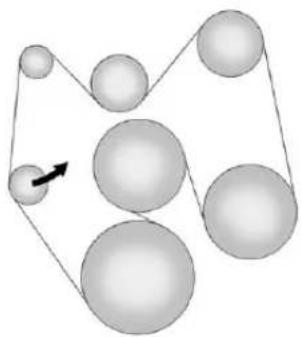
natural_image
Diagram of interconnected spheres with a directional arrow, no text or symbols presentV6Engines
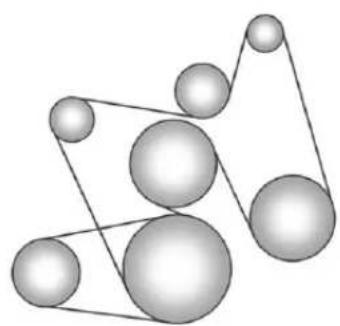
natural_image
Abstract geometric diagram of interconnected spheres with connecting lines (no text or symbols)V8Engines
If the vehicle has diesel engine, seethe Duramax diesels supplement formoreinformation.
12-6 TechnicalData
NOTES
Customer Information
CustomerInformation
CustomerSatisfaction
Procedure(U.S.and
Canada)....13-1
CustomerSatisfaction
Procedure(Mexico)......13-3
CustomerAssistanceOffices
(U.S.andCanada)......13-5
CustomerAssistanceOffices
(Mexico)....13-6
CustomerAssistanceforText
Telephone(TTY)Users(U.S.
andCanada)....13-6
OnlineOwnerCenter......13-7
GMMobilityReimbursement
Program(U.S.and
Canada)....13-8
Roadside Assistance Program
(U.S.andCanada)......13-8
Roadside Assistance
Program(Mexico)......13-10
SchedulingService
Appointments(U.S.and
Canada)....13-13
CourtesyTransportation
Program(U.S.and
Canada)....13-14
CollisionDamageRepair
(U.S.andCanada)......13-15
ServicePublications
Ordering Information.....13-18
ReportingSafetyDefects
ReportingSafetyDefectsto
theUnitedStates
Government......13-19
ReportingSafetyDefectsto
theCanadian
Government......13-19
Reporting Safety Defectsto
GeneralMotors......13-20
VehicleDataRecordingand Privacy
VehicleDataRecordingand
Privacy....13-20
EventDataRecorders.....13-20
OnStar ^® ......13-21
NavigationSystem......13-22
RadioFrequency
Identification(RFID)......13-22
RadioFrequency
Statement......13-22
CustomerInformation
CustomerSatisfaction Procedure(U.S.and Canada)
Yoursatisfactionandgoodwillare importanttoyourdealerando Chevrolet.Normally,anyconcerns withthesaletransactionorthe operationofthevehiclewillbe resolvedbyyourdealer'ssalesor servicedepartments.Sometimes, however,despitethebestintentions ofallconcerned,misunderstandings canoccur.Ifyourconcernhasnot beenresolvedoyoursatisfaction, thefollowingstepsshouldbetaken:
STEPONE: Discuss your concern with a member of dealership management. Normally, concerns can be quickly resolved at that level. If them matter has already been reviewed with the sales, service, or parts manager, contact the owner of your dealership or the general manager.
13-2 Customer Information
STEPTWO: If after contacting a member of dealership management, it appears your concern cannot be resolved by your dealership without further help, in the U.S., call the Chevrolet Customer Assistance Center at 1-800-222-1020. In Canada, call General Motors of Canada Customer Care Centreat 1-800-263-3777 (English), or 1-800-263-7854 (French).
Weencourageyoutocallthe toll-freenumberinordertogiveyour inquirypromptattention.Havethe followinginformationavailableto givetheCustomerAssistance representative:
- VehicleIdentification Number(VIN). This is available from the vehicleregistration or title, or the plate at the top of the instrument panel and visible through the windshield.
• Dealershipnameandlocation.
• Vehicledeliverydate and presentmileage.
When contacting Chevrolet, remember that your concern will likely be resolved at a dealer's facility. That is why we suggest following Step One first.
STEPTHREE—U.S.Owners: BothGeneralMotorsandyour dealerarecommittedtomaking sureyouarecompletely satisfied withyournewvehicle. However, ifyoucontinuetoremainunsatisfied afterfollowingtheprocedure outlinedinStepsOneandTwo,you canfilewiththeBetterBusiness Bureau(BBB)AutoLine ^® Program toenforceyourrights.
TheBBBAutoLineProgramisan out-of-courtprogramadministered bytheCouncilofBetterBusiness Bureaustosettleautomotive disputesregardingvehiclerepairsor theinterpretationoftheNewVehicle LimitedWarranty.Althoughyoumay berequiredtoresorttothisinformal disputereresolutionprogrampriorto filingacourtaction,useofthe programisfreeofchargeandyour
casewillgenerallybeheardwithin 40days.Ifyoudonotagreewiththe decisiongiveninyourcase,you mayrejectitandproceedwithany othervenueforreliefavailable toyou.
YoumaycontacttheBBBAutoLine Programusingthetoll-free telephonenumberorwritethemat thefollowingaddress:
BBBAutoLineProgram CouncilofBetterBusiness Bureaus,Inc. 4200WilsonBoulevard Suite800 Arlington,VA22203-1838
Telephone:1-800-955-5100 www.dr.bbb.org/goauto
Thisprogramisavailableinall 50statesandtheDistrictof Columbia. Eligibilityislimitedby vehicleage, mileage, and other factors. General Motorsreserves therighttochangeeligibility limitationsand/ordiscontinueits participationinthisprogram.
STEPTHREE—Canadian
Owners: In the event that you do not feel your concern have been addressed after following the procedure outlined in Steps One and Two, General Motors of Canada Limited wants to out be aware of participation in nano-charge Mediation/Arbitration Program. General Motors of Canada Limited has committed to binding arbitration of owner disputes involving factory-related vehicle service claims. The program provides for the review of the facts involved by an impartial third party arbiter, and may include an informal hearing before the arbiter. The program is designed so that the entire dispute settlement process, from the time you file your complaint to the final decision, should be completed in about 70 days. We believe our impartial program offers advantages over courts in most jurisdictions because it is informal, quick, and free of charge.
For further information concerning eligibility in the Canadian Motor Vehicle Arbitration Plan (CAMVAP), call toll-free 1-800-207-0685, or call the General Motors Customer Care Centre, 1-800-263-3777 (English), 1-800-263-7854 (French), or writeto:
TheMediation/ArbitrationProgram c/oCustomerCareCentre GeneralMotorsofCanadaLimited MailCode:CA1-163-005 1908ColonelSamDrive Oshawa,OntarioL1H8P7
Yourinquiryshouldbeaccompanied bytheVehicleIdentification Number(VIN).
CustomerSatisfaction Procedure(Mexico)

text_image
GM Garantía PLUSDidyougettheWarrantyExtension Plan?Thisplanisrecommendedby GeneralMotorstosupplementthe warrantyincludedwiththenew vehiclepurchase.
Seeyourdealerfordetails.
13-4 Customer Information
CustomerAssistance Procedure
Ownersatisfactionandgoodwillare veryimportanttoyourdealerand GeneralMotors.
Normally, any problem with the transaction, sale, or usage of the vehicle must be handled by your dealersalesorservicedepartments. However, were cognizethat despite the good intention so fall parties involved, sometimes a misunderstanding may occur.
If you have a problem that has not been satisfactorily handled through then normal means, we suggest the following steps:
STEPONE
Explainyourcasetoyourdealer serviceagent,servicemanager, dealersalesagent,orsales manager,dependingonyourcase.
Makesurethattheyhaveall necessaryinformation.Theyare interestedinyourcontinual satisfaction.
STEPTWO
If you are not satisfied, please contact the general manager your dealership owner to ask for their help. If they are not able to resolve your case, ask them to contact the right people at General Motors for support, if needed.
STEPTHREE
If your case is not resolved in reasonable amount to time by your dealer, please call the General Motors Customer Assistance Center (CAC) and provide the following information:
- Name
- Address
- Phonenumber
- Modelyear
-
Brand
• VehicleIdentification Number(VIN) -
Mileage
- Deliverydate
• Descriptionoftheproblem - Dealershipname
- Dealershipaddress
See Customer Assistance Offices (U.S. and Canada) on page 13-5 or Customer Assistance Offices (Mexico) on page 13-6 form more information.
CustomerAssistance Offices(U.S.andCanada)
Chevroletencouragescustomers tocallthetoll-freenumberfor assistance. However, if customer wishestowriteore-mail Chevrolet, the letters should be addressed to:
UnitedStates
ChevroletMotorDivision
ChevroletCustomer
AssistanceCenter
P.O.Box33170
Detroit, MI48232-5170
www.Chevrolet.com
1-800-222-1020
1-800-833-2438(ForText
TelephoneDevices(TTYs))
Roadside Assistance:
1-800-243-8872
FromPuertoRico:
1-800-496-9992(English)
1-800-496-9993(Spanish)
From U.S. Virgin Islands:
1-800-496-9994
Canada
General Motors of Canada Limited
CustomerCareCentre,
MailCode:CA1-163-005
1908ColonelSamDrive
Oshawa,OntarioL1H8P7
www.gm.ca
1-800-263-3777(English)
Mexico, Central America, and Caribbean Islands/Countries (Except Puerto Rico and U.S. Virgin Islands)
General Motors de Mexico, S. de
R.L.deC.V.
CustomerAssistanceCenter
13-6 Customer Information
CustomerAssistance Offices(Mexico)
TocontacttheCustomer AssistanceCenter(CAC),use thephonenumberslistedinthis section.Customerassistanceis availableMondaythroughFriday, 08:00to20:00hours,and Saturdaysfrom08:00to 15:00hours.
Alle-mailinquiriestotheCustomer AssistanceCenter(CAC)shouldbe sentto:cac.chevrolet@gm.com.
Mexico
FromMexicoCity
5329-0811
FromOtherMexicoLocations
01-800-466-0811
UnitedStatesandCanada
1-866-466-8190
CostaRica
00-800-052-1005
Guatemala
1-800-999-5252
Panama
00-800-052-0001
DominicanRepublic
1-888-751-5301
EISalvador
800-6273
Honduras
800-0122-6101
CustomerAssistancefor TextTelephone(TTY) Users(U.S.andCanada)
Toassistcustomerswhoaredeaf, hardofhearing,orspeech-impaired andwhouseTextTelephones (TTYs),ChevroletthasTTY equipmentavailableatitsCustomer AssistanceCenter.AnyTTYuserin theU.S.cancommunicatewith Chevroletbydialing: 1-800-833-2438.TTYusersin Canadacandial1-800-263-3830.
OnlineOwnerCenter
ChevroletOwnerCenter(U.S.) www.chevyownercenter.com
Information and services customized for your specific vehicle—all in one convenient place.
• Digitalownermanual, warranty information, and more.
• Storageforonlineservice and maintenancerecords.
• Chevroletdealerlocator for servicenationwide.
• Exclusiveprivilegesandoffers.
- Recallnoticesforyourspecific vehicle.
• OnStarandGMCardmember ServicesEarningssummaries.
OtherHelpfulLinks
Chevrolet—www.chevrolet.com
ChevroletMerchandise—www.chevymall.com
HelpCenter—www.chevrolet.com/pages/mds/helpcenter/faq.do
- FAQ
- ContactUs
MyGMCanadawww.gm.ca
MyGMCanadaisa password-protectedsectionof www.gm.cawhereyoucansave informationonGMvehicles,get personalizedoffers,andusehandy toolsandformswithgreaterase.
Hereareafewofthevaluabletools andservicesyouwillhave accessto:
• MyShowroom: Findandsave informationonvehiclesand currentoffersinyourarea.
• MyDealers: Savedetailssuch asaddressandphonenumber foreachofyourpreferred GMdealers.
- MyDriveway:Accessquicklinks topartsandserviceestimates, checktrade-invalues, orscheduleaservice appointmentbyaddingthe vehiclesyouowntoyour drivewayprofile.
• MyPreferences: Manage your profile and set tools and forms with greater ease.
Tosignup, visit the My GM.ca section within www.gm.ca.
GMMobility ReimbursementProgram (U.S.andCanada)
GM MOBILITY
Thisprogramisavailableto qualifiedapplicantsforcost reimbursementofeligible aftermarketadaptiveequipment requiredforthevehicle,suchas handcontrolsorawheelchair/ scooterliftforthevehicle.
Formoreinformationonthelimited offer,visitwww.gmmobility.comor calltheGMMobilityAssistance Centerat1-800-323-9935. TextTelephone(TTY)users, call1-800-833-9935.
General Motors of Canada also has a Mobility Program. Call 1-800-GM-DRIVE(463-7483) for details. TTY users call 1-800-263-3830.
Roadside Assistance Program(U.S.and Canada)
For U.S.-purchased vehicles, call 1-800-243-8872; (TextTelephone(TTY): 1-888-889-2438).
For Canadian-purchased vehicles, call 1-800-268-6800.
Serviceisavailable24hoursaday, 365daysayear.
CallingforAssistance
WhencallingRoadsideAssistance, havethefollowinginformation ready:
- Yourname,homeaddress,and hometelephonenumber.
• Telephonenumberofyour location.
- Locationofthevehicle.
• Model, year, color, and license platenumberofthevehicle.
- Odometerreading, Vehicle IdentificationNumber(VIN), and deliverydateofthevehicle.
• Descriptionoftheproblem.
Coverage
Servicesareprovidedupto5years/160000km(100,000mi),whichever comesfirst.
IntheU.S.,anyonedrivingthe vehicleiscovered.InCanada,a persondrivingthevehiclewithout permissionfromtheownerisnot covered.
RoadsideAssistanceisnotapartof theNewVehicleLimitedWarranty. ChevroletandGeneralMotors of CanadaLimitedreservetheright to makeanychangesordiscontinue theRoadsideAssistanceprogramat anytimewithoutnotification.
Chevrolet and General Motors of Canada Limited reserved to its services or payment to owner or driver if they decide the claims are made too often, or the same type of claim is made many times.
ServicesProvided
• EmergencyFuelDelivery: Deliveryofenoughfuelforthe vehicletogettothenearest servicestation.
- Lock-OutService:Serviceto unlockthevehicleifyouare lockedout.Aremoteunlockmay beavailableifyouhaveOnStar. Forsecurityreasons,thedriver mustpresentidentification beforethisserviceisgiven.
- EmergencyTowFromaPublic RoadorHighway:Towtothe nearestChevroletdealerfor warrantyservice,orifthevehicle wasinacrashandcannotbedriven.Assistanceisalsogiven whenthevehicleisstuckinthe sand,mud,orsnow.
- FlatTireChange:Serviceto changeaflattirewiththespare tire. Thesparetire, ifequipped, mustbeingoodconditionand properlyinflated. Itistheowner's responsibilityfortherepairor replacementofthetireifitisnot coveredbythewarranty.
- BatteryJumpStart:Serviceto jumpstartadeadbattery.
ServicesNotIncludedin RoadsideAssistance
- Impoundtowingcausedby violationofanylaws.
- Legalfines.
- Mounting, dismounting, or changing of snowtires, chains, or other traction devices.
- Towingorservicesforvehicles drivenonanon-publicroador highway.
ServicesSpecifictoCanadian PurchasedVehicles
- FuelDelivery:Reimbursement is approximately \$5Canadian. Dieselfueldeliverymaybe restricted. Propaneandother fuelsarenotprovidedthrough thisservice.
- Lock-OutService: Vehicle registration is required.
- TripRoutingService:Detailed mapsofNorthAmericaare providedwhenrequestedeither withthemostdirectrouteorthe mostscenicroute.Thereisa limitofsixrequestsperyear. Additionaltravelinformationis alsoavailable.Allowthree weeksfordelivery.
13-10 Customer Information
- TriplInterruptionBenefitsand Assistance:Mustbeover 250kilometersfromwhereyour tripwasstartedtoqualify. General Motors of Canada Limited requires pre-authorization, original detailedreceipts, andacopy of therepairorders. Once authorization has been received, the Roadside Assistance advisor will help to make arrangements and explain how to receive payment.
- AlternativeService: Ifassistancecannotbeprovided rightaway,theRoadside Assistanceadvisormay givepermissiontogetlocal emergencyroadservice.Youwill receivepayment,upto\$100, aftersendingtheoriginalreceipt toRoadsideAssistance. Mechanicalfailuresmaybe covered,howeveranycostfor partsandlaborforrepairsnot coveredbythewarrantyarethe ownerresponsibility.
Roadside Assistance Program(Mexico)
Asanewowner,yourvehicleis automaticallyenrolledinthe RoadsideAssistanceprogram. Theservicesareavailableatno costunderthetermsandconditions oftheprogram.TheRoadside Assistanceprogramisnotpartof, orincluded,inthecoverage providedbythenewvehicle limitedwarranty.
Roadside Assistance provides assistance to the driver and passengers while driving the vehicle within your city of residence or on any passableroad in Mexico, the United States, and Canada. Services are subject to the limitations described in the following pages. Program coverage varies by country.
Roadside Assistance is available 24 hours, day, 365 days of the year.
This program expires two years from the date of the invoice for the vehicle, regardless of vehicle mileage and changes in vehicle ownership.
Formoreinformationaboutthe renewalofthisprogramattheend ofitsterm,contacttheChevrolet CustomerAssistanceCenterat 01-800-466-0800.
ServicesProvided
- FlatTireChange:Ifunableto changeaflattire,Roadside Assistancewillprovidetowing servicetothenearestauthorized Chevroletdealership.Itisthe owner'sresponsibilityforthe repairorreplacementofthetire. Thisserviceislimitedtothe transferofthevehicletotherpairfacility.
• EmergencyFuelDelivery: Deliveryofenoughfuelforthe vehicletogettothenearest servicestation.
- Lock-OutService:Serviceto unlockthevehicleifyouare lockedout.
- BatteryJumpStart:Serviceto jumpstartadeadbattery.
• *EmergencyMessages: Transmissionofurgentphone messages.
• *EmergencyCalls:Callfor emergencyservices.
• *DealershipLocation Assistance: Information regarding addresses and telephonenumbers for Chevroletdealers.
- EmergencyTowing: Towtothe nearestdealerforwarranty serviceifthevehiclecannot bedriven.
If the vehicle is involved in an accident during the commission of acrime, administrative
violation, orbreachoftraffic regulations, Roadside Assistance will not provide service. Whenthevehicle is not accessible to be towed, all maneuvers required to access it will beat the owner's expense.
Ifthevehicleisinanothercity outsideofyourresidence, RoadsideAssistanceislimited to movingthevehicletoth nearestdealer.Ifyouwouldlike thevehiclemovedtoadifferent dealer,youwillbeaskedto coverthedifferenceincostat thetimeofthemove.
Ifthevehiclecannotbereceived bythenearestChevroletdealer duetoschedulingconflicts,the vehiclewillbetakentoasafe placewhereitwillremainforup to48hoursuntilcanbetaken tothedealer.Ifthestoragecosts exceedtheamountauthorized, theownerisresponsibletopay thedifferenceatthetimeof
service.ContactRoadside Assistanceformoreinformation onauthorizedamounts.
- *TriplInterruption: This service is provided if you are prevented from further usage of your vehicle while traveling and it is not possible for the nearest Chevrolet dealership to repair the vehicle, requiring the vehicle to stay at the dealership for an eightor more. If this happens, in addition to the previously listed services and prior to confirmation by the dealership, you are entitled to choose one of the following alternatives, within the limit of existing Roadside Assistance program guidelines. If the costs exceed the amount authorized for these services, you must pay the difference at the time of service.
Roadside Assistance will coordinate hotel accommodations for all vehicle travelers foruptotwonights.
13-12 Customer Information
Arentalcarwillbeprovidedfor uptotwodaysandthevehicle mustbereturnedtoitsoriginal destination,excludingvehicles withacarryingcapacitygreater than3.5tons.
Complimentary Transportation: If you prefer to continue your trip to the intended destination or return to your place of residence, and the tripe requires more than eight hours driving on theroad, transportation for the driver and passengers by first class bus or coach commercial airlinewill be provided to a location chosen by Roadside Assistance, depending on availability at the chosen destination. Restrictions apply based on vehicle specifications.
If you are on the road, taxi servicetothenearest bus station or airport will be provided.
- *Complimentary TransportationforVehicle PickUp:Transportationtopick upyourvehicleafterrepairsare complete.Oncethedealerhas reportedthatthevehiclehas beenrepaired,Roadside Assistancewillprovidebusor commercialairlineone-way service(subjecttoavailability) forthepersondesignatedbyyou tocollectyourvehicleatthe dealership'slocationifyouorthe designatedpersonarenotinthe sametownorcityasthe dealership.
*Theseservicesarenotprovided for U.S. or Canadaresidents. All services provided in the U.S. and Canada are at the owner's expense and will bereimbursed by Roadside Assistance.
ServicesNotIncludedinRoadside Assistance
RoadsideAssistancedoesnot coverorreimburseservicesforthe following:
• Eventscausedbyfraudorbad faithbythedriver.
- Vehicleimmobilizationsituations duetoamajorforceor unforeseencircumstances, such as naturalphenomenaofan extraordinarynature, earthquakes, volcaniceruptions, andothercyclonicstorms.
- Vehicleimmobilizationsituations arising from car accidents caused by the driver of the vehicle or third parties. This means any occurrence that causes physical injury to the occupants and/or the vehicle caused by external forces.
- Actsofterrorism, riotoruproar, armedforcesorpoliceactions which preventtimelydelivery of assistance services.
- Foodservice,beverages, telephonecalls,orotherextra costs.Accommodationcosts applyonlytoMexicoperthe termsandconditionsofthe RoadsideAssistanceprogram.
- Anydamagetothevehicle withoutintent,derivedfromthe servicesprovided.
- Costoftowingatrailerwhen choosingaChevroletdealerthat isnearesttothetemporary storagefacilityforthedisabled vehicle.
- Costofallmaneuversrequired toaccessthevehiclewhenitis notavailabletobetowed.
- Costoffuelprovided.
Routinevehiclerepaircostsare notcoveredbytheRoadside Assistanceprogram.Formore information,seeyournewvehicle warranty.
ContactingRoadsideAssistance
RoadsideAssistanceservices areofnocosttoyouandavailable 24hoursaday,365daysayear. Costsareonlyincurredinsituations thatexceedthelimitsofthe program,someofwhicharelisted previouslyinthissection.
TocontactRoadsideAssistanceby phone, usethefollowingnumbers:
Mexico
01-800-466-0800
UnitedStates
1-866-466-8901
Canada
1-800-268-6800
Chevroletreservestherighttomake anychangesordiscontinuethe RoadsideAssistanceprogramat anytimewithoutnotification.
SchedulingService Appointments(U.S.and Canada)
Whenthevehiclerequireswarranty service,contactyourdealerand requestanappointment.By schedulingaserviceappointment andadvisingtheserviceconsultant ofyourtransportationneeds,your dealercanhelpminimizeyour inconvenience.
If the vehicle cannot be scheduled into the serviced department immediately, keep driving it until it can be scheduled for service, unless, of course, the problem is safety related. Ifitis, please call your dealership, let them know this, and ask for instructions.
If your dealer requests you to bring the vehicle for service, you are urged todos to easily in the work day as possible to allow for same day-repair.
Courtesy Transportation Program(U.S. and Canada)
Toenhanceyourownership experience,weandourparticipating dealersareproudtoofferCourtesy Transportation,acustomersupport programforvehicleswiththe Bumper-to-Bumper(BaseWarranty CoverageperiodinCanada), extendedpowertrain,and/or hybrid-specificwarrantiesinboth theU.S.andCanada.
The Courtesy Transportation program is no longer available for cutaway vehicles.
SeveralCourtesyTransportation optionsareavailabletoassistin reducinginconveniencewhen warrantyrepairsarerequired.
Courtesy Transportation is not a part of the New Vehicle Limited Warranty. A separate booklet entitled "Warranty and Owner Assistance Information" furnished
witheachnewvehicleprovides detailedwarrantycoverage information.
TransportationOptions
Warrantyservicecangenerallybe completedwhileyouwait.However, ifyouareunabletowait,GMhelps tominimizeinconvenienceby providingseveraltransportation options.Dependingonthe circumstances,yourdealercan offeroneofthefollowing:
ShuttleService
Shuttleserviceisthepreferred meansofofferingCourtesy Transportation.Dealersmayprovide shuttleservicetogetyoutoyour destinationwithminimalinterruption ofyourdailyschedule.Thisincludes one-wayorround-tripshuttleservice withinreasonabletimeanddistance parametersofyourdealer'sarea.
PublicTransportationorFuel Reimbursement
If the vehiclerequires overnight warranty repairs, and public transportation is used instead of your dealer's shuttleservice, the expense must be supported by original receipts and can only be up to them maximum amount allowed by GM for shuttleservice. In addition, for U.S. customers, should you arrangetransportation through a friend or relative, limited reimbursement for reasonable fuel expenses may be available. Claim amount should reflect actual costs and be supported by original receipts. See your dealer for information regarding the allowance amounts for reimbursement off fuel or other transportation costs.
CourtesyRentalVehicle
Yourdealermayarrangetoprovide youwithacourtesyrentalvehicleor reimburseyouforarentalvehicle thatyouobtainifthevehicleiskept foranovernightwarrantyrepair. Rentalreimbursementwillbelimited andmustbesupportedbyoriginal receipts. Thisrequiresthatyousign andcompletearentalagreement andmeetstate/provincial,local,and rentalvehicleproviderrequirements. Requirementsvaryandmay includeminimumagerequirements, insurancecoverage,creditcard,etc. Youareresponsibleforfuelusage chargesandmayalsobe responsiblefortaxes,levies, usagefees,excessivemileage, orrentalusagebeyondthe completionoftherepair.
Itmaynotbepossibletoprovide a likevehicleasacourtesyrental.
AdditionalProgram Information
Allprogramoptions,suchasshuttle service,maynotbeavailableat everydealer.Pleasecontactyour dealerforspecificinformation aboutavailability.AllCourtesy Transportationarrangementswillbe administeredbyappropriatedealer personnel.
General Motors reserve theright to unilaterally modify, change, or discontinue Courtesy Transportation at any time and to resolve all question sof claim eligibility pursuant to the terms and conditions described herein at its solediscretion.
CollisionDamageRepair (U.S.andCanada)
If the vehicle is involved in a collision and it is damaged, have the damage repaired by a qualified technician using the proper equipment and quality replacement parts. Poorly performed collision repairs diminish the vehicular resale value, and safety performance can be compromised in subsequent collisions.
CollisionParts
GenuineGMCollisionpartsarenew partsmadewiththesamematerials andconstructionmethodsasthe partswithwhichthevehiclewas originallybuilt.GenuineGM Collisionpartsarethebestchoiceto ensurethatthevehicle'sdesigned appearance,durability,andsafety arepreserved.TheuseofGenuine GMpartscanhelpmaintaintheGM NewVehicleLimitedWarranty.
Recycledoriginalequipmentparts mayalsobeusedforrepair. These partsaretypicallyremovedfrom vehiclesthatweretotallossesin priorcrashes.Inmostcases,the partsbeingrecycledarefrom undamagedsectionsofthevehicle. ArecycledoriginalequipmentGM partmaybeanacceptablechoiceto maintainthevehicle'soriginally designedappearanceandsafety performance;however,thehistoryof thesepartsisnotknown.Suchparts arenotcoveredbytheGMNew VehicleLimitedWarranty,andany relatedfailuresarenotcoveredby thatwarranty.
Aftermarketcollisionpartsarealso available. Thesearemadeby companiesotherthanGMandmay nothavebeentestedforthevehicle. Asaresult, thesepartsmayfit poorly, exhibitprematuredurability/corrosionproblems, and may not performproperlyinsubsequent collisions. Aftermarketpartsarenot covered by the GMNewVehicle
Limited Warranty, and any vehicle failurerelated to such parts is not covered by that warranty.
RepairFacility
GMalsorecommendsthatyou chooseacollisionrepairfacilitythat meetsyourneedsbeforeyouever needcollisionrepairs. Yourdealer mayhaveacollisionrepaircenter withGM-trainedtechniciansand state-of-the-artequipment,orbe abletorecommendacollisionrepair centerthathasGM-trained techniciansandcomparable equipment.
InsuringtheVehicle
ProtectyourinvestmentintheGM vehiclewithcomprehensiveand collisioninsurancecoverage.There aresignificantdifferencesinthe qualityofcoverageaffordedby variousinsurancepolicyterms. Manyinsurancepoliciesprovide reducedprotectiontotheGM vehiclebylimitingcompensationfor
damagerepairsbyusing aftermarketcollisionparts. Some insurance companies will not specify aftermarket collisionparts. When purchasing insurance, we recommend that you ensure that the vehicle will berepaired with GM originalequipment collisionparts. If such insurance coverage is not available from your current insurance carrier, considers switching to another insurance carrier.
Ifthevehicleisleased,theleasing companymayrequireyoutohave insurancethatensuresrepairswith GenuineGMOriginalEquipment Manufacturer(OEM)partsor GenuineManufacturerreplacement parts.Readtheleasecarefully,as youmaybechargedattheendof theleaseforpoorqualityrepairs.
IfaCrashOccurs
If there has been an injury, call emergencies services for help. Donot leavethescene of acrash until all matters have been taken care of.
CustomerInformation13-17
Movethevehicleonlyifitsposition putsyouindanger,oryouare instructedtomoveitbyapolice officer.
Giveonlythenecessaryinformation topoliceandotherpartiesinvolved inthecrash.
Foremergencytowingsee RoadsideAssistanceProgram(U.S. andCanada)onpage13-8or RoadsideAssistanceProgram (Mexico)onpage13-10.
Gatherthefollowinginformation:
- Drivename, address, and telephonenumber.
• Driverlicensenumber. - Ownername, address, and telephonenumber.
• Vehiclelicenseplatenumber.
• Vehiclemake, model, and modelyear.
• VehicleIdentification Number(VIN).
• Insurancecompanyandpolicy number.
- Generaldescriptionofthe damagetotheothervehicle.
Choose areputablerepairfacility that uses quality replacement parts. See "Collision Parts" earlier in this section.
If the airbag has inflated, see What Will You See after an Airbag Inflates? on page 3-24.
ManagingtheVehicleDamage RepairProcess
Intheeventthatthevehiclerequires damagerepairs, GMrecommends thatyoutakeanactiveroleinits repair. If you have apre-determined repair facility of choice, takethe vehicle there, or have it towed there. Specify to the facility that any required replacement collision parts be originalequipment parts, either new Genuine GM parts or recycled original GM parts. Remember, recycled part will not be covered by the GM vehicle warranty.
Insurancepaysthebillfortherepair, butyoumustlivewiththerepair. Dependingonyourpolicylimits, yourinsurancecompanymay initiallyvaluetherepairusing aftermarketparts.Discussthiswith therepairprofessional,andinsiston GenuineGMparts.Remember, ifthevehicleisleased,youmaybe obligatedtohavethevehicle repairedwithGenuineGMparts, evenifyourinsurancecoverage doesnotpaythefullcost.
Ifanotherparty'sinsurance companyispayingfortherepairs, youarenotobligatedtoaccepta repairvaluationbasedonthat insurancecompany'scollisionpolicy repairlimits,asyouhaveno contractuallimitswiththatcompany. Insuchcases,youcanhavecontrol oftherepairandpartschoicesas longasthecoststayswithin reasonablelimits.
ServicePublications OrderingInformation
ServiceManuals
ServiceManualshavethediagnosis andrepairinformationonthe engines,transmission,axle, suspension,brakes,electrical, steering,body,etc.
ServiceBulletins
ServiceBulletinsgiveadditional technicalserviceinformation neededtoknowledgeablyservice GeneralMotorscarsandtrucks. Eachbulletincontainsinstructions toassistinthediagnosisand serviceofthevehicle.
OwnerInformation
Ownerpublicationsarewritten specificallyforownersandintended toprovidebasicoperational informationaboutthevehicle.
TheOwnerManualincludesthe MaintenanceScheduleforall models.
In-Portfolio: IncludesaPortfolio, OwnerManual,and Warranty Booklet.
RETAILSELLPRICE: \$35.00(U.S.) plushandlingand shippingfees.
WithoutPortfolio:Owner Manualonly.
RETAILSELLPRICE: \$25.00(U.S.) plushandlingand shippingfees.
CurrentandPastModels
TechnicalServiceBulletinsand Manualsareavailableforcurrent andpastmodelGMvehicles.
ORDERTOLLFREE:
1-800-551-4123Monday-Friday 8:00AM-6:00PMEasternTime
ForCreditCardOrdersOnly (VISA-MasterCard-Discover), visitHelm, Inc. at: www.helminc.com.
Orwriteto:
Helm, Incorporated P.O.Box07130 Detroit, MI48207
Pricesaresubjecttochange withoutnoticeandwithout incurringobligation.Allowample timefordelivery.
All listed prices are quoted in U.S. funds. Make checks payable in U.S. funds.
ReportingSafety Defects
ReportingSafetyDefects totheUnitedStates Government
If you believethat your vehicle has a defect which could cause acrashor could cause injury or death, you should immediately inform the National Highway Traffic Safety Administration (NHTSA) in addition to notifying General Motors.
IfNHTSAreceivessimilar complaints,itmayopenan investigation,andifitfindsthat asafetydefectexistsina groupofvehicles,itmayorder arecallandremedycampaign.
However, NHTSA cannot become involved in individual problems between you, your dealer, or General Motors.
TocontactNHTSA,youmay calltheVehicleSafetyHotline toll-freeat1-888-327-4236 (TTY:1-800-424-9153);goto http://www.safercar.gov;or writeto:
Administrator, NHTSA 1200 New Jersey Avenue, S.E. Washington, D.C. 20590
Youcanalsoobtainother informationaboutmotor vehiclesafetyfrom http://www.safercar.gov.
ReportingSafetyDefects totheCanadian Government
IfyouliveinCanada, and you believethatthevehiclehasasafety defect, notify Transport Canada immediately, and notify General Motors of Canada Limited. Call Transport Canada at 1-800-333-0510 or writeto:
TransportCanada
RoadSafetyBranch
80rueNoel
Gatineau, QCJ8Z0A1
ReportingSafetyDefects toGeneralMotors
InadditiontonotifyingNHTSA (orTransportCanada)inasituation likethis,notifyGeneralMotors.
Call1-800-222-1020, orwrite:
ChevroletMotorDivision
ChevroletCustomer
AssistanceCenter
P.O.Box33170
Detroit, MI48232-5170
InCanada, call
1-800-263-3777(English)or
1-800-263-7854(French), orwrite:
General Motors of Canada Limited
CustomerCareCentre
MailCode:CA1-163-005
1908ColonelSamDrive
Oshawa,OntarioL1H8P7
VehicleData Recordingand Privacy
ThisGMvehiclehasanumberof sophisticatedcomputersthatrecord informationaboutthevehicle's performanceandhowitisdriven. Forexample,thevehicleuses computermodulestomonitorand controlengineandtransmission performance,tomonitorthe conditionsforairbagdeployment anddeployairbagsinacrash,and, ifsoequipped,topprovideantilock brakingtohelpthedrivercontrolthe vehicle. Thesemodulesmaystore datatohelpyourdealertechnician servicethevehicle.Somemodules mayalsostoredataabouthowyou operatethevehicle,suchasrateof fuelconsumptionoraveragespeed. Thesemodulesmayalsoretainthe owner'spersonalpreferences,such asradiopresets,seatpositions,and temperaturesettings.
EventDataRecorders
ThisvehiclehasanEventData Recorder(EDR). Themainpurpose of an EDRistorecord, incertain crashnearcrash-likesituations, such as an airbag deploymentor hitting a road obstacle, data that will assist in understanding how a vehicle's systems performed. The EDR is designed to record data related to vehicled dynamics and safety systems for a short period of time, typically 30 seconds or less. The EDR in this vehicle is designed to record such data as:
• Howvarioussystemsinthe vehiclewereoperating.
- Whetherornotthedriverand passengersafetybeltswere buckled/fastened.
- Howfar, ifatall, thedriver was pressing the accelerator and/or brake pedal.
• Howfastthevehiclewas traveling.
This data can help provide better understanding of the circumstances in which crashes and injuries occur.
Important:EDRdataisrecorded bythevehicleonlyifanon-trivial crashesituationoccurs;nodatais recordedbytheEDRundernormal drivingconditionsandnopersonal data(e.g.,name,gender,age, andcrashlocation)isrecorded. However,otherparties,suchas lawenforcement,couldcombine theEDRdatawiththetypeof personallyidentifyingdata routinelyacquiredduringacrash investigation.
ToreadatarecordedbyanEDR, specialequipmentisrequired, and accesstothevehicleortheEDRis needed. In additiontothevehicle manufacturer, otherparties, suchas
lawenforcement,thathavethe specialequipment,canreadthe informationiftheyhaveaccessto thevehicleortheEDR.
GMwillnotaccessthisdataor shareitwithothersexcept:withthe consentofthevehicleowner, ifthevehicleisleased, withthe consentofthelessee;inresponse toanofficialrequestbypoliceor similargovernmentoffice;aspartof GM'sdefenseoflitigationthrough thediscoveryprocess;or, as requiredbylaw.DatathatGM collectsorreceivesmayalsobe usedforGMresearchneedsormay bemadeavailabletoothersfor researchpurposes,whereaneedis shownandthedataisnottiedtoa specificvehicleorvehicleowner.
OnStar®
If the vehicle is equipped with an active On Starsystem, that system may also record data in crash or near crash-likes situations. The On Star Terms and Conditions provides information on data collection and use and is available at www.onstar.com (U.S.) or www.onstar.ca (Canada), or by pressing the button and speaking to an advisor. See On Star Overview page 14-1 form more information.
NavigationSystem
If the vehicle has an navigation system, use of the system may result in the storage of destinations, addresses, telephonenumber, and other trip information. Referto the navigation manual for information on stored data and for deletion instructions.
RadioFrequency Identification(RFID)
RFIDtechnologyisusedinsome vehiclesforfunctionssuchastire pressuremonitoringandignition systemsecurity,aswellasin connectionwithconveniencessuch askeyfobsforremotedoorlocking/unlockingandstarting,and in-vehicletransmittersforgarage dooropeners.RFIDtechnologyin GMvehiclesdoesnotuseorrecord personalinformationorlinkwithany otherGMsystemcontaining personalinformation.
RadioFrequency Statement
This vehiclehassystemsthat operateonaradiofrequencythat complywithPart15oftheFederal CommunicationsCommission(FCC) rulesandwithIndustryCanada StandardsRSS-GEN/210/220/310.
Operationissubjecttothefollowing twoconditions:
- Thedevicemaynotcause harmfulinterference.
- The device must accept any interference received, including interference that may cause undesired operation of the device.
Changesormodificationstoanyof thesesystemsbyotherthanan authorizedservicefacilitycouldvoid authorizationtousethisequipment.
OnStar
OnStarOverview
OnStarOverview......14-1
OnStarServices
Emergency......14-2
Security......14-2
Navigation......14-2
Connections......14-4
Diagnostics......14-5
OnStarAdditionallInformation
OnStarAdditional
Information......14-5
OnStarOverview
Ifequipped, this vehicle has a comprehensive, in-vehiclesystem that can connect to alive Advisor for Emergency, Security, Navigation, Connection, and Diagnostic Services.
TheOnStarsystemstatuslightis nexttotheOnStarbuttons.Ifthe statuslightis:
• SolidGreen:Systemisready.
- FlashingGreen:Onacall.
• Red: Indicatesaproblem.
Push 📄 or call 1-888-4-ONSTAR (1-888-466-7827)tospeaktoan Advisor.
Push 📞to:
• Makeacall, endacall, oransweranincomingcall.
- GiveOnStarHands-FreeCalling voicecommands.
- GiveOnStarTurn-by-Turn Navigationvoicecommands. RequirestheavailableDirections andConnectionsserviceplan.
Push 📄 toconnecttoalive Advisorto:
- Verifyaccountinformationor updatecontactinformation.
• Getdrivingdirections. Requires the available Directions and Connectionsserviceplan. - ReceiveOn-Demand Diagnosticsforacheckonthe vehicle'skeyoperatingsystems.
- ReceiveRoadsideAssistance.
Push togetapriorityconnection toanEmergencyAdvisoravailable 24/7to:
• Gethelpforanemergency.
- BeaGoodSamaritanor respondtoanAMBERAlert.
• Getcrisisassistance and evacuation routes.
OnStarServices
Emergency
WithAutomaticCrashResponse, thebuilt-insystemcanautomatically connecttohelpinacrashevenif youcannotaskforit.
Push ✉toconnecttoan EmergencyAdvisor.GPS technologyisusedtoidentifythe vehiclelocationandcanprovide criticalinformationtoemergency personnel.TheAdvisorisalso trainedtooffercriticalassistancein emergencysituations.
Security
OnStarprovidesserviceslikeStolen VehicleAssistance, Remotelgnition Block, and Roadside Assistance, if the vehicle is equipped with these services. On Starcan unlock the vehicle doors remotely, if it is equipped with automatic door locks, and can help police locate the vehicle if it is stolen.
Navigation
OnStarnavigationrequiresthe DirectionsandConnections serviceplan.
Push Ⓞtoreceiveddirectionsor havethemsenttothevehicle navigationscreen.Destinationscan alsobeforwardedtothevehicle fromGoogleMaps™ or MapQuest.com.TheOnStar mappingdatabaseiscontinuously updated.Visitwww.onstar.comfor coveragemaps.
Turn-by-TurnNavigation
- Push Ⓞ toconnecttoalive Advisor.
- Requestdirections.
- Directions are downloaded to the vehicle.
- Follow the voice-guided commands.
UsingVoiceCommands DuringaPlannedRoute
CancelRoute
- Push 📄. Systemresponds: "OnStarready," thenatone. Say "Cancelroute." System responds: "Wouldyouliketo cancelroutedirectionstoyourdestination?"
- Say "Yes." Systemresponds: "OK, route canceled."
- Say "Goodbye." Exitsvoice commands.
RoutePreview
1.Push 📋. Systemresponds: "OnStarready," thenatone.
2. Say "RoutePreview." Systemrespondswiththe nextthreemaneuvers.
3. Say "Goodbye." Exitsvoice commands.
Repeat
1.Push 📋. Systemresponds: "OnStarready," thenatone.
2. Say "Repeat." System responds with the last direction given, then responds with "OnStarready," then at one.
3. Say "Goodbye." Exitsvoice commands.
GetMyDestination
1.Push 📄. Systemresponds: "OnStarready," thenatone.
2. Say "Getmydestination." Systemrespondswithmilesto thedestination, thenresponds with "OnStarready," thenatone.
3. Say "Goodbye." Exitsvoice commands.
OtherNavigationServices AvailablefromOnStar
OnStareNav: Allowssubscribers tosenddestinationsfromGoogle Maps™ andMapQuest.comto theirTurn-by-TurnNavigationor screen-basednavigationsystem. Whenready,thedirectionswillbe downloadedtothevehicle.
DestinationDownload:
Push, thenrequest the Advisor to download addirections the navigation system in the vehicle. After the callends, push the "Go" button on then navigations screento begin driving directions.
Destinationscanalsobe downloadedonthego. For informationabouteNav, Destination Download, andcoveragemapsvisit www.onstar.com.
Connections
OnStarHands-FreeCallingallows callstobemadeandreceivedfrom thevehicle. Thevehiclecanalsobe controlledfromacellphonethrough theOnStarmobileapp.See www.onstar.comforcoveragemaps.
Hands-FreeCalling
1.Push Systemresponds: "OnStarready."
2. Say "Dial." Systemresponds: "Pleasesaythenameornumber tocall."
3. Saytheentirenumberwithout pausing,includinga"1"andthe areacode.Systemresponds: "OKcalling."
RetrieveMyNumber
1.Push Systemresponds: "OnStarready."
2. Say "MyNumber." System responds: "YourOnStar Hands-FreeCallingnumberis."
EndaCall
Push Systemresponds: "Call ended."
StoreaNameTagforSpeed Dialing
1.Push Systemresponds: "OnStarready."
2. Say "Store." Systemresponds: "Please say thenumber you would like to store."
3. Saytheentirenumberwithout pausing.Systemresponds: "Pleasesaythenametag."
4. Pickanametag. "System responds." Abouttostore
5. Say "Yes" or "No" to try again. Systemresponds: "OK, storing
PlaceaCallUsingaStored Number
1.Push Systemresponds: "OnStarready."
2. Say "Call
VerifyMinutesandExpiration
Push●andsay"minutes"then "verify"tocheckhowmanyminutes remainandtheirexpirationdate.
OnStarMobileApp
WithaniPhone ^® or Android ^™ -basedmobiledevice, anOnStarmobileappcanbe downloaded. The vehicle can be remotestarted, if equipped, or the doors can be unlocked from anywhere there is cell phone service. It can also check the fuel level, tire pressure, and oil life. It can connect to an OnStar Advisor anytime. For OnStarmobileapp compatibility or further information, see www.onstar.com.
Diagnostics
OnStarVehicleDiagnosticswill performvehiclecheckevery month.Itwillchecktheengine, transmission,antilockbrakes,and majorvehiclesystems.Italso checksthetirepressures,ifthe vehicleisequippedwiththeTire PressureMonitoringSystem.Ifa diagnosticscheckisneeded betweene-mails,push ,andan Advisorcanrunacheck.
OnStarAdditional Information
TransferringService
Push@torequestaccounttransfer eligibilityinformation.TheAdvisor canassistincancelingorremoving accountinformation.IfOnStar receivesinformationthatvehicle ownershiphaschanged,OnStar maysendavoicemessagetothe vehicle,requestingupdatedaccount information.
ReactivationforSubsequent Owners
Push®andfollowthepromptsto speaktoanAdvisorassoonas possibleafteracquiringthevehicle. TheAdvisorwillupdatevehicle recordsandwillexplaintheOnStar serviceoffersandoptionsavailable.
HowOnStarServiceWorks
AutomaticCrashResponse, EmergencyServices,CrisisAssist, StolenVehicleAssistance,Vehicle Diagnostics,RemoteDoorUnlock, RoadsideAssistance,Turn-by-Turn Navigation,andHands-FreeCalling areavailableonmostvehicles. NotallOnStarservicesare availableeverywhereoronall vehicles.Formoreinformation,a fulldescriptionofOnStarservices, systemlimitations,and OnStartermsandconditions, seewww.onstar.com(U.S.)or www.onstar.ca(Canada); contactOnStarat1-888-4-ONSTAR (1-888-466-7827)or TTY1-877-248-2080;or push @tospeakwithanAdvisor. OnStarservicesrequireavehicle electricalsystem,wirelessservice, andGPSsatellitetechnologiestobe availableandoperatingforfeatures tofunctionproperly.Thesesystems maynotoperateifthebatteryis dischargedordisconnected.
OnStarservicecannotworkunless yourvehicleisinaplacewhere OnStarhasanagreementwitha wirelessserviceproviderforservice inthatarea,andthewireless serviceproviderhascoverage, networkcapacity,reception,and technologycompatiblewithOnStar's service.Serviceinvolvinglocation informationaboutthevehiclecannot workunlessGPSsignalsare available,unobstructed,and compatiblewiththeOnStar hardware.OnStarservicemaynot workiftheOnStarequipmentisnot properlyinstalledorithasnotbeen properlymaintained.Ifequipmentor softwareisadded,connected, ormodified,OnStarservicemay notwork.Otherproblemsbeyond OnStar'scontrolmayprevent servicesuchashills,tallbuildings, tunnels,weather,electricalsystem designandarchitectureofthe
vehicle, damagetothe vehicleina crash, or wireless phonenetwork congestion or jamming.
SeeRadioFrequencyStatementon page 13-22forinformation regardingPart15oftheFederal CommunicationsCommission(FCC) rulesandIndustryCanada StandardsRSS-GEN/210/220/310.
ServicesforPeoplewith Disabilities
Advisorsprovideservicestohelp subscriberswithphysicaldisabilities andmedicalconditions.
Push 📄 forhelpwith:
- Locatingagasstationwithan attendanttopumpgas.
• Findingahotel,restaurant,etc., thatmeetsaccessibilityneeds.
• Providingdirectionstothe closesthospitalorpharmacyin urgentsituations.
TTYUsers
OnStarhastheabilityto communicatetothedeaf, hard-of-hearing,orspeech-impaired customerswhileinthevehicle. Theavailabledealer-installed TTYsystemcanprovidein-vehicle accesstoalloftheOnStarservices, exceptVirtualAdvisorandOnStar Turn-by-TurnNavigation.
Onstar.com
The website provides access to account information, manages the OnStars subscription, and allows viewing of videos of each service. Get subscription plan pricing and signup for OnStar Vehicle Diagnostics. Click on the "My Account" tab on the homepage.
OnStarPersonalIdentification Number(PIN)
APINisneededtoaccesssomeof theOnStarservices,likeRemote DoorUnlockandStolenVehicle Assistance.Youwillbepromptedto changethePINthefirsttimewhen speakingwithanAdvisor.To changetheOnStarPIN,callOnStar andprovidetheAdvisorwiththe currentnumber.
Warranty
OnStarequipmentmaybe warrantedaspartofthenew-vehicle limitedwarranty. Themanufacturer ofthevehiclefurnishesdetailed warrantyinformation.
Languages
The vehicle can be programmed to respond in French or Spanish.
Push 🟢 andaskanAdvisor. Advisors canspeakFrenchor Spanish.
PotentialIssues
Some OnStarservices are disabled after fivedays. On Star cannot perform Remote Door Unlockor Stolen Vehicle Assistance after the vehicle has been off continuously for fivedays. After fivedays, On Star can contact Roadside Assistance and alocksmith to help gain access to the vehicle.
GlobalPositioning System(GPS)
- ObstructionoftheGPScan occurinlargecitywithtall buildings;inparkinggarages;aroundairports;intunnels, underpasses,orparking garages;orinanareawithvery densetrees.IfGPSsignalsare notavailable,theOnStarsystem shouldstilloperatetocall OnStar.However,OnStarcould havedifficultyidentifyingthe exactlocation.
- Inemergency situations, OnStar canusethelaststoredGPS locationtosendtoemergency responders.
- A temporary lossof GPScan causelossof the ability to send a Turn-by-Turn Navigation route. The Advisormay give averbal route or may ask for a callback after the vehicle is driven into an open area.
CellularandGPSAntennas
Avoidplacingitemsoverornearthe antennatopreventblockingcellular andGPSsignalreception.Cellular receptionisrequiredforOnStarto sendremotesignalstothevehicle.
UnabletoConnecttoOnStar Message
If there is limited cellular coverage or the cellular network has reached maximum capacity, this message may come on. Push to try the call again or try again after driving a few miles into another cellular area.
VehicleandPowerIssues
OnStarservicesrequireavehicle electricalsystem,wirelessservice, andGPSsatellitetechnologiestobe availableandoperatingforfeatures tofunctionproperly. Thesesystems maynotoperateifthebatteryis dischargedordisconnected.
Add-onElectricalEquipment
TheOnStarsystemisintegrated intotheelectricalarchitectureofthe vehicle.Donotaddanyelectrical equipment.SeeAdd-OnElectrical Equipmentonpage9-58.Added electricalequipmentmayinterfere withtheoperationoftheOnStar systemandcauseittonotoperate.
Privacy
ThecompleteOnStarPrivacy Statementmaybefoundat www.onstar.com.Privacy-sensitive usersofwirelesscommunications arecautionedthattheprivacyofany informationsentviawirelesscellular communicationscannotbeassured. Thirdpartiesmayunlawfully interceptoraccesstransmissions andprivatecommunicationswithout consent.
A
Accessoriesand
Modifications......10-3
AccessoryPower......9-21
Add-On Electrical
Equipment....9-58
Additional Information,
OnStar ^® 14-5
AirCleaner/Filter,Engine.....10-16
AirVents....8-8
Airbag
AddingEquipmenttothe
Vehicle....3-35
LightOn-Off....5-18
AirbagSystem
Check....3-37
HowDoesanAirbag
Restrain?......3-24
PassengerSensing
System......3-30
WhatMakesanAirbag
Inflate?......3-23
AirbagSystem(cont'd)
WhatWillYouSeeafteran
AirbagInflates?......3-24
WhenShouldanAirbag
Inflate?......3-22
WhereAretheAirbags?.....3-20
Airbags
On-OffLight....5-18
On-OffSwitch....3-26
PassengerStatusIndicator...5-20
ReadinessLight......5-18
ServicingAirbag-Equipped
Vehicles....3-35
SystemCheck......3-18
All-WheelDrive......10-29,9-33
AM-FMRadio....7-8
Anti-theft
AlarmSystemMessages.....5-40
AntilockBrake
System(ABS)....9-33
WarningLight....5-24
AppearanceCare
Exterior.....10-93
Interior.....10-97
Ashtrays....5-11
AssistanceProgram,
Roadside......13-8,13-10
AudioPlayers......7-13
CD....7-13
AudioSystem
FixedMastAntenna......7-12
RadioReception......7-12
Theft-DeterrentFeature......7-2
Automatic
DoorLocks......2-8
HeadlampSystem......6-4
Automatic
Transmission......9-25,9-28
Fluid....10-11,10-13
ManualMode....9-31
ShiftLockControl
FunctionCheck......10-33
Auxiliary Devices......7-19
Axle, Front......10-30
Axle, Rear.....10-31
B
Battery....10-28
JumpStarting.....10-86
LoadManagement......6-7
PowerProtection......6-8
VoltageandCharging
Messages......5-34
BladeReplacement,Wiper...10-34
Bluetooth....7-24
BrakeSystemWarningLight...5-23
Brakes....10-26
Antilock....9-33
Fluid....10-27
Parking....9-34
SystemMessages......5-34
Braking....9-3
Break-In, NewVehicle......9-16
BulbReplacement......10-40
CenterHigh-Mounted
Stoplamp(CHMSL).....10-39
FrontTurnSignal,
Sidemarker, and
ParkingLamps......10-37
HalogenBulbs.....10-35
BulbReplacement(cont'd)
Headlamps....10-35
LicensePlateLamps.....10-40
Taillamps....10-38
BuyingNewTires......10-65
C
Calibration....5-6
California
FuelRequirements......9-41
PerchlorateMaterials
Requirements......10-2
Warning......10-2
CanadianVehicleOwners......iii
Capacitiesand
Specifications....12-2
CarbonMonoxide
EngineExhaust......9-24
WinterDriving....9-8
CargoDoorRelocking......2-7
Cautions, Danger, and
Warnings......iv
CDPlayer....7-13
CenterHigh-Mounted
Stoplamp(CHMSL)......10-39
Chains,Tire....10-71
ChargingSystemLight......5-20
Check
EngineLight....5-21
Ignition
TransmissionLock......10-33
ChildRestraints
InfantsandYoung
Children....3-40
LowerAnchorsand
TethersforChildren......3-46
OlderChildren....3-38
Securing......3-53,3-55,3-58
Systems....3-42
CigaretteLighter....5-10
CircuitBreakers.....10-41
Cleaning
ExteriorCare......10-93
InteriorCare....10-97
ClimateControlSystem
RearHeatingSystem......8-5
ClimateControlSystems......8-1
AirConditioning......8-1
Heating....8-1
Rear....8-6
Clock....5-8
Cluster, Instrument......5-12
CollisionDamageRepair.....13-15
Compass....5-6
Messages......5-34
Connections,OnStar ^® .....14-4
ControlofaVehicle......9-3
ConvexMirrors......2-14
Coolant
Engine....10-18
Engine Temperature
Gauge....5-16
CoolingSystem......10-18
EngineMessages......5-36
CourtesyTransportation
Program......13-14
CruiseControl....9-37
Light....5-28
CustomerAssistance......13-6
Offices....13-5,13-6
TextTelephone(TTY)
Users......13-6
CustomerInformation
ServicePublications
OrderingInformation.....13-18
CustomerSatisfaction
Procedure......13-1,13-3
D
DamageRepair, Collision.....13-15
Danger,Warnings, and
Cautions......iv
DataRecorders,Event......13-20
DaytimeRunning
Lamps(DRL)......6-3
DefensiveDriving......9-3
DelayedLocking......2-8
Devices,Auxiliary......7-19
Diagnostics,OnStar ^® .....14-5
DistractedDriving....9-2
DomeLamps....6-6
Door
AjarMessages 5-35
CargoDoorRelocking......2-7
DelayedLocking....2-8
Locks....2-7
PowerLocks......2-7
RearDoors....2-11
Side....2-9
Sliding....2-10
DriveBeltRouting,Engine.....12-5
DriveSystems
All-WheelDrive.....10-29,9-33
DriverInformation
Center(DIC)......5-28
Driving
Characteristicsand
TowingTips....9-46
Defensive....9-3
Drunk....9-3
ForBetterFuelEconomy.....1-21
HighwayHypnosis......9-7
HillandMountainRoads.....9-7
IftheVehicleisStuck......9-10
LossofControl......9-5
Off-RoadRecovery......9-5
VehicleLoadLimits......9-11
WetRoads....9-6
Winter....9-8
DualTire
Rotation....10-64
i-4INDEX
E
E85Fuel....9-42
Electrical Equipment,
Add-On....9-58
ElectricalSystem
EngineCompartment
FuseBlock......10-42
FloorConsoleFuseBlock..10-46
FusesandCircuit
Breakers.....10-41
Overload....10-41
Emergency,OnStar ^® .....14-2
Engine
AirCleaner/Filter......10-16
CheckandServiceEngine
SoonLight......5-21
CompartmentOverview......10-6
Coolant....10-18
CoolantTemperature
Gauge....5-16
CoolingSystem......10-18
CoolingSystemMessages...5-36
DriveBeltRouting......12-5
Exhaust....9-24
Fan....10-24
Heater....9-20
Engine(cont'd)
OilPressureGauge......5-15
Overheating....10-22
PowerMessages......5-37
PressureLight......5-27
RunningWhileParked......9-24
Starting....9-18
EngineOil
LifeSystem......10-10
Messages......5-37
Enhanced Technology
Glass....2-19
Entry/ExitLighting......6-7
Equipment, Towing......9-55
EventDataRecorders.....13-20
Extender, Safety Belt......3-16
ExteriorLampControls......6-1
ExteriorLampsOffReminder...6-2
F
Fan
Engine....10-24
FastIdleSystem......9-19
Filter,
EngineAirCleaner......10-16
Flash-to-Pass......6-3
Flashers,HazardWarning......6-5
FlatTire....10-72
Changing....10-74
FloorMats....10-99
Fluid
Automatic
Transmission......10-11,10-13
Brakes....10-27
PowerSteering......10-24
Washer....10-25
FrontAxle....10-30
FrontSeats
Adjustment....3-2
FrontStorage......4-1
FrontTurnSignal
BulbReplacement......10-37
Fuel....9-40
Additives....9-41
E85(85%Ethanol)....9-42
FillingaPortableFuel
Container....9-45
FillingtheTank....9-44
FuelsinForeignCountries....9-41
GasolineSpecifications.....9-41
Gauge....5-14
INDEXi-5
Fuel (cont'd)
Recommended....9-40
Requirements, California .....9-41
System Messages .....5-38
Fuel Economy
Driving....1
Full-Size Spare Tire ..... 10-85
Fuses
Engine Compartment
Fuse Block 10-42
Floor Console Fuse Block .. 10-46
Fuses and Circuit
Breakers 10-41
G
Gasoline
Specifications....9-41
Gauges
Engine Coolant
Temperature....5-16
Engine Oil Pressure .....5-15
Fuel 5-14
Odometer 5-13
Speedometer....5-13
Gauges (cont'd)
Trip Odometer .....5-13
Voltmeter 5-16
Warning Lights and
Indicators 5-11
1General Information
Service and Maintenance ..... 11-1
Towing....9-4
Vehicle Care....10-2
Glass, Enhanced
Technology 2-19
GM Mobility Reimbursement
Program 13-8
H
Halogen Bulbs 10-35
Hazard Warning Flashers ..... 6-5
Head Restraints 3-2
Headlamps 10-35
Automatic 6
Bulb Replacement ..... 10-35
Daytime Running
Lamps (DRL) 6-3
Flash-to-Pass 6-3
High-Beam On Light .....5-28
High/Low Beam Changer ..... 6-2
Heated Mirrors 2-15
Heater
Engine 9-20
Heating and Air Conditioning . . . 8-1
High-Beam On Light 5-28
Highway Hypnosis 9-7
Hill and Mountain Roads ..... 9-7
Hood 10-4
Horn 5-4
How to Wear Safety Belts
Properly 3-10
|
Idle System
Fast....9-19
Ignition Positions ..... 9-16
Ignition Transmission Lock
Check 10-33
Immobilizer 2-12
4Infants and Young Children,
Restraints 3-40
Infotainment 7-1
Instrument Cluster 5-12
Introduction ..... iii
i-6INDEX
J
JumpStarting.....10-86
K
KeyandLockMessages......5-38
KeylessEntry
Remote(RKE)System......2-3
Keys....2-2
L
Labeling, TireSidewall.....10-50
LampMessages......5-38
Lamps
DaytimeRunning(DRL)......6-3
Dome......6-6
ExteriorControls......6-1
ExteriorLampsOff
Reminder......6-2
LicensePlate......10-40
MalfunctionIndicator......5-21
Reading......6-7
Taillamps....10-38
Lap-ShoulderBelt......3-11
LATCHSystem
ReplacingPartsaftera
Crash....3-52
LATCH, LowerAnchorsand
TethersforChildren......3-46
Light
StabiliTrak ^® OFF......5-25
Lighter, Cigarette.....5-10
Lighting
Entry/Exit......6-7
IlluminationControl......6-6
Lights
AirbagOn-Off....5-18
AirbagReadiness......5-18
AntilockBrakeSystem
(ABS)Warning......5-24
BrakeSystemWarning......5-23
ChargingSystem......5-20
CruiseControl....5-28
EngineOilPressure......5-27
Flash-to-Pass......6-3
High-BeamOn....5-28
High/LowBeamChanger......6-2
SafetyBeltReminders......5-17
Security......5-27
Lights(cont'd)
TirePressure....5-26
Tow/HaulMode......5-25
TractionControlSystem
(TCS)/StabiliTrak ^ ......5-26
LockingRearAxle......9-37
Locks
AutomaticDoor......2-8
CargoDoorRelocking......2-7
DelayedLocking......2-8
Door....2-7
LockoutProtection......2-8
PowerDoor....2-7
Safety....2-8
LossofControl....9-5
LowerAnchorsandTethers
forChildren(LATCH
System)....3-46
M
Maintenance
Records......11-15
MaintenanceSchedule
RecommendedFluids
andLubricants......11-12
MalfunctionIndicatorLamp....5-21
ManualMirrors....2-14
ManualMode....9-31
ManualWindows......2-16
Messages
AirbagSystem......5-40
Anti-theftAlarmSystem......5-40
BatteryVoltageand
Charging....5-34
BrakeSystem......5-34
Compass......5-34
DoorAjar....5-35
EngineCoolingSystem......5-36
EngineOil....5-37
EnginePower......5-37
FuelSystem......5-38
KeyandLock......5-38
Lamp....5-38
RideControlSystem......5-38
ServiceVehicle....5-40
Messages(cont'd)
Tire....5-41
Transmission......5-42
Vehicle....5-34
VehicleReminder......5-42
Mirrors
Convex....2-14
Heated....2-15
Manual....2-14
ManualRearview......2-15
Power......2-15
TrailerTow....2-14
MonitorSystem, Tire
Pressure....10-58
N
Navigation
VehicleDataRecording
andPrivacy......13-22
Navigation,OnStar ^® .....14-2
NewVehicleBreak-In......9-16
NoiseControlSystem......10-31
0
Odometer....5-13
Trip....5-13
Off-Road
Recovery......9-5
Oil
Engine....10-7
EngineOilLifeSystem.....10-10
EngineOilPressure
Gauge....5-15
Messages 5-37
PressureLight......5-27
OlderChildren, Restraints.....3-38
OnlineOwnerCenter......13-7
OnStar®
AdditionalInformation......14-5
Connections......14-4
Diagnostics....14-5
Emergency....14-2
Navigation......14-2
Overview......14-1
Security......14-2
OnStar ^® System......1-22
i-8INDEX
Operation, Infotainment
System......7-3
Ordering
ServicePublications......13-18
Outlets
Power......5-10
Overheating,Engine......10-22
Overview, OnStar ^® .....14-1
P
Park
Shiftinginto....9-21
Shiftingoutof....9-23
Parking
Brake....9-34
BrakeandP(Park)
MechanismCheck......10-34
OverThingsThatBurn......9-23
ParkingLamps
BulbReplacement......10-37
PassengerAirbagStatus
Indicator....5-20
PassengerSensingSystem...3-30
PerchlorateMaterials
Requirements, California.....10-2
Personalization
Vehicle....5-42
Phone
Bluetooth....7-24
Power
DoorLocks......2-7
Mirrors....2-15
Outlets....5-10
Protection,Battery......6-8
RetainedAccessory(RAP)...9-21
SeatAdjustment......3-3
SteeringFluid......10-24
Windows....2-16
Pregnancy, Using Safety
Belts....3-16
Privacy
RadioFrequency
Identification(RFID)......13-22
Program
CourtesyTransportation....13-14
Proposition65Warning,
California....10-2
R
RadioFrequency
Identification(RFID)......13-22
Statement......13-22
Radios
AM-FMRadio....7-8
Reception......7-12
Satellite....7-10
ReadingLamps......6-7
RearAxle....10-31
Locking....9-37
RearClimateControlSystem...8-6
RearDoors....2-11
RearHeatingSystem......8-5
RearSeats......3-5
RearviewMirrors......2-15
RecliningSeatbacks......3-3
Recommended
Fuel....9-40
RecommendedFluidsand
Lubricants....11-12
Records
Maintenance....11-15
Recreational Vehicle
Towing....10-90
INDEXi-9
ReimbursementProgram, GMMobility....13-8
RemoteKeylessEntry(RKE) System......2-3
RemoteVehicleStart......2-5
ReplacementBulbs.....10-40
ReplacementParts Airbags......3-37
Maintenance....11-14
ReplacingAirbagSystem.....3-37
ReplacingLATCHSystem PartsafteraCrash......3-52
ReplacingSafetyBelt SystemPartsafteraCrash...3-17
Reporting Safety Defects Canadian Government.....13-19 General Motors.....13-20 U.S. Government.....13-19
Restraints WheretoPut......3-45
RetainedAccessory Power(RAP)....9-21
RideControlSystems Messages......5-38
Roads Driving, Wet....9-6
Roadside Assistance Program....13-8, 13-10
Rotation, Tires.....10-62
Routing,EngineDriveBelt.....12-5
RunningtheVehicleWhile Parked....9-24
S
SafetyBelts....3-8
Care....3-17
Extender....3-16
HowtoWearSafetyBelts Properly....3-10
Lap-ShoulderBelt......3-11
Reminders......5-17
ReplacingafteraCrash .....3-17
UseDuringPregnancy......3-16
SafetyDefectsReporting CanadianGovernment.....13-19
GeneralMotors......13-20
U.S.Government......13-19
SafetyLocks....2-8
SafetySystemCheck......3-16
SatelliteRadio....7-10
SchedulingAppointments.....13-13
Seats
Adjustment, Front......3-2
HeadRestraints....3-2
PowerAdjustment, Front.....3-3
Rear....3-5
RecliningSeatbacks......3-3
SecondaryLatchSystem.....10-83
SecuringChild
Restraints.....3-53,3-55,3-58
Security
Light....5-27
Vehicle....2-12
Security, OnStar ^® .....14-2
Service
Accessories and Modifications....10-3
DoingYourOwnWork......10-4
EngineSoonLight......5-21
MaintenanceRecords.....11-15
Maintenance, General Information....11-1
PartsIdentificationLabel.....12-1
i-10INDEX
Service(cont'd)
PublicationsOrdering
Information......13-18
SchedulingAppointments...13-13
VehicleMessages......5-40
ServicingtheAirbag......3-35
ShiftLockControlFunction
Check, Automatic
Transmission......10-33
Shifting
IntoPark....9-21
OutofPark....9-23
SideDoor....2-9
Sidemarker
BulbReplacement......10-37
Signals, Turnand
Lane-Change......6-5
SlidingDoor......2-10
Specificationsand
Capacities....12-2
Speedometer....5-13
StabiliTrak
OFFLight....5-25
System......9-35
StartVehicle,Remote......2-5
StarterSwitchCheck......10-33
StartingtheEngine......9-18
Steering....9-4
Fluid, Power.....10-24
WheelAdjustment......5-2
WheelControls....5-2
StorageAreas
Front......4-1
StuckVehicle....9-10
SunVisors....2-19
Swing-outWindows......2-18
Switches
AirbagOn-Off....3-26
Symbols......iv
System
Infotainment....7-1
NoiseControl.....10-31
T
Taillamps....10-38
TextTelephone(TTY)Users...13-6
Theft-DeterrentSystems.....2-12
Immobilizer....2-12
Time....5-8
Tires
BuyingNewTires......10-65
Chains....10-71
Changing....10-74
Designations......10-52
DifferentSize......10-67
DualRotation.....10-64
Full-SizeSpare......10-85
IfaTireGoesFlat......10-72
InflationMonitorSystem....10-59
Inspection......10-62
Messages......5-41
PressureLight......5-26
PressureMonitorSystem...10-58
Tires(cont'd)
Rotation.....10-62
SecondaryLatchSystem...10-83
SidewallLabeling......10-50
Terminology and
Definitions......10-54
UniformTireQuality
Grading....10-68
WheelAlignmentandTire
Balance....10-69
WheelReplacement......10-70
WhenItIsTimeforNew
Tires....10-64
Tow/HaulMode......9-32
Tow/HaulModeLight......5-25
Towing
DrivingCharacteristics......9-46
Equipment....9-55
GeneralInformation......9-46
RecreationalVehicle......10-90
Trailer....9-50
Vehicle....10-90
Traction
ControlSystem(TCS)/
StabiliTrak® Light......5-26
Trailer
TowMirrors....2-14
TrailerTowing....9-50
Transmission
Automatic....9-25,9-28
Fluid, Automatic.....10-11, 10-13
Messages......5-42
TransportationProgram,
Courtesy......13-14
TripOdometer....5-13
TurnandLane-Change
Signals......6-5
U
UniformTireQuality
Grading....10-68
UsingThisManual......iv
V
Vehicle
CanadianOwners......iii
Control....9-3
Identification
Number(VIN)......12-1
LoadLimits....9-11
Messages......5-34
Personalization......5-42
ReminderMessages......5-42
RemoteStart......2-5
Security......2-12
Towing....10-90
VehicleCare
TirePressure......10-56
VehicleIdentification
ServicePartsIdentification
Label......12-1
Ventilation,Air......8-8
Visors....2-19
VoltmeterGauge 5-16
i-12INDEX
W
Warning
BrakeSystemLight......5-23
WarningLights, Gauges,
andIndicators......5-11
Warnings......iv
CautionsandDanger......iv
HazardFlashers......6-5
WasherFluid......10-25
Wheels
AlignmentandTire
Balance....10-69
DifferentSize......10-67
Replacement......10-70
WhenItIsTimeforNew
Tires....10-64
WheretoPuttheRestraint....3-45
Windows....2-16
Enhanced Technology
Glass....2-19
Manual....2-16
Power....2-16
Swing-outWindows......2-18
Windshield
Wiper/Washer....5-5
Winter
Driving....9-8
WiperBladeReplacement....10-34