
ZMC19M - Microwave ZANUSSI - Free user manual and instructions
Find the device manual for free ZMC19M ZANUSSI in PDF.


| Product Type | Countertop Microwave Oven |
| Brand | Zanussi |
| Model | ZMC19M |
| Capacity | 19 Liters |
| External Dimensions (W x D x H) | 455 x 384 x 286 mm |
| Cavity Dimensions (W x D x H) | 309 x 286 x 196 mm |
| Weight | 12 kg |
| Power Supply | 230 V, 50 Hz, 10 A fuse |
| Power Consumption | 1150 W |
| Power Output | 700 W (IEC 705) |
| Control Type | Mechanical knobs (Power Selector and Timer) |
| Turntable | Glass turntable, 270 mm diameter (approx.) |
| Functions | Microwave cooking, defrost, reheat, keep warm |
| Power Levels | 4 levels: 100W, 400W, 550W, 700W |
| Safety Features | Door interlock switches, tamper-resistant design, overheat protection (air vents) |
| Cleaning | Mild detergent and water; never use abrasive cleaners or steel wool |
| Accessories Included | Turntable, turntable support |
| Warranty | 12 months domestic guarantee (parts and labor) |
| Installation Clearance | At least 10 cm from walls and above |
Frequently Asked Questions - ZMC19M ZANUSSI
User questions about ZMC19M ZANUSSI
0 question about this device. Answer the ones you know or ask your own.
Ask a new question about this device
Download the instructions for your Microwave in PDF format for free! Find your manual ZMC19M - ZANUSSI and take your electronic device back in hand. On this page are published all the documents necessary for the use of your device. ZMC19M by ZANUSSI.
USER MANUAL ZMC19M ZANUSSI
The symbol / on the product or on its packaging indicates that this product may not be treated as household waste. Instead it shall be handed over to the applicable collection point for the recycling of electrical and electronic equipment. By ensuring this product is disposed of correctly, you will help prevent potential negative consequences for the environment and human health, which could otherwise be caused by inappropriate waste handling of this product. For more detailed information about recycling of this product, please contact your local city office, your household waste disposal service or the shop where you purchased the product.
Before using your microwave oven 4
Technical data
Safety instructions
- Utensil safety
- Testing suitability of cookware 5
- Food safety
Installation
- Connecting to the mains 8
Oven utensils and accessories guide 9
- Unpacking
7
How to operate your microwave oven 10
– Name and function of parts 10 - Turntable Installation - Control panel - Microwave Cooking – Microwave Power Setting Guide 12 - Defrosting instructions using ⚪ - Microwave Hints - Care and cleaning - Cleaning the accessories (turntable and support) 15 - Cleaning the interior - Cleaning the exterior
Guarantee conditions
16
Congratulations on the purchase of your new Microwave Oven
Thank you for choosing a Zanussi product. We are confident that you will find your new microwave oven very useful and that it will be of great help to you. As with all new kitchen appliances, it will take some time to learn all the new functions and features, but with time, this oven will become indispensable to you.
Before using your Microwave Oven
Read through the instruction manual carefully and ensure that you follow the recommendations given. These instructions have been prepared so that you get the best from your new Zanussi Microwave Oven. It is important that this instruction book is retained with the appliance for future reference. Should the appliance be sold or transferred to another owner, or if you move house and leave the appliance, always ensure that the book is supplied with the appliance so that the new owner can be acquainted with the functioning of the appliance and the relevant warnings.
Technical data
| Overall dimension Weight 12 kg | |
| Width 455 mm | Volume 19 Litre |
| Depth 384 mm | |
| Height 286 mm | Power source 230V, 50 Hz |
| Cavity dimension Fuse 10 A | |
| Width 309 mm | Power consumption 1150W |
| Depth 286 mm | |
| Height 196 mm | Power output 700W |
Important Safety instructions.
READ CAREFULLY AND KEEP FOR FUTURE REFERENCE
- The built-in safety interlock switches prevent the microwave oven from operating when the door is open.
- Do not tamper with them, or attempt to operate the oven with the door open as open door operation can result in exposure to microwave energy.
- Do not allow food spills or cleaner residue to accumulate on door sealing surfaces. See the Cleaning and Care section for cleaning instructions.
- It is particularly important that the oven door closes properly and that there is no damage to the: (1) door (warped), (2) hinges and latches (broken or insecure), (3) door seals and sealing surface.

WARNING: If the door,
hinges/latches or door seals are damaged, the microwave must not be operated until it has been repaired by an authorized service person.

WARNING: It is hazardous for anyone except factory trained service personnel to service or make adjustments to this oven. Contact your nearest authorised service agent if service should be required.
- Do not remove the outer case, door or control panel at any time. Doing so may cause exposure to extremely high voltage.
- Install or locate this oven only in accordance with the 'installation instructions' found in this manual.
- Use the appliance for its intended use as described in this manual. Do not use corrosive chemicals in this appliance. This type of oven is specifically designed to heat, cook, or defrost food. It is not designed for industrial or laboratory use, nor for commercial use, as this will invalidate the guarantee.
- Do not operate the oven empty. If food or water is not present to absorb the microwave energy, the magnetron tube can be damaged.
- Do not store this appliance outdoors. Do not use this product near water.
- Do not attempt to dry clothing or newspapers in the microwave oven. These items can ignite.
- Do not use the cavity for storage purposes. Do not leave paper products, cooking utensils, or food in the cavity when not in use.
- The temperature of accessible surfaces may be high when the appliance is operating.

WARNING: If smoke is observed, switch off or unplug the appliance and keep the door closed in order to stifle any flames. Never use water.

WARNING: Only allow children or infirm persons to use the microwave without supervision when adequate instructions have been given so that the child or infirm person is able to use the microwave in a safe way and understand the hazards of improper use.
Utensil safety
- Only use utensils that are suitable for use in a microwave oven.
- Most glass, glass ceramic and heat-resistant glassware utensils are excellent for use in the microwave oven. Although microwave energy will not heat most glass and ceramic items, these utensils can become hot as heat transfers from the food to the container. The use of oven gloves to remove dishes is recommended.
Testing suitability of cookware
- Utensils should be checked to ensure they are suitable for use in microwave ovens.
- Place the cookware in the microwave along with a glass half full of water. Heat on (700W) (100%) for one minute. If the cookware feels hot, you should not use it. If it is just slightly warm, you can use it for reheating but not for cooking. If the dish is room temperature, it is suitable for microwave cooking.
- Paper napkins, wax paper, paper towels, plates, cups, cartons, freezer wrap and cardboard are great convenience utensils. Always be sure containers are filled with food to absorb energy and thus avoid the possibility of overheating or ignition.
- Many plastic dishes, cups, freezer containers and plastic wraps may be used in the microwave oven. Follow manufacturer's instructions when using plastics in the oven. Avoid using plastic utensils with foods that have high fat or sugar content since these foods reach high temperatures and could melt some plastics.
- Do not leave oven unattended, and look at it from time to time when heating or cooking food in plastic, paper or other combustible containers.
- Metal utensils and utensils with metallic trim should not be used in the microwave oven, unless specifically recommended for microwave use.
- Containers with restricted openings, such as bottles, should not be used for microwave cooking.
- Use caution when removing a lid or cover from a dish to avoid steam burns.
Foil containers
Shallow foil containers may safely be used to reheat foods in your microwave oven providing the following rules are observed:
- Foil containers should not be more than 3 cms (1 1/4") deep.
- Foil lids must not be used.
- The foil containers must be at least two-thirds full of food. Empty containers must never be used.
- Foil containers should be used singly in the microwave oven and should not be allowed to touch the sides. If your oven has a metal turntable or cooking rack, the foil container should be placed on an upturned oven-proof plate.
- Foil containers should never be re-used in the microwave oven.
- If the microwave oven has been in use for 15 minutes or more, allow it to cool before using it again.
- The container and turntable may become hot during use, take great care when removing either from the oven. It is advisable to use an oven cloth or glove when doing so.
- Remember when using an aluminium foil container that the reheating or cooking times may be longer than you are used to, always ensure that the food is piping hot before serving.
Food safety
- Do not heat food in a can in the microwave oven. Always remove the food to a suitable container.
- Deep fat frying should not be done in the microwave oven, because the fat temperature cannot be controlled, hazardous situations can result.
- Popcorn may be prepared in the microwave oven, but only in special packages or utensils designed specifically for this purpose. This cooking operation should never be unattended.
- Pierce foods with non-porous skins or membranes to prevent steam build-up and bursting. Apples, potatoes, chicken livers, and egg yolks are examples of items that should be pierced.
- The contents of feeding bottles and baby food jars are to be stirred or shaken and the temperature is to be checked before consumption, in order to avoid burns.
WARNING : Liquids or other foods must not be heated in sealed containers since they are liable to explode. WARNING : Microwave heating of beverages can result in delayed eruptive boiling, therefore care must be taken when handling the container. WARNING : When heating liquids, e.g. soups, sauces and beverages in your microwave oven, overheating the liquid beyond boiling point can occur without evidence of bubbling. This could result in a sudden boil over of the hot liquid. To prevent this possibility the following steps should be taken:
- Avoid using straight-sided containers with narrow necks.
- Do not overheat.
- Stir the liquid before placing the container in the oven and again halfway through the heating time.
- After heating, allow to stand in the oven for a short time, stirring again before carefully removing the container.
- Do not force the turntable to rotate by hand. This may cause malfunctioning.
- Arcing in the oven during microwave operation usually occurs from use of metallic utensils. Continuous arcing, however, can damage the unit. Stop the programme and check the utensil.
- Care should be taken not to obstruct any air vents located on the top, rear, side and bottom of the oven.
WARNING: Some products such as whole eggs and sealed containers – for example, closed glass jars – may explode and should not be heated in this oven. Occasionally, poached eggs may explode during cooking. Always pierce the yolk, then cover and allow the standing time of one minute before removing cover.
It is quite normal for steam to be emitted around the door, or for misting to occur on the door, or even for water droplets to appear below the door during the cooking cycle. This is merely condensation from the heat of the food and does not affect the safety of your oven. The door is not intended to seal the oven cavity completely.
WARNING: Do not use this oven for commercial purposes. This oven is made for domestic use only.
Installation.
- Remove any promotion label from the door.
- The oven should be installed on a flat, level surface. The surface must be strong enough to safely bear the weight (12 kg) of the oven, and the contents. To avoid the possibility of causing vibration or noise the oven must be in a stable position.
- Keep the oven away from heat and water. Exposure to heat and water can lower oven efficiency and lead to malfunctioning, so be sure to install the oven away from heat and water sources.
- Do not block air vents on the top and the sides of the cabinet and also do not place any articles on the top of the oven. If air vents are blocked during operation, the oven may overheat, and this may lead to malfunctioning. Hot air escapes from the vents, so be sure not to obstruct it or let curtains come between the oven and the rear wall.
- Place the oven as far away from radios and TV's as possible. This oven does conform to EEC requirements of radio interference suppression, but some interference may occur if it is placed too close to a radio or TV, so keep them as far apart as possible.
- If positioned in a corner, leave a gap of at least 10 cm from the walls and 10 cm above the microwave.
IMPORTANT! The oven can be placed almost anywhere in the kitchen. Make sure the oven is placed on a flat, level surface and that vents as well as the surface underneath the oven are not blocked (for sufficient ventilation).
Connecting to the mains
The oven is delivered with the power cord and a plug for 230V, 50Hz, earthed socket outlet.
Earth protection minimises the risks should a short circuit occur. Check to ensure the voltage of the oven matches the supply.
N.B. If the oven is connected to the socket via an extension cord, make sure the cord is earthed.

This appliance must not be used on a non-earth protected power supply. Contact an electrician if you are uncertain regarding electrical connection of the oven or provision of earth protection of the supply.

This appliance must be earthed. If this appliance is fitted with a non-rewireable plug for which your socket is unsuitable, it must be replaced by the manufacturer, its service agent or similarly qualified persons in order to avoid a hazard.

If the supply cord is damaged, it must be replaced by the manufacturer, its service agent or similarly qualified persons in order to avoid a hazard.
Oven utensils and accessories guide
A variety of Utensils and Materials may be used for cooking in your microwave oven. For your safety and to prevent damaging utensils and your oven choose appropriate utensils and materials for each cooking method. The list below is a general guide.
| Material | Utensils | Microwave |
| Ceramic & Glass | Corning ware YES | |
| Heat resistant glass ware | YES*1 | |
| Glass ware with metal decoration | NO | |
| Lead crystal glass NO | ||
| China | Without metal decoration | YES |
| Pottery*2 | YES | |
| Plastic | Microwave oven heat-proof wear | YES |
| Plastic wrap YES | ||
| Metal | Baking pan | NO |
| Aluminium foil*3 YES | ||
| Paper | Cups, plates, towels YES | |
| Waxed paper YES | ||
| Wood | NO | |
| Accessories | Grill rack NO | |
| Turntable YES | ||
| Turntable support YES |
YES: Utensils and accessories to use NO: Utensils and accessories to avoid
*1 Only if there is no metal trim. *2 Only if it does not have a glaze containing metal. *3 NOTE: Use aluminium foil only for shielding purposes, over use may cause arcing.
Unpacking
N.B. When you unpack the oven, check that the product is free from damage. Damage or any missing parts must be reported immediately to the retailer. The oven, parts of the oven or the accessories may be wrapped by a protection foil. If so, you must remove this foil before using the oven. Do not leave packing material so that small children can play with it. This can be hazardous.
How to operate your microwave oven
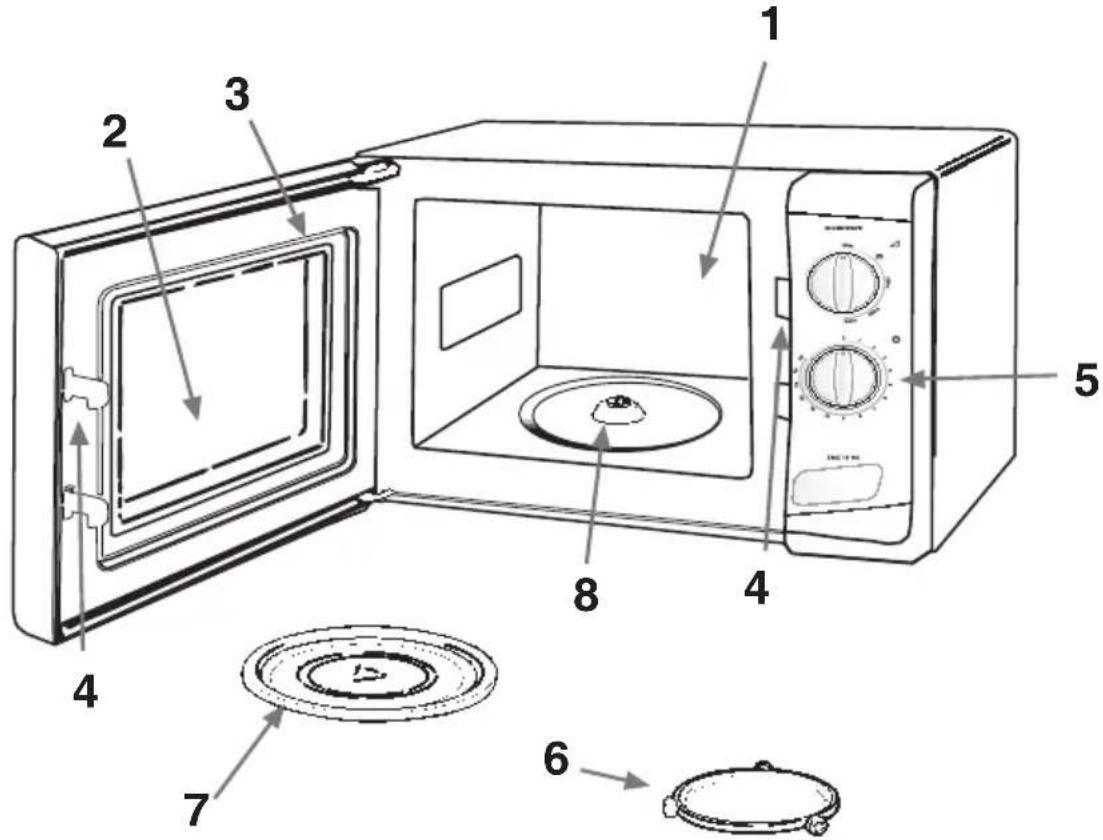
Name and function of parts
- Cooking compartment. Wipe the compartment clean after using the oven.
- Viewing window. Food can be checked while the microwave oven is in operation.
- Oven door. The door must always be firmly closed while cooking.
- Latch hook and safety interlock system.
- Control panel.
- Drive shaft for turntable
- Turntable. Made of special heat-resistant glass. Food in a suitable container is placed on this tray for cooking. Do not use the oven without the turntable.
- Turntable support. Place the support on the floor of the cooking chamber to support the turntable.
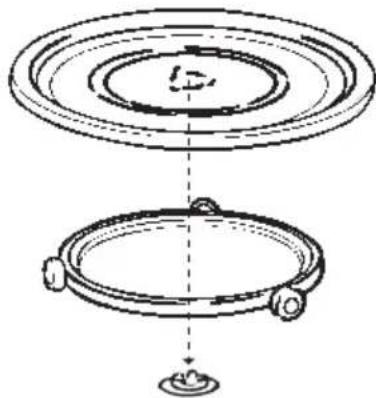
Turntable Installation
- Place the turntable support on the cavity Bottom.
- Place the turntable on top of the turntable support as shown in the diagram. Make sure that the turntable hub is securely locked in the turntable shaft. Never place the turntable upside down.
- Both the turntable and the turntable support must always be used during cooking.
- All food and containers of food are always placed on this turntable for cooking.
- This turntable rotates clockwise and anticlockwise; this is normal.
Turntable
Roller rest
Turntable Shaft
CONTROL PANEL
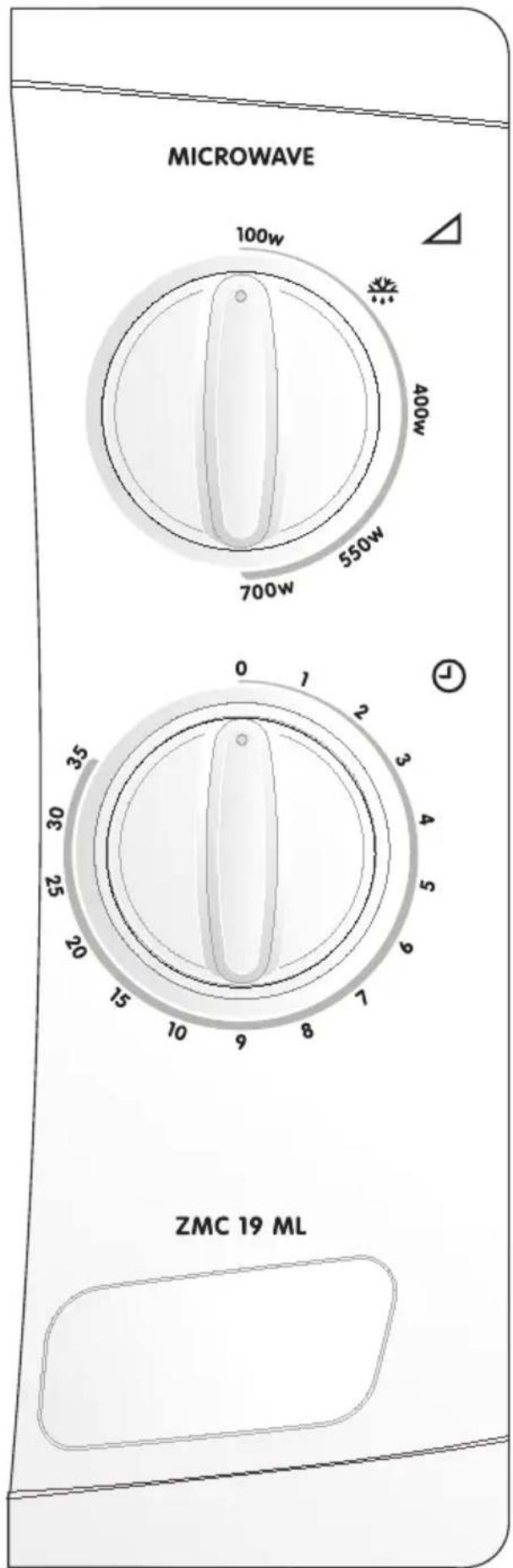
1. Power Selector
Adjust this knob to select the correct power level for your food.
2. Timer
Set for desired cooking time. Cooking will start. All clockwork timers will operate more accurately if wound past the desired time first, and then back.
MICROWAVE COOKING
- Open the door, place the food on the turntable. Close the door.
- Set the Power Selector to the desired power level. (See table below.)
- Set the Timer to the desired time.
The oven begins cooking.
When cooking for less than 2 minutes, turn the timer for a longer period and then return to the desired time.
To turn off the oven during cooking, simply turn the Timer to 0.
Note: After use, be sure to return the Timer to 0, or the oven will continue to operate.
Example: To cook at 400W for 15 minutes
- Turn the power selector to 400W.
- Turn the timer to 15
- The Oven will automatically start cooking for 15 minutes at 400W
Microwave Power setting Guide
| Power Setting Suggested use | |
| 100W | Keeping warm; Keeping foods warm |
| Defrost; Thawing frozen foods. | |
| 400W | Medium; Faster defrosting and reheating for casseroles and stews. |
| 550W | Reheat; Reheating pre-cooked foods.Roasting joints of meat and poultry. |
| 700W | Boiling or reheating liquids.Cooking vegetables.Preheating a browning dish. |
Recommendations for Defrosting using

Some foods such as bread and fruit, can successfully be thawed manually by using the power setting.
| FOOD | PREPARATION | STANDING TIME | |
| Bread | |||
| Small loaf | Place on microwave-proof rack or kitchen paper.Turn over halfway through defrosting time. | 8-10 min. | 10-15 min. |
| Sliced large loaf | Place on microwave-proof rack or kitchen paper.Turn over halfway through defrosting time. | 10-13 min. | 10 min |
| 2 slices | Place on kitchen paper. 45-60 sec. 5 min. | ||
| 1 bread roll | Place on kitchen paper. 45-60 sec. 5 min. | ||
| 2 bread rolls | Place on kitchen paper. 1-11/2 min. 5 min. | ||
| Cakes and Pastry | |||
| Gateau 450g/1 lb | Remove from packaging, place on plate. 9-11 min. 15-30 | min. | |
| Cheesecake 450g/1 lb | Remove from packaging, place on plate. 9-11 min. 15-30 | min. | |
| Pie (cooked) 450g/1 lb | Remove from packaging, place on plate. 7-9 min. 15-30 | min. | |
| Pastry 450g/1 lb | Remove from packaging, place on plate. 7-9 min. 15-30 | min. | |
| Butter | |||
| 250g/8.8 oz(1 packet) | If foil wrapped, remove from wrapper and place on a plate | 3-4 min. | 5-10 min. |
| Fruit | |||
| 225g/8 ozSoft berry fruits | Place in a single layer in a shallow dish. 5-6 min. 5-10 min. | ||
| 450g/1 lbSoft berry fruits | Place in a single layer in a shallow dish. | 7-8 min. | 5-10 min. |
| Plated meal | |||
| 400g/14 oz | Cover with a plate or non P.V.C. cling film.To reheat, microwave on 100% (700W)for 3-4 minutes. | 7-8 min | 5-10 min. |
| Vegetables | |||
| It is not necessary to defrost vegetables before cooking.All vegetables can be thawed and cooked on 100% (700W) | |||
Microwave Hints Microwave Ti
ps
- Always keep the oven clean – avoid spill-overs and do not forget to clean under the glass tray and the inside of the door.
- Preferably use round or oval casseroles with a lid when cooking in your microwave oven.
- Do not use metal or metal decorated casseroles. Certain plastic materials can melt and be warped by hot food.
- Cover the food when cooking. Use a glass lid, a plate or grease proof paper.
- Pastry, bread and the like can be defrosted directly in a bread basket or on a paper towel.
- If frozen food is heated in its packaging, the packaging should be opened. Packaging containing metal or metal decoration must not be used unless specifically recommended for use in the microwave. Remove metal clips and wire ties.
- Smaller pieces of aluminium foil can be used to cover parts that easily over cook such as chicken legs.
- Food with peel or skin should be pierced with a fork – e.g. potatoes and sausages. Do not boil eggs in the microwave oven as they can explode.
- Put large, thick pieces close to the edge of the casserole and try to cut the food in to even sized pieces. Always place the food in the centre of the oven.
- The food will be evenly cooked if you stir or turn it a few times.
- Always set a shorter cooking time than indicated in your recipe to avoid over cooking. The larger the amount of food the longer it takes.
- Use little or no water for vegetables.
- Use less salt and spices than for ‘normal’ cooking.
- Season afterwards.
- Allow a few minutes ‘standing’ time after the oven has switched off to ensure complete and even cooking results.
- Always ensure food is piping hot throughout before serving.
- Use pot holders or gloves when taking dishes and food from the oven.
- Softening Honey
If you have a jar of honey which has crystallised, remove lid and place the jar in the oven, microwave on medium power for 2 minutes.
- Melting Chocolate
Break 100g of chocolate into squares, place in a bowl and heat on high power for 1-2 minutes and stir well.
- Softening or Melting Butter
Melting takes a few seconds on high power. Softening is best done more gently on low power.
- Freshen or Warm Bread
Use medium power for few seconds.
- Peeling Garlic easily
Heat 3 or 4 cloves of garlic on high power for 15 seconds. Squeeze at one end until the clove pops out.
- Fruit Juice
Citrus fruits will yield more juice if they are heated on high power for 15 seconds before squeezing.
- Cooking Porridge
Porridge is easily cooked in the serving dish with no sticky pan to wash. Follow food manufacturers' recommendations.
Care and cleaning
The oven must always be kept clean. Residue from food spill-overs or spatters will attract microwave energy, causing it to burn on. This could reduce the efficiency of the oven and may cause bad odors. Do not attempt to tamper with or make any adjustments or repairs to any part of the oven. Repairs should only be done by a qualified service technician.
Be sure the oven is disconnected from the electricity supply before cleaning.
Cleaning the accessories (turntable and support)
Clean them with mild detergent after removing them from the cavity. The turntable support should be handled carefully.
CAUTION: The inside of the oven and turntable get very hot, so do not touch them immediately after use.
Cleaning the interior
Always keep the inside of the oven clean. Wipe up spill-overs and food spatters immediately. Deposits that are allowed to remain on the oven walls, door seal, and door surface will absorb microwave energy, reduce the efficiency of the oven, and possibly damage the oven interior. Use mild liquid detergent, warm water, and a soft, clean cloth to remove deposits.
NEVER USE ABRASIVE CLEANERS, COMMERCIAL OVEN CLEANERS, OR STEEL WOOL PADS ON ANY PART OF THE MICROWAVE OVEN.
To loosen difficult deposits, boil a cup of water in the microwave oven for 2 or 3 minutes.
NEVER USE A KNIFE OR ANY UTENSIL TO REMOVE DEPOSITS FROM OVEN SURFACES.
To remove odors from the oven interior, boil a cup of water plus 2 tablespoons of lemon juice for 5 minutes.
Cleaning the exterior
Open the oven door when cleaning the control panel. This will prevent the oven from being turned on accidentally. Clean the outside surfaces of the oven with mild liquid detergent and water, then wipe with clear water to remove any excess detergent. Dry with a soft cloth.
Spray-on window cleaners or all-purpose spray-on kitchen cleaners can also be used. Never use abrasive cleaners, scouring pads, or harsh chemicals on outside surfaces of your oven. To prevent damage to the working parts, do not allow water to seep into ventilation openings.
GUARANTEE CONDITIONS
Zanussi offers the following guarantee to the first purchaser of this appliance:
- The guarantee is valid for 12 months commencing when the appliance is handed over to the first retail purchaser, which must be verified by purchase invoice or similar documentation. The guarantee does not cover commercial use.
- The guarantee covers all parts or components which fail due to faulty workmanship or faulty material. The guarantee does not cover appliances where defects or poor performance are due to misuse, accidental damage, neglect, faulty installation, unauthorised modification or attempted repair, commercial use or failure to observe requirements and recommendations set out in the instruction book. This guarantee does not cover such parts as light bulbs, removable glassware, or plastic.
- Should guarantee repairs be necessary the purchaser must inform the nearest customer service office (ZANUSSI's service or authorised agent). ZANUSSI reserves the right to stipulate the place of repair (i.e. the customer's home, place of installation or ZANUSSI workshop).
- The guarantee or free replacement includes both labour and materials.
- Repairs carried out under guarantee do not extend the guarantee period for the appliance. Parts removed during guarantee repairs become the property of ZANUSSI.
- The Purchaser's statutory rights are not affected by this guarantee.
European Guarantee
If you should move to another country within Europe then your guarantee moves with you to your new home subject to the following qualifications:
- The guarantee starts from the date you first purchased your product.
- The guarantee is for the same period and to the same extent for labour and parts as exists in the new country of use for this brand or range of products. This guarantee relates to you and cannot be transferred to another user.
- Your new home is within the European Community (EC) or European Free Trade Area.
- The product is installed and used in accordance with our instructions and is only used domestically, i.e. a normal household. The product is installed taking into account regulations in your new country.

From the Electrolux Group. The world's No.1 choice.
The Electrolux Group is the world's largest producer of powered appliances for kitchen, cleaning and outdoor use. More than 55 million Electrolux Group products (such as refrigerators, cookers, washing machines, vacuum cleaners, chain saws and lawn mowers) are sold each year to a value of approx. USD 14 billion in more than 150 countries around the world.

- BEFORE USING YOUR MICROWAVE OVEN
- TECHNICAL DATA
- SAFETY INSTRUCTIONS
- OVEN UTENSILS AND ACCESSORIES GUIDE
- HOW TO OPERATE YOUR MICROWAVE OVEN
- CONGRATULATIONS ON THE PURCHASE OF YOUR NEW MICROWAVE OVEN
- IMPORTANT SAFETY INSTRUCTIONS
- READ CAREFULLY AND KEEP FOR FUTURE REFERENCE
- WARNING: IF THE DOOR
- UTENSIL SAFETY
- TESTING SUITABILITY OF COOKWARE
- FOIL CONTAINERS
- FOOD SAFETY
- INSTALLATION
- CONNECTING TO THE MAINS
- UNPACKING
- NAME AND FUNCTION OF PARTS
- TURNTABLE INSTALLATION
- CONTROL PANEL
- POWER SELECTOR
- TIMER
- MICROWAVE COOKING
- EXAMPLE: TO COOK AT 400W FOR 15 MINUTES
- MICROWAVE POWER SETTING GUIDE
- RECOMMENDATIONS FOR DEFROSTING USING
- MICROWAVE HINTS MICROWAVE TI
- PS
- CARE AND CLEANING
- CLEANING THE ACCESSORIES (TURNTABLE AND SUPPORT)
- CLEANING THE INTERIOR
- NEVER USE ABRASIVE CLEANERS, COMMERCIAL OVEN CLEANERS, OR STEEL WOOL PADS ON ANY PART OF THE MICROWAVE OVEN
- NEVER USE A KNIFE OR ANY UTENSIL TO REMOVE DEPOSITS FROM OVEN SURFACES
- CLEANING THE EXTERIOR
- GUARANTEE CONDITIONS
- EUROPEAN GUARANTEE
Brand : ZANUSSI
Model : ZMC19M
Category : Microwave