
C 105.5-5 - Pressure washer NILFISK - Free user manual and instructions
Find the device manual for free C 105.5-5 NILFISK in PDF.


| Product Type | Pressure Washer |
| Brand | Nilfisk |
| Model | C 105.5-5 |
| Power Input | 1500 W |
| Max Pressure | 105 bar (1523 psi) |
| Max Flow Rate | 5.5 L/min |
| Weight | 11 kg |
| Dimensions (L x W x H) | 300 x 280 x 580 mm |
| Voltage | 230 V |
| Frequency | 50 Hz |
| Water Supply | Cold water, garden hose connection |
| High Pressure Hose Length | 8 m |
| Safety Features | Thermal overload protection, pressure switch, locking trigger |
| Included Accessories | Spray lance, turbo nozzle, foam nozzle, high pressure hose, detergent tank |
| Detergent System | On-board detergent tank |
| Maintenance | Check oil level, clean inlet filter, inspect hose for damage |
| Spare Parts Availability | Yes, through authorized service centers |
| Repairability | Repairable; spare parts available |
Frequently Asked Questions - C 105.5-5 NILFISK
User questions about C 105.5-5 NILFISK
0 question about this device. Answer the ones you know or ask your own.
Ask a new question about this device
Download the instructions for your Pressure washer in PDF format for free! Find your manual C 105.5-5 - NILFISK and take your electronic device back in hand. On this page are published all the documents necessary for the use of your device. C 105.5-5 by NILFISK.
USER MANUAL C 105.5-5 NILFISK

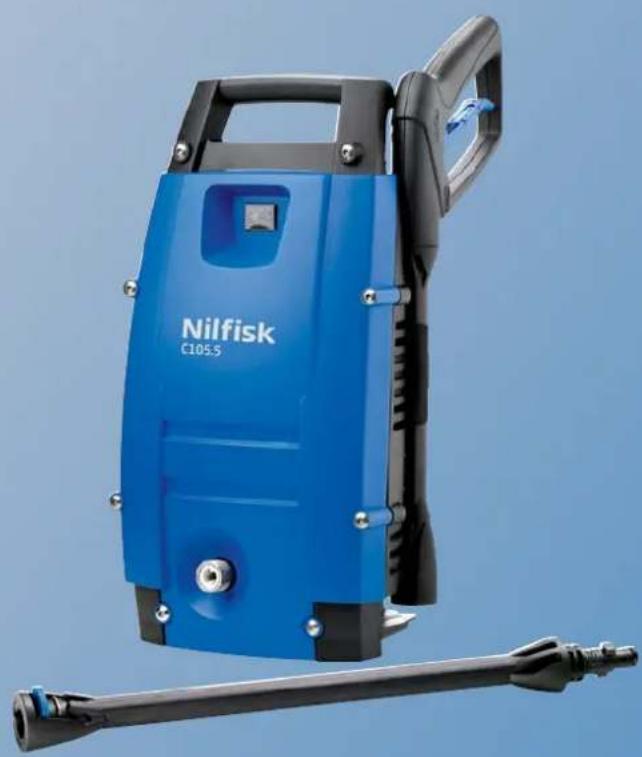
Nilfi sk C 105.5
Nilfi sk C 115.3
natural_image
Blue Nilfisk C105.5 water heater with attached hose against a plain blue background (no text or symbols visible on the device body)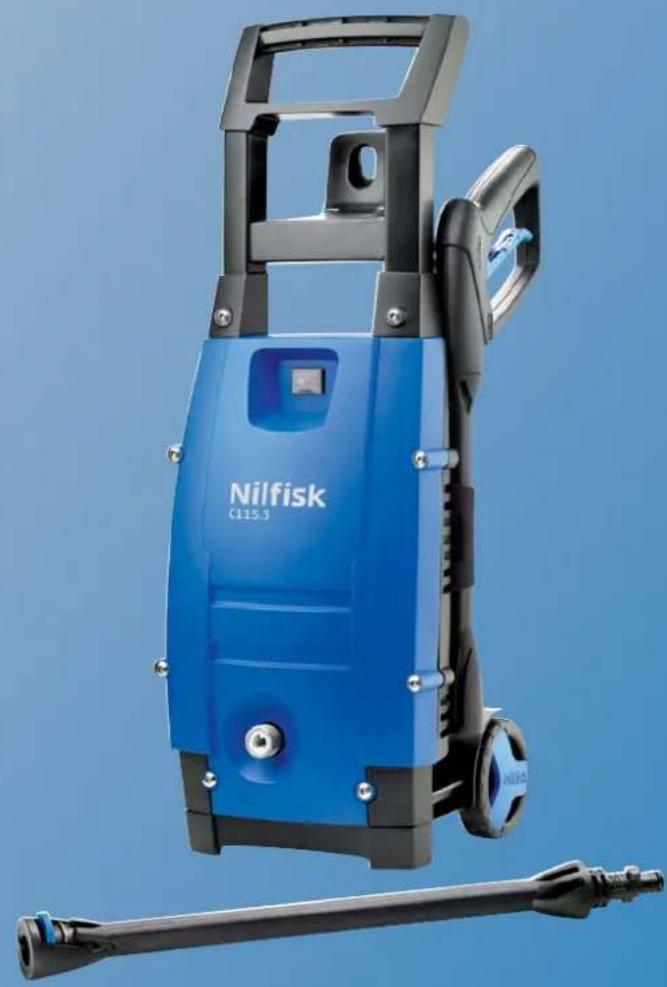
natural_image
Blue Nilfisk C115.3 water heater with attached hose against a blue background (no text or symbols visible on the device body)EN
User Manual
Index

1 Safety precautions and warnings ....3
2 Description ....5
3 Before you start using your pressure washer ....6
4 Operating your pressure washer ....7
5 After using your pressure washer 9
6 Maintenance ....10
7 Trouble shooting 12
8 Further information ....13
9 Technical data ....14
10 Declaration 14
1 Safety Precautions and Warnings
Symbols used to mark instructions

Before starting up your high-pressure washer for the first time, this instruction manual must be read through carefully. Save the instructions for later use.

Safety instructions marked with this symbol must be observed to prevent danger to persons.

This symbol is used to mark safety instructions that must be observed to prevent damage to the machine and its performance.
This symbol indicates tips and instructions to simplify work and to ensure a safe operation.

Do not let people who have not been trained in the use of a high pressure washer nor read the instruction manual ope rate the machine.
This appliance is not intended for use by children or other persons without assistance or supervision if their physical, sensory or mental capabilities prevent them from using it safely. Children should be supervised to ensure that they do not play with the appliance.
Before starting up your machine please check it carefully for any defects. If you find any, do not start up your machine and contact your Nilfi sk distributor.
Especially check:
- The insulation of the electric cable should be faultless and without any cracks. If the electric cable is damaged, an authorized Nilfisk di tributor should replace it.
WARNING!
● High pressure jets can be dangerous. Never direct the water jet at persons, pets, live electrical equipment or the machine itself.
- Never try to clean clothes or footwear on yourself or other persons.
- Hold the spray lance firmly with both hands. The spray lance is affected by a thrust of up to 16.4 N during ope—
ration.
● The operator and anyone in the immediate vicinity of the site of cleaning should take action to protect themselves from being struck by debris dislodged during operation. Wear goggles and protection clothes during operation.
- This appliance has been designed for use with cleaning agents supplied or recommended by the manufacturer. The use of other cleaning agents or chemicals may adversely affect the safety of the appliance.
- Disconnect from electrical power supply before carrying out user maintenance.
● To ensure the appliance

safety only use original spare parts from the manufacturer or approved by the manufacturer.
● High pressure hoses, fi ttings and couplings are important for the safety of the appliance. Only use hoses, fi ttings and couplings recommended by the manufacturer.
- Do not use the appliance if a supply cord or important parts of appliance are damaged, e.g. safety device, high pressure hose and trigger gun.
● The appliance is intended to clean cars and garden etc..
● Appropriate ear protection has to be used.
● Never use the machine in an environment where there could be a danger of explosion. If any doubt arises, please contact the local authorities.
- It is not allowed to clean asbestos- containing surfaces with high pressure.
- This high pressure washer must not be used at temperatures below 0°C.
WARNING!
Inadequate extension cables can be dangerous. Cables on drums should always be completely unwinded to prevent the cable from overheating.
If an extension cable is used, the plug and the socket must be waterproof and comply with the below-mentioned requirements for length and cable dimensions.
1.0 mm ^2 max. 12.5 m
1.5 mm ^2 max. 20 m
2.5 mm² max. 30 m
- If the electric cable is damaged, it must be replaced by the manufacturer or his service agent or similarly qualified person in order to avoid a hazard.
Mains power connection
The following should be observed when connecting the high pressure washer to the electric installation:
- The electric installation shall be made by a certified electrician and comply with IEC 364.
- It is recommended that the electric supply to this appliance should include either a residual current device that will interrupt the supply if the leakage current to earth exceeds 30 mA for 30 ms.
Water connection
- Connection to the public mains according to regulations.
- Inlet hose can be connected to the water mains with a max. inlet pressure of 10 bars.
This high pressure washer is only allowed to be connected with the drinking water mains,
when an appropriate backflow preventer has been installed, Type BA according to EN 1717. The backflow preventer can be ordered under number 106411177. The length of the
hose between the backfl ow preventer and the high pressure washer must be at least 10 metres to absorb possible pressure peaks (min diameter 12 inch).
Operation by suction (for example from a rainwater vessel) is carried out without backflow preventer. Recommended suction set: 126411387.
As soon as water has fl own through the BA valve, this water is not considered to be drinking water any more.
IMPORTANT! Only use water without any impurities. If there is a risk of running sands in the inlet water (i.e. from your own well), an additional filter should be mounted.
Safety devices
- The unloader valve can reduce pressure if it exceeds pre-set values.
Locking device on spray handle (7a) (see illustration at the end of this manual):
The spray handle features a locking device. When the pawl is activated, the spray handle cannot be op rated.
Thermal sensor:
A thermal sensor protects the motor against overloading. The machine will restart after a few minutes when the thermal sensor has cooled.
2 Description

2.1 Application
This high-pressure washer has been developed for domestic use within:
- Car, motorbike, boat, caravan, trailer, patio/drive/fl agstones, woodwork, brickwork, barbecue, garden furniture, lawn mower
Only use the high-pressure washer for purposes described in this manual.
The safety precautions must be observed to prevent damage to the machine, the surface to be cleaned or severe personal injuries.
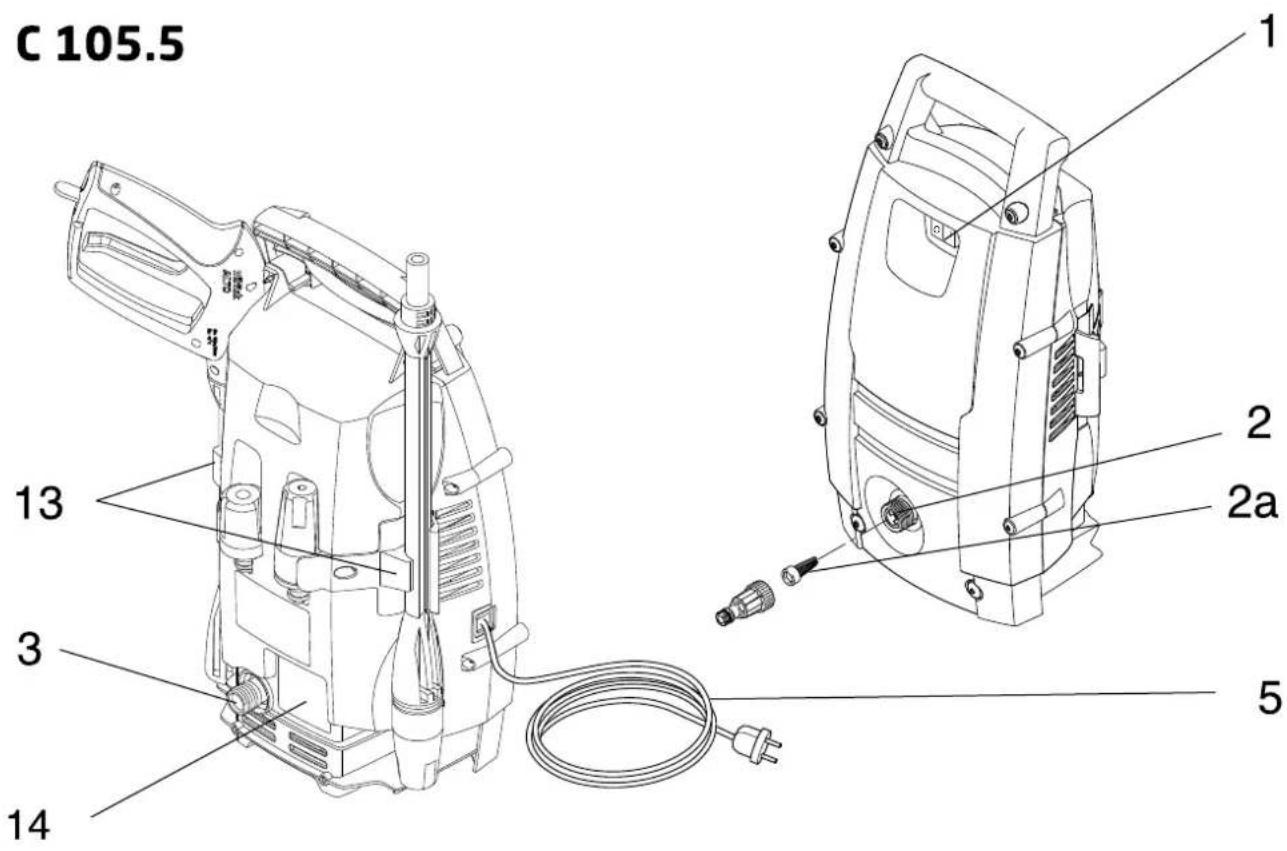
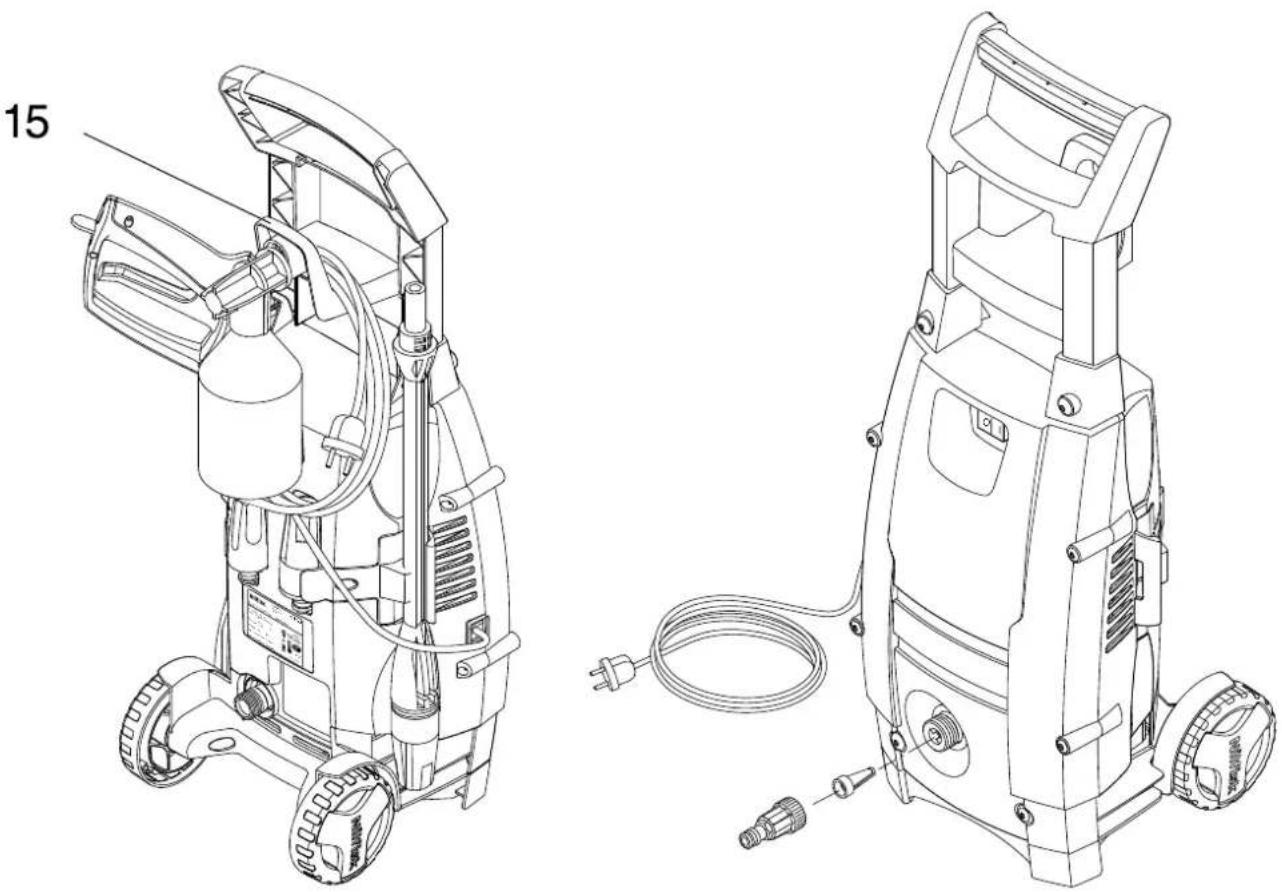
2.2 Operation elements and model survey

See illustration at the end of this manual.
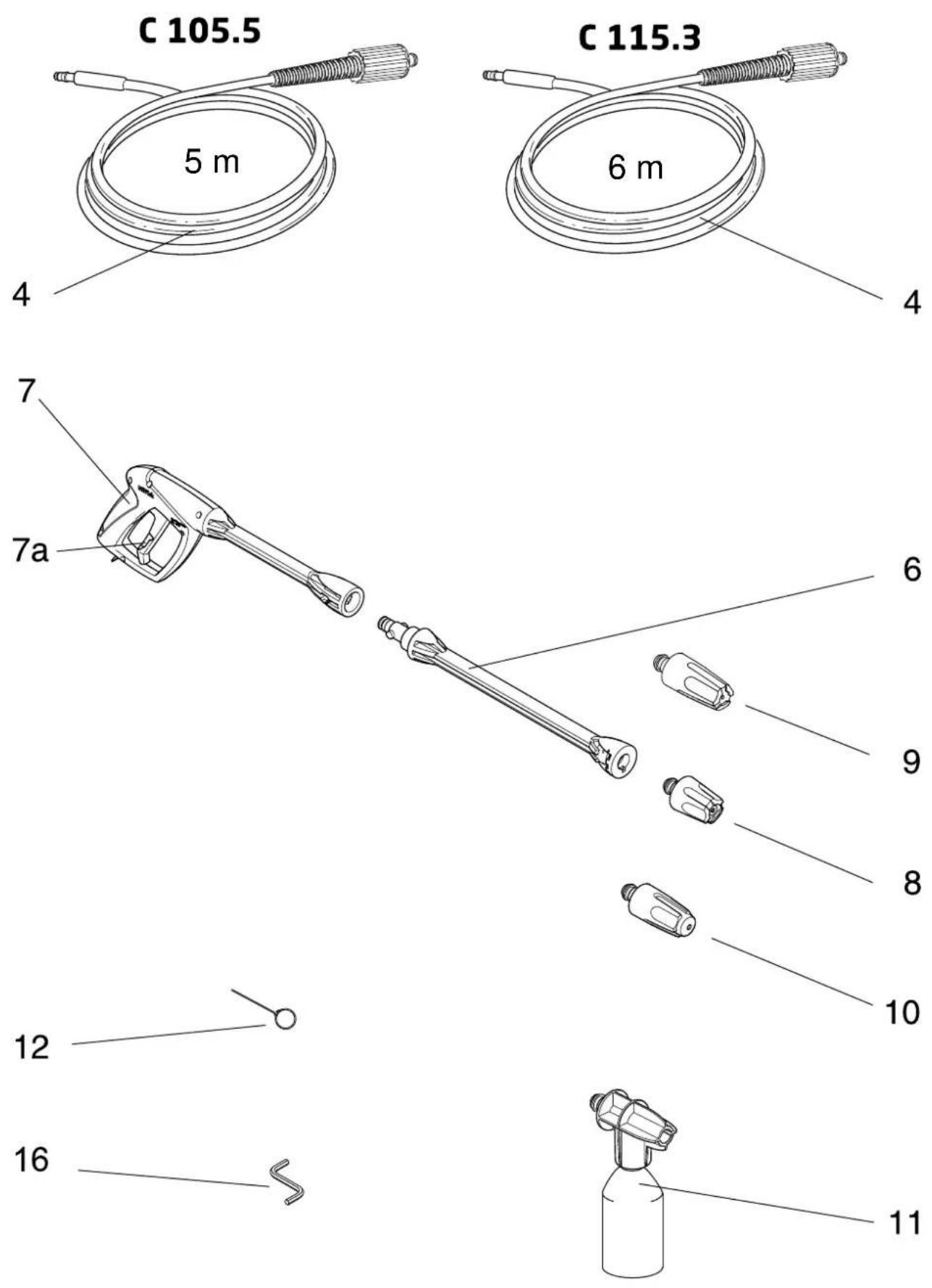
1 Start/stop switch
2 Water inlet with filter (2a)
3 High pressure connection
4 High pressure hose
5 Electric cable
6 Click & Clean spray lance
7 Spray handle with lock (7a)
8 Click & Clean Tornado nozzle (C 105.5)
9 Click & Clean Tornado PR nozzle (C 115.3)
10 Click & Clean Powerspeed nozzle
11 Foam sprayer
12 Nozzle cleaning tool
13 Lance and nozzle holder
14 Model tag
15 Holder for electric cable (C 115.3)
16. Hexagon key
Specifications: See model tag (14) of machine.
We reserve the right to alter the specifications.

3 Before you start using your pressure washer
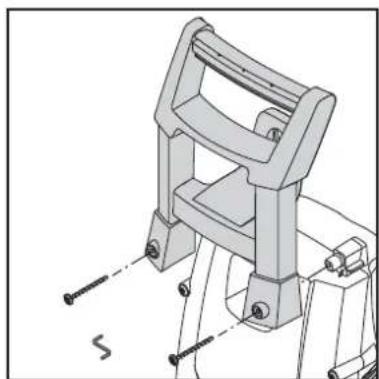
3.1 Mounting of trolley handle (C 115.3)
natural_image
Technical line drawing of a mechanical bracket assembly (no text or symbols)- Place the trolley handle on the machine.
- Secure the handle by mounting the 2 screws. Use the enclosed hexagon key.
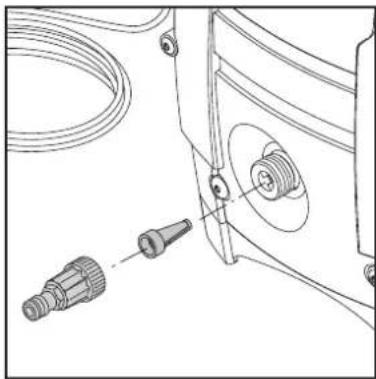
3.2 Mounting of quick coupling
natural_image
Technical line drawing of a mechanical assembly with hoses and connectors (no text or symbols)- Screw the quick coupling tight on to the water inlet (2).

Note: The inlet fi lter (2a) must always be fi tted ➤ in the water inlet pipe to fi lter out and, lime stone and
other impurities as these will damage the pump valves.
Caution: Failure to fi t the fi lter will invalidate the guarantee.
3.3 Mounting of high pressure hose on spray handle
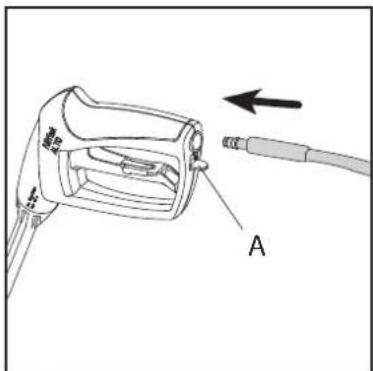
- Attach the high pressure hose (4) to the spray handle (7).
Detach the high pressure hose by pressing the pawl (A).
4 Operating your pressure washer

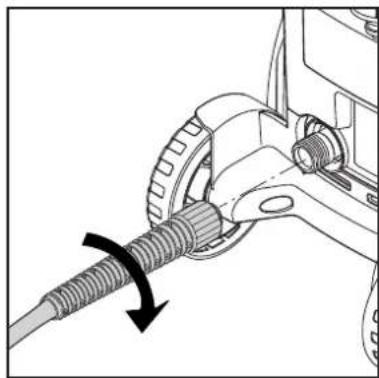
4.1 Connection of high pressure hose
natural_image
Mechanical assembly diagram showing a threaded component being inserted into a housing (no text or symbols present)1. Mount the high pressure hose on the outlet (3).
4.2 Mounting of spray lance and Click & Clean nozzles
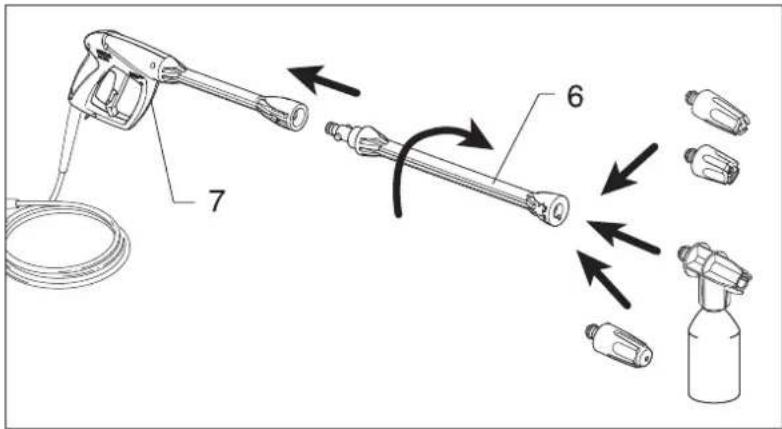
- Push the spray lance (6) into the spray handle (7) and screw it on.
Note: The spray lance (6) has a built-in low pressure nozzle that can be used for fl ushing away dirt.
- Attach the nozzle.
Warning: When attaching the Click & Clean nozzles, the pawl on the side of the spray lance (6) should come out again.
Note: The foam sprayer (11) features a swivel lock, which must be positioned in the hole in the Click & Clean spray lance (6).
Press the pawl to detach the Click & Clean nozzle.

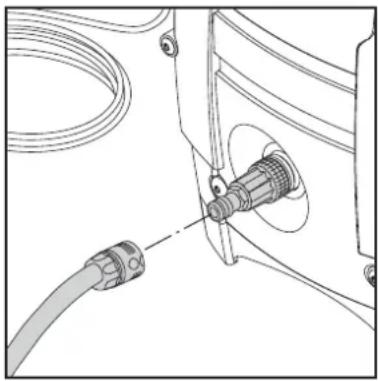
4.3 Water connection An ordinary 1/2" garden hose of
min. 10 m and max. 25 m will be suitable.
NOTE: Connection to the public mains according to regulations.
natural_image
Technical line drawing of a mechanical assembly with a coiled cable and threaded connector (no text or symbols)IMPORTANT! Only use water without any impurities. If there is a risk of running sands in the inlet water (i.e. from your own well), an additional filter (106411231) should be mounted.
- Let the water run through the water hose before connecting it to the machine to prevent sand and dirt from penetrating the machine.
Note: Check that the filter is fitted in the water inlet pipe and that it is not clogged up. - Connect the water hose to the water supply by means of the quick connector (inlet water, max. pressure: 10 bar, max. temperature: 40°C).
- Turn on the water.
4.4 Start and stop of the machine
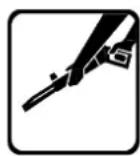
The spray lance is affected by a thrust during operation - therefore always hold it firmly with both hands. IMPORTANT: Point the nozzle at the ground.
- Check that the machine is in uprighth position.
NOTE: Do not place the machine in high grass! - Release the trigger lock (7a).
- Activate the trigger of the spray handle and let the water run until all air has escaped from the water hose.
- Press the Start/stop switch "I" (1).
- Activate the trigger of the spray handle.
Always adjust the distance and thus the pressure of the nozzle to the surface, which is to be cleaned.
Do not cover the machine during operation or use it in a room without adequate ventilation!

Note: If the machine is left or not used for 5 min-
utes, it must be switched off on the start/stop switch "O" (1):
- Press the start/stop switch "O".
- Disconnect the electrical plug from the socket.
- Shut off the water supply and activate the trigger to relieve the machine of pressure.
- Lock the spray handle (7a).
When releasing the trigger of the spray handle, the machine automatically stops. The machine will start again when you re-activate the spray handle.
5 After using your pressure washer

5.1 Storing the washer The machine should be stored in a frost-free room!

Pump, hose and accessories should always be emptied of water prior to storing as follows:
- Stop the machine (press the start/stop switch "O" (1) and detach water hose and accessory.
-
Restart the machine and activate the trigger. Let the machine run until no more water runs through the spray handle.
-
Stop the machine, unplug and wind up hose and cable.
- Place spray handle, nozzles and other accessories in the holders of the machine.
Should the machine by mistake be frozen, it will be necessary to check it for damage.
NEVER START-UP A FROZEN MACHINE.
Frost damages are not covered by the guarantee!
5.2 Winding up of electric cable and high pressure hose (C115.3)
natural_image
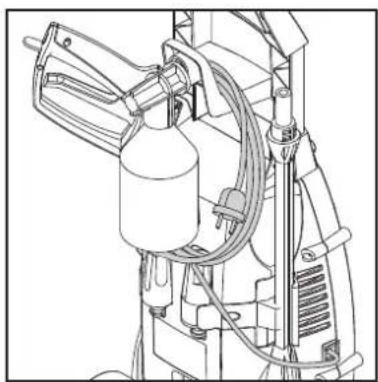
Technical line drawing of a mechanical device with hoses and a cylindrical component (no text or symbols)To avoid accidents, the electric cable and the high pressure hose should always be winded carefully up around the handle.
Wind up the cable on the appropriate hook.
5.3 Storage of accessories
natural_image
Technical line drawing of a mechanical device with no visible text or symbols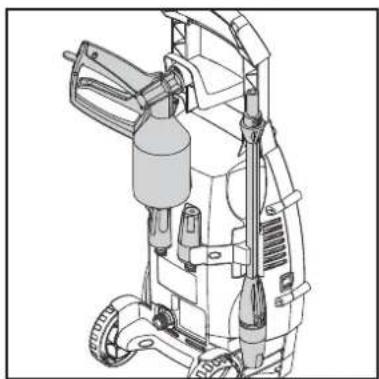
natural_image
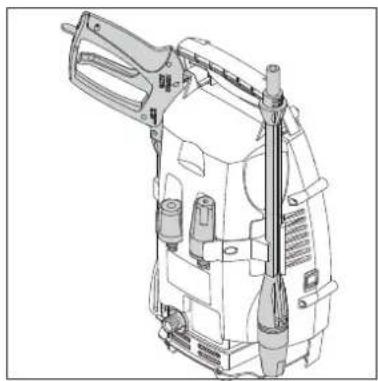
Technical line drawing of a mechanical device with no visible text or symbolsThe standard accessories - spray handle, lance, nozzles and foam sprayer can be stored on the pressure washer.

6 Maintenance

WARNING! Always disconnect the electrical plug from the socket prior to maintenance or cleaning.
To ensure a long and problem free working life, please take the following advice:
- Wash out water hose, high pressure hose, spray lance and accessories before mounting.
- Clean the connectors of dust and sand.
● Rinse the detergent spraying attachment after use. - Clean the nozzles.
Any repair should always be made in an authorized workshop with original spare parts.
6.1 Cleaning of water inlet fi Iter
natural_image
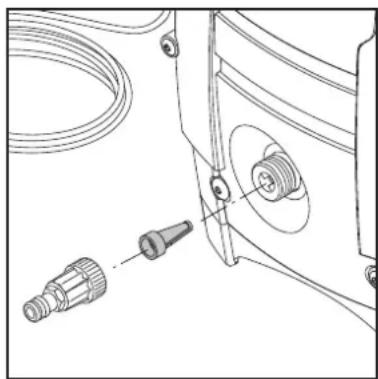
Technical line drawing of a mechanical assembly with hoses and connectors (no text or symbols)Clean the water inlet fi Iter regularly once a month or more frequently according to use. Carefully loosen the fi Iter with a screwdriver and clean it. Check that it is intact before re-mounting it.
The inlet fi lter must always be fi tted inside the water inlet pipe to fi lter out sand, limestone and other impurities, as they will damage the pump valves.
CAUTION: Failure to fi t the fi Iter will invalidate the guarantee.
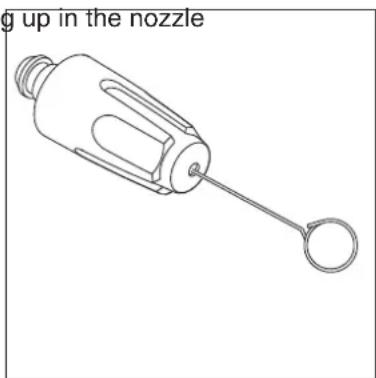
6.2 Cleaning of nozzle A clogging up in the nozzle
natural_image
Line drawing of a nozzle with a handle and circular end (no text or symbols)causes a pump pressure which is too high. This is why cleaning is required immediately.
- Stop the machine and disconnect the nozzle.
- Clean the nozzle. IMPORTANT: The cleaning tool (12) should only be used when the nozzle is detached!
- Flush the nozzle backwards with water.
6.3 Cleaning of machine vents
The machine should be kept clean so as to let cooling air pass freely through the machine vents.

6.4 Greasing of couplings
To ensure an easy connection and that o-rings do not dry up, the couplings should be greased regularly.
7 Trouble-shooting
To avoid unnecessary disappointments, you should check the following before contacting the Nilfi sk service organization:
| Symptom | Cause | Recommended | action |
| Machine refuses to start Defective socket Try another socket.Fuse has blown Replace fuse. Switch off other machines.Defective extension cable Try without the extension cable. | Machine not plugged in Plug in machine. | ||
| Fluctuating pressure | Pump sucking air Check that hoses and connections are air-tight. | ||
| Valves dirty, worn out | Clean and replace or refer to local Nilfi sk or stuck | distributor | |
| Pump seals worn out | Clean and replace or refer to local Nilfi sk-distributor. | ||
| Machine stopsIncorrect mains voltage | Fuse has blownCheck that the mains voltage corresponds to specifi cation on the model tag. | Replace fuse. Switch off other machines. | |
| Thermal sensor activated | Leave the washer for 5 minutes to cool down. | ||
| Nozzle partially blocked | Clean the nozzle (see section 6.2) | ||
| Fuse blows | Fuse too smallamp. consumption of the machine.You may try without the extension cable. | Change to an installation higher than the | |
| Machine pulsatingInadequate supply of mains water | Air in inlet hose/pumpregular working pressure resumes. | Allow machine to run with open trigger until resumes. | |
| Check that the water supply corresponds to specific cations required (see model tag) | NB! Avoid using long, thin hoses (min. 1/2") | ||
| Nozzle partially blockedWater fi Iter blockedHose kinked | Clean the nozzle (see section 6.2)Clean the fi Iter (see section 6.1) | ||
| Straighten out hose. | |||
| Machine often starts and stops by itself | Pump/spray handle is leaking | Contact your nearest Nilfisk Service Centre. | |
| Machine starts, but no water comes outNo water supplyWater fi Iter blockedNozzle blocked | Pump/hoses or accessory frozenConnect inlet water.Clean the fi Iter (see section 6.1)Clean the nozzle (see section 6.2) | Wait for pump/hoses or accessory to thaw. |
In case problems other than the above occur, please contact your local Nilfisk distributor.
UK:
Customer Services at Penrith - 01768 868995
8 Further information

8.1 Recycling the washer Make the old cleaner unusable immediately.
- Unplug the cleaner and cut the electric cable.
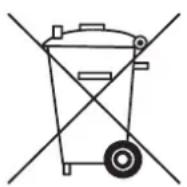
Do not discard electrical appliances with household waste.
As specified in European Directive 2002/96/EC on old electrical and electronic appliances, used electrical goods must be collected separately and recycled ecologically.
Contact your local authorities or your nearest dealer for further information.
8.2 Warranty conditions Nilfi sk guarantees high pres-
sure washers for domestic use for 2 years. If your high pressure washer or ac ces so ries are handed in for repair, a copy of the receipt must be enclosed. Guarantee repairs are being made on the following con di- t ions:
- that defects are attributable to flaws or defects in materials or workmanship. (wear and tear as well as misuse are not covered by the gu a ran tee).
● that the directions of this instruction manual have been thoroughly observed.
● that repair has not been carried out or attempted by other than Nilfi sk-trained service staff.
● that only original accessories have been applied.
● that the product has not been exposed to abuse such as knocks, bumps or frost.
● that only water without any impurities has been used.
● that the high pressure washer has not been used for rental nor used commercial ly in any other way.
Repairs under this guarantee include replacement of defective parts, exclusive of packing and postage/carriage. Besides, we refer to your national law of sale.
The machine should be forwarded to one of the service centres of the Nilfi sk organisation with description/spe ci fi cati on of the fault.
Repairs not covered by the guarantee conditions will be invoiced. (I.e. malfunctions due to Causes men ti o ned in section Troubleshooting Chart of the instruction manual).
9 Main Technical Data
| Type C 105.5-5 C 115.3-6 | |||
| Rated pressure bar/MPa | 75/7.5 | 80/8.0 | |
| Permissible pressure | bar/MPa | max. 105/10.5 | max. 115/11.5 |
| Rated flow | l/min | 5.2 | 5.2 |
| Rated input | kW | 1.3 | 1.4 |
| Rated voltage | V | 230-240 | 230-240 |
| Max. water temperature | °C | 40 | 40 |
| Inlet pressure | bar/MPa | 0.15-10/0.015-1.0 | 0.15-10/0.015-1.0 |
| Sound pressure level | dB(A) | 78 | 78 |
| Guaranteed sound power level | dB(A) | 93 | 93 |
| Vibration according to ISO 5349 | m/s ^2 | < 2.5 | < 2.5 |
10 Declaration
| CE Declaration | |
| Manufacturer's name and address or his authorized representative in the Community | Nilfi sk-Advance A/SIndustrikvarteret9560 HadsundDenmark |
| Name of the person responsible for the technical documentation | Anton Sørensen, General Manager of Technical Operations EAPC |
| Description of the equipment:Equipment nameModelRated output voltageRated frequency | High pressure washerNilfi skC 105.5-5 / C 115.3-6AC 230-240 V50 Hz |
| Measured sound pressure level | 78 dB(A) |
| Guaranteed sound power level | 93 dB(A) |
| Declaration | The equipment refer in this document fulfi is all the requirements of the Directive :Machine Directive 2006/42/ECLow-voltage Directive 2006/95/EECEMC Directive 2004/108/EECOutdoor Noise Directive 2000/14/ECEN ISO 12100-1, EN ISO 12100-2, EN 60335-2-79EN 55014-1 (2006), EN 55014-2 (2001), EN 61000-3-2 (2006) |
| Place and date of the declaration | Hadsund, September 1, 2010 |
| Signature | |
C 115.3
natural_image
Technical line drawings of two different pressure water spray machines, one with a labeled component (15), shown from front and side views (no text or symbols on the devices themselves)
- Index
- Safety Precautions and Warnings
- Especially check:
- WARNING!
- ration.
- Mains power connection
- Water connection
- Safety devices
- Thermal sensor:
- Description
- Application
- Operation elements and model survey
- Before you start using your pressure washer
- Operating your pressure washer
- Connection of high pressure hose
- Mount the high pressure hose on the outlet (3).
- Mounting of spray lance and Click & Clean nozzles
- Water connection An ordinary 1/2" garden hose of
- Start and stop of the machine
- After using your pressure washer
- Storing the washer The machine should be stored in a frost-free room!
- NEVER START-UP A FROZEN MACHINE.
- Winding up of electric cable and high pressure hose (C115.3)
- Storage of accessories
- Maintenance
- Cleaning of water inlet fi Iter
- Cleaning of nozzle A clogging up in the nozzle
- Cleaning of machine vents
- Greasing of couplings
- Trouble-shooting
- Further information
- Recycling the washer Make the old cleaner unusable immediately.
- Warranty conditions Nilfi sk guarantees high pres-
- Main Technical Data
- Declaration
Brand : NILFISK
Model : C 105.5-5
Category : Pressure washer