
cr 5530 - Camera ACER - Free user manual and instructions
Find the device manual for free cr 5530 ACER in PDF.



| Product Type | Digital Camera |
| Image Sensor | 5.2 Megapixels (effective 4.9 Megapixels) |
| Image Resolution | Still: 2560x1920, 2048x1536, 1280x960, 640x480; Video: 640x480, 320x240 |
| LCD Monitor | 2.5-inch LTPS TFT Color LCD |
| Lens | 3x Optical Zoom, F=2.8-4.8, f=5.4-16.2mm (35mm equiv: 32-96mm) |
| Focus Range | Auto: 50cm to infinity; Macro: 6cm (Wide) / 35cm (Tele) to infinity |
| Shutter Speed | 1/2 to 1/1000 sec |
| Digital Zoom | 4x (Photo Mode), 2x/4x (Playback Mode) |
| Flash Modes | Auto, Red-eye Reduction, Forced Flash, Suppressed Flash, Night Scene |
| ISO Sensitivity | Auto, 50, 100, 200 |
| Metering System | Multi, Spot |
| White Balance | Auto, Incandescent, Fluorescent 1, Fluorescent 2, Daylight, Cloudy, Manual |
| Exposure Compensation | -2EV to +2EV in 0.3EV steps |
| Self-Timer | 10 seconds, 2 seconds, 10+2 seconds |
| Storage Media | SD Card (up to 512MB) |
| Power Supply | Rechargeable Lithium-Ion Battery (3.7V); AC Adapter (5V via conversion adapter) |
| Dimensions (WxHxD) | Approx. 88.5 x 54.5 x 24 mm (without protruding parts) |
| Weight | Approx. 130 g (without battery and SD card) |
| Interfaces | USB 2.0 (Full Speed), A/V Out, DC In (via conversion adapter) |
| Video Output | NTSC / PAL |
| Compatible Operating Systems | Windows 98/Me/2000/XP, Mac OS 8.6 or later |
| Accessories Included | Camera strap, A/V cable, USB cable, Software CD, Camera pouch, Conversion adapter, SD card, AC power adapter, Rechargeable battery, Battery charger |
| Safety and Maintenance | Keep away from water, humidity, dust, and extreme temperatures. Clean with dry cloth. Do not disassemble. Use only specified accessories. |
| Repairability | No user-serviceable parts. Contact dealer for repairs. |
Frequently Asked Questions - cr 5530 ACER
User questions about cr 5530 ACER
0 question about this device. Answer the ones you know or ask your own.
Ask a new question about this device
Download the instructions for your Camera in PDF format for free! Find your manual cr 5530 - ACER and take your electronic device back in hand. On this page are published all the documents necessary for the use of your device. cr 5530 by ACER.
USER MANUAL cr 5530 ACER
This device complies with Part 15 of the FCC Rules. Operation is subject to the following two conditions:
(1) This device may not cause harmful interference, and (2) This device must accept any interference received, including interference that may cause undesired operation.
Note:
This equipment has been tested and found to comply with the limits for Class B digital devices, pursuant to Part 15 of the FCC rules. These limits are designed to provide reasonable protection against harmful interference in a residential installation. This equipment generates, uses and can radiate radio frequency energy and, if not installed and used in accordance with the instructions, may cause harmful interference to radio communications. However, there is no guarantee that interference will not occur in a particular installation. If this equipment does cause harmful interference to radio or television reception, which can be determined by turning the equipment off and on, the user is encouraged to try to correct the interference by one or more of the following measures:
Reorient or relocate the receiving antenna. Increase the separation between the equipment and receiver. Connect the equipment into an outlet on a circuit different from that to which the receiver is connected. Consult the dealer or an experienced radio/TV technician for help.
Use of shielded cable is required to comply with Class B limits in Subpart B of Part 15 of the FCC rules. Do not make any changes or modifications to the equipment unless otherwise specified in the manual. If such changes or modifications should be made, you could be required to stop operation of the equipment.
TRADEMARK INFORMATION
Microsoft® and Windows® are U.S. registered trademarks of Microsoft Corporation. Pentium® is a registered trademark of Intel Corporation. Macintosh is a trademark of Apple Computer, Inc. SD™ is a trademark. Other names and products may be trademarks or registered trademarks of their respective owners.
READ THIS FIRST
Notice:
- Product design and specifications are subject to change without notice. This includes primary product specifications, software, software drivers, and user's manual. This User Manual is a general reference guide for the product.
- The product and accessories that come with your camera may be different from those described in this manual. This is due to the fact that different retailers often specify slightly different product inclusions and accessories to suit their market requirements, customer demographics, and geographical preferences. Products very often vary between retailers especially with accessories such as batteries, chargers, AC adapters, memory cards, cables, carrying cases/pouches, and language support. Occasionally a retailer will specify a unique product color, appearance, and internal memory capacity. Contact your dealer for precise product definition and included accessories.
- The illustrations in this manual are for the purpose of explanation and may differ from the actual design of your camera.
- The manufacturer assumes no liability for any errors or discrepancies in this user manual.
- For driver updates, refer to our website.
Safety Instructions
Read and understand all Warnings and Cautions before using this product.
WARNING
If foreign objects or water have entered the camera, turn the power OFF and remove the battery and the AC power adapter.
Continued use in this state might cause fire or electric shock. Consult the store of purchase.
If the camera has fallen or its case has been damaged, turn the power OFF and remove the battery and the AC power adapter.
Continued use in this state might cause fire or electric shock. Consult the store of purchase.
Do not disassemble, change or repair the camera.
This might cause fire or electric shock. For repair or internal inspection, ask the store of purchase.
Use the specified AC power adapter only with the indicated power supply voltage.
Use with any other power supply voltage might cause fire or electric shock.
Do not use the camera in areas near water.
This might cause fire or electric shock. Take special care during rain, snow, on the beach, or near the shore.
Do not place the camera on inclined or unstable surfaces.
This might cause the camera to fall or tilt over, causing injury.
Keep the battery out of the reach of children.
Swallowing battery might cause poisoning. If the battery is accidentally swallowed, immediately consult a physician.
Do not use the camera while you are walking, driving or riding a vehicle.
This might cause you to fall over or result in traffic accident.


CAUTION
Insert the battery paying careful attention to the polarity (+ or −) of the terminals.
Inserting the battery with its polarities inverted might cause fire and injury, or damage to the surrounding areas due to the battery rupturing or leaking.

Do not fire the flash close to anyone's eyes.
This might cause damage to the person's eyesight.

Do not subject the LCD monitor to impact.
This might damage the glass on the screen or cause the internal fluid to leak. If the internal fluid enters your eyes or comes into contact with your body or clothes, rinse with fresh water. If the internal fluid has entered your eyes, consult a physician to receive treatment.

A camera is a precision instrument. Do not drop it, strike it or use excessive force when handling the camera.
This might cause damage to the camera.

Do not use the camera in humid, steamy, smoky, or dusty places. This might cause fire or electric shock.

Do not remove the battery immediately after long period of continuous use.

The battery becomes hot during use. Touching a hot battery might cause burns.
Do not wrap the camera or place it in cloth or blankets.

This might cause heat to build up and deform the case, resulting in fire. Use the camera in a well-ventilated place.

Do not leave the camera in places where the temperature may rise significantly, such as inside a car.
This might adversely affect the case or the parts inside, resulting in fire.

Before you move the camera, disconnect cords and cables.
Failure to do this might damage cords and cables, resulting in fire and electric shock.
Notes on Battery Usage
When you use the battery, carefully read and strictly observe the Safety Instructions and the notes described below:
■ Use only the specified battery (3.7V). - Avoid using the battery in extremely cold environments as low temperatures can shorten the battery life and reduce camera performance. - When you are using the new rechargeable battery or rechargeable battery that has not been used for an extended period of time (the battery that passed the expiry date is an exception) might affect the number of pictures that can be taken. Therefore, to maximize its performance and lifetime, we recommend that you fully charge the battery and discharge it for at least one complete cycle before use. ■ The battery may feel warm after long period of continuous use of the camera or the flash. This is normal and not a malfunction. ■ The camera may feel warm after long period of continuous use. This is normal and not a malfunction. If the battery is not to be used for a long period of time, remove it from the camera to prevent leakage or corrosion. If the battery is not to be used for a long period of time, store it after no battery power left. If the battery is stored for a long time in a fully charged state, its performance may be impaired. ■ Always keep the battery terminals in a clean state.
CONTENTS
9 INTRODUCTION
9 Overview
11 Package Contents
12 GETTING TO KNOW THE CAMERA
12 Front View
13 Rear View
15 Status LED Indicator
16 LCD Monitor Icons
18 GETTING STARTED
18 Attaching the Camera Strap
19 Inserting and Removing the Battery
20 Charging the Battery
22 Inserting and Removing the SD Card
23 Turning the Power On/Off
24 Setting the Date and Time
25 Choosing the Language
26 Formatting the SD Card
27 Setting Image Resolution and Quality
29 PHOTOGRAPHY MODE
29 [ ] Still Image Mode
30 Recording Voice Memos
31 Using the Optical Zoom
32 Using the Digital Zoom
33 Setting the Flash
35 Setting the Focus
36 Setting the Self-timer
37 Exposure Compensation/Backlight Correction
39 [ ] Movie Mode
40 [ ] PLAYBACK MODE
40 Playing Back Still Images 41 Playing Back Video Clips 43 Playing Back Still Images/Video Clips on a TV 44 Attaching Voice Memos 45 Thumbnail Display 46 Zoom Playback 47 Slideshow Display 48 Protecting Images 50 DPOF Settings 52 [ ] Erasing Images
54 MENU OPTIONS
54 Still Image Menu (Picture) 57 Still Image Menu (Function) 60 Movie Menu (Picture) 61 Movie Menu (Function) 62 Playback Menu 63 Setup Menu (In Photography Mode) 65 Setup Menu (In Playback Mode)
67 TRANSFERRING RECORDED IMAGES AND VIDEOS TO YOUR COMPUTER
68 Step 1: Installing the USB Driver 69 Step 2: Connecting the Camera to Your Computer 70 Step 3: Downloading Images and Video Files
71 INSTALLING NTI PHOTO SUITE
72 CONNECTING THE CAMERA TO OTHER DEVICES
73 CAMERA SPECIFICATIONS
INTRODUCTION
Overview
Congratulations on your purchase of the new digital camera.
Capturing high-quality digital pictures is fast and easy with this state-of-the-art smart camera. Equipped with a 5.2 Mega pixels CCD, this camera is capable of capturing pictures with a resolution of up to 2560 x 1920 pixels.
Other cool features provided by the camera include the following:
LCD monitor - 2.5" LTPS TFT color LCD monitor makes it easy
to frame your subject when taking pictures. It also displays the pictures you have taken.
Recording media - External memory supports SD card up to 512MB.
Optical zoom - 3x optical lens allows you to take telephoto and wide-angle pictures.
Digital zoom - 4x digital zoom and 3x optical zoom permit zoom photography of up to 12 times; 2x and 4x playback captured images to enlarge a selected portion of an image.
Flexible flash settings - Change the flash setting according to your lighting environment and photography mode setting.
Focus mode - Photographs can be taken with the distance to the subject set by auto focus, macro or infinity.
Self-timer mode - Time selectable between 10 seconds, 2 seconds and 10+2 seconds.
Capture mode - Take different still images including single, a series of 3 images with different exposures, and 3 images continuously.
Movie mode - Record video clips with voice.
Voice memo - A voice memo can be recorded once for 30
seconds at photography mode immediately following a still image captured or at playback mode while viewing the picture.
Camera settings - Have more control over picture quality by adjusting the menu options.
Thumbnail display - Display in sets of nine pictures on the LCD monitor for easier and quicker selection of pictures.
TV and PC connection - View pictures on a television monitor or computer while connected to the USB or A/V cable.
DPOF settings - Allow you to embed printing information on your SD card and to print your images on a DPOF compatible printer by simply inserting it.
Package Contents
Carefully unpack your camera and ensure that you have the following items.
Common Product Components:
Digital camera, A/V cable, User's manual, USB cable, Software CD-ROM, Camera strap, Camera pouch, Conversion adapter, SD card, AC power adapter, Rechargeable lithium-ion battery, Battery charger
GETTING TO KNOW THE CAMERA
Front View
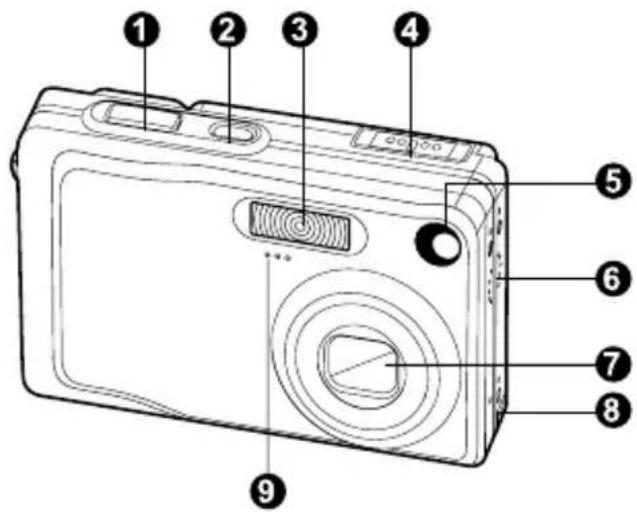
# Name Description
- Shutter button: Focuses and locks the exposure of the camera when pressed halfway down, and takes the picture when pressed all the way down.
- POWER button: Turns the camera power on and off.
- Flash: Provides flash illumination.
- Mode switch: Sets the camera mode.


Selects this when taking still images.
Selects this when recording video clips.
Performs image playback and deletion.
- Self-timer LED (AF auxiliary light): Blinks red during Self-timer mode until picture is taken.
- Speaker: Produces camera sounds and plays recorded audio.
- Lens: 3x optical zoom lens allows you to take telephoto and wide-angle pictures.
- Conversion adapter: Allows you to connect the conversion adapter to an AC terminal power adapter to the camera to operate the camera without battery, or to charge rechargeable lithium-ion battery or to connect a USB cable or an A/V cable to the camera.
- Microphone Records audio clips.
Rear View
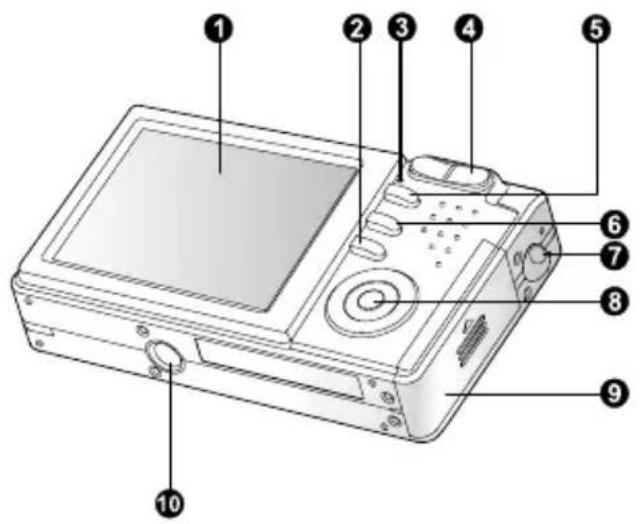
# Name Description
- LCD monitor Provides menu information to operate the camera, and previews the picture before taking it and review it afterwards.
- Display button Turns the LCD monitor display and live view on and off.
- Status LED Displays the camera current state.
- Zoom in button Zooms the lens to telephoto position. Zoom out button Zooms the lens to wide-angle position.
- MENU button Toggles OSD menu on and off.
- Erase button Allows you to erase the picture.
- Strap holder Camera strap attachment.
- SET /Direction button Allows you to scroll through menus and pictures, and then select choices.
- Battery/SD card cover Allows access to the battery and insert or remove the memory card.
- Tripod socket Allows tripod mounting.

SET /Direction button
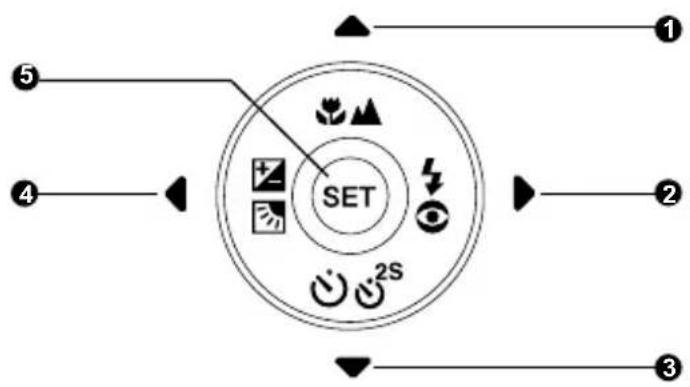
# Name Description
- button Scrolls upwards.

Focus button Allows you to choose the appropriate focus setting.
- button Scrolls right.

Flash button Allows you to choose the appropriate flash setting.
- button Scrolls downwards.

Self-timer button Allows you to toggle the self-timer on and off, selects the desired self-timer mode.
- button Scrolls left.

Exposure compensation Allows you to toggle the exposure / Backlight correction button compensation / backlight correction on and off.
- SET button
Enters the menu page and confirms the chosen setting.
Status LED Indicator
This describes the color and state of the status LED.
| Color | State | During power off | During photography | During connection to a PC |
| Green | On | The completion of battery charge. | AE or AF is locked with the shutter button held halfway. | - |
| Flashing | Battery charging in progress. | - | - | |
| Red | On | Battery charging error. | Writing to SD card in progress. | In communication to PC. (SD card is inserted.) |
| Flashing | - | When the image is not in focus. | - | |
| Orange | On | - | Charging of the flash in progress. | - |
| Flashing | - | Hardware malfunction. | SD card is not inserted. |
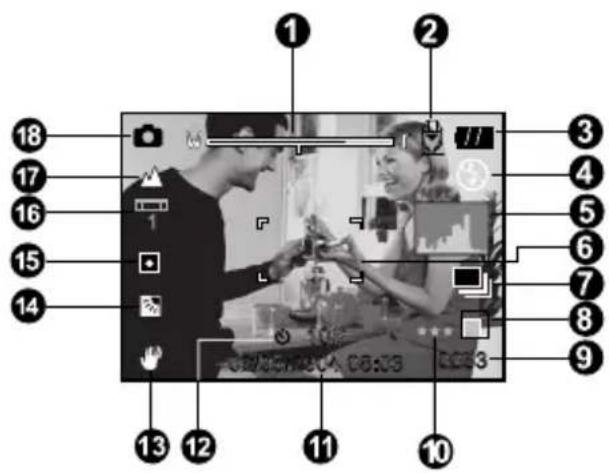
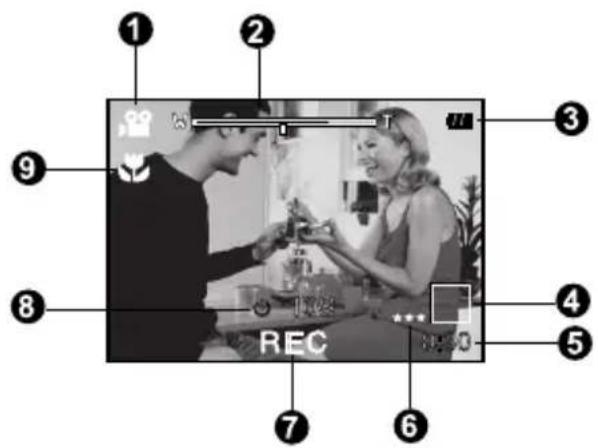
LCD Monitor Icons
Photography mode [ ]
- Zoom status
- Voice memo
- Remaining battery status
[ ] Full battery power [ ] Medium battery power [ ] Low battery power [ ] No battery power
- Flash icon
[Blank] Auto
[ ] Red-eye Reduction [ ] Forced Flash [ ] Suppressed Flash [ ★ ] Night Scene
- [ ] Histogram
- Focus area (When the shutter button is pressed halfway.)
- Capture mode icon
[Blank] Single
[ ] Continuous [ AEB ] Auto Exp.
- Image size
[ ]2560 x 1920 [ ] 2048 x 1536 [ ] 1280 x 960 [ ] 640 x 480
- Possible number of shots
- Quality
[★] Fine [★★] Standard [★] Economy
- Date and time
- Self-timer icon
[10s] 10 sec. [2s] 2 sec. [10+2s] 10+2 sec.
NOTE![ACER cr 5530 - Photography mode [ ] - 1](/content/2026/05/758165/images/908598f1145fb483532ae7c8089ca993151a4ccf0c8543f474f68d24f6795519.jpg)
■ Each press of the ☐ button switches one step in the sequence of Normal display (displaying the icons, etc), Normal and Histogram, display OFF, LCD monitor OFF.
- Unsteady hold warning icon
- [ ] Exposure compensation
[ ] Backlight correction
- Metering icon
[Blank] Multi
[●] Spot
- White balance icon
[Blank] Auto [ ] Incandescent [ ] Fluorescent 1 [ ] Fluorescent 2 [☀] Daylight [ ] Cloudy [ ] Manual
- Focus icon
[Blank] Auto focus [ ] Macro [▲] Infinity
- [ ] Still image mode
Photography mode

- [ ] Movie mode
- Zoom status
- Remaining battery status
- Image size
- Possible recording time / elapsed time
- Quality
- Recording indicator
- Self-timer icon
- Focus icon
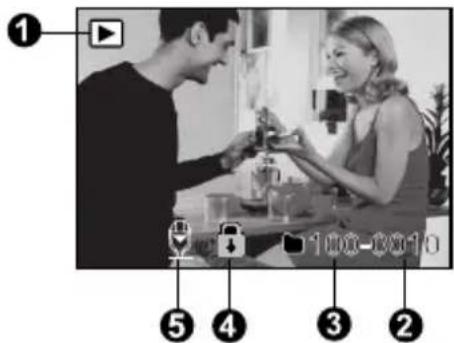
Playback mode [ ] - Still image playback
- Mode icon
- File number
- Folder number
- Protect icon
- Voice memo
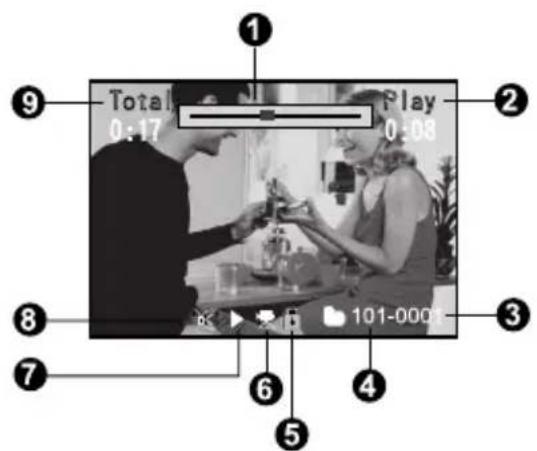
Playback mode [ ] - Video playback
- Video status bar
- Elapsed time
- File number
- Folder number
- Protect icon
- Mode icon
- Play mode
- Sound off icon (When the
[▲] button is pressed during video playback.)
- Total time
GETTING STARTED
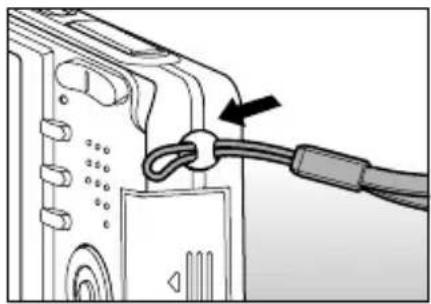
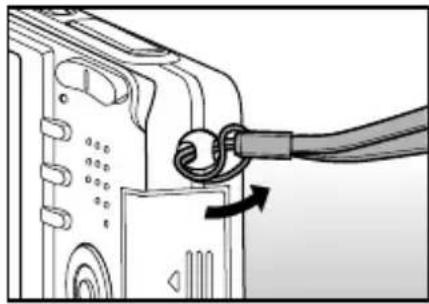
Attaching the Camera Strap
Attach the camera strap as shown in the illustration.
Inserting and Removing the Battery
We highly recommend using specified rechargeable lithium-ion battery (3.7V) to fully demonstrate this camera's function. Charge the battery before using the camera. Make sure that the power of the camera is off before inserting or removing the battery.
Inserting the Battery
- Open the battery/SD card cover.
- Insert the battery in the correct orientation shown. ■ Tilt the battery lock lever in the direction of the arrow and orient the battery so that its label is facing to the rear side of the camera, and then insert the battery.
- Close the battery/SD card cover.
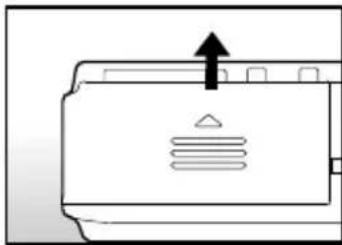
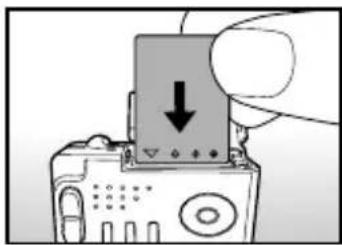
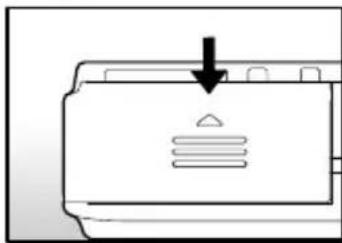
Removing the Battery
Open the battery/SD card cover and then release the battery lock lever. When the battery has come out a little, slowly pull it out the rest of the way.
Charging the Battery
Using the AC power adapter may charge the battery or operate the camera as power supply. Make sure that the power of the camera is off and then insert the battery before starting.
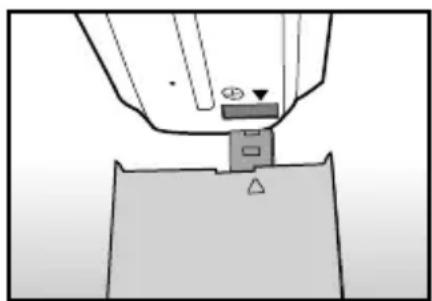
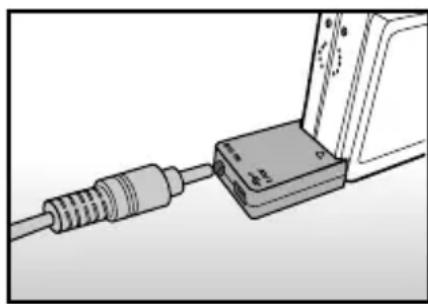
- Insert the conversion adapter into the conversion adapter terminal of the camera as shown in the illustration.
- Insert one end of the AC power adapter into the DC IN terminal of the conversion adapter.
- Insert the other end of the AC power adapter into a wall outlet.
■ The status LED flashes green when charging is started and lights green when charging is completed. It lights red when a charging error occurs. ■ It is recommended to fully discharge or exhaust the battery before being charged. ■ Charging time varies according to the ambient temperature and the status of battery.

■ This camera must be used with specified AC power adapter. Damage caused by the use of an incorrect adapter is not covered under the warranty. ■ When the charging is not started even if following the above procedure, turn the power on at any mode after LCD monitor turns on, and then turn the power off. ■ The battery may feel warm after it has been charged or immediately after being used. This is normal and not a malfunction. ■ When using the camera in cold areas, keep the camera and battery warm by holding them inside your outer cloth. If you open the battery cover without removing the battery, the power will not be terminated. If you remove the battery, you have to insert the battery again in a period of 2 hours in order to make sure that the date and time will not be reset.
Inserting and Removing the SD Card
Images photographed with this camera will be stored on the SD card. Without inserting the SD card, you cannot take photographs using the camera. Before inserting or removing the SD card, make sure that the power of the camera is off.
Inserting the SD card
- Open the battery/SD card cover.
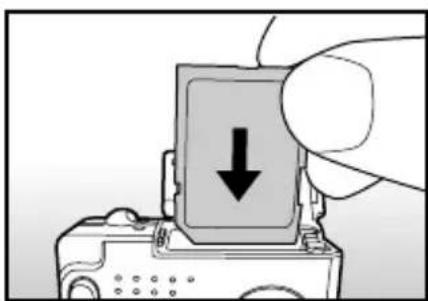
- Insert the SD card in the correct orientation shown.
- Hold the SD card with its front side (printed arrow) facing the rear side of the camera, and then insert the card as far as it can go.
- Close the battery/SD card cover.
Removing the SD card
Open the battery/SD card cover, press lightly on the edge of the SD card and it will eject.

If the camera is powered on without an SD card inserted into the camera, the "NO CARD" message appears on the LCD monitor.
■ To prevent valuable data from being accidentally erased from an SD card, you can slide the write-protected tab (on the side of the SD card) to "LOCK".
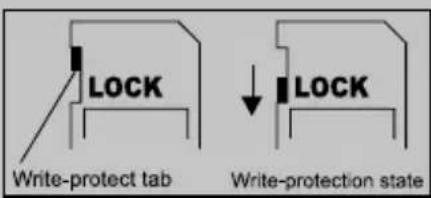
■ To save, edit, or erase data on an SD card, you must unlock the card.
■ This camera does not support MultiMediaCard™.
Turning the Power On/Off
Load the battery and insert an SD card before starting.
Turning the power on
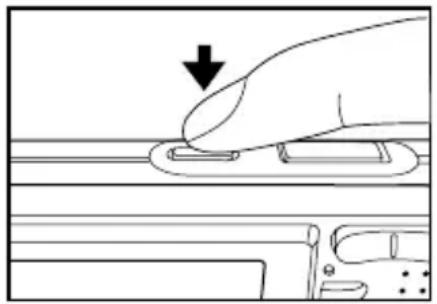
Press the POWER button to turn the power on.
■ The status LED lights green and the camera is initiated. ■ When the power is turned on, the camera will start in the mode that was set.
Turning the power off
Press the POWER button to turn the power off.

- The power is turned off automatically when the camera has not been operated for a fixed period of time. To resume the operation condition, turn the power on again. Refer to the section in this manual titled "Auto OFF" in the Setup Menu (In Photography Mode) for further details. ■ After the power is turned on, it may take several seconds to charge the flash. While the flash is being charged, the status LED lights orange, and then the camera is not yet ready for photography. Start photography after the status LED is turned off.
Setting the Date and Time
The date/time needs to be set if/when:
■ Camera is turned on for the first time. ■ Camera is turned on after leaving the camera without the battery for an extended period of time.
When the date and time information is not displayed on the LCD monitor, follow these steps to set the correct date and time.
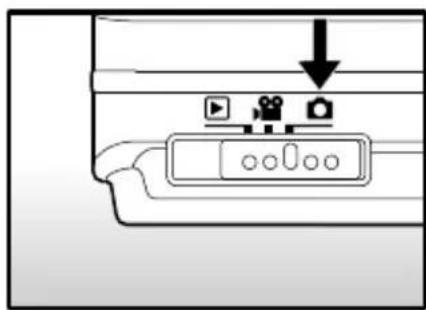
- Slide the mode switch to [ ] or [ ].
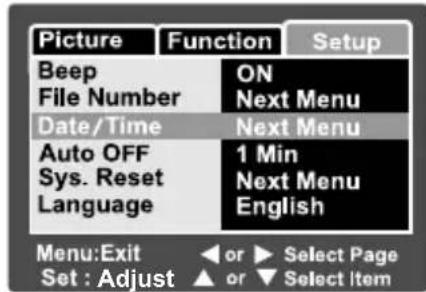
- Press the MENU button and select [Setup] menu with the ▶ button.
- Select [Date/Time] with the ▲ buttons and press the SET button.
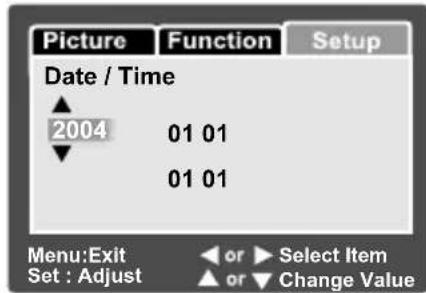
■ The Date/Time setting screen will be displayed.
- Select the item's field with the ◀/▶ buttons and adjust the value for the date and time with the ▲ buttons.
■ The date and time is set in the order year-month-day-hour-minute. ■ The time is displayed in 24-hour format.
- After confirming all settings are correct, press the SET button.
■ The setting will be stored and the screen will return to the set-up menu.
Choosing the Language
Specify in which language menus and messages are to be displayed on the LCD monitor.
- Slide the mode switch to [ ] or [ ] or [ ]
- Press the MENU button and select the [Setup] menu with the ▶ button.
■ If no images/video clips are recorded on the SD card, press the MENU button and the [Setup] menu will be displayed.
- Select [Language] with the ▲ buttons and press the SET button.
■ The Language setting screen will be displayed.
- Select the displayed language with the
▼ buttons and press the SET button. ■ The setting will be stored.
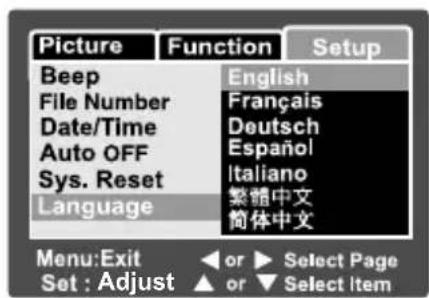
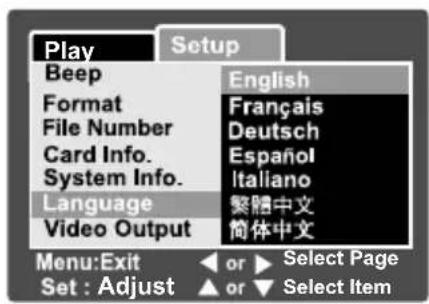
[ ] Mode with Images/Video Clips on SD card
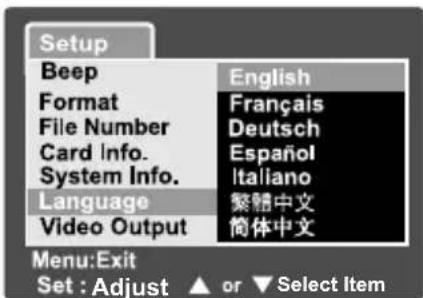
[ ] Mode without Images/Video Clips on SD card
Formatting the SD Card
This erases all of the images and folders that have been recorded on the SD card. Formatting is not possible when the SD card is in the locked condition.
- Slide the mode switch to [ ]
- Press the MENU button.
The [Setup] menu is displayed. If images/video clips are recorded on the SD card, press the ▶ button after the MENU button is pressed.
- Select [Format] with the ▲/▼ buttons, then press the SET button.
- Select [Execute] with the ▲/▼ buttons, and press the SET button.
To cancel formatting, select [Cancel] and press the SET button.
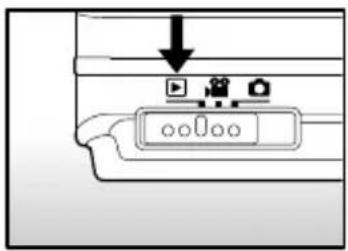
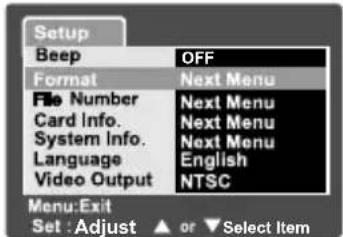
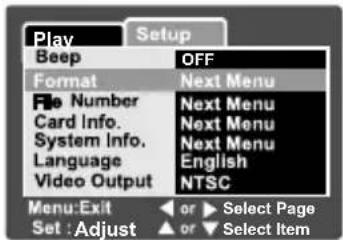
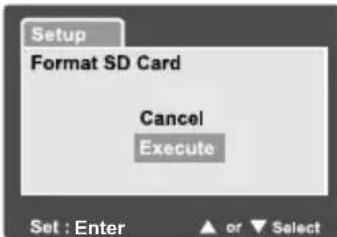

You need to format an SD card before using it for the first time. Formatting the SD card also erases the protected images. All data other than images are also erased. Before formatting the card, make sure that all the images are unnecessary. Formatting is an irreversible action and data cannot be recovered at a later time. An SD card having any problem cannot be properly formatted.
Setting Image Resolution and Quality
Resolution and quality settings determine the pixel size (dimension), image file size, and compression ratio for your images. These settings affect the number of images that can be stored on a memory card. As you get to know the camera, it is recommended that you try each quality and resolution setting to get an appreciation for the effects that these settings will have on your images.
Higher resolution and higher quality images offer the best photographic results but produce large file sizes. Therefore, few images will take up a lot of memory space.
High resolution and quality settings are recommended for printed output and situations requiring the finest detail. Lower resolution/quality images take up less memory space and may be quite suitable for sharing images via e-mail, in a report, or on a web page.
To change image resolution or image quality, perform these steps below:
- Slide the mode switch to [ ] or [ ].
- Press the MENU button. The [Picture] of the photography menu is displayed.
- Select [Size] with the ▲/▼ buttons, and press the SET button.
- Select the desired setting with the buttons, and press the SET button.
- Select [Quality] with the /▲ buttons, and press the SET button.
- Select the desired setting with the buttons, and press the SET button.
- To exit from the photography menu, press the MENU button.
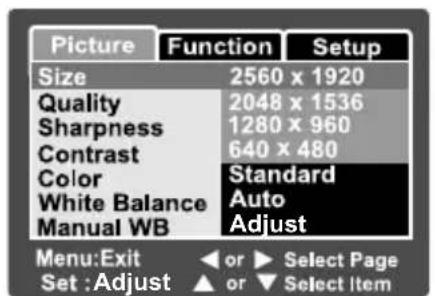
[Mode
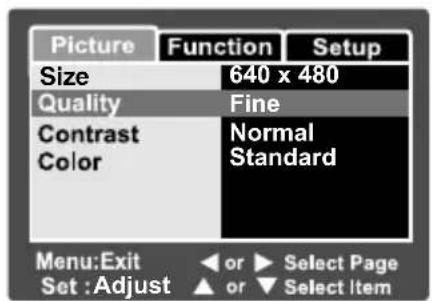
[Mode
Possible number of shots (still image)
The table shows the approximate shots that you can take at each setting based on an optional SD card.
| Image size Quality | Quality | SD card capacity | ||||
| 32MB 64MB 128MB 256MB 512MB | ||||||
| (5M)2560 x 1920 | Fine | 13 | 27 | 55 | 110 | 222 |
| Standard | 22 | 46 | 93 | 185 | 374 | |
| Economy | 42 | 86 | 174 | 346 | 698 | |
| (3M)2048 x 1536 | Fine | 22 | 46 | 93 | 185 | 374 |
| Standard | 36 | 74 | 150 | 300 | 604 | |
| Economy | 72 | 149 | 301 | 600 | 1208 | |
| (1.2M)1280 x 960 | Fine | 42 | 86 | 174 | 346 | 698 |
| Standard | 72 | 149 | 301 | 600 | 1208 | |
| Economy | 126 | 258 | 552 | 1040 | 2094 | |
| (VGA)640 x 480 | Fine | 145 | 298 | 602 | 1200 | 2417 |
| Standard | 210 | 430 | 870 | 1734 | 3491 | |
| Economy | 379 | 775 | 1566 | 3121 | 6284 | |
Possible recording time / sec (video clip)
| Image size | Quality | SD card capacity | ||||
| 32MB | 64MB 128 | MB 256MB | 512MB | |||
| 640 x 480 | Fine | 00:40 | 01:22 | 02:46 | 05:32 | 11:08 |
| Standard | 00:54 | 01:51 | 03:44 | 07:27 | 15:00 | |
| 320 x 240 | Fine | 01:45 | 03:34 | 07:13 | 14:23 | 28:59 |
| Standard | 02:36 | 05:20 | 10:46 | 21:28 | 43:13 | |
* The data shows the standard testing results. The actual capacity varies according to the shooting conditions and settings.
PHOTOGRAPHY MODE
[ ] Still Image Mode
Auto photography is a typical method of photography. Photographs can be taken simply because the exposure (the combination of shutter speed and aperture setting) is controlled automatically to suit the photographic conditions. You can use the 2.5" LCD monitor to compose the images.
Make sure that the battery and SD card are inserted before taking photographs.
- Press the POWER button to turn the power on.
- Slide the mode switch to [ ]
■ By default, the LCD monitor setting is on.
- Compose your image in the LCD monitor.
- Press the shutter button.
- Pressing the shutter button down halfway automatically focuses and adjusts the exposure, and pressing the shutter button down fully takes the photographs. ■ The focus area frame turns blue and the status LED lights green when the camera is in focus and the exposure is calculated. ■ When the focus or exposure is not suitable, the frame of the focus area turns yellow and the status LED flashes red.
- If the photographic quickview is set to "ON", the captured image will be displayed while the image is being recorded onto the SD card.
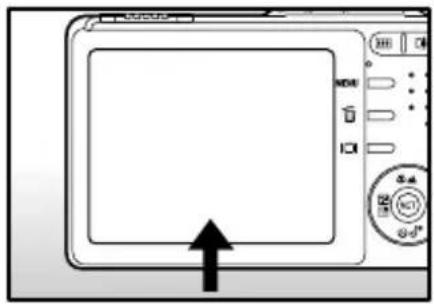
① Press down halfway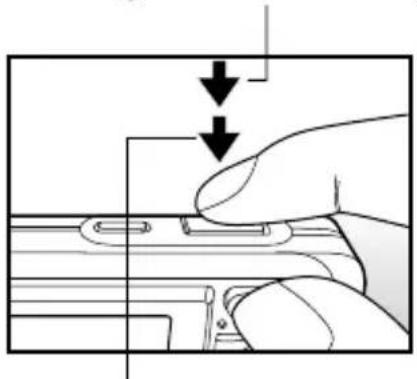
② Press down fully
Recording Voice Memos
A voice memo can be recorded once for 30 seconds at still image mode immediately following a still image captured or at playback mode while viewing the picture.
- Slide the mode switch to [
- Press the MENU button, and select the [Function] menu with the ▶ button. ■ [Function] of the still image menu is displayed.
- Select [VOICE MEMO] with the ▲▼ buttons, and press the SET button.

- Select [ON] with the ▲ buttons, and press the SET button.
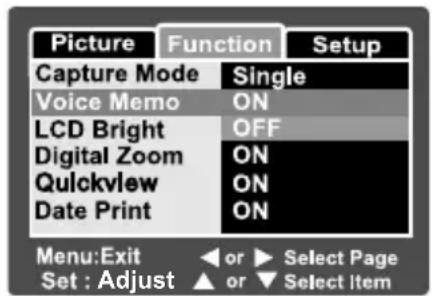
- Press the MENU button to exit from the still image menu.
■ [icon] is displayed on the screen.
- Compose the picture, press the shutter button down halfway, then press it down fully.
■ [VOICE RECORDING] is displayed on the screen immediately, and the voice memo recording starts.
- Press the shutter button one more time during recording, or wait for 30 seconds.
■ [VOICE RECORD END] will be displayed and the recording will end. ■ A [icon] is displayed with images that have been recorded with a voice memo.

Voice memo is only available in the still single image capture mode.
Using the Optical Zoom
Zoom photography allows you to take zoom photographs up to 3 times the size or wide-angle photography depending on the distance up to the subject. You can also enlarge the center of the screen and take photographs in the digital zoom mode.
- Slide the mode switch to [ ] or [ ].
- If required, turn on the LCD monitor by pressing the I button.
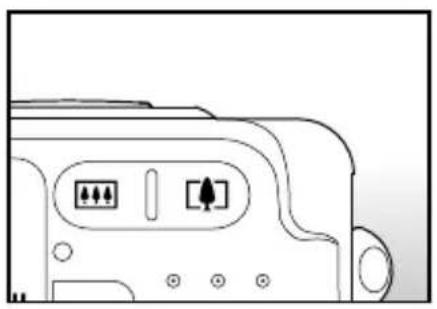
- Compose the picture with the zoom button.
- Pressing the button zooms in on the subject, and enlarges the subject on the LCD monitor.
- Pressing the button provides a wider angle picture. The lens position moves according to the zoom button setting.
- Press the shutter button down halfway, then press it down fully.
Using the Digital Zoom
Using a combination of 3 times optical zoom and 4.0 times digital zoom permits zoom photography of up to 12 times to suit the subject and the distance. The digital zoom is a compelling feature; the more an image is enlarged (zoomed), the more pixilated (grainer) the image will appear.
- Slide the mode switch to [ ] or [ ].
- Turn on the LCD monitor by pressing the button.
- To enable the digital zoom:
a. Press the MENU button. b. Select [Function] with the ◀ buttons. c. Select [Digital Zoom] with the ▲ / ▼ buttons, and press the SET button. d. Select [ON] with the ▲ / ▼ buttons again, and press the SET button. e. Press the MENU button to exit from the menu screen.
f. To activate the digital zoom, press and hold the button completely until the image on the LCD monitor expands.
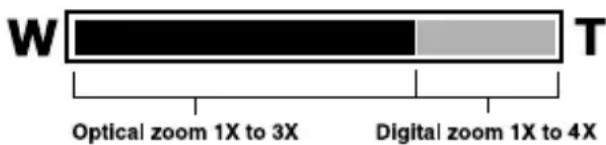
- Press the shutter button to capture a "zoomed" image.

The digital zoom is cancelled when the button is pressed and the LCD monitor is turned off. The zoom setting is automatically cancelled by either turning the camera off or the activation of the Auto OFF function.
Setting the Flash
Set the flash for taking photographs. The flash firing mode can be set to suit the photographic conditions.
- Slide the mode switch to [
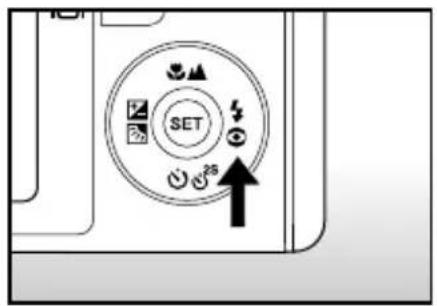
- Toggle the button to select the desired flash mode.
Each press of the 4 button moves the icon one step through the sequence and displays it on the screen.
![graph LR A["Blank"] --> B["Auto"] B --> C["Red-eye Reduction"] C --> D["Forced Flash"] E["Night Scene"] --> F["Suppressed Flash"]](/content/2026/05/758165/images/7ba7728912bcc0c3785836d656a95c150600df9e567528b9d8344a9a29758424.jpg)
The table below will help you choose the appropriate flash mode:
| Flash mode Description | |
| [ Blank] Auto The flash fires | automatically to suit thephotographic conditions. |
| [ ]Red-eye Reduction Use this mode to reduce the red-eyephenomenon when you want to take natural-looking photographs of people and animals inlow-light conditions.When taking photographs, the red-eyephenomenon can be reduced by asking thesubject (person) to look at the camera or getas close to the camera as possible.The flash always fires twice, and thephotograph is taken at the second firing. | |
| [ ] Forced Flash In this mode, the flash always fires. Use thismode for photographing under artificial lightsuch as backlighting, fluorescent lighting, etc. | |
| [ ] Suppressed Flash Use this mode when taking pictures usingindoor lighting, for stages and indoorcompetitions, and when the subject is too faraway for the flash to be effective. | |
| [ ] Night Scene | Use this mode when taking pictures of peopleat dark or night-time background.When the Night Scene is selected, the flashmode is fixed to Slow Synchronization. (theflash is fired at a slower shutter speed.) |

In the [▲] focus mode and capture mode [Continuous] and [Auto Exp.], the flash mode is fixed to [④ Suppressed Flash]. The flash cannot be set in the [ ] mode.
Setting the Focus
Photographs can be taken with the distance to the subject set by auto focus, [ ] macro or [ ] infinity.
The settings will be maintained even when the power is turned off or when Auto OFF is activated.
- Slide the mode switch to [ ] or [ ].
- Toggle the button to select the desired focus mode. Each press of the 🔊 button moves the icon one step through the sequence and displays it on the screen.
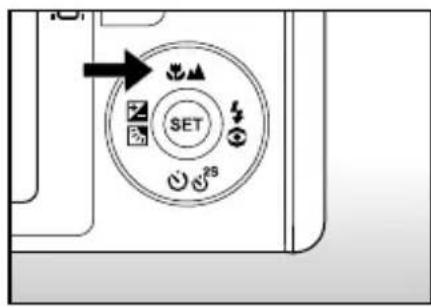
![graph LR A["Blank"] --> B["Auto focus"] B --> C["Macro"] C --> D["Infinity"]](/content/2026/05/758165/images/182e57a78898c5a3317097311e725a9f2d74eb767c7ea91354ec3b42c30fe0dc.jpg)
The table below will help you choose the appropriate focus mode:
| Focus mode Description | |
| [ Blank]Auto Focus Selects this when you want to leave the settings up to the camera so that you can take photographs without paying attention to settings.Approximately 50 cm to infinity (both Wide and Tele) | |
| [ ] Macro | Selects this when you want to takes a close up photography.Wide (zoom off) : Approximately 6 cm to infinityTele (at optical zoom 3x) : Approximately 35 cm to infinity |
| [ ] Infinity | Selects this when you want to take photographs of subjects at a distance of infinity. |
Setting the Self-timer
This setting allows photographs to be taken with the self-timer.
- Slide the mode switch to [ ] or [ ].
- Toggle the button to select the setting.
■ Each press of the button moves the icon one step through the sequence and displays it on the screen.
![OFF → [Tunisia 10s] 10 sec. → [Tunisia 2s] 2 sec. ← [Tunisia 10+2s] 10+2 sec.](/content/2026/05/758165/images/11e08b3aef94ed24675d5584c755ca1034f4c95c8dc44ace69e728853e238e49.jpg)
■ For the [mode and capture mode ([Continuous] and [Auto Exp.])
![OFF → [Tunisia 10s] 10 sec. → [Tunisia 2s] 2 sec.](/content/2026/05/758165/images/a104838c364e307f856d9e2b44bfea5ce4ab9a28e4b67c11eb6eeb7a221dd569.jpg)
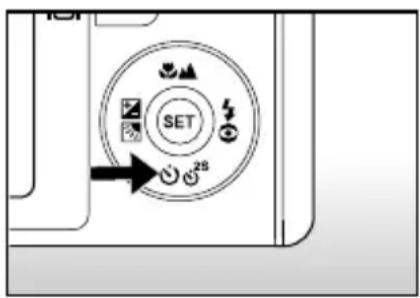
- Compose the picture, press the shutter button down halfway, then press it down fully.
■ The self-timer LED flashes and the photograph is taken after the preset time has elapsed. ■ The countdown is displayed on the LCD monitor. ■ To cancel the self-timer during operation, press the SET button.
The table below will help you choose the appropriate self-timer mode:
| Self-timer mode Description | |
| [ Tunisia 10s] 10 sec. | The picture is taken about 10 seconds after the shutter button is pressed. |
| [ Tunisia 2s] 2 sec. | The picture is taken about 2 seconds after the shutter button is pressed. |
| [ Tunisia 10+2s]10+2 sec. | One picture is taken about 10 seconds after the shutter button is pressed, and the other photograph is taken again after 2 seconds. This is convenient when taking group photographs in succession. |
NOTE
■ The self-timer setting is automatically cancelled after a photograph is taken.
Exposure Compensation/Backlight Correction
Photographs can be taken with the overall screen intentionally made brighter or darker. These settings are used when a suitable brightness (exposure) cannot otherwise be obtained in circumstances where the difference in brightness between the subject and the background (the contrast) is large, or when the subject that you want to photograph is very small within the screen. Exposure can be set in 0.3 EV units.
- Slide the mode switch to [ ] and press the 📄 button.
■ Each press of the 📄 button displays the setting in the order of [Blank], [ ] Backlight Correction, and [ ] Exposure Compensation.
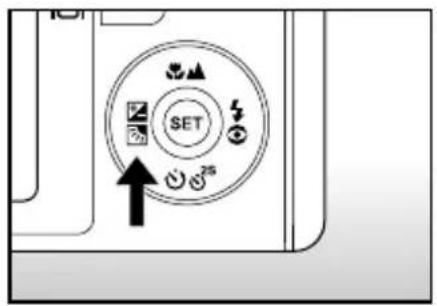
- Set the exposure value with the ▲ ▼ buttons.
■ Press the ▲ button to increase the value. ■ Press the ▼ button to decrease the value. ■ The setting range of the exposure compensation is as follows.
-2.0, -1.7, -1.3, -1.0, -0.7, -0.3, 0, +0.3, +0.7, +1.0, +1.3, +1.7, +2.0
■ The larger the value, the brighter the image. The smaller the value, the darker the image. The set value is displayed on the screen.
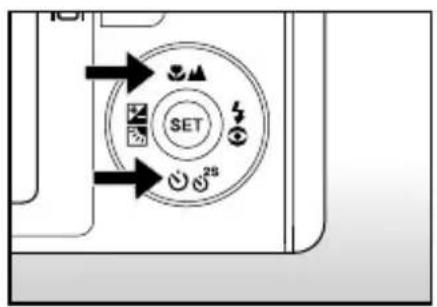
Effective Subjects and Set Values
■ + (positive) compensation
* Printed matter comprising black text on whitish paper * Backlighting * Bright scenes or strong reflected light such as ski slopes * When the sky accounts for a large area on the screen
■ - (negative) compensation
* People illuminated by a spotlight, in particular, against dark background * Printed matter comprising white text on blackish paper * Weak reflecting bodies such as evergreen trees or darkish leaves
■ Backlight correction (+1.3, fixed)
* When the background is bright and the subject is dark. * When subjects (people) have a light source such as the sun to their backs.
[Movie Mode]
This mode allows you to record video clips at a resolution of 320 x 240 / 640 x 480 pixels. Voice can also be recorded.
- Slide the mode switch to [ ]
- Compose the picture with the zoom button.
- Press the shutter button.
■ The recording of the video clip will start. Pressing the shutter button one more time will end the recording of the video clip and record the image into the SD card. ■ The recording time depends on the storage size and the subject of the image to be recorded. ■ Zoom function cannot be used while a video clip is recording.
![ACER cr 5530 - [Movie Mode] - 1](/content/2026/05/758165/images/88a15632bb7ae97af7e68db2877e56d2db7660553e18521ea7a0b8cb14bf1eed.jpg)
■ In the [ ] mode, the LCD monitor cannot be turned off. ■ When recording a video clip, flash photography is not possible. ■ While the image is being recorded into the SD card, do not open the battery/SD card cover, nor remove the battery or SD card. Doing so might damage the SD card or destroy the data on the SD card. ■ While composing the image, optical zoom and digital zoom functions can be used at the resolution of 320 x 240 pixels. However, digital zoom function cannot be activated at the resolution of 640 x 480 pixels.
[ ] PLAYBACK MODE
Playing Back Still Images
You can play back the still images on an LCD monitor. Insert the SD card into the camera and turn on the power before starting.
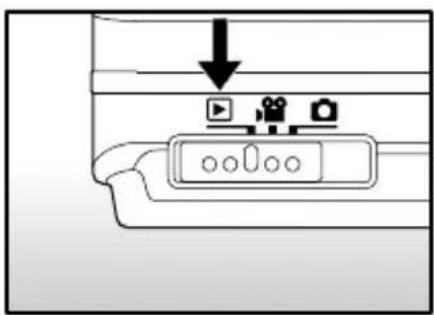
- Slide the mode switch to [ ]. The last image appears on the screen.
- The images can be fed in reverse or fed forward with the ▲ / ▼ buttons.
Image Display Information
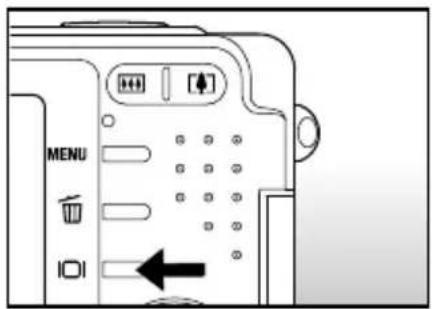
You can switch the state of the information display by pressing the I button when playing back images. Each press of the I button switches the information display state in the following order:
![graph LR A["Video Video"] --> B["Audio Video"] B --> C["Monitor Display"] C --> D["Audio Record"]](/content/2026/05/758165/images/ecf6a6c31478b6edaa4351604cab9cacb705bf926eee607613246c441c0741fb.jpg)

- Pressing the ◀/▶ buttons during image playback will result in a 90 degree rotated display. The ▶ button rotates the image clockwise and displays it, whereas the ◀ button rotates the image counterclockwise and displays it. A press of the button opposite to the direction in which the image was rotated will return the image to the normal display. ■ [icon is displayed with the video data. Video clips cannot be rotated. ■ A [💡] icon is displayed with images which have an audio memo recorded. ■ Press the SET button to playback the voice memo data. ■ The condition of the information display cannot be switched with video clips.
Playing Back Video Clips
You can play back video clips recorded on the camera. You can also play back voice.
- Slide the mode switch to [ ]
■ The last image appears on the screen.
- Select the desired video clip with the /▲ buttons.
- Press the SET button.
- A press of the ▶ / ◀ buttons during playback allows fast forward play / fast reverse play. ■ To stop video playback:
Press the ▼button.
This stops playback and returns to the start of the video clip.
■ To pause video playback
Press the SET button.
This pauses video playback.
To cancel pause, press the SET button again.
Button Operations
| During Playback During a Pause During a Stop | |||
| ▶ button | Forward playEach press of the ▶button moves the operation one step in the sequence of 2 times fast forward play, 4 times fast forward play, and regular play. | 1-frame feed | |
| ◀ button | Reverse playEach press of the ◀button moves the operation one step in the sequence of 2 times fast reverse play, 4 times fast reverse play, and regular play. | Reverse1-frame feed | |
| ▲ button | Sound On/Off | Sound On/Off | The previous image is displayed. |
| ▼ button | Stop (The display returns to the 1st frame playback) | The next image is displayed. | |
| SET button | Pause | Canceling pause | Regular forward play |
NOTE
■ Video clips cannot be displayed rotated or enlarged.
Playing Back Still Images/Video Clips on a TV
You can also playback your images on a TV screen. Before connecting to any devices, make sure to select the NTSC / PAL system to match the video output system of the video equipment you are going to connect to the camera, then turn all connected devices off. It is also recommended to use the AC power adapter while transferring the recorded images and video files.
- Slide the mode switch to [ ]
- Connect one end of the A/V cable to the conversion adapter terminal of the camera.
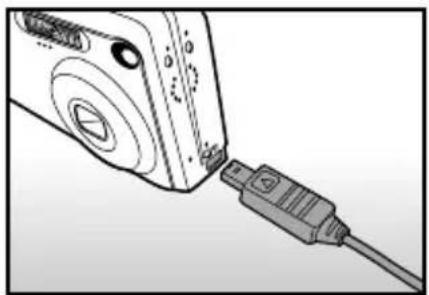
■ If you use the conversion adapter to connect the A/V cable, insert the conversion adapter into the conversion adapter terminal of the camera first, and then connect one end of the A/V cable to the A/V terminal of the conversion adapter.
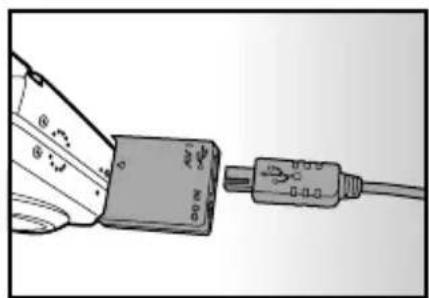
- Connect the other end to the A/V input socket of the TV set.
- Turn the TV and camera on.
- Play back the still images / video clips.
■ The method of operation is the same as playing back still images and video clips on the camera.
NOTE
■ In the case of the PAL system, images are surrounded by a black frame. ■ Refer to the section in this manual titled "Video Output" in the Setup Menu (In Playback Mode) for further details.
Attaching Voice Memos
A maximum of 30 seconds of audio can be recorded like a memo for photographed still images. The voice memo can be recorded only once.
- Slide the mode switch to [ ]
■ The last image appears on the screen.
- Select the image that you want to attach the voice memo with the buttons.
- Press the shutter button.
■ [VOICE RECORDING] is displayed on the screen and recording starts.
- To stop recording the voice memo during recording, press the shutter button again.
■ [VOICE RECORD END] will be displayed and the recording will end. An [icon] icon is displayed with images that have been recorded with a voice memo.
Playing back voice memo
A press of the SET button displays [VOICE PLAYBACK] and plays back the voice memo.
NOTE
■ Voice memo is only available in the still single image capture mode.
Thumbnail Display
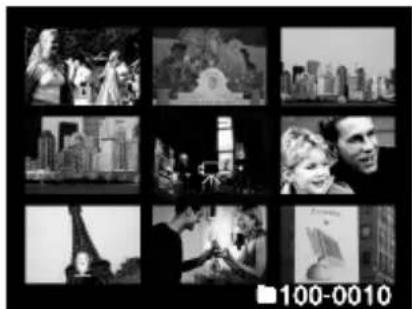
This function allows you to view 9 thumbnail images on the LCD monitor at the same time, which can quickly search for the image that you want.
- Slide the mode switch to [ ]
■ The last image appears on the screen.
- Press the 🏠 button.
■ The images are displayed in the thumbnail display. ■ Images that have been selected with the ▲ / ▼ / ◀ / ▶ buttons will be indicated by a green frame. ■ When there are ten or more images, scroll the screen with the ▲ buttons.
- Press the ▲ / ▼ buttons to select the image to be displayed at regular size.
- Press the SET button.
The selected image is displayed at its regular size.
NOTE
A [ ], [ ], [ ] icon will be displayed in a thumbnail display.
Zoom Playback
Images that are being played back can be enlarged and displayed in 2 levels of 2 times and 4 times enlargement. This mode also allows you to enlarge your image on the selected portion of the image to check for small details.
- Slide the mode switch to [ ]
- Press the ▲/▼ buttons to select the image you want to enlarge.
You can also select the image you want to enlarge from the thumbnail display.
- Adjust the zoom ratio with the buttons.
Pressing the □ button enlarges the image.
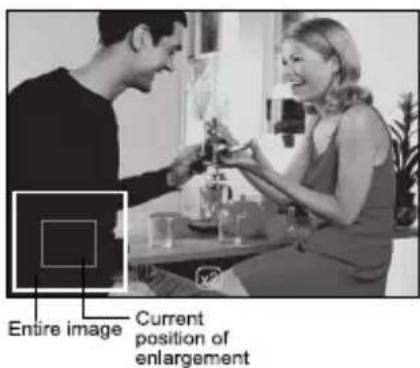
To return to normal magnification, press the 🎨 button. The image is displayed enlarged, and a white frame and green frame are displayed on the LCD monitor. The white frame indicates the entire image, while the green frame shows the location of the currently enlarged area.
- Press the ▲/▼/◄/► buttons to select the area to enlarge.
- To return to regular display, toggle the button until the regular display appears on the screen.
NOTE
- Pressing the button magnifies the image from 1x to 2x to 4x.
Slideshow Display
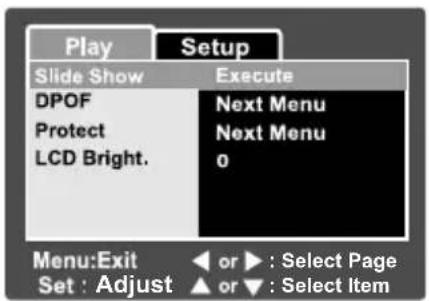
The slideshow function enables you to playback your still images automatically in order one image at a time.
- Slide the mode switch to [ ]
- Press the MENU button.
■ The playback menu is displayed.
- Select [Slide Show] with the ▲/▼ buttons, and press the SET button.
■ The slideshow starts.
- To stop the slide show during playback, press the SET button.
■ The image is displayed on screen when you press the SET button.

■ The Auto OFF function does not operate during slide show. ■ All still images in the folder are automatically played back.
Protecting Images
Set the data to read-only to prevent images from being erased by mistake.
Protecting Images
- Slide the mode switch to [
- Select the image that you want to protect with the ▲ buttons.

- Press the MENU button.
■ The playback menu is displayed.
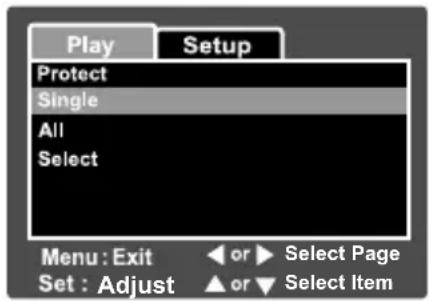
- Select [Protect] with the /▲buttons, and press the SET button.
- Select [Single] or [All] with the ▲▼ buttons, and press the SET button.
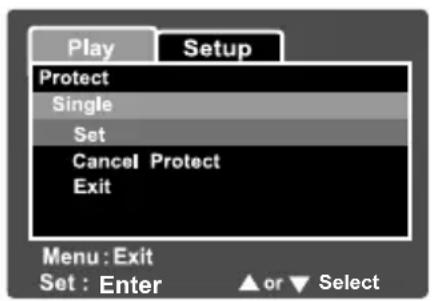
- Select [Set] with the ▲ buttons, and press the SET button.
■ Protect is executed and the camera returns to the play mode. - The protect icon [🔒] is displayed with protected images. When [All] has been selected, [🔒] is displayed with all the images.
Canceling the Protection
To cancel protection for only one image, display the image that you want to remove the image protection.
- Select [Protect] with the ▲ / ▼ buttons from the playback menu, and press the SET button.
- Select [Single] or [All] with the ▲ / ▼ buttons, and press the SET button.
- Select [Cancel Protect] with the ▲ / ▼ buttons, and press the SET button. ■ The removal of image protection is executed and the camera returns to the play mode.
Protecting multiple images simultaneously
- Select [Protect] with the ▲ / ▼ buttons from the playback menu, and press the SET button.
- Select [Select] with the ▲ / ▼ buttons, and press the SET button. ■ The images are displayed in the thumbnail display.
- Select the image you want to protect with the ▲ / ▼ / ◀ / ▶ buttons, and press the □ button.
- The protect icon [🔒] is displayed with protected images. Selecting a protected image and pressing the □ button again will cancel the protection. This procedure is repeated to select multiple images.
- Press the SET button.
Protection and cancellation of protection are executed, and the camera returns to play mode.
NOTE
Formatting the SD card undoes the protection and erases all images.
DPOF Settings
DPOF is the abbreviation for Digital Print Order Format, which allows you to embed printing information on your memory card. You can select the images to be printed and how many prints to make with the DPOF menu in the camera, and insert the memory card into a compatible printer. When the printer starts printing, it will read the embedded information on the memory card and print the specified images.
- Slide the mode switch to [ ].
- Select the image for which you want to set DPOF using the ▲ buttons.
- Press the MENU button.
The playback menu is displayed.
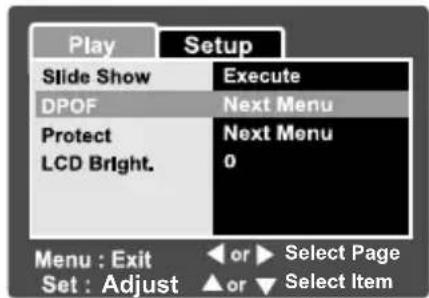
- Select [DPOF] with the ▲/▼ buttons, and press the SET button.
The DPOF setting screen is displayed.
- Select [Single] or [All] with the ▲/▼ buttons, and press the SET button. Single: Sets DPOF for each individual image.
All: Sets DPOF for all images at once.
- Select [Print Num.] with the ▲/▼ buttons, and press the SET button.
■ This displays the number of prints setting screen.
- Set the number of prints with the ▲/▼ buttons, and press the SET button.
■ You can set up to 9 prints for each image.
- Select [Date] with the ▲/▼ buttons, and press the SET button.
■ The date setting screen appears.
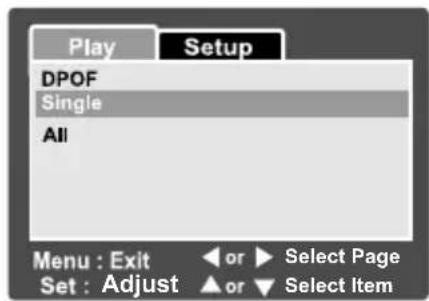
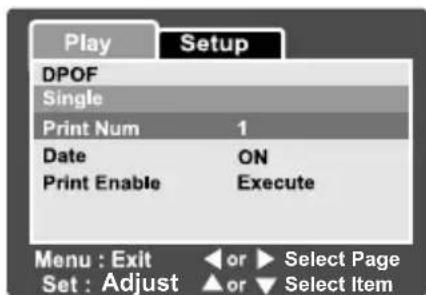
- Select date to [ON] or [OFF] with the ▲/▼ buttons, and press the SET button.
■ ON: The date of the photograph will also be printed.
OFF: The date of the photograph will not be printed.
- Select [Print Enable] with the ▲/▼ buttons, and press the SET button.
- Select [Execute] with the ▲/▼ buttons, and press the SET button.
■ This creates a file containing the DPOF information, and when the operation is finished, the screen returns to the playback screen.

- The date that is printed on the photo is the date set on the camera. To print the correct date on the photo, set the date on the camera before you photograph the image. Refer to section in this manual titled “Setting the Date and Time” for further details.
[ ] Erasing Images
Erasing at Photography Mode (Quick Delete Function)
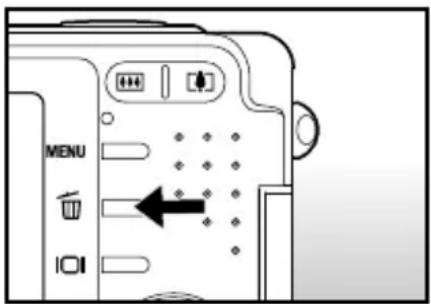
Quick delete function enables you to erase the image during photography. The quick delete menu provides you to directly erase the last image without further settings.
- Slide the mode switch to [ ] or [ ]
- Press the button.
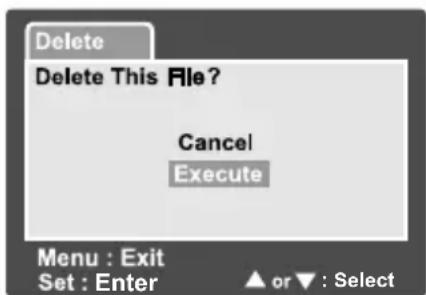
■ The last image and quick delete menu appear on the screen.
- Press the SET button to erase the image.
■ To not erase, select [Cancel], and press the SET button.
Erasing at Playback Mode
Erasing single image / Erasing all images
- Slide the mode switch to [ ]
■ The last image will be displayed on the screen.
- Select the image you want to erase with the ▲ / ▼ buttons.
- Press the 📋 button.
■ The deletion menu will be displayed.
- Select [Single] or [All] with the ▲▼ buttons, and press the SET button.
■ Single: Erases the selected image or the last image.
All: Erases all of the images on the SD card except for the protected images.
Select: Erases a number of selected images.
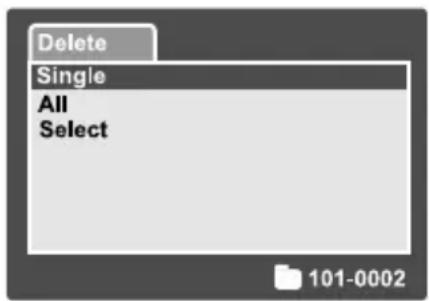
- Select [Execute] with the ▲ / ▼ buttons, and press the SET button.
■ To not erase, select [Cancel], and press the SET button.

■ Even if you take photographs after erasing an image, the file number is assigned the next number of the very last one before the image was erased.
Erasing selected images
This erases a number of selected images.
- Slide the mode switch to [ ]
- Press the 📋 button.
The deletion menu will be displayed.
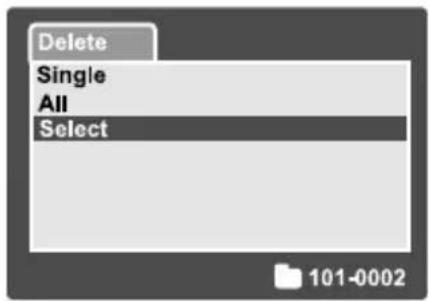
- Select [Select] with the ▲/▼ buttons, and press the SET button.
The images are displayed in the thumbnail display.
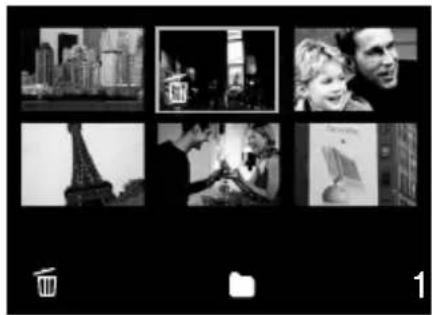
- Select the image you want to erase with the ▲/▼/◄/► buttons, and press the erase button.
The icon will be displayed. One more press of the erase button will cancel the operation. Repeat this procedure and select all the images that you want to erase.
- Press the SET button.
MENU OPTIONS
Still Image Menu (Picture)
This menu is for the basic settings to be used when taking still images.
- Slide the mode switch to [ ]
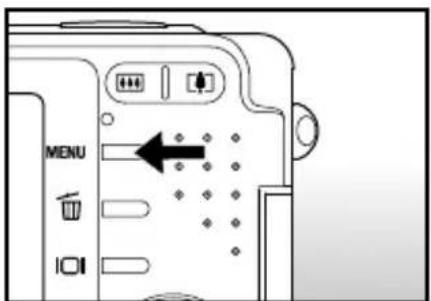
- Press the MENU button. [Picture] of the still image menu is displayed.
- Select the desired [Picture] option item with the ▲/▼ buttons, and press the SET button to enter its respective menu.
- Select the desired setting with the ▲/▼ buttons, and press the SET button.
- To exit from the still image menu, press the MENU button.
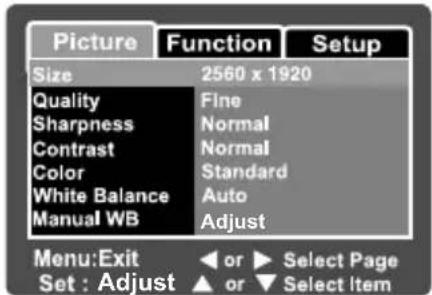
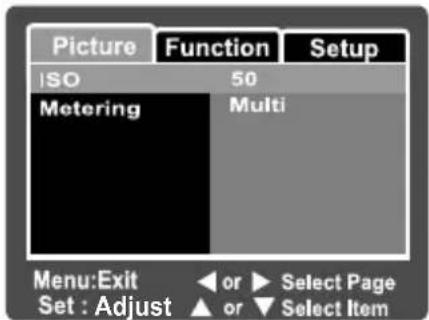
Size
This sets the size of the image that will be photographed.
[ ] 2560 x 1920: 2560 x 1920 pixels (5M) [ ] 2048 x 1536: 2048 x 1536 pixels (3M) [ ] 1280 x 960: 1280 x 960 pixels (1.2M) [ ] 640 x 480: 640 x 480 pixels (VGA)
Quality
This sets the quality (compression rate) at which the image is taken.
[★★★] Fine: Low compression rate.
[★★] Standard: Normal
[★] Economy: High compression rate
Sharpness
This sets the sharpness of the image that will be photographed.
Hard: Hard touch
Normal: Normal touch
Soft: Soft touch
Contrast
This sets the difference between the bright and dark portions of the image that will be photographed.
Hard: Increases the contrast.
Normal: Set the contrast automatically.
Soft: Decreases the contrast.
Color
This sets the color of the image that will be photographed.
Standard: Standard color
Vivid: Bright color
Sepia: Sepia
Monochrome: Black-and-white
White Balance
This sets the white balance photographing under a variety of lighting conditions and permits photographs to be taken that approach the conditions that are seen by the human eye.
[Blank] Auto: Automatic adjustment.
[ ] Incandescent: Photography under incandescent lighting.
[ ] Fluorescent 1: Photography under a daylight fluorescent tube with a bluish cast.
[ ] Fluorescent 2: Photography under a daylight white fluorescent tube with a reddish cast.
[★] Day Light: Outdoor photography.
[ ] Cloudy: Photography under a cloudy sky.
[ ] Manual: Photography with a Manual WB.
Manual WB
This manually sets the white balance and stores it. Use of this is convenient when the white balance does not offer a good match.
Before selecting [Execute], determine the subject (such as a white paper) that will be used to set the white balance.
Cancel: Disable manual white balance.
Execute: Enable manual white balance.
ISO
This sets the sensitivity for taking pictures. When the sensitivity is raised (and the ISO figure is increased), photography will become possible even in dark locations, but the more pixilated (grainer) the image will appear.
50: Equivalent to ISO 50.
100: High-sensitive photography equivalent to ISO 100.
200: High-sensitive photography equivalent to ISO 200.
Auto: Automatic adjustment.
Metering
This sets the metering method for calculating the exposure.
Multi: The entire area of the screen is measured, and the exposure is calculated.
Spot: A very small portion of the center of the screen is measured, and the exposure is calculated.
Still Image Menu (Function)
- Slide the mode switch to [
- Press the MENU button, and select the [Function] menu with the ▶ button. ■ [Function] of the still image menu is displayed.
- Select the desired [Function] option item with the ▲ / ▼ buttons, and press the SET button to enter its respective menu.
- Select the desired setting with the ▲ ▼ buttons, and press the SET button.
- To exit from the still image menu, press the MENU button.

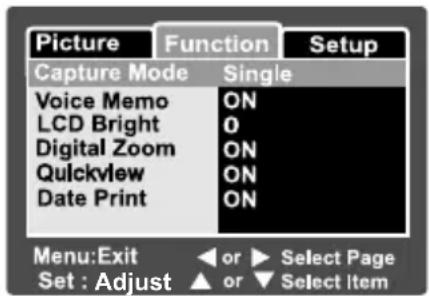
Capture Mode
This sets the recording method at the time of taking pictures.
Single: Takes one photograph at a time.
Continuous: Permits continuous photography of 3 pictures max, at the fastest interval of 0.6 seconds.
Auto Exp.: Effective when it is difficult to determine the exposure for continuous photography with exposure at the 3 levels of standard exposure (0), underexposure (-0.67) and overexposure (+0.67) compensation.

In continuous photography, press and hold the shutter button until 3 images have been captured. If the shutter button is released earlier, the continuous photography will end at that point.
Voice Memo
A voice memo can be recorded for 30 seconds immediately following still single image photography. This feature is also available during playback mode.
Refer to section in this manual titled "Recording Voice Memos" for further details.
ON: Enable voice memo.
OFF: Disable voice memo.

■ When voice memo is set to on, the quickview setting is also fixed to on.
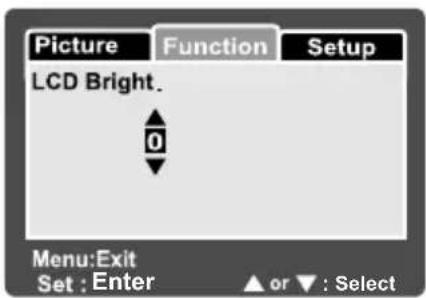
LCD Bright.
Select a brightness level for the LCD monitor. The LCD becomes brighter with the ▲button and darker with the ▼button. The adjustment range is from -5 to +5.
Digital Zoom
This sets whether or not to use digital zoom at the time of photography.
ON: Enable digital zoom.
OFF: Disable digital zoom.
Quickview
This sets whether or not to display the photographed image on the screen immediately after the picture is taken.
ON: Displayed when images are being recorded on the SD card.
OFF: Does not display.

A photographed image is displayed on the LCD monitor for 2 seconds. Pressing the shutter button during quickview cancels the operation. When quickview is set to off, the voice memo setting is also fixed to off.
Date Print
The date of recording can be printed directly on the still images. This function must be activated before the image is taken.
ON: Imprints the date on the still images when taking pictures.
OFF: Does not imprint the date on the still images when taking pictures.
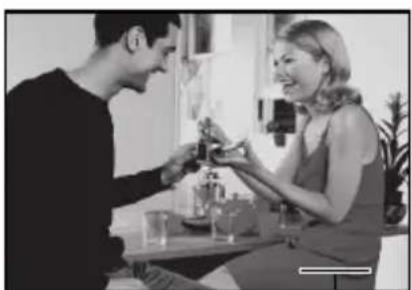
Date imprinted here.
Movie Menu (Picture)
This menu is for the basic settings to be used when recording video clips.
- Slide the mode switch to [
- Press the MENU button. [Picture] of the movie menu is displayed.
- Select the desired [Picture] option item with the ▲ / ▼ buttons, and press the SET button to enter its respective menu.
- Select the desired setting with the ▲ ▼ buttons, and press the SET button.
- To exit from the movie menu, press the MENU button.

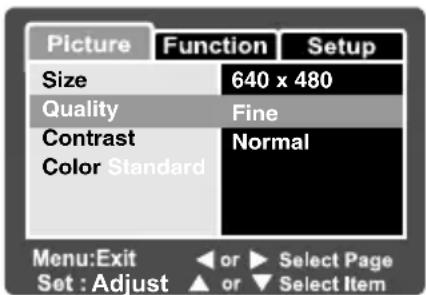
Size
This sets the size of the image that will be photographed.
[ ] 640 x 480: 640 x 480 pixels [ ] 320 x 240: 320 x 240 pixels
Quality
This sets the quality (compression rate) at which the image is taken.
[ ★★★ ] Fine: Low compression rate. [★] Standard: Normal
Contrast
This sets the difference between the bright and dark portions of the image that will be photographed.
Hard: Increases the contrast.
Normal: Set the contrast automatically.
Soft: Decreases the contrast.
Color
This sets the color of the image that will be photographed.
Standard: Standard color
Vivid: Bright color
Sepia: Sepia
Monochrome: Black-and-white
Movie Menu (Function)
- Slide the mode switch to [
- Press the MENU button, and select the [Function] menu with the ▶ button. ■ [Function] of the movie menu is displayed.

- Select the desired [Function] option item with the ▲/▼ buttons, and press the SET button to enter its respective menu.
- Select the desired setting with the ▲ ▼ buttons, and press the SET button.
- To exit from the movie menu, press the MENU button.
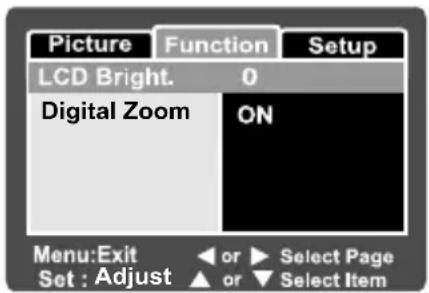
LCD Bright.
Adjust the brightness of the LCD monitor. This function does not adjust the brightness of recorded images.
Refer to section in this manual titled “LCD Bright.” in Still Image Menu (Function) for further details.
Digital Zoom
This sets whether or not to use digital zoom at the time of photography.
ON: Enable digital zoom.
OFF: Disable digital zoom.
Playback Menu
In the [ ] mode, set which settings are to be used for playback.
- Slide the mode switch to [ ▶ ].
- Press the MENU button. ■ The playback menu is displayed.
- Select the desired option item with the ▲ /▼ buttons, and press the SET button to enter its respective menu.
- Select the desired setting with the ▲ / ▼ buttons, and press the SET button.
- To exit from the playback menu, press the MENU button.
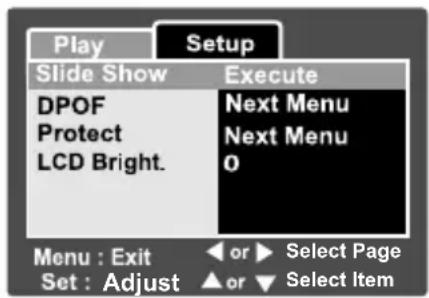
Slide Show
Automatically plays back still images in order one image at a time.
Refer to section in this manual titled "Slideshow Display" for further details.
DPOF
Set the number of prints and date display in DPOF format to images that you want to print. (This function is available for still images only.) You can print images easily just by inserting the SD card to a DPOF-compatible printer or a print shop.
Refer to section in this manual titled "DPOF Settings" for further details.
Protect
Set the data to read-only to prevent images from being erased by mistake. Refer to the section in this manual titled "Protecting Images" for further details.
LCD Bright.
Adjust the brightness of the LCD monitor. This function does not adjust the brightness of recorded images.
Refer to the section in this manual titled "LCD Bright." in the Still Image Menu (Function) for further details.
Setup Menu (In Photography Mode)
Set your camera's operating environment.
- Slide the mode switch to [ ] or [ ]
- Press the MENU button, and select the [Setup] menu with the ▶ button. ■ [Setup] of the photography menu is displayed.
- Select the desired [Setup] option item with the ▲ / ▼ buttons, and press the SET button to enter its respective menu.
- Select the desired setting with the ▲ / ▼ buttons, and press the SET button.
- To exit from the photography menu, press the MENU button.
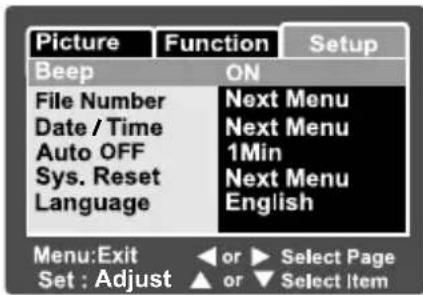
Beep
This sets whether or not to mute the startup sound, and the camera sound each time you press the camera button.
ON: Sounds the beep tone.
OFF: Does not sound the beep tone.
File Number
This creates a new folder. The photographed images are recorded to the newly created folder from number 0001.
Cancel: Does not reset the file number.
Execute: Resets the file number and creates a new folder.
Date/Time
This sets the date and the time.
Refer to section in this manual titled "Setting the Date and Time" for further details.
Auto OFF
If no operation is performed for a specific period of time, the power to the camera is automatically turned off. This feature is useful to reduce battery wear.
1 Min.: When the camera has not been operated, it turns the power off after 1 minute. 2 Min.: When the camera has not been operated, it turns the power off after 2 minutes. 3 Min.: When the camera has not been operated, it turns the power off after 3 minutes.
This function does not operate during a slideshow or during PC connection.
Sys. Reset
This returns all basic settings to the camera's default settings. The time setting will not be reset.
Cancel: Does not return to the default settings.
Execute: Returns to the default settings.
Language
This sets the language that is displayed on the LCD monitor.
Refer to section in this manual titled "Choosing the Language" for further details.
English: English
Français: French
Deutsch: German
Español: Spanish
Italiano: Italian.
: Chinese (Traditional)
: Chinese (Simplified)
Setup Menu (In Playback Mode)
- Slide the mode switch to [

- Press the MENU button.
■ [Setup] of the playback menu is displayed. ■ If images/video clips are recorded on the SD card, press the ▶ button after the MENU button is pressed.
- Select the desired [Setup] option item with the ▲ / ▼ buttons, and press the SET button to enter its respective menu.
- Select the desired setting with the ▲ / ▼ buttons, and press the SET button.
- To exit from the playback menu, press the MENU button.
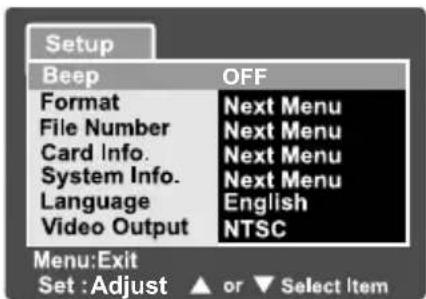
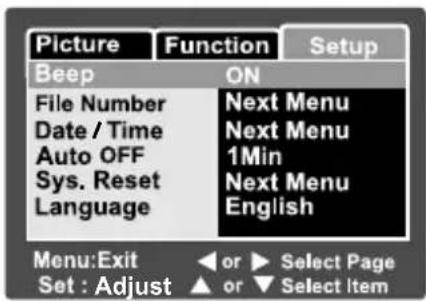
Beep
This sets whether or not to mute the startup sound, and the camera sound each time you press the camera button.
ON: Sounds the beep tone.
OFF: Does not sound the beep tone.
Format
This function erases all images and reformats the SD card loaded in your camera. Protected images are also erased. SD card cannot be formatted if it is write-protected.
Refer to section in this manual titled "Formatting the SD Card" for further details.
File Number
This creates a new folder. The photographed images are recorded to the newly created folder from number 0001.
Cancel: Does not reset the file number.
Execute: Resets the file number and creates a new folder.
Card Info.
This allows a check of the free capacity of the SD card as well as other information.
System Info.
This displays the firmware version of the camera.
Language
This sets the language that is displayed on the LCD monitor.
Refer to section in this manual titled “Choosing the Language” for further details.
English: English
Français: French
Deutsch: German
Español: Spanish
Italiano: Italian.
繁體中文: Chinese (Traditional)
Chinese (Simplified)
Video Output
This sets the video output system of the video equipment that you are going to connect to the camera.
NTSC: NTSC system.
PAL: PAL system.
TRANSFERRING RECORDED IMAGES AND VIDEOS TO YOUR COMPUTER
To transfer images/video clips from the camera to your computer, follow these steps:
Step 1: Installing the USB driver (Windows 98 and Mac OS 8.6 users only)
Step 2: Connecting the camera to your computer
Step 3: Downloading images and video files
System Requirements (Windows)
■ Pentium 166 MHz or higher ■ Windows 98/98SE/Me/2000/XP ■ 64MB RAM ■ 128MB hard disk space ■ CD-ROM drive ■ Available USB port
System Requirements (Macintosh)
■ PowerPC G3/G4 ■ OS 8.6 or later 64MB RAM ■ 128MB hard disk space ■ CD-ROM drive ■ Available USB port
Step 1: Installing the USB Driver
Windows 98 computers
The USB driver on the CD-ROM is exclusively for Windows 98 computers. Installing the USB driver on computers running Windows 2000/ME/XP is not necessary.
- Insert the CD-ROM that came with the camera into your CD-ROM drive. The welcome screen appears.
- Click "INSTALL USB DRIVER". Follow the on-screen instructions to complete the installation. After the USB driver has been installed, restart your computer.
Macintosh OS 8.6 computers
Mac OS 8.6 users must install a USB driver. For Mac OS 9.0 or higher, the computer will automatically recognize the camera and load its own USB drivers.
- Insert the CD-ROM that came with the camera into the CD-ROM drive.
- Select and double-click "Digital Camera Driver Installer".
- Select "Install Location" and click "Install".
- Follow the on-screen instructions to complete the installation and restart your computer.
Step 2: Connecting the Camera to Your Computer
- Connect one end of the USB cable to the conversion adapter terminal of the camera.
■ If you use the conversion adapter to connect the USB cable, insert the conversion adapter into the conversion adapter terminal of the camera first, and then connect one end of the USB cable to the USB terminal of the conversion adapter.
- Connect the other end of the USB cable to an available USB port on your computer.
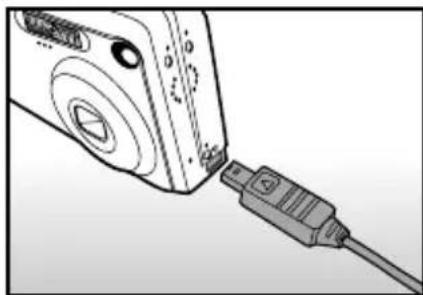
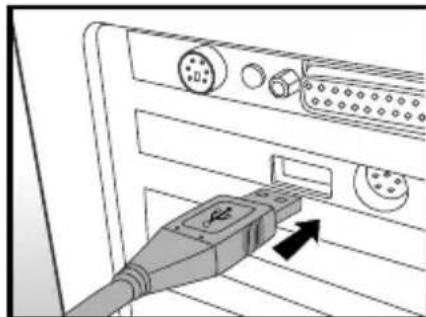
- Turn on your camera.
- From the Windows desktop, double click on "My Computer".
- Look for a new "Removable disk" icon. This "Removable disk" is actually the memory card in your camera. Typically, the camera will be assigned drive letter "e" or higher.
- Double click on the removable disk and locate the DCIM folder.
- Double click on the DCIM folder to open it to find more folders.
- Your recorded images and video clips will be inside these folders.
■ Copy & Paste or Drag-N-Drop image and video files to a folder on your computer.
Mac users: Double-click the "untitled" or "unlabeled" disk drive icon on your desktop. iPhoto may automatically launch.

■ The data saved to the SD card may be damaged if the power to the camera is cut off during image transfer. We recommend that you use the AC power adapter when connecting the camera to the PC.
Step 3: Downloading Images and Video Files
When the camera is turned on and connected to your computer, it is considered to be a disk drive, just like a floppy disk or CD. You can download (transfer) images by copying them from the "Removable disk" ("untitled" or "unlabeled" disk on a Macintosh) to your computer hard drive.
Windows
Open the “removable disk” and subsequent folders by double clicking on them. Your images are inside these folder(s). Select the images that you want, and then choose “Copy” from the “Edit” menu. Open the destination location (folder) and choose “Paste” from the “Edit” menu. You may also drag and drop image files from the camera to a desired location.
Macintosh
Open the “untitled” disk icon, and the destination location on your hard disk. Drag and drop from the camera to the desired destination.

■ Do not open the battery cover during USB cable connection. ■ Memory card users may prefer to use a memory card reader (highly recommended). ■ Video playback application is not included with the package. Make sure that video playback application has been installed in your computer.
INSTALLING NTI PHOTO SUITE
PC users will find that NTI Photo Suite is a very user-friendly image-editing program. With NTI Photo Suite, you can retouch, compose, and organize your images. It includes a variety of templates, such as photo frames, birthday cards, calendars and more. Get your images ready and explore this amazing program.
To install NTI Photo Suite:
- Insert the CD-ROM that came with the camera into your CD-ROM drive. The welcome screen appears.
- Click "INSTALL NTI PHOTO SUITE". Follow the onscreen instructions to complete the installation.

■ To use NTI Photo Suite to edit and retouch your recorded images, please refer to the on-line help. ■ For Windows 2000/XP users, please make sure to install and use the NTI Photo Suite in "Administrator" mode. ■ NTI Photo Suite is not supported on the Mac. iPhoto or iPhoto2 is recommended.
CONNECTING THE CAMERA TO OTHER DEVICES
![graph TD TV["TV"] -->|A/V Cable| Display["Monitor"] Display -->|USB Cable| Computer["Computer"] Display -->|SD Memory Card| MemoryCard["SD Memory Card"] MemoryCard -->|SD Card Reader| Tablet["Desktop"] Tablet -->|SD Card Reader| Printer["Printer"] PCMCIAAdapter["PCMCIA Adapter"] -->|PCMCIA Adapter|…](/content/2026/05/758165/images/f2e3cbfb3dce6a89ada0aa7f2e12b2dd4f693a8d822af0a8a0eac4a2d619f014.jpg)
CAMERA SPECIFICATIONS
| Item Description | |
| Image sensor Total number of pixels: approx. 5.2 mega pixelsNumber of effective pixels: approx. 4.9 mega pixels | |
| Image resolution | <Still image>2560 x 1920, 2048 x 1536, 1280 x 960, 640 x 480< Video clip>640 x 480, 320 x 240 |
| LCD monitor 2.5" LTPS TFT color LCD | |
| Image quality Fine / Standard / Economy | |
| Recording media External memory: Supports SD card (up to 512MB) | |
| Compression format JPEG compliant | |
| Image file format DCF 1.0, DPOF 1.1, EXIF 2.2, AVI | |
| Lens | 3x optical zoom lensF=2.8 - 4.8f=5.4 mm - 16.2 mm (equivalent to 32 mm - 96 mm on a 35 mm camera) |
| Focus range Approx. | Approx. 50 cm to infinity (both Wide and Tele)6 cm to infinity (Macro Wide)Approx. 35 cm to infinity (Macro Tele) |
| Auto-Focus TTL method AF | |
| Shutter speed 1/2 -1/1000 sec. | |
| Image capturing | Single / 3 images with -0.67, 0, +0.67EV / 3 images continuously |
| Digital zoom | 4x (Photography mode)2x and 4x (Playback mode) |
| Metering system Multi / Spot | |
| Exposure compensation -2EV - | +2EV (in 0.3EV increments) |
| White balance | Auto / Incandescent / Fluorescent 1/ Fluorescent 2 / Daylight / Cloudy / Manual |
| Flash | Auto Flash / Red-eye Reduction / Night Scene / Suppressed Flash / Forced Flash |
| Flash effective range | 0.5 m -2.7 m |
| ISO sensitivity Equivalent to ISO 50/100/200/Auto | |
| Self-timer 10 sec. / 2 sec. / 10+2 sec. | |
| Video output NTSC/PAL | |
| Interface A/V OUT terminal | DC IN 5V terminal (Via conversion adapter) |
| minal (Via conversion adapter) | |
| USB 2.0 (Full speed) | |
| Power supply | Rechargeable Lithium-ion battery (3.7V) |
| AC power adapter (5V) | |
| Dimension (WxHxD) Approx. | 88.5 x 54.5 x 24mm (without protruding parts) |
| Weight Approx. 130 g | (without the battery & SD card) |
*Design and specifications are subject to change without notice.

- NOTE
- TRADEMARK INFORMATION
- READ THIS FIRST
- NOTICE
- SAFETY INSTRUCTIONS
- WARNING
- CAUTION
- NOTES ON BATTERY USAGE
- CONTENTS
- INTRODUCTION
- GETTING TO KNOW THE CAMERA
- GETTING STARTED
- PHOTOGRAPHY MODE
- [ ] PLAYBACK MODE
- MENU OPTIONS
- TRANSFERRING RECORDED IMAGES AND VIDEOS TO YOUR COMPUTER
- INSTALLING NTI PHOTO SUITE
- CONNECTING THE CAMERA TO OTHER DEVICES
- CAMERA SPECIFICATIONS
- OVERVIEW
- PACKAGE CONTENTS
- COMMON PRODUCT COMPONENTS
- FRONT VIEW
- NAME DESCRIPTION
- REAR VIEW
- SET /DIRECTION BUTTON
- STATUS LED INDICATOR
- LCD MONITOR ICONS
- PHOTOGRAPHY MODE [ ]
- PLAYBACK MODE [ ] - STILL IMAGE PLAYBACK
- PLAYBACK MODE [ ] - VIDEO PLAYBACK
- ATTACHING THE CAMERA STRAP
- INSERTING AND REMOVING THE BATTERY
- INSERTING THE BATTERY
- REMOVING THE BATTERY
- CHARGING THE BATTERY
- INSERTING AND REMOVING THE SD CARD
- INSERTING THE SD CARD
- REMOVING THE SD CARD
- TURNING THE POWER ON/OFF
- TURNING THE POWER ON
- TURNING THE POWER OFF
- SETTING THE DATE AND TIME
- CHOOSING THE LANGUAGE
- FORMATTING THE SD CARD
- SETTING IMAGE RESOLUTION AND QUALITY
- POSSIBLE NUMBER OF SHOTS (STILL IMAGE)
- [ ] STILL IMAGE MODE
- RECORDING VOICE MEMOS
- USING THE OPTICAL ZOOM
- USING THE DIGITAL ZOOM
- SETTING THE FLASH
- SETTING THE FOCUS
- SETTING THE SELF-TIMER
- EXPOSURE COMPENSATION/BACKLIGHT CORRECTION
- EFFECTIVE SUBJECTS AND SET VALUES
- [MOVIE MODE]
- PLAYING BACK STILL IMAGES
- IMAGE DISPLAY INFORMATION
- PLAYING BACK VIDEO CLIPS
- PLAYING BACK STILL IMAGES/VIDEO CLIPS ON A TV
- ATTACHING VOICE MEMOS
- PLAYING BACK VOICE MEMO
- THUMBNAIL DISPLAY
- ZOOM PLAYBACK
- SLIDESHOW DISPLAY
- PROTECTING IMAGES
- CANCELING THE PROTECTION
- PROTECTING MULTIPLE IMAGES SIMULTANEOUSLY
- DPOF SETTINGS
- [ ] ERASING IMAGES
- ERASING AT PHOTOGRAPHY MODE (QUICK DELETE FUNCTION)
- ERASING AT PLAYBACK MODE
- ERASING SELECTED IMAGES
- STILL IMAGE MENU (PICTURE)
- SIZE
- QUALITY
- SHARPNESS
- CONTRAST
- COLOR
- WHITE BALANCE
- MANUAL WB
- ISO
- METERING
- STILL IMAGE MENU (FUNCTION)
- CAPTURE MODE
- VOICE MEMO
- LCD BRIGHT
- DIGITAL ZOOM
- QUICKVIEW
- DATE PRINT
- MOVIE MENU (PICTURE)
- MOVIE MENU (FUNCTION)
- PLAYBACK MENU
- SLIDE SHOW
- DPOF
- PROTECT
- SETUP MENU (IN PHOTOGRAPHY MODE)
- BEEP
- FILE NUMBER
- DATE/TIME
- AUTO OFF
- SYS. RESET
- LANGUAGE
- SETUP MENU (IN PLAYBACK MODE)
- FORMAT
- CARD INFO
- SYSTEM INFO
- VIDEO OUTPUT
- STEP 1: INSTALLING THE USB DRIVER
- WINDOWS 98 COMPUTERS
- MACINTOSH OS 8.6 COMPUTERS
- STEP 2: CONNECTING THE CAMERA TO YOUR COMPUTER
- STEP 3: DOWNLOADING IMAGES AND VIDEO FILES
- WINDOWS
- MACINTOSH
- TO INSTALL NTI PHOTO SUITE
Brand : ACER
Model : cr 5530
Category : Camera