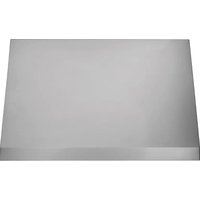
UVW93042PSS - Range hood Monogram - Free user manual and instructions
Find the device manual for free UVW93042PSS Monogram in PDF.


| Product Type | Ducted range hood |
| Brand | Monogram |
| Model | UVW93042PSS |
| Width | 30 in (76.2 cm) |
| Minimum installation height above electric range | 24 in (61 cm) |
| Minimum installation height above gas range | 30 in (76.2 cm) |
| Maximum recommended installation height | 36 in (91.4 cm) |
| Estimated weight | 36 kg (80 lb) |
| Electrical supply | 120 V, 60 Hz, 15 or 20 A |
| Duct diameter | 8 in (20.3 cm) round |
| Ventilation technology | QuietBoost™ (low noise motor) |
| Key features | Touch control, 4 speeds (Low, Med, High, Boost), delayed shut-off, LED lighting with nightlight mode, Chef Connect (Bluetooth) connection, built-in Wi-Fi |
| Filters | Washable metal baffle filters (dishwasher safe), optional charcoal filter (model UXCF91) for recirculation |
| Lighting | LED, adjustable intensity (on/nightlight/off) |
| Material | Stainless steel |
| Warranty | 1 year parts and labor |
| Included accessories | Mounting bar, screws, installation template |
| Venting options | Top (round duct) or rear (with optional transition) |
| Connectivity | Wi-Fi (GE Appliances app), Chef Connect (pairing with cooktop/range) |
Frequently Asked Questions - UVW93042PSS Monogram
User questions about UVW93042PSS Monogram
0 question about this device. Answer the ones you know or ask your own.
Ask a new question about this device
Download the instructions for your Range hood in PDF format for free! Find your manual UVW93042PSS - Monogram and take your electronic device back in hand. On this page are published all the documents necessary for the use of your device. UVW93042PSS by Monogram.
USER MANUAL UVW93042PSS Monogram
SAFETY INFORMATION....3
USING THE HOOD
Controls....5
Chef Connect 5
Wi-Fi Connect....6
CARE AND CLEANING
Filters....7
Surfaces 8
Lights 8
INSTALLATION
INSTRUCTIONS 9
TROUBLESHOOTING TIPS....25
LIMITED WARRANTY 26
ACCESSORIES 27
CONSUMER SUPPORT 28
OWNER'S MANUAL & INSTALLATION INSTRUCTIONS
UVW9304
UVW9364
UVW9484
Write the model and serial numbers here:
Model #
Serial # ____
You can find them on a label on the inside of the hood.
THANK YOU FOR MAKING GE APPLIANCES A PART OF YOUR HOME.
Whether you grew up with GE Appliances, or this is your first, we're happy to have you in the family.
We take pride in the craftsmanship, innovation and design that goes into every GE Appliances product, and we think you will too. Among other things, registration of your appliance ensures that we can deliver important product information and warranty details when you need them.
Register your GE appliance now online. Helpful websites and phone numbers are available in the Consumer Support section of this Owner's Manual. You may also mail in the pre-printed registration card included in the packing material.

GE APPLIANCES
IMPORTANT SAFETY INFORMATION READ ALL INSTRUCTIONS BEFORE USING
WARNING
TO REDUCE THE RISK OF FIRE,
ELECTRIC SHOCK OR INJURY TO PERSONS, OBSERVE THE FOLLOWING:
A. Use this unit only in the manner intended by the manufacturer. If you have questions, contact the manufacturer.
B. Before servicing or cleaning unit, switch power off at service panel and lock the service disconnecting means to prevent power from being switched on accidentally. When the service disconnecting means cannot be locked, securely fasten a prominent warning device, such as a tag, to the service panel.
C. Do not use this unit with any solid-state speed control device.
D. This unit must be grounded.
CAUTION
FOR GENERAL VENTILATING USE
ONLY. DO NOT USE TO EXHAUST HAZARDOUS OR EXPLOSIVE MATERIALS AND VAPORS.
CAUTION
To reduce risk of fire and to properly
exhaust air, be sure to duct air outside. Do not vent exhaust air into spaces within walls or ceilings or into attics, crawl spaces, or garages.
WARNING
TO REDUCE THE RISK OF INJURY
TO PERSONS IN THE EVENT OF A RANGE TOP GREASE FIRE, OBSERVE THE FOLLOWING*:
A. SMOTHER FLAMES with a close-fitting lid, cookie sheet or metal tray, then turn off the burner. BE CAREFUL TO PREVENT BURNS. If the flames do not go out immediately, EVACUATE AND CALL THE FIRE DEPARTMENT.
B. NEVER PICK UP A FLAMING PAN—You may be burned.
C. DO NOT USE WATER, including wet dishcloths or towels—a violent steam explosion will result.
D. Use an extinguisher ONLY if:
1. You know you have a Class ABC extinguisher, and you already know how to operate it.
2. The fire is small and contained in the area where it started.
3. The fire department is being called.
4. You can fight the fire with your back to an exit.
* Based on "Kitchen Fire Safety Tips" published by NFPA.
WARNING
TO REDUCE THE RISK OF A
RANGE TOP GREASE FIRE:
A. Never leave surface units unattended at high settings. Boil overs cause smoking and greasy spillovers that may ignite. Heat oils slowly on low or medium settings.
B. Always turn hood ON when cooking on high heat or when flambéing food (i.e. Crepes Suzette, Cherries Jubilee, Peppercorn Beef Flambé).
C. Clean ventilating fans frequently. Grease should not be allowed to accumulate on fan or filter.
D. Use proper pan size. Always use cookware appropriate for the size of the surface element.
READ AND SAVE THESE INSTRUCTIONS
IMPORTANT SAFETY INFORMATION READ ALL INSTRUCTIONS BEFORE USING
WARNING
TO REDUCE THE RISK OF FIRE, ELECTRIC SHOCK OR INJURY TO PERSONS, OBSERVE THE FOLLOWING:
A. Installation work and electrical wiring must be done by qualified person(s) in accordance with all applicable codes and standards, including fire-rated construction.
B. Sufficient air is needed for proper combustion and exhausting of gases through the flue (chimney) of fuel burning equipment to prevent back drafting. Follow the heating equipment manufacturer's guidelines and safety standards such as those published by the National Fire Protection Association (NFPA), the American Society for Heating, Refrigeration and Air Conditioning Engineers (ASHRAE) and the local code authorities. When applicable, install any makeup (replacement) air system in accordance with local building code requirements. Visit geappliances.com for available makeup air solutions.
C. When cutting or drilling into wall or ceiling, do not damage electrical wiring and other hidden utilities.
D. Ducted fans must always be vented to the outdoors.
E. Turn off breaker to adjacent rooms while working.
⚠ WARNING
TO REDUCE THE RISK OF FIRE, USE ONLY METAL DUCTWORK.
Do not attempt to repair or replace any part of your hood unless it is specifically recommended in this manual. All other servicing should be referred to a qualified technician.
How to Remove Protective Shipping Film and Packaging Tape
Carefully grasp a corner of the protective shipping film with your fingers and slowly peel it from the appliance surface. Do not use any sharp items to remove the film. Remove all of the film before using the appliance for the first time.
To assure no damage is done to the finish of the product, the safest way to remove the adhesive from packaging tape on new appliances is an application of a household liquid dishwashing detergent. Apply with a soft cloth and allow to soak.
NOTE: The adhesive must be removed from all parts.
READ AND SAVE THESE INSTRUCTIONS
Controls
flowchart
graph LR
    A["1"] --> B["2"]
    B --> C["3"]
    C --> D["4"]
    D --> E["5"]
    E --> F["6"]
    G["Off"] --> H["Low Med"]
    H --> I["High Light"]
    I --> J["-WiFi"]
    K["Delay Off Hold 3 Sec"] --> L["WiFi Pairing"]
    M["Boost Hold 3 Sec"] --> N["Chef Connect To Pair Hold 3 Sec"]
    O["7"] --> P["7"]
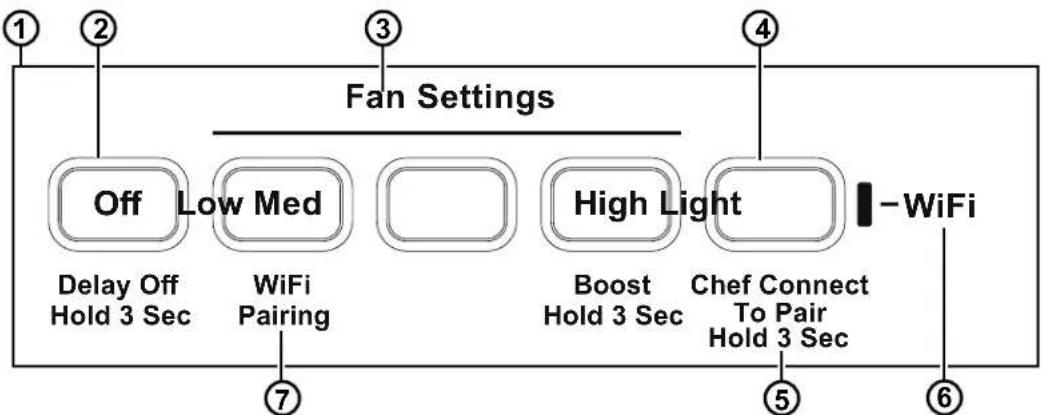
- Rangehood Control Panel: The control panel is located under the front edge of the canopy. The position and function of each control button are noted below.
- Fan On/Off: On/Off switch for the fan. The fan can be operated by pressing any of the fan setting buttons. Hold Power for 3 seconds to activate Delay Off feature, which automatically turns the fan off after 15 minutes. Low, Med and High buttons LEDs will rolling blink to indicate Delay Off feature is activated.
-
Fan Settings: Speed control for fan. Fan speed is powered by QuietBoost™ Technology. This unique technology is designed to minimize ventilation noise and enhance motor efficiency for a peacefully-quiet, odor-free kitchen. Press the button Low for LOW speed, Med for MEDIUM speed, and High for HIGH speed. Hold down the High button for 3 seconds to activate the Boost speed that will run for 15 minutes. High button LED will blink on/off to indicate Boost feature is activated.
-
Light: Off/On/Night Light switch for the LED lights. Press the Light button to turn the lights on, again to set the lights to night light setting, and again to turn the lights off.
- Chef Connect: This is a Bluetooth® pairing feature for use with other compatible Chef Connect enabled products on a cooktop or range. When the device is paired, the default sync settings will be activated upon receiving a command from the range or cooktop. To change the default sync setting, refer to the Chef Connect section.
To pair devices, hold down the Light button for 3 seconds. To turn it back off, hold the button down for another 3 seconds. See the Chef Connect section for more details. - IR Sensor: Remote control receiver when used with remote control kit.
- Wi-Fi: Hold down the Low button for 3 seconds to initiate the Wi-Fi connection. The Wi-Fi indicator light turns on when connected, see the Wi-Fi Connect section for details.
Chef Connect
Chef Connect Operation Bluetooth® Connection
To pair with another device:
To start the pairing process on the hood, press and hold the Light button for 3 seconds. The backlight for all the icons will flash until the hood is paired with the range or other device. If the pairing is successful, the backlights of all buttons will flash simultaneously three times and then turn off. The hood lights and fan default sync setting will be activated.
It will time out after 2 minutes if the pairing is not completed, after which the pairing sequence will need to be restarted.
To cancel pairing:
To cancel the pairing, hold the Light button down for 3 seconds and then turn off the hood.
Default Sync Settings:
The factory default setting for the light will be the brightest. The factory default setting for the fan sync will be OFF.
The user can change the Default Sync Settings by pressing and holding the Med button for 3 seconds. This will enter the Default Settings Mode. Once in this mode, the backlights for all buttons will blink on/off indefinitely and the fan and light will switch to the current Default Sync Setting, so the user knows what the current default value is. At this time, set the light and fan to the desired default levels. Once the user is satisfied with the selection, press and hold the Power button for 3 seconds. This will exit this mode. At that time the backlights will stop blinking and the state of the fan and light will change back to their prior state before entering the Default Settings Mode.
Connecting your Wi-Fi Connect Enabled hood (on some models)
Your GE Appliances hood is designed to provide you with two-way communication between your appliance and smart device. By using the GE Appliances Wi-Fi Connect features, you will be able to control essential hood operations such as fan speed, light functions, delay off and filter notification using your smartphone or tablet.
This device complies with part 15 of the FCC Rules. Operation is subject to the following two conditions: (1) This device may not cause harmful interference, and (2) this device must accept any interference received, including interference that may cause undesired Operation.
What you will need
Your GE Appliances hood uses your existing home Wi-Fi network to communicate between the appliance and your smart device. In order to setup your GE Appliances hood, you will need to gather some information:
- Each GE Appliances hood has a connected appliance information label that includes an Appliance Network Name and Password. These are the two important details that you will need to connect to the appliance. The label is located on the side of the unit behind the filters.
Connected Appliance Information
| FCC ID: ZKJ-WCATA005 | Network:********** |
| IC: 10229A-WCATA001 | Password:********** |
| MAC ID:********** |
Sample Label
- Have your smart phone or tablet ready with the ability to access the internet and download apps.
- You will need to know the password of your home Wi-Fi router. Have this password ready while you are setting up your GE Appliances hood.
Connect your GE Appliances hood
- On your smart phone or tablet visit
GEAppliances.com/connect to learn more about connected appliance features and to download the appropriate app. - Follow the app onscreen instructions to connect your GE Appliances hood.
- Once the process is complete, the indicator light located on your GE Appliances hood display will stay on solid and the app will confirm you are connected.
- If the indicator light does not turn on or is blinking, follow the instructions on the app to reconnect. If issues continue please call 800.220.6899 and ask for assistance regarding hood wireless connectivity.
To connect additional smart devices, repeat steps 1 and 2.
Note that any changes or modifications to the remote enable device installed on this hood that are not expressly approved by the manufacturer could void the user's authority to operate the equipment.
Enhanced Wi-Fi Features
Once your product is connected to Wi-Fi, you have access to enhanced features via phone app
Delay Off Timer: This feature allows the user to adjust delay off time from 1 minute to 15 minutes. The default delay off time is 15 minutes.
Boost Timer: This feature allows the user to adjust the boost time from 1 minute to 15 minutes. The default boost time is 15 minutes
Night Light Timer: This feature allows the user to set time for the night light to turn on and off automatically.
Grease/Charcoal Filter Notifications: This feature sends a regular reminder to the user to clean their grease filters, and/or to replace their charcoal filter, if the hood is setup in recirculation mode.
Filters
Be sure the circuit breaker is off and all surfaces are cool before cleaning or servicing any part of the vent hood.
The baffle filters and drip trays are dishwasher safe and should be cleaned every month, depending on the usage of the hood
Grease Drip Tray
To install:
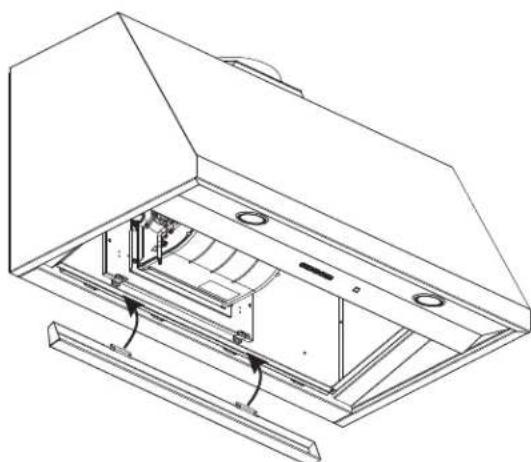
Place and seat the drip trays into the designated hood track. Slide them left or right until all trays are side-by-side in place in the track.
To remove:
Carefully, use the grease tray lip to lift the tray upwards and out. The tray will be free of the designated hood track.
To clean:
Swish the drip tray in hot soapy water and rinse in clean water or wash it in the dishwasher. Do not use abrasive cleaners.
NOTE: Some discoloration of the grease drip tray may occur in the dishwasher.
natural_image
Technical line drawing of a mechanical assembly with internal components and mounting brackets (no text or symbols)Drip Tray Replacement
Baffle Grease Filter
The baffles channel grease released by foods on the cooktop into the drip trays. The baffles also help prevent flaming foods on the cooktop from damaging the inside of the hood.
The baffles must ALWAYS be in place when the hood is in use.
To install:
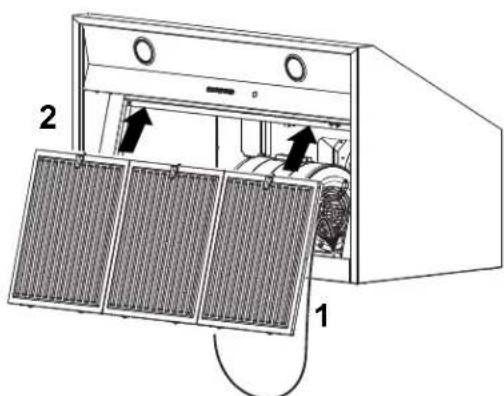
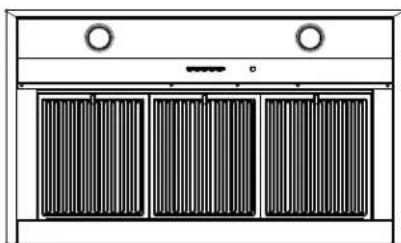
Insert the top of the baffle (side without knob) into the track behind the control panel. Push knob side into the back, twist to lock into place.
To remove:
Pull and twist knob and slowly pull filter down. Hold with other hand and pull filter away from the track behind the control panel.
It is important for baffles to be placed correctly to channel grease to the drip trays and avoid grease accumulation in the baffles.
To clean:
Swish the filter in hot soapy water and rinse in clean water or wash it in the dishwasher. Do not use abrasive cleansers.
NOTE: Some discoloration of the filter may occur in the dishwasher.
To clean hard to reach areas of the filter, use a soft brush.
natural_image
Front view of a double-door air conditioner unit with three vertical grilles and two top outlets (no text or symbols visible)Baffle Replacement
Filters (Cont.)
Charcoal Filter (for recirculation installation on select models only)
NOTE: DO NOT rinse, or put charcoal filter in an automatic dishwasher.
The charcoal filter is NOT included with the unit. Order Charcoal Filter UXCF91. It cannot be cleaned; it must be replaced. It is recommended that the charcoal filter be replaced every 6 months or if it is noticeably dirty or discolored.
To reduce the risk of fire and shock, when used in recirculation mode, use only charcoal filter UXCF91.
To inquire about purchasing replacement charcoal filters or to find the location of a dealer nearest you, please call our toll-free number:
National Parts Center 800.626.2002
To Install
- Remove the grease filters. See Filters section.
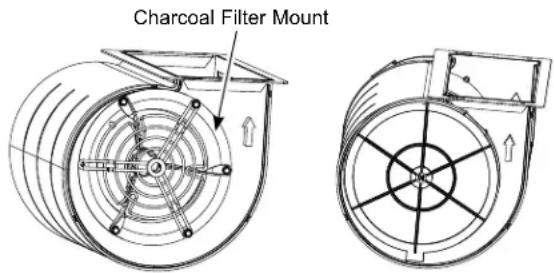
- Install the charcoal filter mounts to either side of the motor using three screws per side.
-
Insert the tab on the charcoal filter into the triangular slot on the mount.
-
Clip the charcoal filter in until it is locked
- Repeat with second filter on the other side of the motor.
- Reattach the metal filters. See Filters section.
To Remove
- Remove grease filters-See Filters section
- Unclip the charcoal filter by pressing the release clip.
- Carefully remove charcoal filter from tab.
Surfaces
Stainless Steel Surfaces (on some models)
Do not use a steel wool pad; it will scratch the surface.
To clean the stainless steel surface, use warm sudsy water or a stainless steel cleaner or polish. Always wipe the surface in the direction of the brush line. Follow the cleaner instructions for cleaning the stainless steel surface. Cleaners with oxalic acid such as Bar Keepers
Friend Soft Cleanser™ will
remove surface rust, tarnish, and small blemishes. To receive a coupon for a trial sample of Bar Keepers Friend Soft Cleanser™ follow the link below or scan the QR Code.
barkeepersfriend.com/ge

Use only a liquid cleanser free of grit and rub in the direction of the brush lines with a damp soft sponge.
To inquire about purchasing stainless steel appliance cleaner or polish, or to find the location of a dealer nearest you, please visit geappliances.com/parts
Lights
To change the LED lamps, schedule a service appointment. See Consumer Support page for a list of websites and contact information.
Installation Instructions
Range Hoods
If you have questions, visitGEAppliances.com, or call GE Appliances at 800.GE.CARES (800.432.2737).
In Canada, call 800.561.3344 or visit geappliances.ca.
BEFORE YOU BEGIN
Read these instructions completely and carefully.
- IMPORTANT — Save these instructions for local inspector's use.
- IMPORTANT — Observe all governing codes and ordinances.
- Note to Installer – Be sure to leave these instructions with the Consumer.
- Note to Consumer – Keep these instructions for future reference.
- Skilllevel—Installation of this vent hood requires basic mechanical and electrical skills.
- Completiontime— Approximately 1 to 3 hours
- Proper installation is the responsibility of the installer.
- Product failure due to improper installation is not covered under the Warranty.
CAUTION
Due to the weight and size of
these vent hoods and to reduce the risk of personal injury or damage to the product, TWO PEOPLE ARE REQUIRED FOR PROPER INSTALLATION.
FOR YOUR SAFETY
WARNING
Before beginning the installation,
switch power off at service panel and lock the service disconnecting means to prevent power from being switched on accidentally. When the service disconnecting means cannot be locked, securely fasten a prominent warning device, such as a tag, to the service panel.
⚠ WARNING
TO REDUCE THE RISK OF FIRE, ELECTRIC SHOCK OR INJURY TO PERSONS, OBSERVE THE FOLLOWING:
A. Installation work and electrical wiring must be done by qualified person(s) in accordance with all applicable codes and standards, including fire-rated construction.
B. Sufficient air is needed for proper combustion and exhausting of gases through the flue (chimney) of fuel burning equipment to prevent back drafting. Follow the heating equipment manufacturer's guidelines and safety standards such as those published by the National Fire Protection Association (NFPA), the American Society for Heating, Refrigeration and Air Conditioning Engineers (ASHRAE) and the local code authorities.
C. When cutting or drilling into wall or ceiling, do not damage electrical wiring and other hidden utilities.
D. Ducted fans must always be vented to the outdoors.
E. Turn off breaker to adjacent rooms while working.
WARNING
TO REDUCE THE RISK OF FIRE,
USE ONLY METAL DUCT WORK.
WARNING
Disconnect all electrical power
at the main circuit breaker or fuse box before installing.
PRODUCT DIMENSIONS
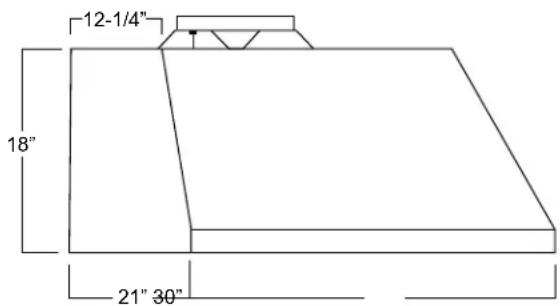
30" Models
Requires a 30" opening.
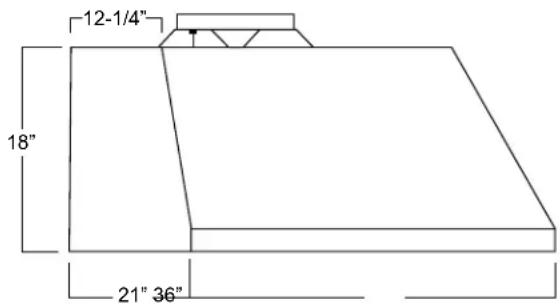
36" Models
Requires a 36" opening.
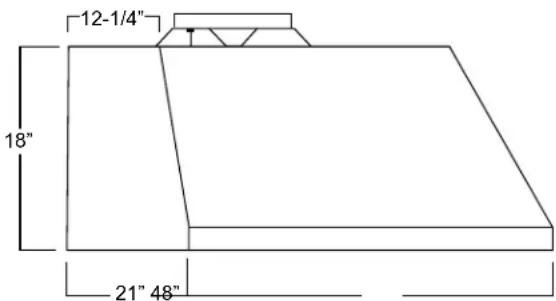
48" Models
Requires a 48" opening.
TOOLS AND MATERIALS REQUIRED (NOT SUPPLIED)

Pencil and tape measure
Safety glasses

Level
Phillips screwdriver with at least 6" shank
Wire cutter/stripper
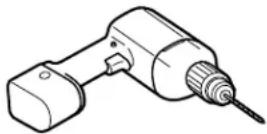
Electric drill with #2 Phillips with 1/8" and 5/16" drill bits
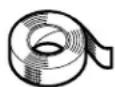
Aluminized duct tape
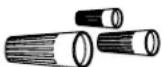
UL listed wire nuts
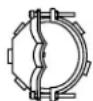
Strain relief for junction box, 1" diameter knockout
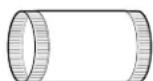
8" round duct for 30" and 36" models
10" round duct for 48" model
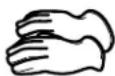
Gloves
Needed for back venting only
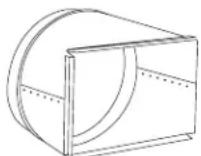
8"x12" to 12" round duct transition
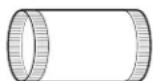
12" round duct
REMOVE THE PACKAGING
CAUTION
Wear gloves to protect against
sharp edges.
■ Remove the hood body.
■ Remove the hardware bag, literature package and other boxed parts.
■ Remove and properly discard the protective plastic wrapping and other packaging materials.
PLAN THE INSTALLATION
CAUTION
To reduce risk of fire and to
properly exhaust air, be sure to duct the air outside. Do not vent exhaust air into spaces within walls or ceilings or into attics, crawl spaces, or garages.
PARTS SUPPLIED FOR INSTALLATION
■ 1 Hardware Package
■ 1 Literature Package
■ 1 Installation Template
PARTS NEEDED FOR INSTALLATION
■ 1 Strain Relief
■ 1 Wall or Roof Cap (for vented installation only)
■ All Metal Ductwork
WARNING
PERSONAL INJURY HAZARD
Because of the weight and size of the rangehood canopy. It is recommended that 2 people are used to install the range hood. Failure to properly lift rangehood could result in damage to the product or personal injury.
NOTE: Before making any cuts or holes for installation, determine which venting method will be used and carefully calculate all measurements.
Installation Preparation
PARTS PROVIDED
Locate the parts packed with the hood.
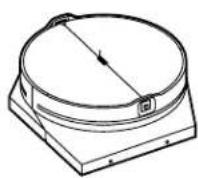
Top Damper
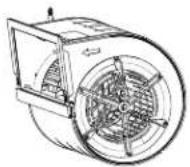
Motor
(2 with 48" model)
natural_image
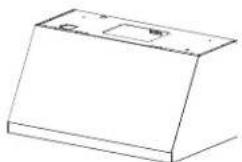
Simple line drawing of a 3D rectangular block with a small square cutout on top (no text or symbols)Hood Body

Grease Drip Trays
natural_image
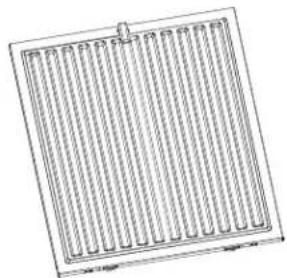
Pure technical diagram of a grid-patterned panel or vent, without any text, numbers, or symbols.2 Baffle Filters
3 with 36" models
4 with 48" model
HARDWARE PACKAGE
Locate and check contents.
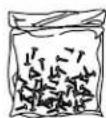
A
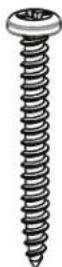
(QTY: 4) 8 x 1-3/4 AB Screw. Used to mount the installation bar. Use 1/8" drill for pilot hole.
B

(QTY: 4) 2.9mm x 6mm
PZ screws. Used to attach the damper
D
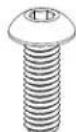
(QTY: 4 or 8) M4 screws. Used to mount motor
C
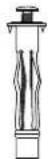
(QTY: 2) 3/16" dry wall anchors with screws. Used for hood bottom mounting screw holes. Use 5/16" drill for pilot hole.
DUCT COVER REQUIREMENTS
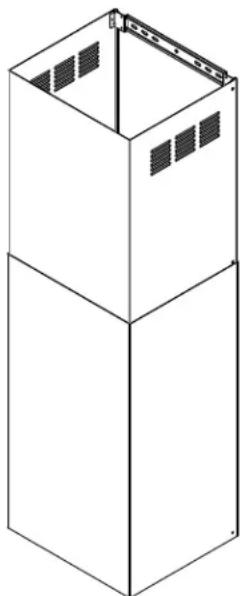
Duct cover kits must be purchased separately. We recommend that the vent hood and duct cover (if used) be on site before final framing and wall finishing. This will help to accurately locate studs, ductwork and electrical service.
natural_image
Isometric line drawing of a three-tiered cabinet or enclosure with ventilation grilles (no text or symbols)- Duct cover accessory comes with a lower and upper duct cover and installation hardware.
- The installation hardware includes mounting brackets to secure duct covers to the wall.
- For vented installations, recirculation holes can be hidden by installing the upper duct cover upside down.
- For ceiling installations up to 8' 4", use the 8' Ceiling Duct Cover kit CX8DC9SPSS. This kit only supports vented installation mode.
- For ceiling installations up to 11' 4", use the 10' High Ceiling Duct Cover kit CX10DC9SPSS.
- For higher ceiling installations up to 13' 2", use the 12' High Ceiling Duct Cover kit CX12DC9SPSS.
INSTALLATION DIMENSIONS
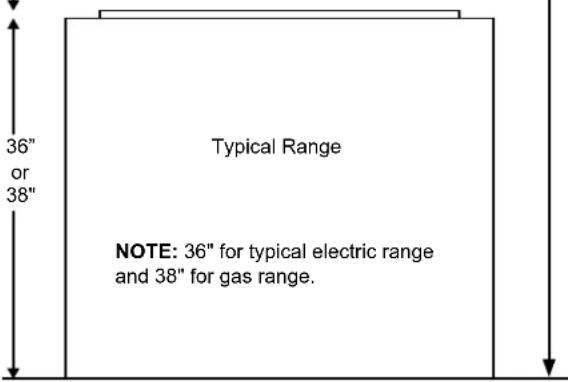
The hood duct covers can be adjusted for different ceiling heights depending on the distance between the bottom of the hood and the cooktop (distance X). See Installation Height Table on the next page.
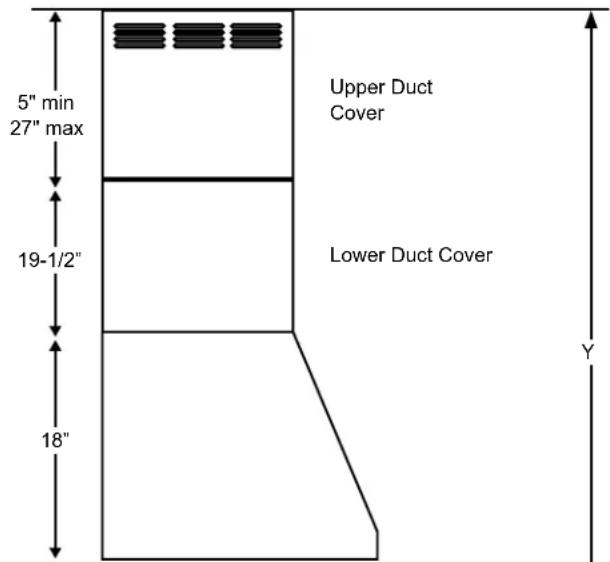
| Required Min & Recommended Max Ceiling Height Examples for 10' Duct Cover Kit (Vented) | ||
| Electric Gas | ||
| = 24" Y = Min 8' 2" Max 9'10" | = 30" Y = Min 8' 10" Max 10' 6" | = 36" Y = Min 9' 4" Max 11' 0" |
X = Distance from hood to cooktop. (Varies depending on the installation) Required 24" minimum over electric range or 30" minimum over gas range. The recommended maximum is 36".
Installation Preparation
INSTALLATION HEIGHT TABLE
| CX8DC9SPSS | CX10DC9SPSS | ||||||
| Ceiling Duct Cover up to 8 ft. | High Ceiling Duct Cover up to 10 ft. | ||||||
| Installation over Gas Range | Installation over Electric Range | ||||||
| Installation over Gas Range | Installation over Electric Range | ||||||
| Ceiling Height (ft./in.) | Vented Installation Height | Vented Installation Height | Ceiling Height (ft./in.) | Recirc Installation Height | Vented Installation Height (Recirc holes hidden) | Recirc Installation Height | Vented Installation Height (Recirc holes hidden) |
| 7' 0" | 24 | ||||||
| 7' 1" | 24-25 | 8' 2" 24 | 25 | ||||
| 7' 2" | 24-26 | 8' 3" 24 | |||||
| 7' 3" | 25-27 | 8' 4" 24-26 | |||||
| 7' 4" | 26-28 | 8' 5" 24-27 | |||||
| 7' 5" | 27-29 | 8' 6" 24-28 | |||||
| 7' 6" | 28-30 | 8' 7" 24-24-29 | |||||
| 7' 7" | 29-31 | 8' 8" 24-25 24-30 | |||||
| 7' 8" 30 | 30-32 | 8' 9" 24-26 24-31 | |||||
| 7' 9" | 30-31 | 31-33 | 8' 10" 30 24-27 24-32 | ||||
| 7' 10" | 30-32 | 32-34 | 8' 11" 30-31 24-28 24-33 | ||||
| 7' 11" | 31-33 33-35 | 9' 0" 30-32 24-29 24-34 | |||||
| 8' 0" | 32-34 | 34-36 | 9' 1" 30-33 24-30 24-35 | ||||
| 8' 1" | 33-35 | 35-36 | 9' 2" 30-34 24-31 | ||||
| 8' 2" | 34-36 | 36 | 9' 3" 30 30-35 24-32 | ||||
| 8' 3" | 35-36 | 9' 4" 30-31 | 24-33 | ||||
| 8' 4" 36 | |||||||
| CX12DC9SPSS | ||||
| High Ceiling Duct Cover up to 12 ft. | ||||
| Installation over Gas Range | Installation over Electric Range | |||
| Ceiling Height (ft./in.) | Recirc Installation Height | Vented Installation Height (Recirc holes hidden) | Recirc Installation Height | Vented Installation Height (Recirc holes hidden |
| 9' 1" | 24 | |||
| 9' 2" | 24-25 | |||
| 9' 3" | 24-26 | |||
| 9' 4" | 24-27 | |||
| 9' 5" | 24 | 24-28 | ||
| 9' 6" | 24-25 24-29 | |||
| 9' 7" | 24-26 24-30 | |||
| 9' 8" | 24-27 | 24-31 | ||
| 9' 9" | 30 | 24-28 | 24-32 | |
| 9' 10" | 30-31 24-29 | 24-33 | ||
| 9' 11" | 30-32 24-30 | 24-34 | ||
| 10' 0" | 30-33 | 24-31 | 24-35 | |
| 10' 1" 30 | 30-34 | 24-32 | 24-36 | |
| 10' 2" | 30-31 30-35 | 24-33 | ||
| 10' 3" | 30-32 | 30-36 | 24-34 | |
| 10' 4" | 30-33 | 24-35 | ||
| 10' 5" | 30-34 | 24-36 | ||
| 10' 6" | 30-35 | |||
| 10' 7" | 30-36 | |||
| 10' 8" | ||||
| 10' 9" | ||||
| 10' 10" | 25-36 | |||
| 10' 11" | 26-36 | |||
| 11' | 27-36 | |||
| 11' 1" | 28-36 | |||
| 11' 2" | 29-36 | |||
| 11' 3" | 30-36 | |||
| 11' 4" | 31-36 | |||
| 11' 5" | 32-36 | |||
| 11' 6" | 31-36 | 33-36 | ||
| 11' 7" | 32-36 | 34-36 | ||
| 11' 8" | 33-36 | 35-36 | ||
| 11' 9" | 34-36 | 36 | ||
| 11' 10" | 35-36 | |||
| 11' 11" | 36 | |||
| 12' | ||||
| 12' 1" | 25-36 | |||
| 12' 2" | 26-36 | |||
| 12' 3" | 27-36 | |||
| 12' 4" | 28-36 | |||
| 12' 5" | 29-36 | |||
| 12' 6" | 30-36 | |||
| 12' 7" | 31-36 | |||
| 12' 8" | 32-36 | |||
| 12' 9" | 31-36 | 33-36 | ||
| 12' 10" | 32-36 | 34-36 | ||
| 12' 11" | 33-36 | 35-36 | ||
| 13 | 34-36 | 36 | ||
| 13' 1" | 35-36 | |||
| 13' 2" 36 | ||||
1" = 2.5 cm; 1' = 0.3 m
ADVANCE PLANNING
Duct Install Planning
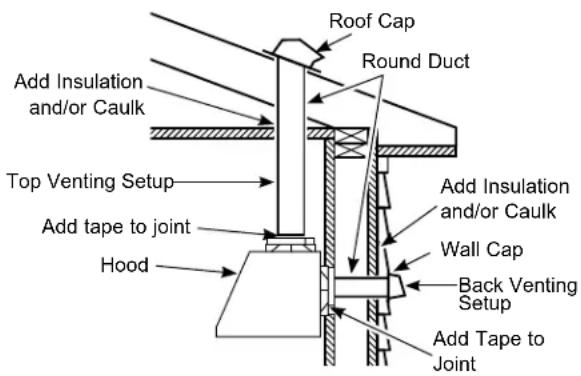
■ This hood is designed to be vented vertically through the ceiling with an 8" round duct for 30" and 36" models and a 10" round duct for 48" model, or horizontally through a wall with an 8"x12" duct transition and 12" round duct.
■ Use metal ductwork only.
■ Plan the route for venting exhaust to the outdoors. To maximize the ventilation performance of the vent system:
- Minimize the duct run length and number of transitions and elbows.
- Maintain a constant duct size.
- Seal all joints with duct tape to prevent any leaks.
NOTE: Flexible vent is not recommended. Flexible vent creates back pressure and air turbulence that greatly reduces performance.
■ Maximum equivalent duct length for 100 CFM: 150 foot for vent hoods.
■ Install a wall cap or roof cap with damper at the exterior opening. Purchase the wall or roof cap and any transition and length of duct needed in advance.
- When applicable, install any makeup (replacement) air system in accordance with local building code requirements. 8" round duct makeup air kit JXMUA8 can be purchased from GEAppliances.com or 10" round duct universal make up air kit can be purchased locally.
Vent system can terminate either through the roof or the wall.
POWER SUPPLY
IMPORTANT – (Please read carefully)
WARNING
FOR PERSONAL SAFETY, THIS APPLIANCE MUST BE PROPERLY GROUNDED.
Remove house fuse or open circuit breaker before beginning installation.
Do not use an extension cord or adapter plug with this appliance. Follow National Electrical Codes or prevailing local codes and ordinances.
Electrical supply
These vent hoods must be supplied with 120V, 60Hz, and connected to a properly grounded branch circuit, and protected by a 15 or 20 amp circuit breaker or time delay fuse.
■ Wiring must be 2 wire with ground.
■ If the electrical supply does not meet the above requirements, call a licensed electrician before proceeding.
■ Route house wiring as close to the installation location as possible in the ceiling or wall.
■ Connect the wiring to the house wiring in accordance with local codes.
Grounding instructions
The grounding conductor must be connected to a ground metal, permanent wiring system, or an equipment-grounding terminal or lead on the hood.
WARNING
The improper connection of the equipment-grounding conductor can result in a risk of electric shock. Check with a qualified electrician or service representative if you are in doubt whether the appliance is properly grounded.
NEW CONSTRUCTION, PRE-PLANNING, OR REMODELING
NOTE: For existing instruction, skip to the next section.
FOR TOP VENTING
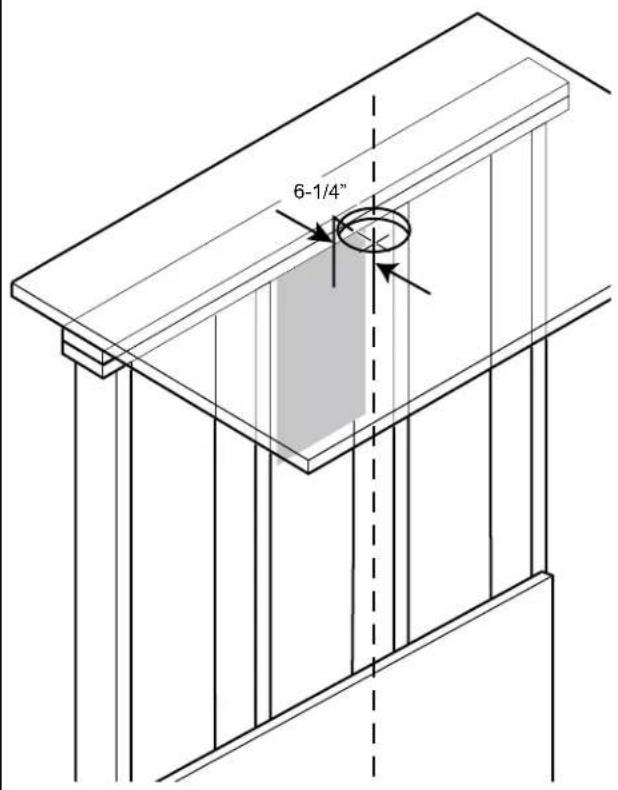
■ For ducted installation through the top, the 8" diameter hole (for 30" or 36" model) or the 10" diameter hole (for 48" model) for the duct in the ceiling must be center 6-1/4" away from the finished rear wall in the installation space.
FOR BACK VENTING
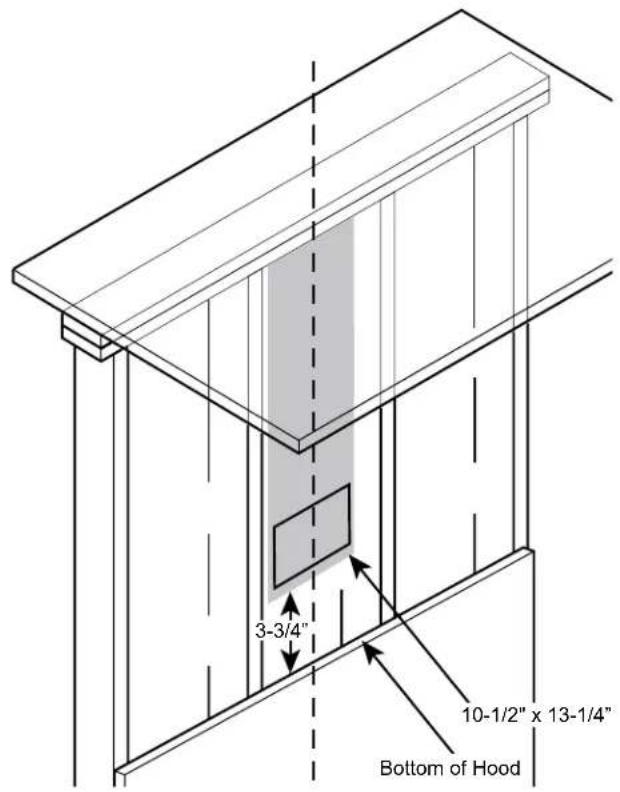
■ For ducted installation through the back, the 10-1/2" x 13-1/4" cut out for the duct in the wall must be centered in the installaton space, left to right and located 3-3/4" above intended install height from bottom of the hood.
■ The hood junction box knockout is located 10-1/2" to the left from center of the hood. Ensure enough wire length is available to make electrical connection.
DETERMINE HOOD, DUCTWORK AND WIRING LOCATIONS
- This hood can be installed onto the wall or underneath the soffit or cabinet.
- For installing the hood to soffit or cabinet, refer to page 19 for alternate mounting method.
- A wall mounting template is included with the product for ease of installation. Follow the instructions below if the template is not being used.
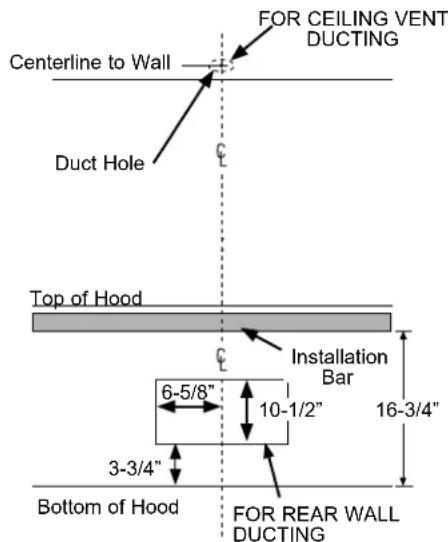
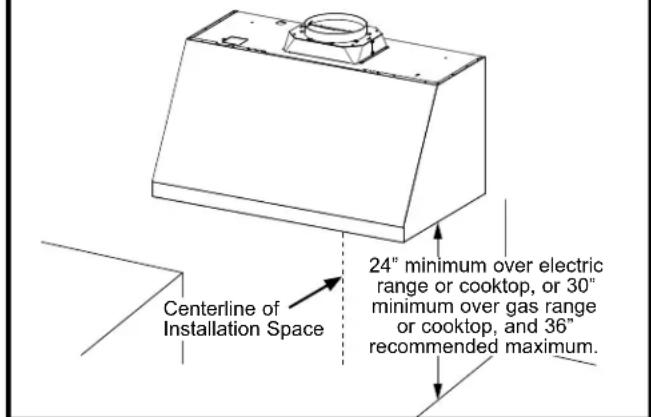
- Measure desired distance from the bottom of the hood to the cooking surface, 24" minimum over electric range or 30" minimum over gas range and 36" recommended maximum.
- Use a level to draw a horizontal line indicating the bottom of the hood.
- Measure 16-3/4" up from the horizontal line indicating the bottom of the hood. Draw another horizontal line to indicate the bottom of the installation bar.
- Use a level to draw the cooktop or range centerline location.
For Ceiling Ducting:
- If venting out the ceiling, extend the centerline forward on the ceiling to the back wall.
- Measure 6-1/4" from back wall to mark center point.
- Cut 8" dia. duct hole from center point on the ceiling for 30" or 36" models.
- Cut 10" dia. duct hole from center point on the ceiling for 48" models.
Venting Through a Soffit or Cabinet:
- Follow the same procedure for ceiling ducting to cut the hole through the top of the soffit or cabinet.
For Ducting Through Rear Wall:
NOTE: Check to make sure back damper will not interfere with studs, electrical or plumbing before making cut out.
- Back damper accessory UXBDA812 must be purchased separately for venting through the rear wall.
- Measure 3-3/4" up along the centerline from the horizontal line indicating bottom of the hood.
- Makea 10-1/2 x 13-1/4" cut out centered left to right along the centerline.
House Wiring Location:
- The junction box is located inside the hood body on the left side. See Illustrations for hood knockout locations.
House wiring may enter the junction box from the rear or the top of the hood on the left side.
To route house wiring through the ceiling, soffit or cabinet:
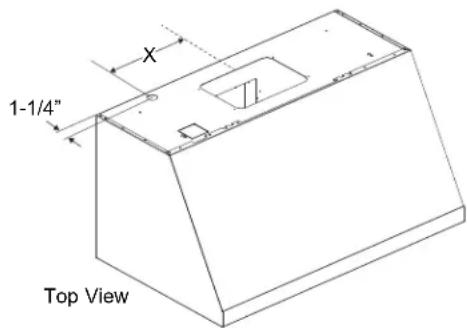
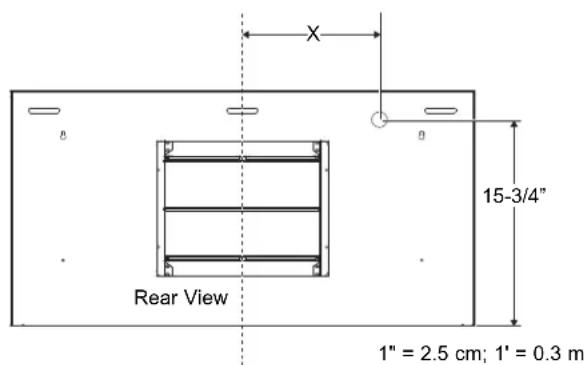
- Cut a hole approximately 1-1/4" dia. forward on the ceiling at a distance (X) to the left of the centerline based on table below.
To route house wiring through the wall:
NOTE: For back venting, the house wiring must be routed through the rear knockout so it is hidden.
- Measure 15-3/4" from the bottom of the hood and mark location.
- Cut a hole approximately 1-1/4" dia. at the marked location at a distance (X) to the left of the centerline based on table below.
- Remove top or rear knockout depending on your installation.
| Models "X" | |
| 30" 9-3/4" | |
| 36" & 48" | 10-1/2" |
1 INSTALL HOOD SUPPORT
IMPORTANT: Framing must be capable of supporting 100 lbs for 30" and 36" models and 150 lbs for 48" models.
- Locate a minimum of 2 vertical studs for the installation bar by tapping drywall with a hammer or use a stud finder.
- Level the installation bar and center left to right above the marked line. Hold bar against the wall.
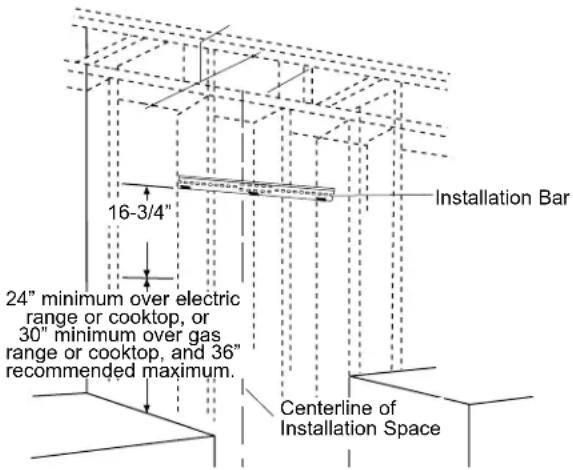
- Drill 1/8" pilot holes at the 2 vertical stud locations through holes in the installation bracket. Secure the installation bar with supplied screws (A) as shown above.
Drill Bottom Mounting Hole Locations:
- Hang hood on installation bar to mark anchor locations. Mark hole locations through the back of the hood. NOTE: If installing to the soffit or cabinet, push hood flush to the soffit or cabinet before marking screw hole locations.
- Remove the hood and drill 5/16" clearance holes centered at the marks you made.
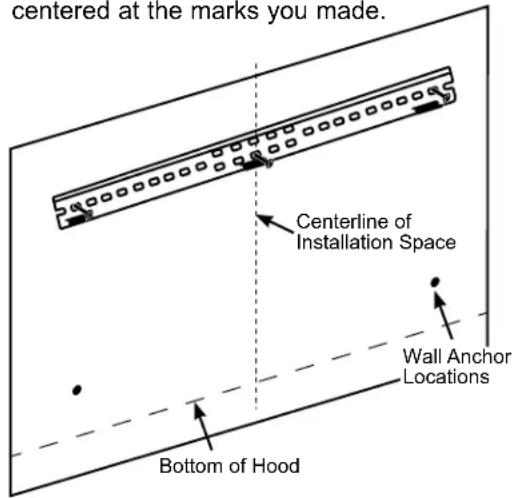
1" = 2.5 cm; 1' = 0.3 m
1 INSTALL HOOD SUPPORT (Cont.)
- Install wall anchors (C) by tapping the anchors with a hammer to seat the teeth of the flanges into the wall. This keeps anchor from rotating.
- Drive the anchor screws until the barrels crimp against the inside of the wall.
- Remove the screws from the wall anchors before installing the hood.
2 INSTALL DAMPER
IMPORTANT: Remove shipping tape from damper and check that damper moves freely.
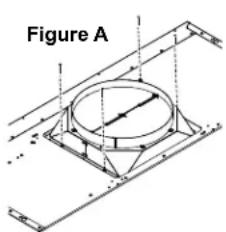
Install Top Damper:
- The motor mounting plate comes pre-installed in the hood for top venting.
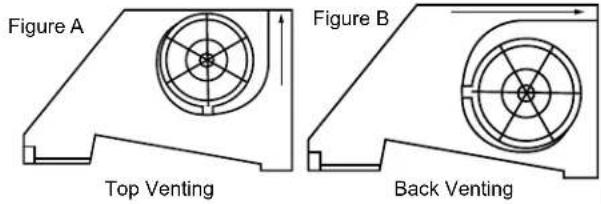
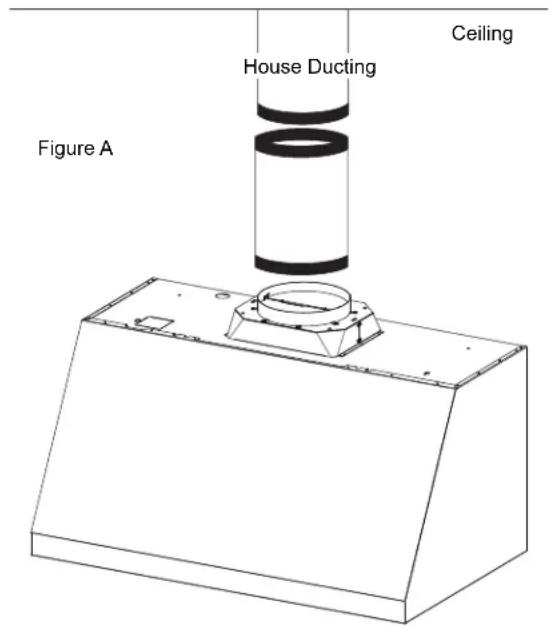
• Install the top damper to the hood body as shown in Figure A using screws (B) from top of hood.
natural_image
Technical line drawing of a rectangular enclosure with internal frame and circular supports (no text or symbols)Install Back Damper:
- In case of back venting through the wall, back damper accessory UXBDA812 must be purchased separately.
- Remove the square knockout panel on hood body for back venting.
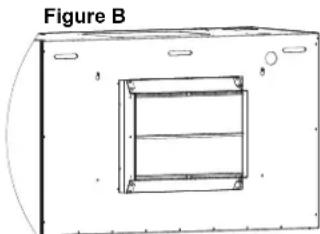
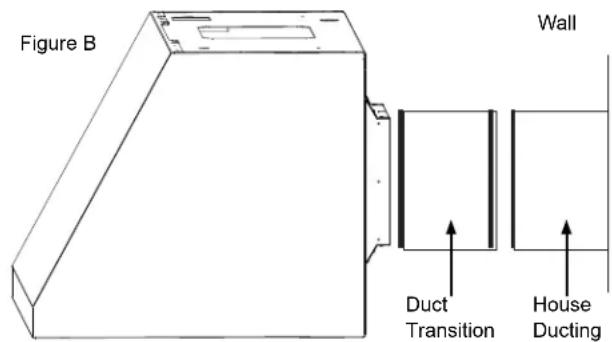
- Install the back damper to the hood body as shown in Figure B using screws provided with the accessory.
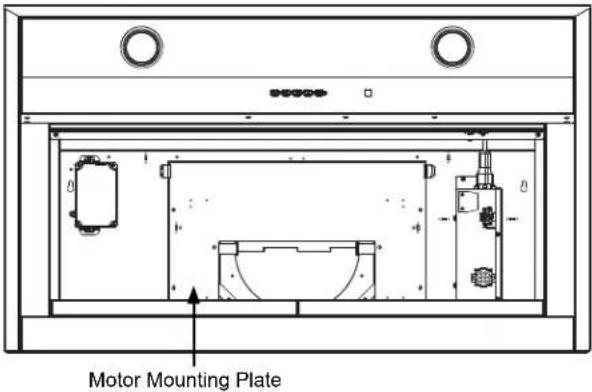
- Uninstall the motor mounting plate from top venting position. Save the screws.
- Install the metal plate provided with the accessory to cover the opening for top damper.
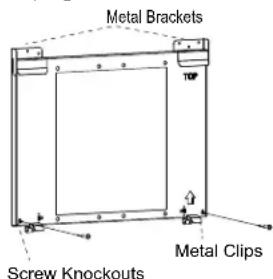
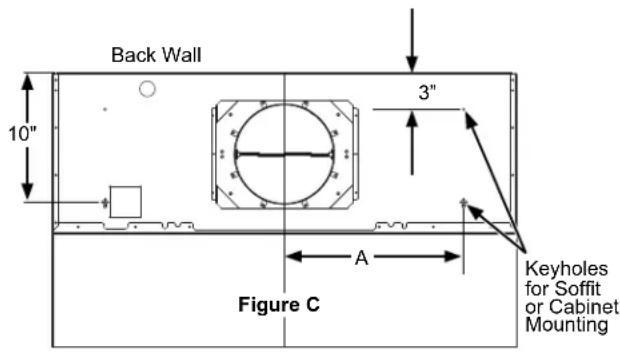
- Remove the two screw knockout holes on the motor mounting plate as shown in Figure C.
• Install the motor mounting plate so that arrow is pointing upwards and on right side.
- Slide plate into the metal brackets and push in until metal clips at the bottom engage.
- Fasten the plate through the two screw hole knockouts as shown in Figure C. Use the two screws you saved.
Figure C(Single motor will look different)
3 INSTALL HOOD ONTO WALL
- Pull house wiring through knockout at the back or top of the hood.
- Lift the hood and place over the hooks on the installation bar. Allow the hood to slide down into position.
- Check to be sure the hood is level and centered.
- Tighten wall anchor screws (C) to finish hood body installation to the wall.
- Remove cover from junction box inside the hood.
4 (Alternate Mounting Method) INSTALL HOOD TO SOFFIT OR CABINET
SKIP THIS STEP IF USING WALL MOUNTING METHOD
IMPORTANT: Soffit or cabinet framing must be capable of supporting 100 lbs. for 30" and 36" models and 150 lbs. for 48" models.
When necessary the hood may be installed so that it is supported by the soffit or cabinet.
- The soffit should be constructed with 2"x4"'s.
- Use a level to draw the cooktop or range center line.
- Continue the centerline forward on the bottom of the soffit.
- Install horizontal wood supports between the 2"x4", at distance A to the left and right, as per the table below.
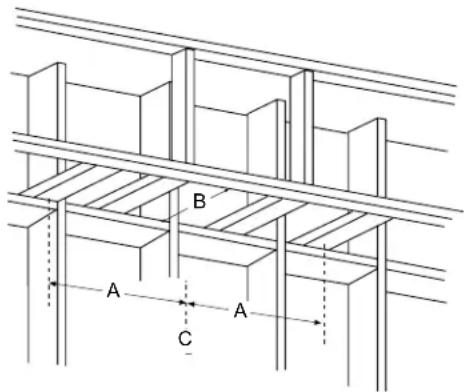
| “A” Center-line to Center Stud | “B” Opening for Ductwork for top venting | “C” Opening for Ductwork for back venting | |
| 30" Models | 8-3/4" | 8-3/8"x11-1/4" | 10-1/2"x13-1/4" |
| 36" Models | 13-3/4" | ||
| 48" Models | 17-3/4" 10 | 5/8"x11-1/4" |
4 (Alternate Mounting Method) INSTALL HOOD TO SOFFIT OR CABINET (Cont.)
- Drill two 1/8" pilot holes at a distance of 10" from the back wall in the horizontal wood supports. This is the vertical distance between mounting keyholes and back wall as shown in Figure C
- Drill two more 1/8" pilot holes at a distance of 3" from the back wall in the horizontal wood supports. This is the vertical distance between mounting screw holes and back wall as shown in Figure C.
- For top venting, allow minimum opening (Dim. B) to accommodate damper in soffit or cabinet.
- For back venting, allow minimum opening (Dim. C) to accommodate damper in back wall.
-
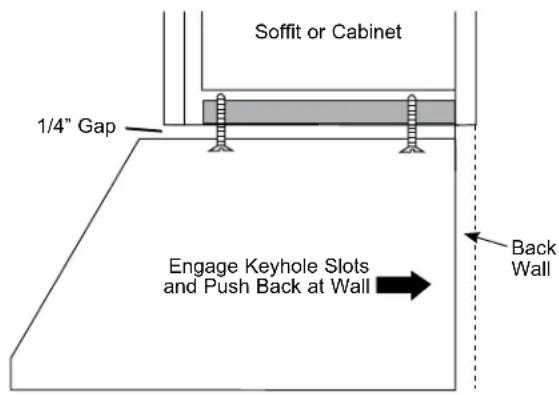
Drive mounting Screw (A) into the studs until they protrude 1/4". This 1/4" gap will provide clearance to engage the keyhole slots in the top of the hood.
-
The hood must also be secured to the back wall. Follow instruction on page 18, "Drill Bottom Mounting Hole Locations" for installation to the back wall.
- Follow instructions on page 17 "House Wiring Locations" for wiring setup.
- Lift hood onto mounting screws. Slide back against the rear wall.
- Pull house wiring through the knockout at the rear or top of the hood.
- Tighten mounting screws (A).
- Once the hood is secured to the soffit or cabinet, drive screws (C) to secure the hood to the back wall.
5 INSTALL MOTOR
I) Align the motor exhaust with the top damper as shown in the Figure A for top venting. In case of back venting, rotate the motor 90° to align with the back damper as shown in Figure B.
II) Secure the motor to motor mounting plate using screws (D).
III) Plug the motor connector into the mating connector on top of the control housing.
IV) Repeat steps I through III for dual motor models.
V) For dual motor models, secure the motor wires to the motor clips as shown in image below.
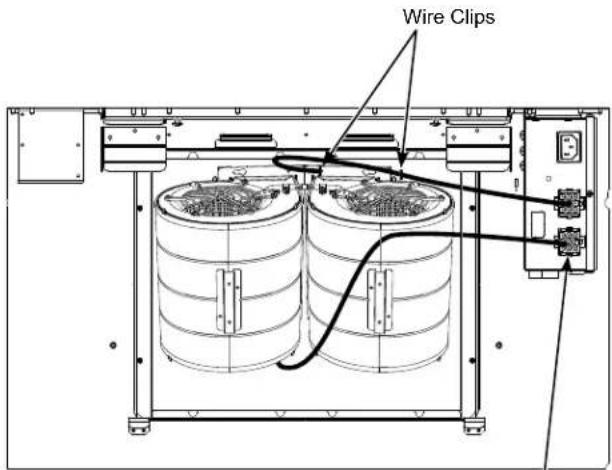
Dual Motor Top Venting Installation
Motor Mating
Connector Location
6 CONNECT ELECTRICAL
Verify that power is turned off at the source.
WARNING
If house wiring is not 2-wire with a ground wire, a ground must be provided by the installer. When house wiring is aluminum, be sure to use UL approved anti-oxidant compound and aluminum-to-copper connectors.
- Remove junction box cover.
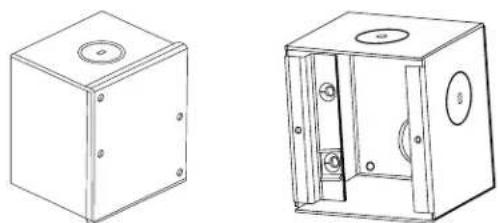
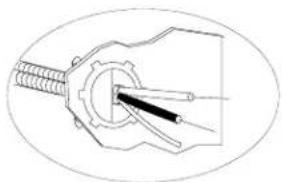
- Pull the house wiring through the knockout at the top or back of the hood and secure with the strain relief.
natural_image
Technical line drawing of a mechanical component with threaded end and internal gear (no text or symbols)- Use UL listed wire nuts to connect incoming white to white, and black to black wires.
- Loosen the green grounding screw (with grounding bracket) in the junction box. Loop solid copper house wire clockwise around the green grounding screw and above the bracket. Firmly tighten the screw over the loop.
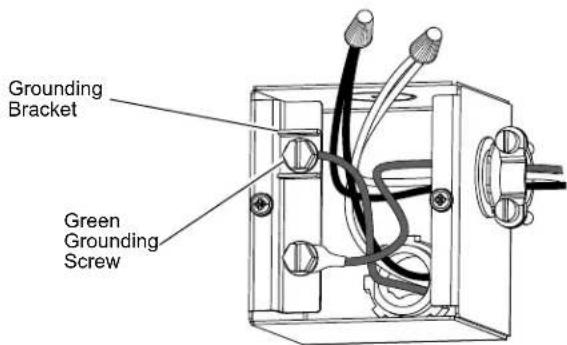
- Replace junction box cover and ensure wires are not pinched.
NOTE:
For corded installation: Use only with rangehood cord-connection kits that have been investigated and found acceptable for use with this model rangehood.
7 CONNECT DUCTWORK
A. Vented Installation
- Connect the house ducting to the top damper as shown in Figure A.
- For back venting, connect the transition piece to the back damper and the house ducting to the transition as shown in Figure B.
- Seal all connections with duct tape.
CAUTION
Do not use sheet metal screws at the transition to ductwork connection. Doing so will prevent proper damper operations. Seal connection with tape only.
B. Recirculation (non-vented) Installation
NOTE: A recirculation duct (WB34X30519), and Charcoal Filter (UXCF91), are not included with the hood and are necessary for recirculation installation.
- Attach the recirculation duct to the duct cover mounting bracket with screws provided.
- Connect the ducting from the exhaust outlet on the hood to the recirculation duct. Use duct tape to seal the connections.
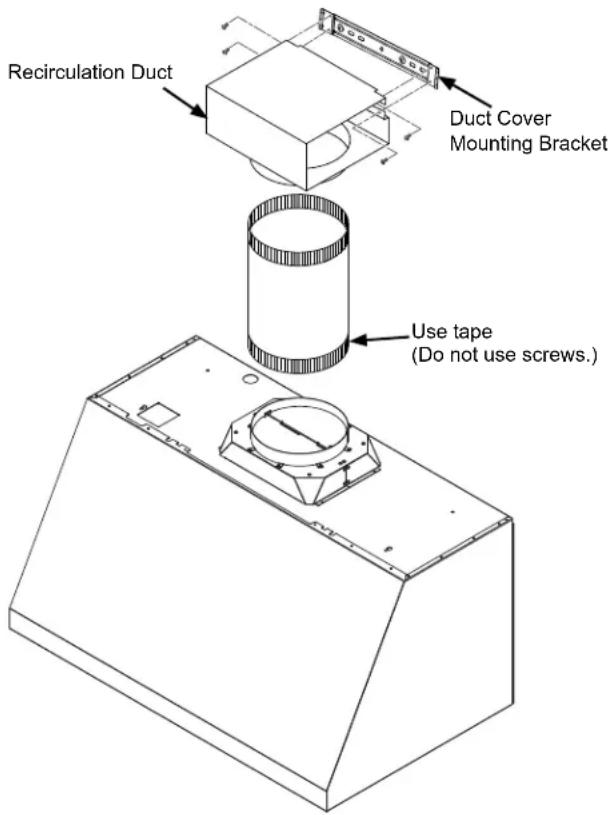
NOTE: Recirculation installation does not apply to 48" models.
8 INSTALL DUCT COVERS
- Refer to section "Duct Cover Requirements" on page 13 for duct cover accessory part numbers.
- Follow instructions included with the duct cover accessory to install duct covers.
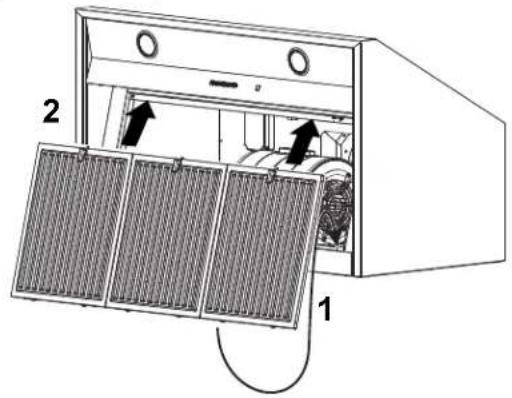
9 INSTALL GREASE TRAYS AND FILTERS
- Remove protective film.
- Place grease drip trays into slots.
• Install the baffle filters. - See page 7 for instructions to install or remove grease drip trays and baffle filters.
MAKE UP AIR TECHNOLOGY
This operation must be performed by a qualified technician or installer.
Note to Installers and Inspectors: This product comes equipped with a simple installation feature that limits maximum CFM levels in order to comply with certain local codes or regulations. This installation method may not be necessary for all installations, please refer to your local codes for further guidelines.
This makeup air feature applies to single motor models only.
CAUTION
Hood must be disconnected from main power prior performing the conversion instructions
listed below. Failure to do so could result in personal injury or damage to the product.
To modify unit (if needed for local codes):
390CFM
By design, the maximum blower speed is greater than 400 CFM. For local codes requiring reduced CFM, modify the wiring as described below:
- Remove the baffle filters.
- Disconnect all the harnesses from the top of control box located on right side of motor.
- Loosen the screws on top of control box and slide out to remove it from the hood.
-
Uninstall the control box cover.
-
For a maximum of 390 CFM Unit can operate with 4 speeds (Low, Medium, High, Boost).
i. Disconnect connectors of the BROWN wire.
ii. Remove the cap attached to the connector of the RED wire.
iii. Connect the mating connector of the BROWN wire and the RED wire.
iv. Attach the cap to the open BROWN wire connector.
-
Reinstall control box cover and secure control box to the bracket in the hood using the two screws.
-
Connect all harnesses on top of the control box.
-
Reinstall filters.
Note to Inspectors: To verify this product installation, check motor wiring connections as described above.
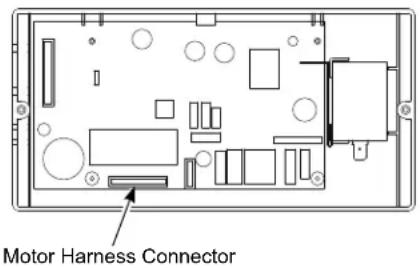
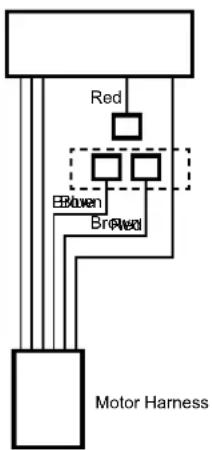
flowchart
graph TD
    A["Motor Harness"] --> B["Red"]
    A --> C["Brown"]
    A --> D["Browned"]
    B --> E["Box 1"]
    B --> F["Box 2"]
    B --> G["Box 3"]
    C --> H["Box 4"]
    C --> I["Box 5"]
Factory Installed Wiring Setup
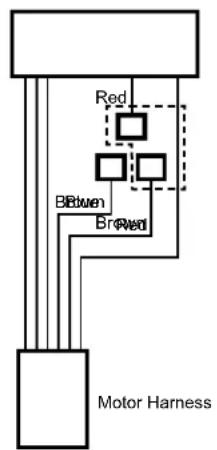
Max 390 CFM Boost Wiring Setup
Troubleshooting tips ... Before you schedule service
Save time and money! Review the chart below first and you may not need to schedule service.
| Problem Possible Cause What To Do | ||
| Fan/Light does not operate when button is turned ON | A house fuse may be blown or a circuit breaker tripped. | Replace fuse or reset circuit breaker. |
| Loud or abnormal airflow noise | Wrong duct size used in installation. This | hood requires 8" ducting or 10" ducting depending on model to perform optimally. Using smaller duct pipe will cause reduced venting. Minimize the duct run length and number of transitions and elbows. GE Appliances service technicians cannot correct this issue if installed improperly. |
| Fan fails to circulate air or moves air slower than normal and/or fan is making loud or abnormal airflow noise | Obstructions in duct work. Make sure nothing is blocking the vent. Make sure your wall or roof cap has a blade or door. | |
| Damper blade on wall or roof cap may not be open. | Make sure damper swings freely. Damper blades may flip over and will not fully open when this happens. Adjust to original position. | |
| Metal grease filter and charcoal filter (if present) may be dirty. | Clean the metal grease filter and replace charcoal filter (if present). See Care and Cleaning of the Vent Hood. | |
| Fan keeps going off and on | The motor is probably overheating and turning itself off. This can be harmful to the motor. | Check to be sure the filters are clean. If off and on cycling continues, call for service. |
| Hood will not work remotely | Router issues, no wireless signal, etc. | For assistance with hood wireless network connectivity, please call 800.220.6899. |
| Hood is not connected. | ||
Vented Range Hood Limited Warranty
GEAppliances.com
All warranty service is provided by our Factory Service Centers, or an authorized Customer Care® technician. To schedule service online, visit us at www.geappliances.com/service_and_support/, or call GE Appliances at 800.GE.CARES (800.432.2737). Please have your serial number and your model number available when calling for service. In Canada, call 800.561.3344 or visit geappliances.ca.
Servicing your appliance may require the use of the onboard data port for diagnostics. This gives a GE Appliances factory service technician the ability to quickly diagnose any issues with your appliance and helps GE Appliances improve its products by providing GE Appliances with information on your appliance. If you do not want your appliance data to be sent to GE Appliances, please advise your technician not to submit the data to GE Appliances at the time of service.
For the period of GE Appliances will replace
| One yearFrom the date of the original purchase | Any part of the cooking product which fails due to a defect in materials or workmanship. During this limited one-year warranty, GE Appliances will provide, free of charge, all labor and related service costs to replace the defective part. |
What GE Appliances will not cover:
■ Service trips to your home to teach you how to use the product.
■ Improper installation, delivery, or maintenance.
■ Failure of the product if it is abused, misused, modified, or used for other than the intended purpose or used commercially.
■ Replacement of house fuses or resetting of circuit breakers.
■ Damage to the product caused by accident, fire, floods, or acts of God.
■ Damage to finish, such as surface rust, tarnish, or small blemishes not reported within 48 hours of delivery.
■ Incidental or consequential damage caused by possible defects with this appliance.
■ Damage caused after delivery.
■ Product not accessible to provide required service.
■ Service to repair or replace light bulbs, except for LED lamps.
EXCLUSION OF IMPLIED WARRANTIES
Your sole and exclusive remedy is product repair as provided in this Limited Warranty. Any implied warranties, including the implied warranties of merchantability or fitness for a particular purpose, are limited to one year or the shortest period allowed by law.
This warranty is extended to the original purchaser and any succeeding owner for products purchased for home use within the USA. If the product is located in an area where service by a GE Appliances Authorized Servicer is not available, you may be responsible for a trip charge or you may be required to bring the product to an Authorized GE Appliances Service location for service. In Alaska, the warranty excludes the cost of shipping or service calls to your home. Some states do not allow the exclusion or limitation of incidental or consequential damages. This warranty gives you specific legal rights, and you may also have other rights which vary from state to state. To know what your legal rights are, consult your local or state consumer affairs office or your state's Attorney General.
In Canada: This warranty is extended to the original purchaser and any succeeding owner for products purchased in Canada for home use within Canada. If the product is located in an area where service by a GE Authorized Servicer is not available, you may be responsible for a trip charge or you may be required to bring the product to an Authorized GE Service location. Some provinces do not allow the exclusion or limitation of incidental or consequential damages. This warranty gives you specific legal rights, and you may also have other rights which vary from province to province. To know what your legal rights are, consult your local or provincial consumer affairs office.
Warrantor: GE Appliances, a Haier company
Warrantor in Canada: MC Commercial Burlington, ON, L7R 5B6
Extended Warranties: Purchase a GE Appliances extended warranty and learn about special discounts that are available while your warranty is still in effect. You can purchase it online anytime at
www.geappliances.com/service_and_support/shop-for-extended-service-plans.htm
or call 800.626.2224 during normal business hours. GE Appliances Service will still be there after your warranty expires.
In Canada: contact your local extended warranty provider.
Looking For Something More?
GE Appliances offers a variety of accessories to improve your cooking and maintenance experiences!
Refer to the Consumer Support page for website information.
The following products and more are available:
Parts
| Baffle Filters |
| Grease Drip Trays |
| Duct Covers |
| Remote Control |
| Back Venting Damper |
| 15" Cabinet Filler Panel |
| Power Cord Kit |
| Charcoal Filters |
| Recirculation Kit |
Cleaning Supplies
| CitruShineTM Stainless Steel Wipes |
| Stainless Steel Appliance Cleaner |
| Bar Keepers Friend Soft CleanserTM |
Consumer Support
GE Appliances Website
Have a question or need assistance with your appliance? Try the GE Appliances Website 24 hours a day, any day of the year! You can also shop for more great GE Appliances products and take advantage of all our on-line support services designed for your convenience. In the US: GEAppliances.com.
In Canada: GEAppliances.ca.
Register Your Appliance
Register your new appliance on-line at your convenience! Timely product registration will allow for enhanced communication and prompt service under the terms of your warranty, should the need arise. You may also mail in the pre-printed registration card included in the packing material. In the US: GEAppliances.com/register. In Canada: geappliances.ca.
Schedule Service
Expert GE Appliances repair service is only one step away from your door. Get on-line and schedule your service at your convenience any day of the year. In the US: GEAppliances.com/service
or call 800.432.2737 during normal business hours.
In Canada: GEAppliances.ca or call 800.561.3344.
Extended Warranties
Purchase a GE Appliances extended warranty and learn about special discounts that are available while your warranty is still in effect. You can purchase it on-line anytime. GE Appliances Services will still be there after your warranty expires. In the US: GEAppliances.com/extended-warranty
or call 800.626.2224 during normal business hours.
In Canada, contact your local extended warranty provider.
Remote Connectivity
For assistance with wireless network connectivity (for models with remote enable), visit our website at GEAppliances.com/connected-home-smart-appliances/ or call 800.220.6899 in the US.
Parts and Accessories
Individuals qualified to service their own appliances can have parts or accessories sent directly to their homes (VISA, MasterCard and Discover cards are accepted). Order on-line today 24 hours every day.
In the US: GEApplianceparts.com or by phone at 877.959.8688 during normal business hours.
Instructions contained in this manual cover procedures to be performed by any user. Other servicing generally should be referred to qualified service personnel. Caution must be exercised, since improper servicing may cause unsafe operation.
Customers in Canada should consult the yellow pages for the nearest Mabe service center, visit our website at GEAppliances.ca or call 800.661.1616.
Contact Us
If you are not satisfied with the service you receive from GE Appliances, contact us on our Website with all the details including your phone number, or write to:
In the US: General Manager, Customer Relations | GE Appliances, Appliance Park | Louisville, KY 40225 GEAppliances.com/contact
In Canada: Director, Consumer Relations, Mabe Canada Inc. | Suite 310, 1 Factory Lane | Moncton, N.B. E1C 9M3 GEAppliances.ca/en/contact-us
Printed in the the United States
Connected Appliance Information
FCC ID: ZKJ-WCATA005
Network: ********
IC: 10229A-WCATA001
Password: ********
MAC ID: ********
Exemple d'étiquette
natural_image
Technical line drawing of an open industrial cabinet or enclosure with internal components and mounting holes (no text or symbols)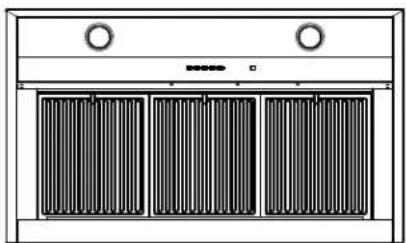
natural_image
Front view of a double-door air conditioner unit with three vertical grilles and two top ovens (no text or symbols visible)natural_image
Technical line drawing of a mechanical component with two views (top and side), showing internal components and directional arrows (no text or symbols)Surfaces
Lumières
natural_image
Simple line drawing of a 3D rectangular block with a small square cutout on top (no text or symbols)Caisson de la hotte
natural_image
Pure technical diagram of a grid-patterned panel or filter structure without any text, numbers, or symbolsEXIGENCES RELATIVES AU CACHE-CONDUIT
natural_image
Isometric line drawing of a two-tiered rectangular cabinet or enclosure with ventilation grilles (no text or symbols)DIMENSIONS D'INSTALLATION
natural_image
Technical line drawing of a mechanical component labeled Figure B, showing a rectangular frame with internal structure and mounting holes (no text or symbols beyond label)natural_image
Technical line drawing of a mechanical component with a circular feature and an upward arrow, labeled Figure A (no text or symbols on the diagram itself)natural_image
Technical line drawing of a mechanical component with a circular feature and directional arrow (no text or symbols)natural_image
Technical line drawing of a room layout with furniture and fixtures (no text or symbols)natural_image
Simple line drawing of a 3D cube with a circular top and four corner holes (no text or symbols)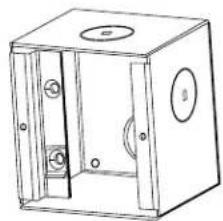
natural_image
Line drawing of an open electrical cabinet with mounting holes and a circular vent (no text or symbols)natural_image
Pure mechanical diagram showing a tool interacting with a gear and shaft (no text or symbols)TECHNOLOGIE D'AIR D'APPOINT
natural_image
Top-down schematic of a device layout with labeled components (no text or symbols)www.geappliances.com/service_and_support/shop-for-extended-service-plans.htm
Au Canada : geappliances.ca.
Demande de service
GEAppliances.com/contact
- SAFETY INFORMATION....3
- USING THE HOOD
- CARE AND CLEANING
- INSTALLATION
- OWNER'S MANUAL & INSTALLATION INSTRUCTIONS
- THANK YOU FOR MAKING GE APPLIANCES A PART OF YOUR HOME.
- IMPORTANT SAFETY INFORMATION READ ALL INSTRUCTIONS BEFORE USING
- WARNING
- CAUTION
- READ AND SAVE THESE INSTRUCTIONS
- ⚠ WARNING
- How to Remove Protective Shipping Film and Packaging Tape
- Controls
- Chef Connect
- Chef Connect Operation Bluetooth® Connection
- To pair with another device:
- To cancel pairing:
- Default Sync Settings:
- Connecting your Wi-Fi Connect Enabled hood (on some models)
- What you will need
- Sample Label
- Connect your GE Appliances hood
- Enhanced Wi-Fi Features
- Filters
- Grease Drip Tray
- To install:
- To remove:
- To clean:
- Baffle Grease Filter
- Filters (Cont.)
- Charcoal Filter (for recirculation installation on select models only)
- National Parts Center 800.626.2002
- To Install
- To Remove
- Surfaces
- Stainless Steel Surfaces (on some models)
- Lights
- Installation Instructions
- Range Hoods
- BEFORE YOU BEGIN
- FOR YOUR SAFETY
- TOOLS AND MATERIALS REQUIRED (NOT SUPPLIED)
- REMOVE THE PACKAGING
- PLAN THE INSTALLATION
- PARTS SUPPLIED FOR INSTALLATION
- PARTS NEEDED FOR INSTALLATION
- PERSONAL INJURY HAZARD
- Installation Preparation
- PARTS PROVIDED
- HARDWARE PACKAGE
- DUCT COVER REQUIREMENTS
- INSTALLATION DIMENSIONS
- ADVANCE PLANNING
- Duct Install Planning
- POWER SUPPLY
- Electrical supply
- Grounding instructions
- NEW CONSTRUCTION, PRE-PLANNING, OR REMODELING
- FOR TOP VENTING
- FOR BACK VENTING
- DETERMINE HOOD, DUCTWORK AND WIRING LOCATIONS
- For Ceiling Ducting:
- Venting Through a Soffit or Cabinet:
- For Ducting Through Rear Wall:
- House Wiring Location:
- To route house wiring through the ceiling, soffit or cabinet:
- To route house wiring through the wall:
- INSTALL HOOD SUPPORT
- Drill Bottom Mounting Hole Locations:
- INSTALL HOOD SUPPORT (Cont.)
- INSTALL DAMPER
- Install Top Damper:
- Install Back Damper:
- INSTALL HOOD ONTO WALL
- (Alternate Mounting Method) INSTALL HOOD TO SOFFIT OR CABINET
- (Alternate Mounting Method) INSTALL HOOD TO SOFFIT OR CABINET (Cont.)
- INSTALL MOTOR
- CONNECT ELECTRICAL
- NOTE:
- CONNECT DUCTWORK
- Vented Installation
- Recirculation (non-vented) Installation
- INSTALL DUCT COVERS
- INSTALL GREASE TRAYS AND FILTERS
- MAKE UP AIR TECHNOLOGY
- 390CFM
- Troubleshooting tips ... Before you schedule service
- Vented Range Hood Limited Warranty
- GEAppliances.com
- What GE Appliances will not cover:
- EXCLUSION OF IMPLIED WARRANTIES
- Looking For Something More?
- Consumer Support
- GE Appliances Website
- Register Your Appliance
- Schedule Service
- Extended Warranties
- Remote Connectivity
- Parts and Accessories
- Contact Us
- Connected Appliance Information
- Lumières
- EXIGENCES RELATIVES AU CACHE-CONDUIT
- DIMENSIONS D'INSTALLATION
- TECHNOLOGIE D'AIR D'APPOINT
- Demande de service
Brand : Monogram
Model : UVW93042PSS
Category : Range hood