ManualGo.com
32LH5000 - TV LG - Free user manual and instructions
Find the device manual for free 32LH5000 LG in PDF.


Download the instructions for your TV in PDF format for free! Find your manual 32LH5000 - LG and take your electronic device back in hand. On this page are published all the documents necessary for the use of your device. 32LH5000 by LG.
USER MANUAL 32LH5000 LG
@ LG Life's Good HSITON3
LCD TV MODELS PLASMA TV MODELS
ACCESSORIES Ensure that the following accessories are included with your TV. If an accessory is missing, please contact the dealer where you purchased the TV. # Image shown may differ from your TV. SN
L'Æ Owner's Manual (C This item is not included for all models. Ovmers Manual Batteries {Remote Control DLisntyWipelanyistains or fingerprints on the surface of the TV with the polishing cloth. Polishing Cloth Do not use excessive Be Ferrite Core Polishing cloth for This may cause scratching (This item is not included for use on the screen. or discolouration. all models.) Power Cord
Teppent rubber stand F'the transparent Bolts for stand assembly Cable mapsemen Etre stand on the Cable Holder Protection cover bottom of the stand is (Only SOPS70+: 50PS80-+) lost, attach the spare (Refer to p.23) (Refer to p.24) (Refer to p.18) (Refer to p.23) rubber stand. TV models = L Cable Holder Cable management clip Jscreu for stand fins (Only 19/22LU40+, (Only 19/22LH20+) 262) muse 2/47 Cablemanagement dip Stand rear cover 19/22/26LU50++) (Refer to p.22) 32/37 /42LH40+, 32/37/421H {Ony32/37/42/41H70) (Only 37/42/47LH70++) (Refer to p.22) 32/37/421H50- (Refer to p.23) Refer to p.21) (Refer to p.20) Bolts for stand assembly (Refer to p. 17-19)
32/37/42 19/22LU40+, 26LUS0-) M420 M420 Méxlé Maé : 1F25++) {Only 32LH70++) (Only 37LH70-.) (Only 47LH70++) (Only 42LH70+) 32/37/42/47HS0=) ns) Protective Bracket USB extension cable Protection Cover and Bolt for Power Cord (Only 32/37/42/47LH70+) {Except for 19/22LU40++, 19/22/26LU50++) (Only 32/37/42/47LH70+) Make sure to use the provided (Refer to p.24) (Refer to p.23) USB extension cable, Which is specially designed for à slim fit. SINOSS322v ||
SINIINOD | CONTENTS ACCESSORIES 1 PREPARATION Front Panel Controls. Back Panel Information. Stand Installation Detaching stand Attaching the TV to a desk. Desktop Pedestal Installation Positioning your display … Kensington Security System . Careful installation advice … Swivel Stand … To use the stand rear cover Back Cover for Wire Arrangement. Not Using the desk-type stand. Wall Mount: Horizontal Installation Antenna Connection
EXTERNAL EQUIPMENT SETUP
HD Receiver Setup. DVD Setup. VCR Setup. Insertion of CI Module Digital Audio Out Setu Headphone Setup …. Other A/V Source Setup . Usb Setup... PC Setup. - Screen Setup for PC Mod
WATCHING TV / PROGRAMME CONTROL
Volume Adjustmen 50 Quick Menu … 51 On-Screen Menus Selection and Adjustment..…. 52
- Connecting to Bluetooth headset shesdy registered. 77 - Disconnecting the Bluetooth headset during use...78 - When requesting to connect to TV from the Bluetooth headset … Managing Registered Bluetooth device My Bluetooth Information. Receiving Photos from external Bluetooth device Listening to the Musics from external Bluetooth device
When connecting the a USB device Photo List … Music List. Movie List DivX Registration Code Deactivation…
NOI1VYVdIHd | PREPARATION
FRONT PANEL CONTROLS
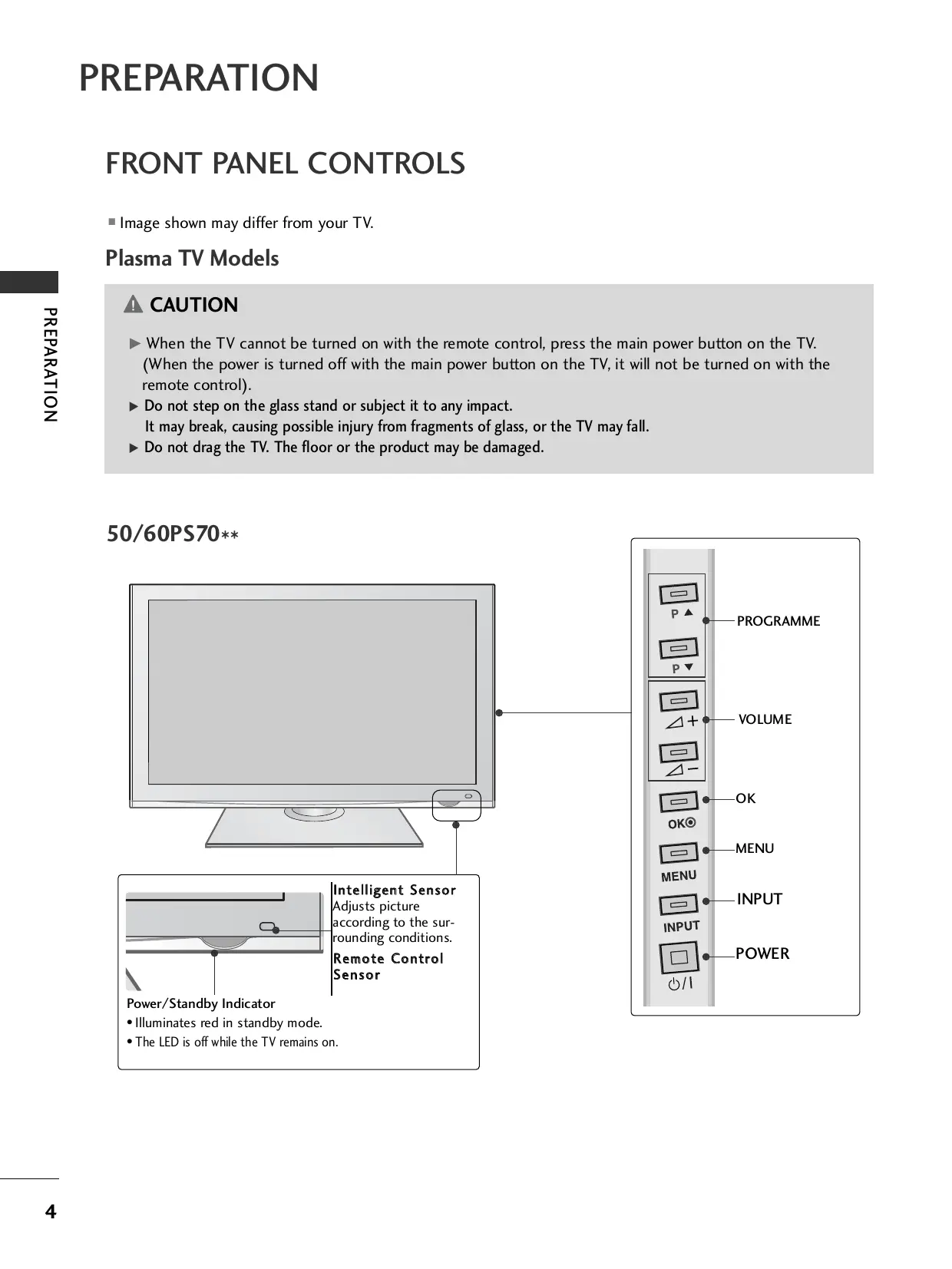
# Image shown may differ from your TV. Plasma TV Models À CAUTION > When the TV cannot be turned on with the remote control, press the main power button on the TV. (When the power is turned off with the main power button on the TV, it will not be turned on with the remote control). > Do not step on the glass stand or subject it to any impact. It may break, causing possible injury from fragments of glass, or the TV may fall. > Do not drag the TV. The floor or the product may be damaged. 50/60PS70+x+ P À #1 PROGRAMME Se | | +8 — voiumE = ex w oKk® EME MENU Intelligent Sensor ss 4 djusts picture El INPUT a hccording to the sur- INPUT lounding conditions. [Remote Control e—POWER \ Sensor 6 o/1 Power/Standby Indicator + Illuminates red in standby mode. + The LED is off while the TV remains on.
50/60PS80++ $— PROGRAMME | Intelligent Sensor Adjusts picture according to the sur- rounding conditions. Remote Control Sensor Power/Standby Indicator + Illuminates red in standby mode. + The LED is off while the TV remains on. NOILVYVdI Hd |]
NOI1VYVdAHd | PREPARATION LCD TV Models : 32/37/42/47LH70++ Moving LED POWER(Touch Sensor) Power/Standby Indicator {+ Illuminates red in standby mode. {+ Illuminates whitish when the TV is switched on. Note: You can adjust Power Indicator in the (OPTION menu. Intelligent Sensor Adjusts picture according to the surrounding conditions Remote Control Sensor in] 9— PROGRAMME
LCD TV Models : 19/22/26/32/37/42LH20**, 32/37/42/47LH30** (Only 19/22/26LH20+*)
Adjusts picture according to the surrounding conditions. — Remote Control Sensor T Inteligent Sensor Power/Standby Indicator + Illuminates red in standby mode. | |
- Iluminates blue when the TV is switched on. Main Power Switch
LCD TV Models : 19/22LU40+*+ ts De OK [ro [PROSRANNE ë & & à GI ivPuT MENU ok® | + LCD TV Models : 32/37/42LF25+* Main Power Switch Remote Control Sensor Power/Standby Indicator + illuminates red in standby mode. + illuminates white when the TV is switched on. POWER Remote Control Sensor Power/Standby Indicator
- illuminates red in standby mode.
- illuminates blue when the TV is switched on. $— PROGRAMME 4 VOLUME NOILVYVdIUd |]
| ©/1 INPUT MENU OK©
© Remote Control Sensor Power/Standby Indicator Illuminates red in standby mode. Illuminates white when the TV is switched on. (Only 26LU50++) PROGRAMME VOLUME
M Image shown may differ from your TV. Plasma TV Models
© Power Cord Socket This TV operates on an AC power. The voltage is indicated on the Specifications page. Never attempt to operate the TV on DC power. @ HDMI/DVI IN Input Connect an HDMI signal to HDMI IN. Or DVI(VIDEO)signal to HDMI/DVI port with DVI to HDMI cable. @ RGB/DVI Audio Input Connect the audio from a PC or DTV.
© OPTICAL DIGITAL AUDIO OUT
Connect digital audio to various types of equipment. Connect to a Digital Audio Component. Use an Optical audio cable. @ Component Input Connect a component video/audio device to these jacks. © RGB IN Input Connect the output from a PC.
Connect to the RS-232C port on a PC. This port is used for Service or Hotel mode. @ Euro Scart Socket (AV1/AV2) Connect scart socket input or output from an external device to these jacks. © Antenna Input Connect antenna or cable to this jack. © PCMCIA (Personal Computer Memory Card International Association) Card Slot Insert the CI Module to PEMCIA CARD SLOT. (This feature is not available in all countries.) © USB Input Connect USB storage device to this jack. @ S-Video Input Connect S-Video out from an S-VIDEO device. Audio/Video Input Connect audio/video output from an external device to these jacks. NOILVUVdIUd ||
© =] HENJE n AUDIO I n q © Power Cord Socket @ Antenna Input This TV operates on an AC power The voltage is Connect antenna or cable to this jack. indicated on the Specifications page. Never attempt to operate the TV on DC power. @ Component Input Connect a component video/audio device to © USB Input these jacks. Connect USB storage device to this jack. @ HDMI/DVI IN Input @ OPTICAL DIGITAL AUDIO OUT npu Connect digital audio to various types of equipment. Connect an HDMI signal to HDMI IN. Connect to a Digital Audio Component: Or DVI(VIDEO) signal to HDMI/DVI port with DVI Use an Optical audio cable. l to HDMI cable. u © S-Video Input ® Euro Scart Socket (AV1/AV2) : Connect scart socket input or output from an Connect S-Video out from an S-VIDEO device. external device to these jacks. Audio/Video Input Connect audio/video output from an external ® Headphone Socket device to these jacks. Plug the headphone into the headphone socket. @ RGB IN Input ® PCMCIA (Personal Computer Memory Card Connect the output from a PC. International Association) Card Slot RGB/DVI Audio Input Insert the CI Module to PCMCIA CARD SLOT. Connect the audio from a PC or DTV. (This feature is not available in all countries.)
@ RS-232C IN (CONTROL & SERVICE) PORT
Connect to the RS-232C port on a PC. This port is used for Service or Hotel mode.
(| anrennan “re © Power Cord Socket @ RS-232C IN (CONTROL & SERVICE) PORT This TV operates on an AC power. The voltage is Connect to the RS-232C port on a PC. indicated on the Specifications page. Never This port is used for Service or Hotel mode. attempt to operate the TV on DC power @ RGB/DVI Audio Input © Component Input Connect the audio from a PC or DTV. Connect a component video/audio device to these jacks. @ OPTICAL DIGITAL AUDIO OUT Ant Input Connect digital audio to various types of equipment. @ Antenna Inpu . Connect to a Digital Audio Component. Connect antenna or cable to this jack. Use an Optical audio cable. © USB Input © Euro Scart Socket (AV1/AV2) Connect USB storage device to this jack. Connect scart socket input or output from an @ PCMCIA (Personal Computer Memory Card external device to these jacks. International Association) Card Slot Insert the CI Module to PCMCIA CARD SLOT. © HDMI/DVI IN Input (This feature is not available in all countries.) Connect an HDMI signal to HDMI IN. Or DVI (VIDEO) signal to HDMI/DVI port with DVI to HDMI ® Audio/Video Input cable. Connect audio/video output from an external @ RGB IN Input device to these jacks. npu Connect the output from a PC. ® Headphone Socket Plug the headphone into the headphone socket. NOILVYVdI Hd |]
This TV operates on an AC power. The voltage is indicated on the Specifications page. Never attempt to operate the TV on DC power RGB/DVI Audio Input Connect the audio from a PC or DTV.
OPTICAL DIGITAL AUDIO OUT
Connect digital audio to various types of equipment. Connect to a Digital Audio Component. Use an Optical audio cable. Euro Scart Socket (AV1/AV2) Connect scart socket input or output from an external device to these jacks. HDMI/DVI IN Input Connect an HDMI signal to HDMI IN. Or DVI (VIDEO) signal to HDMI/DVI port with DVI to HDMI cable. RGB IN Input Connect the output from a PC. Connect to the RS-232C port on a PC. This port is used for Service or Hotel mode. Component Input Connect a component video/audio device to these jacks. Antenna Input Connect antenna or cable to this jack. PCMCIA (Personal Computer Memory Card International Association) Card Slot Insert the CI Module to PCMCIA CARD SLOT. (This feature is not available in all countries.) Audio/Video Input Connect audio/video output from an external device to these jacks. Headphone Socket Plug the headphone into the headphone socket.
AV2 HPQ G lanrenNaIN This TV operates on an AC power. The voltage is indicated on the Specifications page. Never attempt to operate the TV on DC power. @ RGB/DVI Audio Input Connect the audio from a PC or DTV.
@ OPTICAL DIGITAL AUDIO OUT
Connect digital audio to various types of equipment. Connect to a Digital Audio Component. Use an Optical audio cable. © Euro Scart Socket (AV1/AV2) Connect scart socket input or output from an external device to these jacks. @ HDMI/DVIIN Input Connect an HDMI signal to HDMI IN. Or DVI (VIDEO) signal to HDMI/DVI port with DVI to HDMI cable. © RGB IN Input Connect the output from a PC.
Connect to the RS-232C port on a PC. This port is used for Service or Hotel mode. Component Input Connect a component video/audio device to these jacks. Antenna Input Connect antenna or cable to this jack. Headphone Socket Plug the headphone into the headphone socket. PCMCIA (Personal Computer Memory Card International Association) Card Slot Insert the CI Module to PCMCIA CARD SLOT. (This feature is not available in all countries.)
© Power Cord Socket This TV operates on an AC power. The voltage is indicated on the Specifications page. Never attempt to operate the TV on DC power. @ RGB/DVI Audio Input Connect the audio from a PC or DTV.
OPTICAL DIGITAL AUDIO OUT
Connect digital audio to various types of equipment. Connect to a Digital Audio Component. Use an Optical audio cable. Euro Scart Socket (AV1/AV2) Connect scart socket input or output from an external device to these jacks. HDMI/DVI IN Input Connect an HDMI signal to HDMI IN. Or DVI (VIDEO) signal to HDMI/DVI port with DVI to HDMI cable. RGB Input Connect the output from a PC.
RS-232C IN (CONTROL & SERVICE) PORT
Connect to the RS-232C port on a PC. This port is used for Service or Hotel mode. (Only 26LU50*++) 19/22/26LU50**+
AVINS ANTENNA IN ©+—® HPQ @ Component Input Connect a component video/audio device to these jacks. @ Antenna Input Connect antenna or cable to this jack. © Headphone Socket
Plug the headphone into the headphone socket. PCMCIA (Personal Computer Memory Card International Association) Card Slot Insert the CI Module to PCMCIA CARD SLOT. (This feature is not available in all countries.)
Audio/Video Input Connect audio/video output from an external device to these jacks.
STAND INSTALLATION # Image shown may differ from your TV When assembling the desk type stand, check whether the bolt is fully tightened. (If not tightened fully, the product can tilt forward after the product installation.) lf you tighten the bolt with excessive force, the bolt can deviate from abrasion of the tightening part of the bolt. Only 32/37/42/47LH70**+ Carefully place the TV screen side down on a cush- ioned surface to protect the screen from damage.
Assemble the parts of the Stand Body with the Stand Base of the TV. 32LH70+*+
LE] Only 26/32/37/42LH20*, 32/37/42/471H30*, 32/37/42/47LH40*+, 32/37/42/471H49%, 32/37/42/47LH50++ Carefully place the TV screen side down on a cushioned surface to protect the screen from damage. Fix the 4 bolts securely using the holes in the back of the TV. NOILVYVdI Hd |]
PREPARATION Only 19/22LH20*+ Carefully place the TV screen side down on a cush- ioned surface to protect the screen from damage. Cover Base Only 19/22LU40+x*, 19/22/26LU50*+ Carefully place the TV screen side down on a cush- ioned surface to protect the screen from damage. (2) Fix the 2 or 3 bolts securely using the holes in the back of the TV. (Only 26LU50++) Only 50PS70++/50PS80*++ Carefully place the TV screen side down on a cushioned surface to protect the screen from damage. Fix the 4 bolts securely using the holes in the back of the TV. Front When assembling the stand, make sure to distinguish and assemble the front and rear side of the stand correctly.
Only 32/37/42LF25+* DETACHING STAND Only 19/22LU40+*, 19/22/26LU50++ Carefully place the TV screen side down on a cushioned surface to protect the screen from damage. # Image shown may differ from your TV. Carefully place the TV screen side down on a cush- ioned surface to protect the screen from damage. (2 EEE the parts of the Stand Body with à ;;: Cover Base of the TV. NOILVYVdIUd |] Stand Body Cover Base (Only 26LU50++) Loose the bolts from TV. Detach the Cover Base from TV. Cover Base (Only 26LU50--) [4] Detach the Stand Body from TV. Fix the 4 bolts securely using the holes in the back of the TV. Stand Body
ATTACHING THE TV TO A DESK
(Only 26LU50x+, 32/37/42LF25x+, 26/32/37 /42LH20*, 32/37/421H30+*, 32/37/42LH40x+, 32/37/421H49++, 32/37/421H50++, 32/37LH70++) # Image shown may differ from your TV. The TV must be attached to desk so it cannot be pulled in a forward/backward direction, potentially causing injury or damaging the product. Use only an attached screw. TL à LI — 1-Screw (provided as parts of the product) © WARNING » To prevent TV from falling over, the TV should be securely attached to the floor/wall per installation instructions. Tipping, shaking, or rocking the machine may cause injury.
DESKTOP PEDESTAL INSTALLATION
For adequate ventilation allow a clearance of 4” (10cm) all around the TV. ] 1
(Only 19/22LH20**) # Image shown may differ from your TV. # Adjust the position of the panel in various ways for maximum comfort. + Tilt range @ NOTE » The following model is a fixed stand type model without the Tilt and Swivel features so excessive pressure may damage the set. -19/22/26LU50*+, 19/22LU40**
KENSINGTON SECURITY SYSTEM
# This feature is not available for all models. # Image shown may differ from your TV. The TV is equipped with a Kensington Securit System connector on the back panel. Connect the ensington Security System cable as shown below. For the detailed installation and use of the Kensington ecurity System, refer to the user's guide provide! with the Kensington Security System. For further information, contact http;//wwwkensing- ton.com, the internet homepage of the Kensington company. Kensington sells security systems for expensive electron- ic equipment such as notebook PCs and LCD projectors. NOTE - The Kensington Security System is an optional accessory. NOTES a.lf the TV feels cold to the touch, there may be a small “flicker” when it is turned on. This is normal, there is nothing wrong with TV. b. Some minute dot defects may be visible on the green. appearing as tiny re r green. or blue spots. However, they have no adverse effect on the moni- tor's performance. . Avoid touching the LCD screen or holding your finger(s) against it for long periods of time. Doing so may produce some temporary distortion effects on the screen.
(Except for 19/22LH20+*, 19/22LU40#*, 19/22/26LU50++) M You should purchase necessary components to fix the TV # Image shown may differ from your TV. safety and secure to the wall on the market. After installing the TV, you can adjust the TV set % Position the TV close to the wall to avoid the possibility manually to the left or rigt direction by 20 degrees ofit faling when pushed. o suit Your viewing position. # The instructions shown below are a safer way to set up the TV, by fixing it to the wall, avoiding the possibility of it falling forwards if pulled. This will prevent the TV from falling forward and causing injury. This will also prevent the TV from damage. Ensure that children do not climb or hang from the TV. NOILVYVdIUd |]
le dr? 3} TO USE THE STAND REAR = COVER (only 37/42/47LH70-+) # Image shown may differ from your TV. [1] Use the eye-bolts or TV brackets/bolts to fix the Install the STAND REAR COVER as shown. product to the wall as shown in the picture. (If your TV has bolts in the eyebolts, loosen then bolts.)
- Insert the eye-bolts or TV brackets/bolts and tight- en them securely in the upper holes. 12] Secure the wall brackets with the bolts on the wall. Match the height of the bracket that is mounted on the wall.
Grip the knob in your fingers and pull it. [3] Use a sturdy rope to tie the product for alignment. It is safer to tie the rope so it becomes horizontal between the wall and the product. @ NOTE > When moving the TV undo the cords first. > Use a platform or cabinet strong and large enough to support the size and weight of the TV. > To use the TV safely make sure that the height of the bracket on the wall and on the TV is the same.
# Image shown may differ from your TV. LCD TV Models : 19/22LH20++ Connect the cables as neces- sary. To connect additional equip- ment, see the EXTERNAL EQUIPMENT SETUP section. How to remove the cable management (Clip (LCD TV Models : 19/22LH20++) Hold the CABLE MANAGEMENT CLIP with both hands and pull it backward. O NOTE > Do not use the CABLE MANAGEMENT CLIP to lift the TV. - Ifthe TV is dropped, you may be injured or the TV may be damaged. LCD TV Models : 32/37/42LF25**, 26/32/37/421LH20**, 32/37/42/47LH30**, 32/37/42/47LH40**, 32/37/42/A47LH49**, 32/37/42/47LH50** O Connect the cables as neces- sary. Ce To connect additional equip- | 21 ment, see the EXTERNAL ER EQUIPMENT SETUP section. A (2) Open the CABLE MANAGEMENT CLIP as shown. s À
2 | | BY CABLE MANAGEMENT CLIP
9 Fit the CABLE MANAGEMENT CLIP as shown. LCD TV Models : 19/22LU40*+, 19/22/26LU50++ After Connecting the cables as necessary, install CABLE HOLDER as shown and bundle the cables.
LCD TV Models : 32/37/42/47LH70*+ Align the hole with the tab on the CABLE MANAGEMENT CLIP. Tum the CABLE MANAGEMENT CLIP as shown. Note : that excessive force might cause damage to the product when using Cable Management dip.
CABLE MANAGEMENT CLIP
Connect the cables as necessary. To connect additional Equipment see the etup section. External equipment How to secure the power cable (Only 32/37/42/47LH70++) O Secure the power cable with the PROTECTIVE BRACKET and the bolt as shown. lt will help prevent the power cable from being removed by accident. PROTECTIVE BRACKET @ NOTE Plasma TV Models O After Connecting the cables as necessary, install CABLE HOLDER as shown and bundle the cables. To connect additional equipment, see the External equipment Setup section.
CABLE HOLDER (2) Install the CABLE MANAGEMENT CLIP as shown.
How to remove the cable man- agement clip Hold the CABLE MANAGEMENT CLIP with both hands and pull it upward. » Do not use the CABLE MANAGEMENT CLIP to lift the TV. - Ifthe TV is dropped, you may be injured or the TV may be damaged. NOILVYVdI Hd |]
(Except for 19/22LU40+*, 19/22/26LU50*+) # Image shown may differ from your TV. When installing the wall-mounted unit, use the protection cover. Plasma TV models PROTECTION COVER Insert the PROTECTION COVER into the TV until clicking sound. LCD TV models Only 32/37/42/47LH70*+*+
After removing the protection paper from the protection cover, adhere it to the TV as shown. Only 26/32/37/42LH20+*, 32/37/42/471H30**, 32/37/42/47LH40**, 32/37/42/471H49**, 32/37/42/47LH50+*+ Insert the PROTECTION COVER into the TV until clicking sound. Only 32/37/42LF25**+ PROTECTION COVER Insert the PROTECTION COVER into the TV until clicking sound. PROTECTION COVER Only 19/22LH20++ O Carefully place the TV screen side down on a cushioned surface to protect the screen from damage. PROTECTION COVER Fix the 4 bolts securely using the holes in the back of the TV.
m The TV can be installed in various ways such as on a wall, or on a desktop etc. m The TVis designed to be mounted horizontally. EARTHING Ensure that you connect the earth wire to prevent possible electric shock. If grounding methods are not possible, have a qualified electrician install a separate circuit breaker. Do not try to earth the TV by connecting it to tele- phone vwires, lightening rods or gas pipes. Porer supp (irait breaker
WALL MOUNT: HORIZONTAL
INSTALLATION m We recommend the use of a LG Brand wall mounting bracket when mounting the TV to a wall. m We recommend that you purchase a wall mounting bracket which supports VESA standard. M LG recommends that wall mounting be performed by a qualified professional installer. ® NOTE > Should Install wall mount on a solid wall perpendicular to e floor. > Should use a special wall mount, if you want to install it to ceiling or slanted wall. > The surface that wall mount is to be mounted on should be of sufficient SE to support the weight of TV set; e.g. concrete, natural rock, be and hollow block. > Installing screw type and length depends on the wall mount used. Further information, refer to the instructions included with the mount. > LG is not liable for any accidents or damage to property or TV due to incorrect Hana PE - Where a non-compliant VESA wall mount is used. - incorrect fastening of screws to surface which may cause TV to fall and cause personal injury. - Not following the recommended Installation method.
PREPARATION = To prevent damage do not connect to the mains outlet until all connections are made between the devices. ANTENNA CONNECTION = For optimum picture quality, adjust antenna direction. m An antenna cable and converter are not supplied. Multi-family Dwellings/Apartments (Connect to wall antenna socket) Wall Antenna Socket RF Coaxial Wire (75 ohm) Outdoor Antenna (VHE, UHF) Single-family Dwellings /Houses (Connect to wall jack for outdoor antenna) (| (| ) — VHF = In poor signal areas, to achieve better picture quality it may be necessary to install a signal amplifier to the antenna as shown above. = If signal needs to be split for two TVs,use an antenna signal splitter for connection. Use of ferrite core (This feature is not available for all models.) Ferrite core can be used to reduce the electromagnetic wave when connecting the power cord. The closer the location of the ferrite core to the power plug, the better it is. Install the power plug closely.
EXTERNAL EQUIPMENT SETUP
= To avoid damaging any equipment, never plug in any power cord until you have finished connecting all equipment. = This section on EXTERNAL EQUIPMENT SETUP mainly uses diagrams for the Plasma TV models. = Image shown may differ from your TV.
= This TV can receive Digital RF/Cable signals without an external digital set-top box. However, if you do receive Digital signals from a digital set-top box or other digital external device, refer to the diagram as shown below. Connecting with a Component cable © Connect the video outputs (Y, P8, Pr) of the digital set top box to the COMPONENT IN VIDEO jacks on the TV. Connect the audio output of the digital set-top box to the COMPONENT IN AUDIO jacks on the TV. (Refer to the owner's manual for the digital set-top box.) Select Component input source using the INPUT button on the remote control.
(3) Turn on the digital set-top box.
EXTERNAL EQUIPMENT SETUP
Connecting a set-top box with an HDMI cable M] Connect the digital set-top box to HDMI/DVI IN 1, HDMI IN 2(Except for 19/22LH20**), HDMI IN 3 (Except for 19/22LU40+*, 19/22LU50** 19/22/26/32/37/42LH20+*, 32/37/42LF25*) or HDMI IN 4 (Only 32/37/42/47LH49+< 32/37/42/47LH50* 32/37/42/471H70*+, 50/60PS70+, 50/60PS80**) jack on the TV. CELLES Fever 12] Turn on the digital set-top box. (Refer to the owner's manual for the digital set-top box.) (3) Select HDMIT, HDMI2(Except for 19/22LH20*+), HDMI3 (Except for 19/22LU40* 19/22LU50**+ 19/22/26/32/37/42LH20*, 32/37/42LF25**) or HDMI4(Only 32/37/42/47LH49++, 32/37/42/47LH50*+, 32/37/42/47LH70+*, 50/60PS70**, 50/60PS80*) input source using the INPUT button on the remote control. O NOTE > Check that your HDMI cable is version 1.3 or higher. If the HDMI cables don't support HDMI version 1.3, flicker- ing or no screen display can result. Please use the latest cables that support at least HDMI version 1.3. HDMI-DTV OUTPUT. Connecting with an HDMI to DVI cable un 6 à O Connect the digital set-top box to HDMI/DVI IN 1 jack on the TV. épbeeees CSSS SR opbepeees 12] Connect the audio output of the digital set-top box to the AUDIO IN (RGB/DVI) jack on the TV. (3] Turn on the digital set-top box. (Refer to the owner's manual for the digital set-top box.) (4) Select HDMIT input source using the INPUT button on the remote control.
DVD SETUP Connecting with a Component cable [1] Connect the video outputs (Y, P8, Pr) of the DVD to the COMPONENT IN VIDEO jacks on the TV. Connect the audio outputs of the DVD to the COMPONENT IN AUDIO jacks on the TV. Turn on the DVD player, insert a DVD. Select Component input source using the INPUT button on the remote control. Refer to the DVD player's manual for operating instruc- tions.
Component Input ports To achieve better picture quality, connect a DVD player to the component input ports as shown below. Component ports on the TV Y Ps Pr Y Ps Pr Video output ports Y BY RY on DVD player Y €b Cr Y Pb Pr 413$ LNINdIND3 1VNYILXI ||
413$ LNINdIND3 1VNYILXI |
EXTERNAL EQUIPMENT SETUP
Connecting with a Euro Scart cable Connect the Euro scart socket of the DVD to the AVI Euro scart socket on the TV.
[2] Turn on the DVD player, insert a DVD. D
[3] Select AVT input source using the INPUT button on the remote control. If connected to AV2 Euro scart socket, select AV2 input source. C4] Refer to the DVD player's manual for operating instructions. s Input Output Video Audio RGB Video, Audio AVI o o o Analogue only Analogue, DTV, AV1/2/3 output is available. o x AVI AV2 (TV Out) | (Monitor Out)
{R) AUDIO (L) > TV Out : Outputs analogue TV signals. Digital TV x ù Anal TV AVI/3 Monitor Out: Outputs na ogue ° ° ° the current screen image. Component/RGB le) x (The input mode is converted to DTV) HDMI x x AV2 [e] [e] [e) @ NOTE > Any Euro scart cable used must be signal shielded. Connecting with a S-Video cable (Only 32/37/42/47LH70++, 50/60PS70++ 50/60PS80++) © Connect the S-VIDEO output of the DVD to the S- VIDEO input on the TV. Connect the audio outputs of the DVD to the AUDIO input jacks on the TV. Turn on the DVD player, insert a DVD. Select AV3 input source using the INPUT button on the remote control. Refer to the DVD player's manual for operating instruc- 8 tions. © 60 ©
Connecting the HDMI cable [1] Connect the HDMI output of the DVD to the HDMI/DVI IN 1, HDMI IN 2(Except for 19/22LH20*+), HDMI IN 3 Except for 19/22LU40** 19/22LU50*, 19/22/26/32/37/42LH20+*, 32/37/42LF25*) or HDMI IN 4 (Only 32/37/42/47LH49*+ 32/37/42/47LH50%*, 32/37/42/47LH70*, 50/60PS70+*, 50/60PS80*+) jack on the TV. HOMU IN Ha! © scie HDMIT, HDMI2(Except for 19/221H20%), HDMI3 Except for 19/22LU40+*, 19/22LU50+*, 19/22/26/32/37/42LH20+*,32/37/42LF25*) or HDMI4(Only 32/37/42/47LH49:* 32/37/42/47LH50++, 32/37/42/471LH70+, 50/60PS70*, 50/60PS80*+) input source using the INPUT button on the remote control. (3] Refer to the DVD player’ s manual for operating instructions. (es @ NOTE ES HDMI-DVD OUTPUT The TV can receive video and audio signals simultaneously when using an HDMI cable. » If the DVD does not support Auto HDMI, you must set the output resolution appropriately. > Check that your HDMI cable is version 1.3 or higher. If the HDMI cables don't support HDMI version 1.3, flicker- ing or no screen display can result. Please use the latest cables that support at least HDMI version 1.3. 413$ LNINdIND3 1VNYILXI ||
EXTERNAL EQUIPMENT SETUP
VCR SETUP = To avoid picture noise (interference), allow adequate distance between the VCR and TV. Connecting with a RF Cable SO IEFIIEE = FE | 2 2 lanrenna ©: E+llEs) N ANT OUT © © D
ANTIN swrrcH Antenna Ô Connect the ANT OUT socket of the VCR to the ANTENNA IN socket on the TV. (2) Connect the antenna cable to the ANT IN socket of the VCR. Press the PLAY button on the VCR and match the appropriate channel between the TV and VCR for viewing.
Connecting with a Euro Scart cable © Connect the Euro scart socket of the VCR to the AV1 Euro scart socket on the TV. LRU EEE Lo) RESTE [2] Insert a video tape into the VCR and press PLAY on the VCR. (Refer to the VCR owner’s manual.) [3] Select AVT input source using the INPUT button on the remote control. [4] If connected to AV2 Euro scart socket, select AV2 input source.
Sa © € Video Audio RGB Video, Audio = AUDIO @) AUDIO (L) AVI o o o Analogue only VIDEO AV2 [e) [e) x Analogue, DTV, AV1/2/3 output is available.
RUE RON RARE ” Out: Outputs analogue TV signals. Digital TV x e] e] . Anal DAVIS Monitor Out: Outputs mange ° ° ° the current screen image. Component/RGB le) x (The input mode is converted to DTV) HDMI " " AV2 o o o @ NOTE > Any Euro Scart cable used must be signal shielded. Connecting with a RCA cable (Except for 19/22LU40++, 19/22LU50+*, 19/22LH20+*, 32/37/42LF25++) O Connect the AUDIO/VIDEOQ jacks between TV and VCR. Match the jack colours (Video = yellow, Audio Left = white, and Audio Right = red) (2) Insert a video tape into the VCR and press PLAY on the VCR. (Refer to the VCR owner's manual.) (3) Select AV3 input source using the INPUT button on the remote control. © 6 66 © @ NOTE SVDEO wDEo © © ANT If you have a mono VCR, connect the audio cable from the oùreur ACA VCR to the AUDIO L/MONO jack of the TV. Sen 413$ LNINdIND3 1VNYILXI ||
EXTERNAL EQUIPMENT SETUP
Connect the S-VIDEO output of the VCR to the S - (12 VIDEO input on the TV set. The picture quality is improved; compared to normal composite (RCA cable) input. (2) Connect the audio outputs of the VCR to the AUDIO input jacks on the TV. [3] Insert a video tape into the VCR and press PLAY on the VCR. (Refer to the VCR owners manual.) [4] Select AV3 input source with using the INPUT button on the remote control. O NOTE > Ifboth S-VIDEO and VIDEO sockets have been connected to the S-VHS VCR simultaneously, only the S-VIDEO can be received.
INSERTION OF CI MODULE
- To view the encrypted (pay) services in digital TV mode. - This feature is not available in all countries. Oo Insert the CI Module to PCMCIA (Personal Computer Memory Card International Association) CARD SLOT of TV as shown.
Y PCMCIA CARD SLOT Y
For further information, see p.63. I Check this point as shown | and insert the CI Module. O NOTE > Check ifthe CI module is inserted into the PCMCIA card slot in the right direction. Ifthe module is not inserted properly, this can cause damage to the TV and the PCMCIA card slot.
DIGITAL AUDIO OUT SETUP
Sending the TV's audio signal to external audio equipment via the Digital Audio Output (Optical) port. If you want to enjoy digital broadcasting through 5.1-channel speakers, connect the OPTICAL DIGITAL AUDIO OUT terminal on the back of TV to a Home Theater (or amp). O Connect one end of an optical cable to the TV Digital Audio (Optical) Output port. M2] Connect the other end of the optical cable to the digi- tal audio (Optical) input on the audio equipment. 6 Set the “TV Speaker option - Off ” in the AUDIO ( menu.(pp.119). Refer to the external audio equipment instruction manual for operation. À CAUTION »Do not look into the optical output port. Looking at the laser beam may damage your vision. =
HEADPHONE SETUP (Except for 50/60PS70++, 50/60PS80*+) You can listen the sound through the headphone. © Plug the headphone into the headphone socket. To adjust the headphone volume, press the 221 + or - button. If you press the MUTE button, the sound from the headphone is switched off. AUDIO = 413$ LNINdIND3 1VNYILXI ||
EXTERNAL EQUIPMENT SETUP
OTHER A/V SOURCE SETUP
(Except for 19/22LU40+*+, 19/22LU50%*, 19/22LH20**, 32/37/42LF25*+) Camcorder Video Game Set
5 @- LAV IN 3 O Connect the AUDIO/VIDEO jacks between TV and external equipment. Match the jack colours. (Video = yellow, Audio Left = white, and Audio Right = red) Select AV3 input source with using the INPUT button on the remote control. Operate the corresponding external equipment. Refer to external equipment operating guide.
USB SETUP (Except for 19/221U40+*+, 19/22/26LU50+*+, 32/37/42LF25*+, 19/22/26/32/37/42LH20*+, 32/37/42/47LH30*+)
Memory Stick EmiIN4 USBIN 0 o O Connect the USB device to the USB IN jack on the TV. (2) After connecting the USB IN jack, you use the USB function. (x p.82) 413$ LNINdIND3 1VNYILXI ||
EXTERNAL EQUIPMENT SETUP
PC SETUP This TV provides Plug and Play capability, meaning that the PC adjusts automatically to the TV's settings. Connecting with a D-sub 15 pin cable
Connect the RGB output of the PC to the RGB IN (PC) jack on the TV. Connect the PC audio output to the AUDIO IN (RGB/DVI) jack on the TV. Turn on the PC and the TV Select RGB input source using the INPUT button on the remote control. re 5 > D lsesssesess CEE
Connecting with an HDMI to DVI cable © © © e Connect the DVI output of the PC to the HDMI/DVI INT jack on the TV. Connect the PC audio output to the AUDIO IN (RGB/DVI) jack on the TV. Turn on the PC and the TV. Select HDMI input source using the INPUT button on the remote control. HDMI N mn; 413$ LNINdIND3 1VNYILXI ||
Supported Display Resolution
EXTERNAL EQUIPMENT SETUP
© NOTE > Avoid keeping a fixed image on the set's screen for prolonged periods of time. The fixed image may become permanently imprinted on the screen; use a screen saver when possible. > There may be interference relating to resolution, vertical pattern, contrast or brightness in PC mode. Change the PC mode to another resolu- tion or change the refresh rate to another rate or adjust the brightness and contrast on the menu until the picture is clear. If the refresh rate of the PC graphic card can not be changed, change the PC graphic card or consult the manufacturer of the PC graphic card. > The synchronization input waveform for Horizontal and Vertical frequencies are separate. > We recommend using 1920x1080, 60Hz(Except for 19/22LU40**, 19LU50+*, 19/22/26/32/37/421H20**), 1360x768, 60Hz(Only 19/22LU40*+, 19LU50**, 19/22/26/32/37/421H20**) for the PC mode, this should provide the best picture quality. > Connect the signal cable from the monitor out- put port of the PC to the RGB (PC) port of the TV or the signal cable from the HDMI output port of the PC to the HDMI IN (or HDMI/DVI IN) port on the TV. > Connect the audio cable from the PC to the Audio input on the TV. (Audio cables are not included with the TV). > Ifusing a sound card, adjust PC sound as
required. This TV uses a VESA Plug and Play Solution. The TV provides EDID data to the PC system with a DDC protocol. The PC adjusts automatically when using this TV. DDC protocol is preset for RGB (Analogue RGB), HDMI (Digital RGB) mode. required, adjust the settings for Plug and Play functionality IFthe graphic card on the PC does not output analogue and digital RGB simultaneously, connect only one of either RGB or HDMI IN (or HDMI/DVI IN) to display the PC output on the TV. H the graphic card on the PC does output analogue and digital RGB simultaneouslÿ, set the TV to either RGB or HDMI; (the other mode is set to Plug and Play automatically by the TV) DOS mode may not work depending on the video card if you use an HDMI to DVI cable. If you use too long an RGB-PC cable that is too long, there may be interference on the screen. We recommend using under 5m of cable. This provides the best picture quality. 4n13S LNIWdIND3 1YVNYILX ||
EXTERNAL EQUIPMENT SETUP
Screen Setup for PC mode Screen Reset Returns Position, Size and Phase to the factory default settings. This function works in the following mode : RGB[PC]. 1 PICTURE Mme © 0k SCREEN Mo d Preu. + Contrast 90 Ci] eBrightness 50 mm fo] +Sharpness 70 mm + Colour 60 == > L:] To Set eTint © RUNMINNNS) “mé E - Ms + Picture Reset L.…] Screen © Lo Jreset elect PICTURE. Run Reset. + Press the MENU button to return to normal TV viewing. + Press the RETURN button to move to the previous menu screen.
Adjustment for screen Position, Size, Phase If the picture is not clear after auto adjustment and especially if characters are still trembling, adjust the pic- ture phase manually. This function works in the following mode : RGB[PC]. LA PICTURE éme o où SCREEN En dore 2 Cr] en œe— HE D = El — (= «Colour 60 mn Creer = + Tint o eme > Ü] © QE) + Advanced Control CJ es OGDES = E Os Select PICTURE. 4 > Mak jate adjustments ake a ropriate adjustments. D ppropriate adj
elect Position, Size or Phase. + Press the MENU button to retum to normal TV viewing. + Press the RETURN button to move to the previous menu screen. dn13S LNIWdIND3 1VNYILXI ||
EXTERNAL EQUIPMENT SETUP
Selecting Resolution To view a normal picture, match the resolution of RGB mode and selection of PC mode. This function works in the following mode: RGB[PC] C2 PICTURE <a 0 0k + contrast 50 mm + Brightness 50 mm +Sharpness 70 = + Colour 60 == «tint QU cd + Advanced Control + Picture Reset Screen © SCREEN Love ER Prev. { Ca ]Resolution J 1024x768 1280 x 768 1360 x 768
s L-] L:-] [o] elect PICTURE. elect Resolution. elect the desired resolution. + Press the MENU button to retum to normal TV viewing. + Press the RETURN button to move to the previous menu screen.
Auto Configure (RGB [PC] mode only) Automatically adjusts the picture position and minimizes image instability. After adjustment, if the image is still not correct, your TV is functioning properly but needs further adjustment. Auto configure This function is for automatic adjustment of the screen position, size, and phase The displayed image will be unstable for a few seconds while the auto configuration is in progress. contrast 90 om «Brightness 50 mm -Sharpness 70 = con] + Colour 60 «Tint o + Advanced Control
SCREEN cum dore Select PICTURE. Select Screen. Select Auto Config. Select Yes. Run Auto Config. + f the position of the image is still not correct, try Auto adjustment again. + picture needs to be adjusted again after Auto adjustment in RGB (PC), you can adjust the Position, Size or Phase. + Press the MENU button to retum to normal TV viewing. + Press the RETURN button to move to the previous menu screen. dn13S LNIWdIND3 1VNYILXI ||
WATCHING TV / PROGRAMME CONTROL
REMOTE CONTROL KEY FUNCTIONS
(Only 32/37/42/47LH40++, 32/37/42/47LH49*+, 32/37/42/47LH50+*, 32/37/42/47LH70*+, 50/60PS70**, 50/60PS80**) When using the remote control, aim it at the remote control sensor on the TV. CE D) ENERGY SANG
Allows you to navigate the on-screen menus and adjust the system settings to your preference. Accepts your selection or displays the current mode. RETURN(EXIT) Allows the user to move return one step in an interac- tive application, EPG or other user interaction function. INFO © Shows the present screen information. AV MODE It helps you select and set images and sounds when connecting AV devices.(b p.72) Coloured buttons These buttons are used for teletext (on TELETEXT models only) , Programme edit. TELETEXT BUTTONS SUBTITLE
(SIMPLINK These buttons are used for teletext. For further details, see the ‘Teletext’ section.(> p.135) Recalls your preferred subtitle in digital mode. See a list of AV devices connected to TV. When you toggle this button, the Simplink menu appears at the screen. (à p.69)
VOLUME UP /DOWN MARK FAV MUTE Programme UP/DOWN PAGE UP/DOWN 0-9 number button LIST Q.VIEW Adjusts the voume. Check and un-check programmes in the USB menu. Displays the selected favourite programme. Switches the sound on or off. Selects a programme. Move from one full set of screen information to the next one. Selects a programme. Selects numbered items in a menu. Displays the programme table. Returns to the previously viewed programme. SIMPLINK / USB Menu control buttons Controls SIMPLINK or USB menu(Photo List and Music List or Movie List (Only 32/37/42/47LH49*+, 32/37/42/47LH50*+, 32/37/42/47LH70**, 50/60PS70**, 50/60PS80*+)). FREEZE Pause the present picture at the screen.(Plasma TV only) Installing Batteries
# Open the battery compartment cover on the back and install the batteries matching correct polarity (+with +,-with -). # Install to 1.5V AAA batteries. Do not mix old or used batteries with new ones. # Close cover. T1OHLNOD ANWVYDOUd / AL ONIHDIVM ||
WATCHING TV / PROGRAMME CONTROL
REMOTE CONTROL KEY FUNCTIONS
(Only 19/22LU40**, 19/22/26LU50**, 32/37/42LF25**, 19/22/26/32/37/42LH20*+*, 32/37/42/471H30*+) When using the remote control, aim it at the remote control sensor on the TV. Le] L1+ ® © © © (: @: © © © © ©: TV/RAD AV MODE POWER INPUT ENERGY SAVING Selects Radio, TV and DTV channel. It helps you select and set images and sounds when con- necting AV devices.(b p.72) Switches the TV on from standby or off to standby. External input mode rotate in regular sequence. Adjust the Energy Saving mode of the TV. 0-9 number button Q.VIEW LIST Selects a programme. Selects numbered items in a menu. Returns to the previously viewed programme. Displays the programme table. THUMBSTICK (Up/Down/Left/Right)
MENU RETURN(EXIT) Allows you to navigate the on-screen menus and adjust the system settings to your preference. Accepts your selection or displays the current mode. Selects a menu. Clears all on-screen displays and returns to TV viewing from any menu. Allows the user to move return one step in an interactive application, EPG or other user interaction function. Coloured buttons These buttons are used for teletext (on TELETEXT models only) , Programme edit. EN TELETEXT BUTTONS SUBTITLE (Simruink These buttons are used for teletext. For further details, see the ‘Teletext’ section.(» p.135) Recalls your preferred subtitle in digital mode. See a list of AV devices connected to TV. When you toggle this button, the Simplink menu appears at the screen.(& p.69)
L1+ ® © © © Li @: © © © © ©: VOLUME UP Adjusts the volume. /DOWN MUTE Switches the sound on or off. Programme Selects a programme. UP/DOWN PAGE Move from one full set of screen information to the next UP/DOWN one. SIMPLINK Controls SIMPLINK. control buttons Q. MENU Select the desired quick menu source. (Aspect Ratio, Clear Voice Il, Picture Mode, Sound Mode, Audio, Sleep Timer, Favourite, Energy Saving.)(» p.51) INFO © Shows the present screen information. GUIDE Shows programme schedule.(» p.96) FAV Displays the selected favourite programme. MARK Select the input to apply the Picture Wizard settings. Installing Batteries # Open the battery compartment cover on the back and install the batteries matching correct polarity (+with +,-with -). # Install two 1.5V AAA batteries. Do not mix old or used batteries with new ones. # Close cover. T1OYLNOD IWWVYDOUd / AL INIHIIVM ||
WATCHING TV / PROGRAMME CONTROL
- When your TV is turned on, you will be able to use its features. [1] Firstly, connect the power cord correctly and check the main power on the TV. At this stage, the TV switches to standby mode. ô In standby mode to turn TV on, press the INPUT or P À Y (orP À Y ) button on the TV or press the POWER, INPUT, P À vor NUMBER button on the remote control and the TV will switch on. If the OSD (On Screen Display) is displayed on the screen after turning on the TV, you can adjust the Language, Mode Setting, Country, Auto Tuning. Note: a. If you close without completing the initial setting, the Initial Setting menu can be displayed again. b. Press the RETURN button to change the current OSD to the previous OSD. c. For those countries without confirmed DTV broadcasting standards, some DTV features might not work, depending on the DTV broadeasting environment. d. "Home Use” mode is the optimal setting for home environments, and is the TV's default mode. e. "Store Demo” mode is the optimal setting for store environments. If a user modifies image quality data, “Store Demo” mode initializes the product to the image quality set by us after a certain period of time. f._ The mode (Home Use, Store Demo) can be changed by executing Mode Setting in the OPTION menu. PROGRAMME SELECTION Press the P Y or NUMBER buttons to select a programme number VOLUME ADJUSTMENT OO Press the 21 + or - button to adjust the volume. If you wish to switch the sound off, press the MUTE button. You can cancel this function by pressing the MUTE, 241 + ,- or AV Mode button.
QUICK MENU Your TV's OSD (On Screen Display) may differ slightly from that shown in this manual. Q.Menu (Quick Menu) is a menu of features which users might use frequently. [7] Aspect Ratio: Selects your desired picture format. For Zoom Setting, select 14:9, Zoom and Cinema Zoom in Ratio Menu. After completing Zoom Setting, the display goes back to Q.Menu. «@ Clear Voice Il : By differentiating the human sound range from others, it helps users listen to human voices better. [Æ] Picture Mode : Mode. (Où Sound Mode:lt is a feature to automatically set the sound combination which it deems the best for the images being watched. Selects your desired Sound Mode. Selects your desired Picture (Exp or 19/2240», 19/22/26LU50- 32/37/421F25 19/22/26/32/87 /42H20*. 32/37/42/471H30°) (6) Audio : Selects the sound output. G Sleep Timer : Sets the sleep timer. Favourite : Selects the favourite programme. C USB Device : Selects “Eject” in order to eject USB device. (Except for 19/22LU40+*, 19/22/26LU50++, 32/37/421F25**, 19/22/26/32/37/42LH20++, 32/37/42/47LH30*+) eg Energy Saving : Selects your desired Energy Saving mode. (Only19/22LU40+*, 19/22/26LU50%*, 32/37/421F25**, 19/22/26/32/37/42LH20*+, 32/37/42/47LH30*+) (Only19/22LU40» 19/22/26LU50**, 32/37/42LF25%, 19/22/26/32/37/42H20% 32/37/42/47LH30°+) AD) select your desired Source.
+ Press the Q.MENU button to retum to normal TV viewing. + Press the RETURN button to move to the previous menu screen. T1OHLNOD ANWVYDOUd / AL ONIHDIVM ||
WATCHING TV / PROGRAMME CONTROL
(Plasma TV Models & For countries other than Finland and Sweden in LCD TV Models) Use this to automatically find and store all available programmes. When you start auto programming, all previously stored service information will be deleted. Auto Tuning Manual Tuning Programme Edit Software Update :On & Diagnostis a Information Manual Tuning Programme Edit Software U 5
Diagnostics The previous chanel information information + Use NUMBER buttons to input a 4-digit pass- word in Lock System ‘On’ + If you wish to keep on auto tuning select Start Select Auto Tuning. usingthe = Y button. Then, press the OK but- ton. Otherwise select Close. + Automatic Numbering: Decide whether to Select Start. use the programme numbers as sent by broad- casting stations for tuning. Run Auto tuning. + Press the MENU button to retum to normal TV viewing. + Press the RETURN button to move to the previous menu screen. T1OHLNOD ANWVYDOUd / AL ONIHDIVM ||
WATCHING TV / PROGRAMME CONTROL
AUTO PROGRAMME TUNING
{Only for Finland and Sweden in LCD TV Models uto Tuning is a menu for users in countries that support DVB cable. Use this to automatically find and store all available programmes. : : When you start auto programming, all previously stored service information will be deleted. If you want to select the Antenna, © SETUP Mo _ 0 DAANUNNENEE EI SETUP Mao ok Manual Tuning Manual Tuning = Programme Edit Programme Edit M ou ae Software Update :On Software Update il be updated duing Auto _ ss, [a Diagnostics > Diagnostics CP | Maine 2 ca Sr information information 2 automate mb
Select SETUP. Run Auto tuning. + Use NUMBER buttons to input a 4-digit pass- word in Lock System ‘On: + If you wish to kéep on auto tuning select Start using the À Y button. Then, press the OK but- ect Ant ton. Otherwise select Close. elect Antenna. + Automatic Numbering: Decide whether to use the programme numbers as sent by broad- casting stations for tuning. Select Start + Press the MENU button to retum to normal TV viewing. + Press the RETURN button to move to the previous menu screen. If you want to select the Cable, SETUP um 0 0x à | T please select your TV Connection. ‘Auto Tuning © a Default ne Manual Tuning Manual Tuning FrequencylkHz) Programme Edit Programme Edit Symbol rate(kS/s) [es | Software Update :On . Software Update | Moduation pen > mr > = a ntomation CC LC] Cable [ Gise ] Select SETUP. Select Start. Select Auto Tuning. Run Auto tuning. . Use NUMBER buttons fe input a 4-digit pass- word in Loc stem'On: clect Cable. +1f you wish to ie on auto tuning select OK using the À V button. Then, press the OK but- ton. Otherwise select Close. Make appropriate adjust- ments. + Press the MENU button to retum to normal TV viewing. + Press the RETURN button to move to the previous menu screen. The following values are needed in order to search all available programmes quickly and correctly. The commonly used values are provided as "default”,. However, for correct settings, please inquire of the cable service provider. + Frequency : Enter a Wéer-defined frequency range. . Symbol ak : Enter a user-defined symbol rate (Symbol rate: Speed at which a device such as modem sends symbols to a channel). + Modulation : Enter a user-defined modulation. (Modulation: Loading of audio or video signals onto carrier). + Network ID (Sweden only) : Unique identifier allocated for each user.
MANUAL PROGRAMME TUNING (IN DIGITAL MODE) Manual TA jou manually add a programme to your programme list. Plasma TV Models & For countries other than Finland and Sweden in LCD TV Models When selecting Antenna if Finland or Sweden is chosen in LCD TV Models) 7 serup éme ook 4° serup JE DV > Auto Tuning Auto Tuning Your receiver will add this channel Manual Tuning © EG TIE Programme Edit Crnen UHF CH. Software Update :0n > Software Update Diagnostics Diagnostics Cl Information Cl'information CL ue] elect Manual Tuning. Select the desired channel number. + Use NUMBER buttons to input a 4-digit pass- Select DTV. word in Lock System ‘On:
+ Use NUMBER buttons to input a 4-digit pass- word in Lock System ‘On: + Press the MENU button to return to normal TV viewing. + Press the RETURN button to move to the previous menu screen. Make appropriate adjustments. Frequency, Symbol rate, and Modulation mode are needed in order to add a programme correctly in DVB cable mode. Please inquire of the cable service provider about the correct values. T1OHLNOD ANWVYDOUd / AL ONIHDIVM ||
WATCHING TV / PROGRAMME CONTROL
MANUAL PROGRAMME TUNING (IN ANALOGUE MODE) Manual Tuning lets you manually tune and arrange the stations in whatever order you desire. KT serup Mae © ok SETUP éme 6 0x auto Tuning Auto Tuning
Programme Edit Programme Edit Sorse [Is] Software Update :on > Software Update d'en Diagnosis Diagnosis sn information information Game [T0] ne æ Search PL ame
Select V/UHF or Cable. Commence searching. Select the desired pro- mme number on. Select a TV system. Select the desired channel number. Select Store.
SETUP due 60 auto Turing D e [Manu tuning + u . Programme Edit Programme Edit Swrse [13] Software Update :0n Se Software Update #| system [se Diagnostics. dd Diagnostics sand G'infomation G'ifomation Ghamel [0] fe PC Search LL eme mAssigning a station name You can assign a station name with five characters to each programme number. Select the position and make your choice of the second char- acter, and so on. You can use an the alphabet A to Z, the number O to 9,+/-, and blank. Select Close. Select Store. mFine Tuning (Except for 32/37/42/47LH70+*, 50/60PS70*+, 50/60PS80**) Normally fine tuning is only necessary if reception is poor. Select SETUP. GAY) select Fine.
Select Manual Tuning. Fine tune for the best picture and sound. Select TV. Select Store. + Press the MENU button to retum to normal TV viewing. + Press the RETURN button to move to the previous menu screen. T1OHLNOD ANWVYDOUd / AL ONIHDIVM ||
WATCHING TV / PROGRAMME CONTROL
PROGRAMME EDIT When a programme number is skipped, it means that you will be unable to select it using P À Y button during TV viewing. If you wish to select the skipped programme, directly enter the programme number with the NUMBER buttons or select it in the Programme edit menu. This function enables you to skip the stored programmes. You can change the programme number using “Move"function, if “Automatic Numbering” is unchecked when you start Auto Tuning. Auto Tuning Manual Tuning Programme Edit Software Update :On Diagnostics Information TVA Stockholm | 5 VLEFST 14 TVA Film 24 TV4 Fakta 84 Kanal Lokal 24 TV4 Fakta 86 Info/3sat 87 Doku/Kika Navigation À Previous Skip Select SETUP. Select Programme Edit. Enter the Programme Edit.
Q Select a programme to be ‘xs stored or skipped. + Use NUMBER buttons to input a 4-digit pass- word in Lock System ‘On: + Press the MENU button to retum to normal TV viewing. + Press the RETURN button to move to the previous menu screen.
#Skipping a programme number (a a programme number to be skipped. nue) Turn the programme number to blue. uue) Release.
When programmes are to be skipped, the skipped programme shows in blue and these programmes will not be selected by the P À buttons during TV viewing. «If you wish to select a skipped programme, directly enter the programme number with the NUMBER but- tons or select it in the programme edit or EPG. This function enables you to delete or skip the stored programmes. You can also move some channels and use other programme numbers. #Deleting a programme elect a programme number to be deleted. Turn the programme number to red. (ren) Delete. (uuè)rune + The selected programme is deleted, all the fol- lowing programmes are shifted up one m Moving a programme Select a programme number to be moved.
+ After activating Auto Sort once, you can no longer edit programmes. #Skipping a programme number Select a programme number to be skipped. Turn the programme number to blue. Release. DEC + When a programme number is skipped it means that you will be unable to select it using the P A Y button during normal TV viewing. «If you wish to select a skipped programme, directly enter the programme number with the NUMBER but- tons or select it in the programme edit or EPG. T1OYLNOD IWWVYDOUd / AL INIHIIVM ||
WATCHING TV / PROGRAMME CONTROL
BOOSTER (IN DIGITAL MODE) (Except for 32/37/42/47LH70*+, 50/60PS70**, 50/60PS80*+) If reception is poor select Booster to On. When the signal is strong, select "Off. SETUP éme 00 Auto Tuning Manual Tuning Programme Edit Software Update Diagnostics Information Auto Tuning Manual Tuning Programme Edit Booster CN] Software Update Diagnostics Information
Select SETUP. Select Booster. Select On or Off. + Press the MENU button to retum to normal TV viewing. + Press the RETURN button to move to the previous menu screen.
SOFTWARE UPDATE Software Update means software can be downloaded through the digital terrestrial broadcasting system. Mae © ok “°° sETUP Mae © 0 Auto Tuning Auto Tuning Manual Tuning Manual Tuning Programme Edit Programme Edit Software Update :0n © > Software Update Diagnostics F Diagnostics information information Select On or Off. Select SETUP. If you select On, a user con- firm message box will be dis- played to notify that new soft- ware is found. Select Software Update.
- When setting “Software Update” Occasionally, a transmission of Select the Yes usingthe < > After the Software Update is updated digital software infor- button and you will see the follow- complete, the System restarts. mation will result in the following ing picture. menu on the TV screen. BP! u Software update is available. JA Sfar dounlonding progres. Would you like to download now? Ver HA. Ver. 02.01.00 {approximately 30 Min - 2 hours) ‘Your TV software is updated when you turn off the TV I New Software is successfully installed. 65% using the remote control or local key. Do not unplug!
ve Û RC LL: Simple Update ‘for current update stream When the power is turned off, downloading ‘The new software is updated at the time below. starts. 00/00/0 00:00 When the power is turned on while updat- Would you like to download now? . ns ing, the progress status is displayed. Yes No Schedule Update : for scheduled update stream When the Software Update menu is "Off", the message to change it to "On” appears. - During Progress of a Software Update, please note the following: + Power to the TV must not be interrupted. + The TV must not be switched off. + The antenna must not be disconnected. < After Software Update, you can confirm the updated software version in Diagnostics menu. + It may take hours to download the software, so make sure that the power stays on during the download. T1OYLNOD IWWVYDOUd / AL INIHIIVM ||
WATCHING TV / PROGRAMME CONTROL
DIAGNOSTICS This function enables you to view information on the Manufacturer, Model/Type, Serial Number and Software Version. This displays the information and signal strength of the tuned *MUX. This displays the signal information and service name of the selected MUX. (MUX: A higher directory of channels in digital broadcasting (a single MUX contains multiple channels.)) Engineering Diagnostics Manufacturer : LG Electronics Inc. Model/Type : 21H7000 Serial No. : KIY1107 Software Version : V1.10.00 Lo © ok Auto Tuning Manual Tuning Programme Edit CE) Software Update :On CH 34 Diagnesties e > Information
4 Pre © Popup Bit Select SETUP. elect Diagnostics. Display Manufacturer, Model/Type, Serial Number and Software Version. Display the information of Channel. + Press the MENU button to retum to normal TV viewing. + Press the RETURN button to move to the previous menu screen.
This function enables you to watch some encrypted services (pay services). If you remove the CI Module, you can- not watch pay services. When the module is inserted into the Cl slot, you can access the module menu. To purchase a module and smart card, contact your dealer Do not repeatedly insert or remove a CI module from the TV. This may cause a malfunction. When the TV is turned on after inserting a CI Module, you may not have any sound output. This may be incompatible with the CI module and smart card. CI (Common Interface) functions may not be possible depending upon the country broadcasting circumstances. I Viaccess Module SETUP me 00 Consultations Auto Tuning ‘Authorizations Manual Tuning Programme Edit > Software Update :On Diagnostics Select the item
Module information # This OSD is only for illustration and the menu options and screen format will vary according to the Digital pay services provider. It is possible for you to change CI (Common Interface) menu screen and service by consulting your dealer. Select SETUP. Select CI Information. Select the desired item: Module information, smart card information, language, or software download etc. + Press the RETURN button to return to normal TV viewing. T1OYLNOD IWWVYDOUd / AL INIHIIVM ||
WATCHING TV / PROGRAMME CONTROL
SELECTING THE PROGRAMME LIST
You can check which programmes are stored in the memory by displaying the programme list. Programme List 0 1 BBC 288c 388c & Displayed when the Locked Programme. 2 Bit “Displaying programme LIST Display the Programme List. + You may find some blue programmes. These have been set up to be skipped by auto pro- gramming or in the programme edit mode. + Some programmes with the channel number shown in the programme LIST indicate there is no station name assigned. # Selecting a programme in the programme list
Switch to the chosen programme number The mode will be switched between TV, DTV, and Radio from the program you are currently watching. m Paging through a programme list
Turn the pages. Return to normal TV viewing.
#Selecting favourite programme Favorite programmes is a convenient feature that lets you quickly scan up to programmes of your choice without having to wait for the TV to scan through all the in-between programmes. To tune to a favorite programme, press the FAV(Favorite)button repeatedly. Œceptior 19/22LU40*: 19/22/6150, (Only19/22LU40++, 19/22/26LU50*+, 22/37/421F25% 19/22/26/32/37/421H20*, 32/37/421F25%, 19/22/26/32/37/421H20%, 32/37/42/471H50*) 32/37/42/471H30*) Select Favourite.
(®) or (D) Select your desired programme. OU) Select Favourite. Return to TV viewing. < This will automatically include the selected programme into your favourite programme list. # Displaying the favourite programme list @ Favourite List Display the Favourite Programme List. T1OHLNOD AWNWVYDOd / AL ONIHDIVM ||
WATCHING TV / PROGRAMME CONTROL
INPUT LIST HDMI and AVI, 2 (SCART) can be recognized by a detect pin and thus enabled only when an external device approves volt- age. By using TV/RAD button, you can move from External Input to RF Input and to the last watched programme in DTV/RADIO/TV mode. | Antenna | AVI | | HDMI4 | < HDMB | < (Only 32/37/42/471LH49% (Except for 19/22LH20++) 32/37/42/47LH50+*, 32/37/42/471H70% Ecept for 19/22LU40, 19/22LU50+, 50/60PS70**, 50/ 6OPS80+*) 19/22/26/32/ 37/421H20*+ 32/37/42LF25**) + Antenna or Cable : Select it when watching the DTV/TV. (Digital cable input is available only at Finland and Sweden in LCD TV Models.) + AVI, AV2, AV3 : Select it when watching the VCR or external equipment. + Component : Select it when using the DVD or the Digital set-top box depends on connector. + RGB :Select it when using PC depends on connector. + HDMI1, HDMI2(Except for 19/22LH20*+), HDMI3 (Except for 19/22LU40+* 19/22LU50+, 19/22/26/32/37/421H20%* 32/37/42LF25%), HDMI4(Only 32/37/42/47LH49%+ 32/37/42/47LH50*+ 32/37/42/47LH70%*, 50/60PS70*+, 50/60PS 80+*) : Select it when” using DVD, PC or Digital set-top box depend on connector. elect the input source.
Select the label. + Press the MENU button to return to normal TV viewing. + Press the RETURN button to move to the previous menu screen. T1OYLNOD IWWVYDOUd / AL INIHIIVM ||
WATCHING TV / PROGRAMME CONTROL
SIMPLE MANUAL You can easily and effectively access the TV information by viewing a simple manual on the TV. During the Simple Manual operation, audio will be muted.
MATE TV PROGRAIMECONTEOL
“= OPTION mme 0 0 Audio Language: English Subtitle Language : English Hard of Hearing([])_: Off > Country :uk Input Label SIMPLINK :0n Key Lock :0f Simple Manual Select OPTION Select Simple Manual Select the part of the manual you want to see. + Press the RETURN button to return to normal TV viewing.
(SIMRUINK This function operates only with devices with the SIMPLINK logo. Please check the SIMPLINK logo. This TV might not function properly when using it with other products with HDMI-CEC function. This allows you to control and play other AV devices connected to the display through HDMI cable without addi- tional cables and settings. If you do not want SIMPLINK menu,select “Off. SIMPLINK function is not supported by HDMI IN 4 (Only 50/60PS70*+, 50/60PS80*+) input. Menu Language Audio Language English Subtitle Language English Hard of Hearing([])_ : : English EM] audio Language: English OM subtite Language : English CJM] Hard of Hearing(L]) : Of
+ Press the MENU button to retum to normal TV viewing. + Press the RETURN button to move to the previous menu screen. T1OYLNOD IWWVYDOUd / AL INIHIIVM ||
WATCHING TV / PROGRAMME CONTROL
Connecting to Home Theater with the SIMPLINK logo. 0 Connect the HDMI/DVI IN 1, HDMI IN 2(Except for 19/221H20+), HDMI IN 3 (Except for 19/22LU40%*, 19/22LU50*, 19/22/26/32/37/421H20*, ne (as 32/37/42LF25*) or HDMI IN 4 (Only | ŸE 32/37/42/471H49*+, 32/37/42/47LH50%*, : y ÉÉ 32/37/42/471H70*+) terminal on the back of the TV and the ; & Fr: HDMI output terminal of the Home Theater using HDMI cables. Connect the Digital Audio output terminal on the back of the TV and the Digital Audio input terminal of the Home Theater using optical cables.
(] Select Home Theater in the Speaker menu by pushing the SIMPLINK button.
Home Theater > When you select or operate a media device with home theater func- tion, the speaker automatically switches to home theater speaker (HT speaker). T1OYLNOD IWWVYDOUd / AL INIHDIVM Il
@ NOTE > Connect the HDMI/DVI IN or HDMI IN terminal of the TV to the rear terminal (HDMI terminal) of the SIMPLINK device with the HDMI cable. > When you switch the QE source using the INPUT button on the remote control, you can stop the operation of a device controlled by SIMPLINK.
SIMPLINK Functions Disc playback Control connected AV devices by pressing the À Y < > ,OK,B, 1, IL «4 and > buttons. Direct Play After connecting AV devices to the TV, you can directly control the devices and play media without additional settings. Select AV device Enables you to select one of the AV devices connected to the TV and operate it. Power off all devices When you switch off the TV, all connected devices are turned off. Switch audio-out Offers an easy way to switch audio-out. Sync Power on When the equipment with Simplink function connected HDMI terminal starts to play, The TV will change automatically to turn on mode.
- A device, which is connected to the TV through an HDMI cable but does not support SIMPLINK, does not provide this function. Note: To operate SIMPLINK, an HDMI cable over Version 1.3 with *CEC function should be used. (*CEC: Consumer Electronics Control). SIMPLINK Menu Press the À Y < > button and then OK button to select the desired SIMPLINK source. © TV viewing : Switch to the previous TV programme regardless of the current mode. (Sim @ DISC playback : Select and play connected discs. 9 LD w When multiple discs are available, the titles of discs are D tr RS Device conveniently displayed at the bottom of the screen. Ce yhen device is not con- @ VCR playback : Play and control the connected nected (displayed in gray) VCR. O-—e ! 1 HDD Recorder HDD R di layback : PI d control Speaker When a device is connected 9 cornes Pyoac yen on ge 9. par > (displayed in bright colour) recordings stored in HDD. 4 » Change Device © OK @ Audio Out to Home theater/Audio Out to TV: Select Home theater or TV speaker for Audio Out. + Home theater: Only one supported at a time + DVD, Recorder: Up to one(19/22LH20*+), two(19/22LU40++, 19/22LU50*+, 26/32/37/42LH20**, 32/37/42LF25 +), three(32/37/42/47LH30++, 32/37/42/47LH40%, 26LU50++, 50/60PS70++, 50/60PS80**) or four(32/37/42/47LH49%+, 32/37/42/471H50** 32/37/42/47LH70**) supported at à time. + VCR: Only one supported at a time T1OYLNOD IWWVYDOUd / AL INIHIIVM ||
WATCHING TV / PROGRAMME CONTROL
AV MODE You can select the optimal images and sounds when connecting AV devices to external input. Off Disables the AV MODE. Cinema Optimizes video and audio for watching movies. Sport Optimizes video and audio for watching sports events. Game Optimizes video and audio for playing games. off ) Cinema Û Ü Game = Sport Press the AV MODE button repeatedly to select the desired source. + If you select Cinema in AV mode, Cinema will be selected both for Picture Mode and Sound Mode in PICTURE menu and AUDIO menu respectively. + If you select “Off” in AV mode, the picture and image which you ini- tially set will be selected.
INITIALIZING (RESET TO ORIGINAL FACTORY SETTINGS) This function initializes all settings. But the settings of ÆS Day and EBNight of the Picture Mode cannot be initialized. It is useful to initialize the product or when you move to other city or country. When the Factory Reset is completed, you must restart the Initializing setup. When the Lock System menu is "On, the message to enter the password appears. T1OYLNOD IWWVYDOUd / AL INIHIIVM || - OPTION Mae © -- OPTION Mme 6 ok sIMPuNK :on LMI sur :0n Key Lock :off LM Key Lock :off Simple Manual S OM simple Manual Set ID 11 T ON set [| All user settings and channel Power Indicator Power In} # settings will be reset. Still Demo Mode :0n Demo mi Continue? Mode Setting : Store Demo Mode Sel Eu Factory Reset © | Factory Re elect OPTION + In Lock System "On, if you forget your password, press 7’, '7°,'7",'7' on the remote control handset. elect Factory Reset. (Ds Yes. Start Factory Reset. + Press the MENU button to return to normal TV viewing. + Press the RETURN button to move to the previous menu screen.
TO USE THE BLUETOOTH (on 32/37/42/471H70++, 50/60PS70%, 50/60PS80%:) Bluetooth? Bluetooth is a short distance networking technology using 2.4 GHz frequency to connect various types of infor- mation devices such as computers, cell phones and PDAs, as well as digital appliances through wireless connec- tion, without having to connect any cable, to enable data exchange. With the Bluetooth communication function, you can connect the Bluetooth enabled wireless headset or receive images(only JPEG), listen to music from the Bluetooth enabled cell phone using this TV. + Communication Spec.: Bluetooth Specification Version 2.0 + EDR (Enhanced Data Rate) + Output: Bluetooth Specification Power Class 2 + Maximum Communication Range: Line of open sight approx. 10 m (30 ft) + Frequency Band: 2.4 GHz band (2.4 GHz - 2.4835 GHz) + Bluetooth Module: EAX57538201 (LG Electronics) + Compatible Bluetooth Profile : GAVDP (Generic Audio/Video Distribution Profile) Aer (Raneed Audio Distribution Profile) HSP(Headset Profile) OPPObject Push Fong A CE0678 Precautions when using the Bluetooth » Use within 10m(-45°- 45°) range. If you use the device out of the range or within the range with obstacles, it can result in communication error. > Communication error can occur depending on the surrounding devices. > Products using the same frequency of 2.4 GHz (Wireless LAN, microwave oven etc.), can cause communi- cation error by using the same frequency bandwidth. > The device search time differs depending on the number of Bluetooth devices and the operating situation. > The probability of search increases with less number of devices. » Electromagnetic wave can be interfered with applicable wireless devices. > Because applicable wireless devices have the possibility of electromagnetic wave interference, they cannot provide services related to human life. > You can only connect one Bluetooth device at a time. > You cannot receive photos (only JPEG) or listen to music from other Bluetooth devices while using the Bluetooth headset. » For details of Bluetooth, refer to the user manual of the Bluetooth device. » USB (Photo List, Music List, Movie List(Only 32/37/42/47LH49++, 32/37/42/47LH50**, 32/37/42/47LH70**, 50/60PS70**, 50/60PS80:+)) and Bluetooth will not be supported at the same time. > Operation is subject to the following two conditions : (1) This device may not cause (harmful) interfer- ence, and (2) this device must accept any interference received, including interference that may cause undesired operation (of the device). QDID (Qualified Design Identity) : B014836
If you want to listen to the broadcasted sound using the Bluetooth headset or receive the jpeg images from an external device and view them on the TV, listen to music from cell phone(Bluetooth device), you can use the wireless communication without having to connect any cables. You can use the BLUETOOTH menu by selecting “On”. If you do not want to use the Bluetooth function, select “Off”. Ifit is connected to the external Bluetooth device, you can select “Off” after disconnecting the device. BLUETOOTH moe © ok Bluetooth Ci © TVPIN : 0000 Bluetooth Headset : Disconnected Registered Bluetooth Device > My Bluetooth Info. BLUETOOTH TVPIN Bluetooth Head Registered Bluetooth Device My Bluetooth Info. : Disconnectec H10013N14 3HL 151 OL || Select BLUETOOTH. Select Bluetooth. Select On or Off. Save. + Press the MENU button to retum to normal TV viewing. + Press the RETURN button to move to the previous menu screen.
To accept connection from an external Bluetooth device or to connect to an external Bluetooth device, the PIN needs to be entered. For details on how to set the PIN of the external Bluetooth device, refer to the user manual of the applicable device. The TV PIN is composed of numbers of up to 10 digits. The TV PIN must have more than 1 digit. BLUETOOTH {moe © Ok Bluetooth :off TVPIN Bluetooth Headset : Disconnected Registered Bluetooth Device > My Bluetooth Info. BLUETOOTH moe © Ok Bluetooth Set TV PIN suoù Bluetooth Hendset Disco Registered Bluetooth Device| 4 Delete ©x My Bluetooth Info. Select BLUETOOTH. + Press the < button to delete digits one by one. + Press the MENU button to retum to normal TV viewing. + Press the RETURN button to move to the previous menu screen.
BLUETOOTH HEADSET When you select the Bluetooth headset, you can listen to the TV sound in the Bluetooth headset through wireless communica- tion. You must pair it with any new Bluetooth device before the first use. For details, refer to the user manual of the applicable device. A maximum of 12 devices can be paired. When the unit is searching for the Bluetooth headset, other buttons except for the “Stop” (OK button) do not work. Connecting a new Bluetooth headset You can only search for the new Bluetooth headset only in the Disconnected condition. When you run the search, it will show you the list of all Bluetooth headsets responding. After new Bluetooth device is searched, the PIN number is validated to connect the device. For details, refer to the user manual of the applicable device. When selecting Cable (DVB cable mode) if Finland or Sweden is chosen in LCD TV Models, you cannot hear stereo sound through the Bluetooth headset. *When selecting Cable (DVB cable mode) if Finland or Sweden is chosen in LCD TV Models
1. A Bluetooth headset is disconnected if there is any.
2. All headset device lists are deleted.
3. Bluetooth mode is turned off.
4. When trying to connect with a stereo-only headset, “Invalid format” will be displayed.
Select Bluetooth headset PIN number. Refer to the user manual of the applic- able device for the PIN number onnect the Bluetooth headset. Select Bluetooth Headset. Search the Bluetooth headset. Connecting to Bluetooth headset already registered Bluetooth headsets are listed in the order most recently used with the headset currently in use listed at the top. When connecting to the Bluetooth device already registered, you can select and connect directly without any PIN validation. Message asking to connect the selected elect BLUETOOTH. (Q Dancens headset will be displayed. Select Yes or No. elect Bluetooth Headset. see the desired Bluetooth headset. + After connecting/using the Bluetooth headset, the headset setting will be the Disconnected condition automatically when you turn off the power of the TV and then turn on. onnect the Bluetooth headset. + After connecting the Bluetooth headset, the TV speaker is switched to Mute condition and the sound will only be gen- erated from the headset. H10013N14 3HL 151 OL ||
Disconnecting the Bluetooth headset during use
O7 BLUETOOTH. Select Bluetooth Headset. isconnect the Bluetooth headset. When requesting to connect to TV from the Bluetooth headset When the Bluetooth menu is "On" and there is a connection request from the headset, this message is dispalyed. Not all headsets support the this feature.(Refer to the user manual of the applicable Bluetooth headset.) Q Do you want to connect your headset? _* | Mi O NOTE > LG recommends the following headset models. -Mono/Stereo : Nokia : BH501 / Jabra : BT620s / Sony : DR-BT30Q /Philips : SHB7100 / Plantronics : Pulsar590 / Motorola : HT820 / Motorola : S9 / LG : HBS200 -Only Stereo : Logitech : Freepulse-wireless -Only Mono : Motorola : H800 / Jabra : BT250v / Jabra : BT2040 / Plantronics : Discovery665 / Nokia : BH-900 / Sony Ericsson : HBH-GV435 / Samsung : WEP500 / LG: Prada HBM-510 There might be an audio delay, depending on the buffer memory size of the headset. » The stereo/mono headset officially certified to be Bluetooth compatible can be searched and connected. > The stereo/mono headset that supports the A2DP or HSP function among the Bluetooth devices can be connected. >» lfthe surrounding environment of the TV is as follows, the device may not be searched or connected properly. -f there is strong electromagnetic wave. -If there are many Bluetooth devices. “If the headset is turned off, not in place or has an error -Because products such as microwave oven, wireless LAN, plasma light, gas range etc., use the same frequency range, it can cause communication error. > Only one Bluetooth headset can be connected at once. > Connection that is lost due to the TV being turned off etc. will not be automatically recovered. Try connecting the applicable device again. > Some operations can be slower while operating the headset. » Even if you choose simplink Home Theater after using the headset during Simplink operation, the unit will not auto- matically switch to Home Theater speakers. > When the headset connection continuously fails, pair the device one more time. » The audio quality of mono headsets will not be as good as that for stereo headsets. > Mono headsets may suffer from noise as the distance from the TV increases, because they use a different transmission method compared with stereo headsets. > When a Bluetooth headset is in use, the Volume +/- and Mute keys do not work, and the Audio menu returns to the default value and is disabled.
If there are no devices registered, Registered Bluetooth Device menu will be deactivated and cannot be used. When 12 devices are registered, you cannot register any more devices, and the external device will no longer be able to pair up with the TV. In this case, you should delete one (disconnect first if a device is connected to the TV) and then you can register another device. BLUETOOTH {moe © ok BLUETOOTH moe © ok Bluetooth off Bluetooth -0# mL ACT MED Registered Bluetooth Device 00:0d:44:84:14:62 Bluetooth Headset : Disconnected Bluetooth Registered Bluetooth Device My Bluetooth Info.
ad + FrecPuise Wireless e LG L600V I Connect I Delete Select BLUETOOTH. Select Registered Bluetooth Device. Check the registered Bluetooth device. # Connecting the registered Bluetooth headset Select Yes or No. # Deleting registered Bluetooth device "Delete” will be available when selecting the device that is not connected to the TV. sconnecting registered Bluetooth device Disconnect” will be available when selecting the device that is connected to the TV.
This function provides the My Bluetooth Information to the user. “Edit” will be available when TV is not connected with any device. You can edit the My Device Name. You can check the My Device Address. Bluetooth TVPN : 0000 Bluetooth Headset : Disconnected Registered Bluetooth Device My Bluetooth Info. BLUETOOTH Bluetooth 20 TVPN :0000 Bluetooth Headset : Disconnected Registered Blueté My Bluetooth In Mae 5 0€ My Device Name My Device Address. CET © elect BLUETOOTH. elect My Bluetooth Info. ou can use an the alphabet A to Z, the number O o 9,+/-, and blank. + Press the MENU button to retum to normal TV viewing. + Press the RETURN button to move to the previous menu screen.
For details on how to send photos(only JPEG) from the external Bluetooth device to TV, refer to the user manual of the applicable device. Receiving 2 filets) S + When you select Close withthe À Ÿ < > button, the OSD will disappear And when you press the OK button again, it will appear again. elect the desired photos. II(Rotate) : Rotate photos. # Rotates the photo 90° clockwise upon OK button on I(Rotate). + The maximum accumulated size of the image(s) that can be received is 10MBytes. + You cannot receive the image(s) while using the Bluetooth headset. + You cannot receive the image(s) while listening to music from Bluetooth device. + When the external Bluetooth device is currently sending the photo, press the RETURN button to stop receiving the photo. All photos already received will be deleted as a result. + With some Bluetooth devices, you may not be able to transmit an image (JPEG) file to the TV set. LISTENING TO THE MUSICS FROM EXTERNAL BLUETOOTH DEVICE For details on how to listen to the musics from the external Bluetooth device to TV, refer to the user manual of the applicable device. You should use the Bluetooth device supporting A2DP(as external device) + With some Bluetooth devices, you may not be able to listen to music via the TV speaker system. 4% Back to TV + Press the 21 + or - button to adjust the volume. < If you wish to switch the sound off, press the MUTE button. + Press the RETURN button to return to normal TV viewing. @ NOTE > You cannot listen to music while using the Bluetooth headset. > You cannot listen to music while receiving image(s). H10013N14 3HL 151 OL ||
» It is not possible to use USB function in 19/22LU40+*, 19/22/26LU50x*, 32/37/42LF25%x, 19/22/26/32/37/42LH20%**, 32/37/42/47LH30+* models. When connecting a USB device When you connect a USB device, this pop up menu is displayed, automatically. “POP ÿP MENU” will not be displayed while the OSD including Menu, EPG or Schedule list is activated or while the Bluetooth Headset is connected. When the Pop Up menu does not appear, you can select Music List, Photo List or Movie List(Only 32/37/42/47LH49*+, 32/37 /42/471H50**, 32/37/42/47LH70**, 50/60PS70**, 50/60PS80**) in the USB menu. In USB device, you can not add a new folder or delete the existing folder. 1 Connect the USB device to the USB IN jack on the TV. + Only photo(PEG), music (MP3) and movie(DAT, MPG, MPEG, VOB, AVI, DIVX, MP4, MKV, TS, TRP TP)(Only 32/37/42/47LH49**, 32/37/42/471H50**, 32/37/42/47LH70**, 50/60PS70**, USB memory stick When removing the USB device z F 50/60PS80*) are supported. CRE [| Select the USB Device menu before removing the Select PHOTO LIST, MUSIC LIST or MOVIE | USB device. LIST(Oniy 32/37/42/47LH49*+, 32/37/42/47LH50%, 1 32/37/42/47LH70**, 50/60PS70*+, 50/60PS80*). OÙUS Eject PHOTO LIST. Precautions when using the USB device » Only a USB storage device is recognizable. » If the USB storage device is connected through a USB hub, the device is not recognizable. > À USB storage device using an automatic recognition programme may not be recognized. > À USB storage device which uses its own driver may not be recognized. » The recognition speed of a USB SEC device may depend on each device. > Please do not tum off the TV or unplug the USB device when the connected USB storage device is working. When such device is suddenly separated or unplugged, the stored files or the USB storage device may be damaged. » Please do not connect te USB storge device ich was artificial maneuvered on the PC. TI 1e device may, cause the product to malfunction or fàil to be played. Never forget to use only a USB storage device which has normal music files, image files or movie files. » Please use only a USB storage device which was formatted FE a FAT32 file gétem, NTFS file system proyid d with t indows 6perating systém. In case of a storage device formatted as a different utility programme which is not supported by Windows, it may not be recognized. » Please connect poyen to a USB storage device(over O.5A) which requires an external power supply. If not, the device may not be recognized. » Please connect a USB storage device with the cable offered by the device maker If you use a cable which is not offered by the device maker or an excessively long cable (max 5m), the device may not be recognized. > Some USB storage devices may not be supported or operated smoothly. > File alignment method of USB storage device is similar to Window XP and flename can recognize up to 100 English characters. » Be sure to back up important files since data stored in a USB memory device may be damaged. We will not be responsible for any data loss. » Ifthe USB HDD does not have an external power source, the USB device may not be detected. So be sure to connect the external power source. > Data in a USB storage device cannot be deleted in the NTFS file system. » If your USB memory device has multiple partitions, or if you use a USB multi-card reader, you can use up to 4 partitions or USB memory devices. > Only the FAT32 file system supports the delete function. » fa USB memory device is connected to a USB multi-card reader, its volume data may not be detected. » If the USB memory device does not work properly, disconnect and reconnect it. > How fast a USB memory device is detected differs from device to device. » Ifthe USB is connected in Standby Mode, specific hard disk will automatically be loaded when the TV is turned on. » The recommended capacity is TTB or less for a USB external hard disk and 32GB or less for USB memory. > Any device with more than the recommended capacity may not work papa > If a USB external hard disk with a "Energy Saving” function does not work, tum the hard disk off and on again to make it work properly. > USB storage devices below USB 2.0 are supported as well. But they may not work properly in the movie list.
@ NOTE # Image shown may differ from your TV. > In order to avoid losing the USB memor stick, use the USB connector(sold separately) to fix the USB memory stick to the USB connector bsiéer ofthe TV. (Plasma TV only) |? connector holder USB Connector (sold separately) - Fixthe one end of the USB connector to the USB memory stick and the other end to the USB connector holder. PHOTO LIST You can view photo files on USB storage device. The On Screen Display may be different from your TV. Images are an example to assist with the TV operation. PHOTO(*JPEG) supporting file Baseline : 64 x 64 - 15360 x 8640 Progressive : 64 x 64 - 1920 x 1440 + You can play JPEG files only. + Non-supported files are displayed in the form of predefined icon. Screen Components Select USB. Select Photo List. © Moves to upper level folder @ Current page/Total pages Photo List Page 2/3 Ex No Marked © Total number of marked photos a Drive Up Folder Bio oo © Corresponding buttons on the de BR Y0T oœnoms © [Rkvio4 como remote control KY102 0102008 [ky105 09/10/2008 EE = uoo5 o1072008 F DM002 oo M JMIO06 oAoz008 JM003 © osmo2008 F JMI007 09/10/2008 F M004 © ossozos © F JMIO08 oAoz0s Popup Menu Page Change La Mar a Exit 121439 4Sn V 151 OL ||
Photo Selection and PopUp Menu Photo List … sages No Martod Up Folder Up Folder canons <> Navigation # Popup Menu» Page Change | L=1 Mare » View : Display the selected item. > Mark All: Mark all photos on the screen. > Unmark AIl : Deselect all marked photos. + Delete or Delete Marked(FAT32 file system only) : Delete the selected photo item. > Close : Close the pop-up menu. Select the target folder or drive. Select the desired photos. Show the PopUp menu. Select the desired PopUp menu. + Usethe P À V button to navigation in the photo page. + Use the MARK button to mark or unmark a photo. When one or more photos are marked, you can view each marked photo or a slide show of the marked photos. If no photos are marked, you can view every individual photo in the folder or a slide show of all photos in the folder. + Press the RETURN button to return to normal TV viewing.
How to view photo Detailed operations are available on full-sized photo view screen. RO ve mme Up Folder oson0 Page Change 2 Bit Up Folder oson0 gun» Popupenu Page Change À EE Ma A ut The aspect ratio of a photo may change the size of the photo dis- played on the screen in full size. Press the RETURN button to move to the previous menu screen. 121439 4Sn V 151 OL || elect the target folder or drive. + Use the P À Y button to navigation in the photo page. elect the desired photos. how the PopUp menu. AE) select View. as) The selected photo is displayed in full size.
Select the Slideshow, BGM, BON (Rotate), Delete, Option or Hide + Use < > button to select the previous or next photo. + Use < > button to select and control the menu on the full-sized screen. » Slideshow : When no picture is selected, all photos in the current folder are displayed during slide show. If some photos are selected, those photos are displayed in a slide show. # &t the time interval of the slide show in Option. »> BGM (Background Music) : Listen to music while viewing photos in full size. = Set the Music Folder for BGM in Options before using this func- tion. > DOI (Rotate) : Rotate photos. # Rotates the photo 90°, 180°, 270°, 360° clockwise. = It can not be rotate when the width of a picture is bigger than supported height. > Delete(FAT32 file system only) : Delete photos. > Option : Set values for Slide Speed and Music Folder for e— BGM. mUse À v < > button and OK button to set values. Then go to Slide Speed [4 Fast »| OKI and press OK to save the settings. Music Folder Muse |
m You cannot change Music Folder while BGM is playing. W Press 4 D to set the time interval between slides. > Hide : Hide the menu on the full-sized screen. m To see the menu again on the full-sized screen, press OK button to display.
MUSIC LIST You can play music files on USB storage device. Purchased music files(*. MP3) may contain copyright restrictions. Playback of these files may not be support- ed by this model. Music file on your USB device can be played by this unit. The On Screen Display may be different from your TV. Images are an example to assist with the TV opera- tion. MUSIC (*.MP3) supporting file Bit rate 32 - 320 + Sampling rate MPEG1 Layer3 : 32kHz, 44.1kHz, 48kHz + Sampling rate MPEG2 Layer3 : 16kHz, 22.05kHz, 24kHz + Sampling rate MPEG2.5 Layer3 : 8kHz, 11.025kHz, 12kHz Screen Components Select USB. © Preview: If any album jacket for the file(Album Art Image) exists, this jacket is displayed. © Moves to upper level folder © Current page/Total pages © Total number of marked music title © Corresponding buttons on the remote control Select Music List Music List Page 2/3 gf No Marked Music En 0 roider D Favorite Music AM Favorite Music No2
Music Selection and PopUp Menu As shown, up to 6 music titles are listed per page. God Bye (Oral Ver) 1 tan Ni (eat Ami.) Play with Photo Mark AN Delete dose God Bye (Oral Ver) 1 tan Ni (eat Ami.) <Navigatlon _* Popup Menu ?HPage change | LE: Matt » Play (During stop) : Play the selected music titles. One playback of a piece of music finishes, the next selected one will be played. When there are no selected music titles to play, the next one in the current folder will be played. If you go to a different folder and press the OK but- ton, the current music in playback will stop. » Play Marked : Play the selected music titles. Once a music finishes playing, the next select- ed one will be played automatically. » Stop Play (During playback) : Stop the play- ing music titles. » Play with Photo : Start playing the selected music titles and then move to the Photo List. > Mark AIT : Mark all music titles in the folder > Unmark All : Deselect all marked music titles. > Delete or Delete Marked(FAT32 file system only) : Delete the selected music titles. » Close : Close the pop-up menu. Select the target folder or drive. Select the desired music title Show the PopUp menu. elect the desired PopUp menu. eUsetheP A Y button to navigate up/down in the music page. + Use MARK button to mark or unmark a music. When one or more music files are marked, the marked music title will be played in sequence. For example, if you want to listen to only one music repeatedly, just mark the music only and play it. Ifno music is marked, all the music in the folder will be played in sequence. + Press the RETURN button to return to normal TV viewing.
#1f you don't press any button for a while during the play- ing, the play information box (as shown in the below) will float as a screen saver # The ‘Screen Saver’? Screen saver is to prevent screen pixel damage due to an fixed image remaining on the screen for a extended period of time. O NOTE > When a music file is played, J is displayed behind the title. > À damaged or corrupted music does not play but displays 00:00 in playtime. > À music downloaded from a paid service with copyright protection does not start but displays inappropri- ate information in playtime. » If you press OK M buttons, screen saver is stopped. »> The PLAY(), Pause(ll), M >< buttons on the remote control are also available in this mode. > You can use the BB button to select the next music and the #4 button to select the previous music. 121439 95N V 151 OL ||
MOVIE LIST (only 32/37/42/471H49+*, 32/37/42/47LH50**, 32/37/42/471H70**, 50/60PS70++, 50/60PS80**) You can play movie files on a USB storage device. The movie list is activated once USB is detected. It is used when playing movie files on TV. Displays the movies in the USB folder and supports Play. Allows playback of all movies in the folder and user desired files. It is a movie list that displays folder information and movie file. The On Screen Display may be different from your TV. Images are an example to assist with the TV operation. Movie(*.dat/*.mpg/*.mpeg/*.ts/*.trp/*.tp/*.vob/*.mp4/*.mkv/*.avi/*.divx) supporting file Video format :DivX3.11, DivX4.12, DivX5.x, DivX6, Xvid1.00, Xvid1.01, Xvid1.02, Xvid1.03, Xvid 1.10- beta-1/beta-2, Mpeg-1, Mpeg-2, Mpeg-4, H.264, AVC Audio format : AC3(Dolby Digital), EAC3, AAC, Mpeg, MP3, PCM, HEAAC, CDDA Bit rate : within 32 - 320kbps(MP3) Subtitle format : *.smi/*.srt/*.sub(MicroDVD, SubViewer1.0/2.0)/*.ass/*.ssa/*.txt(TMPlayer)/*.psb(PowerDivx) + Some user-created subtitles may not work properly. + The screen may suffer temporary interruptions (image stoppage, faster playback, etc.) when the audio language is changed. + À damaged movie file may not be played correctly, or some player functions may not be usable. + Movie files produced with some encoders may not be played correctly. + Ifthe video and audio structure of recorded file is not interleaved, either video or audio is outputted. + HD videos with a maximum of 1920x1080@25/30P or 1280x720@ 50/60P are supported, depending on the frame. + Videos with resolutions higher than 1920X1080@25/30P or 1280x720@ 50/60P may not work properly depending on the frame. + Movie files other than the specified types and formats may not work properly. + Max bitrate of playable movie file is 20OMbps. + We do not guarantee smooth playback of profiles encoded level 4.1 or higher in H.264. + DTS Audio codec is not supported. + À movie file more than 30GB in file size is not supported for playback. + A DivX movie file and its subtitle file must be located in the same folder + A video file name and its subtitle file name must be identical for it to be displayed. + Playing a video via a USB connection that doesn't support high speed may not work properly. Video Decoder Audio Codec mpg, mpeg, vob MPEGT, MPEG2 AC3,MPEGMP3,PCM dat MPEGI AC3,MPEGMP3,PCM tstrptp MPEG2, H.264 AC3,AAC MPEG mp4 MPEG4 SP MPEG4 ASP, Divx 3.11, Dvix 4.12, Dvix 5.x AC3,EAC3 HEAAC, Dvix 6, Xvid 1.00, Xvid 1.01, Xvid 1.02, Xvid 1.03 AAC.MPEG,MP3,PCM Xvid 1.10-beta, Xvid 1.10-beta 2, H.264 ai MPEG 2, MPEG 4 SP MPEG4 ASP Dix 3.11, Divx 4, Divx 5, Divx 6 1920x1080@30p AC3,EAC3,HEAAC,AAC,MPEG, Xvid 1.00, Xvid 1.01, Xvid 1.02, Xvid 1.03, Xvid 1.10-beta 1 MP3,PCM Xvid 1.10-beta 2, H.264 mkv H.264, MPEG 1, MPEG 2, MPEG 4 SP, MPEG4 ASP, AVC | AC3,EAC3,HEAACAAC.MPEGMP3 PCM divx MPEG 2, MPEG 4 SP MPEG4 ASP Divx 3.11, Divx 4, Divx 5, Divx 6 Xvid 1.00, Xvid 1.01, Xvid 1.02, Xvid 1.03, Xvid 1.10-beta 1 Xvid 1.10-beta 2, H.264 AC3,EAC3,HEAAC,AAC,MPEG, MP3,PCM
Screen Components O'e Select USB. © Moves to upper level folder @ Current page/Total pages © Total number of marked movie title © Corresponding buttons on the remote control
» Play : Play the selected movie. Divx Play is executed while screen changes. > Mark AIl: Mark all Movie in the folder. > Unmark All : Deselect all marked movies. > Delete or Delete Marked(FAT32 file system only) : Delete the selected Movie item. £ Navigation # Popup Menu #8 Page Change | 77 Mar > Close : Close the pop-up menu. Select the target folder or drive. +Usethe P A Ÿ button to navigation in the movie page. + Use MARK button to mark or unmark a movie. When one or more movie files are marked, the marked movies will be played in sequence. Select the desired movie title Show the PopUp menu. elect the desired PopUp menu. + Press the RETURN button to return to normal TV viewing. O NOTE > In the case of files not supported, a message regarding non-supported file is displayed.
Using the Movie List function, play a ER mousse D)
“me De it To | > Picture Size : Selects your desired picture format during movie play. Le > Audio Language & Subtitle Language : Changes the Language Group of the audio/subtitle during movie play. Support Language » Sync : Adjusts the time synchronisation of Latin? English, Spanish, French, German, Italian, Swedish, Finnish, the subtitle from -10 secs - +10 secs by steps Dutch, Portuguese, Danish, Romanian, Norwegian, of 0.5 secs during movie pla Albanian, Gaelc, Welsh, sh, Catalan Valencian : 8 Prey. > Position : Changes the position of the subti- Latin Bosnian, Polish, Croatian, Czech, tle either up or down during movie play. Slovak, Slovenian, Serbian, Hungarian Latin4 Estonian, Latvian, Lithuanian Cyrlic Bulgarian, Macedonian, Russian, Ukrainian, Kazakh Greek Greek Turkish Turkish Using the remote control te />r PLAY(») ERP AVMQDE When playing, repeatedly, press the REW(-#4) button to speed up 44(x2) -> 444(x4) > AS) > (6) > (32) repeatedly, press the FF(RR) button to speed up bR(x2)-> BR (x4) > RRR(x8) > bb»»» (16) - >b>DD(x32). # Pressing these buttons repeatedly increases the fast forward/reverse speed. During playback, press the Pause(ll) button. # Still screen is displayed. #lf no buttons are pressed on the remote control for 10 minutes after pausing, the TV returns to the playback state. # Press the Pause(Il} button and then use the FF(æ) button for slow motion. # When usingthe < or > button during playback a cursor indicating the position can be viewed on the screen. Press the PLAY(R) button to return to normal playback. Press the ENERGY SAVING button repeatedly to increase the brightness of your screen. (Refer to p. 102) Press the AV MODE button repeatedly to select the desired source.(Refer to p. 72) 121439 4Sn V 151 OL ||
(Only 32/37/42/47LH49%, 32/37/42/471H50%, 32/37/42/47LH70%, 50/60PS70, 50/60PS80**) Confirm the DivX registration code number of the TV. Using the registration number, movies can be rented or purchased at wwwdivx.com/vod. With a DivX registration code from other TV, playback of rented or purchased DivX file is not allowed. (Only DivX files matched with the registration code of the purchased TV are playable.) T USB Photo List Mae @0k Music List Movie List [2 DIvX(R) Video On Demand Your registration Code is: x000000000€ ‘To learn more visit www.divx.com/vod. Deactivati Se DivX Reg. Code. Display DivX Reg. Code. + Press the MENU button to return to normal TV viewing. + Press the RETURN button to move to the previous menu screen. + Official DivX® Certified Product + Plays all version of DivX® video (including Divx® 6) with standard playback of DivX® media files “DivX Certified products: “DivX, DivX Certified, and associated logos are trademarks of DivX, Inc. and are used under license.” © NOTE > Movie files are supported as follows Resolution : under 1920x1080 WxH pixels Frame rate : under 30 frames/sec(1920x1080), under 60 frames/sec(under 1280x720) > Video Codec : MPEG 1, MPEG 2, MPEG 4, H.264, DivX 3.11, DivX 4.12, DivX 5x, DivX 6, Xvid 1.00, Xvid 1.01, Xvid 1.02, Xvid 1.03, Xvid 1.10-betal, Xvid 1.01-beta2, AVC
DEACTIVATION (Only 32/37/42/471H49, 32/37/42/47LH50**, 32/37/42/471H70**, 50/60PS70*, 50/60PS80**) The purpose of deactivation is to allow deactivation of devices for users who have activated all the available devices through the web_server and are blocked from activating more devices. DivX VOD allowed the consumer to activate up to 6 devices under one account, but to replace or deactivate any of those devices, the consumer had to contact DivX Support and request deletion. Now with this added feature, consumers will be able to deactivate the device themselves and hence better manage their DivX VOD devices. PA uss me ook usB éme o0 | % | Photo List Photo List Music List Music List Movie List Movie List DivX(R) Video On Demand DivX Reg. Code > DivX Reg. Cod ID DIVX(R) Video On Demand 1 This device 1 denctvated. Deactivation G A Descivation Your deactivation code is: 10000 NS To learn more visit www.divx.com/vod.
Display Deactivation. + Press the MENU button to return to normal TV viewing. + Press the RETURN button to move to the previous menu screen. 121439 4Sn V 151 OL ||
EPG (ELECTRONIC PROGRAMME GUIDE) (IN DIGITAL MODE) This system has an Electronic Programme Guide (EPG) to help your navigation through all the possible viewing options. The EPG supplies information such as programme listings, start and end times for all available services. In addition, detailed information about the programme is often available in the EPG (the availability and amount of these programme details will vary, depending on ti e particular broadcaster). This function can be used only when the EPG information is broadcast by broadcasting companies The EPG displays the programme details for next 8 days. Shows the present screen information. @ÿ Displayed with a DTV Programme. CB Displayed with a Radio Programme. MHEG Displayed with a MHEG Programme. EM Displayed with a AAC Programme. EH Asoect ratio of broadcasting programme. Aspect ratio of broadcasting programme. [1 Displayed with a Teletext Programme. BL Displayed with a Subtitle Programme. A Displayed with a Scramble Programme. D Displayed with a Dolby Programme. [UD+ Displayed with a Dolby Digital PLUS Programme. 480ï/p, 576i/p, 720p, 1080i/p : Resolution of broadcasting programme Switch on/off EPG Switch on or off EPG. Select a programme Select desired programme. he EPG will disappear after moving to selected program. Button Function in NOW/NEXT Guide Mode You can view a program being broadcasted and one scheduled to follow.
EPG (ELECTRONIC PROGRAMME GUIDE)(IN DIGITAL MODE) Button Function in Extended Description Box Text Up/Down. inner LOIRE Gamme | Fa Tu Ca eng Enter Timer Record/Remind setting mode. PA Fa Chngin Mis ot Haute house Cry Où off EPG. Button Function in Record/Remind Setting Mode Sets a start or end time for recording, and sets only a start time for the reminder with the end time grayed out. This function is available only when recording equipment that use pin8 recording signalling has been con- nected to the DTV-OUT(AV2) terminal, using a SCART cable. he detail information on or off. Change to Guide or Schedule mode. Select the date to record. Date Start Time End Time Programme Select Record or Remain. RÊB C5s )Cr0 mue Function setting. Le COL Select Date, Start/End time or Programme. Save Timer Record/Remind. Button Function in Schedule List Mode If you've created a schedule list, a scheduled program is displayed at the scheduled time even when you are watching a different program at the time. Only the Up/Down/OK/Return keys will work when a popup window is open. Schedule List Paget/1 Add new Manual Recording setting mode. lo 6Mey 1600 Friendi 6May 1800 Friend? éme ai new Timer Watching setting mode. or Change to Guide mode. Switch off EPG. Select Schedule List. Select your desired Option(Modify/Delete/Delete All). Page Up/Down.
You can watch the screen in various picture formats; 16:9, Just Scan, Original, Full Wide, 4:3, 14:9, Zoom and Cinema Zoom. If a fixed image is displayed on the screen for a long time, that fixed image may become imprinted on the screen and remain visible. You can adjust the enlarge proportion using À Y button. This function works in the following signal. Select the desired picture format. (DO) °16:9 The following selection will allow you to adjust the pic- ture horizontally, in linear proportion, to fill the entire screen(useful for viewing 4:3 formatted DVDs). e Just Scan Following Selection will lead to you view the picture of best quality without loss of original picture in high resolution image. Note : If there is noise in original Picture, You can see the noise at the edge. + You can also adjust Aspect Ratio in the PIC- +For Zoom Setting, select 14:9, Zoom and TURE menu. Cinema Zoom in Ratio Menu. After completing Zoom Setting, the display goes back to Q Menu. + Original When your TV receives a wide screen signal it will auto- matically change to the picture format broadcast. + Full Wide When TV receives the wide screen signal,it will lead you to adjust the picture horizontally or vertically, in a linear proportionto fill the entire screen fully. T1OYLNOD 14N1DId |]
PICTURE CONTROL °43 + Zoom The following selection will allow you to view a picture The following selection will allow you to view With an original 4:3 aspect ratio, gray bars will appear the picture without any alteration, while filling on both the left and right of the screen. the entire screen. However, the top and bot- tom of the picture will be cropped.
°149 + Cinema Zoom You can view a picture format of 14:9 or a general TV Choose Cinema Zoom when you want to progremme in the 19 mode. The 49 screen is enlarge the picture in correct proportion. viewed in the same way as in 4:3, but is magnified to . . . the left and right. Note:When enlarging or reducing the picture, the image may become distorted. or button: Adjust enlarge proportion of Cinema Zoom. The adjustment range is 1-16. Y or À button: Move the screen. © NOTE > You can only select 4:3, 16:9 (Wide), 14:9, Zoom/Cinema Zoom in Component mode. > You can only select 4:3, Original, 16:9 (Wide), 14:9, Zoom/Cinema Zoom in HDMI mode. > You can only select 4:3, 16:9 (Wide) in RGB mode only. > In DTV/HDMI/Component (over 720p) mode, Just Scan is available.
PICTURE WIZARD This feature lets you adjust the picture quality of the original image. Use this to calibrate the screen quality by adjusting the Black and White Level etc. General users can calibrate the screen quality by easily following each stage. When you adjust the image to Low, Recommended or High, you can see the changed result as an example. In RGB input, the changed Colour, Tint and H/V Sharpness values are not applied. L23 PICTURE & M © 0k With Picture Wizard, you can adjust the picture quality of the Aspect Ratio PES eG Energy Saving: Off Picture Mode : Standard > [2 +Backight 70 mm + Contrast 90 em fl + Brightness 50 mm PR Fe = Select PICTURE ef you stop the setting before the final stage, the changes will not be applied + The adjustment value is saved to Expert1. + Once the Picture Wizard sets the image quality, the Select Picture Wizard. Energy Saving is changed into Off. (LCD TV only) Adjust Black level, White level, Colour, Tint, H Sharpness, V Sharpness, Backlight (LCD TV only). Select input source to apply the settings. + Press the MENU button to retum to normal TV viewing. + Press the RETURN button to move to the previous menu screen. T1OYLNOD 14N191d |]
PICTURE CONTROL eg ENERGY SAVING It reduces the TV's power consumption. The default factory setting complies with the Energy Star requirements and is adjusted to the comfortable level to be viewed at home. You can increase the brightness of your screen by adjusting the Energy Saving level or by setting the Picture Mode. When adjusting Energy Saving in MHEG mode, the Energy Saving setting is applied after MHEG is finished. LCD TV only Plasma TV only L2 PICTURE Mae 6 ok LM] Aspect Ratio 1169 Picture Wizard ec Energy Saving :0#f EM] Picture M : Standat Picture Mode :Vivid off + Backlighl + Contrast | Minimum + contrast! Medium + Brightness % Medium Brightne] Maximum + Sharpness À Maximum + Colour
+ Sharpnel Screen Off
elect PICTURE. elect PICTURE. elect eg Energy Saving. Select Intelligent Sensor, Off, Minimum, Medium or elect eg Energy Saving. Select Auto(except for 19/22LU40**, 19/22/26LU50*, 32/37/421F25++, Maximum. 19/22/26/32/37 /421H20%, - 32/37/42/471H30++), Off, ‘Intelligent Sensor Minimum , Medium, Maximum or Screen Off. Select Low, Middle or High. + Press the MENU button to return to normal TV viewing. + Press the RETURN button to move to the previous menu screen. + When selecting Screen off, TV turned off after 3 seconds. + If you adjust “Energy Saving-Auto(except for 19/22LU40+*, 19/22/26LU50++, 32/37/42LF25**, 19/22/26/32/37/421LH20**, 32/37/42/471H30**), Minimum, Medium, Maximum’, Backlight feature will not work.(LCD TV only). + You can also adjust this feature by selecting Energy Saving button on the remote control. + When selecting Auto, Backlight is automatically adjusted through intelligent sensor according to the sur- rounding condition when intelligent sensor is in the TV.
PRESET PICTURE SETTINGS
Picture Mode-Preset Vivid Strengthen the contrast, brightness, colour and sharpness for vivid picture. Standard The most general screen display status. Natural The most natural screen display status. Cinema Optimizes video for watching movies. Sport Optimizes video for watching sports events. Game Optimizes video for playing games. LCD TV only Plasma TV only LA PICTURE Mas 9 0€ 13 PICTURE Ses 0 0€ LM aspect ratio 1169 LM] aspect Ratio 1169 Picture Wizard ET Picture Wizard G e2 Energy Sang :0ff | vivid €2 Energy Saving _:Intellige) standard Standard + Backlid Natural * Contras| port Sport + Contrd Cinema * Brightn| Game Game
- Brigh *Sharnd ga Expertt £a Expertt
- Sharp + Colour | 3 experte «2 bye v v pe xper xperti D | expert2 (Only 50/60PS80*+) (Only 50/60PS70+) elect PICTURE. (@) Select PICTURE. Select Picture Mode. se Picture Mode. Select Vivid, Standard, Ex De 0 22/260 50°, Cinema(or Cinema), Sport or 19/22/26/32/37/421H20= Game. 32/37/42/471H30*), Vivid Standard Natural, Cinema, Sport or Game. Select Intelligent Sensor(ocent for Picture Mode adjusts the TV for the best picture appearance. Select the preset value in the Picture Mode menu based on the programme category. + When the Intelligent sensor function is on, the most suitable picture is automatically adjusted according to the surrounding conditions. except for 19/22LU40-* 19/22/26LU50-, 32/37/42LF25 ++, 19/22/26/32/37/421H20++, 32/37/42/471H30*) + You can also adjust Bicture Mode in the Q. Menu. + Intelligent Sensor Adjusts picture according to the surrounding conditions. [rent for 19/22LU40+*, 19/22/26LU50+*, 32/37/42LF25+*, 19/22/26/32/37/42LH20*+, 32/37/42/47LH30*+) + 1EX Cinema(Only 50/60PS80*+):This is cinema quality mode to provide you the experience of watch- ing a movie at home.The user will be able enjoy the best level of satisfactory screen quality in any movie with- out any separate adjustments.Cinema expresses the optimal screen quality when it is darkest. When selecting THX Cinema, Aspect ratio changes to Just scan. + IHX Cinema(Thomlinson Holman 's Experiment)is the audio and video certification standard of THX established by George Lucas,who directed the movie Star Wars,and Thomlinson. This is the product to be certified in THX display area and guarantees screen quality that exceeds the dis- play standard specification in both hardware and software. T1OYLNOD 14N191d |]
MANUAL PICTURE ADJUSTMENT
Picture Mode-User option Backlight (LCD TV Only) To control the brightness of the screen, adjust the brightness of LCD panel. Adjusting the backlight when setting the brightness of the set is recommended. Contrast Adjusts the signal level between black and white in the picture. You may use Contrast when the bright part of the pic- ture is saturated. Brightness Adjusts the base level of the signal in the picture. Sharpness Adjusts the level of crispness in the edges between the light and dark areas of the picture. The lower the level, the softer the image. Colour Adjusts intensity of all colours. Tint Adjusts the balance between red and green levels. It is not available to use this function in “Intelligent pensor (except for 19/22LU40++ 19/22/26LU50*+, 32/37/421F25++, 19/22/26/32/37/421H20+, 32/37/42/47LH30*+). [3 PICTURE oe 6 0€ 2: ‘Aspect Ratio :16:9 Intelligent Sensor Picture Wizard Vivid €2 Enry/Soin_ of > Picture Mode Standard © TT Natural «Backlight 70 om Backlighg Cinema + Contrast 90 + Contrast| SPOrt + Brightness 50. mm + Brightne] Same
- Sharpness 70 mm «Sharpne] ER Expert v_| ga Expert2 + Benefits of using Backlight (LCD TV Only) - The electricity consumption is reduced by up to 60%. - The black brightness is reduced. (As the black has greater depth, you can enjoy a better quality definition.) - You can adjust brightness with maintaining original signal resolution. T1OYLNOD 34N1DId | Select Vivid, Standard, Natural, Cinema(or IX Cinema), Sport or Game. Select Backlight(LCD TV only), Contrast, Brightness, Sharpness, Colour or Tint. Make appropriate adjustments. … * Press the MENU button to return to normal TV viewing. + Press the RETURN button to move to the previous menu screen. 9 NOTE »> You cannot adjust colour, sharpness and tint in the RGB-PC mode. »> When the Expert 1/2 is selected, you can select Backlight(LCD TV only), Contrast, Brightness, H Sharpness, V Sharpness, Colour or Tint.
PICTURE IMPROVEMENT TECHNOLOGY
You can calibrate the screen for each Picture Mode or set the video value according to the special video screen. You can set the video value differently for each input. To reset to the factory default screen after making adjustments to each video mode, execute the “Picture Reset” function for each Picture Mode. PICTURE £ Me © ok CS à vedun » | co mn Direnie contest [Medium] + Contast — E Dyrai Colour Don < cu _» | + Brightness 50 GE esharpness 70 mm . Cie an [us ] «Colour 60 mm > Gamma Dynaie Colour oTint © ENS Black Level aise Reduction Advanced Control e Eye Care [Dom | | comme + Picture Reset RealCrema (on | | Slave se TruMotion 10042 [own | | im Mode [on v v Î Ge j [ Go | LCD TV only Plasma TV only Select PICTURE. Select Advanced Control. «rm Select your desired Source.: S Colour Temperature, D name Contrast, Dynamic Colour, Noise Reduction, Gamma, Black Level, Eye Care(LCD TV only), Real Cinema(LCD TV only), Film Mode(Plasma TV only), TruMotion 100OHz(LCD TV Dans Colour Gamut, Edge Énhancer, xvYCC or OPC(LCD TV only)).(Refer to p. 107-108)
Make appropriate adjustments. + Press the MENU button to retum to normal TV viewing. + Press the RETURN button to move to the previous menu screen. T1OYLNOD 14N191d |]
By segmenting categories, Expert1 and Expert2 provide more categories which users can set as they see fit, offering the optimal picture quality for users. This may also be used to help a professional optimize the TV performance using specific videos. T1OYLNOD 3HN1DId |
*This feature is not available for all models. Colour Temperature (Warm/Medium/Cool) Dynamic Contrast (Off/Low/Medium(LCD TV only)/High) Dynamic Colour (Off/Low/High ) Noise Reduction (Off/Low/Medium/High) Gamma (Low/Medium/High) Black Level (Low/High) Eye Care (On/off) Real Cinema/Film Mode (On/0ff) TruMotion 100Hz (Off/Low/High ) = Choose one of three automatic colour adjustments. Set to warm to enhance hot- ter colours such as red, or set to cool to make picture bluish. # Adjusts the contrast to keep it at the best level according to the brightness of the screen. The picture is improved by making bright parts brighter and dark parts darker. = Adjusts screen colours so that they look livelier, richer and clearer. This feature enhances hue, saturation and luminance so that red, blue, green and white look more vivid. = Reduces screen noise without compromising video quality. m# You can adjust brightness of dark area and middle gray level area of the picture. + Low : Make dark and middle gray level area of the picture brighter. + Medium: Express original picture levels. + High: Make dark and middle gray level area of the picture darker + Low : The reflection of the screen gets darker. «High : The reflection of the screen gets brighter + Auto : Realizing the black level of the screen and set it to High or Low automatically. = Set black level of the screen to proper level. m This function enables to select ‘Low’ or"High' in the following mode: AV (NTSC-M), HDMI or Component. Otherwise, ‘Black level is set to ‘Auto’. *This feature is not available for all models. = Adjust the brightness of the screen to prevent the screen from being too bright. Dims extremely bright pictures. = This feature is disable in “Picture Mode-Vivid, Cinema, Intelligent Sensor (except for 19/22LU40+** 19/22/26LU50+*, 32/37/42LF25*+, 19/22/26/32/37/421H20**, 32/37/42/471H30%)". = Makes video clips recorded in film look more natural by eliminating judder effect. = This function can work when TruMotion is off. *This feature is not available for all models. + High : Provides smoother picture movement. + Low : Provides smooth picture movement. Use this setting for standard use. + Off: Use this setting when “High” and “Low” setting result in noise. = TruMotion can reduce perception of blur on fast moving scenes by displaying one hundred images per second. = It is used for the best picture quality without any motion blur or judder when you enter a quick image or Film Source. = This feature is disable in RGB-PC,HDMI-PC mode. = |f you enable "TruMotion”, noise may appear on the screen. = Ifthis occurs, set "TruMotion” to "Off". T1OYLNOD 14N191d |]
PICTURE CONTROL Colour Gamut (Wide/Standard) Edge Enhancer (LCD TV.Off/Low/High Plasma TV:On/Off) xvYCC (Auto/off/on) OPC (On/0ff) Colour Standard (SD/HD) Expert Pattern (Off/Expert1/Expert2) Colour Filter (Off/Red/Green/Blue) White Balance (Medium/Warm/Cool) Colour Management System + Standard : Mode to reproduce original colour according to the standard of input signal independent of the display characteristics. + Wide: Mode to use and set the rich colour area of the display. = Maximize the utilization for colour area that can be expressed. = Shows clearer and distinctive yet natural corners of the video. = This is the function to express richer colour. = This function is enabled in "Picture mode - Cinema, Expert” when xvYCC signal is inputted through HDMI *This feature is not available for all models. # As the technology to reduce the power consumption while keeping the same brightness, this has the effect of reducing power consumption, improvement in contrast. m Converts the colour of a different video to HD colour This function is set for SD video (BT-601) and HD video (BT-709) colour format. m This is the pattern necessary for expert adjustment. # This function is enabled in "Picture Mode - Expert” when you watch DTV. = This is the function to filter the specific colours of the video. You can use the RGB filter to set colour saturation and hue accurately. = This is the function to adjust the overall colour of the screen to the feeling you want. a. Method : 2 Points + Pattern: Inner, Outer + Red/Green/Blue Contrast, Red/Green/Blue Brightness: The adjustment range is -50 - +50. b. « Method : 10 point IRE(LCD TV), 20 Point IRE(Plasma TV) + Pattern: Inner / Outer + RE (Institute of Radio Engineers) is the unit to display the size of the video sig- nal and can be set among 10, 20, 30 - 100(LCD TV), 5, 10, 15 - 100(Plasma TV), . You can adjust Red, Green or Blue according to each setting. + Luminance: This function displays calculated luminance value for 2.2 gamma. You can input luminance value you want at 100 IRE, than the target luminance value for
2.2 gamma is displayed at every 10 steps from 10 IRE to 90 IRE.(LCD TV only)
+ Red/Green/Blue: The adjustment range is -50 - +50. = As the tool used by the experts to make adjustments by using the test patterns, this does not affect other colours but can be used to selectively adjust the 6 colour areas (Red/Green/Blue/Cyan/Magenta/Yellow). Colour difference may not be distinctive even when you make the adjustments for the general video. = Adjusts Red/Green/Blue/Yellow/Cyan/Magenta. + Red/Green/Blue/Yellow/Cyan, Magenta Colour : The adjustment range is-30 - +30. . Red/Green/Blue/Yellow/Cyan/Magenta Tint : The adjustment range is -30 - +30. m This feature is disable in RGB-PC and HDMI (PC) mode.
PICTURE RESET Settings of the selected picture modes return to the default factory settings. Le co Mae 60 + Contest 0 ont 90 + Brightness 50 * Brightness D — “Sharpness 70 mm + Colour 60 == > A Al picture setting will be resetted. NE continue? © Be] IN Select Picture Reset. Select Yes or No. T1OYLNOD 14N1DId |] Initialize the adjusted value. + Press the MENU button to return to normal TV viewing. + Press the RETURN button to move to the previous menu screen.
PICTURE CONTROL POWER INDICATOR (LCD TV ONLY) It helps you adjust the brightness of moving LED and sound when power is turned on. Startup Sound(Only 32/37/42/47LH70*+) Set Startup Sound to Off, Low, Medium or High when the power is turned on. Standby Light Determines whether to set the indicator light on the front of the TV to Off, Low or High in standby mode.(Only 32/37/42/47LH70*+) Deien ines whether to set the indicator light on the front of the TV to On or Off in standby mode.(except for 32/37/42/471H70**) Power Light Determines whether to set the indicator light on the front of the TV to On or Off when the power turns on. SIMPLINK :0n Key Lock :off Simple Manual
DS your desired Source. + Press the MENU button to retum to normal TV viewing. + Press the RETURN button to move to the previous menu screen.
IMAGE STICKING MINIMIZATION (ISM) METHOD (PLASMA TV ONIY) A frozen or still picture displayed on the screen for prolonged periods will result in a ghost image remaining even when you change the image. Avoid allowing a fixed image to remain on the screen for prolonged peri- ods. White Wash White wash removes permanent images from the screen. Note: An excessive permanent image may be impossible to clear entirely with White Wash. Orbiter Orbiter may help prevent ghost images. However, it is best not to allow any fixed image to remain on the screen. To avoid a permanent image on the screen, the screen will move every 2 minutes. Colour Wash The colour block with the screen moved a little and the white pattern are alternately displayed. It is difficult to sense the afterimage occurred while the temporary afterimage is removed and the colour pattern is operating. Ë - OPTION Mo © ok LM sun :0n SIMPLINK on LaM key Lock :off LM key Lock off y : ey OM simple Manual OM simple Manual Ü > CM setio ï Demo Mode :0n Mode Setting Store Demo Factory Reset Mode Setting Factory Reset Colour Wash White Wash Select OPTION. sec + If you do not need this function, set Normal. Select ISM Method. Select Normal, Orbiter, Colour Wash or White Wash. + Press the MENU button to retum to normal TV viewing. + Press the RETURN button to move to the previous menu screen. T1OYLNOD 14N191d |]
PICTURE CONTROL DEMO MODE Display the slide show to explain the various logo of this TV. Itis not possible to use Demo Mode in Home Use mode. In Store Demo, Demo Mode is automatically set to On. Once Demo Mode is set to Off in Store Demo, Demo Mode does not run and only the screen is reset. The screen is reset automatically after 5 minutes in Demo Mode. OPTION Me 0 0 SIMPLINK :0n Key Lock 1 off Simple Manual > SIMPLINK :0n Key Lock 1 off Simple Manual SetID 11 SetID 11 Power Indicator Power Indicator Demo Mode Demo Mode SF Mai serie |] Factory Reset On(LED Of) LCD TV only Plasma TV only Select Demo Mode. Select On to show the various logo of TV. Return to TV viewing. If you want to stop the demo, press any button. (except for MUTE, 21 +,- button) + Press the MENU button to return to normal TV viewing. + Press the RETURN button to move to the previous menu screen.
MODE SETTING We recommend setting the TV to “Home Use ” mode for the best picture in your home environment. “Store Demo ” mode is an optimal setting for displaying at stores. OPTION SIMPLINK Key Lock Simple Manual Set ID 1 Power Indicator Demo Mode :0n
: Store Dema® OPTION SIMPLINK :0n Key Lock 1 of Simple Mans Set 1D À Selecting the environment. ‘Choose the setting mode you want. Power Indic} Select [Home Use] to use this TV at home. To use this TV at store, select [Store Demo]. Select OPTION Save. su Mode Setting (Q Ds Store Demo or Home Use + Press the MENU button to return to normal TV viewing. + Press the RETURN button to move to the previous menu screen. T1OYLNOD 14N1DId |]
AVL automatically remains on the same level of volume if you change programmes. Because each broadcasting station has its own signal conditions, volume adjustment may be needed every time the channel is changed. This feature allows users to enjoy stable volume levels by making automatic adjustments for each program. © aunio éme © AUDIO Auto Volume _: Off © ‘Auto Volume Clear Voice Il :0ff Clear Voice Il + Level 3 EN & + Level Balance © CEA > Balance Oo CEE) Sound Mode : Standard Sound Mode : Standard + SRS TruSurround XT _ : Off + SRS TruSurround XT _ : Off + Treble 50 = + Treble 50 + Bass 50== + Bass 50 == Ë u elect AUDIO Select Auto Volume. Select On or Off. + Press the MENU button to retum to normal TV viewing. + Press the RETURN button to move to the previous menu screen.
CLEAR VOICE Il By differentiating the human sound range from others, it helps users listen to human voices better. AUDIO or © & Auto Volume :Off Clear Voicell :0#
AUDIO Auto Volume Balance Sound Mode: Standard Select Level. lake desired adjustment. + If you select “On” for Clear Voice Il, SRS TruSurround XT feature will not work. + Select levels from ‘-6’ to +6: + Press the MENU button to retum to normal TV viewing. + Press the RETURN button to move to the previous menu screen.
You can select your preferred sound setting; Standard, Music, Cinema, Sport or Game and you can also adjust the Treble, Bass. Sound Mode lets you enjoy the best sound without any Special adjustment as the TV sets the appropriate sound options based on the programme content. Standard, Music, Cinema, Sport and Game are preset for optimum sound quality at the factory. Standard Offers standard-quality sound. Music Optimizes sound for listening to music. Cinema Optimizes sound for watching movies. Sport Optimizes sound for watching sports events. Game Optimizes sound for playing games. © aunio Nos © 0 Auto Volume :Off Clear Voice ll :0ff © aunio Se © 0€ Auto Volume :Off Clear Voicell :0ff Level 3 cn ) + Level D Balance o EEE > Balance o Sound Mode: Standard O rm Mode: Standard + SRS TuSuround XT_: Of + SRS TuSuround x] Mie + Teble 50 = + Treble 5o| Pere Bass 50 = Bass 50] SP" Ê Game + You can also adjust Sound Mode in the Q. Menu Select Standard, Music, Cinema, Sport or Game. + Press the MENU button to retum to normal TV viewing. + Press the RETURN button to move to the previous menu screen.
SOUND SETTING ADJUSTMENT -USER MODE
Select this option to sound realistic. + Press the RETURN button to move to the previous menu screen. SRS TruSurround XT : TruSurround XT is a patented SRS technology that solves the prob- lem of playing 5.1 multicannel content over two speakers. re SRS TruSurround XT. elect On or Off. + Press the MENU button to return to normal TV viewing. + Press the RETURN button to move to the previous menu screen. L2 STS © is à trademark of SRS Labs, Inc. auraund HT > TruSurround XT technology is incorporated under license from SRS Labs, Inc.
BALANCE You can adjust the sound balance of the speakers to preferred levels. AUDIO me © 0 Auto Volume :Off Clear Voicell :Off © aunio € Mons © 0€ Auto Volume :Off Clear Voicll :Off se Balance. Make desired adjustment. + Level ÉRannE] > + Level Sound Mode: Standard Sound Mode: Standard + SRS TruSurroundXT_ : Of + Treble 50 mn 50 em + Bass 50 = 50 = Select AUDIO. + Press the MENU button to return to normal TV viewing. + Press the RETURN button to move to the previous menu screen.
You can adjust the TV internal speaker status. In AV1, AV2, AV3, COMPONENT, RGB and HDMI with HDMI to DVI cable, the TV speaker can be opera- tional even when there is no video signal. If you wish to use an external Hi-Fi system, turn off the TV's internal speakers. AUDIO Mae © + SRS TruSurround XT _ : Off cTeble 50m Bass 50 == + Reset Digital Audio Out : PCM
} AUDIO Mae © ok + SRS TruSuround'XT. : Off + Treble 50 = “Bass 50 == > “hat Digital Audio Out : PCM of © TV Speaker On Audio Description :On “Volume 0 Emme) Ds On or Off. @ NOTE » When the TV speaker is turned off while the Simplink home theater is operating, the sound output auto- matically switches to the Home theater speaker but when the TV speaker is turned on, the sound output the TV speaker + Press the MENU button to retum to normal TV viewing. + Press the RETURN button to move to the previous menu screen.
This function allows you to select your preferred Digital Audio Output. The TV can only output DOLBY Digital if a channel is broadcast with Dolby Digital audio. When Dolby digital is available, selecting Auto in the Digital Audio Out menu will set SPDIF(Sony Philips Digital InterFace) output to Dolby Digital. If Auto is selected in the digital audio out menu when dolby digital is not available, SPDIF output will be PCM (Pulse-code modulation). Even if both Dolby Digital and Audio language have been set in a channel which broadcast Dolby Digital Audio, only Dolby Digital will be played. AUDIO Mas 6 ok + SRS TruSurround XT : Off + Treble 50 == + Bass 50 == . TV Speaker Audio Description :0n Audio Description :0n «volume 9 Es “Volume © EN HIDOLBY Manufactured under license from DIGITAL PLUS | Dolby Laboratories. “Dolby “and elect AUDIO DIGITAL PLUS ! {he double-D symbol are trade- marks of Dolby Laboratories. + There is a possibility that when HDMI mode, elect Digital Audio Out. some DVD players do not make SPDIF sound. At that time, set the output of the digital audio of the DVD player to PCM. (In HDMI, Dolby Digital Plus is not supported). Select Auto or PCM. Item Audio Input _| Digital Audio output Auto(Speaker On) | MPEG PCM DD DD DD+ DD HE-AAC PCM Auto(Speaker Off) | MPEG PCM DD DD DD+ DD HE-AAC DD
+ Press the MENU button to retum to normal TV viewing. + Press the RETURN button to move to the previous menu screen.
AUDIO RESET Settings of the selected Sound Mode return to the default factory settings. © aunio Mae © ok + SRS TruSurround XT _ : Off + Treble 50 > == I Resetting sound mode configuration. Digital| TV Speaker :0n Audio Description :On Audio Description :On “Volume © Ce “Volume © EU elect AUDIO. © Reset. itialize the adjusted value. + Press the MENU button to return to normal TV viewing. + Press the RETURN button to move to the previous menu screen.
AUDIO DESCRIPTION (IN DIGITAL MODE ONLY) This function is for the blind, and provides explanatory audio describing the current situation in a TV programme in addition to the basic audio. When Audio Description Onis selected, basic audio and Audio Description are provided only for those programmes that have Audio Description included. © aunio Nos © 0
Stereo/Dual Reception (In Analogue Mode Only) When a programme is selected, the sound information for the station appears with the programme number and station name. ODE Audio. elect the sound output. Broadcast On Screen Display D Mono | MONO | Stereo STEREO Dual DUAL I, DUAL Il, DUAL I#II M Mono sound selection If the stereo signal is weak in stereo reception, you can switch to mono. In mono reception, the clarity of sound is improved. M Language selection for dual language broadcast If a programme can be received in two languages (dual language), you can switch to DUAL 1, DUAL II or DUAL IHIL. DUAL! Sends the primary broadcast language to the loudspeakers. DUAL Il Sends the secondary broadcast language to the loudspeakers. DUAL I+II Sends a separate language to each loudspeaker.
NICAM Reception (In Analogue Mode Only) If the TV is equipped with a receiver for NICAM reception, high quality NICAM (Near Instantaneous Companding Audio Multiplex) digital sound can be received. Sound output can be selected according to the type of broadcast received. © When NICAM mono is received, you can select NICAM MONO or FM MONO. 12] When NICAM stereo is received, you can select NICAM STEREO or FM MONO. If the stereo signal is weak, switch to FM MONO. (3] When NICAM dual is received, you can select NICAM DUAL I, NICAM DUAL Il or NICAM DUAL I+Il or FM MONO. Speaker Sound Output Selection In AV, Component, RGB and HDMI mode, you can select output sound for the left and right loud- speakers. Select the sound output. L+R: Audio signal from audio L input is sent to the left loudspeaker and audio signal from audio R input is sent to the right loudspeaker. L+L: Audio signal from audio L input is sent to left and right loudspeakers. R+R: Audio signal from audio R input is sent to left and right loudspeakers.
COUNTRY SELECTION The installation guide menu appears on the TV screen when it is switched on for the first time. elect your desired language.
- If you want to change Language/ Country selection
OS OPTION. se Menu Language or Country. elect your desired language or country. + Press the MENU button to retum to normal TV viewing. + Press the RETURN button to move to the previous menu screen. O NOTE > If you do not finish the set-up Installation Guide by pressing RETURN or if you time out on the OSD (On Screen Display) the installation menu will continuously appear until the set up is completed whenever the TV is switched on. > If you select the wrong local country, teletext may not appear correctly on the screen and some problems may occur during teletext operation. > The CI (Common Interface) function may not be applied based on country broadcasting circumstances. > DTV mode control buttons may not function based on country broadcasting circumstances. > In country that Digital broadcasting regulation isn't fixed, some DTV function may not work depending on digital broadcasting circumstances. > The Country Setting "UK" should only be activated in UK. » Ifthe country setting is set to "--”, European terrestrial digital standard broadcasting programmes are available, but some DTV functions may not work properly.
LANGUAGE SELECTION (IN DIGITAL MODE ONLY) The Audio function allows selection of a preferred language. If audio data in a selected language is not broadcast, the default language audio will be played. Use the Subtitle function when two or more subtitle languages are broadcast. If subtitle data in a selected lan- guage is not broadcast, the default language subtitle will be displayed. When the languages you selected as the primary for Audio Language and Subtitle Language are not supported, you can select language in secondary category. Select OPTION. elect Audio Language or ubtitle Language. Select your desired language. + Press the RETURN button to move to the previous menu screen. < Audio Language Selection » Audio Language OSD Information »> When two or more audio languages are broadcast, you can Display - Status select the audio language. NA Not Available MPEG Audio Dolby Digital Audio Select an audio language.
»> When two or more subtitle languages are broadcast, you Display Gus can select the subtitle language with the SUBTITLE button NA Not Available on the remote control. El Teletext Subtitle > Pressthe À V button to select a subtitle language. las] Subtitle for “Hard of Hearing” - The audio/subtitles can be displayed in a simpler form with 1 to 3 characters broadcast by the service provider -_ When you select supplementary Audio (Audio for “Visual/Hearing Impaired”) the TV may output a part of the Main audio.
TIME SETTING CLOCK SETUP The clock is set automatically when receiving a digital signal. (You can set the clock manually only if the TV has no DTV signal.) You must set the time correctly before using on/off timer function. When you select a Time Zone city, the TV time is set by the time offset information based on Time Zone and GMT Greenwich Mean Time) which is received with the broadcast signal and the time is set automatically by a igital signal. Once Clock is set in DTV mode, you cannot change time, but if the city name in Time Zone is changed into off- set, you can change time by 1 hour. = Sleep Timer Off > ? ru [I] me [8 | Fine one [| Select TIME. Select Clock. Select either the year, month, date, time or Time Zone option. € ÿ Set the year, month, date, time or Time Zone option. ONILLIS 3WIL || + Press the MENU button to return to normal TV viewing. + Press the RETURN button to move to the previous menu screen.
The Off time function automatically switches the TV to standby at a preset time. Two hours after the TV is switched on by the on time function it will automatically switch back to standby mode unless a button has been pressed. The Off time function overrides the On time function if both are set to the same time. The TV must be in standby mode for the On time to work. OffTime :0ff OnTime :0# Sleep Timer : Off
You do not have to remember to switch the TV off before you go to sleep. The sleep timer automatically switches the TV to standby after the preset time has elapsed. OS Sleep Timer. (ES) Off, 10,20,30,60,90, 120,180 or 240 min. + When you switch the TV off, the preset sleep timer is cancelled. + You can also adjust Sleep Timer in the TIME menu. ONILLIS 3WIL ||
Enter the password, press ‘0’ ‘0’, ‘0’, ‘0’ on the remote control handset. Lock System Set Password Block Programme Parental Guidance _ : Blocking Of Input Block Set Password | On Block Programme Parental Guidance _ : Blocking Off Input Block ef you forget your password, press ‘7; ‘7, ‘7: ‘7' Select LOCK. on the remote control handset. Select Lock System. Select On. Set the password. nput a 4-digit password. Be sure to remember this number! Re-enter new password for confirm. + Press the MENU button to return to normal TV viewing. | SONILVH / IOHLNOD 1VLNIUVd || + Press the RETURN button to move to the previous menu screen.
BLOCK PROGRAMME Blocks any programme that you do not want to watch or that you do not want your children to watch. It is available to use this function in Lock System "On". Enter a password to watch a blocked programme. A TV4 Stockholm Lock System Set Password ZT | 9 YLE Teema 14 TVA Film Block Programme ü Parental Guidance : Blocking Of Input Block > Pr. Change Navigation Block/Unblodk Select LOCK. Select Block Programme. Enter the Block Programme. Select a programme to be locked. + Press the MENU button to retum to normal TV viewing. + Press the RETURN button to move to the previous menu screen. SONILVY / TOYLNOD 1VLNIUVd ||
PARENTAL CONTROL (IN DIGITAL MODE ONLY) This function operates according to information from the broadcasting station. Therefore if the signal has incor- rect information, this function does not operate. A password is required to gain access to this menu. This set is programmed to remember which option it was last set to even if you switch the set off. Prevents children from watching certain adult's TV programmes, according to the ratings limit set. Enter a password to watch a blocked programme. LOCK ] LOCK Blocking Off : Permis all programmes Lock System :0# Lock System a Set Password Set Password Deseso 11 and above Block Programme Parental Guidance Input Block Block Programme
13 and above Input Block 14 and above 15 and above 16 and above 17 and above 18 and above Blocking Off à : Blocking Off ©
SONILVY / TOHLNOD 1VLNIUVd | + Press the MENU button to return to normal TV viewing. + Press the RETURN button to move to the previous menu screen.
(Only 32/37/42/47LH49%* 32/37/42/47LH50**, 32/37/42/471H70%, 50/60PS70**, 50/60PS80«) Select Input Block. Select input source. elect On or Off. + Press the MENU button to return to normal TV viewing. + Press the RETURN button to move to the previous menu screen. a | SONILVY / TOULNOD TYLN3HVd || [nl
KEY LOCK The TV can be set so that the remote control is required to control it. This feature can be used to prevent unau- thorized viewing. OPTION ECC: Menu Language : English Audio Language : English Subtitle Language _: English Hard of Hearing(C)_ : Off Country :uk Input Label IMPLINK : on Key Lock :0#f
?* OPTION EMoe © LM] menu Language _: English LMI audio Language: English CIM) subtitie Language: English CIN] Hard of Hearing(TD)_: Off PM country :uk Input Label SIMPUNK elect On or Off. Save. + In Key Lock ‘On: if the TV is turned off, press the Ô/1, INPUT, P À or V(or P À v ) button on the TV or POWER INPUT, P À Y or NUMBER buttons on the remote con- trol then the set will be turned on. + With the Key Lock On, the display ‘AN Key Lock On’ appears on the screen if any button on the front panel is pressed while viewing the TV. (Except for À / | button : Plasma TV only) + Press the MENU button to return to normal TV viewing. + Press the RETURN button to move to the previous menu screen.
TELETEXT This feature is not available in all countries. ES Teletext is a free service broadcast by most TV stations which gives up-to-the-minute information on news, weather, television | programmes, share prices and many other topics. |
| 1 The teletext decoder of this TV can support the SIMPLE, TOP and | FASTEXT systems. SIMPLE (standard teletext) consists of a num- ber of pages which are selected by directly entering the corre- sponding page number. TOP and FASTEXT are more modern | methods allowing quick and easy selection of teletext information. @i © à +
Press the TEXT button to switch to teletext. The initial page or last page viewed appears on the screen. Two page numbers, TV station name, date and time are displayed on the screen headline. The first page number indicates your selection, while the second shows the current page displayed. Press the TEXT button to switch off teletext. The previous mode reappears.
SIMPLE TEXT M Page selection © Enter the desired page number as a three digit number with the NUMBER buttons. If during selection you press a wrong number, you must complete the three digit number and then re-enter the correct page number. @ TheP À v button can be used to select the preceding or following page. TOP TEXT The user guide displays four fields-red, green, yellow and blue at the bottom of the screen. The yellow field denotes the next group and the blue field indicates the next block. BE Block / group / page selection © With the blue button you can progress from block to block. @ Use the yellow button to proceed to the next group with automatic overflow to the next block. @ With the green button you can proceed to the next existing page with automatic overflow to the next group. Alternatively the P À button can be used. © The red button returns to the previous selection. Alternatively the P Y button can be used. M Direct page selection As with SIMPLE teletext mode, you can select a page by entering it as a three digit number using the NUMBER buttons in TOP mode. 1X313731 |]
TELETEXT FASTEXT The teletext pages are colour coded along the bottom of the screen and are selected by pressing the correspond- ing coloured button. M Page selection OPress the T.OPT button and then use x Y button to select Eï] menu. Display the index page. @ You can select the pages which are colour coded along the bottom line with corresponding coloured buttons. @ AS with SIMPLE teletext mode, you can select a page by entering its three digit page number with the NUM- BER buttons in FASTEXT mode. ©@ The P À Y button can be used to select the preceding or following page.
Æ Hold Stops the automatic page change which will occur if a teletext page consists of 2 or more sub pages. The number of sub pages and the sub page displayed is, usually, shown on the screen below the time. When this menu is selected the stop symbol is displayed at the top left-hand corner of the screen and the automatic page change is inactive. EH Reveal Select this menu to display concealed information, such as solutions to riddles or puzzles. A Update Displays the TV picture on the screen while waiting for a new teletext page. The display will appear at the top left hand corner of the screen. When the updated page is available then display will change to the page number. Select this menu again to view the updated teletext page. Close
DIGITAL TELETEXT *This function works in UK, Ireland only. The TV gives you access to digital teletext which is greatly improved in various aspects such as text, graphics etc. This digital teletext can access special digital teletext services and specific services which broadcast digital teletext. You should select off in the subtitle language menu to display teletext by pressing the SUBTITLE button.
TELETEXT WITHIN DIGITAL SERVICE
O Press the numeric or P = Y button to select a digital ser- vice which broadcasts digital teletext. To know which are digital teletext services, refer to the EPG service list.
FA : 12] Follow the indications on digital teletext and move onto the a A next step by pressing TEXT, OK, À v < >, RED, : JOGGER & GREEN, YELLOW, BLUE or NUMBER buttons and etc. EE cosn (3] To change digital teletext service, select a different ser- vice by the numeric or P À Y button.
TELETEXT IN DIGITAL SERVICE
© Press the numeric or P A Y button to select a certain service which broadcasts digital teletext. n Press the TEXT or coloured button to switch on teletext. Follow the indications on digital teletext and move onto scan sraaima the next step by pressing OK, À Y < >, RED, GREEN, ‘ YELLOW, BLUE or NUMBER buttons and so on. Press the TEXT or colour button to switch off digital tele- text and return to TV viewing.
Some services may allow you to access text services by pressing the RED button.
APPENDIX TROUBLESHOOTING The TV does not operate properly. The remote control does not work Power is suddenly turned off M Check to see if there is any object between the TV and the remote control causing an obstruction. Ensure you are pointing the remote control directly at the TV. M Ensure that the batteries are installed with correct polarity (+ to +, - to -). MInstall new batteries. ms the sleep timer set? # Check the power control settings. Has the Power supply been interrupted. mifthe TV is switched on and there is no input signal, it will switch off automatical- ly after 15 minutes. No picture & No sound Picture appears slowly after switching on No or poor colour or poor picture Horizontal/vertical bars or picture shaking Poor reception on some channels Lines or streaks in pictures No picture when connecting HDMI The video function does not work. M Check whether the TV is switched on. m Try another channel. The problem may be with the broadcast. ms the power cord inserted correctly into the mains? M Check your antenna direction and/or location. m Test the mains outlet by plugging another TV into the same outlet. m This is normal, the image is muted during the TV startup process. Please contact your service centre, if the picture has not appeared after five minutes. m Adjust Colour in menu option. # Allow a sufficient distance between the TV and the VCR. m Try another channel. The problem may be with the broadcast. MB Are the video cables installed properly? m Activate any function to restore the brightness of the picture. m Check for local interference such as an electrical appliance or power tool. # Station or cable channel experiencing problems, tune to another station. # Station signal is weak, reposition the antenna to receive weaker stations. M Check for sources of possible interference. M Check antenna (Change the position of the antenna). # Check that your HDMI cable is version 1.3 or higher. If the HDMI cables don't support HDMI version 1.3, flickering or no screen display can result. Please use the latest cables that support at least HDMI version 1.3.
The audio function does not work. M Press the 241 + or - button. Picture OK & No sound " Sound muted? Press MUTE button. M Try another channel. The problem may be with the broadcast. m Are the audio cables installed properly? No output from one of the speakers # Adjust Balance in menu option. Unusual sound from # A change in ambient humidity or temperature may result in an unusual noise inside the TV when the TV is switched on or off and does not indicate a fault with the TV. No sound when M Check HDMI cable over version 1.3. connecting HDMI M Check USB cable over version 2.0. or USB *This feature is not available for all models. . . # Adjust resolution, horizontal frequency, or vertical frequency. The signal is out of range Invalid f t) (relie) m Check the input source. Vertical bar or stripe on background & Horizontal Noise & incorrect position # Use Auto configure or adjust clock, phase, or H/V position. (Option) Screen colour is unstable m Check the signal cable. or single colour # Reinstall the PC video card. There is a problem with PICTURE settings. When the user changes M It means that the TV is currently set to Store Demo mode. the picture settings, the To switch to Home use mode you should do the followings: TV automatically converts From the TV Menu, choose OPTION -> Choose Mode Setting -> Choose backitojthe initial Setings Home use. Now, you have completed switching to the Home use mode. after a certain period of time. XIGNAddV |]
APPENDIX MAINTENANCE Early malfunctions can be prevented. Careful and regular cleaning can prolong the life of your new TV. Caution: Be sure to switch the power off and unplug the power cord before you begin any cleaning. Cleaning the Screen M] A good way to keep the dust off your screen for a while is to wet a soft cloth in a mixture of lukewarm water and a little fabric softener or dish washing detergent. Wring the cloth until it is almost dry, and then use it to wipe the screen. 12] Ensure there is no excess water on the screen. Allow any water or dampness to evaporate before switching on. Cleaning the Cabinet #To remove dirt or dust, wipe the cabinet with a soft, dry, lint-free cloth. mDo not to use a wet cloth. Extended Absence À CAUTION »> If you expect to leave your TV dormant for prolonged periods (such as a holiday), unplug the power cord to protect against possible damage from lightning or power surges.
PAL/SECAM B/G/D/K, PAL 1/11, SECAM L/L VHF: E2 - E12, UHF: E21 - E69, CAT V: S1 - S20, HYPER: S21 - S47 75 Q O-40°C/32-104F Less than 80% -20 - 60°C /-4- 140'F Less than 85% = The specifications shown above may be changed without prior notice for quality improvement. XIGNAddV |]
MODELS Dimensions CET (Width x Height x Depth) without stand Weight with stand without stand Power requirement Pover Consumption th stand Dimensions Msn {Width x Heïght x Depth) without stand Weight with stand without stand Power requirement Power Consumption CI Module Size (Width x Height x Depth) Television System Program Coverage External Antenna Impedance Operating Temperature Environment condition Storage Temperature Storage Humidity Operating Humidity
PAL/SECAM B/G/D/K, PAL 1/11, SECAM L/L VHF: E2 - E12, UHF: E21 - E69, CAT V: S1 - S20, HYPER: S21 - S47 75 Q O-40°C/32-104F Less than 80% -20 - 60°C /-4- 140'F Less than 85% = The specifications shown above may be changed without prior notice for quality improvement. XIGNAddV |]
PAL/SECAM B/G/D/K, PAL 1/11, SECAM L/L 75 Q O0 -40'C/32-104F Less than 80% -20 - 60°C /-4- 140'F Less than 85% = The specifications shown above may be changed without prior notice for quality improvement. 6670 x 504.0 x 224.0 mm |804.0 x 583.0 x 223.8 mm 317 x23.0 x 8.8 inches
40.5 x25.8 x 3.5 inches
40.5 x25.9 x 3.5 inches
PAL/SECAM B/G/D/K, PAL 1/11, SECAM L/L VHF: E2 - E12, UHF: E21 - E69, CAT V: S1 - S20, HYPER: S21 - S47 O-40°C/32-104F Less than 80% -20 - 60°C /-4- 140'F Less than 85% = The specifications shown above may be changed without prior notice for quality improvement. XIGNAddV |]
PAL/SECAM B/G/D/K, PAL 1/11, SECAM L/L VHF: E2 - E12, UHF: E21 - E69, CAT V: S1 - S20, HYPER: S21 - S47 75 Q O0 -40'C/32-104F Less than 80% -20 - 60°C /-4- 140'F Less than 85% Refer to p.90 = The specifications shown above may be changed without prior notice for quality improvement.
36.4x 26.3 x 10.7 inches
924.7 x 599.9x 89.6mm
36.4x 23.6 x 3.5 inches
MODELS Dimensions CET (Width x Height x Depth) without stand Weight with stand without stand Power requirement Pover Consumption MODELS Dimensions with stand {Width x Height x Depth) without stand Weight vith stand without stand Power requirement Pover Consumption CI Module Size (Width x Height x Depth) Television System Program Coverage External Antenna Impedance Operating Temperature Environment condition | 2Perting Humidity Storage Temperature Storage Humidity Supported movie files SOPS70++ SOPS7000-ZA
-20 - 60°C /-4- 140'F Less than 85% Refer to p.90 = The specifications shown above may be changed without prior notice for quality improvement. XIANAddV |]
m Connect your wired remote control to the Remote Control port on the TV.
2. Remote Control IR Codes
= Output waveform Single pulse, modulated with 37917KHz signal at 455KHz Carrier frequency FCAR = 1/Tc = fOSC/12 Duty ratio = T1/Tc = 1/3 # Configuration of frame 1st frame SRÉRÉERE) polo:/p21ozfp4los[ocfp?l Repeat frame Se ES Repeat code [__ Repeat code | 76 | # Lead code 9 ms # Repeat code # Bit description Bit "0" Bit”1” 1.12ms 2.24ms # Frame interval: Tf The waveform is transmitted as long as a key is depressed. Tf TÉ
- Note : During USB operations such as Dvix or mands except Power(ka) and Key(mc) are not executed and treated as NG. ear on screen. FF, all com- Transmission / Receiving Protocol Transmission [Command 1][Command2][ ][Set ID][ ][Data][Cr] + [Command 1] : First command to control the TV. 6, km or x) + [Command 2] : Second command to control the TV. + [Set ID] : You can adjust the set ID to choose desired monitor ID number in option menu. Adjustment range is 1 - 99. When selecting Set ID ‘0! every connect- ed set is controlled. Set ID is indicated as decimal (1-99) on menu and as Hexa decimal (0x0-0x63) on transmission/receiving protocol. + [DATA] : To transmit command data. Transmit ‘FF data to read status of com- mand. + [C1] : Carriage Return ASCII code ‘OxOD”’ “[] : ASCII code ‘space (0x20)' OK Acknowledgement [Command2][ ][Set ID][ ][OK][Data]{x]
- The set transmits ACK (acknowledgement) based on this format when receiving normal data. At this time, if the data is data read mode, it indicates present status data. If the data is data write mode, it returns the data of the PC computer. Error Acknowledgement [Command2][ ][SetID][ ][NG][Data] x]
- The set transmits ACK (acknowledgement) based on this format when receiving abnormal data from non-viable functions or communication errors. Data 00: Illegal Code
- Similarly, if other functions transmit ‘OxFF' data based on this format, Acknowledgement data feed back pre- sents status about each function.
- OK Ack, Error Ack. and other message may display on the screen when TV is power On.
- Full Wide is supported only for Analogue, AV1,2,3.
03. Screen Mute (Command: k d)
D To select screen mute on/off. Transmissi IKId][ JISet ID][ J[Data] [Cr] Data 00: Screen mute off (Picture on) Video mute off O1 : Screen mute on (Picture off) 10: Video mute on Ack [a][ J[Set ID][ J[OK/NG][Data][x]
- In case of video mute on only, TV will display On Screen Display(OSD). But, in case of Screen mute on, TV will not display OSD. 10-1F : Cinema Zom 1-16
04. Volume Mute (Command: ke)
> To control volume mute on/off. You can also adjust mute using the MUTE button on remote control. Transmissi IKILeIT 1{Set ID][ J{Data] [Cr] Data 00: Volume mute on (Volume off) 1 : Volume mute off (Volume on)
D To adjust volume. You can also adjust volume with the VOLUME buttons on remote control. Transmissi [KIT 11Set ID]T J{Data] [Cr] Data Min : 00 - Max : 64 + Refer to ‘Real data mapping 1! See page 157.
D To adjust screen brightness. You can also adjust brightness in the PICTURE menu. Transmission IKIh]E 1 [Set ID]T ]IData][Cr] Data Min : 00 - Max : 64 + Refer to ‘Real data mapping 1' See page 157.
D To adjust the screen sharpness. You can also adjust sharpness in the PICTURE menu. Transmissi INIKIT 1ISet1D]T J{Data] [Cr] Data Min: 00 - Max : 64 + Refer to ‘Real data mapping 1' See page 157 Ack IK][ 1 [Set IDJ[ J[OK/NG] [Data] [x]
11. OSD Select (Command: k1)
D To select OSD (On Screen Display) on/off when con- trolling remotely. Transmissi (UE JISet IDIT ]{[Data][Cr] Data 00 : OSD off 01 : OSD on
To lock the front panel controls on the monitor and remote control. Transmissi IK]Im][ [Set ID][ JIData] [Cr] Data 00 : Lock off Ack [m][ J[SetID][ ][OK/NG][Data] [x] O1 : Lock on
- If you are not using the remote control, use this mode. When main power is on/off, external control lock is released.
- Local Power Key will work property.
D To adjust colour temperature. You can also adjust Colour Temperature in the PICTURE menu. Transmission IKIEu]E 1 {Set ID]T ] [Data] [Cr] Data 00: Medium O1:Cool Ack [u][ JSet ID][ JIOK/NG][Data][x] 02: Warm
Open source software notice The following GPL executables and LGPL/MPL libraries used in this product are subject to the GPL2.0/LGPL2.1/MPL1.1 License Agreements: GPL EXECUTABLES: + Linux kernel 2.6 + busybox + Lo LGPL LIBRARIES: + uClibc MPL LIBRARIES: + Nanox LG Electronics offers to provide source code to you on CD-ROM for a charge covering the cost of performing such distribution, such as the cost of media, shipping and handling upon e-mail request to LG Electronics at: opensource@lge.com This offer is valid for a period of three(3) years from the date of the distribution of this product by LG Electronics. You can obtain a copy of the GPL, LGPL, MPL licenses from http://www.gnu.org/licenses/old-licenses/gpl-
2.0.html, http://wwwgnu.org/licenses/old-licenses/Igpl-2.1.html, http: unemozillaorg/MPL/MPL 1 html.
Also you can obtain the translation of GPL, LGPL licenses from http://www.gnu.org/licenses/old-licenses/gpl- 2.0-translations.html, http://www.gnu.org/licenses/old-licenses/Igpl-2.1-translations.html. This software is based in part on the work of the Independent JPEG Group copyright © 1991 - 1998, Thomas G. Lane. This product includes ° libpng library : copyright © 2004 Glenn Randers-Pehrson + Zlib compression library: Copyright © 1995-2002 Jean-loup Gailly and Mark Adler. + Tinyxml library : copyright (c) 2000-2006 Lee Thomason XIANAddV |]
Version 2, June 1991 Copyright (C) 1989, 1991 Free Software Foundation, Inc., 51 Franklin Street, Fifth Floor, Boston, MA 02110-1301 USA Everyone is permitted to copy and distribute verbatim copies of this license document, but changing it is not allowed. Preamble The licenses for most software are designed to take away your freedom to share and change it. By contrast, the GNU General Public License is intended to guarantee your freedom to share and change free software--to make sure the software is free for all its users. This General Public License applies to most of the Free Software Foundation's software and to any other program whose authors commit to using it. (Some other Free Software Foundation software is covered by the GNU Lesser General Public License instead.) You can apply it to your programs, too. When we speak of free software, we are referring to freedom, not price. Our General Public Licenses are designed to make sure that you have the freedom to distribute copies of free software (and charge for this service if you wish), that you receive source code or can get it if you want it, that you can change the software or use pieces of it in new free programs; and that you know you can do these things. To protect your rights, we need to make restrictions that forbid anyone to deny you these rights or to ask you to sur- render the rights. These restrictions translate to certain responsibilities for you if you distribute copies of the software, or if you modify it. For example, if you distribute copies of such a program, whether gratis or for a fee, you must give the recipients all the rights that you have. You must make sure that they, too, receive or can get the source code. And you must show them these terms so they know their rights. We protect your rights with two steps: (1) copyright the software, and (2) offer you this license which gives you legal permission to copy, distribute and/or modify the software. Also, for each authors protection and ours, we want to make certain that everyone understands that there is no war- ranty for this free software. lf the software is modified by someone else and passed on, we want its recipients to know that what they have is not the original, so that any problems introduced by others will not reflect on the original authors’ reputations. Finally, any free program is threatened constantly by software patents. We wish to avoid the danger that redistributors of a free program will individually obtain patent licenses, in effect making the program proprietary. To prevent this, we have made it clear that any patent must be licensed for everyone's free use or not licensed at all. The precise terms and conditions for copying, distribution and modification follow.
0. This License applies to any program or other work which contains a notice placed by the copyright holder saying it
may be distributed under the terms of this General Public License. The "Program", below, refers to any such program or work, and a "work based on the Program" means either the Program or any derivative work under copyright law: that is to say, a work containing the Program or a portion of it, either verbatim or with modifications and/or translated into another language. (Hereinafter, translation is included without limitation in the term "modification".) Each licensee is addressed as "you". Activities other than copying, distribution and modification are not covered by this License; they are outside its scope. The act of running the Program is not restricted, and the output from the Program is covered only if its contents constitute a work based on the Program (independent of having been made by running the Program). Whether that is true depends on what the Program does.
1. You may copy and distribute verbatim copies of the Program's source code as you receive it, in any medium, pro-
vided that you conspicuously and appropriately publish on each copy an appropriate copyright notice and disclaimer of warranty; keep intact all the notices that refer to this License and to the absence of any warranty; and give any other recipients of the Program a copy of this License along with the Program. You may charge a fee for the physical act of transferring a copy, and you may at your option offer warranty protection in exchange for a fee.
2. You may modify your copy or copies of the Program or any portion of it, thus forming a work based on the
Program, and copy and distribute such modifications or work under the terms of Section 1 above, provided that you also meet all of these conditions: a) You must cause the modified files to carry prominent notices stating that you changed the files and the date of any change. b) You must cause any work that you distribute or publish, that in whole or in part contains or is derived from the Program or any part thereof, to be licensed as a whole at no charge to all third parties under the terms of this License. c) If the modified program normally reads commandés interactively when run, you must cause it, when started running for such interactive use in the most ordinary way, to print or display an announcement including an appropriate copy- right notice and a notice that there is no warranty (or else, saying that you provide a warranty) and that users may redistribute the program under these conditions, and telling the user how to view a copy of this License. (Exception: if the Program itself is interactive but does not normally print such an announcement, your work based on the Program is not required to print an announcement.) These requirements apply to the modified work as a whole. If identifiable sections of that work are not derived from the Program, and can be reasonably considered independent and separate works in themselves, then this License, and its terms, do not apply to those sections when you distribute them as separate works. But when you distribute the same sections as part of a whole which is a work based on the Program, the distribution of the whole must be on the terms of this License, whose permissions for other licensees extend to the entire whole, and thus to each and every part regard- less of who wrote it. Thus, it is not the intent of this section to claim rights or contest your rights to work written entirely by you; rather, the intent is to exercise the right to control the distribution of derivative or collective works based on the Program. In addition, mere aggregation of another work not based on the Program with the Program (or with a work based on the Program) on a volume of a storage or distribution medium does not bring the other work under the scope of this License.
3. You may copy and distribute the Program (or a work based on it, under Section 2) in object code or executable
form under the terms of Sections 1 and 2 above provided that you also do one of the following: a) Accompany it with the complete corresponding machine-readable source code, which must be distributed under the terms of Sections 1 and 2 above on a medium customarily used for software interchange: or, b) Accompany it with a written offer, valid for at least three years, to give any third party, for a charge no more than your cost of physically performing source distribution, a complete machine-readable copy of the corresponding source code, to be distributed under the terms of Sections 1 and 2 above on a medium customarily used for software interchange; or, c) Accompany it with the information you received as to the offer to distribute corresponding source code. (This alternative is allowed only for noncommercial distribution and only if you received the program in object code or exe- cutable form with such an offer, in accord with Subsection b above.) The source code for a work means the preferred form of the work for making modifications to it. For an executable work, complete source code means all the source code for all modules it contains, plus any associated interface defini- tion files, plus the scripts used to control compilation and installation of the executable. However, as a special excep- tion, the source code distributed need not include anything that is normally distributed (in either source or binary form) with the major components (compiler, kernel, and so on) of the operating system on which the executable runs, unless that component itself accompanies the executable. XIGNAddV |]
APPENDIX If distribution of executable or object code is made by offering access to copy from a designated place, then offering equivalent access to copy the source code from the same place counts as distribution of the source code, even though third parties are not compelled to copy the source along with the object code.
4. You may not copy, modify, sublicense, or distribute the Program except as expressly provided under this License.
Any attempt otherwise to copy, modify, sublicense or distribute the Program is void, and will automatically terminate your rights under this License. However, parties who have received copies, or rights, from you under this License will not have their licenses terminated so long as such parties remain in full compliance.
5. You are not required to accept this License, since you have not signed it. However, nothing else grants you permis-
sion to modify or distribute the Program or its derivative works. These actions are prohibited by law if you do not ccept this License. Therefore, by modifying or distributing the Program (or any work based on the Program), you indicate your acceptance of this License to do so, and all its terms and conditions for copying, distributing or modifying the Program or works based on it.
6. Each time you redistribute the Program (or any work based on the Program), the recipient automatically receives a
license from the original licensor to copy, distribute or modify the Program subject to these terms and conditions. You may not impose any further restrictions on the recipients' exercise of the rights granted herein. You are not responsible for enforcing compliance by third parties to this License.
7. If, as a consequence of a court judgment or allegation of patent infringement or for any other reason (not limited to
patent issues), conditions are imposed on you (whether by court order, agreement or otherwise) that contradict the con- ditions of this License, they do not excuse you from the conditions of this License. If you cannot distribute so as to sat- isfy simultaneously your obligations under this License and any other pertinent obligations, then as a consequence you may not distribute the Program at all. For example, if a patent license would not permit royalty-free redistribution of the Program by all those who receive copies directly or indirectly through you, then the only way you could satisfy both it and this License would be to refrain entirely from distribution of the Program. If any portion of this section is held invalid or unenforceable under any particular circumstance, the balance of the sec- tion is intended to apply and the section as a whole is intended to apply in other circumstances. It is not the purpose of this section to induce you to infringe any patents or other property right claims or to contest validity of any such claims; this section has the sole purpose of protecting the integrity of the free software distribution system, which is implemented by public license practices. Many people have made generous contributions to the wide range of software distributed through that system in reliance on consistent application of that system; it is up to the author/donor to decide if he or she is willing to distribute software through any other system and a licensee cannot impose that choice. This section is intended to make thoroughly clear what is believed to be a consequence of the rest of this License.
8. If the distribution and/or use of the Program is restricted in certain countries either by patents or by copyrighted
interfaces, the original copyright holder who places the Program under this License may add an explicit geographical distribution limitation excluding those countries, so that distribution is permitted only in or among countries not thus excluded. In such case, this License incorporates the limitation as if written in the body of this License.
9. The Free Software Foundation may publish revised and/or new versions of the General Public License from time to
time. Such new versions will be similar in spirit to the present version, but may differ in detail to address new problems or concerns. Each version is given a distinguishing version number. If the Program specifies a version number of this License which applies to it and "any later version", you have the option of following the terms and conditions either of that version or of any later version published by the Free Software Foundation. If the Program does not specify a version number of this License, you may choose any version ever published by the Free Software Foundation. 10. If you wish to incorporate parts of the Program into other free programs whose distribution conditions are different, write to the author to ask for permission. For software which is copyrighted by the Free Software Foundation, write to the Free Software Foundation; we sometimes make exceptions for this. Our decision will be guided by the two goals of preserving the free status of all derivatives of our free software and of promoting the sharing and reuse of software generally.
12. IN NO EVENT UNLESS REQUIRED BY APPLICABLE LAW OR AGREED TO IN WRITING WILL ANY COPY-
RIGHT HOLDER, OR ANY OTHER PARTY WHO MAY MODIFY AND/OR REDISTRIBUTE THE PROGRAM AS PER- MITTED ABOVE, BE LIABLE TO YOU FOR DAMAGES, INCLUDING ANY GENERAL, SPECIAL, INCIDENTAL OR CONSEQUENTIAL DAMAGES ARISING OUT OF THE USE OR INABILITY TO USE THE PROGRAM (INCLUDING BUT NOT LIMITED TO LOSS OF DATA OR DATA BEING RENDERED INACCURATE OR LOSSES SUSTAINED BY YOU OR THIRD PARTIES OR A FAILURE OF THE PROGRAM TO OPERATE WITH ANY OTHER PROGRAMS), EVEN IF SUCH HOLDER OR OTHER PARTY HAS BEEN ADVISED OF THE POSSIBILITY OF SUCH DAMAGES.
END OF TERMS AND CONDITIONS
How to Apply These Terms to Your New Programs If you develop a new program, and you want it to be of the greatest possible use to the public, the best way to achieve this is to make it free software which everyone can redistribute and change under these terms. To do so, attach the following notices to the program. It is safest to attach them to the start of each source file to most effectively convey the exclusion of warranty; and each file should have at least the "copyright" line and a pointer to where the full notice is found. <one line to give the program's name and a brief idea of what it does.> Copyright (C) <year> <name of author> This program is free software; you can redistribute it and/or modify it under the terms of the GNU General Public License as published by the Free Software Foundation: either version 2 of the License, or (at your option) any later version. This program is distributed in the hope that it will be useful, but WITHOUT ANY WARRANTY; without even the implied warranty of MERCHANTABILITY or FITNESS FOR A PARTICULAR PURPOSE. See the GNU General Public License for more details. You should have received a copy of the GNU General Public License along with this program; if not, write to the Free Software Foundation, Inc., 51 Franklin Street, Fifth Floor, Boston, MA 02110-1301 USA. Also add information on how to contact you by electronic and paper mail. If the program is interactive, make it output a short notice like this when it starts in an interactive mode: Gnomovision version 69, Copyright (C) year name of author Gnomovision comes with ABSOLUTELY NO WARRAN- TY: for details type ‘show w'. This is free software, and you are welcome to redistribute it under certain conditions; type ‘show c' for details. The hypothetical commands ‘show w' and ‘show c' should show the appropriate parts of the General Public License. Of course, the commands you use may be called something other than ‘show w' and ‘show c'; they could even be mouse-clicks or menu items--whatever suits your program. You should also get your employer (if you work as a programmer) or your school, if any, to sign a "copyright disclaimer" for the program, if necessary. Here is a sample; alter the names: Yoyodyne, Inc., hereby disclaims all copyright interest in the program ‘Gnomovision' (which makes passes at compil- ers) written by James Hacker. <signature of Ty Coon>, 1 April 1989 Ty Coon, President of Vice This General Public License does not permit incorporating your program into proprietary programs. lf your program is a subroutine library, you may consider it more useful to permit linking proprietary applications with the library. If this is what you want to do, use the GNU Lesser General Public License instead of this License. XIGNAddV |]
Version 2.1, February 1999 Copyright (C) 1991, 1999 Free Software Foundation, Inc. 51 Franklin Street, Fifth Floor, Boston, MA 02110-1301 USA Everyone is permitted to copy and distribute verbatim copies of this license document, but changing it is not allowed. [This is the first released version of the Lesser GPL. It also counts as the successor of the GNU Library Public License, version 2, hence the version number 2.1.] Preamble The licenses for most software are designed to take away your freedom to share and change it. By contrast, the GNU General Public Licenses are intended to guarantee your freedom to share and change free software--to make sure the software is free for all its users. This license, the Lesser General Public License, applies to some specially designated software packages--typically libraries--of the Free Software Foundation and other authors who decide to use it. You can use it too, but we suggest you first think carefully about whether this license or the ordinary General Public License is the better strategy to Use in any particular case, based on the explanations below. When we speak of free software, we are referring to freedom of use, not price. Our General Public Licenses are designed to make sure that you have the freedom to distribute copies of free software (and charge for this service if you wish); that you receive source code or can get it if you want it; that you can change the software and use pieces of it in new free programs; and that you are informed that you can do these things. To protect your rights, we need to make restrictions that forbid distributors to deny you these rights or to ask you to surrender these rights. These restrictions translate to certain responsibilities for you if you distribute copies of the library or if you modify it. For example, if you distribute copies of the library, whether gratis or for a fee, you must give the recipients all the rights that we gave you. You must make sure that they, too, receive or can get the source code. If you link other code with the library, you must provide complete object files to the recipients, so that they can relink them with the library after making changes to the library and recompiling it. And you must show them these terms so they know their rights. We protect your rights with a two-step method: (1) we copyright the library, and (2) we offer you this license, which gives you legal permission to copy, distribute and/or modify the library. To protect each distributor, we want to make it very clear that there is no warranty for the free library. Also, if the library is modified by someone else and passed on, the recipients should know that what they have is not the original version, so that the original author's reputation will not be affected by problems that might be introduced by others. Finally, software patents pose a constant threat to the existence of any free program. We wish to make sure that a company cannot effectively restrict the users of a free program by obtaining a restrictive license from a patent holder. Therefore, we insist that any patent license obtained for a version of the library must be consistent with the full freedom of use specified in this license. Most GNU software, including some libraries, is covered by the ordinary GNU General Public License. This license, the GNU Lesser General Public License, applies to certain designated libraries, and is quite different from the ordinary General Public License. We use this license for certain libraries in order to permit linking those libraries into non-free programs. When a program is linked with a library, whether statically or using a shared library, the combination of the two is legal- ly speaking a combined work, a derivative of the original library. The ordinary General Public License therefore permits Such linking only if the entire combination fits its criteria of freedom. The Lesser General Public License permits more lax criteria for linking other code with the library. We call this license the "Lesser" General Public License because it does Less to protect the user's freedom than the ordinary General Public License. It also provides other free software developers Less of an advantage over competing non-free programs. These disadvantages are the reason we use the ordinary General Public License for many libraries. However, the Lesser license provides advantages in certain special circumstances. For example, on rare occasions, there may be a special need to encourage the widest possible use of a certain library, so that it becomes a de-facto standard. To achieve this, non-free programs must be allowed to use the library. A more frequent case is that a free library does the same job as widely used non-free libraries. In this case, there is little to gain by limiting the free library to free software only, so we use the Lesser General Public License. In other cases, permission to use a particular library in non-free programs enables a greater number of people to use a large body of free software. For example, permission to use the GNU C Library in non-free programs enables many more people to use the whole GNU operating system, as well as its variant, the GNU/Linux operating system.
Although the Lesser General Public License is Less protective of the users’ freedom, it does ensure that the user of a program that is linked with the Library has the freedom and the wherewithal to run that program using a modified ver- sion of the Library. The precise terms and conditions for copying, distribution and modification follow. Pay close attention to the differ- ence between a "work based on the library" and a "work that uses the library". The former contains code derived from the library, whereas the latter must be combined with the library in order to run.
0. This License Agreement applies to any software library or other program which contains a notice placed by the
copyright holder or other authorized party saying it may be distributed under the terms of this Lesser General Public License (also called "this License"). Each licensee is addressed as "you". A "library" means a collection of software functions and/or data prepared so as to be conveniently linked with applica- tion programs (which use some of those functions and data) to form executables. The "Library", below, refers to any such software library or work which has been distributed under these terms. A “work based on the Library" means either the Library or any derivative work under copyright law: that is to say, a work containing the Library or a portion of it, either verbatim or with modifications and/or translated straightforwardly into another language. (Hereinafter, translation is included without limitation in the term "modification".) “Source code" for a work means the preferred form of the work for making modifications to it. For a library, complete source code means all the source code for all modules it contains, plus any associated interface definition files, plus the scripts used to control compilation and installation of the library. Activities other than copying, distribution and modification are not covered by this License: they are outside its scope. The act of running a program using the Library is not restricted, and output from such a program is covered only if its contents constitute a work based on the Library (independent of the use of the Library in a tool for writing it). Whether that is true depends on what the Library does and what the program that uses the Library does.
1. You may copy and distribute verbatim copies of the Library's complete source code as you receive it, in any medi-
um, provided that you conspicuously and appropriately publish on each copy an appropriate copyright notice and dis- claimer of warranty; keep intact all the notices that refer to this License and to the absence of any warranty; and distrib- ute a copy of this License along with the Library. You may charge a fee for the physical act of transferring a copy, and you may at your option offer warranty protection in exchange for a fee.
2. You may modify your copy or copies of the Library or any portion of it, thus forming a work based on the Library,
and copy and distribute such modifications or work under the terms of Section 1 above, provided that you also meet all of these conditions: a) The modified work must itself be a software library. b) You must cause the files modified to carry prominent notices stating that you changed the files and the date of any change. c) You must cause the whole of the work to be licensed at no charge to all third parties under the terms of this License. d) If a facility in the modified Library refers to a function or a table of data to be supplied by an application program that uses the facility, other than as an argument passed when the facility is invoked, then you must make a good faith effort to ensure that, in the event an application does not supply such function or table, the facility still operates, and performs whatever part of its purpose remains meaningful. (For example, a function in a library to compute square roots has a purpose that is entirely well-defined independent of the application. Therefore, Subsection 2d requires that any application-supplied function or table used by this function must be optional: if the application does not supply it, the square root function must still compute square roots.) These requirements apply to the modified work as a whole. If identifiable sections of that work are not derived from the Library, and can be reasonably considered independent and separate works in themselves, then this License, and its terms, do not apply to those sections when you distribute them as separate works. But when you distribute the same sections as part of a whole which is a work based on the Library, the distribution of the whole must be on the terms of this License, whose permissions for other licensees extend to the entire whole, and thus to each and every part regard- less of who wrote it. XIGNAddV |]
APPENDIX Thus, it is not the intent of this section to claim rights or contest your rights to work written entirely by you; rather, the intent is to exercise the right to control the distribution of derivative or collective works based on the Library. In addition, mere aggregation of another work not based on the Library with the Library (or with a work based on the Library) on a volume of a storage or distribution medium does not bring the other work under the scope of this License.
8. You may opt to apply the terms of the ordinary GNU General Public License instead of this License to a given copy
of the Library. To do this, you must alter all the notices that refer to this License, so that they refer to the ordinary GNÜ General Public License, version 2, instead of to this License. (If a newer version than version 2 of the ordinary GNU General Public License has appeared, then you can specify that version instead if you wish.) Do not make any other change in these notices. Once this change is made in a given copy, it is irreversible for that copy, so the ordinary GNU General Public License applies to all subsequent copies and derivative works made from that copy. This option is useful when you wish to copy part of the code of the Library into a program that is not a library.
4. You may copy and distribute the Library (or a portion or derivative of it, under Section 2) in object code or exe-
cutable form under the terms of Sections 1 and 2 above provided that you accompany it with the complete correspond- ing machine-readable source code, which must be distributed under the terms of Sections 1 and 2 above on a medium customarily used for software interchange. If distribution of object code is made by offering access to copy from a designated place, then offering equivalent access to copy the source code from the same place satisfies the requirement to distribute the source code, even though third parties are not compelled to copy the source along with the object code. 5. À program that contains no derivative of any portion of the Library, but is designed to work with the Library by being compiled or linked with it, is called a “work that uses the Library". Such a work, in isolation, is not a derivative work of the Library, and therefore falls outside the scope of this License. However, linking a “work that uses the Library" with the Library creates an executable that is a derivative of the Library (because it contains portions of the Library), rather than a "work that uses the library". The executable is therefore cov- ered by this License. Section 6 states terms for distribution of such executables. When a "work that uses the Library" uses material from a header file that is part of the Library, the object code for the work may be a derivative work of the Library even though the source code is not. Whether this is true is especially significant if the work can be linked without the Library, or if the work is itself a library. The threshold for this to be true is not precisely defined by law. If such an object file uses only numerical parameters, data structure layouts and accessors, and small macros and small inline functions (ten lines or less in length), then the use of the object file is unrestricted, regardiess of whether it S legally 3 derivative work. (Executables containing this object code plus portions of the Library will still fall under ection 6. Otherwise, if the work is a derivative of the Library, you may distribute the object code for the work under the terms of
Section 6. Any executables containing that work also fall under Section 6, whether or not they are linked directly with
6. As an exception to the Sections above, you may also combine or link a “work that uses the Library" with the Library
to produce a work containing portions of the Library, and distribute that work under terms of your choice, provided that the terms permit modification of the work for the customer's own use and reverse engineering for debugging such modi- fications. You must give prominent notice with each copy of the work that the Library is used in it and that the Library and its use are covered by this License. You must supply a copy of this License. Îf the work during execution displays copy- right notices, you must include the copyright notice for the Library among them, as well as a reference directing the user to the copy of this License. Also, you must do one of these things: a) Accompany the work with the complete corresponding machine-readable source code for the Library including whatever changes were used in the work (which must be distributed under Sections 1 and 2 above); and, if the work is an executable linked with the Library, with the complete machine-readable "work that uses the Library", as object code and/or source code, so that the user can modify the Library and then relink to produce a modified executable containing the modified Library. (It is understood that the user who changes the contents of definitions files in the Library will not necessarily be able to recompile the application to use the modified definitions.) b) Use a suitable shared library mechanism for linking with the Library. A suitable mechanism is one that (1) uses at run time a copy of the library already present on the user's computer system, rather than copying library functions into the executable, and (2) will operate properly with a modified version of the library, if the user installs one, as long as the modified version is interface-compatible with the version that the work was made with.
c) Accompany the work with a written offer, valid for at least three years, to give the same user the materials specified in Subsection 6a, above, for a charge no more than the cost of performing this distribution. d) If distribution of the work is made by offering access to copy from a designated place, offer equivalent access to copy the above specified materials from the same place. e) Verify that the user has already received a copy of these materials or that you have already sent this user a copy. For an executable, the required form of the “work that uses the Library" must include any data and utility programs needed for reproducing the executable from it. However, as a special exception, the materials to be distributed need not include anything that is normally distributed (in either source or binary form) with the major components (compiler, kernel, and so on) of the operating system on which the executable runs, unless that component itself accompanies the executable. It may happen that this requirement contradicts the license restrictions of other proprietary libraries that do not normal- ly accompany the operating system. Such a contradiction means you cannot use both them and the Library together in an executable that you distribute.
7. You may place library facilities that are a work based on the Library side-by-side in a single library together with
other library facilities not covered by this License, and distribute such a combined library, provided that the separate distribution of the work based on the Library and of the other library facilities is otherwise permitted, and provided that you do these two things: a) Accompany the combined library with a copy of the same work based on the Library, uncombined with any other library facilities. This must be distributed under the terms of the Sections above. b) Give prominent notice with the combined library of the fact that part of it is a work based on the Library, and explaining where to find the accompanying uncombined form of the same work.
8. You may not copy, modify, sublicense, link with, or distribute the Library except as expressly provided under this
License. Any attempt otherwise to copy, modify, sublicense, link with, or distribute the Library is void, and will automati- cally terminate your rights under this License. However, parties who have received copies, or rights, from you under this License will not have their licenses terminated so long as such parties remain in full compliance.
9. You are not required to accept this License, since you have not signed it. However, nothing else grants you permis-
sion to modify or distribute the Library or its derivative works. These actions are prohibited by law if you do not accept this License. Therefore, by modifying or distributing the Library (or any work based on the Library), you indicate your acceptance of this License to do so, and all its terms and conditions for copying, distributing or modifying the Library or works based on it.
10. Each time you redistribute the Library (or any work based on the Library), the recipient automatically receives a
license from the original licensor to copy, distribute, link with or modify the Library subject to these terms and condi- tions. You may not impose any further restrictions on the recipients' exercise of the rights granted herein. You are not responsible for enforcing compliance by third parties with this License. 11. 1f, as a consequence of a court judgment or allegation of patent infringement or for any other reason (not limited to patent issues), conditions are imposed on you (whether by court order, agreement or otherwise) that contradict the con- ditions of this License, they do not excuse you from the conditions of this License. If you cannot distribute so as to sat- isfy simultaneously your obligations under this License and any other pertinent obligations, then as a consequence you may not distribute the Library at all. For example, if a patent license would not permit royalty-free redistribution of the Library by all those who receive copies directly or indirectly through you, then the only way you could satisfy both it and this License would be to refrain entirely from distribution of the Library. If any portion of this section is held invalid or unenforceable under any particular circumstance, the balance of the sec- tion is intended to apply, and the section as a whole is intended to apply in other circumstances. It is not the purpose of this section to induce you to infringe any patents or other property right claims or to contest validity of any such claims; this section has the sole purpose of protecting the integrity of the free software distribution system which is implemented by public license practices. Many people have made generous contributions to the wide range of software distributed through that system in reliance on consistent application of that system; it is up to the author/donor to decide if he or she is willing to distribute software through any other system and a licensee cannot impose that choice. This section is intended to make thoroughly clear what is believed to be a consequence of the rest of this License.
12. If the distribution and/or use of the Library is restricted in certain countries either by patents or by copyrighted
interfaces, the original copyright holder who places the Library under this License may add an explicit geographical dis- tribution limitation excluding those countries, so that distribution is permitted only in or among countries not thus excluded. In such case, this License incorporates the limitation as if written in the body of this License. XIGNAddV |]
13. The Free Software Foundation may publish revised and/or new versions of the Lesser General Public License
from time to time. Such new versions will be similar in spirit to the present version, but may differ in detail to address new problems or concerns. Each version is given a distinguishing version number. If the Library specifies a version number of this License which applies to it and "any later version", you have the option of following the terms and conditions either of that version or of any later version published by the Free Software Foundation. If the Library does not specify a license version number, you may choose any version ever published by the Free Software Foundation. 14. If you wish to incorporate parts of the Library into other free programs whose distribution conditions are incompati- ble with these, write to the author to ask for permission. For software which is copyrighted by the Free Software Foundation, write to the Free Software Foundation; we sometimes make exceptions for this. Our decision will be guid- ed by the two goals of preserving the free status of all derivatives of our free software and of promoting the sharing and reuse of software generally. NO WARRANTY
16. IN NO EVENT UNLESS REQUIRED BY APPLICABLE LAW OR AGREED TO IN WRITING WILL ANY COPY-
RIGHT HOLDER, OR ANY OTHER PARTY WHO MAY MODIFY AND/OR REDISTRIBUTE THE LIBRARY AS PERMIT- TED ABOVE, BE LIABLE TO YOU FOR DAMAGES, INCLUDING ANY GENERAL, SPECIAL, INCIDENTAL OR CONSEQUENTIAL DAMAGES ARISING OUT OF THE USE OR INABILITY TO USE THE LIBRARY (INCLUDING BUT NOT LIMITED TO LOSS OF DATA OR DATA BEING RENDERED INACCURATE OR LOSSES SUSTAINED BY YOU OR THIRD PARTIES OR A FAILURE OF THE LIBRARY TO OPERATE WITH ANY OTHER SOFTWARE), EVEN IF SUCH HOLDER OR OTHER PARTY HAS BEEN ADVISED OF THE POSSIBILITY OF SUCH DAMAGES.
END OF TERMS AND CONDITIONS
How to Apply These Terms to Your New Libraries If you develop a new library, and you want it to be of the greatest possible use to the public, we recommend making it free software that everyone can redistribute and change. You can do so by permitting redistribution under these terms (or, alternatively, under the terms of the ordinary General Public License). To apply these terms, attach the following notices to the library. It is safest to attach them to the start of each source file to most effectively convey the exclusion of warranty; and each file should have at least the "copyright" line and a pointer to where the full notice is found. <one line to give the library's name and a brief idea of what it does.> Copyright (C) <year> <name of author> This library is free software; you can redistribute it and/or modify it under the terms of the GNU Lesser General Public License as published by the Free Software Foundation; either version 2.1 of the License, or (at your option) any later version. This library is distributed in the hope that it will be useful, but WITHOUT ANY WARRANTY; without even the implied warranty of MERCHANTABILITY or FITNESS FOR A PARTICULAR PURPOSE. See the GNU Lesser General Public License for more details. You should have received a copy of the GNU Lesser General Public License along with this library; if not, write to the Free Software Foundation, Inc., 51 Franklin Street, Fifth Floor, Boston, MA 02110-1301 USA Also add information on how to contact you by electronic and paper mail. You should also get your employer (if you work as a programmer) or your school, if any, to sign a "copyright disclaimer" for the library, if necessary. Here is a sample; alter the names: Yoyodyne, Inc., hereby disclaims all copyright interest in the library ‘Frob' (a library for tweaking knobs) written by James Random Hacker. <signature of Ty Coon>, 1 April 1990 Ty Coon, President of Vice
1.0.1. "Commercial Use" means distribution or otherwise making the Covered Code available to a third party.
1.1. "Contributor" means each entity that creates or contributes to the creation of Modifications. 1.2. "Contributor Version" means the combination of the Original Code, prior Modifications used by a Contributor, and the Modifications made by that particular Contributor. 1.8. "Covered Code" means the Original Code or Modifications or the combination of the Original Code and Modifications, in each case including portions thereof. 1.4. "Electronic Distribution Mechanism" means a mechanism generally accepted in the software development com- munity for the electronic transfer of data. 1.5. "Executable" means Covered Code in any form other than Source Code. 1.6. "Initial Developer" means the individual or entity identified as the Initial Developer in the Source Code notice required by Exhibit A. 1.7. "Larger Work" means a work which combines Covered Code or portions thereof with code not governed by the terms of this License. 1.8. "License" means this document.
1.8.1. "Licensable" means having the right to grant, to the maximum extent possible, whether at the time of the ini-
tial grant or subsequently acquired, any and all of the rights conveyed herein. 1.9. "Modifications" means any addition to or deletion from the substance or structure of either the Original Code or any previous Modifications. When Covered Code is released as a series of files, a Modification is: A. Any addition to or deletion from the contents of a file containing Original Code or previous Modifications. B. Any new file that contains any part of the Original Code or previous Modifications. 1.10. "Original Code" means Source Code of computer software code which is described in the Source Code notice required by Exhibit A as Original Code, and which, at the time of its release under this License is not already Covered Code governed by this License.
1.10.1. "Patent Claims" means any patent claim(s), now owned or hereafter acquired, including without limitation,
method, process, and apparatus claims, in any patent Licensable by grantor. 1.11. "Source Code" means the preferred form of the Covered Code for making modifications to it, including all modules it contains, plus any associated interface definition files, scripts used to control compilation and installation of an Executable, or source code differential comparisons against either the Original Code or another well known, available Covered Code of the Contributor's choice. The Source Code can be in a compressed or archival form, provided the appropriate decompression or de-archiving software is widely available for no charge. 1.12. "You" (or Your“) means an individual or a legal entity exercising rights under, and complying with all of the terms of, this License or a future version of this License issued under Section 6.1. For legal entities, "You" includes any entity which controls, is controlled by, or is under common control with You. For purposes of this definition, "control" means (a) the power, direct or indirect, to cause the direction or manage- ment of such entity, whether by contract or otherwise, or (b) ownership of more than fifty percent (50%) of the out- standing shares or beneficial ownership of such entity.
2. Source Code License.
2.1. The Initial Developer Grant. The Initial Developer hereby grants You a world-wide, royalty-free, non-exclusive license, subject to third party intel- lectual property claims: (a) under intellectual property rights (other than patent or trademark) Licensable by Initial Developer to use, reproduce, modify, display, perform, sublicense and distribute the Original Code (or portions thereof) with or without Modifications, and/or as part of a Larger Work; and XIGNAddV |]
APPENDIX (b) under Patents Claims infringed by the making, using or selling of Original Code, to make, have made, use, practice, sell, and offer for sale, and/or otherwise dispose of the Original Code (or portions thereof). (c) the licenses granted in this Section 2.1(a) and (b) are effective on the date Initial Developer first distributes Original Code under the terms of this License. (d) Notwithstanding Section 2.1(b) above, no patent license is granted: 1) for code that You delete from the Original Code; 2) separate from the Original Code; or 3) for infringements caused by: i) the modification of the Original Code or ii) the combination of the Original Code with other software or devices. 2.2. Contributor Grant. Subject to third party intellectual property claims, each Contributor hereby grants You a world-wide, royalty-free, non-exclusive license (a) under intellectual property rights (other than patent or trademark) Licensable by Contributor, to use, repro- duce, modify, display, perform, sublicense and distribute the Modifications created by such Contributor (or por- tions thereof) either on an unmodified basis, with other Modifications, as Covered Code and/or as part of a Larger Work; and (b) under Patent Claims infringed by the making, using, or selling of Modifications made by that Contributor either alone and/or in combination with its Contributor Version (or portions of such combination), to make, use, sell, offer for sale, have made, and/or otherwise dispose of: 1) Modifications made by that Contributor (or portions thereof); and 2) the combination of Modifications made by that Contributor with its Contributor Version (or por- tions of such combination). (c) the licenses granted in Sections 2.2(a) and 2.2(b) are effective on the date Contributor first makes Commercial Use of the Covered Code. (d) Notwithstanding Section 2.2(b) above, no patent license is granted: 1) for any code that Contributor has delet- ed from the Contributor Version; 2) separate from the Contributor Version: 3) for infringements caused by: i) third party modifications of Contributor Version or ii) the combination of Modifications made by that Contributor with other software (except as part of the Contributor Version) or other devices; or 4) under Patent Claims infringed by Covered Code in the absence of Modifications made by that Contributor.
3. Distribution Obligations.
3.1. Application of License. The Modifications which You create or to which You contribute are governed by the terms of this License, including without limitation Section 2.2. The Source Code version of Covered Code may be distributed only under the terms of this License or a future version of this License released under Section 6.1, and You must include a copy of this License with every copy of the Source Code You distribute. You may not offer or impose any terms on any Source Code version that alters or restricts the applicable version of this License or the recipients' rights hereunder. However, You may include an additional document offering the additional rights described in Section 3.5. 3.2. Availability of Source Code. Any Modification which You create or to which You contribute must be made available in Source Code form under the terms of this License either on the same media as an Executable version or via an accepted Electronic Distribution Mechanism to anyone to whom you made an Executable version available; and if made available via Electronic Distribution Mechanism, must remain available for at least twelve (12) months after the date it initially became available, or at least six (6) months after a subsequent version of that particular Modification has been made available to such recipients. You are responsible for ensuring that the Source Code version remains available even if the Electronic Distribution Mechanism is maintained by a third party. 3.3. Description of Modifications. You must cause all Covered Code to which You contribute to contain a file documenting the changes You made to create that Covered Code and the date of any change. You must include a prominent statement that the Modification is derived, directly or indirectly, from Original Code provided by the Initial Developer and including the name of the Initial Developer in (a) the Source Code, and (b) in any notice in an Executable version or related documentation in which You describe the origin or ownership of the Covered Code. 3.4. Intellectual Property Matters (a) Third Party Claims. If Contributor has knowledge that a license under a third party's intellectual property rights is required to exercise the rights granted by such Contributor under Sections 2.1 or 2.2, Contributor must include a text file with the Source Code distribution titled "LEGAL" which describes the claim and the party making the claim in sufficient detail that a recipient will know whom to contact. If Contributor obtains such knowledge after the Modification is made available as described in Section 3.2, Contributor shall promptly modify the LEGAL file in all copies Contributor makes available thereafter and shall take other steps (such as notifying appropriate mailing lists or newsgroups) reasonably calculated to inform those who received the Covered Code that new knowledge has been obtained.
(b) Contributor APIs. If Contributor's Modifications include an application programming interface and Contributor has knowledge of patent licenses which are reasonably necessary to implement that API, Contributor must also include this infor- mation in the LEGAL file. (c) Representations. Contributor represents that, except as disclosed pursuant to Section 3.4(a) above, Contributor believes that Contributor's Modifications are Contributor's original creation(s) and/or Contributor has sufficient rights to grant the rights conveyed by this License. 3.5. Required Notices. You must duplicate the notice in Exhibit À in each file of the Source Code. If it is not possible to put such notice in a particular Source Code file due to its structure, then You must include such notice in a location (such as a relevant directory) where a user would be likely to look for such a notice. lf You created one or more Modification(s) You may add your name as a Contributor to the notice described in Exhibit A. You must also duplicate this License in any documentation for the Source Code where You describe recipients' rights or ownership rights relating to Covered Code. You may choose to offer, and to charge a fee for, warranty, support, indemnity or liability obligations to one or more recipients of Covered Code. However, You may do so only on Your own behalf, and not on behalf of the Initial Developer or any Contributor. You must make it absolutely clear than any such warranty, support, indemnity or liabil- ity obligation is offered by You alone, and You hereby agree to indemnify the Initial Developer and every Contributor for any liability incurred by the Initial Developer or such Contributor as a result of warranty, support, indemnity or lia- bility terms You offer. 3.6. Distribution of Executable Versions. You may distribute Covered Code in Executable form only if the requirements of Section 3.1-3.5 have been met for that Covered Code, and if You include a notice stating that the Source Code version of the Covered Code is avail- able under the terms of this License, including a description of how and where You have fulfilled the obligations of
Section 3.2. The notice must be conspicuously included in any notice in an Executable version, related documenta-
tion or collateral in which You describe recipients' rights relating to the Covered Code. You may distribute the Executable version of Covered Code or ownership rights under a license of Your choice, which may contain terms different from this License, provided that You are in compliance with the terms of this License and that the license for the Executable version does not attempt to limit or alter the recipient's rights in the Source Code version from the rights set forth in this License. If You distribute the Executable version under a different license You must make it absolutely clear that any terms which differ from this License are offered by You alone, not by the Initial Developer or any Contributor. You hereby agree to indemnify the Initial Developer and every Contributor for any liability incurred by the Initial Developer or such Contributor as a result of any such terms You offer. 3.7. Larger Works. You may create a Larger Work by combining Covered Code with other code not governed by the terms of this License and distribute the Larger Work as a single product. In such a case, You must make sure the requirements of this License are fulfilled for the Covered Code.
4. Inability to Comply Due to Statute or Regulation.
If itis impossible for You to comply with any of the terms of this License with respect to some or all of the Covered Code due to statute, judicial order, or regulation then You must: (a) comply with the terms of this License to the max- imum extent possible; and (b) describe the limitations and the code they affect. Such description must be included in the LEGAL file described in Section 3.4 and must be included with all distributions of the Source Code. Except to the extent prohibited by statute or regulation, such description must be sufficiently detailed for a recipient of ordinary skill to be able to understand it.
5. Application of this License.
This License applies to code to which the Initial Developer has attached the notice in Exhibit À and to related Covered Code.
6. Versions of the License.
6.1. New Versions. Netscape Communications Corporation ("Netscape") may publish revised and/or new versions of the License from time to time. Each version will be given a distinguishing version number. 6.2. Effect of New Versions. Once Covered Code has been published under a particular version of the License, You may always continue to use it under the terms of that version. You may also choose to use such Covered Code under the terms of any subse- quent version of the License published by Netscape. No one other than Netscape has the right to modify the terms applicable to Covered Code created under this License. XIGNAddV |]
APPENDIX 6.3. Derivative Works. If You create or use a modified version of this License (which you may only do in order to apply it to code which is not already Covered Code governed by this License), You must (a) rename Your license so that the phrases "Mozilla", "MOZILLAPL", "MOZPL", "Netscape", "MPL", "NPL" or any confusingly similar phrase do not appear in your license (except to note that your license differs from this License) and (b) otherwise make it clear that Your ver- sion of the license contains terms which differ from the Mozilla Public License and Netscape Public License. (Filling in the name of the Initial Developer, Original Code or Contributor in the notice described in Exhibit A shall not of themselves be deemed to be modifications of this License.)
8.1. This License and the rights granted hereunder will terminate automatically if You fail to comply with terms here- in and fail to cure such breach within 30 days of becoming aware of the breach. All sublicenses to the Covered Code which are properly granted shall survive any termination of this License. Provisions which, by their nature, must remain in effect beyond the termination of this License shall survive. 8.2. If You initiate litigation by asserting a patent infringement claim (excluding declatory judgment actions) against Initial Developer or a Contributor (the Initial Developer or Contributor against whom You file such action is referred to as "Participant") alleging that: (a) such Participant's Contributor Version directly or indirectly infringes any patent, then any and all rights granted by such Participant to You under Sections 2.1 and/or 2.2 of this License shall, upon 60 days notice from Participant terminate prospectively, unless if within 60 days after receipt of notice You either: (i) agree in writing to pay Participant a mutually agreeable reasonable royalty for Your past and future use of Modifications made by such Participant, or (ü) withdraw Your litigation claim with respect to the Contributor Version against such Participant. lf Within 60 days of notice, a reasonable royalty and payment arrangement are not mutually agreed upon in writing by the parties or the litigation claim is not withdrawn, the rights granted by Participant to You under Sections 2.1 and/or
2.2 automatically terminate at the expiration of the 60 day notice period specified above.
(b) any software, hardware, or device, other than such Participant's Contributor Version, directly or indirectly infringes any patent, then any rights granted to You by such Participant under Sections 2.1(b) and 2.2(b) are revoked effective as of the date You first made, used, sold, distributed, or had made, Modifications made by that Participant. 8.3. If You assert a patent infringement claim against Participant alleging that such Participant's Contributor Version directly or indirectly infringes any patent where such claim is resolved (such as by license or settlement) prior to the initiation of patent infringement litigation, then the reasonable value of the licenses granted by such Participant under Sections 2.1 or 2.2 shall be taken into account in determining the amount or value of any payment or license. 8.4. In the event of termination under Sections 8.1 or 8.2 above, all end user license agreements (excluding distrib- utors and resellers) which have been validly granted by You or any distributor hereunder prior to termination shall survive termination.
The Covered Code is a "commercial item," as that term is defined in 48 C.F.R. 2.101 (Oct. 1995), consisting of "commercial computer software" and "commercial computer software documentation," as such terms are used in 48 C.F.R. 12.212 (Sept. 1995). Consistent with 48 C.F.R. 12.212 and 48 C.FR. 227.7202-1 through 227.7202-4 (June 1995), all U.S. Government End Users acquire Covered Code with only those rights set forth herein.
This License represents the complete agreement concerning subject matter hereof. If any provision of this License is held to be unenforceable, such provision shall be reformed only to the extent necessary to make it enforceable. This License shall be governed by California law provisions (except to the extent applicable law, if any, provides otherwise), excluding its conflict-of-law provisions. With respect to disputes in which at least one party is a citizen of, or an entity chartered or registered to do business in the United States of America, any litigation relating to this License shall be subject to the jurisdiction of the Federal Courts of the Northern District of California, with venue lying in Santa Clara County, California, with the losing party responsible for costs, including without limitation, court costs and reasonable attorneys' fees and expenses. The application of the United Nations Convention on Contracts for the International Sale of Goods is expressly excluded. Any law or regulation which provides that the language of a contract shall be construed against the drafter shall not apply to this License.
12. RESPONSIBILITY FOR CLAIMS.
As between Initial Developer and the Contributors, each party is responsible for claims and damages arising, direct- ly or indirectly, out of its utilization of rights under this License and You agree to work with Initial Developer and Contributors to distribute such responsibility on an equitable basis. Nothing herein is intended or shall be deemed to constitute any admission of liability.
13. MULTIPLE-LICENSED CODE.
Initial Developer may designate portions of the Covered Code as "Multiple-Licensed". "Multiple-Licensed" means that the Initial Developer permits you to utilize portions of the Covered Code under Your choice of the NPL or the alter- native licenses, if any, specified by the Initial Developer in the file described in Exhibit A. EXHIBIT A -Mozilla Public License. “The contents of this file are subject to the Mozilla Public License Version 1.1 (the "License"); you may not use this file except in compliance with the License. You may obtain a copy of the License at http:/{www.mozilla.org/MPL/ Software distributed under the License is distributed on an "AS IS" basis, WITHOUT WARRANTY OF ANY KIND, either express or implied. See the License for the specific language governing rights and limitations under the License. The Original Code is The Initial Developer of the Original Code is Portions created by are Copyright (C) . AIl Rights Reserved. Contributor(s): Alternatively, the contents of this file may be used under the terms of the license (the "[__] License‘), in which case the provisions of License are applicable instead of those above. lf you wish to allow use of your version of this file only under the terms of the [____] License and not to allow others to use your version of this file under the MPL, indicate your decision by deleting the provisions above and replace them with the notice and other provisions required by the [___] License. 1f you do not delete the provisions above, a recipient may use your version of this file under either the MPL or the [___ ] License." [NOTE: The text of this Exhibit A may differ slightly from the text of the notices in the Source Code files of the Original Code. You should use the text of this Exhibit A rather than the text found in the Original Code Source Code for Your Modifications.] XIGNAddV |]