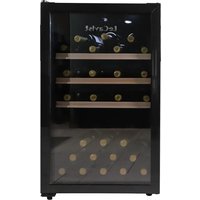
LKCV63N - Refrigerator LeCavist - Free user manual and instructions
Find the device manual for free LKCV63N LeCavist in PDF.


| Product Type | Wine Cellar |
| Reference | LKCV63N |
| Dimensions (Length x Depth x Height) | 500 x 575 x 847 mm |
| Weight | 29 kg |
| Power Supply | 220-240 V~, 1.5 A |
| Lighting Power | 2 W |
| Usable Volume | 126 L |
| Maximum Capacity (75 cl Bordeaux bottles) | 63 bottles |
| Adjustable Temperature Range | 5 °C to 20 °C |
| Climate Class | N/ST (16 °C to 38 °C) |
| Noise Emissions | 43 dB(A) |
| Installation Type | Freestanding |
| Door Opening Direction | Right (reversible to left) |
| Number of Shelves | 3 adjustable metal shelves with wooden front |
| Defrosting | Automatic (natural) |
| Display and Controls | LED screen, keys K1-K4: light, temperature increase/decrease, toggle °C/°F |
| Settings Backup Function | Settings retained in case of power outage |
| Maintenance and Cleaning | Clean with mild detergent; dust the condenser; automatic defrosting |
| Safety | Grounding mandatory; refrigerant R600a (isobutane) flammable; do not use outdoors; prohibition of mechanical devices for defrosting |
| Spare Parts and Repairability | Repair by authorized professional; any unauthorized intervention voids the warranty |
| Warranty | Manufacturer's warranty (conditions in manual) |
Frequently Asked Questions - LKCV63N LeCavist
User questions about LKCV63N LeCavist
0 question about this device. Answer the ones you know or ask your own.
Ask a new question about this device
Download the instructions for your Refrigerator in PDF format for free! Find your manual LKCV63N - LeCavist and take your electronic device back in hand. On this page are published all the documents necessary for the use of your device. LKCV63N by LeCavist.
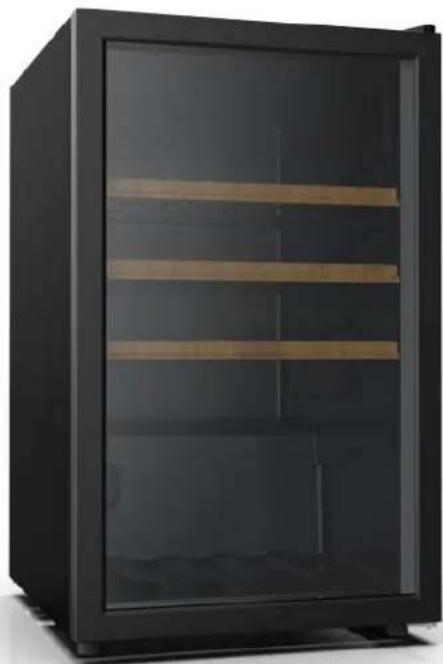
USER MANUAL LKCV63N LeCavist
natural_image
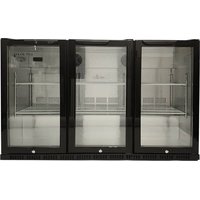
Exterior view of a modern black double-decker refrigerator with glass doors and wooden shelves (no text or symbols visible)IMPORTANT SAFETY INSTRUCTIONS
Please read this user guide carefully and in full before installing and using the wine cel
It is important that this guide is kept with the fridge for future reference.
If the wine cellar is given to another person, make sure the user guide follows the fridge that the new owner can properly install and use the fridge.

natural_image
Recycling symbol with three chasing arrows forming a triangle (no text or labels)Please recycle. At the end of the product's life, consider bringing it to a collection point off at a recycling centre near your home.
The meaning of these symbols in this user guide is outlined below.
 | Important information about your personal safet and how to avoid damaging the fridge. |
 | General information and advice |
 | Environmental information |
 | Fire risk |
 | Risk of electric shock |

For your safety and the safety of others, please read these safety instructions carefully before installing and using your wine cellar.
- This fridge is intended for domestic use or in similar settings such as:
- kitchen areas in an office or other business environments; and
-
hotels (for guest use), motels and other residential environments.
-
This wine cellar should not be used for commercial or industrial purposes or for any purpose other than the one for which it was designed. This fridge is intended for wine storage.
- Do not use outdoors.
- Make sure the voltage on the product matches your power supply before plugging in.
- Check the condition of your fridge regularly. Do not use the device if it is damaged
- Always unplug the fridge at the power socket before cleaning the unit; defrosting it changing the lighting lamp (when it is replaceable); moving the fridge or cleaning the ground under the fridge.
- Do not remove the electrical socket by pulling on the cord. To remove it, hold the plug and carefully remove it from the wall socket.
WARNING: Do not dismantle or otherwise damage the refrigeration system.
WARNING: Fire hazard. Contains refrigerant gas.
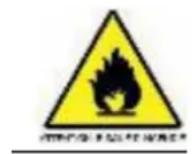
- The refrigerant gas contained in this device is isobutane (R600a). It is a flammable. When transporting and installing the unit, be careful not to damage any part of the refrigeration system.
- Do not use anything sharp to defrost the device.
- Do not use any electrical appliance inside the wine cellar.
- If the refrigeration system is damaged:
- Do not use a flame near the device.
- Avoid sparks - do not turn on an electrical appliance or electric lamp.
- Immediately ventilate the room.
For your safety, follow these installation recommendations:
The room in which the fridge will be installed must be at least 1m^3 per 8 grams of refrigerant gas. The amount of refrigerant gas contained in this fridge is shown in grams the rating label at the back of the fridge.
CHILD SAFETY
This fridge may be used by children aged 8 years or older and by persons with reduced physical, sensory or mental abilities or lack of experience or knowledge, if they are properly monitored, or if instructions on the safe use of the fridge have been given and if the risks involved have been appropriately assessed.
The fridge is not a toy. Children should be monitored to ensure proper use of the fridge
Cleaning and maintenance should not be done by children without supervision.
CONNECTION
- Check the plug and power cord regularly for damage.
- Do not use the device if the power cord or socket is damaged.

WARNING: If the power cord is damaged, it must be replaced by the manufacturer its after-sales service or people of similar qualification to avoid danger.
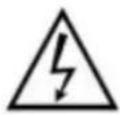
ELECTRICAL SAFETY
- Do not connect the fridge to a power outlet that is not protected from overloads.
- Never use power boards with multiple sockets to connect the device.
WARNING: Do not immerse the cord in water, handle the electrical components or grip them with wet hands.
- The power socket to which the wine cellar is connected must be easily accessible, it can be disconnected quickly in an emergency.
- Do not unplug the fridge by pulling on the cord and do not wrap the cord around fridge.
- Turn the fridge off before unplugging the power cord from the socket.
• Always unplug the fridge before cleaning it.
- In the event of a fire, unplug the power cord if safe to do so or separate the uni the area by another means before taking fire action.
- This fridge is not intended to be activated by an external timer, by a separate remote-control system or any other device that automatically switches on the device
- If you do not use the device for a long period of time, please turn it off and unp from the power supply.
- Do not store explosive materials such as aerosol containers with a flammable thruster in this device.
- Any maintenance or repair of this device must be carried out by a licensed professional. Do not attempt to repair the device yourself.

WARNING: Danger of Electrocution
WARNING: The ventilation openings on the fridge's casing must remain uncovered. Be careful not to block them.
WARNING: Do not use mechanical devices inside the wine cellar.
WARNING: Do not dismantle or otherwise damage the refrigeration system.
WARNING: Do not use electrical appliances in the wine cellar, other than those recommended by the manufacturer.
INSTALLATION
- This wine cellar is heavy. Be careful when moving it.
- When transporting the fridge, be careful not to damage any part of the refrigeration system.
- Important! Leave your device vertical for 24 hours before plugging it in for the first time so the refrigerant gas can equalise.
- If your device has been horizontal during transport, wait 48 hours before turning it on.
- After installation, make sure the fridge is not resting on the power cable.
CLEANING
- Never clean the appliance with flammable products. The fumes could cause a fire of explosion.
- When it comes to the use, handling, cleaning and disposal of the device, refer to the following chapters of the user guide.
WARNING: Do not use electrical appliances to clean your wine cellar.
Summary
IMPORTANT SECURITY WARNINGS Page 1
I DESCRIPTION OF THE APPLIANCE Page 10
II TECHNICAL CHARACTERISTICS Page 11
III INSTALLATION Page 13
A. Location Page 14
B. Unpacking the device and discarding the packaging items Page 14
C. Foot adjustment Page 15
D. Before loading the fridge Page 15
E. Ambient temperature Page 15
F. Changing the orientation of the door Page 16
IV BEFORE USE Page 18
V USING YOUR wine cellar Page 19
A. Loading your wine cellar Page 19
B. Loading plan Page 20
C. Adjustable shelves Page 21
D. Functions and temperature setting Page 23
E. Wine service temperature table Page 25
F. Power outage Page 26
VI MAINTENANCE AND CLEANING Page 27
VII TROUBLESHOOTING Page 19
VIII WARRANTY Page 32
IX CAUTION Page 33
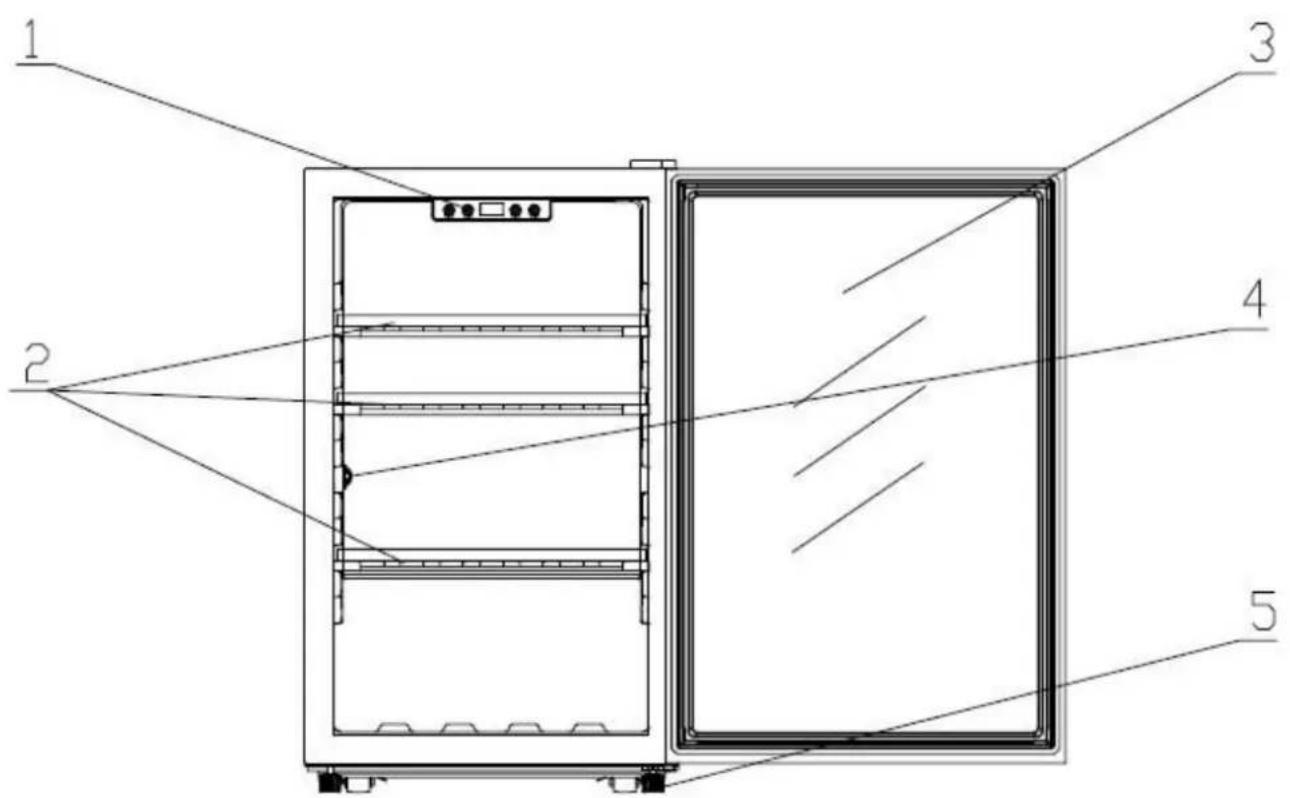
- Digital control panel & display
- Shelves
- Glass door
- Temperature sensor
- Adjustable foot
II TECHNICAL CHARACTERISTICS
| Reference LKCV63N | |
| Model JC-130 | |
| Power supply 220-240 V | |
| Electric current 2.0A | |
| Power of the lamp 2W | |
| Dimensions L x D x H | 500 x 575 x 847mm |
| Weight 29kg | |
| Type of installation Free standing | |
| Door orientation Right (factory setting) | |
Electrical scheme
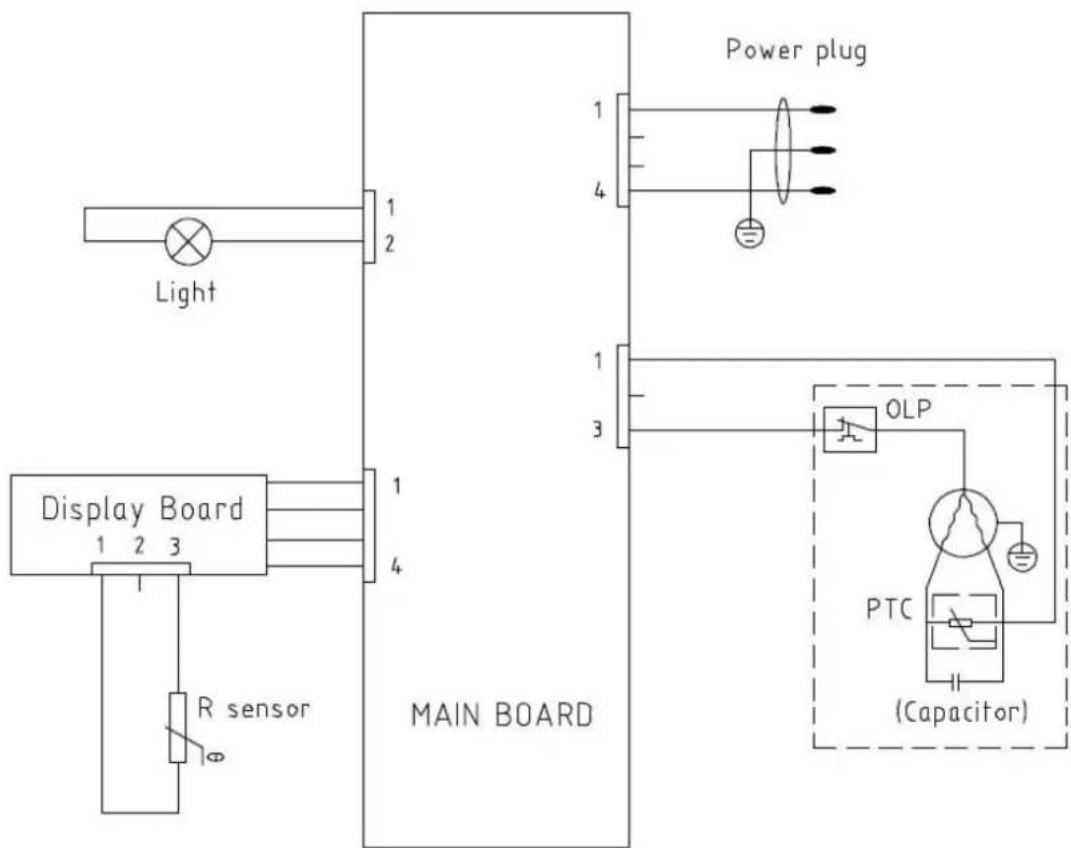
| ENERGY-RELATEDSPECIFICATIONS | |
| ReferenceLKCV63N | |
| Capacity(L) | 126 |
| Thecoldeststoragetemperature settingthatcanbemaintained continuously | 5°C |
| DefrostAutomatic | |
| Climateclass | ClimateclassN/ST.Thisfridgeisintended tobeusedinambient temperaturesof16-38°C. |
| Noise(dB)43 | |
| IntegrabledeviceNo | |
| Thisdeviceisintendedonlyforthestorageofwine | |
Recommendations:
The location you have selected for your wine cellar should:
- be well ventilated
- be away from any source of heat and direct sunlight;
- not be frequently wet (e.g. laundry, bathroom);
• have a level floor;
• have a reliable electricity supply; and
- be away from the microwave. Some microwaves do not have a wave jamming shield so when the wine cellar is placed less than 1m from a microwave, the operation of the wine cellar can be affected.
The fridge is designed for the N-ST climate class. Protect the device from heat (above 38 and cold (below 16 °C), dust, moisture, flooding events and splashes.
- The wine cellar must be positioned so that the power socket remains accessible after installation.
- Unwind the power cord but do not plug it into the electricity supply immediately.
- Install your wine cellar in its final location before loading it. If the fridge is moved when loaded, the fridge walls may be permanently deformed.
IMPORTANT: Two people are required to properly and safely install the fridge.
A. Location
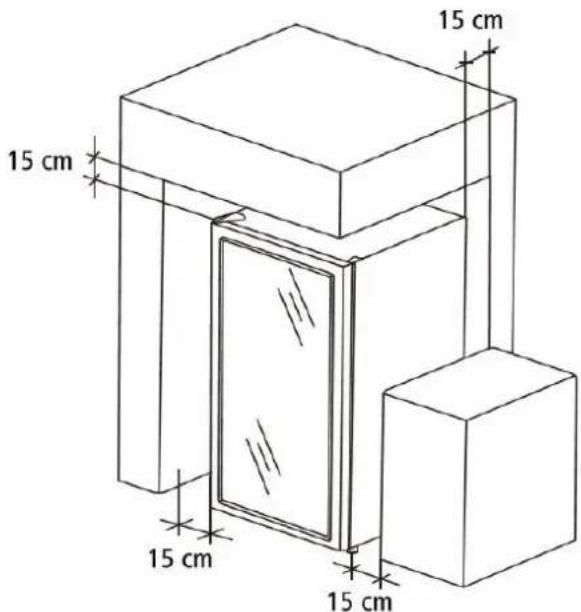
To ensure adequate ventilation of the fridge, allow a minimum of 15 cm between the w cellar and the nearby walls as shown in the illustration below.
B. Unpacking the age of the device and discarding the packaging.
Remove all packaging, as well as protective elements inside the device's compartments before turning it on.
The carton and paper packaging are recyclable. Please dispose of paper packaging in recycling bins.
Materials bearing the symbol are recyclable. Including: Polyethylene; Polystyrene; and Polypropylene. These materials can be recycled if you dispose of them in collection containers.
Other packaging items (e.g. fasteners) must be disposed of with household waste.
C. Foot adjustment
Your wine cellar is equipped with an adjustable foot to facilitate levelling.
It is recommended to adjust the front feet to level the wine cellar. Correctly levelled fee will limit noise and vibration of the wine cellar.
Turn the adjustable foot by hand (be careful not to jam your fingers).
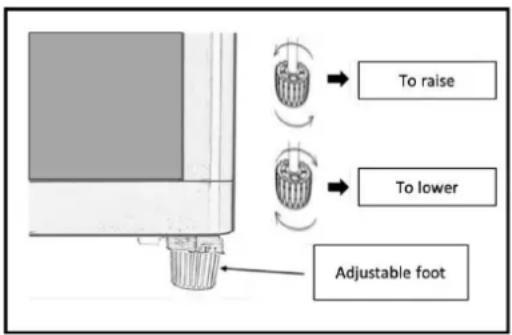
- Turn the foot anti-clockwise to raise the level of the wine cellar
- Turn the foot clockwise to lower the level of the wine cellar
D. Before loading the fridge
- Levelling: The wine cellar must be levelled before loading your wine
- Stable floor: Place the fridge on a stable surface where the ground can support the loaded weight (1 full bottle usually weighs 1.3kg).
E. Ambient temperature

The wine cellar should be placed in a room with temperatures between 16-38°C. If t ambient temperature is above or below the climatic class, the performance of the wine cellar will be impacted. Cold or warm temperatures can cause fluctuating fridge temperatures, the fridge may not reach the set temperature or may stop working.
F. Changing the orientation of the door
The door can be right or left opening. Change the door by following the instructions below. Making this change requires 2 people.
Instructions for changing the "right-hung" door and reassembling it so it is "left-hung":
| 1. Unplug the power cord from the socket.2. Remove the top hinge cover.3. Unscrew the top hinge and remove it, then remove the door by gently lifting it. | 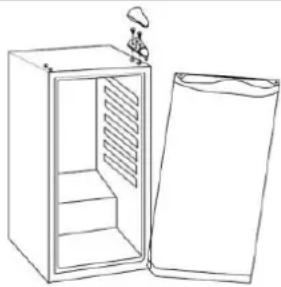 |
| 4. Unwind the front right foot completely until it comes off. Remove it.5. Unscrew the lower hinge and remove it. | 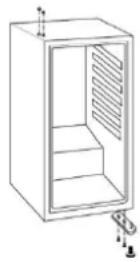 |
| 6. Place the lower hinge on the opposite side after removing the front foot and attach the hinge with the screws you have just removed from the right side.7. Replace the foot on the left side of the fridge with the adjustable foot removed from the right side. Screw the smaller foot onto the right side. | 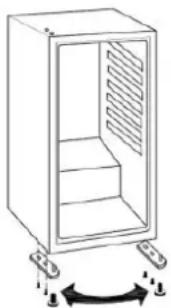 |
| 8. Place the door on the lower hinge. Make sure the glass door is upright and closes easily. | 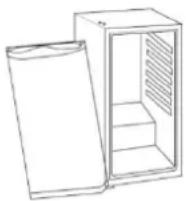 |
| 9. Place the top hinge on the opposite side.10. Place the door on the fridge, then loosely screw the hinge without tightening completely. | 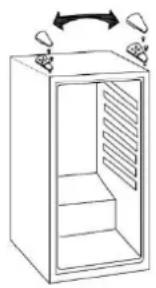 |
| 11 Once the door is installed, adjust the hinge by tightening the screws until the door is in the correct place.12. Replace the top hinge cover. | 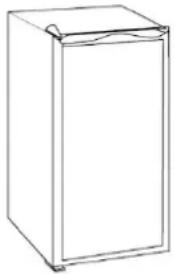 |
Note: The door seal may come out of its place when changing the door. If you notice go between the seal and the fridge frame when the door is closed, pull carefully on the sea close these openings. The correct positioning of the seal is important to ensure the fridge waterproof.

Wait 24 hours before starting your wine cellar.
We recommend that you leave your wine cellar upright, clean it with soapy water and let it open to eliminate residual odours.
Recommendations:
- Place the fridge in a cool place away from sunlight and heat sources.
- Certain parameters such as room temperature, door opening time or the number of bottles stored inside could affect the internal temperature of your wine cellar. We recommend that you check the internal temperature regularly and adjust it if necessary.
- Do not cover the vents.
Operating noise:
To reach the desired temperature, this wine cellar, like all wine cellars with compressor cooling systems, can produce certain noises, which are normal operating noises.
- Gurgling noise: caused by the refrigerant gas circulating in the refrigeration area of the unit.
- Cracking noise: resulting from the contraction and expansion of the gas to produce the cold.
The perception of noise by the individual is directly related to the environment in which the wine cellar is located. Noise in normal operation is not a cause of the warranty's application
A. Loading your wine cellar
- You can load your wine bottles in single or double rows.
- For loading, take note of the following: if you don't have enough bottles to completely fill your wine cellar, it's best to spread the load over the entire height the wine cellar to avoid a thermal imbalance at the top or bottom of the fridge.
- The balanced distribution of bottles throughout the height of the wine cellar is the most efficient way to use the energy of the appliance.
- The bottle capacity is expressed in bottles of the “Bordeaux” type. If larger bottles are stored, or if additional shelves are used, the maximum bottle capacity is reduced
- To accommodate the largest type of bottle or increase the capacity of the cellar by stacking the bottles when necessary, the shelves must be removed or moved (see paragraph adjustable shelves).
- Keep a gap between the bottom of the fridge and the bottles to allow air to flow. As in an underground wine cellar, air circulation is important for a homogeneous temperature inside your wine cellar.
This will also reduce energy consumption.
IMPORTANT INFORMATION ABOUT THE SERVING TEMPERATURE OF WINE
Your wine cellar has been designed to allow you to set desired serving temperature of y wine. Each wine varietal is served at a different ideal temperature.
The temperature of the cellar is adjustable from 5-22 °C. Unless the wine producer says recommends a different temperature for your particular wine, champagne should be served at 7°C, white wine should be served at 12°C and red wine should be served at 1 (see “Wine Service Temperature” recommendation table).
Some wines can be served young (2 to 3 years), while others are much better aged (10 years and older). Each wine peaks at a different age. Check the ideal drinking age for your wine with your wine merchant.
SETTING TYPES: Please note that depending on where your wine cellar is kept, how often the door is open, the ambient temperate and the loading, the time taken to reach the temperate varies. Usually, it takes about 24 hours for the wine cellar to reach the desire temperature and indicate a stable temperature on the digital display. The temperature displayed will change when the desired temperature is adjusted or whenever a large number of bottles are added to the fridge.
B Loading plan
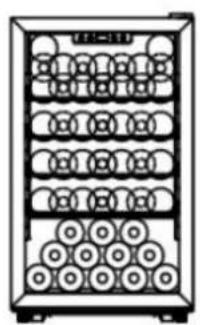
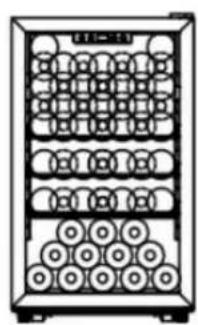
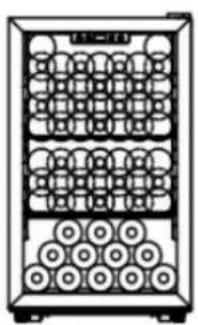
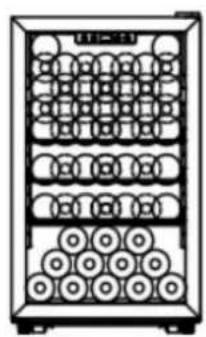
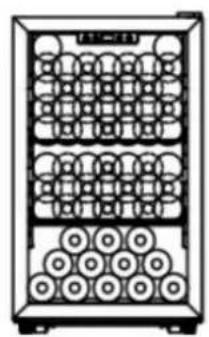
Your wine cellar can accommodate up to 63 Bordeaux bottles with a stack based on two shelves.
While loading several levels of bottles on the same shelf, please gently store your bottles in the 1st row to prevent them from colliding with the 2nd row. Store the bottle a "head to tail" - crossing the neck and bottom of each bottle, so you can get close to stated maximum capacity.
If you store larger bottles or add a shelf to more easily access your bottles, storage capacity will be reduced.
The way you load your fridge and the number of shelves, determines capacity. Below you will find an explanatory diagram for loading (capacity with load “head to tail”):
natural_image
Front view of a multi-tiered rack-mounted device with circular components (no visible text or labels)49
natural_image
Front view of a rack-mounted server unit with multiple circular components (no visible text or labels)56
natural_image
Front view of a multi-tiered rack-mounted device with circular components (no visible text or labels)63
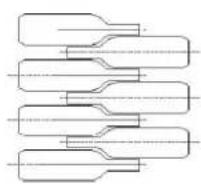
This wine cellar is called mono temperature, which means that you have a single choice temperature.
If storing red, rose and whites together, set the thermostat on average between 11 and degrees and store the red wines on the top shelves and whites at the bottom. This will make the most of the ‘hot air rises’ phenomenon. Consider the ambient temperature of your room when setting the thermostat.
For wines stored at the top of the fridge: bottles of red wine. Before serving, uncork an it decant in a carafe a few hours before tasting (to slowly rise to 16 to 18 degrees).
For wines stored in the middle of the fridge: white wine. Cool before serving according to your preference (8-10 degrees)
For wines stored at the bottom: rose and champagne. Cool them for about an hour before serving (6-8 degrees).
C. Adjustable shelves
Your wine cellar has 2 adjustable shelves, which gives the strength to stack several rows "head to tail" bottles (the moulding at the bottom of the fridge allows bottles to be stable underneath the bottom shelf).
The 2 shelves can be adjusted to different spacings on all four levels depending on your needs.
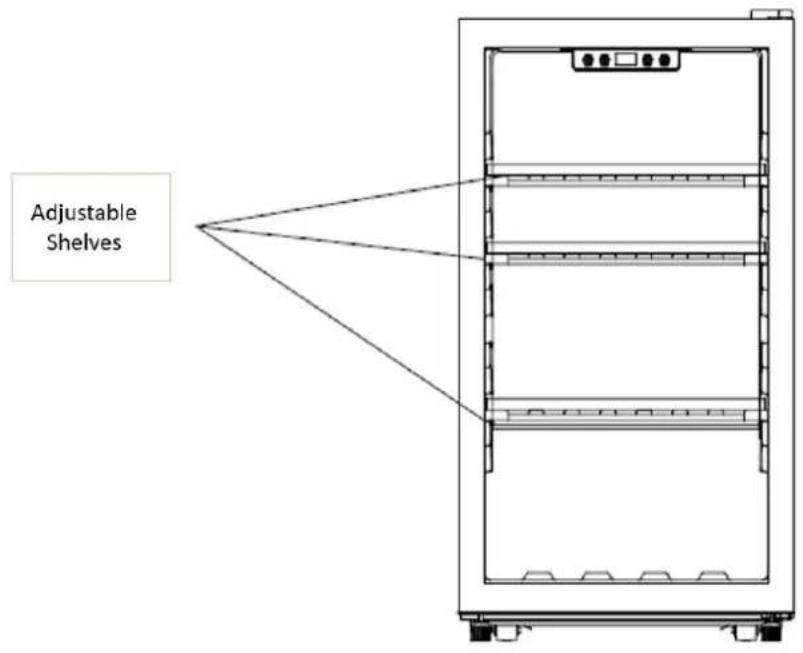
- Door seal protection: Ensure you open the door completely before removing shelves from their rails.
- Do not slide multiple loaded shelves outwards as it may cause bottles to fall or make cause the wine cellar to tip forward.
- Do not cover shelves with material like aluminum foil or metal plate as this will impact internal airflow.
- Do not move your wine cellar while it is loaded with bottles. This could distort the walls of the wine cellar and cause back injuries.
D. Functions and temperature setting
Please note that depending on the selected settings and the loading, it can take 24 hour for the wine cellar to reach the desired temperature.
- Plug the power cord into a suitable power supply
- Set the thermostat to adjust the temperature with the K2 and K3 keys


Light
K1: This button allows you to turn on / off the inside light

Increase temperature
K2: Press the button once, the LED display will flash indicating the current temperature. Press again to set the temperature. 1 touch will increase the temperature by 1 degree. 1 blink stops after 5 seconds without action on your part, and the new temperature requested is recorded. The LED display then shows the actual temperature inside.
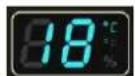
Temperature display
L1: The temperature can be adjusted from 5 to 20 degrees depending on the cycle below touch = 1 additional degree)

Decrease temperature
K3: Press the button once, the LED display will flash indicating the current temperature. Press again to set the temperature. 1 touch will reduce the temperature by 1 degree. The blink stops after 5 seconds without action on your part, and the newly set temperature recorded. The LED display then shows the actual inside temperature
Mode Fahrenheit/Celsius
K4: Switch the temperature display between Fahrenheit/Celsius by pressing the button.
How your wine cellar works:
There are two internal fans for airflow however fluctuations of up to 3 degrees is expected. The average temperature throughout the fridge will be a maximum of 1.5^ C of the requested temperature (once sufficient time for cooling has passed). Once a temperature difference of 3^ C above the set temperature is detected, the cooling cycle will start to be the temperature down to below the set temperature. Once the cooler temperature is reached, the cooling stops and the temperature inside the fridge is allowed to slowly increase. This cycle is continuous and results in a very small range of constant fluctuation.
The temperature sensor is placed halfway down the compartment and reads the temperature instantaneously. Small amounts of deviation in temperature is expected (less than 6^ C).
Please do not open the door too often as this will disrupt the operation of the tempera sensors. The fridge automatically adjusts moisture and condensation levels within the fridge as required.

Attention
When the temperature sensor is failing due to power outage or bug, an error code appe
E1 internal temperature problem
E2 ambient temperature problem
CE for communication problem
E. Wine service temperatures:
The table below shows the recommended serving temperatures for different wine.
| Wine Recommended temperature | |
| Champagne, sparkling, sparkling 6°C | |
| White: Sémillon, Sauvignon Blanc 8°C | |
| Vintage Champagne 10°C | |
| Dry white: Chardonnay 10°C | |
| Dry white: Gewürztraminer, Riesling, Pinot gris 10°C | |
| Sweet late harvested white: Sauternes, Barsac, Monbazillac | 10°C |
| Beaujolais 13°C | |
| Sweet white wine: Sauternes | 14°C |
| White Chardonnay vintage 14°C | |
| Pinot Noir 16°C | |
| Red Grenache, Syrah 16°C | |
| Red vintage 18°C | |
| Other red wines Temperature not exceeding | 20°C |
To bring the wine to the serving temperature, it is recommended to place it in your win cellar at least 48 hours before serving, and uncork or aerate a few minutes before tasting
F. Power outage
In the event of a power outage, all temperature settings will be automatically preserved, unless you change the thermostat setting.
A power outage of an hour or two will not affect the temperature of your wine cellar. Avoid a sudden change in temperature when the power supply is turned off, you should avoid opening the door. In the event of a prolonged cut, storage alternatives must be fo to preserve your wine.
If you plan to temporarily shut off the electrical power or if there is a power outage scheduled by your power provider, it is imperative to disconnect the power socket rather than have your power meter shut down. A sudden shutdown of the current could damage the mother board in your wine cellar
A. Defrosting
Your wine cellar is designed with a "natural" defrosting system. When the engine is shut down, the refrigerated surfaces of the wine cellar automatically defrost. The de-icing water descends into a drainage container near the compressor at the back of the wine cellar. The water is evaporated by the heat produced by the compressor.
⚠️ Important: Keep the drain and gutter clean to prevent it to clog and water to flow inside the wine cellar.
B. Cleaning

Before cleaning or restarting, unplug at the socket.
Never use abrasive products or sponges with scrapers for cleaning inside or outside your device.
- Remove all accessories (e.g. shelves, water tank). Wash them with lukewarm water with a mild, odorless detergent (an unscented dish liquid, for example), rinse with water containing bleach and dry thoroughly.
- Wash the interior walls in the same way; take special care of the shelves.
- Wash the door seal without omitting to clean also under the door seal
- Reconnect the device and get it back into operation.
Occasionally, dust the condenser at the back of the unit; a build-up of dust could reduce performance of the unit.
At certain times of the year, condensation on the door may occur. If this happens, wipe water from the door and avoid opening the door of the fridge often as this amplifies the difference between the inside of the fridge and the ambient temperature.
In case of prolonged absence, empty and clean the appliance; keep the door ajar for the duration of non-use.

Important!
When the wine cellar is not used:
- Unplug the appliance
- Remove all objects inside.
- Clean and dry the interior space of the wine cellar per the above instructions.
- Leave the door slightly ajar to avoid mold.
VII TROUBLESHOOTING
Some issues can be easy to fix. Before using after-sales service or a repairman, please set the following table:
| Problem POSSIBLE CAUSES | |
| The wine cellar doesn't work. | The fridge is not plugged in or it is switched offThe circuit breaker is triggered, or the fuse is damaged.Check to see if the power outlet is powered by connecting anthe electrical appliance. |
| The wine cellar is not cold enough. | Check the temperature setting.A high ambient temperature may require a lower setting.The door is opened too often.The door is not completely closed.The door seal is not properly positioned. |
| The compressor works and goes out often. | The room temperature is warmer than normal.A large quantity of bottles has been added to the wine cellar.The door is opened too often.The door is not completely closed.Temperature control is not properly defined.The door seal is not properly positioned. |
| The light doesn't work. | The socket is not plugged in.The circuit breaker has gone off or a fuse is damaged.The lighting button is stuck on "OFF." |
| Vibration. The wine cellar may not be level. | |
| The wine cellar seems to be making too much noise. | Squeaking or slamming may come from the circulation of the refrigerant gas, which is normal.At the end of the cycle, the compressor emits a noise caused by the passage of the refrigerant into your wine cellar.The contraction and expansion of the gas inside the walls can emit hissing and crackling.The wine cellar is not level, check the setting of the feet. |
| The door doesn't close properly. | The door was reversed and not properly reinstalled.The seal is defective (the magnet or rubber is altered).The shelves block the door closure. |
If your wine cellar doesn't seem to be working normally, unplug the device for a few minutes, then plug it again to reset the fridge
Any service or repair on the cooling process must be carried out by a licensed profession who will have to carry out an inspection of the refrigeration circuit.
Similarly, any service or repairs on the electrical circuit must be carried out by a qualified electrician.
Note: Any repair by an unlicensed technician will result in the cancellation of the warrant
WARRANTY EXCLUSIONS
The warranty does not cover the wear parts of the product, or the problems or damage resulting from:
(1) superficial deterioration due to normal wear and tear of the product.
(2) defects or deteriorations due to the product's contact with food or liquids, and due to corrosion caused by rust.
(3) any unauthorised incident, abuse, improper use, modification, dismantling or repair.
(4) any improper maintenance operation, non-compliant use of the product or connection to an incorrect voltage.
(5) any use of accessories not supplied or approved by the manufacturer.

The warranty will be waived if the rating label and/or serial number of the product removed.
IX CAUTION
For more information about disposing of your fridge, you can contact your local or regional government. Electronic products that have not been selectively sorted are potentially hazardous to the environment and human health due to the presence of hazardous substances
This wine cellar contains flammable foaming agents.
At the end of your product life, it must be disposed of in an appropriate location, capable recycling refrigerators, freezers, and wine cellars. To do this contact your local council.
Under no circumstances should you dispose of this wine cellar during curbside collections.
LeCavist
Guide d'utilisation
CAVE A VIN
LKCV63N
natural_image
Exterior view of a modern black double-door refrigerator with glass doors and gold shelves (no text or symbols visible)AVERTISSEMENTS ET CONSEILS DE SECURITE IMPORTANTS
natural_image
Symbolic icon of a person walking with arrows, enclosed in a circle (no text or symbols)FAITES UN GESTE ECOCITOYEN TRIANT VOS EMBALLAGES CARTON
À LA FIN DE VIE DE VOTRE PRODUIT, PENSEZ À LE RAPPORTER DANS UN POINT DE COLLECTE OU DÉPOSEZ LE À LA DÉCHETTERIE PROCHE DE VOTRE DOMICILE
natural_image
Front view of a rack-mounted server unit with multiple circular components (no visible text or labels)49
natural_image
Front view of a rack-mounted server unit with multiple circular components (no visible text or labels)56
natural_image
Front view of a server rack unit with multiple circular components (no visible text or labels)63

Bouton lumière
- IMPORTANT SAFETY INSTRUCTIONS
- For your safety, follow these installation recommendations:
- CHILD SAFETY
- CONNECTION
- ELECTRICAL SAFETY
- INSTALLATION
- CLEANING
- Summary
- IMPORTANT SECURITY WARNINGS Page 1
- I DESCRIPTION OF THE APPLIANCE Page 10
- II TECHNICAL CHARACTERISTICS Page 11
- III INSTALLATION Page 13
- IV BEFORE USE Page 18
- V USING YOUR wine cellar Page 19
- VI MAINTENANCE AND CLEANING Page 27
- VII TROUBLESHOOTING Page 19
- VIII WARRANTY Page 32
- IX CAUTION Page 33
- Recommendations:
- Location
- Before loading the fridge
- Ambient temperature
- Changing the orientation of the door
- Wait 24 hours before starting your wine cellar.
- Operating noise:
- Loading your wine cellar
- IMPORTANT INFORMATION ABOUT THE SERVING TEMPERATURE OF WINE
- B Loading plan
- Adjustable shelves
- Functions and temperature setting
- Light
- Increase temperature
- Temperature display
- Decrease temperature
- Mode Fahrenheit/Celsius
- How your wine cellar works:
- Attention
- Wine service temperatures:
- Power outage
- Defrosting
- Cleaning
- Important!
- VII TROUBLESHOOTING
- WARRANTY EXCLUSIONS
- IX CAUTION
- LeCavist
- AVERTISSEMENTS ET CONSEILS DE SECURITE IMPORTANTS
- Bouton lumière
Brand : LeCavist
Model : LKCV63N
Category : Refrigerator