
SHZ 500-2 - Hoist Herkules - Free user manual and instructions
Find the device manual for free SHZ 500-2 Herkules in PDF.


| Product type | Cable electric hoist |
| Brand | Herkules |
| Model | SHZ 500-2 |
| Supply voltage | 230 V ~ 50 Hz |
| Power consumption | 900 W |
| Rated load (single line) | 250 kg |
| Rated load (double line) | 500 kg |
| Lifting height (single line) | 11.5 m |
| Lifting height (double line) | 5.7 m |
| Lifting speed (single line) | 8 m/min |
| Lifting speed (double line) | 4 m/min |
| Wire rope diameter | 4.2 mm |
| Wire rope breaking strength | 1770 N/mm² |
| Protection degree | IP 54 |
| Insulation class | B |
| Net weight | 16.5 kg |
| Duty cycle | S3 25% – 10 min (intermittent service) |
| Control type | Bowden cable control with push buttons |
| Emergency stop | Yes, emergency stop switch |
| Safety | Automatic limit switches (up and down) |
| Maximum number of cable layers | 4 |
| Accessories included | Return pulley, extra hook, remote control |
| Intended use | Lifting and lowering loads indoors |
| Maintenance | Regular lubrication of cable, periodic check of limit switches |
Frequently Asked Questions - SHZ 500-2 Herkules
User questions about SHZ 500-2 Herkules
0 question about this device. Answer the ones you know or ask your own.
Ask a new question about this device
Download the instructions for your Hoist in PDF format for free! Find your manual SHZ 500-2 - Herkules and take your electronic device back in hand. On this page are published all the documents necessary for the use of your device. SHZ 500-2 by Herkules.
USER MANUAL SHZ 500-2 Herkules
SHZ 125/250; SHZ 300-2;
SHZ 500-2; SHZ 600; SHZ 1000
GB Original operating instructions Electric hoist
Danger!
When using the equipment, a few safety precautions must be observed to avoid injuries and damage. Please read the complete operating instructions and safety regulations with due care. Keep this manual in a safe place, so that the information is available at all times. If you give the equipment to any other person, hand over these operating instructions and safety regulations as well. We cannot accept any liability for damage or accidents which arise due to a failure to follow these instructions and the safety instructions.
1. Safety regulations
Danger!
Read all safety regulations and instructions.
Any errors made in following the safety regulations and instructions may result in an electric shock, fire and/or serious injury.
Keep all safety regulations and instructions in a safe place for future use.
- Always check that the mains voltage is identical to the voltage quoted on the rating plate. In the event that the mains voltage is not suitable, it may cause the machine to work abnormally and thus result in personal injury.
- The power supply must be earthed and be secured by a residual current operated circuit breaker (RCCB).
- Do not attempt to lift loads that exceed the rated load.
- Use the machine only for the purpose for which it is designed. Never lift personnel using the cable hoist.
- Do not pull the power cable to unplug it. Protect the power cable from heat, oil, and sharp edges.
- Never attempt to raise fixed or jammed loads.
- Unplug the cable hoist when it is not in use.
- Keep children and other unauthorized persons away from the machine.
- Do not pull loads sideways or from one side. Do not allow the load to swing.
- Ensure that the hook moves in the same direction as shown on the control switch.
- Check the cable hoist at regular intervals for signs of damage. The control switch must be in good condition.
- Have repair and servicing work carried out only by authorized workshops and trained electricians.
Repair work must only be carried out by a trained electrician; otherwise, the machine may cause accidents.
- Do not switch the machine on and off quickly (inching mode).
- Always concentrate fully when operating the cable hoist.
- Do not stand or work under a raised load.
2. Layout and items supplied
2.1 Layout (Fig. 1/2)
- Fastening bar
- Fastening hole for hook
- Drum
- Lever for maximum cable length
- Automatic stop mechanism lever
- Steel cable
- Cut-out weight
- Hook
- Emergency Stop switch
- Pushbutton
- Remote control
- Power cable
- Control cable
- Motor
- Return roller
- Additional hook
- Cable for remote control
2.2 Items supplied
Please check that the article is complete as specified in the scope of delivery. If parts are missing, please contact our service center or the sales outlet where you made your purchase at the latest within 5 working days after purchasing the product and upon presentation of a valid bill of purchase. Also, refer to the warranty table in the service information at the end of the operating instructions.
- Open the packaging and take out the equipment with care.
- Remove the packaging material and any packaging and/or transportation braces (if available).
- Check to see if all items are supplied.
- Inspect the equipment and accessories for transport damage.
- If possible, please keep the packaging until the end of the guarantee period.
GB
Danger!
The equipment and packaging material are not toys. Do not let children play with plastic bags, foils or small parts. There is a danger of swallowing or suffocating!
• Original operating instructions
3. Proper use
The cable hoist is designed for lifting and lowering loads in enclosed areas commensurate with the machine's capacity.
The equipment is to be used only for its prescribed purpose. Any other use is deemed to be a case of misuse. The user / operator and not the manufacturer will be liable for any damage or injuries of any kind caused as a result of this.
Please note that our equipment has not been designed for use in commercial, trade or industrial applications. Our warranty will be voided if the machine is used in commercial, trade or industrial businesses or for equivalent purposes.
4. Technical data
SHZ 125/250
Voltage (V) 230 V ~ 50 Hz
Rated current (A) 2.2
Power consumption (W) 500
Operating mode S3 20% 10 min
Rated load (kg) 125 / 250
Lifting height (m) 11.5 / 5.7
Rated speed (m/min) 8 / 4
Diameter of steel cable (mm) 3.0
Tensile strength of the steel cable (N/mm²) 1870
Insulation class ......B
Protection class IP 54
Drive unit class M1
Net weight (kg) 10.5
Maximum number of windings: 4
Operating mode S3 - 20% - 10 minutes: S3 = Intermittent mode without influencing the starting process. This means that the maximum operating period over a time of 10 minutes is 20% (2 minutes).
SHZ 300-2
Voltage (V) 230 V ~ 50 Hz
Rated current (A) 2.4
Power consumption (W) 550
Operating mode ...... S3 20% 10 min
Rated load (kg) 150 / 300
Lifting height (m) 11.5 / 5.7
Rated speed (m/min) 8 / 4
Diameter of steel cable (mm) 3.0
Tensile strength of the
steel cable (N/mm²) 1870
Insulation class ......B
Protection class IP 54
Drive unit class M1
Net weight (kg) 11
Maximum number of windings: 4
Operating mode S3 - 20% - 10 minutes: S3 = Intermittent mode without influencing the starting process. This means that the maximum operating period over a time of 10 minutes is 20% (2 minutes).
SHZ 500-2
Voltage (V) 230 V \~ 50 Hz
Rated current (A) 4,0
Power consumption (W) 900
Operating mode ...... S3 25% 10 min
Rated load (kg) 250 / 500
Lifting height (m) 11,5 / 5,7
Rated speed (m/min) 8 / 4
Diameter of steel cable (mm) 4.2
Tensile strength of the
steel cable (N/mm²) 1770
Insulation class ......B
Protection class IP 54
Drive unit class M1
Net weight (kg) 16.5
Maximum number of windings: 4
Operating mode S3 - 25% - 10 minutes: S3 = Intermittent mode without influencing the starting process. This means that the maximum operating period over a time of 10 minutes is 25% (2.5 minutes)
Voltage (V) 230 V ~ 50 Hz
Rated current (A) 4.6
Power consumption (W) 1050
Operating mode .... S3 20% 10 min
Rated load (kg) 300 / 600
Lifting height (m) 11.5 / 5.7
Rated speed (m/min) 8 / 4
Diameter of steel cable (mm) 4.5
Tensile strength of the steel cable (N/mm²) 1770
Insulation class ......B
Protection class IP 54
Drive unit class M1
Net weight (kg) 17.5
Maximum number of windings: 5
Operating mode S3 - 20% - 10 minutes: S3 = Intermittent mode without influencing the starting process. This means that the maximum operating period over a time of 10 minutes is 20% (2 minutes).
SHZ 1000
Voltage (V) 230 V ~ 50 Hz
Rated current (A) 7.4
Power consumption (W) 1600
Operating mode ...... S3 25% 10 min
Rated load (kg) 500 / 999
Lifting height (m) 11.5 / 5.7
Rated speed (m/min) 8 / 4
Diameter of steel cable (mm) 5.6
Tensile strength of the steel cable (N/mm²) 1770
Insulation class ......B
Protection class IP 54
Drive unit class M1
Net weight (kg) 31
Maximum number of windings: 4
Operating mode S3 - 25% - 10 minutes: S3 = Intermittent mode without influencing the starting process. This means that the maximum operating period over a time of 10 minutes is 25% (2.5 minutes).
Keep the noise emissions and vibrations to a minimum.
- Only use appliances which are in perfect working order. • Service and clean the appliance regularly. • Adapt your working style to suit the appliance. • Do not overload the appliance.
- Have the appliance serviced whenever necessary.
- Switch the appliance off when it is not in use. • Wear protective gloves.
5. Before starting the equipment
Before you connect the equipment to the mains supply make sure that the data on the rating plate are identical to the mains data.
Warning!
Always pull the power plug before making adjustments to the equipment.
- The cable hoist is not suitable for transporting hot and/or molten masses and in addition it is not suitable for use at low temperatures or in aggressive atmospheres. • It is in mechanical group M1.
- The service life of the cable hoist is approximately 8000 cycles (excluding wearing parts). When the hoist has completed 8000 cycles, all its mechanical parts must be checked and overhauled.
- Read and absorb the operating instructions before you use the cable hoist.
- Ensure that the operator knows how the machine works and how it should be operated.
- The user should always operate as set out in the operating instructions.
- The cable hoist is not designed for continuous operation. Its mode of operation is: Intermittent mode without influencing the starting process.
- The rated capacity of the machine does not vary due to the position of the load.
5.1 Unpacking
After opening the packaging, inspect the frame, the steel cable, the hook and the electric control mechanism for signs of possible transit damage.
5.2 Assembly (Fig. 5)
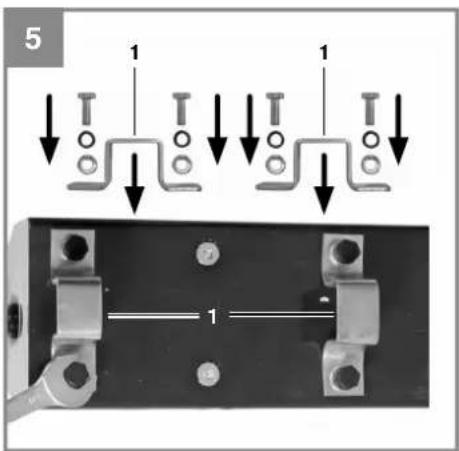
The cable hoist is fitted with two fastening bars (1) with which it has to be fastened to a rectangular tube. The dimensions of the arm must conform with the size of the fastening bars (1) and must be capable of supporting twice the rated load. We recommend that you seek advice from a qualified technician.
All screws must be tightened correctly. A qualified technician should check the anchoring of the arm before the machine is started.
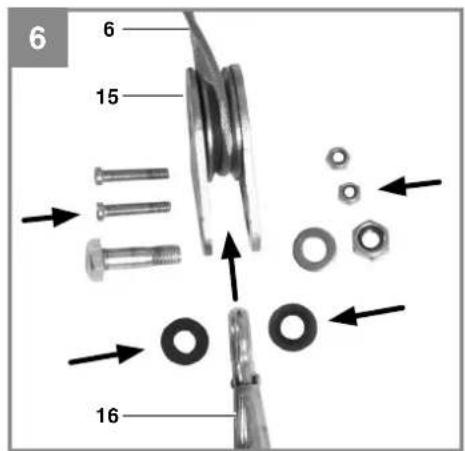
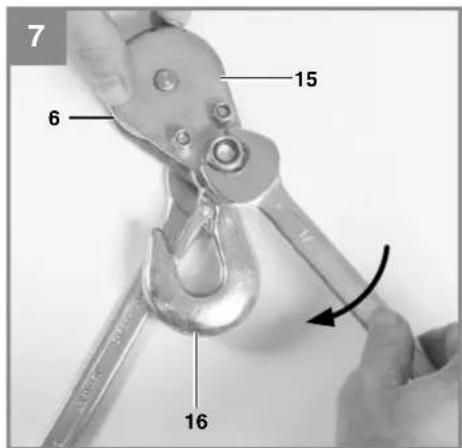
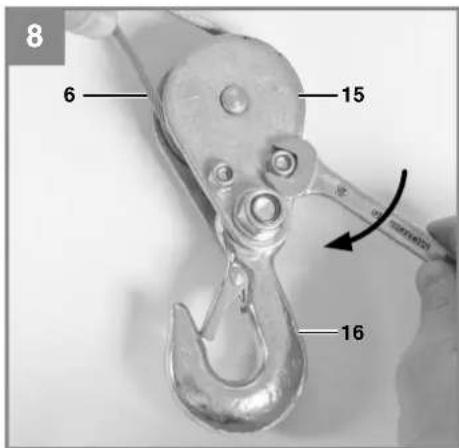
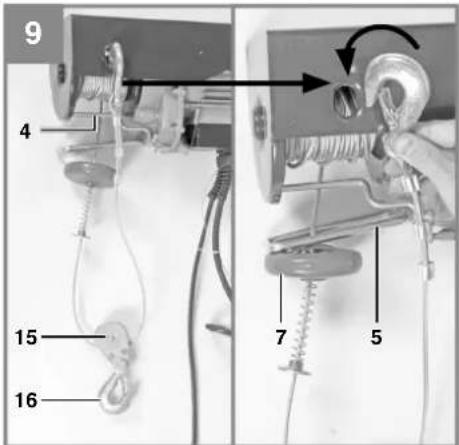
5.3 Block and tackle function (Fig. 6 - 9)
The cable hoist is fitted with a return roller (15) and an additional hook (16). If these parts are used correctly, the cable hoist can lift twice its rated load.
Fit the return roller (15) and additional hook (16) as shown in Figure 6 – 8. The permanent hook (8) must be attached to the fastening hole (2) (Fig. 9). The load is now raised by two steel cables, which means that the cable hoist can lift twice its rated load.
6. Operation
Danger!
6.1 Information for operation
- Remove the adhesive tape from the drum (3) before using the hoist for the first time.
- The value of the A-rated noise emissions at the operator's position is less than 71 dB.
- Supply voltage: 230 V ± 10%, 50 Hz ± 1%.
- The cable hoist must be operated in ambient temperatures of between 0°C and 40°C with a relative humidity of less than 85%. Height above sea level: max. 1,000 m.
- The temperature for transport and storage may be between -25°C and 55°C. The maximum temperature must not exceed 70°C.
- The user should lift the load off the ground at the slowest possible speed. The cable should be taut when the load is raised.
- The motor (14) for the cable hoist is fitted with a thermostat switch. Whilst the cable hoist is operating, the motor (14) may therefore stop. It will restart automatically when it has cooled down.
- The electric cable hoist is not fitted with a rated power limiter. You should therefore not repeat attempts to lift a load if the overload trip is limiting the hoist's operation. In this case the load exceeds the rated capacity of
the cable hoist.
- Do not leave any suspended loads unsupervised without first taking the appropriate safety precautions.
- Fit the machine with a 10 A fuse or a 10 mA residual current operated circuit breaker (RCCB) to protect the circuit
- Do not use the lever (4/5) as a routine stopping device. It should only be used to stop the machine in an emergency.
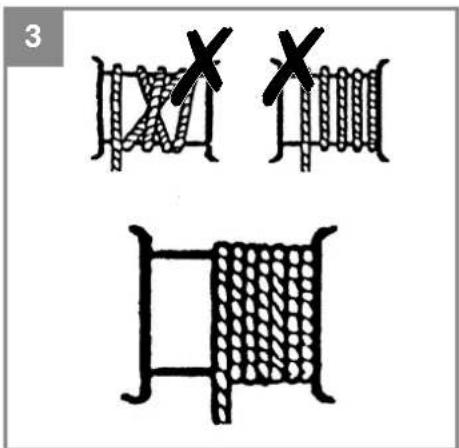
- Before you start, ensure that the steel cable (6) is correctly wound around the drum (3) and that the spacing between the windings is smaller than the steel cable (Fig. 3)
- Ensure that the load is correctly secured to the hook (8) or, if you are using the block and tackle, the additional hook (16) and always maintain a safe distance from the load and the steel cable (6).
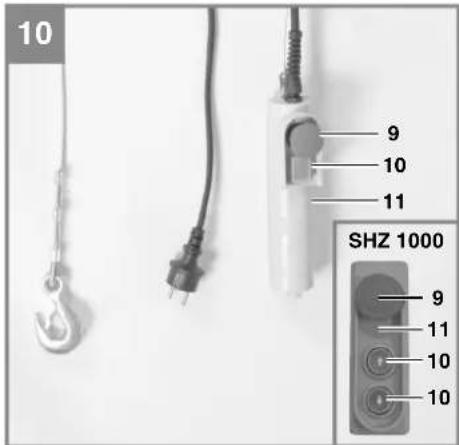
6.2 Operation (Fig. 10)
- Check whether the Emergency Stop switch (9) is pressed. Turn the red stop switch clockwise to release it.
• Press the pushbutton ▲ (10) to raise the load.
- Press the pushbutton ▼ (10) to lower the load.
- Automatic stop mechanism lever (5): When the maximum lifting height has been reached, the cut-out weight (7) presses the lever (5) upwards. This trips a limit switch after which the load cannot be raised any further.
- Lever for maximum cable length (4): When the load has reached its lowest possible position, a limit switch is tripped which makes it impossible to lower the load any further. This limit switch also prevents the cable hoist operating in the wrong direction (hook moving in the opposite direction to the arrow shown on the control switch).
- The cable hoist will stop if the Emergency Stop switch (9) is pressed.
- In an emergency, immediately press the Emergency Stop switch (9) to stop the cable hoist. The cable hoist cannot be operated if the Emergency Stop switch has been pressed.
7. Replacing the power cable
Danger!
If the power cable for this equipment is damaged, it must be replaced by the manufacturer or its after-sales service or similarly trained personnel to avoid danger.
8. Cleaning, maintenance and ordering of spare parts
Danger!
Always pull out the mains power plug before starting any cleaning work.
8.1 Cleaning
- Keep all safety devices, air vents and the motor housing free of dirt and dust as far as possible. Wipe the equipment with a clean cloth or blow it with compressed air at low pressure. We recommend that you clean the device immediately each time you have finished using it.
- Clean the equipment regularly with a moist cloth and some soft soap. Do not use cleaning agents or solvents; these could attack the plastic parts of the equipment. Ensure that no water can seep into the device. The ingress of water into an electric tool increases the risk of an electric shock.
8.2 Servicing
Danger! Always ensure that the machine is not connected to the mains supply before you start any servicing work.
- In the following: One cycle means one raising and lowering movement of a load. Periodic inspection means an inspection after 100 cycles.
- Test periodically that the limit switches on the cable hoist are in correct working order. Conduct this test as follows: When the cable has reached the maximum height, the lever on the automatic stopping mechanism (5) will be actuated. The motor (14) must then stop. (Test without a load). When the steel cable (6) has been unwound as far as possible, the lever for the maximum cable length (4) will be actuated. The motor (14) must then stop.
- Inspect the mains cable (12) and the control cable (13) periodically.
- The steel cable (6) and return roller (15) must be greased every 200 cycles.
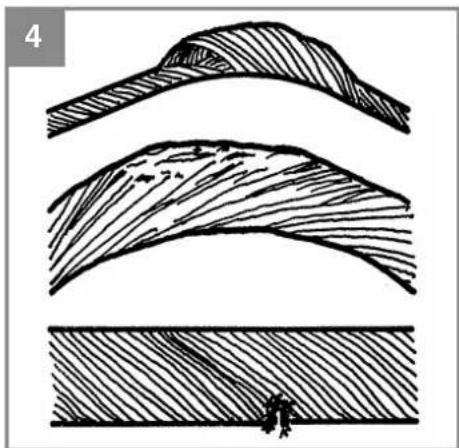
- A check must be made every 30 cycles, as shown in Fig. 4, to find whether the entire steel cable (6) is in good condition. If it is damaged, it must be replaced by a steel cable of the type specified in the technical data.
- Check every 1000 cycles whether the screws for the fastening bars (1) and return roller (15) are properly tightened.
- Check every 1000 cycles whether the hooks (8/16) and return roller (15) are in good condition.
- Lubricate the cable, chain, gear unit, bearings and hooks regularly.
- Check wearing parts after every 1000 cycles, e.g.: cable, chain, hooks, belts and brake linings.
- Check before using the cable hoist whether the Emergency Stop switch (9) and pushbuttons (10) are in perfect working order.
- Check the braking system every 1000 cycles. If the motor (14) makes any unusual noises or cannot raise the rated load, it is possible that the braking system requires an overhaul:
- Replace damaged or worn parts and keep the service documentation relating to this in a safe place.
- Please contact an authorized service center for any unscheduled maintenance work.
- Have your electric tools repaired only by a qualified electrician.
8.3 Ordering replacement parts:
Please quote the following data when ordering replacement parts:
• Type of machine • Article number of the machine • Identification number of the machine - Replacement part number of the part required For our latest prices and information please go to www.isc-gmbh.info
9. Disposal and recycling
The equipment is supplied in packaging to prevent it from being damaged in transit. The raw materials in this packaging can be reused or recycled. The equipment and its accessories are made of various types of material, such as metal and plastic. Never place defective equipment in your household refuse. The equipment should be taken to a suitable collection center for proper disposal. If you do not know the whereabouts of such a collection point, you should ask in your local council offices.
10. Storage
Store the equipment and accessories in a dark and dry place at above freezing temperature. The ideal storage temperature is between 5 and 30°C. Store the electric tool in its original packaging.

For EU countries only
Never place any electric power tools in your household refuse.
To comply with European Directive 2012/19/EC concerning old electric and electronic equipment and its implementation in national laws, old electric power tools have to be separated from other waste and disposed of in an environment-friendly fashion, e.g. by taking to a recycling depot.
Recycling alternative to the return request:
As an alternative to returning the equipment to the manufacturer, the owner of the electrical equipment must make sure that the equipment is properly disposed of if he no longer wants to keep the equipment. The old equipment can be returned to a suitable collection point that will dispose of the equipment in accordance with the national recycling and waste disposal regulations. This does not apply to any accessories or aids without electrical components supplied with the old equipment.
The reprinting or reproduction by any other means, in whole or in part, of documentation and papers accompanying products is permitted only with the express consent of the iSC GmbH.
Subject to technical changes
Service information
We have competent service partners in all countries named on the guarantee certificate whose contact details can also be found on the guarantee certificate. These partners will help you with all service requests such as repairs, spare and wearing part orders or the purchase of consumables.
Please note that the following parts of this product are subject to normal or natural wear and that the following parts are therefore also required for use as consumables.
| Category Example | |
| Wear parts* Steel cable, Hook, Return roller, Additional hook | |
| Consumables* | |
| Missing parts | |
* Not necessarily included in the scope of delivery!
In the event of defects or faults, please register the problem on the internet at www.isc-gmbh.info. Please ensure that you provide a precise description of the problem and answer the following questions in all cases:
• Did the equipment work at all or was it defective from the beginning? • Did you notice anything (symptom or defect) prior to the failure? • What malfunction does the equipment have in your opinion (main symptom)? Describe this malfunction.
Warranty certificate
Dear Customer,
All of our products undergo strict quality checks to ensure that they reach you in perfect condition. In the unlikely event that your device develops a fault, please contact our service department at the address shown on this guarantee card or the sales outlet from where you bought the device. Please note the following terms under which guarantee claims can be made:
- These warranty terms regulate additional warranty services, which the manufacturer mentioned below promises to buyers of its new products in addition to their statutory rights of guarantee. Your statutory guarantee claims are not affected by this guarantee. Our guarantee is free of charge to you.
- The warranty services cover only defects due to material or manufacturing faults on a product which you have bought from the manufacturer mentioned below and are limited to either the rectification of said defects on the product or the replacement of the product, whichever we prefer.
Please note that our devices are not designed for use in commercial, trade or professional applications. A guarantee contract will not be created if the device has been used by commercial, trade or industrial business or has been exposed to similar stresses during the guarantee period.
- The following are not covered by our guarantee:
- Damage to the device caused by a failure to follow the assembly instructions or due to incorrect installation, a failure to follow the operating instructions (for example connecting it to an incorrect mains voltage or current type) or a failure to follow the maintenance and safety instructions or by exposing the device to abnormal environmental conditions or by lack of care and maintenance.
- Damage to the device caused by abuse or incorrect use (for example overloading the device or the use or unapproved tools or accessories), ingress of foreign bodies into the device (such as sand, stones or dust, transport damage), the use of force or damage caused by external forces (for example by dropping it).
- Damage to the device or parts of the device caused by normal or natural wear or tear or by normal use of the device.
- The guarantee is valid for a period of 60 months starting from the purchase date of the device. Guarantee claims should be submitted before the end of the guarantee period within two weeks of the defect being noticed. No guarantee claims will be accepted after the end of the guarantee period. The original guarantee period remains applicable to the device even if repairs are carried out or parts are replaced. In such cases, the work performed or parts fitted will not result in an extension of the guarantee period, and no new guarantee will become active for the work performed or parts fitted. This also applies if an on-site service is used.
- Please report the defective device on the following internet address to register your guarantee claim: www.isc-gmbh.info. If the defect is covered by our guarantee, then the item in question will either be repaired immediately and returned to you or we will send you a new replacement device.
Also refer to the restrictions of this warranty concerning wear parts, consumables and missing parts as set out in the service information in these operating instructions.
Danger!
Rated current (A) 4.0
Rated current (A) 4.0
Rated current (A) 4.0
Power consumption (W) 900
Operating mode ...... S3 25% 10 min
Rated load (kg) 250 / 500
Rated current (A) 4.0
Rated current (A) 4.0
Steel rope diameter (mm) 3.0
Steel rope tensile strength (N/mm²)......1870
Steel rope diameter (mm) 3.0
Steel rope tensile strength (N/mm²)......1870
Rated current (A) 4.0
Power (W)....900
Drive type.... S3 25% 10 min
Rated current (A) 4.0
Power (W)....900
Drive type.... S3 25% 10 min
Rated current (A) 4.0
Power (W)....900
Duty type S3 25%:10 min
Steel rope diameter (mm) 3.0
Steel rope diameter (mm) 3.0
Steel wire diameter (mm) 3.0
Steel wire tensile strength (N/mm²) 1870
Steel wire diameter (mm) 3.0
Rated current (A) 4.0
Steel wire diameter (mm) 3.0
Steel wire tensile strength (N/mm²) ...... 1870
Insulation class ......B
Enclosure class....IP 54
Gear class....M1
Net weight (kg) 10.5
Steel wire diameter (mm) 3.0
Tensile strength of steel wire (N/mm²) ...... 1870
Insulation class......B
Enclosure class....IP 54
Gear class....M1
Net weight (kg) 11
Subject to change without notice
Archive-File/Record: NAPR012137
Documents registrar: Martin Guggenberger
Wiesenweg 22, D-94405 Landau/Isar
X 2006/42/EC Annex IV Notified Body: Notified Body No.: Reg. No. □ 2000/14/EC_2005/88/EC □ Annex V Annex VI P = KW; L/∅ = cm Notified Body: □ 2004/26/EC Emission No.:
Noise: measured Lµ ν = dB (A); guaranteed Lµ ν = dB (A)
Standard references: EN 14492-2; EN 60204-32;
EN 55014-1; EN 55014-2; EN 61000-3-2; EN 61000-3-3
Subject to change without notice
Archive-File/Record: NAPR012124
Documents registrar: Martin Guggenberger
Wiesenweg 22, D-94405 Landau/Isar
X 2006/42/EC Annex IV Notified Body: Notified Body No.: Reg. No. □ 2000/14/EC_2005/88/EC □ Annex V Annex VI P = KW; L/∅ = cm Notified Body: □ 2004/26/EC Emission No.:
Noise: measured Lµ ν = dB(A) ; guaranteed Lµ ν = dB(A)
Standard references: EN 14492-2; EN 60204-32;
EN 55014-1; EN 55014-2; EN 61000-3-2; EN 61000-3-3
Subject to change without notice
Archive-File/Record: NAPR012127
Documents registrar: Martin Guggenberger
Wiesenweg 22, D-94405 Landau/Isar
Subject to change without notice
Archive-File/Record: NAPR012128
Documents registrar: Martin Guggenberger
Wiesenweg 22, D-94405 Landau/Isar
X 2006/42/EC Annex IV Notified Body: Notified Body No.: Reg. No. □ 2000/14/EC_2005/88/EC □ Annex V Annex VI P = KW; L/∅ = cm Notified Body: □2004/26/EC Emission No.:
Noise: measured Lµ ν = dB(A) ; guaranteed Lµ ν = dB(A)
Standard references: EN 14492-2; EN 60204-32;
EN 55014-1; EN 55014-2; EN 61000-3-2; EN 61000-3-3
Subject to change without notice
Archive-File/Record: NAPR012129
Documents registrar: Martin Guggenberger
Wiesenweg 22, D-94405 Landau/Isar
EH 04/2015 (01)
- DANGER
- SAFETY REGULATIONS
- LAYOUT AND ITEMS SUPPLIED
- LAYOUT (FIG. 1/2)
- ITEMS SUPPLIED
- GB
- PROPER USE
- TECHNICAL DATA
- SHZ
- KEEP THE NOISE EMISSIONS AND VIBRATIONS TO A MINIMUM
- BEFORE STARTING THE EQUIPMENT
- WARNING
- UNPACKING
- ASSEMBLY (FIG. 5)
- BLOCK AND TACKLE FUNCTION (FIG. 6 - 9)
- OPERATION
- INFORMATION FOR OPERATION
- OPERATION (FIG. 10)
- REPLACING THE POWER CABLE
- CLEANING, MAINTENANCE AND ORDERING OF SPARE PARTS
- CLEANING
- SERVICING
- DANGER! ALWAYS ENSURE THAT THE MACHINE IS NOT CONNECTED TO THE MAINS SUPPLY BEFORE YOU START ANY SERVICING WORK
- ORDERING REPLACEMENT PARTS
- DISPOSAL AND RECYCLING
- STORAGE
- SERVICE INFORMATION
- WARRANTY CERTIFICATE
- STANDARD REFERENCES: EN 14492-2; EN
- EN 55014-1; EN 55014-2; EN 61000-3-2; EN
Brand : Herkules
Model : SHZ 500-2
Category : Hoist