TO15-Z40 - Server GIGABYTE - Free user manual and instructions
Find the device manual for free TO15-Z40 GIGABYTE in PDF.


| Brand | GIGABYTE |
| Model | TO15-Z40 |
| Category | GPU Server |
| Dimensions (L x H x D) | 537 x 45 x 805,7 mm |
| Power Supply | 48V Bus Bar |
| Supported Processors | 2 x AMD EPYC™ 9004 (socket SP5), up to 128 cores/256 threads, cTDP up to 400 W |
| Chipset | System on Chip |
| Memory | 24 x DDR5 slots, 12 channels, up to 4800 MHz, RDIMM up to 96 GB, 3DS RDIMM up to 256 GB |
| Storage | 4 x E1.S NVMe hot-swappable bays |
| Network Connectivity | 2 x 10GbE (Broadcom BCM57416) + 1 x 1GbE management |
| Video Controller | Aspeed® AST2600, 1920x1200@60Hz |
| Expansion Slots | 8 x PCIe Gen5 x16 for GPUs (flexible configurations) |
| Remote Management | BMC Aspeed AST2600, GIGABYTE Management Console (AMI MegaRAC SP-X), KVM HTML5 |
| Security | UEFI Secure Boot, Silicon Root of Trust, SNMP v3, optional TPM |
| Operating Temperature | 10°C to 35°C |
| Operating Humidity | 8% to 80% (non-condensing) |
| Maintenance | Use anti-static wrist strap, disconnect before servicing, clean with a dry anti-static cloth |
| Safety Instructions | Do not disable the ground connection, avoid hot surfaces, follow ventilation instructions |
| Spare Parts and Repairability | Replaceable components: CPU, memory, GPU, SSD, fans, power supply (consult manual) |
| General Information | 1U server for immersion cooling, designed for intensive GPU workloads |
Frequently Asked Questions - TO15-Z40 GIGABYTE
User questions about TO15-Z40 GIGABYTE
0 question about this device. Answer the ones you know or ask your own.
Ask a new question about this device
Download the instructions for your Server in PDF format for free! Find your manual TO15-Z40 - GIGABYTE and take your electronic device back in hand. On this page are published all the documents necessary for the use of your device. TO15-Z40 by GIGABYTE.
USER MANUAL TO15-Z40 GIGABYTE
© 2023 Giga Computing Technology CO., LTD. All rights reserved.
The trademarks mentioned in this manual are legally registered to their respective owners.
Disclaimer
Information in this manual is protected by copyright laws and is the property of Giga Computing. Changes to the specifications and features in this manual may be made by Giga Computing without prior notice. No part of this manual may be reproduced, copied, translated, transmitted, or published in any form or by any means without Giga Computing's prior written permission.
Documentation Classifications
In order to assist in the use of this product, Giga Computing provides the following types of documentation:
■ User Manual: detailed information & steps about the installation, configuration and use of this product (e.g. motherboard, server barebones), covering hardware and BIOS.
■ User Guide: detailed information about the installation & use of an add-on hardware or software component (e.g. BMC firmware, rail-kit) compatible with this product.
■ Quick Installation Guide: a short guide with visual diagrams that you can reference easily for installation purposes of this product (e.g. motherboard, server barebones).
Please see the support section of the online product page to check the current availability of these documents.
For More Information
For related product specifications, the latest firmware and software, and other information please visit our website at http://www.gigabyte.com/Enterprise
For GIGABYTE distributors and resellers, additional sales & marketing materials are available from our reseller portal: http://reseller.b2b.gigabyte.com
For further technical assistance, please contact your GIGABYTE representative or visit https://esupport.gigabyte.com/ to create a new support ticket
For any general sales or marketing enquiries, you may also message GIGABYTE server directly by email: server.grp@gigabyte.com
Conventions
The following conventions are used in this user's guide:
 | NOTE!Pieces of additionalinformation related to the current topic. |
 | CAUTION!Precautionary measures toavoid possible hardware or software problems. |
 | WARNING!Alerts to any damage that mightresult from doing or not doing specific actions. |
Server Warnings and Cautions
Before installing a server, be sure that you understand the following warnings and cautions.

WARNING!
To reduce the risk of electric shock or damage to the equipment:
- Do not disable the power cord grounding plug. The grounding plug is an important safety feature.
- Plug the power cord into a grounded (earthed) electrical outlet that is easily accessible at all times.
- Unplug the power cord from the power supply to disconnect power to the equipment.
- Do not route the power cord where it can be walked on or pinched by items placed against it. Pay particular attention to the plug, electrical outlet, and the point where the cord extends from the server.

WARNING!
To reduce the risk of personal injury from hot surfaces, allow the drives and the internal system components to cool before touching them.

WARNING!
This server is equipped with high speed fans. Keep away from hazardous moving fan blades during servicing.

CAUTION!
- Do not operate the server for long periods with the access panel open or removed. Operating the server in this manner results in improper airflow and improper cooling that can lead to thermal damage.
- Danger of explosion if battery is incorrectly replaced.
- Replace battery with the same or equivalent type recommended by the manufacturer.
- Dispose of used batteries according to the manufacturer's instructions.

CAUTION!
Risk of explosion if battery is replaced incorrectly or with an incorrect type. Replace the battery only with the same or equivalent type recommended by the manufacturer. Dispose of used batteries according to the manufacturer's instructions.

Electrostatic Discharge (ESD)
CAUTION!
ESD CAN DAMAGE DRIVES, BOARDS, AND OTHER PARTS. WE RECOMMEND THAT YOU PERFORM ALL PROCEDURES AT AN ESD WORKSTATION. IF ONE IS NOT AVAILABLE, PROVIDE SOME ESD PROTECTION BY WEARING AN ANTI-STATIC WRIST STRAP ATTACHED TO CHASSIS GROUND -- ANY UNPAINTED METAL SURFACE -- ON YOUR SERVER WHEN HANDLING PARTS.
Always handle boards carefully, they can be extremely sensitive to ESD. Hold boards only by their edges without touching any components or connectors. After removing a board from its protective ESD bag or from the system, place the board component side up on a grounded, static free surface. Use a conductive foam pad if available but not the ESD bag. Do not slide the board over any surface.
System power on/off: To service components within the server, please ensure the power has been disconnected.
e.g. Remove the node from the server chassis (to disconnect power) or disconnect the power from the server chassis.
Make sure the system is removed from the rack before opening the chassis, adding, or removing any non hot-plug components.
Hazardous conditions, devices and cables: Hazardous electrical conditions may be present on power, telephone, and communication cables. Turn off the system chassis and disconnect the cables attached to the system before servicing the chassis. Otherwise, personal injury or equipment damage can result.
Electrostatic discharge (ESD) and ESD protection: ESD can damage drives, boards, and other parts. We recommend that you perform all procedures in this chapter only at an ESD workstation. If one is not available, provide some ESD protection by wearing an antistatic wrist strap attached to chassis ground (any unpainted metal surface on the server) when handling parts.
ESD and handling boards: Always handle boards carefully. They can be extremely sensitive to electrostatic discharge (ESD). Hold boards only by their edges. After removing a board from its protective wrapper or from the system, place the board component side up on a grounded, static free surface. Use a conductive foam pad if available but not the board wrapper. Do not slide board over any surface.
Installing or removing jumpers: A jumper is a small plastic encased conductor that slips over two jumper pins. Some jumpers have a small tab on top that can be gripped with fin-gertips or with a pair of fine needle nosed pliers. If the jumpers do not have such a tab, take care when using needle nosed pliers to remove or install a jumper; grip the narrow sides of the jumper with the pliers, never the wide sides. Gripping the wide sides can dam-age the contacts inside the jumper, causing intermittent problems with the function con-trolled by that jumper. Take care to grip with, but not squeeze, the pliers or other tool used to remove a jumper, or the pins on the board may bend or break.
Table of Contents
Chapter 1 Hardware Installation ....10
1-1 Installation Precautions.... 10
1-2 Product Specifications.... 11
1-3 System Block Diagram.... 14
Chapter 2 System Appearance....15
2-1 Front View 15
2-2 Rear View....16
2-3 Front Panel LEDs and Buttons....17
2-4 RoT LEDs....18
2-5 Front System LAN LEDs 20
2-6 Storage LED....21
Chapter 3 System Hardware Installation ....22
3-1 Removing Compute Node from the Rack 23
3-2 Removing and Installing the Chassis Cover 24
3-3 Installing the EDSFF SSD 25
3-4 Removing and Installing the CPU and Heatsink 26
3-5 Removing and Installing Memory....28
3-5-1 Eight Channel Memory Configuration....28
3-5-2 Removing and Installing a Memory Module 29
3-5-3 Processor and Memory Module Matrix Table 29
3-5-4 Memory Population Table....30
3-6 Installing the GPU Card 31
3-7 Removing and Installing the PCIe Card 35
3-8 Cable Routing 37
Chapter 4 Motherboard Components ....44
4-1 Motherboard Components 44
4-2 Jumper Settings 45
Chapter 5 BIOS Setup 46
5-1 The Main Menu 48
5-2 Advanced Menu 51
5-2-1 Trusted Computing....53
5-2-2 PSP Firmware Versions....54
5-2-3 Legacy Video Select....55
5-2-4 AST2600 Super IO Configuration....56
5-2-5 S5 RTC Wake Settings....58
5-2-6 Serial Port Console Redirection ....59
5-2-7 CPU Configuration....63
5-2-8 PCI Subsystem Settings....64
5-2-9 USB Configuration....66
5-2-10 Network Stack Configuration....68
5-2-11 Post Report Configuration 69
5-2-12 NVMe Configuration....70
5-2-13 SATA Configuration....71
5-2-14 Graphic Output Configuration....72
5-2-15 AMD Mem Configuration Status....73
5-2-16 TIs Auth Configuration....74
5-2-17 RAM Disk Configuration....75
5-2-18 iSCSI Configuration....76
5-2-19 Broadcom BCM57416 10GBASE-T Network Connection....77
5-2-20 VLAN Configuration....80
5-2-21 MAC IPv4 Network Configuration....81
5-2-22 MAC IPv6 Network Configuration....82
5-3 AMD CBS Menu....83
5-3-1 CPU Common Options....84
5-3-2 DF Common Options....90
5-3-3 UMC Common Options 97
5-3-4 NBIO Common Options....118
5-3-5 FCH Common Options 129
5-3-6 SOC Miscellaneous Control 138
5-3-7 CXL Common Options....140
5-4 AMD PBS Menu....141
5-4-1 RAS 142
5-4-2 CXL Range Encryption....144
5-5 Chipset Setup Menu.... 145
5-5-1 North Bridge 146
5-5-2 Fabric Resource 147
5-6 Server Management Menu.... 149
5-6-1 System Event Log 151
5-6-2 View FRU Information 152
5-6-3 BMC Network Configuration....153
5-6-4 IPv6 BMC Network Configuration....154
5-7 Security Menu 155
5-7-1 Secure Boot 156
5-8 Boot Menu....158
5-9 Save & Exit Menu....160
5-10 BIOS Recovery 161
5-11 BIOS POST Beep code (AMI standard).... 162
5-11-1 PEI Beep Codes....162
5-11-2 DXE Beep Codes 162
Chapter 1 Hardware Installation
1-1 Installation Precautions
The motherboard/system contain numerous delicate electronic circuits and components which can become damaged as a result of electrostatic discharge (ESD). Prior to installation, carefully read the service guide and follow these procedures:
- Prior to installation, do not remove or break motherboard S/N (Serial Number) sticker or warranty sticker provided by your dealer. These stickers are required for warranty validation.
- Always remove the AC power by unplugging the power cord from the power outlet before installing or removing the motherboard or other hardware components.
- When connecting hardware components to the internal connectors on the motherboard, make sure they are connected tightly and securely.
- When handling the motherboard, avoid touching any metal leads or connectors.
- It is best to wear an electrostatic discharge (ESD) wrist strap when handling electronic components such as a motherboard, CPU or memory. If you do not have an ESD wrist strap, keep your hands dry and first touch a metal object to eliminate static electricity.
- Prior to installing the motherboard, please have it on top of an antistatic pad or within an electrostatic shielding container.
- Before unplugging the power supply cable from the motherboard, make sure the power supply has been turned off.
- Before turning on the power, make sure the power supply voltage has been set according to the local voltage standard.
- Before using the product, please verify that all cables and power connectors of your hardware components are connected.
- To prevent damage to the motherboard, do not allow screws to come in contact with the motherboard circuit or its components.
- Make sure there are no leftover screws or metal components placed on the motherboard or within the computer casing.
- Do not place the computer system on an uneven surface.
- Do not place the computer system in a high-temperature environment.
- Turning on the computer power during the installation process can lead to damage to system components as well as physical harm to the user.
- If you are uncertain about any installation steps or have a problem related to the use of the product, please consult a certified computer technician.
1-2 Product Specifications

NOTE:
We reserve the right to make any changes to the product specifications and product-related information without prior notice.
 | SystemDimension | ◆ 1OU◆ 537 (W) x 45 (H) x 805.7(D) mm |
 | CPU | ◆ AMD EPYCTM 9004 Series processors◆ AMD EPYCTM 9004 Series processors with AMD 3D V-CachetM Technology◆ Dual processor, 5nm technology◆ Up to 128-core, 256 threads per processor◆ cTDP up to 400WNOTE: If only 1 CPU is installed, some PCIe or memory functions might be unavailable |
 | Socket | ◆ 2 x LGA 6096◆ Socket SP5 |
 | Chipset | ◆ System on Chip |
| [x4ZK] | Security ◆ UEFI Secure Boot◆ Silicon root of trust◆ SNMP Support: V3 | |
| [SHWC] | Memory | ◆ 24 x DIMM slots◆ DDR5 memory supported only◆ 12-Channel memory architecture◆ RDIMM modules up to 96GB supported◆ 3DS RDIMM modules up to 256GB supported◆ Memory speed: Up to 4800 MHz |
 | LAN | Front side:◆ 2 x 10GbE LAN ports (1 x Broadcom® BCM57416)◆ Support NCSI function◆ 1 x 10/100/1000 management LAN |
 | Video | ◆ Integrated in Aspeed® AST2600◆ 2D Video Graphic Adapter with PCIe bus interface◆ 1920x1200@60Hz 32bpp, DDR4 SDRAM |
 | Storage | ◆ 4 x 15mm E1.S NVMe hot-swappable bays |

Expansion Slot
Riser Card CORC206 x 2:
1 x PCIe x16 (Gen5 x16) FHFL slot or 2 x PCIe x16 (Gen5 x8) FHFL slots, from CPU_0, for GPUs
1 x PCIe x16 (Gen5 x16) FHFL slot or 2 x PCIe x16 (Gen5 x8) FHFL slots, from CPU_1, for GPUs
Riser Card CORC207 x 2:
1 x PCIe x16 (Gen5 x16) FHFL slot or 2 x PCIe x16 (Gen5 x8) FHFL slots, from CPU_0, for GPUs
1 x PCIe x16 (Gen5 x16) FHFL slot or 2 x PCIe x16 (Gen5 x8) FHFL slots, from CPU_1, for GPUs
Riser Card CORC20F x 2:
◆ 2 x PCIe x16 (Gen5 x16) low-profile slots on rear side
Optional 2 x M.2 slots (COMTP61):
M-key
- PCIe Gen5 x4, from CPU_1
- Support 22110 cards
NOTE: Supports GPUs TDP up to 350W with 8 GPUs configuration or 600W with 4 GPUs configuration.

Front I/O
2 x USB 3.2 Gen1
1 x VGA
1 x MLAN
◆ 1 x Power button with LED
◆ 1 x ID button with LED
1 x NMI button
1 x Reset button
◆ 1 x System status LED

No. of Bus Bars
◆ 1 x 48V Bus Bar

TPM
◆ 1 x TPM header with SPI interface
♦ Optional TPM2.0 kit: CTM010

System Management
- Aspeed® AST2600 management controller - GIGABYTE Management Console (AMI MegaRAC SP-X) web interface
- Dashboard - HTML5 KVM
◆ Sensor Monitor (Voltage, RPM, Temperature, CPU Status ...etc.)
◆ Sensor Reading History Data
FRU Information
- SEL Log in Linear Storage / Circular Storage Policy
Hardware Inventory
Fan Profile
◆ System Firewall
Power Consumption
Power Control
◆ LDAP / AD / RADIUS Support
◆ Backup & Restore Configuration
◆ Remote BIOS/BMC/CPLD Update
Event Log Filter
User Management
◆ Media Redirection Settings
◆ PAM Order Settings
SSL Settings
- SMTP Settings

Operating Properties
♦ Operating temperature: 10°C to 35°C
◆ Operating humidity: 8%-80% (non-condensing)
Non-operating temperature: -40°C to 60°C
Non-operating humidity: 20%-95% (non-condensing)
1-3 System Block Diagram
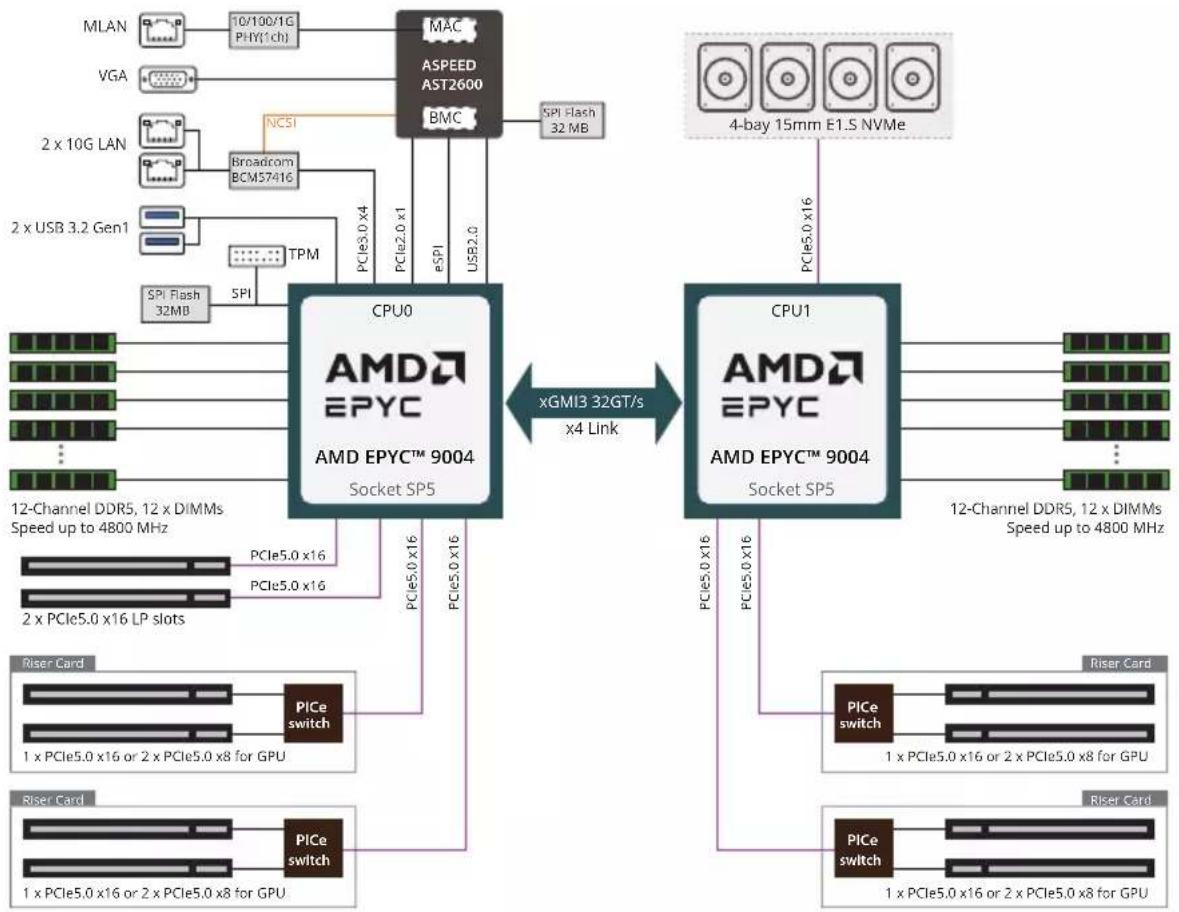
flowchart
graph TD
    subgraph_CPU0["CPU0 AMD EPYCTM 9004 Socket SP5"]
        A["MAC ASPEED AST2600"] --> B["BMC"]
        C["PCIe5.0 x16"] --> D["PCIe5.0 x16"]
        E["PCIe5.0 x16"] --> F["PCIe5.0 x16"]
        G["PCIe5.0 x16"] --> H["PCIe5.0 x16"]
        I["PCIe5.0 x16"] --> J["PCIe5.0 x16"]
        K["PCIe5.0 x16"] --> L["PCIe5.0 x16"]
        M["PCIe5.0 x16"] --> N["PCIe5.0 x16"]
        O["PCIe5.0 x16"] --> P["PCIe5.0 x16"]
        Q["PCIe5.0 x16"] --> R["PCIe5.0 x16"]
        S["PCIe5.0 x16"] --> T["PCIe5.0 x16"]
        U["PCIe5.0 x16"] --> V["PCIe5.0 x16"]
        W["PCIe5.0 x16"] --> X["PCIe5.0 x16"]
        Y["PCIe5.0 x16"] --> Z["PCIe5.0 x16"]
        AA["PCIe5.0 x16"] --> AB["PCIe5.0 x16"]
        AC["PCIe5.0 x16"] --> AD["PCIe5.0 x16"]
        AE["PCIe5.0 x16"] --> AF["PCIe5.0 x16"]
        AG["PCIe5.0 x16"] --> AH["PCIe5.0 x16"]
        AI["PCIe5.0 x16"] --> AJ["PCIe5.0 x16"]
        AK["PCIe5.0 x16"] --> AL["PCIe5.0 x16"]
        AM["PCIe5.0 x16"] --> AN["PCIe5.0 x16"]
        AO["PCIe5.0 x16"] --> AP["PCIe5.0 x16"]
        AQ["PCIe5.0 x16"] --> AR["PCIe5.0 x16"]
        AS["PCIe5.0 x16"] --> AT["PCIe5.0 x16"]
        AU["PCIe5.0 x16"] --> AV["PCIe5.0 x16"]
        AW["PCIe5.0 x16"] --> AX["PCIe5.0 x16"]
        AY["PCIe5.0 x16"] --> AZ["PCIe5.0 x8 for GPU"]
        BA["Riser Card"] --> BB["PICe switch"]
        BC["Riser Card"] --> BD["PICe switch"]
    end

    subgraph_CPU1["CPU1 AMD EPYCTM 9004 Socket SP5"]
        AD["PCIe5.0 x16"] --> AE["PCIe5.0 x16"]
        AF["PCIe5.0 x16"] --> AG["PCIe5.0 x16"]
        AH["Riser Card"] --> AI["PICe switch"]
        AJ["Riser Card"] --> AK["PICe switch"]
    end

    subgraph_CPU2["xGMI3 32GT/s x4 Link"]
        AI --> AJ
    end

    style CPU2 fill:#f9f,stroke:#333
    style CPU1 fill:#ccf,stroke:#333
Chapter 2 System Appearance
2-1 Front View
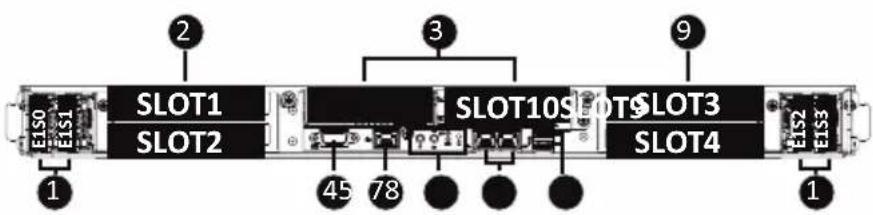
No. Description
- EDSFF E1.S SSD Bay
- GPU Card Slot
- PCIe Card Slot
- VGA Port
- Server Management LAN Port
- Front Panel LEDs and Buttons
- 10 GbE LAN Port
- USB 3.2 Gen1 Port
- GPU Card Slot

- Refer to section 2-3 Front Panel LEDs and Buttons for a detailed description of the function of the LEDs.
2-2 Rear View

| No. | Description |
| 1. | Power Distribution Board to Bus Bar Connector |
| 2. | GPU Card Slot |
| 3. | GPU Card Slot |
2-3 Front Panel LEDs and Buttons
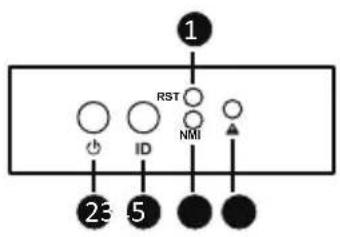
flowchart
graph TD
    A["1"] --> B["RST"]
    B --> C["NMI"]
    C --> D["2"]
    C --> E["5"]
    B --> F["ID"]
| No. | Name | Color | Status | Description |
| 1. Reset Button -- -- Press this button to reset the system. | ||||
| 2. Power button with LED | Green On Indicates the system is powered on. | |||
| Green | Blink | System is in ACPI S1 state (sleep mode). | ||
| N/A | Off | - System is not powered on or in ACPI S5 state (power off) - System is in ACPI S4 state (hibernate mode) | ||
| 3. ID Button with LED^(Note) | Blue On Indicates the system identification is active. | |||
| N/A | Off | Indicates the system identification is disabled. | ||
| 4. NMI button | -- | -- | Press this button for the server to generate a NMI to the processor. If multiple-bit ECC errors occur, the server will effectively be halted. | |
| 5. System Status LED^(Note) | Green | Solid On | System is operating normally. | |
| Amber | Solid On | Critical condition, may indicate: System fan failure System temperature | ||
| Blink | Non-critical condition, may indicate: Redundant power module failure Temperature and voltage issue Chassis intrusion | |||
| N/A | Off | System is not ready, may indicate: POST error NMI error Processor or terminator missing | ||
(Note) If your server features RoT function, please see the following section for detail LED behavior.
2-4 RoT LEDs
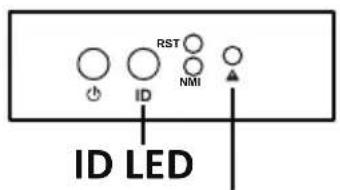
Status LED
| LED on Front panel (Note5) | ||
| ID LED Status LED | ||
| EC Firmware (FW) Authentication fail or not exit | ||
| EC FW is broken or not exit (Note1) | OFF OFF | |
| Authenticating/Recovering BMC/BIOS Images | ||
| Authenticating Images | OFF OFF | |
| Recovering BMC Active Flash | Blinks Blue 4 times per second | Blinks Green 4 times per second |
| Recovering BIOS Active Flash | Blinks Blue 4 times per second | Blinks Green 4 times per second |
| Authentication (AUTH) Pass | ||
| Recovering BIOS Active Flash | OFF OFF | |
| BMC : AUTH pass after doing recovery BIOS : AUTH pass after doing recovery | OFF OFF | |
| BMC : AUTH pass after doing recovery BIOS : AUTH pass | OFF OFF | |
| BMC : AUTH pass BIOS : AUTH pass after doing recovery | OFF OFF | |
| Active Flash Authentication (AUTH) Fail | ||
| BMC : AUTH Fail ^(Note2) | Blinks Blue1 time per second | Blinks Green1 time per second |
| BIOS : AUTH fail ^(Note2) | Blinks Blue1 time per second | Blinks Amber1 time per second |
| BMC : AUTH fail after doing recovery ^(Note3) | Blinks Blue2 times per second[ON OFF OFF] | Blinks Green2 times per second[ON OFF OFF] |
| BIOS : AUTH fail after doing recovery ^(Note3) | Blinks Blue2 times per second[ON OFF OFF] | Blinks Amber2 times per second[ON OFF OFF] |
| Backup Flash Authentication Fail ^(Note4) | ||
| BMC : AUTH fail | Blinks Blue2 times per second[ON OFF ON OFF] | Blinks Green2 times per second[ON OFF ON OFF] |
| BIOS : AUTH fail | Blinks Blue2 times per second[ON OFF ON OFF] | Blinks Amber2 times per second[ON OFF ON OFF] |
NOTE!
- EC FW is broken or not exited result in Microchip CEC1702 cannot load EC FW for authentication.
2 (1) Authentication fail include below scenarios
Configuration table is missing or modified
Public key is missing or modified
Protected area or signature is modified
Flash empty - if active flash is still authentication failed after recovery sequence, Microchip CEC1702 stop the process and showing LED behavior.
- If backup flash authentication is failed cause by configuration table, public key or protected area is broken. Microchip CEC1702 stop the process and showing LED behavior.
- Front panel LED is controlled by BMC or Microchip CEC1702. Once Microchip CEC1702 is working(Auth or recovery), the front panel LED is controlled by Microchip CEC1702 and vice versa.
2-5 Front System LAN LEDs

| No. | Name | Color | Status | Description |
| 1. | 1 GbE Speed LED | Yellow On 1 Gbps data rate | ||
| Green On 100 Mbps data rate | ||||
| N/A Off 10 Mbps data rate | ||||
| 2. | 1 GbE Link / Activity LED | Green | On Link between system and network or no access | |
| Blink Data transmission or reception is occurring. | ||||
| N/A Off No data transmission or reception is occurring. | ||||
| 3. | 10 GbE Speed LED | Yellow On 10 Gbps data rate | ||
| Green On 1 Gbps data rate | ||||
| N/A Off 100 Mbps data rate | ||||
| 4. | 10 GbE Link / Activity LED | Green | On Link between system and network or no access | |
| Blink Data transmission or reception is occurring. | ||||
| N/A Off No data transmission or reception is occurring. | ||||
2-6 Storage LED
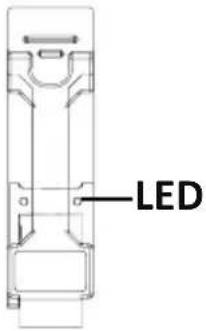
| RAID SKU | Color Locate | NVMe Fault | Rebuilding HDD Access | HDD Present (No Access) | |||
| No RAID configuration (via HBA, ICH) | NVMe LED (On NVMe Module) | Amber OFF ON (*1) | |||||
| RAID configuration (via HW RAID Card or SW RAID Card) | NVMe LED | Amber | BLINK | ON | Alternately | ||
NOTE:
(*1) Depends on HBA/Utility Spec
Chapter 3 System Hardware Installation

Pre-installation Instructions
Computer components and electronic circuit boards can be damaged by discharges of static electricity. Working on computers that are still connected to a power supply can be extremely dangerous. Follow the simple guidelines below to avoid damage to your computer or injury to yourself.
- Always disconnect the computer from the power outlet whenever you are working inside the computer case.
- If possible, wear a grounded wrist strap when you are working inside the computer case. Alternatively, discharge any static electricity by touching the bare metal system of the computer case, or the bare metal body of any other grounded appliance.
- Hold electronic circuit boards by the edges only. Do not touch the components on the board unless it is necessary to do so. Do not flex or stress the circuit board.
- Leave all components inside the static-proof packaging until you are ready to use the component for the installation.
3-1 Removing Compute Node from the Rack
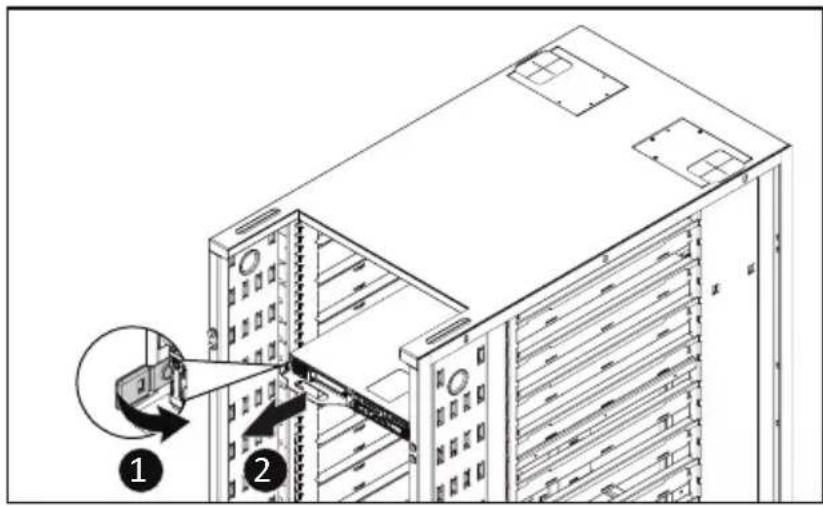
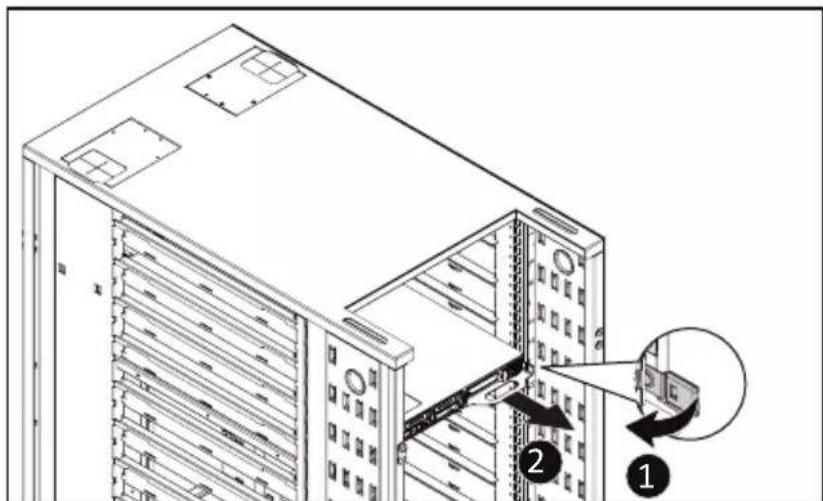
Follow these instructions to remove the compute node from the rack:
- Press the release latches inward while simultaneously pulling the handle for the compute node.
- Pull the compute node out of the cabinet.
- To install the compute node, push the shelf back into the cabinet.
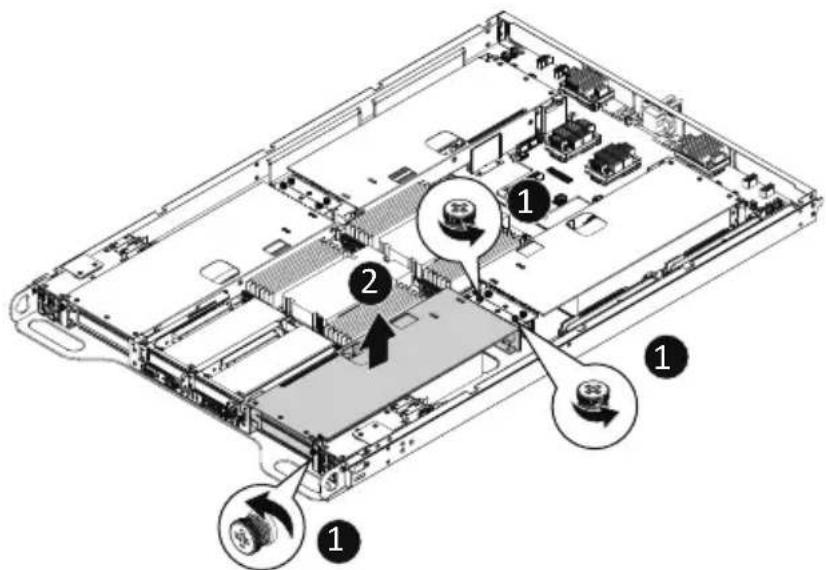
3-2 Removing and Installing the Chassis Cover
Follow these instructions to remove the chassis cover:
- Loosen the two thumbnail screws securing the chassis cover.
- Slide the cover to the front of the system and then remove the cover in the direction indicated by the arrow.
- To reinstall the chassis cover follow steps 1-2 in reverse order.
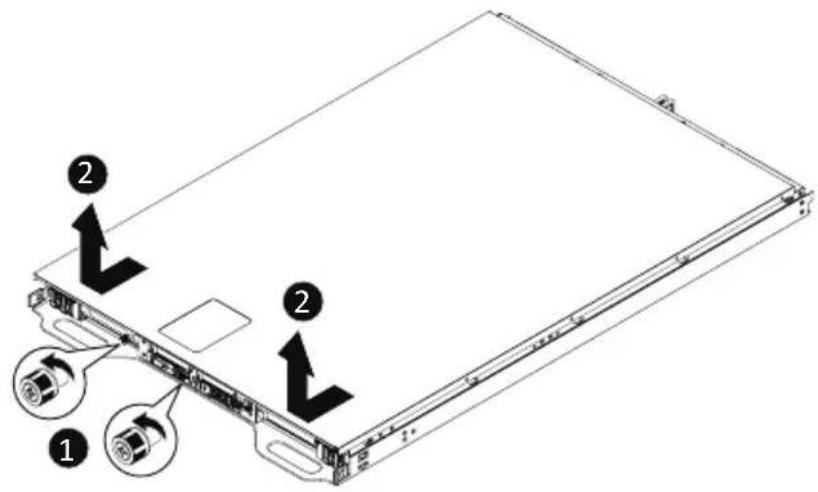
3-3 Installing the EDSFF SSD

Read the following guidelines before you begin to install the EDSFF SSD:
• Take note of the drive tray orientation before sliding it out.
• The tray will not fit back into the bay if inserted incorrectly.
- Make sure that the SDD is connected to the SDD connector on the backplane.
Follow these instructions to install the SSD:
- Press the release latch of the storage tray.
- Pull out the locking lever.
- Use the locking lever to slide out the storage tray.
- Remove two screws on the storage tray.
- Install the SSD into the storage tray, secure the SSD with two screws.
- Re-install the storage tray with SSD into the system until it clicks.
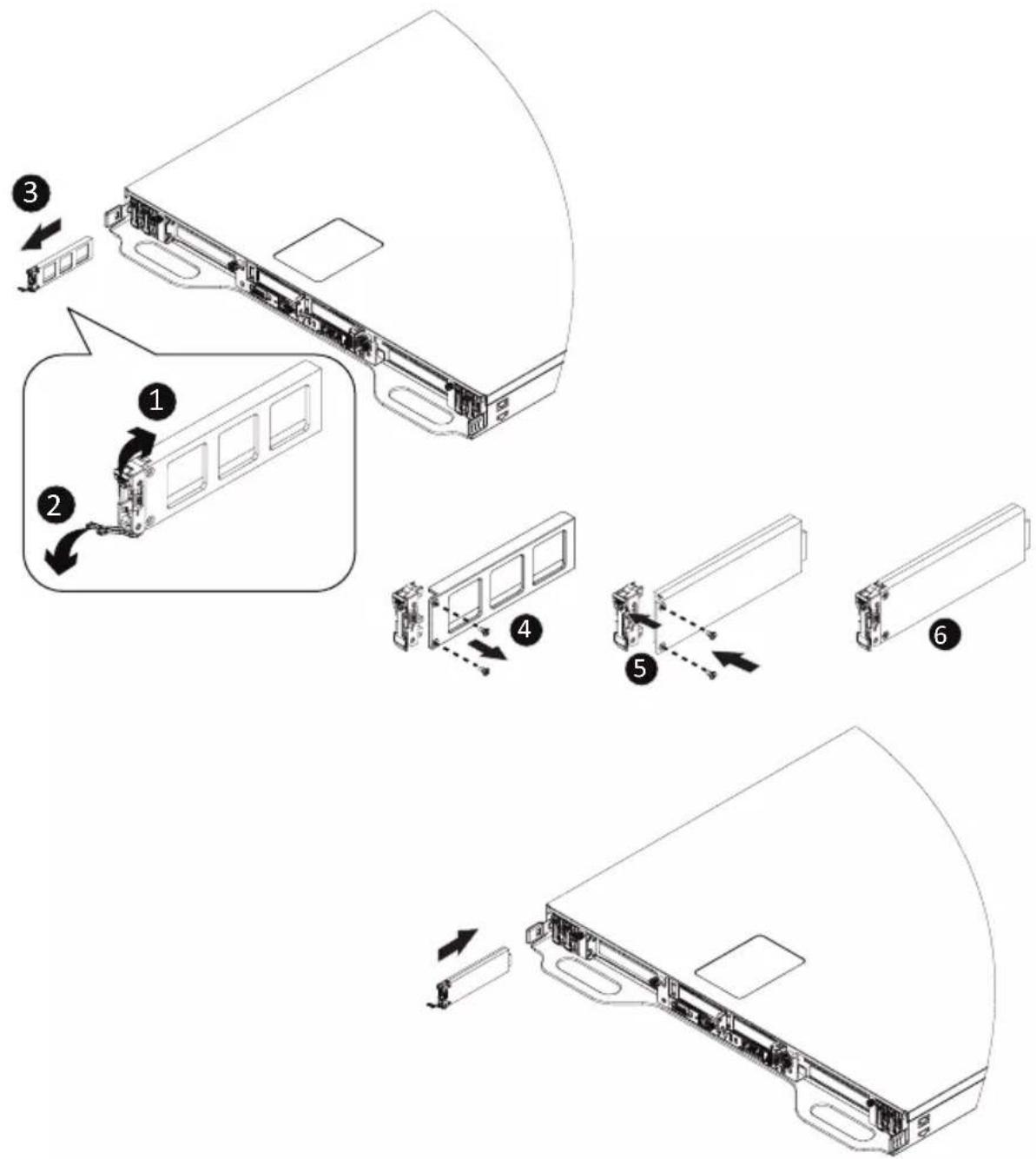
3-4 Removing and Installing the CPU and Heatsink

Read the following guidelines before you begin to install the CPU:
- Make sure that the motherboard supports the CPU.
• Always turn off the computer and unplug the power cord from the power outlet before installing the CPU to prevent hardware damage. - Unplug all cables from the power outlets.
- Disconnect all telecommunication cables from their ports.
- Place the system unit on a flat and stable surface.
- Open the system according to the instructions.

WARNING!
Failure to properly turn off the server before you start installing components may cause serious damage. Do not attempt the procedures described in the following sections unless you are a qualified service technician.
Follow these instructions to install the CPU:
- Loosen the three captive screws securing the CPU cover.
- Flip open the CPU cover.
- Remove the CPU carrier from the CPU frame using the handle on the CPU carrier.
- Using the handle on the CPU carrier insert the new CPU carrier with CPU installed into the CPU frame.
NOTE: Ensure the CPU is installed in the CPU carrier in the correct orientation, with the triangle on the CPU aligned to the top left corner of the CPU carrier.
- Flip the CPU frame with CPU installed into place in the CPU socket.
- Flip the CPU cover into place over the CPU socket.
- Tighten the CPU cover screw to secure the CPU cover in place.
- Place the thermal pad on the top of CPU.
- When installing the heatsink to CPU, use a Torx T20 screwdriver to tighten 4 captive nuts in sequence as 1-6.
- Repeat steps 1-9 for the second CPU and the heatsink.
- To remove the CPUs, follow steps 1-7 in reverse order.
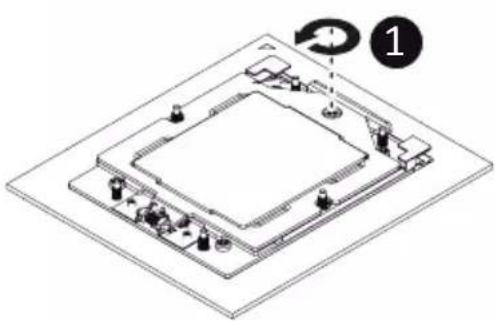
natural_image
Isometric diagram of a computer motherboard with labeled components and a circular arrow indicator (no text or symbols)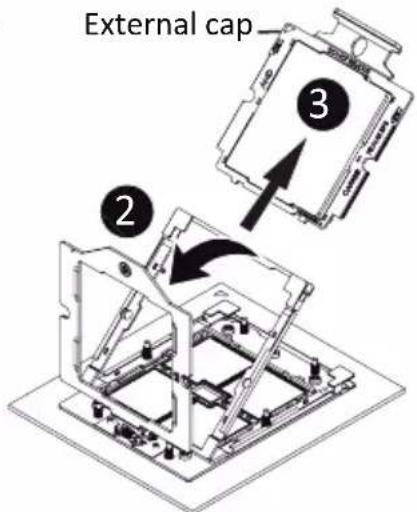
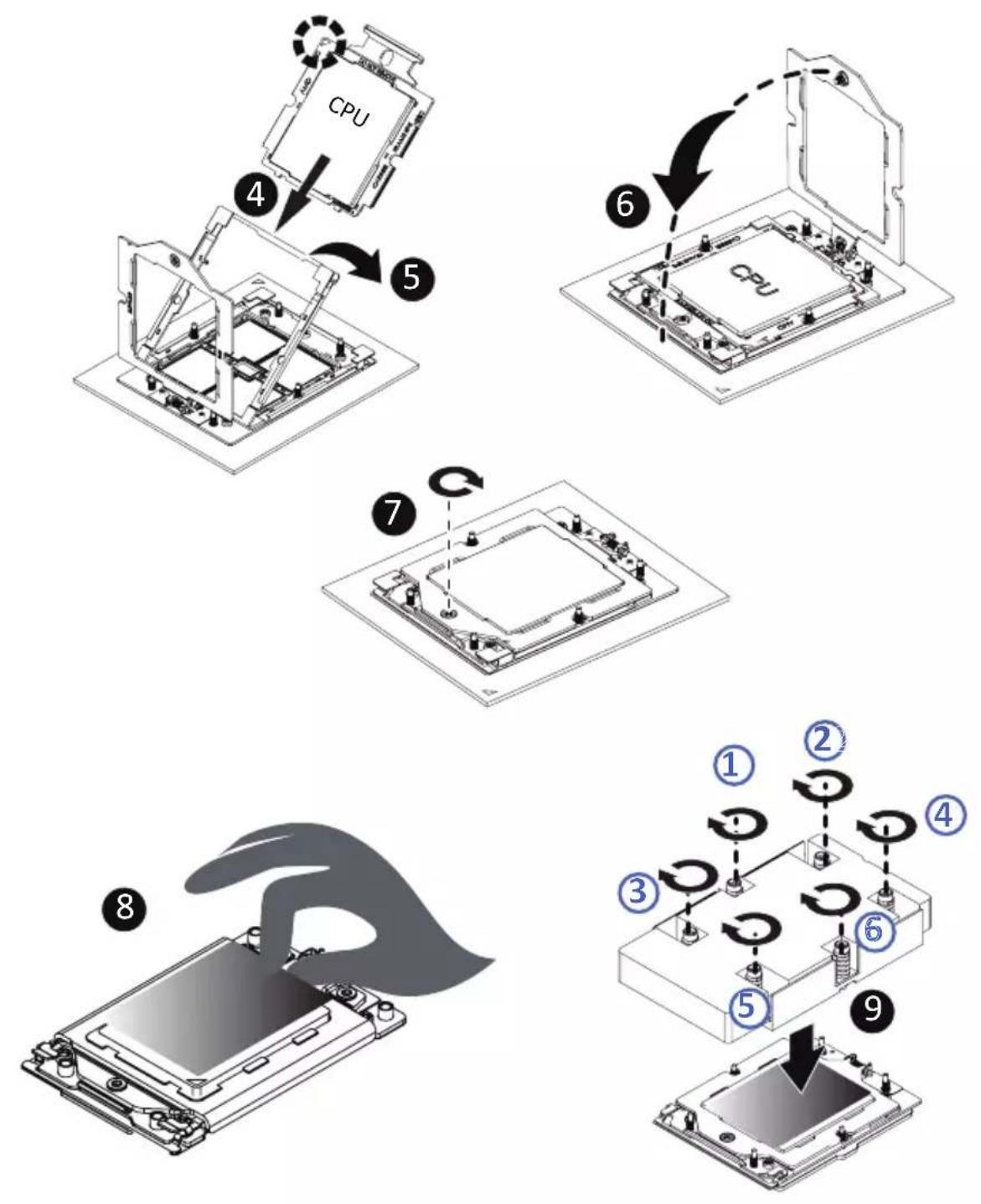

- Lock the CPU by using a Torx T20 screwdriver to tighten screw.
- When installing the heatsink to CPU, use a Torx T20 screwdriver to tighten 6 captive nuts in sequence as 1-6.
• The screw tightening torque: 12.5-15.0 kgf-cm. - To ensure the system operates properly, make sure the heatsink is seated on the processor firmly.
3-5 Removing and Installing Memory

Read the following guidelines before you begin to install the memory:
- Make sure that the motherboard supports the memory. It is recommended that memory of the same capacity, brand, speed, and chips be used.
• Always turn off the computer and unplug the power cord from the power outlet before installing the memory to prevent hardware damage. - Memory modules have a foolproof design. A memory module can be installed in only one direction. If you are unable to insert the memory, switch the direction.
3-5-1 Eight Channel Memory Configuration
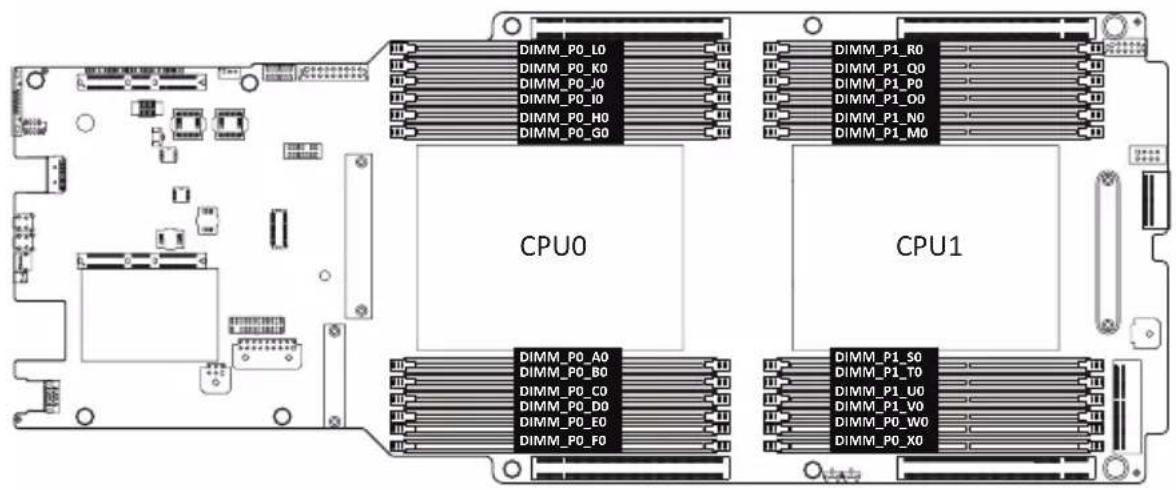
This motherboard provides 24 DDR5 memory sockets and supports Twelve Channel Technology. After the memory is installed, the BIOS will automatically detect the specifications and capacity of the memory.
3-5-2 Removing and Installing a Memory Module

Before installing a memory module, make sure to turn off the computer and unplug the power cord from the power outlet to prevent damage to the memory module. Be sure to install DDR5 DIMMs on to this motherboard.
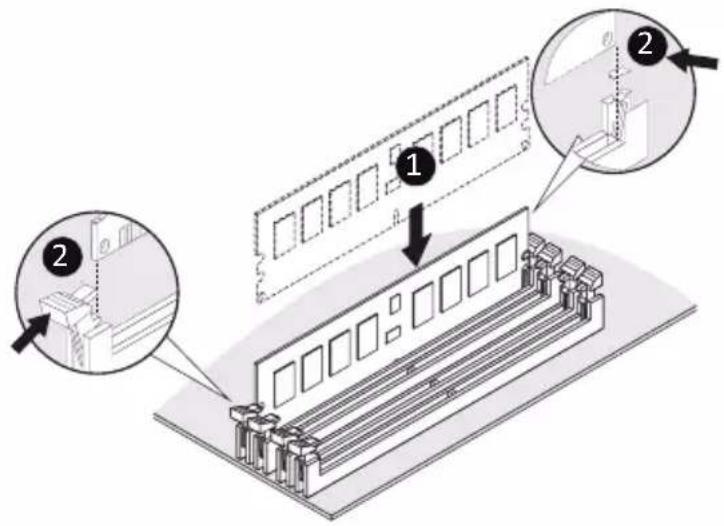
Follow these instructions to install a DIMM module:
- Insert the DIMM memory module vertically into the DIMM slot and push it down.
- Close the plastic clip at both edges of the DIMM slots to lock the DIMM module.
- Reverse the installation steps when you want to remove the DIMM module.
3-5-3 Processor and Memory Module Matrix Table
| Memory Q'ty for each CPU | CPU0 | CPU1 | |||||||||||||||||||||||
| F0 | E0 | D0 | C0 | B0 | A0 | G0 | H0 | I0 | J0 | K0 | L0 | R0 | M0 | P0 | Q0 | S0 | T0 | Q0 | N0 | U0 | V0 | W0 | X0 | ||
| 1 DIMM | V | V | |||||||||||||||||||||||
| 2 DIMM | V | V | V | V | |||||||||||||||||||||
| 4 DIMM | V | V | V | V | V | V | V | V | |||||||||||||||||
| 6 DIMM | V | V | V | V | V | V | V | V | V | V | V | V | |||||||||||||
| 8 DIMM | V | V | V | V | V | V | V | V | V | V | V | V | V | V | V | V | |||||||||
| 10 DIMM | V | V | V | V | V | V | V | V | V | V | V | V | V | V | V | V | V | V | V | V | |||||
| 12 DIMM | V | V | V | V | V | V | V | V | V | V | V | V | V | V | V | V | V | V | V | V | V | V | V | V | V |
3-5-4 Memory Population Table
EPYC Memory Speed based on DIMM Population (One DIMM per Channel)
| DIMM Type | DIMM Population | Max EPYC 9004 DDR5 Frequency (MT/s) |
| DIMM 0 | ||
| RDIMM | 1R (1 Rank) 4800 | |
| 2R (2 Ranks) 4800 | ||
| 3DS RDIMM | 2S2R (4 Ranks) 4800 | |
| 2S4R (8 Ranks) 4800 | ||
| 2S8R (16 ranks) 4800 |
EPYC Memory Speed based on DIMM Population (Two DIMM per Channel)
| DIMM Type | DIMM Population DDR5 Frequency (MT/s) | ||||
| DIMM 0 DIMM | 1 | 14L 93mil high-Dk PCB stackup | 14L 74mil high-Dk PCB stackup | 16L 93mil high-Dk PCB stackup | |
| RDIMM | -- 1R 4800 | 4800 4800 | |||
| 1R 1R | 4000 4000 4000 | ||||
| -- 2R | 4400 4800 4800 | ||||
| 1R 2R | 3600 3600 3600 | ||||
| 2R 2R | 3600 3600 3600 | ||||
| 3DS RDIMM | -- | 2S2R (4 Ranks) | 4400 4800 | 4800 | |
| -- | 2S4R (8 Ranks) | 4400 4800 | 4800 | ||
| -- | 2S8R (16 Ranks) | 4400 4800 | 4800 | ||
| 2S2R (4 Ranks) | 2S2R (4 Ranks) | 3600 3600 | 3600 | ||
| 2S4R (8 Ranks) | 2S4R (8 Ranks) | 3600 3600 | 3600 | ||
| 2S8R (16 Ranks) | 2S8R (16 Ranks) | 3600 3600 | 3600 | ||
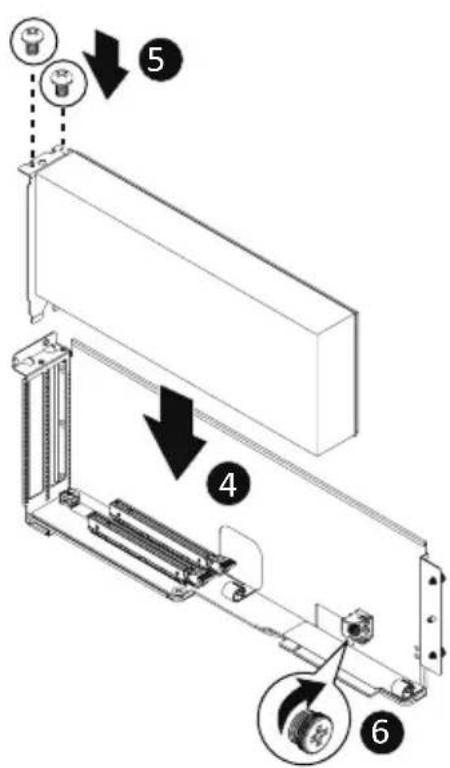
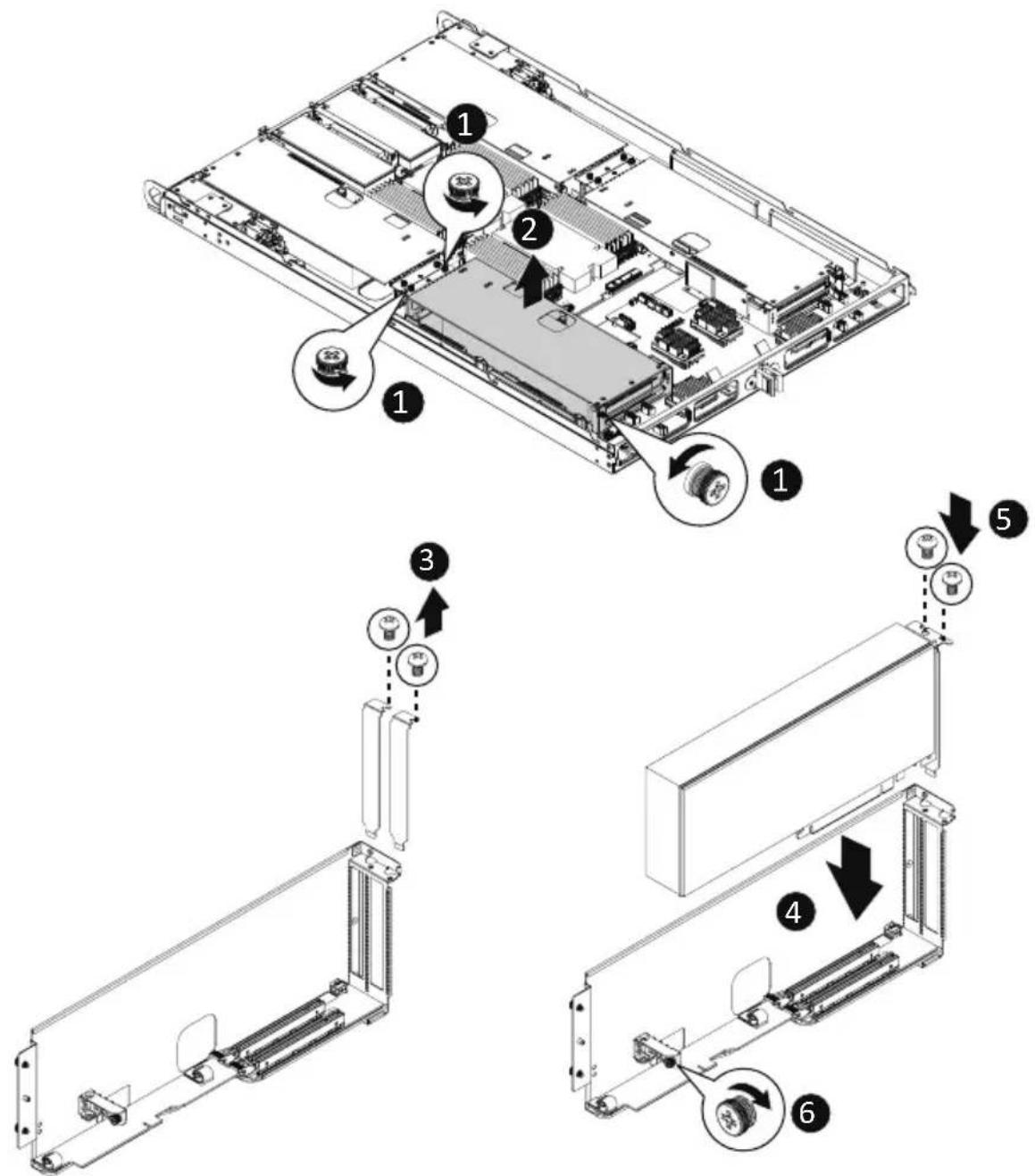
3-6 Installing the GPU Card
Follow these instructions to install the GPU card:
For Slot3/Slot4
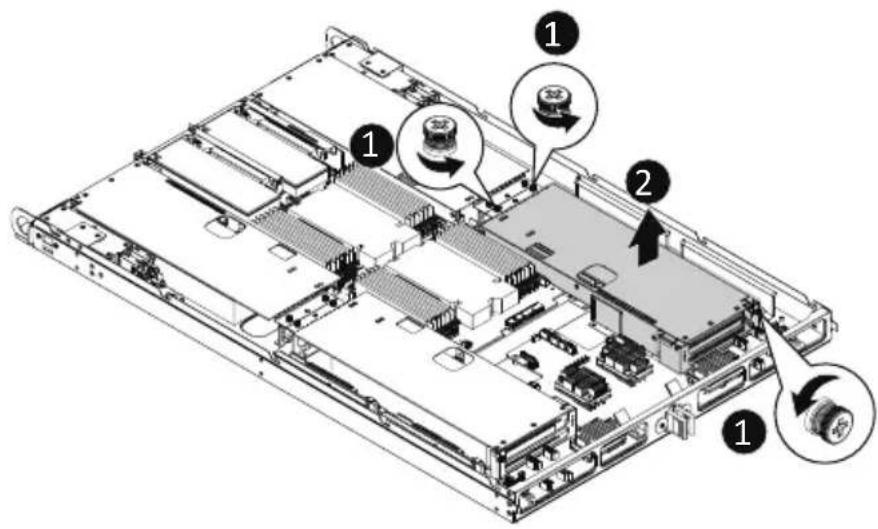
- Loosen the thumbnail screws securing the GPU card bracket.
- Slightly lift the GPU card bracket up in the direction indicated as shown in the image below.
- Remove the two screws securing the GPU card slot covers and remove the GPU slot covers.
- Insert the GPU card into the selected slot. Make sure the GPU card is properly seated.
- Install the two screws to secure the GPU card in place.
- Use a driver to tighten the thumbnail screw of the GPU card.
NOTE! The screw tightening torque: 5 ± 0.5 kgf-cm. - Reverse step 1-7 to install the GPU card with bracket into the system.
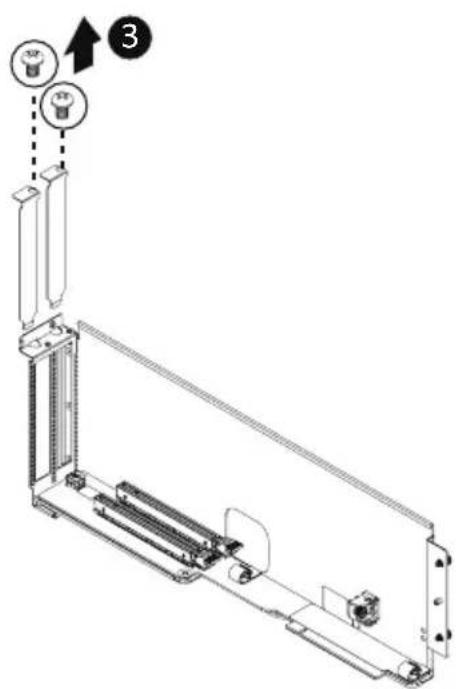
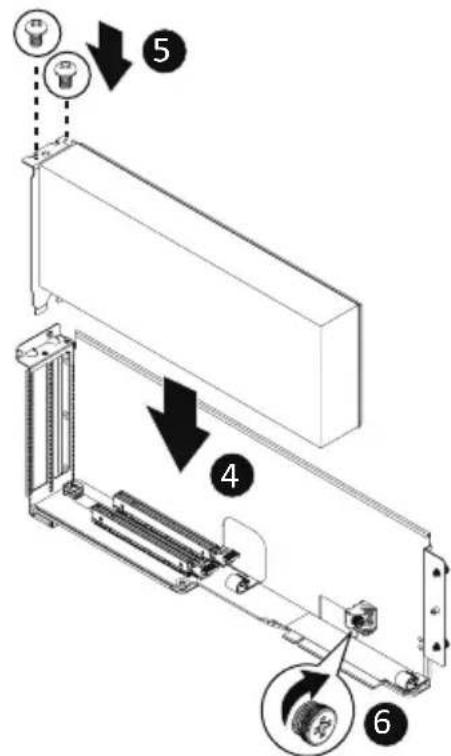
Follow these instructions to install the GPU card: For Slot1/Slot2
- Loosen the thumbnail screws securing the GPU card bracket.
- Slightly lift the GPU card bracket up in the direction indicated as shown in the image below.
- Remove the two screws securing the GPU card slot covers and remove the GPU slot covers.
- Insert the GPU card into the selected slot. Make sure the GPU card is properly seated.
- Install the two screws to secure the GPU card in place.
- Use a driver to tighten the thumbnail screw of the GPU card.
NOTE! The screw tightening torque: 5 ± 0.5 kgf-cm. - Reverse step 1-7 to install the GPU card with bracket into the system.

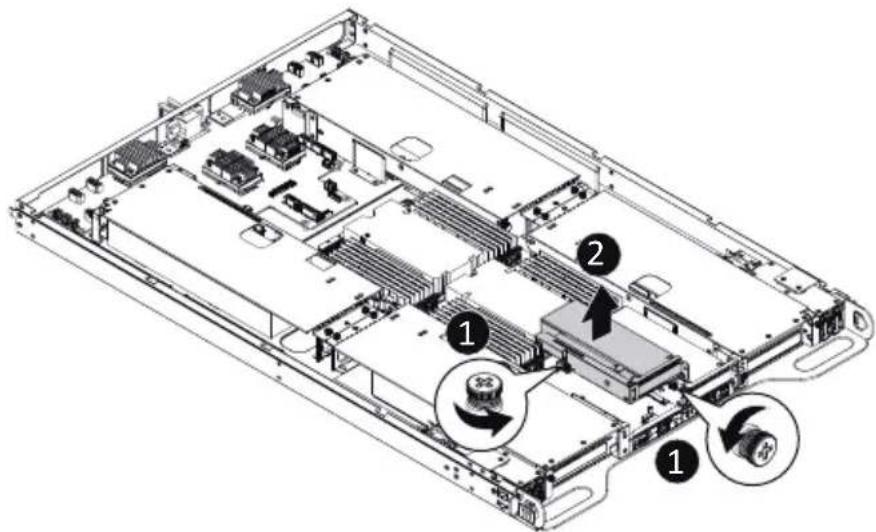
Follow these instructions to install the GPU card: For Slot5/Slot6
- Loosen the thumbnail screws securing the GPU card bracket.
- Slightly lift the GPU card bracket up in the direction indicated as shown in the image below.
- Remove the two screws securing the GPU card slot covers and remove the GPU slot covers.
- Insert the GPU card into the selected slot. Make sure the GPU card is properly seated.
- Install the two screws to secure the GPU card in place.
- Use a driver to tighten the thumbnail screw of the GPU card.
NOTE! The screw tightening torque: 5 ± 0.5 kgf-cm. - Reverse step 1-7 to install the GPU card with bracket into the system.
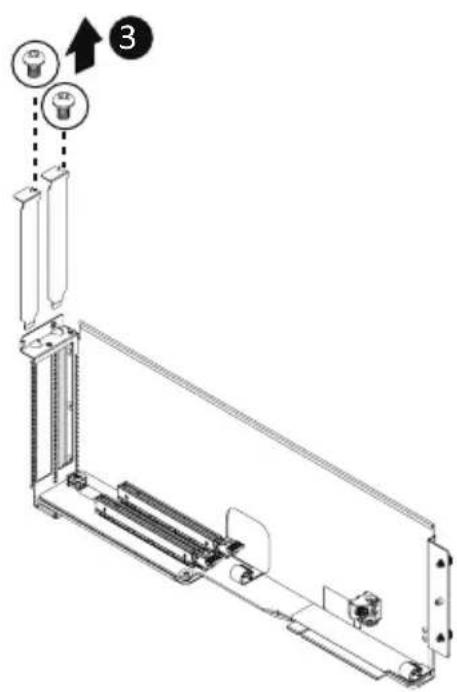
Follow these instructions to install the GPU card: For Slot7/Slot8
- Remove the two screws securing the GPU card bracket and remove the bracket.
- Remove the screw securing the GPU card bracket from the side of system.
- Loosen the thumbnail screw securing the GPU card bracket.
- Slightly lift the GPU card bracket up in the direction indicated as shown in the image below.
- Remove the two screws securing the GPU card slot covers and remove the GPU slot covers.
- Insert the GPU card into the selected slot. Make sure the GPU card is properly seated.
- Install the two screws to secure the GPU card in place.
- Use a driver to tighten the thumbnail screw of the GPU card.
NOTE! The screw tightening torque: 5 ± 0.5 kgf-cm.
- Reverse step 1-7 to install the GPU card with bracket into the system.
3-7 Removing and Installing the PCIe Card

- The PCIe riser assembly does not include a riser card or any cabling as standard. To install a PCIe card, a riser card must be installed.
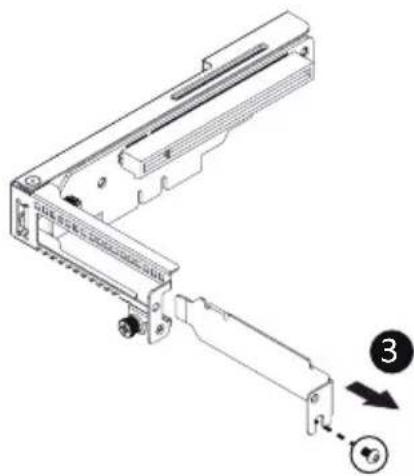
Follow these instructions to install the left PCI Expansion card:
- Loosen the two thumbnail screws securing the riser bracket.
- Lift up the riser bracket out of system.
- Remove the screw securing the slot cover from riser bracket.
- Orient the PCIe card with the riser guide slot and push in the direction of the arrow until the PCIe card sits in the PCIe card connector.
NOTE: Some riser brackets allow for single or multiple PCIe cards.
Repeat steps 3-4 as necessary.
- Secure the PCIe card with the screw.
- Repeat steps 1-2 to install the PCIe card into the system.
natural_image
Diagram of a computer hard drive with labeled component (no text or symbols present)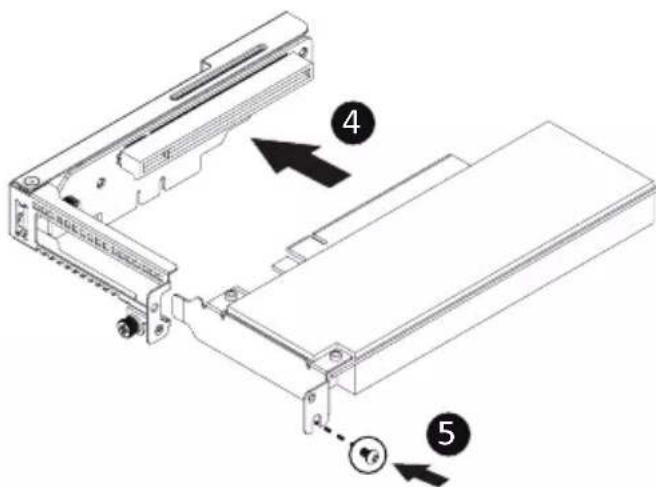
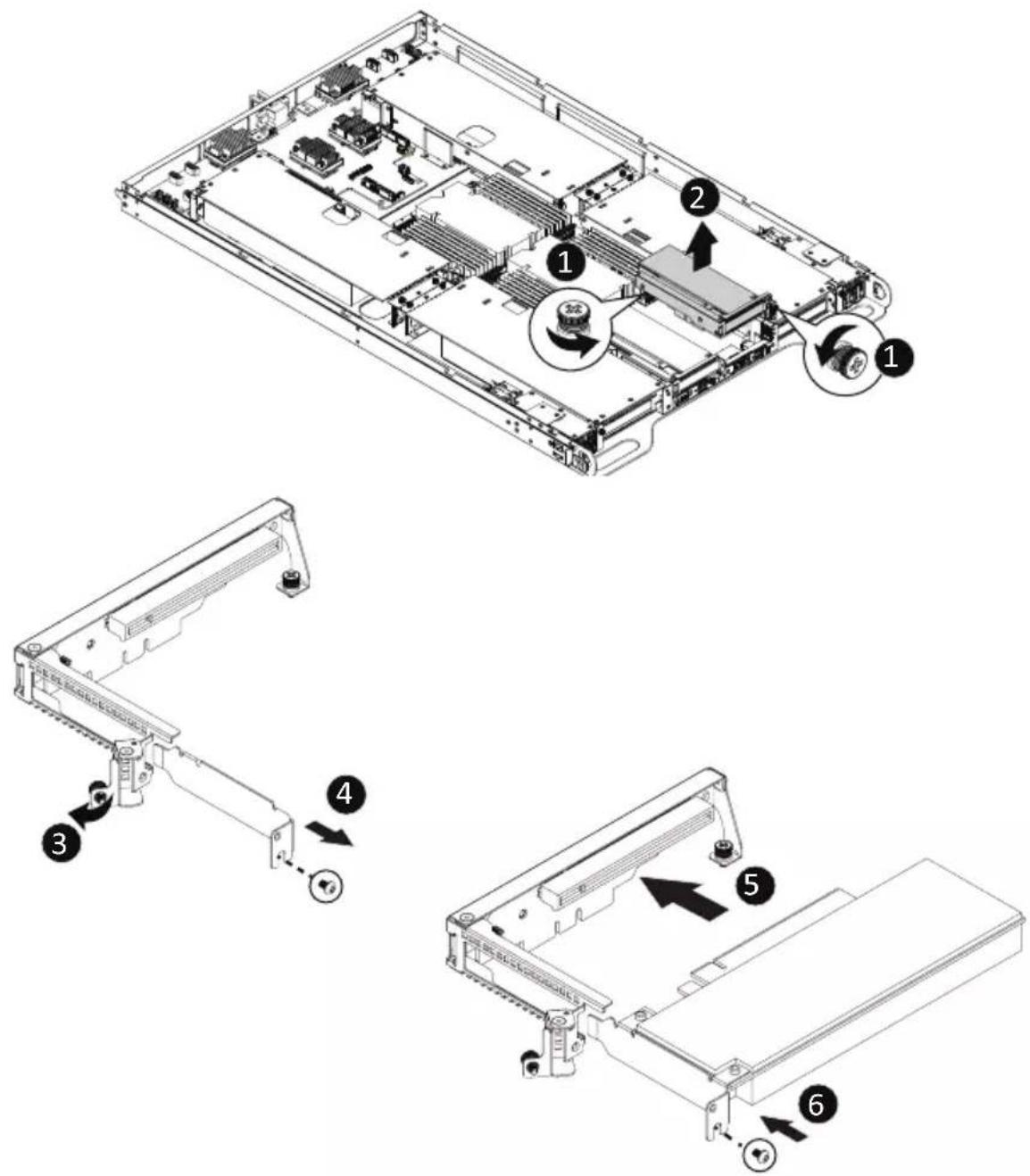
Follow these instructions to install the right PCI Expansion card:
- Loosen the two thumbnail screws securing the riser bracket.
- Lift up the riser bracket out of system.
- Flip over the bracket metal cover.
- Remove the screw securing the slot cover from riser bracket.
- Orient the PCIe card with the riser guide slot and push in the direction of the arrow until the PCIe card sits in the PCIe card connector.
NOTE: Some riser brackets allow for single or multiple PCIe cards.
Repeat steps 4-5 as necessary.
- Secure the PCIe card with the screw.
- Repeat steps 1-3 to install the PCIe card into the system.
3-8 Cable Routing
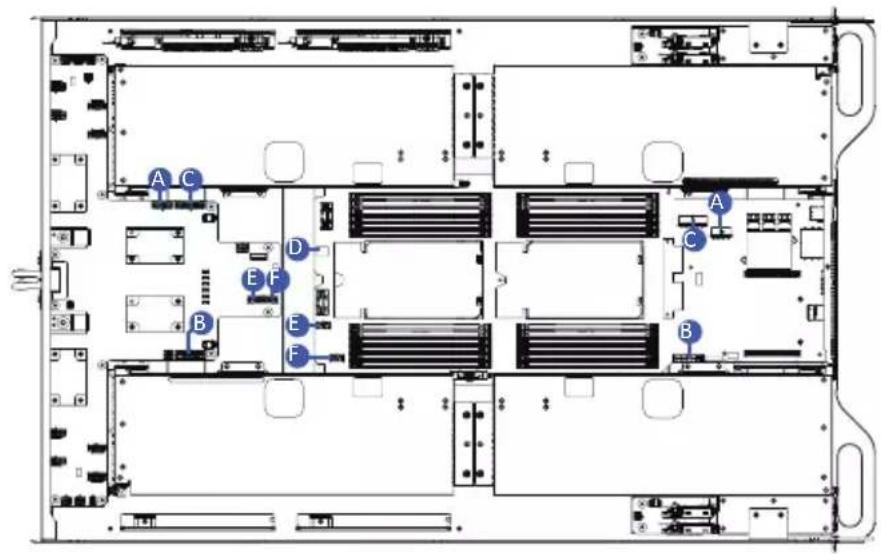
| A System | Power Cable | Motherboard: ATX1_1 |
| Power Distribution Board: ATX1_2 | ||
| B System | Power Cable | Motherboard: ATX_S |
| Power Distribution Board: SSI_MB_1 | ||
| C System | Power Cable | Motherboard: ATX1 |
| Power Distribution Board: ATX1_1 | ||
| D System | Power Cable | Motherboard: ATX2_3 |
| Power Distribution Board: ATX2_2 | ||
| E System | Power Cable | Motherboard: ATX2_2 |
| Power Distribution Board: ATX2_1 | ||
| F System | Power Cable | Motherboard: ATX2_1 |
| Power Distribution Board: ATX2_1 |
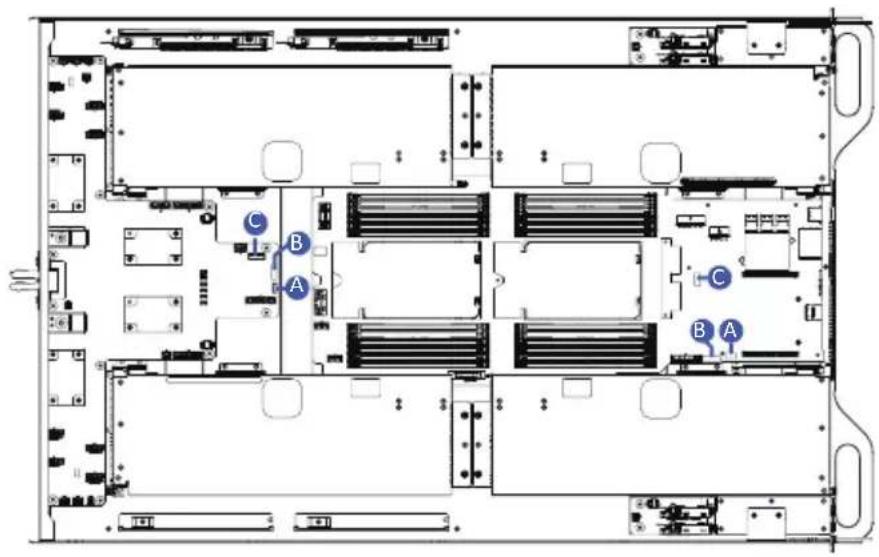
| A System Signal Cable | Motherboard: P12V_STBY |
| Power Distribution Board : P12V_STBY1 | |
| B System Signal Cable | Motherboard: FP_2 |
| Power Distribution Board : F_PANEL1 | |
| C System Signal Cable | Motherboard: BP_1 |
| Power Distribution Board : BP_1 |
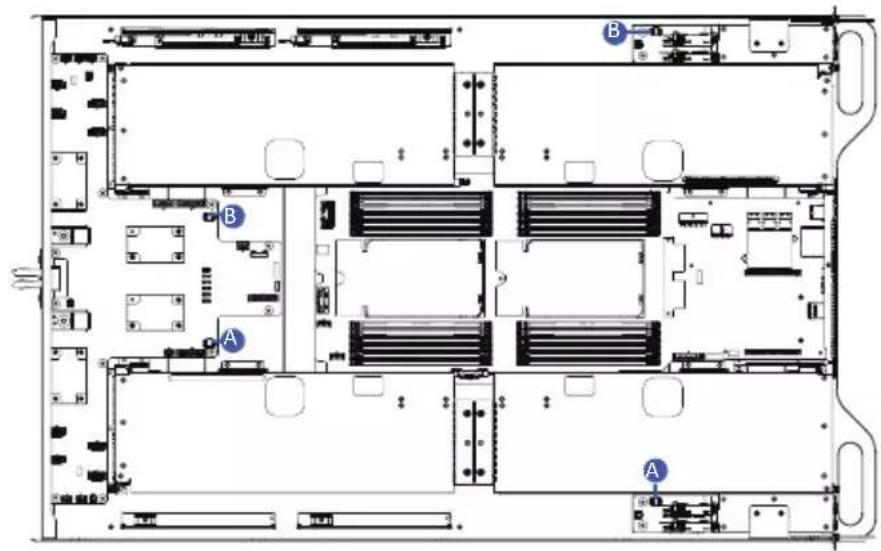
| A | Storage Backplane Board Signal Cable | Front Storage Board: BP_1 |
| Power Distribution Board : BP_L | ||
| B | Front Storage Board: BP_1 | |
| Power Distribution Board : BP_R |
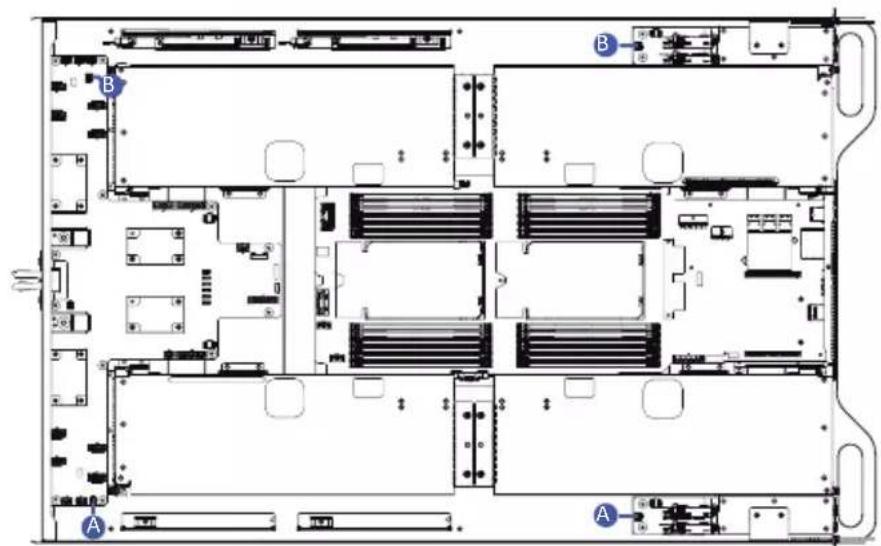
| A | Storage Backplane Board Power Cable | Front Storage Board: PWR_IN |
| Power Distribution Board : P_E1_L | ||
| B | Front Storage Board: PWR_IN | |
| Power Distribution Board : P_E1_R |
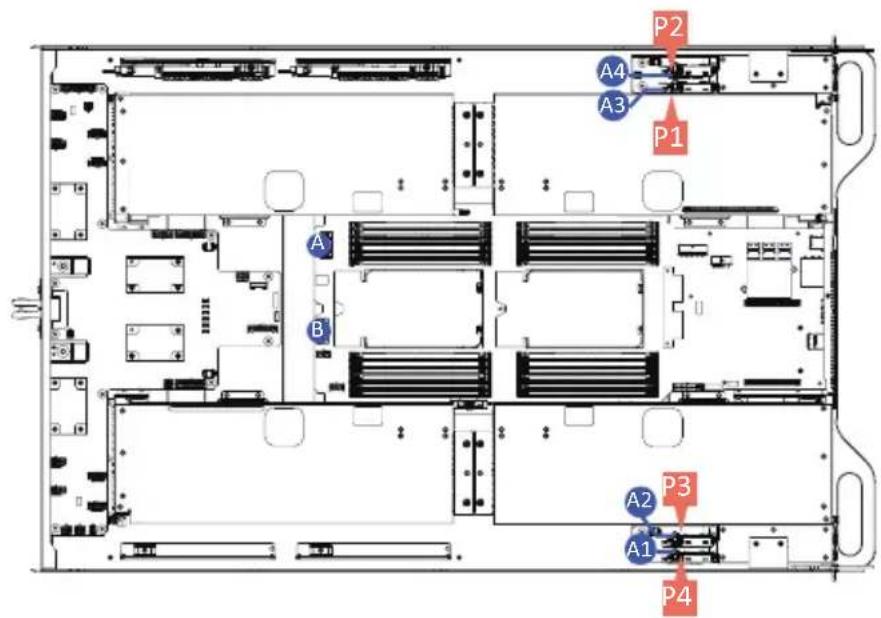
| A | A1 | NVMe 0-1 Cable | Motherboard: P1_P2 | A | A3 | NVMe 2-3 Cable | Motherboard: P1_P2 |
| Storage Board: U2_0 | Storage Board: U2_0 | ||||||
| A2 | Motherboard: P1_P2 | A4 | Motherboard: P1_P2 | ||||
| Storage Board: U2_0 | Storage Board: U2_0 |
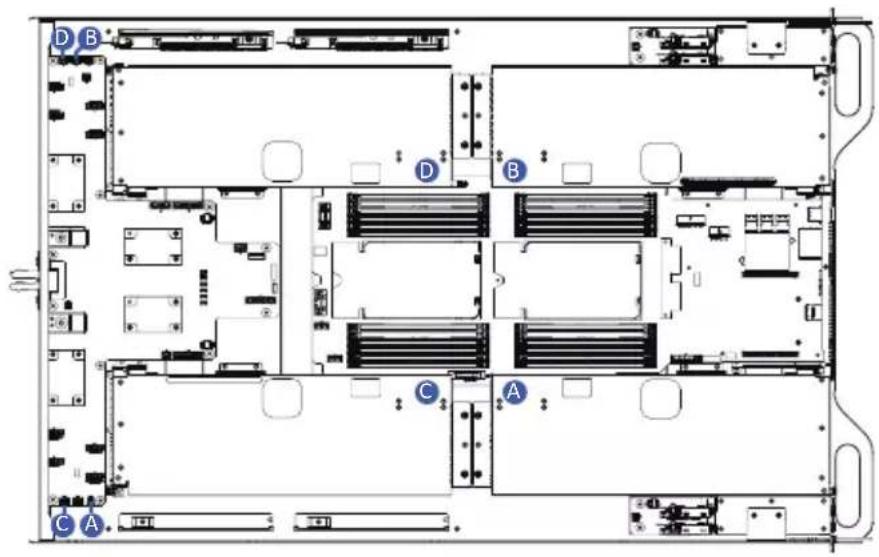
| A | Front System Riser Power Cable | Front System Left Riser: -- |
| Power Distribution Board: RIS_PWR_L1 | ||
| B | Front System Riser Power Cable | Front System Right Riser: -- |
| Power Distribution Board: RIS_PWR_R1 | ||
| C | Rear System Riser Power Cable | Rear System Left Riser: -- |
| Power Distribution Board: RIS_PWR_L | ||
| D | Rear System Riser Power Cable | Rear System Left Riser: -- |
| Power Distribution Board: RIS_PWR_R |
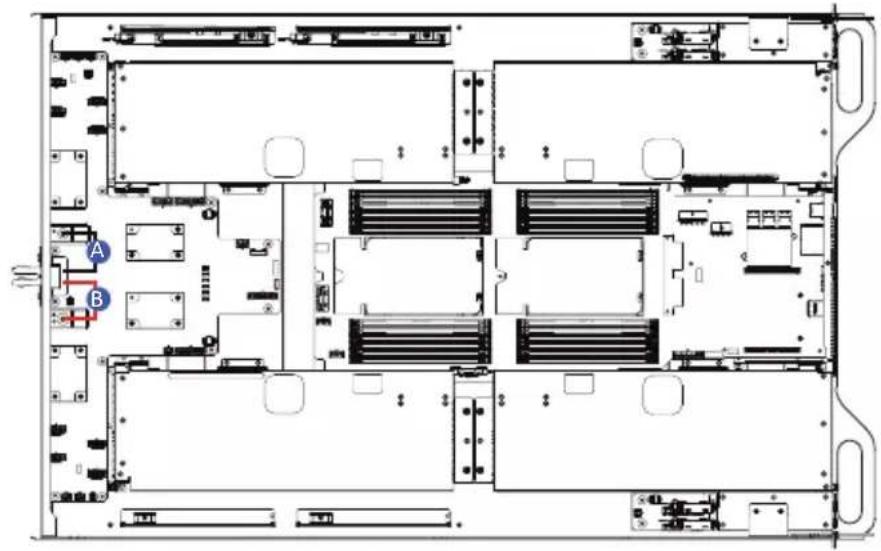
| A | Bus Bar Cable distribution Board | Power Distribution Board: BUS_GND1 |
| B Power D | : BUS_PWR1 |
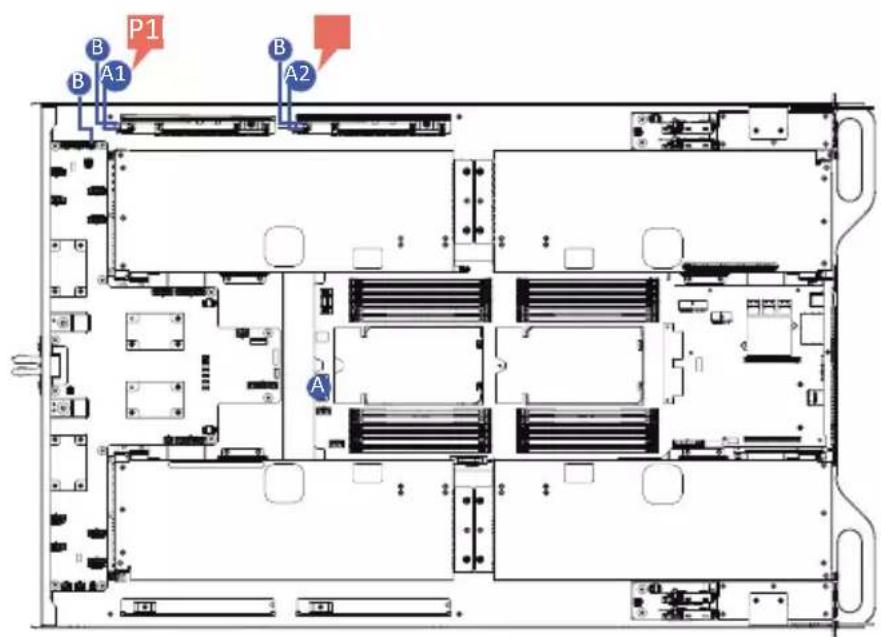
| A | M.2 Riser Sinal Cable (Option) | Motherboard: P1_S |
| A1: U2_M2 | ||
| A2: U2_M2 | ||
| B | M.2 Riser Power Cable (Option) | M.2 Riser: M2_PWR |
| Power Distribution Board: M2_PWR |
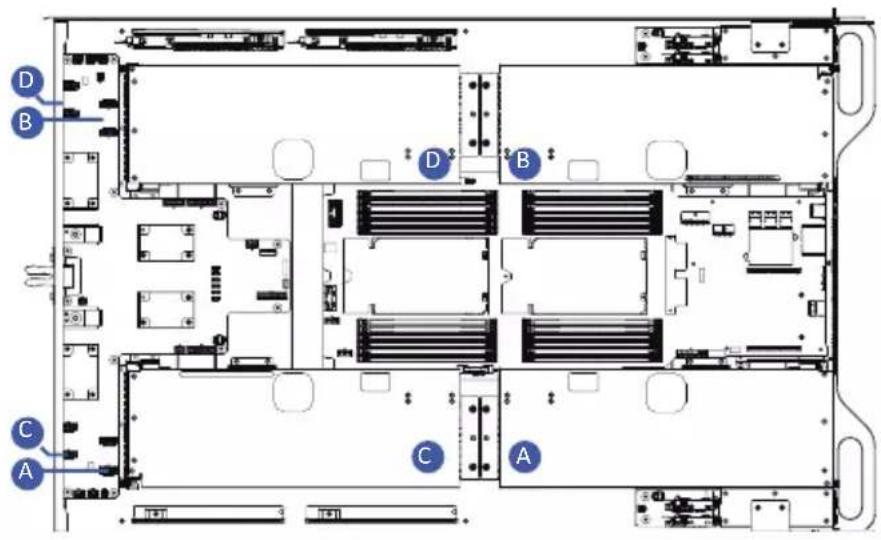
| A | GPU Card Power Cable(Reserved) | Front System Left GPU: -- |
| Power Distribution Board:A1: P12V_GPU3A2: P12V_GPU4 | ||
| B | Front System Right GPU: -- | |
| Power Distribution Board:B1: P12V_GPU7B2: P12V_GPU8 | ||
| C | Front System Right GPU: -- | |
| Power Distribution Board:C1:P12V_GPU1C2:P12V_GPU2 | ||
| D | Rear System Right GPU: -- | |
| Power Distribution Board:D1: P12V_GPU5D2: P12V_GPU6 |
Chapter 4 Motherboard Components
4-1 Motherboard Components
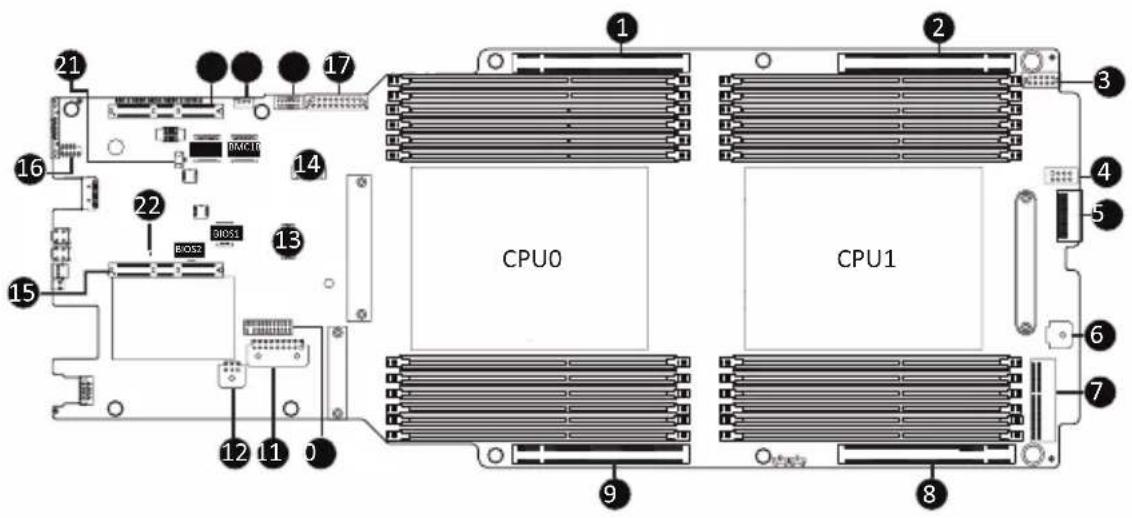
| Item Description | |
| 1 PCIe x16 Slot #1 | |
| 2 PCIe x16 Slot #3 | |
| 3 2 x 5 Pin ATX Power Connector | |
| 4 2 x 4 Pin ATX Power Connector | |
| 5 MC O Connector (P1_S/SATA) | |
| 6 2 x 3 Pin ATX Power Connector | |
| 7 MC O Connector (P1_P2/PCIe Gen5) | |
| 8 PCIe x16 Slot #4 | |
| 9 PCIe x16 Slot #2 | |
| 10 Front Panel Header (Primary) | |
| 11 2 x 9 Pin ATX Power Connector | |
| 12 2 x 3 Pin ATX Power Connector | |
| 13 HDD Back Plane Board Connector | |
| 14 TPM Module Connector | |
| 15 Proprietaey PCIe Slot(Gen5 x16) | |
| 16 Serial Port Cable Connector | |
| 17 2 x 9 Pin ATX Power Connector | |
| 18 Front Panel Header (Secondary) | |
| 19 12V Standby Power Connector | |
| 20 | Proprietaey PCIe Slot(Gen5 x16) |
| 21 System Battery Cable Connector | |
| 22 | BMC Firmware Readiness LED |
4-2 Jumper Settings
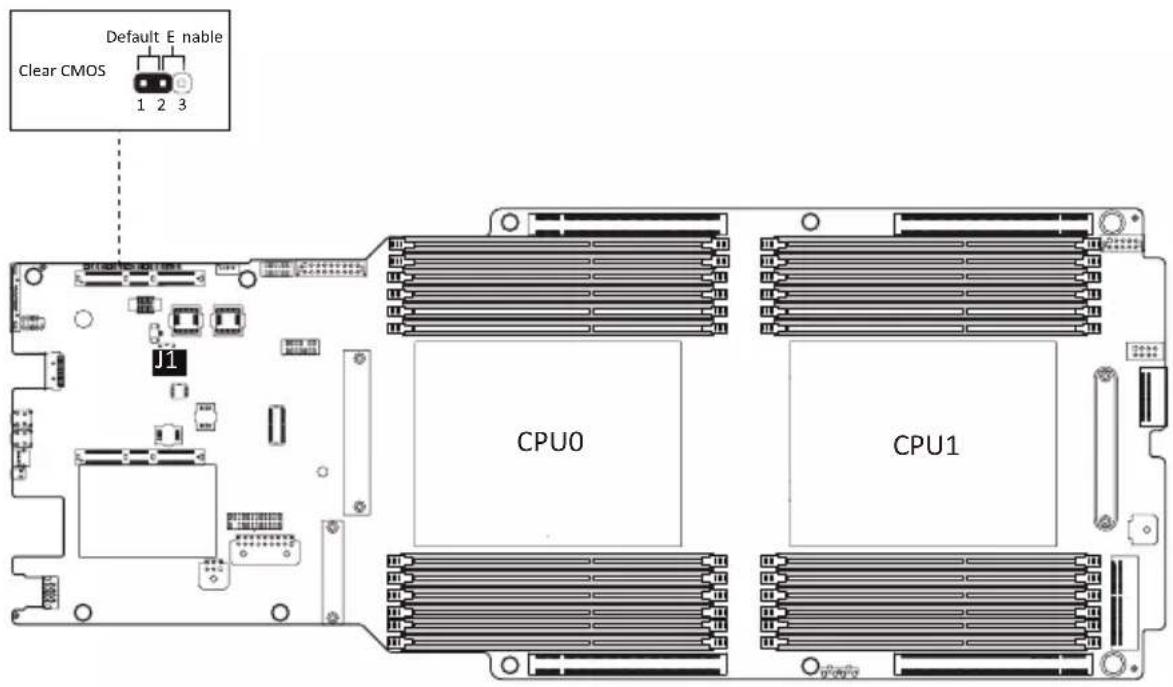
| J1 CIN OFF | ||
| 1 HOST_SMBUS_SEL BIOS defined | ||
| 2 Reserved BIOS defined | ||
| 3 BIOS_PWD Clear supervisor password Normal [Default] | ||
| 4 BIOS_RCVR BIOS recovery mode Normal [Default] | ||
Chapter 5 BIOS Setup
BIOS (Basic Input and Output System) records hardware parameters of the system in the EFI on the motherboard. Its major functions include conducting the Power-On Self-Test (POST) during system startup, saving system parameters, loading the operating system etc. The BIOS includes a BIOS Setup program that allows the user to modify basic system configuration settings or to activate certain system features. When the power is turned off, the battery on the motherboard supplies the necessary power to the CMOS to keep the configuration values in the CMOS.
To access the BIOS Setup program, press the key during the POST when the power is turned on.

- BIOS flashing is potentially risky, if you do not encounter any problems when using the current BIOS version, it is recommended that you don't flash the BIOS. To flash the BIOS, do it with caution. Inadequate BIOS flashing may result in system malfunction.
- It is recommended that you not alter the default settings (unless you need to) to prevent system instability or other unexpected results. Inadequately altering the settings may result in system's failure to boot. If this occurs, try to clear the CMOS values and reset the board to default values. (Refer to the Exit section in this chapter or introductions of the battery/clearing CMOS jumper in Chapter 4 for how to clear the CMOS values.)
BIOS Setup Program Function Keys
| <←><→> | Move the selection bar to select the screen |
| <↑><↓> | Move the selection bar to select an item |
| <+> | Increase the numeric value or make changes |
| <-> | Decrease the numeric value or make changes |
| Execute command or enter the submenu | |
| Main Menu: Exit the BIOS Setup programSubmenus: Exit current submenu | |
| Show descriptions of general help | |
| Restore the previous BIOS settings for the current submenus | |
| Load the Optimized BIOS default settings for the current submenus | |
| Save all the changes and exit the BIOS Setup program |
Main
This setup page includes all the items of the standard compatible BIOS.
■ Advanced
This setup page includes all the items of AMI BIOS special enhanced features.
(ex: Auto detect fan and temperature status, automatically configure hard disk parameters.)
AMD CBS
This setup page includes the common items for configuration of AMD motherboard-related information.
AMD PBS Option
This setup page includes the common items for configuration of AMD CPM RAS related settings.
Chipset
This setup page includes all the submenu options for configuring the functions of the North Bridge.
■ Server Management
Server additional features enabled/disabled setup menus.
■ Security
Change, set, or disable supervisor and user password. Configuration supervisor password allows you to restrict access to the system and BIOS Setup.
A supervisor password allows you to make changes in BIOS Setup.
A user password only allows you to view the BIOS settings but not to make changes.
Boot
This setup page provides items for configuration of the boot sequence.
■ Save & Exit
Save all the changes made in the BIOS Setup program to the CMOS and exit BIOS Setup. (Pressing
Abandon all changes and the previous settings remain in effect. Pressing
5-1 The Main Menu
Once you enter the BIOS Setup program, the Main Menu (as shown below) appears on the screen. Use arrow keys to move among the items and press
Main Menu Help
The on-screen description of a highlighted setup option is displayed on the bottom line of the Main Menu.
Submenu Help
While in a submenu, press

- When the system is not stable as usual, select the Restore Defaults item to set your system to its defaults.
- The BIOS Setup menus described in this chapter are for reference only and may differ by BIOS version.
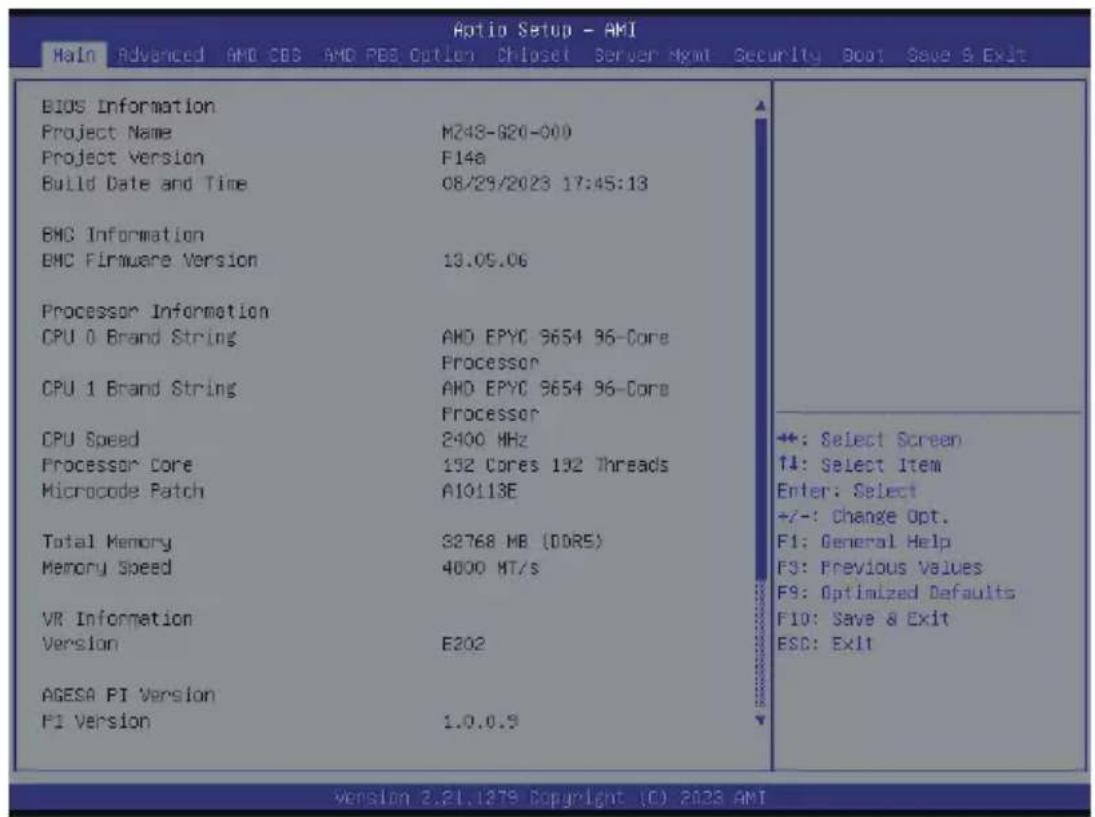
![Aptio Setup - AMI Main Advanced AMD CBS AMD PGS Option Chipset Server Mgmt Security Boot Save & Exit Processor Information CPU 0 Brand String CPU 1 Brand String CPU Speed Processor Core Microcode Patch Total Memory Memory Speed VR Information Version AGESA PI Version PI Version Onboard LAN Information LAN1 MAC Address LAN2 MAC Address System Date System Time AMD EPYC 9654 96-Core Processor AMD EPYC 9654 96-Core Processor 2400 MHz 192 Cores 192 Threads A10113E 82768 MB (DDR5) 4800 MT/s E202 1.0.0.9 74-56-3C-87-0F-0F 74-56-3C-87-0F-10 [Wed 09/06/2023] [09:03:36] Set the Time. Use Tab to switch between Time elements. +: Select Screen +1: Select Item Enter: Select +/-: Change Opt. F1: General Help F3: Previous Values F9: Optimized Defaults F10: Save & Exit ESC: Exit Version 2.21.1278 Copyright (C) 2023 AMI](/content/2026/04/656286/images/fcbff84b8074922fecce81e0269d808e53ed86e01239fae529e538227ec11430.jpg)
| Parameter | Description |
| BIOS Information | |
| Project Name | Displays the project name information. |
| Project Version | Displays version number of the BIOS setup utility. |
| Build Date and Time | Displays the date and time when the BIOS setup utility was created. |
| BMC Information^(Note1) | |
| BMC Firmware Version ^(Note1) | Displays BMC firmware version information. |
| Processor Information | |
| CPU Brand String/ CPU Speed / Processor Core / Microcode Patch | Displays the technical specifications for the installed processor(s). |
| Total Memory ^(Note2) | Displays the total memory size of the installed memory. |
| Memory Speed^(Note2) | Displays the frequency information of the installed memory. |
| VR Information Version Displays VR version information. | |
| AGESA PI Version | |
| PI Version Displays AGESA PI version information. | |
(Note1) Functions available on selected models.
(Note2) This section will display capacity and frequency information of the memory that the customer has installed.
| Parameter | Description |
| Onboard LAN Information | |
| LAN1 MAC Address ^(Note) | Displays LAN MAC address information. |
| LAN2 MAC Address ^(Note) | Displays LAN MAC address information. |
| System Date | Sets the date following the weekday-month-day-year format. |
| System Time | Sets the system time following the hour-minute-second format. |
(Note) The number of LAN ports listed will depend on the motherboard / system model.
5-2 Advanced Menu
The Advanced Menu displays submenu options for configuring the function of various hardware components. Select a submenu item, then press
When Boot Mode Select is set to UEFI (Default)
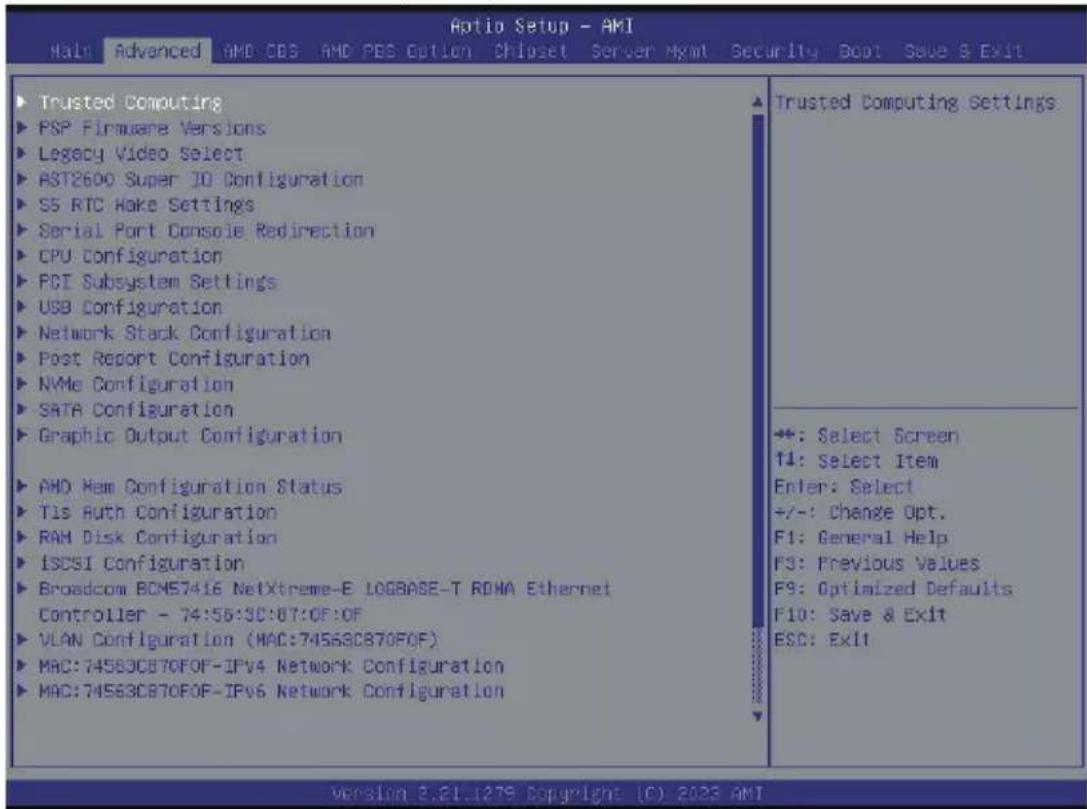

When "Boot Mode Select" is set to Legacy in the Boot > Boot Mode Select section
| Aptio Setup - AMI Main Advanced AMD CBS AMD PBS Option Chipset Server Mgmt Security Boot Save & Exit* | |
| Trusted Computing PSP Firmware Versions Legacy Video Select AST2600 Super IO Configuration S5 RTC Wake Settings Serial Port Console Redirection CPU Configuration PCI Subsystem Settings USB Configuration Network Stack Configuration NVMe Configuration SATA Configuration AMD Mem Configuration Status TIS Auth Configuration RAM Disk Configuration ISCSI Configuration | Trusted Computing Settings |
| +: Select Screen ↑↓: Select Item Enter: Select +/-: Change Opt. F1: General Help F3: Previous Values F9: Optimized Defaults F10: Save & Exit ESC: Exit | |
5-2-1 Trusted Computing
![Optio Setup - AMI Advanced Configuration Security Device Support [Enable] SPI TPM Support [Enabled] NO Security Device Found Enables or Disables BIOS support for security device, O.S. will not show Security Device. TCG EPI protocol and INTIA interface will not be available. +: Select Screen T1: Select Item Enter: Select +/-: Change Opt. F1: General Help F3: Previous Values F9: Optimized Defaults F10: Save & Exit ESC: Exit Version 2.21.1279 Copyright (C) 2023 AMI](/content/2026/04/656286/images/9cd52faaa30e9ac7c4bafd197f92b650091a3a6e9ba985abaf6f81101b06361f.jpg)
| Parameter | Description |
| Configuration | |
| Security Device Support | Enable/Disable BIOS support for security device. OS will not show security device. TCG EFI protocol and INT1A interface will not be available.Options available: Disable, Enable. Default setting is Enable. |
| SPI TPM Support | Select Enable to activate TPM support feature.Options available: Disabled, Enabled. Default setting is Disabled. |
5-2-2 PSP Firmware Versions
The PSP Firmware Versions page displays the basic PSP firmware version information. Items on this window are non-configurable.
| PSP Firmware Versions | |
| ABL Version 10098012 FSP BootLoader Version 00.29.00.93 SHU FW Version 04.71.115.00 SEV FW Version 01.01.37.18 PHY FW Version 00.01.37.00 MPIO FW Version 01.00.28.07 TF MPDMA FW Version 00.47.03.00 FM MPDMA FW Version 00.47.3F.00 GHI FW Version AB.01.27.00 RIB FW Version 02.00.08.33 SEC FW Version 00.0E.50.6A PMU FW Version 00.00.90.49 EMCR FW version 00.00.E6.45 uCode B1 Version A10113E | +: Select Screen ↑↓: Select Item Enter: Select +/-: Change Opt. F1: General Help F3: Previous Values F9: Optimized Defaults F10: Save & Exit ESC: Exit |
5-2-3 Legacy Video Select
| Optio Setup - AMI | |
| Advanced | |
| OnBrd/Ext VGA Select [Auto] | Select between onboard or external VGA support. |
| ++: Select Screen T↓: Select Item Enter: Select +/-: Change Opt. F1: General Help F3: Previous Values F9: Optimized Defaults F10: Save & Exit ESC: Exit | |
| Version 2.21.1279 Copyright (6) 2022 AMI | |
| Parameter | Description |
| OnBrd/Ext VGA Select | Selects between onboard or external VGA support. Options available: Auto, Onboard, External. Default setting is Auto. |
(Note) This configurable option will be displayed when "Boot Mode Select" is set to Legacy in the Boot > Boot Mode Select section.
5-2-4 AST2600 Super IO Configuration
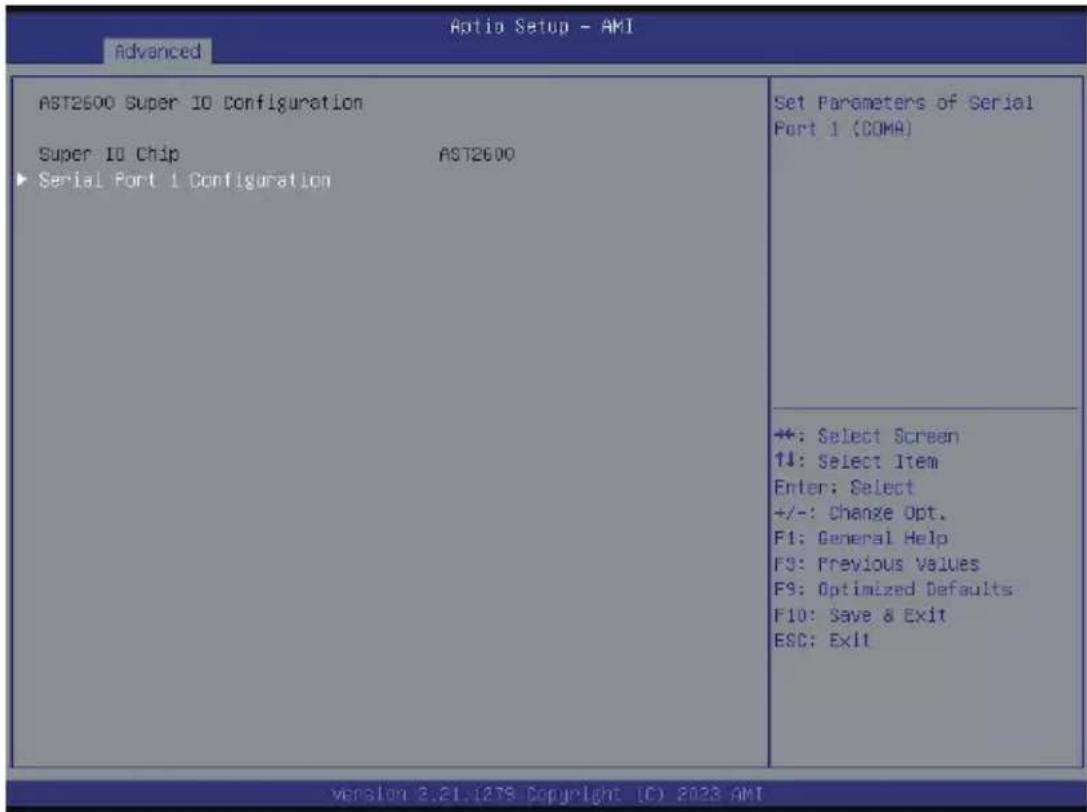
| Parameter | Description |
| AST2600 Super IO Configuration | |
| Super IO Chip Displays the super IO chip information | |
| Serial Port 1 Configuration | Press [Enter] for configuration of advanced items. |
5-2-4-1 Serial Port 1 Configuration
![Advanced Serial Port 1 Configuration Serial Port [Enabled] Device Settings IO=3F8h; IRQ=4; Change Settings [Auto] Enable or Disable Serial Port (COM) +: Select Screen T↓: Select Item Enter: Select +/-: Change Opt. F1: General Help F3: Previous Values F9: Optimized Defaults F10: Save & Exit ESC: Exit Version 2.21.1279 Copyright (C) 2023 AMI](/content/2026/04/656286/images/7255c9ca0ca9a298c3b1454290a44f0782582299ff833900fd37718e92918caa.jpg)
| Parameter | Description |
| Serial Port 1 Configuration | |
| Serial Port ^(Note) | Enable/Disable the Serial Port (COM). When set to Enabled allows you to configure the Serial port 1 settings. When set to Disabled, displays no configuration for the serial port.Options available: Disabled, Enabled. Default setting isEnabled. |
| Devices Settings Displays the Serial Port 1 device settings. | |
| Change Settings | Select an optimal settings for Super IO Device.Options available for Serial Port 1:AutoIO=3F8h; IRQ=4;IO=3F8h; IRQ=3, 4, 5, 6, 7, 9, 10, 11, 12;IO=2F8h; IRQ=3, 4, 5, 6, 7, 9, 10, 11, 12;IO=3E8h; IRQ=3, 4, 5, 6, 7, 9, 10, 11, 12;IO=2E8h; IRQ=3, 4, 5, 6, 7, 9, 10, 11, 12;Default setting isAuto. |
(Note) Advanced items prompt when this item is defined.
5-2-5 S5 RTC Wake Settings
| Optio Setup - AMI | |
| Advanced | |
| Make system from SS [Disabled] | Enable or disable System wake on alarm event. Select FixedTime, system will wake on the hr::min::sec specified. Select DynamicTime, System will wake on the current time + Increase minute(s) |
| +: Select Screen ↑↓: Select Item Enter: Select +/-: Change Opt. F1: General Help F3: Previous Values F9: Optimized Defaults F10: Save & Exit ESC: Exit | |
| Version 2.21.1278 Copyright (C) 2023 AMI | |
| Parameter | Description |
| Wake System from S5 | Enable/Disable system wake on alarm event. Options available: Disabled, Fixed Time, Dynamic Time. When Fixed Time is selected, system will wake on the hr::min::sec specified. Default setting is Disabled. |
5-2-6 Serial Port Console Redirection
![Optio Setup - AMI Advanced COM1/SOL Console Redirection [Enabled] ► Console Redirection Settings COM2 (Disabled) Console Redirection Port Is Disabled Legacy Console Redirection ► Legacy Console Redirection Settings Serial Port for Out-of-Band Management/ Windows Emergency Management Services (EMS) Console Redirection EMS [Enabled] ► Console Redirection Settings Console Redirection Enable or Disable. +: Select Screen ↑↓: Select Item Enter: Select +/-: Change Opt. F1: General Help F3: Previous Values F9: Optimized Defaults. F10: Save & Exit ESC: Exit Version 2.21.1278 Copyright (C) 2023 AMI](/content/2026/04/656286/images/23e83728fdefa938d2925cb2fd451ed9383c0af7ce865f0836ba86ec967ead04.jpg)
| Parameter | Description |
| COM1/Serial Over LANConsole Redirection ^(Note) | Select whether to enable console redirection for specified device. Console redirection enables the users to manage the system from a remote location.Options available: Enabled, Disabled. Default setting isDisabled. |
| COM1/Serial Over LANConsole Redirection Settings | Press [Enter] to configure advanced items.Please note that this item is configurable when COM1/Serial Over LAN Console Redirection is set to Enabled.Terminal Type- Selects a terminal type to be used for console redirection.- Options available: VT100, VT100+, ANSI, VT-UTF8. Default setting isANSI.Bits per second- Selects the transfer rate for console redirection.- Options available: 9600, 19200, 38400, 57600, 115200. Default setting is115200.Data Bits- Selects the number of data bits used for console redirection.- Options available: 7, 8. Default setting is8. |
(Note) Advanced items prompt when this item is defined.
| Parameter | Description |
| COM1/Serial Over LAN Console Redirection Settings (continued) | Parity– A parity bit can be sent with the data bits to detect some transmission errors.– Even: parity bit is 0 if the num of 1's in the data bits is even.– Odd: parity bit is 0 if num of 1's in the data bits is odd.– Mark: parity bit is always 1. Space: Parity bit is always 0.– Mark and Space Parity do not allow for error detection.– Options available: None, Even, Odd, Mark, Space. Default setting is None.Stop Bits– Stop bits indicate the end of a serial data packet. (A start bit indicates the beginning). The standard setting is 1 stop bit.Communication with slow devices may require more than 1 stop bit.– Options available: 1, 2. Default setting is 1.Flow Control– Flow control can prevent data loss from buffer overflow. When sending data, if the receiving buffers are full, a 'stop' signal can be sent to stop the data flow. Once the buffers are empty, a 'start' signal can be sent to re-start the flow. Hardware flow control uses two wires to send start/stop signals.– Options available: None, Hardware RTS/CTS. Default setting is None.VT-UTF8 Combo Key Support– Enable/Disable the VT-UTF8 Combo Key Support.– Options available: Enabled, Disabled. Default setting is Enabled.Recorder Mode– When this mode enabled, only texts will be send. This is to capture Terminal data.– Options available: Enabled, Disabled. Default setting is Disabled.Resolution 100x31– Enable/Disable extended terminal resolution.– Options available: Enabled, Disabled. Default setting is Enabled.Putty KeyPad– Selects Function Key and KeyPad on Putty.– Options available: VT100, LINUX, XTERMR6, SC0, ESCN, VT400. Default setting is VT100. |
| Legacy Console Redirection | |
| Legacy Console Redirection Settings | Press [Enter] to configure advanced items.◆Redirection COM Port-Selects a COM port for Legacy serial redirection.-Default setting isCOM1/SOL.◆Resolution-Selects the number of rows and columns used in Console Redirection for legacy OS support.-Options available: 80x24, 80x25. Default setting is80x24.◆Redirect After POST-When Bootloader is selected, then Legacy Console Redirection is disabled before booting to legacy OS. When Always Enable is selected, then Legacy Console Redirection is enabled for legacy OS.-Options available: Always Enable, BootLoader. Default setting isAlways Enable. |
| Serial Port for Out-of-Band Management / Windows Emergency Management Services (EMS) Console Redirection ^(Note) | EMS console redirection allows the user to configure Console Redirection Settings to support Out-of-Band Serial Port management.Options available: Disabled, Enabled. Default setting isDisabled. |
| Serial Port for Out-of-Band EMS Console Redirection Settings | Press [Enter] to configure advanced items.Please note that this item is configurable when Serial Port for Out-of-Band Management EMS Console Redirection is set to Enabled.◆Out-of-Band Mgmt Port-Microsoft Windows Emergency Management Service (EMS) allows for remote management of a Windows Server OS through a serial port.-Default setting isCOM1/SOL.◆Terminal Type-Selects a terminal type to be used for console redirection.-Options available: VT100, VT100+, ANSI, VT-UTF8. Default setting isANSI.◆Bits per second-Selects the transfer rate for console redirection.-Options available: 9600, 19200, 57600, 115200. Default setting is115200. |
(Note) Advanced items prompt when this item is defined.
| Parameter | Description |
| Serial Port for Out-of-Band EMS Console Redirection Settings(continued) | Flow Control– Flow control can prevent data loss from buffer overflow. When sending data, if the receiving buffers are full, a 'stop' signal can be sent to stop the data flow. Once the buffers are empty, a 'start' signal can be sent to re-start the flow. Hardware flow control uses two wires to send start/stop signals.– Options available: None, Hardware RTS/CTS, Software Xon/Xoff. Default setting is None. |
5-2-7 CPU Configuration
![Optio Setup - AMI Advanced CPU Configuration SVM Mode [Enabled] ► CPU 0 Information ► CPU 1 Information Enable/disable CPU Virtualization +: Select Screen ↑↓: Select Item Enter: Select +/-: Change Opt. F1: General Help F3: Previous Values F9: Optimized Defaults F10: Save & Exit ESC: Exit version 2.21.1278 Copyright (C) 2023 AMI](/content/2026/04/656286/images/6aeb07456c40e9256c2d33b85b8cbfc277616dde575f6cc8e0bb7f0c3371c9b0.jpg)
| Parameter | Description |
| SVM Mode | Enable/Disable the CPU Virtualization.Options available: Disabled, Enabled. Default setting is Enabled. |
| CPU 0/1 Information | Press [Enter] to view the memory information related to CPU 0/1. |
5-2-8 PCI Subsystem Settings
![Optio Setup - AMI Advanced PCI Bus Driver Version AS.01.28 GENZ_1 [Auto] GENZ_1 I/O ROM [Enabled] GENZ_1 Link Speed [Auto] GENZ_2 [Auto] GENZ_2 I/O ROM [Enabled] GENZ_2 Link Speed [Auto] PCIE_1 [Auto] PCIE_1 I/O ROM [Enabled] PCIE_1 Link Speed [Auto] PCIE_2 [Auto] PCIE_2 I/O ROM [Enabled] PCIE_2 Link Speed [Auto] PCIE_3 [Auto] PCIE_3 I/O ROM [Enabled] PCIE_3 Link Speed [Auto] PCIE_4 [Auto] PCIE_4 I/O ROM [Enabled] PCIE_4 Link Speed [Auto] Change GENZ_1 PCIe lanes. ++: Select Screen ↑: Select Item Enter: Select +/-: Change Opt. F1: General Help F3: Previous Values F9: Optimized Defaults F10: Save & Exit ESC: Exit Version 2.21.1279 Copyright (C) 2023 AMI](/content/2026/04/656286/images/fe21caf266db3c6c6f6e1a48721bed3c4ddb15929ed637b0265fe72a52cb237d.jpg)
![Optio Setup - AMI Advanced PCIE_1 [Auto] PCIE_1 I/O ROM [Enabled] PCIE_1 Link Speed [Auto] PCIE_2 [Auto] PCIE_2 I/O ROM [Enabled] PCIE_2 Link Speed [Auto] PCIE_3 [Auto] PCIE_3 I/O ROM [Enabled] PCIE_3 Link Speed [Auto] PCIE_4 [Auto] PCIE_4 I/O ROM [Enabled] PCIE_4 Link Speed [Auto] Onboard LAN Controller [Enabled] Onboard LAN1 I/O ROM [Enabled] Onboard LAN2 I/O ROM [Enabled] PCI Devices Common Settings: Above 4G Decoding [Enabled] SR-IOv Support [Enabled] Relaxed Ordering [Enabled] Enables or Disables PCI Express Device Relaxed Ordering. ++: Select Screen T4: Select Item Enter: Select +/-: Change Opt. F1: General Help F9: Previous Values F9: Optimized Defaults F10: Save & Exit ESC: Exit Version 2.21.1278 Copyright (C) 2023 AMI](/content/2026/04/656286/images/7866558472ac2ec83b095ef4558d9bfd31d52f2d4e73fc9b6d1791124decb5ef.jpg)
| Parameter | Description |
| PCI Bus Driver Version | Displays the PCI Bus Driver version information. |
| GENZ_#_Lanes Configuration ^(Note1) | Change the PCIe lanes.Options available: Disabled, Auto, x16, x8x8, x8x4x4, x4x4x8, x4x4x4x4. Default setting isAuto. |
| GENZ_#_I/O ROM ^(Note1) | When enabled, this setting will initialize the device expansion ROM for the related PCI-E slot.Options available: Disabled, Enabled. Default setting isEnabled. |
| GENZ_#_Link Speed ^(Note1) | Configure PCIe max link speed.Options available: Auto, Gen5, Gen4, Gen3, Gen2, Gen1.Default setting isAuto. |
| PCI_#Lanes ^(Note2) | Change mezzanine PCIe lanes.Options available: Disabled, Auto, x16, x8x8, x8x4x4, x4x4x8, x4x4x4x4. Default setting isAuto. |
| PCI_# I/O ROM ^(Note2) | When enabled, this setting will initialize the device expansion ROM for the related devices.Options available: Disabled, Enabled. Default setting isEnabled. |
| PCI_# Link Speed ^(Note2) | Configure mezzanine OCP max link speed.Options available: Auto, Gen5, Gen4, Gen3, Gen2, Gen1.Default setting isAuto. |
| Onboard LAN Controller ^(Note3) | Enable/Disable the onboard LAN devices.Options available: Disabled, Enabled. Default setting isEnabled. |
| Onboard LAN# I/O ROM ^(Note3) | Enable/Disable the onboard LAN devices, and initializes device expansion ROM.Options available: Disabled, Enabled. Default setting isEnabled. |
| PCI Devices Common Settings | |
| Above 4G Decoding | Enable/Disable memory mapped I/O to 4GB or greater address space (Above 4G Decoding).Options available: Disabled, Enabled. Default setting isEnabled. |
| SR-IOV Support | If the system has SR-IOV capable PCIe devices, this item Enable/Disable Single Root IO Virtualization Support.Options available: Disabled, Enabled. Default setting isEnabled. |
| Relaxed Ordering | Enable/Disable PCI express device relaxed ordering.Options available: Disabled, Enabled. Default setting isEnabled. |
(Note1) This section is dependent on the available Riser Slot.
(Note2) This section is dependent on the available PCI connector.
5-2-9 USB Configuration
![Optio Setup - AMI Advanced USB Configuration USB Module version 29 USB Controllers: 2 XHCIs USB Devices: 8 Drives, 1 Keyboard, 1 Mouse, 3 Hubs Legacy USB Support [Enabled] XHCI Hand-off [Enabled] USB Mass Storage Driver Support [Enabled] USB hardware delays and time-outs: USB transfer time-out [20 sec] Device reset time-out [20 sec] Device power-up delay [Auto] Mass Storage Devices: AMI Virtual CDROK0 1.00 [Auto] AMI Virtual HDisk0 1.00 [Auto] AMI Virtual CDROK1 1.00 [Auto] AMI Virtual CDROK2 1.00 [Auto] AMI Virtual CDROK3 1.00 [Auto] AMI Virtual HDisk1 1.00 [Auto] Enables Legacy USB support. AUTO option disables legacy support if no USB devices are connected. DISABLE option will keep USB devices available only for EFI applications. ++: Select Screen ↑↓: Select Item Enter: Select +/-: Change Opt. F1: General Help F3: Previous Values F9: Optimized Defaults F10: Save & Exit ESC: Exit Version 2.21.1279 Copyright (C) 2023 AMI](/content/2026/04/656286/images/e26c7907cc426693e1b840f8c404a987578a2ef13a56206083486a4b7b7b29c8.jpg)
| Parameter | Description |
| USB Configuration | |
| USB Module Version | Displays the USB module version information. |
| USB Controllers | Displays the supported USB controllers. |
| USB Devices: | Displays the USB devices connected to the system. |
| Legacy USB Support | Enable/Disable the Legacy USB support function. AUTO option disables legacy support if no USB devices are connected. DISABLE option will keep USB devices available only for EFI applications.Options available: Enabled, Disabled, Auto. Default setting is Enabled. |
| XHCI Hand-off | Enable/Disable the XHCI Hand-off support.Options available: Enabled, Disabled. Default setting is Enabled. |
| USB Mass Storage Driver Support ^(Note) | Enable/Disable the USB Mass Storage Driver Support.Options available: Disabled, Enabled. Default setting is Enabled. |
| USB hardware delays and time-outs | |
| USB transfer time-out | Selects the time-out value for USB Control/Bulk/Interrupt transfers.Options available: 1 sec, 5 sec, 10 sec, 20 sec.Default setting is 20 sec. |
(Note) This item is present only if you attach USB devices.
| Parameter | Description |
| Device reset time-out | Selects the time-out value during a USB mass storage device reset. Options available: 10 sec, 20 sec, 30 sec, 40 sec. Default setting is 20 sec. |
| Device power-up delay | Maximum time the device will take before it properly reports itself to the Host Controller. "Auto" uses default value: for a Root port it is 100 ms, for a Hub port the delay is taken from Hub descriptor. Options available: Auto, Manual. Default setting is Auto. |
5-2-10 Network Stack Configuration
![Advanced Optio Setup - AMI Network Stack [Enabled] Ipv4 PXE Support [Enabled] Ipv4 HTTP Support [Disabled] Ipv6 PXE Support [Enabled] Ipv6 HTTP Support [Disabled] PXE boot wait time 1 Media detect count 1 Enable/Disable UEFI Network Stack +: Select Screen ↑↓: Select Item Enter: Select +/-: Change Opt. F1: General Help F3: Previous Values FS: Optimized Defaults. F10: Save & Exit ESC: Exit Version 3.21.1279 Copyright (C) 2023 AMI](/content/2026/04/656286/images/612f3191366404af3dba6329a0a351590820938cbb188e540fdd45b76c5d251d.jpg)
| Parameter | Description |
| Network Stack | Enable/Disable the UEFI network stack.Options available: Enabled, Disabled. Default setting is Enabled. |
| Ipv4 PXE Support | Enable/Disable the lpv4 PXE feature.Options available: Enabled, Disabled. Default setting is Enabled. |
| Ipv4 HTTP Support | Enable/Disable the lpv4 HTTP feature.Options available: Enabled, Disabled. Default setting is Disabled. |
| Ipv6 PXE Support | Enable/Disable the lpv6 PXE feature.Options available: Enabled, Disabled. Default setting is Enabled. |
| Ipv6 HTTP Support | Enable/Disable the lpv6 HTTP feature.Options available: Enabled, Disabled. Default setting is Disabled. |
| PXE boot wait time | Wait time in seconds to press ESC key to abort the PXE boot.Press the <+> / <-> keys to increase or decrease the desired values. |
| Media detect count | Number of times the presence of media will be checked.Press the <+> / <-> keys to increase or decrease the desired values. |
5-2-11 Post Report Configuration
![Optio Setup - AMI Advanced Post Report Configuration Error Message Report Post Error Message [Enabled] Halt On [No Error] Post Error Message Support Enabled/Disabled +: Select Screen +: Select Item Enter: Select +/-: Change Opt. F1: General Help F3: Previous Values F9: Optimized Defaults F10: Save & Exit ESC: Exit Version 2.21.1279 Copyright (C) 2023 AMI](/content/2026/04/656286/images/7fc71fa756600787832c23f004ebca4672feb9607eaa94ee9cf90bc92984e788.jpg)
| Parameter | Description |
| Post Report Configuration | |
| Error Message Report | |
| Post Error Message | Enable/Disable the POST Error Message support. Options available: Enabled, Disabled. Default setting is Enabled. |
| Halt On | Options available: No Error, All Error. Default setting is No Error. |
5-2-12 NVMe Configuration
![Optio Setup - AMI Advanced NVMe controller and Drive information NVMe LED Control [System Default] Bus:81 Dev:0 Func:0 SAMSUNG MZTL23T8HCLS-00A07 Nyme Size 3840.7GB Bus:82 Dev:0 Func:0 SAMSUNG MZTL23T8HCLS-00A07 Nyme Size 3840.7GB Bus:83 Dev:0 Func:0 SAMSUNG MZTL23T8HCLS-00A07 Nyme Size 3840.7GB Bus:84 Dev:0 Func:0 SAMSUNG MZTL23T8HCLS-00A07 Nyme Size 3840.7GB Enable Nyme Led Control +: Select Screen ↑↓: Select Item Enter: Select +/-: Change Opt. F1: General Help F3: Previous Values F9: Optimized Defaults F10: Save & Exit ESC: Exit version 2.21.1278 Copyright (C) 2023 AMI](/content/2026/04/656286/images/5c42c85d511d9774fda2905efcad80f73917820f5cf6120a88fe5ab590f7f4b3.jpg)
| Parameter | Description |
| NVMe Configuration | Displays the NVMe devices connected to the system. |
| NVMe LED Control | Enable/Disable NVMe LED Control.Options available: System Default, Disabled, Enabled.Default setting is Enabled. |
5-2-13 SATA Configuration
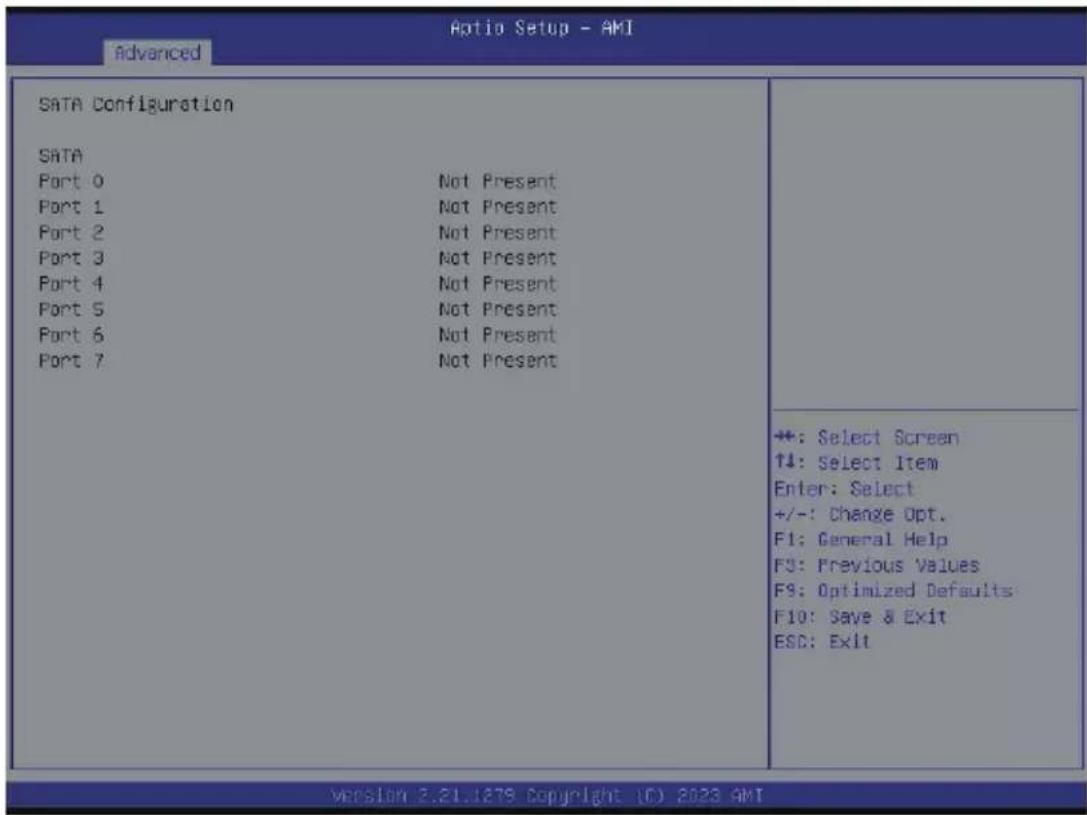
| Parameter | Description |
| SATA Configuration | Displays the installed HDD devices information. System will automatically detect HDD type. |
5-2-14 Graphic Output Configuration
![Optio Setup - AMI Advanced Graphic Output Configuration Output Device Type [Onboard Device] Select Output Device Type +: Select Screen ↑↓: Select Item Enter: Select +/-: Change Opt. F1: General Help F3: Previous Values F9: Optimized Defaults F10: Save & Exit ESC: Exit version 2.21.1278 Copyright (C) 2023 AMI](/content/2026/04/656286/images/5c1fe02b87077c3dd446595a60f7c41f4ab541dfd5e59c98ac1a33bedf9415a9.jpg)
| Parameter | Description |
| Output Device Type | Selects output device type. Options available: First loaded Device, Onboard Device, External Device, Specific Device. Default setting is Onboard Device. |
5-2-15 AMD Mem Configuration Status
| Optio Setup - AMI Advanced | |
| CPU 0 CPU 1 Mblst Test Enable Disabled, 0xC000 Mblst Aggressor Enable Disabled, 0xC000 Mblst Per Bit Slave Die Report 0x00FF, 0xC000 Dram Temp Controlled Refresh Disabled, 0xC001 Enable User Timing Mode Disabled, 0x0000 User Timing Value Disabled, 0x0000 Mem Bus Freq Limit Disabled, 0x0000 Enable Power Down Disabled, 0xC000 Dram Double Refresh Rate Disabled, 0x0000 Pmu Train Mode 0x0000, 0xC000 Ecc Symbol Size 0x0000, 0xC000 Uncorrectable Ecc Retry Disabled, 0xC004 Ignore Spd Checksum Disabled, 0xC000 Enable Bank Group Swap Ait Disabled, 0x0000 Enable Bank Group Swap Disabled, 0xC000 Addr Route Balanced Tee Disabled, 0xC004 Nvidia Power Source 0x0000, 0xC004 Odts Cmd Throt Enable Disabled, 0xC004 Odts Cmd Throt Cycle Disabled, 0xC004 | Socket-specific memory configuration status |
| +: Select Screen ↑↓: Select Item Enter: Select +/-: Change Opt. F1: General Help F3: Previous Values F9: Optimized Defaults F10: Save & Exit ESC: Exit | |
| Parameter | Description |
| CPU 0/1 | Press [Enter] to view the memory configuration status related to CPU 0/1. |
5-2-16 TIs Auth Configuration
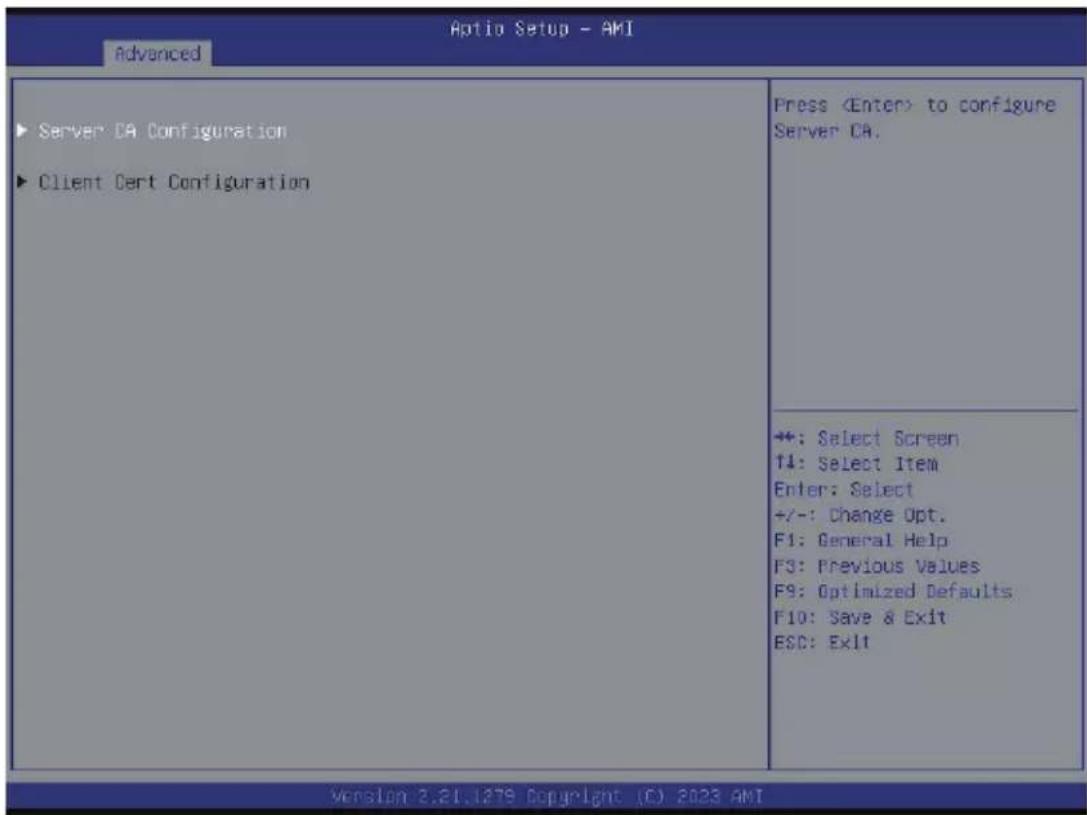
| Parameter Description | |
| Server CA Configuration | Press [Enter] for configuration of advanced items.◆ Enroll Cert- Press [Enter] to enroll a certificate• Enroll Cert Using File• Cert GUIDInput digit character in 1111111-2222-3333-4444-1234567890ab format.- Commit Changes and Exit- Discard Changes and Exit◆ Delete Cert |
| Client Cert Configuration | Press [Enter] for configuration of advanced items. |
5-2-17 RAM Disk Configuration
| Disk Memory Type: [Boot Service Date] | Specifies type of memory to use from available memory pool in system to create a disk. |
| Create raw Create from file Created RAM disk list: Remove selected RAM disk(s). | |
| +: Select Screen ↑↓: Select Item Enter: Select +/-: Change Opt. F1: General Help F3: Previous Values F9: Optimized Defaults F10: Save & Exit ESC: Exit |
| Parameter | Description |
| Disk Memory Type | Specifies the type of memory to use from available memory pool in system to create a disk.Options available: Boot Service Data, Reserved.Default setting isBoot Service Data. |
| Create Raw | Creates a raw RAM diskSIZE (Hex)- Input a valid RAM disk size that should be multiple of the RAM disk block size.Create & ExitDiscard & Exit |
| Create from file | Creates a RAM disk from a given file. |
| Created RAM disk list | |
| Remove selected RAM disk(s) | Selects the RAM disk(s) to remove. |
5-2-18 iSCSI Configuration
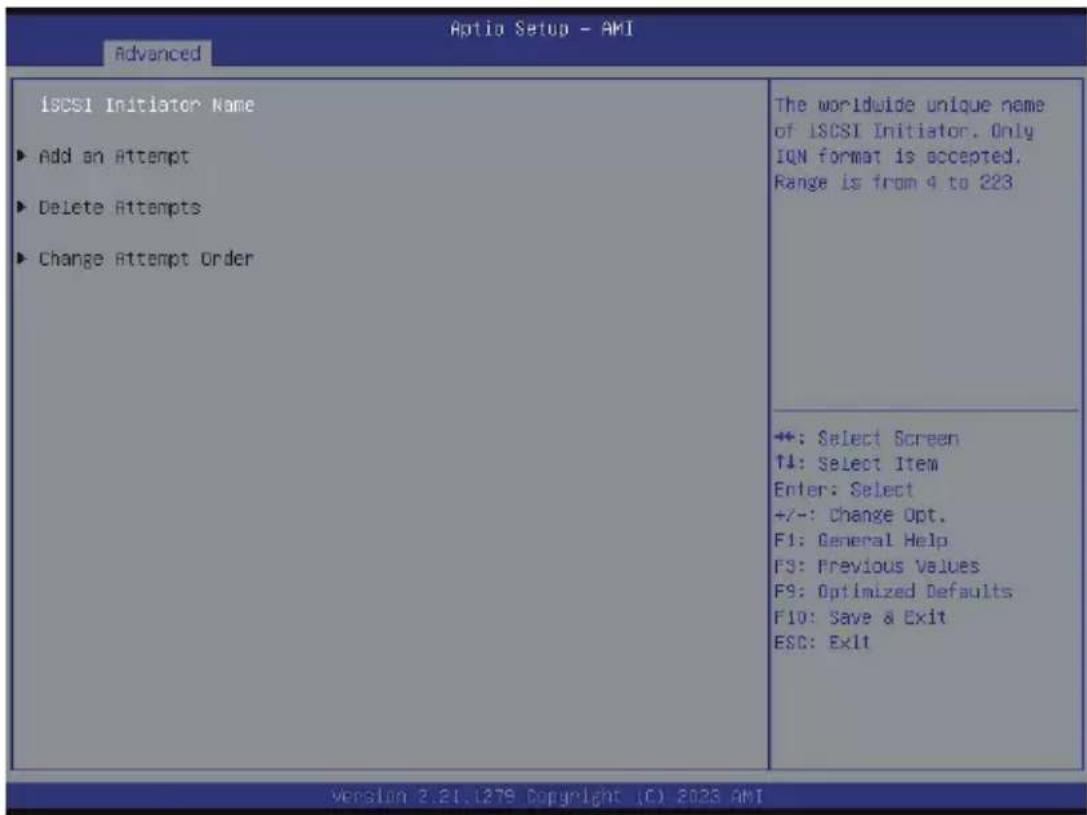
| Parameter | Description |
| iSCSI Initiator Name | Press [Enter] and name iSCSI Initiator. Only IQN format is accepted. Range: from 4 to 223 |
| Add an Attempt | Press [Enter] to configure advanced items. |
| Delete Attempts | Press [Enter] to configure advanced items. |
| Change Attempt Order | Press [Enter] to configure advanced items. |
5-2-19 Broadcom BCM57416 10GBASE-T Network Connection
![Aptio Setup - AMI Advanced ► Firmware Image Menu ► Device Configuration Menu ► MBA Configuration Menu Blink LEDs 0 Link Status [Connected] Physical Link Speed 1Gbps Chip Type BCM57416 B1 PCI Device ID 16D8 Bus:Device:Function 01:00:00 Permanent MAC Address 74:56:80:87:0F:0F Virtual MAC Address 74:56:80:87:0F:0F Restore Defaults Firmware image information. +: Select Screen ↑↓: Select Item Enter: Select +/-: Change Opt. F1: General Help F3: Previous Values F9: Optimized Defaults F10: Save & Exit ESC: Exit version 2.21.1279 Copyright (C) 2023 AMI](/content/2026/04/656286/images/802dbe16b2c5f6fb46825d2468c3e6eb1d5fb3f2ee6289d5dfa3f1d369986829.jpg)
Parameter Description
| Firmware Image Menu | Press [Enter] to view firmware image information. |
| Device Configuration Menu | Press [Enter] to configure advanced items.◆ Multi-Function Mode– Configures the NIC Hardware Mode.– Options available: SF, NPAR 1.0. Default setting isSF.◆ SR-IOV– Enable/Disable Single Root I/O Virtualization.– Options available: Disabled, Enabled. Default setting isDisabled.◆ Number of MSI-X Vectors per VF– Configures the number of MSI-X Vectors per VF (0-128).– Default setting is16.◆ Maximum Number of PF MSI-X Vectors– Configures the maximum number of PF MSI-X Vectors (0-512 per controller).– Default setting is74.◆ Energy Efficient Ethernet– Enable/Disable Energy Efficient Ethernet operation.– Options available: Disabled, Enabled. Default setting isDisabled.◆ Operational Link Speed– Configures the link speed setting to be used as the default link speed for the selected port.– Options available: AutoNeg. Default setting isAutoNeg. |
| Parameter | Description |
| Device Configuration Menu (continued) | Support RDMA- Enable/Disable RDMA support for this port.- Options available: Disabled, Enabled. Default setting isDisabled.DCB Protocol- Enable/Disable DCB protocol.- Options available: Disabled, Enabled (IEEE only), CEE (only), Both (IEEE preferred with fallback to CEE). Default setting isDisabled.LLDP nearest bridge- Enable/Disable LLDP nearest bridge state.- Options available: Disabled, Enabled. Default setting isEnabled.Default EVB Mode- Configures the default Edge Virtual Bridging mode.- Options available: VEB, VEPA, None. Default setting isVEB.Enable PME Capability- Enable/Disable PME Capability support.- Options available: Disabled, Enabled. Default setting isEnabled.Flow Offload- Options available: Enabled, Disabled. Default setting isDisabled.Live Firmware Upgrade- Options available: Enabled, Disabled. Default setting isDisabled.Adapter Error Recovery- Options available: Enabled, Disabled. Default setting isDisabled. |
| MBA Configuration Menu | Press [Enter] to configure advanced items.Option ROM- Enable/Disable Boot Option ROM.- Options available: Disabled, Enabled. Default setting isEnabled.Legacy Boot Protocol- Selects non-UEFI Boot Protocol: Preboot Execution Environment (PXE)/iSCSI.- Options available: PXE, iSCSI, NONE. Default setting isPXE.Bot Strap Type- Selects the boot strap type. Options available: Auto Detect, BBS, Int 18h, Int 19h. Default setting isAuto Detect.Hide Setup Prompt- Configures whether the Setup Prompt is displayed during ROM initialization.- Options available: Disabled, Enabled. Default setting isDisabled.Setup Key Stroke- Configures key strokes to invoke the configuration menu.- Options available: Ctrl-S, Ctrl-B. Default setting isCtrl-S.banner Message Timeout- Selects the timeout value. (0 defaults to 4 seconds, 15 is no delay, 1-14 is timeout value in seconds)- Default setting is5. |
| Parameter Description | |
| MBA Configuration Menu (continued) | ◆ Pre-boot Wake On LAN– Configures Pre-boot Wake on LAN (WOL).– Options available: Disabled, Enabled. Default setting is Enabled.◆ VLAN Mode– Configures the virtual LAN (VLAN) mode.– Options available: Disabled, Enabled. Default setting is Disabled.◆ VLAN ID– Configures the VLAN ID (1...4094).– This item is available only when VLAN Mode is Enabled.◆ Boot Retry Count– Selects the number of boot retries.– Options available: No Retry, 1 Retry, 2 Retries, 3 Retries, 4 Retries, 5 Retries, 6 Retries, Indefinite Retries. Default setting is No Retry. |
| iSCSI Boot Configuration Menu | Press [Enter] to configure advanced items. |
| Blink LEDs | Identifies the physical network port by blinking the associated LED.Press the numeric keys to adjust desired values. |
| Link Status | Specifies the link status of the port. |
| Physical Link Speed | Displays the technical specifications for the Network Interface Controller. |
| Chip Type | Displays the technical specifications for the Network Interface Controller. |
| PCI Device ID | Displays the technical specifications for the Network Interface Controller. |
| Bus:Device:Function | Displays the technical specifications for the Network Interface Controller. |
| Permanent MAC Address | Displays the MAC address of the Ethernet controller. |
| Virtual MAC Address | Displays the virtual MAC address of the Ethernet controller. |
| Restore Defaults | Resets the adapter to factory defaults. |
5-2-20 VLAN Configuration
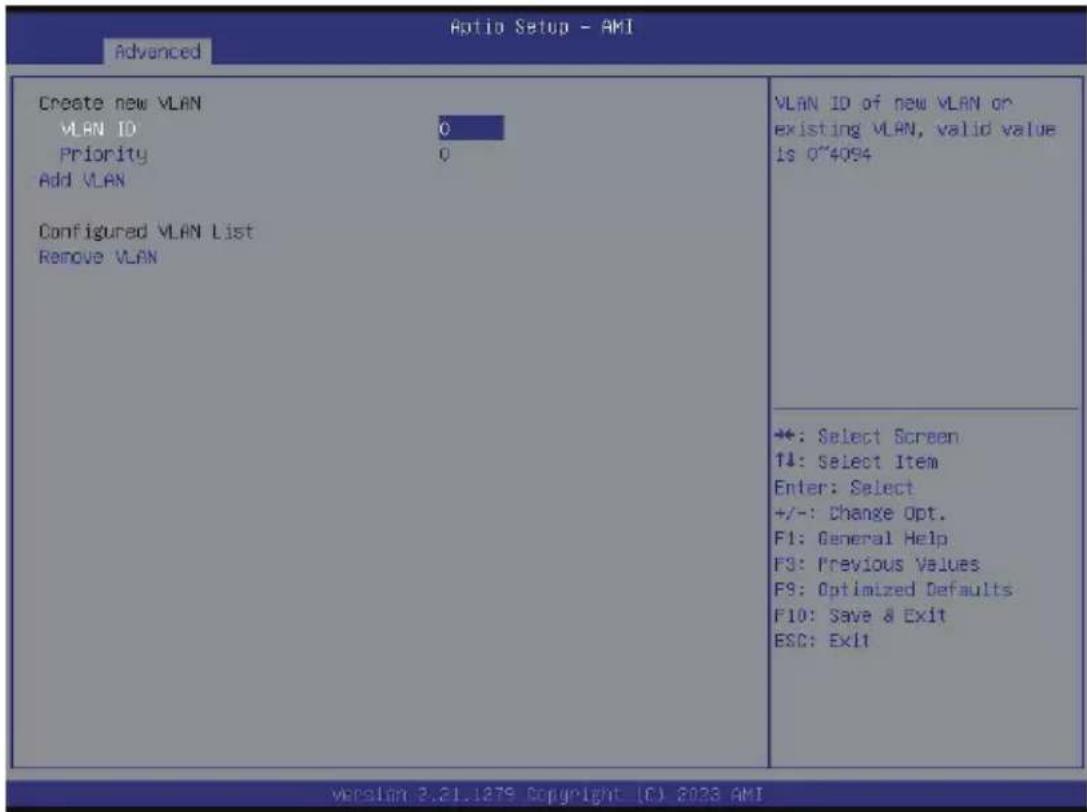
| Parameter | Description |
| Enter Configuration Menu | Press [Enter] to configure advanced items.◆ Create new VLAN◆ VLAN ID- Sets VLAN ID for a new VLAN or an existing VLAN.- Press the <+> / <-> keys to increase or decrease the desired values.- The valid range is from 0 to 4094.◆ Priority- Sets 802.1Q Priority for a new VLAN or an existing VLAN.- Press the <+> / <-> keys to increase or decrease the desired values.- The valid range is from 0 to 7.◆ Add VLAN- Press [Enter] to create a new VLAN or update an existing VLAN.◆ Configured VLAN List◆ Remove VLAN- Press [Enter] to remove an existing VLAN. |
5-2-21 MAC IPv4 Network Configuration
| Optio Setup - AMI | |
| Advanced | |
| Configured [Disabled] Save Changes and Exit | Indicate whether network address configured successfully or not. |
| +:-: Select Screen ↑↓: Select Item Enter: Select +/-: Change Opt. F1: General Help F3: Previous Values F9: Optimized Defaults F10: Save & Exit ESC: Exit | |
| version 2.21.1678 Copyright (C) 2023 AMI | |
| Parameter Description | |
| Configured | Indicates whether network address is configured successfully or not. Options available: Enabled, Disabled. Default setting is Disabled. |
| Enable DHCP ^(Note) | Options available: Enabled, Disabled. Default setting is Disabled. |
| Local IP Address ^(Note) | Press [Enter] to configure local IP address. |
| Local NetMask ^(Note) | Press [Enter] to configure local NetMask. |
| Local Gateway ^(Note) | Press [Enter] to configure local Gateway |
| Local DNS Servers ^(Note) | Press [Enter] to configure local DNS servers |
| Save Changes and Exit Press [Enter] to save all configurations. | |
(Note) This item appears when Configured is set to Enabled.
5-2-22 MAC IPv6 Network Configuration
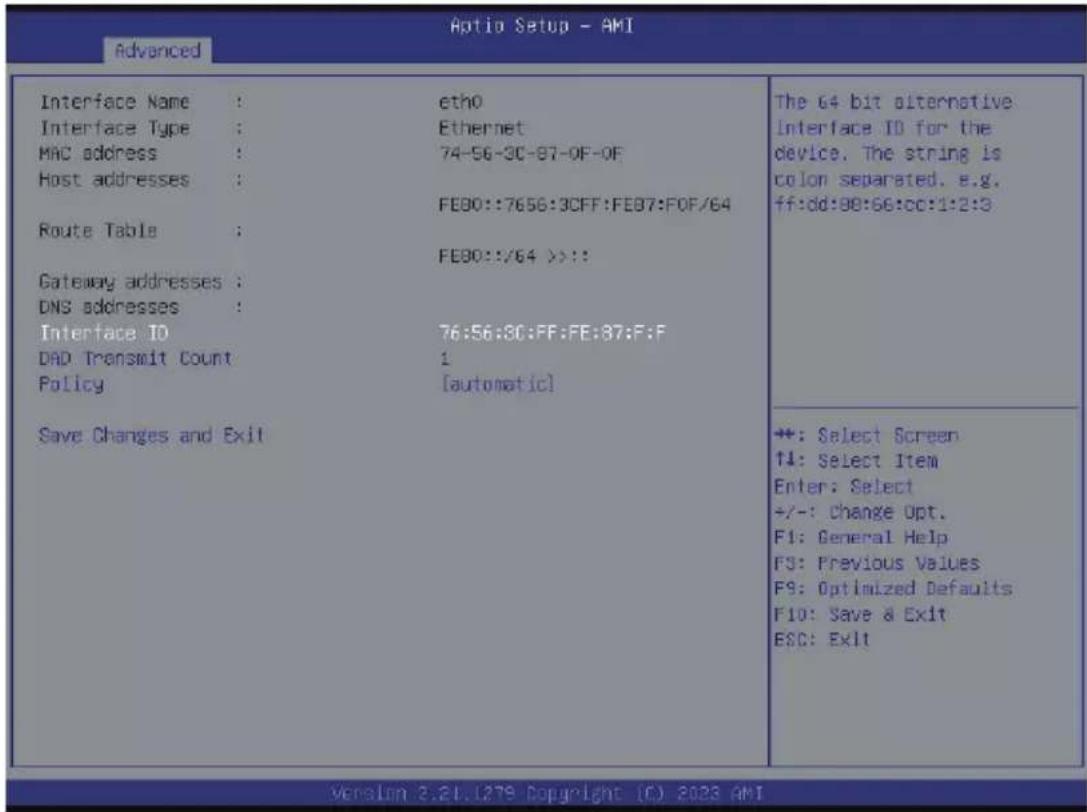
| Parameter | Description |
| Enter Configuration Menu | Press [Enter] to configure advanced items.◆ Displays the MAC Address information.◆ Interface ID- The 64 bit alternative interface ID for the device. The string is colon separated. e.g. ff:dd:88:66:cc:1:2:3.◆ DAD Transmit Count- The number of consecutive Neighbor solicitation messages sent while performing Duplicate Address Detection on a tentative address. A value of zero indicates that Duplicate Address Detection is not performed.◆ Policy- Options available: automatic, manual. Default setting is automatic.◆ Save Changes and Exit- Press [Enter] to save all configurations. |
5-3 AMD CBS Menu
AMD CBS menu displays submenu options for configuring the CPU-related information that the BIOS automatically sets. Select a submenu item, then press [Enter] to access the related submenu screen.
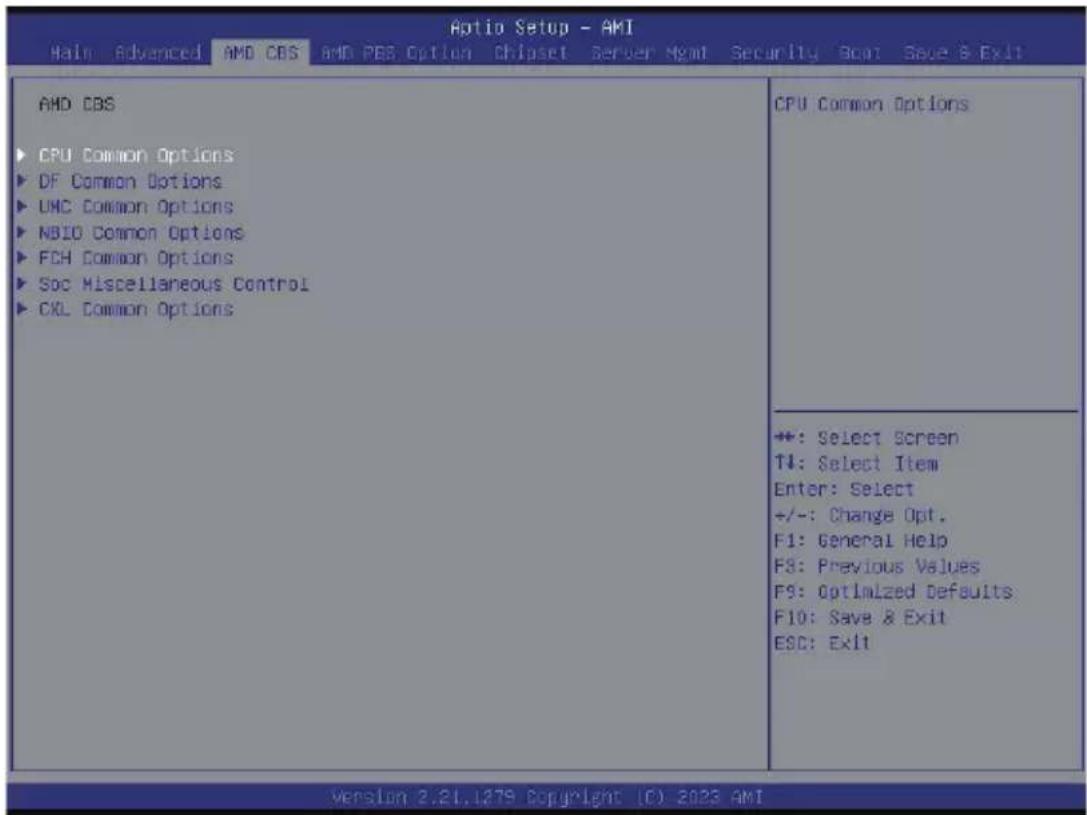
5-3-1 CPU Common Options
![Aptio Setup - AMI AMD CBS CPU Common Options ▶ Performance REP-MOV/STOS Streaming [Enabled] ▶ Prefetcher settings ▶ Core Watchdog RedirectForReturnDis [Auto] Platform First Error Handling [Auto] Core Performance Boost [Auto] Global C-state Control [Auto] Power Supply Idle Control [Auto] SEV-ES ASID Space Limit 1 SEV Control [Enable] Streaming Stores Control [Auto] Local APIC Mode [Auto] ACPI _CST C1 Declaration [Auto] ACPI CST C2 Latency 800 MCA error thresh enable [True] MCA error thresh count E0B MCA FruText [True] SMU and PSP Debug Mode [Auto] PPIN Opt-in [Auto] SNP Memory (RMP Table) Coverage [Auto] SMEE [Auto] Performance ++: Select Screen ↑↓: Select Item Enter: Select +/-: Change Opt. F1: General Help F3: Previous Values F9: Optimized Defaults F10: Save & Exit ESC: Exit version 3.21.1279 Copyright (C) 2023 AMI](/content/2026/04/656286/images/b333ad4d9b36cf982c5678bdd6af36583e4c1644c62a9d927c4085c85f745a70.jpg)
![Power Supply Idle Control [Auto] SEV-ES ASIO Space Limit 1 SEV Control [Enable] Streaming Stores Control [Auto] Local APIC Mode [Auto] ACPI _CST C1 Declaration [Auto] ACPI CST C2 Latency 800 MCA error thresh enable [True] MCA error thresh count EOB MCA FruText [True] SMU and PSP Debug Mode [Auto] PPIN Opt-in [Auto] SNP Memory (RMP Table) Coverage [Auto] SHEE [Auto] Action on DIST Failure [Auto] Fast Short REP MOVSB (FSRM) [Auto] Enhanced REP MOVSD/STOSD (ERSH) [Auto] Log Transparent Errors [Auto] AVX512 [Auto] MONITOR and MHAIT disable [Auto] Small Hammer Configuration [Auto] Corrector Branch Predictor [Disable] FAUSE Delay [Auto] CPU Speculative Store Modes [Auto] Prefetch/Request Throttle [Auto] Enables KI logic which calculates average latency, updates throttle level, and sends throttle level messages to L2 **: Select Screen ↑↓: Select Item Enter: Select +/-: Change Opt. F1: General Help F9: Previous Values F9: Optimized Defaults F10: Save & Exit ESC: Exit Version 2.21.1279 Copyright (C) 2023 AMI](/content/2026/04/656286/images/1a1792348ebf74344375b2cc145e2739fe4c4980435d0a670929359056ac8d66.jpg)
| Parameter Description | |
| CPU Common Options | |
| Performance Press [Enter] for configuration of advanced items. | |
| REP-MOV/STOS Streaming | Allow REP-MOV/STOS to use non-caching streaming stores for large sizes. Options available: Disabled, Enabled. Default setting is Enabled. |
| Prefetcher settings Press [Enter] for configuration of advanced items. | |
| Core Watchdog Press [Enter] for configuration of advanced items. | |
| RedirectForReturnDis | From a workaround for GCC/C000005 issue for XV Core on CZ A0, setting MSRC001_1029 Decode Configuration (DE_CFG) bit 14 [DecfgNoRdrctForReturns] to 1. Options available: Auto, 1, 0. Default setting is Auto. |
| Platform First Error Handling | Enable/Disable PFEH, cloak individual banks, and mask deferred error interrupts from each bank. Options available: Enabled, Disabled, Auto. Default setting is Auto. |
| Core Performance Boost | Enable/Disable the Core Performance Boost function. Options available: Disabled, Auto. Default setting is Auto. |
| Global C-state Control | Controls the IO based C-state generation and DF C-states. Options available: Disabled, Enabled, Auto. Default setting is Auto. |
| Power Supply Idle Control | Configures the Power Supply Idle Control. Options available: Low Current Idle, Typical Current Idle, Auto. Default setting is Auto. |
| SEV-ES ASID Space Limit | Configures the Space limit for SEV-ES ASIDs. Default setting is 1. |
| SEV Control | Enable/Disable SEV control. Options available: Enable, Disable. Default setting is Enable. |
| Streaming Stores Control | Enable/Disable the Streaming Stores functionality. Options available: Disabled, Enabled, Auto. Default setting is Auto. |
| Local APIC Mode | Sets the Local APIC Mode. Options available: Compatibility, xAPIC, x2APIC, Auto. Default setting is Auto. |
| ACPI_CST C1 Declaration | Determines whether or not to declare the C1 state to the OS. Options available: Disabled, Enabled, Auto. Default setting is Auto. |
| ACPI_CST C2 Latency Enter in microseconds (decimal value). | |
| MCA error thresh enable | Enable MCA error thresholding. Options available: False, True, Auto. Default setting is True. |
| MCA error thresh count MCA error thresh count. | |
| MCA FruText | Enable MCA FruText. Options available: False, True. Default setting is Auto. |
| SMU and PSP Debug Mode | When this option is enabled, specific uncorrected errors detected by the PSP FW or SMU FW will hand and not reset the system. Options available: Disabled, Enabled, Auto. Default setting is Auto. |
| PPIN Opt-in | Enable/Disable the PPIN feature. Options available: Disabled, Enabled, Auto. Default setting is Auto. |
| SNP Memory (RMP Table)Coverage | Enabled: Enter system memory is covered.Options available: Disabled, Enabled, Custom, Auto.Default setting isAuto. |
| SMEE | Controls the Secure Memory Encryption Enable (SMEE) function.Options available: Disable, Enable, Auto. Default setting isAuto. |
| Action on BIST Failure | Action to take when a CCD BIST failure is detected.Options available: Do nothing, Down-CCD, Auto. Default setting isAuto. |
| Fast Short REP MOVSB Effective error threshold count. | |
| Enhanced REP MOVSB/STOSB (ERMSB) | Options available: Disabled, Enabled, Auto. Default setting isAuto. |
| Log Transparent Errors | Enable/Disable the log Transparent errors function.Options available: Auto, Disabled, Enabled. Default setting isAuto. |
| AVX512 | Enable/Disable AVX512.Options available: Disabled, Enabled, Auto. Default setting isAuto. |
| MONITOR and MWAIT disable | The MONITOR, MWAIT, MONITORX and MWAITX opcodes become invalid when enabled.Options available: Enabled, Disabled, Auto. Default setting isAuto |
| Small Hammer Configuration | Options available: Disabled, Enabled, Auto. Default setting isAuto. |
| Corrector Branch Predictor Options available: Disable, Enable. Default setting isDisable. | |
| PAUSE Delay | Number a cycles thread will be idle after a PAUSE instruction.Options available: Auto, Disable, 16 cycles, 32 cycles, 64 cycles, 128 cycles. Default setting isAuto. |
| CPU Speculative Store Modes | Select the CPU speculative store modes.Options available: Balanced, More Speculative, Less Speculative, Auto.Default setting isAuto. |
| Prefetch/Request Throttlee | Enable XI logic which calculates average latency, updates throttle level, and sends throttle level message to L2.Options available: Auto, Disable, Enable.Default setting isAuto. |
5-3-1-1 Performance
![Optio Setup - AMI AMD CDS Performance OC Mode [Normal Operation] ► Custom Core Pstates ► CCD/Core/Thread Enablement SMT Control [Disable] Select overclock operation modes +: Select Screen ↑↓: Select Item Enter: Select +/-: Change Opt. F1: General Help F3: Previous Values F9: Optimized Defaults F10: Save & Exit ESC: Exit Version 2.21.1278 Copyright (C) 2023 AMI](/content/2026/04/656286/images/3e3d57b699dc4f76329c30e8be64ec683e417fb8e784012df4e047d0bd3d8ebe.jpg)
Parameter Description
| Performance | |
| OC Mode(Note) | Options available: Normal Operation, Customized. Default setting is Normal Operation. |
| Custom Core Pstates | Allows you to accept or decline enabling Custom Core Pstates. When accepted, you can disable or customize core pstates. |
| CCD/Core/Thread Enablement | Allows you to accept or decline enabling CCDs, processor cores and threads. When accepted, you can control the number of CCDs to be used, and the number of cores to be used.◆ CCD Control- Options available: Auto, 2 CCDs, 4 CCDs, 6 CCDs, 8 CCDs, 10 CCDs. Default setting is Auto.◆ Core Control- Options available: Auto, ONE(1+0), TWO(2+0), THREE(3+0), FOUR(4+0), FIVE(5+0), SIX(6+0), SEVEN(7+0).- Default setting is Auto. |
| SMT Control | Can be used to disable symmetric multithreading. To re-enable SMT, a POWER CYCLE is needed after select the 'Enable' option. Select 'Auto' base on BIOS PCD. (PcdAmdSmtMode) default setting.Options available: Disable, Enable, Auto. Default setting is Enable. |
(Note) Advanced items are configurable when this item is defined.
5-3-1-2 Prefetcher Settings
![Auto Setup - AMI AMD CBS Prefetcher settings L1 Stream HW Prefetcher [Auto] L1 Stride Prefetcher [Auto] L1 Region Prefetcher [Auto] L2 Stream HW Prefetcher [Auto] L2 Up/Down Prefetcher [Auto] L1 Burst Prefetch Mode [Auto] Option to Enable | Disable L1 Stream HW Prefetcher +: Select Screen +: Select Item Enter: Select +/-: Change Opt. F1: General Help F3: Previous Values F9: Optimized Defaults. F10: Save & Exit ESC: Exit version 2.21.1878 Copyright (CD) 2023 AMI](/content/2026/04/656286/images/4c8ff76ee048f088c1283e94c4f43dbfee1948a39ae5e855935c375dc7c72a2f.jpg)
| Parameter Description | |
| Prefetcher settings | |
| L1 Stream HW Prefetcher | Enable/Disable L1 Stream HW Prefetcher.Options available: Disable, Enable, Auto. Default setting isAuto. |
| L1 Stride Prefetcher | Use memory access history of individual instructions to fetch additional lines when each access is a constant distance from the previous.Enable/Disable L1 Stride Prefetcher.Options available: Disable, Enable, Auto. Default setting isAuto. |
| L1 Region Prefetcher | Use memory access history to fetch additional lines when the data access for a given instruction tends to be followed by other data accesses.Enable/Disable L1 Region Prefetcher.Options available: Disable, Enable, Auto. Default setting isAuto. |
| L2 Stream HW Prefetcher | Enable/Disable L2 Stream HW Prefetcher.Options available: Disable, Enable, Auto. Default setting isAuto. |
| L2 Up/Down Prefetcher | Use memory access history to determine whether to fetch the next or previous line for all memory accesses.Enable/Disable L2 Up/Down Prefetcher.Options available: Disable, Enable, Auto. Default setting isAuto. |
| L1 Burst Prefetch Mode | Enable/Disable L1 Burst Prefetch Mode.Options available: Disable, Enable, Auto. Default setting isAuto. |
5-3-1-3 Core Watchdog
![Aptio Setup - AMI AMD CBS Core Watchdog Core Watchdog Timer Enable [Auto] Enable or disable CPU Watchdog Timer +: Select Screen ↑↓: Select Item Enter: Select +/-: Change Opt. F1: General Help F3: Previous Values F9: Optimized Defaults F10: Save & Exit ESC: Exit version 2.21.1278 Copyright (C) 2023 AMI](/content/2026/04/656286/images/fa9aee716ec5ce0993a024aae83470b434ead76f4111ca077a2e2cd45e7c4c76.jpg)
Parameter Description
| Core Watchdog | |
| Core Watchdog Timer Enable ^(Note) | Enable/Disable CPU Watchdog Timer.Options available: Disabled, Enabled, Auto. Default setting isAuto. |
| Core Watchdog Timer Interval | Select the CPU Watchdog Timer interval.Options available: 2.681s, 1.340s, 669.41ms, 334.05ms, 166.37ms, 82.53ms, 40.61ms, 20.970ms, 10.484ms,5.241ms, 2.620ms, 1.309ms, 654.08us, 326.4us, 162.56us, 80.64us, 39.68us, Auto.Default setting isAuto. |
| Core Watchdog Timer Severity | Specific the CPU watch dog time severity.Options available: No Error, Transparent, Deferred, Uncorrected, Fatal, Auto.Default setting isAuto. |
(Note) Advanced items prompt when this item is defined.
5-3-2 DF Common Options
![Optio Setup - AMI AMD CBS DF Common Options ► Memory Addressing ► ACPI ► Link ► SDCI ► Probe Filter DF Watchdog Timer Interval [Auto] Disable DF to external IP [Auto] SyncFloodPropagation Sync Flood Propagation to DF [Auto] Components Freeze DF module queues on error [Auto] CD5 memory region encryption [Auto] CCD B/W Balance Throttle Level [Auto] Memory Addressing +: Select Screen ↑↓: Select Item Enter: Select +/-: Change Opt. F1: General Help F3: Previous Values F9: Optimized Defaults F10: Save & Exit ESC: Exit Version 2.21.1278 Copyright (C) 2023 AMI](/content/2026/04/656286/images/41c65b534bce8df7251e0cc45cf538e9d531b1e1be01452690941a0c04cbccaa.jpg)
| Parameter Description | |
| DF Common Options | |
| Memory Addressing Press [Enter] for configuration of advanced items. | |
| ACPI Press [Enter] for configuration of advanced items. | |
| Link Press [Enter] for configuration of advanced items. | |
| SDCI Press [Enter] for configuration of advanced items. | |
| Probe Filter Press [Enter] for configuration of advanced items. | |
| DF Watchdog Timer Interval | Configures the Data Fabric watchdog timer interval. Options available: Auto, 41ms, 166ms, 334ms, 669ms, 1.34 seconds, 2.68 seconds, 5.36 seconds. Default setting is Auto. |
| Disable DF to external IP sync flood propagation | Enable/Disable SyncFlood to UMC & downstream slaves. Options available: Sync flood disabled, Sync flood enabled, Auto. Default setting is Auto. |
| Sync FloodPropagation to DF Components | Enable/Disable DF Sync Flood propagation. Options available: Sync flood disabled, Sync flood enabled, Auto. Default setting is Auto. |
| Freeze DF module queues on error | Options available: Disabled, Enabled, Auto. Default setting is Auto. |
| CC6 memory region encryption | Controls whether or not the CC6 save/restor memory is encrypted. Options available: Disabled, Enabled, Auto. Default setting is Auto. |
| CCD B/W Balance Throttle Level | Options available: Auto, Level 0, Level 1, Level 2, Level 3, Level 4. Default setting is Auto. |
5-3-2-1 Memory Addressing
![Memory Addressing NUMA nodes per socket [Auto] Memory interleaving [Auto] 1TB remap [Auto] DRAM map inversion [Auto] Location of private memory regions [Auto] CXL Memory interleaving [Auto] CXL Sublink interleaving [Auto] Specifies the number of desired NUMA nodes per socket. Zero will attempt to interleave the two sockets together. +: Select Screen ↑↓: Select Item Enter: Select +/-: Change Opt. F1: General Help F3: Previous Values F9: Optimized Defaults F10: Save & Exit ESC: Exit version 2.21.1278 Copyright (C) 2023 AMI](/content/2026/04/656286/images/a87ba9af45c70de86db264bf34febf1653336131a5c0efbe7a2704d517461b51.jpg)
| Parameter Description | |
| Memory Addressing | |
| NUMA nodes per socket | Specifies the number of desired NUMA nodes per socket.Options available: NPS0 ,NPS1,NPS2,NPS4, Auto. Default setting isAuto.NOTE!Available options may vary by system configuration.Only dual processor configuration supports NPS0. |
| Memory interleaving | Enable/Disable the Memory interleaving feature.Options available: Disabled, Auto, Enabled. Default setting isAuto. |
| 1TB remap | Enable/Disable to remap DRAM out of the space just below the 1TB boundary.The ability to remap depends on DRAM configuration, NPS, and interleaving selection, and may not always be possible.Options available: Do not remap, Attempt to remap, Auto.Default setting isAuto. |
| DRAM map inversion | Enable/Disable the DRAM map inversion function.Options available: Disabled, Enabled, Auto. Default setting isAuto. |
| Location of private memory regions | Controls whether or not the private memory regions (PSP, SMU and CC6) are at the top of DRAM or distributed.Options available: Distributed, Consolidated, Auto. Default setting isAuto. |
| CXL Memory interleaving | Allows for enabling/disabling CXL memory devices interleaving.Options available: Disabled, Enabled, Auto. Default setting isAuto. |
| CXL Sublink interleaving | Enable or disable CXL sublink interleaving.Options available: Enable, Disable, Auto. Default setting isAuto. |
5-3-2-2 ACPI
![ACPI ACPI SRAT L3 Cache As NUMA Domain [Auto] ACPI SLIT Distance Control [Auto] ACPI SLIT remote relative distance [Auto] Enabled: Each CCX in the system will be declared as a separate NUMA domain. Disabled: Memory Addressing \ NUMA nodes per socket will be declared. **: Select Screen T4: Select Item Enter: Select +/-: Change Opt. F1: General Help F8: Previous Values F9: Optimized Defaults F10: Save & Exit ESC: Exit version 2.21.1279 Copyright (C) 2023 AMI](/content/2026/04/656286/images/65db2ef7a73cc70bb0fb52e337f4ec9b969c8d7a58ace3e683bd7189e1944927.jpg)
Parameter Description
| ACPI | |
| ACPI SRAT L3 Cache As NUMA Domain | Enable/Disable report each L3 cache as a NUMA Domain to the OS. Options available: Disabled, Enabled, Auto. Default setting is Auto. |
| ACPI SLIT Distance Control | Determines how the SLIT distances are declared. Options available: Manual, Auto. Default setting is Auto. |
| ACPI SLIT remote relative distance | Sets the remote socket distance for 2P systems as near (2.8) or far (3.2). Options available: Near, Far, Auto. Default setting is Auto. |
5-3-2-3 Link
![Optio Setup - AMI AMD CBS Link GMI encryption control [Auto] ×GMI encryption control [Auto] ×GMI Link Configuration [Auto] 4-Link ×GMI max speed [Auto] S-Link ×GMI max speed [Auto] ×GMI 18GACOFC [Auto] ×GMI CRC Scale 5 ×GMI CRC Threshold 25 ×GMI Preset Control [Enabled] ▶ ×GMT Global Preset List ▶ ×GMI Initial Preset ▶ ×GMT TXEQ Search Mask ▶ ×GMI AC/DC Coupled Link ▶ ×GMT Channel Type Control GMI link encryption +: Select Screen ↑↓: Select Item Enter: Select +/-: Change Opt. F1: General Help F3: Previous Values F9: Optimized Defaults F10: Save & Exit ESC: Exit Version 2.21.1278 Copyright (C) 2023 AMI](/content/2026/04/656286/images/0c23a51f553bbe6cf51b5bbbb13a3ab239763a00a3b750b0f2d18edeec524e6d.jpg)
| Parameter Description | |
| GMI encryption control | Enable/Disable GMI link encryption. Options available: Disabled, Enabled, Auto. Default setting is Auto. |
| xGMI encryption control | Enable/Disable xGMI link encryption. Options available: Disabled, Enabled, Auto. Default setting is Auto. |
| xGMI Link Configuration | Configures the number of xGMI2 links used on a multi-socket system. Options available: Auto, 3 xGMI Links, 4 xGMI Links. Default setting is Auto. |
| 4-link xGMI max speed | Specifies the max speed of 4-link xGMI. Options available: 12Gbps, 16Gbps, 17Gbps, 18Gbps, 20Gbps, 22Gbps, 23Gbps, 24Gbps, 25Gbps, 26Gbps, 27Gbps, 30Gbps, 32Gbps, Auto. Default setting is Auto. |
| 3-link xGMI max speed | Specifies the max speed of 3-link xGMI. Options available: 12Gbps, 16Gbps, 17Gbps, 18Gbps, 20Gbps, 22Gbps, 23Gbps, 24Gbps, 25Gbps, 26Gbps, 27Gbps, 30Gbps, 32Gbps, Auto. Default setting is Auto. |
| xGMI 18GACOFC | Configures xGMI 18GACOFC. Options available: Auto, Enable, Disable. Default setting is Auto. |
| xGMI CRC Scale | Configures leaky bucket scale for xGMI and WAFL CRC errors. Every scale milliseconds an error will leak from the CRC counter. Default setting is 7. |
| xGMI CRC Threshold | Configures leaky bucket threshold for xGMI and WAFL CRC errors. If link CRC counter exceeds this threshold, an error will be logged. Default setting is 25. |
| xGMI Preset Control | Enable/Disable xGMI Preset control. Options available: Disabled, Enabled, Auto. Default setting is Auto. |
Parameter Description
| xGMI Global Preset List Press [Enter] to configure the xGMI Preset list. |
| xGMI Initial Preset Press [Enter] to configure the xGMI Initial Preset CPU0/1 link. |
| xGMI TXEQ Search Mask Press [Enter] to configure the xGMI TXEQ Search Mask CPU0/1 link. |
| xGMI AC/DC Coupled Link | Press [Enter] to configure the xGMI AC/DC Coupled link.◆ xGMI AC/DC Coupled Link Control ^(Note) – Options available: Manual, Auto. Default setting isAuto. |
| xGMI Channel Type | Press [Enter] to configure the xGMI Channel Type.◆ xGMI Channel Type Control ^(Note) – Options available: Manual, Auto. Default setting isAuto. |
5-3-2-4 SDCI
![Aptio Setup - AMI AMD COS SDCI SDCI [Auto] DisRmtSteer [Auto] Enable or Disable Smart Data Cache Injection feature **: Select Screen. T4: Select Item Enter: Select +/-: Change Opt. F1: General Help F3: Previous Values F9: Optimized Defaults F10: Save & Exit ESC: Exit Version 2.21.1279 Copyright (C) 2023 AMI](/content/2026/04/656286/images/62213ceb276fa95d0456b4700e2a7db859b6e9cc244c4ab51f9de7825d03ffe5.jpg)
Parameter Description
SDCI ^(Note)
Options available: Disabled, Enabled, Auto. Default setting is Auto.
DisRmSteer Options available: Disabled, Enabled, Auto. Default setting is Auto.
(Note) Advanced items prompt when this item is defined.
5-3-2-5 Probe Filter
![Amo CDS Amo CDS Probe Filter Organization [Dedicated] Periodic Directory Rinse (PDR) [Auto] Tuning Specifies whether multiple memory/CXL channels will share probe filter storage. For memory sizes of 1678 or larger, this feature is ignored as it is auto-selected to 'shared' +: Select Screen T4: Select Item Enter: Select +/-: Change Opt. F1: General Help F3: Previous Values F9: Optimized Defaults F10: Save & Exit ESC: Exit Version 2.21.1378 Copyright (C) 2023 AMI](/content/2026/04/656286/images/a1390df4c6c0b78bd79a0d4b68fe5fb37d066cf25bd5492c464fda5783b946a8.jpg)
| Parameter Description | |
| Organization | Specifies whether multiple memory/CXL channels will share probe filter storage. For memory sizes of 16TB or larger, this features is ignored as it is auto-selected to 'shared'.Options available: Disabled, Shared, Auto. Default setting isAuto. |
| Periodoodic Directory Rines (PDR) Tuning | Controls PDR settings that may impact performance by workload and/or processor.Options available: Memory-Sensitive, Cache-Bound, Neutral, Adaptive, Auto.Default setting isAuto. |
5-3-3 UMC Common Options
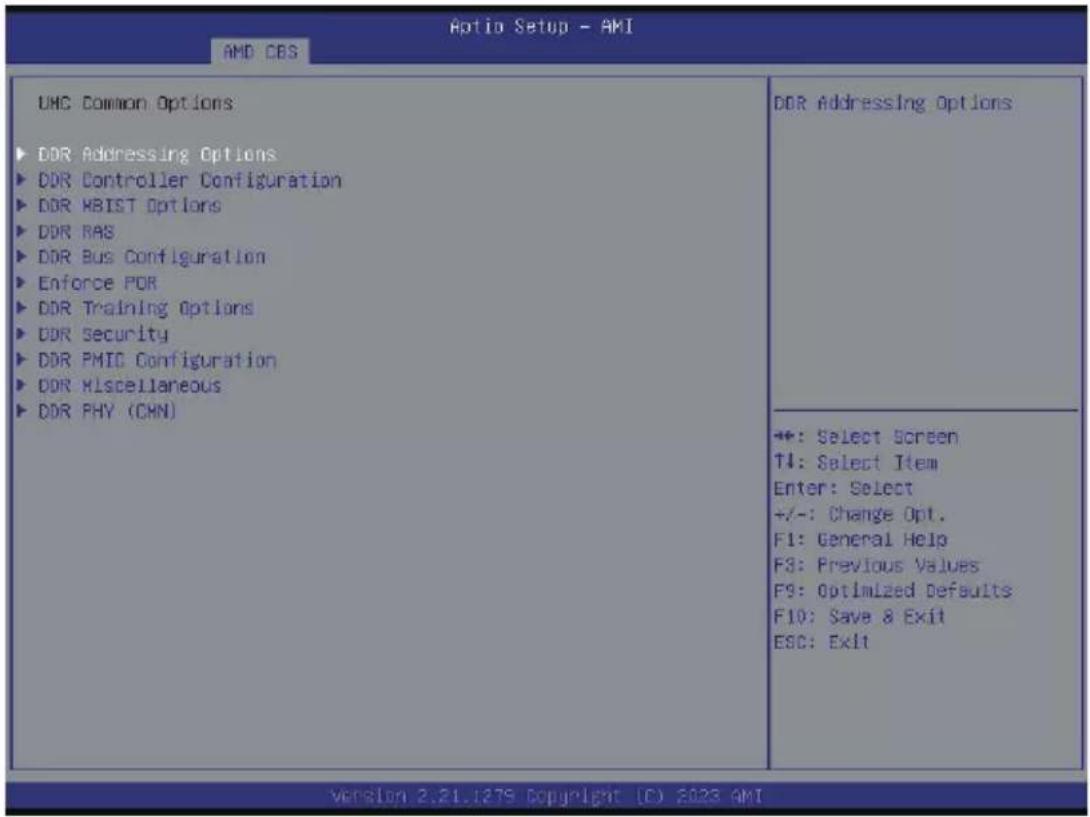
Parameter Description
UMC Common Options
DDR Addressing Options Press [Enter] for configuration of advanced items.
DDR Controller Configuration Press [Enter] for configuration of advanced items.
DDR MBIST Options Press [Enter] for configuration of advanced items.
DDR RAS Press [Enter] for configuration of advanced items.
DDR Bus Configuration Press [Enter] for configuration of advanced items.
Enforce POR Press [Enter] for configuration of advanced items.
DDR Training Options Press [Enter] for configuration of advanced items.
DDR Security Press [Enter] for configuration of advanced items.
DDR PMIC Configuration Press [Enter] for configuration of advanced items.
DDR Miscellaneous Press [Enter] for configuration of advanced items.
DDR PHY (CMN) Press [Enter] for configuration of advanced items.
5-3-3-1 DDR Addressing Options
| DDR Addressing Options Chipselect Interleaving [Auto] Address Hash Bank [Auto] Address Hash CS [Auto] Address Hash RM [Auto] Address Hash Subchannel [Auto] BankSwapMode [Auto] | Interleave DRAM accesses across ranks within a memory channel if the configuration supports it. 'Enable' will override certain optimization policies, but cannot force interleaving on configurations that do not support it. |
| +: Select Screen ↑↓: Select Item Enter: Select +/-: Change Opt. F1: General Help F9: Previous Values F9: Optimized Defaults F10: Save & Exit ESC: Exit |
| Parameter Description | |
| DDR Addressing Options | |
| Chipselect Interleaving | Interleaves memory blocks across the DRAM chip selects for node 0. Options available: Disabled, Auto. Default setting isAuto. |
| Address Hash Bank | Enable or disable bank addressing hashing. Options available: Enabled, Disabled, Auto. Default setting isAuto. |
| Address Hash CS | Enable or disable CS addressing hashing. Options available: Enabled, Disabled, Auto. Default setting isAuto. |
| Address Hash Rm | Enable or disable RM addressing hashing. Options available: Enabled, Disabled, Auto. Default setting isAuto. |
| Address Hash Subchannel | Enable or disable sub-channel addressing hashing. Options available: Enabled, Disabled, Auto. Default setting isAuto. |
| Bank SwapMode Options available: Auto, Disabled, Swap CPU. Default setting isAuto. | |
5-3-3-2 DDR Controller Configuration
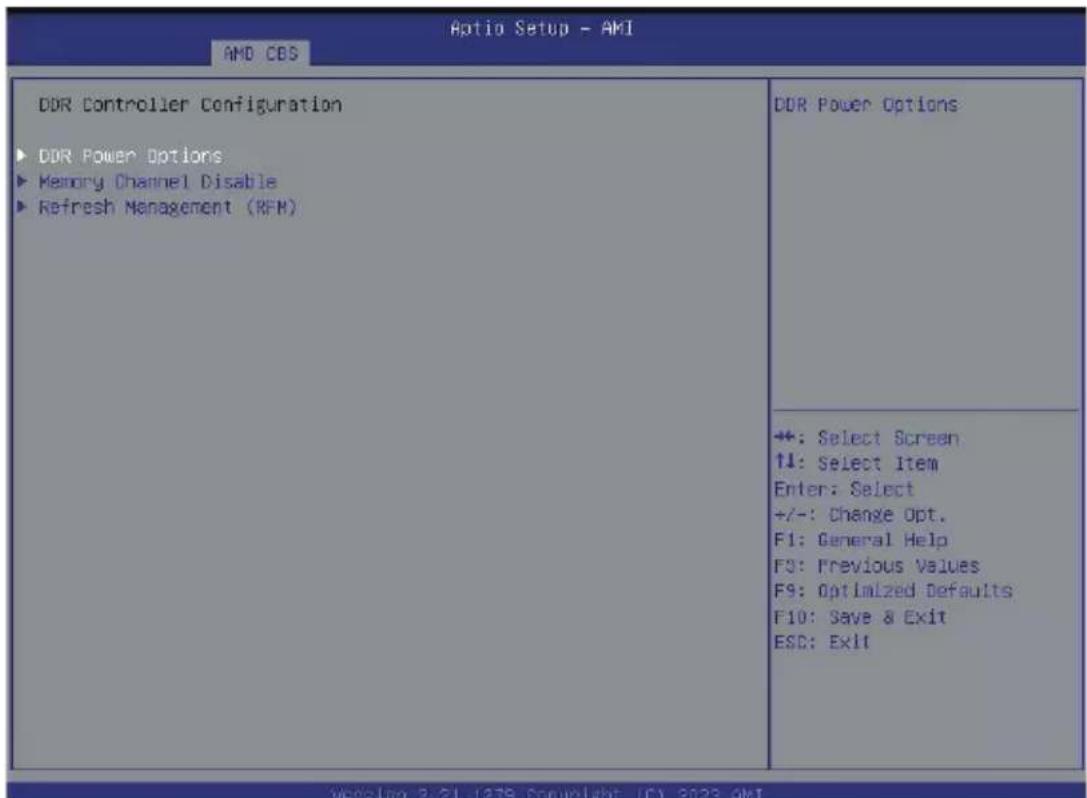
Parameter Description
DDR Cotroller Configuration
DDR Power Options Press [Enter] for configuration of advanced items.
Memory Channel Diable Press [Enter] for configuration of advanced items.
Refresh Management (RFM) Press [Enter] for configuration of advanced items.
5-3-3-2-1 DDR Power Options
![Optio Setup - AMI AMD CBS DDR Power Options Power Down Enable [Auto] Sub Urgent Refresh Lower Bound 1 Urgent Refresh Limit 4 DRAM Refresh Rate [8.9 usec] Self-Refresh Exit Staggering [n = 9] Enable or disable DDR power down mode ++: Select Screen ↑↓: Select Item Enter: Select +/-: Change Opt. F1: General Help F3: Previous Values F9: Optimized Defaults F10: Save & Exit ESC: Exit version 2-21-1879 Copyright (D) 2023 A#I](/content/2026/04/656286/images/55f0e23c444312c11ea3b09c97787bfa621366f395b6f157c2628a5b08af3cc1.jpg)
| Parameter Description | |
| DDR Power Options | |
| Power Down Enable | Enable or disable DDR power down mode. Options available: Enabled, Disabled, Auto. Default setting is Auto. |
| Sub Urgent Refresh Lower Bound | Specifies the stored refresh limit required to enter sub-urgent refresh mode. |
| Urgent Refresh Limit Specifies the stored refresh limit required to enter urgent refresh mode. | |
| DRAM Refresh Rate | DRAM refresh rate: 1.95us or 3.9us. Options available: 1.95usec 3.9 usec. Default setting is 3.9 usec. |
| Self-Refresh Exit Staggering Options available: n=1~9. Default setting is n=9. | |
5-3-3-2-2 Memory Channel Disable
![AMD CBS Memory Channel Disable Memory Channel Disable Bltmask 0 CPU 0 Channel A [Enabled] CPU 0 Channel B [Enabled] CPU 0 Channel C [Enabled] CPU 0 Channel D [Enabled] CPU 0 Channel E [Enabled] CPU 0 Channel F [Enabled] CPU 0 Channel G [Enabled] CPU 0 Channel H [Enabled] CPU 0 Channel I [Enabled] CPU 0 Channel J [Enabled] CPU 0 Channel K [Enabled] CPU 0 Channel L [Enabled] CPU 1 Channel M [Enabled] CPU 1 Channel N [Enabled] CPU 1 Channel O [Enabled] CPU 1 Channel P [Enabled] CPU 1 Channel Q [Enabled] CPU 1 Channel R [Enabled] CPU 1 Channel S [Enabled] CPU 1 Channel T [Enabled] CPU 1 Channel U [Enabled] CPU 1 Channel V [Enabled] SPD reading will be skipped when channel is disabled. +: Select Screen ↑↓: Select Item Enter: Select +/-: Change Opt. F1: General Help F3: Previous Values F9: Optimized Defaults F10: Save & Exit ESC: Exit Version 2-21.1879 Copyright (C) 2023 AMI](/content/2026/04/656286/images/fedcf00fed00492a3e1d6898d18b11ce15fd399650cb87d9d45fcf57175dcad7.jpg)
Parameter Description
Memory Channel Disable
Memory Channel Disable Bitmask
CPU0/1 Channel_# Press [Enter] to enable/disable specific memory channel.
5-3-3-2-3 Refresh Management (RFM)
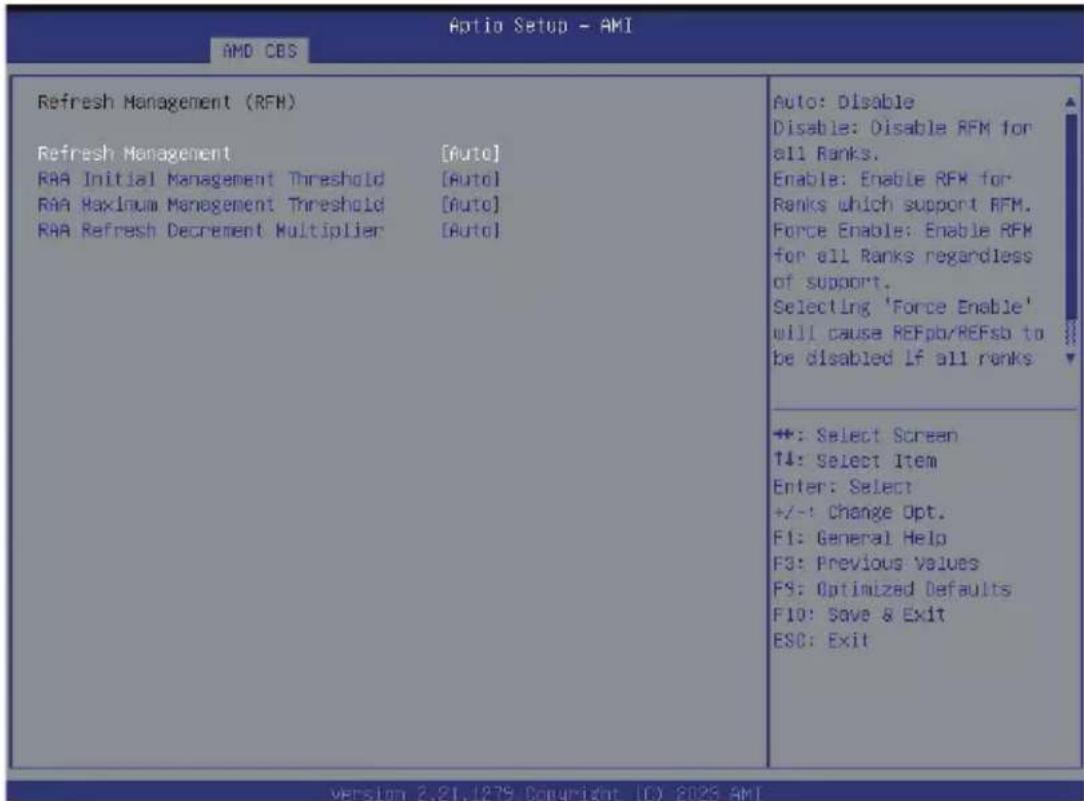
Parameter Description
| Refresh Management (RFM) | |
| Refresh Management | Configure Refresh Management. Options available: Enable, Disable, Auto, Force Enable. Default setting is Auto. |
| RAA Initial Management Threshold | Override Rolling Accumulated ACT Initial Management Threshold. Options available: 32, 40, 48, 56, 64, 72, 80, Auto. Default setting is Auto. |
| RAA Maximum Management Threshold | Override Rolling Accumulated ACT Maximum Management Threshold. Options available: 3X, 4X, 5X, 6X, Auto. Default setting is Auto. |
| RAA Refresh Decrement Multiplier | Override RAA Refresh Decrement Multiplier. Options available: 0.5, 1, Auto. Default setting is Auto. |
5-3-3-3 DDR MBIST Options
![Aptio Setup - AMI AMD CDS DDR MBIST Options MBIST Enable [Auto] MBIST Test Mode [Auto] MBIST Aggressors [Auto] MBIST Per Bit Slave Die Reporting [Auto] ► Data Eye DDR Healing BIST [Disabled] DDR Healing BIST Execution Mode [One Time] ► PMU Mem BIST Algorithm DDR Healing BIST Repair Type [Soft Repair] Enable or disable Memory MBIST +: Select Screen 1↓: Select Item Enter: Select +/-: Change Opt. F1: General Help F3: Previous Values F9: Optimized Defaults F10: Save & Exit ESC: Exit ++: Select Screen 1↓: Select Item Enter: Select +/-: Change Opt. F1: General Help F3: Previous Values F9: Optimized Defaults F10: Save & Exit ESC: Exit](/content/2026/04/656286/images/36bd35fa0513b0f41cb5b3b567a52fa63fc5995ece3d4fc9379f720065ee1e88.jpg)
Parameter Description
| DDR MBIST Options | |
| MBIST Enable | Enable/Disable the Memory MBIST function.Options available: Enabled/Disabled. Default setting is Disabled. |
| MBIST Test Mode ^(Note1) | Selects MBIST Test Mode.Interface Mode: Tests Single and Multiple CS transactions and Basic Connectivity.Data Eye Mode: Measures Voltage vs. Timing.Options available: Auto, Both, Interface Mode, Data Eye Mode. Default setting is Auto. |
| MBIST Aggressors ^(Note1) | Enable/Disable MBIST Aggressor test.Options available: Auto, Enabled, Disabled. Default setting is Auto. |
| MBIST Per Bit Slave Die Reporting ^(Note1) | Enable/Disable to report 2D data eye results in ABL log for each DQ, Chipselect, and Channel.Options available: Auto, Enabled, Disabled. Default setting is Auto. |
| Data Eye | Press [Enter] to configure advanced items. |
| Memory Healing BIST | Enable/Disable memory healing BIST.Options available: Disabled, PMU Mem BIST, Self-Healing Mem BIST, PMU, and Self-Healing Mem BIST. Default setting is Disabled. |
| DDR Healing BIST Execution Mode ^(Note2) | Options available: One Time, Every boot.Default setting is One Time. |
| Parameter Description | |
| PMU Mem BIST Algorithm DDR Healing BIST ^(Note2) | For DRAM errors found in the BIOS memory BIST select tje repair type. Options available: Soft, Repair, Hard Repair, No Repairs -Test only.. Default setting isSoft Repair. |
5-3-3-3-1 Data Eye
| Data Eye Pattern Select Pattern Length Aggressor Channel Aggressor Static Lane Control Aggressor Static Lane Select Upper 32 bits Aggressor Static Lane Select Lower 32 Bits Aggressor Static Lane Select ECC Aggressor Static Lane Value Target Static Lane Control Target Static Lane Select Upper 32 bit Target Static Lane Select Lower 32 Bits Target Static Lane Select ECC Target Static Lane Value Worst Case Margin Granularity Read Voltage Sweep Step Size Read Timing Sweep Step Size Write Voltage Sweep Step Size Write Timing Sweep Step Size Silent Execution | [FRBS] 3 [All Channels] [Disabled] 0 0 0 [Disabled] 0 0 0 0 0 0 [Far Chip Select] [1] [1] [1] [1] [Disabled] | MEIST Data Eye Pattern Type. 0 - FRBS (default), 1 - SSO, 2 - Both |
| +:-: Select Screen 14: Select Item Enter: Select +/-: Change Opt. F1: General Help F3: Previous Values F9: Optimized Defaults F10: Save & Exit ESC: Exit |
| Parameter | Description |
| Data Eye | |
| Pattern Select | Options available: PRBS, SSO, Both. Default setting is PRBS. |
| Pattern Length | Determines the pattern length. The possible options are N=3....12. |
| Aggressor Channel | This item helps read the aggressors channels. Options available: Disabled, 1 Aggressor Channel, 3 Aggressor Channels, 7 Aggressor Channels. Default setting is 1 Aggressor Channel. |
| Aggressor Static Lane Control | Enable/Disable the Aggressor Static Lane Control function. Options available: Enabled/Disabled. Default setting is Disabled. |
| Aggressor Static Lane Select Upper 32 bits | This item is configurable when Aggressor Static Lane Control is set to Enabled. |
| Aggressor Static Lane Select Lower 32 bits | This item is configurable when Aggressor Static Lane Control is set to Enabled. |
| Aggressor Static Lane Select ECC | This item is configurable when Aggressor Static Lane Control is set to Enabled. |
| Aggressor Static Lane Value | This item is configurable when Aggressor Static Lane Control is set to Enabled. |
| Target Static Lane Control | Enable/Disable the Target Static Lane Control function. Options available: Enabled/Disabled. Default setting is Disabled. |
| Target Static Lane Select Upper 32 bits | This item is configurable when Target Static Lane Control is set to Enabled. |
| Target Static Lane Select Lower 32 bits | This item is configurable when Target Static Lane Control is set to Enabled. |
| Target Static Lane Select ECC | This item is configurable when Target Static Lane Control is set to Enabled. |
| Target Static Lane Value | This item is configurable when Target Static Lane Control is set to Enabled. |
| Worst Case Margin Granularity | Configures Worst Case Margin Granularity.Options available: Per Chip Select, Per Nibble.Default setting is Worst Case Margin Only. |
| Read Voltage Sweep Step Size | Configures the step size for read Data Eye voltage sweep.Options available: 1, 2, 4. Default setting is 2. |
| Read Timing Sweep Step Size | Configures the step size for read Data Eye timing sweep.Options available: 1, 2, 4. Default setting is 1. |
| Write Voltage Sweep Step | Configures the step size for write Data Eye voltage sweep.Options available: 1, 2, 4. Default setting is 2. |
| Write Timing Sweep Step Size | Configures the step size for write Data Eye timing sweep.Options available: 1, 2, 4. Default setting is 1. |
| Silent Execution | Enable Mbist Target Static Lane Control.Options available: Enabled, Disabled. Default setting is Disabled. |
5-3-3-4 DDR RAS
![AMD COS Optio Setup - AMI PHU Mem BIST Algorithm PMU Mem BIST Algorithm Select [Auto] PMU Mem BIST Algorithm Bitmap 1FF Algorithm #1 [Enabled] Algorithm #2 [Enabled] Algorithm #3 [Enabled] Algorithm #4 [Enabled] Algorithm #5 [Enabled] Algorithm #6 [Enabled] Algorithm #7 [Enabled] Algorithm #8 [Enabled] Algorithm #9 [Enabled] PMU Mem BIST algorithms that will be performed can be selected by user or vendor **: Select Screen ↑↓: Select Item Enter: Select +/-: Change Opt. F1: General Help F3: Previous Values F5: Optimized Defaults F10: Save & Exit ESC: Exit](/content/2026/04/656286/images/346b692e12b9319ac872b0c40e223a08289c6f64d8124ada1122191a2a3cd5a9.jpg)
Parameter Description
| DDR RAS | |
| Data Poisoning | Enable/Disable the Data Poisoning function.Options available: Auto, Enabled, Disabled. Default setting isAuto. |
| DRAM Boot Time Package Repair | Enable/Disable the DRAM Boot Package Repair function.Options available: Enable/Disable. Default setting isDisable. |
| DRAM Runtime Post Package Repair | Enable/Disable the DRAM Runtime Post Package Repair function.Options available: Enable/Disable. Default setting isDisable. |
| RCD Parity | Enable/Disable the RCD Parity function.Options available: Auto, Enabled, Disabled. Default setting isEnabled. |
| Max RCD Parity Error Replay Default setting is 8. | |
| Disable Memory Error Injection Options available: False/True, Auto. Default setting isAuto. | |
Parameter Description
| ECC Configuration | Press [Enter] to configure advanced items.♦ DRAM ECC Symbol Size– Configures the DRAM ECC Symbol Size.– Options available: Auto, x4, x8, x16. Default setting isAuto.♦ DRAM ECC Enable– Enable/Disable DRAM ECC. When set to Auto, it will set ECC to enable.– Options available: Auto, Enabled, Disabled. Default setting isAuto.♦ DRAM UECC Retry– Enable/Disable DRAM UECC Retry.– Options available: Auto, Enabled, Disabled. Default setting isDisabled.♦ Max DRAM UECC Error Replay– Default setting is 8.♦ Memory Clear– Options available: Auto, Enabled, Disabled. Default setting isAuto.♦ Address XDR after ECC– Options available: Auto, Enabled, Disabled. Default setting isDisabled. |
| Press [Enter] to configure advanced items.♦ DRAM ECS Mode- Options available: Auto, AutoECS, Manual1EECS, DisableECS. Default setting isAuto.♦ DRAM Redirect Scrubber Enable- Options available: Auto, Enabled, Disabled. Default setting isAuto.♦ DRAM Scrub Redirection Limit- Options available: Auto, 8 Scrubs, 4 Scrubs, 2 Scrubs, 1 Scrub. Default setting isAuto.♦ DRAM Scrub Time- Options available: Auto, 1 hour, 4 hours, 6 hours, 8 hours, 12 hours, 16 hours, 24 hours, 48 hours. Default setting is24 Hours. | |
| DRAM Scrubbers | ♦ DRAM Error Threshold Count- Options available: Auto, ETC_4, ETC_16, ETC_64, ETC_256, ETC_1024, ETC_4096. Default setting isAuto.♦ DRAM ECS Count Mode- Options available: Auto, Row Count Mode, Code Word Count Mode. Default setting isAuto.♦ DRAM AutoEcs during Self Refresh- Options available: Auto, AutoEcs Disabled, AutoEcs Enabled. Default setting isAuto.♦ DRAM ECS WriteBack Suppression- Options available: Auto, Enable, Disable. Default setting isAuto.♦ DRAM X4 WriteBack Suppression- Options available: Auto, Enable, Disable. Default setting isAuto. |
| DRAM Corrected Error Counter Enabled | Configure DRAM Corrected Error Counter function.Options available: Disable, NoLeakMode, Leak Mode, Auto. Default setting isLeak Mode. |
| DRAM Corrected Error Counter Interrupt Enable | Enable SMI when DRAM corrected Error Counter count exceeds the threshold value.Options available: Disable, NoLeakMode, Leak Mode, Auto. Default setting isLeak Mode. |
| DRAM Corrected Counter Leak Rate | Program Rate value for DRAM Corrected Error Counter function. Default setting is7. |
| DRAM Corrected Error Counter Start Count | Program starting value for DRAM Corrected Error Counter function. Default setting isFFF5. |
5-3-3-5 DDR Bus Configuration
![Auto Setup - AMI AMD CBS DDR Bus Configuration Draw ODT Impedance RTT_NOM_NR [Auto] Draw ODT impedance RTT_NOM_RD [Auto] Draw ODT impedance RTT_NR [Auto] Draw ODT impedance RTT_PARK [Auto] Draw ODT impedance DQS_RTT_PARK [Auto] Processor ODT impedance [Auto] Draw DQ drive strengths [Auto] Select the DRAMs On-die Termination Impedance for RTT_NOM_NR +: Select Screen T↓: Select Item Enter: Select +/-: Change Opt. F1: General Help F3: Previous Values F9: Optimized Defaults F10: Save & Exit ESC: Exit Version 2/21.1278 Copyright (C) 2023 AMI](/content/2026/04/656286/images/7a561f4ff396c6d47d83438d59e621c7bebaa19c9ae88b43f287b47dbbc9271d.jpg)
| Parameter Description | |
| DDR Bus Configuration | |
| Dram ODT impedance RTT_NOM_WR | Select the DRAMs On-die Termination impedance for RTT_NOM_WR. Options available: Auto, RTT_OFF, RZQ (240), RZQ/2 (120), RZQ/3 (80) RZQ/4 (60), RZQ5/(40), RZQ6/(20), RZQ7/(34). Default setting is Auto. |
| Dram ODT impedance RTT_NOM_RD | Select the DRAMs On-die Termination impedance for RTT_NOM_RD. Options available: Auto, RTT_OFF, RZQ (240), RZQ/2 (120), RZQ/3 (80) RZQ/4 (60), RZQ5/(40), RZQ6/(20), RZQ7/(34). Default setting is Auto. |
| Dram ODT impedance RTT_WR | Select the DRAMs On-die Termination impedance for RTT_WR. Options available: Auto, RTT_OFF, RZQ (240), RZQ/2 (120), RZQ/3 (80) RZQ/4 (60), RZQ5/(40), RZQ6/(20), RZQ7/(34). Default setting is Auto. |
| Dram OD Timpedance RTT_PARK | Select the DRAMs On-die Termination impedance for RTT_PARK. Options available: Auto, RTT_OFF, RZQ (240), RZQ/2 (120), RZQ/3 (80) RZQ/4 (60), RZQ5/(40), RZQ6/(20), RZQ7/(34). Default setting is Auto. |
| Dram OD Timpedance DQS_RTT_PARK | Select the DRAMs On-die Termination impedance for DQS_RTT_PARK. Options available: Auto, RTT_OFF, RZQ (240), RZQ/2 (120), RZQ/3 (80) RZQ/4 (60), RZQ5/(40), RZQ6/(20), RZQ7/(34). Default setting is Auto. |
| Processor ODT impedance | Select the ODT impedance for all DBYTE IOs. Options available: Auto, High Impedance, 480 ohm, 240 ohm, 160 ohm, 120 ohm, 96 ohm, 80 ohm, 68.6 ohm, 60 ohm, 53.3 ohm,48 ohm, 43.6 ohm, 40 ohm, 36.9 ohm, 34.3 ohm, 32 ohm, 30 ohm, 28.2 ohm, 26.7 ohm, 25.3 ohm. Default setting isAuto. |
| Dram DQ drive strengths | Select the Dram Pull-up and Pull-Down Output Driver Impedance for all DQ and DMI IOs.. Options available: Auto, 48 ohm, 40 ohm, 34 ohm, Default setting isAuto. |
5-3-3-6 Enforce POR
| Aptio Setup - AMI AMD CBS | |
| Enforce POR WARNING - DAMAGE CAUSED BY USE OF YOUR AMD PROCESSOR OUTSIDE OF SPECIFICATION OR IN EXCESS OF FACTORY SETTINGS ARE NOT COVERED UNDER YOUR AMD PRODUCT WARRANTY AND MAY NOT BE COVERED BY YOUR SYSTEM MANUFACTURER'S WARRANTY. Operating your AMD processor outside of specification or in excess of factory settings, including but not limited to overclocking, may damage or shorten the life of your processor or other system components, create system instabilities (e.g., data loss and corrupted images) and in extreme cases may result in total system failure. AMD does not provide support or service for issues or damages related to use of an AMD processor outside of processor specifications or in excess of factory settings. ►Decline ►Accept | Decline |
| +: Select Screen ↑↓: Select Item Enter: Select +/-: Change Opt. F1: General Help F3: Previous Values F9: Optimized Defaults: F10: Save & Exit ESC: Exit | |
Parameter Description
| DDR Training Options | |
| Enforce POR | Press [Enter] to configure the Plan of Record (POR) to enable / disable restrictions for DDR5 frequency and voltage programming. Memory speeds will be capped at AMD guidelines. |
5-3-3-7 DDR Training Options
![Optio Setup - AMI AMD CDS DDR Training Options DRAM PDA Enumerate ID Programming [Auto] Mode Specify PDA enumeration mode Auto: default Q: Continuous DOS toggling PDA enumeration mode (default) 1: Legacy PDA enumeration mode +: Select Screen ↑↓: Select Item Enter: Select +/-: Change Opt. F1: General Help F3: Previous Values F9: Optimized Defaults F10: Save & Exit ESC: Exit version 8.21.1279 Copyright (C) 2028 AMI](/content/2026/04/656286/images/8ccba7ab45d93030753f78a2b2771e2a84624a6af893d71064672d28d58b6221.jpg)
Parameter Description
| DDR Training Options | |
| DRAM PDA Enumerate ID Programming | Specify PDA enumeration mode. Options available: Auto, Toggling PDA enumeration mode, Legacy PDA enumeration mode. Default setting isAuto. |
5-3-3-8 DDR Security
![Ampio Setup - AMI AMD CBS DDR Security TSME [Auto] AES [AES-256] Date Scramble [Enabled] SHE-MX [Disabled] Transparent SME +: Select Screen ↑↓: Select Item Enter: Select +/-: Change Opt. F1: General Help F3: Previous Values F9: Optimized Defaults F10: Save & Exit ESC: Exit](/content/2026/04/656286/images/e26ddbe84c3d1bd5610f097164e7b2951d470e673a18a84fcdb33b4a281c8653.jpg)
Parameter Description
| Security | |
| TSME | Enable/Disable Transparent SME. Options available: Auto, Enabled, Disabled. Default setting is Auto. |
| AES Options available: AES-128, AES-256. Default setting is AES-256. | |
| Data Scramble | Enable/Disable Data Scrambling. Options available: Enabled, Disabled. Default setting is Enabled. |
| SME-MK Options available: Enabled, Disabled. Default setting is Disabled. | |
5-3-3-9 DDR PMIC Configuration
![Aptio Setup - AMI AMD CBS DDR PMIC Configuration PMIC Error Reporting [Auto] PMIC Operation Mode [Programmable Mode] PMIC Fault Recovery [Always] PMIC SWC VDDIO 1100 PMIC SWA/SHB VDD Core 1100 PMIC Stagger Delay 5 Max PMIC Power On FF Enables support for PMIC Error Reporting. +: Select Screen T4: Select Item Enter: Select +/-: Change Opt. F1: General Help F3: Previous Values F9: Optimized Defaults F10: Save & Exit ESC: Exit Version 2.21.1278 Copyright (C) 2023 AMI](/content/2026/04/656286/images/3d4b9c8587ef6bf7d81f6f7c4689f9b3ecba7a044592ae4c70ea712236f7e0ec.jpg)
| Parameter Description | |
| DDR PMIC Configuration | |
| PMIC Error Reporting | Enables support for PMIC Error Reporting. Options available: Auto, False, True. Default setting is Auto. |
| PMIC Operation Mode | Options available: Secure Mode, Programming Mode. Default setting is Programming Mode. |
| PMIC Fault Recovery Options available: Always, Never, Once. Default setting is Always. | |
| PMIC SWC VDDIO Default setting is 1100. | |
| PMIC SWA/SWB VDD Core Default setting is 1100. | |
| PMIC Stagger Delay Default setting is 5. | |
| Max PMIC Power On Default setting is FF. | |
5-3-3-10 DDR Miscellaneous
![Aptio Setup - AMI AMD CBS DDR Miscellaneous DRAM Survives Harm Reset [Disabled] ODTS CMD Throttle Threshold [Auto] 1 - Enabled (default); 0 - Disabled If enabled - Upon warm reset DRAM content is preserved, Training values are saved & retrieved. +: Select Screen ↑↓: Select Item Enter: Select +/-: Change Opt. F1: General Help F3: Previous Values F9: Optimized Defaults F10: Save & Exit ESC: Exit Version 2.21.1278 Copyright (C) 2023 AMI](/content/2026/04/656286/images/2bba017ffd3a1a54a0bf22f46d2920ac78328be33e6f5add8a7013aa796a98d1.jpg)
Parameter Description
DDR Miscellaneous
DRAM Survives Warm Reset Options available: Enabled, Disabled. Default setting is Enabled.
ODTS CMD Throttle Threshold Options available: Auto, 85'C, 90'C, 95'C. Default setting is Auto.
5-3-3-11 DDR PHY (CMN)
![Aptio Setup - AMI AMD CBS DDR PHY (CHN) Periodic Training [Auto] Specifies Periodic Training config +: Select Screen T4: Select Item Enter: Select +/-: Change Opt. F1: General Help F3: Previous Values F9: Optimized Defaults F10: Save & Exit ESC: Exit Version 2.21.1278 Copyright (C) 2023 AMI](/content/2026/04/656286/images/5324fc48d1412c8ed77837ae308ab7b03c0a9620d14e8cddb1854b4819f89436.jpg)
Parameter Description
DDR PHY (CMN)
Periodic Training
Options available: Auto, Enabled, Disabled. Default setting is Auto.
5-3-4 NBIO Common Options
![Optio Setup - AMI AMD CBS NBIO Common Options IDMMU [Disabled] DMAr Support [Auto] DMA Protection [Auto] DRTM Virtual Device Support [Auto] DRTM Memory Reservation [Auto] ACS Enable [Auto] PCIe ARI Support [Auto] PCIe ARI Enumeration [Auto] PCIe Ten Bit Tag Support [Auto] ► SHU Common Options ► NBIO RAS Common Options Enable AER Cap [Enable] Early Link Speed [Auto] Hot Plug Handling mode [Auto] Hot Plus Allow FF in Synchronous [Disabled] Presence Detect Select mode [Auto] Data Link Feature Cap [Auto] CV test [Auto] SEV-SNP Support [Auto] Allow Compliance [Auto] SRIS [Auto] Multi Upstream Auto Speed Change [Auto] Enable/Disable IOMMU ++: Select Screen ↑↓: Select Item Enter: Select +/-: Change Opt. F1: General Help F3: Previous Values F9: Optimized Defaults F10: Save & Exit ESC: Exit Version 2.21.1279 Copyright (C) 2023 AMI](/content/2026/04/656286/images/dd6a7853f1807b07b9ac5cf990e9a3bcb07c3f89f7db5c9e8576055c82621c19.jpg)
![PCIe ARI Enumeration [Auto] PCIe Ten Bit Tag Support [Auto] ▶ SMU Common Options ▶ NBIO RAS Common Options Enable AER Cap [Enable] Early Link Speed [Auto] Hot Plug Handling mode [Auto] Hot Plug Allow FF in Synchronous [Disabled] Presence Detect Select mode [Auto] Data Link Feature Cap [Auto] CV test [Auto] SEV-SNP Support [Auto] Allow Compliance [Auto] SRIS [Auto] Multi Upstream Auto Speed Change [Auto] Multi Auto Speed Change On Last [Auto] Rate PCIE Link Speed Capability [Auto] RTM Margining Support [Auto] EQ Bypass To Highest Rate [Auto] Non-PCIe Compliant Support [Auto] PCIE Idle Power Setting [Optimize for Perf/Power] ▶ nBIF Common Options ▶ Link EQ Preset Options Enable 2 SPC (Gen 4) [Auto] Enable this setting to use 2 symbols per clock for devices at Gen 4 speed. ◆: Select Screen ↑↓: Select Item Enter: Select +/-: Change Opt. F1: General Help F9: Previous Values F9: Optimized Defaults F10: Save & Exit ESC: Exit Version 2.21.1278 Copyright (C) 2023 AMI](/content/2026/04/656286/images/dc3de3edbac0a9041f3c6a109920a8a88f5193da21baa839893cc053b44d172b.jpg)
| Parameter | Description |
| NBIO Common Options | |
| IOMMU | Enable/Disable the IOMMU function.Options available: Disabled, Enabled. Default setting is Enabled. |
| DMAr Support | Enable/Disable DMAr system protection during POST.Options available: Disabled, Enabled, Auto. Default setting is Auto. |
| DMA Protection | Enable/Disable DMA remap support in IVRS IVinfo Field.Options available: Auto, Enabled, Disabled. Default setting is Auto. |
| DRTM Virtual Device Support | Enable/Disable DRTM ACPI virtual device.Options available: Disabled, Enabled, Auto. Default setting is Auto. |
| DRTM Memory Reservation | Enable/Disable DRTM Memory reservation.Options available: Disabled, Enabled, Auto. Default setting is Auto. |
| ACS Enable | Enable/Disable ACS.Options available: Enable, Disabled, Auto. Default setting is Auto. |
| PCIe ARI Support | Enable/Disable Alternative Routing-ID Interpretation.Options available: Disable, Enable, Auto. Default setting is Auto. |
| PCIe ARI Enumeration | ARI Forwarding Enable for each downstream port.Options available: Disable, Enable, Auto. Default setting is Auto. |
| PCIe Ten Bit Tag Support | Enable/Disable PCIe ten bit tags for supported devices. (Auto=Disabled)Options available: Disable, Enable, Auto. Default setting is Auto. |
| SMU Common Options Press [Enter] for configuration of advanced items. | |
| NBIO RAS Common Options | Press [Enter] for configuration of advanced items. |
| Enable AER Cap | Enable/Disable Advanced Error Reporting Capability.Options available: Enable, Disabled, Auto. Default setting is Auto. |
| Early Link Speed | Configures Early Link Speed.Options available: Auto, Gen1, Gen2. Default setting is Auto. |
| Hot Plug Handling mode | Controls the Hot Plug Handling mode.Options available: OS First, Firmware First/EDR if OS supports, Firmware First but allow OS First, System Firmware Intermediary, Auto. Default setting is Auto. |
| Hot Plug Allow FF in Synchronous | Allows firmware first hot plug handling mode to operate in mode A and mode B synchronous mappings.Options available: Disabled, Enabled. Default setting is Disabled. |
| Presence Detect Select mode | Controls the Presence Detect Select mode.Options available: OR, AND, Auto. Default setting is Auto. |
| Data Link Feature Cap | Enable/Disable the data link feature capability.Options available: Enabled, Disabled, Auto. Default setting isAuto. |
| CV test | Enable/Disable the running PCIE CV tool support.Options available: Auto, Enabled, Disabled. Default setting isAuto. |
| SEV-SNP Support | Enable/Disable the SEV-SNP support.Options available: Disable, Enable. Default setting isDisable. |
| Allow Compliance | When enabled, allows the PCIe RP to enter Polling.Compliance state.Options available: Auto, Disable, Enable. Default setting isAuto. |
| SRIS Options available: Auto, Disable, Enable. Default setting isAuto. | |
| Multi Upstream Auto Speed Change | Defines the setting of this feature for all PCIe devices.Options available: Disabled, Enabled, Auto. Default setting isAuto. |
| Multi Auto Speed Change On Last Rate | Options available: Disable, Enable, Auto. Default setting isAuto. |
| PCIE Link Speed Capability | Options available: Maximum speed, Gen1, Gen2, Gen3, Gen4, Gen5, Auto.Default setting isAuto. |
| RTM Margining Support Options available: Disable, Enable, Auto. Default setting isAuto. | |
| EQ Bypass To Highest Rate | Options available: Disable, Enable, Auto. Default setting isAuto. |
| Non-PCIe Compliance Support | Options available: Disable, Enable, Auto. Default setting isAuto. |
| PCIE Idle Power Setting | Options available: Optimized for Latency, Optimized for Perf/Power.Default setting isOptimized for Perf/Power. |
| nBif Common Options Press [Enter] for configuration of advanced items. | |
| Link EQ Present Options Press [Enter] for configuration of advanced items. | |
| Enable 2 SPC (Gen 4) | Enable this settings to use 2 symbols per clock for devices at Gen 4 peed.Options available: Enable, Auto. Default setting isAuto. |
5-3-4-1 SMU Common Options
![Optio Setup - AMI AMD CBS SMU Common Options Power Policy Quick Setting [Standard] TDP Control [Auto] PPT Control [Auto] Determinism Control [Auto] XGMI Link Width Control [Auto] APBDIS [Auto] DfPstate Range Support [Auto] Power Profile Selection [High Performance Model] BoostEmaxEn [Auto] DF PState Frequency Optimizer [Auto] DF Cstates [Auto] CPPC [Auto] HSMP Support [Auto] SVDS SVC Speed Control [Auto] SD V-Cache [Auto] Diagnostic Mode [Auto] PCIE Speed PMM Control [Auto] Power Policy Quick Setting +: Select Screen ↑↓: Select Item Enter: Select +/-: Change Opt. F1: General Help F3: Previous Values F9: Optimized Defaults F10: Save & Exit ESC: Exit **: Select Screen ↑↓: Select Item Enter: Select +/-: Change Opt. F1: General Help F3: Previous Values F9: Optimized Defaults F10: Save & Exit ESC: Exit Version 2.21.1279 Copyright (C) 2023 AMI](/content/2026/04/656286/images/f303c2b3e97bdece9bda068dbcef0fc1246117b6164e02e73ffba4f0ee688720.jpg)
| Parameter | Description |
| SMU Common Options | |
| TDP Control | Options available: Manual, Auto. Default setting is Auto. |
| PPT Control | Options available: Manual, Auto. Default setting is Auto. |
| Determinism Control | Selects use the fused Determinism or set customized Determinism. Options available: Manual, Auto. Default setting is Auto. |
| xGMI Link Width Control Options available: Manual, Auto. Default setting is Auto. | |
| APBDIS Options available: 0, 1, Auto. Default setting is Auto. | |
| Power Profile Selection | Options available: High Performace Mode, Efficiency Mode, Maximum IO Performance Mode. Default setting is High Performace Mode. |
| BoostFmaxEn Options available: Manual, Auto. Default setting is Auto. | |
| DF PState Frequency Optimizer | Options available: Auto, Enabled, Disabled. Default setting is Auto. |
| DF PState Latency Optimizer | Options available: Auto, Enabled, Disabled. Default setting is Auto. |
| DF Cstates Options available: Disabled, Enabled, Auto. Default setting is Disabled. | |
| CPPC | Enable/Disable the CPPC feature. Options available: Disabled, Enabled, Auto. Default setting is Auto. |
| CPPC Preferred Cores Options available: Disabled, Enabled, Auto. Default setting is Auto. | |
| HSMP Support | Enable/Disable the HSMP support.Options available: Disabled, Enabled, Auto. Default setting is Auto. |
| SVI3 SVC Speed Control Options available: Auto, Manual. Default setting is Auto. | |
| 3D V-Cache | Options available: Auto, Disable, 1 stack, 2 stack, 4 stack.Default setting is Auto. |
| Diagnostic Mode Options available: Disabled, Enabled, Auto. Default setting is Auto. | |
| PCIE Speed PMM Control | Options available: Dynamic link speed determined by Power Management functionality, Static Target Link Speed (GEN4),Static Target Link Speed (GEN5),Auto. Default setting is Auto. |
5-3-4-2 NBIO RAS Common Options
| NBIO RAS Common Options | (0) Disabled, (1) MCA | |
| NBIO RAS Control | [Auto] | |
| Egress Poison Severity High | 30011 | |
| Egress Poison Severity Low | 4 | |
| NBID SyncFlood Generation | [Auto] | |
| NBID SyncFlood Reporting | [Auto] | |
| Egress Poison Mask High | FFFFFFF | |
| Egress Poison Mask Low | FFFFFFF | |
| Uncorrected Converted to Poison Enable Mask High | 30000 | |
| Uncorrected Converted to Poison Enable Mask Low | 4 | |
| System Hub Watchdog Timer | 2600 | +: Select Screen ↑↓: Select Item Enter: Select +/-: Change Opt. F1: General Help F9: Previous Values F9: Optimized Defaults F10: Save & Exit ESC: Exit |
| PCIe Aer Reporting Mechanism | [Auto] | |
| Edge Control | [Auto] | |
| ACS RAS Request Value | [Auto] | |
| NBID Poison Consumption | [Auto] | |
| Sync Flood on PCIe Fatal Error | [Auto] | |
| Parameter | Description |
| NBIO RAS Common Options | |
| NBIO RAS Control Options available: Disabled, MCA, Auto. Default setting is Auto. | |
| Egress Poison Severity High | Configures the Egress Poison High Severity. Each bit set to 1 enables High severity on the associated IOHC egress port. A bit of 0 indicates LOW severity. |
| Egress Poison Severity Low | Configures the Egress Poison Low Severity. Each bit set to 1 enables High severity on the associated IOHC egress port. A bit of 0 indicates LOW severity. |
| NBIO SyncFlood Generation | The value may be used to mask SyncFlood caused by NBIO RAS options. Options available: Enabled, Disabled, Auto. Default setting is Auto. |
| NBIO SyncFlood Reporting | The value may be used to enable SyncFlood reporting to APML. Options available: Enabled, Disabled, Auto. Default setting is Auto. |
| Egress Poison Mask High | Enables mask for masking of errors logged in EGRESS_POISON_STATUS. For each bit set to 1, errors are masked. For each bit set to 0, errors trigger response actions. |
| Egress Poison Mask Low | Enables mask for masking of errors logged in EGRESS_POISON_STATUS. For each bit set to 1, errors are masked. For each bit set to 0, errors trigger response actions. |
| Uncorrected Converted to Poison Enable Mask High | Enables mask for masking of uncorrectable parity errors on internal arrays. |
| Uncorrected Converted to Poison Enable Mask Low | Enables mask for masking of uncorrectable parity errors on internal arrays. |
| System Hub Watchdog Timer | Specifies the timer interval of the SYSHUB Watchdog timer in milliseconds. |
| PCIe Aer Reporting Mechanism | Selects the method of reporting AER errors from PCI Express. Options available: Firmware First, Firmware Frist but allow OS First, OS First, Auto. Default setting isAuto. |
| Edpc Control Options available: Disabled, Enabled, Auto. Default setting isAuto. | |
| ACS RAS Request Value | Options available: Direct Request Access Enabled, Request Blocking Enabled, Request Redirect Enabled, Auto. Default setting isAuto. |
| NBIO Poison Consumption Options available: Auto, Enabled, Disabled. Default setting isAuto. | |
| Sync Flood on PCIe Fatal Error | Options available: Auto, True, False. Default setting isAuto. |
5-3-4-3 nBif Common Options
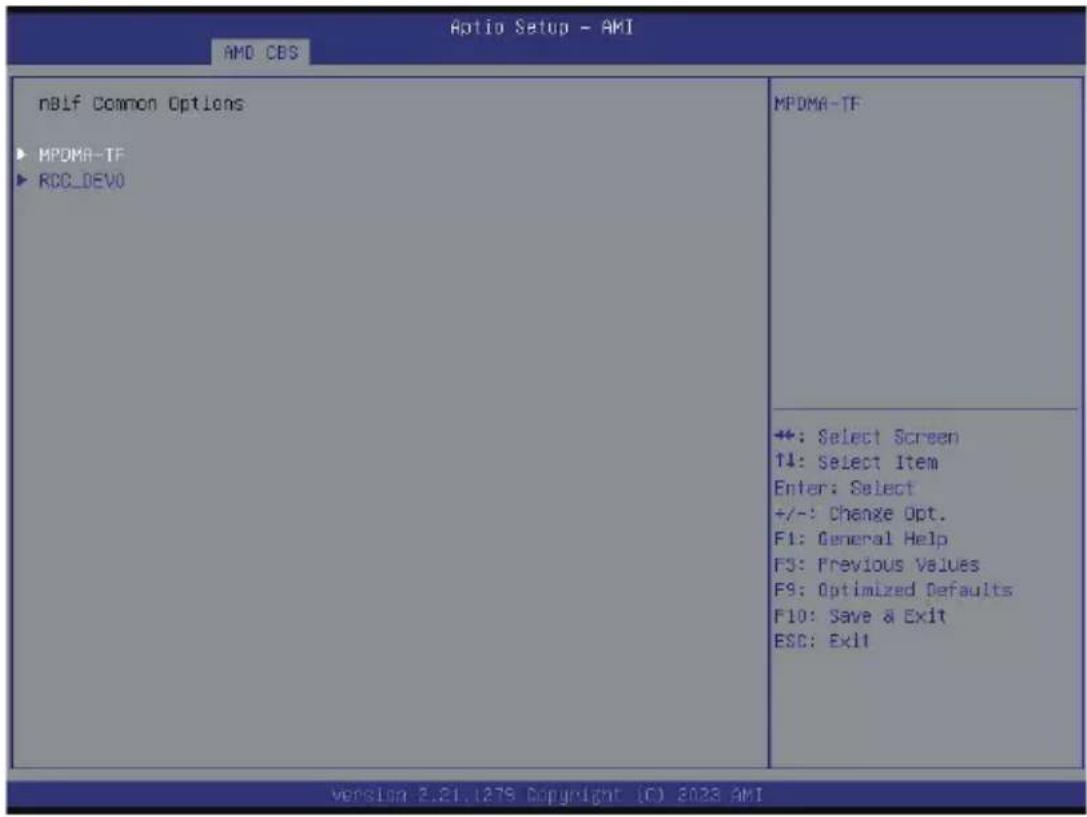
| Parameter | Description |
| MPDMA-TF | SRIOV- Options available: Auto, Disable, Enable. Default setting isAuto.ARI- Options available: Auto/Default, Disable, Enable. Default setting isAuto/Default.AER- Options available: Auto, Disable, Enable. Default setting isAuto.ACS- Options available: Auto, Disable, Enable. Default setting isAuto.ATS- Options available: Auto, Disable, Enable. Default setting isAuto.PASID- Options available: Auto, Disable, Enable. Default setting isAuto.RTR- Options available: Auto, Disable, Enable. Default setting isAuto.PAGE_REQ- Options available: Auto, Disable, Enable. Default setting isAuto.PWR- Options available: Auto, Disable, Enable. Default setting isAuto.ATC_ENABLE- Options available: Auto, Disable, Enable. Default setting isAuto. |
| RCC_DEV0 | ACS Rcc_Dev0Options available: Auto, Disable, Enable. Default setting isAuto.AER Rcc_Dev0Options available: Auto, Disable, Enable. Default setting isAuto.DlfEnableStrap1Options available: Auto, Disable, Enable. Default setting isAuto.Phy16GTStrap1Options available: Auto, Disable, Enable. Default setting isAuto.MarginEnStrap1Options available: Auto, Disable, Enable. Default setting isAuto.SourceValStrap5Options available: Auto, Disable, Enable. Default setting isAuto.TranslationalBlockingStrap5Options available: Auto, Disable, Enable. Default setting isAuto.P2pReq ACS ControlOptions available: Auto, Disable, Enable. Default setting isAuto.P2pCompStrap5Options available: Auto, Disable, Enable. Default setting isAuto.UpstreamFwdStrap5Options available: Auto, Disable, Enable. Default setting isAuto.P2PEgressStrap5Options available: Auto, Disable, Enable. Default setting isAuto.DirectTranslatedStrap5Options available: Auto, Disable, Enable. Default setting isAuto.SsidEnStrap5Options available: Auto, Disable, Enable. Default setting isAuto.PriEnPageReqOptions available: Auto, Disable, Enable. Default setting isAuto.PriResetPageReqOptions available: Auto, Disable, Enable. Default setting isAuto.SourceVal ACS cntlOptions available: Auto, Disable, Enable. Default setting isAuto.TranslationalBlocking ACS ControlOptions available: Auto, Disable, Enable. Default setting isAuto.P2pComp ACS ControlOptions available: Auto, Disable, Enable. Default setting isAuto.UpstreamFwd ACS ControlOptions available: Auto, Disable, Enable. Default setting isAuto.P2PEgress ACS ControlOptions available: Auto, Disable, Enable. Default setting isAuto.P2pReqStrap5Options available: Auto, Disable, Enable. Default setting isAuto.E2E_PREFIXOptions available: Auto, Disable, Enable. Default setting isAuto. |
| RCC_DEV0(continued) | ◆ EXTENDED_FMT– Options available: Auto, Disable, Enable. Default setting isAuto. |
5-3-4-4 Link EQ Present Options
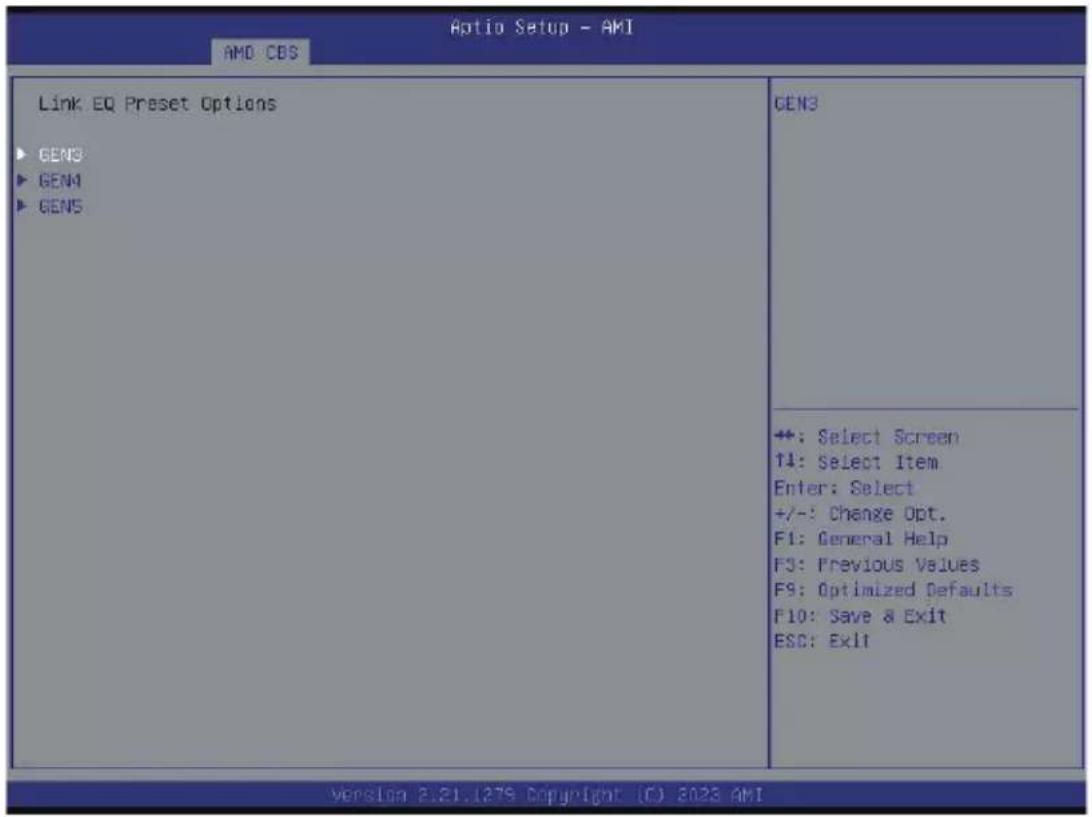
| Parameter | Description |
| Link EQ Present Options | |
| GEN3 | Press [Enter] for configuration of advanced items.◆ Present Search Mask Configuration– Options available: Auto, Custom, Enable. Default setting isAuto. |
| GEN4 | Press [Enter] for configuration of advanced items.◆ Present Search Mask Configuration– Options available: Auto, Custom, Enable. Default setting isAuto. |
| GEN5 | Press [Enter] for configuration of advanced items.◆ Present Search Mask Configuration– Options available: Auto, Custom, Enable. Default setting isAuto. |
5-3-5 FCH Common Options
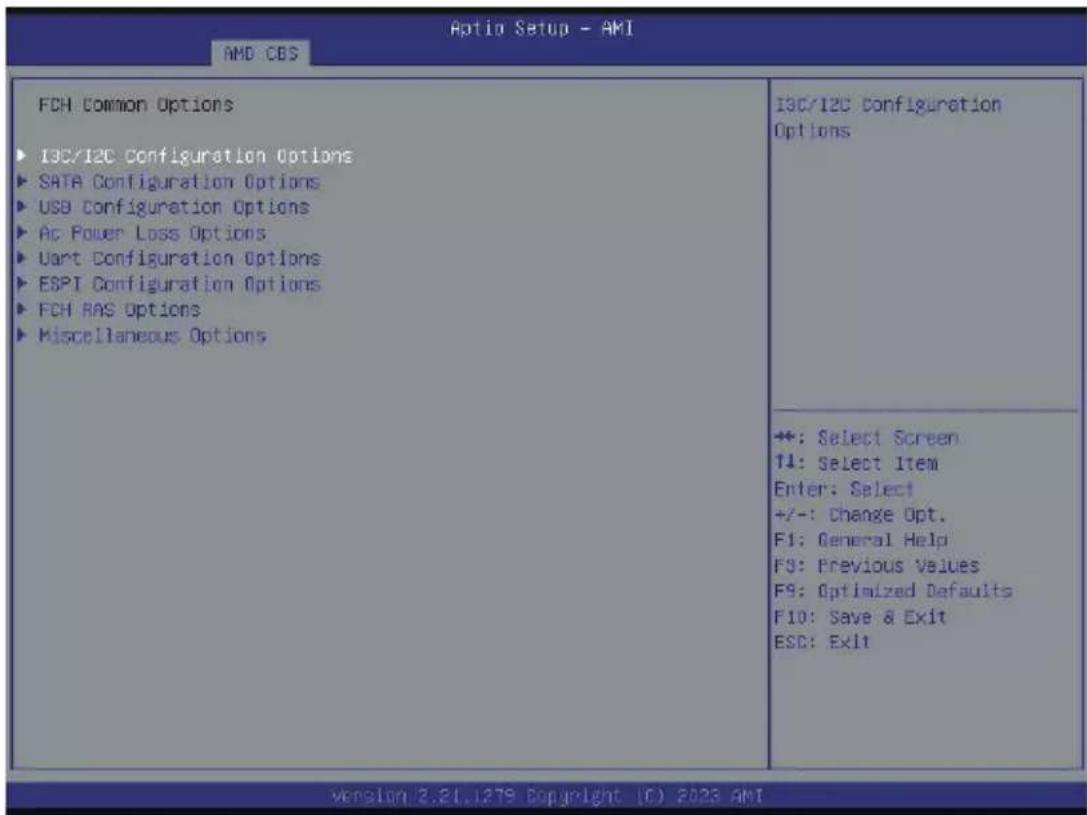
Parameter Description
FCH Common Options
I3C/I2C Configuration Options Press [Enter] for configuration of advanced items.
SATA Configuration Options Press [Enter] for configuration of advanced items.
USB Configuration Options Press [Enter] for configuration of advanced items.
AC Power Loss Options Press [Enter] for configuration of advanced items.
Uart Configuration Options Press [Enter] for configuration of advanced items.
ESPI Configuration Options Press [Enter] for configuration of advanced items.
FCH RAS Options Press [Enter] for configuration of advanced items.
Miscellaneous Options Press [Enter] for configuration of advanced items.
5-3-5-1 I3C/I2C Configuration Options
![Aptio Setup - AMI AMD CBS 13C/12C Configuration Options 13C/12C 0 Enable [Auto] 13C/12C 1 Enable [Auto] 13C/12C 2 Enable [Auto] 13C/12C 3 Enable [Auto] 12C 4 Enable [Auto] 12C 5 Enable [Auto] Release SPD Host Control [Disabled] PMFN Poll DDR5 Telemetry [Enabled] I2C Telemetry Ports Fence Control [Disabled] I2C SDA Hold Override [Auto] APML SE-TSI & RMI Mode [I3C] I3C Mode Speed [Auto] I3C Push Pull HCNT Value 8 I3C SDA Hold Override [Auto] Enable or disable Inter-Integrated Circuit Control 0 +: Select Screen T1: Select Item Enter: Select +/-: Change Opt. F1: General Help F3: Previous Values F9: Optimized Defaults F10: Save & Exit ESC: Exit Version 2.21.1279 Copyright (C) 2023 AMI](/content/2026/04/656286/images/c60105bde53254db65d8618a7980b4749c1fdfe39eeeb3e260c376132fa7f2b2.jpg)
| Parameter | Description |
| I3C/I2C Configuration Options | |
| I3C/I2C 0/1/2/3 Enable | Options available: Both Disabled, I3C Enabled, I2C Enabled, Auto. Default setting is Auto. |
| I2C 4/5 Enable | Options available: Disabled, Enabled, Auto. Default setting is Auto. |
| Release SPD Host Control | Options available: Disabled, Enabled, Auto. Default setting is Auto. |
| I2C SDA Hold Override | Options available: Disabled, Enabled, Auto. Default setting is Auto. |
| APML SB-TSI Mode | Options available: I3C, I2C. Default setting is I3C. |
| I3C Mode Speed | Options available: SDR2(6MHz), SDR0(12.5MHz), Auto. Default setting is Auto. |
| I3C SDA Hold Value | Configures I3C SDA Hold value. |
5-3-5-2 SATA Configuration Options
![SATA Configuration Options SATA Enable [Auto] SATA BAS Support [Auto] SATA Staggered Spin-up [Auto] SATA Disabled AHCI Prefetch [Auto] Function Aggressive SATA Device Sleep P0 [Auto] Aggressive SATA Device Sleep P1 [Auto] ▶ SATA Controller options Disable or enable OnChip SATA controller +: Select Screen T4: Select Item Enter: Select +/-: Change Opt. F1: General Help F3: Previous Values F9: Optimized Defaults F10: Save & Exit ESC: Exit Version 2.21.1279 Copyright (C) 2023 AMI](/content/2026/04/656286/images/db9fa64599fee976ee10dac4ed3a78b655bb807211adc918ef0d422f5d2f63ee.jpg)
| Parameter | Description |
| SATA Configuration Options | |
| SATA Enable | Enable/Disable OnChip SATA controller.Options available: Disabled, Enabled, Auto. Default setting isAuto. |
| SATA RAS Support | Options available: Disabled, Enabled, Auto. Default setting isAuto. |
| SATA Staggered Spin-up | Options available: Disabled, Enabled, Auto. Default setting isAuto. |
| SATA Disabled AHCI Prefetch Function | Options available: Disabled, Enabled, Auto. Default setting isAuto. |
| Aggressive SATA Device Sleep P0/P1 | Options available: Disabled, Enabled, Auto. Default setting isAuto. |
| SATA Controller options | Press [Enter] for configuration of advanced items.SATA Controller EnableSATA Controller eSATSATA Controller DevSlpSATA Controller SGPIO |
5-3-5-3 USB Configuration Options
![Optio Setup - AMI AMD CBS USB Configuration Options XHCI Controller0 enable [Auto] XHCI Controller1 enable [Auto] USB acc SMI Enable [Auto] ▶ MCM USB enable Enable or disable USB3 controller. +: Select Screen T1: Select Item Enter: Select +/-: Change Opt. F1: General Help F3: Previous Values F9: Optimized Defaults F10: Save & Exit ESC: Exit Version 2.21.1279 Copyright (C) 2023 AMI](/content/2026/04/656286/images/8b6eab949dfbfee2ba4f68b961d405d1466c8760ff7f0c9f189a964d0118bfe9.jpg)
| Parameter | Description |
| USB Configuration Options | |
| XHCI Controller0/1 enable | Enable/Disable USB controller.Options available: Enabled, Disabled, Auto. Default setting isAuto. |
| USB ecc SMI Enable | Options available: Enable, Off, Auto. Default setting isAuto. |
| MCM USB enable | Press [Enter] for configuration of advanced items.♦ XHCI2/ XHCI3 enable (Socket1)– Options available: Enabled, Disabled, Auto. Default setting isAuto. |
5-3-5-4 AC Power Loss Options
![Apo Setup - AMI AMD COS Ac Power Loss Options Ac Loss Control [Power Off] Select Ac Loss Control Method +: Select Screen T↓: Select Item Enter: Select +/-: Change Opt. F1: General Help F3: Previous Values F9: Optimized Defaults F10: Save & Exit ESC: Exit version 2.21.127S Copyright (C) 2023 AMI](/content/2026/04/656286/images/3ad13c6c6743f4dfc707f1662ffca1725f7e0ff146705bd23eb775b811f48aad.jpg)
| Parameter | Description |
| AC Power Loss Options | |
| AC Loss Control | Selects the AC Loss Control Method. Options available: Power Off, Power On, Last State. Default setting is Last State. |
5-3-5-5 Uart Configuration Options
![Optio Setup - AMI AMD COS Uart Configuration Options Uart 0 Enable [Auto] Uart 1 Enable [Auto] Uart 2 Enable [Auto] Uart 3 Enable [Auto] Enable or disable Uart0. Uart 0 has no HW flow control if Uart 2 is enabled +: Select Screen ↑4: Select Item Enter: Select +/-: Change Opt. F1: General Help F3: Previous Values F9: Optimized Defaults. F10: Save & Exit ESC: Exit version 2.21.1278 Copyright (C) 2023 AMI](/content/2026/04/656286/images/05532b026cb45f3bfb1dde4eb64f84c5ce162516197cac6c5477a6aebcb337ea.jpg)
| Parameter | Description |
| Uart Configuration Options | |
| Uart 0/1/2/3 Enable | Options available: Disabled, Enabled, Auto. Default setting is Auto. |
5-3-5-6 ESPI Configuration Options
![Optio Setup - AMI AMD CBS ESPI Configuration Options ESPI Enable [Auto] No help string +: Select Screen T4: Select Item Enter: Select +/-: Change Opt. F1: General Help F3: Previous Values F9: Optimized Defaults F10: Save & Exit ESC: Exit Version 2.21.1279 Copyright (C) 2023 AMI](/content/2026/04/656286/images/0a4ae8f2c6f4086af3252d0c537666c48b22a30f99a6ead6e15bcd85810f7b8f.jpg)
| Parameter | Description |
| ESPI Configuration Options | |
| ESPI Enable | Options available: Disabled, Enabled, Auto. Default setting isAuto. |
5-3-5-7 FCH RAS Options
![Aio Setup - AMI AMD CBS FCH RAS Options ALink RAS Support [Auto] Reset After Sync-Flood [Auto] Enable FCH A-Link parity error +: Select Screen T1: Select Item Enter: Select +/-: Change Opt. F1: General Help F3: Previous Values F9: Optimized Defaults F10: Save & Exit ESC: Exit Version 2.21.1279 Copyright (C) 2023 AMI](/content/2026/04/656286/images/b7c2e271434b55246b56135cdaf59aa294e31246e02ec4f929b7d9b47feb9ebe.jpg)
| Parameter | Description |
| FCH RAS Options | |
| ALink RAS Support | Enable/Disable the ALink RAS Support.Options available: Disabled, Enabled, Auto. Default setting isAuto. |
| Reset After Sync Flood | Enables AB to forward downstream sync-flood message to system controller.Options available: Enable, Disable, Auto. Default setting isAuto. |
5-3-5-8 Miscellaneous Options
![Aptio Setup - AMI AMD CBS Miscellaneous Options Boot Timer Enable [Auto] Boot Timer enable. Enable : force PMx44 bit 27 = 1 Disable : force PMx44 bit 27 = 0 Auto:PMx44 bit 27 = PcdBootTimerEnable +: Select Screen ↑↓: Select Item Enter: Select +/-: Change Opt. F1: General Help F3: Previous Values F9: Optimized Defaults F10: Save & Exit ESC: Exit Version 2.21.1278 Copyright (C) 2023 AMI](/content/2026/04/656286/images/f6c227546f02d9ed806dec37ce849cb4b7b663f9766aa838a8407a05a4efafe6.jpg)
| Parameter | Description |
| Miscellaneous Options | |
| Boot Timer Enable | Enable/Disable Boot Timer.Options available: Disabled, Enabled, Auto. Default setting isAuto. |
5-3-6 SOC Miscellaneous Control
![Ampio Setup - AMI AMD CBS Soc Miscellaneous Control ABL Console Out Control [Auto] ABL Console Out Serial Port [Auto] ABL Console Out Serial Port ID [Auto] ABL Basic Console Out Control [Auto] ABL PMU message Control [Auto] ABL Memory Population message [Warning message] Control FSP error injection support [False] ► Firmware Anti-rollback (FAR) Enable : Enable ConsoleOut Function for ABL Disable : Disable ConsoleOut Function for ABL Auto : Keep default behavior +: Select Screen ↑↓: Select Item Enter: Select +/-: Change Opt. F1: General Help F3: Previous Values F9: Optimized Defaults F10: Save & Exit ESC: Exit Version 2.21.1279 Copyright (C) 2023 AMI](/content/2026/04/656286/images/e1c958aa2d9501c8bbc1738c282d3dcd04d9e99d0a3b901eccb6381274f03907.jpg)
| Parameter | Description |
| SOC Miscellaneous Control | |
| ABL Console Out Control ^(Note) | Enable/Disable the ConsoleOut function for ABL. Options available: Disable, Enable, Auto. Default setting isAuto. |
| ABL Console Out Serial Port ^(Note) | Options available: eSPI, SOC UART0, SOC UART1, Auto. Default setting isAuto. |
| ABL Console Out Serial Port IO | Options available: 0x3F8, 0x2F8, 0x3E8, 0x2E8, Auto. Default setting isAuto. |
| ABL Basic Console Out Control | Enable/Disable the Basic ConsoleOut function for ABL. Options available: Disable, Enable, Auto. Default setting isAuto. |
| ABL PMU message Control | To Control the total number of PMU debug messages. Options available: Auto, Detailed debug message, Coarse debug message, Stage completion, Assertion messages, Firmware completion message only. Default setting isAuto. |
| ABL Memory Population message Control | Options available: Warning message, Fatal error. Default setting isWarning message. |
| PSP error injection support Options available: False, True. Default setting isFalse. | |
(Note) Advanced items are configurable when this item is defined.
Firmware Anti-rollback (FAR)
Press [Enter] for configuration of advanced items.
◆ FAR enforcement state
- Default setting is Enabled.
◆ SPL value in the CPU Fuse
◆ SPL value in the SPL table
FAR Switch
- Options available: Disabled, Enabled, Auto. Default setting is Auto.
5-3-7 CXL Common Options
![Auto Setup - AMI AMD CDS CXL Common Options CXL Control [Auto] CXL SPM [Auto] CXL Encryption [Disabled] CXL BYSED Lock [Auto] Temp Gen5 Advertisement [Auto] Sync Header Dypass [Auto] ▶ CXL BAS Enable/Disable CXL on all ports +: Select Screen T4: Select Item Enter: Select +/-: Change Opt. F1: General Help F3: Previous Values F9: Optimized Defaults F10: Save & Exit ESC: Exit Version 2.21.1278 Copyright (C) 2023 AMI](/content/2026/04/656286/images/4f8a629c15fe8932b15ac0c66d4fa5c517ecb821c0ae5f9bfc30c1f1afcd124c.jpg)
| Parameter | Description |
| CXL Common Options | |
| CXL Control Options available: Auto, Enabled, Disabled. Default setting is Auto. | |
| CXL SPM Options available: Auto, Enabled, Disabled. Default setting is Auto. | |
| CXL Encryption Options available: Enabled, Disabled. Default setting is Disabled. | |
| CXL DVSEC LOCK Options available: Auto, Enabled, Disabled. Default setting is Auto. | |
| Temp Gen5 Advertisement | Options available: Disable, Enable, Auto. Default setting is Auto. |
| Sync Hader Bypass Options available: Auto, Enabled, Disabled. Default setting is Auto. | |
| CXL RAS | Press [Enter] for configuration of advanced items.CXL Protocol Error Reporting- Options available: Disabled, SameAsPciAer,ForceAerFwFirstIfCx1Present. Default setting is SameAsPciAer. |
5-4 AMD PBS Menu
AMD PBS Option menu displays submenu options for configuring the function of AMD PBS. Select a submenu item, then press [Enter] to access the related submenu screen.
![Optio Setup - AMI Main Advanced AMD CBS AMD PBS Option Chloset Server Mgmt Security Boot Save & Exit AMD PBS ► RAS SPI Locking [Disabled] ► CKL Range Encryption AMD CPM RAS related settings +: Select Screen T1: Select Item Enter: Select +/-: Change Opt. F1: General Help F3: Previous Values F9: Optimized Defaults F10: Save & Exit ESC: Exit Version 2.21.1278 Copyright (C) 2023 AMI](/content/2026/04/656286/images/b3fc3c4b8dc137e2b5b43c6e463499dba5c02ad75cca6a0b4431d4431dd0ba61.jpg)
Parameter Description
RAS Press [Enter] for configuration of advanced items.
| SPI Locking | Enable/Disable SPI Locking for protect ROM part. Options available: Disabled, Enabled. Default setting is Disabled. |
CXL Range Encryption Press [Enter] for configuration of advanced items.
![Aptio Setup - AMI AMD PBS Option RAS Periodic SMI Control [Enabled] SMI Threshold 5 SMI Scale 1000 SMI Scale Unit [millisecond] SMI Period 1000 GHES Notify Type [Poiled] GHES UnCorr Notify Type [NMI] PCIe GHES Notify Type [Poiled] PCIe UnCorr GHES Notify Type [NMI] PCIe Root Port Corr Err Mask Reg 0 PCIe Root Port UnCorr Err Mask Reg 0 PCIe Root Port UnCorr Error Sev 7EF6030 Reg PCIe Device Corr Err Mask Reg 0 PCIe Device UnCorr Err Mask Reg 100000 PCIe Device UnCorr Error Sev Reg 7EF6030 CXL DP CIE Mask Enable [Enabled] DRAM Hard Post Package Repair [Disabled] HEST DMC Structure Support [Disabled] CXL Error Report Support [Disabled] Enable/ disable Periodic SMI for polling [MCA Threshold] error **: Select Screen T4: Select Item Enter: Select +/-: Change Opt. F1: General Help F3: Previous Values F9: Optimized Defaults F10: Save & Exit ESC: Exit version 2.21.1279 Copyright (C) 2023 AMI](/content/2026/04/656286/images/51189e2afec90cc12a4efd7548628862a4b84673f42b0b43e35cf48482be12ff.jpg)
| Parameter | Description |
| RAS Periodic SMI Control | Enable/Disable the Periodic SMI for polling [MCA Threshold] error. Options available: Disabled, Enabled. Default setting is Enabled. |
| SMI Threshold Configures the SMI Threshold value. | |
| SMI Scale Configures the SMI Scale value. | |
| SMI Scale Unit | Defines the unit of time scale. Options available: millisecond, second, minute. Default setting is millisecond. |
| SMI Period Configures the SMI Period. | |
| GHES Notify Type | Selects the Notification type for deferred/ corrected errors. Options available: Polled, SCI. Default setting is Polled. |
| GHES UnCorr Notify Type | Selects the Notification type for uncorrected errors. Options available: Polled, NMI. Default setting is NMI. |
| PCIe GHES Notify Type | Selects the Notification type for PCIe corrected errors. Options available: Polled, SCI. Default setting is Polled. |
| PCIe UnCorr GHES Notify Type | Selects the Notification type for PCIe uncorrected errors. Options available: Polled, NMI. Default setting is NMI. |
| PCIe Root Port Corr Err Mask Reg | Initialize the PCIe AER Corrected Error Mask register of Root Port. |
| PCIe Root Port UnCorr Err Mask Reg | Initialize the PCIe AER Uncorrected Error Mask register of Root Port. |
| PCIe Root Port UnCorr Err Sev Reg | Initialize the PCIe AER Uncorrected Error Severity register of Root Port. |
| PCIe Device Corr Err Mask Reg | Initialize the PCIe AER Corrected Error Mask register of PCIe device. |
| PCIe Device UnCorr Err Mask Reg | Initialize the PCIe AER Uncorrected Error Mask register of PCIe device. |
| PCIe Device UnCorr Err Sev Reg | Initialize the PCIe AER Uncorrected Error Severity register of PCIe device. |
| DRAM Hard Post Package Repair | This feature allows spare DRAM rows to replace malfunctioning rows via an in-field repair mechanism.Options available: Disabled, Enabled. Default setting is Disabled. |
| HEST DMC Structure Support | HEST DMC (Deferred Machine Check) Structure Support.Options available: Disabled, Enabled. Default setting is Disabled. |
| CXL Error Report Support | Enable/Disable CXL Error Reporting.Options available: Disabled, Enabled. Default setting is Disabled. |
5-4-2 CXL Range Encryption
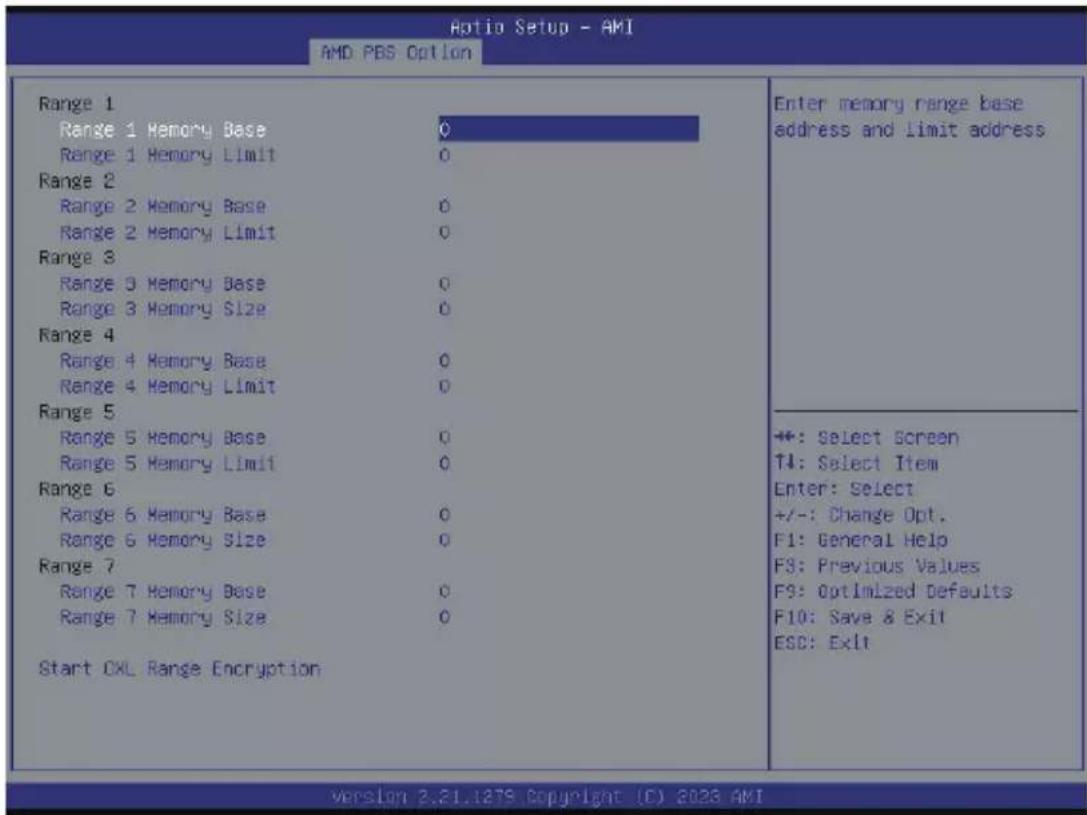
| Parameter | Description |
| Range_# | Enter memory base address and limit address. |
| Range_# Memory Base | |
| Start CXL Range Encryption | Start to encrypt all memory ranges. |
5-5 Chipset Setup Menu
Chipset Setup menu displays submenu options for configuring the function of the North Bridge. Select a submenu item, then press
![Aio Setup - AMI Main Advanced AND CES AND PGS Option Chloset Server Mgmt Security Boot Save & Exit PCIe Compliance Mode [Off] Program All VR [Enabled] ► North Bridge ► Fabric Resource PCIe Link Compliance Mode. +: Select Screen T↓: Select Item Enter: Select +/-: Change Opt. F1: General Help F3: Previous Values F5: Optimized Defaults F10: Save & Exit ESC: Exit Version 2.21.1279 Copyright (C) 2023 AMI](/content/2026/04/656286/images/993bd37ae446dae3ed25e818934af61157fa002986167fa57d55ccdbf12847e8.jpg)
| Parameter | Description |
| PCIe Link Training Type | Options available: 1 Step, 2 Step. Default setting is 1 Step. |
| PCIe Compliance Mode Options available: Off, On. Default setting is Off. | |
| Program All VR | Enable/Disable program all VR on MB. Options available: Disabled, Enabled. Default setting is Enabled. |
| North Bridge Press [Enter] for configuration of advanced items. | |
| Fabric Resource Press [Enter] for configuration of advanced items. | |
5-5-1 North Bridge
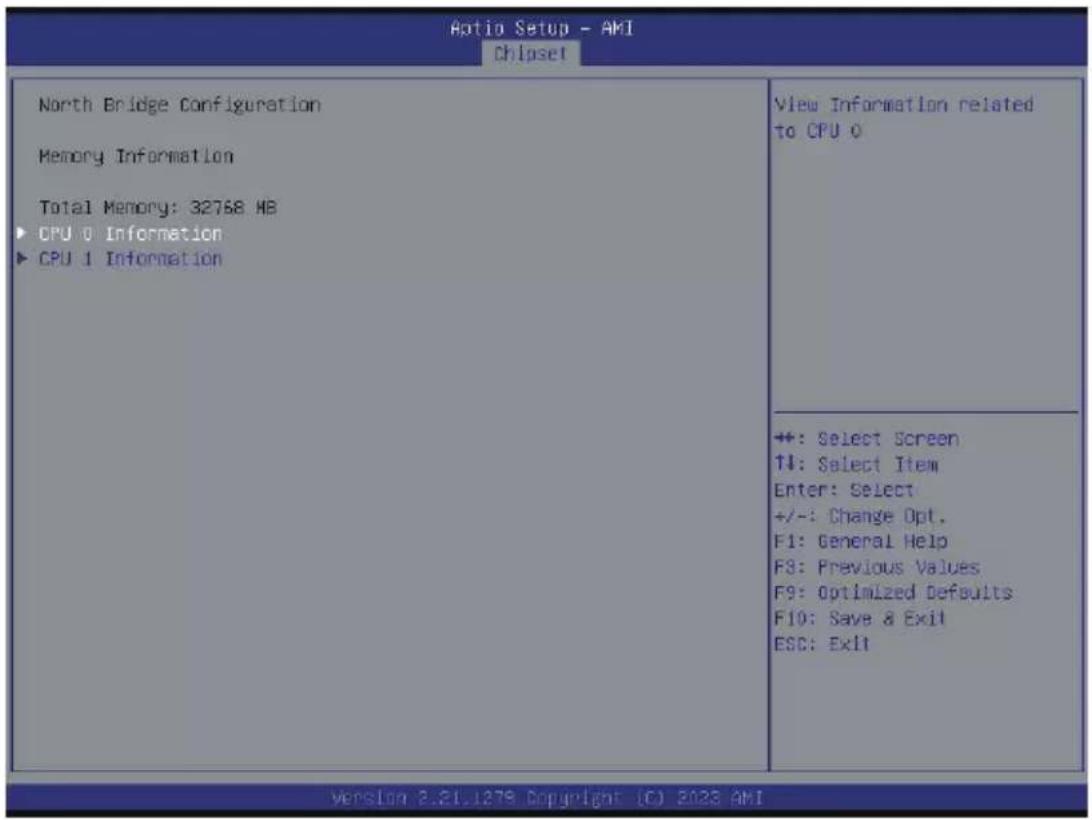
| Parameter | Description |
| North Bridge ConfigurationMemory Information | |
| Total Memory Displays the total memory information. | |
| CPU 0/1 Information Press [Enter] to view information related to CPU 0/1. | |
5-5-2 Fabric Resource
![Aio Setup - AMI Chipset Fabric Resource CPU0 NB100: Base Bus: 0x60 Prefetchable Mmio Above 4G Size: 1500 GB IO Resource: 0x000 PCIe Bus Number 20 Prefetchable Mmio Above 4G size [System Default] PCIe IO Resource FFFF CPU0 NB101: Base Bus: 0x40 Prefetchable Mmio Above 4G Size: 1500 GB IO Resource: 0x000 PCIe Bus Number 20 Prefetchable Mmio Above 4G size [System Default] PCIe IO Resource FFFF CPU0 NB102: Base Bus: 0x00 Prefetchable Mmio Above 4G Size: 1500 GB IO Resource: 0x000 PCIe Bus Number 20 Prefetchable Mmio Above 4G size [System Default] PCIe IO Resource FFFF Change CPU0 NB100 PCIe bus number +: Select Screen ↑1: Select Item Enter: Select +/-: Change Opt. F1: General Help F3: Previous Values F9: Optimized Defaults F10: Save & Exit ESC: Exit version 3.21.1279 Copyright (C) 2023 AMI](/content/2026/04/656286/images/fe9115f84f707214c7e29f2b34fb6f167e82f9fc481446e94960c93a69de6226.jpg)
![Aptio Setup - AMI Chipset CPU1 NBIO1: Base Bus: 0xC0 Prefetchable Mmio Above 4G Size: 1500 GB IO Resource: 0x000 PCIe Bus Number 20 Prefetchable Mmio Above 4G size [System Default] PCIe IO Resource FFFF CPU1 NBIO2: Base Bus: 0x80 Prefetchable Mmio Above 4G Size: 1500 GB IO Resource: 0x000 PCIe Bus Number 20 Prefetchable Mmio Above 4G size [System Default] PCIe IO Resource FFFF CPU1 NBIOS: Base Bus: 0xA0 Prefetchable Mmio Above 4G Size: 1500 GB IO Resource: 0x000 PCIe Bus Number 20 Prefetchable Mmio Above 4G size [System Default] PCIe IO Resource FFFF Change CPU1 NBIOS PCIe 10 Resource +: Select Screen ↑↓: Select Item Enter: Select +/-: Change Opt. F1: General Help F3: Previous Values F9: Optimized Defaults F10: Save & Exit ESC: Exit Version 2.21.1279 Copyright (C) 2023 AMI](/content/2026/04/656286/images/e73023391a17a53d769cda6322aaf17146508bd6e2f7e2ee1eb3e655daee4399.jpg)
| Parameter | Description |
| Fabric Resource | |
| CPU 0/1 NBIO_# PCIe Bus Number | Change CPU 0/1 NBIO_# PCIe Bus Number. |
| Prefetchable Mmio Above 4G size | Change CPU 0/1 NBIO_# Prefetchable MMIO Above 4G Size.Options available: System Default, 0, 1G, 2G, 4G, 8G, 16G, 32G, 64G, 128G, 256G, 512G, 1T, 2T, 4T, 8T. Default setting isSystem Default. |
| PCIe IO Resource Change CPU 0/1 NBIO_# PCIe IO Resource. | |
5-6 Server Management Menu
![Aptio Setup - AMI Main Advanced AND CBS AND PDB Option Chipset Server Mgmt Security Boot Save & Exit FRB-2 Timer [Enabled] FRB-2 Timer timeout [20 minutes] FRB-2 Timer Policy [Do Nothing] OS Watchdog Timer [Disabled] OS Wtd Timer Timeout [10 minutes] OS Wtd Timer Policy [Reset] Wait BMC Ready [2 minutes] ► System Event Log ► View FRU information ► BMC network configuration ► IPv6 BMC Network Configuration Configure how the system should respond if the FRB-2 Timer expires. Not available if FRB-2 Timer is disabled. +: Select Screen ↑↓: Select Item Enter: Select +/-: Change Opt. F1: General Help F3: Previous Values F9: Optimized Defaults F10: Save & Exit ESC: Exit Version 2.21.1278 Copyright (C) 2023 AMI](/content/2026/04/656286/images/3f06cee74f22812df455f7f2d796da8f51485b2f51df9479c60e68194a7c8c25.jpg)
| Parameter | Description |
| FRB-2 Timer | Enable/Disable FRB-2 timer (POST timer).Default setting is Enabled. |
| FRB-2 Timer timeout | Configures the FRB2 Timer timeout.Options available: 3 minutes, 4 minutes, 5 minutes, 6 minutes. Default setting is 6 minutes. |
| FRB-2 Timer Policy | Configures the FRB2 Timer policy.Options available: Do Nothing, Reset, Power Down, Power Cycle.Default setting is Do Nothing. |
| OS Watchdog Timer | Enable/Disable OS Watchdog Timer function.Options available: Enabled, Disabled. Default setting is Disabled. |
| OS Wtd Timer Timeout ^(Note) | Configures OS Watchdog Timer.Options available: 5 minutes, 10 minutes, 15 minutes, 20 minutes.Default setting is 10 minutes. |
| OS Wtd Timer Policy ^(Note) | Configure OS Watchdog Timer Policy.Options available: Do Nothing, Reset, Power Down, Power Cycle.Default setting is Reset. |
| Wait BMC Ready | Post wait BMC ready and reboot system.Options available: Disabled, 2 minutes, 4 minutes, 6 minutes. Default setting is 2 minutes. |
(Note) This item is configurable when OS Watchdog Timer is set to Enabled.
| Parameter | Description |
| System Event Log | Press [Enter] to configure advanced items. |
| View FRU Information | Press [Enter] to view the FRU information. |
| BMC network configuration | Press [Enter] to configure advanced items. |
| IPv6 BMC Network Configuration | Press [Enter] to configure advanced items. |
5-6-1 System Event Log
![Optio Setup - AMI Main Advanced AMD CBS AMD PBS Option Chipset Server Mgmt Security Boot Save & Exit FRB-2 Timer [Enabled] FRB-2 Timer timeout [20 minutes] FRB-2 Timer Policy [Do Nothing] OS Watchdog Timer [Disabled] OS Wtd Timer Timeout [10 minutes] OS Wtd Timer Policy [Reset] Wait BMC Ready [2 minutes] ► System Event Log ► View FRU information ► BMC network configuration ► IPVG BMC Network Configuration Configure how the system should respond if the FRB-2 Timer expires. Not available if FRB-2 Timer is disabled. +: Select Screen T↓: Select Item Enter: Select +/-: Change Opt. F1: General Help F3: Previous Values F9: Optimized Defaults F10: Save & Exit ESC: Exit Version 2.21.1879 Copyright (C) 2023 AMI](/content/2026/04/656286/images/b1315046ff6d372f0af0ac86cb0a30bbcc2a0ab8ccc4bcb89ad70070391390cf.jpg)
| Parameter | Description |
| Enabling / Disabling Options | |
| SEL Components | Change this item to enable or disable all features of System Event Logging during boot.Options available: Disabled, Enabled. Default setting is Enabled. |
| Erasing Settings | |
| Erase SEL | Choose options for erasing SEL.Options available: No/Yes, On next reset/Yes, On every reset. Default setting is No. |
| When SEL is Full | Choose options for reactions to a full SEL.Options available: Do Nothing, Erase Immediately. Default setting is Do Nothing. |
| Custom EFI Logging Options | |
| Log EFI Status Codes | Enable/Disable the logging of EFI Status Codes (if not already converted to legacy).Options available: Disabled, Both, Error code, Progress code. Default setting is Error code. |
5-6-2 View FRU Information
The FRU page is a simple display page for basic system ID information, as well as System product information. Items on this window are non-configurable.
| FRU Information | |
| System Manufacturer Giga Computing System Product Name T015-240-IA01-000 System Version 0100 System Serial Number GNG6P7712A0010 Board Manufacturer Giga Computing Board Product Name M248-G20-000 Board Version 123456789AB Board Serial Number NG5R6900020 Chassis Manufacturer Giga Computing Chassis Product Name 01234567 Chassis Serial Number 01234567850123456785AB | +: Select Screen ↑↓: Select Item Enter: Select +/-: Change Opt. F1: General Help F3: Previous Values F9: Optimized Defaults F10: Save & Exit ESC: Exit |
5-6-3 BMC Network Configuration
![Aptio Setup - AMI Server Mgmt --BMC network configuration-- Lan channel 1 Configuration Address source [DynamicBmcDhcp] Station IP address 10.1.111.216 Subnet mask 255.255.255.0 Router IP address 10.1.111.253 Station NAC address 74-56-3c-49-6d-85 VLAN Support [Disabled] Real-time synchronize BMC network parameter values Select to configure LAN channel parameters statically or dynamically(by BIOS or BMC). Unspecified option will not modify any BMC network parameters during BIOS phase +: Select Screen ↑↓: Select Item Enter: Select +/-: Change Opt. F1: General Help F3: Previous Values F9: Optimized Defaults F10: Save & Exit ESC: Exit Version 2.21.1878 Copyright (C) 2028 AMI](/content/2026/04/656286/images/b5f7ae6ca60d7870cb8a85f8001626c2b276aab8dfd3dab9f2c5568c27e41c97.jpg)
| Parameter | Description |
| BMC network configuration | |
| Lan Channel 1 | |
| Configuration Address source | Selects to configure LAN channel parameters statically or dynamically (DHCP). Do nothing option will not modify any BMC network parameters during BIOS phase. Options available: Unspecified, Static, DynamicBmcDhcp. Default setting is DynamicBmcDhcp. |
| Station IP address | Displays IP Address information. |
| Subnet mask | Displays Subnet Mask information. Please note that the IP address must be in three digitals, for example, 192.168.000.001. |
| Router IP address | Displays the Router IP Address information. |
| Station MAC address | Displays the MAC Address information. |
| VLAN Support | Set BMC to enable/disable VLAN support. Options available: Enabled, Disabled. Default setting is Disabled. |
| Real-time synchronize BMC network parameter values | Press [Enter] will set Address source(Static/DHCP) to BMC and then get Station IP address, Subnet mask and Router IP address from BMC. |
5-6-4 IPv6 BMC Network Configuration
![Aptio Setup - AMI Server Mgmt IPv6 BMC Network Configuration IPv6 BMC Lan Channel 1: IPv6 BMC Lan Option [Enable] IPv6 BMC Lan IP Address Source [Dynamic-Obtained by BMC running DHCP] IPv6 BMC Lan IP Address/Prefix :::/0 Length -> [::/0] Enable/Disable IPv6 BMC LAN channel function. Disable option will not modify any BMC network during BIOS Phase ++: Select Screen ↑↓: Select Item Enter: Select +/-: Change Opt. F1: General Help F3: Previous Values F9: Optimized Defaults F10: Save & Exit ESC: Exit Version 2.21.1279 Copyright (C) 2023 AMI](/content/2026/04/656286/images/0dfb1709f338169b341b69e35bdd05808b4301537b46d92c1bd7fe04749ed158.jpg)
| Parameter | Description |
| IPv6 BMC network configuration | |
| IPv6 BMC Lan Channel 1 | |
| IPv6 BMC Lan Option | Enable/Disable IPv6 BMC LAN channel function. When this item is disabled, the system will not modify any BMC network during BIOS phase.Options available: Unspecified, Disable, Enable. Default setting is Enable. |
| IPv6 BMC Lan IP Address Source | Selects to configure LAN channel parameters statically or dynamically (by BIOS or BMC).Options available: Unspecified, Static, Dynamic-Obtained by BMC running DHCP. Default setting is Dynamic-Obtained by BMC running DHCP. |
| IPv6 BMC Lan IP Address/ Prefix Length | Check if the IPv6 BMC LAN IP address matches those displayed on the screen. |
5-7 Security Menu
The Security menu allows you to safeguard and protect the system from unauthorized use by setting up access passwords.
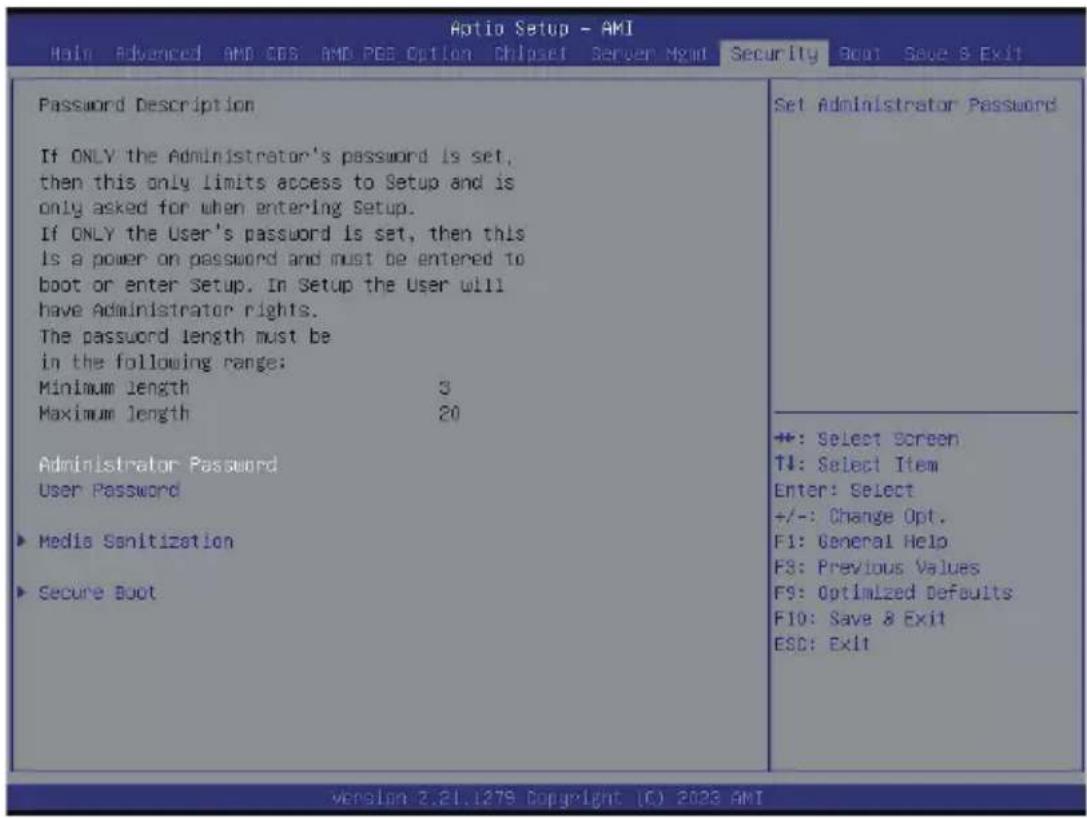
There are two types of passwords that you can set:
- Administrator Password
Entering this password will allow the user to access and change all settings in the Setup Utility.
- User Password
Entering this password will restrict a user's access to the Setup menus. To enable or disable this field, a Administrator Password must first be set. A user can only access and modify the System Time, System Date, and Set User Password fields.
| Parameter | Description |
| Administrator Password | Press [Enter] to configure the administrator password. |
| User Password | Press [Enter] to configure the user password. |
| Media Sanitization | Press [Enter] to configure advanced items. |
| Secure Boot | Press [Enter] to configure advanced items. |
5-7-1 Secure Boot
The Secure Boot submenu is applicable when your device is installed the Windows® 8 (or above) operating system.
| System Mode | Setup | Secure Boot feature is Active if Secure Boot is Enabled, Platform Key(PK) is enrolled and the System is in User mode. The mode change requires platform reset |
| Secure Boot | [Disabled] Not Active | |
| Secure Boot Mode | [Custom] | |
| Restore Factory Keys Reset To Setup Mode Enter Audit Mode | ||
| Key Management | ||
| +: Select Screen ↑↓: Select Item Enter: Select +/-: Change Opt. F1: General Help F3: Previous Values F9: Optimized Defaults F10: Save & Exit ESC: Exit |
| Parameter | Description |
| System Mode | Displays if the system is in User mode or Setup mode. |
| Secure Boot | Enable/ Disable the Secure Boot function.Options available: Enabled, Disabled. Default setting is Disabled. |
| Secure Boot Mode^(Note) | Secure Boot requires all the applications that are running during the booting process to be pre-signed with valid digital certificates. This way, the system knows all files being loaded before Windows loads to the login screen have not been tampered with.When set to Standard, it will automatically load the Secure Boot keys form the BIOS databases.When set to Custom, you can customize the Secure Boot settings and manually load its keys from the BIOS database.Options available: Standard, Custom. Default setting is Standard. |
| Restore Factory Keys | Forces the system to user mode and installs factory default Secure Boot key database. |
| Reset To Setup Mode | Press [Enter] to reset the system mode to Setup mode. |
| Enter Audit Mode | Press [Enter] to set the system mode to audit mode. |
(Note) Advanced items prompt when this item is set to Custom.
| Parameter | Description |
| Key Management | Press [Enter] to configure advanced items.Please note that this item is configurable when Secure Boot Mode is set to Custom.♦ Factory Key Provision- Allows to provision factory default Secure Boot keys when system is in Setup Mode.- Options available: Enabled, Disabled. Default setting is Disabled.♦ Restore Factory Keys- Installs all factory default keys. It will force the system in User Mode.- Options available: Yes, No.♦ Enroll Efi Image- Press [Enter] to enroll SHA256 hash of the binary into Authorized Signature Database (db).♦ Secure Boot variable- Displays the current status of the variables used for secure boot.♦ Platform Key (PK)- Displays the current status of the Platform Key (PK).- Press [Enter] to configure a new PK.- Options available: Update.♦ Key Exchange Keys (KEK)- Displays the current status of the Key Exchange Key Database (KEK).- Press [Enter] to configure a new KEK or load additional KEK from storage devices.- Options available: Update, Append.♦ Authorized Signatures (DB)- Displays the current status of the Authorized Signature Database.- Press [Enter] to configure a new DB or load additional DB from storage devices.- Options available: Update, Append.♦ Forbidden Signatures (DBX)- Displays the current status of the Forbidden Signature Database.- Press [Enter] to configure a new dbx or load additional dbx from storage devices.- Options available: Update, Append.♦ Authorized TimeStamps (DBT)- Displays the current status of the Authorized TimeStamps Database.- Press [Enter] to configure a new DBT or load additional DBT from storage devices.- Options available: Update, Append.♦ OsRecovery Signatures- Displays the current status of the OsRecovery Signature Database.- Press [Enter] to configure a new OsRecovery Signature or load additional OsRecovery Signature from storage devices.- Options available: Update, Append. |
5-8 Boot Menu
The Boot menu allows you to set the drive priority during system boot-up. BIOS setup will display an error message if the legacy drive(s) specified is not bootable.
![Auto Setup - AMI Main Advanced AND CDS AND PGS Option Chipset Server Mgm Security Boot Save & Exit Boot Configuration Setup Prompt Timeout 2 Bootup NumLock State [On] Quiet Boot [Enabled] Setup Flash Dump full Setup Data Dump non-default Setup Data Restore Setup Data Boot mode select [UEFI] FIXED BOOT ORDER Priorities Boot Option #1 [Hard Disk] Boot Option #2 [CD/DVD] Boot Option #3 [USB Device] Boot Option #4 [Network] Boot Option #5 [UEFI AP:UEFI: Built-in EFI Shell] ▶ UEFI Application Boot Priorities Number of seconds to wait for setup activation key. 65535(0xFFFF) means indefinite waiting. **: Select Screen ↑↓: Select Item Enter: Select +/-: Change Opt. F1: General Help F3: Previous Values F9: Optimized Defaults F10: Save & Exit ESC: Exit Version 2.21.1279 Copyright (C) 2023 AMI](/content/2026/04/656286/images/eef57b784c5e588de2b41a5717c916e9452db1cc66d4378bbed6fc90e6ee37d0.jpg)
| Parameter | Description |
| Boot Configuration | |
| Setup Prompt Timeout | Number of seconds to wait for setup activation key. 65535 (0xFFFF) means indefinite waiting.Press the numeric keys to input the desired values. |
| Bootup NumLock State | Enable/Disable the Bootup NumLock function.Options available: On, Off. Default setting is On. |
| Quiet Boot | Enable/Disable showing the logo during POST.Options available: Enabled, Disabled. Default setting is Enabled. |
| Setup Flash | Press [Enter] to run setup flash. |
| Dump full Setup Data | Press [Enter] to dump full setup data to file. |
| Dump non-default Setup Data | Press [Enter] to dump non-default setup data to file. |
| Restore Setup Data | Press [Enter] to restore setup data from file (cJson format). |
| Boot mode select | Selects the boot mode.Options available: LEGACY, UEFI. Default setting is UEFI. |
| FIXED BOOT ORDERPriorities | |
| Boot Option #1 / #2 / #3 / #4 / #5 | Press [Enter] to configure the boot priority.By default, the server searches for boot devices in the following sequence:1. Hard drive.2. CD-COM/DVD drive.3. USB device.4. Network.5. UEFI. |
| UEFI Network Drive BBS Priorities | Press [Enter] to configure the boot priority. |
| UEFI Application Boot Priorities | Press [Enter] to configure the boot priority. |
5-9 Save & Exit Menu
The Save & Exit menu displays the various options to quit from the BIOS setup. Highlight any of the exit options then press
| Aptio Setup - AMI Main Advanced AND CDS AND PES Option Chipset Server Ngmt Security Boot Save & Exit | |
| Save Options Save Changes and Exit Discard Changes and Exit Save Changes Default Options Restore Defaults Boot Override UEFI: Built-in EFI Shell Launch EFI Shell from filesystem device | Exit system setup after saving the changes. |
| +: Select Screen T4: Select Item Enter: Select +/-: Change Opt. F1: General Help F3: Previous Values F9: Optimized Defaults F10: Save & Exit ESC: Exit | |
| Parameter | Description |
| Save Options | |
| Save Changes and Exit | Saves changes made and closes the BIOS setup. Options available: Yes, No. |
| Discard Changes and Exit | Discards changes made and exits the BIOS setup. Options available: Yes, No. |
| Save Changes | Saves changes done so far to any of the setup options. Options available: Yes, No. |
| Default Options | |
| Restore Defaults | Loads the default settings for all BIOS setup parameters. Setup Defaults are quite demanding in terms of resources consumption. If you are using low-speed memory chips or other kinds of low-performance components and you choose to load these settings, the system might not function properly. Options available: Yes, No. |
| Boot Override | Press [Enter] to configure the device as the boot-up drive. |
| Launch EFI Shell from filesystem device | Attempts to Launch EFI Shell application (Shell.efi) from one of the available file system devices. |
5-10 BIOS Recovery
The system has an embedded recovery technique. In the event that the BIOS becomes corrupt the boot block can be used to restore the BIOS to a working state. To restore your BIOS, please follow the instructions listed below:
Recovery Instruction:
- Copy the XXX.rom to USB diskette.
- Setting BIOS Recovery jump to enabled status.
- Boot into BIOS recovery.
- Run Proceed with flash update.
- BIOS updated.
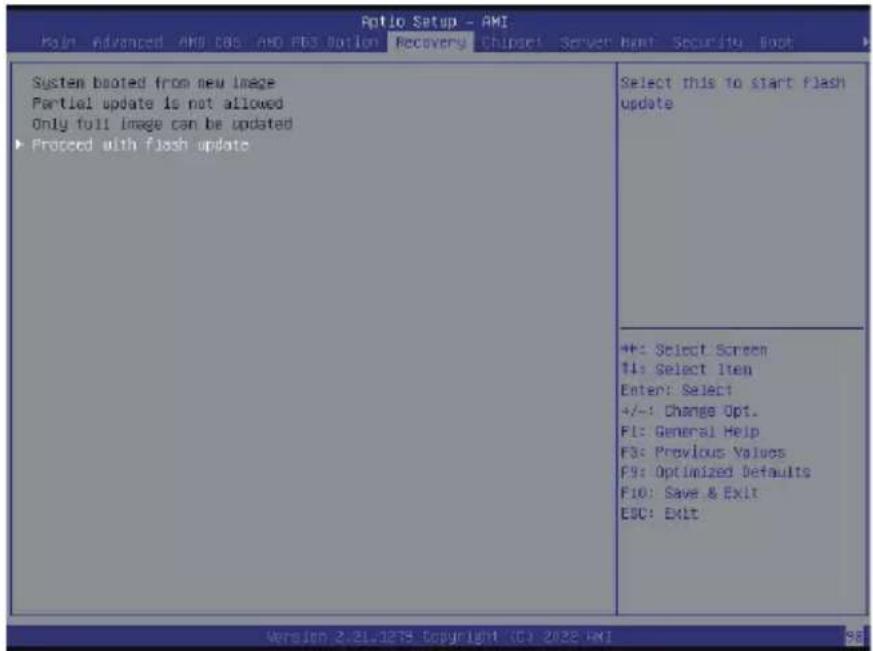
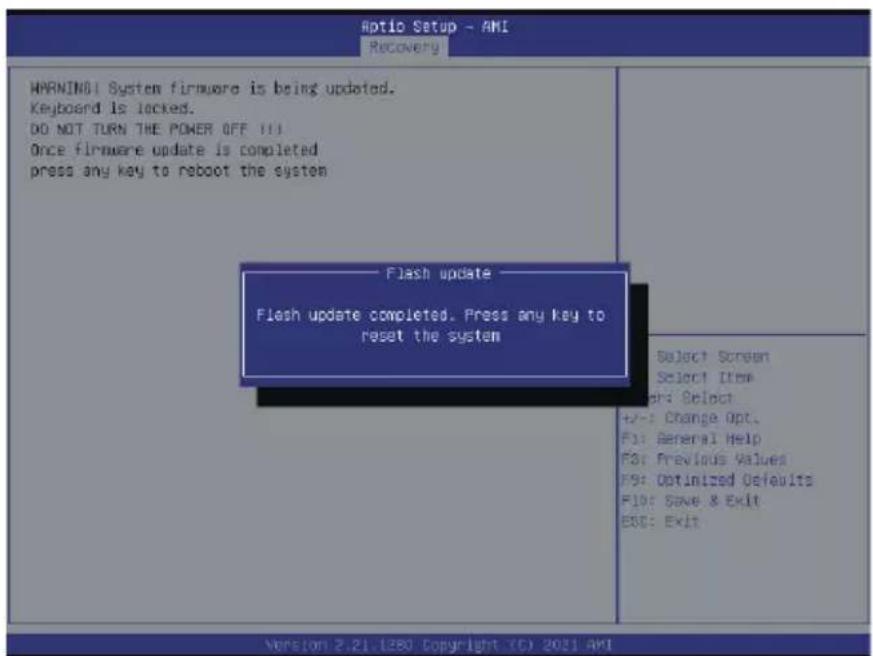
5-11 BIOS POST Beep code (AMI standard)
5-11-1 PEI Beep Codes
| # of Beeps Description |
| 1 Memory not Installed. |
| 1 Memory was installed twice (InstallPeiMemory routine in PEI Core called twice) |
| 2 Recovery started |
| 3 DXEIPL was not found |
| 3 DXE Core Firmware Volume was not found |
| 4 Recovery failed |
| 4 S3 Resume failed |
| 7 Reset PPI is not available |
5-11-2 DXE Beep Codes
| # of Beeps Description | |
| 1 Invalid password | |
| 4 Some of the Architectural Protocols are not available | |
| 5 No Console Output Devices are found | |
| 5 No Console Input Devices are found | |
| 6 Flash update is failed | |
| 7 Reset protocol is not available | |
| 8 Platform PCI resource requirements cannot be met |
- Disclaimer
- Documentation Classifications
- For More Information
- Conventions
- Server Warnings and Cautions
- WARNING!
- To reduce the risk of electric shock or damage to the equipment:
- CAUTION!
- Electrostatic Discharge (ESD)
- Table of Contents
- Chapter 1 Hardware Installation ....10
- Chapter 2 System Appearance....15
- Chapter 3 System Hardware Installation ....22
- Chapter 4 Motherboard Components ....44
- Chapter 5 BIOS Setup 46
- 5-3 AMD CBS Menu....83
- 5-4 AMD PBS Menu....141
- 5-5 Chipset Setup Menu.... 145
- 5-6 Server Management Menu.... 149
- 5-7 Security Menu 155
- Chapter 1 Hardware Installation
- 1-1 Installation Precautions
- 1-2 Product Specifications
- Expansion Slot
- Riser Card CORC206 x 2:
- Riser Card CORC207 x 2:
- Riser Card CORC20F x 2:
- Optional 2 x M.2 slots (COMTP61):
- Front I/O
- No. of Bus Bars
- TPM
- System Management
- Operating Properties
- Chapter 2 System Appearance
- 2-1 Front View
- No. Description
- 2-2 Rear View
- 2-3 Front Panel LEDs and Buttons
- 2-4 RoT LEDs
- NOTE!
- 2-5 Front System LAN LEDs
- 2-6 Storage LED
- NOTE:
- Chapter 3 System Hardware Installation
- Pre-installation Instructions
- 3-1 Removing Compute Node from the Rack
- 3-2 Removing and Installing the Chassis Cover
- 3-3 Installing the EDSFF SSD
- Follow these instructions to install the SSD:
- 3-4 Removing and Installing the CPU and Heatsink
- Follow these instructions to install the CPU:
- 3-5 Removing and Installing Memory
- 3-5-1 Eight Channel Memory Configuration
- 3-5-2 Removing and Installing a Memory Module
- Follow these instructions to install a DIMM module:
- 3-5-3 Processor and Memory Module Matrix Table
- 3-5-4 Memory Population Table
- 3-6 Installing the GPU Card
- Follow these instructions to install the GPU card: For Slot1/Slot2
- Follow these instructions to install the GPU card: For Slot5/Slot6
- Follow these instructions to install the GPU card: For Slot7/Slot8
- 3-7 Removing and Installing the PCIe Card
- Follow these instructions to install the left PCI Expansion card:
- Follow these instructions to install the right PCI Expansion card:
- 3-8 Cable Routing
- Chapter 4 Motherboard Components
- 4-1 Motherboard Components
- 4-2 Jumper Settings
- Chapter 5 BIOS Setup
- Main
- ■ Advanced
- AMD CBS
- AMD PBS Option
- Chipset
- ■ Server Management
- ■ Security
- Boot
- ■ Save & Exit
- 5-1 The Main Menu
- Main Menu Help
- Submenu Help
- 5-2 Advanced Menu
- When Boot Mode Select is set to UEFI (Default)
- When "Boot Mode Select" is set to Legacy in the Boot > Boot Mode Select section
- 5-2-1 Trusted Computing
- 5-2-2 PSP Firmware Versions
- 5-2-3 Legacy Video Select
- 5-2-4 AST2600 Super IO Configuration
- 5-2-4-1 Serial Port 1 Configuration
- 5-2-5 S5 RTC Wake Settings
- 5-2-6 Serial Port Console Redirection
- 5-2-7 CPU Configuration
- 5-2-8 PCI Subsystem Settings
- 5-2-9 USB Configuration
- 5-2-10 Network Stack Configuration
- 5-2-11 Post Report Configuration
- 5-2-12 NVMe Configuration
- 5-2-14 Graphic Output Configuration
- 5-2-15 AMD Mem Configuration Status
- 5-2-16 TIs Auth Configuration
- 5-2-17 RAM Disk Configuration
- 5-2-18 iSCSI Configuration
- 5-2-19 Broadcom BCM57416 10GBASE-T Network Connection
- 5-2-20 VLAN Configuration
- 5-2-21 MAC IPv4 Network Configuration
- 5-2-22 MAC IPv6 Network Configuration
- 5-3 AMD CBS Menu
- 5-3-1 CPU Common Options
- 5-3-1-1 Performance
- 5-3-1-2 Prefetcher Settings
- 5-3-1-3 Core Watchdog
- 5-3-2 DF Common Options
- 5-3-2-1 Memory Addressing
- 5-3-2-2 ACPI
- 5-3-2-3 Link
- 5-3-2-4 SDCI
- Parameter Description
- 5-3-2-5 Probe Filter
- 5-3-3 UMC Common Options
- 5-3-3-1 DDR Addressing Options
- 5-3-3-2 DDR Controller Configuration
- 5-3-3-2-1 DDR Power Options
- 5-3-3-2-2 Memory Channel Disable
- 5-3-3-2-3 Refresh Management (RFM)
- 5-3-3-3-1 Data Eye
- 5-3-3-4 DDR RAS
- 5-3-3-5 DDR Bus Configuration
- 5-3-3-6 Enforce POR
- 5-3-3-7 DDR Training Options
- 5-3-3-9 DDR PMIC Configuration
- 5-3-3-10 DDR Miscellaneous
- 5-3-4 NBIO Common Options
- 5-3-4-2 NBIO RAS Common Options
- 5-3-4-4 Link EQ Present Options
- 5-3-5 FCH Common Options
- 5-3-5-1 I3C/I2C Configuration Options
- 5-3-5-2 SATA Configuration Options
- 5-3-5-3 USB Configuration Options
- 5-3-5-5 Uart Configuration Options
- 5-3-5-6 ESPI Configuration Options
- 5-3-5-7 FCH RAS Options
- 5-3-5-8 Miscellaneous Options
- 5-3-6 SOC Miscellaneous Control
- 5-3-7 CXL Common Options
- 5-4 AMD PBS Menu
- 5-4-2 CXL Range Encryption
- 5-5 Chipset Setup Menu
- 5-5-1 North Bridge
- 5-5-2 Fabric Resource
- 5-6 Server Management Menu
- 5-6-1 System Event Log
- 5-6-2 View FRU Information
- 5-6-3 BMC Network Configuration
- 5-6-4 IPv6 BMC Network Configuration
- 5-7 Security Menu
- 5-7-1 Secure Boot
- 5-8 Boot Menu
- 5-9 Save & Exit Menu
- 5-10 BIOS Recovery
- Recovery Instruction:
- 5-11 BIOS POST Beep code (AMI standard)
- 5-11-1 PEI Beep Codes
- 5-11-2 DXE Beep Codes
Brand : GIGABYTE
Model : TO15-Z40
Category : Server