ManualGo.com
HIS8655U - Cooker BOSCH - Free user manual and instructions
Find the device manual for free HIS8655U BOSCH in PDF.


Download the instructions for your Cooker in PDF format for free! Find your manual HIS8655U - BOSCH and take your electronic device back in hand. On this page are published all the documents necessary for the use of your device. HIS8655U by BOSCH.
USER MANUAL HIS8655U BOSCH
Use and Care Manual Free-standing range
STATEMENT OF LIMITED PRODUCT WARRANTY .. 31
- What this Warranty Covers & Who it Applies to p. 31
- How Long the Warranty Lasts p. 31
- Repair/Replace as Your Exclusive Remedy p. 31
- Out of Warranty Product p. 31
- Warranty Exclusions p. 31
- Obtaining Warranty Service: 9 Safety Definitions Safety Defi nitions 9 WARNING This indicates that death or serious injuries may occur as a result of non-observance of this warning. 9 CAUTION This indicates that minor or moderate injuries may occur as a result of non-observance of this warning. NOTICE: This indicates that damage to the appliance or property may occur as a result of non-compliance with this advisory. Note: This alerts you to important information and/or tips.9 IMPORTANT SAFETY INSTRUCTIONS p. 32
READ AND SAVE THESE INSTRUCTIONS
IMPORTANT SAFET Y I NS T RUCT I ONS READ AND SAVE THESE INSTRUCTIONSGas Appliance Safety
'2127$77(03772(;7,1*8,6+ $12,/*5($6(),5(:,7+:$7(55
9 IMPORTANT SAFETY INSTRUCTIONS
READ AND SAVE THESE INSTRUCTIONS
FUTURE REFERENCE. WARNING When properly cared for, your new appliance has been designed to be safe and reliable. Read all instructions carefully before use. These precautions will reduce the risk of burns, electric shock, fire and injury to persons. When using kitchen appliances, basic safety precautions must be followed including those in the following pages. WARNING
Fire Safety Save these instructions. Set the burner control so that the flame does not extend beyond the bottom of the pan. Do not allow aluminum foil, plastic, paper or cloth to come in contact with a hot surface element, burner or grate. Do not allow pans to boil dry. If the cooktop is near a window, forced air vent or fan, be certain that flammable materials such as window coverings do not blow over or near the burners or elements. They could catch on fire. Always have a working smoke detector near the kitchen. Never leave the cooktop unattended when in use. Boilovers cause smoking and greasy spillovers may ignite. WARNING TO REDUCE THE RISK OF A GREASE FIRE:
Never leave surface units unattended at high settings. Boilovers cause smoking and greasy spillovers that may ignite. Heat oils slowly on low or medium settings.
Clean ventilating fans frequently. Grease should not be allowed to accumulate on fan or filter.
Use proper pan size. Always use cookware appropriate for the size of the surface element. In the event that personal clothing or hair catches fire, drop and roll immediately to extinguish flames. Smother flames from food fires other than grease fires with baking soda. Never use water on cooking fires. Take care that drafts like those from fans or forced air vents do not push the flames so that they extend beyond the edges of the pan. Have an appropriate fire extinguisher available, nearby, highly visible and easily accessible near the appliance. WARNING TO REDUCE THE RISK OF INJURY TO PERSONS IN THE EVENT OF A GREASE FIRE, OBSERVE THE FOLLOWING:
SMOTHER FLAMES with a close-fitting lid, cookie sheet, or metal tray, then turn off the burner. BE CAREFUL TO PREVENT BURNS. If the flames do not go out immediately, EVACUATE AND CALL THE FIRE DEPARTMENT.
NEVER PICK UP A FLAMING PAN – You may be burned.
DO NOT USE WATER, including wet dishcloths or towels – a violent steam explosion will result.
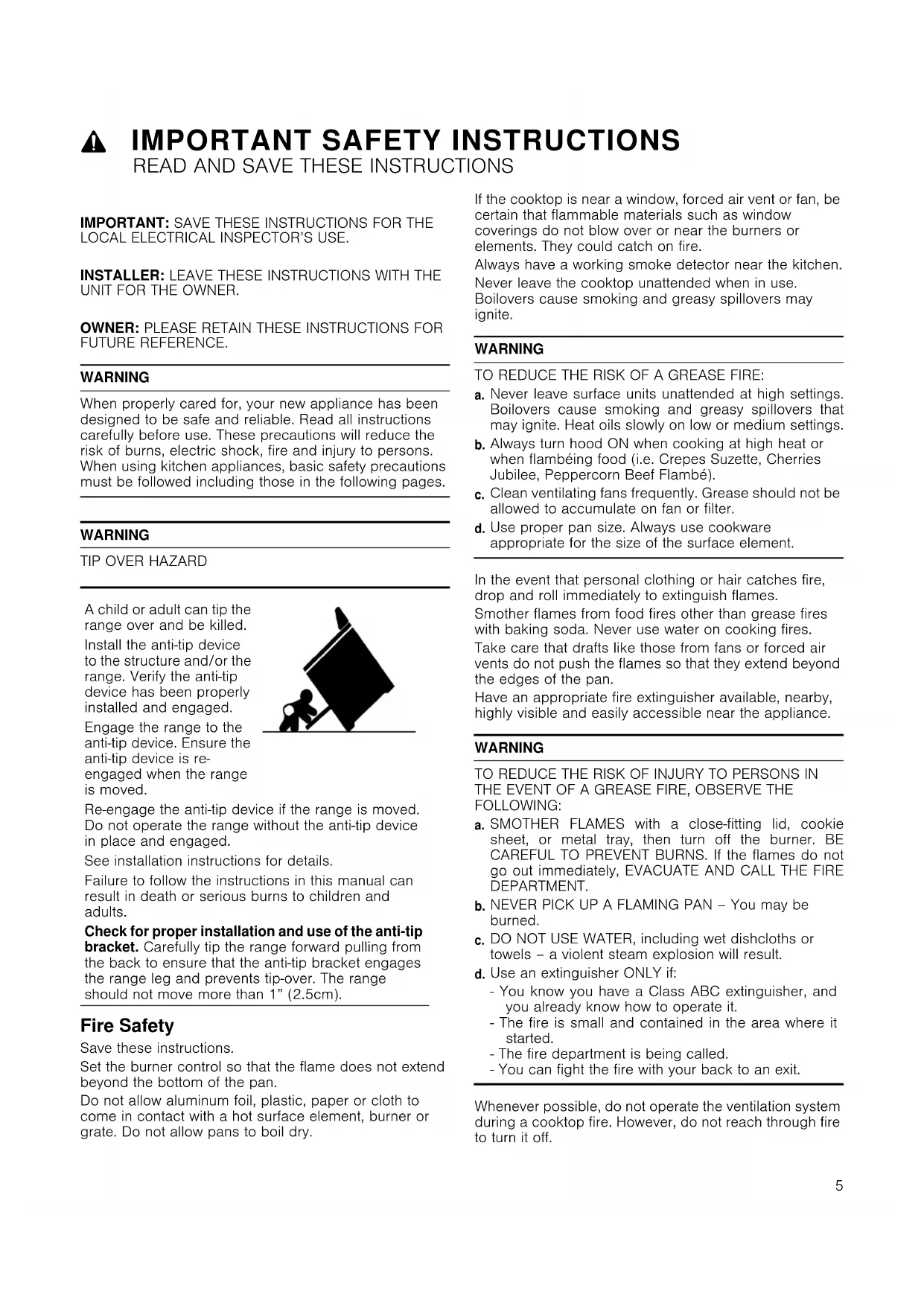
Use an extinguisher ONLY if: - You know you have a Class ABC extinguisher, and you already know how to operate it. - The fire is small and contained in the area where it started. - The fire department is being called. - You can fight the fire with your back to an exit. Whenever possible, do not operate the ventilation system during a cooktop fire. However, do not reach through fire to turn it off. A child or adult can tip the range over and be killed. Install the anti-tip device to the structure and/or the range. Verify the anti-tip device has been properly installed and engaged. Engage the range to the anti-tip device. Ensure the anti-tip device is re- engaged when the range is moved. Re-engage the anti-tip device if the range is moved. Do not operate the range without the anti-tip device in place and engaged. See installation instructions for details. Failure to follow the instructions in this manual can result in death or serious burns to children and adults. Check for proper installation and use of the anti-tip bracket. Carefully tip the range forward pulling from the back to ensure that the anti-tip bracket engages the range leg and prevents tip-over. The range should not move more than 1” (2.5cm).9 IMPORTANT SAFETY INSTRUCTIONS
READ AND SAVE THESE INSTRUCTIONS
Gas Safety To prevent carbon monoxide build-up, do not block appliance air vents. Have the installer show you where the gas shut-off valve is located. For proper burner performance, keep igniters clean and dry. If a burner goes out and gas escapes, open windows and doors. Wait until gas dissipates before using the appliance. IMPORTANT SAFETY NOTICE: Burning gas cooking fuel generates some by-products which are on the list of substances which are known by the State of California to cause cancer or reproductive harm. To minimize exposure to these substances, always operate this unit according to the instructions contained in this booklet and provide good ventilation. WARNING All igniters spark when any single burner is turned on. Do not touch any of the burners when the cooktop is in use. If you smell gas, your installer has not done a proper job of checking for leaks. If the connections are not perfectly tight, you can have a small leak and, therefore, a faint smell. Finding a gas leak is not a “do-it-yourself” procedure. Some leaks can only be found with the burner control in the ON position and this must be done by a qualified service technician. See Warning on page 4. WARNING To prevent flare-ups all grates must be properly positioned on the cooktop whenever the cooktop is in use. Each of the feet must be placed into the corresponding dimples in the cooktop. Do not use a grate if the rubber feet are missing or damaged. Keep the igniter ports clean for proper lighting performance of the burners. It is necessary to clean these when there is a boilover or when the burner does not light even though the electronic igniters click. WARNING To prevent flare-ups do not use the cooktop without all burner caps and all burner grates properly positioned. WARNING Do not clean or touch any of the burners when an extra low burner (if equipped) is in use. When the extra low burner automatically reignites the ignitor at the burner will spark. WARNING Use this appliance only for its intended use as described in this manual. NEVER use this appliance as a space heater to heat or warm the room. Doing so may result in carbon monoxide poisoning and overheating the appliance. Never use the appliance for storage. WARNING NEVER cover any slots, holes or passages in the oven bottom or cover an entire rack with materials such as aluminum foil. Doing so blocks air flow through the oven and may cause carbon monoxide poisoning. Aluminum foil linings may also trap heat, causing a fire hazard. Burn Prevention DO NOT TOUCH SURFACE UNITS OR AREAS NEAR UNITS - Surface units may be hot even though they are dark in color. Areas near surface units may become hot enough to cause burns. During and after use, do not touch, or let clothing, potholders, or other flammable materials contact surface units or areas near units until they have had sufficient time to cool. Among these areas are the cooktop and areas facing the cooktop. Do not heat or warm unopened food containers. Build-up of pressure may cause the container to burst and cause injury. Use high heat settings on the cooktop only when necessary. To avoid bubbling and splattering, heat oil slowly, on no more than a low-medium setting. Hot oil is capable of causing extreme burns and injury. Never move a pan of hot oil, especially a deep fat fryer. Wait until it is cool. Secure all loose garments, etc., before beginning. Tie long hair so that it does not hang loose, and do not wear loose-fitting clothing or hanging garments, such as ties, scarves, jewelry, or dangling sleeves. Do not place any objects on the projecting control panel in front of the burners. The area becomes very hot during cooking. Child Safety When children become old enough to use the appliance, it is the responsibility of the parents or legal guardians to ensure that they are instructed in safe practices by qualified persons. Do not allow anyone to climb, stand, lean, sit, or hang on any part of an appliance, especially a door, warming drawer, or storage drawer. This can damage the appliance, and the unit may tip over, potentially causing severe injury. Do not allow children to use this appliance unless closely supervised by an adult. Children and pets should not be left alone or unattended in the area where the appliance is in use. They should never be allowed to play in its vicinity, whether or not the appliance is in use.7
9 IMPORTANT SAFETY INSTRUCTIONS
READ AND SAVE THESE INSTRUCTIONS
CAUTIONItems of interest to children should not be stored in an appliance, in cabinets above an appliance or on the backsplash. Children climbing on an appliance to reach items could be seriously injured. Cleaning Safety IMPORTANT SAFETY NOTICE: The California Safe Drinking Water and Toxic Enforcement Act requires the Governor of California to publish a list of substances known to the state to cause cancer, birth defects or other reproductive harm, and requires businesses to warn customers of potential exposure to such substances. The burning of gas cooking fuel and the elimination of soil during self-cleaning can generate some by-products which are on the list. To minimize exposure to these substances, always operate this unit according to the instructions contained in this booklet and provide good ventilation.WARNINGBurning gas cooking fuel may create small amounts of carbon monoxide, benzene and formaldehyde. To minimize exposure to these substances, the burners should be adjusted by a certified installer or agency to ensure proper combustion. Ensure proper ventilation with an open window or use a ventilation fan or hood when cooking with gas. Always operate the appliance according to the instructions in this manual.After a spill or boilover, turn off the burner and allow the cooktop to cool. Clean around the burner and burner ports. After cleaning, check for proper operation.Do not clean the appliance while it is still hot. Some cleaners produce noxious fumes when applied to a hot surface. Wet clothes and sponges can cause burns from steam. Cookware Safety Hold the handle of the pan when stirring or turning food. This helps prevent spills and movement of the pan.Use Proper Pan Size. The use of undersized cookware will expose a portion of the heating element or burner to direct contact and may result in ignition of clothing. Select cookware having flat bottoms large enough to cover the surface heating unit. This appliance is equipped with one or more surface units of different sizes. Proper relationship of cookware to heating element or burner will also improve efficiency.Always position handles of utensils inward so they do not extend over adjacent work areas, burners, or the edge of the cooktop. This reduces the risk of fires, spills and burns.Adjust burner flame size so that it does not extend beyond the edge of the cookware. Proper relationship of cookware to burner flame reduces safety risks. Proper Installation and Maintenance Have the installer show you the location of the circuit breaker or fuse. Mark it for easy reference.This appliance must be properly installed and grounded by a qualified technician. Connect only to properly grounded outlet. Refer to Installation Instructions for details.This appliance is intended for normal family household use only. It is not approved for outdoor use. See the Statement of Limited Product Warranty. If you have any questions, contact the manufacturer.Do not store or use corrosive chemicals, vapors, flammables or nonfood products in or near this appliance. It is specifically designed for use when heating or cooking food. The use of corrosive chemicals in heating or cleaning will damage the appliance and could result in injury.WARNINGFailure to operate knobs properly may result in personal injury and damage to the appliance.This appliance is not intended for operation with an external time switch or external remote control.Do not operate this appliance if it is not working properly, or if it has been damaged. Contact an authorized service provider.Do not repair or replace any part of the appliance unless specifically recommended in this manual. Refer all servicing to a factory authorized service provider.To avoid electrical shock hazard, before servicing the appliance, switch power off at the service panel and lock the panel to prevent the power from being switched on accidentally. Proposition 65Warning: This product may contain a chemical known to the State of California, which can cause cancer or reproductive harm. Therefore, the packaging of your product may bear the following label as required by California: &DQFHUDQG5HSURGXFWLYH+DUPZZZ3:DUQLQJVFDJRY67$7(2)&$/,)251,$352326,7,21:$51,1*:$51,1*9 IMPORTANT SAFETY INSTRUCTIONS
READ AND SAVE THESE INSTRUCTIONS
Conversion to Propane Gas WARNING Personal injury or death from electrical shock may occur if the appliance is not installed by a qualified installer or electrician. Any additions, changes or conversions required in order for this appliance to satisfactorily meet the application needs must be made by a qualified technician. High Altitude Installation This appliance has been tested for operation up to an altitude of 10,000ft (3,048m) elevation above sea level. If desired, for altitudes above 2,000 ft (610 m) elevation above sea level, adjustments may be made. Burners should be checked at the lowest setting, if the flame is not stable the simmer should be increased until the flame is stable. This can be done by adjusting the bypass screw in the valve. If flame performance is satisfactory, adjustment will not be required. It is required that a Certified Professional make the high altitude adjustments during installation. High altitude nozzle sets for natural gas and propane gas are available for installations at 2,000-6,500 ft (610-1,981 m) or 6,501- 10,000 ft (1,982-3,048 m) if the adjustments using the bypass screw don’t resolve performance issues.9 Getting Started Parts and Accessories 36” Burner Cap Placement Sealed burners Your new cooktop has sealed gas burners. There are no burner parts under the cooktop to clean, disassemble or adjust. Your cooktop has three different burner sizes: small, large and dual-flame. 9 WARNING To prevent flare-ups, do not use the cooktop without all burner caps and all burner grates properly positioned. 9 WARNING To prevent burns, do not touch burner caps orgrates while hot. Turn the cooktop off and allow the burners to cool. The burner parts must be correctly positioned for the cooktop to function properly. If the burner parts are not correctly positioned, one or more of the following problems may occur: ▯ Burner flames are too high.▯ Flames shoot out of burners.▯ Burners do not ignite.▯ Burner flames light unevenly.▯ Burner emits gas odor. Burner Cap and Burner Base Placement After electrical connection is complete, place each burner base on the corresponding location on the cooktop. One of the three bars on the burner base should line up with the notch and prevent the base from rotating. The small hole or cutout near the edge should also line up with the igniter. Pay special attention to avoid damaging the igniter during installation of the base. See Illustration below. Once each base is located and resting evenly, place each burner cap on its correct burner base. See Illustration. Place burner cap gently on top of base so that the prongs of the burner base fit snugly into the groove of the burner cap. If the maintop is removed by a certified installer (for example to check electrical or piping connection) the panhead screws that were removed must be re-installed to ensure proper functionality of burners. No. Designation
Large burner (10,000 BTU/ 2.9 kW) Bake burner (17,000 BTU/ 5.0 kW) Broiler, 30” range (11,500 BTU/ 3.4 kW) Broiler, 36” range (14,000 BTU/ 4.1 kW)10 Checking Burner Cap Placement Check to make sure that there is no gap between the burner cap and burner base. See illustration below for correct and incorrect placements of the burner cap. You may gently try to move the burner cap from side to side to check if it is properly placed. If properly placed, the cap will click from side to side as the prongs hit the groove ridge. Install Grates First position the outer grates, followed by the the central grate. If you only have two grates, the order in which you position them is not relevant. Inserting Racks 9 CAUTION▯ To avoid burns, place oven racks in desired positions before turning oven on. Always use oven mitts when the oven is warm. If a rack must be moved while the oven is hot, do not let oven mitts contact hot heating elements. ▯ Use caution when removing oven racks from the lowest rack position to avoid contact with the hot oven door. ▯ To avoid possible injury or damage to the appliance, ensure racks are installed exactly per installation instructions and not backwards or upside down. The wire rack can be inserted into the cooking compartment at five different levels. Always push accessories in fully so that they do not touch the door panel. Make sure that you always insert the accessories into the cooking compartment the right way round. Flat Rack The rack is designed with a stop so it will stop before coming completely out of the oven and not tilt. To insert wire rack into oven:
Grasp rack firmly on both sides.
Insert rack (see picture).
Tilt rack up to allow stop into rack guide.
Bring rack to a horizontal position and push the rest of the way in. Rack should be straight and flat, not crooked. To remove Flat Rack from Oven:
Grasp rack firmly on both sides and pull rack toward you.
When the stop is reached, tilt rack up and pull the rest of the way out. Telescopic Rail 9 WARNING
The telescopic shelves become hot when the appliance is in use. You must take great care to avoid burning yourself when they are pulled out.
D11 The telescopic rails allow you to pull accessories out completely. When inserting the baking tray and roasting shelf, ensure that it locks into place in front of the tab on the telescopic rails. To insert Telescopic Rail into Oven:
Hang the upper part of the rail into the rack.
Clip the lower part of the rail into the rack.
Slide the movable part of the telescopic rack in and out a few times to make sure it is able to move freely and that the non-moving part of the telescopic rack is securely anchored. 9 CAUTION To avoid possible injury or damage to the appliance, ensure the telescopic rack is installed exactly per installation instructions and not backwards or upside down. To Remove Telescopic Rail from the Oven:
Pull the lower part of the rail away from the rack.
Hang the upper part of the rail out of the rack. Accessories Included Your appliance is equipped with the following accessories: Wire rack Use: Inserting cake pans, baking dishes, cookware, meat and frozen meals. 36” order number: 11034062 Telescopic rail Use: Pulling wire rack out further without tip- ping. Order number: 1202991812 Special Accessories (not included) Operating the cooktop Before Using the Appliance for the First Time ▯ Remove all packing materials and literature from the cooktop surface. ▯ Wipe with a clean, damp sponge and dry.▯ There may be a slight odor during the first several uses. This is normal and will disappear. ▯ Optimum cooking results depend on the proper cookware being selected and used. See “Choosing Cookware - Cookware Recommendations”. ▯ Read all safety precautions and Use and Care Manual information prior to operating. About the Appliance Use the cooktop for surface cooking applications such as boiling, frying, simmering, steaming and sautéing. 9 WARNING The burning of gas cooking fuel can create small amounts of carbon monoxide, benzene, formaldehyde and soot. To minimize exposure to these substances, the burners should be adjusted by a certified installer or authorized servicer to ensure proper combustion. Ensure proper ventilation with an open window or use a ventilation fan or hood when cooking with gas. Always operate the unit according to the instructions in this manual. Control Knobs The cooktop has one control knob for each burner. Push in and turn to the left to light and set the desired heat setting. 9 WARNING Failure to operate knobs properly may result in personal injury and damage to the appliance. The cooktop has standard burner controls. To operate Select the appropriate control knob, push in and turn counterclockwise to the desired flame setting. With this motion, burner sparking and gas flow will be initiated. Once the flame appears keep the knob pressed in fully for 2-3seconds before releasing. Note: It is normal that sparks will appear at all burners. Turn off by turning the control knob clockwise to off. In Case of Power Failure In the event of a power failure, the burners may be lit by an alternate flame source. Hold a lit flame source next to the burner gas exit ports, turn corresponding knob to max position, and remove flame source immediately upon burner lighting. Wok ring Use: Only suitable for dual-flame burners. Use cookware with a rounded bottom. Order number: HEZ9GW23UC Griddle Use: The griddle plate allows meals that are usually cooked in a pan to be prepared with reduced fat. Order number: HEZ9GR41UC Side panel extension Use: Side cover for appliances without adja- cent kitchen units. Low back guard Use: Cover for the wall behind the cooktop. Symbol Meaning off Cooking zone switched off min Minimum power max Maximum power o Inner flame switched on
Inner and outer flame switched on13 Flame Failure Safety System Your rangetop is equipped with a safety system that cuts off the gas flow in case of flame extinguishes by accident, i.e. because of a strong draft or high amount of spillage – so preventing an escape of unburned gas. This systems requires certain burner start procedure, see above, which means that the knob has to be pressed in completely for some seconds until the thermocouple at burner is heated up by flame and keeps the gas flow. Normal Operation - Electronic Ignition The cooktop uses electronic igniters to light the burners. There is no pilot light. Each burner has its own igniter. All igniters are activated when a control knob is pushed. 9 CAUTION To avoid possible injury or damage to the appliance, ensure grates are installed exactly per installation instructions and not backwards or upside down. The igniter should be clean and dry for proper operation. ▯ Avoid getting water or food on the igniter. ▯ If the igniter is wet or soiled, it may spark without igniting the burner, or even spark continuously when a flame is present. Note: If the burner does not light within 4 seconds, turn the burner off. Check to see that the burner cap is positioned correctly on the burner base and the igniter is clean and dry. Wait at least 5 minutes before igniting the burner again. If a burner still fails to ignite, see “Before Calling for Service”. Griddle To cook most foods on the griddle, the surface must be pre-heated. The burner power may require adjustment if the griddle is used for a long time. Before First Use Before using your new griddle, wash it in hot, soapy water, rinse and dry. Installing the Griddle The griddle is customized to fit only on the grates illustrated below. 9 WARNING Place and remove the griddle only when all grates and the griddle have cooled down and all burners are off. Typical flame characteristics The burner flame should be blue in color and stable with no yellow tips, excessive noise or fluttering. It should burn completely around the burner cap. Checking the flame characteristics: Yellow flames: Further adjustment is required. Yellow tips on outer cones: Normal for propane gas. Soft blue flames: Normal for natural gas. Orange flames: Can be normal if certain types of humidifiers are used in the home. Flames should return to blue without the humidifier run- ning. +*68& +*68& +'68 +'6& +'68 +'6& +*68& +*68& +'68 +'6& +'68 +'6&14 ▯ If the flame is completely or mostly yellow, verify that the regulator is set for the correct fuel. Retest after adjustment. ▯ Some yellow streaking is normal during the initial start- up. Allow the appliance to operate for 4–5 minutes and reevaluate before making adjustments. ▯ Foreign particles in the gas line may cause an orange flame during initial use. This should disappear with use. Check the burner to make sure that port holes are not obstructed. If the ports are clogged ~ Page 29 Note: An audible "pop" may be heard when the burner is turned off manually. The "popping" may be louder with propane gas than with natural gas. This is normal. Getting the Most Out of Your Appliance Cooking suggestions for best results ▯ Boil water in covered pot on High using largest burner for best results. If water boils over, turn to a lower setting. ▯ When melting chocolate or butter, use smallest burner with a water bath for best results. ▯ When simmering, bring food to a boil first. Stir well to be sure all the food is boiling, then cover and reduce the flame to the desired setting to simmer. ▯ There should be steam and slight quivering of the liquid’s surface while simmering. ▯ Use a lid to keep a more constant cooking temperature and heat food faster. ▯ Check the food occasionally to see if the control knob should be turned to a lower or higher setting. ▯ It is normal to stir food occasionally. ▯ Center the pan over the burner before turning the burner on. ▯ Use proper cookware. ▯ Refer to the settings recommendations in the following chart for suggested settings. Settings recommendations Standard Burner Cooking The table lists the optimal heating setting for various dishes. The temperature and cooking time depend on the amount, composition and temperature of the food. Setting ranges are indicated for this reason. Try using the lower values at first. During cooking heat may be increased. Standard Burner Cooking Table Uses Heat setting Boiling (i.e. water, stock, etc.) High Pan frying, sautéing, browning meat, deep frying Medium High Shallow frying, eggs, pancakes, bacon Medium Steaming, braising Medium Low Melting chocolate, melting butter, sim- mering sauces, soups and stews (i.e. tomato sauce, alfredo sauce, beef stew, etc.) Low Food Burner Heat Level Start Cooking (boil, melt, brown. fry, etc.) Heat Level Continue Cooking (simmer, braise, poach, hold, etc.) Beverages Mulled Cider Dual Flame Large High Medium Low Hot Chocolate Dual Flame Large Medium High Low Tea Small High Low Breads French toast Dual Flame Large Medium Medium-Medium Low Pancakes Dual Flame Large Medium Medium-Medium Low Grilled Sandwiches Dual Flame Large Medium Medium-Medium Low Cereals Beans Dual Flame Large High Medium-Medium Low Cornmeal/Polenta Large High Medium-Medium Low Grits Large High Medium-Medium Low Oatmeal Large High Medium-Medium Low Deep Frying15 French Fries Dual Flame Medium High Medium High Donuts Dual Flame Medium High Medium High Desserts Pie Filling, Fruit Compote Small Medium Low Medium-Medium Low Pudding Small Medium Low Medium-Medium Low Poached Fruit Dual Flame Large High-Medium High Medium-Medium Low Eggs Fried Dual Flame Large Medium High Medium Low Scrambled Dual Flame Large Medium High Medium Low-Low Meat, Fish, Poultry Bacon, Sausage Patties Dual Flame Medium High Medium-Medium Low Braising: Swiss Steak, Pot Roast, Stew Meat Dual Flame Medium High Low Shallow Frying: Chicken, Fish Dual Flame Medium Medium-Medium Low Pan Frying: Lamb Chops, Thin Steaks, Hamburgers, Link Sau- sage Dual Flame Medium High Medium Simmering: Stewed Chicken, Corned Beef, Poaching Fish Dual Flame High Medium Low Pasta All types Dual Flame Large High High Rice White Rice Large High Low Brown Rice Large High Low Sauces Tomato Sauce: Marinara, Bolognese Dual Flame High Low Cream Sauce: Alfredo, Queso Dual Flame Medium Low Butter Sauce: Bearnaise, Hol- landaise Large Small Medium Low Soups and Stocks Cream Soup Dual Flame Large Medium Low Broth Soup Dual Flame Large High Low Stock: Beef, Chicken, Vegeta- ble Dual Flame Large High Low Vegetables Fresh Large Small High Medium Frozen Large Small High Medium Food Burner Heat Level Start Cooking (boil, melt, brown. fry, etc.) Heat Level Continue Cooking (simmer, braise, poach, hold, etc.)16 Notes Regarding Cookware The following information and tips have been provided to help you save energy and avoid damaging your cookware. Suitable Cookware Pans with a diameter of less than 4.7” (120 mm) or more than 11.0” (280 mm) should not be used. If you do use larger pans, these should not protrude beyond the edges of the appliance. Cookware Recommendations Note: When using certain pots or pans, a slight and temporary deformation of the steel cooking surface may occur. This is normal and does not affect the functionality of the appliance. Proper Cookware ▯ Aluminum or copper bottomed pans conduct heat evenly. ▯ Steel pan, if not combined with other metals, may cook unevenly. ▯ Cast-iron cookware absorbs heat slowly and cooks more evenly at low-to-medium settings. ▯ Flat heavy bottoms pans provide even heat and stability. ▯ DO NOT USE pans that are thin, warped, dented or ridged as they heat unevenly. Information for Use Burner Recommended pan base diameter Small burner 5” - 8” (127- 203 mm) Large burner 7” - 9
” (178- 240 mm) Dual-flame burner 7” - 11“ (178- 280 mm) Use cooking vessels of appropriate size for the particular burner. Don't use small cooking vessels on large burners. The flame shouldn't come in contact with the sides of the cooking vessel. Don't use any deformed cooking vessels that don't stand solidly on the cooktop. The vessels could tip over. Only use cooking vessels with flat and thick bottoms. Don't cook without a lid or if the lid is not on all the way. The majority of the heat is lost. Place the cooking vessel in the center of the burner, otherwise it may tip over. Don't place large pots on the burners near the stove controls. They could overheat and become damaged. Place the pots on the pan supports, never directly onto the burners. Prior to use, ensure that the pan supports and lids of the gas burners are positioned correctly. Handle vessels carefully on the cooktop. Don't bang the cooktop and don't place any heavy weights on it. Never heat a cooking vessel (e.g. roasting tin, pan, cooking stone) with multiple burners, except of the griddle plate. The resulting accumulation of heat causes damage to the appliance.17 Cleaning and Maintenance-Cooktop Cleaning The entire cooktop can be safely cleaned by wiping with a soapy sponge, then rinsing and drying. If stubborn soil remains, follow the recommended cleaning methods below. Cleaning recommendations: ▯ Always keep the appliance area clear and free from combustible materials, gasoline, and other flammable vapors and liquids. ▯ Always use the mildest cleaner that will do the job. Use clean, soft cloths, sponges or paper towels. ▯ Rub stainless steel finishes in the direction of the grain. Wipe area dry to avoid water marks. ▯ Before cleaning, be certain the burners are turned off and the grates and burners are cool. ▯ Do not clean removable cooktop parts in any self cleaning oven or dishwasher. ▯ Do not obstruct air flow around cooktop burners, range backguard and door area. ▯ After cleaning, place all parts in their proper positions before using cooktop. ▯ For proper burner performance, keep igniters clean and dry. ▯ Keep the igniter ports clean for proper lighting performance of the burners. It is necessary to clean these when there is a boilover or when the burner does not light even though the electronic igniters click. ▯ Do not use flammable cleansers such as lighter fluid.▯ Do not use chlorine based cleaners.▯ Always test cleaners on a small inconspicuous area first. 9 CAUTION All igniters spark when any single burner is turned on. Do not touch any of the burners when the cooktop is in use. Cleaning Guidelines The cleaners recommended below and on the following page indicate a type and do not constitute an endorsement of a particular brand. Use all products according to package directions. Cooktop part / material Suggested cleaners Important reminders Burner base / aluminum alloy ▯ Detergent and hot water; rinse and dry thoroughly. ▯ Stiff nylon bristle tooth brush to clean port openings. ▯ Abrasive cleansers: Brillo
pads. Rinse and dry. ▯ Do not scratch or gouge the port openings. ▯ Clean ports with a wire or straight- ened paper clip. ▯ Do not use a toothpick that may break off. ▯ Do not soak burner bases. Burner cap / porcelain enamel ▯ Detergent and hot water; rinse and dry thoroughly. ▯ Nonabrasive Cleansers: Omit ammo- nia, Fantastic
▯ Liquid cleaners: Bar Keeper's Friend
▯ Bar Keeper's Friend Soft Cleanser Liq- uid
▯ Reassemble. Make sure that the cap is seated on the base. ▯ Acidic and sugar-laden spills deterio- rate the porcelain enamel. ▯ Remove soil immediately after unit has cooled enough to touch. ▯ Do not use wet sponge or towel on hot porcelain. ▯ Do not soak burner caps. ▯ Always apply minimal pressure with abrasive cleaners. ▯ Dry thoroughly after cleaning. Control knobs and bezels ▯ Detergent and hot water; rinse and dry thoroughly. ▯ To remove knobs, pull outward.▯ Do not soak knobs. ▯ Do not use abrasive scrubbers or cleansers, such as Bon Ami®, Ajax®, or Comet®. They may permanently damage the finish or remove graph- ics.18 Burnt-on Dirt For hard-to-remove, burnt-on dirt, you can order a cleaning gel from our online shop, from your specialist retailer or our Customer Service (item number 00311859). It is suitable for pan supports and the stainless steel recess. If necessary, let the dirt soak overnight. Follow the instructions on the cleaning agent.
NOTICE: DAMAGE TO THE SURFACE -
Do not use the cleaning gel on the burner parts. Exterior finish / stainless steel ▯ Nonabrasive Cleaners: Hot water and detergent, Fantastic
Rinse and dry immediately. ▯ Bosch Stainless Steel Conditioner (Order number: 00576696) ▯ Cleaner Polish: Stainless Steel Magic
to protect the finish from staining and pitting; enhances appearance. ▯ Hard water spots: Household white vinegar. ▯ Mild Abrasive Cleaners: Bon Ami
▯ Heat discoloration: Bar Keepers Friend
▯ Do not use steel wool pads. They will scratch the surface. ▯ Stainless steel resists most food stains and pit marks providing the sur- face is kept clean and protected. ▯ Never allow food stains or salt to remain on stainless steel for any length of time. ▯ Rub lightly in the direction of the grain. ▯ Chlorine or chlorine compounds in some cleaners are corrosive to stain- less steel. Check ingredients on label before using. Grates and grate bridge / porcelain enamel on cast iron ▯ Nonabrasive cleaners: Hot water and detergent, Fantastic
Rinse and dry immediately. ▯ Mild abrasive cleaners: Bon Ami
▯ Abrasive cleaners for stubborn stains: soap-filled steel wool pad. ▯ You may also clean the burner grates in the dishwasher. Remove any burnt- on food prior to placing the burner grates in the dishwasher. Place them on the lowest rack of dishwasher and use the dishwasher manufacturer's recommended detergent. ▯ The grates are heavy; use care when lifting. Place on a protected surface for cleaning. ▯ Blisters/ crazing/ chips are common due to the extreme temperatures on grate fingers and rapid temperature changes. ▯ Acidic and sugar-laden spills deterio- rate the enamel. Remove soil immedi- ately after unit has cooled enough to touch. ▯ Abrasive cleaners, used too vigor- ously or too often can eventually mar the enamel. ▯ Do not clean in a self-cleaning oven. Igniters / ceramic ▯ Carefully wipe with a cotton swab dampened with water or Formula
▯ Gently scrape soil off with a toothpick. ▯ Avoid excess water on the igniter. A damp igniter will prevent burner from lighting. ▯ Remove any lint that may remain after cleaning. Cooktop part / material Suggested cleaners Important reminders19 Operating the Oven Before Using the Appliance for the First Time ▯ There may be a slight odor during the first several uses. This is normal and will disappear. ▯ Read all safety precautions and Use and Care Manual information prior to operating. Setting the time Once the appliance is connected to a power supply, ‚ƒ:‹‹ flashes on the display. Set the time.
Use the u or w button to set the time.
Press the v button. Note: Once the period allowed for setting the time on the clock has elapsed, the time will automatically be saved. The time has now been set. Prepping the oven
Remove the accessories and the rack guides from the cooking compartment.
Completely remove any leftover packaging, e.g. small pieces of polystyrene, from the cooking compartment.
Remove protection film from parts.
Clean the outside of the appliance with a soft, damp cloth.
Clean the oven cavity with hot soapy water. Initial start up In order to prevent excess smoke and odor from manufacturing oils, heat up the oven for the first time when it is empty and closed. Note: Make sure that there is no leftover packaging, such as polystyrene pellets, in the oven cavity. Before heating the appliance, wipe the smooth surfaces in the oven cavity with a soft, damp cloth. Keep the kitchen ventilated while the appliance is heating.
Operate the cooktop burners to ensure they all light and air is out the gas system. Follow instructions ~ Page 12
Turn off the cooktop burners.
Operate the oven by firmly pushing in the oven temperature control knob and holding for two seconds. The cooling fan will come on and the sparking will be heard.
Turn the knob counter-clockwise to bake 500°F and release. The oven will begin to heat and the ignition sparking will stop after a few seconds.
After about one hour, turn the oven temperature control clockwise to off.
Push in and turn the oven temperature control knob clockwise to Broil and release
After about 10minutes, turn the knob clockwise to off.
Once oven has cooled wipe out with hot soapy water and replace rack guides. Note: When the appliance is heating up for the first time, you may hear crackling noises coming from the oven. Cleaning the accessories Before using the accessories, clean them thoroughly using a cloth and warm soapy water. Fitting the telescopic rack set Instructions on fitting the telescopic rack set are enclosed with the set. About the Appliance Oven control panel Buttons Note: You only need to press lightly on the buttons to operate them. Display
Kitchen timer AM/PM Time20 Control knobs 9 WARNING Failure to operate knobs properly may result in personal injury and damage to the appliance. Oven Set the temperature for the bake burner or the broiler using the control knob for the oven. To operate: Push the oven temperature control knob in firmly and turn counter clockwise to bake or clockwise to broil. The sparking will start with this motion and ignite the flame at according burner. Turn off by turning the control knob clockwise to off. Notes ▯ The oven has a push and turn feature to limit gas flow if the control is not pressed firmly in for a few seconds prior to turning the oven to the desired temperature. ▯ Broil has only one setting, at the positon marked broil. ▯ Do not try to turn the oven control knob from broil to bake temperatures clockwise, or from bake temperatures to broil counter-clockwise. The control needs to go to off then change to bake or broil. Time-setting Options Setting the electronic clock To set the clock the oven must be switched off.
Press and hold the v button until : flashes.
Change the time using the u and w buttons.
Press v button. Setting the short-term timer The short-term timer has no effect on how the oven operates. The duration of the short-term timer can be set from 30 seconds to 23hours and 59minutes.
Use the u and w buttons to set the desired time for the timer. An audible signal sounds once the time has elapsed. Notes ▯ To change the remaining time, press the v button. Then use the u and w buttons to change the remaining time. ▯ To cancel the short-term timer, press the v button. Then set the remaining time to zero using the u and w buttons. Switching off the signal tone Press any button to switch off the audible signal. Note: After 7minutes, the audible signal will stop automatically. Changing the signal tone Three different signal tones are available.
Press and hold the u and w buttons at the same time for approximately two seconds.
Press the v button. The signal tone that is currently selected is shown in the display, e.g. "Tone 1".
Press the u button to select a different signal tone.
Press the v button. Oven Features Cooling Fan The cooling fan runs during all cooking modes. The fan can be heard when it is running, and warm air may be felt as it is released from the oven vent. The fan may run until the oven has cooled down. Convection Fan The convection fan is not available for broiling. You can turn on and off the convection fan by pressing w. If the oven door is opened, the convection fan will turn off. Oven light Your appliance is equipped with an oven light. You can turn the oven light on and off by pressing u. Surfaces in the oven cavity The back wall and side parts in the oven cavity are self- cleaning. You can tell this from the rough surface. The oven cavity floor and ceiling are enameled and have smooth surfaces. Notes ▯ Use an oven tray on the first bottom shelf to collect liquids produced by broiling. ▯ Use an oven tray to bake food that could release fats or oils, in order to avoid spillage of these substances on the floor plate of the oven. Symbol Meaning off Oven switched off 250-500 Oven baking temperature broil Switching on the gas broiler21 Self-cleaning surfaces The self-cleaning surfaces are coated with a porous, matte ceramic layer. This coating absorbs and dispels splashes from baking and roasting while the appliance is in operation. 9 CAUTION Do not use oven cleaner on the self-cleaning surfaces. These will damage the surfaces. If oven cleaner does get onto these surfaces, dab it off immediately using water and a sponge cloth. Do not rub the surface and do not use abrasive cleaning aids. Getting the Most Out of Your Appliance Aluminum Foil 9 WARNING Do not use aluminum foil or protective liners to line any part of the appliance, especially the oven bottom. Installing these liners may result in risk of electric shock or fire. Preheating the oven ▯ Place oven racks in the required position before heating the oven. ▯ Always preheat the oven. ▯ Allow the oven to preheat while preparing recipe ingredients or food items. ▯ Increasing the oven temperature will require a longer preheat time. ▯ When the oven has preheated a beep indicator will sound for 2 seconds. ▯ Once the oven is preheated, place the food in the oven as quickly as possible to minimize the loss of heat and reduction of oven temperature. Baking Pans and Dishes ▯ Glass baking dishes absorb heat. Some cookware manufacturers recommend reducing the temperature by 25°F when using this type of dish. Follow the manufacturers’ recommendations. ▯ Cookie sheets should have at least 1" clearance on all sides. ▯ Use pans that provide the desired level of browning. For tender, light, golden brown crusts, use light, anodized or shiny metal bakeware. ▯ Dark, rough or dull pans (nonstick or anodized) will absorb heat and result in a browner, crisper crust. Some manufacturers recommend reducing the temperature by 25°F when using this type of pan. Follow the manufacturers’ recommendations. ▯ Insulated cookie sheets or bakeware may increase the length of cooking time. ▯ Do not place broil pans or any other heavy objects down on the open oven door. ▯ Do not store empty pans or pizza stones in the oven during cooking as this changes the cooking performance. Store pans outside of the oven. Opening the oven door Open and close the appliance door only by holding the door handle. To avoid risk of burns, do not touch any other parts of the door. Open the door as briefly as possible to avoid temperature reduction. Use the interior oven light to view the food through the oven window rather than opening the door frequently. High Altitude Baking When cooking at high altitudes, recipes and cooking times will vary. For accurate information, write the Extension Service, Colorado State University, Fort Collins, Colorado 80521. There may be a cost for the guides. Specify which high altitude food preparation guide you prefer: general information, cakes, cookies, breads, etc. Condensation It is normal for certain amount of moisture to evaporate from the food during any cooking process. The amount depends on the moisture content of the food. The moisture may condense on any surface cooler than the inside of the oven, such as the control panel. Broil Broil uses intense heat radiated from the upper element. Broil mode is best suited for cooking thin, tender cuts of meat (1" or less), poultry and fish. It can also be used to brown breads and casseroles. Always broil with the door closed. The benefits of broiling include: ▯ Fast and efficient cooking. ▯ Cooking without the addition of fats or liquids. Tips ▯ Preheat oven for 3–4minutes. Do not preheat for more than 5minutes. ▯ Steaks and chops should be at least 3/4" thick. ▯ Brush fish and poultry with butter or oil to prevent sticking. ▯ Use broiler pan with grid when broiling. ▯ Do not cover the broil grid with foil. It is designed to drain fats and oils away from the cooking surface to prevent smoking and spattering. ▯ Turn meats (other than fish) once during the recommended cooking time. Fish does not need to be turned. ▯ When browning the top of casseroles, use only metal or glass ceramic dishes. ▯ Never use heat-proof glass; it cannot tolerate the high temperature.22 Cleaning and Maintenance-Oven To avoid electrical shock hazard, before servicing the appliance, switch power off at the service panel and lock the panel to prevent the power from being switched on accidentally. Cleaning the Oven Avoid These Cleaners Do not use commercial oven cleaners such as Easy Off®. They may damage the oven finish or parts. Chlorine or chlorine compounds in some cleansers are corrosive to stainless steel. Check ingredients on label. Never use scouring pads or abrasive cleaners. Oven cleaning guide Part Recommendations Flat rack Clean with soapy water. Rinse thoroughly and dry, or gently rub with cleansing powder or soap- filled pads as directed. Telescopic rail Clean with soapy water. Rinse thoroughly and dry, or gently rub with cleansing powder or soap- filled pads as directed. Avoid get- ting cleansing powder in the tele- scopic slides. Re-lubrication may become necessary. Use only high-temperature food-grade lubricants to re-lubricate slides. Fiberglass gasket Do not clean the door gasket – The door gasket is essential for a good seal. Care should be taken not to rub, damage or move the gasket. Glass Clean with soapy water or glass cleaner. Apply Fantastik® or For- mula 409® to a clean sponge or paper towel and wipe clean. Avoid using powder cleaning agents, steel wool pads and oven cleaners. Painted surfaces Clean with soapy water or apply Fantastik® or Formula 409® to a clean sponge or paper towel and wipe clean. Avoid using powder cleaning agents, steel wool pads and oven cleaners. Porcelain surfaces Immediately wipe up acid spills like fruit juice, milk and tomatoes with a dry cloth when surface is cool enough to touch. Do not use a moistened sponge/cloth on hot porcelain. When cool, clean with soapy water or apply Bon-Ami® or Soft Scrub® to a damp sponge. Rinse and dry. For stub- born stains, use soap-filled pads. It is normal for porcelain to show fine lines with age due to expo- sure to heat and food soil. Stainless steel sur- faces (HGS8.55UC, HDS8.55.) Never allow food stains or salt to remain on stainless steel for any length of time. Always wipe or rub in the direction of the grain. Clean with a soapy sponge, then rinse and dry, or wipe with Fan- tastik® or Formula 409® sprayed onto a paper towel. Pro- tect and polish with Stainless Steel Magic® and a soft cloth. Remove water spots with a cloth dampened with white vinegar. Use Bar Keeper´s Friend® to remove heat discoloration. Chlo- rine or chlorine compounds in some cleansers are corrosive to stainless steel. Check the ingre- dients on the label. Black stainless sur- faces (HGS8.45UC, HDS8.45.) For black stainless steel and anti- fingerprint surfaces, use a soft, dry towel. For stubborn dirt, use warm water diluted with a non- abrasive, mild cleansing soap. Never use stainless steel polish. Plastic & controls When cool, clean with soapy water, rinse and dry. Probe (HDS8..5.) Wipe with soapy water. Do not submerge. Do not wash in the dishwasher. Printed areas (words & numbers) Do not use abrasive cleaners or petroleum based solvents. Part Recommendations23 Cleaning Self-cleaning Surfaces 9 CAUTION Do not use oven cleaner on the self-cleaning surfaces. These will damage the surfaces. If oven cleaner does get onto these surfaces, dab it off immediately using water and a sponge cloth. Do not rub the surface and do not use abrasive cleaning aids.
Use a microfiber cloth with soapy water to clean the upper and lower part of the self-cleaning surfaces.
Set the bake burner to the highest temperature.
Switch off the appliance after one hour.
If the side, self-cleaning surfaces are particularly dirty, remove these from the cooking compartment. Note: The self-cleaning surface on the back panel must remain in the cooking compartment.
Wash the self-cleaning surfaces with hot soapy water.
Rinse and dry the self-cleaning surfaces.
Insert the self-cleaning surfaces into the cooking compartment.
Set the bake burner to 350°F.
Switch off the appliance after one hour. Maintenance How to Remove the Rack Guides and Self-cleaning Surfaces The rack guides are fixed to the side panels of the cooking compartment at three points. The self-cleaning surfaces are fixed with the rack guides.
When the oven is cool, grip the front of the rack guide and pull it round to the middle of the cooking compartment. The front hook of the rack guide will come out of the hole.
Swing the rack guide round further and pull it out of the rear holes in the side panel.
Remove the rack guides from the cooking compartment.
Replace the self-cleaning surfaces and rack guides in the reverse order in which they were removed. How to Remove the Oven Door Glass 9 WARNING▯ Make sure oven is cool and power to the oven has been turned off before removing the door. Failure to do so could result in electrical shock or burns. ▯ The glass panels are big, heavy and parts are fragile. Use both hands to remove the glass. Handle carefully to avoid breakage. ▯ Failure to grasp the glass firmly and properly could result in personal injury or product damage. ▯ Do not place the glass on sharp or pointed objects as this could break the glass. Lay on a flat, smooth surface, positioned so that the glass cannot fall over. 9 CAUTION Wear gloves to avoid cutting fingers on broken glass. For easier cleaning the internal glass panes of the door can be removed.
Open the oven door fully.
Lock the two hinges on the left and right using the locking pin.The locking pins must be fully inserted into the holes in the hinges.
Remove the internal glass pane by pulling the rear part gently upwards, following the movement indicated by the arrows (1). This way, the first 2 pins attached to the rear of the glass detach from their housings in the oven door. Then, push the glass pane slightly towards the cooking compartment and pull it upwards (2). This way, the other 2 pins attached to the front of the glass detach from their housings in the oven door. 9 CAUTION Move the glass pane slow to avoid damage to the glass and the cooking compartment frame.
Remove the intermediate glass pane by lifting it upwards.
Clean the external glass pane and the panes removed previously. Use absorbent kitchen roll. In case of stubborn dirt, wash with a damp sponge and neutral detergent.
Reinsert the middle panel. Notes ▯ If the Low-E symbol can be read, the middle panel is inserted correctly. ▯ Make sure that the panel is seated correctly. All rubber mounts must lay flat against the outer panel.
Reposition the internal glass pane. First insert the front part into the two clips and the 2 pins in the front into their housings. Then insert the 2 pins in the rear into their housings in the oven door by applying slight pressure. 9 CAUTION Do not use with intermediate glass pane not correctly re-fitted.
Remove the locking pins and close the oven door. How to Remove the Oven Door 9 WARNING ▯ Make sure the oven is cool and the power to the oven has been turned off before removing the door. Failure to do so could result in electrical shock or burns. ▯ The oven door is heavy and parts of it are fragile. Use both hands to remove the oven door. The door front is glass. Handle carefully to avoid breaking. ▯ Grasp only the side of the oven door. Do not grasp the handle as it may swing in your hand and cause damage or injury. ▯ Failure to grasp the oven door firmly and properly could result in personal injury or product damage. ▯ To avoid injury from the hinge bracket snapping closed, make sure that both levers are securely in place before removing the door. Also, do not force the door open or closed – this could damage the hinge or result in injury. ▯ Do not place the removed door down on sharp or pointed objects as this could break the glass. Lay on a flat, smooth surface, positioned so that the door cannot fall over. To avoid injury or damage, make sure that you read the above WARNING before attempting to remove the oven door.
Open the oven door to its fully open position.
Lock the two hinges on the left and right using the locking pin. The locking pins must be fully inserted into the holes in the hinges.
Close the oven door until it catches on the hinge stop levers, locking the hinges at the correct angle for door removal. The door can be removed when it is pulled up from the open position by about 8 inches (203 mm). This takes the tension off the spring-loaded hinges so that the door can be easily lifted out. 9 CAUTION
Closing the door by 8" (203 mm) takes the pressure off the spring. If this is not done, the door can still be removed but the latch will now slam shut and will pinch or cut your hand.
The door is heavy. Use both hands to firmly grip it by the sides. Do not grip the door by the handle. Keeping the angle of the door the same, lift the door straight up approximately 3/4" (19 mm) to unhook the hinges from the slots, and then pull it out towards you until the hinges are clear of the oven housing.
Place the door in a convenient and stable location for cleaning.
Refit the door in the reverse order in which it was removed. Replacing an Cven Light 9 CAUTION WHEN REPLACING AN OVEN LIGHT: ▯ Make sure the appliance and lights are cool and that the power to the appliance has been turned off before replacing the light bulb(s). Failure to do so may result in electrical shock or burns. ▯ Wear gloves. ▯ The lenses must be in place when using the appliance. ▯ The lenses serve to protect the light bulb from breaking. ▯ The lenses are made of glass. Handle carefully to avoid breaking. Broken glass may cause an injury. ▯ The light socket is live when the door is open. Bulb specifications: Voltage: 120V; Power: 40 W; Fitting: G9; Temperature resistance: 575°F (300°C) To change the bulb:
Allow the cooking compartment to cool down.
Open the appliance door.
Place a cloth in the oven cavity to prevent damage.
Remove the racks and rack guides.
Remove the glass cover. To do this, open the glass cover at the front with your hand. Should you experience difficulties removing the glass cover, use a spoon to help.
Remove the oven light bulb.
Replace the oven light bulb with a bulb of the same type.
Replace the glass cover for the oven light bulb.
Replace rack guides and racks.
Switch the circuit breaker back on.
Check that the oven lighting is working again.
- Preheat oven Roasting times are approximate and may vary depending on the shape of the meat. Stuffed turkey requires additional roasting time. The minimum safe temperature for stuffing in poultry is 165°F. Note: : Internal food temperatures are USDA recommended temperatures as measured by a digital cooking thermom- eter.28 Chops, 1-inch thick Broil High* 5 Medium, 160°F Side 1: 5-7 Side 2: 5-6 No none Pork Loin Roast, 2.2-
- Preheat oven Roasting times are approximate and may vary depending on the shape of the meat. Stuffed turkey requires additional roasting time. The minimum safe temperature for stuffing in poultry is 165°F. Note: : Internal food temperatures are USDA recommended temperatures as measured by a digital cooking thermom- eter.29 Customer Service Contact our Customer Service if your appliance needs repair. Our Customer Service (see below) will be happy to supply you with details how to obtain a service repair. Before Calling for Service Before calling Customer Service, consider the suggestions and instructions below: 9 CAUTION Repairs should only be done by an authorized servicer. Improper repair of your appliance may result in risk of severe physical injury or death. Problem Suggestion Burner(s) do not light/igniters do not spark ▯ Ensure that the gas shut-off valve is in the “ON” position and the gas supply to the house is not shut off. ▯ Ensure that the burner caps and burner bases and the burner ports are not clogged. Clear ports with a wire or straightened paper clip if clogged. ▯ Make sure the igniters are clean and dry. ▯ Check the power supply. It should be properly grounded with the correct polarity. Ensure that the unit is fully plugged in to the outlet and the circuit breaker is not tripped. Cooktop burner(s) do not start cor- rectly, Flame extinguishes at burner as soon knob is released ▯ Probable reason is, that the push in time was to short or the pushing was too soft. Push in the knob completely, once flame appears keep it pushed in at that complete position for 3-5seconds. ▯ If than flame does not hold, check the burner for being clean and parts attached in right manner. Note: : There has to be a flame towards the brown pin at burner, which is the thermocouple. Burner flame goes out unexpectedly Ensure that there is no draft in the room. Sparks appear on the wrong burner No fault: On starting one burner on all burners sparks will be generated. The igniters spark even though the knobs are in the off position When the electrical power connection has been activated at the first power-up or reconnected after an outage, the igniters may spark once or twice, even though all burner knobs are in the “OFF” position. Cooking results are not what was expected ▯ Check the level of the cooktop burner during installation. ▯ Cooking pan does not fit on the surface being used. ▯ The cookware is not the recommended type or size. See "Notes regarding cookware" and "Baking pans and dishes"~ Page 21. Oven door feels hotter as before remove the oven door glass for cleaning Check if the oven door glass is right way round (low-E symbol can be read). Oven door is not balanced Check if inner door glass is present/ has been inserted during reassembly. If the oven is cold with the oven con- trol set to bake or broil. ▯ Check a cooktop burner for a few minutes to be sure gas is flowing to the range. If not, check your LP gas tank or or insulation valve in installation to be open. If gas is available at cooktop burners, probably the start procedure of oven burner was not executed correctly. Make sure that in start procedure the knob is pressed in fully and listen for sparks and gas flow to the accord- ing burner. ▯ The push and turn feature may be preventing gas flow. Be sure to follow the instructions ~ Page 20 i.e. Press the control knob in for a few seconds (this gets gas flowing), then turn to bake of broil and release. This lights the gas. ▯ The automatic start procedure will stop after 10sec (no more sparking), than you can check whether flame is generated by opening appliance door (bake burner visible through holes in bottom sheet, broil burner is free). If no flame visible- keep open oven door for 5minutes, than close and try again.30 How to Obtain Warranty Service To obtain warranty service for your Product, you should contact Bosch Customer Service at 1-800-944-2904to schedule a repair. Model (E) number and FD number When you contact our service, please have the Model (E) number and the FD number for your appliance available. You can find this information on the rating label ▯ on the back side of the appliance▯ on the underside of the projecting control panel Questions? Please contact us. We look forward to hearing from you. Broil setting cannot be changed. This is correct, broil has only one setting, marked by the word broil. To reduced or increasing broiling intensity, move the rack up or down. Follow the instruc- tions for racks ~ Page 10 Oven control knob can turn from Broil to bake temperatures. This is correct. The control knob can only be turned from broil to bake, or vice versa, via the off position. Problem Suggestion
What this Warranty Covers & Who it Applies to The limited warranty provided by BSH Home Appliances (“Bosch“) in this Statement of Limited Product Warranty applies only to the Bosch appliance sold to you (“Product“), provided that the Product was purchased: ▯ For your normal, household (non-commercial) use, and has in fact at all times only been used for normal household purposes. ▯ New at retail (not a display, "as is", or previously returned model), and not for resale, or commercial use. ▯ Within the United States or Canada, and has at all times remained within the country of original purchase. The warranties stated herein apply to the original purchaser of the product warranted herein and to each succeeding owner of the product purchased for ordinary home use during the term of the warranty. Please make sure to return your registration card; while not necessary to effectuate warranty coverage, it is the best way for Bosch to notify you in the unlikely event of a safety notice or product recall. How Long the Warranty Lasts Bosch warrants that the Product is free from defects in materials and workmanship for a period of three hundred sixty-five (365) days from the date of the original purchase. The foregoing timeline begins to run upon the date of the original purchase, and shall not be stalled, tolled, extended, or suspended, for any reason whatsoever. This Product is also warranted to be free from cosmetic defects in material and workmanship (such as scratches of stainless steel, paint/porcelain blemishes, chip, dents, or other damage to the finish) of the Product, for a period of thirty (30) days from the date of purchase or closing date for new construction. This cosmetic warranty excludes slight color variations due to inherent differences in painted and porcelain parts, as well as differences caused by kitchen lighting, product location, or other similar factors. This cosmetic warranty specifically excludes any display, floor, “As Is”, or “B” stock appliances. Repair/Replace as Your Exclusive Remedy During this warranty period, Bosch or one of its authorized service providers will repair your Product without charge to you (subject to certain limitations stated herein) if your Product proves to have been manufactured with a defect in materials or workmanship. If reasonable attempts to repair the Product have been made without success, then Bosch will replace your Product (upgraded models may be available to you, in Bosch’s sole discretion, for an additional charge). Nothing in this warranty requires damaged or defective parts to be replaced with parts of a different type or design than the original part. All removed parts and components shall become the property of Bosch at its sole option. All replaced and/or repaired parts shall assume the identity of the original part for purposes of this warranty and this warranty shall not be extended with respect to such parts. Bosch's sole liability and responsibility hereunder is to repair manufacturer- defective Product only, using a Bosch-authorized service provider during normal business hours. For safety and property damage concerns, Bosch highly recommends that you do not attempt to repair the Product yourself, or use a non-authorized service provider; Bosch will have no responsibility or liability for repairs or work performed by a non-authorized service provider. Authorized service providers are those persons or companies that have been specially trained on Bosch products, and who possess, in Bosch's opinion, a superior reputation for customer service and technical ability (note that they are independent entities and are not agents, partners, affiliates or representatives of Bosch). Notwithstanding the foregoing, Bosch will not incur any liability, or have responsibility, for the Product if it is located in a remote area (more than 100miles from an authorized service provider) or is reasonably inaccessible, hazardous, threatening, or treacherous locale, surroundings, or environment; in any such event, if you request, Bosch would still pay for labor and parts and ship the parts to the nearest authorized service provider, but you would still be fully liable and responsible for any travel time or other special charges by the service company, assuming they agree to make the service call. Out of Warranty Product Bosch is under no obligation, at law or otherwise, to provide you with any concessions, including repairs, prorates, or Product replacement, once this warranty has expired. Warranty Exclusions The warranty coverage described herein excludes all defects or damage that are not the direct fault of Bosch, including without limitation, one or more of the following: ▯ Use of the Product in anything other than its normal, customary and intended manner (including without limitation, any form of commercial use, use or storage of an indoor product outdoors, use of the Product in conjunction with air or water-going vessels). ▯ Any party's willful misconduct, negligence, misuse, abuse, accidents, neglect, improper operation, failure to maintain, improper or negligent installation, tampering, failure to follow operating instructions, mishandling, unauthorized service (including self performed "fixing" or exploration of the appliance's internal workings). ▯ Adjustment, alteration or modification of any kind. ▯ A failure to comply with any applicable state, local, city, or county electrical, plumbing and/or building codes, regulations, or laws, including failure to install the product in strict conformity with local fire and building codes and regulations.32 ▯ Ordinary wear and tear, spills of food, liquid, grease accumulations, or other substances that accumulate on, in, or around the Product. ▯ Any external, elemental and/or environmental forces and factors, including without limitation, rain, wind, sand, floods, fires, mud slides, freezing temperatures, excessive moisture or extended exposure to humidity, lightning, power surges, structural failures surrounding the appliance, and acts of God. ▯ Service calls to correct the installation of your Product, to instruct you how to use your Product, to replace house fuses or correct house wiring or plumbing. In no event shall Bosch have any liability or responsibility whatsoever for damage to surrounding property, including cabinetry, floors, ceilings, and other structures or objects around the Product. Also excluded from this warranty are Products, on which the serial numbers have been altered, defaced, or removed; service visits to teach you how to use the Product, or visits where there is nothing wrong with the Product; correction of installation problems (you are solely responsible for any structure and setting for the Product, including all electrical, plumbing or other connecting facilities, for proper foundation/flooring, and for any alterations including without limitation cabinetry, walls, floors, shelving, etc.); and resetting of breakers or fuses. TO THE EXTENT ALLOWED BY LAW, THIS WARRANTY
SETS OUT YOUR EXCLUSIVE REMEDIES WITH
RESPECT TO PRODUCT, WHETHER THE CLAIM ARISES IN CONTRACT OR TORT (INCLUDING STRICT LIABILITY,
LOSSES, OR EXPENSES, INCLUDING WITHOUT
LIMITATION TIME AWAY FROM WORK, HOTELS AND/
OR RESTAURANT MEALS, REMODELLING EXPENSES
NOT ALLOW LIMITATIONS ON HOW LONG AN IMPLIED WARRANTY LASTS, SO THE ABOVE EXCLUSIONS OR LIMITATIONS MAY NOT APPLY TO YOU. THIS WARRANTY GIVES YOU SPECIFIC LEGAL RIGHTS, AND YOU MAY ALSO HAVE OTHER RIGHTS WHICH VARY FROM STATE TO STATE. No attempt to alter, modify or amend this warranty shall be effective unless authorized in writing by an officer of BSH. Obtaining Warranty Service: To obtain warranty service for your Product, you should contact Bosch Customer Service at 1-800-944-2904to schedule a repair.33 Table des Matières Notice d’uti li sation 9 Définitions de sécurité ........................................... 33