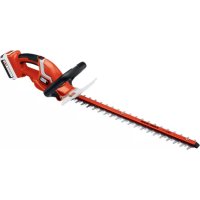
LHT2436 - Hedge trimmers BLACK & DECKER - Free user manual and instructions
Find the device manual for free LHT2436 BLACK & DECKER in PDF.


| Brand | Black & Decker |
| Model | LHT2436 |
| Category | Hedge Trimmer |
| Type | Cordless Hedge Trimmer |
| Power Source | Rechargeable lithium-ion battery (Li-ion) |
| Battery Voltage | 36 V |
| Charge Time (full) | Approximately 2 hours |
| Charge Time (80%) | Approximately 1 hour |
| Blade Type | Hardened Steel |
| Blade Length | 55 cm (approx.) |
| Handle | Ergonomic handle with lock-off switch |
| Hand Guard | Yes |
| Blade Sheath | Included |
| Battery Charge Indicator | Yes (4 LEDs) |
| Protection Class | Class II (double insulation) |
| Usage | Household only |
| Warranty | 3 years |
| Blade Maintenance | Lubricate with light oil after cleaning |
| Cleaning | Damp cloth and mild soap |
| Recommended Charging Temperature | 16 °C to 27 °C |
| Weight (with battery) | 2.6 kg (approx.) |
| Included Accessories | Charger, battery pack, sheath |
Frequently Asked Questions - LHT2436 BLACK & DECKER
User questions about LHT2436 BLACK & DECKER
0 question about this device. Answer the ones you know or ask your own.
Ask a new question about this device
Download the instructions for your Hedge trimmers in PDF format for free! Find your manual LHT2436 - BLACK & DECKER and take your electronic device back in hand. On this page are published all the documents necessary for the use of your device. LHT2436 by BLACK & DECKER.
USER MANUAL LHT2436 BLACK & DECKER
Thank you for choosing Black & Decker! to www.BlackandDecker.com/NewOwner to register your new product.
PLEASE READ BEFORE RETURNING THIS PRODUCT FOR ANY REASON:
If you have a question or experience a problem with your Black & Decker purchase, go to
WWW.BLACKANDDECKER.COM/INSTANTANSWERS for instant answers 24 hours a day.
If you can't find the answer or do not have access to the internet, call 1-800-544-6986 from 8 a.m. to 5 p.m. EST Mon. - Fri to speak with an agent.
Please have the catalog number available when you call.
SAVE THIS MANUAL FOR FUTURE REFERENCE. VEA EL ESPA—OL EN LA CONTRAPORTADA. POUR LE FRANÇAIS, VOIR LA COUVERTURE ARRIÈRE.
natural_image
Line drawing of a mechanical tool with diagonal grooves and a digital display (no text or symbols)TABLE OF CONTENTS
Safety Guidelines - Definitions ......2
General Safety Rules 2
Components....4
Important Safety Instructions for Battery Chargers ....5
Important Safety Instructions for Battery Packs 6
Charging Procedure 7
Installing/Removing Battery Pack 8
Operation 8
Maintenance 9
Accessories....11
Service Information ....11
Three-Year Home Use Warranty 11
Troubleshooting 12
SAFETY GUIDELINES - DEFINITIONS
It is important for you to read and understand this manual. The information it contains relates to protecting YOUR SAFETY and PREVENTING PROBLEMS. The symbols below are used to help you recognize this information.
⚠️ DANGER: Indicates an imminently hazardous situation which, if not avoided, will result in death or serious injury.
⚠ WARNING: Indicates a potentially hazardous situation which, if not avoided, could result in death or serious injury.a
⚠️ CAUTION: Indicates a potentially haz ard ous situation which, if not avoided, may result in minor or mod er ate injury.
NOTICE: Used without the safety alert symbol indicates potentially hazardous situation which, if not avoided, may result in property damage.
GENERAL POWER TOOL SAFETY WARNINGS
⚠ WARNING: Read all safety warnings and all instructions. Failure to follow the warnings and instructions may result in electric shock, fire and/or serious injury.
SAVE ALL WARNINGS AND INSTRUCTIONS FOR FUTURE REFERENCE
The term "power tool" in the warnings refers to your mains-operated (corded) power tool or battery-operated (cordless) power tool.
SAVE THESE INSTRUCTIONS
1) WORK AREA SAFETY
a) Keep work area clean and well lit. Cluttered or dark areas invite accidents.
b) Do not operate power tools in explosive atmospheres, such as in the presence of flammable liquids, gases or dust.
Power tools create sparks which may ignite the dust or fumes.
c) Keep children and bystanders away while operating a power tool. Distractions can cause you to lose control.
2) ELECTRICAL SAFETY
a) Power tool plugs must match the outlet. Never modify the plug in any way. Do not use any adapter plugs with earthed (grounded) power tools. Unmodified plugs and matching outlets will reduce risk of electric shock.
b) Avoid body contact with earthed or grounded surfaces such as pipes, radiators, ranges and refrigerators. There is an increased risk of electric shock if your body is earthed or grounded.
c) Do not expose power tools to rain or wet conditions. Water entering a power tool will increase the risk of electric shock.
d) Do not abuse the cord. Never use the cord for carrying, pulling or unplugging the power tool. Keep cord away from heat, oil, sharp edges or moving parts. Damaged or entangled cords increase the risk of electric shock.
e) When operating a power tool outdoors, use an extension cord suitable for outdoor use. Use of a cord suitable for outdoor use reduces the risk of electric shock.
f) If operating a power tool in a damp location is unavoidable, use a ground fault circuit interrupter (GFCI) protected supply. Use of a GFCI reduces the risk of electric shock.
3) PERSONAL SAFETY
a) Stay alert, watch what you are doing and use common sense when operating a power tool. Do not use a power tool while you are tired or under the influence of drugs, alcohol or medication. A moment of inattention while operating power tools may result in serious personal injury.
b) Use personal protective equipment. Always wear eye protection. Protective equipment such as dust mask, nonskid safety shoes, hard hat, or hearing protection used for appropriate conditions will reduce personal injuries.
c) Prevent unintentional starting. Ensure the switch is in the off position before connecting to power source and/or battery pack, picking up or carrying the tool. Carrying power tools with your finger on the switch or energizing power tools that have the switch on invites accidents.
d) Remove any adjusting key or wrench before turning the power tool on. A wrench or a key left attached to a rotating part of the power tool may result in personal injury.
e) Do not overreach. Keep proper footing and balance at all times. This enables better control of the power tool in unexpected situations.
f) Dress properly. Do not wear loose clothing or jewelry. Keep your hair, clothing and gloves away from moving parts. Loose clothes, jewelry or long hair can be caught in moving parts.
g) If devices are provided for the connection of dust extraction and collection facilities, ensure these are connected and properly used. Use of dust collection can reduce dust-related hazards.
4) POWER TOOL USE AND CARE
a) Do not force the power tool. Use the correct power tool for your application. The correct power tool will do the job better and safer at the rate for which it was designed.
b) Do not use the power tool if the switch does not turn it on and off. Any power tool that cannot be controlled with the switch is dangerous and must be repaired.
c) Disconnect the plug from the power source and/or the battery pack from the power tool before making any adjustments, changing accessories, or storing power tools. Such preventive safety measures reduce the risk of starting the power tool accidentally.
d) Store idle power tools out of the reach of children and do not allow persons unfamiliar with the power tool or these instructions to operate the power tool. Power tools are dangerous in the hands of untrained users.
e) Maintain power tools. Check for misalignment or binding of moving parts, breakage of parts and any other condition that may affect the power tool's operation. If damaged, have the power tool repaired before use. Many accidents are caused by poorly maintained power tools.
f) Keep cutting tools sharp and clean. Properly maintained cutting tools with sharp cutting edges are less likely to bind and are easier to control.
g) Use the power tool, accessories and tool bits, etc. in accordance with these instructions, taking into account the working conditions and the work to be performed. Use of the power tool for operations different from those intended could result in a hazardous situation.
5) BATTERY TOOL USE AND CARE
a) Recharge only with the charger specified by the manufacturer. A charger that is suitable for one type of battery pack may create a risk of fire when used with another battery pack.
b) Use power tools only with specifically designated battery packs. Use of any other battery packs may create a risk of injury and fire.
c) When battery pack is not in use, keep it away from other metal objects like paper clips, coins, keys, nails, screws, or other small metal objects that can make a connection from one terminal to another. Shorting the battery terminals together may cause burns or a fire.
d) Under abusive conditions, liquid may be ejected from the battery, avoid contact. If contact accidentally occurs, flush with water. If liquid contacts eyes, additionally seek medical help. Liquid ejected from the battery may cause irritation or burns.
6) SERVICE
a) Have your power tool serviced by a qualified repair person using only identical replacement parts. This will ensure that the safety of the power tool is maintained.
HEDGE TRIMMER SAFETY WARNINGS
- Keep all parts of the body away from the cutter blade. Do not remove cut material or hold material to be cut when blades are moving. Make sure the switch is off when clearing jammed material. Blades coast after turn off. A moment of inattention while operating the hedge trimmer may result in serious personal injury.
⚠️ DANGER: Keep hands away from blade. Contact with blade will result in serious personal injury.
- Use both hands when operating the hedge trimmer. Using one hand could cause loss of control and result in serious personal injury.
- Carry the hedge trimmer by the handle with the cutter blade stopped. When transporting or storing the hedge trimmer always fit the cutting device cover. Proper handling of the hedge trimmer will reduce possible personal injury from the cutter blades.
- Hold the power tool by insulated gripping surfaces only, because the cutter blade may contact hidden wiring or its own cord. Cutter blades contacting a "live" wire may make exposed metal parts of the power tool "live" and could give the operator an electric shock.
- Keep extension cord away from cutting area. During operation the extension cord may be hidden in shrubs and can be accidentally cut by the blade.
- Check the hedge for foreign objects, e.g. wire fences. CAUTION: Do not expose to rain.
⚠ WARNING: Remove plug from the outlet immediately if the extension cord becomes damaged or cut.
⚠ WARNING: Some dust created by this product contains chemicals known to the State of California to cause cancer, birth defects or other reproductive harm. Some examples of these chemicals are:
• compounds in fertilizers
• compounds in insecticides, herbicides and pesticides
• arsenic and chromium from chemically treated lumber
To reduce your exposure to these chemicals, wear approved safety equipment such as dust masks that are specially designed to filter out microscopic particles.
The label on your tool may include the following symbols.
V....volts A.....amperes
Hz ......hertz W ......watts
min ....minutes \~ ......alternating current ===.....direct current n0 .....no load speed
☐ ......Class II Construction ☎ ......earthing terminal
⚠️ ...... safety alert symbol .../min ......strokes
per minute
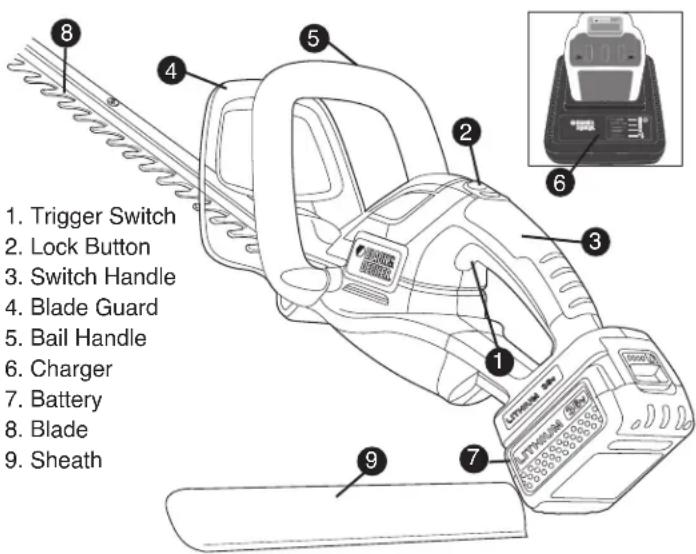
COMPONENTS
IMPORTANT SAFETY INSTRUCTIONS FOR BATTERY CHARGERS
SAVE THESE INSTRUCTIONS: This manual contains important safety instructions for battery chargers.
- Before using charger, read all instructions and cautionary markings on charger, battery pack, and product using battery pack.
⚠ WARNING: Shock hazard. Do not allow any liquid to get inside charger.
⚠️ CAUTION: Burn hazard. To reduce the risk of injury, charge only designated Black & Decker batteries. Other types of batteries may burst causing personal injury and damage.
⚠️ CAUTION: Under certain conditions, with the charger plugged in to the power supply, the charger can be shorted by foreign material. Foreign materials of a conductive nature such as, but not limited to, steel wool, aluminum foil, or any buildup of metallic particles should be kept away from charger cavities. Always unplug the charger from the power supply when there is no battery pack in the cavity. Unplug charger before attempting to clean.
⚠ WARNING: The charger supplied with this product is intended to be plugged in such that it is correctly orientated in a vertical or floor mount position.
- DO NOT attempt to charge the battery pack with any chargers other than the ones in this manual. The charger and battery pack are specifically designed to work together.
• These chargers are not intended for any uses other than charging designated Black & Decker rechargeable batteries. Any other uses may result in risk of fire, electric shock or electrocution. - Do not expose charger to rain or snow.
- Pull by plug rather than cord when disconnecting charger. This will reduce risk of damage to electric plug and cord.
-
Make sure that cord is located so that it will not be stepped on, tripped over, or otherwise subjected to damage or stress.
-
Do not use an extension cord unless it is absolutely necessary. Use of improper extension cord could result in risk of fire, electric shock, or electrocution.
- An extension cord must have adequate wire size (AWG or American Wire Gauge) for safety. The smaller the gauge number of the wire, the greater the capacity of the cable, that is 16 gauge has more capacity than 18 gauge. When using more than one extension to make up the total length, be sure each individual extension contains at least the minimum wire size.
Recommended Minimum Wire Size for Extension Cords
| Minimum Gauge for Cord Sets | |
| Volts | Total Length of Cord in Feet |
| 120V | 0-25 26-50 51-100 101-150 |
| 240V | 0-50 51-100 101-200 201-300 |
| Ampere Rating | |
| More Not more American Wire Gauge | |
| Than Than | |
| 0 - 6 | 18 16 16 14 |
| 6 - 10 | 18 16 14 12 |
| 10 - 12 | 16 16 14 12 |
| 12 - 16 | 14 12 Not Recommended |
- Do not place any object on top of charger or place the charger on a soft surface that might block the ventilation slots and result in excessive internal heat. Place the charger in a position away from any heat source. The charger is ventilated through slots in the top and the bottom of the housing.
- Do not mount charger on wall or permanently affix charger to any surface. The charger is intended to use on a flat, stable surface (i.e., table top, bench top).
- Do not operate charger with damaged cord or plug — have them replaced immediately.
- Do not operate charger if it has received a sharp blow, been dropped, or otherwise damaged in any way. Take it to an authorized service center.
-
Do not disassemble charger; take it to an authorized service center when service or repair is required. Incorrect reassembly may result in a risk of electric shock, electrocution or fire.
-
Disconnect the charger from the outlet before attempting any cleaning. This will reduce the risk of electric shock. Removing the battery pack will not reduce this risk.
- NEVER attempt to connect 2 chargers together.
- The charger is designed to operate on standard household electrical power (120 Volts). Do not attempt to use it on any other voltage.
SAVE THESE INSTRUCTIONS
IMPORTANT SAFETY WARNINGS FOR BATTERY PACKS
⚠ WARNING: For safe operation, read this manual and manuals originally supplied with tool before using the charger.
The battery pack is not fully charged out of the carton. Before using the battery pack and charger, read the safety instructions below. Then follow charging procedures outlined.
READ ALL INSTRUCTIONS
- Do not incinerate the battery pack even if it is severely damaged or is completely worn out. The battery pack can explode in a fire. Toxic fumes and materials are created when battery packs are burned.
- Do not charge or use battery in explosive atmospheres, such as in the presence of flammable liquids, gases or dust. Inserting or removing the battery from the charger may ignite the dust or fumes.
- If battery contents come into contact with the skin, immediately wash area with mild soap and water. If battery liquid gets into the eye, rinse water over the open eye for 15 minutes or until irritation ceases. If medical attention is needed, the battery electrolyte for Li-ion batteries is composed of a mixture of liquid organic carbonates and lithium salts.
- Contents of opened battery cells may cause respiratory irritation. Provide fresh air. If symptoms persist, seek medical attention.
⚠ WARNING: Burn hazard. Battery liquid may be flammable if exposed to spark or flame.
- Charge the battery packs only in Black & Decker chargers.
- DO NOT splash or immerse in water or other liquids. This may cause premature cell failure.
- Do not store or use the tool and battery pack in locations where the temperature may reach or exceed 105^ (40°C) (such as outside sheds or metal buildings in summer).
⚠ WARNING: Never attempt to open the battery pack for any reason. If battery pack case is cracked or damaged, do not insert into charger. Do not crush, drop or damage battery pack. Do not use a battery pack or charger that has received a sharp blow, been dropped, run over or damaged in any way (i.e., pierced with a nail, hit with a hammer, stepped on). Damaged battery packs should be returned to service center for recycling.
⚠ WARNING: Fire hazard. Do not store or carry battery so that metal objects can contact exposed battery terminals. For example, do not place battery in aprons, pockets, tool boxes, product kit boxes, drawers, etc., with loose nails, screws, keys, etc. Transporting batteries can possibly cause fires if the battery terminals inadvertently come in contact with conductive materials such as keys, coins, hand tools and the like. The US Department of Transportation Hazardous Material Regulations (HMR) actually prohibit transporting batteries in commerce or on airplanes (i.e., packed in suitcases and carry-on luggage) UNLESS they are properly protected from short circuits. So when transporting individual batteries, make sure that the battery terminals are protected and well insulated from materials that could contact them and cause a short circuit. NOTE: LI-ION batteries should not be put in checked baggage.
STORAGE RECOMMENDATIONS
- The best storage place is one that is cool and dry away from direct sunlight and excess heat or cold.
- Long storage will not harm the battery pack or charger.
CHARGING PROCEDURE
The standard charger provided will charge a full depleted battery in about 2 hours. A 80% charge available in 1 hour.
- Plug the charger into an appropriate outlet before inserting the battery pack.
-
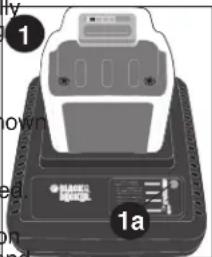
Insert the battery pack into the charger as shown in figure 1.
-
The green LED (figure 1a) will flash indicating that the battery is being charged
-
The completion of charge is indicated by the green LED (figure 1a) remaining on continuously. The pack is fully charged and may be used at this time or left on the
Recharge discharged batteries as soon as possible after use or battery life may be greatly diminished.
CHARGER DIAGNOSTICS
This charger is designed to detect certain problems that can arise with the battery packs or the power source. Problems are indicated by one LED (figure 1a) flashing in different patterns.
BAD BATTERY

The charger can detect a weak or damaged battery. The red LED (figure 1a) flashes in the pattern indicated on the label. If you see this bad battery blink pattern, do not continue to charge the battery. Return it to a service center or a collection site for recycling.
HOT/COLD PACK DELAY

When the charger detects a battery that is excessively hot or excessively cold, it automatically starts a Hot/Cold Pack Delay, suspending charging until the battery has normalized. After this happens, the charger automatically switches to the Pack Charging mode. This feature ensures maximum battery life. The red LED (figure 1a) flashes in the pattern indicated on the label when the hot / cold pack delay is detected.
LEAVING THE BATTERY IN THE CHARGER
The charger and battery pack can be left connected with the green LED (figure 1a) glowing indefinitely. The charger will keep the battery pack fresh and fully charged.
IMPORTANT CHARGING NOTES
- Longest life and best performance can be obtained if the battery pack is charged when the air temperature is between 60^ F and 80^ F ( 16^-27^ C). DO NOT charge the battery pack in an air temperature below +40^ F ( +4.5^ C), or above +105^ F ( +40.5^ C). This is important and will prevent serious damage to the battery pack.
- The charger and battery pack may become warm to touch while charging. This is a normal condition, and does not indicate a problem. To facilitate the cooling of the battery pack after use, avoid placing the charger or battery pack in a warm environment such as in a metal shed, or an uninsulated trailer.
- If the battery pack does not charge properly:
a. Check current at receptacle by plugging in a lamp or other appliance
b. Check to see if receptacle is connected to a light switch which turns power off when you turn out the lights.
c. Move charger and battery pack to a location where the surrounding air temperature is approximately 60°F and 80°F (16°-27°C)
d. If charging problems persist, take the tool, battery pack and charger to your local service center.
- The battery pack should be recharged when it fails to produce sufficient power on jobs which were easily done previously. DO
NOT CONTINUE to use under these conditions. Follow the charging procedure. You may also charge a partially used pack whenever you desire with no adverse effect on the battery pack.
-
Foreign materials of a conductive nature such as, but not limited to, steel wool, aluminum foil, or any buildup of metallic particles should be kept away from charger cavities. Always unplug the charger from the power supply when there is no battery pack in the cavity. Unplug charger before attempting to clean.
-
Do not freeze or immerse charger in water or any other liquid.
⚠ WARNING: Shock hazard. Do not allow any liquid to get inside charger. Never attempt to open the battery pack for any reason. If the plastic housing of the battery pack breaks or cracks, return to a service center for recycling.
INSTALLING / REMOVING BATTERY PACK
⚠ WARNING: Make certain the lock-off button is engaged to prevent switch actuation before removing or installing battery.
TO INSTALL BATTERY PACK:
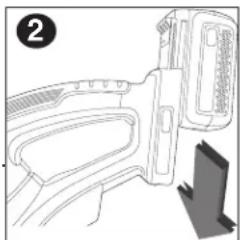
Insert battery pack into tool until fully seated and an audible click is heard (figure 2). Make sure battery pack is fully seated and fully latched into position.
TO REMOVE BATTERY PACK: Depress the battery release button in the back of the battery pack and pull battery pack out of tool.
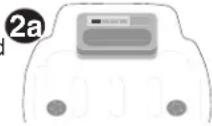
STATE OF CHARGE INDICATOR (FIGURE 2a)
The battery is equipped with a state of charge indicator. This can be used to display of charge in the battery during use and during charging. It does not indicate tool functionality and is subject to variation based on product components, temperature and end-user application.
natural_image
Technical line drawing of a mechanical component with no visible text or symbolsthe current level
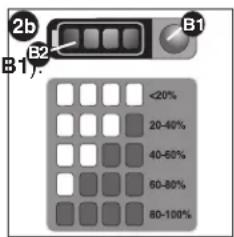
CHECKING STATE OF CHARGE DURING USE (FIGURE 2b):
- Press the state of charge indicator button
- The four LED's (B2) will illuminate indicating the percent of charge in the battery. See chart in figure 2b.
- If LED light does not illuminate, charge battery.
OPERATION
SWITCH
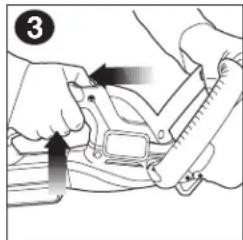
To turn the unit "ON", slide the lock off button, shown in figure 3, backward and squeeze the trigger switch. Once the unit is running, you may release the lock off button. In order to keep the unit running you must continue to squeeze the trigger. To turn the unit "OFF", release the trigger.
⚠ WARNING: Never attempt to lock a switch in the ON position.
TRIMMING INSTRUCTIONS
- WORKING POSITION – Maintain proper footing and balance and do not overreach. Wear safety goggles, non-skid footwear when trimming. Hold the unit firmly in both hands and turn the unit ON. Always hold the trimmer, as shown in the illustrations in this manual, with one hand on the switch handle and one hand on the bail handle. (figure 4) Never hold the unit by the blade guard.
natural_image
Illustration of hands using a tool to adjust or install a mechanical component (no text or symbols visible)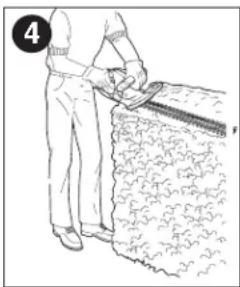
natural_image
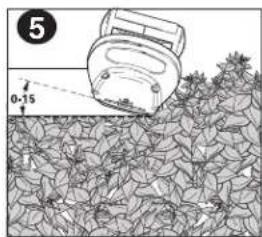
Illustration of a person using a long-handled tool to cut a large piece of material (no text or symbols visible)- TRIMMING NEW GROWTH – (Figure 5) A wide, sweeping motion, feeding the blade teeth through the twigs is most effective. A slight downward tilt of the blade, in the direction of motion gives the best cutting.
⚠️ CAUTION: Do not cut stems greater than 3/4 inch (19mm). Use the trimmer only for cutting normal shrubbery around houses and buildings.
-
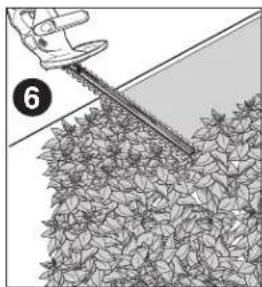
LEVEL HEDGES (Figure 6) – To obtain exceptionally level hedges a piece of string can be stretched along the length of the hedge as a guide.
-
SIDE TRIMMING HEDGES (Figure 7) – Hold the trimmer as shown and begin at the bottom and sweep up.
natural_image
Illustration of a hand using a tool to cut a textured surface, no text or symbols present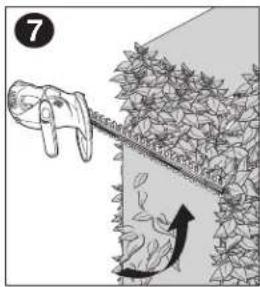
natural_image
Illustration of a person climbing a slope near a tree, with an arrow indicating upward motion (no text or symbols)WARNING: TO GUARD AGAINST INJURY, OBSERVE THE FOLLOWING:
- READ INSTRUCTION MANUAL BEFORE USING. SAVE INSTRUCTION MANUAL.
- CHECK THE HEDGE FOR FOREIGN OBJECTS SUCH AS WIRE OR FENCES BEFORE EACH USE.
- KEEP HANDS ON HANDLES. DON'T OVERREACH.
• DO NOT USE UNDER WET CONDITIONS.
⚠️ CAUTION: BLADE MAY COAST AFTER TURN OFF.
⚠️ DANGER: KEEP HANDS AWAY FROM BLADES.
MAINTENANCE
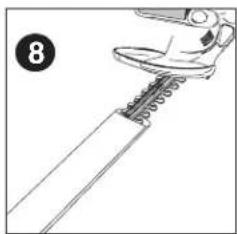
A sheath is supplied with your trimmer for storing. Remove battery and slip the hedge trimmer blade into the sheath, as shown in figure 8.
natural_image
Line drawing of a mechanical tool with a handle and spring, labeled with number 8 (no text or symbols on the diagram itself)⚠ WARNING: Remove battery pack before servicing, cleaning or removing material from the gardening appliance.
The cutting blades are made from high quality, hardened steel and with normal usage, they will not require resharpening. However, if you
accidentally hit a wire fence (figure 9), stones, glass or other hard objects, you may put a nick in the blade. There is no need to remove this nick as long as it does not interfere with the movement of the blade. If it does interfere, remove the battery and use a fine toothed file or sharpening stone to remove the nick. If you drop the trimmer, carefully inspect it for damage. If the blade is bent, housing cracked, handles broken or if you see any other condition that may affect the trimmer's operation contact your local Black & Decker Service Center for repairs before putting it back into use.

Fertilizers and other garden chemicals contain agents which greatly accelerate the corrosion of metals. Do not store the unit on or adjacent to fertilizers or chemicals.
With the battery removed, use only mild soap and a damp cloth to clean the unit. Never let any liquid get inside the unit; never immerse any part of the unit into a liquid. Prevent the blades from rusting by applying a film of light machine oil after cleaning.
This device complies with part 15 of the FCC rules. Operation is subject to the following two conditions: (1) This device may not cause harmful interference, and (2) this device must accept any interference received, including interference that may cause undesired operation.
NOTE: This equipment has been tested and found to comply with the limits for a Class B digital device, pursuant to Part 15 of the FCC Rules. These limits are designed to provide reasonable protection against harmful interference in a residential installation. This equipment generates, uses and can radiate radio frequency energy and, if not installed and used in accordance with the instructions, may cause harmful interference to radio communications. However, there is no guarantee that interference will not occur in a particular installation.
If this equipment does cause harmful interference to radio or television reception, which can be determined by turning the equipment off and on, the user is encouraged to try to correct the interference by one or more of the following measures:
• Reorient or relocate the receiving antenna.
- Increase the separation between the equipment and receiver.
- Connect the equipment into an outlet on a circuit different from that to which the receiver is connected.
- Consult the dealer or an experienced radio/TV technician for help. Changes or modifications to this unit not expressly approved by the party responsible for compliance could void the user's authority to operate the equipment. This Class B digital apparatus complies with Canadian ICES-003.
ACCESSORIES
⚠ WARNING: DO NOT use the Hedge Trimmer with any type of accessory or attachment. Such usage might be hazardous.
THE RBRC™ SEAL
The RBRC™ (Rechargeable Battery Recycling Corporation) Seal on the LI-ION battery (or battery pack) indicates that the costs to recycle the battery (or battery pack) at the end of its useful life have already been paid by Black & Decker.

RBRC™ in cooperation with Black & Decker and other battery users, has established programs in the United States to facilitate the collection of spent LI-ION batteries. Help protect our environment and conserve natural resources by returning the spent LI-ION battery to an authorized Black & Decker service center or to your local retailer for recycling. You may also contact your local recycling center for information on where to drop off the spent battery.RBRC™ is a registered trademark of the Rechargeable Battery Recycling Corporation
SERVICE INFORMATION
All Black & Decker Service Centers are staffed with trained personnel to provide customers with efficient and reliable power tool service. Whether you need technical advice, repair, or genuine factory replacement parts, contact the Black & Decker location nearest you. To find your local service location, refer to the yellow page directory under "Tools—Electric" or call: 1-800-544-6986 or visit www.blackanddecker.com.
FULL THREE-YEAR HOME USE WARRANTY
Black & Decker (U.S.) Inc. warrants this product for three years against any defects in material or workmanship. The defective product will be replaced or repaired at no charge in either of two ways:
The first, which will result in exchanges only, is to return the product to the retailer from whom it was purchased (provided that the store is a participating retailer). Returns should be made within the time period of the retailer's policy for exchanges (usually 30 to 90 days after the sale). Proof of purchase may be required. Please check with the retailer for their specific return policy regarding returns that are beyond the time set for exchanges.
The second option is to take or send the product (prepaid) to a Black & Decker owned or authorized Service Center for repair or replacement at our option. Proof of purchase may be required. Black & Decker owned and authorized service centers are listed under "Tools–Electric" in the yellow pages of the phone directory. This warranty does not apply to accessories. This warranty gives you specific legal rights and you may have other rights which vary from state to state. Should you have any questions, contact the manager of your nearest Black & Decker Service Center. This product is not intended for commercial use.
LATIN AMERICA: This warranty does not apply to products sold in Latin America. For products sold in Latin America, check country specific warranty information contained in the packaging, call the local company or see the website for warranty information.
FREE WARNING LABEL REPLACEMENT: If your warning labels become illegible or are missing, call 1-800-544-6986 for a free replacement.
TROUBLESHOOTING
| Problem Possible Cause• Slow running, noisy or hot blades.• Blades or blade support bent.• Bent or damaged teeth.• Loose blade bolts. • Tighten blade bolts. | Possible Solution• Dry, corroded blades. • Lubricate blades.• Straighten blade or blade support.• Straighten teeth.• Loose blade bolts. • Tighten blade bolts. | |
| • Unit will not start.• Battery not charged.• Battery not charged.• Lock off not fully operated.prior to moving main trigger. | • Check that lock off is fully pulled back | |
| • Battery won't charge.“Important Charging Notes” for more details.lamp or other appliance.out the lights.below 105 degree F (+40.5°C). | • Battery not inserted into charger.• Charger not plugged in.• Surrounding air temperature too hot or too cold. | • Insert battery into charger until green LED appears. Charge up to 8 hours if battery totally drained.• Plug charger into a working outlet. Refer to• Check current at receptacle by plugging in a• Check to see if receptacle is connected to a light switch which turns power off when you turn• Move charger and tool to a surrounding air temperature of above 40 degree F (4.5°C) or |
For assistance, visit our website www.blackanddecker.com for the location of the service center nearest you or call the BLACK & DECKER help line at 1-800-544-6986.
Imported by
Black & Decker (U.S.) Inc.,
701 E. Joppa Rd.
Towson, MD 21286 U.S.A.
See 'Tools-Electric'
- Yellow Pages -
for Service & Sales


BlackandDecker.com
1-800-544-6986

BLACK&DECKER®
TAILLE-HAIE AU LITHIUM-ION DE 36 MODE D'EMPLOI
natural_image
Line drawing of a manual hatched tool with a diagonal blade and control panel (no text or symbols)TABLE DES MATIÈRES
FONCTIONNEMENT
INTERRUPTEUR
INSTRUCTIONS RELATIVES À LA COUPE
natural_image
Illustration of a person measuring a large pile of material (no text or symbols visible)2. COUPE DES NOUVELLES POUSSES – (Figure 5)
natural_image
Illustration of a hand using a tool to cut leafy plant material, no text or symbols present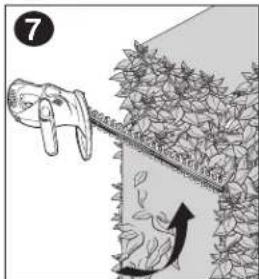
natural_image
Illustration of a person climbing a slope with vegetation and a curved arrow indicating direction (no text or symbols)⚠ AVERTISSEMENT : POUR ÉVITER LES RISQUES DE BLESSURE, RESPECTER LES CONSIGNES SUIVANTES.
• LIRE LE GUIDE AVANT L'UTILISATION; CONSERVER LE GUIDE D'UTILISATION.
- VÉRIFIER LA HAIE POUR LA PRÉSENCE DE TOUT OBJET ÉTRANGER COMME DU FIL DE FER OU DES CLÔTURES AVANT CHAQUE UTILISATION.
• LAISSER LES MAINS SUR LES POIGNÉES. NE PAS DÉPASSER SA PORTÉE.
- NE PAS UTILISER DANS DES CONDITIONS MOUILLÉES.
- NE PAS UTILISER LORSQUE LE CORDON EST ENDOMMAGÉ.
⚠ MISE EN GARDE : LA LAME CONTINUE DE BOUGER APRÈS AVOIR MIS L'OUTIL HORS TENSION.
⚠️ DANGER : TENIR LES MAINS ÉLOIGNÉES DES LAMES.
ENTRETIEN
natural_image
Line drawing of a mechanical tool or tool with a spring and handle (no text or symbols)⚠ AVERTISSEMENT :
Black & Decker Canada Inc.
100 Central Ave.
natural_image
Line drawing of a manual chain-linking tool with a power button and control panel (no text or symbols)ÍNDICE
natural_image
Line drawing of a car interior frame with a directional arrow indicating movement (no text or symbols)natural_image
Illustration of a hand using a tool to cut a pile of granular material, no text or symbols present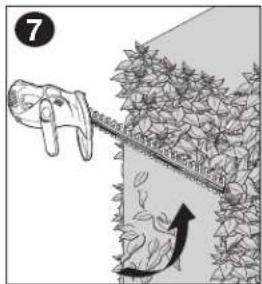
natural_image
Diagram showing a skull interacting with a wall and vegetation, with an arrow indicating direction (no text or symbols)ADVERTENCIA: PARA PROTEGERSE DE LESIONES, OBSERVE LO SIGUIENTE:
natural_image
Line drawing of a mechanical tool or tool with a spring-like extension, no text or symbols presentDate of purchase · Fecha de compra Invoice No. · No. de factura
Col. Fracc. Universidad
Chihuahua, Chihuahua
Tel. 01 614 413 64 04
Fernando González Armenta
Bolivia No. 605
Col. Felipe Carrillo Puerto
Cd. Madero, Tampico
Tel. 01 833 221 34 50
Cat No. LHT2436 Form No. 90588863
Copyright © 2012 Black & Decker
JUNE 2012
Printed in China

- PLEASE READ BEFORE RETURNING THIS PRODUCT FOR ANY REASON:
- TABLE OF CONTENTS
- SAFETY GUIDELINES - DEFINITIONS
- GENERAL POWER TOOL SAFETY WARNINGS
- SAVE ALL WARNINGS AND INSTRUCTIONS FOR FUTURE REFERENCE
- SAVE THESE INSTRUCTIONS
- 3) PERSONAL SAFETY
- 4) POWER TOOL USE AND CARE
- 5) BATTERY TOOL USE AND CARE
- 6) SERVICE
- HEDGE TRIMMER SAFETY WARNINGS
- IMPORTANT SAFETY INSTRUCTIONS FOR BATTERY CHARGERS
- IMPORTANT SAFETY WARNINGS FOR BATTERY PACKS
- READ ALL INSTRUCTIONS
- STORAGE RECOMMENDATIONS
- CHARGING PROCEDURE
- CHARGER DIAGNOSTICS
- BAD BATTERY
- HOT/COLD PACK DELAY
- LEAVING THE BATTERY IN THE CHARGER
- IMPORTANT CHARGING NOTES
- INSTALLING / REMOVING BATTERY PACK
- TO INSTALL BATTERY PACK:
- STATE OF CHARGE INDICATOR (FIGURE 2a)
- CHECKING STATE OF CHARGE DURING USE (FIGURE 2b):
- OPERATION
- SWITCH
- TRIMMING INSTRUCTIONS
- ACCESSORIES
- THE RBRC™ SEAL
- SERVICE INFORMATION
- FULL THREE-YEAR HOME USE WARRANTY
- BLACK&DECKER®
- TAILLE-HAIE AU LITHIUM-ION DE 36 MODE D'EMPLOI
- TABLE DES MATIÈRES
- FONCTIONNEMENT
- INTERRUPTEUR
- INSTRUCTIONS RELATIVES À LA COUPE
- COUPE DES NOUVELLES POUSSES – (Figure 5)
- ENTRETIEN
- ⚠ AVERTISSEMENT :
- ÍNDICE
Brand : BLACK & DECKER
Model : LHT2436
Category : Hedge trimmers