ManualGo.com
WFT8500TP - Washing machine LG - Free user manual and instructions
Find the device manual for free WFT8500TP LG in PDF.


Download the instructions for your Washing machine in PDF format for free! Find your manual WFT8500TP - LG and take your electronic device back in hand. On this page are published all the documents necessary for the use of your device. WFT8500TP by LG.
USER MANUAL WFT8500TP LG
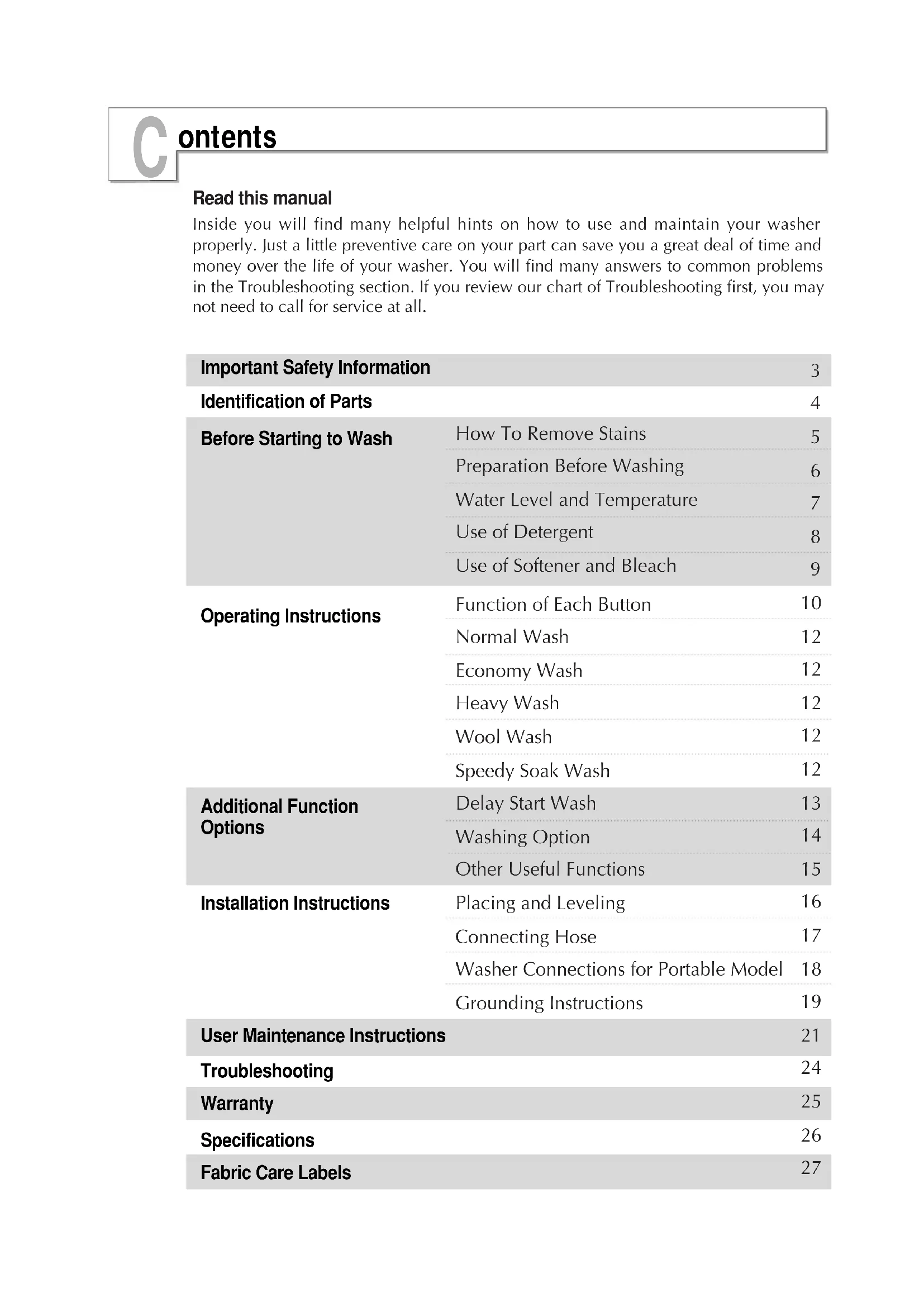
S/N :C itle ontents Important Safety Information Identification of Parts Before Starting to Wash Operating Instructions Additional Function Options Installation Instructions User Maintenance Instructions Specifications Troubleshooting Warranty Fabric Care Labels How To Remove Stains Preparation Before Washing Water Level and Temperature Use of Detergent Use of Softener and Bleach Function of Each Button Normal Wash Economy Wash Heavy Wash Wool Wash Speedy Soak Wash Delay Start Wash Washing Option Other Useful Functions Placing and Leveling Connecting Hose Washer Connections for Portable Model Grounding Instructions
Read this manual Inside you will find many helpful hints on how to use and maintain your washer properly. Just a little preventive care on your part can save you a great deal of time and money over the life of your washer. You will find many answers to common problems in the Troubleshooting section. If you review our chart of Troubleshooting first, you may not need to call for service at all. CImportant Safety Information
mportant Safety Information
For your safety, the information in this manual must be followedto minimize the risk of fire or explosion, electric shock, or toprevent property damage, personal injury, or loss of life. READ ALL INSTRUCTIONS BEFORE USE WARNING!
- Read all instructions before using the washer.• Do not wash articles that have been previouslycleaned in, washed in, soaked in, or spottedwith gasoline, dry cleaning solvents, or otherflammable or explosive substances, as theygive off vapors that could ignite or explode.• Do not add gasoline, dry cleaning solvents, orother flammable or explosive substances to thewash water. These substances give off vaporsthat could ignite or explode.• Under certain conditions, hydrogen gas maybe produced in a hot water system that has notbeen used for 2 weeks or more. HYDROGENGAS IS EXPLOSIVE. If the hot water systemhas not been used for such a period, beforeusing the washing machine, turn on all hotwater faucets and let the water flow from eachfor several minutes. This will release anyaccumulated hydrogen gas. As the gas isflammable, do not smoke or use an open flameduring this time.• Do not allow children to play on or in thewasher. Close supervision of children isnecessary when the washer is used nearchildren.• Before the washer is removed from service ordiscarded, remove the lid to prevent childrenfrom hiding inside.• Do not reach into the washer if the basket oragitator is moving.• Do not install or store the washer where it willbe exposed to the weather.• Do not tamper with controls.• Do not repair or replace any part of the washeror attempt any servicing unless specificallyrecommended in the user-maintenanceinstructions or published user-repairinstructions that you understand and have theskills to carry out.• See Installation Instructions for groundingrequirements. GROUNDING INSTRUCTIONS This appliance must be grounded. In the event of malfunction or breakdown, grounding will reduce therisk of electric shock by providing a path of least resistance for electric current. This appliance is equippedwith a cord having an equipment-grounding conductor and grounding plug. The plug must be plugged intoan appropriate outlet that is properly installed and grounded in accordance with all local codes andordinances.Do not use an adapter or otherwise defeat the grounding plug.If you don’t have the proper outlet, consult an electrician.
IMPORTANT SAFETY INSTRUCTIONS
To reduce the risk of fire, electric shock, or injury to persons when using thewasher, follow basic precautions, including the following:
SAVE THESE INSTRUCTIONS
Improper connection of the equipment-grounding conductor can result in risk ofelectric shock. Check with a qualified electrician or serviceman if you are in doubt as to whetherthe appliance is properly grounded. Do not modify the plug provided with the appliance - if it doesnot fit the outlet, have a proper outlet installed by a qualified electrician.Identification of Parts dentification of Parts
Accessories Inlet hose Drain hose Tie strapLeg Stopper(Option)Complete hose(Option)1 Each for cold and hot waterto secure drain hoseto standpipe, inlethose or laundry tub2 PiecesHOT WATER SUPPLY HOSE
HOSE Make sure the water does notleak.SOFTENER INLETSTART/PAUSEBUTTONWASHING WINGSSoftner will automaticallyflow into the tub.Use to start or stop thewashing machinetemporarily.LINT FILTERClean regularly to stop lintingon the clothes load.DRAIN HOSECheck if the drain hose is hungup before operating thewashing machine.POWER PLUGIf the supply cord is damaged,it must be replaced by themanufacturer or its serviceagents or similarly qualifiedperson in order to avoid ahazard.POWDER DETERGENTBOX FOR DELAYEDWASHINGINLET HOLE FORBLEACHFUNCTION SELECTOR BASE Vertical movement of agitatoroccurs when a sufficient amountof laundry is deposited. Set the proper water level, anexcessive amount of water mayincrease entanglement oflaundry.
( )Before Starting to Wash
How To Remove Stains Pretreating dirt and stains Brush a little washing detergent dissolved in water onto stains, collars, and cuffs to help shift dirt. The secret of stain treatment is immediate action. When an accident happens, plunge the stained area into cold water, or sponge it down. This prevents the stain from setting. Wash as soon as possible afterwards.
- Treat stains AS SOON AS POSSIBLE. The longer they are left, the harder they are to remove.
- Always consider the type of fabric you are treating to make sure you do not use a water temperature that is too hot or a treatment that will alter the color of the fabric. It pays to pre-wash products and solvents on an inconspicuous part of the garment first.
- Place the garment being treated on an absorbent cloth (e.g. on an old towel). Work from the reverse side of the stain, as this can force the stain off the fabric instead of through it.
- Use cold or warm water on unknown stains as hot water can set some stains.
- Some stains are not easily seen when the fabric is wet. Do air dry the stained garment to be sure the stain has been removed, as heat from a dryer may set the stain.
- Take care with stain removal treatments as they are often flammable and highly poisonous. Do not use them in your washer as they may damage the paint or plastic components.
- Some pretreatment sprays or liquids can damage your washer's control panel. Diaper Sanitizers
- Diaper sanitizers are very corrosive to metal surfaces. DO NOT soak diapers in sanitizers in your washer or tip the contents of the diaper bucket into your machine. Rinse and wring diapers out thoroughly before placing them in your machine. Diapers
- Scrape off any excess baby cream, such as Vaseline from the diapers before washing and handwash to prevent the cream being transferred to other items in the wash.Before Starting to Wash reparation Before Washing
- Check all pockets to make sure that they are empty. Things such as nails, hairclips, matches, pens, coins, and keys can damage both your washer and your clothes.
- Mend any torn garments or loose buttons. Tears or holes may become larger during washing.
- Remove belts, underwires, etc. to prevent damage to the machine or your clothes.• Pretreat any dirt and stains.• Make sure the clothes are washable in water. • Check the washing instructions on care label (Refer to p. 26.)To get the best results, different fabrics need to be washed in different ways.
- SOIL (Heavy, Normal, Light) Separate clothes according to the type and amount of soil.
- COLOR (Whites, Lights, Darks) Separate white fabrics from colored fabrics.
- LINT (Lint producers, Collectors) Separate lint producers and lint collectors. Lint Producers Terry cloth, Chenile, Towels, Nappies, DiapersLint Collectors Synthetics, Corduroy, Permanent Press, Socks WIRE Sorting Check before Loading
- Look for a care label on your clothes. This will tell you about the fabric content of your garment and how it should be washed. (Refer to p. 26.)Sort clothes into loads that can be washed with the same wash cycle, water temperature and spin speed. Care Labels Use nylon nets for long, delicate items. For laundry with long strings or long length , a net will prevent tangling during washing.Fasten zippers, hook, and strings to make surethat these items don't snag on other clothes.Nylon net is not supplied by LG.Clothes like downs and woollens are light weight,large and float easily. Use a nylon net and washthem in a small amount of water. If the laundry floats during the wash cycle, it may become damaged. Use dissolved detergent to prevent the detergent from clumping.Light and Large-sized clothingLong laundry itemsDo not wash fabrics containing flammable materials (waxes, cleaning fluids, etc.).Load SizeThe water level should just cover the clothes. Adjust the load size accordingly. Loosely load clothes no higher than thetop row of holes in the washer tub. To add items after washer has started, press Start button and submerge additionalitems. Close the lid and press Start button again to restart. Loading Fire HazardNever place items in the washer that aredampened with gasoline or other flammable fluids.No washer can completely remove oil.Do not dry anything that has ever had any type ofoil on it (including cooking oils).Doing so can result in death, explosion, or fire. WARNINGitle
- You can change the water temperature by pressing the WATER TEMP. button. The temperature of the water impacts the effectiveness of all laundry additives and, therefore, whichresults in wash performance. We recommend the water temperature as follows :
- Temperature below 65˚F (18˚C) will not activate laundry additives and may cause lint, residue, poor cleaning, etc. In addition, detergent manufactures and care labels define cold water as 80~85˚F (26.5~29.5˚C). If the temperature of the water in the tub is cold to your hands, the detergent will not beactivated and clean effectively.• This machine detects the quantity of laundry automatically,then sets the water level and proper amount of detergent. • When you select a wash program, the water level andamount of detergent (to be used) will be shown on thecontrol panel.• When the water level is automatically detected, it maydiffer depending on the quantity of laundry even thoughthe same water level is indicated on the control panel. Water Level (refer to p10)
- If you do not specify the water level ‘Large’ will be automatically selected. Note Note ; White items, diapers, underclothes, and heavily soiled, colorfast items.; Most items; Lightly soiled items Before Starting to Wash
- When washing in cold water, additional steps may be needed:- Adjust detergent amount and pre-dissolve detergent in warm water- Pretreat spots and stains- Soak heavily soiled items- Use appropriate bleach
ater Level and Temperature WASH OPTION PRO- GRAM PRO- CESS DELAY START WATER LEVEL START PAUSE Water Detergent Ex-Large Medium Small Large WATER TEMP.Before Starting to Wash se of Detergent
- Follow the detergent package directions. • Using too little detergent is a common cause of laundry problems.
- Use more detergent if you have hard water, large loads, greasy or oily soils, or lower water temperature.
- The correct amount of detergent will vary depending on the amount of soil in your clothes. (Jeans and work clothes may be needed more detergent while bath towels are less.)
- For liquid and concentrated detergent, follow the recommendations of the detergent manufacturer. To see if you are using the correct amount of detergent, lift the lid of your machine about half-waythrough the wash. There should be a thin layer of foam over the surface of the water. Lots of foammay look good, but it does not contribute to cleaning your clothes. No foam means not enoughdetergent has been used; soil and lint can settle back on the clothes or the washing machine.• We recommend powdered detergent, or liquid detergent diluted with water.(manufacturer’s recommanded ratio)
- Soap or granulated soap powders should not be used in your washing machine to prevent build-up.
- When washing woolens, remember to use a detergent suitable for washing woolens.If excessive detergent is used, the rinse will not be as clean and efficient. Also, it could cause environmental pollution, so use detergent accordingly. Attention Choosing the Right Detergent Where youdeposit thedetergentPowder Detergent Box.• Open the detergent box and deposit theappropriate amount of detergent . Adding the Detergent
- Some detergents MUST be fully dissolved before adding to your machine to get the best wash results. Check the instructions on the detergent packet.If you use powdered detergent, it is essential that the required amount be fully dissolved in very hotwater before being added to warm or hot water for the actual wash.Pre-dissolving detergent in warm water when washing in cold water can improve its performance. Note ( )Before Starting to Wash
se of Softener and Bleach
Available Fabric Softener Type
- Do not use concentrated fabric softener. This may cause some problems in automatic dispensing.
- For more details refer to the softener product instructions for use. Depositing Fabric Softener
- Don't use softener with detergent. Softener is dispensed into the last rinse water.
- When using concentrated softener, dilute 1 oz. (30ml) of softener with 1 oz. (30ml) of fresh water.
- When filling dispenser, do not splash or overfill. It may stain clothes.• Never pour fabric softener directly on clothes. It may stain them.• If spotting occurs, wet and rub dishwashing liquid (or mild bar soap) and rewash.• Add 60ml (2 oz.) of fabric softener in the dispenser when starting the washer.It will be dispensed into the final rinse at the proper time. See the attention,below, for using concentrated fabric softener in the dispenser. Depositing Bleach Bleach dispenser• Separate the laundry to be bleached. • Measure liquid bleach carefully, following instructions on the bottle.• Before starting the washer, pour measured amount of bleach directlyinto bleach dispenser. • Avoid splashing or over-filling dispenser. If you prefer to usepowdered bleach, add it into the wash basket with your detergent.• The dispenser dilutes liquid bleach before it reaches into your wash load. Using Bleach Using Softener Check fabric care labels for special instructions. Attention Attention
- Never pour undiluted liquid bleach directly onto clothes or into the wash basket.This may affect decolorization or damage of laundry.• Do not mix chlorine bleach with ammonia or acids such as vinegar and/or rust remover. Mixing can produce a toxic gas which may cause death.• Do not pour powered bleach into bleach dispenser.• Powdered bleach should be dissolved with water and then be deposited into the tub.• For more details refer to the product instructions for use.
( )WASH OPTIONPRO-GRAMPRO-CESSDELAYSTARTWATERLEVEL START PAUSE Water DetergentEx-LargeMediumSmallLargeExtra WashExtra RinseGentle SpinWATERTEMP. Hot Cold Warm Time Left Delay
DETERGENT VOLUME WASH OPTION WATER LEVEL SELECTOR DELAY START title itle
unction of Each Button
Operating Instructions
Used to indicate proper amount of detergent for each water level.
Used to set the time when wash program ends from now to prevent wrinkle while you are away for a while.
Press the button to increase the delay time. ● The Normal program is used for average day-to-day washing. ● Press the POWER button to turn power on. ● Load clothes. ● Press the START/PAUSE button. ● The water level lights will scroll up and down while the washer is working out to find the optimum water level for your load. ● Add detergent, bleach, and softener as desired into the appropriate dispenser. ● Close the lid.
Used to select proper water temperature of washing water.
Select the desired wash option according to your laundry type, soil level, or load size.
Press the button to cycle through the options. ❃ To change cycles during the process of cycle.
Step 2. Select desired cycle or function.
Step 3. Press START/PAUSE button to restart the washer at the beginning of the new cycle.
Use to select the proper amount of water in relation to the weight and type of laundry.
Operating Instructions Other programs are selected as follows : ● Press the POWER button to turn power on. ● Load clothes. ● Add detergent, bleach, and softener as desired in the appropriate dispenses. ● Select water temperature, water level, process, program, and wash options as described below. ● Close the lid and press the START/PAUSE button.
Used to indicate the timeleft of all processes ordelay. Use to start or stop the washingmachine temporarily. After 10 minutes in pause state,the power is automatically turned off.
Use to select the desiredfunction among SpeedySoak, Wash, Rinse, orSpin. Power is automaticallyturned off after the washprogram finishes. According to laundry andstain, you can select suitableprogram yourself. Press the button to cyclethrough the options. Used to lock or unlock thecontrol buttons to preventall the setting from beingchanged by a child. For locking, push bothbuttons simultaneously andfor unlocking push themonce more in washingprocess. Manual control : 3 step works at large and medium water level of Normal and Heavy program.title ashing Programs
Press the PROGRAM button to select the washing program.
Thick and heavy clothes or those which are excessively dirty like jeans or working uniforms can be washed. Delicate clothes (lingerie, woolens, etc.) which may be easily damaged can be washed.
- Before washing your woolens, check the care label for the washing instructions. (Machine washable woolens have been specifically modified to prevent felting when they are machine washed. Most handknitted garments are not made of machine washable wool so we recommend that you wash them with hand.)
- When washing woolens, use a mild detergent recommended for washing wool.
- Hand washed woolens may be spun in the washing machine to reduce the time to dry.
- To dry woolens lay down them flat on a towel and pat into shape. Dry woolens out of direct sunlight. (The heat and tumble action of a dryer may cause shrinkage or felting of woolen garments.) Some underlaid woolens and sheepskin products machine may cause pump blockages during washing.
- Ensure that the whole article is suitable for machine washing and not just the backing material. Fuzzy (Normal) Wash Heavy Wash Wool Wash Economy wash can be selected to wash lightly soiled clothes of less than 4
lb. (2.0 kg) in a short time. Economy Wash Speed Soak Wash can be selected to wash heavily soiled laundry by soaking in water for an extended period to remove dirt and grime. Speedy Soak Wash cannot be selected for the Economy and Wool wash program. Speedy Soak Wash Use this program for normal clothes except woolen clothes and lingerie. Normal Wash When you press the START/PAUSE button the light will blink. Add the laundry and press the START/PAUSE button. The appropriate quantity of detergent is marked next to the water level of WaterDetergent. When the lid is open the machine will not operate and an alarm signal will remind you to close the lid Add the detergent. Water will be supplied for up to 2 minutes after the start of the wash to supplement the water which the laundry has absorbed. Close the lid.
AttentionAdditional Function Options
Delay Start wash is used to delay the finishing time of the operation. The hours to be delayed can be set by the user accordingly. The time on the display is the finishing time , not the start time. When you press the START/PAUSE button,the light will blink.Select the program for laundry on the control panel.You cannot use DELAY START with the woolen setting.The time changes as followingorder (3 4 Hours). Press the POWER button to turn power on. Press the PROGRAM button to select the washing program. Add the laundry and press the START/PAUSE button. Press the DELAY START button to set the time when the delayed washing is to be completed. The appropriate amount of detergent is marked at the WaterDetergent on the water level button. Add the detergent. Water will be supplied 2 minutes into the wash cycle to supplement the water the laundry has absorbed. Close the lid. The washing will be finished according to the delayed time.To select washing program, process, water level, wash option, or water temperature manually, press the DELAY START button and select the desired option. Then press the START/PAUSE button. Finish When the laundry cannot be taken out immediately after the wash program ends, it is better toomit the spinning program. The laundry will be wrinkled if it is left for a long time afterspinning. Note If the lid is open, the machine will not work and an alarm signal will alarm to remind you toclose the lid.
When you only need the Wash, Wash/Rinse or Rinse cycles, these can be set manually. Press the AUTO OFF (Power) button to turn power on. Press the PROCESS button until below desired option light is on. ( Refer to p. 11.)
- When you want to only drain, wait until the water in the washing tubdrains completely and then turn off the power. Add the laundry into the washing tub. Press the START/PAUSE button. Press the WATER LEVEL button.
- Control the water level according to the amount of laundry.
- If you do not choose anything, it is set the ‘Large’ water level automatically. Add the detergent if required and close the lid. (Refer to p. 10.)
- When spin option is not selected, the water will not be drained off after the process is completed . When you want the water to drain only, wait until the water in the wash tub finishes draining and turn off the power.• If you do not specify the water level, then Large will be selected automatically.
ther Useful Functions
Press the POWER button. Press the START/PAUSE button to start washing after all washing conditions are set according to this manual. Press both PROCESS and PROGRAM button simultaneously while wash is proceeding, then all the keys are locked the wash or until unlocking them. Turn Power on.You can use the child lock option, if you want to lock all the buttons to prevent all the setting frombeing changed by a child. To unlock this function during the wash, press both PROCESS and PROGRAM button simultaneously again. One or more wash options can be selectable for every washing program.Wash program is changed as follows according to selected wash options. Child Lock Function
- Extra Wash : It gives additional 3 min wash. (Except for Speedy and Wool)
- Extra Rinse : It gives additional one deep rinse. (Except for Speedy and Wool)
- Gentle Spin : It gives gentle spin instead of normal spin. (Set for Wool automatically) Wash Option How to Lock How to Unlock
- [ ] and the remaining time are alternatively shown on the diplay. ( [ ] means Controls Locked.) Note Hour Min. Time Left Delay If you want to use the washing machine without alarm signal sounds, press both the WATER LEVEL and PROCESS buttons simultaneously. To make buzzer work, press both the WATER LEVEL and PROCESS buttons simultaneously one more time. Mute OptionInstallation Instructions lacing and Leveling
Top view of the machineCasterLeg Stoppermore than 4” more than 1”more than1” Place the machine on a flat and firm surface which allows proper clearance. Concreate flooring is best. Washer should not be installedon rugs or exposed to the weather.We suggest a minimum clearance of 1” from right and leftsides and 4” from rear wall.An insecure installation may cause walking during spin cycles because the washer has casters forconvenience to move.To protect it from walking, place the leg stoppers, which are provided as a accessory, under the twofront legs of washer as shown in the figure. Check that the machine is level and securely installed not to move. Open the lid and look from above to see if it issame as shown beside.
Please ensure that the transit restraint has been removed before operating your machine. CautionIf the washer is installed on a uneven,weak or tilted floor causing excessive vibration, spin failure or “ ” error can happen to it. It must be placed on a firm and level floor to prevent spin failure. ■ Washer with CastersInstallation Instructions
Connect the water supply hose to the tap. Push the water supply hose up so that the sealingwasher within the hose can adhere completely tothe tap.Tighten it by screwing to the right. Connect water supply hose to the machine. Check to see if there is a sealing washer inside the connector. Check water leakage. Connect the water supply hose to inlet valve ofthe washing machine, and then lock it by turningthe hose connecting part.After connecting the hose, open the tap to check for any water leakage. Water Supply Hose Water Supply HoseSealing WasherWater Tap
Fit the end of the drain hose to the outlet of thedrain pump of washer and tighten the clamp. Drain Hose
To prevent siphoning, the drain hose should not be extended more than 2” from the end of the hose guide. The discharge height should be approximately 36 ~ 47” from the floor. Note Put the other end of the drain hose over the standpipe or wash tub.To prevent accidental dislodgingsecure the drain hose to the standpipe,inlet hose or laundry tub with the tiestrap provided in the parts package.
Attach the faucet connector to the faucetadapter by pulling down on the lockingcollar while lifting up on the connector untilit snaps into place. Make sure the waterfilter provided is in place. Remove the complete hose from inside the washer
Connect to water supply
Attach the water supply hose to the cold watervalve inlet (BLUE color). Make sure the washer is inside the completehose before tightening.Tighten the hose, ensuring the threads arealigned properly for tightest fit. Inspect forkinks or binding of the hose. Connect to valve inlet
Attach the drain hose to the rear of the washer.Install the clamp on the drain hose and tightento prevent leakage of water. Connect drain hose
Use the Complete hose provided with the water for a one-faucet connection. Make sure the temperature selector is set at cold Tighten the water filter to the faucet. Tighten water filter
rounding Instructions
Grounding Instructions With Ground Insert Space Terminal If the AC current outlet has no ground terminal, thenseparate grounding is required. Note that AC power outlet configurationsmay differ from country to country.If your outlet has no ground terminal or does notmatch your plug on the washer, consult an electrician.DO NOT change or modify the plug or the outlet.Outlet with ground terminal.(may vary)• To prevent a explosion, do not connect ground to a gas pipe.• Do not connect ground to telephone wires or lightning rods. This may be dangerousduring electrical storms.• Connecting ground to plastics has no effect.CautionElectrical Shock HazardPlug into a grounded 3 prong outlet.Do not remove ground prong. Do not use an adapter.Do not use an extension cord.Failure to follow these instructions can result in death, fire, or electrical shock. WARNINGUser Maintenance Instructions ser Maintenance Instructions
- Turn off taps to prevent the chance of flooding.•Always unplug the power cord when not in use. When you have finished washing Wash Inner-Tub Leave the lid open after washing to allow moisture to evaporate. If you want to clean the inner-tub use a clean soft cloth dampened with liquiddetergent, then rinse. (Do not use harsh or gritty cleaners.) Inlet Hoses Hoses connecting washer to faucet should be replaced every 5 years. Exterior Immediately wipe off any spills. Wipe with damp cloth. Try not to hit surface withsharp objects. Long Vacations Be sure water supply is shut off at faucets. Drain all water from hoses if weather will be below freezing. These might damage your washing machine
- Concentrated bleaches and diaper sanitizer will cause damage to the paintwork and components of your washer.
- Hydrocarbon solvents i.e. gasoline, paint thinners and lacquer thinners, etc. can dissolve plastic and blister paint . (Be careful when washing garments stained with these solvents as they are flammable DO NOT put them inwasher or dryer.) • Some pretreatment sprays or liquids can damage your washer's control panel.
- Use of dyes in your washer may cause staining of the plastic components. The dye will not damage the machine but we suggest you thoroughly clean your washer afterwards. We do not recommend the use of dye strippers inyour washer.• Do not use your washer lid as a work surface.• Clean your machine regularly.
- Cold water washing increases the chance of this build-up occuring. We recommend a warm or hot wash at regular intervals e.g. approx. every 5th wash.
- Fabric softener of thinner consistency is less likely to leave residue on the dispenser and contribute to build-up.Scum is the name given to the waxy build-up that can occur within any washer when the fabric softenercomes into contact with detergent. This build-up is not brought about by fault from the machine. If scum is allowed in the machine, it canresult in stains on your clothes or an unpleasant smell in your washer.If you use fabric softener or do regular cold water washing, it is important that you occasionally cleanthe inside of your machine.• Fill your machine with hot water. Add chlorine bleach or equivalent for cleaner.Measure the amount of cleaner carefully by instructions on the bottle.• Select Wash cycle and operate. Repeat it 2 or 3 times.• Stop the machine, open the lid, and leave it to soak overnight.• After soaking, drain the machine and run the machine through a regular cycle.We do not recommend that you wash clothes during this procedure. Note If you wish to use fabric softener, we recommend How to clean the inside of your washing machineUser Maintenance Instructions
Check it if water leaks after reassembling. (The gasket is in the cap) To Clean the Pump Casing Caution To Clean the Filter in the Inlet Valve Close the tap before turning off thepower. Select both hot/cold and thenpress the [START/PAUSE] button toremove water remaining in the waterhose completely. In case the water supply is impure, check substances like stone or sand in the filter. If the filter is clogged with dirt, water cannot flow into the washer. Clean the filter regulary. (The figure of power cord and water tap may vary by country.) After disconnecting the watersupply hose, remove the filterfrom the inlet valve by handor with tools. Then removedirt with a brush, etc.Turn off the power anddisconnect the power cord.Replace the filter into the waterinlet after cleaning it.
Before cleaning the filter, water remaining in the water supply hose should be emptied.Caution To Clean the Lint Filter Turn the net inside outto remove dirt andrinse it with water.Pull out the lint filter fromthe tub in the directionshown below.Replace the filter to theoriginal location. Pushthe lip of the filter untila pop sound is heard.
- If the lint filter is worn out or damaged, contact a LG Service Center for new one.• The amount of collected lint depends on the load size and type.Clean the lint filters when cleaning is needed.Place a towel on thefloor under the drainpump cap. Excesswater may flow out.Remove any foreignobjects and fluff insidepump casing and from thefilter.Replace the cap. Insert the filter alongthe guide ribs inside the pump casing.Filter must face the guide ribs insidepump casing and securely turn the capclockwise. Turn the capcounter-clockwise andpull it out. Filter Cap Guide rib FilterTroubleshooting roubleshooting
Look for your problem below, then check the things we suggest. More often than not, this will give you the answer to your problem, and you’ll be able to carry on without having to telephone your service center. WASH PROBLEM Possible CausesProblem What To Do
- Separate lint producers from lint collectors.
- Wash small loads for a shorter time than larger loads.
- Some lint is normal. Using the dryer should remove any lint not removed by the washer. Detergent on clothes Lint or residue on clothes Incorrect sorting Wash time too long Natural By-product When Washing Certain Items Detergent not dissolving Incorrect use of fabric softener Dye transfer Not enough detergent used A build-up caused by the interaction of fabric softener and detergent can flake off and marks on clothes. Pins, snaps, hooks, sharp buttons, belt buckles, zippers, and sharp objects left in pockets Chemical Damage a. Chlorine Bleach b. Battery Acid c. Hydrogen Peroxide d. Skin & Hair Care Products Non-chemical Damage a. Age & Normal Use b. Poor Construction c. Overloading d. Mice & Insects e. Sunlight
- Use warmer water for wash.
- Try pre-dissolving the detergent in warm water.
- Try a liquid detergent. Black spots on clothes
- Pre-treat stain and rewash.
- Separate whites or lightly colored items from dark colors. - Wash and dry non-colorfast clothes separately.
- Insufficient detergent for the amount of soil on the clothes can result in black marks on clothes.
- Cleaning the inside of your washing machine. (Refer to p. 19.) Fasten snaps, hooks, buttons, and zippers. Remove any loose support wires. Remove objects in pockets and sharp buttons. Turn knits (which snag easily) inside out. Dilute bleach or use the dispenser (Refer to p. 9.) Use caution around battery acids or skin and hair care products - these can remove color and cause holes or tears in fabrics. Check construction carefully when purchasing. Mend any damage before laundering. Fabric damage (snags, holes, tears, rips or excessive wear)Troubleshooting
- Use warmer water temperature
- Select the wash temperature according to soil type. For example, blood and mud are better in cold water, while oily soils are better in warmer water.
- Brush a little detergent dissolved in water or liquid detergent or suitable prewash product onto stains, collars, and cuffs to help shift dirt.
- Wash stains as soon as possible. The longer they are left the harder to be removed.
- Select load size to match clothes load.
- White clothes are better washed separately. Separate light and heavily soiled items, as clothes can pick up soil from dirty washed water.
- Various size of load mixture is recommanded (e.g. full loads of sheets may not wash that well).
- Detergent for load size or amount of soil is not enough. Hard water requires more detergent than soft water. The laundry isn’t clean Water temperature is too cold. Water temperature is not correct Stain is not pretreated Washer is overloaded Incorrect sorting Insufficient detergent Result of normal wear on poly- cotton blends and fuzzy fabrics
- While this is not caused by the washer, you can slow the pilling process by washing garments inside out. Pilling Not enough detergent Water is not hot enough Washer is overloaded Dye transfer Use more detergent (especially with larger loads). Make sure water heater is delivering water at 120˚F. Select load size to match clothes load. Sort clothes by color. If fabric label states wash separately, unstable dyes may be indicated. Grayed or yellowed clothes Gulping sound after drain and before spin. Load is unbalanced Washer is not level Floor not strong enough to support washer This is normal. Redistribute load Level washer (Refer to p. 16.) Relocate washer (Refer to p. 16.) Washer makes NoiseTroubleshooting roubleshooting
Symptom Error MessageCheck upIs the water tap shut off?Is the water supply cut off ?Is the tap or water supply hose frozen ? Is the water pressure low or is the filter of the inletvalve clogged with impurities?Is the Cold hose connected to Hot inlet valve?Are the hot and cold supply hoses comected to theproper inlets?Drainage FailureWater Supply FailureIs the drain hose positioned correctly?Is the drain hose bent or placed too high?Is the internal part of the hose or drain pump clogged with impurities?Check if electric power has gone off.Spin Failure
Is the laundry evenly balanced?Is the washing machine placed on a flat surface?Is the lid closed?Door (Lid) OpenOthersAsk for help at the Service Center. Call (888)542-2623[LG-CANADA] OPERATION PROBLEMWarranty
lbs. (6.5 kg) Electrical ratings 120V, 60Hz Standard amount of water Approx. 19-3/4 gal. (75L) (EX-LARGE water level) Standard amount of water used Approx. 39-5/8 gal. (150L) (EX-LARGE water level) Washing system Drum rotating system Water tap pressure 4~115 PSI (30-800kPa) Outer dimension 23-1/4 (W) X 23-7/8 (D) X 36-1/2 (H) in. 590 (W) X 606 (D) X 928 (H) mm Weight 90-2/5 lbs. (41kg) Model WF-T8500TP / WF-T8501TP
Below are fabric care label “symbols” that affect the clothing you will be laundering. WASH LABELS DRY LABELS BLEACH LABELS Machine wash cycle Water temperature Tumble dry Heat setting Special instructions Bleach symbols IRON LABELS DRYCLEAN Iron-dry or steam Dryclean- Normal cycle Professional dryclean Hand wash NormalPermanent Press/wrinkle resistantGentle/delicate Hot (50 /120 ) Warm (40 /105 )Cold/cool(30 /85 )Do not wash Do nottumble dryNormalDryHigh Medium Low No heat/airLine dry/hang to dryAny bleach(when needed)Only non-chlorine bleach(when needed)Do not bleachNo SteamDo not ironIronDrycleanReducemoistureShort cycle No SteamfinishingLow heatAny solvent Any solvent excepttrichloroethylenePetroleumSolvent onlyDo notdrycleanHigh Medium LowDrip dry Dry flat In the shadePermanent Press/wrinkle resistantGentle/delicateDo not dry(used withdo not wash)Do notwringLAVE-LINGE