ManualGo.com
24HL110 - TV SALORA - Free user manual and instructions
Find the device manual for free 24HL110 SALORA in PDF.



Download the instructions for your TV in PDF format for free! Find your manual 24HL110 - SALORA and take your electronic device back in hand. On this page are published all the documents necessary for the use of your device. 24HL110 by SALORA.
USER MANUAL 24HL110 SALORA
WARNING: This device is intended to be used
by persons (including children) who are capable / experienced of operating such a device unsupervised, unless they have been given supervision or instruction concerning the use of the device by a person responsible for their safety.
- Use this TV set at an altitude of less than 5000 meters above the sea level, in dry locations and in regions with moderate or tropical climates.
- The TV set is intended for household and similar indoor use but may also be used in public places.
- For ventilation purposes, leave at least 5cm of free space around the TV.
- The ventilation should not be impeded by covering or blocking the ventilation openings with items, such as newspapers, table-cloths, curtains, etc.
- The power cord plug should be easily accessible. Do not place the TV, furniture, etc. on the power cord. A damaged power cord/plug can cause re or give you an electric shock. Handle the power cord by the plug, do not unplug the TV by pulling the power cord. Never touch the power cord/plug with wet hands as this could cause a short circuit or electric shock. Never make a knot in the power cord or tie it with other cords. When damaged it must be replaced, this should only be done by qualied personnel.
- Do not expose the TV to dripping or splashing of liquids and do not place objects lled with liquids, such as vases, cups, etc. on or over the TV (e.g., on shelves above the unit).
- Do not expose the TV to direct sunlight or do not place open ames such as lit candles on the top of or near the TV.
- Do not place any heat sources such as electric heaters, radiators, etc. near the TV set.
- Do not place the TV on the floor and inclined surfaces.
- To avoid danger of suocation, keep plastic bags out of the reach of the babies, children and domestic animals.
- Carefully attach the stand to the TV. If the stand is provided with screws, tighten the screws rmly to prevent the TV from tilting. Do not over-tighten the screws and mount the stand rubbers properly.
- Do not dispose of the batteries in fire or with hazardous or ammable materials. WARNING - Batteries must not be exposed to excessive heat such as sunshine, re or the like. WARNING - Excessive sound pressure from earphones or headphones can cause hearing loss. ABOVE ALL - NEVER let anyone, especially children, push or hit the screen, push anything into holes, slots or any other openings in the case. Caution Serious injury or death risk Risk of electric shock Dangerous voltage risk Maintenance Important maintenance component Markings on the Product The following symbols are used on the product as a marker for restrictions and precautions and safety instructions. Each explanation shall be considered where the product bears related marking only. Note such information for security reasons. Class II Equipment: This appliance is designed in such a way that it does not require a safety connection to electrical earth. Hazardous Live Terminal: The marked terminal(s) is/are hazardous live under normal operating conditions.
Caution, See Operating Instructions: The marked area(s) contain(s) user replaceable coin or button cell batteries. CLASS 1 LASER PRODUCT Class 1 Laser Product: This product contains Class 1 laser source that is safe under reasonably foreseeable conditions of operation.English - 3 - WARNING
– – – – – – – – – – – –
– – – – – – – – – – – –
WALL MOUNTING WARNINGS
Environmental Information
Energy Saving to MinimumMedium, Maximum or Auto
BacklightCustom Backlight Energy Saving
O Note: Available Energy Saving options may dier depending on the selected Mode in the Settings>Picture menu. Energy Saving Set- tings>Picture
“Screen will be o in 15 seconds. Proceed OK
Note: Screen O option is not available if the Mode is set to Game.
Accessories Included
“TV switched to stand-by mode automatically because there was no signal for a long time.” Auto TV OFF Settings>System >More
“TV switched to stand-by mode automatically because no operation was made for a long time.”
Notes: If you turn the TV o, this cycle starts again beginning with the volume setting. Main menu OSD cannot be displayed via control button. Operation with the Remote Control Menu
Source English - 5 - Changing Channels and Volume You can change the channel and adjust the volume by using the Programme +/- and Volume +/- buttons on the remote. Using Main TV Menu When the Menu button is pressed, the main TV menu will appear at the bottom of the screen. You can navigate through the menu items using the directional buttons on the remote. To select an item or see the sub-menu options of the highlighted menu press OK button. When you highlight a menu option some of the sub-menu items of this menu may appear on the upper side of the menu bar for quick access. To use a quick access item highlight it, press OK and set as desired using the Left/Right directional buttons. When nished press OK or Back/Return button to exit. Press Exit button to close the main menu.
When main menu is opened Home menu bar will be highlighted. The content of the Home menu can be customised by adding options from other menus. Just highlight an option and press the Down direction button on the remote. If you see Add to Home option you can add it to the Home menu. Same way you can delete or change the position of any item in the Home menu. Press the Down direction button and select Delete or Move option and press OK. In order to move a menu item use the Right and Left direction buttons to select the position that you want the item to move to and press OK.
2.1. Guide You can access the electronic programme guide menu using this option. Refer to Electronic Programme Guide section for more information. 2.2. Channels You can access the Channels menu using this option. Refer to Using the Channel List section for more information. 2.3. Timers You can set timers for future events using the options of this menu. You can also review the previously created timers under this menu. To add a new timer select the Add Timer tab using the Left/Right buttons and press OK. Set the sub-menu options as desired and when nished press OK. A new timer will be created. To edit a previously created timer, highlight that timer, select the Edit Selected Timer tab and press OK. Change the sub-menu options as desired and press OK to save your settings. To cancel an already set timer, highlight that timer, select Delete Selected Timer tab and press OK. A conrmation message will be displayed. Highlight Yes and press OK to proceed. The timer will be cancelled. It is not possible to set timers for two or more events that will broadcasted in dierent channels at the same time interval. In this case you will be asked to choose one of these timers and cancel others. Highlight the timer you want to cancel and press OK, Options menu will be displayed. Then highlight Set/Cancel and press OK to cancel that timer. You will have to save changes after that. In order to do that press OK, highlight Save Changes and press OK again. 2.4. Recordings You can manage your recordings using the options of this menu. You can playback, edit, delete or sort previously recorded events. Highlight a tab by using the Left or Right direction button and press OK to see available options. Recording Settings You can also congure your recording preferences using the Settings tab in the Recordings menu. Highlight Settings tab by using Left or Right button and press OK. Then select the desired item in the sub-menu and set by using Left or Right button. Start early: You can set recording timer’s starting time to start earlier by using this setting. End late: You can set recording timer’s end time to end later by using this setting. Max Timeshift: This setting allows you to set the maximum duration for the timeshift recording. Available options are approximate and the actual recording time may change in practice depending on the broadcast. The reserved and free storage space values will change according to this setting. Make sure that you have enough free space otherwise instant recording may not be possible. Auto discard: You can set the Discard type as None, Oldest, Longest or Shortest. If it is not set to None, you can set the Unplayed option as Included or Excluded. These options determine the preferences for deleting the recordings in order to obtain more storage space for ongoing records. Hard disk information: You can view detailed information about the USB storage device connected to your TV. Highlight and press OK to see and press Back/Return to close. Format Disk: If you want to delete all les on the connected USB storage device and convert the disk format to FAT32, you can use this option. Press OK button while the Format Disk option is highlighted. A menu will appear on the screen, requiring you to enter the PIN(*). After you enter the PIN, a conrmation message will be displayed. Select Yes and press OK to start formatting the USB storage device. Select No and press OK to cancel.English - 6 - (*) Default PIN could have been set to 0000 or 1234. If you have dened the PIN(is requested depending on the country selection) during the First Time Installation use the PIN that you have dened.
OK. 4.1. Source Settings
Inserting the Batteries into the Remote
[Other Countries outside the European Union]
Note: The sign Pb below the symbol for batteries indicates that this battery contains lead.English - 7 -
Number of Preset Channels
Channel Indicator RF Aerial Input Operating Voltage Audio Audio Output Power (WRMS.) (10% THD)
Power Consumption (W)
TV Dimensions DxLxH (with stand) (mm) 133 x 553 x 371 TV Dimensions DxLxH (without stand) (mm)
24” Operation temperature and operation humidity
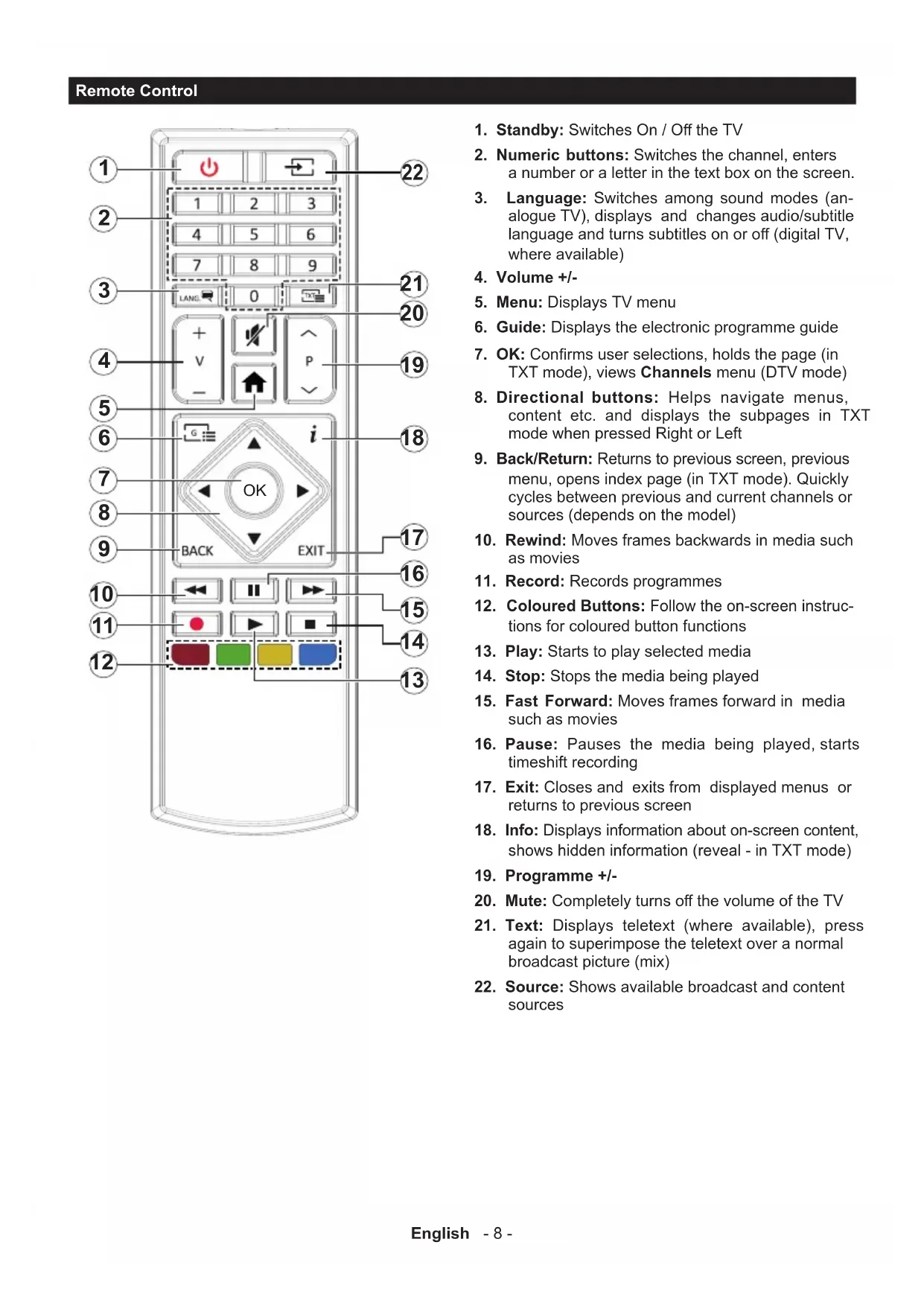
English - 8 - Remote Control
2. Numeric buttons: Switches the channel, enters
a number or a letter in the text box on the screen.
3. Language: Switches among sound modes (an-
alogue TV), displays and changes audio/subtitle language and turns subtitles on or o (digital TV, where available)
7. OK: Conrms user selections, holds the page (in
TXT mode), views Channels menu (DTV mode)
8. Directional buttons: Helps navigate menus,
content etc. and displays the subpages in TXT mode when pressed Right or Left
9. Back/Return: Returns to previous screen, previous
menu, opens index page (in TXT mode). Quickly cycles between previous and current channels or sources (depends on the model)
10. Rewind: Moves frames backwards in media such
12. Coloured Buttons: Follow the on-screen instruc-
tions for coloured button functions
13. Play: Starts to play selected media
14. Stop: Stops the media being played
16. Pause: Pauses the media being played, starts
returns to previous screen
18. Info: Displays information about on-screen content,
shows hidden information (reveal - in TXT mode)
20. Mute: Completely turns o the volume of the TV
21. Text: Displays teletext (where available), press
again to superimpose the teletext over a normal broadcast picture (mix)
22. Source: Shows available broadcast and content
sourcesEnglish - 9 - Connections Connector Type Cables Device VGA Connection (back) AUDIO IN PC/YPbPr Audio Connection (side) YPbPr/PC Audio Cable HDMI Connection (back) Scart Connection (back) YPBPR YPbPr Video Connection (back) PC to YPbPr Connection Cable SIDE AV Side AV (Audio/Video) Connection (side) Audio/Video Cable SPDIF SPDIF (Coaxial Out) Connection (back) HEADPHONE Headphone Connection (side) USB Connection (side)
Connection (side) CAM module See the illustrations on the left side. You can use YPbPr to VGA cable to enable YPbPr signal via VGA input. You cannot use VGA and YPbPr at the same time. To enable PC/YPbPr audio, you will need to use the side audio inputs with a YPbPr/PC audio cable for audio connection. If an ex- ternal device is connected via the SCART socket, the TV may auto- matically switch to EXT1 mode. When receiving DTV channels (Mpeg4 H.264, H.265) or while in Media Browser mode, output will not be available via the scart sock
et. When using the wall mounting kit (available from a third party in the market, if not supplied), we recommend that you plug all your cables into the back of the TV before mounting on the wall. Insert or remove the CI module only when the TV is SWITCHED OFF. You should refer to the module instruction manual for details of the settings. The/Each USB input of your TV supports devices up to 500mA. Connecting devices that have current value above 500mA may damage your TV. When connecting equipment using a HDMI cable to your TV, to guarantee sucient immunity against parasitic frequency radia
tion, you have to use a high speed shielded (high grade) HDMI cable with ferrites. If you want to connect a device to the TV, make sure that both the TV and the device are turned o before making any connection. After the connection is done, you can turn on the units and use them.English - 10 - Switching On/O To Switch the TV On Connect the power cord to a power source such as a wall socket (220-240V AC, 50 Hz). To switch on the TV from standby mode either:
- Press the Standby button, Programme +/- or a numeric button on the remote control.
- Press the middle of the side function switch on the TV in. To Switch the TV O Press the Standby button on the remote control or press the middle of the side function switch on the TV in and hold it down for a few seconds, the TV will switch into standby mode. To power down the TV completely, unplug the power cord from the mains socket. Note: When the TV is switched into standby mode, the standby LED can blink to indicate that features such as Standby Mode Search, Over Air Download or Timer is active. The LED can also blink when you switch on the TV from standby mode. First Time Installation When turned on for the first time, the language selection screen is displayed. Select the desired language and press OK. In the following steps of the installation guide, set your preferences using the directional buttons and OK button. On the second screen set your country preference. Depending on the country selection you may be asked to set and conrm a PIN at this point. The selected PIN cannot be 0000. You have to enter it if you are asked to enter a PIN for any menu operation later. You can activate Store Mode option in the next step. This option will congure your TV’s settings for store environment and depending on the TV model being used, the supported features of it may be displayed on the side of the screen as an info banner. This option is intended only for store use. It is recommended to select Home Mode for home use. This option will be available in Settings>System>More menu and can be turned o/on later. Make your selection and press OK to continue. On next screen you can set broadcast types to be searched, set your encrypted channel searching and time zone (depending on the country selection) preferences. Additionally you can set a broadcast type as your favourite one. Priority will be given to the selected broadcast type during the search process and the channels of it will be listed on the top of the channel list. When nished, highlight Next and press OK to continue. About Selecting Broadcast Type To turn a search option for a broadcast type highlight it and press OK. The checkbox next to the selected option will be checked. To turn the search option o clear the checkbox by pressing OK after moving the focus on the desired broadcast type option. Digital Aerial: If D. Aerial broadcast search option is turned on, the TV will search for digital terrestrial broadcasts after other initial settings are completed. Digital Cable: If D. Cable broadcast search option is turned on, the TV will search for digital cable broadcasts after other initial settings are completed. A message will be displayed before starting to search asking if you want to perform cable network search. If you select Yes and press OK you can select Network or set values such as Frequency, Network ID and Search Step on the next screen. If you select No and press OK you can set Start Frequency, Stop Frequency and Search Step on the next screen. When nished, highlight Next and press OK button to continue. Note: Searching duration will change depending on the selected Search Step. Analogue: If Analogue broadcast search option is turned on, the TV will search for analogue broadcasts after other initial settings are completed. After the initial settings are completed TV will start to search for available broadcasts of the selected broadcast types. While the search continues current scan results will be displayed at the bottom of the screen. After all the available stations are stored, Channels menu will be displayed. You can edit the channel list according to your preferences using the Edit tab options or press the Menu button to quit and watch TV. While the search continues a message may appear, asking whether you want to sort channels according to the LCN(*). Select Yes and press OK to conrm. (*) LCN is the Logical Channel Number system that organizes available broadcasts in accordance with a recognizable channel number sequence (if available). Note: Do not turn off the TV while initializing first time installation. Note that, some options may not be available depending on the country selection. Media Playback via USB Input You can connect 2.5” and 3.5” inch (HDD with external power supply) external hard disk drives or USB memory stick to your TV by using the USB inputs of the TV. IMPORTANT! Back up the les on your storage devices before connecting them to the TV. Manufacturer will not be responsible for any le damage or data loss. Certain types of USB devices (e.g. MP3 Players) or USB hard disk drives/memory sticks may not be compatible with this TV. The TV supports FAT32 and NTFS disk formatting but recording will not be available with NTFS formatted disks. While formatting USB hard drives which have more than 1TB (Tera Byte) storage space you may experience some problems in the formatting process.English - 11 - Wait a little while before each plugging and unplugging as the player may still be reading les. Failure to do so may cause physical damage to the USB player and the USB device itself. Do not pull out your drive while playing a le. You can use USB hubs with your TV’s USB inputs. External power supplied USB hubs are recommended in such a case. It is recommended to use the TV’s USB input(s) directly, if you are going to connect a USB hard disk. Note: When viewing image les the Media Browser menu can only display 1000 image les stored on the connected USB device. USB Recording Recording a Programme IMPORTANT: When using a new USB hard disk drive, it is recommended that you rst format the disk using your TV’s Format Disk option in the TV>Recordings>Settings menu. To record a programme, you should rst connect a USB disk to your TV while the TV is switched o. You should then switch on the TV to enable the recording feature. To use recording your USB drive should have 2 GB free space and be USB 2.0 compatible. If the USB drive is not compatible an error message will be displayed. To record long duration programmes such as movies, it is recommended to use USB Hard disk drives (HDD’s). Recorded programmes are saved into the connected USB disk. If desired, you can store/copy recordings onto a computer; however, these les will not be available to be played on a computer. You can play the recordings only via your TV. Lip Sync delay may occur during the timeshifting. Radio record is supported. The TV can record programmes up to ten hours. Recorded programmes are split into 4GB partitions. If the writing speed of the connected USB disk is not sucient, the recording may fail and the timeshifting feature may not be available. It is recommended to use USB hard disk drives for recording HD programmes. Do not pull out the USB/HDD during a recording. This may harm the connected USB/HDD. Multipartition support is available. A maximum of two dierent partitions are supported. The rst partition of the USB disk is used for USB Recording ready features. It also must be formatted as the primary partition to be used for the USB Recording ready features. Some stream packets may not be recorded because of signal problems, as a result sometimes videos may freeze during playback. Record, Play, Pause, Display (for playlist dialogue) keys can not be used when teletext is on. If a recording starts from timer when teletext is on, teletext is automatically turned o. Also teletext usage is disabled when there is an ongoing recording or playback. Timeshift Recording Press Pause button while watching a broadcast to activate timeshifting mode. In timeshifting mode, the programme is paused and simultaneously recorded to the connected USB disk. Press Play button again to resume the paused programme from where you stopped. Press the Stop button to stop timeshift recording and return to the live broadcast. Timeshift cannot be used while in radio mode. You can use the timeshift rewind feature after resuming normal playback or fast forward option. Instant Recording Press Record button to start recording an event instantly while watching a programme. You can press Record button on the remote control again to record the next event after selecting the next programme from within the electronic programme guide. Press Stop button to cancel instant recording. You can not switch broadcasts during the recording mode. While recording a programme or during the timeshifting, a warning message appears on the screen if your USB device speed is not sucient. Watching Recorded Programmes Select Recordings from the TV menu. Select a recorded item from the list (if previously recorded). Press the OK button to view the Options menu. Select an option then press OK button. Note: Viewing main menu and menu items will not be available during playback. Press the Stop button to stop a playback and return to the Recordings. Slow Forward If you press Pause button while watching recorded programmes, the slow forward feature will be available. You can use Fast Forward button to slow forward. Pressing Fast Forward button consecutively will change slow forwarding speed. Recording Conguration Select the Settings tab in the TV>Recordings menu to congure the recording settings and press OK. Format Disk: You can use the Format Disk option for formatting the connected USB disk. Your PIN will be required to use the Format Disk feature. Note: Default PIN could have been set to 0000 or 1234. If you have dened the PIN(is requested depending on the country selection) during the First Time Installation use the PIN that you have dened. IMPORTANT: Formatting your USB drive will erase ALL the data on it and it’s le system will be convertedEnglish - 12 - to FAT32. In most cases operation errors will be xed after a format but you will lose ALL your data. If “USB disk writing speed too slow to record” message is displayed on the screen while starting a recording, try restarting the recording. If you still get the same error, it is possible that your USB disk does not meet the speed requirements. Try connecting another USB disk. Media Browser You can play back music and movie les and display photo files stored on a USB storage device by connecting it to your TV. Connect a USB storage device to one of the USB inputs located on the side of the TV. After connecting a USB storage device to your TV Media Browser menu will be displayed on the screen. You can access the content of the connected USB device any time later from the Sources menu. Select the related USB input option from this menu and press OK. Then select the le of your choice and press OK to display or play it back. You can set your Media Browser preferences by using the Settings menu. Settings menu can be accessed via the information bar which is displayed on the bottom of the screen when pressed the Info button while playing back a video le or displaying a picture le. Press the Info button, highlight the gear wheel symbol positioned on the right side of the information bar and press OK. Picture Settings, Sound Settings, Media Browser Settings and Options menus will be available. The contents of these menus may change according to the type of the currently open media le. Only Sound Settings menu will be available while playing back audio les. Loop/Shue Mode Operation Start playback and activate All les in the list will be continuously played in original order Start playback and activate The same le will be played continuously (repeat) Start playback and activate All les in the list will be played once in random order Start playback and activate
All les in the list will be continuously played in the same random order To use the functions on the information bar highlight the symbol of the function and press OK. To change the status of a function highlight the symbol of the function and press OK as much as needed. If the symbol is marked with a red cross, that means it is deactivated. CEC This function allows to control the CEC-enabled devices, that are connected through HDMI ports by using the remote control of the TV. The CEC option in the Settings>System>More menu should be set as Enabled at rst. Press the Source button and select the HDMI input of the connected CEC device from the Sources List menu. When new CEC source device is connected, it will be listed in source menu with its own name instead of the connected HDMI ports name(such as DVD Player, Recorder 1 etc.). The TV remote is automatically able to perform the main functions after the connected HDMI source has been selected. To terminate this operation and control the TV via the remote again, press and hold the “0- Zero” button on the remote control for 3 seconds. You can disable the CEC functionality by setting the related option under the Settings>System>More menu accordingly. The TV supports ARC (Audio Return Channel). This feature is an audio link meant to replace other cables between the TV and an audio system (A/V receiver or speaker system). When ARC is active, the TV does not mute its other audio outputs automatically. You will need to decrease TV volume to zero manually if you wish to hear the ARC audio only (same as optical or co-axial digital audio outputs). If you want to change connected device’s volume level, you should select that device from the source list. In that case volume control keys are directed to connected audio device. When using the ARC connection, some incompatibilities may occur between the TV and the connected sound system due to the dierence of the used volume ranges. Note: ARC is supported only via the HDMI1 input. System Audio Control Allows an Audio Amplier/Receiver to be used with the TV. The volume can be controlled using the remote control of the TV. To activate this feature set the Speakers option in the Settings>System>More menu as Amplier. The TV speakers will be muted and the sound of the watched source will be provided from the connected sound system. Note: The audio device should support System Audio Control feature and CEC option should be set as Enabled.English - 13 - Settings Menu Contents Picture Menu Contents Mode You can change the picture mode to suit your preference or requirements. Picture mode can be set to one of these options: Cinema, Game(optional), Sports, Dynamic and Natural. Contrast Adjusts the light and dark values on the screen. Brightness Adjusts the brightness values on the screen. Sharpness Sets the sharpness value for the objects displayed on the screen. Colour Sets the colour value, adjusting the colours. Energy Saving For setting the Energy Saving to Custom, Minimum, Medium, Maximum, Auto, Screen O or O. Note: Available options may dier depending on the selected Mode. Backlight This setting controls the backlight level. The backlight function will be inactive if the Energy Saving is set to an option other than Custom. Advanced Settings Dynamic Contrast You can change the dynamic contrast ratio to desired value. Noise Reduction If the signal is weak and the picture is noisy, use the Noise Reduction setting to reduce the amount of noise. Colour Temp Sets the desired colour temperature value. Cool, Normal, Warm and Custom options are available. White Point If the Colour Temp option is set as Custom, this setting will be available. Increase the ‘warmth’ or ‘coolness’ of the picture by pressing Left or Right buttons. Picture Zoom Sets the desired image size format. Picture Shift This option may be available depending on the Picture Zoom setting. Highlight and press OK, then use directional buttons to shift the picture upwards or downwards. Film Mode Films are recorded at a dierent number of frames per second to normal television programmes. Turn this feature on when you are watching lms to see the fast motion scenes clearly. Skin Tone Skin tone can be changed between -5 and 5. Colour Shift Adjust the desired colour tone. HDMI Full Range While watching from a HDMI source, this feature will be visible. You can use this feature to enhance blackness in the picture. PC Position Appears only when the input source is set to VGA/PC. Autoposition If the image is not centered in VGA mode use this option to automatically adjust the position of the image. Press OK to start the auto adjustment. H Position This item shifts the image horizontally to the right hand side or left hand side of the screen. V Position This item shifts the image vertically towards the top or bottom of the screen. Dot Clock Dot Clock adjustments correct the interference that appear as vertical banding in dot intensive presentations like spreadsheets or paragraphs or text in smaller fonts. Phase Depending on the input source(computer etc.) you may see a hazy or noisy picture on the screen. You can use phase to get a clearer picture by trial and error. Reset Resets the picture settings to factory default settings (except Game mode). While in VGA (PC) mode, some items in Picture menu will be unavailable. Instead, VGA mode settings will be added to the Picture menu while in PC mode.English - 14 - Sound Menu Contents Volume Adjusts the volume level. Equalizer Selects the equalizer mode. Custom settings can be made only when in User mode. Balance Adjusts whether the sound comes from the left or right speaker. Headphone Sets headphone volume. Please ensure before using headphones that the headphone volume is set to a low level, to prevent damage to your hearing. Sound Mode You can select a sound mode (If the viewed channel supports). AVL (Automatic Volume Limiting) Sets the sound to obtain xed output level between programmes. Headphone/Lineout When you connect an external amplier to your TV using the headphone jack, you can select this option as Lineout. If you have connected headphones to the TV, set this option as Headphone. Please ensure before using headphones that this menu item is set to Headphone. If it is set to Lineout, the output from the headphone socket will be set to maximum which could damage your hearing. Dynamic Bass Enables or disables the Dynamic Bass. Surround sound Surround sound mode can be changed as On or O. Digital Out Sets digital out audio type. Installation Menu Contents Automatic channel scan (Retune) Displays automatic tuning options. D. Aerial: Searches and stores aerial DVB stations. D. Cable: Searches and stores cable DVB stations. Analogue: Searches and stores analogue stations. Manual channel scan This feature can be used for direct broadcast entry. Network channel scan Searches for the linked channels in the broadcast system. D. Aerial: Searches for aerial network channels. D. Cable: Searches for cable network channels. Analogue ne tune You can use this setting for ne tuning analogue channels. This feature is not available if no analogue channels are stored and if currently watched channel is not an analogue channel. Installation Settings (optional) Displays installation settings menu. Standby Mode Search (*): Your TV will search for new or missing channels while in standby. Any new found broadcasts will be shown. Dynamic Channel Update(*): If this option is set as Enabled, the changes on the broadcasts such as frequency, channel name, subtitle language etc., will be applied automatically while watching. (*) Availability depends on model. Clear Service List Use this setting to clear channels stored. This setting is visible only when the Country option is set to Denmark, Sweden, Norway or Finland. Select Active Network This setting allows you to select only the broadcasts within the selected network to be listed in the channel list. This feature is available only for the country option of Norway. Signal Information You can use this menu item to monitor signal related information such as signal level/ quality, network name etc for available frequencies. First time installation Deletes all stored channels and settings, resets TV to factory settings.English - 15 - System Menu Contents Conditional Access Controls conditional access modules when available. Language You may set a dierent language depending on the broadcaster and the country. Parental Enter correct password to change parental settings. You can easily adjust Menu Lock, Maturity Lock, Child Lock or Guidance in this menu. You can also set a new PIN or change the Default CICAM PIN using the related options. Note: Some menu options may not be available depending on the country selection in the First Time Installation. Default PIN could have been set to 0000 or 1234. If you have dened the PIN(is requested depending on the country selection) during the First Time Installation use the PIN that you have dened. Date/Time Sets date and time. Sources Edit the names, enable or disable selected source options. Accessibility Displays accessibility options of the TV. Hard of Hearing Enables any special feature sent from the broadcaster. Audio Description A narration track will be played for the blind or visually impaired audience. Press OK to see all available Audio Description menu options. This feature is available only if the broadcaster supports it. Note: Audio description sound feature is not available in recording or time shifting mode. More Displays other setting options of the TV. Menu Timeout Changes timeout duration for menu screens. Standby Mode LED If set as O the standby mode LED will not light up when the TV is in standby mode. Software Upgrade Ensures that your TV has the latest rmware. Press OK to see the menu options. Application Version Displays current software version. Subtitle Mode This option is used to select which subtitle mode will be on the screen (DVB subtitle / Teletext subtitle) if both is available. Default value is DVB subtitle. This feature is available only for the country option of Norway. Auto TV OFF Sets the desired time for the TV to automatically go into standby mode when not being operated. This option can be set from 1 to 8 hours in steps of 1 hour. You can also disable this option by setting as O. Store Mode Select this mode for store display purposes. Whilst Store Mode is enabled, some items in the TV menu may not be available. Power Up Mode This setting congures the power up mode preference. Last State and Standby Mode options are available. CEC With this setting you can enable and disable CEC functionality completely. Press Left or Right button to enable or disable the feature. CEC Auto Power
This function allows the connected HDMI-CEC compatible device to turn on the TV and switch to its input source automatically. Press Left or Right button to enable or disable the feature. Speakers To hear the TV audio from the connected compatible audio device set as Amplier. You can use the remote control of the TV to control the volume of the audio device. OSS Displays Open Source Software license information. Note: Some options may not be available depending on the model of your TV, its features and the selected country in the First Time Installation.English - 16 - General TV Operation Using the Channel List The TV sorts all stored stations in the channel list. You can edit this channel list, set favourites or set active stations to be listed by using the Channels menu options. Press the OK button to open the channel list. You can lter the listed channels or make advanced changes in the current list using the Filter and Edit tab options. Highlight the tab you want and press OK to see available options. Managing the Favourite Lists You can create four dierent lists of your favourite channels. Enter the TV>Channels menu or press the OK button in order to open the Channels menu. Highlight the Edit tab and press OK to see the editing options and select the Tag/Untag channel option. Select the desired channel on the list by pressing the OK button while the channel is highlighted. You can make multiple choices. You can also use the Tag/ Untag all option to select all channels on the list. Then press Back/Return button to return to the Edit menu options. Select Add/Remove Favourites option and press the OK button again. Favourite channel list options will be displayed. Set the desired list option to On. The selected channel/s will be added to the list. In order to remove a channel or channels from a favourite list follow the same steps and set the desired list option to O. You can use the ltering function in the Channels menu to lter the channels in the channel list permanently according to your preferences. For instance, using the options of the Filter tab, you can set one of your four favourite lists to be displayed every time the channel list is opened. Conguring Parental Settings The Parental menu options can be used to prohibit users from viewing of certain programmes, channels and using of menus. These settings are located in the Settings> System>Parental menu. To display parental lock menu options, a PIN should be entered. After coding the correct PIN, Parental menu will be displayed. Menu Lock: This setting enables or disables access to all menus or installation menus of the TV. Maturity Lock: If this option is set, TV gets the maturity information from the broadcast and if this maturity level is disabled, prohibits access to the broadcast. Note: If the country option in the First Time Installation is set as France, Italy or Austria, Maturity Lock’s value will be set to 18 as default. Child Lock: If this option is set to On, the TV can only be controlled by the remote control. In this case the control buttons on the TV will not work. Set PIN: Denes a new PIN number. Default CICAM PIN: This option will appear as greyed out if no CI module is inserted into the CI slot of the TV. You can change the default PIN of the CI CAM using this option. Note: Default PIN could have been set to 0000 or 1234. If you have dened the PIN(is requested depending on the country selection) during the First Time Installation use the PIN that you have dened. Some options may not be available depending on the model and/or on the country selection in the First Time Installation. Electronic Programme Guide By means of electronic programme guide function of your TV you can browse the event schedule of the currently installed channels on your channel list. It depends on the related broadcast whether this feature is supported or not. To access the programme guide, press the Guide button on your remote. You can also use the Guide option under TV menu. There are 2 different types of schedule layouts available, Timeline Schedule and Now/Next. To switch between these layouts highlight the tab with the name of the alternative layout on the upper side of the screen and press OK. Use the directional buttons to navigate through the programme guide. Use the Back/Return button to use the tab options on the upper side of the screen. Timeline Schedule In this layout option, all events of the listed channels will be displayed by timeline. You can use the directional buttons to scroll through the list of the events. Highlight an event and press OK to display event options menu. Press Back/Return button to use available tab options. Highlight Filter tab and press OK to see the ltering options. To change the layout highlight Now/Next and press OK. You can use the Previous Day and Next Day options to display the events of the previous and next day. Highlight Extras tab and press OK to access below options. Highlight Genre: Displays Highlight Genre menu. Select a genre and press OK. The events in the programme guide matching the selected genre will be highlighted. Guide Search: Displays searching options. Using these options, you can search the programme guide database in accordance with the selected criteria. Matching results will be listed. Now: Displays current event of the highlighted channel. Zoom: Highlight and press OK to see events in a wider time interval.English - 17 - Now/Next Schedule In this layout option, only the current and next events of the listed channels will be displayed. You can use the directional buttons to scroll through the list of the events. Press Back/Return button to use available tab options. Highlight Filter tab and press OK to see the ltering options. To change the layout highlight Timeline Schedule and press OK. Event Options Use the directional buttons to highlight an event and press OK button to display Options menu. The following options are available. Select Channel: Using this option, you can switch to the selected channel in order to watch it. The programme guide will be closed. More Info: Display detailed information on the selected event. Use up and down directional buttons to scroll through the text. Set Timer on Event / Delete Timer on Event: Select Set Timer on Event option and press OK. You can set timers for future events. To cancel an already set timer, highlight that event and press the OK button. Then select Delete Timer on Event option. The timer will be cancelled. Record / Delete Rec. Timer: Select the Record option and press the OK button. If the event is going to be broadcasted at a future time, it will be added to Timers list to be recorded. If the selected event is being broadcasted at the moment, recording will start immediately. To cancel an already set record timer, highlight that event and press the OK button and select the option Delete Rec. Timer. The record timer will be cancelled. IMPORTANT: Connect a USB disk to your TV while the TV is switched o. You should then switch on the TV to enable the recording feature. Notes: You cannot switch to any other channel while there is an active recording or timer on the current channel. It is not possible to set timer or record timer for two or more individual events at the same time interval. Teletext Services Press the Text button to enter. Press again to activate mix mode, which allows you to see the teletext page and the TV broadcast at the same time. Press once more to exit. If available, sections in the teletext pages will become colour-coded and can be selected by pressing the coloured buttons. Follow the instructions displayed on the screen. Digital Teletext Press the Text button to view digital teletext information. Operate it with the coloured buttons, cursor buttons and the OK button. The operation method may dier depending on the contents of the digital teletext. Follow the instructions displayed on the digital teletext screen. When the Text button is pressed again, the TV returns to television broadcast. Software Upgrade Your TV is capable of nding and updating the rmware automatically via the broadcast signal. Software upgrade search via user interface On the main menu select Settings>System and then More. Navigate to Software upgrade and press the OK button. Then select Scan for upgrade and press OK button to check for a new software upgrade. If a new upgrade is found, it starts to download the upgrade. After the download is completed, a warning will be displayed, press OK button to complete software upgrade process and restart TV. 3 AM search and upgrade mode Your TV will search for new upgrades at 3:00 o’clock if Automatic scanning option is set to Enabled and if the TV is connected to an aerial signal. If a new software is found and downloaded successfully, it will be installed at the next power on. Note: Do not unplug the power cord while led is blinking during the reboot process. If the TV fails to come on after the upgrade, unplug, wait for two minutes then plug it back in. All updates are automatically controlled. If a manual search is carried out and no software is found then this is the current version. Troubleshooting & Tips TV will not turn on Make sure the power cord is plugged in securely to a wall outlet. Press the Power button on the TV. Poor picture
- Check if you have correctly tuned the TV.
- Low signal level can cause picture distortion. Please check antenna connections.
- Check if you have entered the correct channel frequency if you have performed manual tuning. No picture
- TV is not receiving any signal. Make sure the correct source has been selected.
- Is the antenna connected properly?
- Is the antenna cable damaged?
- Are suitable plugs used to connect the antenna?
- If you are in doubt, consult your dealer. No sound
- Check if the TV sound is muted. Press the Mute button or increase the volume to check.
- Sound may be coming from only one speaker. Check the balance settings from Sound menu.English - 18 - Remote control - no operation
- The batteries may be exhausted. Replace the batteries.
- The batteries maybe inserted incorrectly. Refer to the section “Inserting the Batteries into the Remote”. No signal on an input source
- It is possible that no device is connected.
- Check the AV cables and connections from your device.
- Check the device is switched on. The Image is not centered in VGA source To have your TV automatically center the image, enter the PC Position menu in Picture menu, highlight Autoposition and press OK. Wait for it to nish. In order to set the position of the image manually you can use H Position and V Position options. Select the desired option and use Left and Right directional buttons on the remote to set. Recording unavailable To record a programme, you should rst correctly connect a USB storage device to your TV, while the TV is switched o. You should then switch on the TV to enable recording feature. If you cannot record, check the storage device is correctly formatted and there is sucient space. USB is too slow If a “USB disk writing speed too slow to record” message is displayed on the screen while starting a recording, try restarting the recording. If you still get the same error, it is possible that your USB storage device does not meet the speed requirements. Try using a dierent USB storage device. PC Input Typical Display Modes The following table is an illustration of some of the typical video display modes. Your TV may not support all resolutions. Index Resolution Frequency 1 640x480 60 Hz 2 800x600 56 Hz 3 800x600 60 Hz 4 1024x768 60 Hz 5 1024x768 66 Hz 6 1280x768 60 Hz 7 1280x960 60 Hz 8 1280x1024 60 Hz 9 1360x768 60 Hz 10 1400x1050 60 Hz 11 1600x1200 60 Hz 12 1920x1080 60 Hz AV and HDMI Signal Compatibility Source Supported Signals Available EXT (SCART) PAL 50/60 O NTSC 60 O RGB 50 O RGB 60 O Side AV PAL 50/60 O NTSC 60 O PC/YPbPr 480I, 480P 60Hz O 576I, 576P 50Hz O 720P 50Hz,60Hz O 1080I 50Hz,60Hz O 1080P 50Hz,60Hz O HDMI 480I 60Hz O 480P 60Hz O 576I, 576P 50Hz O 720P 50Hz,60Hz O 1080I 50Hz,60Hz O 1080P 24Hz, 25Hz 30Hz, 50Hz, 60Hz
A VESA WALL MOUNT MEASUREMENTS
Hole Paern Sizes (mm) W H