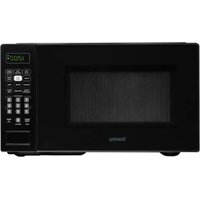
DMW1158W - Microwave Oven DANBY - Free user manual and instructions
Find the device manual for free DMW1158W DANBY in PDF.


| Product Type | Microwave Oven |
| Brand | Danby |
| Model | DMW1158W |
| Capacity | 0.9 cu.ft (25.5 L) |
| Power | 900 W |
| Power Supply | 120 V, 60 Hz, 15 A |
| Control Type | Touch electronic with LED display |
| Turntable | Yes, removable glass |
| Door Lock System | Yes, with child safety |
| Power Levels | 10 (from PL10 to PL1, from 100% to 10%) |
| Kitchen Timer | Yes, adjustable up to 99 min 99 sec |
| Clock | Yes, 12-hour display |
| Child Lock | Yes, activated by STOP/CANCEL key (3 s) |
| Auto Cook Programs | Popcorn, potato, pizza, beverage, soup, dinner, fresh vegetables, frozen vegetables |
| Defrost | By weight (4 to 100 oz) and by time |
| Multi-stage Cooking | Up to 2 stages |
| Memory Function | Yes, to save time and power |
| Maintenance | Interior cleaning with damp cloth and baking soda; tray dishwasher safe |
| Safety | Grounding required; avoid metal, superheated liquids, and cooking without food |
| Customer Service | 1-800-263-2629 (Canada/US) |
Frequently Asked Questions - DMW1158W DANBY
User questions about DMW1158W DANBY
0 question about this device. Answer the ones you know or ask your own.
Ask a new question about this device
Download the instructions for your Microwave Oven in PDF format for free! Find your manual DMW1158W - DANBY and take your electronic device back in hand. On this page are published all the documents necessary for the use of your device. DMW1158W by DANBY.
USER MANUAL DMW1158W DANBY
Owner's Use and Care Guide
natural_image
Line drawing of a Danby Designer microwave oven with control panel and digital display (no text or symbols on the device itself)CAUTION: Read and follow all safety rules and operating instructions before first use of this product.
- Safety Instructions
- Menu Cooking Guide
- Operation
• Care and Maintenance - Troubleshooting
Four à micro-ondes
IMPORTANT SAFETY INFORMATION
Precautions to Avoid Possible Exposure to Excessive Microwave Energy 3
Safety Precautions 4
Special Notes About Microwaving 5
OPERATING INSTRUCTIONS
Features of Your Microwave .....10
Controls of Your Microwave ....11
Menu Cooking Guide ....12
Start Cooking 14
Changing the Power Levels .....15
Defrost Guide 16
Menu Cooking 17
Other Features 20
HELPFUL INFORMATION
Microwave Terms 22
Care and Maintenance 23
TROUBLESHOOTING
Before You Call For Service .....24
WELCOME
Welcome to the Danby family. We're proud of our quality products and we believe in dependable service. You'll see it in this easy-to-use manual and you'll hear it in the friendly voices of our consumer service department. Tel: 1-800-26- Danby (1-800-263-2629) Best of all, you'll experience these values each time you use your microwave. That's important, because your new microwave will be part of your family for a long time.
Write down the model and serial numbers here. They are on a label located on the back of the oven.
Model Number ____
Serial Number ____
Date Purchased ____
Staple your receipt to this manual. You will need it to obtain service under warranty.
NEED HELP?
Before you call for service, there are a few things you can do to help us serve you better...
Read this manual: It contains instructions to help you use and maintain your microwave properly.
If you received a damaged oven: Immediately contact the dealer (or builder) that sold you the oven.
Save time and money : Check the section titled "If Something Goes wrong" before calling. This section helps you solve common problems that might occur.
If you do need service, you can relax knowing help is only a phone call away. Tel: 1-800-26- Danby
(1-800-263-2629)
IMPORTANT SAFETY INFORMATION
READ ALL SAFETY INFORMATION BEFORE USING
PRECAUTIONS TO AVOID POSSIBLE EXPOSURE TO EXCESSIVE MICROWAVE ENERGY
For your safety the information in this manual must be followed to minimize the risk of fire or explosion or to prevent property damage, personal injury or loss of life.
Do Not Attempt to operate this oven with the door open since open-door operation can result in harmful exposure to microwave energy. It is important not to defeat or tamper with the safety interlocks.
Do Not Place any object between the oven front face and the door or allow soil or cleaner residue to accumulate on sealing surfaces.
Do Not Operate the oven if it is damaged. It is particularly important that the oven door close properly and that there is no damage to the:
1 door (bent),
2 hinges and latches (broken or loosened),
3 door seals and sealing surfaces.
The Oven Should Not be adjusted or repaired by anyone except properly qualified service personnel.
FEDERAL COMMUNICATIONS COMMISSION RADIO FREQUENCY INTERFERENCE STATEMENT (U.S.A. ONLY)
This equipment generates and uses ISM frequencies and if not installed and used properly, that is in strict accordance with the manufacturer's instructions, may cause interference to radio and television reception. It has been type-tested and found to comply with limits for ISM Equipment pursuant to Part 18 of FCC Rules, which are designed to provide reasonable protection against such interference in a residential installation.
However, there is no guarantee that interference will not occur in particular installations. If this equipment does cause interference to radio or television reception, which can be determined by turning the equipment off and on, the user is encouraged to try to correct the interference by one or more of the following:
• Reorient the receiving antenna of radio or television.
- Relocate the microwave oven with respect to the receiver.
- Move the microwave oven away from the receiver.
- Plug the microwave into a different outlet so that microwave and receiver are on different branch circuits.
The Manufacturer is not responsible for any radio or TV interference caused by UNAUTHORIZED MODIFICATION to this microwave oven. It is the responsibility of the user to correct such interference.
SAVE THESE INSTRUCTIONS
IMPORTANT SAFETY INFORMATION
READ ALL SAFETY INFORMATION BEFORE USING
WARNING
To reduce the risk of fire, burns, electric shock, injury to persons or exposure of excessive microwave energy when using your appliance, follow basic precautions, including the following sections.
SAFETY PRECAUTIONS
- Read and follow the specific "Precautions to Avoid Possible Exposure to Excessive Microwave Energy" on page 3.
- This appliance must be grounded. Connect only to a properly grounded outlet. See "Grounding Instructions" section on page 9.
- Do not operate this appliance if it has a damaged power cord or plug, if it is not working properly, or if it has been damaged or dropped.
- Do not cover or block any openings on the appliance.
- Use this appliance only for its intended use as described in this manual. Do not use corrosive chemicals or vapors in this appliance.
- This microwave oven is specifically designed to heat, dry or cook food, and is not intended for laboratory or industrial use.
- Some products such as whole eggs and sealed containers – for example, closed glass jars- may explode and should not be heated in this oven.
- Do not store this appliance outdoors.
- Do not use this product near water-for example, in a wet basement, near a swimming pool or near a sink.
-
Keep power cord away from heated surfaces.
-
Do not immerse power cord or plug in water.
• See door surface cleaning instructions in the Care and Maintenance section(s) of this manual. - This appliance should be serviced only by qualified service personnel. Contact nearest authorized service facility for examination, repair or adjustment.
- As with any appliance, close supervision is necessary when used by children. To reduce the risk of fire in the oven cavity:
- Do not overcook food.
- Carefully attend appliance if paper, plastic or other combustible materials are placed inside the oven while cooking.
- Remove wire twist-ties and metal handles from paper or plastic containers before placing them in the oven.
- Do not use the oven for storage purposes. Do not leave paper products, cooking utensils or food in the oven when not in use.
- Do not use the microwave to dry newspapers.
- If materials inside oven should ignite, keep the oven door closed, turn the oven off and disconnect the power at the fuse or circuit breaker panel. If the door is opened, the fire may spread.
IMPORTANT SAFETY INFORMATION
SPECIAL NOTES ABOUT MICROWAVING
ARCING
If you see arcing, press the "STOP/Clear" button and correct the problem.
Arcing is the microwave term for sparks in the oven. Arcing is caused by:
• Metal or foil touching the side of the oven.
- Foil not molded to food (upturned edges act like antennas).
• Metal, such as twist-ties, poultry pins, or gold-rimmed dishes, in the microwave.
• Recycled paper towels containing small metal pieces being used in the microwave.
FOODS
- Only cook popcorn in your microwave oven using a special microwave popcorn accessory dish, unless you use popcorn labeled for use in microwave ovens.
- Some products- such as whole eggs (with shell), sealed containers, and closed jars - will explode and should not be heated in this microwave oven. Heating these products in the microwave oven could result in injury.
- Do not boil eggs in a microwave oven. Pressure will build up inside egg yolk and will cause it to burst, possibly resulting in injury.
- Operating the microwave with no food inside for more than a minute or two may cause damage to the oven and could start a fire. It increases the heat around the magnetron and can shorten the life of the oven.
- Foods with unbroken outer "skin" such as potatoes, hot dogs, sausages, tomatoes, apples, chicken livers and other giblets, and egg yolks should be pierced to allow steam to escape before cooking.
IMPORTANT SAFETY INFORMATION
SAFETY FACT: SUPERHEATED WATER
Microwaved water and other liquids do not always bubble when they reach the boiling point. They can actually get superheated and not bubble at all. Superheated liquid can bubble up when it is moved or when something like a spoon or tea bag is put into it. To prevent this from happening and causing injury, do not heat any liquid for more than 2 minutes per cup. After heating, let the cup stand in the microwave for 30 seconds before moving it or putting anything into it.
- Avoid heating baby food in glass jars, even with the lid off. Make sure all infant food is thoroughly cooked. Stir food to distribute the heat evenly. Be careful to prevent scalding when warming formula. The container may feel cooler than the milk really is. Always test the milk before feeding the baby.
- Spontaneous boiling-Under certain circumstances, liquids may start to boil during or shortly after removal from the microwave oven. To prevent burns from splashing liquid, we recommend the following: before removing the container from the oven, allow the container to stand in the oven for 30 to 40 seconds after the oven has shut off. Do not boil liquids in narrow-necked containers such as soft drink bottles, wine flasks and especially narrow-necked coffee cups. Even if the container is opened, excessive steam can build up and cause it to burst or overflow.
- Don't defrost frozen beverages in narrow-necked bottles (especially carbonated beverages). Even if the container is opened, pressure can build up. This can cause the container to burst, possibly resulting in injury.
- Hot foods and steam can cause burns. Be careful when opening any containers of hot food, including popcorn bags, cooking pouches and boxes. To prevent possible injury, direct steam away from hands and face.
- Do not overcook potatoes. They could dehydrate and catch fire, causing damage to your oven.
- Cook meat and poultry thoroughly- meat to at least an INTERNAL temperature of 160°F (71.1°C), and poultry to at least an INTERNAL temperature of 180°F (82.2°C). Cooking to these temperatures usually protects against food borne illness.
IMPORTANT SAFETY INFORMATION
SPECIAL NOTES ABOUT MICROWAVING
MICROWAVE-SAFE COOKWARE
Make sure all cookware used in your microwave oven is suitable for microwaving. Most glass casserole, cooking dishes, measuring cups, custard cups, pottery or china dinnerware which do not have metallic trim or glaze with a metallic sheen can be used. Some cookware will be labeled "suitable for microwaving".
- If you use a meat thermometer while cooking, make sure it is safe for use in microwave ovens.
- Do not use recycled paper products. Recycled paper towels, napkins, and waxed paper can contain metal flecks which may cause arcing or ignite. Paper products containing nylon or nylon filament should be avoided, as they may also ignite.
- Not all plastic wrap is suitable for use in microwave ovens. Check the package for proper use.
- Some styrofoam trays (like those that meat is packaged on) have a thin strip of metal embedded in the bottom. When microwaved, the metal can burn the floor of the oven, or ignite a paper towel.
- Cookware may become hot because of heat transferred from the heated food. Pot holders may be needed to handle the cookware.
- "Boilable" cooking pouches and tightly closed plastic bags should be slit, pierced, or vented as directed by package. If they are not, plastic could burst during or immediately after cooking, possibly resulting in injury. Also, plastic storage containers should be at least partially uncovered because they form a tight seal. When cooking with containers tightly covered with plastic wrap, remove covering carefully and direct steam away from hands and face.
- Paper towels, waxed paper, and plastic wrap can be used to cover dishes in order to retain moisture and prevent splattering. Be sure to vent plastic wrap so steam can escape.
How to test for a microwave-safe dish:
-
Place in the oven both the dish you are testing and a glass measuring cup filled with 1 cup of water.
-
Set the measuring cup either in or next to the dish.
-
Microwave 1 minute on high power.
If the dish heats, it should not be used for microwaving. If the dish remains cool and only the water in the cup heats, then the dish is microwave-safe.
- Use only foil as directed in this manual. TV dinners may be microwaved in foil trays less than 3/4" high; remove the top foil cover and return the tray to the box. When using foil in the microwave, keep the foil at least 1 inch away from the sides of the oven.
- Plastic cookware designed for microwave cooking is very useful, but should be used carefully. Even microwave-safe plastic may not be as tolerant of overcooking conditions as are glass and ceramic materials and may soften or char if subjected to short periods of over-cooking. In longer exposure to over-cooking, the food and cookware could ignite. Follow these guidelines:
-
Use Microwave-safe plastics only and use them in strict compliance with the cookware manufacturer's recommendations.
-
Do not microwave empty containers
-
Do not permit children to use plastic cookware without complete supervision.
GROUNDING INSTRUCTIONS
WARNING: Improper use of the grounding plug can result in a risk of electric shock.
This appliance must be grounded. In the event of an electrical short circuit, grounding reduces the risk of electric shock by providing an escape wire for the electric current.
This appliance is equipped with a power cord having a grounding wire with a grounding plug. The plug must be plugged into an outlet that is properly installed and grounded.
Consult a qualified electrician or service technician if the grounding instructions are not completely understood, or if doubt exists as to whether the appliance is properly grounded.
If the outlet is a standard 2-prong wall outlet, it is your personal responsibility and obligation to have it replaced with a properly grounded 3-prong wall outlet.
DO NOT under any circumstances cut or remove the third (ground) prong from the power cord.
DO NOT use an adapter plug with this appliance.
DO NOT use an extension cord with this appliance. If the power cord is too short, have a qualified electrician or service technician install an outlet near the appliance.
For best operation, plug this appliance into its own electrical outlet to prevent flickering of lights, blowing of fuse, or tripping of circuit breaker.
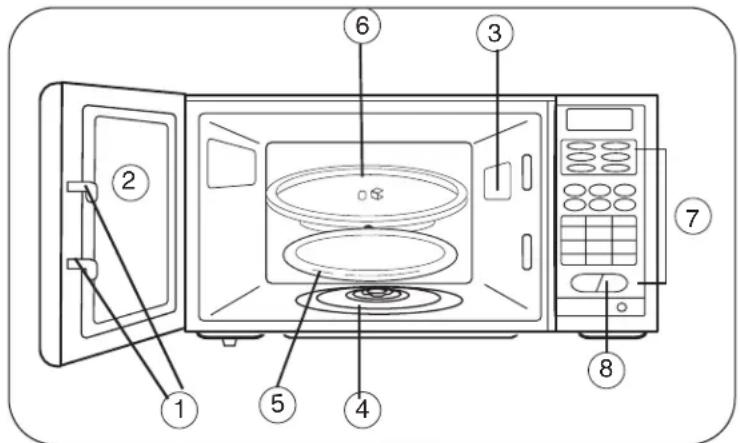
OPERATING INSTRUCTIONS
-
Door Safety Lock System
-
Oven Window. Screen allows cooking to be viewed while keeping microwave energy confined in oven.
-
Turntable Shaft
-
Roller Ring
-
Removable Glass Turntable. Turntable and support must be in place when using the oven. The turntable may be removed for cleaning.
-
Control Panel (see page 11)
-
Electronic Display
OPERATING INSTRUCTIONS
CONTROLS
flowchart
graph TD
    A["POP CORN POTATO"] --> B["PIZZA"]
    C["BEVERAGE"] --> D["SOLP"]
    E["FRESH VEGETABLE"] --> F["FLOWER"]
    G["DINNER PLATE"] --> H["FROZEN VEGETABLE"]
    I["EXPRESSION COOK"] --> J["1"]
    I --> K["2"]
    I --> L["3"]
    M["STOCK CREAM"] --> N["0"]
    O["COVEY PROCESSED"] --> P["9"]
    Q["COVEY PROCESSED"] --> R["10"]
    S["COVEY PROCESSED"] --> T["10"]
    U["COVEY PROCESSED"] --> V["10"]
    W["COVEY PROCESSED"] --> X["10"]
    Y["COVEY PROCESSED"] --> Z["10"]
    AA["COVEY PROCESSED"] --> AB["10"]
    AC["COVEY PROCESSED"] --> AD["10"]
    AE["COVEY PROCESSED"] --> AF["10"]
    AG["COVEY PROCESSED"] --> AH["10"]
    AI["COVEY PROCESSED"] --> AJ["10"]
    AK["COVEY PROCESSED"] --> AL["10"]
    AM["COVEY PROCESSED"] --> AN["10"]
    AO["COVEY PROCESSED"] --> AP["10"]
    AQ["COVEY PROCESSED"] --> AR["10"]
    AS["COVEY PROCESSED"] --> AT["10"]
    AU["COVEY PROCESSED"] --> AV["10"]
    AW["COVEY PROCESSED"] --> AX["10"]
    AY["COVEY PROCESSED"] --> AZ["10"]
    BA["COVEY PROCESSED"] --> BB["10"]
    BC["COVEY PROCESSED"] --> BD["10"]
    BE["COVEY PROCESSED"] --> BF["10"]
    BG["COVEY PROCESSED"] --> BH["10"]
    BI["COVEY PROCESSED"] --> BJ["10"]
    BK["COVEY PROCESSED"] --> BL["10"]
    BM["COVEY PROCESSED"] --> BN["10"]
    BO["COVEY PROCESSED"] --> BP["10"]
    BQ["COVEY PROCESSED"] --> BR["10"]
    BS["COVEY PROCESSED"] --> BT["10"]
    BU["COVEY PROCESSED"] --> BV["10"]
    BW["COVEY PROCESSED"] --> BX["10"]
    BY["COVEY PROCESSED"] --> BZ["10"]
    CA["COVEY PROCESSED"] --> CB["10"]
    CC["COVEY PROCESSED"] --> CD["10"]
    CE["COVEY PROCESSED"] --> CF["10"]
    CG["COVEY PROCESSED"] --> CH["10"]
    CI["COVEY PROCESSED"] --> CJ["10"]
    CK["COVEY PROCESSED"] --> CL["10"]
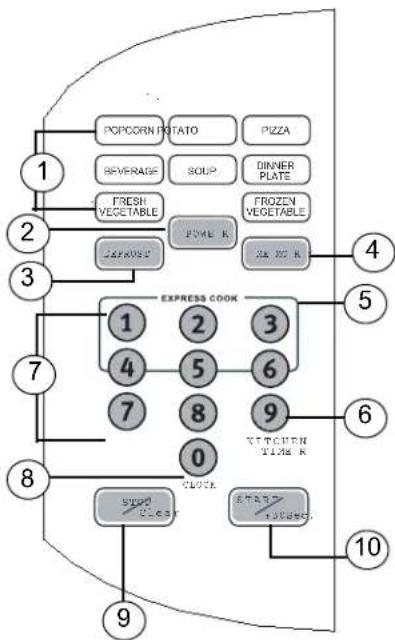
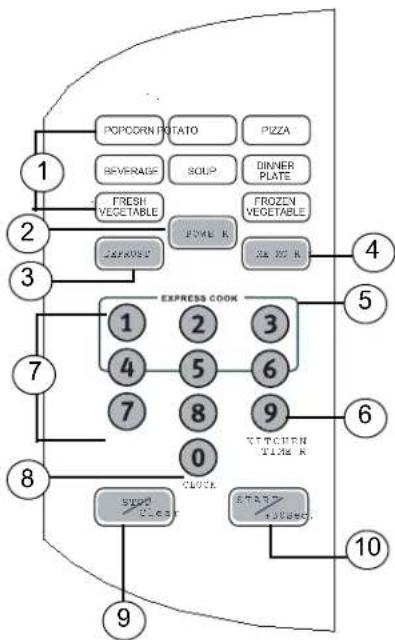
- Menu Cooking: Potato, Beverage, Soup, Popcorn, Dinner Plate, Pizza, Fresh Vegetables, Frozen Vegetables (See "Menu Cooking" on pg. 10)
- Allows you to cook/reheat food automatically without entering a time or selecting a power level. Some MENU COOKING programs give the option of specifying between two portion sizes.
- POWER: Used to set the power level.
- DEFROST (by Weight or Time): Touch to defrost food by weight or by time. The oven automatically sets the defrosting time (in By Weight setting) and power level.
- MEMORY: Set pre-programmed cooking times and power levels.
- EXPRESS COOKING
- KITCHEN TIMER
- Number Pad: Set times and weights.
- Clock: Sets/Displays the current time.
- STOP/Clear: Clears/stops previous program or setting.
- START/+30sec.: Starts, resumes or adds +30 seconds to programs.
MENU COOKING GUIDE
| Touch Program Information Start | ||
| POPCORNOnce 1.75 oz/ 50 grams- 2 min. 40 sec.Twice 3.0 oz/ 85 grams- 3 min. 15 sec. 3 Times 3.5 oz/ 100 grams- 3 min. 25 sec. | Touch START/+30 Sec | |
| POTATOOnce 1 Potato- 7 min. 30 sec.Twice 2 Potatoes- 11 min. 00 sec. Touch START/+30 Sec3 Times 3 Potatoes- 15 min. 00 sec.*Approx. weight of 1 potato= 8.3 oz (230g) | ||
| PIZZAOnce 1 Slice- 40 sec.Twice 2 Slices- 1 min. 20 sec. Touch START/+30 Sec3 Times 3 Slices- 2 min.*Approx. weight of 1 slice= 3 oz (85g) | ||
| BEVERAGEOnce 1 Beverage- 1 min. 50 sec.Twice 2 Beverages- 3 min. 10 sec. Touch START/+30 Sec3 Times 3 Beverages- 4 min. 20 sec.*Approx. vol. of 1 beverage= 8.5 oz (250mL) | ||
| SOUPOnce 4.0 oz. (118 mL) - 1 min. 30 sec.Twice 8.0 oz. (236mL) - 2 min. 50 sec. 3 Times 12.0 oz. (356mL) - 4 min. 10 sec.4 Times 16.0 oz. (472mL) - 5 min. 30 sec. | Touch START/+30 Sec | |
| DINNER PLATEOnce 9.0 oz./ 255 grams- 3 min.Twice 12.0 oz/ 340 grams- 4 min. Touch START/+30 Sec3 Times 18.0 oz/ 510 grams- 6 min. 20 sec. | ||
| FRESHVEGETABLESOnce 4.0 oz./ 113.4 grams- 3 min.Twice 8.0 oz./ 227 grams- 4 min. 10 sec. 3 Times 16.0 oz./454 grams- 6 min. 40 sec. | Touch START/+30 Sec | |
| FROZENVEGETABLESOnce 4.0 oz./ 113.4 grams- 4 min. 10 sec.Twice 8.0 oz./ 227 grams- 6 min. 40 sec. 3 Times 16.0 oz./ 454 grams- 11 min. 30 sec. | Touch START/+30 Sec | |
Warning: Drinks and soups heated with the Beverage or Soup feature may be very hot. Remove containers with care.
MENU COOKING GUIDE (Cont'd)
Notes on Menu Cooking:
POPCORN
Follow package instructions using TIMER cooking (see pg. 10) if the package is less than 1.75 ounces, or larger than 3.5 ounces. Place the package of popcorn on the center of the turntable.
WARNING:
- Never leave the microwave oven unattended during the cooking of popcorn.
- Light Popcorn does not contain as much cooking ingredient (oil, butter, etc.) as Regular popcorn, so cooking time will be substantially reduced.
- When the popping action slows down or stops, stop the microwave immediately, otherwise popcorn will overcook, burn, or possibly catch on fire.
DINNER PLATE
Follow package instructions using Timer Cooking (see pg. 10) if the package is less than 9 oz. or larger than 18 oz.
FRESH AND FROZEN VEGETABLES
Follow package instructions using Timer Cooking (pg. 10) if the amount of vegetables to be cooked is less than 4 oz./ 113 grams or more than 16 oz./ 454 grams.
OPERATING INSTRUCTIONS
START COOKING
IMPORTANT: You can pause or cancel cooking operation at any time by touching "STOP/Clear" or opening the microwave door.
To Pause: Touch "STOP/Clear" until a single beep is heard, or microwave countdown stops.
To Cancel: Touch "STOP/Clear" twice (two beeps sound), or until the clock returns to the display (or 0:00 if clock is not set.)
QUICK COOKING
- Touch "START/+30 sec." pad for 30 seconds of cooking. Microwave instantly begins cooking.
If the cooking time is an interval of 30 seconds (e.g. 1 min., or 1 min. 30 sec., 2 min., etc.) you can instantly start to cook using this method. See also “If more cooking time is needed...” below. If the recipe requires a lowered cooking power level, or the recommended cooking time is not an interval of 30 seconds, see One and Two-Stage Cooking below.
One and Two-Stage Cooking
This method is ideal for recipes that require a reduced cooking power level, or meals with special cooking times (i.e. not in intervals of 30 seconds as in “Quick Cooking”.)
- Touch the "POWER" pad. PL10 appears on the display.
- Each additional touch of the "POWER" pad will reduce the power by 10%. For more information on power levels, see section "Power Levels". To use default power, simply move on to step 3.
- Enter the cooking time by touching the corresponding numbers on the number pad (e.g. touch 1, 1, and 5 for 1 minute and 15 seconds (1:15)).
- For Two-Stage Cooking, repeat steps 1 to 3 and then continue to step 5.
- Touch the "START/+30Sec." pad. Cooking time will begin to countdown until it reaches zero ( :00 on the display). The oven will then resume showing the time (if set) and sound five beeps.
If more cooking time is needed...
At any time and for any operation, even while the oven is cooking, touching the "START/+30Sec." pad adds 30 more seconds of cooking time each time the pad is pressed.
NOTE: The added cooking time will use the same power level that is currently being used by the microwave. For example, if the Power Level is currently set to 50% (PL5 on the display), then the added cooking time will use a Power Level of 50%.
OPERATING INSTRUCTIONS
CHANGING THE POWER LEVELS
How to Chance the Power Level:
The power level is lowered from the default 100% (PL10) by touching POWER.
SINGLE STAGE Cooking: 1. Touch POWER 2. Continue to touch POWER to lower power level until desired power level is displayed (see table 1 below). 3. Enter cook time. 4. Touch START/+30Sec.
MULTI-STAGE Cooking:
- Repeat steps 1-3 above for up to 2 separate cooking stages.
- Touch START/+30Sec
| Table 1 | |
| # Touches | of Display % Power |
| 1 PL10-2 PL9-90%3 PL8-80%4 PL7-70%5 PL6-60%6 PL5-50%7 PL4-40%8 PL3-30%9 PL2-20%10 | 100% |
| PL1-10% | |
Variable power levels add microwave flexibility to microwave cooking. The power level on the microwave oven can be compared to the surface units on a range. The power level PL10 is 100% (or full) power, and this is the fastest way to cook. Each power level gives you microwave energy a certain percent of the time. PL7 (power level 7) is microwave energy 70% of the time. Power level 3 is energy 30% of the time. At the default setting (High) food will cook faster but it may need more frequent stirring, rotating, or turning over. Most cooking will be done on default (High/PL10). A lower setting will cook more evenly and need less stirring or rotating of food. Some foods may have a better flavor, texture, or appearance if a lower setting is used. Use a lower power level when cooking foods that have a tendency to boil over, such as scalloped potatoes.
Rest periods (when the microwave energy cycles off) give time for the food to "equalize" or transfer heat to the inside of the food. An example of this is shown with power level 3- the defrost cycle. If microwave energy did not cycle off, the outside of the food would cook before the inside was defrosted.
Here are some examples of uses for various power levels:
Power Level Best Uses
Default PL10 Fish, bacon, vegetables, (100%) boiling liquids.
Med-High 7-9 Gentle cooking of meats and poultry; (70-90%) baking casseroles and reheating.
Low 3-4 Defrost without cooking; simmering; (30-40%) delicate sauces.
Warm 1-2 Keeping food warm without overcooking; (10-20%) softening butter.
OPERATING INSTRUCTIONS
Defrost Guide: DEFROST (By Weight)
- Touch the DEFROST pad. dEF1 appears on display.
- Enter weight in ounces using number pad.
- Press START/+30Sec.
• The defrost time is determined by the weight of the food.
- The weight to be defrosted must be entered in ounces.
NOTE: The defrost by weight (dEF1) program uses ounces only, and has a range of 4 up to 100 ounces (113 to 2,835 grams).
Conversion Guide: If the weight of food is shown only in pounds, the pounds must be converted to ounces.
| Food (lb) Oz. | |
| under .03 0.03 to .09 1.10 to .15 2.16 to .21 3.22 to .27 4.28 to .34 5.35 to .40 6.41 to .46 7.47 to .53 8.54 to .59 9.60 to .65 10.66 to .71 11.72 to .77 12.78 to .83 13.84 to .90 14.91 to .97 15.98 to 1.0 16 |
Defrost Guide: DEFROST (by Time)
- Touch DEFROST pad twice. dEF2 appears on display.
- Enter defrosting time using number pads.
-
Touch
START/+30Sec. -
Allows you to defrost for the length of time you select.
- Depending on the time entered, during the defrost program, the oven may stop and beep 3 times. At this time, turn food over and break apart or rearrange pieces for more even defrosting.
- Touch START/+30Sec. to resume the program.
NOTE: During DEFROST BY TIME (dEF2) and DEFROST BY WEIGHT (dEF1) a dull thumping noise may be heard. This sound is normal when the oven is not operating at High Power.
DEFROSTING TIPS:
- Foods frozen in paper or plastic can be defrosted in the package. Tightly closed packages should be slit, pierced, or vented. Plastic storage containers should be at least partially uncovered.
- Family-size, prepackaged frozen dinners can be defrosted and microwaved. If the food is in a foil container, transfer it to a microwave-safe dish.
- Foods that spoil easily, such as milk, eggs, fish, stuffings, poultry and pork, should not be allowed to sit out for more than one hour after defrosting. Room temperature promotes the growth of harmful bacteria.
- When defrosted, food should be cooled and softened in all areas. If still slightly icy, return to the microwave very briefly, or let stand a few minutes.
OPERATING INSTRUCTIONS
Notes On Other Features:
CLOCK
- Touch 0 / CLOCK once to set the 12 hour clock.
- Enter time of day the number pad. For example, 9:12 is 0-9-1-2, in turn.
- Touch START/+30Sec to confirm
Pressing the CLOCK button while a program is running will temporarily display the current time.
NOTE: When the oven is first plugged in, 0:00 will be shown in the LED display, prompting you to set the clock.
KITCHEN TIMER
- Touch 9 / KITCHEN TIMER
- Enter countdown time on the number pad.
- Touch START/+30Sec.
The KITCHEN TIMER can be used as a timer for your convenience. To set the KITCHEN TIMER:
- Touch 9 / KITCHEN TIMER number pad; 00:00 appears on display
- Enter desired countdown length using the number pad. Enter the time length by selecting minutes first and then seconds.
- Touch the START/+30Sec. pad. The timer will begin to countdown until it reaches zero (0:00 on the display). The oven will then resume showing the time of day (if set) and sound five beeps.
To Cancel the KITCHEN TIMER:
- Touch STOP/CLEAR. The display will resume showing the clock (if set). NOTE: The KITCHEN TIMER program can not be used in conjunction with, or during the process of, any other programs.
STOP/CLEAR
Clears any previous setting if the program has not started, and pauses the program if it has started. Once a program is complete, pressing the "STOP/Clear" button will stop the "reminder" tone. This button is also used to (de)activate the Child Lock (see below).
CHILD LOCK
You may lock the control panel to prevent the microwave from being accidentally started or used by children.
To lock or unlock the controls:
1. Touch and hold the STOP/Clear pad for about 3 seconds.
2. A long beep is heard and [::] appears on the display (or is replaced by the clock- if set- when unlocked).
CARE AND MAINTENANCE
HELPFUL HINTS
Open the oven door a few minutes after cooking to air out the inside. An occasional thorough wiping with a solution of baking soda and water keeps the inside fresh.
NOTE: Be certain the power is off before cleaning any part of this oven.
HOW TO CLEAN THE INSIDE
Walls, Floor, Inside Window, Metal and Plastic Parts on the Door: Some spatters can be removed with a paper towel, while others may require a damp cloth. Remove greasy spatters with a sudsy cloth, then rinse with a damp cloth.
DO NOT use abrasive cleaners or sharp utensils on the oven walls. Never use a commercial oven cleaner on any part of your microwave.
Removable Turntable and Turntable Support: To prevent breakage, do not place the turntable into water just after cooking. Wash it carefully in warm, sudsy water or in the dishwasher. The turntable and support can be broken if dropped. Remember, do not operate the oven without the turntable and support in place.
HOW TO CLEAN THE OUTSIDE
DO NOT use cleaners containing ammonia or alcohol on the microwave oven. Ammonia or alcohol can damage the appearance of the microwave.
Outer Case: Clean the outside of the microwave with a sudsy cloth. Rinse and dry. Wipe the window clean with a damp cloth.
Control Panel and Door: Wipe with a damp cloth and dry thoroughly. Do not use cleaning sprays, large amounts of soap and water, abrasive or sharp objects on the panel- they may damage it. Some paper towels can also scratch the control panel.
Door Surface: It is important to keep the area clean where the door seals against the microwave. Use only mild, non-abrasive detergents applied with a clean sponge or soft cloth. Rinse well.
TROUBLESHOOTING
Before You Call For Service: If none of the below suggestions rectify the situation, contact our customer care department at 1-800-26-DANBY (1-800-263-2629)
| Problem Possible Cause What To Do | ||
| Oven will not start A fuse may be blown, or the Replace fuse or reset the circuit breaker tripped. circuit breaker.Microwave door is not closed Close door securely.Power surge. Unplug, then re-plug inthe microwave. | ||
| [::] appears on The control has been locked. Press and hold STOP/Clear display. for about 3 seconds to | STOP/Clear unlock the control. | |
THINGS THAT ARE NORMAL:
- Steam or vapor escaping from around the door.
• Light reflection around door/outer case. - Dimming oven light and change in sound at power levels other than high.
• Dull thumping sound while oven is operating.
- TV- radio interference might occur during use- this does not indicate a problem with the microwave. Plug microwave into a different circuit, move radio or TV away from microwave, or check position and signal of TV/radio antenna.
TABLE DES MATIÈRES
RENSEIGNEMENTS IMPORTANTS SUR LA SÉCURITÉ
CONSIGNES D'UTILISATION
COMMANDES
flowchart
graph TD
    A["POP CORN POTATO"] --> B["PIZZA"]
    C["BEVERAGE"] --> D["SOLP"]
    E["FRESH VEGETABLE"] --> F["FLOWER"]
    G["DINNER PLATE"] --> H["FROZEN VEGETABLE"]
    I["EXPRESSION COOK"] --> J["1"]
    I --> K["2"]
    I --> L["3"]
    M["STOCK CREAM"] --> N["0"]
    O["COVEY PROCESSED"] --> P["9"]
    Q["COVEY PROCESSED"] --> R["10"]
    S["COVEY PROCESSED"] --> T["10"]
    U["COVEY PROCESSED"] --> V["10"]
    W["COVEY PROCESSED"] --> X["10"]
    Y["COVEY PROCESSED"] --> Z["10"]
    AA["COVEY PROCESSED"] --> AB["10"]
    AC["COVEY PROCESSED"] --> AD["10"]
    AE["COVEY PROCESSED"] --> AF["10"]
    AG["COVEY PROCESSED"] --> AH["10"]
    AI["COVEY PROCESSED"] --> AJ["10"]
    AK["COVEY PROCESSED"] --> AL["10"]
    AM["COVEY PROCESSED"] --> AN["10"]
    AO["COVEY PROCESSED"] --> AP["10"]
    AQ["COVEY PROCESSED"] --> AR["10"]
    AS["COVEY PROCESSED"] --> AT["10"]
    AU["COVEY PROCESSED"] --> AV["10"]
    AW["COVEY PROCESSED"] --> AX["10"]
    AY["COVEY PROCESSED"] --> AZ["10"]
    BA["COVEY PROCESSED"] --> BB["10"]
    BC["COVEY PROCESSED"] --> BD["10"]
    BE["COVEY PROCESSED"] --> BF["10"]
    BG["COVEY PROCESSED"] --> BH["10"]
    BI["COVEY PROCESSED"] --> BJ["10"]
    BK["COVEY PROCESSED"] --> BL["10"]
    BM["COVEY PROCESSED"] --> BN["10"]
    BO["COVEY PROCESSED"] --> BP["10"]
    BQ["COVEY PROCESSED"] --> BR["10"]
    BS["COVEY PROCESSED"] --> BT["10"]
    BU["COVEY PROCESSED"] --> BV["10"]
    BW["COVEY PROCESSED"] --> BX["10"]
    BY["COVEY PROCESSED"] --> BZ["10"]
    CA["COVEY PROCESSED"] --> CB["10"]
    CC["COVEY PROCESSED"] --> CD["10"]
    CE["COVEY PROCESSED"] --> CF["10"]
    CG["COVEY PROCESSED"] --> CH["10"]
    CI["COVEY PROCESSED"] --> CJ["10"]
    CK["COVEY PROCESSED"] --> CL["10"]
| Ailment (lb) Oz. | |
| under .03 0.03 to .09 1.10 to .15 2.16 to .21 3.22 to .27 4.28 to .34 5.35 to .40 6.41 to .46 7.47 to .53 8.54 to .59 9.60 to .65 10.66 to .71 11.72 to .77 12.78 to .83 13.84 to .90 14.91 to .97 15.98 to 1.0 16 | |
For service, contact your nearest service depot or call:
1-800-26- Danby
(1-800-263-2629)
to recommend a depot in your area.
The model number can be found on the serial plate located on the back panel of the unit.
All repair parts available for purchase or special order when you visit your nearest service depot. To request service and/or the location of the service depot nearest you, call the TOLL FREE NUMBER.
When requesting service or ordering parts, always provide the following information:
- Product Type
- Model Number
- Part Description