ManualGo.com
BDP-S1E - Blu-ray player SONY - Free user manual and instructions
Find the device manual for free BDP-S1E SONY in PDF.

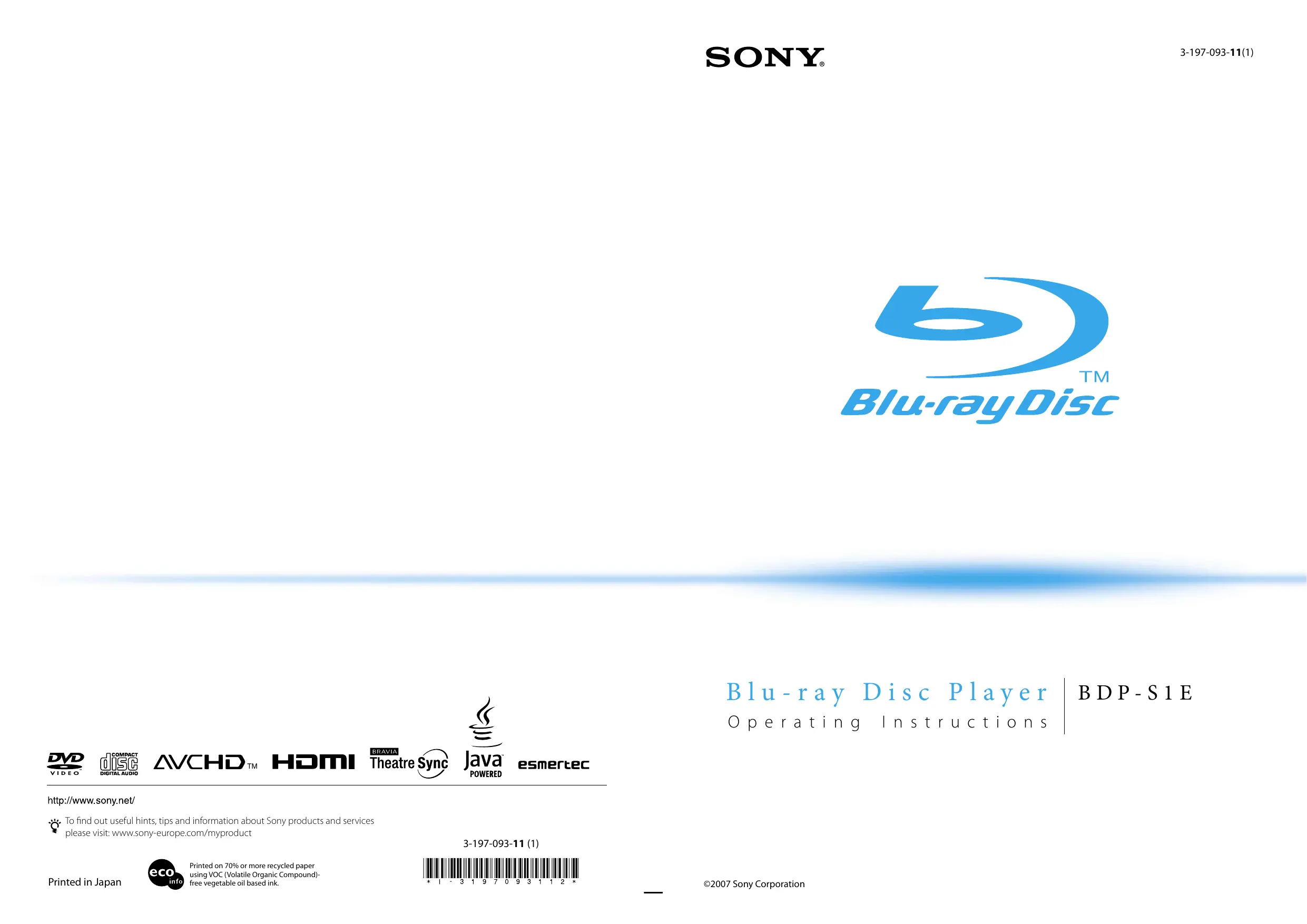

Download the instructions for your Blu-ray player in PDF format for free! Find your manual BDP-S1E - SONY and take your electronic device back in hand. On this page are published all the documents necessary for the use of your device. BDP-S1E by SONY.
USER MANUAL BDP-S1E SONY
To find out useful hints, tips and information about Sony products and services please visit: www.sony-europe.com/myproduct Printed in Japan Printed on 70% or more recycled paper using VOC (Volatile Organic Compound)free vegetable oil based ink. 3-197-093-11 (1) ©2007 Sony Corporation I n s t r u c t i o n s BDP-S1E WARNING To reduce the risk of fire or electric shock, do not expose this apparatus to rain or moisture. To avoid electrical shock, do not open the cabinet. Refer servicing to qualified personnel only. The mains lead must be changed only at a qualified service shop. Batteries or batteries installed apparatus shall not be exposed to excessive heat such as sunshine, fire or the like. CAUTION The use of optical instruments with this product will increase eye hazard. As the laser beam used in this Blu-ray Disc player is harmful to eyes, do not attempt to disassemble the cabinet. Refer servicing to qualified personnel only. Notes About the Discs Disposal of Old Electrical & Electronic Equipment (Applicable in the European Union and other European countries with separate collection systems) This symbol on the product or on its packaging indicates that this product shall not be treated as household waste. Instead it shall be handed over to the applicable collection point for the recycling of electrical and electronic equipment. By ensuring this product is disposed of correctly, you will help prevent potential negative consequences for the environment and human health, which could otherwise be caused by inappropriate waste handling of this product. The recycling of materials will help to conserve natural resources. For more detailed information about recycling of this product, please contact your local Civic Office, your household waste disposal service or the shop where you purchased the product. The manufacturer of this product is Sony Corporation, 1-7-1 Konan Minato-ku Tokyo, 108-0075 Japan. The Authorized Representative for EMC and product safety is Sony Deutschland GmbH, Hedelfinger Strasse 61, 70327 Stuttgart, Germany. For any service or guarantee matters please refer to the addresses given in separate service or guarantee documents.
- To keep the disc clean, handle the disc by its edge. Do not touch the surface.
- Do not expose the disc to direct sunlight or heat sources such as hot air ducts, or leave it in a car parked in direct sunlight as the temperature may rise considerably inside the car.
- After playing, store the disc in its case.
- Clean the disc with a cleaning cloth. Wipe the disc from the centre out. Precautions Safety This label is located on the laser protective housing inside the enclosure. This appliance is classified as a CLASS 1 LASER product. The
CLASS 1 LASER PRODUCT
MARKING is located on the laser protective housing inside the enclosure. Notice for customers in the United Kingdom and Republic of Ireland A moulded plug complying with BS1363 is fitted to this equipment for your safety and convenience. Should the fuse in the plug supplied need to be replaced, a fuse of the same rating as the supplied one and approved by ASTA or BSI to BS1362, (i.e., marked with mark) must be used. If the plug supplied with this equipment has a detachable fuse cover, be sure to attach the fuse cover after you change the fuse. Never use the plug without the fuse cover. If you should lose the fuse cover, please contact your nearest Sony service station.
- This unit operates on 220 – 240 V AC, 50/60 Hz. Check that the unit’s operating voltage is identical with your local power supply.
- To prevent fire or shock hazard, do not place objects filled with liquids, such as vases, on the apparatus. Installing
- Do not install the unit in an inclined position. It is designed to be operated in a horizontal position only.
- Keep the unit and discs away from equipment with strong magnet, such as microwave ovens, or large loudspeakers.
- Do not place heavy objects on the unit.
- Do not install this unit in a confined space, such as a bookshelf or similar unit.
- Install this unit so that the power cord can be unplugged from the wall socket immediately in the event of trouble.
- Do not expose the battery to excessive heat such as direct sunlight, fire or the like.
- Do not use solvents such as benzine, thinner, commercially available disc/ lens cleaners, or anti-static spray intended for vinyl LPs.
- If you have printed the disc’s label, dry the label before playing. Precautions On safety Should any solid object or liquid fall into the cabinet, unplug the player and have it checked by qualified personnel before operating it any further. On power sources
- The player is not disconnected from the AC power source (mains) as long as it is connected to the wall outlet, even if the player itself has been turned off.
- If you are not going to use the player for a long time, be sure to disconnect the player from the wall outlet. To disconnect the AC power cord (mains lead), grasp the plug itself; never pull the cord. On placement
- Place the player in a location with adequate ventilation to prevent heat build-up in the player.
- Do not place the player on a soft surface such as a rug.
- Do not place the player in a location near heat sources, or in a place subject to direct sunlight, excessive dust, or mechanical shock.
- The transparent part on the front panel surface is made of glass. Handle with care. On cleaning discs, disc/lens cleaners Do not use a commercially available cleaning disc or disc/lens cleaner (wet or spray type). These may cause the apparatus to malfunction. On replacement of parts In the events that this player is repaired, repaired parts may be collected for reuse or recycling purposes. IMPORTANT NOTICE Caution: This player is capable of holding a still video image or on-screen display image on your television screen indefinitely. If you leave the still video image or on-screen display image displayed on your TV for an extended period of time you risk permanent damage to your television screen. Plasma display panel televisions and projection televisions are susceptible to this. If you have any questions or problems concerning your player, please consult your nearest Sony dealer. On operation
- If the player is brought directly from a cold to a warm location, or is placed in a very damp room, moisture may condense on the lenses inside the player. Should this occur, the player may not operate properly. In this case, remove the disc and leave the player turned on for about half an hour until the moisture evaporates.
- When you move the player, take out any discs. If you don’t, the disc may be damaged. On adjusting volume Do not turn up the volume while listening to a section with very low level inputs or no audio signals. If you do, the speakers may be damaged when a peak level section is played. On cleaning Clean the cabinet, panel, and controls with a soft cloth slightly moistened with a mild detergent solution. Do not use any type of abrasive pad, scouring powder or solvent such as alcohol or benzine.
Functions available for music CDs or CDRs/CD-RWs in music CD Format.
- MP3 (MPEG-1 Audio Layer III) is a standard format defined by ISO (International Organization for Standardization)/IEC (International Electrotechnical Commission) MPEG which compresses audio data. Note The on-screen display illustrations used in this manual may not match the graphics displayed on your TV screen.
“Blu-ray Disc” is a trademark. “Blu-ray Disc,” “DVD+RW,” “DVD-RW,” “DVD+R,” “DVDR,” “DVD VIDEO,” and “CD” logos are trademarks. Supported file formats (DATA DVD only) DVD+RWs/DVD-RWs/DVD+Rs/DVD-Rs are called “DATA DVD” in this manual when the discs contain playable files. The following file formats are supported:
- JPEG format conforming to UDF (Universal Disk Format). Notes about BD-ROM compatibility This player supports BD-ROM Profile 1 only. Playback of later versions and BDs other than BD-ROM is not guaranteed. Since the Blu-ray Disc specifications are new and evolving, some discs may not play depending on the disc type and the version. The audio output differs depending on the source, connected output jack, and selected audio settings. For details, see page 48. ,continued
Examples of discs that the player cannot play The player cannot play the following discs:
- DATA CDs (CD-Rs/CD-RWs other than music CD format).
- CD-ROMs recorded in PHOTO CD format.
- Data part of CD-Extras.
- HD layer on Super Audio CDs. Also, the player cannot play the following discs:
- A BD-ROM/DVD VIDEO with a different region code.
- A disc that has a non-standard shape (e.g., card, heart).
- A disc with paper or stickers on it.
- A disc that has the adhesive of cellophane tape or a sticker still left on it. About playback of discs recorded in AVCHD format This player can play AVCHD format discs.
What is the AVCHD format? The AVCHD format is a high definition digital video camera format used to record SD (standard definition) or HD (high definition) signals of either the 1080i specification*1 or the 720p specification*2 on DVDs, using efficient data compression coding technology. The MPEG-4 AVC/H.264 format is adopted to compress video data, and the Dolby Digital or Linear PCM system is used to compress audio data. The MPEG-4 AVC/ H.264 format is capable of compressing images at higher efficiency than that of the conventional image compressing format. The MPEG-4 AVC/H.264 format enables a high definition (HD) video signal shot on a digital video camera recorder to be recorded on DVD discs, in the same way as it would be for a standard definition (SD) television signal. Notes
- Notes about DVD+RWs/DVD+Rs, DVD-RWs/DVD-Rs, or CD-Rs/ CD-RWs Some DVD+RWs/DVD+Rs, DVD-RWs/DVD-Rs, or CD-Rs/ CD-RWs cannot be played on this player due to the recording quality or physical condition of the disc, or the characteristics of the recording device and authoring software. The DVD disc will not play if it has not been correctly finalized. For more information, refer to the operating instructions for the recording device. Note that some playback functions may not work with some DVD+RWs/DVD+Rs, even if they have been correctly finalized. In this case, view the disc by normal playback.
- Music discs encoded with copyright protection technologies This product is designed to playback discs that conform to the Compact Disc (CD) standard. Recently, various music discs encoded with copyright protection technologies are being marketed by some record companies. Please be aware that among those discs, there are some that do not conform to the CD standard and may not be playable by this product.
- Note on DualDiscs A DualDisc is a two sided disc product which mates DVD recorded material on one side with digital audio material on the other side. However, since the audio material side does not conform to the Compact Disc (CD) standard, playback on this product is not guaranteed.
- Note about double-layer DVDs The playback pictures and sound may be momentarily interrupted when the layers switch.
“AVCHD” and the AVCHD logo are trademarks of Matsushita Electric Industrial Co., Ltd. and Sony Corporation. *1 A high definition specification which utilizes 1080 effective scanning lines and the interlace system. *2 A high definition specification which utilizes 720 effective scanning lines and the progressive system. Notes
- Some AVCHD format discs may not play, depending on the recording condition.
- The AVCHD format disc will not play if it has not been correctly finalized. Main Features BD/DVD region code Your player has a region code printed on the back of the unit and only will play BD-ROM/DVD VIDEOs (playback only) labelled with identical region codes. This system is used to protect copyrights. DVD VIDEOs labelled ALL will also play on this player. Depending on the BD-ROM/DVD VIDEO, there may be no region code indication, even though playing the BD-ROM/DVD VIDEO is prohibited by area restrictions.
AC IN HDMI OUT PB/CB S VIDEO PR/CR BD-ROM playback BD-ROM is a next generation optical disc format in the HD era. Featuring massive storage capacity of 25 to 50 GB (five times larger than a DVD) and a high-speed transfer rate of up to 54 Mbps, the format offers not only uncompromised HD quality video*1*2, but also enables rich bonus content on a single disc and HD quality audio up to 8ch, and interactive operability. COMPONENT VIDEO OUT VIDEO OUT VIDEO Experience the high definition (HD) quality audio/video output and the library function of this Blu-ray Disc Player. 5.1CH OUTPUT DIGITAL OUT
WOOFER Note on playback operations of BDs/ DVDs Some playback operations of BDs/DVDs may be intentionally set by software producers. Since this player plays BDs/DVDs according to the disc contents the software producers designed, some playback features may not be available. Also, refer to the instructions supplied with the BDs/DVDs. Copyrights This product incorporates copyright protection technology that is protected by U.S. patents and other intellectual property rights. Use of this copyright protection technology must be authorized by Macrovision, and is intended for home and other limited viewing uses only unless otherwise authorized by Macrovision. Reverse engineering or disassembly is prohibited. *1 A compatible HD display device is necessary to enjoy the same quality. *2 Some discs allow viewing only with an HDMI connection. 24p True Cinema Movies shot with a film camera consist of 24 frames per second. Since conventional televisions (both CRT and flat panels) display frames either at 1/60 or 1/50 second intervals, the 24 frames do not appear at an even pace. When connected to a TV with 24p capabilities, the player displays each frame at 1/24 second intervals — the same interval originally shot with the film camera, thus faithfully reproducing the original cinema image. HDMI Control (‘BRAVIA’ Theatre Sync) ‘BRAVIA’ Theatre Sync Function makes operations simple by connecting Sony components that are compatible with the HDMI Control function with an HDMI cord (not supplied). BD-J application The BD-ROM format supports Java for interactive functions. “BD-J” offers content providers almost unlimited functionality when creating interactive BD-ROM titles*. Java and all Java-based trademarks and logos are trademarks or registered trademarks of Sun Microsystems, Inc. in the U.S. and other countries. Esmertec and Jbed are trademarks or registered trademarks of Esmertec AG. © 2000-2007 Esmertec AG
- This player does not support downloadable BD-J content. Support of uncompressed multi-channel Linear PCM In combination with a compatible AV amplifier, the player can output up to 8ch Linear PCM surround sound*. With a noncompatible amplifier, the player can output 5.1ch analog signals from its 5.1CH OUTPUT jack for high quality audio enjoyment.
- Note that the DIGITAL OUT (COAXIAL or OPTICAL) jack does not output 8ch signals. You will need an HDMI cord and an HDMIcompatible device that support 8ch signals. AVCHD format disc playback The player supports AVCHD format files–high definition recordings made on AVCHD-compatible camcorders. Your high definition personal archive is readily playable in HD quality. ,continued
HDMI (High-Definition Multimedia Interface) digital interface When connected to an HDMI-equipped display device using a single HDMI cord, the player can output both SD to HD video and multi-channel audio signals, in digital form without degradation. The HDMI specification supports HDCP (High-bandwidth Digital Content Protection), a copy protection technology that incorporates coding technology for digital video signals. Library function for recorded files (For JPEG image, MP3 audio, MPEG-2 PS movie files only) With DATA DVDs created on other DVD devices, three separate movie/music/photo Title List-browsers allow for easy sorting, searching and playback including a slideshow.
Step 1: Unpacking Getting Started Notes
- Plug cords securely to prevent unwanted noise.
- Refer to the instructions supplied with the components to be connected.
- You cannot connect this player to a TV that does not have a video input jack.
- Be sure to disconnect the mains lead of each component before connecting.
- Do not apply too much pressure on the connecting cords. Pushing against the cabinet wall, etc., may damage the cord. Getting Started Follow steps 1 to 7 to hook up and adjust the settings of the player. For jack and button names, see “Index to Parts and Controls” (page 58). Check that you have the following items:
- Video cord (phono plug × 1) (1)
- Stereo audio cord (phono plug × 2) (1)
- Remote commander (remote) (1)
Step 2: Connecting the Video Cords/HDMI Cord B Connecting to an S VIDEO input jack Connect using an S VIDEO cord (not supplied). You will enjoy high quality images. Blu-ray Disc player Connect this player to your TV monitor, projector or AV amplifier (receiver) using a video cord. Select one of the patterns A through D, according to the input jack on your TV monitor, projector or AV amplifier (receiver). In order to view 1080p progressive signals with a compatible TV, projector, or monitor with an HDMI input jack, you must select pattern D. You can use pattern C to view 480p/576p/ 720p progressive signals or 1080i interlace signals on a compatible device with component video input jacks. COMPONENT VIDEO OUT 5.1CH OUTPUT
WOOFER to S VIDEO VIDEO OUT S VIDEO cord (not supplied) VIDEO S VIDEO INPUT S VIDEO A Connecting to a video input jack Connect the supplied video cord (yellow) to the yellow (video) jack. You will enjoy standard quality images. TV, projector, or AV amplifier (receiver) : Signal flow Blu-ray Disc player COMPONENT VIDEO OUT
WOOFER to VIDEO OUT VIDEO OUT VIDEO S VIDEO (yellow) (yellow) INPUT VIDEO Video cord (supplied) Connect the component via the COMPONENT VIDEO OUT jacks using a component video cord (not supplied) or three video cords (not supplied) of the same kind and length. You will enjoy accurate colour reproduction and high quality images. You can also enjoy higher quality pictures from 480p/576p/720p progressive signals or 1080i interlace signals, if your TV, projector or AV amplifier (receiver) is compatible.
Blu-ray Disc player AUDIO COMPONENT VIDEO OUT : Signal flow When connecting to a standard 4:3 screen TV Depending on the disc, the image may not fit your TV screen. To change the aspect ratio, see page 45. VIDEO OUT Do not connect a VCR, etc., between your TV and the player. If you pass the player signals via the VCR, you may not receive a clear image on the TV screen. If your TV has only one audio/video input jack, connect the player to this jack. VCR Blu-ray Disc player
(blue) (blue) PB/CB PB/CB PR/CR Note
TV, projector, or AV amplifier (receiver) (red) (red) Component video cord (not supplied) : Signal flow PR/CR TV, projector, or AV amplifier (receiver) D Connecting to an HDMI input jack Use a certified Sony HDMI cord (not supplied) to enjoy high quality digital pictures and sound through the HDMI OUT jack. You will enjoy higher quality pictures from 480p/576p/1080i, or 1080p (highest among the player output), if your TV, projector or AV amplifier (receiver) is compatible. Blu-ray Disc player
WOOFER HDMI OUT to HDMI OUT After the player is turned on, the HD indicator on the front panel lights up when outputting 720p/1080i/1080p video signals. The HDMI indicator lights up when an HDMI device is connected. Notes
- Consumers should note that not all high definition television sets are fully compatible with this product and may cause artifacts to be displayed in the picture. In the case of 480/576/720/1080 progressive scan picture problems, it is recommended that the user switch the connection to the ‘standard definition’ output. If there are questions regarding our TV set compatibility with this model 480p/576p/720p/ 1080p Blu-ray Disc player, please contact our customer service centre.
- If the picture is not clear, natural, or to your satisfaction, change the video output resolution by pressing VIDEO FORMAT (page 46).
- Be sure to use only an HDMI cord that bears the HDMI logo. About the ‘BRAVIA’ Theatre Sync features (for HDMI connections only) HDMI cord (not supplied) TV, projector, or AV amplifier (receiver) HDMI IN This Blu-ray Disc player incorporates High-Definition Multimedia Interface (HDMI™) technology. HDMI, the HDMI logo and High-Definition Multimedia Interface are trademarks or registered trademarks of HDMI Licensing LLC. Notes on connecting to the HDMI OUT jack Observe the following as improper handling may damage the HDMI OUT jack and the connector.
- Carefully align the HDMI OUT jack on the back of the player and the HDMI connector by checking their shapes. Make sure the connector is not upside down or tilted. Getting Started COMPONENT VIDEO OUT VIDEO OUT VIDEO About indicators for HDMI connection By connecting Sony components that are compatible with the HDMI Control function with an HDMI cord (not supplied), operation is simplified as below:
- One-Touch Play (page 21) You can turn on the player and TV/AV receiver, set the TV/AV receiver’s input to the player, and start playback with one touch of the H button.
- System Power-Off When you turn the TV off by using the POWER button on the TV’s remote, the HDMI compatible components turn off automatically. To prepare for the ‘BRAVIA’ Theatre Sync features Set “HDMI Control” of “Options” setup to “On” (page 52). Note Depending on the connected component, the HDMI Control function may not work. Refer to the operating instructions supplied with the component.
- Be sure to disconnect the HDMI cord when moving the player.
- If you place the player on the cabinet with the HDMI cord connected, do not apply too much pressure to the cabinet wall. It may damage the HDMI OUT jack or the HDMI cord.
- When connecting or disconnecting, do not screw in or rotate the HDMI connector.
Step 3: Connecting the Audio Cords Select the connection that best suits your system. Be sure to read the instructions for the components you wish to connect. Connection Your setup
Stereo amplifier (receiver) and two speakers Notes about the HDMI OUT jack
- When you connect the player to an AV amplifier (receiver) using an HDMI cord, you will need to do one of the following: – Connect the AV amplifier (receiver) to a TV with the HDMI cord. – Connect the player to the TV with a video cord other than an HDMI cord (component video cord, S VIDEO cord, or video cord).
- When connecting to the HDMI OUT jack, carefully align the HDMI connector with the jack. Do not bend or apply pressure to the HDMI cord.
- If you change the component connected to the HDMI OUT jack, change “Audio (HDMI)” in “Audio Setup” to match the new component (page 47). The player stores the HDMI related settings for up to five components.
- The HDMI connection is compatible with 2ch Linear PCM signals (48 to 192 kHz, 16/20/24 bit), and 6 to 8ch Linear PCM signals (48 to 96 kHz, 16/20/24 bit), in addition to Dolby Digital and DTS bit stream (5.1ch signals up to 96 kHz, 16/20/ 24bit). Note If you connect a component that does not conform to the selected audio signal, a loud noise (or no sound) will come out from the speakers, which could damage your ears or speakers.
AV amplifier (receiver) having a Dolby*1 Surround (Pro Logic) decoder and 3 to 6 speakers
- Surround effects: Dolby Surround (Pro Logic) D-1 AV amplifier (receiver) with 5.1ch input jacks and 6 speakers
- Surround effects: Dolby Digital (5.1ch), DTS (5.1ch) D-2 AV amplifier (receiver) with a digital input jack having a Dolby Digital or DTS*2 decoder and 6 speakers
- Surround effects: Dolby Digital (5.1ch), DTS (5.1ch) D-3 AV amplifier (receiver) with an HDMI input jack and 8 speakers
- Surround effects: 8ch Linear PCM
Manufactured under license from Dolby laboratories. “Dolby,” “Pro Logic,” and the double-D symbol are trademarks of Dolby Laboratories. *2 “DTS” and “DTS Digital Surround” are registered trademarks of DTS, Inc.
Connecting to your TV
Connecting to a stereo amplifier (receiver) and 2 speakers
This connection will use your TV’s speakers for sound. If your stereo amplifier (receiver) only has audio input jacks L and R, use B-1 . If your amplifier (receiver) has a digital input jack, use B-2 . COMPONENT VIDEO OUT COMPONENT VIDEO OUT
COAXIAL OPTICAL REAR (white) AUDIO OUT
WOOFER WOOFER to AUDIO OUT L/R CENTER
INPUT Stereo audio cord (supplied) VIDEO to AUDIO OUT L/R to DIGITAL OUT (COAXIAL or OPTICAL) (white) AUDIO (red)
: Signal flow Optical digital cord (not supplied) (white) (red)
Stereo audio cord (supplied) Coaxial digital cord (not supplied) (white) (red) to coaxial or optical digital input [Speakers] to audio input Stereo amplifier (receiver) Front (L) Front (R) : Signal flow ,continued
Connecting to an AV amplifier (receiver) having a Dolby Surround (Pro Logic) decoder and 3 to 6 speakers
If your AV amplifier (receiver) only has L and R audio input jacks, use C-1 . If your amplifier (receiver) has a digital input jack, use C-2 . You can enjoy surround effects only when playing Dolby Surround audio or multi-channel audio (Dolby Digital or DTS) discs. Connecting to an AV amplifier (receiver) with 5.1ch input jacks and 6 speakers D-1 If your AV amplifier (receiver) has 5.1 channel inputs, use D-1 . Blu-ray Disc player Blu-ray Disc player COMPONENT VIDEO OUT COMPONENT VIDEO OUT
WOOFER WOOFER C-2 C-1 DIGITAL OUT D-1 AUDIO OUT
WOOFER to DIGITAL OUT (COAXIAL or OPTICAL) to AUDIO OUT L/R (white) Optical digital cord (not supplied) (red)
Stereo audio cord (supplied) Coaxial digital cord (not supplied) (white) to audio input [Speakers] Front (R) Rear (L) Rear (R) Centre [Speakers] AV amplifier (receiver) with 5.1ch inputs [Speakers] Rear (L) Centre Rear (R) Front (L) Subwoofer Rear (mono) Front (R) Front (L) : Signal flow : Signal flow z Hint z Hint For correct speaker location, see the operating instructions of the connected components. For correct speaker location, see the operating instructions of the connected components. Note When connecting 6 speakers, you do not need the “Rear (mono)” speaker above.
Monaural audio cord (not supplied) to audio input AV Amplifier (receiver) with a decoder Subwoofer Stereo audio cord (one is supplied) (red) to coaxial or optical digital input [Speakers] to 5.1CH OUTPUT Connecting to an AV amplifier (receiver) with a digital input jack and 6 speakers D-2 If you want to use the Dolby Digital, or DTS decoder function on your AV amplifier (receiver), connect to its digital jack using D-2 . You can enjoy a more realistic audio presence. Connecting to an AV amplifier (receiver) with an HDMI input jack and 8 speakers D-3 If your AV amplifier (receiver) accepts 8ch Linear PCM input with an HDMI connection, you can enjoy the surround sound using D-3 . Blu-ray Disc player COMPONENT VIDEO OUT HDMI OUT AC IN COMPONENT VIDEO OUT 5.1CH OUTPUT
WOOFER Getting Started Blu-ray Disc player D-3 DIGITAL OUT
to HDMI OUT Coaxial digital cord (not supplied) HDMI cord (not supplied) Optical digital cord (not supplied) to HDMI input [Speakers] to coaxial or optical digital input AV amplifier (receiver) having a decoder Centre Subwoofer [Speakers] [Speakers] Rear (L) Rear (R) to HDMI input AV amplifier (receiver) with 8ch outputs Rear1 (L) Rear2 (R) Rear2 (L) Front (L) Centre Subwoofer Rear1 (R) Front (R) [Speakers] Front (R) Front (L) : Signal flow z Hint For correct speaker location, see the operating instructions of the connected components. z Hint For correct speaker location, see the operating instructions of the connected components. Note Not all HDMI-compatible AV amplifiers (receivers) accept 8ch Linear PCM signals. See also the operating instructions supplied with the connected AV amplifier (receiver).
Step 4: Connecting the Mains Lead After all of the other connections are complete, connect the supplied mains lead to the AC IN terminal of the player. Then plug the player and TV mains lead (power cords) into the mains. Step 5: Preparing the Remote You can control the player using the supplied remote. Insert two R6 (size AA) batteries by matching the 3 and # ends on the batteries to the markings inside the battery compartment. When using the remote, point it at the remote sensor on the player (page 58). AC IN to AC IN to mains Notes
- Do not leave the remote in an extremely hot or humid place.
- Do not drop any foreign object into the remote casing, particularly when replacing the batteries.
- Do not expose the remote sensor to direct sunlight or a lighting apparatus. Doing so may cause a malfunction.
- If you do not use the remote for an extended period of time, remove the batteries to avoid possible damage from battery leakage and corrosion.
If you want to control your TV with the supplied remote You can control the volume, input source, and power switch of your Sony TV with the supplied remote. To control other TVs with the remote You can control the volume, input source, and power switch of nonSony TVs as well. If your TV is listed in the table below, set the appropriate manufacturer’s code.
◆Code numbers of controllable TVs If more than one code number is listed, try entering them one at a time until you find the one that works with your TV. VIDEO FORMAT CLEAR
2 +/– By pressing You can TV [/1 Turn the TV on or off. 2 +/– Adjust the volume of the TV.
Switch the TV’s input source between the TV and other input sources. PROG +/– Select the channel up and down.
Hitachi 23, 24, 72 Loewe 06, 45 Nokia 15, 16, 69, 73 Panasonic 17, 49 Philips 06, 07, 08, 23, 45, 72 Saba 12, 13, 36, 43, 74, 75 Samsung 06, 22, 23, 71, 72 Sanyo
DIMMER ◆To return the remote to its default settings
Remove the batteries from the remote.
Wait for a few seconds. Re-insert the batteries while pressing down 1, 2, and 3 of the number buttons. Note Depending on the connected unit, you may not be able to control your TV using all or some of the buttons on the supplied remote.
e Select “Start,” and press ENTER to start Step 6: Easy Setup “Easy Setup.” Easy Setup Before using, make some simple settings for the BD player. Follow the steps below to make the minimum number of basic adjustments for using the player. If you do not complete Easy Setup, it will appear each time you turn on your player. Make the settings below in the following order. Start Cancel Please use the Initial Setup if you want to make more detailed settings. Use to select then press ENTER. Confirm SYSTEM MENU Exit When turned on for the first time Wait about 90 seconds before the player turns on and starts Easy Setup. The start-up time will be much shorter once Easy Setup is completed. ◆If the above display does not appear Go to step 6. This display appears only when the player is turned on for the first time. f Select the video output format for the connected TV, and press ENTER.
SYSTEM MENU TOP MENU Select [Auto] to automatically match the video output format with the HDMI-connected TV. Confirm SYSTEM MENU Exit </M/m/,, ENTER RETURN Select from “Auto,” “576i/480i,” “576p/480p,” “720p,” “1080i,” “1080p,” or “Source Direct,” then go to step 8. “TV Type” in step 7 will be set to “16:9” (wide screen). POP UP/ MENU ◆ When using the jacks other than the HDMI OUT jack a Turn on the TV. b Press [/1 to turn on the player. The player turns on after a moment. c Switch the input selector on your TV so that the signal from the player appears on your TV screen. If the display for OSD language selection does not appear, select “Start” of “Easy Setup” in “Options” Setup (page 52). d Select the OSD language you want to display, and press ENTER. Easy Setup Language English Français Deutsch Italiano Español Select the on-screen display language. Audio, subtitle and BD/DVD menu language options will be set to the same language as this. Confirm SYSTEM MENU Exit This will determine the Audio, Subtitle and BD/ DVD menu languages as well.
Easy Setup Output Video Format S-Video/Video only 576i/480i 576p/480p 720p 1080i Don't Know Select [Auto] to automatically match the video output format with the HDMI-connected TV. Confirm SYSTEM MENU Exit Select from “S-Video/Video only,” “576i/480i,” “576p/480p,” “720p,” “1080i” or “Don’t Know.” If you select “720p” or “1080i,” go to step 8. “TV Type” in step 7 will be set to “16:9” (wide screen). g Select the aspect ratio that matches your TV, and press ENTER. Easy Setup Step 7: Additional Adjustments TV Type 16:9 4:3 The following settings and adjustments are necessary when your connection applies. Confirm SYSTEM MENU Exit ◆ If you have a wide screen TV or a 4:3 standard TV with a wide screen mode Select “16:9” (page 45). ◆ If you have a 4:3 standard TV Select “4:3” (page 45). h Select “Finish Setup,” and press ENTER. ◆When using the HDMI OUT jack (Pattern D –page 11)
- Select the video output resolution for your TV by pressing VIDEO FORMAT (page 46).
- Select the type of video output from the HDMI OUT jack in “YCbCr/RGBPC (HDMI)” of “Video Setup” (page 45). For audio connection Easy Setup ◆When using the DIGITAL OUT (OPTICAL or COAXIAL) jack (Connection B-2 , C-2 , D-2 –page 13 to 15)
- Set “Dolby Digital Output” and “DTS Output” in “Audio Setup” (page 47) according to your AV amplifier’s (receiver’s) decoder. Settings are complete. Enjoy using your BD player! Finish Setup Go Back Use ◆When using the COMPONENT VIDEO OUT jacks (Pattern C –page 10)
- Select the video output resolution for your TV by pressing VIDEO FORMAT (page 46). Getting Started For video connection Select the screen aspect ratio to match your TV. to select then press ENTER. Confirm SYSTEM MENU Exit z Hints
- If you want to reset these settings to their factory defaults, see “Resetting the Player” (page 53).
- You can re-run “Easy Setup” from “Options” Setup (page 52). ◆When using the HDMI OUT jack (HDMI connection of D-2 , D-3 –page 15)
- Set “Dolby Digital Output” and “DTS Output” in “Audio Setup” (page 47) according to your AV amplifier’s (receiver’s) decoder.
- Select the audio output method from the HDMI OUT jack in “Audio (HDMI)” of “Audio Setup” (page 47). ◆When using the AUDIO OUT (L/R) jacks (Connection C-1 –page 14)
- Set “DTS Downmix” to “Lt/Rt” in “Audio Setup” (page 47). ◆When using the 5.1CH OUTPUT jacks (Connection D-1 –page 14)
- Set “Audio Output Mode” to “5.1 Channel” in “Speakers” Setup (page 51), and adjust the “Speaker Setup” setting for your system. Notes
- If you connect a component that does not conform to the selected audio signal, a loud noise (or no sound) will come out from the speakers, which could damage your ears or speakers.
- If you connect using the HDMI OUT jack or COMPONENT VIDEO OUT jacks and the picture does not appear clearly, the connected display device may not be compatible with the progressive signals. In this case, connect the display device to the S VIDEO jack or the VIDEO jack (pattern A or B – see page 10), re-run the “Easy Setup” from the “Options” Setup (page 52), and select “S-Video/Video only” in step 6 (page 18). Also, check the above items again to see if any additional adjustment is required.
Playing a Disc Basic Operations Most of the BD playback operations are common to DVD. This section covers BD/ DVD/CD playback in general, together with the basic operation of the player. For browsing recorded files on DATA DVDs*, a separate library function is available. See also page 32 for movie, 36 for music, 40 for photo files. For operations using the remote, a complete list is located on page 24.
a Press \/1. The player turns on after a moment. b Switch the input selector on your TV so that the signal from the player appears on your TV screen. c Press Z to open the disc tray. d Place a disc on the disc tray with the playback side facing down.
Playback side facing down e Press Z to close the disc tray. Wait a short while until the disc type appears on the front panel display. f Press H to start playback. For more information about the remote’s operations, see page 24. Details
Pauses playback, or restarts playback from the same point.
Stops playback, or cancels the resume point when pressed twice.
Starts or restarts playback from the previous stop point. g When you finish playing, press Z to open the disc tray. h Remove the disc, and press Z again to close To prevent damage to your display device (ghosting), a screen saver image appears when the player is left unattended, has no disc inserted, or no title/slideshow is displayed for 15 minutes. To cancel, press any button on the remote or the player. About One-Touch Play (for HDMI connections only) With one touch of the H button, the player and your TV/AV receiver automatically turn on and the TV/AV receiver’s input is switched to the player. Playback starts automatically. To use this function, set “HDMI Control” of “Options” setup to “On” (page 52). The TV/AV receiver’s input will also switch to the player automatically, in the following cases: – You press H, SYSTEM MENU, TOP MENU, or POP UP/ MENU buttons on the remote. – A disc with auto playback function is loaded. Basic Operations Buttons About the screen saver function the disc tray. i Press \/1 to turn off the player. To use the BD’s or DVD’s menu When you play a BD-ROM, DVD VIDEO, or a finalized DVD+RW, DVD-RW (Video mode), DVD+R, or DVD-R (Video mode), you can display the disc’s menu by pressing TOP MENU or POP UP/MENU. Some BDs/DVDs display the menu automatically. Either cases, navigate through the menu using </M/m/,, ENTER, or the number buttons and the colour buttons as indicated by the disc’s on-screen instructions. The BD menu is operable without interrupting playback. To play restricted BDs If “CAN’T PLAY” appears on the front panel display for a BDROM, change the “BD Parental Control” setting (page 30). To play restricted DVDs For a restricted DVD, the display asks for the password. For “DVD Parental Control” setting, see page 30.
Press ENTER to confirm. To register or change the password, see page 29. Notes about Resume Play
- Playback starts from the beginning if the title has not been played or the previous stop point is cancelled.
- The stop point is cancelled when: – you change the settings on the player. – you turn off the player (BD-ROM and CD only). – you press x twice. – you open the disc tray. – you finish a search.
- The player remembers the stop point for one title/track/file only. On a music CD, playback resumes from the beginning of the track.
Title List Guide to Displays For DATA DVDs, this display leads further to the Title Lists of content type. The three Title Lists appear similar and are operable in a similar way. Title List
Movies Photos When ‘Select an item, and press ENTER’ appears in this manual, press the </M/m/, keys on the remote to select the item then the entry button in the middle. You can operate the player likewise using displays. Music Access the BD-R/RE titles. Select SYSTEM MENU Exit System Menu Select the Title List you want to view; from “Movies,” “Photos,” or “Music,” and press ENTER. Title List ◆Movies Displays movies/video titles only (page 32). A/V Control Setup ◆Photos Displays image files only (page 40). Search for the part you want to play from a list of the disc's content. Select SYSTEM MENU Exit a Press SYSTEM MENU to turn on the above “System Menu.” The player’s start menu appears, with entries to all of the functions. ◆Music Displays music files only (page 36). A/V Control (page 27) Adjusts the audio/video settings. Select either “Video Control,” or “Audio Control,” and press ENTER. b Select an item, and press ENTER. A/V Control Each item leads to the following function displays. See the pages in parentheses for operations. When you want to return to the previous display, press RETURN. Video Control Audio Control Set the playback picture quality. Select SYSTEM MENU Exit Setup (page 44) Enters the Setup displays for changing the player’s settings. Select the related Setup display, and press ENTER. Setup Video Setup Audio Setup Language Parental Control Speakers Options TV Type 4:3 Video Output DVD Aspect Ratio YCbCr/RGBPC(HDMI) 24p Output 16:9 Normal Letter Box Y, Cb, Cr Off Use to select an item, then press [RR] or ENTER. Confirm SYSTEM MENU Exit
Entering characters DATA DVD When an on-screen keyboard appears (e.g., when searching for a title), enter the characters as follows.
CLR CANCEL a Select the character you want to enter, and press ENTER. The character appears in the entry field. If necessary, select the following items, and press ENTER. Items Details SHFT Switches between upper and lower case characters. Select this before entering the character. SPC Inserts a space. DEL Deletes the last character input. CLR Clears all input characters. Basic Operations
b Repeat step 1 to complete the entry. c Select “DONE,” and press ENTER to close the on-screen keyboard. Note You cannot use the extended character set.
Guide to the Remote A Z (open/close) (page 20) – Opens/closes the disc tray. TV &/1 (on/standby) (page 17) – Turns the TV on or to standby mode. The following covers all of the remote’s functions. Refer to the list when necessary. B DIMMER (page 59) – Changes the brightness of the front panel display on the player (when completely darkened, indicators on the front panel are also turned off and the FL OFF indicator lights up).
DISPLAY (page 26) – Displays the disc information on the screen. t (TV/video) (page 17) – Switches between TV and other input sources.
AUDIO SUBTITLE RED &/1 (on/standby) (page 18) – Turns on, or sets the player to standby mode. ANGLE
SYSTEM MENU TOP MENU C Number buttons (page 26) – Enters the title/chapter numbers, etc. CLEAR – Clears the entry field. D VIDEO FORMAT (page 45) – Changes the video output resolution from the HDMI OUT jack and the COMPONENT VIDEO OUT jacks. Press this button repeatedly if no picture appears. E AUDIO*1 (page 49) – Selects the sound track or the language track on a BD/DVD. POP UP/ MENU RETURN *1 When playing MPEG-2 movie files or MP3 music files on a DATA DVD, or a music CD, you cannot select the left or right channel only. SUBTITLE (page 49) – Selects the subtitle language on a BD/DVD. ANGLE – Switches to other viewing angles when available. PLAY MODE PROG Number 5, AUDIO, PROG+, and H buttons have a tactile dot. Use the tactile dot as a reference when operating the player.
F Colour buttons (RED/GREEN/YELLOW/BLUE) – Short cut keys for selecting items on some BD’s menus (can also be used for BD’s Java interactive operations). G SYSTEM MENU (page 22) – Enters/exits the player’s start menu (“System Menu”). I For TVs operable with the following buttons, see page 17. % (muting) (page 17) – Mutes the TV sound. TOP MENU (page 20) – Opens/closes the BD’s or DVD’s top menu. 2 (volume) +/– (page 17) – Adjusts the TV volume. POP UP/MENU (page 20) – Opens/closes the BD’s pop up menu, or the DVD’s disc menu. </M/m/, (page 20, 22) – Moves the highlight to select a displayed item. Centre button (ENTER) (page 20, 22) – Enters the selected item. H ./> (previous/next) – Skips to the previous/next chapter, track, or file. c/ C (slow/step)*2 – Plays in slow motion or stop motion. To return to normal play, press H.
- To play in slow motion Press C during playback. When slow motion C repeatedly to change the play starts, press speed : 1/16 t 1/8 t 1/4 t 1/2 of normal playback speed.
- To play in stop motion (step by step) Press X during playback, then press c or repeatedly. m/M (scan)*2 – Scans backwards or forward. The speed changes when pressed repeatedly. Playing in various play mode
a During playback, press PLAY MODE repeatedly. Available items differ depending on the current title/ track/file or the disc type. To cancel the Play Mode, press PLAY MODE again. For “Time Search,” see “Searching using the remote” (page 26). ◆When playing a video or movie title Items Details Repeat Chapter
only) Repeats the current chapter. Repeat Title Repeats the current title. ◆When playing a music track Items Details Repeat Track Repeats the current track. Repeat All Repeats all the tracks on the disc or the “Music” Title List. *2 Depending on the disc or file type, the function may not work or the scan speeds may differ. Random Plays all the tracks on the disc or the “Music” Title List in a random order. H (play) – Starts or re-starts playback. ◆When playing a photo image PLAY MODE – Switches to other play modes (Repeat Play, etc.) when pressed during playback. – Searches for a specific point (page 26). Basic Operations RETURN (page 20, 22) – Returns to the previous display. PROG (programme) +/– (page 17) – Selects the TV channels up and down. Items Details Repeat All Repeats all the files on the disc or “Photos” Title List. Random Plays all the files on the disc or “Photos” Title List in a random order. X (pause) – Pauses/re-starts playback. x (stop) – Stops playback. – Clears the resume point when pressed twice. The resume point for a title is the last point you played, the last track for an audio file, or the last photo for a photo file. ,continued
DVD DATA DVD Checking the Disc Information You can search by entering the title/chapter number or the time code (elapsed time from the beginning of the disc).
AUDIO SUBTITLE You can check the title/chapter/track information including video transmission rate etc., by pressing DISPLAY. The information differs depending on the disc type and the player status.
SYSTEM MENU Example: When playing a DVD VIDEO. TOP MENU ENTER Play DVD-VIDEO 1-1 2.01.23 Chapters 12 Title Total Repeat Title 2h15m34s POP UP/ MENU RETURN PLAY MODE a Press DISPLAY. ANGLE PLAY MODE PROG The following information appears: 1 Playback status 2 Disc type 3 Title information
- Currently playing title number/currently playing chapter number.
- Total number of chapters within the title.
- Total playback time of the title. To search for a title or chapter (BD-ROM, DVD VIDEO only) 4 Elapsed time of the current title
Enter the title number using the number buttons while the player is in stop mode. To search for a chapter, enter the chapter number during playback. If you make a mistake, press CLEAR once and re-enter. Press ENTER to start playback. b Press DISPLAY again. Play DVD-VIDEO 1-1 2.01.23 Chapter Time Chapter Total To search for a specific point
During playback, press PLAY MODE repeatedly until “Time Search” appears.
Enter the time code using the number buttons. Enter the time in minutes and seconds (e.g., ‘12030’ for 1 hour, 20 minutes and 30 seconds). If you make a mistake, press CLEAR once and re-enter.
Press ENTER to start playback. Note Depending on the DVD VIDEO/BD-ROM/DATA DVD, these search functions may not work. Repeat Title 2h15m34s
The display switches to show the following information: 1 Chapter information
- Elapsed time of the current chapter.
- Total playback time of the current chapter. 2 Video transmission rate and the stream information
- You can check the audio information by pressing AUDIO. Clarifying Low Volume Sounds (Audio DRC)
DVD DATA DVD Even at low volume, you can make low sounds such as dialogues more audible. Audio DRC Off Max Basic Operations Audio Control Adjusting sound accentual width (dynamic range). This is effective when playback sound is Dolby Digital. Convenient when you cannot turn up the volume (e.g., at night) a Press SYSTEM MENU during playback. b Select “A/V Control,” and press ENTER. c Select “Audio Control,” and press ENTER to turn on the above display. d While “Audio DRC” is highlighted, select from “Max” to “Off” by pressing </,. e Press ENTER. Note “Audio DRC” is effective only when the disc is a Dolby Digital Blu-ray Disc or DVD, and: – “Dolby Digital Output” in “Audio Setup” is set to “Downmix PCM” (page 47) and the audio signals are output from the DIGITAL OUT (OPTICAL or COAXIAL) jack or the HDMI OUT jack. – “Audio (HDMI)” in “Audio Setup” is set to “PCM” (page 47) and the audio signals are output from the HDMI OUT jack. – the audio signals are output from the AUDIO OUT (L/R) jacks or the 5.1CH OUTPUT jacks.
Adjusting the Pictures Fine-tuning the picture to your preference Memory1
DVD DATA DVD White Enhancer Min Black Enhancer Min Max Green Red Min Max Hue Chroma Level The “cinema tuned” picture preset setting will allow you to maximize the visual impact of the BD or DVD you are watching by optimizing the picture settings for different lighting environments. “Memory” allows you to make your own detailed adjustments. Max Use [LL][RR] to set the behavior of film source input. Press ENTER to preview. a Select from “Memory 1” to “Memory 3” in step 4 of “Adjusting the Pictures” (page 28). b Select “Detailed Settings,” and press ENTER to turn on the above display. To switch to another “Memory,” press RETURN. Standard Detailed Settings b Select “A/V Control,” and press ENTER. ◆ To adjust while previewing the effect Select a setting and press ENTER to switch the display for the setting. Press </, to adjust while checking the effect on the background playback picture. Then press ENTER to save the adjustment. c Select “Video Control,” and press ENTER to Underlined are the default settings for “Memory.” a Press SYSTEM MENU during playback. turn on the above display. d Press </, to select a setting. Items Details Brighter Room For a room brighter than normal. Theatre Room For a dark room such as a home theatre. Standard (default) Normally, select this. Memory (1-3) Select a setting when you want to use the detailed picture adjustments you previously made, or when you want to make a new set. The player remembers up to three sets (see page 28). e Press ENTER. z Hint The above description applies when the picture setting of your TV (if any) is set to ‘Standard.’ Note “Memory” settings do not affect the output from the S VIDEO OUT or VIDEO OUT jacks.
c Select each of the picture elements, and adjust using </,. Items Details White Enhancer (Min~(mid)~Max) Adjusts the brightness of white colours. Black Enhancer (Min~(mid)~Max) Adjusts the richness of dark colours. Hue (Green~(mid)~Red) Balances the green and the red colours. Chroma Level (Min~(mid)~Max) Adjusts the colour saturation. d Press RETURN. Locking a Disc Setting/changing the password
DVD Video Setup Audio Setup Language Parental Control Speakers Options By setting the password and your limit in “Parental Control” Setup, you can control playback of inappropriate discs. Change Password DVD Parental Control BD Parental Control Next Screen Next Screen Next Screen Basic Operations Use to select an item, then press [RR] or ENTER. Confirm SYSTEM MENU Exit Parental Control BD PLAYER Use the number buttons to enter the password to turn off parental control. Current Level Disc Level
The password is required when the DVD exceeds the level you set. Notes
- You cannot limit playback if the DVD VIDEO/BD-ROM does not have the “Parental Control” function.
- If you forget the password, you will have to return all of the player settings to their factory defaults (page 53).
- The above display does not appear for BD-ROM. If you cannot play a BD-ROM because of Parental Control, reset “Change Age Restriction” of “BD Parental Control” (page 30). a Press SYSTEM MENU. b Select “Setup,” and press ENTER. c Select “Parental Control,” and press ENTER to turn on the above “Parental Control” Setup. d Select “Change Password (Set Password),” and press ENTER. e Select “Next Screen,” and press ENTER to turn on the password display. ◆ When you have not yet registered a password Enter a four-digit password using the number buttons, and press m. Re-enter it for confirmation, and press ENTER. ◆ When you have already registered a password Enter the four-digit password using the number buttons, and press ENTER. Enter a new password and press m, then re-enter it for confirmation, and press ENTER. z Hint To continue to set “DVD Parental Control,” go to step 4 of “Setting the Parental Control for DVD VIDEOs” (page 30). ,continued
Use the number keys to enter the password, and press ENTER. Confirm SYSTEM MENU Exit a Press SYSTEM MENU. a Press SYSTEM MENU. b Select “Setup,” and press ENTER. b Select “Setup,” and press ENTER. c Select “Parental Control,” and press ENTER to turn on the “Parental Control” Setup. c Select “Parental Control,” and press ENTER to turn on the “Parental Control” Setup. d Select “DVD Parental Control,” and press ENTER. d Select “BD Parental Control,” and press ENTER. e Select “Change Level,” and press ENTER to turn on the above display. e Select “Change Age Restriction,” and press ENTER to turn on the above display. This will set the playback limitation level. f Enter the password using the number buttons, and press ENTER. g Press </, to select the limitation level from “Off” to “Level 8,” and press ENTER. Note that the lower the value, the stricter the limitation. h When the display returns to the “Parental Control” Setup, select “DVD Parental Control,” and press ENTER. i Select “DVD Country Code,” and press ENTER. This ensures that you see the scenes intended for your residential area. j On the “DVD Country Code” display, enter the password using the number buttons, and press ENTER. k Press </, to select your country code (see page 63), or press m and enter the code for your area using the number buttons. l Press ENTER. z Hint To continue to set “BD Parental Control,” go to step 4 of “Setting the Parental Control for BD-ROMs” (page 30).
Confirm SYSTEM MENU Exit For BD-ROMs, the restriction is set by age, not by level. f Enter the password using the number buttons, and press ENTER. g Press </, to select the age from “0” to “255,” and press ENTER. h When the display returns to the “Parental Control” Setup, select “BD Parental Control,” and press ENTER. i Select “BD Country Code,” and press ENTER. This ensures that you see the scenes intended for your residential area. j On the “BD Country Code” display, enter the password using the number buttons, and press ENTER. k Press </, to select your country code (see page 63), or press m and enter the code for your area using the number buttons. l Press ENTER. Basic Operations
Viewing All Titles Watching Movie Files DATA DVD The “Movies” Title List first displays all titles on the disc. Use the “Movies” Title List to browse through and sort MPEG-2 PS movie files on DATA DVDs. All Movies All Movies Browse Search Sort 1214 items Spider 1:31 Smoother 1:02 Sideway 1:31 Home 1:25 Alpinist 1:33 Electricity 1:26 Lemon Grove 1:57 Bridget 1:36 Finding Never-Ever Land 1:18 Meet My Mom 1:18 List Select SYSTEM MENU Exit The Browse menu appears when you press < a Press SYSTEM MENU. b Select “Title List,” and press ENTER. c Select “Movies,” and press ENTER. The above “All Movies” display appears, showing all titles (scrollable by pressing m). From “All Movies” you can apply items to all titles using the Browse menu (see below). To use the Browse menu Press < after step 3 to display the items for the “Movies” Title List. For operations, see the pages in parentheses. Available items differ depending on the display. Items Details All Movies Lists all titles (as above). Browse Displays a list of genres, Quicklist, or folders (page 34). Search Searches for a title using the on-screen keyboard (page 34). Sort Reorders the titles by date or alphabet (see below). ◆Example: To apply “Sort” to all titles A Select “Sort,” and press ENTER. B Select the setting you want to sort by; “Recent first,” “Oldest first,” “By title (AtZ),” “By title (ZtA),” and press ENTER.
- Viewing All Titles . . . . . . . . . . . . . . . . . . . . . . 32
- Browsing by Genre, Quicklist, or Folder . . . . . 34
- Date: Displays the recording year.
- Genre: Displays the genre name.
- Format: Displays the coding format. 2 List area Displays the title names of all content. Watching Movie Files Date : 2006 Genre : Adventure Format : MPEG Select SYSTEM MENU Exit Press , instead of ENTER in the above step to display the “Options” menu settings applicable to the title in the given situation. In the above example, the following items are available. Items Details Play from Beginning Starts playing the title you selected from the beginning. Add to Quicklist Adds the selected title to the Quicklist. ◆Example: To apply “Play from Beginning” to the selected title A Select “Play from Beginning,” and press ENTER. To play in other play mode During playback, press PLAY MODE repeatedly. The selected item changes with each press: “Time Search” (page 26) — “Repeat Title” — “Repeat Off” See page 25 for details. z Hint See page 24 for the remote’s operations.
Browsing by Genre, Quicklist, or Folder Searching for a Title DATA DVD DATA DVD Narrow down the list of titles by selecting the category type (e.g., “Folders”), then the category. You can find the exact title, or titles with a similar name. Folders Search Results 2 items 5 items Winter games 2006 Say No 1:31 Interviews Sea 1:02 Sideway 1:31 Spider 1:25 Stay Alive 1:33
CLR CANCEL Select SYSTEM MENU Exit Search results are narrowed down as more characters are entered a Press SYSTEM MENU. b Select “Title List,” and press ENTER. c Select “Movies,” and press ENTER. d Press < to turn on the Browse menu. e Select “Browse,” and press ENTER. f Select the list you want to view from “Genres,” “Quicklist,” or “Folders,” and press ENTER. The list of genres/Quicklist/folders appears as above. For details about the Quicklist, see “Programming Playback (Quicklist)” (page 35). g Select the genre/Quicklist/folder you want to view, and press ENTER. z Hint You can select a title and start playback by pressing H or ENTER, or using the “Options” menu (press ,).
a Press SYSTEM MENU. b Select “Title List,” and press ENTER. c Select “Movies,” and press ENTER. d Press < to turn on the Browse menu. e Select “Search,” and press ENTER to turn on the above display. f Enter the title name using the on-screen keyboard (see page 23). z Hint You can select a title and start playback by pressing H or ENTER, or using the “Options” menu (press ,). Programming Playback (Quicklist) To remove the title from the “Quicklist”
Select the title you want to remove from the displayed “Quicklist,” and press ,.
Select “Remove,” and press ENTER. z Hint You can play the “Quicklist” content in other play modes by pressing PLAY MODE (page 25). DATA DVD Play your favourite titles in the order you like by making your own “Quicklist.” Quicklist 14 items Spider 1:31 Smoother 1:02 Sideway 1:31 Home 1:25 Alpinist 1:33 Electricity 1:26 Lemon Grove 1:57 Bridget 1:36 Finding Never-Ever Land 1:18 Meet My Mom 1:18 List Select SYSTEM MENU Exit The “Quicklist” does not affect the original recording on the disc Watching Movie Files Date : 2006 Genre : Adventure Format : MPEG Note The “Quicklist” may be cleared after some operations (e.g., opening the disc tray, or turning off the player etc.). a Press SYSTEM MENU. b Select “Title List,” and press ENTER. c Select “Movies,” and press ENTER. d When the “All Movies” Title List appears, select the title you want to add to the top of the “Quicklist,” and press ,. e Select “Add to Quicklist” from the “Options” menu, and press ENTER. f Repeat step 4 and 5 to select all the desired titles. Select in the order you want to play. You can add the same title multiple times. The “Quicklist” can contain up to 25 titles. g Press < to turn on the Browse menu. h Select “Browse,” and press ENTER. i Select “Quicklist,” and press ENTER to turn on the above display. The “Quicklist” Title List appears with the programmed content. j Select the title you want to start playback, and press ENTER.
Viewing All Artists Listening to Music Files DATA DVD The “Music” Title List first displays a list of the artist names on the disc. Use the “Music” Title List to browse through and play the MP3 track files on DATA DVDs. You can make a “Quicklist” of your favourites and play in various play modes. Artists 7 items All Artists Angela Simpson 6 Albums Blue Glass 5 Albums Bohemian Beat 6 Albums Cela 4 Albums Classic Remix 5 Albums Commotion 2 Albums Count Dra"Q"la 2 Albums Main Menu Options Play SYSTEM MENU Exit The Browse menu appears when you press < a Press SYSTEM MENU. b Select “Title List,” and press ENTER. c Select “Music,” and press ENTER. The above “Artists” display appears, showing all artist names (scrollable by pressing m). From “Artists” you can apply items to all tracks using the Browse menu (see below). To use the Browse menu Press < after step 3 to display the items for the “Music” Title List. For operations, see the pages in parentheses. Available items differ depending on the display. Items Details All Songs Lists all tracks (page 37). Browse Displays a list of artists, albums, genres, Quicklist, or folders (page 38). Search Searches for a track using the on-screen keyboard (page 38). Sort Reorders the tracks by alphabet, or year, etc. (see below). Now Playing Displays the track information and the playback information during playback. ◆Example: To apply “Sort” to all tracks A To display the list of tracks, select “All Songs” from the Browse menu and press ENTER. B Press < to turn on the Browse menu. C Select “Sort,” and press ENTER.
D Select the setting you want to sort by; “Recent first,” “Oldest first,” “By title (AtZ),” “By title (ZtA),” “By artist (AtZ),” “By artist (ZtA),” and press ENTER. About the “Music” (All Songs) Title List display Playing a track a After step 3 of “Viewing All Artists” above, narrow down the list of tracks by selecting the artist, then the album. To list all tracks, press < and select “All Songs” from the Browse menu. b Select the track you want to play, and press ENTER or H. The title starts playing. You can apply other playback settings to the selected track using the “Options” menu (see below). All Songs 1214 items Policies of Truth Shout in Rio Artist Album Genre Format
Deep Green Splash! Alternative MP3 Home 9:31 Play Song 8:00 7:31 Add to Quicklist 3:55 Strangled 6:33 Rash (Spiritual Mix) 5:26 I Feel You (Remix) 4:57 Route 57 (Beatmasters Mix) 9:36 Free (DJ Remix) 6:18 Personal Note Main Menu 6:18 Options Play SYSTEM MENU Exit The “Options” menu appears when you select a track and press , To use the “Options” menu Press , instead of ENTER in the above step to display the “Options” menu settings applicable to the track in the given situation. In the above example, the following items are available. Items Details Play Song Starts playing the track you selected from the beginning. Add to Quicklist Adds the selected track to the Quicklist. Artist : DeepGreen Artist:Deep Green Album:Remixes Album : Splash! 81-04 Genre:Alternative Genre : Alternative Format:MP3 Format : MP3 1214 items Never Let Me Down (Split Mix) 9:31 Policies of Truth 8:00 Shout in Rio 7:31 Home 3:55 Strangled 6:33 Rash (Spiritual Mix) 5:26 I Feel You (Remix) 4:57 Route 57 (Beatmasters Mix) 9:36 Free (DJ Remix) 6:18 Personal Note 6:18 Main Menu Options Play SYSTEM MENU Exit 1 Detailed information Displays details about the selected track.
- Artist: Displays the artist name.
- Album: Displays the album name.
- Genre: Displays the genre name.
- Format: Displays the coding format. 2 List area Displays overall content.
- Main area: Displays the track names.
- Sub area: Displays the total playback time of each track. About unplayable audio track files Listening to Music Files Never Let Me Down (Split Mix) Options All Songs The player does not play the file if: – The DATA DVD is not recorded in an MP3 format that conforms to UDF (Universal Disk Format). – The audio track file does not have the extension “.MP3.” – The data is not formatted properly even though it has the extension “.MP3.” – The data is not MPEG-1 Audio Layer III data. – The data is recorded in mp3PRO format. – The file name contains characters other than numbers and English alphabet. ◆Example: To apply “Play Song” to the selected track A Select “Play Song,” and press ENTER. To play in other play mode During playback, press PLAY MODE repeatedly. The selected item changes with each press: “Repeat Track” — “Repeat All” — “Random” — “Repeat Off” See page 25 for details. z Hints
- See page 24 for the remote’s operations.
- Even after stopping playback, the player resumes playback from the last track you played.
- Depending on the writing software used, the displayed track or album names may be different from the characters you input. Notes
- Playback time of MP3 audio tracks may not be displayed correctly.
- If you put an extension “.MP3” to a non-MP3 file, the file may accidentally play on the player. Note that such output may cause the connected device to malfunction.
- Playback may not start immediately after skipping to another album.
- When using the Resume function on MP3 tracks, playback starts from the beginning of the track.
Browsing by Artist, Album, Genre, Quicklist, or Folder Searching for a Track DATA DVD DATA DVD Narrow down the list of tracks by selecting the category type (e.g., “Genres”), then the category. You can find the exact track, or tracks with a similar name. Genres Search Results 20 items All Genres Alternative 2876 Songs 9:31 Raging Plants 8:00 Ragamufin 7:31 16 Songs Ree 7:32 Celtic 304 Songs Rise 6:33 Classical 841 Songs Rose Bed 6:34 Rule the World 6:35 Blues 195 Songs Books And Spoken Comedy 32 Songs Country 2 Songs Dance 460 Songs Dark 60 Songs
SHFT Main Menu Options Play SYSTEM MENU Exit Genres without content do not appear in the list a Press SYSTEM MENU. b Select “Title List,” and press ENTER. c Select “Music,” and press ENTER. d Press < to turn on the Browse menu. e Select “Browse,” and press ENTER. f Select the list you want to view from “Artists,” “Albums,” “Genres,” “Quicklist” or “Folders,” and press ENTER. The list of artists/albums/genres/Quicklist/folders appears as above. For details about the Quicklist, see “Programming Playback (Quicklist)” (page 39). g Select the artist/album/genre/Quicklist/ folder you want to view, and press ENTER. z Hint You can select a track from the list of tracks, and start playback by pressing ENTER or H, or using the “Options” menu (press ,).
CLR CANCEL Select SYSTEM MENU Exit Search results are narrowed down as more characters are entered a Press SYSTEM MENU. b Select “Title List,” and press ENTER. c Select “Music,” and press ENTER. d Press < to turn on the Browse menu. e Select “All Songs,” and press ENTER. f Press < to turn on the Browse menu. g Select “Search,” and press ENTER to turn on the above display. h Enter the track name using the on-screen keyboard (see page 23). z Hints
- You can select a track from the search result, and start playback by pressing ENTER or H, or using the “Options” menu (press ,).
- You can search for a genre, artist, album, or folder name from each Title List (e.g., “Genres”). Programming Playback (Quicklist) To remove the title from the “Quicklist”
Select the track you want to remove from the displayed “Quicklist,” and press ,.
Select “Remove,” and press ENTER. z Hint You can play the “Quicklist” content in other play modes by pressing PLAY MODE (page 25). DATA DVD Play your favourite tracks in the order you like by making your own “Quicklist.” Note The “Quicklist” may be cleared after some operations (e.g., opening the disc tray, or turning off the player etc.). Quicklist
9:31 Policies of Truth 8:00 Shout in Rio 7:31 Deep Green Splash! Alternative MP3 Main Menu Options Play SYSTEM MENU Exit The “Quicklist” does not affect the original recording on the disc a Press SYSTEM MENU. b Select “Title List,” and press ENTER. Listening to Music Files Artist Album Genre Format 3 items Never Let Me Down (Split Mix) c Select “Music,” and press ENTER. d Press < to turn on the Browse menu. e Select “All Songs,” and press ENTER. f When the “All Songs” Title List appears, select the track you want to add to the top of the “Quicklist,” and press ,. g Select “Add to Quicklist” from the “Options” menu, and press ENTER. h Repeat step 6 and 7 to select all the desired tracks. Select in the order you want to play. You can add the same track multiple times. The “Quicklist” can contain up to 25 tracks. i Press < to turn on the Browse menu. j Select “Browse,” and press ENTER. k Select “Quicklist,” and press ENTER to turn on the above display. The “Quicklist” Title List appears with the programmed content. l Select the track you want to start playback, and press ENTER.
Viewing All Folders Viewing Photo Files DATA DVD The “Photos” Title List first displays all the folders on the disc. Use the “Photos” Title List to view the JPEG images on DATA DVDs. You can reorder the files and start playing a slideshow. Folders 2 items Kurobe-dam 2005 Jungfraujoch 2006 Confirm SYSTEM MENU Exit The Browse menu appears when you press < while on the leftmost row a Press SYSTEM MENU. b Select “Title List,” and press ENTER. c Select “Photos,” and press ENTER. The above “Folders” display appears, showing all folders (scrollable by pressing m). From “Folders” you can apply items to all files using the Browse menu (see below). To use the Browse menu Press < after step 3 to display the items for “Photos” Title List. For operations, see the pages in parentheses. Available items differ depending on the display. Items Details All Photos Displays all files in alphabetical order (page 41). Browse Displays a list of dates, Quicklist, or folders (page 42). Search Searches for a file using the on-screen keyboard (page 42). Sort Reorders the files by date or alphabet (see below). ◆Example: To apply “Sort” to all files A To display the list of all files, select “All Photos” from the Browse menu and press ENTER. B Move the highlight to the left most row, and press < to turn on the Browse menu. C Select “Sort,” and press ENTER.
- Viewing All Folders . . . . . . . . . . . . . . . . . . . . . 40
- Browsing by Date, Quicklist, or Folder . . . . . . 42
D Select the setting you want to sort by; “Recent first,” “Oldest first,” “By title (AtZ),” “By title (ZtA),” and press ENTER. About the “Photos” (All Photos) Title List display Playing a slideshow a After step 3 of “Viewing All Folders” above, press < and select “All Photos” from the Browse menu. b Select the file you want to start from, and press ENTER to turn on the “Options” menu. All Photos 1214 items File : DSC00434.jpg File:Summer of '06.jpg Date:July/23/2006 Date : 12/10/2007 Resolution:196x298 Resolution: 293 x 196 pixels Format:JPEG Format: JPEG Confirm SYSTEM MENU Exit c Select “Slideshow,” and press ENTER. Slideshow starts. You can apply other playback settings to the selected file using the “Options” menu (see below). All Photos 1214 items Options
- File: Displays the file name.
- Date: Displays the shooting date.
- Resolution: Displays the picture resolution in width × height.
- Format: Displays the recording format. 2 List area Displays overall photo content in thumbnail. Confirm SYSTEM MENU Exit The “Options” menu appears when you select a file and press ENTER To use the “Options” menu Available “Options” menu settings differ depending on the situation. In the above example of the use of the “Options” menu, the following items are available. Items Details Slideshow Starts playing a slideshow as above. Add to Quicklist Adds the selected file to the Quicklist for later slideshow playback. To play in other play mode During playback, press PLAY MODE repeatedly. The selected item changes with each press: “Repeat All” — “Random” — “Repeat Off” See page 25 for details. About unplayable photo files The player does not play the file if: – The DATA DVD is not recorded in a JPEG format that conforms to UDF (Universal Disk Format). – The photo file is not recorded in a format that conforms to the DCF*. – The file has an extension other than “.JPEG.” – The image is larger than 4,096 (width) × 4,096 (height) in normal mode, or progressive JPEG. – The image does not fit the screen (the image is reduced). – The file name contains characters other than numbers and English alphabet.
- Even when the above are not applicable, some files may not play depending on the recording condition or the method (e.g., writer software).
- Files may not play on this player if edited on a PC. Viewing Photo Files Slideshow Add to Quicklist File : DSC00434.jpg Date : 12/10/2007 Resolution: 293 x 196 Format: JPEG 1 Detailed information Displays details about the selected file.
- “Design rule for Camera File system”: Image standards for digital cameras regulated by JEITA (Japan Electronics and Information Technology Industries Association). z Hints
- See page 24 for the remote’s operations.
- Even after stopping playback, the player resumes playback from the last file you played. Note The photos may appear slowly depending on the size and the number of files.
Browsing by Date, Quicklist, or Folder Searching for a Photo DATA DVD DATA DVD Narrow down the list of files by selecting the category type (e.g., “Date”), then the category. You can find the exact file, or files with a similar name. Year Search Results 10 items 7 items
SHFT Confirm SYSTEM MENU Exit a Press SYSTEM MENU. b Select “Title List,” and press ENTER. c Select “Photos,” and press ENTER. d Press < to turn on the Browse menu. e Select “Browse,” and press ENTER. f Select the list you want to view from “Date,” “Quicklist,” or “Folders” and press ENTER. The list of date/Quicklist/folders appears as above. For details about the Quicklist, see “Programming a Slideshow Playback (Quicklist)” (page 43). g Select the date/Quicklist/folder you want to view, and press ENTER. z Hint You can select a file and start slideshow by using “Options” menu (press
CLR CANCEL Select SYSTEM MENU Exit Search results are narrowed down as more characters are entered a Press SYSTEM MENU. b Select “Title List,” and press ENTER. c Select “Photos,” and press ENTER. d Press < to turn on the Browse menu. e Select “All Photos,” and press ENTER. f Move the highlight to the leftmost row, and press < to turn on the Browse menu. g Select “Search,” and press ENTER to turn on the above display. h Enter the file name using the on-screen keyboard (see page 23). z Hint You can select a file and start slideshow by using “Options” menu (press
Programming a Slideshow Playback (Quicklist) m Select “Slideshow” from the “Options” menu, and press ENTER. To remove from the “Quicklist” DATA DVD Play a slideshow in the order you like by making your own “Quicklist.”
Select the file you want to remove from the displayed “Quicklist,” and press ENTER.
Select “Remove,” and press ENTER. z Hint You can play the “Quicklist” content in other play modes by pressing PLAY MODE (page 25). Quicklist 22 items Note The “Quicklist” may be cleared after some operations (e.g., opening the disc tray, or turning off the player etc.). File : DSC00434.jpg Date : 12/10/2007 Resolution: 293 x 196 Format: JPEG The “Quicklist” does not affect the original recording on the disc a Press SYSTEM MENU. b Select “Title List,” and press ENTER. Viewing Photo Files Confirm SYSTEM MENU Exit c Select “Photos,” and press ENTER. d Press < to turn on the Browse menu. e Select “All Photos,” and press ENTER. f When the “All Photos” Title List appears, select the file you want to add to the top of the “Quicklist,” and press ENTER. g Select “Add to Quicklist” from the “Options” menu, and press ENTER. h Repeat step 6 and 7 to select all the desired files. Select in the order you want to play. You can add the same file multiple times. The “Quicklist” can contain up to 25 files. i Move the highlight to the leftmost row, and press < to turn on the Browse menu. j Select “Browse,” and press ENTER. k Select “Quicklist,” and press ENTER to turn on the above display. The “Quicklist” Title List appears with the programmed content. l Select the file you want to start playback, and press ENTER.
Using the Setup Displays Changing the Initial Settings Select “Setup” from the “System Menu” when you need to change the settings of the player (e.g., when changing the connected device or the audio/video output, etc.). The last part of this section explains how to return all of these settings to their factory defaults.
From the “System Menu,” enter the “Setup” displays to change the settings of the player. Setup Video Setup Audio Setup Language Parental Control Speakers Options TV Type 4:3 Video Output DVD Aspect Ratio YCbCr/RGBPC(HDMI) 24p Output 16:9 Normal Letter Box Y, Cb, Cr Off Use to select an item, then press [RR] or ENTER. Confirm SYSTEM MENU Exit Note Playback settings described in this section may not work when there is any preset playback setting in the disc. The disc’s playback settings take priority over the player’s playback settings. DATA DVD a Press SYSTEM MENU while the player is stopped. b Select “Setup,” and press ENTER. c Select the “Setup” display you want to use, from “Video Setup,” “Audio Setup,” “Language,” “Parental Control,” “Speakers,” or “Options,” and press ENTER. The “Setup” display appears with the related items. Note that the display switches to the screen saver if you do not operate for 15 minutes. d Select the item you want to change, and press ENTER. Refer to the explanations in the following sections. To return to the previous display Press RETURN.
Video Setup Underlined items are the default settings. TV Type – Select your TV type. 4:3 – 4:3 screen TV. 16:9 – Wide-screen TV, or a TV with a wide mode function. 4:3 Video Output – Select the display configuration for a 4:3 screen picture on a 16:9 wide screen TV. Full – Displays a 4:3 screen picture in 16:9 aspect ratio. Normal – Displays a 4:3 screen picture in 4:3 aspect ratio with black bands on the sides. Select this if your TV does not have a 4:3 screen mode. DVD Aspect Ratio Changing the Initial Settings Letter Box Displays a wide picture with black bands on the top and – Select the display configuration for a 16:9 DVD picture on a 4:3 screen TV (selectable bottom. when “TV Type” is set to “4:3”). Note that the aspect ratio is fixed on some Pan Scan discs. For example, a 4:3 letterbox picture – Displays a full-height picture on the entire screen, with trimmed sides. may appear even when “Pan Scan” is selected. YCbCr / RGBPC (HDMI) – Select the type of output from the HDMI OUT jack. Y, Cb, Cr – Select this when connecting to an HDMI device. RGB (16-235) – Select this when connecting to a device with an HDCP-compliant DVI jack. RGB (0-255) – Select this when connecting to an RGB (0-255) device. 24p Output
– For connection to a 1080/24p-compatible TV Sends 1920 × 1080p/24 Hz video signals when playing Film-based materials on BDROMs (720p/24 Hz or 1080p/24 Hz). Select this when the connection applies. using the HDMI OUT jack. Off – Select this for any other connection. Note “TV Type” and “DVD Aspect Ratio” can be set when video output resolution is 480i/576i or 480p/576p. ,continued
To set the video output resolution Press VIDEO FORMAT repeatedly to select the desired resolution. Note that the resolution differs depending on the display device, connecting jack and the source material as below. Settings Connecting jack HDMI OUT
Auto Automatically selects the 480i/576i recommended resolution acceptable for your TV. 480i/576i 576i/480i 480i/576i 480i/576i 480i/576i 576p/480p 480p/576p 480p/576p 480i/576i 720p 720p BD:720p/576i*1, DVD:480p/576i 480i/576i 1080i 1080i BD:1080i/576i*1, DVD:480p/576i 480i/576i 1080p 1080p 480i/576i Source Direct Output differs depending on source Output differs depending on source material*3 material*2 480i/576i 480i/576i *1 576i when in 50Hz to comply with the international standards. *2 Outputs in the same resolution and frequency as recorded on the disc. *3 1080/24p video signals are not output from the COMPONENT VIDEO OUT jacks. Notes
- If the picture is not clear, natural or to your satisfaction, try another resolution that suits the disc and your TV/projector, etc. For the details, refer also to the instruction manual supplied with the TV/projector, etc.
- 480i/576i or 480p/576p video signals may be output when you connect to the COMPONENT VIDEO OUT jacks and play some copy-guarded BDs/ DVDs. To enjoy the HD quality resolution in this case, connect the display device to the HDMI OUT jack using an HDMI cord.
- Even when you select a setting other than “Auto,” the player automatically adjusts the video signals if the TV cannot accept the set resolution. To output the 1080/24p video signals A 1080/24p-compatible TV is required for this setting.
Set “24p Output” in “Video Setup” to “On” (page 45). Press VIDEO FORMAT repeatedly to select “Auto” or “Source Direct.” Note If there is no picture, press VIDEO FORMAT repeatedly until the picture appears correctly.
Audio Setup Underlined items are the default settings. Since many factors affect the type of audio output, see also “About the audio output signals” on page 48. Dolby Digital Output Dolby Digital – Select the audio signals output when playing Select this when connecting to a device with a built-in Dolby Digital decoder. Dolby Digital discs. This setting affects the Downmix PCM output from the DIGITAL OUT (COAXIAL – Converts to output Linear PCM signals. Select this when connecting to a device or OPTICAL) jack. without a built-in Dolby Digital decoder. DTS Output DTS Downmix – Select the type of 2-channel signals when down-mixed from multi-channel DTS sources (effective for audio connections when “DTS Output” is set to “Downmix PCM”). Audio (HDMI) – Select the output method from the HDMI OUT jack. Stereo – Downmixes multi-channel audio signals for two channel stereo. Lt/Rt – Allows you to hear surround sound when the connected device has a built-in Dolby Pro Logic decoder. Auto – Normally, select this. Outputs audio signals according to the status of the connected HDMI device. PCM – Converts all audio signals to Linear PCM. Changing the Initial Settings DTS – Select the audio signals output when playing Select this when connecting to a device with a built-in DTS decoder. DTS discs. This setting affects the output Downmix PCM from the DIGITAL OUT (COAXIAL or – Converts to output Linear PCM signals. Select this when connecting to a device OPTICAL) jack. without a built-in DTS decoder. ,continued
About the audio output signals The audio output differs as follows, depending on the source, output jack, and the selected settings. Jacks/ settings Disc/source BDLinear PCM 2ch ROM DVD
DIGITAL OUT (OPTICAL/
2ch LPCM 2ch LPCM Linear PCM 2ch 2ch 2ch 2ch LPCM 2ch LPCM 2ch LPCM 2ch LPCM DTS 2ch Downmix 5.1ch 2ch Downmix LPCM DTS 5.1ch LPCM DTS 2ch Downmix LPCM 2ch Downmix LPCM 2ch LPCM 2ch Downmix LPCM 2ch Downmix LPCM *1 “2 Channel” and “5.1 Channel” are selectable under “Audio Output Mode” in “Speakers” Setup (page 51). *2 PCM : when “Dolby Digital Output” or “DTS Output” in “Audio Setup” is set to “Downmix PCM” (page 47). Bitstream : when “Dolby Digital Output” or “DTS Output” in “Audio Setup” is set to “Dolby Digital” or “DTS” (page 47). *3 Selectable under “Audio (HDMI)” in “Audio Setup” (page 47). *4 Selectable under “Audio (HDMI)” in “Audio Setup” (page 47). Resulting output may differ depending on the connected HDMI device. *5 When the sampling frequency is 192 kHz, the player downmixes to 2ch signals even if the disc or source is 5.1ch. *6 Outputs 7.1ch LPCM signals decoded from Dolby Digital Plus audio stream. *7 Outputs 7.1ch LPCM signals decoded from Dolby True HD audio stream. The player outputs up to 7.1ch LPCM when the source sampling frequency is 48 kHz; up to 5.1ch at 96 kHz; up to 2ch at 192 kHz.
Language Underlined items are the default settings. Notes
- When you select a language in “Audio,” “Subtitles,” “BD/DVD Menu” that is not recorded on the disc, one of the recorded languages is automatically selected.
- Playback settings stored in the disc take priority over these settings. OSD English / Français / Deutsch / Italiano / Español – Select your language for the player on-screen Displays the menus and messages in English/French/German/Italian/Spanish. displays. Audio – Select the default soundtrack language for BD-ROMs/DVD VIDEOs. English / French / German / Italian / Spanish – Plays the soundtrack in the selected language. Other – See “Language Code List” on page 62 and enter the code for your language. English / French / German / Italian / Spanish Displays the subtitles in the selected language. – Select the default subtitle language for BDROMs/DVD VIDEOs. Other – See “Language Code List” on page 62 and enter the code for your language. BD/DVD Menu – Select the default menu language for BDROMs/DVD VIDEOs. w/Subtitle Language – Displays BD’s/DVD’s menus in the same language as the subtitle language. English / French / German / Italian / Spanish – Displays BD’s/DVD’s menus in the selected language. Other – See “Language Code List” on page 62 and enter the code for your language. Subtitle Display
– Turns on the subtitles. Changing the Initial Settings Subtitles Off – Turns off the subtitles.
Parental Control This function limits playback of DVD VIDEOs and BD-ROMs. To activate, see “Locking a Disc” (page 29). The default settings are underlined. Notes
- You cannot limit playback if the disc does not have the Parental Control function.
- If you forget the password for “Parental Control,” you will need to reset the player (page 53). Note that all the settings you made also return to their defaults. Change Password (Set Password) Next Screen – Set or change the password for the “Parental Control” function. You will be asked for the password when playing restricted discs or when changing the control level. DVD Parental Control Change Level – Set the control level. The display asks for the password if the disc’s pre-determined level exceeds the limit you set. The default setting is “Off.” DVD Country Code – This ensures that you see the scenes intended for your residential area. The default setting is “us” (2119). BD Parental Control Change Age Restriction – Set the control level. The display asks for the password if the disc’s pre-determined age restriction is higher than the age you set. The default setting is “255.” BD Country Code – This ensures that you see the scenes intended for your residential area when playing BD-ROMs. The default setting is “us” (2119).
Speakers The following items are necessary when using the 5.1CH OUTPUT jacks. The default settings are underlined. Audio Output Mode – For analog connection. 2 Channel – Select this when connecting to an AV amplifier (receiver) using the AUDIO OUT (L/ R) jacks.
– Select this when connecting to an AV amplifier (receiver) using the 5.1CH OUTPUT jacks. Speaker Setup Changing the Initial Settings – This setting affects the output from the 5.1CH OUTPUT jacks. Next Screen 1 Select the speaker setting that needs adjusting by pressing M/m.
- “C” (centre speaker): “Yes” or “No”
- “Ls/Rs” (left surround speaker/right surround speaker): “Yes” or “No”
- “L/R” (left front speaker/right front speaker): “Large” or “Small” 2 Adjust the setting by pressing </,.
- For “C” and “Ls/Rs,” select whether the speakers are included in your system.
- For “L/R,” select the size. This setting is disabled if either of “C” or “Ls/Rs” is set to “No.” 3 Press ENTER to save the adjustments.
Options Underlined items are the default settings. On Screen Display
– Select whether to display the playback status Displays playback status. on the screen (Stop, Play, etc.). Off – Playback status is not displayed. Auto Power Off – Select whether to activate the “Auto Power Off” function of the player. Easy Setup – Re-runs the Easy Setup to make the basic settings.
– Turns off the player when the player is left in stop or pause mode without operation for 30 minutes. Off – The player remains turned on with or without operation. Start – Press ENTER and see page 18. HDMI Control
– Select whether to activate the HDMI Control – Activates the function. Off function of the player (page 11). – Turns off the function. Hybrid Disc Playback Layer – Select the layer priority when playing a Hybrid Disc. Remove the disc when you change the setting.
– Plays BD layer. DVD – Plays DVD layer. – Plays CD layer. Resetting the Player You can return all of the player settings to their factory defaults. @/1
FL OFF a When the power is on, hold down x on the front panel, and press @/1. The player turns off, and all of the settings return to their factory defaults. Changing the Initial Settings
Troubleshooting Additional Information If you experience any of the following difficulties while using the player, use this troubleshooting guide to help remedy the problem before requesting repairs. Should any problem persist, consult your nearest Sony dealer. Power The power does not turn on. , Check that the mains lead is connected securely. , It takes a short while before the player turns on. Picture There is no picture/picture noise appears. , Re-connect the connecting cord securely. , The connecting cords are damaged. , Check the connection to your TV (page 10) and switch the input selector on your TV so that the signal from the player appears on the TV screen. , The disc is dirty or flawed. , If the picture output from your player goes through your VCR to get to your TV or if you are connected to a combination TV/VIDEO player, the copy-protection signal applied to some BD/DVD programmes could affect picture quality. If you still experience problems even when you connect your player directly to your TV, try connecting your player to your TV’s S VIDEO input (page 10). , The player is connected to an input device that is not HDCPcompliant (the HDMI indicator on the front panel does not light up). See page 11. , If the HDMI OUT jack or the COMPONENT VIDEO OUT jacks are used for video output, changing the output resolution may solve the problem (page 46). Press VIDEO FORMAT repeatedly until the picture appears correctly. , Depending on the disc, the picture quality may be poor when the VIDEO FORMAT setting is set to other than “480i,” even when the player is connected to a progressive or HD TV using a component cord or an HDMI cord. If this happens, press VIDEO FORMAT repeatedly to switch to “480i.” , When playing a double-layer DVD, the video and audio may be momentarily interrupted at the point where the layers switch.
There is no picture or picture noise appears when connected to the HDMI OUT jack. , Try the following: 1Turn the player off and on again. 2Turn the connected equipment off and on again. 3Disconnect and then connect the HDMI cord again. , If the HDMI OUT jack is used for video output, changing the video output resolution may solve the problem (page 46). Press VIDEO FORMAT repeatedly until the picture appears correctly. The picture does not fill the screen, even though the aspect ratio is set in “TV Type” under “Video Setup.” , The aspect ratio of the disc is fixed on your BD/DVD. See page 45. The dark area of the picture is too dark/the bright area is too bright or unnatural. , Set “Video Control” in “A/V Control” to “Standard” (default) (page 28). , Adjust each picture setting for “Memory” in “Video Control” to midpoint (default) (page 28). The disc does not play. , The disc is turned over. Insert the disc with the playback side facing down. , The disc is skewed. , The player cannot play certain discs (page 6). , The region code on the BD/DVD does not match the player. , Moisture has condensed inside the player (page 3). , The player cannot play a recorded disc that is not correctly finalized (page 6). , The movie file size exceeds 2 GB. , The file on the DATA DVD contains characters other than numbers and English alphabet. The MP3 audio track file cannot be played (page 36). Sound There is no sound. The sound is not output correctly. , Check the “Audio Output Mode” in “Speakers” Setup (page 51) if the AUDIO OUT (L/R) jacks or the 5.1CH OUTPUT jacks are used for audio connection. No sound is output from the HDMI OUT jack , Try the following: 1Turn the player off and on again. 2Turn the connected equipment off and on again. 3Disconnect and then reconnect the HDMI cord. , The HDMI OUT jack is connected to a DVI device (DVI jacks do not accept audio signals). The photo file cannot be played (page 40). , The disc is dirty or flawed. , The DATA DVD is not recorded in a JPEG format that conforms to UDF (Universal Disk Format). , The file has an extension other than “.JPEG” or “.JPG.” , The image is larger than 4,096 (width) × 4,096 (height) in normal mode. (Some progressive JPEG files cannot be displayed even if the file size is within this specified capacity.) , The image does not fit the screen (the image is reduced). , The photo file format does not conform to DCF* (page 41). , Characters other than numbers and English alphabet are contained in the file name. Additional Information , The disc is dirty or flawed. , Re-connect the connecting cord securely. , The connecting cord is damaged. , The player is connected to the wrong input jack on the amplifier (receiver) (page 12). , The amplifier (receiver) input is not correctly set. , The player is in pause mode or in Slow-motion Play mode. , The player is in scan mode. , If the audio signal does not come through the DIGITAL OUT (OPTICAL or COAXIAL)/HDMI OUT jack, check the audio settings (page 47). , The equipment connected to the HDMI OUT jack does not conform to the audio signal format, in this case set “Audio (HDMI)” in “Audio Setup” to “PCM” (page 47). , The DATA DVD is not recorded in the MP3 format that conforms to UDF (Universal Disk Format). , The audio track file does not have the extension “.MP3.” , The data is not formatted properly even though it has the extension “.MP3.” , The data is not MPEG-1 Audio Layer III data. , The player cannot play audio tracks in mp3PRO format. , Characters other than numbers and English alphabet are contained in the file name.
- “Design rule for Camera File system”: Image standards for digital cameras regulated by JEITA (Japan Electronics and Information Technology Industries Association). The file name is not correctly displayed. , The player can only display numbers and alphabet. Other characters may be displayed differently. , Depending on the writing software used, the input characters may be displayed differently. The sound volume is low. , The sound volume is low on some BDs/DVDs. The sound volume may improve if you adjust the “Audio Control” setting in “A/V Control” (page 27). Operation The remote does not function. , The batteries in the remote are weak (page 16). , There are obstacles between the remote and the player. , The distance between the remote and the player is too far. , The remote is not pointed at the remote sensor on the player. The disc does not start playing from the beginning. , Random Play or Repeat Play is selected (page 25). , Resume play mode is on (page 20). The player starts playing the disc automatically. , The disc features an auto playback function. Playback stops automatically. , While playing discs with an auto pause signal, the player stops playback at the auto pause signal. ,continued
Some functions such as Stop, Search, Slowmotion Play, Repeat Play, or Random Play cannot be performed. , Depending on the disc, you may not be able to do some of the operations above. Refer to the operating manual that comes with the disc. The language for the soundtrack cannot be changed. , Try using the BD’s or DVD’s menu instead of the direct selection button on the remote (page 21). , Multi-lingual tracks are not recorded on the BD/DVD being played. , The BD/DVD prohibits the changing of the language for the sound track. The subtitle language cannot be changed or turned off. , Try using the BD’s or DVD’s menu instead of the direct selection button on the remote (page 21). , Multi-lingual subtitles are not recorded on the BD/DVD being played. , The BD/DVD prohibits the changing of subtitles. The angles cannot be changed. , Try using the BD’s or DVD’s menu instead of the direct selection button on the remote (page 21). , Multi-angles are not recorded on the BD/DVD being played. , The BD/DVD prohibits changing of the angles. The HDMI Control function does not work. , If the HDMI indicator on the front panel does not light up, check the HDMI connection (page 11, 15). , Set “HDMI Control” to “On” (page 52). , Make sure that the connected component is compatible with the HDMI Control function. Refer to the operating instructions of the component for details. , Check that the mains lead of the connected component is connected securely. , Check the connected component’s setting for the HDMI Control function. Refer to the operating instructions of the component. , If you change the HDMI connection, connect and disconnect the mains lead, or if a power failure occurs, set “HDMI Control” to “Off,” then set “HDMI Control” to “On” (page 52). , For details on the HDMI Control function, see “About the ‘BRAVIA’ Theatre Sync features (for HDMI connections only)” (page 11). The display language on the screen switches automatically. , When “HDMI Control” is set to “On” (page 52), the display language on the screen automatically switches according to the language setting of the connected TV (if you change the setting on your TV, etc.). The player does not operate properly. , When static electricity, etc., causes the player to operate abnormally, unplug the player.
The disc tray does not open and “LOCK” appears on the front panel display. , Contact your Sony dealer or local authorized Sony service facility. The disc tray does not open and you cannot remove the disc even after you press Z. , Turn on the player. As soon as “POWER ON” appears on the front panel display, press x on the player (not the remote) repeatedly until the tray opens. Repeat the above procedure several times if the tray does not open on the first try. “UNPLAYABLE” appears when playing a DATA DVD. , See also “The photo file cannot be played” or “The MP3 audio track file cannot be played” (page 55). , The MP3 audio track/JPEG image file you want to play/view is damaged. , The data is not MPEG-1 Audio Layer III data. , The JPEG image file format does not conform to DCF* (page 41). , The JPEG image file has the extension “.JPG” or “.JPEG,” but is not in JPEG format.
- “Design rule for Camera File system”: Image standards for digital cameras regulated by JEITA (Japan Electronics and Information Technology Industries Association). The player does not accept any button. , Hold down \/1 on the player for more than five seconds until the indicators on the front panel display turn off. Self-Diagnosis Function When the self-diagnosis function is activated to prevent the player from malfunctioning, the “ERR” error code appears on the front panel display indicating the cause. Error code Cause and/or corrective action AACS ERR AACS read failure. tRemove the protected disc. LSI1 ERR LSI2 ERR LSI3 ERR MEM ERR FLASH ERR ROM ERR tContact your nearest Sony dealer or local authorized Sony service facility and give the error code. Additional Information
Index to Parts and Controls Buttons on the remote and the player have the same function if they have the same or similar name. For details, see the pages in parentheses. Front panel HDMI A @/1 (20) – Turns on the player, or sets to standby mode. – Lights up in white while the power is on. B Disc tray (20) C H, X, x (20) – Starts, pauses, or stops playback. D ./> (24) – Skips to the previous/next chapter or track. – Scans forward or backwards when held down. E A (20) – Opens or closes the disc tray. – Lights up in white while the power is on.
FL OFF F HDMI indicator (11) – Lights up when an HDMI device is connected. HD indicator (11) – Lights up when outputting 720p/1080i/1080p video signals. FL OFF indicator (24) – Lights up when the front panel display and other indicators on the front panel are turned off. G Remote sensor (16) H Blu-ray Disc indicator – Lights up when a BD is recognized. – Lights up for a few seconds when the player is turned on. I Front panel display (59) Note The transparent part on the front panel surface is made of glass. Handle with care.
Front panel display The playback information is displayed as follows. A H – Lights up during playback. Example: When playing a DVD VIDEO or a BD-ROM B Playback information z Hint You can change the brightness of the front panel display by pressing DIMMER (page 24). A Current title number C Elapsed time of the title Rear panel Additional Information B Current chapter number Note that the chapter number is not displayed if the title’s elapsed time exceeds 10 hours. For connections, see page 10 to 16. COMPONENT VIDEO OUT 5.1CH OUTPUT
Glossary AACS “Advanced Access Content System” is a specification for managing digital entertainment contents stored on the next generation of prerecorded and recorded optical media. The specification enables consumers to enjoy digital entertainment content, including high-definition content. AVCHD (page 6) The AVCHD format is a high definition digital video camera format used to record SD (standard definition) or HD (high definition) signals of either the 1080i specification*1 or the 720p specification*2 on DVDs, using efficient data compression coding technology. The MPEG-4 AVC/H.264 format is adopted to compress video data, and the Dolby Digital or Linear PCM is used to compress audio data. The MPEG-4 AVC/H.264 format is capable of compressing images at higher efficiency than that of the conventional image compression format. The MPEG-4 AVC/ H.264 format enables a high definition (HD) video signal shot on a digital video camera recorder to be recorded on DVDs in the same way as for a standard definition (SD) television signal. *1 A high definition specification that utilizes1080 effective scanning lines and the interlace format. *2 A high definition specification that utilizes 720 effective scanning lines and the progressive format. BD-J application The BD-ROM format supports Java for interactive functions. “BD-J” offers content providers almost unlimited functionality when creating interactive BD-ROM titles. BD-R BD-R (Blu-ray Disc Recordable) is a recordable, write-once Blu-ray Disc, available in the same capacities as the BD below. Since contents can be recorded and cannot be overwritten, a BD-R can be used to archive valuable data or storing and distributing video material. BD-RE BD-RE (Blu-ray Disc Rewritable) is a recordable and rewritable Blu-ray Disc, available in the same capacities as the BD below. The re-recordable feature makes extensive editing and timeshifting applications possible.
BD-ROM (page 5) Dolby TrueHD (page 48) BD-ROMs (Blu-ray Disc Read-Only Memory) are commercially produced discs and are available in the same capacities as the BD below. Other than conventional movie and video contents, these discs have enhanced features such as interactive content, menu operations using pop-up menus (see below), selection of subtitle display, and slideshow. Although a BD-ROM may contain any form of data, most BD ROM discs will contain movies in High Definition format, for playback on Bluray Disc players. Dolby TrueHD is a lossless coding technology that supports up to 8 channels of multi-channel surround sound for the next generation optical discs. The reproduced sound is true to the original source bit-for-bit. Blu-ray Disc (BD) (page 5) A disc format developed for recording/ playing high-definition (HD) video (for HDTV, etc.), and for storing large amounts of data. A single layer Blu-ray Disc holds up to 25 GB, and a dual-layer Blu-ray Disc holds up to 50 GB of data. DTS (page 47) Digital audio compression technology that DTS, Inc. developed. This technology conforms to multi-channel surround sound. The rear channel is stereo and there is a discrete subwoofer channel in this format. DTS provides the same discrete channels of high quality digital audio. Good channel separation is realized because all of the channel data is recorded discretely and little deterioration occurs because all channel data processing is digital. DTS-HD (page 48) Chapter (page 25) Sections of a picture or a music feature that are smaller than titles. A title is composed of several chapters. Depending on the disc, no chapters may be recorded. Dolby Digital (page 47) Digital audio compression technology developed by Dolby Laboratories. This technology conforms to multi-channel surround sound. The rear channel is stereo and there is a discrete subwoofer channel in this format. Dolby Digital provides the same discrete channels of high quality digital audio found in “Dolby Digital” theatre surround sound systems. Good channel separation is realized because all of the channel data is recorded discretely and little deterioration occurs because all channel data processing is digital. Dolby Digital Plus (page 48) Developed as an extension to Dolby Digital, the audio coding technology supports 7.1 multi-channel surround sound. Dolby Surround (Pro Logic) (page 47) Audio signal processing technology that Dolby Laboratories developed for surround sound. When the input signal contains a surround component, the Pro Logic process outputs the front, centre and rear signals. The rear channel is monaural. DTS-HD is an extended format of the Coherent Acoustics audio coding system, which also encompasses DTS Digital Surround, DTS-ES, and DTS 96/
24. DTS-HD is highly flexible in
supporting the number of discrete surround sound channels. While 7.1ch surround sound is planned for Blu-ray Discs, the audio signals can be downmixed to 5.1 or 2 channels for backward compatibility, and the reproduced audio quality can either be at the bit rate of DTS Digital Surround or the lossless mode. DVD VIDEO (page 5) A disc format that contains up to eight hours of moving pictures on a disc the same diameter as a CD. A single-layer single sided DVD holds up to 4.7 GB; a double layer single-sided DVD, 8.5 GB; a single layer double-sided DVD, 9.4 GB; double-layer double-sided DVD, 17 GB. The MPEG 2 format is adopted for the efficient video data compression. The variable rate coding technology that changes the data to be allocated according to the status of the picture is adopted for reproducing high-quality pictures. Audio information is recorded in a multi-channel format, such as Dolby Digital, allowing for a realistic audio presence. DVD-R (page 5) Interlace format A DVD-R is a recordable disc that is the same size as a DVD VIDEO. Contents can be recorded only once to a DVD-R, and will have the same format as a DVD VIDEO. The DVD-R has two different modes: VR mode and Video mode. DVDs created in Video mode have the same format as a DVD VIDEO, while discs created in VR (Video Recording) mode allow the contents to be programmed or edited. Interlace format shows every other line of an image as a single “field” and is the standard method for displaying images on television. The even number field shows the even numbered lines of an image, and the odd numbered field shows the odd numbered lines of an image. DVD-RW (page 5) A DVD-RW is a recordable and rewritable disc that is the same size as a DVD VIDEO. The DVD-RW has two different modes: VR mode and Video mode. DVDs created in Video mode have the same format as a DVD VIDEO, while discs created in VR (Video Recording) mode allow the contents to be programmed or edited. DVD+R (page 5) DVD+RW (page 5) A DVD+RW (read “plus RW”) is a recordable and rewritable disc. DVD+RWs use a recording format that is comparable to the DVD VIDEO format. Film-based software, Video-based software DVDs can be classified as Film-based or Video-based software. Film-based DVDs contain the same images (24 frames per second) that are shown at movie theatres. Video-based DVDs, such as television dramas or sitcoms, display images at 25 frames/50 fields (30 frames/60 fields) per second. One of the video data compression schemes established by the Moving Picture Experts Group (MPEG), which is adopted for DVD VIDEOs and digital broadcasts worldwide. The scheme specifies MPEG-2 PS (Program Stream) for recordable media such as a DVD VIDEO, and MPEG-2 TS (Transport Stream) for digital broadcasts and other communications. Pop-up menu An enhanced menu operation available on BD-ROMs. The pop-up menu appears when MENU is pressed during playback, and can be operated while playback is in progress. Progressive format Compared to the Interlace format that alternately shows every other line of an image (field) to create one frame, the Progressive format shows the entire image at once as a single frame. This means that while the Interlace format can show 25 or 30 frames (50-60 fields) in one second, the Progressive format can show 50-60 frames in one second. The overall picture quality increases and still images, text, and horizontal lines appear sharper. Title (page 26) The longest section of a picture or music feature on a DVD, movie, etc., in video software, or the entire album in audio software. System Laser: Semiconductor laser Outputs (Jack name: Jack type/Output level/ Load impedance) AUDIO OUT L/R: Phono jack/2 Vrms/10 kilohms DIGITAL OUT (OPTICAL): Optical output jack/–18 dBm (wave length 660 nm) DIGITAL OUT (COAXIAL): Phono jack/0.5 Vp-p/75 ohms 5.1CH OUTPUT: Phono jack/2 Vrms/10 kilohms HDMI OUT: HDMI 19-pin standard connector
COMPONENT VIDEO OUT(Y, PB/
CB, PR/CR): Phono jack/Y: 1.0 Vp-p, PB/CB, PR/ CR: progressive or interlace = 0.7 Vp-p/75 ohms VIDEO: Phono jack/1.0 Vp-p/75 ohms S VIDEO: 4-pin mini DIN/Y:
75 ohms General Power requirements: 220-240 V AC, 50/60 Hz Power consumption: 33 W Dimensions (approx.): 430 × 106 × 355 mm (width/height/ depth) incl. projecting parts Mass (approx.): 7.5 kg Operating temperature: 5 ºC to 35 ºC Operating humidity: 25 % to 80 % Additional Information A DVD+R (read “plus R”) is a recordable disc that is the same size as a DVD VIDEO. Contents can be recorded only once to a DVD+R, and will have the same format as a DVD VIDEO. MPEG-2 Specifications Supplied accessories HDMI (High-Definition Multimedia Interface) See page 9. HDMI is an interface that supports both video and audio on a single digital connection. The HDMI connection carries standard to high definition video signals and multi-channel audio signals to AV components such as HDMI equipped TVs, in digital form without degradation. The HDMI specification supports HDCP (High-bandwidth Digital Contents Protection), a copy protection technology for digital entertainment contents for HDMI. Specifications and design are subject to change without notice.
Parental Control Country/Area Code List For details, see pages 50 and 52. Index “Language” 49 Words in quotations appear in the onscreen displays. Code Argentina (ar)
Russian Federation (ru)
United States of America (us)
“Parental Control” 50 “Photos” 40
Pro Logic 14, 47, 60 Progressive format 61
Region code 7 Remote 16, 17, 24 Resetting the Player 53
Colour buttons 24 Connecting the audio cords 12 the video cords 10 Korea, Republic of (kr) Singapore (sg)
Additional Information
Video based software 61 “Video Control” 28 “Video Setup” 45
Film based software 61 Front panel display 59
HDMI 11, 12, 18, 45, 47, 61 HDMI Control 11, 21, 52
To find out useful hints, tips and information about Sony products and services please visit: www.sony-europe.com/myproduct Printed in Japan Printed on 70% or more recycled paper using VOC (Volatile Organic Compound)free vegetable oil based ink. 3-197-093-11 (1) ©2007 Sony Corporation I n s t r u c t i o n s BDP-S1E