AQC0701GRW - Freezer AMANA - Free user manual and instructions
Find the device manual for free AQC0701GRW AMANA in PDF.


| Product Type | Chest Freezer |
| Brand | Amana |
| Model | AQC0701GRW |
| Volume | Approximately 7.0 cu ft (198 L) |
| Power Supply | 115 V, 60 Hz, 15 A, AC, 3-prong grounded outlet |
| Temperature Setting | Rotary control from 1 to 5 |
| Indicator Lights | LED Power (ON) and Compressor (COMPRESSOR) |
| Sliding Basket | Yes, removable |
| Defrost | Manual |
| Cleaning | With mild detergent and warm water |
| Safety | Grounded outlet, no extension cord, key out of reach of children |
| Warranty | 1 year limited (parts and labor) |
| Included Accessories | Sliding basket, drain plug |
Frequently Asked Questions - AQC0701GRW AMANA
User questions about AQC0701GRW AMANA
0 question about this device. Answer the ones you know or ask your own.
Ask a new question about this device
Download the instructions for your Freezer in PDF format for free! Find your manual AQC0701GRW - AMANA and take your electronic device back in hand. On this page are published all the documents necessary for the use of your device. AQC0701GRW by AMANA.
USER MANUAL AQC0701GRW AMANA
For questions about features, operation/performance, parts or service, call: 1-800-843-0304.
In Canada, call for assistance 1-800-807-6777
or visit our website at.
www.amana.com or www.amana.ca
CONGÉLATEUR COFFRE
Proper Disposal of Your Old Freezer or Refrigerator 3
INSTALLATION INSTRUCTIONS 4
Unpacking 4
Location Requirements. 4
Electrical Requirements 5
FREEZER USE 5
Using the Control 5
Indicator Lights 6
Sliding Basket 6
FREEZER CARE 6
Defrosting and Cleaning Your Freezer 6
Power Interruptions 7
Moving Care 7
TROUBLESHOOTING 8
WARRANTY 10
TABLE DES MATIÈRES
SECURITE DU CONGELATEUR 11
Your safety and the safety of others are very important.
We have provided many important safety messages in this manual and on your appliance. Always read and obey all safety messages.

This is the safety alert symbol.
This symbol alerts you to potential hazards that can kill or hurt you and others.
All safety messages will follow the safety alert symbol and either the word "DANGER" or "WARNING."
These words mean:
DANGER
You can be killed or seriously injured if you don't immediately follow instructions.
WARNING
You can be killed or seriously injured if you don't follow instructions.
All safety messages will tell you what the potential hazard is, tell you how to reduce the chance of injury, and tell you what can happen if the instructions are not followed.
IMPORTANT SAFETY INSTRUCTIONS
WARNING: To reduce the risk of fire, electric shock, or injury when using your freezer, follow these basic precautions:
Plug into a grounded 3 prong outlet.
Do not remove ground prong.
- Do not use an adapter.
Do not use an extension cord.
Disconnect power before servicing.
Replace all parts and panels before operating.
Use nonflammable cleaner.
- Keep flammable materials and vapors, such as gasoline, away from freezer.
Use two or more people to move and install freezer. - Keep key away from children.
- Remove doors or lid from your old freezer or refrigerator.
- Disconnect power before installing ice maker (on ice maker kit ready models only).
SAVE THESE INSTRUCTIONS
State of California Proposition 65Warnings:
WARNING: This product contains one or more chemicals known to the State of California to cause cancer.
WARNING: This product contains one or more chemicals known to the State of California to cause birth defects or other reproductive harm.
Proper Disposal of Your Old Freezer or Refrigerator
WARNING
Suffocation Hazard
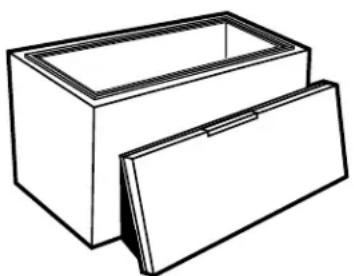
Remove doors or lid from your old freezer or refrigerator.
Failure to do so can result in death or brain damage.
IMPORTANT: Child entrapment and suffocation are not problems of the past. Junked or abandoned freezers or refrigerators are still dangerous ... even if they will sit for "just a few days."
Excessive Weight Hazard
Use two or more people to move and install freezer.
Failure to do so can result in back or other injury.
Remove Packaging Materials
- Remove tape and glue residue from surfaces before turning on the freezer. Rub a small amount of liquid dish soap over the adhesive with your fingers. Wipe with warm water and dry.
- Do not use sharp instruments, rubbing alcohol, flammable fluids, or abrasive cleaners to remove tape or glue. These products can damage the surface of your freezer. For more information, see "Freezer Safety."
When Moving Your Freezer:
Your freezer is heavy. When moving the freezer for cleaning or service, be sure to cover the floor with cardboard or hardboard to avoid floor damage. Always pull the freezer straight out when moving it. Do not wiggle or "walk" the freezer when trying to move it, as floor damage could occur.
Clean Before Using
After you remove all of the packaging materials, clean the inside of your freezer before using it. See the cleaning instructions in "Freezer Care."
Important information to know about glass shelves and covers:
Do not clean glass shelves or covers with warm water when they are cold. Shelves and covers may break if exposed to sudden temperature changes or impact, such as bumping. Tempered glass is designed to shatter into many small, pebble-size pieces. This is normal. Glass shelves and covers are heavy. Use both hands when removing them to avoid dropping.
Location Requirements
WARNING
Explosion Hazard
Keep flammable materials and vapors, such as gasoline, away from freezer.
Failure to do so can result in death, explosion, or fire.
IMPORTANT: Check the strength of the floor before installing your freezer. It should hold the weight of a freezer fully loaded with food.
Ventilation and Clearance
- Keep flammable materials and vapors, such as gasoline, away from freezer.
- Do not cover the freezer with items such as blankets, sheets, tablecloths, etc. This reduces air circulation.
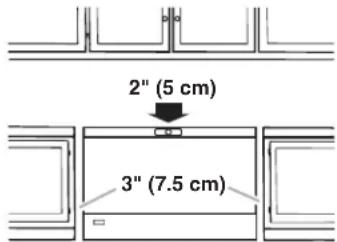
- Allow at least a 3'' (7.5 cm) clearance on both sides of the freezer and 2'' (5 cm) between the back of the freezer and the wall. Leave room above the freezer to open the lid.
Temperature
Your freezer operates most efficiently when located in an area where the temperature is normally between 32^ (0^) and 110^ (43^) . Do not install the freezer near an oven, radiator, or other heat source.
Upon Moving to Final Location
- Level the freezer from side to side and front to back so that the lid will seal properly. Use shims to level the freezer if necessary.
NOTE: It should not be necessary to remove the lid during installation. If, for any reason, the hinges need adjustment, contact a designated service company.
Electrical Requirements
WARNING
Electrical Shock Hazard
Plug into a grounded 3 prong outlet.
Do not remove ground prong.
Do not use an adapter.
Do not use an extension cord.
Failure to follow these instructions can result in death, fire, or electrical shock.
Before you move your freezer into its final location, it is important to make sure you have the proper electrical connection.
Recommended Grounding Method
A 115 Volt, 60Hz , AC-only, 15-amp fused and grounded (earthed) electrical supply is required.
It is recommended that a separate circuit serving only your freezer be provided. Use an outlet that cannot be turned off by a switch. Do not use an extension cord.
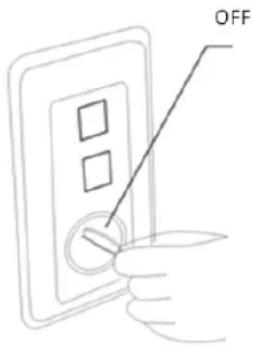
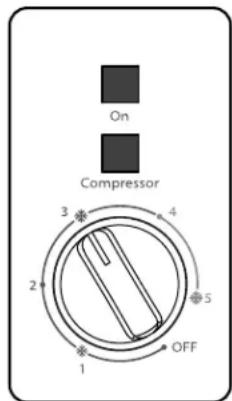
NOTE: Before performing any type of installation or cleaning, turn the Temperature Control to the OFF position as shown and then disconnect the freezer from the electrical source.
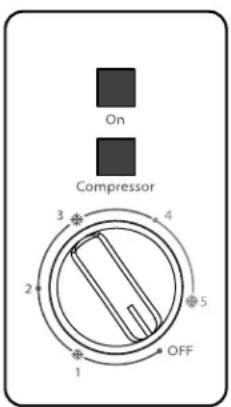
NOTE:To turn off the freezer requires moving the knob to the OFF position, place a coin on the knob carefully, and turn it down to the OFF position. (Please see the picture below).
FREEZER USE
Using the Control
Turn the freezer temperature control to 3. This setting is designed to maintain the temperature at or near 0^ (-17.8^) under normal operating conditions.
IMPORTANT: Allow the freezer to cool 6 to 8 hours before filling with frozen food. Let the freezer cool overnight before adding large amounts of unfrozen food. Do not add more than 2 to 3 lbs (0.907 to 1.360kg ) of unfrozen food per cubic foot of freezer space.
NOTES:
- When the freezer is first started, the compressor will run constantly until the interior is cooled. It may take 6 to 8 hours (or longer), depending on location, room temperature, and the number of times the freezer lid is opened.
After the cabinet is cooled, the compressor will turn on and off as needed to keep the freezer at the proper temperature.
Each time the lid is opened, cold air escapes and the temperature inside the freezer rises.
The outside of your freezer may feel warm. This is normal. The freezer's design and main function is to remove heat from the contents and air inside the freezer. The heat is transferred to the room air, making the outside of the freezer feel warm.
Adjusting the Control
Turn control to a higher number for colder temperatures.
Turn control to a lower number for less cold temperatures.
Indicator Lights
The indicator lights are located on the front of the freezer above the control. The lights assure you that your freezer is operating. The indicator lights are LED which do not need to be replaced. ON indicator light - shows you that there is power to the freezer. COMPRESSOR indicator light - shows you that the compressor is running.
If the ON indicator light is not illuminated, immediately check for:
A power interruption.
An unplugged power cord.
An open circuit breaker or blown fuse.
NOTE: If there is power to the freezer, and the ON indicator does not illuminate, the indicator light may be burned out. Call Service to replace the indicator lights.
If the COMPRESSOR indicator is not illuminated: the compressor is in its off cycle.
NOTE: The compressor automatically cycles off and on to maintain the desired temperature.
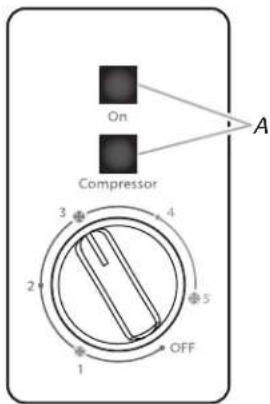
A. Indicator lights
Sliding Basket
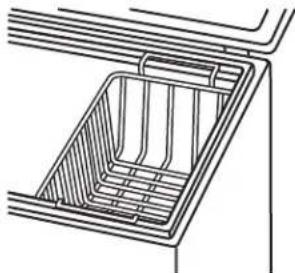
Store small packages in the basket to avoid losing them in the bottom of the freezer. The basket can then be moved from side to side or it can be removed when loading or unloading the food below it.
To remove basket, lift it straight up and out. To replace basket, lower basket back into place.
FREEZER CARE
Defrosting and Cleaning Your Freezer
WARNING
Explosion Hazard
Use nonflammable cleaner.
Failure to do so can result in death, explosion, or fire.
Accumulation of frost and ice will lessen the performance of the freezer. Complete defrosting and cleaning should be done at least twice a year or when frost has built up to about 14 (0.6 cm) thickness. In high humidity areas, a freezer may need more frequent defrosting and cleaning.
Before Defrosting
- Turn the temperature control dial to setting 5, approximately 6 hours before defrosting, to ensure frozen food is at the lowest temperature before removing it from the freezer.
- Remove all frozen food. Wrap frozen food in several layers of newspaper and cover with a blanket. Food will stay frozen for several hours. You may also store frozen food in a cooler, additional refrigerator-freezer, or in a cool area.
- Remove the freezer basket and leave the lid open.
Defrosting
- Unplug freezer or disconnect power.
- Remove the rubber cap from the drain on the freezer floor by pulling it straight up. Set the cap aside until defrosting is completed.
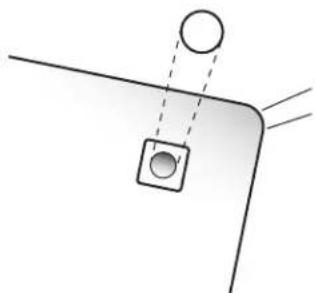
- Place containers of warm water in the freezer, keeping the lid open, to speed melting. As the ice melts, water will collect on the bottom of the freezer.
- Use a plastic scraper to remove frost.
NOTE: Do not use electrical appliances such as hair dryers or heaters to speed defrosting. Do not use an ice pick, knife, or other sharp-pointed tool to defrost freezer. Damage can occur.
- Place a pan under the drain, located at the rear of the freezer. Pull the drain plug outward, extending the drain until the hole in the tube is visible.
- Turn the drain so that the arrow is pointing downward. The defrost water will drip into the hole and flow out.
NOTE: Check the drain pan frequently to avoid water overflow. Have a second pan handy for easier emptying.
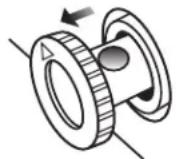
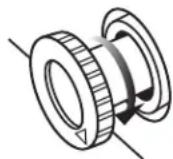
- Wipe water from freezer walls with a towel or sponge.
- Once no more water is draining from the freezer, push the drain back into place and turn it so the arrow is pointing upward.
Cleaning
IMPORTANT:
- Do not use abrasive cleaners on your freezer. Do not use cleaning waxes, concentrated detergents, bleaches, or cleaners containing petroleum on plastic parts. Damage can occur.
- Do not use water around the compressor. After defrosting and cleaning dry the compressor area thoroughly to avoid rust.
- Wash the inside walls with a solution of mild detergent in warm water or 2 Tbs (26 mg) bakingsoda to 1 qt (0.95 L) warm water. Do not use abrasive or harsh cleaners.
- Rinse well and wipe dry with a clean soft cloth.
- Wash the outside of the freezer, lid liner, and gasket with a clean sponge or soft cloth and mild detergent in warm water.
NOTE: Check the lid gasket regularly to ensure it is clean and free from food particles.
- Rinse well and wipe dry with a clean, soft cloth.
- Wax painted metal surfaces on the outside of freezer to avoid rust.
NOTE: Do not use wax on plastic parts. Wax may damage them.
Final Steps
If you will not be using the freezer for a long period of time:
- Replace the drain cap.
- Do not plug in freezer or reconnect power.
- Leave the lid ajar to avoid moisture buildup.
If you will use the freezer immediately:
- Replace the drain cap.
- Replace all frozen food.
- Plug in freezer or reconnect power.
- Turn the Temperature control to the highest number (coldest setting) for approximately 3 hours to quickly cool the freezer. Then, select your preferred temperature. See "Using the Control."
Power Interruptions
If the power will be out for 24 hours or less, keep the door closed to help food stay cold and frozen.
If the power will be out for more than 24 hours, do one of the following:
Remove all frozen food and store it in a frozen food locker.
If a food locker is not available, consume or can perishable food at once.
After the power is restored, unplug the freezer for 30 minutes to allow the refrigeration system to equalize. During this time, keep the door closed whenever possible.
REMEMBER: A full freezer stays cold longer than a partially filled one. A freezer full of meat stays cold longer than a freezer full of baked goods. If you see that food contains ice crystals, it may be refrozen, although the quality and flavor may be affected. If the condition of the food is poor, dispose of it.
Moving Care
When you are moving your freezer to a new home, follow these steps to prepare it for the move.
- Remove all frozen food.
- Unplug the freezer.
- Take out all removable parts, wrap them well, and tape them together so they don't shift and rattle during the move.
- Clean the freezer thoroughly.
- Tape the freezer shut and tape the electrical cord to the cabinet.
When you get to your new home, refer to the "Installation Instructions" and "Freezer Use" sections for information on installation and setting the controls.
TROUBLESHOOTING
Try the solutions suggested here first to avoid the cost of an unnecessary service call.
Your freezer will not operate
WARNING
Electrical Shock Hazard
Plug into a grounded 3 prong outlet.
Do not remove ground prong.
Do not use an adapter.
Do not use an extension cord.
Failure to follow these instructions can result in death, fire, or electrical shock.
Is the power supply cord unplugged? Plug into a grounded 3 prong outlet.
Has a household fuse blown or circuit breaker tripped? Replace the fuse or reset the circuit.
Is the temperature control set to a numbered setting? Refer to the "Using the Control" section.
Indicator Lights
■ Is the ON indicator not illuminated? There is no power to the freezer. Check the power source. See "Indicator Lights."
■ Is there power to the freezer, but the ON indicator is not illuminated? The indicator light may be burned out. Call Service to replace the indicator light.
Is the COMPRESSOR indicator not illuminated? The indicator illuminates only when the compressor is on. The compressor cycles off and on to maintain the desired temperature. See "Using the Control."
The motor seems to run too much
WARNING
Explosion Hazard
Use nonflammable cleaner.
Failure to do so can result in death, explosion, or fire.
■ Is there excessive frost or a package keeping the door or lid from closing? Defrost and clean the freezer, or move the package so the lid closes properly.
Is the room temperature hotter than normal? Expect the motor to run longer under warm conditions. At normal room temperatures, expect your motor to run about 40% to 80% of the time. Under warmer conditions, expect it to run even more of the time.
■ Has a large amount of food just been added to the freezer? Adding a large amount of food warms the freezer. It is normal for the motor to run longer in order to cool the freezer back down. Add no more unfrozen food at one time than will freeze in 24 hours — approximately 2 to 3 lbs (0.9 to 1.4kg ) per cubic foot of freezer space.
■ Is the lid opened often? Expect the motor to run longer when this occurs. In order to conserve energy, try to get everything you need out of the freezer at once, keep food organized so it is easy to find, and close the lid as soon as the food is removed.
Is the control set correctly for the surrounding conditions? Refer to the "Using the Control" section.
■ Is the lid not closed completely? Push the lid firmly shut. If it will not shut all the way, see "The lid will not close completely" later in this section.
Is the lid gasket sealed all the way around? Contact a qualified person or a technician.
Is there enough air circulation space around the freezer? See the "Location Requirements" section.
NOTE: If the problem is not due to any of the above, remember that your new freezer will run longer than your old one due to its high-efficiency motor.
Interior temperature is too warm
Is the lid opened often? Be aware that the freezer will warm when this occurs. In order to keep the freezer cool, try to get everything you need out of the freezer at once, keep food organized so it is easy to find, and close the lid as soon as the food is removed.
- Has a large amount of food just been added to the freezer? Adding a large amount of food warms the freezer. It can take several hours for the freezer to return to the normal temperature.
Is the control set correctly for the surrounding conditions? Refer to the "Using the Control" section.
Exterior of freezer feels warm
This is normal. The freezer's main function is to remove heat from the contents and air inside the freezer. The heat is transferred to the room air, which makes the outside of the freezer feel warm.
The lid will not close completely
Are food packages blocking the lid? Rearrange containers so that they fit more tightly and take up less space.
WARNING
Explosion Hazard
Use nonflammable cleaner.
Failure to do so can result in death, explosion, or fire.
Are the gaskets dirty or sticky? Clean gaskets according to the directions in the "Freezer Care" section.
Does the freezer wobble or seem unstable? Level the freezer. Refer to the "Location Requirements" section.
The lid is difficult to open
WARNING
Explosion Hazard
Use nonflammable cleaner.
Failure to do so can result in death, explosion, or fire.
Are the gaskets dirty or sticky? Clean gaskets according to the directions in the "Freezer Care" section.
The freezer clicks but does not run
Has the local power failed? Unplug the freezer for 30 minutes to allow the refrigeration system to equalize. During this time, keep the lid closed whenever possible.
AMANA® MAJOR APPLIANCE LIMITED WARRANTY
ATTACH YOUR RECEIPT HERE. PROOF OF PURCHASE IS REQUIRED TO OBTAIN WARRANTY SERVICE.
Please have the following information available when you call the Customer eXperience Center:
Name, address and telephone number
Model number and serial number
A clear, detailed description of the problem
Proof of purchase including dealer or retailer name and address
IF YOU NEED SERVICE:
- Before contacting us to arrange service, please determine whether your product requires repair. Some questions can be addressed without service. Please take a few minutes to review the Troubleshooting or Problem Solver section of the Use and Care Guide, scan the QR code on the right to access additional resources, or visit http://amana.custhelp.com.
- All warranty service is provided exclusively by our authorized Amana Service Providers. In the U.S. and Canada, direct all requests for warranty service to:
http://amana.custhelp.com
Amana Customer eXperience Center
In the U.S.A., call 1-800-843-0304. In Canada, call 1-800-807-6777.
If outside the 50 United States or Canada, contact your authorized Amana dealer to determine whether another warranty applies.
ONE YEAR LIMITED WARRANTY
WHAT IS COVERED WHAT IS NOT COVERED
For one year from the date of purchase, when this major appliance is installed, operated and maintained according to instructions attached to or furnished with the product, Amana brand of Whirlpool Corporation or Whirlpool Canada LP (hereafter "Amana") will pay for Factory Specified Replacement Parts and repair labor to correct defects in materials or workmanship that existed when this major appliance was purchased, or at its sole discretion replace the product. In the event of product replacement, your appliance will be warranted for the remaining term of the original unit's warranty period.
YOUR SOLE AND EXCLUSIVE REMEDY UNDER THIS LIMITED WARRANTY SHALL BE PRODUCT REPAIR AS PROVIDED HEREIN. Service must be provided by a Amana designated service company. This limited warranty is valid only in the United States or Canada and applies only when the major appliance is used in the country in which it was purchased. This limited warranty is effective from the date of original consumer purchase. Proof of original purchase date is required to obtain service under this limited warranty.
- Commercial, non-residential, multiple-family use, or use inconsistent with published user, operator or installation instructions.
- In-home instruction on how to use your product.
- Service to correct improper product maintenance or installation, installation not in accordance with electrical or plumbing codes or correction of household electrical or plumbing (i.e. house wiring, fuses or water inlet hoses).
- Consumable parts (i.e. light bulbs, batteries, air or water filters, preservation solutions, etc.).
- Defects or damage caused by the use of non-genuine Amana parts or accessories.
- Conversion of products from natural gas or L.P. gas.
- Damage from accident, misuse, abuse, fire, floods, acts of God or use with products not approved by Amana.
- Repairs to parts or systems to correct product damage or defects caused by unauthorized service, alteration or modification of the appliance.
- Cosmeti c damage including scratches, dents, chips, and other damage to the appliance finishes unless such damage results from defects in materials and workmanship and is reported to Amana within 30 days.
- Discoloration, rust or oxidation of surfaces resulting from caustic or corrosive environments including but not limited to high salt concentrations, high moisture or humidity or exposure to chemicals.
- Food or medicine loss due to product failure.
- Pick-up or delivery. This product is intended for in-home repair.
- Travel or transportation expenses for service in remote locations where an authorized Amana servicer is not available.
- Removal or reinstallation of inaccessible appliances or built-in fixtures (i.e. trim, decorative panels, flooring, cabinetry, islands, countertops, drywall, etc.) that interfere with servicing, removal or replacement of the product.
- Service or parts for appliances with original model/serial numbers removed, altered or not easily determined.
The cost of repair or replacement under these excluded circumstances shall be borne by the customer.
DISCLAIMER OF IMPLIED WARRANTYES
IMPLIED WARRANTY, INCLUDING ANY IMPLIED WARRANTY OF MERCHANTABILITY OR IMPLIED WARRANTY OF FITNESS FOR A PARTICULAR PURPOSE, ARE LIMITED TO ONE YEAR OR THE SHORTEST PERIOD ALLOWED BY LAW. Some states and provinces do not allow limitations on the duration of implied warranties of merchantability or fitness, so this limitation may not apply to you. This warranty gives you specific legal rights, and you also may have other rights that vary from state to state or province to province.
DISCLAIMER OF REPRESENTATIONS OUTSIDE OF WARRANTY
Amana makes no representations about the quality, durability, or need for service or repair of this major appliance other than the representations contained in this warranty. If you want a longer or more comprehensive warranty than the limited warranty that comes with this major appliance, you should ask Amana or your retailer about buying an extended warranty.
LIMITATION OF REMEDIES; EXCLUSION OF INCIDENTAL AND CONSEQUENTIAL DAMAGES
YOUR SOLE AND EXCLUSIVE REMEDY UNDER THIS LIMITED WARRANTY SHALL BE PRODUCT REPAIR AS PROVIDED HEREIN. AMANA SHALL NOT BE LIABLE FOR INCIDENTAL OR CONSEQUENTIAL DAMAGES. Some states and provinces do not allow the exclusion or limitation of incidental or consequential damages, so these limitations and exclusions may not apply to you. This warranty gives you specific legal rights, and you also may have other rights that vary from state to state or province to province.
SECURITE DU CONGÉLATEUR

- CONGÉLATEUR COFFRE
- TABLE DES MATIÈRES
- Your safety and the safety of others are very important.
- DANGER
- WARNING
- IMPORTANT SAFETY INSTRUCTIONS
- SAVE THESE INSTRUCTIONS
- Proper Disposal of Your Old Freezer or Refrigerator
- Remove Packaging Materials
- When Moving Your Freezer:
- Clean Before Using
- Important information to know about glass shelves and covers:
- Location Requirements
- Ventilation and Clearance
- Temperature
- Upon Moving to Final Location
- Electrical Requirements
- Electrical Shock Hazard
- Recommended Grounding Method
- FREEZER USE
- Using the Control
- NOTES:
- Adjusting the Control
- Indicator Lights
- Sliding Basket
- FREEZER CARE
- Defrosting and Cleaning Your Freezer
- Explosion Hazard
- Before Defrosting
- Defrosting
- Cleaning
- IMPORTANT:
- Final Steps
- Power Interruptions
- Moving Care
- TROUBLESHOOTING
- Interior temperature is too warm
- Exterior of freezer feels warm
- The lid will not close completely
- The lid is difficult to open
- The freezer clicks but does not run
- AMANA® MAJOR APPLIANCE LIMITED WARRANTY
- IF YOU NEED SERVICE:
- ONE YEAR LIMITED WARRANTY
- WHAT IS COVERED WHAT IS NOT COVERED
- DISCLAIMER OF IMPLIED WARRANTYES
- DISCLAIMER OF REPRESENTATIONS OUTSIDE OF WARRANTY
- LIMITATION OF REMEDIES; EXCLUSION OF INCIDENTAL AND CONSEQUENTIAL DAMAGES
- SECURITE DU CONGÉLATEUR
Brand : AMANA
Model : AQC0701GRW
Category : Freezer