ManualGo.com
MORADW116 - Cooker Monogram - Free user manual and instructions
Find the device manual for free MORADW116 Monogram in PDF.



Download the instructions for your Cooker in PDF format for free! Find your manual MORADW116 - Monogram and take your electronic device back in hand. On this page are published all the documents necessary for the use of your device. MORADW116 by Monogram.
USER MANUAL MORADW116 Monogram
- 49-85246-1 10-17 GEA Monogram.com OWNER’S MANUAL 30”, 36” and 48” Professional All-Gas Ranges ENGLISH/FRANÇAIS/ESPAÑOL2 49-85246-1 Contents Professional All-Gas Range Contents Consumer Information p. 3
- Safety Information p. 5
- Features of Your Range p. 9
- Cooktop Controls Electronic ignition & automatic reignition p. 10
- To light a surface burner p. 10
- Dual-flame stacked burners p. 10
- Surface Cooking How to select flame size p. 11
- Wok cooking p. 11
- Grill safety precautions p. 12
- Using the IR grill p. 12
- Grill grates p. 13
- Grill radiant baffle p. 13
- Griddle safety precautions, leveling p. 14
- Using the griddle p. 14
- Features of Your Oven p. 15
- Oven Control p. 16
- Baking Tips Rear oven vents p. 17
- Aluminum Foil and Oven Liners p. 17
- Pan placement p. 17
- Baking pans/sheets p. 17
- Preheating p. 17
- Oven Racks Full extension oven racks p. 18
- Remove and replace oven racks p. 18
- Low profile oven rack p. 18
- Baking How to set the oven for baking p. 19
- Broiling Introduction to broiling p. 20
- How to set the oven for broiling p. 20
- Broiling guide p. 21
- Aluminum foil p. 21
- Convection Baking or Roasting Introduction to convection cooking p. 22
- Cookware for convection cooking p. 22
- Adapting recipes p. 22
- Convection roasting tips p. 22
- How to set the oven for convection baking or roasting p. 23
- Using the Probe How to use the probe with bake, convection bake and convection roast p. 24
- Using the probe p. 24
- Proper placement of the probe p. 25
- Proofing How to set the oven for proofing p. 25
- Self-Cleaning Oven Self-cleaning safety precautions p. 26
- How to set the oven for cleaning p. 26
- After a clean cycle p. 27
- Timer p. 27
- Special Features Oven thermostat adjustment p. 28
- Sabbath mode p. 28
- Care and Cleaning Control panel and knobs p. 29
- Oven burners p. 29
- Broiler pan, grid and roasting rack p. 29
- Oven racks p. 30
- Low profile oven rack p. 30
- Lift-off oven door p. 31
- Probe p. 31
- Oven lights p. 32
- To clean the door p. 33
- Stainless steel surfaces p. 33
- Oven bottom p. 33
- Dual-flame stacked burners p. 34
- Spark igniter and electrodes p. 35
- Burner grates p. 35
- Grease troughs p. 36
- Griddle p. 36
- Cutting board p. 36
- Grill grate, frame and baffle p. 37
- Troubleshooting Tips p. 38
- Warranty p. 43
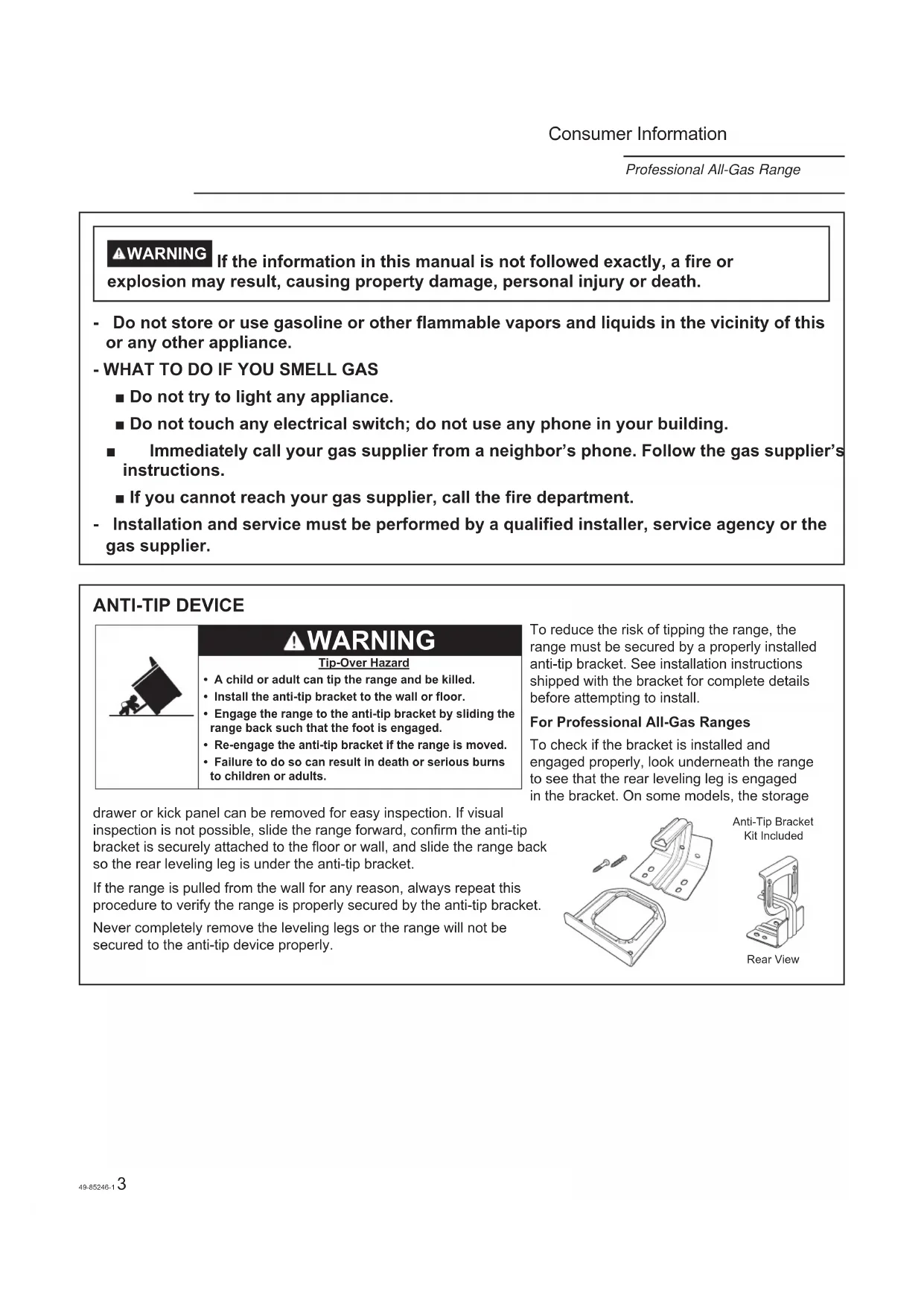
- Consumer Support -85246-1 3 Consumer Information Professional All-Gas Range ANTI-TIP DEVICE To reduce the risk of tipping the range, the range must be secured by a properly installed anti-tip bracket. See installation instructions shipped with the bracket for complete details before attempting to install. For Professional All-Gas Ranges To check if the bracket is installed and engaged properly, look underneath the range to see that the rear leveling leg is engaged in the bracket. On some models, the storage drawer or kick panel can be removed for easy inspection. If visual inspection is not possible, slide the range forward, confirm the anti-tip bracket is securely attached to the floor or wall, and slide the range back so the rear leveling leg is under the anti-tip bracket. If the range is pulled from the wall for any reason, always repeat this procedure to verify the range is properly secured by the anti-tip bracket. Never completely remove the leveling legs or the range will not be secured to the anti-tip device properly. WARNING If the information in this manual is not followed exactly, a fire or explosion may result, causing property damage, personal injury or death. - Do not store or use gasoline or other flammable vapors and liquids in the vicinity of this or any other appliance. - WHAT TO DO IF YOU SMELL GAS p. 4449
- Installation and service must be performed by a qualified installer, service agency or the gas supplier. Anti-Tip Bracket Kit IncludedRear View• A child or adult can tip the range and be killed.• Install the anti-tip bracket to the wall or floor.• Engage the range to the anti-tip bracket by sliding the range back such that the foot is engaged.• Re-engage the anti-tip bracket if the range is moved.• Failure to do so can result in death or serious burns to children or adults.Tip-Over Hazard
If you received a damaged cooktop Immediately contact the dealer (or builder) that sold you the range. Trouble- shooting tips Before you request service, check the Problem Solver in the back of this manual. It lists causes of minor operating problems that you can correct yourself. If you need service To obtain service, see the Consumer Services page in the back of this manual. We’re proud of our service and want you to be pleased. If for some reason you are not happy with the service you receive, here are steps to follow for further help. FIRST, contact the people who serviced your appliance. Explain why you are not pleased. In most cases, this will solve the problem. NEXT, if you are still not pleased, write all the details—including your phone number—to: Manager, Customer Relations GE Appliances Appliance Park Louisville, KY 40225 Remove packaging tape Carefully remove all packaging, foam pads and tape. To assure no damage is done to the finish of the product, the safest way to remove the adhesive from packaging tape on new appliances is an application of a household liquid dishwashing detergent. Apply with a soft cloth and allow to soak. NOTE: The adhesive must be removed from all parts. It cannot be removed if it is baked on. Write down the model & serial numbers You’ll find them on a label located behind the left burner knob or below the control panel which is visible when the oven door is opened. Before sending in the registration card, please write these numbers here: Model Number Serial Number Use these numbers in any correspondence or service calls concerning your range. Consumer Information Professional All-Gas Range49-85246-1 5
READ ALL INSTRUCTIONS BEFORE USING THE APPLIANCE
READ AND SAVE THESE INSTRUCTIONS
WARNING Read all safety instructions before using the product. Failure to follow these instructions may result in fire, electrical shock, serious injury or death. WARNING
GENERAL SAFETY INSTRUCTIONS
WARNING NEVER use this appliance as a space heater to heat or warm the room. Doing so may result in carbon monoxide poisoning and overheating of the oven.Ŷ 8VHWKLVDSSOLDQFHIRULWVLQWHQGHGSXUSRVHDVdescribed in this owner’s manual.Ŷ +DYH\RXUUDQJHLQVWDOOHGDQGSURSHUO\JURXQGHGE\a qualified installer in accordance with the provided installation instructions.Ŷ $Q\DGMXVWPHQWDQGVHUYLFHVKRXOGEHSHUIRUPHGRQO\by a qualified gas range installer or service technician. Do not attempt to repair or replace any part of your range unless it is specifically recommended in this manual.Ŷ <RXUUDQJHLVVKLSSHGIURPWKHIDFWRU\VHWIRUXVHZLWKnatural gas or propane (LP) gas. It can be converted for use with either. If required, these adjustments must be made by a qualified technician in accordance with the installation instructions and local codes. The agency performing this work assumes responsibility for the conversion.Ŷ +DYHWKHLQVWDOOHUVKRZ\RXWKHORFDWLRQRIWKHUDQJHgas shut-off valve and how to turn it off if necessary.Ŷ 3OXJ\RXUUDQJHLQWRDYROWJURXQGHGRXWOHWonly. Do not remove the round grounding prong from the plug. If in doubt about the grounding of the home electrical system, it is your responsibility and obligation to have an ungrounded outlet replaced with a properly grounded, three prong outlet in accordance with the National Electrical Code. Do not use an extension cord with this appliance.Ŷ %HIRUHSHUIRUPLQJDQ\VHUYLFHXQSOXJWKHUDQJHor disconnect the power supply at the household distribution panel by removing the fuse or switching off the circuit breaker.Ŷ %HVXUHDOOSDFNLQJPDWHULDOVDUHUHPRYHGIURPWKHrange before operating to prevent ignition of these materials.Ŷ $YRLGVFUDWFKLQJRULPSDFWLQJJODVVGLVSOD\V'RLQJso may lead to glass breakage. Do not cook on a product with broken glass. Shock, fire, or cuts may occur.Ŷ 'RQRWOHDYHFKLOGUHQDORQHRUXQDWWHQGHGLQDQDUHDwhere an appliance is in use. They should never be allowed to climb, sit or stand on any part of the appliance. CAUTION Do not store items of interest to children in cabinets above an oven - children climbing on the oven to reach items could be seriously injured.Ŷ 1HYHUEORFNWKHYHQWVDLURSHQLQJVRIWKHUDQJHThey provide the air inlets and outlets that are necessary for the range to operate properly with correct combustion. Air openings are located at the rear of the cooktop, at the top and bottom of the oven door, and at the bottom of the range.Ŷ 8VHRQO\GU\SRWKROGHUV²PRLVWRUGDPSSRWKROGHUVon hot surfaces may result in burns from steam. Do not let pot holders touch surface burners, burner grate, or oven heating element. Do not use a towel or other bulky cloth in place of pot holders.Ŷ 'RQRWWRXFKWKHKHDWLQJHOHPHQWVRUWKHLQWHULRUsurface of the oven. These surfaces may be hot enough to burn even though they are dark in color. During and after use, do not touch, or let clothing or other flammable materials contact any interior area of the oven; allow sufficient time for cooling first. Other surfaces of the appliance may become hot enough to cause burns. Potentially hot surfaces include the burners, grates, oven vent opening, surfaces near the opening, crevices around the oven door, metal trim parts above the door, any backguard, or high shelf surface.Ŷ 'RQRWKHDWXQRSHQHGIRRGFRQWDLQHUV3UHVVXUHcould build up and the container could burst, causing an injury.6 49-85246-1
IMPORTANT SAFETY INFORMATION
READ ALL INSTRUCTIONS BEFORE USING THE APPLIANCE WARNING GENERAL SAFETY INSTRUCTIONS (cont.) Ŷ &RRNIRRGWKRURXJKO\WRKHOSSURWHFWDJDLQVWfoodborne illness. Minimum safe food temperature recommendations can be found at www.IsItDoneYet.gov and www.fsis.usda.gov. Use a food thermometer to take food temperatures and check several locations.Ŷ 'RQRWDOORZDQ\RQHWRFOLPEVWDQGRUKDQJRQWKHoven door, drawer or cooktop. They could damage the range or tip it over causing severe injury or death.Ŷ .HHSWKHYHQWLODWRUKRRGDQGJUHDVHILOWHUVFOHDQto maintain good venting and to avoid grease fires. Turn the ventilator OFF in case of a fire or when intentionally "flaming" liquor or other spirits on the cooktop. The blower if in operation, could spread the flames.
READ AND SAVE THESE INSTRUCTIONS
WARNING KEEP FLAMMABLE MATERIALS AWAY FROM THE RANGE Failure to do so may result in fire or personal injury.Ŷ 'RQRWVWRUHRUXVHIODPPDEOHPDWHULDOVLQDQRYHQRUnear the cooktop, including paper, plastic, pot holders, linens, wall coverings, curtains, drapes and gasoline or other flammable vapors and liquids.Ŷ 1HYHUZHDUORRVHILWWLQJRUKDQJLQJJDUPHQWVZKLOHusing the appliance. These garments may ignite if they contact hot surfaces causing severe burns.Ŷ 'RQRWOHWFRRNLQJJUHDVHRURWKHUIODPPDEOHmaterials accumulate in or near the range. Grease in the oven or on the cooktop may ignite. WARNING IN THE EVENT OF A FIRE, TAKE THE FOLLOWING STEPS TO PREVENT INJURY AND FIRE SPREADING Ŷ 'RQRWXVHZDWHURQJUHDVHILUHV1HYHUSLFNXSDflaming pan. Turn the controls off. Smother a flaming pan on a surface unit by covering the pan completely with a well-fitting lid, cookie sheet or flat tray. Use a multi-purpose dry chemical or foam-type fire extinguisher.Ŷ ,IWKHUHLVDILUHLQWKHRYHQGXULQJEDNLQJVPRWKHUWKHfire by closing the oven door and turning the oven off or by using a multi-purpose dry chemical or foam-type fire extinguisher.Ŷ ,IWKHUHLVDILUHLQWKHRYHQGXULQJVHOIFOHDQWXUQWKHoven off and wait for the fire to go out. Do not force the door open. Introduction of fresh air at self-clean temperatures may lead to a burst of flame from the oven. Failure to follow this instruction may result in severe burns.49-85246-1 7
IMPORTANT SAFETY INFORMATION
READ ALL INSTRUCTIONS BEFORE USING THE APPLIANCE
READ AND SAVE THESE INSTRUCTIONS
COOKTOP SAFETY INSTRUCTIONS
Ŷ 1HYHUOHDYHWKHVXUIDFHEXUQHUVXQDWWHQGHGDWmedium or high heat settings. Foods, especially oily foods, may ignite resulting in fire that could spread to surrounding cabinets.Ŷ 1HYHUOHDYHRLOXQDWWHQGHGZKLOHIU\LQJ,IDOORZHGWRheat beyond its smoking point, oil may ignite resulting in fire that may spread to surrounding cabinets. Use a deep fat thermometer whenever possible to monitor oil temperature.Ŷ 7RDYRLGRLOVSLOORYHUDQGILUHXVHWKHPLQLPXPamount of oil when using a shallow pan-frying and avoid cooking frozen foods with excessive amounts of ice.Ŷ 8VHSURSHUSDQVL]HDQGDYRLGSDQVWKDWDUHXQVWDEOHor easily tipped. Select cookware that is matched to the size of the burner. Burner flames should be adjusted so that they do not extend beyond the bottom of the pan. Excessive flame may be hazardous.Ŷ $OZD\VXVHWKH/,7(SRVLWLRQZKHQLJQLWLQJWKHWRSburners and make sure the burners have ignited.Ŷ :KHQXVLQJJODVVFHUDPLFFRRNZDUHPDNHVXUHLWis suitable for cooktop service; others may break because of sudden change in temperature.Ŷ 7RPLQLPL]HWKHSRVVLELOLW\RIEXUQVLJQLWLRQRIflammable materials and spillage, the handle of a container should be turned toward the center of the range without extending over nearby burners.Ŷ 'RQRWXVHDZRNZLWKDURXQGPHWDOVXSSRUWULQJThe ring may trap heat and block air to the burner resulting in a carbon monoxide hazard.Ŷ 'RQRWDWWHPSWWROLIWWKHFRRNWRS'RLQJVRPD\damage the gas tubing to the surface burners resulting in a gas leak and risk of fire.Ŷ :KHQGLVDEOLQJ/RFN&RQWURORQVRPHPRGHOVmake sure the surface controls are set to the OFF position. This will prevent unintended gas flow from the burners.Ŷ 'RQRWXVHDOXPLQXPIRLOWRFRYHUWKHJUDWHVRUline any part of the cooktop. Doing so may result in carbon monoxide poisoning, overheating of the cooktop surfaces, or a potential fire hazard.WARNING
OVEN SAFETY INSTRUCTIONS
WARNING NEVER cover any slots, holes, or passages in the oven bottom or cover an entire rack with materials such as aluminum foil or oven liners. Doing so blocks air flow through the oven and may cause carbon monoxide poisoning. Never place foil or oven liners on the oven bottom. They can trap heat causing risk of smoke or fire.Ŷ 6WDQGDZD\IURPWKHUDQJHZKHQRSHQLQJWKHRYHQdoor. Hot air or steam which escapes can cause burns to hands, face and/or eyes.Ŷ 1HYHUSODFHFRRNLQJXWHQVLOVSL]]DRUEDNLQJVWRQHVor any type of foil or liner on the oven floor. These items can trap heat or melt, resulting in damage to the product and risk of shock, smoke or fire.Ŷ 3ODFHRYHQUDFNVLQGHVLUHGORFDWLRQZKLOHRYHQLVcool. If rack must be moved while oven is hot, be careful to avoid touching hot surfaces.Ŷ 'RQRWOHDYHLWHPVVXFKDVSDSHUFRRNLQJXWHQVLOVRUfood in the oven when not in use. Items stored in an oven can ignite.Ŷ 'RQRWOHDYHLWHPVRQWKHFRRNWRSQHDUWKHRYHQvent. Items may overheat resulting in a risk of fire or burns.Ŷ 1HYHUEURLOZLWKGRRURSHQ2SHQGRRUEURLOLQJLVQRWpermitted due to overheating of control knobs.8 49-85246-1
READ AND SAVE THESE INSTRUCTIONS
SELF-CLEANING OVEN SAFETY INSTRUCTIONS
The self-cleaning feature operates the oven at temperatures high enough to burn away food soils in the oven. Follow these instructions for safe operation.Ŷ 'RQRWWRXFKRYHQVXUIDFHVGXULQJVHOIFOHDQoperation. Keep children away from the oven during self-cleaning. Failure to follow these instructions may cause burns.Ŷ %HIRUHRSHUDWLQJWKHVHOIFOHDQF\FOHUHPRYHSDQVshiny metal oven racks, and other utensils from the oven. Only porcelain-coated oven racks may be left in the oven.Ŷ %HIRUHRSHUDWLQJWKHVHOIFOHDQF\FOHZLSHJUHDVHand food soils from the oven. Excessive amount of grease may ignite leading to smoke damage to your home.Ŷ ,IWKHVHOIFOHDQLQJPRGHPDOIXQFWLRQVWXUQWKHRYHQoff and disconnect the power supply. Have it serviced by a qualified technician. Ŷ 'RQRWXVHRYHQFOHDQHUV1RFRPPHUFLDORYHQcleaner or oven liner protective coating of any kind should be used in or around any part of the oven.Ŷ 'RQRWFOHDQWKHGRRUJDVNHW7KHGRRUJDVNHWLVessential for a good seal. Care should be taken not to rub, damage or move the gasket.Ŷ IMPORTANT: The health of some birds is extremely sensitive to the fumes given off during the self-cleaning cycle of any range. Move birds to another well-ventilated room.
STATE OF CALIFORNIA PROPOSITION 65 WARNINGS
WARNING This product contains one or more chemicals known to the State of California to cause cancer, birth defects or other reproductive harm.Self-clean electric ovens: Self clean ovens can cause low level exposure to some of the Proposition 65 substances, including carbon monoxide, during the cleaning cycle. Exposure to these substances can be minimized by opening a window or using a ventilation fan or hood.49-85246-1 9 Design information (Not all features are on all models. Appearance may vary.) Features of Your Range Professional All-Gas Range
6 burners and griddle4 burners, grill and griddle4 burners and griddle6 gas burners 4 gas burners Double oven model shown includes a small oven.Bamboo Cutting BoardGrill and Griddle CoversToekickFeature Index Page1 Bamboo Cutting Board (on some models) 362 Toekick —3 Grill and Griddle Covers (on some models) —4 Oven Vents 175 IR (Infrared) Grill 126 Grill and Griddle Grease Troughs 367 Griddle 148 Cooktop Burner Grates 359 Burner Location Indicator —10 LED Bullnose Task Lighting Control — 11 Burner Control Knob with Lighted Bezel 10, 29 12 Oven Display 1613 Mini-Knob(to select PROBE, TIMER or Special Features)16, 2914 Oven Mode Selector 1615 Oven Temperature Knob 1616 Kitchen Timer 16, 2717 Leveling System (4) —10 49-85246-1 Electronic ignition & automatic reignition To light a surface burner Dual-flame stacked burners The range is equipped with electronic ignition which eliminates the need for a standing pilot light. The burners on this range will automatically relight if the flame goes out. All surface burner igniters will spark and make clicking sounds when any burner is turned on. Do not touch any of the burners when igniters are clicking. Occasionally the burners may spark if excess wind or a draft blows the flame away from the burner’s flame sensor. The griddle and IR (infrared) grill are equipped with Glo-Bar igniters. The Glo-Bar remains energized whenever the griddle or IR grill is in use to ensure the burner always stays lit. In case of a power outage, you can light the surface burners on your cooktop with a match. Hold a lighted match to the burner, then turn the knob to the LOW position. Use extreme caution when lighting burners this way. Do not attempt to light the grill or griddle during a power outage. The gas to these burners will automatically shut off during a power outage. Push the control knob in and turn it counterclockwise to the LITE position. WARNING Burners should be operated only when covered by cookware. Burner flames not covered by cookware present a risk of fire or clothing ignition. Never let flames extend beyond the sides of the cookware. Failure to comply may result in serious injury. After the burner ignites, turn the knob to adjust the flame size. To turn a burner off, turn the knob clockwise, as far as it will go, to the OFF position. Ŷ Do not operate a burner for an extended period of time without cookware on the grate. The finish on the grate may chip without cookware to absorb the heat. Ŷ The indicator light on each bezel verifies the burner is on. However, it should not be a substitute for visually checking the flame at the burner. All surface burners on your range have two sets of flames stacked one on top of the other; the dual-flame burners have a lower (simmer) flame and a upper (main) flame. When a burner is turned on, the lower flame will always light and stay on. Simmering: The stacked burner design provides a wide range of heat settings with which to simmer. Depending on the type and quantity of food, and pan size, the flame can be adjusted to suit your specific need. The lowest setting uses only the lower flame and can maintain delicate foods at a safe 140°F. Cooking: Settings from LO to X-HI will use both upper and lower flames. Use LO to HI for all purpose cooking. Use HI or X-HI (highest setting) with larger diameter cookware. X-HI and HI are very high heat settings and are intended to sear foods quickly and boil large quantities of water. Cooktop Controls Professional All-Gas Range ON Indicator LightLower FlameUpper FlameLower Flame49-85246-1 11 How to select flame size Wok cooking Watch the flame, not the knob, as you increase or reduce heat. The flame size on a gas burner should match the cookware you are using. FOR SAFE HANDLING OF COOKWARE, NEVER LET THE FLAME EXTEND UP THE SIDES OF THE COOKWARE. Any flame larger than the bottom of the cookware will not result in faster heating and could be hazardous. For surface stability, 6” minimum diameter cookware is recommended. Use larger diameter cookware for heat settings between HI and X-HI. The burner grates are uniquely designed to cook on either side. The flat side accommodates flat bottom cookware (stockpots, sauce pans, frying pans and flat bottom woks), while the wok side is designed to hold a wide variety of round bottom woks without the need for a separate ring. For easy access, a front burner location is recommended for wok cooking. The front center burner is recommended for
ZRNFRRNLQJRQEXUQHUƎDQGƎUDQJHV
Do not use a wok support ring. Placing the ring over the burner or grate may cause the burner to work improperly, resulting in carbon monoxide levels above allowable standards. This could be hazardous to your health. Surface Cooking Professional All-Gas Range Wok Side Flat Side12 49-85246-1 Grill safety precautions (on some models) WARNING Fire Hazard
burners can heat the grill and may result in fire. Ŷ 3ODFHDQGUHPRYHWKHJULOORQO\ZKHQJULOOLVFRRODQGDOOVXUIDFHEXUQHUVDUH turned OFF. Grease Flare-ups: Occasionally, during grilling, grease drippings can ignite creating minor bursts of flame for a second or two. This is normal when grilling. The grill radiant baffle is designed to catch excess grease, limiting flare-ups. If a flare-up becomes excessive, remove the food from the grill and lower the heat setting until the flare-up subsides. To further reduce flare-ups, trim excess fat around the edges of steaks and chops, use hamburger that is lean, remove the skin from poultry, etc. Use a long spatula and a non-flammable mitt when turning food on the grill. Grill Cover: Remove the cover before lighting the burner. For your safety, the cover must be removed when using the grill. If the cover is left in place it will become extremely hot. Cookware: Do not use any cookware on the grill. Surface Cooking Professional All-Gas Range Using the IR grill Remove the cover before lighting the burner. The cover must be removed when using the IR grill. Set the control knob to PREHEAT. The longer the grill is preheated, the darker the grill marks will be on the food. Allow 5 to 15 minutes to fully preheat the grill. After preheat, the control knob may be set to any position between HI and LO. Do not leave the grill unattended at any time. The intense heat caramelizes fats and juices creating authentic barbecued flavor. The IR grill will achieve the same results as an outdoor grill. All gas grills cook differently. Adjust cooking times and methods when using the IR grill. Clean the grill grate, grease trough and grease basin after each use. Remove the parts for cleaning after they are cool to the touch. NOTE: The grill will take approximately 45 seconds to ignite. Unlike the surface burners, which use electric igniters, the grill uses a Glo-Bar for ignition. It takes approximately 45 seconds for the Glo-Bar to reach temperature. Gas is only supplied to the grill once the Glo- Bar reaches temperature.49-85246-1 13 Grill grates (on some models) Remove the cover before lighting the IR grill. The grill grate is reversible. Place the handle end toward the front of the cooktop. The grate will change color when subjected to the heat, and as oils cook onto the surface. This is normal and does not affect the cooking performance. The porcelainized cast-iron grill grate does not need to be seasoned. One side of the grate (Side A) is grooved and should be used for foods such as steak or hamburger patties. The grooves are sloped so the excess liquids and oils run toward the front of the grill and into the grease trough. The other side of the grate (Side B) is designed for delicate foods such as fish. Turn and move foods as needed. Surface Cooking Professional All-Gas Range Grill radiant baffle Models equipped with an IR grill have a radiant baffle which distributes the heat from the burners evenly across the grill area. The grill baffle also helps to limit grease flare-ups. The grill baffle rests on tabs in the grill opening. Be sure the baffle is secured in place by fully engaging the tabs. IMPORTANT: Avoid contact with the igniter. It is fragile and can chip or break. Side A Side BFood Setting PreheatHamburger Patties (8) HI or LO 5 MinutesChicken Breast (6)(Bone side down) LO 5 MinutesT-Bone Steak(1-1/2” thick) LO 5 MinutesSalmon LO 5 MinutesSupport TabsGlo-Bar Igniter14 49-85246-1 Griddle safety precautions, leveling (on some models) WARNING Fire Hazard
burners can heat the griddle and may result in fire. Ŷ 3ODFHDQGUHPRYHWKHJULGGOHRQO\ZKHQJULGGOHLVFRRODQGDOOVXUIDFHEXUQHUVDUH turned OFF. Remove the metal cover and the cutting board before turning the griddle on. The griddle assembly should not be removed for cleaning. Once the unit is in position, the griddle can be leveled. Remove the flue cover by lifting it straight up. Be careful not to scratch the surrounding stainless steel surfaces during removal of the flue cover. The two inner screws are clamping screws for securing the griddle in place. Loosen these two screws before leveling. Do not remove these two screws. The two outer screws are leveling screws. Do not remove these two screws. They can be turned to level the griddle or to provide a forward slope to help grease and oils to drain away from the food being cooked. After the first few uses, you will be able to judge the slope best suited for the foods you are cooking and personal preference. After leveling the griddle, tighten the clamping screws to secure griddle in place. Hand WLJKWHQVFUHZVGRQRWRYHUWLJKWHQ Surface Cooking Professional All-Gas Range Griddle flue cover Clamping screwsLeveling screws Using the griddle Clean the griddle thoroughly with hot soapy water before first use and after subsequent uses. The griddle surface is made of durable, highly polished Type 304 stainless steel backed by an aluminum plate for even heat distribution. Apply a light coating of cooking oil to the griddle surface to help prevent food from sticking. To heat the griddle, push in and turn the control knob to the desired temperature setting. The light on the bezel will glow to indicate that the thermostat control is working. The griddle is thermostatically controlled and can be set to maintain any temperature from 200ºF to 450ºF. Permit the griddle to preheat for 10 minutes before placing food on it. NOTE: Unlike the surface burners which use spark igniters, the griddle uses a Glo-Bar for ignition. Gas flows to the griddle burner and ignition occurs approximately 45 seconds after the control knob is turned to a set temperature. Food Item Temperature SettingPancakes 375ºFHamburgers 400ºFBacon* 400ºFGrilled Cheese 350ºFEggs 275ºF*NOTE: Place bacon on a cold griddle. Do not preheat.49-85246-1 15 Design information NOTE: Not all features are on all models. Features of Your Oven Professional All-Gas Range
Feature Index Page1 Full Extension Oven Rack(s)— 2 in large oven— 2 in small oven18, 19, 23, 302 /RZ3UR¿OH2YHQ5DFNLQODUJHRYHQ 18, 19, 21, 303 Broiler Pan and Grid 22, 294 Temperature Probe 24, 315 Roasting Rack 22, 296 Automatic Oven Door Latch 267 IR (Infrared) Broil Burner 298 Halogen Oven Lights 329 Oven Rack Supports— 5 positions in large oven— 4 positions in small oven19, 2310 %DNH%XUQHUXQGHURYHQÀRRU 2911 Oven Door Seal 3312 Oven Frame Seal 3313 Temperature Probe Outlet— right side in large oven— left side in small oven 14 Convection Fan 22, 2315 Oven Door 31, 33 NOTE: On models equipped with 2 ovens, both ovens have same features.16 49-85246-1 Features of your oven control and timer 1 Oven Mode Selector – Turn outer ring to select: PROOF – Maintains a warm environment useful for rising yeast-leavened products. BAKE – Select for traditional baking. CONV BAKE – Use for convection baking. CONV ROAST – Use for convection roasting. BROIL – Select for broiling. CLEAN – Select for the self-cleaning function. See the Self-Cleaning Oven section. 2 Temperature Knob – Turn to select: Temperatures from 175°F to 550°F. LOW BROIL – A lower broiling temperature is automatically set. HIGH BROIL – A higher broiling temperature is automatically set. CLEAN – The self-clean temperature is automatically set. 3 Mini-Knob – Turn to select and push to enter PROBE or TIMER settings. Also to adjust CLEAN cycle time. 4 Timer Button – Push to select the kitchen timer function. The timer does not control oven operations. 5 Oven Display – Displays oven functions such as oven and probe temperatures and kitchen timer. The Oven Mode Selector (1) AND the Temperature Knob (2) must be set together in one of the following valid pairings: To cancel a feature, turn either the Oven Mode Selector or the Temperature knob to OFF. To cancel PROOF, turn the Oven Mode Selector to OFF. Oven Control Professional All-Gas Range Oven Mode Selector Temperature Knob BAKE 175º to 550°F CONV BAKE 175º to 550°F CONVECTION/ROAST 175º to 550°F BROIL HIGH or LOW BROIL CLEAN CLEAN PROOF —
349-85246-1 17 An internal cooling fan operates during all oven modes. The warm air from the oven is exhausted through vents located at the rear of the cooktop. Do not allow the airflow from the rear vents to be obstructed by cookware or towels. Baking Tips Professional All-Gas Range Rear oven vents Do not block rear vents Aluminum Foil and Oven Liners Pan placement Preheating Baking pans/sheets CAUTION Do not use any type of foil or oven liner to cover the oven bottom. These items can trap heat or melt, resulting in damage to the product and risk of shock, smoke or fire. Damage from improper use of these items is not covered by the product warranty. Foil may be used to catch spills by placing a sheet on a lower rack, several inches below the food. Do not use more foil than necessary and never entirely cover an oven rack with aluminum foil. Keep foil at least 1-1/2” from oven walls to prevent poor heat circulation. NOTE: “NO FOIL ON OVEN BOTTOM” note is enameled on the bottom of the oven cavity and is designed to withstand self-cleaning temperatures. Do not attempt to peal or scrape off. For even cooking and proper browning, there must be enough room for air circulation in the oven. Baking results will be better if baking pans are centered as much as possible rather than being placed to the front or to the back of the oven. Allow the oven to preheat before placing food in the oven. Preheating is necessary for good results when baking cakes, cookies, pastry and breads. NOTE: Condensation or fogging on the inside of the oven door glass is normal during the preheating of the oven and will evaporate usually by the end of the preheating cycle. Use the proper baking pan. The type of finish on the pan effects the amount of browning that will occur. Ŷ Dark, rough or dull pans absorb heat resulting in a browner, crisper crust. Use this type for pies. Ŷ Shiny, bright and smooth pans reflect heat, resulting in a lighter, more delicate browning. Cakes and cookies require this type of pan or sheet. Ŷ Glass baking dishes also absorb heat. When baking in glass baking dishes, the temperature may need to be reduced by 25°F. Aluminum foil to catch spillovers18 49-85246-1 CAUTION To avoid possible burns, place the racks in the correct position before turning on the oven. The correct rack position depends on the kind of food and the browning desired. The racks have a frame that locks into the rack supports on both sides. Once the frame is locked into place, always pull the rack out, by its upper front rail, to its full extension stop position, when placing or removing cookware. Oven Racks Professional All-Gas Range Full extension oven racks Remove and replace oven racks Low profile oven rack To remove a rack:
1. Make sure the rack is pushed all the way
2. Grasp the rack by both its upper front rail
and its lower front rail and lift straight up to unlock the front rack locks from the rack supports.
3. Firmly holding onto both the upper and
lower front rack rails, pull the rack forward and remove it from the oven. To replace a rack:
1. Place the rear rack locks over and onto
the rack supports (five rack positions are available including the top position).
2. Slide the rack all the way in until the rear
rack locks are secure on the rear rack supports and press the front rack locks onto the front rack supports.
3. Pull the rack all the way out to check that it
is properly engaged. The low profile oven rack is designed for optimized performance when baking or broiling certain foods in your Monogram Professional All-Gas range. It can also be used as a normal oven rack with the full extension oven racks as well. Please refer to the oven rack position table for your bake/broil/convection mode for details as to location and rack type for the best performance. Lift to unlock front rack locks from the rack supportLower front rail Upper front rail Front rack lockLower front rail Upper front rail Slide the rack all the way in and push down to lock the front rack locks onto the front rack supportsFront rack lock49-85246-1 19 Baking Professional All-Gas Range How to set the oven for baking Oven Mode Selector (Outer) Oven Temperature Knob (Inner)
1. Turn the Oven Mode Selector to BAKE.
2. Using the Temperature knob, set the
desired temperature, in 25°F increments, from 175°F to 550°F. The oven will now begin to preheat. The temperature display will begin at 100ºF and remain there until the oven exceeds that temperature. From that point, the display will show the actual temperature. The interior lights will turn on and stay on until the oven is turned off. The convection oven fan will turn on temporarily during preheat. The control will beep when the oven is preheated and food can now be placed inside the oven.
3. Turn the Oven Mode Selector and the
Temperature knob to OFF when baking is finished. NOTE: A cooling fan will turn on to cool internal parts. This is normal, and the fan may continue to run even after the oven is turned off. Use the temperature probe when a precise internal temperature is important. See Using the probe. For best results when baking four cake layers at one time, place four pans on one shelf using the center position C. Place the pans so each has at least 1-1/2” air space around it. Or, place four pans using racks B and D. Stagger the pans so that one pan is not directly above another as shown above. The oven has 5 rack positions. See the Full extension oven racks section for how to use, remove and replace the racks. The double oven range has a small oven with 4 rack positions. Rack position C is not in the small oven.
Suggested shelf positions are intended as general guidelines. Experiment with these positions for specific foods and personal preference. Type of Food Large Oven Rack Position Small Oven Rack Position Angel food cake A A
E20 49-85246-1 The broil mode has 2 settings. Choose HI or LO setting. Ŷ The HI setting can be used to seal in juices or provide intense browning or charring when needed for foods such as hamburgers, roasted vegetables, whole peppers, eggplant, corn, assorted cut vegetables, kabobs and very thin meats such as smoked pork chops, London broil and chicken. Ŷ The LO setting can be used for foods that need adequate browning and also need to be thoroughly cooked, like fish fillets, pork tenderloin and beef roast. Broiling Professional All-Gas Range Introduction to broiling How to set the oven for broiling
1. Turn the Oven Mode Selector to BROIL
2. Turn the Oven Temperature Knob to LO
BROIL or HI BROIL. LO or HI will appear in the display. NOTE: Always broil with the door closed. If the door is left open, the display will scroll “CLOSE door” and the elements will not turn on until the door is shut. The oven interior lights will turn on and stay on until the oven is turned off.
3. When broiling is finished, turn the Oven
Mode Selector and the Temperature knob to OFF. NOTE: A cooling fan will turn on to cool internal parts. This is normal, and the fan may continue to run even after the oven is turned off. NOTE: Broil will not work if the temperature probe is plugged in. Never leave your probe inside the oven during a broil cycle. Oven Mode Selector(Outer)Oven Temperature Knob (Inner)Open door broiling is not permitted.49-85246-1 21 Due to the variety of of meats and cuts available, you may select alternate rack positions based on personal preferences of doneness and external searing. For optimal searing, preheat oven for 5-10 minutes. The size, weight, thickness, starting temperature and your preference of doneness will affect broiling times. This guide is based on meats at refrigerator temperature. The U.S. Department of Agriculture says “Rare beef is popular, but you should know that cooking it to only 140°F means some food poisoning organisms may survive.” (Source: Safe Food Book. Your Kitchen Guide. USDA Rev. June 1985.) Broiling Professional All-Gas Range Broiling guide
NOTE: In general, high- er rack positions yield darker external searing and lower positions yield more doneness. Food Doneness Type or Thickness Rack Position Broil Setting Comments Steak Rare - Medium Rare (140°F-150°F) 1” thick D-E Hi Steaks less than 1” thick DUHGLႈFXOWWRFRRNUDUH They may cook through before browning. Medium (160°F) 3/4” to 1” thick C-D Hi To avoid curling, slash fat at 1” intervals. Well Done (170°F) 1/2” to 3/4” thick B-C Hi Chicken Breast, bonless B-C Hi or Lo %URLOVNLQVLGHGRZQ¿UVW Breast, bone-in B-C Hi or Lo Fish Fillets OE¿OOHWV 1/4” to 1/2” thick D Lo Handle and turn very carefully Kabobs (5 skewers) D Hi Sliced Vegetables D Lo Aluminum foil You can use aluminum foil to line the broiler pan and broiler grid. However, you must mold the foil tightly to the grid and cut slits in it just like the grid.22 49-85246-1 The Monogram reverse-air convection system fan periodically pauses, then changes direction to best distribute hot air throughout the oven. As a result, foods are evenly cooked and browned—often in less time with convection heat. NOTE: The convection fan shuts off when the oven door is opened. Convection Baking or Roasting Professional All-Gas Range Introduction to convection cooking Grid Broiler pan Roasting Rack Cookware for convection cooking Adapting recipes Convection roasting tips Before using your convection oven, check to see if your cookware leaves room for air circulation in the oven. If you are baking with several pans, leave space between them. Also, be sure the pans do not touch each other or the walls of the oven. Cookware used in standard BAKE will also work in CONV BAKE. See Baking Tips section. It is recommended that when baking cookies, the best results are attained with a flat cookie sheet instead of a pan with sides. For recipes like oven-baked chicken, use a pan with low sides. Hot air cannot circulate well around food in a pan with high sides. You can use your favorite recipes in the convection oven. When convection baking, it may be necessary to reduce the baking temperature by 25°F or to adjust the cooking time. No temperature adjustment is necessary when using CONV ROAST. Some package instructions for frozen casseroles or main dishes have been developed using commercial convection ovens. For best results in this oven, preheat the oven and use the temperature on the package. Use the broiler pan, grid and the roasting rack for best results. Use of the rack will result in improved browning on the underside of meat or poultry.
1. Place the oven rack on a low rack position (A).
2. Place the grid on the broiler pan and put the
roasting rack over them.
3. Place meat on the roasting rack.49-85246-1 23
Convection Baking is ideal for evenly browned baked foods cooked on single or multiple racks. Select Convection Roast to roast large, tender cuts of meat uncovered. When set on CONV BAKE or CONV ROAST, the rear convection elements and the fan operate when the oven is heating.
1. Turn the Oven Mode Selector to CONV BAKE
2. Using the Temperature knob, set the
desired temperature, in 25°F increments, from 175°F to 550°F. The oven will now begin to preheat. The temperature display will begin at 100°F and remain there until the oven exceeds that temperature. From that point, the display will show the actual temperature. The interior lights will turn on and stay on until the oven is turned off. The convection oven fan will turn on during preheat. The control will beep when the oven is preheated and food can be placed inside the oven.
3. Turn the Oven Mode Selector and the
Temperature knob to OFF when convection cooking is finished. NOTE: A cooling fan will turn on to cool internal parts. This is normal, and the fan may continue to run even after the oven is turned off. Use the temperature probe when a precise internal temperature is important. See Using the probe. The oven has 5 rack positions. See the Full extension oven racks section for how to use, remove and replace the racks. The double-oven range has a small oven with 4 rack positions. Rack position C is not in the small oven. Convection Baking or Roasting Professional All-Gas Range How to set the oven for convection baking or roasting Oven Mode Selector (Outer) Oven Temperature Knob (Inner) Type of Food Large Oven Rack Position Small Oven Rack Position
(multiple racks) B & D B & D Cookies (multiple racks) A, C & E B & D Frozen Appetizer C — Frozen Appetizer (multiple racks) A, C & E — Roasting (large cuts of meat) A B Turkey or Whole Chicken A B Suggested shelf positions are intended as general guidelines. Experiment with these positions for specific foods and personal preference.
E24 49-85246-1 WARNING Consuming undercooked food can result in foodborne illness. Use probe according to the following instructions to ensure all portions of the food reach minimum safe cooking temperatures. Recommendations for minimum safe food temperatures can be found at www.foodsafety.gov or www.IsItDoneYet.gov. CAUTION Use oven mitts when inserting or removing the probe from the hot oven. Areas around the probe inlet can be very hot.For many foods, especially roasts and poultry, internal food temperature is the best test for doneness. The temperature probe takes the guesswork out of cooking foods to the exact doneness you want.The probe can be used with the BAKE, CONV BAKE and CONV ROAST. 1. Push the tip of the probe into the thickest part of the meat.2. Place the rack in the desired rack position.3. Set the oven controls. Turn the Oven Mode Selector to CONV BAKE, CONV ROAST or BAKE. Turn the Temperature Knob to desired oven temperature in 25°F increments, from 175°F to 550°F. Allow the oven to preheat if necessary. The oven and oven lights will turn on immediately and stay on until the oven is turned off.4. Use oven mitts to place the food in the hot oven. Insert the plug into the outlet. Make sure it is pushed all the way in. Close the oven door.5. Turn the Mini-Knob to find the desired internal food temperature. Push the Mini-Knob to select that temperature.The word PROBE and SET, will flash in the display until a temperature is selected. If no temperature is set, the probe will default to 100°F. If the oven was not preheated, the display will show LO.The internal food temperature can be set from a minimum of 100°F and up to 200°F maximum.When food reaches the set internal temperature, the display will beep. To stop the reminder beep, turn the Oven Mode Selector and the Temperature Knob to OFF. Use oven mitts to remove the probe from the oven outlet.To change the set internal temperature anytime in the cooking process, push the Mini-Knob and turn to adjust the temperature. Press the Mini-Knob to select. Using the Probe Professional All-Gas Range How to use the probe with bake, convection bake and convection roast Probe Outlet Using the probe Use only the probe provided with the range.Use the handles of the probe and plug when inserting and removing them from the meat and oven outlet. Ŷ To avoid damaging the probe, do not use tongs to pull on the cable when removing it. Ŷ To avoid breaking the probe, make sure food is completely defrosted before inserting.Ŷ To prevent possible burns, always wear an oven mitt when removing the plug; internal oven surfaces may be hot.Ŷ Never leave the probe inside the oven during a broil or self-cleaning cycle.Ŷ Do not store the probe in the oven.Cable Plug ProbeHandlesThe temperature probe has a skewer-like probe at one end and a plug at the other end that goes into the outlet in the oven.49-85246-1 25 Using the Probe and Proofing Professional All-Gas Range Ŷ Measure the distance to the center of a roast by laying the temperature probe on top of the meat. Use your thumb and forefinger to mark where the edge of the meat will come on the probe. Ŷ Insert the probe up to the point marked with your finger. The tip of the probe should be in the center of the meat. Proper placement of the probe How to set the oven for proofing The proofing feature maintains a warm environment which is useful for rising yeast- leavened dough.
1. Turn the Oven Mode Selector to PROOF.
The display will show “PrF”. PROOF mode will not operate when oven is above 125°F. The display will scroll “too hot”. Allow the oven time to cool. For best results, cover the dough with a cloth or with greased plastic wrap. Use rack position B or C in the large oven. Use rack position B in the small oven. The proofing feature automatically provides the optimum temperature for the proofing process; therefore the Temperature knob does not affect the proof temperature. The oven interior lights cycle on and off as necessary to maintain optimum proof temperature until the Oven Mode Selector has been turned to OFF. Ŷ To avoid lowering the oven temperature and lengthening proofing time, do not open the oven door unnecessarily. Ŷ Check bread products early to avoid over- proofing.
2. When proofing is finished, turn the Oven
Mode Selector to OFF. CAUTION Do not use the proofing mode for warming food or keeping food hot. The proofing oven temperature is not hot enough to hold foods at safe temperatures.26 49-85246-1 The self-clean oven feature is designed to make cleaning the inside of the oven easy by using very high temperatures to burn away food spills. WARNING Wipe up excess grease and other food spills with a damp cloth. Excessive food soils can ignite leading to smoke and heat damage. Ŷ Do not clean the oven seals, damage can occur. Ŷ Remove cookware, broiler pan, grid, probe and any aluminum foil from the oven. Ŷ Make sure the oven light lens and lens frame are in place. Ŷ Do not use commercial oven cleaners, abrasives or oven protectors in or near the self-cleaning oven. Ŷ We recommend venting your kitchen with an open window or using a ventilation fan/hood during the self-clean cycle. Ŷ Clean soil from around the frame and from around the oven door, outside the oven seals. These areas must be cleaned by hand. Ŷ The oven racks may be left in the oven during the self-clean cycle. IMPORTANT: The health of some birds is extremely sensitive to the fumes given off during the self-cleaning cycle of any oven. Move birds to another well-ventilated room. NOTE: During the self-clean cycle, the cooktop will be locked out and not functional. If a surface burner is turned on after the self- clean cycle has begun, a warning will be displayed on the Oven Display “err turn surf frnr off” and a beeping sound will be heard. NOTE: Self-Clean will not work if the temperature probe is plugged in or if the Sabbath mode is set. On double oven models, you can set a clean cycle in both ovens at the same time. The last oven set will automatically delay its start until the end of the first oven’s clean cycle. On double oven models, you can bake in one oven and self-clean in the other at the same time. However, you cannot use the PROOF mode setting in one oven while the other oven is self-cleaning. Self-Cleaning Oven Professional All-Gas Range Self-cleaning safety precautions How to set the oven for cleaning
1. Turn off all surface burners. (The CLEAN
cycle will not start until all surface burners have been turned off.)
2. Turn the Oven Mode Selector to CLEAN.
3. Turn the Temperature knob to CLEAN.
The control automatically defaults to the recommended clean cycle time of 5 hours. The clean time may be adjusted to any time between 3 and 5 hours using the Mini- Knob. The display will show the actual time remaining.
4. Push the Mini-Knob to start the CLEAN cycle.
If “CLOSE door” scrolls in the display, the self-clean cycle has been selected but the door is not closed. Close the oven door. The symbol will flash as the oven door is locked. It will not be possible to open the oven door during the clean cycle.
5. After the clean cycle is complete and the
oven has cooled, “End” will show in the display and the will turn off. Turn the Oven Mode Selector and the Temperature knob to OFF. To interrupt a clean cycle, turn the Oven Mode Selector and the Temperature knob to OFF. When the oven has cooled to a safe temperature, the symbol will turn off indicating the door may be opened. An interrupted clean cycle cannot be restarted until after the oven is cool enough for the door to unlock. Mini-Knob Turn to adjust Push to select49-85246-1 27 Self-Cleaning Oven Professional All-Gas Range You may notice some white ash in the oven. Wipe it up with a damp cloth after the oven cools. If white spots remain, remove them with warm sudsy water and rinse thoroughly with a vinegar and water mixture. These deposits are usually a salt residue that cannot be removed by the clean cycle. If the oven is not clean after one clean cycle, repeat the cycle. After a clean cycle Timer NOTE: The timer is independent of all the other functions and does not control the oven. To set the timer:
1. Push the TIMER button.
2. Turn the Mini-Knob to adjust any length of
time up to 12 hours and push to select it. On double oven models, each oven control has its own timer function. Each timer can be set independently. The control will beep with 1 minute remaining and the display will show seconds until the timer counts down to :00. When the timer reaches :00, the control will beep 3 times followed by one beep every 6 seconds until the Mini-Knob is pushed. To cancel the timer:
1. Push the TIMER button.
2. Turn the Mini-Knob to :00 and push to select.
To adjust the timer after start:
1. Push the TIMER button.
2. Turn the Mini-Knob to a new desired time
and push to select. NOTE: The timer cannot be used while the oven is self-cleaning. (On double oven models, the timer for the oven that is not in the self-cleaning mode may be used.) Mini-Knob Turn to adjust Push to select28 49-85246-1 You may find that your new oven cooks differently than the one it replaced. Use your new oven for a few weeks to become more familiar with it. If you still think your new oven is too hot or too cold, you can adjust the thermostat yourself. On double oven models, use the large oven controls to enter the mode and to select the adjustment. To adjust the oven thermostat:
1. Push and hold the TIMER button and Mini-
Knob at the same time for 4 seconds until the display shows “SF” (Special Features).
2. Turn the Mini-Knob counterclockwise until
the display scrolls “OFFSEt”. Push the Mini- Knob to select the offset mode.
3. Turn the Mini-Knob to adjust the oven
thermostat up to 35°F hotter or (-) 35°F cooler in 1°F increments. 3A. On double oven models, you can adjust the thermostat of the small oven by turning the Mini-Knob above the small oven. Use the large oven Mini-Knob to select that adjustment.
4. Push the Mini-Knob to select your choice
and exit the mode. If you do not wish to save changes, push the TIMER button to exit at any time. NOTE: This adjustment will only affect Bake, Convection Bake and Convection Roast temperatures; it does not affect broiling or self- cleaning temperatures. The adjustment will be retained in memory after a power failure. Do not use thermometers, such as those found in grocery stores, to check the temperature setting of your oven. These thermometers may vary 20–40 degrees. Special Features Professional All-Gas Range Oven thermostat adjustment Sabbath mode To set the Sabbath mode: The Sabbath mode is designed for use on the Jewish Sabbath and other Jewish holidays. It can be used for baking only. It cannot be used for any other cooking mode. When the Sabbath feature is set, the oven light and all audible beeps will be disabled. The feature will also provide a random delay period, of approximately 30 seconds to 1 minute, before the oven will turn on once it is set to BAKE.
1. Push and hold the TIMER button and Mini-
Knob at the same time for 4 seconds until the display shows “SF” (Special Features).
2. Turn the Mini-Knob clockwise until the
display scrolls “SAbbAtH.” Push the Mini- Knob to select the Sabbath mode.
3. Once “SAbbAtH” is selected, the display will
scroll “SAbbAtH ON”. The Sabbath setting will control both ovens. The symbol will appear in both oven display windows. For double oven models, use the large oven control to set the Sabbath feature for both ovens. To Cancel the Sabbath Mode: Repeat steps 1, 2 and 3. The display will scroll “SAbbAtH OFF”. The oven temperature may be adjusted at any time by turning the temperature knob. There is a random delay before the oven elements respond. Mini-Knob Turn to adjust Push to select Mini-Knob Turn to adjust Push to select Certified Sabbath Mode49-85246-1 29Clean up spatters with a damp cloth. Remove heavier soil with warm, soapy water. Do not use abrasives of any kind on the control panel or knobs.The control knobs may be removed for easier cleaning. To remove a knob, pull it straight off the control panel. Wash the knobs in hot soapy water, but do not soak.NOTE: The Mini-Knob is not removable.NOTE: )RUƎUDQJHV=*31DQG=*3/SODFHWKHNQREZLWK;+,VHWWLQJRQthe right-front side. Care and Cleaning Professional All-Gas Range Control panel and knobs Mini-Knob Oven burners Broiler pan, grid and roasting rack Do not attempt to clean the IR (Infrared) broil burner. Any soil will burn off when the burner is heated. The bake burner is not exposed.The broiler pan, grid and roasting rack are all dishwasher safe. However, baked on foods may require washing by hand with a commercial oven cleaner or abrasive detergent.Do not store a soiled broiler pan or grid anywhere in the oven. Always properly dispose of excess grease. CAUTION Do not clean the broiler pan, grid or roasting rack in a self-cleaning oven. Grid Broiler panRoasting Rack WARNING If your range is removed for cleaning, servicing or any reason, be sure the anti-tip device is reengaged properly when the range is replaced. Failure to take this precaution could result in tipping of the range and can result in death or serious burns to children or adults.Be sure all controls are off and all surfaces are cool before cleaning any part of the range.30 49-85246-1 The racks may remain in the oven during the self-cleaning cycle without being damaged. Periodically, after several self-clean cycles, the oven racks may need to be lubricated using the Graphite Lubrication shipped with your range. To order additional Graphite Lubrication, call our National Parts Center at
800.626.2002 and reference WB02T10303.
1. Remove rack from the oven. See the Full
extension oven racks section.
2. Fully extend the rack on a table or
countertop. Newspaper may be placed underneath the rack for easy cleanup.
3. If there is debris in the slide tracks, wipe
it away using a paper towel. NOTE: Any graphite lubricant wiped away must be replaced.
4. Shake the graphite lubricant before opening
it. Starting with left slide mechanism of the rack, place four (4) small drops of lubricant on the two (2) bottom tracks of the slide close to the bearing carriers.
5. Repeat for the right slide mechanism of the
6. Open and close the rack several times to
distribute the lubricant.
7. Replace the cap on the lubricant and shake
it again. Turn the rack over and repeat steps 3, 4, 5 and 6.
8. Close the rack, turn rack right-side-up and
place in the oven. See the Full extension oven racks section.
9. Repeat above steps for each rack.
NOTE: Do not use a cooking spray or other lubricant sprays on the slides. Care and Cleaning Professional All-Gas Range Oven racks Rack right- side-up Right side Left side Rack right-side-up Low profile oven rack The gray porcelain-coated low profile rack may remain in the oven during the self-cleaning cycle without being damaged. It may also be cleaned using a mild abrasive cleanser. After cleaning, rinse the rack with clean water and dry with a clean cloth. Periodically and after clean cycles, the low profile rack may need to be lubricated to aid sliding. Wipe the rack edges or oven rack supports with the Graphite Lubrication shipped with your range or vegetable oil. To order additional Graphite Lubrication, call our National Parts Center at 800.626.2002 and reference WB02T10303.49-85246-1 31 The door is very heavy. Be careful when removing and lifting the door. Do not lift the door by the handle. To remove the door:
1. Fully open the door.
2. Pull the hinge locks down toward the door
frame, to the unlocked position. A tool, such as a small flat-blade screwdriver, may be required.
3. Firmly grasp both sides of the door at the
4. Close door to the door removal position,
(approximately 15 degrees from closed) and lift it up and out until the hinge arm is clear of the slot. To replace the door:
1. Firmly grasp both sides of the door at the
2. With the door at the same angle as the
removal position, seat the indentation of the hinge arm into the bottom edge of the hinge slot. The notch in the hinge arm must be fully seated into the bottom of the slot.
3. Fully open the door. If the door will not fully
open, the indentation is not seated correctly in the bottom edge of the slot.
4. Push the hinge locks up against the front
frame of the oven cavity, to the locked position.
5. Close the oven door.
Care and Cleaning Professional All-Gas Range Lift-off oven door Removal position Pull hinge locks down to unlock Push hinge locks up to lock Replacement position Hinge lock Slot Hinge arm Indentation Bottom edge of slot Hinge lock Hinge arm Probe Allow the temperature probe to cool before cleaning. The probe should be cleaned with soap and water by hand. Do not immerse the temperature probe in water. Do not store the temperature probe in the oven. Do not clean the temperature probe in the self- cleaning oven.32 49-85246-1 WARNING SHOCK OR BURN HAZARD: Before replacing oven light bulb, disconnect the electrical power to the range at the main fuse or circuit breaker panel. Failure to do so may result in electric shock or burn. CAUTION BURN HAZARD: The glass cover and bulb should be removed when cool. Touching hot glass with bare hands or a damp cloth can cause burns.Each oven is equipped with halogen light columns located on the side walls of the oven. The lights come on when the door is opened or when the oven is in a cooking cycle. Each light assembly consists of a removable light cover with two locking clips and a light compartment with three halogen bulbs.Be sure to let the light cover and bulb cool completely. For your safety, do not touch a hot bulb with bare hands or a damp cloth.To remove:1. Remove the racks from the oven. See the Full extension oven racks section. 8VLQJDƎQXWGULYHUUHPRYHWKHIRXUQXWVholding the rack supports to the oven wall. 3. Remove the glass light cover by pulling its back edge out and rolling it toward you. Do not remove any screws.4. Using gloves or a dry cloth, remove the burned-out light bulb by pulling it straight out.To replace:Use a new 120-volt Halogen bulb, with G8 pins, not to exceed 25 watts.Replacement bulbs may be purchased by calling 800.626.2002. Order Part Number WB25T10064.NOTE: Higher wattage bulbs will damage your oven.Using gloves or a dry cloth, remove the bulb from its packaging. Do not touch the bulb with bare fingers. Oil from bare fingers may cause hot spots on the glass surface and lead to premature failure of the bulb. If you do touch the glass, clean it with alcohol prior to installation. 1. Push the bulb straight into the receptacle all the way.2. Replace the light cover, by placing its front edge under the front two tabs in the light compartment. Roll the back edge into place, making sure that it is firmly seated. NOTE: If the locking clips fell from the glass lens cover, hold them on the cover, in the correct position, while replacing the cover on the light compartment. The light cover must be in place when using the oven.3. Reinstall the rack support. Be sure to orient the support so that the top tabs for the nuts are closest to the top of the oven. Lightly secure with the four nuts removed earlier, but do not over-tighten or the enamel could be chipped.4. Replace the racks. See the Full extension oven racks section.5. Reconnect electrical power to the oven. Care and Cleaning Professional All-Gas Range Oven lights Press the light cover into placePlace front edge of lens cover under front two tabsLocking clips49-85246-1 33 The oven frame and door, outside the oven seals, should be cleaned by hand. Enameled surfaces should be cleaned with hot soapy water. See Stainless Steel Surfaces section for all Stainless Steel areas. Do not rub or clean the door seal—the fiberglass material of the seal has an extremely low resistance to abrasion. An intact and well-fitting oven seal is essential for energy-efficient operation and good baking results. If the seal becomes worn, frayed, damaged or displaced it must be replaced by a qualified technician. Care and Cleaning Professional All-Gas Range To clean the door Stainless steel surfaces Oven bottom Do not use a steel-wool pad; it will permanently scratch the surface. To clean the stainless steel surface, use warm sudsy water or a stainless steel cleaner. Always wipe the surface in the direction of the grain. Follow the cleaner instructions for cleaning the stainless steel surface. To inquire about purchasing stainless steel appliance cleaner, please call our toll-free number, 800.626.2002 or visit monogram.com. The oven bottom has a porcelain enamel finish. To make cleaning easier, protect the oven bottom from excessive spillovers. A smaller sheet of foil or sheet tray may be used to catch a spillover by placing it on the rack below the rack you are cooking on. This is particularly important when baking a fruit pie or other foods that are highly acidic. Hot fruit fillings or other foods that are highly acidic (such as tomatoes, sauerkraut and sauces with vinegar or lemon juice) may cause pitting and damage to the porcelain enamel surface and should be wiped up immediately. Never fully cover a rack with aluminum foil. This will disturb the heat circulation and result in poor baking. To clean up spillovers, use soap and water, an abrasive cleaner or soap-filled scouring pad. Rinse well to remove soap before self-cleaning.34 49-85246-1 Burner cap not properly seatedBurner cap properly seated The burner consists of three parts: the burner base, burner head, and burner cap. The burner head and burner cap can be lifted off, making them easy to clean. CAUTION
IN PLACE. Surface burners should be cleaned routinely, especially after bad spillovers, which could clog the slots and holes in the burner heads. The electrode is located at the rear of each burner. Do not attempt to disassemble or clean around any burner while another burner is on. An electric shock may result. To remove the burner parts:
1. Turn all controls OFF before removing any
2. When cool, you may lift off the burner grates,
burner caps and burner heads for easier cleaning. Do not remove the burner bases.
NOTE:7KH=*3PRGHOKDVGLIIHUHQW
size burners. Be sure to replace the burners in the same location. Cleaning Lift off burner parts only when cool. Wash in hot, soapy water. You may use a plastic scouring pad to remove burned-on food particles. To remove burned-on food, soak the burner heads in a solution of mild liquid detergent and hot water for 20–30 minutes. For more stubborn stains, use a plastic scouring pad or toothbrush. If the spill goes inside the burner head assembly, wash it under running water and shake to remove excess water. After Cleaning Before replacing the burner parts, shake out excess water and then dry them thoroughly. To replace the burner parts: Make sure that the burner parts are replaced in the correct location.
1. Replace the burner head on top of the
burner base, making sure that the hole in the burner head is properly aligned with the electrode in the burner base. A small gap between the base and head is normal.
2. Place the burner cap on top of the burner
head. Make sure that the burner cap is properly seated on the burner head. Care and Cleaning Professional All-Gas Range Dual-flame stacked burners Burner Head Burner Base ElectrodeBurner Cap49-85246-1 35 The electrode of the electronic ignition system is positioned at the rear of the burner base. When cleaning the cooktop, be careful not to snag the igniter with your cleaning cloth. Damage to the igniter could occur. Be careful not to push in a control knob while cleaning. It could cause the igniter to spark. Make sure that the white ceramic igniters on the cooktop are dry and clean. Clean the metal portion of the electrode with a soft cloth or emery board. Do not attempt to remove the electrode from the cooktop. Care and Cleaning Professional All-Gas Range Spark igniter and electrodes Clean this metal part with an emery board. Do not clean this white ceramic part with an emery board. Burner grates The enameled cast-iron burner grates should be cleaned regularly. You must put the grates on the self-clean oven rack during the self-clean cycle. DO NOT put the grate on the oven floor during a self-clean cycle. DO NOT put the frame inside the oven during a self-clean cycle. Only the grate can withstand the heat of the self-clean cycle. The frames may be cleaned by hand or in the dishwasher. Wash them in hot soapy water, rinse, and dry thoroughly. Although they are durable, the grates will gradually lose their shine, regardless of the best care you can give them. This is due to their continual exposure to high temperatures. Do not operate a burner for an extended period of time without cookware on the grate. The finish on the grate may chip without cookware to absorb the heat. For stability, the frames have rubber pads on each corner. During cleaning and use, be careful not to damage or snag rubber pads. Grates Frame Pads36 49-85246-1 Grease from the griddle and the grill will drain into the enameled cast-iron grease troughs at the front of the range. Once the troughs have cooled, they may be lifted out for easier cleaning. To remove the cool grease trough from the griddle, slide it toward the front and lift up. To remove the cool grease trough from the grill, lift the grill frame and lift out the trough. Do not allow grease to accumulate in the grease troughs as it can be a fire hazard. Clean the grease troughs as soon as they are cool. The grease troughs can be cleaned by hand with hot soapy water or in the dishwasher. Wipe any spillage in the trough basin with a soft cloth. For stability, the troughs have rubber pads at the front. Be careful not to damage the pads when removing for cleaning. Care and Cleaning Professional All-Gas Range Grease troughs (on some models) Grease troughs Griddle (on some models) Cutting board (on some models) Thoroughly clean the griddle of grease and food particles, using a square-edged metal spatula, while it is still hot. Wipe the griddle with a dry, heavy, coarse cloth to remove any remaining residue and food particles. If the griddle is cleaned with anything other than a dry, heavy, coarse cloth, it will need to be reseasoned. Never flood the hot griddle with cold water. This could cause the griddle to crack or warp. NOTE: It is normal for the stainless steel griddle to discolor to a yellow-brown color after use. Wash the bamboo cutting board with warm water and a mild soap. Occasionally, wipe it with mineral oil. Do not clean the cutting board in the dishwasher.49-85246-1 37 The IR Grill should be cleaned immediately after each use.
1. Clean the Grill Grate:
Turn the burner to OFF. Use a barbecue mitt to remove the hot grill grate. Place the grill grate in a basin or sink and scrub with a brass bristle brush. Rinse frequently. The grill grate may also be cleaned in the oven during the self-cleaning cycle, or, it can be cleaned in the dishwasher.
2. Clean the Grill Grate Frame:
The grill grate frame can be cleaned by hand or in the dishwasher. Do not clean the grill grate frame in a self-cleaning oven. The grill grate frame has rubber pads on each bottom corner. Be careful not to damage the pads during the cleaning process.
3. Clean the Radiant baffle:
Lift the baffle out of the pan. Clean the baffle with hot soapy water or in the dishwasher.
4. Clean the Pan Surround, Wire Mesh:
The pan surround and wire mesh cannot be removed. Clean them in place. Use a soft damp cloth to clean the pan surround. Gently brush food particles into the grease trough or use a vacuum cleaner for excess debris. IMPORTANT: Keep the grill burner and ceramic igniter dry. Do not spray water or cleaner directly onto the wire mesh or igniter. Avoid contact with the igniter, it is fragile and can chip or break. Reassemble the Grill: Reverse the steps above to reassemble the grill. The radiant baffle support tabs should engage the pins on the side of the pan surround. Replace the grate frame. Be sure to engage the bottom locater pin with the pin hole at the left rear side of the pan. Replace the grill grate with the handle end towards the front of the range. Care and Cleaning Professional All-Gas Range Grill grate, frame and baffle (on some models) 1. Grill Grate2. Grate FrameSupport TabsGlo-Bar Igniter3. Radiant Baffle4. Pan SurroundWire Mesh BurnerLocater Pin Hole38 49-85246-1 Before you call for service Problem Possible Cause Oven Will Not Work A fuse in your home may be blown or the circuit breaker tripped. The oven controls are not properly set.The oven controls are set for cleaning. If necessary, allow the oven to cool; then open the door.Make sure the Oven Mode Selector is set to BAKE and the Temperature knob is set to a temperature.Surface Burners Light But Oven Does NotThe oven gas shut-off valve may have accidentally been moved during cleaning or moving.Oven Light(S) Do Not WorkThe light bulb is defective. Replace the bulb.The oven is self-cleaning or the Sabbath feature is set. The oven lights do not come on during self-cleaning or if the Sabbath feature is set.The oven is set for Proof mode. The lights cycle on and off as necessary to maintain Proof temperature.Food Does Not Bake Or Roast ProperlyThe oven controls are improperly set. See the Baking or Roasting section.Oven not preheated for a long enough time; wait for the oven to signal preheat.Incorrect cookware or cookware of improper size being used. See Baking Tips.Racks in the wrong position. See the Baking or Roasting section.Use a foil tent to slow down browning during roasting.Oven thermostat needs adjustment. See the Oven thermostat adjustment section. Food Does Not Broil ProperlyThis model is designed for closed door broiling only. Close the door. Always broil with the door closed.The oven controls are not set at BROIL. See the Broiling section.The probe is plugged into the outlet in the oven. Remove the probe from the oven.Improper rack position being used.Cookware is not suited for broiling. Use the broiling pan and grid that came with your oven.Aluminum foil used on the broiling pan and grid has not been fitted properly and slit as recommended.Oven Will Not Self CleanThe oven temperature is too high to set a self-clean operation. Allow the oven to cool below the locking temperature and reset the controls.The controls are not properly set. See the Self-Cleaning Oven section.Cracking Or Popping Sound During CleaningThis is normal. This is the sound of the metal heating and cooling during both the cooking and cleaning functions.Excessive Smoking Occurs During CleaningThe oven is heavily soiled. Turn the Oven Mode Selector and the Temperature knobs to OFF. Open the windows to rid the room of smoke. Wait until the locked door indicator light goes off. Wipe up excess soil and reset the clean cycle. Oven Not Clean After A Clean CycleThe oven was heavily soiled. Clean up heavy spillovers before starting the clean cycle. Heavily soiled ovens may need to self-clean again.Oven is connected to a 208V electrical supply. Set your cleaning time for 5 hours.The oven controls are not properly set. See the Self-Cleaning Oven section.Oven Racks Are Difficult To SlideThe racks were cleaned in the self-clean cycle and now need periodic lubrication. Do not spray with a cooking spray or other lubricant sprays. See Full extension oven racks in the Care and Cleaning section. Troubleshooting Tips Professional All-Gas Range49-85246-1 39 Before you call for service Problem Possible Cause Timer Does Not Work The timer cannot be used while the oven is self-cleaning.Oven Temperature Too Hot Or Too ColdOven thermostat needs adjustment. See the Oven thermostat adjustment section. Oven Door Will Not Open After A Clean CycleThe oven is too hot. Allow the oven to cool below locking temperature.“Err Turn Surface Burners Off” Scrolls In The DisplaySelf-clean is in progress and the Cooktop Lockout feature is activated. No surface cooking is permitted during the self-clean operation. Wait until the self-cleaning operation has been completed.“Close Door” Scrolls In The DisplayThe self-clean cycle has been selected but the door is not closed.Close the oven door. The symbol will appear in the display Is On When You Want To CookThe oven door is locked because the temperature inside the oven has not dropped below the unlocking temperature. Turn the Oven Mode Selector and the Temperature knobs to OFF. Allow the oven to cool.F- And A Number Flash In The DisplayThe oven has a function error code. Turn the Oven Mode Selector and the Temperature knobs to OFF. Allow the oven to cool for one hour. Put the oven back into operation.Disconnect all power to the oven for 30 seconds and then reconnect power. If the function error code repeats, call for service.Display Goes Blank The display is blank when the oven or timer is not in use.A fuse in your home may be blown or the circuit breaker tripped. Replace the fuse or reset the circuit breaker.Unable To Get The Display To Show “Sf” The TIMER and the MINI-KNOB buttons must be pushed at the same time and held for 4 seconds. “Probe” Appears In The DisplayThis is reminding you to enter a probe temperature after plugging in the probe. Enter a probe temperature Shows In DisplayThe Sabbath mode has been selected. Power Outage If the oven was in use during a power outage or surge, the oven must be reset. Turn the Temperature knob and the Oven Mode Selector to OFF. Reset the controls to begin again. Steam From The Vent When using the convection mode, it is normal to see steam coming out of the oven vent. As the number of racks or amount of food being cooked increases, the amount of visible steam will increase.Burning Or Oily Odor Emitting From The VentThis is normal in a new oven and will disappear in time.Strong Odor This is temporary. An odor from the insulation around the inside of the oven is normal for the first few times the oven is used.Fan Noise A cooling fan or a convection fan (depending on the function you are using) may turn on. This is normal. The cooling fan will turn on to cool internal parts. It may run after the oven is turned off. The convection fan may cycle on and off until the function is over or the door is opened. Troubleshooting Tips Professional All-Gas Range40 49-85246-1 Before you call for service Problem Possible Cause Convection Fan Not On All The TimeThe convection fan (depending on the function you are using) may cycle on and off until the function is over or the door is opened for optimized performance. This is normal. In addition, the convection fan may cycle in the clockwise and counter clockwise direction until the function is over or the door is opened.Burners Do Not Light Or Spark RandomlyElectrical plug is not plugged into a live power outlet.Gas supply not turned on.Burner parts not replaced correctly.Holes in the simmer rings or slits in the burner rings are clogged.Clogged orifice, or wet burners or electrodes.Cooktop Lockout feature is activated.A fuse in your home may be blown or circuit breaker tripped.Burners Have Yellow Or Yellow-Tipped FlamesBurner parts not replaced correctly.A. Yellow flames: Call for service.B. Yellow tips on outer cones: Normal for propane (LP) gas.C. Soft blue flames: Normal for natural gas.If burner flames look like (A), call for service. Normal burner flames should look like (B) or (C), depending on the type of gas.Burner Flames Very Large Or YellowThe range may be connected to the wrong fuel type. Contact the person who installed your range or made the conversion Burner Control Knob Will Not TurnWhen the knob is at the OFF position, it must be pushed in before it can be turned, and it can only be turned in a counterclockwise direction. When the knob is at any other position, it can be turned in either direction without being pushed inwards.Condensation Or Fogging On The Inner Door GlassCondensation or fogging on the inside of the oven door glass is normal during the preheating of the oven and will evaporate usually by the end of the preheating cycle.Burner Flames contain Flickers of OrangeAirborne dust; cool-mist humidifier; debris on or inside burner. Troubleshooting Tips Professional All-Gas Range49-85246-1 41 Notes Professional All-Gas Range42 49-85246-1 Notes Professional All-Gas Range49-85246-1 43
EXCLUSION OF IMPLIED WARRANTIES
Your sole and exclusive remedy is product repair as provided in this Limited Warranty. Any implied warranties, including the implied warranties of merchantability or fitness for a particular purpose, are limited to one year or the shortest period allowed by law. Warranty Professional All-Gas Range WHAT IS COVERED
LIMITED TWO-YEAR WARRANTY
For two years from date of original purchase, we will provide, free of charge, parts and service labor in your home to repair or replace any part of the range that fails because of a manufacturing defect.
LIMITED FIVE-YEAR WARRANTY
For five years from the date of original purchase, we will provide, free of charge, replacement gas surface burners if they fail in normal household use. (The grill, griddle and oven burners are not included.) You pay for the service trip to your home and all service labor charges.
LIMITED LIFETIME WARRANTY
For the lifetime of the gray porcelain enamel oven racks, we will provide, free of charge, replacement racks if they fail in normal household use. You pay for the service trip to your home and all service labor charges. This warranty is extended to the original purchaser and any succeeding owner for products purchased for ordinary home use in the 48 mainland states, Hawaii and Washington, D.C. In Alaska the warranty is the same except that it is LIMITED because you must pay to ship the product to the service shop or for the service technician’s travel costs to your home. All warranty service will be provided by our Factory Service Centers or by our authorized Customer Care
servicers during normal working hours. Should your appliance need service, during warranty period or beyond, in the U.S.A. call 800.444.1845. In Canada: 800.561.3344 Some states do not allow the exclusion or limitation of incidental or consequential damages, so the above limitation or exclusion may not apply to you. This warranty gives you specific legal rights, and you may also have other rights which vary from state to state. To know what your legal rights are in your state, consult your local or state consumer affairs office or your state’s Attorney General. Warrantor: GE Appliances, a Haier company Warrantor in Canada: MC Commercial, Burlington, ON, L7R 5B6 WHAT IS NOT COVERED Ŷ Service trips to your home to teach you how to use the product. Ŷ Discoloration of the griddle plate or oven racks. Ŷ Chipping of porcelain enamel grates or oven racks. Ŷ Replacement of house fuses or resetting of circuit breakers. Ŷ Incidental or consequential damage caused by possible defects with this appliance. Ŷ Damage after delivery. Ŷ Damage to the product caused by accident, fire, floods or acts of God. Ŷ Product damage or failure of the product if it is abused, misused, used for other than the intended purpose, or used commercially. Ŷ Improper installation, delivery or maintenance. If you have an installation problem, contact your dealer or installer. You are responsible for providing adequate electrical, gas, exhausting and other connecting facilities as described in the Installation Instructions provided with the product. Ŷ Product not accessible to provide required service.
YOUR MONOGRAM RANGE WARRANTY
Staple sales slip or cancelled check here. Proof of original purchase date is needed to obtain service under warranty. Please have serial number and model number available when calling for service.44 49-85246-1 With the purchase of your new Monogram appliance, receive the assurance that if you ever need information or assistance from Monogram, we will be there. All you have to do is call! Register Your Appliance Register your new appliance on-line at your convenience! Timely product registration will allow for enhanced communication and prompt service under the terms of your warranty, should the need arise. You may also mail in the pre-printed registration card included in the packing material. In the US: Monogram.com In Canada: Prodsupport.mabe.ca/crm/Products/ProductRegistration.aspx Schedule Service Expert Monogram repair service is only one step away from your door. Get on-line and schedule your service at your convenience any day of the year. In the US: Monogram.com or call 800.444.1845 during normal business hours. In Canada: GEAppliances.ca/en/support/service-request or call 800.561.3344 Extended Warranties Contact Us Remote Connectivity Parts and Accessories Purchase a Monogram extended warranty and learn about special discounts that are available while your warranty is still in effect. In the US: Monogram.com or call 800.444.1845 during normal business hours. In Canada: GEAppliances.ca/en/support/purchase-extended-warranty or call 800.290.9029 If you are not satisfied with the service you receive from GE Appliances, contact us on our Website with all the details including your phone number, or write to: In the US: General Manager, Customer Relations | Monogram, Appliance Park | Louisville, KY 40225 Monogram.com In Canada: Director, Consumer Relations, MC Commercial Inc. | Suite 310, 1 Factory Lane | Moncton, N.B. E1C 9M3 GEAppliances.ca/en/contact-us For assistance with wireless network connectivity (for models with remote enable), visit our website at Monogram.com or call