 ManualGo.com
MCS-FS232 - Audio System PIONEER - Free user manual and instructions
Find the device manual for free MCS-FS232 PIONEER in PDF.



Download the instructions for your Audio System in PDF format for free! Find your manual MCS-FS232 - PIONEER and take your electronic device back in hand. On this page are published all the documents necessary for the use of your device. MCS-FS232 by PIONEER.
USER MANUAL MCS-FS232 PIONEER
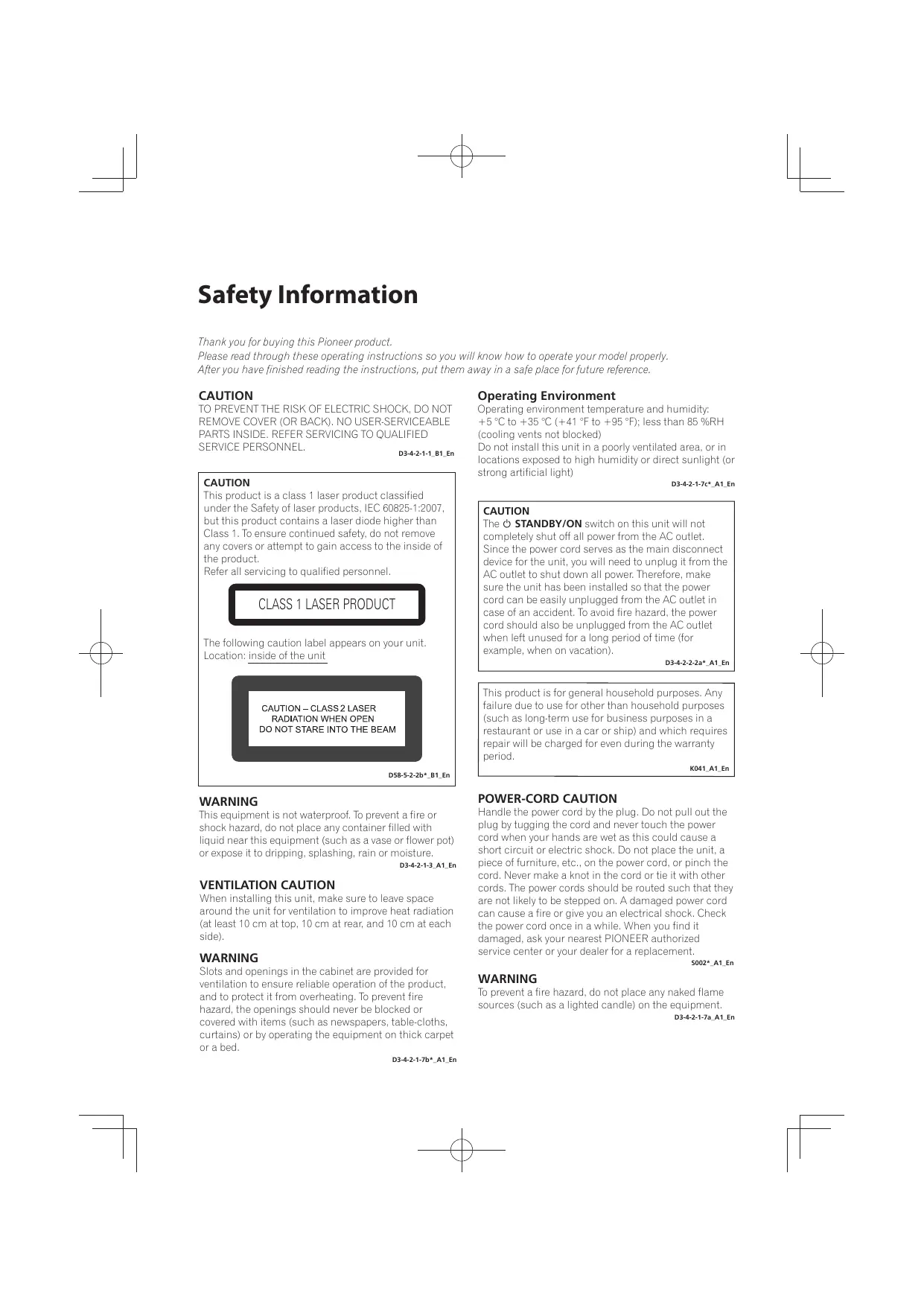
MCS-838 MCS-434 MCS-737 MCS-333 MCS-FS232 MCS-FS131 Safety Information Thank you for buying this Pioneer product. Please read through these operating instructions so you will know how to operate your model properly. After you have finished reading the instructions, put them away in a safe place for future reference. CAUTION TO PREVENT THE RISK OF ELECTRIC SHOCK, DO NOT
REMOVE COVER (OR BACK). NO USER-SERVICEABLE
PARTS INSIDE. REFER SERVICING TO QUALIFIED
SERVICE PERSONNEL. D3-4-2-1-1_B1_En CAUTION This product is a class 1 laser product classified under the Safety of laser products, IEC 60825-1:2007, but this product contains a laser diode higher than Class 1. To ensure continued safety, do not remove any covers or attempt to gain access to the inside of the product. Refer all servicing to qualified personnel.
CLASS 1 LASER PRODUCT
The following caution label appears on your unit. Location: inside of the unit Operating Environment Operating environment temperature and humidity: +5 °C to +35 °C (+41 °F to +95 °F); less than 85 %RH (cooling vents not blocked) Do not install this unit in a poorly ventilated area, or in locations exposed to high humidity or direct sunlight (or strong artificial light) D3-4-2-1-7c*_A1_En CAUTION The 1STANDBY/ON switch on this unit will not completely shut off all power from the AC outlet. Since the power cord serves as the main disconnect device for the unit, you will need to unplug it from the AC outlet to shut down all power. Therefore, make sure the unit has been installed so that the power cord can be easily unplugged from the AC outlet in case of an accident. To avoid fire hazard, the power cord should also be unplugged from the AC outlet when left unused for a long period of time (for example, when on vacation). D3-4-2-2-2a*_A1_En This product is for general household purposes. Any failure due to use for other than household purposes (such as long-term use for business purposes in a restaurant or use in a car or ship) and which requires repair will be charged for even during the warranty period. K041_A1_En D58-5-2-2b*_B1_En WARNING This equipment is not waterproof. To prevent a fire or shock hazard, do not place any container filled with liquid near this equipment (such as a vase or flower pot) or expose it to dripping, splashing, rain or moisture. D3-4-2-1-3_A1_En VENTILATION CAUTION When installing this unit, make sure to leave space around the unit for ventilation to improve heat radiation (at least 10 cm at top, 10 cm at rear, and 10 cm at each side). WARNING Slots and openings in the cabinet are provided for ventilation to ensure reliable operation of the product, and to protect it from overheating. To prevent fire hazard, the openings should never be blocked or covered with items (such as newspapers, table-cloths, curtains) or by operating the equipment on thick carpet or a bed. D3-4-2-1-7b*_A1_En Handle the power cord by the plug. Do not pull out the plug by tugging the cord and never touch the power cord when your hands are wet as this could cause a short circuit or electric shock. Do not place the unit, a piece of furniture, etc., on the power cord, or pinch the cord. Never make a knot in the cord or tie it with other cords. The power cords should be routed such that they are not likely to be stepped on. A damaged power cord can cause a fire or give you an electrical shock. Check the power cord once in a while. When you find it damaged, ask your nearest PIONEER authorized service center or your dealer for a replacement. S002*_A1_En WARNING To prevent a fire hazard, do not place any naked flame sources (such as a lighted candle) on the equipment. D3-4-2-1-7a_A1_En Information for users on collection and disposal of old equipment and used batteries Symbol for equipment These symbols on the products, packaging, and/or accompanying documents mean that used electrical and electronic products and batteries should not be mixed with general household waste. For proper treatment, recovery and recycling of old products and used batteries, please take them to applicable collection points in accordance with your national legislation. Symbol examples for batteries By disposing of these products and batteries correctly, you will help to save valuable resources and prevent any potential negative effects on human health and the environment which could otherwise arise from inappropriate waste handling. For more information about collection and recycling of old products and batteries, please contact your local municipality, your waste disposal service or the point of sale where you purchased the items. These symbols are only valid in the European Union. For countries outside the European Union: If you wish to discard these items, please contact your local authorities or dealer and ask for the correct method of disposal.
K058a_A1_En For Wireless product European Union Notice Notes on Copyrights PIONEER hereby declares that this/ these product(s) is/are in compliance with the essential requirements and other relevant provisions of Directive 1999/5/ EC, 2004/108/EC, 2006/95/EC and 2009/125/EC. Because AACS (Advanced Access Content System) is approved as content protection system for Blu-ray Disc format, similar to use of CSS (Content Scramble System) for DVD format, certain restrictions are imposed on playback, analog signal output, etc., of AACS protected contents. The operation of this product and restrictions on this product may vary depending on your time of purchase as those restrictions may be adopted and/ or changed by AACS after the production of this product. RF Radiation Exposure Statement This equipment should be installed and operated with minimum distance 20 cm between the radiator and your body. WARNING Changes or modifications not expressly approved by the party responsible for compliance could void the user’s authority to operate the equipment.
NOTE: THE MANUFACTURER IS NOT
RESPONSIBLE FOR ANY RADIO OR TV
INTERFERENCE CAUSED BY UNAUTHORIZED
MODIFICATIONS TO THIS EQUIPMENT. SUCH
MODIFICATIONS COULD VOID THE USER’S
AUTHORITY TO OPERATE THE EQUIPMENT. Furthermore, BD-ROM Mark and BD+ are additionally used as content protection systems for Blu-ray Disc format, which imposes certain restrictions including playback restrictions for BD-ROM Mark and/or BD+ protected contents. To obtain additional information on AACS, BD-ROM Mark, BD+, or this product, please contact an authorized Customer Service Center. Many BD-ROM/DVD discs are encoded with copy protection. Because of this, you should only connect your player directly to your TV, not to a VCR. Connecting to a VCR results in a distorted picture from copy-protected discs. Under the U.S. Copyright laws and Copyright laws of other countries, unauthorized recording, use, display, distribution, or revision of television programs, videotapes, BD-ROM discs, DVDs, CDs and other materials may subject you to civil and/or criminal liability. Important Notice for TV colour system The colour system of this player differs according to currently playing discs. For example, when the player plays the disc recorded in the NTSC colour system, the image is output as an NTSC signal. Only the multi system colour TV can receive all signals output from the player. If you have a PAL colour system TV, you will see just distorted images when using discs or video contents recorded in NTSC. The multi system colour TV changes the colour system automatically according to input signals. In case that the colour system is not changed automatically, turn it off and then on to see normal images on screen. Even if the disc recorded in NTSC colour system are well displayed on your TV, these may not be recorded correctly on your recorder. Table of Contents
Introduction – Supplied accessories – Accessories of speaker box (MCS-838, MCS-737) – Accessories of speaker box (MCS-434, MCS-333) – Accessories of speaker box (MCS-FS232) – Accessories of speaker box (MCS-FS131) – Putting the batteries in the remote control – Software update – About operation of this player from a mobile device (iPod, iPhone, iPad etc.) – Types of discs/files that can be played – Trademarks and licenses Remote control Front panel Rear panel
– MCS-838/MCS-434/MCS-737/MCS-333
– MCS-FS232/MCS-FS131
Assemble the speakers – Speaker setup for MCS-838, MCS-737 – Wall mounting the speaker for MCS-838, MCS-737 – Additional notes on speaker for MCS-838, MCS-737 – Positioning the system for MCS-838, MCS737 – Speaker setup for MCS-434, MCS-333 – Wall mounting the speaker for MCS-434, MCS-333 – Additional notes on speaker for MCS-434, MCS-333 – Positioning the system for MCS-434, MCS333 – Speaker setup for MCS-FS232 – Wall mounting the speakers for MCSFS232 – Additional notes on speaker placement for MCS-FS232 – Positioning the system for MCS-FS232 – Speaker setup for MCS-FS131 – Wall mounting the speaker for MCS-FS131
– Additional notes on speaker for MCSFS131 – Positioning the system for MCS-FS131 Connecting to Your TV – HDMI connection – ARC (Audio Return Channel) function Antenna connection Connections with external device – AUX connection – PORTABLE IN connection – OPTICAL IN connection – HDMI IN 1/2/3/4 connection Connecting to your Home Network – Wired network connection – Wireless network connection (MCS-838/ MCS-434/MCS-FS232 only) – Wireless network setup (MCS-838/MCS-434/MCS-FS232 only) – WPS setup (Wi-Fi Protected Setup) (MCS-838/MCS-434/MCS-FS232 only) USB device connection – About USB devices – Connecting the USB device
Making settings using the Setup Navigator menu Operating the TV with the player’s remote control – TV preset code list
Playing discs or files – Forward and reverse scanning – Playing specific chapters, tracks or files – Skipping content – Playing in slow motion – Step forward and step reverse – Playing a specific section within a title or track repeatedly (A-B Repeat) – Playing repeatedly (Repeat Play) – Playing in the desired order (Programmed Play) – Making bookmarks – Zoom – Playing photos as slideshows – Switching the camera angles – Switching the subtitles
– Switching the audio – Convert 2D image into 3D – Switching the CD/SACD playback area – Displaying the disc information – Enjoying BONUSVIEW or BD-LIVE – Playback functions Using the TOOLS menu – Playing from a specific time (Time Search) – Playing a specific title, chapter, track or file (Search) – Playing specified range of discs, titles or chapter (track/file) in random order Continuing playback from a specified position (Continued Viewing Playback)
Playback from Home Media Gallery
About Home Media Gallery – About network playback Playback file on the network Disc/USB playback – Playing back image files – Switch Play Mode Playing in the desired order (Playlist) – Adding tracks/files – Playing the playlist – Deleting tracks/files from the playlist Copy files to a USB – Select and copy a single file/folder – Copy all files Use the unit’s Wi-Fi Direct™ function (MCS-838/MCS-434/MCS-FS232 only) – Display the Wi-Fi Direct mode screen – Connect to mobile device – Connect using WPS (Wi-Fi Protected Setup) – Connect using mobile device’s Wi-Fi Direct function – Playback photos, music and video files from a mobile device – Ending Wi-Fi Direct connection – Change SSID and password
Playing the web contents
Available web contents Playing the items Enjoying YouTube
Recording Audio CD to a USB device iPod/iPhone/iPad playback (MCS-838/MCS434/MCS-FS232 only) – Connect an iPod/iPhone/iPad – Playing your iPod/iPhone/iPad Radio Operations – Listening to the radio – Presetting the radio stations – Deleting all the saved stations – Improving poor FM reception – Seeing information about a radio station – FM Recording Karaoke – Enjoying Karaoke Sound
Changing the settings – Operating the initial setup screen – Software updating – Restoring all the settings to the factory default settings – Language code table and country/area code table
– Picture – Sound – Playback – Control function – Network – Wireless LAN (MCS-838/MCS-434/MCSFS232 only) – iPod/iPhone/iPad (MCS-838/MCS-434/ MCS-FS232 only) – Others
Specifications Maintenance – Handling the unit – Notes on discs Important Information Relating to Network Services
Chapter 1
Before you start Accessories of speaker box (MCS-838, MCS-737)
Before you start Introduction Supplied accessories Non-skid pads (1) [2 cm x 2 cm] Remote control (1) Screws M4 x 16 (16) (They are used to fix to the base and lower cabinet.) Battery (2) Screws M4 x 12 (8) (They are used to fix the upper and lower cabinet.) FM antenna (1) Power cord Accessories of speaker box (MCS-434, MCS-333) Screws M3.5x12 [Taping type] (4) (These screws are used to fix the speakers to the stands.) Before you start
Accessories of speaker box (MCS-FS232)
Speaker stand bases (2) Large poles (2) Small poles (2) Large screws (4) Small screws (8) Accessories of speaker box (MCS-FS131) Screws M3.5x12 [Taping type] (2) (These screws are used to fix the speakers to the stands.) WARNING Store small parts out of the reach of children and infants. If accidentally swallowed, contact a doctor immediately. Before you start Before you start
Putting the batteries in the remote control
1. Open the rear cover.
Before you start Press lightly on this part and slide into the direction of the arrow.
2. Insert the batteries (AAA/R03 x 2).
Insert as indicated by the / marks into the battery compartment. Insert the negative ( ) side first.
3. Close the rear cover.
Close securely (a click should be heard). The batteries included with the player have been provided to allow you to check product operation
DQGPD\QRWODVWORQJ:HUHFRPPHQGXVLQJ
alkaline batteries that have a longer life. WARNING Do not use or store batteries in direct sunlight or other excessively hot place, such as inside a car or near a heater. This can cause batteries to leak, overheat, explode or catch fire. It can also reduce the life or performance of batteries. Caution Do not use any batteries other than the ones specified. Also, do not use a new battery together with an old one. :KHQORDGLQJWKHEDWWHULHVLQWRWKHUHPRWHFRQWURO set them in the proper direction, as indicated by the polarity marks ( and ). Do not heat batteries, disassemble them, or throw them into flames or water. Batteries may have different voltages, even if they look similar. Do not use different kinds of batteries together. To prevent leakage of battery fluid, remove the batteries if you do not plan to use the remote control for a long period of time (1 month or more). If the fluid should leak, wipe it carefully off the inside of the case, then insert new batteries. If a battery should leak and the fluid should get on your skin, flush it off with large quantities of water. :KHQGLVSRVLQJRIXVHGEDWWHULHVSOHDVHFRPSO\ with governmental regulations or environmental public institution’s rules that apply in your country/ area. :KHQLQVHUWLQJWKHEDWWHULHVPDNHVXUHQRWWR damage the springs on the battery’s (–) terminals. This can cause batteries to leak or overheat. Software update Product information on this player is provided on the Pioneer website. Check this website for update and service information on your Blu-ray disc player. IN Europe: http://www.pioneer.eu/ IN U.K.: http://www.pioneer.eu/ http://www.pioneer.co.uk/ IN Russia: http://www.pioneer.eu/ http://www.pioneer-rus.ru/ IN Hong Kong: http://www.pioneerhongkong.com.hk/ IN Singapore: http://www.pioneer.com.sg/firmwaredownload IN Australia: http://www.pioneer.com.au/ About operation of this player from a mobile device (iPod, iPhone, iPad etc.) The player can be controlled from a mobile device by installing the special application onto the mobile device. For details, see the product information on the Pioneer website. This special application may be changed or discontinued without notice. Before you start
Types of discs/files that can be played Playable discs
Discs with the logo marks below indicated on the disc label, package or jacket can be played. Disc type BD2 Logo CD-DA (Audio CD)8
1. Discs on which video, image or audio files are recorded. This player does not support multisession discs or multiborder recording. 2 Including dual-layered discs.
3. Finalize them before playing them on this player.
4 DVD-R for Authoring discs (3.95 and 4.7 GB) cannot be played.
5. Including the AVCHD format.
6. Including the AVCREC format.
9HUVLRQ'9'5:GLVFVFDQQRWEHSOD\HG
8. Including Video CDs.
Before you start Caution Only the discs that have been finalized can be played.
“Blu-ray Disc”, “Blu-ray” and “Blu-ray Disc” logo are trademarks of Blu-ray Disc Association.
Before you start is a trademark of DVD Format/Logo Licensing Corporation. Discs that cannot be played HD DVDs DVD-RAM discs It is possible that some discs other than the ones listed above may not be playable either. Note Some discs cannot be played, even if one of the logo marks on the previous page is indicated. To play 8 cm discs, set the disc in the 8 cm disc depression in the center of the disc tray. No adapter is necessary. 8 cm BD-ROMs cannot be played. About playback of unauthorized copies Cinavia Notice This product uses Cinavia technology to limit the use of unauthorized copies of some commercially-produced film and videos and WKHLUVRXQGWUDFNV:KHQDSURKLELWHGXVHRIDQ unauthorized copy is detected, a message will be displayed and playback or copying will be interrupted. More information about Cinavia technology is provided at the Cinavia Online Consumer Information Center at http://www.cinavia.com. To request additional information about Cinavia by mail, send a postcard with your mailing address to: Cinavia Consumer Information Center, P.O. Box 86851, San Diego, CA, 92138, USA. Copyright 2004-2010 Verance Corporation. Cinavia™ is a Verance Corporation trademark. Protected by U.S. Patent 7,369,677 and worldwide patents issued and pending under license from Verance Corporation. All rights reserved. About copyright protection Copyright protection technology is used for some Blu-ray DiscsTM, DVDs and contents played over the Internet or other networks. Copyright protection technology restricts playback and analog output. Due to updates in copyright protection provisions, the restrictions may differ depending on the date this product was purchased. Furthermore, the restrictions may be updated when the software is updated after purchase. About audio formats The following audio formats are supported on this player: Dolby TrueHD Dolby Digital Plus Dolby Digital DTS-HD Master Audio DTS-HD High Resolution Audio DTS Digital Surround MPEG audio (AAC) Linear PCM Manufactured under license from Dolby Laboratories. Dolby, Pro Logic, and the double-D symbol are trademarks of Dolby Laboratories. Manufactured under license under U.S. Patent Nos: 5,956,674; 5,974,380; 6,226,616; 6,487,535; 7,392,195; 7,272,567; 7,333,929; 7,212,872 & other U.S. and worldwide patents issued & pending. DTS-HD, the Symbol, & DTS-HD and the Symbol together are registered trademarks & DTS-HD Master Audio | Essential is a trademark of DTS, Inc. Product includes software. © DTS, Inc. All Rights Reserved. Playing BDs BDs (BDMV) compatible with the formats below can be played. – Blu-ray Disc Read-Only (ROM) Format Version 2 – Blu-ray Disc Recordable (R) Format Version 2 – Blu-ray Disc Rewritable (RE) Format Version 3 This player supports BD-ROM Profile 5. “Blu-ray 3D” and “Blu-ray 3D” logo are trademarks of Blu-ray Disc Association. %21869,(:IXQFWLRQVVXFKDVSOD\EDFN of secondary video (Picture-in-Picture) and secondary audio can be used. The data
XVHGZLWKWKH%21869,(:IXQFWLRQV WKH
secondary video (Picture-in-Picture) and secondary audio data) may be stored in the storage. For details on secondary video and secondary audio playback, refer to the disc’s instructions. Before you start
Playing DVDs “BONUSVIEW” is trademark of Blu-ray Disc Association. “BD-LIVE” logo is trademark of Blu-ray Disc Association.
:LWK%'520VLWLVSRVVLEOHWRXVH
BD-J (Java) applications to create highly interactive titles, for example including games. The AVCHD is a high definition (HD) digital video camera recorder format recording highdefinition onto certain media by using highly efficient codec technologies. “AVCHD” and the “AVCHD” logo are trademarks of Panasonic Corporation and Sony Corporation. About region numbers Blu-ray Disc Player and BD-ROM or DVD-Video discs are assigned region numbers according to the region in which they are sold. This player’s region numbers are: BD-ROM: – Europe, Australia and New Zealand models: B – Russia models: C – Others: A DVD-Video: Oracle and Java are registered trademarks of Oracle and/or its affiliates. Other names may be trademarks of their respective owners. BDs (BDAV) compatible with the formats below can be played. – Blu-ray Disc Recordable (R) Format Version 1 – Blu-ray Disc Rewritable (RE) Format Version 2 – Europe models: 2 – Australia and New Zealand models: 4 – Russia models: 5 – Others: 3 Discs not including these numbers cannot be played. Discs playable on this player are as shown below. BDs: – Europe, Australia and New Zealand models: B (including B) and ALL – Russia models: C (including C) and ALL – Others: A (including A) and ALL DVDs: – U.K. models: 2 (including 2) and ALL – Australia and New Zealand models: 4 (including 4) and ALL – Russia models: 5 (including 5) and ALL – Others: 3 (including 3) and ALL
Before you start BD-LIVE functions such as downloading movie trailers or additional audio and subtitle languages and playing on-line games can be enjoyed over the Internet. The data downloaded with the BD-LIVE function (trailers, etc.) is stored in the storage. Refer to the disc’s instructions for details about BD-LIVE functions. This label indicates playback compatibility with DVD-RW discs recorded in VR format (Video Recording format). However, for discs recorded with a record-only-once encrypted program, playback can only be achieved using a CPRM compatible device.
Before you start Regarding copy protected CDs: This player is designed to conform to the specifications of the Audio CD format. This player does not support the playback or function of discs that do not conform to these specifications. DualDisc playback A DualDisc is a two-sided disc, one side of which contains DVD content - video, audio, etc. - while the other side contains non-DVD content such as digital audio material. The DVD side of a DualDisc can be played on this player. The non-DVD, audio side of the disc is not compatible with this player. It is possible that when loading or ejecting a DualDisc, the opposite side to that being played will be scratched. Scratched discs may not be playable. For more detailed information on the DualDisc specification, please refer to the disc manufacturer or disc retailer. Playing discs created on computers or BD/DVD recorders It may not be possible to play discs recorded using a computer due to the application settings or computer’s environment settings. Record discs in a format playable on this player. For details, contact the dealer. It may not be possible to play discs recorded using a computer or a BD/DVD recorder, if burn quality is not good due to characteristics of the disc, scratches, dirt on the disc, dirt on the recorder’s lens, etc. About video, audio, and image files and folders Audio and image files can be played on this player when the folders on the disc or USB device are created as described below. Example of folder structure: Root 001.jpg/001.mp3
xxx.jpg/xxx.mp3 01 Folder
- The number of folders and files within a single folder (including the root directory) is limited to a maximum of 256. Also, keep the number of folder layers to a maximum of 5. Note The file and folder names displayed on this player may differ from those displayed on a computer. Before you start
Playable files Video, image and audio files recorded on DVDs, CDs or USB devices can be played. DivX Plus HD DivX Certified® to play DivX® and DivX PlusTM HD (H.264/MKV) video up to 1080p HD including premium content. ABOUT DIVX VIDEO: DivX® is a digital video format created by DivX, LLC, a subsidiary of Rovi Corporation. This is an official DivX Certified® device that plays DivX video. Visit divx.com for more information and software tools to convert your files into DivX videos. ABOUT DIVX VIDEO-ON-DEMAND: This DivX Certified® device must be registered in order to play purchased DivX Video-on-Demand (VOD) movies. To obtain your registration code, locate the DivX VOD section in your device setup menu. Go to vod.divx.com for more information on how to complete your registration. DivX®, DivX Certified®, DivX PlusTM HD and associated logos are trademarks of Rovi Corporation or its subsidiaries and are used under license. – This player’s DivX VOD registration code can be checked at HOME MENU A Initial Setup A Playback A DivX® VOD DRM A Registration Code (page 75). – The number of views is restricted for some
'LY;92'ILOHV:KHQVXFKILOHVDUHSOD\HGRQ
this player, the remaining number of views is displayed. Files for which the remaining number of views has reached 0 cannot be played (This DivX® rental has expired is displayed). Files for which the number of views is not restricted can be played as many times as you like (the remaining number of views is not displayed).
Before you start Supported video file formats Note This DivX® Certified device must be registered in order to play DivX Video-on-Demand (VOD) content. First generate the DivX VOD registration code for your device and submit it during the registration process. Important: DivX VOD content is protected by a DivX DRM (Digital Rights Management) system that restricts playback to registered DivX Certified devices. If you try to play DivX VOD content not authorized for your device, the message Authorization Error will be displayed and your content will not be played. Learn more at www.divx.com/vod.
Table of Playable Files Playable media
Before you start BD-R/RE/-R DL/ Playable files RE DL/-R LTH, (Extensions) DVD-R/RW/-R DL/ USB devices1 +R/+RW/+R DL, CD-R/RW File specifications Network MP3 (.mp3)
Sampling frequencies: Up to 48 kHz Bit rate: Up to 320 kbps Audio type: MPEG-1 Audio Layer 3 :0$*2 (.wma)
Sampling frequencies: Up to 48 kHz Bit rate: Up to 192 kbps
$XGLRW\SH:0$YHUVLRQ
Sampling frequencies: Up to 96 kHz Bit rate: Up to 192 kbps Audio type: MPEG4-AAC :$9 (.wav)
Sampling frequencies: Up to 192 kHz Quantization bitrate: 16 bit, 24 bit Channel: 2ch FLAC (.flac)
Sampling frequencies: Up to 192 kHz Quantization bitrate: 16 bit, 24 bit Channel: Multi channel Sampling frequencies: Up to 192 kHz Quantization bitrate: 16 bit Channel: 2ch JPEG (.jpg/.jpeg)
Maximum resolution: 2 048 x 1 024 pixel Animated PNG files are not supported. GIF (.gif)
Maximum resolution: 2 048 x 1 024 pixel Animated GIF files are not supported. Rotate is not supported. Maximum resolution: 4 000 x 3 000 pixels 3D photo image DivX (.avi/.divx/.mkv)
Supported versions: Through DivX® PLUS HD Maximum resolution: Up to 1 920 x 1 080 (DivX® PLUS HD) Up to 1 280 x 720 (MKV) MP4 (.mp4)
Maximum resolution: Up to 1 920 x 1 080 Video: MPEG4, MPEG-4 AVC (level 4.1) Audio: AAC, MP3 :09 (.wmv)
Maximum resolution: Up to 1 280 x 720 9LGHR:09:09$3 9& $XGLR:0$ AVI (.avi)
Maximum resolution: Up to 1 920 x 1 080 Video: MPEG4 Audio: MP3, AAC Before you start
Playable media File specifications Network 3GP (.3gp)
Video: Sorenson H.263 (FLV1), VP6 (FLV4), H.264 Audio: MP3, AAC
1. This unit supports FAT16, FAT32 and NTFS file systems.
:0$3UR/RVVOHVVDQG9RLFHDUHQRWVXSSRUWHG
3. Apple lossless encoding is not supported.
Note Depending on the file structure, server capacity and network environment, it may not be possible to play certain files, even for files indicated on the table of playable files above.
:KHQXVLQJZLUHOHVV/$1GHSHQGLQJRQWKHHQYLURQPHQW UDGLRZDYHLQWHUIHUHQFH GXULQJVHQGLQJUHFHLYLQJ
RIDODUJHYROXPHRIGDWDVXFKDV+'TXDOLW\LPDJHILOHVDQG:$9)/$&N+]ELWKLJKTXDOLW\DXGLRILOHV
images and sound may be interrupted during playback. Files protected by DRM (Digital Rights Management) cannot be played (not including DivX VOD files). AVCHD contents cannot be played via LAN.
Before you start BD-R/RE/-R DL/ Playable files RE DL/-R LTH, (Extensions) DVD-R/RW/-R DL/ USB devices1 +R/+RW/+R DL, CD-R/RW
Trademarks and licenses
Before you start The terms HDMI and HDMI High-Definition Multimedia Interface, and the HDMI Logo are trademarks or registered trademarks of HDMI Licensing, LLC in the United States and other countries. Manufactured under license from Dolby Laboratories. Dolby, Pro Logic, and the double-D symbol are trademarks of Dolby Laboratories. “x.v.Colour”, and trademarks of Sony Corporation. Manufactured under license under U.S. Patent Nos: 5,956,674; 5,974,380; 6,226,616; 6,487,535; 7,392,195; 7,272,567; 7,333,929; 7,212,872 & other U.S. and worldwide patents issued & pending. DTS-HD, the Symbol, & DTS-HD and the Symbol together are registered trademarks & DTS-HD Master Audio | Essential is a trademark of DTS, Inc. Product includes software. © DTS, Inc. All Rights Reserved. YouTube™ is a trademark of Google Inc. DLNA®, the DLNA Logo and DLNA CERTIFIED® are trademarks, service marks, or certification marks of the Digital Living Network Alliance.
3LFDVD:HE$OEXPVLVDWUDGHPDUNRI*RRJOH
Inc. This product includes technology owned by Microsoft Corporation and cannot be used or distributed without a license from Microsoft Licensing, Inc. This item incorporates copyright protection technology that is protected by U.S. patents and other intellectual property rights of Rovi Corporation. Reverse engineering and disassembly are prohibited. Do not connect the unit through a VCR. Video signals fed through VCRs may be affected by copyright protection systems and the picture will be distorted on the television. Before you start
Apple, iPad, iPhone, iPod, iPod nano, and iPod touch are trademarks of Apple Inc., registered in the U.S. and other countries. (MCS-838/MCS-434/MCS-FS232 only) Before you start USB works with iPhone 5, iPhone 4S, iPhone 4, iPhone 3GS, iPhone 3G, iPad (4th generation), iPad (3rd generation), iPad 2, iPad mini, iPad, iPod touch (1st through 5th generation) and iPod nano (2nd through 7th generation). “Made for iPod,” “Made for iPhone,” and “Made for iPad” mean that an electronic accessory has been designed to connect specifically to iPod, iPhone, or iPad, respectively, and has been certified by the developer to meet Apple performance standards. Apple is not responsible for the operation of this device or its compliance with safety and regulatory standards. Please note that the use of this accessory with iPod, iPhone, or iPad may affect wireless performance.
1 (STANDBY/ON): Press to turn the power on and off. FUNCTION: Changes the input source or function.
When switching while viewing the display window on the player
1. The input source switches every time the
FUNCTION is pressed.
2. Select the desired input source and press
When switching while viewing the TV monitor
1. Press FUNCTION to display the [Source Menu].
2. The input source switches every time the
FUNCTION is pressed. You can also use the cursor / to switch the input source.
3. Select the desired input source and press
- The Source Menu screen can also be displayed by [HOME MENU] A [Source Menu] and pressing ENTER. The FUNCTION button switches the input source for the [Source Menu]. Select Home Media Gallery to playback disc. (page 48)
$ OPEN/CLOSE: Opens and closes the disc tray. 2 TV Control Buttons: See page 46.
KARAOKE: Press to display the Karaoke Settings screen. KEY/ECHO: Switch between Key Control and Echo adjustment modes (See page 70). RESOLUTION: Sets the output resolution for HDMI (See page 74). NET CONTENTS: Enhances the picture quality of network video contents. YouTube: Display the YouTube screen (See page 65). MIC VOLUME: Adjust mic volume. DIMMER: Dims the light on the unit. SLEEP: Sets a certain period of time after which the unit will switch to off. EXIT: See page 65. Before you start
VOL +/– : Adjusts speaker volume. DISPLAY: Displays or exits On- Screen Display. SUBTITLE: See page 52. ' USB REC: Records an audio. SOUND: Switches to Sound settings (See page 72). CLEAR: Press to clear the numeric number, etc. A-B: See page 49. Color buttons: Use these to navigate BD-ROM menus. TOP MENU: Press to display the top menu of the BD-ROM or DVD-Video. POPUP MENU/MENU: Press to display the BDROM or DVD-Video menus. / / / (up/ down/ left/ right): Used to navigate on-screen displays. ENTER: Acknowledges menu selection. HOME MENU: Displays or exits the [Home Menu]. RETURN: Press to return to the previous screen. 5 REPLAY: Press to jump back 10 seconds when REPLAY is pressed during playback. TOOLS: See page 55. CONTINUED: Use to continue playback from a specified position. SKIP SEARCH: Press to skip 30 seconds ahead SKIP SEARCH is pressed during when playback. +/-//, 0/./,: See page 49. PLAY ( ): Starts playback. REV/FWD ()*): See page 49. PAUSE (!): Pauses playback. STOP (#): Stops playback or recording. REPEAT: See page 50. PROGRAM: Registers FM radio stations. BOOKMARK (RDS): Create a BOOKMARK
6HHSDJH :KHQ)0781(5LVVHOHFWHG
switches RDS information (See page 69).
ZOOM (PTY)::LOO]RRPLQRU]RRPRXW:KHQ
this button is pressed while the FM tuner is selected, the PTY value will switch. INDEX: Slideshow playback (See page 51).
Before you start Before you start
- The illustration is for
MCS-838/MCS-434/MCS-FS232
1 Disc tray 2 Operation buttons $ (OPEN/CLOSE) FUNCTION Changes the input source or function. When switching while viewing the display window using the button on the front panel
1. The input source switches every time the
FUNCTION is pressed.
2. Select the desired input source and press
" (PLAY/PAUSE). The FUNCTION button switches the input source for the [Source Menu]. Select Home Media Gallery to playback disc. (page 48)
BASS BOOST Turn BASS BOOST ON or OFF. " (PLAY/PAUSE) # (STOP)
1 (STANDBY/ON) Switches the unit ON or OFF. Note If the power does not turn OFF, pressing the 1 (STANDBY/ON) button for more than 5 seconds reboots the unit and the operation becomes possible. 3 Display Window
9 a 4 Remote control sensor Point the remote control to this, then operate it within approximately 7 m. The player may have trouble capturing remote control signals if there is a fluorescent light nearby. If this happens, move the player away from the fluorescent light. 5 Front input indicator Lit at the following times. :KHQDIURQW86%LVFRQQHFWHGDQG recognized by the unit.
:KHQ3RUWDEOH,1LVVHOHFWHG
:KHQWKHXQLWVHWWLQJV.DUDRNH6ZLWFK
is ON. 6 MIC 1, MIC 2 7 PORTABLE IN 8 USB Port
&RQQHFWD86%GHYLFHL3RGL3KRQH
iPad. (MCS-838/MCS-434/MCS-FS232) &RQQHFWD86%GHYLFH 0&60&6 333/MCS-FS131) Caution The USB port on the front of the unit cannot be used for recording. Please connect to the USB port on the rear of the unit. Before you start
MCS-838/MCS-434/MCS-737/MCS-333
9 a MCS-FS232/MCS-FS131
1 AC IN Plug into the power source. 2 SPEAKERS connectors 3 Cooling Fan 4 Antenna Connector 5 AUX IN (L/R) 6 USB Port Caution The USB port on the rear of the unit does not support iPod/iPhone/iPad. Please connect these devices to the USB port on the front of the unit. (MCS-838/MCS-434/MCS-FS232) Before you start
Chapter 2
3. Mount the front/surround speaker.
Connecting 1 Insert the lower cabinet to the base so that the cable hole is positioned at the backside. Assemble the speakers
Speaker setup for MCS-838, MCS-737 Connecting Preparing the speakers
1. Connect the wires to the player.
Insert the cables connected to the player to the same colored connector on the speaker. 2 Fix the base to the lower cabinet from the underside, using the four screws (M4 x 16). Caution These speaker terminals carry HAZARDOUS LIVE voltage. To prevent the risk of electric shock when connecting or disconnecting the speaker cables, disconnect the power cord before touching any uninsulated parts. Do not connect any speakers other than those supplied to this system. Do not connect the supplied speakers to any amplifier other than the one supplied with this system. Connection to any other amplifier may result in malfunction or fire.
2. Attach the non-skid pads to the base of the
center speaker. Non-skid pads 3 Insert the upper cabinet to the lower cabinet. Connecting
4 Fix the upper cabinet and the lower cabinet from the backside of the speaker using the two screws (M4 x 12). Wall mounting the speaker for MCS-838, MCS-737 The center speaker have a mounting hole which can be used to mount the speaker on the wall. Before mounting Do not stand on the speaker stand base of the tall speaker to push or swing the speaker. The speaker may fall and break, or someone may be injured. Pay special attention to children. Mounting screws are not supplied. Use screws suitable for the wall material and support the weight of the speaker. Caution If you are unsure of the qualities and strength of the wall, consult a professional for advice. Pioneer is not responsible for any accidents or damage that result from improper installation.
3.5 mm
7.5 mm
Mounting screw (not supplied) 3 mm to 4 mm
Connecting Caution Be careful not to tighten screws excessively. If excessive force is used to tighten screws, the threads of screw and/or nut may be damaged. Use a middle-sized manual screwdriver during assembly. Do not use power screwdrivers or oversized screwdrivers that may exert excessive force on the screws and nuts. Confirm that no foreign matter is stuck to the base or the lower cabinet during assembly. If the unit is assembled with foreign matter stuck between the base and lower cabinet, the unit may not be assembled securely, resulting in tipping or falling. Remember that the speaker system is heavy and that its weight could cause the screws to work loose, or the wall material to fail to support it, resulting in the speaker falling. Make sure that the wall you intend to mount the speakers on is strong enough to support them. Do not mount on plywood or soft surface walls.
Additional notes on speaker for MCS-838, MCS-737 Install the main front left and right speakers at an equal distance from the TV. Precautions:
Connecting These speakers are not magnetically shielded and so should not be placed near a TV or monitor. Magnetic storage media (such as floppy discs and tape or video cassettes) should also not be kept close to these speakers. Do not attach the front/surround speakers and subwoofer to a wall or ceiling. They may fall off and cause injury. Positioning the system for MCS-838, MCS-737 The following illustration shows an example of positioning the system. Note that the illustrations in these instructions differ from the actual unit for explanation purposes. For the best possible surround sound, all the speakers other than the subwoofer should be placed at the same distance from the listening position ( A ). Front left speaker (L)/ Front right speaker (R): Place the front speakers to the sides of the monitor or screen and as flush with the screen surface as possible.
C Center speaker: Place the center speaker below or in front of the monitor or screen. Surround left speaker (L)/ Surround right speaker (R): Place these speakers behind your listening position, facing slightly inwards.
F Subwoofer: The position of the subwoofer is not so critical, because low bass sounds are not highly directional. But it is better to place the subwoofer near the front speakers. Turn it slightly toward the center of the room to reduce the wall reflections.
Unit Caution Be careful to make sure children do not put their hands or any objects into the *subwoofer duct. *subwoofer duct: A hole for plentiful bass sound on subwoofer cabinet (enclosure). Place the center speaker well out of the reach of children. Otherwise it may result in the speaker falling down and causing personal injury and/or property damage. The speakers contain magnet parts, so color irregularity may occur on the TV screen (CRT) or computer monitor screen. Please use the speakers away from the TV screen (CRT) or computer monitor screen. Connecting
Speaker setup for MCS-434, MCS-333 Wall mounting the speaker for MCS-434, MCS-333 Preparing the speakers All speakers have a mounting hole which can be used to mount the speaker on the wall.
1. Connect the wires to the player.
Insert the cables connected to the player to the same colored connector on the speaker. Before mounting Mounting screws are not supplied. Use screws suitable for the wall material and support the weight of the speaker. Caution If you are unsure of the qualities and strength of the wall, consult a professional for advice. Caution These speaker terminals carry HAZARDOUS LIVE voltage. To prevent the risk of electric shock when connecting or disconnecting the speaker cables, disconnect the power cord before touching any uninsulated parts. Pioneer is not responsible for any accidents or damage that result from improper installation. Mounting screw (not supplied) Do not connect any speakers other than those supplied to this system.
3.5 mm
Do not connect the supplied speakers to any amplifier other than the one supplied with this system. Connection to any other amplifier may result in malfunction or fire.
7.5 mm
2. Attach the non-skid pads to the base of
each speaker. Non-skid pads This hole is used to fix the unit to the speaker stand. Caution: Do not use this hole to mount on walls or ceilings. The speaker may fall resulting in injury.
Connecting Remember that the speaker system is heavy and that its weight could cause the screws to work loose, or the wall material to fail to support it, resulting in the speaker falling. Make sure that the wall you intend to mount the speakers on is strong enough to support them. Do not mount on plywood or soft surface walls.
Additional notes on speaker for MCS-434, MCS-333 Install the main front left and right speakers at an equal distance from the TV.
Connecting Precautions: These speakers are not magnetically shielded and so should not be placed near a TV or monitor. Magnetic storage media (such as floppy discs and tape or video cassettes) should also not be kept close to these speakers. Do not attach the subwoofer to a wall or ceiling. They may fall off and cause injury. The unit’s front speaker and surround speaker can be attached to speaker stand CP-31B. :KHQXVLQJWKH&3%WKHVSHDNHUPXVW be attached to the stand’s bracket using the screws supplied with this unit. (The screws (M5) supplied with the CP-31B cannot be used to attach the speakers from this unit). Screws supplied with this unit Stand bracket Front left speaker (L)/ Front right speaker (R): Place the front speakers to the sides of the monitor or screen and as flush with the screen surface as possible.
C Center speaker: Place the center speaker below or in front of the monitor or screen. Surround left speaker (L)/ Surround right speaker (R): Place these speakers behind your listening position, facing slightly inwards.
You must also pass the speaker cable through the bottom of the base from the hole in the upper part of the speaker stand pipe. Speaker cable Speaker stand (CP-31B) F Subwoofer: The position of the subwoofer is not so critical, because low bass sounds are not highly directional. But it is better to place the subwoofer near the front speakers. Turn it slightly toward the center of the room to reduce the wall reflections.
Unit Caution Positioning the system for MCS-434, MCS-333 The following illustration shows an example of positioning the system. Note that the illustrations in these instructions differ from the actual unit for explanation purposes. For the best possible surround sound, all the speakers other than the subwoofer should be placed at the same distance from the listening position ( A ). Be careful to make sure children do not put their hands or any objects into the *subwoofer duct. *subwoofer duct: A hole for plentiful bass sound on subwoofer cabinet (enclosure). Place the front, surround and center speakers well out of the reach of children. Otherwise it may result in the speaker falling down and causing personal injury and/or property damage. The speakers contain magnet parts, so color irregularity may occur on the TV screen (CRT) or computer monitor screen. Please use the speakers away from the TV screen (CRT) or computer monitor screen. Connecting
Speaker setup for MCS-FS232 Preparing the speakers
4. Secure the speaker and the pole with 2
screws. Ensure that the speaker wire does not get pinched between the speaker and the pole. For front speakers: Assembling the speaker stands and securing your front speakers. For vertical installation
1. Use the supplied adhesive to attach 4 small
pads to the speaker stand base.
Connecting Non-skid pads For horizontal installation
1. Use the supplied adhesive to attach 4 small
pads to the speaker stand base.
2. Insert the large pole from the holes behind
the base and secure with the 4 screws. Non-skid pads
2. Insert the small pole from the holes behind
the base and secure with the 4 screws.
3. Pass the speaker wire through the hole on
3. Secure the speaker and the pole with 2
screws. Ensure that the speaker wire does not get pinched between the speaker and the pole. The height of the speaker stands can be adjusted in two levels; select the height you prefer, and fix in position. Connect the wires to the player Insert the cables connected to the player to the same colored connector on the speaker.
Connecting For direct installation Use the supplied adhesive to attach 4 pads to the base of the front speakers. Caution Do not connect any speakers other than those supplied to this system. Do not connect the supplied speakers to any amplifier other than the one supplied with this system. Connection to any other amplifier may result in malfunction or fire. These speaker terminals carry HAZARDOUS LIVE voltage. To prevent the risk of electric shock when connecting or disconnecting the speaker cables, disconnect the power cord before touching any uninsulated parts. Connecting
Wall mounting the speakers for MCS-FS232 Before mounting The front speaker can be hung vertically or horizontally on the wall. Use one hole to hang it vertically and two holes to hang it horizontally. The illustration below shows the front right speaker. Vertical set up
Hole Connecting Remember that the speaker system is heavy and that its weight could cause the screws to work loose, or the wall material to fail to support it, resulting in the speaker falling. Make sure that the wall you intend to mount the speakers on is strong enough to support them. Do not mount on plywood or soft surface walls. Attaching the speakers
Horizontal set up Mounting screws are not supplied. Use screws suitable for the wall material and support the weight of the speaker. Hole Caution If you are unsure of the qualities and strength of the wall, consult a professional for advice. Pioneer is not responsible for any accidents or damage that result from improper installation.
:KHQLQVWDOOLQJWKHVSHDNHUKRUL]RQWDOO\VHW
it up so that the speaker wire position on the back side of the speaker is on the outside on the end of the surface, farthest away from the other speaker. Speaker wire position Mounting screw (not supplied) 5 mm to 7 mm Front right Speaker wire position Front left
Additional notes on speaker placement for MCS-FS232 Positioning the system for MCS-FS232 Install the main front left and right speakers at an equal distance from the TV. The following illustration shows an example of positioning the system. Note that the illustrations in these instructions differ from the actual unit for explanation purposes. For the best possible surround sound, all the speakers other than the subwoofer should be placed at the same distance from the listening position ( A ). Precautions:
Connecting The front speakers and subwoofer is not magnetically shielded and so should not be placed near a TV or monitor. Magnetic storage media (such as floppy discs and tape or video cassettes) should also not be kept close to the front speakers and subwoofer. Do not attach the subwoofer to a wall or ceiling. They may fall off and cause injury.
Front left speaker (L)/ Front right speaker (R): Place the front speakers to the sides of the monitor or screen and as flush with the screen surface as possible.
C Subwoofer: The position of the subwoofer is not so critical, because low bass sounds are not highly directional. But it is better to place the subwoofer near the front speakers. Turn it slightly toward the center of the room to reduce the wall reflections.
Unit Caution Be careful to make sure children do not put their hands or any objects into the *subwoofer duct. *subwoofer duct: A hole for plentiful bass sound on subwoofer cabinet (enclosure). Place the front speaker at a safe distance from the child’s reach. Otherwise it may result in the speaker falling down and causing personal injury and/or property damage. The speakers contain magnetic parts, so colour irregularity may occur on the TV screen (CRT) or computer monitor screen. Please use the speakers away from the TV screen (CRT) or computer monitor screen. Connecting
Speaker setup for MCS-FS131 Preparing the speakers
1. Connect the wires to the player.
Insert the cables connected to the player to the same colored connector on the speaker. Wall mounting the speaker for MCS-FS131 All speakers have a mounting hole which can be used to mount the speaker on the wall. Before mounting Mounting screws are not supplied. Use screws suitable for the wall material and support the weight of the speaker. Caution Caution These speaker terminals carry HAZARDOUS LIVE voltage. To prevent the risk of electric shock when connecting or disconnecting the speaker cables, disconnect the power cord before touching any uninsulated parts. Do not connect any speakers other than those supplied to this system. Do not connect the supplied speakers to any amplifier other than the one supplied with this system. Connection to any other amplifier may result in malfunction or fire. If you are unsure of the qualities and strength of the wall, consult a professional for advice. Pioneer is not responsible for any accidents or damage that result from improper installation. Mounting screw (not supplied)
3.5 mm
7.5 mm
2. Attach the non-skid pads to the base of
each speaker. Non-skid pads This hole is used to fix the unit to the speaker stand. Caution: Do not use this hole to mount on walls or ceilings. The speaker may fall resulting in injury.
Connecting Remember that the speaker system is heavy and that its weight could cause the screws to work loose, or the wall material to fail to support it, resulting in the speaker falling. Make sure that the wall you intend to mount the speakers on is strong enough to support them. Do not mount on plywood or soft surface walls.
Additional notes on speaker for MCS-FS131 Positioning the system for MCS-FS131 Install the main front left and right speakers at an equal distance from the TV. The following illustration shows an example of positioning the system. Note that the illustrations in these instructions differ from the actual unit for explanation purposes. For the best possible surround sound, all the speakers other than the subwoofer should be placed at the same distance from the listening position ( A ). Precautions:
Connecting These speakers are not magnetically shielded and so should not be placed near a TV or monitor. Magnetic storage media (such as floppy discs and tape or video cassettes) should also not be kept close to these speakers. Do not attach the subwoofer to a wall or ceiling. They may fall off and cause injury. The unit’s front speaker can be attached to speaker stand CP-31B. :KHQXVLQJWKH&3%WKHVSHDNHUPXVW be attached to the stand’s bracket using the screws supplied with this unit. (The screws (M5) supplied with the CP-31B cannot be used to attach the speakers from this unit). Screws supplied with this unit Front left speaker (L)/ Front right speaker (R): Place the front speakers to the sides of the monitor or screen and as flush with the screen surface as possible. C Subwoofer: The position of the subwoofer is not so critical, because low bass sounds are not highly directional. But it is better to place the subwoofer near the front speakers. Turn it slightly toward the center of the room to reduce the wall reflections.
Stand bracket You must also pass the speaker cable through the bottom of the base from the hole in the upper part of the speaker stand pipe. Speaker cable Speaker stand (CP-31B)
Unit Caution Be careful to make sure children do not put their hands or any objects into the *subwoofer duct. *subwoofer duct: A hole for plentiful bass sound on subwoofer cabinet (enclosure). Place the front speaker at a safe distance from the child’s reach. Otherwise it may result in the speaker falling down and causing personal injury and/or property damage. The speakers contain magnet parts, so color irregularity may occur on the TV screen (CRT) or computer monitor screen. Please use the speakers away from the TV screen (CRT) or computer monitor screen. Connecting
Connecting to Your TV When connected to a DVI device Please refer to the manuals of your TV, stereo system or other devices as necessary to make the best connections. It is not possible to connect DVI devices (computer displays, for example) that are not compatible with HDCP. HDCP is a specification to protect audiovisual content across the DVI/HDMI interface. Make sure the player is connected directly to the TV. Tune the TV to the correct video input channel. No audio signals are output. Connect using an audio cable, etc. Note If you have a HDMI TV or monitor, you can connect it to this player using a HDMI cable (High Speed HDMI®/™ Cable). Connect the HDMI terminal on the player to the HDMI terminal on a HDMI compatible TV or monitor. Rear of the unit ARC (Audio Return Channel) function The ARC function enables an HDMI capable TV to send the audio stream to HDMI OUT of this player. To use this function: - Your TV must support the ARC function. - The setting method of ARC may differ depending on the TV. For details about ARC function, refer to your TV manual. HDMI cable - You must use the HDMI cable (High Speed HDMI®/™ Cable).
- You must connect with the HDMI IN of TV that supports the ARC function using the HDMI OUT on this player. - You can connect only one Home Theater to TV compatible with ARC. Set the TV’s source to HDMI (refer to TV’s Operating Instructions). Caution Connecting the player and the TV using the HDMI cable alone does not enable you to hear the audio from the devise. Please also connect by either the optical cable (page 37) or the analog audio cable (page 36). - The ARC function does not warrant that the function works in all cases even if the above conditions are satisfied.
- :KHQ\RXXVHWKH$5&IXQFWLRQ&(&
(Consumer Electronics Control) may work. If you do not want to use CEC, you can stop it work by setting [Control: Off] on HDMI. In this case, it is needed to connect TV and this player by an optical cable to send the audio stream to this player. - Power on the unit when using CEC function. - CEC does not operate during Standby mode.
Connecting HDMI connection This player is designed for connection with
+'0,FRPSDWLEOHGHYLFHV:KHQFRQQHFWHG
to a DVI device, it may not operate properly depending on the DVI device.
Antenna connection Connect the supplied antenna for listening to the radio. Connections with external device AUX connection You can enjoy the sound from an external component through the speakers of this system.
Connecting Connect the analog audio output terminals of your component into the AUX L/R (INPUT) on this unit. And then select the [AUX] option by pressing FUNCTION and ENTER. Rear of the unit Rear of the unit Note After connecting the FM wire antenna, keep it as horizontal as possible. Be sure to fully extend the FM wire antenna. :KLWH Red To the audio output terminals of your component (TV, VCR, etc.) Connecting
PORTABLE IN connection OPTICAL IN connection You can enjoy the sound from your portable audio player through the speakers of this system. You can enjoy the sound from your component with a digital optical connection through the speakers of this system. Connect the headphones (or line out ) terminal of the portable audio player into the PORTABLE IN socket of this unit. And then select the [Portable In] option by pressing FUNCTION and ENTER. Connect the optical output terminal of your component into the OPTICAL IN terminal on the unit. And then select the [Optical IN] option by pressing FUNCTION and ENTER. To the digital optical output terminal of your component MP3 Player, etc... Caution :KHQLQVHUWLQJWKH3257$%/(,1WHUPLQDOVXSSRUW the top of the unit with your hand to prevent it from moving. Connecting Rear of the unit
HDMI IN 1/2/3/4 connection You can enjoy the pictures and sound from your component through this connection.
Connect the HDMI OUT terminal of your component into the HDMI IN 1, 2, 3 or 4 terminal on this unit. And then select the [HDMI IN 1/2/3/4] option by pressing FUNCTION and ENTER. Connecting Rear of the unit To the HDMI OUT terminal of your component (set-top box, digital satellite receiver, video game machine, etc.) Note You cannot change the video resolution in the HDMI IN 1/2/3/4 mode. Change the video resolution of the connected component. If the video output signal is abnormal when your personal computer is connected to HDMI IN 1, 2, 3 or 4 terminal, change the resolution of your personal computer to 576p, 720p, 1080i or 1080p. You may not able to output 3D images depending on the type of the 3D output signal of the connected device. Connecting
Connecting to your Home Network
Router Wired network connection Using a wired network provides the best performance, because the attached devices connect directly to the network and are not subject to radio frequency interference. Please refer to the documentation for your network device for further instructions. Connect the player’s LAN port to the corresponding port on your Modem or Router using a commercially available LAN or Ethernet cable. Computer and/or DLNA certified server Note :KHQSOXJJLQJRUXQSOXJJLQJWKH/$1FDEOHKROG WKHSOXJSRUWLRQRIWKHFDEOH:KHQXQSOXJJLQJ do not pull on the LAN cable but unplug while pressing down on the lock. Do not connect a modular phone cable to the LAN port. Since there are various connection configurations, please follow the specifications of your telecommunication carrier or internet service provider. If you want to access content from computers or DLNA servers, this player must be connected to the same local area network with them via a router. Rear of the unit Connecting This player can be connected to a local area network (LAN) via the LAN port on the rear panel or the internal wireless module. By connecting the unit to a broadband home network, you have access to services such as BD-LIVE interactivity and Online content services. Broadband service
Wireless network connection (MCS-838/MCS-434/MCS-FS232 only) Wireless network setup (MCS-838/MCS-434/MCS-FS232 only) Another connection option is to use an Access Point or a wireless router. The network configuration and connection method may vary depending on the equipment in use and the network environment. For the wireless network connection, the player needs to be set up for network communication. This adjustment can be done from the [Setup] menu. Adjust the [NETWORK] setting as follow. Setting up the access point or the wireless router is required before connecting the player to the network. Connecting This player is equipped with an IEEE 802.11n (Single band, 2.4 GHz band) wireless module, which also supports the 802.11b/g standards. For the best wireless performance, we
UHFRPPHQGXVLQJD,(((QFHUWLILHG:L
Fi network (access point or wireless router). Preparation Before setting the wireless network, you need to: - connect the broadband internet to the wireless home network. - set the access point or wireless router. - note the SSID and security code of the network.
1. Select [Initial Setup] A[Network] A
[Interface] A[Wireless] and press ENTER. Wireless Communication Computer and/or DLNA certified server Access Point or :LUHOHVV5RXWHU Broadband service Refer to the setup instructions supplied with your access point or wireless router for detailed connection steps and network settings. For best performance, a direct wired connection from this player to your home network’s router or cable/DSL modem is always the best option. If you do chose to use the wireless option, note that performance can sometimes be affected by other electronic devices in the home.
2. Select [Initial Setup] A[Network] A
[Wireless Setting] A[Next Screen] and press ENTER.
3. Select [Yes] and press ENTER to continue.
The new connection settings reset the current network settings.
4. [Wireless Setting] menu is displayed.
Use / to select [Scan]. Then select [Next] using the / and press ENTER.
5. The player scans the all available access
points or wireless routers within range and display them as a list. Use / to select an access point or wireless router on the list, and then press ENTER. If you have security on your access point
RUZLUHOHVVURXWHUYHULI\WKDWWKH:(3RU
:3$NH\WKDWZDVHQWHUHGLQWRWKHSOD\HU
matches the router’s information exactly. You need to input the security code as necessary. Connecting
6. How to enter the security code.
1 Select the security code section using / / / and press ENTER to start the software keyboard. 2 Use / / / to select characters and items, and then press ENTER to input. 3 Select [abc], [ABC], or [!@#$] using / / / to switch to lower case characters, upper case characters, or symbols.
8. Pressing ENTER ends [Wireless Setting].
Note y :(3VHFXULW\PRGHJHQHUDOO\KDYHNH\V available on an access point or wireless router’s setting. If your access point or wireless
URXWHUXVH:(3VHFXULW\HQWHUWKHVHFXULW\
code of the key “No.1” to connect on your home network. y An Access Point is a device that allows you to connect to your home network wirelessly. [Scan] – The player scans the all available access points or wireless routers within range and display them as a list. [Manual] – Your access point may not be broadcasting its access point name (SSID). Check your router settings through your computer and either set your router to broadcast SSID, or manually enter the access point name (SSID) in [Manual]. [Auto] – If your access point or wireless router that supports the Push Button Configuration method, select this option and press the Push Button on your access point or wireless router within 120 counts. You do not need to know the access point name (SSID) and security code of your access point or wireless router. Note y If there is no DHCP server on the network and you want to set the IP address manually, Please refer to “Setting the IP address”. (Page 77) Connecting 4 Finish entering the security code by selecting [Enter] using / / / and pressing ENTER.
7. Select [Next] using / / / and press
ENTER. If it connects success, it will display connection success and IP is obtained.
WPS setup (Wi-Fi Protected Setup) (MCS-838/MCS-434/MCS-FS232 only) WPS connection setting
:36LVDEEUHYLDWLRQRI:L)L3URWHFWHG6HWXS
$VWDQGDUGHVWDEOLVKHGE\WKH:L)L$OOLDQFH
industry group for a function allowing settings UHODWHGWRLQWHUFRQQHFWLRQRI:36FRPSDWLEOH wireless LAN devices and encryption to be made with simple operations. This unit supports push-button configuration and PIN code configuration. PBC (Push Button Configuration) Connection settings are made automatically
VLPSO\E\SUHVVLQJWKH:36EXWWRQVRQWKH
:36FRPSDWLEOHZLUHOHVV/$1GHYLFH7KLVLV
the simplest way of making the settings, and LVSRVVLEOHZKHQWKH:36FRPSDWLEOHZLUHOHVV /$1GHYLFHLVHTXLSSHGZLWK:36EXWWRQ PIN Input Connection settings are made by inputting the 8-digit PIN code shown on the main display to the access point to which you selected. Follow the instructions shown in Connecting using PIN code configuration on the right. :KHQSHUIRUPLQJZLUHOHVVVHWWLQJVVHW[Initial Setup] A [Network] A [Interface] to [Wireless].
1. Press HOME MENU.
The HOME MENU screen is displayed.
2. Use cursor buttons to select [Initial
Setup] and press ENTER. The Initial Setup screen is displayed.
3. Select [Initial Setup] A [Network] A
[Wireless Setting] A [Next Screen] and press ENTER. A confirmation screen is displayed.
4. Use / to select Yes, then press
ENTER. The Wireless Setting screen is displayed.
5. Use / to select Auto, then press
ENTER. The WPS (Wi-Fi Protected Setup) screen is displayed.
6. Use / to switch between [PBC] or
[PIN] screens. :KHQFRQQHFWLQJXVLQJ3%&JRWRVWHS :KHQFRQQHFWLQJXVLQJ3,1JRWRVWHS
7. When connecting using PBC (Push
Button), on the [PBC] screen use / to select NEXT, then press ENTER. 7KHQSUHVVWKH:36EXWWRQRQWKHDFFHVV point within 120 seconds.
8. When connecting using PIN confirm
the PIN Code on the [PIN] screen. Use cursor / to select NEXT, then press ENTER.
9. Enter into the access point the PIN
Code that you confirmed in step 8 above. The PIN Code input method differs depending on the LAN device used. For details, consult the operating instructions accompanying your LAN device. Connecting
Notes on Network Connection: Many network connection problems during set up can often be fixed by re-setting the router or modem. After connecting the player to the home network, quickly power off and/ or disconnect the power cord of the home network router or cable modem. Then power on and/or connect the power cord again. Our company is not responsible for any malfunction of the player and/or the internet connection feature due to communication errors/malfunctions associated with your broadband internet connection, or other connected equipment. The features of BD-ROM discs made available through the Internet Connection feature are not created or provided by our company, and our company is not responsible for their functionality or continued availability. Some disc related material available by the Internet Connection may not be compatible with this player. If you have questions about such content, please contact the producer of the disc. Some internet contents may require a higher bandwidth connection. Even if the player is properly connected and configured, some internet contents may not operate properly because of internet congestion, the quality or bandwidth of your internet service, or problems at the provider of the content. Some internet connection operations may not be possible due to certain restrictions set by the Internet service provider (ISP) supplying your broadband Internet connection. Any fees charged by an ISP including, without limitation, connection charges are your responsibility. A 10 Base-T or 100 Base-TX LAN port is required for wired connection to this player. If your internet service does not allow for such a connection, you will not be able to connect the player. You must use a Router to use xDSL service. The use of a “Router” may not be allowed or its usage may be limited depending on the policies and restrictions of your ISP. For details, contact your ISP directly. The wireless network operate at 2.4 GHz radio frequencies that are also used by other household devices such as cordless telephone, microwave oven, and can be affected by interference from them. Turn off all unused network equipment in your local home network. Some devices may generate network traffic. For the purpose of the better transmission, placing the player from the access point as close as possible. In some instances, placing the access point or wireless router at least 0.45 m above the floor may improve the reception. Move closer to the access point if possible or re-orient the player so there is nothing between it and the access point. The reception quality over wireless depends on many factors such as type of the access point, distance between the player and access point, and the location of the player. Set your access point or wireless router to Infrastructure mode. Ad-hoc mode is not supported.
Connecting Depending on the internet service provider (ISP), the number of devices that can receive internet service may be limited by the applicable terms of service. For details, contact your ISP. xDSL modem is required to use xDSL service and a cable modem is required to use cable modem service. Depending on the access method of and subscriber agreement with your ISP, you may not be able to use the internet connection feature contained in this player or you may be limited to the number of devices you can connect at the same time. (If your ISP limits subscription to one device, this player may not be allowed to connect when a computer is already connected.)
USB device connection A USB device connected to the unit can perform the following operations. File Playback Playback files recorded on the front USB device or rear USB device, such as video, music or photos.
Connecting Copy Files Files can be copied from the front USB device to the rear USB device. Record CD or FM The rear USB device can be used to record CD or FM. Note See page 67 for details on connecting a iPod/ iPhone/iPad (MCS-838/MCS-434/MCS-FS232 only). About USB devices The USB devices that can be connected to the player are as shown below. Connecting the USB device Caution Be sure to turn the player’s power off before connecting or disconnecting USB devices. When using an external hard disk as the external storage device, be sure to turn on the hard disk’s power before turning on the player’s power. If the USB device is write-protected, be sure to disable the write-protection. When connecting the USB cable, hold onto the plug, set the plug in the proper direction for the port and insert it horizontally. Placing excessive loads on the plug may result in poor contact, making it impossible to write data on the USB device. When a USB device is connected and the player’s power is turned on, do not unplug the power cord. This player can play movie, music and photo files contained in the USB device.
1. Insert a USB device to the USB port until it
fits into place. Front of the unit USB 2.0-compatible memory devices FAT16, FAT32 or NTFS file system, minimum 1 GB capacity (2 GB or more recommended) Note Devices formatted with a file system other than the above cannot be used. USB device Hard disk, etc. USB cable (commercially available) USB devices may not be recognized if they contain multiple partitions. Rear of the unit Some USB devices may not operate with this player. Operation of USB devices is not guaranteed. USB device Hard disk, etc. USB cable (commercially available) Caution When inserting the USB terminal, support the top of the unit with your hand to prevent it from moving. Note This unit does not support a USB hub. Use a USB cable with a length of 2 meters or less. Getting Started
Capter 3 Getting Started Making settings using the Setup Navigator menu Be sure to perform these settings when using the player in the following situations.
:KHQ\RXXVHWKHSOD\HUIRUWKHILUVWWLPH
After Initial Setup format. Caution Before turning on the power, check that the connections between the player and other devices are correct. Also, turn on the power of the devices connected to the player before turning on the player’s power.
:KHQXVLQJD3LRQHHU)ODW6FUHHQ79RUIURQW
projector compatible with the Control function, set Control to On on the connected device before turning on the player’s power.
1. Turn on the TV’s power and switch the
input. See the TV’s operating instructions for the details of operating the TV.
2. Turn on the player’s power.
Press 1 STANDBY/ON. Check that the Setup Navigator menu is displayed. HOME MENU to display the Press Home Menu, select Initial Setup A Setup Navigator A Start, then press ENTER.
3. Start Setup Navigator.
Press ENTER. y Setup Navigator starts.
4. Select the OSD language.
Use / to select, then press ENTER.
:KHQD3LRQHHU)ODW6FUHHQ79WKDW
is compatible with Control function is connected to this player’s HDMI OUT terminal, language settings are imported from the Pioneer Flat Screen TV’s language settings before Setup Navigator begins.
5. Select the appropriate output resolution
for the connected TV. Use / to select, then press ENTER.
6. Select the appropriate aspect for the
connected TV. Use / to select, then press ENTER.
7. Close the Setup Navigator menu.
Press ENTER. y Setup Navigator finishes and the setting is stored. RETURN to go back to the y Press previous screen.
Getting Started After updating the player’s software. If the Setup Navigator menu is not displayed
Operating the TV with the player’s remote control :KHQWKHPDQXIDFWXUHUFRGHIRU\RXUEUDQG of TV is set on the player’s remote control, the TV can be operated using the player’s remote control. Caution
For some models it may not be possible to operate the TV with the player’s remote control, even for TVs of brands listed on the manufacturer code list. Getting Started The setting may be restored to the default after the batteries are replaced. If this happens, reset it.
1. Input the 2-digit manufacturer code.
Press the number buttons (0 to 9) to input the code while pressing TV CONTROL 1. Note y The factory default setting is 00 (PIONEER). y If you make a mistake when inputting the code, release TV CONTROL 1 then start over from the beginning. y :KHQWKHUHDUHPXOWLSOHFRGHVIRUD manufacturer, try inputting them in the indicated order until the TV can be operated.
2. Check that the TV can be operated.
Operate the TV using TV CONTROL. 1 – Press to turn the TV’s power on and off. INPUT SELECT – Press to switch the TV’s input. CH +/– – Press to select the TV channel. VOL +/– – Press to adjust the volume. Getting Started
If the disc menu is displayed Playback For some discs, the disc menu is displayed automatically when playback starts. The contents of the disc menu and the way to operate depend on the disc. Playing discs or files This section describes the player’s main operations. For the types of discs and files that can be played, see page 11. Video, image and audio files recorded on discs are played with the Home Media Gallery (page 57).
1. Press 1 STANDBY/ON to turn on the
power. Turn the TV’s power on and switch its input beforehand.
2. Press $ OPEN/CLOSE to open the disc
tray and load the disc. Playback Note y Load the disc with the printed side facing up. y Several dozen seconds are required to read the disc. Once reading is completed, the type of disc is displayed on the player’s front panel display. y :KHQD%'ZLWKXVDJHUHVWULFWLRQVVHWE\D%' recorder is loaded, the PIN code input screen appears. In this case, input your PIN code.
3. Press PLAY to play the disc.
y To pause, press ! PAUSE during playback. y To stop, press # STOP during playback. Note y Some discs start playing automatically when the disc tray is closed. y BD-ROM/DVD-Video discs have parental lock features. Input the password registered in the player’s settings to unlock the parental lock. For details, see page 79. y BD-R/-RE may have restrictions placed on the disc or titles. Enter the password set to the disc in order to remove the restrictions. Resuming playback from where it was stopped (resume playback function) y :KHQ# STOP is pressed during playback, the point at which the disc VWRSSHGLVVWRUHGLQWKHPHPRU\:KHQ PLAY is pressed after that, playback resumes from that point. y To cancel the resume playback function, press # STOP while playback is stopped. Note y The resume playback function is canceled automatically in the following cases: – :KHQWKHGLVFWUD\LVRSHQHG – :KHQWKHILOHOLVWZLQGRZLVVZLWFKHG
– :KHQWKHSRZHULVWXUQHGRII )RU%'V
and DVDs this does not cancel the resume playback function.) y :KHQ\RXZDQWWRFRQWLQXHSOD\EDFNIURPD position you specify to be played next time, see Continuing playback from a specified position (Continued Viewing Playback) on page 56. y The resume playback function cannot be used for some discs. Playback disc/file when selecting other functions
1. Press $ OPEN/CLOSE to open the disc
tray and load the disc.
2. Press HOME MEDIA GALLERY to
display the Home Media Gallery.
3. Select disc type (BDMV/BDAV/DVD
Forward and reverse scanning Step forward and step reverse During playback, press )REV or *FWD. y The scanning speed switches each time the button is pressed. The speed steps depend on the disc or file (the speed is displayed on the TV screen). While playback is paused, press -// or 0/.. y The picture moves a step forward or reverse each time the button is pressed. To resume normal playback Press PLAY. Playing specific chapters, tracks or files Skipping content During playback, press + or ,. y :KHQ, is pressed, the playback skips ahead to the beginning of the next chapter/track/file. y :KHQ+ is pressed while a video or audio file is playing, the playback skips back to the beginning of the currently playing chapter/track/file. Press twice to skip back to the beginning of the previous chapter/track/file. y :KHQ+ is pressed while an image file is playing, playback returns to the previous file. Playing in slow motion While playback is paused, press and hold -// or 0/.. y The speed switches each time the button is pressed (the speed is displayed on the TV screen). To resume normal playback Press PLAY. Press PLAY. Playing a specific section within a title or track repeatedly (A-B Repeat) Use this procedure to play a specific section within a title or track repeatedly.
1. During playback, press A-B to select the
starting point. y A- is displayed on the TV screen.
2. During playback, press A-B to select the
ending point. y A-B Repeat playback starts. To cancel A-B Repeat play y Press A-B during the A-B Repeat play. Note y A-B Repeat play is canceled in the following cases: – :KHQ\RXVHDUFKRXWVLGHRIWKHUHSHDW range.
– :KHQ\RXVWDUWRWKHU5HSHDW3OD\RU
Playback During playback, input the number of the chapter/track/file you want to select. y Use the number buttons (0 to 9) to input the number, then press ENTER. y Press CLEAR to clear the values you have input. To resume normal playback
Playing repeatedly (Repeat Play) Playing in the desired order (Programmed Play) Use this procedure to play the currently playing disc, title, chapter, track or file repeatedly. 1 During playback, press PROGRAM. y The program screen is displayed. During playback, press REPEAT. y Each time you press REPEAT the type of repeat modes changes as shown below. Current chapter A Current title DVD Current chapter A Current title A All titles CD/Video file/Audio file/Image file Current track/file A All tracks/All files in folder
To cancel Repeat Play Playback y Press REPEAT several times during Repeat Play. Note y Repeat Play is canceled in the following cases: – :KHQ\RXVHDUFKRXWVLGHWKHUHSHDWUDQJH
– :KHQ\RXVWDUWRWKHU5HSHDW3OD\RU
2. Select the program number.
Use / to select, then press ENTER.
3. Select the title you want to play.
Use / to select, then press .
4. Select the chapter you want to play.
Use / to select, then press ENTER.
5. Press PLAY.
y Playback starts. Editing the program
1. Select the program number you want to
edit, then press ENTER.
2. Select title/chapter, then press ENTER.
Deleting the program Select the program number you want to delete, then press CLEAR. y To delete all the programs, press RETURN. Note y :KHQ\RXXVHDXGLR&'VIRU3URJUDPPHG3OD\ enter the track number in step 3. y This function does not work with BDs. Playback
Making bookmarks Playing photos as slideshows You can make bookmarks on the video currently playing and play back the scene later. This function plays the photos, switching them automatically. During playback, press BOOKMARK. y The bookmark is made. y Maximum number of bookmarks are 12. Playing the bookmarked scene
1. Press and hold BOOKMARK for a few
seconds. y The list of bookmarks is displayed.
2. Select the bookmark you want to play.
Use / to select, then press ENTER. Deleting the bookmark Zoom During playback, press ZOOM. y Each time you press ZOOM, the zoom level changes as shown below. Zoom 2x A Zoom 3x A Zoom 4x A Zoom 1/2 A Zoom 1/3 A Zoom 1/4 A Normal (not displayed) Note y This function does not work with some discs. Rotating/inverting photos :KHQDVOLGHVKRZLVSOD\LQJRUSDXVHGWKH display switches as shown below when the / / / buttons are pressed. button: Rotates 90° clockwise button: Rotates 90° counterclockwise button: Flips horizontally button: Flips vertically Switching the camera angles For BD-ROM and DVD-Video discs on which multiple angles are recorded, the angles can be switched during playback. During playback, press ANGLE. y The current angle and total number of recorded angles are displayed on the TV screen. To switch the angles, press ANGLE again. y The angles can also be switched by selecting Angle from the TOOLS menu. y If the angles are not switched when ANGLE is pressed, switch them from the disc menu screen.
Playback Select the bookmark you want to delete, then press CLEAR. y Bookmarks may not be allowed to make for some discs. y Bookmarks are canceled in the following cases:
– :KHQWKHSOD\HU·VSRZHUWXUQHGRII
– :KHQWKHGLVFWUD\LVRSHQHG During playback, press INDEX. y Display the thumbnail of image files. The maximum number is 12 at once. y If you select one of the image and press ENTER, slideshow will start from the image you selected.
Switching the subtitles Switching the audio For discs or files on which multiple subtitles are recorded, the subtitles can be switched during playback. For discs or files on which multiple audio streams/channels are recorded, audio streams/ channels can be switched during playback. Caution y The subtitles cannot be switched for discs recorded by a DVD or BD recorder. Also refer to the operating instructions for the device used for recording.
Playback During playback, press SUBTITLE. y The current subtitle and total number of recorded subtitles are displayed on the TV screen. To switch the subtitle, press SUBTITLE again. y The subtitles can also be switched by selecting Subtitle from the TOOLS menu. y If the subtitles are not switched when SUBTITLE is pressed, switch them from the disc menu screen. Turning the subtitles off Press SUBTITLE several times or select Subtitle from the TOOLS menu to switch the setting to Off. About displaying external subtitle files while playing DivX media files In addition to the subtitles recorded in DivX media files, this player also supports the display of external subtitle files. If a file has the same name as that of a DivX media file aside from the file extension and the extension is one of the extensions listed below, the file is treated as an external subtitle file. Note that DivX media files and external subtitle files must be located in the same folder. Only one external subtitle file can be displayed on this player. Use a computer, etc., to delete any external subtitle files you do not want to display from the disc. Note y Depending on the file, the external subtitles may not be displayed properly. During playback, press AUDIO. y The current audio and total number of recorded audio streams are displayed on the TV screen. To switch the audio, press AUDIO again. y The audio can also be switched by selecting Audio from the TOOLS menu. y If the audio is not switched when AUDIO is pressed, switch it from the disc menu screen. Convert 2D image into 3D Convert 2D image into a pseudo 3D image and output.
1. During playback of a BD-ROM/DVD,
press TOOLS. The TOOLS menu will be displayed.
2. Use / to select [2D To 3D], then
3. Use / to select [On], then press
ENTER. Note y A TV that supports 3D must be connected. y Depending on the disc and the image, the 3D effect may not work. Switching the CD/SACD playback area
1. Select the area you want to play.
In the stop mode, press CD/SACD. The playback area switches on the front panel display window each time the button is pressed. [CD AREA] A [SACD 2CH] A [SACD MCH] A (back to beginning) y During playback, press # STOP twice to cancel continuous play before selecting the playback area. Displaying the disc information Press DISPLAY. The disc information appears on the TV screen. To switch off the information display, press DISPLAY again. The information display differs between during playback and when playback is stopped. Playback
Enjoying BONUSVIEW or BD-LIVE This player is compatible with BD-Video %21869,(:DQG%'/,9(
:KHQXVLQJ%'9LGHRGLVFVFRPSDWLEOHZLWK
%21869,(:\RXFDQHQMR\VXFKIXQFWLRQV as secondary video (picture in picture) (page
DQGVHFRQGDU\DXGLR SDJH :LWK%'
Video discs supporting BD-LIVE, special video images and other data can be downloaded from the Internet. Data recorded on BD video and downloaded from BD-LIVE is stored on the USB flash drive (external memory). To enjoy these functions, connect a USB flash drive (minimum 1 GB capacity, 2 GB or greater recommended) supporting USB 2.0 High Speed (480 Mbit/s) to the USB port. To recall data stored in the USB flash drive, first insert the disc media that was being used at the time the data was downloaded (if a different disc is loaded, the data stored on the USB flash drive cannot be played). If a USB flash drive containing other data (previously recorded) is used, the video and audio may not play back properly. Do not disconnect the USB flash drive while playback is in progress. Some time may be required for the data to load (read/write). Caution
,WPD\QRWEHSRVVLEOHWRXVHWKH%21869,(:DQG
BD-LIVE functions if there is insufficient space on the USB flash drive. In this case, refer to Erasing data that has been added to BDs and application data on page 78 for erasing the Virtual Package data and the BD-LIVE data in the USB flash drive. Playback of BD-LIVE function data differs depending on the disc used. For details, consult the user instructions supplied with the disc. To enjoy the BD-LIVE function, a network connection and settings are required (pages 39 and 77). BD-LIVE is a function that provides for connection to the Internet. Discs supporting the BD-LIVE function may send ID codes identifying this player and the disc to the contents provider via the Internet.
:KHQ\RXLQVHUWRUUHPRYHD86%IODVK
drive, be sure to turn the player’s power off. Note Operation of USB flash drives is not guaranteed.
Playback functions The functions that can be used differ according to the type of disc and file. In some cases, some of the functions cannot be used. Check the usable functions on the table below. Disc/file type Function1 BDROM BD-R /-RE DVD-R DVD/-RW Video AVCREC AVCHD Video (VR file format) Image file Audio file Audio
Forward and reverse scanning2
Playing specific titles, chapters or tracks
Step forward and step reverse2
Playback Repeat Play
Some functions may not work for some discs or files, even if indicated [] on the table. For some discs, normal playback resumes automatically when the chapter switches. No sound is produced during forward and reverse scanning. Sound is produced during forward and reverse scanning. No sound is output during slow motion playback. Reverse slow motion playback is not possible. Reverse step playback is not possible. Angle mark is displayed for scenes at which multiple angles are recorded if Angle Mark is set to On (page 75). 7KHW\SHVRIUHFRUGHGVXEWLWOHVGHSHQGRQWKHGLVFDQGILOH
,QVRPHFDVHVWKHVXEWLWOHPD\VZLWFKRUWKHVZLWFKLQJVFUHHQSURYLGHGRQWKHGLVFPD\EHGLVSOD\HG
immediately, without the current subtitle or the total number of subtitles recorded on the disc being displayed.
10. The types of recorded audio streams depend on the disc and file.
Using the TOOLS menu Item Description Various functions can be called out according to the player’s operating status. Still off Switch off the BD-ROM’s still picture. Ins Search Skip forward 30 seconds. Ins Replay Skip backward 10 seconds. 2D To 3D Convert 2D image into a pseudo 3D image and output. Slide Show Switch the playback speed while playing the picture slide show. Transition Change the style of the slide show while playing the picture slide show.
1. Display the TOOLS menu.
Press TOOLS during playback.
2. Select and set the item.
Use / to select, then press ENTER. Note y Items that cannot be changed are displayed in gray. The items that can be selected depend on the player’s status. To change the setting of the selected item Use
to change. To close the TOOLS menu Press TOOLS. Item Description Title Display the title information for the currently playing disc and total number of titles on the disc. Also select the title you want to play. (See the following description.) Chapter (track/file)1 Display the information for the currently playing chapter (track/ file) and total number of chapters in the disc. Also select the chapter (track/file) you want to play. (See the following description.) Time Display the elapsed or remaining time. Also enter the time from which you want to start playback. (See the following description.) Mode Switch the play mode (page 56). Audio Switch the BD-ROM/DVD-Video disc’s camera angle. Subtitle Switch the subtitle language. Code Page Switch the BD-ROM’s secondary video (Picture-in-Picture). Secondary Audio3 Switch the BD-ROM’s secondary audio. Bitrate Display the bitrate of the audio/video/ secondary video/secondary audio. Note y Selectable items depend on the type of disc. y The types of recorded secondary audio streams depend on the disc and file. y Some discs do not include secondary audio/ secondary video. y In some cases, the secondary audio/secondary video may switch or the switching screen provided on the disc may be displayed immediately, without the current secondary audio/secondary video or the total number of secondary audio/secondary video streams recorded on the disc being displayed. Playing from a specific time (Time Search)
1. Select Time.
Use / to select, then press ENTER.
2. Input the time.
Use the number buttons (0 to 9) to input the time. y To play from 45 minutes, input 0, 0, 4, 5, 0 and 0, then press ENTER. y To play from 1 hour 20 minutes, input 0, 1, 2, 0, 0 and 0, then press ENTER. y Press CLEAR to clear the values you have input.
3. Starting playback from the specified
1. One of these types of information is displayed,
depending on the type of disc.
2. Secondary video mark is displayed for scenes at
which secondary video is recorded if PIP Mark is set to On (page 75).
3. Secondary audio mark is displayed for scenes at
which secondary audio is recorded if Secondary Audio Mark is set to On (page 75).
Playing a specific title, chapter, track or file (Search)
1. Select Title or Chapter (track/file).
Use / to select, then press ENTER.
2. Input the Title or Chapter (track/file)
number. Use the number buttons (0 to 9) or / to input the number. y To search for title 32, input 3 and 2, then press ENTER. y Press CLEAR to clear the values you have input.
3. Starting playback from the specified
title, chapter or track. Press ENTER.
Playback Playing specified range of discs, titles or chapter (track/ file) in random order You can select from 2 types of random playback.
1. Select Mode.
Use / to select, then press ENTER.
2. Select the playing mode.
Use / to select, then press ENTER. Random play The specified range of discs, titles or chapter (track/file) is played in random order. The same item may be played consecutively. Shuffle play The specified range of discs, titles or chapter (track/file) is played in random order. Each item is played once. Continuing playback from a specified position (Continued Viewing Playback) This function allows you to continue playback from a position you specify to be played next time, even after turning the power off. Setting During playback, press CONTINUED at the position from which you want to start continued viewing playback. The elapsed playing time at the specified position is displayed on the TV screen. Playing
1. Press PLAY to play the title for
which you have set continued viewing playback. The continued viewing playback confirmation screen appears.
2. Use / to select Yes, then press
ENTER. Playback starts from the specified position. Note y The continued viewing playback setting is canceled when $ OPEN/CLOSE is pressed. y Continued viewing playback may not work properly with some discs. Playback from Home Media Gallery
Chapter 5
Playback from Home Media Gallery About Home Media Gallery Note The Home Media Gallery allows you to play files on media servers connected to the same Local Area Network (LAN) as the unit. The following files are allowed to be played from Home Media Gallery:
– &RPSXWHUVUXQQLQJ0LFURVRIW:LQGRZV9LVWDRU
;3ZLWK:LQGRZV0HGLD3OD\HULQVWDOOHG
– &RPSXWHUVUXQQLQJ0LFURVRIW:LQGRZVZLWK
:LQGRZV0HGLD3OD\HULQVWDOOHG
– DLNA-compatible digital media servers (on computers or other components) Files stored in a computer or DMS (Digital Media Server) as described above can be played by Digital Media Player (DMP). The player supports the use of such DMP. Files stored in a computer or DMS (Digital Media Server) as described above can be played via command from an external Digital Media Controller (DMC). Devices controlled by this DMC to play files are called DMRs (Digital Media Renderers).
7KLVSOD\HUVXSSRUWVWKLV'05IXQFWLRQ:KHQLQ
the DMR mode, such operations as playing and stopping files can be performed from the external controller. The input sources that can be played from Home Media Gallery are as shown below. BD-R/RE (BDAV format) discs
'9'55: 95IRUPDW GLVFV
About network playback The network playback function of this unit uses the following technologies: Windows Media Player 6HH:LQGRZV0HGLD3OD\HU:LQGRZV0HGLD Player 12 above for more on this. DLNA Audio CDs (CD-DA, SACD and DTS CDs) DVD/CDs on which only data files of video, image or audio files, etc. are recorded. USB device Files on the network servers (on the computers or components connected to the player via LAN interface.) DLNA CERTIFIED® Audio Player The Digital Living Network Alliance (DLNA) is a cross-industry organization of consumer electronics, computing industry and mobile device companies. Digital Living provides consumers with easy sharing of digital media through a wired or wireless network in the home.
Playback from Home Media Gallery This player’s Home Media Gallery function allows you to display a list of input sources and start playback. This chapter describes setup and playback procedures required to enjoy these
IHDWXUHV:KHQ\RXSOD\WKHILOHVVWRUHGRQ\RXU
computer or the components on the network, it is advisory that you also refer to the operation manual supplied with your network component. To play back audio files stored on components on the network, you must turn on the DHCP server function of your router. In case your router does not have the built-in DHCP server function, it is necessary to set up the network manually. Otherwise, you cannot play back files stored on components on the network. See page 77.
Playback from Home Media Gallery
The DLNA certification logo makes it easy to find products that comply with the DLNA Interoperability Guidelines. This unit complies with DLNA Interoperability Guidelines v1.5. :KHQDFRPSXWHUUXQQLQJ'/1$VHUYHU software or a DLNA compatible device is connected to this player, some setting changes of software or other devices may be required. Please refer to the operating instructions for the software or device for more information. DLNA®, the DLNA Logo and DLNA CERTIFIED® are trademarks, service marks, or certification marks of the Digital Living Network Alliance. Content playable over a network Even when encoded in a compatible format, some files may not play correctly. Some functions may not be supported depending on the server type or version used.
Playback from Home Media Gallery Supported file formats vary by server. As such, files not supported by your server are not displayed on this unit. For more information check with the manufacturer of your server. Disclaimer for Third Party Content Access to content provided by third parties requires a high speed Internet connection and may also require account registration and a paid subscription. About playback behavior over a network Playback may stall when the computer is switched off or any media files stored on it are deleted while playing content. If there are problems within the network environment (heavy network traffic, etc.) content may not be displayed or played properly (playback may be interrupted or stalled). For best performance, a 10BASE-T/ 100BASE-TX connection between the player and the computer is recommended. If several clients are playing simultaneously, as the case may be, playback is interrupted or stalled. Depending on the security software installed on a connected computer and the setting of such software, network connection may be blocked. Pioneer is not responsible for any malfunction of the player and/or the Home Media Gallery features due to communication errors/ malfunctions associated with your network connection and/or your computer, or other connected equipment. Please contact your computer manufacturer or Internet service provider. Windows Media is either a registered trademark or trademark of Microsoft Corporation in the United States and/or other countries. Third party content services may be changed, suspended, interrupted, or discontinued at any time without notice, and Pioneer disclaims any liability in connection with such occurrences. This product includes technology owned by Microsoft Corporation and cannot be used or distributed without a license from Microsoft Licensing, Inc. Pioneer does not represent or warrant that content services will continue to be provided or available for a particular period of time, and any such warranty, express or implied, is disclaimed. Microsoft, Windows and Windows Vista are either registered trademarks or trademarks of Microsoft Corporation in the United States and/ or other countries. Playback from Home Media Gallery
Playback file on the network
1. Press HOME MEDIA GALLERY to
display the Home Media Gallery. The Home Media Gallery can also be displayed by selecting [Home Media Gallery] from Home Menu, then pressing ENTER.
2. Select the server which contains the file
3. Select the file you want to play.
Use / to select, then press ENTER. To end Home Media Gallery Press HOME MEDIA GALLERY. Note If you are unable to display the servers on the Home Media Gallery screen, select [DLNA Search] and press ENTER. Disc/USB playback
2. Select Disc or USB.
Use / to select, then press ENTER.
3. Select Photo/Music/Video/AVCHD.
Use / to select, then press ENTER. y This step is not for the discs that have been recorded with BDAV/VR/AVCREC format. y To play files in AVCHD format on a USB device, create a folder named “AVCHD” on the USB device, then copy the “BDMV” folder containing which the files to be played into the “AVCHD” folder.
4. Select the title/track or file you want to
play. Use / to select, then press ENTER. Playback starts from the selected title/track or file. y If the file you want to play is in the folder, select the folder that contains the file first. About Slideshow A display of the files on the disc or in the folder switches automatically. Note
:KHQSOD\LQJDQDXGLR&' &''$6$&''76
CD), the Now Playing screen is displayed. Some BD-R/-RE discs have playback protection. To cancel the protection, input the password set for the disc. It may take a few seconds before playback starts. This is normal. It may not be possible to play some files properly. The number of views may be restricted. Depending on the connected devices and conditions, some time may be required for playback to start and for the image to switch. Switch Play Mode Playback range can be selected from within a folder, or within the selected Disc/USB device.
1. While stopped display the Home Menu.
2. Select and confirm [Initial Setup].
Use / to select, then press ENTER.
3. Select and confirm [Playback] A [Play
Mode] A [All Play] or [Folder Play]. Use / to select, then press ENTER. y Folder Play: Playback files from the selected folder. y All Play: Playback all files on the selected USB device or disc. Caution :KHQXVLQJ[All Play], a new file list will be displayed on the unit, regardless of original folder composition, and then played back in the order that they are displayed. The order the files are displayed in on the unit's file list may be different from the original order on your computer. Playback will stop once the final file on the file list is played. If you want to playback again from the top of the file list use the repeat function (page 50). The maximum number of files that can be displayed is 1000 files. The file list may take some time to be displayed when it includes a large number of files.
Playback from Home Media Gallery
1. Press HOME MEDIA GALLERY to
display the Home Media Gallery. The Home Media Gallery can also be displayed by selecting [Home Media Gallery] from Home Menu, then pressing ENTER. Playing back image files
Playback from Home Media Gallery
Playing in the desired order (Playlist) The discs that can add tracks and files to the Playlist are as shown below. DVDs/CDs/USB devices on which audio files are recorded Adding tracks/files Use this procedure to add tracks and files, and create the Playlist.
1. Press HOME MEDIA GALLERY to
display the Home Media Gallery. The Home Media Gallery can also be displayed by selecting [Home Media Gallery] from Home Menu, then pressing ENTER.
2. Select Disc or USB.
Load the disc beforehand. Use / to select, then press ENTER.
Playing the playlist
1. Press HOME MEDIA GALLERY to
display the Home Media Gallery. The Home Media Gallery can also be displayed by selecting [Home Media Gallery] from Home Menu, then pressing ENTER.
2. Select Playlist.
Use / to select, then press ENTER.
3. Select the track/file to be played.
Use / to select, then press ENTER. Playback starts from the selected track/ file and continues until the end of the list is reached. Use +/, to play the previous or next track/file. The Now Playing screen is displayed. Deleting tracks/files from the playlist Playback from Home Media Gallery
3. Select the track/file to be added.
1. Select the track/file to be deleted, then
press POPUP MENU to display the POPUP MENU menu.
2. Use / to select Remove from Playlist,
5. Select Add to Playlist to add to Playlist.
Use / to select, then press ENTER. The track or file selected in step 3 is added to the Playlist. y To add more tracks or files, repeat steps 3 to 5. Playback from Home Media Gallery
Copy files to a USB Files can be copied from the front USB device or from a data disc to the rear USB device. Select and copy a single file/ folder You can only copy one file or one folder at a time.
1. Press HOME MEDIA GALLERY to
display the Home Media Gallery. The Home Media Gallery can also be displayed by selecting [Home Media Gallery] from Home Menu, then pressing ENTER.
2. Select [Disc] or [Front USB].
Use / to select, then press ENTER.
3. Select [Photo]/[Music]/[Video]/
[AVCHD]. Use / to select, then press ENTER. Note Different types of file, such as [Photo], [Music], [Video] and [AVCHD], cannot be copied at the same time.
:KHQFRS\LQJVWDUWVD>)LOH@IROGHUZLOOEHFUHDWHG
in the [Pioneer] folder on the rear USB device. The maximum number of [File] folders is 99. This unit does not support a USB hub. Image of [Copy All] Example folder composition on a copy source (Front USB) Root
6. Copy the file/folder to the rear USB
device. Use / to select [Copy 1 file/folder], then press ENTER. y If you want to copy other files/folders, repeat steps 3 to 6. Folder Folder File File Copy all files
1. Press HOME MEDIA GALLERY to
display the Home Media Gallery. The Home Media Gallery can also be displayed by selecting [Home Media Gallery] from Home Menu, then pressing ENTER.
2. Select [Disc] or [Front USB].
Use / to select, then press ENTER.
3. Select [Photo]/[Music]/[Video]/
[AVCHD]. Use / to select, then press ENTER. Example folder composition on a copy source (Rear USB) All files will be copied into a single folder regardless of the original folder composition. Root Pioneer File
5. Copy the file/folder to the rear USB
device. Use / to select [Copy All], then press ENTER. y To copy other types of file, repeat steps 3 to 5. File File Playback from Home Media Gallery
4. Select the file/folder you want to copy.
Use to select. [] will be displayed to the left of the selected file/folder. You can only select one.
5. Display the Popup Menu.
Press POPUP MENU. Caution :KHQXVLQJ[Copy All], all files will be copied into a single folder regardless of the original folder composition. The order of the file list may differ from the order displayed on your computer. The maximum number of files that can be copied at once is 1000 files. You cannot overwrite when there is a file with the same name.
Playback from Home Media Gallery
Use the unit’s Wi-Fi Direct™ function (MCS-838/MCS-434/MCS-FS232 only) :L)L'LUHFWLVDIXQFWLRQWKDWDOORZVWKHXQLW and mobile device to be directly connected together without the need for a wireless LAN router. Installing a DLNA based application on your mobile device will allow you to playback on the unit photos, music and video files saved on your mobile device. Note You can only connect one mobile device to the unit at a time with this function. If you want to connect a different mobile device, you will first need to disconnect the one that is currently connected.
:KLOHFRQQHFWHGYLD:L)L'LUHFW\RXZLOOEH
unable to use the unit's internet connection.
:KLOHFRQQHFWHGYLD:L)L'LUHFW\RXZLOOEH
unable to change sound settings.
Playback from Home Media Gallery If the power to the unit is turned OFF (Standby) then this function will be terminated, and network settings will be returned to what they were before using this function. The unit does not support mobile device control using a specialist application. In order to use this function your mobile device
PXVWPHHW:L)LVSHFLILFDWLRQV
Display the Wi-Fi Direct mode screen
1. Press 1 STANDBY/ON and the power
to the unit will come on. The Pioneer logo will be displayed on the TV screen.
2. Press to display the Wi-Fi Direct
mode screen. y Settings to connect the unit and mobile devices will be started from this screen. y This screen will also be displayed while the unit and your mobile device are
FRQQHFWHGXVLQJ:L)L'LUHFW
y Closing this screen will terminate the :L)L'LUHFWFRQQHFWLRQ Caution y If the Pioneer logo is not displayed, please check the following. – If the unit is playing back, press the STOP and stop playback. After stopping playback, press the STOP again and cancel resume playback. – If the Home Media Gallery or Home Menu are displayed, press HOME MENU and close the displayed screen. – :KHQDQH[WHUQDOLQSXWIXQFWLRQVXFKDV)0 or AUX input is selected, press HOME MENU twice. Connect to mobile device This is the normal method you should use to connect. First display the Pioneer logo on the TV screen, then press WRGLVSOD\WKH:L)L'LUHFWPRGH screen.
1. Under the “Wi-Fi Network Settings” on
your mobile device, select the device name “DIRECT-xxBD” for this unit as displayed on the TV screen. The “xx” shown here stands for the unit’s identification code. Caution y If the name of the unit “DIRECT-xxBD” does not appear on your mobile device, press RETURN on the remote control and then the button
DQGSHUIRUPWKHFRQWUROVDJDLQIURPWKH:L)L
2. Enter the password “xxxxxxxx” for the
unit as shown on the TV screen into your mobile device. The connection is then complete. Note Please see the manual for your mobile device for details on how to operate it. Playback from Home Media Gallery
Connect using WPS (Wi-Fi Protected Setup)
<RXFDQFRQQHFWXVLQJ:36LI\RXUPRELOH
<RXFDQFRQQHFWXVLQJD:L)L'LUHFWIXQFWLRQ
if your mobile device has one. First display the Pioneer logo on the TV screen, then press WRGLVSOD\WKH:L)L'LUHFWPRGH screen. First display the Pioneer logo on the TV screen, then press WRGLVSOD\WKH:L)L'LUHFWPRGH screen.
1. Use / to select [WPS (PBC)], then
7KH:36 3XVK%XWWRQ&RQILJXUDWLRQ
screen will be displayed.
1. Turn on the Wi-Fi Direct setting on your
2. Use / to select [Next], then press
3. Turn on the WPS setting on your mobile
device within 2 minutes. If the connection is successful then [Connection Success] will be displayed on the TV screen.
4. Press ENTER.
The connection is then complete.
7KH:L)L'LUHFW0RGHVFUHHQZLOOEHGLVSOD\HG
Please see the manual for your mobile device for details on how to operate it.
3. Use / to select a mobile device from
the list, then press ENTER. Depending on the mobile device you are using, a connection confirmation may be displayed on its screen. If one is displayed, select [OK] or [Yes] on the mobile device to allow the connection. If the connection is successful then [Connection Success] will be displayed on the TV screen.
4. Press ENTER.
The connection is then complete.
7KH:L)L'LUHFW0RGHVFUHHQZLOOEH
displayed. Note Please see the manual for your mobile device for details on how to operate it. Playback photos, music and video files from a mobile device Send photos, music and video files from a mobile device to the unit. Note Please see the manual for your mobile device for details on how to operate it. Depending on the mobile device you are using, you may need to first install software before you can send photos, music and video files.
Playback from Home Media Gallery Note
2. Use / to select [Search], then press
ENTER. A list of mobile devices that be connected to the unit will be displayed on the TV screen.
Playback from Home Media Gallery
Ending Wi-Fi Direct connection Press RETURNZKLOHWKH:L)L'LUHFWPRGH screen is displayed. The connection will be terminated. Network settings will be returned to what they were before using this function. Note If you wish to playback a disc, USB device or web
FRQWHQWVGXULQJ:L)L'LUHFWFRQQHFWLRQ\RXPXVW
FORVHWKH:L)L'LUHFWPRGHVFUHHQ
:KHQFKDQJLQJWRH[WHUQDOLQSXWIXQFWLRQVVXFKDV
)0DQG$8;LQSXW\RXPXVWFORVHWKH:L)L'LUHFW
Mode Screen. Change SSID and password Change the SSID and password used to connect the unit and a mobile device.
1. Press 1 STANDBY/ON and the power
to the unit will come on. The Pioneer logo will be displayed on the TV screen. Playback from Home Media Gallery
2. Press to display the Wi-Fi Direct
3. Use / to select [Refresh], then press
ENTER. SSID and password will be changed. The connection between the unit and mobile device will be terminated. After the connection is terminated, when using the
XQLW V:L)L'LUHFWIXQFWLRQDJDLQ\RXZLOO
also need to set up the connection again. Caution All connection settings that have been setup for mobile devices will be removed. The SSID and password will not change until an update (Refresh) is performed. You should periodically perform an update (Refresh) for security reasons. Playing the web contents
Playing the web contents connection with such occurrences. Pioneer does not represent or warrant that content services will continue to be provided or available for a particular period of time, and any such warranty, express or implied, is disclaimed. You can enjoy some streaming contents on the Internet with the player. Disc playback and this function cannot be used at the same time.
Chapter 6
Available web contents YouTube vTuner Picasa About YouTube This player supports the YouTube Leanback service. The YouTube Leanback service is only available in English for now. Playing the items Caution You must connect the player to the Internet beforehand. See Connecting to your Home Network on page 39 for the details. YouTube videos for mobile phones cannot be played. Some YouTube videos cannot be played. About Picasa Picasa is available only in English. Refer to instructions at http://picasa.google.com/support/ for details. – Register your user name and password on the
FRPSXWHUEHIRUH\RXXVH3LFDVD:HE$OEXPV
– :KHQ\RXDFFHVV3LFDVDIURPWKLVSOD\HUIRUWKH
first time, select the New User icon and enter your registered user name and password. Note Depending on the Internet connection environment, it may not be possible to play web contents properly. To access to web contents, this player requires a broadband Internet connection. A contract with an Internet provider is required for a broadband Internet connection. Access to content provided by third parties requires a high speed Internet connection and may also require account registration and a paid subscription. Third party content services may be changed, suspended, interrupted, or discontinued at any time without notice, and Pioneer disclaims any liability in
1. Display the selection screen.
The selection screen can be selected by HOME MENU then selecting pressing :HE&RQWHQWVA Desired web content.
2. Select the type of web contents.
Use / to select, then press ENTER.
3. Press / to select the item you want
to play, then press ENTER. To stop playback, press EXIT. Playback of the video stops. Enjoying YouTube
1. Display YouTube screen.
2. Select file and playback.
Use / / / to select, then press ENTER. Press STOP to stop playback. Playback of image will stop. Playing the web contents About vTuner vTuner is an online content service for internet radio. The port number differs depending on the station broadcasting the internet radio, so be sure to check your firewall settings. The list of stations provided by vTuner is subject to change without prior notification. Broadcast may be cut short or cancelled by the radio station. Under these circumstances, playback will not occur even if the station appears on and can be selected from the station list. Depending on the station, data such as the name of tracks may not be displayed correctly. The guidance on the vTuner Access Screen is all conducted in English.
Chapter 7
Other Operating Recording Audio CD to a USB device You can record audio CD to the rear USB device using this player. Caution The USB port on the front of the unit cannot be used for recording.
1. Insert an USB device into the USB port
2. Open the disc tray and place an Audio
CD on the tray. Press $ OPEN/CLOSE.
3. Close disc tray.
:KHQ$OPEN/CLOSE is pressed, playback will start automatically. y If playback does not start automatically, press the PLAY on the remote or /! (PLAY/PAUSE) on the device to start playback.
4. Press USB REC during CD playback.
[CD RIP] will be displayed.
5. Select the song or the Track No. you
want to record. If you are recording all the songs on the CD use / / / to select [Select all] and press ENTER. If you are selecting a Track to record use / / / to select the Track No. and press ENTER. y If there are more than one Track you want to record, repeat the step for 5. y If you want to delete a selected Track use / / / to select [Select None] and press ENTER.
6. Set the recording speed
Use / / / to select [Speed] and press ENTER. y The recording speed will change each time ENTER is pressed. The recording speed will change as shown below. Normal: when recording while listening to the music. Fast: will record at approx 4x speed. You cannot listen to the music.
7. Start recording.
Use / / / to select [Start] and press ENTER to start recording.
8. Exit CD recording display.
Use / / / to select [Cancel] then press ENTER after recording has finished. Note Use cursor / / / to select [Bitrate] then press ENTER to change the Bitrate setting. The set speed will change each time [Bitrate] is pressed. The set value can be selected from those shown below. [64kbps] A [96kbps] A [128kbps] A [192kbps] A [256kbps] A [320kbps]
:KHQ\RXVWDUWUHFRUGLQJD>&'@IROGHUZLOOEH
created in the [Pioneer] folder on the unit's rear USB device. The maximum number of folders that can be created is 100. This unit does not support a USB hub. Other Operating
iPod/iPhone/iPad playback Connect an iPod/iPhone/iPad (MCS-838/MCS-434/MCS-FS232 only) Use the USB cable supplied with your iPod/ iPhone/iPad. Connect it to the unit's front USB. The USB port on the rear of the unit does not support iPod/iPhone/iPad. Please connect these devices to the USB port on the front of the unit. Caution This system has been developed and tested for the software version of iPod/iPhone/iPad indicated on the website of Pioneer (http:// pioneer.jp/homeav/support/ios/eu/). Installing software versions other than indicated on the website of Pioneer to your iPod/iPhone/iPad may result in incompatibility with this system.
:KHQXVLQJDQL3RGL3KRQHL3DGQRW
supported by this unit, use a commercially available cable to connect the iPod/iPhone/ iPad to the PORTABLE IN connector of this unit. Before connecting the iPod/iPhone/iPad, turn this unit off and reduce the volume of this unit to its minimum. Note Some functions may be restricted depending on the model or software version. iPod/iPhone/iPad is licensed for reproduction of non-copyrighted materials or materials the user is legally permitted to reproduce. Pioneer cannot under any circumstances accept responsibility for any direct or indirect loss arising from any inconvenience or loss of recorded material resulting from iPod/iPhone/iPad failure. Your iPod/iPhone/iPad will not be charged when the unit power is turned off. For detailed instructions on using the iPod/iPhone/ iPad, please refer to the manual supplied with the iPod/iPhone/iPad.
Other Operating Features such as the equalizer cannot be controlled using this system, and we recommend switching the equalizer off before connecting.
Playing your iPod/iPhone/iPad
1. Connect your iPod/iPhone/iPad.
To connect your iPod/iPhone/iPad, see Connect an iPod/iPhone/iPad on page 67. If this unit cannot play your iPod/iPhone/ iPad, perform the following troubleshooting checks:
2. Press FUNCTION to select iPod as the
input source and press ENTER. – Check whether the iPod/iPhone/iPad is supported by this unit. Button PLAY What it does Starts normal playback. ! PAUSE Pauses playback. # STOP Pauses playback. + PREV Press to skip to the start of the current file, then previous files. , NEXT Press to skip to the next file.
Press to start fast reverse scanning.
Press to start fast forward scanning. MENU Use to access the iPod/iPhone/iPad menu. / /ENTER
Caution Use to control the iPod/iPhone/iPad menu. – Reconnect the iPod/iPhone/iPad to the unit. If this doesn’t seem to work, try resetting your iPod/iPhone/iPad. – Check the iPod/iPhone/iPad software is supported by this unit. If the iPod/iPhone/iPad cannot be operated, check the following items: – Is the iPod/iPhone/iPad connected correctly? Reconnect the iPod/iPhone/ iPad to the unit. – Is the iPod/iPhone/iPad experiencing a hangup? Try resetting the iPod/iPhone/ iPad, and reconnect it to the unit. Note :KHQLQSXWLVVZLWFKHGIURPL3RGWRDQRWKHU function, iPod/iPhone/iPad playback is temporarily stopped. Other Operating Other Operating
Radio Operations Be sure that FM aerial is connected. (Refer to the page 36) Listening to the radio
1. Press FUNCTION until FM appears in the
display window and press ENTER. The last received station is tuned in. Seeing information about a radio station The FM tuner is supplied with the RDS (Radio Data System) facility. This shows information about the radio station being listened to. Press BOOKMARK (RDS) repeatedly to cycle through the various data types:
(Programme Service Name) The name of the channel will appear in the display. PTY (Programme Type Recognition) The programme type (e.g. Jazz or News) will appear in the display.
(Radio Text) A text message contains special information from the broadcast station. This text may scroll across the display.
2. Scanning will start when either the * or
the ) button is pressed. Press
3. Adjust the volume by rotating VOLUME on
the front panel or by pressing VOL + or VOL – on the remote control repeatedly. Presetting the radio stations You can preset 50 stations for FM. Before tuning, make sure that you have turned down the volume.
1. Press FUNCTION until FM appears in the
display window and press ENTER. The last received station is tuned in.
2. Select the desired frequency by using
3. Press PROGRAM a preset number will flash
in the display window.
4. Press
to select the preset number you
5. Press PROGRAM.
The station is stored.
7. You can select the stored station by
pressing / . Deleting all the saved stations
1. Press and hold CLEAR for two seconds.
[ERASE ALL] will flash up on the display window.
2. Press CLEAR to erase all of the saved radio
stations. Improving poor FM reception Press AUDIO on the remote control. This will change the tuner from stereo to mono and usually improve the reception. FM Recording The unit is capable of recording received FM broadcasts to the rear USB device. Caution The USB port on the front of the unit cannot be used for recording.
1. Connect the USB device to the USB port on
the rear of the unit.
2. Receive the broadcast station you wish to
3. Press USB REC on the remote.
Recording will begin. The recording time will be displayed on the TV screen.
4. Press STOP on the remote to stop recording.
Note If you switch from FM to another function while recording, the recording will be stopped.
:KHQ\RXVWDUWUHFRUGLQJD>)0@IROGHUZLOOEH
created in the [Pioneer] folder on the unit's rear USB device. The maximum number of files that can be created is 100. The maximum single length of time that be recorded is 5 hours. This unit does not support a USB hub.
6. Repeat the steps 2 to 5 to store other
stations. You can search the radio stations by programme type by pressing BOOKMARK (RDS). The display will show the last PTY in use. Press ZOOM (PTY) one or more times to select your preferred programme type. Press and hold / . The tuner ZLOOVHDUFKDXWRPDWLFDOO\:KHQDVWDWLRQLV found the search will stop.
Karaoke Enjoying Karaoke
1. Press KARAOKE on the remote control.
The Karaoke setting screen will be displayed on the TV screen. Press KARAOKE to close the Karaoke settings screen.
2. Turn the Karaoke Switch on.
Select [Karaoke Switch] A [On] using cursor and press ENTER.
3. Adjust microphone volume.
Select [Microphone Setup] A [Mic Volume] using cursor and press ENTER. Use / to adjust the microphone volume. Press RETURN to finish. Adjust microphone echo Select [Microphone Setup] A [Mic Echo] using cursor and press ENTER. Use cursor / to adjust the microphone echo. Press RETURN to finish. Microphone echo can also be adjusted using KEY/ECHO and / on the remote control. Press KEY/ECHO to display [Mic Echo] and then adjust using / . Adjust Key Control
Use / / / to select [Key Control] A [Next], and then press ENTER. Use / to adjust Key Control volume, and then press RETURN. Other Operating Key Control can also be adjusted using KEY/ ECHO and / on the remote control. Press KEY/ECHO to display [Key Control] and then adjust using / . Switch Vocal Cancel on or off Use cursor to select [Vocal Cancel] A [On] or [Off] and press ENTER. Turn the Karaoke score function on/off Use / / / to select [Karaoke Score] A [On] or [Off], and then press ENTER. :KHQWKH.DUDRNHVFRUHIXQFWLRQLVWXUQHGRQ a score will be displayed after each track ends. Note Karaoke can only be used with disc playback or USB playback. Depending on the song, Vocal Cancel may not be effective. :KHQLQVHUWLQJWKH0,&WHUPLQDOVXSSRUWWKH top of the unit with your hand to prevent it from moving. The microphone volume can also be adjusted using the MIC VOL +/– button on the remote control. If you turn on Vocal Cancel, Virtual 3D Sound settings and Surround settings are turned off. If you turn on Virtual 3D Sound settings or Surround settings when Vocal Cancel is on, Vocal Cancel is turned off. Turn the Karaoke Switch Off and Vocal Cancel and Karaoke Score will be turned off, and Key Control will be set to a value of 0. The sound may be distorted if the microphone volume is too high. If there is howling, move the microphone away from the speakers. Also try lowering the volume and echo level. Other Operating
Setting Options Explanation Karaoke Switch Off Select when not using Karaoke.
Select when using Karaoke. Mic Volume Select to adjust the volume of your microphone. Use / to perform the adjustment on the mic volume adjustment screen. Mic Echo Select to adjust the level of microphone echo. Use / to perform the adjustment on the mic echo adjustment screen. Microphone Setup Key Control Select to adjust the level of the key control. Use / to perform the adjustment on the key control adjustment screen. Vocal Cancel Off Select when you want Vocal Cancel off.
Select when you want Vocal Cancel on. Off Turn Karaoke score function Off.
$:0$03RU$$&ILOHLVSOD\HGZLWKKLJKVRXQGTXDOLW\7KLVLV
only valid for files with the extension “.wma”, “.mp3” or “.m4a”. The effect depends on the file. Try different settings, and choose the one providing the best effect. Low High Equalizer Add a variety of effects to the output sound. Select a mode that suits your personal tastes. Off News This mode is suited to the news. Gaming This mode is suited to video games. Movie This mode is suited to movies. Music This mode is suited to music. Effect is minimum Virtual 3D Max Effect is maximum Extra Power Mode The sound from the front speakers will also be output by the rear speakers. This mode is valid in both 2 channel audio source and 5.1 channel audio source. 5 Speaker Mode The same sound will be output from the 5 speakers other than the sub woofer. This mode is valid in both 2 channel audio source and 5.1 channel audio source. Dolby Pro Logic II enables you to play stereo source on 5.1-channel. This mode is valid in 2 channel audio source.
Other Operating Virtual 3D Sound: Has the effect of creating a 3D sound space. Suited to when restrictions on speaker placement mean you have to place surround speakers alongside your front speakers. Off Min Effect is minimum Mid Effect is moderate Max Effect is maximum Off Switch to Bass Boost mode. This will emphasize deeper sounds and increase the impact of movies and music.
Audio Sync Effect is moderate Adjust the delay between image and sound. Use Virtual 3D Sound: Has the effect of creating a 3D sound space.
to adjust. Advanced settings
Chapter 8
Advanced settings Operating the initial setup screen Changing the settings
1. When playback is stopped, display the
Home Menu screen. HOME MENU. Press
2. Select and set Initial Setup.
Use / to select, then press ENTER.
3. Select the item and change the setting.
Use / / / to select, then press ENTER. Closing the Initial Setup screen Press HOME MENU or RETURN. Note The items that can be selected depend on the player’s status. In Options, the factory default settings are indicated in bold. Options Explanation TV Screen 16:9 Full Select this when connecting to a wide (16:9) TV. 16:9 Normal Select this when connected to a wide (16:9) TV. 4:3 pictures are displayed with vertical black bars along the sides. 4:3 Pan&Scan Select this when connecting to a 4:3 screen TV and playing a 16:9 video. The video will be played with the left and right sides of the image cut off to display on the 4:3 screen. (This function works if the disc is labeled for 4:3PS.) 4:3 Letterbox Select this when connecting to a 4:3 screen TV and playing a 16:9 video. The video will be played with black bands at the top and bottom. Standard The quality of the playback picture can be adjusted according to the TV you are using (page 77).
Choose the level of noise reduction.
Net Contents Mode Off
Select this to automatically correct compressed video files on the network, a disc or a USB device and play them with a more natural picture quality.
Audio Output Setting Options Explanation DRC (Dynamic Range Control) Off Select this to output audio signals without using the DRC function.
Select this to adjust the range between the loudest and softest sounds (dynamic range) for playback at average volume. Use this when it is hard to hear dialog or when watching movies at midnight. Auto Select to switch the DRC setting On/Off automatically according to the input audio signal from the disc. This only affects Dolby TrueHD signals. Adjust the Trim (output level) and Delay (distance from viewers) of the speakers. Please see “Adjust speaker settings” for more details (page 77). HDMI Test Tone Output a test tone from the speakers. Color Space RGB Select this to output the video signals as RGB signals. Choose this if the colors seem too faint and the black seems too bright. YCbCr Select this to output the video signals as YCbCr 4:4:4 signals. YCbCr 422 Select this to output the video signals as YCbCr 4:2:2 signals. Full RGB Select this to output the video signals as RGB signals. Choose this if the colors seem too dense and all the dark colors are displayed in a uniform black. Auto Select this to choose the resolution of the video signals output from the HDMI OUT terminal automatically. 480I/576I Output the video signals from the HDMI OUT terminal with the selected resolution. The resolution can be changed by pressing RESOLUTION, but Auto cannot be selected. Resolution 480P/576P 720P 1080I 1080P HDMI Audio Out Advanced settings Select this to output HDMI audio signals directly. PCM Select this to output HDMI audio signals converted to PCM audio signals. Reencode
:KHQD%'FRQWDLQLQJVHFRQGDU\DXGLRDQGLQWHUDFWLYHDXGLRLVSOD\HGWKH
two audio signals are mixed and converted to DTS audio for output. Off Select this when you do not want to output the audio signal from the HDMI output terminal. 30bits Select this when outputting the video signals with 30-bit color. 36bits Select this when outputting the video signals with 36-bit color. Off Select this when outputting the video signals with normal 24-bit color. Select this when Resolution is set to Auto or 1080P and outputting 1080p/24 video signals to a TV compatible with 1080p/24. Off Select this when Resolution is set to 1080P and outputting 1080p/60 video signals to a TV compatible with 1080p/60. Auto :LWK'GLVFVWKHGLVFLVSOD\HGZLWK'LPDJHV Off 3D images are not played. Yes This sets whether or not to display the 3D notice when playing 3D images. Specifies the routing of the HDMI audio signal out of this system (amp) or
WKURXJKWRD79:KHQ2QLVVHOHFWHGQRVRXQGLVRXWSXWIURPWKLVV\VWHP
Off: Playback using speakers connected to the unit. On: Playback through TV connected to the unit via HDMI output
Select this to control the player with the remote control of the connected AV device using an HDMI cable. Also refer to page 35. Off Select this when you do not want to control the player with the remote control of the connected AV device using an HDMI cable. Advanced settings
Network Setting Options IP Address Setting Select this to set the IP address of the player and DNS server (page 77). Explanation Proxy Server Only set the proxy server if so instructed by your Internet service provider (page 78). Information Displays the values of the MAC address, IP address, subnet mask, default gateway, DNS server (primary) and DNS server (secondary). Connection Test Select this to test the network connection (page 78). Internet Connection Enable Select this when connecting to the Internet. Disable Select this when not connecting to the Internet. Permitted All discs are allowed to connect to BD-LIVE. Partial Permitted Only discs whose safety has been confirmed are allowed to connect to BDLIVE. Prohibited No disc is allowed to connect to BD-LIVE. Enable Select this when connecting to DLNA server. Disable Select this when not connecting to DLNA server. Ethernet Select when using a LAN cable to connect to the network. :LUHOHVV Select when connecting wirelessly to the network. Language :LUHOHVV6HWWLQJ Perform settings for a wireless network connection (page 40). OSD available languages Choose a language for the on-screen displays from the listed languages. Audio available languages Choose a language from the listed languages to set the default audio
- For some discs, it may language for BD-ROM and DVD-Video playback. not be possible to change to the selected language. If a language not recorded on the BD/DVD is set, one of the recorded languages is automatically selected for playback. Subtitle available languages Choose a language from the listed languages to set the default subtitle
- For some discs, it may language for BD-ROM and DVD-Video playback. not be possible to change to the selected language. If a language not recorded on the BD/DVD is set, one of the recorded languages is automatically selected for playback. If a language not recorded on the BD/DVD is set, one of the recorded languages is automatically selected for playback. Playback Angle Mark PIP Mark Secondary Audio Mark
Select this to display the angle mark on the TV screen (page 51). Off Select this if you do not want to display the angle mark on the TV screen.
Select this to display the PIP mark on the TV screen. Off Select this if you do not want to display the PIP mark on the TV screen.
Select this to display the secondary audio mark on the TV screen (page 55). Off Select this if you do not want to display the secondary audio mark on the TV screen. DivX® VOD DRM Registration Code Displays the player’s registration code required to play DivX VOD files (page 15). Internet Setting Permitted :HEFRQWHQWVFDQEHZDWFKHGZLWKRXWHQWHULQJWKHSDVVZRUG Disc Auto Playback Last Memory Partial Permitted The password must be entered to watch web contents. Prohibited No web contents can be watched.
Discs are played automatically after they are loaded. Off Loaded discs do not start playing automatically.
Select this to save the point at which you last stopped playback, even after the disc tray is opened or you switch to the standby mode. Off Select this when you want to use only Continue Viewing Play (page 56). Advanced settings Menu available languages Choose a language from the listed languages to set the default language for
- For some discs, it may BD-ROM and DVD-Video menus. not be possible to change to the selected language.
Playback Setting Options Explanation Select this to play Video-CDs (version 2.0) compatible with PBC using the disc menu. Off Select this to play Video-CDs (version 2.0) compatible with PBC without using the disc menu. Play Mode Folder Play Playback files from the selected folder. All Play Playback all files on the selected USB device or disc. Setup Navigator Start making the settings using the Setup Navigator menu. For details, see page 45. Security Change Password Register (change) the password for parental lock settings or for unlocking to play DVD-Videos with the parental lock feature (page 79). The default password is “0000”. Parental Control Change the player’s parental lock level (page 79). Options Country Code Change the Country/Area code (page 79). Screen Saver Off The screen saver is not activated. 1 min The screen saver will be activated if no operation has been performed for more than one minute/two minutes/three minutes. Operating the remote control can deactivate the screen saver. Select this if you do not want the power to turn off automatically. 10 min The power will be automatically turned off if no operation has been performed for more than 10 minutes/20 minutes/30 minutes. Select to shorten the required time to boot up. Off Select to perform normal bootup. USB Storage Select the method of software updating. (page 80) Network Advanced settings
Load Default Restore the settings to the factory default. System Information Check the system version number. BUDA Display and set up the BUDA data on the connected USB device (page 78). Advanced settings
1. Select and set Display Setting A Video
Adjust A Custom. Use / to select, then press ENTER.
2. Select the item and change the setting.
Use / to select the item, then use / to change the setting. Once the setting is RETURN to close the completed, press settings screen. Item Description Brightness Select this to adjust the TV screen’s brightness. Saturation Select this to adjust the TV screen’s saturation. Hue Select this to adjust the color (green and red) balance of the TV screen. Contrast Select this to adjust the TV screen’s contrast. Sharpness Choose the level of sharpness. CTI (Color Provides images with clearer color Transient contours. Improvement) Adjust speaker settings
2. A picture of speakers will be shown on
the screen. Select the speaker using cursor and press ENTER.
3. Use / to select Trim or Delay and
4. Use cursor / to adjust the setting,
1. Select and set Audio Output A Test
Tone A Next Screen. Use / / / to select, then press ENTER.
2. A test tone will be output. The speakers
will switch automatically.
3. A picture of speakers will be shown
on the screen. Press ENTER when the speaker you wish to adjust to is focused.
4. Use / to select Trim or Delay and
then press ENTER. 5 Use / to adjust the setting, then press ENTER. *1ms = 30 cm Setting the IP address
1. Select and set Network A IP Address
Setting A Next Screen. Use / to select, then press ENTER.
2. Set IP address.
Use / / / to set the IP address of the player or DNS server, then press ENTER. y Auto Set IP Address On – The player’s IP address is obtained automatically. Select this when using a broadband router or broadband modem that has a DHCP (Dynamic Host Configuration Protocol) server function. This player’s IP address will automatically be allocated from the DHCP server. Off – The player’s IP address must be set manually. Use the number buttons (0 to 9) to input the IP address, subnet mask and default gateway. Note y For information on the DHCP server function, refer to the operating instructions for the network device. y You may need to contact your Internet service provider or network administrator when inputting the IP address manually. Advanced settings
1. Select and set Audio Output A Speaker
Setup A Next Screen. Use / / / to select, then press ENTER. Adjust speaker settings while listening to a sound
Setting the proxy server Only set the proxy server if so instructed by your Internet service provider.
1. Select and set Network A Proxy Server
A Next Screen. Use / to select, then press ENTER.
2. Select and set Use or Not use at Proxy
Server. Use / to change, then press . y Use – Select this when using a proxy server. y Not use – Select this when not using a proxy server. If you have selected Use, proceed to step 3.
3. Select and set Server Select Method.
Use / to change, then press . y IP Address – Input the IP address. y Server Name – Input the server name. Advanced settings
4. Input IP Address or Server Name.
Use the number buttons (0 to 9) to input the number if you select IP address in step 3. Use / to move the cursor.
:KHQ6HUYHU1DPHLVVHOHFWHGLQVWHS
use the number buttons (0 to 9) to launch the software keyboard. Now use / / / to select characters and items, then press ENTER to input.
5. Input Port Number.
Press , then use the number buttons (0 to
9) to input the number.
6. Press ENTER to set.
Displaying the network settings Select and set Network A Information A Next Screen. Use / to select, then press ENTER. The MAC address, IP address, subnet mask, default gateway and DNS server (primary and secondary) settings are displayed. :KHQAuto Set IP Address is set to On, the values obtained automatically are displayed. Note y [0.0.0.0] is displayed when each IP address has not been set. Testing the network connection Select and set Network A Connection Test A Start. Use / to select, then press ENTER. [Network is OK.] is displayed once the test is completed. If any other message is displayed, check the connections and/or settings (pages 39 and 77). Changing to other language at language setting
1. Select and set Language.
Use / to select, then press ENTER.
2. Select and set OSD, Audio, Subtitle or
Menu Use / to select, then press ENTER.
3. Select and set the desired language.
Use / to select, then press ENTER. Note y If a language not recorded on the BD/DVD is set, one of the recorded languages is automatically selected and played. Erasing data that has been added to BDs and application data Use this procedure to erase data that has been added to BDs (data downloaded with the BD-LIVE function and data used with
WKH%21869,(:IXQFWLRQ DQGDSSOLFDWLRQ
data. Caution y Some time is required to erase the data. y Do not unplug the power cord while data is being erased.
1. Select and set Options A BUDA A
BUDA Setup. Use / to select, then press ENTER.
2. Select and set Fmt buda.
Press ENTER. Advanced settings
Registering or Changing the password Use this procedure to register or change the code number required for the Parental Lock settings. About default password of this unit The default password is [0000]. y This unit might ask you to enter a password when you change the password. y If you reset this unit, your password is simultaneously changed to the default setting.
1. Select and set Security A Change
Password A Next Screen. Use / to select, then press ENTER.
2. Input the password.
Use the number buttons (0 to 9) to input the number, then press ENTER to set. Use / to move the cursor.
3. Re-input the password.
Use the number buttons (0 to 9) to input the number, then press ENTER to set. Use / to move the cursor. y To change the password, input the previously registered password, then input the new password. Some DVD-Video discs containing scenes of violence, for example, have Parental Lock levels (check the indications on the disc’s jacket or elsewhere). To restrict viewing these discs, set the player’s level to the level lower than the discs.
1. Select and set Security A Parental
Control A Next Screen. Use / to select, then press ENTER.
2. Input the password.
Use the number buttons (0 to 9) to input the number, then press ENTER to set. Use / to move the cursor.
3. Change the level.
Use / to change, then press ENTER to set. Note y The level can be set to Off or between Level1
DQG/HYHO:KHQVHWWR2IIYLHZLQJLVQRW
restricted. Changing the Country/Area code
1. Select and set Security A Country
Code A Next Screen. Use / to select, then press ENTER.
2. Input the password.
Use the number buttons (0 to 9) to input the number, then press ENTER to set. Use / to move the cursor.
3. Change the country/area code.
Use / to change, then press ENTER to set. Refer to page 82. Advanced settings Note y :HUHFRPPHQGPDNLQJDQRWHRIWKHSDVVZRUG y If you have forgotten the password, reset the player to the factory default setting, then register the password again (page 81). Changing the Parental Lock level for viewing DVDs/BD-ROMs
Software updating The player’s software can be updated using one of the methods shown below. Connecting to the Internet. Using a USB flash drive. Product information on this player is provided on the Pioneer website. Check the website shown on page 10 for update and service information on your Blu-ray disc player. Caution Do not unplug the power cord or remove the USB flash drive during software updating. Also, do not reboot by pressing the 1 STANDBY/ON button for 5 seconds or longer. Otherwise, the updating will be aborted and malfunction may occur with the player. There are two processes for software updating, downloading and updating. Both processes may take a certain period of time. Other operations are defeated during software updating. Furthermore, updating process cannot be canceled. Updating connecting to the Internet
1. Connect to the Internet.
2. When playback is stopped, display the
Home Menu screen. HOME MENU. Press
3. Select and set Initial Setup.
Use / to select, then press ENTER.
4. Select and set Options A Update A
Network A Start. Use / / / to select, then press ENTER.
5. Updating starts.
Press ENTER. y Software updating may take a certain period of time. y :KHQXSGDWLQJLVFRPSOHWHGWKHXQLW restarts automatically. Updating using a USB flash drive Note y :KHQDQXSGDWHILOHLVSURYLGHGRQWKH3LRQHHU website, use your computer to download it onto a USB flash drive. Carefully read the instructions on downloading update files provided on the Pioneer website. y Store the update file in the root directory of the USB flash drive. Do not store it within a folder. y Do not put any files other than the update file on the USB flash drive. y The player supports USB flash drive formatted LQ)$7)$717)6:KHQIRUPDWWLQJD86% flash drive on your computer, do so with the settings below. – File system: FAT32 – Allocation unit size: Default allocation size y Only store the most recent update file on the USB flash drive. y Do not use a USB extension cable to connect a USB flash drive to the player. Using a USB extension cable may prevent the player from performing correctly.
1. Plug in the USB flash drive on which
the update file is stored.
2. When playback is stopped, display the
Home Menu screen. HOME MENU. Press
3. Select and set Initial Setup.
Use / to select, then press ENTER.
4. Select and set Options A Update A
USB Storage A Start. Use / / / to select, then press ENTER.
5. Updating starts.
Press ENTER. y Software updating may take a certain period of time. y :KHQXSGDWLQJLVFRPSOHWHGWKHXQLW restarts automatically. Advanced settings
Restoring all the settings to the factory default settings
1. Check that the player’s power is turned
2. When playback is stopped, display the
Home Menu screen. HOME MENU. Press
3. Select and set Initial Setup.
Use / to select, then press ENTER.
4. Select and set Options A Load Default
A Next Screen. Use / to select, then press ENTER.
5. Select and set OK.
Use / to select, then press ENTER.
6. Press 1 STANDBY/ON to turn off the
7. Press 1 STANDBY/ON to turn on the
power. Note y After restoring all the settings to the factory default settings, use Setup Navigator to reset the player (page 45). Advanced settings
Abkhazian, ab/abk, 0102 Afar, aa/aar, 0101 Afrikaans, af/afr, 0106 Albanian, sq/sqi, 1917 Amharic, am/amh, 0113 Arabic, ar/ara, 0118 Armenian, hy/hye, 0825 Assamese, as/asm, 0119 Aymara, ay/aym, 0125 Azerbaijani, az/aze, 0126 Bashkir, ba/bak, 0201 Basque, eu/eus, 0521 Belarusian, be/bel, 0205 Bengali, bn/ben, 0214 Bihari, bh/bih, 0208 Bislama, bi/bis, 0209 Breton, br/bre, 0218 Bulgarian, bg/bul, 0207 Burmese, my/mya, 1325 Catalan, ca/cat, 0301 Central Khmer, km/khm, 1113 Chinese, zh/zho, 2608 Corsican, co/cos, 0315 Croatian, hr/hrv, 0818 Czech, cs/ces, 0319 Danish, da/dan, 0401 Dutch, nl/nld, 1412 Dzongkha, dz/dzo, 0426 English, en/eng, 0514 Esperanto, eo/epo, 0515 Estonian, et/est, 0520 Finnish, fi/fin, 0609 Fijian, fj/fij, 0610 Faroese, fo/fao, 0615 French, fr/fra, 0618 Galician, gl/glg, 0712 Georgian, ka/kat, 1101 German, de/deu, 0405 Greek, el/ell, 0512 Guarani, gn/grn, 0714 Gujarati, gu/guj, 0721 Hausa, ha/hau, 0801 Hebrew, iw/heb, 0923 Hindi, hi/hin, 0809 Hungarian, hu/hun, 0821 Icelandic, is/isl, 0919 Indonesian, in/ind, 0914 Interlingua, ia/ina, 0901 Interlingue, ie/ile, 0905 Inupiaq, ik/ipk, 0911 Irish, ga/gle, 0701 Italian, it/ita, 0920 Japanese, ja/jpn, 1001 Javanese, jw/jav, 1023 Kalaallisut, kl/kal, 1112 Kannada, kn/kan, 1114 Kashmiri, ks/kas, 1119 Kazakh, kk/kaz, 1111 Kinyarwanda, rw/kin, 1823 Kirghiz, ky/kir, 1125 Korean, ko/kor, 1115 Kurdish, ku/kur, 1121 Lao, lo/lao, 1215 Latin, la/lat, 1201 Latvian, lv/lav, 1222 Lingala, ln/lin, 1214 Lithuanian, lt/lit, 1220 Macedonian, mk/mkd, 1311 Malagasy, mg/mlg, 1307 Malay, ms/msa, 1319 Malayalam, ml/mal, 1312 Maltese, mt/mlt, 1320 Maori, mi/mri, 1309 Marathi, mr/mar, 1318 Mongolian, mn/mon, 1314 Moldavian, mo/mol, 1315 Nauru, na/nau, 1401 Nepali, ne/nep, 1405 Norwegian, no/nor, 1415 Occitan, oc/oci, 1503 Oriya, or/ori, 1518 Oromo, om/orm, 1513 Panjabi, pa/pan, 1601 Persian, fa/fas, 0601 Polish, pl/pol, 1612 Portuguese, pt/por, 1620 Pushto, ps/pus, 1619 Quechua, qu/que, 1721 Romanian, ro/ron, 1815 Romansch, rm/roh, 1813 Rundi, rn/run, 1814 Russian, ru/rus, 1821 Samoan, sm/smo, 1913 Sango, sg/sag, 1907 Sanskrit, sa/san, 1901 Scottish Gaelic, gd/gla, 0704 Serbian, sr/srp, 1918 Serbo-Croatian, sh/---, 1908 Shona, sn/sna, 1914 Sindhi, sd/snd, 1904 Sinhalese, si/sin, 1909 Slovak, sk/slk, 1911 Slovenian, sl/slv, 1912 Somali, so/som, 1915 Sotho, Southern, st/sot, 1920 Spanish, es/spa, 0519 Sundanese, su/sun, 1921 Swahili, sw/swa, 1923 Swati, ss/ssw, 1919 Swedish, sv/swe, 1922 Tagalog, tl/tgl, 2012 Tajik, tg/tgk, 2007 Tamil, ta/tam, 2001 Tatar, tt/tat, 2020 Telugu, te/tel, 2005 Thai, th/tha, 2008 Tibetan, bo/bod, 0215 Tigrinya, ti/tir, 2009 Tonga (Tonga Islands), to/ton, 2015 Tsonga, ts/tso, 2019 Tswana, tn/tsn, 2014 Turkmen, tk/tuk, 2011 Turkish, tr/tur, 2018 Twi, tw/twi, 2023 Ukrainian, uk/ukr, 2111 Urdu, ur/urd, 2118 Uzbek, uz/uzb, 2126 Vietnamese, vi/vie, 2209 Volapük, vo/vol, 2215 :HOVKcy/cym, 0325 :HVWHUQ)ULVLDQfy/fry, 0625 :RORIwo/wol, 2315 Xhosa, xh/xho, 2408 Yiddish, ji/yid, 1009 Yoruba, yo/yor, 2515 Zulu, zu/zul, 2621 Luxembourg, lu, 1221 Macedonia, the Former Yugoslav Republic of, mk, 1311 Malaysia, my, 1325 Malta, mt, 1320 Mexico, mx, 1324 Moldova, Republic of, md, 1304 Monaco, mc, 1303 Montserrat, ms, 1319 Netherlands, nl, 1412 New Zealand, nz, 1426 Norway, no, 1415 Pakistan, pk, 1611 Peru, pe, 1605 Philippines, ph, 1608 Poland, pl, 1612 Portugal, pt, 1620 Puerto Rico, pr, 1618 Romania, ro, 1815 Russian Federation, ru, 1821 Saint Kitts and Nevis, kn, 1114 Saint Lucia, lc, 1203 Saint Vincent and the Grenadines, vc, 2203 San Marino, sm, 1913 Singapore, sg, 1907 Slovakia, sk, 1911 Slovenia, si, 1909 Spain, es, 0519 Suriname, sr, 1918 Sweden, se, 1905 Switzerland, ch, 0308 Taiwan, Province of China, tw, Tajikistan, tj, 2010 Thailand, th, 2008 Trinidad and Tobago, tt, 2020 Tunisia, tn, 2014 Turkey, tr, 2018 Turkmenistan, tm, 2013 Turks and Caicos Islands, tc, Ukraine, ua, 2101 United Kingdom, gb, 0702 United States, us, 2119 Uruguay, uy, 2125 Uzbekistan, uz, 2126 Venezuela, ve, 2205 Virgin Islands, British, vg, 2207 Country/area code table Country/Area name, Country/Area code, input code Anguilla, ai, 0109 Antigua and Barbuda, ag, 0107 Argentina, ar, 0118 Armenia, am, 0113 Australia, au, 0121 Austria, at, 0120 Azerbaijan, az, 0126 Bahamas, bs, 0219 Barbados, bb, 0202 Belarus, by, 0225 Belgium, be, 0205 Belize, bz, 0226 Bermuda, bm, 0213 Brazil, br, 0218 Bulgaria, bg, 0207 Canada, ca, 0301 Cayman Islands, ky, 1125 Chile, cl, 0312 China, cn, 0314 Colombia, co, 0315 Croatia, hr, 0818 Cyprus, cy, 0325 Czech Republic, cz, 0326 Denmark, dk, 0411 Dominica, dm, 0413 Dominican Republic, do, 0415 Estonia, ee, 0505 Finland, fi, 0609 France, fr, 0618 Georgia, ge, 0705 Germany, de, 0405 Greece, gr, 0718 Greenland, gl, 0712 Grenada, gd, 0704 Guyana, gy, 0725 Haiti, ht, 0820 Hong Kong, hk, 0811 Hungary, hu, 0821 Iceland, is, 0919 India, in, 0914 Indonesia, id, 0904 Ireland, ie, 0905 Israel, il, 0912 Italy, it, 0920 Jamaica, jm, 1013 Japan, jp, 1016 Kazakhstan, kz, 1126 Korea, Republic of, kr, 1118 Kyrgyzstan, kg, 1107 Latvia, lv, 1222 Liechtenstein, li, 1209 Lithuania, lt, 1220 Troubleshooting
Chapter 9
Troubleshooting Incorrect operation is often mistaken for trouble or malfunction. If you think that there is something wrong with this component, check the points below. Sometimes the trouble may lie in another component. Inspect the other components and electrical appliances being used. If the trouble cannot be rectified even after checking the points below, ask your nearest Pioneer authorized service center or your dealer to carry out repair work. Picture Problem No picture is displayed or the picture is not displayed properly. Check Is the HDMI cable properly connected? Is the HDMI cable damaged? y Picture is stretched. y Picture is cropped. y Aspect ratio cannot be switched. Picture is interrupted. Read the operating instructions for the connected components and switch to the proper input. Press RESOLUTION to switch the video resolution output from the HDMI OUT terminal (page 20). Connect to the TV using a High Speed HDMI®/™ Cable. The picture may not be displayed properly if a DVI device is connected. Change the Color Space setting (page 74). Read the operating instructions for the TV and set the TV’s aspect ratio properly. Set TV Screen properly (page 73). :KHQYLGHRVLJQDOVZLWKDUHVROXWLRQRILSS 1080/24p, 1080/60i, 1080/60p or 720/60p are being output from the HDMI OUT terminal, they may be output with an aspect ratio of 16:9 even if TV Screen is set to 4:3 Pan&Scan (page 73). The picture may be interrupted when the resolution of the recorded video signal switches. Press RESOLUTION to select a setting other than Auto (page 74). y Connect the player to your TV with HDMI cable (High Speed HDMI®/™ Cable). y Your TV may not support “HDMI 3D mandatory format”. Troubleshooting Blu-ray 3D disc playback does not output 3D views. Is the input setting on the connected TV right? Is the output video resolution properly set? Is the player connected with an HDMI cable other than a High Speed HDMI®/™ Cable (with a Standard HDMI®/™ cable)? Is a DVI device connected? Is Color Space properly set? Is the TV’s aspect ratio properly set? Is TV Screen properly set? Remedy y Connect the cable properly according to the connected devices (page 35). y Disconnect the HDMI cable, then reinsert it firmly and all the way in. If the cable is damaged, replace it with a new one.
Sound Problem y No sound is output. y Sound is not output properly. Check y Is the disc played back in slow motion? y Is the disc played back in fast forward or fast reverse? Are the cables properly connected? Remedy No sound is output during slow motion play and forward and reverse scanning. Check Is the disc one that is playable on this player? Is the file one that is playable on this player? Remedy Check whether the disc is one that can be played on this player (page 11). y Check whether the file is one that can be played on this player (page 15). y Check whether or not the file is damaged. It may not be possible to play scratched discs. Clean the disc (page 93). The disc may be warped and unplayable. y Connect the cable properly according to the connected devices (page 35). y Insert the cable firmly and all the way in. Is the audio cable damaged? If the cable is damaged, replace it with a new one. Is Audio Output properly set? Set Audio Output properly, according to the connected device (page 74). Are the connected components Read the operating instructions for the connected components and properly set? check the volume, input, speaker settings, etc. Multi-channel sound is Is multi-channel sound Use the menu screen or AUDIO to switch the disc’s sound to multinot output. selected? channel. No sound from surround y Check to confirm that the speakers are connected properly. or center speaker. y Check the volume setting in the Speaker Setup for Audio Menu menu (page 74). No sound from the sub:KHQWKHDXGLRVLJQDOEHLQJSOD\HGKDVQREDVVFRPSRQHQWQRVRXQG woofer. will come from the sub-woofer. Check the volume setting in the Speaker Setup for Audio Menu (page 74). Excessive noise during y Connect an antenna and set to the best reception position. radio reception. y Set an FM antenna outside the house. y Turn power off the electric devices that may be causing the noise or move these devices away from this unit. HDMI input audio sound Is the HDMI In Audio Through Set the HDMI In Audio Through for HDMI setup to Off (page 74). cannot be output from the for HDMI setup On? speaker or is output from the TV. Playback Problem y Disc does not play. y Disc tray opens automatically. Troubleshooting Is the disc scratched? Is the disc dirty? Is there a piece of paper or sticker attached to the disc? Is the disc properly set in the disc tray? Is the region number correct? Picture freezes and the front panel and remote control buttons stop working.
The subtitles cannot be switched. After a disc is inserted, Are there too many files Loading stays displayed recorded on the disc? and playback does not start. (#) is displayed in file names, etc. A message indicating low memory appears while playing a BD-ROM disc. y Set the disc with the printed side facing up. y Set the disc properly in the depression in the disc tray. See page 13 for the region numbers of discs that can be played on this player. y Press (#) STOP to stop playback, then restart playback. y If the playback cannot be stopped, press 1 STANDBY/ON on the player’s front panel to turn off the power, then turn the power back on. y Press 1 STANDBY/ON on the player for more than 5 seconds. The unit reboots, and the operation becomes possible. The subtitles cannot be switched for discs recorded on a DVD or BD recorder. :KHQDGLVFRQZKLFKILOHVDUHUHFRUGHGLVLQVHUWHGGHSHQGLQJRQWKH number of files recorded on the disc, loading may take several dozen minutes. The characters that cannot be displayed on this player are displayed in y Connect a USB device (page 44). y Erase the data stored on the connected USB device from BUDA Setup (page 78). Troubleshooting
Control function Problem Check Control function does not Is the HDMI cable properly work. connected? Is the HDMI cable you are using a High Speed HDMI®/™ Cable? Is this player connected to the TV using an HDMI cable to watch the picture? Does the connected device support the Control function? Is Control set to On on the connected device? Remedy To use the Control function, connect the Flat Screen TV to the HDMI OUT terminal (page 35). Use a High Speed HDMI®/™ Cable. The Control function may not work properly if an HDMI cable other than a High Speed HDMI®/™ Cable is used. If video signals are being output from a terminal other than the HDMI OUT terminal, the Control function does not work. Connect to the TV using an HDMI cable (page 35). y The Control function will not work with devices of other brands that do not support the Control function, even when connected using an HDMI cable. y The Control function will not work if devices that do not support the Control function are connected between the Control-compatible device and the player. y See page 16. y Even when connected to a Pioneer product compatible with the Control function, some of the functions may not work. Also refer to the operating instructions for the connected device. Set Control to On on the connected device. The Control function operates when Control is set to On for all devices connected to the HDMI OUT terminal. Once connections and settings of all the devices are finished, be sure to check that the player’s picture is output to the Flat Screen TV. (Also, check after changing the connected devices and connecting and/or disconnecting HDMI cables.) If the player’s picture is not being output to the Flat Screen TV, the Control function may not work properly. For details, refer to the operating instructions of the connected device. Network A message other than “Networks is OK.” is displayed when Connection Test is performed. Is “Network is FAILED.” displayed? Is the Ethernet hub (or router with a hub functionality) operating properly? Cannot access to the component or computer connected via network. Internet security software is currently installed in the connected component. The audio component on the network which has been switched off is switched on. Remedy Perform Connection Test (page 78). If “Networks is OK.” is displayed, check the proxy server settings (page 78). Also, there may be a problem with the Internet connection. Contact your Internet service provider. Depending on the Internet connection and other conditions, some time may be required to update the software. y Check that this player and the Ethernet hub (or router with a hub functionality) are properly connected. y If the IP address is obtained using the DHCP server function, check the setting is correct at the Information (page 75). For details on the DHCP server function, see the operating instructions for the Ethernet hub (or router with a hub functionality). y Set the IP address manually. y Check the operation and settings of the DHCP server function of the Ethernet hub (or router with hub functionality). For details on the DHCP server function, see the operating instructions for the Ethernet hub (or router with a hub functionality). y If this player has been set manually, reset the IP address of this player or other components. y Check the settings and operation the Ethernet hub (or router with a hub functionality). For details, see the operating instructions for the Ethernet hub. y Reboot the Ethernet hub (or router with a hub functionality). There are cases where a component with Internet security software installed cannot be accessed. Switch on the audio component on the network before switching on this unit. Troubleshooting Problem Check y BD-LIVE function (connection to the Internet) cannot be used. y “No valid id file found!” is displayed when I try to update the software. Software updating is slow.
Problem Troubleshooting
Check Remedy The component connected to If the client is automatically authorized, you need to enter the the network is not properly set. corresponding information again. Check whether the connection status is set to “Do not authorize”. There are no playable audio Check the audio files stored on the component connected to the files on the component network. connected to the network. Playback does not start. The component is currently Check whether the component is properly connected to this unit or the disconnected from this unit or power supply. the power supply. The computer is not The corresponding IP address Switch on the built-in DHCP server function of your router, or set up the properly operated. is not properly set. network manually according to your network environment. The IP address is being The automatic configuration process takes time. Please wait. automatically configured. ,QVWDOO:LQGRZV0HGLD3OD\HURU:LQGRZV0HGLD3OD\HURQ\RXU The audio files stored
:LQGRZV0HGLD3OD\HURU
:LQGRZV0HGLD3OD\HULV
computer. the network, such as not currently installed on your a computer, cannot be computer. played back. Audio files were recorded in
3OD\EDFNDXGLRILOHVUHFRUGHGLQ03:$9 /3&0RQO\ 03(*$$&
IRUPDWVRWKHUWKDQ03:$9 RU:0$1RWHWKDWVRPHDXGLRILOHVUHFRUGHGLQWKHVHIRUPDWVPD\QRW
(LPCM only), MPEG-4 AAC, and be played back on this unit. :0$ Audio files recorded in MPEG-4 Audio files recorded in MPEG-4 AAC cannot be played back on :LQGRZV0HGLD3OD\HURU:LQGRZV0HGLD3OD\HU7U\XVLQJ or AAC are being played back RQ:LQGRZV0HGLD3OD\HURU another server. Refer to the operation manual supplied with your server.
:LQGRZV0HGLD3OD\HU
The component connected Check whether the component is affected by special circumstances or to the network is not properly is in the sleep mode. Try rebooting the component if necessary. operated. The component connected to Try changing the settings for the component connected to the network. the network does not permit file sharing. The folder stored on the Check the folder stored on the component connected to the network. component connected to the network has been deleted or damaged. Network connections could be Check the computer’s network settings, security settings, etc. restricted due to the computer’s network settings, security settings, etc. &DQQRWDFFHVV:LQGRZV ,QFDVHRI:LQGRZV0HGLD3OD\HU Instead of logging onto the domain, log onto the local machine. Media Player 11 or 11: You are currently logged :LQGRZV0HGLD3OD\HU onto the domain through your
FRPSXWHUZLWK:LQGRZV;3RU
:LQGRZV9LVWDLQVWDOOHG
,QFDVHRI:LQGRZV0HGLD
Player 12: You are currently logged onto the domain through \RXUFRPSXWHUZLWK:LQGRZV installed. Audio playback is The audio file currently being y Check whether the audio file was recorded in a format supported by undesirably stopped or played back was not recorded this unit. disturbed. in a format playable on this y Check whether the folder has been damaged or corrupted. unit. Even audio files listed as playable on this unit may sometimes not be played back or displayed. The LAN cable is currently Connect the LAN cable properly. disconnected. There is heavy traffic on the Use 100BASE-TX to access the components on the network. network with the Internet being accessed on the same network. There is a connection routed y There may be a shortage of bandwidth on the 2.4 GHz band used by through a wireless LAN on the the wireless LAN. Make wired LAN connections not routed through a same network. wireless LAN. y Install away from any devices emitting electromagnetic waves on the
2.4 GHz band (microwave ovens, game consoles, etc.). If this does not
solve the problem, stop using other devices that emit electromagnetic waves. Troubleshooting
Wireless LAN (MCS-838/MCS-434/MCS-FS232 only) Problem Network cannot be accessed via wireless LAN. Check This unit and wireless LAN router etc. are too far apart, or there is an obstacle between them. There is a microwave oven or other device generating electromagnetic waves near the wireless LAN environment. Multiple wireless devices are connected to the wireless LAN router. Connection settings between the unit and the wireless LAN router etc. are not set up correctly. The IP address settings for the unit and the wireless LAN router etc. (including DHCP settings) do not match. The access point is set to conceal the SSID. Remedy Improve the wireless LAN environment by taking steps such as moving the unit and wireless LAN router etc. closer together. Use the unit in a place away from microwave ovens or others device generating electromagnetic waves. Avoid using devices generating electromagnetic waves as much as possible when using the unit with a wireless LAN. :KHQFRQQHFWLQJPXOWLSOHZLUHOHVVGHYLFHVWKHLU,3DGGUHVVHVPXVWEH changed. If the connection settings between the unit and the wireless LAN router etc. are not set up correctly, connection settings much be performed in order to connect the unit and the wireless LAN router etc. Check the IP address settings of the unit and the wireless LAN router etc. (including the DHCP setting). If the unit’s DHCP setting is on, turn the unit’s power off, then turn the power back on. Check that the IP address of the unit matches the settings of the wireless LAN router etc. If the unit's DHCP setting is off, set an IP address matching the network of the wireless LAN router etc. For example, if the wireless LAN router’s IP address is “192.168.1.1”, set the unit’s IP address to “192.168.1.XXX” (*1), the subnet mask to “255.255.255.0”, and the gateway and DNS to “192.168.1.1”. (*1) Set the “XXX” in “192.168.1.XXX” to a number between 2 and 248 that is not assigned to other devices. In this case, the SSID may not be displayed on the access point list screen. If not, set the SSID etc. by setting the wireless LAN settings on the receiver manually.
7KHXQLWGRHVQRWVXSSRUW:(3ELWOHQJWKFRGHNH\RUVKDUHGNH\
authentication. The access point’s security VHWWLQJVXVH:(3ELW length code key or shared key authentication. Unable to connect normally Press RETURNRQWKHUHPRWHFRQWUROWRFORVHWKH:L)L'LUHFW0RGH XVLQJWKH:L)L'LUHFWIXQFWLRQ Screen. Then press the button and perform the controls again from
WKH:L)L'LUHFW0RGH6FUHHQ
Problem Can’t operate the iPod/ iPhone/iPad. Check Is the iPod/iPhone/iPad connected correctly? Does the unit support the iPod/ iPhone/iPad? Is the iPod/iPhone/iPad experiencing a hangup? Remedy Make sure the iPod/iPhone/iPad is connected correctly. Also, try disconnecting the iPod/iPhone/iPad then reconnecting it. Confirm that the connected iPod/iPhone/iPad is supported by this unit. Try resetting the iPod/iPhone/iPad and then reconnect it to the unit. Troubleshooting iPod/iPhone/iPad (MCS-838/MCS-434/MCS-FS232 only)
Others Problem Power does not turned on. Check Is the power cord properly connected? The player’s power turns off automatically. Is Auto Power Off set to 10 min/20 min/30 min? Is Control set to On? The player’s power turns on automatically. Is Control set to On? Cannot be operated with the remote control. Are you operating the remote control from a point too far away from the player? Are the batteries dead? Settings I have made have y Have you disconnected the been cleared. power cord while the player’s power was on? y Has there been a power failure? USB (external storage) Is the USB device properly device does not work with connected? this player properly. Troubleshooting Is the USB device connected via an extension cable? Is the external storage device connected to the USB port via a memory card reader or USB hub? Does the external storage device contain multiple partitions? Is the external storage device write-protected? Is the external storage device’s file system FAT16, FAT32 or NTFS? Cannot record to a USB device. Display window is dark.
“OC ERROR” is displayed on the unit’s display window. A USB device is not connected to the USB port on the rear of the unit. There is not enough free memory in the USB device. The USB device format is not set correctly. Remedy y Plug the power cord securely into the power outlet. y Unplug the power cord, wait several seconds, then plug the power cord back in. If Auto Power Off is set to 10 min/20 min/30 min, the player’s power automatically turns off if no operation is performed for the set amount of time (page 76). The player’s power may turn off together with the power of the TV connected to the HDMI OUT terminal. If you do not want the player’s power to turn off when the TV’s power is turned off, set Control to Off (page 74). The player’s power may turn on together with the power of the TV connected to the HDMI OUT terminal. If you do not want the player’s power to turn on when the TV’s power is turned on, set Control to Off (page 74). Operate from within 7 m of the remote control sensor. Replace the batteries (page 10). Always press 1 STANDBY/ON on the player’s front panel or 1 STANDBY/ ONRQWKHUHPRWHFRQWUROFKHFNWKDW32:(52))KDVWXUQHGRIIIURP the player’s front panel display and wait for more than 10 seconds before disconnecting the power cord. Be particularly careful when the power cord is connected to the AC outlet on another device because the player turns off in conjunction with the device. y Turn the player’s power off, then turn the power back on. y Turn the player’s power off, then reconnect the external storage device (page 44). Do not use an extension cable. The player may not work properly with it. External storage device may not work if connected to the USB port via a memory card reader or USB hub. External storage devices may not be recognized if they contain multiple partitions. Turn the player’s power off, then disable the write-protection. Only external storage devices with a FAT16, FAT32 or NTFS file system can be used. Some external storage devices may not operate. You cannot use the USB port on the front of the unit to record. Please check to make sure that there is enough free memory in the USB device. Please set the USB device to the correct format. Press the DIMMER on the remote and select the desired display brightness. Unplug the unit and contact the Pioneer Customer Support Center. Appendix
Chapter 10
Appendix Specifications General for MCS-838/MCS-737/MCS-434/MCS-333 Power requirements AC 220 V to 240 V, 50 Hz/60 Hz Power consumption 145 W (In Standby mode: Less than 0.5 W) Dimensions (W x H x D) Approx. 430 mm x 63 mm x 349 mm Net Weight (Approx.)
3.1 kg
Operating temperature 5 °C to 35 °C Operating humidity 5 % to 85 % General for MCS-FS232/MCS-FS131 Power requirements AC 220 V to 240 V, 50 Hz/60 Hz Power consumption 90 W (In Standby mode: Less than 0.5 W) Dimensions (W x H x D) Approx. 430 mm x 63 mm x 349 mm Net Weight (Approx.)
3.0 kg
Operating temperature 5 °C to 35 °C Operating humidity 5 % to 85 % 19 pin (HDMI®/™ Connector)
ANALOG AUDIO IN
DIGITAL IN (OPTICAL) Amplifier for MCS-838/MCS-737/MCS-434/MCS-333 Power output (RMS) THD 30 % (AUX) Total
Amplifier for MCS-FS232/MCS-FS131 Power output (RMS) THD 30 % (AUX) Total
Front :ð 6XE:RRIHU
System Laser Semiconductor laser Signal system Standard PAL/NTSC colour TV system LAN port :LUHOHVV/$1 LQWHUQDODQWHQQD Integrated IEEE 802.11n (2.4 GHz band) wireless networking (MCS-838/MCS-434/MCS-FS232 only) DFFHVVFRPSDWLEOHZLWKEJ:L)LQHWZRUNV Bus Power Supply (USB) Front: DC 5 V 2.1 A (MCS-838/MCS-434/MCS-FS232) DC 5 V 500 mA (MCS-737/MCS-333/MCS-FS131) Rear: DC 5 V 500 mA Speakers for MCS-838 Front speaker (Left/Right) Type :D\ Net Dimensions
250 mm x 1110 mm x 250 mm Impedance Rated
3.7 kg
Surround speaker (Left/Right) Appendix
Type :D\ Net Dimensions
250 mm x 1110 mm x 250 mm Impedance Rated
3.6 kg
Type :D\ Net Dimensions
230 mm x 80 mm x 90 mm Impedance Rated
0.7 kg
Type :D\ Net Dimensions
130.5 mm x 420 mm x 375 mm
4.4 kg
Center speaker Subwoofer Appendix
Speakers for MCS-737 Front speaker (Left/Right) Type :D\ Net Dimensions
250 mm x 1110 mm x 250 mm Impedance Rated
3.7 kg
Surround speaker (Left/Right) Type :D\ Net Dimensions
250 mm x 1110 mm x 250 mm Impedance Rated
3.6 kg
Type :D\ Net Dimensions
230 mm x 80 mm x 90 mm Impedance Rated
0.7 kg
Type :D\ Net Dimensions
200 mm x 340 mm x 270 mm Impedance Rated
3.7 kg
Center speaker Subwoofer Speakers for MCS-434 Front/Surround speaker (Left/Right) Type :D\ Net Dimensions
95 mm x 80 mm x 90 mm Impedance Rated
0.4 kg
Type :D\ Net Dimensions
230 mm x 80 mm x 90 mm Impedance Rated
0.7 kg
Type :D\ Net Dimensions
130.5 mm x 420 mm x 375 mm
4.4 kg
Center speaker Subwoofer Appendix
Speakers for MCS-333 Front/Surround speaker (Left/Right) Type :D\ Net Dimensions
95 mm x 80 mm x 90 mm Impedance Rated
0.4 kg
Type :D\ Net Dimensions
230 mm x 80 mm x 90 mm Impedance Rated
0.7 kg
Type :D\ Net Dimensions
200 mm x 340 mm x 270 mm Impedance Rated
3.7 kg
Center speaker Subwoofer Speakers for MCS-FS232 Front speaker (Left/ Right) Type Impedance Rated :D\ Net Dimensions
380 mm x 97 mm/ 87 mm x 110 mm (lengthwise putting) 110 mm x 412 mm x 110 mm (side putting)
0.9 kg
Type :D\ Net Dimensions
130.5 mm x 420 mm x 375 mm
4.4 kg
Subwoofer Speakers for MCS-FS131 Front speaker (Left/Right) Appendix
Type :D\ Net Dimensions
95 mm x 80 mm x 90 mm Impedance Rated
0.4 kg
Type :D\ Net Dimensions
200 mm x 340 mm x 270 mm Impedance Rated
3.7 kg
Subwoofer Design and specifications are subject to change without notice. Appendix
Maintenance Notes on discs When shipping the unit Please save the original shipping carton and packing materials. If you need to ship the unit, for maximum protection, re-pack the unit as it was originally packed at the factory. Do not touch the playback side of the disc. Hold the disc by the edges so that fingerprints do not get on the surface. Never stick paper or tape on the disc. Storing discs Do not use volatile liquids such as insecticide spray near the unit. After playing, store the disc in its case. Do not expose the disc to direct sunlight or sources of heat and never leave it in a parked car exposed to direct sunlight. :LSLQJZLWKVWURQJSUHVVXUHPD\GDPDJH the surface. Cleaning discs Do not leave rubber or plastic products in contact with the unit for a long period of time. Fingerprints and dust on the disc can cause poor picture quality and sound distortion. Before playing, clean the disc with a clean FORWK:LSHWKHGLVFIURPWKHFHQWHUWRRXW Cleaning the unit Do not use strong solvents such as alcohol, benzine, thinner, commercially available cleaners, or anti-static spray intended for older vinyl records. Keeping the exterior surfaces clean To clean the player, use a soft, dry cloth. If the surfaces are extremely dirty, use a soft cloth lightly moistened with a mild detergent solution. Do not use strong solvents such as alcohol, benzine, or thinner, as these might damage the surface of the unit. Maintaining the unit The unit is a high-tech, precision device. If the optical pick-up lens and disc drive parts are dirty or worn, the picture quality could be diminished. For details, please contact your nearest authorized service center. Appendix
Important Information Relating to Network Services All information, data, documents, communications, downloads, files, text, images, photographs, graphics, videos, webcasts, publications, tools, resources, software, code, programs, applets, widgets, applications, products and other content (“Content”) and all services and offerings (“Services”) provided or made available by or through any third party (each a “Service Provider”) is the sole responsibility of the Service Provider from whom it originated. The availability of and access to Content and Services furnished by the Service Provider through the PIONEER Device are subject to change at any time, without prior notice, including, but not limited to the suspension, removal or cessation of all or any part of the Content or Services. Should you have any inquiry or problem related to the Content or Services, you may refer to the Service Provider’s website for the most up-to-date information. PIONEER is neither responsible nor liable for customer service related to the Content and Services. Any question or request for service relating to the Content or Services should be made directly to the respective Content and Service Providers. Please note that PIONEER is not responsible for any Content or Services provided by the Service Provider or any changes to, removal of, or cessation of such Content or Services and does not warrant or guaranty the availability of or access to such Content or Services. Appendix
© 2013 PIONEER CORPORATION. All rights reserved. Appendix
Piles (2) Vis M4 x 12 (8) Antenne FM (1) Cordon d’alimentation Vis de montage (non fournies) 3 mm à 4 mm
Raccordements Vis de montage (non fournies) 5 mm à 7 mm Avant droit Configuration WPS (Wi-Fi Protected Setup)
(MCS-838/MCS-434/MCS-FS232
uniquement) Configuration de la connexion WPS
Raccordements Low High Equalizer Extra Power Mode Vivid Cinema Noise Reduction Custom
Net Contents Mode Off
DRC (Dynamic Range Off Control) &HFLDJLWVXUOHVVLJQDX[DXGLRFRPPHOHVVLJQDX['ROE\'LJLWDO'ROE\7UXH+'HW'ROE\'LJLWDO3OXV 6HORQOHGLVTXHO·HIIHWSHXWrWUHIDLEOH Speaker Setup 480P/576P 720P 1080I 1080P HDMI Audio Out Réglages détaillés
IP Address Setting Secondary Audio Mark On Abkhazian, ab/abk, 0102 Afar, aa/aar, 0101 Afrikaans, af/afr, 0106 Albanian, sq/sqi, 1917 Amharic, am/amh, 0113 Arabic, ar/ara, 0118 Armenian, hy/hye, 0825 Assamese, as/asm, 0119 Aymara, ay/aym, 0125 $]HUEDLMDQLaz/aze, 0126 Bashkir, ba/bak, 0201 Basque, eu/eus, 0521 Belarusian, be/bel, 0205 Bengali, bn/ben, 0214 Bihari, bh/bih, 0208 Bislama, bi/bis, 0209 Breton, br/bre, 0218 Bulgarian, bg/bul, 0207 Burmese, my/mya, 1325 Catalan, ca/cat, 0301 Central Khmer, km/khm, 1113 Chinese, zh/zho, 2608 Corsican, co/cos, 0315 Croatian, hr/hrv, 0818 Czech, cs/ces, 0319 Danish, da/dan, 0401 Dutch, nl/nld, 1412 Dzongkha, dz/dzo, 0426 English, en/eng, 0514 Esperanto, eo/epo, 0515 Estonian, et/est, 0520 Finnish, fi/fin, 0609 )LMLDQfj/fij, 0610 Faroese, fo/fao, 0615 French, fr/fra, 0618 Galician, gl/glg, 0712 Georgian, ka/kat, 1101 German, de/deu, 0405 Greek, el/ell, 0512 Guarani, gn/grn, 0714 *XMDUDWLgu/guj, 0721 Hausa, ha/hau, 0801 Hebrew, iw/heb, 0923 Hindi, hi/hin, 0809 Hungarian, hu/hun, 0821 Icelandic, is/isl, 0919 Indonesian, in/ind, 0914 Interlingua, ia/ina, 0901 Interlingue, ie/ile, 0905 Inupiaq, ik/ipk, 0911 Irish, ga/gle, 0701 Italian, it/ita, 0920 Japanese, ja/jpn, 1001 Javanese, jw/jav, 1023 Kalaallisut, kl/kal, 1112 Kannada, kn/kan, 1114 Kashmiri, ks/kas, 1119 Kazakh, kk/kaz, 1111 Kinyarwanda, rw/kin, 1823 Kirghiz, ky/kir, 1125 Korean, ko/kor, 1115 Kurdish, ku/kur, 1121 Lao, lo/lao, 1215 Latin, la/lat, 1201 Latvian, lv/lav, 1222 Lingala, ln/lin, 1214 Lithuanian, lt/lit, 1220 Macedonian, mk/mkd, 1311 Malagasy, mg/mlg, 1307 Malay, ms/msa, 1319 Malayalam, ml/mal, 1312 Maltese, mt/mlt, 1320 Maori, mi/mri, 1309 Marathi, mr/mar, 1318 Mongolian, mn/mon, 1314 Moldavian, mo/mol, 1315 Nauru, na/nau, 1401 Nepali, ne/nep, 1405 Norwegian, no/nor, 1415 Occitan, oc/oci, 1503 Oriya, or/ori, 1518 Oromo, om/orm, 1513 3DQMDELpa/pan, 1601 Persian, fa/fas, 0601 Polish, pl/pol, 1612 Portuguese, pt/por, 1620 Pushto, ps/pus, 1619 Quechua, qu/que, 1721 Romanian, ro/ron, 1815 Romansch, rm/roh, 1813 Rundi, rn/run, 1814 Russian, ru/rus, 1821 Samoan, sm/smo, 1913 Sango, sg/sag, 1907 Sanskrit, sa/san, 1901 Scottish Gaelic, gd/gla, 0704 Serbian, sr/srp, 1918 Serbo-Croatian, sh/---, 1908 Shona, sn/sna, 1914 Sindhi, sd/snd, 1904 Sinhalese, si/sin, 1909 Slovak, sk/slk, 1911 Slovenian, sl/slv, 1912 Somali, so/som, 1915 Sotho, Southern, st/sot, 1920 Spanish, es/spa, 0519 Sundanese, su/sun, 1921 Swahili, sw/swa, 1923 Swati, ss/ssw, 1919 Swedish, sv/swe, 1922 Tagalog, tl/tgl, 2012 7DMLNtg/tgk, 2007 Tamil, ta/tam, 2001 Tatar, tt/tat, 2020 Telugu, te/tel, 2005 Thai, th/tha, 2008 Tibetan, bo/bod, 0215 Tigrinya, ti/tir, 2009 Tonga (Tonga Islands), to/ton, 2015 Tsonga, ts/tso, 2019 Tswana, tn/tsn, 2014 Turkmen, tk/tuk, 2011 Turkish, tr/tur, 2018 Twi, tw/twi, 2023 Ukrainian, uk/ukr, 2111 Urdu, ur/urd, 2118 Uzbek, uz/uzb, 2126 Vietnamese, vi/vie, 2209 Volapük, vo/vol, 2215 Welsh, cy/cym, 0325 Western Frisian, fy/fry, 0625 Wolof, wo/wol, 2315 Xhosa, xh/xho, 2408 Yiddish, ji/yid, 1009 Yoruba, yo/yor, 2515 Zulu, zu/zul, 2621 Dimensions (L x H x P) Approximativement 430 mm x 63 mm x 349 mm Poids net (approx.) 3,1 kg Dimensions (L x H x P) Approximativement 430 mm x 63 mm x 349 mm Poids net (approx.) 3,0 kg
ANALOG AUDIO IN
DIGITAL IN (OPTICAL) 4 broches type A x 2 Alimentation bus (USB) Dimensions nettes (L x H x P) 250 mm x 1110 mm x 250 mm Impédance nominale
Poids net 3,7 kg Dimensions nettes (L x H x P) 250 mm x 1110 mm x 250 mm Impédance nominale
Poids net 3,6 kg Type 1 Way Dimensions nettes (L x H x P) 230 mm x 80 mm x 90 mm Impédance nominale
Poids net 0,7 kg Type 1 Way Dimensions nettes (L x H x P) 130,5 mm x 420 mm x 375 mm Impédance nominale
Poids net 4,4 kg Dimensions nettes (L x H x P) 250 mm x 1110 mm x 250 mm Impédance nominale
Poids net 3,7 kg Dimensions nettes (L x H x P) 250 mm x 1110 mm x 250 mm Impédance nominale
Poids net 3,6 kg Type 1 Way Dimensions nettes (L x H x P) 230 mm x 80 mm x 90 mm Impédance nominale
Poids net 0,7 kg Type 1 Way Dimensions nettes (L x H x P) 200 mm x 340 mm x 270 mm Impédance nominale
Poids net 3,7 kg Dimensions nettes (L x H x P) 95 mm x 80 mm x 90 mm Impédance nominale
Poids net 0,4 kg Type 1 Way Dimensions nettes (L x H x P) 230 mm x 80 mm x 90 mm Impédance nominale
Poids net 0,7 kg Type 1 Way Dimensions nettes (L x H x P) 130,5 mm x 420 mm x 375 mm Impédance nominale
Poids net 4,4 kg Dimensions nettes (L x H x P) 95 mm x 80 mm x 90 mm Impédance nominale
Poids net 0,4 kg Type 1 Way Dimensions nettes (L x H x P) 230 mm x 80 mm x 90 mm Impédance nominale
Poids net 0,7 kg Type 1 Way Dimensions nettes (L x H x P) 200 mm x 340 mm x 270 mm Impédance nominale
Poids net 3,7 kg Dimensions nettes (L x H x P) Dimensions nettes (L x H x P) 130,5 mm x 420 mm x 375 mm Impédance nominale
Poids net 4,4 kg Dimensions nettes (L x H x P) 95 mm x 80 mm x 90 mm Impédance nominale
Poids net 0,4 kg Type 1 Way Dimensions nettes (L x H x P) 200 mm x 340 mm x 270 mm Impédance nominale
Poids net 3,7 kg CD-DA (Audio-CD)8
Video: Sorenson H.263 (FLV1), VP6 (FLV4), H.264 Audio: MP3, AAC Mode Audio Angle Subtitle Code Page Secondary Video2 Secondary Audio3 Bitrate Ins Search Ins Replay 2D To 3D Slide Show Transition Options Off Low High Anderer Betrieb Bass Boost Audio Sync Net Contents Mode Standard Vivid Cinema Custom
Erweiterte Einstellungen Display Setting Einstellung IP Address Setting Proxy Server Information Connection Test Internet Connection Wireless Setting OSD Options
Secondary Audio Mark Disc Auto Playback Last Memory Setup Navigator Change Password Abkhazian, ab/abk, 0102 Afar, aa/aar, 0101 Afrikaans, af/afr, 0106 Albanian, sq/sqi, 1917 Amharic, am/amh, 0113 Arabic, ar/ara, 0118 Armenian, hy/hye, 0825 Assamese, as/asm, 0119 Aymara, ay/aym, 0125 Azerbaijani, az/aze, 0126 Bashkir, ba/bak, 0201 Basque, eu/eus, 0521 Belarusian, be/bel, 0205 Bengali, bn/ben, 0214 Bihari, bh/bih, 0208 Bislama, bi/bis, 0209 Breton, br/bre, 0218 Bulgarian, bg/bul, 0207 Burmese, my/mya, 1325 Catalan, ca/cat, 0301 Central Khmer, km/khm, 1113 Chinese, zh/zho, 2608 Corsican, co/cos, 0315 Croatian, hr/hrv, 0818 Czech, cs/ces, 0319 Danish, da/dan, 0401 Dutch, nl/nld, 1412 Dzongkha, dz/dzo, 0426 English, en/eng, 0514 Esperanto, eo/epo, 0515 Estonian, et/est, 0520 Finnish, fi/fin, 0609 Fijian, fj/fij, 0610 Faroese, fo/fao, 0615 French, fr/fra, 0618 Galician, gl/glg, 0712 Georgian, ka/kat, 1101 German, de/deu, 0405 Greek, el/ell, 0512 Guarani, gn/grn, 0714 Gujarati, gu/guj, 0721 Hausa, ha/hau, 0801 Hebrew, iw/heb, 0923 Hindi, hi/hin, 0809 Hungarian, hu/hun, 0821 Icelandic, is/isl, 0919 Indonesian, in/ind, 0914 Interlingua, ia/ina, 0901 Interlingue, ie/ile, 0905 Inupiaq, ik/ipk, 0911 Irish, ga/gle, 0701 Italian, it/ita, 0920 Japanese, ja/jpn, 1001 Javanese, jw/jav, 1023 Kalaallisut, kl/kal, 1112 Kannada, kn/kan, 1114 Kashmiri, ks/kas, 1119 Kazakh, kk/kaz, 1111 Kinyarwanda, rw/kin, 1823 Kirghiz, ky/kir, 1125 Korean, ko/kor, 1115 Kurdish, ku/kur, 1121 Lao, lo/lao, 1215 Latin, la/lat, 1201 Latvian, lv/lav, 1222 Lingala, ln/lin, 1214 Lithuanian, lt/lit, 1220 Macedonian, mk/mkd, 1311 Malagasy, mg/mlg, 1307 Malay, ms/msa, 1319 Malayalam, ml/mal, 1312 Maltese, mt/mlt, 1320 Maori, mi/mri, 1309 Marathi, mr/mar, 1318 Mongolian, mn/mon, 1314 Moldavian, mo/mol, 1315 Nauru, na/nau, 1401 Nepali, ne/nep, 1405 Norwegian, no/nor, 1415 Occitan, oc/oci, 1503 Oriya, or/ori, 1518 Oromo, om/orm, 1513 Panjabi, pa/pan, 1601 Persian, fa/fas, 0601 Polish, pl/pol, 1612 Portuguese, pt/por, 1620 Pushto, ps/pus, 1619 Quechua, qu/que, 1721 Romanian, ro/ron, 1815 Romansch, rm/roh, 1813 Rundi, rn/run, 1814 Russian, ru/rus, 1821 Samoan, sm/smo, 1913 Sango, sg/sag, 1907 Sanskrit, sa/san, 1901 Scottish Gaelic, gd/gla, 0704 Serbian, sr/srp, 1918 Serbo-Croatian, sh/---, 1908 Shona, sn/sna, 1914 Sindhi, sd/snd, 1904 Sinhalese, si/sin, 1909 Slovak, sk/slk, 1911 Slovenian, sl/slv, 1912 Somali, so/som, 1915 Sotho, Southern, st/sot, 1920 Spanish, es/spa, 0519 Sundanese, su/sun, 1921 Swahili, sw/swa, 1923 Swati, ss/ssw, 1919 Swedish, sv/swe, 1922 Tagalog, tl/tgl, 2012 Tajik, tg/tgk, 2007 Tamil, ta/tam, 2001 Tatar, tt/tat, 2020 Telugu, te/tel, 2005 Thai, th/tha, 2008 Tibetan, bo/bod, 0215 Tigrinya, ti/tir, 2009 Tonga (Tonga Islands), to/ton, 2015 Tsonga, ts/tso, 2019 Tswana, tn/tsn, 2014 Turkmen, tk/tuk, 2011 Turkish, tr/tur, 2018 Twi, tw/twi, 2023 Ukrainian, uk/ukr, 2111 Urdu, ur/urd, 2118 Uzbek, uz/uzb, 2126 Vietnamese, vi/vie, 2209 Volapük, vo/vol, 2215 Welsh, cy/cym, 0325 Western Frisian, fy/fry, 0625 Wolof, wo/wol, 2315 Xhosa, xh/xho, 2408 Yiddish, ji/yid, 1009 Yoruba, yo/yor, 2515 Zulu, zu/zul, 2621
ANALOG AUDIO IN
DIGITAL IN (OPTICAL) BD-R/RE/-R DL/ RE DL/-R LTH,
DVD-R/RW/-R DL/
+R/+RW/+R DL, CD-R/RW Dispositivi USB1 Network MP3 (.mp3)
)UHTXHQ]HGLFDPSLRQDPHQWR)LQRDN+]
7LSRGLDXGLR03(*$XGLR/D\HU
)UHTXHQ]HGLFDPSLRQDPHQWR)LQRDN+]
Quantization bitrate: 16 bit, 24 bit Canali: 2 can FLAC (.flac)
)UHTXHQ]HGLFDPSLRQDPHQWR)LQRDN+]
Quantization bitrate: 16 bit, 24 bit Canali: Multicanale
)UHTXHQ]HGLFDPSLRQDPHQWR)LQRDN+]
Quantization bitrate: 16 bit Canali: 2 can -3(* (.jpg/.jpeg)
Video: Sorenson H.263 (FLV1), VP6 (FLV4), H.264 Audio: MP3, AAC BD-R/RE/-R DL/ RE DL/-R LTH,
DVD-R/RW/-R DL/
+R/+RW/+R DL, CD-R/RW
Wi-Fi, Wi-Fi Protected Setup, Wi-Fi Direct, WPA, WPA2 sono marchi di Wi-Fi Alliance. (Solo MCS-838/MCS-434/MCS-FS232) (Solo MCS-838/MCS-434/MCS-FS232) DVD-R /-RW AVCREC AVCHD (formato VR) File video Mode Audio Angle Subtitle Code Page Secondary Video2 Secondary Audio3 Still off Ins Search Ins Replay 2D To 3D 6OLGH6KRZ Transition Windows Media Player /RZ High Equalizer
([WUD3RZHU0RGH
Net Contents Mode Off
DRC (Dynamic Range Control) Off 4XHVWRLQIOXHQ]DVHJQDOLDXGLRFRPHL'ROE\'LJLWDO'ROE\7UXH+'H'ROE\'LJLWDO3OXV /·HIIHWWRSRWUHEEHHVVHUHGHEROHFRQFHUWLGLVFKL HDMI 6SHDNHU6HWXS IP Address Setting $ENKD]LDQab/abk, 0102 Afar, aa/aar, 0101 $IULNDDQVaf/afr, 0106 Albanian, sq/sqi, 1917 Amharic, am/amh, 0113 Arabic, ar/ara, 0118 Armenian, hy/hye, 0825 Assamese, as/asm, 0119 Aymara, ay/aym, 0125 Azerbaijani, az/aze, 0126 %DVKNLUba/bak, 0201 Basque, eu/eus, 0521 Belarusian, be/bel, 0205 Bengali, bn/ben, 0214 Bihari, bh/bih, 0208 Bislama, bi/bis, 0209 Breton, br/bre, 0218 Bulgarian, bg/bul, 0207 Burmese, my/mya, 1325 Catalan, ca/cat, 0301 Central Khmer, km/khm, 1113 Chinese, zh/zho, 2608 Corsican, co/cos, 0315 Croatian, hr/hrv, 0818 Czech, cs/ces, 0319 Danish, da/dan, 0401 Dutch, nl/nld, 1412 ']RQJNKDdz/dzo, 0426 English, en/eng, 0514 Esperanto, eo/epo, 0515 Estonian, et/est, 0520 Finnish, fi/fin, 0609 Fijian, fj/fij, 0610 Faroese, fo/fao, 0615 French, fr/fra, 0618 *DOLFLDQgl/glg, 0712 *HRUJLDQka/kat, 1101 *HUPDQde/deu, 0405 *UHHNel/ell, 0512 *XDUDQLgn/grn, 0714 *XMDUDWLgu/guj, 0721 Hausa, ha/hau, 0801 +HEUHZiw/heb, 0923 Hindi, hi/hin, 0809 Hungarian, hu/hun, 0821 Icelandic, is/isl, 0919 Indonesian, in/ind, 0914 Interlingua, ia/ina, 0901 Interlingue, ie/ile, 0905 Inupiaq, ik/ipk, 0911 Irish, ga/gle, 0701 Italian, it/ita, 0920 Japanese, ja/jpn, 1001 Javanese, jw/jav, 1023 Kalaallisut, kl/kal, 1112 Kannada, kn/kan, 1114 Kashmiri, ks/kas, 1119 .D]DNKkk/kaz, 1111 .LQ\DUZDQGDrw/kin, 1823 Kirghiz, ky/kir, 1125 Korean, ko/kor, 1115 Kurdish, ku/kur, 1121 Lao, lo/lao, 1215 Latin, la/lat, 1201 Latvian, lv/lav, 1222 Lingala, ln/lin, 1214 Lithuanian, lt/lit, 1220 Macedonian, mk/mkd, 1311 Malagasy, mg/mlg, 1307 Malay, ms/msa, 1319 Malayalam, ml/mal, 1312 Maltese, mt/mlt, 1320 Maori, mi/mri, 1309 Marathi, mr/mar, 1318 Mongolian, mn/mon, 1314 Moldavian, mo/mol, 1315 Nauru, na/nau, 1401 Nepali, ne/nep, 1405 1RUZHJLDQno/nor, 1415 Occitan, oc/oci, 1503 Oriya, or/ori, 1518 Oromo, om/orm, 1513 Panjabi, pa/pan, 1601 Persian, fa/fas, 0601 Polish, pl/pol, 1612 Portuguese, pt/por, 1620 Pushto, ps/pus, 1619 Quechua, qu/que, 1721 Romanian, ro/ron, 1815 Romansch, rm/roh, 1813 Rundi, rn/run, 1814 Russian, ru/rus, 1821 Samoan, sm/smo, 1913 Sango, sg/sag, 1907 6DQVNULWsa/san, 1901 6FRWWLVK*DHOLFgd/gla, 0704 Serbian, sr/srp, 1918 Serbo-Croatian, sh/---, 1908 Shona, sn/sna, 1914 Sindhi, sd/snd, 1904 Sinhalese, si/sin, 1909 6ORYDNsk/slk, 1911 Slovenian, sl/slv, 1912 Somali, so/som, 1915 Sotho, Southern, st/sot, 1920 Spanish, es/spa, 0519 Sundanese, su/sun, 1921 6ZDKLOLsw/swa, 1923 6ZDWLss/ssw, 1919 6ZHGLVKsv/swe, 1922 Tagalog, tl/tgl, 2012 7DMLNtg/tgk, 2007 Tamil, ta/tam, 2001 Tatar, tt/tat, 2020 Telugu, te/tel, 2005 Thai, th/tha, 2008 Tibetan, bo/bod, 0215 Tigrinya, ti/tir, 2009 Tonga (Tonga Islands), to/ton, 2015 Tsonga, ts/tso, 2019 7VZDQDtn/tsn, 2014 7XUNPHQtk/tuk, 2011 7XUNLVKtr/tur, 2018 7ZLtw/twi, 2023 8NUDLQLDQuk/ukr, 2111 Urdu, ur/urd, 2118 8]EHNuz/uzb, 2126 Vietnamese, vi/vie, 2209 9RODSNvo/vol, 2215 Welsh, cy/cym, 0325 Western Frisian, fy/fry, 0625 Wolof, wo/wol, 2315 Xhosa, xh/xho, 2408 Yiddish, ji/yid, 1009 Yoruba, yo/yor, 2515 Zulu, zu/zul, 2621 iPod/iPhone/iPad (solo MCS-838/MCS-434/MCS-FS232)
DIMENSIONI (L x A x P) Approx. 430 mm x 63 mm x 349 mm DIMENSIONI (L x A x P) Approx. 430 mm x 63 mm x 349 mm
ANALOG AUDIO IN
DIGITAL IN (OPTICAL) Campo sintonia FM Anteriore: DC 5 V 2,1 A (MCS-838/MCS-434/MCS-FS232) DC 5 V 500 mA (MCS-737/MCS-333/MCS-FS131) Posteriore: DC 5 V 500 mA Dimensioni nette (L x A x P) 250 mm x 1110 mm x 250 mm Impedenza nominale
Dimensioni nette (L x A x P) 250 mm x 1110 mm x 250 mm Impedenza nominale
Tipo 1 vie Dimensioni nette (L x A x P) 230 mm x 80 mm x 90 mm Impedenza nominale
Tipo 1 vie Dimensioni nette (L x A x P) 130,5 mm x 420 mm x 375 mm Impedenza nominale
Dimensioni nette (L x A x P) 250 mm x 1110 mm x 250 mm Impedenza nominale
Dimensioni nette (L x A x P) 250 mm x 1110 mm x 250 mm Impedenza nominale
Tipo 1 vie Dimensioni nette (L x A x P) 230 mm x 80 mm x 90 mm Impedenza nominale
Tipo 1 vie Dimensioni nette (L x A x P) 200 mm x 340 mm x 270 mm Impedenza nominale
Dimensioni nette (L x A x P) 95 mm x 80 mm x 90 mm Impedenza nominale
Tipo 1 vie Dimensioni nette (L x A x P) 230 mm x 80 mm x 90 mm Impedenza nominale
Tipo 1 vie Dimensioni nette (L x A x P) 130,5 mm x 420 mm x 375 mm Impedenza nominale
Dimensioni nette (L x A x P) 95 mm x 80 mm x 90 mm Impedenza nominale
Tipo 1 vie Dimensioni nette (L x A x P) 230 mm x 80 mm x 90 mm Impedenza nominale
Tipo 1 vie Dimensioni nette (L x A x P) 200 mm x 340 mm x 270 mm Impedenza nominale
Dimensioni nette (L x A x P) Dimensioni nette (L x A x P) 130,5 mm x 420 mm x 375 mm Impedenza nominale
6XEZRRIHU Dimensioni nette (L x A x P) 95 mm x 80 mm x 90 mm Impedenza nominale
Tipo 1 vie Dimensioni nette (L x A x P) 200 mm x 340 mm x 270 mm Impedenza nominale
6XEZRRIHU CD-DA (Audio CD)8
Video: Sorenson H.263 (FLV1), VP6 (FLV4), H.264 Audio: MP3, AAC (alleen MCS-838/MCS-434/MCS-FS232) Mode Audio Angle Subtitle Code Page Secondary video2 Secondary audio3 Slide Show Transition Low High Equalizer Effect is minimaal Virtual 3D Max Extra Power Mode Effect is minimaal Mid Effect is gemiddeld Max Effect is gemiddeld Net Contents Mode Standard Vivid Cinema Custom
Instelling IP Address Setting Proxy Server Information Connection Test Internet Connection BD-Live Connection DLNA Interface Wireless Setting OSD Geavanceerde instellingen Playback Setup Navigator Change Password Options Quick Start Update Geavanceerde instellingen
Abkhazian, ab/abk, 0102 Afar, aa/aar, 0101 Afrikaans, af/afr, 0106 Albanian, sq/sqi, 1917 Amharic, am/amh, 0113 Arabic, ar/ara, 0118 Armenian, hy/hye, 0825 Assamese, as/asm, 0119 Aymara, ay/aym, 0125 Azerbaijani, az/aze, 0126 Bashkir, ba/bak, 0201 Basque, eu/eus, 0521 Belarusian, be/bel, 0205 Bengali, bn/ben, 0214 Bihari, bh/bih, 0208 Bislama, bi/bis, 0209 Breton, br/bre, 0218 Bulgarian, bg/bul, 0207 Burmese, my/mya, 1325 Catalan, ca/cat, 0301 Central Khmer, km/khm, 1113 Chinese, zh/zho, 2608 Corsican, co/cos, 0315 Croatian, hr/hrv, 0818 Czech, cs/ces, 0319 Danish, da/dan, 0401 Dutch, nl/nld, 1412 Dzongkha, dz/dzo, 0426 English, en/eng, 0514 Esperanto, eo/epo, 0515 Estonian, et/est, 0520 Finnish, fi/fin, 0609 Fijian, fj/fij, 0610 Faroese, fo/fao, 0615 French, fr/fra, 0618 Galician, gl/glg, 0712 Georgian, ka/kat, 1101 German, de/deu, 0405 Greek, el/ell, 0512 Guarani, gn/grn, 0714 Gujarati, gu/guj, 0721 Hausa, ha/hau, 0801 Hebrew, iw/heb, 0923 Hindi, hi/hin, 0809 Hungarian, hu/hun, 0821 Icelandic, is/isl, 0919 Indonesian, in/ind, 0914 Interlingua, ia/ina, 0901 Interlingue, ie/ile, 0905 Inupiaq, ik/ipk, 0911 Irish, ga/gle, 0701 Italian, it/ita, 0920 Japanese, ja/jpn, 1001 Javanese, jw/jav, 1023 Kalaallisut, kl/kal, 1112 Kannada, kn/kan, 1114 Kashmiri, ks/kas, 1119 Kazakh, kk/kaz, 1111 Kinyarwanda, rw/kin, 1823 Kirghiz, ky/kir, 1125 Korean, ko/kor, 1115 Kurdish, ku/kur, 1121 Lao, lo/lao, 1215 Latin, la/lat, 1201 Latvian, lv/lav, 1222 Lingala, ln/lin, 1214 Lithuanian, lt/lit, 1220 Macedonian, mk/mkd, 1311 Malagasy, mg/mlg, 1307 Malay, ms/msa, 1319 Malayalam, ml/mal, 1312 Maltese, mt/mlt, 1320 Maori, mi/mri, 1309 Marathi, mr/mar, 1318 Mongolian, mn/mon, 1314 Moldavian, mo/mol, 1315 Nauru, na/nau, 1401 Nepali, ne/nep, 1405 Norwegian, no/nor, 1415 Occitan, oc/oci, 1503 Oriya, or/ori, 1518 Oromo, om/orm, 1513 Panjabi, pa/pan, 1601 Persian, fa/fas, 0601 Polish, pl/pol, 1612 Portuguese, pt/por, 1620 Pushto, ps/pus, 1619 Quechua, qu/que, 1721 Romanian, ro/ron, 1815 Romansch, rm/roh, 1813 Rundi, rn/run, 1814 Russian, ru/rus, 1821 Samoan, sm/smo, 1913 Sango, sg/sag, 1907 Sanskrit, sa/san, 1901 Scottish Gaelic, gd/gla, 0704 Serbian, sr/srp, 1918 Serbo-Croatian, sh/---, 1908 Shona, sn/sna, 1914 Sindhi, sd/snd, 1904 Sinhalese, si/sin, 1909 Slovak, sk/slk, 1911 Slovenian, sl/slv, 1912 Somali, so/som, 1915 Sotho, Southern, st/sot, 1920 Spanish, es/spa, 0519 Sundanese, su/sun, 1921 Swahili, sw/swa, 1923 Swati, ss/ssw, 1919 Swedish, sv/swe, 1922 Tagalog, tl/tgl, 2012 Tajik, tg/tgk, 2007 Tamil, ta/tam, 2001 Tatar, tt/tat, 2020 Telugu, te/tel, 2005 Thai, th/tha, 2008 Tibetan, bo/bod, 0215 Tigrinya, ti/tir, 2009 Tonga (Tonga Islands), to/ton, 2015 Tsonga, ts/tso, 2019 Tswana, tn/tsn, 2014 Turkmen, tk/tuk, 2011 Turkish, tr/tur, 2018 Twi, tw/twi, 2023 Ukrainian, uk/ukr, 2111 Urdu, ur/urd, 2118 Uzbek, uz/uzb, 2126 Vietnamese, vi/vie, 2209 Volapük, vo/vol, 2215 Welsh, cy/cym, 0325 Western Frisian, fy/fry, 0625 Wolof, wo/wol, 2315 Xhosa, xh/xho, 2408 Yiddish, ji/yid, 1009 Yoruba, yo/yor, 2515 Zulu, zu/zul, 2621 Circa 430 mm x 63 mm x 349 mm Circa 430 mm x 63 mm x 349 mm 19 pins (HDMI®/™-connector)
ANALOG AUDIO IN
DIGITAL IN (OPTICAL) DC 5 V 2,1 A (MCS-838/MCS-434/MCS-FS232) DC 5 V 500 mA (MCS-737/MCS-333/MCS-FS131) Achterzijde: DC 5 V 500 mA USB-busvoeding Center speaker Subwoofer Aanhangsel
Center speaker Subwoofer Luidsprekers MCS-434 Front/surround-luidsprekerbox (links/rechts) Type eenweg Center speaker Subwoofer Aanhangsel
Luidsprekers MCS-333 Front/surround-luidsprekerbox (links/rechts) Type eenweg Center speaker Subwoofer CD-DA (Audio CD)8
Video: Sorenson H.263 (FLV1), VP6 (FLV4), H.264 Audio: MP3, AAC (solo MCS-838/MCS-434/MCS-FS232) Wi-Fi, Wi-Fi Protected Setup, Wi-Fi Direct, WPA y WPA2 son marcas de la Wi-Fi Alliance. (solo MCS-838/MCS-434/MCS-FS232) Panel trasero
MCS-838/MCS-434/MCS-737/MCS-333
9 a MCS-FS232/MCS-FS131
DVD-R /-RW AVCREC AVCHD (Formato VR) Mode Audio Angle Subtitle Code Page Secondary Video2 Secondary Audio3 Bitrate 6OLGH6KRZ Transition Para terminar Home Media Gallery Pulse HOME MEDIA GALLERY. Nota /RZ High Equalizer Front Surround Mode
([WUD3RZHU0RGH
Net Contents Mode Off
Ajustes avanzados Display Setting Configuración (VWRDIHFWDDODVVHxDOHVGHDXGLRGH'ROE\'LJLWDO'ROE\7UXH+'\'ROE\'LJLWDO3OXV 'HSHQGLHQGRGHOGLVFRHOHIHFWRSXHGHTXHVHDGpELO Speaker Setup IP Address Setting PIP Mark Secondary Audio Mark DivX® VOD DRM
Disc Auto Playback Last Memory Abkhazian, ab/abk, 0102 Afar, aa/aar, 0101 Afrikaans, af/afr, 0106 Albanian, sq/sqi, 1917 Amharic, am/amh, 0113 Arabic, ar/ara, 0118 Armenian, hy/hye, 0825 Assamese, as/asm, 0119 Aymara, ay/aym, 0125 Azerbaijani, az/aze, 0126 Bashkir, ba/bak, 0201 Basque, eu/eus, 0521 Belarusian, be/bel, 0205 Bengali, bn/ben, 0214 Bihari, bh/bih, 0208 Bislama, bi/bis, 0209 Breton, br/bre, 0218 Bulgarian, bg/bul, 0207 Burmese, my/mya, 1325 Catalan, ca/cat, 0301 Central Khmer, km/khm, 1113 Chinese, zh/zho, 2608 Corsican, co/cos, 0315 Croatian, hr/hrv, 0818 Czech, cs/ces, 0319 Danish, da/dan, 0401 Dutch, nl/nld, 1412 Dzongkha, dz/dzo, 0426 English, en/eng, 0514 Esperanto, eo/epo, 0515 Estonian, et/est, 0520 Finnish, fi/fin, 0609 Fijian, fj/fij, 0610 Faroese, fo/fao, 0615 French, fr/fra, 0618 Galician, gl/glg, 0712 Georgian, ka/kat, 1101 German, de/deu, 0405 Greek, el/ell, 0512 Guarani, gn/grn, 0714 Gujarati, gu/guj, 0721 Hausa, ha/hau, 0801 +HEUHZiw/heb, 0923 Hindi, hi/hin, 0809 Hungarian, hu/hun, 0821 Icelandic, is/isl, 0919 Indonesian, in/ind, 0914 Interlingua, ia/ina, 0901 Interlingue, ie/ile, 0905 Inupiaq, ik/ipk, 0911 Irish, ga/gle, 0701 Italian, it/ita, 0920 Japanese, ja/jpn, 1001 Javanese, jw/jav, 1023 Kalaallisut, kl/kal, 1112 Kannada, kn/kan, 1114 Kashmiri, ks/kas, 1119 Kazakh, kk/kaz, 1111 .LQ\DUZDQGDrw/kin, 1823 Kirghiz, ky/kir, 1125 Korean, ko/kor, 1115 Kurdish, ku/kur, 1121 Lao, lo/lao, 1215 Latin, la/lat, 1201 Latvian, lv/lav, 1222 Lingala, ln/lin, 1214 Lithuanian, lt/lit, 1220 Macedonian, mk/mkd, 1311 Malagasy, mg/mlg, 1307 Malay, ms/msa, 1319 Malayalam, ml/mal, 1312 Maltese, mt/mlt, 1320 Maori, mi/mri, 1309 Marathi, mr/mar, 1318 Mongolian, mn/mon, 1314 Moldavian, mo/mol, 1315 Nauru, na/nau, 1401 Nepali, ne/nep, 1405 1RUZHJLDQno/nor, 1415 Occitan, oc/oci, 1503 Oriya, or/ori, 1518 Oromo, om/orm, 1513 Panjabi, pa/pan, 1601 Persian, fa/fas, 0601 Polish, pl/pol, 1612 Portuguese, pt/por, 1620 Pushto, ps/pus, 1619 Quechua, qu/que, 1721 Romanian, ro/ron, 1815 Romansch, rm/roh, 1813 Rundi, rn/run, 1814 Russian, ru/rus, 1821 Samoan, sm/smo, 1913 Sango, sg/sag, 1907 Sanskrit, sa/san, 1901 Scottish Gaelic, gd/gla, 0704 Serbian, sr/srp, 1918 Serbo-Croatian, sh/---, 1908 Shona, sn/sna, 1914 Sindhi, sd/snd, 1904 Sinhalese, si/sin, 1909 Slovak, sk/slk, 1911 Slovenian, sl/slv, 1912 Somali, so/som, 1915 Sotho, Southern, st/sot, 1920 Spanish, es/spa, 0519 Sundanese, su/sun, 1921 6ZDKLOLsw/swa, 1923 6ZDWLss/ssw, 1919 6ZHGLVKsv/swe, 1922 Tagalog, tl/tgl, 2012 Tajik, tg/tgk, 2007 Tamil, ta/tam, 2001 Tatar, tt/tat, 2020 Telugu, te/tel, 2005 Thai, th/tha, 2008 Tibetan, bo/bod, 0215 Tigrinya, ti/tir, 2009 Tonga (Tonga Islands), to/ton, 2015 Tsonga, ts/tso, 2019 7VZDQDtn/tsn, 2014 Turkmen, tk/tuk, 2011 Turkish, tr/tur, 2018 7ZLtw/twi, 2023 Ukrainian, uk/ukr, 2111 Urdu, ur/urd, 2118 Uzbek, uz/uzb, 2126 Vietnamese, vi/vie, 2209 Volapük, vo/vol, 2215 Welsh, cy/cym, 0325 Western Frisian, fy/fry, 0625 Wolof, wo/wol, 2315 Xhosa, xh/xho, 2408 Yiddish, ji/yid, 1009 Yoruba, yo/yor, 2515 Zulu, zu/zul, 2621 Aprox. 430 mm x 63 mm x 349 mm Aprox. 430 mm x 63 mm x 349 mm
ANALOG AUDIO IN
DIGITAL IN (OPTICAL) Declaration of Conformity with regard to the R&TTE Directive 1999/5/EC Manufacturer: PIONEER CORPORATION 1-1, Shin-ogura, Saiwai-ku, Kawasaki-shi, Kanagawa 212-0031, Japan EU Representative’s: Pioneer Europe NV Haven 1087, Keetberglaan 1, 9120 Melsele, Belgium http://www.pioneer.eu
[*] MCS-838, MCS-434, MCS-FS232
English: Hereby, Pioneer, declares that this [*] is in compliance with the essential requirements and other relevant provisions of Directive 1999/5/EC. PIONEER CORPORATION 1-1, Shin-ogura, Saiwai-ku, Kawasaki-shi, Kanagawa 212-0031, Japan PIONEER ELECTRONICS (USA) INC. P.O. BOX 1540, Long Beach, California 90801-1540, U.S.A. TEL: (800) 421-1404 PIONEER ELECTRONICS OF CANADA, INC. 340 Ferrier Street, Unit 2, Markham, Ontario L3R 2Z5, Canada TEL: 1-877-283-5901, 905-479-4411 PIONEER ELECTRONICS ASIACENTRE PTE. LTD. 253 Alexandra Road, #04-01, Singapore 159936 TEL: 65-6472-7555 PIONEER ELECTRONICS AUSTRALIA PTY. LTD. 5 Arco Lane, Heatherton, Victoria, 3202, Australia, TEL: (03) 9586-6300