ManualGo.com
RFNE448E45WCH - Freezer BEKO - Free user manual and instructions
Find the device manual for free RFNE448E45WCH BEKO in PDF.

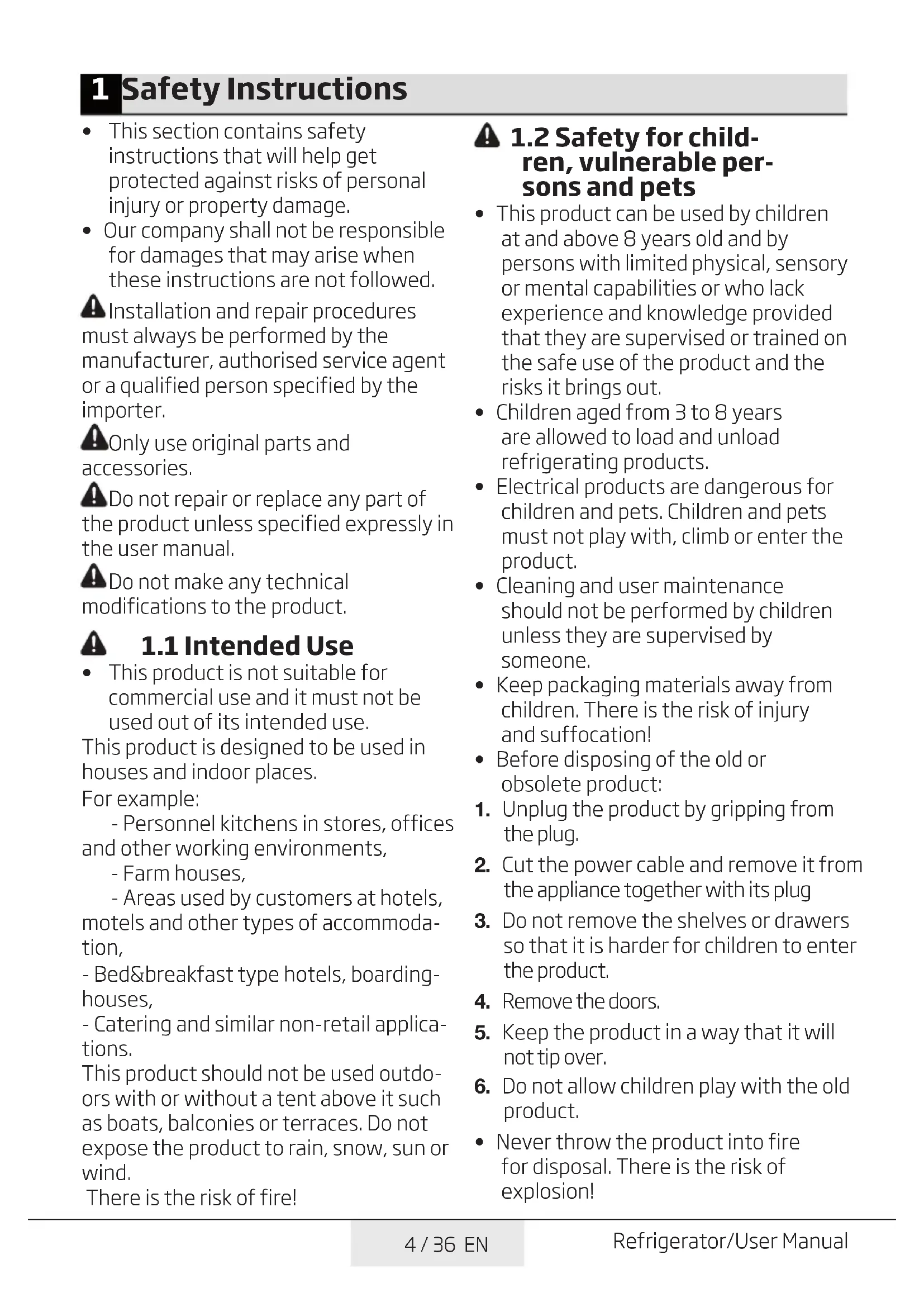


Download the instructions for your Freezer in PDF format for free! Find your manual RFNE448E45WCH - BEKO and take your electronic device back in hand. On this page are published all the documents necessary for the use of your device. RFNE448E45WCH by BEKO.
USER MANUAL RFNE448E45WCH BEKO
Congélateur Manuel d'utilisation EN / DE / FR / IT / 58 6481 0000/AB Kühlschrank/Gefrierschrank Bedienungsanleitung Freezer User manual Frigorifero Manuale utentePlease read this manual before using the product! Dear Customer, We'd like you to make the best use of our product, which has been manufactured in modern facilities with care and meticulous quality controls. Thus, we advice you to read the entire user manual before you use the product. In case the product changes hands, do not forget to hand the guide to its new owner along with the product. This guide will help you use the product quickly and safely.
- Please read the user guide carefully before installing and operating the product.
- Always observe the applicable safety instructions.
- Keep the user guide within easy reach for future use.
- Please read any other documents provided with the product. Keep in mind that this user guide may apply to several product models. The guide clearly indicates any variations of different models.
Risk of life and property.
Risk of electric shock. The product’s packaging is made of recyclable materials, in accordance with the National Environment Legislation.
The model information as stored in the product data base can be reached by entering following website and searching for your model identifier (*) found on energy label.https://eprel.ec.europa.eu/3 / 36 EN Refrigerator/User Manual 1 Safety Instructions 6
1.1 Intended Use.................................. 6
1.2 Safety for children, vulnerable
1.7 Maintenance and cleaning
4.1 Appropriate Installation Location 13
4.2 Installing the Plastic Wedges ........14
4.6 Changing the illumination lamp ... 15
4.7 Changing the door opening
6 Operating the product 18
6.1 Indicator panel ......................................18
6.2 How to Freeze Fresh Foods .........20
6.3 Recommendations for Preservation
6.6 Defrosting the frozen foods ..........22
6.7 Recommended Temperature
- This section contains safety instructions that will help get protected against risks of personal injury or property damage.
- Our company shall not be responsible for damages that may arise when these instructions are not followed. Installation and repair procedures must always be performed by the manufacturer, authorised service agent or a qualified person specified by the importer. Only use original parts and accessories. Do not repair or replace any part of the product unless specified expressly in the user manual. Do not make any technical modifications to the product.
- This product is not suitable for commercial use and it must not be used out of its intended use. This product is designed to be used in houses and indoor places. For example: - Personnel kitchens in stores, offices and other working environments, - Farm houses, - Areas used by customers at hotels, motels and other types of accommoda- tion, - Bed&breakfast type hotels, boarding- houses, - Catering and similar non-retail applica- tions. This product should not be used outdo- ors with or without a tent above it such as boats, balconies or terraces. Do not expose the product to rain, snow, sun or wind. There is the risk of fire!
1.2 Safety for child-
ren, vulnerable per- sons and pets
- This product can be used by children at and above 8 years old and by persons with limited physical, sensory or mental capabilities or who lack experience and knowledge provided that they are supervised or trained on the safe use of the product and the risks it brings out.
- Children aged from 3 to 8 years are allowed to load and unload refrigerating products.
- Electrical products are dangerous for children and pets. Children and pets must not play with, climb or enter the product.
- Cleaning and user maintenance should not be performed by children unless they are supervised by someone.
- Keep packaging materials away from children. There is the risk of injury and suffocation!
- Before disposing of the old or obsolete product:
1. Unplug the product by gripping from
2. Cut the power cable and remove it from
the appliance together with its plug
3. Do not remove the shelves or drawers
so that it is harder for children to enter the product.
4. Remove the doors.
5. Keep the product in a way that it will
6. Do not allow children play with the old
- Never throw the product into fire for disposal. There is the risk of explosion! 1 Safety Instructions5 / 36 EN Refrigerator/User Manual Safety and environment instructions
- If there is a lock on the door of the product, the key should be kept out of the reach of children.
1.3 Electrical safety
- The product must be unplugged during installation, maintenance, cleaning, repairing and moving procedures.
- If the power cable is damaged, it must be replaced by a qualified person specified by the manufacturer, authorised service agent or importer in order to avoid potential dangers.
- Do not squeeze the power cable under or behind the product. Do not place heavy objects on the power cable. Power cable must not be bent excessively, pinched or get in contact with any heat source.
- Do not use extension cords, multi- sockets or adapters to operate the product.
- Portable multi-sockets or portable power sources can overheat and cause fire. Therefore, do not keep any multi-sockets behind or near the product.
- Plug must be easily accessible. If this is not possible, the electrical installation to which the product is connected must contain a device (such as a fuse, switch, circuit breaker, etc.) which conforms to the electrical regulations and disconnects all poles from the grid.
- Do not touch the power plug with wet hands.
- Remove the plug from the socket by gripping the plug and not the cable.
1.4 Transportation safety
- Product is heavy; do not move it alone.
- Do not hold its door when moving the product.
- Pay attention not to damage the cooling system or the piping during transportation. If the piping is damaged, do not operate the product and call the authorised service agent.
1.5 Installation safety
- Call the authorised service agent for installation of the product. To make the product ready for use, check the information in the user manual to make sure that the electricity and water installations are suitable. If they are not, call a qualified electrician and plumber to have the necessary arrangements made. Otherwise, there is the risk of electric shock, fire, problems with the product, or injury!
- Prior to installation, check if the product has any defects on it. If the product is damaged, do not have it installed.
- Place the product on a clean, flat and solid surface and balance it with adjustable feet. Otherwise, the product may tip over and cause injuries.
- The installation location must be dry and well ventilated. Do not place carpets, rugs or similar covers under the product. Insufficient ventilation causes the risk of fire!
- Do not cover or block the ventilation openings. Otherwise, power consumption increases and your product may get damaged.6 / 36 EN Refrigerator/User Manual Safety and environment instructions
- Product must not be connected to supply systems such as solar power supplies. Otherwise, your product may get damaged due to sudden voltage changes!
- The more refrigerant a refrigerator contains, the larger the installation location must be. If the installation location is too small, flammable refrigerant and air mixture will accumulate in cases of refrigerant leakage in cooling system. The required space for each 8 gr of refrigerant is 1 m3 minimum. The amount of refrigerant in your product is indicated on the Type Label.
- Product must not be installed in places exposed to direct sunlight and it must be kept away from heat sources such as hobs, radiators, etc. If it is inevitable to install the product close to a heat source, a suitable insu- lation plate must be used in between and the following minimum distances must be kept to the heat source: - Minimum 30 cm away from heat sources such as hobs, ovens, heater units or stoves, - Minimum 5 cm away from electric ovens.
- Protection class of your product is Type I. Plug the product in a grounded socket that conforms the voltage, current and frequency values stated on the type label of the product. The socket must be equipped with a 10 A – 16 A circuit breaker. Our company shall not be liable for any damages that will arise when the product is used without grounding and electrical connection in accordance with the local and national regulations.
- Product must not be plugged in during installation. Otherwise, there is the risk of electric shock and injury!
- Do not plug the product in sockets that are loose, dislocated, broken, dirty, greasy or bear the risk of getting in contact with water.
- Route the power cable and hoses (if any) of the product in a way that they do not cause risk of tripping over.
- Exposing the live parts or power cable to humidity may cause short circuit. Therefore, do not install the product in places such as garages or laundry rooms where humidity is high or water may splash. If the refrigerator gets wet with water, unplug it and call the authorised service agent.
- Never connect your refrigerator to energy saving devices. Such systems are harmful to your product.
1.6 Operational safety
- Never use chemical solvents on the product. There is the risk of explosion!
- If the product malfunctions, unplug it and do not operate until it is repaired by the authorised service agent. There is the risk of electric shock!
- Do not place flame sources (lit candles, cigarettes, etc.) on or close to the product.
- Do not climb on the product. There is the risk of falling and getting injured!
- Do not damage the pipes of the cooling system with sharp or penetrating objects. The refrigerant that might come out when the refrigerant pipes, pipe extensions or surface coatings are punctured causes skin irritations and eye injuries.7 / 36 EN Refrigerator/User Manual Safety and environment instructions
- Unless recommended by the manufacturer, do not place or use electrical devices inside the refrigerator/deep freezer.
- Be careful not to trap your hands or any other part of your body in the moving parts inside the refrigerator. Pay attention not to squeeze your fingers between the door and the refrigerator. Be careful when opening and closing the door particularly if there are children around.
- Never eat ice cream, ice cubes or frozen food right after removing them from the refrigerator. There is the risk of frostbite!
- When your hands are wet, do not touch the inner walls or metal parts of the freezer or the food stored therein. There is the risk of frostbite!
- Do not place tins or bottles that contain carbonated drinks or freezable liquids in the freezer compartment. Tins and bottles may burst. There is the risk of injury and material damage!
- Do not place or use flammable sprays, flammable materials, dry ice, chemical substances or similar heat-sensitive materials near the refrigerator. There is the risk of fire and explosion!
- Do not store explosive materials that contain flammable materials, such as aerosol cans, in your product.
- Do not place containers filled with liquid onto the product. Splashing water on an electrical part may cause electric shock or the risk of fire.
- This product is not intended for storing medicines, blood plasma, laboratory preparations or similar medical substances and products subject to Medical Products Directive.
- Using the product against its intended purpose may cause the products stored inside it to deteriorate or spoil.
- If your refrigerator is equipped with blue light, do not look at this light with optical tools. Do not stare at UV LED lamp directly for a long time. Ultraviolet light may cause eye strain.
- Do not overload the product. Objects in the refrigerator may fall down when the door is opened, causing injury or damage. Similar problems may arise if any object is placed onto the product.
- To avoid injuries, make sure that you have cleaned all the ice and water that may have fallen or splashed on the floor.
- Change the position of the shelves/ bottle holders on the door of your refrigerator only when they are empty. There is the risk of injury!
- Do not place objects that can fall down/tip over onto the product. Such objects may fall down when the door is opened and cause injuries and/or material damage.
- Do not hit or exert excessive force on glass surfaces. Broken glass may cause injuries and/or material damage.
- Cooling system of your product contains R600a refrigerant: Type of the refrigerant used in the product is indicated on the type label. This refrigerant is flammable. Therefore, pay attention not to damage the cooling system or the piping while the product is in use. If the piping is damaged: - Do not touch the product or the power cable,8 / 36 EN Refrigerator/User Manual Safety and environment instructions - Keep away potential sources of fire that may cause the product to catch fire. - Ventilate the area where the pro- duct is located. Do not use fans. - Call the authorised service agent.
- If the product is damaged and you see refrigerant leak, please stay away from the refrigerant. Refrigerant may cause frostbite in case of skin contact. For products with a Water Dispenser/Ice Machine
- Use only potable water. Do not fill the water tank with any liquids -such as fruit juice, milk, carbonated beverages or alcoholic drinks- that are not suitable for use in the water dispenser.
- There is the risk for health and safety!
- Do not allow children play with the water dispenser or ice machine (Icematic) in order to prevent accidents or injuries.
- Do not insert your fingers or other objects into the water dispenser hole, water channel or ice machine container. There is the risk of injury or material damage!
- Do not pull from the door handle if you need to move the product for cleaning purposes. Handle may break and cause injuries if you exert excessive force on it.
- Do not spray or pour water on or inside the product for cleaning purposes. There is the risk of fire and electric shock!
- Do not use sharp or abrasive tools when cleaning the product. Do not use household cleaning products, detergent, gas, gasoline, thinner, alcohol, varnish etc.
- Only use cleaning and maintenance products inside the product that are not harmful for food.
- Never use steam or steam assisted cleaners to clean or defrost the product. Steam gets into contact with the live parts in your refrigerator, causing short circuit or electric shock!
- Make sure that no water enters the electronic circuits or lighting elements of the product.
- Use a clean and dry cloth to wipe the foreign materials or dust on the pins of the plug. Do not use a wet or damp cloth to clean the plug. There is the risk of fire and electric shock!
(May not be applicable for all models)
- When you operate your product through HomeWhiz application, you must observe the safety warnings even when you are away from the product. You must also follow the warnings in the application.
(May not be applicable for all models)
- Call the authorised service when it is required to replace the LED/bulb used for lighting.9 / 36 EN Refrigerator/User Manual
2.1 Compliance with the WEEE
Directive and Disposing of the Waste Product: This product complies with EU WEEE Directive (2012/19/EU). This product bears a classification symbol for waste electrical and electronic equipment (WEEE). This symbol indicates that this product shall not be disposed with other household wastes at the end of its service life. Used device must be returned to offical collection point for recycling of electrical and electronic devices. To find these collection systems please contact to your local authorities or retailer where the product was puchased. Each household performs important role in recovering and recycling of old appliance. Appropriate disposal of used appliance helps prevent potential negative consequences for the environment and human health. 2 Environmental Instructions
2.2 Compliance with RoHS Directive
The product you have purchased complies with EU RoHS Directive (2011/65/EU). It does not contain harmful and prohibited materials specified in the Directive.
2.3 Package information
Packaging materials of the product are manufactured from recyclable materials in accordance with our National Environment Regulations. Do not dispose of the packaging materials together with the domestic or other wastes. Take them to the packaging material collection points designated by the local authorities.10 / 36 EN Refrigerator/User Manual 3 Your Freezer
Figures that take place in this instruction manual are schematic and may not correspond exactly with your product. If the subject parts are not included in the product you have purchased, then it is valid for other models.
5. Adjustable front feet
Installation Location Contact an Authorized Service for the installation of the product. In order to prepare the product for use, refer the information in the user manual and ensure that electrical installation and water installation are appropriate. If not, call a qualified electrician and technician to have any necessary arrangements carried out.
WARNING: Manufacturer shall
not be held liable for damages that may arise from procedures carried out by unauthorized persons.
WARNING: Product must
not be plugged in during installation. Otherwise, there is the risk of death or serious injury!
If the door clearance of the room where the product shall be place is so tight to prevent passing of the product, remove the door of the room and pass the product through the door by turning it to its side; if this does not work, contact the authorized service.
- Place the product on an even floor surface to prevent jolts.
- Install the product at least 30 cm away from heat sources such as hobs, heater cores and stoves and at least 5 cm away from electrical ovens.
- Product must not be subjected to direct sun light and kept in humid places.
- Appropriate air ventilation must be provided around your product in order to achieve an efficient operation. If the product is to be placed in a recess in the wall, pay attention to leave at least 5 cm distance with the ceiling and side walls.
- Your product requires adequate air circulation to function efficiently. If the product will be placed in an alcove, remember to leave at least 5 cm clearance between the product and the ceiling, rear wall and the side walls.
- If the product will be placed in an alcove, remember to leave at least 5 cm clearance between the product and the ceiling, rear wall and the side walls. Check if the rear wall clearance protection component is present at its location (if provided with the product). If the component is not available, or if it is lost or fallen, position the product so that at least 5 cm clearance shall be left between the rear surface of the product and the wall of the room. The clearance at the rear is important for efficient operation of the product.12 / 36 EN Refrigerator/User Manual Installation
Plastic Wedges Plastic wedges supplied with the product are used to create the distance for the air circulation between the product and the rear wall.
1. To install the wedges, remove the
screws on the product and use the screws supplied together with the wedges.
2. Insert the 2 plastic wedges onto the
rear ventilation cover as illustrated in the figure.
4.3 Adjusting the Feet
If the product stands unbalanced after installation, adjust the feet on the front by rotating them to the right or left.
4.4 Electrical Connection
WARNING: Do not make
connections via extension cables or multi-plugs.
power cable must be replaced by the Authorized Service Agent.
If two coolers are to be installed side by side, there should be at least 4 cm distance between them.
- Our company shall not be liable for any damages that will arise when the product is used without grounding and electrical connection in accordance with the national regulations.
- Power cable plug must be within easy reach after installation.
- Connect your refrigerator to a grounded outlet rated for a voltage value of 220-240V /50 Hz. Outlet shall have 10 to 16A fuse.
- Do not extension cords or cordless multiple outlets between your product and the wall outlet.13 / 36 EN Refrigerator/User Manual Installation
4.5 Door Open Warning
*May not be available in all models An audio warning signal will be given when the door of your product is left open for at least 1 minute. This warning will be muted when the door is closed or any of the display buttons (if any) are pressed.
illumination lamp To change the Bulb/LED used for illumination of your refrigerator, call your AuthorisedService. The lamp(s) used in this appliance is not suitable for household room illumination. The intended purpose of this lamp is to assist the user to place foodstuffs in the refrigerator/freezer in a safe and comfortable way.The lamps used in this appliance have to withstand extreme physical conditions such as temperatures below -20 °C. (only chest and upright freezer)
4.7 Changing the door
opening direction Door opening direction of your refrigerator can be changed according to the place you are using it. If this is necessary, please call your nearest Authorized Service.14 / 36 EN Refrigerator/User Manual 5 Preliminary preparation
Connecting the product to electronic energy-saving systems is harmful, as it may damage the product.
- For a freestanding appliance; ‘this refrigerating appliance is not intended to be used as a built-in appliance.
- Do not keep the refrigerator doors open for long periods.
- Do not place hot food or beverages into the refrigerator.
- Do not overfill the refrigerator; blocking the internal air flow will reduce cooling capacity.
- In order to load the maximum quantity of food into the cooler compartment of your refrigerator, the upper drawers should be taken out and the food should be placed onto the wire/glass shelves. Net volume and energy consumption information declared in the energy label of your refrigerator was tested by taking out the upper drawers in the cooler department and the ice bucket, which is easily removable by hand.
- Food packages should not be in direct contact with the heat sensor located in the cooler compartment. The food should be 10 cm away from the sensor. In case of contact with the sensor, energy consumption of the device may increase. 10 cm
Before using your refrigerator, make sure the necessary preparations are made in line with the instructions in "Safety and environment instructions" and "Installation" sections.
- Keep the product running without placing any food inside for 6 hours and do not open the door, unless absolutely necessary.
- The temperature change caused by opening and closing of the door while using the product may normally lead to frost deposit, icing and condensation on food placed on door/body shelves and glass containers placed in the product.
A sound will be heard when the compressor is engaged. It is normal to hear sound even when the compressor is inactive, due to the compressed liquids and gasses in the cooling system.15 / 36 EN Refrigerator/User Manual
It is normal for the front edges of the refrigerator to be warm. These areas are designed to warm up in order to prevent condensation.
For some models, indicator panel turns off automatically 1 minutes after the door closes. It will be reactivated when the door is open or any button is pressed.
- Since hot and humid air will not directly penetrate into your product when the doors are not opened, your product will optimize itself in conditions sufficient to protect your food. Functions and components such as compressor, fan, heater, defrost, lighting, display and so on will operate according to the needs to consume minimum energy under these circumstances.16 / 36 EN Refrigerator/User Manual
Figures in this user manual are schematic and may not match the product exactly. If the subject parts are not included in the product you have purchased, then those parts are valid for other models. 1.On/Off Indicator: This icon ( ) come on when the freezer is turned off. All the other icons turn off. 2.Economic Usage Indicator: This icon ( ) (comes on when the Freezer Compartment is set to -18°C which is the most economical set value. Economic Usage Indicator turns off when the Quick Fridge or Quick Freeze function is selected. 3.Freezer Compartment Temperature Setting Indicator: Indicates the temperature set for the Freezer Compartment. 4.Power Failure / High temperature / Error status indicator: This indicator ( ) illuminates in case of power failure, high temperature and error warnings. When the temperature of the freezer compartment is heated up to a critical level for the frozen food, the maximum value reached by the freezer compartment temperature flashes on the digital indicator. Check the food in the freezer compartment. This is not a malfunction. The warning may be deleted by pressing any button or on high temperature alarm off button. (Cancelling by pressing any button is not applicable for every model.) 6 Operating the product
1317 / 36 EN Refrigerator/User Manual Operating the product This indicator ( ) illuminated when a sensor failure occurs, too. When this indicator is illuminated, “E” and figures such as “1,2,3...” are displayed alternatively on the temperature indicator. These figures on the indicator inform the service personnel about the error. 5.Eco Extra Indicator: This icon ( ) lights up when this Function is active. 6.Key Lock Indicator: This icon ( ) lights up when the Key Lock mode is activated. 7.Key Lock Mode: Press Key Lock ( ) button continuously for 3 seconds. Key lock icon will light up and key lock mode will be activated. Buttons will not function if the Key Lock mode is active. Press Key Lock button continuously for 3 seconds again. Key lock icon will turn off and the key lock mode will be exite. 8.Termination of the High Temperature Warning: In case of power failure/high temperature warning, you may delete the warning ( ) by pressing any button on the indicator or high temperature alarm off button for 1 second after checking the food inside the freezer compartment. Note: Cancelling by pressing any button is not applicable for every model. 9.Eco Extra Function: Press the Eco Extra button ( ) for 3 seconds to activate Eco Extra Function when going on holday for instance. Freezer will start operating in the most economic mode at around 6 hours later and the economic usage indicator will turn on when the function is active. 10.Freezer Set Function: This function ( ) allows you to change the Freezer compartment temperature setting. Press this button to set the temperature of the freezer compartment to -18, -19, -20, -21, -22, -23 and -24, respectively. 11.Quick Freeze Function: Quick Freeze indicator ( ) turns on when the Quick Freeze function is on. Press Quick Freeze button again to cancel this function. Quick Freeze indicator will turn off and normal settings will be resumed. Quick Freeze function will be cancelled automatically 52 hours later if you do not cancel it manually. If you want to freeze plenty amount food, press Quick Freeze button before you place the food into the freezer compartment. 12.On/Off Function: This function ( ) allows you to make the Fridge turn off when pressed for 3 seconds.The fridge could be turned on by pressing On/Off button for 3 seconds again .18 / 36 EN Refrigerator/User Manual Operating the product 13.Energy Saving Indicator : If the product doors are kept closed for a long time energy saving function is automatically activated and energy saving symbol is illuminated. ( ) When energy saving function is activated, all symbols on the display other than energy saving symbol will turn off. When the Energy Saving function is activated, if any button is pressed or the door is opened, energy saving function will be canceled and the symbols on display will return to normal. Energy saving function is activated during delivery from factory and cannot be canceled. 14.Quick Freeze Indicator : This icon ( ) comes on when the Quick Freeze function is on.
- Foods to be frozen must be divided into portions according to a size to be consumed, and frozen in separate packages. In this way, all the food should be prevented from being re- frozen by thawing.
- In order to protect the nutritional value, the aroma and the color of the foods as much as possible, vegetables should be boiled for a short period of time before freezing. (Boiling is not necessary for foods such as cucumber, parsley.) Cooking time of the vegetables frozen in this way is shortened by 1/3 than that of the fresh vegetables.
- To extend the storage times of frozen foods, boiled vegetables must first be filtered and then hermetically packaged as in the all types of foods.
- Foods should not be placed in the freezer compartment without package.
- The packaging material of the food to be stored should be air-tight, thick and durable and should not deform with cold and humidity. Otherwise, the food that is hardened by freezing might pierce the package. Sealing the package well is also important in terms of securely storing the food. The following packaging types are suitable for use to freeze the food: Polyethylene bag, aluminum foil, plastic foil, vacuum bags and cold-resistant storage containers with caps. The use of the following types of packaging is not recommended to freeze the food; Packaging paper, parchment paper, cellophane (gelatin paper), garbage bag, used bags and shopping bags.19 / 36 EN Refrigerator/User Manual Operating the product
- Hot foods should not be placed in the freezer compartment without cooling.
- When placing unfrozen fresh foods in the freezer compartment, please note that it does not contact with frozen foods. Cool-pack (PCM) can be placed to the rack immediately below the quick freezer rack for preventing them from being getting warm.
- During the freezing time (24 hours) do not place other food to the freezer.
- Place your foods to the freezing shelves or racks by spreading them so that they will not be cramped (it is recommended that the packaging does not come into contact with each other).
- Frozen foods must be immediately consumed in a short period of time after defrosting and must never be frozen again.
- Do not block the ventilation holes by putting your frozen foods in front of the ventilation holes located on the back surface.
- We recommend you to attach a label onto the package and write the name of the foods in the package and the freezing time. Foods suitable for freezing: Fish and seafood, red and white meat, poultry, vegetables, fruit, herbaceous spices, dairy products (such as cheese, butter and strained yoghurt), pastries, ready or cooked meals, potato dishes, souffle and desserts. Foods not suitable for freezing: Yoghurt, sour milk, cream, mayonnaise, leaved salad, red radish, grapes, all fruits (such as apple, pears and peaches).
- For foods to be frozen quickly and thoroughly, the following specified amounts per package should not be exceeded. -Fruits and vegetables, 0.5-1 kg -Meat, 1-1.5 kg
- A small amount of foods (maximum 2 kg) can also be frozen without the use of the quick freezing function. To obtain the best result, apply the following instructions:
1. Activate the quick freezing
function 24 hours before placing your fresh foods.
2. After 24 hours after pressing the
button, first place your food that you want to freeze to the top shelf with higher freezing capacity. Place your remaining food, if any, to the rightmost part of the second shelf.
3. The quick freezing function will be
automatically inactivated after 52hours.
4. Do not try to freeze a large
quantity of food at a time. Within 24 hours, this product can freeze the maximum food quantity specified as «Freezing Capacity … kg/24 hours» on its type label. It is not convenient to put more unfrozen/fresh foods to the freezer compartment than the quantity specified on the label.
- You can review the Meat and Fish, Vegetables and Fruits, Dairy Products tables for placing and storing your foods in the deep-freezer.
6.3 Recommendations for
Preservation of Frozen Foods
- While purchasing your frozen foods, make sure that they are frozen at appropriate temperatures and their packages are not broken.
- Put the packages on the freezer compartment as soon as possible after purchasing them.
- Make sure that the expiration date indicated on the packaging is not20 / 36 EN Refrigerator/User Manual Operating the product expired before consuming the packaged ready meals that you remove from the freezer compartment.
The ice in the freezer compartments is automatically thawed.
6.5 Deep Freezer Information
The EN 62552 standard requires (according to specific measurement conditions) that at least 4.5 kg of food for each 100 liter of freezer compartment volume can be frozen at a room temperature of 25°C in 24 hours.
frozen foods Depending on the food diversity and the purpose of use, a selection can be made between the following options for defrosting:
- At room temperature (it is not very suitable to defrost the food by leaving it at room temperature for a long time in terms of maintaining the food quality)
- In the electrical oven (in models with or without fan)
- In the microwave oven CAUTION:
- Never put acidic beverages in glass bottles and cans into your freezer due to the risk of explosion.
- If there is moisture and abnormal swelling in the packaging of frozen foods, it is likely that they were previously stored in an improper storage condition and their contents deteriorated. Do not consume these foods without checking.
- Since some spices in cooked meals may change their taste when exposed to long-term storage conditions, your frozen foods should be less seasoned or the desired spices should be added to the foods after the thawing process.21 / 36 EN Refrigerator/User Manual Operating the product
6.7 Recommended Temperature Settings
Freezer compartment setting Remarks -20 °C This is the default recommended temperature setting. -21,-22,-23 or -24 oC These settings are recommended when the ambient temperature is higher than 30°C or when you think the refrigerator is not cool enough due to frequent opening and closing of the door. Quick Freezing Use when you want to freeze your food in a short time. It is recommended to be applied to preserve the quality of your fresh food. You do not need to use the quick freezing function when putting your frozen food. You do not need to use the quick freezing function to freeze a small amount of fresh food, up to 2 kg per day.22 / 36 EN Refrigerator/User Manual Operating the product Meat and Fish Preparation Longest storage time (month) M e a t products Veal Steak By cutting them 2 cm thick and placing foil between them or wrapping tightly with stretch 6 – 8 Roast By packing the pieces of meat in a refrigerator bag or wrapping them tightly with stretch 6 – 8 Cubes In small pieces 6 – 8 Schnitzel, chops By placing foil between cut slices or wrapping individually with stretch 6 – 8 Mutton Chops By placing foil between meat pieces or wrapping individually with stretch
Roast By packing the pieces of meat in a refrigerator bag or wrapping them tightly with stretch
Cubes By packing the shredded meats in a refrigerator bag or wrapping them tightly with stretch
Beef Roast By packing the pieces of meat in a refrigerator bag or wrapping them tightly with stretch
Steak By cutting them 2 cm thick and placing foil between them or wrapping tightly with stretch
Cubes In small pieces 8 - 12 Boiled meat By packaging in small pieces in a refrigerator bag 8 - 12 Mince Without seasoning, in flat bags 1 - 3 Offal (piece) In pieces 1 - 3 Fermented sausage - Salami It should be packaged even if it has casing. 1 - 2 Jambon By placing foil between cut slices 2 - 3 Poultry a n d h u nt in g animals Chicken and Turkey By wrapping in foil 4 – 6 Goose By wrapping in foil (portions should not exceed 2.5 kg) 4 – 6 Duck By wrapping in foil (portions should not exceed 2.5 kg) 4 – 6 Deer, Rabbit, Roe Deer By wrapping in foil (portions should not exceed 2.5 kg, and their bones should be separated) 6 – 8 F i s h a n d seafood Freshwater fish (Trout, Carp, Crane, Catfish) After thoroughly cleaning the inside and scales, it should be washed and dried, and the tail and head parts should be cut when necessary.
Lean fish (Sea bass, Turbot, Sole) 4-6 Fatty fish (Bonito, Mackerel, Bluefish, Red Mullet, Anchovy)
Shellfish Cleaned and in bags 4 - 6 Caviar In its packaging, in an aluminum or plastic container 2 - 323 / 36 EN Refrigerator/User Manual Operating the product Fruits and Vegetables Preparation Longest storage time (month) String bean and Pole bean By shock boiling for 3 minutes after washing and cutting into small pieces 10 - 13 Green pea By shock boiling for 2 minutes after shelling and washing 10 - 12 Cabbage By shock boiling for 1-2 minute(s) after cleaning 6 - 8 Carrot By shock boiling for 3-4 minutes after cleaning and cutting into slices 12 Pepper By boiling for 2-3 minutes after cutting the stem, dividing into two and separating the seeds
Spinach By shock boiling for 2 minutes after washing and cleaning 6 - 9 Leek By shock boiling for 5 minutes after chopping 6 - 8 Cauliflower By shock boiling in a little lemon water for 3-5 minutes after separating the leaves, cutting the core into pieces 10 – 12 Eggplant By shock boiling for 4 minutes after washing and cutting into 2cm pieces 10 – 12 Squash By shock boiling for 2- 3 minutes after washing and cutting into 2cm pieces 8 - 10 Mushroom By lightly sauteing in oil and squeezing lemon on it 2 - 3 Corn By cleaning and packing in cob or granular 12 Apple and Pear By shock boiling for 2-3 minutes after peeling and slicing 8 - 10 Apricot and Peach Divide in half and extract the seeds 4 - 6 Strawberry and Raspberry By washing and shelling 8 - 12 Baked fruit By adding 10% sugar in the container 12 Plum, Cherry, Sour Cherry By washing and shelling the stalks 8 - 12 Dairy Products Preparation Longest Storage Time ((Month Storage Conditions Cheese (except feta cheese) By placing foil therebetween, in slices
6 - 8 It can be left
in its original packaging for short term storage. For long-term storage it should also be wrapped in aluminum or plastic foil. Butter, margarine In its own packaging 6 In its own packaging or in plastic containers24 / 36 EN Refrigerator/User Manual 7 Maintenance and cleaning Cleaning your fridge at regular inter- vals will extend the service life of the product. B WARNING: Unplug the product before cleaning it.
- Never use gasoline, benzene or similar substances for cleaning purposes.
- Never use any sharp and abrasive tools, soap, household cleaners, detergent and wax polish for cleaning.
- For non-No Frost products, water drops and frosting up to a fingerbreadth occur on the rear wall of the Fridge compartment. Do not clean it; never apply oil or similar agents on it.
- Only use slightly damp microfiber cloths to clean the outer surface of the product. Sponges and other types of cleaning cloths may scratch the surface
- Dissolve one teaspoon of bi- carbonate in half litre of water. Soak a cloth with the solution and wrung it thoroughly. Wipe the interior of the refrigerator with this cloth and the dry thoroughly.
- Make sure that no water enters the lamp housing and other electrical items.
- If you will not use the refrigerator for a long period of time, unplug it, remove all food inside, clean it and leave the door ajar.
- Check regularly that the door gaskets are clean. If not, clean them.
- To remove door and body shelves, remove all of its contents.
- Remove the door shelves by pulling them up. After cleaning, slide them from top to bottom to install.
- Never use cleaning agents or water that contain chlorine to clean the outer surfaces and chromium coated parts of the product. Chlorine causes corrosion on such metal surfaces.
7.1 Avoiding bad odours
- Materials that may cause odour are not used in the production of our refrigerators. However, due to inappropriate food preserving conditions and not cleaning the inner surface of the refrigerator as required can bring forth the problem of odour. Pay attention to following to avoid this problem:
- Keeping the refrigerator clean is important. Food residuals, stains, etc. can cause odour. Therefore, clean the refrigerator with bi-carbonate dissolved in water every few months. Never use detergents or soap.
- Keep the food in closed containers. Microorganisms spreading out from uncovered containers can cause unpleasant odours.
- Never keep the food that have passed best before dates and spoiled in the refrigerator.
7.2 Protecting the plas-
tic surfaces Do not put liquid oils or oil-cooked meals in your refrigerator in unsealed contai- ners as they damage the plastic surfaces of the refrigerator. If oil is spilled or sme- ared onto the plastic surfaces, clean and rinse the relevant part of the surface at once with warm water.25 / 36 EN Refrigerator/User Manual
Check this list before contacting the service. Doing so will save you time and money. This list includes frequent complaints that are not related to faulty workmanship or materials. Certain features mentioned herein may not apply to your product. The refrigerator is not working.
- The power plug is not fully settled. >>> Plug it in to settle completely into the socket.
- The fuse connected to the socket powering the product or the main fuse is blown. >>> Check the fuses. Condensation on the side wall of the cooler compartment (MULTI ZONE, COOL, CONTROL and FLEXI ZONE).
- The door is opened too frequently >>> Take care not to open the product’s door too frequently.
- The environment is too humid. >>> Do not install the product in humid environments.
- Foods containing liquids are kept in unsealed holders. >>> Keep the foods containing liquids in sealed holders.
- The product’s door is left open. >>> Do not keep the product’s door open for long periods.
- The thermostat is set to too low temperature. >>> Set the thermostat to appropriate temperature. Compressor is not working.
- In case of sudden power failure or pulling the power plug off and putting back on, the gas pressure in the product’s cooling system is not balanced, which triggers the compressor thermic safeguard. The product will restart after approximately 6 minutes. If the product does not restart after this period, contact the service.
- Defrosting is active. >>> This is normal for a fully-automatic defrosting product. The defrosting is carried out periodically.
- The product is not plugged in. >>> Make sure the power cord is plugged in.
- The temperature setting is incorrect. >>> Select the appropriate temperature setting.
- The power is out. >>> The product will continue to operate normally once the power is restored. The refrigerator’s operating noise is increasing while in use.
- The product’s operating performance may vary depending on the ambient temperature variations. This is normal and not a malfunction. The refrigerator runs too often or for too long.
- The new product may be larger than the previous one. Larger products will run for longer periods.
- The room temperature may be high. >>> The product will normally run for long periods in higher room temperature.
- The product may have been recently plugged in or a new food item is placed inside. >>> The product will take longer to reach the set temperature when recently plugged in or a new food item is placed inside. This is normal.
- Large quantities of hot food may have been recently placed into the product. >>> Do not place hot food into the product.
- The doors were opened frequently or kept open for long periods. >>> The warm air moving inside will cause the product to run longer. Do not open the doors too frequently.26 / 36 EN Refrigerator/User Manual Troubleshooting
- The freezer or cooler door may be ajar. >>> Check that the doors are fully closed.
- The product may be set to temperature too low. >>> Set the temperature to a higher degree and wait for the product to reach the adjusted temperature.
- The cooler or freezer door washer may be dirty, worn out, broken or not properly settled. >>> Clean or replace the washer. Damaged / torn door washer will cause the product to run for longer periods to preserve the current temperature. The freezer temperature is very low, but the cooler temperature is adequate.
- The freezer compartment temperature is set to a very low degree. >>> Set the freezer compartment temperature to a higher degree and check again. The cooler temperature is very low, but the freezer temperature is adequate.
- The cooler compartment temperature is set to a very low degree. >>> Set the freezer compartment temperature to a higher degree and check again. The food items kept in cooler compartment drawers are frozen.
- The cooler compartment temperature is set to a very low degree. >>> Set the freezer compartment temperature to a higher degree and check again. The temperature in the cooler or the freezer is too high.
- The cooler compartment temperature is set to a very high degree. >>> Temperature setting of the cooler compartment has an effect on the temperature in the freezer compartment. Wait until the temperature of relevant parts reach the sufficient level by changing the temperature of cooler or freezer compartments.
- The doors were opened frequently or kept open for long periods. >>> Do not open the doors too frequently.
- The door may be ajar. >>> Fully close the door.
- The product may have been recently plugged in or a new food item is placed inside. >>> This is normal. The product will take longer to reach the set temperature when recently plugged in or a new food item is placed inside.
- Large quantities of hot food may have been recently placed into the product. >>> Do not place hot food into the product. Shaking or noise.
- The ground is not level or durable. >>> If the product is shaking when moved slowly, adjust the stands to balance the product. Also make sure the ground is sufficiently durable to bear the product.
- Any items placed on the product may cause noise. >>> Remove any items placed on the product. The product is making noise of liquid flowing, spraying etc.
- The product’s operating principles involve liquid and gas flows. >>> This is normal and not a malfunction.27 / 36 EN Refrigerator/User Manual Troubleshooting There is sound of wind blowing coming from the product.
- The product uses a fan for the cooling process. This is normal and not a malfunction. There is condensation on the product’s internal walls.
- Hot or humid weather will increase icing and condensation. This is normal and not a malfunction.
- The doors were opened frequently or kept open for long periods. >>> Do not open the doors too frequently; if open, close the door.
- The door may be ajar. >>> Fully close the door. There is condensation on the product’s exterior or between the doors.
- The ambient weather may be humid, this is quite normal in humid weather. >>> The condensation will dissipate when the humidity is reduced. The interior smells bad.
- The product is not cleaned regularly. >>> Clean the interior regularly using sponge, warm water and carbonated water.
- Certain holders and packaging materials may cause odour. >>> Use holders and packaging materials without free of odour.
- The foods were placed in unsealed holders. >>> Keep the foods in sealed holders. Micro-organisms may spread out of unsealed food items and cause malodour. Remove any expired or spoilt foods from the product. The door is not closing.
- Food packages may be blocking the door. >>> Relocate any items blocking the doors.
- The product is not standing in full upright position on the ground. >>> Adjust the stands to balance the product.
- The ground is not level or durable. >>> Make sure the ground is level and sufficiently durable to bear the product. The vegetable bin is jammed.
- The food items may be in contact with the upper section of the drawer. >>> Reorganize the food items in the drawer. If The Surface Of The Product Is Hot.
- High temperatures may be observed between the two doors, on the side panels and at the rear grill while the product is operating. This is normal and does not require service maintenance!Be careful when touching these areas. A WARNING: If the problem persists after following the instructions in this section, contact your vendor or an Authorised Service. Do not try to repair the product.28 / 36 EN Refrigerator/User Manual DISCLAIMER / WARNING Some (simple) failures can be adequately handled by the end-user without any safety issue or unsafe use arising, provided that they are carried out within the limits and in accordance with the following instructions (see the “Self-Repair” section). Therefore, unless otherwise authorized in the “Self-Repair” section below, repairs shall be addressed to registered professional repairers in order to avoid safety issues. A registered professional repairer is a professional repairer that has been granted access to the instructions and spare parts list of this product by the manufacturer according to the methods described in legislative acts pursuant to Directive 2009/125/EC. However, only the service agent (i.e. authorized professional repairers) that you can reach through the phone number given in the user manual/warranty card or through your authorized dealer may provide service under the guarantee terms. Therefore, please be advised that repairs by professional repairers (who are not authorized by Beko) shall void the guarantee. Self-Repair Self-repair can be done by the end-user with regard to the following spare parts: door handles,door hinges, trays, baskets and door gaskets (an updated list is also available in support.beko.com as of 1st March 2021). Moreover, to ensure product safety and to prevent risk of serious injury, the mentioned self-repair shall be done following the instructions in the user manual for self-repair or which are available in support.beko.com. For your safety, unplug the product before attempting any self-repair. Repair and repair attempts by end-users for parts not included in such list and/ or not following the instructions in the user manuals for self-repair or which are available in support.beko.com, might give raise to safety issues not attributable to Beko, and will void the warranty of the product. Therefore, it is highly recommended that end-users refrain from the attempt to carry out repairs falling outside the mentioned list of spare parts, contacting in such cases authorized professional repairers or registered professional repairers. On the contrary, such attempts by end-users may cause safety issues and damage the product and subsequently cause fire, flood, electrocution and serious personal injury to occur. By way of example, but not limited to, the following repairs must be addressed to authorized professional repairers or registered professional repairers: compressor, cooling circuit, main board,inverter board, display board, etc. The manufacturer/seller cannot be held liable in any case where end-users do not comply with the above. The spare part availability of the refrigerator that you purchased is 10 years. During this period, original spare parts will be available to operate the refrigerator properly The minimum duration of guarantee of the refrigerator that you purchased is 24 months.29 / 36 EN Refrigerator/User Manual This product is equipped with a lighting source of the "G" energy class. The lighting source in this product shall only be replaced by professional repairers.ANGABEN