LC40R - Television GRANDIN - Free user manual and instructions
Find the device manual for free LC40R GRANDIN in PDF.


| Product type | LCD Television |
| Brand | Grandin |
| Model | LC40R |
| Screen size | 40 inches (102 cm) |
| Image format | 16:9 |
| Maximum resolution | 1920 x 1080 pixels (Full HD) |
| Dimensions with stand (W x H x D) | 973 x 655 x 219 mm |
| Weight with stand | 15.10 kg |
| Dimensions without stand (W x H x D) | 973 x 616 x 99.5 mm |
| Weight without stand | 14.40 kg |
| Power supply | 220-240 V AC, 50 Hz |
| Standby consumption | Low (standby mode) |
| Number of channels | 1000 (analog + digital) |
| Digital reception | DVB-T (MPEG2, MPEG4) |
| Connectivity | 2 HDMI inputs, 1 VGA (PC) input, 1 SCART input, 1 USB input, side AV input, S/PDIF output, headphone jack |
| Main functions | USB recording, time shift, EPG, teletext, parental control, sleep timer, game mode, energy saving |
| Supported USB formats | Video: MPEG1/2/4, H.264, Xvid; Audio: MP3; Photo: JPEG, BMP |
| Maintenance and cleaning | Unplug before cleaning, use a soft dry cloth, no solvents |
| Safety | Do not expose to moisture, do not block ventilation slots, do not place open flames on the device |
| Spare parts and reparability | Contact a qualified technician; use parts recommended by the manufacturer |
Frequently Asked Questions - LC40R GRANDIN
User questions about LC40R GRANDIN
0 question about this device. Answer the ones you know or ask your own.
Ask a new question about this device
Download the instructions for your Television in PDF format for free! Find your manual LC40R - GRANDIN and take your electronic device back in hand. On this page are published all the documents necessary for the use of your device. LC40R by GRANDIN.
USER MANUAL LC40R GRANDIN



RECONNAISSANCE DE MARQUE COMMERCIALE
ATTENTION!
natural_image
Close-up of a black remote control case with internal components and a white arrow indicating the location (no text or symbols present)natural_image
Color test monitor with grid background and a circular color swatch (no readable text or symbols)natural_image
Microscopic view of a pixelated surface with a color-coded scale bar (no text or symbols)natural_image
Color test monitor with grid overlay and color wheel (no readable text or symbols)Zoom 14:9
natural_image
Pixelated grayscale image of a computer monitor with a grid background and color wheel (no readable text or symbols)Panoramique
natural_image
Color test monitor with grid background and color wheel (no readable text or symbols)natural_image
Microscopic view of a semiconductor wafer with a color calibration bar overlay (no text or symbols)natural_image
Symbol of a trash bin crossed out by two diagonal lines (no text or numbers present)

natural_image
Symbol of a trash bin crossed out by two diagonal lines (no text or labels)Batterie
PAL/SECAM B/G D/K K' I/I' L/L'
RÉCEPTION DE CANAUX
VHF (BANDE I/III)
UHF (BANDE U)
HYPERBANDE
NOMBRE DE CANAUX PRÉRÉGLÉS
1000
INDICATEUR DE CHAÎNE
Affichage à l'écran
ENTRÉE D'ANTENNE RF
German + Nicam Stéréo
PUISSANCE DE SORTIE AUDIO ( WRMS ) (10% THD)
2×6
CONSOMMATION ÉLECTRIQUE (W)
190 W (max)
PANNEAU
Safety Precautions 41
Connection to a Television Distribution System (Cable TV etc.) from Tuner 43
Environmental Information 43
Repair Information 43
Package Contents 44
Remote Control Buttons 45
LCD TV and Operating Buttons 46
Viewing the Back side Connections 46
Viewing the Connections - Side Connectors ..... 47
Power Connection 48
Aerial Connection 48
Using USB Input 48
Connecting the LCD TV to a PC 49
Using Side AV Connectors 49
Connecting to a DVD Player via HDMI 50
Connecting to a DVD Player.... 50
Remote Control Handset 50
Inserting Batteries 50
Switching On/Off 51
To Switch the TV On 51
To Switch the TV Off 51
Input Selection 51
Basic Operations 51
Operation with the Buttons on the TV 51
Operation with the Remote Control 51
Viewing Electronic Programme Guide (EPG) ..... 52
Recording via EPG Screen 53
Programme Options.... 53
Digital Teletext ( ** for UK only) 53
Analogue Teletext 53
First Time Installation.... 53
Installation 54
Auto Channel Scan (Retune) Menu Operation .. 54
Manual Tuning 55
Manual Search.... 55
Analogue Manual Search 55
Analogue Fine Tune.... 55
Clear Service List (*) 55
Managing Stations: Channel List 55
Operating the Channel List 56
Moving a Channel 56
Deleting a Channel 56
Renaming a Channel 56
Locking a Channel 56
Managing Stations: Favourites 56
Button Functions 56
Managing Stations: Sorting Channel List .... 57
On-Screen Information 57
Media Playback Using Media Browser 57
Viewing Videos via USB 57
Viewing Photos via USB 58
Slideshow Options 58
Playing Music via USB 59
Recordings Library.... 59
Media Browser Settings 60
Timeshift Recording 60
Instant Recording 60
Watching Recorded Programmes 61
Changing Image Size: Picture Formats 61
Configuring Picture Settings 62
Operating Picture Settings Menu Items 62
Picture Settings Menu Items 62
PC Picture Settings.... 63
Configuring Sound Settings 63
Operating Sound Settings Menu Items 63
Sound Settings Menu Items.... 64
Configuring Your TV's Settings 64
Operating Settings Menu Items 64
Settings Menu Items 64
Using a Conditional Access Module 65
Viewing Conditional Access Menu (*) 65
Configuring Language Preferences 65
Language Settings 66
Parental Control.... 66
Parental Settings Menu Operation 66
Timers 66
Setting Sleep Timer 66
Setting Programme Timers 67
Recording Configuration 67
Configuring Date/Time Settings 68
Configuring Source Settings 68
Configuring Other Settings 68
Operation 68
Other Features 69
Teletext 69
Tips 70
Appendix A: PC Input Typical Display Modes ..... 71
Appendix B: AV and HDMI Signal Compatibility (Input Signal Types) 71
Appendix C: Supported DVI Resolutions.... 72
Appendix D: Software Upgrade 72
Appendix E : Supported File Formats for USB Mode....73
Specifications 74
Features
Remote controlled colour LCD TV.
Fully integrated Terrestrial digital TV (DVB-T MPEG2, • MPEG4)
HDMI connectors for digital video and audio. This • connection is also designed to accept high definition signals.
USB input.
Programme recording•
Programme timeshifting•
1000 programmes (analogue+digital).•
OSD menu system.
- Integrated tuner DVB-T MPEG 2, MPEG4. compatible.
Scart socket for external devices (such as video, • video games, audio set, etc.).
Stereo sound system. (German+Nicam)•
Teletext, fastext, TOP text.
Headphone connection.
• Automatic programming system.
- Forward or backward manual tuning.
- Sleep timer / Child lock.
• Automatic sound mute when no transmission.
- NTSC playback.
• AVL (Automatic Volume Limiting).
- Auto power down.
- PLL (Frequency Search).
- PC input.
Plug&Play for Windows 98, ME, 2000, XP, Vista, Windows 7.
- Game Mode
Introduction
Please read the corresponding instructions of this handbook prior to the first usage of the device, even when the usage of electronic devices is familiar to you. Notice especially the chapter SAFETY PRECAUTIONS. Carefully keep the handbook as future reference. When selling the device or giving it away, absolutely give these direction for use.
Thank you for choosing this product. This manual will guide you for the proper operation of your TV. Before operating the TV, please read this manual thoroughly. Please do keep this manual in a safe place for future references.
This device is intended to receive and display TV programs. The different connection options make an additional expansion of the reception and display sources possible (receiver, DVD player, DVD recorder,
VCR, PC etc.). This device is only suitable for the operation in dry interiors. This appliance is intended solely for private domestic use and may not be used for industrial and commercial purposes. We exclude liability in principle, if the device is not used as intended, or unauthorized modifications have been made. To operate your LCD TV in extreme ambient conditions may cause the damage of the device.
Preparation
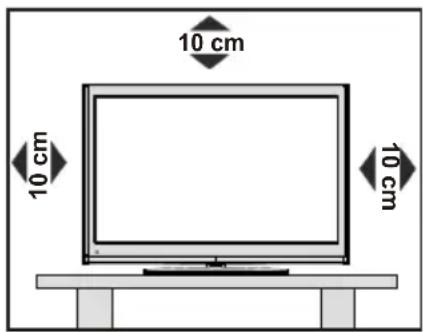
For ventilation, leave a free space of at least 10 cm all around the set. To prevent any fault and unsafe situations, please do not place any objects on top of the set. Use this device in moderate climates.
Safety Precautions
Read the following recommended safety precautions carefully for your safety.
Power Source
The TV set should be operated only from a 220-240 V AC, 50 Hz outlet. Ensure that you select the correct voltage setting for your convenience.
Power Cord
Do not place the set, a piece of furniture, etc. on the power cord (mains lead) or pinch the cord. Handle the power cord by the plug. Do not unplug the appliance pulling from the power cord and never touch the power cord with wet hands as this could cause a short circuit electric shock. Never make a knot in the cord or tie it other cords. The power cords should be placed in such way that they are not likely to be stepped on. A damage power cord can cause fire or give you an electric shock. When it is damaged and needs to be replaced, it should be done by qualified personnel.
Moisture and Water
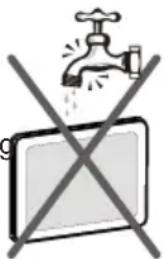
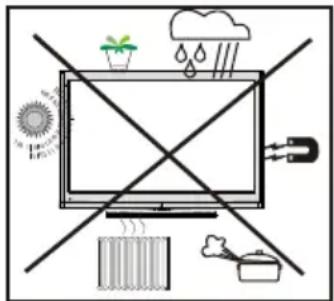
Do not use this device in a humid and damp place (avoid the bathroom, the sink in the kitchen, and near the washing machine). Do not expose this device to rain or water, as this may be dangerous and do not place objects filled with liquids, such as flower vases, on top.
Avoid from dripping or splashing.
If any solid object or liquid falls into the cabinet, unplug the TV and have it checked by qualified personnel before operating it any further.
Cleaning
Before cleaning, unplug the TV set from the wall outlet. Do not use liquid or aerosol cleaners. Use soft and dry cloth.
Ventilation
The slots and openings on the TV set are intended for ventilation and to ensure reliable operation. To prevent overheating, these openings must not be blocked or covered in anyway.
Heat and Flames
The set should not be placed near to open flames and sources of intense heat such as an electric heater. Ensure that no open flame sources, such as lighted candles, are placed on top of the TV. Batteries should not be exposed to excessive heat such as sunshine, fire or the like.
Lightning
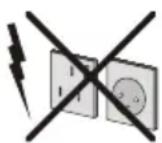
In case of storm and lightning or when going on holiday, disconnect the power cord from the wall outlet.
Replacement Parts
When replacement parts are required, make sure that the service technician has used replacement parts, which are specified by the manufacturer or have the same specifications as the original one. Unauthorized substitutions may result in fire, electrical shock or other hazards.
Servicing
Please refer all servicing to qualified, personnel. Do not remove the cover y yourself as this may result in an electric shock.

or Waste Disposal
Instructions for waste disposal:• ePackaging and packaging aids are recyclable and should principally be recycled. Packaging materials, such as foil bag, must be kept away from children.
Batteries, including those which are heavy metal-free, should not be disposed of with household waste. Please dispose of used battery in an environment friendly manner. Find out about the legal regulations which apply in your area.
Don't try to recharge batteries. Danger of explosion. Replace batteries only with the same or equivalent type.
This symbol on the product or on its packaging means
that your electrical and electronic device should be disposed at the end of its service life separately from your household wastes. There are separate collection systems for recycling in EU. For more information, please contact the local authority or the dealer where you purchased the product.


Disconnecting the Device
The mains plug is used to disconnect TV set from the mains and therefore it must remain readily operable.
Headphone Volume
Excessive sound pressure from earphones and headphones can cause hearing loss.

Installation
To prevent injury, this device must be securely attached to the wall in accordance with the installation instructions when mounted to the wall (if the option is available).
LCD Screen
The LCD panel is a very high technology product with about a million thin film transistors, giving you fine picture details. Occasionally, a few non-active pixels may appear on the screen as a fixed blue, green or red point. Please note that this does not affect the performance of your product.
Warning! Do not leave your TV in standby or operating mode when you leave your house.
Connection to a Television Distribution System (Cable TV etc.) from Tuner
Device connected to the protective earthing of the building installation through the mains connection or through other apparatus with a connection to protective earthing-and to a television distribution system using coaxial cable, may in some circumstances create a fire hazard.
Connection to a cable distribution system has therefore to be provided through a device providing electrical isolation below a certain frequency range (galvanic isolator, see EN 60728-11).
TRADEMARK ACKNOWLEDGMENT
"Dolby" and the double-D symbol are trademarks of Dolby Laboratories.
DOLBY.
DIGITAL PLUS
Licence Notification (Optional)
Ma n uf ac tu red un d er li c en se from D o l b y Laboratories.
Electrical device not in the hands of children
Never let children use electrical device unsupervised. Children can't always recognize properly the possible dangers. Batteries / accumulators can be life threatening when swallowed. Store batteries unreachable for small children. In case of swallowing a battery medical aid has to be sought immediately. Also keep the packaging foils away from children. There is danger of suffocation.
Note: The HDMI connection between PC and TV may cause radio interference in which case it is recommended to use VGA(DSUB-15) connection. The Standby Off/On button doesn't separate this device completely from mains. Moreover the device consumes power in the standby operation. In order to separate the device completely from mains, the mains plug has to be pulled from the mains socket. Because of that the device should be set up in a way, that an unobstructed access to mains socket is guaranteed, so that in case of emergency the mains plug can be pulled immediately. To exclude the danger of fire, the power cord should principally be separated from the mains socket prior to a longer period of non-usage, i.e. during vacations.
Environmental Information
This television is designed to consume less energy • to save environment.
You not only help to save the environment but also you can save money by reducing electricity bills thanks to the energy efficiency feature of this TV. To reduce energy consumption, you should take the following steps:
You can use Power Save Mode setting, located in the • Other settings menu. If you set Power Save Mode as On, the TV will switch to energy-saving mode and luminance level of TV set will be decreased to optimum level. Note that some picture settings will be unavailable to be changed when the TV is in Power Save Mode.
Power Save Mode

When the TV is not in use, please switch off or disconnect the TV from the mains plug. This will also reduce energy consumption.
Disconnect power when going away for longer time.
Note that annually, using the TV set in Power Save Mode has more power efficiency than disconnecting the TV from the mains plug instead of keeping stand-by mode. Therefore it is highly recommended to activate Power Save Mode setting to reduce your annual power consumption. And also it is recommended to disconnect the TV from the mains plug to save energy more when you do not use.
- Please help us to save environment by following these steps.
Repair Information
Please refer all servicing to qualified personnel. Only qualified personnel must repair the TV. Please contact your local dealer, where you have purchased this TV for further information.
Package Contents
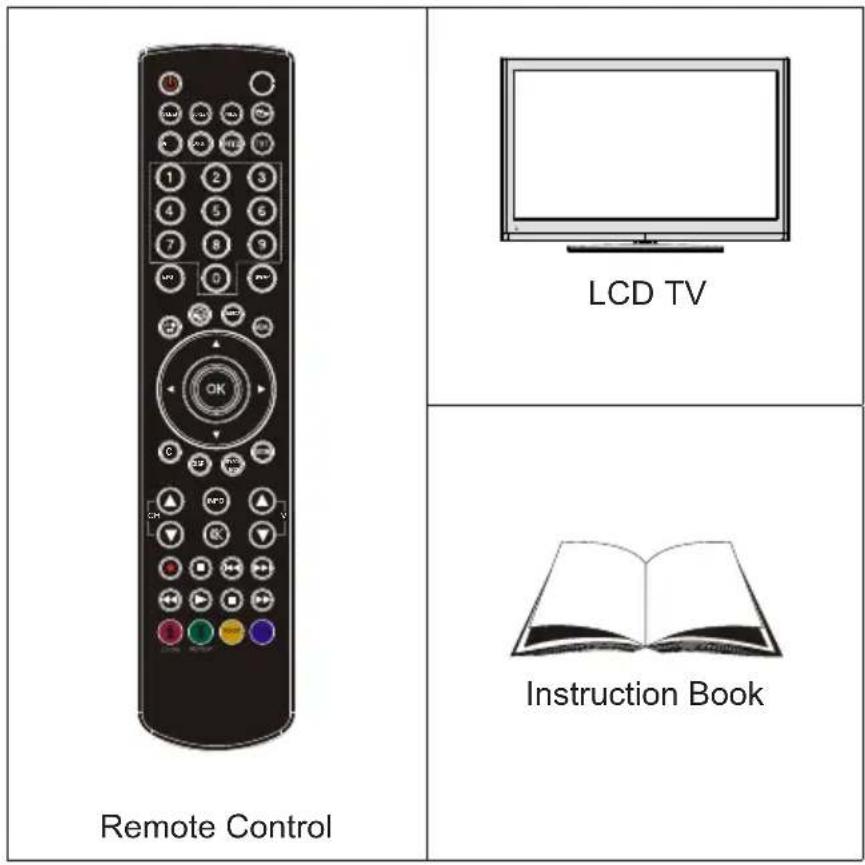
Note: You should check the accessories after purchasing. Make sure that each accessory is included.
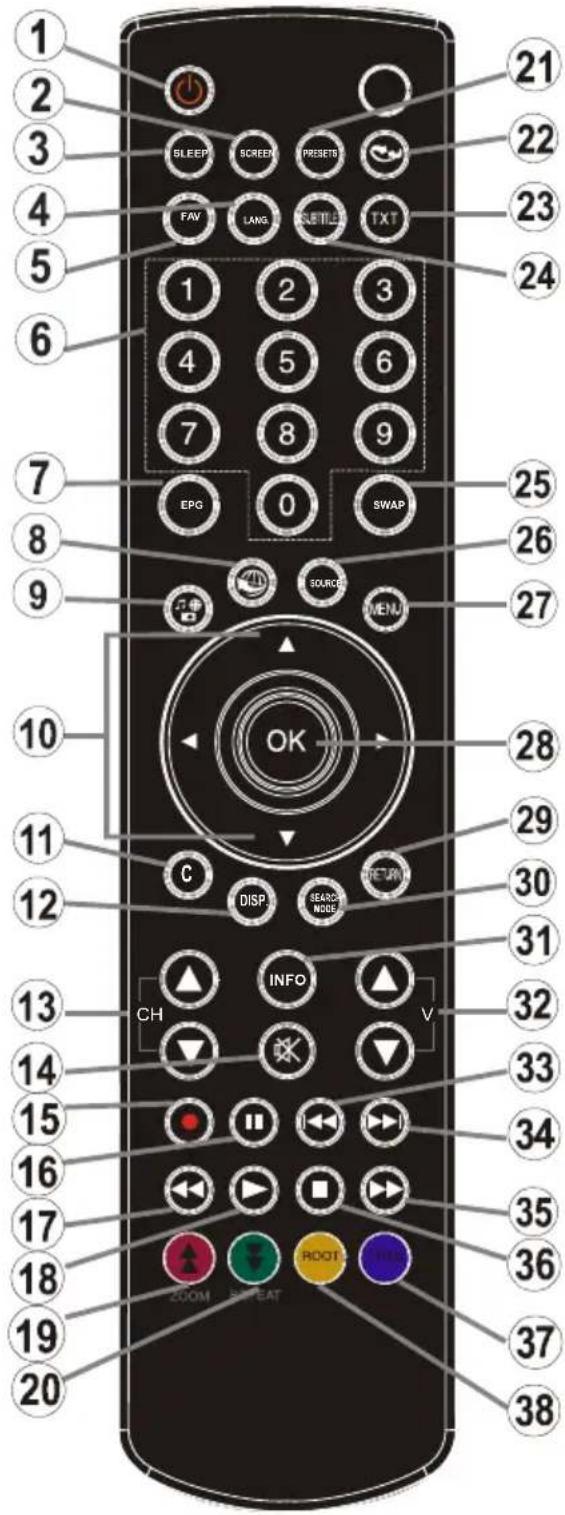
Remote Control Buttons
Standby1.
Image size / Zooms videos (in Media Browser 2. video mode)
Sleep Timer3.
Mono/Stereo - Dual I-II / Current Language (*) 4. (in DVB channels)
Favourite channels5.
Numeric buttons6.
Electronic programme guide(in DVB channels)7.
No function8.
Media Browser9.
Navigation buttons (Up/Down/Left/Right)10.
No function11.
Recordings library12.
Programme Down / Page up - Programme Up / 13.
Page down
Mute14.
Programme recording15.
Pause (in Media Browser mode) / Timeshift 16. recording
-
Rapid reverse (in Media Browser mode)
-
Play (in Media Browser mode)
-
Red button/Stop(in Media Browser)
-
Green button / List Schedule (in EPG) / Tag/ Untag All(in favourite list) / Play-Slideshow(in Media Browser)
-
Picture mode selection. / Changes picture mode (in Media Browser video mode)
No function22.
-
Teletext / Mix (in TXT mode)
-
Subtitle on-off (in DVB channels)
-
Previous programme
-
AV / Source selection Menu on-off27.
-
Okay (Confirm) / Hold (in TXT mode)/ Edit Channel List
Exit / Return / Index page (in TXT mode)29.
No function30.
-
Info / Reveal (in TXT mode)
-
Volume Up / Down
No function 33.
No function34.
-
Rapid advance (in Media Browser mode)
-
Stop (in Media Browser mode)
-
Blue button/Edit Channel List/Filter (In Favourite List&EPG)/Loop-Shuffle (in Media Browser)
-
Yellow button/Pause (in Media Browser)/Timeline Schedule(in EPG)
LCD TV and Operating Buttons
| FRONT and REAR VIEW | Control buttons VIEW | Control Buttons |
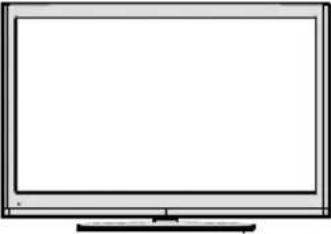 | 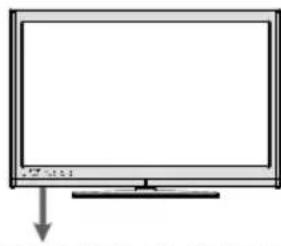 | Standby button1.TV/AV button2.Programme Up/Down buttons3.4. Volume Up/Down buttonsNote: Press “-▲” / “▲+”buttons at the same time to view main menu. |
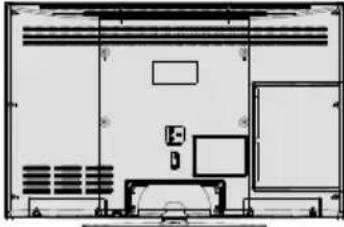 | 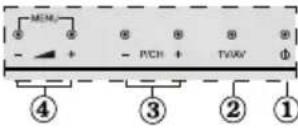 |
Viewing the Back side Connections
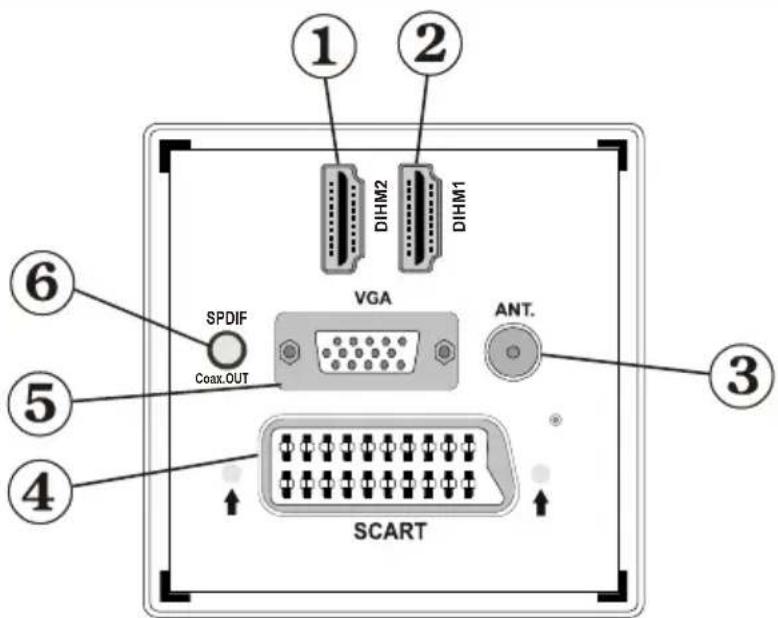
HDMI 2: HDMI Input1.
HDMI 1: HDMI Input 2.
HDMI Inputs are for connecting a device that has an HDMI socket. Your LCD TV is capable of displaying High Definition pictures from devices such as a High Definition Satellite Receiver or DVD Player. These devices must be connected via the HDMI sockets or Component Socket. These sockets can accept either 720p or 1080i signals. No sound connection is needed for an HDMI to HDMI connection.
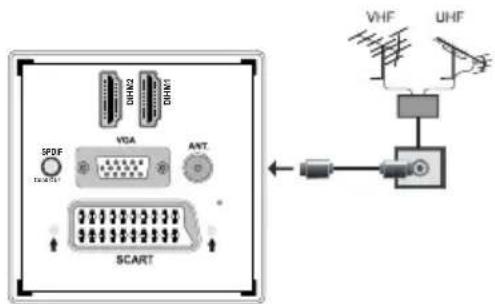
RF Input3. connects to an aerial antenna system.
Note that if you use a decoder or a media recorder, you should connect the aerial cable through the device to the television with an appropriate antenna cable, as shown in the illustration in the following pages.
4. SCART input or output for external devices. Connect the SCART cable between SCART socket on TV and SCART socket on your external device (such as a decoder, a VCR or a DVD player).
Note: If an external device is connected via the SCART socket, the TV will automatically switch to AV mode.
Note: S-VHS signal is supported via the scart socket(optional).
Note: When receiving DTV channels (Mpeg4 H.264) or while in Media Browser mode, output will not be available via the scart socket.
VGA Input5. is for connecting a personal computer to the TV set.
Connect the PC cable between the PC INPUT on the TV and the PC output on your PC.
Note: You can use YPbPr to VGA cable (not supplied) to enable YPbPr signal via VGA input.
WARNING: You cannot use VGA and YPbPr at the same time.
SPDIF Out6. outputs audio signals of the currently watched source.
Use an SPDIF cable to transfer audio signals to a device that has SPDIF input
Viewing the Connections - Side Connectors
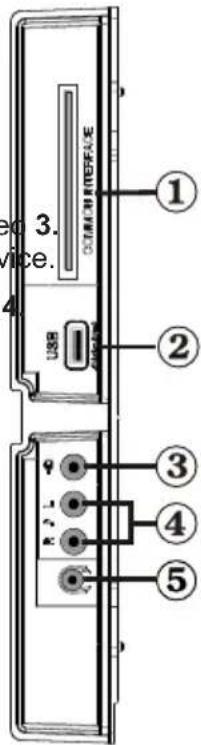
CI Slot is used for inserting a CI card. A CI card allows you to view all the 1.
channels that you subscribe to. For more information, see "Conditional Access" section.
Side USB input. 2.
Note that programme recording feature is available via this USB input. You can connect external hard disk drives to this input.
Video Input is used for connecting video signals of external devices. Connect the video cable between the VIDEO IN socket on the TV and the VIDEO OUT jack on your devi
Audio Inputs are used for connecting audio signals of external devices. Connect the audio cable between the AUDIO INPUTS on the TV and the AUDIO OUTPUT jacks on your device.
Note: If you connect a device to the TV via the VIDEO INPUT, you should also connect your device with an audio cable to the AUDIO INPUTS of the TV to enable audio.
Headphone jack is used for connecting an external headphone to the system. 5. Connect to the HEADPHONE jack to listen to the TV from headphones (optional).
Power Connection
IMPORTANT: The TV set is designed to operate on 220-240V AC, 50 Hz.
After unpacking, allow the TV set to reach the ambient room temperature before you connect the set to the mains. Plug the power cable to the mains socket outlet.
Aerial Connection
- Connect the aerial plug to the AERIAL INPUT (ANT) socket located at the rear of the TV.
Using USB Input
USB Connection
You can connect a USB hard disk drive or USB memory stick to your TV by using the USB inputs of the TV. This feature allows you to play files stored in a USB drive or record programmes.
2.5" and 3.5" inch (hdd with external power supply) external hard disk drives are supported.
To record a programme, you should first connect • a USB disk to your TV while the TV is switched off. You should then switch on the TV to enable recording feature. Otherwise, recording feature will not be available.
IMPORTANT!
You may back up your files before making any connections to the TV set in order to avoid any possible data loss. Note that manufacturer will not be responsible for any file damage or dataloss.
It is possible that certain types of USB devices (e.g. MP3 Players) or USB hard disk drives/memory sticks may not be compatible with this TV.
IMPORTANT: The TV supports only FAT32 disk formatting. NTFS format is not supported. If you connect a USB disk with NTFS format, the TV will ask you to format the content. See the section, "Format Disk" in the following pages for more information on disk formatting.
Note that ALL the data stored on the USB disk will be lost and then the disk format will be converted to FAT32 in such a case.
USB Disk Connection
- Plug your USB device to the USB input of the TV.
Note: Plug or unplug your USB disk while the TV is switched off.
Note: If you are going to connect a USB hard disk drive to the TV set, USB connection cable used between the disk drive and the TV should have a USB logo and should be as short as possible.
Note: While formatting a USB hard disk that has 1TB (Tera Byte) or more file capacity, you can experience problems with the formatting process. In such a case, you should format the disk with your personal computer and the formatted disk type should be FAT32.
CAUTION!
Quickly plugging and unplugging USB devices, • is a very hazardous operation. Especially, do not repeatedly quickly plug and unplug the drive. This may cause physical damage to the USB player and especially the USB device itself.
Do not pull out USB module while playing or recording a file.
Programme Recording
To record a programme, you should first connect a USB disk to your TV while the TV is switched off. You should then switch on the TV to enable recording feature.
IMPORTANT: When using a new USB hard disk drive, it is recommended that you first format the disk using your TV's "Format Disk" option.
For using recording function, you should connect a USB disk or an external hard disk drive to the TV and connected USB disk should have at least 1 GB capacity and should have 2.0 speed compatibility. If the connected USB device does not support 2.0 speed, an error message will be displayed.
Note: Recorded programmes are saved into the connected USB disk. If desired, you can store/copy recordings on a computer; however, these files will not be available to be played on a computer. You can play the recordings only via your TV.
An hour of the recordings stored occupies approximately 2 GB of space.
For more information on recording programmes, • see sections “Instant Recording”, “Timeshifting”, “Electronic Programme Guide”, “Recordings Library” or “Recording Timers” in the following parts.
- Recorded programmes are split into 4GB partitions.
Recorded programmes are stored in the following • directory of the connected USB disk: \DVR\RECS. All recordings are indicated with a number. A text (txt) file is created for each recording. This text file includes information such as broadcaster, programme, and recording time.
Timeshifting may be stopped according to USB device write speed. If the USB device speed is not enough for video stream bitrate, timeshifting may be stopped and recording may fail. If HD service bitrate is greater than 13 Mbp/sec. some freeze can be seen during timeshifting on both USB disk and on external HDD.
Recordings of HD programmes can occupy bigger size on the USB disk depending on the broadcast's resolution. For this reason it is recommended to use USB hard disk drives for recording HD programmes.
Do not plug out the USB/HDD during the recording. This may harm the connected USB/HDD.
Multipartiton support is available. Maximum two different partitions are supported. If the disk have more than two partitions, crash may occur. First partition of the usb disk is used for PVR ready features. It also must be formatted as primary partition to be used for PVR ready features.
Some stream packets may not be recorded because of signal problems, so sometimes video may freezes during playback.
Record, Play, Pause, Display (for PlayListDialog) • keys could not be used when teletext is ON. If a recording starts from timer when teletext is ON, teletext is automatically turned off. Also teletext usage is disabled when there is ongoing recording or playback.
- Radio record is not supported.
- The Tv can record programmes up to ten hours.
Connecting the LCD TV to a PC
For displaying your computer's screen image on your LCD TV, you can connect your computer to the TV set. Power off both computer and display before making any connections. Use 15-pin D-sub display cable to connect a PC to the LCD TV. When the connection is made, switch to PC source. See Input selection section. Set the resolution that suits your viewing requirements. Resolution information can be found in the appendix parts
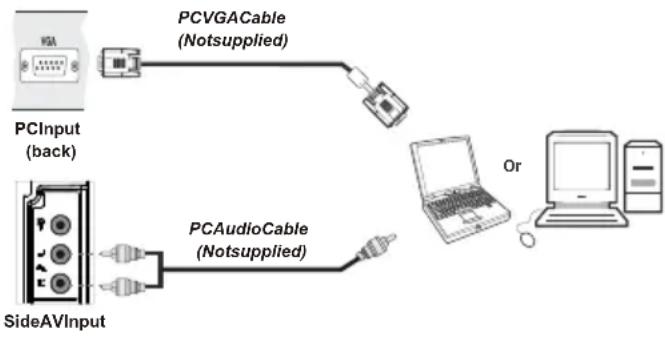
flowchart
graph LR
    A["PCInput (back)"] --> B["PCVGACable (Notsupplied)"]
    C["SideAVInput"] --> D["PCAudioCable (Notsupplied)"]
    B --> E["Laptop"]
    D --> E
    E --> F["Computer"]
Note: If you connect a PC to the TV using HDMI connection, radio interference may occur. Therefore this type of connection is not recommended. You should use VGA connection instead.
Using Side AV Connectors
You can connect a range of optional equipment to your TV using the side connectors of the TV.
For connecting a camcorder, connect to the VIDEO • IN socket and the AUDIO SOCKETS. Do not connect the camcoder to VIDEO IN socket at the same time since it can cause noise in the picture. For selecting the related source, see the section “Input selection” in the following parts.
- Afterwards, you should switch to Side AV source. See the section Input selection in the following sections for more information.
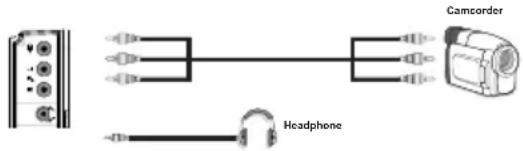
To listen the TV sound from headphones, you should connect headphones to your TV by using the HEADPHONE jack as illustrated above.
Connecting to a DVD Player via HDMI
Please refer to your DVD player's instruction book for additional information. Power off both the TV and the device before making any connections.
Note: Not all cables shown in the illustration are supplied.
- If your DVD player has an HDMI socket, you can connect via HDMI for better video and audio quality.
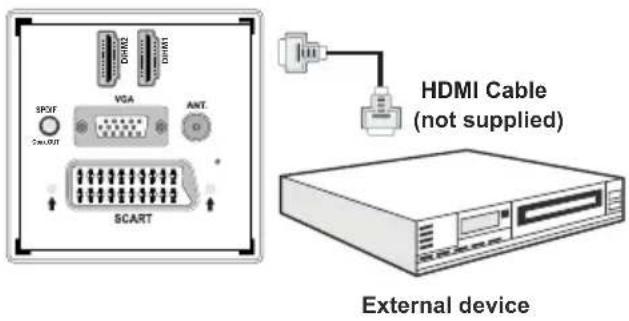
When you connect to DVD player as illustrated above, switch to the connected HDMI source. See, Input Selection section for more information on changing sources.
Connecting to a DVD Player
If you want to connect a DVD player to your TV, you can use the connectors of the TV set. DVD players may have different connectors. Please refer to your DVD player's instruction book for additional information. Power off both the TV and the device before making any connections.
Note: Cables shown in the illustration are not supplied.
- If your DVD player has an HDMI socket, you can connect via HDMI. When you connect to a DVD player as illustrated below, switch to the HDMI source. See "Input Selection" section.
Some DVD players are connected through • COMPONENT SOCKETS (YPbPr). YPbPr can be used only when you connect a device that has a YPbPr output through the PC input with YPbPr to PC cable (YPbPr cable is not supplied).
You may also connect through the SCART sockets. Use a SCART cable as shown below.
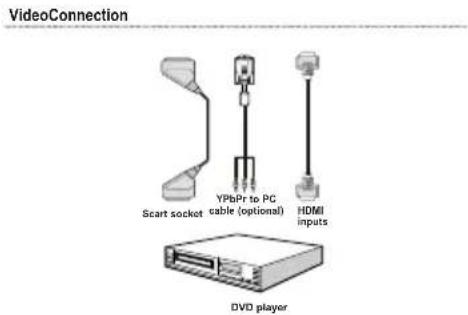
Note: These three methods of connection perform the same function but in different levels of quality. It is not necessary to connect by all three methods.
Remote Control Handset
Inserting Batteries
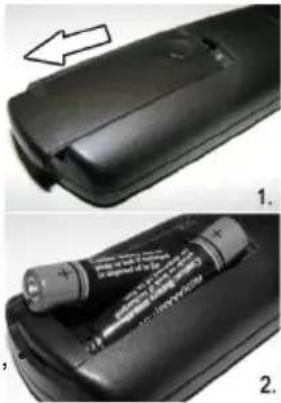
Remove the battery cover located on the back of the handset by gently pulling backwards from the indicated part.
- Insert two AAA/R3 or equivalent type batteries inside. Observe the correct polarity (+/-) when inserting batteries and replace the battery cover.
natural_image
Two views of a black remote control case showing battery and plug, with an arrow indicating direction (no text or symbols)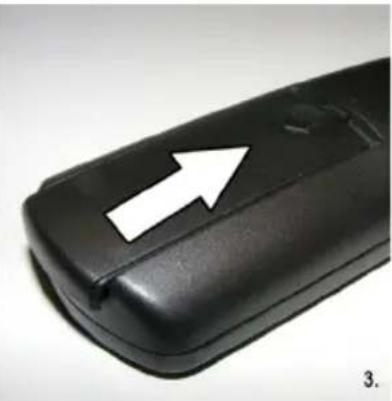
natural_image
Close-up of a black plastic object with a white arrow pointing upward (no text or symbols visible)Note: Remove the battery from remote control handset when it is not to be used for a long period. Otherwise it can be damaged due to any leakage of batteries. Remote range is approximately 7m/23ft.
Switching On/Off
To Switch the TV On
Connect the power cord to the 220-240V AC 50 Hz. Then the standby LED lights up (The led will blink during the standby On/Off).
To switch on the TV from standby mode either:•
- Press the “○” button, CH▲ or CH▼ or a numeric button on the remote control.
- Press the “○” button, P/CH- or P/CH+ button on the TV. The TV will then switch on.
Note: If you switch on your TV via CH▲ or CH▼ buttons on the remote control or on the TV set, the programme that you were watching last will be reselected.
By either method the TV will switch on.
To Switch the TV Off
Press the "button" button on the remote control or hold the "button" button on the TV until shut down, so the TV will switch to standby mode.
To power down the TV completely, unplug the power cord from the mains socket.
Note: When the TV is switched to standby mode, standby LED can blink to indicate that features such as Standby Search, Over Air Download or Timer is active.
Input Selection
Once you have connected external systems to your TV, you can switch to different input sources. Press "SOURCE" button on your remote control consecutively for directly changing sources.
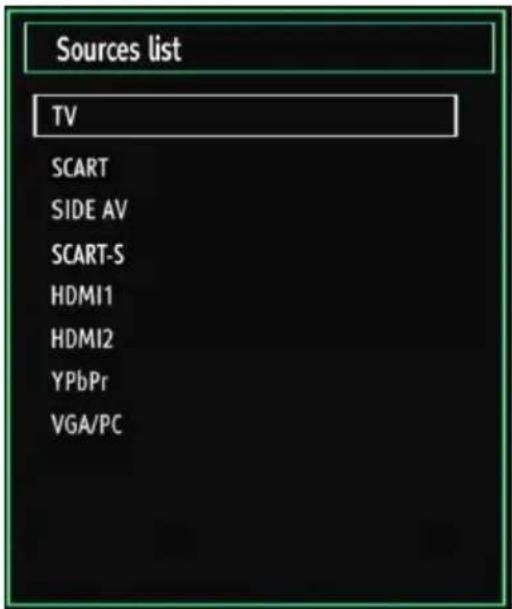
Note: YPbPr mode can be used only when you connect a device that has a YPbPr output through the PC input with YPbPr to PC cable (not supplied).
Basic Operations
You can operate your TV using both the remote control and onset buttons.
Operation with the Buttons on the TV Volume Setting
- Press “—” button to decrease volume or “+” button to increase volume, so a volume level scale (slider) will be displayed on the screen.
Programme Selection
- Press "P/CH+" button to select the next programme or "P/CH-" button to select the previous programme.
Viewing Main Menu
- Press “—” / “+” buttons at the same time to view main menu. In the Main menu select sub-menu using “P/CH -” or “P/CH +” buttons and enter the sub-menu using “—” or “+” buttons. To learn the usage of the menus, refer to the menu system sections.
AV Mode
- Press the "TV/AV" button in the control panel on the TV to switch between AV modes.
Operation with the Remote Control
The remote control of your TV is designed to control all the functions of the model you selected. The functions will be described in accordance with the menu system of your TV.
Volume Setting
- Press "V▲" button to increase the volume. Press "V▼" button to decrease the volume. A volume level scale (slider) will be displayed on the screen.
Programme Selection (Previous or Next Programme)
- Press CH▼ button to select the previous programme.
- Press CH▲ button to select the next programme.
Programme Selection (Direct Access)
Press numeric buttons on the remote control to select • programmes between 0 and 9. The TV will switch to the selected programme. To select programmes between, press the numeric buttons consecutively. When the pressing time is due for the second numeric button, only the first digit programme will be displayed. Press directly the programme number to reselect single digit programmes.
Viewing Electronic Programme Guide (EPG)
You can view the electronic programme guide (EPG) to view information about available programmes. To view the EPG menu please press EPG button on the remote control.
- Press “▼”/“▲” buttons to navigate through channels.
Press “◀”/“▶” buttons to navigate through the programme list.
EPG menu displays available information on all channels.
Please note that event information is updated • automatically. If there are no event information data available for channels, EPG will be displayed with blanks.
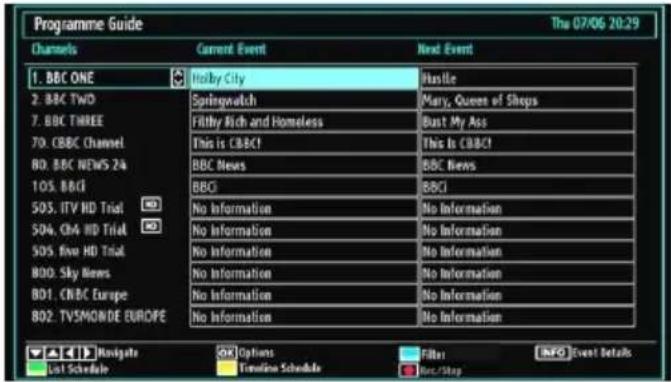
▼/▲/◄: Navigate
OK (Options): Views/records or sets timer for future programmes.
Blue button (Filter): Views filtering options.
INFO (Event Details): Displays the programmes in detail.
Green button: Programme schedule will be listed
Yellow button: Display EPG data in accordane with timeline schedule
(RECORD): the TV will start to record the selected programme. You can press again to stop the recording.
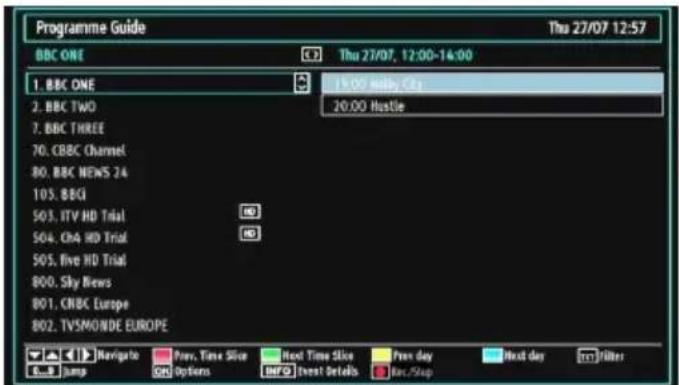
▼/▲/▲>Navigate
Red button (Prev Time Slice): Displays the programmes of previous time slice.
Green button (Next Time Slice): Displays the programmes of the next time slice.
Yellow button (Prev Day): Displays the programmes of previous day.
Blue button (Next day): Displays the programmes of the next day.
TXT button (Filter): Views filtering options.
Numeric buttons (Jump): Jumps to the preferred channel directly via numeric buttons.
OK (Options): Views/records or sets timer for future programmes.
INFO (Details): Displays the programmes in detail.
(RECORD): the TV will start to record the selected programme. You can press again to stop the recording.
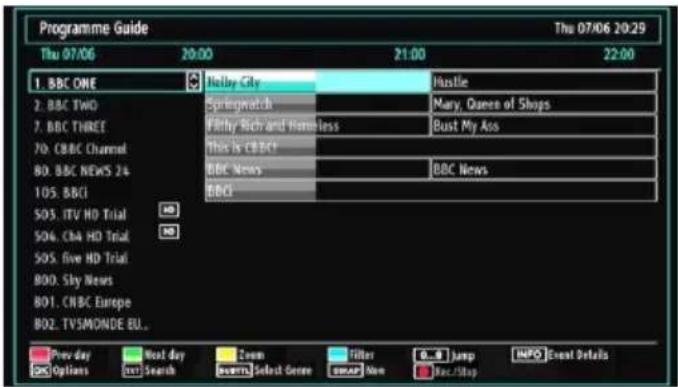
Red button (Prev Day): Displays the programmes of previous day.
Green button (Next day): Displays the programmes of the next day.
Yellow button (Zoom): Expands programme information.
Blue button (Filter): Views filtering options.
Numeric buttons (Jump): Jumps to the preferred channel directly via numeric buttons.
INFO (Details): Displays the programmes in detail.
OK (Options): Views/records or sets timer for future programmes.
Text (Search): Displays "Guide Search" menu.
SUBTTL: Press SUBTITLE button to view Select Genre menu. Using this feature, you can search the programme guide database in accordance with the genre. Info available in the programme guide will be searched and results matching your criteria will be listed.
SWAP(Now) : Shows the current programme.
(RECORD): the TV will start to record the selected programme. You can press again to stop the recording.
Recording via EPG Screen
IMPORTANT: To record a programme, you should first connect a USB disk to your TV while the TV is switched off. You should then switch on the TV to enable recording feature. Otherwise, recording feature will not be available.
(RECORD): the TV will start to record the selected programme. You can press again to stop the recording.
Note: Switching to a different broadcast or source is not available during the recording.
◀ / ▶ Page left / Page right.
Programme Options
In EPG menu, press the OK button to enter the "Event Options" menu.
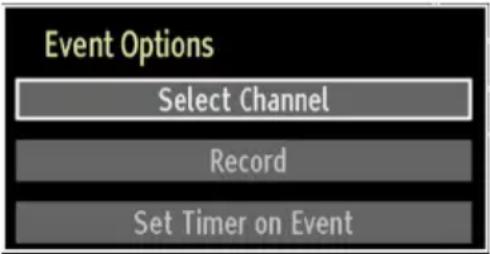
Select Channel
In EPG menu, using this option, you can switch to the selected channel.
Record / Delete Record Timer
IMPORTANT: To record a programme, you should first connect a USB disk to your TV while the TV is switched off. You should then switch on the TV to enable recording feature. Otherwise, recording feature will not be available.
After you have selected a programme in EPG menu, press the OK button and and Options screen will be displayed. Select "Record" option and press the OK button. After this operation, a recording becomes set to the selected programme.
To cancel an already set recording, highlight that • programme and press the OK button and select the option "Delete Rec. Timer". The recording will be cancelled.
Note: You cannot switch to any other channel or source while there is an active recording on the current channel.
Set Timer / Delete Timer
After you have selected a programme in EPG menu, press the OK button and and Options screen will be displayed. Select "Set Timer on Event" option and press OK button. You can set a timer for future programmes.
To cancel an already set reminder, highlight that programme and press the OK button. Then select "Delete Timer" option. The timer will be cancelled.
Note: It is not possible to record or set timer for two or more individual events at the same time interval.
Digital Teletext ( ** for UK only)
- Press the ““TXT”” button.
The digital teletext information appears.
Operate it with the coloured buttons, cursor buttons • and OK button.
The operation method may differ depending on the contents of the digital teletext.
Follow the instructions displayed on digital teletext screen.
- When the ““TXT”” button is pressed, the TV returns to television broadcasting.
With digital broadcasting (DVB-T-C), in addition to digital teletext broadcasting together with the normal broadcasting, there are also channels with just digital teletext broadcasting.
The aspect ratio (picture shape) when watching a channel with just digital teletext broadcasting is the same as the aspect ratio of the picture viewed previously.
- When you press the ““TXT”” button again, the digital teletext screen will be displayed.
Analogue Teletext
Use of teletext and its functions are identical to the analogue text system. Please do refer to the "TELETEXT" explanations
First Time Installation
IMPORTANT: Ensure that the aerial or cable is connected and a Common Interface module is not inserted before switching on the TV for the first time installation.
When the TV is operated for the first time, installation • wizard will guide you through the process. First, language selection screen will be displayed:
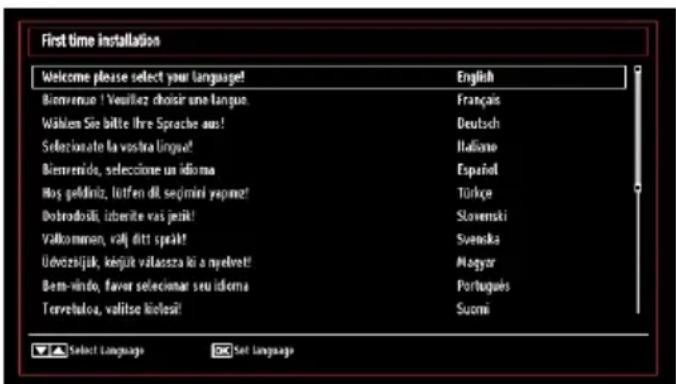
- Use “▼” or “▲” buttons to select your language and press OK button to set selected language and continue.
- After selecting the language, "Welcome!" screen will be displayed, requiring you to set Country, Teletext Language and Scan Encrypted options.
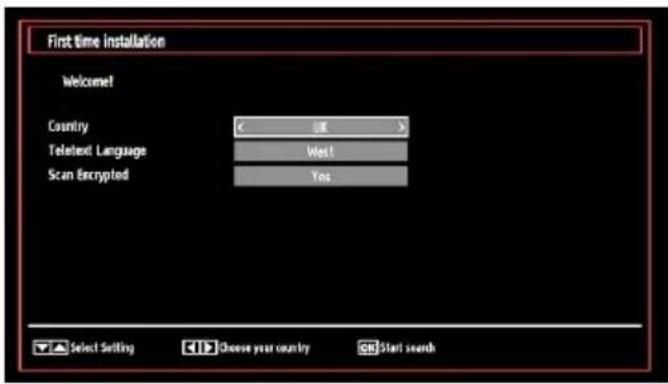
- By pressing “◀” or “▶” button, select the country you want to set and press “ ” button to highlight Teletext Language option. Use “◀” or “ ” button to select desired Teletext Language.
Press “▼” button after setting Teletext Language option. Scan Encrypted will be then highlighted. You can set Scan Encrypted as Yes if you want to scan coded stations. Afterwards select the desired Teletext Language.
- Press OK button on the remote control to continue and the following message will be displayed on the screen:
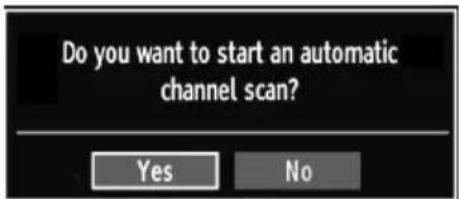
To select the "Yes" or "No" option, highlight the item by using "◀or " ”buttons and press OK button.
Afterwards the following OSD will be displayed on the screen and the TV will search for both digital and analogue TV broadcasts.
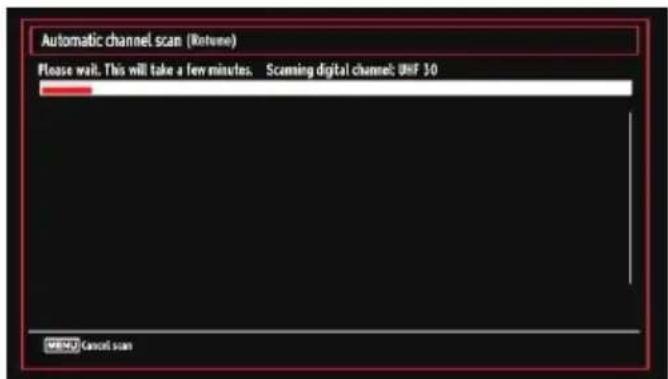
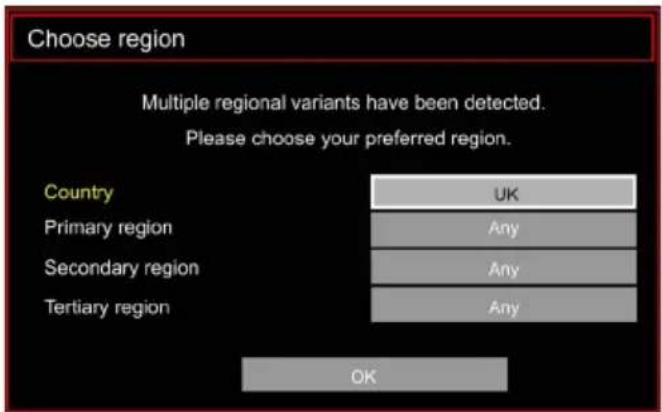
- Note: You can press "MENU" button to cancel. End of the search process, "Choose Region" osd will be displayed on the screen (if any multiple region variants are detected). Please select country and region choice then press OK to continue.
- After all the available stations are stored, Channel List will be displayed on the screen. If you like the sort channels, according to the LCN, please select "Yes" and then press "OK".
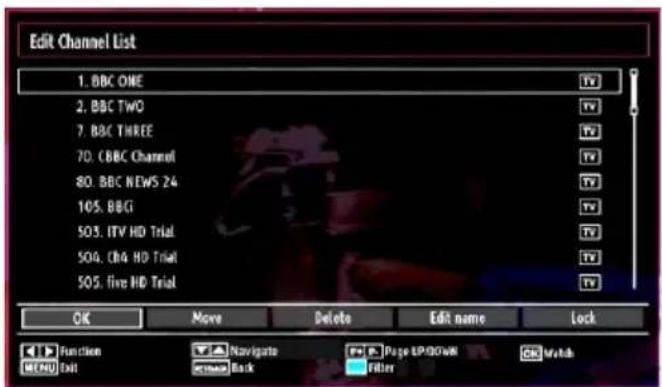
- Press OK button to quit channel list and watch TV.
Installation
Press MENU button on the remote control and select Installation by using "◀ or " ▶ button. Press OK button and the following menu screen will be displayed.
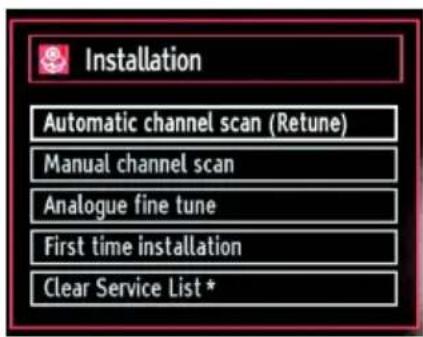
Select Automatic Channel Scan (Retune) by using▼/▲button and press OK button. Automatic Channel Scan (Retune) options will be displayed. You can select options by using "▼/▲" and OK buttons.
Auto Channel Scan (Retune) Menu Operation
Digital Aerial: Searches and stores aerial DVB stations.
Analogue: Searches and stores analogue stations.
Full: Searches and stores both analog and aerial DVB stations.
Whenever you select an automatic search type and press OK button, a confirmation screen will appear on the screen. To start installation process, select Yes, to cancel select No by using . " " or " " and OK button.
After auto channel scan type is set and selected • and confirmed, installation process will start and progress bar will move along. Press "MENU" button to cancel process. In such a case, located channels are not stored.
Manual Tuning
HINT: This feature can be used for direct broadcast entry.
- Select Manual Channel Scan from the Installation menu by using “▼” and OK buttons. Manual Scan options screen will be displayed.
- Select the desired Search Type using “◀” or “▶” button. Manual search options will change accordingly. Use “▼/” ▶ button to highlight an item and then press “◀” or “ ” button to set an option. You can press “MENU” button to cancel.
Manual Search
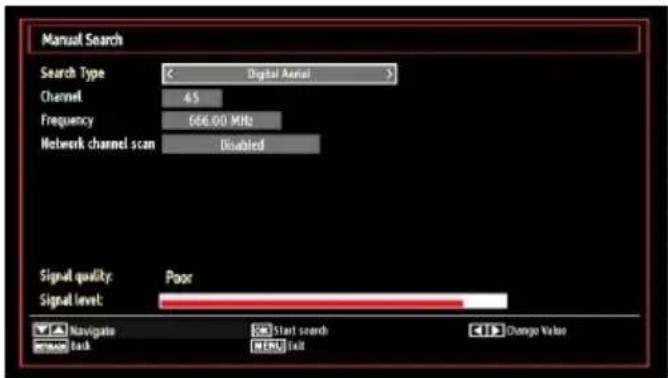
In manual channel scan, the number of the multiplex or frequency are entered manually and only that multiplex or frequency are searched for the channels. After selecting search type as Digital Aerial, you can enter the multiplex or frequency number using the numeric buttons and press OK button to search.
Analogue Manual Search
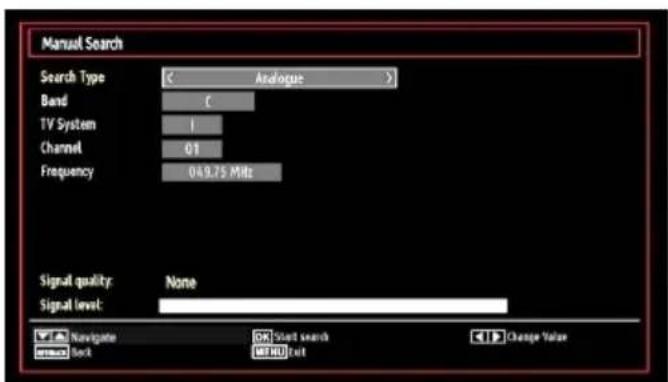
After selecting search type as analogue, you can use "▼/” ▲button to highlight an item and then press “◀” or “▶” button to set an option.
Enter the channel number or frequency using the numeric buttons. You can then press OK button to search. When the channel is located, any new channels that are not on the list will be stored.
Analogue Fine Tune
- Select Analogue Fine Tune from the Installation menu by using “▼” or “▲” and OK buttons. Analogue fine tune screen will be displayed. Analogue Fine Tune feature will not be available if there are no analog channels, digital channels and external sources stored.
- Press OK button to proceed. Use “◀” or “▶” button to set Fine Tune. When finished, press OK button again.
Clear Service List (\*)
(*) This setting is visible only when the Country option is set to Denmark, Sweden, Norway or Finland.
Use this setting to clear channels stored. Press▼" or "▲button to select Clear Service List and then press OK. The following OSD message will be displayed on the screen:
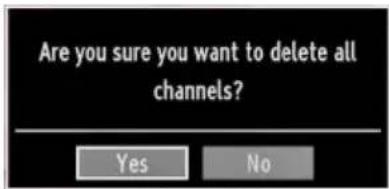
Press OK to cancel. Select Yes by pressing◀" or ▶" button and press OK to delete all of the channels.
Managing Stations: Channel List
The TV sorts all stored stations in the Channel List. You can edit this channel list, set favourites or set active stations to be listed by using the Channel List options.
- Press MENU button to view main menu. Select Channel List item by using “◀ or “▶button. Press OK to view menu contents.
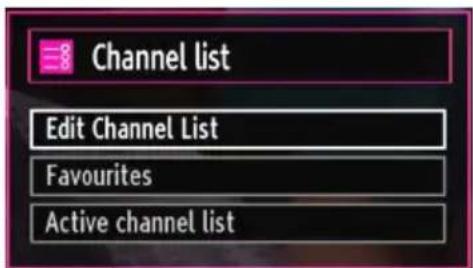
Select Edit Channel List to manage all stored channels. Use "◀or " ▶ and OK buttons to select Edit Channel List.
Operating the Channel List
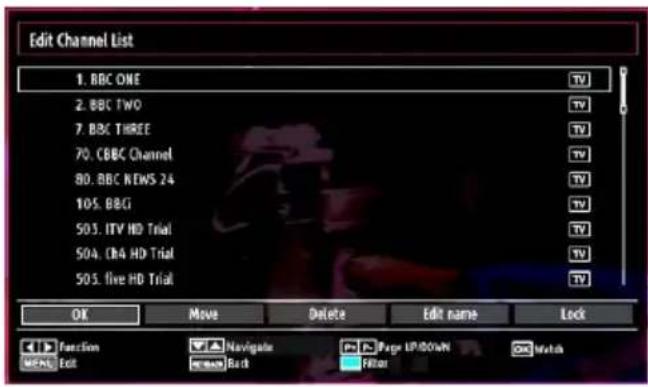
Press “▼” or “▲button to select the channel that will be processed. Press “◀or “▶button to select a function on Channel List menu.
- Use CH▲ or CH▼ buttons to move page up or down.
Press • BLUE button to view filtering options.
Press • MENU button to exit.
Moving a Channel
First select the desired channel. Select Move option in the channel list and press OK button.
Edit Number screen will be displayed. Enter the desired channel number by using the numeric buttons on the remote control. If there is a previously stored channel on that number, a warning screen will be displayed. Select Yes if you want to move the channel and press OK.
- Press OK button to process. Selected channel is now moved.
Deleting a Channel
You can press GREEN button to tag/untag all channels; YELLOW button to tag/untag channel.
Select the channel that you want to delete and select Delete option. Press OK button to continue.
- A warning screen will appear. Select YES to delete, select No to cancel. Press OK button to continue.
Renaming a Channel
Select the channel that you want to rename and select Edit Name option. Press OK button to continue.
- Pressing “◀” or “▶” button moves to the previous/ next character. Pressing “▼” or “ ”▲button toggles the current character, i.e., ‘b’ character becomes ‘a’ by “▼” and ‘c’ by “ ”▲Pressing the numeric buttons ‘0...9’ replaces the highlighted character with the characters printed above the button one by one as the button is pressed.
- When finished, press OK button to save. Press MENU to cancel.
Locking a Channel
You can press GREEN button to tag/untag all channels; YELLOW button to tag/untag a single channel.
Select the channel that you want to lock and select Lock option. Press OK button to continue.
You will be asked to enter parental control PIN. Default PIN is set as 0000. Enter the PIN number.
Note: If the Country option is set to France, you can use 4725 as the default code.
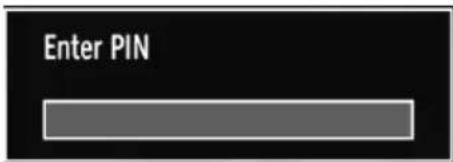
- Press OK button when the desired channel is highlighted to lock/unlock the channel. Lock symbol will be displayed next to the selected channel.
Managing Stations: Favourites
You can create a list of favourite programmes.
- Press MENU button to view main menu. Select Channel List item by using “◀ or “▶button. Press OK to view menu contents.
- Select Favourites to manage favourite list. Use “▼”/“▲and OK buttons to select Favourites.
You can set various channels as favourites so that • only the favourite channels are navigated.

- Select a channel by using “▼” or “▲” button. Press OK button to add selected channel to favourites list. Press OK button again to remove.
Button Functions
- OK: Add/remove a station.
• YELLOW: Tag/untag a channel.
• GREEN: Tag/untag all channels. - BLUE: Displays filtering options.
Managing Stations: Sorting Channel List
You can select broadcasts to be listed in the channel list. To display specific types of broadcast, you should use Active channel list setting.
Select Active channel list from the Channel list menu by using "◀or" button. Press OK button to continue.
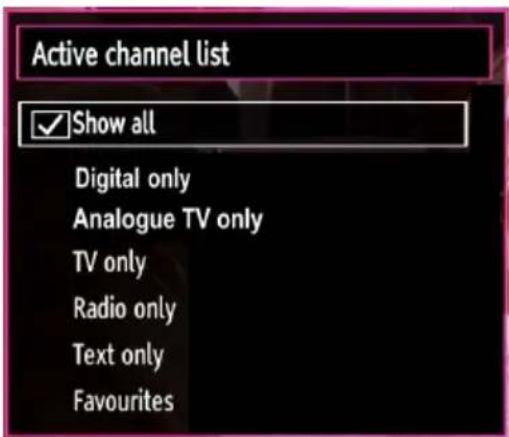
You can select a broadcast type option from the list by using "▼/" ▲nd OK buttons.
On-Screen Information
You can press INFO button to display on-screen information. Details of the station and current programme will be displayed on the information banner.

The information banner gives information on the channel selected and the programmes on it. The name of the channel is displayed, along with its channel list number.
Hint: Not all channels broadcast the programme data. If the name and time of the programme are not available, then information banner will be displayed with blanks.
If the selected channel is locked, you must enter the correct four-digit numeric code to view the channel (default code is 0000). "Enter PIN" will be displayed on the screen.
Note: If the Country option is set to France, you can use 4725 as the default code.
Media Playback Using Media Browser
If the USB stick is not recognized after power off/on or First Time Installation, first, plug the USB device out and power off/on the TV set. Plug the USB device in again.
To display Media Browser window, press either "MENU" button on the remote control and then select Media Browser by pressing "◀or "▼" button. Press OK button to continue. Media Browser menu options will be displayed.
Also, when you plug USB devices, media browser screen will be displayed automatically:
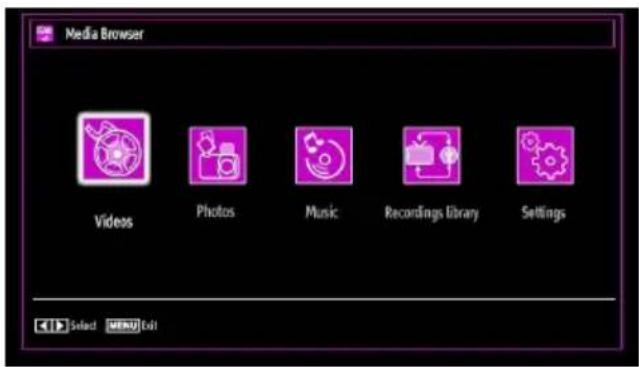
You can play music, picture and video files from the connected USB memory stick. Use "◀ or " ▶ button to select Videos, Photos, Music, Recordings library or Settings.
Viewing Videos via USB
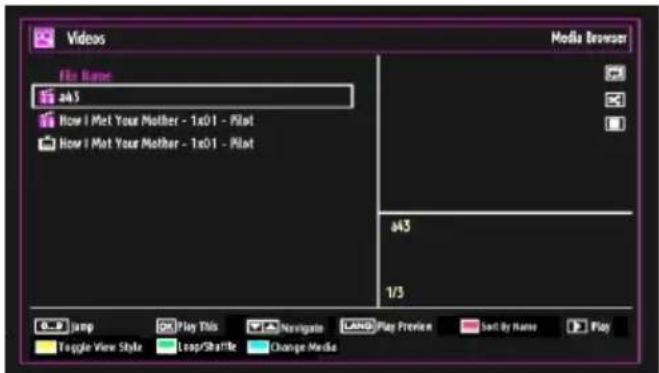
When you select Videos from the main options, available video files will be filtered and listed on this screen. You can use ▼ or “▲button to select a video file and press OK button to play a video. If you select a subtitle file and press OK button, you can select or deselect that subtitle file. The following menu will be displayed while playing a video file:
Jump (Numeric buttons): The TV will jump to the file starting with the letter you input via the numeric buttons on your remote control.
Play This (OK button) : Plays the selected file.
▼ Navigate menu
Lang (Play Preview): Displays selected file in a small preview screen.
RED: Sorts files by name.
Play (▶button) : Plays all media files starting with the selected one.
Yellow Button: Change viewing style
Loop/Shuffle (GREEN button): Press once to disable Loop. Press again to disable both Loop and Shuffle. Press once more to enable only Shuffle. Press again to enable all. You can follow the disabled functions with the change of the icons.
BLUE: Changes media options.
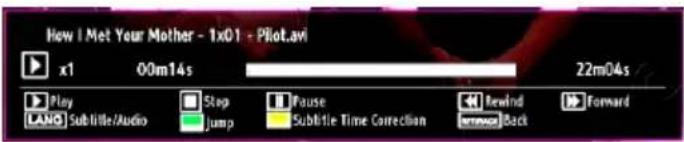
Play ▶button): Starts the video playback.
Stop (button): Stops the video playback.
Pause (1button): Pause the video playback.
Rewind (button): Goes backward.
Forward (▶ button): Goes forward.
Subtitle/Audio (LANG. button): Sets subtitle/Audio.
Jump (GREEN button): Jumps to time. Use numeric buttons to type the desired time and press GREEN button again to proceed.
![Jump To Second/Total Duration < [0]0h 00m 00s > / 00h 22m 04s OK Cancel](/content/2026/02/408816/images/bf1f2073597fabf166da1ca901aa9f02f4380e0e7d3623fd037b9f1a77c6a8b8.jpg)
Yellow: Opens subtitle time correction menu.
Ret/Back: Back to previous menu.
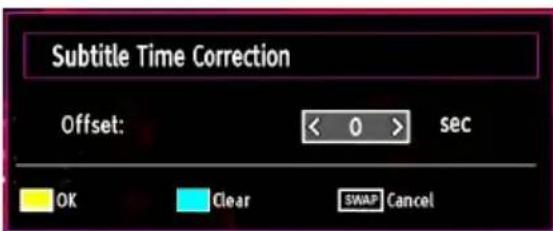
Press OK to confirm
Press BLUE button for clear
Press SWAP (Exit) button to switch back to previous menu.
Viewing Photos via USB
When you select Photos from the main options, available image files will be filtered and listed on this screen.
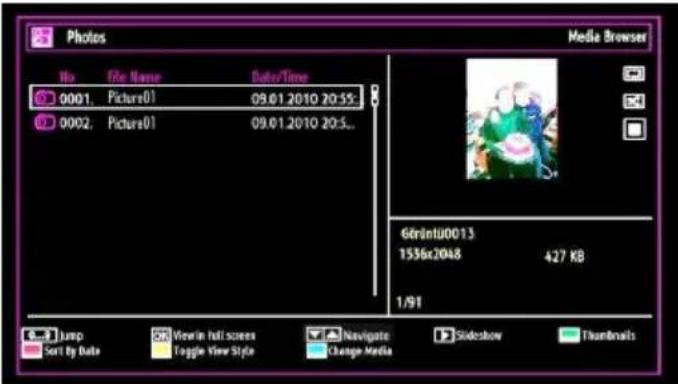
Jump (Numeric buttons): Jump to selected file using the numeric buttons.
OK: Views the selected picture in full screen.
▼ Navigate menu
Slideshow (▶button): Starts the slideshow using all images.
GREEN button: Views images in thumbnails.
RED button: Sorts files by date.
Yellow Button: Change viewing style
BLUE: Changes media options.
Slideshow Options

Pause (I button) : Pauses the slideshow.
Continue (▶ button) : Continues the slideshow.
Loop/Shuffle (GREEN button): Press once to disable Loop. Press again to disable both Loop and Shuffle. Press once more to enable only Shuffle. Press again to enable all. You can follow the disabled functions with the change of the icons.
Previous/Next (Left/Right buttons): Jumps to previous or next file on slideshow.
Rotate (Up/Down buttons): Rotates the image using up/down buttons.
RETURN (Exit): Back to file list.
INFO: Displays help screen.
Playing Music via USB
When you select Music from the main options, available audio files will be filtered and listed on this screen.
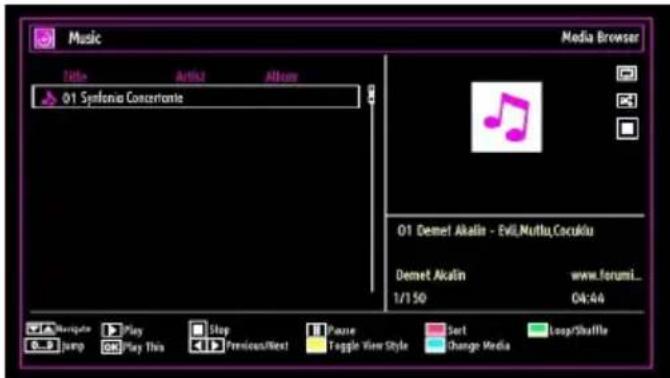
▼/ ▲ Navigate menu
Play ▶button): Starts the playback.
Stop (button) : Stops playback.
Pause (1button) : Pauses the selected playback.
RED button: Sorts files by Title, Artist or Album.
Note: If the Viewing Style is set to Folder in Media Browser Settings, Music folder will be displayed as sorted and there is no need to sort files again by pressing RED button.
Loop/Shuffle (GREEN button): Press once to disable Loop. Press again to disable both Loop and Shuffle. Press once more to enable only Shuffle. Press again to enable all. You can follow the disabled functions with the change of the icons.
Note:
If you start the playback with the button and activate the symbol, the TV will play the next music/video file. The playback will proceed accordingly and when the end of the list is reached, it will be played again from the beginning (loop function).
If you start the playback with the OK button and activate the symbol, the same music or video file will be played in a loop (repeat function).
If you start the playback with ▶ or OK button and activate the 📁 symbol, music or video file will be played in a shuffle.
If you start the playback with▶or OK button and activate 📄 symbols, music or video file playback will continue randomly and the random playback will continue.
0..9 (Numeric buttons): The TV will jump to the file starting with the letter you input via the numeric buttons on your remote control.
Play This (OK button) : Plays the selected file.
Previous/Next (Left/Right buttons) : Jumps to previous or next file to play.
Yellow Button: Change viewing style
BLUE: Changes media options.
INFO: Changes filter options.
Recordings Library
IMPORTANT: To view recordings library, you should first connect a USB disk to your TV while the TV is switched off. You should then switch on the TV to enable recording feature. Otherwise, recording feature will not be available.
To view the list of recordings, select “Recordings Library” and press the OK button. Recordings Library will then be displayed with available recordings.
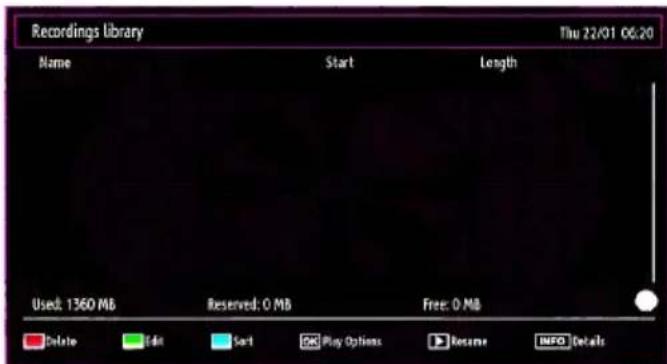
All the recordings are kept in a list in the recordings library.
RED button (Delete): Erases the selected recording.
GREEN button (Edit): Makes changes on the selected recording.
BLUE button (Sort): Changes the order of the recordings. You can select from a wide range of sorting options.
OK button: Activates play options menu:
- Play from start: Plays the recording from the beginning.
- Resume: Recommences the recordings.
- Play from offset: Specifies a playing point.
Note: Viewing main menu and menu items will not ve available during the playback.
▶ (Resume): Recommences the recordings.
INFO (Details): Displays the short extended programmes in detail.
Media Browser Settings
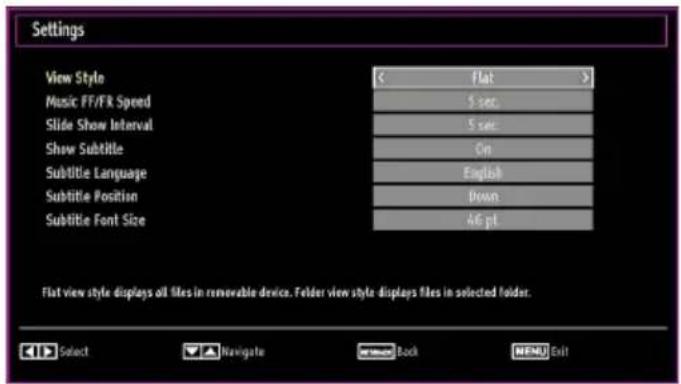
You can set your Media Browser preferences by using the Settings dialog. Press “▼ or “ ”▲ button to highlight an item and use “◀ or “ ”▶ button to set.
View Style: Sets default browsing mode.
Music FF/FR Speed: Sets forwarding/advancing speed.
Slide Show Interval: Sets slide show interval time.
Show Subtitle: Sets subtitle enabling preference.
Subtitle Language: Sets supported subtitle language.
Subtitle Position: Sets subtitle position as up or down.
Subtitle Font Size: Sets subtitle font size (max. 54pt).
Timeshift Recording
IMPORTANT: To record a programme, you should first connect a USB disk to your TV while the TV is switched off. You should then switch on the TV to enable recording feature. Otherwise, recording feature will not be available.
- Press (PAUSE) button while watching a broadcast for switching to timeshifting mode.
In timeshifting mode, the programme is paused and simultaneously recorded to the connected USB disk (*). Press ▶(PLAY) button again to watch the paused programme from the stopped moment.
This playback is performed in x1 playback speed. • You will see the timeshift gap between the real and the timeshifted programme in the info bar.
- Use ◀◀ /▶▶ (PREVIOUS/NEXT) buttons to move forward or backward on timeshift playback. When the timeshift is reached, timeshifting mode will be quitted and you will switch back to watching normal broadcast.
- Press ■ (STOP) button to quit timeshifting mode.
(*) Similtaneous timeshifting recording's duration depends on your connected USB disk's file size and defined Max. Timeshift in the Recordings Configuration menu. See the section, "Recordings" for more information on setting Max. Timeshift.
Note: Switching to a different broadcast or source; and viewing main menu are not available during the timeshifting.
Lip Sync delay may occur during the timeshifting.
Instant Recording
IMPORTANT: To record a programme, you should first connect a USB disk to your TV while the TV is switched off. You should then switch on the TV to enable recording feature. Otherwise, recording feature will not be available.
- Press (RECORD) button to start recording an event instantly while watching a programme. The following OSD appears on the screen:
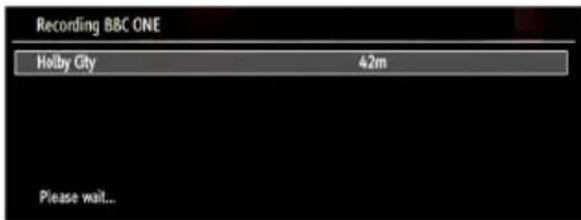
Record OSD will then be displayed for a short time • and the current event will be recorded.
- You can press (RECORD) button on the remote control again to record the next event on the EPG. In this case, OSD will display the programmed events for recording.
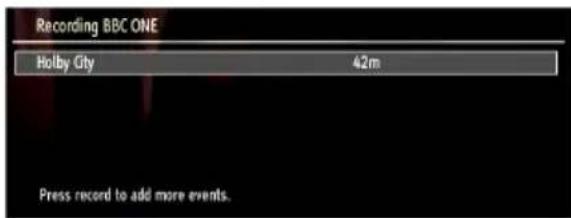
Press ■ (STOP) button to cancel instant recording. The following OSD will be displayed:
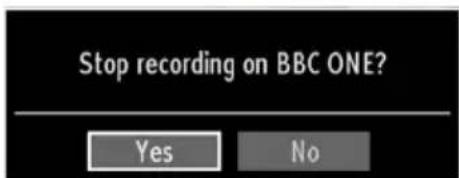
Select Yes by using “◀” or “▶” / OK buttons to cancel instant recording.
Note: Switching to a different broadcast or source; and viewing Media Browser are not available during the recording.
Watching Recorded Programmes
In the main menu, use " " or " " buttons to select Media Browser. Highlight Recordings Library item by using "◀ or " ▶ button and press OK button to enter. Recordings Library will then be displayed.
IMPORTANT: To view recordings library, you should first connect a USB disk to your TV while the TV is switched off. You should then switch on the TV to enable recording feature. Otherwise, recording feature will not be available.
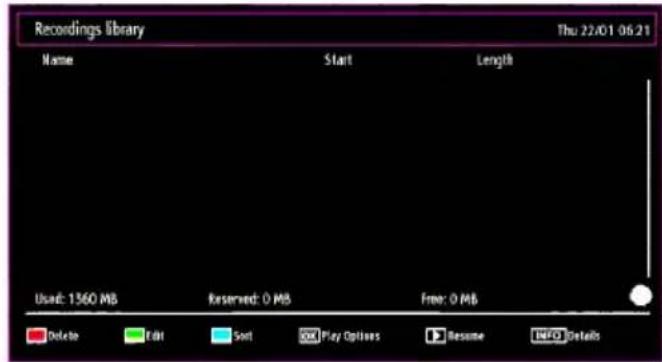
Select a recorded item from the list (if previously recorded) by using “▼”/“▲” button. Press OK button to view Play Options. Select an option by using “▼”/“▲” or OK buttons.
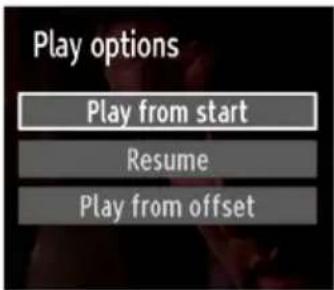
Available playback options:
Play from start: Plays the recording from the • beginning.
Resume: Recommences the recordings.
Play from offset: Specifies a playing point.
Note: Viewing main menu and menu items will not be available during the playback.
Press ■(STOP) button to stop a playback and return to return to Recordings Library.
Slow Forward
If you press (PAUSE) button while watching recorded programmes, slow forward feature will be available. You can use button to slow forward. Pressing button consecutively will change slow forwarding speed.
Changing Image Size: Picture Formats
You can change the aspect ratio (image size) of the TV for viewing the picture in different zoom modes.
- Press SCREEN button repeatedly to change the image size. Available zoom modes are listed below.
toAuto
When AUTO is selected, the aspect ratio of the screen is adjusted by the information provided by the selected source(if available)
The format being displayed in AUTO mode is completely independent of WSS information which could be included in the broadcast signal or the signal from an external device.
Note: Auto mode only will be available in HDMI, YPbPr and DTV sources.
16:9
This uniformly stretches the left and right sides of a normal picture (4:3 aspect ratio) to fill the wide TV screen.
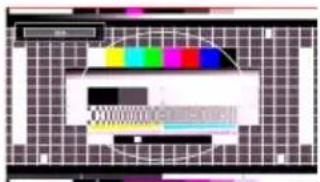
For 16:9 aspect ratio pictures that have been • squeezed into a normal picture (4:3 aspect ratio), use the 16:9 mode to restore the picture to its original shape.
Subtitle
This zooms up the wide picture (16:9 aspect ratio) with subtitles to the full screen.
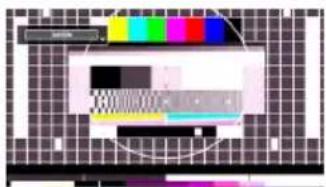
Note: You can shift to screen up or down by pressing "▼/ " " Buttons while picture zoom is selected as panaromic, 14:9 Zoom, Cinema or Subtitle.
14:9
This zooms up the wide picture (14:9 aspect ratio) to the upper and lower limits of the screen.
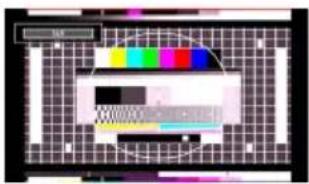
14:9 Zoom
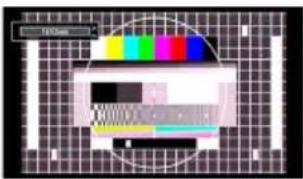
This option zooms to the 14:9 picture.
4:3
Use to view a normal picture (4:3 aspect ratio) as this is its original size.

Panoramic
This stretches the left and right sides of a normal picture (4:3 aspect ratio) to fill the screen, without making the picture appear unnatural.
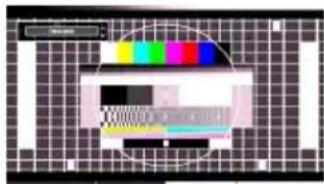
The top and bottom of the picture are slightly cut off.
Cinema
This zooms up the wide picture (16:9 aspect ratio) to the full screen.
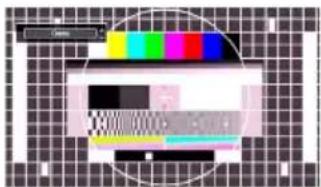
natural_image
Pure electrical circuit lines without any symbolsConfiguring Picture Settings
You can use different picture settings in detail.
Press MENU button and select the Picture icon by using "◀or "▶button. Press OK button to view Picture Settings menu.
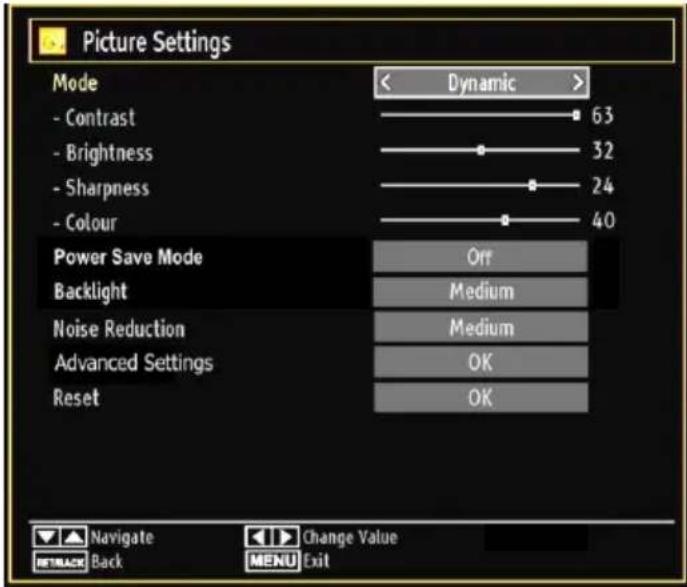
Operating Picture Settings Menu Items
Press “▼” or “▲button to highlight a menu item.
Use “◀” or “▶” button to set an item.
Press • MENU button to exit.
Picture Settings Menu Items
Mode: For your viewing requirements, you can set the related mode option. Picture mode can be set to one of these options: Cinema, Game, Dynamic and Natural.
Contrast: Sets the lightness and darkness values of the screen.
Brightness: Sets the brightness value for the screen.
Sharpness: Sets the sharpness value for the objects displayed on the screen.
Colour: Sets the colour value, adjusting the colors.
Power Save Mode : Use "▼" or "▲" button to select Power Save Mode.
Press “◀” or “▶” button to set Power Save Mode as On or Off.
See the section, "Environmental Information" in this manual for further information on Power Save Mode.
Note : Backlight function will be inactive if Power Save Mode is set to on.
Backlight (optional): This setting controls the backlight level and it can be set to Auto, Maximum, Minimum, Medium and Eco Mode (optional).
Note: Backlight can not be activate in VGA or Media Browser mode or while picture mode is set as Game.
Noise Reduction: If the broadcast signal is weak and the picture is noisy, use Noise Reduction setting to reduce the noise amount. Noise Reduction can be set to one of these options: Low, Medium, High or Off.
Advanced Settings:
Colour Temp• : Sets the desired colour tone. Setting Cool option gives white colours a slight blue stress. For normal colours, select Normal option. Setting Warm option gives white colours a slight red stress.
- Picture Zoom: Sets the picture size to Auto, 16:9, Subtitle, 14:9, 14:9 Zoom, 4:3, Panoramic or Cinema.
HDMI True Black (optional):• While watching from HDMI source, this feature will be visible in the Picture Settings menu. You can use this feature to enhance blackness in the picture. You can set this feature as "On" for activating HDMI True Black mode.
- Film Mode: Films are recorded at a different number of frames per second to normal television programmes. Press “▼” or “▲” buttons to select Film mode. Press “◀” or “▶” buttons to set this feature Auto or Off. Turn this feature to Auto when you are watching films to see the fast motion scenes clearly.
Colour Shift:• Adjust the desired colour tone.
Reset: Resets the picture settings to factory default settings.
While in VGA (PC) mode, some items in Picture menu will be unavailable. Instead, VGA mode settings will be added to the Picture Settings while in PC mode.
PC Picture Settings
For adjusting PC picture items, do the following:
Press “◀” or ▶” button to select Picture icon. Picture menu appears on the screen.
Contrast, Brightness, Colour, Colour Temp and Picture Zoom settings in this menu are identical to settings defined in TV picture menu under "Main Menu System".
Sound, Settings and Source settings are identical to the settings explained in main menu system.
PC Position: Select this to display PC position menu items.
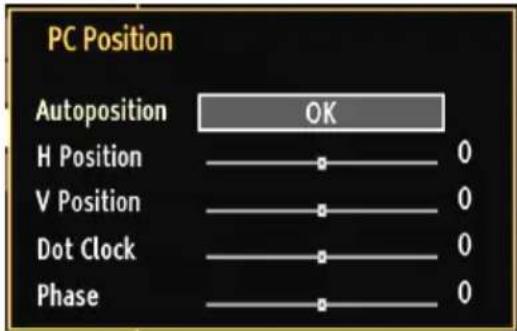
Autoposition: Automatically optimizes the display. Press OK to optimize.
H Position: This item shifts the image horizontally to right hand side or left hand side of the screen.
V Position: This item shifts the image vertically towards the top or bottom of the screen.
Dot Clock: Dot Clock adjustments correct the interference that appear as vertical banding in dot intensive presentations like spreadsheets or paragraphs or text in smaller fonts.
Phase: Depending on the resolution and scan frequency that you input to the TV set, you may see a hazy or noisy picture on the screen. In such a case you can use this item to get a clear picture by trial and error method.
Configuring Sound Settings
Sound settings can be configured according to your personal preferences.
Press MENU button and select the Sound icon by using “◀” or “▶” button. Press OK button to view Sound Settings menu.
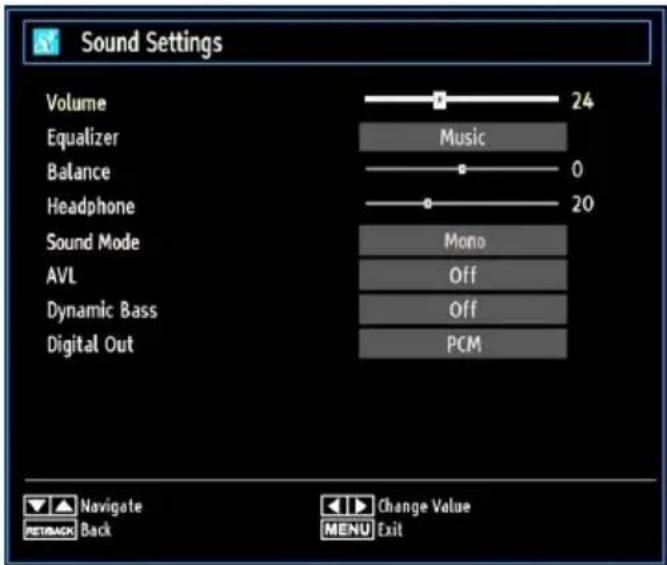
Operating Sound Settings Menu Items
- Press “▼” or “▲” button to highlight a menu item.
- Use “◀” or “▶” button to set an item.
- Press MENU button to exit.
Sound Settings Menu Items
Volume: Adjusts volume level.
Equalizer: Press OK button to view equalizer submenu.
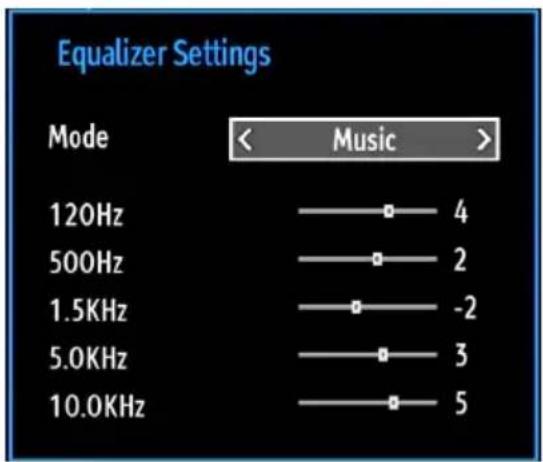
In equalizer menu, the preset can be changed to Music, Movie, Speech, Flat, Classic and User. Press the MENU button to return to the previous menu.
Note: Equalizer menu settings can be changed manually only when the Equalizer Mode is in User.
Balance: This setting is used for emphasizing left or right speaker balance.
Headphone: Sets headphone volume.
Sound Mode: You can select Mono, Stereo, Dual I or Dual II mode, only if the selected channel supports that mode.
AVL: Automatic Volume Limiting (AVL) function sets the sound to obtain fixed output level between programmes (For instance, volume level of advertisements tend to be louder than programmes).
Dynamic Bass: Dynamic Bass is used to increase bass effect of the TV set.
Digital Out: Sets digital out audio type.
Configuring Your TV's Settings
Detailed settings can be configured to suit your personal preferences.
Press MENU button and select Settings icon by using "◀ or " ▶button. Press OK button to view Settings menu.
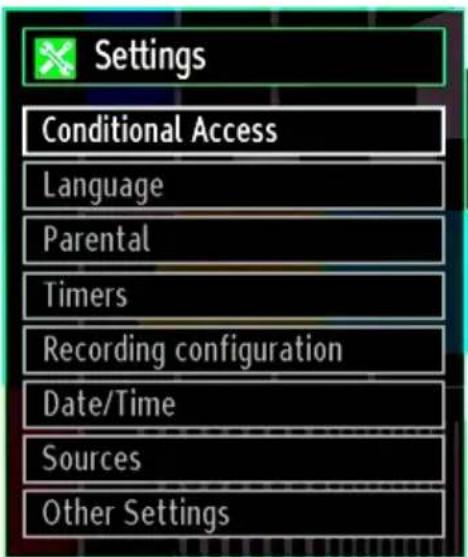
Operating Settings Menu Items
Press “▼” or “▲button to highlight a menu item.
Press • OK button to select an item.
Press • MENU button to exit.
Settings Menu Items
Conditional Access: Controls conditional access modules when available.
Language: Configures language settings.
Parental: Configures parental settings.
Timers: Sets timers for selected programmes.
Date/Time: Sets date and time.
Sources: Enables or disables selected source options.
Other Settings: Displays other setting options of the TV set.
Using a Conditional Access Module
IMPORTANT: Insert or remove the CI module only when the TV is SWITCHED OFF.
In order to watch certain digital channels, a conditional access module (CAM) can be necessary. This modu must be inserted in the CI slot of your TV.
Obtain the Conditional Access Module (CAM) and the viewing card by subscribing to a pay channel company, then insert those to the TV using the following procedure.
Insert the CAM and then the viewing card to the slot that is located in the terminal cover at the rear side of the TV.
The CAM should be correctly inserted, it is • impossible to insert fully if reversed. The CAM or the TV terminal may be damaged if the CAM is forcefully inserted.
Connect the TV to the mains supply, switch on and then wait for few moments until the card is activated.
When no module is inserted, “• No Common Interface module detected” message appears on the screen.
Refer to the module instruction manual for details of the settings.
Viewing Conditional Access Menu (\*)
(*) These menu settings may change depending on the service provider.
Press MENU button and select the icon by using “◀” or “▶” button. Press OK button to view Settings menu. Use “▼” or “▲” button to highlight Conditional Access and press OK to view menu items.
Configuring Language Preferences
You can operate the TV's language settings using this menu.
Press MENU button and select the Settings icon by using “◀ or ”▶ button. Press OK button to view Settings menu. Use “▼ or “ ”▲ button to highlight Language and press OK to continue:
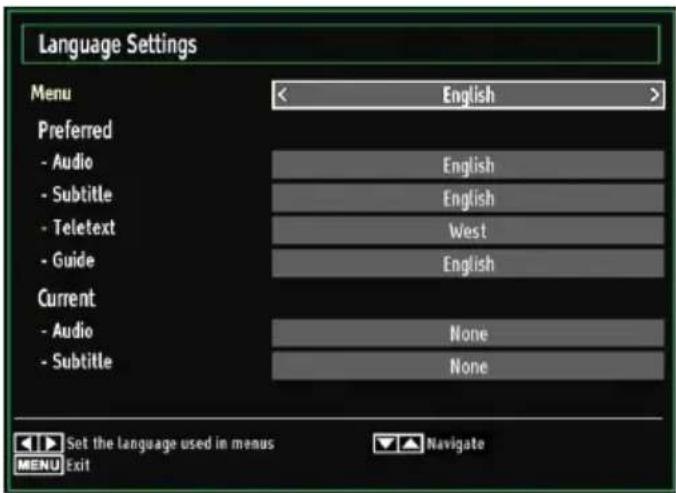
Use "▼or " " button to set an item. Settings are stored automatically.
Menu: displays the system language.
Preferred
These settings will be used if available. Otherwise the current settings will be used.
Audio• : Sets the preferred audio language.
- Subtitle: Sets the subtitle language. Selected language will be seen in subtitles.
- Teletext: Sets teletext language.
Guide• : Sets the preferred Guide language.
Current (\*)
(*) These settings can be changed if only the broadcaster supports. Otherwise, settings will not be available to be changed.
Audio• : Changes the audio language for the current channel.
- Subtitle: Sets the subtitle language for the current channel.
Note: If the Country option is set to Denmark, Sweden, Norway or Finland, the Language Settings menu will function as described below:
Language Settings
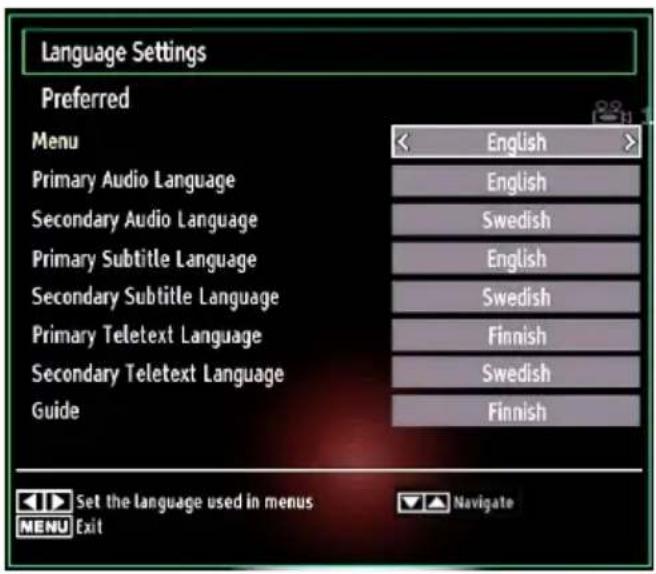
In the configuration menu, highlight the Language Settings item by pressing “▼or “” Buttons. Press OK and Language Settings submenu will be displayed on the screen:
Use “▼or “” buttons to highlight the menu item that will be adjusted and then press ◀ or “▶button to set.
Notes:
System Language determines the on-screen menu language.
Audio Language is used for selecting the soundtrack of a channels.
Primary settings are the first priority when multiple choices are available on a broadcast. Secondary settings are the alternatives when the first options are not available.
Parental Control
To prohibit viewing of certain programmes, channels and menus can be locked by using the parental control system.
This function enables or disables the menu protection system and allows the PIN code to be changed.
Press MENU button and select the Settings icon by using “◀or “ ”button. Press OK button to view Settings menu. Use ▼ or “▲button to highlight Parental and press OK to continue:
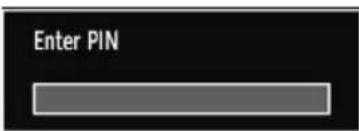
To display parental lock menu options, PIN number should be entered. Factory default PIN number is 0000.
Note: If the Country option is set to France, you can use 4725 as the default code.
After coding the correct PIN number, parental settings menu will be displayed:
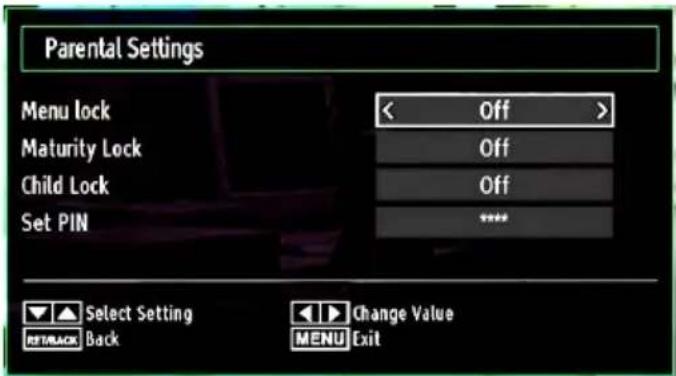
Parental Settings Menu Operation
Select an item by using “▼” or “▲button.”
Use “◀” or “” button to set an item.
- Press OK button to view more options.
Menu Lock: Menu lock setting enables or disables the menu access. You can disable access to the installation menu or the whole menu system.
Maturity Lock: When set, this option gets the maturity information from the broadcast and if this maturity level is disabled, disables access to the broadcast.
Child Lock: When Child Lock is set, the TV can only be controlled by the remote control. In this case the control panel buttons will not work. Hence, if one of those buttons is pressed, Child Lock Is On will be displayed on the screen when the menu screen is not visible.
Set PIN: Defines a new PIN number. Use numeric buttons to enter a new pin number. You will need to code your new pin a second time for verification purposes.
IMPORTANT: The factory default pin number is 0000, if you change the pin number make sure you write it down and keep it safe.
Note: If the Country option is set to France, you can use 4725 as the default code.
Timers
To view Timers menu, press MENU button and select Settings icon by using "◀or " " button. Press OK button to view Settings menu. Use "▼ or " " button to highlight Timers and press OK to continue:
Setting Sleep Timer
This setting is used for setting the TV to turn off after a certain time.
- Highlight Sleep Timer by using “▼” or “▲” button.
- Use “◀” or “▶” button to set. The timer can be programmed between Off and 2.00 hours (120 minutes) in steps of 30 minutes.
Setting Programme Timers
You can set programme timers for a particular programme using this feature.
Press "▼button to set timers on an event. Programme timer function buttons will be displayed on the screen.
Adding a Timer
- Press YELLOW button on the remote control to add a timer. The following menu appears on the screen:
Channel: Changes network type by using “◀ or ”
Timer Type: You can select timer type as Record or Timer.
Date: Enter a date using the numeric buttons.
Start: Enter a starting time using the numeric buttons.
End: Enter an ending time using the numeric buttons.
Duration: Displays duration between the starting and ending time.
Repeat: Sets a timer to be repeated as Once, Daily or Weekly. Use “◀ or “▶” buttons to select an option.
Change/Delete: Sets the change/dele permission.
Playback: Sets the playback permission and parental settings.
- Press GREEN button to save the timer. Press RED button to cancel.
Editing a Timer
- Select the timer you want to edit by pressing “▼” or “▲button.
- Press GREEN button. Edit Timer menu screen will be displayed.
- When finished with editing, press GREEN button to save. You can press MENU button to cancel.
Deleting a Timer
- Select the timer you want to delete by pressing “▼” or “▲button.
- Press RED button.
- Select YES by using “◀” or “▶” buttons to delete the timer. Select NO to cancel.
Recording Configuration
Select Recording Configuration item in the Settings menu to configure recording settings. The following menu is displayed for recording configuration.

The following options are available for adjustments:
Start Early (\*)
You set recording timer's starting time to start earlier by using this setting.
(*) Available only for EU country options.
End Late (\*)
You set recording timer's end time to end later by using this settings.
(*) Available only for EU country options.
Max Timeshift
This setting allows you to set the maximum time allowed for timeshifting. Duration options are approximate and can change accordingly, depending on the broadcast received.
Format Disk
IMPORTANT: Note that ALL the data stored on the USB disk will be lost and then the disk format will be converted to FAT32 if you activate this feature.
- If you want to delete all files on the connected USB hard disk drive or memory stick, you can use Format Disk option.
- Also, if your USB disk malfunctions, you can try formatting the USB disk. In most cases formatting the USB disk will restore normal operation; however, ALL the data stored on the USB disk will be lost in such a case.
- Press OK button while the Format Disk option is highlighted. A menu will appear on the screen, requiring you to enter a pin number. If you have not changed the pin number, the factory default is 0000. After you enter the pin, a pop-up menu appears on the screen to ensure that the hard disk should be formatted, select "YES" and press OK to format the hard disk. Select "NO" and press OK to cancel. Ensure you back up important recordings before you format the USB disk unit.
Hard Disk Info
To view the details about the USB disk, highlight Hard Disk Info by using “▼” or “▲” key and press OK. USB disk information will be displayed.
Configuring Date/Time Settings
Select Date/Time in the Settings menu to configure Date/Time settings. Press OK button.
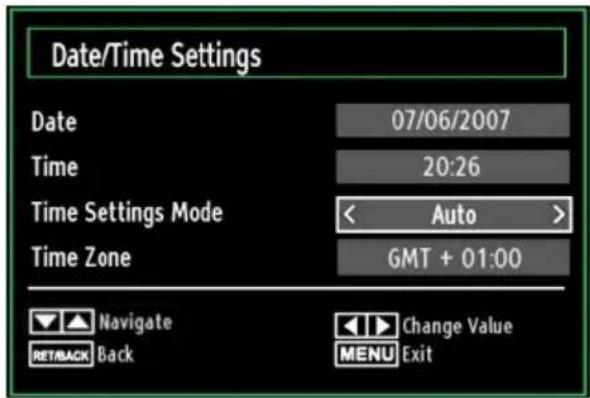
- Use “▼” or “▲” buttons to highlight Date/Time.
Date, Time, Time Settings Mode and Time Zone Setting will be available.
Use "▲or "▼buttons to highlight the Time Settings Mode. Time Settings Mode is set using "◀or "▼buttons. It can be set to AUTO or MANUAL.
When AUTO is selected, Date/Time and Time Zone options will not be available to be set. If MANUAL option is selected as the Time Zone can be altered:
- By pressing “▲or”▼buttons select Time Zone.
Use "◀ or "▶ buttons to change the Time Zone between GMT-12 or GMT+12. Date/Time on the top of the menu list will then change according to the selected Time Zone.
- Changes are automatically stored. Press MENU to exit.
Configuring Source Settings
You can enable or disable selected source options. The TV will not switch to the disabled source options when SOURCE button is pressed.
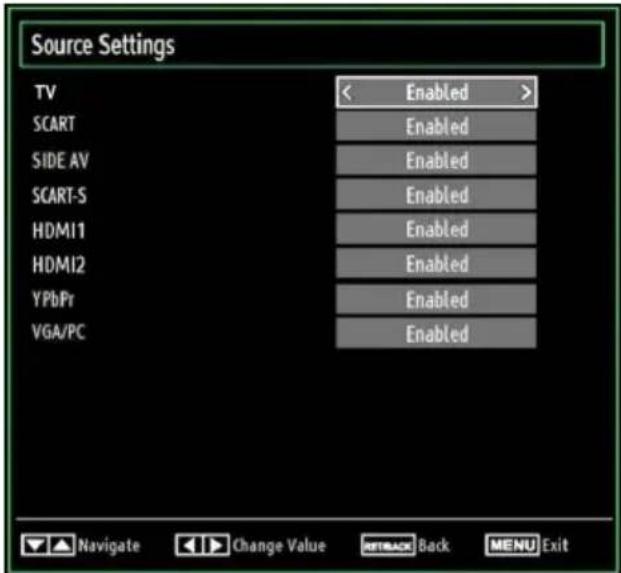
- Select Sources in the Settings menu and press OK button.
- Press“▼” or “▲” buttons to select a source.
- Use “◀” or “▶” button to enable or disable the selected source. Changes are automatically stored.
Note: YPbPr mode can be used only when you connect a device that has a YPbPr output through the PC input with YPbPr to PC cable (not supplied).
Configuring Other Settings
To view general configuration preferences, select Other Settings in the Settings menu and press OK button.
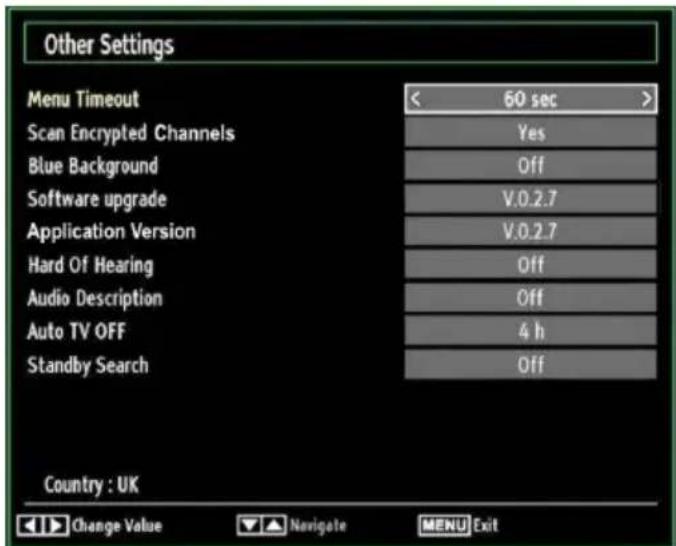
Operation
- Press “▼” or “▲” buttons to select an item.
- Use “◀” or “▶” button to set an option.
Press• OK button to view a sub-menu.
Menu Timeout: Changes timeout duration for menu screens.
Scan Encrypted: When this setting is on, search process will locate the encrypted channels as well. If it is set as Off, encrypted channels will not be located in automatic search or manual search.
Blue Background (Optional): Activates or deactivates blue background system when the signal is weak or absent.
Software Upgrade: To ensure that your TV always has the most update information, you can use this setting. In order for the proper operation, please ensure that the TV is set to standby mode.
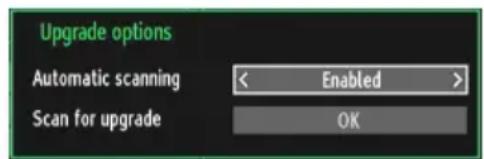
You can enable or disable automatic upgrade by setting Automatic Scanning option.
You can manually search for new software by selecting Scan for upgrade.
Application version: Displays the current application version.
Hard of Hearing: If the broadcaster enables any special signal concerning the audio, you can set this setting as On to receive such signals.
Audio Description: Audio description refers to an additional narration track for blind and visually impaired viewers of visual media, including television and movies. The description narrator talks through the presentation, describing what is happening on the screen during the natural pauses in the audio (and sometimes during dialogue, if deemed necessary). You can use this feature, only if the broadcaster supports that additional narration track.
Auto TV Off: You can set the timeout value of auto off feature. After the timeout value is reached and the Tv not operated for selected time, the TV will go off.
Standby Search (optional): Use "▼or " " button to select Standby Search and then press " " or " ▶" button to set this setting as On or Off. If you change Standby Search to Off, this function will be unavailable. To use Standby search please make sure that you select Standby Search as On.
If the Standby Search is set to On, when the TV is in standby mode, available broadcasts will be searched. If the TV locates any new or missing broadcasts, a menu screen will be displayed, asking you whether or not to execute these changes.
Other Features
Displaying TV Information: Programme Number, Programme Name, Sound Indicator, time, teletext, channel type and resolution information is displayed on the screen when a new programme is entered or "INFO" button is pressed.
Mute Function: Press "button to disable sound. Mute indicator will be displayed in the upper side of the screen. To cancel mute, there are two alternatives; the first one is pressing the button and the second one is increasing the volume level.
Picture Mode Selection: By pressing PRESETS button, you can change Picture Mode settings in accordance with your viewing requirements. Available options are Dynamic, Natural, Cinema and Game.
Displaying Subtitles: You can enable subtitles by pressing the SUBTITLE button of the remote control. Press SUBTITLE button again to disable subtitle function.
If "Subtitle" is On, pressing the "TXT" button causes the following warning message display on the screen ( ** for UK only)
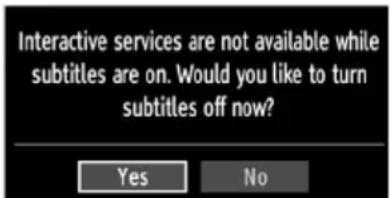
Teletext
Teletext system transmits information such as news, sports and weather on your TV. Note that is the signal degrades, for example in poor/adverse weather conditions, some text errors may occur or the teletext mode may be aborted.
Teletext function buttons are listed below:
“TXT” Teletext / Mix : Activates teletext mode when pressed once. Press again to place the teletext screen over the programme (mix).Pressing again will quit the teletext mode.
"RETURN" Index: Selects the teletext index page.
"INFO"Reveal: Shows hidden information (e.g. solutions of games).
"OK" Hold: Holds a text page when convenient. Press again to resume.
“◀” Subcode Pages : Selects subcode pages if available when the teletext is activated.
CH▲ or CH▼ and numbers (0-9): Press to select a page.
Note: Most TV stations use code 100 for their index pages.
Coloured Buttons (RED/GREEN/YELLOW/BLUE)
Your TV supports both FASTEXT and TOP text systems. When these systems are available, the pages are divided into groups or topics. When FASTEXT system is available, sections in a teletext page will become colour-coded and can be selected by pressing the coloured buttons. Press a coloured button that corresponds to with your needs. The coloured writings will appear, showing you which coloured buttons to use when TOP text transmission is present. Pressing “▼” or “▲” commands will request the next or previous page respectively.
Tips
Screen Care: Clean the screen with a slightly damp, soft cloth. Do not use abrasive solvents as they may damage the coating layer of the TV screen. For your safety, unplug the mains plug when cleaning the set. When moving the TV, hold it properly from the bottom part.
Image Persistence: Please note that ghosting may occur while displaying a persistent image.LED TVs' image persistence may disappear after a short time. Try turning off the TV for a while.
To avoid this, do not leave the screen in still picture for extended periods.
No Power: If your TV system has no power, please check the main power cable and connection to the mains socket outlet.
Poor Picture: Have you selected the correct TV system? Is your TV set or house aerial located too close to a non-earthed audio equipment or neon lights, etc.? Mountains or high buildings can cause double pictures or ghost images. Sometimes you can improve the picture quality by changing the direction of the aerial. Is the picture or teletext unrecognisable? Check if you have entered the correct frequency. Please retune the channels. The picture quality may degrade when two peripherals are connected to the TV at the same time. In such a case, disconnect one of the peripherals.
No Picture: Is the aerial connected properly? Are the plugs connected tightly to the aerial socket? Is the aerial cable damaged? Are suitable plugs used to connect the aerial? If you are in doubt, consult your dealer. No Picture means that your TV is not receiving a transmission. Have you selected the correct button on the remote control? Try once more. Also make sure the correct input source has been selected.
Sound: You can not hear any sound. Did you perhaps interrupt the sound, pressing the x button? Sound is coming from only one of the speakers. Is the balance set to one extreme? See Sound Menu.
Remote Control: Your TV no longer responds to the remote control. Perhaps the batteries are exhausted. If so you can still use the local buttons on the TV.
Input Sources: If you cannot select an input source, it is possible that no device is connected. Check the AV cables and connections if you have tried to connect a device.
Recording Unavailable: To record a programme, you should first connect a USB disk to your TV while the TV is switched off. You should then switch on the TV to enable recording feature. Otherwise, recording feature will not be available. If you cannot perform recording, try switching off the TV and then re-inserting the USB device while the TV is switched off.
USB Is too Slow: If "USB is too slow" message is displayed on the screen while starting a recording, try restarting the recording. If you still get the same error, it is possible that your USB disk does not meet the speed requirements. Try connecting another USB disk.
Appendix A: PC Input Typical Display Modes
The display has a maximum resolution of 1920 x 1200. The following table is an illustration of some of the typical video display modes. Your TV may not support different resolutions. Supported resolution modes are listed below. If you switch your PC to an unsupported mode, a warning OSD will appear on the screen.
| Index | Resolution | Frequency |
| 1 | 640x350 85 Hz | |
| 2 | 640x400 70 Hz | |
| 3 | 640x480 | 60Hz-66Hz-72Hz-75Hz-85Hz |
| 4 | 800x600 | 56Hz-60Hz-70Hz-72Hz-75Hz-85Hz |
| 5 | 832x624 75 Hz | |
| 6 | 1024x768 | 60Hz-66Hz-70Hz-72Hz-75Hz |
| 7 | 1152x864 | 60Hz-70Hz-75Hz-85 Hz |
| 8 | 1280x768 60 HzA | |
| 9 | 1280x768 60 HzB | |
| 10 | 1280x768 75 Hz-85Hz | |
| 11 | 1280x960 | 60Hz-75Hz-85Hz |
| 12 | 1280x1024 | 60Hz-75Hz-85Hz |
| 13 | 1360x768 60 Hz | |
| 14 | 1400x1050 60 HzA | |
| 15 | 1400x1050 60 HzB | |
| 16 | 1400x1050 | 75Hz-85Hz |
| 17 | 1400x900 | 65Hz-75Hz |
| 18 | 1600x1200 60 Hz | |
| 19 | 1680x1050 60 Hz | |
| 20 | 1920x1080 60 HzA | |
| 21 | 1920x1080 60 HzB | |
| 22 | 1920x1200 60 HzA | |
| 23 | 1920x1200 60 Hz |
Appendix B: AV and HDMI Signal Compatibility (Input Signal Types)
| Source | Supported Signals | Available | |
| EXT(SCART) | PAL 50/60 O | ||
| NTSC 60 O | |||
| RGB 50 O | |||
| RGB 60 O | |||
| Side AV | PAL 50/60 O | ||
| NTSC 60 O | |||
| YPbPr | 480I 60Hz O | ||
| 480P | 60Hz O | ||
| 576I 50Hz O | |||
| 576P | 50Hz O | ||
| 720P | 50Hz O | ||
| 720P | 60Hz O | ||
| 1080I | 50Hz O | ||
| 1080I | 60Hz O | ||
| 1080P | 50Hz O | ||
| 1080P | 60Hz O | ||
| HDMI1HDMI2 | 480I 60Hz O | ||
| 480P | 60Hz O | ||
| 576I 50Hz O | |||
| 576P | 50Hz O | ||
| 720P | 50Hz O | ||
| 720P | 60Hz O | ||
| 1080I | 50Hz O | ||
| 1080I | 60Hz O | ||
| 1080P | 24Hz O | ||
| 1080P | 25Hz O | ||
| 1080P | 30Hz O | ||
| 1080P | 50Hz O | ||
| 1080P | 60Hz O | ||
(X: Not Available, O: Available)
In some cases a signal on the LCD TV may not be displayed properly. The problem may be an inconsistency with standards from the source equipment (DVD, Set-top box, etc.). If you do experience such a problem please contact your dealer and also the manufacturer of the source equipment.
Appendix C: Supported DVI Resolutions
When connecting devices to your TV's connectors by using DVI to HDMI cables (not supplied), you can refer to the following resolution information.
| Index | Resolution | Frequency |
| 1 | 640x400 | 70Hz |
| 2 | 640x480 | 60Hz-66Hz-72Hz-75Hz |
| 3 | 800x600 | 56Hz-60Hz-70Hz-72Hz -75Hz |
| 4 | 832x624 | 75 Hz |
| 5 | 1024x768 | 60Hz-66Hz-70Hz-72Hz -75Hz |
| 6 | 1152x864 | 60Hz-70Hz-75Hz |
| 7 | 1152x870 | 75Hz |
| 8 | 1280x768 | 60 HzA |
| 9 | 1280x768 | 60 HzB |
| 10 | 1280x768 | 75Hz |
| 11 | 1280x960 | 60Hz-75Hz |
| 12 | 1280x1024 | 60Hz-75Hz |
| 13 | 1360x768 | 60 Hz |
| 14 | 1400x1050 | 60 HzA |
| 15 | 1400x1050 | 60 HzB |
| 16 | 1400x1050 | 75Hz |
| 17 | 1400x900 | 65Hz-75Hz |
| 18 | 1600x1200 | 60 Hz |
| 19 | 1680x1050 | 60 Hz |
| 20 | 1920x1080 | 60 HzA |
| 21 | 1920x1080 | 60 HzB |
| 22 | 1920x1200 | 60HzA |
| 23 | 1920x1200 | 60Hz |
| 24 | 480i-480p | 60Hz |
| 25 | 576i-576p | 50Hz |
Appendix D: Software Upgrade
- Your TV is capable of finding and updating new software upgrades over broadcast channels.
- For broadcast channels search, TV looks the available channels stored in your settings. So before software upgrade search, it is advised to auto search and update all available channels.
1) Software upgrade search via user interface
- It is possible manually to check if there is a new software upgrade for your TV set.
- Simply navigate on your main menu. Choose Settings and select Other Settings menu. In Other Settings menu navigate on to the Software Upgrade item and press OK button to open Upgrade Options menu.
- In Upgrade Options menu select Scan for upgrade and press OK button.
- If a new upgrade is found, it starts to download the upgrade. A progress bar indicates the remaining download progress. When download completes with success a message is displayed for reboot to activate new software. Press OK to continue with the reboot operation.
2) 3.AM search and upgrade mode
- If Automatic scanning in Upgrade Options menu is enabled, TV wakes up at 03:00 and searches broadcast channels for new software upgrade. If new software is found and downloaded successfully, with next power up TV opens with new software version.
Note on reboot operation: Reboot is the last step in software upgrade operation if download of new software is finished successfully. During reboot TV makes final initializations. In reboot sequence panel power is closed and front led indicates the activity with blinking. Around 5 minutes later TV restarts with new software activated. - If your TV fails to restart in 10 minutes, unplug power for 10 minutes and re-plug again. TV should open with new software safely. If you still can not get TV working, please kindly repeat unplug and plug sequence a few times more. If your set still can not operate, please call the service personnel to fix the problem for you.
Caution: While led is blinking during reboot do not unplug your TV's power. Doing this may cause your TV not to re-open again and can only be fixed by service personnel.
Appendix E : Supported File Formats for USB Mode
| Media | File Extension | Format | Remarks | |
| Video | Audio | (Maximum resolution/Bit rate etc.) | ||
| Movie | .mpg, .mpeg | MPEG1, 2 MPEG Layer | 1/2/3 | MAX 1920x1080 @ 30P 20Mbit/sec |
| .dat MPEG1, 2 | MPEG2 | |||
| .vob MPEG2 | ||||
| .mkv H.264, MPEG1,2,4 EAC3 / AC3 | ||||
| .mp4 | MPEG4, Xvid 1.00, Xvid 1.01, Xvid 1.02, Xvid 1.03, Xvid 1.10-beta1/2 H.264 | PCM/MP3 | ||
| .avi | MPEG2, MPEG4 PCM/MP3 | MAX 1920x1080 @ 30P 20Mbit/sec | ||
| Xvid 1.00, Xvid 1.01, Xvid 1.02, Xvid 1.03, Xvid 1.10-beta1/2 H.264 | PCM | |||
| Music | .mp3 - | MPEG 1 Layer 1 / 2 (MP3) | 32Kbps ~ 320Kbps(Bit rate)32KHz ~ 48KHz(Sampling rate) | |
| Photo | .jpg .jpeg | Baseline JPEG max WxH = 15360x8640 4147200bytes | ||
| Progressive JPEG | max WxH = 1024x768 6291456bytes | |||
| .bmp | - | max WxH = 9600x6400 3840000bytes | ||
| Subtitle | .sub | - | - | |
| .srt | ||||

natural_image
Symbol of a trash bin crossed out by two diagonal lines (no text or numbers present)
Products

natural_image
Symbol of a trash bin crossed out by two diagonal lines (no text or labels)Battery
Information for Users on Disposal of old Equipment and Batteries
[European Union only]
These symbols indicate that equipment with these symbols should not be disposed of as general household waste. If you want to dispose of the product or battery, please consider the collection systems or facilities for appropriate recycling.
Notice: The sign Pb below the symbol for batteries indicates that this battery contains lead.
Specifications
TV BROADCASTING
PAL/SECAM B/G D/K K' I/I' L/L'
RECEIVING CHANNELS
VHF (BAND I/III)
UHF (BAND U)
HYPERBAND
NUMBER OF PRESET CHANNELS
1000
CHANNEL INDICATOR
On Screen Display
RF AERIAL INPUT
75 Ohm (unbalanced)
OPERATING VOLTAGE
220-240V AC, 50 Hz.
AUDIO
German + Nicam Stereo
AUDIO OUTPUT POWER ( WRMS. ) (10% THD)
2 × 6
POWER CONSUMPTION (W)
190 W (max)
PANEL
16:9 display, 40" Screen Size
DIMENSIONS (mm)
DxLxH (With foot): 219 x 973 x 655
Weight (Kg): 15,10
DxLxH (Without foot): 99,5 x 973 x 616
Weight (Kg): 14,40
| Digital Reception DVB-T | MHEG-5 ENGINE compliant with ISO/IEC 13522-5 UK engine Profile 1 | for UKObject ca |
| Frequency range: 474-850 MHz for UK models | ||
| 170-862 MHz for EU models | ||
| Transmission standard: DVB-T. MPEG-2, MPEG-4 | ||
| Demodulation: COFDM with 2K/8K FFT mode | ||
| FEC: all DVB modes | ||
| Video: MP@ML, PAL, 4:3/16:9 | ||
| Audio: MPEG Layer I&II 32/44.148kHz. | ||

- RECONNAISSANCE DE MARQUE COMMERCIALE
- ATTENTION!
- Zoom 14:9
- Panoramique
- RÉCEPTION DE CANAUX
- NOMBRE DE CANAUX PRÉRÉGLÉS
- INDICATEUR DE CHAÎNE
- ENTRÉE D'ANTENNE RF
- PUISSANCE DE SORTIE AUDIO ( WRMS ) (10% THD)
- CONSOMMATION ÉLECTRIQUE (W)
- PANNEAU
- Features
- Introduction
- Preparation
- Safety Precautions
- Power Source
- Power Cord
- Moisture and Water
- Cleaning
- Ventilation
- Heat and Flames
- Lightning
- Replacement Parts
- Servicing
- or Waste Disposal
- Disconnecting the Device
- Headphone Volume
- Installation
- LCD Screen
- Connection to a Television Distribution System (Cable TV etc.) from Tuner
- TRADEMARK ACKNOWLEDGMENT
- DOLBY.
- DIGITAL PLUS
- Licence Notification (Optional)
- Electrical device not in the hands of children
- Environmental Information
- Power Save Mode
- Repair Information
- Package Contents
- Remote Control Buttons
- Viewing the Connections - Side Connectors
- Power Connection
- Aerial Connection
- Using USB Input
- USB Connection
- IMPORTANT!
- USB Disk Connection
- CAUTION!
- Programme Recording
- Connecting the LCD TV to a PC
- Using Side AV Connectors
- Connecting to a DVD Player via HDMI
- Connecting to a DVD Player
- Remote Control Handset
- Inserting Batteries
- Switching On/Off
- To Switch the TV On
- To Switch the TV Off
- Input Selection
- Basic Operations
- Operation with the Buttons on the TV Volume Setting
- Programme Selection
- Viewing Main Menu
- AV Mode
- Operation with the Remote Control
- Volume Setting
- Programme Selection (Previous or Next Programme)
- Programme Selection (Direct Access)
- Viewing Electronic Programme Guide (EPG)
- ▼/▲/◄: Navigate
- ▼/▲/▲>Navigate
- Recording via EPG Screen
- Programme Options
- Select Channel
- Record / Delete Record Timer
- Set Timer / Delete Timer
- Digital Teletext ( ** for UK only)
- Analogue Teletext
- First Time Installation
- Auto Channel Scan (Retune) Menu Operation
- Manual Tuning
- Analogue Fine Tune
- Clear Service List (\*)
- Managing Stations: Channel List
- Operating the Channel List
- Moving a Channel
- Deleting a Channel
- Renaming a Channel
- Locking a Channel
- Managing Stations: Favourites
- Button Functions
- Managing Stations: Sorting Channel List
- On-Screen Information
- Media Playback Using Media Browser
- Viewing Videos via USB
- Viewing Photos via USB
- Slideshow Options
- Playing Music via USB
- Recordings Library
- Media Browser Settings
- Timeshift Recording
- Instant Recording
- Watching Recorded Programmes
- Slow Forward
- Changing Image Size: Picture Formats
- toAuto
- 16:9
- Subtitle
- 14:9
- 4:3
- Panoramic
- Cinema
- Configuring Picture Settings
- Operating Picture Settings Menu Items
- Picture Settings Menu Items
- Advanced Settings:
- PC Picture Settings
- Configuring Sound Settings
- Operating Sound Settings Menu Items
- Sound Settings Menu Items
- Configuring Your TV's Settings
- Operating Settings Menu Items
- Settings Menu Items
- Using a Conditional Access Module
- Viewing Conditional Access Menu (\*)
- Configuring Language Preferences
- Preferred
- Current (\*)
- Language Settings
- Parental Control
- Parental Settings Menu Operation
- Timers
- Setting Sleep Timer
- Setting Programme Timers
- Adding a Timer
- Editing a Timer
- Deleting a Timer
- Recording Configuration
- Start Early (\*)
- End Late (\*)
- Max Timeshift
- Format Disk
- Hard Disk Info
- Configuring Date/Time Settings
- Configuring Source Settings
- Configuring Other Settings
- Operation
- Other Features
- Teletext
- Coloured Buttons (RED/GREEN/YELLOW/BLUE)
- Tips
- Appendix A: PC Input Typical Display Modes
- (X: Not Available, O: Available)
- Appendix C: Supported DVI Resolutions
- Appendix D: Software Upgrade
- 1) Software upgrade search via user interface
- 2) 3.AM search and upgrade mode
- Information for Users on Disposal of old Equipment and Batteries
- Specifications
- TV BROADCASTING
- RECEIVING CHANNELS
- NUMBER OF PRESET CHANNELS
- CHANNEL INDICATOR
- RF AERIAL INPUT
- OPERATING VOLTAGE
- AUDIO
- AUDIO OUTPUT POWER ( WRMS. ) (10% THD)
- POWER CONSUMPTION (W)
- PANEL
- DIMENSIONS (mm)
Brand : GRANDIN
Model : LC40R
Category : Television