
FT2 47 VR04 - Refrigerator TEKA - Free user manual and instructions
Find the device manual for free FT2 47 VR04 TEKA in PDF.



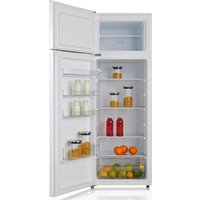
| Product type | Refrigerator with freezer compartment |
| Brand | Teka |
| Model | FT2 47 VR04 |
| Power supply | 220-240 V, 50 Hz |
| Climate class | T (16 °C to 43 °C) |
| Refrigerant gas | R600a (isobutane, flammable) |
| Thermostat | Adjustable from 1 (warmest) to 5 (coldest) |
| Ice tray capacity | Yes, ice tray included |
| Refrigerator defrosting | Automatic (water drained through channel) |
| Freezer defrosting | Manual, use the plastic scraper provided |
| Interior lighting | Bulb ≤ 15 W, easy replacement |
| Adjustable feet | Yes, at the front for leveling |
| Door opening direction | Reversible (service by authorized service) |
| Included accessories | Vegetable bin, bottle rack, butter and cheese compartment, egg tray, ice tray |
| Cleaning | Warm water and baking soda; do not use solvents |
| Grounding required | Yes, special 16 A grounded socket |
| Installation space | ≥ 15 cm above, ≥ 2 cm on sides and back |
| Energy saving tips | Let hot food cool down, cover food, limit door opening |
Frequently Asked Questions - FT2 47 VR04 TEKA
User questions about FT2 47 VR04 TEKA
0 question about this device. Answer the ones you know or ask your own.
Ask a new question about this device
Download the instructions for your Refrigerator in PDF format for free! Find your manual FT2 47 VR04 - TEKA and take your electronic device back in hand. On this page are published all the documents necessary for the use of your device. FT2 47 VR04 by TEKA.
USER MANUAL FT2 47 VR04 TEKA
General warnings 2 Old and out-of-order fridges 4 Safety warnings 4 Installing and operating your fridge 5 Before Using your Fridge 5
THE VARIOUS FUNCTIONS AND POSSIBILITIES 6
Thermostat Setting 6
Accessories 6
Ice tray 6
ARRANGING FOOD IN THE APPLIANCE 7
Refrigerator Compartment 7 Freezer Compartment 7
CLEANING AND MAINTENANCE 8
Defrosting 9 Replacing The Light Bulb 10
SHIPMENT AND REPOSITIONING 10
Repositioning the Door 10
BEFORE CALLING YOUR AFTER SALES SERVICE 11
Tips for saving energy 12
THE PARTS OF THE APPLIANCE AND THE COMPARTMENTS 13
WARNING: Keep ventilation openings, in the appliance enclosure or in the built-in structure, clear of obstruction.
WARNING: Do not use mechanical devices or other means to accelerate the defrosting process, other than those recommended by the manufacturer.
WARNING: Do not use electrical appliances inside the food storage compartments of the appliance, unless they are of the type recommended by the manufacturer.
WARNING: Do not damage the refrigerant circuit.
WARNING: To avoid a hazard due to the instability of the appliance, it must be fixed in accordance with the instructions.
- If your appliance uses R600a as a refrigerant – you can learn this information from the label on the cooler- you should be careful during shipment and installation to prevent your appliance's cool elements from being damaged. Although R600a is an environmentally friendly and natural gas. As it is explosive, in the event of a leak due to damage to the cooler elements, move your fridge from open flame or heat sources and ventilate the room where the appliance is located for a few minutes.
- While carrying and positioning the fridge, do not damage the cooler gas circuit.
- Do not store explosive substances such as aerosol cans with a flammable propellant in this appliance.
- This appliance is intended to be used in household and similar applications such as;
- staff kitchen areas in shops, offices and other working environments
- farm houses and by clients in hotels, motels and other residential-type environments
- bed and breakfast type environments;
- catering and similar non-retail applications
- If the socket does not match the refrigerator plug, it must be replaced by the manufacturer, its service agent or similarly qualified persons in order to avoid a hazard.
- This appliance is not intended for use by persons (including children) with reduced physical, sensory or mental capabilities, or lack of experience and knowledge, unless they have been given supervision or instruction concerning use of the appliance by a person responsible for their safety. Children should be supervised to ensure that they do not play with the appliance.
- A specially grounded plug has been connected to the power cable of your refrigerator. This plug should be used with a specially grounded socket of 16 amperes. If there is no such socket in your house, please have it installed by an authorized electrician.
- This appliance can be used by children aged from 8 years and above and persons with reduced physical, sensory or mental capabilities or lack of experience and knowledge if they have been given supervision or instruction concerning use of the appliance in a safe way and understand the hazard involved. Children shall not play with the appliance. Cleaning and user maintenance shall not be made by children without supervision.
- If the supply cord is damaged, it must be replaced by the manufacturer, its service agent or similar qualified persons in order to avoid a hazard.
Old and out-of-order fridges
- If your old fridge has a lock, break or remove the lock before discarding it, because children may get trapped inside it and may cause an accident.
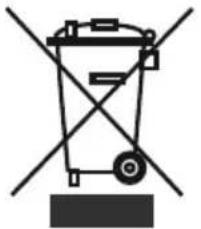
- Old fridges and freezers contain isolation material and refrigerant with CFC. Therefore, take care not to harm the environment when you are discarding your old fridges.
Please ask your municipal authority about the disposal of the WEEE for the reuse, recycle and recovery purposes.
Notes:
- Please read the instruction manual carefully before installing and using your appliance. We are not responsible for damage caused by misuse.
- Follow all instructions on your appliance and in the instruction manual, and keep this manual in a safe place to resolve problems that may occur in the future.
- This appliance is produced for home use and can only be used in domestic environments and for the specified purposes. It is not suitable for commercial or common use. Such use will void the appliance's guarantee, and our company will not be responsible for any resulting losses.
- This appliance is produced for home use and is only suitable for cooling/storing food. It is not suitable for commercial or common use and/or for storing substances other than food. Our company is not responsible for losses that may occur in the contrary case.
Safety warnings
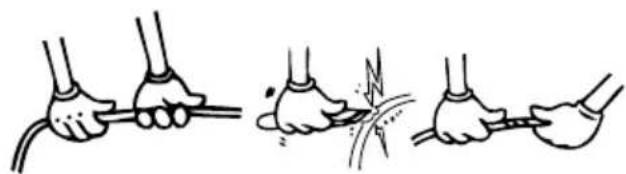
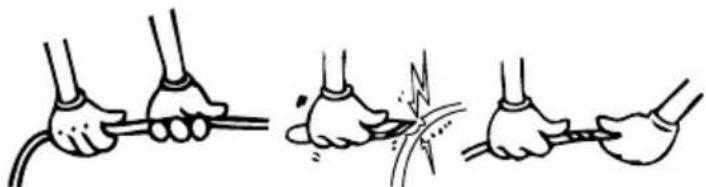
- Do not use multiple receptacles or extension cords.
- Do not plug in damaged, torn, or old plugs.
- Do not pull, bend, or damage the cord.
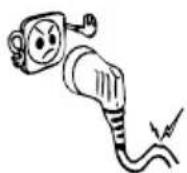
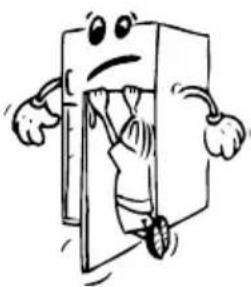
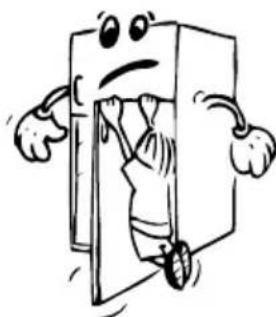
- This appliance is designed for use by adults; do not allow children to play with the appliance or hang off the door.
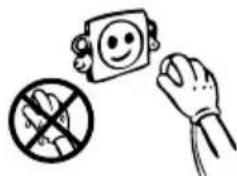
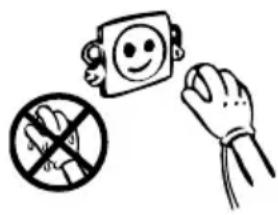
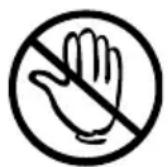
- Do not plug in or unplug the plug from the receptacle with wet hands to prevent electrocution!
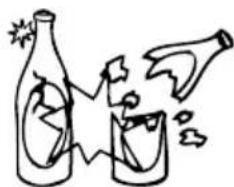
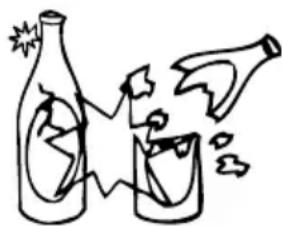
- Do not place glass bottles or beverage cans in the freezer compartment. Bottles or cans may explode.
- Do not place explosive or flammable material in your fridge for your safety. Place drinks with higher alcohol content upright and with their necks tightly closed in the fridge department.
- When taking ice made in the freezer department, do not touch it, as ice may cause ice burns and/or cuts.
- Do not touch frozen goods with wet hands! Do not eat ice-cream and ice cubes immediately after you have taken them out of the freezer department!
- Do not re-freeze frozen goods after they have melted. This may cause health issues like food poisoning.
- Do not cover the body or top of the fridge with lace. This affects the performance of your fridge.
Fix the accessories in the fridge during transportation to prevent damage to accessories.
Installing and operating your fridge
Before starting to use your fridge, you should pay attention to the following points:
- Operating voltage for your fridge is 220-240 V at 50Hz.
- We do not take responsibility for the damages that occur due to ungrounded usage.
- Place your fridge in a place where it would not be exposed to direct sunlight.
- Your appliance should be at least 50 cm away from stoves, gas ovens and heater cores, and should be at least 5 cm away from electrical ovens.
- Your fridge should never be used outdoors or left under the rain.
- When your fridge is placed next to a deep freezer, there should be at least 2 cm between them to prevent humidity on the outer surface.
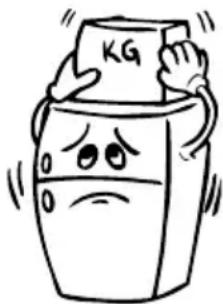
- Do not place anything on your fridge, and install your fridge in a suitable place so that at least 15 cm is available on the upper side.
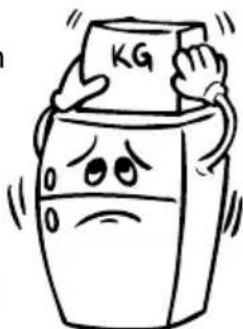
- The adjustable front legs should be adjusted to make sure your appliance is level and stable. You can adjust the legs by turning them clockwise (or in the opposite direction). This should be done before placing food in the fridge.
- Before using your fridge, wipe all parts back with warm water added with a tea spoonful of sodium bicarbonate, and then rinse with clean water and dry. Place all parts after cleaning.
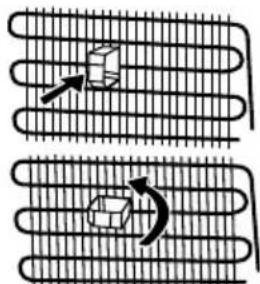
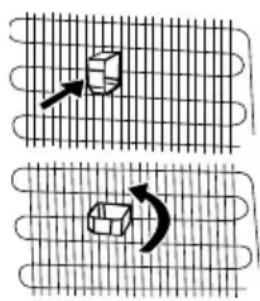
- Install the plastic distance guide (the part with black vanes at the rear) by turning it 90 degrees as shown in the figure to prevent the condenser from touching the wall.
- Refrigerator should be placed against a wall with a free distance not exceeding 75 mm.
Before Using your Fridge
- When it is operated for the first time or after transportation, keep your fridge in the upright position for 3 hours and plug it on to allow efficient operation. Otherwise, you may damage the compressor.
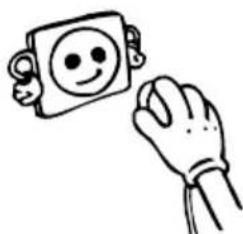
- Your fridge may have a smell when it is operated for the first time; the smell will fade away when your fridge starts to cool.
PART - 2. THE VARIOUS FUNCTION AND POSSIBILITIES
Thermostat Setting
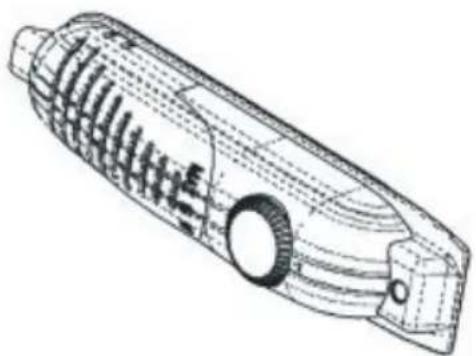
- Thermostat automatically regulates the inside temperature of the refrigerator compartment and freezer compartment. By rotating the knob from position 1 to 5, colder temperatures can be obtained. «*» position shows thermostat is closed and no cooling will be available.
- For short-term storage of food in the freezer compartment, you can set the knob between 1 and 3 position.
- For long-term storage of food in the freezer compartment, you can set knob 3-4 position.
Note that; the ambient temperature, temperature of the freshly stored food and how often the door is opened, affects the temperature in the refrigerator compartment. If required, change the temperature setting.
Accessories
Ice tray
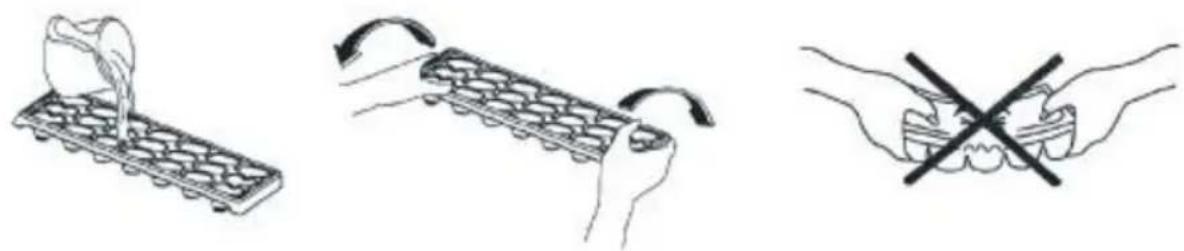
- Fill the ice tray with water and place in freezer compartment.
- After the water completely turned into ice, you can twist the tray as shown below to get the ice cube.
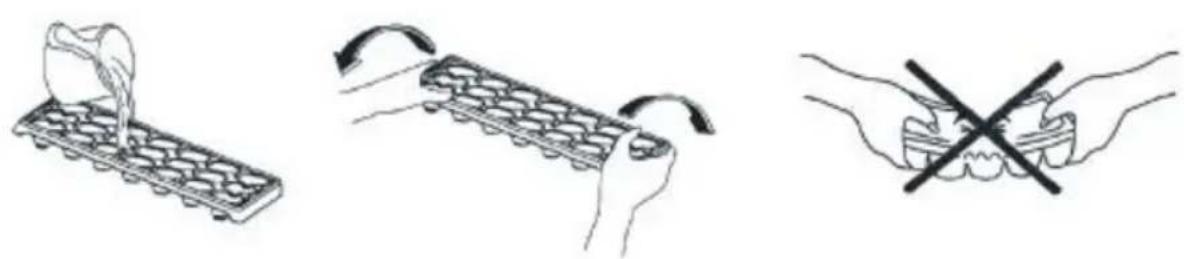
PART - 3. ARRANGING FOOD IN THE APPLIANCE
Refrigerator Compartment
- To reduce humidity and consequent increase of frost, never place liquids in unsealed containers in the refrigerator. Frost tends to concentrate in the coldest parts of the evaporator and in time will require more frequent defrosting.
- Never place warm food in the refrigerator. Warm food should be allowed to cool at room temperature and should be arranged to ensure adequate air circulation in the refrigerator compartment.
- Nothing should touch the back wall as it will cause frost and the packages can stick on the back wall. Do not open the refrigerator door too frequently.
- Arrange the meat and cleaned fish (wrapped in packages or sheets of plastic) which you will use in 1-2 days, in the bottom section of the refrigerator compartment (that is above the crisper) as this is the coldest section and will ensure the best storing conditions.
- You can put the fruits and vegetables into crisper without packing.
Freezer Compartment
- The use of freezer is, storing of deep-frozen or frozen foods for long periods of time and making ice cubes.
- To freeze fresh food, ensure that as much of the surface as possible of food to be frozen is in contact with the cooling surface.
- Do not put fresh food with frozen on side by side as it can thaw the frozen food.
- While freezing fresh foods (i.e. meat, fish and mincemeat), divide them in parts you will use in one time.
- Once the unit has been defrosted replace the foods into freezer and remember to consume them in as short period of time.
- Never place warm food in the freezer compartment. As it will disturb the frozen foods.
- For storing the frozen foods; the instructions shown on frozen food packages should always be followed carefully and if no information is provided food should not be stored for more than 3 months from the purchased date.
- When buying frozen foods ensure that these have been frozen at suitable temperatures and that the packing is intact.
- Frozen foods should be transported in appropriate containers to maintain the quality of the food and should be returned to the freezing surfaces of the unit in the shortest possible time.
- If a package of frozen food shows the sign of humidity and abnormal swelling it is probable that it has been previously stored at an unsuitable temperature and that the contents have deteriorated.
- The storage life of frozen foods depends on the room temperature, thermostat setting, how often the door is opened, the type of food and the length of time required to transport the product from the shop to your home. Always follow the instructions printed on the package and never exceed the maximum storage life indicated.
Note that if you want to open the freezer door again immediately after closing it, it will not open easily. This is quite normal! After reaching equilibrium condition, the door will open easily.
PART - 4. CLEANING AND MAINTENANCE
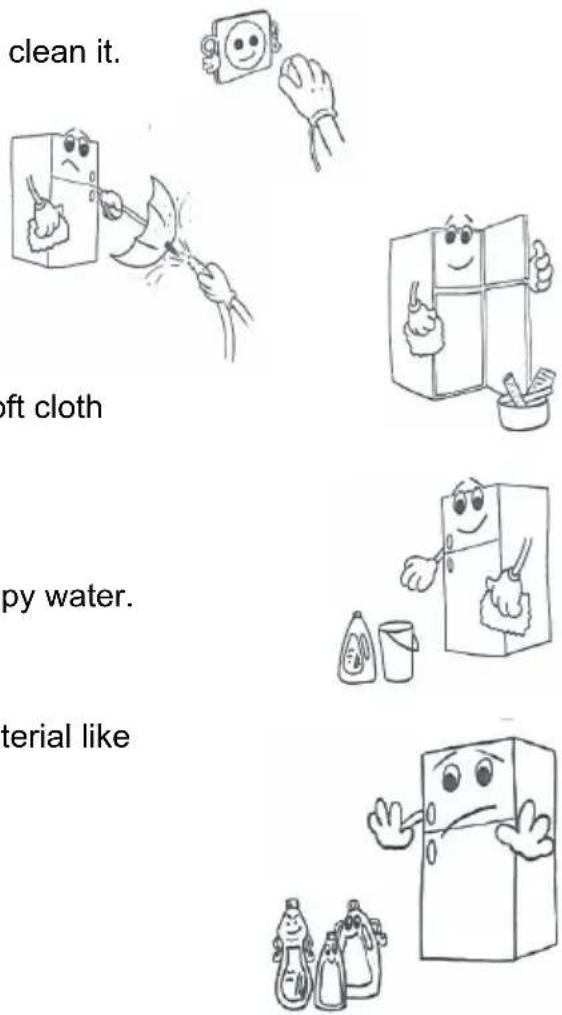
- Make sure to unplug the fridge before starting to clean it.
- Do not wash your fridge by pouring water.
- You can wipe the inner and outer sides with a soft cloth or a sponge using warm and soapy water.
- Remove the parts individually and clean with soapy water. Do not wash in washing machine.
- Never use flammable, explosive or corrosive material like thinner, gas, acid for cleaning.
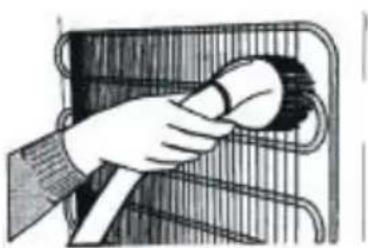
- You should clean the condenser with broom at least once a year in order to provide energy saving and increase the productivity.
Make sure that your fridge is unplugged while cleaning.
Defrosting
Refrigerator Compartment;
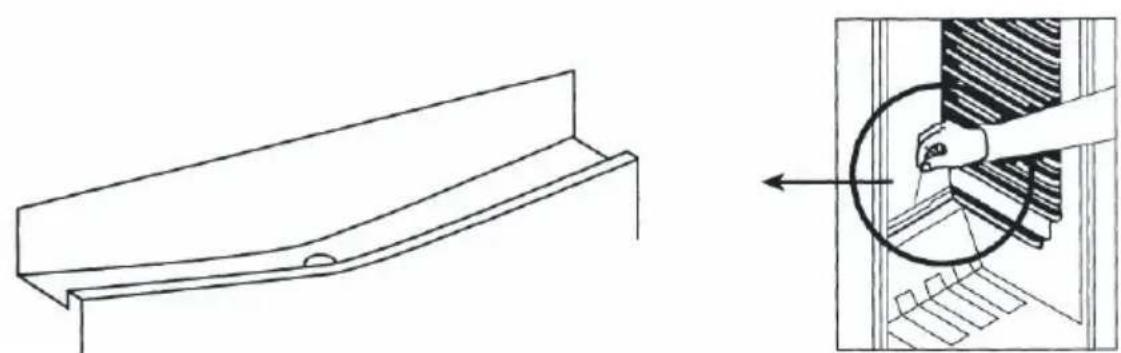
- Defrosting occurs automatically in the refrigerator compartment during operation; the defrost water is collected by the evaporating tray and evaporates automatically.
- The evaporating tray and the defrost water drain hole should be cleaned periodically with the defrost drain plug to prevent water from collecting on the bottom of the refrigerator instead of flowing out.
- You can also pour 1/2 glass of water into the drain hole to clean inside.
Freezer Compartment:
The frost accumulated in the freezer compartment should be removed periodically. (Use the plastic scraper provided.) The freezer compartment should be cleaned in the same way as the refrigerator compartment, with defrosting operations at least twice a year.
For this:
- The day before you defrost, set the thermostat dial to "5" position to freeze the foods completely.
- During defrosting, frozen foods should be wrapped in several layers of paper and kept in a cool place. The inevitable rise in temperature will shorten their storage life. Remember to use these foods within a relatively short period of time.
- Set the thermostat knob to position "•" or unplug the unit; leave the door open until completely defrosted.
- To accelerate the defrosting process, one or more basins of warm water can be placed in the freezer compartment.
- Dry the inside of the unit carefully and set the thermostat knob to MAX position.
Replacing the Light Bulb
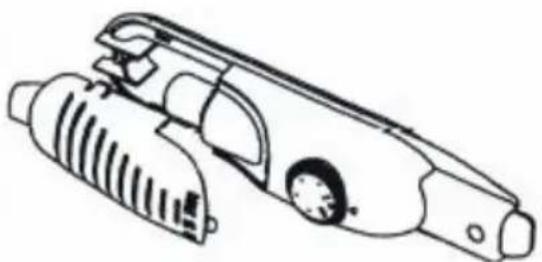
To replace the bulb in the freezer and fridge compartments:
1- Unplug your fridge. 2- Remove the cover of the box from the claws using a screwdriver. 3- Replace with a bulb of maximum 15 Watts. 4- Install the cover. 5- Wait for 5 minutes before re-plugging and bring the thermostat to its original position.
PART - 5. SHIPMENT AND REPOSITIONING
- Original package and foam may be kept for re-transportation (optionally).
- You should fasten your fridge with thick packaging, bands, or strong cords and follow the instructions for transportation on the package for re-transportation.
- Remove movable parts (shelves, accessories, vegetable bins, etc.) or fix them into the fridge against shocks using bands during re-positioning and transportation.
- Carry your fridge in the upright position.
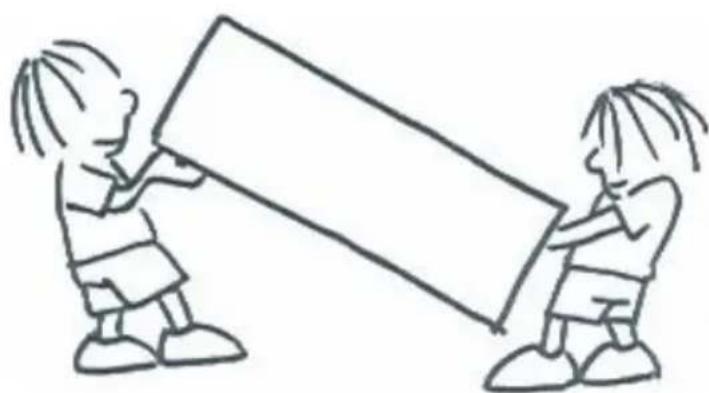
Repositioning the Door (For Some Models)
You can reposition the doors of your fridge. Contact the nearest Authorized service for this.
PART - 6.
BEFORE CALLING YOUR AFTER SALES SERVICE
If your refrigerator is not working properly, it may be a minor problem. Therefore, check the following before calling an electrician to save time and money.
What to do if your refrigerator does not operate:
Check that:
- There is no power.
- The general switch in your home is disconnected.
- The thermostat setting is on the "•" position.
- The socket is not sufficient. To check this, plug in another appliance that you know is working into the same socket.
What to do if your refrigerator performs poorly;
Check that:
- You have not overloaded the appliance,
- The doors are closed perfectly,
- There is no dust on the condenser,
- There is enough space at the rear and side walls.
If there is noise:
The cooling gas which circulates in the refrigerator circuit may make a slight noise (bubbling sound) even when the compressor is not running. Do not worry, this is quite normal. If these sounds are different, check that:
- The appliance is well leveled.
- Nothing is touching the rear.
- The items on the appliance are vibrating.
If there is water in the lower part of the refrigerator:
Check that:
The drain hole for defrost water is not clogged (use the defrost drain plug to clean the drain hole).
If your fridge is not cooling enough:
Your fridge is designed to operate in the ambient temperature intervals stated in the standards, according to the climate class stated in the information label. We do not recommend operating your fridge out of stated temperatures value limits in terms of cooling effectiveness.
| Climate Class Ambient Temperature (℃) | |
| T | Between 16 and 43 (℃) |
| ST Between 16 and 38 (℃) | |
| N | Between 16 and 32 (℃) |
| SN Between 10 and 32 (℃) | |
Recommendations
- In order to increase space and improve the appearance, the « cooling section » of this appliance is positioned inside the back wall of the refrigerator compartment. When the appliance is running, this wall is covered with frost or water drops, according to weather the compressor is running or not. Do not worry. This is quite normal. The appliance should be defrosted only if an excessively thick layer forms on the wall.
- If the appliance is not used for long time (for example during the summer holidays) Defrost and clean the refrigerator leaving the door open to prevent the formation of midew and smell.
- To stop the appliance completely, unplug from main socket (for cleaning and when the doors are left open)
Conformity Information
- This appliance is designed for use at an ambient temperature within the 16°C - 32°C range.
- The appliance is designed in compliance with the IEC60335-1 / IEC60335-2-24, 2004/108/EC standards.
Tips for saving energy
1- Install the appliance in a cool, well ventilated room, but not in direct sunlight and not near heat source (radiator, cooker.. etc.). Otherwise use an insulating plate. 2- Allow warm food and drinks to cool down outside the appliance. 3- When thawing frozen food, place it in the refrigerator compartment. The low temperature of the frozen food will help to cool the refrigerator compartment when it is thawing. So it reduces the energy requirements. 4- When placing, drinks and liquids they must be covered. Otherwise humidity increases at the appliance. Therefore the working time gets longer. Also covering drinks and liquids helps preserve the smell and taste. 5- When placing food and drinks, open the appliance door as briefly as possible. 6- Keep the covers closed of any different temperature compartment in the appliance (crisper, chiller ...etc.). 7- Door gasket must be clean and pliable. Replace gaskets if worn.
PART - 7. THE PARTS OF THE APPLIANCE AND THE COMPARTMENTS
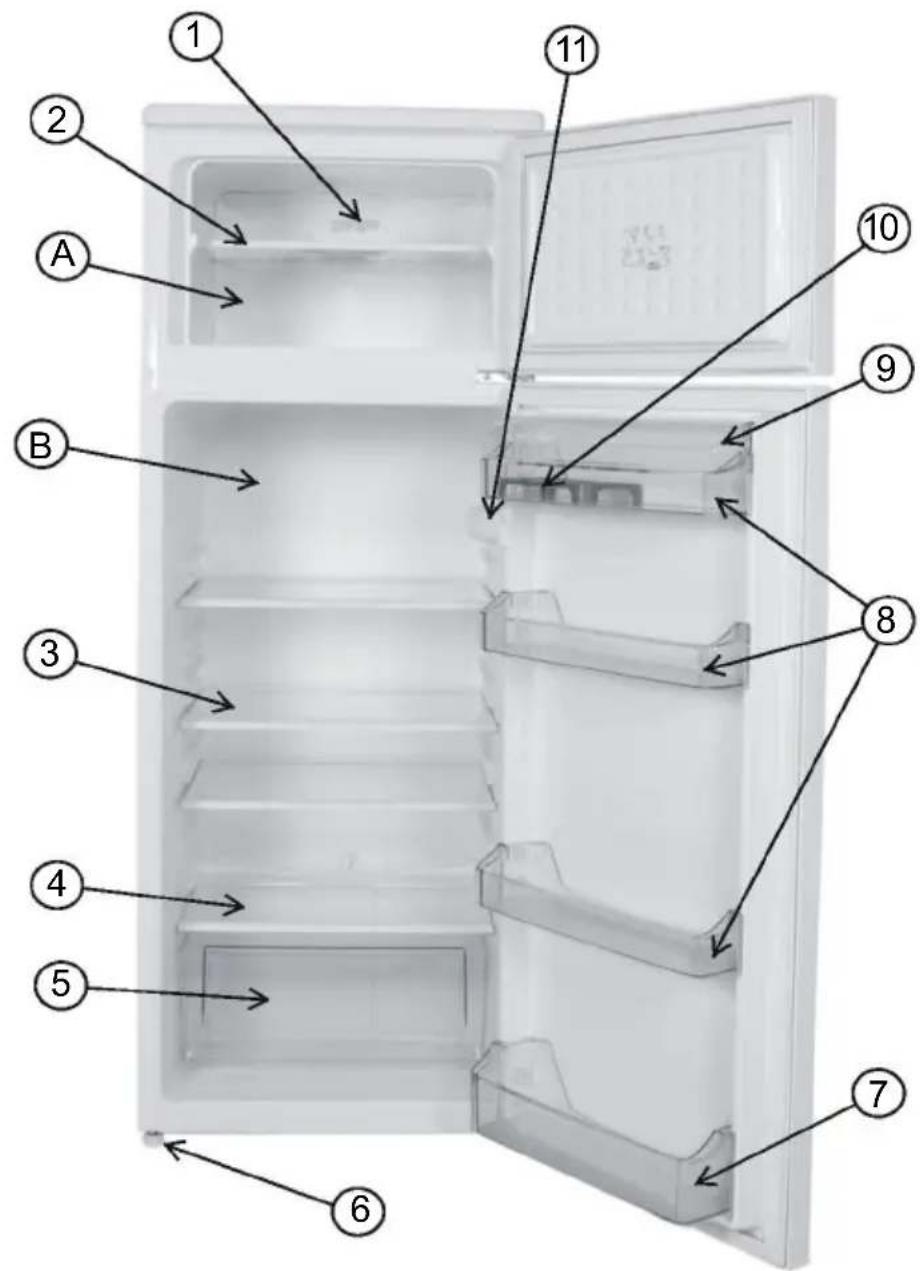
This presentation is only for information about the parts of the appliance. Parts may vary according to the appliance model.
Placement of products in the refrigerator. 91
Refrigerator compartment 91 Freezer compartment 91
Cleaning and care 92
Defrosting 93 Replacing the light bulb 94
Transportation and changing the installation position...94
Changing the door opening direction 94
Before calling customer service 95
Energy saving tips 97
PARTS AND COMPARTMENTS OF THE APPLIANCE 98
PART 1. BEFORE USING
WARNING: It is necessary to avoid blocking the ventilation openings of the housing or the internal structure of the device.
Do not use mechanical devices or other artificial methods to speed up the defrosting process.
Do not use electrical appliances inside the refrigerator and freezer compartments of the refrigerator.
- If the purpose of purchasing this refrigerator is to replace an old refrigerator model with a lock, break or remove the lock as a precaution before disposing of it, to prevent children from being trapped inside the refrigerator.
Old models of refrigerators and freezers contain insulating gases and also refrigerant, which must be disposed of properly. Disposal of the used device is strictly the responsibility of your local waste disposal service. Contact your local authorities or your dealer if you have any questions. Please make sure that the work tube of your device is not damaged before handing it over to the waste disposal service.
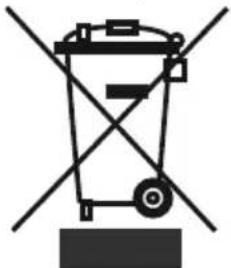
Questions regarding the utilization of projects after their subsequent use, secondary processing, and restoration are addressed to local authorities.
IMPORTANT NOTE:
Please read this operating manual before installing and turning on the refrigerator. The manufacturer is not responsible for incorrect installation or operation of the refrigerator contrary to the rules given in this operating manual.
Recommendations
Do not use adapters or tees that could cause interruption and fire. Do not connect old/damaged cords. Do not twist or tie cords.
Do not allow children to play with the appliance. Children must not, under any circumstances, sit on the drawers or hang on the door.

Do not use sharp metal objects to remove ice from the freezer compartment; they could puncture the refrigerator's lining and cause irreparable damage. Use the supplied plastic scrapers. Do not plug the appliance in with wet hands. Do not place containers (glass bottles or metal containers) with liquids, especially carbonated liquids, in the freezer, as they may cause the container to break during freezing. - Bottles with a high alcohol content must be well sealed and placed in the refrigerator in a vertical position. Do not touch the cooling surfaces, especially with wet hands, as you could get burned or injured. Do not eat ice immediately after removing it from the freezer.
INSTALLATION AND CONNECTION
The working voltage of the refrigerator is 220-240 V, 50 Hz. The company is not responsible for damage that may be caused by installation without grounding. - Place the refrigerator in a suitable location where direct sunlight will not fall on it. The refrigerator should be at a distance of 50 cm from heat sources such as gas stoves, radiators, and heaters, and at a distance of 5 cm from electric stoves. The refrigerator should not be used outdoors and should remain indoors. - If the refrigerator is located next to a freezer compartment, a minimum distance of 2 cm must be left between them to prevent condensation on the top surface. Do not place any heavy objects on the refrigerator and place the refrigerator in a cool place so that there is free space of at least 15 cm above it. - If you plan to place the refrigerator next to kitchen furniture, you must leave a minimum distance of 2 cm between the refrigerator and the furniture. It is necessary to install the adjustable guide with a 90-degree turn to prevent the wall from touching the condenser (black part with blades). - To ensure smooth operation and absence of vibration, it is necessary to set the front adjustable feet to the correct height and balance them mutually. This can be done by turning the adjustable feet clockwise (or
counterclockwise). This must be done before placing products in the refrigerator.
- Before using the refrigerator, wipe all parts with warm water and a little washing-up liquid, then rinse with clean water and wipe dry. After cleaning, put all parts back in place.
Before starting the refrigerator
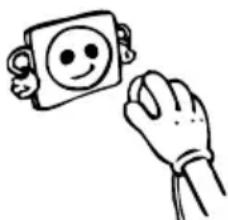
- At the first switch-on, to ensure efficient operation after repositioning, let the refrigerator stand without switching it on for 3 hours (in a vertical position), then insert the plug into the socket. Otherwise, you may damage the compressor.
Part 2. DIFFERENT FUNCTIONS AND POSSIBILITIES
Setting the thermostat
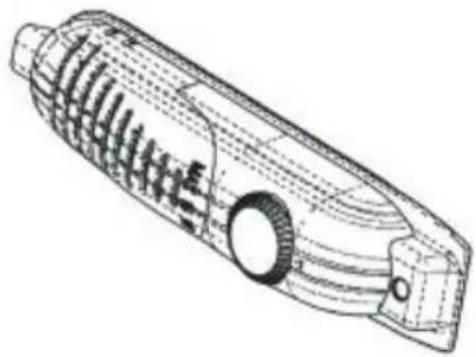
- The thermostat automatically regulates the temperature inside the refrigerator and freezer compartments. By turning the knob from MIN (1) to MAX (5), a colder temperature can be selected. The "0" position indicates the thermostat is off and there is no cooling.
- You can set the knob between the minimum and middle positions for short-term storage of products in the freezer compartment. ("1-2") For long-term storage of products in the freezer compartment, you can set the knob to the middle position. ("3-4")
Note: the ambient temperature, the temperature of fresh foods placed in the refrigerator, and how often the door is opened affect the temperature in the refrigerator compartment. If necessary, change the temperature settings.
Accessories
Ice cube tray
- Fill the ice cube tray with water and place it in the freezer compartment.
- After the water has completely frozen, you can twist the tray as shown below to remove the ice cubes.
Part 3. PLACING PRODUCTS IN THE REFRIGERATOR
Refrigerator compartment
- To reduce humidity and frost, never place liquids in unsealed containers in the refrigerator. Frost tends to accumulate on the coldest parts of the evaporator and over time this will require more frequent defrosting.
- Never place warm products in the refrigerator. Warm products should be cooled to room temperature and placed to ensure proper air circulation in the refrigerator compartment.
- Nothing should touch the back wall, as this can cause freezing, and packaging may stick to the back wall. Do not open the refrigerator door too often. Place meat and fresh fish (wrapped in packaging or plastic wrap) that you will use within 1-2 days in the lower section of the refrigerator compartment (or in the crisper drawer) because it is the coldest section and will ensure the best storage conditions. Place fruits and vegetables in the crisper drawer without packaging.
Freezer compartment
- The freezer is used for storing frozen or deeply frozen products for a long time and for making ice cubes. For freezing fresh products, make sure that the maximum surface area of the product to be frozen is in contact with the cooling surface.
- Do not place fresh products next to frozen ones, as this may defrost the frozen products.
- When freezing fresh products (e.g., meat, fish, poultry), divide them into portions for single use.
- After defrosting, place the food in the refrigerator and try to use it within a short period.
- Never place warm products in the freezer, as this will damage the frozen products.
- For storing frozen products, always follow the instructions on the packaging of frozen products. If there is no information, products should not be stored for more than three months from the date of purchase.
- When buying frozen products, make sure they were frozen at the appropriate temperature and that the packaging is not damaged.
- Frozen products should be transported in special containers to maintain product quality and should be placed in the freezer as soon as possible.
- If the packaging of frozen products shows moisture and excessive swelling, they may have been stored at an incorrect temperature and the contents may have spoiled. The storage time of frozen products depends on the room temperature, thermostat settings, frequency of door openings, type of product, and the time needed to transport products from the store to your home. Always follow the instructions printed on the packaging and never exceed the maximum indicated storage time.
What to do if the refrigerator does not work:
Check that:
- There is no electricity.
- The plug is disconnected in your home, the thermostat is set to the "•" position.
- The socket may not be suitable. To check, connect another device to it, so you know if it works in the same socket.
What to do if the refrigerator works poorly:
Check that:
- You have not overloaded the appliance, the doors are properly closed, there is no dust on the condenser.
- There is sufficient clearance from the back and side walls.
If there is any:
The refrigerant flowing through the refrigerator's piping may create a slight noise (bubbling sound) even when the compressor is running. Do not worry, this is normal. If the sounds differ, check that:
- The appliance is level.
- It does not touch the back panel. Vibrating items on the refrigerator will be selected.
If water accumulates at the bottom of the refrigerator, check that:
Drain hole for thaw water should not clog (use the drain cleaning tool to clean the drain hole).
If the refrigerator does not cool products sufficiently:
Your refrigerator is designed to function at ambient temperature intervals specified in the technical conditions, in accordance with the climate class indicated on the information label. We do not recommend using the refrigerator in a temperature mode whose values go beyond those specified in the specification in order to achieve cooling efficiency.
| КлACC Клиамуескux ускови | Темперамuya okружаяоцей срены (℃) |
| T | Мени 16 и 43 (℃) |
| ST | Мени 16 и 38 (℃) |
| N | Мени 16 и 32 (℃) |
| SN | Мени 10 и 32 (℃) |
Recommendations
- To increase the area and improve the appearance, the cooling section of this appliance is located inside the rear wall of the refrigerator chamber. During operation of the appliance, this wall is covered with frost or drops, depending on whether the compressor is running. Do not worry. This is quite normal. Defrosting is required only in cases of very thick frost formation on the wall. - If the appliance is not used for a long time (for example, during summer holidays), defrost and clean the refrigerator, leaving the door open to avoid odor formation. - For a complete stop of the appliance, disconnect it from the main outlet (for cleaning, and then leave the doors open).
Information on compliance with standards
- This equipment is intended for operation at an ambient temperature range of 16°C - 32°C. The refrigerator is designed in accordance with standards IEC60335-1/IEC60335-2-24, 2004/108/EC.
Energy saving tips
1 - Install the appliance in a cool, well-ventilated room, away from direct sunlight and heat sources (heating radiators, stoves, etc.). Otherwise, use an insulating panel. 2 - Let prepared dishes cool before placing them in the refrigerator. 3 - To thaw frozen products, place them in the refrigerator compartment. The low temperature of frozen products during thawing can help cool the refrigerator compartment. As a result, you save electricity. Thawing frozen products outside the refrigerator will lead to a senseless waste of energy. 4 - When placing hot dishes and drinks in the refrigerator, they must be covered. Otherwise, humidity inside the refrigerator will increase, reducing its service life. Also, covering drinks and hot dishes will help preserve their smell and taste. 5 - When removing shelves and drawers, try to close the refrigerator door as quickly as possible. 6 - Keep the lids of any compartments with different temperatures closed (vegetable and fruit drawer, crisper, etc.). 7 - The door gasket should remain flexible. In case of wear, replace the gasket on the door.
Part 7. DETAILS OF APPLIANCE COMPARTMENTS

The purpose of this document is solely to provide information about the components of the device.
Components depend on the device model.
A) FREEZER COMPARTMENT B) REFRIGERATOR COMPARTMENT
1) ICE TRAY 2) FREEZER SHELF 3) REFRIGERATOR SHELF 4) LID FOR PRODUCTS 5) DRAWER FOR PRODUCTS
6) SHELF 7) LEGS 8) BUTTER AND CHEESE DRAWER 9) DRAWER LID FOR BUTTER AND CHEESE 10) HOLDER FOR EGGS 11) THERMOSTAT BOX
CONTENTS
BEFORE USING THE APPLIANCE 100
Safety instructions 102 Installation and operation of your refrigerator 103 Setting the temperature of your refrigerator 104
BEFORE CALLING YOUR AFTER-SALES SERVICE 110
Practical tips for economical operation 111
PARTS OF THE APPLIANCE AND COMPARTMENTS 112
PART 1: BEFORE USING THE APPLIANCE
WARNING: Keep the ventilation openings in the appliance enclosure or in the built-in structure free of obstruction.
WARNING: Do not use mechanical devices or other means to accelerate the defrosting process, other than those recommended by the manufacturer.
WARNING: Do not use electrical appliances inside the food storage compartments of the appliance, unless they are of the type recommended by the manufacturer.
WARNING: Do not damage the refrigerant circuit.
WARNING: To avoid a hazard due to instability of the appliance, it must be fixed in accordance with the instructions.
If your appliance contains a freezer compartment, place the rating plate inside the refrigerator (the cold compartment). This is a natural gas that is friendly to the environment but also flammable. When transporting and installing the unit, be careful not to damage any part of the refrigeration circuit. In case of damage, avoid open flames and sources of ignition and ventilate the room where the unit is installed. Do not store explosive materials such as aerosol cans with a flammable propellant in this appliance. This appliance is intended for household use and similar applications such as: - staff kitchen areas in shops, offices and other working environments - farmhouses and by clients in hotels, motels and other residential type environments - bed and breakfast type environments - catering and similar non-retail applications.
35708 Haiger (Germany)
Tel.: +49 2771 8141 0
Fax: +49 2771 8141 10
info@teka-kuechentechnik.de

- THE VARIOUS FUNCTIONS AND POSSIBILITIES
- ARRANGING FOOD IN THE APPLIANCE
- CLEANING AND MAINTENANCE
- SHIPMENT AND REPOSITIONING
- BEFORE CALLING YOUR AFTER SALES SERVICE
- THE PARTS OF THE APPLIANCE AND THE COMPARTMENTS
- OLD AND OUT-OF-ORDER FRIDGES
- NOTES
- SAFETY WARNINGS
- INSTALLING AND OPERATING YOUR FRIDGE
- BEFORE USING YOUR FRIDGE
- PART - 2. THE VARIOUS FUNCTION AND POSSIBILITIES
- THERMOSTAT SETTING
- ACCESSORIES
- ICE TRAY
- PART - 3. ARRANGING FOOD IN THE APPLIANCE
- REFRIGERATOR COMPARTMENT
- FREEZER COMPARTMENT
- PART - 4. CLEANING AND MAINTENANCE
- DEFROSTING
- FOR THIS
- REPLACING THE LIGHT BULB
- PART - 5. SHIPMENT AND REPOSITIONING
- REPOSITIONING THE DOOR (FOR SOME MODELS)
- PART
- WHAT TO DO IF YOUR REFRIGERATOR DOES NOT OPERATE
- CHECK THAT
- WHAT TO DO IF YOUR REFRIGERATOR PERFORMS POORLY
- IF THERE IS NOISE
- IF THERE IS WATER IN THE LOWER PART OF THE REFRIGERATOR
- IF YOUR FRIDGE IS NOT COOLING ENOUGH
- RECOMMENDATIONS
- CONFORMITY INFORMATION
- TIPS FOR SAVING ENERGY
- PART - 7. THE PARTS OF THE APPLIANCE AND THE COMPARTMENTS
- PLACEMENT OF PRODUCTS IN THE REFRIGERATOR
- CLEANING AND CARE
- TRANSPORTATION AND CHANGING THE INSTALLATION POSITION
- BEFORE CALLING CUSTOMER SERVICE
- PARTS AND COMPARTMENTS OF THE APPLIANCE
- PART 1. BEFORE USING
- IMPORTANT NOTE
- INSTALLATION AND CONNECTION
- BEFORE STARTING THE REFRIGERATOR
- PART 2. DIFFERENT FUNCTIONS AND POSSIBILITIES
- SETTING THE THERMOSTAT
- ICE CUBE TRAY
- PART 3. PLACING PRODUCTS IN THE REFRIGERATOR
- WHAT TO DO IF THE REFRIGERATOR DOES NOT WORK
- WHAT TO DO IF THE REFRIGERATOR WORKS POORLY
- IF THERE IS ANY
- IF WATER ACCUMULATES AT THE BOTTOM OF THE REFRIGERATOR, CHECK THAT
- IF THE REFRIGERATOR DOES NOT COOL PRODUCTS SUFFICIENTLY
- INFORMATION ON COMPLIANCE WITH STANDARDS
- ENERGY SAVING TIPS
- PART 7. DETAILS OF APPLIANCE COMPARTMENTS
- CONTENTS
- BEFORE USING THE APPLIANCE
- BEFORE CALLING YOUR AFTER-SALES SERVICE
- PARTS OF THE APPLIANCE AND COMPARTMENTS
- PART 1: BEFORE USING THE APPLIANCE
Brand : TEKA
Model : FT2 47 VR04
Category : Refrigerator