FR834B - Fridge Igloo - Free user manual and instructions
Find the device manual for free FR834B Igloo in PDF.


User questions about FR834B Igloo
0 question about this device. Answer the ones you know or ask your own.
Ask a new question about this device
Download the instructions for your Fridge in PDF format for free! Find your manual FR834B - Igloo and take your electronic device back in hand. On this page are published all the documents necessary for the use of your device. FR834B by Igloo.
USER MANUAL FR834B Igloo
natural_image
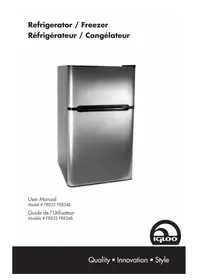
Exterior view of a modern stainless steel refrigerator with a black horizontal bar (no text or symbols visible)User Manual
Model # FR832 FR834B
Read all of the instructions before using this appliance.
When using this appliance, always exercise basic safety precautions, including the following:
NOTE: If the refrigerator/freezer has been placed in a horizontal or tilted position for any period of time wait 24 hours before plugging the unit in.
1) Use this appliance only for its intended purpose as described in this use and care guide.
2) This refrigerator/freezer must be properly installed in accordance with the installation instructions before it is used. See grounding instructions in the installation section.
3) This refrigerator/freezer should not be recessed or built-in an enclosed cabinet. It is designed for freestanding installation only.
4) Never unplug your refrigerator/freezer by pulling on the power cord. Always grasp the plug firmly and pull straight out from the outlet.
5) Repair or replace immediately, all electric service cords that have become frayed or otherwise damaged. Do not use a cord that shows cracks or abrasion damage along its length, the plug or the connector end.
6) If your old refrigerator/freezer is not being used, we recommend that you remove the doors. This will reduce the possibility of danger to children.
7) WARNING: After your refrigerator/freezer is in operation, do not

touch the cold surfaces in the freezer compartment, particularly when hands are damp or wet. Skin may adhere to these extremely cold surfaces.
8) Do not refreeze foods, which have been thawed completely. The United States Department of Agriculture in Home and Garden Bulletin No. 69 reads: "...You may safely refreeze frozen foods that have thawed if they still contain ice crystals or if they are still cold-below 40°F".
"...Thawed ground meats, poultry, or fish that have any off-odor or offcolor should not be refrozen and should not be eaten. Thawed ice cream should be discarded. If the odor or color of any food is poor or questionable, discard it. The food may be dangerous to eat."
"...Even partial thawing and re-freezing reduce the eating quality of foods, particularly fruits, vegetables, and prepared foods. The eating quality of red meats is affected less than that of many other foods. Use refrozen foods as soon as possible, to save as much of they're eating quality as you can."
9) Do not use any electrical device or any sharp instrument in defrosting your refrigerator.
10) Unplug your refrigerator/freezer before cleaning or before making any repairs.
Note: If for any reason this product requires service, we strongly recommend that a certified technician perform service.
11) Do not operate your refrigerator in the presence of explosive fumes.
SAVE THESE INSTRUCTIONS
DANGER
Risk of child entrapment. Before you throw away your old refrigerator or freezer, take off the doors. Leave the shelves in place so that children may not easily climb inside.
Thank you for purchasing our product. This easy-to-use manual will guide you in getting the best use of your appliance.
Remember to record the model and serial number. They are on a label in back of the appliances.
Model number
Serial number
Date of purchase
Staple your receipt to your manual. You will need it to obtain warranty service.
TABLE OF CONTENTS
Safety Precautions....1
Parts And Features .... 3
Installation Instructions 4
Unpacking Your Refrigerator 4
Leveling Your Refrigerator 4
Proper Air Circulation....4
Electrical Requirements 4
Door Alignment 5
Reversing the Door....5
Refrigerator Features and Use 7
General Features 7
Refrigerator Interior Shelves 7
Using Dispense-A-Can ^TM 7
Crisper 7
Defrosting Your Refrigerator 8
Food Storage Information 8
Normal Operating Sounds 9
Proper Refrigerator Care and Cleaning....9
Cleaning and Maintenance 9
Light Bulb Replacement ....10
Power Interruptions....10
Vacations and Moving Care 10
Troubleshooting 11
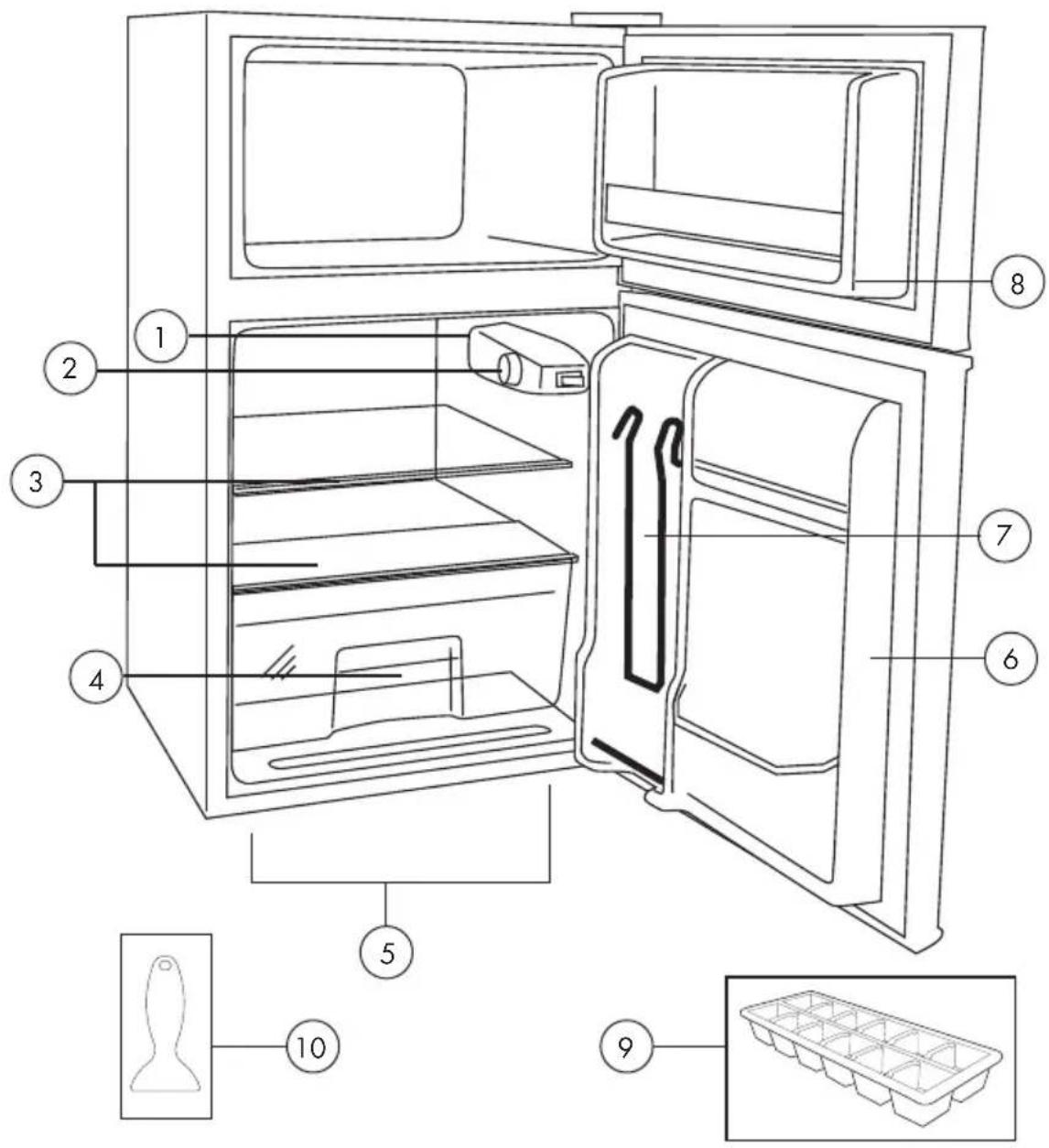
Parts And Features
text_image
Technical diagram of an refrigerator with numbered parts for identification and assembly reference.- Interior Light
- Temperature Control
- Refrigerator Shelves
- Crisper
-
Front Leveling Legs
-
Refrigerator Door Shelves
- "Dispense-A-Can™" Storage
- Freezer Door Shelf
- Ice Cube Tray
- Ice Scraper
Installing Your Refrigerator
Unpacking Your Refrigerator
- Remove all packaging material. This includes the foam base and all adhesive tape holding the refrigerator accessories inside and outside.
- Inspect and remove any remains of packing, tape or printed materials before powering on the refrigerator.
Leveling Your Refrigerator
- Your refrigerator has two leveling legs which are located in the front bottom corners of your refrigerator. After properly placing your refrigerator in its final position, you can level your refrigerator.
- Leveling legs can be adjusted by turning them counterclockwise to raise your refrigerator or by turning them clockwise to lower your refrigerator. The refrigerator door will close easier when the leveling legs are extended.
Proper Air Circulation
- To ensure your refrigerator works at the maximum efficiency it was designed for, you should install it in a location where there is proper air circulation, plumbing and electrical connections.
- The following are recommended clearances around the refrigerator:
Sides....3/4" (19mm)
Top.....2" (50mm)
Back.....2" (50mm)

WARNING: ELECTRICAL REQUIREMENT - SHOCK HAZARD
Electrical Requirement
- Make sure there is a suitable power outlet (120 volts, 15 amps outlet) with proper grounding to power the refrigerator.
- Avoid the use of three prong adapters or cutting off the third grounding prong in order to accommodate a two prong outlet. This is a dangerous practice since it provides no effective grounding for the refrigerator and may result in shock hazard.

WARNING: USE OF EXTENSION CORDS- POTENTIAL SAFETY HAZARD
Use of Extension Cords
- Avoid the use of an extension cord because of potential safety hazards under certain conditions. If it is necessary to use an extension cord, use only a 3-wire extension cord that has a 3-blade grounding plug and a 3-slot outlet that will accept the plug. The marked rating of the extension cord must be equal to or greater than the electrical rating of the appliance. DO NOT USE EXTENSION CORD LONGER THAN 12 FT.
Installation Limitations
- Do not install your refrigerator in any location not properly insulated or heated, e.g. garage, etc. Your refrigerator was not designed to operate in temperature settings below 55° Fahrenheit.
- Select a suitable location for the refrigerator on a hard even surface away from direct sunlight or heat source, e.g. radiators, baseboard heaters, cooking appliances, etc. Any floor unevenness should be corrected with the leveling legs located on the front bottom corners of the refrigerator.
Door Alignment
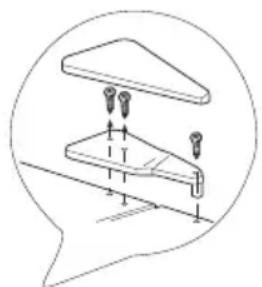
Freezer Door: (see fig. #1)
- Remove the top hinge cover.
- Loosen the top hinge screws using a phillips head screwdriver.
- Adjust the door or put a spacer in between and then tighten the screws.
- Replace the top hinge cover.
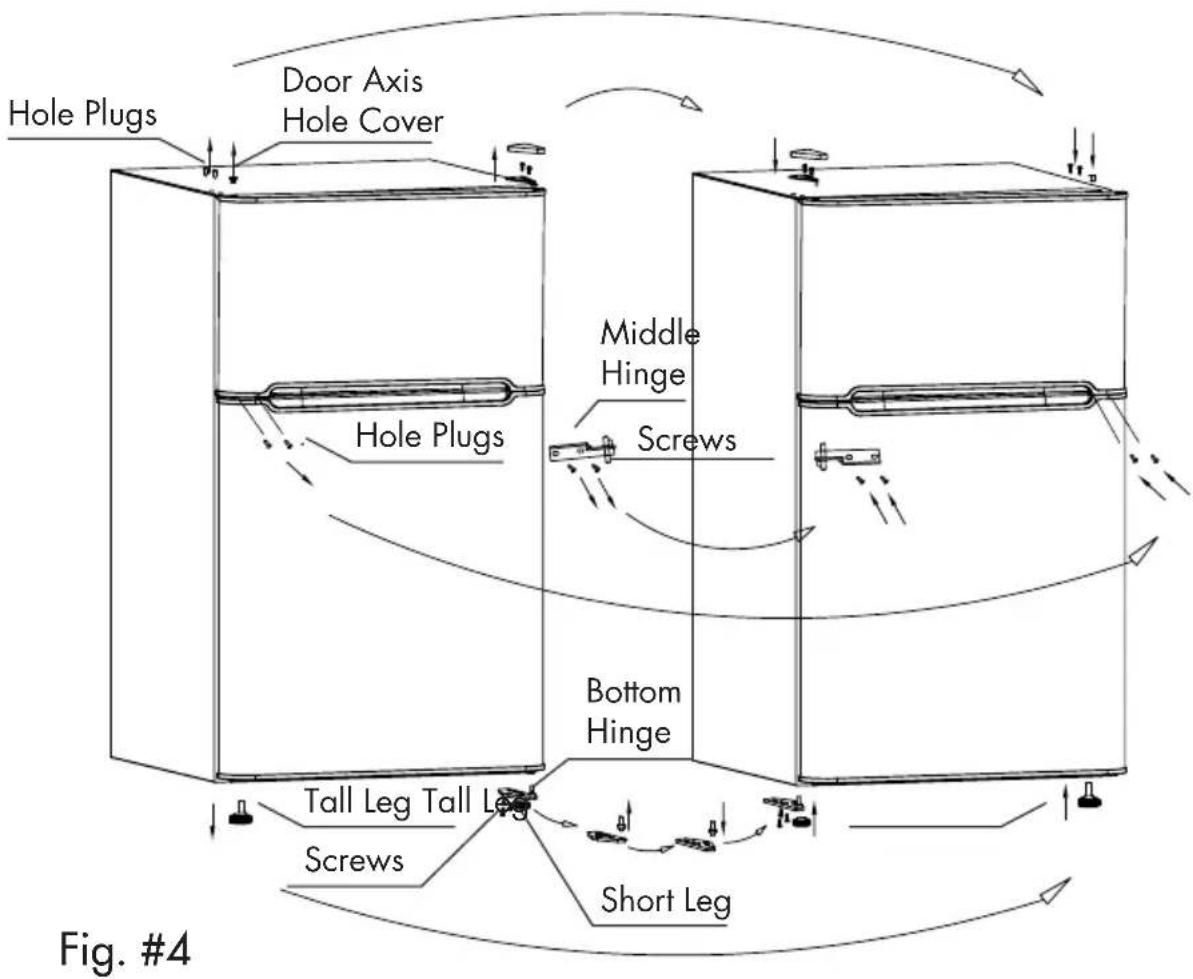
Reversing the Door (See Fig. #4)
- Remove the top hinge cover. (See Fig. #1)
- Using Phillips Head Screwdriver, loosen and remove the screws holding the top hinge in place.
- Remove top hinge and carefully lift off the freezer door.
- Remove the screw hole plugs from the opposite side and insert the plugs in the screw hole openings of the just removed screws.
- Open refrigerator Door and unscrew 2 screws from the center hinge bracket while holding the open door in place. (See Fig. #2)
- Remove bracket and lift off refrigerator door
- While doors are removed unscrew the door stoppers and reinsert on opposite side of door. (See Fig. #3)
- Remove the screw hole plugs from the opposite side and insert the plugs in the screw hole openings of the just removed screws.
- Remove any loose items in the refrigerator and carefully tilt refrigerator and lean against wall. Remove both leveling legs and place in a secure area.
- Loosen the screws holding the lower hinge bracket to the refrigerator door and remove screws and bracket. Remove leveling leg
Fig. #1
natural_image
Diagram of a mechanical assembly with two light bulbs and a triangular base, enclosed in a circular frame (no text or symbols)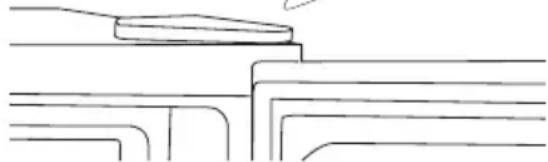
natural_image
Pure geometric line drawing of nested rectangular shapes without any text, numbers, or symbols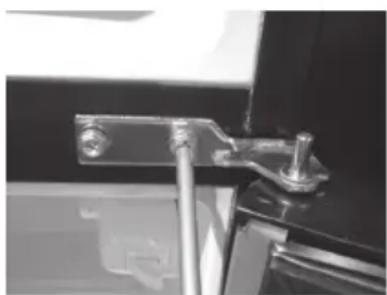
natural_image
Close-up of a metallic mechanical bracket with a metal rod and screw head (no visible text or symbols)Fig. #2
- Remove screws from the other side and insert in the previously removed screw holes. Remove leveling leg.
- Remove door pin by turning counter clockwise and reinsert to the underside of the bracket and tighten.
- Align bracket and insert (2) remaining screws into the holes provided. Tighten all the way. Replace leveling legs and place refrigerator in upright position.
- Replace washers and cap over pin. Align hole in the refrigerator door with the door pin and gently push down until firm.
- Insert pin from center hinge bracket into refrigerator door hole and align center hinge bracket holes to the screw holes in the cabinet.
- Insert 2 screws and tighten.
- Place washers on the center hinge bracket pin and align the freezer door holes and insert into pin.
- Replace screws on the top hinge cover, align door and tighten screws.
- Replace top hinge cover.
text_image
Hole Plugs Door Axis Hole Cover Middle Hinge Screws Hole Plugs Bottom Hinge Tall Leg Tall Leg Screws Short Leg Fig. #4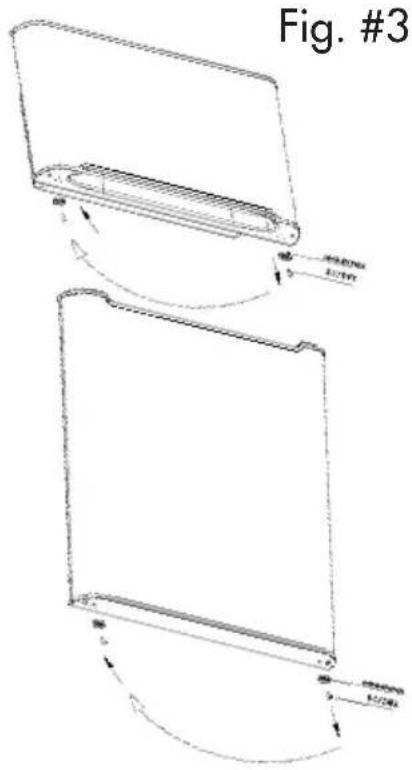
text_image
Fig. #3 40mm x 2.1/MPa 5 50mm x 1.2/MPaRefrigerator Features And Use General Features Adjustable temperature dial:
Your refrigerator will automatically maintain the temperature level you select. The temperature control dial has 7 settings plus 0.1 is the warmest. 7 is the coldest. Turning the dial to 0 Stops cooling in both the refrigeration and freezer sections. At first, set the dial to 4 and allow 24 hours to pass before adjusting the temperature to your needs.
(Note: If the refrigerator has been placed in a horizontal or tilted position for any period of time wait 24 hours before plugging the unit in.)
Freezer Compartment / Use of the Ice Cube Trays
This compartment is designed for making ice cubes and for short-term food storage (a few days at most).

WARNING: This compartment is not cold enough to freeze foods safely for more than 5 days.
- If ice cube tray freezes to the bottom of the compartment, pour a little warm water around it to loosen it. Do not use boiling water, which can damage plastic parts, or sharp metal objects such as a knife or screw-driver, which can damage the cooling system tubing. Wash the ice cube tray in lukewarm water only. Do not wash in the dishwasher.
Refrigerator Interior Shelves
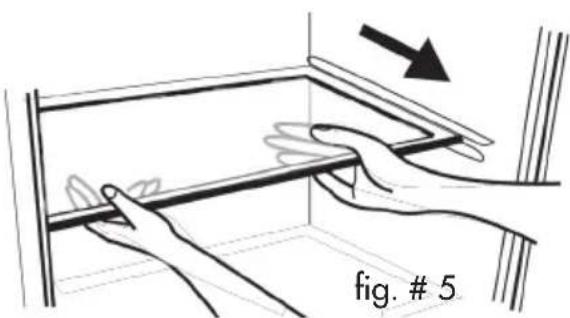
To remove or replace a full-width slide-out shelf:
(see fig. # 5)
- Gently tilt the shelf up and slide forward until the shelf has been completely removed.
- To replace the shelf, gently slide the shelf back.
natural_image
Illustration of hands using a tool to adjust or install a component, with an arrow indicating direction (no text or symbols)Using the Dispense-A-Can™
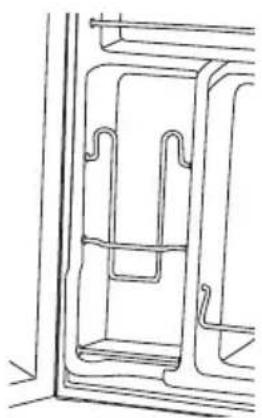
- Your refrigerator is equipped with the convenient "Dispense-A-Can™" compartment. Each compartment will hold up to six cans. Simply load the cans from the top. To dispense a can, simply draw one out from the bottom. It is that easy.
Crisper
fig. # 6
- Your refrigerator has a clear crisper. Grasp the top of the crisper and gently slide our. Push back to replace.
natural_image
Pure technical line drawing of a mechanical or architectural component without any text, numbers, or symbolsDefrosting Your Refrigerator
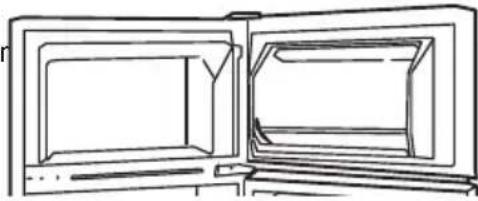
- For maximum energy efficiency, defrost freezer section whenever frost accumulates to a thickness of 1/4" or more on freezer walls. Note that frost tends to accumulate more during the summer months.
natural_image
Line drawing of an open refrigerator with doors open (no text or symbols)- To defrost freezer, remove food and ice cube tray from the freezer section. Turn temperature control dial to OFF position. Defrosting may take a few hours. To speed up defrost time, keep the door open and place a bowl of warm water in the freezer.
- During the defrost, water will accumulate. Use a towel to wipe off excess dripping water. Do not leave unattended.
- After defrosting, empty and wipe down the interior of the freezer. You may now reset your refrigerator to the desired temperature and return food.
- Your freezer has been equipped with an ice scraper for your convenience.
Food Storage Information Fresh Food
- When storing fresh food that is not prepackaged, be sure to wrap or store food in airtight and moisture proof material unless otherwise noted. This will ensure proper shelf life and prevent the transfer of odors and tastes.
- Wipe containers before storing to avoid needless spills.
- Eggs should be stored in an upright position in their original carton to maximize shelf life.
- Fruit should be washed and dried, then stored in sealed plastic bags before storing in the refrigerator.
• Vegetables with skins should be stored in plastic bags or containers.
- Leafy vegetables should be washed and drained and then stored in plastic bags or containers.
- Hot food should be allowed to cool before storing in the refrigeration. This will prevent unnecessary energy use.
- Fresh seafood should be used the same day as purchased.
- When storing meats in the fresh food section, keep in the original packaging or rewrap as necessary. Follow the suggestions below for safe storage:
- Chicken 1-2 Days
• Steaks/Roasts 3-5 Days
• Ground Beef 1-2 Days
• Smoked/Cured Meats 7-10 Days
- Cold Cuts 3-5 Days
Frozen Food
- Proper freezer storage requires correct packaging. All foods must be in packages, which do not allow the flow of air or moisture in, or out. Improper storage will result in odor and taste transfer and will result in the drying out of the improperly packaged food.
- Follow package or container instructions for proper storage.
- Packaging Recommendations: Plastic containers with air tight lids Heavy duty aluminum foil Plastic wrap made from saran film Self-sealing plastic bags
- Do not refreeze defrosted/thawed foods.
- It is recommended that the freezing date be marked on the packaging.
Normal Operating Sounds You May Hear
- Boiling water, gurgling sounds or slight vibrations that are the result of the refrigerant circulating through the cooling coils.
- The thermostat control will click when it cycles on and off.
Proper Refrigerator Care and Cleaning
Cleaning and Maintenance
WARNING: To avoid electric shock, always unplug your

refrigerator before cleaning. Ignoring this warning may result in death or injury.
CAUTION: Before using cleaning products, always read and

follow manufacturer's instructions and warnings to avoid personal injury or product damage.
General: Prepare a cleaning solution of 3-4 tablespoons of baking soda mixed with warm water. Use sponge or soft cloth, dampened with the cleaning solution, to wipe down your refrigerator.
- Rinse with clean warm water and dry with a soft cloth.
- Do not use harsh chemicals, abrasives, ammonia, chlorine
bleach, concentrated detergents, solvents or metal scouring pads. Some of these chemicals may dissolve, damage and/or discolor your refrigerator.
Door Gaskets: Clean door gaskets every three months according to general instructions. Gaskets must be kept clean and pliable to assure a proper seal
- Petroleum jelly applied lightly on the hinge side of gaskets will keep the gasket pliable and ensure a good seal.
Light Bulb Replacement
- Switch off power to refrigerator.
- Gently pull out the clear cover
- Replace with same type light bulb rated at 10 watts.
- Push the clear cover back into place.
Power Interruptions
- Occasionally there may be power interruptions due to thunderstorms or other causes. Remove the power cord from AC outlet when a power outage occurs. When power has been restored, replug power cord to AC outlet. If outage is for a prolonged period, inspect and discard spoiled or thawed food in freezer and refrigerator. Clean refrigerator before reusing.
WARNING: IF OUTAGE IS FOR A PROLONGED PERIOD, INSPECT

AND DISCARD SPOILED OR THAWED FOOD IN FREEZER AND REFRIGERATOR. CLEAN REFRIGERATOR BEFORE REUSING.
Vacation and Moving Care
- For long vacations or absences, empty food from refrigerator and freezer, move the temperature DIAL to the OFF position and clean the refrigerator and door gaskets according to "General cleaning" section. Prop doors open, so air can circulate inside. When moving always move the refrigerator vertically. Do not move with the unit lying down. Possible damage to the sealed system could occur.
Troubleshooting
Refrigerator does not operate:
- Check if thermostat control is not in the "0" position.
- Check if refrigerator is plugged in.
- Check if there is power at the AC outlet, by checking the circuit breaker.
Food temperature appears too warm:
- Frequent door openings.
- Allow time for recently added warm food to reach fresh food temperature.
- Check gaskets for proper seal.
- Adjust temperature control to colder setting.
Food temperature is too cold:
- If temperature control setting is too cold, adjust to a warmer setting and allow several hours for temperature to adjust.
Refrigerator runs too frequently:
- This may be normal to maintain constant temperature during high temperature and humid days.
- Doors may have been opened frequently or for an extended period of time.
- Check gasket for proper seal.
- Check to see if doors are completely closed.
Moisture build up on interior or exterior of the refrigerator:
- This is normal during high humidity periods.
- Prolonged or frequent door openings.
- Check door gaskets for proper seal.
Refrigerator has an odor:
- Interior needs cleaning.
- Foods improperly wrapped or sealed are giving off odors.
Refrigerator door does not shut properly:
- Level the refrigerator.
- Re-align refrigerator door.
- Check for blockages, e.g. food containers, crisper cover, shelves, bins, etc.
Popping or cracking sound when the compressor comes on:
- Check to ensure the refrigerator is level.
- The floor may be uneven or weak. The refrigerator rocks on the floor when it is moved slightly. Be sure the floor can adequately support the refrigerator. Level the refrigerator by putting wood or metal shims under part of the refrigerator.
- The refrigerator is touching the wall. re-level the refrigerator and move it from the wall. See the "Installing Your Refrigerator" section.
Refrigerator light does not work
- Check power supply.
• Tighen bulb in socket. - Replace burned out bulb.
CONSIGNES GÉNÉRALES DE SECURITÉ

ATTENTION:
text_image
Labeled diagram of an refrigerator interior showing numbered components for identification and assembly reference.- Your refrigerator has two leveling legs which are located in the front bottom corners of your refrigerator. After properly placing your refrigerator in its final position, you can level your refrigerator.
- Leveling legs can be adjusted by turning them counterclockwise to raise your refrigerator or by turning them clockwise to lower your refrigerator. The refrigerator door will close easier when the leveling legs are extended.
natural_image
Diagram of a mechanical assembly with two light bulbs and a triangular base, enclosed in a circular frame (no text or symbols)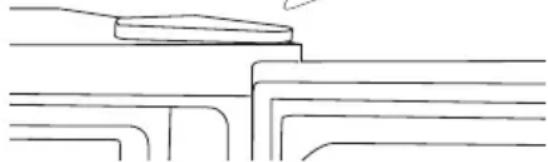
natural_image
Pure geometric line drawing with nested rectangular shapes (no text or symbols)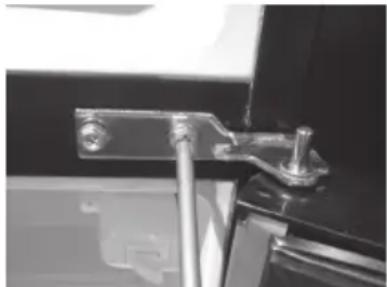
natural_image
Close-up of a metallic mechanical bracket with a screw and lever (no visible text or symbols)Fig. #2
This compartment is designed for making ice cubes and for short-term food storage (a few days at most).