ManualGo.com
Sonicare Advance HX4101 - Brosse a dents PHILIPS - Free user manual and instructions
Find the device manual for free Sonicare Advance HX4101 PHILIPS in PDF.


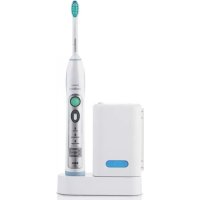
Download the instructions for your Brosse a dents in PDF format for free! Find your manual Sonicare Advance HX4101 - PHILIPS and take your electronic device back in hand. On this page are published all the documents necessary for the use of your device. Sonicare Advance HX4101 by PHILIPS.
USER MANUAL Sonicare Advance HX4101 PHILIPS
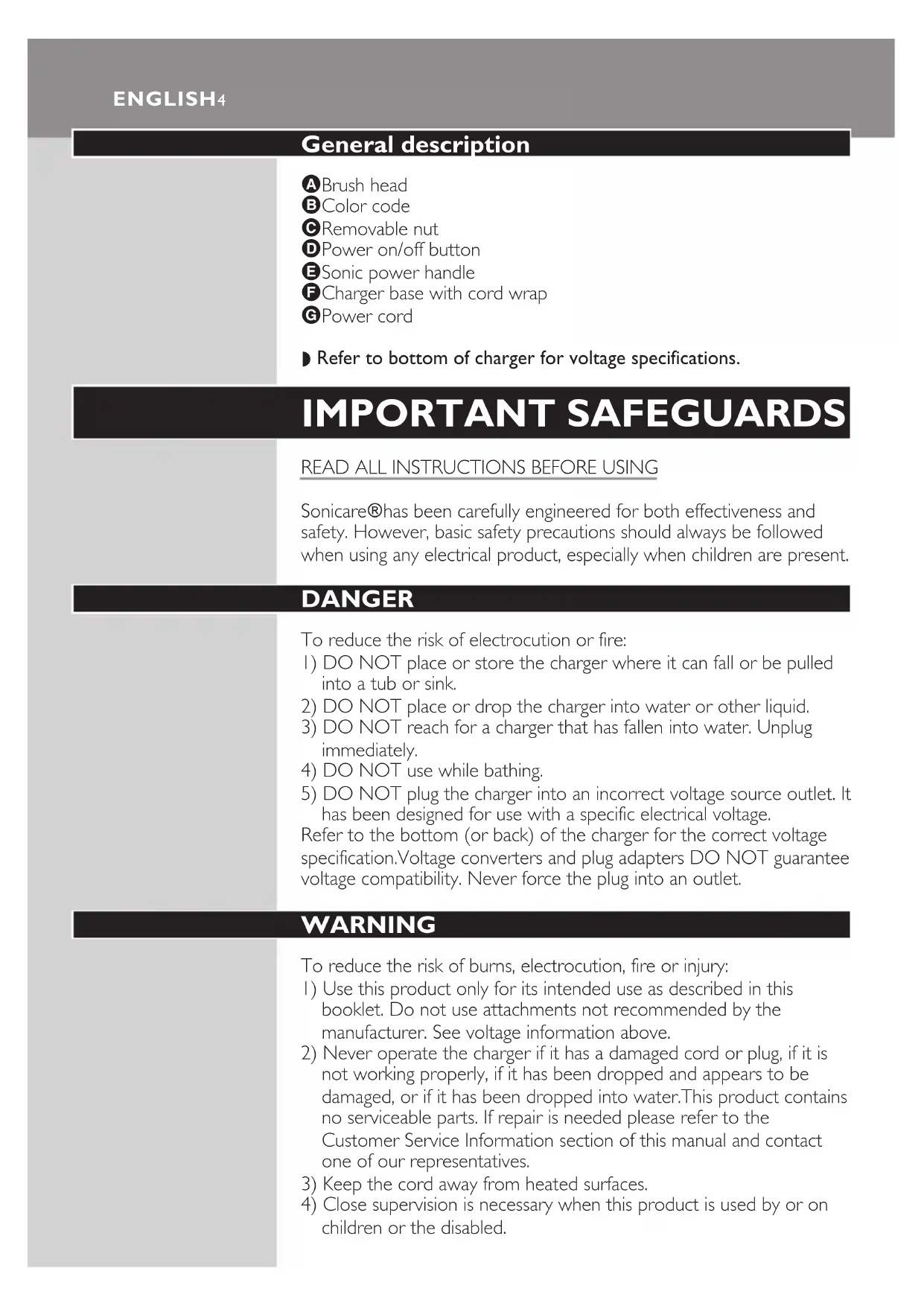
F Charger base with cord wrap
◗ Refer to bottom of charger for voltage specifications.
IMPORTANT SAFEGUARDS READ ALL INSTRUCTIONS BEFORE USING Sonicare\ has been carefully engineered for both effectiveness and
safety. However, basic safety precautions should always be followed
when using any electrical product, especially when children are present.
DANGER To reduce the risk of electrocution or fire:
1) DO NOT place or store the charger where it can fall or be pulled
2) DO NOT place or drop the charger into water or other liquid.
3) DO NOT reach for a charger that has fallen into water. Unplug
4) DO NOT use while bathing.
5) DO NOT plug the charger into an incorrect voltage source outlet. It
has been designed for use with a specific electrical voltage.
Refer to the bottom (or back) of the charger for the correct voltage
specification.Voltage converters and plug adapters DO NOT guarantee
voltage compatibility. Never force the plug into an outlet.
WARNING To reduce the risk of burns, electrocution, fire or injury:
1) Use this product only for its intended use as described in this
booklet. Do not use attachments not recommended by the
manufacturer. See voltage information above.
2) Never operate the charger if it has a damaged cord or plug, if it is
not working properly, if it has been dropped and appears to be
damaged, or if it has been dropped into water.This product contains
no serviceable parts. If repair is needed please refer to the
Customer Service Information section of this manual and contact
one of our representatives.
3) Keep the cord away from heated surfaces.
4) Close supervision is necessary when this product is used by or on
children or the disabled.
ENGLISH45) If your favorite toothpaste includes peroxide, baking soda, or other
bicarbonate (common in whitening toothpastes), it is important that
you thoroughly clean your brush head with soap and water after
6) Unplug the charger base before cleaning and assure that it is dry
before plugging it into an electrical outlet.
7) Brush heads and charger base should never be placed in a
dishwasher for cleaning.
8) Do not use charger base outdoors.
1) Avoid using a brush head with crushed or bent bristles. Damaged
bristles may break off while brushing. In order to prevent this,
replace the brush head with a new one every 6 months or sooner if
signs of wear appear.
2) Similar to starting with any new manual or electric oral hygiene
product, consult your dental professional before using this product if
you have had oral or gum surgery in the previous 2 months.
3) Contact your dental professional if excessive bleeding occurs after
using this product or bleeding continues to occur after 1 week of
4) If you have any questions concerning usage with a pacemaker or
other implanted device, consult your physician or the implanted
device manufacturer prior to use. Sonicare has been tested and is
compliant with safety standards for electromagnetic devices.
5) The Sonicare toothbrush is a personal care device and is not
intended for use on multiple patients in a dental office or institution.
6) This product is designed for cleaning teeth, gums and tongue only.
Do not use for any other purpose.
Customer Service Information
If you have any questions after reading this manual, feel free to contact
our Customer Service Center or visit our Web site.
◗ Customer Service Center
1-800-682-7664 (North America), outside North America contact
Attaching the brush head
1 Align the bar on the brush head with the notch on the handle
and slide the brush head onto the handle.
2 Screw the brush head nut clockwise until it's firmly tightened. If
the brush head rattles when in use, tighten the nut further.
3 Remove the travel cap from your brush head.
◗ Sonicare comes partially charged and ready for use, but we highly
advise that you charge it for a total of 21 hours during the first
1 To charge your Sonicare, place the handle in the charger base
with the Sonicare logo facing towards you to ensure the handle
properly fits (slots) in the charger. Once the handle is placed in
the charger base, the power button light should illuminate or
blink to indicate charging is taking place.
Do not attempt to force the handle into the charger; this will cause
Older model Sonicare handles without the slotting feature will not fit in
this new charger base and do not charge effectively. Do not attempt to
force a handle without the slotting feature into this charger base, as this
◗ Sonicare handles with the slotting feature can be charged
effectively in most older Sonicare charger bases. (Note; these
handles are not compatible with charger model TX-I).
It is recommended that you keep your Sonicare in the charger base
when not in use to maintain a full battery charge.After the initial
charging period of 21 hours, it takes 15 hours charging time to reach
full charge level.There is no need to periodically discharge the handle.
◗ Place the brush head in your mouth before turning on your
Sonicare and keep your mouth closed during brushing, otherwise
toothpaste may splatter.
◗ You may experience a slight tickling or tingling sensation when
using an electronic toothbrush such as Sonicare for the first time.
As you become accustomed to brushing with Sonicare this
sensitivity will diminish.
◗ A fully charged Sonicare will provide approximately 2 weeks of
typical use (2 minutes of brushing twice a day), making it easy to
travel without the charger.
Remember that voltage converters and plug adapters DO NOT
guarantee voltage compatibility.Always check for voltage compatibility.
Tips for special needs
In areas where excess staining occurs, spend extra brushing time to
assist with stain removal.
◗ The brush should be placed at a 45-degree angle between your
brackets and gumline. Using light pressure, gently move the
bristles in a small circular motion so the longer bristles reach
between your teeth for 2 seconds.Then gently turn (roll) the
brush handle so the bristles clean the bracket and the rest of the
tooth before you glide the bristles to the next tooth. Continue
this until you have brushed all of your teeth.
Dental restorations (dental work)
Use Sonicare on dental restorations (such as implants, caps, crowns,
bridges and fillings) as you would on your natural tooth surfaces to
reduce plaque build-up and improve gum health.Work the bristles
around all the areas of the restoration for thorough cleaning.
Your dental professional may have indicated that you have periodontal
pockets, deep pockets where plaque bacteria collect. If this is the case,
after brushing for a full 2 minutes, spend extra time gently brushing
these areas to improve your gum health.
ENGLISH 7Brushing technique
Follow these simple steps to maximize your brushing experience.
1 Before turning the Sonicare on, place the bristles of the brush
head on your gumline at a 45-degree angle.
2 Hold the handle with a light grip, turn the Sonicare on, and
glide the brush across your teeth.
3 To maximize Sonicare's effectiveness use light pressure and let
the Sonicare toothbrush do the brushing for you. Do not scrub.
4 To make sure you brush evenly throughout the mouth, divide
your mouth into 4 sections: outside top, inside top, outside
bottom and inside bottom teeth. Begin brushing in section 1
(outside top teeth) and brush for 30 seconds before moving to
section 2 (inside top teeth). Continue brushing for 30 seconds
in each section progressing through all 4 sections until you've
brushed for 2 minutes.
5 After the 2-minute brushing cycle is complete, additional time
should be spent brushing the chewing surfaces of your teeth.
Press the power button to turn the brush on and off as needed.
To clean your mouth more completely, you may also brush your
tongue, with the toothbrush turned on or off, as you prefer.
Easy-start\ brushing power ramp-up
◗ All Sonicare models come with the Easy-start feature activated
(on), which helps you get used to brushing with Sonicare.
◗ Brushing power will gently increase to full power over the first
◗ The Easy-start feature is active if you hear 2 beeps immediately
after turning on your Sonicare. Once you reach optimal brushing
power (after the 12th brushing), you will no longer hear the
double beep at the beginning of your brushing routine.
◗ Note: each of the first 12 brushings must be at least 1 minute in
length to properly move through the Easy-start ramp-up cycle.
To turn off or reactivate the Easy-start feature:
1 Attach your brush head to the handle.
2 Place the handle in a plugged-in charger base.
33 Press and hold the power button for 5 seconds.You will hear
1 beep if the Easy-start feature is off. If you hear 2 beeps,
Easy-start is active (on).
Using the Easy-start feature beyond the initial ramp-up period is not
recommended and reduces Sonicare's effectiveness in removing
The Easy-start feature should be deactivated when Sonicare is used in
Smartimer\ 2-minute timer
◗ All Sonicare models come with the Smartimer feature, which
automatically sets the brushing time to the 2 minutes
recommended by dental professionals.
◗ If you wish to pause or stop brushing during your 2-minute cycle,
press the power button. Press the power button again and the
Smartimer will pick up where you left off.
◗ The Smartimer will automatically reset to the beginning of a
- brushing is paused for 30 seconds or longer;
- the handle is returned to the charger base.
Quadpacer\ 30-second interval timer (available on select
◗ Quadpacer makes sure that you brush all sections of your mouth
evenly and thoroughly.At 30, 60 and 90 seconds, you will hear a
short beep and a pause in brushing action.This is your signal to
move to the next section of your mouth.
Recharge indicator battery charge status (available on
◗ If your Sonicare has a low charge, you will hear 5 beeps after you
have brushed your teeth for 2 minutes and the power button light
When you hear the low charge indication, you have 3 or fewer
2-minute brushings left.
1 Place the handle in the charger base (with the Sonicare logo
facing towards you) to begin the recharging process.
◗ The power button light flashes slowly when the handle is in the
charger base to signal charging is in progress.
3◗ When the Sonicare is fully charged, the power button light is
constantly on (not flashing), signalling that your Sonicare is ready
When not in use, keep your Sonicare in the charger base to maintain a
full battery charge.
By following these simple steps, you should get years
of worry-free brushing:
1 Rinse brush head and bristles after each use.
2 Clean the brush head at least once per week, including under
3 Clean and dry the handle periodically.
4 Clean the charger base periodically.
UNPLUG the charger before cleaning. After cleaning the charger base
completely dry the charger before plugging it into an electrical outlet.
Mild soap, water and a moist cloth are recommended for cleaning your
Additional Cleaning Tip:
- The Sonicare handle is dishwasher safe. Remove the brush head and
charger before placing the handle only in the top rack of dishwasher.
- NOTE: Brush heads and charger base should never be placed in the
Utilize the cord wrap feature in the underside of the charger base to
store excess cord length.
If the product is not to be used for an extended period of time it
should be unplugged from the electrical outlet, cleaned, stored in a cool
and dry area away from direct sunlight.The cord wrap can be used to
store power cord in an organized manner.
Replacing your brush head every 6 months is clinically proven to
Use only Sonicare Advance replacement brush heads.
HANDLE CONTAINS NICKEL CADMIUM BATTERIES. BATTERIES MUST BE RECYCLED OR DISPOSED OF PROPERLY.
The batteries inside your Sonicare cannot be replaced, but are easily
removed for recycling.At the end of product life and prior to disposal,
please remove the batteries from the handle by following the
◗ To help protect our environment, we encourage you to recycle at
approved recycling locations. Do not dispose of the batteries in
normal household waste.
Removing the batteries
Please note that this process is NOT reversible.
To remove the batteries yourself, you will need a flat-head (standard)
screwdriver and a small towel. Basic safety precautions should be observed
when following the procedure outlined below. Be sure to protect your
eyes, hands, fingers and the surface on which you are working.
1 With the brush head still attached to the power handle,
completely deplete the batteries of electrical charge by pressing
the power button and running a brushing cycle until it stops.
Repeatedly run brushing cycles until the handle will no longer activate
2 Remove the brush head from the handle.
3 Split the handle open by inserting the screwdriver head all the
way through both slots on the top part of the handle throat,
where the brush head was previously attached.
4 Turn the screwdriver handle sideways, using twisting and prying
motions, to crack open the handle along its side seams.
5 Pull the 2 handle sections completely apart.
6 Insert the screwdriver underneath the electronic circuit board
7 Twist and pry the electronic circuit board loose until it is
completely separated from the handle.
8 Pry the 2 AA-sized cylindrical nickel-cadmium batteries loose
by inserting the screwdriver on the sides of the two batteries
in the locations shown in the figure.
9 Use a twisting and prying motion to break the glue bond on
the inside of the handle plastic and underneath the batteries.
The 2 batteries are joined together with glue and will be lifted
Please note that this process is NOT reversible.
For information about Sonicare's battery recycling program or
instructions on recycling your Sonicare, call 1-800-682-7664
(North America) or, outside North America, contact your local Philips
Customer Care Center.
SEE SEPARATE Philips worldwide guarantee leaflet for standard
Guarantee Restrictions
What is not covered under warranty:
- Damage caused by misuse, abuse, neglect or alterations
- Normal wear and tear, including chips, scratches, abrasions,
discoloration or fading.
IMPLIED WARRANTIES ANY IMPLIED WARRANTIES, INCLUDING IMPLIED WARRANTIES OF MERCHANTABILITY AND FITNESS FOR A PARTICULAR PURPOSE, SHALL BE LIMITED TO THE DURATION OF THE EXPRESS WARRANTIES SET FORTH IN THE PHILIPS WORLDWIDE GUARANTEE LEAFLET. SOME STATES DO NOT ALLOW LIMITATION ON HOW LONG AN IMPLIED WARRANTY LASTS,
SO THE ABOVE LIMITATION MAY NOT APPLY TO YOU.
NEGLIGENCE,TORT, OR ANY OTHER LEGAL THEORY. SUCH DAMAGES INCLUDE,WITHOUT LIMITATION, LOSS OF SAVINGS OR REVENUE; LOSS OF PROFIT; LOSS OF USE;THE CLAIMS OF THIRD PARTIES INCLUDING,WITHOUT LIMITATION, DENTISTS AND DENTAL HYGIENISTS;AND COST OF ANY SUBSTITUTE EQUIPMENT OR SERVICES. SOME STATES DO NOT ALLOW THE EXCLUSION OR LIMITATION OF INCIDENTAL OR CONSEQUENTIAL DAMAGES, SO THE ABOVE LIMITATION OR EXCLUSION MAY NOT APPLY TO YOU.
Recharge your Sonicare overnight, ensuring that it is not plugged into
an electrical outlet controlled by a light switch. Make sure the brush
head is attached correctly.
You may experience a slight tickling/tingling sensation when using
Sonicare for the first time.As you become accustomed to brushing
with Sonicare this sensitivity will diminish.
Sonicare should produce a gentle hum during operation.Tightening the
brush head nut can eliminate excessive rattling. If rattling does not stop,
you may need to replace the brush head. Make sure that the travel cap
Chattering of the plastic backplate may occur occasionally.This is
harmless and can be avoided by keeping the brush head properly
oriented, with the bristles placed on the gumline at an angle of
45 degrees as instructed.
The handle may need recharging.
The Easy-start feature may be on and needs to be shut off
(see chapter "Using the appliance")
You may need to clean your brush head.
You may need to replace your brush head.
Clean the handle, brush head and charger thoroughly (see chapter
Replace the brush head with a new one.
The Sonicare toothbrush does not work
I feel a tickling sensation when I use Sonicare.
The brush head rattles when I use Sonicare
The brush head chatters against my teeth.
Brushing seems less powerful.
If you are unable to solve your problem by means of the troubleshooting guide below, please contact
our Customer Service Center at 1-800-682-7664(in North America), or the Philips Customer Care
Center in your country.
después de 1 semana de uso.
4) If you have any questions concerning usage with a pacemaker or
other implanted device, consult your physician or the implanted
device manufacturer prior to use. Sonicare has been tested and is
compliant with safety standards for electromagnetic devices.
5) El cepillo dental Sonicare es un aparato de higiene personal y no ha
ESPAÑOL3839Printed in USA on 100%
Protected by U.S. and international
patents. Other patents pending.
© 2005 Philips Oral Healthcare, Inc.
All rights reserved. PHILIPS and Philips
shield are registered trademarks of
Koninklijke Philips Electronics NV.
Quadpacer, Sonicare, and the
Sonicare logo are registered
trademarks of Philips Oral
Healthcare, Inc. and/or KPENV.
Philips Oral Healthcare, Inc.