ManualGo.com
HMT82G664 - Microwave Oven BOSCH - Free user manual and instructions
Find the device manual for free HMT82G664 BOSCH in PDF.

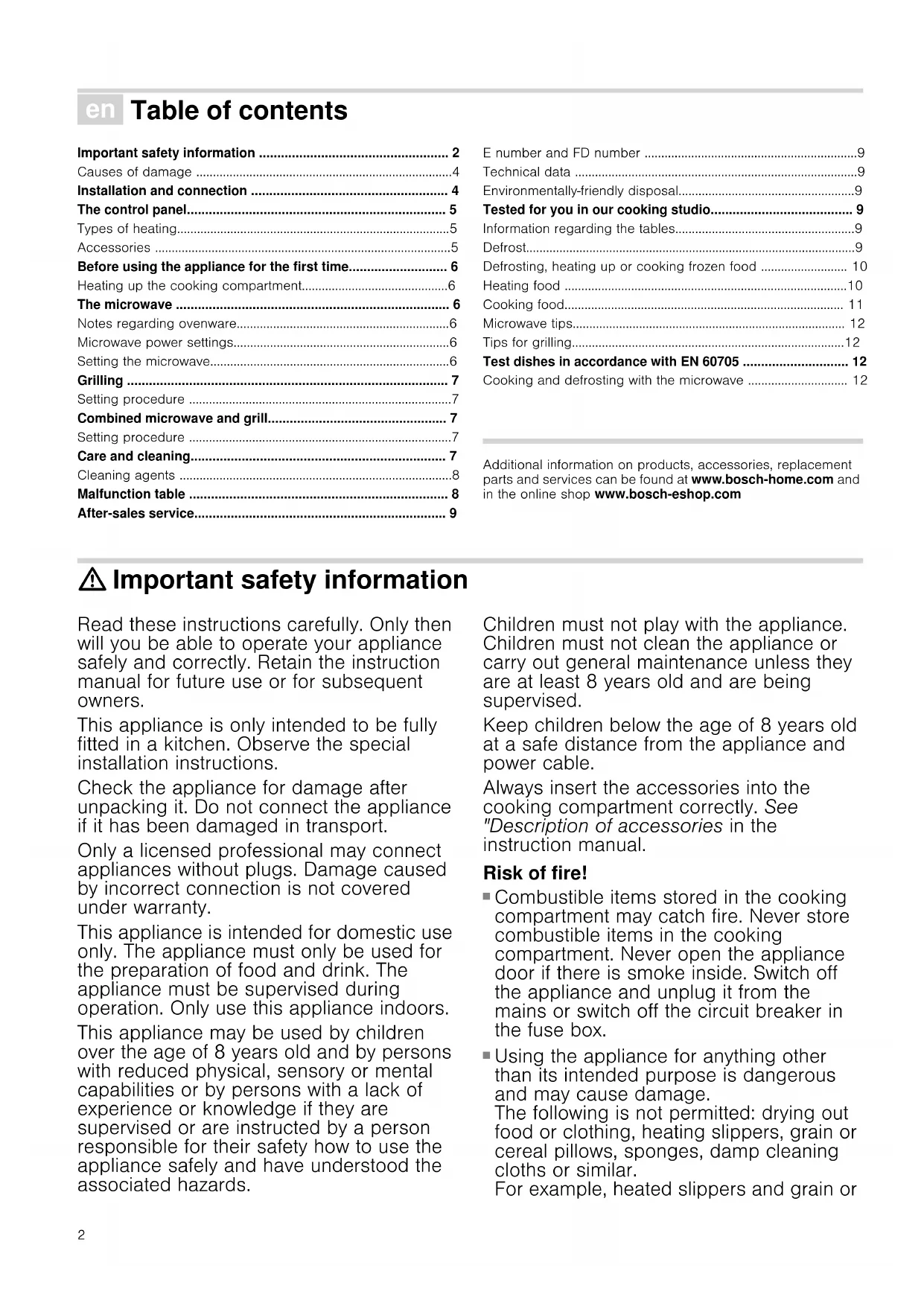

Download the instructions for your Microwave Oven in PDF format for free! Find your manual HMT82G664 - BOSCH and take your electronic device back in hand. On this page are published all the documents necessary for the use of your device. HMT82G664 by BOSCH.
USER MANUAL HMT82G664 BOSCH
- Microwave Micro-ondes2 Ú Table of contents [en]Instruction manual Important safety information p. 2
- Causes of damage p. 4
- Installation and connection p. 4
- The control panel p. 5
- Types of heating p. 5
- Accessories p. 5
- Before using the appliance for the first time p. 6
- Heating up the cooking compartment p. 6
- The microwave p. 6
- Notes regarding ovenware p. 6
- Microwave power settings p. 6
- Setting the microwave p. 6
- Grilling p. 7
- Setting procedure p. 7
- Combined microwave and grill p. 7
- Setting procedure p. 7
- Care and cleaning p. 7
- Cleaning agents p. 8
- Malfunction table p. 8
- After-sales service p. 9
- E number and FD number p. 9
- Technical data p. 9
- Environmentally-friendly disposal p. 9
- Tested for you in our cooking studio p. 9
- Information regarding the tables p. 9
- Defrost p. 9
- Defrosting, heating up or cooking frozen food p. 10
- Heating food p. 10
- Cooking food p. 11
- Microwave tips p. 12
- Tips for grilling p. 12
- Test dishes in accordance with EN 60705 p. 12
- Cooking and defrosting with the microwave Produktinfo Additional information on products, accessories, replacement parts and services can be found at www.bosch-home.com and in the online shop www.bosch-eshop.com : Important safety information Read these instructions carefully. Only then will you be able to operate your appliance safely and correctly. Retain the instruction manual for future use or for subsequent owners. This appliance is only intended to be fully fitted in a kitchen. Observe the special installation instructions. Check the appliance for damage after unpacking it. Do not connect the appliance if it has been damaged in transport. Only a licensed professional may connect appliances without plugs. Damage caused by incorrect connection is not covered under warranty. This appliance is intended for domestic use only. The appliance must only be used for the preparation of food and drink. The appliance must be supervised during operation. Only use this appliance indoors. This appliance may be used by children over the age of 8 years old and by persons with reduced physical, sensory or mental capabilities or by persons with a lack of experience or knowledge if they are supervised or are instructed by a person responsible for their safety how to use the appliance safely and have understood the associated hazards. Children must not play with the appliance. Children must not clean the appliance or carry out general maintenance unless they are at least 8 years old and are being supervised. Keep children below the age of 8 years old at a safe distance from the appliance and power cable. Always insert the accessories into the cooking compartment correctly. See "Description of accessories in the instruction manual. Risk of fire! p. 12
Combustible items stored in the cooking compartment may catch fire. Never store combustible items in the cooking compartment. Never open the appliance door if there is smoke inside. Switch off the appliance and unplug it from the mains or switch off the circuit breaker in the fuse box. Risk of fire!
Using the appliance for anything other than its intended purpose is dangerous and may cause damage. The following is not permitted: drying out food or clothing, heating slippers, grain or cereal pillows, sponges, damp cleaning cloths or similar. For example, heated slippers and grain or3 cereal pillows may catch fire, even several hours after they have been heated.The appliance must only be used for the preparation of food and drinks. Risk of fire!
Food may catch fire. Never heat food in heat-retaining packages. Do not leave food heating unattended in containers made of plastic, paper or other combustible materials. Do not select a microwave power or time setting that is higher than necessary. Follow the information provided in this instruction manual. Never use the microwave to dry food. Never defrost or heat food with a low water content, e.g. bread, at too high a microwave power or for too long. Risk of fire!
Cooking oil may catch fire. Never use the microwave to heat cooking oil on its own. Risk of explosion! Liquids and other food may explode when in containers that have been tightly sealed. Never heat liquids or other food in containers that have been tightly sealed. Risk of serious damage to health!
The surface of the appliance may become damaged if it is not cleaned properly. Microwave energy may escape. Clean the appliance on a regular basis, and remove any food residue immediately. Always keep the cooking compartment, door seal, door and door stop clean; see also section Care and cleaning. Risk of serious damage to health!
Microwave energy may escape if the cooking compartment door or the door seal is damaged. Never use the appliance if the cooking compartment door or the door seal is damaged. Contact the after- sales service. Risk of serious damage to health!
Microwave energy will escape from appliances that do not have any casing. Never remove the casing. For any maintenance or repair work, contact the after-sales service. Risk of electric shock!
Incorrect repairs are dangerous. Repairs may only be carried out and damaged power cables replaced by one of our trained after-sales technicians. If the appliance is defective, unplug the appliance from the mains or switch off the circuit breaker in the fuse box. Contact the after-sales service. Risk of electric shock!
The cable insulation on electrical appliances may melt when touching hot parts of the appliance. Never bring electrical appliance cables into contact with hot parts of the appliance. Risk of electric shock!
Penetrating moisture may cause an electric shock. Do not use any high- pressure cleaners or steam cleaners. Risk of electric shock!
A defective appliance may cause electric shock. Never switch on a defective appliance. Unplug the appliance from the mains or switch off the circuit breaker in the fuse box. Contact the after-sales service. Risk of electric shock!
The appliance is a high-voltage appliance. Never remove the casing. Risk of burns!
Accessories and ovenware become very hot. Always use oven gloves to remove accessories or ovenware from the cooking compartment. Risk of burns!
Alcoholic vapours may catch fire in the hot cooking compartment. Never prepare food containing large quantities of drinks with a high alcohol content. Only use small quantities of drinks with a high alcohol content. Open the appliance door with care. Risk of burns!
Foods with peel or skin may burst or explode during, or even after, heating. Never cook eggs in their shells or reheat hard-boiled eggs. Never cook shellfish or crustaceans. Always prick the yolk when baking or poaching eggs. The skin of foods that have a peel or skin, such as apples, tomatoes, potatoes and sausages, may burst. Before heating, prick the peel or skin. Risk of burns!
Heat is not distributed evenly through baby food. Never heat baby food in closed containers. Always remove the lid or teat. Stir or shake well after the food has been heated. Check the temperature of the food before it is given to the child. Risk of burns!
Heated food gives off heat. The ovenware may become hot. Always use oven gloves to remove ovenware or accessories from the cooking compartment. Risk of burns!
Airtight packaging may burst when food is heated. Always observe the instructions on the packaging. Always use oven gloves to remove dishes from the cooking compartment. Risk of scalding!
When you open the appliance door, hot steam may escape. Open the appliance4 door with care. Keep children at a safe distance. Risk of scalding!
There is a possibility of delayed boiling when a liquid is heated. This means that the liquid reaches boiling temperature without the usual steam bubbles rising to the surface. Even if the container only vibrates a little, the hot liquid may suddenly boil over and spatter. When heating, always place a spoon in the container. This will prevent delayed boiling. Risk of injury!
Scratched glass in the appliance door may develop into a crack. Do not use a glass scraper, sharp or abrasive cleaning aids or detergents. Risk of injury!
Unsuitable ovenware may crack. Porcelain or ceramic ovenware can have small perforations in the handles or lids. These perforations conceal a cavity below. Any moisture that penetrates this cavity could cause the ovenware to crack. Only use microwave-safe ovenware. Causes of damage Caution! ■ Heavily soiled seal: If the seal is very dirty, the appliance door will no longer close properly during operation. The fronts of adjacent units could be damaged. Always keep the seal clean. ■ Operating the microwave without food: Operating the appliance without food in the cooking compartment may lead to overloading. Never switch on the appliance unless there is food in the cooking compartment. An exception to this rule is a short crockery test (see the section "Microwave, suitable crockery"). ■ Microwave popcorn: Never set the microwave power too high. Use a power setting no higher than 600 watts. Always place the popcorn bag on a glass plate. The disc may jump if overloaded. ■ Liquid that has boiled over must not be allowed to run through the turntable drive into the interior of the appliance. Monitor the cooking process. Choose a shorter cooking time initially, and increase the cooking time as required. ■ Never use the microwave oven without the turntable. Installation and connection This appliance is intended for domestic use only. This appliance is only intended to be fully fitted in a kitchen. Please observe the special installation instructions. The appliance can be fitted in a 60 cm wide wall cabinet (min. 30 cm deep and 85 cm off the floor). The appliance is fitted with a plug and must only be connected to a properly-installed earthed socket. The fuse protection must be rated at 10 amperes (L or B circuit breakers). The mains voltage must correspond to the voltage specified on the rating plate. The socket must be installed and the power cable replaced by a qualified electrician only. If the plug is no longer accessible following installation, an all-pin disconnecting device must be present on the installation side, with a contact gap of at least 3 mm. Multiple plugs, plug bars and extension leads must not be used. Overloading can result in a risk of fire.5 The control panel Here, you will see an overview of the control panel. Depending on the appliance model, individual details may differ. Types of heating Microwaves Microwaves are converted to heat inside food. The microwave is ideal for rapid defrosting, heating up, melting and cooking. Microwave power settings ■ 900 watt - for heating liquids.■ 600 watts - for heating and cooking food.■ 360 watts - for cooking meat and heating delicate foods.■ 180 watts - for defrosting and continued cooking.■ 90 watts - for defrosting delicate foods . Grill
You can use this to grill or cook bakes "au gratin". Accessories The turntable How to fit the turntable:
1. Place the turntable ring a in the recess in the cooking
2. Let the turntable b slot in place in the drive c in the centre of
the cooking compartment floor. Note: Do not use the appliance if the turntable is not in place. Ensure that it is properly slotted into place. The turntable can turn clockwise or anti-clockwise. Wire rack Special accessories You can purchase special accessories from the after-sales service or specialist retailers. Please specify the HEZ number. You will find a comprehensive range of products in our brochures and on the Internet. The availability of special accessories and whether it is possible to order them online may vary depending on your country. Please see the sales brochures for more details. 1 Power selector 90 watts 180 watts 360 watts 600 watts 900 watts Combined microwave and grill (180 (360 Grill
Wire rack for grilling, e.g. steaks, sausages or for toasting bread, or as a surface, e.g. for shallow dishes. Note: Place the wire rack on the turntable. Steamer ovenware HEZ 86 D 000
Before using the appliance for the first time Here you will find everything you need to do before using the microwave to prepare food for the first time. First read the section on Safety information. Heating up the cooking compartment Heat the empty cooking compartment with the turntable inserted and the door closed for 10 minutes to remove the new smell. Ensure that no packaging remnants have been left in the cooking compartment
1. Set the power selector to ( grill.
2. Use the time switch to set 10 minutes.
A signal sounds once the time has elapsed. Open the appliance door. The microwave Microwaves are converted to heat in foodstuffs. You will find information about ovenware and how to set the microwave. Note: In the Tested for you in our cooking studio section, you will find examples for defrosting, heating and cooking with the microwave oven. Try out the microwave straight away. You could heat up a cup of water for your tea, for example. Use a large cup without any decorative gold or silver trim and place a teaspoon in it. Place the cup containing the water on the turntable.
1. Set the power selector to 900 W.
2. Use the time switch to set 2 minutes.
A signal sounds after 2 minutes. The water for the tea is hot. As you are drinking your tea, please take time to read again the safety information that can be found at the front of the instruction manual. This is very important. Notes regarding ovenware Suitable ovenware Suitable dishes are heat-resistant ovenware made of glass, glass ceramic, porcelain, ceramic or heat-resistant plastic. These materials allow microwaves to pass through. You can also use serving dishes. This saves you having to transfer food from one dish to another. You should only use ovenware with decorative gold or silver trim if the manufacturer guarantees that they are suitable for use in microwaves. Unsuitable ovenware Metal ovenware is unsuitable. Metal does not allow microwaves to pass through. Food in covered metal containers will remain cold. Caution! Creation of sparks: metal – e.g. a spoon in a glass – must be kept at least 2 cm from the oven walls and the inside of the door. Sparks could destroy the glass on the inside of the door. Ovenware test Do not switch on the microwave unless there is food inside. The following ovenware test is the only exception to this rule. Perform the following test if you are unsure whether your ovenware is suitable for use in the microwave:
1. Heat the empty ovenware at maximum power for ½ to
2. Check the temperature occasionally during that time.
The ovenware should still be cold or warm to the touch. The ovenware is unsuitable if it becomes hot or sparks are generated. Microwave power settings Setting the microwave
1. Set the power selector to the required microwave power
2. Set a cooking time using the time switch.
Note: If the cooking time is less than two minutes, first turn to a longer time and then immediately back to the desired time. The set cooking time counts down. A signal sounds once the time has elapsed. Notes ■ If you open the appliance door during operation, microwave operation is interrupted and the set time maintained. When closed again, operation resumes. ■ In the tables, there are two microwave power settings and times: set the first microwave power setting and time initially, and after the signal, set the second. Changing the cooking time This can be done at any time. Change the cooking time using the time switch. Cancelling operation Microwave operation is ended when you set the time switch to
Microwave power setting Suitable for 90 W Defrosting delicate foods 180 W Defrosting and continued cooking 360 W Cooking meat and heating delicate foods 600 W Heating and cooking food 900 W Heating liquids7 Grilling Setting procedure Example: ( grill, 15 minutes1. Set the power selector to (.2. Use the time switch to set 15 minutes.The cooking time has elapsedA signal sounds. The appliance switches off.CorrectionYou may correct a set cooking time at any time.Pausing operationOpen the appliance door. The set time continues once the door is closed.Cancelling the settingTurn the time switch to zero. Reset. Combined microwave and grill This involves simultaneous operation of the grill and the microwave.The following combinations are available:■ (180 watts■ (360 watts Setting procedure Exmple: ( 360, 25 minutes.1. Set ( 360 using the power selector.2. Set the cooking time using the time switch.The set cooking time counts down.A signal sounds once the time has elapsed.Notes■ If you open the appliance door during operation, microwave operation is interrupted and the set time maintained. Microwave operation continues once the door is closed.■ If your meal requires more than 60 minutes, set the remaining time after the signal. Care and cleaning With careful care and cleaning your microwave oven will retain its looks and remain good order. We will explain here how you should care for and clean your appliance correctly. : Risk of short circuit! Never use high-pressure cleaners or steam cleaners to clean the oven. : Risk of burns! Never clean the appliance immediately after switching off. Let the appliance cool down. : Risk of electric shock! Do not immerse the appliance in water or clean under a jet of water.Surfaces are different, and damage caused by using the wrong cleaning agent can be avoided by observing the information in the table below.Do not use■ sharp or abrasive cleaning agents. The surface could be damaged. If such a substance comes into contact with the front of the appliance, wash it off immediately with water.■ metal or glass scrapers to clean the glass in the appliance door.■ metal or glass scrapers for cleaning the seal.■ hard scouring pads or cleaning sponges. Wash new sponge cloths thoroughly before use. PLQ
■ cleaning agents with high concentrations of alcohol. Cleaning agents Caution! Before cleaning, unplug the appliance from the mains or switch off the circuit breaker in the fuse box. Clean the outside of the appliance and the cooking compartment with a damp cloth and mild detergent. Dry with a clean cloth. Malfunction table Malfunctions often have simple explanations. Please refer to the malfunction table before calling the after-sales service. If a meal does not turn out exactly as you wanted, refer to the Tested for you in our cooking studio section, where you will find plenty of cooking tips and tricks. : Risk of electric shock! Incorrect repairs are dangerous. Repairs may only be carried out by one of our trained after-sales engineers. You can take remedial action yourself for some error messages. Troubleshooting Area Cleaning agents Appliance front Hot soapy water: Clean with a dish cloth and dry with a soft cloth. Do not use glass cleaners or metal or glass scrapers for cleaning. Appliance front with stainless steel Hot soapy water: Clean with a dish cloth and dry with a soft cloth. Remove flecks of limescale, grease, starch and albumin (e.g. egg white) immediately. Corrosion can form under such residues. Special stainless steel cleaning agents can be obtained from the after-sales service or from spe- cialist shops. Do not use glass cleaners or metal or glass scrapers for cleaning. Cooking compart- ment made of stain- less steel Hot soapy water or a vinegar solution: Clean with a dish cloth and dry with a soft cloth. If the oven is very dirty: use oven cleaner, but only when cooking com- partment is cold. It is best to use a stain- less-steel sponge. Do not use oven spray or other aggressive oven cleaners or abrasive materials. Scouring pads, rough sponges and pan cleaners are also unsuitable. These items scratch the surface. Allow the interior surfaces to dry thoroughly. Recess in cooking compartment Damp cloth: Ensure that no water seeps through the turntable drive into the appliance inte- rior. Turntable and turnta- ble ring Hot soapy water: When putting the turntable back in place, make sure it slots in correctly. Wire rack Hot soapy water: Clean using stainless steel cleaning agent or in the dishwasher. Door panels Glass cleaner: Clean with a dish cloth. Do not use a glass scraper. Seal Hot soapy water: Clean with a dish cloth, do not scour. Do not use a metal or glass scraper for cleaning. Area Cleaning agents Error message Possible cause Remedy/Note The appliance does not work The plug is not plugged into the mains. Plug the plug in Power cut Check whether the kitchen light works. Faulty circuit breaker Look in the fuse box to make sure that the fuse for the appliance is OK. Incorrect operation Switch off the circuit breaker in the fuse box. Reconnect it after approx. 10 seconds. The microwave does not work. The door was not fully closed. Check whether food remains or foreign material is trapped in the door. The time switch has not been set. Set the time switch. The food takes longer than usual to heat up The microwave power setting was too low. Select a higher microwave power setting. You have placed a larger amount of food than normal in the appliance. Double the amount = double the cooking time. The food was colder than usual. Stir or turn the food during cooking The turntable is making a scratching or grinding noise. There is dirt or a foreign object in the area around the turntable drive. Clean the roller ring and recess in the cook- ing compartment.9 After-sales service Our after-sales service is there for you if your appliance needs to be repaired. We will always find the right solution in order to avoid unnecessary visits from a service technician. E number and FD number When calling us, please give the product number (E no.) and the production number (FD no.) so that we can provide you with the correct advice. The rating plate bearing these numbers can be found on the right-hand side when you open the appliance door. To save time, you can make a note of the number of your appliance and the telephone number of the after-sales service in the space below, should it be required. Please note that there will be a fee for a visit by a service technician in the event of a malfunction, even during the warranty period. After-sales contact details for all countries can be found in the attached after-sales service directory. This appliance corresponds to the standards EN 55011 and CISPR 11. It is a Group 2, Class B product. Group 2 means that microwaves are produced for the purpose of heating food. Class B states that the appliance is suitable for private households. Technical data Environmentally-friendly disposal Dispose of packaging in an environmentally-friendly manner. Tested for you in our cooking studio Here you will find a selection of recipes and the ideal settings for them. We show you which microwave power setting is best suited to your dish. There are also tips about ovenware and preparation methods. Information regarding the tables The following tables provide you with numerous options and settings for the microwave. The times specified in the tables are only guidelines. They may vary according to the ovenware used, the quality, temperature and consistency of the food. Time ranges are often specified in the tables. Set the shortest time first and then extend the time if necessary. It may be that you have different quantities from those specified in the tables. A rule of thumb can be applied: Double the amount - almost twice the cooking time Half the amount - half the cooking time. Always place the ovenware on the turntable. Defrost Notes ■ Place the frozen food in an open container on the turntable. ■ Delicate parts such as the legs and wings of chicken or fatty outer layers of roasts can be covered with small pieces of aluminium foil. The foil must not touch the oven walls. You can remove the foil half way through the defrosting time. ■ Liquid will be produced when defrosting meat or poultry. Drain off this liquid when turning meat and poultry and under no circumstances use it for other purposes or allow it to come into contact with other foods. ■ Turn or stir the food once or twice during the defrosting time. Large pieces of food should be turned several times. ■ Leave defrosted items to stand at room temperature for a further 10 to 20 minutes so that the temperature is even throughout. The giblets can be removed from poultry at this point. The meat can still be further prepared, even if it has a small frozen core. Microwave operation has been can- celled for no apparent reason. The microwave has a fault. If this fault occurs repeatedly, please call the after-sales service. Error message Possible cause Remedy/Note E no. FD no. After-sales service
Input voltage AC 220 - 230 V, 50 Hz Power consumption 1450 W Maximum output power 900 W Grill power 1200 W Microwave frequency 2450 MHz Fuse 10 A Dimensions (HxWxD) appliance 382 mm x 594 mm x 388 mm cooking compartment 208 mm x 328 mm x 369 mm VDE approved yes CE mark yes This appliance is labelled in accordance with European Directive 2012/19/EU concerning used electrical and electronic appliances (waste electrical and electronic equipment - WEEE). The guideline determines the framework for the return and recycling of used appliances as applicable throughout the EU.10 Defrosting, heating up or cooking frozen food Notes ■ Take ready meals out of the packaging. They will heat up more quickly and evenly in microwaveable ovenware. The different components of the meal may not require the same amount of time to heat up . ■ Food which lies flat will cook more quickly than food which is piled high. You should therefore distribute the food so that it is as flat as possible in the ovenware. Different foodstuffs should not be placed in layers on top of one another. ■ Always cover the food. If you do not have a suitable cover for your ovenware, use a plate or special microwave foil. ■ Stir or turn the food 2 or 3 times during cooking. ■ After heating, allow the food to stand for a further 2 to 5 minutes so that it can achieve an even temperature. ■ Always use an oven cloth or oven gloves when removing plates from the oven. ■ This will help the food retain its own distinct taste, so it will require less seasoning. Heating food : Risk of scalding! There is a possibility of delayed boiling when a liquid is heated. This means that the liquid reaches boiling temperature without the usual steam bubbles rising to the surface. Even if the container only moves a little, the hot liquid can suddenly boil Defrost Weight Microwave power setting in watts, cooking time in minutes Notes Whole pieces of meat (beef, veal or pork - on the bone or boned) 800 g 180 W, 15 mins + 90 W, 10-20 mins - 1 kg 180 W, 20 mins + 90 W, 15-25 mins