 ManualGo.com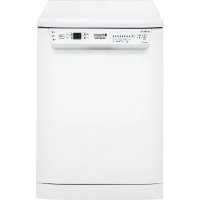
LFFA+ 8H141 EU - Dishwasher HOTPOINT ARISTON - Free user manual and instructions
Find the device manual for free LFFA+ 8H141 EU HOTPOINT ARISTON in PDF.



Download the instructions for your Dishwasher in PDF format for free! Find your manual LFFA+ 8H141 EU - HOTPOINT ARISTON and take your electronic device back in hand. On this page are published all the documents necessary for the use of your device. LFFA+ 8H141 EU by HOTPOINT ARISTON.
USER MANUAL LFFA+ 8H141 EU HOTPOINT ARISTON
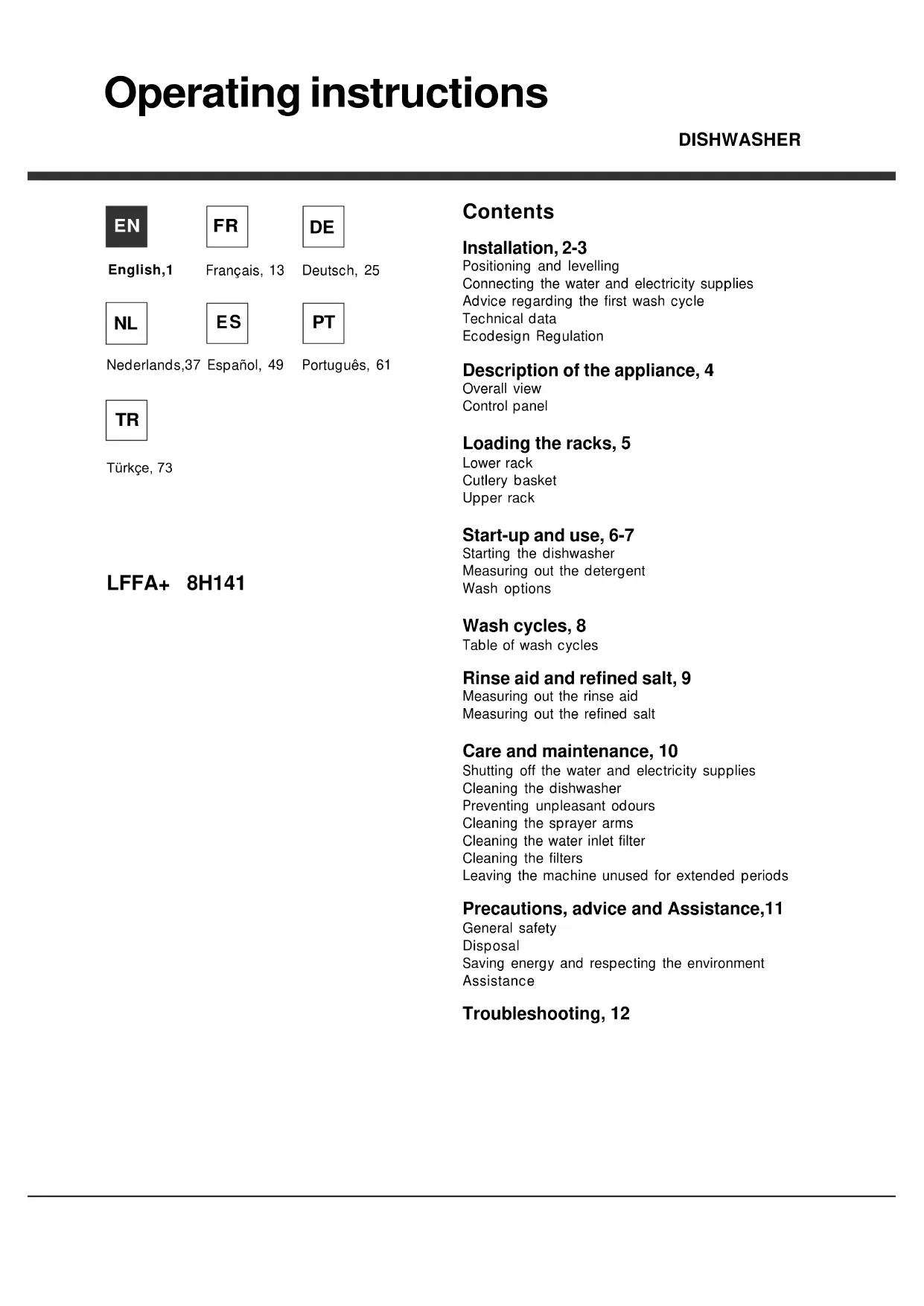
Operating instructions Contents Installation, 2-3 Positioning and levelling Connecting the water and electricity supplies Advice regarding the first wash cycle Technical data Ecodesign Regulation Description of the appliance, 4 Overall view Control panel Loading the racks, 5 Lower rack Cutlery basket Upper rack Start-up and use, 6-7 Starting the dishwasher Measuring out the detergent Wash options Wash cycles, 8 Table of wash cycles Rinse aid and refined salt, 9 Measuring out the rinse aid Measuring out the refined salt Care and maintenance, 10 Shutting off the water and electricity supplies Cleaning the dishwasher Preventing unpleasant odours Cleaning the sprayer arms Cleaning the water inlet filter Cleaning the filters Leaving the machine unused for extended periods Precautions, advice and Assistance,11 General safety Disposal Saving energy and respecting the environment Assistance Troubleshooting, 12 English,1
Installation Keep this instruction manual in a safe place for futurereference. If the appliance is sold, given away or moved, pleaseensure the manual is kept with the machine, so that the newowner may benefit from the advice contained within it.Please read this instruction manual carefully: it containsimportant information regarding the safe installation, use andmaintenance of the appliance.If the appliance must be moved at any time, keep it in anupright position; if absolutely necessary, it may be tilted onto itsback.This appliance is intended to be used in household and similarapplications such as:- staff kitchen areas in shops, offices and other workingenvironments;- farm houses;- by clients in hotels, motels and other residential typeenvironments;- bed and breakfast type environments. Positioning and levelling 1. Remove the appliance from all packaging and check that it hasnot been damaged during transportation.If it has been damaged, contact the retailer and do not proceedany further with the installation process.2. Check the dishwasher by placing it so that its sides or backpanel are in contact with the adjacent cabinets or even with thewall. This appliance can also be recessed under a single worktop
see the Assembly instruction sheet 3. Position the dishwasher on a level and sturdy floor. If the flooris uneven, the front feet of the appliance may be adjusted until itreaches a horizontal position. If the appliance is levelled correctly,it will be more stable and much less likely to move or causevibrations and noise while it is operating.
*. Adjust the height of the rear foot from the front of the appliance on the central lower part of the dishwasher, turning a hexagonalspanner (red color) with an opening of 8 mm in a clockwisedirection to increase the height or in an anticlockwise direction todecrease the height. Connecting the water and electricity supplies Connection to the water and electricity supplies should onlybe performed by a qualified technician.The dishwasher should not stand on top of the water hosesor the electricity supply cable.The appliance must be connected to the water supply networkusing new hoses.Do not use old hoses.The water inlet and outlet hoses and the electricity supply cablemay be positioned towards the right or the left in order to achievethe best possible installation. Connecting the water inlet hose
- To a suitable cold water connection point: before attaching thehose, run the water until it is perfectly clear so that any impuritiesthat may be present in the water do not clog the appliance;after performing this operation, screw the inlet hose tightlyonto a tap with a ¾ gas threaded connection.• To a suitable hot water connection point: your dishwashermay be supplied with hot water from the mains supply (if youhave a central heating system with radiators) provided that itdoes not exceed a temperature of 60°C.Screw the hose to the tap as described for connection to acold water supply. If the inlet hose is not long enough, contact a specialist storeor an authorised technician (see Assistance The water pressure must be within the values indicated in theTechnical data table (see adjacent information The hose should not be bent or compressed. Connecting the water outlet hose Connect the outlet hose (without bending it) to a drain duct with aminimum diameter of 4 cm.The outlet hose must be at a height ranging from 40 to 80 cm fromthe floor / surface where the dishwasher rests (A).Before connecting the water outlet hose to the sink drain, removethe plastic plug (B). Anti-flooding protection To ensure floods do not occur, the dishwasher:- is provided with a special system which blocks the water supplyin the event of anomalies or leaks from inside the appliance.Some models are also equipped with the supplementary safetydevice New Acqua Stop *, which guarantees anti-flooding protection even in the event of a supply hose rupture.
WARNING: HAZARDOUS VOLTAGE!
Under no circumstance should the water inlet hose be cut as itcontains live electrical parts.
- Only available in selected models.EN
Electrical connection Before inserting the plug into the electrical socket, make surethat:• The socket is earthed and complies with current regulations.• The socket can withstand the maximum load of the appliance,which is indicated on the data plate located on the inside of thedoor (see chapter entitled Description of the appliance
- The power supply voltage falls within the values indicated onthe data plate on the inside of the door.• The socket is compatible with the plug of the appliance. If thisis not the case, ask an authorised technician to replace theplug (see Assistance); do not use extension cables or multiplesockets. Once the appliance has been installed, the power supplycable and the electrical socket should be easily accessible. The cable should not be bent or compressed. If the power supply cable is damaged, it must be replacedby the manufacturer or its Technical Assistance Service in order toprevent all potential hazards. (See Assistance) The Company shall not be held responsible for any incidentsthat occur if these regulations are not observed. Anti-condensation strip* After installing the dishwasher, open the door and stick theadhesive transparent strip under the wooden shelf in order toprotect it from any condensation which may form. Advice regarding the first wash cycle After the appliance has been installed, immediately before runningthe first wash cycle, completely fill the salt dispenser with waterand add only then approximately 1 kg of salt (see chapter entitledRinse aid and refined salt). The water may overflow: this is normaland is not a cause for concern. Select the water hardness value see chapter entitled Rinse aid and refined salt). - After the salthas been poured into the machine, the LOW SALT indicatorlight
- switches off. If the salt container is not filled, the water softener and theheating element may be damaged as a result. Technical data Dimensions width 60 cm height 85 cm depth 60 cm Capacity 14 standard place-settings Water supply pressure 0,05 ÷ 1MPa (0.5 ÷ 10 bar) 7,25 – 145 psi Power supply voltage See appliance data plate Total absorbed power See appliance data plate Fuse See appliance data plate This dishwasher conforms to the following European Community Directives: -2006/95/EC (Low Voltage) -2004/108/EC (Electromagnetic Compatibility) -2005/32/EC (Comm. Reg. 1275/2008) (Ecodesign) -97/17/EC (Labelling) -2002/96/EC Waste Electrical and Electronic Equipment (WEEE) ECODESIGN REGULATION ECO wash cycle is the standard cycle to which the energy label data refers; this cycle can be used to wash crockery with a normal soil level and is the most efficient in terms of energy and water consumption for this type of crockery. To reduce consumption even further, only run the dishwasher when it is full.Standby consumption: Left-on mode consumption: 4,5 W – Off mode consumption: 1,3 WConsumption data table for the main cycles
- Cycle data refers to the values recorded in a laboratory, in accordance with European standard EN 50242. ** Data is obtained by recording values when the appliance is operational and loaded with user crockery. Standard conditions* User conditions** Energy consumption (kWh/cycle) Water consumption (l/cycle) Duration (min/cycle) Energy consumption (kWh/cycle) Water consumption (l/cycle) Duration (min/cycle) INTENSIVE 1,50 15 150 1,30 14 135 NORMAL 1,20 15 120 1,05 14 110EN
Overall view Description of the appliance
3. Tip-up compartments
6. Lower sprayer arm
***Only in completely built-in models.
- Only available in selected models.The number and position may vary. Before loading the racks, remove all food residue fromcrockery and empty liquids from glasses and cups.After loading the appliance, make sure that the sprayer armscan rotate freely. Lower rack and cutlery basket The lower rack can hold pans, lids, plates, salad bowls, cutlery, etc.Large plates and lids should ideally be placed at the sides of the rack.Several dishwasher models are fitted with tip-up sections *, which can be used in a vertical position when arranging plates or in ahorizontal position when arranging saucepans, salad bowls andfrying pans.The type of cutlery basket may vary (modular or non-modular)according to the dishwasher model. The non-modular basketmust only
be positioned at the front of the lower rack.Both are fitted withgrilles over the top, forimproved cutlery ar-rangement. Knives and other utensils with sharp edges must be placedin the cutlery basket with the points facing downwards, orthey must be positioned horizontally in the tip-upcompartments on the upper rack. Upper rack Load this rack with delicate and lightweight crockery: glasses,cups, saucers and shallow salad bowls. Adjustable position tip-up compartments The tip-up compartments can bepositioned at different heights, tooptimise the arrangement ofcrockery throughout the rack.Wine glasses can be placedsafely in the tip-up compartments,by inserting the stem of eachglass into the correspondingslots.Some dishwasher models are fittedwith a sliding tray
- which can be used to hold serving utensils or small cups.For optimum washing performance,avoid positioning bulky crockerydirectly below the tray. Adjusting the height of the upper rack In order to make it easier to arrange the crockery, the upper rackmay be moved to a higher or lower level. The height of the upper rack should ideally be adjustedWHEN THE RACK IS EMPTY.NEVER raise or lower the rack on one side only.Open the left and right guide rail stopsand pull out the rack; position it higher orlower as required, slide it along the guiderails until the front wheels are in place andclose the stops (see figure If the rack is fitted with Dual Spacehandles see figure), pull out the upperrack until it reaches its stop point, grip thehandles at the sides of the rack and moveit upwards or downwards, then slowly let itfall back into place. Items that should not be washed in the dishwasher
- Wooden items, objects with wooden or horn handles or glued-on parts.• Items made from aluminium, copper, brass, pewter or tin.• Items made from plastic material which is not heat-resistant.• Antique or hand-painted porcelain.• Antique silver. Silver that is not antique may, however, bewashed in the dishwasher using a delicate wash cycle,provided that it does not come into contact with other metals. We recommend the use of crockery which is dishwashersafe.EN
Start-up and use Starting the dishwasher 1. Turn the water tap on.2. Premere il tasto ON-OFF: si sente un breve bip, tutte le spie eil display si illuminano per alcuni secondi.2. Press the ON/OFF button: you will hear a short beep; all theindicator lights and the display will light up for a few seconds.3. Open the door and pour in a suitable amount of detergent ( see below 4. Load the racks (see Loading the racks) and shut the door.5. Select the wash cycle in accordance with the type of crockeryand its soil level (see Table of wash cycles) by pressing the Pbutton.6. Select the wash options see adjacent information
7. Start the cycle by pressing the Start/Pause button: a long
beep signals the start of the wash cycle, the washing cycle indicator light switches on and the time remaining until the end ofthe cycle is displayed.8. Two short beeps and one long one indicate the end of thewash cycle; the wash cycle indicator light flashes and the ENDindicator light switches on (fixed light). Switch off the applianceby pressing the ON/OFF button, shut off the water valve andunplug the appliance from the electricity socket.9. Wait for a few minutes before removing the crockery, in orderto avoid burns. Unload the racks, beginning with the lower level. - The machine will switch off automatically during certain periods of inactivity, in order to minimise electricity consumption. AUTO WASH CYCLES*: this model of dishwasher is equipped with a special sensor which can be used to assess thelevel of soiling and automatically select the most efficient andeconomic wash cycle accordingly.The duration of the auto wash cycles may vary due to theoperation of the sensor. Modifying a wash cycle in progress If a mistake was made during the wash cycle selection processit is possible to change the cycle, provided that it has only justbegun: once the wash cycle has started, switch off the machineby pressing and holding the ON/OFF/Reset button. Switch itback on using the same button and select the desired washcycle and options. Adding extra crockery Press the Start/Pause button (the corresponding indicator lightwill flash). Open the door, taking care to avoid the escapingsteam, and place the crockery inside the appliance. Press theStart/Pause button (fixed light): the cycle will restart after aprolonged beep is emitted.If the Start/Pause button is pressed so as to pause themachine, the wash cycle or the Delayed Start function (ifselected) is interrupted.At this stage it is not possible to change the wash cycle. Accidental interruptions If the door is opened during the wash cycle, or if there is a powercut, the cycle stops. It starts again from the point at which it wasinterrupted once the door has been shut or once the electricitysupply is restored. Measuring out the detergent A good wash result also depends on the correct amount of detergent being used; exceeding the stated amount does not result in a more effective wash and increases environmental pollution. Only use detergent which has been specifically designed for dishwashers.
DO NOT USE washing up liquid. Using excessive detergent may result in foam residue remaining in the machine after the cycle has ended. The use of tablets is only recommended for models which offer the MULTI-FUNCTIONAL TABLETS option. To achieve the best results from each washing and drying cycle, powder detergent, rinse aid liquid and salt should be used. Compartment A: Washing detergentCompartment B: Pre-wash detergent1. Open cover C by pressing button
2. Pour in the detergent after consulting
the Table of wash cycles
- For powder detergent usecompartments A and B.• For detergent in tablet form: whenthe cycle requires 1 tablet, place it incompartment A and close the cover;when it requires 2, place the second tablet at the bottom of theappliance.3. Remove detergent residues from the edges of the compartmentand close the cover until it clicks.
- Only available in selected models.EN
Multi-functional tablets (Tabs) This option optimises washing and drying results.When using multi-functional tablets, press the MULTI-FUNCTIONAL TABLETS button. The corresponding indicatorlight will illuminate. The “Multi-functional tablets” option resultsin the lengthening of the wash cycle. The MULTI-FUNCTIONAL TABLETS option remains set for subsequent wash cycles if it is not deselected. The use of tablets is only recommended for models which offer the MULTI-FUNCTIONAL TABLETS option. This option is not recommended for use with wash cycles which do not specify the use of multi-functional tablets
see Table of options
- Only available in selected models. Half load using the upper rack If there are not many dishes to be washed, a half load cycle maybe used in order to save water, electricity and detergent. Selectthe wash cycle and press the HALF LOAD button: the indicatorlight will illuminate and the wash cycle will take place only in theupper rack. Remember to load the upper rack only, and to reduce the amount of detergent accordingly. It is better to use powder detergent in this case. This option is not compatible with the following wash cycles: Speed and Baby. Delayed start It is possible to delay the start time of the cycle for a period oftime between 1 and 24 hours.1. After selecting the desired wash cycle and any other options,press the DELAYED START button: the corresponding indicatorlight will illuminate. Use the same button to select the time at whichyou wish the wash cycle to begin (after a period of 1 to 24 hours).2. Confirm your selection using the Start/Pause button; thecountdown will begin. The selected delay period indicator lightflashes and the Start/Pause button stops flashing (the lightbecomes fixed instead).3. When the set time has elapsed, a long beep sounds, theDELAYED START indicator light switches off and the wash cyclebegins.To deselect the DELAYED START option, press the DELAYEDSTART button repeatedly until the text OFF appears. The Delayed Start function cannot be set once the washhas been started. Wash options* The OPTIONS may only be set, modified or reset after the wash cycle has been selected and before the Start/Pause button has been pressed. Only the options which are compatible with the type of wash cycleset may be selected. If an option is not compatible with the se-lected wash cycle ( see Table of wash cycles ), the correspondingLED flashes rapidly 3 times and 2 short beeps will sound.If an option is selected which is incompatible with another (previ-ously selected) option, the indicator light corresponding to theoption selected first will flash 3 times, 3 beeps will sound and it willbe deselected, while the most recently selected option will remainactive.To deselect an option which has been set by mistake, press thecorresponding button again. Good Night option This option reduces the amount of noise made by the machineand lengthens the wash cycles. It is a useful option because itenables users to benefit from the night-time energy rate.After selecting the wash cycle, press the Good Night optionbutton; the illumination of the corresponding indicator light fol-lowed by a short beep indicates its selection.To deselect the option, press the same button again. The Good Night options are not compatible with the HALF LOAD option. A B C D Table of options Delayed Start Half Load Tabs Good Night Eco Yes Yes Yes Yes Auto Normal Yes Yes Yes Yes Daily A 60 Yes Yes Yes
Auto Super Wash Yes Yes Yes
Wash cycles For available OPTIONS please refer to the Table of options on the Start-up and use page. If the crockery is only lightly soiled or if it has been rinsed with water before being placed in the dishwasher, reduce the amount of detergent used accordingly. The number and type of wash cycles and options may vary depending on the dishwasher model. Detergent (A) = compartment A (B) = compartment B Wash cycle selection instructions Wash cycle Powder Liquid Tablets Wash cycles which include drying Options Wash cycle duration (tolerance ±10%) Hrs. Min. Environmentally-friendly wash cycle with low energy consumption levels, suitable for pans and dishes. Eco
29 g (A) 6 g (B) 29 ml (A) 6 ml (B) 1 (A) Yes A–B-C-D 2:55’ Normally soiled pans and dishes. Standard daily wash cycle. Auto Normal 29 g (A) 6 g (B) 29 ml (A) 6 ml (B) 1 (A)
Yes A–B–C-D 1:50’ Limited quantity of daily soiling. (4 place settings + 1 saucepan +1 frying pan). Daily A 60 25 g (A) 25 ml (A) 1 (A)
1:00’ Pre-wash for dishes while awaiting completion of the load with the dishes from the next meal. Soak
A – B 0:08’ Heavily soiled dishes and pans (not to be used for delicate items). Auto Super Wash
Yes A–B–C 2:25’ Economic and fast wash to be used for lightly soiled dishes. (Run cycle immediately after use) (2 plates + 2 glasses + 4 pieces of cutlery + 1 saucepan + 1 small frying pan).
A - C 0:25’ Economic and fast wash for delicate items which are sensitive to high temperatures. (Run cycle immediately after use) (glasses upper rack + delicate plates, lower rack). Crystal 35 g (A) 35 ml (A) 1 (A)
Yes A–B–C 1:30’ Disinfecting wash cycle suitable for washing bottles, rings and teats together with plates, cups, glasses and cutlery. The crockery should only be loaded on the upper rack. Baby Wash 20 g (A) 20 ml (A)
1:20' Notes: Optimum performance levels when using the "Daily wash" and "Speed wash" cycles can be achieved by observing the maximum amounts of crockery specified. To make it easier to measure out the detergent, it is worth remembering that: 1 tablespoon = 15 grams of powder = approximately 15 ml of liquid - 1 teaspoon = 5 grams of powder = approximately 5 ml of liquid
- The Eco wash cycle adheres to the regulation EN-50242. Although it has a longer duration than other wash cycles it uses less energy and is less harmful to the environment. Note for Test Laboratories: for information relating to comparative EN testing conditions, please send an email to the following address: ASSISTENZA_EN_LVS@indesitcompany.comEN
Rinse aid and refined salt
Only use products which have been specifically designedfor dishwashers.Do not use table salt or industrial salt, or washing up liquid.Follow the instructions given on the packaging.If using a multi-functional product it is not necessary to addrinse aid; however, we recommend that you add salt, especiallyif you live in an area where the water is hard or very hard.Follow the instructions given on the packaging.If you do not add salt or rinse aid, the LOW SALT
- indicator lights remain lit. Measuring out the rinse aid Rinse aid makes it easier for the crockery to dry, as water runsoff surfaces more readily and therefore does not leave streaks ormarks.The rinse aid dispenser should be filled:• When the LOW RINSE AID
- indicator light on the control panel is illuminated;1. Open the dispenser by turning thelid (G) in an anticlockwise direction.2. Pour in the rinse aid, making sure itdoes not overflow from the dispenser.If this happens, clean the spillimmediately with a dry cloth.3. Screw the lid back on.NEVER pour the rinse aid directlyinto the appliance tub. Adjusting the amount of rinse aid If you are not completely satisfied with the drying results, youmay adjust the quantity of rinse aid used. Use a screwdriver toturn the dosage adjuster (F) to one of the 6 pre-set positions (thedefault position is set to 4):• If there are streaks on the crockery, set the adjustment deviceto a lower number (1-3).• If drops of water remain on the crockery or if there are limescalemarks present after the cycle has finished, set the adjuster to ahigher number (4-6). Setting the water hardness Every dishwasher is equipped with a water softener which, byusing refined salt designed especially for this type of appliance,supplies water without limescale which is then used to wash thecrockery.This dishwasher offers a setting which helps to reduce pollutionand optimises washing performance in accordance with the waterhardness level in your area. This information can be obtainedfrom the organisation which supplies your household with water.The water hardness adjustment procedure may varydepending on the dishwasher model purchased. - Switch on the appliance by pressing the ON/OFF button. - Press and hold the P button for a few seconds; after a short beep sounds, the water hardness setting will appear on thedisplay and the Start/Pause button will begin to flash (the defaultwater softening system setting is level
3). - Press the P button repeatedly until the desired hardness level has been reached (1-2-3-4-5 see Water hardness table). Theselected water hardness value will appear on the display.E.g.: hardness setting 1 ("1" appears on the display);hardness setting 2 ("2" appears on the display);hardness setting 3 ("3" appears on the display); etc., etc. up to amaximum of level 5.To exit the function, wait a few seconds or press one of the option buttons*, or switch off the machine using the ON/OFF button. Even if using multi-functional tablets, the salt dispenser shouldstill be filled.(°dH = hardness measured in German degrees - °f = hardnessmeasured in French degrees - mmol/l = millimoles per litre) Measuring out the refined salt In order to achieve the best possible results using a wash cycle,make sure that the dispenser is never empty. Refined salt removeslimescale from the water, thus avoiding the formation of depositson crockery.The salt dispenser is located in the lower part of the dishwasher see Description) and should be filled:• When the green float
- cannot be seen by simply looking at the cap of the salt dispenser.
- When the LOW SALT* indicator light on the control panel is illuminated;1. Remove the lower rack and unscrew thecontainer cap (anticlockwise).2. The first time you do this: fill the water tankright up to its edge.3. Position the funnel see figure) and fill thesalt container right up to its edge (this should hold approximately1 kg); it is not unusual for a little water to leak out.4. Remove the funnel* and wipe any salt residue away from theopening; rinse the cap under running water and then screw it on,the head facing downwards so as to let the water flow out of thefour cracks which are arranged in a star shape on the lower partof the cap. (the container cap with the green float*)It is advisable to perform this procedure every time you addsalt to the container.Make sure the cap is screwed on tightly, so that no detergentcan get into the container during the wash cycle (this coulddamage the water softener beyond repair). When necessary, measure out the salt before a wash cycleso that any saline solution which has leaked out of the saltdispenser is removed.
- Only available in selected models. Water Hardness Table Average salt container capacity duration Level °dH °fH mmol/l months 1 0 - 6 0 - 10 0 - 1 7 months 2 6 - 11 11 - 20 1,1 - 2 5 months 3 12 - 17 21 - 30 2,1 - 3 3 months 4 17 - 34 31 - 60 3,1 - 6 2 months
6,1 - 9 2/3 weeks For values between 0°f and 10°f, we do not recommend the use of salt. this setting may cause a slight increase in the duration of the cycles. for 1 wash cycle per day.EN
Care and maintenance Shutting off the water and electricity supplies
- Turn off the water tap after every wash cycle to avoidleaks.• Always unplug the appliance when cleaning it and whenperforming maintenance work. Cleaning the dishwasher
- The external surfaces of the machine and the controlpanel may be cleaned using a non-abrasive cloth whichhas been dampened with water. Do not use solvents orabrasive products.• Any marks on the inside of the appliance may beremoved using a cloth dampened with water and a littlevinegar. Preventing unpleasant odours
- Always keep the door of the appliance ajar in order toavoid moisture from forming and being trapped insidethe machine.• Clean the seals around the door and detergentdispensers regularly using a damp sponge. This willavoid food becoming trapped in the seals, which is themain cause behind the formation of unpleasant odours. Cleaning the sprayer arms Food residue may become encrusted onto the sprayer armsand block the holes used to spray the water. It is thereforerecommended that the arms are checked from time to timeand cleaned with a small non-metallic brush.The two sprayer arms may both be removed.To remove the upper sprayerarm, rotate the locking ring in ananti-clockwise direction.The upper sprayer arm should bereplaced with the holes facingupwards.The lower sprayer arm can beremoved by pressing on the sidetabs and pulling it upwards. Cleaning the water inlet filter* If the water hoses are new or have not been used for anextended period of time, let the water run to make sure it isclear and free of impurities before performing the necessaryconnections. If this precaution is not taken, the water inletcould become blocked and damage the dishwasher.Clean the water inlet filter at the tap outlet regularly.- Turn off the water tap.- Unscrew the end of the water inlet hose, remove the filterand clean it carefully under running water.- Replace the filter and screw the water hose back intoposition. Cleaning the filters The filter assembly consists of three filters which removefood residues from the washing water and then recirculatethe water. They should be cleaned if you wish to achievethe best results in every wash.Clean the filters regularly.The dishwasher should not be used without filters, or ifthe filter is loose.• After several washes, check the filter assembly and ifnecessary clean it thoroughly under running water, usinga non-metallic brush and following the instructions below:
1. Turn the cylindrical filter C in an anti-clockwise directionand pull it out (fig. 1).
2. Remove the cup filter B by exerting a slight pressure onthe side flaps (fig. 2).
3. Slide out the stainless steel plate filter A (fig. 3).
Inspect the trap and remove any food residue.NEVER REMOVE the wash cycle pump (blackdetail) (fig. 4) After cleaning the filters, replace the filter assembly and fixit in position correctly; this is essential for maintaining theefficient operation of the dishwasher. Leaving the machine unused for extended periods
- Disconnect the appliance from the electricity supply andshut off the water tap.• Leave the door of the appliance ajar.• When you return, run a wash cycle when the dishwasheris empty.
- Only available in selected models.
Precautions, advice and Assistance This appliance was designed and manufactured incompliance with current international safety standards. Thefollowing information has been provided for safety reasons andshould therefore be read carefully. General safety
- This appliance is not intended for use by persons (includingchildren) with reduced physical, sensory or mental capabilities,or lack of experience and knowledge, unless they have beengiven supervision or instruction concerning use of the applianceby a person responsible for their safety.• Children should be supervised to ensure that they do not playwith the appliance.• The appliance was designed for domestic use inside the homeand is not intended for commercial or industrial use.• The appliance must be used by adults only, to wash domesticcrockery in accordance with the instructions in this manual.• The appliance must not be installed outdoors, even in coveredareas. It is extremely dangerous to leave the machine exposedto rain and storms.• Do not touch the appliance when barefoot.• When unplugging the appliance always pull the plug from themains socket, do not pull on the cable.• The water supply tap must be shut off and the plug should beremoved from the electrical socket before cleaning theappliance or carrying out any maintenance work.• If the appliance breaks down, do not under any circumstancestouch the internal parts in an attempt to perform the repairwork yourself.• Never touch the heating element.• Do not lean or sit on the open door of the appliance: this maycause the appliance to overturn.• The door should not be left open as it may create a dangerousobstacle.• Keep detergent and rinse aid out of reach of children.• The packaging material should not be used as a toy. Disposal
- Disposal of packaging materials: observe local legislation sothat the packaging may be reused.• The European Directive 2002/96/EC relating to Waste Electricaland Electronic Equipment (WEEE) states that householdappliances should not be disposed of using the normal solidurban waste cycle. Exhausted appliances should be collectedseparately in order to optimise the cost of re-using andrecycling the materials inside the machine, while preventingpotential damage to the atmosphere and to public health. Thecrossed-out dustbin is marked on all products to remind theowner of their obligations regarding separated wastecollection.For further information relating to the correct disposal ofhousehold appliances, owners may contact the relevant publicauthority or the local appliance dealer. Saving energy and respecting the environment Saving water and energy
- Only begin a wash cycle when the dishwasher is full. Whilewaiting for the dishwasher to be filled, prevent unpleasantodours using the Soak cycle (see Wash cycles
- Select a wash cycle which is suited to the type of crockeryand to the soil level of the crockery using the Table of washcycles - For dishes with a normal soil level, use the Eco wash cycle,which guarantees low energy and water consumption levels.- If the load is smaller than usual activate the Half load option
see Start-up and use
- If your electricity supply contract gives details of electricitysaving time bands, run wash cycles during the periods whena lower tariff is applied. The Delayed start* button (see Start-up and use) helps you organise the wash cycles accordingly. Phosphate-free and chlorine-free detergents containing enzymes
- We strongly recommend that you use detergents that do notcontain phosphates or chlorine, as these products are harmfulto the environment.• Enzymes provide a particularly effective action at temperaturesaround 50°C, and as a result detergents containing enzymescan be used in conjunction with low-temperature wash cyclesin order to achieve the same results as a normal 65°C washcycle.• To avoid wasting detergent, use the product in appropriatequantities based on the manufacturer’s recommendations, thehardness of the water and the soil level and quantity of crockeryto be washed. Even if they are biodegradable, detergentscontain substances which may alter the balance of nature. Assistance Before contacting Assistance:
- Check whether the problem can be resolved using theTroubleshooting guide (see Troubleshooting
- Restart the programme to check whether the problem hasceased to exist.• If the problem persists, contact the Authorised TechnicalAssistance Service.Never use the services of unauthorised technicians. Please have the following information to hand:
- The type of malfunction.• The appliance model (Mod.).• The serial number (S/N).This information can be found on the appliance data plate ( see Description of the appliance
- Only available in selected models.EN
Troubleshooting Whenever the appliance fails to work, check for a solution from the following list before calling for Assistance. Problem: Possible causes / Solutions: The dishwasher does not start or cannot be controlled • Switch off the appliance by pressing the ON/OFF button, switch it back on after approximately one minute and reset the program. • The appliance has not been plugged in properly. • The dishwasher door has not been shut properly. The door won’t close • The lock was released. Strongly push the door until a “clacking” noise is heard. No water drains out from the dishwasher.
- The dishwasher cycle has not yet finished. • The water inlet hose is bent (see Installation). • The drain duct is blocked. • The filter is clogged up with food residues. The dishwasher makes excessive noise. • The dishes are rattling against each other or against the sprayer arms. • An excessive amount of foam has been produced: the detergent has not been measured out correctly or it is not suitable for use in dishwashers (see Start-up and use). The dishes and glasses are covered in a white film or limescale deposits. • The level of the refined salt is low or the dosage setting is not suited to the hardness of the water (see Rinse aid and salt). • The lid on the salt dispenser is not closed properly. • The rinse aid has been used up or the dosage is too low. The dishes and glasses are streaked or have a bluish tinge. • The rinse aid dosage is too high. The crockery has not been dried properly. • A wash cycle without a drying program has been selected.
- The rinse aid has been used up or the dosage is too low (see Rinse aid and salt).
- The rinse aid dispenser setting is not suitable. • The crockery is made from non-stick material or plastic. The dishes are not clean. • The racks are overloaded (see Loading the racks).
- The crockery has not been arranged well. • The sprayer arms cannot move freely. • The wash cycle is too gentle (see Wash cycles). • An excessive amount of foam has been produced: the detergent has not been measured out correctly or it is not suitable for use in dishwashers (see Start-up and use). • The lid on the rinse aid compartment has not been shut correctly. • The filter is dirty or blocked (see Care and maintenance). • The refined salt level is low (see Rinse aid and salt). The dishwasher does not take any water in - Tap shut-off alarm (The ON/OFF indicator light flashes and the display shows A 6).
- There is no water in the mains supply. • The water inlet hose is bent (see Installation). • Turn on the tap and the appliance will start after a few minutes. • The appliance lock has been activated because no action was taken when the beeps sounded. Switch off the appliance using the ON/OFF button, turn on the tap and switch the appliance back on after 20 seconds by pressing the same button. Re-program the appliance and restart the wash cycle. Water inlet hose alarm / Water inlet filter blocked (the ON/OFF indicator light flashes and the display shows A 7).
- Switch off the appliance by pressing the ON/OFF button. Shut off the water tap to eliminate the risk of flooding and remove the plug from the electrical socket. Make sure the water inlet filter has not become blocked by impurities (see “Care and maintenance” chapter).
- Only available in selected models.FR
LFFA+ 8H141 AFWASAUTOMAATNL