 ManualGo.com
WCG97US0DS - INSTALLATION GUIDE - Gas stove WHIRLPOOL - Free user manual and instructions
Find the device manual for free WCG97US0DS - INSTALLATION GUIDE WHIRLPOOL in PDF.


Download the instructions for your Gas stove in PDF format for free! Find your manual WCG97US0DS - INSTALLATION GUIDE - WHIRLPOOL and take your electronic device back in hand. On this page are published all the documents necessary for the use of your device. WCG97US0DS - INSTALLATION GUIDE by WHIRLPOOL.
USER MANUAL WCG97US0DS - INSTALLATION GUIDE WHIRLPOOL
Installation de la table de cuisson..............................................20 Raccordement au gaz ................................................................20 Achever l’installation ..................................................................22 IMPORTANT: Installer: Leave installation instructions with the homeowner. Homeowner: Keep installation instructions for future reference. IMPORTANT : Installateur : Remettre les instructions d'installation au propriétaire. Propriétaire : Conserver les instructions d'installation pour référence ultérieure. W10597144A COOKTOP SAFETY Your safety and the safety of others are very important. We have provided many important safety messages in this manual and on your appliance. Always read and obey all safety messages. This is the safety alert symbol. This symbol alerts you to potential hazards that can kill or hurt you and others. All safety messages will follow the safety alert symbol and either the word “DANGER” or “WARNING.” These words mean: DANGER WARNING You can be killed or seriously injured if you don't immediately follow instructions. You can be killed or seriously injured if you don't follow instructions. All safety messages will tell you what the potential hazard is, tell you how to reduce the chance of injury, and tell you what can happen if the instructions are not followed.
WARNING: If the information in this manual is not followed exactly, a fire or explosion
may result causing property damage, personal injury or death. – Do not store or use gasoline or other flammable vapors and liquids in the vicinity of this or any other appliance. – WHAT TO DO IF YOU SMELL GAS:
- Do not try to light any appliance.
- Do not touch any electrical switch.
- Do not use any phone in your building.
- Immediately call your gas supplier from a neighbor's phone. Follow the gas supplier's instructions.
- If you cannot reach your gas supplier, call the fire department. – Installation and service must be performed by a qualified installer, service agency or the gas supplier.
WARNING: Gas leaks cannot always be detected by smell.
Gas suppliers recommend that you use a gas detector approved by UL or CSA. For more information, contact your gas supplier. If a gas leak is detected, follow the “What to do if you smell gas” instructions. IMPORTANT: Do not install a ventilation system that blows air downward toward this gas cooking appliance. This type of ventilation system may cause ignition and combustion problems with this gas cooking appliance resulting in personal injury or unintended operation.
In the State of Massachusetts, the following installation instructions apply:
Installations and repairs must be performed by a qualified or licensed contractor, plumber, or gasfitter qualified or licensed by the State of Massachusetts. If using a ball valve, it shall be a T-handle type. A flexible gas connector, when used, must not exceed 3 feet. INSTALLATION REQUIREMENTS
The cooktop must be a specified cooktop that is approved to be installed either alone or over an undercounter built-in oven. Check the cooktop base approved installation label for your cooktop model number and approved combinations of cooktops and ovens that can be installed. If you do not find this label, your cooktop may not be approved for use over an undercounter built-in oven. Contact your dealer to confirm that your cooktop is approved.
Ovens approved for this type of installation will have an approval label located on the top of the oven. If you do not find this label, contact your dealer to confirm that your oven is approved. Refer to oven manufacturer’s Installation Instructions for approval for built-in undercounter use and proper cutout dimensions.
The cooktop should be installed in a location away from strong draft areas, such as windows, doors and strong heating vents or fans.
All openings in the wall or floor where cooktop is to be installed must be sealed.
Cabinet opening dimensions that are shown must be used. Given dimensions are minimum clearances.
Grounded electrical supply is required. See “Electrical Requirements” section. Proper gas supply connection must be available. See “Gas Supply Requirements” section.
The cooktop is designed to hang from the countertop by its side or rear flanges.
The gas and electric supply should be located as shown in “Cabinet Dimensions” section so that they are accessible without requiring removal of the cooktop.
Provide cutout in right rear corner of cutout enclosure as shown to provide clearance for gas inlet, power supply cord, and to allow the rating label to be visible. Tools and Parts Gather the required tools and parts before starting installation. Tools needed
Flat-blade screwdriver
Phillips screwdriver
¹⁵⁄₁₆" combination wrench Pipe-joint compound resistant to LP gas
Noncorrosive leak-detection solution Parts supplied
Gas pressure regulator
Burner caps Bracket attachment screws (2)
Burner base Parts needed Check local codes and consult gas supplier. Check existing gas supply and electrical supply. See “Electrical Requirements” and “Gas Supply Requirements” sections. Location Requirements IMPORTANT: Observe all governing codes and ordinances. Do not obstruct flow of combustion and ventilation air. ■ It is the installer’s responsibility to comply with installation clearances specified on the model/serial rating plate. The model/serial rating plate is located on the underside of the cooktop base. IMPORTANT: To avoid damage, check with your builder or cabinet supplier to make sure that the materials used will not discolor, delaminate or sustain other damage.
Mobile Home - Additional Installation Requirements A. Model/serial rating plate
To eliminate the risk of burns or fire by reaching over heated surface units, cabinet storage space located above the surface units should be avoided. If cabinet storage is to be provided, the risk can be reduced by installing a range hood that projects horizontally a minimum of 5" (12.7 cm) beyond the bottom of the cabinets. The installation of this cooktop must conform to the Manufactured Home Construction and Safety Standard, Title 24 CFR, Part 3280 (formerly the Federal Standard for Mobile Home Construction and Safety, Title 24, HUD Part 280). When such standard is not applicable, use the Standard for Manufactured Home Installations, ANSI A225.1/NFPA 501A or with local codes. In Canada, the installation of this cooktop must conform with the current standards CAN/CSA-A240-latest edition, or with local codes.
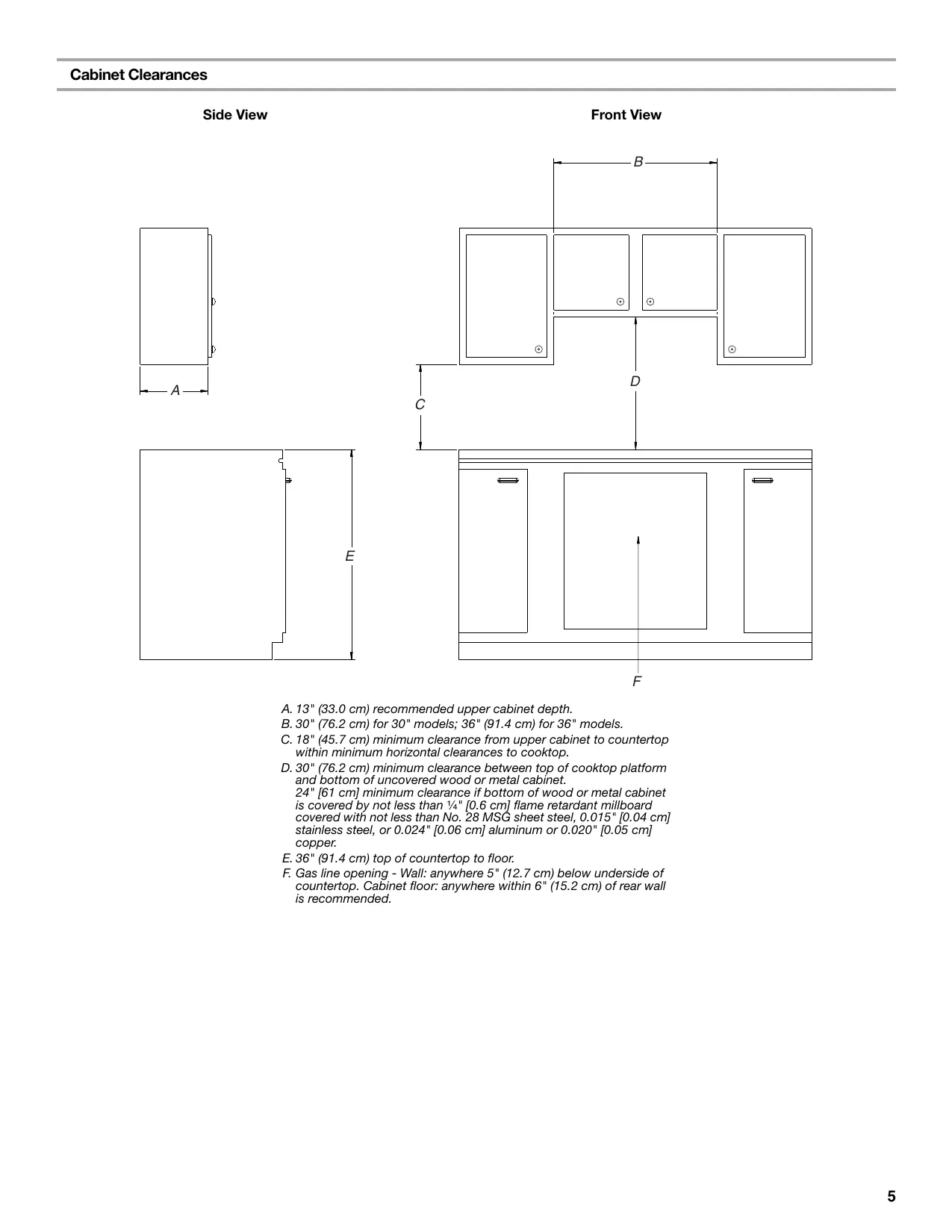
A. 13" (33.0 cm) recommended upper cabinet depth. B. 30" (76.2 cm) for 30" models; 36" (91.4 cm) for 36" models. C. 18" (45.7 cm) minimum clearance from upper cabinet to countertop within minimum horizontal clearances to cooktop. D. 30" (76.2 cm) minimum clearance between top of cooktop platform and bottom of uncovered wood or metal cabinet. 24" [61 cm] minimum clearance if bottom of wood or metal cabinet is covered by not less than ¹⁄₄" [0.6 cm] flame retardant millboard covered with not less than No. 28 MSG sheet steel, 0.015" [0.04 cm] stainless steel, or 0.024" [0.06 cm] aluminum or 0.020" [0.05 cm] copper. E. 36" (91.4 cm) top of countertop to floor. F. Gas line opening - Wall: anywhere 5" (12.7 cm) below underside of countertop. Cabinet floor: anywhere within 6" (15.2 cm) of rear wall is recommended.
Min Recommended Max Min Recommended KCGS550 and KCGS950 All Other 30" (76.2 cm) Models 28¹⁄₂" (72.4 cm) 28¹⁄₂" (72.4 cm) 28⁷⁄₈" (73.4 cm) 28⁷⁄₈" (73.4 cm) 29⁵⁄₁₆" (74.3 cm) 29⁵⁄₁₆" (74.3 cm) 19¹⁄₂" (49.5 cm) 19" (48.3 cm) 19¹³⁄₁₆" (50.2 cm) 19¹⁄₂" (49.5 cm) 20" (50.8 cm) 20" (50.8 cm) Max KCGS556 and KCGS956 All Other 36" (91.4 cm) Models 34⁷⁄₈" (88.4 cm) 33⁷⁄₈" (86.0 cm) 35³⁄₁₆" (89.4 cm) 34⁵⁄₁₆" (87.0 cm) 19¹⁄₂" (49.5 cm) 19" (48.3 cm) 19¹³⁄₁₆" (50.2 cm) 19¹⁄₂" (49.5 cm) 20" (50.8 cm) 20" (50.8 cm) 36" (91.4 cm)Models 35⁵⁄₈" (90.3 cm) 35¹⁄₄" (89.5 cm) Side Walls (Combustible Surfaces) Models H and I KCGS5 and KCGS9 H and I added together must be at least 48" (122.0 cm), with each side individually being at least 8" (20.3 cm). KCGS350, KCGS356, MGC9536, WCG97US0, WCG97US6 H and I added together must be at least 48" (122.0 cm), with each side individually being at least 12" (30.5 cm). All Other Models Both have to be 8" (20.3 cm) or more. Back Wall and Countertop Front Dimensions Models
2³⁄₄" (6.9 cm) 3¹⁄₈" (7.9 cm) NOTES: After making the countertop cutout, some installations may require notching down the base cabinet side walls to clear the cooktop base. To avoid this modification, use a base cabinet with sidewalls wider than the cutout. If cabinet has a drawer, a 4" (10.2 cm) depth clearance from the countertop to the top of the drawer (or other obstruction) in base cabinet is required. The drawer depth may need to be shortened to avoid interfering with the regulator. IMPORTANT: If a built-in wall oven is to be installed below this cooktop, the grounded outlet and gas supply piping must be located in an adjacent cabinet. This cooktop and its gas and electrical supply sources must be installed before the undercounter built-in wall oven is installed.
Electrical Requirements Gas Supply Requirements WARNING WARNING Electrical Shock Hazard Explosion Hazard Plug into a grounded 3 prong outlet. Use a new CSA International approved gas supply line. Do not remove ground prong. Install a shut-off valve. Do not use an adapter. Securely tighten all gas connections. Do not use an extension cord. If connected to LP, have a qualified person make sure gas pressure does not exceed 14" (36 cm) water column. Failure to follow these instructions can result in death, fire, or electrical shock. Examples of a qualified person include: IMPORTANT: The cooktop must be electrically grounded in accordance with local codes and ordinances, or in the absence of local codes, with the National Electrical Code, ANSI/NFPA 70 or Canadian Electrical Code, CSA C22.1. If codes permit and a separate ground wire is used, it is recommended that a qualified electrical installer determine that the ground path is adequate. A copy of the above code standards can be obtained from: National Fire Protection Association One Batterymarch Park Quincy, MA 02269 CSA International 8501 East Pleasant Valley Road Cleveland, Ohio 44131-5575 ■ A 120 volt, 60 Hz, AC only, 15-amp, fused electrical circuit is required. A time-delay fuse or circuit breaker is also recommended. It is recommended that a separate circuit serving only this cooktop be provided.
Electronic ignition systems operate within wide voltage limits, but proper grounding and polarity are necessary. Check that the outlet provides 120-volt power and is correctly grounded.
The wiring diagrams are provided with this cooktop. See “Wiring Diagrams” on a separate sheet. The wiring diagrams are located on the left underside of the cooktop base. licensed heating personnel, authorized gas company personnel, and authorized service personnel. Failure to do so can result in death, explosion, or fire. Observe all governing codes and ordinances. IMPORTANT: This installation must conform with all local codes and ordinances. In the absence of local codes, installation must conform with American National Standard, National Fuel Gas Code ANSI Z223.1 - latest edition or CAN/CGA B149 - latest edition. IMPORTANT: Leak testing of the cooktop must be conducted according to the manufacturer’s instructions. Type of Gas Natural Gas: This cooktop is design-certified by CSA International for use with Natural gas or, after proper conversion, for use with LP gas. ■ This cooktop is factory set for use with Natural gas. If converting to LP gas, see the “LP Gas Conversion” instructions provided in the package containing literature. The model/serial rating plate located on the underside of the cooktop base has information on the types of gas that can be used. If the types of gas listed do not include the type of gas available, check with the local gas supplier. LP Gas Conversion: Conversion must be done by a qualified service technician. No attempt shall be made to convert the cooktop from the gas specified on the model/serial rating plate for use with a different gas without consulting the serving gas supplier. See the Gas Conversion instructions provided in the package containing literature.
Gas Pressure Regulator Provide a gas supply line of ³⁄₄" (1.9 cm) rigid pipe to the cooktop location. A smaller size pipe on longer runs may result in insufficient gas supply. Pipe-joint compounds that resist the action of LP gas must be used. Do not use TEFLON®† tape. With LP gas, piping or tubing size should be ½" minimum. Usually, LP gas suppliers determine the size and materials used in the system. Flexible metal appliance connector:
If local codes permit, use a ¹⁄₂" or ³⁄₄" I.D. flexible stainless steel tubing gas connector, designed by CSA to connect the cooktop to the rigid gas supply line. The gas pressure regulator supplied with this cooktop must be used. The inlet pressure to the regulator should be as follows for proper operation: Natural Gas: Minimum pressure: 5" (12.7 cm) WCP Maximum pressure: 7" to 14" (17.8 cm to 35.5 cm) WCP LP Gas: Minimum pressure: 10" (25.4 cm) WCP Maximum pressure: 14" (35.5 cm) WCP Contact local gas supplier if you are not sure about the inlet pressure. Burner Input Requirements
A ½" male pipe thread is needed for connection to the female pipe threads of the inlet to the cooktop pressure regulator.
Do not kink or damage the flexible metal tubing when moving the cooktop. Must include a shutoff valve: The supply line must be equipped with a manual shutoff valve. This valve should be located in the same room but external to the cooktop opening, such as an adjacent cabinet. It must be accessible without removing the cooktop, and it should be in a location that allows ease of opening and closing. Do not block access to shutoff valve. The valve is for turning on or shutting off gas to the cooktop.
A. Gas supply line B. Shutoff valve “open” position C. To cooktop †®TEFLON is a registered trademark of E.I. Du Pont De Nemours and Company.
Input ratings shown on the model/serial rating plate are for elevations up to 2,000 ft (609.6 m). For elevations above 2,000 ft (609.6 m), ratings should be reduced at a rate of 4% for each 1,000 ft (304.8 m) above sea level (not applicable for Canada). Gas Supply Pressure Testing Gas supply pressure for testing regulator must be at least 1" water column pressure above the manifold pressure shown on the model/serial rating plate. Line pressure testing above ½ psi gauge (14" WCP) The cooktop and its individual shutoff valve must be disconnected from the gas supply piping system during any pressure testing of that system at test pressures in excess of ½ psi (3.5 kPa). Line pressure testing at ½ psi gauge (14" WCP) or lower The cooktop must be isolated from the gas supply piping system by closing its individual manual shutoff valve during any pressure testing of the gas supply piping system at test pressures equal to or less than ½ psi (3.5 kPa). INSTALLATION INSTRUCTIONS
4. Attach brackets to cooktop base bottom with bracket
attachment screws. Securely tighten screws. Install Cooktop
WARNING Excessive Weight Hazard
Use two or more people to move and install cooktop. Failure to do so can result in back or other injury.
Decide on the final location for the cooktop. Avoid drilling into or severing existing wiring during installation.
1. Determine whether your cabinet construction provides
clearance for installing clamping brackets at cooktop base ends. This is the recommended location. Clamping brackets can be installed on the front and back of cooktop base bottom, if necessary.
A. Cooktop B. Cooktop base C. 2" (5.1 cm) bracket attachment screw D. Clamping bracket (extends far enough beyond cooktop base to allow installation of clamping screws) E. Countertop Make Gas Connection WARNING A. Attachment screw holes for optional front and back location B. Cooktop base bottom C. Attachment screw D. Clamping bracket (end locations recommended) Explosion Hazard
2. Using 2 or more people, place cooktop right side up into the
cutout. NOTE: Make sure that the front edge of the cooktop is parallel to the front edge of the countertop. If repositioning is needed, lift entire cooktop up from cutout to avoid scratching the countertop.
3. Remove the attachment screws for the selected bracket
locations from the bottom of the cooktop base.
Use a new CSA International approved gas supply line. Install a shut-off valve. Securely tighten all gas connections. If connected to LP, have a qualified person make sure gas pressure does not exceed 14" (36 cm) water column. Examples of a qualified person include: licensed heating personnel, authorized gas company personnel, and authorized service personnel. Failure to do so can result in death, explosion, or fire.
1. Apply pipe-joint compound made for use with Natural and LP
gas to the smaller thread ends of the flexible connector adapters (see C and G in the following illustration).
2. Attach one adapter to the gas pressure regulator and the
other adapter to the gas shutoff valve. Tighten both adapters.
3. Use a ¹⁵⁄₁₆" combination wrench and channel lock pliers to
attach the flexible connector to the adapters. Check that connector is not kinked. IMPORTANT: All connections must be wrench-tightened. Do not make connections to the gas regulator too tight. Making the connections too tight may crack the regulator and cause a gas leak. Do not allow the regulator to turn when tightening fittings. No appliance/obstructions below cooktop Suggested installation to avoid interference below cooktop
A. Manifold entrance B. Gas pressure regulator C. Use pipe-joint compound. D. Adapter (must have ½" male pipe thread) E. Flexible connector F. Adapter G. Use pipe-joint compound. H. Manual gas shutoff valve
4. Install the pressure regulator with the arrow pointing in the
direction toward the bottom of the cooktop base and in a position where you can reach the regulator access cap.
A. Access cap B. Rear of cooktop C. Gas pressure regulator D. Up arrow. The regulator must be installed with the arrow pointing toward the cooktop bottom. Use only pipe-joint compound made for use with Natural and LP gas. Do not use TEFLON® tape. You will need to determine the fittings required depending on your installation. Complete Connection
1. Open the manual shutoff valve in the gas supply line. The
valve is open when the handle is parallel to the gas pipe.
A. Manifold entrance B. ³⁄₈" elbow C. Use pipe-joint compound. D. Adapter (must have ³⁄₈" male pipe thread) E. Flexible connector (pass through wall between cabinets) F. Adapter (must have ³⁄₈" male pipe thread) G. Use pipe-joint compound. H. Appliance pressure regulator (supplied)
I. ½" or ¾" gas pipe
J. Manual gas shutoff valve K. ½" or ¾" gas pipe A. Closed valve B. Open valve
2. Test all connections by brushing on an approved
noncorrosive leak-detection solution. Bubbles will show a leak. Correct any leak found.
3. Remove surface burner caps, burner base and grates from
parts package. Align notches in burner caps with pins in burner base. Align orifice holder in burner base with igniter electrode. Burner caps should be level when properly positioned. If burner caps are not properly positioned, surface burners will not light. Place burner grates over burners and caps.
A. Orifice holder B. Burner cap C. Gas tube opening D. Burner base E. Igniter electrode
WARNING Check Flame Height Adjust the height of surface burner flames. The surface burner “low” flame should be a steady blue flame approximately ¼" (6.4 mm) high.
Electrical Shock Hazard Plug into a grounded 3 prong outlet.
Do not remove ground prong. Do not use an adapter. A. Low flame B. High flame Do not use an extension cord. Failure to follow these instructions can result in death, fire, or electrical shock.
4. Plug into a grounded 3 prong outlet.
Complete Installation Electronic Ignition System Adjustment for Single Valve:
1. Set the burner flame to LO.
2. Remove the control knob.
3. Hold knob stem with a pair of pliers. Use a ³⁄₃₂" (#0 [2 mm])
flat-blade screwdriver to turn the screw located within the shaft of the control knob stem until the flame is the proper size. Turn adjustment screw “C” to the right to reduce flame height, turn adjustment screw to the left to increase flame height. Initial lighting and gas flame adjustments Surface burners use electronic igniters in place of standing pilots. When the cooktop control knob is turned to the “IGNITE” position, the system creates a spark to light the burner. This sparking continues, as long as the control knob is turned to “IGNITE.”
Check Operation of Surface Burners Push in and turn the surface burners control knobs to light. The surface burner flame should light within 4 seconds. The first time a surface burner is lit, it may take longer that 4 seconds to light because of air in the gas line. Check the flame on “HIGH” for a blue color. It should be clean and soft in character. No yellow tip, blowing or lifting of flame should occur. Occasional orange flashes are normal and reflect different elements in the air or gas. After verifying the proper burner operation, turn the control knobs to “OFF.” If burners do not light properly: ■ Turn surface burner control knob to the “OFF” position.
Check that the power supply cord is plugged in and the circuit breaker has not tripped or the fuse blown.
Check that the gas shutoff valve is set to the “open” position.
Check that burner caps are properly positioned on burner bases. A. ³⁄₃₂" (#0 [2.0 mm]) flat-blade screwdriver (screwdriver shaft must be a minimum of 2" [5.1 cm] long) B. Control knob stem opening C. Adjustment screw location
4. Replace the control knob.
5. Test the flame by turning the control from LO to HI, checking
the flame at each setting IMPORTANT: Dual valve adjustments must be performed by a qualified installer or service agency. Recheck operation of surface burners. If a burner does not light at this point, contact your dealer or authorized service company for assistance.