AX203 - WiFi Adapter INTEL - Free user manual and instructions
Find the device manual for free AX203 INTEL in PDF.


| Product Type | WiFi Adapter |
| Brand | Intel |
| Model | AX203 |
| Wireless Standards | IEEE 802.11a/b/g/n/ac/ax |
| Frequency Bands | 2.4 GHz and 5 GHz |
| Maximum Data Rate | Up to 2.4 Gbps (5 GHz band) |
| Interface | M.2 (Key E) |
| Dimensions | 22 x 30 x 2.4 mm (2230 form factor) |
| Weight | Approximately 3 g |
| Power Supply | Via PCIe bus (3.3 V) |
| Power Consumption | Low, typical < 5 W |
| Integrated Bluetooth | Bluetooth 5.2 |
| Wireless Security | WPA3, WPA2, WPA, 802.1X |
| Flow Management | MU-MIMO, OFDMA, beamforming |
| Operating Temperature | 0 °C to 80 °C |
| Operating Humidity | 10% to 90% RH (non-condensing) |
| Maintenance and Cleaning | Disconnect the device before cleaning. Use a soft, dry cloth. Avoid chemical products. |
| Compatible Devices | Laptops and desktops with M.2 Key E slot |
| Package Contents | Adapter card, antenna(s), mounting screws, installation guide |
| Repairability | Non-user-serviceable part. Replace the entire unit if faulty. |
| Regulatory Information | Certified CE, FCC, IC. Indoor use mandatory on 5.15-5.25 GHz band. |
Frequently Asked Questions - AX203 INTEL
User questions about AX203 INTEL
0 question about this device. Answer the ones you know or ask your own.
Ask a new question about this device
Download the instructions for your WiFi Adapter in PDF format for free! Find your manual AX203 - INTEL and take your electronic device back in hand. On this page are published all the documents necessary for the use of your device. AX203 by INTEL.
USER MANUAL AX203 INTEL
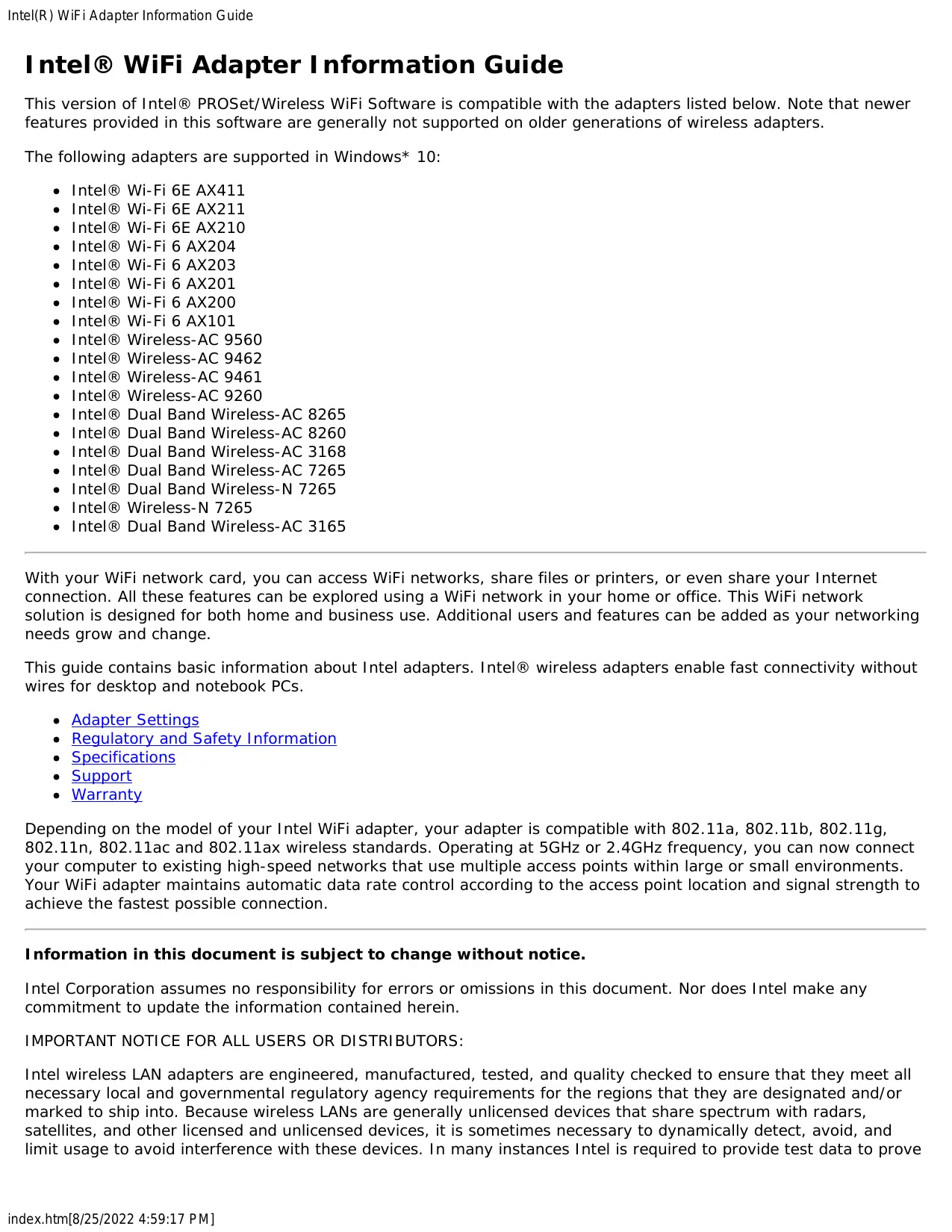
Intel® WiFi Adapter Information Guide
This version of Intel® PROSet/Wireless WiFi Software is compatible with the adapters listed below. Note that newer features provided in this software are generally not supported on older generations of wireless adapters.
The following adapters are supported in Windows* 10:
Intel® Wi-Fi 6E AX411
- Intel® Wi-Fi 6E AX211
Intel® Wi-Fi 6E AX210
Intel® Wi-Fi 6 AX204
Intel® Wi-Fi 6 AX203
- Intel® Wi-Fi 6 AX201
- Intel® Wi-Fi 6 AX200
Intel® Wi-Fi 6 AX101
Intel® Wireless-AC 9560
Intel® Wireless-AC 9462
Intel® Wireless-AC 9461
Intel® Wireless-AC 9260
Intel® Dual Band Wireless-AC 8265
Intel® Dual Band Wireless-AC 8260
Intel® Dual Band Wireless-AC 3168
Intel® Dual Band Wireless-AC 7265
Intel® Dual Band Wireless-N 7265
- Intel® Wireless-N 7265
Intel® Dual Band Wireless-AC 3165
With your WiFi network card, you can access WiFi networks, share files or printers, or even share your Internet connection. All these features can be explored using a WiFi network in your home or office. This WiFi network solution is designed for both home and business use. Additional users and features can be added as your networking needs grow and change.
This guide contains basic information about Intel adapters. Intel® wireless adapters enable fast connectivity without wires for desktop and notebook PCs.
- Adapter Settings
Regulatory and Safety Information - Specifications
Support
Warranty
Depending on the model of your Intel WiFi adapter, your adapter is compatible with 802.11a, 802.11b, 802.11g, 802.11n, 802.11ac and 802.11ax wireless standards. Operating at 5GHz or 2.4GHz frequency, you can now connect your computer to existing high-speed networks that use multiple access points within large or small environments. Your WiFi adapter maintains automatic data rate control according to the access point location and signal strength to achieve the fastest possible connection.
Information in this document is subject to change without notice.
Intel Corporation assumes no responsibility for errors or omissions in this document. Nor does Intel make any commitment to update the information contained herein.
IMPORTANT NOTICE FOR ALL USERS OR DISTRIBUTORS:
Intel wireless LAN adapters are engineered, manufactured, tested, and quality checked to ensure that they meet all necessary local and governmental regulatory agency requirements for the regions that they are designated and/or marked to ship into. Because wireless LANs are generally unlicensed devices that share spectrum with radars, satellites, and other licensed and unlicensed devices, it is sometimes necessary to dynamically detect, avoid, and limit usage to avoid interference with these devices. In many instances Intel is required to provide test data to prove
regional and local compliance to regional and governmental regulations before certification or approval to use the product is granted. Intel's wireless LAN's EEPROM, firmware, and software driver are designed to carefully control parameters that affect radio operation and to ensure electromagnetic compliance (EMC). These parameters include, without limitation, RF power, spectrum usage, channel scanning, and human exposure.
For these reasons Intel cannot permit any manipulation by third parties of the software provided in binary format with the wireless LAN adapters (e.g., the EEPROM and firmware). Furthermore, if you use any patches, utilities, or code with the Intel wireless LAN adapters that have been manipulated by an unauthorized party (i.e., patches, utilities, or code (including open source code modifications) which have not been validated by Intel), (i) you will be solely responsible for ensuring the regulatory compliance of the products, (ii) Intel will bear no liability, under any theory of liability for any issues associated with the modified products, including without limitation, claims under the warranty and/or issues arising from regulatory non-compliance, and (iii) Intel will not provide or be required to assist in providing support to any third parties for such modified products.
Note: Many regulatory agencies consider Wireless LAN adapters to be "modules", and accordingly, condition system-level regulatory approval upon receipt and review of test data documenting that the antennas and system configuration do not cause the EMC and radio operation to be non-compliant.
Intel and the Intel logo are trademarks of Intel Corporation in the U.S. and/or other countries.
*Other names and brands may be claimed as the property of others.
© Intel Corporation.
February 2022
Adapter Settings
The Advanced tab displays the device properties for the WiFi adapter installed on your computer.
How to Access
Double-click on the Intel WiFi adapter in the Network adapters section of the Device Manager and select the Advanced tab.
A description of the WiFi adapter settings on the Advanced tab can be found here:
https://www.intel.com/content/www/us/en/support/articles/000005585/network-and-i-o/wireless-networking.html
Back to Top
Back to Contents
Trademarks and Disclaimers
Regulatory Information
This section provides regulatory information for the following wireless adapters:
Intel® Centrino® Wireless-N 100
Intel® Centrino® Wireless-N 105
Intel® Centrino® Wireless-N 130
Intel® Centrino® Wireless-N 135
Intel® Centrino® Wireless-N 1000
Intel® Centrino® Wireless-N 1030
Intel® Centrino® Wireless-N 2200
Intel® Centrino® Wireless-N 2230
Intel® Centrino® Wireless-N + WiMAX 6150
Intel® Centrino® Advanced-N 6200
Intel® Centrino® Advanced-N 6205
Intel® Centrino® Advanced-N 6230
Intel® Centrino® Advanced-N 6235
Intel® Centrino® Advanced-N + WiMAX 6250
Intel® Centrino® Ultimate-N 6300
Intel® Dual Band Wireless-AC 7260
Intel® Dual Band Wireless-N 7260
Intel® Wireless-N 7260
Intel® Dual Band Wireless-AC 3160
Intel® Dual Band Wireless-AC 3165
Intel® Dual Band Wireless-AC 3168
Intel® Dual Band Wireless-AC 7265
Intel® Dual Band Wireless-N 7265
Intel® Wireless-N 7265
Intel® Dual Band Wireless-AC 8260
Intel® Dual Band Wireless-AC 8265
Intel® Wireless-AC 9260
Intel Wireless-AC 9461
Intel® Wireless-AC 9462
Intel® Wireless-AC 9560
Intel® Tri-Band Wireless-AC 17265
Intel® Tri-Band Wireless-AC 18260
Intel® Tri-Band Wireless-AC 18265
Intel® Wireless Gigabit Sink W13100
Intel® Wireless Gigabit 11000
Intel® Wireless Gigabit Sink W13110VR
Intel® Wireless Gigabit 11100VR
Intel® Wi-Fi 6 AX101
Intel® Wi-Fi 6 AX200
Intel® Wi-Fi 6 AX201
Intel® Wi-Fi 6 AX203
Intel® Wi-Fi 6 AX204
Intel® Wi-Fi 6E AX210
Intel® Wi-Fi 6E AX211
Intel® Wi-Fi 6E AX411
NOTE: Due to the evolving state of regulations and standards in the wireless LAN field (IEEE 802.11 and similar standards), the information provided herein is subject to change. Intel Corporation assumes no responsibility for errors or omissions in this document.
Intel WiFi/WiMAX Wireless Adapters
Information in this section supports the following wireless adapters:
Intel® Centrino® Wireless-N + WiMAX 6150
Intel® Centrino® Advanced-N + WiMAX 6250
See Specifications for complete wireless adapter specifications.
NOTE: In this section, all references to the "wireless adapter" refer to all adapters listed above.
The following information is provided:
Information for the User
Regulatory Information
Regulatory ID
Information for OEMs and Host Integrators
INFORMATION FOR THE USER
Safety Notices
USA FCC Radio Frequency Exposure
The FCC with its action in ET Docket 96-8 has adopted a safety standard for human exposure to radio frequency (RF) electromagnetic energy emitted by FCC certified equipment. The wireless adapter meets the Human Exposure requirements found in FCC Part 2, 15C, 15E along with guidance from KDB 447498, KDB 248227 and KDB 616217. Proper operation of this radio according to the instructions found in this manual will result in exposure substantially below the FCC's recommended limits.
The following safety precautions should be observed:
- Do not touch or move antenna while the unit is transmitting or receiving.
- Do not hold any component containing the radio such that the antenna is very close or touching any exposed parts of the body, especially the face or eyes, while transmitting.
- Do not operate the radio or attempt to transmit data unless the antenna is connected; this behavior may cause damage to the radio.
-
Use in specific environments:
-
The use of wireless adapters in hazardous locations is limited by the constraints posed by the safety directors of such environments.
- The use of electronic devices equipped with wireless adapters on airplanes is governed by rules for each commercial airline operator.
- The use of wireless adapters in hospitals is restricted to the limits set forth by each hospital.
Explosive Device Proximity Warning

Warning: Do not operate a portable transmitter (including this wireless adapter) near unshielded blasting caps or in an explosive environment unless the transmitter has been modified to be qualified for such use.
AntennaWarnings

Warning: The wireless adapter is not designed for use with high-gain directional antennas.
Use On Aircraft Caution

Caution: Regulations of commercial airline operators may prohibit airborne operation of certain electronic devices equipped with radio-frequency wireless devices (less adapters) because their signals could interfere with critical aircraft instruments.

Caution: 60 GHz/802.11ad equipment is not permitted on aircraft per FCC §15.255. OEM and host integrators should consider this FCC rule in host devices.
Other Wireless Devices
Safety Notices for Other Devices in the Wireless Network: See the documentation supplied with wireless adapters or other devices in the wireless network.
Local Restrictions on 802.11a, 802.11b, 802.11d, 802.11g, 802.11n, 802.11ac, and 802.16e Radio Usage
Caution: Due to the fact that the frequencies used by 802.11a, 802.11b, 802.11d, 802.11g, 802.11n, 802.11ac, and 802.16e wireless LAN devices may not yet be harmonized in all countries, 802.11a, 802.11b, 802.11d, 802.11g, 802.11n, 802.11ac, and 802.16e products are designed for use only in specific countries, and are not allowed to be operated in countries other than those of designated use. As a user of these products, you are responsible for ensuring that the products are used only in the countries for which they were intended and for verifying that they are configured with the correct selection of frequency and channel for the country of use. The device transmit power control (TPC) interface is part of the Intel® PROSet/Wireless WiFi Connection Utility Software. Operational restrictions for Equivalent Isotropic Radiated Power (EIRP) are provided by the system manufacturer. Any deviation from the permissible power and frequency settings for the country of use is an infringement of national law and may be punished as such.
Wireless Interoperability
The wireless adapter is designed to be interoperable with other wireless LAN products that are based on direct sequence spread spectrum (DSSS) radio technology and to comply with the following standards:
- IEEE Std. 802.11b compliant Standard on Wireless LAN
- IEEE Std. 802.11g compliant Standard on Wireless LAN
- IEEE Std. 802.11a compliant Standard on Wireless LAN
- IEEE Std. 802.11n draft 2.0 compliant on Wireless LAN
- IEEE 802.16e-2005 Wave 2 compliant
- Wireless Fidelity certification, as defined by the Wi-Fi Alliance
- WiMAX certification as defined by the WiMAX Forum
The Wireless Adapter and Your Health
The wireless adapter, like other radio devices, emits radio frequency electromagnetic energy. The level of energy emitted by the wireless adapter, however, is less than the electromagnetic energy emitted by other wireless devices such as mobile phones. The wireless adapter operates within the guidelines found in radio frequency safety standards and recommendations. These standards and recommendations reflect the consensus of the scientific community and result from deliberations of panels and committees of scientists who continually review and interpret the extensive research literature. In some situations or environments, the use of the wireless adapter may be restricted by the proprietor of the building or responsible representatives of the applicable organization. Examples of such situations may include:
- Using the wireless adapter on board airplanes, or
- Using the wireless adapter in any other environment where the risk of interference with other devices or services is perceived or identified as being harmful.
If you are uncertain of the policy that applies to the use of wireless adapters in a specific organization or environment (an airport, for example), you are encouraged to ask for authorization to use the adapter before you turn it on.
REGULATORY INFORMATION
USA - Federal Communications Commission (FCC)
No configuration controls are provided for Intel® wireless adapters allowing any change in the frequency of operations outside the FCC grant of authorization for U.S. operation according to Part 15.407 of the FCC rules.
- Intel® wireless adapters are intended for OEM integrators only.
- Intel® wireless adapters cannot be co-located with any other transmitter unless approved by the FCC.
This wireless adapter complies with Part 15 of the FCC Rules. Operation of the device is subject to the following two conditions:
- This device may not cause harmful interference.
- This device must accept any interference that may cause undesired operation.
Class B Device Interference Statement
This wireless adapter has been tested and found to comply with the limits for a Class B digital device, pursuant to Part 15 of the FCC Rules. These limits are designed to provide reasonable protection against harmful interference in a residential installation. This wireless adapter generates, uses, and can radiate radio frequency energy. If the wireless adapter is not installed and used in accordance with the instructions, the wireless adapter may cause harmful interference to radio communications. There is no guarantee, however, that such interference will not occur in a particular installation. If this wireless adapter does cause harmful interference to radio or television reception (which can be determined by turning the equipment off and on), the user is encouraged to try to correct the interference by taking one or more of the following measures:
- Reorient or relocate the receiving antenna of the equipment experiencing the interference.
- Increase the distance between the wireless adapter and the equipment experiencing the interference.
- Connect the computer with the wireless adapter to an outlet on a circuit different from that to which the equipment experiencing the interference is connected.
- Consult the dealer or an experienced radio/TV technician for help.
NOTE: The adapter must be installed and used in strict accordance with the manufacturer's instructions as described in the user documentation that comes with the product. Any other installation or use will violate FCC Part 15 regulations.
Safety Approval Considerations
This device has been safety approved as a component and is for use only in complete equipment where the acceptability of the combination is determined by the appropriate safety agencies. When installed, consideration must be given to the following:
It must be installed into a compliant host device meeting the requirement of UL/EN/IEC 60950-1 2nd edition including the general provisions of enclosure design 1.6.2 and specifically paragraph 1.2.6.2 (Fire Enclosure).
- The device shall be supplied by a SELV source when installed in the end-use equipment.
- A heating test shall be considered in the end-use product for meeting the requirement of UL/EN/IEC 60950-1 2nd edition.
Low Halogen
Applies only to brominated and chlorinated flame retardants (BFRs/CFRs) and PVC in the final product. Intel components as well as purchased components on the finished assembly meet JS-709 requirements, and the PCB / substrate meet IEC 61249-2-21 requirements. The replacement of halogenated flame retardants and/or PVC may not be better for the environment.
Japan
5GHz 带は室内のは使用のと
Korea
To determine whether you are allowed to use your wireless network device in a specific country, please check to see if the radio type number that is printed on the identification label of your device is listed in the manufacturer's OEM Regulatory Guidance document.
Modular Regulatory Certification Country Markings
A list of countries requiring regulatory markings is available. Note that the lists include only countries requiring marking but not all certified countries. To find the regulatory country marking information for your adapter, perform these steps:
- Open this web site: http://www.intel.com/content/www/us/en/support/network-and-i-o/wireless-networking/000007443.html
- Click on the link for your adapter.
- Click on Regulatory Marking Document for your adapter.
INFORMATION FOR OEMs and HOST INTEGRATORS
The guidelines described within this document are provided to OEM integrators installing Intel® wireless adapters in notebook and tablet PC host platforms. Adherence to these requirements is necessary to meet the conditions of compliance with FCC rules, including RF exposure. When all antenna type and placement guidelines described herein are fulfilled the Intel® wireless adapters may be incorporated into notebook and tablet PC host platforms with no further restrictions. If any of the guidelines described herein are not satisfied it may be necessary for the OEM or integrator to perform additional testing and/or obtain additional approval. The OEM or integrator is responsible to determine the required host regulatory testing and/or obtaining the required host approvals for compliance.
- Intel® wireless adapters are intended for OEMs and host integrators only.
- The Intel® wireless adapter FCC Grant of Authorization describes any limited conditions of modular approval.
- The Intel® wireless adapters must be operated with an access point that has been approved for the country of operation.
Changes or modification to Intel® wireless adapters by OEMs, integrators or other third parties is not permitted. Any changes or modification to Intel® wireless adapters by OEMs, integrators or other third parties will void authorization to operate the adapter.
Antenna Type and Gains
Only antennas of the same type and with equal or less gains as 3dBi for the 2.4GHz band and 5dBi for the 5GHz band shall be used with the Intel® wireless adapters. Other types of antennas and/or higher gain antennas may require additional authorization for operation. For testing purposes the following dual band antenna that approximates closely the above limits was used:
| Antenna Type | Antenna Location (Main/Aux) | 2.4GHz Peak Gain in dBi* | 5.2GHz Peak Gain in dBi* | 5.5GHz Peak Gain in dBi* | 5.7GHz Peak Gain in dBi* |
| PIFA | Main | ||||
| Aux | 3.24 | 3.73 | 4.77 | 4.77 | |
| MIMO | |||||
| *All antenna gains include cable loss. | |||||
Antenna Placement Within the Host Platform
To ensure RF exposure compliance the antenna(s) used with the Intel® wireless adapters must be installed in notebook or tablet PC host platforms to provide a minimum separation distance from all persons, in all operating modes and orientations of the host platform, with strict adherence to the table below. The antenna separation distance applies to both horizontal and vertical orientation of the antenna when installed in the host system.
| Intel® Wireless Adapter | Minimum required antenna-to-user separation distance |
| Intel® Centrino® Wireless-N + WiMAX 6150 | 18 mm |
| Intel® Centrino® Wireless-N + WiMAX 6350 | 17 mm |
Simultaneous Transmission of Intel® Wireless Adapters with Other Integrated or Plug-In Transmitters
Based upon FCC Knowledge Database publication number 616217 when there are multiple transmitting devices installed in a host device, an RF exposure transmitting assessment shall be performed to determine the necessary application and test requirements. OEM integrators must identify all possible combinations of simultaneous transmission configurations for all transmitters and antennas installed in the host system. This includes transmitters installed in the host as mobile devices ( >20 cm separation from user) and portable devices ( <20 cm separation from user). OEM integrators should consult the actual FCC KDB 616217 document for all details in making this assessment to determine if any additional requirements for testing or FCC approval is necessary.
Information To Be Supplied to the End User by the OEM or Integrator
The following regulatory and safety notices must be published in documentation supplied to the end user of the product or system incorporating the Intel® wireless adapter, in compliance with local regulations. Host system must be labeled with "Contains FCC ID:XXXXXXXX", FCC ID displayed on label.
The Intel® wireless adapter must be installed and used in strict accordance with the manufacturer's instructions as described in the user documentation that comes with the product. Intel Corporation is not responsible for any radio or television interference caused by unauthorized modification of the devices included with the wireless adapter kit or the substitution or attachment of connecting cables and equipment other than that specified by Intel Corporation. The correction of interference caused by such unauthorized modification, substitution or attachment is the responsibility of the user. Intel Corporation and authorized resellers or distributors are not liable for any damage or violation of government regulations that may arise from the user failing to comply with these guidelines.
China:
The following statement on local restrictions must be published as part of the compliance documentation for all 802.11a, 802.11b, 802.11g and 802.11n products.
Caution: Due to the fact that the frequencies used by 802.11a, 802.11b, 802.11g, 802.11n, and 802.16e wireless LAN devices may not yet be harmonized in all countries, 802.11a, 802.11b, 802.11g, 802.11n, and 802.16e products are designed for use only in specific countries, and are not allowed to be operated in countries other than those of designated use. As a user of these products, you are responsible for ensuring that the products are used only in the countries for which they were intended and for verifying that they are configured with the correct selection of frequency and channel for the country of use. Any deviation from the permissible power and frequency settings for the country of use is an infringement of national law and may be punished as such.
Intel WiFi Adapters - 802.11n, 802.11ac and 802.11ax Compliant
The information in this section applies to the following products:
Intel® Centrino® Wireless-N 100
Intel® Centrino® Wireless-N 105
Intel® Centrino® Wireless-N 130
Intel® Centrino® Wireless-N 135
Intel® Centrino® Wireless-N 1000
Intel® Centrino® Wireless-N 1030
Intel® Centrino® Wireless-N 2200
Intel® Centrino® Wireless-N 2230
Intel® Centrino® Advanced-N 6200
Intel® Centrino® Advanced-N 6205
Intel® Centrino® Advanced-N 6230
Intel® Centrino® Advanced-N 6235
Intel® Centrino® Ultimate-N 6300
Intel® Dual Band Wireless-AC 7260
Intel® Dual Band Wireless-N 7260
Intel® Wireless-N 7260
Intel® Dual Band Wireless-AC 3160
Intel® Dual Band Wireless-AC 3165
Intel® Dual Band Wireless-AC 3168
Intel® Dual Band Wireless-AC 7265
Intel® Dual Band Wireless-N 7265
Intel® Wireless-N 7265
Intel® Dual Band Wireless-AC 8260
Intel® Dual Band Wireless-AC 8265
Intel Wireless-AC 9260
Intel® Wireless-AC 9461
Intel Wireless-AC 9462
Intel® Wireless-AC 9560
Intel® Tri-Band Wireless-AC 17265
Intel® Tri-Band Wireless-AC 18260
Intel® Tri-Band Wireless-AC 18265
- Intel® Wireless Gigabit Sink W13100
Intel Wireless Gigabit 11000
Intel® Wireless Gigabit Sink W13110VR
- Intel® Wireless Gigabit 11100VR
Intel® Wi-Fi 6 AX101
Intel® Wi-Fi 6 AX200
Intel® Wi-Fi 6 AX201
Intel® Wi-Fi 6 AX203
Intel® Wi-Fi 6 AX204
Intel® Wi-Fi 6E AX210
Intel® Wi-Fi 6E AX211
Intel® Wi-Fi 6E AX411
See Specifications for complete wireless adapter specifications.
NOTE: In this section, all references to the "wireless adapter" refer to all adapters listed above.
The following information is provided:
Information for the User
Regulatory Information
Regulatory ID
Information for OEMs and Host Integrators
Statements of European Compliance
INFORMATION FOR THE USER
Safety Notices
USA FCC Radio Frequency Exposure
The FCC with its action in ET Docket 96-8 has adopted a safety standard for human exposure to radio frequency (RF) electromagnetic energy emitted by FCC certified equipment. The wireless adapter meets the Human Exposure requirements found in FCC Part 2, 15C, 15E along with guidance from KDB 447498, KDB 248227 and KDB 616217. Proper operation of this radio according to the instructions found in this manual will result in exposure substantially below the FCC's recommended limits.
The following safety precautions should be observed:
- Do not touch or move antenna while the unit is transmitting or receiving.
- Do not hold any component containing the radio such that the antenna is very close or touching any exposed parts of the body, especially the face or eyes, while transmitting.
- Do not operate the radio or attempt to transmit data unless the antenna is connected; this behavior may cause damage to the radio.
-
Use in specific environments:
-
The use of wireless adapters in hazardous locations is limited by the constraints posed by the safety directors of such environments.
- The use of wireless adapters on airplanes is governed by the Federal Aviation Administration (FAA).
- The use of wireless adapters in hospitals is restricted to the limits set forth by each hospital.
Explosive Device Proximity Warning

Warning: Do not operate a portable transmitter (including this wireless adapter) near unshielded blasting caps or in an explosive environment unless the transmitter has been modified to be qualified for such use.
AntennaWarnings

Warning: The wireless adapter is not designed for use with high-gain directional antennas.
Use On Aircraft Caution

Caution: Regulations of commercial airline operators may prohibit airborne operation of certain electronic devices equipped with radio-frequency wireless devices (wireless adapters) because their signals could interfere with critical aircraft instruments.

Caution: 60 GHz/802.11ad equipment is not permitted on aircraft per FCC §15.255. OEM and host integrators should consider this FCC rule in host devices.
Other Wireless Devices
Safety Notices for Other Devices in the Wireless Network: See the documentation supplied with wireless adapters or other devices in the wireless network.
Local Restrictions on 802.11a, 802.11b, 802.11d, 802.11g, 802.11n, and 802.11ac Radio Usage

Caution: Due to the fact that the frequencies used by 802.11a, 802.11b, 802.11d, 802.11g, 802.11n, and 802.11ac wireless LAN devices may not yet be harmonized in all countries, 802.11a, 802.11b, 802.11d, 802.11g, 802.11n, and 802.11ac products are designed for use only in specific countries, and are not allowed to be operated in countries other than those of designated use. As a user of these products, you are responsible for ensuring that the products are used only in the countries for which they were intended and for verifying that they are configured with the correct selection of frequency and channel for the country of use. The device transmit power control (TPC) interface is part of the Intel® PROSet/Wireless WiFi Connection Utility Software. Operational restrictions for Equivalent Isotropic Radiated Power (EIRP) are provided by the system manufacturer. Any deviation from the permissible power and frequency settings for the country of use is an infringement of national law and may be punished as such.
Wireless Interoperability
The wireless adapter is designed to be interoperable with other wireless LAN products that are based on direct sequence spread spectrum (DSSS) radio technology and to comply with the following standards:
- IEEE Std. 802.11b compliant Standard on Wireless LAN
- IEEE Std. 802.11g compliant Standard on Wireless LAN
- IEEE Std. 802.11a compliant Standard on Wireless LAN
- IEEE Std. 802.11n compliant Standard on Wireless LAN
- IEEE Std. 802.11ac draft compliant on Wireless LAN
- Wireless Fidelity certification, as defined by the Wi-Fi Alliance
The Wireless Adapter and Your Health
electromagnetic energy emitted by other wireless devices such as mobile phones. The wireless adapter operates within the guidelines found in radio frequency safety standards and recommendations. These standards and recommendations reflect the consensus of the scientific community and result from deliberations of panels and committees of scientists who continually review and interpret the extensive research literature. In some situations or environments, the use of the wireless adapter may be restricted by the proprietor of the building or responsible representatives of the applicable organization. Examples of such situations may include:
- Using the wireless adapter on board airplanes, or
- Using the wireless adapter in any other environment where the risk of interference with other devices or services is perceived or identified as being harmful.
If you are uncertain of the policy that applies to the use of wireless adapters in a specific organization or environment (an airport, for example), you are encouraged to ask for authorization to use the adapter before you turn it on.
REGULATORY INFORMATION
USA - Federal Communications Commission (FCC)
This wireless adapter is restricted to indoor use due to its operation in the 5.85 to 5.895 and 5.925 to 7.125GHz frequency ranges. No configuration controls are provided for Intel® wireless adapters allowing any change in the frequency of operations outside the FCC grant of authorization for U.S. operation according to Part 15.407 of the FCC rules.
- Intel® wireless adapters are intended for OEM integrators only.
- Intel® wireless adapters cannot be co-located with any other transmitter unless approved by the FCC.
This wireless adapter complies with Part 15 of the FCC Rules. Operation of the device is subject to the following two conditions:
- This device may not cause harmful interference.
- This device must accept any interference that may cause undesired operation.
NOTE: The radiated output power of the adapter is far below the FCC radio frequency exposure limits. Nevertheless, the adapter should be used in such a manner that the potential for human contact during normal operation is minimized. To avoid the possibility of exceeding the FCC radio frequency exposure limits, you should keep a distance of at least 20cm between you (or any other person in the vicinity), or the minimum separation distance as specified by the FCC grant conditions, and the antenna that is built into the computer. Details of the authorized configurations can be found at http://www.fcc.gov/oet/ea/ by entering the FCC ID number on the device.
Class B Device Interference Statement
This wireless adapter has been tested and found to comply with the limits for a Class B digital device, pursuant to Part 15 of the FCC Rules. These limits are designed to provide reasonable protection against harmful interference in a residential installation. This wireless adapter generates, uses, and can radiate radio frequency energy. If the wireless adapter is not installed and used in accordance with the instructions, the wireless adapter may cause harmful interference to radio communications. There is no guarantee, however, that such interference will not occur in a particular installation. If this wireless adapter does cause harmful interference to radio or television reception (which can be determined by turning the equipment off and on), the user is encouraged to try to correct the interference by taking one or more of the following measures:
- Reorient or relocate the receiving antenna of the equipment experiencing the interference.
- Increase the distance between the wireless adapter and the equipment experiencing the interference.
- Connect the computer with the wireless adapter to an outlet on a circuit different from that to which the equipment experiencing the interference is connected.
- Consult the dealer or an experienced radio/TV technician for help.
NOTE: The adapter must be installed and used in strict accordance with the manufacturer's instructions as described in the user documentation that comes with the product. Any other installation or use will violate FCC Part 15 regulations.
Safety Approval Considerations
This device has been safety approved as a component and is for use only in complete equipment where the acceptability of the combination is determined by the appropriate safety agencies. When installed, consideration must be given to the following:
It must be installed into a compliant host device meeting the requirement of UL/EN/IEC 60950-1 2nd edition including the general provisions of enclosure design 1.6.2 and specifically paragraph 1.2.6.2 (Fire Enclosure).
- The device shall be supplied by a SELV source when installed in the end-use equipment.
- A heating test shall be considered in the end-use product for meeting the requirement of UL/EN/IEC 60950-1 2nd edition.
Low Halogen
Applies only to brominated and chlorinated flame retardants (BFRs/CFRs) and PVC in the final product. Intel components as well as purchased components on the finished assembly meet JS-709 requirements, and the PCB / substrate meet IEC 61249-2-21 requirements. The replacement of halogenated flame retardants and/or PVC may not be better for the environment.
Canada - Industry Canada (IC)
This device complies with Industry Canada licence-exempt RSS standard(s). Operation is subject to the following two conditions: (1) this device may not cause interference, and (2) this device must accept any interference, including interference that may cause undesired operation of the device.
Caution: When using IEEE 802.11a wireless LAN, this product is restricted to indoor use due to its operation in the 5.15- to 5.25-GHz frequency range. Industry Canada requires this product to be used indoors for the frequency range of 5.15GHz to 5.25GHz to reduce the potential for harmful interference to co-channel mobile satellite systems. High power radar is allocated as the primary user of the 5.25- to 5.35-GHz and 5.65 to 5.85-GHz bands. These radar stations can cause interference with and/or damage to this device. The maximum allowed antenna gain for use with this device is 6dBi in order to comply with the E.I.R.P limit for the 5.25- to 5.35 and 5.725 to 5.85GHz frequency range in point-to-point operation. To comply with RF exposure requirements all antennas should be located at a minimum distance of 20cm, or the minimum separation distance allowed by the module approval, from the body of all persons.
Under Industry Canada regulations, this radio transmitter may only operate using an antenna of a type and maximum (or lesser) gain approved for the transmitter by Industry Canada. To reduce potential radio interference to other users, the antenna type and its gain should be so chosen that the equivalent isotropically radiated power (e.i.r.p.) is not more than that necessary for successful communication.
The low band 5.15 - 5.35GHz is for indoor use only.
The 6E band 5.925 - 6.425GHz is for Low Power in-door (LPI)
| CE | B | AT | BE | BG | CH | CY | CZ | DE |
| DK | EE | EL | ES | FI | FR | HR | ||
| HU | IE | IS | IT | LI | LT | LU | ||
| LV | MT | NL | PL | PT | RO | SE | ||
| SI | SK | TR | UK (NI) | |||||
This equipment complies with the essential requirements of the European Union directive 2014/53/EU. See Statements of European Union Compliance.
European Union Declarations of Conformity
To view the European Union Declaration of Conformity for your adapter, perform these steps.
- Open this web site: http://www.intel.com/content/www/us/en/support/network-and-i-o/wireless-networking/000007443.html
- Click on "User Guide."
- Scroll to your adapter.
To view additional regulatory information for your adapter, perform these steps:
- Open this web site: http://www.intel.com/content/www/us/en/support/network-and-i-o/wireless-networking/000007443.html
- Click on the link for your adapter.
- Click on Regulatory Marking Document for your adapter.
Waste Electrical and Electronic Equipment Directive (WEEE)

Restriction of Hazardous Substances Directive (RoHS) Compliant
All products described herein are compliant with the European Union's RoHS Directive.
For CE Mark-Related Questions related to the wireless adapter, contact:
Intel Corporation Attn: Corporate Quality 2200 Mission College Blvd. Santa Clara, CA 95054-1549 USA
Japan
5GHz 带は室内のは使用のと
Korea
賊当早定信比是前和汇生能成也无或为用代明安阿和开则
The operation of this product in the radio channel 2 (2417 MHz) is not authorized in the following cities:
Agadir, Assa-Zag, Cabo Negro, Chaouen, Goulmima, Oujda, Tan Tan, Taourirt, Taroudant, Taza.
The operation of this product in the radio channels 4, 5, 6 et 7 (2425 - 2442 MHz) is not authorized in the following cities:
Aeroport Mohamed V, Agadir, Aguelmous, Anza, Benslimane, Béni Hafida, Cabo Negro, Casablanca, Fès, Lakhab, Marrakech, Merchich, Mohammédia, Rabat, Salé, Tanger, Tan Tan, Taounate, Tit Mellil, Zag.
Pakistan
"PTA APPROVED MODEL"
Taiwan
To determine whether you are allowed to use your wireless network device in a specific country, please check to see if the radio type number that is printed on the identification label of your device is listed in the manufacturer's OEM Regulatory Guidance document.
Modular Regulatory Certification Country Markings
A list of countries requiring regulatory markings is available. Note that the lists include only countries requiring marking but not all certified countries. To find the regulatory country marking information for your adapter, perform these steps:
- Open this web site: http://www.intel.com/content/www/us/en/support/network-and-i-o/wireless-networking/000007443.html
Regulatory ID
Europe: Models 3160HMW, 3160NGW, 3160SDW, 3165NGW, 7260SDW, 7260NGW, 7260HMW, 7265D2W, 7265NGW, 8260D2W, 8260NGW, 8260NGWH, 18260NGW
| Software Version | Intel® PROSet/Wireless WiFi Software 20.x and subsequent versions (WiFi/BT) Intel® Wireless Dock Manager 3.x and previous versions (WiGig) |
| Maximum Power Output | |
| (2400 - 2483.5 MHz) IEEE802.11 b/g/n mode | 20dBm EIRP max (100mW) |
| (2400 - 2483.5 MHz) Bluetooth/BLE | 10dBm EIRP max (10mW) |
| (5150 - 5725 MHz) IEEE802.11 a/n/ac mode | 23dBm EIRP max (200mW) The low band 5.15 - 5.35 GHz is for indoor use only |
| (5725 - 5875 MHz) IEEE802.11 a/n/ac mode | 13.98 dBm EIRP Max (25mW) For the standard EN 300 440, the device operating in 5.8 GHz is considered a category 2 receiver. Not supported by the models: 3160HMW, 3160NGW, 3160SDW, 3165NGW, 7265D2W, 7265NGW |
| (57 - 64 GHz) IEEE802.11 ad mode | 25 dBm EIRP max |
This equipment complies with the essential requirements of the European Union directive 2014/53/EU.

Intel® Dual Band Wireless-AC 3165
Due to the very small size of the 3165D2W/3165NGW (12x16), the marking has been placed in this user manual because the product label on the device is considered too small to be readable.
USA:
Model 3165D2W
FCC ID: PD93165D2
Canada:
Model 3165D2W
IC: 1000M-3165D2
Japan:
Model 3165D2W
RF:003-150155
- TEL: D150112003
(Except communicate to high power radio)

D150112003
Model 3165NGW
RF:003-150009
TEL: D150008003
(Except communicate to high power radio)

D150008003
Korea:
Model 3165D2W
MSIP-CRM-INT-3165D2W
Taiwan:
Model 3165D2W

CCAH15LP1320T9
China:
Europe:
Model 3165D2W
| Software Version | Intel® PROSet/Wireless WiFi Software 20.x and subsequent versions |
| Maximum Power Output | |
| (2400 - 2483.5 MHz)IEEE802.11 b/g/n mode | 20dBm EIRP max (100mW) |
| (2400 - 2483.5 MHz)Bluetooth/BLE | 10dBm EIRP max (10mW) |
| (5150 - 5725 MHz)IEEE802.11 a/n/ac mode | 23dBm EIRP max (200mW)The low band 5.15 - 5.35 GHz is for indoor use only |
| (5725 - 5875 MHz)IEEE802.11 a/n/ac mode | 13.98 dBm EIRP Max (25mW)For the standard EN 300 440, the device operating in 5.8 GHz is considered a category 2 receiver |
This equipment complies with the essential requirements of the European Union directive 2014/53/EU.

Australia:
Model 3165D2W

Singapore:
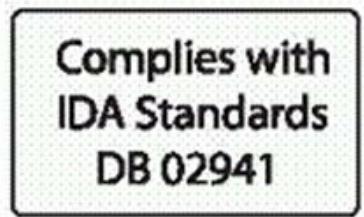
Model 3165D2W
Argentina:
Model 3165D2W
Model 3165NGW

COMISION NACIONAL
DE COMUNICACIONES
CNCID: C-14446
Intel® Dual Band Wireless-AC 3168
Due to the very small size of the 3168NGW, the marking has been placed in this user manual because the product label on the device is considered too small to be readable.
Japan:
Model 3168NGW
RF:003-160024
TEL: D160013003
5.2GHz带高出力一夕通信S土基地局又上陆上移动中维局和通信的场合除<



003-160024
5.15-5.35GHz: Indoor use only
(Except communicate to high power radio)

D160013003
Europe:
Model 3168NGW
| Software Version | Intel® PROSet/Wireless WiFi Software 20.x and subsequent versions |
| Maximum Power Output | |
| (2400 - 2483.5 MHz)IEEE802.11 b/g/n mode | 20dBm EIRP max (100mW) |
| (2400 - 2483.5 MHz)Bluetooth/BLE | 10dBm EIRP max (10mW) |
| (5150 - 5725 MHz)IEEE802.11 a/n/ac mode | 23dBm EIRP max (200mW)The low band 5.15 - 5.35 GHz is for indoor use only |
This equipment complies with the essential requirements of the European Union directive 2014/53/EU.

Argentina:
Model 3168NGW

COMISION NACIONAL
DE COMUNICACIONES
CNCID: C-16378
Intel® Dual Band Wireless-AC 7265
Due to the very small size of the 7265D2W/7265NGW (12x16), the marking has been placed in this user manual because the product label on the device is considered too small to be readable.
USA:
Model 7265D2W
FCC ID: PD97265D2
Canada:
Model 7265D2W
IC: 1000M-7265D2
Japan:
Model 7265D2W
RF:003-140134
TEL: D140087003
5.15-5.35GHz: Indoor use only (Except communicate to high p

D140087003
Model 7265NGW
RF:003-140018
TEL: D140017003
5.2GHz带高出力一夕通信S土基地局又上陆上移动中维局和通信的场合为除<



003-140018
5.15-5.35GHz: Indoor use only (Except communicate to high power radio)

D140017003
Korea:
Model 7265D2W
MSIP-CRM-INT-7265D2W
Taiwan:
Model 7265D2W

CCAH14LP1160T5
China:
Model 7265D2W
CMIIT ID: 2014AJ3467 (M)
Australia:
Model 7265D2W

Argentina:
Model 7265D2W

COMISION NACIONAL
DE COMUNICACIONES
CNCID: C-13902
Intel® Wireless Gigabit Sink W13100
Due to the very small size of the 13100NGW, the marking has been placed in this user manual because the product label on the device is considered too small to be readable.
Europe:
Model 13100NGW
| Software Version | Intel® Wireless Dock Manager 3.x and previous versions |
| Maximum Power Output | |
| (57 - 64 GHz) IEEE802.11 ad mode | 25 dBm EIRP max |
This equipment complies with the essential requirements of the European Union directive 2014/53/EU.

Singapore:
Model 13100NGW
Complies with
IDA Standards
DB02941
Intel® Tri-Band Wireless-AC 17265
Due to the very small size of the 17265NGW, the marking has been placed in this user manual because the product label on the device is considered too small to be readable.
Europe:
Model 17265NGW
| Software Version | Intel® PROSet/Wireless WiFi Software 20.x and subsequent versions (WiFi/BT) Intel® Wireless Dock Manager 3.x and previous versions (WiGig) |
| Maximum Power Output | |
| (2400 - 2483.5 MHz) IEEE802.11 b/g/n mode Bluetooth | 20dBm EIRP max (100mW) |
| (2400 - 2483.5 MHz) BLE | 10dBm EIRP max (10mW) |
| (5150 - 5725 MHz) IEEE802.11 a/n/ac mode | 23dBm EIRP max (200mW) The low band 5.15 - 5.35 GHz is for indoor use only |
| (5725 - 5875 MHz) IEEE802.11 a/n/ac mode | 13.98 dBm EIRP Max (25mW) For the standard EN 300 440, the device operating in 5.8 GHz is considered a category 2 receiver |
| (57 - 64 GHz) IEEE802.11 ad mode | 25 dBm EIRP max |
This equipment complies with the essential requirements of the European Union directive 2014/53/EU.

Singapore:
Model 17265NGW
Intel® Dual Band Wireless-AC 8260
Due to the very small size of the 8260D2W (12x16), the marking has been placed in this user manual because the product label on the device is considered too small to be readable.
USA: Model 8260D2W, FCC ID: PD98260D2 (FCC ID without suffix "U" denotes factory installation only);
FCC ID: PD98260D2U (FCC ID with suffix "U" denotes user installation or replacement permitted and supported by bios locking feature)
Canada:
Model 8260D2W
IC: 1000M-8260D2
Japan:
Model 8260D2W
RF:003-150094
TEL: D150070003
5.2GHz带高出力一夕通信S土基地局又上陆上移动中继局和通信的场合为除<


003-150094
5.15-5.35GHz: Indoor use only
(Except communicate to high power radio)
D150070003
Korea:
Model 8260D2W
MSIP-CRM-INT-8260D2W
Taiwan:
Model 8260D2W
China:
Model 8260D2W
CMIIT ID: 2014AJ3467 (M)
Australia:
Model 8260D2W

Argentina:
Model 8260D2W

Due to the very small size of the 8260NGWH/8260NGW, the marking has been placed in this user manual because the product label on the device is considered too small to be readable.
Japan:
Model 8260NGW
RF:003-150093
TEL: D150069003
5.2GHz带高出力一夕通信S土基地局又上陆上移动中维局和通信的场合除<



003-150093
5.15-5.35GHz: Indoor use only
(Except communicate to high power radio)

D150069003
Model 8260NGWH
RF:003-150154
TEL: D150111003
5.2GHz带高出力一夕通信S土基地局又上陆上移动中维局和通信的场合为除<


003-150154
5.15-5.35GHz: Indoor use only
(Except communicate to high power radio)
D150111003
Argentina:
Model 8260NGWH

COMISION NACIONAL
DE COMUNICACIONES
CNCID: C-15598
Argentina:
Model 8260NGW

COMISION NACIONAL
DE COMUNICACIONES
CNCID: C-14827
Intel® Dual Band Wireless-AC 8265
Due to the very small size of the 8265NGW (22mm x 30mm x 2.4mm), the marking has been placed in this user manual because the product label on the device is considered too small to be readable.
USA:
Model 8265NGW
- FCC ID: PD98265NG (FCC ID without suffix "U" denotes factory installation only)
FCC ID: PD98265NGU (FCC ID with suffix "U" denotes user installation or replacement permitted and supported by BIOS locking feature)
Canada:
Model 8265NGW
IC: 1000M-8265NG
Japan:
Model 8265NGW
RF 003-160104
- TEL D160055003
5.2GHz带高出力一夕通信S土基地局又上陆上移动中继局和通信的场合为除<



003-160104
5.15-5.35GHz: Indoor use only
(Except communicate to high power radio)

D160055003
Korea:
Model 8265NGW
MSIP-CRM-INT-8265NGW

Taiwan:
Model 8265NGW

CCAH16LP1200T7
China:
Model 8265NGW
CMIIT ID:2016AJ2775(M)
Europe:
Model 8265NGW/8265D2W
Software Version
Intel® PROSet/Wireless WiFi Software 20.x and subsequent versions
| Maximum Power Output | |
| (2400 - 2483.5 MHz) IEEE802.11 b/g/n mode Bluetooth | 20dBm EIRP max (100mW) |
| (2400 - 2483.5 MHz) BLE | 10dBm EIRP max (10mW) |
| (5150 - 5725 MHz) IEEE802.11 a/n/ac mode | 23dBm EIRP max (200mW) The low band 5.15 - 5.35 GHz is for indoor use only |
| (5725 - 5875 MHz) IEEE802.11 a/n/ac mode | 13.98 dBm EIRP Max (25mW) For the standard EN 300 440, the device operating in 5.8 GHz is considered a category 2 receiver |
| (57 - 64 GHz) IEEE802.11 ad mode | 25 dBm EIRP max |
This equipment complies with the essential requirements of the European Union directive 2014/53/EU.

Australia:
Model 8265NGW

Brazil:
Model 8265NGW

ANATEL
03877-16-02198
Argentina:
Model 8265NGW

COMISION NACIONAL
DE COMUNICACIONES
CNCID: C-16376
Singapore:
Model 8265NGW
Complies with IDA Standards DB 02941
Pakistan:
Model 8265NGW
"PTA APPROVED MODEL"
Due to the very small size of the 8265D2W (12mm x 16mm x 1.8mm), the marking has been placed in this user manual because the product label on the device is considered too small to be readable.
USA:
Model 8265D2W
FCC ID: PD98265D2
Canada:
Model 8265D2W
IC: 1000M-8265D2
Japan:
Model 8265D2W
RF 003-160129
- TEL D160076003
5.2GHz带高出力一夕通信S土基地局又上陆上移动中维局和通信的场合除<


003-160129
5.15-5.35GHz: Indoor use only
(Except communicate to high power radio)
D160076003
Korea:
Taiwan:
Model 8265D2W

CCAH16LP1240T6
China:
Model 8265D2W
CMIIT ID:2016AJ3025(M)
Australia:
Model 8265D2W

Brazil:
Model 8265D2W

ANATEL
03878-16-02198
Argentina:
Model 8265D2W

Complies with IDA Standards DB 02941
Pakistan:
Model 8265D2W
"PTA APPROVED MODEL"
Intel® Wireless-AC 9260 (9260NGW)
Due to the very small size of the 9260NGW (22mm x 30mm x 2.4mm), the marking has been placed in this user manual because the product label on the device is considered too small to be readable.
USA:
Model 9260NGW
FCC ID: PD99260NG
Canada:
Model 9260NGW
IC: 1000M-9260NG
Japan:
Model 9260NGW
RF003-170125
- TEL D170079003



003-170125
5.15-5.35GHz: Indoor use only
(Except communicate to high power radio)

D170079003
Korea:
Model 9260NGW
MSIP-CRM-INT-9260NGW

Taiwan:
Model 9260NGW

(CCAH17LP2590T7)
China:
Model 9260NGW
CMIIT ID:2016AJ2775(M)
Europe:
Model 9260NGW
| Software Version | Intel® PROSet/Wireless WiFi Software 20.x and subsequent versions |
| Maximum Power Output | |
| (2400 - 2483.5 MHz) IEEE802.11 b/g/n mode Bluetooth | 20dBm EIRP max (100mW) |
| (2400 - 2483.5 MHz) BLE | 10dBm EIRP max (10mW) |
| (5150 - 5725 MHz) IEEE802.11 a/n/ac mode | 23dBm EIRP max (200mW) The low band 5.15 - 5.35 GHz is for indoor use only |
(5725-5875MHz)
IEEE802.11 a/n/ac mode
13.98 dBm EIRP Max (25mW)
For the standard EN 300 440, the device operating in 5.8 GHz is considered a category 2 receiver
This equipment complies with the essential requirements of the European Union directive 2014/53/EU.

Australia:
Model 9260NGW

Singapore:
Model 9260NGW
Complies with
IMDA Standards
DB02941
Intel® Wireless-AC 9260 (9260D2WL)
Due to the very small size of the 9260D2WL (12mm x 16mm x 1.8mm), the marking has been placed in this user manual because the product label on the device is considered too small to be readable.
USA:
Model 9260D2WL
FCC ID:PD99260D2L
Canada:
Model 9260D2WL
IC: 1000M-9260D2L
Japan:
Model 9260D2WL
RF:003-190024
TEL: D190023003

003-190024
5.15-5.35GHz: Indoor use only
(Except communicate to high power radio)
D190023003
Europe:
Model 9260D2WL
| Software Version | Intel® PROSet/Wireless WiFi Software 20.x and subsequent versions |
| Maximum Power Output | |
| (2400 - 2483.5 MHz)IEEE802.11 b/g/n modeBluetooth | 20dBm EIRP max (100mW) |
| (2400 - 2483.5 MHz)BLE | 10dBm EIRP max (10mW) |
| (5150 - 5725 MHz)IEEE802.11 a/n/ac mode | 23dBm EIRP max (200mW)The low band 5.15 - 5.35 GHz is for indoor use only |
| (5725 - 5875 MHz)IEEE802.11 a/n/ac mode | 13.98 dBm EIRP Max (25mW)For the standard EN 300 440, the device operating in 5.8 GHz is considered a category 2 receiver |
This equipment complies with the essential requirements of the European Union directive 2014/53/EU.

Australia:
Model 9260D2WL

Brazil:
Model 9260D2WL
ANATEL:05831-17-04423
Singapore:
Model 9260D2WL
Complies with
IMDA Standards
DB02941
Argentina:
Model 9260D2WL

COMISION NACIONAL
DE COMUNICACIONES
CNC ID: C-22837
Pakistan:
Model 9260D2WL
APPROVED BY PTA: 9.9203/2019
Intel® Wireless-AC 9461 (9461NGW)
Due to the very small size of the 9461NGW (22mm x 30mm x 2.4mm), the marking has been placed in this user manual because the product label on the device is considered too small to be readable.
USA:
Model 9461NGW
FCC ID:PD99461NG
Canada:
Model 9461NGW
IC: 1000M-9461NG
Japan:
Model 9461NGW
RF 003-170204
- TEL D170127003
Korea:
Model 9461NGW
MSIP-CRM-INT-9461NGW
Taiwan:
Model 9461NGW

CCAH17LP3340T2
China:
Model 9461NGW
CMIIT ID: 2017AJ6321 (M)
Europe:
Model 9461NGW
| Software Version | Intel® PROSet/Wireless WiFi Software 20.x and subsequent versions |
| Maximum Power Output | |
| (2400 - 2483.5 MHz)IEEE802.11 b/g/n modeBluetooth | 20dBm EIRP max (100mW) |
| (2400 - 2483.5 MHz)BLE | 10dBm EIRP max (10mW) |
| (5150 - 5725 MHz) | 23dBm EIRP max (200mW) |
| IEEE802.11 a/n/ac mode | The low band 5.15 - 5.35 GHz is for indoor use only |
| (5725 - 5875 MHz) | 13.98 dBm EIRP Max (25mW) |
| IEEE802.11 a/n/ac mode | For the standard EN 300 440, the device operating in 5.8 GHz is considered a category 2 receiver |
This equipment complies with the essential requirements of the European Union directive 2014/53/EU.

Australia:
Model 9461NGW

Singapore:
Model 9461NGW
Complies with
IMDA Standards
DB02941
Intel® Wireless-AC 9461 (9461D2W)
Due to the very small size of the 9461D2W (12mm x 16mm x 1.8mm), the marking has been placed in this user manual because the product label on the device is considered too small to be readable.
USA:
Model 9461D2W
FCC ID: PD99461D2
Canada:
Model 9461D2W
IC: 1000M-9461D2
Japan:
Model 9461D2W
RF 003-170203
- TEL D170126003



003-170203
5.15-5.35GHz: Indoor use only
(Except communicate to high power radio)

D170126003
Korea:
Model 9461D2W

MSIP-CRM-INT-9461D2W
Taiwan:
Model 9461D2W

CCAH17LP3330T2
China:
Model 9461D2W
CMIIT ID: 2017AJ6329(M)
Europe:
Model 9461D2W
| Software Version | Intel® PROSet/Wireless WiFi Software 20.x and subsequent versions |
| Maximum Power Output | |
| (2400 - 2483.5 MHz)IEEE802.11 b/g/n modeBluetooth | 20dBm EIRP max (100mW) |
| (2400 - 2483.5 MHz)BLE | 10dBm EIRP max (10mW) |
| (5150 - 5725 MHz) IEEE802.11 a/n/ac mode | 23dBm EIRP max (200mW) The low band 5.15 - 5.35 GHz is for indoor use only |
| (5725 - 5875 MHz) IEEE802.11 a/n/ac mode | 13.98 dBm EIRP Max (25mW) For the standard EN 300 440, the device operating in 5.8 GHz is considered a category 2 receiver |
This equipment complies with the essential requirements of the European Union directive 2014/53/EU.

Australia:
Model 9461D2W

Singapore:
Model 9461D2W
Complies with
IMDA Standards
DB02941
Intel® Wireless-AC 9462 (9462NGW)
Due to the very small size of the 9462NGW (22mm x 30mm x 2.4mm), the marking has been placed in this user manual because the product label on the device is considered too small to be readable.
USA:
Model 9462NGW
FCC ID: PD99462NG
Canada:
Model 9462NGW
IC: 1000M-9462NG
Japan:
Model 9462NGW
RF 003-170245
(Except communicate to high power radio)
D170151003
Korea:
Model 9462NGW

R-CRM-INT-9462NGW
Taiwan:
Model 9462NGW

CCAH17LP4350T0
China:
Model 9462NGW
CMIIT ID: 2017AJ7583 (M)
Europe:
Model 9462NGW
| Software Version | Intel® PROSet/Wireless WiFi Software 20.x and subsequent versions |
| Maximum Power Output | |
| (2400 - 2483.5 MHz)IEEE802.11 b/g/n modeBluetooth | 20dBm EIRP max (100mW) |
| (2400 - 2483.5 MHz) BLE | 10dBm EIRP max (10mW) |
| (5150 - 5725 MHz) IEEE802.11 a/n/ac mode | 23dBm EIRP max (200mW) The low band 5.15 - 5.35 GHz is for indoor use only |
| (5725 - 5875 MHz) IEEE802.11 a/n/ac mode | 13.98 dBm EIRP Max (25mW) For the standard EN 300 440, the device operating in 5.8 GHz is considered a category 2 receiver |
This equipment complies with the essential requirements of the European Union directive 2014/53/EU.

Australia:
Model 9462NGW

Singapore:
Model 9462NGW
Complies with
IMDA Standards
DB02941
Intel® Wireless-AC 9462 (9462D2W)
Due to the very small size of the 9462D2W (12mm x 16mm x 1.8mm), the marking has been placed in this user manual because the product label on the device is considered too small to be readable.
USA:
Model 9462D2W
FCC ID: PD99462D2
Canada:
Model 9462D2W
IC: 1000M-9462D2
Japan:
(Except communicate to high power radio)
D170149003
Korea:
Model 9462D2W

R-CRM-INT-9462D2W
Taiwan:
Model 9462D2W

CCAH17LP4550T5
China:
Model 9462D2W
CMIIT ID: 2017AJ7649(M)
Europe:
Model 9462D2W
| Software Version | Intel® PROSet/Wireless WiFi Software 20.x and subsequent versions |
| Maximum Power Output | |
| (2400 - 2483.5 MHz) IEEE802.11 b/g/n mode | 20dBm EIRP max (100mW) |
| Bluetooth | |
| (2400 - 2483.5 MHz) BLE | 10dBm EIRP max (10mW) |
| (5150 - 5725 MHz) IEEE802.11 a/n/ac mode | 23dBm EIRP max (200mW) The low band 5.15 - 5.35 GHz is for indoor use only |
| (5725 - 5875 MHz) IEEE802.11 a/n/ac mode | 13.98 dBm EIRP Max (25mW) For the standard EN 300 440, the device operating in 5.8 GHz is considered a category 2 receiver |
This equipment complies with the essential requirements of the European Union directive 2014/53/EU.

Australia:
Model 9462D2W

Singapore:
Model 9462D2W
Complies with
IMDA Standards
DB02941
Intel® Wireless-AC 9560 (9560NGW)
Due to the very small size of the 9560NGW (22mm x 30mm x 2.4mm), the marking has been placed in this user manual because the product label on the device is considered too small to be readable.
USA:
Model 9560NGW
FCC ID: PD99560NG
Canada:
Model 9560NGW
IC: 1000M-9560NG
Japan:
Model 9560NGW
RF 003-170126
- TEL D170080003
(Except communicate to high power radio)

D170080003
Korea:
Model 9560NGW
MSIP-CRM-INT-9560NGW

Taiwan:
Model 9560NGW

CCAH17LP2600T0
Model 9560NGW R

CCAH17LP2610T0
China:
Model 9560NGW
CMIIT ID:2016AJ2775(M)
Europe:
Model 9560NGW
| Software Version | Intel® PROSet/Wireless WiFi Software 20.x and subsequent versions |
| Maximum Power Output | |
| (2400 - 2483.5 MHz)IEEE802.11 b/g/n modeBluetooth | 20dBm EIRP max (100mW) |
| (2400 - 2483.5 MHz)BLE | 10dBm EIRP max (10mW) |
| (5150 - 5725 MHz)IEEE802.11 a/n/ac mode | 23dBm EIRP max (200mW)The low band 5.15 - 5.35 GHz is for indoor use only |
| (5725 - 5875 MHz)IEEE802.11 a/n/ac mode | 13.98 dBm EIRP Max (25mW)For the standard EN 300 440, the device operating in 5.8 GHz is considered a category 2 receiver |
This equipment complies with the essential requirements of the European Union directive 2014/53/EU.

Australia:
Model 9560NGW

Singapore:
Model 9560NGW
Complies with
IMDA Standards
DB02941
Intel® Wireless-AC 9560 (9560D2W)
Due to the very small size of the 9560D2W (12mm x 16mm x 1.8mm), the marking has been placed in this user manual because the product label on the device is considered too small to be readable.
USA:
Model 9560D2W
FCC ID: PD99560D2
Canada:
Japan:
Model 9560D2W
RF 003-170244
- TEL D170150003
5.2GHz带高出力一夕通信S土基地局又上陆上移动中继局和通信的场合为除<

003-170244
5.15-5.35GHz: Indoor use only
(Except communicate to high power radio)
D170150003
Korea:
Model 9560D2W

R-CRM-INT-9560D2W
Taiwan:
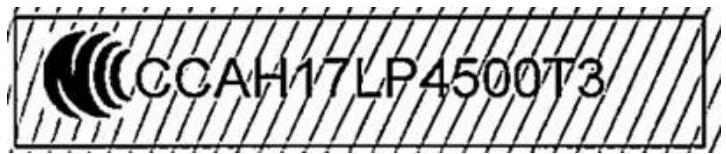
Model 9560D2W
China:
Model 9560D2W
CMIIT ID: 2017AJ7598 (M)
Europe:
| Software Version | Intel® PROSet/Wireless WiFi Software 20.x and subsequent versions |
| Maximum Power Output | |
| (2400 - 2483.5 MHz)IEEE802.11 b/g/n modeBluetooth | 20dBm EIRP max (100mW) |
| (2400 - 2483.5 MHz)BLE | 10dBm EIRP max (10mW) |
| (5150 - 5725 MHz)IEEE802.11 a/n/ac mode | 23dBm EIRP max (200mW)The low band 5.15 - 5.35 GHz is for indoor use only |
| (5725 - 5875 MHz)IEEE802.11 a/n/ac mode | 13.98 dBm EIRP Max (25mW)For the standard EN 300 440, the device operating in 5.8 GHz is considered a category 2 receiver |
This equipment complies with the essential requirements of the European Union directive 2014/53/EU.

Australia:
Model 9560D2W

Singapore:
Model 9560D2W
Complies with
IMDA Standards
DB02941
Intel® Wireless-AC 9560 (9560D2WL)
Due to the very small size of the 9560D2WL (12mm x 16mm x 1.8mm), the marking has been placed in this user manual because the product label on the device is considered too small to be readable.
USA:
Model 9560D2WL
FCC ID: PD99560D2L
Canada:
Model 9560D2WL
IC: 1000M-9560D2L
Japan:
Model 9560D2WL
RF003-180060
- TEL D180033003
(Except communicate to high power radio)
D180033003
Korea:
Model 9560D2WL

R-CRM-INT-9560D2WL
Taiwan:
Model 9560D2WL
China:
Model 9560D2WL
CMIIT ID: 2018AJ2011 (M)
Europe:
| Software Version | Intel® PROSet/Wireless WiFi Software 20.x and subsequent versions |
| Maximum Power Output | |
| (2400 - 2483.5 MHz)IEEE802.11 b/g/n modeBluetooth | 20dBm EIRP max (100mW) |
| (2400 - 2483.5 MHz)BLE | 10dBm EIRP max (10mW) |
| (5150 - 5725 MHz)IEEE802.11 a/n/ac mode | 23dBm EIRP max (200mW)The low band 5.15 - 5.35 GHz is for indoor use only |
| (5725 - 5875 MHz)IEEE802.11 a/n/ac mode | 13.98 dBm EIRP Max (25mW)For the standard EN 300 440, the device operating in 5.8 GHz is considered a category 2 receiver |
This equipment complies with the essential requirements of the European Union directive 2014/53/EU.

Australia:
Model 9560D2WL

Singapore:
Model 9560D2WL
Complies with
IMDA Standards
DB02941
Intel® Tri-band Wireless AC 18265
Due to the very small size of the 18265NGW module, the regulatory marking has been placed in this user manual because the product label on the device is considered too small to be readable
USA: Model 18265NGW, FCC ID: PD918265NG (This module is for factory installation only)
Canada:
Model 18265NGW
IC:1000M-18265NG
Japan:
Model 18265NGW

003-160221
5.15-5.35 GHz:
Indoor use only
D160154003
Korea:
Model 18265NGW
MSIP-CRM-INT-18265NGW

Taiwan:
Model 18265NGW

CCAH16LP3190T1
China:
Model 18265NGW
CMIIT ID: 2016AJ7066 (M)
Europe:
Model 18265NGW
| Software Version | Intel® PROSet/Wireless WiFi Software 20.x and subsequent versions (WiFi/BT) Intel® Wireless Dock Manager 3.x and previous versions (WiGig) |
| Maximum Power Output | |
| (2400 - 2483.5 MHz) IEEE802.11 b/g/n mode Bluetooth | 20dBm EIRP max (100mW) |
| (2400 - 2483.5 MHz) BLE | 10dBm EIRP max (10mW) |
| (5150 - 5725 MHz) IEEE802.11 a/n/ac mode | 23dBm EIRP max (200mW) The low band 5.15 - 5.35 GHz is for indoor use only |
| (5725 - 5875 MHz) IEEE802.11 a/n/ac mode | 13.98 dBm EIRP Max (25mW) For the standard EN 300 440, the device operating in 5.8 GHz is considered a category 2 receiver |
| (57 - 64 GHz) IEEE802.11 ad mode | 25 dBm EIRP max |
This equipment complies with the essential requirements of the European Union directive 2014/53/EU.

Australia:
Model 18265NGW

Brazil:
Model 18265NGW/18265NGW LC

ANATEL
03022-17-04423
Singapore:
Model 18265NGW
Complies with IDA Standards DB 02941
Intel® Wireless Gigabit 11000
Due to the very small size of the 11000D2W/11000D2W LC, the marking has been placed in this user manual because the product label on the device is considered too small to be readable.
USA:
Model 11000D2W/11000D2W LC
FCC ID: PD911000D2
Canada:
Model 11000D2W
IC: 1000M-11000D2
Japan:
Model 11000D2W

R 003-160015
5.15-5.35 GHz:
Indoor use only
D160007003
Korea:
Model 11000D2W
MSIP-CRM-INT-11000D2W
Taiwan:
Model 11000D2W

CCAH16LP0170T6
Model 11000D2W LC

CCAH16LP0180T9
China:
Model 11000D2W
CMIT ID: 2016DJ0267 (M)
Model 11000D2W LC
CMIT ID: 2016DJ0268 (M)
Europe:
Model 11000D2W
| Software Version | Intel® Wireless Dock Manager 3.x and previous versions |
| Maximum Power Output | |
| (57 - 64 GHz) IEEE802.11 ad mode | 25 dBm EIRP max |
Australia:
Model 11000D2W

Singapore:
Model 11000D2W/11000D2W LC
Intel® Wireless Gigabit Sink W13110VR
Due to the very small size of the 13110NGW, the marking has been placed in this user manual because the product label on the device is considered too small to be readable.
USA:
Model 13110NGW
FCC ID: PD913110NG
Canada:
Model 1311ONGW
IC: 1000M-13110NG
Korea:
Model 1311ONGW
R-CRM-INT-13110NGW
Taiwan:
Model 1311ONGW
Europe:
Model 13110NGW
| Software Version | Intel® Wireless VR dashboard 4.x |
| Maximum Power Output | |
| (57 - 64 GHz) IEEE802.11 ad mode | 25 dBm EIRP max |
This equipment complies with the essential requirements of the European Union directive 2014/53/EU.

Singapore:
Model 1311ONGW
Complies with
IMDA Standards
DB02941
Intel® Wireless Gigabit 11100VR
Due to the very small size of the 11100D2W, the marking has been placed in this user manual because the product label on the device is considered too small to be readable.
USA:
Model 11100D2W
FCC ID:PD911100D2
Canada:
Model 11100D2W
IC: 1000M-11100D2
Korea:
Model 11100D2W
R-CRM-INT-11100D2W
Taiwan:
Model 11100D2W

Europe:
Model 11100D2W
| Software Version | Intel® Wireless VR Dashboard 4.x |
| Maximum Power Output | |
| (57 - 64 GHz) IEEE802.11 ad mode | 26 dBm EIRP max |
This equipment complies with the essential requirements of the European Union directive 2014/53/EU.

Australia:
Model 11100D2W

Singapore:
Model 11100D2W
Complies with
IMDA Standards
DB02941
Intel® Wi-Fi 6 AX101 (AX101NGW)
Due to the very small size of the AX101NGW, the marking has been placed in this user manual because the product label on the device is considered too small to be readable.
Intel® Wi-Fi 6 AX101 (AX101D2W)
Due to the very small size of the AX101D2W, the marking has been placed in this user manual because the product label on the device is considered too small to be readable.
TBD
Intel® Wi-Fi 6 AX200 (AX200D2WL)
Due to the very small size of the AX200D2WL, the marking has been placed in this user manual because the product label on the device is considered too small to be readable.
USA:
Model AX200D2WL
FCC ID: PD9AX200D2L
Canada:
Model AX200D2WL
IC: 1000M-AX200D2L
Japan:
Model AX200D2WL
RF:003-190023
TEL: D190022003
5.2GHz带高出力一夕通信S土基地局又上陆上移动中维局和通信的场合除<


003-190023
5.15-5.35GHz: Indoor use only
(Except communicate to high power radio)

D190022003
Korea:
Model AX200D2WL
Taiwan:
Model AX200D2WL

CCAH19LP0720T0
China:
Model AX200D2WL
CMIIT ID: 2019AJ2493 (M)
Europe:
Model AX200D2WL
| Software Version | Intel® PROSet/Wireless WiFi Software 20.x and subsequent versions |
| Maximum Power Output | |
| (2400 - 2483.5 MHz)IEEE802.11 b/g/n/ax modeBluetooth | 20dBm EIRP max (100mW) |
| (2400 - 2483.5 MHz)BLE | 10dBm EIRP max (10mW) |
| (5150 - 5725 MHz)IEEE802.11 a/n/ac/ax mode | 23dBm EIRP max (200mW)The low band 5.15 - 5.35 GHz is for indoor use only |
| (5725 - 5875 MHz)IEEE802.11 a/n/ac/ax mode | 13.98 dBm EIRP Max (25mW)For the standard EN 300 440, the device operating in 5.8 GHz is considered a category 2 receiver |
This equipment complies with the essential requirements of the European Union directive 2014/53/EU.

Australia:
Model AX200D2WL
Brazil:
Model AX200D2WL


04137-19-04423
Singapore:
Model AX200D2WL
Complies with
IMDA Standards
DB02941
Argentina:
Model AX200D2WL

COMISION NACIONAL
DE COMUNICACIONES
CNC ID: C-22839
Pakistan:
Model AX200D2WL
APPROVED BY PTA: 9.9202/2019
Intel® Wi-Fi 6 AX200 (AX200NGW)
Due to the very small size of the AX200NGW, the marking has been placed in this user manual because the product label on the device is considered too small to be readable.
USA:
Model AX200NGW
FCC ID: PD9AX200NG
Canada:
Model AX200NGW
IC: 1000M-AX200NG
Japan:
Model AX200NGW
RF:003-190022
TEL: D190021003
(Except communicate to high power radio)
D190021003
Korea:
Model AX200NGW

R-C-INT-AX200NGW
Taiwan:
Model AX200NGW

CCAH19LP0850T0
China:
Model AX200NGW
CMIIT ID: 2019AJ2274 (M)
Europe:
Model AX200NGW
| Software Version | Intel® PROSet/Wireless WiFi Software 20.x and subsequent versions |
| Maximum Power Output | |
| (2400 - 2483.5 MHz)IEEE802.11 b/g/n/ax modeBluetooth | 20dBm EIRP max (100mW) |
| (2400 - 2483.5 MHz)BLE | 10dBm EIRP max (10mW) |
| (5150 - 5725 MHz)IEEE802.11 a/n/ac/ax mode | 23dBm EIRP max (200mW)The low band 5.15 - 5.35 GHz is for indoor use only |
| (5725 - 5875 MHz)IEEE802.11 a/n/ac/ax mode | 13.98 dBm EIRP Max (25mW)For the standard EN 300 440, the device operating in 5.8 GHz is considered a category 2 receiver |
This equipment complies with the essential requirements of the European Union directive 2014/53/EU.

Australia:
Model AX200NGW

Brazil:
Model AX200NGW

04136-19-04423
Singapore:
Model AX200NGW
Complies with
IMDA Standards
DB02941
Argentina:
Model AX200NGW

APPROVED BY PTA: 9.9211/2019
Intel® Wi-Fi 6 AX201 (AX201NGW)
Due to the very small size of the AX201NGW, the marking has been placed in this user manual because the product label on the device is considered too small to be readable.
USA:
Model AX201NGW
FCC ID: PD9AX201NG
Canada:
Model AX201NGW
IC: 1000M-AX201NG
Japan:
Model AX201NGW
RF:003-180232
TEL: D180131003
5.2GHz带高出力一夕通信S土基地局又上陆上移动中继局和通信的场合为除<


003-180232
5.15-5.35GHz: Indoor use only
(Except communicate to high power radio)

D180131003
Korea:
Taiwan:
Model AX201NGW

CCAH18LP3520T2
China:
Model AX201NGW
CMIT ID:2018AJ7550(M)
Europe:
Model AX201NGW
| Software Version | Intel® PROSet/Wireless WiFi Software 20.x and subsequent versions |
| Maximum Power Output | |
| (2400 - 2483.5 MHz)IEEE802.11 b/g/n/ax modeBluetooth | 20dBm EIRP max (100mW) |
| (2400 - 2483.5 MHz)BLE | 10dBm EIRP max (10mW) |
| (5150 - 5725 MHz)IEEE802.11 a/n/ac/ax mode | 23dBm EIRP max (200mW)The low band 5.15 - 5.35 GHz is for indoor use only |
| (5725 - 5875 MHz)IEEE802.11 a/n/ac/ax mode | 13.98 dBm EIRP Max (25mW)For the standard EN 300 440, the device operating in 5.8 GHz is considered a category 2 receiver |
This equipment complies with the essential requirements of the European Union directive 2014/53/EU.

Australia:
Model AX201NGW
Brazil:
Model AX201NGW
ANATEL:06970-18-04423
Singapore:
Model AX201NGW
Complies with
IMDA Standards
DB02941
Argentina:
Model AX201NGW

COMISION NACIONAL
DE COMUNICACIONES
CNC ID: C-22446
Pakistan:
Model AX201NGW
APPROVED BY PTA: 9.9116/2019
Intel® Wi-Fi 6 AX201 (AX201D2W)
Due to the very small size of the AX201D2W, the marking has been placed in this user manual because the product label on the device is considered too small to be readable.
USA:
Model AX201D2W
FCC ID: PD9AX201D2
Canada:
Model AX201D2W
IC: 1000M-AX201D2
Japan:
5.2GHz带高出力一夕通信S土基地局又上陆上移动中维局和通信的场合为除<


003-180233
5.15-5.35GHz: Indoor use only
(Except communicate to high power radio)
D180132003
Korea:
Model AX201D2W

R-C-INT-AX201D2W
Taiwan:
Model AX201D2W

CCAH18LP3410T5
China:
Model AX201D2W
CMIIT ID:2018AJ7553(M)
Europe:
Model AX201D2W
| Software Version | Intel® PROSet/Wireless WiFi Software 20.x and subsequent versions |
| Maximum Power Output | |
| (2400 - 2483.5 MHz) IEEE802.11 b/g/n/ax mode | 20dBm EIRP max (100mW) |
| Bluetooth | |
| (2400 - 2483.5 MHz) BLE | 10dBm EIRP max (10mW) |
| (5150 - 5725 MHz) IEEE802.11 a/n/ac/ax mode | 23dBm EIRP max (200mW) The low band 5.15 - 5.35 GHz is for indoor use only |
| (5725 - 5875 MHz) IEEE802.11 a/n/ac/ax mode | 13.98 dBm EIRP Max (25mW) For the standard EN 300 440, the device operating in 5.8 GHz is considered a category 2 receiver |
This equipment complies with the essential requirements of the European Union directive 2014/53/EU.

Australia:
Model AX201D2W

Brazil:
Model AX201D2W
ANATEL:07039-18-04423
Singapore:
Model AX201D2W
Complies with
IMDA Standards
DB02941
Argentina:
Model AX201D2W

COMISION NACIONAL
DE COMUNICACIONES
CNC ID: C-22445
Pakistan:
Intel® Wi-Fi 6 AX201 (AX201D2WL)
Due to the very small size of the AX201D2WL, the marking has been placed in this user manual because the product label on the device is considered too small to be readable.
USA:
Model AX201D2WL
FCC ID: PD9AX201D2L
Canada:
Model AX201D2WL
IC: 1000M-AX201D2L
Japan:
Model AX201D2WL
RF:003-180234
TEL: D180133003
5.2GHz带高出力一夕通信S土基地局又上陆上移动中维局和通信的场合除<



003-180234
5.15-5.35GHz: Indoor use only
(Except communicate to high power radio)

D180133003
Korea:
Model AX201D2WL

R-C-INT-AX201D2WL
Taiwan:
Model AX201D2WL
China:
Model AX201D2WL
| Software Version | Intel® PROSet/Wireless WiFi Software 20.x and subsequent versions |
| Maximum Power Output | |
| (2400 - 2483.5 MHz)IEEE802.11 b/g/n/ax modeBluetooth | 20dBm EIRP max (100mW) |
| (2400 - 2483.5 MHz)BLE | 10dBm EIRP max (10mW) |
| (5150 - 5725 MHz)IEEE802.11 a/n/ac/ax mode | 23dBm EIRP max (200mW)The low band 5.15 - 5.35 GHz is for indoor use only |
| (5725 - 5875 MHz)IEEE802.11 a/n/ac/ax mode | 13.98 dBm EIRP Max (25mW)For the standard EN 300 440, the device operating in 5.8 GHz is considered a category 2 receiver |
This equipment complies with the essential requirements of the European Union directive 2014/53/EU.


Australia:
Model AX201D2WL

Brazil:
Model AX201D2WL
ANATEL:07271-18-04423
Singapore:
Model AX201D2WL
Complies with
IMDA Standards
DB02941
Argentina:
Model AX201D2WL

COMISION NACIONAL
DE COMUNICACIONES
CNCID: C-22504
Pakistan:
Model AX201D2WL
APPROVED BY PTA: 9.9110/2019
Intel® Wi-Fi 6 AX203 (AX203NGW)
Due to the very small size of the AX203NGW, the marking has been placed in this user manual because the product label on the device is considered too small to be readable.
USA:
Model AX203NGW
FCC ID: PD9AX203NG
Canada:
Model AX203NGW
IC: 1000M-AX203NG
Japan:
Model AX203NGW
RF:003-200294
TEL: D200230003


R003-200294
5.15-5.35 GHz Indoor use only
(Except communicate to high power radio)
TD200230003
Korea:
Model AX203NGW

R-C-INT-AX203NGW
- 普通:INTEL CORPORATION
2.기자체의명종(모름명):목종수증류무선기기(무선군을 기재한무선군수식지군용무선기기)AX203NGW - 中国证券报:2020/11
- 關於/關於:INTEL CORPORATION / China, Taiwan
Taiwan:
Model AX203NGW

(CCAH20Y10030T4)
China:
Model AX203NGW
CMIIT ID:2020AJ15321

Europe:
Model AX203NGW
| Software Version | Intel® PROSet/Wireless WiFi Software 22.x and subsequent versions |
| Maximum Power Output | |
| (2400 - 2483.5 MHz)IEEE802.11 b/g/n/ax modeBluetooth | 20dBm EIRP max (100mW) |
| (2400 - 2483.5 MHz)BLE | 10dBm EIRP max (10mW) |
| (5150 - 5725 MHz)IEEE802.11 a/n/ac/ax mode | 23dBm EIRP max (200mW)The low band 5.15 - 5.35 GHz is for indoor use only |
| (5725 - 5875 MHz)IEEE802.11 a/n/ac/ax mode | 13.98 dBm EIRP Max (25mW)For the standard EN 300 440, the device operating in 5.8 GHz is considered a category 2 receiver |
This equipment complies with the essential requirements of the European Union directive 2014/53/EU.

Australia:
Model AX203NGW

Brazil:
Model AX203NGW
TBD
Singapore:
Model AX203NGW
Complies with
IMDA Standards
DB02941
Argentina:
Model AX203NGW

RAMATEL
C-25825
Pakistan:
Model AX203NGW

APPROVED BY PTA: 9.162/2021
Intel® Wi-Fi 6 AX203 (AX203D2W)
Due to the very small size of the AX203D2W, the marking has been placed in this user manual because the product label on the device is considered too small to be readable.
USA:
Model AX203D2W
FCC ID: PD9AX203D2
Canada:
Model AX203D2W
IC: 1000M-AX203D2
Japan:
Model AX203D2W
RF: 003-200295
TEL: D200231003


R003-200295
5.15-5.35 GHz: Indoor use only
(Except communicated to high power radio)
T D200231003
Korea:
Model AX203D2W

R-C-INT-AX203D2W
| Software Version | Intel® PROSet/Wireless WiFi Software 22.x and subsequent versions |
| Maximum Power Output | |
| (2400 - 2483.5 MHz)IEEE802.11 b/g/n/ax modeBluetooth | 20dBm EIRP max (100mW) |
| (2400 - 2483.5 MHz)BLE | 10dBm EIRP max (10mW) |
| (5150 - 5725 MHz)IEEE802.11 a/n/ac/ax mode | 23dBm EIRP max (200mW)The low band 5.15 - 5.35 GHz is for indoor use only |
| (5725 - 5875 MHz)IEEE802.11 a/n/ac/ax mode | 13.98 dBm EIRP Max (25mW)For the standard EN 300 440, the device operating in 5.8 GHz is considered a category 2 receiver |
This equipment complies with the essential requirements of the European Union directive 2014/53/EU.

Australia:
Model AX203D2W

Brazil:
Model AX203D2W
TBD
Singapore:
Model AX203D2W
Complies with
IMDA Standards
DB02941
Argentina:

RAMATEL
C-25827
Pakistan:
Model AX203D2W

APPROVED BY PTA: 9.158/2021
Intel® Wi-Fi 6 AX204 (AX204NGW)
Due to the very small size of the AX203NGW, the marking has been placed in this user manual because the product label on the device is considered too small to be readable.
TBD
Intel® Wi-Fi 6 AX204 (AX204D2W)
Due to the very small size of the AX203D2W, the marking has been placed in this user manual because the product label on the device is considered too small to be readable.
TBD
Intel® Wi-Fi 6E AX210 (AX210NGW)
Due to the very small size of the AX210NGW, the marking has been placed in this user manual because the product label on the device is considered too small to be readable.
USA:
Model AX21ONGW
FCC ID: PD9AX210NG
Canada:
Model AX210NGW
IC: 1000M-AX210NG
Japan:
Model AX210NGW
RF: 003-200209
TEL: D200188003
5.15-5.35 GHz: Indoor use only (Except communicate to high power radio)
D200188003
Korea:
Model AX21ONGW

R-C-INT-AX21ONGW
| Software Version | Intel® PROSet/Wireless WiFi Software 22.x and subsequent versions |
| Maximum Power Output | |
| (2400 - 2483.5 MHz)IEEE802.11 b/g/n/ax modeBluetooth | 20dBm EIRP max (100mW) |
| (2400 - 2483.5 MHz)BLE | 10dBm EIRP max (10mW) |
| (5150 - 5725 MHz)IEEE802.11 a/n/ac/ax mode | 23dBm EIRP max (200mW)The low band 5.15 - 5.35 GHz is for indoor use only |
| (5725 - 5875 MHz)IEEE802.11 a/n/ac/ax mode | 13.98 dBm EIRP Max (25mW)For the standard EN 300 440, the device operating in 5.8 GHz is considered a category 2 receiver |
| (5925 - 6425 MHz)IEEE802.11ax | 23 dBm EIRP max (200mW)The band 5.925 - 6.425GHz is for LPI (Low Power in-door) |
This equipment complies with the essential requirements of the European Union directive 2014/53/EU.

Australia:
Model AX210NGW

Brazil:
Model AX21ONGW

14242-20-04423
Singapore:
Model AX21ONGW
Complies with IMDA Standards DA108442
Argentina:
Model AX21ONGW

RAMATEL C-25568
Pakistan:
Model AX21ONGW

APPROVED BY PTA: 9.1000/2020
Intel® Wi-Fi 6E AX210 (AX210D2W)
Due to the very small size of the AX210D2W, the marking has been placed in this user manual because the product label on the device is considered too small to be readable.
USA:
Model AX210D2W
FCC ID: PD9AX210D2
Canada:
Model AX210D2W
IC: 1000M-AX210D2
Japan:
Model AX210D2W
RF: 003-200255
TEL: D200217003
5.15-5.35 GHz: Indoor use only (Except communicate to high power radio)
TD200217003
Korea:
Model AX210D2W

R-C-INT-AX210D2W
| Software Version | Intel® PROSet/Wireless WiFi Software 22.x and subsequent versions |
| Maximum Power Output | |
| (2400 - 2483.5 MHz)IEEE802.11 b/g/n/ax modeBluetooth | 20dBm EIRP max (100mW) |
| (2400 - 2483.5 MHz)BLE | 10dBm EIRP max (10mW) |
| (5150 - 5725 MHz)IEEE802.11 a/n/ac/ax mode | 23dBm EIRP max (200mW)The low band 5.15 - 5.35 GHz is for indoor use only |
| (5725 - 5875 MHz)IEEE802.11 a/n/ac/ax mode | 13.98 dBm EIRP Max (25mW)For the standard EN 300 440, the device operating in 5.8 GHz is considered a category 2 receiver |
| (5925 - 6425 MHz)IEEE802.11ax | 23 dBm EIRP max (200mW)The band 5.925 - 6.425GHz is for LPI (Low Power in-door) |
This equipment complies with the essential requirements of the European Union directive 2014/53/EU.

Australia:
Model AX210D2W

Brazil:
Model AX210D2W
TBD
Singapore:
Model AX210D2W
Complies with
IMDA Standards
DA108442
Argentina:
Model AX210D2W

RAMATEL
C-25695
Pakistan:
Model AX210D2W

APPROVED BY PTA: 9.1311/2020
Intel® Wi-Fi 6E AX211 (AX211NGW)
Due to the very small size of the AX211NGW, the marking has been placed in this user manual because the product label on the device is considered too small to be readable.
USA:
Model AX211NGW
FCC ID: PD9AX211NG
Canada:
Model AX211NGW
IC: 1000M-AX211NG
Japan:
Model AX21NGW
RF: 003-210035
TEL: D210019003


003-210035
5.15-5.35 GHz: Indoor use only (Except communicated to high power radio)
T D210019003
Korea:
Model AX211NGW

R-C-INT-AX211NGW
| Software Version | Intel® PROSet/Wireless WiFi Software 22.x and subsequent versions |
| Maximum Power Output | |
| (2400 - 2483.5 MHz)IEEE802.11 b/g/n/ax modeBluetooth | 20dBm EIRP max (100mW) |
| (2400 - 2483.5 MHz)BLE | 10dBm EIRP max (10mW) |
| (5150 - 5725 MHz)IEEE802.11 a/n/ac/ax mode | 23dBm EIRP max (200mW)The low band 5.15 - 5.35 GHz is for indoor use only |
| (5725 - 5875 MHz) IEEE802.11 a/n/ac/ax mode | 13.98 dBm EIRP Max (25mW) For the standard EN 300 440, the device operating in 5.8 GHz is considered a category 2 receiver |
| (5925 - 6425 MHz) IEEE802.11ax | 23 dBm EIRP max (200mW) The band 5.925 - 6.425GHz is for LPI (Low Power in-door) |
This equipment complies with the essential requirements of the European Union directive 2014/53/EU.

Australia:
Model AX211NGW

Brazil:
Model AX211NGW
TBD
Singapore:
Model AX211NGW
Complies with
IMDA Standards
DB02941
Argentina:
Model AX211NGW
TBD
Pakistan:
Model AX211NGW
TBD
USA:
Model AX211D2W
FCC ID: PD9AX211D2
Canada:
Model AX211D2W
IC: 1000M-AX211D2
Japan:
Model AX211D2W
RF:003-210037
TEL: D210021003


R003-210037
5.15-3.5 GHz: Indoor use only (Except communicate to high power radio)
D210021003
Korea:
Model AX211D2W

R-C-INT-AX211D2W
| Software Version | Intel® PROSet/Wireless WiFi Software 22.x and subsequent versions |
| Maximum Power Output | |
| (2400 - 2483.5 MHz)IEEE802.11 b/g/n/ax modeBluetooth | 20dBm EIRP max (100mW) |
| (2400 - 2483.5 MHz)BLE | 10dBm EIRP max (10mW) |
| (5150 - 5725 MHz)IEEE802.11 a/n/ac/ax mode | 23dBm EIRP max (200mW)The low band 5.15 - 5.35 GHz is for indoor use only |
| (5725 - 5875 MHz)IEEE802.11 a/n/ac/ax mode | 13.98 dBm EIRP Max (25mW)For the standard EN 300 440, the device operating in 5.8 GHz is considered a category 2 receiver |
| (5925 - 6425 MHz)IEEE802.11ax | 23 dBm EIRP max (200mW)The band 5.925 - 6.425GHz is for LPI (Low Power in-door) |
This equipment complies with the essential requirements of the European Union directive 2014/53/EU.

Australia:
Model AX211D2W

Brazil:
Model AX211D2W
TBD
Singapore:
Model AX211D2W
Complies with
IMDA Standards
DB02941
Argentina:
Model AX211D2W
TBD
Pakis
Model AX211D2W
TBD
Intel® Wi-Fi 6E AX211 (AX211D2WH)
Due to the very small size of the AX211D2WH, the marking has been placed in this user manual because the product label on the device is considered too small to be readable.
USA:
FCC ID: PD9AX211D2H
Canada:
IC: 1000M-AX211D2H
Japan:
RF:003-220071
TEL: D220049003


R003-220071
5.15-5.35 GHz: Indoor use only
(Except communicate to high power radio)
T D220049003
Korea:

R-C-INT-AX211D2WH
- 普通:INTEL CORPORATION
2.기자체의명稱(모름명): 희성소ILES류무선기기(무선회을 기재한무선相聚수지스터용무선기기) AX211D2W - 中国证券报:2020/11
- 產業資產/產業鏈:INTEL CORPORATION / China, Taiwan
Taiwan:

CCAH22Y10310T0
China:
TBD
Europe:
| Software Version | Intel® PROSet/Wireless WiFi Software 22.x and subsequent versions |
| Maximum Power Output | |
| (2400 - 2483.5 MHz)IEEE802.11 b/g/n/ax modeBluetooth | 20dBm EIRP max (100mW) |
| (2400 - 2483.5 MHz)BLE | 10dBm EIRP max (10mW) |
| (5150 - 5725 MHz)IEEE802.11 a/n/ac/ax mode | 23dBm EIRP max (200mW)The low band 5.15 - 5.35 GHz is for indoor use only |
| (5725 - 5875 MHz)IEEE802.11 a/n/ac/ax mode | 13.98 dBm EIRP Max (25mW)For the standard EN 300 440, the device operating in 5.8 GHz is considered a category 2 receiver |
| (5925 - 6425 MHz)IEEE802.11ax | 23 dBm EIRP max (200mW)The band 5.925 - 6.425GHz is for LPI (Low Power in-door) |
This equipment complies with the essential requirements of the European Union directive 2014/53/EU.


Australia:
Brazil:

12073-21-04423
Singapore:
Complies with IMDA Standards DA108442
Argentina:

RAMATEL
C-27904
Pakistan:

APPROVED BY PTA: 9.805/2022
Intel® Wi-Fi 6E AX211 (AX211D2WL)
Due to the very small size of the AX211D2WL, the marking has been placed in this user manual because the product label on the device is considered too small to be readable.
USA:
Model AX211D2WL
FCC ID: PD9AX211D2L
Canada:
Model AX211D2WL
IC: 1000M-AX211D2L
Japan:
Model AX211D2WL
TBD
Korea:
Model AX211D2WL
TBD
Taiwan:
Model AX211D2WL
TBD
China:
Model AX211D2WL
TBD
Europe:
Model AX211D2WL
| Software Version | Intel® PROSet/Wireless WiFi Software 22.x and subsequent versions |
| Maximum Power Output | |
| (2400 - 2483.5 MHz)IEEE802.11 b/g/n/ax modeBluetooth | 20dBm EIRP max (100mW) |
| (2400 - 2483.5 MHz)BLE | 10dBm EIRP max (10mW) |
| (5150 - 5725 MHz)IEEE802.11 a/n/ac/ax mode | 23dBm EIRP max (200mW)The low band 5.15 - 5.35 GHz is for indoor use only |
| (5725 - 5875 MHz)IEEE802.11 a/n/ac/ax mode | 13.98 dBm EIRP Max (25mW)For the standard EN 300 440, the device operating in 5.8 GHz is considered a category 2 receiver |
| (5925 - 6425 MHz)IEEE802.11ax | 23 dBm EIRP max (200mW)The band 5.925 - 6.425GHz is for LPI (Low Power in-door) |
This equipment complies with the essential requirements of the European Union directive 2014/53/EU.

Australia:
Model AX211D2WL

Brazil:
Model AX211D2WL
TBD
Singapore:
Model AX211D2WL
Complies with
IMDA Standards
DB02941
Argentina:
Model AX211D2WL

RAMATEL
C-26123
Pakistan:
Model AX211D2WL
TBD
Intel® Wi-Fi 6E AX411 (AX411NGW)
Due to the very small size of the AX411NGW, the marking has been placed in this user manual because the product label on the device is considered too small to be readable.
USA:
Model AX41NGW
FCC ID: PD9AX411NG
Canada:
Model AX41NGW
IC: 1000M-AX411NG
Europe:
Model AX41NGW
| Software Version | Intel® PROSet/Wireless WiFi Software 22.x and subsequent versions |
| Maximum Power Output | |
| (2400 - 2483.5 MHz)IEEE802.11 b/g/n/ax modeBluetooth | 20dBm EIRP max (100mW) |
| (2400 - 2483.5 MHz) BLE | 10dBm EIRP max (10mW) |
| (5150 - 5725 MHz) IEEE802.11 a/n/ac/ax mode | 23dBm EIRP max (200mW) The low band 5.15 - 5.35 GHz is for indoor use only |
| (5725 - 5875 MHz) IEEE802.11 a/n/ac/ax mode | 13.98 dBm EIRP Max (25mW) For the standard EN 300 440, the device operating in 5.8 GHz is considered a category 2 receiver |
| (5925 - 6425 MHz) IEEE802.11ax | 23 dBm EIRP max (200mW) The band 5.925 - 6.425GHz is for LPI (Low Power in-door) |
This equipment complies with the essential requirements of the European Union directive 2014/53/EU.

Intel® Wi-Fi 6E AX411 (AX411E2W)
Due to the very small size of the AX411E2W, the marking has been placed in this user manual because the product label on the device is considered too small to be readable.
USA:
Model AX411E2W
FCC ID: PD9AX411E2
Canada:
Model AX411E2W
IC: 1000M-AX411E2
Europe:
Model AX411E2W
| Software Version | Intel® PROSet/Wireless WiFi Software 22.x and subsequent versions |
| Maximum Power Output | |
| (2400 - 2483.5 MHz)IEEE802.11 b/g/n/ax modeBluetooth | 20dBm EIRP max (100mW) |
| (2400 - 2483.5 MHz)BLE | 10dBm EIRP max (10mW) |
| (5150 - 5725 MHz)IEEE802.11 a/n/ac/ax mode | 23dBm EIRP max (200mW)The low band 5.15 - 5.35 GHz is for indoor use only |
| (5725 - 5875 MHz)IEEE802.11 a/n/ac/ax mode | 13.98 dBm EIRP Max (25mW)For the standard EN 300 440, the device operating in 5.8 GHz is considered a category 2 receiver |
| (5925 - 6425 MHz)IEEE802.11ax | 23 dBm EIRP max (200mW)The band 5.925 - 6.425GHz is for LPI (Low Power in-door) |
INFORMATION FOR OEMS and HOST INTEGRATORS
The guidelines described within this document are provided to OEM integrators installing Intel® wireless adapters in notebook and tablet PC host platforms. Adherence to these requirements is necessary to meet the conditions of compliance with FCC rules, including RF exposure. When all antenna type and placement guidelines described herein are fulfilled the Intel® wireless adapters may be incorporated into notebook and tablet PC host platforms with no further restrictions. If any of the guidelines described herein are not satisfied it may be necessary for the OEM or integrator to perform additional testing and/or obtain additional approval. The OEM or integrator is responsible to determine the required host regulatory testing and/or obtaining the required host approvals for compliance. If needed, please contact the applicant/grantee (Intel) regarding detailed information on how to setup the device for any compliance testing that the OEM integrator is responsible per KDB 996369 D04.
- Intel® wireless adapters are intended for OEMs and host integrators only.
- The Intel® wireless adapter FCC Grant of Authorization describes any limited conditions of modular approval.
- The Intel® wireless adapters must be operated with an access point that has been approved for the country of operation.
Changes or modification to Intel® wireless adapters by OEMs, integrators or other third parties is not permitted. Any changes or modification to Intel® wireless adapters by OEMs, integrators or other third parties will void authorization to operate the adapter.
Antenna Type and Gains
Only antennas of the same type and with equal or less gains as 3dBi for the 2.4GHz band and 5dBi for the 5GHz band shall be used with the Intel® wireless adapters. Other types of antennas and/or higher gain antennas may require additional authorization for operation. For testing purposes the following dual band antenna that approximates closely the above limits was used:
| Antenna Type | Antenna Location (Main/Aux) | 2.4GHz Peak Gain in dBi* | 5.2GHz Peak Gain in dBi* | 5.5GHz Peak Gain in dBi* | 5.7GHz Peak Gain in dBi* | 6.2GHz Peak Gain in dBi* | 6.5GHz Peak Gain in dBi* | 6.7GHz Peak Gain in dBi* | 7GHz Peak Gain in dBi* |
| PIFA | Main | ||||||||
| Aux | 3.24 | 3.73 | 4.77 | 4.77 | 4.83 | 4.30 | 5.37 | 5.59 | |
| MIMO |
Antenna Type and Gains for AX211D2WH Only
| Antenna Type | Antenna Location (Main/Aux) | 2.4GHz Peak Gain in dBi* | 2.43GHz Peak Gain in dBi* | 2.47GHz Peak Gain in dBi* | 2.483GHz Peak Gain in dBi* | 5.2GHz Peak Gain in dBi* | 5.4GHz Peak Gain in dBi* | 5.6GHz Peak Gain in dBi* | 5.8GHz Peak Gain in dBi* | 6.2GHz Peak Gain in dBi* | 6.5GHz Peak Gain in dBi* | 6.6GHz Peak Gain in dBi* | |
| PIFA | Main/Aux | 5.99 | 6.23 | 6.4 | 6.15 | 8 | 8.07 | 8.19 | 8.39 | 7.88 | 8.1 | 7.75 | 8.08 |
*All antenna gains include cable loss.
Simultaneous Transmission of Intel® Wireless Adapters with Other Integrated or Plug-In Transmitters
Based upon FCC Knowledge Database publication number 616217, when there are multiple transmitting devices installed in a host device, an RF exposure transmitting assessment shall be performed to determine the necessary application and test requirements. OEM integrators must identify all possible combinations of simultaneous transmission configurations for all transmitters and antennas installed in the host system. This includes transmitters installed in the host as mobile devices ( >20 cm separation from user) and portable devices ( <20 cm separation from user). OEM integrators should consult the actual FCC KDB 616217 document for all details in making this assessment to determine if any additional requirements for testing or FCC approval is necessary.
Antenna Placement Within the Host Platform
To ensure RF exposure compliance the antenna(s) used with the Intel® wireless adapters must be installed in notebook or tablet PC host platforms to provide a minimum separation distance from all persons, in all operating modes and orientations of the host platform, with strict adherence to the table below. The antenna separation distance applies to both horizontal and vertical orientation of the antenna when installed in the host system.
Any separation distances less than those shown will require additional evaluation and FCC authorization.
For WiFi/Bluetooth combination adapters it is recommended that a 5 cm separation distance between transmitting antennas be provided within the host system to maintain an adequate separation ratio for simultaneous WiFi and Bluetooth transmission. For less than 5 cm separation the separation ratio must be verified according to FCC publication KDB 447498 for the specific adapter.
| Wireless Adapter | Minimum required antenna-to-user separation distance |
| Intel® Centrino® Wireless-N 100 | 9 mm |
| Intel® Centrino® Wireless-N 105 | 9 mm |
| Intel® Centrino® Wireless-N 130 | 8 mm |
| Intel® Centrino® Wireless-N 135 | 9 mm |
| Intel® Centrino® Wireless-N 1000* | 20 mm |
| Intel® Centrino® Wireless-N 1030 | 8 mm |
| Intel® Centrino® Wireless-N 2200 | 9 mm |
| Intel® Centrino® Wireless-N 2230 | 6 mm |
| Intel® Centrino® Advanced-N 6200* | 20 mm |
| Intel® Centrino® Advanced-N 6205 | 12 mm |
| Intel® Centrino® Advanced-N 6230 | 12 mm |
| Intel® Centrino® Advanced-N 6235 | 8 mm |
| Intel® Centrino® Ultimate-N 6300 | 13 mm |
| Intel® Dual Band Wireless-AC 7260 | 8 mm |
| Intel® Dual Band Wireless-N 7260 | 8 mm |
| Intel® Wireless-N 7260 | 8 mm |
| Intel® Dual Band Wireless-AC 3160 | 8 mm |
| Intel® Dual Band Wireless-AC 3165 | 8 mm |
| Intel® Dual Band Wireless-AC 7265 | 8 mm |
| Intel® Dual Band Wireless-N 7265 | 8 mm |
| Intel® Wireless-N 7265 | 8 mm |
| Intel® Dual Band Wireless-AC 8260 | 8 mm |
| Intel® Dual Band Wireless-AC 8265 | 8 mm |
| Intel® Wireless-AC 9260 | 14 mm |
| Intel® Wireless-AC 9461 (9161NGW) | 19 mm |
| Intel® Wireless-AC 9461 (9161D2W) | 12 mm |
| Intel® Wireless-AC 9462 (9162NGW) | 14 mm |
| Intel® Wireless-AC 9462 (9162D2W) | 15 mm |
| Intel® Wireless-AC 9560 (9560NGW) | 18 mm |
| Intel® Wireless-AC 9560 (9560D2W) | 15 mm |
| Intel® Wireless-AC 9560 (9560D2WL) | 15 mm |
| Intel® Tri-Band Wireless-AC 17265 | 8 mm |
| Intel® Tri-Band Wireless-AC 18260 | 8 mm |
| Intel® Tri-Band Wireless-AC 18265 | 8 mm |
| Intel® Wireless Gigabit Sink W13100 | 8 mm |
| Intel® Wireless Gigabit 11000 | 8 mm |
| Intel® Wireless Gigabit Sink W13110VR | 8 mm |
| Intel® Wireless Gigabit 11100VR | 8 mm |
| Intel® Wi-Fi 6E AX101 (AX101NGW) | 18 mm |
| Intel® Wi-Fi 6E AX101 (AX101D2WL) | 13 mm |
| Intel® Wi-Fi 6 AX200 (AX200NGW) | 18 mm |
| Intel® Wi-Fi 6 AX200 (AX200D2WL) | 19 mm |
| Intel® Wi-Fi 6 AX201 (AX201D2W) | 12 mm |
| Intel® Wi-Fi 6 AX201 (AX201D2WL) | 15 mm |
| Intel® Wi-Fi 6 AX201 (AX201NGW) | 17 mm |
| Intel® Wi-Fi 6E AX203 (AX203NGW) | 18 mm |
| Intel® Wi-Fi 6E AX203 (AX203D2W) | 16 mm |
| Intel® Wi-Fi 6E AX204 (AX204NGW) | 14 mm |
| Intel® Wi-Fi 6E AX204 (AX204D2W) | 19 mm |
| Intel® Wi-Fi 6E AX210 (AX210NGW) | 13 mm |
| Intel® Wi-Fi 6E AX210 (AX210D2W) | 17 mm |
| Intel® Wi-Fi 6E AX211 (AX211NGW) | 14 mm |
| Intel® Wi-Fi 6E AX211 (AX211D2W) | 14 mm |
| Intel® Wi-Fi 6E AX211 (AX211D2WH) | >20 cm |
| Intel® Wi-Fi 6E AX211 (AX211D2WL) | 15 mm |
| Intel® Wi-Fi 6E AX411 (AX411NGW) | 15 mm |
| Intel® Wi-Fi 6E AX411 (AX411E2W) | 15 mm |
| * This wireless adapter may be installed in mobile devices only (requires >20 cm antenna separation from the body of user). | |
Additional regulatory authorization process may be required if wishing to place the 60 GHz/802.11ad RFEM (antenna array) closer than 20 cm to the user.
Information To Be Supplied to the End User by the OEM or Integrator
The following regulatory and safety notices must be published in documentation supplied to the end user of the product or system incorporating the Intel® wireless adapter, in compliance with local regulations. Host system must be labeled with "Contains FCC ID:XXXXXXXX", FCC ID displayed on label.
The wireless adapter must be installed and used in strict accordance with the manufacturer's instructions as described in the user documentation that comes with the product. For country-specific approvals, see Radio Approvals. Intel Corporation is not responsible for any radio or television interference caused by unauthorized modification
of the devices included with the wireless adapter kit or the substitution or attachment of connecting cables and equipment other than that specified by Intel Corporation. The correction of interference caused by such unauthorized modification, substitution or attachment is the responsibility of the user. Intel Corporation and authorized resellers or distributors are not liable for any damage or violation of government regulations that may arise from the user failing to comply with these guidelines.
China:
Local Restriction of 802.11a, 802.11b, 802.11g, 802.11n, and 802.11ad Radio Usage
The following statement on local restrictions must be published as part of the compliance documentation for all 802.11a, 802.11b, 802.11g, 802.11n, and 802.11ad products.
Caution: Due to the fact that the frequencies used by 802.11a, 802.11b, 802.11g, 802.11n, and 802.11ad wireless LAN devices may not yet be harmonized in all countries, 802.11a, 802.11b, 802.11g and 802.11n products are designed for use only in specific countries, and are not allowed to be operated in countries other than those of designated use. As a user of these products, you are responsible for ensuring that the products are used only in the countries for which they were intended and for verifying that they are configured with the correct selection of frequency and channel for the country of use. Any deviation from permissible settings and restrictions in the country of use could be an infringement of national law and may be punished as such.
Statements of European Compliance
Each of the adapters listed below comply with the essential requirements of the European Union directive 2014/53/EU.
Intel® Centrino® Wireless-N 100
Intel® Centrino® Wireless-N 105
Intel® Centrino® Wireless-N 130
Intel® Centrino® Wireless-N 135
Intel® Centrino® Wireless-N 1000
Intel® Centrino® Wireless-N 1030
Intel® Centrino® Wireless-N 2200
Intel® Centrino® Wireless-N 2230
Intel® Centrino® Advanced-N 6200
Intel® Centrino® Advanced-N 6205
Intel® Centrino® Advanced-N 6230
Intel® Centrino® Advanced-N 6235
Intel® Centrino® Ultimate-N 6300
Intel® Dual Band Wireless-AC 7260
Intel® Dual Band Wireless-N 7260
Intel Wireless-N 7260
Intel® Dual Band Wireless-AC 3160
Intel® Dual Band Wireless-AC 3165
Intel® Dual Band Wireless-AC 7265
Intel® Dual Band Wireless-N 7265
Intel® Wireless-N 7265
Intel® Dual Band Wireless-AC 8260
Intel® Dual Band Wireless-AC 8265
Intel® Wireless-AC 9260
Intel® Wireless-AC 9560
Intel® Tri-Band Wireless-AC 17265
Intel® Tri-Band Wireless-AC 18260
Intel® Tri-Band Wireless-AC 18265
Intel Wireless Gigabit Sink W13100
Intel Wireless Gigabit 11000
- Intel® Wireless Gigabit Sink W13110VR
Intel Wireless Gigabit 11100VR
Intel® Wi-Fi 6 AX101
Intel® Wi-Fi 6 AX200
Intel® Wi-Fi 6 AX201
Intel® Wi-Fi 6 AX203
Intel® Wi-Fi 6 AX204
Intel® Wi-Fi 6E AX210
Intel® Wi-Fi 6E AX211
Intel® Wi-Fi 6E AX411
Back to Top
Back to Contents
Trademarks and Disclaimers
Specifications
This section provides specification information for the family of Intel® wireless adapters. The following list may not be all inclusive.
Intel® Centrino® Wireless-N 100
Intel® Centrino® Wireless-N 105
Intel® Centrino® Wireless-N 130
Intel® Centrino® Wireless-N 135
Intel® Centrino® Wireless-N 1000
Intel® Centrino® Wireless-N 1030
Intel® Centrino® Wireless-N 2200
Intel® Centrino® Wireless-N 2230
Intel® Centrino® Wireless-N + WiMAX 6150
Intel® Centrino® Advanced-N 6200
Intel® Centrino® Advanced-N 6205
Intel® Centrino® Advanced-N 6230
Intel® Centrino® Advanced-N 6235
Intel® Centrino® Advanced-N + WiMAX 6250
Intel® Centrino® Ultimate-N 6300
Intel® Dual Band Wireless-AC 7260
Intel® Dual Band Wireless-N 7260
Intel® Wireless-N 7260
Intel® Dual Band Wireless-AC 3160
Intel® Dual Band Wireless-AC 3165
Intel® Dual Band Wireless-AC 3168
Intel® Dual Band Wireless-AC 7265
Intel® Dual Band Wireless-N 7265
Intel® Wireless-N 7265
Intel® Dual Band Wireless-AC 8260
Intel® Dual Band Wireless-AC 8265
Intel® Wireless-AC 9260
Intel® Wireless-AC 9461
Intel® Wireless-AC 9462
Intel® Wireless-AC 9560
Intel® Tri-Band Wireless-AC 17265
Intel® Tri-Band Wireless-AC 18260
Intel® Tri-Band Wireless-AC 18265
Intel® Wireless Gigabit Sink W13100
Intel Wireless Gigabit 11000
Intel® Wireless Gigabit Sink W13110VR
Intel® Wireless Gigabit 11100VR
Intel® Wi-Fi 6 AX101
Intel® Wi-Fi 6 AX200
Intel® Wi-Fi 6 AX201
Intel® Wi-Fi 6 AX203
Intel® Wi-Fi 6 AX204
Intel® Wi-Fi 6E AX210
Intel® Wi-Fi 6E AX211
Intel® Wi-Fi 6E AX411
Intel® Centrino® Wireless-N 100, Intel® Centrino® Wireless-N 105, Intel® Centrino® Wireless-N 130 and Intel® Centrino® Wireless-N 135
| Form Factor | PCI Express* Half-Mini Card | |
| Dimensions | Half-Mini Card: Width 1.049 in x Length 1.18 in x Height 0.18 in (26.64 mm x 30 mm x 4.5 mm) | |
| Antenna Interface Connector | Hirose U.FL-R-SMT mates with cable connector U.FL-LP-066 | |
| Antenna Diversity | On-board diversity | |
| Connector Interface | 52-pin Mini Card edge connector | |
| Voltage | 3.3 V | |
| Operating Temperature(Adapter Shield) | 0 to +80 degrees Celsius | |
| Humidity | 50% to 95% non-condensing (at temperatures of 25 °C to 35 °C) | |
| WiFi | ||
| Frequency Modulation | 2.4 GHz (802.11b/g/n) | |
| Frequency band | 2.400 - 2.4835 GHz (dependent on country) | |
| Modulation | BPSK, QPSK, 16 QAM, 64 QAM | CCK, DQPSK, DBPSK |
| Wireless Medium | 2.4 GHz ISM: Orthogonal Frequency Division Multiplexing (OFDM) | |
| Channels | All channels as defined by the relevant specification and country rules. | |
| IEEE 802.11nData Rates | MIMO Configuration: 1X1Tx/Rx: 150, 144, 135, 130, 120, 117, 115.5, 90, 86.667, 72.2, 65, 60, 57.8, 45, 43.3, 30, 28.9, 21.7, 15, 14.4, 7.2 Mbps | |
| IEEE 802.11gData Rates | 54, 48, 36, 24, 18, 12, 9, 6 Mbps | |
| IEEE 802.11bData Rates | 11, 5.5, 2, 1 Mbps | |
| Bluetooth Support | • Intel® Centrino® Wireless-N 100: None• Intel® Centrino® Wireless-N 105: None• Intel® Centrino® Wireless-N 130: Bluetooth 2.1, 2.1 + EDR, 3.0, 3.0+HS• Intel® Centrino® Wireless-N 135: Bluetooth 4.0 (Bluetooth Low-Energy and Bluetooth 3.0 +HS) | |
| General | ||
| Operating Systems | Windows* 7 (32-bit and 64-bit), Windows* 8 (32-bit and 64-bit), Windows* 8.1 (32-bit and 64-bit) | |
| Wi-Fi Alliance*certification | Wi-Fi* certification for 802.11b, 802.11g, 802.11n, WPA-Personal, WPA-Enterprise, WPA2-Personal, WPA2-Enterprise, WMM, WPS | |
| Cisco Compatible Extensionscertification | Cisco Compatible Extensions, v4.0 | |
| IEEE Feature Sets | IEEE 802.11b, 802.11g, 802.11n, 802.11e, 802.11i, 802.11d, 802.11h | |
| Architecture | Infrastructure or ad hoc (peer-to-peer) operating modes | |
| Security | WPA-Personal, WPA2-Personal, WPA-Enterprise, WPA2-Enterprise, AES-CCMP 128-bit, WEP 128-bit and 64-bit; 802.1X: EAP-SIM, LEAP, PEAP, TKIP, EAP-FAST, EAP-TLS, EAP-TTLS, EAP-AKA | |
| Product Safety | UL, C-UL, CB (IEC/EN 60950-1) | |
Intel® Centrino® Wireless-N 1000
| Form Factor | PCI Express* Mini Card and Half-Mini Card |
| SKUs | Intel® Centrino® Wireless-N 1000 - 1X2 MC/HMC |
| Dimensions | Mini Card: Width 2.0 in x Length 1.18 in x Height 0.18 in (50.80 mm x 30 mm x 4.5 mm) Half-Mini Card: Width 1.049 in x Length 1.18 in x Height 0.18 in (26.64 mm x 30 mm x 4.5 mm) |
| Antenna Interface Connector | Hirose U.FL-R-SMT mates with cable connector U.FL-LP-066 |
| Antenna Diversity | On-board diversity |
| Connector Interface | 52-pin Mini Card edge connector |
| Voltage | 3.3 V |
| Operating Temperature (Adapter Shield) | 0 to +80 degrees Celsius |
| Humidity | 50% to 90% non-condensing (at temperatures of 25 °C to 35 °C) |
| WiFi | |
| Frequency Modulation | 2.4 GHz (802.11b/g/n) |
| Frequency band | 2.41-2.474 GHz (dependent on country) |
| Modulation | BPSK, QPSK, 16 QAM, 64 QAM, CCK, DQPSK, DBPSK |
| Wireless Medium | 2.4 GHz ISM: Orthogonal Frequency Division Multiplexing (OFDM) |
| Channels | All channels as defined by the relevant specification and country rules. |
| IEEE 802.11n Data Rates | 300, 270, 243, 240, 180, 150, 144, 135, 130, 120, 117, 115.5, 90, 86.667, 72.2, 65, 60, 57.8, 45, 43.3, 30, 28.9, 21.7, 15, 14.4, 7.2 Mbps |
| IEEE 802.11g Data Rates | 54, 48, 36, 24, 18, 12, 9, 6 Mbps |
| IEEE 802.11b Data Rates | 11, 5.5, 2, 1 Mbps |
| General | |
| Operating Systems | Microsoft Windows* XP (32 and 64 bit) and Windows Vista* (32 and 64 bit), Ubuntu Linux* |
| Wi-Fi Alliance* certification | Wi-Fi* certification for 802.11b, 802.11g, 802.11n, WPA-Personal, WPA-Enterprise, WPA2-Personal, WPA2-Enterprise, WMM, WPS |
| Cisco Compatible Extensions certification | Cisco Compatible Extensions, v4.0 |
| WLAN Standard | IEEE 802.11g, 802.11b, 802.11n, 802.11d, 802.11e, 802.11i, |
| Architecture | Infrastructure or ad hoc (peer-to-peer) operating modes |
| Security | WPA-Personal, WPA2-Personal, WPA-Enterprise, WPA2-Enterprise, 802.1X: EAP-SIM, LEAP, PEAP, EAP-FAST, EAP-TLS, EAP-TTLS, EAP-AKA |
| Encryption | AES-CCMP 128-bit, WEP 128-bit and 64-bit, CKIP, TKIP |
| Product Safety | UL, C-UL, CB (IEC/EN 60950-1) |
Intel® Centrino® Wireless-N 2200 and Intel® Centrino® Wireless-N 2230
| Form Factor | PCI Express* Half-Mini Card |
| Dimensions | Half-Mini Card: Width 1.049 in x Length 1.18 in x Height 0.18 in (26.64 mm x 30 mm x 4.5 mm) |
| Antenna Interface | Hirose U.FL-R-SMT mates with cable connector U.FL-LP-066 |
| Connector | ||
| Antenna Diversity | On-board diversity | |
| Connector Interface | 52-pin Mini Card edge connector | |
| Voltage | 3.3 V | |
| Operating Temperature (Adapter Shield) | 0 to +80 degrees Celsius | |
| Humidity | 50% to 95% non-condensing (at temperatures of 25 °C to 35 °C) | |
| WiFi | ||
| Frequency Modulation | 2.4 GHz (802.11b/g/n) | |
| Frequency band | 2.400 - 2.4835 GHz (dependent on country) | |
| Modulation | BPSK, QPSK, 16 QAM, 64 QAM | CCK, DQPSK, DBPSK |
| Wireless Medium | 2.4 GHz ISM: Orthogonal Frequency Division Multiplexing (OFDM) | |
| Channels | All channels as defined by the relevant specification and country rules. | |
| IEEE 802.11n Data Rates | MIMO Configuration: 2X2 Tx/Rx: 300, 150, 144, 135, 130, 120, 117, 115.5, 90, 86.667, 72.2, 65, 60, 57.8, 45, 43.3, 30, 28.9, 21.7, 15, 14.4, 7.2 Mbps | |
| IEEE 802.11g Data Rates | 54, 48, 36, 24, 18, 12, 9, 6 Mbps | |
| IEEE 802.11b Data Rates | 11, 5.5, 2, 1 Mbps | |
| Bluetooth Support | • Intel® Centrino® Wireless-N 2200: None • Intel® Centrino® Wireless-N 2230: Bluetooth 4.0 (Bluetooth Low-Energy and Bluetooth 3.0 +HS) | |
| General | ||
| Operating Systems | Windows* 7 (32-bit and 64-bit), Windows* 8 (32-bit and 64-bit), Windows* 8.1 (32-bit and 64-bit) | |
| Wi-Fi Alliance* certification | Wi-Fi* certification for 802.11b, 802.11g, 802.11n, WPA-Personal, WPA-Enterprise, WPA2-Personal, WPA2-Enterprise, WMM, WPS | |
| Cisco Compatible Extensions certification | Cisco Compatible Extensions, v4.0 | |
| IEEE Feature Sets | IEEE 802.11b, 802.11g, 802.11n, 802.11e, 802.11i, 802.11d, 802.11h | |
| Architecture | Infrastructure or ad hoc (peer-to-peer) operating modes | |
| Security | WPA-Personal, WPA2-Personal, WPA-Enterprise, WPA2-Enterprise, AES-CCMP 128-bit, WEP 128-bit and 64-bit; 802.1X: EAP-SIM, LEAP, PEAP, TKIP, EAP-FAST, EAP-TLS, EAP-TTLS, EAP-AKA | |
| Product Safety | UL, C-UL, CB (IEC/EN 60950-1) | |
Intel® Centrino® Wireless-N 1030 and Intel® Centrino® Advanced-N 6230
| Form Factor | PCI Express* Half-Mini Card | |
| Dimensions | Half-Mini Card: Width 1.049 in x Length 1.18 in x Height 0.18 in (26.64 mm x 30 mm x 4.5 mm) | |
| Antenna Interface Connector | Hirose U.FL-R-SMT mates with cable connector U.FL-LP-066 | |
| Antenna Diversity | On-board diversity | |
| Network Standards | 802.11a/b/g/n (varies by adapter) and Bluetooth 3.0 + HS | |
| Connector Interface | 52-pin Mini Card edge connector | |
| Voltage | 3.3 V | |
| Operating Temperature(Adapter Shield) | 0 to +80 degrees Celsius | |
| Humidity | 50% to 95% non-condensing (at temperatures of 25 °C to 35 °C) | |
| WiFi Network Standards | Intel® Centrino® Wireless-N 1030: 802.11b/g/nIntel® Centrino® Advanced-N 6230: 802.11a/g/n | |
| Frequency Modulation | 5 GHz (802.11a/n) | 2.4 GHz (802.11b/g/n) |
| Frequency band | 5.15 GHz - 5.85 GHz (dependent on country) | 2.400 - 2.4835 GHz (dependent on country) |
| Modulation | BPSK, QPSK, 16 QAM, 64 QAM | CCK, DQPSK, DBPSK |
| Wireless Medium | 5 GHz UNII: Orthogonal Frequency Division Multiplexing (OFDM) | 2.4 GHz ISM: Orthogonal Frequency Division Multiplexing (OFDM) |
| Channels | All channels as defined by the relevant specification and country rules. | |
| IEEE 802.11n Data Rates | Intel® Centrino® Advanced-N 6230:Tx/Rx (Mbps): 300, 270, 243, 240, 216.7, 195, 180, 173.3, 150, 144, 135, 130, 120, 117, 115.5, 90, 86.667, 72.2, 65, 60, 57.8, 45, 43.3, 30, 28.9, 21.7, 15, 14.4, 7.2 | |
| Intel® Centrino® Wireless-N 1030:Rx (Mbps): 300, 270, 243, 240, 180Tx/Rx (Mbps): 150, 144, 135, 130, 120, 117, 115.5, 90, 86.667, 72.2, 65, 60, 57.8, 45, 43.3, 30, 28.9, 21.7, 15,14.4, 7.2 | ||
| IEEE 802.11a Data Rates | 54, 48, 36, 24, 18, 12, 9, 6 Mbps | |
| IEEE 802.11g Data Rates | 54, 48, 36, 24, 18, 12, 9, 6 Mbps | |
| IEEE 802.11b Data Rates | 11, 5.5, 2, 1 Mbps | |
| Bluetooth | Bluetooth Version 3.0 + HS | |
| General | ||
| Operating Systems | • Microsoft Windows* XP (32-bit and 64-bit)• Windows Vista* (32-bit and 64-bit)• Windows* 7 (32-bit and 64-bit)• Windows* 8 (32-bit and 64-bit)• Windows* 8.1 (32-bit and 64-bit) | |
| Wi-Fi Alliance* certification | Wi-Fi* certification for 802.11b, 802.11g, 802.11a, 802.11h, 802.11d, WPA-Personal, WPA-Enterprise, WPA2-Personal, WPA2-Enterprise, WPS, WMM, WMM Power Save, EAP-SIM, LEAP, PEAP, TKIP, EAP-FAST, EAP-TLS, EAP-TTLS, EAP-AKA, P2P | |
| Cisco | Cisco Compatible Extensions, v4.0 | |
| Compatible Extensions certification | ||
| WLAN Standard | IEEE 802.11g, 802.11b, 802.11a, 802.11n | |
| Architecture | Infrastructure or ad hoc (peer-to-peer) operating modes | |
| Security | WPA-Personal, WPA2-Personal, WPA-Enterprise, WPA2-Enterprise, AES-CCMP 128-bit, WEP 128-bit and 64-bit; 802.1X: EAP-SIM, LEAP, PEAP, TKIP, EAP-FAST, EAP-TLS, EAP-TTLS, EAP-AKA | |
| Product Safety | UL, C-UL, CB (IEC/EN 60950-1) | |
Intel® Centrino® Advanced-N 6235
| Form Factor | PCI Express* Half-Mini Card | |
| Dimensions | Half-Mini Card: Width 1.049 in x Length 1.18 in x Height 0.18 in (26.64 mm x 30 mm x 4.5 mm) | |
| Antenna Interface Connector | Hirose U.FL-R-SMT mates with cable connector U.FL-LP-066 | |
| Antenna Diversity | On-board diversity | |
| Network Standards | 802.11a/b/g/n and Bluetooth 4.0 | |
| Connector Interface | 52-pin Mini Card edge connector | |
| Voltage | 3.3 V | |
| Operating Temperature (Adapter Shield) | 0 to +80 degrees Celsius | |
| Humidity | 50% to 95% non-condensing (at temperatures of 25 °C to 35 °C) | |
| Frequency Modulation | 5 GHz (802.11a/n) | 2.4 GHz (802.11b/g/n) |
| Frequency band | 5.15 GHz - 5.85 GHz (dependent on country) | 2.400 - 2.4835 GHz (dependent on country) |
| Modulation | BPSK, QPSK, 16 QAM, 64 QAM | CCK, DQPSK, DBPSK |
| Wireless Medium | 5 GHz UNII: Orthogonal Frequency Division Multiplexing (OFDM) | 2.4 GHz ISM: Orthogonal Frequency Division Multiplexing (OFDM) |
| Channels | All channels as defined by the relevant specification and country rules. | |
| IEEE 802.11n Data Rates | Tx/Rx (Mbps): 300, 270, 243, 240, 216.7, 195, 180, 173.3, 150, 144, 135, 130, 120, 117, 115.5, 90, 86.667, 72.2, 65, 60, 57.8, 45, 43.3, 30, 28.9, 21.7, 15, 14.4, 7.2 | |
| IEEE 802.11a Data Rates | 54, 48, 36, 24, 18, 12, 9, 6 Mbps | |
| IEEE 802.11g Data Rates | 54, 48, 36, 24, 18, 12, 9, 6 Mbps | |
| IEEE 802.11b Data Rates | 11, 5.5, 2, 1 Mbps | |
| Bluetooth | Bluetooth Version 4.0 (3.0 +HS) | |
| General | ||
| Operating Systems | Windows* 7 (32-bit and 64-bit), Windows* 8 (32-bit and 64-bit), Windows* 8.1 (32-bit and 64-bit) |
| Wi-Fi Alliance* certification | Wi-Fi* certification for 802.11b, 802.11g, 802.11a, 802.11h, 802.11d, WPA-Personal, WPA-Enterprise, WPA2-Personal, WPA2-Enterprise, WPS, WMM, WMM Power Save, EAP-SIM, LEAP, PEAP, TKIP, EAP-FAST, EAP-TLS, EAP-TTLS, EAP-AKA, P2P |
| Cisco Compatible Extensions certification | Cisco Compatible Extensions, v4.0 |
| WLAN Standard | IEEE 802.11g, 802.11b, 802.11a, 802.11n |
| Architecture | Infrastructure or ad hoc (peer-to-peer) operating modes |
| Security | WPA-Personal, WPA2-Personal, WPA-Enterprise, WPA2-Enterprise, AES-CCMP 128-bit, WEP 128-bit and 64-bit; 802.1X: EAP-SIM, LEAP, PEAP, TKIP, EAP-FAST, EAP-TLS, EAP-TTLS, EAP-AKA |
| Product Safety | UL, C-UL, CB (IEC/EN 60950-1) |
Intel® Centrino® Advanced-N + WiMAX 6250 and Intel® Centrino® Wireless-N + WiMAX 6150
| Form Factor | PCI Express* Half-Mini Card | |
| Dimensions | Half-Mini Card: Width 1.049 in x Length 1.18 in x Height 0.18 in (26.64 mm x 30 mm x 4.5 mm) | |
| Antenna Interface Connector | Hirose U.FL-R-SMT mates with cable connector U.FL-LP-066 | |
| Antenna Diversity | On-board diversity | |
| Connector Interface | 52-pin Mini Card edge connector | |
| Voltage | 3.3 V | |
| Operating Temperature (Adapter Shield) | 0 to +80 degrees Celsius | |
| Humidity | 50% to 95% non-condensing (at temperatures of 25 °C to 35 °C) | |
| WiFi | ||
| Frequency Modulation | Intel® Centrino® Advanced-N + WiMAX 62502.4 GHz (802.11b/g/n), 5 GHz (802.11a/n) | Intel® Centrino® Wireless-N + WiMAX 61502.4 GHz (802.11b/g/n) |
| Frequency band | 5.15 GHz - 5.85 GHz (dependent on country) | 2.400 - 2.4835 GHz (dependent on country) |
| Modulation | BPSK, QPSK, 16 QAM, 64 QAM | CCK, DQPSK, DBPSK |
| Wireless Medium | 5 GHz UNII: Orthogonal Frequency Division Multiplexing (OFDM) | 2.4 GHz ISM: Orthogonal Frequency Division Multiplexing (OFDM) |
| Channels | All channels as defined by the relevant specification and country rules. | |
| IEEE 802.11n Data Rates | Intel® Centrino® Wireless-N + WiMAX 6150MIMO Configuration: 1X2 | |
| Rx: 300, 270, 243, 240, 180 Mbps Rx/Tx: 150, 144, 135, 130, 120, 117, 115.5, 90, 86.667, 72.2, 65, 60, 57.8, 45, 43.3, 30, 28.9, 21.7, 15, 14.4, 7.2 Mbps | ||
| Intel® Centrino® Advanced-N + WiMAX 6250 MIMO Configuration: 2X2 Tx/Rx: 300, 270, 243, 240, 180, 150, 144, 135, 130, 120, 117, 115.5, 90, 86.667, 72.2, 65, 60, 57.8, 45, 43.3, 30, 28.9, 21.7, 15,14.4, 7.2 Mbps | ||
| IEEE 802.11a Data Rates | 54, 48, 36, 24, 18, 12, 9, 6 Mbps | |
| IEEE 802.11g Data Rates | 54, 48, 36, 24, 18, 12, 9, 6 Mbps | |
| IEEE 802.11b Data Rates | 11, 5.5, 2, 1 Mbps | |
| General | ||
| Operating Systems | · Microsoft Windows* XP (32-bit and 64-bit) · Windows Vista* (32-bit and 64-bit) · Windows* 7 (32-bit and 64-bit) · Windows* 8 (32-bit and 64-bit) · Windows* 8.1 (32-bit and 64-bit) | |
| Wi-Fi Alliance* certification | Wi-Fi* certification for 802.11b, 802.11g, 802.11a, 802.11h, 802.11d, WPA-Personal, WPA-Enterprise, WPA2-Personal, WPA2-Enterprise, WMM, WMM Power Save, EAP-SIM, LEAP, PEAP, TKIP, EAP-FAST, EAP-TLS, EAP-TTLS, EAP-AKA | |
| Cisco Compatible Extensions certification | Cisco Compatible Extensions, v4.0 | |
| IEEE Feature Sets | Intel® Centrino® Wireless-N + WiMAX 6150: IEEE 802.11b, 802.11g, 802.11n, 802.11e, 802.11i, 802.11h, 802.11d Intel® Centrino® Advanced-N + WiMAX 6250: 802.11a, IEEE 802.11b, 802.11g, 802.11n, 802.11e, 802.11i, 802.11h, 802.11d | |
| Architecture | Infrastructure or ad hoc (peer-to-peer) operating modes | |
| Security | WPA-Personal, WPA2-Personal, WPA-Enterprise, WPA2-Enterprise, AES-CCMP 128-bit, WEP 128-bit and 64-bit; 802.1X: EAP-SIM, LEAP, PEAP, TKIP, EAP-FAST, EAP-TLS, EAP-TTLS, EAP-AKA | |
| Product Safety | UL, C-UL, CB (IEC/EN 60950-1) | |
| WiMAX General | ||
| Operating Systems | · Microsoft Windows* XP (32-bit and 64-bit) · Windows Vista* (32-bit and 64-bit) · Windows* 7 (32-bit and 64-bit) · Windows* 8 (32-bit and 64-bit) · Windows* 8.1 (32-bit and 64-bit) | |
| Standard Compliance | 802.16e-2005 Corrigenda 2 (D4) | |
| WiMAX System Profile Feature set | Intel® Centrino® Wireless-N + WiMAX 6150: Mobile WiMAX release 1, Wave II. Supports 3A and 1A/B profiles Intel® Centrino® Advanced-N + WiMAX 6250: Mobile WiMAX release 1, Wave II. Supports 3A, 5A/C, 1A/B, and 5BL profiles | |
| Security | Key Management Protocol (PKMv2) | |
| Encryption | 128-bit CCMP (Counter-Mode/CBC-MAC) based on AES encryption | |
| WiMAX | ||
| Frequency band | Intel® Centrino® Wireless-N + WiMAX 6150: 2.3-2.4 GHz / 2.496-2.690 GHzIntel® Centrino® Advanced-N + WiMAX 6250: 2.3-2.4 GHz / 2.496-2.690 GHz / 3.4-3.8 GHz | |
| Modulation | UL - QPSK, 16 QAMDL - QPSK, 16 QAM, 64 QAM | |
| Wireless Medium | Duplex mode: TDD operations | Scalable OFDMA (SOFDMA): 512 and 1024 FFT |
| sub-carrier permutation: PUSC | Intel® Centrino® Wireless-N + WiMAX 6150: Channel bandwidths: 5 and 10 MHzIntel® Centrino® Advanced-N + WiMAX 6250: Channel bandwidths: 5, 7, 8.75 and 10 MHz | |
| WiMAX Network Release Feature set | SPWG/NWG Release 1.5 | |
| Rate Performance | Intel® Centrino® Wireless-N + WiMAX 6150: Up to 10 Mbps DL and 4 Mbps UL @ peak rate(OTA performance, 10MHz channel)Intel® Centrino® Advanced-N + WiMAX 6250: Up to 20 Mbps DL and 6 Mbps UL @ peak rate(OTA performance, 10MHz channel) | |
| RF Transmitter Output Power | Compliance with Power class 2 | |
Intel® Centrino® Advanced-N 6200, Intel® Centrino® Advanced-N 6205 and Intel® Centrino® Ultimate-N 6300
| Form Factor | Intel® Centrino® Advanced-N 6200, Intel® Centrino® Ultimate-N 6300: PCI Express* Full-Mini Card and Half-Mini Card. Intel® Centrino® Advanced-N 6205: PCI Express* Half-Mini Card. | |
| Dimensions | Full-Mini Card: Width 2.00 in x Length 1.18 in x Height 0.18 in (50.95 mm x 30 mm x 4.5 mm) Half-Mini Card: Width 1.049 in x Length 1.18 in x Height 0.18 in (26.64 mm x 30 mm x 4.5 mm) | |
| Antenna Interface Connector | Hirose U.FL-R-SMT mates with cable connector U.FL-LP-066 | |
| Antenna Diversity | On-board diversity | |
| Connector Interface | 52-pin Mini Card edge connector | |
| Voltage | 3.3 V | |
| Operating Temperature (Adapter | 0 to +80 degrees Celsius | |
| Shield) | ||
| Humidity | 50% to 95% non-condensing (at temperatures of 25 °C to 35 °C) | |
| Frequency Modulation | 5 GHz (802.11a/n) | 2.4 GHz (802.11b/g/n) |
| Frequency band | 5.15 GHz - 5.85 GHz (dependent on country) | 2.400 - 2.4835 GHz (dependent on country) |
| Modulation | BPSK, QPSK, 16 QAM, 64 QAM | CCK, DQPSK, DBPSK |
| Wireless Medium | 5 GHz UNII: Orthogonal Frequency Division Multiplexing (OFDM) | 2.4 GHz ISM: Orthogonal Frequency Division Multiplexing (OFDM) |
| Channels | All channels as defined by the relevant specification and country rules. | |
| IEEE 802.11n Data Rates | Intel® Centrino® Ultimate-N 6300: Tx/Rx: 450, 405, 360, 300, 270, 243, 240, 216.7, 195, 180, 173.3, 150, 144, 135, 130, 120, 117, 115.5, 90, 86.667, 72.2, 65, 60, 57.8, 45, 43.3, 30, 28.9, 21.7, 15, 14.4, 7.2 Mbps | |
| Intel® Centrino® Advanced-N 6200, Intel® Centrino® Advanced-N 6205: Tx/Rx: 300, 270, 243, 240, 180, 150, 144, 135, 130, 120, 117, 115.5, 90, 86.667, 72.2, 65, 60, 57.8, 45, 43.3, 30, 28.9, 21.7, 15. 14.4, 7.2 Mbps | ||
| IEEE 802.11a Data Rates | 54, 48, 36, 24, 18, 12, 9, 6 Mbps | |
| IEEE 802.11g Data Rates | 54, 48, 36, 24, 18, 12, 9, 6 Mbps | |
| IEEE 802.11b Data Rates | 11, 5.5, 2, 1 Mbps | |
| General | ||
| Operating Systems | • Microsoft Windows* XP (32-bit and 64-bit) • Windows Vista* (32-bit and 64-bit) • Windows* 7 (32-bit and 64-bit) • Windows* 8 (32-bit and 64-bit) • Windows* 8.1 (32-bit and 64-bit) | |
| Wi-Fi Alliance* certification | Wi-Fi* certification for 802.11b, 802.11g, 802.11a, 802.11h, 802.11d, WPA-Personal, WPA-Enterprise, WPA2-Personal, WPA2-Enterprise, WMM, WMM Power Save, EAP-SIM, LEAP, PEAP, TKIP, EAP-FAST, EAP-TLS, EAP-TTLS, EAP-AKA | |
| Cisco Compatible Extensions certification | Cisco Compatible Extensions, v4.0 | |
| WLAN Standard | IEEE 802.11g, 802.11b, 802.11a, 802.11n | |
| Architecture | Infrastructure or ad hoc (peer-to-peer) operating modes | |
| Security | WPA-Personal, WPA2-Personal, WPA-Enterprise, WPA2-Enterprise, AES-CCMP 128-bit, WEP 128-bit and 64-bit; 802.1X: EAP-SIM, LEAP, PEAP, TKIP, EAP-FAST, EAP-TLS, EAP-TTLS, EAP-AKA | |
| Product Safety | UL, C-UL, CB (IEC/EN 60950-1) | |
Intel® Dual Band Wireless-AC 7260
| Form Factors | Half-Mini Card and M.2 (Next Generation Form Factor - NGFF) |
| Electrical interfaces | PCIe and USB 2.0 for both form factors |
| Antenna Interface | Hirose U.FL-R-SMT mates with cable connector U.FL-LP-066 |
| Connector | ||
| Antenna Diversity | On-board diversity | |
| IEEE 802.11 Networking Standards | Intel® Dual Band Wireless-AC 7260 • Model 7260HMW - 802.11agn, ac, 2x2, Bluetooth 4.0, PCIe, USB, HMC • Model 7260NGW - 802.11agn, ac, 2x2, Bluetooth 4.0, PCIe, USB, M.2 | |
| Operating Temperature (Adapter Shield) | 0 to +80 degrees Celsius | |
| Humidity | 50% to 95% non-condensing (at temperatures of 25 °C to 35 °C) | |
| Frequency Modulation | 5GHz (802.11ac/n) | 2.4GHz (802.11b/g/n) |
| Frequency band | 5.15GHz - 5.85GHz (dependent on country) | 2.400 - 2.4835GHz (dependent on country) |
| Modulation | BPSK, QPSK, 16 QAM, 64 QAM, 256 QAM | CCK, DQPSK, DBPSK |
| Wireless Medium | 5GHz UNII: Orthogonal Frequency Division Multiplexing (OFDM) | 2.4GHz ISM: Orthogonal Frequency Division Multiplexing (OFDM) |
| Channels | All channels as defined by the relevant specification and country rules. | |
| Spatial streams | Intel® Dual Band Wireless-AC 7260: 2 X 2 | |
| Data Rates | All data rates are theoretical maximums. | |
| IEEE 802.11ac Data Rates | Intel® Dual Band Wireless-AC 7260: Up to 867 Mbps | |
| IEEE 802.11n Data Rates | Tx/Rx (Mbps): 300, 270, 243, 240, 216.7, 195, 180, 173.3, 150, 144, 135, 130, 120, 117, 115.5, 90, 86.667, 72.2, 65, 60, 57.8, 45, 43.3, 30, 28.9, 21.7, 15, 14.4, 7.2 | |
| IEEE 802.11a Data Rates | 54, 48, 36, 24, 18, 12, 9, 6 Mbps | |
| IEEE 802.11g Data Rates | 54, 48, 36, 24, 18, 12, 9, 6 Mbps | |
| IEEE 802.11b Data Rates | 11, 5.5, 2, 1 Mbps | |
| Bluetooth | Dual Mode Bluetooth* 2.1, 2.1+EDR, 3.0, 3.0+HS, 4.0 (BLE) supported by the following adapters • Model 7260HMW • Model 7260NGW | |
| General | ||
| Operating Systems | Windows* 7 (32-bit and 64-bit), Windows* 8 (32-bit and 64-bit), Windows* 8.1 (64-bit) | |
| Wi-Fi Alliance* certification | Wi-Fi CERTIFIED* for 802.11ac, a/b/g, n, WMM*, WPA*, WPA2*, and WPS, WPS 2.0, Protected Management Frames. Wi-Fi Direct* for peer-to-peer device connections. | |
| Architecture | Infrastructure and SoftAP; Supports simultaneous Client and SoftAP modes | |
| Cisco Compatible Extensions certification | Cisco Compatible Extensions, v4.0 | |
| Security | ||
| Authentication | WPA and WPA2, 802.1X (EAP-TLS, TTLS, PEAP, LEAP, EAP-FAST), EAP-SIM, EAP-AKA | |
| Authentication Protocols | PAP, CHAP, TLS, GTC, MS-CHAP*, MS-CHAPv2 | |
| Encryption | 64-bit and 128-bit WEP, AES-CCMP, TKIP |
| Wi-Fi Direct* Encryption and Authentication | WPA2, AES-CCMP |
| Product Safety | UL, C-UL, CB (IEC/EN 60950-1) |
Intel® Dual Band Wireless-N 7260
Intel® Wireless-N 7260
| Form Factors | Half-Mini Card, M.2 (Next Generation Form Factor - NGFF) | |
| Electrical interfaces | PCIe, USB 2.0 for both form factors | |
| Antenna Interface Connector | Hirose U.FL-R-SMT mates with cable connector U.FL-LP-066 | |
| Antenna Diversity | On-board diversity | |
| IEEE 802.11 Networking Standards | Intel® Dual Band Wireless-N 7260 • Model 7260HMW AN - 802.11agn, 2x2, Bluetooth 4.0, PCIe, USB, HMC • Model 7260NGW AN - 802.11agn, 2x2, Bluetooth 4.0, PCIe, USB, M.2 • Model 7260HMW NB - 802.11agn, 2x2, PCIe, USB, HMC • Model 7260NGW NB - 802.11agn, 2x2, PCIe, USB, M.2 Intel® Wireless-N 7260 • Model 7260HMW BN - 802.11agn, 2x2, Bluetooth 4.0, PCIe, USB, M.2 • Model 7260NGW BN - 802.11bgn, 2x2, Bluetooth 4.0, PCIe, USB, M.2 | |
| Operating Temperature (Adapter Shield) | 0 to +80 degrees Celsius | |
| Humidity | 50% to 95% non-condensing (at temperatures of 25 °C to 35 °C) | |
| Frequency Modulation (See above, not all bands supported by all adapters) | 5GHz (802.11a/n) | 2.4GHz (802.11b/g/n) |
| Frequency band | 5.15GHz - 5.85GHz (dependent on country) | 2.400 - 2.4835GHz (dependent on country) |
| Modulation | BPSK, QPSK, 16 QAM, 64 QAM | CCK, DQPSK, DBPSK |
| Wireless Medium | 5GHz UNII: Orthogonal Frequency Division Multiplexing (OFDM) | 2.4GHz ISM: Orthogonal Frequency Division Multiplexing (OFDM) |
| Channels | All channels as defined by the relevant specification and country rules. | |
| 802.11n spatial streams | All adapters: 2 X 2 spatial streams | |
| Data Rates | All data rates are theoretical maximums. | |
| IEEE 802.11n Data Rates | Tx/Rx (Mbps): 300, 270, 243, 240, 216.7, 195, 180, 173.3, 150, 144, 135, 130, 120, 117, 115.5, 90, 86.667, 72.2, 65, 60, 57.8, 45, 43.3, 30, 28.9, 21.7, 15, 14.4, 7.2 | |
| IEEE 802.11a Data Rates | 54, 48, 36, 24, 18, 12, 9, 6 Mbps | |
| IEEE 802.11g Data Rates | 54, 48, 36, 24, 18, 12, 9, 6 Mbps | |
| IEEE 802.11b Data Rates | 11, 5.5, 2, 1 Mbps | |
| Bluetooth | Dual Mode Bluetooth* 2.1, 2.1+EDR, 3.0, 3.0+HS, 4.0 (BLE) supported by the | |
| following adapters ·Model 7260HMW AN ·Model 7260NGW AN ·Model 7260HMW BN ·Model 7260NGW BN | ||
| General | ||
| Operating Systems | Windows* 7 (32-bit and 64-bit), Windows 8 (32-bit and 64-bit), Windows* 8.1 (64-bit) | |
| Wi-Fi Alliance* certification | Wi-Fi CERTIFIED* for 802.11ac, a/b/g, n, WMM*, WPA*, WPA2*, and WPS, WPS 2.0, Protected Management Frames. Wi-Fi Direct* for peer-to-peer device connections. | |
| Architecture | Infrastructure and SoftAP; Supports simultaneous Client and SoftAP modes | |
| Cisco Compatible Extensions certification | Cisco Compatible Extensions, v4.0 | |
| Security | ||
| Authentication | WPA and WPA2, 802.1X (EAP-TLS, TTLS, PEAP, LEAP, EAP-FAST), EAP-SIM, EAP-AKA | |
| Authentication Protocols | PAP, CHAP, TLS, GTC, MS-CHAP*, MS-CHAPv2 | |
| Encryption | 64-bit and 128-bit WEP, AES-CCMP, TKIP | |
| Wi-Fi Direct* Encryption and Authentication | WPA2, AES-CCMP | |
| Product Safety | UL, C-UL, CB (IEC/EN 60950-1) | |
Intel® Dual Band Wireless-AC 3160
| Form Factors | Half-Mini Card and M.2 (Next Generation Form Factor - NGFF) | |
| Electrical interfaces | PCIe and USB 2.0 for both form factors | |
| Antenna Interface Connector | Hirose U.FL-R-SMT mates with cable connector U.FL-LP-066 | |
| Antenna Diversity | On-board diversity | |
| IEEE 802.11 Networking Standards | Intel® Dual Band Wireless-AC 3160 • Model 3160HMW - 802.11agn, ac, 1x1, Bluetooth 4.0, PCIe, USB, HMC • Model 3160NGW - 802.11agn, ac, 1x1, Bluetooth 4.0, PCIe, USB, M.2 | |
| Operating Temperature (Adapter Shield) | 0 to +80 degrees Celsius | |
| Humidity | 50% to 90% non-condensing (at temperatures of 25 °C to 35 °C) | |
| Frequency Modulation | 5GHz (802.11ac/n) | 2.4GHz (802.11b/g/n) |
| Frequency band | 5.15GHz - 5.85GHz (dependent on country) | 2.400 - 2.4835GHz (dependent on country) |
| Modulation | BPSK, QPSK, 16 QAM, 64 QAM, 256 QAM | CCK, DQPSK, DBPSK |
| Wireless Medium | 5GHz UNII: Orthogonal Frequency Division Multiplexing (OFDM) | 2.4GHz ISM: Orthogonal Frequency Division Multiplexing (OFDM) |
| Channels | All channels as defined by the relevant specification and country rules. | |
| Spatial streams | Intel® Dual Band Wireless-AC 3160: 1 X 1 | |
| Data Rates | All data rates are theoretical maximums. | |
| IEEE 802.11ac Data Rates | Intel® Dual Band Wireless-AC 3160: Up to 433 Mbps | |
| IEEE 802.11n Data Rates | Tx/Rx (Mbps): 150, 144, 135, 130, 120, 117, 115.5, 90, 86.667, 72.2, 65, 60, 57.8, 45, 43.3, 30, 28.9, 21.7, 15, 14.4, 7.2 | |
| IEEE 802.11a Data Rates | 54, 48, 36, 24, 18, 12, 9, 6 Mbps | |
| IEEE 802.11g Data Rates | 54, 48, 36, 24, 18, 12, 9, 6 Mbps | |
| IEEE 802.11b Data Rates | 11, 5.5, 2, 1 Mbps | |
| Bluetooth | Dual Mode Bluetooth* 2.1, 2.1+EDR, 3.0, 3.0+HS, 4.0 (BLE) supported by the following adapters • Model 3160HMW • Model 3160NGW | |
| General | ||
| Operating Systems | Windows* 7 (32-bit and 64-bit), Windows 8 (32-bit and 64-bit), Windows* 8.1 (64-bit) | |
| Wi-Fi Alliance* certification | Wi-Fi CERTIFIED* for 802.11ac, a/b/g, n, WMM*, WPA*, WPA2*, and WPS, WPS 2.0, Protected Management Frames. Wi-Fi Direct* for peer-to-peer device connections. | |
| Architecture | Infrastructure and SoftAP; Supports simultaneous Client and SoftAP modes | |
| Cisco Compatible Extensions certification | Cisco Compatible Extensions, v4.0 | |
| Security | ||
| Authentication | WPA and WPA2, 802.1X (EAP-TLS, TTLS, PEAP, LEAP, EAP-FAST), EAP-SIM, EAP-AKA | |
| Authentication Protocols | PAP, CHAP, TLS, GTC, MS-CHAP*, MS-CHAPv2 | |
| Encryption | 64-bit and 128-bit WEP, AES-CCMP, TKIP | |
| Wi-Fi Direct* Encryption and Authentication | WPA2, AES-CCMP | |
| Product Safety | UL, C-UL, CB (IEC/EN 60950-1) | |
Intel® Dual Band Wireless-AC 3165 (Model 3165NGW)
| Form Factors | M.2 (Next Generation Form Factor - NGFF) |
| Electrical interfaces | PCIe and USB 2.0 |
| Antenna Interface Connector | Hirose U.FL-R-SMT mates with cable connector U.FL-LP-066 |
| Antenna Diversity | On-board diversity |
| IEEE 802.11 Networking Standards | 802.11abgn, 802.11ac, 802.11d, 802.11e, 802.11i, 802.11h, 802.11w |
| Operating Temperature(Adapter Shield) | 0 to +80 degrees Celsius |
| Humidity | 50% to 90% RH non-condensing (at temperatures of 25 °C to 35 °C) |
| Frequency Modulation | 5GHz (802.11ac/n) | 2.4GHz (802.11b/g/n) |
| Frequency band | 5.15GHz - 5.85GHz (dependent on country) | 2.400 - 2.4835GHz (dependent on country) |
| Modulation | BPSK, QPSK, 16 QAM, 64 QAM, 256 QAM | CCK, DQPSK, DBPSK |
| Wireless Medium | 5GHz UNII: Orthogonal Frequency Division Multiplexing (OFDM) | 2.4GHz ISM: Orthogonal Frequency Division Multiplexing (OFDM) |
| Channels | All channels as defined by the relevant specification and country rules. | |
| Spatial streams | Intel® Dual Band Wireless-AC 3165: 1 X 1 | |
| Data Rates | All data rates are theoretical maximums. | |
| IEEE 802.11ac Data Rates | Intel® Dual Band Wireless-AC 3165: Up to 433 Mbps | |
| IEEE 802.11n Data Rates | Tx/Rx (Mbps): 150, 144, 135, 130, 120, 117, 115.5, 90, 86.667, 72.2, 65, 60, 57.8, 45, 43.3, 30, 28.9, 21.7, 15, 14.4, 7.2 | |
| IEEE 802.11a Data Rates | 54, 48, 36, 24, 18, 12, 9, 6 Mbps | |
| IEEE 802.11g Data Rates | 54, 48, 36, 24, 18, 12, 9, 6 Mbps | |
| IEEE 802.11b Data Rates | 11, 5.5, 2, 1 Mbps | |
| Bluetooth | Dual Mode Bluetooth* 2.1, 2.1+EDR, 3.0, 3.0+HS, 4.0 (BLE) | |
| General | ||
| Operating Systems | Windows* 7 (32-bit and 64-bit), Windows* 8 (32-bit and 64-bit), Windows* 8.1 (64-bit) | |
| Wi-Fi Alliance* certification | Wi-Fi CERTIFIED* for 802.11ac, a/b/g, n, WMM*, WPA*, WPA2*, and WPS, WPS 2.0, Protected Management Frames. Wi-Fi Direct* for peer-to-peer device connections. | |
| Architecture | Infrastructure and SoftAP; Supports simultaneous Client and SoftAP modes | |
| Cisco Compatible Extensions certification | Cisco Compatible Extensions, v4.0 | |
| Security | ||
| Authentication | WPA and WPA2, 802.1X (EAP-TLS, TTLS, PEAP, LEAP, EAP-FAST), EAP-SIM, EAP-AKA | |
| Authentication Protocols | PAP, CHAP, TLS, GTC, MS-CHAP*, MS-CHAPv2 | |
| Encryption | 64-bit and 128-bit WEP, AES-CCMP, TKIP | |
| Wi-Fi Direct* Encryption and Authentication | WPA2, AES-CCMP | |
| Product Safety | UL, C-UL, CB (IEC/EN 60950-1) | |
Intel® Dual Band Wireless-AC 3168
| Form Factors | M.2 2230 (Next Generation Form Factor - NGFF) |
| Electrical interfaces | PCIe and USB 2.0 |
| Antenna Interface Connector | Hirose U.FL-R-SMT mates with cable connector U.FL-LP-066 |
| Antenna Diversity | On-board diversity |
| IEEE 802.11 Networking | 802.11abgn, 802.11ac, 802.11d, 802.11e, 802.11i, 802.11h, 802.11w |
| Standards | ||
| Operating Temperature(Adapter Shield) | 0 to +80 degrees Celsius | |
| Humidity | 50% to 90% RH non-condensing (at temperatures of 25 °C to 35 °C) | |
| Frequency Modulation | 5GHz (802.11ac/n) | 2.4GHz (802.11b/g/n) |
| Frequency band | 5.15GHz - 5.85GHz (dependent on country) | 2.400 - 2.4835GHz (dependent on country) |
| Modulation | BPSK, QPSK, 16 QAM, 64 QAM, 256 QAM | CCK, DQPSK, DBPSK |
| Wireless Medium | 5GHz UNII: Orthogonal Frequency Division Multiplexing (OFDM) | 2.4GHz ISM: Orthogonal Frequency Division Multiplexing (OFDM) |
| Channels | All channels as defined by the relevant specification and country rules. | |
| Spatial streams | Intel® Dual Band Wireless-AC 3168: 1 X 1 | |
| Data Rates | All data rates are theoretical maximums. | |
| IEEE 802.11ac Data Rates | Intel® Dual Band Wireless-AC 3168: Up to 433 Mbps | |
| IEEE 802.11n Data Rates | Tx/Rx (Mbps): 150, 144, 135, 130, 120, 117, 115.5, 90, 86.667, 72.2, 65, 60, 57.8, 45, 43.3, 30, 28.9, 21.7, 15, 14.4, 7.2 | |
| IEEE 802.11a Data Rates | 54, 48, 36, 24, 18, 12, 9, 6 Mbps | |
| IEEE 802.11g Data Rates | 54, 48, 36, 24, 18, 12, 9, 6 Mbps | |
| IEEE 802.11b Data Rates | 11, 5.5, 2, 1 Mbps | |
| Bluetooth | Dual Mode Bluetooth* 2.1, 2.1+EDR, 3.0, 3.0+HS, 4.2 (BLE) | |
| General | ||
| Operating Systems | Linux, Windows* 8.1 (64-bit), Windows* 10 (64-bit) | |
| Wi-Fi Alliance* certification | Wi-Fi CERTIFIED* for 802.11ac, a/b/g, n, WMM*, WPA*, WPA2*, and WPS, WPS 2.0, Protected Management Frames. Wi-Fi Direct* for peer-to-peer device connections. | |
| Architecture | Infrastructure and SoftAP; Supports simultaneous Client and SoftAP modes | |
| Cisco Compatible Extensions certification | Cisco Compatible Extensions, v4.0 | |
| Security | ||
| Authentication | WPA and WPA2, 802.1X (EAP-TLS, TTLS, PEAP, LEAP, EAP-FAST), EAP-SIM, EAP-AKA | |
| Authentication Protocols | PAP, CHAP, TLS, GTC, MS-CHAP*, MS-CHAPv2 | |
| Encryption | 64-bit and 128-bit WEP, AES-CCMP, TKIP | |
| Wi-Fi Direct* Encryption and Authentication | WPA2, AES-CCMP | |
| Product Safety | UL, C-UL, CB (IEC/EN 60950-1) | |
Intel® Dual Band Wireless-AC 7265 (Model 7265NGW)
| Form Factors | M.2 (Next Generation Form Factor - NGFF) | |
| Electrical interfaces | PCIe and USB 2.0 | |
| Antenna Interface Connector | Hirose U.FL-R-SMT mates with cable connector U.FL-LP-066 | |
| Antenna Diversity | On-board diversity | |
| IEEE 802.11 Networking Standards | Intel® Dual Band Wireless-AC 7265 • Model 7265NGW - 802.11agn, ac, 2x2, Bluetooth 4.0, PCIe, USB, M.2 | |
| Operating Temperature (Adapter Shield) | 0 to +80 degrees Celsius | |
| Humidity | 50% to 90% RH non-condensing (at temperatures of 25 °C to 35 °C) | |
| Frequency Modulation | 5GHz (802.11ac/n) | 2.4GHz (802.11b/g/n) |
| Frequency band | 5.15GHz - 5.85GHz (dependent on country) | 2.400 - 2.4835GHz (dependent on country) |
| Modulation | BPSK, QPSK, 16 QAM, 64 QAM, 256 QAM | CCK, DQPSK, DBPSK |
| Wireless Medium | 5GHz UNII: Orthogonal Frequency Division Multiplexing (OFDM) | 2.4GHz ISM: Orthogonal Frequency Division Multiplexing (OFDM) |
| Channels | All channels as defined by the relevant specification and country rules. | |
| Spatial streams | Intel® Dual Band Wireless-AC 7265: 2 X 2 | |
| Data Rates | All data rates are theoretical maximums. | |
| IEEE 802.11ac Data Rates | Intel® Dual Band Wireless-AC 7265: Up to 867 Mbps | |
| IEEE 802.11n Data Rates | Tx/Rx (Mbps): 300, 270, 243, 240, 216.7, 195, 180, 173.3, 150, 144, 135, 130, 120, 117, 115.5, 90, 86.667, 72.2, 65, 60, 57.8, 45, 43.3, 30, 28.9, 21.7, 15, 14.4, 7.2 | |
| IEEE 802.11a Data Rates | 54, 48, 36, 24, 18, 12, 9, 6 Mbps | |
| IEEE 802.11g Data Rates | 54, 48, 36, 24, 18, 12, 9, 6 Mbps | |
| IEEE 802.11b Data Rates | 11, 5.5, 2, 1 Mbps | |
| Bluetooth | Dual Mode Bluetooth* 2.1, 2.1+EDR, 3.0, 3.0+HS, 4.0 (BLE) supported by the following adapters • Model 7265NGW | |
| General | ||
| Operating Systems | Windows* 7 (32-bit and 64-bit), Windows* 8 (32-bit and 64-bit), Windows* 8.1 (64-bit) | |
| Wi-Fi Alliance* certification | Wi-Fi CERTIFIED* for 802.11ac, a/b/g, n, WMM*, WPA*, WPA2*, and WPS, WPS 2.0, Protected Management Frames. Wi-Fi Direct* for peer-to-peer device connections. | |
| Architecture | Infrastructure and SoftAP; Supports simultaneous Client and SoftAP modes | |
| Cisco Compatible Extensions certification | Cisco Compatible Extensions, v4.0 | |
| Security | ||
| Authentication | WPA and WPA2, 802.1X (EAP-TLS, TTLS, PEAP, LEAP, EAP-FAST), EAP-SIM, EAP-AKA | |
| Authentication Protocols | PAP, CHAP, TLS, GTC, MS-CHAP*, MS-CHAPv2 | |
| Encryption | 64-bit and 128-bit WEP, AES-CCMP, TKIP | |
| Wi-Fi Direct* | WPA2, AES-CCMP | |
| Encryption andAuthentication | ||
| Product Safety | UL, C-UL, CB (IEC/EN 60950-1) | |
Intel® Dual Band Wireless-N 7265 (Models 7265NGW AN and 7265NGW NB)
Intel® Wireless-N 7265 (Model 7265NGW BN)
| Form Factors | M.2 (Next Generation Form Factor - NGFF) | |
| Electrical interfaces | PCIe, USB 2.0 | |
| Antenna Interface Connector | Hirose U.FL-R-SMT mates with cable connector U.FL-LP-066 | |
| Antenna Diversity | On-board diversity | |
| IEEE 802.11 Networking Standards | Intel® Dual Band Wireless-N 7265 • Model 7265NGW AN - 802.11agn, 2x2, Bluetooth 4.0, PCIe, USB, M.2 • Model 7265NGW NB - 802.11agn, 2x2, PCIe, USB, M.2 Intel® Wireless-N 7265 • Model 7265NGW BN - 802.11bgn, 2x2, Bluetooth 4.0, PCIe, USB, M.2 | |
| Operating Temperature (Adapter Shield) | 0 to +80 degrees Celsius | |
| Humidity | 50% to 90% non-condensing (at temperatures of 25 °C to 35 °C) | |
| Frequency Modulation (See above, not all bands supported by all adapters) | 5GHz (802.11a/n) | 2.4GHz (802.11b/g/n) |
| Frequency band | 5.15GHz - 5.85GHz (dependent on country) | 2.400 - 2.4835GHz (dependent on country) |
| Modulation | BPSK, QPSK, 16 QAM, 64 QAM | CCK, DQPSK, DBPSK |
| Wireless Medium | 5GHz UNII: Orthogonal Frequency Division Multiplexing (OFDM) | 2.4GHz ISM: Orthogonal Frequency Division Multiplexing (OFDM) |
| Channels | All channels as defined by the relevant specification and country rules. | |
| 802.11n spatial streams | All adapters: 2 X 2 spatial streams | |
| Data Rates | All data rates are theoretical maximums. | |
| IEEE 802.11n Data Rates | Tx/Rx (Mbps): 300, 270, 243, 240, 216.7, 195, 180, 173.3, 150, 144, 135, 130, 120, 117, 115.5, 90, 86.667, 72.2, 65, 60, 57.8, 45, 43.3, 30, 28.9, 21.7, 15, 14.4, 7.2 | |
| IEEE 802.11a Data Rates | 54, 48, 36, 24, 18, 12, 9, 6 Mbps | |
| IEEE 802.11g Data Rates | 54, 48, 36, 24, 18, 12, 9, 6 Mbps | |
| IEEE 802.11b Data Rates | 11, 5.5, 2, 1 Mbps | |
| Bluetooth | Dual Mode Bluetooth* 2.1, 2.1+EDR, 3.0, 3.0+HS, 4.0 (BLE) supported by the following adapters • Model 7265NGW AN • Model 7265NGW NB • Model 7265NGW BN | |
| General | |
| Operating Systems | Windows* 7 (32-bit and 64-bit), Windows 8 (32-bit and 64-bit), Windows* 8.1 (64-bit) |
| Wi-Fi Alliance* certification | Wi-Fi CERTIFIED* for 802.11ac, a/b/g, n, WMM*, WPA*, WPA2*, and WPS, WPS 2.0, Protected Management Frames. Wi-Fi Direct* for peer-to-peer device connections. |
| Architecture | Infrastructure and SoftAP; Supports simultaneous Client and SoftAP modes |
| Cisco Compatible Extensions certification | Cisco Compatible Extensions, v4.0 |
| Security | |
| Authentication | WPA and WPA2, 802.1X (EAP-TLS, TTLS, PEAP, LEAP, EAP-FAST), EAP-SIM, EAP-AKA |
| Authentication Protocols | PAP, CHAP, TLS, GTC, MS-CHAP*, MS-CHAPv2 |
| Encryption | 64-bit and 128-bit WEP, AES-CCMP, TKIP |
| Wi-Fi Direct* Encryption and Authentication | WPA2, AES-CCMP |
| Product Safety | UL, C-UL, CB (IEC/EN 60950-1) |
Intel® Dual Band Wireless-AC 8260
| Form Factors | Half-Mini Card and M.2 (Next Generation Form Factor - NGFF) | |
| Electrical interfaces | PCIe and USB 2.0 for both form factors | |
| Antenna Interface Connector | Hirose U.FL-R-SMT mates with cable connector U.FL-LP-066 | |
| Antenna Diversity | On-board diversity | |
| IEEE 802.11 Networking Standards | Intel® Dual Band Wireless-AC 8260 • Model 8260NGW - 802.11agn, ac, 2x2, Bluetooth 4.0, PCIe, USB, M.2 | |
| Operating Temperature (Adapter Shield) | 0 to +80 degrees Celsius | |
| Humidity | 50% to 95% non-condensing (at temperatures of 25 °C to 35 °C) | |
| Frequency Modulation | 5GHz (802.11ac/n) | 2.4GHz (802.11b/g/n) |
| Frequency band | 5.15GHz - 5.85GHz (dependent on country) | 2.400 - 2.4835GHz (dependent on country) |
| Modulation | BPSK, QPSK, 16 QAM, 64 QAM, 256 QAM | CCK, DQPSK, DBPSK |
| Wireless Medium | 5GHz UNII: Orthogonal Frequency Division Multiplexing (OFDM) | 2.4GHz ISM: Orthogonal Frequency Division Multiplexing (OFDM) |
| Channels | All channels as defined by the relevant specification and country rules. | |
| Spatial streams | Intel® Dual Band Wireless-AC 8260: 2 X 2 | |
| Data Rates | All data rates are theoretical maximums. | |
| IEEE 802.11ac Data Rates | Intel® Dual Band Wireless-AC 8260: Up to 867 Mbps | |
| IEEE 802.11n Data Rates | Tx/Rx (Mbps): 300, 270, 243, 240, 216.7, 195, 180, 173.3, 150, 144, 135, 130, 120, 117, 115.5, 90, 86.667, 72.2, 65, 60, 57.8, 45, 43.3, 30, 28.9, 21.7, 15, 14.4, 7.2 | |
| IEEE 802.11a Data | 54, 48, 36, 24, 18, 12, 9, 6 Mbps | |
| Rates | ||
| IEEE 802.11g Data Rates | 54, 48, 36, 24, 18, 12, 9, 6 Mbps | |
| IEEE 802.11b Data Rates | 11, 5.5, 2, 1 Mbps | |
| Bluetooth | Dual Mode Bluetooth* 2.1, 2.1+EDR, 3.0, 3.0+HS, 4.0 (BLE) supported by the following adapters • Model 8260NGW | |
| General | ||
| Operating Systems | Windows* 7 (32-bit and 64-bit), Windows* 8 (32-bit and 64-bit), Windows* 8.1 (64-bit) | |
| Wi-Fi Alliance* certification | Wi-Fi CERTIFIED* for 802.11ac, a/b/g, n, WMM*, WPA*, WPA2*, and WPS, WPS 2.0, Protected Management Frames. Wi-Fi Direct* for peer-to-peer device connections. | |
| Architecture | Infrastructure and SoftAP; Supports simultaneous Client and SoftAP modes | |
| Cisco Compatible Extensions certification | Cisco Compatible Extensions, v4.0 | |
| Security | ||
| Authentication | WPA and WPA2, 802.1X (EAP-TLS, TTLS, PEAP, LEAP, EAP-FAST), EAP-SIM, EAP-AKA | |
| Authentication Protocols | PAP, CHAP, TLS, GTC, MS-CHAP*, MS-CHAPv2 | |
| Encryption | 64-bit and 128-bit WEP, AES-CCMP, TKIP | |
| Wi-Fi Direct* Encryption and Authentication | WPA2, AES-CCMP | |
| Product Safety | UL, C-UL, CB (IEC/EN 60950-1) | |
Intel® Dual Band Wireless-AC 8265 (Models 8265NGWH/8265NGW/8265D2W)
| General | ||
| Dimensions (H x W x D) | M.2 2230: 22 mm x 30 mm x 2.4 mm M.2 1216: 12 mm x 16 mm x 1.8 mm | |
| Weight | M.2 2230: 2.6g M.2 1216: 0.6g | |
| Antenna Diversity | Supported | |
| Radio ON/OFF Control | Supported | |
| Connector Interface | M.2: PCIe, USB, or UART (M.2 1216 only) | |
| Operating Temperature (Adapter Shield) | 0 to +80 degrees Celsius | |
| Humidity | 50% to 90% RH non-condensing (at temperatures of 25 °C to 35 °C) | |
| Operating Systems | Microsoft Windows 7*, Microsoft Windows 8.1*, Microsoft Windows 10*, Linux* (limited feature support), Android | |
| Wi-Fi Alliance* certification | Wi-Fi CERTIFIED* a/b/g/n/ac, WMM*, WMM-PS*, WPA*, WPA2*, WPS2*, Protected Management Frames, Wi-Fi Direct* for peer to peer device connections, Wi-Fi Miracast* as Source. | |
| IEEE WLAN Standard | IEEE 802.11a/b/g/n/ac, 802.11d, 802.11e, 802.11h, 802.11i, 802.11w; 802.11r, 802.11k, 802.11v pending OS support; Fine Timing Measurement based on 802.11REVmc | |
| Roaming | Supports seamless roaming between access points | |
| Bluetooth | Dual Mode Bluetooth* 4.2, BLE | |
| Security | ||
| Authentication | WPA and WPA2, 802.1X (EAP-TLS, TTLS, PEAP, LEAP, EAP-FAST), EAP-SIM, EAP-AKA, EAP-AKA | |
| Authentication Protocols | PAP, CHAP, TLS, GTC, MS-CHAP*, MS-CHAPv2 | |
| Encryption | 64-bit and 128-bit WEP, 128-bit AES-CCMP | |
| Wi-Fi Direct* Encryption and Authentication | WPA2-PSK, AES-CCMP | |
| Compliance | ||
| Product Safety | UL, C-UL, CB (IEC 60950-1) | |
| Model Numbers | ||
| Models | Model 8265NGWH | 802.11ac, 2x2, Bluetooth* 4.2, PCIe, USB, LTE Coexistence, eFEM, M.2 2230 HE |
| Model 8265NGW | 802.11ac, 2x2, Bluetooth* 4.2, PCIe, USB, M.2 2230 MS | |
| Model 8265D2W | 802.11ac, 2x2, Bluetooth* 4.2, PCIe, LTE Coexistence, M.2 1216 SD | |
| Frequency Modulation | 5GHz (802.11ac/n) | 2.4GHz (802.11b/g/n) |
| Frequency band | 5.15GHz - 5.85GHz (dependent on country) | 2.400 - 2.4835GHz (dependent on country) |
| Modulation | BPSK, QPSK, 16 QAM, 64 QAM, 256 QAM | CCK, DQPSK, DBPSK |
| Wireless Medium | 5GHz UNII: Orthogonal Frequency Division Multiplexing (OFDM) | 2.4GHz ISM: Orthogonal Frequency Division Multiplexing (OFDM) |
| Channels | All channels as defined by the relevant specification and country rules. | |
| Spatial streams | Intel® Dual Band Wireless-AC 8265: 2 X 2 | |
| Data Rates | All data rates are theoretical maximums. | |
| IEEE 802.11ac Data Rates | Intel® Dual Band Wireless-AC 8265: Up to 867 Mbps | |
| IEEE 802.11n Data Rates | Tx/Rx (Mbps): 300, 270, 243, 240, 216.7, 195, 180, 173.3, 150, 144, 135, 130, 120, 117, 115.5, 90, 86.667, 72.2, 65, 60, 57.8, 45, 43.3, 30, 28.9, 21.7, 15, 14.4, 7.2 | |
| IEEE 802.11a Data Rates | 54, 48, 36, 24, 18, 12, 9, 6 Mbps | |
| IEEE 802.11g Data Rates | 54, 48, 36, 24, 18, 12, 9, 6 Mbps | |
| IEEE 802.11b Data Rates | 11, 5.5, 2, 1 Mbps | |
Intel® Wireless-AC 9260 (Models 9260NGW and 9260D2WL)
| General | ||
| Dimensions (H x W x D) | M.2 2230: 22 mm x 30 mm x 2.4 mm [1.5 mm max (top side)/ 0.1 mm max (bottom side)]M.2 1216: 12 mm x 16 mm x 1.67 (±0.08) mm | |
| Weight | M.2 2230: 2.9 ±0.3 gM.2 1216: 0.61 ±0.1 g | |
| Antenna Diversity | Supported | |
| Radio ON/OFF Control | Supported | |
| Connector Interface | M.2: PCIe, USB | |
| Operating Temperature (Adapter Shield) | 0 to +80 degrees Celsius | |
| Humidity | 50% to 90% RH non-condensing (at temperatures of 25 °C to 35 °C) | |
| Operating Systems | Microsoft Windows 10*, Linux* (limited feature support), Chrome* | |
| Wi-Fi Alliance* certification | Wi-Fi CERTIFIED* a/b/g/n/ac with wave 2 features, WMM*, WMM-PS*, WPA*, WPA2*, WPS2*, Protected Management Frames, Wi-Fi Miracast* as Source, and Wi-Fi Direct*. | |
| IEEE WLAN Standard | IEEE 802.11a/b/g/n/ac, 802.11d, 802.11e, 802.11h, 802.11i, 802.11w; 802.11r, 802.11k, 802.11v pending OS support; Fine Timing Measurement based on 802.11REVmc | |
| Roaming | Supports seamless roaming between access points | |
| Bluetooth | Bluetooth* 5 | |
| Security | ||
| Authentication | WPA* and WPA2*, 802.1X (EAP-TLS, TTLS, PEAP, EAP-SIM, EAP-AKA, EAP-AKA) | |
| Authentication Protocols | PAP, CHAP, TLS, MS-CHAP*, MS-CHAPv2* | |
| Encryption | 64-bit and 128-bit WEP, 128-bit AES-CCMP | |
| Wi-Fi Direct* Encryption and Authentication | WPA2-PSK, AES-CCMP | |
| Compliance | ||
| US Government | FIPS, FISMA | |
| Product Safety | UL, C-UL, CB (IEC 60950-1) | |
| Model Numbers | ||
| Models | 9260NGW | 802.11ac wave 2, 2x2, Bluetooth* 5, PCIe, USB, M.2 2230 |
| 9260D2WL | 802.11ac wave 2, 2x2, Bluetooth* 5, PCIe, USB, M.2 1216 LTE Coex | |
| Frequency Modulation | 5GHz (802.11ac/n) | 2.4GHz (802.11b/g/n) |
| Frequency band | 5.15GHz - 5.85GHz (dependent on country) | 2.400 - 2.4835GHz (dependent on country) |
| Modulation | BPSK, QPSK, 16 QAM, 64 QAM, 256 QAM | CCK, DQPSK, DBPSK |
| Wireless Medium | 5GHz UNII: Orthogonal Frequency Division Multiplexing (OFDM) | 2.4GHz ISM: Orthogonal Frequency Division Multiplexing (OFDM) |
| Channels | All channels as defined by the relevant specification and country rules. |
| Spatial streams | Intel® Wireless-AC 9260: 2 X 2 |
| Data Rates | All data rates are theoretical maximums. |
| IEEE 802.11ac Data Rates | 1.73 Gbps when using 160MHz channels |
| IEEE 802.11n Data Rates | Tx/Rx (Mbps): 300, 270, 243, 240, 216.7, 195, 180, 173.3, 150, 144, 135, 130, 120, 117, 115.5, 90, 86.667, 72.2, 65, 60, 57.8, 45, 43.3, 30, 28.9, 21.7, 15, 14.4, 7.2 |
| IEEE 802.11a Data Rates | 54, 48, 36, 24, 18, 12, 9, 6 Mbps |
| IEEE 802.11g Data Rates | 54, 48, 36, 24, 18, 12, 9, 6 Mbps |
| IEEE 802.11b Data Rates | 11, 5.5, 2, 1 Mbps |
Intel® Wireless-AC 9461 (Models 9461NGW/9461D2W)
| General | |
| Dimensions (H x W x D) | M.2 2230: 22 mm x 30 mm x 2.4 mm M.2 1216: 12 mm x 16 mm x 1.57 (+-0.08) mm |
| Weight | M.2 2230: 2.7g M.2 1216: 0.7g |
| Antenna Diversity | Supported |
| Radio ON/OFF Control | Supported |
| Connector Interface | M.2: CNVio |
| Operating Temperature (Adapter Shield) | 0°C to +80°C |
| Humidity | 50% to 90% RH non-condensing (at temperatures of 25 °C to 35 °C) |
| Operating Systems | Microsoft Windows 10*, Linux* (limited feature support), Chrome |
| Wi-Fi Alliance* certification | Wi-Fi CERTIFIED* a/b/g/n/ac with wave 2 features, WMM*, WMM-PS*, WPA*, WPA2*, WPS2*, Protected Management Frames, Wi-Fi Miracast* as Source, and Wi-Fi Direct |
| IEEE WLAN Standard | IEEE 802.11a/b/g/n/ac, 802.11d, 802.11e, 802.11h, 802.11i, 802.11w; 802.11r, 802.11k, 802.11v pending OS support; Fine Timing Measurement based on 802.11REVmc |
| Roaming | Supports seamless roaming between access points |
| Bluetooth | Bluetooth* 5 |
| Security | |
| Authentication | WPA and WPA2, 802.1X (EAP-TLS, TTLS, PEAP, EAP-SIM, EAP-AKA) |
| Authentication Protocols | PAP, CHAP, TLS, MS-CHAP*, MS-CHAPv2 |
| Encryption | 64-bit and 128-bit WEP, 128-bit AES-CCMP |
| Wi-Fi Direct* Encryption and Authentication | WPA2-PSK, AES-CCMP |
| Compliance | |
| Regulatory | For a list of country approvals, please contact your local Intel representatives. | |
| US Government | FIPS, FISMA | |
| Product Safety | UL, C-UL, CB (IEC 60950-1) | |
| Model Numbers | ||
| Models | 9461NGW | 802.11ac wave 2, 1x1, Bluetooth* 5, PCIe, USB, M.2 2230, Single Antenna |
| 9461D2W | 802.11ac wave 2, 1x1, Bluetooth* 5, PCIe, USB, M.2 1216, Single Antenna | |
| Frequency Modulation | 5GHz (802.11ac/n) | 2.4GHz (802.11b/g/n) |
| Frequency band | 5.15GHz - 5.85GHz (dependent on country) | 2.400 - 2.4835GHz (dependent on country) |
| Modulation | BPSK, QPSK, 16 QAM, 64 QAM, 256 QAM | CCK, DQPSK, DBPSK |
| Wireless Medium | 5GHz UNII: Orthogonal Frequency Division Multiplexing (OFDM) | 2.4GHz ISM: Orthogonal Frequency Division Multiplexing (OFDM) |
| Channels | All channels as defined by the relevant specification and country rules. | |
| Spatial streams | Intel® Wireless-AC 9461: 1 X 1 | |
| Data Rates | All data rates are theoretical maximums. | |
| IEEE 802.11ac Data Rates | 433 Mbps when using 80MHz channels | |
| IEEE 802.11n Data Rates | Tx/Rx (Mbps): 300, 270, 243, 240, 216.7, 195, 180, 173.3, 150, 144, 135, 130, 120, 117, 115.5, 90, 86.667, 72.2, 65, 60, 57.8, 45, 43.3, 30, 28.9, 21.7, 15, 14.4, 7.2 | |
| IEEE 802.11a Data Rates | 54, 48, 36, 24, 18, 12, 9, 6 Mbps | |
| IEEE 802.11g Data Rates | 54, 48, 36, 24, 18, 12, 9, 6 Mbps | |
| IEEE 802.11b Data Rates | 11, 5.5, 2, 1 Mbps | |
Intel® Wireless-AC 9462 (Models 9462NGW/9462D2W)
| General | ||
| Dimensions (H x W x D) | M.2 2230: 22 mm x 30 mm x 2.4 mm M.2 1216: 12 mm x 16 mm x 1.57 (+-0.08) mm | |
| Weight | M.2 2230: 2.7g M.2 1216: 0.7g | |
| Antenna Diversity | Supported | |
| Radio ON/OFF Control | Supported | |
| Connector Interface | M.2: CNVio | |
| Operating Temperature(Adapter Shield) | 0°C to +80°C | |
| Humidity | 50% to 90% RH non-condensing (at temperatures of 25 °C to 35 °C) | |
| Operating Systems | Microsoft Windows 10*, Linux* (limited feature support), Chrome | |
| Wi-Fi Alliance* certification | Wi-Fi CERTIFIED* a/b/g/n/ac with wave 2 features, WMM*, WMM-PS*, WPA*, WPA2*, WPS2*, Protected Management Frames, Wi-Fi Miracast* as Source, and Wi-Fi Direct | |
| IEEE WLAN Standard | IEEE 802.11a/b/g/n/ac, 802.11d, 802.11e, 802.11h, 802.11i, 802.11w; 802.11r, 802.11k, 802.11v pending OS support; Fine Timing Measurement based on 802.11REVmc | |
| Roaming | Supports seamless roaming between access points | |
| Bluetooth | Bluetooth* 5 | |
| Security | ||
| Authentication | WPA and WPA2, 802.1X (EAP-TLS, TTLS, PEAP, EAP-SIM, EAP-AKA) | |
| Authentication Protocols | PAP, CHAP, TLS, MS-CHAP*, MS-CHAPv2 | |
| Encryption | 64-bit and 128-bit WEP, 128-bit AES-CCMP | |
| Wi-Fi Direct* Encryption and Authentication | WPA2-PSK, AES-CCMP | |
| Compliance | ||
| Regulatory | For a list of country approvals, please contact your local Intel representatives. | |
| US Government | FIPS, FISMA | |
| Product Safety | UL, C-UL, CB (IEC 60950-1) | |
| Model Numbers | ||
| Models | 9462NGW | 802.11ac wave 2, 1x1, Bluetooth* 5, PCIe, USB, M.2 2230, Diversity Antenna |
| 9462D2W | 802.11ac wave 2, 1x1, Bluetooth* 5, PCIe, USB, M.2 1216, Diversity Antenna | |
| Frequency Modulation | 5GHz (802.11ac/n) | 2.4GHz (802.11b/g/n) |
| Frequency band | 5.15GHz - 5.85GHz (dependent on country) | 2.400 - 2.4835GHz (dependent on country) |
| Modulation | BPSK, QPSK, 16 QAM, 64 QAM, 256 QAM | CCK, DQPSK, DBPSK |
| Wireless Medium | 5GHz UNII: Orthogonal Frequency Division Multiplexing (OFDM) | 2.4GHz ISM: Orthogonal Frequency Division Multiplexing (OFDM) |
| Channels | All channels as defined by the relevant specification and country rules. | |
| Spatial streams | Intel® Wireless-AC 9462: 1 X 1 | |
| Data Rates | All data rates are theoretical maximums. | |
| IEEE 802.11ac Data Rates | 433 Mbps when using 80MHz channels | |
| IEEE 802.11n Data Rates | Tx/Rx (Mbps): 300, 270, 243, 240, 216.7, 195, 180, 173.3, 150, 144, 135, 130, 120, 117, 115.5, 90, 86.667, 72.2, 65, 60, 57.8, 45, 43.3, 30, 28.9, 21.7, 15, 14.4, 7.2 | |
| IEEE 802.11a Data Rates | 54, 48, 36, 24, 18, 12, 9, 6 Mbps | |
| IEEE 802.11g Data Rates | 54, 48, 36, 24, 18, 12, 9, 6 Mbps | |
| IEEE 802.11b Data Rates | 11, 5.5, 2, 1 Mbps | |
Intel® Wireless-AC 9560 (Models 9560NGW/9560D2W)
General
| Dimensions (H x W x D) | M.2 2230: 22 mm x 30 mm x 2.4 mm M.2 1216: 12 mm x 16 mm x 1.8 mm | |
| Weight | M.2 2230: 2.6g M.2 1216: 0.6g | |
| Antenna Diversity | Supported | |
| Radio ON/OFF Control | Supported | |
| Connector Interface | M.2: CNVio | |
| Operating Temperature (Adapter Shield) | 0 to +80 degrees Celsius | |
| Humidity | 50% to 90% RH non-condensing (at temperatures of 25 °C to 35 °C) | |
| Operating Systems | Microsoft Windows 10*, Linux* (limited feature support), Chrome* | |
| Wi-Fi Alliance* certification | Wi-Fi CERTIFIED* a/b/g/n/ac with wave 2 features, WMM*, WMM-PS*, WPA*, WPA2*, WPS2*, Protected Management Frames, Wi-Fi Miracast* as Source, and Wi-Fi Direct* (For Microsoft Windows* only). | |
| IEEE WLAN Standard | IEEE 802.11a/b/g/n/ac, 802.11d, 802.11e, 802.11h, 802.11i, 802.11w; 802.11r, 802.11k, 802.11v pending OS support; Fine Timing Measurement based on 802.11-2016 | |
| Roaming | Supports seamless roaming between access points | |
| Bluetooth | Bluetooth* 5 | |
| Security | ||
| Authentication | WPA* and WPA2*, 802.1X (EAP-TLS, TTLS, PEAP, EAP-SIM, EAP-AKA, EAP-AKA) | |
| Authentication Protocols | PAP, CHAP, TLS, MS-CHAP*, MS-CHAPv2* | |
| Encryption | 64-bit and 128-bit WEP, 128-bit AES-CCMP | |
| Wi-Fi Direct* Encryption and Authentication | WPA2-PSK, AES-CCMP | |
| Compliance | ||
| US Government | FIPS, FISMA | |
| Product Safety | UL, C-UL, CB (IEC 60950-1) | |
| Model Numbers | ||
| Models | 9560NGW | 802.11ac wave 2, 2x2, Bluetooth* 5, PCIe, USB, M.2 2230 |
| 9560D2W | 802.11ac wave 2, 2x2, Bluetooth* 5, PCIe, USB, M.2 1216 | |
| Frequency Modulation | 5GHz (802.11ac/n) | 2.4GHz (802.11b/g/n) |
| Frequency band | 5.15GHz - 5.85GHz (dependent on country) | 2.400 - 2.4835GHz (dependent on country) |
| Modulation | BPSK, QPSK, 16 QAM, 64 QAM, 256 QAM | CCK, DQPSK, DBPSK |
| Wireless Medium | 5GHz UNII: Orthogonal Frequency Division Multiplexing (OFDM) | 2.4GHz ISM: Orthogonal Frequency Division Multiplexing (OFDM) |
| Channels | All channels as defined by the relevant specification and country rules. | |
| Spatial streams | Intel® Wireless-AC 9560: 2 X 2 | |
| Data Rates | All data rates are theoretical maximums. | |
| IEEE 802.11ac Data Rates | 1.73 Gbps when using 160MHz channels | |
| IEEE 802.11n Data Rates | Tx/Rx (Mbps): 300, 270, 243, 240, 216.7, 195, 180, 173.3, 150, 144, 135, 130, 120, 117, 115.5, 90, 86.667, 72.2, 65, 60, 57.8, 45, 43.3, 30, 28.9, 21.7, 15, 14.4, 7.2 | |
| IEEE 802.11a Data Rates | 54, 48, 36, 24, 18, 12, 9, 6 Mbps | |
| IEEE 802.11g Data Rates | 54, 48, 36, 24, 18, 12, 9, 6 Mbps | |
| IEEE 802.11b Data Rates | 11, 5.5, 2, 1 Mbps | |
Intel® Tri-Band Wireless-AC 17265 (17265NGW/17265NGW LC)
| Form Factors | M.2 Type 3030 | ||
| Electrical interfaces | M.2 Key 1-DP: 2xPCIe, USB, DP. Interface to Intel® Wireless Gigabit-Antenna M10041 Module using X-FL, and one dedicated for Bluetooth | ||
| Antenna Interface Connector | X.FL; Hirose U.FL-R-SMT mates with cable connector U.FL-LP-066 | ||
| Antenna Diversity | On-board diversity | ||
| IEEE 802.11 Networking Standards | 802.11ac, 802.11ad, 802.11abgn, 802.11a, 802.11d, 802.11e, 802.11i, 802.11h, 802.11w | ||
| Operating Temperature (Adapter Shield) | 0 to +80 degrees Celsius | ||
| Humidity | 50% to 90% RH non-condensing (at temperatures of 25 °C to 35 °C) | ||
| Frequency Modulation | 60GHz (802.11ad) | 5GHz (802.11ac/n) | 2.4GHz (802.11b/g/n) |
| Frequency band | 57GHz - 64GHz (dependent on country) | 5.15GHz - 5.85GHz (dependent on country) | 2.400 - 2.4835GHz (dependent on country) |
| Modulation | DPSK, BPSK, QPSK, 16 QAM, | BPSK, QPSK, 16 QAM, 64 QAM, 256 QAM | CCK, DQPSK, DBPSK |
| Wireless Medium | DMG control PHY, DMG SC PHY | 5GHz UNII: Orthogonal Frequency Division Multiplexing (OFDM) | 2.4GHz ISM: Orthogonal Frequency Division Multiplexing (OFDM) |
| Channels | 1, 2 and 3, subject to country rules | All channels as defined by the relevant specification and country rules. | |
| Spatial streams | N/A | Intel® Tri-Band Wireless-AC 17265 | |
| Data Rates | All data rates are theoretical maximums. | ||
| IEEE 802.11ac Data Rates | Intel® Tri-Band Wireless-AC 17265: Up to 867 Mbps | ||
| IEEE 802.11ad Data Rates | 4620, 3850, 3080, 2503, 2310, 1925, 1540, 1251, 1155, 963, 770, 385 Mbps | ||
| IEEE 802.11n Data Rates | Tx/Rx (Mbps): 300, 270, 243, 240, 216.7, 195, 180, 173.3, 150, 144, 135, 130, 120, 117, 115.5, 90, 86.667, 72.2, 65, 60, 57.8, 45, 43.3, 30, 28.9, 21.7, 15, 14.4, 7.2 | ||
| IEEE 802.11a Data | 54, 48, 36, 24, 18, 12, 9, 6 Mbps | ||
| Rates | |||
| IEEE 802.11g Data Rates | 54, 48, 36, 24, 18, 12, 9, 6 Mbps | ||
| IEEE 802.11b Data Rates | 11, 5.5, 2, 1 Mbps | ||
| Bluetooth | Dual Mode Bluetooth* 2.1, 2.1+EDR, 3.0, 3.0+HS, 4.0 (BLE) | ||
| General | |||
| Operating Systems | Microsoft Windows 7*, Microsoft Windows 8.1* with connected standby | ||
| Wi-Fi Alliance* certification | Wi-Fi CERTIFIED* for 802.11ac, a/b/g, n, WMM*, WPA*, WPA2*, and WPS, WPS 2.0, Protected Management Frames. Wi-Fi Direct* for peer-to-peer device connections. | ||
| Architecture | Infrastructure and SoftAP; Supports simultaneous Client and SoftAP modes | ||
| Cisco Compatible Extensions certification | Cisco Compatible Extensions, v4.0 | ||
| Security | |||
| Authentication | WPA and WPA2, 802.1X (EAP-TLS, TTLS, PEAP, LEAP, EAP-FAST), EAP-SIM, EAP-AKA | ||
| Authentication Protocols | PAP, CHAP, TLS, GTC, MS-CHAP*, MS-CHAPv2 | ||
| Encryption | 64-bit and 128-bit WEP, AES-CCMP, AES-GCMP, TKIP | ||
| Wi-Fi Direct* Encryption and Authentication | WPA2, AES-CCMP | ||
| Product Safety | UL, C-UL, CB (IEC/EN 60950-1) | ||
Intel® Tri-Band Wireless-AC 17265 (17265NGW/17265NGW LC)
| Form Factors | M.2 Type 3030 | ||
| Electrical interfaces | M.2 Key 1-DP: 2xPCIe, USB, DP. Interface to Intel® Wireless Gigabit-Antenna M10041 Module using X-FL, and one dedicated for Bluetooth | ||
| Antenna Interface Connector | X.FL; Hirose U.FL-R-SMT mates with cable connector U.FL-LP-066 | ||
| Antenna Diversity | On-board diversity | ||
| IEEE 802.11 Networking Standards | 802.11ac, 802.11ad, 802.11abgn, 802.11a, 802.11d, 802.11e, 802.11i, 802.11h, 802.11w | ||
| Operating Temperature(Adapter Shield) | 0 to +80 degrees Celsius | ||
| Humidity | 50% to 90% RH non-condensing (at temperatures of 25 °C to 35 °C) | ||
| Frequency Modulation | 60GHz(802.11ad) | 5GHz (802.11ac/n) | 2.4GHz (802.11b/g/n) |
| Frequency band | 57GHz - 64GHz (dependent on country) | 5.15GHz - 5.85GHz (dependent on country) | 2.400 - 2.4835GHz (dependent on country) |
| Modulation | DPSK, BPSK,QPSK, 16 QAM, | BPSK, QPSK, 16 QAM, 64 QAM, 256 QAM | CCK, DQPSK, DBPSK |
| Wireless Medium | DMG control PHY,DMG SC PHY | 5GHz UNII: Orthogonal Frequency Division Multiplexing (OFDM) | 2.4GHz ISM: Orthogonal Frequency Division Multiplexing (OFDM) |
| Channels | 1, 2 and 3, subject to country rules | All channels as defined by the relevant specification and country rules. |
| Spatial streams | N/A | Intel® Tri-Band Wireless-AC 17265 |
| Data Rates | All data rates are theoretical maximums. | |
| IEEE 802.11ac Data Rates | Intel® Tri-Band Wireless-AC 17265: Up to 867 Mbps | |
| IEEE 802.11ad Data Rates | 4620, 3850, 3080, 2503, 2310, 1925, 1540, 1251, 1155, 963, 770, 385 Mbps | |
| IEEE 802.11n Data Rates | Tx/Rx (Mbps): 300, 270, 243, 240, 216.7, 195, 180, 173.3, 150, 144, 135, 130, 120, 117, 115.5, 90, 86.667, 72.2, 65, 60, 57.8, 45, 43.3, 30, 28.9, 21.7, 15, 14.4, 7.2 | |
| IEEE 802.11a Data Rates | 54, 48, 36, 24, 18, 12, 9, 6 Mbps | |
| IEEE 802.11g Data Rates | 54, 48, 36, 24, 18, 12, 9, 6 Mbps | |
| IEEE 802.11b Data Rates | 11, 5.5, 2, 1 Mbps | |
| Bluetooth | Dual Mode Bluetooth* 2.1, 2.1+EDR, 3.0, 3.0+HS, 4.0 (BLE) | |
| General | ||
| Operating Systems | Microsoft Windows 7*, Microsoft Windows 8.1* with connected standby | |
| Wi-Fi Alliance* certification | Wi-Fi CERTIFIED* for 802.11ac, a/b/g, n, WMM*, WPA*, WPA2*, and WPS, WPS 2.0, Protected Management Frames. Wi-Fi Direct* for peer-to-peer device connections. | |
| Architecture | Infrastructure and SoftAP; Supports simultaneous Client and SoftAP modes | |
| Cisco Compatible Extensions certification | Cisco Compatible Extensions, v4.0 | |
| Security | ||
| Authentication | WPA and WPA2, 802.1X (EAP-TLS, TTLS, PEAP, LEAP, EAP-FAST), EAP-SIM, EAP-AKA | |
| Authentication Protocols | PAP, CHAP, TLS, GTC, MS-CHAP*, MS-CHAPv2 | |
| Encryption | 64-bit and 128-bit WEP, AES-CCMP, AES-GCMP, TKIP | |
| Wi-Fi Direct* Encryption and Authentication | WPA2, AES-CCMP | |
| Product Safety | UL, C-UL, CB (IEC/EN 60950-1) | |
Intel® Tri-Band Wireless-AC 18260 (18260NGW)
| Form Factors | M.2 Type 2230 | ||
| Electrical interfaces | M.2 Key 1-DP: 2xPCIe, USB, DP. Interface to Intel® Wireless Gigabit-Antenna M10041 or M10042 Module using X-FL (single coax cable to carry power, IF and control) | ||
| Dimensions | 22 mm x 30 mm x S3 [1.5mm Max (Top Side)/ 0.1mm max (bottom side)] | ||
| Antenna Interface Connector | X.FL; Hirose U.FL-R-SMT mates with cable connector U.FL-LP-066 | ||
| Antenna Diversity | On-board diversity | ||
| IEEE 802.11 Networking Standards | IEEE 802.11abgn, 802.11ac, 802.11ad, 802.11d, 802.11e, 802.11i, 802.11h, 802.11w | ||
| Operating | 0 to +80 degrees Celsius | ||
| Temperature (Adapter Shield) | |||
| Humidity | 50% to 90% RH non-condensing (at temperatures of 25 °C to 35 °C) | ||
| Frequency Modulation | 60GHz (802.11ad) | 5GHz (802.11ac/n) | 2.4GHz (802.11b/g/n) |
| Frequency band | 57GHz - 64GHz (deependent on country) | 5.15GHz - 5.85GHz (deependent on country) | 2.400 - 2.4835GHz (dependent on country) |
| Modulation | DPSK, BPSK, QPSK, 16 QAM, | BPSK, QPSK, 16 QAM, 64 QAM, 256 QAM | CCK, DQPSK, DBPSK |
| Wireless Medium | DMG control PHY, DMG SC PHY | 5GHz UNII: Orthogonal Frequency Division Multiplexing (OFDM) | 2.4GHz ISM: Orthogonal Frequency Division Multiplexing (OFDM) |
| Channels | 1, 2 and 3, subject to country rules | All channels as defined by the relevant specification and country rules. | |
| Spatial streams | N/A | Intel® Tri-Band Wireless-AC 18260 | |
| Data Rates | All data rates are theoretical maximums. | ||
| IEEE 802.11ac Data Rates | Intel® Tri-Band Wireless-AC 18260: Up to 867 Mbps | ||
| IEEE 802.11ad Data Rates | 4620, 3850, 3080, 2503, 2310, 1925, 1540, 1251, 1155, 963, 770, 385 Mbps | ||
| IEEE 802.11n Data Rates | Tx/Rx (Mbps): 300, 270, 243, 240, 216.7, 195, 180, 173.3, 150, 144, 135, 130, 120, 117, 115.5, 90, 86.667, 72.2, 65, 60, 57.8, 45, 43.3, 30, 28.9, 21.7, 15, 14.4, 7.2 | ||
| IEEE 802.11a Data Rates | 54, 48, 36, 24, 18, 12, 9, 6 Mbps | ||
| IEEE 802.11g Data Rates | 54, 48, 36, 24, 18, 12, 9, 6 Mbps | ||
| IEEE 802.11b Data Rates | 11, 5.5, 2, 1 Mbps | ||
| Bluetooth | Dual Mode Bluetooth* 2.1, 2.1+EDR, 3.0, 3.0+HS, 4.0 (BLE), 4.1 | ||
| General | |||
| Operating Systems | Microsoft Windows 7*, Microsoft Windows 8.1* with connected standby | ||
| Wi-Fi Alliance* certification | Wi-Fi CERTIFIED* for 802.11ac, a/b/g, n, WMM*, WPA*, WPA2*, and WPS, WPS 2.0, Protected Management Frames. Wi-Fi Direct* for peer-to-peer device connections. | ||
| Architecture | Infrastructure and SoftAP; Supports simultaneous Client and SoftAP modes | ||
| Cisco Compatible Extensions certification | Cisco Compatible Extensions, v4.0 | ||
| Security | |||
| Authentication | WPA and WPA2, 802.1X (EAP-TLS, TTLS, PEAP, LEAP, EAP-FAST), EAP-SIM, EAP-AKA | ||
| Authentication Protocols | PAP, CHAP, TLS, GTC, MS-CHAP*, MS-CHAPv2 | ||
| Encryption | 64-bit and 128-bit WEP, AES-CCMP, AES-GCMP, TKIP | ||
| Wi-Fi Direct* Encryption and Authentication | WPA2, AES-CCMP | ||
| Product Safety | UL, C-UL, CB (IEC/EN 60950-1) | ||
Intel® Tri-Band Wireless-AC 18265 (18265NGW)
| General | |||
| Dimensions (H x W x D) | M.2 2230: 22 mm x 30 mm x 2.4 mm [1.5mm Max (Top Side)/ 0.1mm Max (Bottom Side)] | ||
| Weight | M.2 2230: 2.4g | ||
| Antenna Diversity | Supported | ||
| Radio ON/OFF Control | Supported | ||
| Connector interface | M.2: PCIe, USB Interface to Intel® Wireless Gigabit-Antenna M10101 Module using X-FL (single coax cable to carry power, IF and control) | ||
| Operating Temperature (Adapter Shield) | 0 to +80 degrees Celsius | ||
| Humidity Non-Operating | 50% to 90% RH non-condensing (at temperatures of 25 °C to 35 °C) | ||
| Operating Systems | Microsoft Windows 7*, Microsoft Windows 8.1*, Microsoft Windows 10, Linux* (limited feature support), Android | ||
| Wi-Fi Alliance | Wi-Fi CERTIFIED* a/b/g/n/ac, WMM*, WMM-PS*, WPA*, WPA2*, WPS2, Protected Management Frames, Wi-Fi Direct* for peer to peer device connections, Wi-Fi Miracast as Source | ||
| IEEE WLAN Standard | IEEE 802.11a/b/g/n/ac, 802.11d, 802.11e, 802.11h, 802.11i, 802.11w; 802.11r, 802.11k, 802.11v pending OS support; Fine Timing Measurement based on 802.11REVmc | ||
| Roaming | Supports seamless roaming between respective access points | ||
| Bluetooth | Dual Mode Bluetooth* 4.2, BLE | ||
| Frequency Modulation | 60GHz (802.11ad) | 5GHz (802.11ac/n) | 2.4GHz (802.11b/g/n) |
| Frequency band | 57GHz - 64GHz (dependent on country) | 5.15GHz - 5.85GHz (dependent on country) | 2.400 - 2.4835GHz (dependent on country) |
| Modulation | DPSK, BPSK, QPSK, 16 QAM, | BPSK, QPSK, 16 QAM, 64 QAM, 256 QAM | CCK, DQPSK, DBPSK |
| Wireless Medium | DMG control PHY, DMG SC PHY | 5GHz UNII: Orthogonal Frequency Division Multiplexing (OFDM) | 2.4GHz ISM: Orthogonal Frequency Division Multiplexing (OFDM) |
| Channels | 1, 2 and 3, subject to country rules | All channels as defined by the relevant specification and country rules. | |
| Spatial streams | N/A | Intel® Tri-Band Wireless-AC 18265 | |
| Data Rates | All data rates are theoretical maximums. | ||
| IEEE 802.11ac Data Rates | Up to 867 Mbps | ||
| IEEE 802.11ad Data Rates | 4620, 3850, 3080, 2503, 2310, 1925, 1540, 1251, 1155, 963, 770, 385 Mbps | ||
| IEEE 802.11n Data Rates | Tx/Rx (Mbps): 300, 270, 243, 240, 216.7, 195, 180, 173.3, 150, 144, 135, 130, 120, 117, 115.5, 90, 86.667, 72.2, 65, 60, 57.8, 45, 43.3, 30, 28.9, 21.7, 15, 14.4, 7.2 | ||
| IEEE 802.11a Data Rates | 54, 48, 36, 24, 18, 12, 9, 6 Mbps | ||
| IEEE 802.11g Data Rates | 54, 48, 36, 24, 18, 12, 9, 6 Mbps | ||
| IEEE 802.11b Data Rates | 11, 5.5, 2, 1 Mbps | ||
| Security | |||
| Authentication | WPA and WPA2, 802.1X (EAP-TLS, TTLS, PEAP), EAP-SIM, EAP-AKA | ||
| Authentication Protocols | PAP, CHAP, TLS, GTC, MS-CHAP*, MS-CHAPv2 | ||
| Encryption | 64-bit and 128-bit WEP, AES-CCMP | ||
| Wi-Fi Direct* Encryption and Authentication | WPA2-PSK, AES-CCMP | ||
| Compliance | |||
| Product Safety | UL, C-UL, CB (IEC 60950-1) | ||
Intel® Wireless Gigabit Sink W13100
| Form Factors | M.2 Type 3030 |
| Electrical interfaces | M.2 Key 1-DP: 2xPCIe, USB, DP. Interface to Intel® Wireless Gigabit-Antenna M10041 Module using X-FL, and one dedicated for Bluetooth |
| Antenna Interface Connector | X.FL |
| Antenna Diversity | On-board diversity |
| IEEE 802.11 Networking Standards | 802.11ac, 802.11ad, 802.11abgn, 802.11a, 802.11d, 802.11e, 802.11i, 802.11h, 802.11w |
| Operating Temperature (Adapter Shield) | 0 to +80 degrees Celsius |
| Humidity | 50% to 90% RH non-condensing (at temperatures of 25 °C to 35 °C) |
| Frequency Modulation | 60GHz (802.11ad) |
| Frequency band | 57GHz - 64GHz (dependent on country) |
| Modulation | DPSK, BPSK, QPSK, 16 QAM, |
| Wireless Medium | DMG control PHY, DMG SC PHY |
| Channels | 1, 2 and 3, subject to country rules |
| Spatial streams | Intel® Wireless Gigabit Sink W13100 |
| Data Rates | All data rates are theoretical maximums. |
| IEEE 802.11ad Data Rates | 4620, 3850, 3080, 2503, 2310, 1925, 1540, 1251, 1155, 963, 770, 385 Mbps |
| Over-the-Air Security | |
| Authentication | WPA2-Personal (WSC - WiFi Simple Configuration) |
| Encryption | 128-bit AES-GCMP |
| Additional Crypto Functions | |
| Public Key Decrypt | RSA-2048 |
| General | |
| Operating Systems | Microsoft Windows 7*, Microsoft Windows 8.1* with connected standby |
| Architecture | Infrastructure and SoftAP; Supports simultaneous Client and SoftAP modes |
| Cisco Compatible Extensions certification | Cisco Compatible Extensions, v4.0 |
Intel® Wireless Gigabit 11000
| Dimensions | 20.5 mm x 14.2 mm x 1.8 mm (shield included) |
| Weight | 2 grams |
| Electrical interfaces | Soldered module has a proprietary land plan. Interface to Intel® Wireless Gigabit Antenna-M 10042R using X-FL (single coax cable to carry power, IF and control) |
| Antenna Interface Connector | X.FL |
| Antenna Diversity | On-board diversity |
| IEEE 802.11 Networking Standards | 802.11ad |
| Operating Temperature(Adapter Shield) | 0 to +80 degrees Celsius |
| Humidity | 50% to 90% RH non-condensing (at temperatures of 25 °C to 35 °C) |
| Frequency Modulation | 60GHz (802.11ad) |
| Frequency band | 57GHz - 64GHz (dependent on country) |
| Modulation | DPSK, BPSK, QPSK, 16 QAM, |
| Channels | 1, 2 and 3, subject to country rules |
| Data Rates | All data rates are theoretical maximums. |
| IEEE 802.11ad Data Rates | 4620, 3850, 3080, 2503, 2310, 1925, 1540, 1251, 1155, 963, 770, 385 Mbps |
| Over-the-Air Security | |
| Authentication | WPA2-Personal (WSC - WiFi Simple Configuration) |
| Encryption | 128-bit AES-GCMP |
| Additional Crypto Functions | |
| Public Key Decrypt | RSA-2048 |
| General | |
| Operating Systems | Microsoft Windows 7*, Microsoft Windows 8.1* with connected standby, Microsoft Windows 10* with connected standby |
Intel® Wireless Gigabit Sink W13110VR
| Dimensions (H x W x D) | M.2 4230: 42 mm x 30 mm x 2.6 mm [1.5 mm Max (Top Side)/ 0.1 mm Max (Bottom Side)] |
| Weight | 5.16 grams |
| Radio ON/OFF Control | Hardware Support |
| Electrical interfaces | M.2 Key G (User Defined). Interface to Intel® Wireless Gigabit Antenna-M 10101 Module using X-FL (single coax cable to carry power, IF and control), up to 2 modules |
| LEDs & GPIO Support | Driving 2 LEDs or Multicolor LED with 4 states, Recovery button, Activity button with configurable action |
| Antenna Diversity | On-board diversity |
| IEEE 802.11 Networking Standards | 802.11ad |
| Operating Temperature (Adapter Shield) | 0 to +80 degrees Celsius |
| Humidity Non-Operating | 50% to 90% RH non-condensing (at temperatures of 25 °C to 35 °C) |
| Frequency Modulation | 60GHz (802.11ad) |
| Frequency band | 57GHz - 64GHz (dependent on country) |
| Modulation | DPSK, BPSK, QPSK, 16 QAM, |
| Channels | 1, 2 and 3, subject to country rules |
| Data Rates | All data rates are theoretical maximums. |
| IEEE 802.11ad Data Rates | 4620, 3850, 3080, 2503, 2310, 1925, 1540, 1251, 1155, 963, 770, 385 Mbps |
| Operating Systems | None |
| Wi-Fi Alliance*certification | N/A |
| Over-the-Air Security | |
| Authentication | WPA2-Personal (WSC - WiFi Simple Configuration) |
| Encryption | 128-bit AES-GCMP |
| Additional Crypto Functions | |
| Public Key Decrypt | RSA-2048 |
| Intel® Wireless Gigabit Antenna-M 10101R Module | |
| Dimensions (H x W x D) | 7 mm x 19.3 mm x 1.8 mm |
| Weight | 1 gram |
| Antenna Connector Interface | X.FL |
| Operating Temperature(Adapter Shield) | 0 to +80 degrees Celsius |
| Humidity Non-Operating | 50% to 90% RH non-condensing (at temperatures of 25 °C to 35 °C) |
Intel® Wireless Gigabit 11100VR
| Dimensions (H x W x D) | 20.5 mm x 14.2 mm x 1.8 mm (shield included) |
| Weight | 2 grams |
| Radio ON/OFF Control | Supported in both hardware and software |
| Electrical interfaces | Soldered module has a proprietary land plan. Interface to Intel® Wireless Gigabit Antenna-M 10042 Module using X-FL (single coax cable to carry power, IF and control) |
| LED Output | On/Off |
| IEEE 802.11 Networking Standards | 802.11ad |
| Operating Temperature (Adapter Shield) | 0 to +80 degrees Celsius |
| Humidity Non-Operating | 50% to 90% RH non-condensing (at temperatures of 25 °C to 35 °C) |
| Frequency Modulation | 60GHz (802.11ad) |
| Frequency band | 57GHz - 64GHz (dependent on country) |
| Modulation | DPSK, BPSK, QPSK, 16 QAM, |
| Channels | 1, 2 and 3, subject to country rules |
| Data Rates | All data rates are theoretical maximums. |
| IEEE 802.11ad Data Rates | 4620, 3850, 3080, 2503, 2310, 1925, 1540, 1251, 1155, 963, 770, 385 Mbps |
| Operating Systems | Microsoft Windows 10* with connected standby |
| Over-the-Air Security | |
| Authentication | WPA2-Personal (WSC - WiFi Simple Configuration) |
| Encryption | 128-bit AES-GCMP |
| Additional Crypto Functions | |
| Public Key Decrypt | RSA-2048 |
| Intel® Wireless Gigabit Antenna-M 10042R Module | |
| Dimensions (H x W x D) | 7.5 mm x 24.5 mm x 1.8 mm |
| Weight | 1 gram |
| Antenna Connector Interface | X.FL |
| Operating Temperature(Adapter Shield) | 0 to +80 degrees Celsius |
| Humidity Non-Operating | 50% to 90% RH non-condensing (at temperatures of 25 °C to 35 °C) |
Intel® Wi-Fi 6 AX101 (AX101NGW/AX101D2W)
| General | ||
| Dimensions (H x W x D) | M.2 2230: 22 mm x 30 mm x 2.4 mm [1.5 mm max (top side)/ 0.1 mm max (bottom side)] M.2 1216: 12 mm x 16 mm x 1.65 (±0.05) mm | |
| Weight | M.2 2230: 2.33 (±0.3) g M.2 1216: 0.61 (±0.1) g | |
| Antenna Diversity | Supported | |
| Radio ON/OFF Control | Supported | |
| Connector Interface | M.2: CNVio2 | |
| Operating Temperature (Adapter Shield) | 0 to +80 degrees Celsius | |
| Humidity | 50% to 90% RH non-condensing (at temperatures of 25 °C to 35 °C) | |
| Operating Systems | Microsoft Windows 10*, Linux*, Chrome OS* | |
| Wi-Fi Alliance* certification | Wi-Fi CERTIFIED* 6, Wi-Fi CERTIFIED* a/b/g/n/ac, WMM*, WMM-PS*, WPA*, WPA2*, WPA3*, WPS*, PMF*, Wi-Fi Direct*, Wi-Fi Agile Multiband*, Wi-Fi Optimized Connectivity*, Wi-Fi Location*, and Wi-Fi TimeSync* | |
| IEEE WLAN Standard | IEEE 802.11-2016 and select amendments (selected feature coverage) IEEE 802.11a,b,d,e,g,h,i,k,n,r,u,v,w,ac,ax; Fine Timing Measurement based on 802.11-2016 | |
| Bluetooth | Bluetooth* 5.1 | |
| Security | ||
| Authentication | WPA* and WPA2* Personal and Enterprise; WPA3* (pending OS support) | |
| Authentication Protocols | 802.1X EAP-TLS, EAP-TTLS/MSCHAPv2, PEAPv0/EAP-MSCHAPv2 (EAP-SIM, EAP-AKA, EAP-AKA') | |
| Encryption | 64-bit and 128-bit WEP, TKIP, 128-bit AES-CCMP, 256-bit AES-GCMP | |
| Compliance | ||
| Regulatory | For a list of country approvals, please contact your local Intel representatives. | |
| US Government | FIPS 140-2 | |
| Product Safety | UL, C-UL, CB (IEC 60950-1) | |
| Model Numbers | ||
| Models | AX101NGW | Wi-Fi 6 (802.11ax) 1x1 80MHz, Bluetooth* 5.1, M.2 2230, Antenna Diversity |
| AX101D2W | Wi-Fi 6 (802.11ax) 1x1 80MHz, Bluetooth* 5.1, M.2 1216, Antenna Diversity | |
Intel® Wi-Fi 6 AX200 (AX200NGW/AX200D2WL)
| General | ||
| Dimensions (H x W x D) | M.2 2230: 22 mm x 30 mm x 2.4 mm [1.5 mm max (top side)/ 0.1 mm max (bottom side)] M.2 1216: 12 mm x 16 mm x 1.65 (±0.05) mm | |
| Weight | M.2 2230: 2.33 (±0.3) g M.2 1216: 0.61 (±0.1) g | |
| Antenna Diversity | Supported | |
| Radio ON/OFF Control | Supported | |
| Connector Interface | M.2: PCIe, USB | |
| Operating Temperature (Adapter Shield) | 0 to +80 degrees Celsius | |
| Humidity | 50% to 90% RH non-condensing (at temperatures of 25 °C to 35 °C) | |
| Operating Systems | Microsoft Windows 10*, Linux*, Chrome OS* | |
| Wi-Fi Alliance* certification | Wi-Fi CERTIFIED* a/b/g/n/ac with wave 2 features, WMM*, WMM-PS*, WPA*, WPA2*, WPS*, PMF*, Wi-Fi Direct*, Wi-Fi Miracast*, Wi-Fi Agile Multiband*, Wi-Fi Optimized Connectivity*, Wi-Fi Location*, Passport*, Wi-Fi Aware*, and Wi-Fi TimeSync* | |
| IEEE WLAN Standard | IEEE 802.11-2016 and select amendments (selected feature coverage) IEEE 802.11a, b, g, n, ac, ax, d, e, h, i, k, r, u, v, w, ai; Fine Timing Measurement based on 802.11-2016 | |
| Bluetooth | Bluetooth* 5 | |
| Security | ||
| Authentication | WPA* and WPA2* Personal and Enterprise; WPA3* (pending OS support) | |
| Authentication Protocols | 802.1X EAP-TLS, EAP-TTLS/MSCHAPv2, PEAPv0/EAP-MSCHAPv2 (EAP-SIM, EAP-AKA, EAP-AKA') | |
| Encryption | 64-bit and 128-bit WEP, TKIP, 128-bit AES-CCMP, 256-bit AES-GCMP | |
| Compliance | ||
| Regulatory | For a list of country approvals, please contact your local Intel representatives. | |
| US Government | FIPS 140-2, FISMA | |
| Product Safety | UL, C-UL, CB (IEC 60950-1) | |
| Model Numbers | ||
| Models | AX200NGW | 802.11ax, 2x2, Bluetooth* 5, M.2 2230 |
| AX200D2WL | 802.11ax, 2x2, Bluetooth* 5, M.2 1216; LTE Coexistence | |
| Frequency Modulation | 5GHz (802.11a/n/ac/ax) | 2.4GHz (802.11b/g/n/ax) |
| Frequency band | 5.15GHz - 5.895GHz (dependent on country) | 2.400 - 2.4835GHz (dependent on country) |
| Modulation | BPSK, QPSK, 16 QAM, 64 QAM, 256 QAM, 1024 QAM | CCK, DQPSK, DBPSK, 16 QAM, 64 QAM, 256 QAM, 1024 QAM |
| Wireless Medium | 5GHz UNII: Orthogonal Frequency Division Multiple Access (OFDMA) | 2.4GHz ISM: Orthogonal Frequency Division Multiple Access (OFDMA) |
| Channels | All channels as defined by the relevant specification and country rules. | |
| Data Rates | All data rates are theoretical maximums. | |
| IEEE 802.11ax Data Rates | Up to 2.4 Gbps | |
| IEEE 802.11ac Data Rates | Up to 867 Mbps | |
| IEEE 802.11n Data Rates | Tx/Rx (Mbps): 300, 270, 243, 240, 216.7, 195, 180, 173.3, 150, 144, 135, 130, 120, 117, 115.5, 90, 86.667, 72.2, 65, 60, 57.8, 45, 43.3, 30, 28.9, 21.7, 15, 14.4, 7.2 | |
| IEEE 802.11a Data Rates | 54, 48, 36, 24, 18, 12, 9, 6 Mbps | |
| IEEE 802.11g Data Rates | 54, 48, 36, 24, 18, 12, 9, 6 Mbps | |
| IEEE 802.11b Data Rates | 11, 5.5, 2, 1 Mbps | |
Intel® Wi-Fi 6 AX201 (AX201NGW/AX201D2W/AX201D2WL)
| General | ||
| Dimensions (H x W x D) | M.2 2230: 22 mm x 30 mm x 2.4 mm [1.5 mm max (top side)/ 0.1 mm max (bottom side)] · M.2 1216: 12 mm x 16 mm x 1.65 (±0.05) mm | |
| Weight | · M.2 2230: 2.33 (±0.3) g · M.2 1216: 0.61 (±0.1) g | |
| Radio ON/OFF Control | Supported | |
| Connector Interface | M.2: CNVio2 | |
| Operating Temperature (Adapter Shield) | 0 to +80 degrees Celsius | |
| Humidity | 50% to 90% RH non-condensing (at temperatures of 25 °C to 35 °C) | |
| Operating Systems | Microsoft Windows 10*, Linux*, Chrome OS* | |
| Wi-Fi Alliance* certification | Wi-Fi CERTIFIED* a/b/g/n/ac with wave 2 features, WMM*, WMM-PS*, WPA*, WPA2*, WPS*, PMF*, Wi-Fi Direct*, Wi-Fi Miracast*, Wi-Fi Agile Multiband*, Wi-Fi Optimized Connectivity*, Wi-Fi Location*, Passport*, Wi-Fi Aware*, and Wi-Fi TimeSync* | |
| IEEE WLAN Standard | IEEE 802.11-2016 and select amendments (selected feature coverage) IEEE 802.11a, b, g, n, ac, ax, d, e, h, i, k, r, u, v, w, ai; Fine Timing Measurement based on 802.11-2016 | |
| Bluetooth | Bluetooth* 5 | |
| Security | ||
| Authentication | WPA* and WPA2* Personal and Enterprise; WPA3* (pending OS support) | |
| Authentication Protocols | 802.1X EAP-TLS, EAP-TTLS/MSCHAPv2, PEAPv0/EAP-MSCHAPv2 (EAP-SIM, EAP-AKA, EAP-AKA') | |
| Encryption | 64-bit and 128-bit WEP, TKIP, 128-bit AES-CCMP, 256-bit AES-GCMP | |
| Compliance | ||
| Regulatory | For a list of country approvals, please contact your local Intel representatives. | |
| US Government | FIPS 140-2, FISMA | |
| Product Safety | UL, C-UL, CB (IEC 60950-1) | |
| Model Numbers | ||
| Models | Model AX201NGW | 802.11ax, 2x2, Bluetooth* 5, M.2 2230 |
| AX201D2W | 802.11ax, 2x2, Bluetooth* 5, M.2 1216 | |
| AX201D2WL | 802.11ax, 2x2, Bluetooth* 5, M.2 1216; LTE Coexistence | |
| Frequency Modulation | 5GHz (802.11a/n/ac/ax) | 2.4GHz (802.11b/g/n/ax) |
| Frequency band | 5.15GHz - 5.895GHz (dependent on country) | 2.400 - 2.4835GHz (dependent on country) |
| Modulation | BPSK, QPSK, 16 QAM, 64 QAM, 256 QAM, 1024 QAM | CCK, DQPSK, DBPSK, 16 QAM, 64 QAM, 256 QAM, 1024 QAM |
| Wireless | 5GHz UNII: Orthogonal Frequency Division | 2.4GHz ISM: Orthogonal Frequency Division |
| Medium | Multiple Access (OFDMA) | Multiple Access (OFDMA) |
| Channels | All channels as defined by the relevant specification and country rules. | |
| Data Rates | All data rates are theoretical maximums. | |
| IEEE 802.11ax Data Rates | Up to 2.4 Gbps | |
| IEEE 802.11ac Data Rates | Up to 867 Mbps | |
| IEEE 802.11n Data Rates | Tx/Rx (Mbps): 300, 270, 243, 240, 216.7, 195, 180, 173.3, 150, 144, 135, 130, 120, 117, 115.5, 90, 86.667, 72.2, 65, 60, 57.8, 45, 43.3, 30, 28.9, 21.7, 15, 14.4, 7.2 | |
| IEEE 802.11a Data Rates | 54, 48, 36, 24, 18, 12, 9, 6 Mbps | |
| IEEE 802.11g Data Rates | 54, 48, 36, 24, 18, 12, 9, 6 Mbps | |
| IEEE 802.11b Data Rates | 11, 5.5, 2, 1 Mbps | |
Intel® Wi-Fi 6 AX203 (AX203NGW/AX203D2W)
| General | ||
| Dimensions (H x W x D) | M.2 2230: 22 mm x 30 mm x 2.4 mm [1.5 mm max (top side)/ 0.1 mm max (bottom side)]M.2 1216: 12 mm x 16 mm x 1.65 (±0.05) mm | |
| Weight | M.2 2230: 2.33 (±0.3) gM.2 1216: 0.61 (±0.1) g | |
| Radio ON/OFF Control | Supported | |
| Connector Interface | M.2: CNVio2 | |
| Operating Temperature (Adapter Shield) | 0 to +80 degrees Celsius | |
| Humidity | 50% to 90% RH non-condensing (at temperatures of 25 °C to 35 °C) | |
| Operating Systems | Microsoft Windows 10*, Linux*, Chrome OS* | |
| Wi-Fi Alliance* certification | Wi-Fi CERTIFIED* 6, Wi-Fi CERTIFIED* a/b/g/n/ac, WMM*, WMM-PS*, WPA*, WPA2*, WPA3*, WPS*, PMF*, Wi-Fi Direct*, Wi-Fi Agile Multiband*, Wi-Fi Optimized Connectivity*, Wi-Fi Location*, and Wi-Fi TimeSync* | |
| IEEE WLAN Standard | IEEE 802.11-2016 and select amendments (selected feature coverage)IEEE 802.11a,b,d,e,g,h,i,k,n,r,u,v,w,ac,ax; Fine Timing Measurement based on 802.11-2016 | |
| Bluetooth | Bluetooth* 5.1 | |
| Security | ||
| Authentication | WPA* and WPA2* Personal and Enterprise; WPA3* (pending OS support) | |
| Authentication Protocols | 802.1X EAP-TLS, EAP-TTLS/MSCHAPv2, PEAPv0/EAP-MSCHAPv2 (EAP-SIM, EAP-AKA, EAP-AKA') | |
| Encryption | 64-bit and 128-bit WEP, TKIP, 128-bit AES-CCMP, 256-bit AES-GCMP | |
| Compliance | ||
| Regulatory | For a list of country approvals, please contact your local Intel representatives. | |
| US Government | FIPS 140-2 | |
| Product Safety | UL, C-UL, CB (IEC 60950-1) | |
| Model Numbers | ||
| Models | AX203NGW | Wi-Fi 6 (802.11ax) 2x2 80MHz, Bluetooth* 5.1, M.2 2230 |
| AX203D2W | Wi-Fi 6 (802.11ax) 2x2 80MHz, Bluetooth* 5.1, M.2 1216 | |
Intel® Wi-Fi 6 AX204 (AX204NGW/AX204D2W)
| General | ||
| Dimensions (H x W x D) | M.2 2230: 22 mm x 30 mm x 2.4 mm [1.5 mm max (top side)/ 0.1 mm max (bottom side)]M.2 1216: 12 mm x 16 mm x 1.65 (±0.05) mm | |
| Weight | M.2 2230: 2.33 (±0.3) gM.2 1216: 0.61 (±0.1) g | |
| Radio ON/OFF Control | Supported | |
| Connector Interface | M.2: CNVio2 | |
| Operating Temperature(Adapter Shield) | 0 to +80 degrees Celsius | |
| Humidity | 50% to 90% RH non-condensing (at temperatures of 25 °C to 35 °C) | |
| Operating Systems | Microsoft Windows 10*Microsoft Windows 11*Linux* (limited feature support)Chrome OS* | |
| Wi-Fi Alliance*certification | Wi-Fi CERTIFIED* 6Wi-Fi CERTIFIED* a/b/g/n/acWMM*WMM-Power Save*WPA*WPA2*WPA3*WPS*PMF*Wi-Fi Direct*Wi-Fi Agile Multiband*Wi-Fi TimeSync* | |
| IEEE WLANStandard | IEEE 802.11-2016 and select amendments (selected feature coverage)IEEE 802.11a, b, d, e, g, h, i, k, n, r, u, v, w, ac, ax; Fine Timing Measurement based on 802.11-2016 | |
| Bluetooth | Bluetooth* 5.2 | |
| Security Features | ||
| Security Methods | WPA2* Personal and Enterprise; WPA3* | |
| Authentication Protocols | 802.1X EAP-TLS, EAP-TTLS/MSCHAPv2, PEAPv0/EAP-MSCHAPv2 (EAP-SIM, EAP-AKA, EAP-AKA') | |
| Encryption | 128-bit AES-CCMP, 256-bit AES-GCMP | |
| Compliance | ||
| Regulatory | For a list of country approvals, please contact your local Intel representatives. | |
| US Government | FIPS 140-2 | |
| Product Safety | UL, C-UL, CB (IEC 60950-1) | |
| Model Numbers | ||
| Models | AX204NGW | Wi-Fi 6 (80211ax R2), 2x2, Bluetooth* 5.2, M.2 2230 |
| AX204D2W | Wi-Fi 6 (80211ax R2), 2x2, Bluetooth* 5.2, M.2 1216 | |
| Frequency Modulation | 5GHz (802.11a/n/ac/ax) | 2.4GHz (802.11b/g/n/ax) |
| Frequency band | 5.15GHz - 5.895GHz (dependent on country) | 2.400 - 2.4835GHz (dependent on country) |
| Modulation | BPSK, QPSK, 16 QAM, 64 QAM, 256 QAM, 1024 QAM | CCK, DQPSK, DBPSK, 16 QAM, 64 QAM, 256 QAM, 1024 QAM |
| Wireless Medium | 5GHz UNII: Orthogonal Frequency Division Multiple Access (OFDMA) | 2.4GHz ISM: Orthogonal Frequency Division Multiple Access (OFDMA) |
| Channels | All channels as defined by the relevant specification and country rules. | |
| Data Rates | All data rates are theoretical maximums. | |
| IEEE 802.11ax Data Rates | Up to 2.4 Gbps | |
| IEEE 802.11ac Data Rates | Up to 867 Mbps | |
| IEEE 802.11n Data Rates | Tx/Rx (Mbps): 300, 270, 243, 240, 216.7, 195, 180, 173.3, 150, 144, 135, 130, 120, 117, 115.5, 90, 86.667, 72.2, 65, 60, 57.8, 45, 43.3, 30, 28.9, 21.7, 15, 14.4, 7.2 | |
| IEEE 802.11a Data Rates | 54, 48, 36, 24, 18, 12, 9, 6 Mbps | |
| IEEE 802.11g Data Rates | 54, 48, 36, 24, 18, 12, 9, 6 Mbps | |
| IEEE 802.11b Data Rates | 11, 5.5, 2, 1 Mbps | |
Intel® Wi-Fi 6E AX210 (AX210GW/AX210D2W)
| General | |||
| Dimensions (H x W x D) | M.2 2230: 22 mm x 30 mm x 2.4 mm [1.5 mm max (top side)/ 0.1 mm max (bottom side)] M.2 1216: 12 mm x 16 mm x 1.65 (±0.08) mm | ||
| Weight | M.2 2230: 2.33 (±0.3) g M.2 1216: 0.61 (±0.1) g | ||
| Radio ON/OFF Control | Supported | ||
| Connector | M.2: PCIe, USB | ||
| Interface | |||
| Operating Temperature (Adapter Shield) | 0 to +80 degrees Celsius | ||
| Humidity | 50% to 90% RH non-condensing (at temperatures of 25 °C to 35 °C) | ||
| Operating Systems | Microsoft Windows 10*, Linux* | ||
| Wi-Fi Alliance* certification | Wi-Fi CERTIFIED* a/b/g/n/ac, WMM*, WMM-PS*, WPA2*, WPA3*, WPS*, PMF*, Wi-Fi Direct*, Wi-Fi Agile Multiband* and Wi-Fi TimeSync* | ||
| IEEE WLAN Standard | IEEE 802.11-2016 and select amendments (selected feature coverage) IEEE 802.11a, b, g, n, ac, ax, d, e, h, i, k, r, u, v, w; Fine Timing Measurement based on 802.11-2016 802.11-2016, Wi-Fi Location R2 (802.11az) HW readiness | ||
| Bluetooth | Bluetooth* 5.2 | ||
| Security | |||
| Authentication | WPA2* and WPA3* | ||
| Authentication Protocols | 802.1X EAP-TLS, EAP-TTLS/MSCHAPv2, PEAPvO/EAP-MSCHAPv2 (EAP-SIM, EAP-AKA, EAP-AKA') | ||
| Encryption | 128-bit AES-CCMP, 256-bit AES-GCMP | ||
| Compliance | |||
| Regulatory | For a list of country approvals, please contact your local Intel representatives. | ||
| US Government | FIPS 140-2 | ||
| Product Safety | UL, C-UL, CB (IEC 60950-1) | ||
| Model Numbers | |||
| Models | AX210NGW | Wi-Fi 6E (6GHz), 2x2, Bluetooth* 5.2, M.2 2230 | |
| AX210D2W | Wi-Fi 6E (6GHz), 2x2, Bluetooth* 5.2, M.2 1216 | ||
| Frequency Modulation | 6-7GHz (802.11ax R2) | 5GHz (802.11a/n/ac/ax) | 2.4GHz (802.11b/g/n/ax) |
| Frequency band | FCC: 5.925GHz-7.125GHz EU: 5925GHz- 6.425GHz (dependent on country) | 5.15GHz - 5.895GHz (dependent on country) | 2.400 - 2.4835GHz (dependent on country) |
| Modulation | BPSK, QPSK, 16 QAM, 64 QAM, 256 QAM, 1024 QAM | BPSK, QPSK, 16 QAM, 64 QAM, 256 QAM, 1024 QAM | CCK, DQPSK, DBPSK, 16 QAM, 64 QAM, 256 QAM, 1024 QAM |
| Wireless Medium | 6-7GHz: Orthogonal Frequency Division Multiple Access (OFDMA) | 5GHz UNII: Orthogonal Frequency Division Multiple Access (OFDMA) | 2.4GHz ISM: Orthogonal Frequency Division Multiple Access (OFDMA) |
| Channels | All channels as defined by the relevant specification and country rules. | ||
| Data Rates | All data rates are theoretical maximums. | ||
| IEEE 802.11ax Data Rates | Up to 2.4 Gbps | ||
| IEEE 802.11ac Data Rates | Up to 867 Mbps | ||
| IEEE 802.11n Data Rates | Tx/Rx (Mbps): 300, 270, 243, 240, 216.7, 195, 180, 173.3, 150, 144, 135, 130, 120, 117, 115.5, 90, 86.667, 72.2, 65, 60, 57.8, 45, 43.3, 30, 28.9, 21.7, 15, 14.4, 7.2 | ||
| IEEE 802.11a | 54, 48, 36, 24, 18, 12, 9, 6 Mbps | ||
| Data Rates | |||
| IEEE 802.11g Data Rates | 54, 48, 36, 24, 18, 12, 9, 6 Mbps | ||
| IEEE 802.11b Data Rates | 11, 5.5, 2, 1 Mbps | ||
Intel® Wi-Fi 6E AX211
(AX211NGW/AX211D2W/AX211D2WH/AX211D2WL)
| General | |
| Dimensions (H x W x D) | M.2 2230: 22 mm x 30 mm x 2.4 mm [1.5 mm max (top side)/ 0.1 mm max (bottom side)]M.2 1216: 12 mm x 16 mm x 1.7 (±0.1) mm |
| Weight | M.2 2230: 2.83 (±0.3) gM.2 1216: 0.67 (±0.1) g |
| Radio ON/OFF Control | Supported |
| Connector Interface | M.2: CNVio2 |
| Operating Temperature (Adapter Shield) | 0 to +80 degrees Celsius |
| Humidity | 50% to 90% RH non-condensing (at temperatures of 25 °C to 35 °C) |
| Operating Systems | Microsoft Windows 10*, Linux* |
| Wi-Fi Alliance* certification | Wi-Fi CERTIFIED* a/b/g/n/ac, WMM*, WMM-PS*, WPA3*, PMF*, Wi-Fi Direct*, and Wi-Fi Agile Multiband* |
| IEEE WLAN Standard | IEEE 802.11-2016 and select amendments (selected feature coverage)IEEE 802.11a, b, g, n, ac, ax, d, e, h, i, k, r, u, v, w; Fine Timing Measurement based on 802.11-2016Wi-Fi Location R2 (802.11az) HW readiness |
| Bluetooth | Bluetooth* 5.2 |
| Security | |
| Authentication | WPA2* and WPA3* |
| Authentication Protocols | 802.1X EAP-TLS, EAP-TTLS/MSCHAPv2, PEAPv0/EAP-MSCHAPv2 (EAP-SIM, EAP-AKA, EAP-AKA') |
| Encryption | 128-bit AES-CCMP, 256-bit AES-GCMP |
| Compliance | |
| Regulatory | For a list of country approvals, please contact your local Intel representatives. |
| US Government | FIPS 140-2 |
| Product Safety | UL, C-UL, CB (IEC 60950-1) |
| Model Numbers | |
| Models | AX211NGWAX211NGWAX211D2WAX211D2WAX211D2WAX211D2WAX211D2WAX211D2WAX211D2WAX211D2WAX211D2WAX211D2WAX211D2WAX211D2WAX211D2WAX211D2WAX211D2W |
| AX211D2WH | Wi-Fi 6E (6GHz), 2x2, Bluetooth* 5.2, M.2 1216 | ||
| AX211D2WL | Wi-Fi 6E (6GHz), 2x2, Bluetooth* 5.2, M.2 1216, LTE Coex | ||
| Frequency Modulation | 6-7GHz (802.11ax R2) | 5GHz (802.11a/n/ac/ax) | 2.4GHz (802.11b/g/n/ax) |
| Frequency band | FCC: 5.925GHz-7.125GHz EU: 5925GHz- 6.425GHz (dependent on country) | 5.15GHz - 5.895GHz (dependent on country) | 2.400 - 2.4835GHz (dependent on country) |
| Modulation | BPSK, QPSK, 16 QAM, 64 QAM, 256 QAM, 1024 QAM | BPSK, QPSK, 16 QAM, 64 QAM, 256 QAM, 1024 QAM | CCK, DQPSK, DBPSK, 16 QAM, 64 QAM, 256 QAM, 1024 QAM |
| Wireless Medium | 6-7GHz: Orthogonal Frequency Division Multiple Access (OFDMA) | 5GHz UNII: Orthogonal Frequency Division Multiple Access (OFDMA) | 2.4GHz ISM: Orthogonal Frequency Division Multiple Access (OFDMA) |
| Channels | All channels as defined by the relevant specification and country rules. | ||
| Data Rates | All data rates are theoretical maximums. | ||
| IEEE 802.11ax Data Rates | Up to 2.4 Gbps | ||
| IEEE 802.11ac Data Rates | Up to 867 Mbps | ||
| IEEE 802.11n Data Rates | Tx/Rx (Mbps): 300, 270, 243, 240, 216.7, 195, 180, 173.3, 150, 144, 135, 130, 120, 117, 115.5, 90, 86.667, 72.2, 65, 60, 57.8, 45, 43.3, 30, 28.9, 21.7, 15, 14.4, 7.2 | ||
| IEEE 802.11a Data Rates | 54, 48, 36, 24, 18, 12, 9, 6 Mbps | ||
| IEEE 802.11g Data Rates | 54, 48, 36, 24, 18, 12, 9, 6 Mbps | ||
| IEEE 802.11b Data Rates | 11, 5.5, 2, 1 Mbps | ||
Intel® Wi-Fi 6E AX411 (AX411NGW/AX411E2W)
| General | |||
| Dimensions (H x W x D) | M.2 2230: 22 mm x 30 mm x 2.4 mm [1.5 mm max (top side)/ 0.1 mm max (bottom side)] M.2 1625: 16 mm x 25 mm x 2.0 mm | ||
| Weight | M.2 2230: 2.83 (±0.3) g M.2 1625: 0.90 (±0.1) g | ||
| Radio ON/OFF Control | Supported | ||
| Connector Interface | M.2: CNVio2 | ||
| Operating Temperature (Adapter Shield) | 0 to +80 degrees Celsius | ||
| Humidity | 50% to 90% RH non-condensing (at temperatures of 25 °C to 35 °C) | ||
| Operating | Microsoft Windows 10*, Linux* | ||
| Systems | |||
| Wi-Fi Alliance* certification | Wi-Fi CERTIFIED* 6, Wi-Fi CERTIFIED* a/b/g/n/ac, WMM*, WMM-PS*, WPA3*, PMF*, Wi-Fi Direct*, and Wi-Fi Agile Multiband* | ||
| IEEE WLAN Standard | IEEE 802.11-2016 and select amendments (selected feature coverage) IEEE 802.11a, b, g, n, ac, ax, d, e, h, i, k, r, u, v, w; Fine Timing Measurement based on 802.11-2016 Wi-Fi Location R2 (802.11az) HW readiness | ||
| Bluetooth | Bluetooth* 5.2 | ||
| Security | |||
| Authentication | WPA2* and WPA3* | ||
| Authentication Protocols | 802.1X EAP-TLS, EAP-TTLS/MSCHAPv2, PEAPv0/EAP-MSCHAPv2 (EAP-SIM, EAP-AKA, EAP-AKA') | ||
| Encryption | 128-bit AES-CCMP, 256-bit AES-GCMP | ||
| Compliance | |||
| Regulatory | For a list of country approvals, please contact your local Intel representatives. | ||
| US Government | FIPS 140-2 | ||
| Product Safety | UL, C-UL, CB (IEC 60950-1) | ||
| Model Numbers | |||
| Models | AX411NGW | Wi-Fi 6E (6GHz), 2x2, Bluetooth* 5.2, M.2 2230 | |
| AX411E2W | Wi-Fi 6E (6GHz), 2x2, Bluetooth* 5.2, M.2 1625 | ||
| Frequency Modulation | 6-7GHz (802.11ax R2) | 5GHz (802.11a/n/ac/ax) | 2.4GHz (802.11b/g/n/ax) |
| Frequency band | FCC: 5.925GHz-7.125GHz EU: 5925GHz- 6.425GHz (dependent on country) | 5.15GHz - 5.895GHz (dependent on country) | 2.400 - 2.4835GHz (dependent on country) |
| Modulation | BPSK, QPSK, 16 QAM, 64 QAM, 256 QAM, 1024 QAM | BPSK, QPSK, 16 QAM, 64 QAM, 256 QAM, 1024 QAM | CCK, DQPSK, DBPSK, 16 QAM, 64 QAM, 256 QAM, 1024 QAM |
| Wireless Medium | 6-7GHz: Orthogonal Frequency Division Multiple Access (OFDMA) | 5GHz UNII: Orthogonal Frequency Division Multiple Access (OFDMA) | 2.4GHz ISM: Orthogonal Frequency Division Multiple Access (OFDMA) |
| Channels | All channels as defined by the relevant specification and country rules. | ||
| Data Rates | All data rates are theoretical maximums. | ||
| IEEE 802.11ax Data Rates | Up to 2.4 Gbps | ||
| IEEE 802.11ac Data Rates | Up to 867 Mbps | ||
| IEEE 802.11n Data Rates | Tx/Rx (Mbps): 300, 270, 243, 240, 216.7, 195, 180, 173.3, 150, 144, 135, 130, 120, 117, 115.5, 90, 86.667, 72.2, 65, 60, 57.8, 45, 43.3, 30, 28.9, 21.7, 15, 14.4, 7.2 | ||
| IEEE 802.11a Data Rates | 54, 48, 36, 24, 18, 12, 9, 6 Mbps | ||
| IEEE 802.11g Data Rates | 54, 48, 36, 24, 18, 12, 9, 6 Mbps | ||
| IEEE 802.11b Data Rates | 11, 5.5, 2, 1 Mbps | ||
Back to Contents
Trademarks and Disclaimers
Customer Support
Intel support is available online or by telephone. Available services include the most up-to-date product information, installation instructions about specific products, and troubleshooting tips.
Online Support
Technical Support: http://www.intel.com/support
Network Product Support: http://www.intel.com/network
Corporate Web Site: http://www.intel.com
Back to Top
Back to Contents
Trademarks and Disclaimers
Warranty Information
One-Year Limited Hardware Warranty
Limited Warranty
In this warranty statement, the term "Product" applies to the wireless adapters listed in Specifications.
Intel warrants to the purchaser of the Product that the Product, if properly used and installed, will be free from defects in material and workmanship and will substantially conform to Intel's publicly available specifications for the Product for a period of one (1) year beginning on the date the Product was purchased in its original sealed packaging.
SOFTWARE OF ANY KIND DELIVERED WITH OR AS PART OF THE PRODUCT IS EXPRESSLY PROVIDED "AS IS", SPECIFICALLY EXCLUDING ALL OTHER WARRANTYES, EXPRESS, IMPLIED (INCLUDING WITHOUT LIMITATION, WARRANTYES OF MERCHANTABILITY, NON-INFRINGEMENT OR FITNESS FOR A PARTICULAR PURPOSE), provided however, that Intel warrants that the media on which the software is furnished will be free from defects for a period of ninety (90) days from the date of delivery. If such a defect appears within the warranty period, you may return the defective media to Intel for replacement or alternative delivery of the software at Intel's discretion and without charge. Intel does not warrant or assume responsibility for the accuracy or completeness of any information, text, graphics, links or other items contained within the software.
If the Product which is the subject of this Limited Warranty fails during the warranty period for reasons covered by this Limited Warranty, Intel, at its option, will:
REPAIR the Product by means of hardware and/or software; OR
- REPLACE the Product with another product, OR, if Intel is unable to repair or replace the Product,
- REFUND the then-current Intel price for the Product at the time a claim for warranty service is made to Intel under this Limited Warranty.
THIS LIMITED WARRANTY, AND ANY IMPLIED WARRANTYES THAT MAY EXIST UNDER APPLICABLE STATE, NATIONAL, PROVINCIAL OR LOCAL LAW, APPLY ONLY TO YOU AS THE ORIGINAL PURCHASER OF THE PRODUCT.
Extent of Limited Warranty
Intel does not warrant that the Product, whether purchased stand-alone or integrated with other products, including without limitation, semi-conductor components, will be free from design defects or errors known as "errata." Current characterized errata are available upon request. Further, this Limited Warranty does NOT cover: (i) any costs associated with the replacement or repair of the Product, including labor, installation or other costs incurred by you, and in particular, any costs relating to the removal or replacement of any Product soldered or otherwise permanently affixed to any printed circuit board or integrated with other products; (ii) damage to the Product due to external causes, including accident, problems with electrical power, abnormal, mechanical or environmental conditions, usage not in accordance with product instructions, misuse, neglect, accident, abuse, alteration, repair, improper or unauthorized installation or improper testing, or (iii) any Product which has been modified or operated outside of Intel's publicly available specifications or where the original product identification markings (trademark or serial number) have been removed, altered or obliterated from the Product; or (iv) issues resulting from modification (other than by Intel) of software products provided or included in the Product, (v) incorporation of software products, other than those software products provided or included in the Product by Intel, or (vi) failure to apply Intel-supplied modifications or corrections to any software provided with or included in the Product.
How to Obtain Warranty Service
To obtain warranty service for the Product, you may contact your original place of purchase in accordance with its instructions or you may contact Intel. To request warranty service from Intel, you must contact the Intel Customer Support ("ICS") center in your region (http://www.intel.com/support/wireless/) within the warranty period during normal business hours (local time), excluding holidays and return the Product to the designated ICS center. Please be prepared to provide: (1) your name, mailing address, email address, telephone numbers and, in the USA, valid
credit card information; (2) proof of purchase; (3) model name and product identification number found on the Product; and (4) an explanation of the problem. The Customer Service Representative may need additional information from you depending on the nature of the problem. Upon ICS's verification that the Product is eligible for warranty service, you will be issued a Return Material Authorization ("RMA") number and provided with instructions for returning the Product to the designated ICS center. When you return the Product to the ICS center, you must include the RMA number on the outside of the package. Intel will not accept any returned Product without an RMA number, or that has an invalid RMA number, on the package. You must deliver the returned Product to the designated ICS center in the original or equivalent packaging, with shipping charges pre-paid (within the USA), and assume the risk of damage or loss during shipment. Intel may elect to repair or replace the Product with either a new or reconditioned Product or components, as Intel deems appropriate. The repaired or replaced product will be shipped to you at the expense of Intel within a reasonable period of time after receipt of the returned Product by ICS. The returned Product shall become Intel's property on receipt by ICS. The replacement product is warranted under this written warranty and is subject to the same limitations of liability and exclusions for ninety (90) days or the remainder of the original warranty period, whichever is longer. If Intel replaces the Product, the Limited Warranty period for the replacement Product is not extended.
WARRANTY LIMITATIONS AND EXCLUSIONS
THIS WARRANTY REPLACES ALL OTHER WARRANTYES FOR THE PRODUCT AND INTEL DISCLAIMS ALL OTHER WARRANTYES, EXPRESS OR IMPLIED INCLUDING, WITHOUT LIMITATION, THE IMPLIED WARRANTY OF MERCHANTABILITY, FITNESS FOR A PARTICULAR PURPOSE, NON-INFRINGEMENT, COURSE OF DEALING AND USAGE OF TRADE. Some states (or jurisdictions) do not allow the exclusion of implied warranties so this limitation may not apply to you. ALL EXPRESS AND IMPLIED WARRANTY ARE LIMITED IN DURATION TO THE LIMITED WARRANTY PERIOD. NO WARRANTYES APPLY AFTER THAT PERIOD. Some states (or jurisdictions) do not allow limitations on how long an implied warranty lasts, so this limitation may not apply to you.
LIMITATIONS OF LIABILITY
INTEL'S RESPONSIBILITY UNDER THIS OR ANY OTHER WARRANTY, IMPLIED OR EXPRESS, IS LIMITED TO REPAIR, REPLACEMENT OR REFUND, AS SET FORTH ABOVE. THESE REMEDIES ARE THE SOLE AND EXCLUSIVE REMEDIES FOR ANY BREACH OF WARRANTY. TO THE MAXIMUM EXTENT PERMITTED BY LAW, INTEL IS NOT RESPONSIBLE FOR ANY DIRECT, SPECIAL, INCIDENTAL, OR CONSEQUENTIAL DAMAGES RESULTING FROM ANY BREACH OF WARRANTY OR UNDER ANY OTHER LEGAL THEORY (INCLUDING WITHOUT LIMITATION, LOST PROFITS, DOWNTIME, LOSS OF GOODWILL, DAMAGE TO OR REPLACEMENT OF EQUIPMENT AND PROPERTY, AND ANY COSTS OF RECOVERING, REPROGRAMMING, OR REPRODUCING ANY PROGRAM OR DATA STORED IN OR USED WITH A SYSTEM CONTAINING THE PRODUCT), EVEN IF INTEL HAS BEEN ADVISED OF THE POSSIBILITY OF SUCH DAMAGES. Some states (or jurisdictions) do not allow the exclusion or limitation of incidental or consequential damages, so the above limitations or exclusions may not apply to you. THIS LIMITED WARRANTY GIVES YOU SPECIFIC LEGAL RIGHTS, AND YOU MAY ALSO HAVE OTHER RIGHTS THAT VARY BY STATE OR JURISDICTION. ANY AND ALL DISPUTES ARISING UNDER OR RELATED TO THIS LIMITED WARRANTY SHALL BE ADJUDICATED IN THE FOLLOWING FORUMS AND GOVERNED BY THE FOLLOWING LAWS: FOR THE UNITED STATES OF AMERICA, CANADA, NORTH AMERICA AND SOUTH AMERICA, THE FORUM SHALL BE SANTA CLARA, CALIFORNIA, USA AND THE APPLICABLE LAW SHALL BE THAT OF THE STATE OF DELAWARE. FOR THE ASIA PACIFIC REGION (EXCEPT FOR MAINLAND CHINA), THE FORUM SHALL BE SINGAPORE AND THE APPLICABLE LAW SHALL BE THAT OF SINGAPORE. FOR EUROPE AND THE REST OF THE WORLD, THE FORUM SHALL BE LONDON AND THE APPLICABLE LAW SHALL BE THAT OF ENGLAND AND WALES IN THE EVENT OF ANY CONFLICT BETWEEN THE ENGLISH LANGUAGE VERSION AND ANY OTHER TRANSLATED VERSION(S)OF THIS LIMITED WARRANTY (WITH THE EXCEPTION OF THE SIMPLIFIED CHINESE VERSION), THE ENGLISH LANGUAGE VERSION SHALL CONTROL.
IMPORTANT! UNLESS OTHERWISE AGREED IN WRITING BY INTEL, THE INTEL PRODUCTS SOLD HEREUNDER ARE NOT DESIGNED, OR INTENDED FOR USE IN ANY MEDICAL, LIFE SAVING OR LIFE SUSTAINING SYSTEMS, TRANSPORTATION SYSTEMS, NUCLEAR SYSTEMS, OR FOR ANY OTHER MISSION CRITICAL APPLICATION IN WHICH THE FAILURE OF THE INTEL PRODUCT COULD CREATE A SITUATION WHERE PERSONAL INJURY OR DEATH MAY OCCUR.
WEEE
Back to Top
Back to Contents
Trademarks and Disclaimers
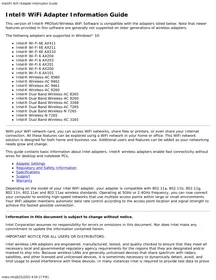
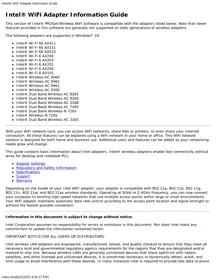
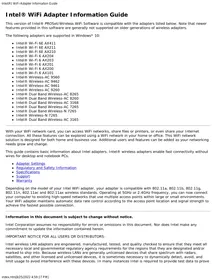
- Intel® WiFi Adapter Information Guide
- Information in this document is subject to change without notice.
- IMPORTANT NOTICE FOR ALL USERS OR DISTRIBUTORS:
- Adapter Settings
- How to Access
- Regulatory Information
- Intel WiFi/WiMAX Wireless Adapters
- INFORMATION FOR THE USER
- Safety Notices
- USA FCC Radio Frequency Exposure
- Explosive Device Proximity Warning
- AntennaWarnings
- Use On Aircraft Caution
- Other Wireless Devices
- Wireless Interoperability
- The Wireless Adapter and Your Health
- USA - Federal Communications Commission (FCC)
- Class B Device Interference Statement
- Safety Approval Considerations
- Low Halogen
- Japan
- Korea
- Modular Regulatory Certification Country Markings
- INFORMATION FOR OEMs and HOST INTEGRATORS
- Antenna Type and Gains
- Antenna Placement Within the Host Platform
- Simultaneous Transmission of Intel® Wireless Adapters with Other Integrated or Plug-In Transmitters
- Information To Be Supplied to the End User by the OEM or Integrator
- China:
- Intel WiFi Adapters - 802.11n, 802.11ac and 802.11ax Compliant
- Local Restrictions on 802.11a, 802.11b, 802.11d, 802.11g, 802.11n, and 802.11ac Radio Usage
- Canada - Industry Canada (IC)
- European Union Declarations of Conformity
- Waste Electrical and Electronic Equipment Directive (WEEE)
- Restriction of Hazardous Substances Directive (RoHS) Compliant
- Pakistan
- Taiwan
- Regulatory ID
- Intel® Dual Band Wireless-AC 3165
- Europe:
- Australia:
- Singapore:
- Argentina:
- Intel® Dual Band Wireless-AC 3168
- Intel® Dual Band Wireless-AC 7265
- Intel® Wireless Gigabit Sink W13100
- Complies with
- IDA Standards
- DB02941
- Intel® Tri-Band Wireless-AC 17265
- Intel® Dual Band Wireless-AC 8260
- Canada:
- Japan:
- Korea:
- Taiwan:
- Intel® Dual Band Wireless-AC 8265
- Pakistan:
- USA:
- Complies with IDA Standards DB 02941
- Intel® Wireless-AC 9260 (9260NGW)
- Intel® Wireless-AC 9260 (9260D2WL)
- 003-190024
- D190023003
- Intel® Wireless-AC 9461 (9461NGW)
- Intel® Wireless-AC 9461 (9461D2W)
- Intel® Wireless-AC 9462 (9462NGW)
- D170151003
- Intel® Wireless-AC 9462 (9462D2W)
- Intel® Wireless-AC 9560 (9560NGW)
- Intel® Wireless-AC 9560 (9560D2W)
- Intel® Wireless-AC 9560 (9560D2WL)
- Intel® Tri-band Wireless AC 18265
- CCAH16LP3190T1
- Intel® Wireless Gigabit 11000
- Intel® Wireless Gigabit Sink W13110VR
- Intel® Wireless Gigabit 11100VR
- Intel® Wi-Fi 6 AX101 (AX101NGW)
- Intel® Wi-Fi 6 AX101 (AX101D2W)
- Intel® Wi-Fi 6 AX200 (AX200D2WL)
- Intel® Wi-Fi 6 AX200 (AX200NGW)
- Intel® Wi-Fi 6 AX201 (AX201NGW)
- Intel® Wi-Fi 6 AX201 (AX201D2W)
- Intel® Wi-Fi 6 AX201 (AX201D2WL)
- Brazil:
- Intel® Wi-Fi 6 AX203 (AX203NGW)
- R-C-INT-AX203NGW
- Intel® Wi-Fi 6 AX203 (AX203D2W)
- R-C-INT-AX203D2W
- Intel® Wi-Fi 6 AX204 (AX204NGW)
- Intel® Wi-Fi 6 AX204 (AX204D2W)
- Intel® Wi-Fi 6E AX210 (AX210NGW)
- R-C-INT-AX21ONGW
- R-C-INT-AX210D2W
- Intel® Wi-Fi 6E AX211 (AX211NGW)
- R-C-INT-AX211NGW
- R-C-INT-AX211D2W
- Pakis
- Intel® Wi-Fi 6E AX211 (AX211D2WH)
- R-C-INT-AX211D2WH
- Intel® Wi-Fi 6E AX211 (AX211D2WL)
- RAMATEL
- C-26123
- Intel® Wi-Fi 6E AX411 (AX411NGW)
- Intel® Wi-Fi 6E AX411 (AX411E2W)
- Local Restriction of 802.11a, 802.11b, 802.11g, 802.11n, and 802.11ad Radio Usage
- Statements of European Compliance
- Specifications
- Intel® Centrino® Wireless-N 1000
- Intel® Centrino® Wireless-N 2200 and Intel® Centrino® Wireless-N 2230
- Intel® Centrino® Wireless-N 1030 and Intel® Centrino® Advanced-N 6230
- Intel® Centrino® Advanced-N + WiMAX 6250 and Intel® Centrino® Wireless-N + WiMAX 6150
- Intel® Centrino® Advanced-N 6200, Intel® Centrino® Advanced-N 6205 and Intel® Centrino® Ultimate-N 6300
- Intel® Dual Band Wireless-AC 7260
- Intel® Dual Band Wireless-N 7260
- Intel® Wireless-N 7260
- Intel® Dual Band Wireless-AC 3160
- Intel® Dual Band Wireless-AC 7265 (Model 7265NGW)
- Intel® Dual Band Wireless-N 7265 (Models 7265NGW AN and 7265NGW NB)
- Intel® Dual Band Wireless-AC 8265 (Models 8265NGWH/8265NGW/8265D2W)
- Intel® Wireless-AC 9260 (Models 9260NGW and 9260D2WL)
- Intel® Wireless-AC 9560 (Models 9560NGW/9560D2W)
- Intel® Tri-Band Wireless-AC 17265 (17265NGW/17265NGW LC)
- Intel® Tri-Band Wireless-AC 18265 (18265NGW)
- Intel® Wi-Fi 6 AX200 (AX200NGW/AX200D2WL)
- Intel® Wi-Fi 6 AX201 (AX201NGW/AX201D2W/AX201D2WL)
- Intel® Wi-Fi 6E AX210 (AX210GW/AX210D2W)
- Intel® Wi-Fi 6E AX211
- (AX211NGW/AX211D2W/AX211D2WH/AX211D2WL)
- Intel® Wi-Fi 6E AX411 (AX411NGW/AX411E2W)
- Customer Support
- Online Support
- Warranty Information
- One-Year Limited Hardware Warranty
- Limited Warranty
- Extent of Limited Warranty
- How to Obtain Warranty Service
- WARRANTY LIMITATIONS AND EXCLUSIONS
- LIMITATIONS OF LIABILITY
Brand : INTEL
Model : AX203
Category : WiFi Adapter