M510 - Marine transceiver ICOM - Free user manual and instructions
Find the device manual for free M510 ICOM in PDF.


| Product type | Marine VHF transceiver |
| Brand | Icom |
| Model | M510 |
| Power supply | 13.8 V DC (max. 16 V DC) |
| Water protection | Front panel waterproof IPX7 (rear connectors not waterproof) |
| Operating temperature | -20 °C to +60 °C |
| Maximum antenna gain | 9 dBi (omnidirectional) |
| RF safety distance | 5 m vertically above the deck; 1 m for boats without structure |
| Admissible exposure radius | Approximately 3 m (according to FCC OET 65) |
| Compliance | FCC Part 15, Class B |
| Installation | At least 1 m from the steering compass |
| Maintenance and cleaning | Soft dry cloth; no solvents (benzene, alcohol) |
| Electrical precautions | Do not connect to AC mains; do not reverse polarity; fuse included |
| Spare parts and repairability | Contact the manufacturer or an authorized technician |
| General information | User manual available in PDF; 128 pages |
Frequently Asked Questions - M510 ICOM
User questions about M510 ICOM
0 question about this device. Answer the ones you know or ask your own.
Ask a new question about this device
Download the instructions for your Marine transceiver in PDF format for free! Find your manual M510 - ICOM and take your electronic device back in hand. On this page are published all the documents necessary for the use of your device. M510 by ICOM.
USER MANUAL M510 ICOM
This device complies with Part 15 of the FCC Rules. Operation is subject to the condition that this device does not cause harmful interference.
Thank you for choosing this lcom product.
This product was designed and built with Icom's state of the art technology and craftsmanship. With proper care, this product should provide you with years of trouble-free operation.
■ Important
READ ALL INSTRUCTIONS carefully and completely before using the transceiver.
SAVE THIS INSTRUCTION MANUAL —
This instruction manual contains important operating instructions for the IC-M510BB.
This instruction manual includes some functions that are usable only when they are preset by your dealer.
Ask your dealer for details.
■ Explicit Definitions
| WORD | DEFINITION |
| ⚠ WARNING! | Personal injury, fire hazard or electric shock may occur. |
| CAUTION | Equipment damage may occur. |
| NOTE | If disregarded, inconvenience only. No risk of personal injury, fire or electric shock. |
Icom is not responsible for the destruction, damage to, or performance of any Icom or non-Icom equipment, if the malfunction is because of:
- Force majeure, including, but not limited to, fires, earthquakes, storms, floods, lightning, other natural disasters, disturbances, riots, war, or radioactive contamination.
- The use of Icom transceivers with any equipment that is not manufactured or approved by Icom.
■ Features
- Up to 3 COMMANDMIC™ capability, VHF Black Box Transceiver
● Built-in Class D DSC, "DISTRESS" key on the back of the COMMANDMIC™ - DSC remote control interface for navigation device or PC console software (EN 300 338-8 compatible)
● Integrated GPS receiver
● Integrated AIS receiver - NMEA 0183-HS and NMEA 2000™ connectivity
● Internal 15 W Hailer/Fog Horn - IPX7 waterproof (1 m depth water for 30 minutes)
● 2 minutes last call voice recording
● Active noise cancelling for transmitted and received audio.
Icom and the Icom logo are registered trademarks of Icom Incorporated (Japan) in Japan, the United States, the United Kingdom, Germany, France, Spain, Russia, Australia, New Zealand, and/or other countries.
AquaQuake is a trademark of Icom Incorporated.
COMMANDMIC is a trademark of Icom Incorporated.
NMEA 2000 is a trademark of the National Maritime Electronics Association, Inc.
All other products or brands are registered trademarks or trademarks of their respective holders.
■ In Case of Emergency
If your vessel requires assistance, contact other vessels and the Coast Guard by sending a distress call on Channel 16 or transmit your Distress call using Digital Selective Calling (DSC) on Channel 70.
◇ Using Channel 16
- Push [16/C] to switch to Channel 16.
- While holding down [PTT], give the appropriate information as follows:
● "MAYDAY MAYDAY MAYDAY."
- "THIS IS" (name of vessel).
- Say your call sign or other indication of the vessel (AND your 9 digit DSC ID, if you have one).
- "LOCATED AT (your position).
● State the nature of the distress and assistance required.
- Give any other information which might facilitate the rescue.
◇ Using Digital Selective Calling
- Lift up the key cover on the back of the command microphone, hold down [DISTRESS] for 3 seconds until the 3 short beeps and then one long beep sound.
![[DISTRESS] key](/content/2025/12/335615/images/c359ff0a54efcaf58e7531d27b276fcb7314b6f85c1f21939cedfbfa5fbaeba0.jpg)
- Wait for an acknowledgment from another station.
- After the acknowledgment is received, Channel 16 is automatically selected.
- Hold down [PTT], then transmit the appropriate information as listed above.
■ Radio Operation Warning

WARNING
Icom requires the radio operator to meet the FCC Requirements for Radio Frequency Exposure. An omnidirectional antenna with gain not greater than 9 dBi must be mounted a minimum of 5 meters (measured from the lowest point of the antenna) vertically above the main deck and all possible personnel. This is the minimum safe separation distance estimated to meet all RF exposure compliance requirements. This 5 meter distance is based on the FCC Safe Maximum Permissible Exposure (MPE) distance of 3 meters added to the height of an adult (2 meters) and is appropriate for all vessels.
For watercraft without suitable structures, the antenna must be mounted so as to maintain a minimum of 1 meter vertically between the antenna, (measured from the lowest point of the antenna), to the heads of all persons AND all persons must stay outside of the 3 meter MPE radius.
Do not transmit with radio and antenna when persons are within the MPE radius of the antenna, unless such persons (such as driver or radio operator) are shielded from antenna field by a grounded metallic barrier. The MPE Radius is the minimum distance from the antenna axis that person should maintain in order to avoid RF exposure higher than the allowable MPE level set by FCC.
FAILURE TO OBSERVE THESE LIMITS MAY ALLOW THOSE WITHIN THE MPE RADIUS TO EXPERIENCE RF RADIATION ABSORPTION WHICH EXCEEDS THE FCC MAXIMUM PERMISSIBLE EXPOSURE (MPE) LIMIT.
IT IS THE RESPONSIBILITY OF THE RADIO OPERATOR TO ENSURE THAT THE MAXIMUM PERMISSIBLE EXPOSURE LIMITS ARE OBSERVED AT ALL TIMES DURING RADIO TRANSMISSION. THE RADIO OPERATOR IS TO ENSURE THAT NO BYSTANDERS COME WITHIN THE RADIUS OF THE MAXIMUM PERMISSIBLE EXPOSURE LIMITS.
Determining MPE Radius
THE MAXIMUM PERMISSIBLE EXPOSURE (MPE) RADIUS HAS BEEN ESTIMATED TO BE A RADIUS OF ABOUT 3 M PER OET BULLETIN 65 OF THE FCC.
THIS ESTIMATE IS MADE ASSUMING THE MAXIMUM POWER OF THE RADIO AND ANTENNAS WITH A MAXIMUM GAIN OF 9 dBi ARE USED FOR A SHIP MOUNTED SYSTEM.
This equipment has been tested and found to comply with the limits for a Class B digital device, pursuant to part 15 of the FCC Rules. These limits are designed to provide reasonable protection against harmful interference in a residential installation. This equipment generates, uses, and can radiate radio frequency energy and, if not installed and used in accordance with the instructions, may cause harmful interference to radio communications. However, there is no guarantee that interference will not occur in a particular installation. If this equipment does cause harmful interference to radio or television reception, which can be determined by turning the equipment off and on, the user is encouraged to try to correct the interference by one or more of the following measures:
- Reorient or relocate the receiving antenna.
- Increase the separation between the equipment and receiver.
- Connect the equipment into an outlet on a circuit different from that to which the receiver is connected.
- Consult the dealer or an experienced radio/TV technician for help.
CAUTION: Changes or modifications to this transceiver, not expressly approved by Icom Inc., could void your authority to operate this transceiver under FCC regulations.
Information FCC
A WARNING STICKER is supplied with the USA version transceiver.
To comply with FCC regulations, this sticker must be affixed in such a location as to be readily seen from the operating controls of the radio. Make sure the chosen location is clean and dry before applying the sticker.
■ Precautions
⚠ WARNING! NEVER connect the transceiver directly to an AC outlet. This may cause a fire or an electric shock.
⚠ WARNING! NEVER connect the transceiver to a power source of more than 16 V DC such as a 24 V battery. This connection could cause a fire or damage the transceiver.
⚠ WARNING! NEVER reverse the DC power cable polarity. This could cause a fire or damage the equipment.
⚠ WARNING! NEVER cut the DC power cable between the DC power connector on the transceiver's rear panel and the fuse holder. If an incorrect connection is made after cutting, the transceiver may be damaged.
⚠ WARNING! NEVER operate the transceiver during a lightning storm. It may result in an electric shock, cause a fire or damage the transceiver. Always disconnect the power source and antenna before a storm.
⚠ WARNING! NEVER place the transceiver where normal operation of the vessel may be hindered, or where it could cause bodily injury.
CAUTION: DO NOT place or leave the transceiver in areas with temperatures below -20^ or above +60^ ( -4^ or above +140^ ), or in areas subject to direct sunlight, such as a dashboard.
CAUTION: DO NOT use harsh solvents such as Benzine or alcohol when cleaning. This could damage the equipment surfaces. If the surface becomes dusty or dirty, wipe it clean with a soft, dry cloth.
NEVER place the transceiver in an insecure place to avoid inadvertent use by unauthorized persons.
BE CAREFUL! The transceiver's rear panel will become hot when transmitting continuously for long periods of time.
BE CAREFUL! The transceiver meets IPX7 requirements for waterproof protection*. However, once the transceiver or microphone has been dropped, or the waterproof seal is cracked or damaged, waterproof protection cannot be guaranteed because of possible damage to the case or the waterproof seal.
* Except for the DC power connector, NMEA In/Out leads and AF Out leads.
NOTE: Install the transceiver and/or microphone more than 1 meter from the vessel's magnetic navigation compass.
■ Précautions
The installation of this equipment should be made in such a manner as to respect the EC recommended electromagnetic field exposure limits. (1999/519/EC)
The maximum RF power available from this device is 25 watts. The antenna should be installed as high as possible for maximum efficiency and the installation height should be at least 1.76 meters above any accessible position. In the case where an antenna cannot be installed at a reasonable height, then the transmitter should neither be continuously operated for long periods if any person is within a distance of 1.76 meters of the antenna, nor operated at all if any person is touching the antenna.
It is recommended that antenna of a maximum gain of 3 dB is used. If higher gain antenna is required then please contact your Icom distributor for revised installation recommendations.
Operation:
The exposure to RF electromagnetic field is only applicable when this device is transmitting. This exposure is naturally reduced due to the nature of alternating periods of receiving and transmitting. Keep your transmissions to the minimum necessary.
■ Disposal
natural_image
Symbol of a trash bin crossed with two diagonal lines, no text or labels presentThe crossed-out wheeled-bin symbol on your product, literature, or packaging reminds you that in the European Union, all electrical and electronic products, batteries, and accumulators
(rechargeable batteries) must be taken to designated collection locations at the end of their working life. Do not dispose of these products as unsorted municipal waste. Dispose of them according to the laws in your area.
■ About CE and DOC
CE Hereby, Icom Inc. declares that the versions of the IC-M510BB which have the "CE" symbol on the product, comply with the essential requirements of the Radio Equipment Directive, 2014/53/EU, and the restriction of the use of certain hazardous substances in electrical and electronic equipment Directive, 2011/65/EU. The full text of the EU declaration of conformity is available at the following internet address:
https://www.icomjapan.com/support/
For the European versions:
The following caution is printed on the labels of the transceiver.
CAUTION
AVOID TOUCHING REAR PANEL DURING PROLONGED USE.
This is because the transceiver's rear panel will become hot when continuously transmitting for long periods of time.
■ Recommendation
CLEAN THE TRANSCEIVER AND MICROPHONE THOROUGHLY WITH FRESH
WATER after exposure to saltwater, and dry it before operating. Otherwise, the transceiver's keys and switches may become unusable, due to salt crystallization.
NOTE: If the transceiver's waterproof protection appears defective, carefully clean it with a soft, damp (fresh water) cloth, then, dry it before operating.
The transceiver may lose its waterproof protection if the case or microphone is cracked or broken, the microphone connector is not screwed in completely, or the transceiver has been dropped.
Contact your Icom distributor or your dealer for advice.
■ Key Icon Description
The keys are described in this manual as follows:
The keys that have words or letters on them are described with the characters “[ ].”
Example: [MENU], [CLEAR]
The software keys are described with the icon such as DTRS or DISP. The function of the keys are shown at the bottom of the display. Push the key below the desired function.
You can use the following keys on the Menu screen.
| FUNCTION | ACTION |
| Select | Push [▼] or [▲], or rotate [DIAL]. |
| Enter | Push [ENT] or [DIAL]. |
| Go to the next tree level | Push [ENT], [►], or [DIAL]. |
| Go back to the previous tree level | Push [CLEAR], or [◀]. |
| Cancel | Push [CLEAR] or CANCEL. |
| Exit | Push [MENU] or ↑. |
Information:
In this instruction manual, the transceiver model names are described as shown below.
U.S.A.: USA
Europe: EUR
Germany: FRG
Netherlands: NLD
U.K.: UK
Table of Contents
TBD
TBD
TBD
◇ Priorities
- Read all rules and regulations pertaining to priorities and keep an up-to-date copy handy. Safety and distress calls take priority over all others.
- You must monitor Channel 16 when you are not operating on another channel.
- False or fraudulent distress calls are prohibited under law.
◇ Privacy
• Information overheard but not intended for you cannot lawfully be used in any way.
- Indecent or profane language is prohibited.
◇ Radio licenses
(1) SHIP STATION LICENSE
You must have a current radio station license before using the transceiver. It is unlawful to operate a ship station which is not licensed.
Inquire through your dealer or the appropriate government agency for a Ship-
Radiotelephone license application. This government-issued license states the call sign which is your craft's identification for radio purposes.
(2) OPERATOR'S LICENSE
A Restricted Radiotelephone Operator Permit is the license most often held by small vessel radio operators when a radio is not required for safety purposes.
The Restricted Radiotelephone Operator Permit must be posted or kept with the operator. Only a licensed radio operator may operate a transceiver.
However, non-licensed individuals may talk over a transceiver if a licensed operator starts, supervises, ends the call and makes the necessary log entries.
A current copy of the applicable government rules and regulations is only required to be on hand for vessels in which a radio telephone is compulsory. However, even if you are not required to have these on hand it is your responsibility to be thoroughly acquainted with all pertinent rules and regulations.
NOTE For the UK version: Even though the IC-M510BB is capable of operation on VHF marine channels 1021, 1023, 1081, 1082 and 1083, according to FCC regulations these simplex channels cannot be lawfully used by the general population in USA waters.
■ Command microphone
Front panel:
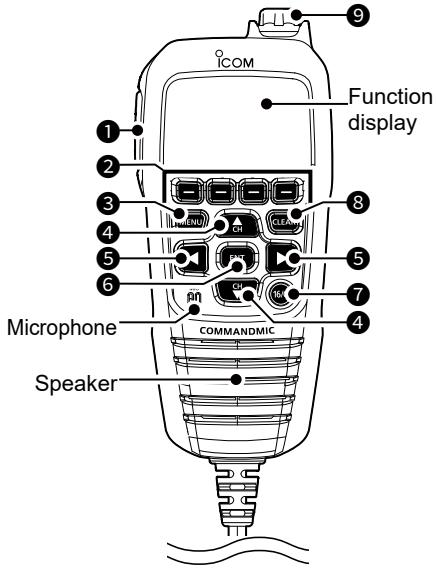
① PTT SWITCH [PTT] (p.XX)
Hold down to transmit, release to receive.
② SOFTWARE KEYS (p.XX)
Scroll the key functions pushing [◀] or [▶], then push either of the 4 software keys to select the function displayed at the bottom of the display.
③ MENU KEY [MENU]
Push to display or close the Menu screen.
④ UP/DOWN KEYS [▲ CH]/[▼ CH]
- Push to select an operating channel, Menu items, Menu settings, and so on. (p. XX)
- Push to select a character or number in the entry mode. (pp. XX, XX\~XX)
⑤ LEFT/RIGHT KEYS [◀]/[▶]
- Push to scroll the Software Key functions. (pp. XX\~ XX)
- Push to select a character or number in the entry mode. (pp. XX, XX, XX\~XX)
Rear panel:
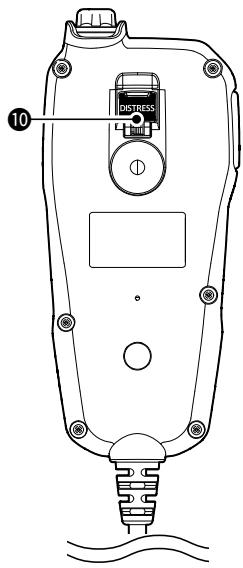
⑥ ENTER KEY [ENT]
Push to set the entered data, selected item, and so on.
⑦ CHANNEL 16/CALL CHANNEL KEY [16/C]
- Push to select Channel 16. (p. XX)
- Hold down for 1.5 seconds to select the Call channel. (p. XX)
⑧ CLEAR KEY [CLEAR]
Push to cancel the entered data or to return to the previous screen.
⑨ VOLUME/SQUELCH/POWER DIAL [VOL]/[SQL]/[PWR]/[DIAL]
- Rotate to adjust the volume level, squelch level
- Hold down for 1 second to turn the transceiver ON or OFF.
- Push to set the entered data, selected item, and so on.
⑩ DISTRESS KEY [DISTRESS]
Hold down for 3 seconds to transmit a Distress call. (p. XX)
2 PANEL DESCRIPTION
■ Function Display (INFO screen)
① When you switch the main screen between the INFO, the Plotter, and the MOB screens, push DISP.
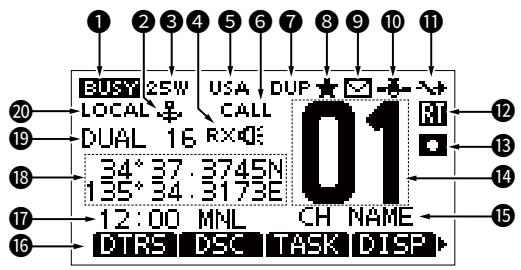
① BUSY/TRANSMIT
- TX is displayed when receiving a signal or the squelch is open.
- BUST is displayed while transmitting.
② ANCHOR WATCH INDICATOR
Displayed when the Anchor Watch function is activated.
③ POWER
- "25W" is displayed when high power is selected.
- “1W” is displayed when low power is selected.
4 RX HAILER
Displayed while in the RX Hailer mode.
AUTO FOGHORN
is displayed when the Auto Foghorn function is activated.
① R×D: takes precedence over ◆ on the screen.
⑤ CHANNEL GROUP
Displays the selected channel group.
① The selectable channels differ, depending on the version or presetting.
⑥ CALL CHANNEL
Displayed when the Call chanel is selected
⑦ DUPLEX
Displayed when a Duplex channel is selected.
8 FAVORITE CHANNEL
Displayed when a Favorite channel is selected.
⑨ MESSAGE
Displayed when there are unread DSC messages Blinks when a DSC message is received.
10 GPS INDICATOR
- Displayed when the transceiver receives valid position data.
- Blinks when invalid GPS data is being received.
⑪ CH AUTO SWITCH
Displayed when "CH AUTO SWITCH" is set to anything other than "Accept."
12 RT (Radio Telephone) INDICATOR
Displayed while in the Radio Telephone mode.
① Returns to the Standby mode if no operation occurs during the preset period of time.
13 VOICE RECORD
- is displayed while recording the audio.
- is displayed while playing back the recorded audio.
LOW BATTERY INDICATOR
+ is displayed when the battery voltage is low.
14 CH NUMBER READOUT
Displays the selected channel number
15 CH NAME FIELD
The channel name is displayed.
16 SOFTWARE KEYS
Software key functions are displayed.
17 TIME ZONE
The current time is displayed when valid GPS data is received, or the time has been manually entered.
- "NO TIME" is Displayed when valid GPS data is not received or time has not been manually entered.
- “??” blinks every 2 seconds instead of the time when the GPS current time is invalid.
① After 23.5 hours has passed, “NO TIME” will be displayed. - “??” blinks every 2 seconds instead of the time after 4 hours have passed since you manually entered the time.
- “LOCAL” is displayed when the offset time is set.
- “MNL” is displayed when the time was manually entered.
18 POSITION
The current position is displayed when valid GPS data is received, or the position has been manually entered.
- "NO POSITION" is displayed when valid GPS data is not received or your position has not been manually entered.
- “??” blinks every 2 seconds instead of your position when the GPS position is invalid.
① The last position is held for only 23.5 hours. After that, “NO POSITION” will be displayed.
- “??” blinks every 2 seconds instead of the position after 4 hours have passed since you manually entered your position.
① The manually entered position is held for only 23.5 hours. After that, "NO POSITION" will be displayed.
19 SCAN INDICATOR
- “SCAN” is displayed during a Normal scan.
- “SCAN 16” is displayed during a Priority scan.
- "DUAL 16" is displayed during Dualwatch.
- "TRI 16" is displayed during Tri-Watch.
20 ATTENUATOR INDICATOR
(For only the USA version) Displayed when the Attenuator function is turned ON.
2 PANEL DESCRIPTION
■ Software Keys
Various often-used functions are assigned to the Software Keys for easy access. The functions' icons are displayed above the Software Keys, as shown below.
◇ Selecting a Software Key function
Push [◀] or [▶] to slide through the selectable functions that are assigned to the Software Keys.
Push the Software Key under the function's icon to select the function.
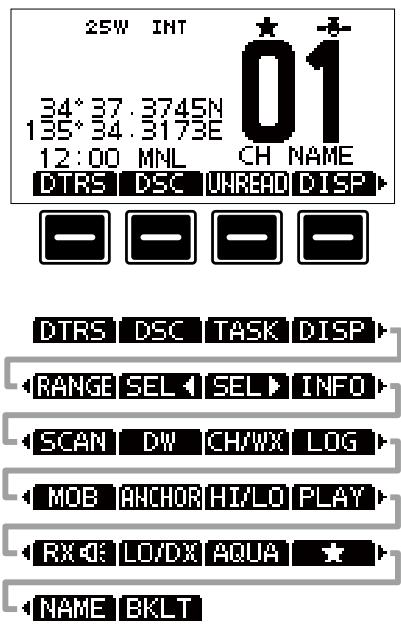
NOTE: The displayed icons or their order may differ, depending on the transceiver version or the presetting.
When the MMSI code is not set, the Software Keys for the DSC function are not displayed.
◇ Software Key functions
Compose Distress [DTRS] (p.XX)
Push to display the “Compose Distress” screen to select the nature of distress, then to make a call.
NEVER MAKE A DISTRESS CALL IF YOUR VESSEL OR A PERSON IS NOT IN AN EMERGENCY. A DISTRESS CALL SHOULD BE MADE ONLY WHEN IMMEDIATE HELP IS NEEDED.
Compose other DSC [DSC] (p.XX)
Push to compose an Individual call, Group call, All Ships call or a Test call, and so on.
Task List [TASK] (p.XX)
(For only the USA version)
Push to enter the Task List.
① Displayed only when “Multiple” is selected in the “Procedure” in the Menu screen.
Unread List [UNREAD] (p.XX)
Push to enter the Unread List.
① Displayed only when “Single” is selected in the “Procedure” in the Menu screen.
DISPLAY [DISP] (p.XX)
Push to switch the main screen between the INFO, the Plotter, and the MOB screens
Range [RANGE] (p.XX)
Push to select the plotter display range on the Plotter screen.
① Displayed only on the plotter screen.
Target Select [SEL ◀]/[SEL ▶] (p.XX)
Push to select an AIS target, or MOB.
① Displayed only on the plotter screen.
Target Details [INFO] (p.XX)
Push to display the details on the selected target.
① Displayed only on the plotter screen.
Scan [SCAN] (p.XX)
Push to start or stop a Normal or Priority scan.
Dualwatch/Tri-watch [DW]/[TW] (p.XX)
(Except for the NLD version)
Push to start or stop the Dualwatch or Tri-watch.
Channel/Weather channel [CH/WX] (p.XX)
Push to select regular channels or Weather channels.
① The Weather channel is only for the USA version. [CH] is displayed for other versions.
① While the Call channel or Channel 16 is displayed, push this key to return to the regular channel mode.
DSC Log [LOG] (p.XX)
Push to display the received call log or distress message log.
Man Overboard [MOB] (p.XX)
Push to enter the Man Overboard (MOB) mode.
While in the MOB mode, push to stop the MOB mode.
Anchor Watch [ANCHOR] (p.XX)
Push to start or stop the Anchor watch function.
High/Low [HI/LO] (p.XX)
Push to set the output power level to high or low.
① Some channels are set to only low power.
RX Play [PLAY] (p.XX)
Push to play back the recorded audio.
RX Hailer [R×□:] (p.XX)
Push to display the RX Hailer popup screen.
① To use this function, an external speaker must be connected to the transceiver.
Attenuator [LO/DX] (p.XX)
(For only the USA version)
Push to turn the Attenuator function ON or OFF.
① “LOCAL” is displayed when the Attenuator function is turned ON.
AquaQuake [AQUA] (p.XX)
Hold down to turn ON the AquaQuake function to clear water from the command microphone's speaker grill.
Favorite Channel [★] (p.XX)
Push to set or clear the displayed channel as a Favorite channel.
CH Name [NAME] (p.XX)
Push to edit the name of the displayed channel.
Backlight [BKLT] (p.XX)
Push to display the Backlight popup screen.
In the Backlight popup screen, you can set the backlight level.
For only the European version:
When you turn ON the transceiver, "Model" screen is displayed depending on the setting. Select the country where you operate the transceiver.
① If no country is selected, “General” is automatically selected.
■ Entering the MMSI code
The Maritime Mobile Service Identity (MMSI: DSC self ID) code consists of 9 digits.
You can only enter the code when turning ON the transceiver for the first time.
This initial code can be entered only once.
After entering, it can be changed only by your dealer or distributor.
If your MMSI code has already been entered, doing the steps below is not necessary.
- Hold down [PWR] to turn ON the transceiver.
- Three short beeps sound, and "Push [ENT] to Register your MMSI" is displayed.
- Push [ENT] to start entering the MMSI code.
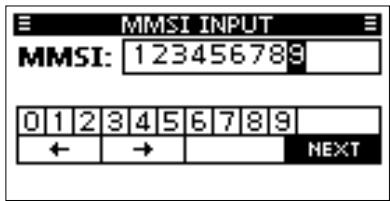
- The "MMSI INPUT" screen is displayed.
① Push [CLEAR] twice to skip the entry. If you skip the entry, you cannot make a DSC call. To enter the code after skipping, turn OFF the power, and then turn it ON again.
- Enter the MMSI code.
TIP:
- Select a number using [◀] and [▶].
- Push [ENT] to enter the selected number.
- Select “←” or “→” on the screen, or rotate [DIAL] to move the cursor.
-
Repeat step 3 to enter all 9 digits.
-
Select NEXT and push [ENT] to set the entered code.
- The “MMSI CONFIRMATION” screen is displayed.
-
Enter your MMSI code again to confirm.
-
Select FINISH to set the entered code.
- When your MMSI code is successfully entered, “MMSI registered successfully.” is briefly displayed, and then enters the operating screen.
① Your MMSI code is also displayed on the opening screen.
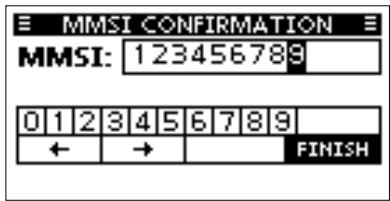

123456789
MMSI registered successfully.
■ Entering the ATIS ID (For NLD and FRG versions)
The Automatic Transmitter Identification System (ATIS) ID consists of 10 digits. You can enter the ID in the “ATIS ID Input” item on the Menu screen.
This ID entering can be done only once.
After entering, it can be changed only by your dealer or distributor. If your ATIS ID has already been entered, doing the steps below is not necessary.
- Push [MENU].
- The Menu screen is displayed.
- Push [▲] or [▼], or rotate [DIAL] to select "ATIS ID Input," then push [ENT] to start entering.
-
The "ATIS ID INPUT" screen is displayed.
-
Enter your ATIS ID.
TIP:
- Select a number using [◀] and [▶].
- Push [ENT], or [DIAL] to enter the selected number.
-
Select “←” or “→”, or rotate [DIAL] on the screen to move the cursor.
-
Repeat step 3 to enter all 10 digits.
-
Select NEXT to set the entered ID.
- The “ATIS ID CONFIRMATION” screen is displayed.
-
Enter your ATIS ID again to confirm.
-
Select FINISH to set the entered ID.
- When your ATIS ID is successfully entered, the screen displays “ATIS ID registered successfully,” and then enters the operating screen.
① You can check the ATIS ID in “Radio Information” on the Menu screen.
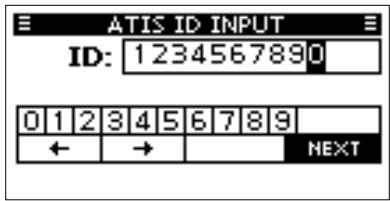
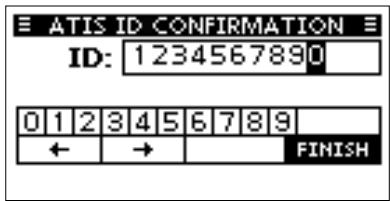

1234567890
ATIS ID registered successfully.
■ Selecting a channel
◇ Regular Channel
You can select a channel by pushing [▲] or [▼].
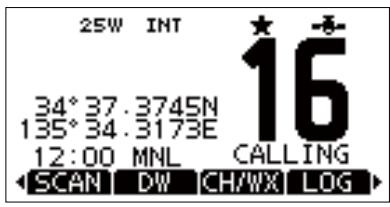
◇ Channel 16
Channel 16 is the distress and safety channel. It is used to establish the initial contact with a station, and for emergency communications. Channel 16 is monitored during both Dualwatch and Tri-watch. While in the standby mode, you must monitor Channel 16.
- Push [16/C] to select Channel 16.
① To return to the previously selected channel, push CH/WX or CH.
◇ Call channel
Each Channel Group has separate leisure-use Call channels. The Call channel is scanned during Tri-watch. The Call channels can be selected and used to store your most often used channels in each Channel Group, for quick recall. See page XX for details on setting the Call channel.
- Hold down [16/C] for 1 second to select the Call channel.
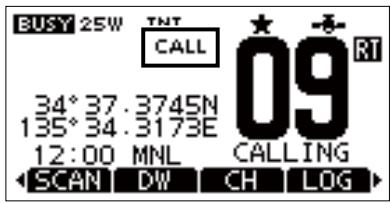
- The Call channel number and "CALL" are displayed.
① To return to the previously selected channel, push CH/WX or CH.
◇ Selecting a Channel Group
Channel Groups are preset into your transceiver. You can select a Channel Group for USA, International, Canadian, DSC, and ATIS depending on the transceiver version.
- Open the "CHANNEL GROUP" screen.
[MENU] > Settings > Radio > Channel Group - Push [▲] or [▼], or rotate [DIAL] to select a Channel Group, and then push [ENT] or [DIAL].
- Push [MENU] to exit the Menu screen.
- The selected Channel Group's icon is displayed on the operating screen.
| Version | Preset Channel Group | ||||
| USA | INT | CAN | DSC | ATIS | |
| USA | √ | √ | √ | ||
| UK | √ | √ | |||
| European | √ | ||||
| NLD | √ | √ | |||
| FRG | √ | √ | √ | ||
■ Weather channels and Weather Alert (For only the USA version)
The USA version transceiver has 10 preset Weather channels.
The transceivers are capable* of monitoring broadcasts from the National Oceanographic and Atmospheric Administration (NOAA). The transceiver automatically detects a Weather alert tone on the selected weather channel, or while scanning.
*When used within range of the broadcasts.
◇ Selecting a Weather channel
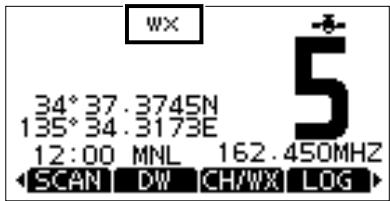
1. Push [CH/WX].
- "WX" is displayed on the operating screen instead of the Channel Group.
2. Push [▲] or [▼], or rotate [DIAL] to select a Weather channel.
The Weather channel list
| WX channel | Frequency (MHz) | WX channel | Frequency (MHz) |
| 1 | 162.550 | 6 | 162.500 |
| 2 | 162.400 | 7 | 162.525 |
| 3 | 162.475 | 8 | 161.650 |
| 4 | 162.425 | 9 | 161.775 |
| 5 | 162.450 | 10 | 163.275 |
◇ Setting the Weather Alert
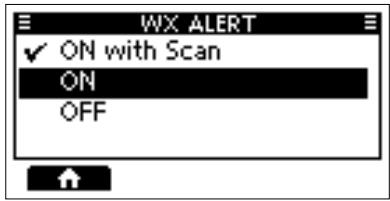
To receive the weather alert, set the WX Alert to "ON with Scan," or "ON."
- Open the "WEATHER ALERT" screen.
$$ [ M E N U ] > \text { Settings } > \text { Radio } > \text { WX Alert } $$
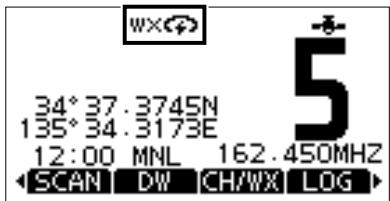
- Select "ON with Scan," or "ON."
- “ ” is displayed next to the weather channel icon.
① “W×” blinks until you push a key after detecting an alert.
4 BASIC OPERATIONS
■ Adjusting the volume/squelch/backlight/display contrast
◇ Adjusting the volume level
- Rotate [VOL] to adjust the audio volume level.
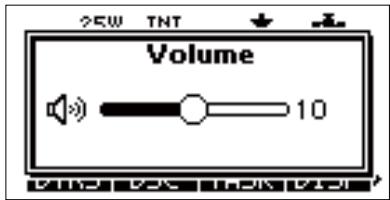
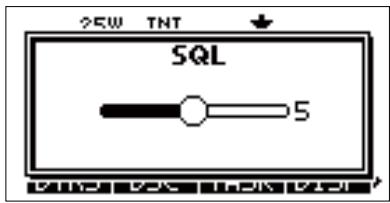
◇ Adjusting the squelch level
Squelch enables the audio to be heard only while receiving a signal that is stronger than the set level. A higher level blocks weak signals, so that you can receive only stronger signals. A lower level enables you to hear weak signals.
- Push [SQL] one or more times and rotate [SQL] to adjust the squelch level.
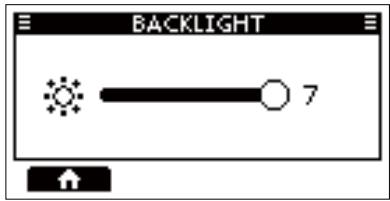
◇ Adjusting the backlight
The Function display and keys can be backlit for better visibility under low light conditions.
- Open the "BACKLIGHT" screen.
[MENU] > Settings > Configuration > Backlight
① You can also push BKLT to open the "Backlight" screen.
-
Push [◀] or [▶] or rotate [DIAL] to adjust the backlight level, and push [ENT] to exit.
-
The backlight level is set, and the transceiver returns to the previous screen.
① The backlight level is adjustable in 7 levels and “OFF.”
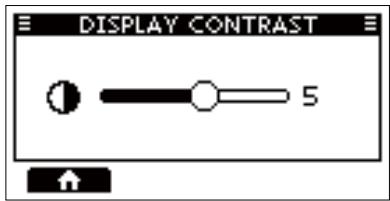
◇ Adjusting the display contrast
- Open the "DISPLAY CONTRAST" screen.
[MENU] > Settings > Configuration > Display Contrast
- Push [◀] or [▶] or rotate [DIAL] to adjust the display contrast, and push [ENT] to exit.
① The contrast level is adjustable in 8 levels.
■ Setting the Call channel
By default, a Call channel is set in each Channel Group.
You can set your most often-used channel as your Call channel in each Channel Group for quick recall.
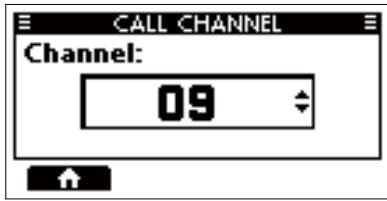
- Open the "CALL CHANNEL" screen.
- Push [▲] or [▼], or rotate [DIAL] to select the channel.
- Push [ENT] or [DIAL] to set the selected channel as the Call channel.
- Push [MENU] to exit the Menu screen.
$$ [ M E N U ] > \text { Settings } > \text { Radio } > \text { Call Channel } $$
■ AquaQuake Water Draining function
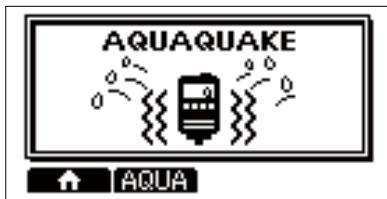
Water in the speaker grill may muffle the sound coming from the speaker. The
AquaQuake Water Draining function removes water from the speaker grill by vibrating the speaker cone.
CAUTION: DO NOT use the AquaQuake Water Draining function when an external speaker is connected.
- Push [◀] or [▶] to display AQUA.
- Hold down AQUA to turn ON the function.
- A low frequency vibration beep sounds to drain the water, regardless of the volume level setting.
① This function is activated for a maximum of 10 seconds, even if you continue to hold down AQUA.
- Release AQUA to turn OFF the function.
■ Editing a channel name
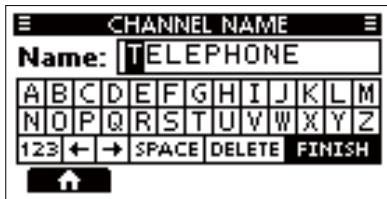
You can edit the name of each operating channel and weather channel, using numbers, uppercase letters, symbols, and a space. This enables easy recognition of the channels or stations. All VHF marine channels are set with default names.
-
Push [▲] or [▼], or rotate [DIAL] to select the channel to edit.
-
Push [◀] or [▶] to display NAME.
① You cannot edit a channel name during Dualwatch, Tri-watch, or a scan.
- Push NAME
- The "CHANNEL NAME" screen is displayed.
- Edit the channel name.
i Select 123 to enter numbers, and !57 to enter symbols.
- Select FINISH, and then push [ENT] or [DIAL] to save the edited name and return to the operating screen.
4 BASIC OPERATIONS
■ Receiving and transmitting
CAUTION: DO NOT transmit without an antenna.
- Push [▲] or [▼], or push [DIAL] one or more times and rotate [DIAL] to select a channel to call on.
- The channel number and name are briefly displayed.
① EUSY is displayed while receiving a signal. - Hold down [PTT] and speak into the microphone at your normal voice level.
• TX is displayed while transmitting. - Release [PTT] to receive.
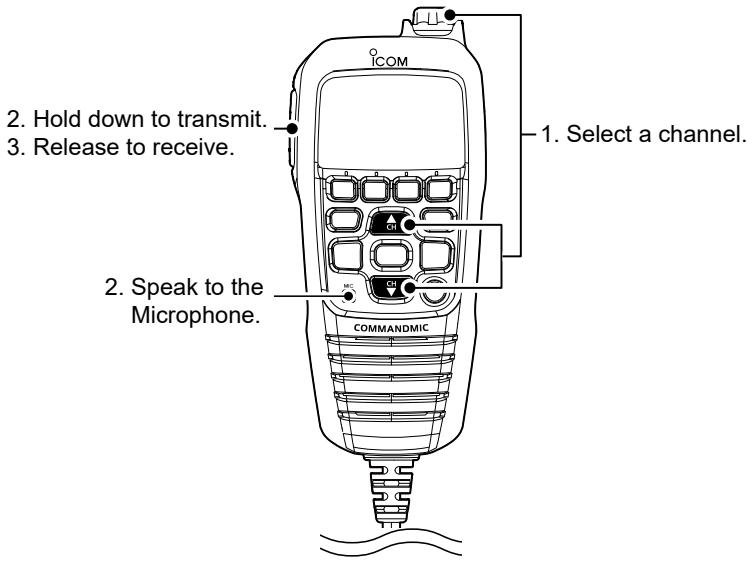
TIP: To maximize the readability of your transmitted signal, pause for a second after holding down [PTT] and hold the microphone 5 to 10 cm from your mouth, and then speak at your normal voice level.
NOTE: The Time-out Timer function cuts OFF transmission after 5 minutes of continuously transmitting, to prevent prolonged transmission.
■ Scan types
You can find ongoing communication by scanning the Favorite channels. Scan is for all the transceiver versions except the NLD version.
Before starting a scan :
- Set the channels that you want to scan as Favorite channels. (p. XX)
① Only the Favorite channels are scanned. - Set the scan type to "Priority Scan" or "Normal Scan" on the Menu screen. (p. XX)
[MENU] > Settings > Radio > Scan Type
Normal Scan
Sequentially searches through all Favorite channels. Channel 16 is not scanned unless it is set as a Favorite channel.
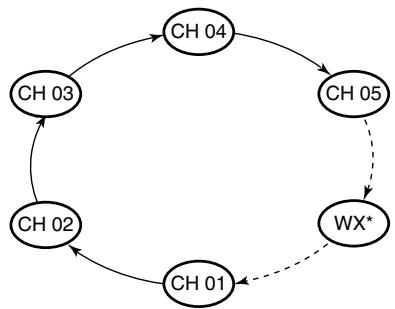
flowchart
graph TD
    CH01 --> CH02
    CH02 --> CH03
    CH03 --> CH04
    CH04 --> CH05
    CH05 -.-> WX*
    WX* -.-> CH01
*For the USA version, when the Weather Alert function is ON, the previously selected Weather channel is also scanned.
Priority Scan
Sequentially searches through all Favorite channels, while also periodically checking Channel 16.
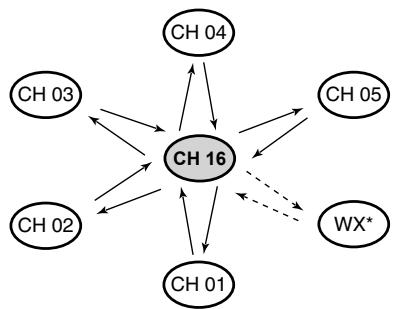
flowchart
graph TD
    CH16["CH 16"] --> CH04["CH 04"]
    CH16 --> CH03["CH 03"]
    CH16 --> CH02["CH 02"]
    CH16 --> CH01["CH 01"]
    CH04 --> CH05["CH 05"]
    CH05 --> WX*
    CH01 -.-> WX*
    CH02 -.-> WX*
*For the USA version, when the Weather Alert function is ON, the previously selected Weather channel is also scanned.
When a signal is received:
On Channel 16:
On a channel other than Channel 16: The scan pauses until the signal disappears. The scan becomes Dualwatch until the signal disappears.
5
SCAN OPERATION
■ Setting Favorite channels (Except for the NLD version)
You can quickly recall often-used channels by setting them as Favorite channels. You can set Favorite channels in each Channel Group.
- Select a Channel Group on the Menu screen. (p. XX)
[MENU] > Settings > Radio > Channel Group
- Push [▲] or [▼], or rotate [DIAL] to select the channel.
- Push [◀] or [▶] to display ★.
- Push ★.
- The selected channel is set as a Favorite channel, and “★” is displayed.
① To cancel the setting, push ★ again.
TIP: You can set all channels as Favorite channels, clear all settings, or reset to the defaults. By default, some channels are preset as Favorite channels. The preset channels differ, depending on the transceiver version.
■ Starting a scan (Except for the NLD version)
Example: Starting a Normal Scan.
- Select a Channel Group on the Menu screen. (p. XX)
[MENU] > Settings > Radio > Channel Group
- Push [◀] or [▶] to display SCAN.
-
Push SCAN.
-
The scan starts.
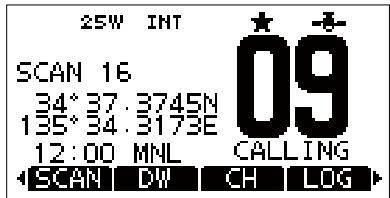
- “SCAN” is displayed during a Normal Scan and “SCAN 16” is displayed during a Priority Scan.
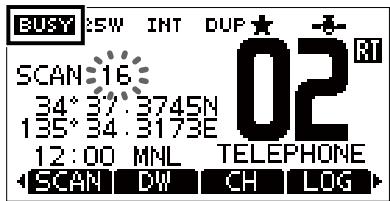
- “SCAN” and BUSY are displayed when a signal is received.
① When a signal is received, the scan pauses until it disappears, or resumes after 5 seconds, depending on the Scan Timer setting in “Radio Settings.”
① A beep sounds and “16” blinks when a signal is received on Channel 16 during a Priority scan.
- To stop the scan, push SCAN.
TIP: To properly receive signals, be sure to adjust the squelch to a suitable level.

DUALWATCH/TRI-WATCH (Except for the NLD version)
■ Description
Dualwatch and Tri-watch are convenient to periodically check Channel 16 while you are operating on another channel.
Dualwatch
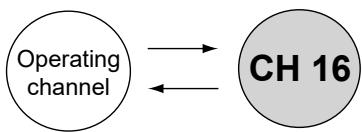
flowchart
graph LR
    A["Operating channel"] --> B["CH 16"]
    B --> A
Periodically checks Channel 16 while operating on another channel.
Tri-watch
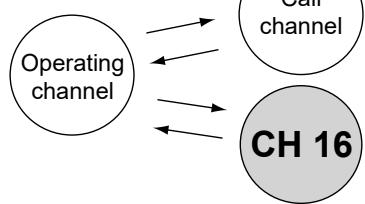
flowchart
graph TD
    A["Operating channel"] --> B["Care channel"]
    B --> C["CH 16"]
    C --> A
Periodically checks Channel 16 and the Call channel while operating on another channel.
When a signal is received:
On Channel 16: Dualwatch/Tri-watch pauses on Channel 16 until the signal disappears.
On the Call channel: Tri-watch switches to Dualwatch until the signal on the Call channel disappears.
Operation
- Select Dualwatch or Tri-watch on the Menu screen.
$$ [ M E N U ] > \text { Settings } > \text { Radio } > \text { Dual / Tri - Watch } $$
- Push [▲] or [▼], or rotate [DIAL] to select a channel.
- Push [◀] or [▶] to display DW or TW.
-
Push DW or TW.
-
Dualwatch or Tri-watch starts.
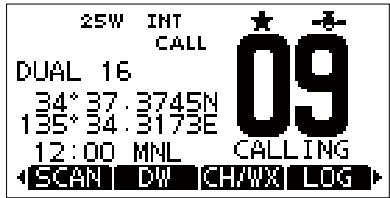
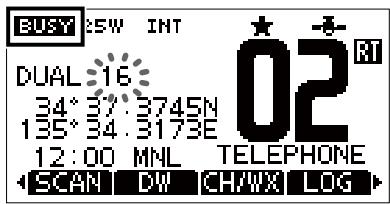
- “DUAL 16” is displayed for Dualwatch, or “TRI 16” is displayed for Tri-watch.
① BUSY is displayed when a signal is received.
① A beep tone sounds and “16” starts to blink when a signal is received on Channel 16.
- To cancel Dualwatch or Tri-watch, push DW or TW. again.
■ DSC address ID
◇ Entering an Individual or Group ID
You can enter a total of 75 Individual IDs and 25 Group IDs, and assign names to them of up to 10 characters.
- Open the "INDIVIDUAL ID" or "GROUPID" screen.
[MENU] > Settings > DSC > Individual ID
[MENU] > Settings > DSC > Group ID
- "No ID" is displayed if no ID is entered.
- Push ADD.
- The ID entry screen is displayed.
- Enter an Individual or Group ID.
TIP:
- Select a number using [◀] and [▶].
- Push [ENT] or [DIAL] to set the selected number.
- Select “←” or “→” on the screen, or rotate [DIAL] to move the cursor.
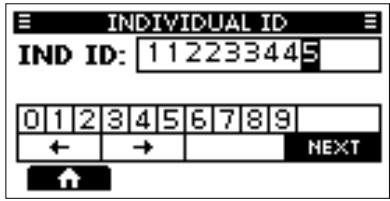
NOTE:
- For a Group ID, the first digit is fixed as "0."
-
For any coast station ID, the first two digits are fixed as "0."
-
Push NEXT to start entering the ID's name.
TIP:
- Select 123 to enter numbers and letters, and 53 to enter symbols.
- Select a number, character, or space using [▲], [▼], [◀], and [▶].
- Push [ENT] or [DIAL] to enter the selected number or character.
- Select “←” or “→” on the screen to move the cursor, or to select the entered character.
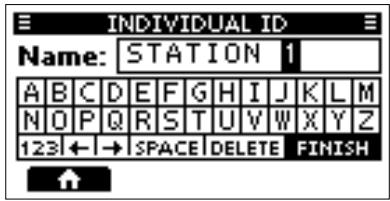
- After entering, push FINISH to save, and return to the previous screen.
- The entered name is displayed.
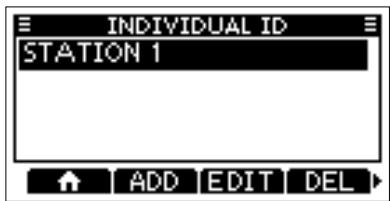
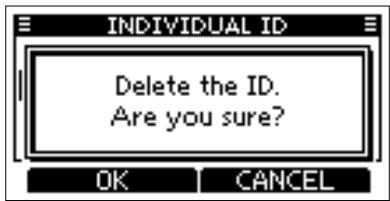
◇ Deleting an entered ID
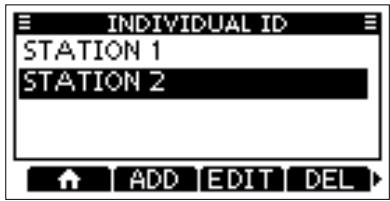
(Example: Deleting an Individual ID: STATION 2)
- Open the "INDIVIDUAL ID" screen.
$$ [ M E N U ] > \text { Settings } > D S C > \text { Individual ID } $$
- Select "STATION 2," and then push DEL.
- “Delete the ID. Are You Sure?” is displayed.
- Push OK to delete.
① Push CANCEL to cancel the deletion.
- The selected ID is deleted, and then returns to the previous screen.
■ Entering the position and time
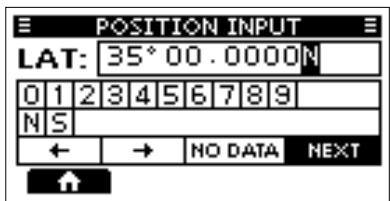
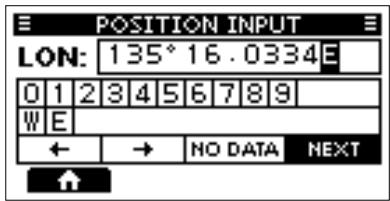
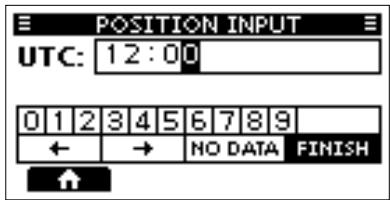
A Distress call should include the vessel's position, date, and time. If no GPS data is received, manually enter the position and Universal Time Coordinated (UTC) time.
NOTE:
- The manual entry is disabled while valid GPS data is received.
-
The manually entered position and time is valid only for 23.5 hours, or until turning OFF the transceiver.
-
Open the "POSITION INPUT" screen.
$$ [ M E N U ] > \text { Settings } > \text { DSC } > \text { Position Input } $$
- Enter the latitude.
TIP:
- Select a number or a compass direction using [▲], [▼], [◀], and [▶].
- Select “←” or “→” on the screen, or rotate [DIAL] to move the cursor.
-
Select HEXT and then push [ENT] or [DIAL] to save the selected number.
-
Enter the longitude and the UTC time.
① See the TIP in step 2 to enter.
- After entering, push FORTH to save, and return to the "DSC" screen.
7 DIGITAL SELECTIVE CALLING (DSC)
■ Sending DSC calls (Distress)
A Distress call should be sent if, in the opinion of the captain, the ship or a person is in distress and requires immediate assistance.
NEVER MAKE A DISTRESS CALL IF YOUR SHIP OR A PERSON IS NOT IN AN EMERGENCY. A DISTRESS CALL SHOULD BE MADE ONLY WHEN IMMEDIATE HELP IS NEEDED.
◇ Simple call
- Confirm that no Distress call is being received.
- While lifting up the key cover, hold down [DISTRESS] for 3 seconds until you hear 3 short countdown beeps and a long beep sound.
- The backlight blinks.
![[DISTRESS] key](/content/2025/12/335615/images/88913aec7d4e6bf9030d72e8c87290851048123b480d54bd37411e62786aaab3.jpg)
-
After sending, wait for an Acknowledgment call.
-
"Waiting for ACK" is displayed.
-
The Distress call is automatically sent every 3.5 to 4.5 minutes, until an Acknowledgment is received, or a Distress Cancel call is sent.
-
When you receive an Acknowledgment, an alarm sounds. Push ALARM OFF to turn OFF the alarm.
- Channel 16 is automatically selected.
- Push CLOSE.
- Hold down [PTT], and then explain your situation.
- After you have finished your conversation, push 🙏.
- “Terminate the procedure. Are you sure?” is displayed.
- Push OK to return to the operating screen.
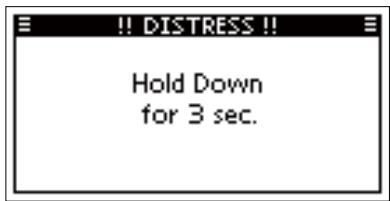
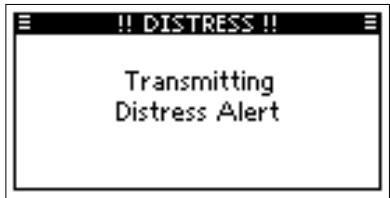
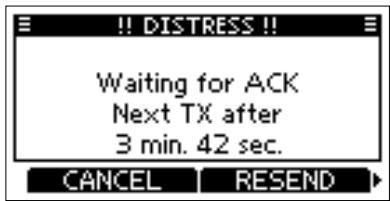
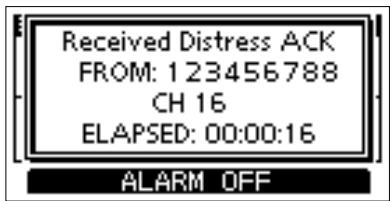
TIP: A default Distress alert contains:
- Nature of distress: Undesignated distress
- Position information: The latest GPS, or manually input position, that is held for 23.5 hours, or until you turn OFF the transceiver.
◇ Regular call
Select the nature of the Distress call to include in the Regular Distress call.
1. Push DTRS
- The “COMPOSE DISTRESS” screen is displayed.
-
Push [ENT] or [DIAL] to enter the Nature selection mode.
-
Select the nature of the Distress, and then push [ENT] or [DIAL]. (Example: Flooding)
- The setting is saved and returns to the previous screen.
① If no valid GPS data is being received, select "Position," and then enter the latitude, longitude, and UTC.
See “Entering the position and time” on page 18 for details.
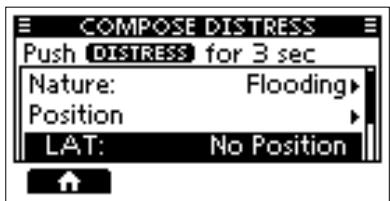
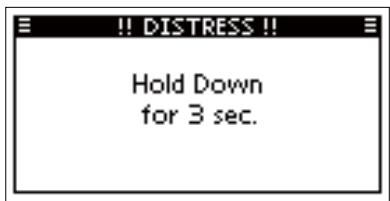
- While lifting up the key cover, hold down [DISTRESS] (the red button) for 3 seconds until you hear 3 short countdown beeps and a long beep sound.
- The backlight blinks.
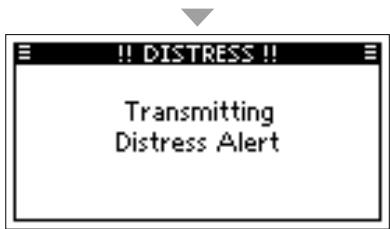
- After sending, wait for an Acknowledgment.
- "Waiting for ACK" is displayed.
① The Distress call is automatically sent every 3.5 to 4.5 minutes, until an Acknowledgment is received, or a Distress Cancel call is sent. (p. 21)
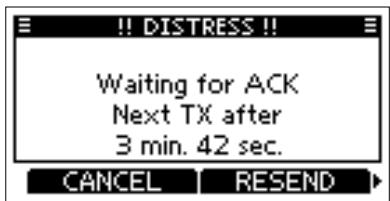
- When you receive an Acknowledgment, an alarm sounds. Push ALARM OFF to turn OFF the alarm.
- Channel 16 is automatically selected.
-
Hold down [PTT] to communicate.
-
After you have finished your conversation, push 🙏.
- "Terminate the procedure. Are you sure?" is displayed.
- Push OK to return to the operating screen.
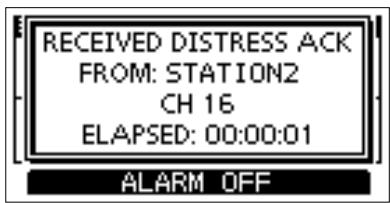
TIP: You can also send a Regular call by selecting the "Distress" item on the Menu screen.
7 DIGITAL SELECTIVE CALLING (DSC)
◇ Distress Cancel call
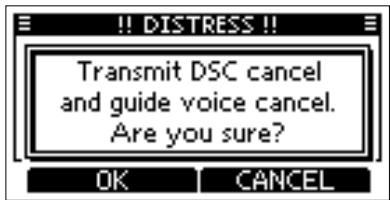
If you have accidentally made a Distress call, or made an incorrect Distress call, send a Distress Cancel call to cancel the call as soon as possible while waiting for an Acknowledgment. Be sure to report the purpose of the cancellation.
- While waiting for an Acknowledgment, push CANCEL.
- The screen on the right is displayed.
-
Push OK.
-
The Distress Cancel call is sent.
- Channel 16 is automatically selected.
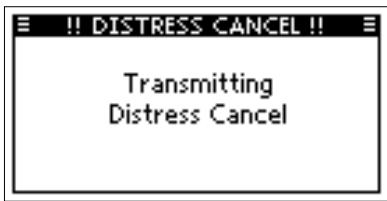
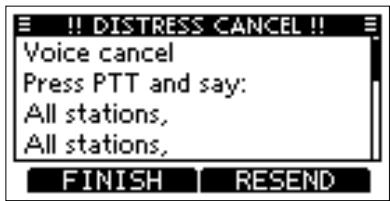
- Hold down [PTT] to report the purpose of the cancellation.
① You can display the wording of the cancellation by pushing [▼].
- After communicating, push FINISH.
① The screen on the right is displayed.
- Push 🏠 to finish the Distress Cancel call.
- “Terminate the procedure. Are you sure?” is displayed.
- Push OK to return to the operating screen.
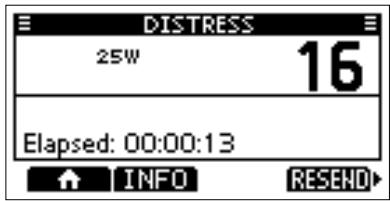
◇ Distress call Software Key description
While waiting for an Acknowledgment:
CANCEL : Cancels the Distress call and enables you to send a Cancel call.
RESEND : Enables you to resend the Distress call by holding down [DISTRESS] again.
PAUSE : Pauses the countdown to resend the next Distress call.
After receiving an Acknowledgment:
INFO : Displays the Distress call information.
◇ Sending a Distress Relay acknowledgment (For only the USA version)
You can send the Distress Relay acknowledgment only when a Distress Relay call is received.
- When a Distress Relay call is received:
- An alarm sounds.
- The screen on the right is displayed.
- Push any ALARM OFF to turn OFF the alarm.
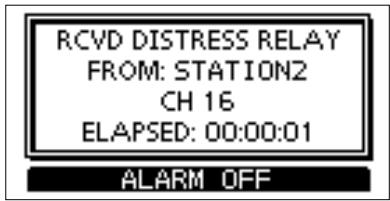
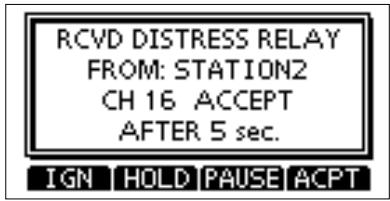
- Push ACPT
- The received information is displayed.
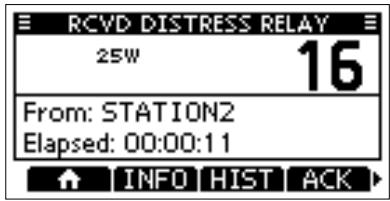
- Push ACK
- The call contents screen is displayed.
① Rotate [DIAL] to view the call contents.
- Push CALL to send the Distress Relay acknowledgment.
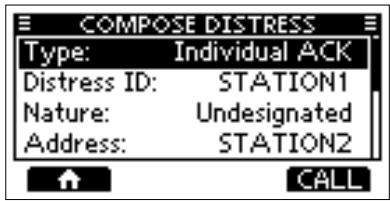
- Hold down [PTT] to communicate.
- After you have finished your conversation, push CANCEL.
- “Terminate the procedure. Are you sure?” is displayed.
- Push OK to return to the operating screen.
7 DIGITAL SELECTIVE CALLING (DSC)
■ Sending DSC calls (other)
NOTE: To ensure proper DSC operation, be sure to correctly adjust the “CH 70 SQL Level” item on the Menu screen. (p. 45)
◇ Sending an Individual call
An Individual call enables you to send a DSC signal to only a specific station. You can communicate after receiving the Acknowledgment “Able to comply.”
NOTE: You can also compose an Individual call to an AIS target on the Plotter screen or the AIS list. (pp. 54, 57)
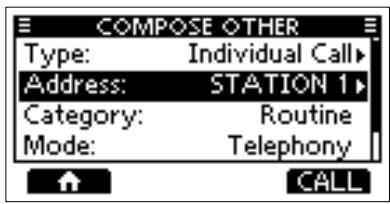
1. Push DSC
- The “COMPOSE OTHER” screen is displayed. ① You can also display the screen by selecting the “Compose Other” item on the Menu screen.
-
Select "Msg Type," and then push [ENT] or [DIAL].
-
Select "Individual Call," and then push [ENT] or [DIAL].
- Returns to the previous screen.
-
Select "Address," and then push [ENT] or [DIAL].
-
Select the station to send an Individual call to, and then push [ENT] or [DIAL].
- Returns to the previous screen.
① You can also select "Manual Input" to manually enter the target station ID.
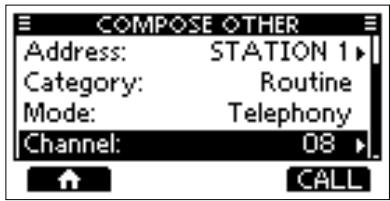
-
Select "Channel," and then push [ENT] or [DIAL].
-
Select a channel to assign, and then push [ENT] or [DIAL].
① The assigned channels are preset by default.
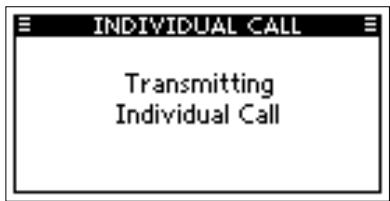
- Push CALL to send the Individual call.
- “Transmitting Individual Call” is displayed, and then “Waiting for ACK” is displayed.
① If Channel 70 is busy, the transceiver stands by until the channel becomes clear.
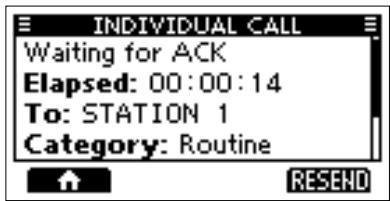
-
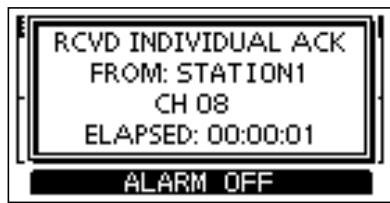
When you receive an Acknowledgment "Able to comply":
-
An alarm sounds.
-
The screen on the right is displayed.
-
Push ALARM OFF to turn OFF the alarm.
- The channel assigned in step 7 is automatically selected.
① If the called station cannot use the channel that you assigned, a different channel is selected by the other station.
-
Push CLOSE.
-
Hold down [PTT] to communicate.
TIP: If you received an Acknowledgment "Unable to comply":
- Push ALARM OFF to turn OFF the alarm, and then push CLOSE.
- The Acknowledge information is displayed.
- Push 🔍, and then OK to return to the operating screen.
◇ Sending an Individual Acknowledgment
When you have received an Individual call (p. 36), send an Acknowledgment to the calling station. When the Auto Ack is set to “Manual,” you can select an appropriate acknowledgment type.
- While an Individual call is being received, push ALARM OFF to turn OFF the alarm.
- The received call's information is displayed.
- Push ACPT
- The Acknowledgment category screen is displayed.
① If you want to send an Acknowledgment "Able to comply" right away, push ABLE.
① If you cannot communicate, and want to return to the operating screen, push IGN.
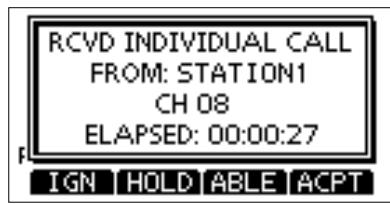
- Push ABLE, UNABLE, or NEWCH to select the Acknowledgment type.
ABLE: (Able to Comply)
Sends an Acknowledgment without any changes.
UNABLE: (Unable to Comply):
Sends an Acknowledgment but cannot communicate.
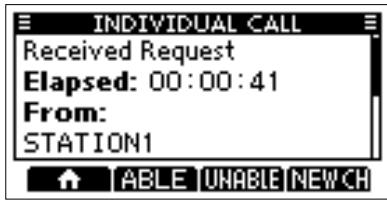
NEW CH: Sends an Acknowledgment. You can specify the Voice Communication channel. (Example: Channel 16)
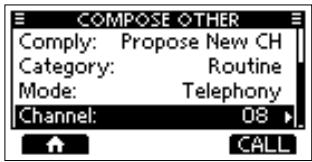
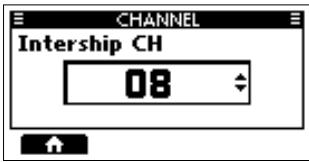
- Push CALL to send the Acknowledgment.
7 DIGITAL SELECTIVE CALLING (DSC)
◇ Sending an All Ships call
All Ships that have DSC transceiver use Channel 70 as their listening channel. When you want to announce a message to these ships, if they are within range, use the All Ships call.
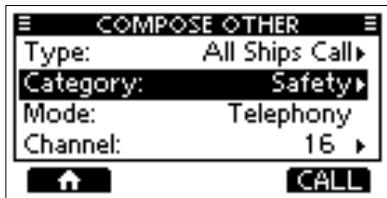
1. Push DSC.
- The “COMPOSE OTHER” screen is displayed. ① You can also display the screen by selecting the “Compose Other” item on the Menu screen.
- Select "Msg Type," and then push [ENT] or [DIAL].
- The "MESSAGE TYPE" screen is displayed.
- Select "All Ships Call," and then push [ENT] or [DIAL].
- Returns to the previous screen.
- Select "Category," and then push [ENT] or [DIAL].
- The "CATEGORY" screen is displayed.
- Select a category of the call, and the push [ENT] or [DIAL].
- Returns to the previous screen.
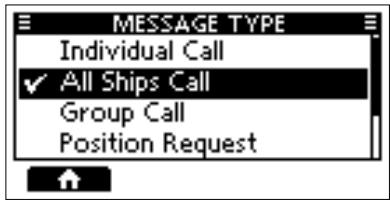
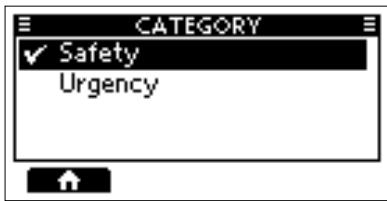
-
Select "Channel," and then push [ENT] or [DIAL].
-
Select the channel to assign, and then push [ENT] or [DIAL].
① The assigned channels are preset by default.
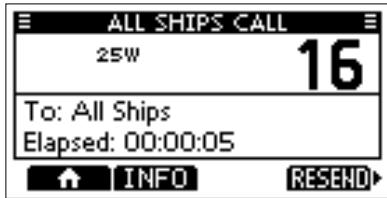
- Push CALL to send the All Ships call.
- “Transmitting All Ships Call” is displayed, and then the assigned channel is automatically selected.
① If Channel 70 is busy, the transceiver stands by until the channel becomes clear.
- Hold down [PTT] to communicate.
- Push 🏠 to finish the All Ships call.
- “Terminate the procedure. Are you sure?” is displayed.
- Push OK to return to the operating screen.
- Returns to the operating screen.
◇ Sending a Group call
A Group call enables you to send a DSC call to only a specific group.
① You can send a Group call to a pre-entered group address, or manually enter the address before sending. (p. 17)
1. Push DSC
- The "COMPOSE OTHER" screen is displayed.
① You can also display the screen by selecting the “Compose Other” item in the Menu screen.
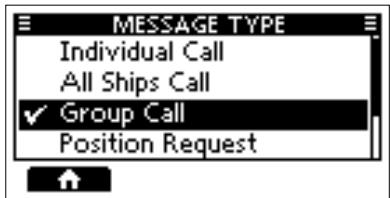
- Select "Msg Type," and then push [ENT] or [DIAL].
- The "MESSAGE TYPE" screen is displayed.
- Select "Group Call," and then push [ENT] or [DIAL].
- The Group call is selected, and returns to the previous screen.
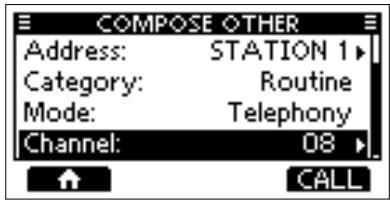
- Select "Address," and then push [ENT] or [DIAL].
- The "ADDRESS" screen is displayed.
- Select the group to send a Group call, and then push [ENT] or [DIAL].
① You can also select "Manual Input" to manually enter the target group.
-
Select "Channel," and then push [ENT].or [DIAL].
-
Select the channel to assign, and then push [ENT].
① The assigned channels are preset by default.
- Push CALL to send the Group call.
- “Transmitting Group Call” is displayed, and then the assigned channel is automatically selected.
① If Channel 70 is busy, the transceiver stands by until the channel becomes clear.
- Hold down [PTT] to communicate.
- Push ↑ to finish the All Ships call.
- “Terminate the procedure. Are you sure?” is displayed.
- Push OK to return to the operating screen.
- Returns to the operating screen.
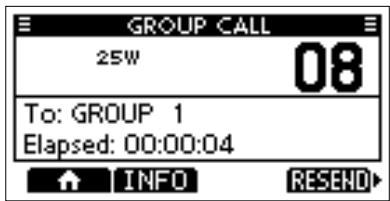
7 DIGITAL SELECTIVE CALLING (DSC)
◇ Sending a Test call
You should avoid testing calls on the exclusive DSC Distress channels and safety calling channels. When you cannot avoid testing on a Distress or safety channel, you should indicate that these are test calls.
Normally the Test call would require no further communications between the two stations involved.
1. Push DSC
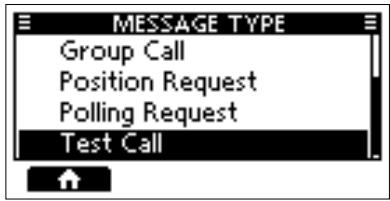
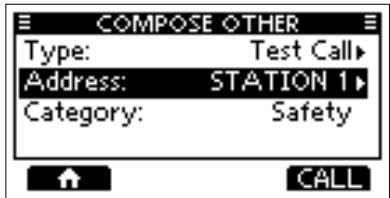
- The “COMPOSE OTHER” screen is displayed. ① You can also display the screen by selecting the “Compose Other” item on the Menu screen.
2. Select "Test Call," and then push [ENT] or [DIAL].
- The Test call is selected, and returns to the "COMPOSE OTHER" screen.
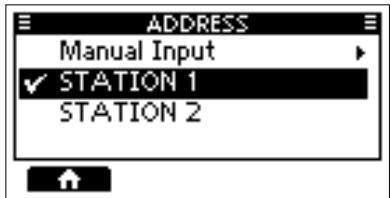
3. Select "Address," and then push [ENT] or [DIAL].
- The "ADDRESS" screen is displayed.
4. Select a station to send the Test call to.
① You can also select “Manual Input” to manually enter the calling station.
5. Push CALL to send the Test call.
① If Channel 70 is busy, the transceiver stands by until the channel becomes clear.
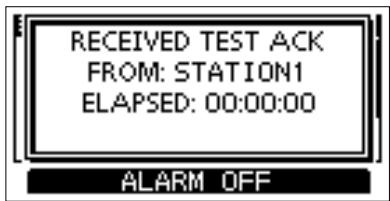
6. When you receive an Acknowledgment:
- An alarm sounds. - The screen on the right is displayed.
7. Push ALARM OFF to turn OFF the alarm.
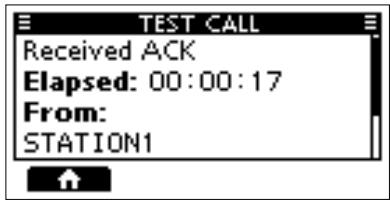
- The Acknowledgment information is displayed.
8. Push CLOSE.
- The received call's information is displayed. - The call is saved in the DSC Log.
9. Push 🏠 to return to the operating screen.
- “Terminate the procedure. Are you sure?” is displayed.
10. Push OK to return to the operating screen.
- Returns to the operating screen.
◇ Sending a Test Acknowledgment
By default, when you receive a Test call, the Auto ACK function automatically sends an Acknowledgment to the calling station (p. 44). If the function is set to “Manual,” do the following steps to send an Acknowledgment.
- After a Test call is being received, push ALARM OFF to turn OFF the alarm.
- Push ACPT. • The received call's information is displayed.
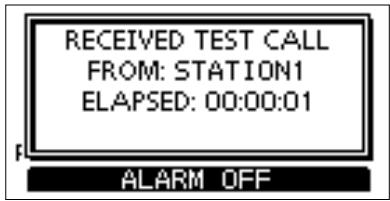
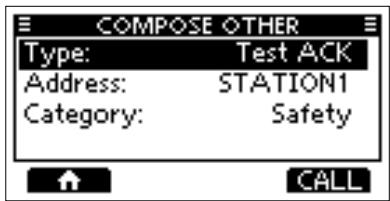
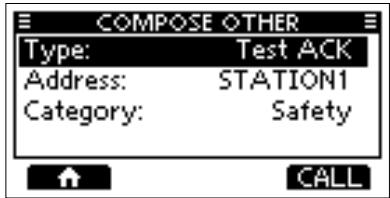
- Push ACK. • The "Test ACK" confirmation screen is displayed.
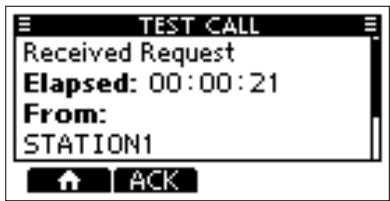
- Push CALL to send the Acknowledgment.
- "Transmitting Test ACK" is displayed.
- Push 🔒, and then push OK to return to the operating screen.
7 DIGITAL SELECTIVE CALLING (DSC)
◇ Sending a Position Request call/Polling Request call (For only the USA version)
You can send a Position Request call or Polling request call to a station, depending on the presetting.
- Send a Position Request call when you want to know a specific ship's current position.
- Send a Polling Request call when you want to know whether a specific ship is in the communication area, or not. Example: Sending a Position Request call
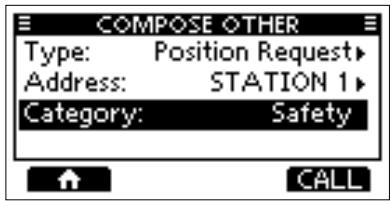
1. Push DSC.
- The "COMPOSE OTHER" screen is displayed.
① You can also display the screen by selecting the “Compose Other” item on the Menu screen.
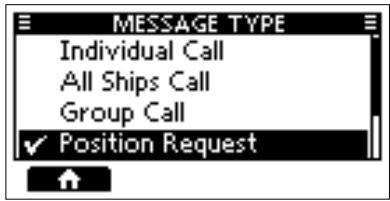
- Select "Msg Type," and then push [ENT] or [DIAL].
- Select "Position Request," and then push [ENT] or [DIAL].
① When you send a Polling Request call, select "Polling Request."
- Returns to the previous screen.
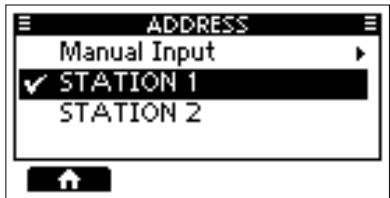
- Select "Address," and then push [ENT] or [DIAL].
- Select a target to send a Position Request call to, and then push [ENT] or [DIAL].
① You can also select “Manual Input” to manually enter the target ID.
- Push CALL to send the Position Request call.
- Position Request call is sent, and then “Waiting for ACK” is displayed.
① If Channel 70 is busy, the transceiver stands by until the channel becomes clear.
- When you receive a Position Reply:
- An alarm sounds.
- The screen on the right is displayed.
- Push ALARM OFF to turn OFF the alarm.
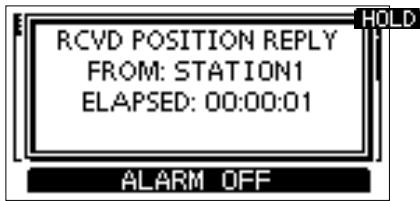
- Push CLOSE
- The received information is displayed.
- Push [▲] or [▼], or rotate [DIAL] to scroll the screen, and then check the target's position.
- Push ↑, and then OK to return to the operating screen.
◇ Sending a Position Reply call
Send a Position Reply call when a Position Request call is received.
If the Auto ACK function is set to “Auto,” the Acknowledgment is automatically sent to the calling station. (p. 44)
- After a Position Request is being received, push ALARM OFF to turn OFF the alarm.
- The received call's information is displayed.
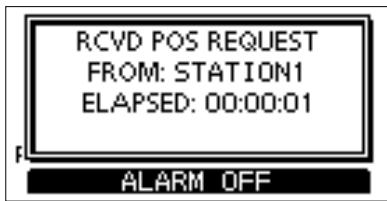
- Push the Software Key below the intended operation.
IGN: Ignores the call and returns to the operating screen.
- The call is saved in the DSC Log.
- “☑” blinks continuously until you display the call message.
HOLD: Holds the RX call task, and returns to the Main screen.
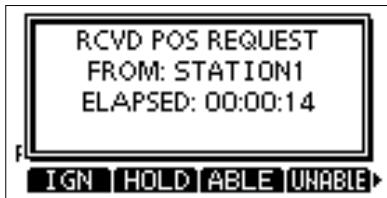
ABLE: Sends Acknowledgment "Able to comply" right away. (Able to
- The call is saved in the DSC Log.
- Displays the Acknowledgment information, and then returns to the operating screen by pushing
, and then OK.
UNABLE: Sends an Acknowledgment (Unable to "Unable to Comply."
- The call is saved in the DSC Log.
- Displays the Acknowledgment information, and then returns to the operating screen by pushing
, and then OK.
7 DIGITAL SELECTIVE CALLING (DSC)
◇ Sending a Position Reply call
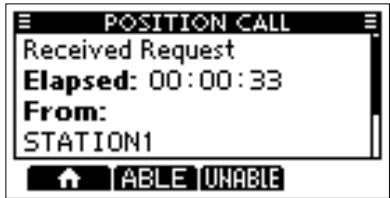
ACPT : Accepts the call.
- Displays the received call's information.
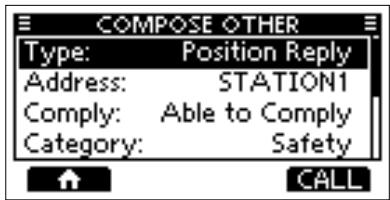
- The call is saved in the DSC Log. Push ABLE or UNABLE, then push CALL to send the Position Reply call.

Closes the call, and then returns to the operating screen.
ABLE: (Able to Comply)
Sends an acknowledgment with position and time data.
UNABLE: (Unable to Comply)
Sends an acknowledgment with no position and time data.
- Push ↑, and then OK to return to the operating screen.
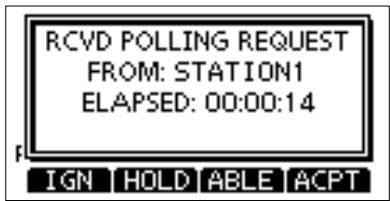
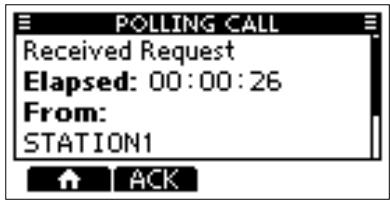
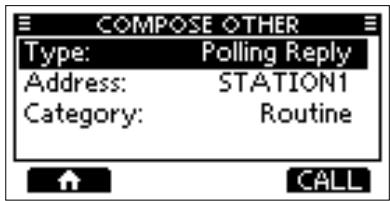
◇ Sending a Polling Reply call
Send a Polling Reply call when a Polling Request call is received.
① When “Polling ACK” is set to “Auto,” the transceiver automatically sends the call.
- While a Polling Request call is being received, push ALARM OFF to turn OFF the alarm.
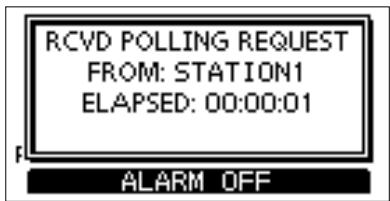
- Push ACPT
- Enters the DSC Task mode.
- Push ACK
- The call contents screen is displayed.
- Push CALL to send the Polling Reply.
- “Transmitting Polling Reply” is displayed.
- Push ↑, and then push OK to return to the operating screen.
7 DIGITAL SELECTIVE CALLING (DSC)
■ Receiving DSC calls (Distress)
The transceiver receives Distress calls, Distress Acknowledgments, and Distress Cancel calls. When you receive a call, an emergency alarm sounds.
NOTE: The screens that are displayed when a Distress call or an Acknowledgment is received slightly differ from one another. The following steps are described using an example of receiving a Distress call.
When a Distress call is received:
- The emergency alarm sounds until you turn it OFF.
- "RECEIVED DISTRESS" is displayed.
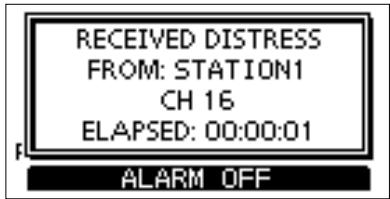
- Push ALARM OFF to turn OFF the alarm.
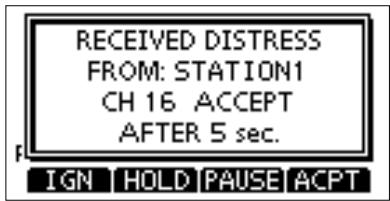
- Push the Software Key below the intended operation.
IGN: Returns to the operating screen. The call is saved in the DSC Log. "💡" blinks continuously until you display the call message.
HOLD: Holds the RX call task, and returns to the Main screen.
PAUSE: PAUSE is not displayed if the "CH Auto Switch" item is set to "Manual." (p. 44) Pauses the countdown until the assigned channel is automatically selected.
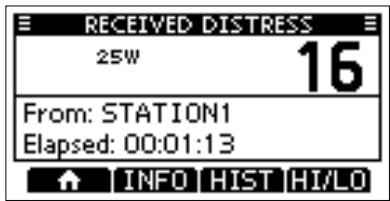
ACPT: Accepts the call. Channel 16 is automatically selected. Monitor Channel 16 as a coast station may require assistance. After Channel 16 is selected, select your next operation by pushing the Software Key below the following options.
Closes the Distress operation, and returns to the operating screen.
HIST: Displays the "DISTRESS HISTORY" screen.
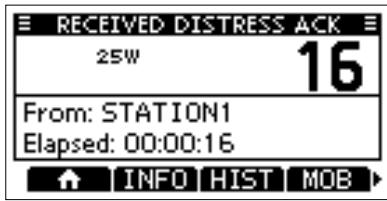
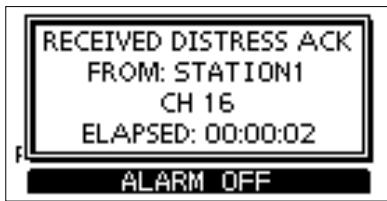
When a Distress acknowledgment is received:
- After a Distress Acknowledgments is being received, push ALARM OFF to turn OFF the alarm.
- Push .CLOSE
- The received information is displayed.
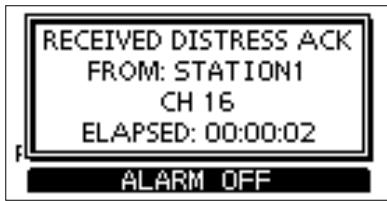
- Push ACPT
- The received information is displayed.
- Push
- "Terminate the procedure. Are you sure?" is displayed.
- Push OK to return to the operating screen.
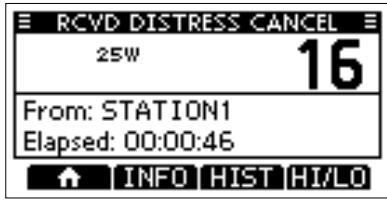
When a Distress Cancel call is received:
- Push ALARM OFF to turn OFF the alarm.
- The received information is displayed.
- Push 🔒, and then push OK to return to the operating screen.
7 DIGITAL SELECTIVE CALLING (DSC)
◇ Receiving a Distress Relay call
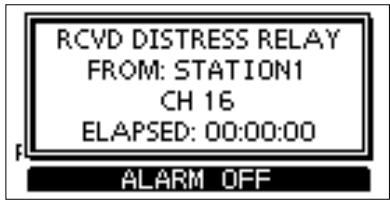
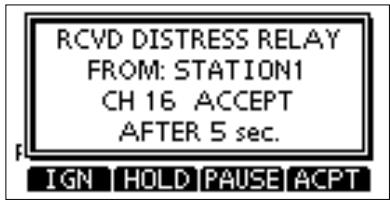
When a Distress Relay call is received:
- An alarm sounds.
- The following screen is displayed and the backlight blinks.
- “” blinks.
1. Push ALARM OFF.
2. Push the Software Key below the next operation.
IGN: Returns to the operating screen. The call is saved in the DSC Log. "✉" blinks continuously until you display the call message.
HOLD: Holds the RX call task, and returns to the Main screen.
PAUSE: PAUSE is not displayed if the "CH Auto Switch" item is set to "Manual." (p. 44) Pauses the countdown until the assigned channel is automatically selected. The call is saved in the DSC Log.
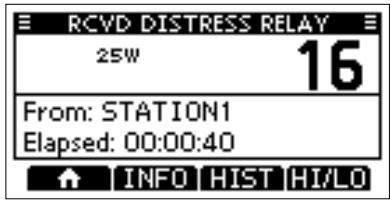
ACPT: Accepts the call. Channel 16 is automatically selected. Monitor Channel 16 as a coast station may require assistance. After Channel 16 is selected, select your next operation by pushing the Software Key below the following options.
: Returns to the operating screen.
HIST: Displays the "DISTRESS HISTORY" screen.
3. Push 🔊, and then OK to return to the operating screen.
■ Receiving DSC calls (other)
The transceiver receives the following types of DSC calls.
- Individual call (p. 36)
- Polling Request call(p. 32)
- Individual Acknowledgment (p. 24)
- Test call (p. 39)
- Group call / All Ships call (p. 37)
- Test Acknowledgment / Position Reply call / Polling Reply call (p. 40)
- Position Request call (p. 38)
① The receivable call types may differ, depending on the transceiver version or presetting.
By default, the Auto ACK function automatically sends an Acknowledgment to the calling station. ([MENU] > Settings > DSC > Auto ACK (p. 44))
If Auto ACK is set to “Manual,” you can manually send an Acknowledgment for each call as described in this section.
◇ Receiving an Individual call
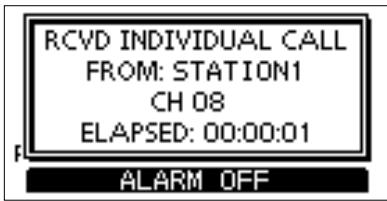
When an Individual call is received:
- An alarm sounds.
-
"RCVD INDIVIDUAL CALL" is displayed.
-
Push ALARM OFF to turn OFF the alarm.
- Push the Software Key below the next operation.
IGN: Ignores the call and returns to the operating screen.
- The call is saved in the DSC Log.
- “✉” blinks continuously until you display the call message.
HOLD: Holds the RX call task, and returns to the Main screen.
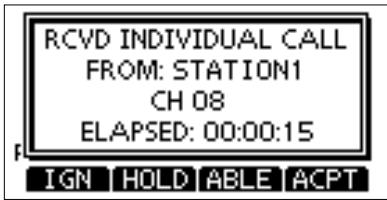
ABLE: Sends an Individual Acknowledgment (Able to right away.
comply) • Automatically switches to the assigned channel.
• After sending, push RESEND to resend.
- The call is saved in the DSC Log.
ACPT: Accepts the call.
- The call is saved in the DSC Log.
- The received call's information is displayed.
- Push the Software Key to select the Acknowledgment option.
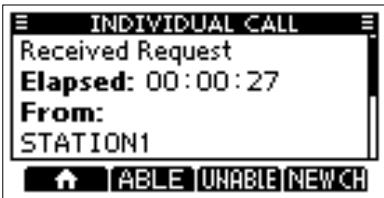

Push to delete the task and returns to the Main screen.
ABLE:
Sends an Acknowledgment without any changes.
(Able to Comply)
UNABLE:
Sends an Acknowledgment but cannot communicate.
(Unable to Comply)
NEW CH:
Able to communicate but proposes another channel.
(Propose New CH)
Specify the channel by pushing [▲] or [▼].
7 DIGITAL SELECTIVE CALLING (DSC)
◇ Receiving a Group call or All Ships call
When a Group call is received:
- An alarm sounds.
- "RECEIVED GROUP CALL" is displayed.
When an All Ships call is received:
- An alarm sounds.
-
"RECEIVED ALL SHIPS CALL" is displayed.
-
Push ALARM OFF to turn OFF the alarm.
- The channel that is assigned by the caller is automatically selected after 10 seconds by default.
- Push the Software Key below your next operation.
IGN: Ignores the call and returns to the operating screen.
- The call is saved in the DSC Log.
- “☑” blinks continuously until you display the call message.
HOLD: Holds the RX call task, and returns to the Main screen.
PAUSE: Pauses the countdown until the assigned channel is automatically selected.
- The call is saved in the DSC Log.
i PAUSE is not displayed if the "CH Auto Switch" item is set to "Manual." (p. 44)
ACPT: Accepts the call.
- The assigned channel is selected.
- The call is saved in the DSC Log.
: Closes the call, and then returns to the operating screen.
(Example: when a Group call is received)
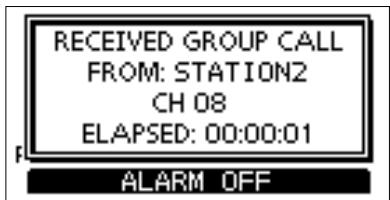
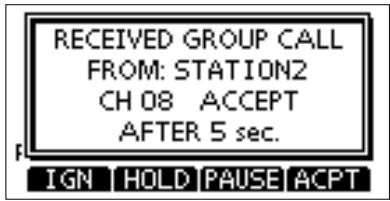
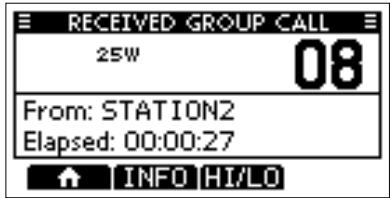
◇ Receiving a Position Request call
(May not be used, depending on the presetting)
NOTE: Even if the Auto ACK function is set to "Manual" while waiting to receiving a distress acknowledgment or after receiving a distress acknowledgment, the Position Reply is automatically sent to the calling station.
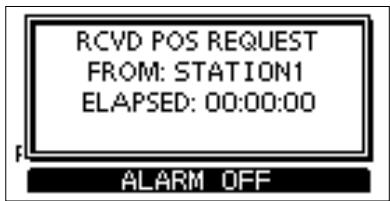
When a Position Request call is received:
- An alarm sounds.
-
"RCVD POS REQUEST" is displayed.
-
Push ALARM OFF to turn OFF the alarm.
-
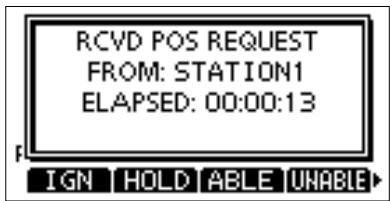
Push the Software Key below the intended operation.
IGN: Ignores the call and returns to the operating screen.
• The call is saved in the DSC Log.
- “☑” blinks continuously until you display the call message.
HOLD: Holds the RX call task, and returns to the Main screen.
ABLE: Sends Acknowledgment "Able to comply" right away. (Able to comply)
UNABLE: Sends an Acknowledgment (Unable to Comply) "Unable to Comply." • The call is saved in the DSC Log • Displays the Acknowledgment information, and then returns to the operating screen by pushing ↑, and then OK.
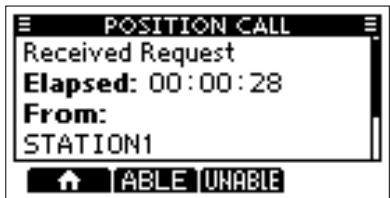
ACPT: Accepts the call. - Displays the received call's information. - The call is saved in the DSC Log. Push ABLE or UNABLE, then push CALL to send the Position Reply call. (p. 30)
7 DIGITAL SELECTIVE CALLING (DSC)
◇ Receiving a Test call
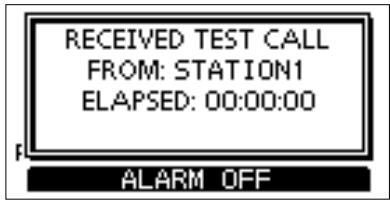
When a Test call is received:
- An alarm sounds.
-
"RECEIVED TEST CALL" is displayed.
-
Push ALARM OFF to turn OFF the alarm.
-
Push the Software Key below your next operation.
IGN: Ignores the call and returns to the operating screen.
- The call is saved in the DSC Log.
- “☑” blinks continuously until you display the call message.
HOLD: Holds the RX call task, and returns to the Main screen.
ABLE: Sends a Test Acknowledgment
(Able to "Able to Comply."
comply) • The call is saved in the DSC Log.
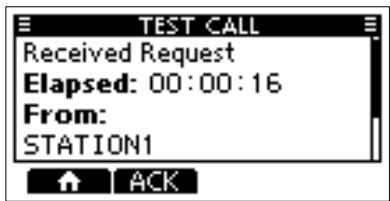
ACPT: Accepts the call.
- Displays the received call's information.
- The call is saved in the DSC Log.
- The received call's information is displayed.
Push ACK, and then push CALL to send a Test Acknowledgment. (p. 39)
Push RESEND to resend.
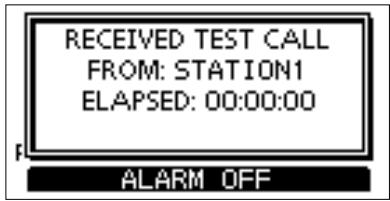

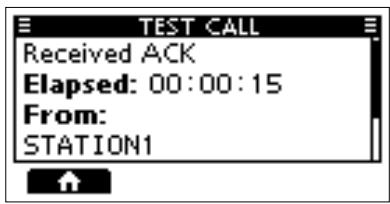
- Receiving a Test acknowledgment/Position Reply call\* /Polling Reply call (\*For only the USA version)
Example: Receiving a Test acknowledgment
When a call is received:
- An alarm sounds.
- The following screen is displayed and the backlight blinks.
-
“” blinks.
-
Push ALARM OFF to turn OFF the alarm.
-
Push CLOSE
- The received information is displayed.
- Push
- “Terminate the procedure. Are you sure?” is displayed.
- Push OK to return to the operating screen.

7 DIGITAL SELECTIVE CALLING (DSC)
■ DSC Log
◇ Received DSC Log
The transceiver saves up to 30 received Distress call messages and 50 received “Others” call messages in your DSC Log.
On the operating screen, “☐” is displayed when there is an unread call message.
The icon blinks when there is a new received call message.
- Open the "DSC LOG" screen.
[MENU] > DSC Log
- Select "Received Call Log," and then push [ENT].
- The "RECEIVED CALL LOG" screen is displayed.
- Select "Distress" or "Others," and then push [ENT].
① “Distress” displays the received Distress call log, and “Others” displays the received DSC call log.
TIP: You can also display the "RECEIVED CALL LOG" screen by pushing LOG on the operating screen.
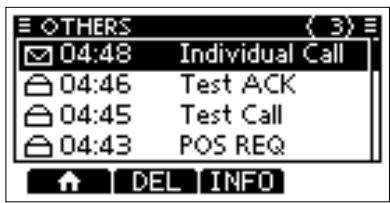
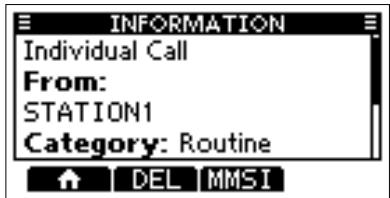
- Select a log, and then push [ENT], [DIAL], or INFO to display the detailed information.
INFO: Displays the detailed information.
DEL: Deletes the selected call log.
MMSI: Saves the MMSI as an Individual ID.
◇ Transmitted DSC Log
The transceiver saves up to 30 DSC transmitted calls in your DSC Log.
- Open the "DSC LOG" screen.
[MENU] > DSC Log
- Select "Transmitted Call Log," and then push [ENT].
- The "TRANSMITTED CALL LOG" screen is displayed.
- Select a log, and then push [ENT] to display the detailed information.
INFO: Displays the detailed information.
DEL: Deletes the selected call log.
MMSI: Saves the MMSI as an Individual ID or a Group ID.
■ Multiple-task mode
(For only the USA version, depending on the presetting)
If the Multiple-task function is enabled, the transceiver can hold up to 7 tasks. You can handle more than 2 DSC tasks simultaneously by switching between the tasks. To use the Multiple-task mode, select “Multiple” in the “Procedure” on the Menu screen. (p. 45)
[MENU] > Settings > DSC > Procedure
When the Multiple-task mode is activated, TASK is displayed on the operating screen.
NOTE: The Task mode has a Inactivity Timer function. After a certain period of time has passed without any operation on a task, the transceiver automatically deletes a task and returns to the operating screen.
When a Inactivity Timer activates, an alarm sounds and a count down message is displayed for 10 seconds.
◇ Holding a DSC task
In the Multiple-task mode, you can hold or activate the DSC task as follows.
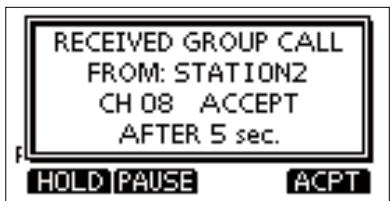
Example: When a Group call is received:
- Push ALARM OFF to turn OFF the alarm.
-
The received call's information is displayed.
-
Push HOLD.
- The received Group call task is held into the task list and returns to the operating screen.
◇ Activating the held DSC task
- Push TASK to display the task list.
- The task list is displayed.
-
Select the task that you want to activate.
-
Push ACTIVE to activate the task.
- The activated task information is displayed.
-
Push [PTT] to communicate.
-
After finishing the communication, push DEL to delete the task.
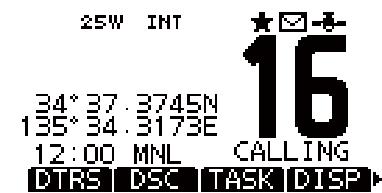
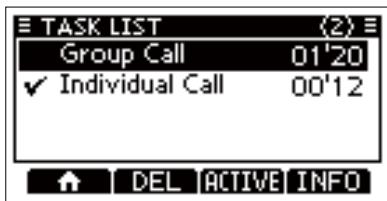
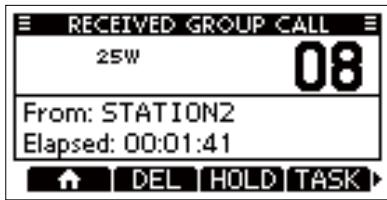
7 DIGITAL SELECTIVE CALLING (DSC)
◇ Task list
You can display the "TASK LIST" screen by pushing TASK.
The number of tasks is displayed at the top of the screen.
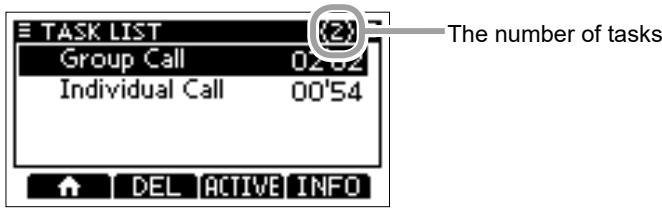
On the “TASK LIST” screen, the following Software Keys are displayed.
: Holds the task and returns to the operating screen.
DEL: Finishes the selected task.
ACTIVE: Activates the selected task.
HOLD: Holds the selected task.
INFO: Displays the task information.
■ DSC Settings
On the "DSC" screen, you can make settings of the DSC call related items.
[MENU] > Settings > DSC
Position Input
See “Entering the position and time” on page 18 for details.
Individual ID
See “Entering an Individual ID” on page 17 for details.
Group ID
See “Entering a Group ID” on page 17 for details.
Auto ACK
The Auto ACK function automatically sends an Acknowledgment when an appropriate Request is received.
- Individual ACK
Auto (Able): Automatically sends "Able to comply."
Auto (Unable): Automatically sends "Unable to comply."
Manual: Manually sends an Acknowledgment.
- Position ACK
Auto (Able): Automatically sends "Able to comply."
Manual: Manually sends an Acknowledgment.
- Polling ACK
Auto: Automatically sends an Acknowledgment.
Manual: Manually sends an Acknowledgment.
- Test ACK
Auto: Automatically sends an Acknowledgment.
Manual: Manually sends an Acknowledgment.
CH Auto Switch
Select whether or not to automatically switch to channel 16 or the specified channel, or ignore the call.
Accept after 10 sec.:
After receiving a DSC call, the transceiver remains on the operating channel for 10 seconds. After that, the transceiver automatically switches to the channel that is specified on the DSC call.
Ignore after 10 sec.:
After receiving a DSC call, if you do not push ACPT in 10 seconds, the transceiver ignores the call, and then remains on the current operating channel.
Manual:
After receiving a DSC call, you can select whether or not to accept the received DSC call.
NOTE: In the Multiple-task mode, "Ignore" is renamed to "Hold after 10 sec."
DSC Data Output
When receiving a DSC call from the station that is selected in this setting, the transceiver outputs the DSC data to the NMEA output port.
① You can send Distress calls despite of this setting.
All Stations: From any station.
Stations List: From the stations that are entered Individual ID or Group ID on the Menu screen.
OFF: Does not output any DSC data to an external device.
7 DIGITAL SELECTIVE CALLING (DSC)
■ DSC Settings
Alarm Status
Sets the alarm ON or OFF when receiving each type of DSC call.
- Safety
- Routine
- Warning
Sets the alarm for when:
- No MMSI code is entered.
- The position data has not been received for 10 minutes after turning ON the transceiver.
- The received position data has not been updated for 10 minutes.
- The received position data has not been updated for 4 hours.
- The manually entered position data has not been updated for 23.5 hours.
- Self-Terminate
An alarm sounds when duplicate Distress calls are received.
- Discrete
An alarm sounds when a lower priority call is received while receiving a high priority call.
CH 70 SQL Level
Sets the Squelch level for Channel 70 to 1 \~ 10 or Open.
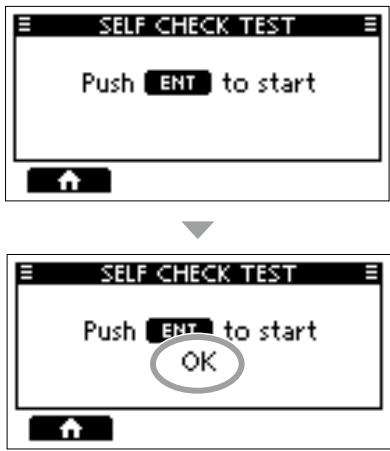
Self Check Test
The Self-Test sends DSC signals to the receiving AF circuit to compare the sending and receiving signals at the AF level.
Push [ENT] to start the Self-Test.
① When the sending and receiving DSC signals match, "OK" is displayed.
Procedure (For only the USA version)
You can select the type of task for the transceiver, depending on the presetting.
Single: Handles only 1 task at the same time.
Multiple: Handles up to 7 tasks at the same time.
■ Making an Individual call to an AIS target
You can transmit an Individual call to a selected AIS target, without entering the target's MMSI code. In this case, the call type is automatically set to Routine.
◇ Selecting an AIS target on the IC-M510BB
You can compose an Individual call to an AIS target selected on the Plotter screen or the AIS list.
NOTE: The IC-M510BB can be input AIS information from the built-in AIS receiver (if built in) or an external NMEA 0183 or NMEA 2000 sentence source.
- Select the AIS target from the Plotter screen, the Target List, the Friends List, or the Danger list (pp. 55, 57).
- Push DSC.
- "COMPOSE OTHER" screen is displayed.
- Select "Channel," then push [ENT] or [DIAL] to display the Voice channel selection screen.
① See page 23 for details.
- Select a channel to assign, and then push [ENT] or [DIAL].
- Push CALL to send the Individual call.
- When you receive an Acknowledgment "Able to comply", an alarm sounds. Push ALARM OFF to turn OFF the alarm.
- The channel assigned in step 4 is automatically selected.
① If the called station cannot use the channel that you assigned, a different channel is selected by the other station.
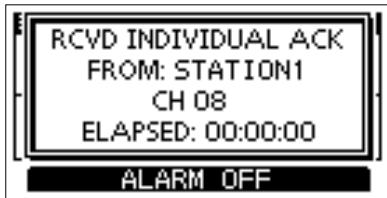
- Push CLOSE.
- Hold down [PTT] to communicate.
◇ Using an AIS transponder
When the optional MA-510TR CLASS B AIS TRANSPONDER is connected to the transceiver, you can transmit an Individual call to a selected AIS target and the voice channel on the transponder.
① See page XX for connecting instructions.
NOTE: To ensure correct operation of the DSC function, make sure you correctly set the CH70 SQL Level. (p. XX)
① See the next page for the operation.
7 DIGITAL SELECTIVE CALLING (DSC)
◇ Using an AIS transponder
Transponder operation:
- Select an AIS target on the plotter display, Target, Danger, or Friends list screen.
① See the MA-510TR INSTRUCTION MANUAL for details. - Push [ENT] to display the Menu window.
- The Menu window is displayed.
- Select "Send DSC," and then push [ENT].
- The "DSC TRANSMISSION" screen is displayed.
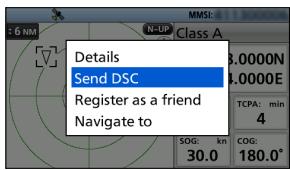
- Push [▲] or [▼] to select a voice channel.
- Voice channels are already preset into the transponder in the recommended order.
NOTE: When a base station is selected in step 1, a voice channel will be specified by the base station. Therefore you cannot change the channel. The transponder will display "Voice Channel is specified by the Base station," in this case.
![DSC TRANSMISSION Select voice channel. Channel: 08 And push [ENT] to transmit.](/content/2025/12/335615/images/53bb4352c80b0106c0fe7c8668291d8c81f2b824586fdc0b38279ccb7ca43c9b.jpg)
- Push [ENT] to make the Individual DSC call.
- “Transmitting individual call” is displayed.
① If Channel 70 is busy, the transceiver stands by until the channel becomes clear.
- After making the Individual DSC call, "DSC transmission completed." is displayed.
- If the transceiver cannot make the call, "DSC transmission failed." is displayed.
Transceiver operation:
- When the acknowledgment is received, alarm sounds.
- If the acknowledgment 'Able to comply' is received, push ALARM OFF to stop the alarm, and then select the voice channel specified in step 4.
- A different voice channel will be selected if the station you called cannot use the channel.
- To reply, push [PTT] and speak at a normal voice level.
- You can check the MMSI code or the name, if entered, of the AIS target on the display.
- If the acknowledgment 'Unable to comply' is received, push ALARM OFF to stop the alarm, then the Acknowledge information is displayed.
- After the communication is finished, push to return to the normal operating mode.
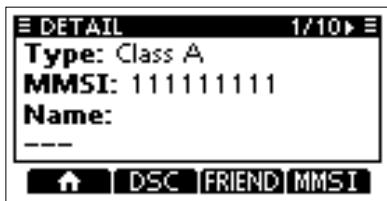
■ DSC Remote Control (EN 300 338-8 compatible)
With controllers connected to the transceiver, you can perform DSC remote control communications. Up to 3 command microphones and an external device can be used as controllers.
For more information about connecting an external device, see page. XX.
◇ Editing a controller name
A name can be assigned to each controller for easy identification.
- Open the "NAME" screen.
[MENU] > Settings > Configuration > Controller > Name
① Only controllers connected to the transceiver are listed.
① The controller being operated has “(Own)” appended to its name.
- Push [▲] or [▼], or rotate [DIAL] to select a controller.
- Push [ENT] or [DIAL] to enter the "NAME" screen.
- Edit a controller name.
i Select 123 to enter numbers, and 45 to enter symbols.
- Select FINISH, and then push [ENT] or [DIAL] to save the edited name and return to the previous screen.
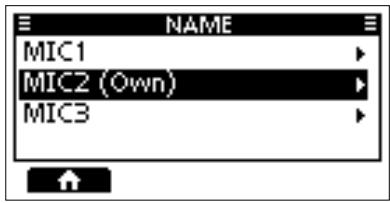
◇ Setting the Priority Controller
Select which controller to be used as the Priority Controller.
The Priority Controller takes precedence over other controllers in DSC operations.
Except for sending a Distress call, a DSC task can be handled only by the first controller operated.
- Open the "PRIORITY" screen.
[MENU] > Settings > Configuration > Controller > Priority
① Only controllers connected to the transceiver are listed.
① The controller being operated has “(Own)” appended to its name.
- Push [▲] or [▼], or rotate [DIAL] to select a controller to be used as the Priority Controller.
① The Priority Controller's ID is automatically set to 0.
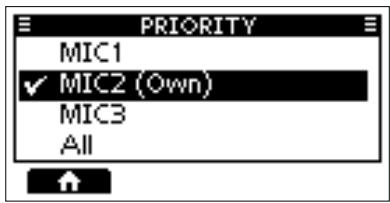
NOTE:
- If the ID of the external device is set to 0, the device is automatically set as the Priority Controller.
- When the external device is set as the Priority Controller, regardless of its ID, DSC remote control from the device is accepted.
7 DIGITAL SELECTIVE CALLING (DSC)
◇ Dealing with ID and Priority
When controllers are connected to the transceiver, the unique ID is automatically assigned to each controller in order from 1 to 99.
Once a controller is set as the Priority Controller, however, its ID is replaced with 0 because the ID of the Priority Controller ID is fixed at 0.
To check the current ID of each controller, open the "ID" screen.
[MENU] > Settings > Configuration > Controller > ID
① The IDs are for display only and cannot be edited.
① The ID of an external device is assigned by the device itself, not by the transceiver.
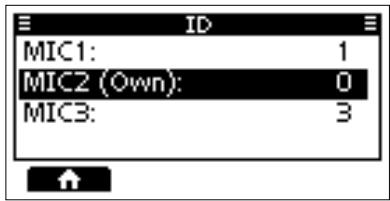
NOTE: With Non-Priority Controllers, you cannot make changes to DSC-related settings listed below. To configure the settings, use the Priority Controller.
| MENU > Settings > Configuration > Inactivity Timer > | Not DSC Related |
| DSC Related | |
| Distress Related | |
| RT Related | |
| MENU > Settings > DSC > Auto ACK > | Individual ACK |
| Position ACK | |
| Polling ACK | |
| Test ACK | |
| MENU > Settings > DSC > | CH Auto Swtich |
When a controller gets disconnected while holding a DSC task:
Controllers are considered disconnected when the following conditions are met.
| Controller | Condition |
| Command microphone | Unplugged or turned off |
| External device | The transceiver has not received a single sentence via NMEA 0183 interface in the last 2 minutes. |
Once a controller is disconnected, the right to handle a DSC task will be released. After that, the first Non-Priority Controller operated will have the right.
When the Priority Controller is disconnected, the controller names are displayed with "(None)" appended.
[MENU] > Settings > Configuration > Controller > Priority
- Allowing controllers to perform DSC operations
Select whether or not to allow controllers to perform DSC operations.
- Open the "DSC OPERATION" screen.
[MENU] > Settings > Configuration > Controller > DSC Operation
① Only controllers connected to the transceiver are listed. ② The controller being operated has “(Own)” appended to its name.
- Push [▲] or [▼], or rotate [DIAL] to select a controller.
- Push [ENT] or [DIAL] to select ON or OFF.
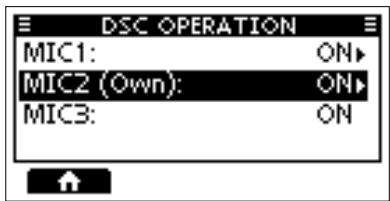
ON: Accepts DSC remote control from the controllers.
Even when this item is set to "ON," DSC remote control from the
Non-Priority Controllers is accepted only from the first controller operated.
OFF: Refuses DSC remote control from the controllers.
Except for sending a distress call, DSC remote control from the Non-Priority Controllers with this item set to "OFF" is not allowed.
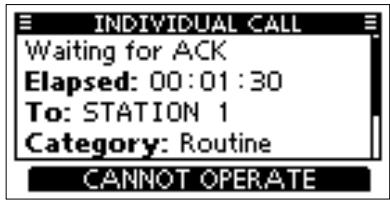

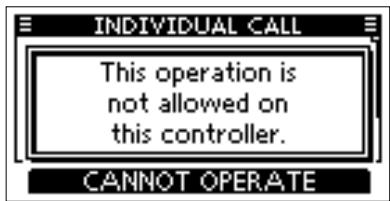
- Push 📊 to exit the Menu screen.
NOTE: The IC-M510BB can be input AIS information from the built-in AIS receiver (if built in) or an external NMEA 0183 or NMEA 2000 sentence source.
■ About AIS
The Automatic Identification System (AIS) is primarily used for collision-risk management and navigation safety. It can automatically transmit and receive vessel information, such as the vessel name, MMSI code, vessel type, position data, speed, course, destination, and more, depending on the class. Information is exchanged among vessels and/or base stations on the VHF maritime mobile band. The information helps to identify other nearby vessels or stations by displaying the received data on a plotter or a radar screen.
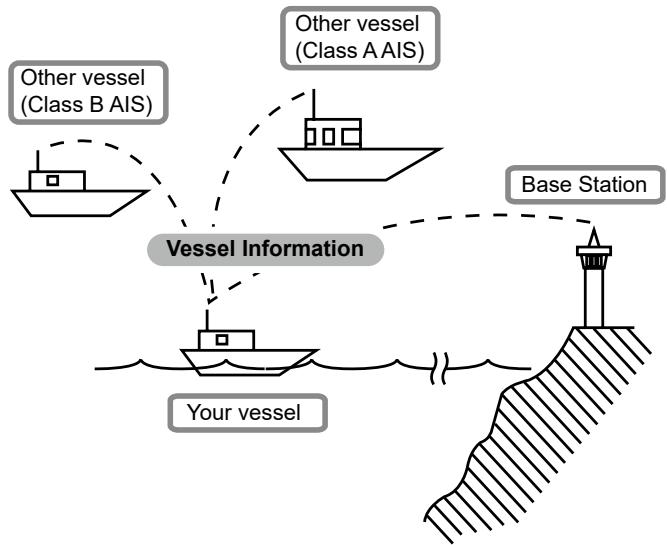
flowchart
graph TD
    A["Other vessel (Class B AIS)"] --> D["Vessel Information"]
    B["Other vessel (Class A AIS)"] --> D
    C["Your vessel"] --> D
    D --> E["Base Station"]
■ AIS classes
There are 7 types of AIS stations, vessels, base stations, Search and Rescue (SAR), Aids to Navigation (AtoN), Search and Rescue Transmitter (AIS-SART), Man OverBoard (MOB), and Emergency Position Indicating Radio Beacon-AIS (EPIRB-AIS).
There are 2 classes of AIS units, which are installed on vessels, Class A and Class B.
Under the Safety Of Life At Sea (SOLAS) convention, all SOLAS vessels, as described below, are required to install a Class AAIS transponder:
- Upwards of 300 gross tonnage engaged on international voyages.
- Passenger vessels, irrespective of size, engaged on international voyages.
- Upwards of 500 gross tonnage not engaged on international voyages.
A Class B AIS transponder is designed to be interoperability with Class A units, but not to impact the Class A network.
Many commercial vessels, and some leisure craft, not classified as requiring a Class A unit, choose to install a Class B unit to avoid accidents at sea.
■ Using the Plotter screen
On the plotter screen, the display range and the icons of the AIS target, waypoint and MOB are displayed. You can change the display range and type, depending on your operating style.
- Push [DISP] and then select "Plotter".
• The Plotter screen is displayed.
- Push the Software Key for your next operation.

Returns to the operating screen.

Selects the display range. (p. 53)

Selects the closest target to your vessel.

Selects the farthest target from your vessel.

Displays the details on the selected target. (p. 58)

Push to enter the Man Overboard (MOB) mode. (p. 65) While in the Man Overboard (MOB) mode, push to stop the MOB mode.

Push to start the Anchor watch function. (p. 66) While in the Anchor watch mode, push to stop Anchor watch.
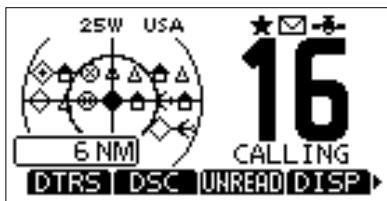
NOTE: An alarm sounds when an AIS target is closer than the CPA (Closest Point of Approach) and TCPA (Time to CPA) settings, and so on, depending on the presetting. To stop the alarm buzzer, push any key.
① If a popup screen is displayed, push any key again to turn it OFF.
TIP: You can display only the Plotter screen by selecting the "Plotter" item on the Menu screen.
[MENU] > AIS > Plotter
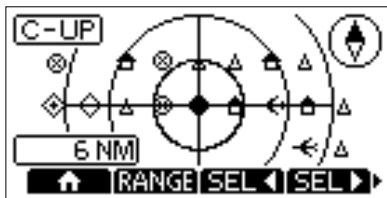
◇ Plotter screen
Displays the plotter display and selected target's information.
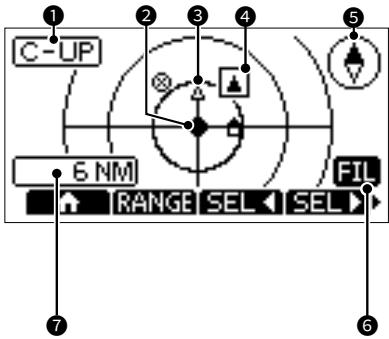
① DISPLAY TYPE
Displays the selected display type. You can select the display type in "North up/Course up" on the Menu screen. (p. 60)
$$ \begin{array}{l} \text {[MENU] > Settings > AIS >} \ \text { North / Course up } \end{array} $$
① When “N-UP” is displayed, the top of the plotter screen represents North.
When “C-UP” is displayed, the top of the plotter screen represents the direction your vessel’s course over ground.
② YOUR VESSEL ICON
Displayed in the center of the screen.
When “N-UP” is displayed, the vessel icon automatically points in the direction your vessel is heading, in 5.625 degree steps.
① When “C-UP” is displayed, the vessel icon constantly points to the top of the plotter screen.
① When your vessel moves less than 2 knots, ● is displayed.
③ TARGET ICONS
Targets whose AIS signal are received are displayed with icons. The icon may differ, depending on the target type or its status.
| Icon | Description |
| AIS target: VesselAIS target: Search and Rescue (SAR) vessel1 The tip of the target triangle automatically points in the direction it's heading. | |
| AIS target: Vessel (Friend)(Black triangle) | |
| AIS target: AIS-SART, AIS-MOB, and EPIRB-AIS | |
| AIS target: Search and Rescue (SAR) aircraft | |
| AIS target: Aids to Navigation (AtoN)AIS target: Aids to Navigation (AtoN) virtual | |
| AIS target: Base station | |
| MOB |
① Icons for other than the SAR aircraft, Base station, Waypoint, and MOB start blinking when the AIS target is closer than your CPA and TCPA settings (Danger target).
① A vessel is regarded as a “Lost target,” and a cross mark displays on the target icon after a specified period of time has passed since the vessel last transmitted data (p. 71). The Lost target icon disappears from the plotter display 6 minutes and 40 seconds after the vessel was regarded as a “Lost target.” Ask your dealer for details.
4 TARGET BOX
Displays the selected target.
When a target box is displayed, push INFO to display the detail screen of the selected target.
⑤ COMPASS
Displays the bearing information.
8 AIS FUNCTION
◇ Plotter screen
⑥ DISPLAY FILTER INDICATOR
Displayed when the type of targets on the plotter screen are filtered. (p. 60)
$$ [ M E N U ] > \text { Settings } > \text { AIS } > \text { Target Display } $$
All Targets: All AIS targets are displayed.
Danger Only: Only Danger AIS targets are displayed.
Friends Only: Only Friend AIS Targets are displayed.
⑦ DISPLAY RANGE
- Displays the selected display range.
- Push RANGE to select the desired display range.
① 0.125, 0.25, 0.5, 0.75, 1.5, 3, 6, 12, 24, 36 NM (nautical miles) can be selected.
■ Using the AIS list screen
There are 3 types of AIS lists, Target, Danger, and Friends.
The target's information is automatically updated every 5 seconds, and then the AIS target data is sorted.
- Push [MENU].
- The Menu screen is displayed.
- Push [▲], [▼], or rotate [DIAL] to select "AIS," and then push [ENT], [DIAL], or [▶].
- The "AIS" screen is displayed.
- Push [▲] or [▼] to select a list, and then push [ENT], [DIAL], or [▶].
- The list screen is displayed.
- Push [▲], [▼], or rotate [DIAL] to select an AIS target.
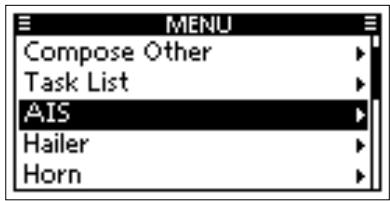
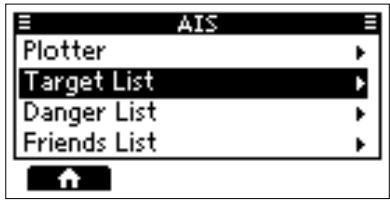
- Push the Software Key below for your next operation.
DSC: Displays the "COMPOSE OTHER" screen to send an Individual call. (p. 25)
① Displayed only when a target is selected.
INFO: Displays the details on the selected target. (p. 58)
① Displayed only when the target is selected.
FRIEND: Sets the selected target as a Friend. (p. 57)
① Displayed only in the Target List or Danger List.
PLOT: Displays the selected target on the plotter screen. (p. 52)
NOTE: An alarm sounds when an AIS target is closer than the CPA and TCPA settings, and so on, depending on the presetting. To stop the alarm buzzer, push any key.
① If the popup screen is displayed, push any key again to turn it OFF.
◇ Target/Friends List screen
The Target List screen displays up to 200 AIS targets.
The Friends List screen displays the AIS targets of up to 100 targets that you set as a Friend. (p. 57)
The AIS target data is sorted by the distance from your vessel, and the closest target is located at the top of the list.
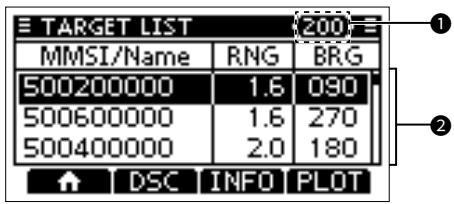
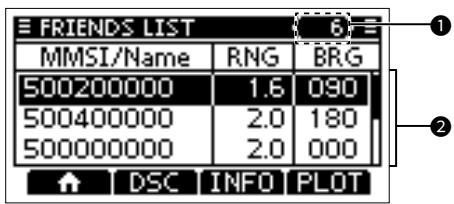
① THE NUMBER OF TARGETS
Displays the number of AIS targets.
② TARGET INFORMATION
Displays the following AIS target information.
- MMSI code or name
- Range (RNG) from your vessel to the target (units: NM)
- Bearing (BRG) from your vessel to the target (units: degree)
◇ Danger list screen
The Danger List screen displays any Danger target whose CPA (Closest Point of Approach) distance and TCPA (Time to CPA) time are less than the set values. You can set the values in “CPA” and “TCPA” on the Menu screen. (p. 60)
$$ \begin{array}{l} \text {[MENU] > Settings > AIS > CPA/TCPA >} \ \text { CPA or TCPA } \end{array} $$
① The transceiver can display up to 200 targets.
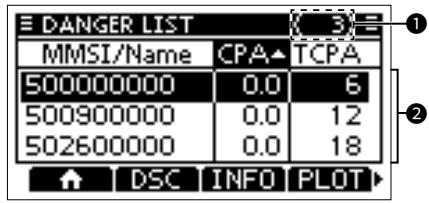
① THE NUMBER OF TARGETS
Displays the number of AIS targets.
② DANGER TARGET INFORMATION
Displays the following AIS target information.
- MMSI code or name
• CPA: Closest Point of Approach (unit: NM) - TCPA: Time to CPA (units: minute)
■ Setting a Friend
You can set up to 100 AIS targets as a Friend in the Friends List.
An alarm sounds when a Friend is detected, depending on the setting. (p. 61)
◇ Entering an ID
There are 3 ways of setting a Friend, using the Friends List, selecting in the AIS list, or selecting on the plotter display.
Using the Friends List:
- Open the "FRIENDS LIST" screen.
[MENU] > Settings > AIS > Friends > Friends List
- “No ID” is displayed when there is no Friend.
-
Push ADD to display the Friend ID window.
-
Enter an ID.
TIP:
- Select a number using [◀] and [▶].
- Push [ENT], or [DIAL] to enter the selected number.
-
Select “←” or “→” on the screen, or rotate [DIAL] to move the cursor.
-
Push FINISH to save the edited ID.
- The target is added to the Friends List.
Selecting in the Target List or Danger List:
- Open a "Target List" or a "Danger List".
[MENU] > AIS > Target List or Danger List
-
Push [▲] or [▼], or rotate [DIAL] to select an AIS target.
-
Push FRIEND.
-
"Register as a Friend," is displayed.
- is displayed.
Selecting on the plotter display:
- Open the plotter screen. (p. 52)
- Push SEL◀ or SEL▶ to select an AIS target.
- Push INFO to display the details screen.
-
The "DETAILS" screen is displayed.
-
Push FRIEND
- The target is added to the Friends List.
- A friend target is displayed with ▲ (black triangle) on the plotter screen.
◇ Editing an ID
- Open the "FRIENDS LIST" screen. [MENU] > Settings > AIS > Friends > Friends List
- Push [▲] or [▼], or rotate [DIAL] to select an ID.
- Push EDIT. ① See step 3 in "Using the Friends List," as described to the left.
◇ Deleting an ID
- Open the "FRIENDS LIST" screen. [MENU] > Settings > AIS > Friends > Friends List
- Push [▲] or [▼], or rotate [DIAL] to select an ID.
- Push DEL. • "Delete the ID. Are you sure?" is displayed.
- Push OK.
■ About the Detail screen
The Detail screen displays the information about the selected AIS target or waypoint. The contents may differ, depending on the selected target.
① When a Danger target is selected, F1 is displayed.(p. 56)
① When a Friend target is selected, ■■ is displayed. (p. 56)
- Push the Software Key below for your next operation.
DSC: Displays the "COMPOSE OTHER" screen to send an Individual call. (p. 25)
FRIEND: Sets the selected target as a Friend. (p. 57)
① A beep sounds and a popup screen is displayed when the memory is full.
MMSI: Displays the Individual ID entry screen. (p. 8)
① A beep sounds and a popup screen is displayed when the memory is full, or the ID has been already added.
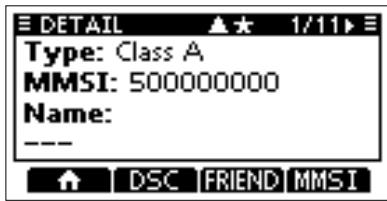
◇ Contents list
NOTE: The contents may differ, depending on the received data.
| Class A and SAR vessel |
| AIS class |
| MMSI code |
| Ship name |
| Country name |
| Call sign |
| Vendor ID |
| IMO number |
| CPA (Closest Point of Approach) |
| TCPA (Time to CPA) |
| Position (Latitude, Longitude) |
| SOG (Speed Over Ground) |
| COG (Course Over Ground) |
| HDG (Heading) |
| PA (Position Accuracy (H: High, L: Low)) |
| Range |
| Bearing |
| ROT (Rate Of Turn) |
| Bow to antenna distance |
| Stern to antenna distance |
| Port side to antenna distance |
| Starboard side to antenna distance |
| Length |
| Beam |
| Draught |
| Type of ship |
| NAV Status |
| Destination |
| Estimated time of arrival |
| Elapsed time |
| Class B |
| AIS class |
| MMSI code |
| Ship name |
| Country name |
| Call sign |
| Vendor ID |
| CPA (Closest Point of Approach) |
| TCPA (Time to CPA) |
| Position (Latitude, Longitude) |
| SOG (Speed Over Ground) |
| COG (Course Over Ground) |
| HDG (Heading) |
| PA (Position Accuracy (H: High, L: Low)) |
| Range |
| Bearing |
| Bow to antenna distance |
| Stern to antenna distance |
| Port side to antenna distance |
| Starboard side to antenna distance |
| Length |
| Beam |
| Type of ship |
| Elapsed time |
| AIS-SART, AIS-MOB, and EPIRB-AIS |
| AIS class |
| MMSI code |
| CPA (Closest Point of Approach) |
| TCPA (Time to CPA) |
| Position (Latitude, Longitude) |
| SOG (Speed Over Ground) |
| COG (Course Over Ground) |
| HDG (Heading) |
| PA (Position Accuracy (H: High, L: Low)) |
| Range |
| Bearing |
| ROT (Rate Of Turn) |
| Elapsed time |
| Base station |
| AIS class |
| MMSI code |
| Position (Latitude, Longitude) |
| PA (Position Accuracy (H: High, L: Low)) |
| Vendor ID |
| Range |
| Bearing |
| Elapsed time |
| SAR aircraft |
| AIS class |
| MMSI code |
| Target name |
| Country name |
| Call sign |
| Vendor ID |
| Position (Latitude, Longitude) |
| SOG (Speed Over Ground) |
| COG (Course Over Ground) |
| ALT (Altitude) |
| PA (Position Accuracy (H: High, L: Low)) |
| Range |
| Bearing |
| Length |
| Width |
| Elapsed time |
| AtoN and AtoN virtual |
| AIS class |
| MMSI code |
| Target name |
| CPA (Closest Point of Approach) |
| TCPA (Time to CPA) |
| Position (Latitude, Longitude) |
| PA (Position Accuracy (H: High, L: Low)) |
| Position indicator(ON POSN: ON Position,OFF POSN: OFF Position) |
| Range |
| Bearing |
| Bow to antenna length |
| Stern to antenna length |
| Port side to antenna length |
| Starboard side to antenna length |
| Length |
| Beam |
| Type of AtoN |
| Elapsed time |
| MOB |
| Position (Latitude, Longitude) |
| Range |
| Bearing |
■ AIS settings
AIS settings can be customized in "AIS" on the Menu screen.
[MENU] > Settings > AIS
North up/Course up
You can select the display type for the plotter screen.
North up: The top of the plotter screen represents North.
Course up: The top of the plotter screen represents the direction your vessel's course over ground.
Target Display
You can select whether or not to limit the AIS or waypoint targets that are displayed on the plotter display. You can easily see the plotter display.
① The indicator is displayed on the plotter display. (p. 57)
① The waypoint for navigation is displayed, regardless of this setting.
All targets: All targets are displayed.
Danger only: Only Danger AIS targets are displayed.
Friends only: Only Friend AIS targets are displayed.
CPA/TCPA
- Alarm
You can select whether or not to turn the following alarm functions ON or OFF.
ON: The alarm function is ON. An alarm sounds, and a popup screen is displayed.
① The alarm may not sound, depending on the “Audible Alarm” setting.
OFF: The alarm function is OFF.
- Approach
The alarm function for when a vessel's CPA is closer, and TCPA is less than the set value.
- Lost
The alarm function for when a danger target is regarded as a “Lost target.” (p. 71)
- Audible Alarm
You can select whether or not to sound the following alarms.
ON: The alarm sounds.
OFF: The alarm does not sound.
- Approach
The alarm function for when a vessel's CPA is closer, and TCPA is less than the set value.
- Lost
The alarm function for when a danger target is regarded as a “Lost target.” (p. 71)
CPA
Set a CPA (Closest Point of Approach) value between 0.01 and 6.00 NM (in 0.01 NM steps) for the alarm function.
- TCPA
Set a TCPA (Time to CPA) value between 1 and 60 minutes (in 1 minute steps) for the alarm function.
- Slow Warn
The GPS receiver calculated COG data of a vessel that is at anchor or drifting is unreliable, and therefore the CPA and TCPA data may not be calculated correctly. If a vessel is anchored in your alarm zone, the unreliable data can cause the collision alarm to sound many times, even if there is no real danger. To prevent this, when the anchored vessel's SOG is less than this set value, the Slow Warn function assumes that vessel's COG is fixed towards your vessel and an alarm will sound.
- Function
Turn the Slow warn function ON or OFF.
ON: The Slow warn function is turned ON.
OFF: The Slow warn function is turned OFF.
- Speed
Set a speed for the Slow warn function between 0.1 and 4.9 kn (in 0.1 kn steps).
NOTE: If other vessels at anchor or drifting come into your alarm zone, the Slow warn alarm will sound again. Only if the previous vessel disappears from the Danger list (p. 56), and then re-enters the list, can a new Slow warn or regular alarm sound, depending on the vessel's SOG, or CPA and TCPA. The Slow warn function operates in the same way if your vessel is at anchor and other vessels enter your alarm zone.
Friends
- Friends List
Displays all Friend targets that you have entered.
① “No ID” is displayed when there is no Friend target.
① See page 57 for how to set a Friend.
- Friends Alarm
- Function
You can select whether or not to turn the following alarm function ON or OFF when a vessel that is entered into the Friends List is detected.
ON: The alarm function is ON. An alarm sounds, and a popup screen is displayed when a vessel that is entered into the Friends list is detected, regardless of the set range.
ON
(in range): The alarm function is ON when a vessel that has entered into the Friends list is detected in the set range.
OFF: The alarm function is OFF.
- Audible Alarm
You can select whether or not to sound the Friends alarm.
ON: The alarm sounds.
OFF:The alarm does not sound.
- Range
Set the range to between 0.01 and 6.00 NM (in 0.01 NM steps) for the alarm function.
8
AIS FUNCTION
■ AIS settings
ID Blocking
The transceiver blocks AIS transponders that are entered into the ID Blocking list. Enter your vessel's transponder ID or other vessel's transponder IDs if necessary to prevent the transceiver from detecting them as dangerous targets.
① You can enter up to 10 MMSI codes.
- Entering an ID
- Open the "ID BLOCKING" screen.
[MENU] > Settings > AIS > ID Blocking
- The blocked AIS transponder's ID is displayed.
-
“No ID” is displayed if there is no blocked AIS transponder.
-
Push ADD to start the ID entry.
-
Enter an ID.
TIP:
- Select a number using [◀] and [▶].
- Push [ENT] or [DIAL] to enter the selected number.
-
Select “←” or “→,” or rotate [DIAL] to move the cursor.
-
Select FINISH, and then push [ENT] to enter the ID.
- Editing an ID
- Open the "ID BLOCKING" screen.
[MENU] > Settings > AIS > ID Blocking
- Push [▲] or [▼] to select an ID.
- Push EDIT.
- See step 3 in "Entering an ID," as described above.
- Push OK.
- Deleting an ID
- Open the "ID BLOCKING" screen.
[MENU] > Settings > AIS > ID Blocking
- Push [▲] or [▼] to select an ID.
- Push DEL.
- “Delete the ID. Are you sure?” is displayed.
- Push OK.
NOTE: For the other functions, the transceiver must be receiving valid GPS signals, or your position must be entered. (p. 20)
■ MOB (Man Overboard)
You can enter a Man OverBoard (MOB) waypoint into the transceiver with its GPS position data, as soon as a person has fallen into the water and needs to be rescued.
This enables you to reach the MOB location even in the dark, or when you have lost visual contact.
You can select an AIS target during the MOB mode.
◇ Starting MOB
- Push MOB to enter the MOB mode.
- Three beeps sound.
• The MOB screen is displayed. - is displayed at your current position on the plotter screen.
TIP: You can also start the MOB mode by selecting the "Start MOB" item on the Menu screen. [MENU] > MOB > Start MOB
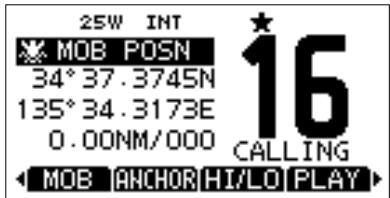
◇ Stopping MOB
- Push MOB to stop the MOB mode.
- “Deactivate MOB. Are you sure?” is displayed.
- Push OK
- disappears, and the transceiver returns to the previous screen.
TIP: You can also stop the MOB mode by selecting the "Stop MOB" item on the Menu screen. [MENU] > MOB > Stop MOB
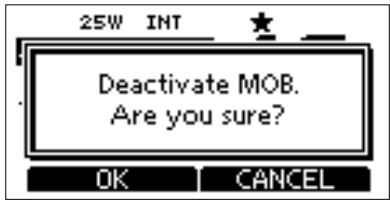
9
OTHER FUNCTIONS
Anchor Watch
Anchor Watch is the function to sound an alarm when your vessel is at anchor and has drifted.
◇ Starting Anchor Watch
- Push ANCHOR to start the Anchor Watch mode.
- The “ANCHOR INFORMATION” screen is displayed.
TIP: You can also start the Anchor Watch mode by selecting the "Start Anchor Watch" item on the Menu screen.
[MENU] > Anchor Watch > Start Anchor Watch
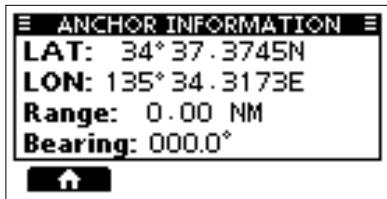
① When your vessel exceeds the range of the anchor watch, “Exceeded anchor radius!” is displayed.
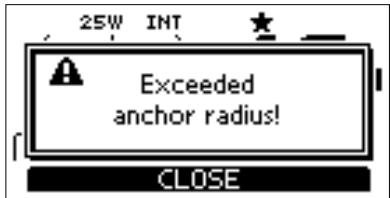
◇ Stopping Anchor Watch
- Push ANCHOR to stop the Anchor Watch mode.
- "Deactivate anchor watch. Are you sure?" is displayed.
- Push OK.
TIP: You can also stop the Anchor Watch mode by selecting the "Stop MOB" item on the Menu screen.
[MENU] > Anchor Watch > Stop Anchor Watch

◇ Anchor Watch Settings
[MENU] > Settings > Anchor Watch
- Audible Alarm
Select whether or not to sound an alarm when the vessel is drifting off its anchor position.
ON: The alarm sounds.
OFF: The alarm does not sound.
- Range
Set the alarm function range from 0.01 to 6.00 NM (0.01 NM steps).
■ Lost target
A vessel is regarded as a “Lost target” after a specified period of time has passed since the vessel last transmitted data, as described below.
The “Lost target” icon disappears from the plotter display 6 minutes and 40 seconds after the vessel was regarded as a “Lost target.” Ask your dealer for details.
The criteria to become a Lost target
- Class A/B
| Vessel type | Lost target maximum interval Class A | Lost target maximum interval Class B *1 | ||
| CS *2 | SO*3 | |||
| 1 | Class A: Vessel is at anchor, moored and not moving faster than 3 knotsClass B: Vessel is not moving faster than 2 knots | 1080 seconds | 1080 seconds | |
| 2 | Vessel is at anchor, moored and moving faster than 3 knots | 60 seconds | N/A | |
| 3 | Class A: Vessel is moving between 0 and 14 knotsClass B: Vessel is moving between 2 and 14 knots | 60 seconds | N/A | 180 seconds |
| 4 | Vessel is moving between 0 and 14 knots while changing course | 60 seconds | N/A | |
| 5 | Vessel is moving between 14 and 23 knots | 36 seconds | N/A | 90 seconds |
| 6 | Vessel is moving between 14 and 23 knots while changing course | 36 seconds | N/A | |
| 7 | Vessel is moving faster than 23 knots | 30 seconds | N/A | 30 seconds |
| 8 | Vessel is moving faster than 23 knots while changing course | 30 seconds | N/A | |
| 9 | Vessel is moving faster than 2 knots | N/A | 180 seconds | N/A |
*1 AIS Class B does not provide information about the navigational status, anchored or moored.
*2 CS: Carrier-sense
*3 SO: Self organized
- Others
| Category | Lost target maximum interval |
| SAR aircraft | 60 seconds |
| AtoN | 1080 seconds |
| Base station | 60 seconds |
9 OTHER FUNCTIONS
■ Voice Record
This function automatically records the last 120 seconds of the received audio.
◇ Audio recording
- Open the "VOICE RECORD" screen.
[MENU] > Settings > Radio > Voice Record
- Select "Auto (Last 120 sec)."
- Recording starts automatically when a signal is received.
- is displayed when recording the received audio.
- The recorded audio is erased when the transceiver is turned off.

◇ Audio playback
- Push PLAY
- is displayed while playing back the recorded audio.
- Push PLAY again to stop playing the recorded audio.

■ Using the Intercom
The Intercom function enables you to communicate between the deck and the cabin. The optional HM-195 COMMANDMICIV ^™ is required for Intercom operation.
① Connect the HM-195 as described on page XX.
NOTE: While using the Intercom function,
- Transmit is disabled.
• The received call audio is muted. -
Operation is disabled on devices other than the two that are using the Intercom function.
-
Open the "INTERCOM" screen.
[MENU] > Intercom
-
Select a unit, and then push [ENT] or [DIAL].
-
Enters the Intercom mode.
① “ALL” is displayed only when 3 command microphones are connected to the transceiver.
① The controller being operated has “(Own)” appended to its name.
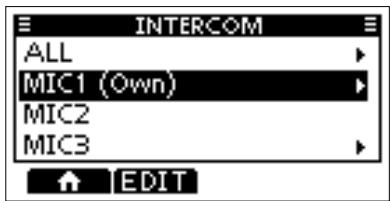
-
Hold down CALL to sound the intercom beeps.
-
The transceiver and the command microphone, or the mobile device sound beeps while holding down CALL.
- "CALL" is displayed.
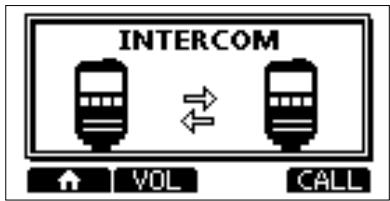
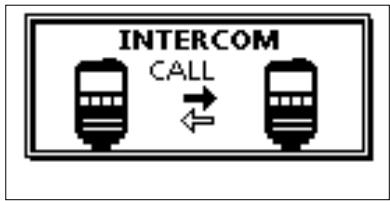
-
After releasing CALL, hold down [PTT] and speak into the microphone at your normal voice level.
-
"TALK" is displayed.
① To adjust the transceiver volume level, rotate [VOL].
To adjust the command microphone's intercom volume level, rotate [VOL] on the command microphone.

-
After releasing [PTT], you can hear the response through the speaker.
-
Push [CLEAR] to return to the previous screen.
NOTE: While in the Intercom mode, the transmit and receive functions are disabled. When the transceiver is transmitting, the Intercom function is disabled.
9
OTHER FUNCTIONS
■ Using the RX Hailer
The RX Hailer function enables you to hear the received audio on the deck or bridge through a Hailer speaker.
To use this function, the external hailer speaker must be connected to the transceiver. ① See page XX for details of the connection.
- Push RX to enter the RX Hailer mode.
- Push[▼], and then push [◀] or [▶] or rotate [DIAL] to set the RX Hailer function ON or OFF.
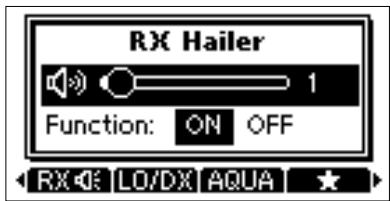
-
Push[▲], and then push [◀] or [▶] or rotate [DIAL] to adjust the volume level.
-
To exit the RX hailer mode, push [ENT] or [DIAL].
- RX is displayed when the RX hailer function is set to ON.
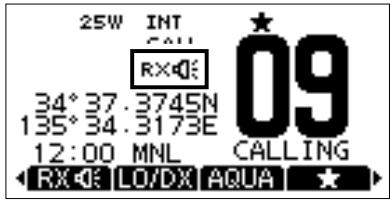
■ Using the Hailer
You can talk without leaving the bridge by using the 2 way hailer function.
To use this function, the external hailer speaker must be connected to the transceiver.
- You cannot transmit while using the hailer.
- Open the "Hailer" screen.
[MENU] > Hailer
- Hold down [PTT] and speak at your normal voice level.
- While holding down [PTT], the screen shown on the right is displayed.
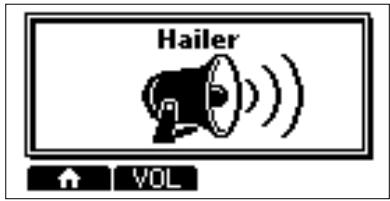
i Push VOL to open the volume adjustment screen.
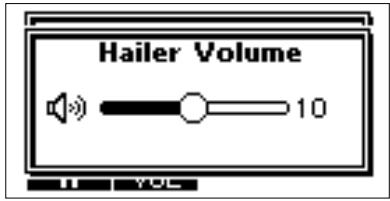
NOTE: While in the Hailer mode, the transmit and receive functions are disabled. When the transceiver is transmitting, the Hailer function is disabled.
9
OTHER FUNCTIONS
■ Using the Horn function
◇ Automatic Foghorn function
The Automatic Foghorn function sounds a horn repeatedly until the function is turned OFF.
The foghorn outputs from the hailer speaker. To use this function, the hailer speaker must be connected to the transceiver.
| TYPE | PATTERN | USAGE | |
| Underway | One 5-second blast every 120 seconds. | 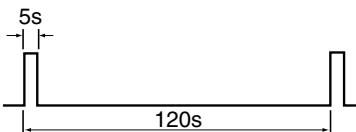 | Motor vessel underway and making way. |
| Stop | Two 5-second blasts (separated by 2 seconds) every 120 seconds. | 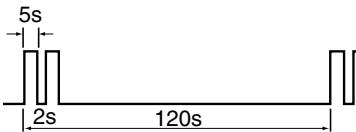 | Motor vessel underway but stopped (not making way). |
| Sail | One 5-second blast followed by two 1-second blasts (each separated by 2 seconds) every 120 seconds. | 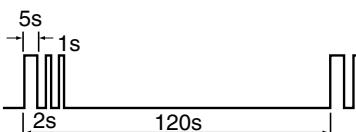 | Sailing vessel underway, fishing vessel (underway or anchored), vessel not under command, a vessel restricted in her ability to maneuver (underway or at anchor), or a vessel towing or pushing another ahead. |
| Tow | One 5-second blast followed by three 1-second blasts (each separated by 2-seconds) every 120 seconds. | 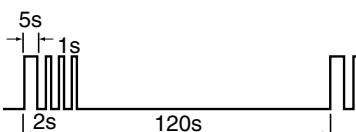 | Vessel under tow (manned). |
- Open the "AUTO FOGHORN" screen.
[MENU] > Horn > Auto Foghorn
- Select the foghorn pattern, and then push [ENT] or [DIAL] to return to the previous screen.
• is displayed.
① To turn OFF the Auto Foghorn, select "OFF" in the "Auto Foghorn" menu.
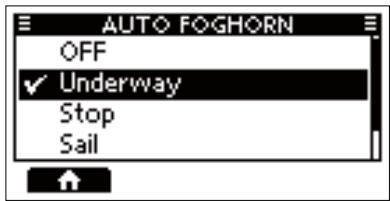
◇ Horn Volume function
- Open the "HORN VOLUME" screen.
[MENU] > Horn > Horn Volume
- Push [◀] or [▶], or rotate [DIAL] to adjust the foghorn level.
◇ Manual Horn function
- Open the "Manual Horn" screen.
[MENU] > Horn > Manual Horn
- Hold down HORN to sound a horn.
- While holding down HORN, the horn sounds, and the screen shown on the right is displayed.
① To adjust the horn volume level, push VOL to open the Horn Volume popup screen.
NOTE: While in the Horn mode, the transmit and receive functions are disabled. When the transceiver is transmitting, the Horn function is disabled.
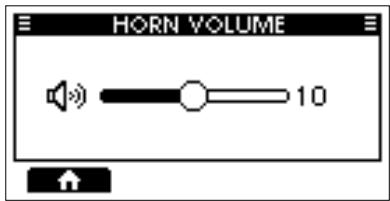
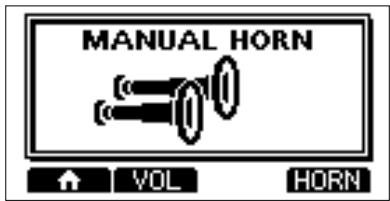
◇ Frequency setting
- Open the Frequency.
[MENU] > Horn > Frequency
- Select the foghorn's audio frequency.
① Available frequency range is 200 Hz to 700 Hz in 50 Hz steps.
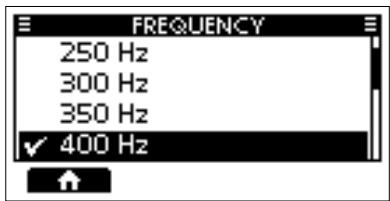
10 MENU SCREEN
■ Using the Menu screen
The Menu screen is used to set items, select options, and so on for the transceiver's functions.
◇ Menu screen operation
Example: Setting the key beep to "OFF."
- Push [MENU].
- The Menu screen is displayed.
- Push [▲] or [▼], or rotate [DIAL] to select "Settings," and then push [ENT], [DIAL], or [▶].
- The "Settings" screen is displayed.
① Holding down [▲] or [▼], or rotate [DIAL] sequentially scrolls up or down through the Menu screen.
- Push [▲] or [▼], or rotate [DIAL] to select "Configuration," and then push [ENT], [DIAL], or [▶].
- The "Configuration" screen is displayed.
- Push [▲] or [▼], or rotate [DIAL] to select "Key Beep," and then push [ENT], [DIAL], or [▶].
- The "Key Beep" screen is displayed.
- Push [▲] or [▼], or rotate [DIAL] to select "OFF," and then push [ENT] or [DIAL].
- "OFF" is set and the transceiver returns to the previous screen.
TIP:
- To exit the Menu screen, push [MENU].
- To return to the previous screen, push [◀] or [CLEAR].
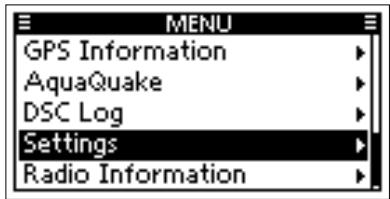
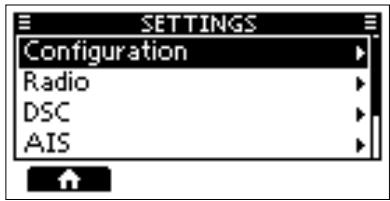
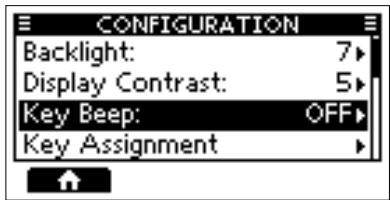

◇ Menu screen items
The Menu screen contains the following items.
See the referred pages for each items.
The displayed menu items may differ, depending on the transceiver version or presetting.
| Menu | Submenu | Item | Reference |
| Compose Distress | - | Nature | p. XX |
| Position | LAT | p. XX | |
| LON | |||
| UTC | |||
| Compose Other | - | Type | p. XX |
| Address | |||
| Category | |||
| Mode | |||
| Channel | p. XX | ||
| Unread List/Task List *1 | - | - | p. XX |
| AIS | - | Plotter | p.XX |
| Target List | p.XX | ||
| Danger List | |||
| Friends List | |||
| Hailer | - | p.XX | |
| Horn | - | Manual Horn | p.XX |
| Auto Foghorn | p. XX | ||
| Horn Volume | p. XX | ||
| Frequency | p. XX | ||
| Intercom *2 | - | - | p. XX |
| MOB | - | Start MOB/Stop MOB | p. XX |
| - | MOB Information | ||
| Anchor Watch | - | Start Anchor Watch/Stop Anchor Watch | p. XX |
| - | Anchor Information | ||
| GPS Information | - | - | p.XX |
| AquaQuake | - | - | p.XX |
| DSC Log | Received Call Log | - | p.XX |
| Transmitted Call Log | - |
*1 For only the USA version.
*2 Displayed only when 2 or more command microphones are connected to the transceiver.
*3 For only the EUR, UK, FRG, NLD versios.
*4 Except for the NLD version.
10 MENU SCREEN
◇ Menu screen items
| Menu | Submenu | Item | Reference |
| Settings | Configuration | Backlight | p.XX |
| Display Contrast | p.XX | ||
| Key Beep | p.XX | ||
| Key Assignment | p.XX, XX | ||
| UTC Offset | p.XX | ||
| Inactivity Timer | p.XX | ||
| GPS | |||
| COMMANDMIC SP | p.XX | ||
| RX Hailer | p.XX | ||
| Noise Cancel | p.XX | ||
| Power Switch | |||
| Controller | p.XX | ||
| Model *3 | p.XX | ||
| Radio | Scan Type *4 | p.XX | |
| Scan Timer *4 | |||
| Dual/Tri-Watch *4 | |||
| Channel Group | |||
| Call Channel | |||
| WX Alert *1 | |||
| Voice Record | |||
| Favorite Channel *4 | |||
| Channel Display | p.XX | ||
| LO/DX *1 | |||
| DSC | Position Input | p.XX | |
| Individual ID | |||
| Group ID | |||
| Auto ACK | |||
| CH Auto Switch | |||
| DSC Data Output | |||
| Alarm Status | p.XX | ||
| CH 70 SQL Level | |||
| Self Check Test | |||
| Procedure *1 | |||
| AIS | North/Course Up | p.XX | |
| Target Display | |||
| CPA/TCPA | |||
| Friends | p.XX | ||
| ID Blocking | p.XX | ||
| Anchor Watch | Audible Alarm | p.XX | |
| Range | |||
| NMEA | NMEA 0183 | p.XX | |
| NMEA 2000 | |||
| Radio Information | - | - | p.XX |
| ATIS ID INPUT | - | - | p.XX |
■ Menu items description
◇ GPS Info
Displays your position, date, time, Speed Over Ground (SOG), and Course Over Ground (COG).
◇ Settings
- Configuration
[MENU] > Settings > Configuration
Backlight
You can adjust the backlight level.
Display Contrast
You can adjust the display contrast of the command microphone's display in 8 steps.
Key Beep
You can select whether or not to sound a beep when a key is pushed.
ON: Sounds a beep when a key is pushed.
OFF: No beep sounds, for silent operation.
Key Assignment
- Softkeys (1\~20)
You can change which Software Key functions to display, and their order. You can assign up to 20 Software Keys at a time.
① The usable Software Key functions and their order may differ, depending on the transceiver version or presetting.
① Some Software Keys may not be usable, depending on other settings.
- Dial
You can assign the audio volume (Volume), squelch (SQL), channel selection (Channel), and the backlight level (Backlight) to any one of 4 sequential positions on the Dial.
UTC Offset
Set the offset time between Universal Time Coordinated (UTC) and your local time to between -14:00 and +14:00 (in 1 minute steps).
Inactivity Timer
The transceiver automatically returns to the operating screen if you push no key for the set period of time for each mode.
- Not DSC Related
Setting for when a screen that is not related to DSC is displayed.
- DSC Related
Setting for when a screen that is related to DSC is displayed.
- Distress Related
Setting for when a screen that is related to a Distress call is displayed.
- RT Related
Setting for when the transceiver is in the Radio Telephone mode.
GPS
Selects a satellite to be used for GPS (Global Positioning System) to pinpoint the geographic location of your transceiver anywhere in the world.
This setting may not be usable, depending on the transceiver version or presetting.
• GPS
The GPS is permanently set to ON.
- GLONASS
Selects whether or not to use the data from the GLONASS (GLObal'naya NAVigatsionnaya Sputnikovaya Sistema) satellites.
- SBAS
Turns the SBAS (Satellite Based Augmentation System) ON or OFF. When turning ON this function, the GPS position accuracy can be improved.
10 MENU SCREEN
◇ Settings
COMMANDMIC SP
Select the speaker to be used.
- External Speaker
Outputs audio from a command microphone's speaker.
● External Speaker
Outputs audio from an external speaker connected to a command microphone.
RX Hailer
Set the RX Hailer function.
① See page XX for details.
Noise Cancel
The Noise Cancel function reduces random noise components in the received or transmitted signal. Set the function for both receiving and transmitting.
- RX
OFF: The Noise Cancel function is OFF.
Low: Reduces random noise components in the received signal to approximately one half.
Middle: Reduces random noise components in the received signal to approximately one third.
High: Reduces random noise components in the received signal to approximately one tenth.
- TX/Hailer
ON: Reduces random noise components in the transmitted signal to approximately one third.
OFF: The Noise Cancel function is OFF.
Power Switch
Select whether or not to turn OFF the transceiver at the same time that you turn OFF the command microphone.
- All Units
When you turn OFF the command microphone, the transceiver is turned OFF at the same time.
- Own Unit
The transceiver is not turned OFF even if you turn OFF the command microphone.
Controller
Configure the settings for controllers.
① For more details, see page.XX
- Name
Enter a name of up to 10 characters for each controller.
- Priority
Select which controller to be used as the Priority Controller.
- DSC Operation
Set whether or not to accept DSC remote control from the controllers connected to the transceiver.
• ID
The unique ID of each controller is displayed.
The Priority Controller' ID is automatically set to 0.
Model
(For only the European versions)
Select the country where you operate the transceiver.
① After select the country, "The Settings are reset. Are you sure?" is displayed. Push OK to return to the Configuration screen.
① If no country is selected, “General” is automatically selected.
- Radio
[MENU] > Settings > Radio
Scan Type
(Except for the NLD version)
Selects the scan type. The default setting differs, depending on the transceiver version.
① See page XX for details.
Normal Scan: Scans all Favorite channels in the selected channel group.
Priority Scan: Sequentially scans all Favorite channels, while periodically checking Channel 16.
Scan Timer
(Except for the NLD version)
You can use the Scan Timer to pause, or to resume after 5 seconds, when a signal is detected.
ON: When a signal is detected on a channel, the scan pauses for 5 seconds, and then resumes. If the signal disappears in less than 5 seconds, the scan immediately resumes.
OFF: When a signal is detected on a channel, the scan pauses until the signal disappears, and then resumes.
Dual/Tri-Watch
(Except for the NLD version)
Select Dualwatch or Tri-Watch.
① See page XX for details.
Dualwatch: Periodically checks Channel 16 while operating on another channel.
Tri-Watch: Periodically checks Channel 16 and the Call channel while operating on another channel.
Channel Group
Select the suitable channel group for your operating area. Select USA, INT, or CAN, depending on the transceiver version.
① See page XX for details.
Call Channel
You can change your Call channel. The default setting may differ, depending on the transceiver version.
① See page XX for details.
WX Alert
For the USA version, an NOAA broadcast station transmits a Weather Alert tone before any important weather information.
① See page XX for details.
ON with Scan:
The preset Weather channels are sequentially checked while scanning.
ON: The previously selected (last used) Weather channel is checked while scanning.
OFF: The Weather Alert tone is not detected.
Voice Record
Auto (Last 120 sec):
The function automatically records the last 120 seconds of the received audio.
OFF: The function is OFF.
Favorite Channel
(Except for the NLD version)
You can set all channels as Favorite channels, clear all settings, or reset to default. By default, some channels are preset. The Favorite channels differ, depending on the transceiver version.
① See page XX for details.
Set All Channels: Sets all channels as Favorite channels.
Clear All Channels: Clears all Favorite channels.
Set Default: Resets Favorite channels to the default.
10 MENU SCREEN
◇ Settings
- Radio
[MENU] > Settings > Radio
Channel Display
You can select the number of digits to display the channel number.
① This setting may not be usable, depending on the transceiver version or presetting.
3 digits: The channel number is displayed in 3 digits, such as "01A."
4 digits: The channel number is displayed in 4 digits, such as "1001."
LO/DX
Push to turn the Attenuator function ON or OFF.
Local: The Attenuator function is ON.
Distance: The Attenuator function is OFF.
• NMEA
[MENU] > Settings > NMEA
NMEA 0183
Select the data transfer speed for each port to receive data from external devices.
4800 bps: Select to receive position data from an external GPS receiver.
38400 bps: Select to receive AIS data from an external AIS equipments.
NMEA 2000
NMEA 2000 is a communication standard used to connect various marine devices and display units in the vessel.
The transceiver can easily connect to a NMEA 2000 network with its plug-and-play functionality, and display the information provided from the devices on the network. Select the sensors in NMEA 2000 network which sends data to the transceiver.
① See the next page for the compatible PGN list.
- Open the "NMEA 2000" screen.
- Select the type of data from the menu screen and push [ENT] or [DIAL].
- The transceiver starts searching the devices connected to NMEA 2000 network.
i Push STOP to stop searching devices and display the device list.
- The list of connected device is displayed.
-
Select the device to send the data to the transceiver, and push [ENT] or [DIAL].
-
Device name: The selected device is used.
• Auto: The first device that sends the data to the transceiver or the device that sends a higher priority data is used. - Not used: No NMEA 2000 device is used.
① Push INFO to display the detail of device.
① If another device sends a higher priority data to the transceiver after selecting “Auto,” the device to be used will switch to that one. (Except for the AIS data)
① In the “Auto” item, the last connected device information is not saved.
① If the transceiver is connected to both NMEA 0183 and NMEA 2000 devices, the NMEA 2000 device has priority. Select “Not Used” if you want to use NMEA 0183 devices.
Compatible PGN list
| Receive | |
| 059392 | ISO Acknowledgment |
| 059904 | ISO Request |
| 060160 | ISO Transport Protocol, Data Transfer |
| 060416 | ISO Transport Protocol, Connection Management |
| 060928 | ISO Address Claim |
| 065240 | ISO Commanded Address |
| 126208 | NMEA |
| 126996 | Product Information |
| 129026 | COG (Course Over Ground) and SOG (Speed Over Ground) - Rapid Update |
| 129029 | GNSS (Global Navigation Satellite System) Position Data |
| 129038 | AIS Class A Position Report |
| 129039 | AIS Class B Position Report |
| 129040 | AIS Class B Extended Position Report |
| 129041 | AIS Aids to Navigation (AtoN) Report |
| 129793 | AIS UTC and Date Report (Base Station) |
| 129794 | AIS Class A Static and Voyage Related Data |
| 129798 | AIS SAR Aircraft Position Report |
| 129809 | AIS Class B “CS” Static Data Report, Part A |
| 129810 | AIS Class B “CS” Static Data Report, Part B |
| Transmit | |
| 059392 | ISO Acknowledgment |
| 059904 | ISO Request |
| 060416 | ISO Transport Protocol, Connection Management |
| 060928 | ISO Address Claim |
| 126208 | NMEA - Acknowledge Group Function |
| 126464 | PGN List |
| 126993 | Heartbeat |
| 126996 | Product Information |
| 126998 | Configuration Information |
| 129026 | COG (course over ground) and SOG (speed over ground) - Rapid Update |
| 129029 | GNSS (Global Navigation Satellite System) Position Data |
| 129038 | AIS Class A Position Report |
| 129039 | AIS Class B Position Report |
| 129040 | AIS Class B Extended Position Report |
| 129041 | AIS Aids to Navigation (AtoN) Report |
| 129793 | AIS UTC and Date Report (Base Station) |
| 129794 | AIS Class A Static and Voyage Related Data |
| 129798 | AIS SAR Aircraft Position Report |
| 129799 | Radio Frequency/Mode/Power |
| 129808 | DSC Call Information |
| 129809 | AIS Class B “CS” Static Data Report, Part A |
| 129810 | AIS Class B “CS” Static Data Report, Part B |
◇ Radio Info
[MENU] > Radio Info
Displays your transceiver and command microphone's information as shown below.
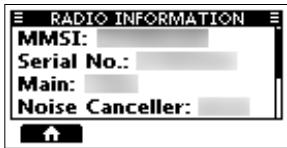
11 CONNECTIONS
■ Connections
Front panel:
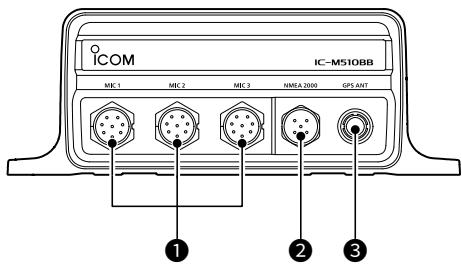
① COMMAND MICROPHONE JACK
Connects the supplied or optional command microphone.
② NMEA 2000™ CONNECTOR
Connects to an NMEA network.
③ GPS ANTENNA CONNECTOR
Connects to the supplied or optional GPS antenna.
NOTE: Be sure the GPS antenna is positioned where it has a clear view to receive signals from satellites, and fixed using the double-sided adhesive pad supplied with the antenna.
④ ANTENNA CONNECTOR
Connects to a marine VHF antenna with a PL-259 connector.
A key element in the performance of any communication system is the antenna. Ask your dealer about antennas and the best place to mount them.
CAUTION: DO NOT transmit without an antenna.
Rear panel:
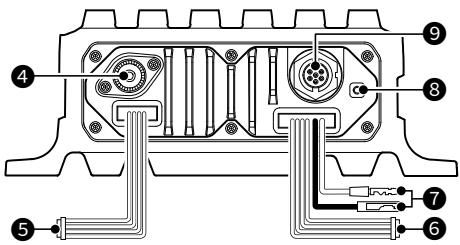
⑤ NMEA IN/OUT LEADS
Yellow: Listener A (Data-H), Data In (+) Green: Listener B (Data-L), Data In (−) Connect to the NMEA output lines of a GPS receiver or an AIS device for position data.
- NMEA 0183 (ver. 2.0 or later) sentence format RMC, GGA, GNS, or GLL and VTG compatible GPS receiver is required. Ask your dealer about suitable GPS receivers.
- The GPS sentences input from this connector are given priority over the sentences input from the built-in GPS receiver.
- The AIS information through the AIS device inputs as VDM sentence. ① The data communication speed (baud rate) is fixed at 38400 bps. Set the NMEA 0183 item to “38400 bps.”
- The external VDM sentence takes precedence over others.
White: Talker A (Data-H), Data Out (+) Brown: Talker B (Data-L), Data Out (−) Connect to NMEA 0183 input lines of a navigation equipment.
- An NMEA 0183 (ver. 2.0 or later) sentence format DSC or DSE compatible navigation equipment is required.
- The GPS outputs RMC format sentences.
- The AIS information through the NMEA2000 device and the internal AIS receiver outputs as VDM sentences.
⑥ AF OUT LEADS
Connects to an external speaker.
Blue: External Speaker (+)
Black: External Speaker (−)
NOTE for NMEA In/Out and AF Out
leads: The connectors are attached to keep the leads together. Before connecting to a piece of equipment, cut the leads to remove the connector.
⑦ DC POWER CONNECTOR
Connects to a 13.8 V (USA version) or 12.0 V (EUR versions) DC power source. (+: Red, -: Black)
CAUTION: After connecting the DC power cable, NMEA leads or external speaker leads, cover the connector and leads with a vulcanizing tape, as shown below, to prevent water seeping into the connection.
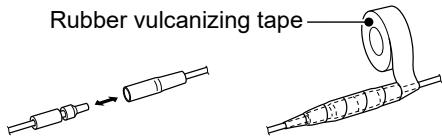
8 GROUND TERMINAL
Connects to a vessel ground to prevent electrical shocks and interference from other equipment occurring.
Use a PH M3 × 6 screw (user supplied).
⑨ DSC REMOTE CONTROL INTERFACE
Connects to an external navigation device or PC console software. (EN 300 338-8 compatible)
NOTE:
- No connector supplied.
You'll need the compatible one to connect an external device.
(Connector: CCBDF06FCC-LLS7001)
- The electric interface of the device to be connected must be RS-422 compliant.
- The receiver circuit of the device to be connected must consist of an opto-isolator and be electrically isolated.
The pin layout is shown in the figure below.

■ Cleaning
If the transceiver becomes dusty or dirty, wipe it clean with a soft cloth.

DO NOT use harsh solvents such as Benzine or alcohol, as they will damage the transceiver's surfaces.
■ Connecting to the MA-510TR
Connect the transceiver to the MA-510TR using the accessory cable. After connecting, an Individual DSC call can be made to the AIS target using the transponder without entering the target's MMSI code. (p.XX)
① See the MA-510TR instruction manual for the connecting instruction.
- Connect each lead to the appropriate lead as follows.
- Listener A (Data-H) (Yellow): To NMEA OUT (+)
- Listener B (Data-L) (Green): To NMEA OUT (−)
- Talker A (Data-H) (White): To NMEA IN (+)
- Talker B (Data-L) (Brown): To NMEA IN (−)
11 CONNECTIONS
■ Supplied accessories
NOTE: Some accessories may not be supplied, or the shape may be different, depending on the transceiver version.
Self-tapping screws
(5 × 20 mm)
[Non-Text]
GPS antenna and
double-sided adhesive pad
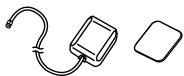
Warning sticker
(For only the USA version)
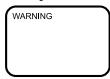
Spring washers (M5)
⊕ ⊕ ⊕ ⊕
Flat washers (M5)
◎◎◎◎
Command microphone
DC power cable

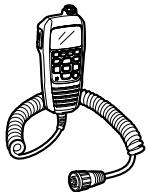
natural_image
Line drawing of a handheld electronic device with coiled cables and a connector (no text or symbols)For Command microphone
Connection cable*
Connector cap
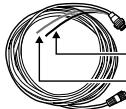
Mounting base


Microphone hanger

Self-tapping screws
(3 × 16 mm)
[Non-Text]
* The OPC-1540 has external speaker leads, as shown above.
(Yellow: Speaker (+), Black: Speaker (−))
■ Fuse replacement
One fuse is installed in the supplied DC power cable. If the fuse blows or the transceiver stops functioning, track down the source of the problem, repair it, and replace the damaged fuse with a new one of the proper rating.
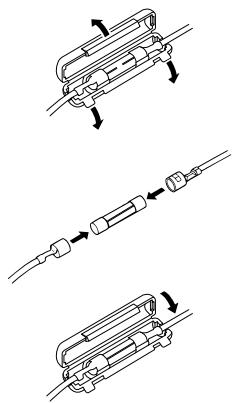
Fuse Coding explanation
Fuse Coding: F 250 V 10 A
Fuse Voltage Rating: 250 Volts
Fuse Current Rating: 10 Amperes
■ Mounting the transceiver
Using the template on the supplied leaflet, mount the transceiver securely to a surface which is more than 10 mm (0.03 ft) thick and can support more than 5 kg (11 lb) using the 4 supplied screws (5 × 20 mm), as illustrated below.
CAUTION: KEEP the transceiver and microphone at least 1 meter (3.3 ft) away from the vessel's magnetic navigation compass.
NOTE: Be sure that the GPS antenna is positioned where it has a clear view to receive signals from satellites, and fixed using the double-sided adhesive pad supplied with the GPS antenna.
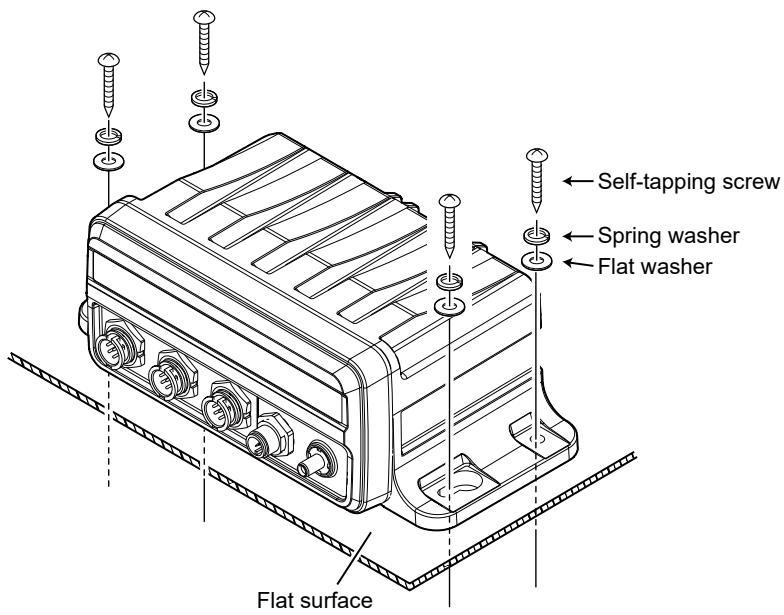
11 CONNECTIONS
■ Microphone installation
When you use the supplied or optional HM-195 COMMAND MICROPHONE, the optional 6 meters long OPC-1541 EXTENSION CABLE can be connected between the OPC-1540 and the transceiver to operate from even longer distances.
You can also install the extension cable's connector as a built-in plug on a cabinet or wall.
NOTE: The firmware of the command microphones may be updated when you connect them to the transceiver.
◇ Installation
- Insert the connection cable connector into the command microphone jack, and tighten the nut.
- To use the cable connector as a wall socket, install it as shown below.
- Using the mounting base as a template, carefully mark the holes where the cable and 3 screws will be fastened.
- Drill holes at these marks.
- Install the mounting base using the supplied screws, as shown below.
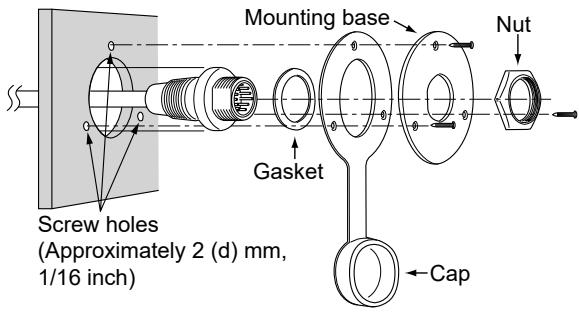
- The completed installation should look like this.
natural_image
Technical line drawing of a mechanical component with a flanged housing and cylindrical base (no text or symbols)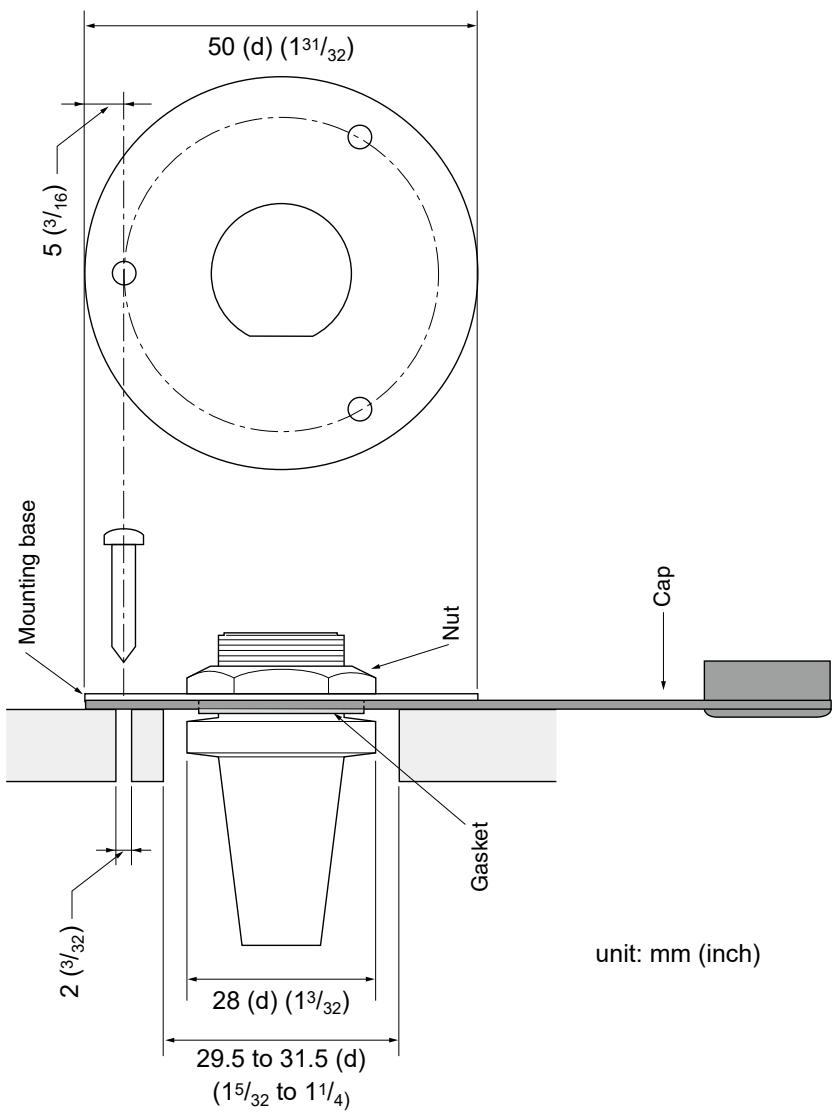
12 SPECIFICATIONS AND OPTIONS
Specifications
IC-M510BB USA Version
◇ General
| • Frequency coverage: | TX | 156.025 ~ 157.425 MHz |
| RX | 156.050 ~ 163.275 MHz | |
| DSC (CH70) | 156.525 MHz | |
| AIS1 | 161.975 MHz | |
| AIS2 | 162.025 MHz | |
| • Mode: | 16K0G3E (FM), 16K0G2B (DSC), 16K0GXW (AIS) | |
| • Operating temperature range: | -20°C ~ +60°C, -4°F ~ +140°F | |
| • Current drain (at 13.8 V): | TX high (25 W) | 5.5 A maximum |
| RX Maximum audio | 1.5 A maximum (Command microphone) | |
| 3.3 A maximum (External speaker) | ||
| • Power supply requirement: | Negative ground | 13.8 V DC (11.7 ~ 15.9 V DC) |
| • Antenna impedance: | 50 Ω nominal | |
| • Dimensions: | Transceiver | 216 (W) × 79 (H) × 113 (D) mm |
| 8.5 (W) × 3.1 (H) × 4.4 (D) in | ||
| Command microphone | 67.5 (W) × 144.5 (H) × 37 (D) mm | |
| 2.7 (W) × 5.7 (H) ×1.5 (D) in | ||
| • Weight (approximate): | Transceiver | 890 g, 2 lb |
| Command microphone | 400 g, 14.1 oz | |
◇ Transmitter
| Output power: | 25 W or 1 W |
| Modulation system: | Variable reactance frequency modulation |
| Maximum frequency deviation: | ±5 kHz |
| Spurious emissions: | Less than -70 dBc (High Power)Less than -56 dBc (Low Power) |
| Frequency error | Less than ± 1.5 kHz |
| Adjacent channel power: | More than 70 dB |
| Audio harmonic distortion: | Less than 10 % (at 60% Deviation) |
| Residual modulation: | More than 40 dB |
| Audio frequency response: | +1 dB to -3 dB of 6 dB octave from 300 Hz to 3000 Hz |
◇ Receiver
| Receive system: | Double conversion superheterodyne | |
| Sensitivity: | FM | -10 dBμ emf Typ. at 12 dB SINAD |
| DSC (CH70) | -7 dBμ emf Typ. (1% BER) | |
| AIS | -115 dBm (20% PER) | |
| Squelch sensitivity: | Less than -10 dBμ | |
| Intermodulation rejection ratio: | FM | More than 70 dB |
| DSC (CH70) | More than 68 dBμ emf (1% BER) | |
| AIS | More than -55 dBm (20% BER) | |
| Spurious response: | FM | More than 70 dB |
| DSC (CH70) | More than 73 dBμ emf (1% BER) | |
| Adjacent channel selectivity: | FM | More than 70 dB |
| DSC (CH70) | More than 73 dBμ emf (1% BER) | |
| AIS | More than -50 dBm (20% BER) | |
| Audio output power:(at 10% distortion into a 4 Ω) | Command microphone | 2 W |
| External Speaker | 15 W | |
| Hum and noise: | More than 40 dB | |
| Audio frequency response: | +1 dB to -3 dB of -6 dB octave from 300 Hz to 3 | |
IC-M510BB European Versions
◇ General
- Frequency coverage:
TX 156.025 \~ 161.425 MHz (Depending on the version)
RX 156.050 \~ 162.000 MHz (Depending on the version)
DSC (CH70) 156.525 MHz
AIS1 161.975 MHz
AIS2 162.025 MHz
- Mode:
- Operating temperature range:
- Current drain (at 13.8 V):
• Power supply requirement:
- Antenna impedance:
- Dimensions:
• Weight (approximate):
16K0G3E (FM), 16K0G2B (DSC), 16K0GXW (AIS)
-20^ +60^
TX high (25 W) 5.5 A maximum
RX Maximum audio 1.5 A maximum (Command microphone*)
3.3 A maximum (External speaker)
Negative ground 12.0 V DC (10.8 \~ 15.6 V DC)
50 Ω nominal
Transceiver 216 (W) × 79 (H) × 113 (D) mm
Command microphone 67.5 (W) × 144.5 (H) × 37 (D) mm
Transceiver 890 g
Command microphone 400 g
◇ Transmitter
- Output power:
- Modulation system:
• Maximum frequency deviation:
- Spurious emissions:
- Frequency error
- Adjacent channel power:
• Audio harmonic distortion:
- Residual modulation:
• Audio frequency response:
25 W or 1 W
Variable reactance frequency modulation
±5 kHz
Less than 0.25 μW
Less than ± 1.5 kHz
More than 70 dB
Less than 10 % (at 60% Deviation)
More than 40 dB
+1 dB to -3 dB of 6 dB octave from 300 Hz to 3000 Hz
◇ Receiver
- Receive system:
- Sensitivity:
- Squelch sensitivity:
- Intermodulation rejection ratio:
- Spurious response:
- Adjacent channel selectivity:
• Audio output power:
(at 10% distortion into a 4 Ω)
- Hum and noise:
• Audio frequency response:
Double conversion superheterodyne
FM -2 dBμ emf Typ. at 20 dB SINAD
DSC (CH70) -7 dBμ emf Typ. (1% BER)
AIS -115 dBm Typ. (20% PER)
Less than -2 dBμ emf
FM More than 68 dB
DSC (CH70) More than 68 dBμ emf (1% BER)
AIS More than -55 dBm (20% BER)
FM More than 70 dB
DSC (CH70) More than 73 dBμ emf (1% BER)
FM More than 70 dB
DSC (CH70) More than 73 dBμ emf (1% BER)
AIS More than -50 dBm (20% BER)
Command microphone 2 W
External Speaker 15 W
More than 40 dB
+1 dB to -3 dB of -6 dB octave from 300 Hz to 3000 Hz
* When one command microphone is connected.
12 SPECIFICATIONS AND OPTIONS
■ Specifications
Common
◇ Built-in GPS receiver
- Channel:
Tracking
Maximum 24 ch
Calculation
Maximum 12 ch
• Differential satellites:
WAAS, EGNOS, MSAS, GAGAN
• Corresponding GPS:
GPS, GLONASS, SBAS
- Receiving frequency:
GPS, SBAS
1575.42 MHz
GLONASS
1602.00 MHz
■ Dimensions
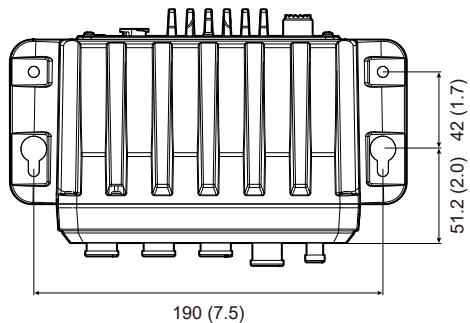
216 (8.5)
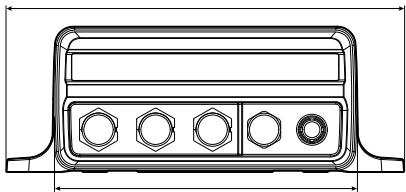
natural_image
Technical line drawing of a device front panel with four buttons and a central knob (no text or symbols)165 (6.5)
8.8 (0.3)
112.8 (4.4)
14.5 (0.6)
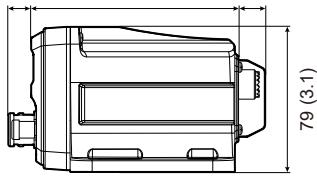
unit: mm (inch)
Options
NOTE: When an optional product with a lower IP rating than the transceiver is attached, the transceiver meets the lower IP rating of the optional product.
• HM-195B/HM-195SW
HM-195GB/HM-195GW COMMANDMICIV™
An external microphone-type controller. Provides optional intercom operation.
A 6 meters (20 feet) long connection cable, microphone hanger, and mounting base are included.
HM-195B/HM-195GB: Black
HM-195SW/HM-195GW: White
- OPC-1541 MICROPHONE EXTENSION CABLE
A 6 meters (20 feet) long microphone extension cable for optional HM-195. Up to two OPC-1541 can be connected. Usable length is 18 meters (60 feet) maximum.
• SP-37 HORN SPEAKER
The external horn speaker. Connect with the AF Out leads for the external speaker.
① SP-37 has not been tested and Icom does not guarantee its waterproofness.
• UX-241 GNSS ANTENNA
To receive GPS signals.
• MA-510TR AIS TRANSPONDER
You can make an Individual call to the selected AIS target without entering the target's MMSI code.
13 TROUBLESHOOTING
The transceiver does not turn ON.
● There is a bad connection to the power supply.
→ Check the connection to the transceiver and power supply. (p.XX)
● The fuse is blown.
→ Repair the problem, and then replace the fuse. (p.XX)
Little or no sound comes from the speaker.
● The squelch level is set too high.
→ Set the squelch to the threshold point. (p.XX)
● The volume level is set too low.
→ Set the volume level to a suitable level. (p.XX)
You cannot transmit with high power.
- Some channels are set for low power or receive only by regulations.
→ Change channels. (p.XX)
● The output power is set to low.
→ Push HILO to select high power. (p.XX)
Scan does not start.
● More than 2 favorite channels are not set.
→ Set at least 2 favorite channels. (p.XX)
No beep sounds.
● The Key Beep function is OFF.
→ Turn ON the function. (p.XX)
Individual or Group ID cannot be set.
- The entered ID code is incorrect. The first digit must be set to between ‘1’ and ‘9’ for an Individual ID.
→ Enter a correct ID code. (p.XX)
“??” blinks instead of the position and time.
● Four hours have passed since you manually entered the position.
● The GPS position is invalid.
→ Enter the position and time. (p.XX)
“No Position” and “No Time” are displayed instead of the position and time.
● The GPS signal is not correctly received.
→ Check the GPS antenna connection and position. (p.XX)
→ Check the cable connection to NMEA In/Out leads. (p.XX)
→ Check the transceiver is located where the GPS antenna has a clear view to receive signal from satellites. (p.XX
● The position and time have not been manually entered.
→ Enter the position and time. (p.XX)
Sensitivity is too low, and only strong signals can be heard.
● The antenna is defective or the coaxial cable connector is shorted or cut.
→ Repair the problem and then reconnect to the antenna connector. (p.XX)
Communication cannot be established.
- The antenna is defective or the coaxial cable connector is shorted or cut. Repair the problem and then reconnect to the antenna connector. (p.XX)
The transceiver is locked up, and does not respond.
● A software error has occurred.
→ Turn OFF the transceiver, and then turn it ON again.
The transceiver does not work.
- The transceiver's Phase Lock Loop is unlocked.
→ Contact your dealer.
The collision alarm does not sound.
● The collision alarm function is OFF.
→ Turn ON the collision alarm function. (p.XX)
■ For IC-M510BB USA version
NOTE: When the “Channel Display” is set to “3 digits” in the Radio setting, the channel number is displayed in 3 digits. See page XX for details. (For example: “1001” is displayed as “01A.”)
| Channel Number | Frequency (MHz) | |||
| USA | INT | CAN | Transmit | Receive |
| 01 | 01 | 156.050 | 160.650 | |
| 1001 | 1001 | 156.050 | 156.050 | |
| 02 | 02 | 156.100 | 160.700 | |
| 03 | 03 | 156.150 | 160.750 | |
| 04 | 156.200 | 160.800 | ||
| 1004 | 156.200 | 156.200 | ||
| 05 | 156.250 | 160.850 | ||
| 1005 | 1005 | 1005 | 156.250 | 156.250 |
| 06 | 06 | 06 | 156.300 | 156.300 |
| 07 | 156.350 | 160.950 | ||
| 1007 | 1007 | 1007 | 156.350 | 156.350 |
| 08 | 08 | 08 | 156.400 | 156.400 |
| 09 | 09 | 09 | 156.450 | 156.450 |
| 10 | 10 | 10 | 156.500 | 156.500 |
| 11 | 11 | 11 | 156.550 | 156.550 |
| 12 | 12 | 12 | 156.600 | 156.600 |
| 13^*3 | 13 | 13^*1 | 156.650 | 156.650 |
| 14 | 14 | 14 | 156.700 | 156.700 |
| 15^*2 | 15^*1 | 15^*1 | 156.750 | 156.750 |
| 16 | 16 | 16 | 156.800 | 156.800 |
| 17^*1 | 17 | 17^*1 | 156.850 | 156.850 |
| 18 | 156.900 | 161.500 | ||
| 1018 | 1018 | 1018 | 156.900 | 156.900 |
| 19 | 156.950 | 161.550 | ||
| 1019 | 1019 | 1019 | 156.950 | 156.950 |
| 2019 | RX only | 161.550 | ||
| 20 | 20 | 20^*1 | 157.000 | 161.600 |
| 1020 | 1020 | 157.000 | 157.000 | |
| 2020 | RX only | 161.600 | ||
| 21 | 157.050 | 161.650 | ||
| 1021 | 1021 | 1021 | 157.050 | 157.050 |
| 2021 | RX only | 161.650 | ||
| 22 | 157.100 | 161.700 | ||
| 1022 | 1022 | 1022 | 157.100 | 157.100 |
| 23 | 23 | 157.150 | 161.750 | |
| 1023 | 1023 | 157.150 | 157.150 | |
| 2023 | RX only | 161.750 | ||
| 24 | 24 | 157.200 | 161.800 | |
| 25 | 25 | 157.250 | 161.850 | |
| 2025 | RX only | 161.850 | ||
| 26 | 26 | 157.300 | 161.900 | |
| 27 | 27 | 27 | 157.350 | 161.950 |
| 1027 | 157.350 | 157.350 | ||
| 28 | 28 | 28 | 157.400 | 162.000 |
*1 Low power only.
*2 RX only.
*3 Momentary High Power.
| Channel Number | Frequency (MHz) | |||
| USA | INT | CAN | Transmit | Receive |
| 1028 | 157.400 | 157.400 | ||
| 2028 | RX only | 162.000 | ||
| 60 | 60 | 156.025 | 160.625 | |
| 61 | 156.075 | 160.675 | ||
| 1061 | 156.075 | 156.075 | ||
| 62 | 156.125 | 160.725 | ||
| 1062 | 156.125 | 156.125 | ||
| 63 | 156.175 | 160.775 | ||
| 1063 | 1063 | 1063 | 156.175 | 156.175 |
| 64 | 64 | 156.225 | 160.825 | |
| 1064 | 156.225 | 156.225 | ||
| 65 | 156.275 | 160.875 | ||
| 1065 | 1065 | 1065^*1 | 156.275 | 156.275 |
| 66 | 156.325 | 160.925 | ||
| 1066 | 1066 | 1066^*1 | 156.325 | 156.325 |
| 67^*3 | 67 | 67 | 156.375 | 156.375 |
| 68 | 68 | 68 | 156.425 | 156.425 |
| 69 | 69 | 69 | 156.475 | 156.475 |
| 71 | 71 | 71 | 156.575 | 156.575 |
| 72 | 72 | 72 | 156.625 | 156.625 |
| 73 | 73 | 73 | 156.675 | 156.675 |
| 74 | 74 | 74 | 156.725 | 156.725 |
| 75^*1 | 75^*1 | 156.775 | 156.775 | |
| 76^*1 | 76^*1 | 156.825 | 156.825 | |
| 77^*1 | 77 | 77^*1 | 156.875 | 156.875 |
| 78 | 156.925 | 161.525 | ||
| 1078 | 1078 | 1078 | 156.925 | 156.925 |
| 2078 | RX only | 161.525 | ||
| 79 | 156.975 | 161.575 | ||
| 1079 | 1079 | 1079 | 156.975 | 156.975 |
| 2079 | RX only | 161.575 | ||
| 80 | 157.025 | 161.625 | ||
| 1080 | 1080 | 1080 | 157.025 | 157.025 |
| 81 | 157.075 | 161.675 | ||
| 1081 | 1081 | 1081 | 157.075 | 157.075 |
| 82 | 157.125 | 161.725 | ||
| 1082 | 1082 | 1082 | 157.125 | 157.125 |
| 83 | 157.175 | 161.775 | ||
| 1083 | 1083 | 1083 | 157.175 | 157.175 |
| 2083 | RX only | 161.775 | ||
| 84 | 84 | 157.225 | 161.825 | |
| 85 | 85 | 157.275 | 161.875 | |
| 86 | 86 | 157.325 | 161.925 | |
| 87 | 87 | 87 | 157.375 | 157.375 |
| 88 | 88 | 88 | 157.425 | 157.425 |
*1 Low power only.
*2 RX only.
*3 Momentary High Power.
NOTE: Simplex channels, 1021, 1023, 1081, 1082, and 1083 CANNOT be lawfully used by the general public in USA waters.
14 CH LIST
■ For IC-M510BB EUR versions
NOTE: When the "Channel Display" is set to "3 digits" in the Radio setting, the channel number is displayed in 3 digits. See pageXX for details. (For example: "1001" is displayed as "01A.")
◇ International channels
| CH | Frequency (MHz) | CH | Frequency (MHz) | CH | Frequency (MHz) | |||
| Transmit | Receive | Transmit | Receive | Transmit | Receive | |||
| 01 | 156.050 | 160.650 | 2020 | RX only | 161.600 | 71 | 156.575 | 156.575 |
| 02 | 156.100 | 160.700 | 21 | 157.050 | 161.650 | 72 | 156.625 | 156.625 |
| 03 | 156.150 | 160.750 | 22 | 157.100 | 161.700 | 73 | 156.675 | 156.675 |
| 04 | 156.200 | 160.800 | 23 | 157.150 | 161.750 | 74 | 156.725 | 156.725 |
| 05 | 156.250 | 160.850 | 24 | 157.200 | 161.800 | 75^*1 | 156.775 | 156.775 |
| 06 | 156.300 | 156.300 | 25 | 157.250 | 161.850 | 76^*1 | 156.825 | 156.825 |
| 07 | 156.350 | 160.950 | 26 | 157.300 | 161.900 | 77 | 156.875 | 156.875 |
| 08 | 156.400 | 156.400 | 27^*2 | 157.350 | 161.950 | 78 | 156.925 | 161.525 |
| 09 | 156.450 | 156.450 | 1027^*3 | 157.350 | 157.350 | 1078 | 156.925 | 156.925 |
| 10 | 156.500 | 156.500 | 28^*2 | 157.400 | 162.000 | 2078 | RX only | 161.525 |
| 11 | 156.550 | 156.550 | 1028^*3 | 157.400 | 157.400 | 79 | 156.975 | 161.575 |
| 12 | 156.600 | 156.600 | 31^*1,6 | 157.050 | 162.150 | 1079 | 156.975 | 156.975 |
| 13 | 156.650 | 156.650 | 1037^*4,5 | 157.850 | 157.850 | 2079 | RX only | 161.575 |
| 14 | 156.700 | 156.700 | 60 | 156.025 | 160.625 | 80 | 157.025 | 161.625 |
| 15^*1 | 156.750 | 156.750 | 61 | 156.075 | 160.675 | 81 | 157.075 | 161.675 |
| 16 | 156.800 | 156.800 | 62 | 156.125 | 160.725 | 82 | 157.125 | 161.725 |
| 17^*1 | 156.850 | 156.850 | 63 | 156.175 | 160.775 | 83 | 157.175 | 161.775 |
| 18 | 156.900 | 161.500 | 64 | 156.225 | 160.825 | 84 | 157.225 | 161.825 |
| 19 | 156.950 | 161.550 | 65 | 156.275 | 160.875 | 85 | 157.275 | 161.875 |
| 1019 | 156.950 | 156.950 | 66 | 156.325 | 160.925 | 86 | 157.325 | 161.925 |
| 2019 | RX only | 161.550 | 67 | 156.375 | 156.375 | 87 | 157.375 | 157.375 |
| 20 | 157.000 | 161.600 | 68 | 156.425 | 156.425 | 88 | 157.425 | 157.425 |
| 1020 | 157.000 | 157.000 | 69 | 156.475 | 156.475 | P4^*7 | 161.425 | 161.425 |
*1 Low power only. *2 Except for the UK and EUR versions. *3 For only the UK and EUR versions.
*4 Low power only for the NLD version. *5 For only the NLD and UK versions.
^6 For only the NLD version. ^7 For only the UK version.
① 1037 and P4 channels are UK Marina Channels: M1=1037, M2=P4 for only the UK version.
◇ USA channels (for the UK version only)
| CH | Frequency (MHz) | CH | Frequency (MHz) | CH | Frequency (MHz) | CH | Frequency (MHz) | ||||
| Transmit | Receive | Transmit | Receive | Transmit | Receive | Transmit | Receive | ||||
| 1001 | 156.050 | 156.050 | 17^*2 | 156.850 | 156.850 | 1037 | 157.850 | 157.850 | 1079 | 156.975 | 156.975 |
| 1005 | 156.250 | 156.250 | 1018 | 156.900 | 156.900 | 1063 | 156.175 | 156.175 | 1080 | 157.025 | 157.025 |
| 06 | 156.300 | 156.300 | 1019 | 156.950 | 156.950 | 1065 | 156.275 | 156.275 | 1081 | 157.075 | 157.075 |
| 1007 | 156.350 | 156.350 | 20 | 157.000 | 161.600 | 1066 | 156.325 | 156.325 | 1082 | 157.125 | 157.125 |
| 08 | 156.400 | 156.400 | 1020 | 157.000 | 157.000 | 67^*1 | 156.375 | 156.375 | 1083 | 157.175 | 157.175 |
| 09 | 156.450 | 156.450 | 1021 | 157.050 | 157.050 | 68 | 156.425 | 156.425 | 84 | 157.225 | 161.825 |
| 10 | 156.500 | 156.500 | 1022 | 157.100 | 157.100 | 69 | 156.475 | 156.475 | 85 | 157.275 | 161.875 |
| 11 | 156.550 | 156.550 | 1023 | 157.150 | 157.150 | 71 | 156.575 | 156.575 | 86 | 157.325 | 161.925 |
| 12 | 156.600 | 156.600 | 24 | 157.200 | 161.800 | 72 | 156.625 | 156.625 | 87 | 157.375 | 157.375 |
| 13^*1 | 156.650 | 156.650 | 25 | 157.250 | 161.850 | 73 | 156.675 | 156.675 | 88 | 157.425 | 157.425 |
| 14 | 156.700 | 156.700 | 26 | 157.300 | 161.900 | 74 | 156.725 | 156.725 | P4 | 161.425 | 161.425 |
| 15 | RX only | 156.750 | 27 | 157.350 | 161.950 | 77^*2 | 156.875 | 156.875 | |||
| 16 | 156.800 | 156.800 | 28 | 157.400 | 162.000 | 1078 | 156.925 | 156.925 | |||
*1 Momentary High Power *2 Low power only
① 1037 and P4 channels are UK Marina Channels: M1=1037, M2=P4.
NOTE: Simplex channels, 1021, 1023, 1081, 1082, and 1083 CANNOT be lawfully used by the general public in USA waters.
INSTRUCTION MANUAL
VHF MARINE TRANSCEIVER
IC-M410BB
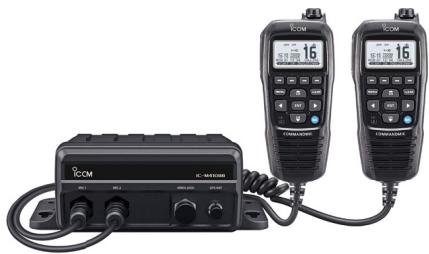
natural_image
Two black ICOM devices with connected cables and a central device, no visible text or symbols on the devices themselves.This device complies with Part 15 of the FCC Rules. Operation is subject to the condition that this device does not cause harmful interference.
Thank you for choosing this lcom product.
This product was designed and built with Icom's state of the art technology and craftsmanship. With proper care, this product should provide you with years of trouble-free operation.
■ Important
READ ALL INSTRUCTIONS carefully and completely before using the transceiver.
SAVE THIS INSTRUCTION MANUAL —
This instruction manual contains important operating instructions for the IC-M410BB.
This instruction manual includes some functions that are usable only when they are preset by your dealer.
Ask your dealer for details.
■ Explicit Definitions
| WORD | DEFINITION |
| ⚠WARNING! | Personal injury, fire hazard or electric shock may occur. |
| CAUTION | Equipment damage may occur. |
| NOTE | If disregarded, inconvenience only. No risk of personal injury, fire or electric shock. |
Icom is not responsible for the destruction, damage to, or performance of any Icom or non-Icom equipment, if the malfunction is because of:
- Force majeure, including, but not limited to, fires, earthquakes, storms, floods, lightning, other natural disasters, disturbances, riots, war, or radioactive contamination.
- The use of Icom transceivers with any equipment that is not manufactured or approved by Icom.
■ Features
- Up to 2 COMMANDMIC™ capability, VHF Black Box Transceiver
● Built-in Class D DSC, “DISTRESS” key on the back of the COMMANDMIC™
● Integrated GPS receiver - NMEA 0183-HS and NMEA 2000™ connectivity
● Internal 15 W Hailer/Fog Horn - IPX7 waterproof (1 m depth water for 30 minutes)
● Active noise cancelling for transmitted and received audio.
Icom and the Icom logo are registered trademarks of Icom Incorporated (Japan) in Japan, the United States, the United Kingdom, Germany, France, Spain, Russia, Australia, New Zealand, and/or other countries.
AquaQuake is a trademark of Icom Incorporated.
COMMANDMIC is a trademark of Icom Incorporated.
NMEA 2000 is a trademark of the National Maritime Electronics Association, Inc.
All other products or brands are registered trademarks or trademarks of their respective holders.
■ In Case of Emergency
If your vessel requires assistance, contact other vessels and the Coast Guard by sending a distress call on Channel 16 or transmit your Distress call using Digital Selective Calling (DSC) on Channel 70.
◇ Using Channel 16
- Push [16/C] to switch to Channel 16.
- While holding down [PTT], give the appropriate information as follows:
● "MAYDAY MAYDAY MAYDAY."
- "THIS IS" (name of vessel).
- Say your call sign or other indication of the vessel (AND your 9 digit DSC ID, if you have one).
- "LOCATED AT (your position).
● State the nature of the distress and assistance required.
- Give any other information which might facilitate the rescue.
◇ Using Digital Selective Calling
- Lift up the key cover on the back of the command microphone, hold down [DISTRESS] for 3 seconds until the 3 short beeps and then one long beep sound.
![[DISTRESS] key](/content/2025/12/335615/images/d54e4a0a119fdb87d37c5af612cd498fc740158ff0165cf469e24d8cf144bb0c.jpg)
- Wait for an acknowledgment from another station.
- After the acknowledgment is received, Channel 16 is automatically selected.
- Hold down [PTT], then transmit the appropriate information as listed above.
■ Radio Operation Warning

WARNING
Icom requires the radio operator to meet the FCC Requirements for Radio Frequency Exposure. An omnidirectional antenna with gain not greater than 9 dBi must be mounted a minimum of 5 meters (measured from the lowest point of the antenna) vertically above the main deck and all possible personnel. This is the minimum safe separation distance estimated to meet all RF exposure compliance requirements. This 5 meter distance is based on the FCC Safe Maximum Permissible Exposure (MPE) distance of 3 meters added to the height of an adult (2 meters) and is appropriate for all vessels.
For watercraft without suitable structures, the antenna must be mounted so as to maintain a minimum of 1 meter vertically between the antenna, (measured from the lowest point of the antenna), to the heads of all persons AND all persons must stay outside of the 3 meter MPE radius.
Do not transmit with radio and antenna when persons are within the MPE radius of the antenna, unless such persons (such as driver or radio operator) are shielded from antenna field by a grounded metallic barrier. The MPE Radius is the minimum distance from the antenna axis that person should maintain in order to avoid RF exposure higher than the allowable MPE level set by FCC.
FAILURE TO OBSERVE THESE LIMITS MAY ALLOW THOSE WITHIN THE MPE RADIUS TO EXPERIENCE RF RADIATION ABSORPTION WHICH EXCEEDS THE FCC MAXIMUM PERMISSIBLE EXPOSURE (MPE) LIMIT.
IT IS THE RESPONSIBILITY OF THE RADIO OPERATOR TO ENSURE THAT THE MAXIMUM PERMISSIBLE EXPOSURE LIMITS ARE OBSERVED AT ALL TIMES DURING RADIO TRANSMISSION. THE RADIO OPERATOR IS TO ENSURE THAT NO BYSTANDERS COME WITHIN THE RADIUS OF THE MAXIMUM PERMISSIBLE EXPOSURE LIMITS.
Determining MPE Radius
THE MAXIMUM PERMISSIBLE EXPOSURE (MPE) RADIUS HAS BEEN ESTIMATED TO BE A RADIUS OF ABOUT 3 M PER OET BULLETIN 65 OF THE FCC.
THIS ESTIMATE IS MADE ASSUMING THE MAXIMUM POWER OF THE RADIO AND ANTENNAS WITH A MAXIMUM GAIN OF 9 dBi ARE USED FOR A SHIP MOUNTED SYSTEM.
This equipment has been tested and found to comply with the limits for a Class B digital device, pursuant to part 15 of the FCC Rules. These limits are designed to provide reasonable protection against harmful interference in a residential installation. This equipment generates, uses, and can radiate radio frequency energy and, if not installed and used in accordance with the instructions, may cause harmful interference to radio communications. However, there is no guarantee that interference will not occur in a particular installation. If this equipment does cause harmful interference to radio or television reception, which can be determined by turning the equipment off and on, the user is encouraged to try to correct the interference by one or more of the following measures:
- Reorient or relocate the receiving antenna.
- Increase the separation between the equipment and receiver.
- Connect the equipment into an outlet on a circuit different from that to which the receiver is connected.
- Consult the dealer or an experienced radio/TV technician for help.
CAUTION: Changes or modifications to this transceiver, not expressly approved by Icom Inc., could void your authority to operate this transceiver under FCC regulations.
Information FCC
A WARNING STICKER is supplied with the USA version transceiver.
To comply with FCC regulations, this sticker must be affixed in such a location as to be readily seen from the operating controls of the radio. Make sure the chosen location is clean and dry before applying the sticker.
■ Precautions
⚠ WARNING! NEVER connect the transceiver directly to an AC outlet. This may cause a fire or an electric shock.
⚠ WARNING! NEVER connect the transceiver to a power source of more than 16 V DC such as a 24 V battery. This connection could cause a fire or damage the transceiver.
⚠ WARNING! NEVER reverse the DC power cable polarity. This could cause a fire or damage the equipment.
⚠ WARNING! NEVER cut the DC power cable between the DC power connector on the transceiver's rear panel and the fuse holder. If an incorrect connection is made after cutting, the transceiver may be damaged.
⚠ WARNING! NEVER operate the transceiver during a lightning storm. It may result in an electric shock, cause a fire or damage the transceiver. Always disconnect the power source and antenna before a storm.
⚠ WARNING! NEVER place the transceiver where normal operation of the vessel may be hindered, or where it could cause bodily injury.
CAUTION: DO NOT place or leave the transceiver in areas with temperatures below -20^ or above +60^ ( -4^ or above +140^ ), or in areas subject to direct sunlight, such as a dashboard.
CAUTION: DO NOT use harsh solvents such as Benzine or alcohol when cleaning. This could damage the equipment surfaces. If the surface becomes dusty or dirty, wipe it clean with a soft, dry cloth.
NEVER place the transceiver in an insecure place to avoid inadvertent use by unauthorized persons.
BE CAREFUL! The transceiver's rear panel will become hot when transmitting continuously for long periods of time.
BE CAREFUL! The transceiver meets IPX7 requirements for waterproof protection*. However, once the transceiver or microphone has been dropped, or the waterproof seal is cracked or damaged, waterproof protection cannot be guaranteed because of possible damage to the case or the waterproof seal.
* Except for the DC power connector, NMEA In/Out leads and AF Out leads.
NOTE: Install the transceiver and/or microphone more than 1 meter from the vessel's magnetic navigation compass.
■ Précautions
The installation of this equipment should be made in such a manner as to respect the EC recommended electromagnetic field exposure limits. (1999/519/EC)
The maximum RF power available from this device is 25 watts. The antenna should be installed as high as possible for maximum efficiency and the installation height should be at least 1.76 meters above any accessible position. In the case where an antenna cannot be installed at a reasonable height, then the transmitter should neither be continuously operated for long periods if any person is within a distance of 1.76 meters of the antenna, nor operated at all if any person is touching the antenna.
It is recommended that antenna of a maximum gain of 3 dB is used. If higher gain antenna is required then please contact your Icom distributor for revised installation recommendations.
Operation:
The exposure to RF electromagnetic field is only applicable when this device is transmitting. This exposure is naturally reduced due to the nature of alternating periods of receiving and transmitting. Keep your transmissions to the minimum necessary.
■ Disposal
natural_image
Symbol of a trash bin crossed with two diagonal lines, no text or labels presentThe crossed-out wheeled-bin symbol on your product, literature, or packaging reminds you that in the European Union, all electrical and electronic products, batteries, and accumulators
(rechargeable batteries) must be taken to designated collection locations at the end of their working life. Do not dispose of these products as unsorted municipal waste. Dispose of them according to the laws in your area.
■ About CE and DOC
CE Hereby, Icom Inc. declares that the versions of the IC-M410BB which have the "CE" symbol on the product, comply with the essential requirements of the Radio Equipment Directive, 2014/53/EU, and the restriction of the use of certain hazardous substances in electrical and electronic equipment Directive, 2011/65/EU. The full text of the EU declaration of conformity is available at the following internet address:
https://www.icomjapan.com/support/
For the European versions:
The following caution is printed on the labels of the transceiver.
CAUTION
AVOID TOUCHING REAR PANEL DURING PROLONGED USE.
This is because the transceiver's rear panel will become hot when continuously transmitting for long periods of time.
■ Recommendation
CLEAN THE TRANSCEIVER AND MICROPHONE THOROUGHLY WITH FRESH
WATER after exposure to saltwater, and dry it before operating. Otherwise, the transceiver's keys and switches may become unusable, due to salt crystallization.
NOTE: If the transceiver's waterproof protection appears defective, carefully clean it with a soft, damp (fresh water) cloth, then, dry it before operating.
The transceiver may lose its waterproof protection if the case or microphone is cracked or broken, the microphone connector is not screwed in completely, or the transceiver has been dropped.
Contact your Icom distributor or your dealer for advice.
■ Key Icon Description
The keys are described in this manual as follows:
The keys that have words or letters on them are described with the characters “[ ].”
Example: [MENU], [CLEAR]
The software keys are described with the icon such as DTRS or DISP. The function of the keys are shown at the bottom of the display. Push the key below the desired function.
You can use the following keys on the Menu screen.
| FUNCTION | ACTION |
| Select | Push [▼] or [▲], or rotate [DIAL]. |
| Enter | Push [ENT] or [DIAL]. |
| Go to the next tree level | Push [ENT], [►], or [DIAL]. |
| Go back to the previous tree level | Push [CLEAR], or [◀]. |
| Cancel | Push [CLEAR] or CANCEL. |
| Exit | Push [MENU] or ↑. |
Information:
In this instruction manual, the transceiver model names are described as shown below.
U.S.A.: USA
Europe: EUR
Germany: FRG
Netherlands: NLD
U.K.: UK
■ Operating Rules
◇ Priorities
- Read all rules and regulations pertaining to priorities and keep an up-to-date copy handy. Safety and distress calls take priority over all others.
- You must monitor Channel 16 when you are not operating on another channel.
- False or fraudulent distress calls are prohibited under law.
◇ Privacy
• Information overheard but not intended for you cannot lawfully be used in any way.
- Indecent or profane language is prohibited.
◇ Radio licenses
(1) SHIP STATION LICENSE
You must have a current radio station license before using the transceiver. It is unlawful to operate a ship station which is not licensed.
Inquire through your dealer or the appropriate government agency for a Ship-Radiotelephone license application. This government-issued license states the call sign which is your craft's identification for radio purposes.
(2) OPERATOR'S LICENSE
A Restricted Radiotelephone Operator Permit is the license most often held by small vessel radio operators when a radio is not required for safety purposes.
The Restricted Radiotelephone Operator Permit must be posted or kept with the operator. Only a licensed radio operator may operate a transceiver.
However, non-licensed individuals may talk over a transceiver if a licensed operator starts, supervises, ends the call and makes the necessary log entries.
A current copy of the applicable government rules and regulations is only required to be on hand for vessels in which a radio telephone is compulsory. However, even if you are not required to have these on hand it is your responsibility to be thoroughly acquainted with all pertinent rules and regulations.
NOTE For the UK version: Even though the IC-M410BB is capable of operation on VHF marine channels 1021, 1023, 1081, 1082 and 1083, according to FCC regulations these simplex channels cannot be lawfully used by the general population in USA waters.
Thank you for choosing this Icom product. READ ALL INSTRUCTIONS carefully and completely before using this product. These instructions describe only the remote-control operations. In this INSTRUCTIONS, the IC-M423/IC-M424 series is used for an example. Some functions may not be usable, and some screen, function name, and softkey name may be different, depending on the transceiver. See the transceiver's manual for detail operation.
1 Supplied accessories
Accessories included with the HM-195: Qty.
① Connection cable (OPC-1540*: 6 m; 20 ft) .... 1
② Mounting base 1
③ Connector cap 1
④ Microphone hanger 1
⑤ Screws (M3 × 16 mm; self-tapping) 5
*The OPC-1540 has external speaker leads, as illustrated to the right. (Yellow: Speaker (+), Black: Speaker (−))
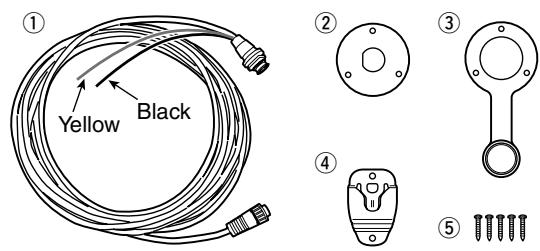
2 Function display
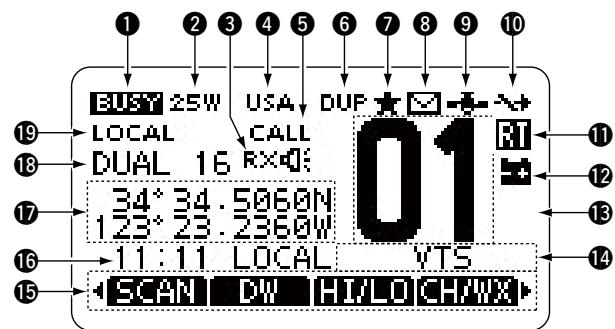
① BUSY/TRANSMIT ICON (See 6)
→ “BUY” appears when receiving a signal or when the squelch is open.
→ “TX” appears while transmitting.
② POWER ICON (See 6)
→ “25W” appears when high power is selected.
→ “1W” appears when low power is selected.
③ RX SPEAKER ICON (See 28)
Appears while in the RX Speaker mode.
④ CHANNEL GROUP ICON (See 5)
Selected channel group icons, USA "USA," International "INT," Canadian "CAN," ATIS "ATIS" or DSC "DSC" appears, depending on the transceiver version.
→ "WX" appears when the weather channel is selected.* *For only USA and Australian version.
⑤ CALL CHANNEL ICON (See 5)
Appears when the Call channel is selected.
⑥ DUPLEX ICON (See 5)
Appears when a duplex channel is selected.
⑦ FAVORITE CHANNEL ICON (See 13)
Appears when a Favorite (TAG) channel is selected.
⑧ MAIL ICON (See 24)
Blinks when there is an unread message.
⑨ GPS ICON
Stays ON when the GPS receiver is activated and valid position data is received.
→ Blinks when invalid position data is being received.
⑩ SWITCH ICON (See 26)
Appears when the “CH AUTO SWITCH” or “CH 16 SWITCH” in DSC Settings is set to ‘OFF.’
11 RT (Radio Telephone) ICON (See 34) (For only USA version) Appears while receiving or transmitting a signal, and when the channel is changed.
⑫ LOW BATTERY ICON
Blinks when the battery voltage drops to approximately 10 V DC or less.
⑬ CHANNEL NUMBER READOUT
Shows the selected operating channel number.
14 CHANNEL NAME FIELD
The channel name appears, if entered. (See 8)
15 KEY ICONS (See 4)
Shows the assigned function of the softkeys on the front panel.
16 TIME ZONE INDICATOR
Shows the current time when a GPS receiver is connected, or the time is manually entered.
- When the GPS current time is invalid, “??” will blink every 2 seconds instead of the current time. After 23.5 hours has passed, “NO TIME” will appear.
- “??” will blink every 2 seconds instead of the current time, after 3 hours and 59 minutes have passed from when the time was manually entered. The manually entered time is held for only 23.5 hours, and after that, “NO TIME” will appear.
→ “LOCAL” appears when the offset time is set.
→ “MNL” appears when the time is manually entered.
“UTC” appears when the GGA, GLL or GNS GPS sentence format is included in the GPS signal.
The date information appears when the RMC GPS sentence format is included in the GPS signal.
“NO TIME” appears when no GPS receiver is connected, and no time is manually entered.
17 POSITION INDICATOR
Shows the current position when a GPS receiver is connected, or the position is manually entered.
- When the GPS position is invalid, “??” may blink every 2 seconds instead of position. The last position is held for only 23.5 hours, and after that, “NO POSITION” will appear.
- “??” will blink every 2 seconds instead of position, after 3 hours and 59 minutes have passed from the time when the position is manually entered. The manually entered position is held for only 23.5 hours, and after that, “NO POSITION” will appear.
“NO POSITION” appears when no GPS receiver is connected, and no position is manually entered.
18 SCAN INDICATOR
→ "SCAN 16" appears during a Priority scan; "SCAN" appears during a Normal scan. (See 14)
“DUAL 16” appears during Dualwatch; “TRI 16” appears during Tri-watch. (See 15)
19 LOCAL ICON (See 6) (For only USA and Australian version.) Appears when the Attenuator function is turned ON.
3 Panel description
The HM-195 remotely controls the transceiver and provides an Intercom function.
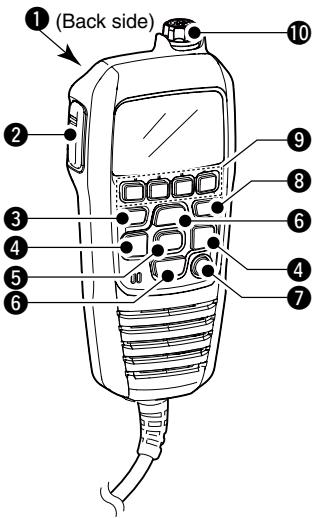
① DISTRESS KEY [DISTRESS] (See 19)
Hold down for 3 seconds to transmit a Distress call.
② PTT SWITCH [PTT]
Hold down to transmit, release to receive. (See 6)
③ MENU KEY [MENU] (See 31)
Push to enter or exit the Menu screen.
④ LEFT AND RIGHT KEYS [◀]/[▶]
→ Push to switch to the previous or next key function that is assigned to the softkeys. (See 4)
→ Push to select the character or number in the table while in the channel name, position entry mode, and so on. (See 8, 16, 17)
⑤ ENTER KEY [ENT] (See 8, 10, 16)
Push to set the entered data, selected item, and so on.
⑥ UP AND DOWN/CHANNEL SELECT KEYS [▲•CH]/[▼•CH]
→ Push to select the operating channels, Menu items, Menu settings, and so on. (See 5, 31)
→ Push to check Favorite channels, change the scanning direction or manually resume a scan. (See 14)
⑦ CHANNEL 16/CALL CHANNEL KEY [16/C]
→ Push to select Channel 16. (See 5)
Hold down for 1 second to select the Call channel. (See 5) - "CALL" appears when the Call channel is selected.
When the Call channel is selected, hold down for 3 seconds to enter Call channel entry mode. (See 7)
⑧ CLEAR KEY [CLEAR] (See 8, 16, 31)
Push to cancel the entered data, or to exit the Menu screen.
⑨ SOFTKEYS
Functions can be assigned in the Menu screen. See the transceiver's manual for details.
10 VOLUME AND SQUELCH SWITCH/POWER SWITCH [VOL/SQL•PWR]
When the power is OFF, hold down for 1 second to turn ON power. (See 6)
→ Hold down for 1 second to turn OFF power.
When the power is ON, push to enter the volume level adjustment mode.* (See 10)
- Each push of this switch toggles the mode between the volume level adjustment, squelch threshold level adjustment, operating channel selection and the LCD and key backlight brightness adjustment, if assigned.
→ Rotate to adjust the volume level.* (See 10)
*The function can be assigned in the Menu screen.
4 Softkey function
Various functions can be assigned to the softkeys.
When a key function is assigned, the key icon is displayed above the softkey, as shown below.
Consult your lcom dealer for details concerning which functions are preassigned to the keys.
◇ Softkey function selection
When “◀” or “▶” is displayed beside the key icon, pushing [◀]
or [▶] sequentially shows the previous or next key function that is assigned to the softkey.
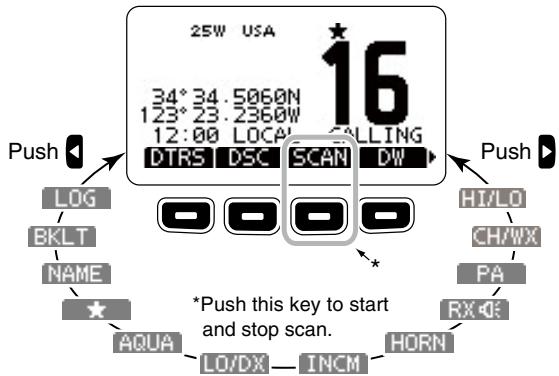
The order of the key icons may differ depending on the pre-setting, and the contents may differ, depending on the transceiver version.
5 Selecting a Channel
◇ Channel 16
① Push [16/C] to select Channel 16.
② Push [CH/WX]* to return to the screen displayed before you selected Channel 16, or push ▲ or ▼ to select an operating channel
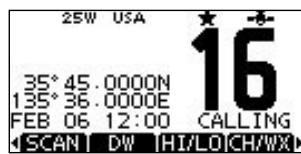
◇ Call channel
① Hold down [16/C] for 1 second to select the Call channel of the selected channel group.
② Push [CH/WX]* to return to the screen displayed before you selected Call channel, select an operating channel
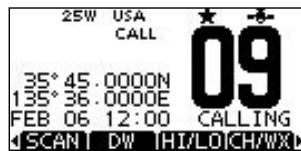
*[CHAN] appears except for a USA and Australian version.
◇ Weather channels
(For only USA and Australian version.)
① Push [CH/WX] once or twice to select a weather channel.
- "WX" appears when a weather channel is selected.
- "WX ➕" appears when the Weather Alert function is in turned ON.
② Push ▲ or ▼ to select a channel.
5 Selecting a Channel (Continued)
◇ Selecting the Channel group
① Push [MENU].
② Rotate Dial or push [▲]/[▼] to select “Radio Settings,” and then push [ENT].
③ Rotate Dial or push [▲]/[▼] to select “CHAN Group,” and then push [ENT].
④ Rotate Dial or push [▲]/[▼] to select the channel group, and then push [ENT].
- The selectable channel groups may differ, depending on the transceiver version.
⑤ Push [EXIT] to exit.
⑥ Push ▲ or ▼ to select a channel.
- "DUP" appears when a duplex channel is selected.
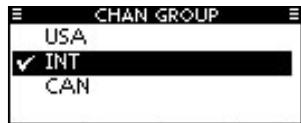

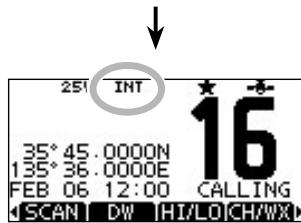
When the International
channel group is selected.
6 Receiving and transmitting
① Hold down [PWR] to turn ON the power.
② Set the audio and squelch levels. (See 10, 11)
→ First, open the squelch. Then, adjust the audio output level. After that, adjust the squelch level until the noise just disappears.
③ Change the channel group. (See 5)
④ Push ▲ or ▼ to select a channel. (See 5)
- When receiving a signal, “EUSY” appears and audio is heard.
• Further adjustment of the volume level may be necessary.
⑤ Push [LO/DX] to turn the receive Attenuator function ON or OFF, if necessary.
- For only USA and Australian version.
- "LOCAL" appears when the receive Attenuator function is ON.
⑥ Push [HI/LO] to select the output power, if necessary.
- “25W” appears when high power is selected, and “1W” appears when low power is selected.
- Choose low power for short range communications, choose high power for longer distance communications.
- Some channels are for only low power.
⑦ Hold down [PTT] to transmit, then speak at your normal voice level.
- “TX” appears.
- Channel 70 cannot be used for transmission other than DSC.
⑧ Release [PTT] to receive.
√ Information
The Noise Cancel function reduces random noise components in the transmit and/or receive signal. See the transceiver's manual for details.
Simplex channels, 1021, 1023, 1081, 1082 and 1083 CAN-
NOT be lawfully used by the general public in USA waters.
IMPORTANT: To maximize the readability of your transmitted signal, pause a few seconds after pushing [PTT], hold
the microphone 5 to 10 cm (2 to 4 inches) from your mouth
and speak at your normal voice level.
√ NOTE for the TOT (Time-out Timer) function
The TOT function inhibits continuous transmission beyond a preset time period after the transmission starts.
10 seconds before transmission is cutoff, a beep sounds to indicate the transmission will be shut down and "TOT" appears in the channel name field. Transmission is not possible for 10 seconds after this shut down.
7 Entering a Call channel
① Select the channel group. (See 5)
② Hold down [16/C] for 1 second to select the Call channel of the selected channel group.
- "CALL" and the Call channel number appear.
③ Hold down [16/C] again for 3 seconds (until a long beep changes to 2 short beeps) to enter the Call channel entry mode.
④ Rotate Dial or push ▲ or ▼ to select a channel.
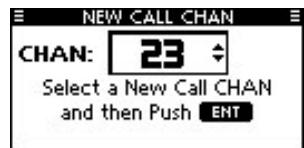
⑤ Push [ENT] to save the displayed channel as the Call channel.
- Push [CLEAR] to cancel.
8 Entering a Channel name
Enter a name of up to 10 characters.
Capital letters, 0 to 9, some symbols (! " # \$ % & ' ( ) * + , - . / [
\ ] ^ _ : ; <= > ?) and a space can be entered.
① Push ▲ or ▼ to select a channel.
- First, cancel the Dualwatch, Tri-watch or Scan function, if activated.
② Push [NAME] to open the channel name entry screen.
- A black box is displayed on the first character.
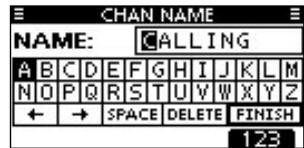
③ Enter the channel name in the following manner:
- Select a character using Dial, or [▲]/[▼]/[◀]/[▶].
- Push [ENT] to set it.
- To move the cursor, select either arrow, “←” or “→,” then push [ENT].
- Select "SPACE," then push [ENT] to enter a space.
- Select "DELETE," then push [ENT] to delete a character.
- Push [CLEAR] to cancel and return to the previous screen.
④ Repeat step ③ to enter all characters.

⑤ Push [◀], [▶], [▲] or [▼] to select "FINISH," then push [ENT]
to set the name and return to the previous screen.
9 Using the AquaQuake water draining function
The AquaQuake water draining function clears water away from the speaker grill. Without this function, water may muffle the sound coming from the speaker. A buzzing sound is heard when this function is activated.
While holding down [AQUA], the AquaQuake function is activated to clear water away from the speaker grill.
- While holding down [AQUA], a low buzzing sounds to drain water, regardless of the volume level setting.
- The HM-195's keys are disabled while the AquaQuake function is activated.
10 Adjusting the volume level
① Rotate VOL/SQL, or push VOL/SQL one or more times to display the volume adjustment screen.
② Rotate VOL/SQL to adjust the volume level.
• The HM-195 has 20 volume levels and OFF.
- If no key operation is performed for about 5 seconds, the HM-195 sets the selected volume level, and returns to the normal mode.
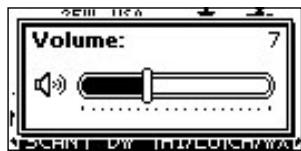
③ Push [ENT] to set the level, and exit the volume adjustment mode.
- Push [CLEAR] to cancel.
The function can be assigned to VOL/SQL. See the transceiver's manual for details.
11 Adjusting the squelch level
① Push VOL/SQL one or more times to display the squelch adjustment screen.
② Rotate VOL/SQL to adjust the squelch level.
- The squelch is adjustable in 11 levels. OPEN is completely open; 10 is tight squelch; 1 is loose squelch.
- If no key operation is performed for about 5 seconds, the selected squelch level is set, and returns to the normal mode.
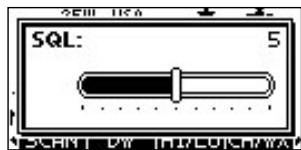
③ Push [ENT] to set the level, and exit the squelch adjustment mode.
- Push [CLEAR] to cancel.
The function can be assigned to VOL/SQL. See the
// transceiver's manual for details.
12 Adjusting the Backlight level
The function display and keys can be backlit for better visibility under low light conditions.
The backlight is adjustable in 7 levels and OFF.
→ Push [BKLT] to show the backlight adjustment screen. Rotate Dial to adjust the brightness of the LCD and key backlight, and then push [ENT].
- If no key operation is performed for about 5 seconds, the HM-195 sets the selected backlight level, and returns to the normal mode.
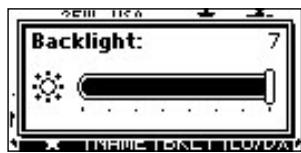
13 Setting Favorite channels
① Select the channel group. (See 5)
② Select the channel to be set as a Favorite channel.
③ Push [★] to set the displayed channel as a Favorite channel.
- “★” appears on the display.
④ To cancel the Favorite channel setting, repeat step ③.
- “★” disappears.
√ Clearing (or setting) all tagged channels
Hold down [★] for 3 seconds (until a long beep changes to 2 short beeps) to clear all Favorite channel settings in the selected channel group.
- Repeat above procedure to set all channels as Favorite channels.
14 Starting a scan
① Select Priority scan or Normal scan in the Menu screen.
- See the transceiver's manual for details.
② Select the channel group. (See 5)
③ Set the Favorite channels. (See 13)
④ Make sure the squelch is closed to start a scan.
⑤ Push [SCAN] to start a Priority or Normal scan.
- “SCAN 16” appears during a Priority scan; “SCAN” appears during a Normal scan.
- When a signal is detected, the scan pauses until the signal disappears, or resumes after pausing 5 seconds, depending on the Set mode setting. (Channel 16 is still monitored during a Priority scan.)
- Push [▲]/[▼] to check the scanning Favorite channels, change the scanning direction or manually resume the scan.
- A beep tone sounds and "16" blinks when a signal is received on Channel 16 during a Priority scan.
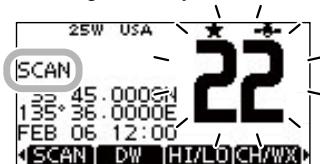
⑥ To stop the scan, push [CLEAR], or repeat step ⑤.
15 Dualwatch/Tri-watch operation
① Select Dualwatch or Tri-watch in the Menu screen.
- See the transceiver's manual for details.
② Push ▲ or ▼ to select the operating channel.
③ Push [DW] to start a Dualwatch or Tri-watch scan.
- "DUAL 16" appears during Dualwatch; "TRI 16" appears during Tri-watch.
- A beep tone sounds when a signal is received on Channel 16.
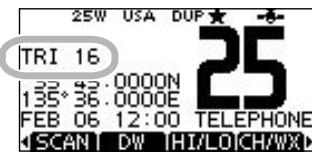
④ To cancel Dualwatch or Tri-watch, push [DW] again.
See “Instructions ②” (16 to 22) or “Instructions ③” (23 to 31) for other functions.
CLEAN THE HM-195 THOROUGHLY WITH FRESH WATER after exposure to saltwater, otherwise, the keys and switch may become inoperable due to salt crystallization.
Icom Inc.
1-1-32 Kamiminami, Hirano-ku, Osaka 547-0003, Japan
16 Entering Individual/Group ID
① Enter "INDIVIDUAL ID" or "GROUP ID" in the DSC SETTINGS menu.
② Push [ADD].
- The “INDIVIDUAL ID” or “GROUP ID” entry screen is displayed.
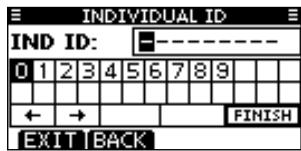
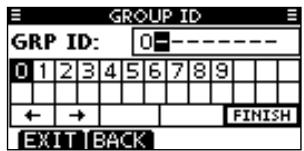
③ Enter an ID in the following way:
- Select a number using Dial, or [▲]/[▼]/[◀]/[▶].
- Push [ENT] or Dial to set it.
- To move the cursor, select either arrow, “←” or “→,” then push [ENT] or Dial.
The first digit is specified as '0' for a Group ID.
The first two digits are '0' for any Coast station ID.
④ Repeat step ③ to enter all 9 digits.
⑤ After entering, push [ENT] or Dial to set it.
- The ID name entry screen is displayed.
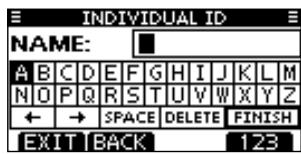
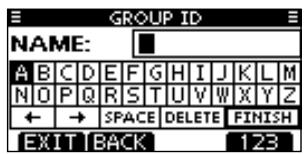
⑥ Enter a 10 digit ID name in the following way:
- Select a character using Dial, or [▲]/[▼]/[◀]/[▶].
- Push [ENT] or Dial to set it.
- To move the cursor, select either arrow, “←” or “→,” then push [ENT] or Dial.
- Push [123] then [!\$?] then [ABC] to select a character group.
⑦ After entering the ID name, select "FINISH" using Dial, or [▲]/[▼]/[◀]/[▶], then push [ENT] or Dial to set it.
- The “INDIVIDUAL ID” or “GROUP ID” list screen is displayed.
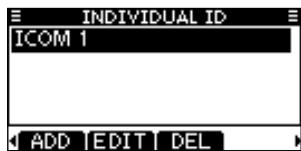
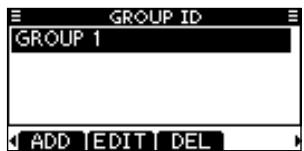
⑧ Push [MENU] to exit the MENU screen.
In this INSTRUCTIONS, the IC-M423/IC-M424 series is used for an example.
- Some functions and DSC calls may not be usable depending on the transceiver model or version.
- Some screen, function name, and softkey name may be different, depending on the transceiver.
See the transceiver's manual for detail operation.
17 Deleting Individual/Group ID
① Enter “INDIVIDUAL ID” or “GROUP ID” in the DSC SETTINGS menu.
- When no address ID is entered, "No ID" is displayed. In this case, push [MENU] to exit the MENU screen.
② Rotate Dial or push [▲]/[▼] to select an ID name, then push [DEL].

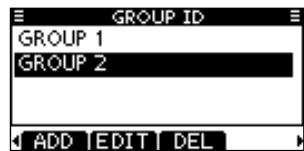
③ Push [OK] to delete the ID, and return to the "INDIVIDUAL ID" or "GROUP ID" list screen.
- Push [CANCEL] to cancel it.
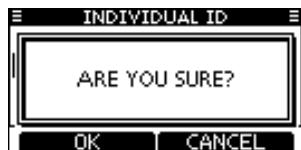
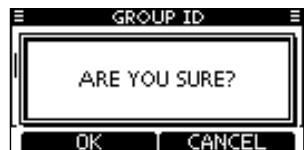
④ Push [MENU] to exit the MENU screen.
18 Entering position and time
① Enter "POSITION INPUT" in the DSC SETTINGS menu.
② Edit your latitude and longitude position using Dial, or [▲]/[▼]/[◀]/[▶].
- Select a number using Dial, or [▲]/[▼]/[◀]/[▶].
- Push [ENT] or Dial to set it.
- To move the cursor, select either arrow, “←” or “→,” then push [ENT] or Dial.
- Select N (North latitude) or S (South latitude) when the cursor is on the 'N' or 'S' position.
- Select W (West longitude) or E (East longitude) when the cursor is on the 'W' or 'E' position.
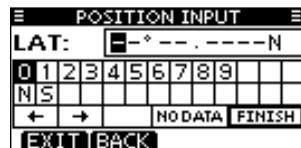
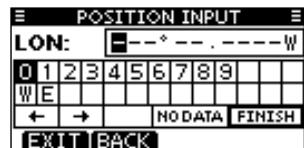
③ After entering the position, push [ENT] to save it.
④ The UTC time entry screen is displayed, enter the UTC time in the following way:
- Select a number using Dial, or [▲]/[▼]/[◀]/[▶].
- Push [ENT] or Dial to set it.
- To move the cursor, select either arrow, “←” or “→,” then push [ENT] or Dial.
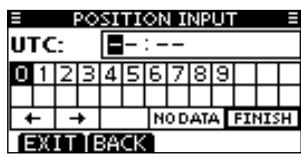
⑤ Push [ENT] or Dial to save your position and time.
- Return to the "DSC SETTING" screen.
19 Making a Distress Call
The Distress call is automatically transmitted every 3.5 to 4.5 minutes, until an acknowledgement is received ('Call repeat' mode), or a DSC Cancel call is made (See 21).
◇ Simple Call
① Confirm no Distress call is being received.
② While lifting up the key cover, hold down [DISTRESS] for 3 seconds to transmit the Distress call.
- While holding down [DISTRESS], count down beeps sound and both the key and display backlighting blink.
- DSC channel (Channel 70) is automatically selected and the Distress call is transmitted.
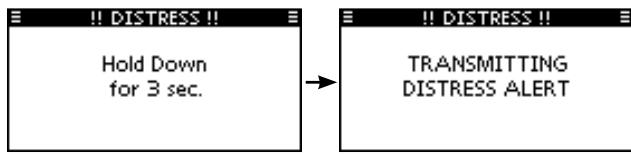
③ After transmitting the call, the transceiver waits for an acknowledgment call.
- Push [RESEND] to manually transmit the Distress repeat call.
- Push [◀]/[▶] then push [INFO] to display the transmitted Distress call information.
- Push [◀]/[▶] then push [PAUSE] to pause the 'Call repeat' mode; push [RESUME] to resume it.
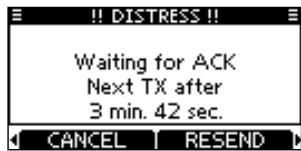
④ After receiving the acknowledgment, push [ALARM OFF] then reply using the microphone.
→ A distress alert default contains:
- Nature of distress: Undesignated distress
- Position information: The latest GPS or manually entered position is held for 23.5 hours, or until the power is turned OFF.
◇ Regular Call
① Enter "DISTRESS CALL" in the DSC CALLS menu.
② Select the nature of the distress using Dial or [▲]/[▼], then push Dial or [ENT].
- 'Undesignated,' Fire, 'Explosion,' Flooding, 'Collision,' Grounding, 'Capsizing,' Sinking, 'Adrift,' Abandoning ship, 'Piracy' or 'Man Overboard' is selectable.
- 'Undesignated,' Fire, 'Explosion,' Flooding, 'Collision,' Grounding, 'Capsizing,' Sinking, 'Adrift,' Abandoning ship, 'Piracy' or 'Man Overboard' is selectable.
- 'Undesignated,' Fire, 'Explosion,' Flooding, 'Collision,' Grounding, 'Capsizing,' Sinking, 'Adrift,' Abandoning ship, 'Piracy' or 'Man Overboard' is selectable.
- 'Undesignated,' Fire, 'Explosion,' Flooding, 'Collision,' Grounding, 'Capsizing,' Sinking, 'Adrift,' Abandoning ship, 'Piracy' or 'Man Overboard' is selectable.
- 'Undesignated,' Fire, 'Explosion,' Flooding, 'Collision,' Grounding, 'Capsizing,' Sinking, 'Adrift,' Abandoning ship, 'Piracy' or 'Man Overboard' is selectable.
- 'Undesignated,' Fire, 'Explosion,' Flooding, 'Collision,' Grounding, 'Capsizing,' Sinking, 'Adrift,' Abandoning ship, 'Piracy' or 'Man Overboard' is selectable.
- 'Undesignated,' Fire, 'Explosion,' Flooding, 'Collision,' Grounding, 'Capsizing,' Sinking, 'Adrift,' Abandoning ship, 'Piracy' or 'Man Overboard' is selectable.
- 'Undesignated,' Fire, 'Explosion,' Flooding, 'Collision,' Grounding, 'Capsizing,' Sinking, 'Adrift,' Abandoning ship, 'Piracy' or 'Man Overboard' is selectable.
• Undesignated, Fire, Explosion, Flooding, Collision, Grounding, Capsizing, Sinking, Adrift, Abandoning ship, Piracy or Man Overboard is selectable.
- 'Undesignated,' Fire, 'Explosion,' Flooding, 'Collision,' Grounding, 'Capsizing,' Sinking, 'Adrift,' Abandoning ship, 'Piracy' or 'Man Overboard' is selectable.
- 'Undesignated,' Fire, 'Explosion,' Flooding, 'Collision,' Grounding, 'Capsizing,' Sinking, 'Adrift,' Abandoning ship, 'Piracy' or 'Man Overboard' is selectable.
- 'Undesignated,' Fire, 'Explosion,' Flooding, 'Collision,' Grounding, 'Capsizing,' Sinking, 'Adrift,' Abandoning ship, 'Piracy' or 'Man Overboard' is selectable.
- 'Undesignated,' Fire, 'Explosion,' Flooding, 'Collision,' Grounding, 'Capsizing,' Sinking, 'Adrift,' Abandoning ship, 'Piracy' or 'Man Overboard' is selectable.
- 'Undesignated,' Fire, 'Explosion,' Flooding, 'Collision,' Grounding, 'Capsizing,' Sinking, 'Adrift,' Abandoning ship, 'Piracy' or 'Man Overboard' is selectable.
- 'Undesignated,' Fire, 'Explosion,' Flooding, 'Collision,' Grounding, 'Capsizing,' Sinking, 'Adrift,' Abandoning ship, 'Piracy' or 'Man Overboard' is selectable.
- 'Undesignated,' Fire, 'Explosion,' Flooding, 'Collision,' Grounding, 'Capsizing,' Sinking, 'Adrift,' Abandoning ship, 'Piracy' or 'Man Overboard' is selectable.
- 'Undesignated,' Fire, 'Explosion,' Flooding, 'Collision,' Grounding, 'Capsizing,' Sinking, 'Adrift,' Abandoning ship, 'Piracy' or 'Man Overboard' is selectable.
- 'Undesignated,' Fire, 'Explosion,' Flooding, 'Collision,' Grounding, 'Capsizing,' Sinking, 'Adrift,' Abandoning ship, 'Piracy' or 'Man Overboard' is selectable.
⑥ After receiving an acknowledgment call, push [ALARM OFF], then reply using the microphone.
→ A distress alert contains:
- Nature of distress: Selected in step ②.
- Position information: The latest GPS or manually entered position is held for 23.5 hours, or until the power is turned OFF.
When no GPS receiver is connected, and both position and time have been manually entered, the screen shown below appears. Edit your latitude and longitude position and UTC time as follows:
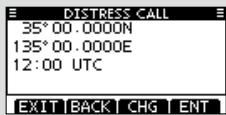
→ Push [CHG], then edit your latitude and longitude position and UTC time.
- Select a number using Dial, or [▲]/[▼]/[◀]/[▶].
- Push [ENT] or Dial to set it.
- To move the cursor, select either arrow, “←” or “→,” then push [ENT] or Dial.
- Select N (North latitude) or S (South latitude) when the cursor is on the 'N' or 'S' position.
- Select W (West longitude) or E (East longitude) when the cursor is on the 'W' or 'E' position.
20 Canceling a Distress call
① While waiting for an acknowledgment call, push [CANCEL].
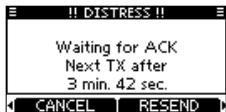
② Push [CONTINUE].
- Push [BACK] to return to waiting for an acknowledgement call.
③ Push [FINISH].
- Push [EXIT] to return to waiting for an acknowledgement call.
④ The Distress cancel call is transmitted.
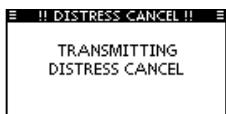
⑤ Channel 16 is automatically selected.
• Report your situation using the microphone.
- After the report, push [EXIT] to return to the normal operating mode.
21 Making a Distress Relay ACK
(For only USA version)
① When a Distress Relay Call is received, beeps sound. Push [ALARM OFF] to stop the beeps.
② Push [ACPT].
- Push [IGN] to ignore the call and return to the normal operating mode.
- Push [INFO] to display the Distress Relay Call information.
- Push [PAUSE] to pause the countdown. The Distress cancel call is transmitted.
③ Push [ACK].
- Push [EXIT] to return to the normal operating mode*.
*The exit confirmation dialog is displayed.
④ The Distress Relay Acknowledgement confirmation screen is displayed.
Push [CALL] to transmit the acknowledgement call.
⑤ After transmitting the acknowledgement call, Channel 16 is automatically selected.
- Push [EXIT] to return to the normal operating mode.*
*The exit confirmation dialog is displayed. - Push [RESEND] to resend the acknowledgement.
To ensure correct operation of the DSC function, make sure you set the squelch correctly.
◇ Making an Individual Call
① Enter "INDIVIDUAL CALL" in the DSC CALLS menu.
② Select or enter the individual address.
③ Select Routine, Safety or Urgency as the call type.
NOTE: When a coast station is selected in step ②, the voice channel is automatically specified by the coast station. Therefore, skip step ④ and go directly to step ⑤.
④ Select a internship channel.
⑤ A confirmation screen appears.
⑥ Push [CALL] to transmit the Individual call.
⑦ Standby on Channel 70 until an acknowledgement is received.
- To return to the normal operating mode, push [EXIT].* *Only USA version, the exit confirmation dialog is displayed, and then push [RESEND] to resend the call.
⑧ When the acknowledgement ‘Able to comply’ is received, beeps sound and the screen below is displayed.
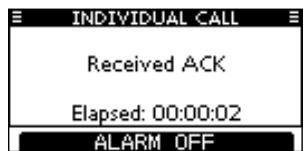
Push [ALARM OFF] to stop the beeps, and then select the internship channel specified in step ④.
- A different internship channel will be automatically selected if the station you called cannot use the channel.
- Reply using the microphone. And go to step ⑨.
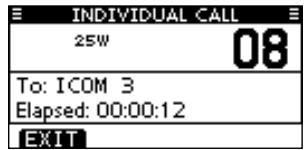
Or, when the acknowledgement ‘Unable to comply’ is received, beeps sound.
Push [ALARM OFF] to stop the beeps. Then push [EXIT] to return to the operating channel (before you entered the MENU screen).
⑨ After communicating, push [EXIT] to return to the normal operating mode.
◇ Making an Individual Acknowledgement
Quick ACK:
① When an Individual call is received, beeps sound. Push [ALARM OFF] to stop the beeps.
② Push [ACK].
③ Select one of three options, Able to Comply, Unable to Comply or Propose New Channel, and then push [ENT].
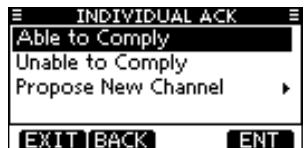
④ The Individual ACK confirmation screen is displayed.
⑤ Push [CALL] to transmit the acknowledgement call.
⑥ Reply to the call using the microphone.
⑦ Push [EXIT] to return to the normal operating mode.*
*Only USA version, the exit confirmation dialog is displayed, and then push [RESEND] to resend the acknowledgement.
Manual ACK:
① Enter "INDIVIDUAL ACK" in the DSC CALLS menu.
- When no Individual call has been received, the "Individual ACK" item will not be displayed.
② Select an individual address or ID code to reply to, using Dial or [▲]/[▼], then push [ENT].
③ Perform steps ③ to ⑦, as described in “Quick ACK:” above.
◇ Making a Group Call
① Enter "GROUP CALL" in the DSC CALLS menu.
② Select or enter the group address.
③ Select an internship channel.
④ A confirmation screen appears.
⑤ Push [CALL] to transmit the Group call.
⑥ Announce the information using the microphone.
⑦ After the announcement, push [EXIT] to return to the normal operating mode.*
*Only USA version, the exit confirmation dialog is displayed, and then push [RESEND] to resend the call.
◇ Making an All Ships Call
① Enter "ALL SHIPS CALL" in the DSC CALLS menu.
② Select a category.
- The selectable category may differ according to the connected transceiver setting.
③ Select a traffic channel.
④ A confirmation screen appears.
⑤ Push [CALL] to transmit the All Ships call.
⑥ Announce the message using the microphone.
⑦ After the announcement, push [EXIT] to return to the normal operating mode.*
*Only USA version, the exit confirmation dialog is displayed, and then push [RESEND] to resend the call.
◇ Making a Position Request Call
① Enter "POSITION REQUEST" in the DSC CALLS menu.
② Select or enter an individual address.
③ A confirmation screen appears.
- Confirm the call contents.
④ Push [CALL] to transmit the Position Request Call.
- If Channel 70 is busy, the transceiver stands by until the channel becomes clear.
⑤ When the acknowledgement call is received, beeps sound.
⑥ Push [ALARM OFF] to stop the beeps, and then push [EXIT] to return to the normal operating mode.*
*Only USA version, the exit confirmation dialog is displayed, and then push [RESEND] to resend the call.

◇ Making a Position Report Call
① Enter "POSITION REPORT" in the DSC CALLS menu.
② Select or enter an individual address.
③ A confirmation screen appears.
- Confirm the call contents.
④ Push [CALL] to transmit the Position Report Call.
- If Channel 70 is busy, the transceiver stands by until the channel becomes clear.
⑤ After the Position Report Call has been transmitted, the transceiver automatically returns to the normal operating mode.
◇ Transmitting a Polling Request Call
① Enter "POLLING REQUEST" in the DSC CALLS menu.
② Select or enter an individual address.
③ A confirmation screen appears.
- Confirm the call contents.
④ Push [CALL] to transmit the Polling Request Call.
- If Channel 70 is busy, the transceiver stands by until the channel becomes clear.
⑤ When the acknowledgement call is received, beeps sound.
⑥ Push [ALARM OFF] to stop the beeps, and then push [EXIT] to return to the normal operating mode.*
*Only USA version, the exit confirmation dialog is displayed, and then push [RESEND] to resend the call.
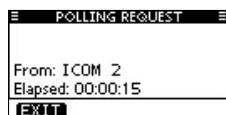
◇ Transmitting a Test Call
① Enter "TEST CALL" in the DSC CALLS menu.
② Select or enter an individual address.
③ A confirmation screen appears.
④ Push [CALL] to transmit the Test call.
⑤ When the acknowledgement call is received, beeps sound.
⑥ Push [ALARM OFF] to stop the beeps, and then push [EXIT] to return to the normal operating mode.
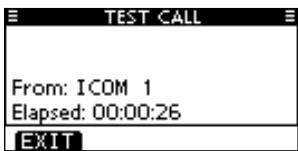
◇ Making a Test Acknowledgement Call Quick ACK:
① When a Test call is received, beeps sound.
Push [ALARM OFF] to stop the beeps.
② Push [ACK].
- Push [INFO] to display the Test call information. Push [BACK] to return to the previous screen, or push [ACK].
③ The Test ACK confirmation screen is displayed.
Push [CALL] to transmit the acknowledgement call.
④ After transmitting the acknowledgement call, the transceiver returns to the normal operating mode.
Manual ACK:
① Enter "TEST ACK" in the DSC CALLS menu.
- If no Test call has been received, the “TEST ACK” item will not be displayed.
② Select a Test call to reply to, using Dial or [▲]/[▼], then push Dial or [ENT].
③ The Test ACK confirmation screen is displayed. Push [CALL] to transmit the acknowledgement call.
④ After transmitting the acknowledgement call, the transceiver returns to the normal operating mode.
◇ Making a Position Reply Call
Quick Reply:
① When a Position Request call is received, beeps sound. Push [ALARM OFF] to stop the beeps.
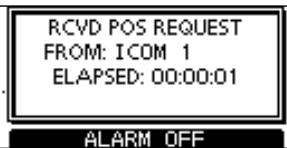
② Push [ACK].
- Push [INFO] to display the Position Request call information. Push [BACK] to return to the previous screen, or push [ACK].
③ The Position Reply confirmation screen is displayed. Push [CALL] to transmit the reply call.
④ After transmitting the reply call, the transceiver returns to the normal operating mode.
Manual Reply:
① Enter "POSITION REPLY" in the DSC CALLS menu.
- If no Position Request call has been received, the “POSITION REPLY” item will not be displayed.
② Select a Position Request call to reply to.
③ The Position Reply call confirmation screen is displayed. Push [CALL] to transmit the acknowledgement call.
④ After transmitting the reply call, the transceiver returns to the normal operating mode.
◇ Making a Position Report Reply Call
Quick Reply:
① When a Position Report Request call is received, beeps sound.
Push [ALARM OFF] to stop the beeps.
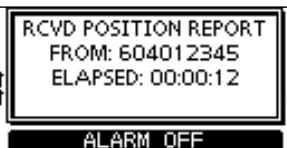
② Push [ACK].
- Push [INFO] to display the Position Report Request call information.
Push [BACK] to return to the previous screen, or push [ACK].
③ The Position Report Reply confirmation screen is displayed. Push [CALL] to transmit the reply call.
④ After transmitting the reply call, the transceiver returns to the normal operating mode.
Manual Reply:
① Enter “POSITION REPORT REPLY” in the DSC CALLS menu.
- If no Position Report Request call has been received, the “POSITION REPORT REPLY” item will not be displayed.
② Select a Position Report Request call to reply to, using Dial or [▲]/[▼], then push Dial or [ENT].
③ The Position Report Reply call confirmation screen is displayed.
Push [CALL] to transmit the acknowledgement call.
④ After transmitting the reply call, the transceiver returns to the normal operating mode.
◇ Transmitting a Polling Reply Call
Quick Reply:
① When a Polling Request call is received, beeps sound. Push [ALARM OFF] to stop the beeps.
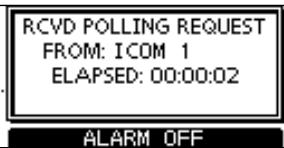
② Push [ACK].
- Push [INFO] to display the Polling Request call information. Push [BACK] to return to the previous screen, or push [ACK].
③ The Polling Reply confirmation screen is displayed. Push [CALL] to transmit the reply call.
④ After transmitting the reply call, the transceiver returns to the normal operating mode.
Manual Reply:
① Enter “POLLING REPLY” in the DSC CALLS menu.
• If no Polling Request call has been received, the “POLLING REPLY” item will not be displayed.
② Select a Polling Request call to be replied.
③ The Polling Reply call confirmation screen is displayed. Push [CALL] to transmit the acknowledgement call.
④ After transmitting the reply call, the transceiver returns to the normal operating mode.
See “Instructions ①” (1 to 15) or “Instructions ③” (23 to 31) for other functions.
In this INSTRUCTIONS, the IC-M423/IC-M424 series is used for an example.
- Some functions and DSC calls may not be usable depending on the transceiver model or version.
- Some screen, function name, and softkey name may be different, depending on the transceiver.
See the transceiver's manual for detail operation.
23 Receiving DSC calls
◇ Receiving a Distress Call/Distress Acknowledgement
① Push [ALARM OFF] to stop the alarm and the blinking backlight.
② Push a softkey to select your action.
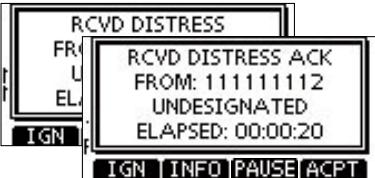
[IGN] Push to ignore the call and return to the normal operating mode.
[INFO] Push to display the Received Call information. (See 24)
[PAUSE] (For only USA version) Push to pause the countdown. - Displayed if the "CH Auto Switch:" item in the DSC SETTINGS menu is set to "10 sec"(See 26).
- Push [RESUME] to resume the countdown.
[ACPT] Push to accept the call, then push [CH 16] to switch the operating channel to Channel 16. After that, monitor it, as a coast station may require assistance.
◇ Receiving a Distress Relay Call/Distress Relay Acknowledgement
① Push [ALARM OFF] to stop the alarm and the blinking backlight.
② Push a softkey to select your action.
[IGN] Push to ignore the call and return to the normal operating mode.
[INFO] Push to display the Received Call information. (See 24)
[PAUSE] (For only USA version.) Push to pause the countdown.
- Displayed if the “CH Auto Switch:” item in the DSC SETTINGS menu is set to “10 sec”(See 26).
- Push [RESUME] to resume the countdown.
[ACPT] Push to accept the call, then push [CH 16] to switch the operating channel to Channel 16. After that, monitor it, as a coast station may require assistance.
◇ Receiving an Individual Call
① Push [ALARM OFF] to stop the alarm and the blinking backlight.
- If [ALARM OFF] is not pushed within 2 minutes, the next screen may appear, depending on the call Category.
② Push a softkey to select your action.
[IGN] Push to ignore the call and return to the normal operating mode.
[INFO] Push to display the Received Call information. (See 24)
[PAUSE] (For only USA version.) Push to pause the countdown.
- Displayed if the "CH Auto Switch:" item in the DSC SETTINGS menu is set to "10 sec"(See 26).
- Push [RESUME] to resume the countdown.
[ACK] Push to display the “INDIVIDUAL ACK” screen to reply to the call, and select the channel specified by the calling station for voice communication, depending on your situation. See 22 for details of the Individual Acknowledgement procedure.
When “INDIVIDUAL ACK” is set to “Auto ACK (Unable),” the transceiver automatically replies to the call. In that case, both the TX and RX calls are stored in the Transmitted and Received Call Logs.
◇ Receiving a Group Call/Geographical Area Call/All Ships Call
① Push [ALARM OFF] to stop the alarm and the blinking backlight.
• If [ALARM OFF] is not pushed within 2 minutes, the next screen may appear, depending on the call Category.
② Push a softkey to select your action.
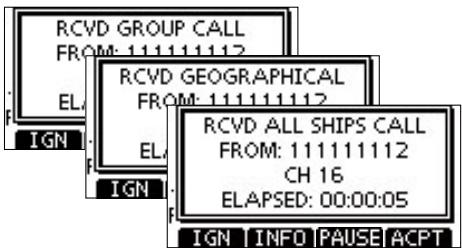
[IGN] Push to ignore the call and return to the normal operating mode.
[INFO] Push to display the Received Call information. (See 24)
[PAUSE] (For only USA version.) Push to pause the countdown.
- Displayed if the "CH Auto Switch:" item in the DSC SETTINGS menu is set to "10 sec"(See 26).
- Push [RESUME] to resume the countdown.
[ACPT] Push to monitor the channel specified by the calling station for its announcement.
Note for Geographical Area Call
When no GPS receiver is connected, or if there is a problem with the connected receiver, all Geographical Area Calls are received, regardless of your position.
◇ Receiving a Position Request Call
① Push [ALARM OFF] to stop the alarm and the blinking backlight.
• If [ALARM OFF] is not pushed within 2 minutes, the next screen may appear, depending on the call Category.
② Push a softkey to select your action.
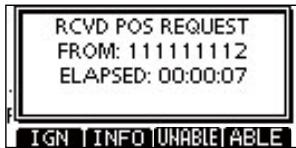
[IGN] Push to ignore the call and return to the normal operating mode.
[INFO] Push to display the Received Call information. (See 24)
[UNABLE] (For only USA version.) Push to transmit the “Unable to Comply” acknowledgement.
[ABLE] (For only USA version.) Push to transmit the "Able to Comply" acknowledgement.
[ACK] Push to display the "POSITION REPLY" screen and send a reply to the call. (See 22)
When “POSITION ACK” is set to “Auto TX,” the transceiver automatically replies to the call. In that case, both the TX and RX calls are stored in the Transmitted and Received Call Logs.
23 Receiving DSC calls (Continued)
◇ Receiving a Position Report Call
① Push [ALARM OFF] to stop the alarm and the blinking backlight.
- If [ALARM OFF] is not pushed within 2 minutes, the next screen may appear, depending on the call Category.
② Push a softkey to select your action.
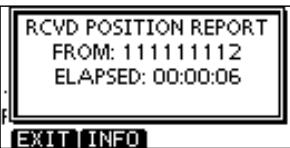
[EXIT] Push to ignore the call and return to the normal operating mode.
[INFO]Push to display the Received Call information. (See 24)
◇ Receiving a Polling Request Call
① Push [ALARM OFF] to stop the alarm and the blinking backlight.
- If [ALARM OFF] is not pushed within 2 minutes, the next screen may appear, depending on the call Category.
② Push a softkey to select your action.

[IGN] Push to ignore the call and return to the normal operating mode.
[INFO] Push to display the Received Call information. (See 24)
[ACK] Push to display the "POLLING REPLY" screen to reply to the call. (See 22)
When “POSITION ACK” is set to “Auto TX,” the transceiver automatically replies to the call. In that case, both the TX and RX calls are stored in the Transmitted and Received Call Logs.
◇ Receiving a Test Call
① Push [ALARM OFF] to stop the alarm and the blinking backlight.
• If [ALARM OFF] is not pushed within 2 minutes, the next screen may appear, depending on the call Category.
② Push a softkey to select your action.
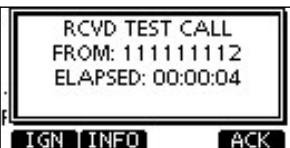
[IGN] Push to ignore the call and return to the normal operating mode.
[INFO] Push to display the Received Call information. (See 24)
[ACK] Push to display the "TESTACK" screen to reply to the call.} (See 22)
When “TEST ACK” is set to “Auto TX,” the transceiver automatically replies to the call. In that case, both the TX and RX calls are stored in the Transmitted and Received Call Logs.
◇ Receiving a Test Acknowledgement Call
① Push [ALARM OFF] to stop the alarm and the blinking backlight.
- If [ALARM OFF] is not pushed within 2 minutes, the next screen may appear, depending on the call Category.
② Push [EXIT] to return to the normal operating mode.
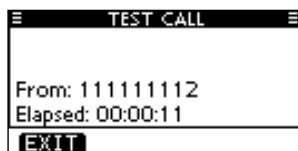
24 Received Call Log
The transceiver automatically stores up to 50 distress messages and 50 other messages, and they can be used as a supplement to your logbook.
- While in the normal operating mode, “☑” blinks in the upper right corner of the LCD when there is an unread message.
① Push [LOG] to enter "RCVD CALL LOG" in the DSC CALLS menu, or you can enter it through the Menu screen.
② Select "Distress" or "Others."
- The Distress messages are stored in "Distress."
- The messages other than the Distress are stored in “Others.”
- “ ” appears when there are unread messages.
- “☐” appears when there are no unread messages.
- No icon appears when there are no messages.
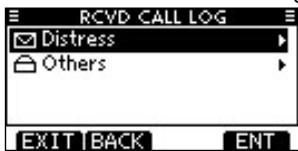
③ Select the message.
- The message in the unopened file has not been read.
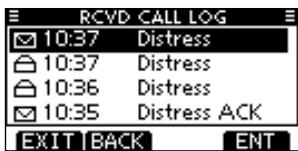
When "Distress" is selected in step ②.
④ Rotate Dial to scroll the message contents.
⑤ To delete the displayed message, push [DEL].
- A confirmation screen appears, then push [OK] to delete.
⑥ Push [EXIT] to return to the normal operating mode.
25 Transmitted Call Log
The transceiver automatically stores up to 50 transmitted calls, and the logs can be used as a supplement to your logbook.
① Enter "TX CALL LOG" in the DSC CALLS menu.
② Select the message.
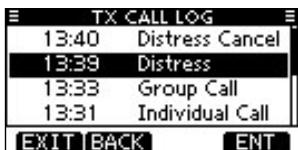
Rotate Dial to scroll the message contents.
④ To delete the displayed message, push [DEL].
- The confirmation screen appears, then push [OK] to delete.
⑤ Push [EXIT] to return to the normal operating mode.
26 DSC Settings
◇ Automatic Acknowledgement
① Enter either “INDIVIDUAL ACK,” “POSITION ACK” or “TEST ACK” in the DSC Settings menu.
② Rotate Dial to select “Auto TX” or “Manual TX,” then push [ENT].
- Push [BACK] to cancel and return to the DSC Settings menu.
③ Push [EXIT] to return to the normal operating mode.
◇ Channel Auto Switch function (For only USA version.)
① Enter “CH AUTO SWITCH” in the DSC Settings menu.
② Rotate Dial to set the Channel Auto Switch function to “Auto (No Delay),” “10 Second Delay” or “OFF,” then push [ENT].
- Push [BACK] to cancel and return to the DSC Settings menu.
③ Push [EXIT] to return to the normal operating mode.
◇ Channel 16 Switch function
① Enter “CH 16 SWITCH” in the DSC Settings menu.
② Rotate Dial to set the Channel 16 Switch function to "Auto (No Delay)," "10 Second Delay" or "OFF," then push [ENT]. Push [BACK] to cancel and return to the DSC Settings menu.
③ Push [EXIT] to return to the normal operating mode.
◇ DSC Data Output
① Enter "DSC DATA OUTPUT" in the DSC Settings menu.
③ Rotate Dial to set the DSC Data Output function to "All Station," "List Station" or "OFF," then push [ENT].
- Push [BACK] to cancel and return to the DSC Settings menu.
③ Push [EXIT] to return to the normal operating mode.
◇ Alarm
① Enter “ALARM” in the DSC Settings menu.
② Rotate Dial to select the status, then push [ENT].
- Push [BACK] to cancel and return to the DSC Settings menu.
- “Safety,” “Routine,” “Warning,” “Self-Terminate” and “Discrete” are selectable. (default: ON)
③ Rotate Dial to set the Alarm setting to "ON" or "OFF."
④ Push [EXIT] to return to the normal operating mode.
◇ Channel 70 Squelch level
① Enter “CH 70 SQL LEVEL” in the DSC Settings menu.
② Rotate Dial to adjust the squelch level until the noise just disappears, then push [ENT].
- Push [BACK] to cancel and return to the DSC Settings menu.
③ Push [EXIT] to return to the normal operating mode.
◇ DSC Loop Test
① Enter "DSC LOOP TEST" in the DSC Settings menu.
② Push [ENT] to start the DSC loop test.
- Push [BACK] to cancel and return to the DSC Settings menu.
- When the transmit DSC and receive DSC signals are matched, "OK" appears.
③ Push [EXIT] to return to the normal operating mode.
If “NG” appears in step ②, either or both TX and RX DSC circuits has a problem. In that case, you will have to send the transceiver to your nearest dealer for repair.
27 Intercom operation
This function is not available with the IC-M400BB.
① Push [INCM] to enter the Intercom mode.
② Hold down [INCM CALL] to sound the intercom beeps.
- The transceiver and the command microphone sound beeps while holding down [INCM CALL].
- "CALL" appears.
③ After releasing [INCM CALL], hold down [PTT] and speak into the microphone at a normal voice level.
- “TALK” appears on the caller’s display, or “LSTN” appears on the listener’s display.
- To adjust the HM-195's intercom volume level, rotate VOL/SQL on the HM-195.
④ After releasing [PTT] you can hear the response through the speaker.
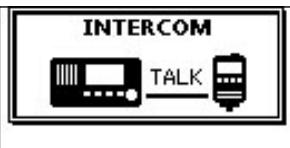
On the caller's display
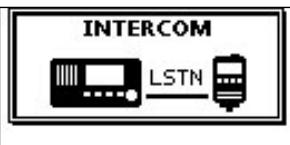
On the listener's display
⑤ To return to the normal operating mode, push [EXIT].
28 RX Speaker function
① Push [RX] to enter the RX Speaker mode.
- The RX Speaker volume level adjustment screen is displayed.
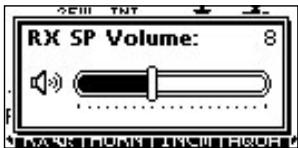
② Rotate Dial or push [▲]/[▼]/[◀]/[▶] to adjust the RX Speaker volume level, and then push [ENT].
- “RX 🔊” appears.
③ To return to normal operating mode, push [RX].
- “RX ☐” disappears.
29 PA (Public Address) function
① Push [PA] to enter the Public Address mode.
② Hold down [PTT] and speak at a normal voice level.
- While holding down [PTT], the screen below is displayed.
- To adjust the PA volume level, rotate Dial.
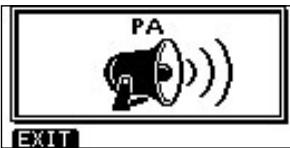
③ Push [EXIT] to return to normal operating screen.
30 Horn function
① Push [HORN] to enter the Horn mode.
② Hold down [HORN] to sound a horn.
- While holding down [HORN], the horn sounds, and the screen below is displayed.
- To adjust the horn volume level, rotate Dial.
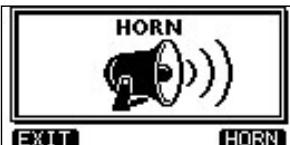
③ Push [EXIT] to return to the normal operating screen.
31 Menu screen operation
The Menu screen is used to change the transceiver's functions and the microphone's own functions, send DSC calls or show the entered MMSI and ATIS ^1 codes and GPS information ^2 .
*1 Appears only when the transceiver is the Dutch or German version.
*2 Appears only when a GPS receiver compatible with NMEA0183 ver. 2.0 or 3.01 is connected to the transceiver.
These instructions are for only the microphone's own functions. Refer to the transceiver's manual for the settings of the other functions. (Some functions cannot be selected from the HM-195.)
◇ Entering the Menu screen and operation
① Push [MENU].
② Rotate Dial or push [▲]/[▼] to select the root item, and then push [ENT].
③ Rotate Dial or push [▲]/[▼] to select the item, and then push [ENT].
④ Rotate Dial or push [▲]/[▼] to select the option, and then push [ENT] to set it.
⑤ Push [EXIT] to exit the Menu screen.
- Push [CLEAR] or [BACK] to return to the previous screen.
- Backlight
The function display and keys of the HM-195 can be backlit for better visibility under low light conditions.
The backlight can be set to 7 levels and OFF. (Default: 7)
- Display contrast
The contrast of the HM-195's function display can be adjusted in 8 steps.
Level 1 is the lowest contrast, and level 8 is the highest contrast. (Default: 5)
• Key Beep
You can turn OFF beep tones for silent operation, or you can turn ON the tones to have confirmation beeps sound when a key is pushed. (Default: ON)
• COMMANDMIC Speaker
The HM-195's external speaker can be used instead of the internal speaker. (Default: Internal Speaker)
Regardless of this setting, the transceiver's microphone speaker is ON.
See “Instructions ①” (1 to 15) or “Instructions ②” (16 to 22) for other functions.
TIP
If the transceiver supports, you can use the AIS functions and the Highway function with the HM-195. Push DISP to display the Plotter screen or the Highway screen on the command microphone screen.
◇ Plotter screen

① TARGET BOX
② YOUR VESSEL ICON
The vessel icon automatically points in the direction your vessel is heading, in 45 degree steps.
When your vessel moves less than 2 knots per hour speed,
● is displayed.
③ TARGET ICONS
| AIS target: Vessel | |
| AIS target: Vessel (Friend) | |
| AIS target: AIS-SART, AIS-MOB, and EPIRB-AIS | |
| AIS target: Search and Rescue (SAR) aircraft | |
| AIS target: Aids to Navigation (AtoN) | |
| AIS target: Aids to Navigation (AtoN) virtual | |
| AIS target: Base station | |
| Waypoint: During navigation. | |
| MOB |
*Blinks when the AIS target is closer than your CPA and TCPA settings (Danger target).
4 DISPLAY RANGE
⑤ DISPLAY FILTER INDICATOR
Displayed when the type of targets on the Plotter screen is filtered.
◇ Highway screen
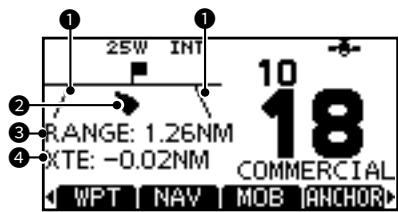
① XTE LIMIT LINE
② YOUR VESSEL ICON
When your vessel moves less than 2 knots per hour speed, ● is displayed.
③ RANGE
Displays the range (RNG) from your vessel to the target.
④ XTE
Displays the Cross Track Error.
32 Menu Screen Operation 2
See “Instructions ③” (31 Menu screen operation) for entering the menu screen operation.
The Menu screen is used for setting infrequently changed values, function settings or sending DSC calls.
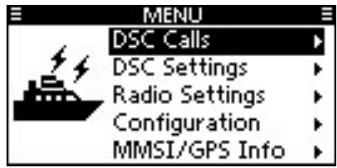
Menu lists
◇ MMSI/GPS Information
The transceiver shows the entered MMSI code and GPS information. If the code is not entered, "NO DSC MMSI" is displayed.
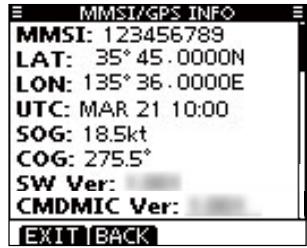
33 Radio Settings items
◇ Scan type
The transceiver has two scan types, Normal scan and Priority scan. A Normal scan searches all Favorite channels in the selected channel group. A Priority scan sequentially searches all Favorite channels, while monitoring Channel 16.
(Default: Priority Scan*)
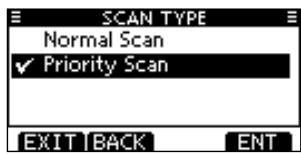
*“Normal Scan” is the default for the USA version.
◇ Scan timer
The scan timer can be selected as a pause (OFF) or timer scan (ON). When OFF is selected, the scan pauses until the signal disappears.
(Default: OFF)
- Priority scan: When ON is selected, the scan pauses for 5 seconds and then resumes, even if a signal has been received on any channel other than Channel 16.
- Normal scan: When ON is selected, the scan pauses for 5 seconds and then resumes, even if a signal has been received on any channel.
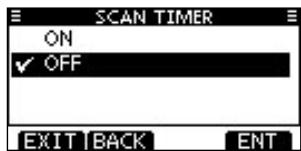
Dual/Tri-watch
This item can be selected as Dualwatch or Tri-watch. (p. 19) (Default: Dualwatch)
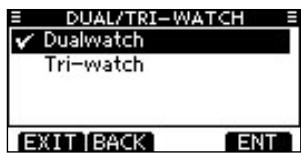
◇ Channel Group
Except for the European version, a channel group suitable for your operating area can be selected. Depending on the transceiver version, INT, USA, CAN, ATIS or DSC may be selectable.
- The screen below shows the USA version.
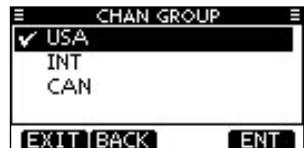
◇ Weather alert (For only USA and Australian version.)
A NOAA broadcast station transmits a weather alert tone before important weather information. (Default: OFF)
- "WX \✗\" blinks until the transceiver is operated after the transceiver detects the alert.
- "WX ➕" appears instead of "WX" when the function is set ON.
ON with Scan: The preset weather channels are sequentially checked while scanning.
ON: The previously selected (last used) weather channel is checked while scanning.
OFF: The transceiver does not detect a weather alert tone.
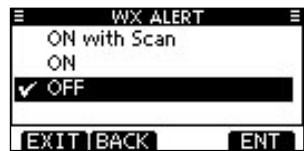
◇ CH Display
You can select the number of digits to display the channel number. (Default: 4 Digits)
- This setting may not be usable, depending on the transceiver's version or presetting.
3 Digits: The channel number is displayed in 3 digits, such as "01A."
4 Digits: The channel number is displayed in 4 digits, such as "1001."
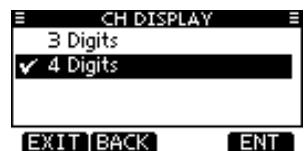
34 Configurations
See “Instructions ③” (31 Menu screen operation) for Backlight, Display Contrast, Key Beep, and COMMANDMIC Speaker functions details.
◇ Key Assignment
Desired functions can be assigned to Dial and the soft-keys.
① When the “KEY ASSIGNMENT” screen is displayed, rotate Dial or push [▲]/[▼] to select “Dial” or “Softkeys,” and then push [ENT].
② Rotate Dial or push [▲]/[▼] to select the desired position, and then push [ENT].
- To return to the default, select "Set default" and push [ENT].
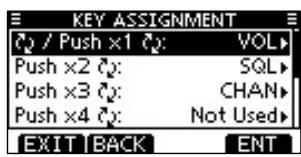
For "Dial" assignment
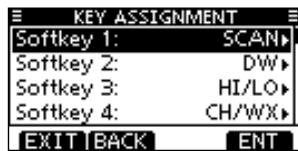
For "Softkeys" assignment
③ Rotate Dial or push [▲]/[▼] to select the option, and then push [ENT] to set it.
- “√” is displayed next to the selected option.
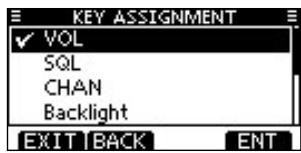
For "Dial" assignment
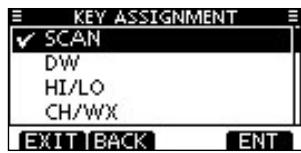
For "Softkeys" assignment*
*[CH/WX] appears instead of [CHAN], depending on the version.
④ Push [EXIT] to exit the Menu screen.
- Push [CLEAR] or [BACK] to return to the previous screen.
- Dial assignment
The Audio volume (VOL), squelch (SQL), channel selection (CHAN) and LCD backlight level (Backlight) functions can be assigned to any one of 4 sequential positions on Dial. Pushing Dial 1 to 4 times sequentially selects the desired function, and rotating Dial adjusts the level or selects a value or number.
For example:
- VOL is assigned the 1st position, and pushing Dial once selects VOL. The VOL adjust screen is displayed and rotating Dial adjusts the audio volume.
- CH is assigned to the 3rd position, and pushing Dial three times selects CH. The channel number is displayed and rotating Dial will select the desired channel.
You can assign VOL, SQL, CHAN and Backlight to any one of the 1st, 2nd, 3rd, or 4th sequential positions.
Repeatedly pushing Dial sequentially displays all the functions in the order they are assigned, and skips any functions assigned as Not Used.
- Softkeys assignment
The desired function can be assigned as the softkey function. The assigned function can be used when its key icon is displayed.
See page 3 for details of the assignable key functions.
◇ UTC Offset
Set the offset time between the UTC (Universal Time Coordinated) and your local time to between -14:00 and +14:00 (in 1 minute steps). (Default: 00:00)
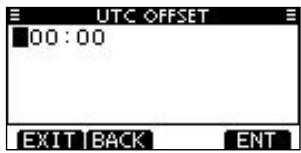
◇ Noise Cancel
Set the Noise Cancel function for both receive and transmit.
① When the "NOISE CANCEL" screen is displayed, rotate Dial or push [▲]/[▼] to select "RX" or "TX," and then push [ENT].
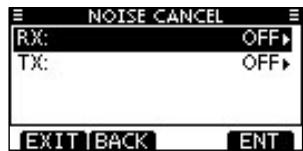
② Rotate Dial or push [▲]/[▼] to select the option, and then push [ENT] to set it.
- “√” is displayed next to the selected option.
③ Push [EXIT] to exit the Menu screen.
- Push [CLEAR] or [BACK] to return to the previous screen.
• RX
Turn the receive Noise Cancel function ON or OFF.
OFF: Turns OFF the function. (Default)
1: The Noise Cancel function reduces random noise components in the received signal to approximately one half.
2: The Noise Cancel function reduces random noise components in the received signal to approximately one third.
3: The Noise Cancel function reduces random noise components in the received signal to approximately one tenth.
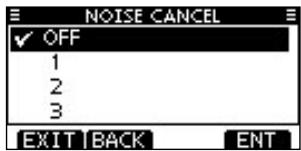
• TX
Turn the transmit Noise Cancel function ON or OFF.
OFF: Turns OFF the function. (Default)
ON: The Noise Cancel function reduces random noise components in the transmitted signal to one third.
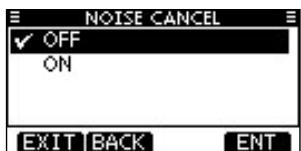
◇ Inactivity Timer
Set the inactivity timer to between 1 and 10 minutes (in 1 minute steps) or OFF for the “Not DSC Related” and “DSC Related” item, and set to between 1 and 15 minutes (in 1 minute steps) or OFF for the “DSC Related” item. The count down alarm sounds 10 seconds before the Inactive timer returns the current screen to the normal operating screen.
① When the “INACTIVITY TIMER” screen is displayed, rotate Dial or push [▲]/[▼] to select “Not DSC Related” or “DSC Related,” and then push [ENT].
② Rotate Dial or push [▲]/[▼] to select the option, and then push [ENT] to set it.
- “√” is displayed next to the selected option.
③ Push [EXIT] to exit the Menu screen.
- Push [CLEAR] or [BACK] to return to the previous screen.
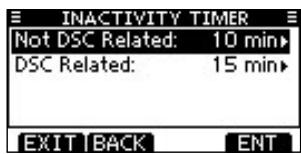
- Not DSC Related
When the LCD displays a screen other than the normal operation screen, or one not related to the DSC, and no key operation occurs for this set period, the transceiver automatically returns to the normal operating screen.
(Default: 10 min)
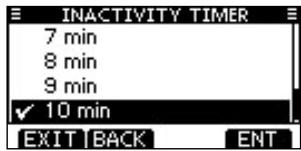
- DSC Related
When the LCD displays the screen related to the DSC, and no key operation occurs for this set period, the transceiver automatically returns to the normal operating screen.
(Default: 15 min)
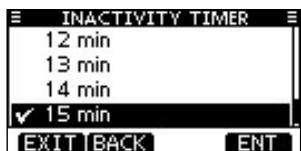
• RT Related (For only USA version.)
While receiving or transmitting a signal, and when the channel is changed, the RT (Radio Telephone) icon is displayed.
The icon disappears if you push no key for the period of time set in the Menu screen shown below.
(Default: 30 sec)
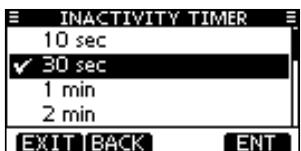
◇ NMEA Output
Select the Data Output function option for a NMEA output port.
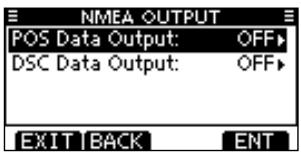
- POS data output
When receiving position data from an external GPS receiver, this function sends the data from the NMEA Output port to an external device.
(Default: OFF)
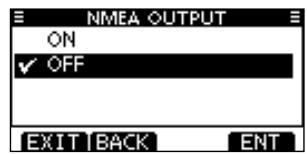
• DSC data output
When receiving a DSC call, this function sends the DSC data from the NMEA Output port to an external device.
(Default: OFF)
All Stations: Outputs the call from any vessel from the NMEA Output port.
Station List: Outputs the call from any vessels listed on the Individual ID screen.
OFF: Does not output any call to an external device.
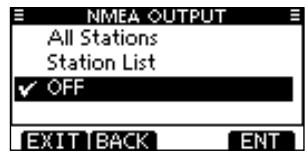
◇ Remote ID
Set a Remote ID number to between 1 and 69.
The Remote ID is included in the sentence of the Icom original NMEA format. (Default: 15)
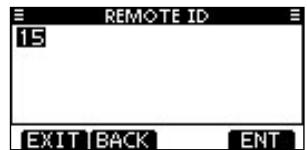
See “Instructions ①” (1 to 15), “Instructions ②” (16 to 22), or “Instructions ③” (23 to 31) for other functions.
- ■ Important
- SAVE THIS INSTRUCTION MANUAL —
- ■ Features
- ■ In Case of Emergency
- ◇ Using Channel 16
- ◇ Using Digital Selective Calling
- ■ Radio Operation Warning
- Determining MPE Radius
- Information FCC
- A WARNING STICKER is supplied with the USA version transceiver.
- ■ Precautions
- ■ Précautions
- Operation:
- ■ Disposal
- ■ About CE and DOC
- For the European versions:
- ■ Recommendation
- CLEAN THE TRANSCEIVER AND MICROPHONE THOROUGHLY WITH FRESH
- ■ Key Icon Description
- Information:
- Table of Contents
- TBD
- ◇ Priorities
- ◇ Privacy
- ◇ Radio licenses
- SHIP STATION LICENSE
- OPERATOR'S LICENSE
- ■ Command microphone
- PANEL DESCRIPTION
- ■ Function Display (INFO screen)
- ① BUSY/TRANSMIT
- ② ANCHOR WATCH INDICATOR
- ③ POWER
- RX HAILER
- AUTO FOGHORN
- ⑤ CHANNEL GROUP
- ⑥ CALL CHANNEL
- ⑦ DUPLEX
- FAVORITE CHANNEL
- ⑨ MESSAGE
- GPS INDICATOR
- ⑪ CH AUTO SWITCH
- RT (Radio Telephone) INDICATOR
- VOICE RECORD
- LOW BATTERY INDICATOR
- CH NUMBER READOUT
- CH NAME FIELD
- SOFTWARE KEYS
- TIME ZONE
- POSITION
- SCAN INDICATOR
- ATTENUATOR INDICATOR
- ■ Software Keys
- ◇ Selecting a Software Key function
- ◇ Software Key functions
- Compose Distress [DTRS] (p.XX)
- Compose other DSC [DSC] (p.XX)
- Task List [TASK] (p.XX)
- Unread List [UNREAD] (p.XX)
- DISPLAY [DISP] (p.XX)
- Range [RANGE] (p.XX)
- Target Select [SEL ◀]/[SEL ▶] (p.XX)
- Target Details [INFO] (p.XX)
- Scan [SCAN] (p.XX)
- Dualwatch/Tri-watch [DW]/[TW] (p.XX)
- Channel/Weather channel [CH/WX] (p.XX)
- DSC Log [LOG] (p.XX)
- Man Overboard [MOB] (p.XX)
- Anchor Watch [ANCHOR] (p.XX)
- High/Low [HI/LO] (p.XX)
- RX Play [PLAY] (p.XX)
- RX Hailer [R×□:] (p.XX)
- Attenuator [LO/DX] (p.XX)
- AquaQuake [AQUA] (p.XX)
- Favorite Channel [★] (p.XX)
- CH Name [NAME] (p.XX)
- Backlight [BKLT] (p.XX)
- For only the European version:
- ■ Entering the MMSI code
- This initial code can be entered only once.
- TIP:
- ■ Entering the ATIS ID (For NLD and FRG versions)
- This ID entering can be done only once.
- ■ Selecting a channel
- ◇ Regular Channel
- ◇ Channel 16
- ◇ Call channel
- ◇ Selecting a Channel Group
- ■ Weather channels and Weather Alert (For only the USA version)
- ◇ Selecting a Weather channel
- Push [CH/WX].
- Push [▲] or [▼], or rotate [DIAL] to select a Weather channel.
- ◇ Setting the Weather Alert
- BASIC OPERATIONS
- ■ Adjusting the volume/squelch/backlight/display contrast
- ◇ Adjusting the volume level
- ◇ Adjusting the squelch level
- ◇ Adjusting the backlight
- ◇ Adjusting the display contrast
- ■ Setting the Call channel
- ■ AquaQuake Water Draining function
- ■ Editing a channel name
- ■ Receiving and transmitting
- ■ Scan types
- Before starting a scan :
- Normal Scan
- Priority Scan
- When a signal is received:
- 5
- SCAN OPERATION
- ■ Setting Favorite channels (Except for the NLD version)
- ■ Starting a scan (Except for the NLD version)
- DUALWATCH/TRI-WATCH (Except for the NLD version)
- ■ Description
- Operation
- ■ DSC address ID
- ◇ Entering an Individual or Group ID
- NOTE:
- ◇ Deleting an entered ID
- ■ Entering the position and time
- DIGITAL SELECTIVE CALLING (DSC)
- ■ Sending DSC calls (Distress)
- ◇ Simple call
- ◇ Regular call
- Push DTRS
- ◇ Distress Cancel call
- ◇ Distress call Software Key description
- ◇ Sending a Distress Relay acknowledgment (For only the USA version)
- ■ Sending DSC calls (other)
- ◇ Sending an Individual call
- Push DSC
- ◇ Sending an Individual Acknowledgment
- ◇ Sending an All Ships call
- Push DSC.
- ◇ Sending a Group call
- ◇ Sending a Test call
- Select "Test Call," and then push [ENT] or [DIAL].
- Select "Address," and then push [ENT] or [DIAL].
- Select a station to send the Test call to.
- Push CALL to send the Test call.
- When you receive an Acknowledgment:
- Push ALARM OFF to turn OFF the alarm.
- Push CLOSE.
- Push 🏠 to return to the operating screen.
- Push OK to return to the operating screen.
- ◇ Sending a Test Acknowledgment
- ◇ Sending a Position Request call/Polling Request call (For only the USA version)
- ◇ Sending a Position Reply call
- ACPT : Accepts the call.
- ◇ Sending a Polling Reply call
- ■ Receiving DSC calls (Distress)
- When a Distress call is received:
- When a Distress acknowledgment is received:
- When a Distress Cancel call is received:
- ◇ Receiving a Distress Relay call
- When a Distress Relay call is received:
- Push ALARM OFF.
- Push the Software Key below the next operation.
- Push 🔊, and then OK to return to the operating screen.
- ■ Receiving DSC calls (other)
- ◇ Receiving an Individual call
- When an Individual call is received:
- ◇ Receiving a Group call or All Ships call
- When a Group call is received:
- When an All Ships call is received:
- ◇ Receiving a Position Request call
- When a Position Request call is received:
- ◇ Receiving a Test call
- When a Test call is received:
- - Receiving a Test acknowledgment/Position Reply call\* /Polling Reply call (\*For only the USA version)
- When a call is received:
- ■ DSC Log
- ◇ Received DSC Log
- ◇ Transmitted DSC Log
- ■ Multiple-task mode
- ◇ Holding a DSC task
- Example: When a Group call is received:
- ◇ Activating the held DSC task
- ◇ Task list
- ■ DSC Settings
- Position Input
- Individual ID
- Group ID
- Auto ACK
- - Individual ACK
- - Position ACK
- - Polling ACK
- - Test ACK
- CH Auto Switch
- DSC Data Output
- Alarm Status
- CH 70 SQL Level
- Self Check Test
- Procedure (For only the USA version)
- ■ Making an Individual call to an AIS target
- ◇ Selecting an AIS target on the IC-M510BB
- ◇ Using an AIS transponder
- Transponder operation:
- Transceiver operation:
- ■ DSC Remote Control (EN 300 338-8 compatible)
- ◇ Editing a controller name
- ◇ Setting the Priority Controller
- ◇ Dealing with ID and Priority
- When a controller gets disconnected while holding a DSC task:
- - Allowing controllers to perform DSC operations
- ■ About AIS
- ■ AIS classes
- ■ Using the Plotter screen
- ◇ Plotter screen
- ① DISPLAY TYPE
- ② YOUR VESSEL ICON
- ③ TARGET ICONS
- TARGET BOX
- ⑤ COMPASS
- AIS FUNCTION
- ■ Using the AIS list screen
- ◇ Target/Friends List screen
- ① THE NUMBER OF TARGETS
- ② TARGET INFORMATION
- ◇ Danger list screen
- ② DANGER TARGET INFORMATION
- ■ Setting a Friend
- ◇ Entering an ID
- Using the Friends List:
- Selecting in the Target List or Danger List:
- Selecting on the plotter display:
- ◇ Editing an ID
- ◇ Deleting an ID
- ■ About the Detail screen
- ◇ Contents list
- ■ AIS settings
- North up/Course up
- Target Display
- CPA/TCPA
- - Alarm
- - Approach
- - Lost
- - Audible Alarm
- CPA
- - TCPA
- - Slow Warn
- - Function
- - Speed
- Friends
- - Friends List
- - Friends Alarm
- ON
- - Range
- 8
- AIS FUNCTION
- ID Blocking
- - Entering an ID
- - Editing an ID
- - Deleting an ID
- ■ MOB (Man Overboard)
- ◇ Starting MOB
- ◇ Stopping MOB
- 9
- OTHER FUNCTIONS
- Anchor Watch
- ◇ Starting Anchor Watch
- ◇ Stopping Anchor Watch
- ◇ Anchor Watch Settings
- ■ Lost target
- The criteria to become a Lost target
- OTHER FUNCTIONS
- ■ Voice Record
- ◇ Audio recording
- ◇ Audio playback
- ■ Using the Intercom
- NOTE: While using the Intercom function,
- ■ Using the RX Hailer
- ■ Using the Hailer
- ■ Using the Horn function
- ◇ Automatic Foghorn function
- ◇ Horn Volume function
- ◇ Manual Horn function
- ◇ Frequency setting
- MENU SCREEN
- ■ Using the Menu screen
- ◇ Menu screen operation
- ◇ Menu screen items
- ■ Menu items description
- ◇ GPS Info
- ◇ Settings
- - Configuration
- Backlight
- Display Contrast
- Key Beep
- Key Assignment
- - Softkeys (1\~20)
- - Dial
- UTC Offset
- Inactivity Timer
- - Not DSC Related
- - DSC Related
- - Distress Related
- - RT Related
- GPS
- • GPS
- - GLONASS
- - SBAS
- COMMANDMIC SP
- - External Speaker
- ● External Speaker
- RX Hailer
- Noise Cancel
- - RX
- - TX/Hailer
- Power Switch
- - All Units
- - Own Unit
- Controller
- - Name
- - Priority
- - DSC Operation
- • ID
- Model
- - Radio
- Scan Type
- Scan Timer
- Dual/Tri-Watch
- Channel Group
- Call Channel
- WX Alert
- Voice Record
- Favorite Channel
- Channel Display
- LO/DX
- • NMEA
- NMEA 0183
- NMEA 2000
- ◇ Radio Info
- CONNECTIONS
- ■ Connections
- ① COMMAND MICROPHONE JACK
- ② NMEA 2000™ CONNECTOR
- ③ GPS ANTENNA CONNECTOR
- ④ ANTENNA CONNECTOR
- ⑤ NMEA IN/OUT LEADS
- ⑥ AF OUT LEADS
- NOTE for NMEA In/Out and AF Out
- ⑦ DC POWER CONNECTOR
- GROUND TERMINAL
- ⑨ DSC REMOTE CONTROL INTERFACE
- ■ Cleaning
- ■ Connecting to the MA-510TR
- ■ Supplied accessories
- ■ Fuse replacement
- ■ Mounting the transceiver
- ■ Microphone installation
- ◇ Installation
- SPECIFICATIONS AND OPTIONS
- Specifications
- IC-M510BB USA Version
- ◇ General
- ◇ Transmitter
- ◇ Receiver
- IC-M510BB European Versions
- ■ Specifications
- Common
- ◇ Built-in GPS receiver
- ■ Dimensions
- Options
- TROUBLESHOOTING
- The transceiver does not turn ON.
- Little or no sound comes from the speaker.
- You cannot transmit with high power.
- Scan does not start.
- No beep sounds.
- Individual or Group ID cannot be set.
- “??” blinks instead of the position and time.
- “No Position” and “No Time” are displayed instead of the position and time.
- Sensitivity is too low, and only strong signals can be heard.
- Communication cannot be established.
- The transceiver is locked up, and does not respond.
- The transceiver does not work.
- The collision alarm does not sound.
- ■ For IC-M510BB USA version
- CH LIST
- ■ For IC-M510BB EUR versions
- ■ Operating Rules
- Supplied accessories
- Function display
- Panel description
- Softkey function
- Selecting a Channel
- Selecting a Channel (Continued)
- ◇ Selecting the Channel group
- Receiving and transmitting
- √ Information
- √ NOTE for the TOT (Time-out Timer) function
- Entering a Call channel
- Entering a Channel name
- Using the AquaQuake water draining function
- Adjusting the volume level
- Adjusting the squelch level
- Adjusting the Backlight level
- Setting Favorite channels
- √ Clearing (or setting) all tagged channels
- Starting a scan
- Dualwatch/Tri-watch operation
- Icom Inc.
- Entering Individual/Group ID
- Deleting Individual/Group ID
- Entering position and time
- Making a Distress Call
- Canceling a Distress call
- Making a Distress Relay ACK
- ◇ Making an Individual Call
- ◇ Making an Individual Acknowledgement
- Quick ACK:
- Manual ACK:
- ◇ Making a Group Call
- ◇ Making an All Ships Call
- ◇ Making a Position Request Call
- ◇ Making a Position Report Call
- ◇ Transmitting a Polling Request Call
- ◇ Transmitting a Test Call
- ◇ Making a Test Acknowledgement Call Quick ACK:
- ◇ Making a Position Reply Call
- Quick Reply:
- Manual Reply:
- ◇ Making a Position Report Reply Call
- ◇ Transmitting a Polling Reply Call
- Receiving DSC calls
- ◇ Receiving a Distress Relay Call/Distress Relay Acknowledgement
- Receiving DSC calls (Continued)
- Received Call Log
- Transmitted Call Log
- DSC Settings
- ◇ Automatic Acknowledgement
- ◇ Channel Auto Switch function (For only USA version.)
- ◇ Channel 16 Switch function
- ◇ DSC Data Output
- ◇ Alarm
- ◇ Channel 70 Squelch level
- ◇ DSC Loop Test
- Intercom operation
- RX Speaker function
- PA (Public Address) function
- Horn function
- Menu screen operation
- ◇ Entering the Menu screen and operation
- - Backlight
- - Display contrast
- • Key Beep
- • COMMANDMIC Speaker
- TIP
- ① TARGET BOX
- DISPLAY RANGE
- ⑤ DISPLAY FILTER INDICATOR
- ◇ Highway screen
- ① XTE LIMIT LINE
- ③ RANGE
- ④ XTE
- Menu Screen Operation 2
- ◇ MMSI/GPS Information
- Radio Settings items
- ◇ Scan type
- ◇ Scan timer
- ◇ Channel Group
- ◇ CH Display
- Configurations
- ◇ Key Assignment
- - Dial assignment
- For example:
- - Softkeys assignment
- ◇ UTC Offset
- ◇ Noise Cancel
- • RX
- OFF: Turns OFF the function. (Default)
- • TX
- ◇ Inactivity Timer
- ◇ NMEA Output
- - POS data output
- • DSC data output
- ◇ Remote ID
Brand : ICOM
Model : M510
Category : Marine transceiver