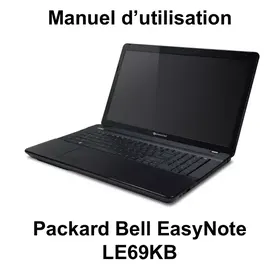
EASYNOTE LE69KB 23804 - Laptop PACKARD BELL - Free user manual and instructions
Find the device manual for free EASYNOTE LE69KB 23804 PACKARD BELL in PDF.


| Product type | Laptop |
| Brand | Packard Bell |
| Model | EasyNote LE69KB (23804) |
| Processor | Variable model (Intel or AMD) |
| RAM | Up to 8 GB (depending on configuration) |
| Hard drive | Variable capacity (HDD model) |
| Screen | 15.6-inch LCD (variable resolution) |
| Touchpad | Multi-touch touchpad with gestures |
| Keyboard | French, integrated numeric keypad |
| Wireless connectivity | Wi-Fi 802.11 b/g/n, Bluetooth (depending on model) |
| Wired network | Ethernet 10/100/1000 (RJ-45) |
| USB ports | USB 2.0 (black) and USB 3.0 (blue) |
| Video output | VGA and HDMI |
| Card reader | Secure Digital (SD/SDHC/SDXC) |
| Optical drive | Internal DVD/CD burner |
| Webcam | Integrated with microphone |
| Battery | Rechargeable lithium-ion, variable battery life |
| Power supply | External AC adapter |
| Operating system | Pre-installed Windows 8 |
| Included utilities | Packard Bell Recovery Management, Norton Internet Security (trial) |
| Maintenance | Clean with a damp cloth, do not use liquid products |
| Security | Kensington lock slot, BIOS/Windows password |
| Repairability | Access to battery, hard drive, and memory from the bottom |
Frequently Asked Questions - EASYNOTE LE69KB 23804 PACKARD BELL
User questions about EASYNOTE LE69KB 23804 PACKARD BELL
0 question about this device. Answer the ones you know or ask your own.
Ask a new question about this device
Download the instructions for your Laptop in PDF format for free! Find your manual EASYNOTE LE69KB 23804 - PACKARD BELL and take your electronic device back in hand. On this page are published all the documents necessary for the use of your device. EASYNOTE LE69KB 23804 by PACKARD BELL.
USER MANUAL EASYNOTE LE69KB 23804 PACKARD BELL
HAVING PROBLEMS?
Packard Bell Support
EXTENSION WITH OPTIONS
Packard Bell Recovery Management
Packard Bell Recovery Management
Welcome to Packard Bell Recovery Management
Packard Bell Recovery Management enables you to restore your system. To begin, select the task you want to perform. Please DO NOT remove the USB device while proceeding.

Customized Restore (Retain User Data)

Reinstall Drivers or Applications
Make a backup before you restore (Recommended).

Create Factory Default Backup
Create Drivers and Applications Backup

packard bell
Restores your computer to its factory default status. A system is required. NOTE: All data on drive C will be deleted.

Here's what will happen:
- Your files and personalization settings won't change.
- Your PC settings will be changed back to their defaults.
- Apps from Windows Store will be kept.
- Apps you installed from discs or websites will be removed.
- A list of removed apps will be saved on your desktop.
Next
Cancel
The FCC with its action in ET Docket 96-8 has adopted a safety standard for human exposure to radio frequency (RF) electromagnetic energy emitted by FCC certified equipment. The wireless adapter meets the Human Exposure limits found in OET Bulletin
65, supplement C, 2001, and ANSI/IEEE C95.1, 1992. Proper operation of this radio according to the instructions found in this manual will result in exposure substantially below the FCC's recommended limits.
- The following safety precautions should be observed:
Do not touch or move antenna while the unit is transmitting or receiving.
- Do not hold any component containing the radio such that the antenna is very close or touching any exposed parts of the body, especially the face or eyes, while transmitting.
- Do not operate the radio or attempt to transmit data unless the antenna is connected; this behavior may cause damage to the radio.
Use in specific environments:
- The use of wireless adapters in hazardous locations is limited by the constraints posed by the safety directors of such environments.
- The use of wireless adapters on airplanes is governed by the Federal Aviation Administration (FAA).
- The use of wireless adapters in hospitals is restricted to the limits set forth by each hospital.
Antenna Use
In order to comply with FCC RF exposure limits, low gain integrated antennas should be located at a minimum distance of 20 cm (8 inches) or more from the body of all persons or at a minimum distance as specified by the FCC module grant conditions. FCC grants can be viewed from the FCC Equipment Authorization website at https://fjallfoss.fcc.gov/oetcf/eas/reports/GenericSearch.cfm by entering the FCC ID printed on the module label.
Explosive Device Proximity Warning
Warning: Do not operate a portable transmitter (including this wireless adapter) near unshielded blasting caps or in an explosive environment unless the transmitter has been modified to be qualified for such use.
Antenna Warnings
- Warning: To comply with the FCC and ANSI C95.1 RF exposure limits, it is recommended that for the wireless adapter installed in a desktop or portable computer, the antenna for this wireless adapter be installed so as to provide a separation distance of at least 20 cm (8 inches) from all persons or at the minimum distance as specified by the module grant conditions. FCC grants can be viewed from the FCC Equipment Authorization website at https://fjallfoss.fcc.gov/oetcf/eas/reports/GenericSearch.cfm by entering the FCC ID printed on the module label.
- Warning: The wireless adapter is not designed for use with high-gain directional antennas.
Use On Aircraft Caution
- Caution: Regulations of the FCC and FAA prohibit airborne operation of radio-frequency wireless devices (wireless adapters) because their signals could interfere with critical aircraft instruments.
Local Restrictions on 802.11a, 802.11b, 802.11g and 802.11n Radio Usage
- Caution: Due to the fact that the frequencies used by 802.11a, 802.11b, 802.11g and 802.11n wireless LAN devices may not yet be harmonized in all countries, 802.11a, 802.11b, 802.11g and 802.11n products are designed for use only in specific countries, and are not allowed to be operated in countries other than those of designated use. As a user of these products, you are responsible for ensuring that the products are used only in the countries for which they were intended and for verifying that they are configured with the correct selection of frequency and channel for the country of use. Any deviation from the permissible power and frequency settings for the country of use is an infringement of national law and may be punished as such.
Wireless Interoperability
The wireless adapter is designed to be interoperable with other wireless LAN products that are based on direct sequence spread spectrum (DSSS) radio technology and to comply with the following standards:
- IEEE Std. 802.11b compliant Standard on Wireless LAN
- IEEE Std. 802.11g compliant Standard on Wireless LAN
- IEEE Std. 802.11a compliant Standard on Wireless LAN (applies to devices supporting 802.11a)
- IEEE Std. 802.11n draft 2.0 compliant on Wireless LAN
- Wireless Fidelity certification, as defined by the Wi-Fi Alliance
The Wireless Adapter and Your Health
The wireless adapter, like other radio devices, emits radio frequency electromagnetic energy. The level of energy emitted by the wireless adapter, however, is less than the electromagnetic energy emitted by other wireless devices such as mobile phones. The wireless adapter operates within the guidelines found in radio frequency safety standards and recommendations. These standards and recommendations reflect the consensus of the scientific community and result from deliberations of panels and committees of scientists who continually review and interpret the extensive research literature. In some situations or environments, the use of the wireless adapter may be restricted by the proprietor of the building or responsible representatives of the applicable organization. Examples of such situations may include:
- Using the wireless adapter on board airplanes, or
- Using the wireless adapter in any other environment where the risk of interference with other devices or services is perceived or identified as being harmful.
If you are uncertain of the policy that applies to the use of wireless adapters in a specific organization or environment (an airport, for example), you are encouraged to ask for authorization to use the adapter before you turn it on.
FCC Radio Frequency Interference Requirements (applies to device supporting 802.11a)
This device is restricted to indoor use due to its operation in the 5.15 to 5.25 GHz and 5.470 to 5.725 GHz frequency ranges. FCC requires this product to be used indoors for the frequency ranges 5.15 to 5.25 GHz and 5.470 to 5.725 GHz to reduce the potential
for harmful interference to co-channel mobile satellite systems. High power radars are allocated as primary users of the 5.25 to 5.35 GHz and 5.65 to 5.85 GHz bands. These radar stations can cause interference with and/or damage this device. No configuration controls are provided for this wireless adapter allowing any change in the frequency of operations outside the FCC grant of authorization for U.S operation according to Part 15.407 of the FCC rules.
USA — Federal Communications Commission (FCC)
This device complies with Part 15 of the FCC Rules. Operation of the device is subject to the following two conditions:
- This device may not cause harmful interference.
- This device must accept any interference that may cause undesired operation.
- Note: The radiated output power of the adapter is far below the FCC radio frequency exposure limits. Nevertheless, the adapter should be used in such a manner that the potential for human contact during normal operation is minimized. To avoid the possibility of exceeding the FCC radio frequency exposure limits, you should keep a distance of at least 20 cm between you (or any other person in the vicinity), or the minimum separation distance as specified by the FCC grant conditions, and the antenna that is built into the computer. Details of the authorized configurations can be found at http://www.fcc.gov/oet/ea/ by entering the FCC ID number on the device.
Interference Statement
This wireless adapter has been tested and found to comply with the limits for a Class B digital device, pursuant to Part 15 of the FCC Rules. These limits are designed to provide reasonable protection against harmful interference in a residential installation. This wireless adapter generates, uses, and can radiate radio frequency energy. If the wireless adapter is not installed and used in accordance with the instructions, the wireless adapter may cause harmful interference to radio communications. There is no guarantee, however, that such interference will not occur in a particular installation. If this wireless
adapter does cause harmful interference to radio or television reception (which can be determined by turning the equipment off and on), the user is encouraged to try to correct the interference by taking one or more of the following measures:
- Reorient or relocate the receiving antenna of the equipment experiencing the interference.
- Increase the distance between the wireless adapter and the equipment experiencing the interference.
- Connect the computer with the wireless adapter to an outlet on a circuit different from that to which the equipment experiencing the interference is connected.
- Consult the dealer or an experienced radio/TV technician for help.
- Note: The adapter must be installed and used in strict accordance with the manufacturer's instructions as described in the user documentation that comes with the product. Any other installation or use will violate FCC Part 15 regulations.
Canada - Industry Canada (IC)
This device complies with RSS210 of Industry Canada. Cet appareil se conforme à RSS210 de Canada d'Industrie.
This Class B digital apparatus complies with Canadian ICES-003.
To prevent radio interference to the licensed service, this device is intended to be operated indoors and away from windows to provide maximum shielding. Equipment (or its transmit antenna) that is installed outdoors is subject to licensing.
The use of these equipments is regulated by:
1. D.L.gs 1.8.2003, n. 259, article 104 (activity subject to general authorization) for outdoor use and article 105 (free use) for indoor use, in both cases for private use. 2. D.M. 28.5.03, for supply to public of LAN access to networks and telecom services.
Pakistan Telecommunication Authority (PTA) Approved
Morocco
The operation of this product in the radio channel 2 (2417 MHz) is not authorized in the following cities: Agadir, Assa-Zag, Cabo Negro, Chaouen, Goulmima, Oujda, Tan Tan, Taourirt, Taroudant and Taza.
The operation of this product in the radio channels 4, 5, 6 and 7 (2425 - 2442 MHz) is not authorized in the following cities: Aéroport Mohamed V, Agadir, Aguelmous, Anza, Benslimane, Béni Hafida, Cabo Negro, Casablanca, Fès, Lakhab, Marrakech, Merchich, Mohammédia, Rabat, Salé, Tanger, Tan Tan, Taounate, Tit Mellil, Zag.
Japan
The 5 GHz band is for indoor use only.
Korea
MODIFICATIONS TO THE PRODUCT
CE Approval
PRODUCT DISPOSAL
low conditions. 45
remove 43
installation. 43
Maintenance Recovery Management 69
Update
Recovery Management Program..... 50
Recovery Management Program.... 50 Recovery Management 69
network 35
s
Security Support
Antivirus 60 Packard Bell Website 57
Updates 67
T
special keys 29 touchpad 31
Windows keys 30 use 31
universal serial bus. 36

- HAVING PROBLEMS
- PACKARD BELL SUPPORT
- EXTENSION WITH OPTIONS
- PACKARD BELL RECOVERY MANAGEMENT
- ANTENNA USE
- EXPLOSIVE DEVICE PROXIMITY WARNING
- ANTENNA WARNINGS
- USE ON AIRCRAFT CAUTION
- LOCAL RESTRICTIONS ON 802.11A, 802.11B, 802.11G AND 802.11N RADIO USAGE
- WIRELESS INTEROPERABILITY
- THE WIRELESS ADAPTER AND YOUR HEALTH
- FCC RADIO FREQUENCY INTERFERENCE REQUIREMENTS (APPLIES TO DEVICE SUPPORTING 802.11A)
- USA — FEDERAL COMMUNICATIONS COMMISSION (FCC)
- INTERFERENCE STATEMENT
- CANADA - INDUSTRY CANADA (IC)
- MOROCCO
- JAPAN
- KOREA
- MODIFICATIONS TO THE PRODUCT
- CE APPROVAL
- PRODUCT DISPOSAL
- S
- T
Brand : PACKARD BELL
Model : EASYNOTE LE69KB 23804
Category : Laptop