 ManualGo.com
LN-S4695D - TV SAMSUNG - Free user manual and instructions
Find the device manual for free LN-S4695D SAMSUNG in PDF.



Download the instructions for your TV in PDF format for free! Find your manual LN-S4695D - SAMSUNG and take your electronic device back in hand. On this page are published all the documents necessary for the use of your device. LN-S4695D by SAMSUNG.
USER MANUAL LN-S4695D SAMSUNG
Customer Care Center ☎ Web Site CANADA 1-800-SAMSUNG (7267864) www.samsung.com/ca U.S.A 1-800-SAMSUNG (7267864) www.samsung.com LN-S4095D LN-S4695D Address Samsung Electronics Canada Inc., Customer Service 55 Standish Court Mississauga, Ontario L5R 4B2 Canada Samsung Electronique Canada Inc., Service á la Clientéle 55 Standish Court Mississauga, Ontario L5R 4B2 Canada Samsung Electronics America, Inc. 105 Challenger Road Ridgefield Park, NJ 07660-0511 TFT-LCD TELEVISION Owner’s Instructions BN68-01047J-01 Register your product at www.samsung.com/global/register Still 5/19/06 4:22 AM Page 1 Precautions When Displaying a Still Image A still image may cause permanent damage to the TV screen.
- Do not display a still image on the LCD panel for more than 2 hours as it can cause screen image retention. This image retention is also known as "screen burn". To avoid such image retention, reduce the degree of brightness and contrast of the screen when displaying a still image.
Watching the LCD TV in 4:3 format for a long period of time may leave traces of borders displayed on the left, right and center of the screen caused by the difference of light emission on the screen. Playing a DVD or a game console may cause a similar effect to the screen. Damages caused by the above effect are not covered by the Warranty. Displaying still images from Video games and PC for longer than a certain period of time may produce partial after-images. To prevent this effect, reduce the ‘brightness’ and ‘contrast’ when displaying still images. © 2006 Samsung Electronics Co., Ltd. All rights reserved. BN68-01047J-01Eng.qxd 7/13/06 4:50 AM Page 1 GENERAL INFORMATION PICTURE CONTROL CONNECTIONS Connecting VHF and UHF Antennas ................................................. Connecting Cable TV......................................................................... Connecting a VCR ............................................................................. Connecting an S-VHS VCR ............................................................... Connecting a Camcorder ................................................................... Connecting a DVD Player/Set-Top Box ............................................. Connecting a DVD Player/Set-Top Box via DVI ................................ Connecting a DVD Player/Set-Top Box via HDMI ............................. Connecting a Digital Audio System.................................................... Connecting an Amplifier/DVD Home Theater .................................... Connecting a PC................................................................................
Setting the Function Help ............................................................. Using the Energy Saving Feature ................................................ Menu Transparency Level ............................................................ Using Game Mode ............................................................................. Using the V-Chip........................................................................... How to Enable/Disable the Rating Controls ................................. How to Set up Restrictions Using “TV Parental Guidelines” ........ How to Set up Restrictions Using “MPAA Rating” ........................ Important Notes About Parental Locks......................................... How to Set up Restrictions Using Canadian English ................... How to Set up Restrictions Using Canadian French .................... Using the V-Chip for Digital channels........................................... Viewing Closed Captions (On-Screen Text Messages) Analog ...... Viewing Closed Captions (On-Screen Text Messages) Digital ...... Setting the Blue Eye .....................................................................
BN68-01047J-01Eng.qxd 7/13/06 4:50 AM Page 2 Contents PC DISPLAY APPENDIX Setting Up Your PC Software (Windows Only)............................. Display Modes ............................................................................. Adjusting the Picture Quality ........................................................ Changing the Picture Position ...................................................... Adjusting the Picture Quality and Position Automatically ............. Changing the Picture Size (PC Mode) ......................................... Viewing the Current Resolution .................................................... Initializing the Picture Settings...................................................... Symbol Press
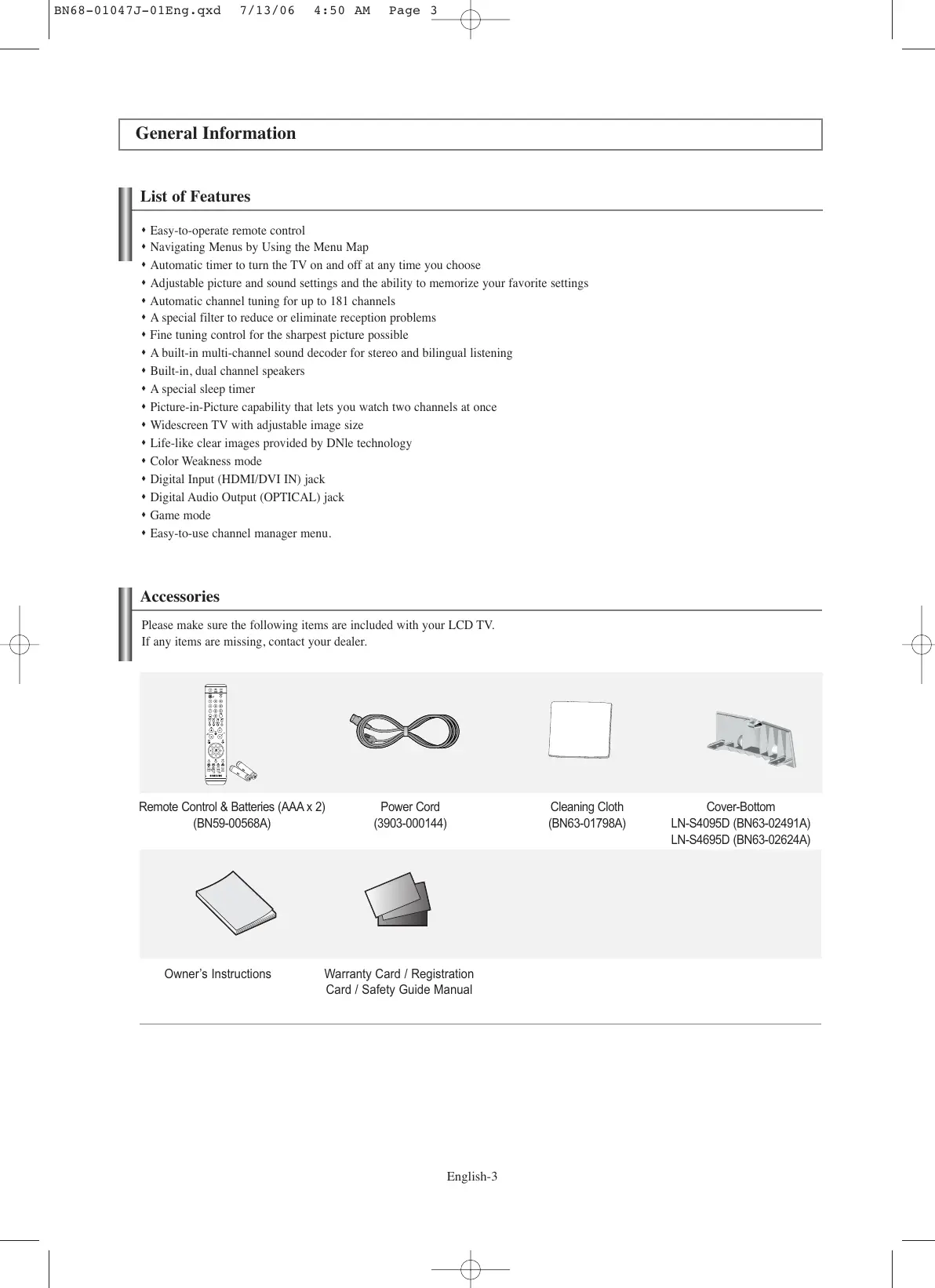
Note English-2 List of Features Easy-to-operate remote control Navigating Menus by Using the Menu Map Automatic timer to turn the TV on and off at any time you choose Adjustable picture and sound settings and the ability to memorize your favorite settings Automatic channel tuning for up to 181 channels A special filter to reduce or eliminate reception problems Fine tuning control for the sharpest picture possible A built-in multi-channel sound decoder for stereo and bilingual listening Built-in, dual channel speakers A special sleep timer Picture-in-Picture capability that lets you watch two channels at once Widescreen TV with adjustable image size Life-like clear images provided by DNle technology Color Weakness mode Digital Input (HDMI/DVI IN) jack Digital Audio Output (OPTICAL) jack Game mode Easy-to-use channel manager menu. Accessories Please make sure the following items are included with your LCD TV. If any items are missing, contact your dealer. Remote Control & Batteries (AAA x 2) (BN59-00568A) Owner’s Instructions Power Cord (3903-000144) Warranty Card / Registration Card / Safety Guide Manual English-3 Cleaning Cloth (BN63-01798A) Cover-Bottom LN-S4095D (BN63-02491A) LN-S4695D (BN63-02624A) BN68-01047J-01Eng.qxd 7/13/06 4:50 AM Page 4 Viewing the Control Panel Buttons on the Lower-Right Part of the Panel The buttons on the lower-right panel control your TV’s basic features, including the on-screen menu. To use the more advanced features, you must use the remote control. The product color and shape may vary depending on the model. SOURCE Toggles between all the available input sources (TV, AV1, AV2, S-Video1, S-Video2, Component1, Component2, PC, HDMI1, HDMI2). In the on-screen menu, use this button as you would use the ENTER button on the remote control. MENU Press to see an on-screen menu of your TV’s features. Press to increase or decrease the volume. In the on-screen menu, use the buttons as you would use the and buttons on the remote control. English-4 Press to change channels. In the on-screen menu, use the buttons as you would use the and buttons on the remote control. SPEAKERS (POWER) Press to turn the TV on and off. POWER INDICATOR Blinks and turns off when the power is on and lights up in stand-by mode.
REMOTE CONTROL SENSOR
Aim the remote control towards this spot on the TV. BN68-01047J-01Eng.qxd 7/13/06 4:50 AM Page 5 Viewing the Connection Panel Rear Panel Jacks Use the rear panel jacks to connect A/V components that will be connected continuously, such as VCR or DVD players. For more information on connecting equipment, see pages 8-14. SERVICE 1/SERVICE 2 Connectors for service only.
DVI IN, HDMI/DVI IN 1,2
Connect to the HDMI jack of a device with an HDMI output. AV OUT Connect to the audio input jacks on your Amplifier/ Home theater. Use the HDMI/DVI terminal for DVI connection to an external device with a DVI output. You should use a DVI to HDMI cable or DVI-HDMI adapter (DVI to HDMI) for video connection, and the DVI-IN ‘R-AUDIO-L’ terminal for audio. - HDMI/DVI IN terminal does not support PC. - No sound connection is needed for an HDMI to HDMI connection. Sound connection is only needed for HDMI to DVI. DIGITAL AUDIO OUT (OPTICAL) Connect to a Digital Audio component. AV IN 1 Video and audio inputs for external devices, such as a camcorder or VCR. S-VIDEO Connect an S-Video signal from a camcorder or VCR.
ANT 1 IN/ANT 2 IN
Connect to an antenna or cable TV system. English-5 PC IN Connect to the video and audio output jacks on your PC. POWER INPUT Connect the supplied power cord. The place of the Power input may be different depending on its model. KENSINGTON LOCK The Kensington lock (optional) is a device used to physically fix the system when used in a public place. If you want to use a locking device, contact the dealer where you purchased the TV. BN68-01047J-01Eng.qxd 7/13/06 4:50 AM Page 6 Side Panel Jacks Use the left side panel jacks to connect a component that is used only occasionally, such as a camcorder or video game. (See page 11) AV IN 2 Video and audio inputs for external devices. S-VIDEO 2 Video inputs for external devices with an S-Video output. HEADPHONE Connect a set of external headphones for private listening. English-6 BN68-01047J-01Eng.qxd 7/13/06 4:50 AM Page 7 Remote Control You can use the remote control up to a distance of about 23 feet from the TV. When using the remote, always point it directly at the TV. You can also use your remote control to operate your VCR, Cable box, DVD player, or Set-Top Box. POWER Turns the TV on and off. NUMERIC BUTTONS Press to change the channel. Press to select additional channels (digital and analog) being broadcast by the same station. For example, to select channel “54-3”, press “54”, then press “–” and “3”. CH MGR Used to display Channel Lists on the screen. ANTENNA Press to select “AIR” or “CABLE”. VCR/DVD Functions - Rewind - Stop - Play/Pause - Fast/Forward VOL / VOL Press to increase or decrease the volume. (MUTE) Press to temporarily cut off the sound. MENU Displays the main on-screen menu. S.MODE Sound mode selection. PIP Picture-in Picture ON/OFF. P.MODE Picture effect selection. SRS Selects SRS TruSurround XT mode. MTS Press to choose stereo, mono or Separate Audio Program (SAP broadcast). AUTO PROG. Press to automatically store selected TV/Cable channels. ADD/DEL Use to store and delete channels to/from memory.
TV, DVD, STB, CABLE, VCR
Press to operate your TV, DVD, STB, CABLE (box), or VCR SOURCE Press to display all of the available video sources. PRE-CH Tunes to the previous channel. FAV.CH Press to switch to your favorite channels. E.SAVING Adjusts screen brightness to save energy. / CH Press to change channels. EXIT Press to exit the menu. / DOWN / LEFT RIGHT / ENTER Use to select on-screen menu items and change menu values. INFO Press to display information on the TV screen. SLEEP Press to select a preset time interval for automatic shut off. STILL Press to stop the action during a particular scene. Press again to resume normal video. P.SIZE Picture size selection. DNIe (Digital Natural Image engine) Activates DNIe mode. (Refer to page 46) Displays the available channels in sequence. (These buttons change channels in the PIP window only.) CAPTION Controls the caption decoder. RESET When your remote does not work, change the batteries and press the RESET button for 2-3 seconds before use. SET Sets the remote to control your TV, VCR, Cable, DVD, or Set-Top Box This is a special remote control for the visually impaired, and has Braille points on the Power, Channel and Volume buttons. English-7 BN68-01047J-01Eng.qxd 7/13/06 4:50 AM Page 8 Installing Batteries in the Remote Control
1. Lift the cover at the back of the remote control upward as shown in the figure.
2. Install two AAA size batteries.
Make sure to match the “+” and “–” ends of the batteries with the diagram inside the compartment.
3. Replace the cover.
Remove the batteries and store them in a cool, dry place if you won’t be using the remote control for a long time. The remote control can be used up to about 23 feet from the TV. (Assuming typical TV usage, the batteries last for about one year.) If the remote control doesn’t work, check the following:
1. Is the TV power on?
2. Are the plus and minus ends of the batteries reversed?
3. Are the batteries drained?
4. Is there a power outage, or is the power cord unplugged?
5. Is there a special fluorescent light or neon sign nearby?
Connections Connecting VHF and UHF Antennas If your antenna has a set of leads that look like this, see “Antennas with 300 Ω Flat Twin Leads” below. If your antenna has one lead that looks like this, see “Antennas with 75 Ω Round Leads”. If you have two antennas, see “Separate VHF and UHF Antennas”. Antennas with 300 Ω Flat Twin Leads If you are using an off-air antenna (such as a roof antenna or “rabbit ears”) that has 300 Ω twin flat leads, follow the directions below.
1. Place the wires from the twin leads under the screws on a 300-75 Ω adapter
(not supplied). Use a screwdriver to tighten the screws.
2. Plug the adaptor into the ANT 2 IN (CABLE) terminal on the back of the TV.
ANT 2 IN (CABLE) Antennas with 75 Ω Round Leads ANT 1 IN (AIR)
1. Plug the antenna lead into the ANT 1 IN (AIR) terminal on the back of the TV.
Separate VHF and UHF Antennas If you have two separate antennas for your TV (one VHF and one UHF), you must combine the two antenna signals before connecting the antennas to the TV. This procedure requires an optional combiner-adaptor (available at most electronics shops).
1. Connect both antenna leads to the combiner.
2. Plug the combiner into the ANT 1 IN (AIR) terminal on the bottom of the rear panel.
ANT 1 IN (AIR) UHF VHF English-8 BN68-01047J-01Eng.qxd 7/13/06 4:50 AM Page 9 Connecting Cable TV To connect to a cable TV system, follow the instructions below. Cable without a Cable Box
1. Plug the incoming cable into the ANT 2 IN (CABLE) terminal on the back of the TV.
ANT 2 IN (CABLE) Because this TV is cable-ready, you do not need a cable box to view unscrambled cable channels. Connecting to a Cable Box that Descrambles All Channels
1. Find the cable that is connected to the ANT OUT terminal on your cable box.
ANT IN This terminal might be labeled “ANT OUT”, “VHF OUT” or simply, “OUT”. ANT OUT
2. Connect the other end of this cable to the ANT 2 IN (CABLE) terminal on the back of the TV.
ANT 2 IN (CABLE) Connecting to a Cable Box that Descrambles Some Channels If your cable box descrambles only some channels (such as premium channels), follow the instructions below. You will need a two-way splitter, an RF (A/B) switch, and four lengths of RF cable. (These items are available at most electronics stores.)
1. Find and disconnect the cable that is
connected to the ANT IN terminal on your cable box. ANT IN This terminal might be labeled “ANT IN”, “VHF IN” or simply, “IN”.
2. Connect this cable to a two-way splitter.
Incoming cable Splitter
3. Connect an RF cable between an OUTPUT
terminal on the splitter and the IN terminal on the cable box. Incoming cable Splitter Cable Box Incoming cable
4. Connect an RF cable between the
ANT OUT terminal on the cable box and the B–IN terminal on the RF(A/B) Switch. Splitter RF (A/B) Switch Cable Box Incoming cable
5. Connect another cable between the other
OUT terminal on the splitter and the A–IN terminal on the RF (A/B) Switch. Splitter RF (A/B) Switch Cable Box ANT 2 IN (CABLE) Incoming cable TV Rear Splitter Cable Box
6. Connect the last RF cable between the
OUT terminal on the RF (A/B) switch and the ANT 2 IN (CABLE) terminal on the rear of the TV. RF (A/B) Switch After you have made this connection, set the A/B Switch to the “A” position for normal viewing. Set the A/B switch to the “B” position to view scrambled channels. (When you set the A/B Switch to “B”, you will need to tune your TV to the cable box’s output channel, which is usually channel 3 or 4.) English-9 BN68-01047J-01Eng.qxd 7/13/06 4:50 AM Page 10 Connecting a VCR These instructions assume that you have already connected your TV to an antenna or a cable TV system (according to the instructions on pages 8-9). Skip step 1 if you have not yet connected to an antenna or a cable system. ANT 1 IN (AIR) ANT 2 IN (CABLE)
1. Unplug the cable or
antenna from the back of the TV.
2. Connect the cable or
antenna to the ANT IN terminal on the back of the VCR. TV Rear Panel VCR Rear Panel
3. Connect an RF Cable
between the ANT OUT terminal on the VCR and the ANT 1 IN (AIR) or ANT 2 IN (CABLE) terminal on the TV.
4. Connect a Video Cable
between the VIDEO OUT jack on the VCR and the AV IN 1 (or AV IN 2) [VIDEO] jack on the TV. 5 Audio Cable (Not supplied) 4 Video Cable (Not supplied) 3 RF Cable (Not supplied) Follow the instructions in “Viewing a VCR or Camcorder Tape” to view your VCR tape. Each VCR has a different back panel configuration. When connecting a VCR, match the color of the connection terminal to the cable. We recommend the use of cables with a Ferrite Core.
5. Connect Audio Cables
between the AUDIO OUT jacks on the VCR and the AV IN 1 (or AV IN 2) [R-AUDIO-L] jacks on the TV. If you have a “mono” (non-stereo) VCR, use a Y-connector (not supplied) to hook up to the right and left audio input jacks of the TV. If your VCR is stereo, you must connect two cables. Connecting an S-VHS VCR Your Samsung TV can be connected to an S-Video signal from an S-VHS VCR. (This connection delivers a better picture as compared to a standard VHS VCR.) TV Rear Panel VCR Rear Panel
1. To begin, follow steps 1–3
in the previous section to connect the antenna or cable to your VCR and your TV.
2. Connect an S-Video Cable
between the S-VIDEO OUT jack on the VCR and the AV IN1 [S-VIDEO] jack on the TV. 3 Audio Cable (Not supplied)
3. Connect Audio Cables
between the AUDIO OUT jacks on the VCR and the AV IN1 [R-AUDIO-L] jacks on the TV. 2 S-Video Cable (Not supplied) 1 RF Cable (Not supplied) An S-Video cable is usually included with an S-VHS VCR. (If not, check your local electronics store.) Each S-VHS VCR has a different back panel configuration. When connecting an S-VHS VCR, match the color of the connection terminal to the cable. We recommend the use of cables with a Ferrite Core. English-10 BN68-01047J-01Eng.qxd 7/13/06 4:50 AM Page 11 Connecting a Camcorder The side panel jacks on your TV make it easy to connect a camcorder to your TV. They allow you to view the camcorder tapes without using a VCR. TV Side Panel 1 S-Video Cable (Not supplied)
Camcorder 1 Video Cable (Not supplied) 2 Audio Cable (Not supplied) Each Camcorder has a different back panel configuration. When connecting a Camcorder, match the color of the connection terminal to the cable. We recommend the use of cables with a Ferrite Core.
1. Connect a Video Cable
(or S-Video Cable) between the AV IN 2 [VIDEO] (or S-VIDEO) jack on the TV and the VIDEO OUT (or S-VIDEO OUT ) jack on the camcorder.
2. Connect Audio Cables
between the AV IN 2 [R-AUDIO-L] jacks on the TV and the AUDIO OUT jacks on the camcorder. Connecting a DVD Player/Set-Top Box The rear panel jacks on your TV make it easy to connect a DVD player to your TV. TV Rear Panel DVD Player/Set-Top Box
1. Connect a Component
Cable between the COMPONENT IN 1 or 2 [Y, PB, PR] jacks on the TV and the COMPONENT [Y, PB, PR] jacks on the DVD player.
2. Connect Audio Cables
between the COMPONENT IN 1 or 2 [R-AUDIO-L] jacks on the TV and the AUDIO OUT jacks on the DVD player. 2 Audio Cable (Not supplied) 1 Component Cable (Not supplied) Component video separates the video into Y (Luminance (brightness)), Pb (Blue) and Pr (Red) for enhanced video quality. Be sure to match the component video and audio connections. For example, if connecting the video cable to COMPONENT IN 1, connect the audio cable to COMPONENT IN 1 also. Each DVD player/STB has a different back panel configuration. When connecting a DVD player/STB, match the color of the connection terminal to the cable. We recommend the use of cables with a Ferrite Core. English-11 BN68-01047J-01Eng.qxd 7/13/06 4:50 AM Page 12 Connecting a DVD Player/Set-Top Box via DVI This connection can only be made if there is a DVI Output connector on the external device. DVD Player/Set-Top Box TV Rear Panel
2. Connect Audio Cables
between the DVI IN [R-AUDIO-L] jack on the TV and the AUDIO OUT jacks on the DVD player/ Set-Top Box. 2 Audio Cable (Not supplied)
1. Connect a DVI to HDMI
Cable or DVI-HDMI Adapter between the HDMI/DVI IN 1 or HDMI/DVI IN 2 connector on the TV and the DVI connector on the DVD player/Set-Top Box. DVI to HDMI Cable (Not supplied) Each DVD player/STB has a different back panel configuration. When connecting a DVD player/STB, match the color of the connection terminal to the cable. We recommend the use of cables with a Ferrite Core. Connecting a DVD Player/Set-Top Box via HDMI This connection can only be made if there is an HDMI Output connector on the external device. DVD Player/Set-Top Box TV Rear Panel HDMI Cable (Not supplied) What is HDMI?
- HDMI, or high-definition multimedia interface, is a next-generation interface that enables the transmission of digital audio and video signals using a single cable without compression.
- “Multimedia interface” is a more accurate name for it especially because it allows multiple channels of digital audio (5.1 channels). The difference between HDMI and DVI is that the HDMI device is smaller in size, has the HDCP (High Bandwidth Digital Copy Protection) coding feature installed, and supports multi-channel digital audio. Each DVD player/STB has a different back panel configuration. We recommend the use of cables with a Ferrite Core. English-12
1. Connect an HDMI Cable
between the HDMI/DVI IN 1 or HDMI/DVI IN 2 connector on the TV and the HDMI connector on the DVD player/Set-Top Box. BN68-01047J-01Eng.qxd 7/13/06 4:50 AM Page 13 Connecting a Digital Audio System The rear panel jacks on your TV make it easy to connect a Digital Audio System to your TV. Digital Audio System TV Rear Panel
1. Connect an Optical Cable
between the “DIGITAL
AUDIO OUT (OPTICAL)”
jacks on the TV and the Digital Audio Input jacks on the Digital Audio System. When a Digital Audio System is connected to the
“DIGITAL AUDIO OUT
(OPTICAL)” terminal: Decrease the gain (volume) of the TV, and adjust the volume level with the system’s volume control. Optical Cable (Not supplied) 5.1CH audio is possible when the TV is connected to an external device supporting 5.1CH. We recommend the use of cables with a Ferrite Core. Connecting an Amplifier/DVD Home Theater TV Rear Panel Amplifier/DVD Home Theater
1. Connect Audio Cables
between the AV OUT [R-AUDIO-L] on the TV and AUDIO IN [R-AUDIO-L] on the Amplifier/DVD Home Theater. When an audio amplifier is connected to the “AV OUT [R-AUDIO-L]” terminals: Decrease the gain (volume) of the TV, and adjust the volume level with the Amplifier’s volume control. Audio Cable (Not supplied) Each external input source device has a different back panel configuration. When connecting an external device, match the color of the connection terminal to the cable. We recommend the use of cables with a Ferrite Core. English-13 BN68-01047J-01Eng.qxd 7/13/06 4:50 AM Page 14 Connecting a PC
1. Connect a D-Sub Cable
between PC IN [PC] connector on the TV and the PC output connector on your computer. TV Rear Panel
2. Connect a PC Audio Cable
between PC IN [AUDIO] jack on the TV and the Audio Out jack of the sound card on your computer.
PC Audio Cable (Not supplied)
D-Sub Cable (Not supplied) Each PC has a different back panel configuration. The HDMI/DVI jacks do not support PC connection. We recommend the use of cables with a Ferrite Core. Audio Out (Optical, L/R Out) Internal Speakers
AV, S-Video Internal Mute Off Speaker Output Speaker Output Speaker Output Sound Output Sound Output Sound Output Internal Mute On Mute Mute Mute Sound Output Sound Output Sound Output Video No Signal Mute Mute Mute Mute Mute Mute When “Internal mute” is set to “On”, Sound menus except “Multi-Track Options” cannot be adjusted. English-14 BN68-01047J-01Eng.qxd 7/13/06 4:50 AM Page 15 Operation Turning the TV On and Off Press the POWER button on the remote control. You can also use the POWER button on the front of the panel. Plug & Play Feature When the TV is initially powered on, two basic settings proceed automatically and subsequently:
Press the POWER button on the remote control. The message “Menu language, Channels and Time will be set.” is displayed. Press the ENTER button, then “Select the language of the OSD” menu is automatically displayed.
Press the or buttons to select “Shop” or “Home”, then the ENTER button. We recommend setting the TV to Home mode for the best picture in your home environment. Shop mode is only intended for use in retail environments. If the unit is accidentally set to Shop Mode, press and hold the MENU button on the side panel of the TV for five seconds to return to Dynamic (Home) mode.
Press the ENTER button to enter the language. Press the button to select language, then the ENTER button. “Select the antennas to memorize” menu is automatically displayed.
Press the button to memorize the channels of the selected connection. Press the ENTER button to select “Start”. If the antenna is connected to ANT 1(AIR), select “Air” and if it is connected to ANT 2 (CABLE), select “Cable”. If both ANT 1 (AIR) and ANT 2 (CABLE) are connected, select “Air + Cable”. In Cable mode, you can select the correct signal source among STD, HRC, and IRC by pressing the button, then press the ENTER button. Contact your local cable company to identify the type of cable system that exists in your particular area. continued... English-15 BN68-01047J-01Eng.qxd 7/13/06 4:50 AM Page 16
The TV will begin memorizing all of the available channels. After all the available channels are stored, the Auto program menu reappears. Press the ENTER button when channel memorization is completed. To stop the search before it has finished, press the ENTER button with stop selected.
Press the ENTER button. Press the buttons to select “Manual” or “Auto”, then the ENTER button. Switches the Daylight Saving Time function on or off.
Press the ENTER button. Press the buttons to select “On” or “Off”, then the ENTER button. “Select the time zone where you are located.” menu is automatically displayed.
Press the buttons to highlight the time zone for your local area (and to move the highlight to the appropriate time zone on the map of the United States). Press the ENTER button. If you have received a digital signal, the time will be set automatically. If not, see page 28 to set the clock.
The message “Enjoy your watching.” is displayed. When you have finished, press the ENTER button. The basic Plug & Play setting is available only once when the TV is initially powered on. If the Plug and Play is stopped while it is in progress, you must set the functions manually by using the OSD menu. For the Language setting, see page 19. For the Time setting, see page 28. For the Auto Program setting, see page 20. English-16 BN68-01047J-01Eng.qxd 7/13/06 4:50 AM Page 17 Dynamic Menus and On-Screen Displays The on-screen menu system allows you to control the settings of your TV. Access the on-screen menu system by pressing the MENU button on the remote control. Once the on-screen menu appears, use the / / / /ENTER buttons on your remote control to select menu items and make adjustments. You can also view the on-screen menu system and make some adjustments using the TV’s front (or side) panel buttons. Viewing the Menus
Press the MENU button. The main menu will appear at the bottom of the screen. There are seven menu groups: “Input”, “Picture”, “Sound”, “Channel”, “Setup”, “PIP”, and “Menu Map”.
Press the button, then press the ENTER button to select an item you want in the menu. Press the / / / /ENTER buttons to display, change, or use the selected items. Select “Return” by pressing the button, then press the ENTER button to return to the previous menu. Press the EXIT button to exit. Viewing the Display Press the INFO button on the remote control. The TV displays the current channel, the status of certain picture, sound settings and the current time. The information displayed varies according to the selected source. English-17
BN68-01047J-01Eng.qxd 7/13/06 4:50 AM Page 18 Navigating Menus by Using the Menu Map Using the Menu Map of the main menu enables you to select a function quickly.
Press the MENU button. The main menu will appear at the bottom of the screen.
Press the button to select “Menu Map”, then press the ENTER The menu map will appear.
Press the / / / buttons to select a menu, then press the ENTER The selected menu will appear.
/ENTER button. button. buttons to display, change, or use the selected items. Red button: Displays menus in alphabetical order. Yellow button: Moves to the next page. Green button: Moves to the previous page. ENTER button: Moves to the selected menu. Press the EXIT button to exit. English-18 BN68-01047J-01Eng.qxd 7/13/06 4:50 AM Page 19 Selecting a Menu Language When you start using your television for the first time, you must select the language which will be used for displaying menus and indications.
button to select “Setup”, then to select “Language”, then press the ENTER button. Select “Return” by pressing the button, then press the ENTER button to return to the previous menu. Press the EXIT button to exit. English-19 BN68-01047J-01Eng.qxd 7/13/06 4:50 AM Page 20 Memorizing Channels Your TV can memorize and store all of the available channels for both “off-air” (antenna) and cable channels. After the available channels are memorized, use the CH and CH buttons to scan through the channels. This eliminates the need to change channels by entering the channel digits. There are three steps for memorizing channels: selecting a broadcast source, memorizing the channels (automatic) and adding and deleting channels (channel manager). Selecting the Video Signal Source Before your television can begin memorizing the available channels, you must specify the type of signal source that is connected to the TV (i.e., an antenna or cable system).
Press the button to select “Antenna”, then press the ENTER button. Press the button to select “Air” or “Cable”, then press the ENTER button.
button to select “Channel”, continued... English-20 BN68-01047J-01Eng.qxd 7/13/06 4:50 AM Page 21
Press the button to select the Antenna connection, then press the ENTER button.
Air : “Air” antenna signal Cable : “Cable” antenna signal Air+Cable : “Air” and “Cable” antenna signals When selecting Cable TV system: Press the ENTER button to start the auto program. By default, the cable TV system is set to “STD”. If you want to select another type of cable system, press the or button to select “STD”, “HRC” or “IRC”.
STD, HRC and IRC identify various types of cable TV systems. Contact your local cable company to identify the type of cable system that exists in your particular area. At this point the signal source has been selected.
Press the ENTER to start the auto program. The TV begins memorizing all available stations. Press the ENTER button at any time to interrupt the memorization process. Select “Return” by pressing the button, then press the ENTER button to return to the previous menu. Press the EXIT button to exit.
The TV must be connected to air/cable in order to receive digital TV signals. Even if a particular channel is deleted from the memory, you can always tune to that channel directly by using the number buttons on the remote control.
When connecting Digital Cable to a Set-Top Box, Channel Memorization is done on the STB. To view the STB on your TV, select the Input jack the STB is connected to with the SOURCE button on the remote control. (see page 32) All available DTV and analog channels are automatically stored in memory. English-21 BN68-01047J-01Eng.qxd 7/13/06 4:50 AM Page 22 Changing Channels Using the Channel Buttons Press the CH or CH button to change channels. When you press the CH or CH button, the TV changes channels in sequence. You will see all the channels that the TV has memorized. (The TV must have memorized at least three channels.) You will not see channels that were either erased or not memorized. Using the Number Buttons Use the number buttons to quickly switch to any channel. Press the number buttons to go directly to a channel. For example, to select channel 27, press “2,” then “7.” The TV will change channels when you press the second number. Using the “-” Button The “-” button is used to select stations that broadcast both a digital and analog signal. For example, for channel 7-1 (digital), press “7”, then “-”, then “1”. HD indicates the TV is receiving a Digital High Definition signal. SD indicates the TV is receiving a Analog standard definition signal. Using the Previous Channel Press the PRE-CH button. The TV changes to the last channel you were watching. English-22 BN68-01047J-01Eng.qxd 7/13/06 4:50 AM Page 23 Setting Up Your Remote Control After it has been set up properly, your remote control can operate in five different modes: TV, VCR, Cable, DVD, or Set-Top Box. Pressing the corresponding button on the remote control allows you to switch between these modes, and control whichever piece of equipment you choose. The remote control might not be compatible with all DVD Players, VCRs, Cable boxes, and Set-Top Boxes. Setting Up the Remote to Operate Your VCR
1. Turn off your VCR.
2. Press the VCR button on your TV’s remote control.
3. Press the SET button on your TV’s remote control.
4. Using the number buttons on your remote control, enter three digits of the VCR code listed on
page 25 of this manual for your brand of VCR. Make sure you enter three digits of the code, even if the first digit is a “0”. (If more than one code is listed, try the first one.)
5. Press the POWER
set up correctly. button on the remote control. Your VCR should turn on if your remote is If your VCR does not turn on after set-up, repeat steps 2, 3 and 4, but try one of the other codes listed for your brand of VCR. If no other codes are listed, try each VCR code, 000 through 080. Note on Using Remote Control Modes: VCR When your remote control is in “VCR” mode, the volume buttons still control your TV’s volume. Setting Up the Remote to Operate Your Cable Box
1. Turn off your cable box.
2. Press the CABLE button on your TV’s remote control.
3. Press the SET button on your TV’s remote control.
4. Using the number buttons on your remote control, enter three digits of the cable box code
listed on page 26 of this manual for your brand of cable box. Make sure you enter three digits of the code, even if the first digit is a “0”. (If more than one code is listed, try the first one.)
5. Press the POWER button on the remote control.
Your cable box should turn on if your remote is set up correctly. If your cable box does not turn on after set-up, repeat steps 2, 3 and 4, but try one of the other codes listed for your brand of cable box. If no other codes are listed, try each code, 000 through 046. Note on Using Remote Control Modes: Cable Box When your remote control is in “CATV” mode, the volume buttons still control your TV’s volume. English-23 BN68-01047J-01Eng.qxd 7/13/06 4:50 AM Page 24 Setting Up the Remote to Operate Your DVD
1. Turn off your DVD.
2. Press the DVD button on your TV’s remote control.
3. Press the SET button on your TV’s remote control.
4. Using the number buttons on your remote control, enter three digits of the DVD code listed on
pages 26~27 of this manual for your brand of DVD. Make sure you enter three digits of the code, even if the first digit is a “0”. (If more than one code is listed, try the first one.)
5. Press the POWER button on the remote control.
Your DVD should turn on if your remote is set up correctly. If your DVD does not turn on after set-up, repeat steps 2, 3 and 4, but try one of the other codes listed for your brand of DVD. If no other codes are listed, try each code, 000 through 141. Note on Using Remote Control Modes: DVD When your remote control is in “DVD” mode, the volume buttons still control your TV’s volume. Setting Up the Remote to Operate Your Set Top Box
1. Turn off your STB.
2. Press the STB button on your TV’s remote control.
3. Press the SET button on your TV’s remote control.
4. Using the number buttons on your remote control, enter three digits of the STB code listed on
page 27 of this manual for your brand of STB. Make sure you enter three digits of the code, even if the first digit is a “0”. (If more than one code is listed, try the first one.)
5. Press the POWER button on the remote control.
Your STB should turn on if your remote is set up correctly. If your STB does not turn on after set-up, repeat steps 2, 3 and 4, but try one of the other codes listed for your brand of STB. If no other codes are listed, try each code, 000 through 074. Note on Using Remote Control Modes: STB When your remote control is in “STB” mode, the volume buttons still control your TV’s volume. English-24 BN68-01047J-01Eng.qxd 7/13/06 4:50 AM Page 25 Remote Control Codes VCR Brand Code Brand Code SAMSUNG
RADIO SHACK/REALISTIC
EMERSON English-25 BN68-01047J-01Eng.qxd 7/13/06 4:50 AM Page 26 Home Theater VCR COMBO
Ground wave STB HDD COMBO Standard
Ground wave STB HDD COMBO Premium 014 SET-TOP BOX Brand Code Brand Code ALPHASTAR
Setting the Clock Setting the clock is necessary in order to use the various timer features of the TV. Also, you can check the time while watching the TV. (Just press the INFO button.) Option 1: Setting the Clock Manually
Press the button to select “Clock Mode”, then press the ENTER button. Press the button to select “Manual”, then press the ENTER button.
Press the button to select “Clock Set”, then press the ENTER button.
Press the or button to move to “Month”, “Day”, “Year”, “Hour”, “Min”, or “am/pm”. Set the time you want by pressing the button, then press the ENTER button. The time set in the Clock Set will appear.
button to select “Setup”, then button to select “Clock”, then press the ENTER button. You can set the month, day, year, hour and minute directly by pressing the number buttons on the remote control. Select “Return” by pressing the button, then press the ENTER button to return to the previous menu. Press the EXIT button to exit. The current time will appear every time you press the INFO button. English-28 BN68-01047J-01Eng.qxd 7/13/06 4:50 AM Page 29 Option 2: Setting the Clock Automatically The Clock can be set automatically if you are receiving a digital signal.
Press the button to select “Clock”, then press the ENTER button.
Press the button to select “Clock Mode”, then press the ENTER button Press the button to select “Auto”, then press the ENTER button.
Press the button to select “Time Zone”, then press the ENTER button. Press the button to highlight the time zone for your local area (and to move the highlight to the appropriate time zone on the map of the United States), then press the ENTER button.
button to select “Setup”, When you set up Auto Time, the set time may not be correct depending on the broadcasting station and signal. If there is a difference between the real time and set time, please set the time manually. Press the button to select “DST”(Daylight Saving Time), then press the ENTER button. Press the button to select “On” or “Off”, then press the ENTER button. Select “Return” by pressing the button, then press the ENTER button to return to the previous menu. Press the EXIT button to exit. English-29 BN68-01047J-01Eng.qxd 7/13/06 4:50 AM Page 30 Setting the On/Off Timer
button to select “Setup”, then button to select “Timer”, then press the ENTER button. Press the button to select “On Timer”, then press the ENTER button. Press the button to adjust “Hour/Min”, then press the button to move to the next step. Set other items using the same method as above. To activate On Timer with the setting entered, set Activation to “Off, Mon~Fri, Daily or Once” by pressing button. Press the ENTER button.
You can set the hour, minute, and channel directly by pressing the number buttons on the remote control. Press the button to select “Off Timer”, then press the ENTER button. Press the button to adjust “Hour/Min”, then press the button to move to the next step. Set other items using the same method as above. To activate Off Timer with the setting entered, set Activation to “Off, Mon~Sat, Mon~Fri, Daily or Once” by pressing button. Press the ENTER buton. When finished, select “Return” by pressing ENTER button to return to the previous menu. Press the EXIT button to exit.
button and You can set the hour, minute, and channel directly by pressing the number buttons on the remote control. Auto Power Off When you set the timer “On”, the television will eventually turn off, if no controls are operated for 3 hours after the TV was turned on by the timer. This function is only available in timer “On” mode and prevents overheating or leakage, which may occur if a TV is on for too long (when you are on vacation, for example). English-30 BN68-01047J-01Eng.qxd 7/13/06 4:50 AM Page 31 Setting the Sleep Timer The sleep timer automatically shuts off the TV after a preset time (from 30 to 180 minutes).
Press the button to set sleep timer to “30min, 60min, 90min, 120min, 150min, 180min or Off”, then press the ENTER button. Select “Return” by pressing the button, then press the ENTER button to return to the previous menu. Press the EXIT button to exit.
button to select “Setup”, then Alternate method Press the SLEEP button on the remote control repeatedly until the appropriate interval appears (any of the preset values from “off” to “180 min”.) English-31 BN68-01047J-01Eng.qxd 7/13/06 4:50 AM Page 32 Viewing an External Signal Source Use the remote control to switch between viewing signals from connected equipment, such as a VCR, DVD, Set-Top Box or the TVsource (broadcast or cable). Setting the Signal Source
Press the MENU button. Press the ENTER button to select “Input”.
Press the button to select “Source List”, then press the ENTER button. Press the button to select a signal source, then press the ENTER button.
When you connect equipment to the TV, you can choose between the following sets of jacks: “AV1”, “S-Video1”, “Component1”, “Component2”, “PC”, “HDMI1”, or “HDMI2” on the TV’s rear panel, and "AV2", or "S-Video2" on the TV's side panel. Alternate method Press the SOURCE button on the remote control repeatedly to select an external signal source. Only connected devices can be selected. Before selecting an input source, make sure the corresponding external device is connected first. HDMI input can be selected only when the external device is turned on and connected to the TV. English-32 BN68-01047J-01Eng.qxd 7/13/06 4:50 AM Page 33 Assigning Names to External Input Mode This feature enables you to name the input source you have connected.
Press the button to select a signal source to edit, then press the ENTER button.
Press the button to select the external device : VCR, DVD, D-VHS, Cable STB, HD STB, Satellite STB, PVR STB, AV Receiver, DVD Receiver, Game, Camcorder, DVD Combo, DVD HDD Recorder, PC, Internet TV Recv., Interactive TV Recv., VOD (Video On Demand) STB, TV. button to select “Input”. Press the ENTER button. Set other signal sources (AV1, AV2, S-Video1, S-Video2, Component1, Component2, PC, HDMI1, HDMI2) using the same method as listed above. Select “Return” by pressing the button, then press the ENTER button to return to the previous menu. Press the EXIT button to exit. English-33 BN68-01047J-01Eng.qxd 7/13/06 4:50 AM Page 34 Channel Control Selecting Your Favorite Channels You can store your favorite channels for each available input source (such as TV and CATV). Preset : To use the Channel Manager function, first run Auto Program (see page 20). To Store Your Favorite Channels:
Press the button to select “Channel Manager”, then press the ENTER button. Press the button to select “All”, then press the ENTER button.
button to select “Channel”, Press the / / / buttons to select a channel, then press the ENTER button and option window will appear. Press the button to select “Favorite”, the press the ENTER button and a mark, designating the channel as a Favorite Channel will appear. Press the ENTER button again to deselect the selected channel and the mark will disappear.
- Red button (List Mode) : If you press the Red button repeatedly, the All Channel List, the Added Channel List or the Favorite Channel List is selected sequentially. Select “Return” by pressing the button, then press the ENTER button to return to the previous menu. Press the EXIT button to exit. Only memorized channels can be set as Favorite channels. Alternate method Select Channel menu ➔ Channel Manager ➔ Favorite Press the FAV.CH button repeatedly to jump from one favorite channel to another. English-34 BN68-01047J-01Eng.qxd 7/13/06 4:50 AM Page 35 Viewing the Channel Lists You can display a list of all channels, added channels, or your favorite channels. Preset : To use the Channel Manager function, first run Auto Program (see page 20).
Press the button to select “Channel Manager”, then press the ENTER button. Press the button to select “All”, then press the ENTER button.
button to select “Channel”,
If you want to watch the channel, press the / / / buttons to select a channel, then press the ENTER button and the option window will appear.
Press the ENTER button to select “Watch”, then press the ENTER button again. The selected channel broadcasting window will appear. Alternate method Press the CH MGR button on the remote control to display a list of channels. English-35 BN68-01047J-01Eng.qxd 7/13/06 4:50 AM Page 36 Adding and Erasing Channels Preset : To use the Channel Manager function, first run Auto Program (See page 20).
Press the button to select “Channel Manager”, then press the ENTER button. Press the button to select “Added” then press the ENTER button.
button to select “Channel”, Press the / / / buttons to select a channel, then press the ENTER button and option window will appear. Press the button to select “Add”, then press the ENTER button; the mark will appear and the channel will be added. To deselect the selected channel, press the button to select “Delete”, then press the ENTER button. The mark will disappear.
Red button (List Mode) : If you press the Red button repeatedly, the All Channel List, the Added Channel List or the Favorite Channel List is selected sequentially. Green button (Add All) : Press to add all channels of the channel list. Yellow button (Delete All) : Press to delete all channels of the channel list. Select “Return” by pressing the button, then press the ENTER button to return to the previous menu. Press the EXIT button to exit. English-36 BN68-01047J-01Eng.qxd 7/13/06 4:50 AM Page 37 Labeling the Channels Use this feature to assign an easy-to-remember label to analog channels (i.e., “CBS”, “ESPN”, “PBS2”, CNN02”, etc.) A label consists of five fields, where each field is a letter, a number or a blank. When the INFO button is pressed, the channel label will appear.
Press the button to select “Channel Manager”, then press the ENTER button. Press the button to select “All”, then press the ENTER button.
button to select “Channel”,
Press the / / / button to select a channel, then press the ENTER button and option window will appear. Press the button to select “Name”, then press the ENTER button.
Press the button to select a letter, a number or a blank. (Results in this sequence: A...Z, 0...9, +, -, *, /, blank).
Press the button to switch to the next field, which will be selected. Select a second letter or digit by pressing button, as above. Repeat the process to select the last three digits. To erase the assigned new name, press and hold the button until a blank appears. When you have finished, press the MENU button. Select “Return” by pressing the button, then press the ENTER button to return to the previous menu. Press the EXIT button to exit. If you add or delete a TV channel, the labeled channels will also be added or deleted. English-37 BN68-01047J-01Eng.qxd 7/13/06 4:50 AM Page 38 Fine Tuning Analog Channels Analog Use fine tuning to manually adjust a particular channel for optimal reception.
Press the button to select “Fine Tune”, then press the ENTER button.
Press the button. Press the button to adjust the fine tuning. To store the fine tuning setting in the TV’s memory, press the ENTER button.
button to select “Channel”, button to select “Reset”, Select “Return” by pressing the button, then press the ENTER button return to the previous menu. Press the EXIT button to exit. Only analog TV channels can be fine tuned.
- " will appear next to the name of fine-tuned channels. English-38 BN68-01047J-01Eng.qxd 7/13/06 4:50 AM Page 39 Checking the Digital-Signal Strength Digital Unlike analog channels, which can vary in reception quality from “snowy” to clear, digital (HDTV) channels have either perfect reception quality or you will not receive them at all. So, unlike analog channels, you cannot fine tune a digital channel. You can, however, adjust your antenna to improve the reception of available digital channels.
Press the button to select “Signal Strength”, then press the ENTER button.
button to select “Channel”, If the signal strength meter indicates that the signal is weak, physically adjust your antenna to increase the signal strength. Continue to adjust the antenna until you find the best position with the strongest signal. Select “Return” by pressing the ENTER menu. Press the EXIT button to exit. button, to return to the previous LNA (Low Noise Amplifier) If the TV is operating in a weak-signal area, sometimes the LNA function can improve the reception (a low-noise preamplifier boosts the incoming signal).
Press the button to select “On” or “Off”, then press the ENTER button.
button to select “Channel”, button to select “LNA”, then press the ENTER button. Select “Return” by pressing the button, then press the ENTER button to return to the previous menu. Press the EXIT button to exit. The LNA setting must be made separately for each channel. If the picture is noisy with the LNA set to On, select Off. English-39 BN68-01047J-01Eng.qxd 7/13/06 4:50 AM Page 40 Picture Control Picture Control You can select the type of picture which best corresponds to your viewing requirements. Changing the Picture Standard
Press the button to select “Mode”, then press the ENTER Press the button again to select “Mode”, then press the ENTER button.
Press the button to select the desired picture mode (Dynamic, Standard, Movie, Custom), then press the ENTER button.
button to select “Picture”, button. Select “Return” by pressing the button, then press the ENTER button to return to the previous menu. Press the EXIT button to exit. Alternate method Press the P.MODE button on the remote control repeatedly to select the desired picture mode.
Choose “Dynamic” for viewing the TV during the day or when there is a bright light in the room. Choose “Standard” for the standard factory settings. Choose “Movie” when viewing the movie. Choose “Custom” if you want to adjust the settings according to personal preference (see “Customizing the Picture Settings”, page 41). English-40 BN68-01047J-01Eng.qxd 7/13/06 4:50 AM Page 41 Customizing the Picture Settings You can use the on-screen menus to change the “Contrast”, “Brightness”, “Sharpness”, “Color”, “Tint”, and “Color Tone” according to personal preference. You can select “Standard” which automatically recalls your personalized picture settings.
Press the button to select “Mode”, then press the ENTER button. Press the button again to select “Mode”, then press the ENTER button.
Press the button to select the desired picture mode (Dynamic, Standard, Movie, Custom), then press the ENTER button.
Press the button to select a particular option (Contrast, Brightness, Sharpness, Color, or Tint), then press the ENTER button. Press the particular item.
button to select “Picture”, button to decrease or increase the value of a While adjusting a picture option, you can also select another option (Contrast, Brightness, Sharpness, Color, or Tint) by pressing the button. “Tint” doesn’t operate in HDMI or 480p Component or higher modes. The Tint cannot be adjusted while watching Digital TV. In PC mode, only the Contrast and Brightness can be selected. continued... English-41 BN68-01047J-01Eng.qxd 7/13/06 4:50 AM Page 42
Press the ENTER button to return to “Mode”. Press the button to select “Color Tone”, then press the ENTER button.
Resetting the Picture Settings to the Factory Defaults
To return the factory defaults, select “Reset” by pressing the button. Press the ENTER button. Press the button to select “OK” or “Cancel”, then press the ENTER button. Select “Return” by pressing the button, then press the ENTER button to return to the previous menu. Press the EXIT button to exit.
If you set “Reset” to “OK”, the previously adjusted settings will be reset to the factory defaults. The reset function must be set separately for each mode (Dynamic, Standard, Movie, or Custom). English-42 BN68-01047J-01Eng.qxd 7/13/06 4:50 AM Page 43 Changing the Picture Size You can select the picture size which best corresponds to your viewing requirements.
Press the MENU button. Press the button to select “Picture”, then press the ENTER button. Press the button to select “Size”, then press the ENTER button.
Press the buttons to select the screen format you want, then press the ENTER button. Select “Return” by pressing the button, then press the ENTER button to return to the previous menu. Press the EXIT button to exit.
16:9 : Sets the picture to 16:9 wide mode.
Zoom1 : Magnifies the size of the picture on screen.
Zoom2 : Magnifies the size of the picture more than “Zoom1”.
Wide Fit : Enlarges the aspect ratio of the picture to fit the entire screen.
4:3 : Sets the picture to 4:3 normal mode. Alternate method Press the P.SIZE button on the remote control repeatedly to select one of the picture size settings. You can select only the 16:9, 4:3 and Wide Fit screen sizes in the DTV Component (720p, 1080i) or HDMI (720p, 1080i) mode. When Double (
) mode has been set in PIP, the Picture Size cannot be set. When watching a DTV’s HD signal, you can use Wide Fit. Horizontal zoom(Wide Fit) sets the optical picture format by expanding it both horizontally and vertically. For example, you can reset the picture in 4:3 format to 16:9. Wide Fit does not support all external devices. To maintain scale in the Wide Fit mode, portions of the picture on the top and bottom will be cropped. English-43 4:3 Wide Fit BN68-01047J-01Eng.qxd 7/13/06 4:50 AM Page 44 Using the Color Weakness Enhancement Feature This feature adjusts the Red, Green or Blue color to compensate for the user’s particular color weakness.
Press the button to select “Color Weakness”, then press the ENTER button.
Press the button to select “Color Weakness”, then press the ENTER button. Press the button to select “On”, then press the ENTER button.
Press the button to select a color to be adjusted, then press the ENTER button. Press the
button to select “Setup”, button to adjust the value of a color selected. You can also select these options (Red, Green or Blue) by pressing the button. Select “Return” by pressing the or button, then press the ENTER button to return to the previous menu. Press the EXIT button to exit. English-44 BN68-01047J-01Eng.qxd 7/13/06 4:50 AM Page 45 Digital Noise Reduction If the broadcast signal received by your TV is weak, you can activate the Digital Noise Reduction feature to help reduce any static and ghosting that may appear on the screen.
Press the button to select “Off” or “On”, then press the ENTER button.
button to select “Picture”, Select “Return” by pressing the button, then press the ENTER button to return to the previous menu. Press the EXIT button to exit. English-45 BN68-01047J-01Eng.qxd 7/13/06 4:50 AM Page 46 DNIe (Digital Natural Image engine) This TV includes the DNIe function so as to provide a high visual quality. If you set DNIe to on, you can view the screen with the DNIe feature activated. If you set the DNIe to Demo, you can view the applied DNIe and normal pictures on the screen, for demonstration purposes. Using this function, you can view the difference in the visual quality.
Press the button to select “Off”, “Demo”, or “On” then press the ENTER button.
button to select “Picture”, button to select “DNIe”, then press the ENTER button.
Demo : The screen before applying DNIe appears on the left and the screen after applying DNIe appears on the right. Select “Return” by pressing the button,then press the ENTER button to return to the previous menu. Press the EXIT button to exit. DNIeTM (Digital Natural Image engine) This feature brings you a more detailed image with 3D noise reduction and detail, contrast and white enhancement. This function doesn’t work when the Input Source is PC. The DNle function is not supported in the Movie mode. (It is inactivated.) English-46 BN68-01047J-01Eng.qxd 7/13/06 4:50 AM Page 47 Setting the Film Mode You can automatically sense and process film signals from all sources and adjust the picture for optimum quality.
Press the button to select “Film Mode”, then press the ENTER button.
Press the button to select “Off” or “On”, then press the ENTER button.
button to select “Picture”, Select “Return” by pressing the button, then press the ENTER button to return to the previous menu. Press the EXIT button to exit. The Film Mode can only be set when viewing an analog signal in AV modes (AV or S-Video) that support SD (Standard Definition) signals (480i). English-47 BN68-01047J-01Eng.qxd 7/13/06 4:50 AM Page 48 Viewing Picture-In-Picture One of the best features of your TV is the Picture-In-Picture (PIP) feature. The advanced PIP system allows you to watch two different pictures at once. Activating the PIP
button to select “PIP”, then press the ENTER button.
Press the button to select “On”, then press the ENTER The sub (PIP) picture appears in the corner of the screen. button.
button to select “PIP”, then Select “Return” by pressing the button, then press the ENTER button to return to the previous menu. Press the EXIT button to exit. Alternate method Press the PIP button on the remote control repeatedly to activate or deactivate the PIP. This feature doesn’t function when the “V-Chip” is active. If you turn the TV off while watching and turn it on again, then the mode will return to normal video. English-48 BN68-01047J-01Eng.qxd 7/13/06 4:50 AM Page 49 Changing the Size of the Sub (PIP) Picture
Press the button to select “Size”, then press the ENTER button. Press the button to select a size you want, then press the ENTER button.
button to select “PIP”, Select “Return” by pressing the button, then press the ENTER button to return to the previous menu. Press the EXIT button to exit. Double (
) mode is not available in PC mode. PIP Settings O : PIP operates X : PIP doesn’t operate PIP Settings Sub Picture O: PIP operates / X: PIP doesn’t operate Changing the Location of the Sub (PIP) Picture
Press the button to select “Position”, then press the ENTER button. Press the button to select a size you want, then press the ENTER button.
button to select “PIP”, then Select “Return” by pressing the button, then press the ENTER button to return to the previous menu. Press the EXIT button to exit. Double (
) mode is not available in PC mode. English-49 BN68-01047J-01Eng.qxd 7/13/06 4:50 AM Page 50 Changing the Channel of the Sub (PIP) Picture After you set the signal source (antenna or cable) of the sub picture, it is easy to change channels.
Press the button to select “Channel”, then press the ENTER button.
Press the button to select a channel you want, then press the ENTER button.
button to select “PIP”, Air : “Air” antenna signal CATV : “CATV” antenna signal Select “Return” by pressing the button, then press the ENTER button to return to the previous menu. Press the EXIT button to exit. Alternate method Press the CH or CH button under the cover of the remote control to change the sub picture channels while PIP is on. English-50 BN68-01047J-01Eng.qxd 7/13/06 4:50 AM Page 51 Freezing the Picture Press the STILL button to freeze a moving picture. (Normal sound will still be heard.) To cancel this function, press the STILL button again or press any button on the remote control. Setting the Blue Screen Mode If no signal is being received or the signal is very weak, a blue screen automatically replaces the noisy picture background. If you wish to continue viewing the poor picture, you must set the “Blue Screen” mode to “Off”.
Press the button to select “On” or “Off”, then press the ENTER button.
button to select “Setup”, Select “Return” by pressing the button, then press the ENTER button to return to the previous menu. Press the EXIT button to exit. English-51 BN68-01047J-01Eng.qxd 7/13/06 4:50 AM Page 52 Sound Control Sound Control You can control and customize the sound levels and settings of the TV with the remote control. Adjusting the Volume Press the VOL+ or VOL– button to increase or decrease the volume. Using the MUTE Button At any time, you can temporarily cut off the sound. Press the MUTE button on the remote control. The message “Mute” is displayed and the sound cuts off. To turn mute off, press the MUTE button again or press either the VOL+ or VOL– button. Using Automatic Sound Settings Your TV has automatic sound settings (“Standard”, “Music”, “Movie”, and “Speech”) that are preset at the factory. You can select “Custom”, which automatically recalls your personalized sound settings.
Press the button to select “Mode”, then press the ENTER button. Press the button again to select “Mode”, then press the ENTER button. Press the button to select a particular item (Standard, Music, Movie, Speech, Custom), then press the ENTER button.
Press the button to select “Off” or “On”, then press the ENTER button.
button to select “Sound”, Select “Return” by pressing the button, then press the ENTER button to return to the previous menu. Press the EXIT button to exit.
Choose “Standard” for the standard factory settings. Choose “Music” when watching music videos or concerts. Choose “Movie” when watching movies. Choose “Speech” when watching a show that is mostly dialog (i.e., news). Choose “Custom” to recall your personalized settings (see “Customizing the Sound”, page 53). The VOL+, VOL– and MUTE buttons do not operate when the Internal Mute is set to on. English-52 BN68-01047J-01Eng.qxd 7/13/06 4:50 AM Page 53 Customizing the Sound The sound settings can be adjusted to suit your personal preference.
Press the button to select “Mode”, then press the ENTER button. Press the button again to select“Mode”, then press the ENTER button. Press the button to select a particular item (Standard, Music, Movie, Speech, Custom), then press the ENTER button.
Press the button. Press the button to select a particular item (Balance, 100Hz, 300Hz, 1kHz, 3kHz, 10kHz) to be changed, then press the ENTER button. Press the button to increase or decrease the selected frequency. Press the ENTER button.
button to select “Sound”, The equalizer function is set for each mode (Standard, Music, Movie, Speech, or Custom). To return the factory defaults, select “Reset” by pressing the button. Press the ENTER button. Press the button to select “OK” or “Cancel”, then press the ENTER button. Select “Return” by pressing the button, then press the ENTER button to return to the previous menu. Press the EXIT button to exit. Alternate method Press the S.MODE button on the remote control repeatedly to select one of the sound settings. L/R Sound Balance Adjustment To adjust the sound balance of the L/R speakers. Bandwidth Adjustment (100Hz, 300Hz, 1kHz, 3kHz, 10kHz) To adjust the level of different bandwidth frequencies. English-53 BN68-01047J-01Eng.qxd 7/13/06 4:50 AM Page 54 Setting the SRS TruSurround XT TruSurround XT is a patented SRS technology that solves the problem of playing 5.1 multichannel content over two speakers. Trusurround delivers a compelling, virtual surround sound experience through any two-speaker playback system, including internal television speakers. It is fully compatible with all multichannel formats.
Press the button to select “SRS TruSurround XT”, then press the ENTER button.
Press the button to select “Off” or “On”, then press the ENTER button.
button to select “Sound”, Select “Return” by pressing the button, then press the ENTER button to return to the previous menu. Press the EXIT button to exit. Alternate method Press the SRS button on the remote control repeatedly to select “Off” or “On”. English-54 BN68-01047J-01Eng.qxd 7/13/06 4:50 AM Page 55 Auto Volume Each broadcasting station has its own signal conditions, and it is inconvenient to adjust the volume every time the channel is changed. “Auto Volume” automatically adjusts the volume of the desired channel by lowering the sound output when the modulation signal is high or by raising the sound output when the modulation signal is low.
Press the button to select “Auto Volume”, then press the ENTER button.
Press the button to select “Off” or “On”, then press the ENTER button.
button to select “Sound”, Select “Return” by pressing the button, then press the ENTER button to return to the previous menu. Press the EXIT button to exit. English-55 BN68-01047J-01Eng.qxd 7/13/06 4:50 AM Page 56 Choosing a Multi-Channel Sound (MTS) track Digital The digital-TV transmission system is capable of simultaneous transmission of many audio tracks (for example, simultaneous translations of the program into foreign languages). The availability of these additional “multitracks” depends upon the program.
Press the button to select “Multi-Track Options”, then press the ENTER button.
Press the button to choose the language (English, Spanish or French) you want, then press the ENTER button.
button to select “Sound”, Select “Return” by pressing the button, then press the ENTER button to return to the previous menu. Press the EXIT button to exit. Alternate method Press the MTS button on the remote control. You can listen in a language other than the favorite language by pressing the MTS button. English-56 BN68-01047J-01Eng.qxd 7/13/06 4:50 AM Page 57 Choosing a Multi-Channel Sound (MTS) track Analog Depending on the particular program being broadcast, you can listen to Stereo or SAP.
Press the button to select “Multi-Track Options”, then press the ENTER button.
Press the button to select “Multi-Track Sound”, then press the ENTER button. Press the button to select a setting you want, then press the ENTER button.
button to select “Sound”, Select “Return” by pressing the button, then press the ENTER button to return to the previous menu. Press the EXIT button to exit. Choose “Stereo” for channels that are broadcasting in stereo. Choose “SAP” to listen to the Separate Audio Program, which is usually a foreign-language translation. Choose “Mono” for channels that are broadcasting in mono, or if you are having difficulty receivind a stereo signal. Alternate method Press the MTS button on the remote control repeatedly to select Stereo, SAP or Mono. English-57 BN68-01047J-01Eng.qxd 7/13/06 4:50 AM Page 58 Selecting the Internal Mute When using a device such as a Home Theater or Amplifier with external speakers, you can set Internal Mute to On to cut off sound from the TV's internal speakers.
Press the button to select “Internal Mute”, then press the ENTER button.
Press the button to select “On”, then press the ENTER button. Pressing the button will alternate between “On” and “Off”.
button to select “Sound”, Select “Return” by pressing the button, then press the ENTER button to return to the previous menu. Press the EXIT button to exit. The VOL +, VOL - and Mute buttons do not operate when the Internal Mute is set to On. When Internal Mute is on, only the “Multi-Track Options” menu is available in the Sound menu. To watch TV with an external speaker system such as a home theater system, set Internal Mute to On. To watch TV with the internal speaker or to record video with a VCR through AV OUT of the TV, set Internal Mute to Off. English-58 BN68-01047J-01Eng.qxd 7/13/06 4:50 AM Page 59 Selecting the Sound Select Sound Select enables you to hear sound from either the Main or Sub(PIP) picture in PIP mode.
Press the button to select “Sound Select”, then press the ENTER button.
Press the button to select “Main”, then press the ENTER button. Pressing the button will alternate between “Main” and “Sub”.
button to select “Sound”, Select “Return” by pressing the button, then press the ENTER button to return to the previous menu. Press the EXIT button to exit. You can select this option when the “PIP” is set to “On”. (See page 48) English-59 BN68-01047J-01Eng.qxd 7/13/06 4:50 AM Page 60 Setting the On/Off Melody A melody sound can be set to come on when the TV is powered On or Off.
Press the button to select “Melody”, then press the ENTER button. Press the button to select “On” or “Off”, then press the ENTER button.
button to select “Sound”, Select “Return” by pressing the button, then press the ENTER button to return to the previous menu. Press the EXIT button to exit. English-60 BN68-01047J-01Eng.qxd 7/13/06 4:50 AM Page 61 Special Features Setting the Function Help Displays Help on the menu functions. The Help appears at the top of the screen.
Press the button to select “Function Help”, then press the ENTER button.
Press the button to select “Off” or “On”, then press the ENTER button.
button to select “Setup”, Select “Return” by pressing the button, then press the ENTER button to return to the previous menu. Press the EXIT button to exit. The Function Help default setting is On. English-61 BN68-01047J-01Eng.qxd 7/13/06 4:50 AM Page 62 Using the Energy Saving Feature This feature adjusts the brightness of the TV in order to reduce power consumption. When watching TV at night, set the "Energy Saving " mode option to "High" to reduce eye fatigue as well as power consumption.
Press the button to select “Energy Saving”, then press the ENTER button. Press the button to select level, then press the ENTER button.
button to select “Setup”, Select “Return” by pressing the button, then press the ENTER button return to the previous menu. Press the EXIT button to exit. Alternate method To select the Energy Saving setting you have made, press the E.SAVING button on the remote control. Menu Transparency Level Adjusts the transparency of the menu screen.
button to select “Setup”, Select “Return” by pressing the button, then press the ENTER button to return to the previous menu. Press the EXIT button to exit. English-62 BN68-01047J-01Eng.qxd 7/13/06 4:50 AM Page 63 Using Game Mode When connecting to a game console such as PlayStationTM or XboxTM, you can enjoy a more realistic gaming experience by setting the Game Mode to on.
Press the button to select “Game Mode”, then press the ENTER button.
Press the button to select “Off” or “On”, then press the ENTER button.
button to select “Setup”, Select “Return” by pressing the button, then press the ENTER button to return to the previous menu. Press the EXIT button to exit. Restrictions on Game mode (Caution)
To disconnect the game console and connect another external device, set Game to Off in the setup menu. If you display the TV menu in Game mode, the screen shakes slightly. Game Mode is not available in TV mode. If Game Mode is On
Picture and Sound Modes are automatically changed to Custom. You cannot select other modes. English-63 BN68-01047J-01Eng.qxd 7/13/06 4:50 AM Page 64 Using the V-Chip Access to channels and programs is controlled by a password (i.e., a 4-digit secret code that is defined by the user). The on-screen menu will instruct you to assign a password (you can change it later, if necessary). How to Change Your Password
Press the button. Press the number buttons to enter your current 4-digit PIN. (The default PIN for a new TV set is “0000”.) The “V-Chip” menu is displayed.
Press the button to select “Change PIN”, then press the ENTER button.
Press the button. Press the number buttons to enter your new 4-digit PIN. Re-enter your new PIN to confirm. The message will automatically disappear, and return to the previous button is not pressed. menu after a few seconds, even if the ENTER Select “Return” by pressing the button, then press the ENTER button to return to the previous menu. Press the EXIT button to exit. The PIP doesn’t function when the V-Chip is active. If you forget the pin number, press the remote control buttons in the following sequence, which resets the pin to 0-0-0-0: POWER (Off), MUTE, 8, 2, 4, POWER (On). The V-Chip function only works in TV, AV mode and S-Video mode. English-64 BN68-01047J-01Eng.qxd 7/13/06 4:50 AM Page 65 How to Enable/Disable the Rating Controls
Press the button. Press the number buttons to enter your current 4-digit PIN. (The default PIN for a new TV set is “0000”.) The “V-Chip” menu is displayed.
The “V-Chip” screen will appear. Press the button to select “V-Chip Lock”. To enable the V-Chip feature, press the ENTER button so that the “V-Chip Lock” field is “On”. (Pressing the button will alternate between “On” and “Off”.) Press the ENTER button. Select “Return” by pressing the button, then press the ENTER button to return to the previous menu. Press the EXIT button to exit. English-65 BN68-01047J-01Eng.qxd 7/13/06 4:50 AM Page 66 How to Set up Restrictions Using “TV Parental Guidelines” The parental restrictions can be set up using either of two methods: The “TV Parental Guidelines” or “MPAA Rating”.
Press the button. Press the number buttons to enter your current 4-digit PIN. (The default PIN for a new TV set is “0000”.) The “V-Chip” menu is displayed.
Press the button to select “TV Parental Guidelines”, then press the ENTER button.
You can independently lock the TV ratings. The locked TV (FCC) ratings are indicated by the symbol “ ”. Press the / / / buttons and the ENTER button to activate the appropriate restrictions for TV (FCC) rating system. To unlock items that are locked, press the ENTER button again. Allow All : Press to unlock all TV ratings. Block All : Press to lock all TV ratings. TV-Y TV-Y7 TV-G TV-PG TV-14 TV-MA
Young children Children 7 and over General audience Parent Guidance Viewers 14 and over Mature Audience Select “Return” by pressing the button, then press the ENTER button to return to the previous menu. Press the EXIT button to exit. These categories consist of two separate groups: “TV-Y” and “TV-Y7” (young children through age 7), and “TV-G” through “TV-MA” (everybody else). The restrictions for these two groups work independently: If a household includes very young children as well as young adults, the TV parental guidelines must be set up separately for each age group. (See page 68.) English-66 BN68-01047J-01Eng.qxd 7/13/06 4:50 AM Page 67 How to Set up Restrictions Using “MPAA Rating” The Movie rating system uses the “MPAA” (Motion Picture Association of America) system, and its main application is for movies. When the rating control is on, the TV will automatically block any programs that are coded with objectionable ratings (either “MPAA Rating” or “TV Parental Guidelines”).
Press the button. Press the number buttons to enter your current 4-digit PIN. (The default PIN for a new TV set is “0000”.) The “V-Chip” menu is displayed.
Press the button to select “MPAA Rating”, then press the ENTER button.
You can independently lock the movie ratings. The locked movie ratings are indicated by the symbol “ ”. Press the / /ENTER buttons to activate the appropriate restrictions for movie rating system. To unlock items that are locked, press the ENTER button again. Select “Return” by pressing the button, then press the ENTER button to return to the previous menu. Press the EXIT button to exit. Allow All : Press to unlock all TV ratings. Block All : Press to lock all TV ratings. English-67 BN68-01047J-01Eng.qxd 7/13/06 4:50 AM Page 68 Important Notes About Parental Locks Explanation of the MPAA and TV (FCC) Rating Systems: TV-G General audience. It contains little or no violence, no strong language, and little or no sexual dialog or situations. TV (FCC) Age-Based Ratings TV-MA Mature audiences only. This program may contain mature themes, profane language, graphic violence and explicit sexual content. TV-Y7 Directed to older children. Themes and elements in this program may include mild physical or comedic violence, or may frighten children under the age of seven. TV-14 Parents strongly cautioned. This program may contain sophisticated themes, sexual content, strong language and more intense violence. TV-Y All children. The themes and elements in this program are specifically designed for a very young audience, including children from ages two – six. TV-PG Parental guidance suggested. The program may contain infrequent coarse language, limited violence, some suggestive sexual dialog and situations. TV (FCC) Content Category
Violence. Sexual content. Offensive language. Dialog sexual innuendo. Fantasy or cartoon violence. MPAA Rating System (Movies)
General audience. No restriction.
Children under 13 should be accompanied by an adult. PG-13 Parental guidance suggested. Children under 13 should be accompanied by an adult.
Restricted. Viewers should be 17 or older. NC-17 Not classified. Viewers should be 17 or older.
TV (FCC) ratings : The particular rating that you have selected will be locked (and indicated as a red “L” on a blue background). Also, all of the age-based ratings will be locked within the particular group (i.e., “group 1” or “group 2”). Suppose that the TV-G rating and all of its contents (V, S, L, and D) are locked. In that case, more restrictive ratings (TV-PG, TV-14, and TV-MA) and all of their contents (V, S, L, and D) are automatically locked as well.
MPAA ratings : The particular rating that you have selected will be locked. In addition, more restrictive ratings will be locked as well.
Neither TV (FCC) ratings nor MPAA ratings apply to news programs. English-68 BN68-01047J-01Eng.qxd 7/13/06 4:50 AM Page 69 How to Set up Restrictions Using Canadian English
Press the button. Press the number buttons to enter your current 4-digit PIN. (The default PIN for a new TV set is “0000”.) The “V-Chip” menu is displayed.
Press the button to select “Canadian English”, then press the ENTER button.
button to select a appropriate restriction. Press the ENTER button to activate the restriction selected. The “ ” symbol is indicated. To unlock items that are locked, press the ENTER button again. Select “Return” by pressing the button, then press the ENTER button to return to the previous menu. Press the EXIT button to exit.
Exempt programming includes...news, sports, documentaries and other information programming, talk shows, music videos, and variety programming.
Programming intended for children under age 8. C8+ Programming generally considered acceptable for children 8 years and over to watch on their own.
General programming, suitable for all audiences.
Parental Guidance. 14+ Programming contains themes or content which may not be suitable for viewers under the age of 14. 18+ Adult programming. Allow All : Press to unlock all TV ratings. Block All : Press to lock all TV ratings. English-69 BN68-01047J-01Eng.qxd 7/13/06 4:50 AM Page 70 How to Set up Restrictions Using Canadian French
Press the button. Press the number buttons to enter your current 4-digit PIN. (The default PIN for a new TV set is “0000”.) The “V-Chip” menu is displayed.
Press the button to select “Canadian French”, then press the ENTER button.
button to select a appropriate restriction. Press the ENTER button to activate the restriction selected. The “ ” symbol is indicated. To unlock items that are locked, press the ENTER button again. Select “Return” by pressing the button, then press the ENTER button to return to the previous menu. Press the EXIT button to exit. Allow All : Press to unlock all TV ratings.
Exempt programming includes...news, sports, documentaries and other information programming, talk shows, music videos, and variety programming.
General. Block All : Press to lock all TV ratings.
ans+ Not recommended for young children.
ans+ Programming may not be suitable for children under the age of 13.
ans+ Programming is not suitable for children under the age of 16.
ans+ Programming restricted to adults. English-70 BN68-01047J-01Eng.qxd 7/13/06 4:50 AM Page 71 Using the V-Chip for Digital channels Parental restriction information can be used while watching DTV channels.
Press the button. Press the number buttons to enter your current 4-digit PIN. (The default PIN for a new TV set is “0000”.) The “V-Chip” menu is displayed.
Press the button to select “Downloadable U.S. Rating”, then press the ENTER button. If information is not downloaded from the broadcasting station, the Downloadable US. Rating menu is deactivated. Parental restriction information is automatically downloaded while watching DTV channels. It may take several seconds. The downloadable US. Rating menu is available for use after information is downloaded from the broadcasting station. However, depending on the information from the broadcasting station, it may not be available for use. Rating title The number of current rating title The number of all rating title
You can independently lock the TV ratings. The locked TV ratings are indicated by the symbol “ ”. To unlock a locked channel, press the ENTER button again. Press the / / / buttons and the ENTER button to activate the appropriate restrictions for TV rating system. Select “Return” by pressing the button, then press the ENTER button to return to the previous menu. Press the EXIT button to exit. Allow all: Press to unlock all TV ratings. / Block all: Press to lock all TV ratings. Parental restriction levels differ depending on the broadcasting station. The default menu name and Downloadable U.S. Rating changes depending on the downloaded information. Even if you set the On-screen display to your desired language, the "Downloadable U.S. Rating" menu will appear in English only. The rating will automatically block certain categories that are more restrictive. The rating titles (For example : Humor Level..etc) and TV ratings (For example : DH, MH, H..etc) may differ depending on the broadcasting station. English-71 BN68-01047J-01Eng.qxd 7/13/06 4:50 AM Page 72 Viewing Closed Captions (On-Screen Text Messages) Analog The Analog Caption function operates in either analog TV channel mode or external source mode. (Depending on the broadcasting signal, the Analog Caption function may operate on digital channels.)
Press the button to select “Caption”, then press the ENTER button.
Press the button to select “Caption”, then press the ENTER button. Press the
button to select “Setup”, button to select “On”, then press the ENTER button. Press the button to select “Caption Mode”, then press the ENTER button. Press the button to select submenu (CC1~CC4 or Text1~Text4) you want, then press the ENTER button. Select “Return” by pressing the button, then press the ENTER button to return to the previous menu. Press the EXIT button to exit. The default is “Default”. CC1 : The Primary Synchronous Caption Service. These are captions in the primary language that must be in sync with the sound, preferably matched to a specific frame. CC2 : The Special NonSynchronous Use Captions. This channel carries data that is intended to augment information carried in the program. CC3 : Secondary Synchronous Caption Service. Alternate program-related caption data, typically second language captions. CC4 : Special Non-Synchronous Use Captions. Similar to CC2. Text1 : First Text Service. This may be various non-program related data. Text2 : Second Text Service. Additional data, usually not program related. Text3/Text4 : Third and Fourth Text Services. These data channels are used only if Text1 and Text2 data bandwidth is not sufficient. The Caption feature only works in TV, AV and S-Video mode. The availability of captions depends on the program being broadcast. English-72 BN68-01047J-01Eng.qxd 7/13/06 4:50 AM Page 73 Viewing Closed Captions (On-Screen Text Messages) Digital The Digital Captions function operates on digital channels.
Press the button to select “Caption”, then press the ENTER button.
button to select “Setup”, button to select “Caption”, then press the ENTER button to select “On”, then press the ENTER button. button.
Press the button to select “Caption Mode”, then press the ENTER button. Press the button to select submenu (Service1 ~ Service6, CC1 ~ CC4 or Text1 ~ Text4) you want, then press the ENTER button. “Caption Options” are available only when “Service1 ~ Service6” can be selected in “Caption Mode”.
Press the button to select “Size”, then press the ENTER button. Press the button to select the desired item in the Size menu, then press the ENTER button. Set other listed options below using the same method as above. Select “Return” by pressing the button, then press the ENTER button to return to the previous menu. Press the EXIT button to exit. The availability of captions depends on the program being broadcast. “Default” means to return to the original caption options set by the broadcaster. Size This option consists of “Default”, “Small”, “Standard”, and “Large”. The default is “Standard”. Font Style This option consists of “Default”, “Style0 ~ Style 7”. You can change the font you want. The default is “Style 0”. Foreground Color This option consists of “Default”, “White”, “Black”, “Red”, “Green”, “Blue”, “Yellow”, “Magenta”, and “Cyan”. You can change the color of the letter. The default is “White”. Background Color This option consists of “Default”, “White”, “Black”, “Red”, “Green”, “Blue”, “Yellow”, “Magenta”, and “Cyan”. You can change the background color of the caption. The default is “Black”. Foreground Opacity This option consists of “Default”, “Transparent”, “Translucent”, “Solid”, and “Flashing”. You can change the opacity of the letter. Background Opacity This option consists of “Default”, “Transparent”, “Translucent”, “Solid”, and “Flashing”. You can change the background opacity of the caption. Return to Default This option sets each of “Size”, “Font Style”, “Foreground Color”, “Background Color”, “Foreground Opacity”, and “Background Opacity” Color to its default. Alternate method Press the CAPTION button on the remote control repeatedly to select “On” or “Off”. English-74 BN68-01047J-01Eng.qxd 7/13/06 4:51 AM Page 75 Setting the Blue Eye You can set the Blue Power LED on or off. When the Blue Eye is set to off, the Blue LED will go off 5 seconds after the TV is turned off. This will save power and reduce eye fatigue.
Press the button to select “On” or “Off”, then press the ENTER button.
button to select “Setup”, button to select “Blue eye”, then press the ENTER Select “Return” by pressing the button, then press the ENTER button to return to the previous menu. Press the EXIT button to exit. English-75 BN68-01047J-01Eng.qxd 7/13/06 4:51 AM Page 76 PC Display Setting Up Your PC Software (Windows Only) Setting Up Your PC Software (Based on Windows XP) The Windows display-settings for a typical computer are shown below. The actual screens on your PC will probably be different, depending upon your particular version of Windows and your particular video card. However, even if your actual screens look different, the same basic set-up information will apply in almost all cases. (If not, contact your computer manufacturer or Samsung Dealer.)
1. First, click on “Control Panel” on the Windows start menu.
2. When the control panel window appears, click on “Appearance and Themes”
and a display dialog-box will appear.
3. When the control panel window appears, click on “Display” and a display
dialog-box will appear.
4. Navigate to the “Settings” tab on the display dialog-box.
The correct size setting (resolution) Optimum: 1920 x 1080 pixels If a vertical-frequency option exists on your display settings dialog box, the correct value is “60” or “60 Hz”. Otherwise, just click “OK” and exit the dialog box. Display Modes If the signal from the system equals the standard signal mode, the screen is adjusted automatically. If the signal from the system doesn’t equal the standard signal mode, adjust the mode by referring to your videocard user guide; otherwise there may be no video. For the display modes listed below, the screen image has been optimized during manufacture. Mode Resolution Vertical Frequency (Hz) Pixel Clock Frequency (MHz) Sync Polarity (H/V) IBM 640 X 350 720 X 400
VESA 640 X 480 640 x 480 640 x 480 800 x 600 800 x 600 800 x 600 800 x 600 1024 x 768 1024 x 768 1024 x 768 1280 x 1024 1280 x 1024 1920 x 1080 -/-/-/+ /+ or - / + /+
English-76 BN68-01047J-01Eng.qxd 7/13/06 4:51 AM Page 77 Adjusting the Picture Quality The purpose of picture quality adjustment is to remove or reduce picture noise. If the noise is not removed by fine tuning alone, then do the frequency adjustments to the utmost and fine tune again. After the noise has been reduced, re-adjust the picture so that it is aligned on the center of the screen.
Press the SOURCE button to select “PC”.
Press the button to select “Image Lock”, then press the ENTER button.
Press the button to select “Coarse” or “Fine”, then press the ENTER button.
button to select “Setup”, button to select “PC”, then press the ENTER button to remove the picture noise. Select “Return” by pressing the button, then press the ENTER button to return to the previous menu. Press the EXIT button to exit. This feature may change the width of the image. If necessary, adjust the position to center. English-77 BN68-01047J-01Eng.qxd 7/13/06 4:51 AM Page 78 Changing the Picture Position After connecting the TV to your PC, adjust the position of the picture if it is not well-aligned.
Press the SOURCE button to select “PC”.
button to select “PC”, then press the ENTER
button to select “Position”, then press the ENTER
button to select “Setup”, Adjust the position of picture by pressing the buttons. Press the ENTER button.
Select “Return” by pressing the button, then press the ENTER button to return to the previous menu. Press the EXIT button to exit. English-78 BN68-01047J-01Eng.qxd 7/13/06 4:51 AM Page 79 Adjusting the Picture Quality and Position Automatically This feature allows the TV to self-adjust to the incoming video signal. The values of fine, coarse and position are adjusted automatically.
Press the SOURCE button to select “PC”.
Press the button to select “PC”, then press the ENTER button.
Press the button to select “Auto Adjustment”, then press the ENTER button. The picture quality and position are automatically adjusted, and the picture returns to original view a few seconds later.
button to select “Setup”, Select “Return” by pressing the button, then press the ENTER button to return to the previous menu. Press the EXIT button to exit. English-79 BN68-01047J-01Eng.qxd 7/13/06 4:51 AM Page 80 Changing the Picture Size (PC Mode) You can select the picture size which best corresponds to your viewing requirements.
Press the SOURCE button to select “PC”.
Press the button to select “Picture”, then press the ENTER button. Press the button to select “Size”, then press the ENTER button.
Press the button to select the screen format you want, then press the ENTER button.
16:9 : Scales the picture to 92% of the TV screen, regardless of the aspect ratio of the input source. 4 : 3 : Displays the picture as it is without changing the aspect ratio of input source. Select “Return” by pressing the button, then press the ENTER button to return to the previous menu. Press the EXIT button to exit. English-80 BN68-01047J-01Eng.qxd 7/13/06 4:51 AM Page 81 Viewing the Current Resolution You can get the resolution information of your PC.
Press the SOURCE button to select “PC”.
button to select “Setup”, button to select “PC”, then press the ENTER The resolution information is displayed on the screen. Select “Return” by pressing the button, then press the ENTER button to return to the previous menu. Press the EXIT button to exit. To change the resolution, see page 76. English-81 button. BN68-01047J-01Eng.qxd 7/13/06 4:51 AM Page 82 Initializing the Picture Settings You can replace all picture settings with the factory default values.
Press the SOURCE button to select “PC”.
Press the button to select “Image Reset”, then press the ENTER button. The picture settings are replaced with the factory default values.
button to select “Setup”, button to select “PC”, then press the ENTER Select “Return” by pressing the button, then press the ENTER button to return to the previous menu. Press the EXIT button to exit. English-82 button. BN68-01047J-01Eng.qxd 7/13/06 4:51 AM Page 83 Appendix Identifying Problems If the TV seems to have a problem, first try this list of possible problems and solutions. If none of these troubleshooting tips apply, call your nearest Samsung service center. Problem Possible Solution Poor picture quality. Try another channel. Adjust the antenna. Check all wire connections. Poor sound quality. Try another channel. Adjust the antenna. No picture or sound. Try another channel. Press the SOURCE button. Make sure the TV is plugged in. Check the antenna connections. No sound or sound is too low at maximum volume. First, check the volume of units connected to your TV (digital broadcasting receiver, DVD, cable broadcasting receiver, VCR, etc.). Then, adjust the TV volume accordingly. Picture rolls vertically. Check all wire connections. The TV operates erratically. Unplug the TV for 30 seconds, then try operating it again. The TV won’t turn on. Make sure the wall outlet is working. Remote control malfunctions Replace the remote control batteries. Clean the upper edge of the remote control (transmission window). Check the battery terminals. “Check signal cable” message. Ensure that the signal cable is firmly connected to the PC source. “Not Supported Mode” message. Check the maximum resolution and the frequency of the Video Adapter. Compare these values with the data in the Display Modes. Digital broadcasting screen problem. Please check the digital signal strength and input antenna. The image is too light or too dark. Adjust the Brightness and Contrast. Adjust the Fine tuning. Horizontal bars appear to flicker, jitter or shimmer on the image. Adjust the Coarse tuning and then adjust the Fine tuning. Vertical bars appear to flicker, jitter or shimmer on the image. Adjust the Coarse tuning and then adjust the Fine tuning. Screen is black and power indicator light blinks steadily. On your computer check: Power, Signal Cable. The TV is using its power management system. Move the computer's mouse or press any key on the keyboard. Image is not stable and may appear to vibrate when you have a computer connected to the PC input. If the setting is not correct, use your computer utility program to change the display settings. Your TV supports multiscan display functions within the following frequency domain: Horizontal frequency (kHz) 30~60 Vertical frequency (Hz) 60~75 PC Maximum refresh rate (at 60 Hz) 1920 x 1080 Image is not centered on the screen. Adjust the horizontal and vertical position. The screen position must be adjusted on the output source (i.e. STB) with a digital signal. If a still image is displayed for an extended period of time, residual images or blurring may appear. When you need to leave the monitor unused for an extended period of time, adjust the settings so that the monitor automatically goes into energy saving mode or activates the screen saver to display moving images. The TFT LCD panel uses a panel consisting of sub pixels 6,220,800 which require sophisticated technology to produce. However, there may be few bright or dark pixels on the screen. These pixels will have no impact on the performance of the product. English-83 BN68-01047J-01Eng.qxd 7/13/06 4:51 AM Page 84 Installing the Stand <3> <2>
1. Place the TV face down on a soft cloth or cushion on a table.
2. Put the stand into the hole at the bottom of the TV.
3. Insert screw into the hole indicated and tighten.
Disconnecting the Stand <2> <3> <4>
1. Place the TV face down on a soft cloth or cushion on a table.
2. Remove four screws from the back of the TV.
3. Separate the stand from the TV.
4. Cover the bottom hole with a cap.
Stand Swivel Function The TV can be swiveled to the left or right. You can adjust the angle up to 20° to the left or right. Place the TV more than 11.8 inches (300 mm) away from the wall. There should be enough space between the wall and the TV. Place the TV on a flat and stable space to easily swivel the TV. -20˚ ~ 20˚ English-84 BN68-01047J-01Eng.qxd 7/13/06 4:51 AM Page 85 Installing the Wall Mount Kit (LN-S4095D) This installation is to be used when attaching the wall mount to a wall. When attaching to other building materials, please contact your nearest dealer. This LCD TV accepts a 200 mm x 200 mm VESA-compliant mounting interface pad. Components (Sold separately) M6 X L14 Wall-Bracket Set-Bracket M4 X L20 Screw: 8 EA Wood Screw: 7 EA Anchor: 7 EA Screw: 3 EA How to assemble the Wall Mount Bracket
Mark the location on the wall where the hole will be drilled. Make over 35 mm-depth-hole on the marked location using drill. Fix anchors on each hole on the wall. Connect wall-bracket to the wall with wood screws after fitting anchors into the wall-bracket Note: If the bracket is not firmly fixed to the wall, the LCD TV may fall.
Turn the power off and unplug the power cord from the outlet. Place the TV face down on a soft cloth or cushion on a table. Attach the set-bracket
onto the rear side of the TV set and secure the screws Insert three Hangers of the set-bracket Fix set-bracket and wall-bracket into the grooves of the wall-bracket with screws
Note: Before installing the TV on the wall, first connect the cables. English-85
Installation Guide BN68-01047J-01Eng.qxd 7/13/06 4:51 AM Page 86 Installing the Wall Mount Kit (LN-S4695D) Refer to the correct installation guide according to your wall bracket. This LCD TV accepts a 600 mm x 400 mm VESA-compliant mounting interface pad. Installation Notes
1. Contact a technician for installing the wall bracket.
2. Samsung Electronics is not responsible for any damage to the product or injury to yourself or others if you elect to perform the wall installation.
3. This product is for installing on cement walls. The product may not stay in place when installed on plaster or wood.
Parts (Wall attachment panel is sold separately. Check with your dealer.) Only use the components and accessories shipped with the panel. How to assemble the Wall Mount Bracket
Insert and tighten the Captive Screw in the direction of the arrow. When done, mount the wall bracket on the wall. Before drilling into the wall, check if the length between the two locking holes at the back of the product is correct. If the length is too short or long, loosen all or some of the 4 screws on the wall bracket to adjust the length. Captive Screw Length between the two locking holes Wall Bracket Hinge (Left) There are two hinges (left and right). Use the correct one. Hinge (Right) Check the installation diagram and mark the drill points on the wall. Use the 5.0 mm bit to drill holes deeper than 35 mm. Fix each anchor in the corresponding hole. Match each of the brackets and hinge holes to the corresponding anchor holes and insert and tighten the 11 screws
English-86 BN68-01047J-01Eng.qxd 7/13/06 4:51 AM Page 87 Installing the Wall Mount Kit (LN-S4695D) Fixing the TV panel to the wall attachment panel bracket The shape of the product may vary depending on the model. (The assemblies of the plastic hanger and the screw are the same)
Insert the screw Remove the 4 screws on the back of the product. into the plastic hanger. (See the figure below)
- Mount the product on the wall bracket and make sure it is properly fixed to the left and right plastic hangers.
- Be careful when installing the product on the bracket as fingers can be caught in the holes.
- Make sure the wall bracket is securely fixed to the wall, or the product may not stay in place after installation. Tighten the 4 screws in step 2 (plastic hanger + screw rear holes of the product. ) to the Remove safety pin ( ) and insert the 4 product holders into the corresponding bracket holes ( ). Then place the product ( ) so that it is firmly fixed to the bracket. Make sure to reinsert and tighten the safety pin ( ) to securely hold the product to the bracket. LCD TV Wall Bracket Wall How to Adjust Mounting Angle Adjust the bracket angle to -2° before installing it on the wall.
1. Fix the product to the wall bracket.
2. Hold the product at the top in the center and pull it forward (direction
of the arrow) to adjust the angle. (See the figure to the right)
3. You can adjust the bracket angle between -2° and 15°.
English-87 Make sure to use the top center, and not the left or the right side of the product to adjust the angle. BN68-01047J-01Eng.qxd 7/13/06 4:51 AM Page 88 Using the Anti-Theft Kensington Lock The Kensington lock is a device used to physically fix the system when using it in a public place. The locking device has to be purchased separately. The appearance and locking method may differ from the illustration depending on the manufacturer. Please refer to the manual provided with the Kensington lock for proper use. Cable Figure 2 Figure 1 <Optional> 1. Insert the locking device into the Kensington slot on the LCD TV (Figure 1), and turn it in the locking direction (Figure 2).
2. Connect the Kensington lock cable.
3. Fix the Kensington lock to a desk or a heavy stationary object.
Specifications Model Name Screen Size (Diagonal) Power Supply Power Consumption PC Resolution Sound Output LN-S4095D LN-S4695D 40 inches 46 inches AC 110-120 V 60 Hz AC 110-120 V 60 Hz 250 W 310 W 1920 x 1080@ 60 Hz 1920 x 1080@ 60 Hz 10 W + 10 W Dimensions (WxDxH) Body With stand Weight With stand Without stand Environmental Considerations Operating Temperature Operating Humidity Storage Temperature Storage Humidity
24.5 kg (54.0 Ibs)
19.5 kg (42.9 Ibs)
35.5 kg (78.3 Ibs)
30.0 kg (66.1 Ibs)
This device is a Class B digital apparatus. -20˚ ~ 20˚ Design and specifications are subject to change without prior notice. English-88 BN68-01047J-01Eng.qxd 7/13/06 4:51 AM Page 89 Dimensions (LN-S4095D) TOP VIEW JACK PANEL DETAIL 3.25" H x 9.92" W @ 12.98 " UP FROM BOTTOM REAR VIEW NOTE: All drawings are not necessarily to scale. Some dimensions are subject to change without prior notice. Refer to dimensions prior to performing installation of your TV. Not responsible for typographical or printed errors. © 2006 Samsung Electronics America, Inc. English-89 BN68-01047J-01Eng.qxd 7/13/06 4:51 AM Page 90 Dimensions (LN-S4695D) TOP VIEW JACK PANEL DETAIL 3.25" H x 9.92" W @ 12.98 " UP FROM BOTTOM REAR VIEW NOTE: All drawings are not necessarily to scale. Some dimensions are subject to change without prior notice. Refer to dimensions prior to performing installation of your TV. Not responsible for typographical or printed errors. © 2006 Samsung Electronics America, Inc. English-90 BN68-01047J-01Eng.qxd 7/13/06 4:51 AM Page 91 This page is intentionally left blank. BN68-01047J-00Fre.qxd 6/20/06 10:38 PM Page 1 Viewing the Connection Panel Rear Panel Jacks Use the rear panel jacks to connect A/V components that will be connected continuously, such as VCR or DVD players. For more information on connecting equipment, see pages 8-14. Câble Audio (non fourni) Câble composante (non fourni) Câble Audio (non fourni) Câble Audio (non fourni) Branchement d’un PC
1. Connect a D-Sub Cable
between PC IN [PC] connector on the TV and the PC output connector on your computer.
2. Connect a PC Audio Cable
between PC IN [AUDIO] jack on the TV and the Audio Out jack of the sound card on your computer.
Câble Audio PC (non fourni)
Câble D-Sub (non fourni) Home Theater VCR COMBO
Ground wave STB HDD COMBO Standard
Ground wave STB HDD COMBO Premium 014 RÉCEPTEUR Marque Code Marque Code ALPHASTAR
Restrictions en mode Jeu (attention)
Activation/désactivation des classifications
TV-Y TV-Y7 TV-G TV-PG TV-14 TV-MA
Classification MPAA (films)
640 X 480 640 x 480 640 x 480 800 x 600 800 x 600 800 x 600 800 x 600 1024 x 768 1024 x 768 1024 x 768 1280 x 1024 1280 x 1024 1920 x 1080 Redimensionnement de l’image (mode PC) You can select the picture size which best corresponds to your viewing requirements.
Installation du support <3> <2> Socle orientable (Gauche/Droite) Dimensions (LN-S4095D)
VUE DE DESSUS
Dimensions (LN-S4695D)
VUE DE DESSUS
Home Theater VCR COMBO
Ground wave STB HDD COMBO Standard
Ground wave STB HDD COMBO Premium 014 How to Change Your Password
TV-Y TV-Y7 TV-G TV-PG TV-14 TV-MA 640 X 480 640 x 480 640 x 480 800 x 600 800 x 600 800 x 600 800 x 600 1024 x 768 1024 x 768 1024 x 768 1280 x 1024 1280 x 1024 1920 x 1080 -/-/-/+ /+ or - / + /+
Español-76 BN68-01047J-01Spa.qxd 7/13/06 5:02 AM Page 77 DETALLE DEL PANEL DE CONEXIONES 3.25" H x 9.92" W @ 12.98 " PROFUNDIDAD DETALLE DEL PANEL DE CONEXIONES 3.25" H x 9.92" W @ 12.98 " PROFUNDIDAD