
SL-M4080FX - Laser MFP SAMSUNG - Free user manual and instructions
Find the device manual for free SL-M4080FX SAMSUNG in PDF.


| Product type | Monochrome laser multifunction printer |
| Brand | Samsung |
| Model | SL-M4080FX |
| Dimensions (W x D x H) | 510 x 436 x 475 mm |
| Weight | 20 kg |
| Power supply | 220-240 V AC, 50/60 Hz |
| Power consumption (standby) | 70 W |
| Power consumption (printing) | 550 W |
| Main functions | Print, copy, scan, fax |
| Print speed (A4) | 40 pages per minute |
| Maximum print resolution | 1200 x 1200 dpi |
| Paper capacity (standard tray) | 550 sheets |
| Connectivity | USB 2.0, Ethernet 10/100/1000 |
| Automatic duplex printing | Yes |
| Touchscreen | 7-inch LCD screen |
| Maintenance and cleaning | Clean the rollers with a lint-free cloth; replace the imaging unit and toner according to the indicated cycles. |
| Safety | Complies with ICES-003 Class B standards; REN equivalence rating 0.1 |
| Spare parts and repairability | Toner, drum, fuser unit, transfer belt, rollers available |
| General information | Manual freely downloadable at notice-facile.com |
Frequently Asked Questions - SL-M4080FX SAMSUNG
User questions about SL-M4080FX SAMSUNG
0 question about this device. Answer the ones you know or ask your own.
Ask a new question about this device
Download the instructions for your Laser MFP in PDF format for free! Find your manual SL-M4080FX - SAMSUNG and take your electronic device back in hand. On this page are published all the documents necessary for the use of your device. SL-M4080FX by SAMSUNG.
USER MANUAL SL-M4080FX SAMSUNG
Thank you for purchasing a Samsung product.
This guide provides information concerning installation, operation and troubleshooting on various operating system.

1. Introduction
Key benefits 6
Features by model 8
Useful to know 10
About this user's guide 11
Safety information 12
Machine overview 18
Control panel overview 21
Turning on the machine 22
Understanding the LEDs 23
Display screen and useful button 26
Understanding the pop-up keyboard 30

2. Software Installation
Installing the driver 32
Reinstalling the driver 35

3. Using a Network-Connected Machine
Network environment 38
Accessing network setup 39
Network settings (TCP/IP) 40
Setting IP address 42
Installing driver over the network 47
Wireless network setup (Optional) 54
4. Media and Tray
Preparing originals 63
Loading originals 64
Selecting print media 67
Loading paper in the tray 68
Printing on special media 73
Setting the paper size and type 78
Output location 79

5. Printing
Printer driver features 81
Basic printing 82
Opening printing preferences 84
Using special print features 91
Using direct printing utility 99
Changing the default print settings 101
Setting your machine as a default machine 102
Printing to a file (PRN) 103
Mac printing 104
Linux printing 106
Unix printing 107

6. Copying
Understanding the copy screen 110
Basic copying 112
Quick copying 114
ID card copying 115
Using special copy features 117
Using a program's setting 122
7. Scanning
Understanding the scan methods 125
Scanning and sending through email 126
Scanning and sending via SMB/FTP 130
Scanning and sending to your computer 135
Scanning and sending to USB /shared folder 136
Changing the scan feature settings 138
Using a programs setting 142
Scanning with TWAIN-enabled software 143
Scanning with Samsung Easy Document Creator 144
Mac scanning 145
Linux scanning 146

8. Faxing
Preparing to fax 148
Sending a fax from your computer 149
Understanding the fax screen 151
Sending a fax 153
Receiving a fax 160
Adjusting the document settings 163
Printing a fax report 166
Using a programs setting 167
9. Setting up an Address Book
Setting up an address book from the control panel 170
Setting up an address book from SyncThru™ Web Service 174

10. Using the Machine via Mobile Device
Using the NFC feature (Optional) 182
Supported Mobile Apps 191
Mopria™ 192
AirPrint 194
Samsung Cloud Print 195
Google Cloud Print™ 198
11. Using SmarThru Workflow, Shared Folder, Stored Document, and USB
About SmarThru Workflow 201
Understanding the SmarThru Workflow screen 202
Workform Creation Screen 203
Understanding the Shared Folder screen 204
Using the Shared Folder 205
Understanding the Stored Document screen 207
Saving documents in the Stored Document 208
Understanding the USB screen 209
About USB memory device 210
Printing from a USB memory device 211
Scanning to a USB memory device 213

12. Menu Overview and Advanced
Menu overview 215
Machine setup 220

13. Useful Tools
Accessing management tools 246
SyncThru™ Web Service 247
Easy Capture Manager 253
Samsung AnyWeb Print 254
Easy Eco Driver 255
Using Samsung Easy Document Creator 256
Using Samsung Printer Center 257
Using Samsung Easy Printer Manager 260
Using Samsung Printer Status 262
Using Samsung Printer Experience 264

14. Maintenance
Ordering supplies and accessories 271
Available consumables 272
Available accessories 273
Available maintenance parts 274
Storing the toner cartridge 275
Redistributing toner 277
Replacing the toner cartridge 279
Installing accessories 282
Monitoring the supplies life 286
Cleaning the machine 287
Tips for moving & storing the machine 293
15. Troubleshooting
Tips for avoiding paper jams 295
Clearing paper jams 296
Understanding display messages 315
Paper feeding problems 321
Power and cable connecting problems 322
Printing problems 323
Printing quality problems 326
Copying problems 334
Scanning problems 335
Faxing problems 337
Operating system problems 339

16. Appendix
Specifications 344
Regulatory information 352
Copyright 365
natural_image
Blue circular icon with a white printer symbol (no text or numbers)1. Introduction
These are the main components of your machine:
• Key benefits 6
- Features by model 8
• Useful to know 10
- About this user's guide 11
• Safety information 12
• Machine overview 18
• Control panel overview 21
• Turning on the machine 22
• Understanding the LEDs 23
• Display screen and useful button 26
• Understanding the pop-up keyboard 30
Key benefits
Environmentally friendly

natural_image
Illustration of a photo frame with a candy swirl, a picture album, and green leaves along a branch (no text or symbols)- To save toner and paper, this machine supports Eco feature (see "Eco tab" on page 88).
- To save paper, you can print multiple pages on one single sheet of paper (see "Printing multiple pages on one sheet of paper" on page 91).
- To save paper, you can print on both sides of the paper (double-sided printing) (see "Printing on both sides of the paper" on page 93).
- To save electricity, this machine automatically conserves electricity by substantially reducing power consumption when not in use.
• We recommend using recycled paper for saving energy.
Fast high resolution printing
natural_image
Product photo of a black appliance with food items nearby, showing apples and eggs (no visible text or symbols)- You can print with a resolution of up to 1,200 x 1,200 dpi effective output (1,200 x 600 x 2 bit).
- Fast, on-demand printing.
- For single-side printing, up to 40 ppm (A4) or up to 42 ppm (Letter).
Convenience
natural_image
Illustration of a laptop and printer with abstract graphics, no visible text or symbols- You can print on the go from your smartphone or computer using Samsung Cloud Print apps (see "Samsung Cloud Print" on page 195).
- You can print on the go from your smartphone or computer using Google Cloud Print™ enabled apps (see "Google Cloud Print™" on page 198).
- Easy Capture Manager allows you to easily edit and print whatever you captured using the Print Screen key on the keyboard (see "Easy Capture Manager" on page 253).
- Samsung Easy Printer Manager and Printing Status is a program that monitors and informs you of the machine's status and allows you to customize the machine's settings (see "Using Samsung Printer Status" on page 262 or "Using Samsung Easy Printer Manager" on page 260).
- Samsung Easy Document Creator is an application to help users scan, compile, and save documents in multiple formats, including .epub format. These documents can be shared via social networking sites or fax (see "Using Samsung Easy Document Creator" on page 256).
- AnyWeb Print helps you screen-capture, preview, scrap, and print the screen of Windows Internet Explorer more easily than when you use the ordinary program (see "Samsung AnyWeb Print" on page 254).
- Smart Update allows you to check for the latest software and install the latest version during the printer driver installation process. This is available only for Windows.
Key benefits
- If you have Internet access, you can get help, support application, machine drivers, manuals, and order information from the Samsung website, www.samsung.com > find your product > Support or Downloads.
Wide range of functionality and application support
• Supports various paper sizes (see "Print media specifications" on page 346).
- Print watermark: You can customize your documents with words, such as "Confidential" (see "Using watermarks" on page 95).
- You can print in various operating systems (see "System requirements" on page 349).
- Your machine is equipped with a USB interface and/or a network interface.
Support XOA applications

xoa
eXtensible Open Architecture

The machine supports XOA custom applications.
- Regarding the XOA custom applications, please contact your XOA custom application provider.
Features by model
Some features and optional goods may not be available depending on model or country.
Operating System
| Operating System | M408x series |
| Windows | ● |
| Mac | ● |
| Linux | ● |
| Unix | ● |
(●: Supported, Blank: Not supported)
Software
You can install the printer driver and software when you insert the software CD into your CD-ROM drive. For windows, select the printer driver and software in the Select Software to Install window.
| Software | M408x series |
| SPL printer driver | |
| PCL printer driver | ● |
| PS printer drivera | ● |
| XPS printer drivera | ● |
| Direct Printing Utilitya | ● |
| Samsung Printer Center | ● |
| Software | M408x series | |
| Samsung Easy Printer Manager | Scan to PC Settings | ● |
| Fax to PC Settings | ● | |
| Advanced Setting | ● | |
| Samsung Printer Status | ● | |
| Samsung AnyWeb Printa | ● | |
| Samsung Easy Document Creator | ● | |
| Easy Capture Manager | ● | |
| Samsung Eco Driver Packb | ● | |
| Samsung Stylish Driver Packc | ● | |
| SyncThruTM Web Service | ● | |
| Fax | Samsung Network PC Fax | ● |
| Scan | Scan driver | ● |
a. Download the software from the Samsung website and install it: (http://www.samsung.com > find your product > Support or Downloads). Before installing, check whether your computer's OS support the software.
b. To use the Easy Eco Driver features, the Eco Driver Pack must be installed.
c. The printer driver includes a user interface that is optimized for touchscreens. To use this UI, click Samsung Printer Center > Device Options and then select Stylish User Interface (see "Using Samsung Printer Center" on page 257).
(●: Supported, Blank: Not supported)
Features by model
Variety feature
| Features | M408x series | |
| Hi-Speed USB 2.0 | ● | |
| Network Interface Ethernet 10/100/1000 Base TX wired LAN | ● | |
| Network Interface 802.11b/g/n wireless LANa | ○ | |
| NFC (Near Field Communication) | ○ | |
| Google Cloud PrintTM | ● | |
| Samsung Cloud Print | ● | |
| AirPrint | ● | |
| Mopria | ● | |
| Eco printing | ● | |
| Duplex (2-sided) printing | ● | |
| USB memory interface | ● | |
| Memory module | ○ | |
| Optional trays (Tray2, Tray3, Tray4) | ○ | |
| Document Feeder | Dual Scan Document Feeder (DSDF) | ● |
a. Depending on your country, wireless LAN card may not be available. For some countries, only 802.11 b/g can be applied. Contact your local Samsung dealer or the retailer where you bought your machine.
(●: Supported, ○: Optional, Blank: Not supported)
Useful to know

The machine does not print.
- Open the print queue list and remove the document from the list (see "Canceling a print job" on page 83).
- Remove the driver and install it again (see "Installing the driver" on page 32).
- Select your machine as your default machine in your Windows (see "Setting your machine as a default machine" on page 102).

Where can I purchase accessories or supplies?
- The toner cartridge included in the printer/all-in-one product you purchased is not available for sale and is not guaranteed to be compatible with any otherw printer.
• Inquire at a Samsung distributor or your retailer. - Visit www.samsung.com/supplies. Select your country/region to view product service information.

The status LED flashes or remains constantly on.
• Turn the product off and on again.
- Check the meanings of LED indications in this manual and troubleshoot accordingly (see "Understanding the LEDs" on page 23).

A paper jam has occurred.
- Open and close the cover (see "Front view" on page 19).
- Check the instructions on removing jammed paper in this manual and troubleshoot accordingly (see "Clearing paper jams" on page 296).

Printouts are blurry.
- The toner level might be low or uneven. Shake the toner cartridge (see "Redistributing toner" on page 277).
- Try a different print resolution setting (see "Opening printing preferences" on page 84).
- Replace the toner cartridge (see "Replacing the toner cartridge" on page 279).

Where can I download the machine's driver?
- You can get help, support application, machine drivers, manuals, and order information from the Samsung website, www.samsung.com > find your product > Support or Downloads.
About this user's guide
This user's guide provides information for your basic understanding of the machine as well as detailed steps to explain machine usage.
- Do not discard this manual and keep it for future reference.
- Read the safety information before using the machine.
- If you have a problem using the machine, refer to the troubleshooting chapter.
- Terms used in this user's guide are explained in the glossary chapter.
- All illustrations in this user's guide may differ from your machine depending on its options or model you purchased.
- The screenshots/some menus in this user's guide may differ from your machine depending on the machine's firmware/driver version.
- The procedures in this user's guide are mainly based on Windows 7.
Conventions
Some terms in this guide are used interchangeably, as below:
• Document is synonymous with original.
• Paper is synonymous with media, or print media.
• Machine refers to printer or MFP.
General icons
| Icon | Text | Description |
 | Warning | Used to alert users to the possibility of personal injury. |
 | Caution | Gives users information to protect the machine from possible mechanical damage or malfunction. |
 | Note | Provides additional information or detailed specification of the machine function and feature. |
Safety information
These warnings and precautions are included to prevent injury to you and others, and to prevent any potential damage to your machine. Be sure to read and understand all of these instructions before using the machine. After reading this section, keep it in a safe place for future reference.
Important safety symbols
Explanation of all icons and signs used in this chapter
| Warning | Hazards or unsafe practices that may result in severe personal injury or death. | |
| Caution | Hazards or unsafe practices that may result in minor personal injury or property damage. | |
| Do not attempt. | ||
Operating environment

Warning
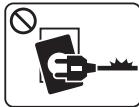 | Do not use if the power cord is damaged or if the electrical outlet is not grounded.This could result in electric shock or fire. |
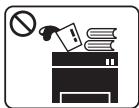 | Do not place anything on top of the machine (water, small metal or heavy objects, candles, lit cigarettes, etc.).This could result in electric shock or fire. |
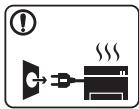 | ·If the machine gets overheated, it releases smoke, makes strange noises, or generates an odd odor, immediately turn off the power switch and unplug the machine.·The user should be able to access the power outlet in case of emergencies that might require the user to pull the plug out.This could result in electric shock or fire. |
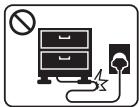 | Do not bend, or place heavy objects on the power cord.Stepping on or allowing the power cord to be crushed by a heavy object could result in electric shock or fire. |
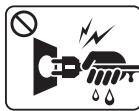 | Do not remove the plug by pulling on the cord; do not handle the plug with wet hands.This could result in electric shock or fire. |
Safety information

Caution
| During an electrical storm or for a period of non-operation, remove the power plug from the electrical outlet.This could result in electric shock or fire. | |
| Be careful, the paper output area is hot.Burns could occur. | |
| If the machine has been dropped, or if the cabinet appears damaged, unplug the machine from all interface connections and request assistance from qualified service personnel.Otherwise, this could result in electric shock or fire. | |
| If the machine does not operate properly after these instructions have been followed, unplug the machine from all interface connections and request assistance from qualified service personnel.Otherwise, this could result in electric shock or fire. | |
| If the plug does not easily enter the electrical outlet, do not attempt to force it in.Call an electrician to change the electrical outlet, or this could result in electric shock. | |
| Do not allow pets to chew on the AC power, telephone or PC interface cords.This could result in electric shock or fire and/or injury to your pet. |
Operating method

Caution
 | Do not forcefully pull the paper out during printing.It can cause damage to the machine. |
 | Be careful not to put your hand between the machine and paper tray.You may get injured. |
 | Be careful when replacing paper or removing jammed paper.New paper has sharp edges and can cause painful cuts. |
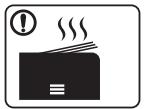 | When printing large quantities, the bottom part of the paper output area may get hot. Do not allow children to touch.Burns can occur. |
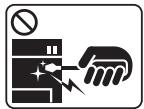 | When removing jammed paper, do not use tweezers or sharp metal objects.It can damage the machine. |
 | Do not allow too many papers to stack up in the paper output tray.It can damage the machine. |
Safety information
|  | Do not block or push objects into the ventilation opening.This could result in elevated component temperatures which can cause damage or fire. |
 | Use of controls or adjustments or performance of procedures other than those specified herein may result in hazardous radiation exposure. |
 | This machine's power reception device is the power cord.To switch off the power supply, remove the power cord from the electrical outlet. |
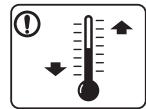
Place the machine in the environment where it meets the operating temperature and humidity specification.
Do not use the machine when it is below freezing temperature or has recently been moved from a location below freezing temperature. Doing so may damage the machine. Only operate the machine when the internal temperature of the machine is within the operating temperature and humidity specifications.
Otherwise, quality problems can occur and cause damage to the machine.
See "General specifications" on page 344.
Installation / Moving

Warning

Do not place the machine in an area with dust, humidity, or water leaks.
This could result in electric shock or fire.
Safety information

Caution
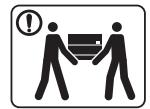 | Before moving the machine, turn the power off and disconnect all cords. The information below are only suggestions based on the units weight.If you have a medical condition that prevents you from lifting, do not lift the machine. Ask for help, and always use the appropriate amount of people to lift the device safety.Then lift the machine:If the machine weighs under 20 kg (44.09 lbs), lift with 1 person.If the machine weighs 20 kg (44.09 lbs) - 40 kg (88.18 lbs), lift with 2 people.If the machine weighs more than 40 kg (88.18 lbs), lift with 4 or more people.The machine could fall, causing injury or machine damage. |
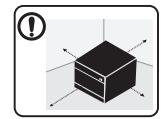 | Choose a flat surface with enough space for ventilation to place the machine. Also consider the space required to open the cover and trays.The place should be well-ventilated and be far from direct light, heat, and humidity. |
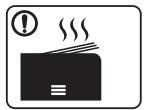 | When using the machine for a long period of time or printing a large number of pages in a non-ventilated space, it could pollute the air and be harmful to your health. Place the machine in a well-ventilated space or open a window to circulate the air periodically. |
 | Do not place the machine on an unstable surface.The machine could fall, causing injury or machine damage. |
 | Use only No.26 AWGa or larger, telephone line cord, if necessary.Otherwise, it can cause damage to the machine. |
 | Make sure you plug the power cord into a grounded electrical outlet.Otherwise, this could result in electric shock or fire. |
 | Use the power cord supplied with your machine for safe operation. If you are using a cord which is longer than 2 meters (6 feet) with a 110V machine, then the gauge should be 16 AWG or larger.Otherwise, it can cause damage to the machine, and could result in electric shock or fire. |
 | Do not put a cover over the machine or place it in an airtight location, such as a closet.If the machine is not well-ventilated, this could result in fire. |
 | Do not overload wall outlets and extension cords.This can diminish performance, and could result in electric shock or fire. |
 | The machine should be connected tothe power level which is specified on the label.If you are unsure and want to check the power level you are using, contact the electrical utility company. |
a. AWG: American Wire Gauge
Safety information
Maintenance / Checking

Caution
| Unplug this product from the wall outlet before cleaning the inside of the machine. Do not clean the machine with benzene, paint thinner or alcohol; do not spray water directly into the machine.This could result in electric shock or fire. | |
| When you are working inside the machine replacing consumables or cleaning the inside, do not operate the machine.You could get injured. | |
| Keep cleaning consumables away from children.Children could get hurt. | |
| Do not disassemble, repair or rebuild the machine by yourself.It can damage the machine. Call a certified technician when the machine needs repairing. | |
| To clean and operate the machine, strictly follow the user's guide provided with the machine.Otherwise, you could damage the machine. |
| Keep the power cable and the contact surface of the plug clean from dust or water.Otherwise, this could result in electric shock or fire. | |
| Do not remove any covers or guards that are fastened with screws.Fuser units should only be repaired by a certified service technician. Repair by non-certified technicians could result in fire or electric shock.The machine should only be repaired by a Samsung service technician. |
Supply usage

Caution
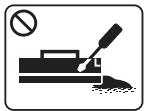 | Do not disassemble the toner cartridge.Toner dust can be dangerous if inhaled or ingested. |
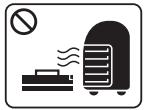 | Do not burn any of the consumables such as toner cartridge or fuser unit.This could cause an explosion or uncontrollable fire. |
Safety information
| When storing consumables such as toner cartridges, keep them away from children.Toner dust can be dangerous if inhaled or ingested. | |
| Using recycled consumables, such as toner, can cause damage to the machine.In case of damage due to the use of recycled consumables, a service fee will be charged. | |
| For consumables that contain toner dust (toner cartridge, waste toner bottle, imaging unit, etc.) follow the instructions below.When disposing of the consumables, follow the instructions for disposal. Refer to the reseller for disposal instructions.Do not wash the consumables.For a waste toner bottle, do not reuse it after emptying the bottle.If you do not follow the instructions above, it may cause machine malfunction and environmental pollution. The warranty does not cover damages caused by a user's carelessness. | |
| When toner gets on your clothing, do not use hot water to wash it.Hot water sets toner into fabric. Use cold water. | |
| When changing the toner cartridge or removing jammed paper, be careful not to let toner dust touch your body or clothes.Toner dust can be dangerous if inhaled or ingested. |
Machine overview
Components
The actual component may differ from the illustration below. Some components may change depending on the configuration.
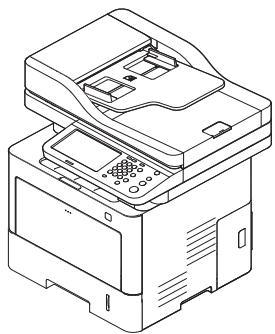 | 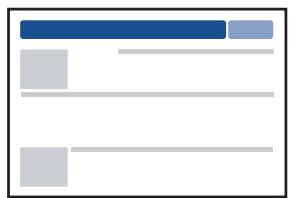 |
| Machine | Quick installation guide |
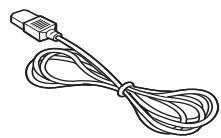 | 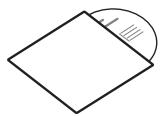 |
| Power cord | Software CDa |
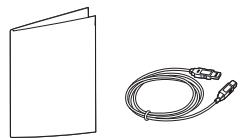 | |
| Misc. accessoriesb |
a. The software CD contains the print drivers, user's guide, and software applications.
b. Miscellaneous accessories included with your machine may vary by country of purchase and specific model.
Machine overview
Front view

- This illustration may differ from your machine depending on your model. There are various types of machine.
- Some features and optional goods may not be available depending on model or country.
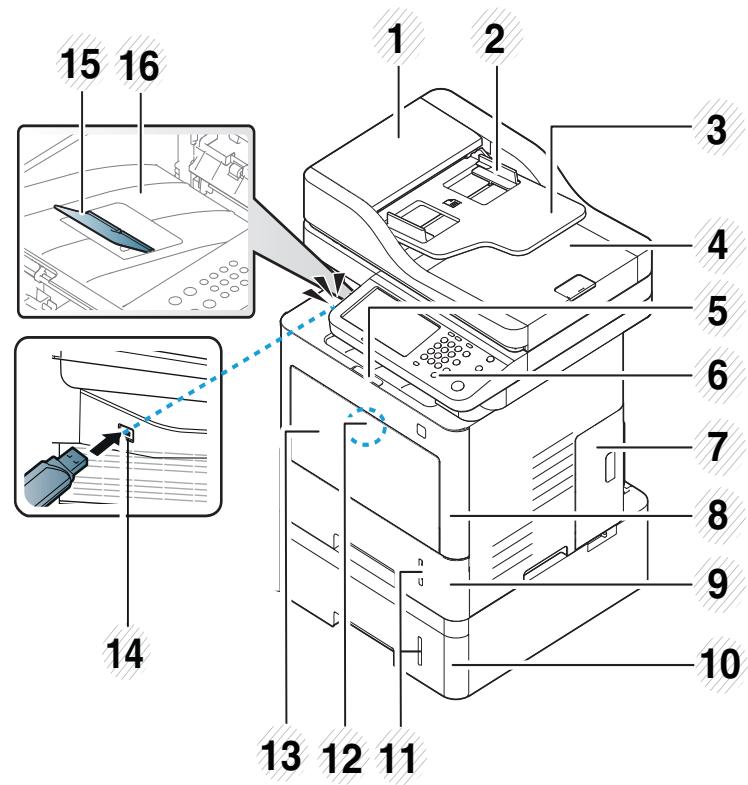
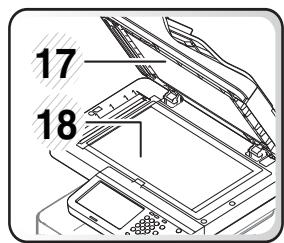
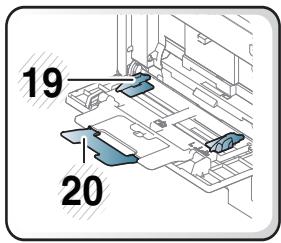
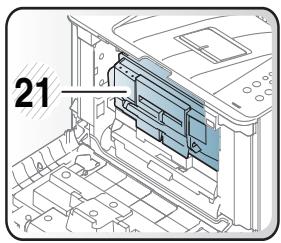
| 1 | Dual scan document feeder cover | 12 | Push-release of multi-purpose tray |
| 2 | Dual scan document feeder width guides | 13 | Multi-purpose tray |
| 3 | Dual scan document feeder input tray | 14 | USB memory port |
| 4 | Dual scan document feeder output tray | 15 | Output support tray |
| 5 | Push-release of front cover | 16 | Output tray |
| 6 | Control panel | 17 | Scanner lid |
| 7 | Cover for optional memory and optional tray^a | 18 | Scanner glass |
| 8 | Front cover | 19 | Paper width guides on a multi-purpose tray |
| 9 | Tray 1 | 20 | Multi-purpose support tray |
| 10 | Optional tray^b | 21 | Toner cartridge |
| 11 | Paper level indicator |
a. Open this cover to install the optional memory and optional tray.
b. Install the optional tray if it is necessary.
a. Open this cover to install the optional memory and optional tray.
Machine overview
Rear view

- This illustration may differ from your machine depending on your model. There are various types of machine.
- Some features and optional goods may not be available depending on model or country.
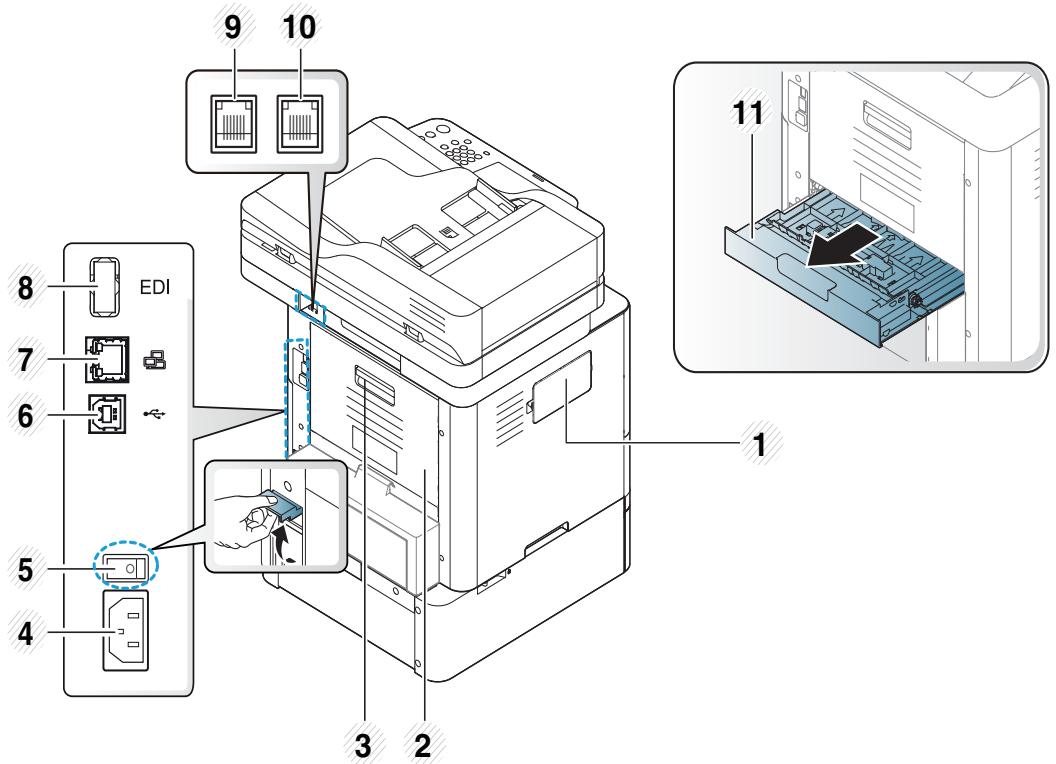
| 1 | Cover for optional Wireless/NFC kita |
| 2 | Rear cover |
| 3 | Rear cover handle |
| 4 | Power receptacle |
| 5 | Power-switch |
| 6 | USB port |
| 7 | Network port |
| 8 | EDI port for card reader |
| 9 | Telephone line socket (LINE) |
| 10 | Extension telephone socket (EXT.) |
| 11 | Duplex unit |
a. Open this cover to install the optional wireless/NFC kit required for the wireless/NFC features.
Control panel overview
Control panel
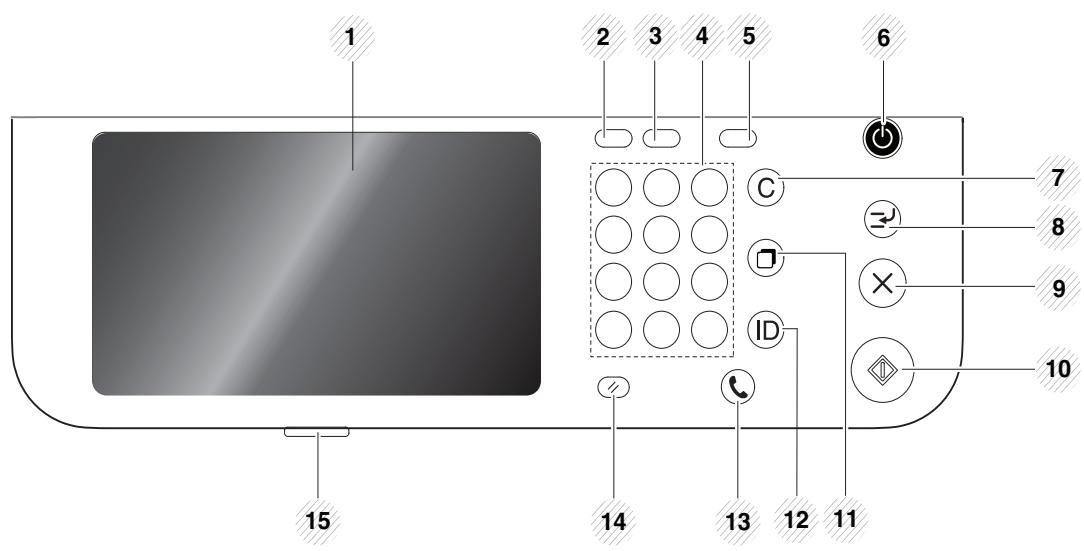
| 1 | Display screen | Shows the current machine status and prompts during an operation. You can set menus easily using the display screen. |
| 2 | Job Status | Shows the jobs currently running, queued jobs, completed jobs, current error code or secured jobs. |
| 3 | Counter | Shows the amount of paper used (see "Counter button" on page 27). |
| 4 | Numeric keypad | Dials numbers and enters alphanumeric characters. You can also enter the number value for document copies or other options. |
| 5 | Eco | Turn on Eco mode. Turn on the Eco mode to reduce toner consumption and paper usage when pc-printing and copying only (see "Eco button" on page 27). |
| 6 | Power/Wakeup | Turns the power on or off. When the blue LED is on, the machine is powered on and you can use it. To turn the machine off, press and hole this button for at least 3 seconds. Press Yes when the confirmation window appears. |
| 7 | Clear | Deletes characters in the edit area. |
| 8 | Interrupt | Stops a job in operation for urgent copying. |
| 9 | Stop | Stops an operation at any time. The pop-up window appears on the screen showing the current job that the user can stop or resume. |
| 10 | Start | Starts a job. |
| 11 | Redial/Pause | Redials the recently sent fax number or received caller ID in ready mode, or inserts a pause (-) into a fax number in edit mode. |
| 12 | Logout | Allows user to log out. |
| 13 | On Hook Dial | When you press this button, you can hear a dial tone. Then enter a fax number. It is similar to making a call using a speaker phone. |
| 14 | Reset | Resets the current machine setup. |
| 15 | Status LED | Shows the status of your machine (see "Understanding the LEDs" on page 23). |

When you use the display screen, use your finger only. The screen may be damaged with a sharp pen or anything else.
Turning on the machine

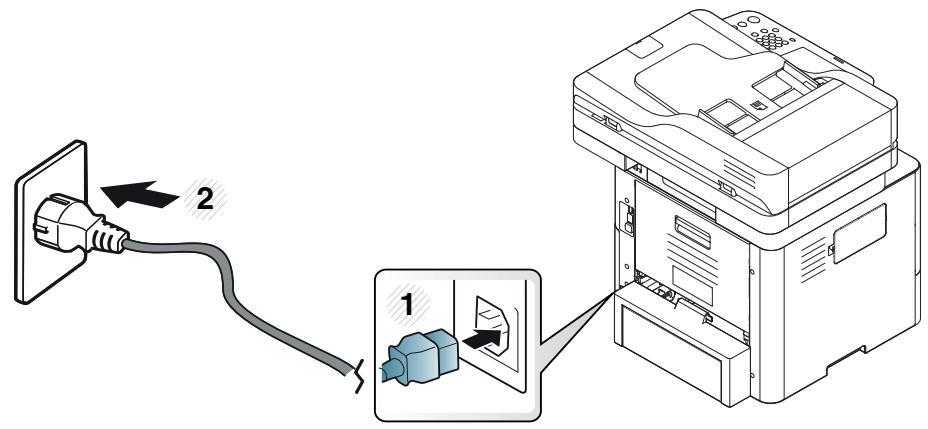
Keep in mind that you should use the power cord supplied with the machine. Otherwise, it can cause damage or fire to the machine.
1 Connect the machine to the electricity supply first.
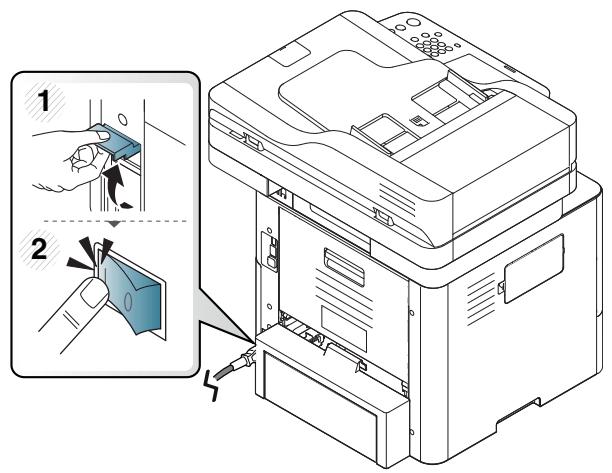
2 Press the power switch.
3 Power is turned on automatically.

You can also turn the machine on pressing the ⏻(Power/Wakeup).

- Some parts inside of the machine may be hot when power is on, or after printing. Be careful not to burn yourself when working inside the machine.
- Do not disassemble the machine when it is turned on or plugged in. Doing so may give you an electric shock.
- If you turn the machine off directly using the power switch, it could cause the hard disk problem in the machine.
Understanding the LEDs
The color of the status LED indicates the machine's current status.

- Some LEDs may not be available depending on model or country (see "Control panel overview" on page 21).
- To resolve the error, look at the error message and its instructions from the troubleshooting part (see "Troubleshooting" on page 294).
- You also can resolve the error with the guideline from the computers' Samsung Printer Status program window (see "Using Samsung Printer Status" on page 262).
• If the problem persists, call a service representative.
Status LED
The color of the status LED indicates the machine's current status.
| Status | Description | ||
| Off | The machine is off-line.The machine is in power saver mode. When data is received, or any button is pressed, it switches to on-line automatically. | ||
| Blue | On | The machine is on-line and can be used. | |
| Blinking | Fax | The machine is sending or receiving faxes. | |
| Copy | The machine is copying documents. | ||
| Scan | The machine is scanning documents. | ||
| When the status LED slowly blinks, the machine is receiving data from the computer.When the status LED blinks rapidly, the machine is printing data. | |||
Understanding the LEDs
| Status | Description | |
| Orange | On | The toner cartridge lifea is totally empty. Remove the old toner cartridge and install a new one.A paper jam has occurred (see "Clearing paper jams" on page 296).The door is open. Close the door.There is no paper in the tray. Load paper in the tray (see "Loading paper in the tray" on page 68).The machine has stopped due to a major error. Check the display message (see "Understanding display messages" on page 315). |
| Blinking | A minor error has occurred and the machine is waiting for the error to be cleared. Check the display message (see "Understanding display messages" on page 315). When the problem is cleared, the machine resumes its original task.The toner cartridge lifea is near the end of its life. Order a new toner cartridge. You can temporarily improve print quality by redistributing the toner. | |
a. Estimated cartridge life means the expected or estimated toner cartridge life, which indicates the average capacity of print-outs and is designed pursuant to ISO/IEC 19752. The number of pages may be affected by operating environment, printing interval, media type, and media size. Some amount of toner may remain in the cartridge even when the orange LED is on and the printer stops printing.

Check the message on the display screen. Follow the instructions in the message or refer to the troubleshooting chapter (see "Understanding display messages" on page 315). If the problem persists, call for service.
Understanding the LEDs
Power LED
The color of the status LED indicates the machine's current status.
| Status | Description | |
| Off | The machine is off-line. | |
| Blue | On | The machine is on-line and can be used.The machine is in power save mode. When data is received, or any screen is pressed, it switches to on-line automatically. |

Check the message on the display screen. Follow the instructions in the message or refer to the troubleshooting chapter (see "Understanding display messages" on page 315). If the problem persists, call for service.
Display screen and useful button
Display screen
The display screen on the control panel allows user-friendly operation of the machine. Once you press the home icon (☐) on the screen, it shows the display screen. The display screen image in this user's guide may differ from your machine depending on its option or model.

- To switch to the next display screen, press the right arrow or drag your finger across the display screen.
- Depending on the authentication setting, the machine's users have to enter an ID and a password. In this case, the machine can only be used by an authorized user who has registered an ID and a password on the machine. Contact the machine's administrator.

• Copy: Enters the Copy menu (see "Copying" on page 109).
• Fax: Enters the Fax menu (see "Faxing" on page 147).
- Stored Document: Enters the Stored Document menu (see "Understanding the Stored Document screen" on page 207).
- Shared Folder: Enters the Shared Folder menu (see "Understanding the Shared Folder screen" on page 204).
- Scan to Email: Enters the Scan to Email menu (see "Scanning and sending through email" on page 126).
- Scan to Server: Enters the Scan to Server menu (see "Scanning and sending via SMB/FTP" on page 132).
- Scan to PC: Enters the Scan to PC menu (see "Scanning and sending through email" on page 126).
- Scan to Shared Folder: Enters the Scan to Shared Folder menu (see "Scanning and sending to USB /shared folder" on page 139).
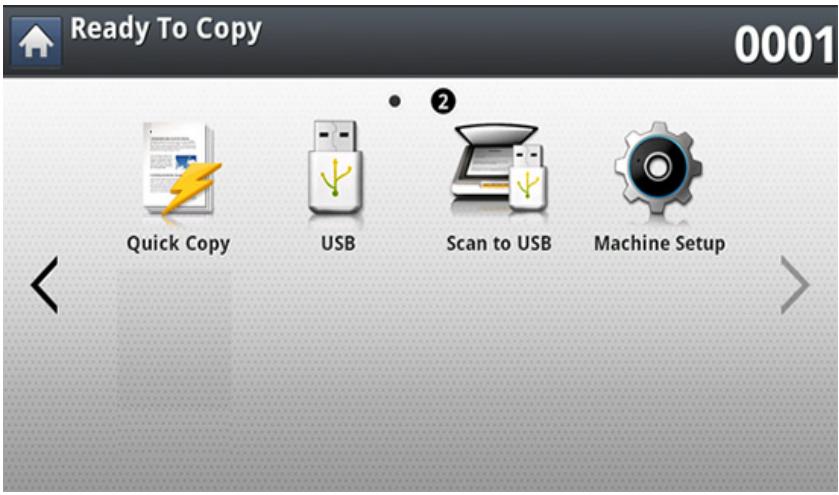
- Quick Copy: Enters the Quick Copy menu (see "Quick copying" on page 114).
• ID Copy: Enters the ID Copy menu (see "ID card copying" on page 115).
Display screen and useful button
- USB: Enters the USB menu. When a USB memory device is inserted into the USB memory port on your machine, USB is activated on the display screen (see "Understanding the USB screen" on page 209).
- Scan to USB: Enters the Scan to USB menu. When a USB memory device is inserted into the USB memory port on your machine, Scan to USB is activated on the display screen (see "Scanning to a USB memory device" on page 213).
- Machine Setup: You can browse current machine settings or change machine values (see "Machine setup" on page 220).

Some menus are only configured by an administrator or an authorized user who has an ID and password registered on the machine by an administrator. When the machine requests, enter the ID and password.
- Samsung Cloud: In order to use this menu, Samsung Cloud Prnter should be registered. For more information, contact your local Samsung dealer or the retailer where you purchased your machine (see "Scanning and sending to Samsung Cloud Print" on page 197).
- SmarThru WorkFlow: In order to use this menu, SmarThru WorkFlow should be installed. For more information, contact your local Samsung dealer or the retailer where you purchased your machine (see "About SmarThru Workflow" on page 201).
Counter button
When you press the Counter button on the control panel, You can see the number of impressions.
When you select Device, you can see the number of impressions by device. An impression typically refers to a single side of a sheet and not a one-sided print.
• Total Usage: Displays the total number of impressions.
- Send Usage: Displays the number of images sent via email, server, etc.
• Fax Send Usage(PSTN): Displays the number of sent faxes.
When you select User, you can see the number of usage, limit, and remaining usage by each user.
Eco button
The eco feature allows you to save print resources and leads you to eco-friendly printing. When you press the Eco button, the machine turns eco mode on or off. If the eco mode is on, you can see the eco image (💡) on some features. Some options in the features are not available to use in the eco mode.

- Only administrators have permission for Eco Settings in Machine Setup (see "Eco Settings" on page 237)
- If the machine requests a password for eco mode, you need to enter the password. Contact your administrator.
- The Eco button is activated only for Copy, Quick Copy menus.
| Status | Description | |
| Off | The machine is not in Eco mode. | |
| Green | On | The machine is in Eco mode. |
Display screen and useful button
Job Status button
When you press the Job Status button, the screen lists the currently running, queued, and completed jobs.
Current Job
Displays the list of jobs in progress and pending.
Pressing the job name shows more detailed information.
• No.: Gives the order of jobs.
• Job Name: Displays the name of the job.
• User: Displays the name of the job owner.
• Status: Displays the current status of each job.
- Delete: Removes a selected job from the list.
• Job Type: Displays type of the job, such as print, copy, fax, etc.
Completed Job
Displays the list of completed jobs.
Pressing the job name shows more detailed information.
• No.: Gives the order of jobs.
• Job Type: Displays type of the job, such as print, copy, fax, etc.
• Job Name: Displays the name of the job.
• User: Displays the name of the job owner.
• Status: Displays the status of each completed job.
Secured Job
Displays the list of secured jobs the user has set in the printer driver (see "Print Mode" on page 89). You need to enter the ID and Password set in the printer driver.
• No.: Gives the order of jobs.
• Job Type: Displays type of the job.
• Job Name: Displays the name of the job.
• User: Displays the name of the job owner.
• Detail: Displays detailed information of the selected job. You can also change the number of copies by pressing Change Settings.
• Edit: Changes the Job Name of the selected job.
- Delete: Removes the selected job from the list.
• Print: Prints the selected job from the list.
- Close: Closes the job status window.
Active Notice
Displays any error messages and codes that have occurred.
• No.: Gives the order of messages.
- Machine Status Message: Displays the error messages for the current errors in the machine.
- Error Code: Displays the error message's code.
• Detail: Displays detailed information of the selected job.
- Close: Closes the job status window.
Display screen and useful button
Interrupt button
When you press the Interrupt button, the machine goes into interrupt mode, which means it stops the current printing job for an urgent copy job. When the urgent copy job is completed, the previous printing job continues.
| Status | Description | |
| Off | The machine is not in interrupt printing mode. | |
| Green | On | The machine is in interrupt printing mode. |
Understanding the pop-up keyboard
You can enter alphabet characters, numbers, or special symbols using the pop-up keyboard on the display screen. This keyboard is the same as a normal keyboard for easy usability.
Touch the input area where you need to enter characters, then the keyboard pops up on the screen. The keyboard is the default showing the lowercase letters.
natural_image
Blue circular icon with a white printer symbol (no text or numbers)2. Software Installation
This chapter gives you step-by-step instructions for installing the machine driver. Read this chapter carefully to use different installation methods.
This chapter includes:
• Installing the driver 32
• Reinstalling the driver 35
Installing the driver
A locally connected machine is a machine directly attached to your computer using a USB cable. If your machine is attached to a network, skip the following steps below and go on to installing a network connected machine's driver (see "Installing driver over the network" on page 47).

- The installation window in this User's Guide may differ depending on the machine and interface in use.
- Only use a USB cable no longer than 3 meters (118 inches).
Windows
1 Make sure that the machine is connected to your computer and powered on.
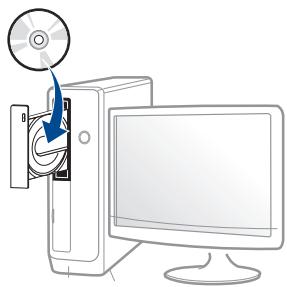
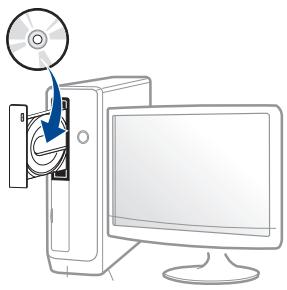
2 Insert the supplied software CD into your CD-ROM drive.
natural_image
Illustration of a CD or DVD disc being inserted into a desktop computer (no text or symbols present)If the installation window does not appear, click Start > All programs > Accessories > Run.
X:\Setup.exe replacing "X" with the letter, which represents your CD-ROM drive and click OK.
- For Windows 8,
If the installation window does not appear, from Charms, select Search > Apps and search for Run. Type in X:\Setup.exe, replacing "X" with the letter that represents your CD-ROM drive and click OK.
If "Tap to choose what happens with this disc." pop-up window appears, click the window and select Run Setup.exe.
3 Review and accept the installation agreements in the installation window, and then click Next.
4 Select USB on the Printer Connection Type screen, and then click Next.
5 Follow the instructions in the installation window.
From the Windows 8 Start Screen

- The V4 driver is automatically downloaded from the Windows Update if your computer is connected to the Internet. If not, you can manually download the V4 driver from Samsung website, www.samsung.com > find your product > Support or downloads. - You can download Samsung Printer Experience app from the Windows Store. You need have a Microsoft account to use the Windows Store.
1 From Charms, select Search.
2 Click Store.
3 Search and click Samsung Printer Experience.
Installing the driver
4 Click Install.
- If you install the driver using the supplied software CD, V4 driver is not installed. If you want to use the V4 driver in the Desktop screen, you can download from the Samsung website, www.samsung.com >find your product >Support or downloads.
- If you want to install Samsung's printer management tools, you need to install them using the supplied software CD.
1 Make sure that your computer is connected to the Internet and powered on.
2 Make sure that the machine is powered on.
3 Connect the computer and the machine with a USB cable.
The driver is automatically installed from the Windows Update.
Mac
1 Make sure that the machine is connected to your computer and powered on.
2 Insert the supplied software CD into your CD-ROM drive.
3 Select the CD-ROM volume that appears on Finder.
4 Double-click the Install Software icon.
5 Read the license agreement and check installation agreement button.
6 Click Next and then follow the instructions in the installation window.
Installing the driver
Linux
You need to download Linux software packages from the Samsung website to install the printer software (http://www.samsung.com > find your product > Support or Downloads).
Installing the Unified Linux Driver

You must log in as a super user (root) to install the machine software. If you are not a super user, ask your system administrator.
1 Make sure that the machine is connected to your computer and powered on.
2 Copy Unified Linux Driver package to your system.
3 Open Terminal program and go to the folder that you copied the package to.
4 Extract the package.
5 Move to uld folder.
6 Execute "./install.sh" command (If you're not logged in as root, execute the command with "sudo" as "sudo ./install.sh")
7 Proceed with installation.
8 When installation finished, launch printing utility (Go to System > Administration > Printing or execute "system-config-printer" command in Terminal program).
9 Click Add button.
10 Select your printer.
11 Click Forward button and add it to your system.
Reinstalling the driver
If the printer driver does not work properly, follow the steps below to reinstall the driver.
Windows
1 Make sure that the machine is connected to your computer and powered on.
2 From the Start menu, select Programs or All Programs > Samsung Printers > Uninstall Samsung Printer Software.
- For Windows 8,
1 From Charms, select Search > Apps.
2 Search and click Control Panel.
3 Click Programs and Features.
4 Right-click the driver you want to uninstall and select Uninstall.
5 Follow the instructions in the window.
3 Follow the instructions in the installation window.
4 Insert the software CD into your CD-ROM drive and install the driver again (see "Installing the driver" on page 32).
natural_image
Illustration of a CD or DVD disc being inserted into a computer tower (no text or symbols present)From the Windows 8 Start Screen
1 Make sure that the machine is connected to your computer and powered on.
2 Click on the Uninstall Samsung Printer Software tile in the Start screen.
3 Follow the instructions in the window.

- If you cannot find a Samsung Printer Software tile, uninstall from the desktop screen mode.
- If you want to uninstall Samsung's printer management tools, from the Start screen, right-click the app > Uninstall > right-click the program you want to delete > Uninstall and follow the instruction in the window.
Reinstalling the driver
Mac
If the printer driver does not work properly, uninstall the driver and reinstall it.
1 Open the Applications folder > Samsung > Printer Software Uninstaller.
2 To uninstall printer software, click Continue.
3 Check the program you want to delete and click Uninstall.
4 Enter the password and click OK.
5 After the uninstallation is finished, click Close.

If a machine has already been added, delete it from the Print Setup Utility or Print & Fax.
Linux
If the printer driver does not work properly, uninstall the driver and reinstall it.
1 Open Terminal program.
2 Move to uld folder extracted from Unified Linux Driver package.
3 Execute "./uninstall.sh" command (If you're not logged in as root, execute the command with "sudo" as "sudo ./uninstall.sh")
4 Proceed with uninstallation.
natural_image
Blue circular icon with a white printer symbol (no text or numbers)3. Using a Network-Connected Machine
This chapter gives you step-by-step instructions for setting up the network environment before using the machine. You need to be familiar with the terms used for setting up the network environment. Refer to the glossary for terms you do not understand ("Glossary" on page 374).
This chapter includes:
• Network environment 38
- Accessing network setup 39
• Network settings (TCP/IP) 40
- Setting IP address 42
• Installing driver over the network 47
• Wireless network setup (Optional) 54
Network environment
You can use network after connecting network cable to a corresponding port on your machine.
You need to set up the network protocols on the machine to use it as your network machine. You can set up the basic network settings through the machine's control panel.
The following table shows the network environments supported by the machine:
| Items | Specifications |
| Network interface | Ethernet 10/100/1000 Base-TX Wired Lan802.11b/g/n Wireless LANa |
| Network operating system | Windows® XP Service Pack 3, Windows Server® 2003, Windows Vista®, Windows® 7/8, Windows Server® 2008 R2Various Linux OSMac OS X 10.6 -10.10UNIX OS |
| Network protocols | TCP/IPv4DHCP, BOOTPDNS, WINS, Bonjour, SLP, UPnPStandard TCP/IP Printing (RAW), LPR, IPP, WSDSNMPv 1/2/3, HTTP, IPSecTCP/IPv6 (DHCP, DNS, RAW, LPR, SNMPv 1/2/3, HTTP, IPSec) |
| Items | Specifications |
| Wireless securitya | Authentication: Open System, Shared Key, WPA Personal, WPA2 Personal (PSK)Encryption: WEP64, WEP128, TKIP, AES |
a. Optional device
Accessing network setup
1 Make sure that the ethernet cable is connected to your machine.
2 Press Machine Setup > Network Settings from the display screen.
3 Select the option you want. If the option is available for only the administrator, the following screen appears.
Enter the ID, Password, and Domain using the pop-up keyboard which appears when you press each field.

- Enter the ID and password you first set when you turned on the machine: Initial Settings (see "Initial Settings" on page 238).
- You can also use the Recent Users button to find the recently used ID and Domain List button to find the domain from the list stored in the machine.
- When you log-in, you can see the ID of the logged in user on the display.
4 Press OK.
Network settings (TCP/IP)
When you connect your machine to a network, you must first configure the TCP/IP settings for the machine. The settings shown below are the basic settings required for using your machine as a network machine. You can set TCP/IP, DNS server, TCP/IPv6, Ethernet, and IP address allocation methods.
Ethernet
You can set ethernet settings.
Press Machine Setup > Network Settings > TCP/IP > Ethernet from the display screen.

You can also use this feature from the SyncThru™ Web Service. Open the Web browser from your networked computer and type the IP address of your machine (see "Settings tab" on page 249).
- Ethernet: You can enable/disable ethernet port.
• Speed Rate: Choose the speed rate of ethernet.
• MAC Address: Shows the Mac address of the machine.
TCP/IP Protocol
You can set IPv4 settings.
Press Machine Setup > Network Settings > TCP/IP > TCP/IPv4 from the display screen.

You can also use this feature from the SyncThru™ Web Service. Open the Web browser from your networked computer and type the IP address of your machine (see "Settings tab" on page 249).
IP Setting
You can choose the method for allocating IP addresses.
• Static: Select to enter IP address/Subnet Mask/Gateway Address manually.
- BOOTP: IP address/Subnet Mask/Gateway Address are automatically allocated by the BOOTP Server.
- DHCP: IP address/Subnet Mask/Gateway Address are automatically allocated by the DHCP Server.
Network settings (TCP/IP)
DNS Configuration
You can configure the DNS server.
- Host Name: Enter the host name. You can enter up to 63 characters. Default name is "SEC[MAC address]".
- Domain Name: Enter the domain name. You can enter up to 128 characters.
• Primary DNS Server: Enter the address of the DNS server you want to use primarily. - Secondary DNS Server: Enter the address of the DNS server you want to use as an alternative.
- Dynamic DNS Registration: If you want to use, check the checkbox(es) of dynamic DNS registration. If this option is checked, the machine registers its host name and domain name to configured DNS servers dynamically. Also, if this option is checked and DHCP is selected, DHCP FQDN options are automatically disabled.
WINS (Windows Internet Name Service)
You can configure the WINS server. WINS is used in the Windows operating system. Select this option.
Display IP address
You can set the machine to display the IP address on the Notification Bar. If you select this option the IP address will show on the Notification Bar.
Setting IP address
When you connect your machine to a network, you must first configure the TCP/IP settings for the machine. The settings shown below are the basic settings required for using your machine as a network machine. You can set TCP/IP, DNS server, TCP/IPv6, Ethernet, and IP address allocation methods.
IPv4 configuration

- If your device does not support a network connection, it will not be able to use this feature (see "Rear view" on page 20).
• You can also set the TCP/IPv4 from control panel. - TCP/IPv6 is not supported by this program.
First, you have to set up an IP address for network printing and managements. In most cases a new IP address will be automatically assigned by a DHCP (Dynamic Host Configuration Protocol) server located on the network.
IPv4 configuration using SetIP (Windows)
Before using the SetIP program, disable the computer firewall from Control Panel > Security Center > Windows Firewall.

The following instructions may differ for your model.
1 Download the software from the Samsung website then unpack and install it: (http://www.samsung.com > find your product > Support or Downloads).
2 Follow the instructions in the installation window.
3 Connect your machine to the network with a network cable.
4 Turn on the machine.
5 From the Windows Start menu, select All Programs > Samsung Printers > SetIP > SetIP.
6 Click the ⚙️ icon (third from left) in the SetIP window to open the TCP/IP configuration window.
7 Enter the machine's new information into the configuration window. In a corporate intranet, you may need to have this information assigned by a network manager before proceeding.

Find the machine's MAC address from the Network Configuration Report (see "Other settings" on page 226) and enter it without the colons. For example, 00:15:99:29:51:A8 becomes 0015992951A8.
8 Click Apply, and then click OK. The machine will automatically print the Network Configuration Report. Confirm that all the settings are correct.
Setting IP address
IPv4 configuration using SetIP (Mac)
Before using the SetIP program, disable the computer firewall from System Preferences > Security (or Security & Privacy) > Firewall.
1 Download the software from the Samsung website then unpack and install it: (http://www.samsung.com > find your product > Support or Downloads).
2 Turn on the machine.
3 Run downloaded SetIP application
4 Click the ⚙️ icon (third from left) in the SetIP window to open the TCP/IP configuration window.
5 Enter the machine's new information into the configuration window. In a corporate intranet, you may need to have this information assigned by a network manager before proceeding.

Find the machine's MAC address from the Network Configuration Report (see "Other settings" on page 226) and enter it without the colons. For example, 00:15:99:29:51:A8 becomes 0015992951A8.
6 Click Apply, and then click OK. The machine will automatically print the Network Configuration Report. Confirm that all the settings are correct.
IPv4 configuration using SetIP (Linux)
Before using the SetIP program, disable the computer firewall from System Preferences or Administrator.

The following instructions may vary from your model or operating systems.
1 Download the SetIP program from the Samsung web site and extract it.
2 Double-click the SetIPApplet.html file in cdroot/Linux/noarch/at_opt/share/utils folder.
3 Click to open the TCP/IP configuration window.
4 Enter the machine's new information into the configuration window. In a corporate intranet, you may need to have this information assigned by a network manager before proceeding.

Find the machine's MAC address from the Network Configuration Report (see "Other settings" on page 226) and enter it without the colons. For example, 00:15:99:29:51:A8 becomes 0015992951A8.
5 The machine will automatically print the Network Configuration Report.
Setting IP address
IPv6 configuration

IPv6 is supported properly only in Windows Vista or higher.
From the control panel
Activating IPv6

Accessing menus may differ from model to model (see "Menu overview" on page 215).
1 Press Machine Setup > Network Settings > TCP/IP > TCP/IPv6 from the display screen.
2 Press the radio button in the display screen to activate the option.
3 Turn the machine off and turn it on again.

When you install the printer driver, do not configure both IPv4 and IPv6. We recommend to configure either IPv4 or IPv6.
DHCPv6 address configuration
If you have a DHCPv6 server on your network, you can set one of the following options for default dynamic host configuration.
1 Press Machine Setup > Network Settings > TCP/IP > TCP/IPv6 from the display screen.
2 Press DHCPv6 Configuration.
3 Select the required value you want.
- Always Enable DHCP : Always use DHCPv6 regardless of router request.
• Never use DHCP: Never use DHCPv6 regardless of router request. - Use DHCP as directed by a router Use DHCPv6 only when requested by a router.
Setting IP address
From the SyncThru™ Web Service
Activating IPv6
1 Access a web browser, such as Internet Explorer, from Windows. Enter the machine IP address (http://xxx.xxx.xxx.xxx) in the address field and press the Enter key or click Go.
2 Type in the ID and Password.
Use the same login ID, Password, Domain as when logging in from the machine (see "Log-in" on page 220).

If you want to create a new user or change the password, see "Security tab" on page 250.
3 When the SyncThru™ Web Service window opens, move the mouse cursor over the Settings of the top menu bar and then click Network Settings.
4 Click TCP/IPv6 on the left pane of the website.
5 Check the IPv6 Protocol check box to activate IPv6.
6 Click the Apply button.
7 Turn the machine off and turn it on again.

• You can also set the DHCPv6.
• To manually set the IPv6 address:
Check the Manual Address check box. Then, the Address/Prefix text box is activated. Enter the rest of the address
(e.g.,:3FFE:10:88:194::AAAA. "A" is the hexadecimal 0 through 9, A through F).
IPv6 address configuration
1 Access a web browser, such as Internet Explorer, from Windows. Enter the machine IP address (http://xxx.xxx.xxx.xxx) in the address field and press the Enter key or click Go.
2 Type in the ID and Password.
Use the same login ID, Password, Domain as when logging in from the machine (see "Log-in" on page 220).

If you want to create a new user or change the password, see "Security tab" on page 250.
3 When the SyncThru™ Web Service window opens, move the mouse cursor over the Settings of the top menu bar and then click Network Settings.
4 Click TCP/IPv6 on the left pane of the website.
Setting IP address
5 Select one of the IPv6 addresses from Address Type (see "Other settings" on page 226).
- Link-Local Address: Self-configured local IPv6 address (Address starts with FE80).
- Stateless Address: Automatically configured IPv6 address by a network router.
• Stateful Address: IPv6 address configured by a DHCPv6 server.
• Manual Address: Manually configured IPv6 address by a user. - Default Gateway: Default gageway configured IPv6 address by a network router.
6 Enter the IPv6 addresses (e.g.,: http://[FE80::215:99FF:FE66:7701]).

Address must be enclosed in '[ ]' brackets.
Installing driver over the network
You must install the printer driver software for printing. The software includes drivers, applications, and other support programs.
Make sure that the network setup for your machine is completed. All applications should be closed on your computer before beginning installation.
Windows
1 Make sure that the machine is connected to the network and powered on. Also, your machine's IP address should have been set.
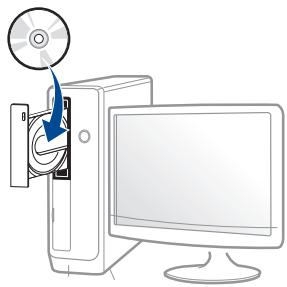
2 Insert the supplied software CD into your CD-ROM drive.
natural_image
Illustration of a CD/DVD printer inserting into a desktop computer (no text or symbols)If the installation window does not appear, click Start > All programs > Accessories > Run.
X:\Setup.exe replacing "X" with the letter, which represents your CD-ROM drive and click OK.
- For Windows 8,
If the installation window does not appear, from Charms, select Search > Apps and search for Run. Type in X:\Setup.exe, replacing "X" with the letter that represents your CD-ROM drive and click OK.
If "Tap to choose what happens with this disc." pop-up window appears, click the window and select Run Setup.exe.
3 Review and accept the installation agreements in the installation window. Then, click Next.
4 Select Network on the Printer Connection Type screen. Then, click Next.
5 Follow the instructions in the installation window.
From the Windows 8 Start Screen

- The V4 driver is automatically downloaded from the Windows Update if your computer is connected to the Internet. If not, you can manually download the V4 driver from Samsung website, www.samsung.com > find your product > Support or downloads.
- You can download Samsung Printer Experience app from the Windows Store. You need have a Microsoft account to use the Windows Store.
a From Charms, select Search.
b Click Store.
c Search and click Samsung Printer Experience.
d Click Install.
Installing driver over the network
- If you install the driver using the supplied software CD, V4 driver is not installed. If you want to use the V4 driver in the Desktop screen, you can download from the Samsung website, www.samsung.com >find your product >Support or downloads.
- If you want to install Samsung's printer management tools, you need to install them using the supplied software CD.
1 Make sure that the machine is connected to the network and powered on. Also, your machine's IP address should have been set.
2 From Charms, select Settings > Change PC settings > Devices.
3 Click Add a device.
Discovered machines will be shown on the screen.
4 Click the model name or host name you wish to use.

You can print a Network Configuration Report from the machine's control panel that will show the current machine's host name.
5 The driver is automatically installed from the Windows Update.
Silent installation Mode
Silent installation mode is an installation method that does not require any user intervention. Once you start the installation, the machine driver and software are automatically installed on your computer. You can start the silent installation by typing /s or /S in the command window.
Command-line Parameters
Following table shows commands that can be used in the command window.

Following command-line are effective and operated when command is used with /s or /S. But /h, /H or /? are exceptional commands that can be operated solely.
| Command-line | Definition | Description |
| /s or /S | Starts silent installation. | Installs machine drivers without prompting any UIs or user intervention. |
Installing driver over the network
| Command-line | Definition | Description |
| /p"" or /P"" | Specifies printer port. | Printer port name can be specified as IP address, hostname, USB local port name, IEEE1284 port name or network path.For example:/p"xxx.xxx.xxx.xxx" in where, "xxx.xxx.xxx.xxx" means IP address for network printer. / p"USB001",/P"LPT1:",/ p"hostname" / p"\computer_name\shared_printer" or "\"xxx.xxx.xxx.xxx\shared_printer" in where, "\"computer_name\shared_printer" or "\"xxx.xxx.xxx.xxx\shared_printer" means the network path to the printer by entering two slashes, the computer name or local IP address of the PC sharing the printer, and then the share name of the printer. |
| Command-line | Definition | Description |
| /a"" or /A"" | Specifies destination path for installation. | Since machine drivers should be installed on the OS specific location, this command applies to only application software. |
 The destination path should be a fully qualified path. The destination path should be a fully qualified path. | ||
| /n"" or /N"" | Specifies printer name. Printer instance shall be created as specified printer name. | With this parameter, you can add printer instances as your wishes. |
| /nd or /ND | Commands not to set the installed driver as a default machine driver. | It indicates installed machine driver will not be the default machine driver on your system if there are one or more printer drivers installed. If there is no installed machine driver on your system, then this option won't be applied because Windows OS will set installed printer driver as a default machine driver. |
Installing driver over the network
| Command-line | Definition | Description |
| /x or /X | Uses existing machine driver files to create printer instance if it is already installed. | This command provides a way to install a printer instance that uses installed printer driver files without installing an additional driver. |
| /up"or /UP"" | Removes only specified printer instance and not the driver files. | This command provides a way to remove only specified printer instance from your system without effecting other printer drivers. It will not remove printer driver files from your system. |
| /d or /D | Uninstalls all device drivers and applications from your system. | This command will remove all installed device drivers and application software from your system. |
| /v""or /V"" | Shares installed machine and add other available platform drivers for Point & Print. | It will install all supported Windows OS platform's machine drivers to system and share it with specifiedfor point and print. |
| /o or /O | OpensPrinters and Faxes folder after installation. | This command will openPrinters and Faxes folder after the silent installation. |
| Command- line | Definition | Description |
| /h, /H or /? | Shows Command-line Usage. | |
Mac
1 Make sure that the machine is connected to your computer and powered on.
2 Insert the supplied software CD into your CD-ROM drive.
3 Select the CD-ROM volume that appears on Finder.
4 Double-click the Install Software icon.
5 Read the license agreement and check installation agreement button.
6 Click Next.
7 Select Network on the Printer Connection Type.
8 Click Next.
9 Follow the instructions in the installation window.
Installing driver over the network
Linux
You need to download Linux software packages from the Samsung website to install the printer software (http://www.samsung.com > find your product > Support or Downloads).
1 Make sure that the machine is connected to your network and powered on. Also, your machine's IP address should have been set.
2 Copy Unified Linux Driver package to your system.
3 Open Terminal program and go to the folder that you copied the package to.
4 Extract the package.
5 Move to uld folder.
6 Execute "/install.sh" command (If you are not logged in as root, execute the command with "sudo" as "sudo ./install.sh").
7 Proceed with installation.
8 When installation finished, launch Printing utility (Go to System > Administration > Printing or execute "system-config-printer" command in Terminal program).
9 Click Add button.
10 Select AppSocket/HP JetDirect and enter your machine's IP address.
11 Click Forward button and add it to your system.
UNIX

- Make sure your machine supports the UNIX operating system before installing the UNIX printer driver (see "Operating System" on page 8).
- The commands are marked with "", when typing the commands, do not type "".
- Some features and optional goods may not be available depending on model or country (see "Operating System" on page 8).
To use the UNIX printer driver, you have to install the UNIX printer driver package first, then setup the printer. You can download the UNIX printer driver package from the Samsung website (http://www.samsung.com > find your product > Support or Downloads).
Installing the UNIX printer driver package
The installation procedure is common for all variants of UNIX OS mentioned.
1 From the Samsung website, download and unpack the UNIX Printer Driver package to your computer.
2 Acquire root privileges.
"su -"
3 Copy the appropriate driver archive to the target UNIX computer.
Installing driver over the network

See administration guide of your UNIX OS for details.
4 Unpack the UNIX printer driver package.
For example, on IBM AIX, use the following commands.
"gzip -d < enter the package name | tar xf -"
5 the unpacked directory.
6 Run the install script.
"./install -i"
install is the installer script file which is used to install or uninstall the UNIX Printer Driver package.
Use "chmod 755 install" command to give the permission to the installer script.
7 Execute the “./install -c” command to verify installation results.
8 Run "installprinter" from the command line. This will bring up the Add Printer Wizard window. Setup the printer in this window referring to the following procedures.

On some UNIX OS, for example on Solaris 10, just added printers may not be enabled and/or may not accept jobs. In this case run the following two commands on the root terminal:
"accept
"enable
Uninstalling the printer driver package

The utility should be used to delete the printer installed in the system.
a Run "uninstallprinter" command from the terminal.
It will open the Uninstall Printer Wizard.
The installed printers are listed in the drop-down list.
b Select the printer to be deleted.
c Click Delete to delete the printer from the system.
d Execute the “./install -d” command to uninstall the whole package.
e To verify removal results, execute the “./install -c” command.
To re-install it, use the command “./install -i” to reinstall the binaries.
Installing driver over the network
Setting up the printer
To add the printer to your UNIX system, run 'installprinter' from the command line. This will bring up the Add Printer Wizard window. Setup the printer in this window according to the following steps:
1 Type the name of the printer.
2 Select the appropriate printer model from the model list.
3 Enter any description corresponding to the type of the printer in the Type field. This is optional.
4 Specify any printer description in the Description field. This is optional.
5 Specify the printer location in the Location field.
6 Type the IP address or DNS name of the printer in the Device textbox for network-connected printers. On IBM AIX with jetdirect Queue type, only the DNS name is possible-numeric IP address is not allowed.
7 Queue type shows the connection as lpd or jetdirect in the corresponding list box. Additionally, usb type is available on Sun Solaris OS.
8 Select Copies to set the number of copies.
9 Check the Collate option to receive copies already sorted.
10 Check the Reverse Order option to receive copies in the reverse order.
11 Check the Make Default option to set this printer as default.
12 Click OK to add the printer.
Wireless network setup (Optional)

- If you want to add wireless feature to the machine, check the option lists and contact the purchasing point to order (see "Available accessories" on page 273). When you purchase a Wireless/NFC kit (Optional), install the kit by following the steps described in the Wireless/NFC kit (Optional) Installation Guide which is enclosed in the kit. After installing the Wireless/NFC kit (Optional), set the machine to use this feature.
- Make sure your machine supports wireless networking. Wireless networking may not be available depending on the model (see "Features by model" on page 8).
Wireless networks require higher security, so when an access point is first set up, a network name (SSID), the type of security used, and a Network Password are created for the network. Ask your network administrator about this information before proceeding with the machine installation.
Introducing wireless set up methods
You can set wireless settings either from the machine or the computer. Choose the setting method from the below table.

- Some wireless network installation types may not be available depending on the model or country.
- It is strongly recommended that you set the password on Access Points. If you do not set the password on Access Points, they might be exposed to illegal access from unknown machines including PCs, smart phones and printers. Refer to the Access Point user' guide for password settings.
| Set up method | Connecting method | Description & Reference |
| With Access Point | From the computer | See "Using a network cable" on page 57. |
| From the machine's control panel | See "Using the WPS menu" on page 55. | |
| See "Using the Wi-Fi Networks" on page 57. | ||
| Wi-Fi Direct setup | See "Setting the Wi-Fi Direct for mobile printing" on page 59. | |
Wireless network setup (Optional)
Using the WPS menu
If your machine and access point (or wireless router) support Wi-Fi Protected Setup™ (WPS), then you can easily configure the wireless network settings through the WPS menu without the need for a computer.

- If you want to use the wireless network using the infrastructure mode, make sure that the network cable is disconnected from the machine. Using the WPS(PBC) or entering the PIN from the computer to connect to the access point (or wireless router) varies depending on the access point (or wireless router) you are using. Refer to the user's guide of the access point (or wireless router) you are using.
- When using the WPS to set the wireless network, security settings may change. To prevent this, lock the WPS option for the current wireless security settings. The option name may differ depending on the access point (or wireless router) you are using.
Items to prepare
- Check if the access point (or wireless router) supports Wi-Fi Protected Setup™ (WPS).
- Check if your machine supports Wi-Fi Protected Setup™ (WPS).
• Networked computer (PIN mode only)
Choosing your type
There are two methods available to connect your machine to a wireless network.
- The Push Button Configuration (PBC) method allows you to connect your machine to a wireless network by pressing both the WPS Settings menu on the control panel of your machine and the WPS (PBC) button on a Wi-Fi Protected Setup™ WPS-enabled access point (or wireless router) respectively.
- The Personal Identification Number (PIN) method helps you connect your machine to a wireless network by entering the supplied PIN information on a Wi-Fi Protected Setup™ WPS-enabled access point (or wireless router).
Wireless network setup (Optional)
Connecting WPS
Factory default in your machine is PBC mode, which is recommended for a typical wireless network environment.
Connecting in PBC mode

Type in the ID and Password.
Use the same login ID, Password, Domain as when logging in from the machine (see "Log-in" on page 220). If you want to create a new user or change the password, see "Security tab" on page 250.
1 Press Machine Setup > Network Settings from the display screen.
2 Press Wi-Fi.
3 Press WPS > PBC.
4 Press Start.
5 Press the WPS (PBC) button on the access point (or wireless router).
6 Follow the instruction on the display screen.
The messages are displayed on the display screen
Connecting in PIN mode

Type in the ID and Password.
Use the same login ID, Password, Domain as when logging in from the machine (see "Log-in" on page 220). If you want to create a new user or change the password, see "Security tab" on page 250.
1 Press Machine Setup > Network Settings from the display screen.
2 Press Wi-Fi.
3 Press WPS > PIN.
4 Press Start.
5 The eight-digit PIN appears on the display.
You need to enter the eight-digit PIN within two minutes on the computer that is connected to the access point (or wireless router).

You need to enter the PIN from the computer to connect to the access point (or wireless router) varies depending on the access point (or wireless router) you are using. Refer to the user's guide of the access point (or wireless router) you are using.
6 Follow the instruction on the display screen.
The messages are displayed on the display screen
Wireless network setup (Optional)
Using the Wi-Fi Networks
Before starting, you will need to know the network name (SSID) of your wireless network and the network key if it is encrypted. This information was set when the access point (or wireless router) was installed. If you do not know about your wireless environment, please ask the person who set up your network.

Type in the ID and Password.
Use the same login ID, Password, Domain as when logging in from the machine (see "Log-in" on page 220). If you want to create a new user or change the password, see "Security tab" on page 250.
1 Press Machine Setup > Network Settings from the display screen.
2 Press Wi-Fi.
3 Press Wi-Fi Settings.
4 The machine will display a list of available networks from which to choose. After a network is chosen then printer will prompt for the corresponding security key.
5 Select the Wi-Fi network option you want.
Using a network cable

See your network administrator, or the person that set up your wireless network, for information about your network configuration.
Your machine is a network compatible machine. To enable your machine to work with your network, you will need to perform some configuration procedures.
Items to prepare
- Access point
• Network-connected computer - Software CD that was provided with your machine
• A machine installed with a wireless network interface - Network cable
Printing a network configuration report
You can identify the network settings of your machine by printing a network configuration report.
See "Other settings" on page 226.
Wireless network setup (Optional)
IP setting using SetIP Program (Windows)
This program is used to manually set the network IP address of your machine using its MAC address to communicate with the machine. The MAC address is the hardware serial number of the network interface and can be found in the Network Configuration Report.
See "Network settings (TCP/IP)" on page 40.
Configuring the machine's wireless network
Before starting you will need to know the network name (SSID) of your wireless network and the network key if it is encrypted. This information was set when the access point (or wireless router) was installed. If you do not know about your wireless environment, please ask the person who set up your network.
To configure wireless parameters, you can use SyncThru™ Web Service.
Using SyncThru™ Web Service
Before starting wireless parameter configuration, check the cable connection status.
1 Check whether or not the network cable is connected to the machine. If not, connect the machine with a standard network cable.
2 Start a web browser such as Internet Explorer, Safari, or Firefox and enter your machine's new IP address in the browser window.
For example,

http://192.168.1.133/
3 Click Login on the upper right of the SyncThru™ Web Service website.
4 Type in the ID and Password.
Use the same login ID, Password, Domain as when logging in from the machine (see "Log-in" on page 220).

If you want to create a new user or change the password, see "Security tab" on page 250.
5 When the SyncThru™ Web Service window opens, click Settings > Network Settings.
6 Click Wi-Fi > Wizard.
7 Select the one Network Name(SSID) in the list.
Wireless network setup (Optional)
8 Click Next.
If the wireless security setting window appears, enter the registered password (network password) and click Next.
9 The confirmation window appears, please check your wireless setup. If the setup is right, click Apply.
Turning the Wi-Fi network on/off
1 Check whether the network cable is connected to the machine. If not, connect the machine with a standard network cable.
2 Start a web browser such as Internet Explorer, Safari, or Firefox and enter your machine's new IP address in the browser window.
For example,

http://192.168.1.133/
3 Click Login on the upper right of the SyncThru™ Web Service website.
4 Type in the ID and Password.
Use the same login ID, Password, Domain as when logging in from the machine (see "Log-in" on page 220).

If you want to create a new user or change the password, see "Security tab" on page 250.
5 When the SyncThru™ Web Service window opens, click Settings > Network Settings.
6 Click Wi-Fi.
7 You can turn the Wi-Fi network on/off.
Setting the Wi-Fi Direct for mobile printing
Wi-Fi Direct is a secure and easy-to-use peer-to-peer connection between a Wi-Fi Direct-enabled printer and mobile device.
With Wi-Fi Direct, you can connect your printer to a Wi-Fi Direct network while concurrently connecting to an access point. You can also use a wired network and a Wi-Fi Direct network simultaneously so multiple users can access and print documents both from Wi-Fi Direct and from a wired network.
Wireless network setup (Optional)

- You cannot connect your mobile device to the internet through the printer's Wi-Fi Direct.
- The supported protocol list may differ from your model, Wi-Fi Direct networks do NOT support IPv6, network filtering, IPSec, WINS, and SLP services.
- The maximum number of devices that can be connected via Wi-Fi Direct is 4.
Setting up Wi-Fi Direct
You can enable Wi-Fi Direct feature by one of the following methods.
From the machine
1 Press Machine Setup > Network Settings from the display screen.
2 Type in the ID and Password.
Use the same login ID, Password, Domain as when logging in from the machine (see "Log-in" on page 220).

If you want to create a new user or change the password, see "Security tab" on page 250.
3 Press Wi-Fi.
4 Tap Wi-Fi Direct.
5 Enable Wi-Fi Direct.
From the network-connected computer
If your printer is using a network cable or a wireless access point, you can enable and configure Wi-Fi Direct from SyncThru™ Web Service.
1 Access SyncThru™ Web Service and select Settings > Network Settings > Wi-Fi > Wi-Fi Direct™.
2 Enable Wi-Fi Direct™ and set other options.
Setting up the mobile device
- After setting up Wi-Fi Direct from the printer, refer to the user manual of the mobile device you are using to set its Wi-Fi Direct.
- After setting up Wi-Fi Direct, you need to download the mobile printing application (For example: Samsung Mobile printer) to print from your smartphone.

- When you have found the printer you want to connect to from your mobile device, select the printer and the printer's LED will blink. Press the option you want when the Wi-Fi connection confirmed window appears from the display screen and it will be connected to your mobile device.
- If your mobile device does not support Wi-Fi Direct, you need to enter the "Network Key" of a printer.
Wireless network setup (Optional)
Troubleshooting for wireless network
If problems occur while using the machine on a network, check the following:

For information on the access point (or wireless router), refer to its own user's guide.
- Your computer, access point (or wireless router), or machine may not be turned on.
- Check the wireless reception around the machine. If the router is far from the machine or there is an obstacle, you might have difficulty receiving the signal.
- Cycle the power for the access point (or wireless router), machine, and computer. Sometimes cycling the power can recover network communication.
- Check whether firewall software (V3 or Norton) is blocking the communication. If the computer and the machine are connected on the same network and it cannot be found when searching, firewall software might be blocking the communication. Refer to the user's guide for the software to turn it off and try searching for the machine again.
- Check whether the machine's IP address is allocated correctly. You can check the IP address by printing the network configuration report.
-
Check whether the access point (or wireless router) has a configured security (password). If it has a password, refer to the access point (or wireless router) administrator.
-
Check the machine's IP address. Reinstall the machine driver and change the settings to connect to the machine on the network. Due to the characteristics of DHCP, the allocated IP address could change if the machine is not used for a long time or if the access point has been reset.
Register the product's MAC address when you configure the DHCP server on the access point (or wireless router). Then you can always use the IP address that is set with the MAC address. You can identify the Mac address of your machine by printing a network configuration report. - Check the wireless environment. You might not be able to connect to the network in the infrastructure environment where you need to type in a user's information before connecting to the access point (or wireless router).
- This machine only supports IEEE 802.11 b/g/n and Wi-Fi. Other wireless communication types (e.g., Bluetooth) are not supported.
• The machine is within the range of the wireless network. - The machine is located away from obstacles that could block the wireless signal. Remove any large metal objects between the access point (or wireless router) and the machine.
Make sure the machine and wireless access point (or wireless router) are not separated by poles, walls, or support columns containing metal or concrete. - The machine is located away from other electronic devices that may interfere with the wireless signal.
Many devices can interfere with the wireless signal, including a microwave oven and some Bluetooth devices. - Whenever the configuration of your access point (or wireless router) changes, you must do the product's wireless network setup again.
• The maximum number of devices that can be connected via Wi-Fi Direct is 4.
natural_image
Blue circular icon with a white printer symbol (no text or numbers)4. Media and Tray
This chapter provides information on how to load originals and print media into your machine.
This chapter includes:
• Preparing originals 63
- Loading originals 64
- Selecting print media 67
- Loading paper in the tray 68
• Printing on special media 73
- Setting the paper size and type 78
• Output location 79
Preparing originals
- Do not load paper smaller or larger than custom size.
- Scan glass: X : 25 - 356 mm (1 x 14.02 inches), Y: 25 - 216 mm (1 x 8.5 inches)
- DSDF: X: 148 - 356 mm (5.83 x 14.02 inches), Y: 105 - 216 mm (4.13 x 8.5 inches)
- Do not attempt to load the following of paper, in order to prevent paper jam, low print quality and machine damage.
- Carbon-paper or carbon-backed paper
- Coated paper
- Onion skin or thin paper
- Wrinkled or creased paper
- Curled or rolled paper
-
Torn paper
-
Remove all staples and paper clips before loading.
- Make sure any glue, ink, or correction fluid on the paper is completely dry before loading.
- Do not load originals that include different sizes or weights of paper.
- Do not load booklets, pamphlets, transparencies, or documents with other unusual characteristics.
Loading originals
You can use the scanner glass or the document feeder to load an original for copying, scanning, and sending a fax.

Illustrations on this user's guide may differ from your machine depending on its options or models. Check your machine type (see "Front view" on page 19).
On the scanner glass
Using the scanner glass, you can copy or scan originals. You can get the best scan quality. Make sure that no originals are in the document feeder. If an original is detected in the document feeder, the machine gives it priority over the original on the scanner glass.
1 Lift and open the scanner lid.
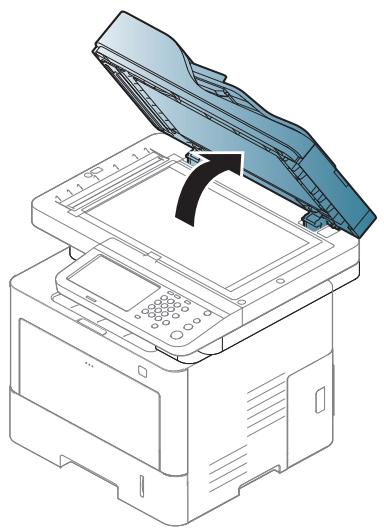
natural_image
Illustration of a printer with a blue cover and paper tray, showing internal components (no text or symbols)2 Place the original face down on the scanner glass. Align it with the registration guide at the top left corner of the glass.
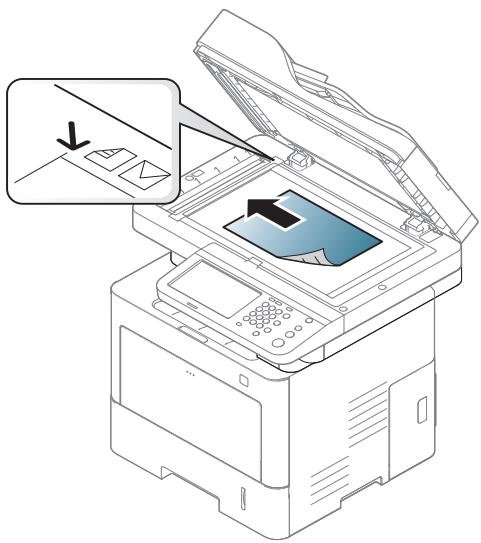
natural_image
Illustration of a printer with an open lid and a close-up of its paper tray (no text or symbols visible)Loading originals
3 Close the scanner lid.

- Leaving the scanner lid open while copying may affect copy quality and toner consumption.
- Dust on the scanner glass may cause black spots on the printout. Always keep it clean (see "Cleaning the machine" on page 287).
- If you are copying a page from a book, lift the scanner lid until its hinges are caught by the stopper and then close the lid. If the book is thicker than 30 mm, start copying with the scanner lid open.

- Be careful not to break the scanner glass. You may get hurt.
- Do not put hands while closing the scanner lid. The scanner lid may fall on your hands and get hurt.
- Do not look into the light from inside of the scanner while copying or scanning. It is harmful to eyes.
In the document feeder
Using the Dual Scan Document Feeder (DSDF), you can load up to 50 sheets of paper (80 g/m ^2 , 21 lbs bond) for one job.
1 Flex or fan the edge of the paper stack to separate the pages before loading originals.
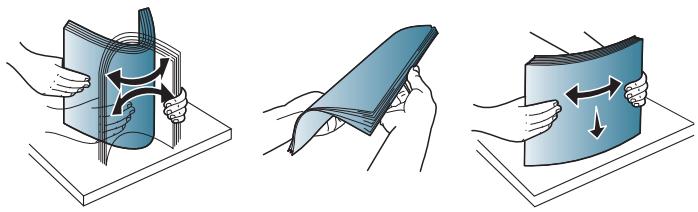
natural_image
Three-step illustration showing hands folding a flexible object, with arrows indicating fold change and rotation (no text or symbols)2 Load the original face up into the document feeder input tray. Make sure that the bottom of the original stack matches the paper size marked on the document input tray.
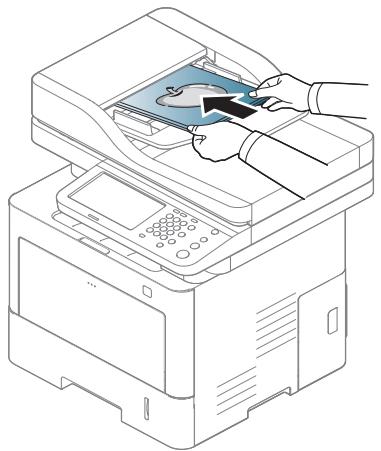
natural_image
Line drawing of a printer with a hand inserting a card into the cover (no text or symbols)Loading originals
3 Adjust the document feeder width guides to the paper size.
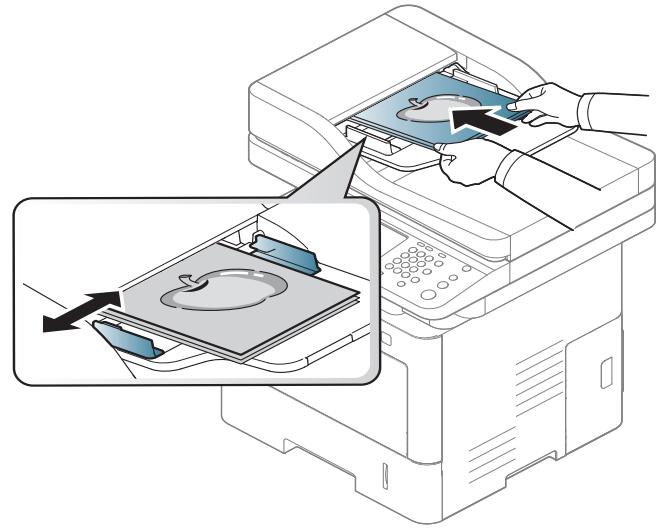
natural_image
Illustration of a printer being placed into a tray with a lid, showing mechanical components and a magnified view of the tray (no text or symbols present)
Dust on the document feeder glass may cause black lines on the printout. Always keep the glass clean (see "Cleaning the machine" on page 287).
Selecting print media
You can print on a variety of print media, such as plain paper, envelopes, labels, and transparencies. Always use print media that meet the guidelines for use with your machine.
Guidelines for select the print media
Print media that does not meet the guidelines outlined in this user's guide may cause the following problems:
- Poor print quality
- Increased paper jams
• Premature wear on the machine.
Properties, such as weight, composition, grain, and moisture content, are important factors that affect the machine's performance and the output quality. When you choose print materials, consider the following:
- The type, size, and weight of the print media for your machine are described in print media specifications (see "Print media specifications" on page 346).
- Desired outcome: The print media you choose should be appropriate for your project.
- Brightness: Some print media are whiter than others and produce sharper, more vibrant images.
- Surface smoothness: The smoothness of the print media affects how crisp the printing looks on the paper.

- Some print media may meet all of the guidelines in this user's guide and still not produce satisfactory results. This may be the result of the sheets characteristics, improper handling, unacceptable temperature and humidity levels, or other variables over which cannot be controlled.
- Before purchasing large quantities of print media, ensure that it meets the requirements specified in this user's guide.

- Using print media that does not meet these specifications may cause problems or require repairs. Such repairs are not covered by Samsung's warranty or service agreements.
- The amount of paper put into the tray may differ according to media type used (see "Print media specifications" on page 346).
- Make sure not to use the inkjet photo paper with this machine. It could cause damage to the machine.
• Using flammable print media can cause a fire. - Use designated print media (see "Print media specifications" on page 346).

The use of flammable media or foreign materials left in the printer may lead to overheating of the unit and, in rare cases may cause a fire.
The amount of paper put into the tray may differ according to media type used (see "Print media specifications" on page 346).
Loading paper in the tray
Tray overview
To change the size, you need to adjust the paper guides.
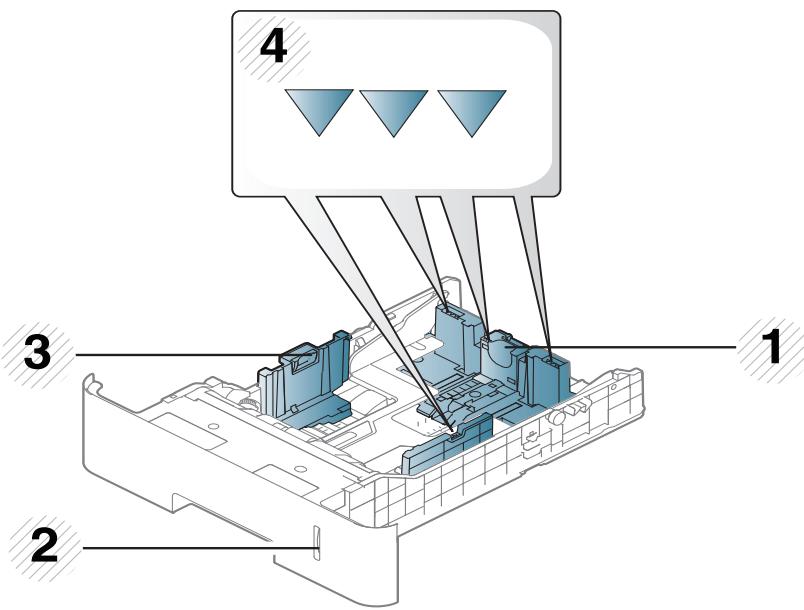
1 Paper length guide
2 Paper level indicator
3 Paper width guide
4 Paper limit mark

If you do not adjust the guide, it may cause paper registration, image skew, or jamming of the paper.

- Push button as shown and pull out the tray.
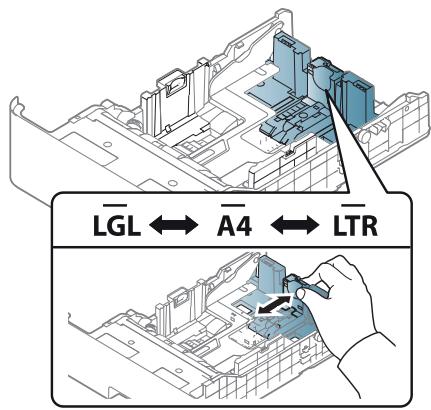
• Paper quantity indicator shows the amount of paper in the tray.
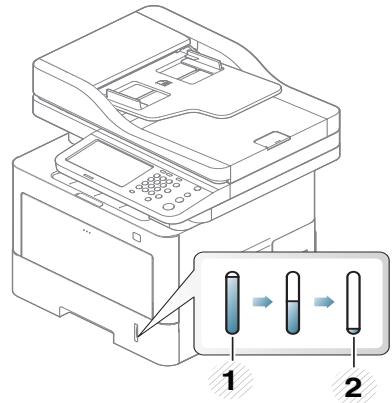
1 Full
2 Empty
Loading paper in the tray
Tray 1 / optional trays

The procedure is same for all optional trays.
1
Pull out the paper tray.
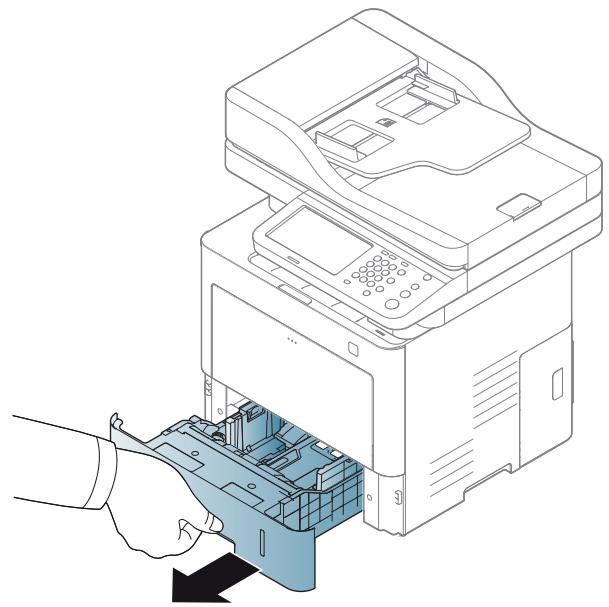
natural_image
Illustration of a printer being inserted into a file into a folder, with a hand holding the folder (no text or symbols visible)2 Squeeze and the paper width guide and paper length lever to locate them in the correct paper size slot marked at the bottom of the tray to adjust to the size (see "Tray overview" on page 68).
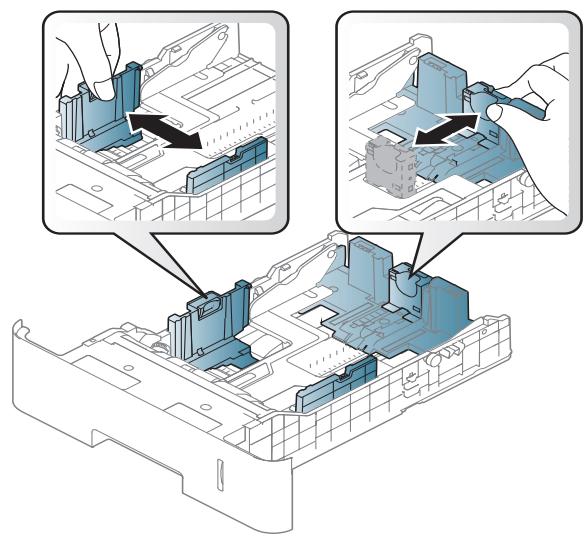
natural_image
Technical illustration of a mechanical assembly with two views showing internal components (no text or symbols present)3 Flex or fan the edge of the paper stack to separate the pages before loading papers.
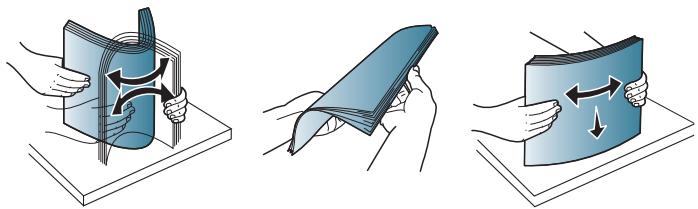
natural_image
Three-step illustration showing hands folding a flexible object, then folding a curved object with directional arrows (no text or symbols)4 After inserting paper into the tray, squeeze the paper width guides and paper length guide.
Loading paper in the tray
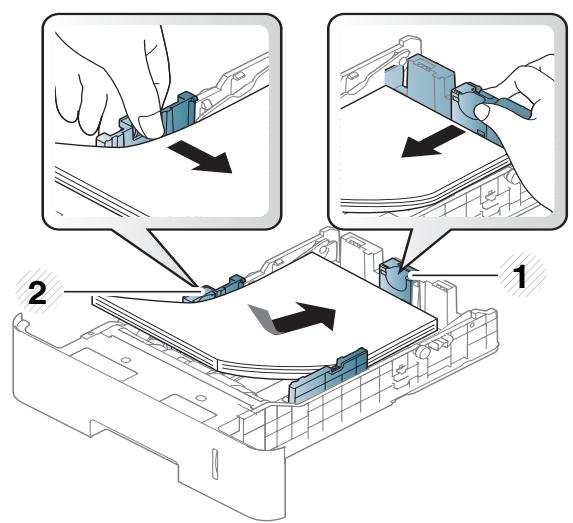
1 Paper length guide
2 Paper width guide

- Do not push the paper width guide too far causing the media to buckle.
- If you do not adjust the paper width guide, it may cause paper jams.
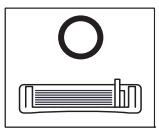
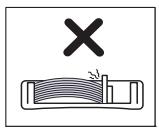
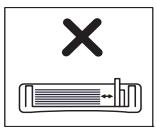
- Do not use a paper with a leading-edge curl, it may cause a paper jam or the paper can be wrinkled.



5 Insert the tray back into the machine.
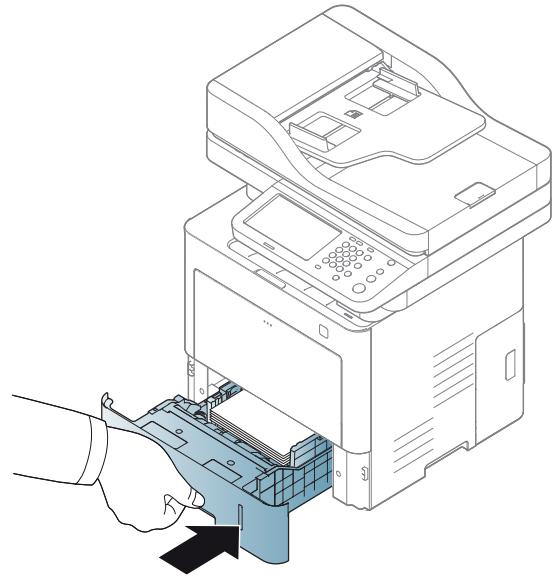
natural_image
Illustration of a printer being inserted into a plastic container, with a hand adjusting the component (no text or symbols visible)6 When you print a document, set the paper type and size for tray (see "Setting the paper size and type" on page 78).
Loading paper in the tray
Multi-purpose tray
The multi-purpose tray can hold special sizes and types of print material, such as postcards, note cards, and envelopes (see "Print media specifications" on page 346).
Tips on using the multi-purpose tray
- Load only one type, size and weight of print media at a time in the multi-purpose tray.
- To prevent paper jams, do not add paper while printing when there is still paper in the multi-purpose tray. This also applies to other types of print media.
- Always load the specified print media only to avoid paper jams and print quality problems (see "Print media specifications" on page 346).
- Flatten any curl on postcards, envelopes, and labels before loading them into the multi-purpose tray.
1 Press the push-release of multi-purpose tray and it down to open. Unfold the multi-purpose tray extension, as shown.
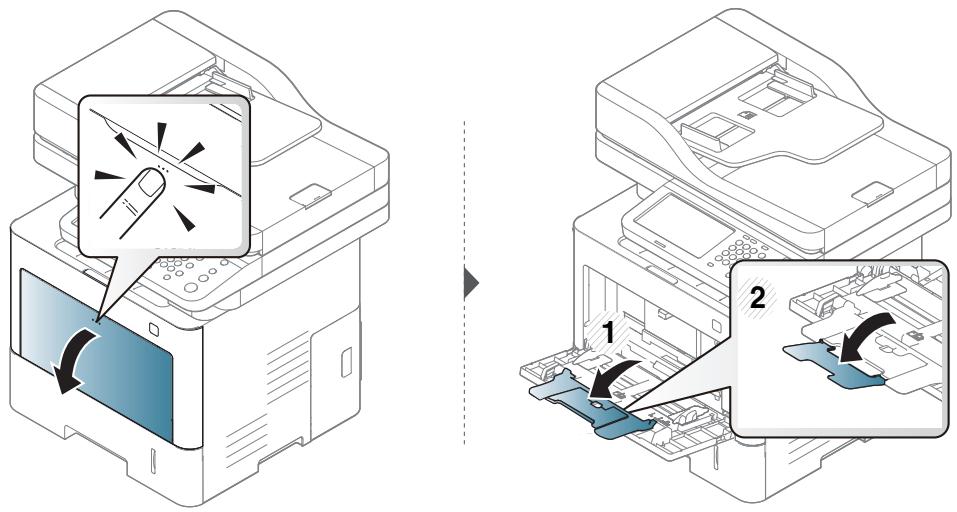
2 Load the paper.
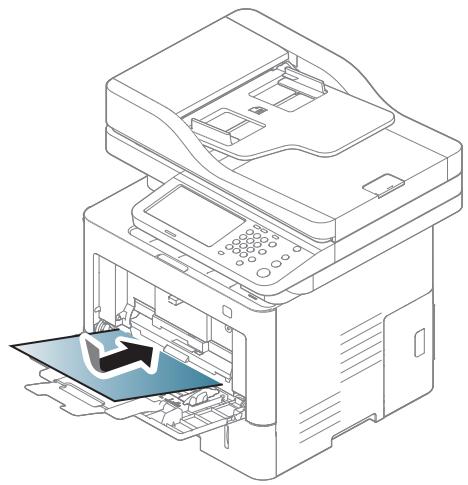
natural_image
Line drawing of a printer with internal components and a blue arrow indicating a loading or assembly process (no text or symbols present)Loading paper in the tray
3 Squeeze the multi-purpose tray paper width guides and adjust them to the width of the paper. Do not force them too much, or the paper will bent resulting in a paper jam or skew.
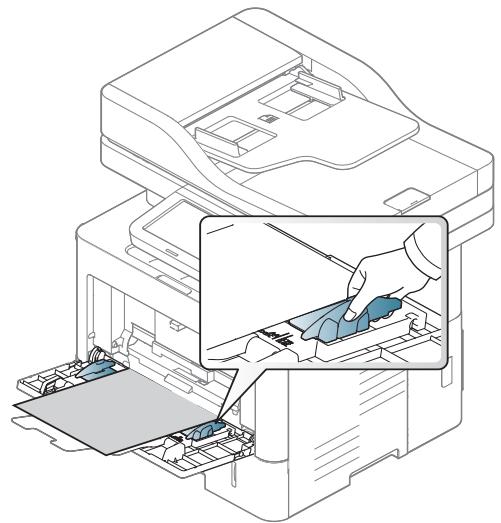
natural_image
Line drawing of a printer with an inset showing a hand inserting a component into the main body (no text or symbols present)
- When printing the special media, you must follow the loading guideline (See "Printing on special media" on page 73).
- When papers overlap when printing using Multi-purpose tray, open tray 1 and remove overlapping papers then try printing again.
4 When you print a document, set the paper type and size for tray (see "Setting the paper size and type" on page 78).
Printing on special media

The paper setting in the machine and driver should match to print without a paper mismatch error.
- You change the paper setting set in the machine from Samsung Easy Printer Manager program or SyncThru™ Web Service.
- If you machine is connected to the local, you can set the machine's setting from Samsung Easy Printer Manager > Advanced Setting > Device Settings (see "Using Samsung Easy Printer Manager" on page 260). - If your machine is connected to the network, you can set the machine's setting from SyncThru™ Web Service > Settings tab > Machine Settings (see "SyncThru™ Web Service" on page 247).
- You can set it using Machine Setup > Tray Settings > Settings > select the tray you want > Paper Size or Paper Type on the control panel.
To see paper weights for each sheet, refer to "Print media specifications" on page 346.
| Types | Tray 1 | Optional trays | Multi-purpose tray |
| Plain | ● | ● | ● |
| Thick | ● | ● | ● |
| Thicker | ● | ||
| Thin | ● | ● | ● |
| Bond | ● | ● | ● |
| Types | Tray 1 | Optional trays | Multi-purpose tray |
| Color | ● | ● | ● |
| CardStock | ● | ● | ● |
| Labels | ● | ● | ● |
| Envelope | ● | ● (Tray 2 only) | ● |
| Preprinted | ● | ● | ● |
| Cotton | ● | ● | ● |
| Recycled | ● | ● | ● |
| Archive | ● | ● | ● |
| Letterhead | ● | ● | ● |
| Punched | ● | ● | ● |
(●: Supported, Blank: Not supported)
Printing on special media
Envelope
Printing successfully on envelopes depends upon the quality of the envelopes. To print an envelope, place it as shown in the following figure.
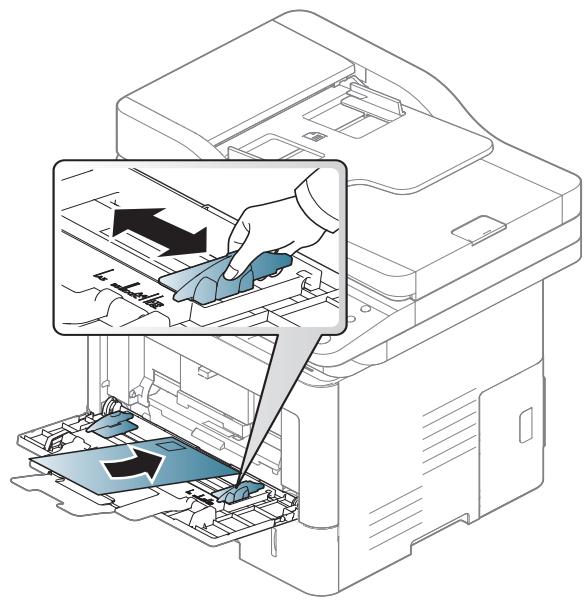
natural_image
Illustration of a printer's internal processing step showing hand inserting a component into a paper holder (no text or symbols present)
If envelopes are printed out with wrinkles, creases, or black bold lines, open the rear cover and pull down the pressure lever on the side about 90 degrees and try printing again. Keep the rear cover opened during printing.
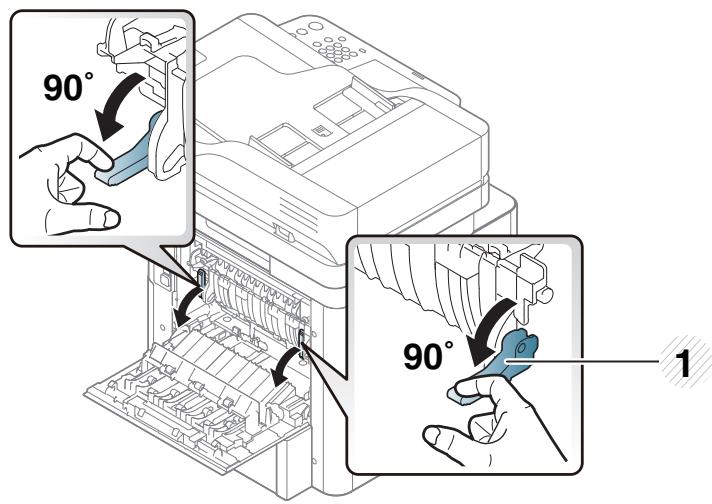
1 Pressure lever
- When selecting envelopes, consider the following factors:
- Weight: should not exceed 90 g/m^2 otherwise, jams may occur.
- Construction: should lie flat with less than 6 mm curl and should not contain air.
- Condition: should not be wrinkled, nicked, nor damaged.
- Temperature: should resist the heat and pressure of the machine during operation.
• Use only well-constructed envelopes with sharp and well-creased folds.
Printing on special media
• Do not use stamped envelopes.
- Do not use envelopes with clasps, snaps, windows, coated lining, self-adhesive seals, or other synthetic materials.
- Do not use damaged or poorly made envelopes.
- Be sure the seam at both ends of the envelope extends all the way to the corner of the envelope.
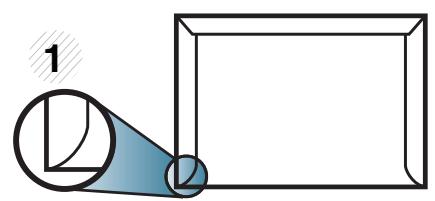
natural_image
Diagram showing a blue circular object and a rectangular block with a label '1' (no text or symbols on the objects themselves)1 Acceptable
2 Unacceptable
- Envelopes with a peel-off adhesive strip or with more than one flap that folds over to seal must use adhesives compatible with the machine's fusing temperature for 0.1 second about 170^ (338 °F). The extra flaps and strips might cause wrinkling, creasing, or jams, and may even damage the fuser.
- For the best print quality, position margins no closer than 15 mm from the edges of the envelope.
- Avoid printing over the area where the envelope’s seams meet.
Labels
To avoid damaging the machine, use only labels designed for use in laser printers.
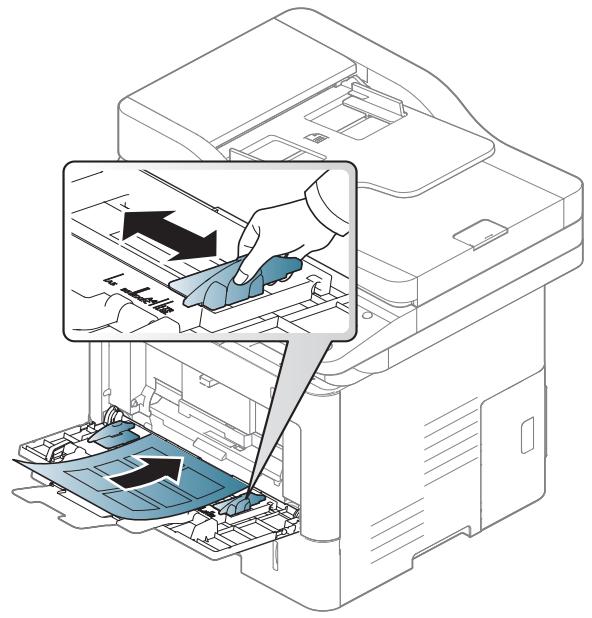
natural_image
Illustration of a printer's internal structure with an inset showing the printer's handle and paper feed (no text or symbols present)- When selecting labels, consider the following factors:
- Adhesives: Should be stable at your machine's fusing temperature about 170 °C (338 °F).
- Arrangement: Only use labels with no exposed backing between them. Labels can peel off sheets that have spaces between the labels, causing serious jams.
- Curl: Must lie flat with no more than 13 mm of curl in any direction.
Printing on special media
- Condition: Do not use labels with wrinkles, bubbles, or other indications of separation.
- Make sure that there is no exposed adhesive material between labels. Exposed areas can cause labels to peel off during printing, which can cause paper jams. Exposed adhesive can also cause damage to machine components.
- Do not run a sheet of labels through the machine more than once. The adhesive backing is designed for only a single pass through the machine.
- Do not use labels that are separating from the backing sheet or are wrinkled, bubbled, or otherwise damaged.
Card stock/ Custom-sized paper
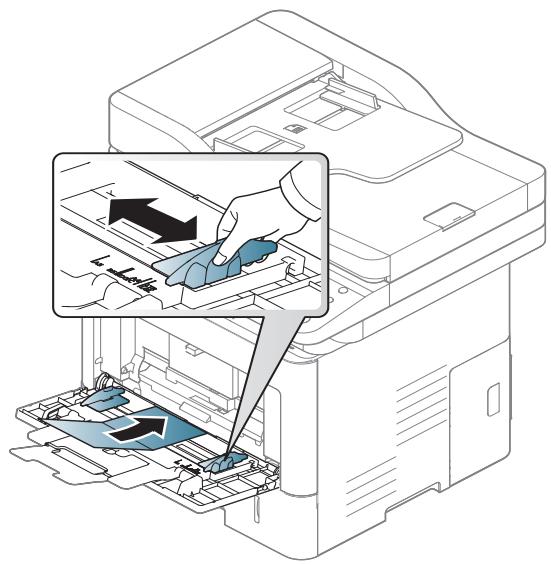
- In the software application, set the margins to at least 6.4 mm (0.25 inches) away from the edges of the material.
Printing on special media
Preprinted paper
When loading preprinted paper, the printed side should be facing up with an uncurled edge at the front. If you experience problems with paper feeding, turn the paper around. Note that print quality is not guaranteed.
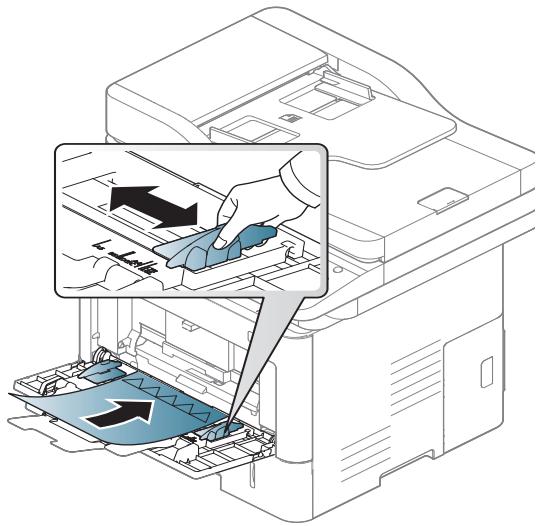
natural_image
Illustration of a printer's internal processing step showing tool insertion and blue fabric being inserted (no text or symbols)- Must be printed with heat-resistant ink that will not melt, vaporize, or release hazardous emissions when subjected to the machine's fusing temperature for 0.1 second (about 170^ (338°F)).
- Preprinted paper ink must be non-flammable and should not adversely affect machine rollers.
- Before you load preprinted paper, verify that the ink on the paper is dry. During the fusing process, wet ink can come off preprinted paper, reducing print quality.
Setting the paper size and type
After loading paper in the paper tray, set the paper size and type using the display screen. For computer printing, select the paper size and type in the application program you use on your computer (see "Opening printing preferences" on page 84).

The paper setting in the machine and driver should match to print without a paper mismatch error.
- You change the paper setting set in the machine from Samsung Easy Printer Manager program or SyncThru™ Web Service.
- If you machine is connected to the local, you can set the machine's setting from Samsung Easy Printer Manager > Advanced Setting > Device Settings (see "Using Samsung Easy Printer Manager" on page 260).
- If your machine is connected to the network, you can set the machine's setting from SyncThru™ Web Service > Settings tab > Machine Settings (see "SyncThru™ Web Service" on page 247).
- You can set it using Machine Setup > Tray Settings > Settings > select the tray you want > Paper Size or Paper Type on the control panel.
Setting the paper size
1 Press Machine Setup > Tray Settings > Settings > select the tray you want from the display screen.
2 Press Paper Size and select the paper size.

If there is no required size paper or you need to use custom size paper, press the Custom Size Button to set the paper size. You can also set and save the custom size using Custom Size. You can select the custom size whenever you need it.

Press ↻ (Back) to save the selection.
Setting the paper type
1 Press Machine Setup > Tray Settings > Settings > select the tray you want from the display screen.
2 Press Paper Type and select the paper type.
3 Press (Back) to save the selection.
Output location

The surface of the center tray may become hot if you print a large number of pages at once. Make sure that you do not touch the surface, and do not allow children near it.
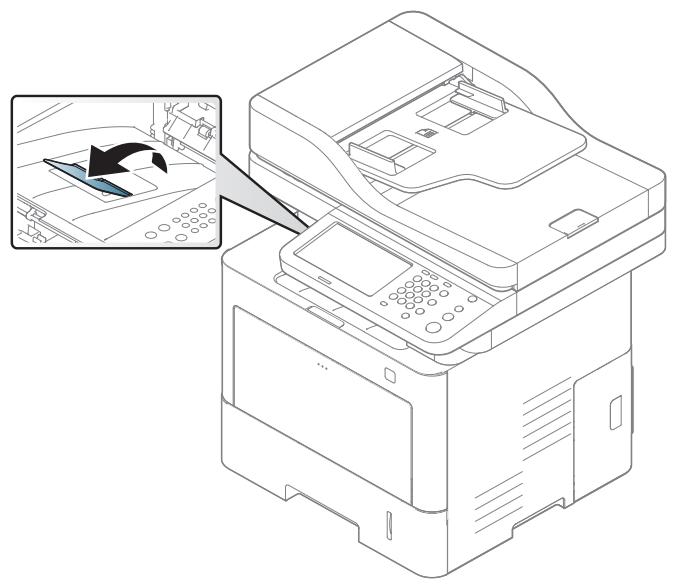
natural_image
Line drawing of a printer with an inset showing a close-up of its internal components (no text or symbols present)The machine sends output to the output tray by default. The printed pages stack on the output support, and the output support will help the printed pages to align. Open the output support.
natural_image
Blue circular icon with a white printer symbol (no text or numbers)5. Printing
This chapter explains common printing tasks.
This chapter includes:
• Printer driver features 81
• Basic printing 82
- Opening printing preferences 84
• Using special print features 91
• Using direct printing utility 99
- Changing the default print settings 101
- Setting your machine as a default machine 102
• Printing to a file (PRN) 103
• Mac printing 104
• Linux printing 106
- Unix printing 107
Printer driver features

- The procedures in this chapter are mainly based on Windows 7.
- Check the operating systems that are compatible with your machine (see "System requirements" on page 349).
Your printer drivers support the following standard features:
• Paper orientation, size, source, and media type selection
• Number of copies
You can also use various special printing features. The following table shows a general overview of features supported by your printer drivers:

Some models or operating system may not support the certain feature(s) in the following table.
| Feature | PCL/PS ^ab /XPS ^bc | PS ^b | ||
| Windows | Mac | Linux | Unix | |
| Machine quality option | ● | ● | ● | ● |
| Poster printing | ● | ● | ||
| Multiple pages per sheet | ● | ● | ● | ● |
| Booklet printing | ● | ● | ||
| Fit to page printing | ● | ● | ||
| Reduce and enlarge printing | ● | ● | ||
| Feature | PCL/PS ^ab /XPS ^bc | PS ^b | ||
| Windows | Mac | Linux | Unix | |
| Different source for first page | ● | ● | ||
| Cover page options | ● | ● | ● | ● |
| Raster compression | ●(PCL only) | |||
| Output options | ● | ● | ● | ● |
| Watermark | ● | ● | ||
| Overlay | ●(PCL only) | |||
| Double-sided printing (duplex) | ● | ● | ● | ● |
a. The PostScript driver is recommended for best print image quality from PostScript-based applications such as Acrobat Reader ^® , Adobe Illustrator ^® , Adobe Photoshop ^® , etc.
b. Download the software from the Samsung website and install it: (http://www.samsung.com > find your product > Support or Downloads). Before installing, check whether your computer's OS support the software.
c. XPS printer driver can be installed only on Windows Vista OS or higher.
(●: Supported, Blank: Not supported)
Basic printing

• Mac printing (see "Mac printing" on page 104).
• Linux printing (see "Linux printing" on page 106).
- UNIX printing (see "Unix printing" on page 107).
The following Printing Preferences window is for Notepad in Windows 7. Your Printing Preferences window may differ, depending on your operating system or the application you are using.
1 Open the document you want to print.
2 Select Print from the File menu.
3 Select your machine from the Select Printer list.
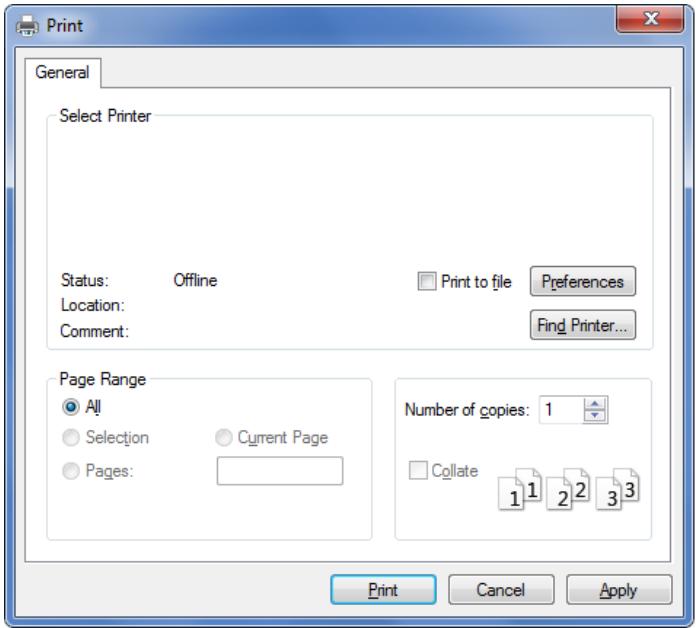
The basic print settings including the number of copies and print range are selected within the Print window.

To take advantage of the printer features provided by your printer driver, click Properties or Preferences in the application's Print window to change the print setting (see "Opening printing preferences" on page 84).
4 To start the print job, click OK or Print in the Print window.
Basic printing
Canceling a print job
If the print job is waiting in the print queue or print spooler, cancel the job as follows:
- You can access this window by simply double-clicking the machine icon (图标) in the Windows task bar.
- You can also cancel the current job by pressing Ⓥ(Stop) button on the control panel.
Opening printing preferences

When you select an option in Printing Preferences, you may see a warning mark, ✗, or 🔍. An exclamation mark ( 🔊) means you can select that certain option but it is not recommended, and ( ✗) mark means you cannot select that option due to the machine's setting or environment.
1 Open the document you want to print.
2 Select Print from the File menu.
3 Select your printer driver from the Select Printer list.
4 Click Properties or Preferences.

The screenshot may differ depending on model.
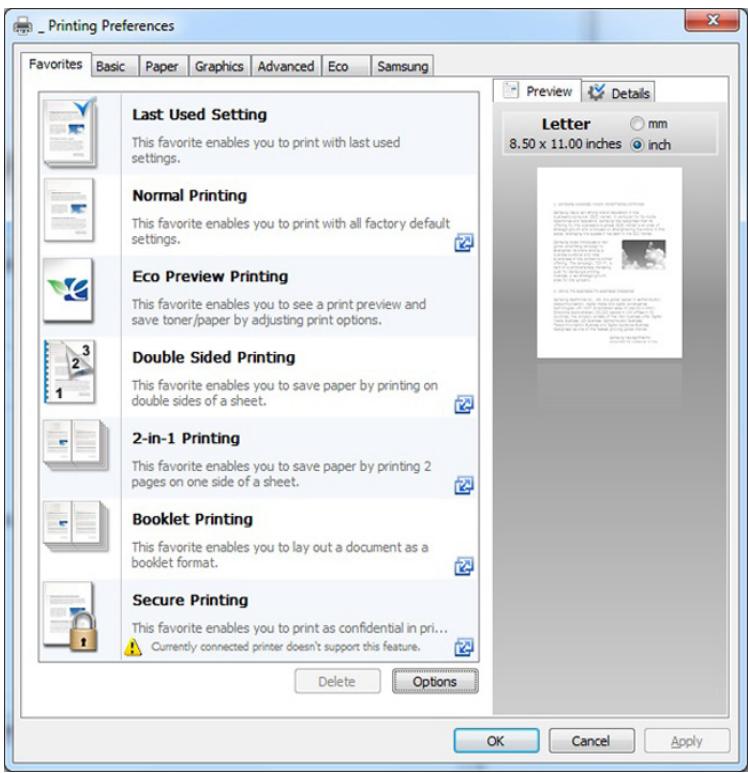

- You can apply Eco features to save paper and toner before printing (see "Easy Eco Driver" on page 255).
- You can check the machine's current status pressing the Printer Status button (see "Using Samsung Printer Status" on page 262).
- The printer driver includes a user interface that is optimized for touchscreens. To use this UI, click Samsung Printer Center > Device Options and then select Stylish User Interface (see "Using Samsung Printer Center" on page 257).
Opening printing preferences
Favorites tab
Listed items help you choose pre-defined settings.

The screenshot may differ depending on model.
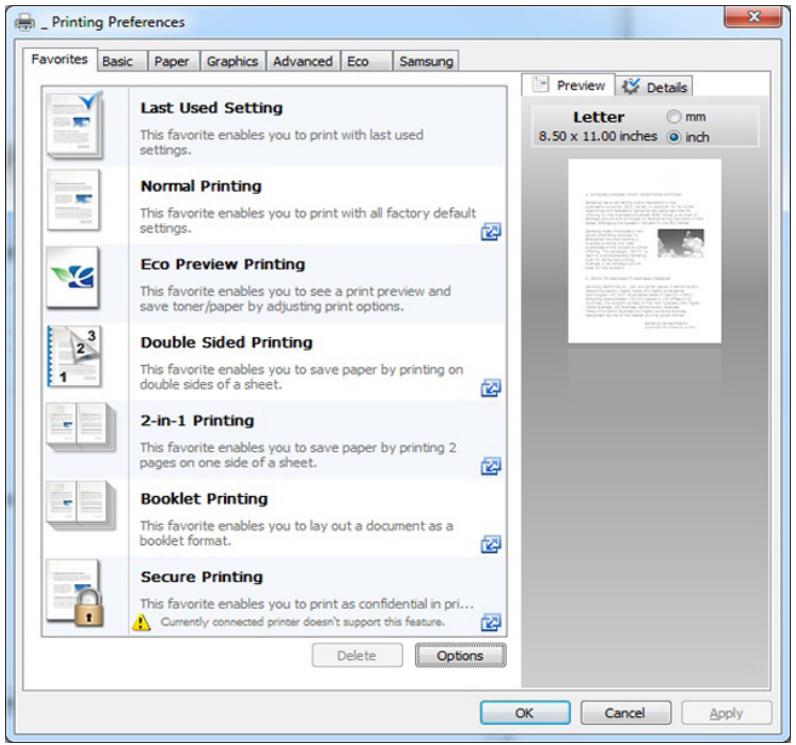
Basic tab
Basic tab to set various printing options.
Orientation
This option allows you to select the direction in which information is printed on a page.
Layout Options
This option allows you to select various ways to layout your document.
- Single Page Per Side: This option is a basic layout option. This option allows you to print a page on one side of a paper.
- Multiple Pages Per Side: See "Printing multiple pages on one sheet of paper" on page 91.
• Poster Printing: See "Printing posters" on page 92.
• Booklet Printing: See "Printing booklets" on page 92. - Page Border: This option allows you to print your document on which border line is. This option is not available for Poster Printing and Booklet Printing.
Opening printing preferences
Double-Sided Printing
This option allows you to print on both sides of paper (see "Printing on both sides of the paper" on page 93).
Paper tab
Use the Paper tab options to set the basic paper handling specifications.
Copies
This option allows you to choose the number of copies to be printed. You can select 1 to 999 copies.
Paper Options
- Original Size: This option allows you to set the actual paper size of the originals.
- Output Size: This option allows you to scale your print job to any selected paper size regardless of the originals size (see "Fitting your document to a selected paper size" on page 94).
- Percentage: This option allows you to change the size of a page's contents to appear larger or smaller on the printed page by typing in a percentage you want (see "Change the size by percentage of your document" on page 94).
- Source: Make sure that Source is set to the corresponding paper tray. Use MP Tray when printing on special materials, such as envelopes and transparencies.
- Paper Type: This option allows you to set the type of paper to be loaded in the tray. This will let you get the best quality printout. If not, the desired print quality may not be achieved.
- Special Pages: This option is allows you to make special pages such as covers, insertion, and exception. You can add, delete or update the special page settings to the list. This option is available only when you use the PCL printer driver.
Opening printing preferences
Graphics tab
Use the Graphic tab options to adjust the print quality for your specific printing needs.
Quality
The higher sharper the clarity of printed characters and graphics. The higher setting also may increase the time it takes to print a document.
Font/Text
Select Clear Text to print text darker than on a normal document.
Check All Text Black to print in solid black, regardless of the color it appears on the screen.
Graphic Controller
It allows user to emphasize edges of texts and fine lines for improving readability and align each color channel registration in color printing mode.
Toner Save
The Toner Save setting allows the user to save printing toner when printing a draft version of a document. Select Off to print in normal mode and select On to print with less toner applied to the page.
Advanced tab
Use the Advanced tab to set various printing options.
Watermark
See "Using watermarks" on page 95.
Overlay
See "Using overlay" on page 97.
Output options
- Print Order: This options allows you to set the sequence in which the pages will print. Print Odd Pages and Print Even Pages are available only when you use the PCL printer driver.
- Skip Blank Pages: This option allows you to specify not to print blank pages in the original data.
- Manual Margin: This option allows you to specify binding margin. Binding margin adjusts binding position. This option is not available when you use the PS printer driver.
Opening printing preferences
Security
Encrypts printing data first, and transmits it to the machine. This feature protects the printing information to prevent your data from being comprised on your network. Job Encryption feature is enabled only when the hard drive is installed. The hard drive is used to decrypt the printing data.
Job Accounting
This option allows you to print with the given permission.
- User permission: If you check this option, only users with user permission can start a print job.
- Group permission: If you check this option, only groups with group permission can start a print job.

- Click the question mark(☐) from the upper-right corner of the window and click on any option you want to know about.
- Administrators can enable job accounting and configure permissions in the control panel or SyncThru™ Web Service. For the detailed information about them, refer to the Administrator's Guide.
Eco tab
The Eco tab allows you to save print resources and lead you to eco-friendly printing. When you select Eco Printing, you can see the eco image ( ) on some options. Also, Some options are not available to use in the eco mode.
Eco Options
- Printer Default: If you select this option, this feature is determined by the setting you've made on the control panel of the machine.
• None: Disables this option. - Eco Printing: To activate Eco mode, select Double-Sided Printing, Layout, Skip Blank Pages, and Toner Save. You want to use in eco mode to save on paper and toner usage. As long as you do not change the options from the other tabs, the document will be printed out as a set in the Eco mode with the selections you have chosen.
- Password: If the administrator sets On-Forced in Default Eco Mode for this machine, the eco mode is always set by this machine's eco setting, while the Eco Options in the printer driver are disabled. If you need to change the print settings, click Password and enter the password or contact your administrator.
Opening printing preferences
Result Simulator
Result Simulator shows the estimated result of reduced emission of carbon dioxide, used electricity, and the amount of saved paper in accordance with the settings you selected.

- The results are calculated on the basis that the total number of printed paper is one hundred without a blank page when the eco mode is disabled.
- Referred to the calculation coefficient about CO2, energy and paper from IEA(International Energy Agency), the index of Ministry of Internal Affairs and Communication of Japan and www.remanufacturing.org.uk. Each model has a different index.
- The power consumption in printing mode refers to the average printing power consumption in this machine.
- The actual saved or reduced amount may differ depending on the operating system used, computing performance, application software, connection method, media type, media size, job complexity, etc.
Samsung tab
Use the Samsung tab to display the copyright and the version number of the driver. If your computer is connected to the Internet, you can have access to services.
Print Mode
The Print Mode option, which is visible on each preferences tab except for the Favorites tab and Samsung tab,
This option allows you to choose how to print or save the printing file by using the HDD in your machine. The default Print Mode is Normal which is for printing without storing the printing file on the HDD. You can also use this option in other tabs.
- Normal: This mode prints without storing your document in the optional memory.
- Confidential: This mode is used for printing confidential documents. You need to enter a password to print.
- Store: Select this setting to save a document in the mass storage device without printing.
- Store and Print: This mode is used when printing and storing document at the same time.
- Spool: This option can be useful when handling large amounts of data. If you select this setting, the printer spools the document into the mass storage device (HDD) and then prints it from the mass storage device (HDD) queue, decreasing the computer's work load.
Opening printing preferences

- Job Name: This option is used when you need to find a stored file using the control panel.
- User ID: This option is used when you need to find a stored file using the control panel. The user name automatically appears as the user name that you use to log on Windows.
- Enter Password: If the Property of the stored documents you selected is Secured, you have to enter the password for the stored document. This option is used for loading a stored file using the control panel.
- Confirm Password: Re-enter the password to confirm it.
Using a favorite setting
The Favorites option, which is visible on each preferences tab except for the Favorites tab and Samsung tab, allows you to save the current preferences for future use.
To save a Favorites item, follow these steps:
1 Change the settings as needed on each tab.
2 Enter a name for the item in the Favorites input box.
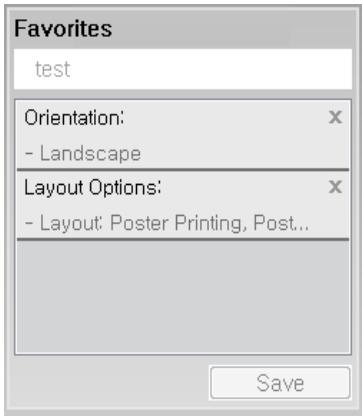
3 Click Save.
4 Enter name and description, and then select the desired icon.
5 Click OK. When you save Favorites, all current driver settings are saved.

To use a saved setting, select it in the Favorites tab. The machine is now set to print according to the settings you have selected.
To delete saved settings, select it in the Favorites tab and click Delete.
Using help
Click the option you want to know on the Printing Preferences window and press F1 on your keyboard.
Using special print features
Special print features include:
- "Printing multiple pages on one sheet of paper" on page 91.
• "Printing posters" on page 92.
• "Printing booklets" on page 92. - "Printing on both sides of the paper" on page 93.
- "Change the size by percentage of your document" on page 94.
- "Fitting your document to a selected paper size" on page 94.
• "Using watermarks" on page 95.
• "Using overlay" on page 97.
Printing multiple pages on one sheet of paper
You can select the number of pages to print on a single sheet of paper. To print more than one page per sheet, the pages will be reduced in size and arranged in the order you specify. You can print up to 16 pages on one sheet.
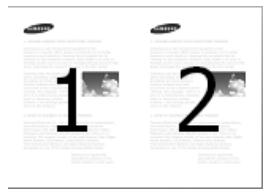
1 To change the print settings from your software application, access Printing Preferences (see "Opening printing preferences" on page 84).
2 Click the Basic tab, select Multiple Pages per Side in the Type dropdown list.
3 Select Page Border to print a border around each page on the sheet.
4 Select the number of pages you want to print per sheet (2, 4, 6, 9, or 16) in the Pages per Side drop-down list.
5 Select the page order from the Page Order drop-down list, if necessary.
6 Click the Paper tab, select the Original size, Source, and Paper Type.
7 Click OK or Print until you exit the Print window.
Using special print features
Printing posters
This feature allows you to print a single-page document onto 4, 9, or 16 sheets of paper, for the purpose of pasting the sheets together to form one poster-size document.
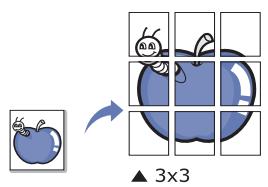
1 To change the print settings from your software application, access Printing Preferences (see "Opening printing preferences" on page 84).
2 Click the Basic tab, select Poster Printing in the Type drop-down list.
3 Select the page layout you want.
4 Select the Poster Overlap value. Specify Poster Overlap in millimeters or inches by selecting the radio button on the upper right of Basic tab to make it easier to paste the sheets together.
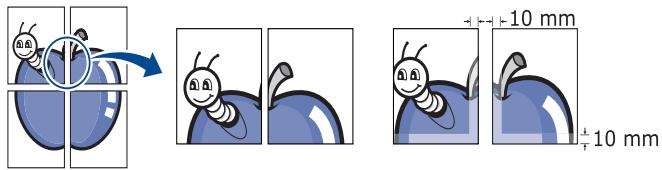
5 Click the Paper tab, select the Original size, Source, and Paper Type.
6 Click OK or Print until you exit the Print window.
7 You can complete the poster by pasting the sheets together.
Printing booklets
This feature prints your document on both sides of a paper and arranges the pages so that the paper can be folded in half after printing to produce a booklet.

1 To change the print settings from your software application, access the Printing Preferences (see "Opening printing preferences" on page 84).
2 Click the Basic tab, select Booklet Printing from the Type drop-down list.
3 Click the Advanced button. Then select the option you want.
4 Click the Paper tab, select the Original size, Source, and Paper Type.

The Booklet Printing option is not available for all paper sizes. In order to find out the available paper size for this feature, select the available paper size in the Original size option on the Paper tab.
If you select an unavailable paper size, this option can be automatically canceled. Select only available paper. (paper without 🚗 or ✕ mark).
5 Click OK or Print until you exit the Print window.
Using special print features
Printing on both sides of the paper
You can print on both sides of a paper; duplex. Before printing, decide how you want your document oriented.

Do not print on both sides of the special media, such as labels, envelopes, or thick paper to print on both sides of paper. It may cause a paper jam or damage the machine.
1 To change the print settings from your software application, access Printing Preferences (see "Opening printing preferences" on page 84).
2 Click the Basic tab.
3 From the Double-Sided Printing section, select the binding option you want.
- Printer Default: If you select this option, this feature is determined by the setting you’ve made on the control panel of the machine. This option is available only when you use the PCL printer driver.
• None: Disables this feature.
- Long Edge: This option is the conventional layout used in bookbinding.
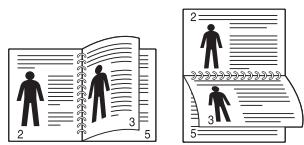
- Short Edge: This option is the conventional layout used in calendars.
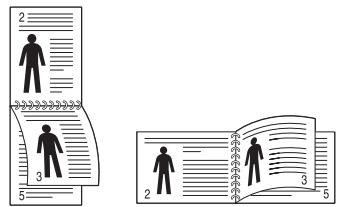
4 Click the Paper tab, select the Original size, Source, and Paper Type.
5 Click OK or Print until you exit the Print window.
Using special print features
Change the size by percentage of your document
You can change the size of a document to appear larger or smaller on the printed page by typing in a percentage you want.

natural_image
Two cartoon carrots with blue fur, one increasing and the other decreasing (no text or symbols)1 To change the print settings from your software application, access Printing Preferences (see "Opening printing preferences" on page 84).
2 Click the Paper tab.
3 Select actual paper size of the originals from the Original Size.
4 Enter the scaling rate in the Percentage input box.
You can also click the up/down arrows to select the scaling rate.

You cannot use this feature when you select a size of paper from the Output Size.
5 Select the Source and Paper Type.
6 Click OK or Print until you exit the Print window.
Fitting your document to a selected paper size
This printer feature allows you to scale your print job to any selected paper size regardless of the document size. This option can be useful when you want to check fine details on a small document.
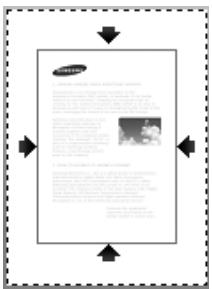
1 To change the print settings from your software application, access Printing Preferences (see "Opening printing preferences" on page 84).
2 Click the Paper tab.
3 Select actual paper size of the originals from the Original Size.
4 Select the size of paper to be printed in the tray from the Output Size.
5 Select the Source and Paper Type.
6 Click OK or Print until you exit the Print window.
Using special print features
Using watermarks
The watermark option allows you to print text over an existing document. For example, you use it when you want to have large gray letters reading "DRAFT" or "CONFIDENTIAL" printed diagonally across the first page or all pages of a document.
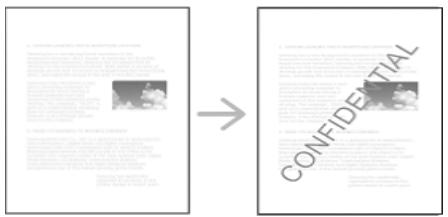
There are several predefined watermarks that come with the machine. They can be modified, or you can add new ones to the list.

- Header: You can add the selected text to the Top left, Top center, or Top right.
- Footer: You can add the selected text to the Bottom left, Bottom center, or Bottom right.
Using an existing watermark
1 To change the print settings from your software application, access Printing Preferences (see "Opening printing preferences" on page 84).
2 Click the Advanced tab, and select the desired watermark from the Watermark drop-down list.
3 Click OK or Print until you exit the print window.
Creating a watermark
1 To change the print settings from your software application, access Printing Preferences (see "Opening printing preferences" on page 84).
2 From the Advanced tab, select Edit... from the Watermark drop-down list.
3 Enter a text message in the Watermark Message box. You can enter up to 256 characters.
When the First Page Only box is checked, the watermark prints on the first page only.
4 Select watermark options.
You can select the font name, style, size, and shade from the Font Attributes section, as well as set the angle of the watermark from the Watermark Alignment and Angle section.
Using special print features
5 Click Add to add a new watermark to the Current Watermarks list.
6 When you finish editing, click OK or Print until you exit the Print window.
To stop printing the watermark, select None from the Watermark drop-down list.
Editing a watermark
1 To change the print settings from your software application, access Printing Preferences (see "Opening printing preferences" on page 84).
2 Click the Advanced tab, select Edit... from the Watermark drop-down list.
3 Select the watermark you want to edit from the Current Watermarks list and change the watermark message and options.
4 Click Update to save the changes.
5 Click OK or Print until you exit the Print window.
Deleting a watermark
1 To change the print settings from your software application, access Printing Preferences (see "Opening printing preferences" on page 84).
2 Click the Advanced tab, select Edit... from the Watermark drop-down list.
3 Select the watermark you want to delete from the Current Watermarks list and click Delete.
4 Click OK or Print until you exit the Print window.
Using special print features
Using overlay
This option is available only when you use the PCL printer driver.
What is an overlay?
An overlay is text and/or images stored on the computer hard drive (HDD) as a special file format that can be printed on any document. Overlays are often used to take the place of letterhead paper. Rather than using preprinted letterhead, you can create an overlay containing exactly the same information that is currently on your letterhead. To print a letter with your company's letterhead, you do not need to load preprinted letterhead paper in the machine just print the letterhead overlay on your document.

Creating a new page overlay
To use a page overlay, you must create a new page overlay containing your logo or image.
1 Create or open a document containing text or an image for use in a new page overlay. Position the items exactly as you wish them to appear when printed as an overlay.
2 To save the document as an overlay, access Printing Preferences (see "Opening printing preferences" on page 84).
3 Click the Advanced tab, and select Create from the Overlay drop-down list.
4 In the Save As window, type a name up to eight characters in the File name box. Select the destination path, if necessary (The default is C:\Formover).
5 Click Save.
6 Click OK or Print until you exit the Print window.
When a confirming message window appears, click Yes.
7 The file is not printed. Instead, it is stored on your computer hard disk drive.

The overlay document size must be the same as the document you print with the overlay. Do not create an overlay with a watermark.
Using special print features
Using a page overlay
After an overlay has been created, it is ready to be printed with your document. To print an overlay with a document:
1 Create or open the document you want to print.
2 To change the print settings from your software application, access Printing Preferences (see "Opening printing preferences" on page 84).
3 Click the Advanced tab.
4 Select the Print Overlay from the Overlay drop-down list.
5 If the overlay file you want does not appear in the Overlay File 1 or Overlay File 2 drop-down list, select Load from the Overlay List. Select the overlay file you want to use.
If you have stored the overlay file you want to use in an external source, you can also load the file when you access the Load window.
After you select the file, click Open. The file appears in the Overlay List box and is available for printing. Select the overlay from the Overlay List box.
6 If necessary, check Confirm Page Overlay When Printing box. If this box is checked, a message window appears each time you submit a document for printing, asking you to confirm your wish to print an overlay on your document.
If this box is not checked and an overlay has been selected, the overlay automatically prints with your document.
7 Click OK or Print until you exit the Print window. The selected overlay prints on your document.

The resolution of the overlay document must be the same as that of the document you will print with the overlay.
Deleting a page overlay
You can delete page overlays that you no longer use.
1 In the Printing Preferences window, click the Advanced tab.
2 Select the Print Overlay from the Overlay drop-down list.
3 Select the overlay you want to delete from the Overlay List box.
If the overlay file you want does not appear in the Overlay List, select Load from the Overlay List. Select the overlay file you want to delete.
4 Click Delete.
5 When a confirming message window appears, click Yes.
6 Click OK or Print until you exit the Print window.
Using direct printing utility
This chapter explains how to use Direct Printing Utility to print PDF files without open the files.

- You cannot print PDF files that are restricted. Deactivate the printing restriction feature and retry printing.
- You cannot print PDF files that are restricted by a password. Deactivate the password feature, and retry printing.
- Whether or not a PDF file can be printed using the Direct Printing Utility program depends on how the PDF file was created.
- The Direct Printing Utility program supports PDF version 1.7 and below. For higher versions, you must open the file to print it.
What is Direct Printing Utility?
Direct Printing Utility is a program that sends a PDF file directly to your machine to print without having to open the file. It sends data through the Windows spooler using the port of the printer driver. It only supports PDF format.
To install this program:
Download the software from the Samsung website then unpack and install it: (http://www.samsung.com > find your product > Support or Downloads).
Printing
There are several ways you can print using the Direct Printing Utility.
From the Direct Printing Utility window
1 From the Start menu select Programs or All Programs.
• For Windows 8, from Charms, select Search > Apps.
2 Find Samsung Printers > Direct Printing Utility.
3 Select your machine from the Select Printer drop-down list and click Browse.
4 Select the file you wish to print and click Open.
The file is added in the Select Files section.
5 Customize the machine settings for your needs.
6 Click Print. The selected PDF file is sent to the machine.
Using direct printing utility
Using the right-click menu
1 Right-click on the PDF file you wish to print and select Direct Printing. The Direct Printing Utility window appears with the PDF file is added.
2 Select the machine you wish to use.
3 Customize the machine settings for your needs.
4 Click Print. The selected PDF file is sent to the machine.
Changing the default print settings

Most Windows applications will override settings you specify in the printer driver. Change all print settings available in the software application first, and change any remaining settings using the printer driver.
1 Click the Windows Start menu.
• For Windows 8, from the Charms, select Search > Settings.
2 For Windows® XP Service Pack 3/Server 2003, select Printer and Faxes.
- For Windows Server 2008/Vista, select Control Panel > Hardware and Sound > Printers.
• For Windows 7/8, select Control Panel > Devices and Printers. - For Windows Server 2008 R2, select Control Panel > Hardware > Devices and Printers.
3 Right-click on your machine.
4 For Windows Windows® XP Service Pack 3/Server 2003/Server 2008/Vista, select Printing Preferences.
For Windows 7/8 or Windows Server 2008 R2, from context menus, select Printing preferences.

If Printing preferences has a ▶, you can select other printer drivers connected to the selected printer.
5 Change the settings on each tab.
6 Click OK.
If you want to change the settings for each print job, change it in Printing Preferences.
Setting your machine as a default machine
1 Click the Windows Start menu.
• For Windows 8, from the Charms, select Search > Settings.
2 For Windows Windows® XP Service Pack 3/Server 2003, select Printer and Faxes.
- For Windows Server 2008/Vista, select Control Panel > Hardware and Sound > Printers.
• For Windows 7/8, select Control Panel > Devices and Printers. - For Windows Server 2008 R2, select Control Panel > Hardware > Devices and Printers.
3 Select your machine.
4 Right-click your machine and select Set as Default Printer.

For Windows 7 or Windows Server 2008 R2, if Set as default printer has a ▶, you can select other printer drivers connected to the selected printer.
Printing to a file (PRN)
You will sometimes need to save the print data as a file.
To create a file:
1 Check the Print to file box at the Print window.
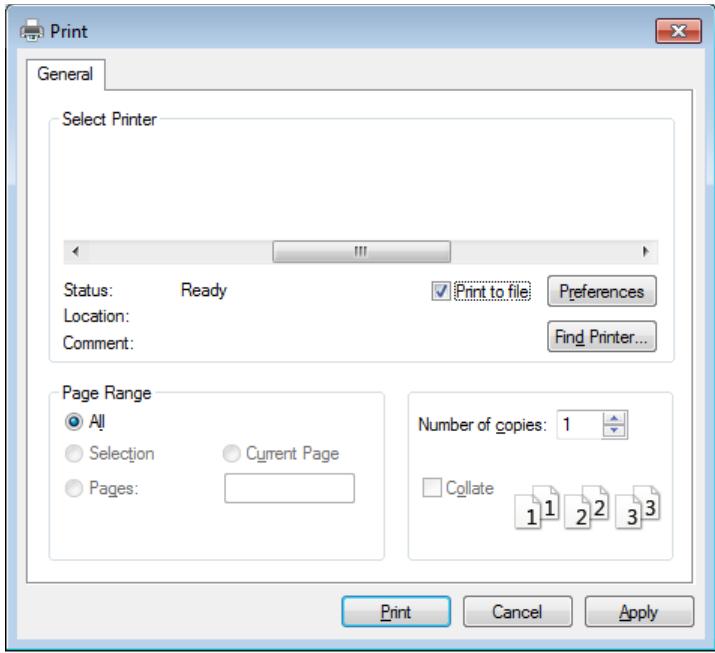
2 Click Print.
3 Type in the destination path and the file name, and then click OK.
For example c:\Temp\file name.

If you type in only the file name, the file is automatically saved in My Documents, Documents and Settings or Users. The saved folder may differ, depending on your operating system or the application you are using.
Mac printing

Some features may not be available depending on models or options. It means that the features are not supported.
Printing a document
When you print with a Mac, you need to check the printer driver settings in each application you use. Follow the steps below to print from a Mac:
1 Open the document to print.
2 Open the File menu and click Page Setup (Document Setup in some applications).
3 Choose your paper size, orientation, scaling, other options, and make sure that your machine is selected. Click OK.
4 Open the File menu and click Print.
5 Choose the number of copies and indicate which pages to print.
6 Click Print.
Changing printer settings
You can use advanced printing features when using your machine.
Open an application and select Print from the File menu. The machine name, which appears in the printer properties window, may differ depending on the machine in use. Except for the name, the composition of the printer properties window is similar to the following.
Printing multiple pages on one sheet
You can print more than one page on a single sheet of paper. This feature provides a cost-effective way to print draft copies.
1 Open an application, and select Print from the File menu.
2 Select Layout from the drop-down list under Orientation. In the Pages per Sheet drop-down list, select the number of pages you want to print on one sheet of paper.
3 Select the other options to use.
4 Click Print.
The machine prints the selected number of pages to print on one sheet of paper.
Printing on both sides of the paper

Some features may not be available depending on models or options. It means that the features are not supported (see "Variety feature" on page 9).
Before printing in the duplex mode, decide on which edge you will be binding your finished document. The binding options are, as follows:
- Long-Edge Binding: This option is the conventional layout used in book binding.
- Short-Edge Binding: This option is the type often used with calendars.
1 From your Mac application, select Print from the File menu.
2 Select Layout from the drop-down list under Orientation.
3 Select a binding orientation from the Two-Sided option.
4 Select the other options to use.
5 Click Print and the machine prints on both sides of the paper.

If you print more than 2 copies, the first copy and the second copy might print on the same sheet of paper. Avoid printing on both sides of paper when you are printing more than 1 copy.
Using help
Click the question mark on the bottom-left corner of the window and click on the topic you want to know about. A pop-up window appears with information about that option's feature, which is provided from the driver.
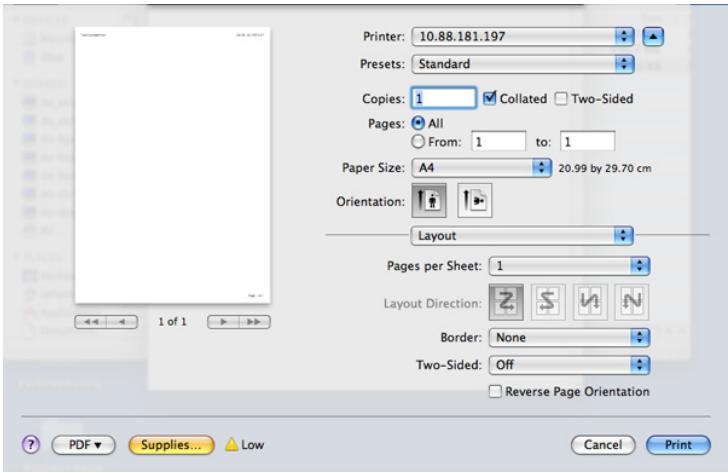
Linux printing

Some features may not be available depending on models or options. It means that the features are not supported.
Printing from applications
There are a lot of Linux applications that allow you to print using Common UNIX Printing System (CUPS). You can print on your machine from any such application.
1 Open the document to print.
2 Open the File menu and click Page Setup (Print Setup for some applications).
3 Choose your paper size, orientation, and make sure that your machine is selected. Click Apply.
4 Open the File menu and click Print.
5 Select your machine to print.
6 Choose the number of copies and indicate which pages to print.
7 Change other printing options in each tab, if necessary.
8 Click Print.

Automatic/manual duplex printing may not be available depending on models. You can alternatively use the lpr printing system or other applications for odd-even printing (see "Features by model" on page 8).
Printing files
You can print text, image, pdf files on your machine using the standard
CUPS directly from the command line interface. The CUPS lp or lpr utility allows you to do that. You can print these files by using below command format.
"lp -d
Please refer to lp or lpr man page on your system for more details.
Configuring Printer Properties
You can change the default printing options or connection type with Printing utility supplied by o/s.
1 Launch Printing utility(Go to System > Administration > Printing menu or execute "system-config-printer" command in Terminal program).
2 Select your printer and double-click it.
3 Change default printing options or connection type.
4 Click Apply button.
Unix printing

Some features may not be available depending on models or options. It means that the features are not supported (see "Features by model" on page 8).
Proceeding the print job
After installing the printer, choose any of the image, text, or PS files to print.
1 Execute "printui
For example, if you are printing "document1"
printui document1
This will open the UNIX Printer Driver Print Job Manager in which the user can select various print options.
2 Select a printer that has been already added.
3 Select the printing options from the window such as Page Selection.
4 Select how many copies are needed in Number of Copies.

To take advantage of the printer features provided by your printer driver, press Properties.
5 Press OK to start the print job.
Changing the machine settings
The UNIX printer driver Print Job Manager in which the user can select various print options in printer Properties.
The following hot keys may also be used: "H" for Help, "O" for OK, "A" for Apply, and "C" for Cancel.
General tab
- Paper Size: Set the paper size as A4, Letter, or other paper sizes, according to your requirements.
- Paper Type: Choose the type of the paper. Options available in the list box are Printer Default, Plain, and Thick.
- Paper Source: Select from which tray the paper is used. By default, it is Auto Selection.
• Orientation: Select the direction in which information is printed on a page.
• Duplex: Print on both sides of paper to save paper.

Automatic/manual duplex printing may not be available depending on models. You can alternatively use the lpr printing system or other applications for odd-even printing.
• Multiple pages: Print several pages on one side of the paper.
Unix printing
• Page Border: Choose any of the border styles (e.g., Single-line hairline, Double-line hairline)
Image tab
In this tab, you can change the brightness, resolution, or image position of your document.
Text tab
Set the character margin, line space, or the columns of the actual print output.
Margins tab
- Use Margins: Set the margins for the document. By default, margins are not enabled. The user can change the margin settings by changing the values in the respective fields. Set by default, these values depend on the page size selected.
• Unit: Change the units to points, inches, or centimeters.
Printer-Specific Settings tab
Select various options in the JCL and General frames to customize various settings. These options are specific to the printer and depend on the PPD file.
natural_image
Blue circular icon with a white printer symbol (no text or numbers)6. Copying
This chapter gives you step-by-step instructions for copying documents.
This chapter includes:
• Understanding the copy screen 110
• Basic copying 112
- Quick copying 114
• ID card copying 115
• Using special copy features 117
- Using a program’s setting 122
Understanding the copy screen
When you press Copy from the display screen, the Copy screen appears which has several tabs and lots of copying options. All the options are grouped by features so that you can configure your selections easily.
If a different screen is displayed, press (↑) to go to the home display screen.
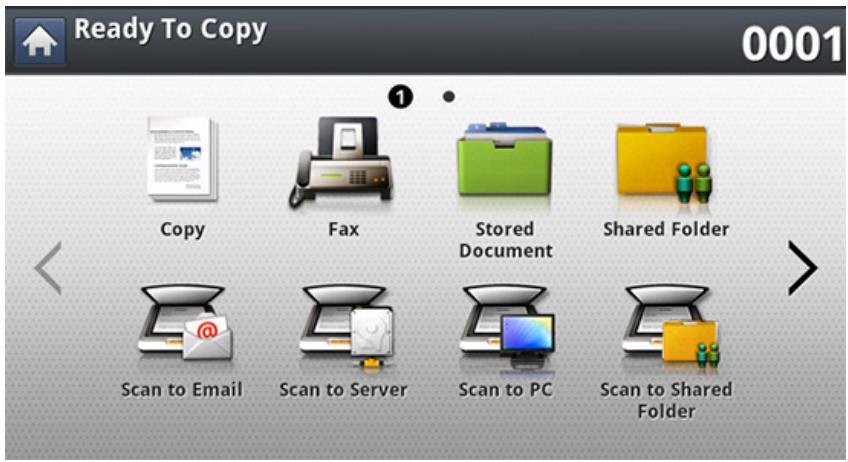
Basic tab
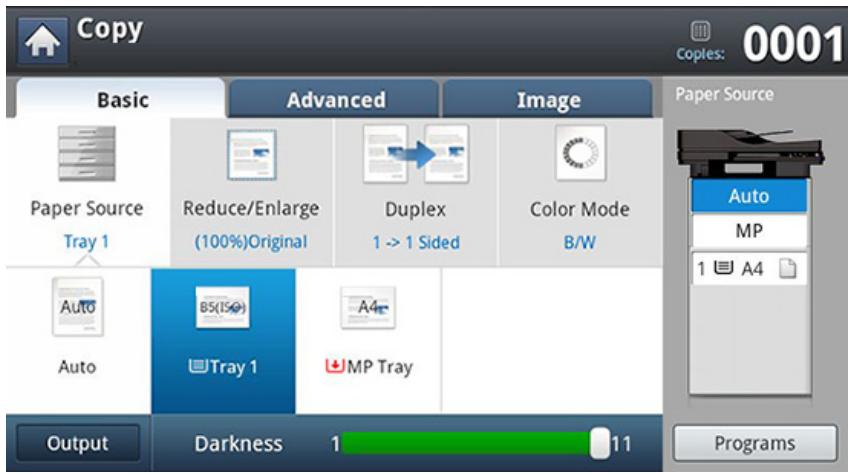
• Copies: Enters the number of copies.
• Paper Source: Selects the paper source tray.
- Reduce/Enlarge: Reduces or enlarges the size of a copied image.
- Duplex: Sets the machine to print copies on both sides of the paper.
• Color Mode: Selects a black/white mode for making copies.
Output: Sets the machine's various output options.
- Darkness: Adjusts the brightness level to make a copy for easier reading, when the original contains faint markings and dark images.
- Programs: Allows you to save the current settings for future use (see "Using a program's setting" on page 122).
Understanding the copy screen
Advanced tab
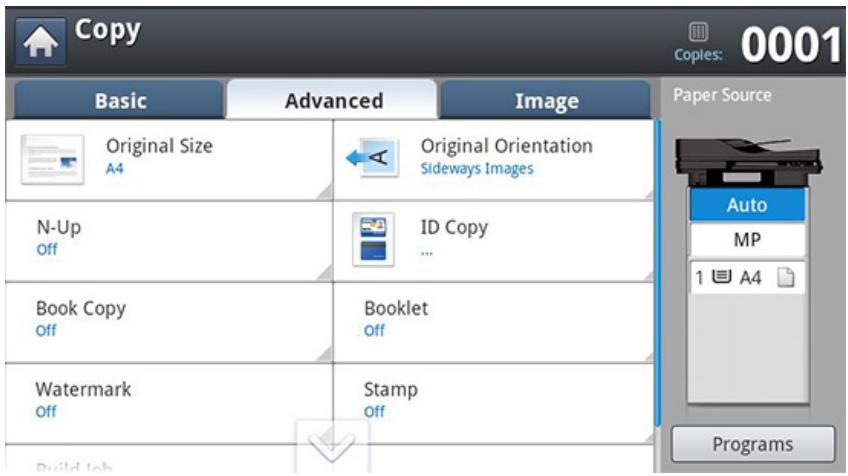
• Original Size: Selects the actual paper size of the originals.
• Original Orientation: Selects the orientation of the originals.
- ID Copy: Prints 2-sided originals on one sheet of paper. This feature is helpful for copying a small-sized item, such as a business card (see "ID card copying" on page 115).
• N-Up: Prints 2 or more original images, reduced to fit onto one sheet of paper.
• Booklet: Allows you to create booklets.
- Book Copy: Allows you to copy the left or/and right pages of book on separate output paper.
• Watermark: Allows you to print a watermark on printouts.
- Stamp: Allows you to print with some information such as date and time.
- Build Job: After the scanning is finished, the Scan More Pages window appears to ask if you want to scan another page. If you select Yes, then you can scan another page in the current job. If you select No, then the scanning process is completed and the remainder of the job is performed.
Image tab
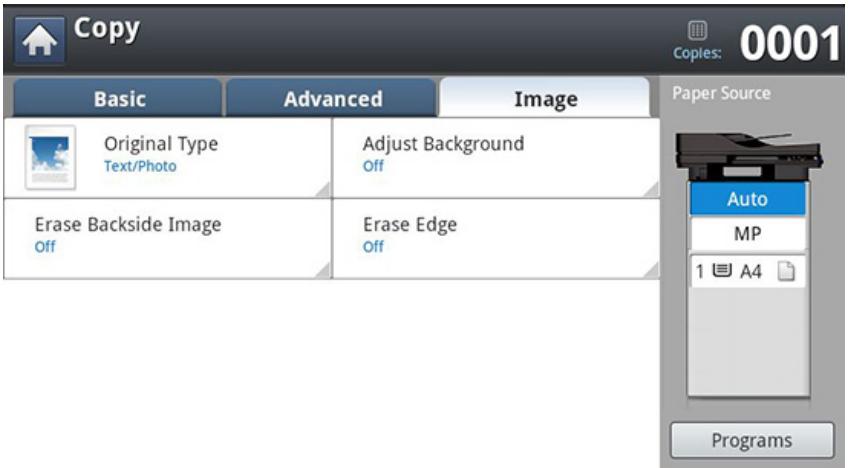
- Original Type: Improves the copy quality by selecting the original's type for the current copy job.
- Adjust Background: Prints an image with a lighter background.
- Erase Backside Image: Prevents copying the original's image shown through on the backside.
- Erase Edge: Allows you to erase spots, drill holes, fold creases and staple marks along any of the four edges of a document.
Basic copying
This is the normal and usual procedure for copying your originals.
1 Press Copy from the display screen.
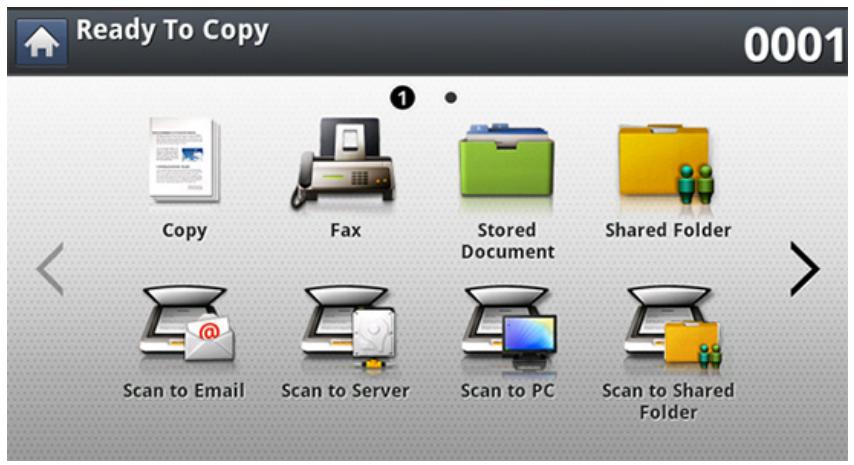
2 Place the originals face up in the DSDF or place a single original face down on the scanner glass and close the DSDF (see "Loading originals" on page 64).
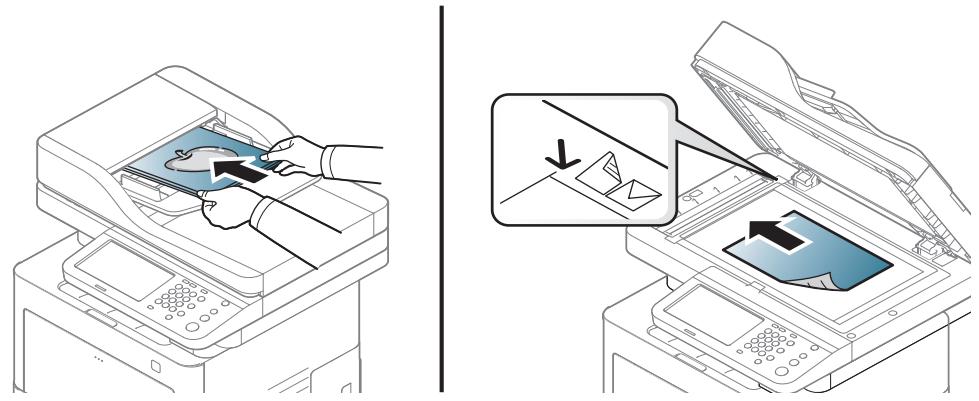
natural_image
Illustration showing a printer being inserted into an open scanner, with a magnified view of the device's internal structure (no text or symbols present)3 Adjust the settings for each copy such as Paper Source, Reduce/Enlarge, Duplex and more in the Basic tab.
4 Set the copy features in the Advanced or Image tabs, if necessary (see "Using special copy features" on page 117).
5 Enter the number of copies using the numeric keypad on the control panel, if necessary.
6 Press ⬇(Start) from the control panel to begin copying.

- To cancel the current copy job, press Ⓥ(Stop) on the control panel.
- You can delete current and pending jobs using Job Status on the control panel. Select the job you want to cancel and press Delete (see "Job Status button" on page 28).
Basic copying
Copying originals of different sizes
This feature allows you to copy originals of different sizes at once.

If you want to copy different sized originals at once, select Mixed Size under the Original Size option. Otherwise, it could cause original- document jams.
1 Press Copy from the display screen.
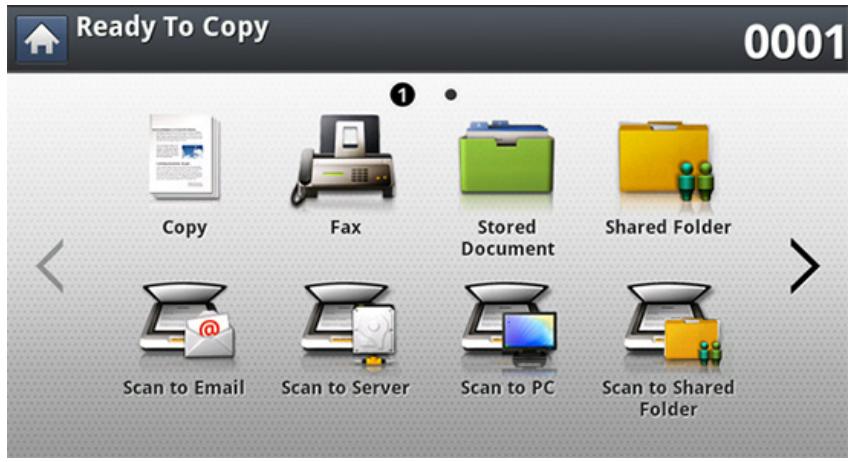
2 Place the different sized originals face up in the DSDF. When you place them in the DSDF, align and gently push them to the center side of the DSDF width guide.
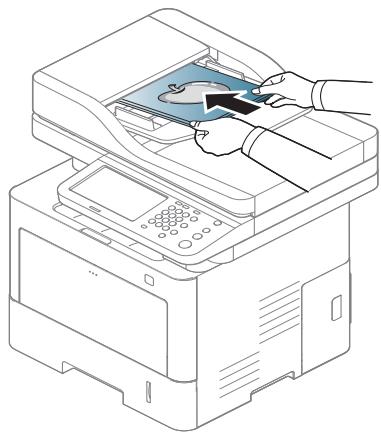
natural_image
Illustration of a printer with hands operating the lid and paper tray (no text or symbols visible)3 Press the Advanced tab > Original Size > Mixed Size from the display screen.

- Mixed Size is activated when the originals are placed in the DSDF.
- When using the Mixed Size option, the machine can detect only the length of the originals and print them on A4 (LTR) or Legal size paper.
4 Adjust the settings for each copy such as Paper Source, Duplex and more in the Basic tab.
5 Set the copy features in the Advanced or Image tab, if necessary (see "Using special copy features" on page 117).
6 Enter the number of copies using the numeric keypad on the control panel, if necessary.
7 Press Ⓧ(Start) from the control panel to begin copying.
Quick copying
The Quick Copy menu allows you to quickly set copy options without having to move to a lower level menu or another tab. But, this menu does not provide all copy options. If you need to use other copy options, use the copy options in the Copy menu (see "Using special copy features" on page 117).
1 Press Quick Copy from the display screen.
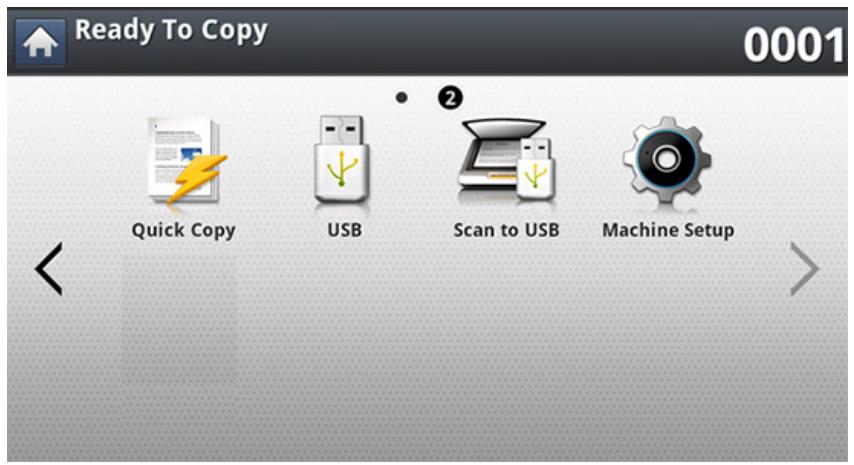
2 Place the originals face up in the DSDF or place a single original face down on the scanner glass and close the DSDF (see "Loading originals" on page 64).
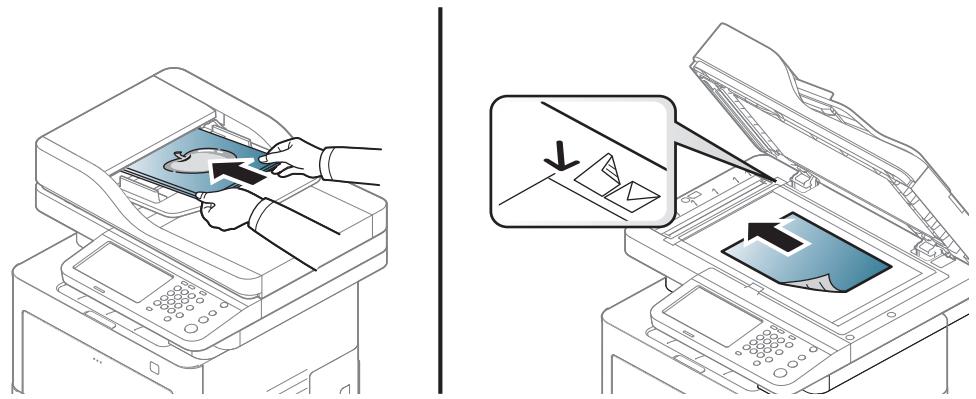
natural_image
Illustration of a printer being placed on top, showing the printer's open lid and internal components (no text or symbols present)3 Adjust the settings for each copy such as Reduce/Enlarge, Duplex/N-Up, Output, Paper Source, etc.
You can set the default Quick Copy options from Machine Setup > Application Settings > Copy Settings from the display screen. Set the most frequently used settings.
4 Enter the number of copies using the numeric keypad on the control panel, if necessary.
5 Press Ⓧ(Start) from the control panel to begin copying.
ID card copying
The machine prints one side of the original on the upper half of the paper and the other side on the lower half without reducing the size of the original.
This feature is helpful for copying a small-sized item, such as a business card.

- This copy feature is available only when you place originals on the scanner glass.
- The size of the 2-sided originals should be smaller than A5, if not, some of it won't be copied.
1 Press Copy from the display screen.
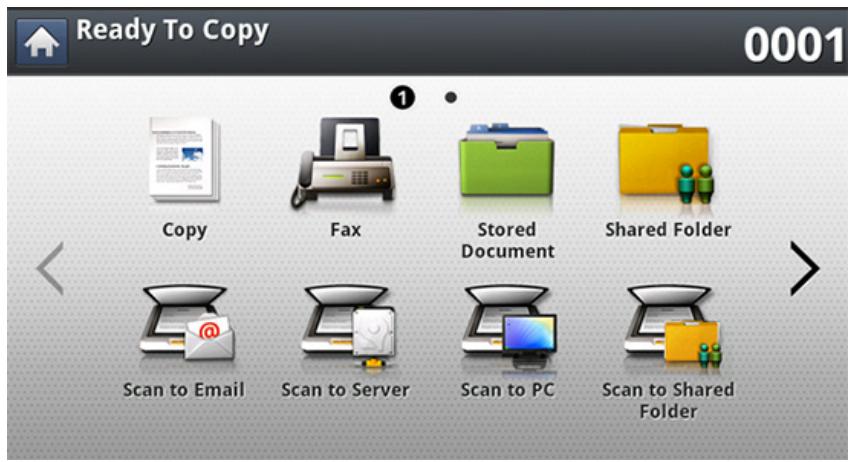
2 Press the Advanced tab > ID Copy from the display screen.
3 Select a tray in Paper Source.
4 Follow the steps on the display screen.
5 Place the front side of an original facing down on the scanner glass as shown below, and close the DSDF.

When you place an original on the scanner glass, leave a little space between the edge of the scanner glass and the original. Otherwise, part of original may not be printed.
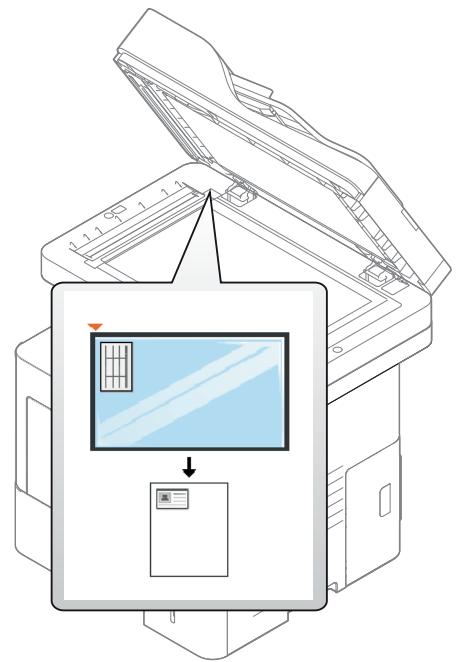
6 Press Ⓥ(Start) on the control panel. Then the machine starts scanning.
7 Turn the original over and place it on the scanner glass as shown below, and then close the DSDF.
ID card copying

When you place an original on the scanner glass, leave a little space between the edge of the scanner glass and the original. Otherwise, part of original may not be printed.
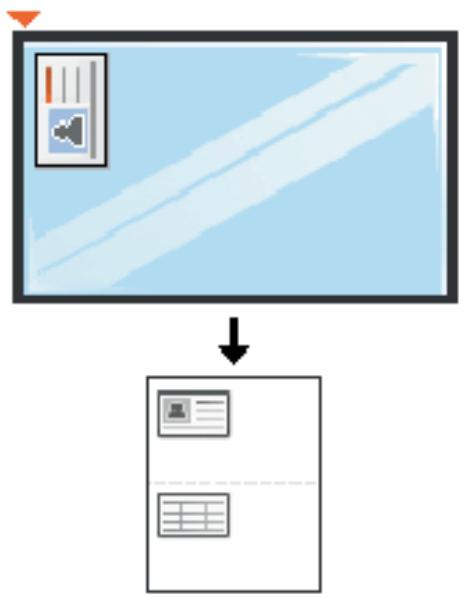
flowchart
graph TD
    A["Input Document"] --> B["Output Image & Text"]
    B --> C["Final Output"]
8
Press Ⓥ(Start) on the control panel to begin copying.
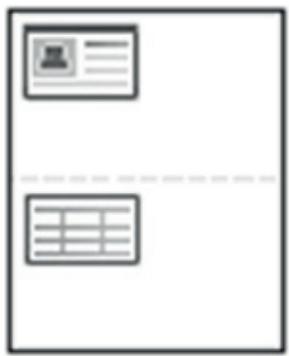

- If the original is larger than the printable area, some portions may not be printed.
- If you do not press the Ⓧ(Start) button, only the front side will be copied.
- If you press the Ⓥ(Stop) button, the machine cancels the copy job and returns to ready mode.
Using special copy features
On the Basic, Advanced, or Image tab of the Copy screen, you can select specific copy features.

Some menus may not appear in the display depending on options or models.
To change the menu options:
1 Press Copy from the display screen.
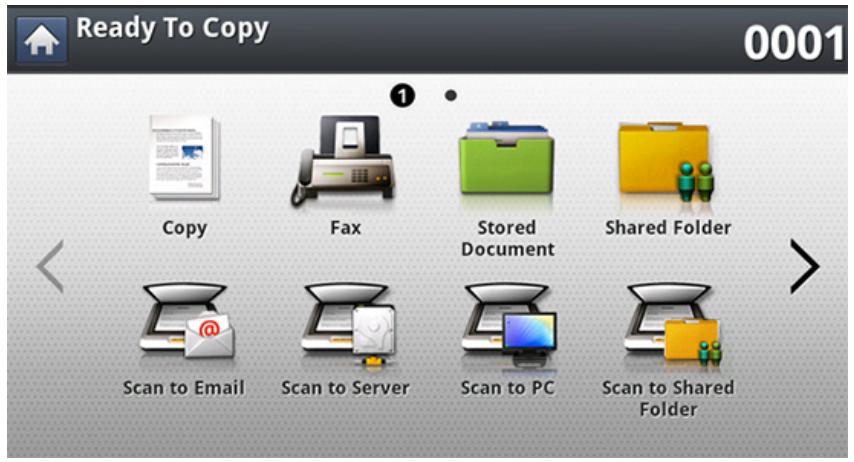
2 Place the originals face up in the DSDF or place a single original face down on the scanner glass and close the DSDF (see "Loading originals" on page 64).
3 If you want to customize the copy settings including reduce/enlarge, darkness, original type, and more from the display screen.
4 Press the Basic, Advanced, or Image tab from the display screen.
5 Press the appropriate option.
| Item | Description |
| Paper Source | Paper Source sets the tray containing the paper to be used for printing. The machine prints the scanned image on the paper in the selected tray. You can see the icons that show paper sizes and the remaining amount of paper in each tray. |
| Reduce/Enlarge | Reduces or enlarges the size of a copied image.  |
| Output | You can select the options for how you want the outputs to be arranged.Sort: Select how to sort the output.- Collated: The outputs are in sets to match the sequence of originals.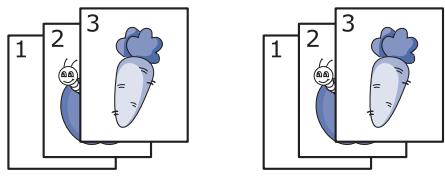 - Uncollated: The outputs are sorted into stacks of individual pages. - Uncollated: The outputs are sorted into stacks of individual pages.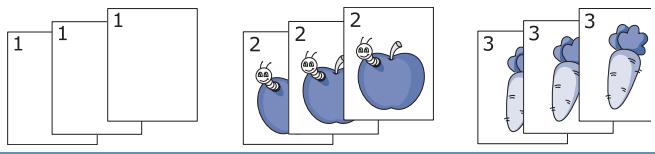 |
Using special copy features
| Item | Description |
| Darkness | You can adjust the degree of darkness. This feature allows dark images to be printed into lighter images, or light images into darker images. |
| Item | Description |
| Duplex | You can set the machine to print copies on both sides of paper.1 -> 1 Sided: Scans one side of an original and prints it on one side of the paper.1 -> 2 Sided 2 -> 1 Sided 2 -> 1 Sided 2 -> 2 Sided 2 -> 2 Sided |
| [w25x] If an original is placed on the scanner glass and you press 1 -> 2 Sided, 2 -> 1 Sided or 2 -> 2 Sided, the message Do you want to scan another page? appears after the first page is copied. Load another original and press Yes. When you finish, press No on this window. |
Using special copy features
| Item | Description |
| Color Mode | You can select the default color mode to use for copy jobs.B/W: Select this setting to print the copy in black and white, regardless whether the scanned document is in color or in black and white. |
| Original Size | Copies can be produced after specifying the document scanning size if the document size cannot be detected automatically or if you wish to specify a certain document size. |
| Original Orientation | When copying double-sided documents or making double-sided copies or combined copies, specify the document orientation; otherwise, the copies may not be printed in the correct page order or correct front and back page arrangement.Upright Images: Select this setting for an original document loaded with the top toward the back of the machine.Sideways Images: Select this setting for an original document loaded into the DSDF with the top of the original document toward the left side of the machine or an original document placed on the scanner glass with the top of the original document toward the right side of the machine. |
| Item | Description |
| Original Type | The original type setting is used to improve copy quality by selecting document types for current copy jobs.Text: Use for originals containing mostly text.Text/Photo: Use for originals containing text mixed with photographs.Photo: Use when the originals are photographs. |
| N-Up | Reduces the size of the original images and prints 2 or 9 pages onto one sheet of paper.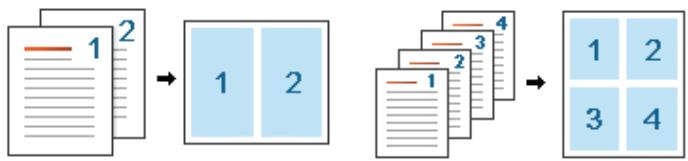 Off: Copies an original onto one sheet of paper.2UP - 16UP: Copies corresponding numbers of separate originals to one page. Off: Copies an original onto one sheet of paper.2UP - 16UP: Copies corresponding numbers of separate originals to one page. Depending on original document size, output paper size, and the reduced rate of image, some options may be inactivated. Depending on original document size, output paper size, and the reduced rate of image, some options may be inactivated. |
Using special copy features
| Item | Description |
| Booklet | The machine automatically prints on one or both sides of the paper, which are then folded to produce a booklet with all the pages in the correct sequence.The machine will also reduce and correctly adjust the position of each image to fit on the selected paper.Off:Disables this feature.1 Sided Original:Copies from one side of the original to one page of a booklet.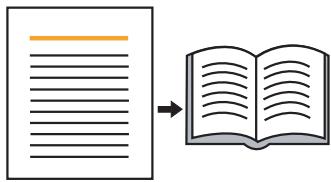 2 Sided Original Book:Copies each side of an original to one page of a booklet. 2 Sided Original Book:Copies each side of an original to one page of a booklet.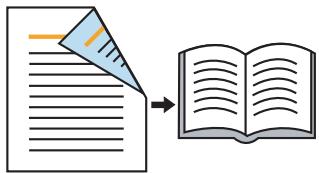 2 Sided Original Calendar:Copies each side of an original to one page of a booklet. The second side of each original is rotated 180 degrees so the text will be upright in the booklet. 2 Sided Original Calendar:Copies each side of an original to one page of a booklet. The second side of each original is rotated 180 degrees so the text will be upright in the booklet.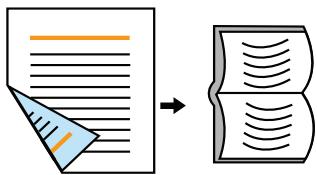 |
| Item | Description |
| Book Copy | This feature allows you to copy an entire book. If the book is too thick, lift the cover until its hinges are caught by the stopper and then close the cover. If the book is thicker than 30 mm, start copying with the cover open.Off:Disables this feature.Left Page:Prints only the left page of the book.Right Page:Prints only the right page of the book.Both Pages (From Left):Prints both facing pages from the left page.Both Pages (From Right):Prints both facing pages from the right page. This copy feature is available only when you place originals on the scanner glass. This copy feature is available only when you place originals on the scanner glass. |
| Adjust Background | Prints an image without its background. This copy feature removes the background color and can be helpful when copying an original containing color in the background, such as a newspaper or a catalog.Off:Disables this feature.Auto:Optimizes the background.Enhance:The higher the number is, the more vivid the background.Erase:The higher the number is, the lighter the background. |
Using special copy features
| Item | Description |
| Erase Edge | Allows you to erase spots, drill holes, fold creases and staple marks along any of the four edges of a document.   ____Off:Disables this feature%.Border Erase:Erases the certain amount of the edge of the printout..Hole Punch Erase:Erases the marks of bookbinding holes. ____Off:Disables this feature%.Border Erase:Erases the certain amount of the edge of the printout..Hole Punch Erase:Erases the marks of bookbinding holes. |
| Stamp | You can apply the stamp feature.IP Address:This option allows you to print a IP Address on the printouts.ID:This option allows you to print a user ID on the printouts.Device information:This option allows you to print a device information on the printouts.Comment:This option allows you to print your comment on the printouts.Date & Time:This option allows you to print time and date stamps on the printouts.Page Number:This option allows you to print page number on the printouts. |
| Item | Description |
| Watermark | The watermark option allows you to print text over an existing document. For example, you use it when you want to have large gray letters reading “DRAFT” or “CONFIDENTIAL” printed diagonally across the first page or all pages of a document.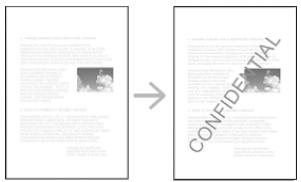 |
| ID Copy | This feature is helpful for copying a small-sized item such as business card (see "ID card copying" on page 115). |
| Erase Backside Image | When the original is thin and backside images show through, you can use this feature to remove the backside images. |
Using a program's setting
This option allows you to save the current settings for future use. You can also use the previous settings from the last job.
Saving Programs
1 Press Copy from the display screen.
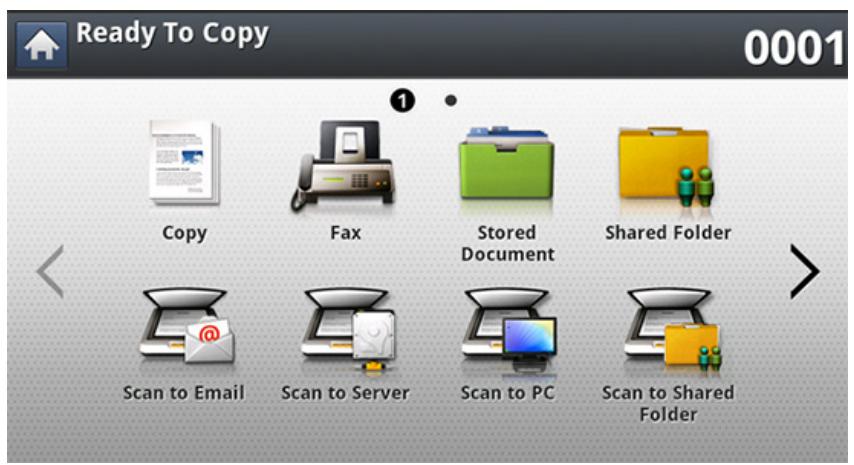
2 Adjust the settings for each copy such as Paper Source, Duplex and more in the Basic tab.
3 Set the copy features in the Advanced or Image tabs, if necessary (see "Using special copy features" on page 117).
4 Press the Basic tab or Back.
5 Enter the number of copies using the numeric keypad on the control panel, if necessary.
6 Press Programs.
7 Press Save.
8 Press Program Name input area. The pop-up keyboard appears. Enter the program name you want. Press Done.
You can see the values of set Programs by scrolling up or down and check the values using the up/down arrows.
9 Press Save. When the confirmation window appears, the settings you set are saved.
Using a program's setting
Loading Programs
1 Press Copy from the display screen.
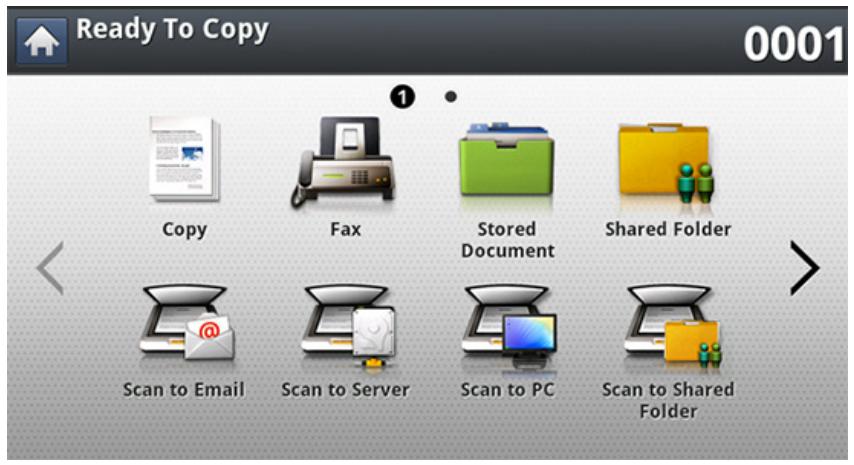
2 Place the originals face up in the DSDF or place a single original face down on the scanner glass and close the DSDF (see "Loading originals" on page 64).
3 Press Programs > Load.
4 Press a program name you want to use on the list.
5 Press Apply.
The machine is now set to copy according to the setting you selected.
6 Press Ⓧ(Start) from the control panel to begin copying.
natural_image
Blue circular icon with a white printer symbol (no text or numbers)7. Scanning
Scanning with your machine lets you turn pictures and text into digital files that can be stored on your computer.
This chapter includes:
• Understanding the scan methods 125
• Scanning and sending through email 126
• Scanning and sending via SMB/FTP 132
• Scanning and sending to your computer 138
• Scanning and sending to USB /shared folder 139
- Changing the scan feature settings 141
• Using a programs setting 145
• Scanning with TWAIN-enabled software 146
• Scanning with Samsung Easy Document Creator 147
• Mac scanning 148
• Linux scanning 149

The maximum resolution that can be achieved depends upon various factors, including computer speed, available disk space, memory, the size of the image being scanned, and bit depth settings. Thus, depending on your system and what you are scanning, you may not be able to scan at certain resolutions, especially using enhanced resolution.
Understanding the scan methods
To use the scanning feature, press Scan to Email, Scan to USB, Scan to Server, Scan to PC, or Scan to Shared Folder on the display screen.
If a different screen is displayed, press (↑) to go to the home display screen.
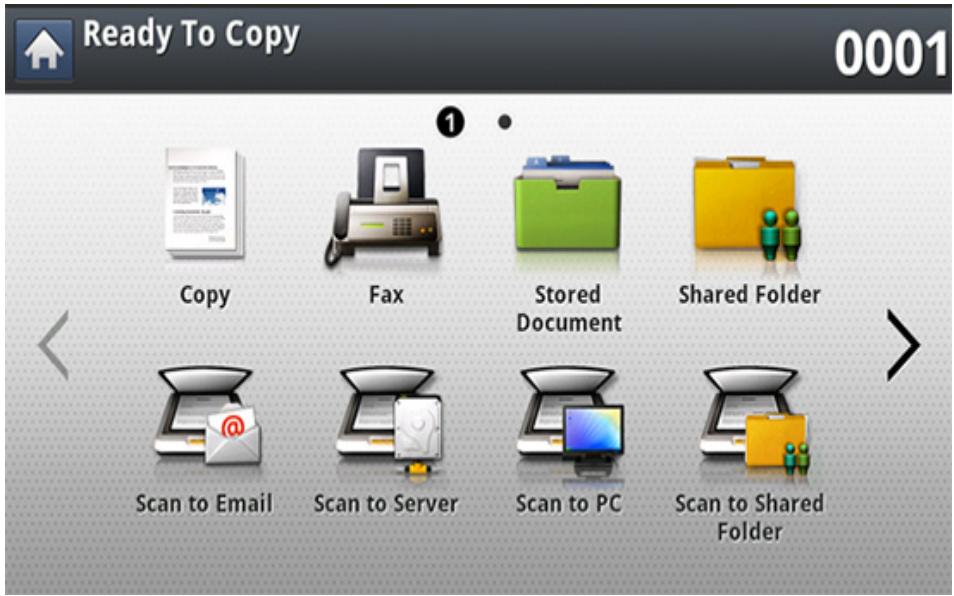
- Scan to Email: Scans and sends scanned output to the destination by e-mail (see "Scanning and sending through email" on page 126).
- Scan to Server: Scans and sends scanned output to the destination with SMB or FTP (see "Scanning and sending via SMB/FTP" on page 132).
- Scan to PC: Scans and sends scanned output to a computer (see "Scanning and sending to your computer" on page 138).
- Scan to Shared Folder: Scans and stores scanned output in the shared folder (see "Scanning and sending to USB /shared folder" on page 139).
- Scan to USB: Scans and stores scanned output onto a USB memory device (see "Scanning to a USB memory device" on page 213).

If you want to use this feature, you need to insert a USB memory device into the USB memory port on your machine.
Scanning and sending through email
You can scan originals and send the scanned image to several destinations from the machine by email.

To scan and send an image as an email attachment, you need to set up network parameters, SMTP settings and Scan to Email settings using the control panel or SyncThru™ Web Service (see "Setting up an email account" on page 128).
Understanding the Scan to Email screen
Press Scan to Email in the display screen.
Basic tab
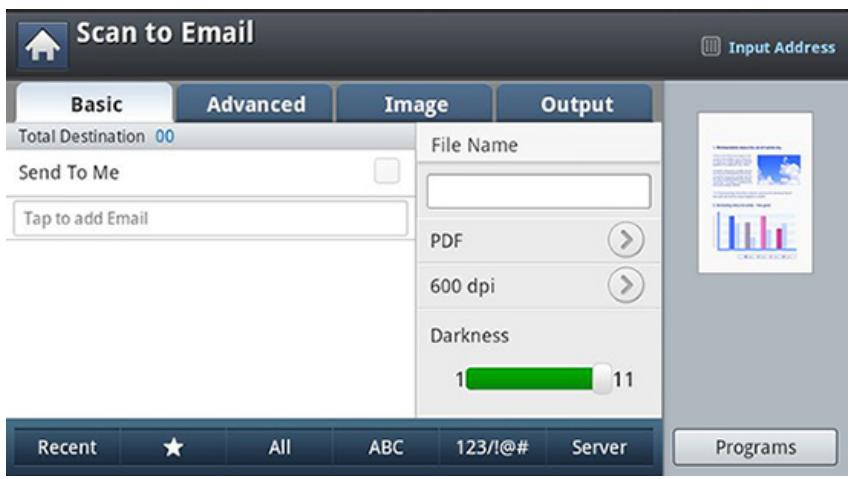
- Send To Me: Press the Advanced tab > Email Settings, then type the sender's email address. Click the checkbox on the right to send to yourself.
- Input Address: Tap the screen to add recipient's email addresses.
- File Name: Makes the file name for the file to be sent.
- File Format: Select the file format before you proceed with the scanning job.
• Resolution: Selects scanning resolution value.
• Darkness: Adjusts the degree of darkness of scanned output. - Address Book((★)Favorite, All, ABC): Inputs the recipient's address by pressing stored addresses. You can save frequently used email addresses using the control panel or SyncThru™ Web Service (see "Setting up an address book from the control panel" on page 170 or "Setting up an address book from SyncThru™ Web Service" on page 174).
Scanning and sending through email
- Recent: Shows the latest email addresses used. Also, you can choose email addresses instead of pressing the pop-up keyboard (see "Resending to the last email address" on page 130).
- Programs: Allows you to save the current settings for future use (see "Using a programs setting" on page 145).
Advanced tab
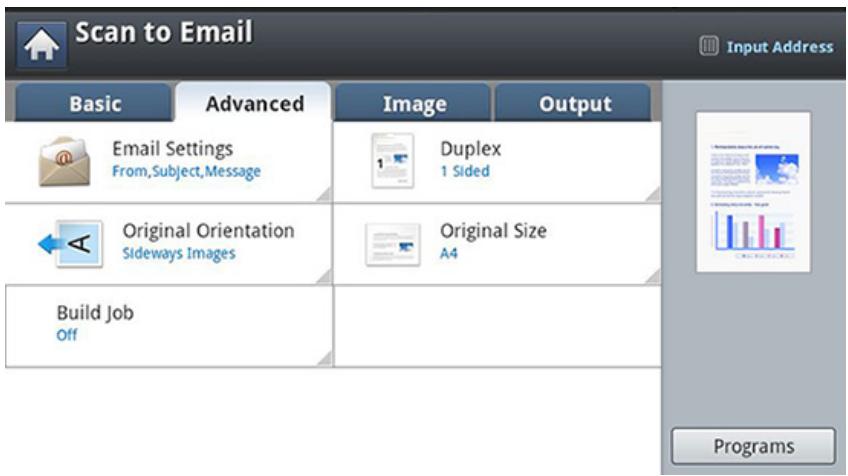
• Original Size: Selects the size of originals.
• Original Orientation: Selects the orientation of the originals.
- Email Settings: Enter the information including From, Subject and Message.
• Duplex: For originals that are scanned on both sides.
- Build Job: After the scanning is finished, the Scan More Pages window appears to ask if you want to scan another page. If you select Yes, then you can scan another page in the current job. If you select No, then the scanning process is completed and the remainder of the job is performed.
Image tab
You can move to the next or previous page using the up/down arrows located at the bottom left.
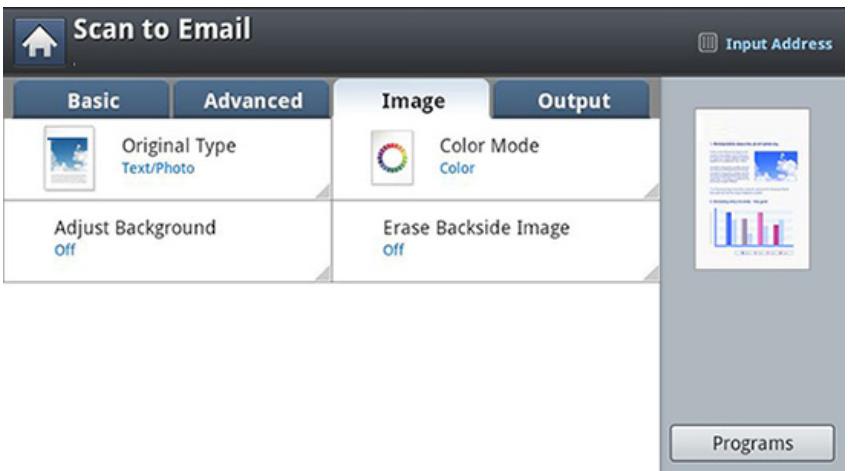
• Original Type: Selects whether the original is text, photo, etc.
• Color Mode: Adjusts the color options of scanned output.
- Adjust Background: Erase the background to some extent by adjusting density or brightness.
- Erase Backside Image: Prevents scanning the other side's image shown through the original paper.
Scanning and sending through email
Output tab
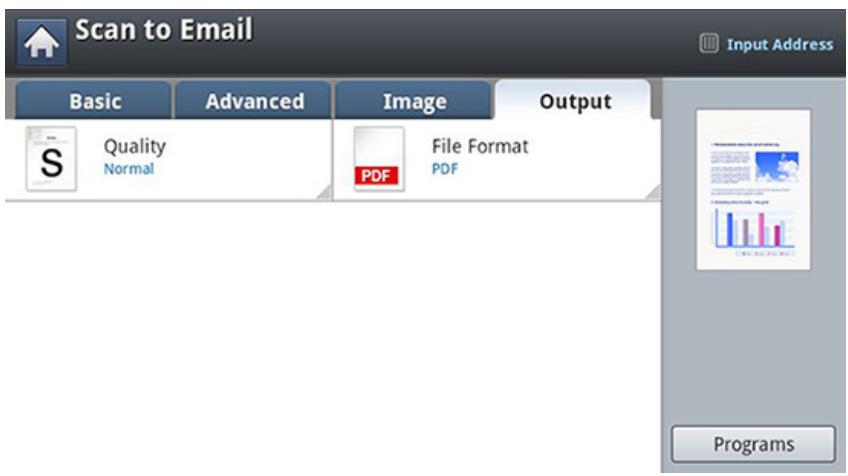
• Quality: Adjusts the display quality of the scanned output.
- File Format: Selects the file format for the file to be sent.
Setting up an email account
1 Check whether or not the network cable is connected to the machine. If not, connect the machine with a standard network cable.
2 Start a web browser such as Internet Explorer, Safari, or Firefox and enter your machine's new IP address in the browser window.
For example,

http://192.168.1.133/
3 Click Login on the upper right of the SyncThru™ Web Service website.
4 Type in the ID and Password.
Use the same login ID, Password, Domain as when logging in from the machine (see "Log-in" on page 220).

If you want to create a new user or change the password, see "Security tab" on page 250.
5 Select Settings > Network Settings and Outgoing Mail Server(SMTP).
6 Enter the IP address in dotted decimal notation or as a host name.
7 Enter the server port number, from 1 to 65535.
8 Check the box next to SMTP Requires Authentication to require authentication.
9 Enter the SMTP server login name and password.
10 Press Apply.

- If the authentication method of SMTP server is POP3 before SMTP, put a check mark of SMTP Requires POP Before SMTP Authentication.
• Enter the IP address and port number.
Scanning and sending through email
Scanning and sending an email
You can scan originals and send the scanned image to several destinations from the machine by email

To scan and send an image as an email attachment, you need to set up network parameters, SMTP settings and Scan to Email settings using the control panel or SyncThru™ Web Service (see "Setting up an email account" on page 128).
1 Place the originals face up in the DSDF or place a single original face down on the scanner glass and close the DSDF (see "Loading originals" on page 64).
2 Press Scan to Email from the display screen.
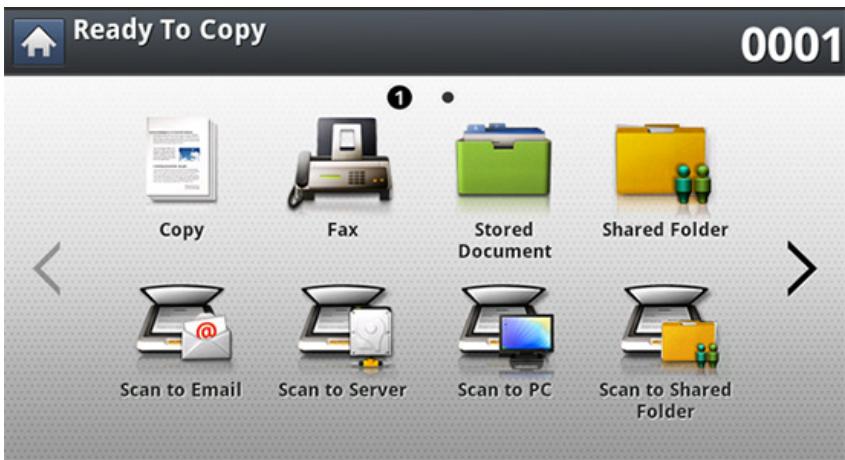
3 Set the scan features in the Advanced, Image, or Output tabs.
4 Press the Basic tab.
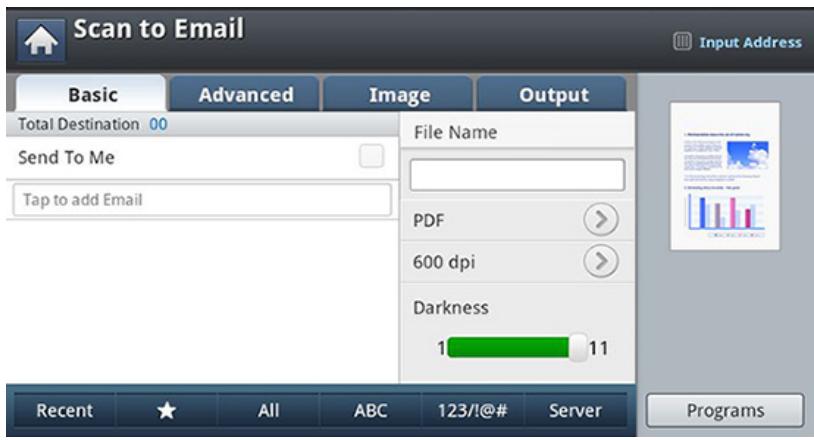
5 Enter the login name and password if you configured on SyncThru™ Web Service.
6 Enter the sender's and recipient's email address.
- Add to Address: Allows you to add an email address in the Recent results to the Address Book. - Delete: Allows you to delete an email address in the Recent results. Press the email address you want to delete. Then press Delete.
7 Set the scan quality by Duplex and Resolution.
8 Press the ⏻(Start) button to scan and send the file.
Scanning and sending through email
9 The machine begins scanning and then sends the email.

- To cancel the current scan job, press Ⓥ(Stop) on the control panel. Or you can delete current and pending jobs using Job Status on the control panel. Select the job you want to cancel and press Delete (see "Job Status button" on page 28).
- While the machine is sending a scanned data, you cannot use the machine to copy or to send a fax.
Resending to the last email address
To resend to the last used email address:
1 Place the originals face up in the DSDF or place a single original face down on the scanner glass and close the DSDF (see "Loading originals" on page 64).
2 Press Scan to Email from the display screen.
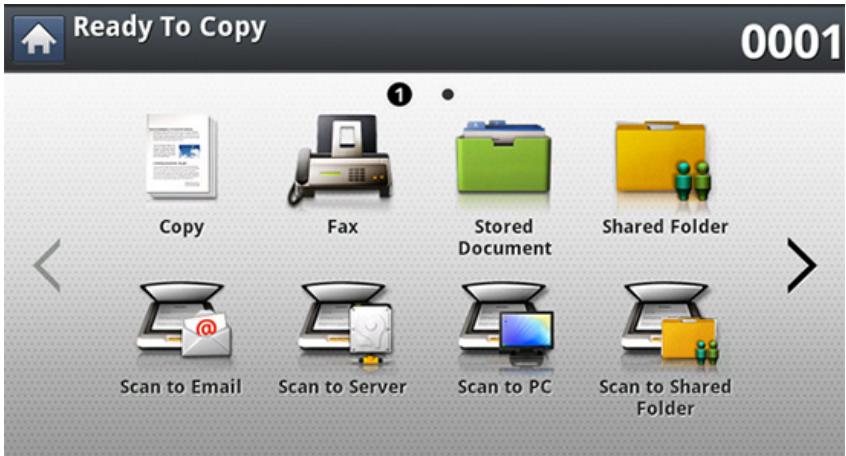
3 Set the scan features in the Advanced, Image, or Output tabs.
Scanning and sending through email
4 Press the Basic tab.
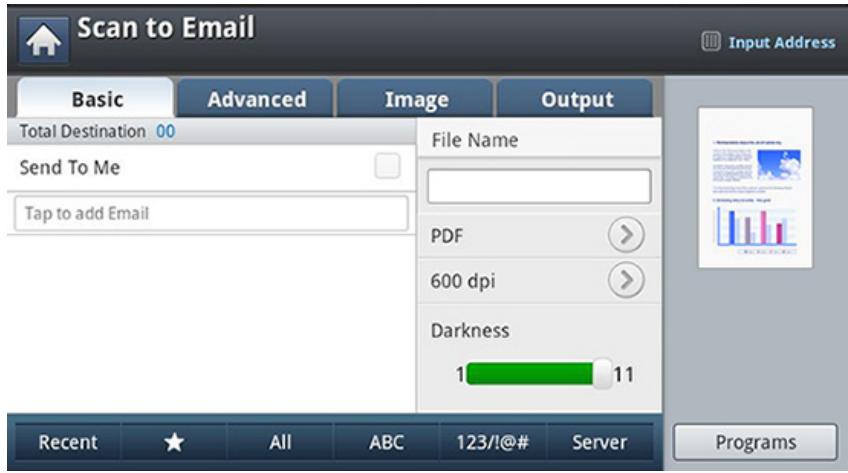
5 Press To's input area and Recent.
6 Press the email address which you want to re-send. Then press OK.

- Add to Address: Allows you to add an email address in the Recent results to the Address Book.
- Delete: Allows you to delete an email address in the Recent results. Press the email address you want to delete. Then press Delete.
7 Set the scan quality by Duplex and Resolution.
8 Press the Ⓧ(Start) button to scan and send the file.
If an original is placed on the scanner glass, the machine shows the window asking if you want to place another page. Load another original and press Yes. When you finish, press No on this window.
Printing an email confirmation report
You can set the machine to print a report whether an email transmission is successfully completed or not.

If a report contains characters or fonts that the machine does not support, Unknown could be printed instead of the characters/fonts in the report.
1 Press Machine Setup > Application Settings > Scan to Email Settings from the display screen.
2 Press the appropriate option in Print Confirmation Report.
- Always: Always prints a confirmation report whether an email transmission is successfully completed or not.
• Never: Never prints a confirmation report. - On Errors Only: Prints a confirmation report only when an email transmission is not successful.
3 Press (Back) to go back to the previous screen.
Scanning and sending via SMB/FTP
You can scan an image and send it to a total of three destinations via SMB or FTP.

To scan and send an image to a server, you need to set up network parameters using the control panel or SyncThru™ Web Service (see "Setting up an FTP/SMB server" on page 134).
Understanding the Scan to Server screen
Press Scan to Server in the display screen.
Basic tab
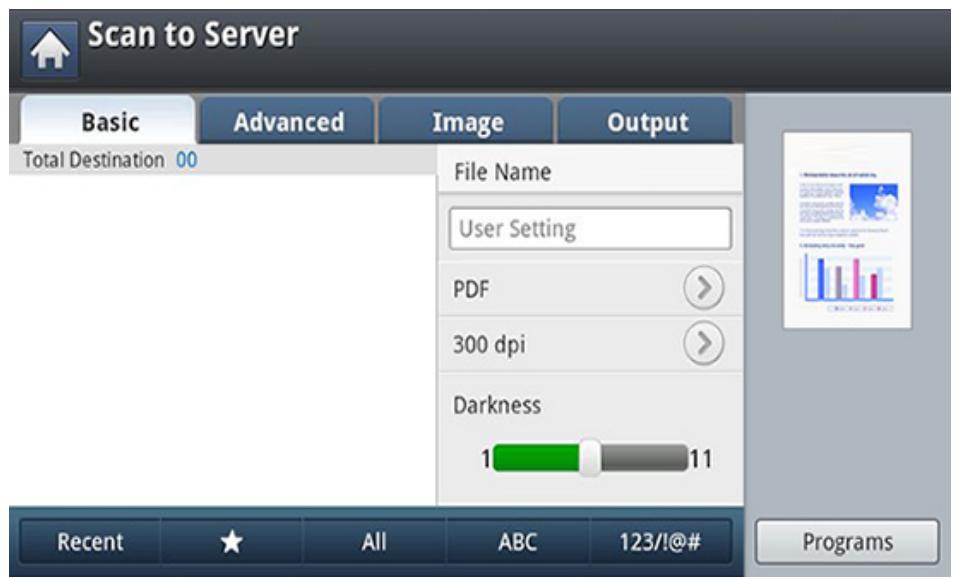
- File Name: Makes the file name for the file to be sent.
- File Format: Select the file format before you proceed with the scanning job.
- Recent: Shows the latest email addresses used. Also, you can choose email addresses instead of pressing the pop-up keyboard (see "Resending to the last email address" on page 130).
• Resolution: Selects scanning resolution value.
• Darkness: Adjusts the degree of darkness of scanned output.
Scanning and sending via SMB/FTP
- Address Book((★)Favorite, All, ABC): Inputs the recipient's address by pressing stored addresses. You can save frequently used email addresses using the control panel or SyncThru™ Web Service (see "Setting up an address book from the control panel" on page 170 or "Setting up an address book from SyncThru™ Web Service" on page 174).
- Programs: Allows you to save the current settings for future use (see "Using a programs setting" on page 145).
Advanced tab
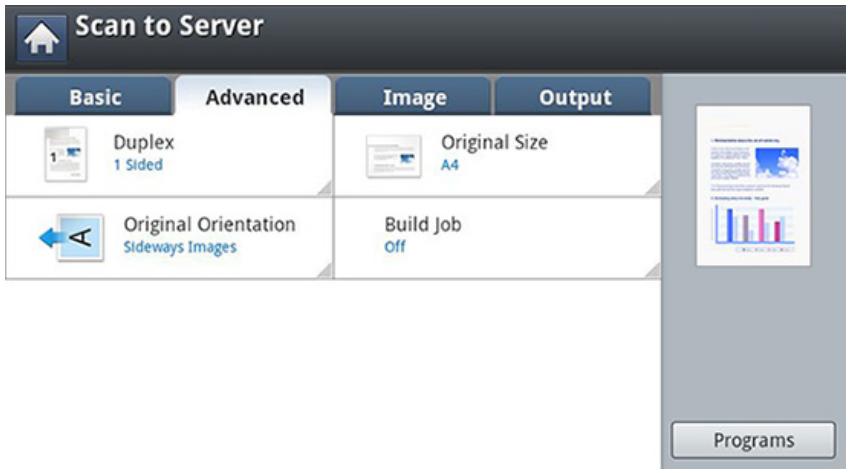
• Original Size: Selects the size of originals.
• Original Orientation: Selects the orientation of the originals.
• Duplex: For originals that are scanned on both sides.
- Build Job: After the scanning is finished, the Scan More Pages window appears to ask if you want to scan another page. If you select Yes, then you can scan another page in the current job. If you select No, then the scanning process is completed and the remainder of the job is performed.
Image tab
You can move to the next or previous page using the up/down arrows located at the bottom left.
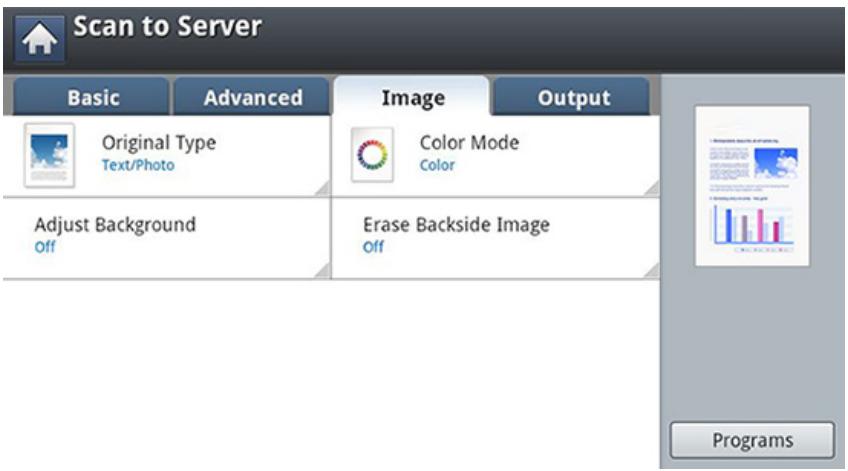
• Original Type: Selects whether the original is text, photo, etc..
• Color Mode: Adjusts the color options of scanned output.
- Adjust Background: Erase the background to some extent by adjusting density or brightness.
- Erase Backside Image: Prevents scanning the other side's image shown through the original paper.
Scanning and sending via SMB/FTP
Output tab
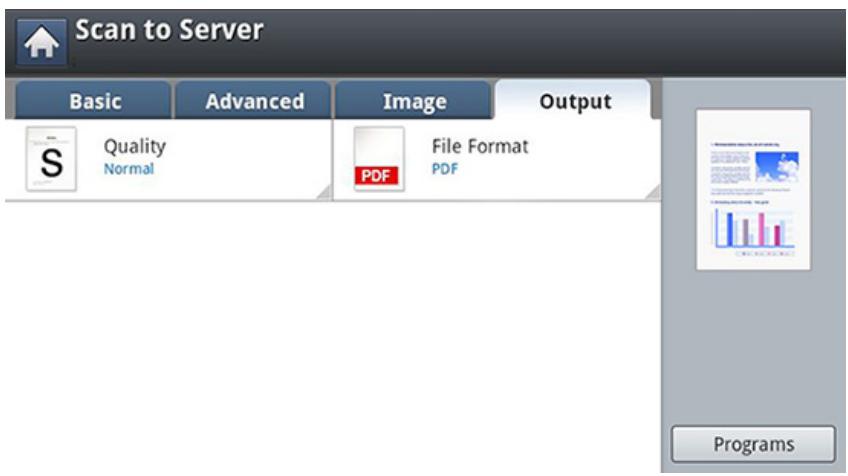
• Quality: Adjusts the display quality of the scanned output.
- File Format: Selects the file format of the scanned output.
Setting up an FTP/SMB server
1 Check whether or not the network cable is connected to the machine. If not, connect the machine with a standard network cable.
2 Start a web browser such as Internet Explorer, Safari, or Firefox and enter your machine's new IP address in the browser window.
For example,

http://192.168.1.133/
3 Click Login on the upper right of the SyncThru™ Web Service website.
4 Type in the ID and Password.
Use the same login ID, Password, Domain as when logging in from the machine (see "Log-in" on page 220).

If you want to create a new user or change the password, see "Security tab" on page 250.
5 Select Address Book > Individual > Add.
6 Check the box next to Add FTP or Add SMB.
7 Enter the IP address in dotted decimal notation or as a host name.
8 Enter the server port number, from 1 to 65535.
9 Check the box next to Anonymous, then the server permits the access of unauthorized people.
10 Enter the login name and password.
11 Enter the domain name if your server is joined to the certain domain, otherwise just enter your computer name which is registered to the SMB server.
12 Enter the path for saving the scanned image.
Scanning and sending via SMB/FTP

- The folder to save the scanned image must be on the root.
- The folder properties need to be setup as a share.
- Your user name should have the rights to read and write the folder.
13 Press Apply.
Scanning and sending to an SMB/FTP server
You can select destinations using SMB, or FTP servers.

To scan and send an image to a server, you need to set up network parameters using the control panel or SyncThru™ Web Service (see "Setting up an FTP/SMB server" on page 134).
1 Place the originals face up in the DSDF or place a single original face down on the scanner glass and close the DSDF (see "Loading originals" on page 64).
2 Press Scan to Server from the display screen
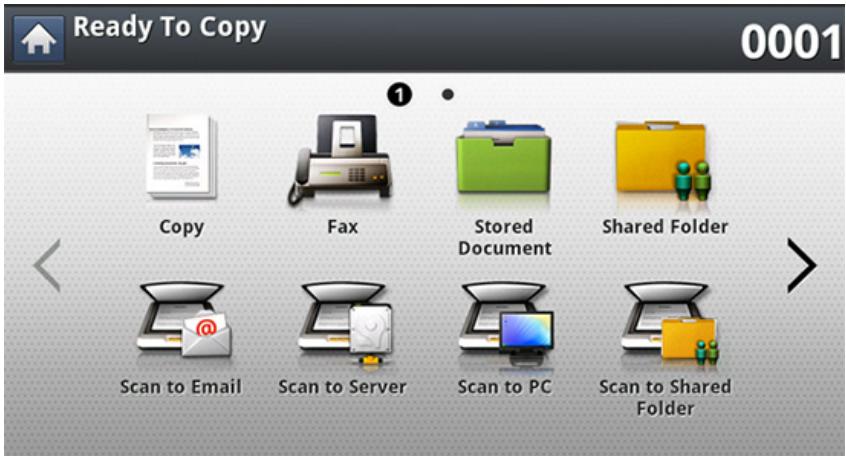
3 Set the scan features in the Advanced, Image, or Output tabs (see "Changing the scan feature settings" on page 141).
Scanning and sending via SMB/FTP
4 Press the Basic tab.
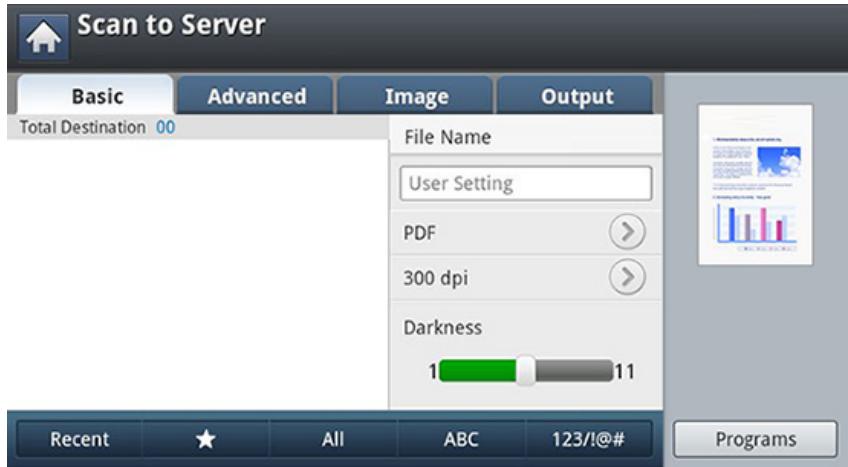
5 Press the server name input area, you can enter a recipient's server address manually. You cannot enter an address in the second field before entering an address in the first field.
You can also use Address Book to enter the addresses easily (see "Setting up an Address Book" on page 169).
6 Set the scan quality by Duplex and Resolution.
7 Press ◎(Start) on the control panel.
The machine begins scanning and then sends the scanned image to the specified server.
If an original is placed on the scanner glass, the machine shows the window asking if you want to place another page. Load another original and press Yes. When you finish, press No on this window.

- To cancel the current scan job, press Ⓥ(Stop) on the control panel. Or you can delete current and pending jobs using Job Status on the control panel. Select the job you want to cancel and press Delete (see "Job Status button" on page 28).
- While the machine is sending a scanned data, you cannot use the machine to copy or to send a fax.
Resending to the last server address
To resend a file to the server address last sent to:
Scanning and sending via SMB/FTP
1 Place the originals face up in the DSDF or place a single original face down on the scanner glass and close the DSDF (see "Loading originals" on page 64).
2 Press Scan to Server from the display screen.
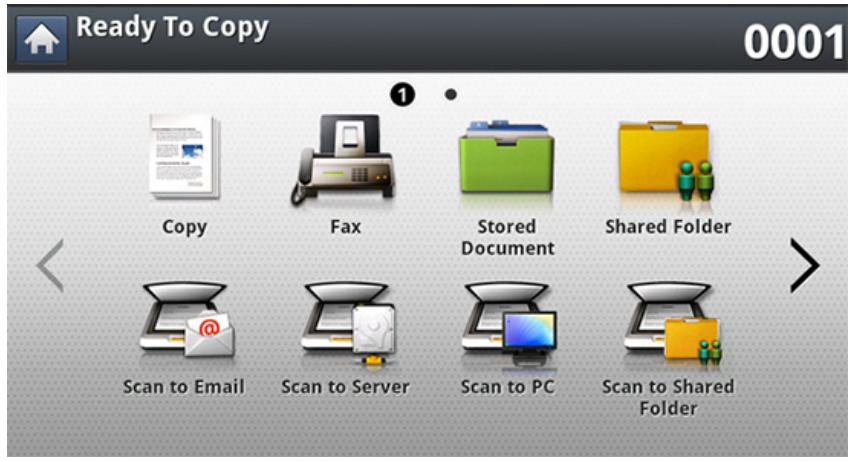
3 Set the scan features in the Advanced, Image, or Output tabs.
4 Press the Basic tab.
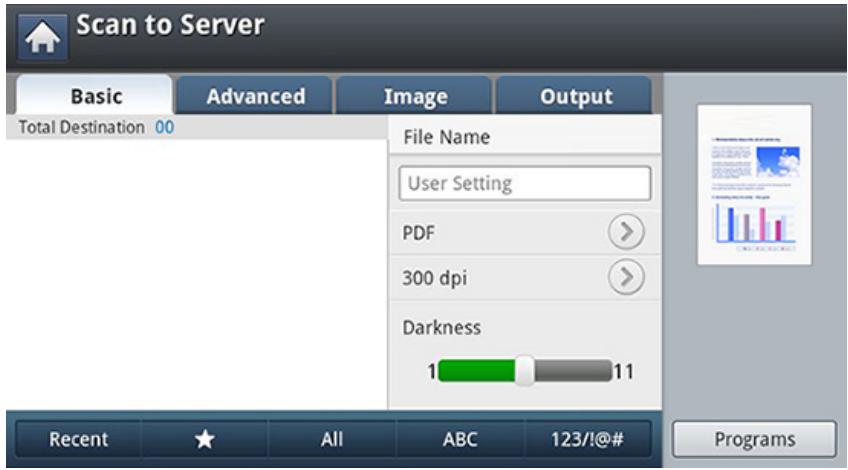
5 Press Recent.
6 Press the server address to which you want to resend. Then press OK.

- Add to Address: Allows you to add a server address in the Recent results to the Address Book.
- Delete: Allows you to delete a server address in the Recent results. Press the server address you want to delete. Then press Delete.
7 Set the scan quality by Duplex and Resolution.
8 Press the ⏻(Start) button to scan and send the file.
If an original is placed on the scanner glass, the machine shows the window asking if you want to place another page. Load another original and press Yes. When you finish, press No on this window.
Scanning and sending to your computer
This option allows you to scan an image on the machine and send it out to your network-connected computer.
For a network connected machine
Make sure the scanner driver is installed on your computer.
1 Make sure that your machine and the computer are connected to a network.
2 Place the originals face up in the DSDF or place a single original face down on the scanner glass and close the DSDF (see "Loading originals" on page 64).
3 Press Scan to PC from the display screen.
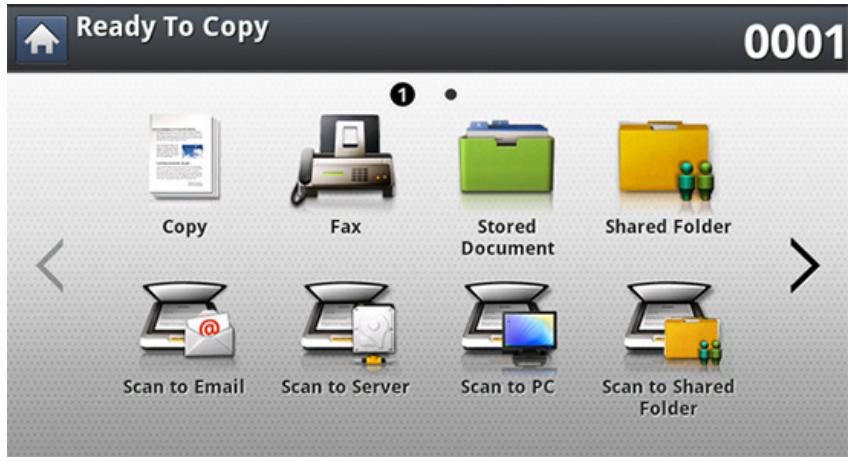
4 Select your computer name and press OK. If the machine requests a password, enter the password using the numeric keypad on the control panel.
5 Press the application program you want and press Select. Default setting is My Documents.
6 Set the scan quality with Resolution in the Basic tab.
7 Set the size of original in the Advanced tab. If you are not sure of the original size, select Auto.
8 Set the color mode in the Image tab.
9 Set the file format in which the image is to be saved in the Output tab.
File Format activates only when you select the application program as My Documents.
10 Press Ⓧ(Start) from the control panel to begin scanning.
Scanned image is saved in the computer's My Documents > My Pictures > Samsung folder.
Scanning and sending to USB /shared folder
You can scan a document and save the scanned image onto USB memory device/ shared folder. When you scan a document, the machine uses the default settings, such as for resolution. You can also customize your own scan settings (see "Changing the scan feature settings" on page 141).
Understanding the USB /shared folder screen
Press Scan to USB or Scan to Shared Folder in the display screen.
Basic tab
- File Name: Makes a file name to store the scan data.
- File Format: Select the file format before you proceed with the scanning job.
• Resolution: Selects the scanning resolution value..
• Darkness: Adjusts the degree of darkness of scanned output.
Advanced tab
• Duplex: For originals that are scanned on both sides.
• Original Size: Selects the size of originals.
• Original Orientation: Selects the orientation of the originals.
- Build Job: After the scanning is finished, the Scan More Pages window appears to ask if you want to scan another page. If you select Yes, then you can scan another page in the current job. If you select No, then the scanning process is completed and the remainder of the job is performed.
Image tab
You can move to next or previous pages using the up/down arrows located at the bottom left.
• Original Type: Selects whether the original is text, photo, etc..
• Color Mode: Adjusts the color options of scanned output.
- Adjust Background: Erase the background to some extent by adjusting density or brightness.
- Erase Backside Image: Prevents scanning the other side's image shown through the original paper.
Output tab
• Quality: Adjusts the display quality of the scanned output.
- File Format: Selects the file format of the scan output.
- Filing Policy: Automatically renames or overwrites when the USB memory device has a file with same name.
Scanning and sending to USB /shared folder
Scanning to a USB /shared folder

To use Scan to USB feature: Insert a USB memory device into the USB memory port on your machine.
1 Place the originals face up in the DSDF or place a single original face down on the scanner glass and close the DSDF (see "Loading originals" on page 64).
2 Press Scan to USB or Scan to Shared Folder from the display screen.
3 Press the Basic tab.
4 Select a folder for storing the scanned image. If you do not select a folder, the scanned image is stored in root directory.
5 Press the File Name input area. The pop-up keyboard appears.
6 Enter a file name to store the scan data. Press Done.
7 Set the File format, Resolution, and Darkness.
8 Set the scan features in the Advanced, Image, or Output tabs, if necessary (see "Changing the scan feature settings" on page 141).
9 Press the ⏻(Start) button to scan and store the file.
If an original is placed on the scanner glass, the machine shows the window asking if you want to place another page. Load another original and press Yes. When you finish, press No on this window.
Changing the scan feature settings
This section explains how to adjust the document settings for each scan job, such as resolution, duplex, original size, type, color mode, darkness, and more. The settings you change will be maintained for a certain time, but after that period, the options will be reset to default values.

Some menus may not appear in the display depending on options or models.
To change the menu options:
1 Press Scan menu from the display screen.
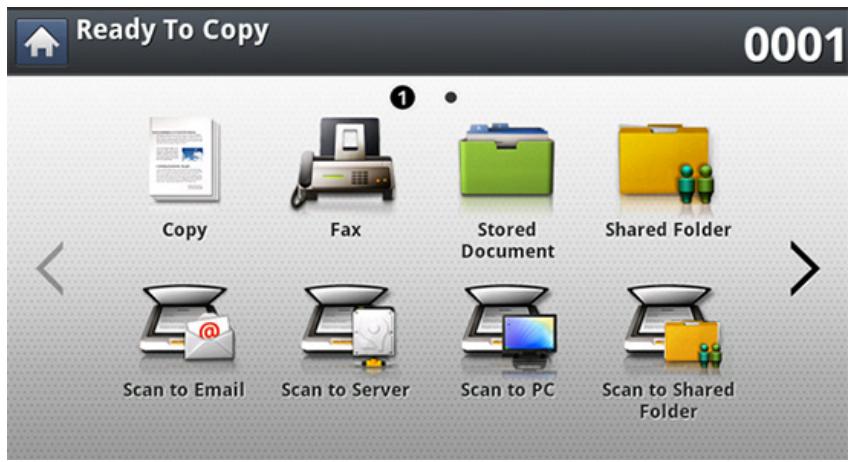
2 Place the originals face up in the DSDF or place a single original face down on the scanner glass and close the DSDF (see "Loading originals" on page 64).
3 If you want to customize the scan settings including reduce/enlarge, darkness, original type, and more from the display screen.
4 Press the Basic, Advanced, Image, or Output tab from the display screen.
5 Press the appropriate option.
| Item | Description |
| Original Size | Sets the image size. |
| Original Orientation | Upright Images: Select this setting for an original document loaded with the top toward the back of the machine.Sideways Images: Select this setting for an original document loaded into the DSDF with the top of the original document toward the left side of the machine or an original document placed on the scanner glass with the top of the original document toward the right side of the machine. |
| Original Type | The original type setting is used to improve the scan quality by selecting the document type for the current scanning job.Text: Use for originals containing mostly text.Text/Photo: Use for originals with mixed text and photographs.Photo: Use when originals are photographs. |
Changing the scan feature settings
| Item | Description |
| Resolution | You can adjust document resolution.Press the resolution and choose the values. The higher value you select, the clearer the result, but the scanning time may take longer. |
| Color Mode | You can select the color options of scan outputs.Color:Uses color to display an image: 24 bits per pixel, 8 bits for each RGB, is used for 1 pixel.Gray:Uses the black gradation to display an image: 8 bits per pixel. Mono:Displays an image in black and white. 1 bit per pixel. Mono:Displays an image in black and white. 1 bit per pixel. |
| Item | Description |
| Duplex | 1 Sided: For originals that are scanned on one side only.2 Sided, Book: For originals that are scanned on both sides.2 Sided, Calendar: For originals that are scanned on both sides, but the back is rotated 180 degrees. If an original is placed on the scanner glass, the machine shows the window asking to place another page. Load another original and press Yes. When you finish, select No for this option. If an original is placed on the scanner glass, the machine shows the window asking to place another page. Load another original and press Yes. When you finish, select No for this option. |
| Darkness | Adjusts the brightness level to scan. |
Changing the scan feature settings
| Item | Description |
| Filing Policy | This option is available When USB memory is inserted into the USB memory port on your machine.You can choose the policy for generating file names before you proceed with the scan job through the USB memory device. If the USB memory device already has the same name entered, you can rename or overwrite it.Change Name:If the USB memory device already has the same name when you enter a new file name, the file will be saved as a different file name that is automatically generated.Cancel:Does not send the scanned file if a file with same name is already on the server.Overwrite:The sent file overwrites the existing file. |
| Item | Description |
| File Format | JPEG: Scans originals in JPEG format.PDF: Scans originals in PDF format. You can open the file with the Adobe Acrobat Reader.-Multi Page: If you want several originals to be scanned as one file, pressMulti Page.Searchable: The machine detects text in the scanned image and creates a searchable PDF for text searching. Press this button and select a language that is used in the scanned image. Press OK.-Compact: You can compress originals to create a small-sized file, pressCompact. This compression method is different from the normal PDF format. Some data parts can be lost during compression.-Add Digital Signature: You can insert a digital signature in the PDF with a certificate. Only an administrator can manage the digital certificate onDigital Signature in PDFfrom SyncThruTM Web Service.-PDF Encryption: Sets the encrypts PDF files.TIFF: Scans originals in TIFF (Tagged Image File Format). If you want several originals to be scanned as one file, pressMulti Page.XPS: Scans originals in XPS (XML Paper Specification). If you want several originals to be scanned as one file, pressMulti Page. Only an administrator can manage the digital certificate onDigital Signature in PDFfrom SyncThruTM Web Service.-PDF Encryption: Sets the encrypts PDF files.TIFF: Scans originals in TIFF (Tagged Image File Format). If you want several originals to be scanned as one file, pressMulti Page.XPS: Scans originals in XPS (XML Paper Specification). If you want several originals to be scanned as one file, pressMulti Page. |
Changing the scan feature settings
| Item | Description |
| Adjust Background | Adjust the background to some extent by adjusting density or brightness. You can lighten, or delete the dark background of colored paper or newspaper to be scanned. When you use this option, Erase Backside Image in the Image tab are inactivated.Off:Disables this feature.Auto:Automatically adjusts background brightness.Enhance:Darkens the background. Use the left/right arrows to toggle the values.Erase:Lightens the background. Use the left/right arrows to toggle the values. When you use this option, Erase Backside Image in the Image tab are inactivated.Off:Disables this feature.Auto:Automatically adjusts background brightness.Enhance:Darkens the background. Use the left/right arrows to toggle the values.Erase:Lightens the background. Use the left/right arrows to toggle the values. |
| Erase Backside Image | This feature prevents scanning the other side's image shown through the original paperOff:Turns this option off.Erase:Lightens the background. Use the left/right arrow's to toggle the values. |
| Item | Description |
| Quality | You can use this option to produce a high-quality document. The higher quality you select, the larger file size you get.Best:Produces a high-quality image, but the file size will be larger.Normal:Both the image quality and file size will be between Best and Draft.Draft:Produces a low-quality image, but the file size will be smaller. |
Using a programs setting
This option allows you to save the current settings for future use. You can also use the previous settings from the last job.
Saving
1 Press Scan to Email, Scan to Server, Scan to Shared Folder or Scan to USB from the display screen.
2 Set scan features in the Advanced, Image, or Output tabs (see "Changing the scan feature settings" on page 141).
3 Press the Basic tab.
4 Set the scan quality by Duplex and Resolution.
5 Press Programs > Save.
6 Press Program Name input area. The pop-up keyboard appears. Enter the program name you want. Then press OK.

You can see the values of set Programs by scrolling up or down and check the values using the up/down arrows.
7 Press Save.
8 You can check the settings again. If everything is fine, press Add to home to make a shortcut on the main screen, Save to save current settings, or Cancel to quit without saving.
Loading
1 Press Scan to Email, Scan to Server or Scan to USB from the display screen.
2 Press Programs > Load.
3 Press a previous setting you want to use.
The machine is now set to scan according to the selected setting.
4 Press Add to home to make shortcut in main screen, Delete to delete the current setting or Apply to use the selected setting.
Scanning with TWAIN-enabled software
If you want to scan documents using other software, you will need to use TWAIN-compliant software, such as Adobe Photoshop.
Follow the steps below to scan with TWAIN-compliant software:
1 Make sure that the machine is connected to your computer and powered on.
2 Place the originals face up in the DSDF or place a single original face down on the scanner glass and close the DSDF (see "Loading originals" on page 64).
3 Open an application, such as Adobe Photoshop.
4 Open the TWAIN window and set the scan options.
5 Scan and save your scanned images.
Scanning with Samsung Easy Document Creator
Samsung Easy Document Creator is an application to help users scan, compile, and save documents in multiple formats, including .epub format.

• Available for Windows and Mac OS users only.
- Windows XP Service Pack 3 or higher and Internet Explorer 6.0 or higher is the minimum requirement for Samsung Easy Document Creator.
- Samsung Easy Document Creator is installed automatically when you install the machine software (see "Using Samsung Easy Document Creator" on page 256).
1 Place the originals face up in the DSDF or place a single original face down on the scanner glass and close the DSDF (see "Loading originals" on page 64).
2 From the Start menu select Programs or All Programs > Samsung Printers.
For Mac, open the Applications folder > Samsung folder > Samsung Easy Document Creator.
3 Click Samsung Easy Document Creator.
4 Click Advanced Scan from the home screen.
5 Select the type of scanning or a favorites and then make adjustments to the image.
6 Click Scan to scan a final image or Prescan to get another preview image.
7 Pressck Send to save the scanned image.
8 Press the option you want.
9 Press OK.

Click the Help ( ? ) button from the window, and then click on any option you want to know about.
Mac scanning
You can scan documents using Image Capture program. Mac OS X offers Image Capture program.
Scanning with network
1 Make sure that your machine is connected to a network.
2 Place the originals face up in the DSDF or place a single original face down on the scanner glass and close the DSDF (see "Loading originals" on page 64)..
3 Open the Applications folder and run Image Capture.
4 Select your device below SHARED.
5 Set the scan options on this program.
6 Scan and save your scanned image.

- If scanning does not operate in Image Capture, update Mac OS to the latest version.
- For more information, refer to the Image Capture's help.
- You can also scan using TWAIN-compliant software, such as Adobe Photoshop.
- You can scan using Samsung Easy Document Creator software. Open the Applications folder > Samsung folder > Samsung Easy Document Creator.
Linux scanning
Scanning
1 Make sure that the machine is connected to your computer and powered on.
2 Launch a scan application such as xsane or simple-scan(If it's not installed, please install it manually to use scan features. For example, you may use "yum install xsane" for rpm package systems and "apt-get install xsane" for deb package systems to install xsane).
3 Select your device from the list and set the scan options to apply.
4 Click the Scan button.
natural_image
Blue circular icon with a white printer symbol (no text or numbers)8. Faxing
This guide gives you information about using your machine as a fax machine.
This chapter includes:
• Preparing to fax 148
- Sending a fax from your computer 149
• Understanding the fax screen 151
- Sending a fax 153
• Receiving a fax 160
- Adjusting the document settings 163
- Printing a fax report 166
• Using a programs setting 167
Preparing to fax
Before you send or receive a fax, you need to connect the supplied phone line cord to the wall jack. Refer to the Quick Installation Guide for how to make a connection. The method of making a telephone connection varies from one country to another.

- You cannot use this machine as a fax through the internet phone line. For more information ask the internet service provider.
- We recommend you to use traditional analog phone services (PSTN: public switched telephone network) when connecting telephone lines to use Fax. If you use other Internet services (DSL, ISDN, VoIP), you can improve the connection quality by using the Micro-filter. The Micro-filter eliminates unnecessary noise signals and improves connection quality or Internet quality. Since the DSL Micro-filter is not provided with the machine, contact your Internet Service provider for use on DSL Micro-filter.
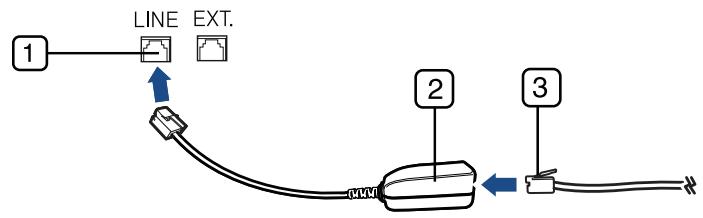
flowchart
graph TD
    A["1"] --> B["LINE"]
    B --> C["EXT."]
    C --> D["2"]
    D --> E["3"]
    E --> F["Output"]
1 Line port
2 Micro filter
3 DSL modem / Telephone line
Sending a fax from your computer
You can send a fax from your computer without going to the machine. Make sure that your machine and the computer are connected to the same network.
Sending a fax (Windows)
To send a fax from your computer, the Samsung Network PC Fax program must be installed. This program is installed when you install the printer driver.

For more information about Samsung Network PC Fax, click Help.
1 Open the document to be sent.
2 Select Print from the File menu.
The Print window will be displayed. It may look slightly different depending on your application.
3 Select Samsung Network PC Fax from the Print window
4 Click Print or OK.
5 Enter the recipient's fax number and set the options if necessary.
6 Click Send.
Checking the sent fax list (Windows)
You can check the sent fax list from your computer.
From the Start menu, click Programs or All Programs > Samsung Printers> Fax Transmission History. Then, the window appears with the list of faxes sent.

For more information about Fax Transmission History, click the Help ( ? ) button.
Sending a fax (Mac)
To send a fax from your computer, the Fax Utilities program must be installed. This program is installed when you install the printer driver.
Depending on the OS version, the following steps will be different.
1 Open the document to be sent.
2 Select Print from the File menu.
3 Select your printer from the drop-down list in Printer.
4 Choose the number of copies and pages.
5 Choose your paper size, orientation, and scale.
Sending a fax from your computer
6 Enter the recipients' fax number into To's input area. You can also use Addresses pressing 📁 button, if you have stored frequently used fax numbers.
7 If necessary, enter the access code in the Dialing Prefix input area.
8 If necessary, you can send the fax with a cover page: check Use Cover Page.
Enter the subject and message of the fax job.
9 Click Fax.
10 The Fax icon ( ) appears on your Mac dock. Click the icon.
You can see the status of the fax job. You can also delete, hold, resume, and pause the fax job.
Understanding the fax screen
To use the fax feature, press Fax on the display screen.
If a different screen is displayed, press ( ) to go to the home display screen.
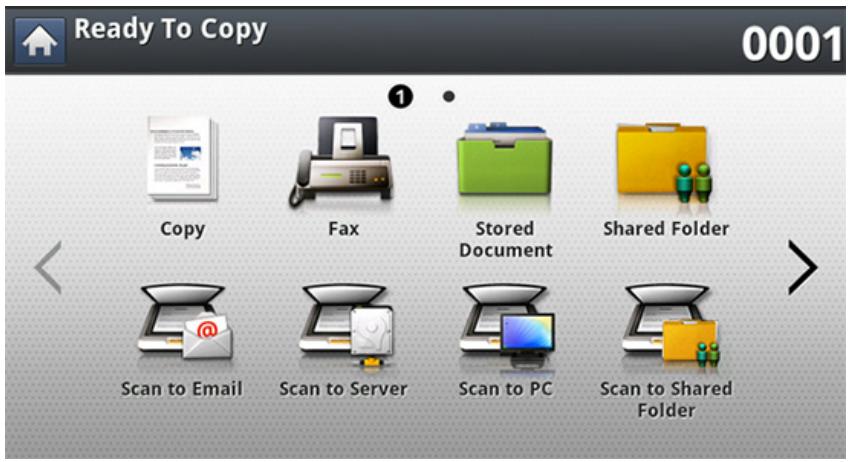
Basic tab
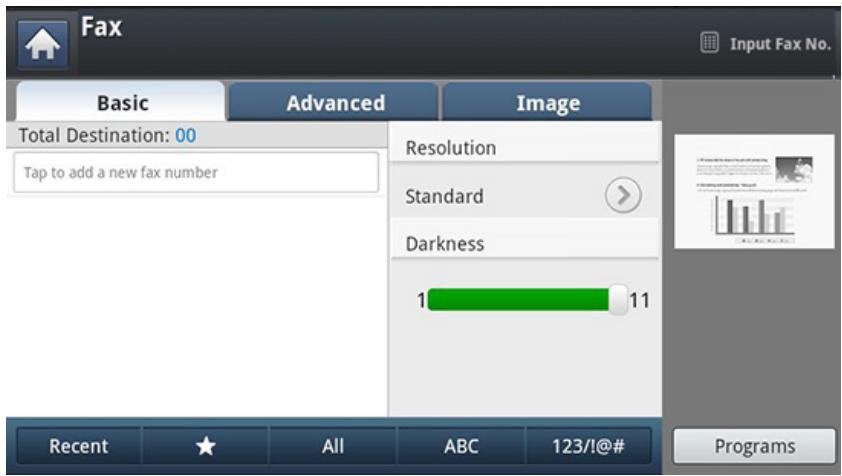
- Fax number input area: Enter the recipient's fax number using the numeric keypad on the control panel. If you configured the address book, press Address Book (see "Setting up an address book from the control panel" on page 170 or "Setting up an address book from SyncThru™ Web Service" on page 174).
• Resolution: Adjusts the resolution options.
• Darkness: Adjusts the degree of darkness of scanned output - Address Book((★)Favorite, All, ABC): Inputs the recipient's address by pressing stored addresses. You can save frequently used email addresses using the control panel or SyncThru™ Web Service (see "Setting up an address book from the control panel" on page 170 or "Setting up an address book from SyncThru™ Web Service" on page 174).
- Programs: Allows you to save the current settings for future use (see "Using a programs setting" on page 167).
Understanding the fax screen
Advanced tab
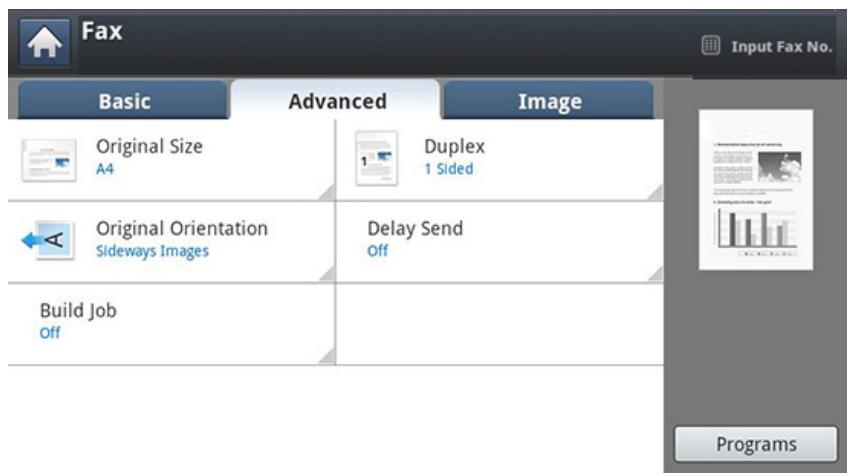
• Original Size: Selects the size of the original.
- Duplex: Selects whether the machine sends faxes one side of the original or both sides of the original.
• Original Orientation: Selects the orientation of the originals.
- Delay Send: Sets the machine to send a fax at a later time without your intervention (see "Delaying a fax transmission" on page 158).
- Build Job: After the scanning is finished, the Scan More Pages window appears to ask if you want to scan another page. If you select Yes, then you can scan another page in the current job. If you select No, then the scanning process is completed and the remainder of the job is performed.
Image tab
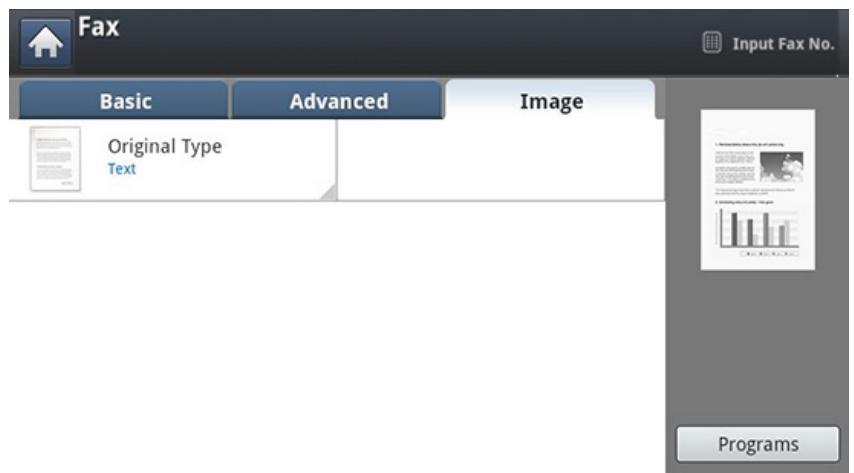
- Original Type: Enhances the fax quality based on the type of the original document being scanned.
Sending a fax
This part explains how to send a fax and the special methods of transmission.

When you place the originals, you can use either the DSDF or the scanner glass. If the originals are placed on both the DSDF and the scanner glass, the machine will read the originals on the DSDF first, because it has higher priority in scanning.
Setting the fax header
In some countries, you are required by law to indicate your fax number on any fax you send.
1 Press Machine Setup > Application Settings > Fax Settings > Machine ID & Fax No. from the display screen.
2 Press a fax line if your machine has multiple fax lines.
3 Press the ID Name input area. The pop-up keyboard appears.
Enter your name or the company name. Press OK.
4 Press the Fax Number input area.
Enter your fax number using the numeric keypad on the control panel.
5 Press OK to save the information.
Sending a fax
1 Place the originals face up in the DSDF or place a single original face down on the scanner glass and close the DSDF (see "Loading originals" on page 64).

This machine automatically reduces the original document to fit the paper size of the recipient's fax. For example, the original document size is A5-sized paper and the paper loaded on recipient's fax is A4-sized paper, the original paper get reduced to be fit to A4-sized paper.
2 Press Fax from the display screen.
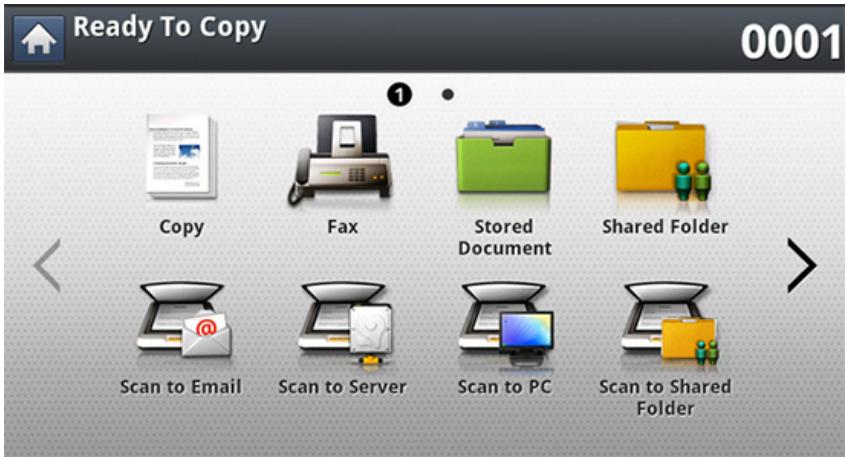
3 Adjust the document settings in the Advanced or Image tab (see "Adjusting the document settings" on page 163).
Sending a fax
4 Press the Basic tab.
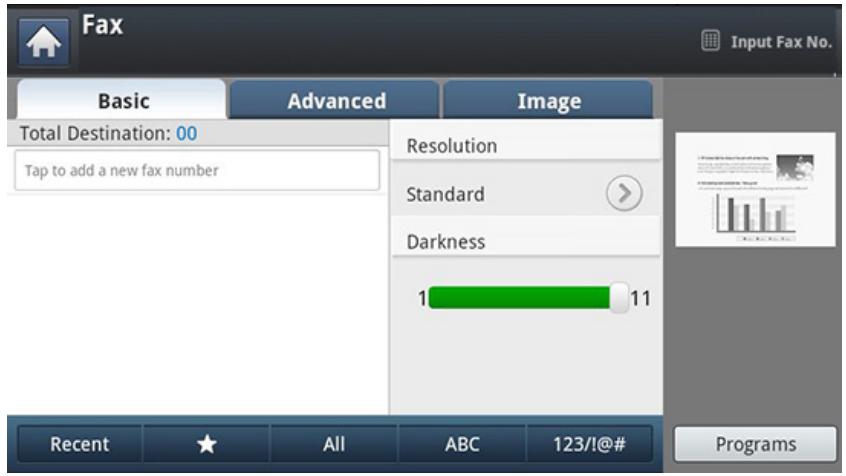
5 Select Resolution.
6 When the cursor is blinking in the input line, enter the fax number using the numeric keypad on the control panel, or use Address Book from the display screen, if you have stored frequently used fax numbers.

• You can send a fax to up to 10 destinations at once.
- To insert a pause, press Pause at the appropriate place while entering the fax number. “-” appears on the display at the corresponding location.
7 Press Ⓧ(Start) on the control panel. The machine starts to scan and send a fax to the destinations.

- You can send a fax directly from your computer (see "Sending a fax from your computer" on page 149).
- When you want to cancel a fax job, press Ⓥ(Stop) on the control panel before the machine starts transmission, or press the Job Status button on the control panel, and select the job you want to delete, then press Delete (see "Job Status button" on page 28).
- If an original is placed on the scanner glass, the machine shows the window asking if you want to place another page. Load another original and press Yes. When you finish, press No on this window.
- While the machine is sending a fax, you cannot send an email at the same time.
Sending a fax
Sending a fax using speed dial numbers
When you are prompted to enter a destination number while sending a fax, enter the speed dial number you set previously (see "Setting up an Address Book" on page 169).
1 Place the originals face up in the DSDF or place a single original face down on the scanner glass and close the DSDF (see "Loading originals" on page 64).
2 Press Fax from the display screen.
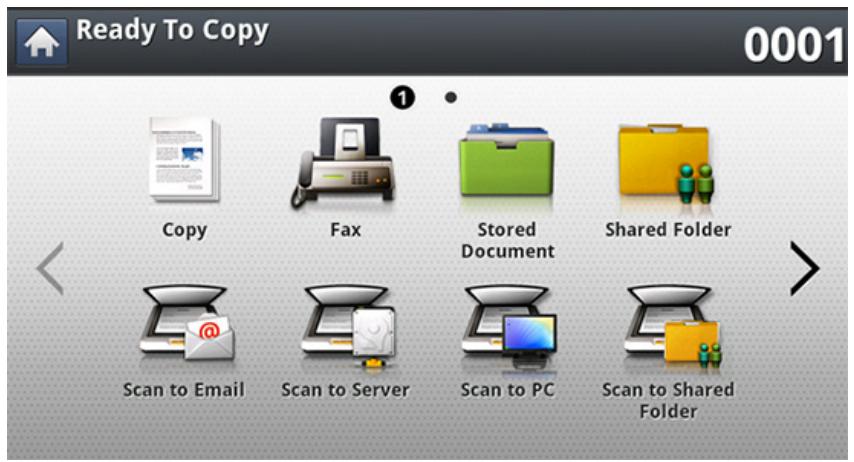
3 Adjust the document settings in the Advanced or Image tab (see "Adjusting the document settings" on page 163).
4 Press the Basic tab.
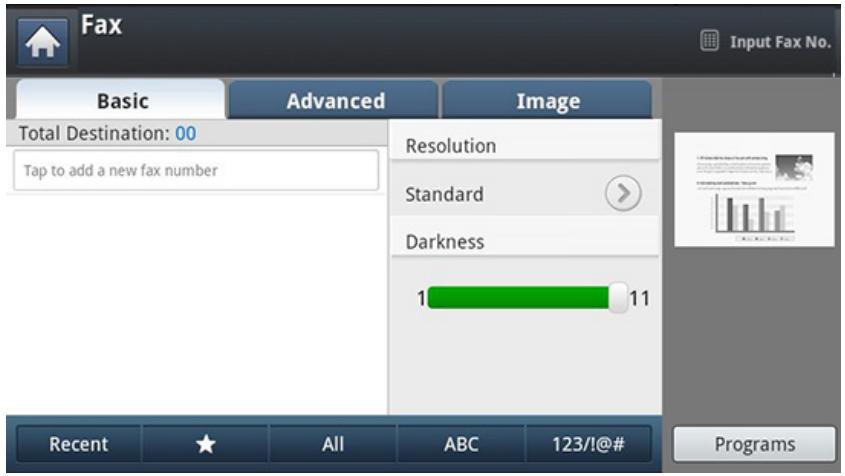
5 Select Resolution.
6 When you press the input line from display screen:
- For a one-digit (0-9) speed dial number, press and hold the corresponding digit button using the numeric keypad on the control panel.
- For a two- or three-digit speed dial number, press the first digit button(s) and then hold down the last digit button using the numeric keypad on the control panel.
7 Press ◇(Start) on the control panel.
The machine starts to scan and send a fax to the destination.
Sending a fax
Sending a fax manually using On Hook
This method is sending a fax using On Hook in the Basic tab.

When you use Delay Send, Quick Start Fax and Priority Send in the Advanced tab, you cannot send a fax using On Hook.
1 Place the originals face up in the DSDF or place a single original face down on the scanner glass and close the DSDF (see "Loading originals" on page 64).
2 Press Fax from the display screen.
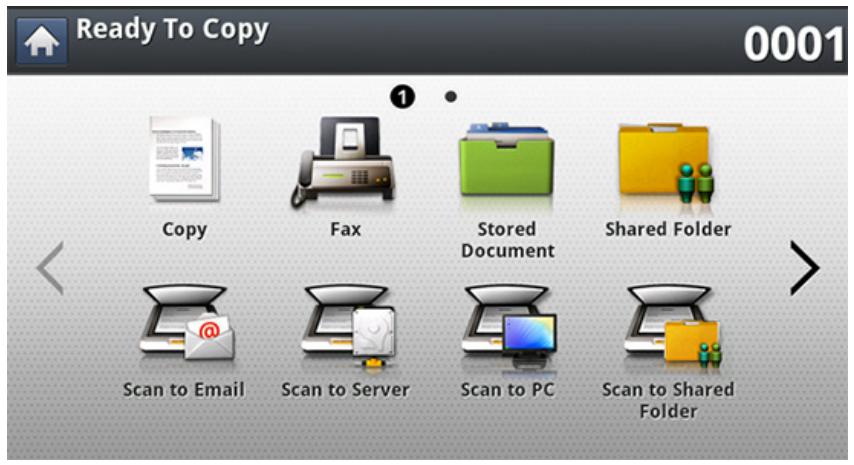
3 Adjust the document settings in the Advanced or Image tab (see "Adjusting the document settings" on page 163).
4 Press the Basic tab.
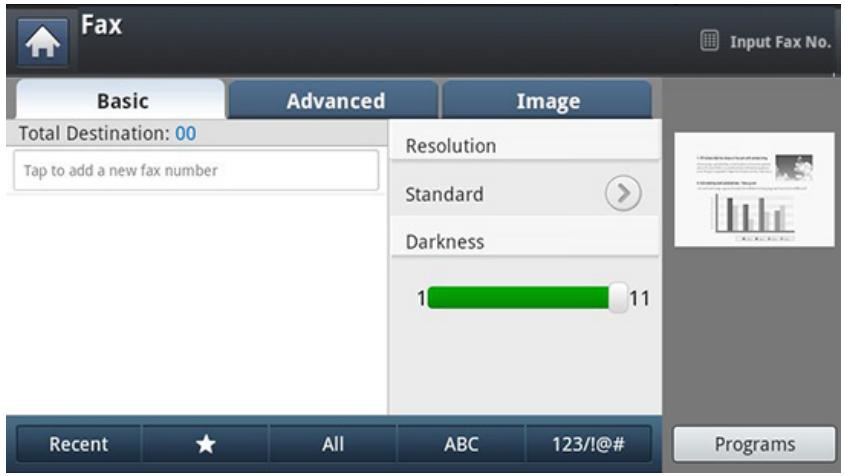
5 Select Resolution.
6 Press On Hook on the display screen.
7 When you hear the dial tone, enter a fax number using the numeric keypad on the control panel.
8 Press Ⓧ(Start) when you hear a high-pitched fax signal from the remote fax machine.
Resending Automatically
When the line you have dialed is busy or there is no answer when you send a fax, the machine automatically redials the number.
To change the time interval between redials and/or the number of redial attempts, follow the steps below:
1 Press Machine Setup > Application Settings > Fax Settings > Redial from the display screen.
2 Press a fax line if your machine has multiple fax lines.
3 Set the Redial Term(min) option using the + and - buttons.
4 Set the Redial Times option using the + and - buttons.
Redialing the last number
You can choose fax numbers instead of pressing the number key.
1 Place the originals face up in the DSDF or place a single original face down on the scanner glass and close the DSDF (see "Loading originals" on page 64).
2 Press Fax from the display screen.
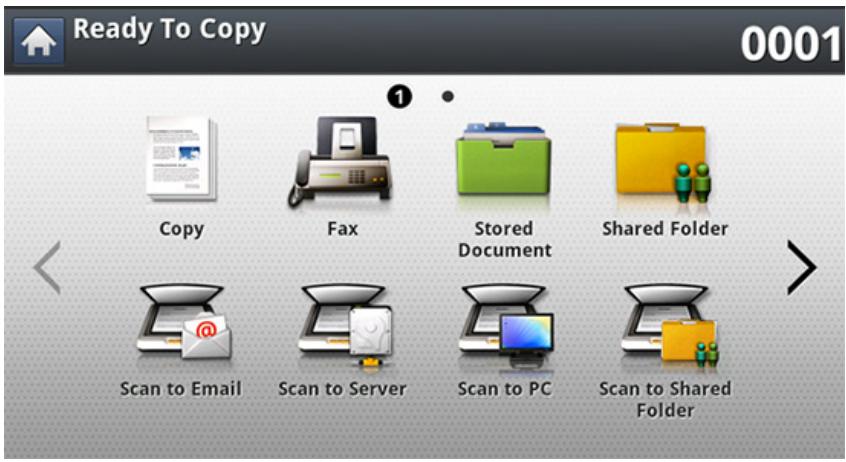
3 Adjust the document settings in the Advanced or Image tab (see "Adjusting the document settings" on page 163).
Sending a fax
4 Press the Basic tab.
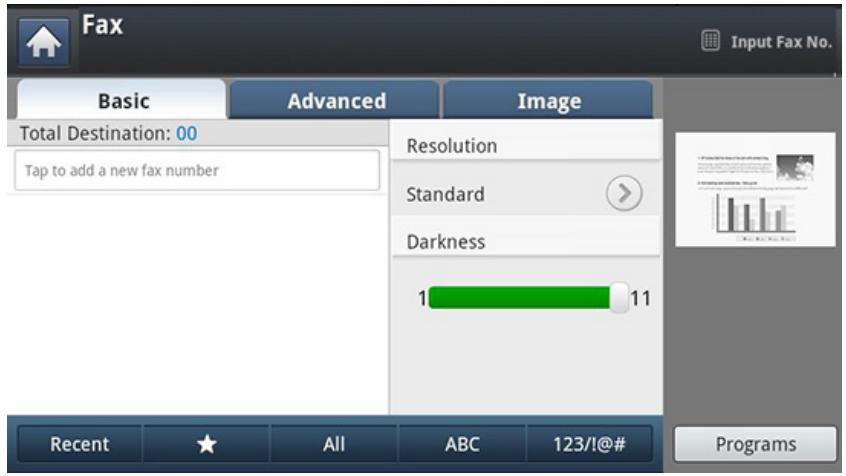
5 Select Resolution.
6 Press Recent.
7 Press the fax number you want to redial. Then press OK.

- Add to Address: Allows you to add a fax number in the Recent results to Address Book.
- Delete: Allows you to delete a fax number in the Recent results. Press the fax number you want to delete. Then press Delete.
8 Press Ⓧ(Start) on the control panel. The machine starts to scan and send a fax to destinations.
Delaying a fax transmission
You can set your machine to send a fax at a later time when you will not be present.

- When you use this option, Quick Start Fax and Priority Send in the Advanced tab are inactivated.
- When you use this option, you cannot send a fax using the On Hook button on the display screen.
1 Place the originals face up in the DSDF or place a single original face down on the scanner glass and close the DSDF (see "Loading originals" on page 64).
2 Press Fax from the display screen.
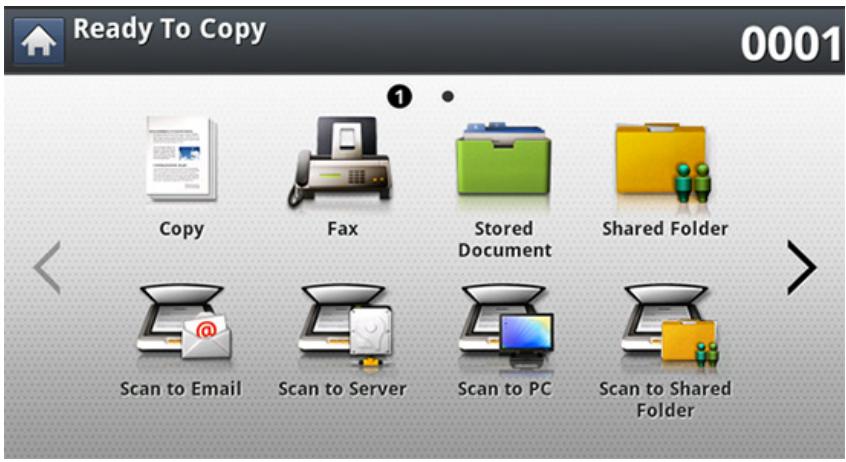
Sending a fax
3 Adjust the document settings in the Advanced or Image tab (see "Adjusting the document settings" on page 163).
4 Press the Basic tab.
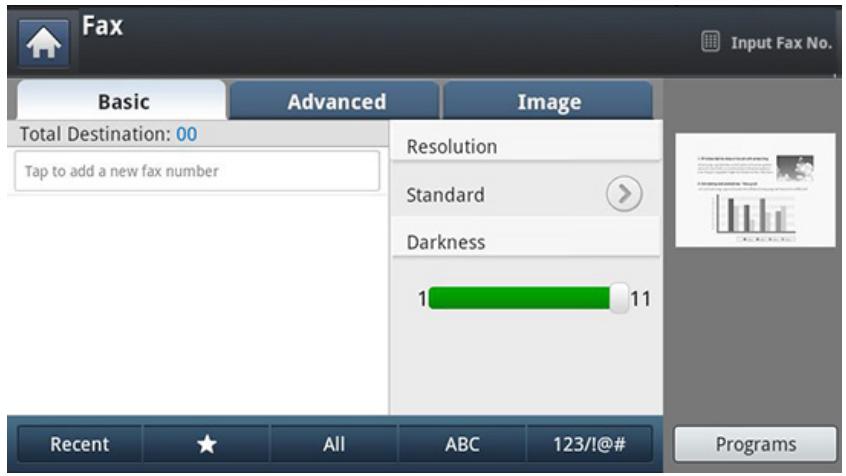
5 Select Resolution.
6 When the cursor is blinking in the input line, enter the fax number using the numeric keypad on the control panel. Or use Address Book from the display screen, if you have stored frequently used fax numbers.
7 Press the Advanced tab > Delay Send.
8 Press On to active this feature.
9 Press the Job Name input area. Then the pop-up keyboard appears.
Enter the job name you want. Press Done.
If you do not enter a job name, the machine assigns the job name.
10 Set the delay sending time.

You can set the delay sending time to be greater than 15 minutes later than the current time. For example, if it is 1:00, then you can set the time starting to be 1:15. If the set time is incorrect, a warning message will appear when the machine resets it to the current time.
11 Press ⬆(Start) on the control panel. The machine starts to store the scanned original data into memory.

To cancel delaying a fax, press Off before sending is activated.
Receiving a fax
This part explains how to receive a fax and the special receiving methods available.
Changing the receive modes
Your machine is preset to the Fax mode at the factory. When you receive a fax, the machine answers the call on a specified number of rings and automatically receives the fax. However, if you want to change the receive mode to another mode, follow the steps below:
1 Press Machine Setup > Application Settings > Fax Settings from the display screen.
2 Press a fax line if your machine has multiple fax lines.
3 Press Receive Mode.
4 Press the appropriate option.
- Telephone: Receives a fax by pressing Fax > On Hook and then (Start).
- Fax: Answers an incoming fax call and immediately goes into the fax reception mode.
- Answering Machine/Fax: Is for when an answering machine is attached to your machine. Your machine answers an incoming call, and the caller can leave a message on the answering machine. If the fax machine senses a fax tone on the line, the machine automatically switches to Fax mode to receive the fax.
Receiving manually in Telephone mode
You can receive a fax call by pressing Fax > On Hook and then pressing
(Start) when you hear a fax tone from the remote machine. The machine begins receiving a fax.
Receiving in secure receiving mode
You may need to prevent your received faxes from being accessed by unauthorized people. You can turn on secure receiving mode to restrict printing of received faxes when the machine is unattended. In secure receiving mode, all incoming faxes go into memory.
Receiving a fax
1 Press Machine Setup > Application Settings > Fax Settings > Secure Receive from the display screen.

The Secure Receive mode can only be configured by an authorized user who has registered an ID and a password on the machine. When the machine requests, enter the ID and password.
2 Press a fax line if your machine has multiple fax lines.
3 Press On to active this feature.

When the machine receives a fax in this mode, Print will be activated. If you want to print the secured faxes, press Print. All secured faxes will be printed out.
4 If you want to Passcode setting, press Passcode blink then input the Passcode.
5 If you want incoming faxes to go into memory always, press Whole Day. Otherwise, go to the next step.
6 Set Start Time by pressing the + and - buttons. Press OK.
7 Press End Time, and set the specific end time using the + and - buttons.
8 Press OK from the display screen.

To deactivate the Secure Receive feature, press Off. In this case, the received fax will be printed out.
Receiving a fax
Printing received faxes on both sides of the paper
Set this duplex feature to save paper. When the machine prints the received fax data, it prints them on both sides of the paper.
1 Press Machine Setup > Application Settings > Fax Settings > Received Fax Printing > Duplex from the display screen.
2 Press the appropriate option.
• Off: Prints on only one side of the paper.
- Long Edge: Prints on both sides of the paper; however, the binding will be the long edge.
- Short Edge: Prints on both sides of the paper; however, the binding will be the short edge.
3 Press (Back) to go back to the previous screen.
Receiving faxes in memory
Since your machine is a multi-tasking device, it can receive faxes while you are making copies or printing. If you receive a fax while you are copying or printing, your machine stores incoming faxes in its memory. Then, as soon as you finish copying or printing, the machine automatically prints the fax.
Adjusting the document settings
Before sending a fax, you can adjust the document settings, such as resolution, darkness, duplex and so on.

- Some menus may not appear in the display depending on options or models.
- The document setting herein is for the current job only. If you want to change the default settings on document settings, refer to Machine Setup > Application Settings > Fax Settings.
To change the menu options:
1 Press Fax from the display screen.
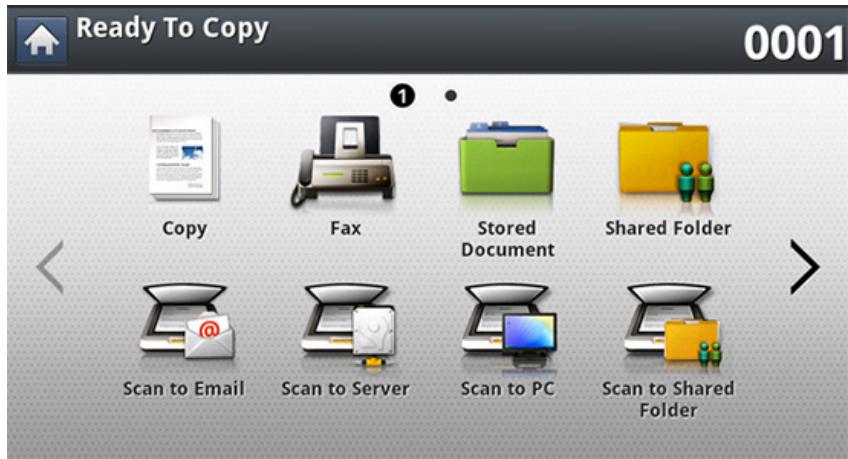
2 Place the originals face up in the DSDF or place a single original face down on the scanner glass and close the DSDF (see "Loading originals" on page 64).
3 If you want to customize the copy settings including reduce/enlarge, darkness, original type, and more from the display screen.
4 Press the Basic, Advanced, or Image tab from the display screen.
5 Press the appropriate option.
| Item | Description |
| Darkness | Adjusts the brightness level to scan an original that is easier to read, when the original contains faint markings and dark images. |
Adjusting the document settings
| Item | Description |
| Resolution | The default document settings produce good results when using typical text-based originals. However, if you send originals that are of poor quality, or contain photographs, you can adjust the resolution to produce a higher quality fax.Standard: Usually recommended for originals with text. This option will reduce the transmission time.Fine: Recommended for the originals containing small characters, thin lines, or text that was printed using a dot-matrix machine.Super Fine: Recommended for originals containing fine detail. This option is enabled only if the receiving machine also supports Super Fine resolution.Ultra Fine: Recommended for originals containing extremely fine detail. This option is enabled only if the receiving machine also supports Ultra Fine resolution. When your machine is set to the Super Fine or Ultra Fine resolution and the fax machine with which you are communicating does not support the Super Fine or Ultra Fine resolution, the machine transmits using the highest resolution mode supported by the other fax machine. When your machine is set to the Super Fine or Ultra Fine resolution and the fax machine with which you are communicating does not support the Super Fine or Ultra Fine resolution, the machine transmits using the highest resolution mode supported by the other fax machine. |
| Item | Description |
| Original Type | Enhances the fax quality based on the type of the original document being scanned.·Text: For originals with text or line art.·Text/Photo: For originals with both text and photographs together.·Photo: For originals that are a continuous tone photograph. |
| Original Size | A fax can be sent after specifying the original document size if the original document size cannot be detected automatically or if you wish to specify a certain document size. |
| Original Orientation | ·Upright Images: Select this setting for an original document loaded with the top toward the back of the machine.·Sideways Images: Select this setting for an original document loaded into the DSDF with the top of the original document toward the left side of the machine or an original document placed on the scanner glass with the top of the original document toward the right side of the machine. |
Adjusting the document settings
| Item | Description |
| Duplex | This function is especially intended for two-sided originals. You can select whether the machine sends the fax on one side or both sides of the paper.1 Sided: For originals that are printed on one side only.2 Sided, Book: For originals that are printed on both sides.2 Sided, Calendar: For originals that are printed on both sides, but the back is rotated 180 degrees.[YYYYK] To use 2 Sided, Book and 2 Sided, Calendar, load the originals on the DSDF. If the machine cannot detect the original on the DSDF, it automatically changes the option to 1 Sided. |
| Delay Send | Sets the machine to send a fax at a later time without your intervention (see "Delaying a fax transmission" on page 158). |
| Build Job | After the scanning is finished, the Scan More Pages window appears to ask if you want to scan another page. If you select Yes, then you can scan another page in the current job. If you select No, then the scanning process is completed and the remainder of the job is performed. |
Printing a fax report
You can set the machine to print a report whether a fax transmission and reception is successfully completed or not.

If a report contains characters or fonts that the machine do not support, Unknown could be printed instead of the characters/fonts in the report.
1 Press Machine Setup > Application Settings > Fax Settings > Report from the display screen.
2 Press Fax Send Confirmation from the display screen.
3 Press the appropriate option.
• Off: Disables this feature.
• On: Activates this feature.
- On-Error: Prints a report only when a transmission fails.
4 Press (Back) to go back to the previous screen.
Using a programs setting
This option allows you to save the current settings for future use. You can also use the previous settings from the previous job.
Saving Programs
1 Press Fax from the display screen.
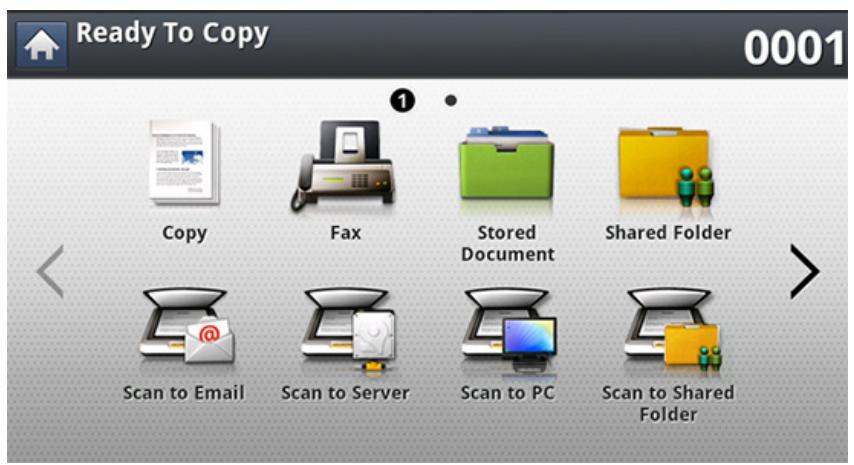
2 Adjust the document settings in the Advanced or Image tab (see "Adjusting the document settings" on page 163).
3 Press the Basic tab.
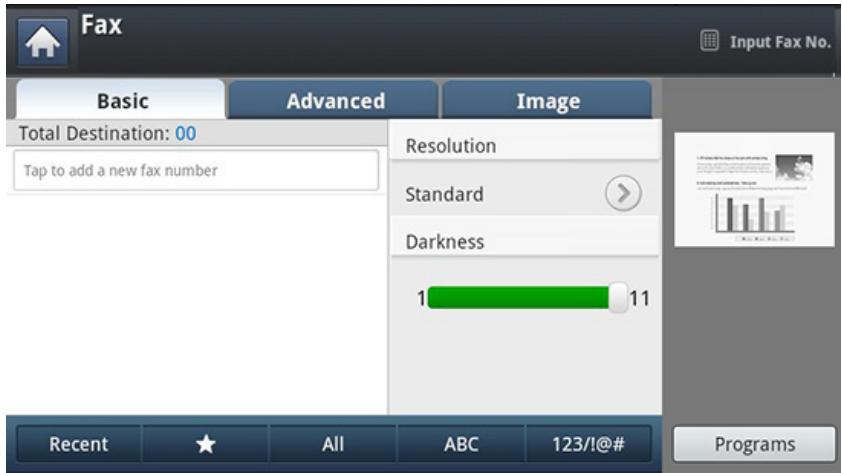
4 Select Resolution.
5 Press Programs > Save.
6 Press Program Name input area. The pop-up keyboard appears.
Enter the program name you want. Then press OK.

You can see the values of set Programs by scrolling up or down and check the values using the up/down arrows.
7 Press Save. When the confirmation window appears, the settings you set are saved. Click Go to List or Close.
Using a programs setting
Loading Programs
1 Place the originals face up in the DSDF or place a single original face down on the scanner glass and close the DSDF (see "Loading originals" on page 64).
2 Press Fax from the display screen.
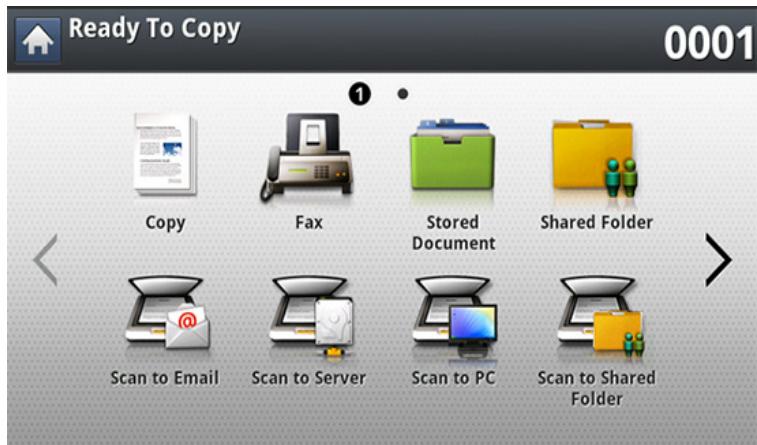
3 When the cursor is blinking in the input line, enter the fax number using the numeric keypad on the control panel, or use Address Book from the display screen, if you have stored frequently used fax numbers.
4 Press Programs > Load.
5 Press a program name in the list that you want to use.
6 Press OK.
7 Press Yes when the confirmation window appears.
The machine is now set to fax according to the selected setting.
8 Press Ⓤ(Start) on the control panel. The machine starts scanning and sending a fax to destinations.

- When you want to cancel a fax job, press Ⓥ(Stop) on the control panel before the machine starts transmission or press the Job Status button on the control panel, and select the job you want to delete, then press Delete.
- If an original is placed on the scanner glass, the machine shows the window asking if you want to place another page. Load another original and press Yes. When you finish, press No on this window.
- While the machine is sending a fax, you cannot send an email at the same time.
natural_image
Blue circular icon with a white printer symbol (no text or numbers)9. Setting up an Address Book
This guide gives you guidelines for the address book.
This chapter includes:
- Setting up an address book from the control panel 170
- Setting up an address book from SyncThru™ Web Service
174
Setting up an address book from the control panel
You can save frequently used fax numbers, email addresses, SMB server addresses, and FTP server addresses in your machine.
- Individual: Stores up to 500 recipients' information.
- Group: Makes groups when you frequently send the same document to several destinations. You can register up to 500 recipients in a group. Entries stored here will be available for selection within the sending list on the Basic tab of Fax, Scan to Email or Scan to Server. Sending Group can be also setup comprising of many Individual entries.

You cannot register a group as you register an individual in a group.
Storing Individual address (Fax, Email)
1 Press Machine Setup > Application Settings > Address Book > New from the display screen
2 Press the Name input area. Then enter the name of the recipient.

Check the ★ (favorite) icon for addresses you often use. You can easily find them from the search results.
3 Speed Dial No. is automatically filled with the first free number.

Speed Dial No. is the number representing a recipient's information.
4 Press the Fax No. input area and enter the fax number using the numeric keypad on the control panel.

Inserting a pause: with some telephone systems, you must dial an access code (9, for example) and listen for a second dial tone. In such cases, you must insert a pause in the telephone number.
5 Press the Email input area. Then enter the email address of the recipient.
6 Press the OK to save the information.
Storing Individual addresses (SMB, FTP)
1 Press Machine Setup > Application Settings > Address Book > New > SMB or FTP > (individual) icon from the display screen.
2 Press the Name input area. Then enter the name of the individual.

Check the ★ (favorite) icon for addresses you often use. You can easily find them from the search results.
Setting up an address book from the control panel
3 Press IP Address or Host tab, then press the IP Address or Host input area. Then enter the server address in dotted decimal notation or a host name.
4 Press the Port No. input area. Then enter the server port number.
5 Press the User Name input area. Then enter the user name.

In case of SMB or FTP, if you want the server to permit access for unauthorized persons. Press the Anonymous box. This box is unchecked by default. If you checked the Anonymous box, go to step 7.
6 Press the Password input area. Then enter the password.
7 Press the User Domain input area. Then enter the domain name.

If the SMB server you entered is not registered on any domain, leave it blank or enter the computer name of the SMB server.
8 Press the Path input area. Then enter the name of file folder where the sent files are to be stored.
Example: /FileFolder/
9 Press the File Name input area. Enter the name of the sent file.
10 Select the Filing Policy option you want using the arrow. If the server has a file with the same name already, the file will get processed by following the file policy you selected.
- Change Name: The sent file is saved as a different file name that is automatically generated.
- Cancel: Does not save the sent file.
• Overwrite: The sent file overwrites the existing file.
11 Select the Folder Creation option you want.
- Use Login Name: If you select this option the machine creates a sub-folder in the file folder you selected. The sub-folder is named using the user name entered in step 5.

If the file folder has a sub-folder with the same name already, the machine does not create a sub-folder.
- Folder Creation Cycle: You can set the cycle of sub-folder creation. The machine create a sub-folder according to this option set.

If the file folder has a sub-folder with the same name already, the machine does not create a sub-folder.
- Every Day: A sub-folder is created every day. The sub-folder name format is YYYY-MM-DD (e.g. 2015-01-01).
- Every Month: A sub-folder is created every month. The subfolder name format is YYYY-MM (e.g. 2015-01).
- Every Year: A sub-folder is created every year. The sub-folder name format is YYYY (e.g. 2015).
Setting up an address book from the control panel
- Create Folder For Multiple Files: If you select this option and scanned multiple files, the machine creates a sub-folder in the file folder you selected, and the sent files will be stored in the sub-folder.

If all folder creation options are enabled at the same time, the sent file(s) will be stored as shown below.
- When a single scanned file is sent:
\folder\user name\2015-01-01\DOC.jpg - When multiple scanned files are sent:
\folder\user name\2015-01-01\DOCJPEG\DOC000.jpg
\folder\user name\2015-01-01\DOCJPEG\DOC001.jpg
\folder\user name\2015-01-01\DOCJPEG\DOC002.jpg
12 Press OK to save the information.
Editing individual address
1 Press Machine Setup > Application Settings > Address Book from the display screen.
2 Press the name of the individual you want to edit. Press Edit.

If you want to delete an individual address, select the checkbox for the address you want to delete and press Delete.
3 Press the input area you want to change. Then change the contents using the pop-up keyboard, or numeric keypad on the control panel. If you use the pop-up keyboard.
4 Press the OK to save the information.
Storing group address
1 Press Machine Setup > Application Settings > Address Book > New > (group) icon from the display screen.
2 Press the Group Name input area. Then enter the group name.
3 Press the Add Member. Select the checkbox for the individual address to include and press the √ icon.
If you are not sure of the name, you can use the Input Address area. Enter the first few letters or just press the 🔒 (search) icon. The machine shows the individual list. Select the checkbox you want include an individual address and press the √ icon.
4 Press OK to save the information
Setting up an address book from the control panel
Editing group address
1 Press Machine Setup > Application Settings > Address Book from the display screen.
2 Press the name of group you want to edit. Press Edit.

If you want to delete an group address, select the checkbox you want to delete and press Delete.
3 Press the Group Name input area. Change the group name.
4 Press the Add Member. Select the checkbox for the individual address to include and press the √ icon.

If you are not sure of the name, you can use the Input Address area. Enter the first few letters or just press the 🔒 (search) icon. The machine shows the individual list. Select the checkbox you want include an individual address and press the √ icon.
5 If you want to delete an individual address, select the checkbox you want to delete and press Delete.. The name of the individual will be deleted from the group.
6 Press OK to save the information
Searching the address book for an entry
You can search the addresses that are currently stored in the address book.
1 Press Machine Setup > Application Settings > Address Book > All from the display screen.
2 Press the specific category you want.
You can find addresses in a specific category such as All, Individual, Group.
3 The machine shows the search results.

If you are not sure of the name, you can use the Input Address area. Enter the first few letters or just press the 🔒 (search) icon.
Setting up an address book from SyncThru™ Web Service
You can store addresses conveniently from a networked computer using SyncThru™ Web Service. Only users registered in the machine can store addresses through login SyncThru™ Web Service.
Storing on your local machine
This method means that you store addresses on your machine's hard drive. You can add addresses, as well as group them in particular categories.
Adding addresses in Individual Address Book
1 Turn your networked computer on and open the web browser.
2 Enter your machine's IP address as the URL in a browser. (Example, http://123.123.123.123)
3 Press Enter or click Go to access the SyncThru™ Web Service shows.
4 Click Login.
5 Enter the ID and password, and select a domain you log into the machine.
6 Click Address Book > Individual.
7 Click Add.
8 Enter the name to be added, and select the speed dial number in General.

- Speed No. is the number representing a recipient's information, you can use the numeric keypad on the control panel.
- Check Favorite for addresses you often use. You can easily find them from the search results.
9 Enter the email address in E-mail.
10 Enter the fax number in Fax.
11 Check the enable SMB box in Add SMB. You can enter the SMB information after checking this checkbox.
12 Enter the server address in decimal notation or a host name in SMB Server Address.
13 Enter the server port number in SMB Server Port.
14 Enter the login name in Login Type.

In case of SMB or FTP, if you want the server to permit access for unauthorized persons. Press the Anonymous box. This box is unchecked by default. If you checked the Anonymous box, go to step 18.
Setting up an address book from SyncThru™ Web Service
15 Enter the login and password, and re-enter the password in Confirm Password.
16 Enter the domain name in Domain.

If the SMB server you entered is not registered on any domain, leave it blank or enter the computer name of the SMB server.
17 Enter the scan file folder for storing scanned images in Path.
Example: /sharedFolder/
18 Select the Scan folder creating policy option you want.
- Create new folder using login name: If you select this option, the machine creates a sub-folder in the file folder you selected. The subfolder is named using the user name you entered in step 15.

If the file folder has a sub-folder with the same name already, the machine does not create a sub-folder.
- Create new folder every: You can set the cycle of sub-folder creation. The machine creates a sub-folder according to this option set.

If the file folder has a sub-folder with the same name already, the machine does not create a sub-folder.
- Day: A sub-folder is created every day. The sub-folder name format is YYYY-MM-DD (e.g. 2015-01-01).
- Month: A sub-folder is created every month. The sub-folder name format is YYYY-MM (e.g. 2015-01).
- Year: A sub-folder is created every year. The sub-folder name format is YYYY (e.g. 2015).
- Create new folder only if scan output consist of several files: If you select this option and scanned multiple files, the machine creates a sub-folder in the file folder you selected, and the sent files will be stored in the sub-folder.

If all folder creation options are enabled at the same time, the sent file(s) will be stored as below.
- When single scanned file is sent:
\folder\user name\2015-01-01\DOC.jpg - When multiple scanned files are sent:
\folder\user name\2015-01-01\DOCJPEG\DOC000.jpg
\folder\user name\2015-01-01\DOCJPEG\DOC001.jpg
\folder\user name\2015-01-01\DOCJPEG\DOC002.jpg
Setting up an address book from SyncThru™ Web Service
19 Select the policy for generating file name in Filing Policy. If the server has a file with the same file name already, the file will get processed by following the file policy you selected.
- Change Name: The sent file is saved as a different file name that is automatically generated.
- Cancel: Does not save the sent file.
• Overwrite: The sent file overwrites the existing file.
20 Enter the file name in File Name, which is to be stored in the server.
21 Click Test to check the server's information,.
22 Enter FTP server information almost same as you do for SMB.
23 Click Apply.

Press Undo to delete the information you entered. If you press Cancel, the Add window is closed.
Editing addresses in an Individual Address Book
1 Turn your networked computer on and open a web browser.
2 Enter your machine's IP address as the URL in a browser.
(Example, http://123.123.123.123)
3 Press Enter or click Go to access SyncThru™ Web Service.
4 Click Login.
5 Enter the ID and password, and select a domain to log into the machine.
6 Click Address Book > Individual.
7 Check an address you want to edit and press Edit.
8 Change the address information.
9 Click Apply.

Press Undo to delete the information you entered. If you press Cancel, the Edit window is closed.
Deleting addresses in an Individual Address Book
1 Turn your networked computer on and open a web browser.
2 Enter your machine's IP address as the URL in a browser.
(Example, http://123.123.123.123)
3 Press Enter or click Go to access SyncThru™ Web Service.
4 Click Login.
5 Enter the ID and password, and select a domain to log into the machine.
6 Click Address Book > Individual.
7 Check an address you want to delete and click Delete.
If you select the column headers' checkbox, all addresses are checked.
Click Yes when the confirmation window appears.
Setting up an address book from SyncThru™ Web Service
Searching addresses in an Individual Address Book
1 Turn your networked computer on and open the web browser.
2 Enter your machine's IP address as the URL in a browser.
(Example, http://123.123.123.123)
3 Press Enter or click Go to access SyncThru™ Web Service.
4 Click Login.
5 Enter the ID and password, and select a domain to log into the machine.
6 Click Address Book > Individual.

You can change the arrangement by clicking each column header. For example, clicking Speed No., you can see the addresses in the order of speed dial number. If you click Speed No. again, you can see them in the reversed order.
7 Enter the name for which you want to search in the search input area.

You can find addresses in a specific category such as Fax Number, E-mail, SMB, etc.
For example, if you want to find the fax number, click drop down list next to the 🔒 and select Fax Number.
8
Click the 🔒. Then the search result appears.

You can find addresses in a specific category such as Fax Number, E-mail, SMB, etc.
For example, if you want to see the addresses which are included fax number, click drop down list below LDAP and select Fax Number.
Importing an Individual Address Book
You can import an address book file from a server or computer. The file should have the file extension 'csv'. Also you can import addresses from a LDAP server. Before importing the addresses to your machine, an LDAP server administrator should store the addresses.
1 Turn your networked computer on and open a web browser.
2 Enter your machine's IP address as the URL in a browser.
(Example, http://123.123.123.123)
3 Press Enter or click Go to access the SyncThru™ Web Service shows.
4 Click Login.
Setting up an address book from SyncThru™ Web Service
5 Enter the ID and password, and select a domain to log into the machine.
6 Click Address Book > Individual.
7 Select Import from the Task drop down list.
8 Select URL or Desktop, and enter the address or folder name where the file is stored.
9 Click Import > OK.
Exporting an Individual Address Book
You can export an address book file to your computer for backup of the file or to another Samsung machine.
1 Turn your networked computer on and open a web browser.
2 Enter your machine's IP address as the URL in a browser. (Example, http://123.123.123.123)
3 Press Enter or click Go to access SyncThru™ Web Service.
4 Click Login.
5 Enter the ID and password, and select a domain to log into the machine.
6 Click Address Book > Individual.
7 Select Export from the Task drop down list.
8 Click Export. Then the address book file is stored in your computer.
Grouping addresses in Groups Address Book
1 Turn your networked computer on and open a web browser.
2 Enter your machine's IP address as the URL in a browser. (Example, http://123.123.123.123)
3 Press Enter or click Go to access SyncThru™ Web Service.
4 Click Login.
5 Enter the ID and password, and select a domain to log into the machine.
6 Click Address Book > Group.
7 Click Add Group.
8 Enter the group name to be added in Group Name.
9 Check Add individual(s) after this group is created.

If you do not want to add individual addresses to the group address you made, skip this step. You can add individual addresses next time by pressing Group Details.
10 Click Apply.
11 Check the addresses you want to add to Group Address Book from Individual Address Book.
12 Click the arrow in the middle. The selected addresses are added to Group Address Book.
13 Click Apply.
Setting up an address book from SyncThru™ Web Service
Editing Group addresses in Groups Address Book
1 Turn your networked computer on and open a web browser.
2 Enter your machine's IP address as the URL in a browser.
(Example, http://123.123.123.123)
3 Press Enter or click Go to access the SyncThru™ Web Service shows.
4 Click Login.
5 Enter the ID and password, and select a domain to log into the machine.
6 Click Address Book > Group.
7 Check the group address you want to edit and press Edit Group.
8 Change the group address information.
9 Click Apply.

Press Undo to delete the information you entered. If you press Cancel, the Edit window closes.
Deleting Group addresses in a Groups Address Book
1 Turn your networked computer on and open a web browser.
2 Enter your machine's IP address as the URL in a browser.
(Example, http://123.123.123.123)
3 Press Enter or click Go to access SyncThru™ Web Service.
4 Click Login.
5 Enter the ID and password, and select a domain to log into the machine.
6 Click Address Book > Group.
7 Check the group addresses you want to delete.
8 Click Delete Group.
Click OK when the confirmation window appears.
Checking Group Addresses
You can see information for group addresses. You can also add or delete individual addresses in the Group Details window.
1 Turn your networked computer on and open a web browser.
2 Enter your machine's IP address as the URL in a browser.
(Example, http://123.123.123.123)
Setting up an address book from SyncThru™ Web Service
3 Press Enter or click Go to access SyncThru™ Web Service.
4 Click Login.
5 Enter the ID and password, and select a domain to log into the machine.
6 Click Address Book > Group.
7 Press the group address you want to see. Press Group Details.

- You can add individual addresses directly. Check the addresses you want to add to Group Address Book from Individual Address Book.
- You can delete individual addresses directly. Check the addresses you want to delete and press Delete in Group Address Book.
natural_image
Blue circular icon with a white printer symbol (no text or numbers)10. Using the Machine via Mobile Device
This chapter gives you step-by-step instructions for setting up the mobile device before using the machine. Check that Wi-Fi enabled features are on your mobile device and Wi-Fi feature is enabled on your printer ("Using a Network-Connected Machine" on page 37).
This chapter includes:
• Using the NFC feature (Optional) 182
• Supported Mobile Apps 191
- Mopria™ 192
• AirPrint 194
• Samsung Cloud Print 195
- Google Cloud Print™ 198
Using the NFC feature (Optional)

If you want to add NFC feature to the machine, check the option lists and contact the purchasing point to order (see "Available accessories" on page 273). When you purchase a Wireless/NFC kit (Optional), install the kit by following the steps described in the Wireless/NFC kit (Optional) Installation Guide which is enclosed in the kit. After installing the Wireless/NFC kit (Optional), set the machine to use this feature.
The NFC (Near Field Communication) printer allows you to directly print from your mobile device just by holding your mobile device over the NFC tag on Wireless/NFC Kit (Wireless LAN Option). It does not require installing print driver or connecting to an access point. You just need NFC supported mobile device. In order to use this feature, mobile apps needs to be installed on your mobile device.

- Depending on the material of the mobile device cover, NFC recognition may not work properly.
- Depending on the mobile device you are using, the transmission speed may differ.
- This feature is available only for the model with a NFC tag (see "Machine overview" on page 18).
- Using a cover or a battery other than the ones that came with the mobile device, or a metal cover/sticker can block NFC.
• If NFC devices keep failing to communicate,
- Remove the case or cover from the mobile device, then try again.
- Reinstall the battery from the mobile device, then try again.
Requirements
- NFC and Wi-Fi Direct enabled, supported mobile apps installed mobile device with Android OS 4.0 or higher.

Only Android OS 4.1 or higher will automatically enable the Wi-Fi Direct feature on your mobile device when you enable the NFC feature. We recommend you to upgrade your mobile device to Android OS 4.1 or higher to use the NFC feature.
- Wi-Fi Direct feature enabled printer (see "Setting the Wi-Fi Direct for mobile printing" on page 59).
Related Apps
There are some apps that can be used with the NFC feature. The apps can be downloaded from the Google Play Store.
- Samsung Mobile Print: Enables users to print, scan (Only users with the machine supports scan), or fax (Only users with the machine supports fax) photos, documents, and web pages directly from your smartphone or tablet (see "Using the Samsung Mobile Print App" on page 188).
- Samsung Mobile Print Pro: Helps users to get an authentication easily. This app provides one way of getting a user authentication using your mobile device (see "Using the Samsung Mobile Print Pro App" on page 183).
- Samsung Mobile Print Manager: Enables users to use cloning and wireless setup features using your mobile device (see "Using the Samsung Mobile Print Manager App" on page 185).
Using the NFC feature (Optional)
Using the Samsung Mobile Print Pro App
You can use it to get an authentication/registration from the Samsung Mobile Print Pro app.
Authentication from the mobile device
1 Check that NFC and Wi-Fi Direct enabled features are on your mobile device and Wi-Fi Direct feature is enabled on your printer.
2 Open Samsung Mobile Print Pro app.

If you do not have Samsung Mobile Print Pro installed on your cellphone, go to the application store (Samsung Apps, Play Store, App Store) on your mobile device, and just search for download the app and try again.
3 Type in the ID and Password.
Use the same login ID, Password, Domain as when logging in from the machine (see "Log-in" on page 220).

If you want to create a new user or change the password, see "Security tab" on page 250.
4 Tag your mobile device (usually located on the back of the mobile device) over the NFC tag (NFC) on your printer.
Wait few seconds for the mobile device to connect to the printer.
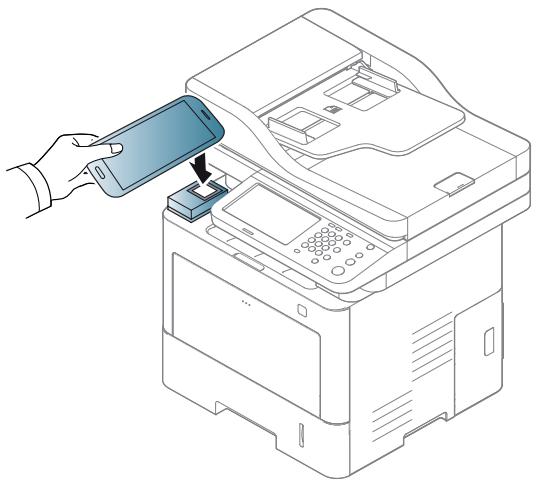
natural_image
Illustration of a hand inserting a smartphone into a printer (no text or symbols visible)
For some mobile devices, NFC tag might not be located at the back of the mobile device. Check the location of the NFC antenna on your mobile device before tagging.
Registration from the mobile device
1 Check that NFC and Wi-Fi Direct enabled features are on your mobile device and Wi-Fi Direct feature is enabled on your printer.
2 Open Samsung Mobile Print Pro app.
Using the NFC feature (Optional)

If you do not have Samsung Mobile Print Pro installed on your cellphone, go to the application store (Samsung Apps, Play Store) on your mobile device, and just search for download the app and try again.
3 Press the icon on the Samsung Mobile Print Pro screen.
4 Select On from the Phone login set as default menu.
5 Mobile device ID appears on the Samsung Mobile Print Pro screen. Press Registration.
6 Type in the ID, Password, Domain, and Passcode, then click OK. Use the same admin ID, Password, Domain as when logging in from the machine (see "Log-in" on page 220.)

- If you want to create a new user or change the password, see "Security tab" on page 250.
- Passcode is for when the administrator chooses Two-Factor Authentication method. You need to enter a passcode for authentication. Password and passcode should be different. You can select Two-Factor Authentication from the SyncThru™ Web Service, select Security > User Access Control > Authentication > Authentication Method > Options button > Login Method > Two-Factor Authentication.
7 Tag your mobile device (usually located on the back of the mobile device) over the NFC tag (NFC) on your printer.
Wait few seconds for the mobile device to connect to the printer.
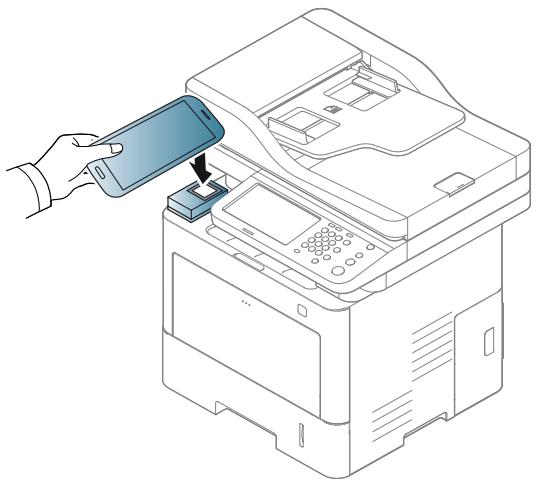
natural_image
Illustration of a hand inserting a smartphone into a printer (no text or symbols visible)
For some mobile devices, NFC tag might not be located at the back of the mobile device. Check the location of the NFC antenna on your mobile device before tagging.
8 Registration complete message appears on the printer's touch screen.
Using the NFC feature (Optional)
Using the Samsung Mobile Print Manager App
If you have more than one printer and need to set the same settings on each printer, you can easily do it using the Samsung Mobile Print Manager app. Touch your cellphone on the NFC tag on your printer to copy the settings and tap on the printer you want to set the setting.

When exporting the data, you can save more than one data. When importing the data, you can select the data from the list and import.
Exporting(Copying the setting to your mobile device)
1 Check that NFC and Wi-Fi Direct enabled features are on your mobile device and Wi-Fi Direct feature is enabled on your printer.
2 Open Samsung Mobile Print Manager from your mobile device.

If you do not have Samsung Mobile Print Manager installed on your cellphone, go to the application store (Samsung Apps, Play Store) on your mobile device, and just search for download the app and try again.
3 Press Export.
4 Type in the ID and Password.
Use the same login ID, Password, Domain as when logging in from the machine (see "Log-in" on page 220).

If you want to create a new user or change the password, see "Security tab" on page 250.
5 Tag your mobile device (usually located on the back of the mobile device) over the NFC tag (NFC) on your printer.
Wait few seconds for the mobile device to connect to the printer.
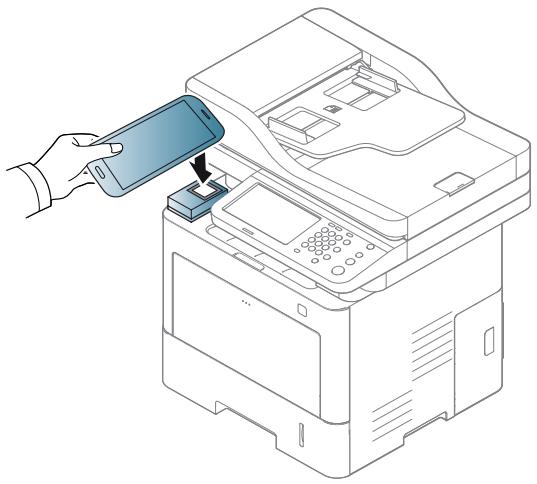
natural_image
Illustration of a hand inserting a smartphone into a printer (no text or symbols visible)Using the NFC feature (Optional)

- For some mobile devices, NFC tag might not be located at the back of the mobile device. Check the location of the NFC antenna on your mobile device before tagging.
• While cloning, the machine is locked.
6 Select the settings you want to apply and press OK.
7 Follow the instruction on the mobile device's screen.
Importing (Applying the settings to the machine)
1 Check that NFC and Wi-Fi Direct enabled features are on your mobile device and Wi-Fi Direct feature is enabled on your printer.
2 Open Samsung Mobile Print Manager from your mobile device.

If you do not have Samsung Mobile Print Manager installed on your cellphone, go to the application store (Samsung Apps, Play Store) on your mobile device, and just search for download the app and try again.
3 Press Import.
4 Type in the ID and Password.
Use the same login ID, Password, Domain as when logging in from the machine (see "Log-in" on page 220).

If you want to create a new user or change the password, see "Security tab" on page 250.
5 Select the settings you want to copy.
6 Follow the instruction on the mobile device's screen.
7 Tag your mobile device (usually located on the back of the mobile device) over the NFC tag (NFC) on your printer.
Wait few seconds for the mobile device to connect to the printer.
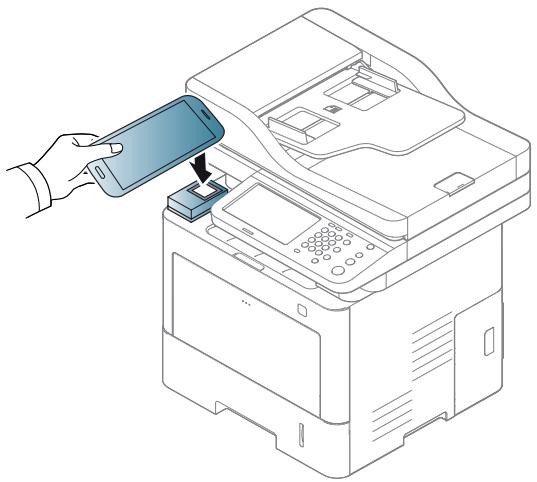
natural_image
Illustration of a hand inserting a smartphone into a printer (no text or symbols visible)Using the NFC feature (Optional)

- For some mobile devices, NFC tag might not be located at the back of the mobile device. Check the location of the NFC antenna on your mobile device before tagging.
• While cloning, the machine is locked.
Wireless Setup
You can copy wireless setting from your phone to your printer by touching your mobile device on the NFC tag on your printer.
1 Check that NFC and Wi-Fi Direct enabled features are on your mobile device and Wi-Fi Direct feature is enabled on your printer.
2 Open Samsung Mobile Print Manager from your mobile device.

If you do not have Samsung Mobile Print Manager installed on your cellphone, go to the application store (Samsung Apps, Play Store) on your mobile device, and just search for download the app and try again.
3 Mobile device Samsung Mobile Print Pro screen appears. Press Wi-Fi Setup.
4 Type in the ID and Password.
Use the same login ID, Password, Domain as when logging in from the machine (see "Log-in" on page 220).

If you want to create a new user or change the password, see "Security tab" on page 250.
5 If the access point (or wireless router) is connected to the connection confirmation window appears, then click OK.
If the access point (or wireless router) not connection, select the desired access point (or wireless router) and click OK, then click OK.
6 Tag your mobile device (usually located on the back of the mobile device) over the NFC tag (NFC) on your printer.
Wait few seconds for the mobile device to connect to the printer.
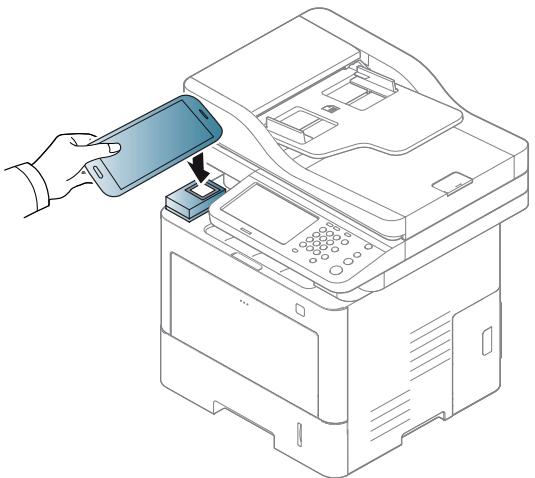
natural_image
Illustration of a hand inserting a smartphone into a printer (no text or symbols visible)Using the NFC feature (Optional)

For some mobile devices, NFC tag might not be located at the back of the mobile device. Check the location of the NFC antenna on your mobile device before tagging.
7 Follow the instruction on the mobile device's screen.
Using the Samsung Mobile Print App
Samsung Mobile Print is a free application that enables users to print, scan(Only users with multi-functional printers), or fax(Only users with multifunctional printers) photos, documents, and web pages directly from your smartphone or tablet.
Printing
1 Check that NFC and Wi-Fi Direct features are enabled on your mobile device and Wi-Fi Direct feature is enabled on your printer.
2 Open Samsung Mobile Print app.

If you do not have Samsung Mobile Print installed on your cellphone, go to the application store (Samsung Apps, Play Store, App Store) on your mobile device, and just search for download the app and try again.
3 Select print mode.
4 Select the content you want to print.
If necessary, change the print option by pressing the ⚙ icon.
5 Tag your mobile device (usually located on the back of the mobile device) over the NFC tag (NFC) on your printer.
Wait a few seconds for the mobile device to send a job to the printer.
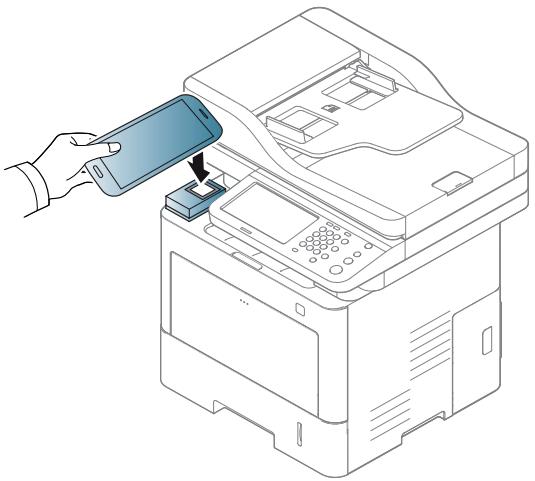
natural_image
Illustration of a hand inserting a smartphone into a printer (no text or symbols visible)
For some mobile devices, NFC tag might not be located at the back of the mobile device. Check the location of the NFC antenna on your mobile device before tagging.
6 The printer starts printing.
Using the NFC feature (Optional)
Scanning
1 Check that NFC and Wi-Fi Direct features are enabled on your mobile device and Wi-Fi Direct feature is enabled on your printer.
2 Open Samsung Mobile Print app.

If you do not have Samsung Mobile Print installed on your cellphone, go to the application store (Samsung Apps, Play Store, App Store) on your mobile device, and just search for download the app and try again.
3 Select scan mode.
4 Place a single document face down on the document glass, or load the documents face up into the document feeder (see "Loading originals" on page 64).
If necessary, change the scan option by pressing the ⚙️.

5 Tag your mobile device (usually located on the back of the mobile device) over the NFC tag (NFC) on your printer.
Wait few seconds for the mobile device to send a job to the printer.
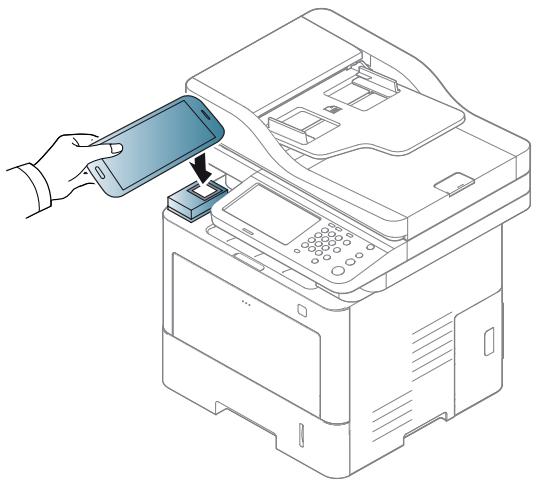
natural_image
Illustration of a hand inserting a smartphone into a printer (no text or symbols visible)
For some mobile devices, NFC tag might not be located at the back of the mobile device. Check the location of the NFC antenna on your mobile device before tagging.
6 The printer starts scanning the content.
The scanned data is saved on your mobile device.

If you want to continue scanning, follow the instruction on the app screen.
Using the NFC feature (Optional)
Sending Fax
1 Check that NFC and Wi-Fi Direct features are enabled on your mobile device and Wi-Fi Direct feature is enabled on your printer.
2 Open Samsung Mobile Print app.

If you do not have Samsung Mobile Print installed on your cellphone, go to the application store (Samsung Apps, Play Store, App Store) on your mobile device, and just search for download the app and try again.
3 Select fax mode.
4 Select the content you want to send fax.
If necessary, enter the fax number and change the fax option by pressing the 🤗 icon.
5 Tag your mobile device (usually located on the back of the mobile device) over the NFC tag (NFC) on your printer.
Wait few seconds for the mobile device to send a job to the printer.
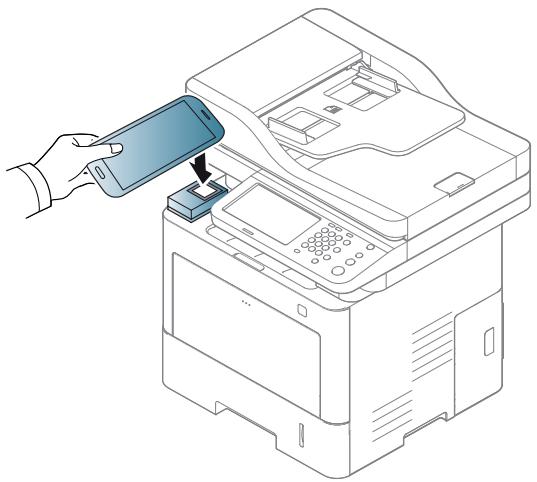
natural_image
Illustration of a hand inserting a smartphone into a printer (no text or symbols visible)
For some mobile devices, NFC tag might not be located at the back of the mobile device. Check the location of the NFC antenna on your mobile device before tagging.
6 The printer starts faxing the content.
Supported Mobile Apps
Available Apps
- Samsung Mobile Print: Samsung Mobile Print is a free application that enables users to print, scan(Only users with the machine supports scan), or fax(Only users with the machine supports fax) photos, documents, and web pages directly from your smartphone or tablet. Samsung Mobile Print is not only compatible with your Android and iOS smart phones but also with your iPod Touch and tablet PC. It connects your mobile device to a network connected Samsung printer or to a wireless printer through a Wi-Fi access point. Installing a new driver or configuring network settings isn't necessary – just simply install the Samsung Mobile Print application, and it will automatically detect compatible Samsung printers. Besides printing photos, web pages, and PDFs, scanning is also supported. If you have a Samsung multifunction, scan any document into a JPG, PDF, or PNG format for quick and easy viewing on your mobile device (see "Using the Samsung Mobile Print App" on page 188).
- Samsung Mobile Print Pro: Helps users to get an authentication easily. This app provides one way of getting a user authentication using your mobile device (see "Using the Samsung Mobile Print Pro App" on page 183).
- Samusng Mobile Print Manager: Enables users to use cloning and wireless setup features using your mobile device (see "Using the Samsung Mobile Print Manager App" on page 185).
Downloading Apps
To download apps, go to the application store (Play Store, App Store) on your mobile device, and just search for "Samsung Mobile Print /Samsung Mobile Print Pro/Samusng Mobile Print Manager." You can also visit iTunes for Apple devices on your computer.
• Samsung Mobile Print
- Android: Search for Samsung Mobile Print from Play Store, and then download the app.
- iOS: Search for Samsung Mobile Print from App Store, and then download the app.
• Samsung Mobile Print Pro/Samusng Mobile Print Manager
- Android: Search for Samsung Mobile Print Pro or Samusng Mobile Print Manager from Play Store, and then download the app.
Supported Mobile OS
• Samsung Mobile Print
- Android OS 2.3 or higher
- iOS 5.0 or higher
• Samsung Mobile Print Pro/Samusng Mobile Print Manager
- NFC and Wi-Fi Direct enabled, supported mobile apps installed mobile device with Android 4.0 or higher

Only Mopria-certified machines can use the Mopria feature. Check the box that your machine came in for the Mopria-certified logo.

Mopria™ Print Service is a mobile printing solution that enhances the new print functionality on any Android phone or tablet (Android version 4.4 or later). With this service, you can connect and print to any Mopria-certified printer on the same network as your mobile device without additional set-up. Many native Android apps support printing, including Chrome, Gmail, Gallery, Drive and Quickoffice.
Setting up the machine for Mopria printing
Bonjour(mDNS) and IPP protocols are required on your machine to use the Mopria feature. Perform the following steps to enable the Mopria feature.
1 Ensure that the machine is connected to the network.
2 On your computer, open a web browser (Internet Explorer, Safari, or Firefox) and type the IP address of the machine in the address bar. Then, press Enter.
For example,

http://192.168.1.133/
3 Click Login in the upper right corner of the SyncThru™ Web Service website.
4 Type in the ID and Password.
Use the same login ID, Password, Domain as when logging in from the machine (see "Log-in" on page 220).

If you want to create a new user or change the password, see "Security tab" on page 250.
5 When the SyncThru™ Web Service window opens, click Settings > Network Settings > Standard TCP/IP, LPR, IPP > IPP. Then, select Enable.
6 Click Settings > Network Settings > mDNS. Then, select Enable.
7 Click Security > System Security > Feature Management > Mopria. Then, select Enable.
Setting up Mopria on your mobile device
If you do not have Mopria Print Service app installed on your mobile device, open to the app store (Play Store, App Store) on your mobile device, search for, Mopria Print Service, and then download and install the app.
Mopria™
1 In the Settings menu of your Android device, tap Printing.

The location of this option may differ depending on your mobile device. If you cannot locate the Printing option, refer to the user's manual for your mobile device.
2 Under Print Services, tap Mopria Print Service.
3 Tap the On/Off slider to enable the Mopria Print Service.
Printing via Mopria
To print via Mopria on an Android device:
1 Open the email, photo, web page, or document that you want to print.
2 Tap Print on the menu in the app.
3 Select your printer, and then configure the print options.
4 Touch Print again to print the document.

To cancel a print job: Select and delete the document from the print queue in the Notification Bar.
AirPrint

Only AirPrint certified machines can use the AirPrint feature. Check the box your machine came in for the AirPrint certified mark.
AirPrint allows you to print directly from iPhone, iPad and iPod touch running the latest version of iOS.
Setting up AirPrint
Bonjour(mDNS) and IPP protocols are required on your machine to use the AirPrint feature. You can enable the AirPrint feature by one of the following methods.
1 Check whether the machine is connected to the network.
2 Start a web browser such as Internet Explorer, Safari, or Firefox and enter your machine's new IP address in the browser window.
For example,

http://192.168.1.133/
3 Click Login in the upper right corner of the SyncThru™ Web Service website.
4 Type in the ID and Password.
Use the same login ID, Password, Domain as when logging in from the machine (see "Log-in" on page 220).

If you want to create a new user or change the password, see "Security tab" on page 250.
5 When the SyncThru™ Web Service window opens, click Settings > Network Settings.
6 Click AirPrint.
Printing via AirPrint
For example, the iPad manual provides these instructions:
1 Open your email, photo, web page, or document you want to print.
2 Touch the action icon( ).
3 Select your printer driver name and option menu to set up.
4 Touch Print button. Print it out.

Cancelling print job: To cancel the printing job or view the print summary, click the print center icon ( ) in multitasking area. You can click cancel in the print center.
Samsung Cloud Print
Samsung Cloud Print is a free cloud service that allows you to print or scan from your smartphone or tablet to your Samsung printer or MFP. After installing the Samsung Cloud Print app, you can register with the Samsung Cloud Print service just using your mobile number for authentication. No other account login is required, although you can link the app to your Samsung Account if you wish.
Refer to the Samsung website (www.samsungcloudprint.com) for more information about Samsung Cloud Print.

If you press the

button from Samsung Cloud Print app, Your mobile
device and printer or MFP can be paired, QR code, or by manually entering its Mac address. Once paired, you can print or scan from anywhere and everywhere.
Registering your Printer to Samsung Cloud server
Registering from Web Browser

Make sure the printer machine is turned on and connected to a wired or wireless network that has access to the Internet.
1 Open Web browser.
2 Enter your printer's IP address in the address field and press the Enter key or click Go.
3 Click Login in the upper right corner of the SyncThru™ Web Service website.
4 Type in the ID and Password.
Use the same login ID, Password, Domain as when logging in from the machine (see "Log-in" on page 220).

If you want to create a new user or change the password, see "Security tab" on page 250.
5 When the SyncThru™ Web Service window opens, click Settings > Network Settings > Samsung Cloud Print.

If the XOA tab is shown, press XOA > Samusng Cloud Agent from SyncThru™ Web Service.
6 Now your printer is registered with Samsung Cloud Print service.
Samsung Cloud Print
Using the Samsung Cloud Print

Make sure the printer is turned on and connected to a wired or wireless network that has access to the Internet.
Registering a printer from an application on mobile device
The following steps are an example of using the Samsung Cloud Print app from Android mobile phone.
1 Open Samsung Cloud Print app.

If you do not have Samsung Cloud Print app installed on your cellphone, go to the application store (Samsung Apps, Play Store, App Store) on your mobile device, and just search for download the app and try again.
2 Press the ( [icon] ) button from Samsung Cloud Print app.
3 Your mobile device and printer or MFP can be paired NFC tapping, QR code or by manually entering its Mac address.
Printing from an application on mobile device
The following steps are an example of using the Samsung Cloud Print app from Android mobile phone.
1 Open Samsung Cloud Print app.

If you do not have Samsung Cloud Print app installed on your cellphone, go to the application store (Samsung Apps, Play Store, App Store) on your mobile device, and just search for download the app and try again.
2 Tap the option check button of the document that you want to print.
3 Set the printing options if you want.
4 Tap Send Job.
Samsung Cloud Print
Scanning and sending to Samsung Cloud Print
You can scan an image and the scanned data will be stored in the Samsung Cloud Print.
1 Place a single document face down on the document glass, or load the documents face up into the document feeder (see "Loading originals" on page 64).
2 Press Samsung Cloud from the control panel.
3 Enter recipient country code and recipient phone number.
4 Enter sender information.
5 Enter a file name to store the scan data.

You can set the file name from the SyncThru™ Web Service. Open the Web browser from your networked computer and type the IP address of your machine. When SyncThru™ Web Service opens, click Settings > Machine Settings > Samsung Cloud > File Name.
6 Press the Ⓧ(Start) button to scan and store the file in samsung cloud server.

When the user is not registered in the Samsung Cloud Print, a confirmation window will pop up. Select a work in progress or not.
Google Cloud Print™
Google Cloud Print™ is a service that allows you to print to a printer using your smart phone, tablet, or any other web-connected devices. Just register your Google account with the printer, and you are ready to use the Google Cloud Print™ service. You can print your document or email with Chrome OS, Chrome browser, or a Gmail™/ Google Docs™ application on your mobile device, so you don’t need to install the printer driver on the mobile device. Refer to the Google website (http://google.com/cloudprint/learn/ or http://support.google.com/cloudprint) for more information about Google Cloud Print™.
Registering your Google account to the printer
Registering from the Chrome Browser

- Make sure the printer machine is turned on and connected to a wired or wireless network that has access to the Internet.
- You should create your Google account in the advance.
1 Open the Chrome browser.
2 Visit www.google.com.
3 Sign in to the Google website with your Gmail™ address.
4 Enter your printer's IP address in the address field and press the Enter key or click Go.
5 Click Login in the upper right corner of the SyncThru™ Web Service website.
6 Type in the ID and Password.
Use the same login ID, Password, Domain as when logging in from the machine (see "Log-in" on page 220).

If the network environment is using a proxy server, you need to configure the proxy's IP and port number from Settings > Network Settings > Proxy. Contact your network service provider or network administrator for more information.
7 When the SyncThru™ Web Service window opens, click Settings > Network Settings > Google Cloud Print.
8 Enter your printer's name and description.
9 Click Register.
The confirmation pop-up window appears.

If you set the browser to block pop-ups, the confirmation window will not appear. Allow the site to show pop-ups.
10 Click Finish printer registration.
Google Cloud Print™
11 Click Manage your printers.
Now your printer is registered with Google Cloud Print™ service.
Google Cloud Print™-ready devices will appear in the list.
Printing with Google Cloud Print™
The printing procedure varies depending on the application or the device you are using. You can see the application list that supports Google Cloud Print™ service.

Make sure the printer is turned on and connected to a wired or wireless network that has access to the Internet.
Printing from an application on mobile device
The following steps are an example of using the Google Docs™ app from Android mobile phone.
1 Install the Cloud Print application on your mobile device.

If you do not have the application, download it from the application store such as Android Market or App Store.
2 Access the Google Docs™ application from your mobile device.
3 Tap the option ▼ button of the document that you want to print.
4 Tap the send ➤ button.
5 Tap the Cloud Print button.
6 Set the printing options if you want.
7 Tap Click here to Print.
Printing from the Chrome browser
The following steps are an example of using the Chrome browser.
1 Run Chrome.
2 Open the document or email that you want to print.
3 Click the wrench icon 📁 in the browser's top right corner.
4 Click Print. A new tab for printing appears.
5 Select Print with Google Cloud Print.
6 Click the Print button.
natural_image
Blue circular icon with a white printer symbol (no text or numbers)11. Using SmarThru Workflow, Shared Folder, Stored Document, and USB
This chapter explains how to use SmarThru Workflow, Shared Folder, Stored Document, and USB with your machine.
This chapter includes:
• About SmarThru Workflow 201
• Understanding the SmarThru Workflow screen 202
• Workform Creation Screen 203
• Understanding the Shared Folder screen 204
• Using the Shared Folder 205
• Understanding the Stored Document screen 207
• Saving documents in the Stored Document 208
• Understanding the USB screen 209
• About USB memory device 210
• Printing from a USB memory device 211
• Scanning to a USB memory device 213
About SmarThru Workflow
SmarThru™ Workflow is a document sending solution that allows users to operate devices on the network by performing a set of pre-constructed tasks called a "Workform." These Workforms allow repetitive and time-consuming tasks to be automated, making the users' work days less tedious and more productive.
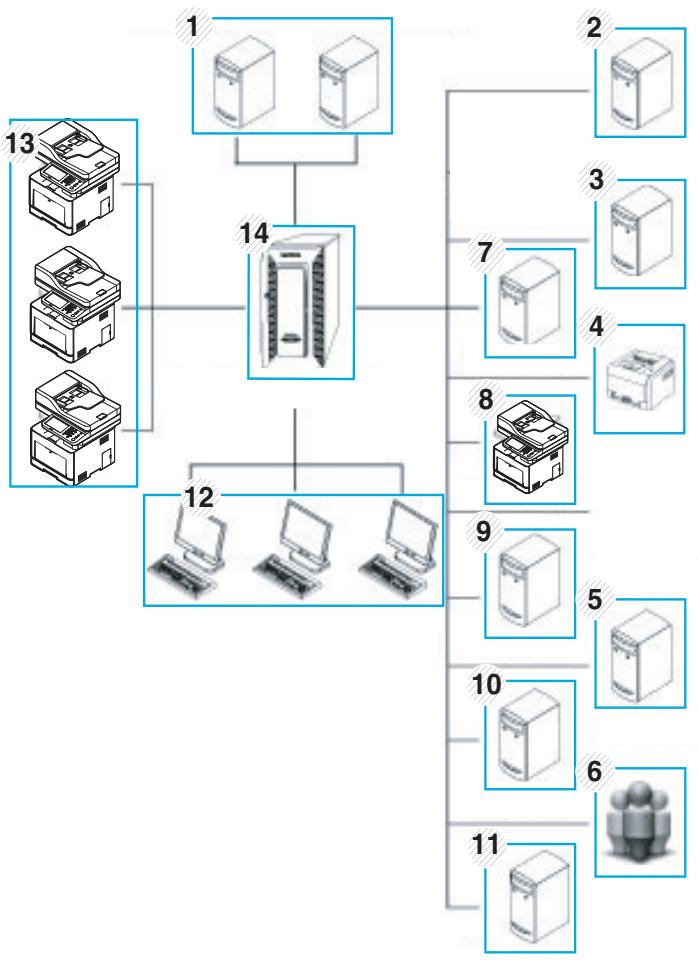
flowchart
graph TD
    A["1"] --> B["13"]
    A --> C["14"]
    B --> D["12"]
    C --> E["14"]
    D --> F["11"]
    E --> G["11"]
    F --> H["6"]
    G --> I["5"]
    H --> J["9"]
    I --> K["8"]
    J --> L["7"]
    K --> M["3"]
    L --> N["2"]
    M --> O["2"]
| 1 | LDAP Server, Domian Server | 8 | Fax |
| 2 | Microsoft Sharepoint Server | 9 | WebDAV |
| 3 | Network Folder | 10 | Google Drive |
| 4 | Printer | 11 | E-mail Server |
| 5 | Database | 12 | Client Systems |
| 6 | User | 13 | Machine |
| 7 | FTP Server | 14 | SmarThru Workflow Server |
Understanding the SmarThru Workflow screen
To use the SmarThru Workflow ( ) feature, press SmarThru Workflow

) on the display screen.
What are "Workform" and "Metadata"?
A "Workform" is a work process created by combining various embedded plugins together to achieve a desired end result for a document.
Metadata is extra information provided by the Workform creator for Workforms that use Scan input plug-ins.
Public Workform Tab
The Public tab shows public Workforms created for user groups by an administrator.
• Refresh: Refresh the Workform information.
• Detail: Shows the details of a Workform.
- Select: Select the Workform for job execution
Private Workform Tab
The Private tab shows private Workforms created for a private user by the current authenticated user.
- Refresh: Refresh the Workform information.
• Detail: Shows the details of Workform. - Select: Let users move to next screen for more options.
Workform Creation Screen
Add a new Workform, execute SmaThru Workflow and log in.

- Workforms that have been previously exported can be imported back into SmarThru Workflow to use again.
- Select the Help menu or click the ? button any option you want to know about from the SmarThru Workflow.
Workform Creation
1 Make sure that the machine is connected to your computer and powered on.
2 Excute the SmarThru Workflow ( [icon] ) icon on your desktop. OR
From the Start menu, select Programs or All Programs > SmarThru Workflow > SmarThru Workflow.
3 Enter your ID and Password to log into the system.
4 Select Workform > Workform List from the main menu.
5 Select whether it will be a Public Workform or Private Workform from the left pane.
6 Click Create.
The Workform Creation page opens.
7 Enter the workform's properties.
8 Drag-and-drop the plug-ins from the left pane to the appropriate section in the data pane, or click on the green checkmark that appears in the icon's upper-right corner.
Each task in the workform will be performed in the order in which they appear in the workform.
9 Click Save.
The Workform will appear on the Workform List page.
10 If the status is Incomplete, a plug-in has not been configured completely. Select the workform and click Edit to make changes to the Workform.
Workform Execution
User can operate various jobs with workforms.
1 Press SmarThru Workflow from the display screen.
2 Press one of the Workfoms in the list and Select.
3 Press metadata and Next.
4 Change the parameters for scanning in the Basic, Advanced, Image and Output tabs.
5 Press start on the control panel. The result files will be saved in the server.
Understanding the Shared Folder screen
This feature allows you to use the machine's memory as a shared folder. The advantage of this feature is that you can conveniently use the shared folder through your computer.
To use the Shared Folder feature, press Shared Folder on the display screen.
• Print: You can print data stored in the shared folder.
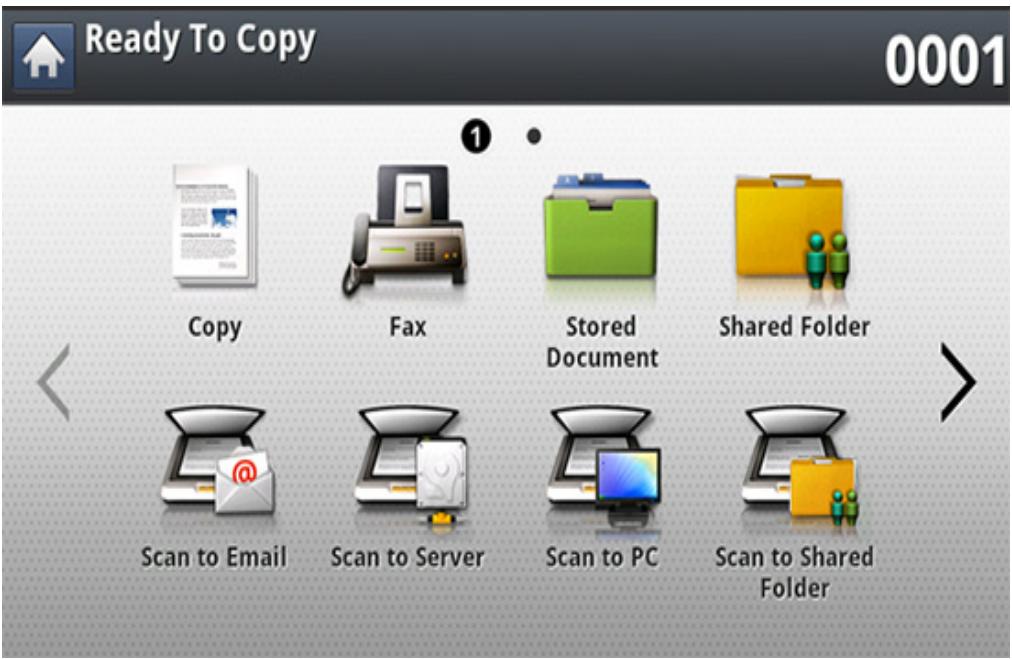

The administrator can set the ID and password to restrict the user's access and also set the maximum number of simultaneous users.
- nfsroot: Create a new folder under nfsroot directory.
- Rename: You can rename data stored in the shared folder.
- Delete: You can delete data stored in the shared folder.
Using the Shared Folder
You can use the shared folder in the exact same way as a normal computer. Create, rename, and delete the folder or file as a normal Windows folder. You also store scanned data in the shared folder. You can directly print files stored in the shared folder. You can print TIFF, BMP, JPEG, and PRN files.
Creating a shared folder
1 Press Shared Folder from the display screen.
2 Press the + icon in the upper-right corner to create a folder.
3 Enter a folder name in the blank field.
4 Press OK.
Scanning and sending to a shared folder.
Scans and stores scanned output in the shared folder.
1 Place the originals face up in the DSDF or place a single original face down on the scanner glass and close the DSDF (see "Loading originals" on page 64).
2 Press Scan to Shared Folder from the display screen.
3 Press the name of the scanned data you want to print.
4 Press the Basic tab.
5 Select a folder for storing the scanned image. If you do not select a folder, the scanned image is stored in root directory.
6 Press the File Name input area. The pop-up keyboard appears.
7 Enter a file name to store the scan data.
8 Set the scan features in the Advanced, Image, or Output tabs, if necessary.
9 Press the Ⓞ(Start) button to scan and store the file.
If an original is placed on the scanner glass, the machine shows the window asking if you want to place another page. Load another original and press Yes. When you finish, press No on this window.
Printing from shared folder

You can also delete, rename from shared folder.
Using the Shared Folder
1 Place the originals face up in the DSDF or place a single original face down on the scanner glass and close the DSDF (see "Loading originals" on page 64).
2 Press Shared Folder from the display screen.
3 Press the name of the scanned data you want to print.
4 Press Print.
5 If you want to customize the print settings including color mode, duplex, and more from the display screen.
6 Press Ⓥ(Start) from the control panel to begin printing.
Understanding the Stored Document screen
You can store documents sent from computers or scanned images in the Stored Document. The Stored Document is located on your machine's hard disk drive (HDD), which means the documents are stored on the HDD. You can create a password for a certain Stored Document, so unauthorized users cannot access it. Also, you can print stored documents by using a variety of printing features and send the documents to several destinations such as email, server, or fax. You can set a Stored Document and use Stored Document feature with SyncThru™ Web Service (see "Setting up an address book from SyncThru™ Web Service" on page 174).

If important data is stored in the Stored Document, we recommend you to backup the data regularly. Samsung disclaims all responsibility for damage or loss of data caused by misuse or failure of the machine.
To use the Stored Document feature, press Stored Document on the display screen.
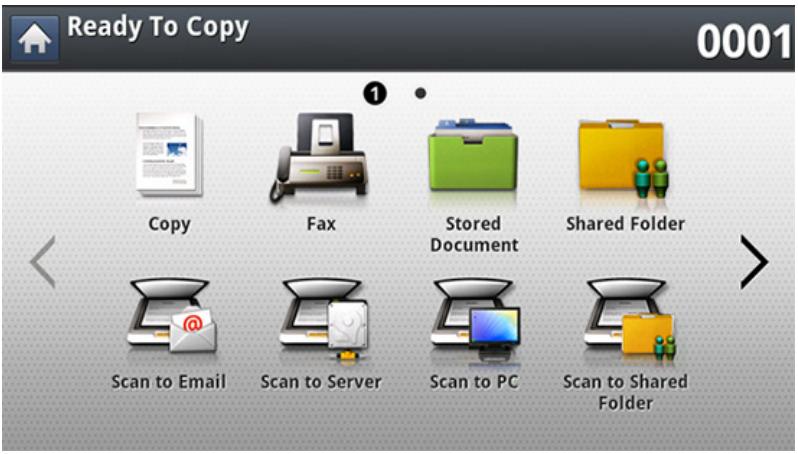
Stored Document allows you to store the scanned data on the HDD (your machine's hard disk drive) in your machine. The stored data can be sent to different destinations like Fax, Email, Server, Box, or USB.
• Public: All users can access the files.
- Private: Set up a password to prevent unauthorized persons from accessing.
Saving documents in the Stored Document
When you use a printing device in an office, school or other public place, you can protect your personal documents or confidential information by using the secure printing feature.
1 Press Stored Document on the main screen.
2 Press Public or Private tab, then you can see the saved files.

If there is no file, you can save files from your PC (see "Print Mode" on page 89).
3 You can rename, delete or print files.
4 Select the document to print.
5 Enter the password that you set from the printer driver.
6 Print or delete the document.
Understanding the USB screen
To use the USB feature, press USB on the display screen.

If you want to use this feature, you need to insert a USB memory device into the USB memory port on your machine.
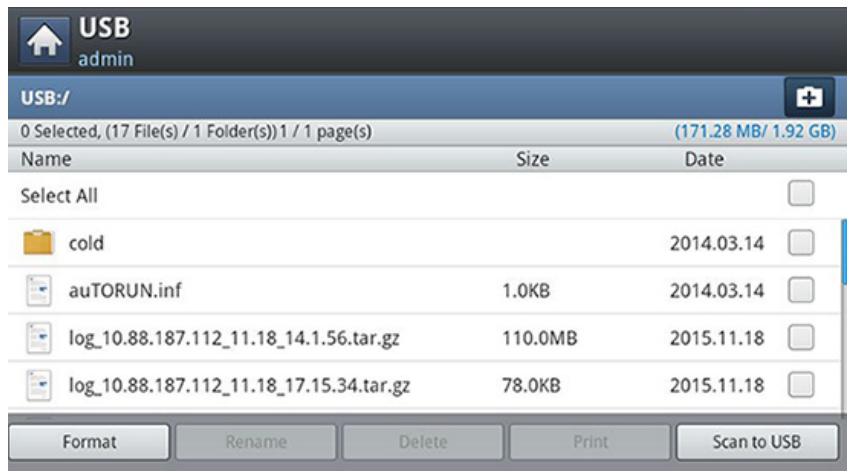
• USB Display: Displays information of the folder or file.
- Format: Formats the USB memory device.
- Rename: Changes the name of the selected folder or file.
- Delete: Deletes the selected folder or file.
- Print: You can directly print files stored on a USB memory device. You can print TIFF, JPEG, PDF, and PRN files (see "Printing from a USB memory device" on page 211).
- Scan to USB: Sends to Scan to USB (see "Scanning to a USB memory device" on page 213).
About USB memory device
USB memory devices are available with a variety of memory capacities to give you more room for storing documents, presentations, music and videos, high resolution photographs, or whatever other files you want to store or move.
You can do the following on your machine using a USB memory device:
- Scan documents and save them on a USB memory device.
• Print data stored on a USB memory device.
• Format the USB memory device.
Your machine supports USB memory devices with FAT16/FAT32 and sector size of 512 bytes.
Check your USB memory device's file system from your dealer.
You must use only an authorized USB memory device with an A plug type connector.
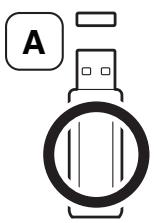
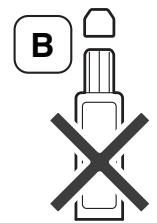
Use only a USB memory device with metal-shielded connector.
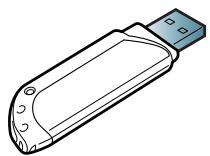
Only use a USB memory device that has obtained compatibility certification; otherwise, the machine might not recognize it.
Insert a USB memory device into the USB memory port on your machine.
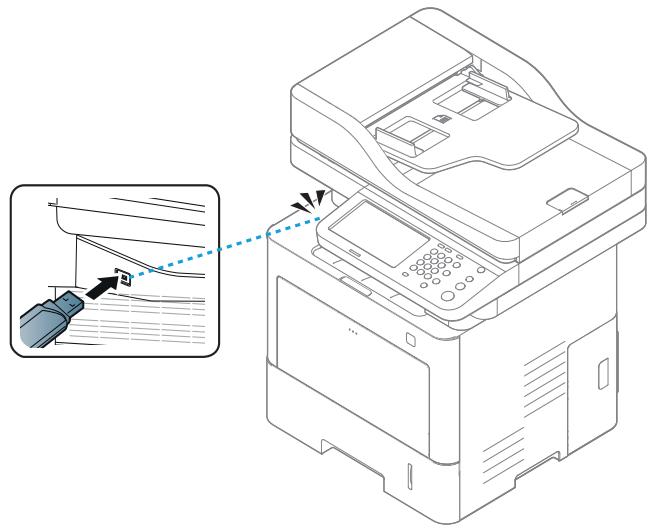
natural_image
Line drawing of a printer with an inset showing a printer's cable being inserted (no text or symbols present)
- Do not remove the USB memory device while it is in use. The machine warranty does not cover damage caused by a user's misuse.
- If your USB memory device has certain features, such as security settings and password settings, your machine may not automatically detect it. For details about these features, see the USB memory device's User's Guide.
Printing from a USB memory device
You can directly print files stored on a USB memory device. You can print TIFF, JPEG, and PRN files. You can select 50 files and print selected the files at once.
USB print option supported file types:
- PRN: Only files created by provided driver with your machine are compatible. PRN files can be created by selecting the Print to file check box when you print a document. The document will be saved as a PRN file, rather than printed on paper. Only PRN files created in this fashion can be printed directly from USB memory device (see "Printing to a file (PRN)" on page 103).
• TIFF: TIFF 6.0 Baseline
• JPEG: JPEG Baseline
• PDF: PDF 1.7 and below

In case of 8-bit CMYK JPEG files, the job could be cancelled.
To print a document from a USB memory device:
1 Insert a USB memory device into the USB memory port on your machine. Your machine automatically detects the device and reads data stored on it (see "About USB memory device" on page 210).

- The machine cannot detect an unformatted USB memory device. Format, and then reinsert the USB memory device into the USB memory port on your machine.
- The machine can not detect the USB memory device when the machine is in power save mode. Wait until the machine returns to ready mode, and then reinsert the USB memory device into the USB memory port on your machine.
2 Press USB from the display screen.
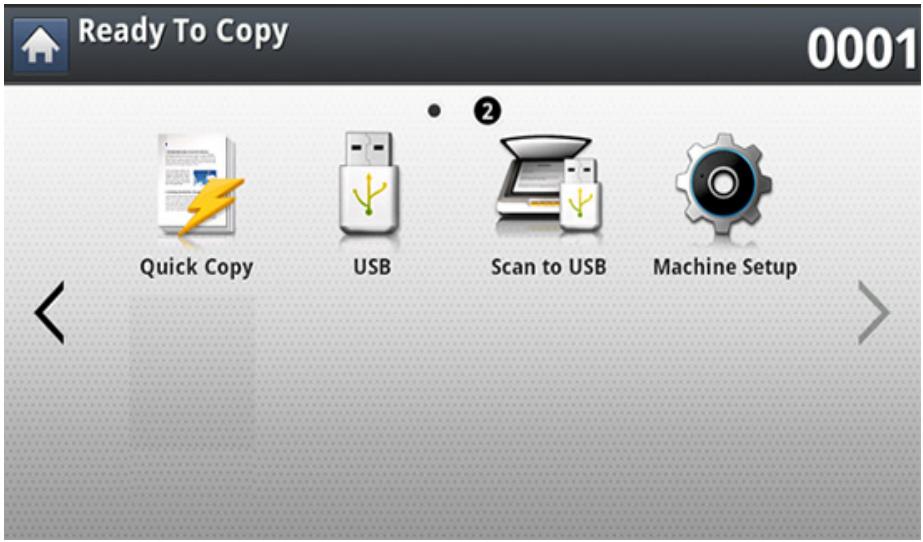
Printing from a USB memory device
3 The machine shows all the files in the USB memory device.
Select the file you want to print. You can also select multiple files if you want to print multiple files.

• If the file is in a folder, press the folder name. Then press Select.
- If the PDF file you selected is secured with a password, you have to know the password for printing. Enter the password when the machine requires the secure password. If you do not know the password, the print job will be cancelled.
4 Press Print.
5 Press the appropriate option.
• Copies: Selects the number of copies.
• Duplex: Selects the machine to print copies on both sides of the paper.
- Auto fit: Allows you to scale your print job to the selected paper size in the tray regardless of the document size. Select a tray, and press On.
• Paper Source: Selects a tray that contains the paper to be printed.
- Output: Sets the machine's various output options such as copy output option.
6 Press Ⓥ(Start) button to print the file.
7 Press (Back) to go back to the previous screen.
8 After printing is completed, you can remove the USB memory device from the machine. Press USB.
Scanning to a USB memory device

- The machine cannot detect the unformatted USB memory device. Format and then reinsert the USB memory device into the USB memory port on your machine.
- The machine could not detect the USB memory device when the machine is in power save mode. Wait until the machine returns to ready mode, and then reinsert the USB memory device into the USB memory port on your machine.
1 Insert a USB memory device into the USB memory port on your machine.
2 Place the originals face up in the DSDF or place a single original face down on the scanner glass and close the DSDF (see "Loading originals" on page 64).
3 Press Scan to USB from the display screen.
4 Press the Basic tab.
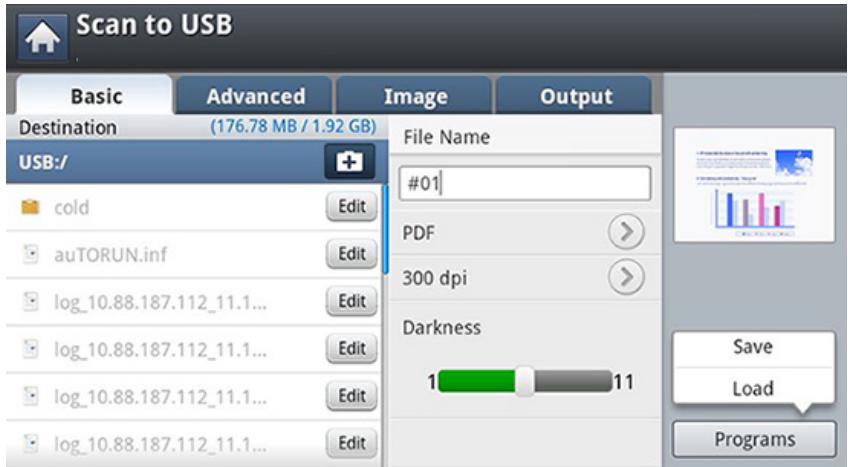
5 Select a folder for storing the scanned image. If you do not select a folder, the scanned image is stored in root directory.
6 Press the File Name input area. The pop-up keyboard appears.
7 Enter a file name to store the scan data. Press Done.
8 Set the File format, Resolution, and Darkness.
9 Set the scan features in the Advanced, Image, or Output tabs, if necessary (see "Changing the scan feature settings" on page 141).
10 Press the Ⓥ(Start) button to scan and store the file.
If an original is placed on the scanner glass, the machine shows the window asking if you want to place another page. Load another original and press Yes. When you finish, press No on this window.
11 After scanning is complete, you can remove the USB memory device from the machine.
natural_image
Blue circular icon with a white printer symbol (no text or numbers)12.Menu Overview and Advanced Features
This chapter shows an overview of menus provided by your machine and explains the Machine Setup menu in detail. The Machine Setup menu provides various options for administrators to set in order to use the machine to its full capabilities. Read this chapter carefully to understand the diverse features your machine provides.

- This administrator's guide mainly describes features administrators would often use and settings to set before using the machine.
- For some options, you need to contact your local service provider to set the settings.
- Some menus may not appear on the display screen depending on the settings or models. If so, it is not applicable to your machine.
This chapter includes:
- Menu overview
215
- Machine setup
220
Menu overview
Your machine is equipped with various menus that will be useful for both users and administrators. With the menus, administrators can set the settings for the machine or use the various features provided. You can access the menus by pressing the display screen on the control panel.
The following table shows the menus provided by your machine. Use the following table to view the menu structure. The menu column shows the main menu and the option column shows its submenus.

Some menus may not appear on the display screen depending on the settings or models. If so, it is not applicable to your machine.
Menu overview
| USB^a (see "Understanding the USB screen" on page 209) | Copy(see "Copying" on page 109) | Quick Copy(see "Quick copying" on page 114) | Fax(see "Faxing" on page 147) | ||
| Format | Basic | Advanced | Image | Copies | Basic |
| Rename | Paper Source | Original Size | Original Type | Reduce/Enlarge | Input Fax No. |
| Delete | Reduce/Enlarge | Original | Adjust | Duplex | Total Destination |
| Duplex | Orientation | Background | N-Up | Resolution | |
| Scan to USB | Color Mode | N-Up | Erase Backside | Output | Darkness |
| Output | ID Copy | Image | Original Orientation | Address Book | |
| Darkness | Book Copy | Erase Edge | Darkness | Programs | |
| Programs | Booklet | Programs | Paper Source | Advanced | |
| Watermark | Original Size | ||||
| Stamp | Duplex | ||||
| Build Job | Original Orientation | ||||
| Programs | Delay Send | ||||
| Build Job | |||||
| Programs | |||||
| Image | |||||
| Original Type | |||||
| Programs | |||||
a. This option is available when the USB memory inserted.
Menu overview
| Scan to Email(see "Scanning and sending through email" on page 126) | Scan to PC (see "Scanning and sending to your computer" on page 138) | Scan to Server (see "Scanning and sending via SMB/FTP" on page 132) | |||
| Basic | Image | Computers | Image | Basic | Image |
| Total Destination | Original Type | Basic | Original Type | Total Destination | Original Type |
| Send to Me | Color Mode | Destination | Color Mode | File Name | Color Mode |
| File Name | Adjust Background | Darkness | Adjust | File Format | Adjust Background |
| File Format | Erase Backside Image | Resolution | Background | Resolution | Erase Backside Image |
| Resolution | Programs | Advanced | Erase Backside Image | Darkness | Programs |
| Darkness | Output | Duplex | Output | Address Book | Output |
| Address Book | Quality | Original | Quality | Programs | Quality |
| Programs | File Format | Orientation | File Format | Advanced | File Format |
| Advanced | Programs | Original Size | Duplex | Programs | |
| Email Settings | Build Job | Original Orientation | |||
| Duplex | Original Size | ||||
| Original Orientation | Build Job | ||||
| Original Size | Programs | ||||
| Build Job | |||||
| Programs | |||||
Menu overview
| Scan to USBa(see "Scanning to a USB memory device" on page 213) | Scan to Shared Folder(see "Scanning and sending to USB /shared folder" on page 139) | Stored Document(see "Understanding the Stored Document screen" on page 207) | Shared Folder(see "Understanding the Shared Folder screen" on page 204) | ||
| Basic | Image | Basic | Image | Public | Rename |
| Destination | Original Type | Destination | Original Type | Private | Delete |
| File Name | Color Mode | File Name | Color Mode | ||
| File Format | Adjust Background | File Format | Adjust Background | ||
| Resolution | Erase Backside Image | Resolution | Erase Backside | ||
| Darkness | Programs | Darkness | Image | ||
| Programs | Output | Advanced | Output | ||
| Advanced | Quality | Duplex | Quality | ||
| Duplex | File Format | Original Size | File Format | ||
| Original Size | Filing Policy | Original Orientation | Filing Policy | ||
| Original Orientation | Programs | Build Job | |||
| Build Job | |||||
| Programs | |||||
a. This option is available when the USB memory inserted.
Menu overview
| Machine SetupIf you have selected Security > Authentication, you need to log-in as an administrator (see "Security" on page 240). | ||||
| Machine Details | Initial Settings | Wi-Fi^a | General Settings | Image Management |
| H/W Configuration | Print Settings | Wi-Fi | Date and Time | Custom Color |
| Software Versions | General | Wi-Fi Settings | Power Saver | Machine Test |
| Capabilities | Emulation | WPS | Timers | Print Adjustment |
| Tray Settings | Paper Source | TCP/IP(Wi-Fi) | Altitude Adjustment | Home Setting |
| Name | Skip Blank Pages | Wi-Fi Direct | Default Paper Size | Home Window |
| Paper Size | Layout | Wi-Fi Signal | Priority | |
| Paper Type | Orientation | Clear Wi-Fi Settings | PDF Format | Home Window |
| Settings | Duplex | NFC^a | Compact | Background |
| Eco Settings | No. Of Copies | Security | Supplies Management | Stamp |
| Default Eco Mode | Margin | Image Overwrite | Toner Cartridge | Job Progress Window |
| Eco Features Configuration | Network Settings | Authentication | Reorder Notification | Job Rescheduling |
| Application Settings | TCP/IP | HTTPS | CLR Empty Msg. | Humidity |
| Copy Settings | SNMPv1/v2 | IPSec | Toner Save | Quiet Mode |
| Fax Settings | SNTP | 802.1x | Sound | Stacking Mode |
| Scan to Email Settings | UPnP(SSDP) | Accounting | Key Sound | Vapor Mode |
| Scan to Server Settings | mDNS | Others | Alarm Sound | |
| Scan to USB Settings | SetIP | Supplies Life | Fax Sound Measurements | |
| Scan to Shared Folder Settings | Contact Information | |||
| Address Book | SLP | Report | ||
| Network Filtering | Application Management | |||
| HTTP | Language | |||
a. This option is available when the optional Wireless/NFC kit installed.
Machine setup

- Some options are only available to the administrator depending on the authentication settings selected (see "Security" on page 240).
- Press the 📋 (Back) button if you want to return to the previous screen.
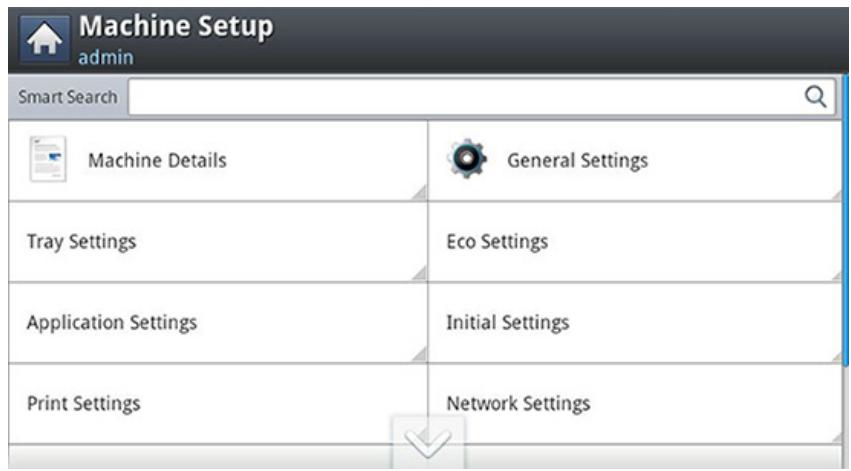
Log-in
Depending on the authentication settings you selected, you may need to log-in as an administrator to access some options under Machine Setup menu (see "Security" on page 240).
1 Press Machine Setup from the display screen.
2 Select the option you want. If the option is available for only the administrator, the following screen appears.
Enter the ID, Password, and Domain using the pop-up keyboard which appears when you press each field.

- Enter the ID and password you first set when you turned on the machine: Initial Settings (see "Initial Settings" on page 238).
• The default ID is admin. - You can also use the Recent Users button to find the recently used ID and Domain List button to find the domain from the list stored in the machine.
- When you log-in, you can see the ID of the logged in user on the display.
3 Press OK.
Machine setup
Machine Details
You can check the detailed machine information. Check the status of installed hardware and software versions to help you maintain the machine. You can download the latest software from the Samsung website.
1 Press Machine Setup > Machine Details from the display screen.
2 Press the option you want.
- H/W Configuration: Shows the status of installed hardware including optional parts.
- Software Versions: Shows the software versions of the systems installed.
• Capabilities: Shows the capabilities of the hardware.
3 Press (Back) for return to the previous screen.
Machine setup
General Settings

Some menus may differ from your machine depending on its options or models.
Before using the machine, set up the general settings, as follows:
Press Machine Setup > General Settings from the display screen.
| Feature | Description |
| Date and Timea | Allows you to set the date and time. The date and time you set in this option will be used for sending/printing delayed fax/print jobs or will be printed on reports. |
| Feature | Description |
| Power Saver | Allows you to reduce energy consumption. If you set this option, the machine goes into power saving mode when not in use.Power Save (minutes):When you are not using the machine for a while, use this option to save power. The machine conserves more power in Power Save option than in Low Power Save mode.Low Power Save (minutes):Low Power Save option allows your machine to save power. When you are not using the machine for a while, some parts of the machine automatically enter Low Power Save option. Low Power Save option conserves less power than Power Save option.Performance Optimization:When this option is On, you can wake up the machine from the power saving mode with the following actions:- Pressing ⏻(Power/Wakeup)on the control panel.- Loading paper in a tray.- Opening or closing the cover.- Pulling a tray out or pushing a tray in.- Place the originals in the DSDF.- Plug in the USB Drive device. |
Machine setup
| Feature | Description |
| Timers | When there is no input for a certain period of time, the machine cancels the held job or exits the current menu and goes in to the default settings. You can set the amount of time the machine will wait before it cancels a held job or exits the current menu.System Timeout:The machine returns to the Copy menu if there is no input for the given time.Held Job Timeout:When an error occurs while printing and there is no signal from the computer, the machine holds a job for a specific time period before deleting it. |
| Altitude Adjustment | Allows you to choose the altitude your machine is placed in. Print quality is affected by atmospheric pressure. The atmospheric pressure is determined by the height of the machine above sea level.Normal:0-1,000 m (3,280 ft)High 1:1,000 m (3,280 ft)-2,000 m (6,561 ft)High 2:2,000 m (6,561 ft)-3,000m (9,842 ft)High 3:3,000 m (9,842 ft)-4,000 m (13,123 ft)High 4:4,000 m (13,123 ft)-5,000 m (16,404 ft) |
| Default Paper Size | Allows you to choose the default paper size. |
| Feature | Description |
| Allows you to select the PDF format. If you select PDF/A, you can create a PDF file that can be displayed exactly the same way regardless of where the file is opened. and you can use Compact function.PDF Format-Standard:Saves the data as a regular PDF.-PDF/A:Saves the data as a PDF that has the necessary information to render itself in any environment.A PDF/A file must be self-contained: it cannot rely on another application to render fonts, open hyperlinks, or execute scripts, audio files, or video files.Compact-On:You can get smaller PDF file size than standard PDF file.-Off:You can turn off this function. |
Machine setup
| Feature | Description |
| Supplies Management | Allows you to set options for supplies reorder notification. If you set this option, the machine will display a warning message when the supplies are running out. Prepare the supplies in advance.Toner Cartridge Reorder Notification: Issues a notification when a toner cartridge has the specified lifespan remaining.CLR Empty Msg.: When toner cartridge is empty, this option appears. You can clear the empty message.Toner Save: Activating this mode extends the life of your toner cartridge and reduces your cost per page beyond what one would experience in the normal mode, but it reduces print quality. |
| Feature | Description |
| Sound | Allows you to set the volume for button sound, notice alarm, and sounds occurring during fax job. You can test the volume right after you set the level. Using the Quiet/Loud buttons select the desired volume and press the Test button to test the volume.Key Sound: Allows you to adjust the sound volume for when pressing the buttonFax Sound: Allows you to adjust the sound volume occurring during a fax job. This option has other sub-options.Alarm Sound: Allows you to adjust the sound volume for when notice alarm. |
| Measurements | Allows you to choose the measuring unit (mm or inch) and set the numeric separation (comma or period) for thousands separator. |
Machine setup
| Feature | Description |
| Machine Test | Print Adjustment: Allows you to adjust the print area. When images are printed off the page or shifted, adjust the print area.Press Print Adjustment from the display screen.Press Paper Source and select the tray to supply the paper from.Press Paper Size and select the paper size to use.Press Print. The adjustment pattern (chart) is printed.Press Next and follow the instruction on the screen. The Next button is enabled after you press Print. The Next button is enabled after you press Print. |
| Home Setting | Allows you to choose the menu order of the Home window.Home Window: You can select the menus to be appeared on the Home screen. Select the menu and press Enable and OK.Priority: You can select the order of the home window menus. Select the Application you want to move up/down and press the Up/Down buttons.Home Window Background: You can select the order of the home window background. |
| Feature | Description |
| Stamp | Allows you to apply the stamp feature, prints the time and date, IP address, or user ID, on the copy output. |
| Job Progress Window | Allows you to show job progress in display. |
| Job Rescheduling | Job Rescheduling allows the machine to proceed to the next job when the current job pauses due to a paper mismatch or paper empty error. |
| Humidity | Optimizes print quality according to the humidity in the environment. |
| Image Management | Allows you to manage the color settings including copy darkness, and print density. |
| Quiet Mode | You can reduce the printing noise by turning this menu on. However the printing speed and quality maybe declined. |
| Stacking Mode | If you use a machine in a humid area, or you are using the damp print media caused by a high humidity, the print-outs on the output tray may be curled and may not be stacked properly. In this case, you can set the machine to use this function to let print-outs stacked firmly. But, using this function will make the print speed slow. |
Machine setup
| Feature | Description |
| Vapor Mode | You can reduce the amount of water vapor produced during printing. |
 Enabling the Vapor Mode option can make the printing speed slower. Enabling the Vapor Mode option can make the printing speed slower. |
a. May only be available for the administrator depending on the authentication settings selected (see "Security" on page 240).
Other settings

Some menus may differ from your machine depending on its options or models.
Press Machine Setup from the display screen.
OR
Press Machine Setup > Others from the display screen.
| Option | Description |
| Application Settings | Allows you to set the default settings for some features (see "Application settings" on page 229). |
| Option | Description |
| Tray Settings | Allows you to check the current tray settings and change the settings if necessary (see "Tray settings" on page 236). |
| Eco Settings^a | Allows you to set the Eco mode as a default and change settings for Eco mode. Using Eco mode can save printing resources (see "Eco Settings" on page 237). |
| Initial Settings^a | Allows you to set the basic settings needed to be set before using the machine (see "Initial Settings" on page 238). |
| Print Settings | Allows you to set the default print settings (see "Print Settings" on page 239). |
| Network Settings^a | Allows you to set the network related settings (see "Network Settings" on page 239). |
| Language | Allows you to select the language that appears on the display screen. |
| Security^a | Allows you to set up the security related settings (see "Security" on page 240). |
Machine setup
| Option | Description |
| Others | Allows you to set up the supplies life.•Supplies Life:Shows the remaining percentage of each supply. If you experience frequent paper jams or printing problems, check the Supplies Life screen. If necessary, replace the corresponding parts. This menu could help you forecast when to replace the toner cartridge or other replaceable supplies.•Contact information:Shows the contact information.•Report:Allows you to print the report related to system, fax, email sent, and font.•Application management:Allows you to enable/disable the applications. |
Machine setup
| Option | Description |
| Report | Shows the list of reports you can print.·System-Configuration:Print to see the machine configuration information.-Supplies information:Print to check remaining percentage of each supply.-Usage Counter:Print to check the count of the jobs performed. Print usage, scan usage, and fax usage information are included.-Demo Page:Print demo page to check if the machine is working properly.-Error Information:Print to check what errors have occurred in the machine. Error types and counts are included.-Network Configuration:Print to see the network configuration information.-Account:This is only available when Job Accounting is enabled from the SyncThruTM Web Admin Service. Print a report of printout counts for each user.·Fax-Fax Send Confirmation:You can set the machine to print a report whether a fax transmission or reception was successfully completed or not.-Fax Received:Print to check the list of faxes received.-Fax sent:Print to check the list of faxes sent.-Fax Scheduled Jobs:Print to check the list of scheduled fax jobs.·Send-Email Sent:Print to check the transmission state of theScan to Email job.·Font-PCL Font List:Print to see the PCL font list.-PS Font List:Print to see the PS font list |
| Option | Description |
| Contact Information | Allows you to set the default settings for some features.SAMSUNG Support:Check the information of the service center.System Administrator:Check the contact information of the administrator. |
Machine setup
| Option | Description |
| Application Management^a | Allows you to manage application and licenses• Installing an application1 Press Machine Setup > Others > Application Management from the display screen.2 Select the Application tab.3 Connect the USB stick (with the downloaded application stored) to the machine.When the USB stick is detected, the Install button will be enabled.4 Click the Install button.5 A pop-up window with list of application appears. Select the application file and press OK.6 A verification message appears. Read the agreement and check I accept the terms of the License Agreement and press OK.Application installation begins. |
| [KHBY] • From the list, select the application you want to view in details and press Detail.• From the list, select the application you want to uninstall and press Uninstall. |
a. Available for the administrator depending on the authentication settings selected (see "Security" on page 240).
Application settings
Copy Settings
You can set the default copy options. Set the most frequently used copy settings.

You can also use this feature from the SyncThru™ Web Service. Open the Web browser from your networked computer and type the IP address of your machine. When SyncThru™ Web Service opens, click Settings > Machine Settings > Copy.
1 Press Machine Setup > Application Settings > Copy Settings from the display screen.
2 Select the appropriate option.
| Option | Description |
| Paper Source | You can select the default tray to use when copying. |
| Reduce/Enlarge | You can reduce or enlarge the original to fit the paper to which you are copying. For example, if the original is A4 and you want it to be copied on B5 sized paper, press (86%)A4 -> B5. If you want to set customized size, select the Custom and select the reduce/enlarge percentage of the original with +,- button. |
Machine setup
| Option | Description |
| Duplex | You can select the duplex and binding options. |
| Output | You can select the options for how you want the outputs to be arranged.Sort: Select how to sort the output.- Collated: The outputs are in sets to match the sequence of originals.- Uncollated: The outputs are sorted into stacks of individual pages. |
| Darkness | You can select the darkness of the copy. |
| Original Size | You can select the default original's size. |
| Original Orientation | You can Select the orientation of the originals.Upright Images: Select this setting for an original document loaded with the top toward the back of the machine.Sideways Images: Select this setting for an original document loaded into the DSDF with the top of the original document toward the left side of the machine or an original document placed on the scanner glass with the top of the original document toward the right side of the machine. |
| Original Type | You can select the type of original you are copying. This will give you a better copy result. |
| Another Page Confirmation | After the scanning is finished, the Scan More Pages window appears to ask if you want to scan another page. |
3
Press

(Back) to save the change and return to the previous screen.
Machine setup
Fax Settings
You can set the default fax options. Set the most frequently used fax settings.

You can also use this feature from the SyncThru™ Web Service. Open the Web browser from your networked computer and type the IP address of your machine. When SyncThru™ Web Service opens, click Settings tab >Machine Settings >Fax.
1 Press Machine Setup > Application Settings > Fax Settings from the display screen.
2 Select the appropriate option.

The fax options are different from country to country depending on the International Communications Regulatory. If some of the fax options explained in the instructions have been grayed-out, it means that the grayed-out option is not supported in your communication environment.
| Option | Description |
| Resolution | You can select the scanning resolution value. |
| Original Size | You can set the default original’s size to use. |
| Option | Description |
| Duplex | You can select the duplex options.1 Sided: For originals that are printed on one side only.2 Sided, Book: For originals that are printed on both sides.2 Sided, Calendar: For originals that are printed on both sides, but the back is rotated 180 degrees. |
| Original Orientation | You can Select the orientation of the originals.Upright Images: Select this setting for an original document loaded with the top toward the back of the machine.Sideways Images: Select this setting for an original document loaded into the DSDF with the top of the original document toward the left side of the machine or an original document placed on the scanner glass with the top of the original document toward the right side of the machine. |
| Original Type | You can select the type of original you are copying. This will give you a better copy result. |
| Darkness | You can select the darkness of the copy. |
Machine setup
| Option | Description |
| Machine ID & Fax No. | You can set the machine ID and fax number which will be printed at the top of each page. If you have installed the fax multi-line kit, you need to select a line first. |
| Redial | You can set the machine to re-dial the fax number if the recipient's fax machine is busy or not answering. You can set the number of re-dial attempts and the interval between attempts. If you have installed the fax multi-line kit, you need to select a line firstRedial Term: Select the terms for re-dialing using the +/- button.Redial Times: Select the re-dial time using the +/- button. Selecting 0 for Redial Times means that the machine will not re-dial. |
| Prefix Dial | You can set the number to be dialed before a number is dialed. Users may set this to access a PABX (e.g., 9) or area code (e.g., 02). Once this number is set, it will automatically appear on the screen when entering a phone/fax number. |
| Option | Description |
| ECM Mode | You can set the machine to correct the error. It helps with poor line quality and ensures any faxes you send are properly transmitted to any other error correction mode-equipped fax machines. Sending a fax using error correction mode may take more time. |
| Receive Mode | You can setReceive Modeand Dial Typeoptions. If you have installed the fax multi-line kit, you need to select a line first.•Receive Mode:Select to change the fax receiving mode.-Telephone:Receives a fax by pressingFax >On Hookand then (Start).-Fax:Answers an incoming fax call and immediately goes into the fax reception mode.-Answering Machine/Fax:Is for when an answering machine is attached to your machine. Your machine answers an incoming call, and the caller can leave a message on the answering machine. If the fax machine senses a fax tone on the line, the machine automatically switches toFaxmode to receive the fax. |
Machine setup
| Option | Description |
| Ring to Answer | You can set the number of times the machine rings before answering an incoming call. If you have installed the fax multi-line kit, you need to select a line first. |
| Toll Save | You can set the machine to send a fax in the toll save time for saving money. If you have installed the fax multi-line kit, you need to select a line first. |
| Secure Receive^a | You can set the machine to keep the received faxes in memory so that unauthorized people cannot access them when you are absent. This option restricts printing of received faxes when the machine is unattended. If you have installed the fax multi-line kit, you need to select a line first.Off: Select to not use secure receive.On: Select to use secure receive.Print: Select to print faxes in the memory. You need to log-in as an administrator to to print out received faxes in memory. |
| Received Fax Printing | You can set options for printing received faxes. |
| Report | You can select the options for the Fax send confirmation report. |
| Option | Description |
| Fax Country Setting | You can select the country as a default. Before you change it, you need to connect telephone line with the machine. When you change the country, ping test will be followed. |
| Smart Fax Diagnostics | The Smart Fax feature optimizes the settings for your fax line. |
a. May only be available for the administrator depending on the authentication settings selected (see "Security" on page 240).
3
Press

(Back) to save the change and return to the previous screen.
Machine setup
Scan Settings
You can set the options for scanning to email. The options you set here will be applied when sending the scanned data to e-mail.

You can also use this feature from the SyncThru™ Web Service. Open the Web browser from your networked computer and type the IP address of your machine. When SyncThru™ Web Service opens, click Settings tab > Machine Settings > Scan.
1 Press Machine Setup > Application Settings > Scan to Email Settings from the display screen.
OR
Press Machine Setup > Application Settings > Scan to Server Settings from the display screen.
OR
Press Machine Setup > Application Settings > Scan to USB Settings from the display screen.
OR
Press Machine Setup > Application Settings > Scan to Shared Folder Settings from the display screen.
2 Set the appropriate options.
| Option | Description |
| Resolution | You can select the scanning resolution value. |
| Darkness | You can select the degree of darkness of scan outputs. |
| Duplex | You can select the duplex options.1 Sided: Select the binding of the original.2 Sided, Book: Select the binding of the original.2 Sided, Calendar: Select the binding of the original. |
| Original Size | You can set the default original's size to use. |
| Original Orientation | You can Select the orientation of the originals.Upright Images: Select this setting for an original document loaded with the top toward the back of the machine.Sideways Images: Select this setting for an original document loaded into the DSDF with the top of the original document toward the left side of the machine or an original document placed on the scanner glass with the top of the original document toward the right side of the machine. |
| Original Type | You can select the type of the original you are scanning. This will enhance the scan quality based on the type of the original document being scanned. |
| Color Mode | You can select the color options of the scan outputs. |
Machine setup
| Option | Description |
| Quality | You can select the quality of the scan outputs.Best:Produces a high quality image, and the file size will be large.Normal:Both the image quality and file size will be betweenBestandDraft.Draft:Produces a low quality image, and the file size will be small. |
| File Format | You can select the file format of the scan outputs.JPEG:Scans originals in JPEG format.PDF:Scans originals in PDF format.TIFF:Scans originals in TIFF (Tagged Image File Format).XPS:Scans originals in XPS format. Scans originals in TIFF (Tagged Image File Format).[BGGT] If you want several originals to be scanned as one file, pressOnin theMulti Pageoption.This is not available forJPEGformat. |
| Print Confirmation Reporta | You can select an option for Print confirmation report.Always:Prints the report always.Never:Does not print report.On Errors Only:Print the report only on errors. |
| Option | Description |
| Filing Policyb | You can choose the policy for generating file names before you proceed with the scan job.· Change Name: The sent file is saved as a different file name that is automatically programmed.· Cancel: Does not save the sent file.· Overwrite: The sent file overwrite the existing file. |
a. Scan to Email Settings and Scan to Server Settings only.
b. Scan to USB Settings and Scan to Shared Folder Settings only.
3
Press

(Back) to save the change and return to the previous screen.
Address Book
This feature allows you to store frequently used phone numbers, fax numbers, and e-mail addresses on the machine's hard drive. When sending a fax, you can use the address book created here. It will save time entering fax numbers and e-mail addresses.

You can also use this feature from the SyncThru™ Web Service. Open the Web browser from your networked computer and type the IP address of your machine. When SyncThru™ Web Service opens, click Address Book.
Machine setup
1 Press Machine Setup > Application Settings > Address Book from the display screen.
2 Select the appropriate option.
| Option | Description |
| All | Press this button and select your search. The categories are: All, Individual, Group, Favorite and Email. |
| Enter the keyword (eg., the first letter of the name for which you are searching) in the blank field and press this button. The machine starts to search for the address. | |
| Select All | Press checkbox to select all the addresses in the list. |
| New | Press this button to create a new address. |
| Edit | Select the address you want to edit and press this button. |
| Delete | Select the address you want to delete and press this button. |
3 Press (Back) to the previous screen.
Tray settings
This feature allows you to check the current tray settings and change the settings if necessary. There are many options available for setting the tray and paper. Make the best use of the options to fit your needs for trays and paper.

You can also use this feature from the SyncThru™ Web Service. Open the Web browser from your networked computer and type the IP address of your machine. When SyncThru™ Web Service opens, click Settings tab >Machine Settings >System >Input Tray.
1 Press Machine Setup > Tray Settings from the display screen.
2 Check the current tray settings. If you do not need to change the setting, go to step 5.
3 Press Settings to change the current settings.
4 Press the option you want to change.

If some options are grayed out, it means that the grayed-out option is not supported for your machine or optional parts needed to use the option are not installed.
Machine setup
| Option | Description |
| Tray [x]a/Mp Tray | You can set the paper size and type to use in the each tray. Also, you can activate a tray confirmation message which asks whether or not to set the paper size and type for the just opened tray. |
| Auto Tray Switch | You can set the machine to automatically switch to the tray with the same sized paper when the tray in use is empty. |
| Auto Continue | Determine whether or not the machine continues printing when it detects the paper does not match the paper settings. |
| Paper Substitution | Automatically substitutes the printer driver's paper size to prevent the paper mismatch between Letter and A4. For example, if you have A4 paper in the tray but you set the paper size to Letter in the printer driver, the machine prints on A4 paper and vice versa. |
| Tray Protection | You can set the tray to be excluded from the Tray priority setting. Select the tray and press the radio button to activate this option. |
| Tray Priority Setting | You can set the usage priority among trays with the same sized paper. Paper in the tray with the highest priority will be used first. Select the tray and use the Up/Down buttons to set the priority. |
a. [tray type] indicates the tray number.
5
Press 📋 (Back) to save changes and return to the previous screen.
Eco Settings
This feature allows you to set the Eco mode as a default and options related to it. Eco mode is created to set the options that reduce toner and paper usage. For example, one of the options for Eco mode is duplex printing. Instead of printing on two different pieces of paper, Eco mode is designed to print on both sides of one piece of paper (duplex). If you try to print on two different pieces of paper when Eco mode is on, a message asking if you want to disable the Eco mode appears. Follow the instructions below to set the Eco mode options.

You can also use this feature from the SyncThru™ Web Service. Open the Web browser from your networked computer and type the IP address of your machine. When SyncThru™ Web Service opens, click the Settings tab > Machine Settings > System > Eco Settings.
1 Press Machine Setup > Eco Settings from the display screen.
2 Select the appropriate option.
- Default Eco Mode: You can set the Eco mode on as a default. If you set this mode on, users will need to press the Eco button on the control panel to turn it off. However, if you (administrator) set the password, users need to enter the password in order to turn this
mode off. Once this feature is on, you can see the symbol next to the options set with eco mode.
- On: Set the Eco mode on.
- Off: Set the Eco mode off.
Machine setup
- On-Forced: Set the Eco mode on with password. If a user wants to turn the Eco mode off, the user needs to enter the password.

If you set this mode to off, the Eco mode print job from the driver will not be calculated as a Eco mode nor will the Eco mode LED on the control be on.
- Eco Features Configuration: You can set the default options for Eco mode.
- Factory Default: You can keep the default settings.
- Custom Settings: You can set printing from copy and PC driver print settings related settings. The settings you set here will be applied to all copy print and PC driver print jobs sent to the machine, unless the user disables Eco mode.
3 Press OK to save the change or (Back) to return to the previous screen.
Initial Settings
You can change the initial settings when you first turn the machine on.
1 Press Machine Setup > Initial Settings from the display screen.
2 Press the language to use on the display screen and then press Next.
3 Enter the password to use and then press Next. Re-enter the password to confirm it, then press Done > Next.
4 Set the time on the machine. Then press Next.
5 Remove the existing device name and enter the device name you want to use and then press OK. Then press Next. If necessary, enter the location of the machine in the Location field. If necessary, enter the information in the Administrator field for the person to contact when any problem occurs on the machine.
6 When Connected appears after pressing the Test button, press Next. If Not connected appears, make sure that the machine is connected to the network then verify the LAN connection again.
If a network connection problem persists, contact your network administrator.
7 Enter the IP address, subnet mask, and gateway in each field. Then press Next.
- If a new IP address is assigned automatically by a DHCP or BOOTP, press DHCP or BOOTP. - If you are not sure about your network environment, contact your network administrator.
8 Enter the Host Name, Domain Name, Primary DNS Server and Secondary DNS Server in each field. Then press Finish.
9 The completed window appears. Press the Close button.
If the engine is busy, the machine might take longer to reboot.
Machine setup
Print Settings
You can set print related settings. When there is no specific input for printing options, the machine prints with the settings you set here. Set the frequently used printing settings. This feature can be useful if your company has a specific printing form.

You can also use this feature from the SyncThru™ Web Service. Open the Web browser from your networked computer and type the IP address of your machine. When SyncThru™ Web Service opens, click the Settings tab > Machine Settings > Printer.
1 Press Machine Setup > Print Settings from the display screen.
2 Select the appropriate option.
| Option | Description |
| Layout | Provides paper layout related options.Orientation: Select the paper orientation.Duplex: Select the paper orientation for duplex mode.No. Of Copies: Select the number of copies you want to print.Margin: Adjust the margin for Common Duplex, Common Simplex, Emulation. |
| Option | Description |
| General | You can setSkip Blank Pages, Paper Source, Emulation.Emulation: You can choose the emulation format.Paper Source: You can select the tray as a paper source.Skip Blank Pages: You can skip the blank pages during printing. |
3
Press 📋 (Back) to save changes and return to the previous screen.
Network Settings
This feature allows you to set up the network. Before setting up the information, you must have the relevant information concerning the type of network protocols and computer system you use. If you are not sure which settings to use, contact your network administrator for such information.
1 Press Machine Setup > Network Settings from the display screen.
2 Set the appropriate options.
| Option | Description |
| TCP/IP | You can set the network settings (see "Network settings (TCP/IP)" on page 40). |
| UPnP(SSDP) | You can set the UPnP settings. |
Machine setup
| Option | Description |
| You can set the ports needed for network printing. | |
| SNMPv1/v2 | You can set SNMP (Simple Network Management Protocol). Administrator's can use SNMP to monitor and manage machines on the network. |
| mDNS | You can set the mDNS settings. |
| SNTP | You can set the SNTP settings. |
| SetIP | You can set the SetIP settings. |
| SLP | You can set the SLP settings. |
| Network Filtering | You can set the network filtering settings. |
| HTTP | You can set the HTTP settings. |
| Wi-Fi | You can set the Wi-Fi settings. After installing the Wireless/NFC kit (Optional), set the machine to use this feature. After installing the Wireless/NFC kit (Optional), set the machine to use this feature. |
| NFC | You can set the NFC settings. After installing the Wireless/NFC kit (Optional), set the machine to use this feature. After installing the Wireless/NFC kit (Optional), set the machine to use this feature. |
3
Press 📋 (Back) to save the change and return to the previous screen.
Security
This feature allows you to set up the security related settings.

You can also use this feature from the SyncThru™ Web Service. Open the Web browser from your networked computer and type the IP address of your machine. When SyncThru™ Web Service opens, click the Security tab > Network Security.
1 Press Machine Setup > Security from the display screen.
2 Select the appropriate option.
Machine setup
| Option | Description |
| Image Overwritea | You can set the machine to overwrite data stored in the memory. The machine overwrites the data with different patterns eliminating the possibilities of recovery.Automatic Image Overwrite:When a job is completed, there are temporal images left in the memory. For security reasons, you can set the machine to automatically overwrite secure non-volatile memory. If you want to secure memory space, you can set the machine to automatically overwrite secure non-volatile memory.Manual Image Overwrite:When printing, copying, scanning, and faxing, the machine temporarily uses memory space. For security reasons, you can set the machine to manually overwrite secure non-volatile memory. If you want to secure memory space, you can manually overwrite secure non-volatile memory. You can set the machine to repeat the manual image overwrite after the system is rebooted |
| Option | Description |
| Image Overwritea | Overwrite Method: You can select the method for overwriting the secure non-volatile memory (hard disk).German VSITR: Select to overwrite the memory 7 times. When overwriting for the 6 times, alternate 0x00 and 0xff are used to overwrite the disk, and, in the 7th time, the disk is written with 0xAA.DoD 5220.28-M: Select to overwrite the memory 3 times. When overwriting three times, patterns 0x35, 0xCA, 0x97 are used to overwrite the disk's content. This method of overwriting the disk is specified by US DoD.Australian ACSI 33: Select to overwrite the memory 5 times. When overwriting 5 times, character "C" and its complement alternatively are used to overwrite the disk. After the 2nd time, there is a mandatory validation. For the 5th time, random data is used.DoD5200.22.M (ECE): Select to overwrite the memory 3 times. When overwriting three times, patterns 0x35, 0xCA, 0x97 are used to overwrite the disk's content. This method of overwriting the disk is specified by US DoD.Custom: Select to determine the number of times the memory will be overwritten. The hard disk will be overwritten as many times as the number you select. |
Machine setup
| Option | Description |
| Authentication | Mode-Device Mode:Activate device authentication.Device authentication requests a user to login before being able to use the device. Users cannot use any application without logging in.-Application Mode:Activate application authentication. An administrator can choose the application(s) to require user to login to use.Users cannot use the selected application(s) without logging-in. PressApplication modeto enable authentication.-Basic Mode:Activate basic authentication.Users are asked to login when they select options that are only available to administrators. |
Machine setup
| Option | Description |
| Authentication | Method-Local Authentication: Executes authentication process based on the user information stored at HDD in the device.-Standard Accounting Only: Allows users to login by entering ID and password.-SyncThru Provider: Executes authentication process based on the user information allocated from SyncThruTM Web Service.-Kerberos and Local Authentication: Executes authentication process based on the user information stored at kerberos server.-LDAP and Local Authentication: Executes authentication process based on the user information stored at LDAP server.-SMB and Local Authentication: Executes authentication process based on the user information stored at SMB server. |
 LUI Login Screen: Provides Pre-Installed-For-LUI, by default.SWS Login Screen: Provides Pre-Installed-For SyncThruTM Web Service, by default.Options: Select what to require for the user to login-Auto Logout: You can use auto logout.Seconds: You can set the auto logout time.Login Identification: You can select the login Identification type.Login Restriction: You can set the Login Restriction time, attemp, or lock-out time.Logout Policy: You can set the logout policy. LUI Login Screen: Provides Pre-Installed-For-LUI, by default.SWS Login Screen: Provides Pre-Installed-For SyncThruTM Web Service, by default.Options: Select what to require for the user to login-Auto Logout: You can use auto logout.Seconds: You can set the auto logout time.Login Identification: You can select the login Identification type.Login Restriction: You can set the Login Restriction time, attemp, or lock-out time.Logout Policy: You can set the logout policy. |
| Option | Description |
| HTTPS | Select Off to disable HTTPS. |
| IPSec | Select Off to disable IPSec. |
| 802.1x | You can enable 802.1x authentication, which is a port-based authentication. If this authentication is enabled, the machine is not allowed to access through the protected side of the network until the machine is authorized. Use this feature to protect your network.EAP-MD5: Offers minimal security. The MD5 hash function is vulnerable to dictionary attacks, and does not support key generation.PEAP: Recommended for users who only intend to use Microsoft desktop clients and servers. For other users, it is not recommended.EAP-MSCHAPv2: EAP-MSCHAPv2 provides two-way authentication between peers by combining a peer Challenge message with the Response packet and an authenticator Response message on the Success packet.TLS: This is used to provide secure communication over the Internet between a client and server. |
Machine setup
| Option | Description |
| Accounting | No Accounting: Select not to use this feature.Standard Accounting: Select to use the installed job accounting method.SyncThruAaProvier: Select to use the job accounting method provided by the SyncThruTM Web Admin Service (For detailed information, refer to the SyncThruTM Web Admin Service guide). |
a. This feature may not be available depending on models or option kits installed.
natural_image
Blue circular icon with a white printer symbol (no text or numbers)13.Useful Tools
This chapter introduces management tools provided to help you make full use of your machine.
This chapter includes:
• Accessing management tools 246
- SyncThru™ Web Service 247
- Easy Capture Manager 253
• Samsung AnyWeb Print 254
- Easy Eco Driver 255
• Using Samsung Easy Document Creator 256
• Using Samsung Printer Center 257
• Using Samsung Easy Printer Manager 260
• Using Samsung Printer Status 262
• Using Samsung Printer Experience 264
Accessing management tools
Samsung provides a variety of management tools for Samsung printers.
1 Make sure that the machine is connected to your computer and powered on.
2 From the Start menu, select Programs or All Programs.
• For Windows 8, from the Charms, select Search > Apps.
3 Find Samsung Printers.
4 Under Samsung Printers, you can see installed management tools.
5 Click the management tool you want to use.

• After installing the driver, for some management tools, you can access them directly from the Start menu > Programs or All Programs.
- For Windows 8, after installing the driver, for some management tools, you can access them directly from the Start screen by clicking on the corresponding tile.
SyncThru™ Web Service
This chapter gives you step-by-step instructions for setting up the network environment through SyncThru™ Web Service.

- Internet Explorer ^® 6.0 or higher is the minimum requirement for SyncThru ^™ Web Service.
- Some menus may not appear on the display screen depending on the settings or models. If so, it is not applicable to your machine.
What is SyncThru™ Web Service?
If you have connected your machine to a network and set up TCP/IP network parameters correctly, you can manage the machine via SyncThru™ Web Service. Use SyncThru™ Web Service to:
- View the machine’s device information and check its current status.
- Change TCP/IP parameters and set up other network parameters.
• Change the printer preference. - Set the email notifications advising of the machine’s status.
• Get support for using the machine. - Upgrade machine software.
Required web browser
You need one of the following web browsers to use SyncThru™ Web Service.
• Internet Explorer® 6.0 or higher
- Chrome 4.0 or higher
- FireFox 3.0 or higher
- Safari 3.0 or higher
Connecting to SyncThru™ Web Service
IPv4 supported web browser
1 Start a web browser, such as Internet Explorer®, that supports IPv4 addressing as a URL. Enter the machine's IP address (http://xxx.xxx.xxx.xxx) in the address field and press the Enter key or click Go.

You can get the machine's IP address from the machine report (see "Other settings" on page 226).
2 Your machine's SyncThru™ Web Service website opens.
SyncThru™ Web Service
IPv6 supported web browser
1 Start a web browser, such as Internet Explorer ^® , that supports IPv6 addressing as a URL.
2 Select one of the IPv6 addresses (Stateless Address, Stateful Address, Manual Address) from Network Configuration Report.

You can get the machine's IPv6 address from the machine report (see "Other settings" on page 226).
3 Enter the IPv6 addresses (eg., http://[3ffe:10:88:194:213:77ff:fe82:75b]).

The address must be enclosed in '[ ]' brackets.
4 Your machine's SyncThru™ Web Service website opens.
Logging into SyncThru™ Web Service
Before configuring options in SyncThru™ Web Service, you need to log-in as an administrator. You can still use SyncThru™ Web Service without logging in, but you will not have access to or view the Settings tab and the Security tab.
1 Click Login on the upper right of the SyncThru™ Web Service website. A log-in page appears.
2 Type in the ID and Password.
Use the same login ID, Password, Domain as when logging in from the machine (see "Log-in" on page 220).

If you want to create a new user or change the password, see "Security tab" on page 250.
SyncThru™ Web Service
Information tab
This tab gives you general information about your machine. You can check things, such as the machine's status, supplies' status, count information, network information, and more. You can also print reports, such as configuration page.
- Active Alerts: You can check the current alerts in the machine. Use this information to troubleshoot machine errors.
- Supplies: You can check the supplies' information. For toner cartridge, supplies' status is displayed with a visual graph showing you the amount of each supply left. Page counts are also available which can help you predict when to change the supplies. This feature is also available from the machine.
- Usage Counters: You can check the billing information and usage counter of the machine. This feature is also available from the machine.
• Current Settings: Shows the current settings of the machine and network. - Machine Information: Shows the current machine settings.
- Network Information: Shows the current network settings. Use this page as a reference and change the necessary settings needed for using the network.
- Security Information: Shows the current security settings of the machine and network.
- Print Information: You can print all the reports provided by your machine. You can use these reports to help you maintain your machine. This feature is also available in the machine (see "Other settings" on page 226).
Address book tab
You can manage the address book. This feature is also available from the machine (see "Setting up an address book from the control panel" on page 170).
• Individual: You can manage individual entries in the address book.
• Group: You can manage group address books.
Settings tab
Settings tab has sub menus, Machine Settings and Network Settings. You cannot view or access this tab if you do not log-in as an administrator (see "Logging into SyncThru™ Web Service" on page 248).
• Machine Settings: You can set machine settings.
- System: You can set machine related settings.
- Printer: You can set print related settings such as darkness or adjust the background. This feature is also available from the machine.
- Copy: You can set copy related settings such as darkness or adjusting the background.
- Fax: You can set fax related settings such as fax number or redial times. This feature is also available from the machine (see "Understanding the fax screen" on page 151).
SyncThru™ Web Service
- Scan: You can set scan related settings. This feature is also available from the machine (see "Understanding the Scan to Email screen" on page 126).
- Email Notification: When an error occurs or the consumables are running out, the machine sends a notification to the administrator via email. You can set whether to use this feature or not. You can also select which alerts to receive and when.
- Network Settings: You can set up the network environment to use your machine as a network machine. You can also set the settings from the machine. Refer to the network setup chapter (see "Network Settings" on page 239).
- General: You can set general machine information to use in the network and set ethernet settings. This feature is also available from the machine.
- TCP/IPv4, TCP/IPv6, Raw TCP/IP, LPR/LPD, IPP, Telnet, WSD, SLP, UPNP, mDNS, CIFS (Shared Folder), SNMPv1/v2, SNMPv3, FTP Print Server, AirPrint, ThinPrint®, Google Cloud Print: You can set protocol settings.
- Outgoing Mail Server (SMTP): You can set server settings for outgoing emails. If this setting is not configured, you cannot use scan to email feature. Outgoing emails will be sent through SMTP server you set here.
- HTTP: You can allow or block users from accessing the SyncThru™ Web Service.
- Proxy: You can set proxy settings and enable authentication.
Security tab
The security tab has System Security, Network Security, User Access Control and System Log. You cannot access this tab if you do not log-in as an administrator (see "Logging into SyncThru™ Web Service" on page 248).
- System Security: From the SyncThru™ Web Service, select the Security tab > System Security.
- System Administrator: Enter the system administrator's information. The machine sends email notification to the email address set here. This feature is also available from the machine.
- Feature Management: You can enable/disable network features. Check the features you want to enable and click Apply.
- Information Hiding: You can enable/disable network features. Check the features you want to enable and click Apply.
- Restart Device: You can reboot your machine. Click the Restart Now button to reboot.
- Network Security: From the SyncThru™ Web Service, select the Security tab > Network Security.
- Digital Certificate: You can manage digital certificates. A digital certificate is an electronic certificate that verifies the secure association between communication nodes. You need to add the certificate for SSL communication.
SyncThru™ Web Service
- Secure Connection: You can enable or disable secure connection to use more enhanced secure network channel. For secure communication, using the Secure Connection feature is recommended.
- SNMPv3: You can set SNMPv3.
- IP Security: You can set IP security settings.
-
IP/MAC Filtering: You can set filtering options for IP and MAC addresses. If the administrator does not add a filtering rule for IPv4, IPv6, and MAC addresses, nothing is filtered. If the administrator has added a filtering rule, filtering will be applied to the entered IPv4, IPv6, and MAC addresses.
-
IPv4 Filtering: You can enable/disable IPv4 filtering as well as manage filtering rules.
- IPv6 Filtering: You can enable/disable IPv6 filtering as well as manage filtering rules.
- MAC Filtering: You can enable/disable Mac filtering as well as manage filtering rules.
- 802.1x: You can enable/disable 802.1x Security as well as manage filtering rules.
- External Authentication Server: Set the servers for authentication.
- User Access Control: You can restrict users from accessing the machine or application. You can also give specific permission for user to only use certain feature of the machine. For example, you can allow user A to only use print feature. In this case, user A will not be able to scan, copy or fax with the machine.
- Authentication (Activating access control): You can choose the authentication method for user authentication. Select a mode and click on the Options button.
-
Authorization (Giving rights): You can give permissions to a user to only use certain features of the machine.
-
Authority Management: You can give different rights to different users. For example, you can allow user A to use all the machine's functions while giving user B only the right to print.
-
External User Authority: Set the servers for authentication.
-
Accounting: You can manage accounts.
- User profile: You can store user information on the machine's hard drive. You can use this feature to manage the users using the machine. You can also group the users and manage them as a group. You can add up to 1,000 entries. User identified by user ID and password are allowed to modify their password. They are allowed to view all of their profile information. When it comes to the role, users are allowed to see only the role they belong to but not its permissions.
SyncThru™ Web Service
- System Log: You can keep logs of events that have happened in the machine. The administrator can record and manage the machine usage information by keeping the system log files. The system log files are stored on the machine's HDD (hard disk drive), and when it is full, it will erase old data. Export and save the important audit data separately using the exporting feature.
- Log configuration: You can enable or disable keeping logs. You can also backup log files by periods and transfer to a repository server.
- Log Viewer: You can view, delete, and search log files.
Maintenance tab
This tab allows you to maintain your machine by upgrading firmware, managing applications, and setting contact information for sending emails. You can also connect to the Samsung website or download manuals and drivers by selecting the Link menu.
- Firmware Version: You can check the firmware version used in the machine. Check the version and update it if necessary.
- Application Management: You can add or delete applications/license. If you add an application, you need to activate the license of the installed application. Some applications may not have a license.
- Backup/Restore: You can backup the machine's configurations and restore the configuration when there is a problem with the machine. The saved (backed up) files can also be used to configure other machines.
- Contact Information: You can view contact information.
- Link: You can view links to useful websites where you can:
- view product information and get support (Samsung website).
- download manuals and drivers.
- order consumable supplies.
- register your machine on-line.
Easy Capture Manager

• Available for Windows OS users only.
- This feature may not be available depending on model or optional goods (see "Software" on page 8).
Capture your screen and launch Easy Capture Manager by simply pressing the Print Screen key on the keyboard. Now you can easily print your captured screen as captured or edited.
Samsung AnyWeb Print

• Available for Windows OS users only.
- This feature may not be available depending on model or optional goods (see "Features by model" on page 8).
This tool helps you screen-capture, preview, scrap, and print Windows Internet Explorer pages more easily, than when you use an ordinary program.
Download the software from the Samsung website then unpack and install it: (http://www.samsung.com > find your product > Support or Downloads).
Easy Eco Driver

• Available for Windows OS users only (see "Software" on page 8).
• To use the Easy Eco Driver features, the Eco Driver Pack must be installed.
With the Easy Eco Driver, you can apply Eco features to save paper and toner before printing.
Easy Eco Driver also allows you simple editing such as removing images and texts, and more. You can save frequently used settings as a favorite (preset).
How to use:
1 Open a document to print.
3 From the Favorites tab, select Eco Printing Preview.
4 Click OK > Print in the window. A preview window appears.
5 Select the options you want to apply to the document.
You can see the preview of the applied features.
2 Open printing preference window (see "Opening printing preferences" on page 84).
6 Click Print.

- If you want to run Easy Eco Driver every time you print, check Start Easy Eco Driver before printing job checkbox in the Basic tab of the printing preference window.
- To use this feature on Stylish User Interface, click Samsung Printer Center > Device Options and then select Stylish User Interface (see "Using Samsung Printer Center" on page 257).
Using Samsung Easy Document Creator

• Available for Windows and Mac OS users only.
- Windows® XP Service Pack 3 or higher and Internet Explorer 6.0 or higher is the minimum requirement for Samsung Easy Document Creator.
Samsung Easy Document Creator is an application to help users scan, compile, and save documents in multiple formats, including .epub format. These documents can be shared via social networking sites or fax. Whether you're a student needing to organize research from the library or a stay-at-home mom sharing scanned pictures from last year's birthday party, Samsung Easy Document Creator will provide you with the necessary tools.
The Samsung Easy Document Creator provides features mentioned below:
- Scan: Use for scanning pictures or documents.
• Text Converting Scan(Windows only): Use for scanning documents that need to be saved in an editable text format. - Document Conversion: Provides the ability to convert existing files into multiple formats.
- Fax: Provides the ability to directly fax a document from Easy Document Creator if the Samsung network PC fax driver is installed.
Using Samsung Printer Center

Available for Windows users only.
The Samsung Printer Center allows you to manage all the printer drivers installed on your computer from a single integrated application. You can use the Samsung Printer Center to add and remove printer drivers, check the status of printers, update printer software, and configure printer driver settings.
Understanding Samsung Printer Center
To open the program:
For Windows,
Select Start > Programs or All Programs > Samsung Printers > Samsung Printer Center.
Printers tab

The screenshot may differ depending on operating system, model, or options.
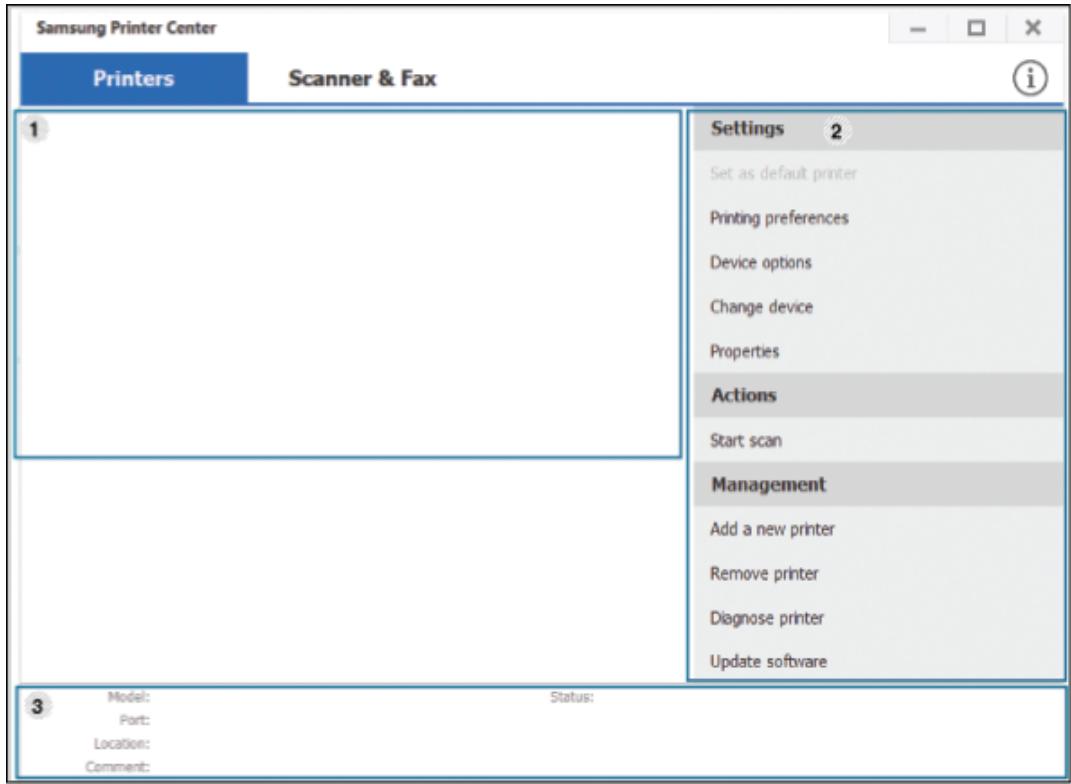
| 1 | Printer list | Displays the printer drivers installed on your computer. To add a printer driver to the list, click the + button. |
Using Samsung Printer Center
| Quick links | Displays links to various printer driver management functions. The quick links in the Printers tab link to the following functions:Settings: Allows you to configure the settings for individual printer driver.Set as default printer: Sets the selected printer driver as the default printer. If the selected printer driver is already set as the default printer, then this option is not activated.Printing preferences: Allows you to configure the default print settings.Device options: Allows you to configure advanced options, such as the settings for optional devices and additional features. | |
| 2 |  The option allows you to modify the Printer Status and Stylish User Interface settings.- Change device: Allows you to change the device into another device.Properties: Allows you to configure the printer driver properties, such as the name of the printer driver and its location, or add comments about the printer driver.Actions: Allows you to use the scan feature (this option is enabled only if the selected device supports the scan feature).Management: Allows you to manage the devices registered in the program.Add a new printer / Remove printer: Adds a new device or removes an existing device.Diagnose printer: Diagnoses problems in the selected device and suggests solutions.Update software: Downloads and applies the applicable software updates. The option allows you to modify the Printer Status and Stylish User Interface settings.- Change device: Allows you to change the device into another device.Properties: Allows you to configure the printer driver properties, such as the name of the printer driver and its location, or add comments about the printer driver.Actions: Allows you to use the scan feature (this option is enabled only if the selected device supports the scan feature).Management: Allows you to manage the devices registered in the program.Add a new printer / Remove printer: Adds a new device or removes an existing device.Diagnose printer: Diagnoses problems in the selected device and suggests solutions.Update software: Downloads and applies the applicable software updates. | |
| 3 | Printer information | Provides general information about the selected device, such as its model, IP address, port number, and status. |
Scanner & Fax Tab

- The screenshot may differ depending on operating system, model, or option.
• Available for multifunction products only.
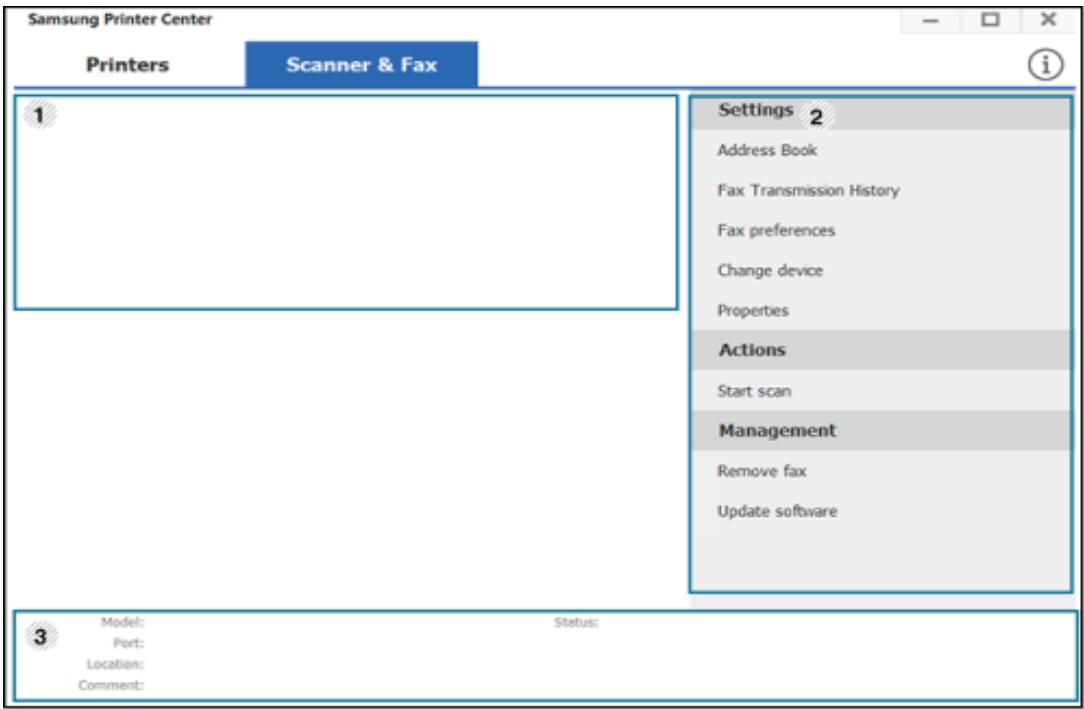
| 1 | Printer list | Displays the fax and scanner driver installed on your computer. To add a fax or scanner driver to the list, click the (Add Fax) or (Add Scanner) button. |
Using Samsung Printer Center
| Quick links | Displays links to the functions available for managing fax or scanner drivers. The quick links in the Scanner & Fax tab offer the following features: | |
 To use this feature, the scanner driver and fax driver must be installed on the computer. To use this feature, the scanner driver and fax driver must be installed on the computer. | ||
| 2 | Settings: Allows you to configure the settings for fax or scanner dirvers.Address Book (fax only): Opens the Address Book.Fax Transmission History (fax only): Opens the fax transmission history.Fax preferences (fax only): Allows you to configure the default fax settings.Change device: Allows you to change the devices into another device.Properties: Allows you to configure the properties of a device, such as location and add comments about the device.Actions: Allows you to use the scan feature.Management: Allows you to manage the devices registered in the program.Remove fax or Remove scan: Removes the selected fax or scan driver.Update software: Downloads and applies the applicable software updates. | |
| 3 | Printer information | Provides general information about the selected device, such as the model, IP address, port number, and machine status. |
Using Samsung Easy Printer Manager

• Available for Windows and Mac OS users only.
- For Windows, Internet Explorer 6.0 or higher is the minimum requirement for Samsung Easy Printer Manager.
Samsung Easy Printer Manager is an application that combines Samsung machine settings into one location. Samsung Easy Printer Manager combines device settings as well as printing environments, settings/actions and launching. All of these features provide a gateway to conveniently use your Samsung machine.
Understanding Samsung Easy Printer Manager
To open the program:
For Windows,
Select Start > Programs or All Programs > Samsung Printers > Samsung Easy Printer Manager.
For Mac,
Open the Applications folder > Samsung folder > Samsung Easy Printer Manager.
The Samsung Easy Printer Manager interface is comprised of various basic sections as described in the table that follows:

The screenshot may differ depending on operating system, model, or option.
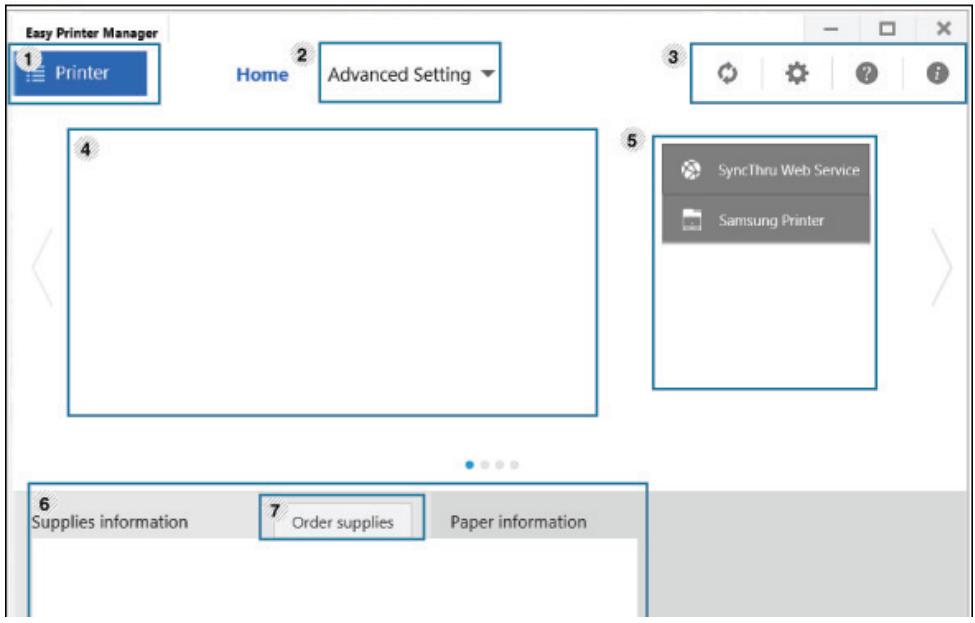
| 1 | Printer list | The Printer list displays printers installed on your computer and network printers added by network discovery (Windows only). |
Using Samsung Easy Printer Manager
2 Advanced Setting The advanced user interface is intended to be used by the person responsible for managing the network and machines.

Some menus may not appear in the display depending on options or models. If so, it is not applicable to your machine.
- Device Settings: You can configure various machine settings such as machine setup, paper, layout, emulation, network, and print information.

If you connect your machine to a network, the SyncThru™ Web Service icon is enabled.
- Scan to PC Settings: This menu includes settings to create or delete scan to PC profiles.
- Scan Activation: Determines whether or not scanning is enabled on the device.
- Basic tab: Contains settings related general scan and device settings.
- Alert Settings (Windows only): This menu includes settings related to error alerting.
- Printer Alert: Provides settings related to when alerts will be received.
- Email Alert: Provides options relating to receiving alerts via email.
- Alert History: Provides a history of device and toner related alerts.
| 3 | Application information | Includes links for changing to the refresh, preference setting, help, and about. |
| 4 | Printer information | This area gives you general information about your machine. You can check information, such as the machine's model name, IP address (or Port name), and machine status.This button opens the Troubleshooting Guide when an error occurs. You can directly open the troubleshooting section in the user's guide. |
| 5 | Quick links | Displays Quick links to machine specific functions. This section also includes links to applications in the advanced settings.If you connect your machine to a network, the SyncThruTM Web Service icon is enabled. |
| 6 | Contents area | Displays information about the selected machine, remaining toner level, and paper. The information will vary based on the machine selected. Some machines do not have this feature. |
| 7 | Order supplies | Click on the Order button from the supply ordering window. You can order replacement toner cartridge(s) from online. |

Select the Help menu or click the ? button from the window and click on any option you want to know about.
Using Samsung Printer Status
The Samsung Printer Status is a program that monitors and informs you of the machine status.

- The Samsung Printer Status window and its contents shown in this user's guide may differ depending on the machine or operating system in use.
- Check the operating system(s) that are compatible with your machine (see "System requirements" on page 349).
• Available for Windows OS users only.
Samsung Printer Status overview
If an error occurs while operating, you can check the error from the Samsung Printer Status. Samsung Printer Status is installed automatically when you install the machine software.
You can also launch Samsung Printer Status manually. Go to the Printing Preferences, click the Basic tab > Printer Status button.
These icons appear on the Windows task bar:
| Icon | Mean | Description |
| Normal | The machine is in ready mode and experiencing no errors or warnings. |
| Icon | Mean | Description |
| [2026] | Warning | The machine is in a state where an error might occur in the future. For example, it might be in toner low status, which may lead to toner empty status. |
 | Error | The machine has at least one error. |

The screenshot may differ depending on operating system, model, or option.
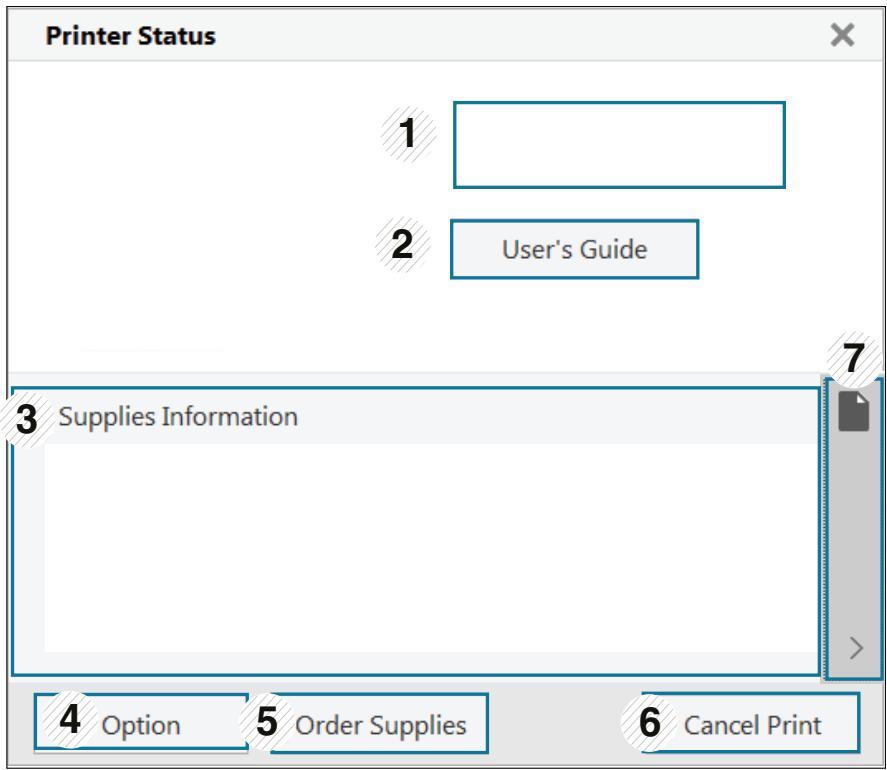
Using Samsung Printer Status
| 1 | Device Information | You can view the device information. |
| 2 | User's Guide | You can view the online User's Guide. This button opens the Troubleshooting Guide when an error occurs. You can directly open the troubleshooting section in the user's guide. This button opens the Troubleshooting Guide when an error occurs. You can directly open the troubleshooting section in the user's guide. |
| 3 | Supplies Information | You can view the percentage of toner remaining in each toner cartridge. The machine and the number of toner cartridge(s) shown in the above window may differ depending on the machine in use. Some machines do not have this feature. |
| 4 | Option | You can set printing job alert related settings. |
| 5 | Order Supplies | You can order replacement toner cartridge(s) from online. |
| 6 | Cancel Print or Close | Cancel Print: If print job is waiting in the print queue or printer, cancel all user's print jobs in the print queue or the printer.Close: Depending on the status of the machine or the supported functions, theClosebutton may appear to close the status window. |
| 7 | Toner/Paper Information | This button areas for paper and toner info will be available based on the device. |
Using Samsung Printer Experience
Samsung Printer Experience is a Samsung application that combines Samsung machine settings and machine management into one location. You can set device settings, order supplies, open troubleshooting guides, visit Samsung's website, and check connected machine information. This application will be automatically downloaded from the Windows Store if the machine is connected to a computer with an Internet connection.

Available for Windows 8 users only.
Understanding the Samsung Printer Experience
To open the application,
From the Start screen, select the Samsung Printer Experience ( [IMAGE] ) tile.
The Samsung Printer Experience interface comprises various useful features as described in the following table:

The screenshot may differ depending on operating system, model, or option.
Samsung Printer Experience
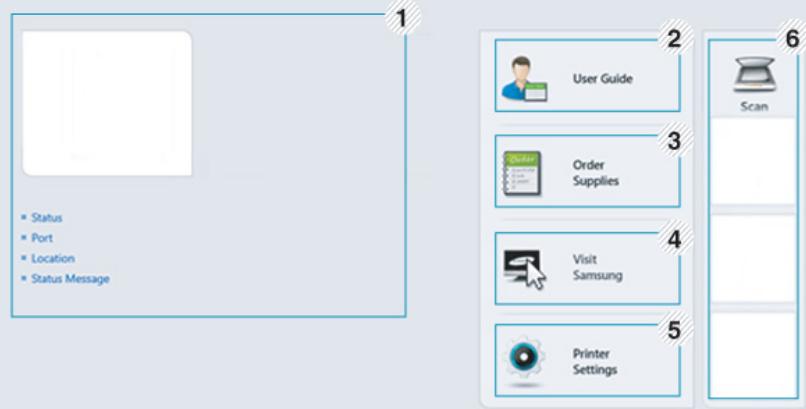
| 1 | Printer Information | This area gives you general information about your machine. You can check information, such as the machine's status, location, IP address, and remaining toner level. |
Using Samsung Printer Experience
| 2 | User's Guide | You can view the online User's Guide. You need to be connected to the Internet to use this feature.[5ww6] This button opens the Troubleshooting Guide when an error occurs. You can directly open the troubleshooting section in the user's guide. |
| 3 | Order Supplies | Click on this button to order replacement toner cartridges online. You need to be connected to the Internet to use this feature. |
| 4 | Visit Samsung | Links to Samsung printer website. You need to be connected to the Internet to use this feature. |
| 5 | Printer Settings | You can configure various machine settings such as machine setup, paper, layout, emulation, networking, and print information through SyncThruTM Web Service. Your machine needs to be connected to a network. This button will be disabled if your machine is connected via USB cable. |
| 6 | Device List & Latest Scanned Image | The scan list displays devices that supports Samsung Printer Experience. Under the device, you can see the latest scanned images. Your machine needs to be connected to a network to scan from here.This section is for the users with multi-functional printers. |
Adding/Deleting Printers
If you do not have any printer added to the Samsung Printer Experience, or if you want to add/delete a printer, follow the instructions below.

You can only add/delete network connected printers.
Adding a printer
1 From the Charms, select Settings.
Or, right-click the Samsung Printer Experience page and select Settings.
2 Select Add Printer
3 Select the printer you want to add.
You can see the added printer.

If you see ⚠ mark, you can also click ⚠ mark to add printers.
Using Samsung Printer Experience
Deleting a printer
1 From the Charms, select Settings.
Or, right-click the Samsung Printer Experience page and select Settings.
2 Select Remove Printer.
3 Select the printer you want to delete.
4 Click Yes.
You can see that the selected printer is removed from the screen.
Printing from Windows 8
This section explains common printing tasks from the Start screen.

The screenshot may differ depending on operating system, model, or option.
Basic printing
1 Open the document to print.
2 From the Charms, select Devices.
3 Select your printer from the list
4 Select the printer settings, such as the number of copies and orientation.
5 Click the Print button to start the print job.
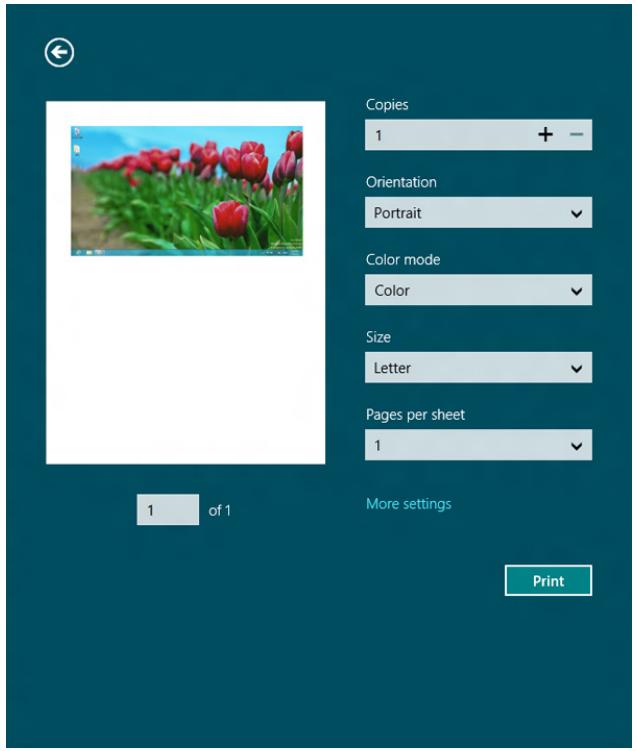
Using Samsung Printer Experience
Cancelling a print job
If the printing job is waiting in the print queue or print spooler, cancel the job as follows:
• You can access this window by simply double-clicking the machine icon
in the Windows task bar.
- You can also cancel the current job by pressing Ⓥ(Stop) button on the control panel.

Opening more settings

The screen may appear somewhat different depending on the model or options.
You can set up more printing parameters.
1 Open the document you want to print.
2 From the Charms, select Devices.
3 Select your printer from the list
4 Click More settings.
Basic tab
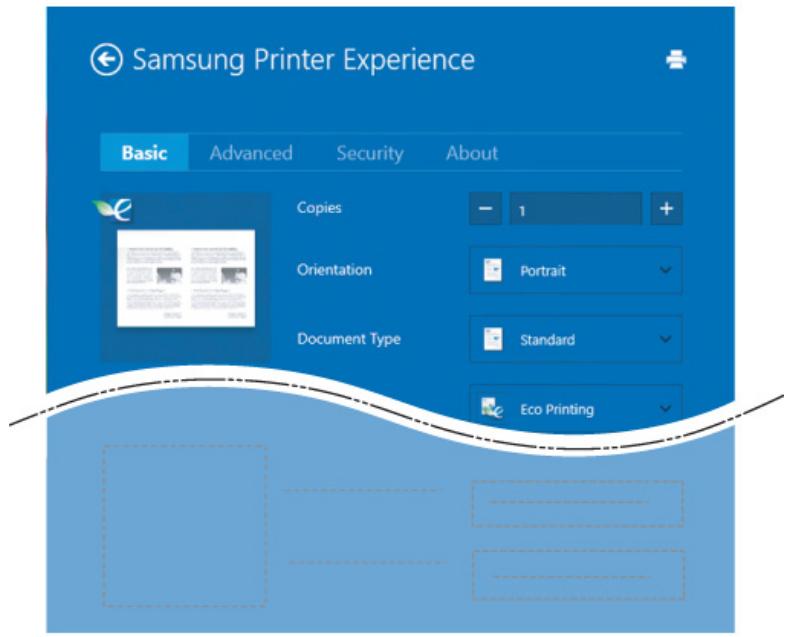
Basic
This option allows you to choose the basic printing settings such as copies, orientation, and document type.
Eco settings
This option allows you to choose multiple pages per side to save media.
Using Samsung Printer Experience
Advanced tab
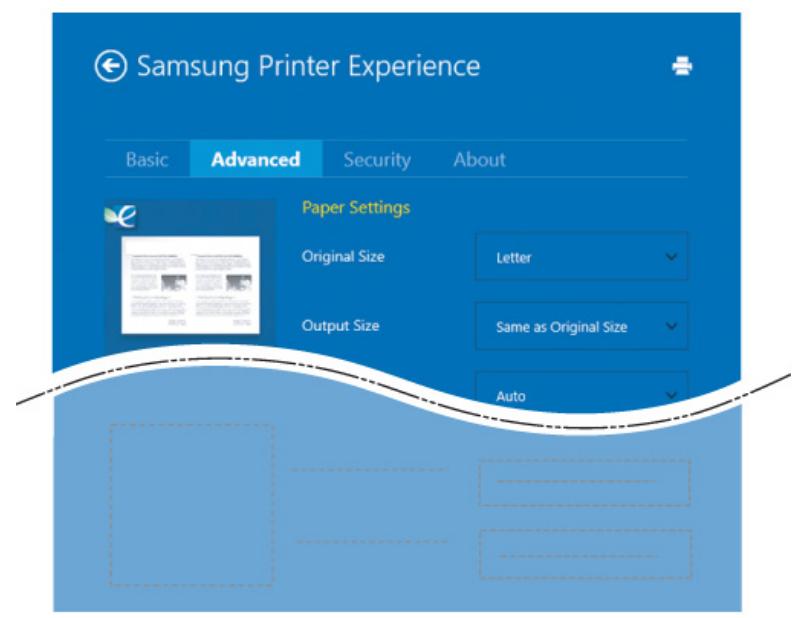
Paper settings
This option allows you to set the basic paper handling specifications.
Layout settings
This option allows you to set the various ways to layout your documents.
Security tab

Some features may not be available depending on the model or options. If this tab is not shown or disabled, it means that this features are not supported.
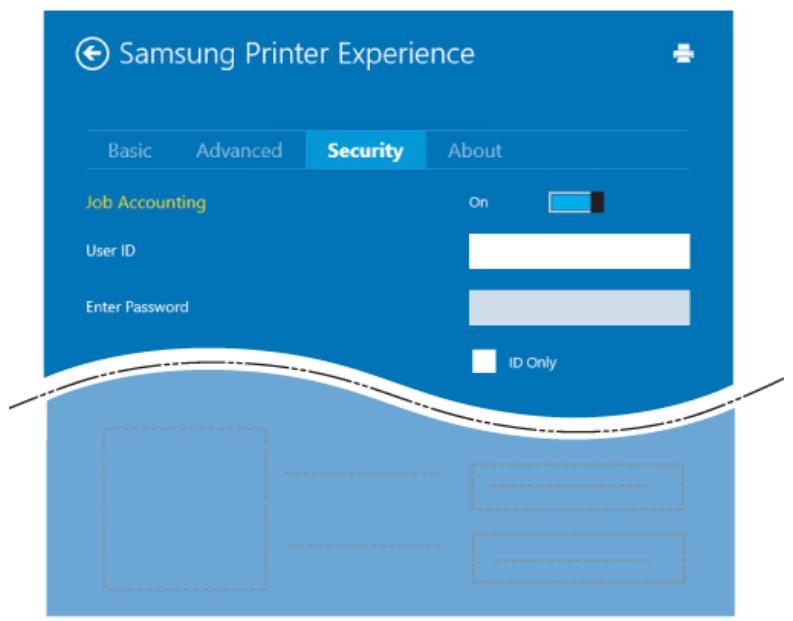
Job Accounting
This option allows you to print with the given permission.
Confidential Printing
This option is used for printing confidential documents. You need to enter a password to print using it.
Using Samsung Printer Experience
Using the sharing feature
Samsung Printer Experience allows you to print from other applications installed on the computer using the sharing feature.

This feature is only available for printing jpeg, bmp, tiff, gif, and png file formats.
1 Select the content you want to print from other application.
2 From the Charms, select Share > Samsung Printer Experience.
3 Select the printer settings, such as the number of copies and orientation.
4 Click the Print button to start the print job.
Scanning from Windows 8

This section is for the users with multi-functional printers.
Scanning with your machine lets you turn pictures and text into digital files that can be stored on your computer.
Scanning from Samsung Printer Experience
The most frequently used printing menus are displayed for quick scanning.
1 Place a single document face down on the document glass, or load the documents face up into the document feeder.
2 Click the Samsung Printer Experience tile on the Start screen.
3 Click Scan ( ).
4 Set up the scanning parameters such as image type, document size, and resolution.
5 Click Prescan (☐) to check the image.
6 Adjust the prescanned image with scanning operation functions such as rotate and mirror.
7 Click Scan ( ) and save the image.

- When you place the originals in the DSDF, Prescan ( ) is not available.
- You can skip step 5, if the Prescan option is selected.
natural_image
Blue circular icon with a white printer symbol (no text or numbers)14.Maintenance
This chapter provides information about purchasing supplies, accessories and maintenance parts available for your machine.
This chapter includes:
- Ordering supplies and accessories 271
• Available consumables 272
• Available accessories 273
• Available maintenance parts 274
• Storing the toner cartridge 275
• Redistributing toner 277
• Replacing the toner cartridge 279
• Installing accessories 282
• Monitoring the supplies life 286
• Cleaning the machine 287
• Tips for moving & storing the machine 293
Ordering supplies and accessories

Available accessories may differ from country to country. Contact your sales representatives to obtain the list of available supplies, and maintenance parts.
To order Samsung-authorized supplies, accessories, and maintenance parts, contact your local Samsung dealer or the retailer where you purchased your machine. You can also visit www.samsung.com/supplies, and then select your country/region to obtain the contact information for service.
Available consumables
When supplies reach the end of their life spans, you can order the followings of supplies for your machine:
| Type | Average yielda | Part name |
| Toner cartridge | Average continuous cartridge yield : Approx. 10,000 standard pages | MLT-D201S |
| Average continuous cartridge yield : Approx. 20,000 standard pages | MLT-D201L |
a. Declared yield value in accordance with ISO/IEC 19752. The number of pages may be affected by operating environment, printing interval, graphics, media type and media size.

Depending on the options, percentage of image area and job mode used, the toner cartridge's lifespan may differ.

When purchasing new toner cartridges or other supplies, these must be purchased in the same country as the machine you are using. Otherwise, new toner cartridges or other supplies will be incompatible with your machine due to different configurations of toner cartridges and other supplies according to the specific country conditions.

Samsung does not recommend using non-genuine Samsung toner cartridge such as refilled or remanufactured toner. Samsung cannot guarantee non-genuine Samsung toner cartridge's quality. Service or repair required as a result of using non-genuine Samsung toner cartridges will not be covered under the machine's warranty.
Available accessories
You can purchase and install accessories to enhance your machine's performance and capacity.

Some features and optional goods may not be available depending on model or country (see "Features by model" on page 8).
| Accessory | Function | Part name |
| Memory module | Extends your machine's memory capacity. | SL-MEM001 (2GB) |
| Optional trays (Tray2, Tray3, Tray4) | If you are experiencing frequent paper supply problems, you can attach an additional 550 ^a sheet trays. | SL-SCF4000 |
| Stand | You can easily move the machine using the stand with its wheels. When using the optional Stand, you must install the foot as shown in the Optional Stand Install Guide provided with the optional Stand. Otherwise, the machine could fall over if on incline and cause bodily injury. When using the optional Stand, you must install the foot as shown in the Optional Stand Install Guide provided with the optional Stand. Otherwise, the machine could fall over if on incline and cause bodily injury. | ML-DSK65S |
| Wireless/NFC kit | This kit lets you use your machine as a Wireless and NFC machine. | SL-NWE001X |
a. Plain paper 75 g/m ^2 (20 lb bond).
Available maintenance parts
You need to replace the maintenance parts at specific intervals to keep the machine in the best condition and avoid print quality and paper feeding problems resulting from the worn-out parts. Maintenance parts are mostly rollers, belts and pads. However, the replacement period and parts may differ depending on the model. Replacing maintenance parts can be performed only by an authorized service provider, dealer, or the retailer where you bought the machine. To purchase maintenance parts, contact the retailer where you bought the machine. The replacement period for the maintenance parts is informed by the Samsung Printer Status program. Or on the UI (User Interface) if your machine supports a display screen. The replacement period varies based on the operating system used, computing performance, application software, connecting method, paper type, paper size, and job complexity.
Storing the toner cartridge
Toner cartridges contain components that are sensitive to light, temperature and humidity. Samsung suggests users follow these recommendations to ensure optimal performance, highest quality, and longest life from your new Samsung toner cartridge.
Store the cartridge in the same environment in which the printer will be used. This should be in controlled temperature and humidity conditions. The toner cartridge should remain in its original and unopened package until installation – if original packaging is not available, cover the top opening of the cartridge with paper and store in a dark cabinet.
Opening the cartridge package prior to use dramatically shortens its useful shelf and operating life. Do not store on the floor. If the toner cartridge is removed from the printer, follow the instructions below to store the toner cartridge properly.
- Store the cartridge inside the protective bag from the original package.
- Store lying flat (not standing on end) with the same side facing up as if it were installed in the machine.
-
Do not store consumables in any of the following conditions:
-
Temperature greater than 40 °C (104 °F).
- Humidity range less than 20% or greater than 80%.
- An environment with extreme changes in humidity or temperature.
- Direct sunlight or room light.
- Dusty places.
- A car for a long period of time.
- An environment where corrosive gases are present.
- An environment with salty air.
Handling instructions
- Do not touch the surface of the photoconductive drum in the cartridge.
- Do not expose the cartridge to unnecessary vibrations or shock.
- Never manually rotate the drum, especially in the reverse direction; this can cause internal damage and toner spillage.
Toner cartridge usage
Samsung Electronics does not recommend or approve the use of non-Samsung brand toner cartridges in your printer including generic, store brand, refilled, or remanufactured toner cartridges.

Samsung's printer warranty does not cover damage to the machine caused by the use of refilled, remanufactured, or non-Samsung brand toner cartridges.
Storing the toner cartridge
Estimated cartridge life
Estimated cartridge life (the life of the toner cartridge yield) depends on the amount of toner that print jobs require. The actual print yield may vary depending on the print density of the pages you print on, operating environment, percentage of image area, printing interval, media type and/or media size. For example, if you print a lot of graphics, the consumption of the toner is higher and you may need to change the cartridge more often.
Redistributing toner
When the toner cartridge is near the end of its life:
- White streaks or light printing occurs and/or density varies from side to side.
- The Status LED blinks orange. The toner-related message saying that the toner is low may appear on the display.
- The computer's Samsung Printing Status program window appears on the computer telling you which toner cartridge is low on toner (see "Using Samsung Printer Status" on page 262).
If this happens, you can temporarily improve print quality by redistributing the remaining toner in the cartridge. In some cases, white streaks or light printing will still occur even after you have redistributed the toner.

Illustrations on this user's guide may differ from your machine depending on its options or models. Check your machine type (see "Front view" on page 19).

• To prevent damage to the toner cartridge, do not expose it to light for more than a few minutes. Cover it with a piece of paper, if necessary.
- Do not touch the green area of the toner cartridge. Use the handle on the cartridge to avoid touching this area.
- Do not use sharp objects such as a knife or scissors to open the toner cartridge package. They might scratch the drum of the cartridge.
- If toner gets on your clothing, wipe it off with a dry cloth and wash clothing in cold water. Hot water sets toner into fabric.
Redistributing toner
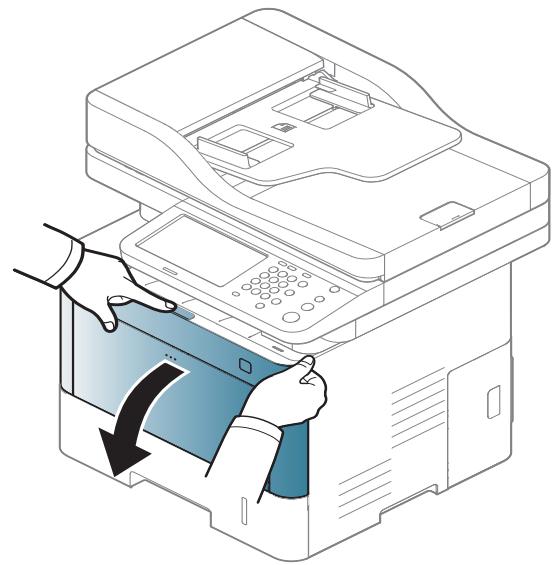
natural_image
Illustration of a printer being inserted into a digital scanner, showing hands performing the process (no text or symbols present)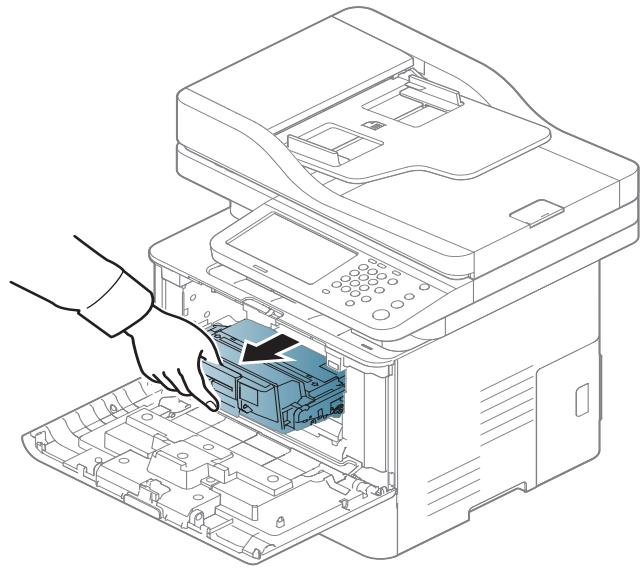
natural_image
Line drawing of a printer with an open base showing internal components (no text or symbols)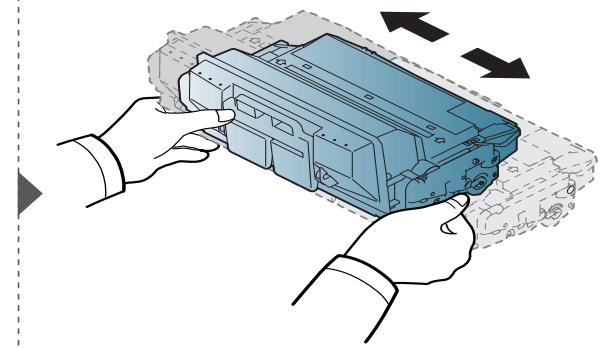
natural_image
Illustration of hands installing or adjusting a blue electronic component with arrows indicating motion (no text or symbols)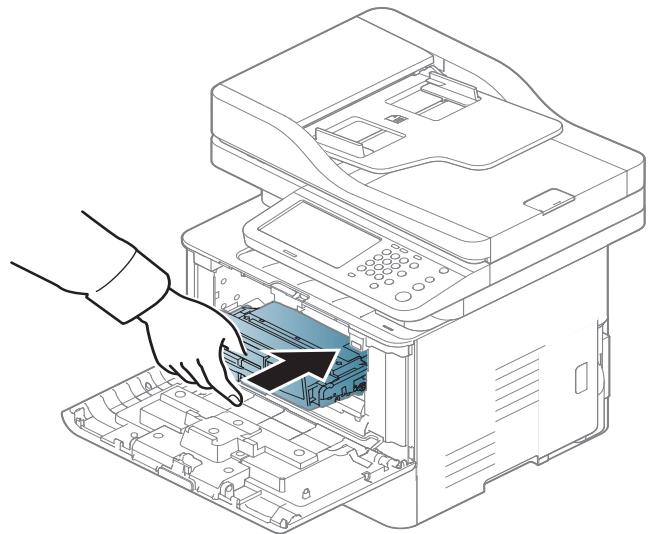
natural_image
Line drawing of a printer with an open circuit board and a hand inserting a component (no text or symbols)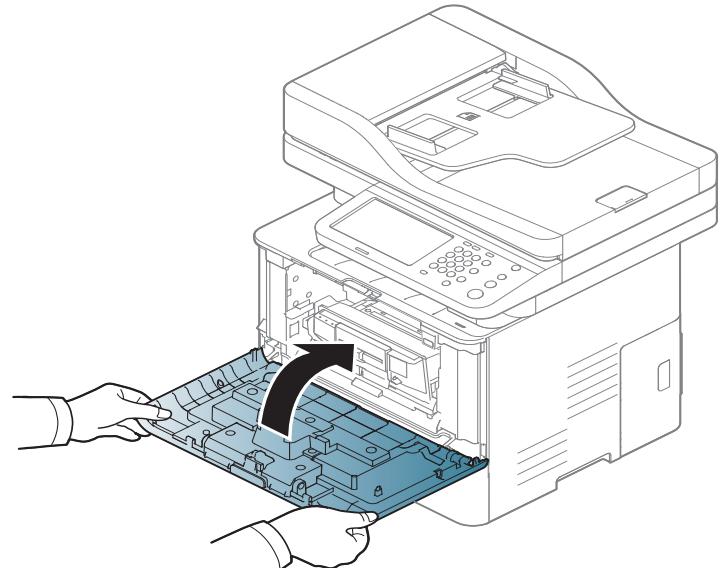
natural_image
Illustration of hands inserting a printer into a circuit board (no text or symbols visible)Replacing the toner cartridge
A toner cartridge has almost reached its estimated cartridge life:
- The status LED and the toner-related message on the display indicate when the toner cartridge should be replaced.
- The computer's Samsung Printing Status Program window appears on the computer telling you cartridge is empty on toner (see "Using Samsung Printer Status" on page 262).
Check the type of the toner cartridge for your machine (see "Available consumables" on page 272).

- Shake the toner cartridge thoroughly, it will increase the initial print quality.
- Illustrations on this user's guide may differ from your machine depending on its options or models. Check your machine type (see "Front view" on page 19).

• To prevent damage to the toner cartridge, do not expose it to light for more than a few minutes. Cover it with a piece of paper, if necessary.
- Do not touch the green area of the toner cartridge. Use the handle on the cartridge to avoid touching this area.
- Do not use sharp objects such as a knife or scissors to open the toner cartridge package. They might scratch the drum of the cartridge.
- If toner gets on your clothing, wipe it off with a dry cloth and wash clothing in cold water. Hot water sets toner into fabric.
Replacing the toner cartridge
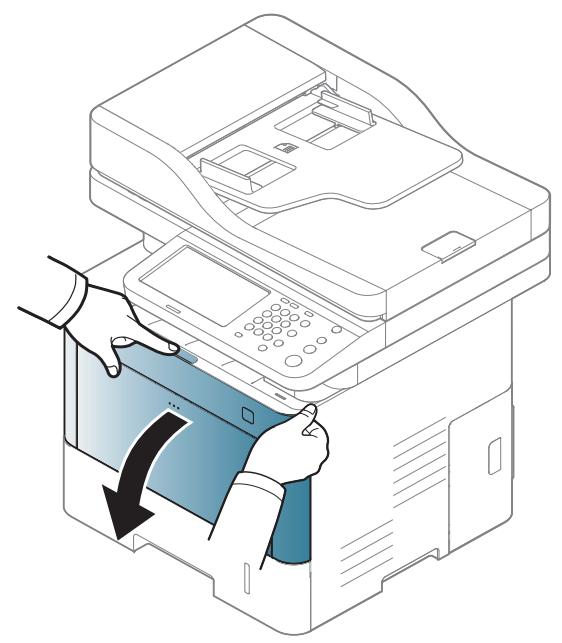
natural_image
Illustration of a printer being inserted into a digital scanner, showing hands performing the process (no text or symbols present)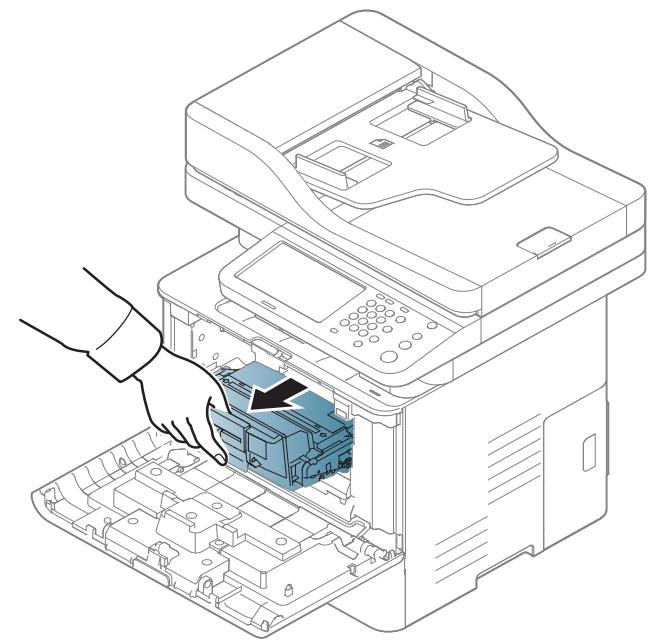
natural_image
Line drawing of a printer with an open base showing internal components (no text or symbols)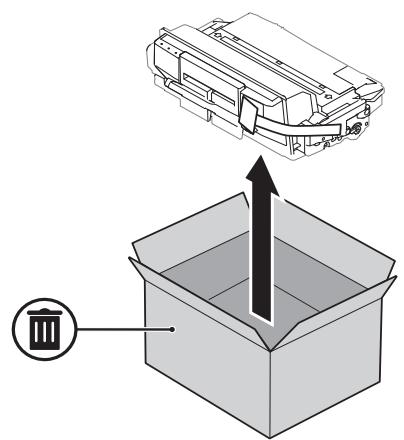
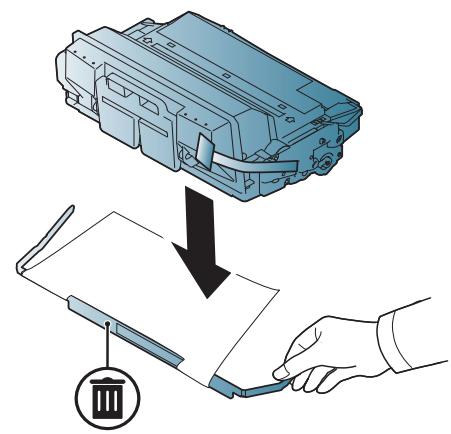
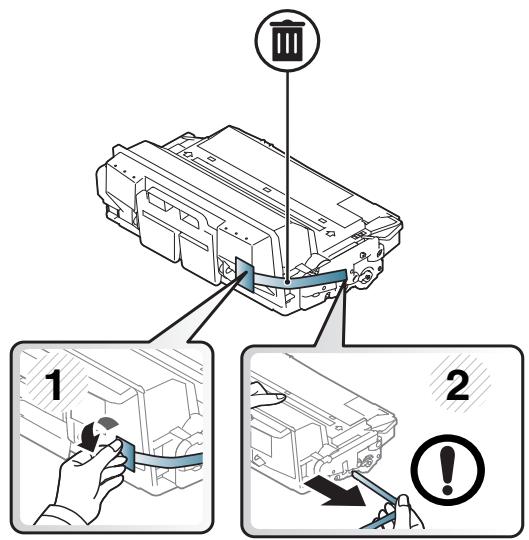
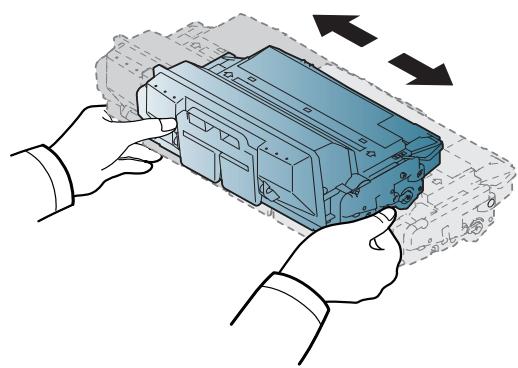
natural_image
Illustration of hands installing or adjusting a blue plastic component with arrows indicating direction (no text or symbols)Replacing the toner cartridge
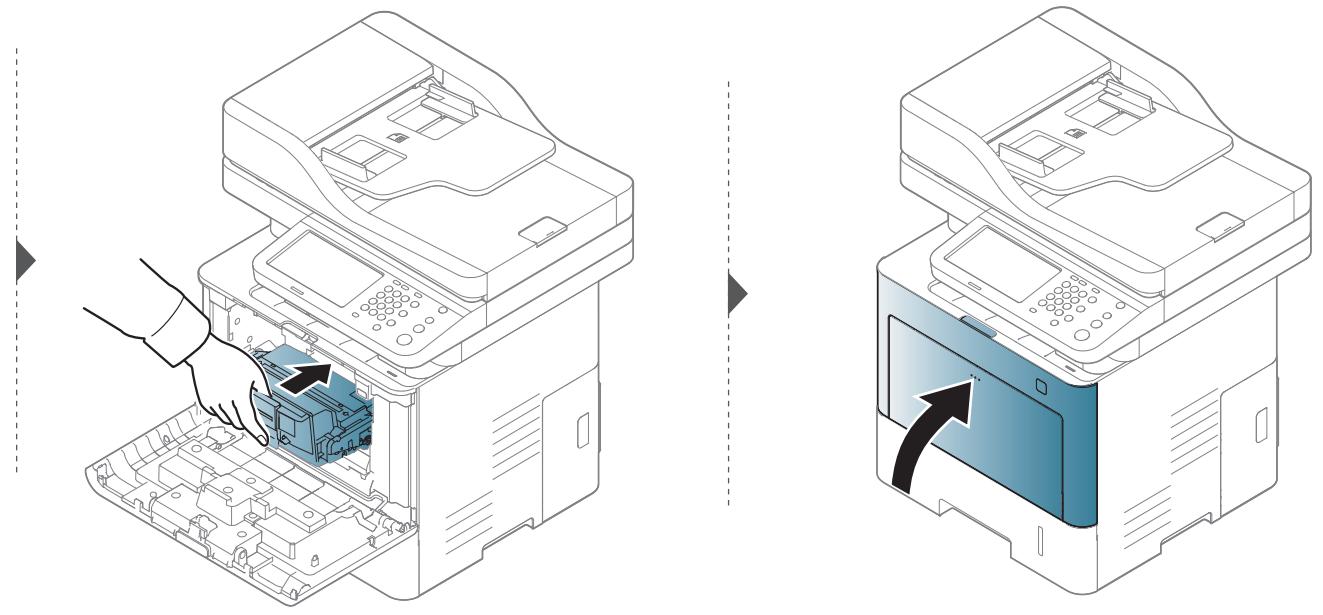
Installing accessories
Precautions
- Disconnect the power cord
Never remove the control board cover while the power is turned on.
To avoid the possibility of an electrical shock, always disconnect the power cord when installing or removing ANY internal or external accessories.
• Discharge static electricity
The control board and internal accessories (memory module) are sensitive to static electricity. Before installing or removing any internal accessories, discharge static electricity from your body by touching something metal, such as the metal back plate on any device plugged into a grounded power source. If you walk around before finishing the installation, repeat this procedure to discharge any static electricity again.

When installing accessories, the battery inside the machine is a service component. Do not change it by yourself. There is a risk of an explosion if battery is replaced by an incorrect type. Your service provider should remove the old battery from your device and dispose of it in accordance with the relevant regulations in your country.
Setting Device Options
When you install the optional devices such as optional tray, memory, etc, this machine automatically detects and sets the optional devices. If you cannot use the optional devices you installed in this driver, you can set the optional devices in Device Options.
1 Click the Windows Start menu.
• For Windows 8, from Charms, select Search > Settings.
2 For Windows® XP Service Pack 3/2003, select Printers and Faxes.
- For Windows 2008/Vista, select Control Panel > Hardware and Sound > Printers.
- For Windows 7, select Control Panel > Hardware and Sound > Devices and Printers.
• For Windows 8, search for Devices and Printers. - For Windows Server 2008 R2, select Control Panel > Hardware > Devices and Printers.
3 Right-click your machine.
4 For Windows® XP Service Pack 3/2003/2008/Vista, press Properties.
For Windows 7, For Windows 8, and Windows Server 2008 R2, from context menus, select the Printer properties.
Installing accessories

If Printer properties item has ▶ mark, you can select other printer drivers connected with selected printer.
5 Select Device Options.

The Properties window may differ depending on the driver or operating system you are using.
6 Select the appropriate option.

Some menus may not appear in the display depending on options or models. if so, it is not applicable to your machine.
- Tray Options: Select the optional tray you installed. You can select the tray.
- Storage Options: Select the optional memory you installed. If this feature is checked, you can select the Print Mode.
• Printer Configuration: Select the printer language for the print job. -
Administrator Settings: You can select the Printer Status and EMF Spooling.
-
Admin Job Accounting: Allows you to associate user and account identification information with each document you print.
- User permission: If you check this option, only users with user permission can start a print job.
- Group permission: If you check this option, only groups with group permission can start a print job.

If you want to encrypt job accounting password, check Job Accounting Password Encryption.
- Custom Paper Size Settings: You can specify custom paper size.
7 Click OK until you exit the Properties or Printer properties window.
Installing accessories
Upgrading a memory module
Your machine has a dual in-line memory module (DIMM). Use this memory module slot to install additional memory. We recommend the use of only genuine Samsung DIMM's. You may void your warranty if it is determined that your machine problem is being caused by third party DIMM's.
The order information is provided for optional accessories (see "Available accessories" on page 273).

After installing the optional memory, you can use the advanced printing features, such as proofing a job and specifying of printing a secure print job in the printer properties window.
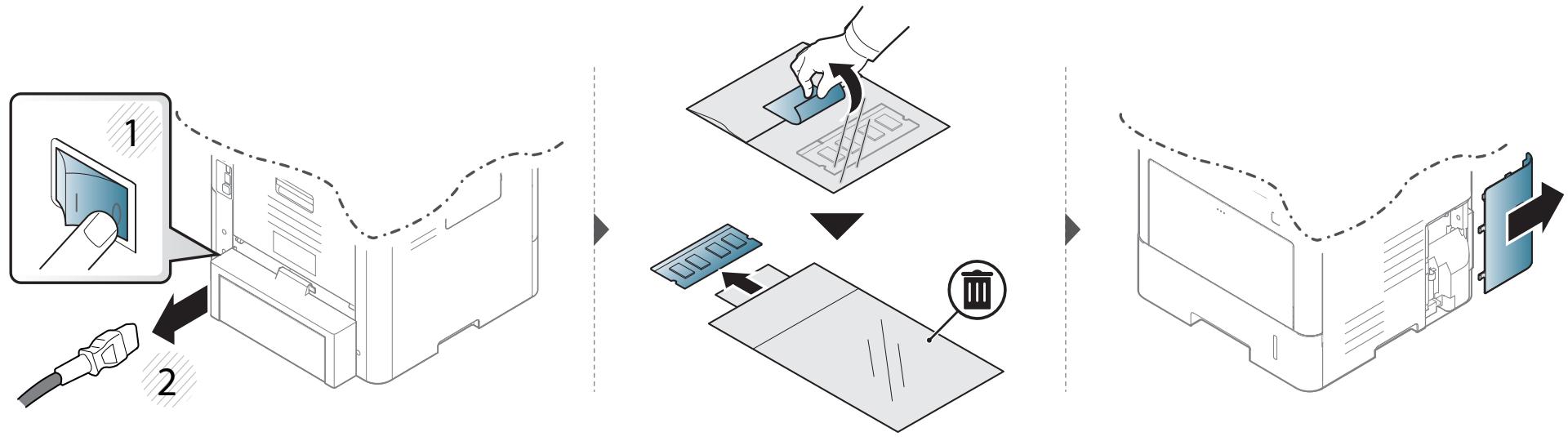
flowchart
graph LR
    A["1: Printer Application"] --> B["2: Paper Seal"]
    B --> C["3: Screen Printing"]
    C --> D["4: Collection Box"]
    D --> E["5: Waste Bin Icon"]
Installing accessories

Monitoring the supplies life
Check remaining life of the supplies and prepare the supplies in advance.
You can also print the supplies life report. Select Supplies Information in the Report feature (see "Other settings" on page 226).
From the machine
1 Press Machine Setup > Others > Supplies Life from the display screen.
2 Check the usage account.

We recommend you prepare new supplies or those that you have used over 90% of their average yield (see "Redistributing toner" on page 277).
3 Press (Back) for return to the previous screen.
From the SyncThru™ Web Service
1 From the SyncThru™ Web Service, select the Information tab > Supplies.
2 Check the remaining percentage.
Cleaning the machine
If printing quality problems occur or if you use your machine in a dusty environment, you need to clean your machine regularly to keep it in the best printing condition and prolong the life of your machine.

• Cleaning the cabinet of the machine with cleaning materials containing large amounts of alcohol, solvents, or other strong substances can discolor or distort the cabinet.
- If your machine or the surrounding area is contaminated with toner, we recommend you use a cloth or tissue dampened with water to clean it. If you use a vacuum cleaner, toner blows in the air and might be harmful to you.
Cleaning the outside
Clean the machine cabinet with a soft, lint-free cloth. Dampen the cloth slightly with water, but be careful not to let any water drip onto or into the machine.
Cleaning the machine
Cleaning the inside
During the printing process, paper, toner, and dust particles can accumulate inside the machine. This buildup can cause print quality problems, such as toner specks or smearing. Cleaning the inside of the machine clears and reduces these problems.

• To prevent damage to the toner cartridge, do not expose it to light for more than a few minutes. Cover it with a piece of paper, if necessary.
- Do not touch the green area of the toner cartridge. Use the handle on the cartridge to avoid touching this area.
- Use a dry lint free cloth when cleaning the inside of the machine, be careful not to damage the transfer roller or any other inside parts. Do not use solvents such as benzene or thinner. Printing quality problems can occur and cause damage to the machine.

- Use a dry lint-free cloth to clean the machine.
- Turn the machine off and unplug the power cord. Wait for the machine to cool down. If your machine has a power switch, turn the power switch off before cleaning the machine.
- Illustrations on this user's guide may differ from your machine depending on its options or models. Check your machine type (see "Front view" on page 19).
Cleaning the machine
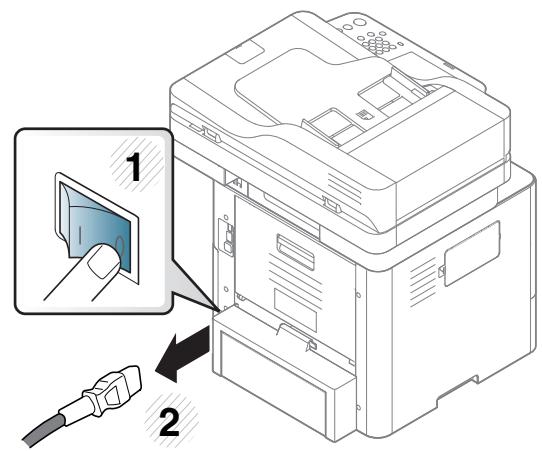
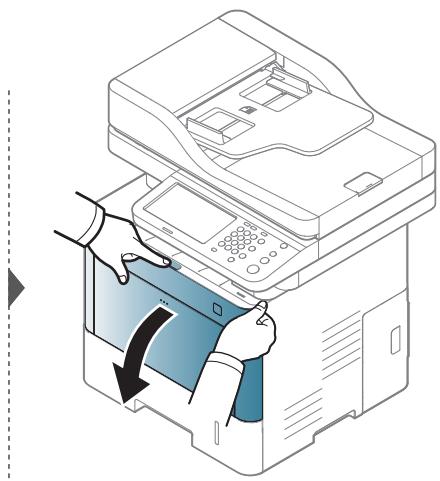
natural_image
Illustration of a printer being inserted into a machine, showing the printer's internal structure and the printer's base panel (no text or symbols present)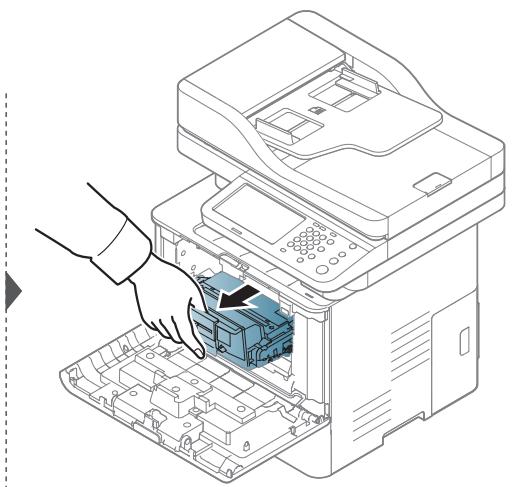
natural_image
Illustration of a printer being inserted into a circuit board, showing internal components and a hand interacting with the printer (no text or symbols present)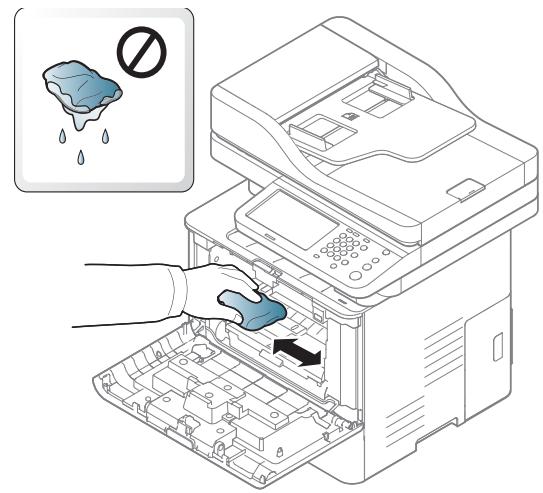
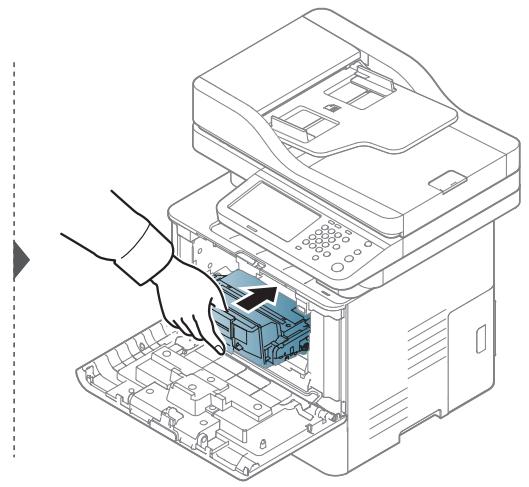
natural_image
Illustration of a printer with a hand inserting a component into the open circuit board (no text or symbols visible)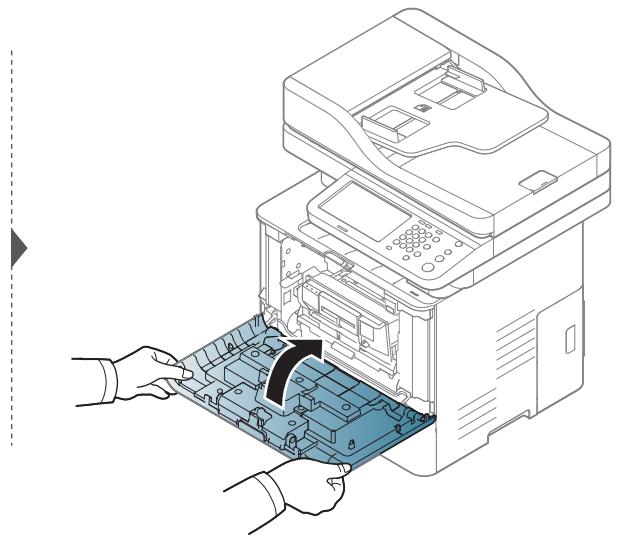
natural_image
Illustration of hands inserting a printer into a circuit board (no text or symbols visible)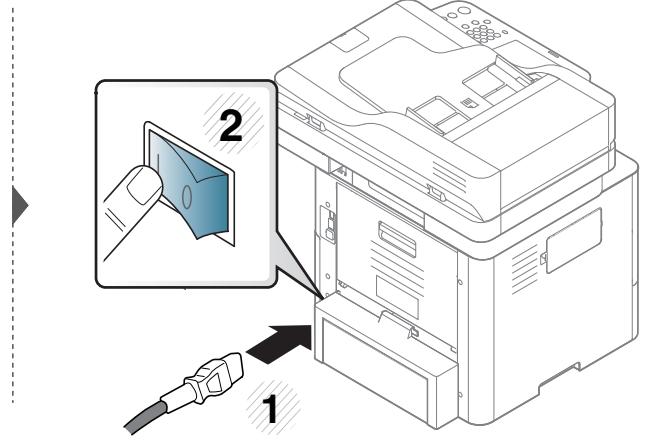
Cleaning the machine
Cleaning the pickup roller

- Turn the machine off and unplug the power cord. Wait for the machine to cool down. If your machine has a power switch, turn the power switch off before cleaning the machine.
- Illustrations on this user's guide may differ from your machine depending on its options or models. Check your machine type (see "Front view" on page 19).
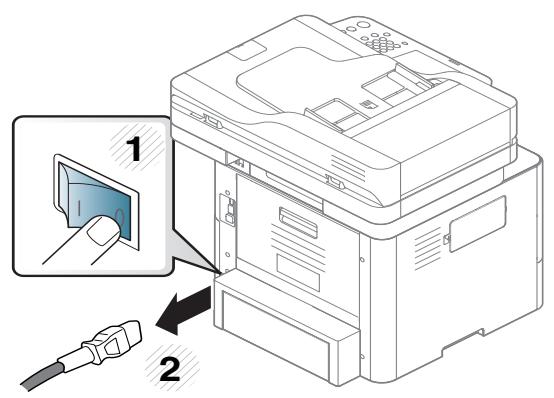
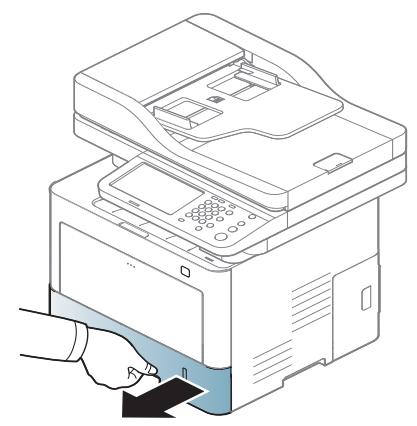
natural_image
Illustration of a printer with a hand inserting a card into the front panel (no text or symbols visible)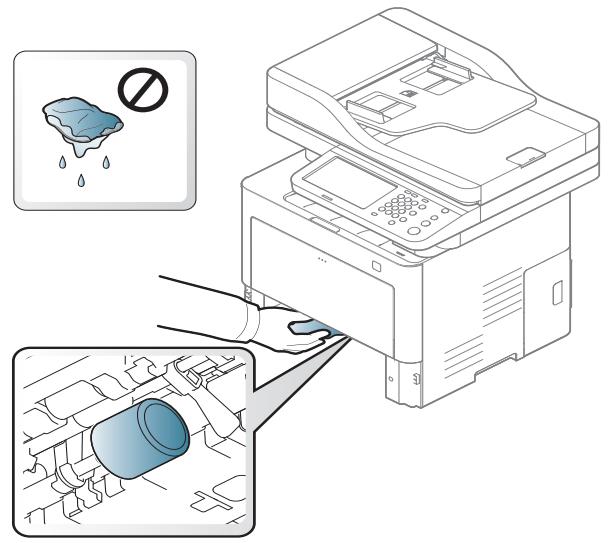
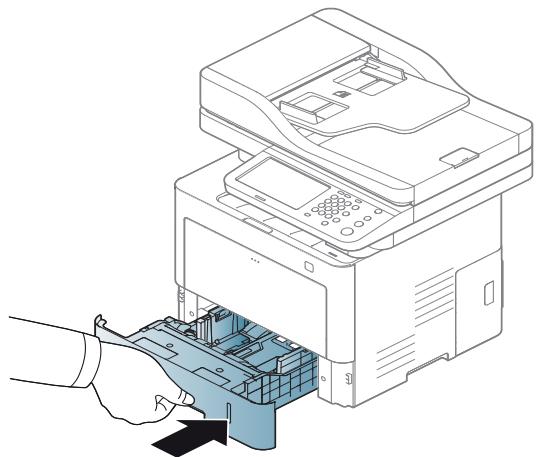
natural_image
Illustration of a printer being inserted into a circuit board, with a hand inserting the component (no text or symbols visible)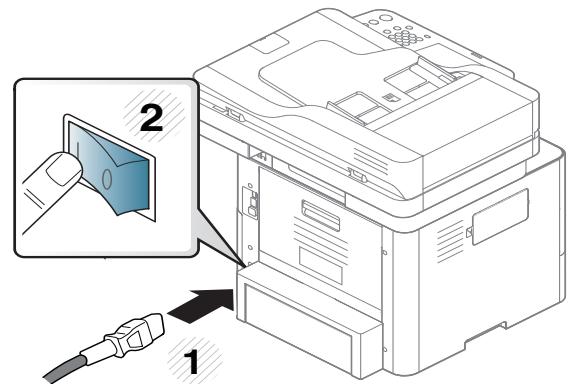
Cleaning the machine
Cleaning the scan unit
Keeping the scan unit clean helps ensure the best possible copies. We suggest that you clean the scan unit at the start of each day and during the day as needed.

- Turn the machine off and unplug the power cord. Wait for the machine to cool down. If your machine has a power switch, turn the power switch off before cleaning the machine.
- Illustrations on this user's guide may differ from your machine depending on its options or models. Check your machine type (see "Front view" on page 19).
1 Slightly dampen a soft, lint-free cloth or paper towel with water.
2 Lift and open the scanner lid.
Cleaning the machine
3 Wipe the surface of the scanner until it is clean and dry.
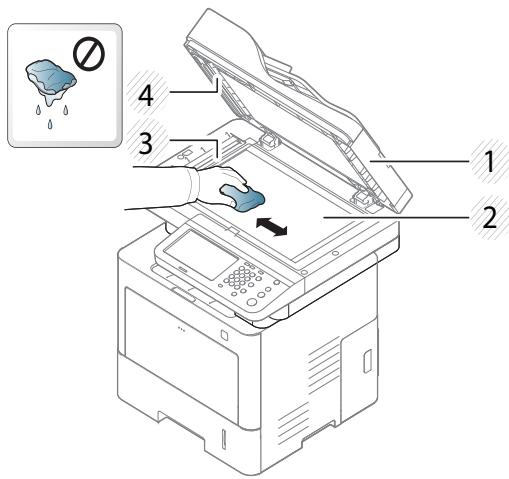
1 Scanner lid
2 Scanner glass
3 Document feeder glass
4 White bar
4 Close the scanner lid.
Tips for moving & storing the machine

The warranty does not cover damage from falls or impacts due to the intentional or unintentional actions of the user.
- When moving the machine, do not tilt or turn it upside down. Otherwise, the inside of the machine may be contaminated by toner, which can cause damage to the machine or reduce print quality.
- When moving the machine, make sure at least two people are holding the machine securely.
natural_image
Blue circular icon with a white printer symbol (no text or numbers)15.Troubleshooting
This chapter gives helpful information for what to do if you encounter an error. If you cannot find a solution in the User's Guide or the problem persists, call for service.
This chapter includes:
- Tips for avoiding paper jams 295
- Clearing paper jams 296
• Understanding display messages 315
• Paper feeding problems 321
• Power and cable connecting problems 322 - Printing problems 323
- Printing quality problems 326
• Copying problems 334
• Scanning problems 335 - Faxing problems 337
- Operating system problems 339
Tips for avoiding paper jams
By selecting the correct medias, most paper jams can be avoided. To avoid paper jams, refer to the following guidelines:
- Ensure that the adjustable guides are positioned correctly (see "Tray overview" on page 68).
- Do not remove paper from the tray while your machine is printing.
• Flex, fan, and straighten paper before loading. - Do not use creased, damp, or highly curled paper.
- Do not mix paper type and size in a tray.
• Use only recommended print media (see "Print media specifications" on page 346).
Clearing paper jams

To avoid tearing the paper, pull the jammed paper out slowly and gently.
In tray1

Illustrations on this user's guide may differ from your machine depending on its options or models. Check your machine type (see "Front view" on page 19).
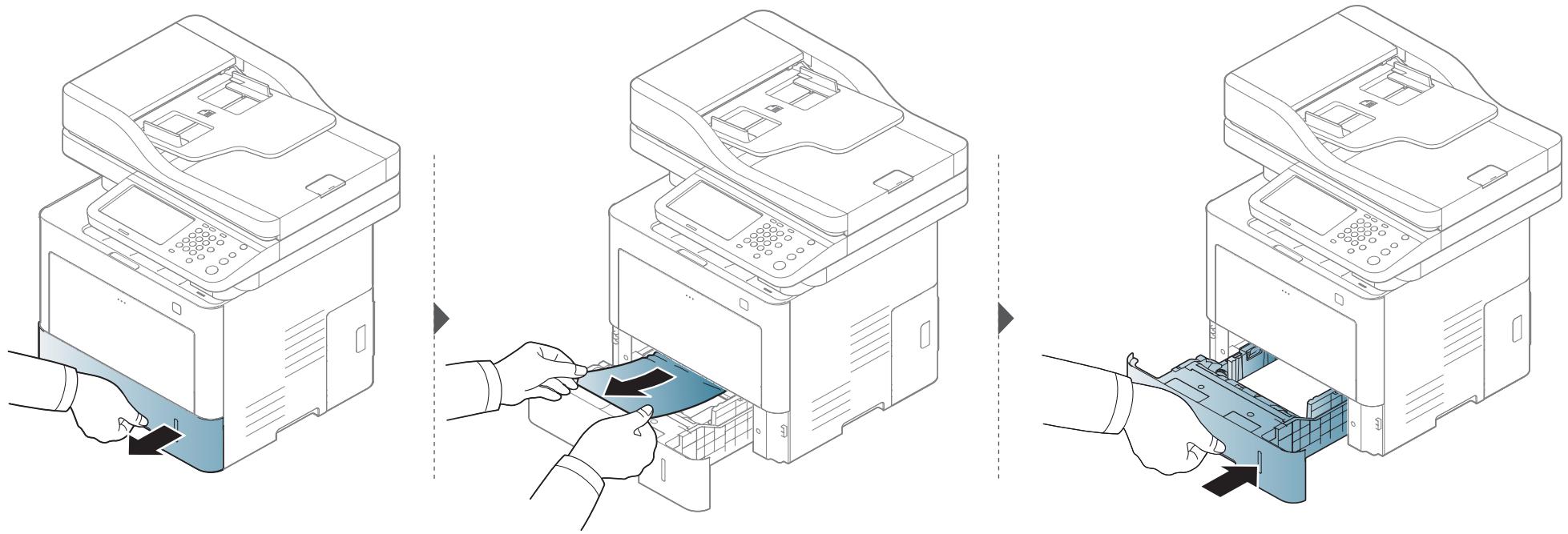
natural_image
Three-step diagram showing a printer being inserted into a device, with no visible text or symbols.Clearing paper jams
If you do not see the paper in this area, stop and go to next step:
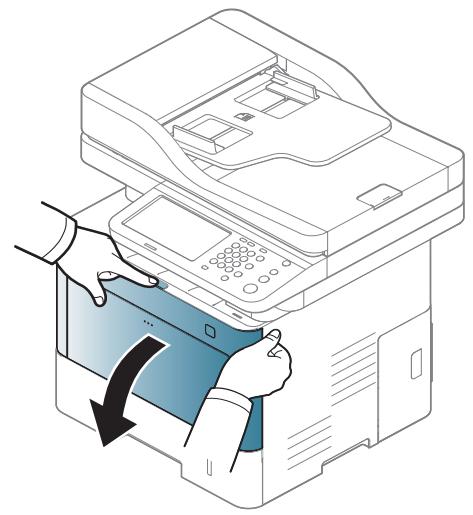
natural_image
Illustration of a printer being inserted into a machine, showing hands inserting a component (no text or symbols present)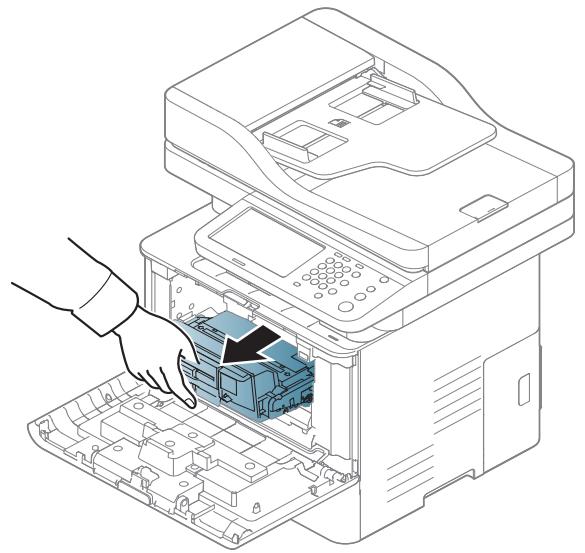
natural_image
Line drawing of a printer with an open base showing internal components (no text or symbols)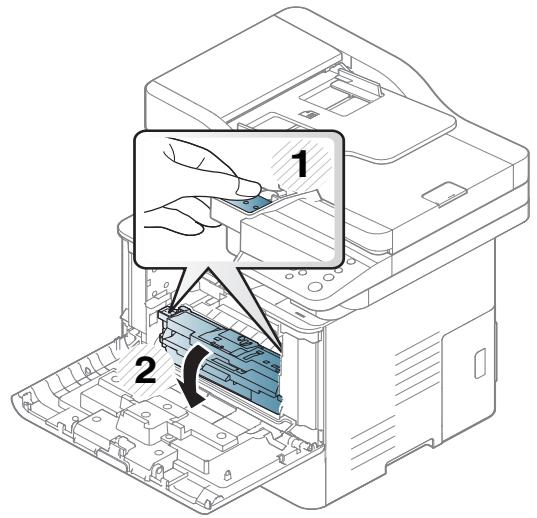
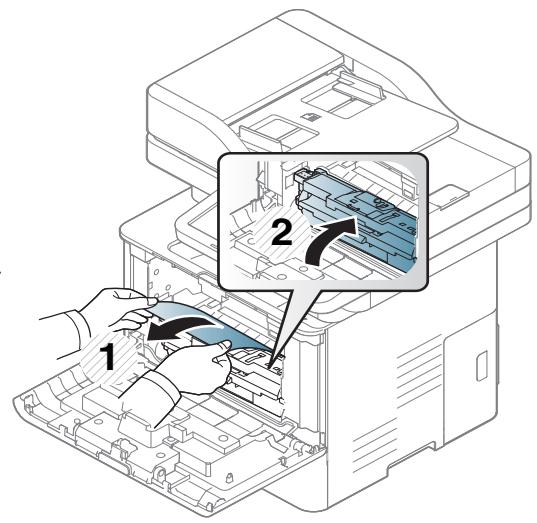
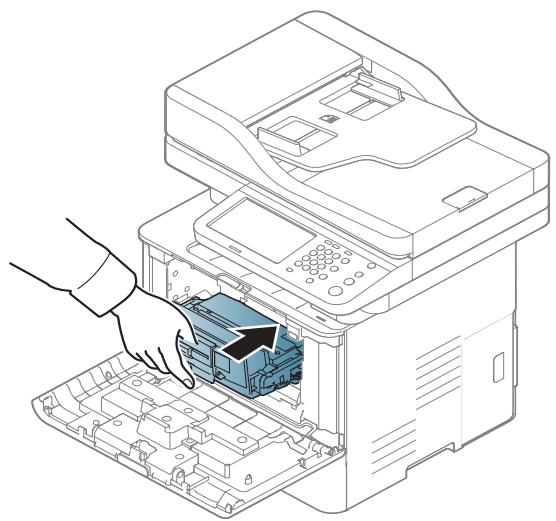
natural_image
Illustration of a hand inserting a printer into an open circuit board (no text or symbols visible)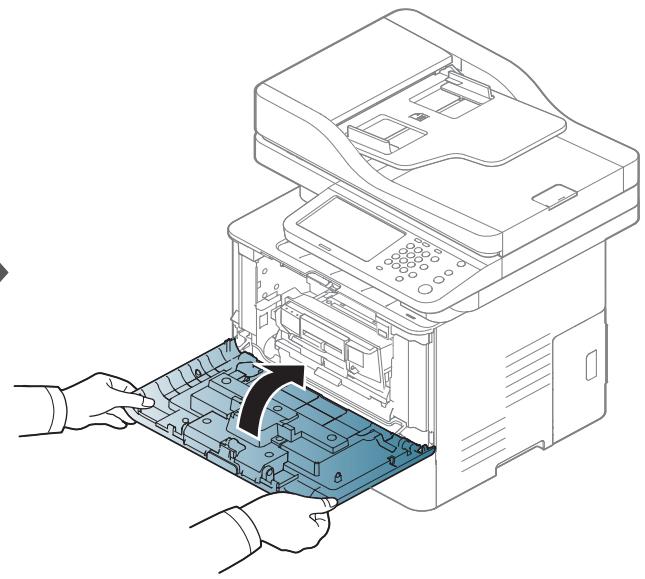
natural_image
Illustration of hands inserting a printer into a circuit board (no text or symbols visible)Clearing paper jams
In optional trays

The procedure is same for all optional trays.
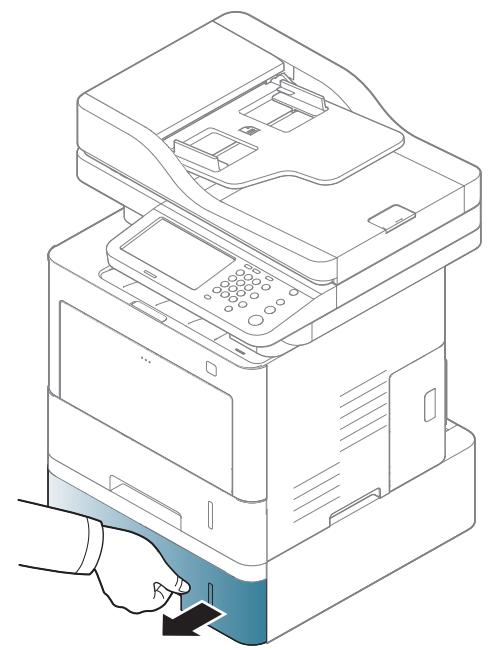
natural_image
Line drawing of a printer with a hand inserting a button to the front panel (no text or symbols present)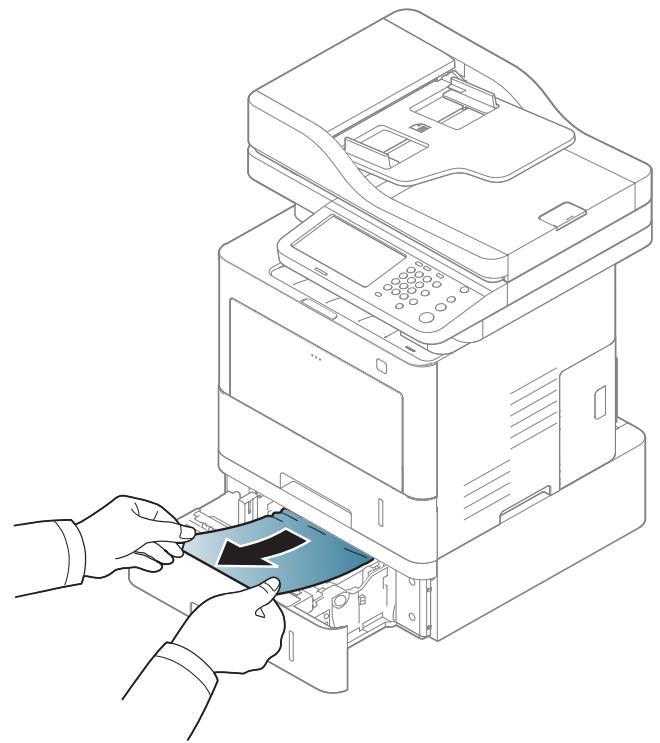
natural_image
Illustration of hands inserting a card into an open printer (no text or symbols visible)
natural_image
Technical line drawing of a printer with internal components and a blue plastic cover (no text or symbols)Clearing paper jams
If you do not see the paper in this area, stop and go to next step:
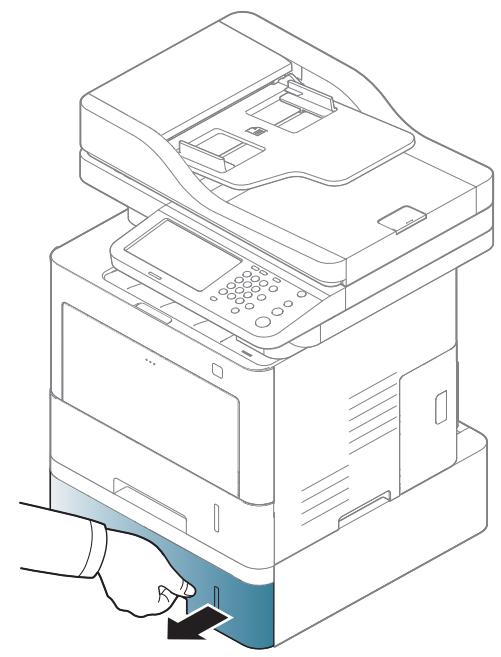
natural_image
Illustration of a printer with a hand inserting a blue object into the base (no text or symbols visible)→
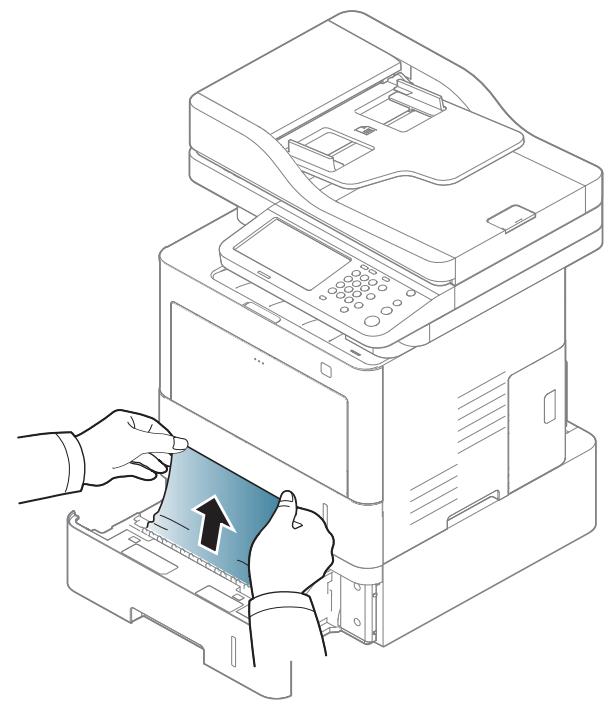
natural_image
Illustration of hands inserting a card into an open printer, showing mechanical components and a blue arrow indicating the card's direction (no text or symbols present)→
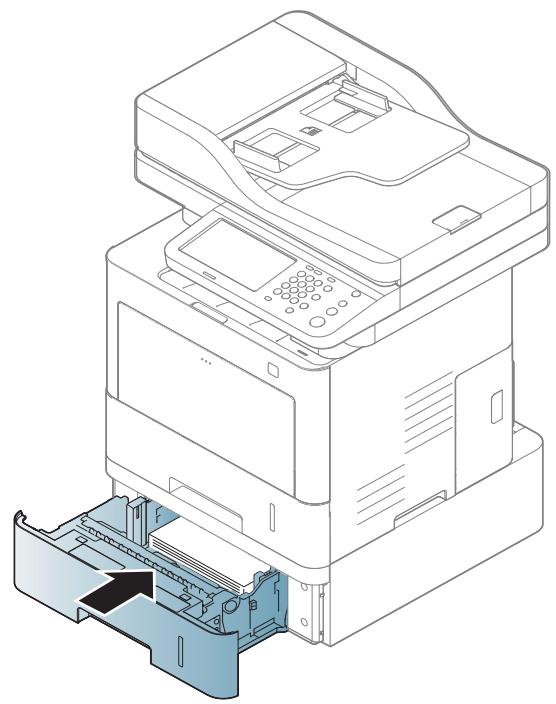
natural_image
Line drawing of a printer with internal components and a clear plastic cover (no text or symbols)Clearing paper jams
If you do not see the paper in this area, stop and go to next step:
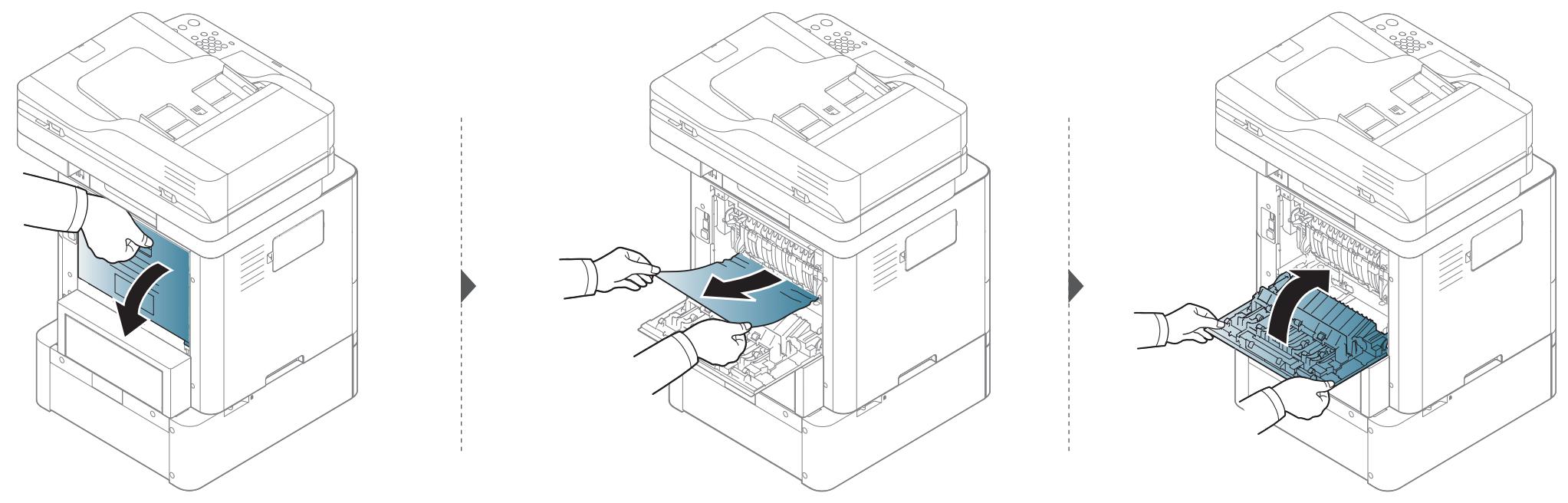
Clearing paper jams
In the multi-purpose tray
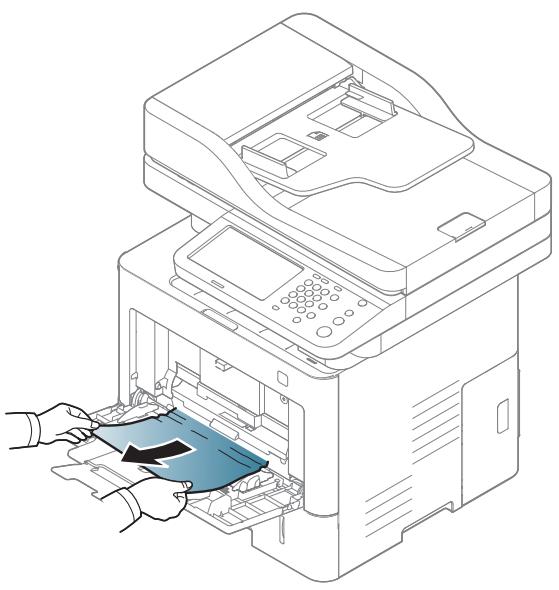
natural_image
Line drawing of a printer with hands inserting a blue plastic bag into the output (no text or symbols)Clearing paper jams
Inside the machine

The fuser area is hot. Turn the machine off and let the machine cool before removing paper from the Fuser Unit area. Failure to take care when removing paper from this area may cause injury.

Illustrations on this user's guide may differ from your machine depending on its options or models. Check your machine type (see "Front view" on page 19).
Clearing paper jams
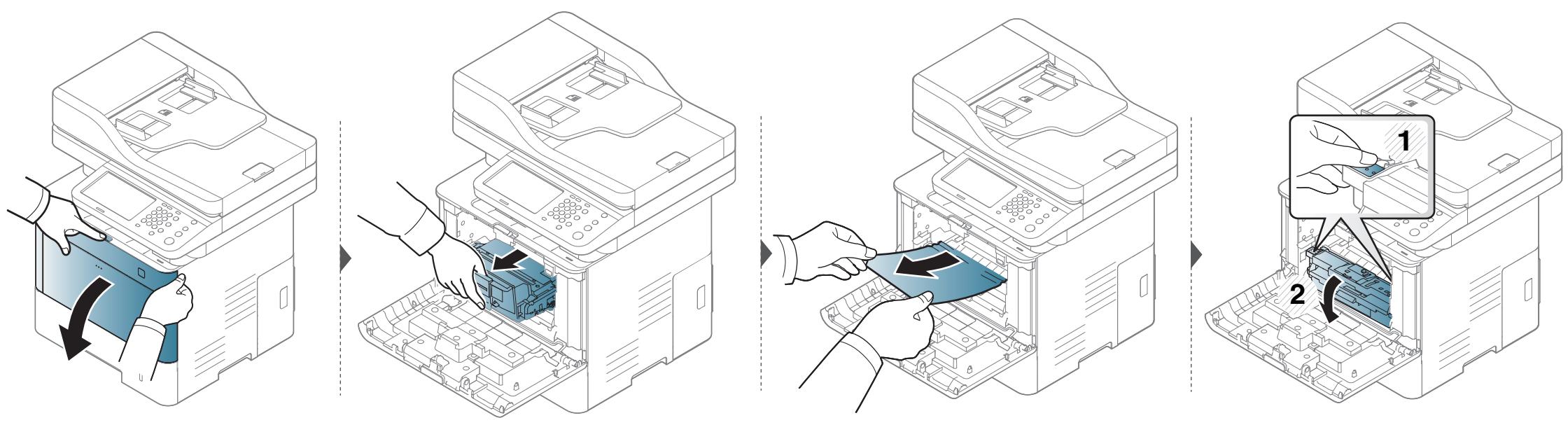
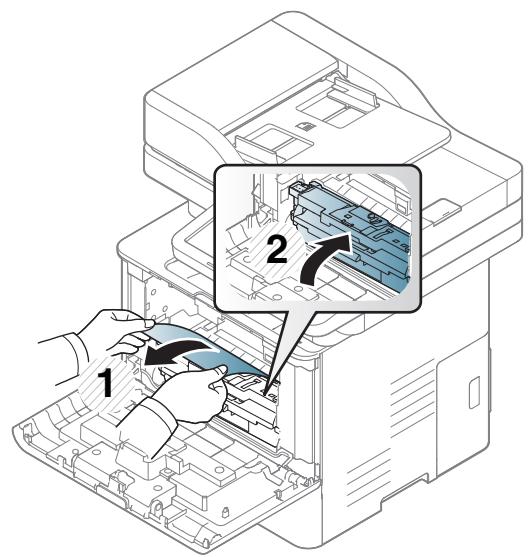
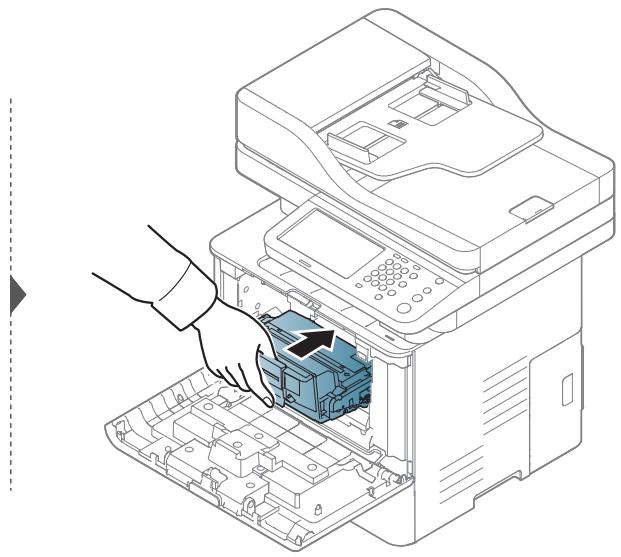
natural_image
Illustration of a printer's internal structure with a hand inserting a component into the open casing (no text or symbols visible)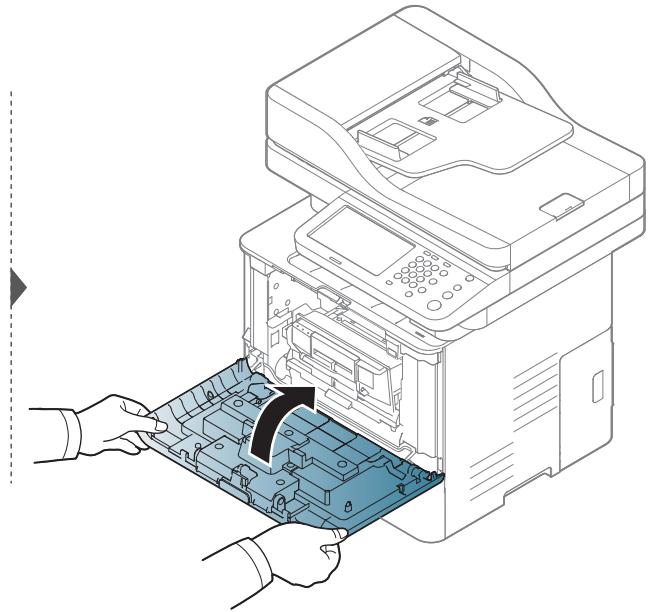
natural_image
Illustration of hands inserting a printer into a circuit board (no text or symbols visible)Clearing paper jams
If you do not see the paper in this area, stop and go to next step:
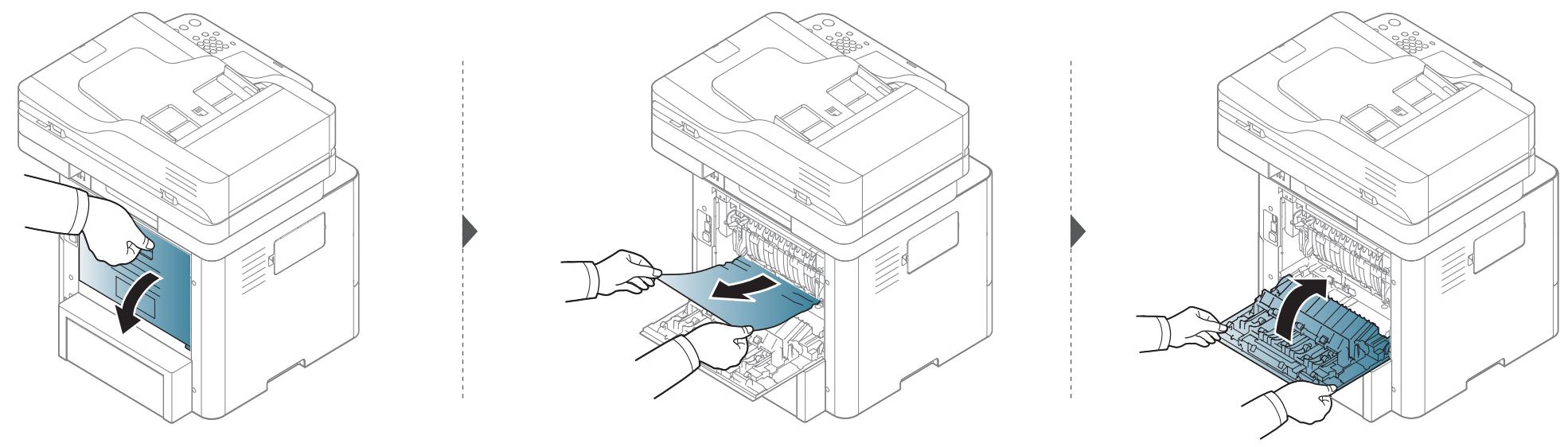
Clearing paper jams
In the exit area

The fuser area is hot. Take care when removing paper from the machine.
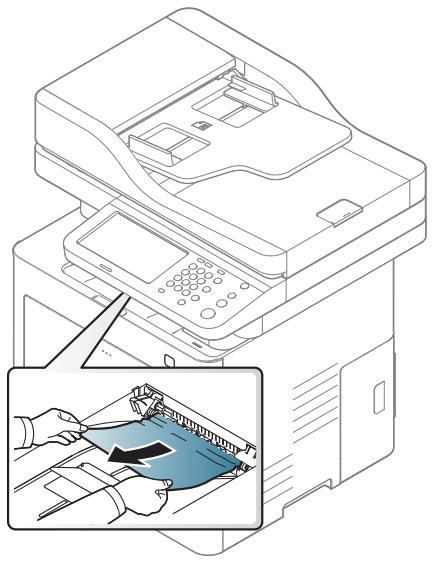
natural_image
Illustration of a printer with a close-up view showing the printer's internal structure and its application in action (no text or symbols present)Clearing paper jams
If you do not see the paper in this area, stop and go to next step:
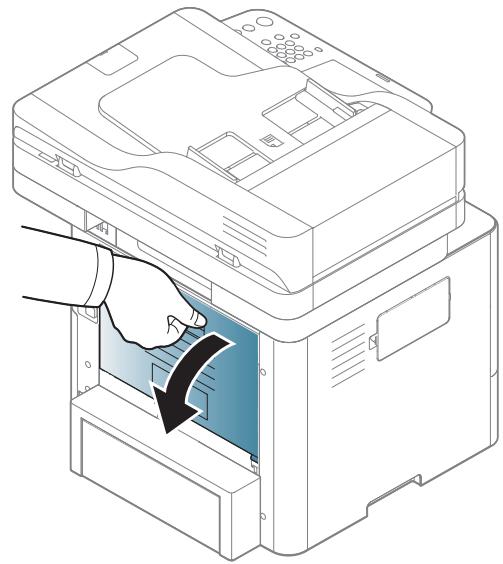
natural_image
Illustration of a printer being inserted into a paper holder, showing internal structure and a hand inserting the paper (no text or symbols present)→
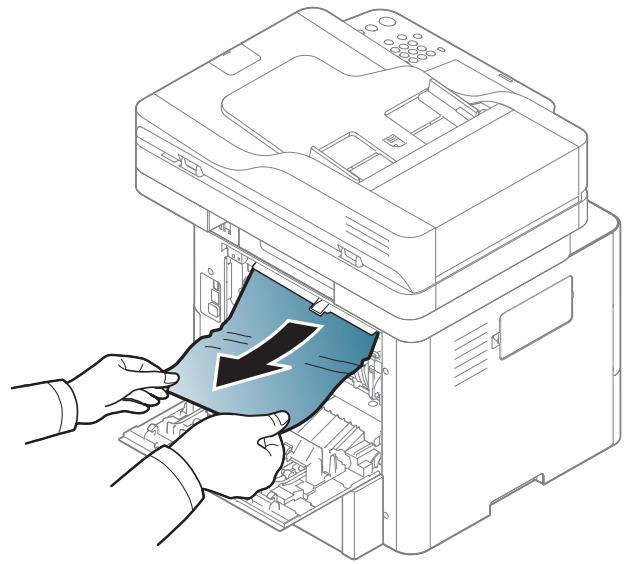
natural_image
Illustration of hands inserting a blue lightning bolt into an open printer (no text or symbols visible)→
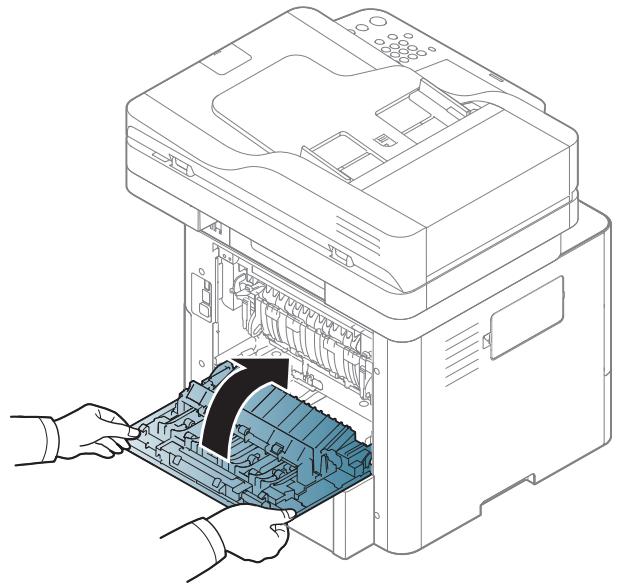
natural_image
Line drawing of a printer with hands inserting a card into the internal casing (no text or symbols)Clearing paper jams
If you do not see the paper in this area, stop and go to next step:
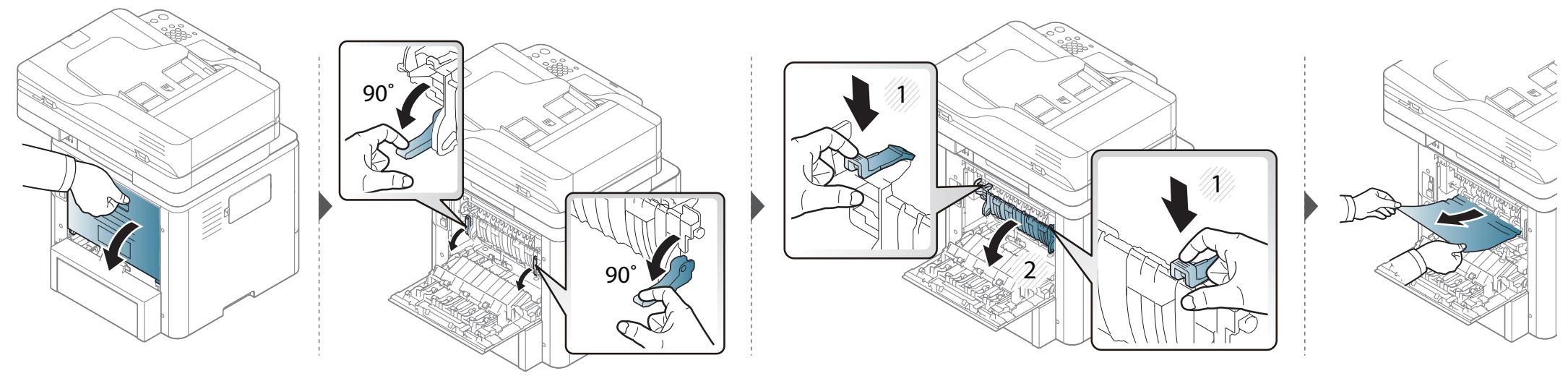
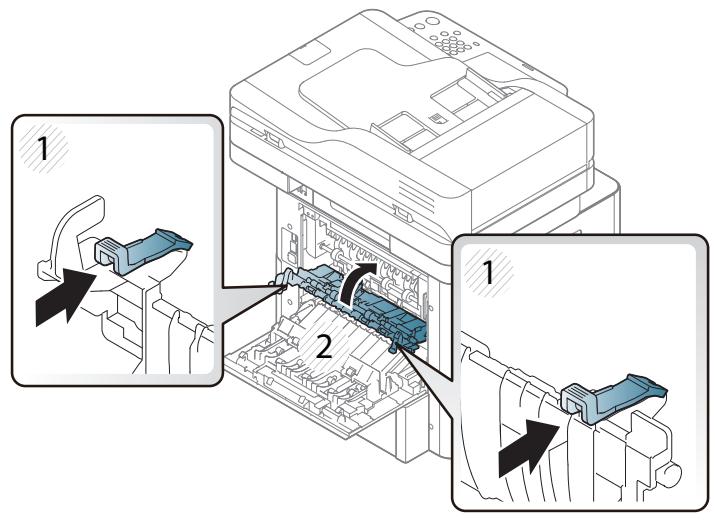
| | |
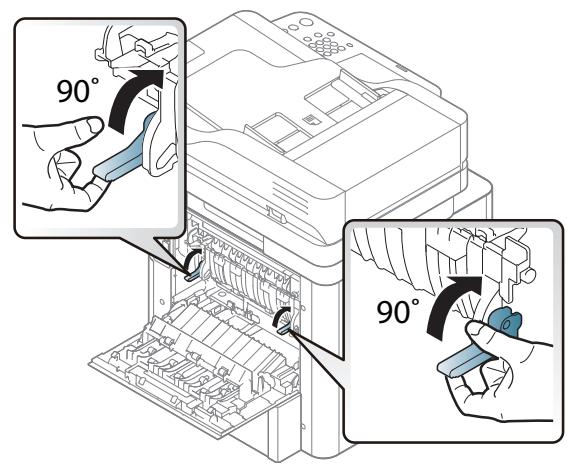
| | |
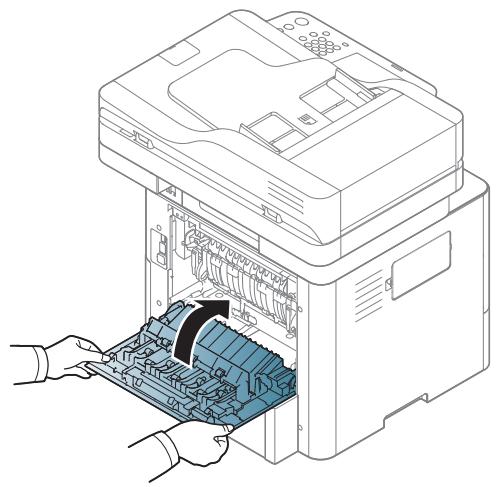
natural_image
Line drawing of a printer with hands inserting a circuit board into the open casing (no text or symbols)Clearing paper jams
In the duplex unit area
natural_image
Illustration of a hand inserting a component into a device casing (no text or symbols visible)
natural_image
Isometric view of a computer chassis with internal compartments and a black arrow pointing to a component (no text or symbols)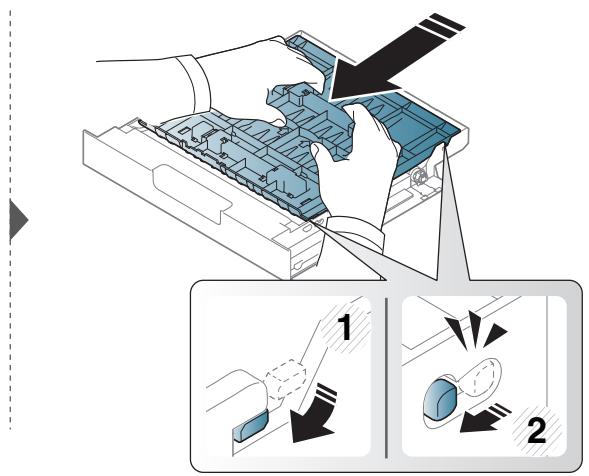
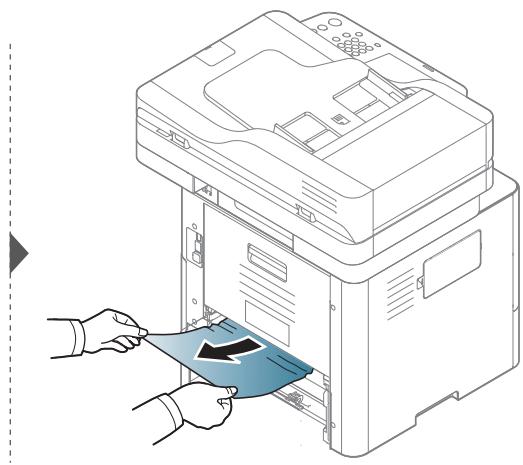
natural_image
Illustration of a printer being inserted into a paper airplane, showing hands inserting a blue card (no text or symbols present)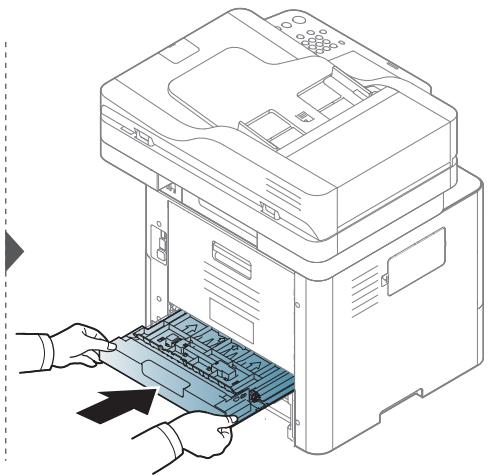
natural_image
Illustration of hands inserting a card into a printer into a circuit board (no text or symbols visible)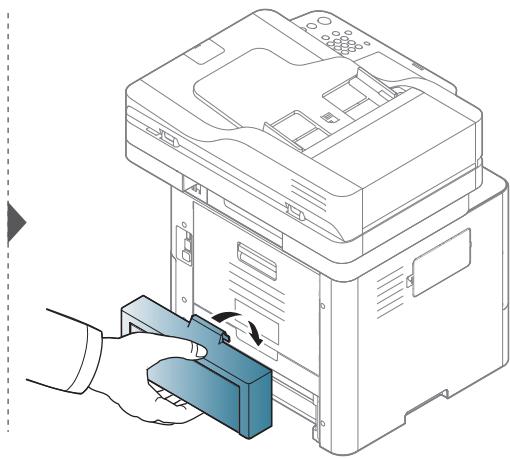
natural_image
Illustration of a printer being inserted into a box, showing mechanical components and a hand holding the device (no text or symbols present)Clearing paper jams
If you do not see the paper in this area, stop and go to next step:
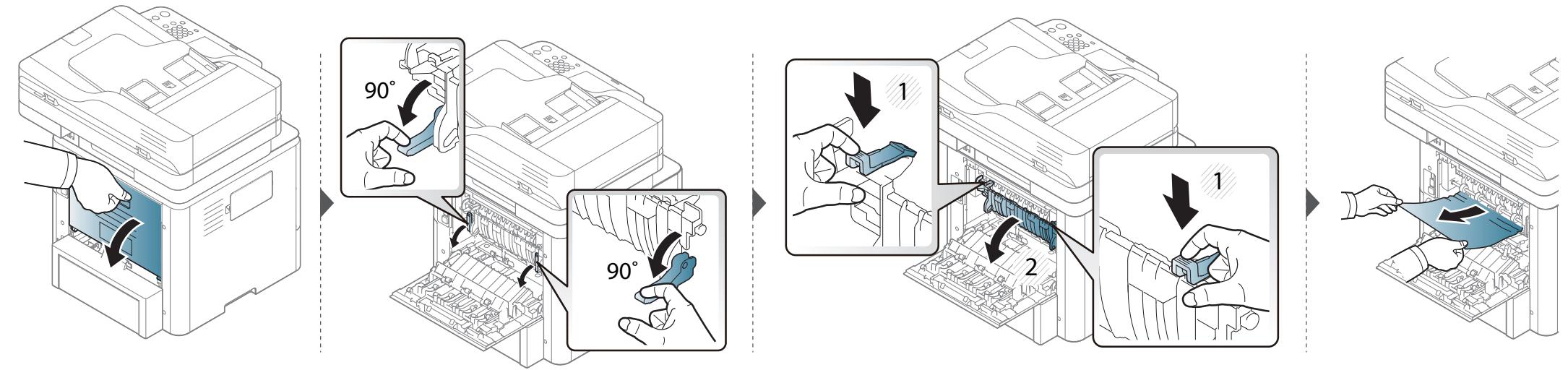
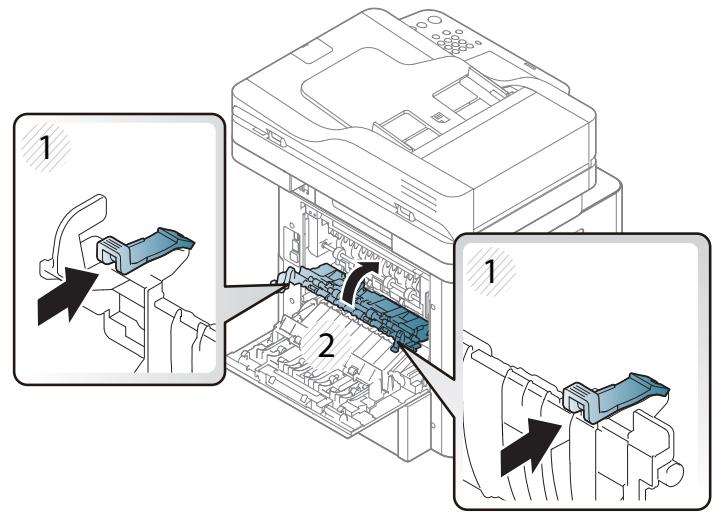
| | | | |
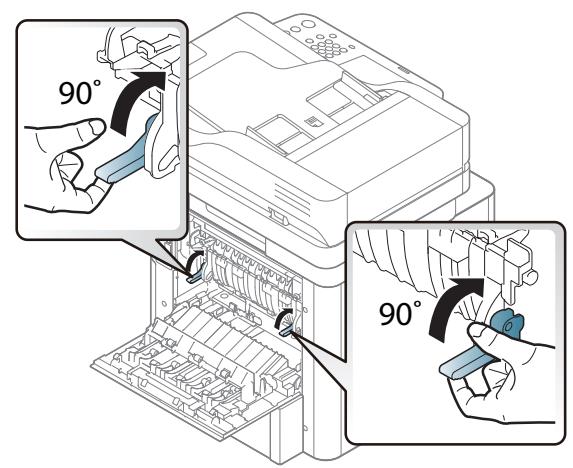
| | | | |
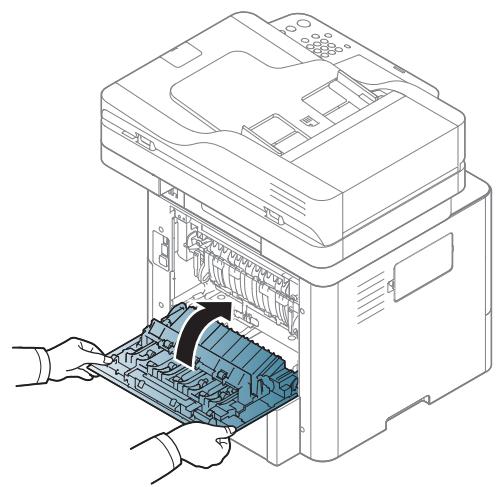
natural_image
Illustration of hands inserting a file into an open printer into a circuit board (no text or symbols visible)Clearing paper jams
Clearing original document jams

To prevent document jams, use the scanner glass for thick, thin or mixed paper originals.

To avoid tearing the document, remove the jammed document slowly and carefully.
Clearing paper jams
Original paper jam in front of scanner

- Illustrations in this user's guide may differ from your machine depending on the model and options installed. Check your machine type (see "Front view" on page 19).
- This troubleshooting may not be available depending on model or optional goods (see "Variety feature" on page 9).
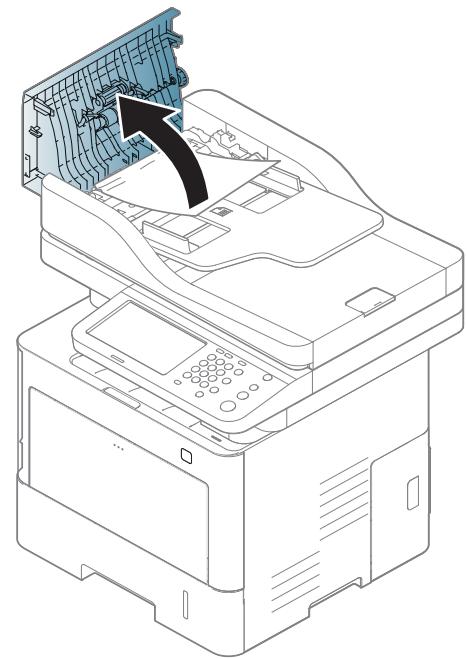
natural_image
Line drawing of a printer with an open lid showing internal components (no text or symbols)→
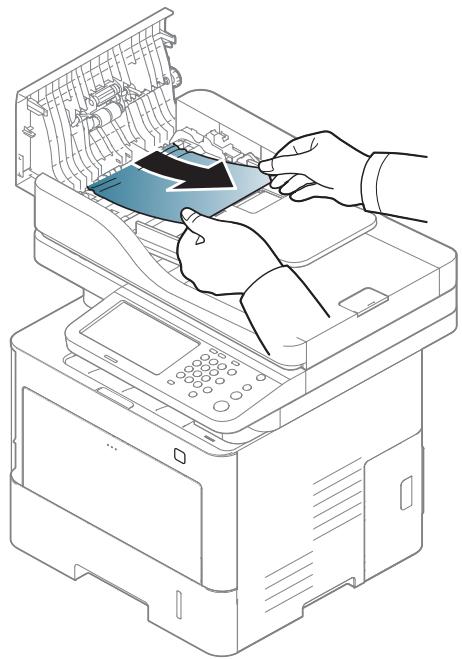
natural_image
Illustration of hands operating a printer with a blue cover, no text or symbols present→
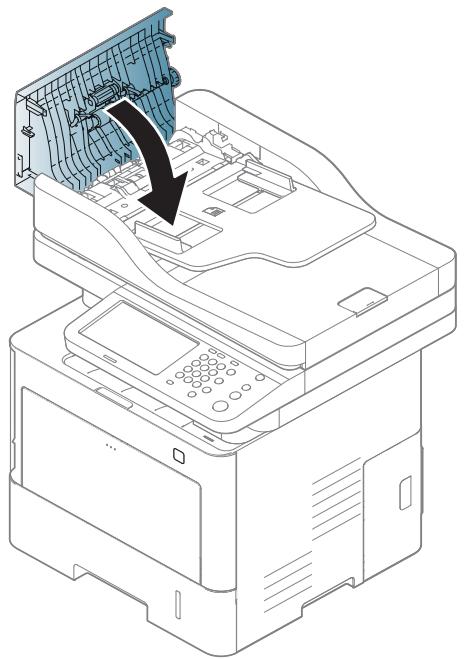
natural_image
Line drawing of a printer with internal components and a black arrow indicating a process or operation (no text or symbols present)Clearing paper jams
Original paper jam inside of scanner

- Illustrations in this user's guide may differ from your machine depending on the model and options installed. Check your machine type (see "Front view" on page 19).
- This troubleshooting may not be available depending on model or optional goods (see "Variety feature" on page 9).
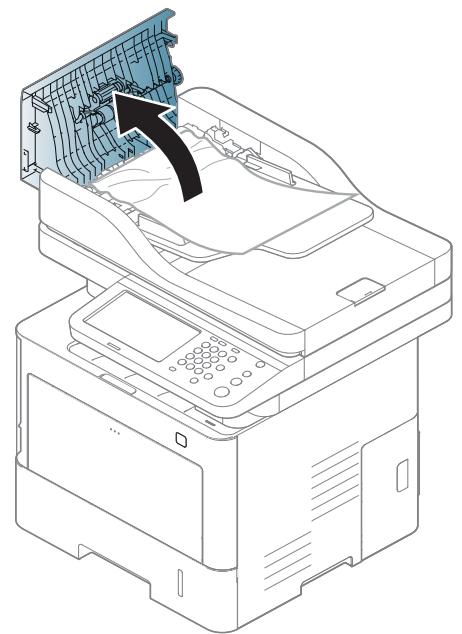
natural_image
Line drawing of a printer with a paper feed cover and an open lid, showing internal components (no text or symbols)→
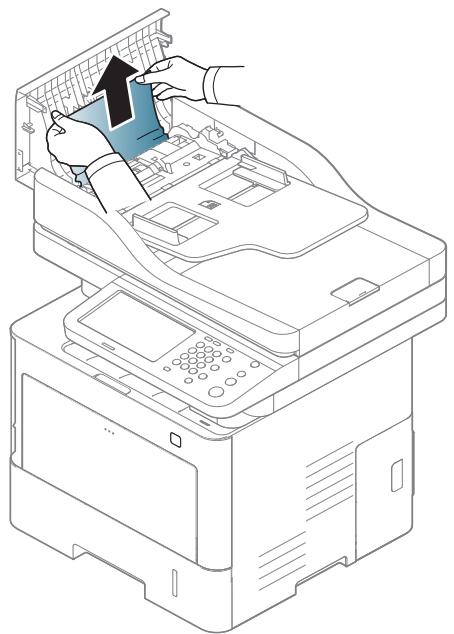
natural_image
Illustration of hands inserting a printer into an open stack top, showing internal components and a keyboard (no text or symbols)→
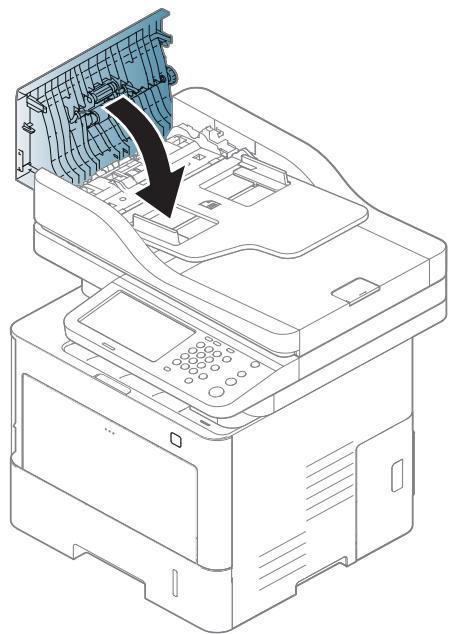
natural_image
Line drawing of a printer with internal components and a black arrow indicating a process (no text or symbols present)Clearing paper jams
If you do not see the paper in this area, stop and go to next step:
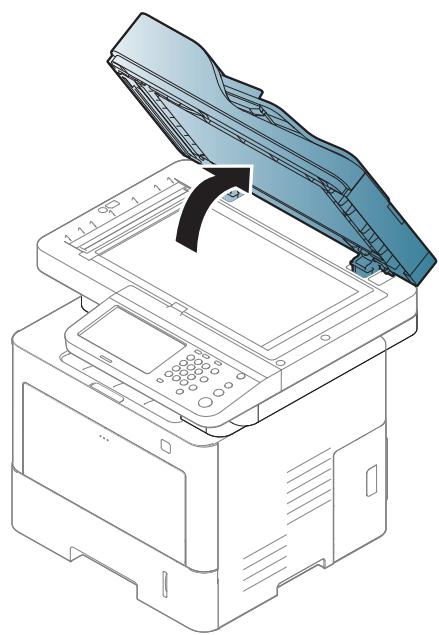
natural_image
Illustration of a printer with a lid being inserted, showing internal components and a blue cover (no text or symbols)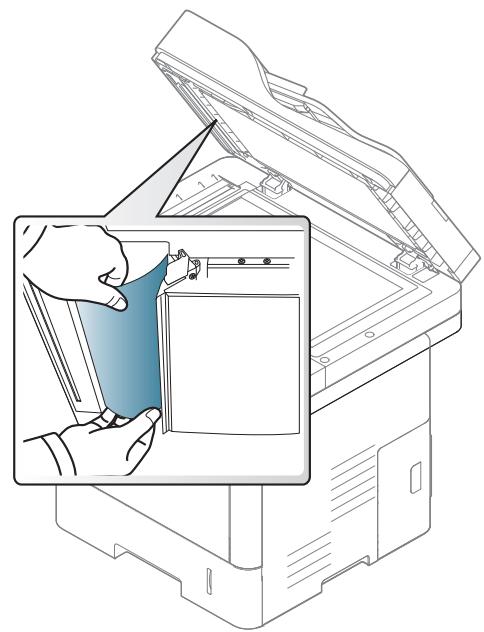
natural_image
Illustration of a printer with an open lid and a hand inserting a pen into it (no text or symbols present)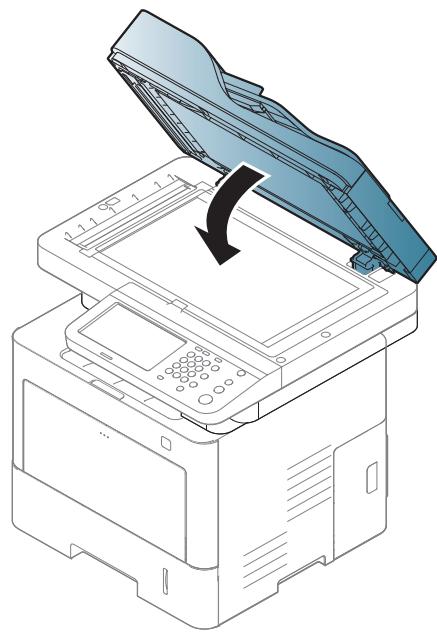
natural_image
Illustration of a printer with a paper roll being inserted, showing the printer's lid and base panel (no text or symbols)Clearing paper jams
Original paper jam in exit area of scanner

- Illustrations in this user's guide may differ from your machine depending on the model and options installed. Check your machine type (see "Front view" on page 19).
- This troubleshooting may not be available depending on model or optional goods (see "Front view" on page 19).
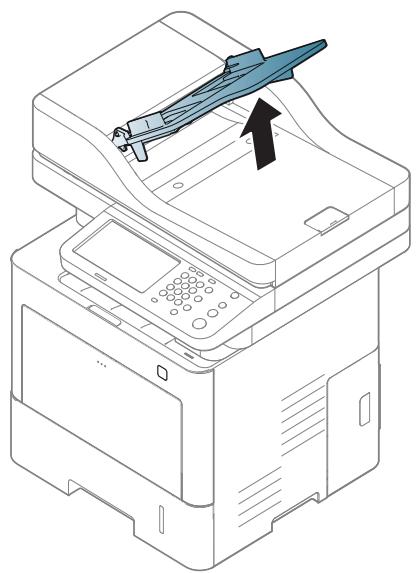
natural_image
Illustration of a printer with a paper airplane being inserted into it (no text or symbols visible)→
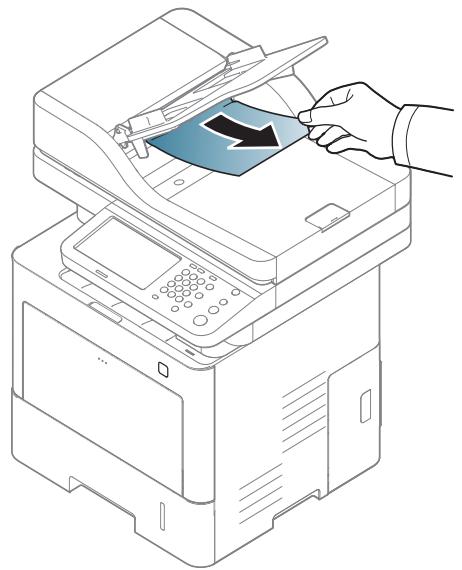
natural_image
Line drawing of a hand inserting a card into a printer (no text or symbols present)→
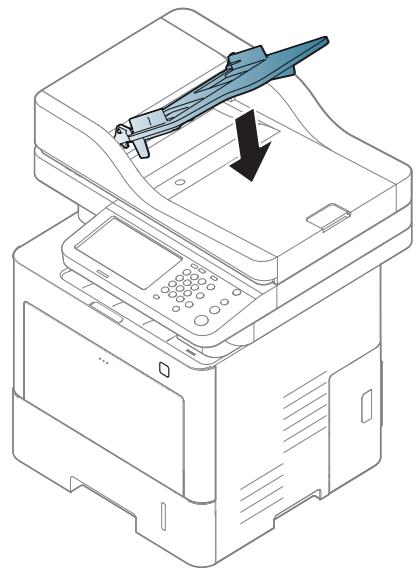
natural_image
Illustration of a printer with a paper airplane being inserted, showing internal components and a downward arrow (no text or symbols)Understanding display messages
Messages appear on the control panel display to indicate the machine's status or errors. Refer to the tables below to understand the messages' and their meaning, and correct the problem, if necessary.

- You can resolve the error with the guideline from the computer's Printing Status program window (see "Using Samsung Printer Status" on page 262).
- If a message is not in the table, reboot the power and try the printing job again. If the problem persists, call a service representative.
- When you call for service, provide the service representative with the contents of display message.
- Some messages may not appear on the display depending on the options or models.
• [error number] indicates the error number.
• [tray type] indicates the tray number.
Paper Jam-related messages
| Message | Meaning | Suggested solutions |
| Paper jam inside of duplex path. Please remove the paperPaper jam at the top of duplex path. Please remove the paperPaper jam at the bottom of duplex path. Please remove the paper | Paper has jammed during duplex printing. This is applicable only to machines with this feature. | Clear the jam (see "In the duplex unit area" on page 308). |
| Paper jam in exit area. Please remove the paper | Paper has jammed in the paper exit area. | Clear the jam (see "In the exit area" on page 305). |
| Paper jam inside of machine. Please remove the paper | Paper has jammed inside the machine. | Clear the jam (see "Inside the machine" on page 302). |
| Original paper jam in front of the scannerOriginal paper jam inside the scanner | The loaded original document has jammed in document feeder. | Clear the jam (see "Clearing original document jams" on page 310). |
| Paper jam in tray 1. Please remove the paper | Paper has jammed in the tray. | Clear the jam (see "In tray1" on page 296). |
Understanding display messages
| Message | Meaning | Suggested solutions |
| Paper Jam in tray 2.Please open the door and remove paper, then close the door.Paper Jam in tray 3.Please open the door and remove paper, then close the door.Paper Jam in tray 4.Please open the door and remove paper, then close the door. | Paper has jammed in the optional tray. | Clear the jam (see "In optional trays" on page 298). |
| Paper Jam in MP tray.Please remove the paper | Paper has jammed in the multi-purpose tray. | Clear the jam (see "In the multi-purpose tray" on page 301). |
Toner-related messages
| Message | Meaning | Suggested solutions |
| Toner cartridge is not installed. Install itInstall black toner cartridge | A toner cartridge is not installed. | Reinstall the toner cartridge. |
| A toner cartridge is not being detected | Reinstall the toner cartridge two or three times to confirm it is seated properly. If the problem persists, please call for service. | |
| Not removed protective film from toner. | Remove the protective film from the toner cartridge. Refer to Quick Installation Guide provided with your machine. | |
| Toner cartridge is not compatible. Check the user guideBlack toner cartridge is not compatible. Check the user guide | The indicated toner cartridge is not suitable for your machine. | Install the corresponding toner cartridge with a Samsung-genuine cartridge (see "Replacing the toner cartridge" on page 279). |
| Toner Cartridge Failure [error number]. Call for service | There is a problem in the toner cartridge. | Unplug the power cord and plug it back in. If the problem persists, call for service. |
Understanding display messages
| Message | Meaning | Suggested solutions |
| Prepare new toner cartridgePrepare new black toner cartridge | The estimated life of the toner cartridge is close. | Prepare a new toner cartridge for a replacement. You may temporarily increase the printing quality by redistributing the toner (see "Redistributing toner" on page 277). |
| Replace with new toner cartridgeReplace with new black toner cartridge | The indicated toner cartridge has almost reached its estimated cartridge life^a . | You can chooseStoporContinueas shown on the control panel. If you selectStop, the printer stops printing. If you selectContinue, the printer keeps printing but the printing quality cannot be guaranteed.Replace the toner cartridge for the best print quality when this message appears. Using a cartridge beyond this stage can result in printing quality issues (see "Replacing the toner cartridge" on page 279). If the machine stops printing, replace the toner cartridge (see "Replacing the toner cartridge" on page 279). |
| End of life,Replace with new toner cartridge | The indicated toner cartridge has reached its estimated cartridge life^a . | Replace the toner cartridge with a Samsung-genuine toner cartridge (see "Replacing the toner cartridge" on page 279). |
a. Estimated cartridge life means the expected or estimated toner cartridge life, which indicates the average capacity of print-outs and is designed pursuant to ISO/IEC 19752 (see "Available consumables" on page 272). The number of pages may be affected by operating environment, percentage of image area, printing interval, media, percentage of image area, and media size. Some amount of toner may remain in the cartridge even when replace new cartridge appears and the machine stops printing.

Samsung does not recommend using a non-genuine Samsung toner cartridge such as refilled or remanufactured. Samsung cannot guarantee a non-genuine Samsung toner cartridge's quality. Service or repair required as a result of using non-genuine Samsung toner cartridges will not be covered under the machine warranty.
Tray-related messages
| Message | Meaning | Suggested solutions |
| Paper in output bin is full.Remove printed paper | The output tray is full. | Remove papers from the output tray, the printer resumes printing. |
| Paper is empty in [tray type]. Load paper | There is no paper in the indicated tray. | Load paper in the tray (see "Loading paper in the tray" on page 68). |
Understanding display messages
| Message | Meaning | Suggested solutions |
| Paper is empty in all tray.Load paper | There is no paper in all tray. | Load paper in the tray (see "Loading paper in the tray" on page 68). |
| Paper is empty in MP tray.Load paper | There is no paper in the multi-purpose tray. | Load paper in the multi-purpose tray (see "Loading paper in the tray" on page 68). |
| Paper is low in [tray type]. Load paper | Running out of paper in the tray. | Load paper in the tray. |
| • Paper Mismatch• MP Tray Paper Mismatch• Tray1 Paper Mismatch• Tray2 Paper Mismatch• Tray3 Paper Mismatch• Tray4 Paper Mismatch | The paper size specified in the printer properties does not match the paper you are loading. | You can select the option between Continue or Cancel. If you select Cancel, the printing job will stop.Load the correct paper in the tray. If you select Continue, printing job will continue. |
| [Tray type] cassette is pulled out. Insert it properly | The tray is not securely latched. | Close the tray until it locks into place. |
| Message | Meaning | Suggested solutions |
| Tray Failure [error number]: Pull [tray type] out and insert it. Call for service if the problem persistsTray Failure [error number]: Check [tray type] connection and turn off then on. Call for service if the problem persists | There is a problem in the tray. | Unplug the power cord and plug it back in. If the problem persists, call for service. |
Network-related messages
| Message | Meaning | Suggested solutions |
| This IP address conflicts with that of other system. Check it | The network IP address you have set is being used by someone else. | Check the IP address and reset it if necessary. |
| 802.1x authentication failed. Please Contact the System Administrator | Fail to authenticate. | Check the network authentication protocol. If the problem persists, contact your network administrator. |
Understanding display messages
| Message | Meaning | Suggested solutions |
| Network cable is disconnected. Check it | The machine is not connected with a network cable. | Connect the machine to the network with a network cable. |
Misc. messages
| Message | Meaning | Suggested solutions |
| Door is open. Close itFront door is open. Close it | The front cover or rear cover is not securely latched. | Close the cover until it locks into place. |
| Engine Failure: [error number]. Call for service if the problem persists | There is a problem in the system. | Unplug the power cord and plug it back in. If the problem persists, call for service. |
| HDD System Failure: [error number].Turn off then on. Call for service if the problem persists | ||
| Video System Failure: [error number].Turn off then on. Call for service if the problem persists |
| Message | Meaning | Suggested solutions |
| System Fan Failure:[error number]. Turn off then on. Call for service if the problem persistsSMPS Fan Failure:[error number]. Turn off then on. Call for service if the problem persistsFuser Fan Failure:[error number]. Turn off then on. Call for service if the problem persists | There is a problem in the fan system. | Reboot the power. If the problem persists, please call for service. |
| Fax memory is almost full.Print or remove received fax job | The memory is almost full. No more fax data can be received. | Print or remove the received fax data in the memory. |
| Fax memory is full. Print or remove received fax job | The memory is full. No more fax data can be received. | Print or remove the received fax data in the memory. |
| Fuser Unit Failure:[error number]. Turn off then on. Call for service if the problem persists | There is a problem in the fuser unit. | Reboot the power. If the problem persists, please call for service. |
Understanding display messages
| Message | Meaning | Suggested solutions |
| LSU Failure: [error number]. Turn off then on. Call for service if the problem persists | There is a problem in the LSU. | Reboot the power. If the problem persists, please call for service. |
| Main Motor Failure: [error number]. Turn off then on. Call for service if the problem persistsFuser Motor Failure: [error number]. Turn off then on. Call for service if the problem persistsOPC Motor Failure: [error number]. Turn off then on. Call for service if the problem persists | There is a problem in the motor system. | Reboot the power. If the problem persists, please call for service. |
| Prepare new fuser unit | The estimated life of the fuser unit is close. | Prepare a new fuser unit for replacement, please call for service. |
| Replace with new fuser unit | The life of the fuser unit has expired. | Replace the fuser unit with a new one. If the problem persists, please call for service. |
| Message | Meaning | Suggested solutions |
| Temperature Sensor Failure: [error number]. Turn off then on. Call for service if the problem persists | There is a problem in the sensor. | Reboot the power. If the problem persists, please call for service. |
| Scanner is locked. Please try to release scanner lock | The scanner is locked. | Reboot the power. If the problem persists, please call for service. |
| The room temperature is not suitable for this set use. Please adjust room temperature | The machine is in a room with improper room temperature. | Move the machine to a room with proper room temperature (see "Specifications" on page 344) |
| Door of scanner is open | The document feeder cover is not securely latched. | Close the cover until it locks into place. |
| Original paper is too long for scanner. Check size. | Original paper size is too long for scanner. | Check original size. |
Paper feeding problems
| Condition | Suggested solutions |
| Paper jams during printing. | Clear the paper jam. |
| Paper sticks together. | Check the maximum paper capacity of the tray.Make sure that you are using the correct type of paper.Remove paper from the tray and flex or fan the paper.Humid conditions may cause some paper to stick together. Flex or fan the edge of the paper stack to separate the pages before loading papers. |
| Multiple sheets of paper do not feed. | Different types of paper may be stacked in the tray. Load paper of only one type, size, and weight. |
| Paper does not feed into the machine. | Remove any obstructions from inside the machine.Paper has not been loaded correctly. Remove paper from the tray and reload it correctly.There is too much paper in the tray. Remove excess paper from the tray.The paper is too thick. Use only paper that meets the specifications required by the machine. |
| The paper keeps jamming. | There is too much paper in the tray. Remove excess paper from the tray. If you are printing on special materials, use the manual feeding in tray.An incorrect type of paper is being used. Use only paper that meets the specifications required by the machine.There may be debris inside the machine. Open the front cover and remove any debris. |
| Envelopes skew or fail to feed correctly. | Ensure that the paper guides are against both sides of the envelopes. |
Power and cable connecting problems
Reboot the power. If the problem persists, please call for service.
| Condition | Suggested solutions |
| The machine is not receiving power, or the connection cable between the computer and the machine is not connected properly. | 1 Connect the machine to the electricity supply first.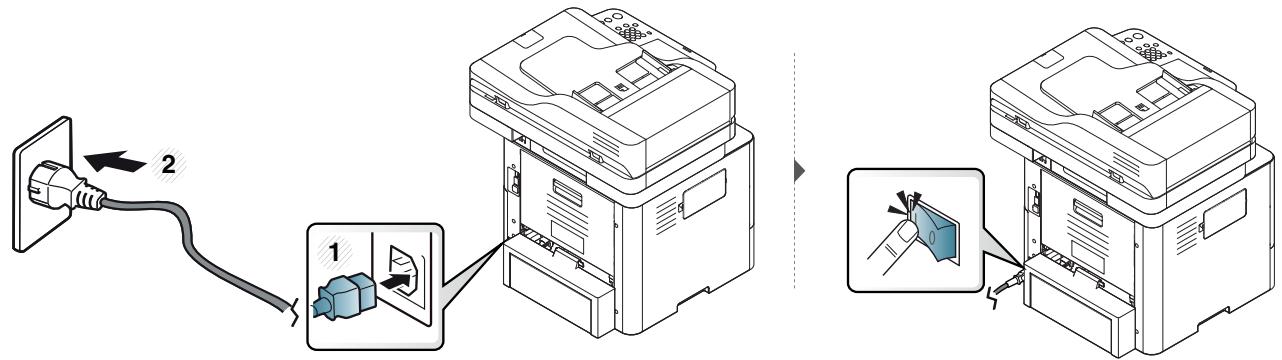 2 Check the USB cable or network cable in the machine's rear. 2 Check the USB cable or network cable in the machine's rear.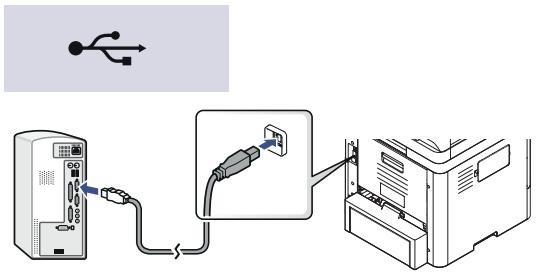 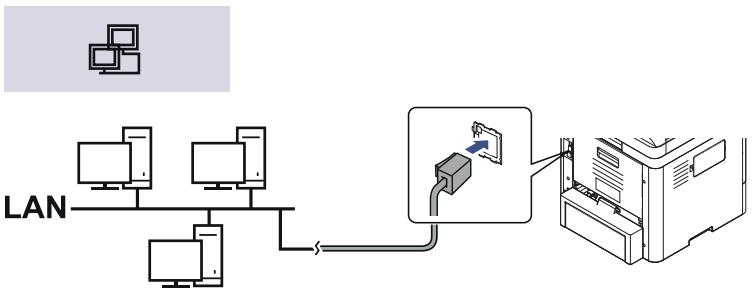 3 Disconnect the USB cable or network cable in the machine's rear and then, reconnect it. 3 Disconnect the USB cable or network cable in the machine's rear and then, reconnect it. |
Printing problems
| Condition | Possible cause | Suggested solutions |
| The machine does not print. | The machine is not receiving power. | Connect the machine to the electricity supply first (see "Turning on the machine" on page 22). |
| The machine is not selected as the default machine. | Select your machine as your default machine in Windows. | |
| Check the machine for the following:· The cover is not closed. Close the cover.· Paper is jammed. Clear the paper jam (see "Clearing paper jams" on page 296).· No paper is loaded. Load paper (see "Loading paper in the tray" on page 68).· The toner cartridge is not installed. Install the toner cartridge (see "Replacing the toner cartridge" on page 279).· Make sure the protect cover and sheets are removed from the toner cartridge (see "Replacing the toner cartridge" on page 279).If a system error occurs, contact your service representative. | ||
| The connection cable between the computer and the machine is not connected properly. | Disconnect the machine cable and reconnect it (see "Rear view" on page 20). | |
| The connection cable between the computer and the machine is defective. | If possible, attach the cable to another computer that is working properly and print a job.You can also try using a different machine cable. | |
| The port setting is incorrect. | Check the Windows printer settings to make sure that the print job is sent to the correct port. If the computer has more than one port, make sure that the machine is attached to the correct one. | |
| The machine may be configured incorrectly. | Check the Printing Preferences to ensure that all of the print settings are correct. | |
| The printer driver may be incorrectly installed. | Uninstall and reinstall the machine's driver. | |
| The machine is malfunctioning. | Check the display message on the control panel to see if the machine is indicating a system error. Contact a service representative. | |
| The document size is so big that the hard disk space of the computer is insufficient to access the print job. | Get more hard disk space and print the document again. | |
| The output tray is full. | Once the paper is removed from the output tray, the machine resumes printing. | |
Printing problems
| Condition | Possible cause | Suggested solutions |
| The machine selects print materials from the wrong paper source. | The paper option that was selected in the Printing Preferences may be incorrect. | For many software applications, the paper source selection is found under the Paper tab within the Printing Preferences (see "Opening printing preferences" on page 84). Select the correct paper source. See the printer driver help screen (see "Using help" on page 90). |
| A print job is extremely slow. | The job may be very complex. | Reduce the complexity of the page or try adjusting the print quality settings. |
| Half the page is blank. | The page orientation setting may be incorrect. | Change the page orientation in your application (see "Opening printing preferences" on page 84). See the printer driver help screen (see "Using help" on page 90). |
| The paper size and the paper size settings do not match. | Ensure that the paper size in the printer driver settings matches the paper in the tray. Or, ensure that the paper size in the printer driver settings matches the paper selection in the software application settings you use (see "Opening printing preferences" on page 84). | |
| The machine prints, but the text is wrong, garbled, or incomplete. | The machine cable is loose or defective. | Disconnect the machine cable and reconnect. Try a print job that you have already printed successfully. If possible, attach the cable and the machine to another computer that you know works and try a print job. Finally, try a new machine cable. |
| The wrong printer driver was selected. | Check the application's printer selection menu to ensure that your machine is selected. | |
| The software application is malfunctioning. | Try printing a job from another application. | |
| The operating system is malfunctioning. | Exit Windows and reboot the computer. Turn the machine off and back on again. | |
| Pages print, but they are blank. | The toner cartridge is defective or out of toner. | Redistribute the toner, if necessary. If necessary, replace the toner cartridge. See "Redistributing toner" on page 277. See "Replacing the toner cartridge" on page 279. |
| The file may have blank pages. | Check the file to ensure that it does not contain blank pages. | |
| Some parts, such as the controller or the board, may be defective. | Contact a service representative. |
Printing problems
| Condition | Possible cause | Suggested solutions |
| The machine does not print PDF files correctly. Some parts of graphics, text, or illustrations are missing. | Incompatibility between the PDF file and the Acrobat products. | Printing the PDF file as an image may enable the file to print. Turn on Print As Image from the Acrobat printing options. It will take longer to print when you print a PDF file as an image. It will take longer to print when you print a PDF file as an image. |
| The print quality of photos is not good. Images are not clear. | The resolution of the photo is very low. | Reduce the photo size. If you increase the photo size in the software application, the resolution will be reduced. |
| Before printing, the machine emits vapor near the output tray. | Using damp/wet paper can cause vapor [white smoke] during printing. | This is not a problem, just keep printing. If you are bothered by the smoke [vapor], then replace the paper with fresh paper from an unopened ream. |
| The machine does not print special-sized paper, such as billing paper. | Paper size and paper size setting do not match. | Set the correct paper size in the Custom in Paper tab in Printing Preferences (see "Opening printing preferences" on page 84). |
| The printed billing paper is curled. | The paper type setting does not match. | Change the printer option and try again. Go to Printing Preferences, click Paper tab, and set type to Thin (see "Opening printing preferences" on page 84). |
Printing quality problems
If the inside of the machine is dirty or paper has been loaded improperly, there might be a reduction in print quality. See the table below to clear the problem.
| Condition | Suggested solutions |
| Light or faded printAaBbCcAaBbCcAaBbCcAaBbCcAaBbCc | If a vertical white streak or faded area appears on the page, the toner supply is low. Install a new toner cartridge (see "Replacing the toner cartridge" on page 279).The paper may not meet paper specifications; for example, the paper may be too moist or rough.If the entire page is light, the print resolution setting is too low or the toner save mode is on. Adjust the print resolution and turn the toner save mode off. See the help screen of the printer driver.A combination of faded or smeared defects may indicate that the toner cartridge needs cleaning. Clean the inside of your machine (see "Cleaning the machine" on page 287).The surface of the LSU part inside the machine may be dirty. Clean the inside of your machine (see "Cleaning the machine" on page 287). If these steps do not correct the problem, contact a service representative. |
| The top half of the paper is printed lighter than the rest of the paperAaBbCcAaBbCcAaBbCcAaBbCcAaBbCc | The toner might not adhere properly to this type of paper.Change the printer option and try again. Go to Printing Preferences, click the Paper tab, and set the paper type to Recycled (see "Opening printing preferences" on page 84). |
Printing quality problems
| Condition | Suggested solutions |
Toner specks | The paper may not meet specifications; for example, the paper may be too moist or rough.The transfer roller may be dirty. Clean the inside of your machine (see "Cleaning the machine" on page 287).The paper path may need cleaning. Contact a service representative (see "Cleaning the machine" on page 287). |
Dropouts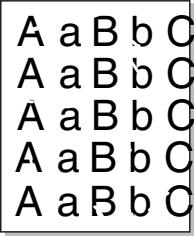 | If faded areas, generally rounded, occur randomly on the page:A single sheet of paper may be defective. Try reprinting the job.The moisture content of the paper is uneven or the paper has moist spots on its surface. Try a different brand of paper.The paper lot is bad. The manufacturing processes can cause some areas to reject toner. Try a different kind or brand of paper.Change the printer option and try again. Go to Printing Preferences, click the Paper tab, and set type to Thick (see "Opening printing preferences" on page 84).If these steps do not correct the problem, contact a service representative. |
White Spots | If white spots appear on the page:The paper is too rough and a lot of dirt from paper falls to the inner components within the machine, so the transfer roller may be dirty. Clean the inside of your machine (see "Cleaning the machine" on page 287).The paper path may need cleaning. Clean the inside of your machine (see "Cleaning the machine" on page 287).If these steps do not correct the problem, contact a service representative. |
Printing quality problems
| Condition | Suggested solutions |
| Vertical lines | If black vertical streaks appear on the page:The surface (drum part) of the toner cartridge inside the machine has probably been scratched. Remove the toner cartridge and install a new one (see "Replacing the toner cartridge" on page 279).If white vertical streaks appear on the page:The surface of the LSU part inside the machine may be dirty. Clean the inside of your machine (see "Cleaning the machine" on page 287). If these steps do not correct the problem, contact a service representative. |
| Black or color background | If the amount of background shading becomes unacceptable:Change to a lighter weight paper.Check the environmental conditions: very dry conditions or a high level of humidity (higher than 80% RH) can increase the amount of background shading.Remove the old toner cartridge and install a new one (see "Replacing the toner cartridge" on page 279).Thoroughly redistribute the toner (see "Redistributing toner" on page 277). |
| Toner smear | Clean the inside of the machine (see "Cleaning the machine" on page 287).Check the paper type and quality.Remove the toner cartridge and install a new one (see "Replacing the toner cartridge" on page 279). |
Printing quality problems
| Condition | Suggested solutions |
Vertical repetitive defects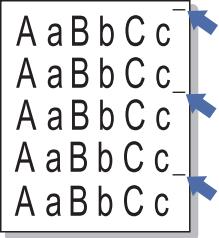 | If marks repeatedly appear on the printed side of the page at even intervals:The toner cartridge may be damaged. If you still have the same problem, remove the toner cartridge and, install a new one (see "Replacing the toner cartridge" on page 279).Parts of the machine may have toner on them. If the defects occur on the back of the page, the problem will likely correct itself after a few more pages.The fusing assembly may be damaged. Contact a service representative. |
Background scatter | Background scatter results from bits of toner randomly distributed on the printed page.The paper may be too damp. Try printing with a different batch of paper. Do not open packages of paper until necessary so that the paper does not absorb too much moisture.If background scatter occurs on an envelope, change the printing layout to avoid printing over areas that have overlapping seams on the reverse side. Printing on seams can cause problems.Or selectThickfrom thePrinting Preferenceswindow (see "Opening printing preferences" on page 84).If background scatter covers the entire surface area of a printed page, adjust the print resolution through your software application or inPrinting Preferences(see "Opening printing preferences" on page 84). Ensure the correct paper type is selected. For example: If Thicker Paper is selected, but Plain Paper actually used, an overcharging can occur causing this copy quality problem.If you are using a new toner cartridge, redistribute the toner first (see "Redistributing toner" on page 277). |
Toner particles are around bold characters or pictures | The toner might not adhere properly to this type of paper.Change the printer option and try again. Go toPrinting Preferences, click the Papertab, and set the paper type toRecycled(see "Opening printing preferences" on page 84).Ensure the correct paper type is selected. For example: If Thicker Paper is selected, but Plain Paper actually used, an overcharging can occur causing this copy quality problem. |
Printing quality problems
| Condition | Suggested solutions |
Misformed characters | ·If characters are improperly formed and producing hollow images, the paper stock may be too slick. Try different paper. |
Page skew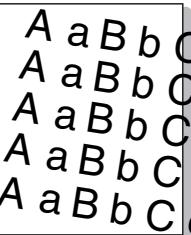 | ·Ensure that the paper is loaded properly.·Check the paper type and quality.·Ensure that the guides are not too tight or too loose against the paper stack. |
Curl or wave | ·Ensure that the paper is loaded properly.·Check the paper type and quality. Both high temperature and humidity can cause paper curl.·Turn the stack of paper over in the tray. Also try rotating the paper 180° in the tray. |
Printing quality problems
| Condition | Suggested solutions |
Wrinkles or creases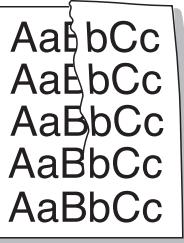 | ·Ensure that the paper is loaded properly.·Check the paper type and quality.·Turn the stack of paper over in the tray. Also try rotating the paper 180° in the tray. |
Back of printouts are dirty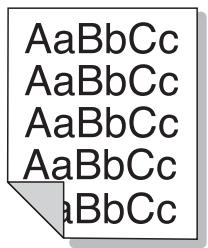 | ·Check for leaking toner. Clean the inside of the machine (see "Cleaning the machine" on page 287). |
Solid color or black pages | ·The toner cartridge may not be installed properly. Remove the cartridge and reinsert it.·The toner cartridge may be defective. Remove the toner cartridge and install a new one (see "Replacing the toner cartridge" on page 279).·The machine may require repairing. Contact a service representative. |
Printing quality problems
| Condition | Suggested solutions |
Loose toner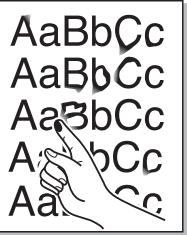 | Clean the inside of the machine (see "Cleaning the machine" on page 287).Check the paper type, thickness, and quality.Remove the toner cartridge and then, install a new one (see "Replacing the toner cartridge" on page 279).If the problem persists, the machine may require repair. Contact a service representative. |
Character voids | Character voids are white areas within parts of characters that should be solid black:You may be printing on the wrong surface of the paper. Remove the paper and turn it around.The paper may not meet paper specifications. |
Horizontal stripes | If horizontally aligned black streaks or smears appear:The toner cartridge may be installed improperly. Remove the cartridge and reinsert it.The toner cartridge may be defective. Remove the toner cartridge and install a new one (see "Replacing the toner cartridge" on page 279).If the problem persists, the machine may require repairing. Contact a service representative. |
Printing quality problems
| Condition | Suggested solutions |
Curl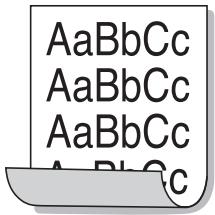 | If the printed paper is curled or paper does not feed into the machine:Turn the stack of paper over in the tray. Also try rotating the paper 180° in the tray.Change the printer's paper option and try again. Go to Printing Preferences, click the Paper tab, and set type to Thin (see "Opening printing preferences" on page 84). |
| An unknown image repetitively appears on a few sheetsLoose tonerLight print or contamination occurs | Your machine is probably being used at an altitude of 1,000 m (3,281 ft) or above.The high altitude may affect the print quality, such as loose toner or light imaging. Change the altitude setting for your machine (see "General Settings" on page 222). |
Copying problems
| Condition | Suggested solutions |
| Copies are too light or too dark. | Adjust the darkness in copy feature to lighten or darken the backgrounds of copies. |
| Smears, lines, marks, or spots appear on copies. | If the defects are on the original, adjust darkness in copy feature to lighten the background of your copies.If there are no defects on the original, clean the scan unit (see "Cleaning the scan unit" on page 291). |
| Copy image is skewed. | Ensure that the original is aligned with the registration guide.The transfer roller may be dirty. Clean the inside of your machine (see "Cleaning the machine" on page 287). |
| Blank copies print out. | Ensure that the original is face down on the scanner glass or face up in the document feeder.If these steps do not correct the problem, contact a service representative. |
| Image rubs off the copy easily. | Replace the paper in the tray with paper from a new package.In high humidity areas, do not leave paper in the machine for extended periods of time. |
| Frequent copy paper jams occur. | Fan the paper, then turn it over in the tray. Replace the paper in the tray with a fresh supply. Check/adjust the paper guides, if necessary.Ensure that the paper is the proper type and weight (see "Print media specifications" on page 346).Check for copy paper or pieces of copy paper remaining in the machine after a paper jam has been cleared. |
| Toner cartridge produces fewer copies than expected before running out of toner. | Your originals may contain pictures, solids, or heavy lines. For example, your originals may be forms, newsletters, books, or other documents that use more toner.The scanner lid may be left open while copies are being made.Turn the machine off and back on. |
Scanning problems
| Condition | Suggested solutions |
| The scanner does not work. | Make sure that you place the original to be scanned face down on the scanner glass, or face up in the document feeder (see "Loading originals" on page 64).There may not be enough available memory to hold the document you want to scan. Try the Prescan function to see if that works. Try lowering the scan resolution rate.Check that the machine printer cable is connected properly.Make sure that the machine printer cable is not defective. Switch the printer cable with a known good cable. If necessary, replace the printer cable.Check that the scanner is configured correctly. Check scan setting in the application you want to use to make certain that the scanner job is being sent to the correct port (for example, USB001). |
| The unit scans very slowly. | Check if the machine is printing received data. If so, scan the document after the received data has been printed.Graphics are scanned more slowly than text.Communication speed slows in scan mode because of the large amount of memory required to analyze and reproduce the scanned image. Set your computer to the ECP printer mode through BIOS setting. It will help to increase the speed. For details about how to set BIOS, refer to your computer user's guide. |
Scanning problems
| Condition | Suggested solutions |
| Message appears on your computer screen:Device can’t be set to the H/W mode you want.Port is being used by another program.Port is disabled.Scanner is busy receiving or printing data. When the current job is completed, try again.Invalid handle.Scanning has failed. | There may be a copying or printing job in progress. Try your job again when that job is finished.The selected port is currently being used. Restart your computer and try again.The machine printer cable may be improperly connected or the power may be off.The scanner driver is not installed or the operating environment is not set up properly.Ensure that the machine is properly connected and the power is on, then restart your computer.The USB cable may be improperly connected or the power may be off. |
Faxing problems
| Condition | Suggested solutions |
| The machine is not working, there is no display, or the buttons are not working. | Unplug the power cord and plug it in again.Ensure that there is power being supplied to the electrical outlet.Ensure that the power is turned on. |
| No dial tone. | Check that the phone line is properly connected (see "Rear view" on page 20).Check that the phone socket on the wall is working by plugging in another phone. |
| The numbers stored in memory do not dial correctly. | Make sure that the numbers are stored in memory correctly. To check that, print an address book list. |
| The original does not feed into the machine. | Make sure that the paper is not wrinkled and you are inserting it in correctly. Check that the original is the right size, not too thick or thin.Make sure that the document feeder is firmly closed.The document feeder rubber pad may need to be replaced. Contact a service representative (see "Available maintenance parts" on page 274). |
| Faxes are not received automatically. | The receiving mode should be set to fax (see "Changing the receive modes" on page 160).Make sure that there is paper in the tray (see "Print media specifications" on page 346).Check to see if the display shows any error message. If it does, clear the problem. |
| The machine does not send. | Make sure that the original is loaded in the document feeder or on the scanner glass.Check the fax machine you are sending to, to see if it can receive your fax. |
| The incoming fax has blank spaces or is of poor-quality. | The fax machine sending you the fax may be faulty.A noisy phone line can cause line errors.Check your machine by making a copy.A toner cartridge has almost reached its estimated cartridge life. Replace the toner cartridge (see "Replacing the toner cartridge" on page 279). |
Faxing problems
| Condition | Suggested solutions |
| Some of the words on an incoming fax are stretched. | The fax machine sending the fax had a temporary document jam. |
| There are lines on the originals you sent. | Check your scan unit for marks and clean it (see "Cleaning the scan unit" on page 291). |
| The machine dials a number, but the connection with the other fax machine fails. | The other fax machine may be turned off, out of paper, or cannot answer incoming calls. Speak with the other machine operator and ask them to solve the problem on their side. |
| Faxes do not store in memory. | There may not be enough memory space to store the fax. If the display indicating the memory status shows, delete any faxes you no longer need from the memory, and then try to store the fax again. Call for service. |
| Blank areas appear at the bottom of each page or on other pages, with a small strip of text at the top. | You may have chosen the wrong paper settings in the user option setting. Check the paper size and type again. |
Operating system problems
Common Windows problems
| Condition | Suggested solutions |
| "File in Use" message appears during installation. | Exit all software applications. Remove all software from the startup group, then restart Windows. Reinstall the printer driver. |
| "General Protection Fault", "Exception OE", "Spool 32", or "Illegal Operation" messages appear. | Close all other applications, reboot Windows and try printing again. |
| "Fail To Print", "A printer timeout error occurred" message appear. | These messages may appear during printing. Just keep waiting until the machine finishes printing. If the message appears in ready mode or after printing has completed, check the connection and/or whether an error has occurred. |
| Samsung Printer Experience is not shown when you click more settings. | Samsung Printer Experience is not installed. Download the app from the Windows Store and install it. |
| Machine information is not displayed when you click the device in the Devices and Printers. | Check the Printer properties. Click the Ports tab.(Control Panel > Devices and Printers > Right-click on your printer icon and select Printer properties)If the port is set to File or LPT, uncheck them and select TCP/IP, USB, or WSD. |

Refer to the Microsoft Windows User's Guide that came with your computer for further information on Windows error messages.
Operating system problems
Common Mac problems
| Condition | Suggested solutions |
| The machine does not print PDF files correctly. Some parts of graphics, text, or illustrations are missing. | Printing the PDF file as an image may enable the file to print. Turn on Print As Image from the Acrobat printing options. It will take longer to print when you print a PDF file as an image. It will take longer to print when you print a PDF file as an image. |
| Some letters are not displayed normally during cover page printing. | Mac OS cannot create the font while printing the cover page. The English alphabet and numbers are displayed normally on the cover page. |
| When printing a document in Mac with Acrobat Reader 6.0 or higher, colors print incorrectly. | Make sure that the resolution setting in your machine driver matches the one in Acrobat Reader. |

Refer to the Mac User's Guide that came with your computer for further information on Mac error messages.
Operating system problems
Common Linux problems
| Condition | Suggested solutions |
| There is no xsane nor simple-scan application on my Linux machine. | For some Linux distributions, there might be no default scan application. To use scan features, install one of scan applications using download center supplied by the OS(ex. Ubuntu Software Center for Ubuntu, Install/Remove Software for openSUSE, Software for Fedora). |
| Scanner can not be found via network. | For some Linux distributions, strong firewall is enabled and it may block our installer from opening the necessary port for searching network devices. In such a case, open the snmp port - 22161 manually or disable the firewall temporarily while using the device. |
| When printing more than one copy, the second copy does not print. | The problem occurs on Ubuntu 12.04 due to the problem in standard CUPS filter 'pdftops'. Update 'cups-filters' package to version 1.0.18 to fix the problem ('pdftops' is a part of 'cups-filters' package). |
| Unchecking the collate option in the Print Dialog does not work. | For some distributions, GNOME Print Dialog has an issue handling the collate option. As workaround, set the default value of collate option to False using the system's printing utility(execute "system-config-printer" in the Terminal program). |
| Printing always works with duplex. | This duplex issue was in Ubuntu 9.10 CUPS package. Update CUPS version to 1.4.1-5ubuntu2.2. |
| Printer is not added through system's printing utility. | The problem occurs on Debian 7 due to the defect in 'system-config-printer' package of the Debian 7 (http://bugs.debian.org/cgi-bin/bugreport.cgi?bug=662813 in Debian bug tracking system). Please use another way to add printer (CUPS WebUI for example) |
| Paper size and orientation are disabled in the Print Dialog when opening text files. | The problem occurs on Fedora 19 and it's related to 'leafpad' text editor on Fedora 19. Please use other text editors like 'gedit'. |
| Printing produces divided images. | This issue exists in openSUSE 13.2 due to wrong ghostscript provided by the system. Update 'cups-filters-ghostscript' package with the command "zypper install --force cups-filters-ghostscript" or with "Install/Remove Software" utility. |
Operating system problems

Refer to the Linux User's Guide that came with your computer for further information on Linux error messages.
Common PostScript problems
The following situations are PS language specific and may occur when several printer languages are used.
| Problem | Possible cause | Solution |
| The PostScript file cannot be printed | The PostScript driver may not be installed correctly. | • Install the PostScript driver (see "Software Installation" on page 31).• Print a configuration page and verify that the PS version is available for printing.• If the problem persists, contact a service representative. |
| Limit Check Error report prints | The print job was too complex. | You might need to reduce the complexity of the page or install more memory. |
| A PostScript error page prints | The print job may not be PostScript. | Make sure that the print job is a PostScript job. Check to see whether the software application expected a setup or PostScript header file to be sent to the machine. |
| The optional tray is not selected in the driver | The printer driver has not been configured to recognize the optional tray. | Open the PostScript driver properties, select the Device Options tab, and set the tray option (see "Setting Device Options" on page 282). |
| When printing a document in Mac with Acrobat Reader 6.0 or higher, colors print incorrectly | The resolution setting in the printer driver may not be matched with the one in Acrobat Reader. | Make sure that the resolution setting in your printer driver matches the one in Acrobat Reader. |
natural_image
Blue circular icon with a white printer symbol (no text or numbers)16.Appendix
This chapter provides product specifications and information concerning applicable regulations.
This chapter includes:
- Specifications 344
• Regulatory information 352
• Copyright 365
other
| Value | |---| | 344 | | 352 | | 365 |Specifications
General specifications

These specifications are subject to change without notice. To see additional specifications and information about changes to the specifications, please visit, www.samsung.com.
| Items | Description | |
| Dimensiona | Width x Depth x Height | 530 x 481.4 x 576 mm (20.87 x 18.95 x 22.68 inches) |
| Weighta | Machine with consumables | 25 Kg (55.11 lbs) |
| Noise Levelbc | Ready mode | Less than 30 dB (A) |
| Print mode | Less than 53 dB (A) | |
| Copy mode | Less than 56 dB (A) | |
| Temperature | Operation | 10 to 30 °C (50 to 86 °F) |
| Storage (packed) | -20 to 40 °C (-4 to 104 °F) | |
| Humidity | Operation | 20 to 80% RH |
| Storage (packed) | 10 to 90% RH | |
| Power ratingd | 110 volt models | AC 110 - 127 V |
| 220 volt models | AC 220 - 240 V | |
Specifications
| Items | Description | |
| Power consumptione | Average operating mode | Less than 700 W |
| Ready mode | Less than 50 W | |
| Power save mode | Less than 1.21 W | |
| Power off modef | Less than 0.1 W | |
| Network Standby Mode (All Port Activation) | Less than 1.26 W | |
a. Dimensions and weight are measured without other accessories.
b. Sound Pressure Level, ISO 7779. Configuration tested: basic machine installation, A4 paper, simplex printing.
c. China only: If the equipment's noise is louder than 63 dB (A), the equipment should be placed in region of relatively independent advice.
d. See the rating label on the machine for the correct voltage (V), frequency (hertz) and of current (A) for your machine.
e. The power consumption may be affected by the machine's status, setting conditions, operating environment, and measuring equipment and method the country uses.
f. Power consumption can be completely avoided only when the power cable is not connected.
Print media specifications
| Type | Size | Dimensions | Weight/Capacitya | |
| Tray1Optional trays (Tray2, Tray3, Tray4) | Multi-purpose tray | |||
| Plain paperbc | Letter | 216 x 279 mm (8.5 x 11 inches) | 70 to 90 g/m2(19 to 24 lbs bond)Tray1: 550 sheets of 75 g/m2(20 lbs bond)Optional trays: 550 sheets of 75 g/m2(20 lbs bond) | 70 to 90 g/m2(19 to 24 lbs bond)100 sheets |
| Legal | 216 x 356 mm (8.5 x 14 inches) | |||
| US Folio | 216 x 330 mm (8.5 x 13 inches) | |||
| A4 | 210 x 297 mm (8.27 x 11.69 inches) | |||
| Oficio | 216 x 343 mm (8.5 x 13.5 inches) | |||
| JIS B5 | 182 x 257 mm (7.17 x 10.12 inches) | |||
| ISO B5 | 176 x 250 mm (6.93 x 9.84 inches) | |||
| Executive | 184 x 267 mm (7.25 x 10.5 inches) | |||
| Statement | 140 x 216 mm (5.5 x 8.5 inches) | |||
| A5 | 148 x 210 mm (5.83 x 8.27 inches) | |||
| A6 | 105 x 148 mm (4.13 x 5.83 inches) | 70 to 90 g/m2(19 to 24 lbs bond)150 sheets of 80 g/m2(21 lbs bond)Not available in optional trays. | ||
 | ||||
| Index Card | 76 x 127 mm (3.00 x 5.00 inches) | Not available in tray1/optional trays. | ||
| Postcard 4 x 6 | 102 x 152 mm (4.00 x 6.00 inches) | Not available in optional trays. | ||
| Postcard 100 x 148 | 100 x 148 mm (3.94 x 5.83 inches) | Not available in optional trays. | ||
Specifications
| Type | Size | Dimensions | Weight/Capacity ^a | |
| Tray1Optional trays (Tray2, Tray3, Tray4) | Multi-purpose tray | |||
| Envelope | Envelope Monarch | 98 x 191 mm (3.87 x 7.5 inches) | 75 to 90 g/m ^2 (20 to 24 lbs bond)20 sheets | 75 to 90 g/m ^2 (20 to 24 lbs bond)10 sheets |
| Envelope No. 10 | 105 x 241 mm (4.12 x 9.5 inches) | |||
| Envelope No. 9 | 98 x 225 mm (3.87 x 8.87 inches) | |||
| Envelope DL | 110 x 220 mm (4.33 x 8.66 inches) | |||
| Envelope C5 | 162 x 229 mm (6.38 x 9.02 inches) | [TOZ3]Envelope Monarch, Envelope C6:Not available in optional trays.Envelope No. 10, Envelope No. 9,Envelope DL, Envelope C5: Notavailable in optional Tray3, Tray 4. | ||
| Envelope C6 | 114 x 162 mm (4.49 x 6.38 inches) | |||
| Thick paper ^b c | Refer to the Plain paper section | Refer to the Plain paper section | 91 to 105 g/m ^2 (24 to 28 lbs bond)50 sheets of 105 g/m ^2 (28 lbs bond) | 91 to 105 g/m ^2 (24 to 28 lbs bond)10 sheets |
| Thicker paper ^c d | Refer to the Plain paper section | Refer to the Plain paper section | [TXST]Not available in tray1 and optional trays. | 164 to 220 g/m ^2 (43 to 59 lbs bond)10 sheets |
| Thin paper | Refer to the Plain paper section | Refer to the Plain paper section | 60 to 69 g/m ^2 (16 to 18 lbs bond)55f0 sheets of 75 g/m ^2 (20 lbs bond) | 60 to 69 g/m ^2 (16 to 18 lbs bond)100 sheets |
| Cotton, Color, Pre-printed, Punched paper, Letterhead | Refer to the Plain paper section | Refer to the Plain paper section | 75 to 90 g/m ^2 (20 to 24 lbs bond)550 sheets of 75 g/m ^2 (20 lbs bond) | 75 to 90 g/m ^2 (20 to 24 lbs bond)100 sheets |
Specifications
| Type | Size | Dimensions | Weight/Capacitya | |
| Tray1Optional trays (Tray2, Tray3, Tray4) | Multi-purpose tray | |||
| Recycled | Refer to the Plain paper section | Refer to the Plain paper section | 60 to 90 g/m2(16 to 24 lbs bond)550 sheets of 75 g/m2(20 lbs bond) | 60 to 90 g/m2(16 to 24 lbs bond)100 sheets |
| Labels^e | Letter, Legal, US Folio, A4, JIS B5, ISO B5, Executive, A5 | Refer to the Plain paper section | 120 to 150 g/m2(32 to 40 lbs bond)50 sheets | 120 to 150 g/m2(32 to 40 lbs bond)10 sheets |
| Card stock^b c | Letter, Legal, US Folio, A4, JIS B5, ISO B5, Executive, A5 | Refer to the Plain paper section | 106 to 163 g/m2(28 to 43 lbs bond)50 sheets | 106 to 163 g/m2(32 to 43 lbs bond)10 sheets |
| Bond paper | Refer to the Plain paper section | Refer to the Plain paper section | 105 to 120 g/m2(28 to 32 lbs bond)50 sheets | 105 to 120 g/m2(28 to 32 lbs bond)10 sheets |
| Archive | Refer to the Plain paper section | Refer to the Plain paper section | 550 sheets | 100 sheets |
| Minimum size (custom) | 76.2 x 127 mm (3 x 5 inches) | 60 to 163 g/m2(16 to 43 lbs bond) | 60 to 220 g/m2(16 to 59 lbs bond) | |
| Maximum size (custom) | 216 x 356 mm (8.5 x 14 inches) | |||
a. Maximum capacity may differ depending on media weight, thickness, and environmental conditions.
b. Post card 4 x 6, Post card 100 x 148.5 are supported for Tray1, Multi-purpose tray.
c. Index card (3x5) is supported for Multi-purpose tray.
d. Post card 4 x 6, Post card 100 x 148.5 are supported for Multi-purpose tray.
e. The smoothness of the labels used in this machine is 100 to 250 (sheffield). This means the numeric level of smoothness.
System requirements
Microsoft® Windows®
| Operating system | Requirement (recommended) | ||
| CPU | RAM | free HDD space | |
| Windows^® XP Service Pack 3 | Intel® Pentium® III 1 GHz (Pentium IV 2 GHz) | 512 MB (1 GB) | 1.5 GB |
| Windows Server^® 2003 | Intel® Pentium® III 1 GHz (Pentium IV 2 GHz) | 512 MB (1 GB) | 1.5 GB |
| Windows Server^® 2008 | Intel® Pentium® IV 1 GHz (Pentium IV 2 GHz) | 512 MB (2 GB) | 10 GB |
| Windows Vista^® | Intel® Pentium® IV 3 GHz | 512 MB (1 GB) | 15 GB |
| Windows^® 7 | Intel® Pentium® IV 1 GHz 32-bit or 64-bit processor or higher | 1 GB (2 GB) | 16 GB |
| Support for DirectX® 9 graphics with 128 MB memory (to enable the Aero theme).DVD-R/W Drive | |||
| Windows Server^® 2008 R2 | Intel® Pentium® IV 1.4 GHz (x64) processors (2 GHz or faster) | 512 MB (2 GB) | 10 GB |
| Windows^® 8 | Intel® Pentium® IV 1 GHz 32-bit or 64-bit processor or higher | 2 GB (2 GB) | 20 GB |
| Windows^® 8.1 | Support for DirectX® 9 graphics with 128 MB memory (to enable the Aero theme).DVD-R/W Drive | ||
| Windows Server^® 2012 | Intel® Pentium® IV 1.4 GHz (x64) processors (2 GHz or faster) | 512 MB (2 GB) | 32GB |
| Windows Server^® 2012 R2 | |||

- Internet Explorer 6.0 or higher is the minimum requirement for all Windows operating systems.
- Users who have administrator rights can install the software.
- Windows Terminal Services is compatible with your machine.
Specifications
Mac
| Operating system | Requirements (Recommended) | ||
| CPU | RAM | Free HDD space | |
| Mac OS X 10.6 | Intel®processors | 1 GB (2 GB) | 1 GB |
| Mac OS X 10.7-10.10 | Intel®processors | 2 GB | 4 GB |
Linux
| Items | Requirements |
| Operating system | Red Hat Enterprise Linux 5, 6, 7Fedora 13, 14, 15, 16, 17, 18, 19, 20, 21OpenSUSE 11.3, 11.4, 12.1, 12.2, 12.3, 13.1, 13.2Ubuntu 10.04, 10.10, 11.04, 11.10, 12.04, 12.10, 13.04, 13.10, 14.04, 14.10SUSE Linux Enterprise Desktop 11, 12Debian 6, 7Mint 13, 14, 15, 16, 17 |
| CPU | Pentium IV 2.4 GHz (Intel CoreTM 2) |
| RAM | 512 MB (1 GB) |
| Free HDD space | 1 GB (2 GB) |
Specifications
Unix
| Items | Requirements |
| Operating system | Sun Solaris 9, 10, 11 (x86, SPARC)HP-UX 11.0, 11i v1, 11i v2, 11i v3 (PA-RISC, Itanium)IBM AIX 5.1, 5.2, 5.3, 5.4, 6.1, 7.1 (PowerPC) |
| Free HDD space | Up to 100 MB |
Regulatory information
This machine is designed for a normal work environment and certified with several regulatory statements.
Laser safety statement
The printer is certified in the U.S. to conform to the requirements of DHHS 21 CFR, chapter 1 Subchapter J for Class I (1) laser products, and elsewhere is certified as a Class I laser product conforming to the requirements of IEC 60825-1 : 2007.
Class I laser products are not considered to be hazardous. The laser system and printer are designed so there is never any human access to laser radiation above a Class I level during normal operation, user maintenance or prescribed service condition.
Warning
Never operate or service the printer with the protective cover removed from laser/scanner assembly. The reflected beam, although invisible, can damage your eyes.
When using this product, these basic safety precautions should always be followed to reduce risk of fire, electric shock, and injury to persons:

CAUTION - CLASS 3B. INVISIBLE LASER RADIATION WHEN OPEN. AVOID EXPOSURE TO THE BEAM.
ATTENTION - CLASSE 3B. RADIATION LASER INVISIBLE EN CAS D'OUVERTURE. EVITER L'EXPOSITION AU FAISCEAU.
Regulatory information
Ozone safety

This product's ozone emission rate is under 0.1 ppm. Because ozone is heavier than air, keep the product in a place with good ventilation.
Perchlorate warning
This Perchlorate warning applies only to primary CR (Manganese Dioxide) Lithium coin cells in the product sold or distributed ONLY in California USA.
Perchlorate Material - special handling may apply.
See www.dtsc.ca.gov/hazardouswaste/perchlorate. (U.S.A. only)
Power saver

This printer contains advanced energy conservation technology that reduces power consumption when it is not in active use.
When the printer does not receive data for an extended period of time, power consumption is automatically lowered.
ENERGY STAR and the ENERGY STAR mark are registered U.S. marks.
For more information on the ENERGY STAR program see http://www.energystar.gov
For ENERGY STAR certified models, the ENERGY STAR label will be on your machine. Check if your machine is ENERGY STAR certified.
Recycling

Recycle or dispose of the packaging material for this product in an environmentally responsible manner.
Regulatory information
China only
回收和再循环
Website: http://www.samsung.com/cn/support/location/supportServiceLocation.do?page=SERVICE.LOCATION
中国能效标识
Regulatory information
Correct disposal of this product (Waste electrical & electronic equipment)
(Applicable in countries with separate collection systems)

This marking on the product, accessories or literature indicates that the product and its electronic accessories (e.g. charger, headset, USB cable) should not be disposed of with other household waste at the end of their working life. To prevent possible harm to the environment or human health from uncontrolled waste disposal, please separate these items from other s of waste and recycle them responsibly to promote the sustainable reuse of material resources.
Household users should contact either the retailer where they purchased this product, or their local government office, for details of where and how they can take these items for environmentally safe recycling.
Business users should contact their supplier and check the terms and conditions of the purchase contract. This product and its electronic accessories should not be mixed with other commercial wastes for disposal.
(The United States of America only)
Dispose unwanted electronics through an approved recycler. To find the nearest recycling location, go to our website: www.samsung.com/recyclingdirect Or call, (877) 278 - 0799
State of California Proposition 65 Warning (USA Only)
The California Safe Drinking Water and Toxic Enforcement Act requires the Governor of California to publish a list of chemicals known to the State of California to cause cancer or reproductive toxicity and requires businesses to warn of potential exposure to such chemicals.
WARNING: This product contains chemicals known to the State of California to cause cancer, birth defects or other reproductive harm. This appliance can cause low-level exposure to the chemicals, which can be minimized by operating the appliance in a well ventilated area.
Taiwan only
警告
Regulatory information
Radio frequency emissions
FCC information to the user
This device complies with Part 15 of the FCC Rules. Operation is subject to the following two conditions:
• This device may not cause harmful interference, and
- This device must accept any interference received, including interference that may cause undesired operation.
This equipment has been tested and found to comply with the limits for a Class B digital device, pursuant to Part 15 of the FCC Rules. These limits are designed to provide reasonable protection against harmful interference in a residential installation. This equipment generates, uses and can radiate radio frequency energy and, if not installed and used in accordance with the instructions, may cause harmful interference to radio communications. However, there is no guarantee that interference will not occur in a particular installation. If this equipment does cause harmful interference to radio or television reception, which can be determined by turning the equipment off and on, the user is encouraged to try to correct the interference by one or more of the following measures:
• Reorient or relocate the receiving antenna.
- Increase the separation between the equipment and receiver.
- Connect the equipment into an outlet on a circuit different from that to which the receiver is connected.
- Consult the dealer or experienced radio TV technician for help.

Change or modifications not expressly approved by the manufacturer responsible for compliance could void the user's authority to operate the equipment.
Canadian radio interference regulations
This digital apparatus does not exceed the Class B limits for radio noise emissions from digital apparatus as set out in the interference-causing equipment standard entitled “Digital Apparatus”, ICES-003 of the Industry and Science Canada.
Regulatory information
United States of America
Federal Communications Commission (FCC)
Intentional emitter per FCC Part 15
Low power, Radio LAN devices (radio frequency (RF) wireless communication devices), operating in the 2.4 GHz/5 GHz Band, may be present (embedded) in your printer system. This section is only applicable if these devices are present. Refer to the system label to verify the presence of wireless devices.
Wireless devices that may be in your system are only qualified for use in the United States of America if an FCC ID number is on the system label.
The FCC has set a general guideline of 20 cm (8 inches) separation between the device and the body, for use of a wireless device near the body (this does not include extremities). This device should be used more than 20 cm (8 inches) from the body when wireless devices are on. The power output of the wireless device (or devices), which may be embedded in your printer, is well below the RF exposure limits as set by the FCC.
This transmitter must not be collocated or operation in conjunction with any other antenna or transmitter.
Operation of this device is subject to the following two conditions: (1) This device may not cause harmful interference, and (2) this device must accept any interference received, including interference that may cause undesired operation of the device.

Wireless devices are not user serviceable. Do not modify them in any way. Modification to a wireless device will void the authorization to use it. Contact manufacturer for service.
FCC Statement for Wireless LAN use:

While installing and operating this transmitter and antenna combination the radio frequency exposure limit of 1 mW/cm^2 may be exceeded at distances close to the antenna installed. Therefore, the user must maintain a minimum distance of 20 cm from the antenna at all times. This device cannot be collocated with another transmitter and transmitting antenna.
Regulatory information
Russia / Kazakhstan / Belarus only
EAC
This telecommunication equipment conforms to NTC technical requirement.
Canada only
This product meets the applicable Industry Canada technical specifications. / Le present materiel est conforme aux specifications techniques applicables d'Industrie Canada.
Regulatory information
Fax Branding
The Telephone Consumer Protection Act of 1991 makes it unlawful for any person to use a computer or other electronic device to send any message via a telephone facsimile machine unless such message clearly contains in a margin at the top or bottom of each transmitted page or on the first page of the transmission the following information:
1 the date and time of transmission
2 identification of either business, business entity or individual sending the message; and
3 telephone number of either the sending machine, business, business entity or individual.
The Telephone Company may make changes in its communications facilities, equipment operations or procedures where such action is reasonably required in the operation of its business and is not inconsistent with the rules and regulations in FCC Part 68. If such changes can be reasonably expected to render any customer terminal equipment incompatible with telephone company communications facilities, or require modification or alteration of such terminal equipment, or otherwise materially affect its use or performance, the customer shall be given adequate notice in writing, to allow the customer an opportunity to maintain uninterrupted service.
Ringer Equivalence Number
The Ringer Equivalence Number and FCC Registration Number for this machine may be found on the label located on the bottom or rear of the machine. In some instances you may need to provide these numbers to the telephone company.
The Ringer Equivalence Number (REN) is a measure of the electrical load placed on the telephone line, and is useful for determining whether you have "overloaded" the line. Installing several s of equipment on the same telephone line may result in problems making and receiving telephone calls, especially ringing when your line is called. The sum of all Ringer Equivalence Numbers of the equipment on your telephone line should be less than five in order to assure proper service from the telephone company. In some cases, a sum of five may not be usable on your line. If any of your telephone equipment is not operating properly, you should immediately remove it from your telephone line, as it may cause harm to the telephone network.
The equipment complies with Part 68 of the FCC rules and the requirements adopted by the ACTA. On the rear of this equipment is a label that contains, among other information, a product identifier in the format US:AAAEQ##TXXXX. If requested, this number must be provided to the telephone company.
Regulatory information

FCC Regulations state that changes or modifications to this equipment not expressly approved by the manufacturer could void the user's authority to operate this equipment. In the event that terminal equipment causes harm to the telephone network, the telephone company should notify the customer that service may be stopped. However, where prior notice is impractical, the company may temporarily cease service, providing that they:
a promptly notify the customer.
b give the customer an opportunity to correct the equipment problem.
c inform the customer of the right to bring a complaint to the Federal Communication Commission pursuant to procedures set out in FCC Rules and Regulations Subpart E of Part 68.
You should also know that:
- Your machine is not designed to be connected to a digital PBX system.
- If you intend to use a computer modem or fax modem on the same phone line as your machine, you may experience transmission and reception problems with all the equipment. It is recommended that no other equipment, except for a regular telephone, share the line with your machine.
-
If your area experiences a high incidence of lightning or power surges, we recommend that you install surge protectors for both the power and the telephone lines. Surge protectors can be purchased from your dealer or telephone and electronic specialty stores.
-
When programming emergency numbers and/or making test calls to emergency numbers, use a non-emergency number to advise the emergency service dispatcher of your intentions. The dispatcher will give you further instructions on how to actually test the emergency number.
• This machine may not be used on coin service or party lines.
• This machine provides magnetic coupling to hearing aids.
You may safely connect this equipment to the telephone network by means of a standard modular jack, USOC RJ-11C.
Replacing the Fitted Plug (for UK Only)
Important
The mains lead for this machine is fitted with a standard (BS 1363) 13 amp plug and has a 13 amp fuse. When you change or examine the fuse, you must re-fit the correct 13 amp fuse. You then need to replace the fuse cover. If you have lost the fuse cover, do not use the plug until you have another fuse cover.
Contact the people from you purchased the machine.
The 13 amp plug is the most widely used in the UK and should be suitable. However, some buildings (mainly old ones) do not have normal 13 amp plug sockets. You need to buy a suitable plug adaptor. Do not remove the moulded plug.
Regulatory information

If you cut off the moulded plug, get rid of it straight away.
You cannot rewire the plug and you may receive an electric shock if you plug it into a socket.
Important warning:
You must earth this machine.
The wires in the mains lead have the following color code:

• Green and Yellow: Earth
- Blue: Neutral
- Brown: Live
If the wires in the mains lead do not match the colors marked in your plug, do the following:
You must connect the green and yellow wire to the pin marked by the letter "E" or by the safety 'Earth symbol' or colored green and yellow or green.
You must connect the blue wire to the pin which is marked with the letter "N" or colored black.
You must connect the brown wire to the pin which is marked with the letter "L" or colored red.
You must have a 13 amp fuse in the plug, adaptor, or at the distribution board.
Declaration of conformity (European countries)
Approvals and Certifications

Hereby, Samsung Electronics, declares that this [M408x series] is in compliance with the essential requirements and other relevant provisions of R&TTE Directive 1999/5/EC.
The declaration of conformity may be consulted at www.samsung.com, go to Support > Download center and enter your printer (MFP) name to browse the EuDoC.
January 1, 1995: Council Directive 2006/95/EC Approximation of the laws of the member states related to low voltage equipment.
January 1, 1996: Council Directive 2004/108/EC, approximation of the laws of the Member States related to electromagnetic compatibility.
March 9, 1999: Council Directive 1999/5/EC on radio equipment and telecommunications terminal equipment and the mutual recognition of their conformity. A full declaration, defining the relevant Directives and referenced standards can be obtained from your Samsung Electronics Co., Ltd. representative.
Regulatory information
EC Certification
Certification to 1999/5/EC Radio Equipment & Telecommunications Terminal Equipment Directive (FAX)
This Samsung product has been self-certified by Samsung for pan-European single terminal connection to the analogue public switched telephone network (PSTN) in accordance with Directive 1999/5/EC. The product has been designed to work with the national PSTNs and compatible PBXs of the European countries:
In the event of problems, you should contact the Euro QA Lab of Samsung Electronics Co., Ltd. in the first instance.
The product has been tested against TBR21. To assist in the use and application of terminal equipment which complies with this standard, the European Telecommunication Standards Institute (ETSI) has issued an advisory document (EG 201 121) which contains notes and additional requirements to ensure network compatibility of TBR21 terminals. The product has been designed against, and is fully compliant with, all of the relevant advisory notes contained in this document.
European radio approval information (for products fitted with EU-approved radio devices)
Low power, Radio LAN type devices (radio frequency (RF) wireless communication devices), operating in the 2.4 GHz/5 GHz band, may be present (embedded) in your printer system which is intended for home or office use. This section is only applicable if these devices are present. Refer to the system label to verify the presence of wireless devices.
CE
Wireless devices that may be in your system are only qualified for use in the European Union or associated areas if a CE mark with a Notified Body Registration Number and the Alert Symbol is on the system label.
The power output of the wireless device or devices that may be embedded in you printer is well below the RF exposure limits as set by the European Commission through the R&TTE directive.
European states qualified under wireless approvals:
EU countries
European states with restrictions on use:
EU
In France, this equipment may only be used indoors.
EEA/EFTA countries
No limitations at this time
Regulatory information
Regulatory compliance statements
Wireless guidance
Low power, Radio LAN devices (radio frequency (RF) wireless communication devices), operating in the 2.4 GHz/5 GHz Band, may be present (embedded) in your printer system. The following section is a general overview of considerations while operating a wireless device.
Additional limitations, cautions, and concerns for specific countries are listed in the specific country sections (or country group sections). The wireless devices in your system are only qualified for use in the countries identified by the Radio Approval Marks on the system rating label. If the country you will be using the wireless device in, is not listed, contact your local Radio Approval agency for requirements. Wireless devices are closely regulated and use may not be allowed.
The power output of the wireless device or devices that may be embedded in your printer is well below the RF exposure limits as known at this time. Because the wireless devices (which may be embedded into your printer) emit less energy than is allowed in radio frequency safety standards and recommendations, manufacturer believes these devices are safe for use. Regardless of the power levels, care should be taken to minimize human contact during normal operation.
As a general guideline, a separation of 20 cm (8 inches) between the wireless device and the body, for use of a wireless device near the body (this does not include extremities) is typical. This device should be used more than 20 cm (8 inches) from the body when wireless devices are on and transmitting.
This transmitter must not be collocated or operation in conjunction with any other antenna or transmitter.
Some circumstances require restrictions on wireless devices. Examples of common restrictions are listed below:

Radio frequency wireless communication can interfere with equipment on commercial aircraft. Current aviation regulations require wireless devices to be turned off while traveling in an airplane. IEEE 802.11 (also known as wireless Ethernet) and Bluetooth communication devices are examples of devices that provide wireless communication.

In environments where the risk of interference to other devices or services is harmful or perceived as harmful, the option to use a wireless device may be restricted or eliminated. Airports, Hospitals, and Oxygen or flammable gas laden atmospheres are limited examples where use of wireless devices may be restricted or eliminated. When in environments where you are uncertain of the sanction to use wireless devices, ask the applicable authority for authorization prior to use or turning on the wireless device.
Regulatory information

Every country has different restrictions on the use of wireless devices. Since your system is equipped with a wireless device, when traveling between countries with your system, check with the local Radio Approval authorities prior to any move or trip for any restrictions on the use of a wireless device in the destination country.

If your system came equipped with an internal embedded wireless device, do not operate the wireless device unless all covers and shields are in place and the system is fully assembled.

Wireless devices are not user serviceable. Do not modify them in any way. Modification to a wireless device will void the authorization to use it. Contact manufacturer for service.

Only use drivers approved for the country in which the device will be used. See the manufacturer System Restoration Kit, or contact manufacturer Technical Support for additional information.
Copyright
© 2015 Samsung Electronics Co., Ltd. All rights reserved.
This user's guide is provided for information purposes only. All information included herein is subject to change without notice.
Samsung Electronics is not responsible for any direct or indirect damages, arising from or related to use of this user's guide.
• Samsung and the Samsung logo are trademarks of Samsung Electronics Co., Ltd.
- Microsoft, Windows XP Service Pack 3, Windows Vista, Windows 7, Windows 8, and Windows Server 2008 R2 are either registered trademarks or trademarks of Microsoft Corporation.
- Microsoft, Internet Explorer, Excel, Word, PowerPoint, and Outlook are either registered trademarks or trademarks of Microsoft Corporation in the United States and other countries.
• Google, Picasa, Google Cloud Print, Google Docs, Android and Gmail are either registered trademarks or trademarks of Google Inc.
- iPad, iPhone, iPod touch, Mac and Mac OS are trademarks of Apple Inc., registered in the U.S and other countries.
• AirPrint and the AirPrint logo are trademarks of Apple Inc.
• All other brand or product names are trademarks of their respective companies or organizations.
QR code
The software included in this product contains open source software. You may obtain the complete corresponding source code for a period of three years after the last shipment of this product by sending an email to mailto:oss.request@samsung.com. It is also possible to obtain the complete corresponding source code in a physical medium such as a CD-ROM; a minimal charge will be required.
The following URL https://opensource.samsung.com/opensource/Samsung_M408x_Series/seq/45 leads to the download page of the source code made available and open source license information as related to this product. This offer is valid to anyone in receipt of this information.
Contact SAMSUNG worldwide
If you have any comments or questions regarding Samsung products, contact the Samsung customer care center.
| Country/Region | Customer Care Center | WebSite |
| ALGERIA | 021 36 11 00 | www.samsung.com/n_africa/support |
| ARGENTINE | 0800-555-SAMSUNG(0800-555-7267) | www.samsung.com/ar/support |
| ARMENIA | 0-800-05-555 | www.samsung.com/support |
| AUSTRALIA | 1300 362 603 | www.samsung.com/au/support |
| AUSTRIA | 0800-SAMSUNG (0800-7267864)[Only for Premium HA] 0800-366661[Only for Dealers] 0810-112233 | www.samsung.com/at/support |
| AZERBAIJAN | 0-88-555-55-55 | www.samsung.com/support |
| BAHRAIN | 8000-GSAM (8000-4726) | www.samsung.com/ae/support (English)www.samsung.com/ae_ar/support (Arabic) |
| BELARUS | 810-800-500-55-500 | www.samsung.com/support |
| Country/Region | Customer Care Center | WebSite |
| BANGLADESH | 09612300300 | www.samsung.com/in/support |
| BELGIUM | 02-201-24-18 | www.samsung.com/be/support (Dutch)www.samsung.com/be_fr/support (French) |
| BOLIVIA | 800-10-7260[HHP] 4828210 | www.samsung.com/cl/support |
| BOSNIA | 055 233 999 | www.samsung.com/support |
| BOTSWANA | 8007260000 | www.samsung.com/support |
| BRAZIL | 0800-124-421 (Demais cidades e regiões)4004-0000 (Capitais e grandes centros) | www.samsung.com/br/support |
| BULGARIA | 800 111 31, Безплатна телефонна линия | www.samsung.com/bg/support |
| BURUNDI | 200 | www.samsung.com/support |
| CAMEROON | 7095-0077 | www.samsung.com/africa_fr/support |
Contact SAMSUNG worldwide
| Country/Region | Customer Care Center | WebSite |
| CANADA | 1-800-SAMSUNG (726-7864) | www.samsung.com/ca/support(English)www.samsung.com/ca_fr/support (French) |
| CHILE | 800-SAMSUNG (726-7864)[HHP] 02-24828200 | www.samsung.com/cl/support |
| CHINA | 400-810-5858 | www.samsung.com/cn/support |
| COLOMBIA | Bogotá 600 12 72Gratis desde cualquier parte del país 01 8000 112 112 ó desde su celular #SAM(726) | www.samsung.com/co/support |
| COSTA RICA | 0-800-507-726700-800-1-SAMSUNG (726-7864) | www.samsung.com/latin/support (Spanish)www.samsung.com/latin_en/support (English) |
| CROATIA | 072 726 786 | www.samsung.com/hr/support |
| Cote D’ Ivoire | 8000 0077 | www.samsung.com/africa_fr/support |
| Country/Region | Customer Care Center | WebSite |
| CYPRUS | 8009 4000 only from landline, toll free | www.samsung.com/gr/support |
| CZECH | 800-SAMSUNG (800-726786) | www.samsung.com/cz/support |
| DENMARK | 70 70 19 70 | www.samsung.com/dk/support |
| DOMINICAN REPUBLIC | 1-800-751-2676 | www.samsung.com/latin/support(Spanish)www.samsung.com/latin_en/support(English) |
| DRC | 499999 | www.samsung.com/support |
| ECUADOR | 1-800-10-72671-800-SAMSUNG (72-6786) | www.samsung.com/latin/support(Spanish)www.samsung.com/latin_en/support(English) |
| EGYPT | 08000-726786416580 | www.samsung.com/eg/support |
Contact SAMSUNG worldwide
| Country/Region | Customer Care Center | WebSite |
| EIRE | 0818 717100 | www.samsung.com/ie/support |
| EL SALVADOR | 800-6225800-0726-7864 | www.samsung.com/latin/support (Spanish)www.samsung.com/latin_en/support (English) |
| ESTONIA | 800-7267 | www.samsung.com/ee/support |
| FINLAND | 030-6227 515 | www.samsung.com/fi/support |
| FRANCE | 01 48 63 00 00 | www.samsung.com/fr/support |
| GERMANY | 0180 6 SAMSUNG bzw.0180 6 7267864*[HHP] 0180 6 M SAMSUNG bzw.0180 6 67267864* (*0,20 €/Anruf aus dem dt. Festnetz, aus dem Mobilfunk max. 0,60 €/Anruf) | www.samsung.com/de/support |
| GEORGIA | 0-800-555-555 | www.samsung.com/support |
| Country/Region | Customer Care Center | WebSite |
| GHANA | 0800-100770302-200077 | www.samsung.com/africa_en/support |
| GREECE | 80111-SAMSUNG (80111 726 7864) only from land line(+30) 210 6897691 from mobile and land line | www.samsung.com/gr/support |
| GUATEMALA | 1-800-299-00131-800-299-0033 | www.samsung.com/latin/support(Spanish)www.samsung.com/latin_en/support(English) |
| HONDURAS | 800-2791-9267800-2791-9111 | www.samsung.com/latin/support(Spanish)www.samsung.com/latin_en/support(English) |
| HONG KONG | (852) 3698 4698 | www.samsung.com/hk/support (Chinese)www.samsung.com/hk_en/support(English) |
Contact SAMSUNG worldwide
| Country/Region | Customer Care Center | WebSite |
| HUNGARY | 0680SAMSUNG (0680-726-786)0680PREMIUM (0680-773-648) | www.samsung.com/hu/support |
| INDIA | 1800 3000 8282 - Toll Free1800 266 8282 - Toll Free | www.samsung.com/in/support |
| INDONESIA | 021-5699777708001128888 | www.samsung.com/id/support |
| IRAN | 021-8255 [CE]021-42132 [HHP] | www.samsung.com/iran/support |
| ITALIA | 800-SAMSUNG (800.7267864)[HHP] 800.Msamsung(800.67267864) | www.samsung.com/it/support |
| JAMAICA | 1-800-234-72671-800-SAMSUNG (726-7864) | www.samsung.com/latin_en/support(English) |
| JAPAN | 0120-363-905 | www.samsung.com/jp/support |
| JORDAN | 0800-2227306 5777444 | www.samsung.com/levant/support(English) |
| KAZAKHSTAN | 8-10-800-500-55-500 (GSM:7799,VIP care 7700) | www.samsung.com/support |
| Country/Region | Customer Care Center | WebSite |
| KENYA | 0800 545 545 | www.samsung.com/support |
| KUWAIT | 183-CALL (183-2255) | www.samsung.com/ae/support (English)www.samsung.com/ae_ar/support (Arabic) |
| KYRGYZSTAN | 00-800-500-55-500 | www.samsung.com/kz_ru/support |
| LATVIA | 8000-7267 | www.samsung.com/lv/support |
| LITHUANIA | 8-800-77777 | www.samsung.com/lt/support |
| LUXEMBURG | 261 03 710 | www.samsung.com/support |
| MACAU | 0800 333 | www.samsung.com/support |
| MACEDONIA | 023 207 777 | |
| MALAYSIA | 1800-88-9999603-77137477 (Overseas contact) | www.samsung.com/my/support |
| MAURITIUS | 23052574020 | www.samsung.com/support |
Contact SAMSUNG worldwide
| Country/Region | Customer Care Center | WebSite |
| MEXICO | 01-800-SAMSUNG (726-7864) | www.samsung.com/mx/support |
| MOLDOVA | 0-800-614-40 | www.samsung.com/support |
| MONGOLIA | +7-495-363-17-00 | www.samsung.com/support |
| MONTENEGRO | 020 405 888 | www.samsung.com/support |
| MOROCCO | 080 100 2255 | www.samsung.com/n_africa/support |
| MOZAMBIQUE | 847267864 / 827267864 | www.samsung.com/support |
| MYANMAR | +95-01-2399-888 | www.samsung.com/support |
| NAMIBIA | 08 197 267 864 | www.samsung.com/support |
| NIGERIA | 0800-726-7864 | www.samsung.com/africa_en/support |
| NETHERLANDS | 0900-SAMSUNG (0900-7267864)(€ 0,10/Min) | www.samsung.com/nl/support |
| NEW ZEALAND | 0800 726 786 | www.samsung.com/nz/support |
| Country/Region | Customer Care Center | WebSite |
| NICARAGUA | 001-800-5077267 | www.samsung.com/latin/support(Spanish)www.samsung.com/latin_en/support(English) |
| NORWAY | 815 56480 | www.samsung.com/no/support |
| OMAN | 800-SAMSUNG (800 - 726 7864) | www.samsung.com/ae/support (English)www.samsung.com/ae_ar/support (Arabic) |
| PAKISTAN | 0800-Samsung (72678) | www.samsung.com/pk/support |
| PANAMA | 800-7267800-0101 | www.samsung.com/latin/support(Spanish)www.samsung.com/latin_en/support(English) |
Contact SAMSUNG worldwide
| Country/Region | Customer Care Center | WebSite |
| PARAGUAY | 009-800-542-0001 | www.samsung.com/latin/support (Spanish)www.samsung.com/latin_en/support (English) |
| PERU | 0800-777-08 | www.samsung.com/pe/support |
| PHILIPPINES | 1-800-10-7267864 [PLDT]1-800-8-7267864 [Globe landline and Mobile]02-4222111 [Other landline] | www.samsung.com/ph/support |
| POLAND | 801-172-678* lub +48 22 607-93-33*[HHP] 801-672-678* lub +48 22 607-93-33** (koszt połączenia według taryfy operatora) | www.samsung.com/pl/support |
| PORTUGAL | 808 20 7267 | www.samsung.com/pt/support |
| Country/Region | Customer Care Center | WebSite |
| PUERTO RICO | 1-800-682-3180 | www.samsung.com/latin/support (Spanish)www.samsung.com/latin_en/support (English) |
| QATAR | 800-CALL (800-2255) | www.samsung.com/ae/support (English)www.samsung.com/ae_ar/support (Arabic) |
| REUNION | 262508869 | www.samsung.com/support |
| RWANDA | 9999 | www.samsung.com/support |
| ROMANIA | 08008 726 78 64 (08008 SAMSUNG)Apel GRATUIT | www.samsung.com/ro/support |
| RUSSIA | 8-800-555-55-55 (VIP care 8-800-555-55-88) | www.samsung.com/ru/support |
| SAUDI ARABIA | 8002474357 | www.samsung.com/sa/supportwww.samsung.com/sa_en/support (English)/ |
Contact SAMSUNG worldwide
| Country/Region | Customer Care Center | WebSite |
| SENEGAL | 800-00-0077 | www.samsung.com/africa_fr/support |
| SERBIA | 011 321 6899 | www.samsung.com/rs/support |
| SINGAPORE | 1800-SAMSUNG (726-7864) | www.samsung.com/sg/support |
| SLOVENIA | 080 697 267 (brezplačna številka)090 726 786 (0,39 EUR/min) | www.samsung.com/rs/si |
| SLOVAKIA | 0800 - SAMSUNG(0800-726 786) | www.samsung.com/sk/support |
| SOUTH AFRICA | 0860 SAMSUNG (726 7864) | www.samsung.com/support |
| SPAIN | 0034902172678[HHP] 0034902167267 | www.samsung.com/es/support |
| SRI LANKA | 94117540540 | www.samsung.com/support |
| SUDAN | 1969 | www.samsung.com/support |
| SWEDEN | 0771 726 7864 (0771-SAMSUNG) | www.samsung.com/se/support |
| Country/Region | Customer Care Center | WebSite |
| SWITZERLAND | 0800 726 78 64 (0800-SAMSUNG) | www.samsung.com/ch/support (German)www.samsung.com/ch_fr/support (French) |
| SYRIA | 18252273 | www.samsung.com/levant/support(English) |
| TADJIKISTAN | 8-10-800-500-55-500 | www.samsung.com/support |
| TAIWAN | 0800-329999 | www.samsung.com/tw/support |
| TANZANIA | 0800 755 7550685 889 900 | www.samsung.com/support |
| THAILAND | 0-2689-3232,1800-29-3232 | www.samsung.com/th/support |
| TRINIDAD &TOBAGO | 1-800-SAMSUNG (726-7864) | www.samsung.com/latin/support(Spanish)www.samsung.com/latin_en/support(English) |
| TURKEY | 444 77 11 | www.samsung.com/tr/support |
Contact SAMSUNG worldwide
| Country/Region | Customer Care Center | WebSite |
| TUNISIA | 80-1000-12 | www.samsung.com/n_africa/support |
| U.A.E | 800-SAMSUNG (800 -726 7864) | www.samsung.com/ae/support (English)www.samsung.com/ae_ar/support (Arabic) |
| UK | 0330 SAMSUNG (7267864) | www.samsung.com/uk/support |
| U.S.A-ConsumerElectronics | 1-800-SAMSUNG (726-7864) | www.samsung.com/us/support |
| U.S.A(Mobile Phones) | 1-800-SAMSUNG (72-6786)[HHP] 1-888-987-HELP(4357) | www.samsung.com/us/support |
| UGANDA | 0800 300 300 | www.samsung.com/support |
| UKRAINE | 0-800-502-000 | www.samsung.com/ua/support (Ukrainian)www.samsung.com/ua_ru/support (Russian) |
| Country/Region | Customer Care Center | WebSite |
| URUGUAY | 000-405-437-33 | www.samsung.com/latin/support(Spanish)www.samsung.com/latin_en/support(English) |
| UZBEKISTAN | 8-10-800-500-55-500 (GSM: 7799) | www.samsung.com/support |
| VENEZUELA | 0-800-SAMSUNG (726-7864) | www.samsung.com/ve/support |
| VIETNAM | 1800 588 889 | www.samsung.com/vn/support |
| ZAMBIA | 0211 350370 | www.samsung.com/support |
Glossary

The following glossary helps you get familiar with the product by understanding the terminologies commonly used with printing as well as mentioned in this user's guide.
802.11
802.11 is a set of standards for wireless local area network (WLAN) communication, developed by the IEEE LAN/MAN Standards Committee (IEEE 802).
802.11b/g/n
802.11b/g/n can share same hardware and use the 2.4 GHz band. 802.11b supports bandwidth up to 11 Mbps, 802.11n supports bandwidth up to 150 Mbps. 802.11b/g/n devices may occasionally suffer interference from microwave ovens, cordless telephones, and Bluetooth devices.
Access point
Access Point or Wireless Access Point (AP or WAP) is a device that connects wireless communication devices together on wireless local area networks (WLAN), and acts as a central transmitter and receiver of WLAN radio signals.
ADF
An Automatic Document Feeder (ADF) is a scanning unit that will automatically feed an original sheet of paper so that the machine can scan some amount of the paper at once.
AppleTalk
AppleTalk is a proprietary suite of protocols developed by Apple, Inc for computer networking. It was included in the original Macintosh (1984) and is now deprecated by Apple in favor of TCP/IP networking.
BIT Depth
A computer graphics term describing the number of bits used to represent the color of a single pixel in a bitmapped image. Higher color depth gives a broader range of distinct colors. As the number of bits increases, the number of possible colors becomes impractically large for a color map. 1-bit color is commonly called as monochrome or black and white.
BMP
A bitmapped graphics format used internally by the Microsoft Windows graphics subsystem (GDI), and used commonly as a simple graphics file format on that platform.
Glossary
BOOTP
Bootstrap Protocol. A network protocol used by a network client to obtain its IP address automatically. This is usually done in the bootstrap process of computers or operating systems running on them. The BOOTP servers assign the IP address from a pool of addresses to each client. BOOTP enables 'diskless workstation' computers to obtain an IP address prior to loading any advanced operating system.
CCD
Charge Coupled Device (CCD) is a hardware which enables the scan job. CCD Locking mechanism is also used to hold the CCD module to prevent any damage when you move the machine.
Collation
Collation is a process of printing a multiple-copy job in sets. When collation is selected, the device prints an entire set before printing additional copies.
Control Panel
A control panel is a flat, typically vertical, area where control or monitoring instruments are displayed. They are typically found in front of the machine.
Coverage
It is the printing term used for a toner usage measurement on printing. For example, 5% coverage means that an A4 sided paper has about 5% image or text on it. So, if the paper or original has complicated images or lots of text on it, the coverage will be higher and at the same time, a toner usage will be as much as the coverage.
CSV
Comma Separated Values (CSV). A type of file format, CSV is used to exchange data between disparate applications. The file format, as it is used in Microsoft Excel, has become a de facto standard throughout the industry, even among non-Microsoft platforms.
DSDF
A Dual Scan Document Feeder (DSDF) is a scanning unit that will automatically feed and turn over an original sheet of paper so that the machine can scan on both sides of the paper.
Default
The value or setting that is in effect when taking a printer out of its box state, reset, or initialized.
Glossary
DHCP
A Dynamic Host Configuration Protocol (DHCP) is a client-server networking protocol. A DHCP server provides configuration parameters specific to the DHCP client host requesting, generally, information required by the client host to participate on an IP network. DHCP also provides a mechanism for allocation of IP addresses to client hosts.
DIMM
Dual Inline Memory Module (DIMM), a small circuit board that holds memory. DIMM stores all the data within the machine like printing data, received fax data.
DLNA
The Digital Living Network Alliance (DLNA) is a standard that allows devices on a home network to share information with each other across the network.
DNS
The Domain Name Server (DNS) is a system that stores information associated with domain names in a distributed database on networks, such as the Internet.
Dot Matrix Printer
A dot matrix printer refers to a type of computer printer with a print head that runs back and forth on the page and prints by impact, striking an ink-soaked cloth ribbon against the paper, much like a typewriter.
DPI
Dots Per Inch (DPI) is a measurement of resolution that is used for scanning and printing. Generally, higher DPI results in a higher resolution, more visible detail in the image, and a larger file size.
DRPD
Distinctive Ring Pattern Detection. Distinctive Ring is a telephone company service which enables a user to use a single telephone line to answer several different telephone numbers.
Duplex
A mechanism that will automatically turn over a sheet of paper so that the machine can print (or scan) on both sides of the paper. A printer equipped with a Duplex Unit can print on both sides of paper during one print cycle.
Duty Cycle
Duty cycle is the page quantity which does not affect printer performance for a month. Generally the printer has the lifespan limitation such as pages per year. The lifespan means the average capacity of print-outs, usually within the warranty period. For example, if the duty cycle is 48,000 pages per month assuming 20 working days, a printer limits 2,400 pages a day.
Glossary
ECM
Error Correction Mode (ECM) is an optional transmission mode built into Class 1 fax machines or fax modems. It automatically detects and corrects errors in the fax transmission process that are sometimes caused by telephone line noise.
Emulation
Emulation is a technique of one machine obtaining the same results as another.
An emulator duplicates the functions of one system with a different system, so that the second system behaves like the first system. Emulation focuses on exact reproduction of external behavior, which is in contrast to simulation, which concerns an abstract model of the system being simulated, often considering its internal state.
Ethernet
Ethernet is a frame-based computer networking technology for local area networks (LANs). It defines wiring and signaling for the physical layer, and frame formats and protocols for the media access control (MAC)/data link layer of the OSI model. Ethernet is mostly standardized as IEEE 802.3. It has become the most widespread LAN technology in use during the 1990s to the present.
EtherTalk
A suite of protocols developed by Apple Computer for computer networking. It was included in the original Macintosh (1984) and is now deprecated by Apple in favor of TCP/IP networking.
FDI
Foreign Device Interface (FDI) is a card installed inside the machine to allow a third party device such as a coin operated device or a card reader. Those devices allow the pay-for-print service on your machine.
FTP
A File Transfer Protocol (FTP) is a commonly used protocol for exchanging files over any network that supports the TCP/IP protocol (such as the Internet or an intranet).
Fuser Unit
The part of a laser printer that fuses the toner onto the print media. It consists of a heat roller and a pressure roller. After toner is transferred onto the paper, the fuser unit applies heat and pressure to ensure that the toner stays on the paper permanently, which is why paper is warm when it comes out of a laser printer.
Glossary
Gateway
A connection between computer networks, or between a computer network and a telephone line. It is very popular, as it is a computer or a network that allows access to another computer or network.
Grayscale
A shades of gray that represent light and dark portions of an image when color images are converted to grayscale; colors are represented by various shades of gray.
Halftone
An image type that simulates grayscale by varying the number of dots. Highly colored areas consist of a large number of dots, while lighter areas consist of a smaller number of dots.
Mass storage device (HDD)
Mass storage device (HDD), commonly referred to as a hard drive or hard disk, is a non-volatile storage device which stores digitally-encoded data on rapidly rotating platters with magnetic surfaces.
IEEE
The Institute of Electrical and Electronics Engineers (IEEE) is an international non-profit, professional organization for the advancement of technology related to electricity.
IEEE 1284
The 1284 parallel port standard was developed by the Institute of Electrical and Electronics Engineers (IEEE). The term "1284-B" refers to a specific connector type on the end of the parallel cable that attaches to the peripheral (for example, a printer).
Intranet
A private network that uses Internet Protocols, network connectivity, and possibly the public telecommunication system to securely share part of an organization's information or operations with its employees. Sometimes the term refers only to the most visible service, the internal website.
IP address
An Internet Protocol (IP) address is a unique number that devices use in order to identify and communicate with each other on a network utilizing the Internet Protocol standard.
Glossary
IPM
The Images Per Minute (IPM) is a way of measuring the speed of a printer. An IPM rate indicates the number of single-sided sheets a printer can complete within one minute.
IPP
The Internet Printing Protocol (IPP) defines a standard protocol for printing as well as managing print jobs, media size, resolution, and so forth. IPP can be used locally or over the Internet to hundreds of printers, and also supports access control, authentication, and encryption, making it a much more capable and secure printing solution than older ones.
IPX/SPX
IPX/SPX stands for Internet Packet Exchange/Sequenced Packet Exchange. It is a networking protocol used by the Novell NetWare operating systems. IPX and SPX both provide connection services similar to TCP/IP, with the IPX protocol having similarities to IP, and SPX having similarities to TCP. IPX/SPX was primarily designed for local area networks (LANs), and is a very efficient protocol for this purpose (typically its performance exceeds that of TCP/IP on a LAN).
ISO
The International Organization for Standardization (ISO) is an international standard-setting body composed of representatives from national standards bodies. It produces world-wide industrial and commercial standards.
ITU-T
The International Telecommunication Union is an international organization established to standardize and regulate international radio and telecommunications. Its main tasks include standardization, allocation of the radio spectrum, and organizing interconnection arrangements between different countries to allow international phone calls. A -T out of ITU-T indicates telecommunication.
ITU-T No. 1 chart
Standardized test chart published by ITU-T for document facsimile transmissions.
JBIG
Joint Bi-level Image Experts Group (JBIG) is an image compression standard with no loss of accuracy or quality, which was designed for compression of binary images, particularly for faxes, but can also be used on other images.
JPEG
Joint Photographic Experts Group (JPEG) is a most commonly used standard method of lossy compression for photographic images. It is the format used for storing and transmitting photographs on the World Wide Web.
Glossary
LDAP
The Lightweight Directory Access Protocol (LDAP) is a networking protocol for querying and modifying directory services running over TCP/IP.
LED
A Light-Emitting Diode (LED) is a semiconductor device that indicates the status of a machine.
Mac address
Media Access Control (MAC) address is a unique identifier associated with a network adapter. MAC address is a unique 48-bit identifier usually written as 12 hexadecimal characters grouped in pairs (e.g., 00-00-0c-34-11-4e). This address is usually hard-coded into a Network Interface Card (NIC) by its manufacturer, and used as an aid for routers trying to locate machines on large networks.
MFP
Multi Function Peripheral (MFP) is an office machine that includes the following functionality in one physical body, so as to have a printer, a copier, a fax, a scanner and etc.
MH
Modified Huffman (MH) is a compression method for decreasing the amount of data that needs to be transmitted between the fax machines to transfer the image recommended by ITU-T T.4. MH is a codebook-based run-length encoding scheme optimized to efficiently compress white space. As most faxes consist mostly of white space, this minimizes the transmission time of most faxes.
MMR
Modified Modified READ (MMR) is a compression method recommended by ITU-T T.6.
Modem
A device that modulates a carrier signal to encode digital information, and also demodulates such a carrier signal to decode transmitted information.
MR
Modified Read (MR) is a compression method recommended by ITU-T T.4. MR encodes the first scanned line using MH. The next line is compared to the first, the differences determined, and then the differences are encoded and transmitted.
Glossary
NetWare
A network operating system developed by Novell, Inc. It initially used cooperative multitasking to run various services on a PC, and the network protocols were based on the archetypal Xerox XNS stack. Today NetWare supports TCP/IP as well as IPX/SPX.
OPC
Organic Photo Conductor (OPC) is a mechanism that makes a virtual image for print using a laser beam emitted from a laser printer, and it is usually green or rust colored and has a cylinder shape.
An imaging unit containing a drum slowly wears the drum surface by its usage in the printer, and it should be replaced appropriately since it gets worn from contact with the cartridge development brush, cleaning mechanism, and paper.
Originals
The first example of something, such as a document, photograph or text, etc, which is copied, reproduced or translated to produce others, but which is not itself copied or derived from something else.
OSI
Open Systems Interconnection (OSI) is a model developed by the International Organization for Standardization (ISO) for communications. OSI offers a standard, modular approach to network design that divides the required set of complex functions into manageable, self-contained, functional layers. The layers are, from top to bottom, Application, Presentation, Session, Transport, Network, Data Link and Physical.
PABX
A private automatic branch exchange (PABX) is an automatic telephone switching system within a private enterprise.
PCL
Printer Command Language (PCL) is a Page Description Language (PDL) developed by HP as a printer protocol and has become an industry standard. Originally developed for early inkjet printers, PCL has been released in varying levels for thermal, dot matrix printer, and laser printers.
Portable Document Format (PDF) is a proprietary file format developed by Adobe Systems for representing two dimensional documents in a device independent and resolution independent format.
Glossary
PostScript
PostScript (PS) is a page description language and programming language used primarily in the electronic and desktop publishing areas. - that is run in an interpreter to generate an image.
Printer Driver
A program used to send commands and transfer data from the computer to the printer.
Print Media
The media like paper, envelopes, labels, and transparencies which can be used in a printer, a scanner, a fax or, a copier.
PPM
Pages Per Minute (PPM) is a method of measurement for determining how fast a printer works, meaning the number of pages a printer can produce in one minute.
PRN file
An interface for a device driver, this allows software to interact with the device driver using standard input/output system calls, which simplifies many tasks.
Protocol
A convention or standard that controls or enables the connection, communication, and data transfer between two computing endpoints.
PS
See PostScript.
PSTN
The Public-Switched Telephone Network (PSTN) is the network of the world's public circuit-switched telephone networks which, on industrial premises, is usually routed through the switchboard.
RADIUS
Remote Authentication Dial In User Service (RADIUS) is a protocol for remote user authentication and accounting. RADIUS enables centralized management of authentication data such as usernames and passwords using an AAA (authentication, authorization, and accounting) concept to manage network access.
Resolution
The sharpness of an image, measured in Dots Per Inch (DPI). The higher the dpi, the greater the resolution.
Glossary
SMB
Server Message Block (SMB) is a network protocol mainly applied to share files, printers, serial ports, and miscellaneous communications between nodes on a network. It also provides an authenticated Inter-process communication mechanism.
SMTP
Simple Mail Transfer Protocol (SMTP) is the standard for e-mail transmissions across the Internet. SMTP is a relatively simple, text-based protocol, where one or more recipients of a message are specified, and then the message text is transferred. It is a client-server protocol, where the client transmits an email message to the server.
SSID
Service Set Identifier (SSID) is a name of a wireless local area network (WLAN). All wireless devices in a WLAN use the same SSID in order to communicate with each other. The SSIDs are case-sensitive and have a maximum length of 32 characters.
Subnet Mask
The subnet mask is used in conjunction with the network address to determine which part of the address is the network address and which part is the host address.
TCP/IP
The Transmission Control Protocol (TCP) and the Internet Protocol (IP); the set of communications protocols that implement the protocol stack on which the Internet and most commercial networks run.
TCR
Transmission Confirmation Report (TCR) provides details of each transmission such as job status, transmission result and number of pages sent. This report can be set to print after each job or only after failed transmissions.
TIFF
Tagged Image File Format (TIFF) is a variable-resolution bitmapped image format. TIFF describes image data that typically come from scanners. TIFF images make use of tags, keywords defining the characteristics of the image that is included in the file. This flexible and platform-independent format can be used for pictures that have been made by various image processing applications.
Toner Cartridge
A kind of bottle or container used in a machine like a printer which contains toner. Toner is a powder used in laser printers and photocopiers, which forms the text and images on the printed paper. Toner can be fused by by a combination of heat/pressure from the fuser, causing it to bind to the fibers in the paper.
Glossary
TWAIN
An industry standard for scanners and software. By using a TWAIN-compliant scanner with a TWAIN-compliant program, a scan can be initiated from within the program. It is an image capture API for Microsoft Windows and Apple Macintosh operating systems.
UNC Path
Uniform Naming Convention (UNC) is a standard way to access network shares in Window NT and other Microsoft products. The format of a UNC path is: \
URL
Uniform Resource Locator (URL) is the global address of documents and resources on the Internet. The first part of the address indicates what protocol to use, the second part specifies the IP address or the domain name where the resource is located.
USB
Universal Serial Bus (USB) is a standard that was developed by the USB Implementers Forum, Inc., to connect computers and peripherals. Unlike the parallel port, USB is designed to concurrently connect a single computer USB port to multiple peripherals.
Watermark
A watermark is a recognizable image or pattern in paper that appears lighter when viewed by transmitted light. Watermarks were first introduced in Bologna, Italy in 1282; they have been used by papermakers to identify their product, and also on postage stamps, currency, and other government documents to discourage counterfeiting.
WEP
Wired Equivalent Privacy (WEP) is a security protocol specified in IEEE 802.11 to provide the same level of security as that of a wired LAN. WEP provides security by encrypting data over radio so that it is protected as it is transmitted from one end point to another.
WIA
Windows Imaging Architecture (WIA) is an imaging architecture that is originally introduced in Windows Me and Windows XP. A scan can be initiated from within these operating systems by using a WIA-compliant scanner.
WPA
Wi-Fi Protected Access (WPA) is a class of systems to secure wireless (Wi-Fi) computer networks, which was created to improve upon the security features of WEP.
WPA-PSK
WPA-PSK (WPA Pre-Shared Key) is special mode of WPA for small business or home users. A shared key, or password, is configured in the wireless access point (WAP) and any wireless laptop or desktop devices. WPA-PSK generates a unique key for each session between a wireless client and the associated WAP for more advanced security.
WPS
The Wi-Fi Protected Setup (WPS) is a standard for establishing a wireless home network. If your wireless access point supports WPS, you can configure the wireless network connection easily without a computer.
XPS
XML Paper Specification (XPS) is a specification for a Page Description Language (PDL) and a new document format, which has benefits for portable document and electronic document, developed by Microsoft. It is an XML-based specification, based on a new print path and a vector-based device-independent document format.
A
| accessories | |
| installing | 282 |
| ordering | 273 |
| accounting | 251 |
| address book | 235, 249 |
| group | 249 |
| individual | 249 |
| settings | 235 |
| SyncThru Web Service | 174 |
| adjustment | |
| print area | 225 |
| AirPrint | 192, 194 |
| AnyWeb Print | 254 |
| application | |
| installing | 229 |
| authentication | |
| login | 220, 248 |
| authority | 251 |
B
| booklet printing | 92 |
| booklets | 92 |
| buttons | |
| Counter | 27 |
| ECO | 27 |
| Interrupt | 29 |
| Interrupt | 29 |
| Job Status | 28 |
C
| certificate | 250 |
| cleaning | |
| inside | 288 |
| outside | 287 |
| pickup roller | 290 |
| scan unit | 291 |
| cleaning a machine | 287 |
| control panel | 21 |
| convention | 11 |
| copy | |
| darkness | 230, 231 |
| duplex | 230, 231, 234 |
| original type | 230, 231 |
| setting | 229, 249 |
| copying | |
| basic copying | 112 |
| ID card copy | 115 |
| programs setting | 122 |
| understanding the copy screen | 110 |
D
| default paper selection | |
| printing | 239 |
| default settings | |
| setting a fax header | 153 |
| tray setting | 78 |
| device options | 282 |
| direct printing utility | 99 |
| display screen | 21 |
| displaying | |
| IP address | 41 |
| displaying | |
| fax number | 233 |
| document box | |
| understanding the document box screen | |
| 207 | |
| driver installation | 47 |
| Unix | 51 |
| duplex printing | |
| 93 | |
E
easy document creator 256
e-book conversion 256
editing
group address 173
individual address 172
error correction mode 232
error message 315
ethernet 40
external authentication server 251
F
favorites settings, for printing 90
fax
address book 235, 249
forward 233
prefix dial 232
printing 233
secure receive 233
settings 231
toll save 233
fax receiving
changing the receive mode 160
in answering machine/fax 162
receiving in duplex 162
secure receiving 160
fax sending
delay sending 158
redialing the last number 157
resending automatically 157
sending a fax 153
fax, email
individual address 170
faxing
changing receiving mode 160
delaying a fax transmission 158
preparing to fax 148
printing sent fax report 166
programs setting 167
receiving 160
receiving a fax in memory 162
receiving in Tel mode 160
redialing the last number 157
sending 153
sending for both sided originals 162
setting the fax header 153
understanding the fax screen 151
features 6
print media feature 346
printer driver 81
filtering 251
IPv6 251
MAC 251
firmware 252
front view 1 19
G
general icons 11
general settings 222
glossary 374
google cloud printing 198
group
group address 172
H
hole-punching 230
HTTP settings 250
HTTPS settings 243
|
ID copy 115
IPP settings 250
J
jam
clearing paper 296
tips for avoiding paper jams 295
JPEG
USB scanning memory device 140, 171, 176
K
keyboard
understanding the keyboard 30
L
LED
interrupt button 29
machine status 23, 25
understanding the status LED 23
link 252
Linux
common Linux problems 341
driver installation for network connected 51
printer properties 106
printing 106
scanning 146
system requirements 351
using SetIP 43
linux scanning 146
loading
paper in multi-purpose tray 71
special media 73
loading originals 64
log 252
login 220, 248
LPR/LPD settings 250
M
Mac
common Mac problems 340
driver installation for network connected 50
driver reinstallation for USB cable connected
36
printing 104
system requirements 350
using SetIP 43
machine detail 221
machine setup 220
Macintosh
scanning 145
maintenance parts 274
managing
address book 235, 249
application 252
copy 229
user 251
margin
printing 239
memory
memory upgrading 284
menu overview
multi-purpose tray
loading 71
using special media 73
N
network
driver installation
Linux 51
Mac 50
UNIX 51
Windows 47
general setup 239
installing environment 38
IPv4 configuration 42
IPv6 configuration 44
SetIP program 42, 43, 58
setting up 38
wireless network setup 54
network settings 239
N-up printing Windows 91
n-up printing Mac 104
0
optional tray 273
ordering 273
overlay printing create 97
delete 98
print 98
overview menu 215
overwrite image 241
P
poster, print 92
postScript driver troubleshooting 342
preparing originals type 63
print mobile OS 191
mobileprint 191
print media card stock 76
envelope 74
guidelines 67
labels 75
output support 346
paper tab in printer preferences 86
preprinted paper 77
setting the paper size 78
setting the paper type 78
special media 73
printer preferences Linux 106
printer properties opening printer preferences 84
printer status general information 262
printing
changing the default print settings 101
changing the print percentage 94
duplex 239, 249
fitting your document to a selected paper size 94
Linux 106
Mac 104
margin 239, 249
multiple pages on one sheet of paper Mac 104
Windows 91
paper orientation 239, 249 poster 92
printing a document Windows 82
printing on both sides of paper Mac 105
Windows 93
printing to a file 103
setting as a default machine 102
UNIX 107
using direct printing utility 99
using overlay 97
using watermarks 95
printing a document
Linux 106
Mac 104
UNIX 107
problem
operating system problems 339
problems
copying problems 334
faxing problems 337
paper feeding problems 321
power problems 322
printing problems 323
printing quality problems 326
scanning problems 335
Q
quick copy 114
R
Raw TCP/IP settings 250
rear view 20
regulatory information 352
reports
email confirmation report 129
fax report 166
machine information 139, 163, 164, 165
requirements
SyncThruTM Web Service 247
S
safety
information 12
symbols 12
samsung cloud printing 195
samsung printer experience 264
Samsung Printer Status 262
scan
color 234, 235
darkness 234
email server 250
format 235
original type 234
quality 235
to email 234
to server 234
to shared folder 234
to usb 234
Scan Assistant 144
scan to email 126
scan to server 130
Scanning
Scanning with Samsung Scan Assistant 144
scanning
changing settings 138
for network connection
to email 126
to FTP, SMB, WEBDAV 130
Linux scanning 146
Macintosh 145
programs setting 142
TWAIN 143
searching
address book 173
security
system 250
security settings 240
HTTPS 243
image overwriting 241
server settings 37, 181
service contact numbers 366
SetIP program 42, 58
setting up an address book
from a control panel 170
settings 240
address book 235
application 229
copy 249
current 249
DNS 41
eco mode 237
ethernet 40
fax 231, 249
gernal 222
HTTP 250
HTTPS 243
machine 249
margin 239, 249
network 37, 40, 181, 239, 250
printer 249
scan 250
security 250
network 250
server 37,181
SyncThruTM Web Service 250
TCP/IPv4 40
tray 236
WINS 41
shared folder 204
SMB, FTP
individual address 170
specifications 344
print media 346
stapling 230
stop button 21
supplies
available supplies 272
estimated toner cartridge life 276
monitoring the supplies life 286
ordering 272
replacing toner cartridge 279
SyncThruTM Web Service 247
accounting 251
address book tab 249
application management 252
configuring 250
connecting to 247
copy 249
external authentication server 251
fax 249
information tab 249
log 252
maintenance tab 252
network 250
printer 249
requirements 247
scan 250
security tab 250
settings 249
settings tab 249
user access control 251
user profile 251
what is 247
T
TCP/IPv4 40
to USB memory device 136, 137, 213
toner cartridge
estimated life 276
handling instructions 275
non-Samsung and refilled 275
redistributing toner 277
replacing the cartridge 279
storing 275
tray
adjusting the width and length 68
changing the tray size 68
loading paper in multi-purpose tray 71
ordering an optional tray 273
setting the paper size and type 78
tray setting 236
TWAIN, scan 143
U
understanding the fax screen 151
understanding the scan screen 125
UNIX
driver installation for network connected 51
printing 107
Unix
system requirements 350
usage
counter 249
supplies 249
usb
understanding the usb screen 209
USB cable
driver installation 32
driver reinstallation 36
USB memory device
how to scan 136
printing 211
user
managing 251
profile 251
user access control 251
using help 90,105
W
watermark
create 95
delete 96
edit 96
print 95
Windows
common Windows problems 339
driver installation for network connected 47
driver installation for USB cable connected 32
driver reinstallation for USB cable connected 35
printing 80
scanning 124
system requirements 349
using SetIP 42, 58
wireless
WPS
disconnecting 56
PBC mode 56
wireless network
network cable 57
WSD settings
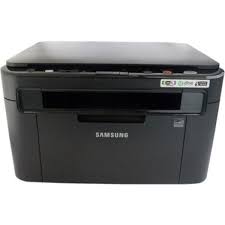
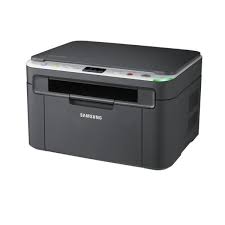
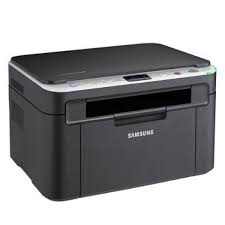
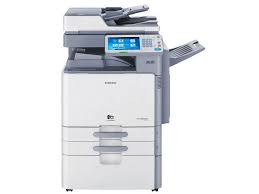

- Introduction
- Software Installation
- Using a Network-Connected Machine
- Media and Tray
- Printing
- Copying
- Scanning
- Faxing
- Setting up an Address Book
- Using the Machine via Mobile Device
- Using SmarThru Workflow, Shared Folder, Stored Document, and USB
- Menu Overview and Advanced
- Useful Tools
- Maintenance
- Troubleshooting
- Appendix
- Key benefits
- Environmentally friendly
- Fast high resolution printing
- Convenience
- Wide range of functionality and application support
- Support XOA applications
- Features by model
- Software
- Useful to know
- The machine does not print.
- Where can I purchase accessories or supplies?
- The status LED flashes or remains constantly on.
- A paper jam has occurred.
- Printouts are blurry.
- Where can I download the machine's driver?
- About this user's guide
- Conventions
- Safety information
- Important safety symbols
- Operating environment
- Warning
- Caution
- Operating method
- Installation / Moving
- Maintenance / Checking
- Supply usage
- Machine overview
- Components
- Front view
- Rear view
- Control panel overview
- Turning on the machine
- Understanding the LEDs
- Status LED
- Power LED
- Display screen and useful button
- Display screen
- Counter button
- Eco button
- Job Status button
- Current Job
- Completed Job
- Secured Job
- Active Notice
- Interrupt button
- Understanding the pop-up keyboard
- This chapter includes:
- Installing the driver
- Windows
- From the Windows 8 Start Screen
- Click Install.
- Mac
- Linux
- Installing the Unified Linux Driver
- Reinstalling the driver
- Network environment
- Accessing network setup
- Network settings (TCP/IP)
- Ethernet
- TCP/IP Protocol
- IP Setting
- DNS Configuration
- WINS (Windows Internet Name Service)
- Display IP address
- Setting IP address
- IPv4 configuration
- IPv4 configuration using SetIP (Windows)
- IPv4 configuration using SetIP (Mac)
- IPv4 configuration using SetIP (Linux)
- IPv6 configuration
- From the control panel
- Activating IPv6
- DHCPv6 address configuration
- From the SyncThru™ Web Service
- IPv6 address configuration
- Installing driver over the network
- Silent installation Mode
- Command-line Parameters
- UNIX
- Installing the UNIX printer driver package
- Uninstalling the printer driver package
- Setting up the printer
- Wireless network setup (Optional)
- Introducing wireless set up methods
- Using the WPS menu
- Items to prepare
- Choosing your type
- Connecting WPS
- Connecting in PBC mode
- Type in the ID and Password.
- Connecting in PIN mode
- Using the Wi-Fi Networks
- Using a network cable
- Printing a network configuration report
- IP setting using SetIP Program (Windows)
- Configuring the machine's wireless network
- Using SyncThru™ Web Service
- Turning the Wi-Fi network on/off
- Setting the Wi-Fi Direct for mobile printing
- Setting up Wi-Fi Direct
- From the machine
- Enable Wi-Fi Direct.
- From the network-connected computer
- Setting up the mobile device
- Troubleshooting for wireless network
- Preparing originals
- Loading originals
- On the scanner glass
- Close the scanner lid.
- In the document feeder
- Selecting print media
- Guidelines for select the print media
- Loading paper in the tray
- Tray overview
- Tray 1 / optional trays
- Multi-purpose tray
- Tips on using the multi-purpose tray
- Printing on special media
- Envelope
- Labels
- Card stock/ Custom-sized paper
- Preprinted paper
- Setting the paper size and type
- Setting the paper size
- Setting the paper type
- Output location
- Printer driver features
- Basic printing
- Select your machine from the Select Printer list.
- To start the print job, click OK or Print in the Print window.
- Canceling a print job
- Opening printing preferences
- Favorites tab
- Basic tab
- Orientation
- Layout Options
- Double-Sided Printing
- Paper tab
- Copies
- Paper Options
- Graphics tab
- Quality
- Font/Text
- Graphic Controller
- Toner Save
- Advanced tab
- Watermark
- Overlay
- Output options
- Security
- Job Accounting
- Eco tab
- Eco Options
- Result Simulator
- Samsung tab
- Print Mode
- Using a favorite setting
- Using help
- Using special print features
- Special print features include:
- Printing multiple pages on one sheet of paper
- Printing posters
- Printing booklets
- Printing on both sides of the paper
- Change the size by percentage of your document
- Fitting your document to a selected paper size
- Using watermarks
- Using an existing watermark
- Creating a watermark
- Editing a watermark
- Deleting a watermark
- Using overlay
- What is an overlay?
- Creating a new page overlay
- Using a page overlay
- Deleting a page overlay
- Using direct printing utility
- What is Direct Printing Utility?
- Printing
- From the Direct Printing Utility window
- Using the right-click menu
- Changing the default print settings
- Setting your machine as a default machine
- Printing to a file (PRN)
- Mac printing
- Printing a document
- Changing printer settings
- Printing multiple pages on one sheet
- Linux printing
- Printing from applications
- Printing files
- Configuring Printer Properties
- Unix printing
- Proceeding the print job
- Changing the machine settings
- General tab
- Image tab
- Text tab
- Margins tab
- Printer-Specific Settings tab
- Understanding the copy screen
- Basic copying
- Copying originals of different sizes
- Quick copying
- ID card copying
- Using special copy features
- Using a program's setting
- Saving Programs
- Loading Programs
- Understanding the scan methods
- Scanning and sending through email
- Understanding the Scan to Email screen
- Output tab
- Setting up an email account
- Scanning and sending an email
- The machine begins scanning and then sends the email.
- Resending to the last email address
- Press the Basic tab.
- Printing an email confirmation report
- Scanning and sending via SMB/FTP
- Understanding the Scan to Server screen
- Setting up an FTP/SMB server
- Scanning and sending to an SMB/FTP server
- Resending to the last server address
- Scanning and sending to your computer
- For a network connected machine
- Scanning and sending to USB /shared folder
- Understanding the USB /shared folder screen
- Scanning to a USB /shared folder
- Changing the scan feature settings
- Using a programs setting
- Saving
- Loading
- Scanning with TWAIN-enabled software
- Scanning with Samsung Easy Document Creator
- Mac scanning
- Scanning with network
- Linux scanning
- Scanning
- Preparing to fax
- Sending a fax from your computer
- Sending a fax (Windows)
- Checking the sent fax list (Windows)
- Sending a fax (Mac)
- Understanding the fax screen
- Sending a fax
- Setting the fax header
- Sending a fax using speed dial numbers
- Select Resolution.
- When you press the input line from display screen:
- Press ◇(Start) on the control panel.
- Sending a fax manually using On Hook
- Resending Automatically
- Redialing the last number
- Delaying a fax transmission
- Receiving a fax
- Changing the receive modes
- Receiving manually in Telephone mode
- Receiving in secure receiving mode
- Printing received faxes on both sides of the paper
- Receiving faxes in memory
- Adjusting the document settings
- Printing a fax report
- Setting up an address book from the control panel
- Storing Individual address (Fax, Email)
- Storing Individual addresses (SMB, FTP)
- Editing individual address
- Storing group address
- Editing group address
- Searching the address book for an entry
- Setting up an address book from SyncThru™ Web Service
- Storing on your local machine
- Adding addresses in Individual Address Book
- Editing addresses in an Individual Address Book
- Deleting addresses in an Individual Address Book
- Searching addresses in an Individual Address Book
- Importing an Individual Address Book
- Exporting an Individual Address Book
- Grouping addresses in Groups Address Book
- Editing Group addresses in Groups Address Book
- Deleting Group addresses in a Groups Address Book
- Checking Group Addresses
- Using the NFC feature (Optional)
- Requirements
- Related Apps
- Using the Samsung Mobile Print Pro App
- Authentication from the mobile device
- Registration from the mobile device
- Using the Samsung Mobile Print Manager App
- Exporting(Copying the setting to your mobile device)
- Importing (Applying the settings to the machine)
- Wireless Setup
- Using the Samsung Mobile Print App
- Sending Fax
- Supported Mobile Apps
- Available Apps
- Downloading Apps
- Supported Mobile OS
- Setting up the machine for Mopria printing
- Setting up Mopria on your mobile device
- Mopria™
- Printing via Mopria
- AirPrint
- Setting up AirPrint
- Printing via AirPrint
- Samsung Cloud Print
- Registering your Printer to Samsung Cloud server
- Registering from Web Browser
- Using the Samsung Cloud Print
- Registering a printer from an application on mobile device
- Printing from an application on mobile device
- Scanning and sending to Samsung Cloud Print
- Google Cloud Print™
- Registering your Google account to the printer
- Registering from the Chrome Browser
- Click Manage your printers.
- Printing with Google Cloud Print™
- Printing from the Chrome browser
- About SmarThru Workflow
- Understanding the SmarThru Workflow screen
- What are "Workform" and "Metadata"?
- Public Workform Tab
- Private Workform Tab
- Workform Creation Screen
- Workform Creation
- Workform Execution
- Understanding the Shared Folder screen
- Using the Shared Folder
- Creating a shared folder
- Scanning and sending to a shared folder.
- Printing from shared folder
- Understanding the Stored Document screen
- Saving documents in the Stored Document
- Understanding the USB screen
- About USB memory device
- Printing from a USB memory device
- Scanning to a USB memory device
- 12.Menu Overview and Advanced Features
- Menu overview
- Machine setup
- Log-in
- Press OK.
- Machine Details
- General Settings
- Other settings
- Application settings
- Copy Settings
- Fax Settings
- Scan Settings
- Address Book
- Tray settings
- Eco Settings
- Initial Settings
- Print Settings
- Network Settings
- 13.Useful Tools
- Accessing management tools
- SyncThru™ Web Service
- What is SyncThru™ Web Service?
- Required web browser
- Connecting to SyncThru™ Web Service
- IPv4 supported web browser
- IPv6 supported web browser
- Logging into SyncThru™ Web Service
- Information tab
- Address book tab
- Settings tab
- Security tab
- Maintenance tab
- Easy Capture Manager
- Samsung AnyWeb Print
- Easy Eco Driver
- How to use:
- Click Print.
- Using Samsung Easy Document Creator
- Using Samsung Printer Center
- Understanding Samsung Printer Center
- Printers tab
- Scanner & Fax Tab
- Using Samsung Easy Printer Manager
- Understanding Samsung Easy Printer Manager
- Using Samsung Printer Status
- Samsung Printer Status overview
- Using Samsung Printer Experience
- Understanding the Samsung Printer Experience
- Adding/Deleting Printers
- Adding a printer
- Deleting a printer
- Printing from Windows 8
- Cancelling a print job
- Opening more settings
- Basic
- Paper settings
- Layout settings
- Confidential Printing
- Using the sharing feature
- Scanning from Windows 8
- Scanning from Samsung Printer Experience
- 14.Maintenance
- Ordering supplies and accessories
- Available consumables
- Available accessories
- Available maintenance parts
- Storing the toner cartridge
- Handling instructions
- Toner cartridge usage
- Estimated cartridge life
- Redistributing toner
- Replacing the toner cartridge
- Installing accessories
- Precautions
- Setting Device Options
- Select Device Options.
- Select the appropriate option.
- Click OK until you exit the Properties or Printer properties window.
- Upgrading a memory module
- Monitoring the supplies life
- Cleaning the machine
- Cleaning the outside
- Cleaning the inside
- Cleaning the pickup roller
- Cleaning the scan unit
- Wipe the surface of the scanner until it is clean and dry.
- Close the scanner lid.
- Tips for moving & storing the machine
- 15.Troubleshooting
- Tips for avoiding paper jams
- Clearing paper jams
- In tray1
- In optional trays
- In the multi-purpose tray
- Inside the machine
- In the exit area
- In the duplex unit area
- Clearing original document jams
- Original paper jam in front of scanner
- Original paper jam inside of scanner
- Original paper jam in exit area of scanner
- Understanding display messages
- Paper feeding problems
- Power and cable connecting problems
- Printing problems
- Printing quality problems
- Copying problems
- Scanning problems
- Faxing problems
- Operating system problems
- Common PostScript problems
- 16.Appendix
- Specifications
- General specifications
- System requirements
- Microsoft® Windows®
- Regulatory information
- Laser safety statement
- Ozone safety
- Perchlorate warning
- Power saver
- Recycling
- China only
- 回收和再循环
- Correct disposal of this product (Waste electrical & electronic equipment)
- (Applicable in countries with separate collection systems)
- (The United States of America only)
- State of California Proposition 65 Warning (USA Only)
- Taiwan only
- 警告
- Radio frequency emissions
- FCC information to the user
- Canadian radio interference regulations
- United States of America
- Federal Communications Commission (FCC)
- Intentional emitter per FCC Part 15
- FCC Statement for Wireless LAN use:
- Russia / Kazakhstan / Belarus only
- EAC
- Canada only
- Fax Branding
- Ringer Equivalence Number
- You should also know that:
- Replacing the Fitted Plug (for UK Only)
- Important
- Important warning:
- Declaration of conformity (European countries)
- Approvals and Certifications
- EC Certification
- European radio approval information (for products fitted with EU-approved radio devices)
- CE
- European states qualified under wireless approvals:
- European states with restrictions on use:
- Regulatory compliance statements
- Wireless guidance
- Copyright
- Contact SAMSUNG worldwide
- Glossary
- 802.11
- 802.11b/g/n
- Access point
- ADF
- AppleTalk
- BIT Depth
- BMP
- BOOTP
- CCD
- Collation
- Control Panel
- Coverage
- CSV
- DSDF
- Default
- DHCP
- DIMM
- DLNA
- DNS
- Dot Matrix Printer
- DPI
- DRPD
- Duplex
- Duty Cycle
- ECM
- Emulation
- EtherTalk
- FDI
- FTP
- Fuser Unit
- Gateway
- Grayscale
- Halftone
- Mass storage device (HDD)
- IEEE
- IEEE 1284
- Intranet
- IP address
- IPM
- IPP
- IPX/SPX
- ISO
- ITU-T
- ITU-T No. 1 chart
- JBIG
- JPEG
- LDAP
- LED
- Mac address
- MFP
- MH
- MMR
- Modem
- MR
- NetWare
- OPC
- Originals
- OSI
- PABX
- PCL
- PostScript
- Printer Driver
- Print Media
- PPM
- PRN file
- Protocol
- PS
- PSTN
- RADIUS
- Resolution
- SMB
- SMTP
- SSID
- Subnet Mask
- TCP/IP
- TCR
- TIFF
- Toner Cartridge
- TWAIN
- UNC Path
- URL
- USB
- WEP
- WIA
- WPA
- WPA-PSK
- WPS
- XPS
- A
- B
- C
- D
- E
- F
- G
- H
- |
- J
- K
- L
- M
- N
- 0
- P
- Q
- R
- S
- T
- U
- W
Brand : SAMSUNG
Model : SL-M4080FX
Category : Laser MFP