 ManualGo.com
 LC 140P - Tondeuse à gazon HUSQVARNA - Free user manual and instructions
Find the device manual for free LC 140P HUSQVARNA in PDF.


Download the instructions for your Tondeuse à gazon in PDF format for free! Find your manual LC 140P - HUSQVARNA and take your electronic device back in hand. On this page are published all the documents necessary for the use of your device. LC 140P by HUSQVARNA.
USER MANUAL LC 140P HUSQVARNA
Transportation, storage and disposal 16
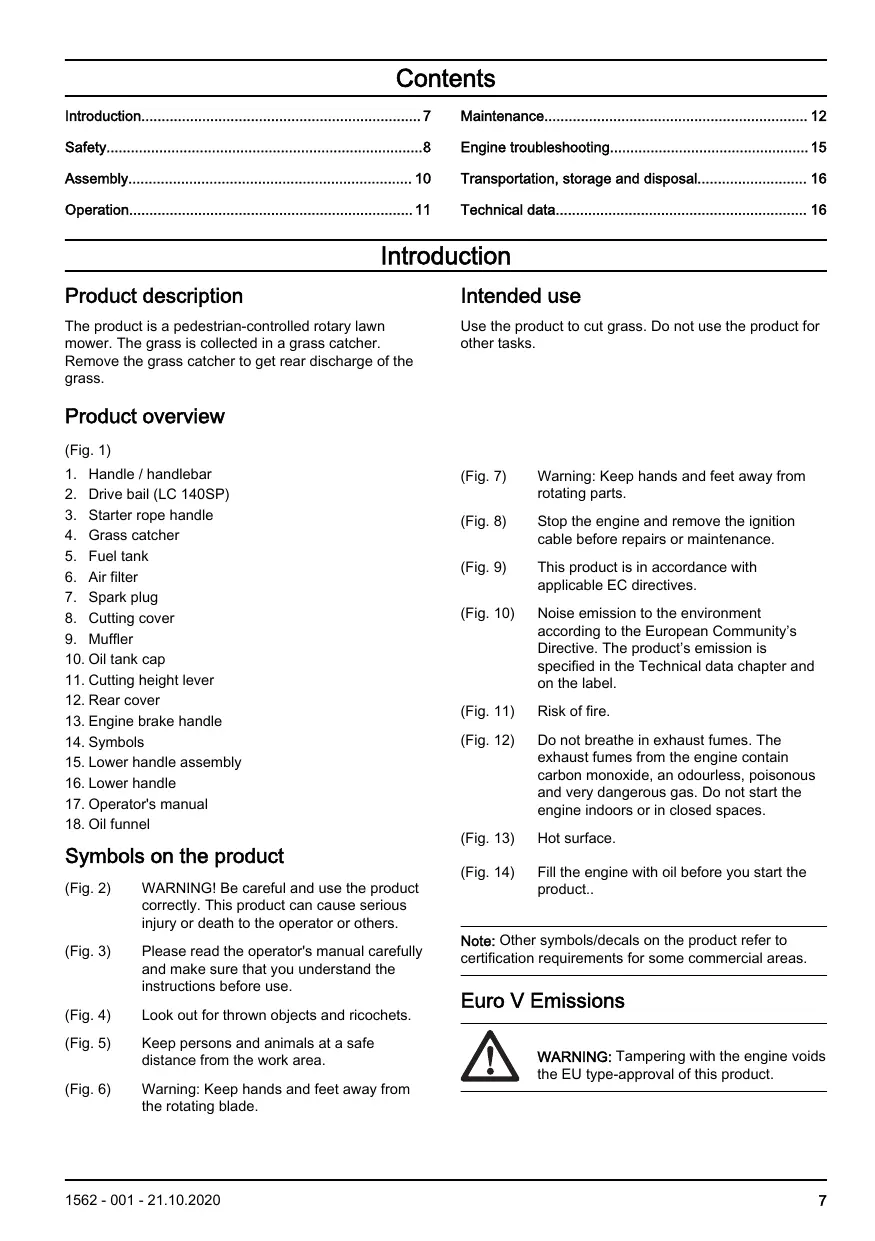
The product is a pedestrian-controlled rotary lawn mower. The grass is collected in a grass catcher.
Remove the grass catcher to get rear discharge of the grass.
Use the product to cut grass. Do not use the product for other tasks.
(Fig. 1) 1. Handle / handlebar 2. Drive bail (LC 140SP) 3. Starter rope handle 4. Grass catcher 5. Fuel tank 6. Air filter 7. Spark plug 8. Cutting cover 9. Muffler 10. Oil tank cap 11. Cutting height lever 12. Rear cover 13. Engine brake handle 14. Symbols 15. Lower handle assembly 16. Lower handle 17. Operator's manual 18. Oil funnel
Symbols on the product
WARNING! Be careful and use the product correctly. This product can cause serious injury or death to the operator or others.
Please read the operator's manual carefully and make sure that you understand the instructions before use.
Look out for thrown objects and ricochets.
Keep persons and animals at a safe distance from the work area.
Warning: Keep hands and feet away from the rotating blade.
1562 - 001 - 21.10.2020
Warning: Keep hands and feet away from rotating parts.
Stop the engine and remove the ignition cable before repairs or maintenance.
This product is in accordance with applicable EC directives.
Noise emission to the environment according to the European Community’s
Directive. The product’s emission is specified in the Technical data chapter and on the label.
Do not breathe in exhaust fumes. The exhaust fumes from the engine contain carbon monoxide, an odourless, poisonous and very dangerous gas. Do not start the engine indoors or in closed spaces.
Fill the engine with oil before you start the product..
Note: Other symbols/decals on the product refer to certification requirements for some commercial areas.
WARNING: Tampering with the engine voids the EU type-approval of this product.
As referred to in the product liability laws, we are not liable for damages that our product causes if:
the product has an accessory that is not from the manufacturer or not approved by the manufacturer. the product is not repaired at an approved service center or by an approved authority.
the product is incorrectly repaired. the product is repaired with parts that are not from the manufacturer or not approved by the manufacturer.
Warnings, cautions and notes are used to point out specially important parts of the manual.
WARNING: Used if there is a risk of injury or death for the operator or bystanders if the instructions in the manual are not obeyed.
CAUTION: Used if there is a risk of damage to the product, other materials or the adjacent area if the instructions in the manual are not obeyed. Note: Used to give more information that is necessary in a given situation.
General safety instructions
WARNING: Read the warning instructions that follow before you use the product.
WARNING: Read the warning instructions that follow before you use the product.
This product is dangerous if used incorrectly or if you are not careful. Injury or death can occur if you do not obey the safety instructions.
This product produces an electromagnetic field during operation. This field may under some circumstances interfere with active or passive medical implants. To reduce the risk of serious or fatal injury we recommend persons with medical implants to consult their physician and the medical implant manufacturer before operating this product. Always be careful and use your common sense. If you are not sure how to operate the product in a special situation, stop and speak to your Husqvarna dealer before you continue. Keep in mind that the operator will be held responsible for accidents that involve other persons or their property. Keep the product clean. Make sure that you can clearly read signs and decals. Do not let a person use the product unless you make sure that they read and understand the contents of the operator's manual. Do not let a child operate the product.
Keep children away from the work area. A responsible adult must be there at all times.
Do not let a person, without knowledge of the instructions, operate the product. Always monitor a person, with decreased physical capacity or mental capacity, that uses the product. A responsible adult must be there at all times. Do not use the product if you are tired, ill, or under the influence of alcohol, drugs or medicine. This has a negative effect on your vision, alertness, coordination and judgment. Do not use the product if it is defective. Do not change this product or use it if it is possible that it has been changed by others. Do not change the adjustment for the engine speed control.
Remove objects such as branches, twigs and stones from the work area before you use the product.
Objects that hit against the cutting equipment can eject and cause damage to persons and objects. Keep bystanders and animals at a safe distance from the product. Never use the product in bad weather such as fog, rain, strong winds, intense cold and risk of lightning. To use the product in bad weather or in moist or wet locations is tiring. Bad weather can cause dangerous conditions, such as slippery surfaces. Look out for persons, objects and situations that can prevent safe operation of the product. Look out for obstacles, such as roots, stones, twigs, pits and ditches. Long grass can hide obstacles. To cut grass on slopes can be dangerous. Do not use the product on ground that slopes more than 15°. Operate the product across the face of slopes. Do not move up and down. Be careful when you go near hidden corners and objects that prevent a clear view.
1562 - 001 - 21.10.2020
WARNING: Read the warning instructions that follow before you use the product. • • • •
Use this product to cut grass lawns only. It is not permitted to use it for other tasks.
Use personal protective equipment. Refer to Personal protective equipment on page 9. Make sure that you know how to stop the engine quickly in an emergency. Never start the engine in a closed space or near flammable material. The exhaust fumes from the engine are hot and can contain sparks which can start a fire. Do not operate the product unless the blade and all covers are attached correctly. An incorrectly attached blade can come loose and cause personal injury. Make sure that the blade does not hit objects such as stones and roots. This can do damage to the blade and bend the engine shaft. A bent axle causes heavy vibration and a very high risk that the blade becomes loose. If the blade hits an object or if vibrations occur, stop the product immediately. Disconnect the ignition cable from the spark plug. Examine the product for damages. Repair damages or let an authorised service agent do the repair. Never attach the engine brake handle permanently to the handle when the engine is started. Put the product on a stable, flat surface and start it. Make sure that the blade does not hit the ground or other objects. Always stay behind the product when you operate it. Let all the wheels stay on the ground and keep 2 hands on the handle when you operate the product. Keep your hands and feet away from the rotating blades. Do not tilt the product when the engine is started. Be careful when you pull the product rearward. Never lift up the product when the engine is started. If you must lift the product, first stop the engine and disconnect the ignition cable from the spark plug. Do not walk rearward when you operate the product. Stop the engine when you move across areas without grass, for example paths made of gravel, stone and asphalt. Do not run with the product when the engine is started. Always walk when you operate the product. Stop the engine before you change the cutting height. Never make adjustments with the engine started. Never let the product stay out of view with the engine started. Stop the engine and make sure that the cutting equipment does not rotate.
1562 - 001 - 21.10.2020
Safety instructions for operation
Personal protective equipment WARNING: Read the warning instructions that follow before you use the product. •
Personal protective equipment cannot fully prevent injury but it decreases the degree of injury if an accident does occur. Let your dealer help you select the right equipment.
Use hearing protection if the noise level is higher than 85 dB. Use heavy-duty slip-resistant boots or shoes. Do not use open shoes or go with bare feet. Use heavy, long pants. Use protective gloves when necessary, for example when you attach, examine or clean the cutting equipment.
Safety devices on the product
WARNING: Read the warning instructions that follow before you use the product. • •
Do not use a product with defective safety devices.
Do a check of the safety devices regularly. If the safety devices are defective, speak to your Husqvarna service agent.
To do a check of the cutting cover
The cutting cover decreases vibrations in the product and decreases the risk of injury from the blade. •
Examine the cutting cover to make sure that there are no damages such as cracks.
To do a check of the engine brake handle
The engine brake handle stops the engine. When the engine brake handle is released, the engine stops. •
Start the engine and then release the engine brake handle. If the engine does not stop in 3 seconds, let an approved Husqvarna service agent adjust the engine brake. (Fig. 15)
The muffler keeps the noise levels to a minimum and sends the exhaust fumes away from the operator. Do not use the product if the muffler is missing or defective. A defective muffler increases the noise level and the risk of fire. WARNING: The muffler becomes very hot during and after use and when the engine operates at idle speed. Be careful near
flammable materials and/or fumes to prevent fire.
Move the product a minimum of 3 m / 10 ft from the position where you filled the tank before a start.
Do not fill the fuel tank fully. Heat causes the fuel to expand. Keep a space at the top of the fuel tank.
Safety instructions for maintenance
WARNING: Read the warning instructions that follow before you use the product. • • • • • • • • • • • • •
Do not start the product if there is fuel or engine oil on the product. Remove the unwanted fuel/oil and let the product dry.
If you spill fuel on your clothing, change clothing immediately. Do not get fuel on your body, it can cause injury. If you get fuel on your body, use soap and water to remove the fuel. Do not start the product if the engine has a leak. Examine the engine for leaks regularly. Be careful with fuel. Fuel is flammable and the fumes are explosive and can cause injuries or death. Do not breathe in the fuel fumes, it can cause injury. Make sure that there is a sufficient airflow. Do not smoke near the fuel or the engine. Do not put warm objects near the fuel or the engine. Do not add the fuel when the engine is on. Make sure that the engine is cool before you refuel. Before you refuel, open the fuel tank cap slowly and release the pressure carefully. Do not add fuel to the engine in an indoor area. Not sufficient airflow can cause injury or death because of asphyxiation or carbon monoxide. Tighten the fuel tank cap fully. If the fuel tank cap is not tightened, there is a risk of fire.
WARNING: Read the warning instructions that follow before you use the product.
The exhaust fumes from the engine contain carbon monoxide, an odourless, poisonous and very dangerous gas. Do not start the engine indoors or in closed spaces.
Before you do the maintenance on the product, stop the engine and remove the ignition cable from the spark plug. Use protective gloves when you do maintenance on the cutting equipment. The blade is very sharp and cuts can easily occur. Accessories and changes to the product that are not approved by the manufacturer, can cause serious injury or death. Do not change the product. Always use accessories that are approved by the manufacturer. If the maintenance is not done correctly and regularly, the risk of injury and damage to the product increases. Only do the maintenance as given in this owner's manual. All other servicing must be done by an approved Husqvarna service agent. Let an approved Husqvarna service agent do servicing on the product regularly. Replace damaged, worn or broken parts.
To assemble the handle 1. Push the screw (A) through the handle (B), the plastic washer (C) and the handle support bracket (D). (Fig. 16) 2. Tighten the nut (E) fully. 3. Push the screw (F) thrugh the washer (G) and the handle support bracket. 4. Tighten the knob (H) fully. 5. Align the holes in the handlebar with the holes in the lower handle and attach the screws, washers and knobs. Tighten the knobs fully. (Fig. 17) 6. Attach the cables to the handle with the cable holders. (Fig. 18) Note: Make sure that the tension in the cables is not too high. A too high tension can cause damage to the cable if the handle is folded to transport position.
7. Put the cables around the hook at the bottom of the handle. (Fig. 19)
To adjust the handle height
1. Loosen the lower knobs. (Fig. 20) 2. Remove the knob, washer, and screw on the left and the right side. 3. The handle can be set to 2 different heights. Put the screw in one of the 2 holes on the left and the right side. (Fig. 21) 4. Attach the screws, washers and knobs. 5. Move the knobs up in the direction of the handle until they stop and you hear a click. Tighten the knobs fully. (Fig. 22)
To set the product in transport position
1. Remove the grass catcher. 2. Loosen the knobs on the upper handle and fold the handle down. (Fig. 23)
1562 - 001 - 21.10.2020
3. Loosen the lower knobs.
5. Tighten the knobs fully. (Fig. 28)
4. Move the knobs to the lower end of the grooves on the left and the right side of the product. (Fig. 24)
To assemble the grass catcher
5. Fold the handle forward. (Fig. 25)
1. Put the top part of the grass catcher onto the lower part of the grass catcher. (Fig. 29)
To set the product in operation position
1. Lift the handlebar until the lower handle locks in operation position. (Fig. 26)
2. Attach the grass catcher frame with the clips. (Fig.
30) 3. Lift the rear cover.
2. Move the knobs up in the direction of the handle until they stop and you hear a click.
4. Attach the hooks on the grass catcher to the top edge of the chassis. (Fig. 31)
3. Tighten the knobs fully. (Fig. 27)
5. Put the lower part of the grass catcher into the grass discharge channel.
4. Lift the top part of the handlebar.
Introduction WARNING: Before you operate the product, you must read and understand the safety chapter.
Husqvarna Connect is a free app for your mobile device. The Husqvarna Connect app gives extended functions for your Husqvarna product: • •
Extended product information.
Information about, and help with, product parts and servicing.
To start to use Husqvarna Connect
1. Download the Husqvarna Connect app on your mobile device.
CAUTION: Do not use gasoline with an octane number less than 91 RON. This can cause damage to the product.
CAUTION: Replace the fuel filter yearly or more frequently if it is necessary. A new fuel filter is available at your Husqvarna dealer.
CAUTION: Always stop the engine before you fill fuel.
CAUTION: Do not use pressurized starting fluids.
2. Register in the Husqvarna Connect app.
1. Open the fuel tank cap slowly to release the pressure.
3. Do the instruction steps in the Husqvarna Connect app to connect and register the product.
2. Fill slowly with a fuel can. If you spill fuel, remove it with a cloth and let remaining fuel dry off. (Fig. 32)
Before you operate the product
3. Clean the area around the fuel tank cap.
1. Read the operator's manual carefully and make sure that you understand the instructions.
2. Examine the cutting equipment to make sure that it is correctly attached and adjusted. See To examine the cutting equipment on page 13. 3. Fill the fuel tank. See To fill fuel on page 11. 4. Fill the oil tank and do a check of the oil level. See To do a check of the oil level on page 14.
If available, use gasoline with a low emission grade/ alkylate fuel. If gasoline with a low emission grade/ alkylate fuel is not available, use good quality unleaded gasoline or leaded gasoline with octane number not less than 91.
1562 - 001 - 21.10.2020
4. Tighten the fuel tank cap fully. If the fuel tank cap is not tightened, there is a risk of fire.
5. Move the product a minimum of 3 m / 10 ft from the position where you filled the tank before a start.
To set the cutting height
1. Move the cutting height lever rearward to increase the cutting height. 2. Move the cutting height lever forward to decrease the cutting height. (Fig. 33) CAUTION: Do not set the cutting height too low. The blades can hit the ground if the surface of the lawn is not level.
To start the product
1. Make sure that the ignition cable is connected to the spark plug.
Before you pull the product rearward, disengage the drive and push the product forward approximately 10 cm.
2. Stay behind the product.
3. Hold the engine brake handle against the handlebar.
4. Hold the starter rope handle with your right hand.
To get a good result
5. Slowly pull out the starter rope until you feel some resistance.
6. Pull with force to start the engine.
WARNING: Do not twist the starter rope around your hand.
To use the drive on the wheels
Push the drive bail in the direction of the handlebar.
(Fig. 35) Release the drive bail to disengage the drive, for example when you go near an obstacle.
To stop the drive only, release the drive bail.
To stop the engine, release the engine brake handle.
Always use a sharp blade. A blunt blade gives an irregular result and the cut surface of the grass becomes yellow. A sharp blade also uses less energy than a blunt blade.
Do not cut more than ⅓ of the length of the grass. Cut first with the cutting height set high. Examine the result and lower the cutting height to an applicable level. If the grass is very long, drive slowly and cut 2 times if necessary. Cut in different directions each time to prevent stripes in the lawn.
Maintenance schedule
WARNING: Before you do maintenance, you must read and understand the safety chapter.
CAUTION: Make sure that the air filter is up and not against the ground when you tilt the product. Risk of engine damage.
For all servicing and repair work on the product, special training is necessary. We guarantee the availability of professional repairs and servicing. If your dealer is not a service agent, speak to them for information about the nearest service agent.
The maintenance intervals are calculated from daily use of the product. The intervals change if the product is not used daily.
For maintenance identified with * refer to instructions in Safety devices on the product on page 9.
Do a general inspection
X Examine the oil level
Replace the oil (the first time after 5 h of use, then after each 50 h of use) 1
X Examine the cutting equipment
X Examine the cutting cover *
X Examine the engine brake handle *
X Examine the muffler *
X If the product is operated with heavy load or in high ambient temperatures, replace the engine oil each 25 hours.
1562 - 001 - 21.10.2020
Examine the spark plug. Clean or replace the spark plug if it is necessary
Examine the air filter Clean the air filter
X Replace the air filter
X Examine the fuel system
X Clean the cooling fins on the cylinder
X Examine and adjust the clutch wire (LC 140SP)
X To do a general inspection
2. Look at the blade to see if it is damaged or blunt.
Note: It is necessary to balance the blade after it is sharpened. Let a service center sharpen, replace and balance the blade. If you hit an obstacle that causes the product to stop, replace the damaged blade. Let the service center estimate if the blade can be sharpened or must be replaced.
Make sure that all nuts and screws on the product are tightened correctly.
To clean the product externally
Use a brush to remove leaves, grass and dirt.
Make sure that the air intake on the top of the engine is not blocked. Do not use a high pressure washer to clean the product. If you use water to clean the product, do not flush water directly on the engine.
To clean the inner surface of the cutting cover
1. Empty the fuel tank. 2. Tilt the product. Make sure that the spark plug point up. CAUTION: If the product is put with the air filter down, the engine can become damaged. 3. Hose down the inner surface of the cutting cover with water.
To examine the cutting equipment
WARNING: To prevent accidental start remove the ignition cable from the spark plug. WARNING: Use protective gloves when you do maintenance on the cutting equipment. The blade is very sharp and cuts can easily occur.
To replace the blade
1. Lock the blade with a block of wood. (Fig. 36) 2. Remove the blade bolt. 3. Remove the blade. 4. Examine the blade support and blade bolt to see if there are damages. 5. Examine the engine shaft to make sure that it is not bent. 6. When you attach the new blade, point the angled ends of the blade in the direction of the cutting cover. (Fig. 37) 7. Make sure that the blade is aligned with the center of the engine shaft. 8. Lock the blade with a block of wood. Attach the spring washer and tighten the bolt and washer with a torque of 45–60 Nm. (Fig. 38) 9. Pull the blade around by hand and make sure that it turns freely. WARNING: Use heavy duty gloves. The blade is very sharp and cuts can easily occur. 10. Start the product to do a test of the blade. If the blade is not correctly attached, there is vibration in the product or the cutting result is unsatisfactory.
1. Examine the cutting equipment for damage or cracks. Always replace a damaged cutting equipment.
Clean more often under dusty conditions or when airborne debris is present. Replace air filter, if it is very dirty.
1562 - 001 - 21.10.2020
To do a check of the oil level
CAUTION: A too low oil level can do damage to the engine. Do a check of the oil level before you start the product. 1. Put the product on level ground. 2. Remove the oil tank cap with the attached dipstick.
5. Lubricate the foam plastic filter with engine oil.
6. Press a clean cloth against the foam plastic filter to remove unwanted oil. 7. Put the air filter back. Make sure that the air filter fully seals against the air filter holder. 8. Put the air filter cover back.
To examine the spark plug
3. Clean the oil from the dipstick.
CAUTION: Always use the recommended spark plug type. Incorrect spark plug type can cause damage to the product.
4. Put the dipstick fully into the oil tank to give a correct picture of the oil level.
5. Remove the dipstick. 6. Examine the oil level on the dipstick. 7. If the oil level is low, fill with engine oil and do a check of the oil level again.
Note: Use a funnel to prevent spill.
To replace the engine oil
WARNING: Engine oil is very hot directly after the engine is stopped. Let the engine become cool before you drain the engine oil. If you spill engine oil on your skin, clean with soap and water.
Examine the spark plug if the engine is low on power, is not easy to start or does not operate correctly at idle speed.
To decrease the risk of unwanted material on the spark plug electrodes, obey these instructions: a) Make sure that the idle speed is correctly adjusted. b) Make sure that the fuel mixture is correct. c) Make sure that the air filter is clean. If the spark plug is dirty, clean it and make sure that the electrode gap is correct, refer to Technical data on page 16. (Fig. 40) Replace the spark plug if it is necessary.
To examine the fuel system
Note: Use 4-stroke engine oil. Make sure to use the correct viscosity for the ambient temperature.
1. Operate the product until the fuel tank is empty.
2. Remove the ignition cable from the spark plug.
3. Remove the oil tank cap. 4. Drain the engine oil from the oil tank with an oil pump (accessory). 5. Fill with new engine oil of the type recommended in Technical data on page 16.
Examine the fuel tank cap and the seal for the fuel tank cap to make sure that there are no damages.
Examine the fuel hose to make sure that there are no leaks. If the fuel hose is damaged, let a service agent replace it.
To adjust the clutch wire (LC 140SP)
For the situations that follow, it is necessary to decrease the length of the clutch wire: •
The drive of the wheels does not engage when you pull the drive bail or the speed control lever.
The product moves slowly when the drive of the wheels is engaged.
6. Do a check of the oil level. Refer to To do a check of the oil level on page 14.
To clean the foam plastic filter
For the situations that follow, it is necessary to extend the length of clutch wire:
1. Remove the air filter cover and remove the foam plastic filter.
2. Clean the foam plastic filter with soap and water. 3. Flush the foam plastic filter in clean water. 4. Squeeze the water from the foam plastic filter and let it dry. CAUTION: Do not use compressed air. It can cause damage to the foam plastic filter.
The product moves when the drive of the wheels is not engaged.
Adjust the clutch wire. a) To decrease the length of clutch wire, turn the adjuster screw counterclockwise. b) To extend the length of the clutch wire, turn the adjustment screw clockwise. (Fig. 41)
If the product continues to drive unsatisfactory after the adjustment, speak to you servicing dealer
1562 - 001 - 21.10.2020
Engine troubleshooting
The engine does not start.
The ignition cable is not connected correctly.
Connect the ignition cable to the spark plug.
The fuel tank is empty.
Fill the fuel tank with correct fuel type.
Drain the fuel tank and the carburetor.
Refuel with new gasoline.
There is dirt in the carburetor or fuel line. Clean the carburetor and/or fuel line.
The spark plug is defective.
Adjust the electrode gap, clean or replace the spark plug.
There is fuel on the spark plug.
Clean the spark plug.
The engine does not stop.
The stop mechanism is defective.
Disconnect the ignition cable from the spark plug. Let an approved service agent repair the product.
The engine does not operate smoothly.
The ignition cable is not connected correctly.
Connect the ignition cable to the spark plug.
There is dirt in the fuel line or the fuel has expired.
Clean the fuel line. Fill the fuel tank with new fuel of the correct type.
There is blockage in the fuel tank cap.
Clean the fuel tank cap.
There is water or dirt in the fuel system.
Drain the fuel tank. Fill the fuel tank with new fuel of the correct type.
The air filter is dirty.
Clean the air filter.
The carburetor must be adjusted.
Let a servicing dealer adjust the carburetor.
The engine oil level is too low.
The air flow is not sufficient.
Clean the air filter and the air filter housing.
The carburetor must be adjusted.
Let a servicing dealer adjust the carburetor.
There is misfire in the engine when it operates at high speed.
The electrode gap in the spark plug is too small.
Adjust the electrode gap.
Unusual noises from the engine during normal load.
Incorrect type of gasoline.
Drain the fuel tank and the carburetor.
Refuel with new gasoline. Refer to To fill fuel on page 11. If the problem continues speak to your local service dealer.
The engine does not operate smoothly at idle speed.
The spark plug is dirty, defective or the electrode gap is too wide.
Adjust the electrode gap or replace the spark plug.
The carburetor must be adjusted.
Adjust the carburetor.
The air filter is dirty.
Clean the air filter.
The engine becomes too hot.
1562 - 001 - 21.10.2020
Transportation, storage and disposal
Transportation and storage
For storage and transportation of the product and fuel, make sure that there are no leaks or fumes.
Sparks or open flames, for example from electrical devices or boilers, can start a fire. Always use approved containers for storage and transportation of fuel. Empty the fuel tank before you put the product in storage for a long period of time. Discard the fuel at an applicable disposal location Safely attach the product during transportation to prevent damage and accidents.
Keep the product in a locked area to prevent access for children or persons that are not approved.
Keep the product in a dry and frost free area.
Obey the local recycling requirements and applicable regulations.
Discard all chemicals, such as engine oil or fuel, at a service center or at an applicable disposal location. When the product is no longer in use, send it to a Husqvarna dealer or discard it at a recycling location.
LC 140P LC 140SP Brand
HS 123A HS 123A Engine type
Single cylinder, 4-Stroke,
Forced Air Cooling, OHV Single cylinder, 4-Stroke,
Forced Air Cooling, OHV Displacement, cm3
Engine lubrication type
Fuel tank capacity, litre
Oil tank capacity, litre
Nominal engine output,
Fuel and lubrication system
The power rating of the engine indicated is the average net output (at specified rpm) of a typical production engine for the engine model measured to SAE standard J1349/ISO1585. Mass production engines may differ from this value. Actual power output for the engine installed on the final product will depend on the operating speed, environmental conditions and other values.
If SAE-30 oil is used at temperatures lower than +5 °C, there is a risk that it does not lubricate the engine sufficiently. This can cause engine damage. Refer to To replace the engine oil on page 14 for the correct oil for low temperatures.
1562 - 001 - 21.10.2020
Sound power level, measured, dB(A)
Sound power level, guaranteed, LWA dB(A)
Collection / Rear discharge
Collection / Rear discharge
Collection 5873863-10
Collection 5873863-10
Grass catcher capacity, liter
With empty tanks, kg Noise
Sound pressure level at operators ear, dB(A)
Vibrations handlebar, m/s2
Self walk speed, km/h
Noise emissions in the environment measured as sound power (LWA) in conformity with EC directive
2000/14/EC. Reported data for noise pressure level has a typical statistical dispersion (standard deviation) of 1.2 dB (A). Reported data for vibration level has a typical statistical dispersion (standard deviation) of 0.2 m/s2.