 ManualGo.com
VS1010X - Dishwasher BRANDT - Free user manual and instructions
Find the device manual for free VS1010X BRANDT in PDF.


Download the instructions for your Dishwasher in PDF format for free! Find your manual VS1010X - BRANDT and take your electronic device back in hand. On this page are published all the documents necessary for the use of your device. VS1010X by BRANDT.
USER MANUAL VS1010X BRANDT
- Dea r Cu stomer, Ple ase care fully rea d this manual bef ore using the dishwasher, it will help you use and maintain the dishwasher properly. Keep this manual for future reference. Pass it on to any sub sequent owner of the applianc e. This ma nual con tains sections on safe ty In stru ctions, Ope rating Instru ction s, In stallatio n Ins truc tion s an d Trou bleshoo ting Tips, etc. Cont rol Panel p. 6
- Dishw asher Features p. 6
- A、Water Softener p. 7
- B、 Loading th e S alt into the Sof tener p. 8
- C、Filling the Rinse Aid Dispenser p. 8
- D、 Function of Dete rgent p. 9
- Recommendation s for loading and unloadin g the dishw as her p. 12
- Loading the upper B asket p. 13
- Loa ding the Lower Basket p. 13
- Reviewing the section on troubleshooting Tips will help you solve some common problems by yourself. If you cannot solve the problems by yourself, please ask for help from a professional technician. Wash Cycle Table p. 14
- Turning on the Appliance p. 14
- C hang ing the Prog ram m id-cy cle p. 15
- At the en d o f th e Wash Cycle p. 15
- Filter System p. 16
- Caring for the Dishwasher p. 17
- The man ufacture r, following a policy of con stant dev elopment and updating of the product, may make m odificatio ns w itho ut giving prior notice. If lost or out-of-d ate, you can receive a new user manual from the manufacturer or responsible vendor. Installation preparation p. 18
- Aesthetic panel's dimensions and installation p. 19
- Ten sion adjustment of the door spring p. 21
- Connection of drain hoses p. 21
- Dishwasher installation steps p. 22
- About Electricity Connecting p. 23
- Cold Water Connection p. 24
- Befo re calling for service p. 25
- Error codes p. 26
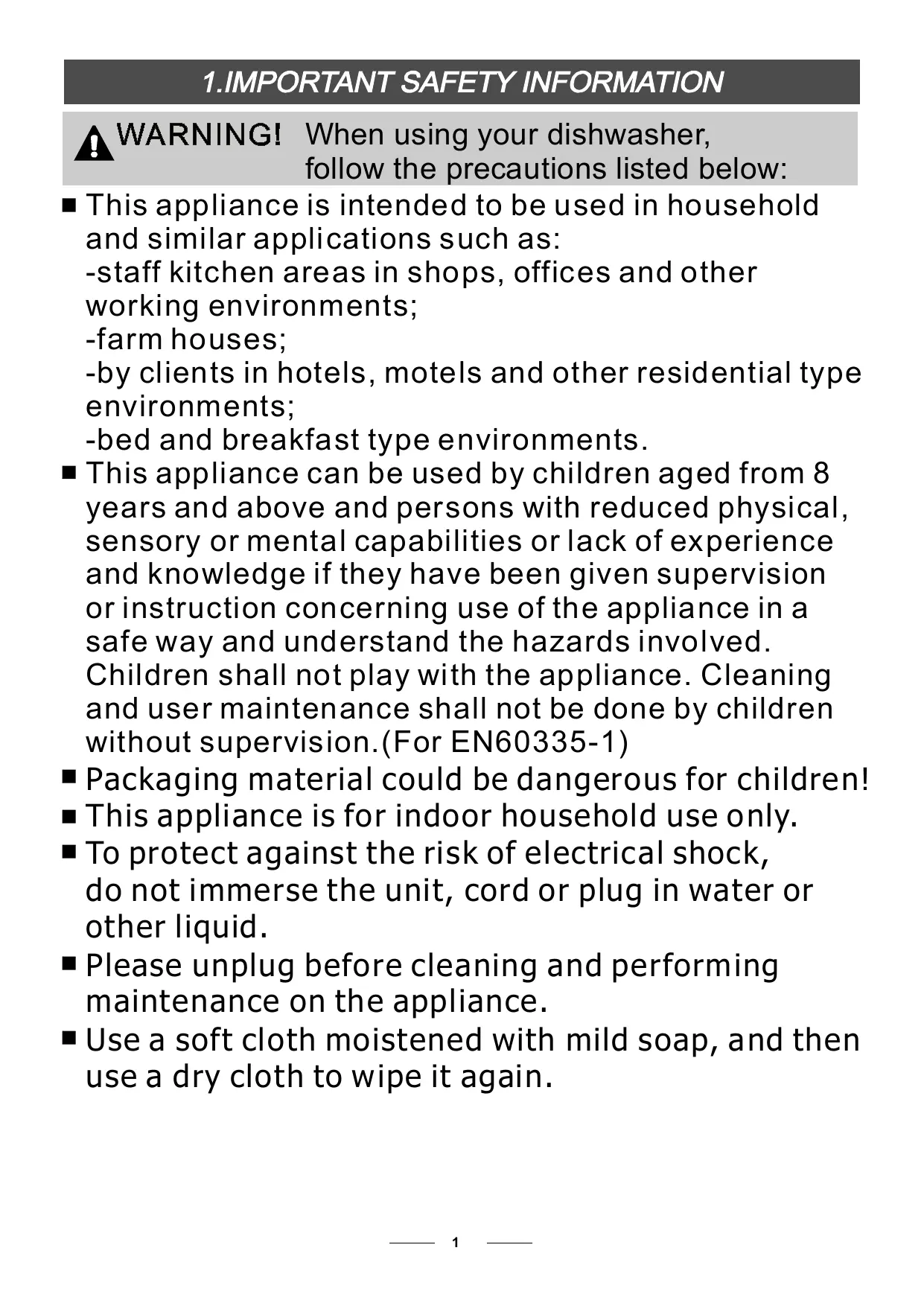
- Technical information When using your dishwasher, follow the precautions listed below: This appliance is intended to be used in household and similar applications such as: -staff kitchen areas in shops, offices and other working environments; -farm houses; -by clients in hotels, motels and other residential type environments; -bed and breakfast type environments. This appliance can be used by children aged from 8 years and above and persons with reduced physical, sensory or mental capabilities or lack of experience and knowledge if they have been given supervision or instruction concerning use of the appliance in a safe way and understand the hazards involved. Children shall not play with the appliance. Cleaning and user maintenance shall not be done by children without supervision.(For EN60335-1) Packaging material could be dangerous for children! This appliance is for indoor household use only. To protect against the risk of electrical shock, do not immerse the unit, cord or plug in water or other liquid. Please unplug before cleaning and performing maintenance on the appliance. Use a soft cloth moistened with mild soap, and then use a dry cloth to wipe it again. p. 27
This appliance must be earthed. In the event of a malfunction or breakdown, earthing will reduce the risk of an electric shock by providing a path of least resistance of electric current. This appliance is equipped with an earthing conductor plug. The plug must be plugged into an appropriate outlet that is installed and earthed in accordance with all local codes and ordinances. Improper connection of the equipment-earthing conductor can result in the risk of an electric shock. Check with a qualified electrician or service representative if you are in doubt whether the appliance is properly grounded. Do not modify the plug provided with the appliance; If it does not fit the outlet. Have a proper outlet installed by a qualified electrician. Do not abuse, sit on, or stand on the door or dish rack of the dishwasher. Do not operate your dishwasher unless all enclosure panels are properly in place. Open the door very carefully if the dishwasher is operating, there is a risk of water squirting out. Do not place any heavy objects on or stand on the door when it is open. The appliance could tip forward. When loading items to be washed:
1) Locate sharp items so that they are not likely to
damage the door seal;
2) Warning: Knives and other utensils with sharp points
must be loaded in the basket with their points facing down or placed in a horizontal position. Check that the detergent powder is empty after completion of the wash cycle. Do not wash plastic items unless they are marked “ dishwasher safe” or its equivalent. For unmarked plastic items not so marked,check the manufacturer's recommendations. Use only detergent and rinse agents recommended for use in an automatic dishwasher. Never use soap, laundry detergent, or hand washing detergent in your dishwasher. The door should not be left open, since this could increase the risk of tripping. If the supply cord is damaged, it must be replaced by the manufacturer or its service agent or a similarly qualified person in order to avoid a hazard. During installation, the power supply must not be excessively or dangerously bent or flattened. Do not tamper with controls. The appliance needs to be connected to the main water valve using new hose sets. Old sets should not be reused. The maximum number of place settings to be washed is 10. The maximum permissible inlet water pressure is 1MPa. The minimum permissible inlet water pressure is 0.04MPa.
This appliance's packaging materials are recyclable. Dispose of the packaging into a suitable waste collection container to recycle it. It is prohibited to dispose of this appliance as household waste. Correct Disposal of this product: this symbol on the product or in its packing indicates that this product may not be treated as household waste. Instead, it should be taken to the appropriate waste collection point for the recycling of electrical and electronic equipment. By ensuring this product is disposed of correctly, you will help prevent potential negative consequences for the environment and human health, which could otherwise be caused by the inappropriate waste handling of this product. For more detailed information about the recycling of this product, please contact your local council your household waste disposal service, or the shop where you purchased the product. For disposing of package and the appliance please go to a recycling centre. Therefore cut off the power supply cable and make the door closing device unusable. Cardboard packaging is manufactured from recycled paper and should be disposed in the waste paper collection for recycling. By ensuring this product is disposed of correctly, you will help prevent potential negative consequences for the environment and human health, which could otherwise be caused by inappropriate waste handling of this product. For more detailed information about recycling of this product, please contact your local city office and your household waste disposal service. DISPOSAL: Do not dispose this product as unsorted municipal waste. Collection of such waste separately for special treatment is necessary.
For detailed operating method read the corresponding conte nt on the instruction manual. Switch on the appliance Fill the detergent dispenser Check the rinse aid level Check the regeneration salt level Load the baskets Select a program Press the On/Off button to switch on the appliance, Open the door. With each wash cycle. Compartment For programmes with pre-wash only. (Follow the user instructions!) Electric indicator on control panel (if provided). (On models with water softener system only.) Electric indicator on control panel (if provided). If there is no salt warning light in the control panel (for some models), you can estimate when to fill the salt into the softener by the number of cycles the dishwasher has run. To lo ad the baske ts, ref er to t he sec tion en titled “Pre paring and L oading Dishe s”. Close the door, press the program button until the selected program indicator lights up. ( See the section entitled“Operation instruction”) Running the dishwasher Turn on the water tap and press the Start/Pause Button. The machine will start working after about 10 seconds. Changing the program
1. A running cycle can only be modified if it has been running for a short time. Otherwise the detergent
may have already been released and the water already drained. If this is the case, the detergent dispenser must be refilled.
2. Press the Start/Pause Button to stop washing , Then press programme button for 3 seconds and
the program will cancel.
3. Turn the selector to select a new program.
4. .Press the Start/Pause Button, the dishwasher will run after 10 seconds.
Adding forgotten dishes in the dishwasher. 1.Press the Start/Pause Button to stop the washing. 2.Open the door a little . 3.After the spray arms stop working, you can open the door completely. 4.Add forgotten dishes. 5.Close the door 6.Press the Start/Pause Button, the dishwasher will run after 10 seconds. If the appliance is switched off during a wash cycle. If the appliance is switched off during a wash cycle, when switched on again, please re-select the washing cycle and operate the dishwasher according to the original Power-on state. Switch off the appliance Turn off the water tap, unload the baskets Open the do or care fully. Look o ut for hot ste am when openin g the d oor! When the working cycle has finished, the buzzer of the dishwasher will sound 8 times, then stop. Turn off the appliance using the On/Off Button. Since the appliance in stand-by, it will power off automaticly after 30 minutes without any operation. Warn ing: wait a f ew min utes (about 15 min utes) before unloa ding th e dish washe r to av oid hand ling th e dish es and utens ils wh ile the y are s till hot and more su scepti ble to break. The dishes will al so dry better. First start u nloading the lower baske t. To get the best perform ance from your dishwasher, read all operating instructions before using it for the first tim e. 1.O n/Off Button: To turn on/off the power sup ply. 6.Power indicator: To show when the p owe r is on
2. P rogram B utto n : P ress the button to se lect a
w ash Prog ram. 7.Progra m in dicators : to show which program yo u have chosen; 3.De lay Button : Press the button to delay. 8.De lay indicators: to show the delay time (3h/6h/9h ) 4.Half load functions Button: To select Half lo ad functions.
5.Start /Pause but ton: To start t he sel ect ed was hin g p rogram or pause the washing progr am whe n the m achine is working. . Rinse Aid indicator: Indicates when the dispenser needs to be refilled. Add salt indicator: Indicates when the dispenser needs to be refilled. Half load function indicator: Indicates that half load function has been selected. Ba ck View Front view
Cup shelf Upper basket Inner pipe
Inlet pipe connector Drain pipe Before using you r dishwasher for the first time : A. Set the water softener B. Add 1.5Kg dishw asher salt an d then full fill the salt con tainer with w ater C. Fill the rinse aid dispenser D. Fill in detergent The water softener must be set m anually, using the water hard ness dial. The water softener is des igned to rem ove minerals and salts from the water, which would have a detrim ental or adverse effect on the operation of the app liance. The more minerals there are, the harder your water is. The softener sho uld be adjusted according to the hard ness of the water in your area. Your local Water Authority can advise you on the hardne ss o f the water in your area. Adjusting Salt Consumption The dishwasher is designed to allow for adjustment in the amount of sa lt co nsumed bas ed on the ha rdness of the water used. This is intended to op timise and customise the level o f salt consum ption. Please follow the steps below for adjustmen t in salt consumption.
1. Switch on the appliance;
2. Press the Start/Pause button for more than 5 seconds to start the water
softener set model within 60seconds after the appliance is switched on;
3. Press the Start/Pause button to select the proper set according to
your local environment, the sets will change in the following sequence: H1->H2->H3->H 4->H5->H6;
4. To end the setting m ode, ei ther pres s th e On /Of f button or wait 5 sec ond s.
1 dH=1.25 Clarke=1.78 fH =0.178mmol/l dH: German degree fH: French degree Clark: British degree The manufactory setting: H3 (EN 50242) Contact your local water board for information on the hardness of your water supply. If your model does not have any water softener, you may skip this section.
The hardness of the wa ter varie s from place to plac e. If hard water is used in the dishwasher, de posits will form on the dish es and utensils. The applian ce is equipped with a sp ecial softener that uses a salt container specifically des igned to eliminate lime and minera ls from the water. Always u se salt intended for dishwasher use. The salt co ntain er is located beneath the lowe r basket and sh ould be filled as explained in t he foll owing: Warning! Only use salt spe cif ically desi gne d for d ishwa shers u se! Every ot he r type o f salt n ot speci fically d esig ned fo r dishwashe r use, e specially table salt, wil l damage the w ater sof tene r. I n case of d amages caused by the use o f unsuitable salt t he ma nuf act ure r doe s not g ive any wa rranty no r is liable for a ny damag es cau sed. Only fil l wi th sa lt ju st before sta rting one of the co mp let e washing p rogra ms. Th is wi ll pre ve nt any grains of sa lt or sa lty wa te r, wh ich ma y have been spilled, remainin g on th e bo ttom o f th e machi ne fo r any p eriod of time , which may cau se corrosi on. A After the low er basket has been removed, unscrew and remove the cap from the salt container. B Pl ace the end of the funnel (supplied) into the hole and poor i n about 1.5kg of dishwasher salt . C Fill the salt cont ai ne r to its maximu m li mit with wat er,It i s normal fo r a sma ll amount of w at er t o come out of the salt container. D Af ter fil ling the container , screw back the cap tightly. E The sal t warning ligh t will stop being after th e sa lt co ntain er has be en fi ll ed with sa lt . F Imm ediat ely aft er f illing the salt into the salt container, a washing program should be started (We su ggest to use a short program ). Other wise the filt er system, pump or ot her important parts of t he machine may be damaged by salty water. This is out of warranty.
1. The salt container must only be refilled when the salt warning light in the control panel comes on.
Depending on how well the salt dissolve s, the salt warning light may still be on even though the salt container is filled. If there is no salt w arning light in the con trol panel (for some Mode ls),you can estimate when to fill the salt into the softener by the cycles that the dishwasher has run.
2. I f salt has spilled, run a soak or qu ick prog ram to r emo ve it.
C. Filling the Rinse Aid Dispenser Rinse Aid Dispenser The rinse aid is released during the final rinse to prevent water from forming droplets on your dishes, which can leave spots and streaks. It also improves drying by allowing water to roll off the dishes. Your dishwasher is designed to use liquid rinse aids. The rinse aid dispenser is located inside, on the door and next to the detergent dispenser. To fill the dispenser, open the cap and pour the rinse aid into the dispenser until the level indicator turns completely black. The volume of the rinse aid container is about 110m l. Function of Rinse Aid Rinse aid is automatically added during the last rinse, ensuring thorough rinsing, a s pot and streak free drying. Warning! Only use branded rinse aid for dishwasher. Never fill the rinse aid dis penser with any other substances (e.g. Di shwasher cleaning agent, liquid detergent). Th is would damage the app liance. When to Refill the Rinse Aid Dispenser U nless the rins e-aid warning light on the control pan el is on, you can alw ays estimate the amount from the color of the optical level indicator ""C""locate d next to the cap. When the rinse-aid container is full, the indicator w ill be fully dark. Th e size of the dark d ot de creases as th e rinse-aid diminish es. You s hould never let the rinse aid level be less than 1/4 full. As the rinse aid d iminishes, the size o f the black dot on the rinse aid level indicator changes, as illustra ted b elow. Full 3 / 4 full 1 / 2 full 1 / 4 full - Should refill to eliminate spotting Empty
To open the dispenser, turn the cap to the "open" (left) arrow and lift it out. C areful ly pour in the r inse-aid in to its dispenser, whil st avoiding i t to overflo w. Replace the cap by inserting it aligned with "open" arrow and turning it to the closed (right) arrow. C lean up any spilled rin se a id w ith an a bsorbent cloth to avoid e xcessive foaming during the next wash. Don't forget to re place the cap be fore you c lose the dish was her door.. Adjusting Rinse Aid Dispenser The rinse aid dispenser has six or four settings. Always st art with the dispenser set on "4". If spot s and poor drying are a problem, increase the amount of rinse aid dispensed by removing the dispenser lid and rotating the dial to "5". If the dishes still are not drying properly o r show spots, adjust the dial t o the next higher lever until your dishes are sp ot-free. The recommended setting is "4". (Factory value is "4".) I ncrease the dose if there are drops of water o r lime spots on the di shes after washing. Reduce i t if there are sticky whitis h stains on your dish es o r a bluish fil m on glassware or knife blades. The chemical ingredients that compose the detergent are necessary to remove, crush and dispense all dirt out of the di shwashe r. Most of the commercial qualit y detergents are suitable for this purpose. Warning! Proper Use of Detergent Use only detergent specifically m ade for the use in dishwashers. Keep your detergent fresh and dry. Don't put powdered detergent into the dispenser u ntil you're re ady to wash dish es. Detergents There are 3 sorts of d etergents 1.With phosphate and with ch lorine 2.With phosphate and without chlorine 3.Withou t phosphate and without chlorine Normally new pulverised detergent is with out phosphate. T hus the water softener fu nction of phospha te is not given. In this case we recommend to fill salt in the salt con taine r even w hen the hardness of water is only 6 °dH. If dete rgents w itho ut phosphate are used in the case of hard water often white spots appear on d ishes and glasses. In this case please add more detergent to reach better results. Detergents without chlorine do only bleach a little. S tron g and coloured spots will not be removed com pletely. In this case please choose a program with a higher temperature. Concentrated Detergent Based on their chem ical com position, deterge nts can be split in two basic types: co nventional, alkaline dete rgents w ith caus tic comp onents low alkalin e co ncentrated detergen ts with n atural enzym es Detergent Tablets Dete rgent tablets of diffe rent brands disso lve at different speeds. For this reason some detergent tablets cannot dissolve and develop the ir full cleaning power during short prog rams. There fore please use long program s wh en u sin g deterg ent tablets, to ensure the complete rem oval of detergent residua ls. Detergent Dispenser The dispenser m ust be re filled before the start of each wash cycle following the instructions provided in the w ash cycle table . Your dis hwa sher uses less de tergent and rinse aid than Conventiona l dis hwa sher. Generally, only one tablespoon of detergent is needed for a normal wash load. More heavily soiled items need more detergent. Alway s ad d the detergent just be fore starting the dish was her, otherwise it could get damp and w ill not dissolve properly. Amount of Detergent to Use Push latch to open De tergen t pow der De tergen t table t If the lid is closed: press release button. T he lid will spring open. Always add the detergent just before starting each wash cycle. Only use branded detergent aid for dishwasher. Dishwasher detergent is corrosive! Take care to keep it out of reach of children. Filling the detergent dispenser
Fill the detergent dispenser w ith detergen t. The marking indicates the dosing levels , as illustrate d below:
P lace the pre- was h cy cle d etergen t here. Plea se o bserve the m anufact urers do sing and storage Recomm endations as stated on the detergent pac kagi ng. C lose the lid a nd p ress on it un til it locks into place. If the dishes are heavily soiled, place an a dditiona l detergent do se in the pre-wash detergent chamber. This detergent will take effe ct during the pre-wash phas e. You will find in form atio n about the amount of deterg ent for the single pro gram me on page 14. Be aware that depend ing on the soiling of water, se tting may be different. Please observe th e manufacturer's rec ommendations on the de tergent packaging. Consider buying utensils which are identified as dishwasher-proof. Use a mild detergent that is described as 'kind to dishes'. If necessary, seek further information from the detergent manufacturers. For particular items, select a program w ith t he lowes t po ssible te mpe rature. To prevent damage, do not take gla ss a nd c utlery out of the dishwasher immediately after the programme has ended. Are not suitable Are of limited suitability Cutlery with wooden, horn china or mother-of-pearl handles Plast ic items that are not heat resistant Older cutlery with glued parts that are not temperature resistant Bonded cutlery items or dishes Pewter or copper items Crystal glass Steel items subject to rusting Wooden platters Items made from synthetic fibres Some types of glasses can become dull after a large number of washes Silver and aluminum parts have a tendency to discolour during washing Glazed patterns may fade if machine washed frequently (For best performance of the dishwasher, follow the se loading guide lines. Features and appearance of baske ts and cutlery ba skets may vary from your model.) Scrape off any larg e amounts o f leftover food. Soften remnants of burnt food in pans. It is not necess ary to rinse the d ishes under running water. Place objects in the dishwasher in following way: 1.Item s such as cups, glasses, pots /pans, etc. a re faced dow nwards. 2.Curved items, or ones with recesses, should be loaded aslant so th at water can run off. 3.All utensils are stacked securely and can not tip over. 4.All utensils are placed in the way that the spray arms can rotate freely during washing. Very sm all items should not be washed in the dishwasher as they could easily fall out of the basket. Load hollow items suc h as cups, gl asses, pans etc. With the opening facing downwards so that water can not collect in the container or a deep b ase. D ishes and items of cutlery must not lie inside one another, or cover each oth er. To avoid damage , gla sse s should not touch on e an oth er. Load large a nd difficult t o cle an i tems in t he lower basket. The upper basket is designed to ho ld m ore delicate and lighter dishware such as glasses , coffee and tea cups Long bladed knives stored in an upright position are a potential haza rd! Long and/or sharp item s o f cutlery such as carving knives must be positioned horizontally in the upper basket. P lease do not ove rload your dishwasher. T his is important for good results and for reasonab le consumption of energy. To prevent water dripping from the uppe r basket into the lower basket, we recommend that you empty the lower basket first, follow ed b y th e upper basket. The u pper basket is designed to hold m ore delicate and lighter dishware such as glasses, coffee and tea cups and saucers, as well as plates, sm all bowls and shallow pans (as long as they are not too dirty). Position the dishe s an d co okw are so that they w ill not get moved by the spray of w ate r. We suggest that you place large items and the most di fficult to clea n ite ms int o the low er b asket: such as pots, p ans, lids, serving dishes and bowls, as shown in the figure be low. It is preferable to place serving di shes and lids on the side of the ra cks in order to avoid blocking the rotation of th e to p spray arm. Th e m axim um diam eter advised for plates in front of the detergent dispense r is of 19 cm, this not to hamper the opening of it Please be reminded that: Pots, serving bowls, etc, must alw ays be placed to p down. D eep pots should be slan ted to allow water to flow out. The B otto m Basket features fo lding spikes so that larger or more pots and pans can be loade d. The height of th e up per rack can be easi ly ad just ed to accommodate taller dishes in ei ther the uppe r an d lower rac k. The height o f the upper basket can be adjusted by placing the wheels on d ifferent height of therails. For better stacking of cups, the shelves can be folded down a s sh owe d on the picture below. Fo r better stacking of pots and pans, the spikes can be folded dow n as show on the picture be low. C utlery should be pla ced in the cutlery rack separatelyfrom each other in the ap propriate pos itio ns, and do m ake sure th e utensils do not nest together, this mayca use bad performance. For a top quality cleaning, place the silverware in the basket making sure that: They do not nest together. Silverware is placed with the male face up. Long utensils in the middle. Do not let any item extend through bottom. Always load sharp utens ils with the sharp pointing down!
In ten si ve Normal (* E N 5024 2) Glass 90 Min Rapi d ) Means : need to fill rinse into the Rinse-Aid Dispenser. For heaviest soiled crockery, and normally soiled pots、 pans、dishes etc with dried on soiling. For normally soiled loads, s uch as pots , plates,glasses and lightly soiled pans. This is standard progr amm e, it is s uitable to clean norm ally soiled tableware and it i s t he most efficient pr ogramme in ter ms of its c ombi ned ener gy and w ater consumption f or that type of tableware. For lightly soiled cr ockery a nd glass For lightly soiled loads that do not need excellent drying efficiency. A shorter wash for lightly soiled loads and quick wash. Prewas h(50℃ ) Wash(60℃) Rin se Rin se Rin se(70 ℃) Drying Prewas h(45℃ ) Wash (55 ℃) Rin se Rin se (65 ℃) Drying Prewas h Wash (45 ℃) Rin se(65℃) Drying Pre-w ash wash(40℃) Rin se Rin se(60℃) Drying Wash(65℃) R inse R inse (65℃) D rying Wash (45 ℃) Rin se (50 ℃ ) Rin se (55 ℃) 3/22g
*EN 50242 : This program is the test cycle. The information for comparability test in accordance with EN 50242, as follows: Capacity: 10 setting Position Upper ba sket: lo west position Rinse aid setting: 6 PI:0.49W; Po:0.45W. Starting a cycle wash
Draw out the lower and up per basket, load the dishes and push them back. It is recom mended to load the lower ba sket first, then the upper one (see the section entitled “Loading the Dishwasher”). Pour in the detergent (see the section entitled“Salt, Detergent and Rinse Aid”). Insert the plug into the socket. The power supply is 220-240 VAC /50 HZ, the specification of the socket is 10A 250VAC. Make sure that the water supply is turned on to full pressure. Close the door, press the On/Off button to switch on the machine. Press the program button , the wash program will be changed as follows direction: Intensive->Normal->ECO->Glass ->90 Min ->Rapid; If a program is selected, the response light will light turn on . Then press the Start/Pause butto n, the dishwasher will start its cycle. When you press the Start/Pause button to pause during washing, the running indicator will stop blinking and the dishwasher will mooing every minute unless you press the Start/Pause button to start. Changing the Program Mid-Cycle Premise: 1 A run ning cycle can only be changed if it has only been running for a short time .Otherwise, the detergent may have alrea dy been released, and the appliance may have already drain the wash water. If thi s is the case, the detergent dispenser must be refille d(see the section entitled Function of Detergent). 2 Press the Start/Pa use button , the machine will pause, press the program button more than 3s then you can chan ge th e pro gram to the desired cycle setting (see the section entitled " Sta rting a washing program " ). If you open the door during a wash cycle , the machine will pause. The program light will stop blinking and the buzzer will mooing every minute unless you close the door . After you close the door ,the machine will keep on working after 10 seconds. If your model has broken remember function, the machine will go on to finish the selected program after the power cut . A forgotten dish can be added any time before the detergent cup opens. 1 Press the Start/Pause Button to stop the washing. 4 Add forgotten dishes. 2 Open the door a little .
Press the Start/Pause Button , the dishwasher will run after 10 seconds. After the spray arms stop working, you can open the door completely. When the wo rking cycle has finished, the buzzer of the dishwasher will soun d for 8 seconds, then stop. Turn off the appliance using the O N/O FF button, shut off the wa ter supp ly and open the door of the dishw ashe r. Wait for a few minutes before unlo ading th e dishwasher to avoid ha ndlin g the dishes and utensils while th ey are still hot and m ore susceptible to break . They will also dry be tter. Switching Off the Dishwasher The program light is on but is not blinking, only in this case the programme has ended. 1.Open the door.Switch off the dishwasher by pressing the ON/OFF button. 2.Turn off the water tap! Open the door carefully. Hot dishes are sensitive to s hocks. The dishes should cool down for around 15 minutes before removing from the appliance. Open the dishwasher's door, leave it ajar and wait a few minutes before removing the dishes. In this way they will be cooler and the drying will be improved. Unloading the dishwasher It is normal for the dishw asher to be wet insid e. Empty the lower basket first and then the upper one. This will avoid water dripping from the upper Basket onto the dishes in the lower one. It is dangerous to open the door mid-cycle, as hot steam may scald you. The filter prevents larger remnants of food or other objects from getting inside th e pump. The residues may block the filter, in this case they must be rem oved . The filter system consists of a coarse filter,a flat (Main filter) A nd a microfilter(Fine filter). Main filter
Fo od and soil particles trap ped in this filter are pulverize d by a specia l jet on the lower spray arm and washe d do wn the d rain .
La rger items, such as p ieces of bon es o r glass, that could block the drain are trapped in the coarse filter. To remove the items caught by the filter, gently sque eze the tap on th e top of this filter and lift out.
This filter holds soil and food residues in the sum p a rea a nd them fro m being redepos ited on t he d ishe s du ring wash cycle. Filter assembly The filter efficiently re mo ves food particle s from the wa sh w ater, allowing it to be rec ycle d during the cycle. For best performance and results, the filter must be cleaned re gularly. For this reason, it is a goo d idea to remove the larger food particles trapp ed in the filter after e ach was h cycle by rinsing the sem icircular filte r and cup under runnin g water. To remove th e filter device, pull the cup handle in the upward d irection. The d ishw ash er m ust never b e used without the filters. Impro per replacement of the filter may reduce the perform ance level of the appliance and dama ge dishes and utensils.
Step 1:Turn the filter counterclockwise,
Step 2:lift the filter assy up When following this procedure from step1 to step 2, the filter system will be removed; when following it from Step 2 to Step 1, the filter system will be installed. Remarks: - After each cyc le, c heck for any deb ris in the filte r to avoid future b lock age. - By unscrew ing the coarse filter, you can rem ove the filter system . Re move any foo d remna nts and clean the filters under running water. The entire filter assembly should be cleaned once a week. Cleaning the Filter To clea n the coarse filte r an d the fine filt er, u se a clea ning brush. Rea ssem ble the filte r parts (see page 16) and reinsert the m in the dish was her, pos ition ing them in their sea t and pressing downw ards. When cle anin g the filters, do no t kno ck them. Othe rwis e, th e filters could be c onto rted and the p erfo rmance of the dish was her could be d ecre ase d. The control pane l can be clea ned by using a lightly dampened cloth. After cleaning, m ake sure to dry it thoroug hly. For the exterior, use a good appliance polish w ax. Never use sharp objects, scouring pads or harsh cleaners on a ny part of the dishwasher. Cleaning the Door To cle an the edge around the door, you sh ould only use a s oft, ward and damp cloth. To avoid pene tration o f water into the door lock and electrical components, do not use a spray cleaner of any kind. Never u se a spray cleaner to clean the door panel as it m ay dam age the door loc k and electrical components. Abrasive ag ents or som e paper towels shou ld not be used becau se of the risk of scratching or leaving spots on the stainless steel surface. Winterizing please take frost protection measures on the dishwasher in winter. Every time a fter washing cycles, please operate as follows: 1 .Cut off the electrical power to the dishwasher at the supply source.
2. Turn off the water supply and disconnect the water inlet pipe from the water valve.
3. Drain the water from the inlet pipe and water valve. (Use a pan to gather the water)
4. Reconnect the water inlet pipe to the water valve.
5. Remov e the filt er at the bottom of the tub and use a sponge to soak up water in the sump.
I f your dishwasher cannot work because of the ice, please contact professional service persons. Cleaning the Spray Arms It is necessary to clean the spra y arms re gularly fo r hard w ate r che micals w ill clog the sp ray arm jets a nd bearings. To remove the up per spray arm, hold the nut, rotate the arm clockwise to remove it. To remove th e lower spray arm, pull out the spray arm u pwa rd. Wash the arms in soapy and warm water and use a soft brush to clean the jets. Replace them after rinsing them thoroughly. After Every Wash When not in Use for a L ongTime After every wash, turn off the water supply to the appliance and leave the door slightly op en so that m oisture and odours are not tra pped inside. It is recommend that you run a was h cy cle with the dishwasher empty an d the n remove the plug from the sock et, turn off the wa ter supp ly and leave the door of the appliance slightly open. This w ill help the d oor seals to last longer and prevent odours from forming within the appliance. Remove the Plug Before cleaning or performing maintenance, always remove the plug from the socket. No Solvents or Abrasive Cleaning To cle an the e xterior a nd rubber p arts of the dishw asher, do not use solvents or abrasive cle aning products. O nly use a clo th w ith warm so apy water. To rem ove spots o r stains from the surface of the interior, use a cloth da mpened with water a n a little vinegar, o r a cleaning pro duct mad e specifically for dishw ashers. Moving the Appliance If the appliance must be moved, try to keep it in the vertical position. If absolutely necessary, it can be positioned on its back. Seals One of the factors that cau se odours to form in the dishwasher is rema inin g food s trapped i n the seals. Periodic cleaning with a damp sponge will prevent this from occurring. Th e installation of the pipes and electrical equipments should be done by professionals . Electrical Shock HazardDisconnect electrical power beforeinstalling dishwasher. Failure to do so can result in death or electrical shock.
Installation preparation The installation position of dishwasher sho uld be ne ar the existing in let and drain hoses and power co rd. O ne side of the ca binet sink should be chosen to facilitate the connection of drain hoses of the dis hwa sher. N ote: please check the accompanying installation acce ssories( hook for aesthetic panel,screw) Please carefully read the installation instruction.
Illustratio ns o f cabinet dimensions and installa tion position of the dishwasher Preparations should b e made before moving the dishwasher to the installation place. C hoose a place near the sink to facilitate the installation of inlet and drain hoses (see figure 1). If dishwasher is installed at the corner o f the cabinet, there should be some sp ace (illustrated in figure 2) when th e door is opened. 【Figure1】 Cabinet dimens ions Less than 5mm between the top of dis hwasher and cabinet and the outer door aligned to cabinet. 90 ° 90 ° 820mm 580mm Electrical, drain and water supply line entrances
Space between cabinet bottom and floor 【Figure2】 Dishwasher Minimum space when the door is opened Cabinet Do or of dishw ashe r Minimum space of 50mm
Aesthetic panel's dimensions and installation The aesthetic wooden panel could be processed according to the Figure 3.
【 Figure3】 The aesthetic panel should be proc essed in accordance with the illustrated dim ensions (Unit: mm) 2 magical paster A and magical paster B be disjoinedon ,magical paster A on the aesthetic wooden panel and fe lted magical paster B of the outer door of dishwasher(see f igure 4a). After po sitio ning of the panel , fix the panel onto t he outer door by s crew s an d bo lts(See figure 4b) 【Figure4a】 Installation of aesthetic panel 【Figure4b】 Installation of aesthetic wooden panel 1 . take away the four short screws 2 . pin up the fo ur long screws
Tension adjustment of the door spring The door springs are set at the factory to the proper tension for the outer door. If aesthetic wooden panel are installed, you will have to adjust the door spring tension. Rotate the adjusting screw to drive the adjustor to strain or relax the steel cable (see figure 5). Door spring tension is correct when the door remains horizontal in the fully opened position,yet rises to a close with the slight lift of a finger. 【Figure5】 Tension adjustment of the door spring
Connection of drain hoses In sert the d rain hos e into a drain pip e wi th a mini mum dia met er o f 40m m, or le t it run in to the sink, m aking s ure to avoid bendin g or crim ping it. The heig ht o f the drain pip e m ust be less than 1000 mm . Front NOTE The top of the hose must be less than 1000mm. Drain pipe Counter
Dishwasher installation steps 1 Ins tall t he furnit ure door to the outer door of the dishwasher using the brac kets prov ided. Re fer to the template for posi tioning of the brackets. 2 Adjust the tension of the door spr ings by using an Allen key turning in a cloc kwis e motion to tighten the left and right door springs. Failur e to do this c ould cause damage to your dishwasher (I llustration 2) . 3 Connec t the inlet hos e to the cold wat er suppl y . 4 Connec t the drai n hose. Refer to diagram . (Figure 6) 5 Connec t the power c ord . 6 Affix the condensation st rip under the wor k surface of cabinet. Please ensure th e condensation strip is flus h wi th edge of work surface. 7 Place the dis hwasher int o position.(Illustr ation 4) 8 Lev el the dishwasher. The rear food c an be adjust ed fr om the front of the dishwasher by turning the Allen s crew in the m iddl e of the base of dishwasher use an All en k ey (Illus tration 5A). To adjust the front feet, use a flat scre w driver and tur n the front feet until t he dishwasher is level (Illustr ation 5B ). 9 The dishwas her mus t be secured in place. The re are two ways to do thi s: A. Nor mal work sur face :Put the inst allat ion hook into the slot of t he s ide plane and secure it to the work sur face wit h the wood s crews (I llust ration 6) . B. Mar ble or gr anit e work top:F ix the side wi th S crew. (Ill ustr ation 7). 【Figure 7】 Dishwasher must be level for proper dish rack operation and wash performance. 1 Place a spirit level on door and rack track inside the tub as shown to check that the dishwasher is level. 2 level the dishwasher by adjusting the three levelling legs individually. 3 When level the dishwasher, please pay attention not to let the dishwasher tip over. 【Figure 8】 Illustration of feet adjustment NOTE: The maximum adjustment height of the feet is 50 mm. Chec k lev el Fr ont to Ba ck Spirit level Check level side to side About Electricity Connecting For personal safety: Do not use an extension cord or an adapter plug with this appliance. Do not, under any circumstances, cut or remove the earthing connection from the power cord. Plea se lo ok at the ra ting label to know the rating v olta ge and connect the dishwash er to the app ropriate power s upp ly. Use the required fuse 10 amp, tim e delay fuse or circuit breaker rec ommended and provide separate circuit serving only this appliance. Check power su pply. Vo ltage , fre quen cy a nd phas e must co rres pond to that specified on the unit ratin g pla te. Only insert the plu g int o an electrical so cket whic h is earthed pro perly. If the electrical socket to wh ich t he a ppliance must be conn ecte d is not approp riate for the p lug, replace the s ocket, ra ther than using a adaptors or t he li ke as they cou ld ca use ove rhea ting and burn s. Co nnect the c old water supply hose to a thr eaded 3/4 (inch) con nector an d make sure tha t it is fastened tightly in place. If th e water pipes are new or have not been used for an extende d period of time, let the water run to m ake sure that the water is clear. This pr ecaution is needed to avoid the risk of the wa ter inlet to be blocked and dam age the a ppliance. please close the hydrant after u se Positioning the Appliance Position the appliance in the desired location. The back should rest against the wall behind it, and the sides, along the adjacent cabinets or walls. The dishwasher is equipped with water supply and drain hoses that can be positioned either to the right or the left sides to facilitate pro per installation. How to Drain Excess Water From Hoses If the sink is 1000 higher from the floor, the exces s water in hoses cannot be drained directly into the sink. It will b e necessary to d rain excess water from hoses into a bowl or suitable container that is held outside and lower than the sink. Water Outlet Connect the water d rain hose. The d rain hose must b e co rrec tly fitted to av oid wate r leaks. En sure that the water inlet hose is not kinked or s quashed. Extension Hose If you n eed a drain hose extension, m ake sure to use a sim ilar dra in ho se. It m ust be no longer than 4 m etres; o therwise the cleanin g effect o f the dishwasher could b e re duced. Syphon Connection The distance between the dra in conne ctio n an d the bo ttom of t he appliance must not be longer th an 1000 mm. The wate r drain h ose should be fixed. The following things should be checked before starting the dishwasher. 1 The dishwasher is levelled and fixed properly 2 The inlet valve is open 3 To avoid any water leak, check if inlet valve is correctly screwed to the dishwasher 4 The wires are tightly connected 5 The power is switched on 6 The inlet and drain hoses are knotted 7 All packing materials and printings have been removed from the dishwasher. After installation, please make sure to keep this manual. The content of this manual is very helpful to the users. Fuse blown, or the circuit breaker tripped Replace fuse or reset circuit breaker. Remove any other appliances sharing the same circuit with the dishwasher Power supply is not turned on Make sure the dishwasher is turned on and the door is closed securely. Make sure the power cord is properly plugged into the wall socket. Water pressure is low Check that the water supply is connected properly and the water is turned on. Door of dishwasher not properly closed. Make sure to close the door properly and latch it. Kink in drain hose Check drain hose. Filter clogged Check the c oars e fil ter (see section titled " Cleaning The Fi lter ") Kitchen sink clogged Check the kitchen sink to make sure it is draining well. If the kitchen sink is not draining properly, you may need a plumber rather than a serviceman for dishwashers. Improper detergent Spilled rinse-aid Use only the special dishwasher detergent to avoid suds. If this occurs, open the dishwasher and let suds evaporate. Add 1 gallon of cold water to the tub. Close and latch the dishwasher, then select any cycle. Dishwasher will drain out the water at the first step.Open the door after draining is over and check if the suds have disappeared. Repeat if necessary. Always wipe up rinse-aid spills immediately. Detergent with colorant Make sure that the de terg ent i s the one wit hou t was used c olorant. Hard water minerals To clean the interior, use a damp sponge with dishwasher detergent and wear rubber gloves. Never use any other cleaner than dishwasher detergent for the risk of foaming or suds. The affected items are not corrosion resistant. A programme was not Always run the quick wash programme . run after dishwasher without any crockery in the dishwasher and salt was added. without selecting the Turbo function (if present), Traces of salt have after adding dishwasher salt. gotten into the wash cycle. The lid of the softer is loose Check the lid .Ensure the fix is fine. A spray arm is knocking against an item in a basket Interrupt the programme, and rearrange the items which are obstructing the spray arm. Items of crockery are loose in the wash cabinet Interrupt the programme, and rearrange the items of crockery. This may be caused by on-site installation or the cross-section of the piping. This has no influence on the dishwasher function. If in doubt, contact a qualified plumber. The dishes were not loaded correctly. See notes in " Loading the Dishwasher Baskets ". The programme was not powerful enough. Select a more intensive programme. See" Wash Cycle Table ". Not enough detergent was dispensed. Use more detergent, or change your detergent. Items are blocking the path of spray arms. Rearrange the items so that the spray can rotate freely. The filter combination in the base of wash cabinet is not clean or is not correctly fitted. This may cause the sp ray arm jets to get blocked. Clean and/or fit the filter combination correctly. Clean the spray arm jets. See "Cleaning the Spray Arms". Combination of soft water and too much detergent. Use less detergent if you have soft water and select a shorter cycle to wash the glassware and to get them clean. Aluminum utensils have rubbed against dishes. Use a mild abrasive cleaner to eliminate those marks. Dishes block detergent cups. Re-loading the dishes properly. Improper loading Load the dishwasher as suggested in the directions. Too little rinse-aid Increase the amount of rinse-aid/refill the rinse-aid dispenser. Dishes are removed too soon Do not empty your dishwasher immediately after washing. Open the door slightly so that the steam can escape. Begin unloading the dishwasher only once t he dishes are barely warm to the touch. Empty the l ower basket first to prevent any water from dripping into the lower basket. Wrong program has been selected With a sho rt program, the washing tempera ture is lower, d ecre asing cleaning performan ce. Choose a program with a long washing time. Use of cutlery with a low-quality coating Water drainage is more difficult with these items. Cutlery or dishes of this type are not suitable for washing in the dishwasher. When some malfunctions come on, the appliance will display error codes to warn you: The Rapi d light flicke r fleet ly Longer inlet time. Faucet is not opened, or water intake is restricted,or water pressure is too low. The Glass light flicker fleet ly Overflow. Some element of dishwasher leaks . If overflow occurs, turn off the main water supply before calling a service. If the base pan overflows: - Turn off the main water supply before calling for service - Remove the excess water before restarting the dishwasher. Height : Width : Depth : Power supply: Capacity: 815mm
570mm ( with the door closed ) see rating label 10 place settings BRANDT VS1010X
Any maintenance on your equipment should be undertaken by: -Either your dealer, -Or another qualified mechanic who is an authorized agent for the brand appliances. When making an appointment, state the full reference of your equipment (model, type and serial number). This information appears on the manufacturer's nameplate attached to your equipment.