 ManualGo.com
 SX91SV9 - Cooker SMEG - Free user manual and instructions
Find the device manual for free SX91SV9 SMEG in PDF.


| Intitulé | Description |
|---|---|
| Type de produit | Cuisinière à gaz avec four électrique |
| Caractéristiques techniques principales | 4 foyers à gaz, four électrique multifonction |
| Alimentation électrique | 230 V |
| Dimensions approximatives | 90 cm (largeur) x 60 cm (profondeur) x 85 cm (hauteur) |
| Poids | Environ 90 kg |
| Compatibilités | Compatible avec les bouteilles de gaz et le gaz de ville |
| Fonctions principales | Cuisson à gaz, cuisson par convection, grill, nettoyage par catalyse |
| Entretien et nettoyage | Nettoyage facile grâce à la surface en acier inoxydable et aux grilles amovibles |
| Pièces détachées et réparabilité | Disponibilité de pièces détachées via le service après-vente SMEG |
| Sécurité | Système de sécurité pour les foyers à gaz, thermocouples pour éviter les fuites de gaz |
| Informations générales | Design rétro, disponible en plusieurs couleurs, garantie de 2 ans |
Frequently Asked Questions - SX91SV9 SMEG
Download the instructions for your Cooker in PDF format for free! Find your manual SX91SV9 - SMEG and take your electronic device back in hand. On this page are published all the documents necessary for the use of your device. SX91SV9 by SMEG.
USER MANUAL SX91SV9 SMEG
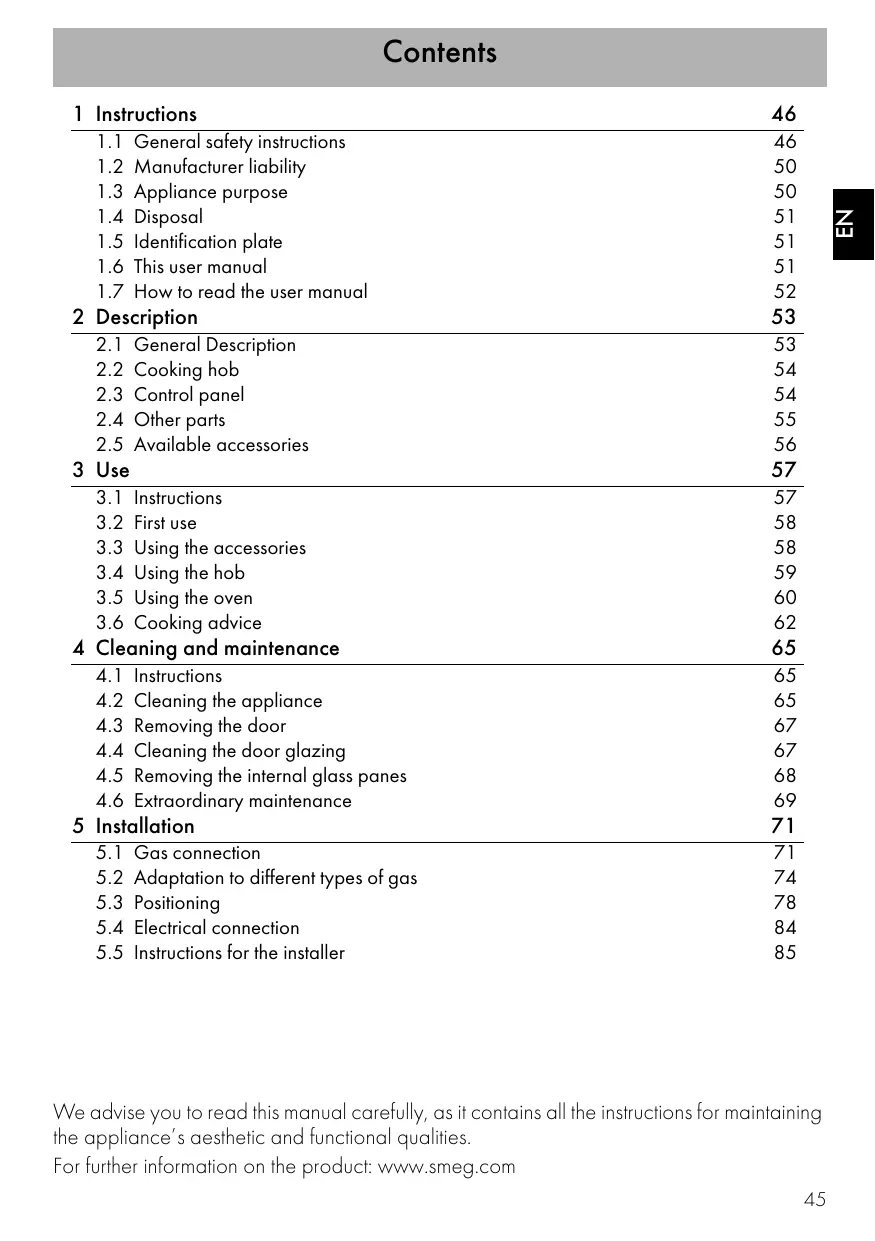
Contents 1 Instructions 46 T.1 General safety instructions 26
1.2 Manufacturer liability 50
1.3 Appliance purpose 50
1.5 Identification plate 51
1.6 This user manual 51
1.7 How to read the user manual 52
2 Description 53 2.T General Description 53
2.5 Available accessories 56
3.3 Using the accessories 58
3.4 Using the hob 59
3.5 Using the oven 60
3.6 Cooking advice 62
4 Cleaning and maintenance 65 A.T Instructions 65
4.2 Cleaning the appliance 65
4.3 Removing the door 67
4.4 Cleaning the door glazing 67
4.5 Removing the internal glass panes 68
4.6 Exiraordinary maintenance 69
5.1 Gas connection 71
5.2 Adaptation to different types of gas 74
5.4 Electrical connection 84
5.5 Instructions for the installer 85
We advise you to read this manual carefully, as it contains all the instructions for maintaining the appliance's aesthetic and functional qualities: For further information on the product: www.smeg.com
1.1 General safety instructions
Risk of personal injury + During use the appliance and its accessible parts become very hot. Never touch the heating elements during use. + Protect your hands by wearing oven gloves when moving food inside the oven. + Nevertry to put out a fire or flames With water: turn off the appliance and smother the flames with a fire blanket or other appropriate cover. + This appliance may be used by children aged at least 8 and by people of reduced physical, sensory or mental capacity, or lacking in experience in the use of electrical appliances, provided that they are supervised or instructed by adults who are responsible for their safety. + Children must never play With the appliance. + Keep children under the age of eight at a safe distance unless they are constanily supervised.
Instructions + Keep children under the age of 8 away from the appliance when it is in use. + Cleaning and maintenance must not be carried out by unsupervised children. + Make sure that the flame-spreader crowns are correcily positioned in their seats with their respective burner caps + Be aware of how rapidly the cooking zones heat up. Do not place empty pans on the heat. Danger of overheating + Fais and oils can catch fire if they overheat. Do not leave the appliance unattended while preparing foods containing oils or fats. If fats or oils catch fire, never put water on them. Place the lid on the pan and turn off the relevant cooking zone. + Cooking process should always be kept under control. A short cooking process must be continuously surveyed.
Instructions + While cooking do not place metal objects, such as cuilery or dishes on the hob surface as they may overheat. + Do notinsert pointed metal objects (cutlery or utensils) into the slots in the appliance. + Do not pour water directly onto very hot trays. + Keep the oven door closed during cooking. + IFyou need to move food or atthe end of cooking, open the door 5 cm for a few seconds, let the steam come out, then open it fully + Do not open the storage compartment [where present) when the oven is on and still hot. + The items inside the storage compartment could be very hot after using the oven
+ DO NOT USE OR STORE
THE STORAGE COMPARTMENT [IF AVAILABLE) OR NEAR THE APPLIANCE.
USE Switch off the appliance after use.
+ DO NOT MODIFY THIS
APPLIANCE. Before any operation on the appliance (installation, maintenance, positioning or movement) always wear PPM + Before performing any operation on the appliance, switch off the power supply. Have qualified personnel carry out installation and assistance interventions according to the standards in force. + Do not try to repair the appliance yourself or without the intervention of a qualified technician Do not pull the cable to remove the plug + lfthe power supply cable is damaged, contact technical support immediately and they will replace it
À Instructions Risk of damaging the appliance + Do not use abrasive or corrosive detergents {e.g. scouring powders, stain removers and metallic sponges] on glass parts. + Use wooden or plastic utensils. + Racks and trays should be inserted as far as they will go into the side guides. The mechanical safety locks that prevent them from being removed must face downwards and towards the back of the oven + Do not sit on the appliance. + Do not use steam jets to clean the appliance. + Do not obstruct ventilation openings and heat dispersal slots. + Never leave the appliance unattended during cooking operations where fats or oils could overheat and take fire. Be very careful. + Never leave objects on the cooking surface
+ DO NOT USE THE APPLIANCE
TO HEAT ROOMS FOR ANY
+ Do not spray any spray products near the oven. + Do not use plastic cookware or containers for cooking. + Donot place sealed tins or containers in the oven cavity. + Remove all trays and racks which are not required during cooking + Do not cover the bottom of the oven cavity With aluminium or tin foil sheets. + Do not place pans or trays directly on the bottom of the oven cavity. + IFyou wish to use greaseproof paper, place it so that it will not interfere with the hot air circulation inside the oven. + Do notuse the open door to place pans or trays on the internal glazing pane + Cooking vessels or griddle plates should be placed inside the perimeter of the hob. + All pans must have smooth, flat bottoms el any liquid does boil over or spill, remove the excess from the hob.
Instructions + Take care not to spill acid substances such as lemon juice or vinegar on the hob. + Do not put empty pans or frying pans on switched on cooking zones. + Do not use steam jets to clean the appliance. + Do not use rough or abrasive materials or sharp metal scrapers. + Do not use cleaning products containing chlorine, ammonia or bleach on parts made of steel or that have metallic surface finishes (e.g. anodizing, nickel- or chromium-plating]. + Do not use abrasive or corrosive detergents {e.g. scouring powders, stain removers and metallic sponges] on glass parts. + Do not wash the removable components such as the hob grids, flame-spreader crowns and burner caps in a dishwasher. + Never use the oven door to lever the appliance into place when fiting. + Avoid exerting too much pressure on the door when open + Do not use the handle to lift or move this appliance. Installation
+ THIS APPLIANCE MUST NOT BE
INSTALLED IN À BOAT OR
CARAVAN ° This appliance must not be installed on a pedestal. Position the appliance into the cabinet cut-out with the help of a second person. + To prevent any possible overheating, the appliance should not be installed behind a decoration door or a panel. + Have the gas connection performed by authorised staff. Installation using a hose must be carried out so that the length of the hose does not exceed 2 metres when fully extended for steel hoses and 1.5 metres for rubber hoses. + The hoses should not come into contact with moving parts and should not be crushed in any way. If required, use a pressure regulator that complies with current regulations. + After carrying out any operation, check that the tightening torque of gas connections is between 10 Nm and 15 Nm.
+ Atthe end ofthe installation, check for any leaks with a soapy solution, never with a flame. + Have the electrical connection performed by authorised technicians. + The appliance must be connected to ground in compliance with electrical system safety standards: + Use cables withstanding a temperaiure of at least 90°C. + The tightening torque ofthe screws of the terminal board leads must be 1.5 -2 Nm. For this appliance + Ensure that the appliance is switched off before replacing the bulb. + Do notrest any weight or sit on the open door of the appliance. + Take care that no objects are stuck in the doors.
1.2 Manufacturer liability
The manufacturer declines all liability for damage to persons or property caused by: + _use ofthe appliance other than that specified; *_ failure to comply with the instructions in the user manual tampering with any part of the appliance:; the use of non-original spare parts .3 Appliance purpose This appliance is intended for cooking food in the home environment. Every other use is considered inappropriate. The appliance is not designed to operate with external timers or with remote-control systems.
4 This appliance must be LA] disposed of separately from other waste [Directives 2002/95/EC, 2002/06/EC, 2003/108/EC). The appliance does not contain substances in quantities sufficient to be considered hazardous to health and the environment, in accordance with current European directives. To dispose of the appliance: + Cutthe power supply cable and remove it along with the plug. + Deliver the appliance to the appropriate recycling centre for electrical and electronic equipment waste, or return it to the retailer when purchasing an equivalent product, on a one for one basis. Our appliances are packaged in non-polluting and recyclable materials. + _Deliver the packing materials to the appropriate recycling centre.
1.5 Identification plate
The identification plate bears the technical data, serial number and brand name ofthe appliance. Do not remove the identification plate for any reason.
1.6 This user manual
This user manual is an integral part of the appliance and must therefore be kept in its entirety and within the user's reach for the whole working life of the appliance. Read this user manual carelully before using the appliance.
1.7 How to read the user manual
This user manual uses the following reading conventions: Instructions General information on this user manual, on safety and final disposal. Description dE Description of the appliance and its accessories. Use Information on the use of the appliance and its accessories. Cleaning and maintenance 4 Information for proper cleaning and maintenance of the appliance. Installation Information for the qualified technician: Installation, operation and inspection.
1. Sequence of instructions for use.
+ Standalone instruction.
SR SR R AUX AUX = Auxiliary burner R = Rapid burner SR = Semi-rapid burner UR = Ultra rapid burner
f À o o Q] e] e) 1 Timer knob 3 Indicator light Allows you to set manual cooking or atimer The indicator light comes on to indicate that with automatic oven switch off at the end of the oven is heating up. ltturns off as soon as cooking itreaches the set temperature. lt flashes regularly to indicate that the temperature set 2 Temperature knob inside the oven is kept constant This knob allows you to select the cooking À Function knob unction knol temperaiure. Turn the knob clockwise to the required The oven's various functions are suitable for value, between the minimum and maximum different cooking modes. After selecting the setting required function, set the cooking temperature using the temperature knob.
5 Hob burner knobs Used for lighting and adjusting the hob burers. Press and turn the knobs anti-clockwise to in order to light the relative burners. Turn the knobs to the zone between the maximum À and minimum A setling to adjust the flame. Return the knobs to the position © to turn off the burners.
Shelves The appliance features shelves to position trays and racks at different heights. The insertion heights are indicated from the bottom upwardks [see 2.1 General Description). Cooling fan The fan cools the oven and comes into operation during cooking. The fan causes a steady outflow of air that
exits from the rear of the appliance and 5 which may continue for a brief period of time even after the appliance has been tumed off. Interior lighting The appliance's interior lighting comes on: + when the door is opened: + When any function is selected, apart from the Eco function.
2.5 Available accessories Ring reducer
EN ©< Useful when using small cookware. - Lid Used for supporting containers with food during cooking. Deep tray The toughened glass lid with aluminium edging protects the hob when not in use. Uselul for collecting fat from foods placed on the rack above.
1. Remove any protective film from the
outside or inside ofthe appliance, including accessories.
2. Remove any labels [apart from the
technical data plate} from the accessories and from the oven cavity.
3. Remove and wash all the appliance
accessories [see 4 Cleaning and maintenance).
4. Heat the empty oven at the maximum
temperature to burn off any residues left by the manufacturing process.
3.3 Using the accessories
Ring reducers The ring reducers have to be placed on the hob grids. Make sure they are placed properly.
Racks and trays Racks and trays have to be inserted into the side guides until they come to a complete stop. +_ The mechanical safety locks that prevent the rack from being taken out accidentally have to face downwards and towards the oven back.
Allthe appliance's control and monitoring devices are located together on the front panel. The burner controlled by each knob is shown next to the knob. The appliance is equipped with an electronic ignition device. Simply press the knob and turn it anti- clockwise to the maximum flame symbol, until the burner ignites. IFthe burner does not light in the first 15 seconds, turn the knob and wait 60 seconds before trying
again. After lighting, keep the knob pressed in for a few seconds to allow the thermocouple to heat up. The burner may go out when the knob is released: In this case, the thermocouple has not heated up sufficiently. Wait a few moments and repeat the operation. Keep the knob pressed in longer.
Correct positioning of the flame- spreader crowns and burner caps Before lighting the hob burners, make sure that the flame-spreader crowns are correcily positioned in their seats with their respective burner caps. Make sure that the holes 1 of the flame-spreader crowns are aligned with the thermocouples 2 and igniters 3. Practical tips for using the hob For better burner efficiency and to minimise gas consumption, use pans with lids and of suitable size for the burner, so that the flames do not reach up the sides ofthe pan. Once the contents come to the boil, turn down the flame far enough to ensure that the liquid does not boil over.
Switching on the oven To switch on the oven:
1. Select manual cooking # or set the
cooking duration using the timer knob. Adijustment is progressive so that the time can also be set to any intermediate value between these numbers.
2. Select the temperature using the
function knob. Atthe end oftimed cooking, a buzzer sounds that stops automatically after a few seconds. Functions list Static As the heat comes from above and below at the same time, this system is particularly suitable for certain types of food. Traditional cooking, also known as static cooking, is suitable for cooking just one dish at a time. Perfect for all types of roasts, bread and cakes, and in any case, particularly suitable for fatty meats such as goose and duck.
Fan + lower element LS The combination of the fan with just the lower heating element allows cooking to be completed more rapidly. This system is recommended for sterilising or for finishing off the cooking of foods which are already well-cooked on the surface, but not inside, which therefore need a litle more heat. Perfect for any type of food. Grill The heat coming from the grill element gives perfect grilling results above dllfor thin and medium thickness meat and, in combination with the rotisserie [where fitted), gves the od an even browning at e end of cooking. Perfect for usages spare ribs and bacon. This function enables large quantities of food, particularly meat, to be grilled evenly. Fan with grill The air produced by the fan softens the strong heatwave generated by the grill, grilling perfectly even very thick foods. Perfect for large cuts of meat {e.g. shin of pork]. Fan assisted The operation of the fan, combined With traditional cooking, ensures consistent cooking even with Z complex recipes. Perfect for biscuits fr and cakes, even when simultaneously cooked on several levels. [For multiple-level cooking, we recommend using the 2 and 4Ÿ shell]. Eco Using the grill and the lower heating element in combination is particularly suitable for cooking on a single shelf, as it provides low energy consumption. Ideal for cooking mea, fish and vegetables. Not recommended for desserts which must rise.
General advice + _ Use a fan assisted function to achieve consistent cooking at several levels. Itis not possible to shorten cooking times by increasing the temperature [the food could be overcooked on the outside and undercooked on the inside]. Advice for cooking meat + Cooking times vary according to the thickness and quality of the food and to consumer taste. Use a meat thermometer when roasting meat, or simply press on the roast with a spoon. If it is hard, it is ready; IF not, it needs another few minutes cooking. Advice for cooking with the Grill and the Fan grill + Meat can be grilled even when it is put into the cold oven or into the preheated oven if you wish to change the effect of the cooking. With the Fan grill function, we recommend that you preheat the oven before grilling. We recommend placing the food at the centre of the rack.
+ With the Grill function, we recommend that you turn the temperature knob to the maximum value near the E symbol to optimise cooking. Foods should be seasoned before cooking. Foods should also be coated with oil or melted butter before cooking. +_ Use the oven tray on the first bottom shelf to collect liquids produced by grilling. Grilling processes must never last more than 60 minutes. Advice for cooking desserts/pastries and biscuits + Use dark metal moulds: They help to absorb the heat better. +_ The temperature and the cooking time depend on the quality and consistency ofthe dough. To check whether the dessert is cooked right through: at the end ofthe cooking time, put a toothpick into the highest point ofthe dessert. IFthe dough does not stick to the toothpick, the dessert is cooked. +_lfthe dessert collapses when it comes out of the oven, on the next occasion reduce the set temperature by about 10°C, selecting a longer cooking time if necessary. + While cooking desserts or vegetables, excessive condensation may form on the glass. In order to avoid this, open the door very carelully a couple of times while cooking.
Advice for defrosting and proving +_ Place frozen foods without their packaging in a lidless container on the first shelf of the oven. Avoid overlapping the food. To defrost meat, use the rack placed on the second level and a tray on the first level. In this way, the liquid from the defrosting food drains away from the food. The most delicate parts can be covered with aluminium foil. For successful proving, a container of water should be placed in the bottom of the oven. To save energy + Stop cooking a few minutes before the time normally used. Cooking will continue for the remaining minutes with the heat which has accumulated inside the oven. + Reduce any opening ofthe door to a minimum to avoid heat dispersal. +_Keep the inside ofthe appliance clean at all times.
4 Cleaning and maintenance
4.2 Cleaning the appliance
Recommendations for cleaning the hob To keep the surfaces in good condition, they should be cleaned regularly after use. Let them cool first. Cleaning the hob
1. Pour some non-abrasive detergent on a
damp cloth and wipe the surface.
2. Rinse thoroughly. Z
3. Dry with a soft cloth or a microfibre cloth. le
Cleaning the hob grids, flame-spreader crowns and burner caps
1. Remove the components from the hob.
2. Clean with lukewarm water and non-
abrasive detergent. Make sure to remove any encrustations.
3. Dry thoroughly with a soft cloth or a
Cleaning the igniters and thermocouples +_lfnecessary, clean the igniters and thermocouples with a damp cloth. +_lfthere is any dry residue, remove it with a toothpick or needle. Cleaning the oven cavity For the best oven upkeep, clean it regularly after having allowed it to cool. Avoid letting food residue dry inside the oven cavity, as this could damage the enamel. Take out all removable parts before cleaning.
For easier cleaning, we recommend removing: + The door; + The rack/ray support frames; + The seal. Cleaning the glass lid For easier cleaning, the lid can be taken off its hinges.
1. Lower the lid to closed position.
2. Unscrew the screws on the back of the
3. Open it and lift it upwards.
5. Insert the ld into the guides. Tighten the
fastening screws on the hinges in closed position.
For easier cleaning it is recommended to remove the door and place it on a tea towel. To remove the door proceed as follows:
1. Open the door completely and insert two
pins into the holes on the hinges indicated in the figure.
2. Grasp the door on both sides with both
hands, lift it forming an angle of around 30° and remove it.
3. To reassemble the door, put the hinges in
the relevant slots in the oven, making sure that grooved sections À are resting completely in the slots. Lower the door and once it is in place remove the pins from the holes in the hinges.
4.4 Cleaning the door glazing
The door glazing should always be kept thoroughly clean. Use absorbent kitchen roll. In case of stubborn dirt, wash with a damp sponge and an ordinary detergent.
4.5 Removing the internal glass 4. Refit the panes in the reverse order in
panes which they were removed. For easier cleaning the internal glazing +_ Reposition the internal glass pane. Take panes of the door can be removed. care to centre and insert the 4 pins into
1. Remove the internal glass pane by their housings in the oven door by
pulling the rear part genily upwardk, applying slight pressure. following the movement indicated by the arrows [1].
2. Then, pull the front part upwards [2]. This
way, the 4 pins attached to the glass detach from their housings in the oven door.
3. Clean the external glass pane and the
internal pane which you have removed previously. Use absorbent kitchen roll. In case of stubborn dirt, wash with a damp sponge and neutral detergent.
Cleaning and maintenance Pa! Removing racks/trays support frames 4.6 Extraordinary maintenance Removing the rack/tray support frames Installing and removing the seal enables the sides to be cleaned more easily. To remove the seal To remove the rack/tray support frames: + Unhook the clips located in he 4 comers FA and in the centre, then pull the seal +_ Pullthe frame towards the inside of the oven to unhook it from its groove À, then slide it out of the seats B at the back. outwards. + When cleaning is complete, repeat the above procedures to put the rack/tray To refit the seal: support frames back in + Hook the clips located in the 4 corners and in the centre onto the seal Seal maintenance tips The seal should be soft and elastic. + To keep the seal clean, use a non- abrasive sponge and wash with lukewarm water.
Replacing the internal light bulb 4. Slide out and remove the light bulb.
1. Completely remove all accessories from
2. Remove the rack/tray support frames.
5. Fitthe new light bulb.
6. Refit the cover. Ensure the moulded part
ofthe glass [A] is facing the door.
7. Press the cover completely down so that
it attaches perfecily to the bulb support.
General information Connection to the gas mains can be made using a continuous wall steel hose in compliance with the guidelines established by the standardks in force. For supplying it with other types of gas, see chapter "5.2 Adaptation to different types of gas”. The gas inlet connection is threaded 2" external gas (ISO 228-1). Connection with a rubber hose Verify that all following conditions are met: +_the hose is fixed to the hose connection with safety clamps; Z no part of the hose is in contact with hot D walls (max. 50 °C}; +_the hose is not under traction or tension and has no kinks or twists; *_the hose is not in contact with sharp objects or sharp corners; *_ifthe hose is not perfecly airtight and leaks gas, do not try to repair it; replace it with a new hose. verify that the hose is not past its expiry date (serigraphed on the hose itself).
Make the connection to the gas mains using a rubber hose whose specifications comply with current standards {verify that the reference standard is stamped on the hose). Carelully screw the hose connector 3 to the appliance’s gas connector 1 [}2" thread ISO 228-1}, placing the seal 2 between them. The hose connector 4 can also be screwed to the hose connector 3, depending on the diameter of the gas hose used.
After having tightened the hose Carelully screw the connector 3 to the gas connector(s), push the gas hose 6 ontothe connector 1 ofthe appliance, placing the hose connector and secure it with the clamp seal 2 between them. 5 that is compliant with the standard in force. fr Connection with a steel hose with bayonet fitting Carry out the connection to the gas mains using a steel hose with bayonet fitting compliant with B.S. 669. Apply insulating material to the thread of the gas hose connector 4 and then tighten the adapter 3. Screw the assembly to the movable connector 1 ofthe appliance, placing the supplied seal 2 between them. Connection with a steel hose Make the connection to the gas mains using a continuous wall steel hose whose specifications comply with the applicable standard.
Connection with a steel hose with conical fitting Make the connection to the gas mains using a continuous wall steel hose whose specifications comply with the applicable standard. Carelully screw the hose connector 3 to the appliance's gas connector 1 [/2" thread ISO 228-1|, placing the supplied seal 2 between them. Apply insulating material to the thread of connector 3, then tighten the steel hose 4 to the connector 3. Connection to LPG Use a pressure regulator and make the connection on the gas cylinder following the guidelines set out in the standards in force. The supply pressure must comply with the values indicated in the table "Gas types and Countries”. Room ventilation The appliance should be installed in rooms that have a permanent air supply in accordance with the standards in force. The room where the appliance is installed must PA have enough air flow for the regular combustion of gas and the necessary air change in the room itself. The air vents, protected by grilles, must be the right size to comply with current regulations and positioned so that no part ofthem is obstructed, not even partially. The room must be kept adequately venfilated in order to eliminate the heat and humidity produced by cooking; In particular, after prolonged use, you are recommended to open a window or to increase the speed of any fans. Extraction of the combustion products The combustion products may be extracted by means of hoods connected to a natural draught chimney whose efficiency is certain or via forced extraction. An efficient extraction system requires precision planning by a specialist qualified in this area and must comply with the positions and clearances indicated by the applicable standards.
When the job is complete, the installer must issue a certificate of conformity.
e ‘BI x Aias ie 22 1 Extraction using a hood 2 Extraction without a hood A Single natural draught chimney B Single chimney with extractor fan € Direcily outdoors with wall. or window- mounted extractor fan D Direcily outdoors through wall <aAï a Combustion products & Extractor fan
5.2 Adaptation to different types of
gas In case of operation with other types of gas, the burner nozzles must be changed and the minimum flame adjusted on the gas cocks. Replacing nozzles
1. Remove the grids, burner caps and
flame-spreader crowns to access the burner cups.
2. Replace the nozzles using a 7 mm socket
wrench according to the gas to be used {see "Burner and nozzle specifications tables”}
3. Replace the burners in their respective
Adjusting the minimum setting for natural Adjusting the minimum setting for LPG or town gas Tighten the screw located at the side ofthe Light the burner and turn it to the minimum cock rod clockwise all the way. position. Extract the gas cock knob and turn the adjustment screw next to the tap rod {depending on the model} until the correct minimum flame is achieved. Refit the knob and verify that the burner flame is stable. Turn the knob rapidly from the maximum to the minimum setting: The flame should not go out. Repeat the operation on all gas cocks. . Lubricating the gas cocks Over time the gas cocks may become difficult to tum and get blocked. Clean them internally and replace the lubrication grease. | Es"
Burner and nozzle specifications tables Rated heating capacity (kW] 10 1.8 29 40 Nozzle diameter (1/100 mm) 72 94 115 145 Pre-chamber (printed on nozzle] (x) M] MI (2) Reduced flow rate (W) 400 500 800 1600 Rated heating capacity (kW] 10 175 29 40 Nozzle diameter (1/100 mm) 50 65 85 102 Pre-chamber [printed on nozzle] - - - Reduced flow rate (W) 400 500 800 1600 Rated flow rate G30 (g/h] 73 127 211 291 Rated flow rate G31 (g/h] 71 125 207 286 Rated heating capacity (kW] 10 1.8 28 38 Nozzle diameter (1/100 mm) 145 185 260 340 Pre-chamber (printed on nozzle] (/8) 1/2] 1/3) 1/13} Reduced flow rate (W) 400 500 800 1400 Rated heating capacity (kW] 10 1.8 29 38 Nozzle diameter (1/100 mm) 145 185 260 315 Pre-chamber (printed on nozzle) 1/81 (2 {/31 1/13] Reduced flow rate (W) 400 500 800 1400 The nozzles not provided are available at Authorised Service Centres.
Installation Position of gas and electrical connections Depending on the type of installation, this appliance belongs to classes PEN du QG “UIW
A 51 mm B 671 mm C 126 mm A - Class 1 D 30 mm (Free-standing appliance) E Gas connection F Electrical connection General information This appliance may be installed next to walls, one of which must be higher than the worklop, at a minimum distance of 50 mm from the side of the appliance, as shown in figures À and C relative to the installation classes. Any wall units positioned above the worktop of the appliance must be at a minimum distance of at least 750 mm. If a hood is installed above the hob, refer to the hood instruction manual to ensure the correct clearance is left. B - Class 2 subclass 1 QUI 092 “UT (Built-in appliance]
C- Class 2 subclass 1 {Built-in appliance)
ning and levelling +_ After making the gas and electrical connections, screw on the four feet supplied with the appliance. The appliance must sit level on the floor to ensure stability. + Screw or unscrew the bottom part ofthe foot until the appliance is stable and level on the floor.
Fastening to the wall 3. Assemble the fastening bracket.
1. Screw the wall fastening plate to the rear
4. Align the base of the hook on the
fastening bracket with the base ofthe slot on the wall fastening plate.
5. Align the base of he fastening bracket 7. Move the bracket onto the wall and
with the ground and tighten the screws to mark the position of the holes to be fix the measurements. drilled in the wall.
8. After drilling the holes in the wall, use
6. Use 50 mm for the distance from the side wall plugs and screws to fasten the
ofthe appliance to the bracket holes. bracket to the wall.
9. Push the cooker towards the wall, and at
the same time, insert the bracket in the plate fastened to the rear of the appliance.
1. Install the two supports À and fasten them
from below the hob using the corresponding screws B. (QN
2. Install the lid from above, parallel with
Cinserted in the rear of the two supports
5.4 Electrical connection
General information Check the mains characteristics against the data indicated on the plate. The identification plate bearing the technical data, serial number and brand name is visibly positioned on the appliance. Do not remove this plate for any reason. Perform the ground connection using a wire that is 20 mm longer than the other wires. The appliance can work in the following modes: + 220-240 VIN” 3 x 1.5 mm? three-core cable. Fixed connection Fitthe power line with an all-pole disconnection switch, with at least 3 mm between its contacts, in compliance with installation regulations. The circuit breaker should be located near the appliance and in an easily reachable position. Connection with plug and socket Make sure that the plug and socket are of the same type. Avoid using adapters, gang sockets or extensions as these could cause overheating and a risk of burns.
Testing Atthe end of installation, carry out a brief inspection test. IFthe appliance fails to operate, after checking that you have followed the instructions correcily, unplug the appliance and contact Technical Support.
5.5 Instructions for the installer
+ The plug must be accessible after installation. Do not bend or trap the power cable. *_The appliance must be installed 5 according to the installation diagrams. Do not try to unscrew or force the threaded elbow of the fitting. You may damage this part ofthe appliance, which may void the manufacturer's warranty. Use soap and water to check for gas leaks on all connections. DO NOT use naked flames to find leaks. Turn on all the burners separately and at then all together to make sure that the gas valve, burer and ignition are working properly. Turn the burner knobs to the minimum position and check that the flame is stable for each individual burner and all the burners together. Ifthe appliance does not work correcily after having carried out all the checks, contact your local Authorised Service Centre. Once the appliance has been installed, please explain to the user how to use it correctly.