USER MANUAL G 665 SC MIELE
Operating instructions for dishwashers
It is essential to read these operating instructions before installing or using the machine, to avoid risk of accident or damage to the machine.

M.-Nr. 04 873 380
Contents
Guide to the appliance 3 Warning and safety instructions 6 Caring for the environment 9 Before using for the first time 10 Opening and closing the door 11 Water softener/reactivation 12 Setting the water hardness level/Filling the salt reservoir 12/13 Add salt indicator light. 14 Adding rinse aid 15 Rinse aid dosage setting 16 Loading the dishwasher 17 Loading examples 18 Flap up racks, positioning rail, adjusting the upper basket. 22/23 Not suitable for dishwashers 24 Adding detergent 25 Programme selection 29 Programme chart 30/31 Switching on and off 32/33 Programme change; interrupting a programme; programme sequence display. 32/33 Removing load 34 Cleaning and care 35 Checking the water level/Increasing the water intake time 41 Dealing with minor faults 43 After sales service 43 Special accessories 44 Comparison tests 45 Installation instructions 47 Technical data 69
Miele dishwashers are available in three versions:
1. “Freestanding” dishwashers
"Freestanding" dishwashers do not require any special installation fixings in the kitchen.
A decor frame can be added to take a panel for matching the dishwasher to the kitchen fronts.
2. Integrated ("i") dishwashers
“i” dishwashers are specially designed for building under a continuous worktop.
The control panel with its accessories is included with the "i" dishwasher in a separate package for on-site fixing. The front is designed to be fitted with a base unit front to match the kitchen furniture.
The dishwasher does not have a plinth facia. The plinth area can be covered either with facia to match your kitchen furniture if available, or another facia. The separate plinth facia can be fitted to match the height of adjacent plinths. The plinth return is freely adjustable.
All notes on installation are described in the chapter on "Installation instructions".
3. "U" dishwashers
The built-under ("U") dishwashers use the integrated ("i") dishwashers as the basic machine.
By using a decor set (GDU), the "i" dishwasher can be converted into a "U" model dishwasher.
GDU installation instructions are included in a separate installation leaflet supplied with the decor set.
View of the machine Control panel (facia)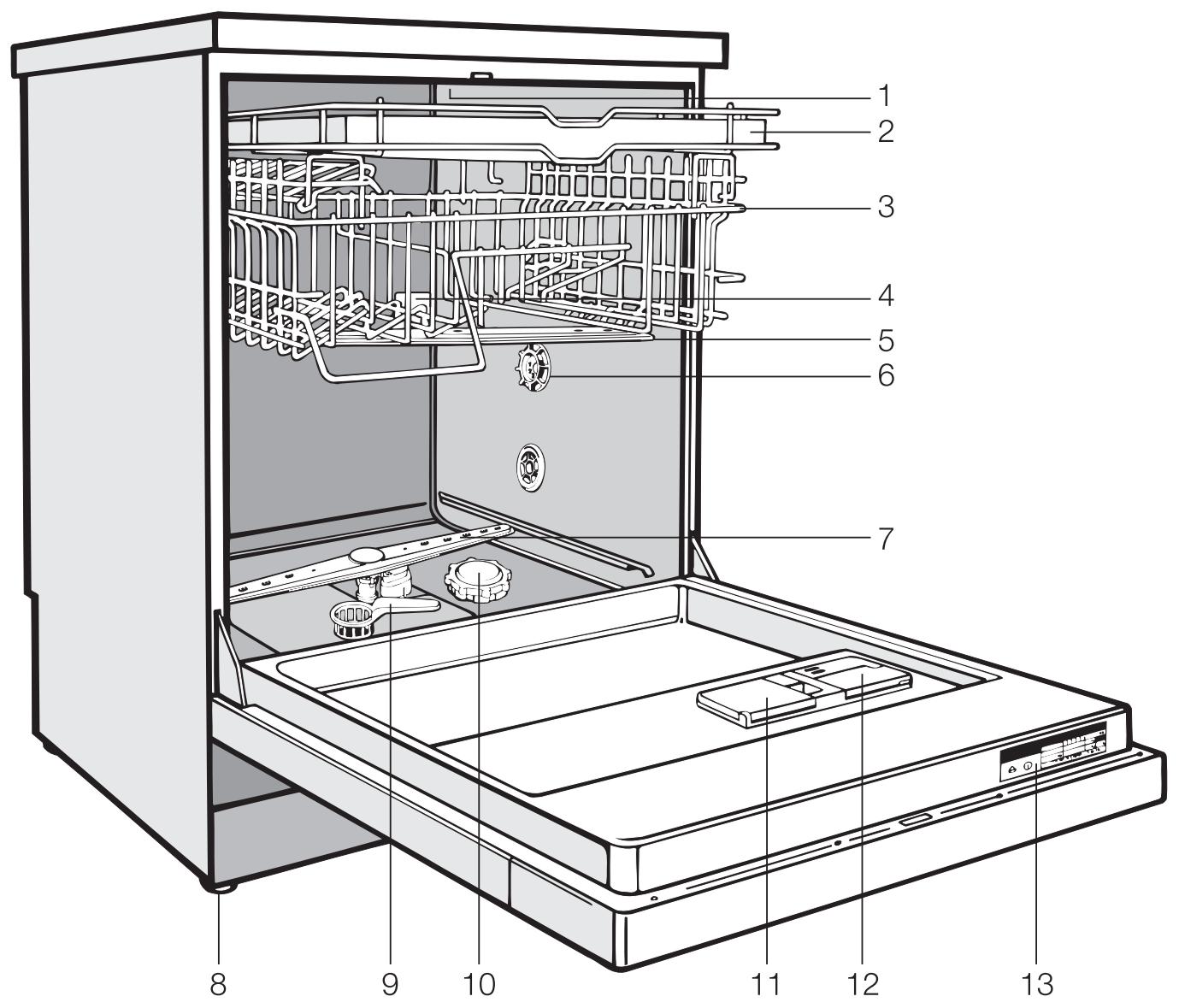
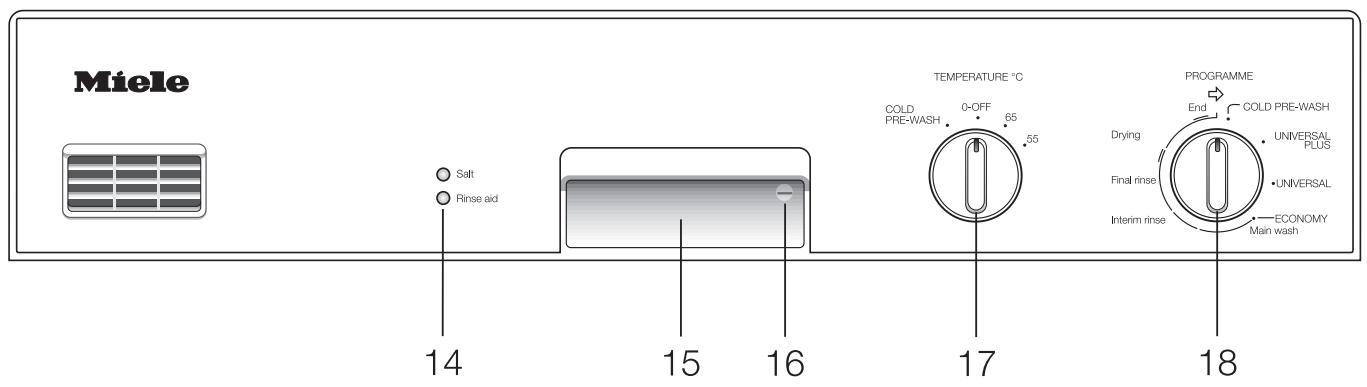
1 Upper spray arm (not visible) 2 Cutlery tray (standard depending on model) 3 Upper basket (design varies according to model, and may not match the one shown) 4 Water duct for middle spray arm 5 Middle spray arm 6 Water hardness selector 7 Lower spray arm 8 Four height adjustable screw feet 9 Filter combination 10 Salt reservoir 11 Dual compartment detergent dispenser 12 Rinse aid reservoir (with dosage selector) 13 Data plate 14 Indicator lights 15 Door opener 16 Child safety lock 17 Temperature selector 18 Programme selector switch
This appliance conforms to current safety requirements. Inappropriate use can however lead to personal injury and damage to property. Read the operating instructions carefully before starting to use this machine. This way you will avoid the risk of accidents, and damage to the machine. Keep these instructions in a safe place for reference, and pass them on to any future user.
Appropriate usage
This dishwasher is intended exclusively for cleaning domestic crockery and cutlery. Do not use for purposes other than those for which it was designed. Unauthorized use could prove dangerous.
The manufacturer cannot be held responsible for any damage caused by improper use or for uses other than those for which the appliance is intended.
The following notes are to help avoid personal injury
To ensure stability, integrated and built-under models must be installed under a continuous worktop which has been firmly screwed to neighbouring units.
The electrical safety of this appliance can only be guaranteed when continuity is complete between the appliance and an effective earthing system. It is imperative that this basic safety requirement is tested and where there is any doubt the electrical system in the house is checked out by a qualified electrician. The manufacturer can-
not be held responsible for damage caused by the lack or inadequacy of an effective earthing system (electric shock for example).
For safety reasons, do not operate this appliance on an extension cable. Danger of overheating. A damaged appliance is dangerous. Switch off at the mains and call the Service Department for assistance. Repairs may only be carried out by suitably qualified and competent engineers to ensure safety. Repairs by unqualified persons could be dangerous. With the "Waterproof system", the plastic housing of the water inlet connection contains an electrical component. It must not be dipped in water. Do not let small children play with the dishwasher and its controls or operate it. There is a danger that children playing might shut themselves in the dishwasher. Please supervise its use by the elderly or infirm. Do not use solvents in the dishwasher. Danger of explosion! Avoid inhalation of powder detergents. For appliances with the heating element in the wash cabinet, do not touch the element during or directly after the end of a programme, you could burn yourself.
Dishwasher detergents contain irritant or corrosive ingredients. They can cause burning in the mouth and throat if swallowed, or inhibit breathing. Keep children away from detergents and from the dishwasher when the door is open. There could be detergent residues in the appliance. To avoid the danger of children coming into contact with the dishwasher detergent: Only put it into the detergent dispenser just before starting the programme, and then secure the door with the child safety lock. For models with "Delay Start" option, make sure the detergent dispenser is dry before putting in detergent. Wipe dry if necessary. Detergent will clog if poured into a damp dispenser and may not be thoroughly dispensed. If the door is open at the end of a programme, children may come into contact with this residue. Water in the dishwasher must not be used as drinking water. Appliances with a cutlery basket: items of cutlery are cleaned and dried more efficiently if placed in the basket handles downwards. You may, however, prefer to place cutlery with sharp points with the handles upwards. Always disconnect the appliance from the electrical supply for maintenance work (switch off at wall socket and remove plug, screw out fuse in countries where this is applicable).
The following notes should help to avoid material damage.
The voltage and frequency shown on the data plate must match the mains supply in the house. Only use detergents formulated for domestic dishwashers. Do not use washing-up liquid. Do not use commercial or industrial detergents as these may damage material and there is a risk of severe chemical reaction. Inadvertently filling the salt reservoir with dishwasher detergent always leads to damage to the water softener. Make sure that you have picked up the right packet of dishwasher salt before filling the salt reservoir. Inadvertently filling the rinse aid reservoir with powder or liquid detergent always leads to serious damage to the reservoir. Only use rinse aid formulated for domestic dishwashers. Do not sit or lean on the opened door. This could cause the dishwasher to tip and be damaged. If your dishwasher has the heating element visible in the base of the wash cabinet, as far as possible always place plastic items in the top basket, and ensure they do not drop through. The plastic could melt or lose its shape near the heating element.
The Miele Waterproof System offers protection from water damage, provided the following conditions are met:
- the dishwasher is correctly installed and plumbed in
- the dishwasher is properly maintained and parts are replaced where it can be seen that this is necessary
- the stopcock has been turned off when the machine is not used for a longer period of time (e.g. during holidays).
In countries where there are areas which may be subject to infestation by cockroaches or other vermin, pay particular attention to keeping the appliance and its surroundings in a clean condition at all times. Any damage which may be caused by cockroaches or other vermin will not be covered by the appliance guarantee.
Disposal of your old machine
When disposing of an old dishwasher first make it unusable. Disconnect, cut off the cable and the plug from the cable.
Make the door lock inoperative, so that children cannot accidentally shut themselves in. Make appropriate arrangements for the safe disposal of the appliance.
The manufacturer cannot be held responsible for any damage caused by non-observation of the Warning and Safety instructions.
Disposal of the packing material
The transport and protective packing has been selected from materials which are environmentally friendly for disposal and can normally be recycled.
Rather than just throwing these materials away, please ensure they are offered for recycling.
Disposal of your old machine
Old machines contain materials which can be recycled. Please contact your local authorities or scrap merchant about potential recycling schemes, before disposing of the appliance.
Energy saving washing
These dishwashers are exceptionally efficient in their use of water and electricity. You can make the most of your appliance by following these tips:
If your household water system is suitable, this dishwasher can be connected to a hot water supply, for further economies.
However, if your water is heated by electricity we would still recommend connection to cold water.
In the UNIVERSAL 55° programme, depending on the capacity of the dishwasher, when connected to hot water at 55°C up to 0.7 kWh of electrical energy is saved. The hot water provides this energy, and the approx. 0.13 l oil or 0.14 m³ natural gas needed to heat the water might be considerably more cost effective.
Although all stages of the wash then take place with hot water, savings are made in cost, time and energy.
Make full use of the baskets without overloading the dishwasher for most economical washing. - Choose the programme to suit the type of crockery being washed and the degree of soiling. If baskets are only half full use the ECONOMY programme. Use the correct dosages of detergent.
Before using for the first time please note the following points:
See the relevant chapters for detailed information on the points below.
Setting the water softener
The water softener unit must be set to deal with the water hardness level in your area. The salt reservoir must also first be filled with water and then with dishwasher salt. Never fill with dishwasher powder detergent.
Filling the salt reservoir with detergent by mistake will cause serious damage to the water softener. Please check every time before refilling that the package contains dishwasher salt.
Add rinse aid
Inadvertently filling the rinse aid reservoir with powder or liquid detergent, or washing up liquid, will cause serious damage to the reservoir.
Only use rinse aid formulated for domestic dishwashers.
Do not use washing up liquid
Only use detergent formulated for domestic dishwashers.
Load the crockery correctly
Load the crockery so that water will come into contact with all surfaces.
This ensures that they will be properly cleaned.
The spray arms must not be blocked by items which are too tall for the basket or which hang through. If necessary, manually rotate the spray arms to test.
Add the correct amount of detergent
Follow the detergent manufacturer's recommendations on how much detergent to use. Not using enough will lead to poor wash results. The amount to dispense will depend on the type of detergent and programme selected.
Read the notes on dosage given in the programme chart.
Cleaning results may vary from brand to brand. If you are not satisfied with the results from one brand, try another quality brand before contacting the Customer Service department for advice.
It is important to choose the correct programme
The UNIVERSAL programmes are ideally suited to everyday loads. See the programme chart for descriptions of other programmes.
The filter combination in the base of the wash cabinet and the spray arms must be kept clean.
These should be regularly inspected and cleaned if necessary.
To open the door
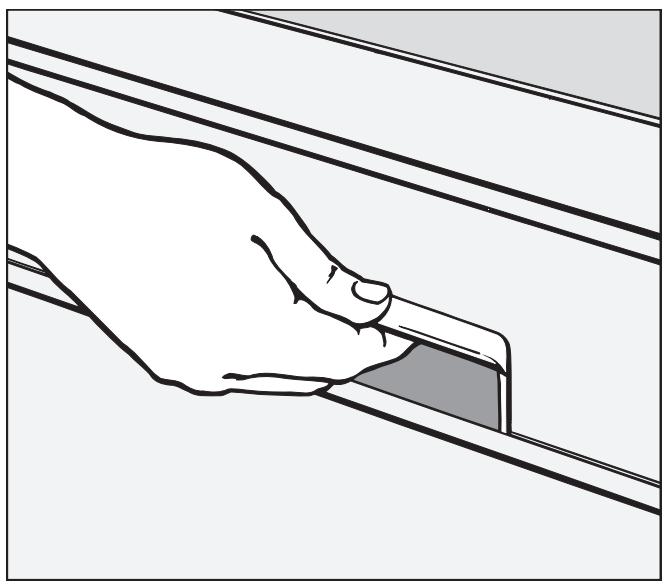
Press the release catch inside the door grip.
If the door is opened during operation, all functions are automatically interrupted.
To close the door:
Push the baskets right in. Lift the door upwards and push until it clicks into position.
Child safety lock
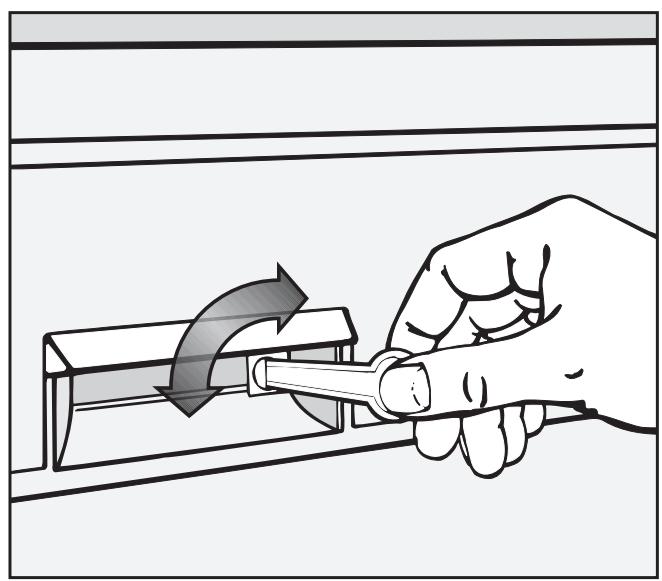
The child safety lock is designed to deter children from opening the dishwasher door.
Use the key provided to turn the child safety lock to the required setting.

Horizontal setting = The door is locked.

Vertical setting = The door can be opened.
It is not necessary to reactivate with salt if the degree of hardness in the local supply is permanently under 70 mg/l (0.7 mmol/l, or 4 °d German scale).
Your local water supplier will advise you on the water hardness of your area.
Above 70 mg/l (0.7 mmol/l, or 4 °d German scale) water must be softened.
This is to avoid the build-up of calcium deposits on crockery and cutlery, and in the dishwasher, and also to increase the effectiveness of the detergent.
To ensure a steady supply of soft water, the built-in water softener must be:
- correctly set and
- The salt reservoir must be filled with dishwasher salt for reactivation.
The dishwasher is set at the factory to operate at a hardness level of 400 - 630 mg/l (4.0 - 6.3 mmol/l, or 22 - 35 °d German scale).
If your water is harder or softer than this, the factory setting will need to be adjusted.
Setting the water hardness level selector in the wash cabinet
There are six settings on the selector.
| Setting | °d | mg/l | °f |
| 1 | 4-14 | 70-250 | 7-25 |
| 2 | 15-21 | 270-380 | 27-38 |
| 3* | 22-35 | 400-630 | 40-63 |
| 4 | 36-47 | 650-850 | 65-85 |
| 5 | 48-65 | 860-1170 | 86-117 |
| 6 | 66-70 | 1190-1260 | 119-126 |
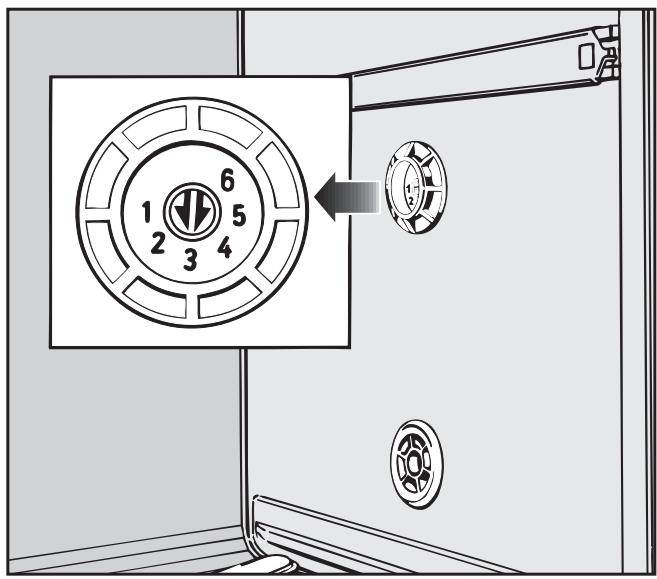
- Use a coin or screwdriver to adjust the water hardness level selector in the wash cabinet. There is a click as each setting is reached.
Example:
The water hardness level is 320 mg/l.
The water hardness level selector must be set to setting 2, 270 - 380 mg/l (15 - 21 °d German scale).
Filling the salt reservoir
Please only use special coarse grained dishwasher salt for reactivation, as other salts may contain insoluble additives which can impair the functioning of the softener.
The salt reservoir holds approximately 2 kg of salt.
Inadvertently filling the salt reservoir with dishwasher detergent always causes serious damage to the water softener.
Make sure that you have picked up the right packet of dishwasher salt before filling the salt reservoir.
Remove the bottom basket. Unscrew the salt reservoir cap.
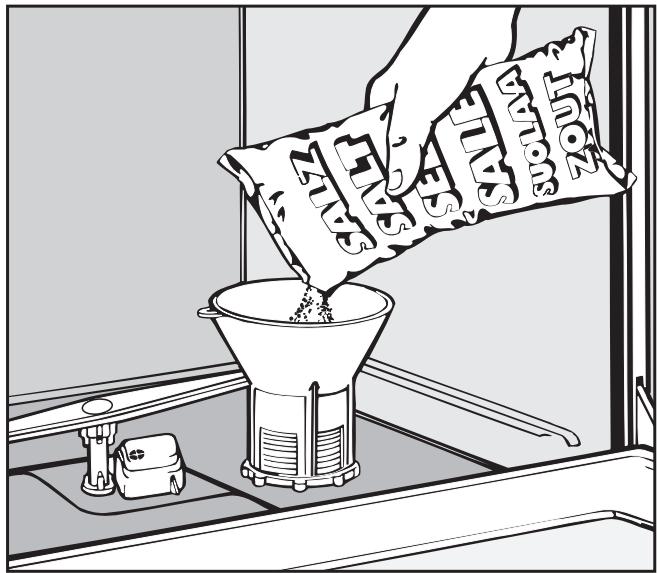
Before filling the salt reservoir for the first time:
Fill the salt reservoir with approximately
2 litres of water.
- Place the funnel (provided) in place.
- Fill carefully with salt (as it is filled, displaced water will run out). Clean salt from the screw threads of the socket. Screw the cap on firmly.
- Run the "COLD PRE-WASH" programme immediately to remove any traces of salt water from the cabinet. This is not necessary if a "UNIVERSAL" or "UNIVERSAL PLUS" programme is run straight away.
Salt indicator
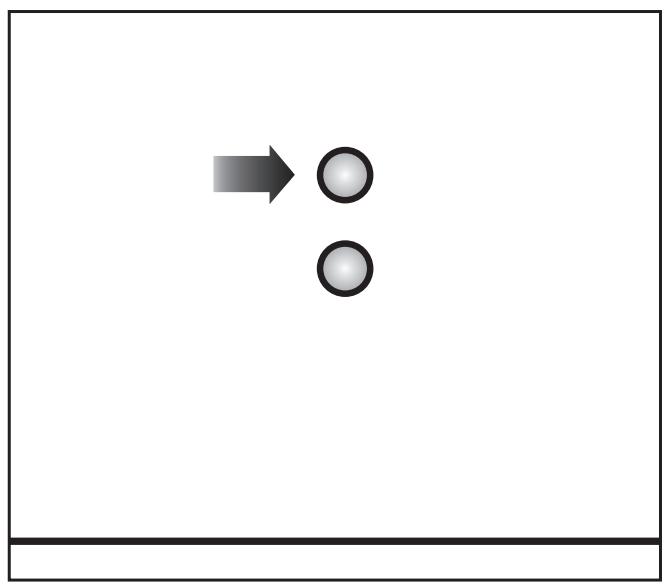
When the salt reservoir is empty, the "Salt" indicator light comes on. The reservoir should be refilled with dishwasher salt for reactivation.
Note
With very soft water, i.e. constantly at a level below 70 mg/l (4°d), the reservoir does not have to be filled with salt, and although the salt light does come on, this can be disregarded.
Rinse aid is necessary to ensure that water does not cling and leave marks on crockery during the drying phase. Rinse aid is poured into the storage reservoir, and the amount set is dispensed automatically. The rinse aid reservoir holds approximately 130 cm³.
Inadvertently filling the rinse aid reservoir with powder detergent (or liquid detergent) always causes serious damage to the reservoir. Only pour rinse aid formulated for domestic dishwashers into the reservoir.
Although it is possible to use household vinegar with a max. 5% acid content, or liquid citric acid up to 50% acid as an alternative, the resulting rinsing and drying quality will not be as good as when rinse aid is used.
Do not use vinegar with a high acid content (e.g. vinegar essence 25% acid). This must not be used as its use would damage the dishwasher.
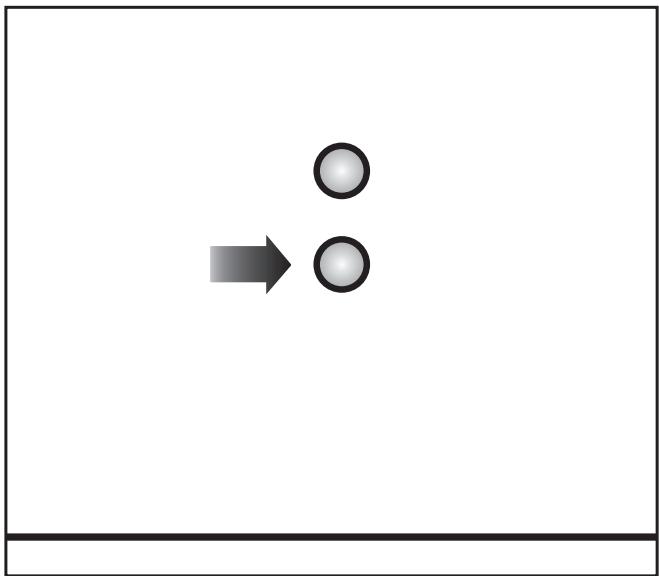
- Add rinse aid when the indicator light "Rinse aid" on the control panel comes on.
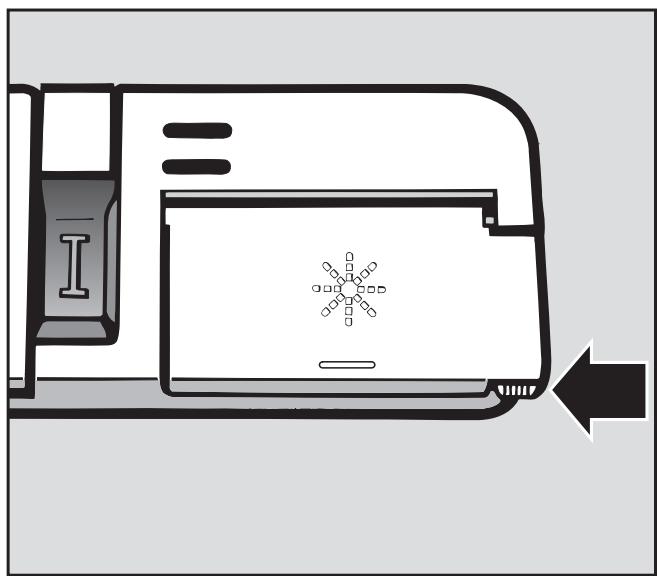
Press the button (in the direction of the arrow) until the flap springs open.
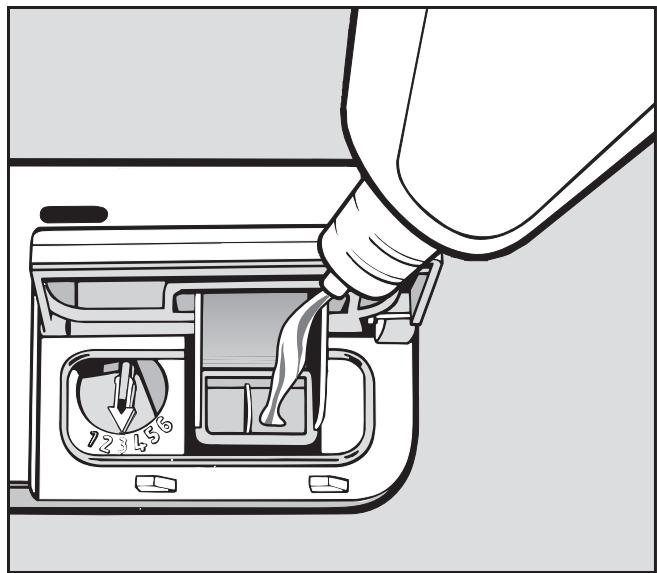
- Add rinse aid only until it is visible on the surface of the filter in the opening.
- Close the flap firmly. The flap must audibly engage, otherwise water could get into the rinse aid storage container during the programme.
- Mop up any split rinse aid. This prevents over-forming occurring during the next programme.
The flap should normally remain closed. Only open it for adding more rinse aid!
Wait until the "Rinse aid" indicator on the control panel lights up before adding more rinse aid.
Setting the dosage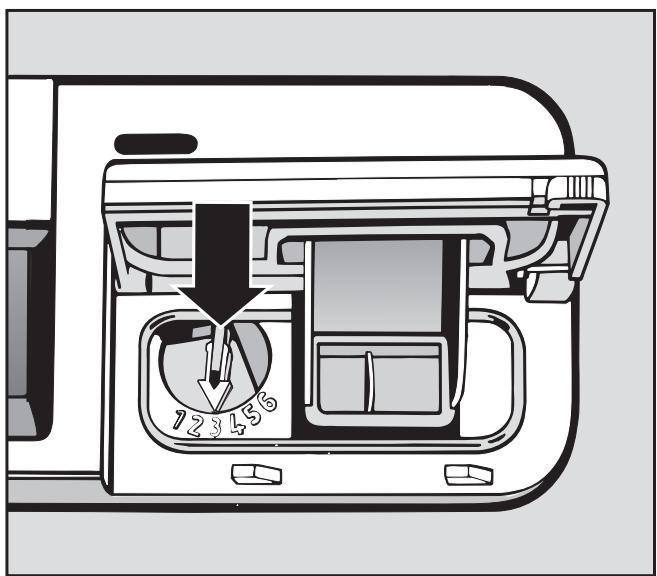
The dosage adjuster (see arrow) in the opening has settings from 1 to 6. It is set to 3 at the factory, as the recommended dose. This setting dispenses approx. 3 ml rinse aid per programme.
If there are flecks on glasses after drying use a higher setting. If smearing appears on crockery use a lower setting.
Note
- Load the crockery so that water will come into contact with all surfaces. This ensures that they will be properly cleaned.
- Do not place crockery and cutlery inside other pieces where they may be concealed.
- Hollow items e.g. cups, glasses etc. must be inverted in the basket. Deep based items should be placed at an angle such that water runs off them freely.
- Tall narrow hollow pieces should be placed in the centre of the basket, rather than in the corners, to ensure good coverage of water.
- Small pieces should be placed on the cup racks. Cups should be on the lower rack and bowls on the top rack so that water reaches all pieces.
- The spray arms must not be blocked by items which are too tall for the basket or which hang through. If necessary manually rotate the arms to test.
- Some foodstuffs may contain natural dyes, e.g. carrots, tomatoes or ketchup. Plastic items in the dishwasher may discolour if large quantities of these foodstuffs find their way into the appliance on the crockery.
The stability of the plastic items is not affected by this discolouration.
Loading examples
Upper basket
Small, lightweight, delicate items such as cups, saucers, glasses, dessert bowls, etc.
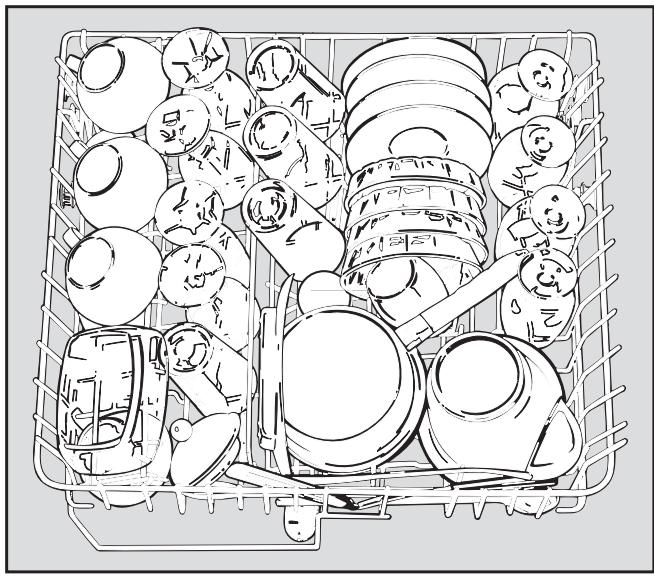
Bottom basket
Larger and heavier items such as plates, serving platters, saucepans, bowls. Depending on the dishwasher model glasses may only be cleaned in the bottom basket if it is fitted with a special glassware insert or if there is a special bottom basket.
Dishwashers with cutlery tray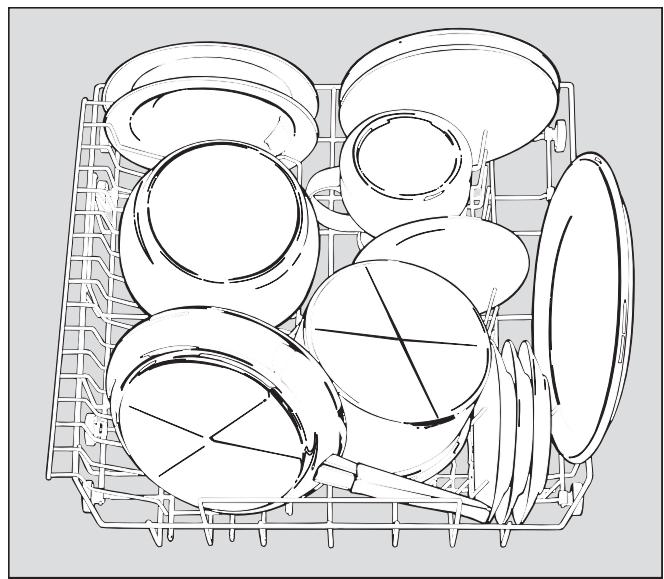
Dishwashers with cutlery basket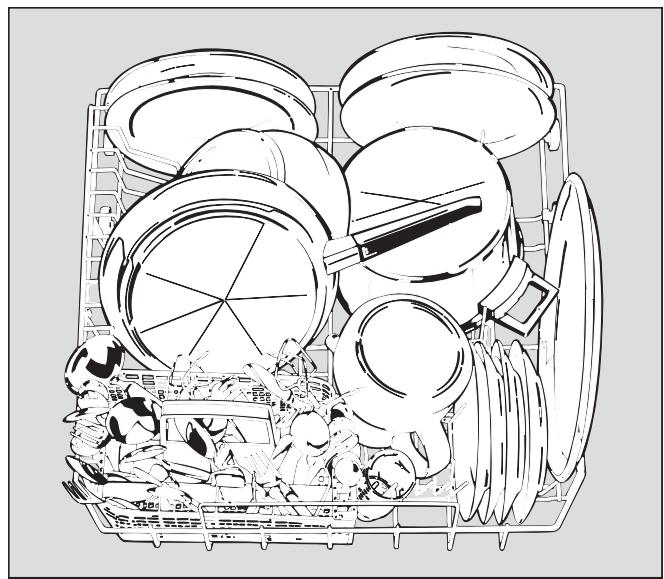
Cutlery
Dishwashers with cutlery basket:
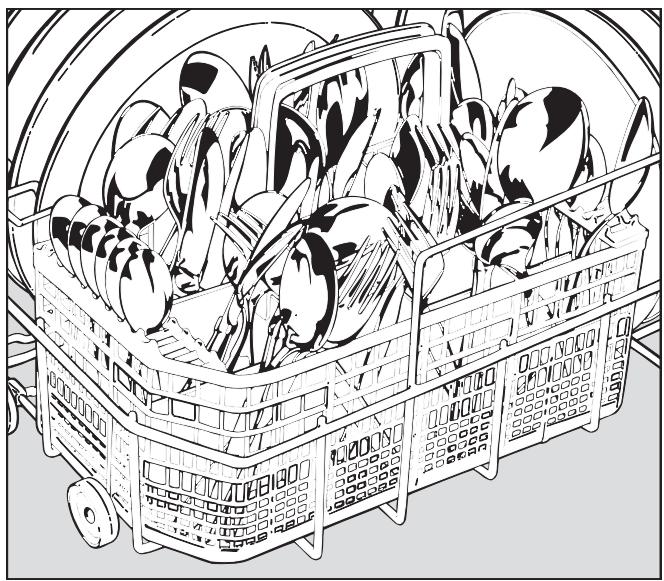
Unsorted cutlery should be placed in the cutlery basket, handles facing downwards.
You may, however, prefer to place cutlery with sharp points with the handles upwards.
Place small spoons in the individual slots to either side of the cutlery basket.
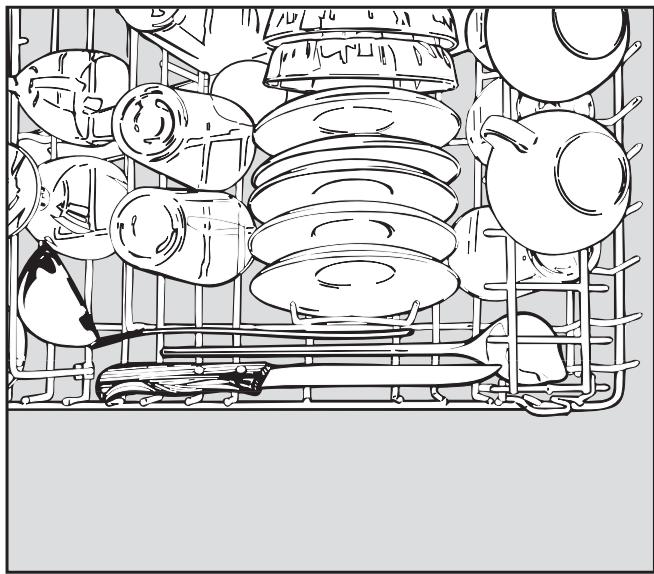
Larger items like soup ladles, long knives and mixing spoons should be placed lying down across the front of the upper basket.
Dishwasher with cutlery tray (SC models):
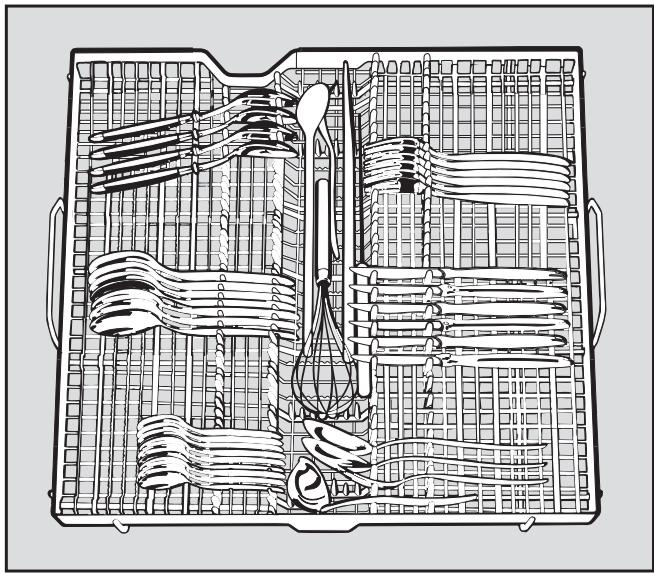
For best results cutlery should be grouped in zones, one for knives, one for forks, one for spoons etc. This makes unloading much easier.
Larger items like sauce ladles, cake slices, long knives and mixing spoons can be placed lengthwise in the trough in the centre of the tray.
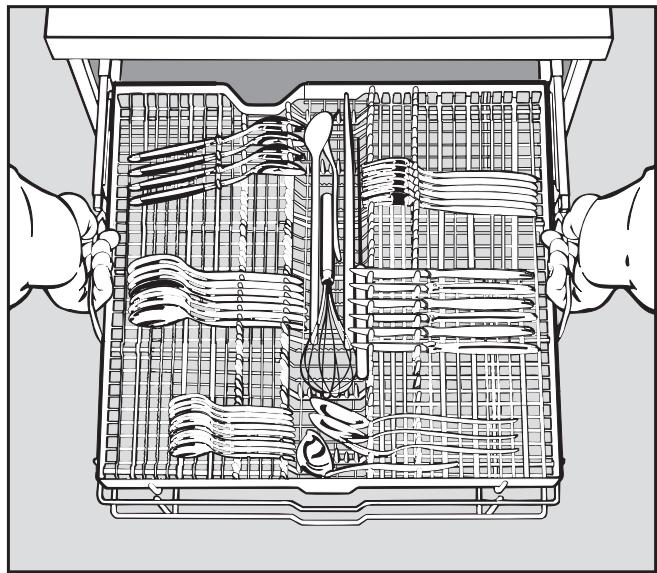
The cutlery tray insert is removable. It can be completely removed from its frame and carried to the cutlery drawer, or table where it can be easily unloaded.
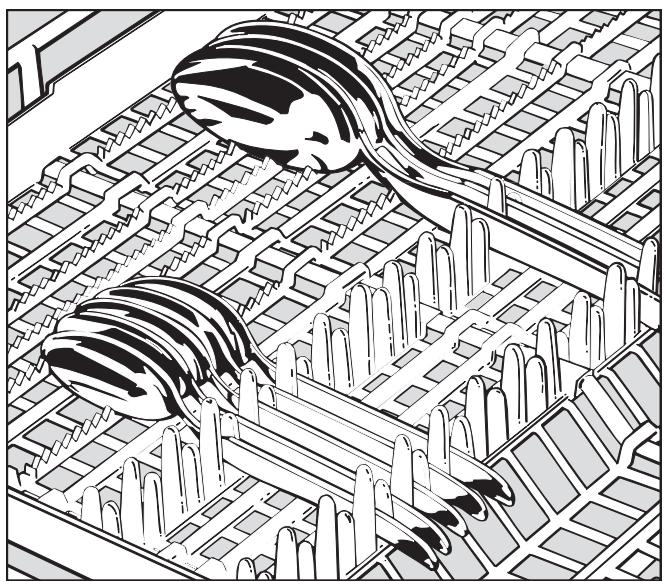
Spoon heads should be placed in such a way that water runs off them freely.
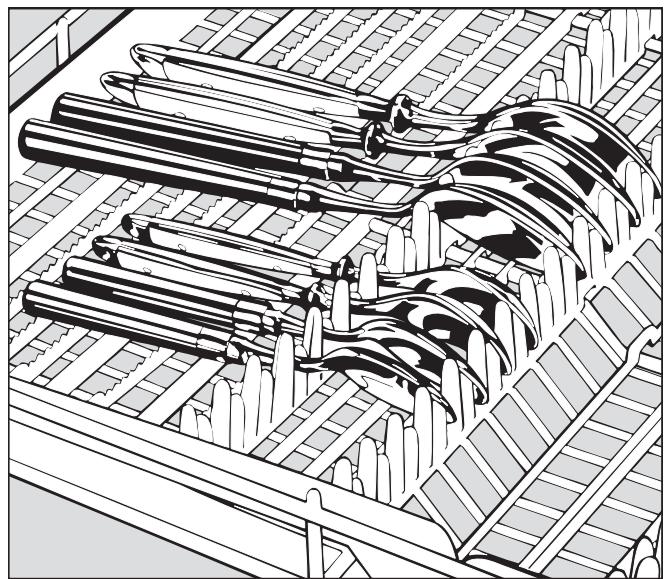
Cutlery with round or oval handles should be placed with the heads in the grips as this prevents them slipping.
Ensure that spoon heads are in contact with at least one of the grips in the cutlery tray. This way they cannot collect water.
The upper spray arm must not be blocked by items which are too big, e.g. cake slices.
Flap up racks
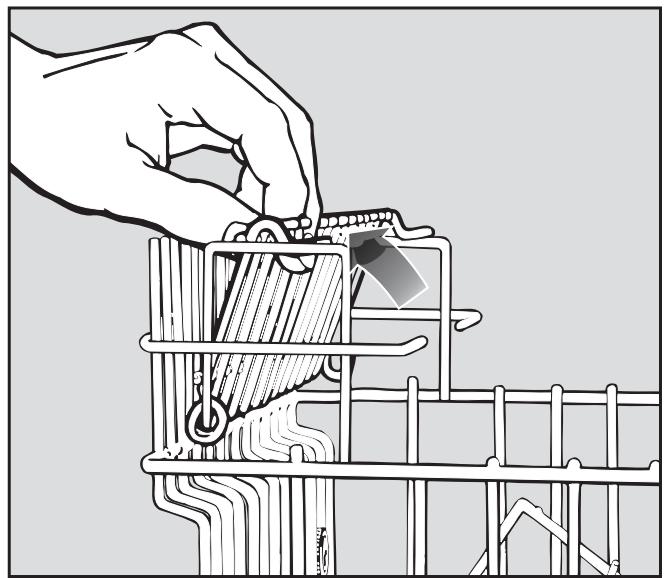
Can either be used for a second row of cups or raised upwards to make room for tall items.
Positioning rail
(standard feature depending on model)
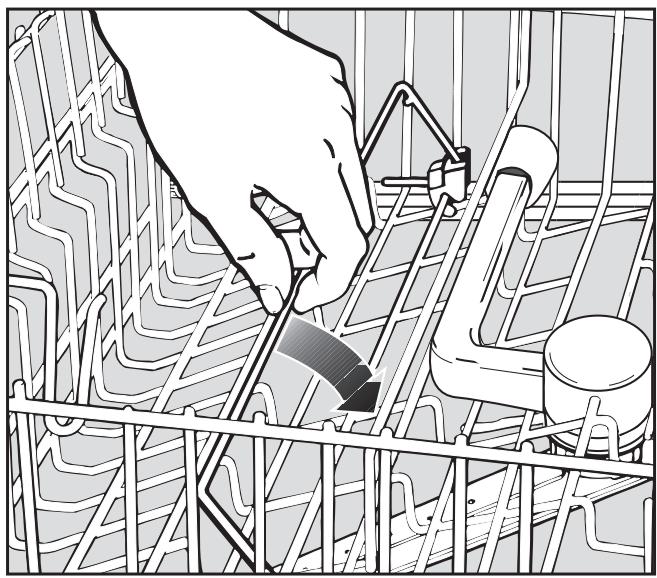
For easy sorting and removing of crockery, the positioning rail can be rested to one side.
Raise it again afterwards so that crockery can rest against it in the basket.
Adjusting the upper basket
(depending on model)
In order to gain more space for taller pieces of crockery in the bottom or upper basket, the upper basket can be adjusted in three steps with 2 cm between each step.
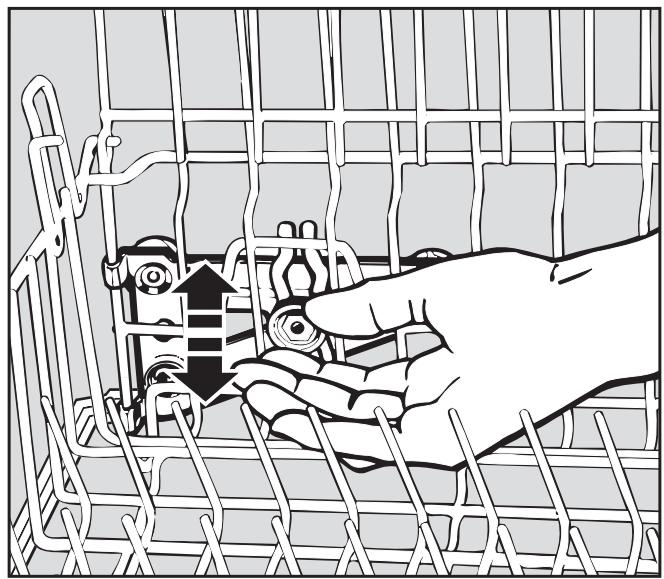
Pull out the upper basket and loosen the two locknuts on either side of the basket. - Adjust the basket up or down to the right height. - Tighten the locknuts.
The upper basket can also be set to an angle if required.
Depending on the setting of the upper basket, the following dimensions can be accommodated:
Dishwashers with cutlery tray
| Upper
basket
position | plates ∅ in cm |
| Upper
basket | Lower
basket |
| Top | 15.5 | 30 |
| Middle | 17.5 | 28 |
| Bottom | 19.5 | 26 |
Dishwashers with cutlery basket
models with adjustable upper basket
| Upper
basket
position | plates ∅ in cm |
| Upper
basket | Lower
basket |
| Top | 21.5 | 30 |
| Middle | 23.5 | 28 |
| Bottom | 25.5 | 26 |
models with non-adjustable basket
Plate diameter in upper basket: 23.5 cm
Plate diameter in lower basket: 28 cm
- cutlery with wooden or horn handles,
- wooden or plastic chopping boards,
- glued items, e.g. old knives with handles which have been glued on, hand-made craft items,
- copper or tin items,
- plastic items which are not heat resistant.
Please note
Silver and aluminium items can suffer some discolouration. Aluminium components (e.g. grease filter) must not be cleaned with caustic alkaline commercial or industrial detergents. This may damage material or, in extreme cases, cause severe chemical reaction. Silver, treated with a silver polish may still be damp or spotted at the end of a programme, where water has not run off smoothly. It may need rubbing dry with a soft cloth. Silver, treated in a silver immersion dip is usually dry at the end of a programme but may discolour. - Colours painted over a glaze may fade after many washes. - Clouding may occur on glasses after frequent washing.
We recommend:
- Wash delicate glassware in the ECONOMY 55° - programme, (or for models where the programme is available, GENTLE 45°C). This will reduce the risk of clouding.
- There are no standard guidelines for washing glassware. When in doubt wash by hand.
- When purchasing new crockery and cutlery, make sure they are dishwasher safe.
Only use detergents formulated for domestic dishwashers. Do not use washing up liquid.
Please note
Dishwasher detergents contain irritant or corrosive ingredients. They can cause burning in the mouth and throat if swallowed, or inhibit breathing. Keep children away from detergent and from the dishwasher when the door is open. There could still be detergent residues in the cabinet.
To avoid the danger of children coming into contact with the dishwasher detergent:
only put it into the detergent dispenser just before starting the programme.
Selecting detergent
Recently almost all detergent manufacturers have launched new detergents with a different composition, in addition to standard types.
Should you experience difficulties when using these types of products, please contact Miele Customer and Technical Services Department, or the detergent manufacturer's own Advisory Service.
These new dishwashing detergents, although welcome from an ecological point of view, react to a different degree from conventional products to water hardness. The drawbacks may only become apparent after a prolonged period of use.
The following problems may occur:
- White deposits on crockery and inner cabinet.
- Increased etching in the form of a bluish sheen on the surface of glassware.
- Discolouration of silverware.
Appearances of this nature are generally caused by the detergent used and are not attributable to any malfunctioning of the dishwasher itself.
Preventive measures:
- If you wish to continue using the new chlorine and phosphate-free products, the following is recommended:
- Set the water hardness selector one setting higher than recommended in the "Water softener" chapter, if the water hardness is at the top of the scale (except with setting 6).
Example:
above 610 mg / l (34 °d ) set the water hardness selector to setting 4 .
- Try out an environmentally friendly detergent of the same type from another manufacturer.
- If you are still dissatisfied with the results, we recommend the use of chlorine-free but not phosphate-free detergent.
- Set the water softener and dispense detergent according to instructions given in this instruction booklet.
- If results are still not to your satisfaction, you should revert back to using conventional detergents containing both chlorine and phosphate.
- Set the water softener and dispense detergent according to instructions given in this instruction booklet.
Should you experience difficulties when using these types of products, please contact the detergent manufacturer's own Advisory Service.
Dishwasher detergent must be added before each programme (except COLD PRE-WASH).
- Pour powder or liquid detergent into the dispenser.
- Dishwasher detergent tablets can be put at various places in the wash cabinet, (follow the manufacturer's advice on the packet).
Detergent manufacturers give the required amount of detergent in ml (or g) on the packaging.
For UNIVERSAL programmes use at least 30 ml (or g) detergent unless advised to use more by the manufacturer, then use what they advise.
The amount to dispense will depend on the type of load and the programme selected.
See the programme chart on the next pages for advice on amounts to dispense.
If you buy detergent in bulk, please ensure that the container is always properly sealed after use. Otherwise, the detergent can lose its effectiveness.
Compartment I takes max. 25 ml, Compartment II max. 80 ml. There are horizontal markers to assist with dispensing in compartment II, indicating the level in ml.
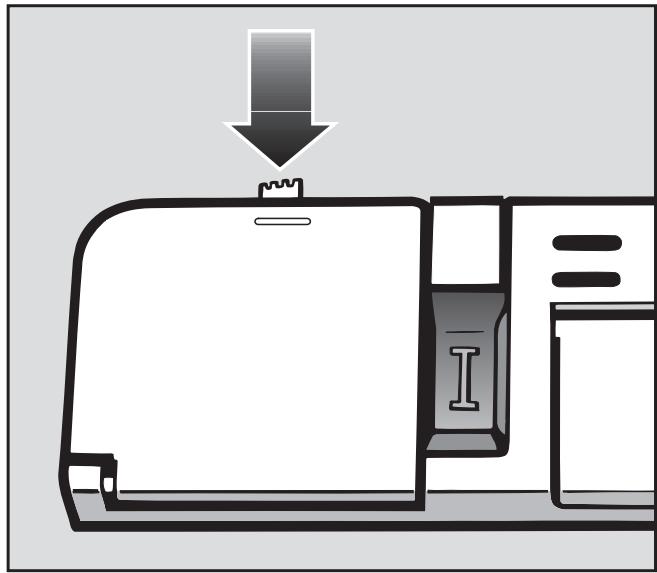
Press the opening catch on the container flap.
The flap will spring open.
The flap is always open at the end of a programme.
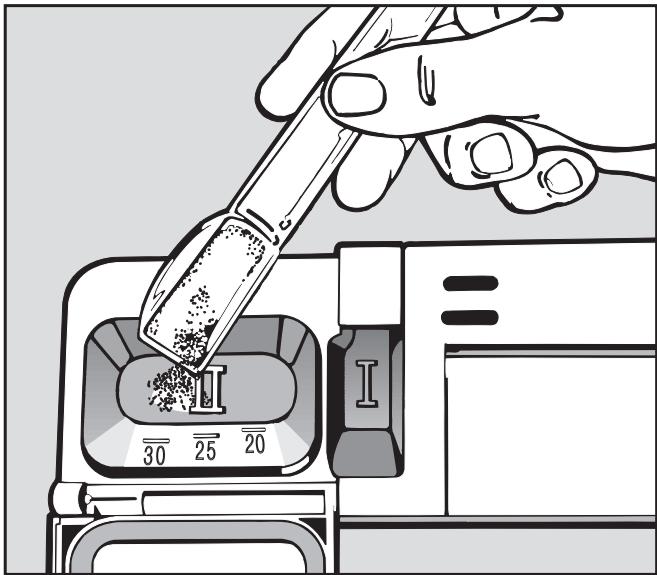
Pour in the required amount of detergent. Shut the flap.
Choose your programme according to the type of load and how dirty it is.
In most cases this will be a UNIVERSAL - programme.
UNIVERSAL 55° or 65° (with one pre-wash) or UNIVERSAL PLUS 55° or 65° (with two pre-washes).
These programmes are ideally suited to everyday loads, mixed loads with varying degrees of soiling.
For particular needs there are special programmes: The different programmes and their uses are described on the next two pages in the Programme chart.
| Programme | When to use | Detergent |
| | A1) | B2) |
| Compartment I (Pre-wash) | Compartment II (Wash cycle) | Compartment II (Wash cycle) |
| Universal Programmes | | |
| UNIVERSAL 55°3) | This programme is for normal everyday loads | 20 % | 80% | 100 % |
| UNIVERSAL 65° | as UNIVERSAL 55°, but higher temperatures for stubborn dried on particles | 20 % | 80 % | 100 % |
| UNIVERSAL PLUS 55° | as UNIVERSAL 55°, but with preliminary pre-wash for heavy soiling | 20 % | 80 % | 100 % |
| UNIVERSAL PLUS 65° | as UNIVERSAL PLUS 55°, but higher wash temperature for stubborn dried on particles and lightly soiled pots and pans | 20 % | 80 % | 100 % |
| Special programmes | | |
| ECONOMY 55° | for full loads with very light soiling, e.g. coffee cups, or: for half a, normal everyday load | | 50 % | 50 % |
| COLD 4) PRE-WASH | for rinsing crockery to avoid smells if a complete cycle is not needed | | | |
The amount dispensed will depend on the type of detergent being used:
A 1) Use this method for:
- detergents which contain phosphates and chlorine (except liquid detergent)
Divide the total amount proportionally between compartment I and compartment II.
B2) Use this method for:
- detergent which is chlorine and phosphate free
- – detergent which is chlorine free but contains phosphates liquid detergent
In this instance the whole amount is placed in compartment II.
For UNIVERSAL programmes use at least 30 ml (or g) detergent unless advised to use more by the manufacturer, then use what they advise.
3) Standard programme (see chapter "Comparison tests") 4) See Section "Plumbing"-Connection to the water inlet.
| Programme cycle | Consumption | Time |
| Energy kWh | Water | Minutes (approx.) |
| 1. Preliminary pre-wash | 2. Pre-wash | Main wash | Interim-rinse | Final rinse | Drying-phase | Water cold (15 °C) | Water hot (55 °C) | Litres | Water cold (15 °C) | Water hot (55 °C) |
|
| X | X 55° | X | X 65° | X | 1.3 | 0.6 | 20 | 83 | 70 |
| X | X 65° | X | X 65° | X | 1.4 | 0.7 | 20 | 86 | 72 |
| X | X | X 55° | X | X 65° | X | 1.5 | 0.5 | 25 | 90 | 75 |
| X | X | X 65° | X | X 65° | X | 1.6 | 0.7 | 25 | 94 | 78 |
|
| | X 55° | X | X 65° | X | 1.25) | 0.45) | 16 | 685) | 585) |
| X | | | | | | 0.06 | 0.06 | 5 | 8 | 8 |
5) with half loads (6 place settings)
Switching on
Close the door - Open the stopcock (if it is closed).
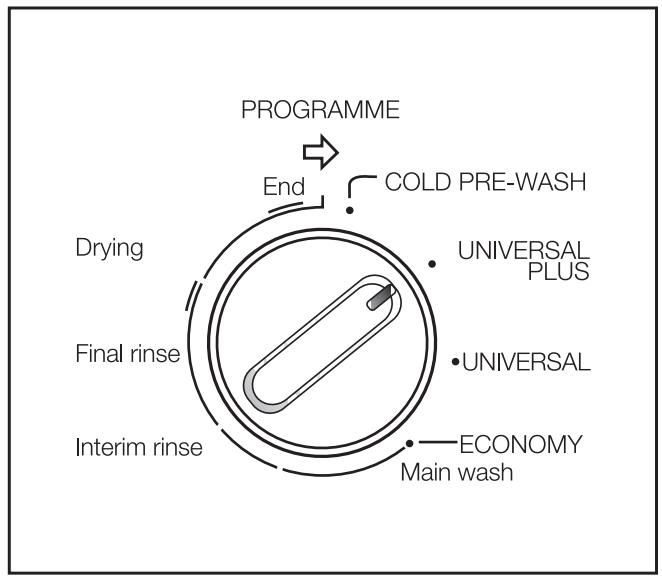
Turn the Programme selector switch (programme sequence indicator) clockwise, until a resistance is felt, to the "start point" of the required programme, e.g. "UNIVERSAL PLUS".
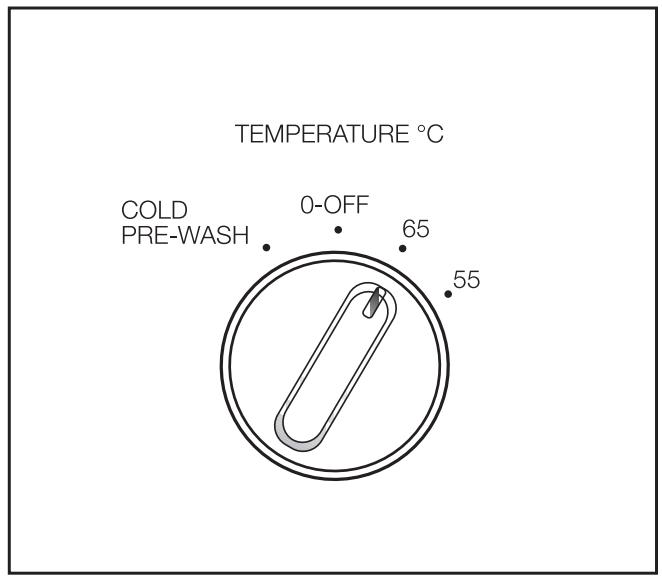
- Then turn the Temperature selector switch to the required temperature e.g. "65". The programme cycle begins.
If you turn the selector past the "start point" by mistake:
Turn the temperature selector switch to "0-Off". - Turn the programme selector switch in a clockwise direction to the required start point. - Re-set the temperature with the temperature selector switch.
Programme change
It is possible to change temperature within a programme, e.g. UNIVERSAL 55° to UNIVERSAL 65° . If changing a programme, e.g. UNIVERSAL PLUS to UNIVERSAL it is advisable to first turn the dishwasher off.
Switching off
On completion of a programme:
- Turn the temperature selector to "0-Off". If the dishwasher is not to be used for a longer period of time, e.g. whilst on holiday: Turn off the stopcock.
Programme sequence indication
During the programme the programme selector switch moves around the dial to show which stage has been reached:
- Pre-wash (not shown)
- Wash cycle
- Interim rinse
- Final rinse
- Drying phase
The programme selector switch remains stationary during the warm-up phases of the wash and rinse cycle until the required temperature has been reached.
Note!
Do not finish a programme prematurely. Important programme stages (e.g. re-activating the water softener) could be omitted.
A programme is complete only when the programme selector switch is at the "End" position.
The dishwasher can be opened and crockery unloaded. If it is left closed, the fan will continue for a few more minutes to diminish any remaining moisture.
This is recommended if the crockery is not required immediately. This process is extra to the wash programme.
The COLD PRE-WASH programme is complete only when the programme selector switch stops just before the start point of the “UNIVERSAL PLUS” programme.
Programme interruption
A programme is interrupted as soon as the door is opened.
If the door is closed again the programme will continue from the position it was at when it was interrupted.
Warning
Water in the dishwasher may be hot. Danger of scalding!
Only open the door if absolutely necessary and exercise caution when doing so.
Before closing the door leave it ajar for approx. 20 secs. This will enable the temperature in the wash cabinet to settle. Close the door firmly making sure that it clicks into place.
Hot crockery will chip and break more easily.
After switching off let it cool down in the dishwasher until it is comfortable enough to handle, before you unload it.
If you open the door fully after switching off, the crockery will cool down much faster. - First unload the bottom basket, then the upper basket and then the cutlery tray (if you have one) at the very end.
This way you avoid water droplets from the upper basket or the cutlery tray falling on to crockery in the bottom basket.
Cleaning the filters in the wash cabinet
The dishwasher must not be used without all the filters in place!
The filter combination in the base of the wash cabinet should be regularly inspected and cleaned if necessary.
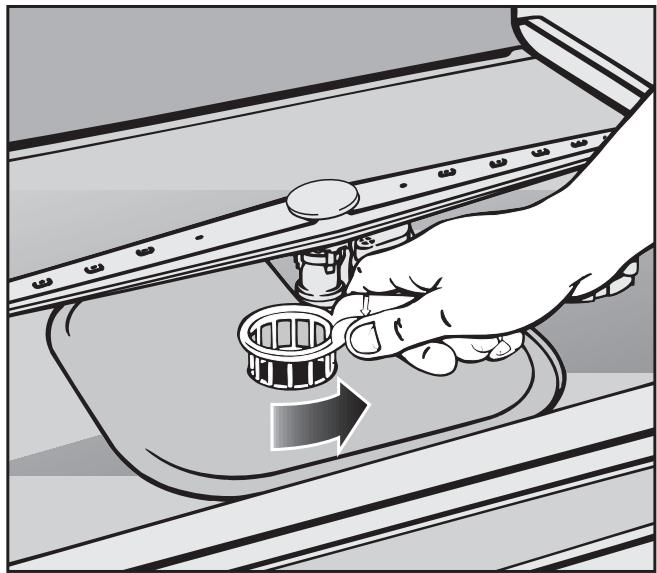
Turn the handle anti-clockwise to release the filters.
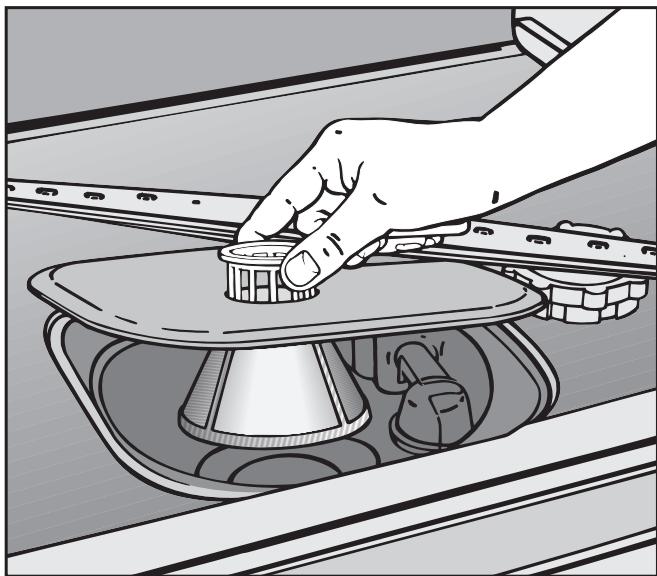
- Lift and take the filter combination out of the machine. Remove coarse particles and rinse under running water. Use a nylon brush if necessary.
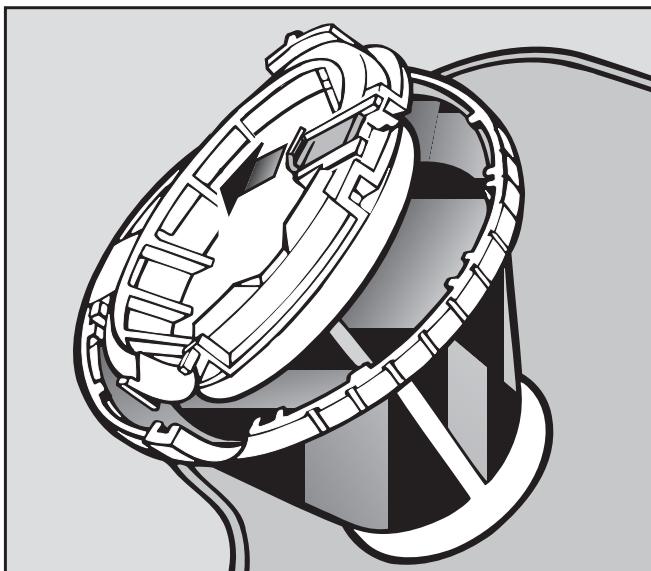
- Turn the filter combination over and open the coarse filter by pulling back on the locking device. Clean the coarse filter under running water, using a brush if necessary, and press the locking device back in.
Important:
After cleaning make sure that the locking device is properly locked.
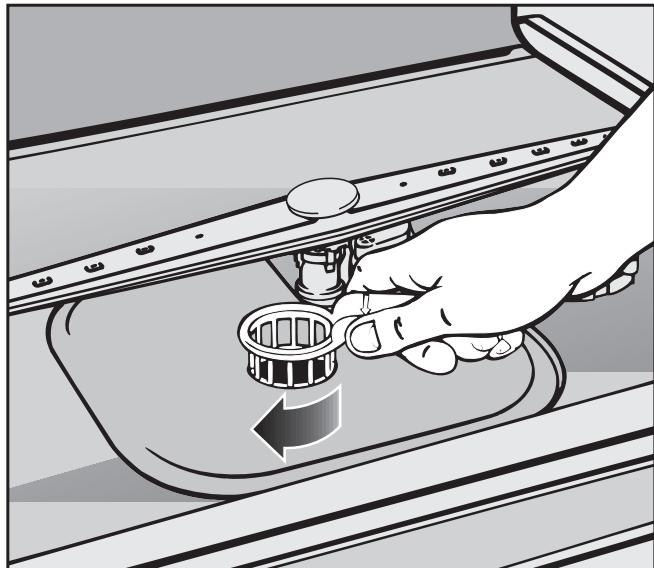
- Replace the filter combination so that it lies flat in the base of the wash cabinet. Secure the filter by turning the handle in a clockwise direction.
Cleaning the spray arms
Particles of food can lodge in the spray arm jets.
The spray arms should be inspected and cleaned regularly (approx. every 6 months).
To do this remove the spray arms as follows.
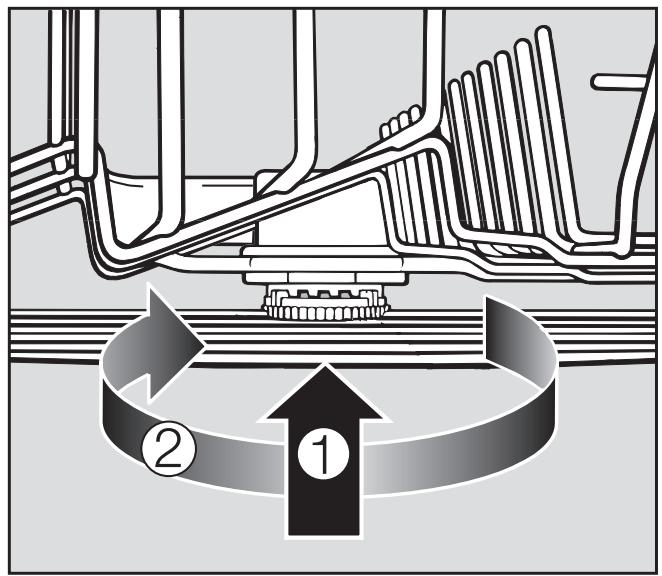
- Lift up the middle spray arm ① to engage the tooth-wheel mechanism. Then unscrew the spray arm ②.
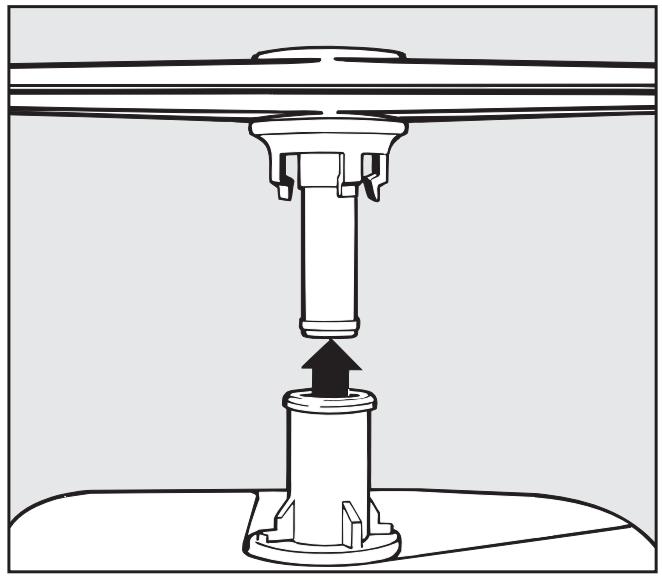
- Remove the lower basket and take out the lower spray arm.
Dishwashers with cutlery basket:
Unscrew the upper spray arm.
Dishwashers with cutlery tray:
Pull out the cutlery tray. - Lift up the upper spray arm to engage the tooth-wheel mechanism and then unscrew the spray arm.
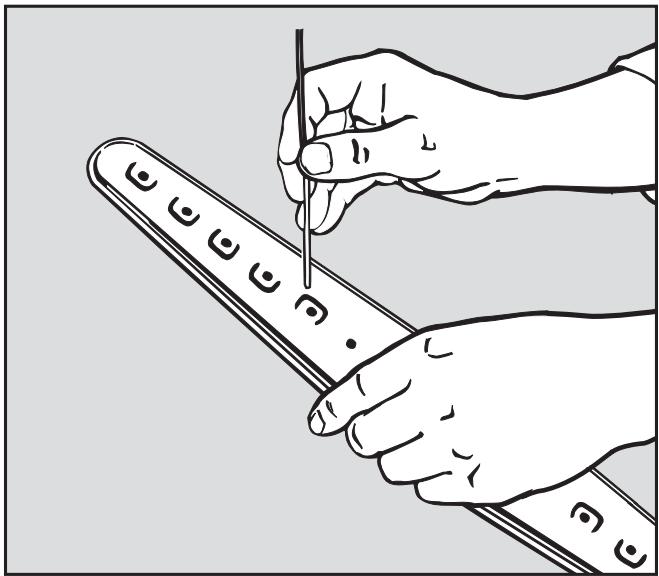
Using a sharp pointed object push the food particles into the spray arm jets and rinse well under running water.
Please note:
After replacing the spray arms check that they move freely.
Cleaning the drain pump and non-return valve
If water has not been pumped away at the end of a programme the drain pump or the non-return valve might be blocked. They are, however, easy to clean. Watch out for glass splinters, which could cause injury.
Take the filter combination out of the wash cabinet. Use a jug or bowl to scoop water out of the wash cabinet.
Raise the locking clamp.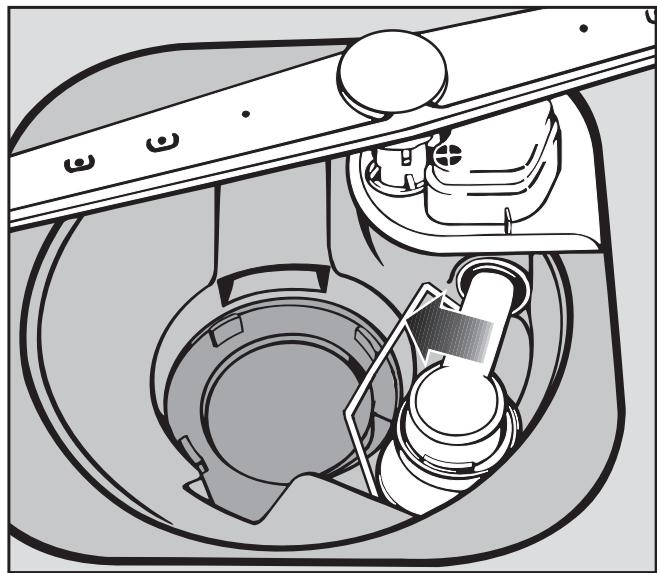
- Lift up the non-return valve and rinse under running water.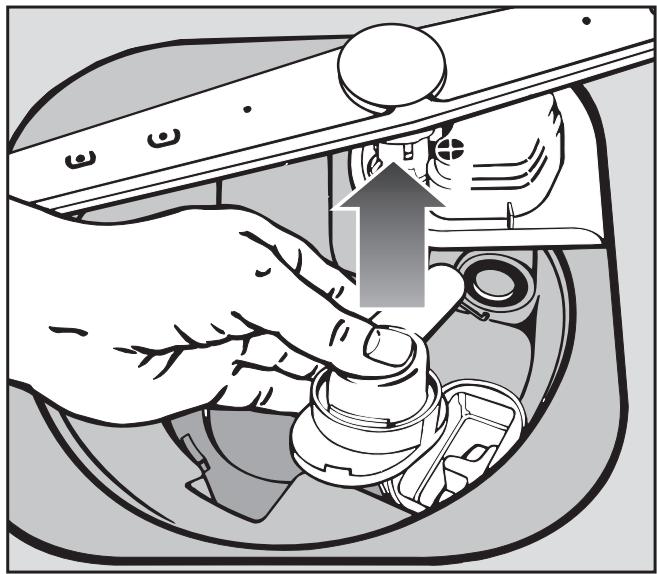
The drain pump is situated under the non-return valve (see arrow).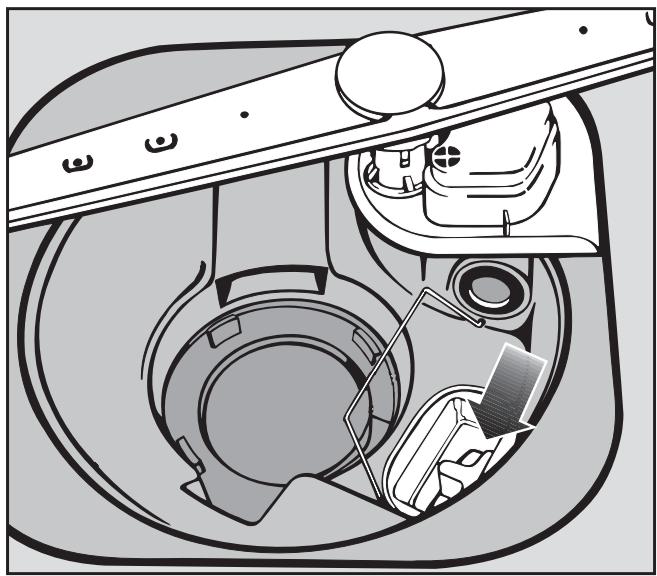
Before replacing the non-return valve check that the drain pump impeller turns with only slight resistance, and that there is no obstruction. - Carefully replace the non-return valve and secure with the locking clamp. - Replace and secure the filter combination.
Cleaning the filter in the water inlet
A filter is incorporated in the screw connection of the valve on the water inlet hose. The filter must be cleaned when dirty, otherwise insufficient water flows into the wash cabinet.
The plastic housing of the water connection contains an electrical component. It must not be dipped in water.
Fitting an in-line water filter
If the mains water contains a large number of insoluble substances, we recommend fitting a large area filter in the connection between the stopcock and the water inlet hose threaded union. These filters can be obtained from the Miele Spares Department (Part No.: 75577).
To clean the filter
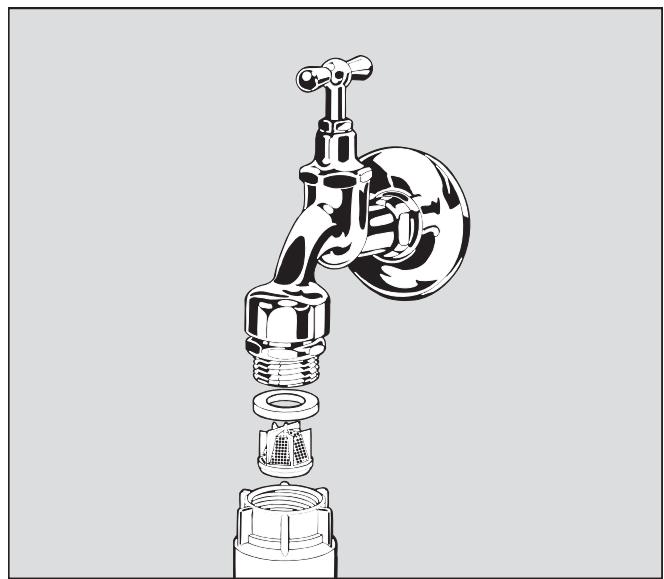
- Disconnect the appliance from the mains supply (switch off at the main socket and pull out the plug, switch off the appropriate circuit at the fuse-box or withdraw the mains fuse). Turn off the stopcock and unscrew the inlet hose. Carefully remove the rubber seal.
- Withdraw the filter using pointed pliers and clean by rinsing under running water.
- Replace filter and seal. Make sure they are sitting correctly!
- Screw back into place on the water inlet, taking care that it goes back on straight.
- Turn on the stopcock gradually to test for leaks. If there is a leak: Screw the connections on more tightly.
Cleaning the wash cabinet
In general the wash cabinet is self-cleaning, provided that the correct amount of dishwasher detergent is used.
If however there are time scale or grease deposits these can be removed with a proprietary dishwasher cleaner.
Cleaning the door and the door seal
- Wipe the door seal regularly with a damp cloth and remove any particles of food.
- Wipe away any residue of food and drink spillage from the sides of the dishwasher door. These are not part of the wash cabinet and are not reached by water from the spray arms.
The facia panel
This should only be wiped with a damp cloth, or a suitable plastic cleaner.
Do not use an abrasive cleaner, a glass cleaner or an all-purpose cleaner. Because of their chemical composition they could cause serious damage to plastic surfaces.
The front of the dishwasher
- Laminate fronts should be cleaned using a suitable proprietary cleaning agent.
- Fronts made from wood should only be cleaned using a damp cloth or leather and dried with a soft cloth.
Do not use any cleaner containing ammonia or thinners.
Checking the water level
If the water pressure (flow rate at the take-off point) is too low, i.e. less than 1,0 bar, too little water will flow into the wash cabinet.
To ensure an accurate assessment open the stopcock fully and run the COLD PRE-WASH programme once (without crockery) to bring water into the system. - Run the COLD PRE-WASH programme again. After approx. 3 minutes open the door and remove the bottom basket from the machine.
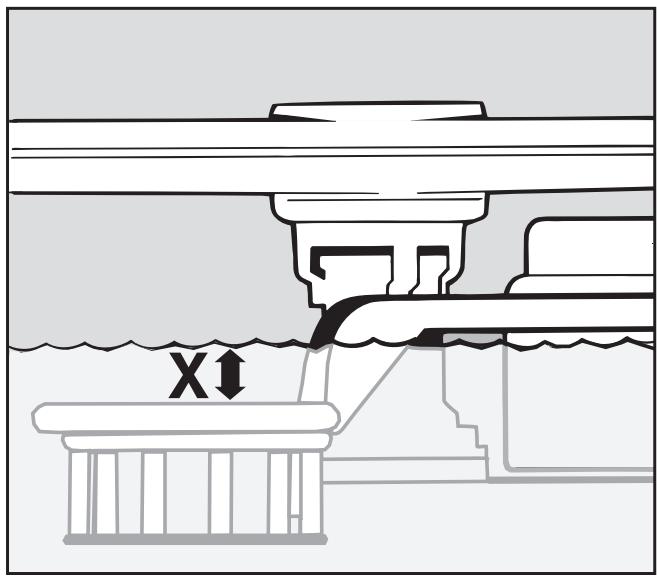
The water level is correct when dimension “X” is at least 4 mm.
If it measures less, then the water intake time must be increased.
Increasing the water intake time
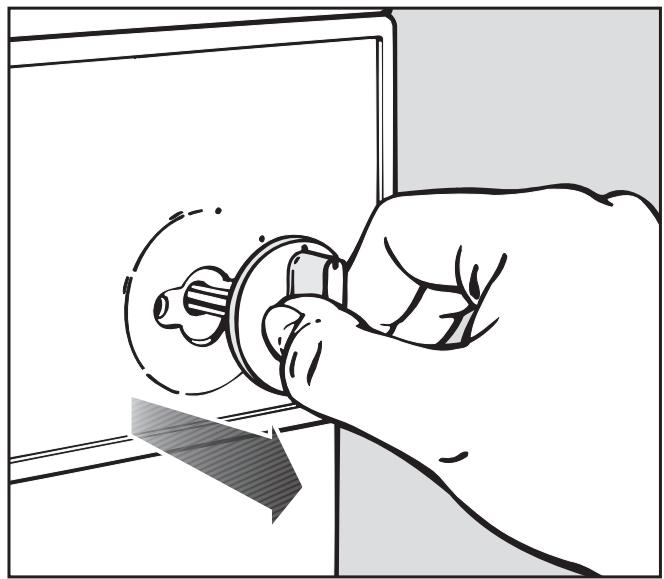
Position the right hand switch vertically and then pull it off.
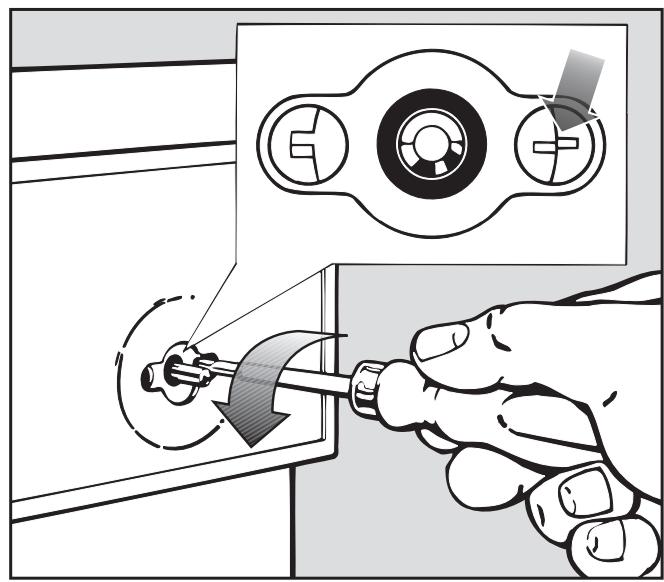
Using a 4-5 mm wide screwdriver turn the adjuster mechanism to the right hand side of the spindle carefully in an anti-clockwise direction until it checks into position.

= Anti-clockwise turn (increases water intake - 2 min.)

= Clockwise turn (factory setting - 1 min.)
Note:
If the water intake time has been increased, then the water hardness selector must be reset at one grade higher than that stated in chapter "Water softener" (except with setting 6).
With the aid of the following explanatory notes, minor faults can be corrected without contacting the Miele Service Department.
Any work on the electrical components of the appliance should only be carried out by a suitably qualified and competent person in accordance with local and national regulations. Unauthorised repairs could be dangerous.
Faults/possible causes
The dishwasher does not start
- The door is not properly closed.
- The plug is not properly inserted.
- The fuse is defective/has blown.
The dishes are not clean
- The dishes are incorrectly loaded.
- The wrong amount of detergent was used.
- The stopcock was not fully opened.
- The water pressure is too low (too little water in the wash cabinet) – see chapter “Checking the water level”.
- The filter in the water inlet screw connection is blocked - see "Cleaning and care".
- The filters in the wash cabinet are not clean - see "Cleaning and care".
- Spray arm jets are blocked - see "Cleaning and care".
- The spray arms are obstructed by items in the baskets.
White residue on cutlery and crockery
- Not enough rinse aid.
- No salt in the salt reservoir.
- Salt reservoir lid has not been screwed on properly.
Water in the wash cabinet at the end of a programme
- The drain hose is kinked.
- The drain pump or non-return valve may be blocked. See "Cleaning and care".
After Sales Service
Should you still have any difficulties, or if the appliance is under guarantee please contact: - your Miele Dealer or - the Miele Service Department
See back cover for addresses.
- Please quote the model type and number of your appliance. This information can be found on the data plate inside the door.
Bottle holder
(depending on model)
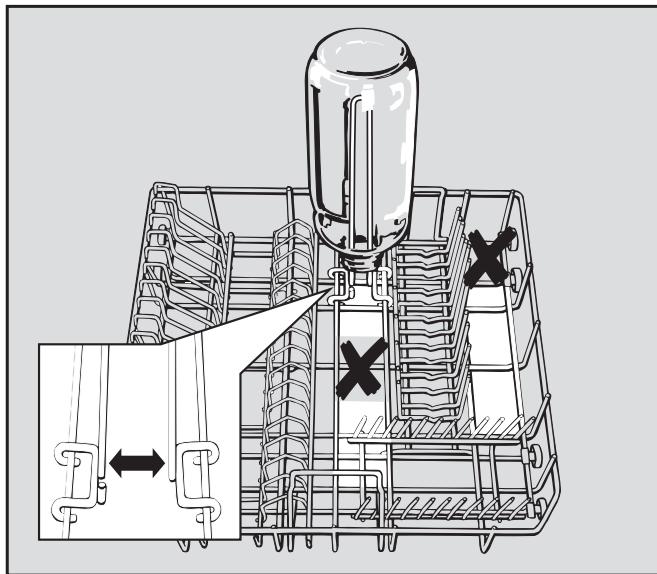
The bottle holder (e.g. for milk or baby bottles) can be used in the bottom basket.
To achieve good cleaning results, the bottle holder should only be placed in the positions marked white – and on no account in the positions marked with an X.
Other special accessories, e.g. special inserts for glasses or plates, etc., are available through your Dealer or the Spare Parts Department. See the following list.
Installation - special situations
Brackets to fix the dishwasher under a marble-type worktop.
Decor frame for freestanding dishwashers (GDR) to match kitchen fronts in colour and style (available with some models).
Decor frame adapter strip for freestanding dishwashers for decor panels 1 to 4 mm thick.
Building-under kit (GDU) to modify an integrated “i” dishwasher to a built-under dishwasher.
Extended machine feet where a height of up to 92 cm is required.
Plinth facia kit for "i" dishwashers for kitchens without a complete plinth facia run.
Adapter strips for "i" dishwashers to match the control panel facia to the adjacent drawers.
Inserts
Glass inserts for the bottom basket, (only available for models with removable inserts in the bottom basket).
Glass inserts for the upper basket, especially for glasses which need a special support.
Test standard:
IEC 436 / DIN 44990 / IEC 704 / prEN 50242
Programme tested:
UNIVERSAL 55°
Amount of detergent:
If using a detergent containing chlorine: 5 g in compartment I, 25 g in compartment II. If using a chlorine-free detergent: 30 g only in compartment II.
Rinse aid dispensing:
Setting 3, (approx. 3 ml, set at factory)
Noise measurement:
Before starting a programme to measure noise, the dishwasher door must first be opened completely. Doing this will automatically close the vent exit for the turbothermic drying process as in daily use.
Amount washed:
12 place settings
Dishwasher with cutlery basket
Upper basket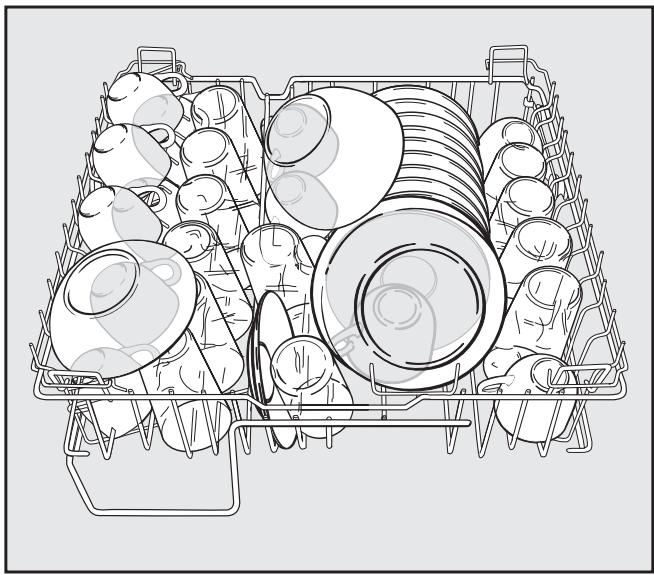
Lower basket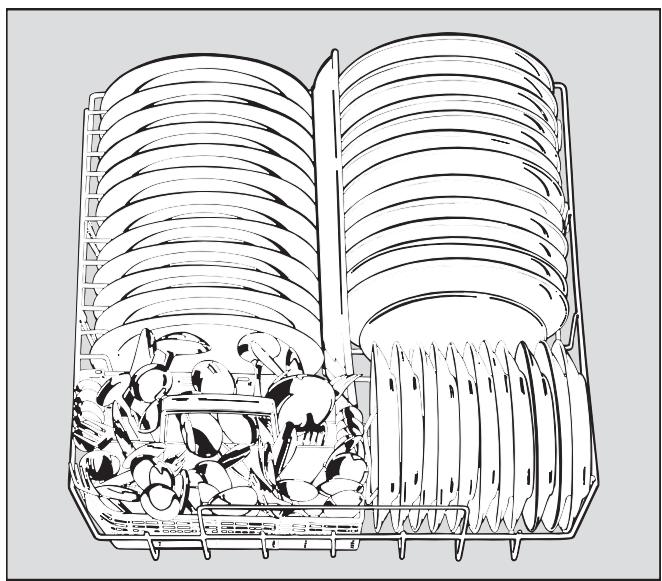
These illustrations show how 12 place settings can be loaded. For normal mixed loads see "Loading the dishwasher".
Dishwasher with cutlery tray
Upper basket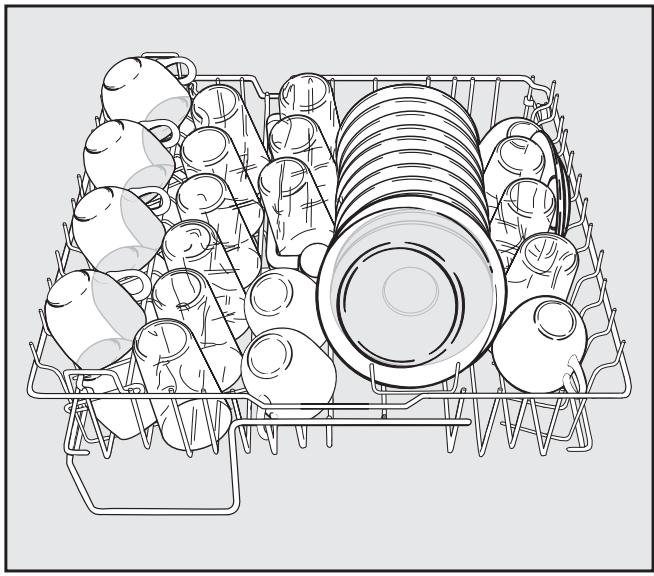
Lower basket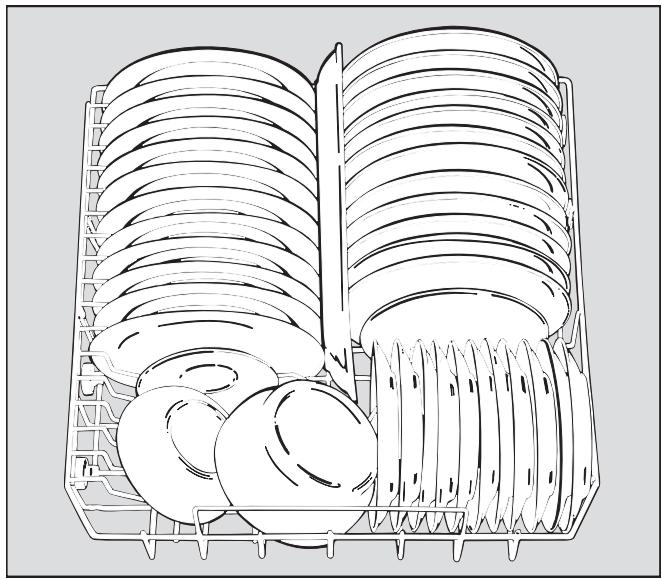
Cutlery tray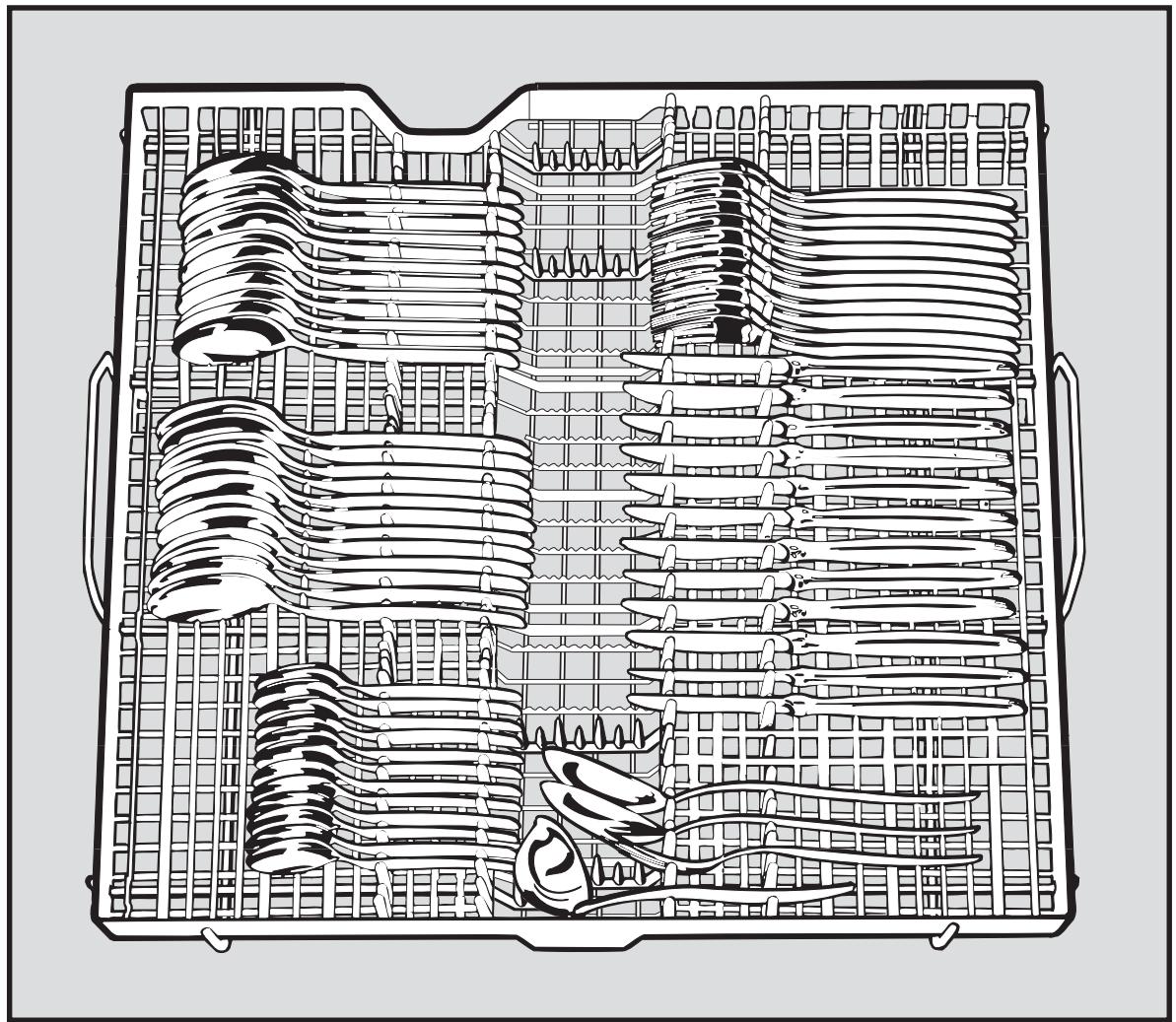
Installation instructions
Installing a freestanding dishwasher 49
Installation integrated "i" dishwashers 50
- Fit worktop protection ("niro" stainless steel coverplate) 51
- Building the dishwasher into a niche 52
- Fitting the facia panel 55
- Matching the facia panel to the dimensions of the adjacent drawer fronts 56
- Fitting the (matching) door front 57
- Adjusting the door springs. 60
- Levelling and securing the dishwasher 60
- Matching the plinth facia of a kitchen run 62
Electrical connection 63
Plumbing 65
Connection to the water inlet 65
Drainage 67
Technical data 69
"Freestanding" dishwashers
- The dishwasher must be installed and levelled.
- Any unevenness in the floor level can be compensated for by adjusting the four screw feet.
The adjustment range is approx. 1 cm (85-86 cm total height).
Decor frame and decor panel
"Freestanding" dishwashers can be subsequently fitted with a decor frame (standard feature with some models only).
This enables the front of the dishwasher to be fitted with a decor panel to match the kitchen furniture.
Decor panels up to 1 mm thick:
Decor panel dimensions: 587 x 603 x 1 mm.
Decor panels 1 to 4 mm thick:
Decor panel dimensions: 587 x 599 x 1-4 mm.
With decor panels 1 to 4 mm thick, an extra decor frame adapter strip (special accessory) must be fitted to the control facia panel.
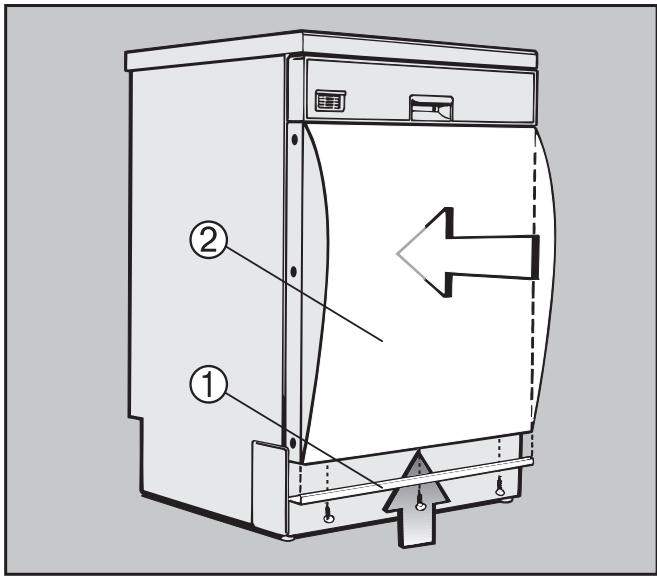
Screw on the lower decor strip ①. Insert the decor panel ②.
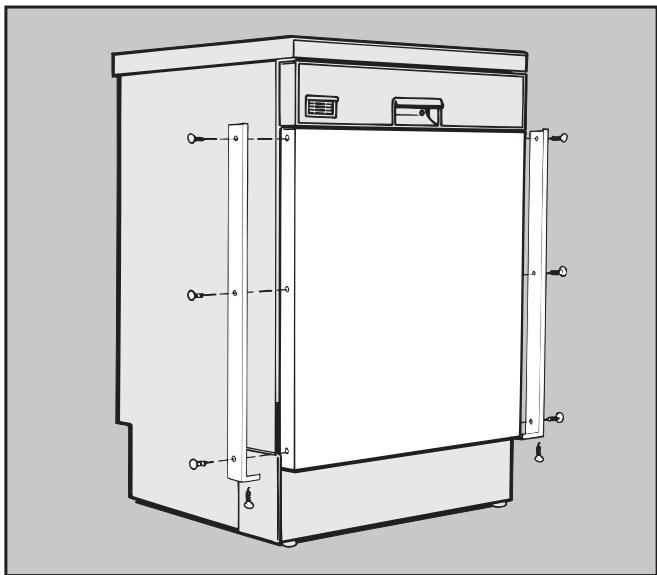
- Screw the side decor strips into position.
The "i" model dishwashers are specially designed for building under a continuous worktop.
The front can be fitted with a base unit front to match the kitchen furniture.
By using a decor set GDU, "i" model dishwashers can be converted into a built-under "U" model dishwasher. The decor set is supplied with a separate installation instruction leaflet.
To ensure stability, these dishwashers must only be installed under a continuous worktop which must be securely screwed to neighbouring units.
Dimensions:
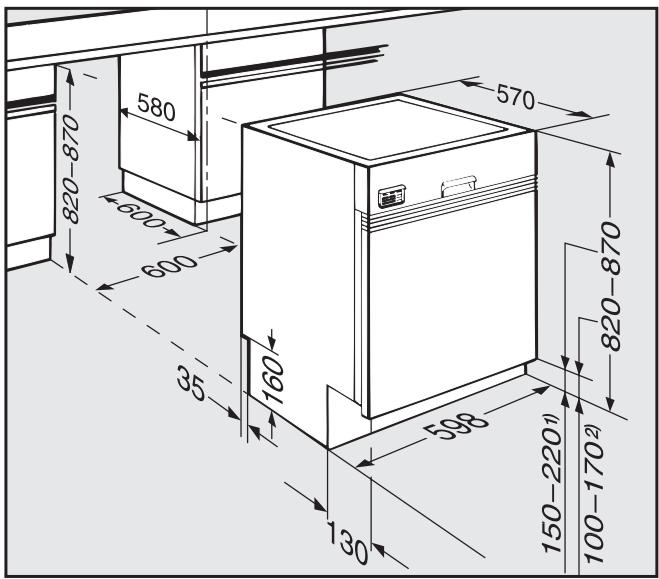
1) with 870 mm machine height 2) with 820 mm machine height
Range of adjustment approx. 5 cm (82-87 cm total height).
Extended machine feet are available at extra cost (special accessory). These can be used for a machine height of 87 to 92 cm.
1. Fit worktop protection
A stainless steel "niro" coverplate is supplied with the machine to protect the underside of the worktop against steam rising from the machine.
The coverplate is supplied as standard with "i" models.
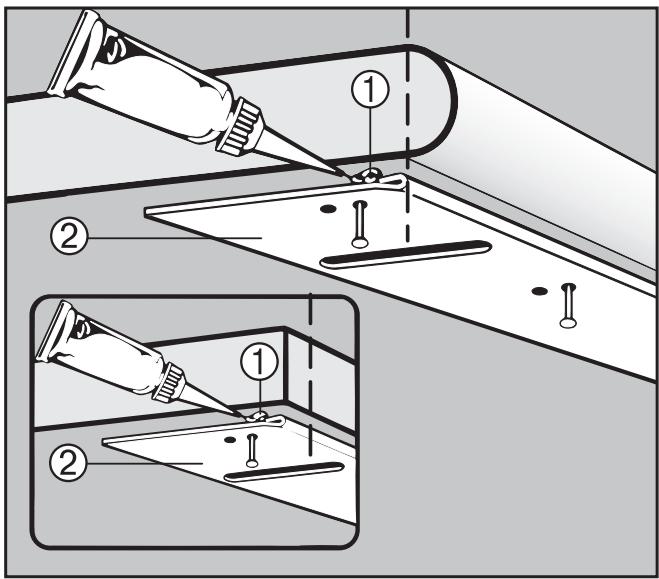
- Squeeze sealant from the tube supplied ① into the angle of the "niro" plate.
- Align the "niro" plate ② to the front edge of the worktop - see illustration - and then use tacks supplied to nail the "niro" plate to the underside of the worktop.
On worktops with wood or laminate edging, the tacks should be nailed through the holes further back from the edge.
2. Building the dishwasher into a niche
Connection to water and drainage should be sited beside and not behind the dishwasher for accessibility. Connections are usually made in the area under the sink. Many kitchen unit manufacturers provide a cutout in the base of the sink base unit for the hoses to be fed through.
If the base unit has no opening and if there is not an opening through the plinth area for connections, one must be cut. Suggested dimensions: 60 x 110 mm.
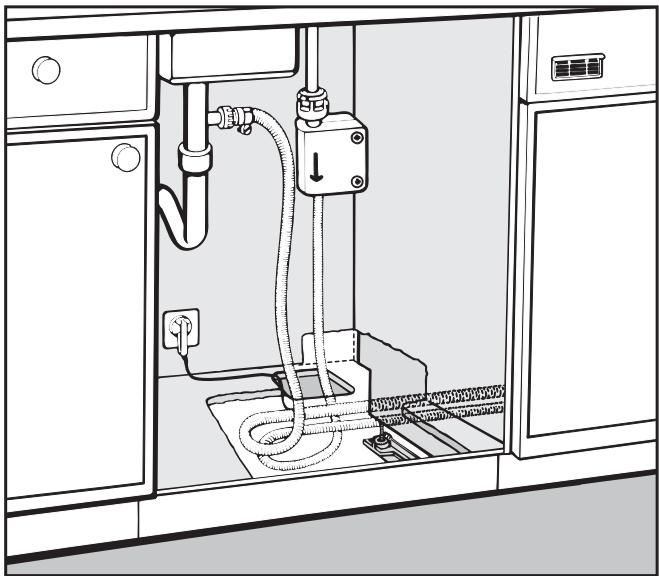
For some installation steps it is necessary to pull the dishwasher slightly out of the recess. Therefore do not make these connections until last.
The slides make installation of the dishwasher easier and protect the floor from possible damage when moving the appliance into and out of the recess. They are also used for adjusting the height of the rear screw feet.
- Adjust the height manually before installing the dishwasher. Leave a space of approx. 5 mm below the worktop to allow the dishwasher to be pushed back easily into the recess. Make sure that the dishwasher stands level.
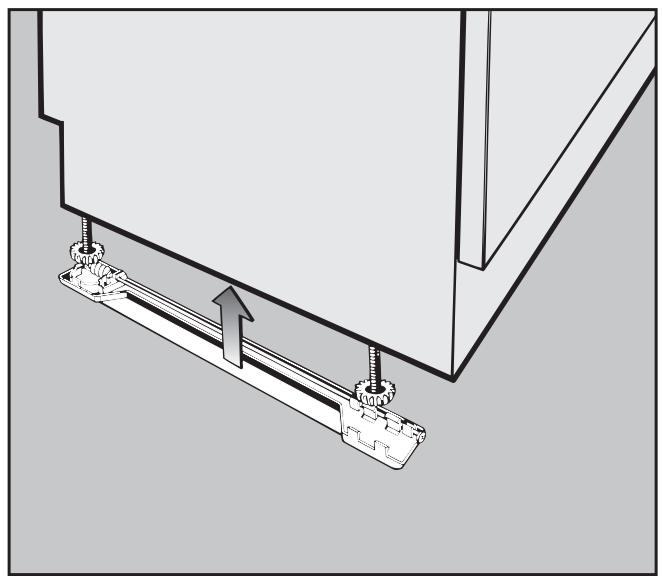
Press the slides - with the ratchet at the rear - under the screw feet.
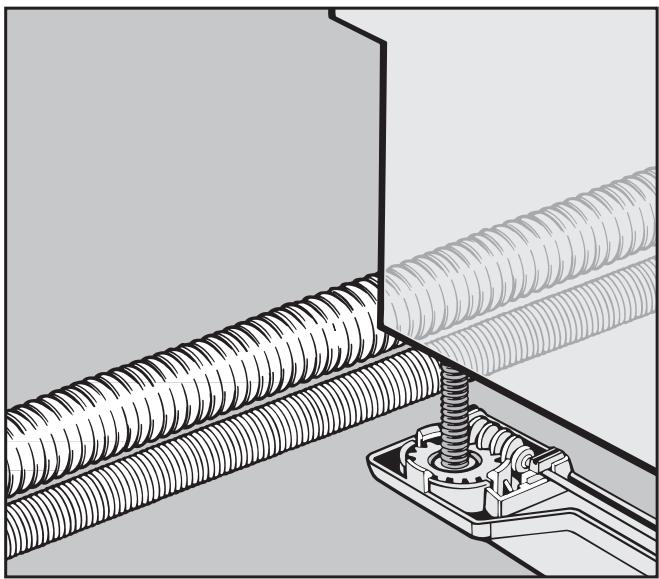
Push the dishwasher right back into the recess. Ensure that drain hose, inlet hose and electric cable are laid to reach the connection point without any kinks.
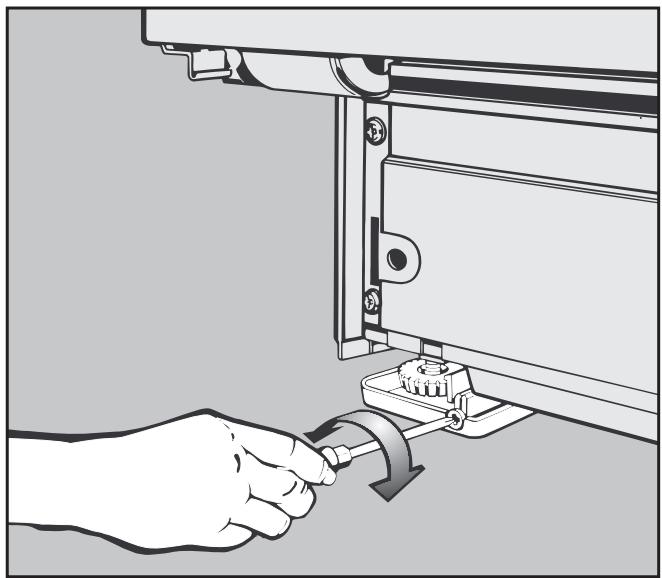
- Adjust the rear screw feet to the required height.
Higher = turn clockwise
Lower = turn anti-clockwise
Several turns are needed to adjust 1 mm in height. A battery-powered screwdriver could be used.
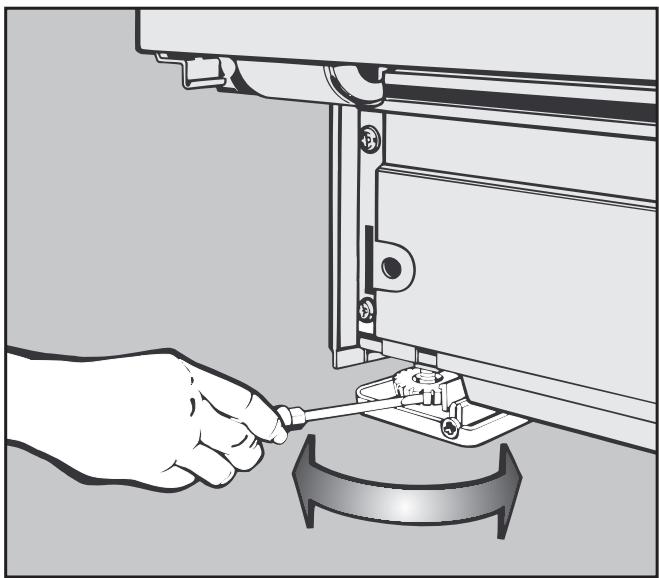
- Adjust the front screw feet manually or with a flat blade screwdriver.
It is easier to adjust the screw feet if the weight of the dishwasher is not bearing down on them.
If possible tip the machine slightly. For fine adjustments it may be necessary to press with a screwdriver against the cogs of the feet.
Screw the feet out until the dishwasher is right up against the underside of the worktop, to which it will be screwed later. Ensure that the dishwasher stands level.
3. Fitting the facia panel
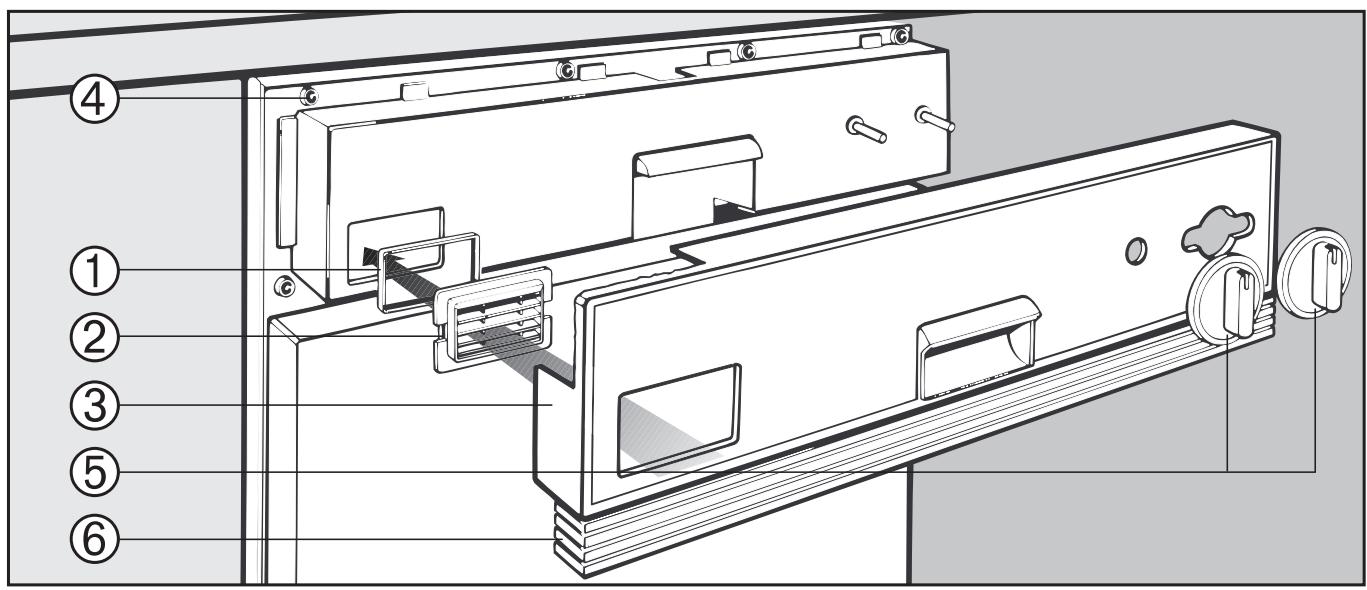
The facia panel is delivered separately in the colour ordered with the relevant accessories.
It has to be fitted to the dishwasher when it is being installed.
Press out the adapter strips from the fitting slits in the facia panel. - Fit the seal supplied ① into the groove surrounding the ventilation grille ②. Push the ventilation grille ② into position. - Place the facia panel ③ in position and screw into place from the inside of the door using the six screws ④. - Attach the switch knobs ⑤.
Only applicable when using the GDU decor set (to convert an "i" version to a built-under "U" version)
If the GDU decor set is being used, the adapter strips ⑥ must first of all be removed, and stored for possible use in the future. See also the separate instructions for fitting the GDU decor set.
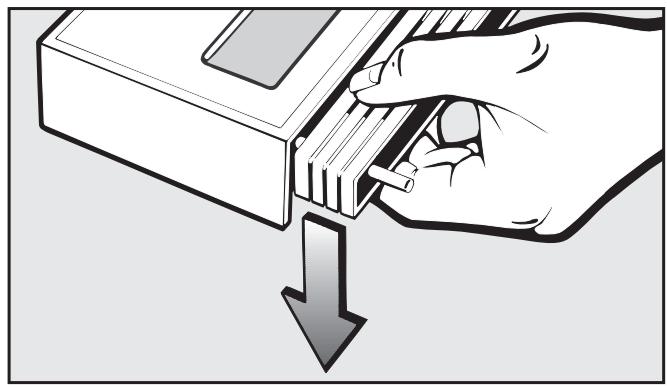
Press out the adapter strips from the fitting slits in the facia panel.
4. Matching the facia panel to the dimensions of the adjacent drawer fronts
The fascia panel can be aligned with the drawer fronts of the kitchen units by adjusting the spacer bars.
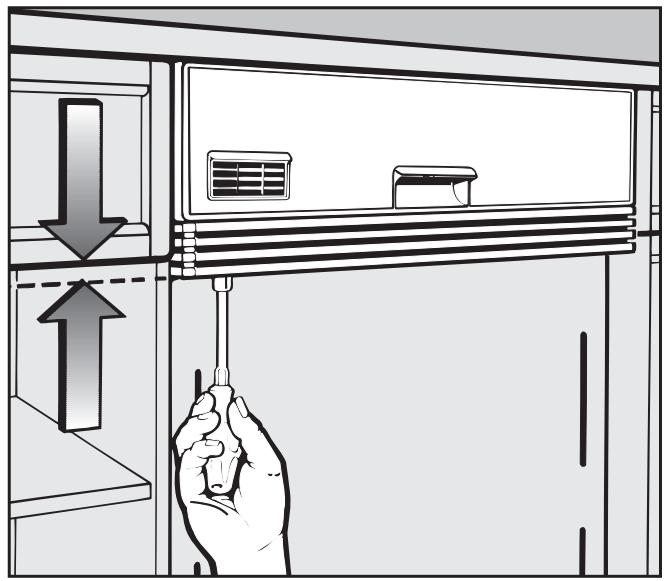
Using an 8 mm socket spanner, turn clockwise or anti-clockwise until the required height is reached. If necessary, some or all spacer bars can be removed.
Adjustment range:
from 112 mm: fascia panel without spacer bars
to 145 mm: fascia panel with four spacer bars,
to 154 mm: using a fifth spacer bar (special accessory at extra cost).
Please note
After adjustment, cut off any protruding lengths of the screws.
5. Fitting the (matching) door front
The door of a kitchen base unit (without the drawer fascia or fittings) is normally used for the door front.
The door front is fixed to the machine door outer panel using a fixing bracket which has to be pre-mounted on the rear of the door front.
Fixing brackets are already fitted on to the stainless steel door front. This front cannot be shortened.
Door fronts differ in weight and it is therefore essential that the door springs are adjusted (see Step 6) after the door front has been fitted.
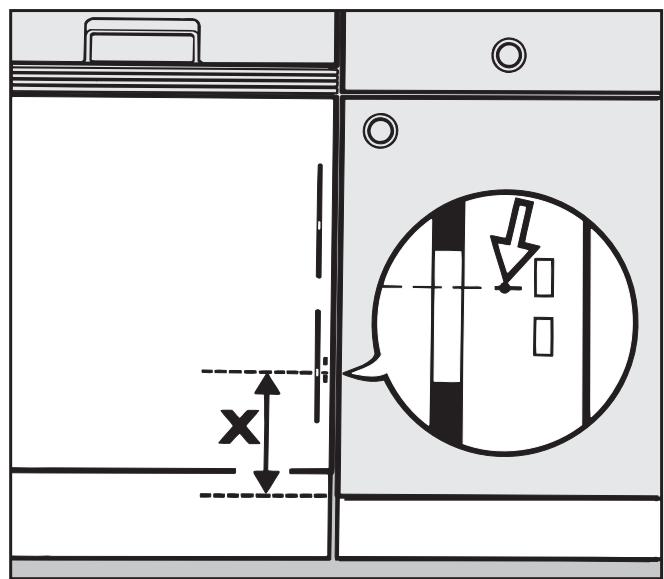
Calculate dimension "X" and make a note of it before attaching the fixing bracket.
Dimension "X" is the dimension shown on the illustration between the drill hole in the outer door panel and the lower edge of the neighbouring unit door(s).
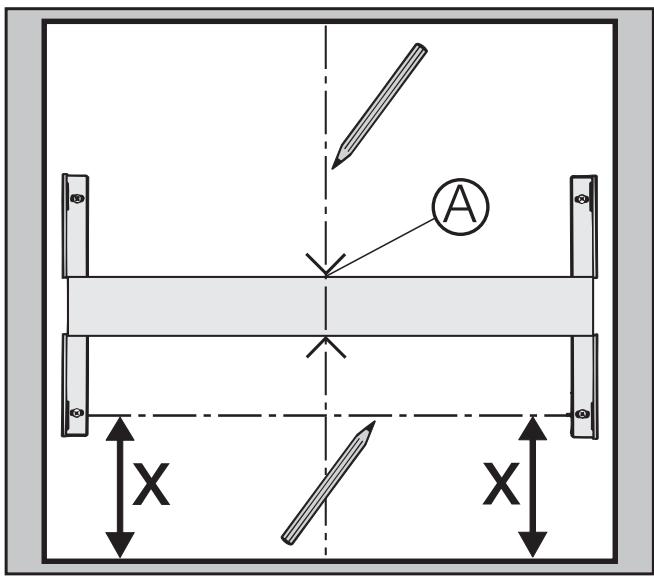
- Lay the door front with the rear side facing upwards. Using a pencil, draw a vertical line down the middle of the door to use as a guide line. Draw a horizontal guide line across the door, at a distance from the lower edge of the front panel equalling the previously measured dimension “X”.
The fixing bracket is marked in the middle (A).
- Lay the bracket on the rear side of the door front so that the marks ④ in the middle of the fixing bracket align with the vertical guide line, and the lower fixing holes of the bracket are centrally positioned in the horizontal guide line (see illustration). Use strips of adhesive tape to hold the bracket in this position.
- Drill the fixing holes to a depth of about 10 mm, using a 2.5 mm drill bit.
- Secure the bracket to the door using the screws supplied. Double check for correct alignment before building into the recess.
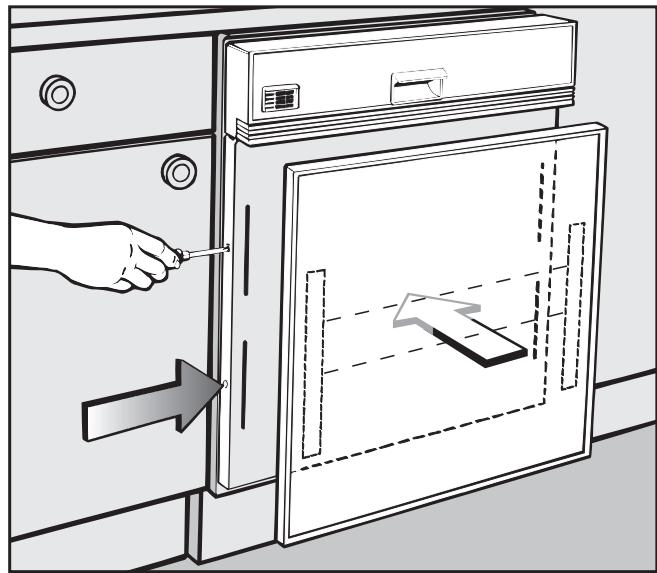
Pull the dishwasher out of its recess enough to allow easy access to the side fixing screws for the door front. - Hang the door front into the slits in the machine door outer panel, adjust for height and secure. - Secure the door front by turning the screws clockwise at each side of the machine door outer panel. Plug the openings for the fixing screws using the plastic stoppers provided.
6. Adjusting the door springs
The door springs are correctly adjusted when a half opened door (approx. 45° opening angle) remains in that position when released.
If the door drops down, then the door springs need to be tightened.
If, however, it rises up, then the springs need to be released.
The adjusting screw is located in the upper front strip at the left hand side of the dishwasher.
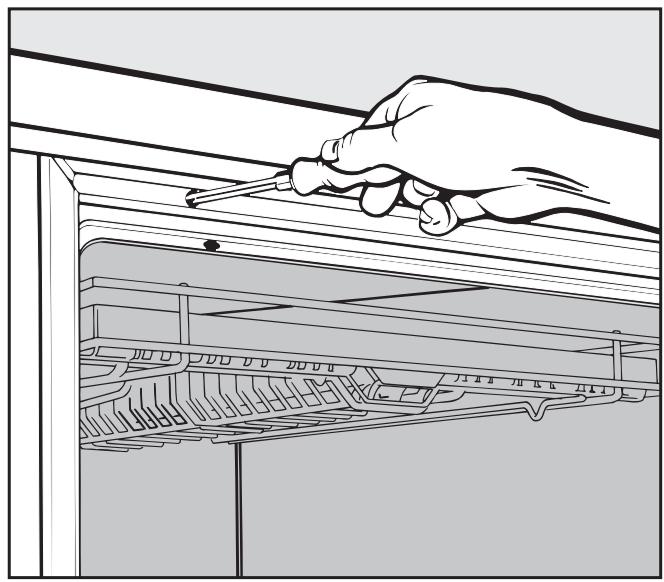
- Open the dishwasher door.
- Adjust the door spring until it is correctly balanced:
- turn clockwise = tighten
- turn anti-clockwise = loosen.
Push the dishwasher back into its recess.
7. Level and secure the dishwasher
To ensure the stability of the dishwasher it must be screwed to the continuous worktop after it has been positioned.
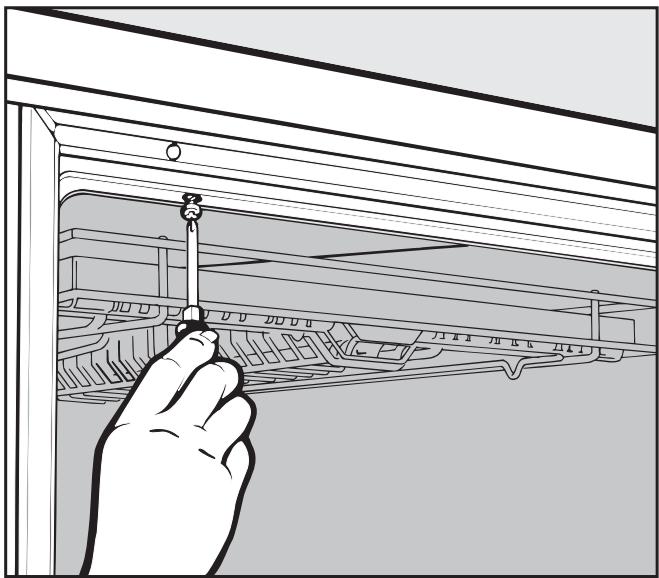
Half open the dishwasher door. - Screw one of the 4 x 15 screws (supplied) from below into the holes in the right and left hand side of the upper strip.
Do not lift the dishwasher to do this. If necessary, screw the feet out further.
If one of the screw positions is in the cut-out area, e.g. of the built-in sink, attach the fixing bracket supplied.
For "Corian" or granite worktops there is a special accessory to fix the dishwasher to an adjacent kitchen unit.
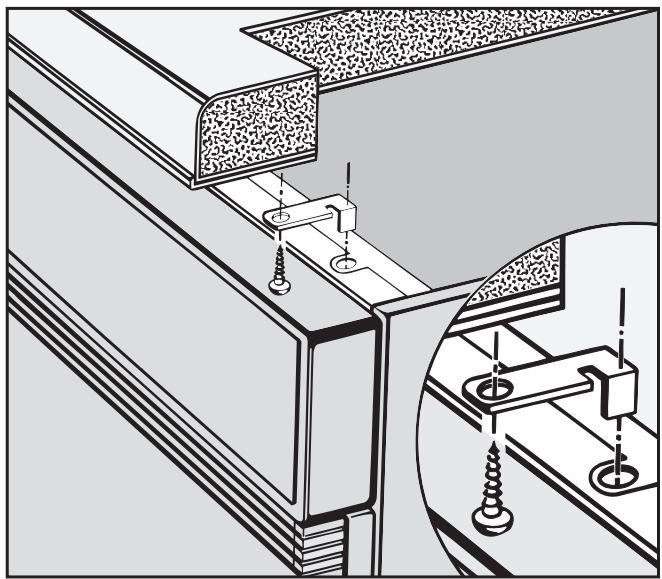
Pull the dishwasher approx. 5-10 cm out of the recess. Position the fixing bracket. Push the dishwasher back into the recess, adjust and screw into position with a (3.9 x 22) screw.
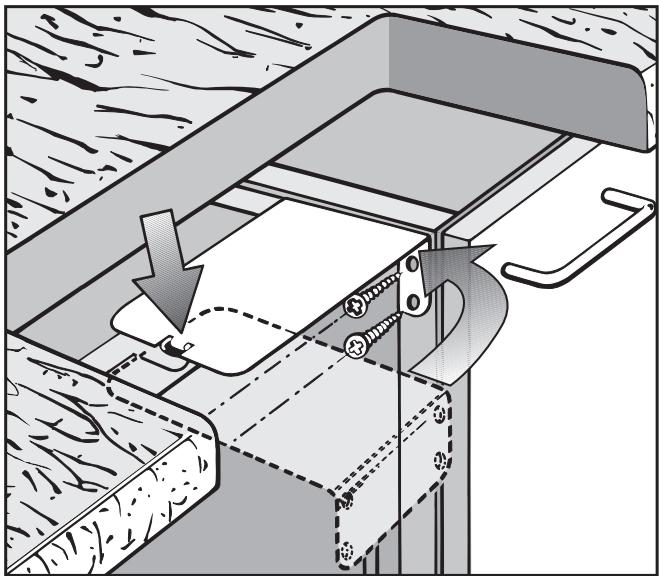
Pull the dishwasher approx. 5-10 cm out of its niche. Fit the lug of each fixing bracket into the guide hole on top of the dishwasher, and then swing to the left or right side respectively. Push the dishwasher back into the niche, align, and fix to the adjacent kitchen unit(s) with 2 screws (3.5 x 15) for each bracket.
8. Matching the plinth facia of a kitchen run
The plinth area of the dishwasher is normally covered with a plinth run matching the kitchen furniture.
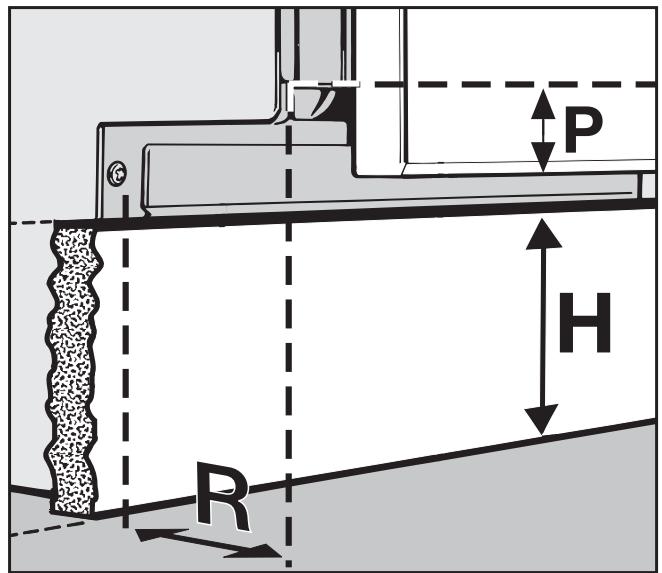
The height (H) of the plinth facia around the dishwasher depends on the plinth return (R) and how much the door front extends below the dishwasher door (P).
- Place the plinth facia directly in front of the kitchen run but do not attach.
- Carefully open the dishwasher door.
If the door front comes into contact with the kitchen plinth when the dishwasher door is opened, the plinth facia in the area around the dishwasher door needs to be cut to size.
To do this, mark where the edge of the door front comes into contact with the plinth facia. Cut the plinth facia to size along this line. Place the plinth facia in front of the kitchen run again and check whether the dishwasher door can be opened fully. If it cannot, trim the plinth facia to the correct size. Secure the plinth facia to the adjacent kitchen units.
If your kitchen does not have a plinth run matching the kitchen furniture, the plinth area can be covered with a separate plinth kit, available at extra cost.
Please follow the installation instructions carefully.
This dishwasher is supplied ready for connection to an a.c. single phase supply, (230 - 240 V 50 Hz for the UK and Australia). It is supplied with a mains cable and moulded plug.
All electrical work should be carried out by a competent person in accordance with national and local regulations. Connection should be made via a fused plug and suitable switched socket which is easily accessible.
For extra safety it is advisable to install a residual current device (RCD) with a trip current of 30 mA.
The voltage, rated load and fuse rating are given on the data plate. Please ensure that these match the household mains supply.
Important
The wires in the mains lead are coloured in accordance with the following code:
Green/yellow = earth
Blue = neutral
Brown = live
As the colours of the wires in the mains lead of this appliance may not correspond with the coloured markings identifying the terminals in your plug, proceed as follows:
The wire which is coloured green and yellow must be connected to the terminal in the plug which is marked with the letter E or by the earth symbol, or coloured green or green and yellow.
The wire which is coloured blue must be connected to the terminal which is marked with the letter N or coloured black.
The wire which is coloured brown must be connected to the terminal which is marked with the letter L or coloured red (UK), or marked with the letter A for (AUSTRALIA).
WARNING: THIS APPLIANCE MUST BE EARTHED
Non-rewireable plugs BS 1363
If this machine or appliance is fitted with a non-rewireable plug, the following information applies:
If the socket outlets are not suitable for the plug supplied with this product, it must be cut off and an appropriate plug fitted.
The plug cut from the flexible cord should be disposed of and on no account be inserted into a socket elsewhere in the house (electric shock hazard).
The fuse cover must be refitted when changing the fuse, and if the fuse cover is lost, the plug must not be used until a suitable replacement is obtained. The colour of the correct replacement cover is that of the coloured insert in the base of the plug, or the colour that is embossed in words in the base of the plug (as applicable to the design of plug fitted).
The correct fuse rating of the replacement fuses that are ASTA approved to BS 1362 should be fitted. Replacement fuse covers may be purchased from your local electrical suppliers, or Miele Service Agent.
(The German standard version is supplied with a cable and moulded plug for connection to a 230 V single phase supply. It must only be connected via a fused 16 A socket).
Connection to the water inlet
Water in the dishwasher must not be used as drinking water.
- The dishwasher may be connected to a cold or hot water supply, max. 60°C. Connection to a hot water supply would save energy costs and time. When connected to a hot water supply all programme stages which would otherwise be carried out with cold water (pre-wash and interim rinse) as well as the COLD PRE-WASH will be carried out with hot water. The inlet hose is approx. 1.5 m long; a longer hose (4 m) may be bought from the Miele Spare Parts Dept. A stopcock with a 3/4" male thread must be provided on site.
- The dishwasher is constructed to comply with DVGW regulations, and may be connected to a suitable supply without an extra non-return valve provided that national regulations allow this.
- The water pressure (flow rate at the take-off point) must be between 1.0 and 10 bar pressure.
If the water pressure is too low the water intake time must be increased (see chapter "Checking the water level").
If the water pressure is too high, a pressure reducer valve must be fitted.
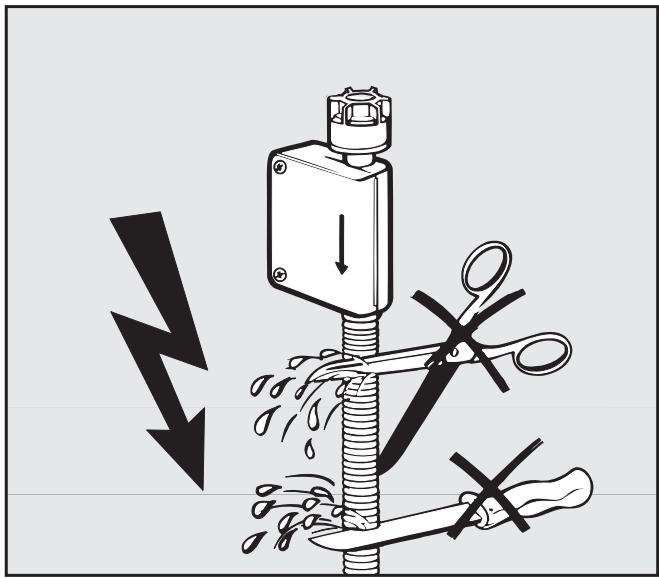
The water inlet hose must not be shortened or damaged in any way (see illustration).
- Connect the inlet hose with the "Waterproof-System" preferably vertically (use an angle connector if necessary).
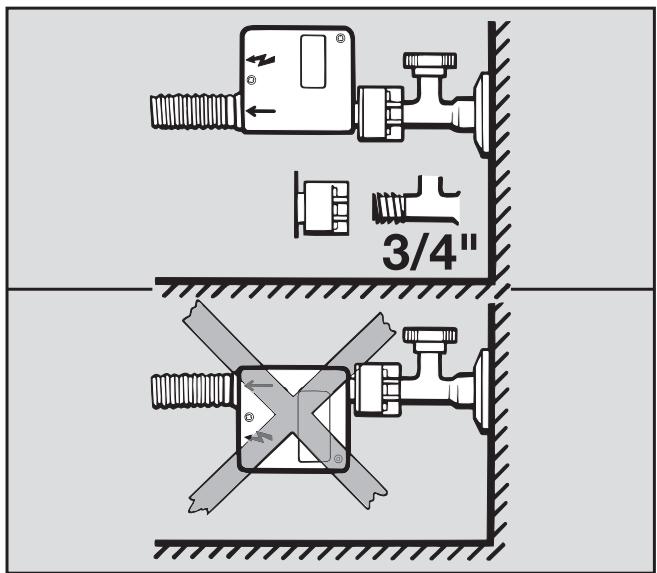
If this is not possible, it can be installed horizontally, but it is essential that the main body of the "Waterproof valve" box is above the hose exit (see illustration). The 'lightning' power symbol should be above the water flow 'arrow'.
There must be a distance of at least 20 cm between the floor and the bottom of the "Waterproof" unit housing, for either vertical or horizontal installation.
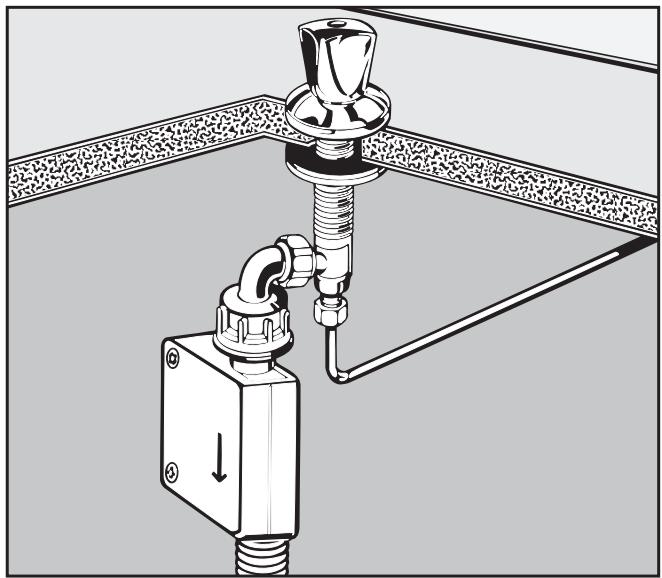
If the stopcock is situated in the worktop, a special angle connector can be ordered from the Miele Spare Parts Dept. (Part No. 2078910).
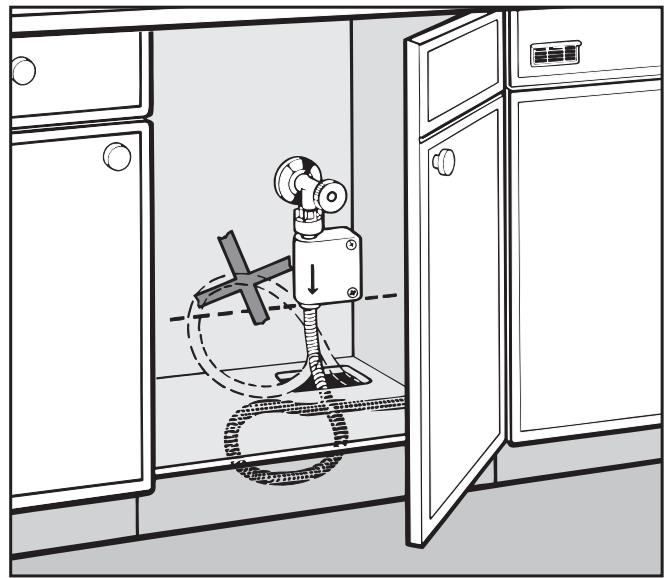
- Lay the hose in such a way that it does not rise above the bottom of the "Waterproof" unit casing (see illustration).
Drainage
The machine drainage system is fitted with a non-return valve, which prevents dirty water from flowing back into the machine via the drain hose. The dishwasher is supplied with approx. 1.5 m of flexible drain hose with an internal diameter of 22 mm. The drain hose can be extended using a connection piece and an extra drain hose, (up to max. 4 metres). If the hose is to be directly fitted to the drainage outlet on site, use the hose clip supplied. The connection socket on the dishwasher can be turned. The hose can thus be laid to the right or left without needing to loosen the hose clip. The drain system must not exceed 4 metres. The drain pump has a maximum delivery head of 1 metre. The drain hose must not be shortened.
Venting the drainage system
- Open the dishwasher door fully.
If the site drain connection is situated lower than the guide path for the bottom basket rollers in the open door the drainage system must be vented.
Otherwise a siphoning effect during a programme can cause the machine to empty itself of water.
To vent:
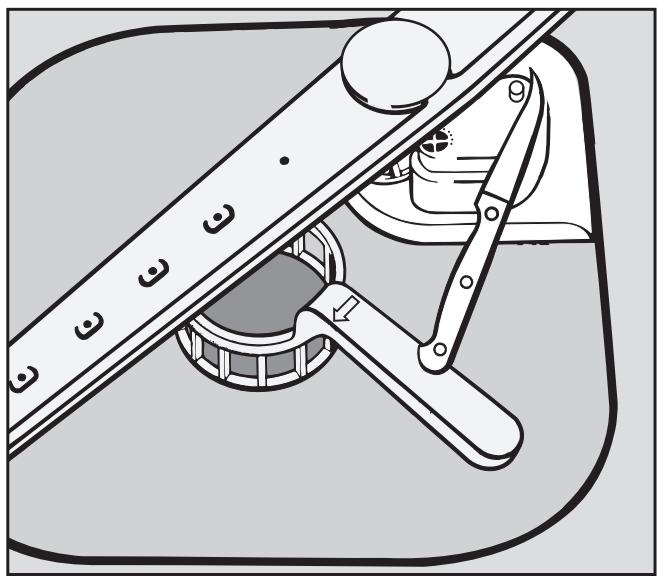
Cut off the top of the vent valve in the wash cabinet.
Height Freestanding
Height U- and i-models
Width
Width of building in recess
Depth
Depth with door open
Voltage
Rated load
Fuse rating
Test marks
Water pressure (flow rate)
Hot water connection
Delivery head
Drainage length
Connection cable
Capacity
85 cm (adjustable + 1.0 cm)
82 cm (adjustable + 5.0 cm)
59.8 cm
60 cm
60 cm (Freestanding model)
57 cm (U- and i-models)
118.5 cm (Freestanding model)
115.5 cm (U- and i-models)
} see data plate
VDE, Radio and Television suppressed
1.0 - 10 bar pressure
max. 60°C
max. 1 m
max. 4 m
approx. 1.7 m
12 place settings
United Kingdom
Miele Co. Ltd.
Fairacres, Marcham Road, Abingdon, Oxon, OX14 1TW
tel. Abingdon (01235) 554455 - fax (01235) 554477
Service Office, tel. Abingdon (01235) 554466
Ireland:
Miele Ireland Ltd.
Wilton House, Naas Road, Dublin 22
Tel. (01) 4504024, Fax (01) 4504037